Article

Integrating Computer Vision and GIS for Large-Scale Morphological Mapping and Driving Force Analysis of Vernacular Courtyard Dwellings

1
School of Architecture, Changsha University of Science and Technology, Changsha 410076, China
2
School of Architecture and Planning, Hunan University, Changsha 410082, China
*
Author to whom correspondence should be addressed.
Buildings 2026, 16(6), 1118; https://doi.org/10.3390/buildings16061118

Submission received: 21 January 2026 / Revised: 24 February 2026 / Accepted: 10 March 2026 / Published: 11 March 2026
(This article belongs to the Special Issue Artificial Intelligence in Architecture and Interior Design)

Abstract

This study develops and applies an integrated methodology that combines deep learning-based computer vision and spatial statistics to automate the large-scale identification and analysis of morphological features in vernacular courtyard dwellings. Focusing on Liangshuaixiu dwellings in Wu’an, southern Hebei, we trained an HRNetV2 semantic segmentation model on high-resolution satellite imagery to identify and extract contours for 134,280 courtyard spaces. Core morphological parameters (area, orientation) were calculated and analyzed using GIS spatial statistics and the geographic detector model. The results show that (1) the computer vision pipeline achieved efficient recognition with satisfactory accuracy (~10% mean error); (2) spatial autocorrelation and hotspot analysis revealed distinct regional patterns, including a west–east increase in average courtyard area; and (3) geographic detector analysis demonstrated that courtyard morphology is shaped by complex interactions between natural and socio-economic factors. While average area and orientation were primarily governed by climate (air pressure, wind, temperature) and topography (elevation), diversity and internal variation were strongly influenced by nonlinear interactions, particularly between natural factors (e.g., wind–aspect) and between natural and human factors (e.g., population–climate). This work provides a scalable, data-driven framework for the quantitative spatial analysis of vernacular architectural heritage, advancing the understanding of building morphology as an outcome of coupled human–environment systems.

1. Introduction

1.1. Vernacular Architecture and Courtyard Dwellings

Vernacular architecture refers to indigenous building traditions that emerge spontaneously, shaped by specific regional cultures, climatic conditions, available material resources, and socio-economic structures, typically without the involvement of professionally trained architects [1,2,3,4]. Functioning as a wordless local chronicle, it tangibly embodies community memory, environmentally adaptive construction wisdom, and unadorned esthetic values [5,6,7,8]. Across the vast rural and urban landscapes of China, courtyard houses stand out as one of the most representative and widely distributed forms of vernacular architecture [9,10]. In particular, the courtyard dwellings of southern Hebei bear the distinct imprint of the North China Plain’s natural environment, Confucian ritual principles, clan-based settlement patterns, and local construction techniques developed since the Ming and Qing dynasties [11]. They are characterized by a courtyard-centric layout, buildings enclosing the yard, defined central axes, and a pronounced hierarchical order [12]. These courtyard dwellings are not merely essential living spaces but also concentrated expressions of regional culture, social structure, and ecological intelligence [13,14]. Consequently, a systematic understanding of their spatial distribution patterns and morphological characteristics is not just an architectural pursuit, but a crucial foundation for interpreting the region’s traditional settlement landscape, human settlement wisdom, and cultural continuity [15,16].

1.2. Traditional Research Paradigms and Their Limitations

Research on vernacular architecture in southern Hebei and beyond has long been underpinned by methodologies from architecture, historical geography, and sociology. Traditional paradigms typically involve: (1) in-depth fieldwork, measurement, and documentation of representative case studies to obtain precise plan, elevation, and detail data [17,18,19,20,21]; (2) tracing architectural evolution and socio-cultural context by consulting historical documents such as local gazetteers, genealogies, and craftsmen’s manuals [22,23]; and (3) classifying, comparing, and summarizing formal characteristics based on collected cases [24,25,26]. These qualitative approaches have yielded substantial insights, forming the bedrock of our knowledge about traditional building practices and typologies.
However, when confronted with the vast quantity and wide distribution of vernacular architecture, these traditional paradigms reveal significant methodological limitations. First, reliance on manual fieldwork is time-consuming and labor-intensive, making large-scale, comprehensive surveys impractical [27]. Consequently, conclusions are often drawn from a limited number of canonical cases, which, while rich in detail, may introduce sampling bias and fail to capture the full spectrum of architectural diversity. Second, the manual processes of surveying and feature identification are inherently slow, rendering them ill-suited for rapidly processing and synthesizing information from vast repositories of building imagery or map data [28]. Finally, and most critically, traditional methods emphasize qualitative description and typological classification. While valuable for establishing cultural and historical narratives, this focus has left the systematic quantitative analysis of spatial attributes such as courtyard scale, orientation, and proportional relationships relatively underdeveloped [29]. This methodological gap fundamentally limits our capacity to move beyond case-based interpretation and uncover the underlying distribution patterns and morphological regularities that exist at a macro geographical scale.

1.3. Application of Artificial Intelligence in Vernacular Architecture Studies

Recent rapid advances in artificial intelligence (AI), particularly computer vision technologies centered on deep learning, have provided revolutionary tools for the large-scale, automated analysis of the built environment [30]. Their application spans diverse fields, from cultural heritage preservation [31,32] and urban planning [33,34] to architecture analysis [35,36]. Within these domains, a distinction can be drawn between studies focused on architectural style and those centered on spatial analysis. For instance, research in architecture has employed convolutional neural networks (CNNs) for tasks like automated building type classification from street-view or historical photographs [37,38,39] and even utilized generative adversarial networks (GANs) for architectural style transfer [40,41,42]. In contrast, work more aligned with remote sensing and spatial analysis has focused on semantic segmentation to extract building elements such as roof outlines from satellite imagery [43,44], or on leveraging geospatial data for large-scale urban morphology quantification [45,46].
Applying these techniques to vernacular architecture research holds the potential to overcome the bottlenecks inherent in traditional methods. By processing high-resolution remote sensing imagery and open map data, computer vision approaches can: (1) enable efficient large-scale identification and geolocation of specific building types [47]; (2) automate the extraction of morphological features like building footprints and axial orientations [45]; and (3) support quantitative statistical analysis of massive datasets to reveal previously obscured spatial patterns and correlations [46].
Despite this potential, a critical research gap remains. Existing studies have largely applied AI either to generic historical building classification or to coarse-grained urban morphology analysis. Its systematic use for the detailed mapping and feature analysis of a specific, regionally defined courtyard type, particularly one as culturally significant as the “Liangshuaixiu” dwelling, is nascent. There is a clear absence of an integrated methodological framework that synthesizes advanced computer vision techniques with deep-seated domain knowledge from architecture and cultural geography [48]. Bridging this gap is the central contribution of this paper. This study transcends the boundaries of extant approaches by moving beyond mere classification to a high-precision, quantitative investigation of the courtyard’s core spatial morphology. In doing so, it not only aims to establish a comprehensive digital archive for the cultural heritage of southern Hebei but also, through a data-driven lens, to reveal quantitative patterns and spatial heterogeneity in human–environment interactions that have long been obscured by qualitative description. This advancement is intended to propel vernacular architecture research from traditional, case-based interpretation towards a spatial-scientific analysis grounded in large, empirical samples.

1.4. Research Objectives

This research addresses the identified methodological gap by establishing a novel, interdisciplinary framework that integrates architecture, geographic information science, and computer vision. Beyond merely constructing a technical workflow, the central aim is to generate new, empirically grounded knowledge about vernacular architecture that has been inaccessible through traditional methods. The study will explicitly advance professional understanding in three key areas, shifting the discourse from qualitative typology to quantitative, spatially explicit analysis. The specific research objectives are as follows:
(1)
To develop an automated identification and feature extraction model. Construct and train a deep learning model adapted to the rural environment of southern Hebei, enabling the automatic detection and contour segmentation of Liangshuaixiu dwelling spaces from satellite imagery, and the batch extraction of core morphological parameters, with a focus on courtyard area and primary orientation angle.
(2)
To reveal the spatial distribution patterns of courtyard morphology. Based on the extracted regional-scale dataset of courtyard features, employ spatial statistical methods to systematically delineate the spatial distribution patterns of courtyard area and orientation in southern Hebei. This involves identifying spatial clusters, transitional zones, and anomalies to explore underlying regional differentiation patterns.
(3)
To investigate the influence mechanisms of physical geographical factors. Spatially overlay the courtyard morphology dataset with natural environmental variables and conduct correlation analysis. Utilize models such as geographically weighted regression (GWR) to quantitatively identify and assess the degree of influence and spatial heterogeneity of different physical geographical factors on courtyard spatial morphology (particularly area and orientation), explaining the causes of morphological variations from a human–environment interaction perspective.
The anticipated outcomes of this research will provide detailed, panoramic data support for the conservation of traditional settlements and architecture in southern Hebei. By fulfilling these objectives, the study will not only generate new, data-driven insights into the vernacular architecture of this specific region but also establish an extensible quantitative methodology for cross-regional comparative studies. Ultimately, this work aims to propel architectural cultural heritage research from a case-based interpretive tradition into a new paradigm grounded in data-intensive, spatially explicit scientific analysis.

2. Materials and Methods

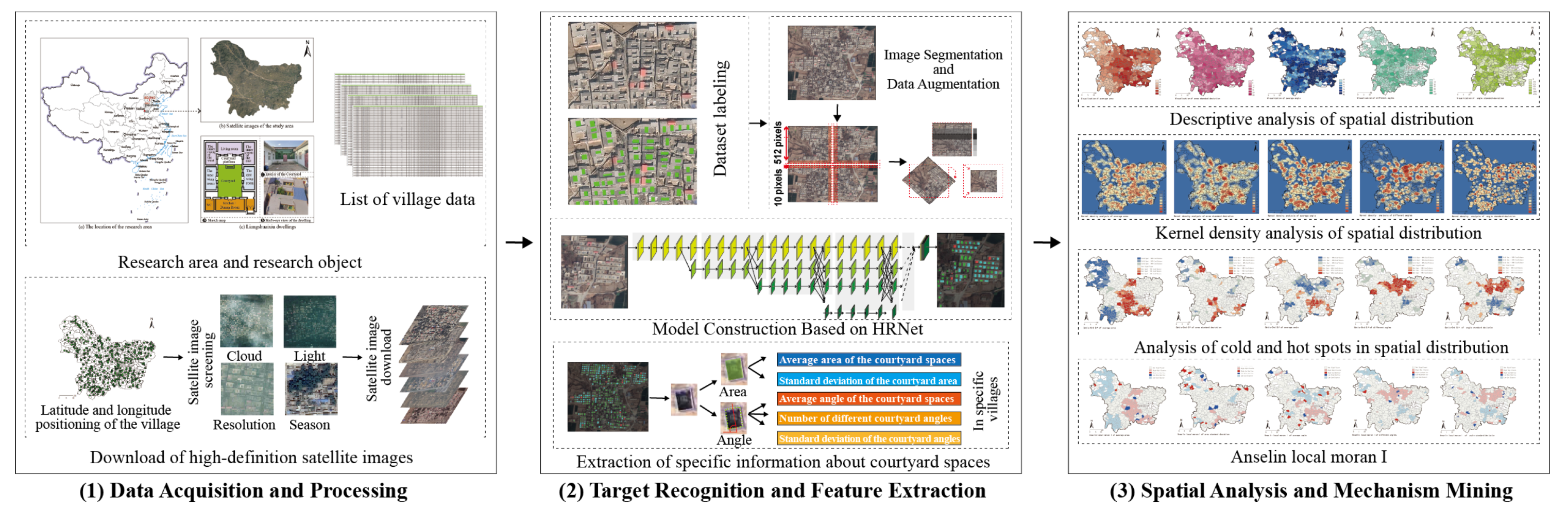
The overall research workflow follows the logic of “Data Acquisition and Processing → Target Identification and Feature Extraction → Spatial Analysis and Mechanism Exploration.” It aims to deeply integrate the automated recognition capability of computer vision, quantitative descriptive methods for architectural morphology, and the spatial analysis functions of Geographic Information Systems (GISs, ArcGIS 10.8) to reveal the macroscopic patterns and driving factors of the courtyard morphology of Liangshuaixiu dwellings in the Wu’an region of southern Hebei (Figure 1).

2.1. Geographical Context and Target Subjects

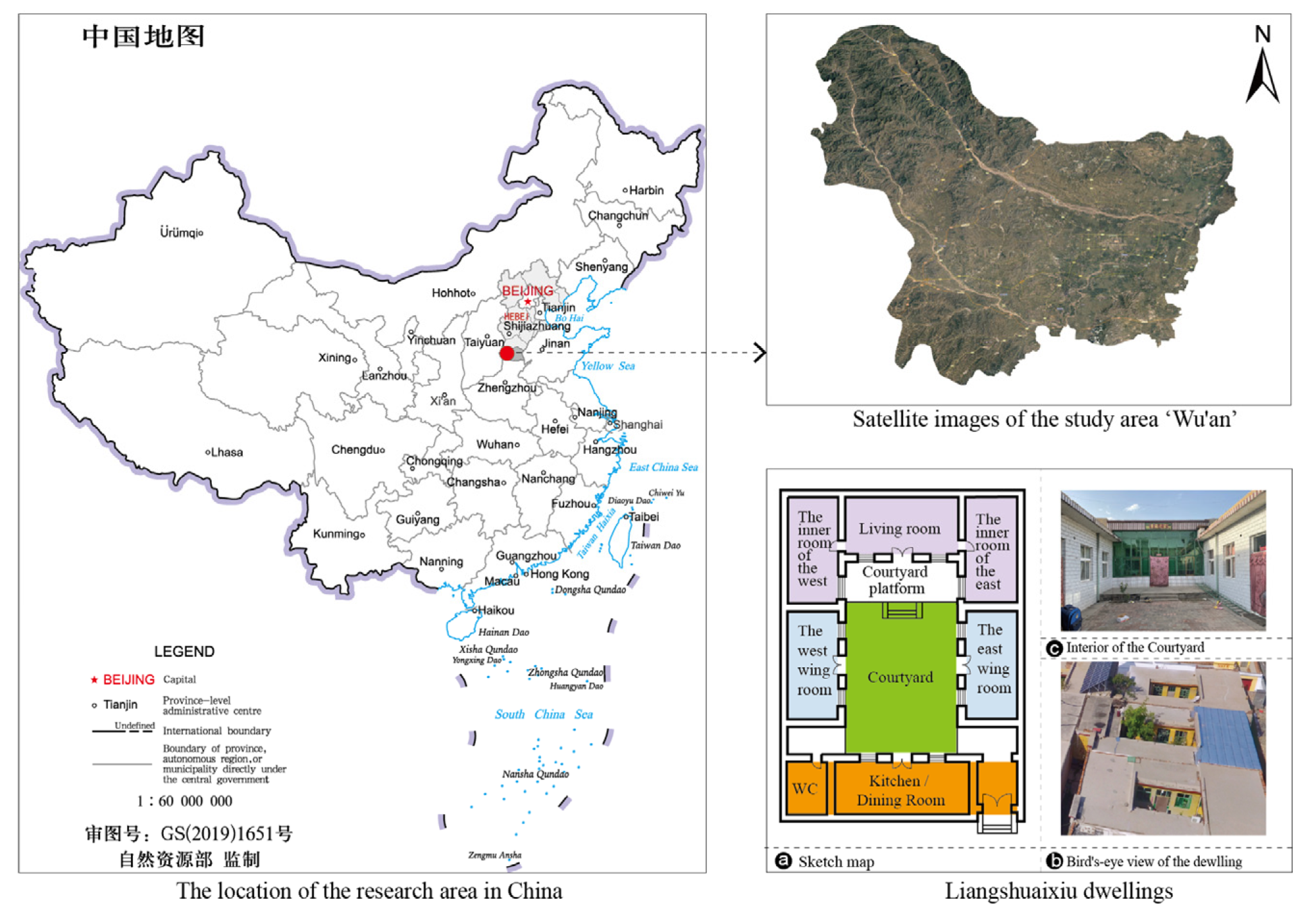
This study takes all rural settlements within Wu’an City, Hebei Province as the study area (Figure 2). Wu’an is located on the eastern foothills of the Taihang Mountains in southern Hebei, representing a typical transitional zone between the North China Plain farming area and low mountainous/hilly terrain [49]. The area features a rich variety and wide distribution of courtyard house types, with the Liangshuaixiu form being relatively well-preserved and distinct in its characteristics. This makes Wu’an an excellent sample area for studying courtyard dwellings of southern Hebei. The selection of Wu’an balances regional representativeness (representing the core cultural area of southern Hebei), topographic diversity (encompassing plains, hills, and mountains, facilitating environmental adaptability analysis), and data accessibility (availability of clear satellite imagery and fundamental geographic data).
The specific research subject is the courtyard space of traditional dwellings exhibiting a clear Liangshuaixiu layout within the rural settlements of Wu’an. Liangshuaixiu is a variant of the traditional Siheyuan (quadrangle courtyard). It typically refers to the layout where the bedrooms flanking the main north hall extend southward, connecting with the east and west wing rooms. All buildings of the dwelling are connected end-to-end, usually with flat roofs, forming a geometrically regular and highly enclosed courtyard space [50]. This form is widely distributed in the countryside of Handan, Xingtai, and other areas in southern Hebei [46]. In terms of image characteristics, the criteria for identifying a Liangshuaixiu dwelling are: an open-air courtyard enclosed by a main building, two wing buildings, and an opposite building (or courtyard wall), resulting in at least three sides being surrounded by structures. Exclusion criteria include: courtyards that have undergone complete modern reconstruction, courtyards completely obscured by large structures or trees, and courtyards that cannot be clearly interpreted due to poor image quality.

2.2. Satellite Imagery Collection

This study systematically downloaded high-resolution satellite imagery covering all administrative villages within Wu’an City using the “Shuijing Weitu” software (Rivermap V4.3.24). The imagery was primarily from 2009 to the present to reflect the relatively stable recent rural building pattern while avoiding significant loss of traditional forms due to large-scale new rural construction [47]. Priority was given to winter imagery (November to February). During this period, vegetation in northern China is leafless, minimizing tree occlusion of buildings and courtyards, which maximizes visible courtyard area and improves recognition accuracy. All selected imagery met the requirements of being cloud-free, having clear imaging (no severe haze or shadows), and possessing a spatial resolution better than 0.6 m. The downloaded images were mosaicked, cropped (by administrative village), and projected into the CGCS2000 coordinate system. Furthermore, individual villages whose imagery did not meet the quality standards for computer vision recognition were excluded to ensure the final recognition accuracy.

2.3. Computer Vision Technology

To precisely segment courtyard spaces from the massive imagery, a computer vision framework based on deep learning semantic segmentation was constructed. The core algorithm used was HRNetV2 (High-Resolution Network). This network is renowned for its unique architecture that maintains high-resolution feature representations throughout [51]. In semantic segmentation tasks, it is particularly adept at preserving spatial details and geometric structures of targets. The specific advantage of HRNetV2 over conventional encoder–decoder architectures (e.g., U-Net) lies in its parallel multi-resolution subnetwork design. Unlike U-Net, which progressively downsamples and then upsamples, often leading to a loss of fine spatial detail, HRNetV2 maintains high-resolution representations throughout the entire process and repeatedly exchanges information across parallel resolutions. This enables more precise delineation of targets like “courtyards,” which often have complex, irregular boundaries and, in some instances, low contrast with surrounding buildings or roads [52]. This architectural choice is therefore critical for achieving the high-fidelity geometric data required for subsequent quantitative morphological analysis [42].
Sample image patches containing typical Liangshuaixiu courtyards were manually selected from the study area imagery. Using the annotation tool LabelMe, pixel-level semantic segmentation annotation was performed, defining three classes: Courtyard, Building, and Background. Annotation was carried out by architecture professionals to ensure that the judgment of “courtyard” conformed to architectural definitions. Ultimately, a dataset containing thousands of annotated courtyard samples was built and divided into training, validation, and test sets.
Within the PyTorch framework (version 2.6.0), transfer learning was performed using a pre-trained HRNetV2 model on the custom dataset. During training, the cross-entropy loss function and the Adam optimizer were employed, and data augmentation (e.g., rotation, flipping, color jitter) was applied to enhance model generalization. The validation set was used to monitor performance and prevent overfitting.
For inference and post-processing, the trained model was applied to the imagery of the entire study area for batch inference, producing a probability map for each pixel belonging to the “Courtyard” class. A threshold (0.5) was applied to convert this into a binary segmentation map. Subsequently, morphological operations (e.g., closing to remove small holes, opening to smooth boundaries) were performed to optimize the segmentation results [47]. Connected component analysis was then used to extract vector polygon files representing the contour of each independent courtyard.

2.4. Calculation of Courtyard Spatial Morphological Parameters

Based on the identified courtyard contour vector data, two core types of morphological parameters were calculated: courtyard area and dominant orientation angle.

2.4.1. Courtyard Area Calculation

(1)
Area conversion and calibration
The courtyard area output by the model is based on pixel count. Using the georeferencing information of the satellite imagery (ground distance per pixel), the pixel area was converted to actual ground area in square meters. To verify conversion accuracy, several courtyards with known dimensions were measured on-site, and the results were compared with model calculations for calibration, ensuring systematic error was within an acceptable range.
The model-calculated courtyard area is derived as
A model = N × ( GSD ) 2
where
A model : Model-calculated courtyard area (m2).
N : Total number of pixels within the courtyard contour polygon.
GSD : Ground Sampling Distance of the imagery (m/pixel), i.e., spatial resolution.
The absolute error Δ A i and relative error δ i for a single sample are
Δ A i = A model , i A field , i
δ i = | Δ A i A field , i | × 100 %
where
A field , i : Field-measured area of the i-th courtyard (m2).
The Root Mean Square Error (RMSE), characterizing overall accuracy, is
RMSE = 1 m i = 1 m ( Δ A i ) 2
(2)
Village-scale average courtyard area
Each courtyard was assigned to its respective administrative village. The arithmetic mean of the areas A v ¯ of all identified courtyards within a village was calculated as an indicator of the central tendency of courtyard scale for that village:
A v ¯ = 1 n v i = 1 n v A i
where n v is the number of courtyards in village v.
(3)
Village-scale measure of courtyard area consistency
The Coefficient of Variation (CV) was used to measure the dispersion of courtyard areas within the same village, reflecting the uniformity or diversity of courtyard scale in that locality:
A v ¯ = 1 n v i = 1 n v A i
where σ A v is the standard deviation of courtyard areas in village v. A smaller CV value indicates greater similarity in courtyard areas within the village.

2.4.2. Courtyard Orientation Calculation

(1)
Calculation of individual courtyard orientation angle
The Minimum Bounding Rectangle (MBR) was calculated for each courtyard polygon using the minimum area enclosing rectangle method. The direction (azimuth, 0–90°) of the rectangle’s long side was defined as the primary orientation of the courtyard. In the context of North China courtyard houses, this direction typically represents the orientation of the main building (the ideal south-facing orientation is 90°). This simplification is theoretically justified by the geometric properties of the Liangshuaixiu form, which is characterized by a highly regular, orthogonal layout. In such cases, the long axis of the MBR reliably corresponds to the principal axis of the entire dwelling complex, making it a robust and efficient proxy for the building’s orientation. While this method may be less accurate for irregularly shaped plots, its application to a highly standardized vernacular type ensures a high degree of validity for large-scale analysis.
(2)
Village-scale overall orientation calculation
For circular angular data, the average direction was calculated at the village scale. First, each courtyard’s angle was converted into a unit vector. The vector sum was calculated, and then the average angle was derived inversely.
r ̄ = 1 n i = 1 n r i
where
r ̄ : Average resultant length (also known as mean resultant length).
n : Total number of buildings/courtyards.
r i : Unit vector component for the i-th building.
(3)
Village-scale measure of orientation consistency
Village-scale orientation consistency is characterized using two metrics. On the one hand, the number of unique orientation angles within a specific village is calculated to represent angular diversity. The formula is as follows:
U   =   | { r i i   =   1 n } |
where
U: Number of unique values.
r i : Orientation angle (rotate value) of the i-th building.
i : Index variable, ranging from 1 to n .
On the other hand, the standard deviation of angles is used as a dispersion metric to quantify the deviation of courtyard orientations within a village:
s 2 = 1 n 1 i = 1 n ( r i r ̄ ) 2
where
s 2 : Sample variance (indicating data dispersion).
n : Total number of buildings.
r i : Orientation angle (rotate value) of the i-th building.
r ̄ : Mean value of the orientation angles.

2.5. GIS Analysis and Geographic Detector

All calculated courtyard morphological parameters (area, orientation) were associated with their spatial location points (courtyard centroids) as attributes, constructing a spatial geodatabase of courtyard morphology.
(1) Spatial distribution characteristics and pattern analysis: Visual Mapping: Thematic maps were generated for the spatial distribution of courtyard area, orientation (discretized into several main directional intervals), and village-level statistical indicators (average area, orientation concentration).
Spatial Autocorrelation Analysis: Global Moran’s I was used to determine whether a particular morphological parameter (e.g., courtyard area) across the entire region exhibited a significant spatial clustering pattern [51]. Subsequently, Local Moran’s I and Getis-Ord Gi* hotspot analysis were used to precisely identify “High-High” clusters (hotspots), “Low-Low” clusters (coldspots), and spatial outlier areas.
(2) Factor Detection: To explore the driving forces behind the spatial differentiation of courtyard morphology, the Geographic Detector model was introduced. Potential influencing factors (X) were selected, and their continuous variables (e.g., elevation, distance to water) were appropriately discretized. To ensure the robustness and interpretability of our findings, we adopted a theoretically informed and empirically validated approach to discretization: Elevation and Slope were discretized using the natural breaks (Jenks) method. This approach is appropriate as it inherently seeks to minimize within-group variance and maximize between-group variance, effectively identifying meaningful thresholds in the natural landscape where environmental conditions change significantly. The proximity variables, such as Distance to Water and Roads, were discretized using quantiles, ensuring a relatively balanced number of samples in each category.
Factor Detector: Used to detect the explanatory power (q statistic) of various influencing factors (e.g., elevation zone, slope zone, aspect category, distance to major water bodies, distance to major roads, mean annual temperature, annual precipitation, village population density, per capita cultivated land area, etc.) on the spatial differentiation of courtyard morphological parameters (e.g., average area, orientation angle). The q-value range is [0, 1]; a larger value indicates stronger explanatory power of that factor [53].
Interaction Detector: Assesses whether the explanatory power for the morphological parameter is enhanced, weakened, or independent after the interaction of any two influencing factors. This helps reveal the complex synergistic influence mechanisms between physical geographical and socio-economic factors.
Through this series of spatial statistical and attribution analyses, this study aims to quantitatively reveal the underlying spatial patterns of Liangshuaixiu courtyard morphology in Wu’an at a macroscopic scale and scientifically identify the underlying natural and human driving factors and their interactions.

3. Results

3.1. Recognition Accuracy and Data Calibration

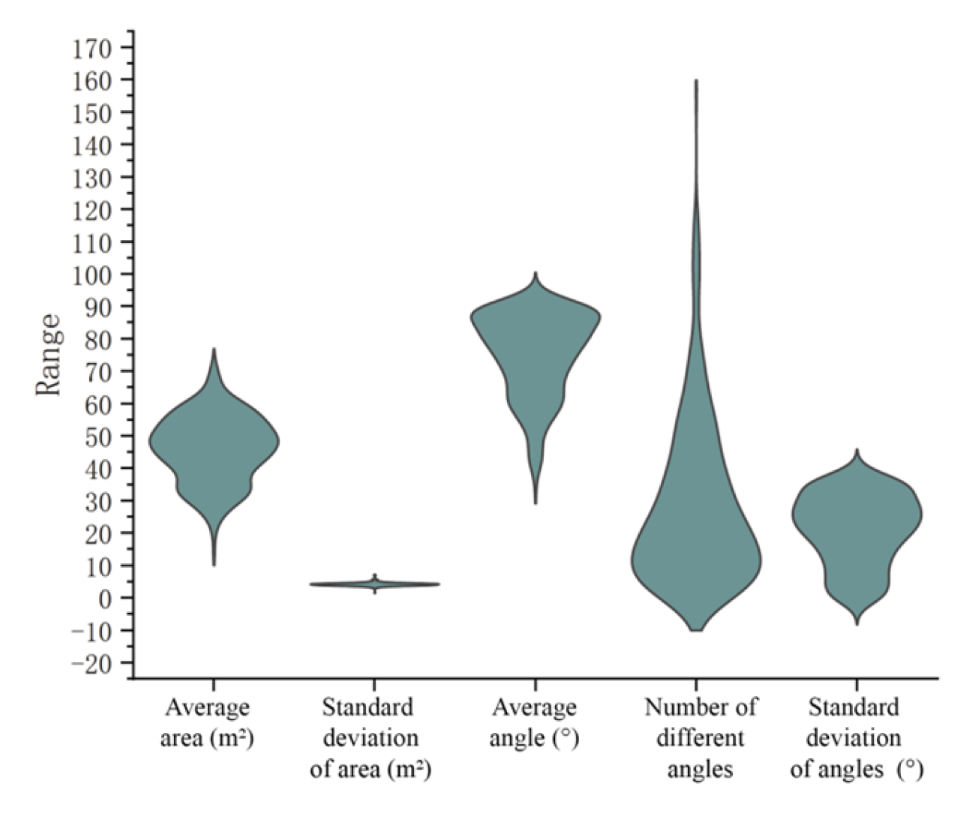
High-resolution satellite imagery was downloaded for all 450 villages in Wu’an, leading to the identification of 134,280 Liangshuaixiu dwellings. For each village, the average courtyard area, the standard deviation of the area, the average courtyard orientation angle, the number of distinct orientation angles, and the standard deviation of the angles were calculated, as illustrated in Figure 3.
The average courtyard area ranged from 13.51 m2 to 72.43 m2, with the majority of values concentrated around 46.83 m2. The distribution of the area standard deviation was narrower, spanning from 0.96 m2 to 7.07 m2 and predominantly clustering around 4.22 m2. Regarding the average orientation angle, values ranged from a minimum of 33.07° to a maximum of 90.00° (indicating a due south orientation for the main building), with most values centered around 75.30°. The number of distinct courtyard orientation angles per village varied significantly; the maximum observed was 157 (indicating a high degree of variation), while the most uniform village had all buildings sharing the same orientation. The median number of distinct angles was 21. The standard deviation of orientation angles ranged from 0° to 39.62°, with the most frequent values concentrated around 21.01°.
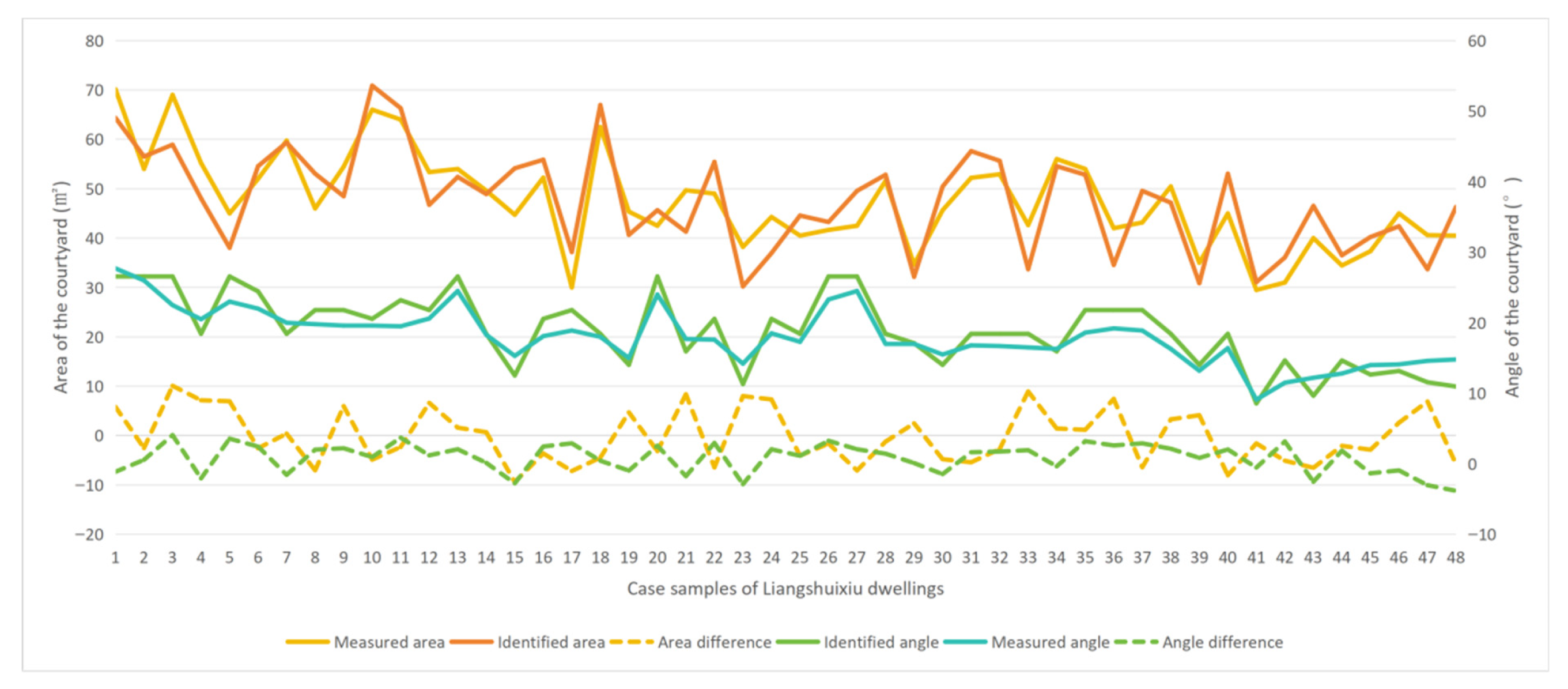
A random sample of 48 Liangshuaixiu dwellings was selected to validate the accuracy of the computer vision recognition results (Figure 4). For courtyard area recognition, the maximum absolute error was +10.09 m2 (approximately 14.62% of the measured area), while the minimum error was +0.39 m2. On average, the absolute difference between the measured and recognized area values was 4.81 m2, corresponding to about 10.13% of the average courtyard area. For orientation angle recognition, the largest error was +4.07° (approximately 18.09% of the measured angle), and the smallest error was 0° (for angles consistently identified as 90°). The mean absolute error was 1.99°, representing about 10.97% of the average orientation angle.
Overall, the average recognition errors for both courtyard area and orientation were approximately 10%, with maximum errors reaching around 18%. This level of accuracy is considered acceptable for the purposes of this study, which focuses on identifying macro-scale spatial patterns and regional trends rather than precisely characterizing individual dwellings. However, the observed systematic overestimation of area, combined with the sample size limitations of the validation set, implies that while the spatial patterns and relative differences reported in subsequent sections are robust, the absolute values of courtyard area should be interpreted with appropriate caution.

3.2. Morphology and Distribution Characteristics of Courtyards

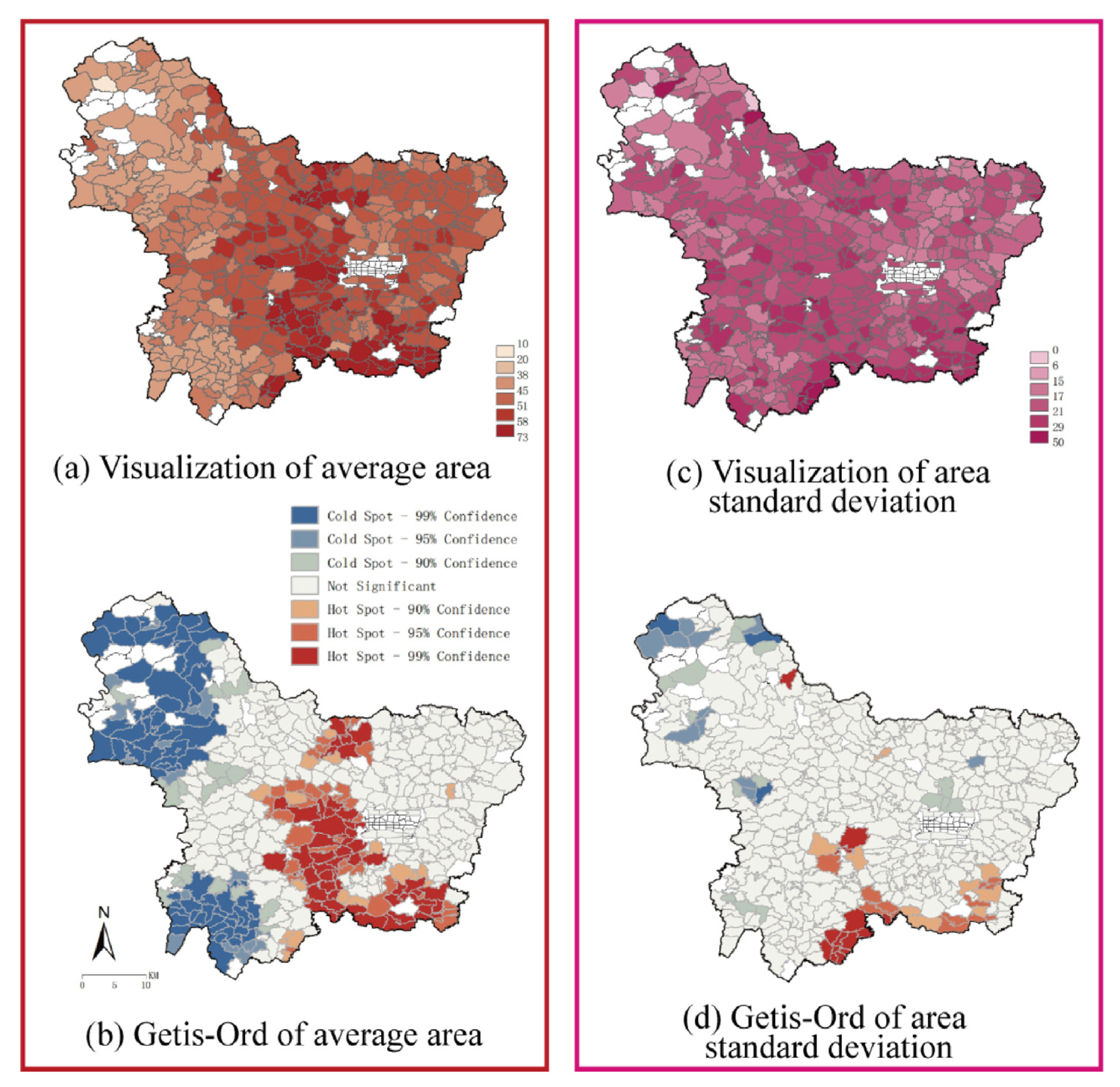
The courtyard area of Liangshuaixiu dwellings exhibits significant variation and distinct geographical distribution patterns, as shown in Figure 5. A general west-to-east gradient is apparent, with smaller courtyards predominantly located in the west and larger ones in the east. Larger courtyards, typically ranging from 58 m2 to 73 m2, are clustered in the central part of Wu’an County. In contrast, the average area of courtyards in the west is only 10–20 m2, while those in the east mostly range between 38 m2 and 45 m2.
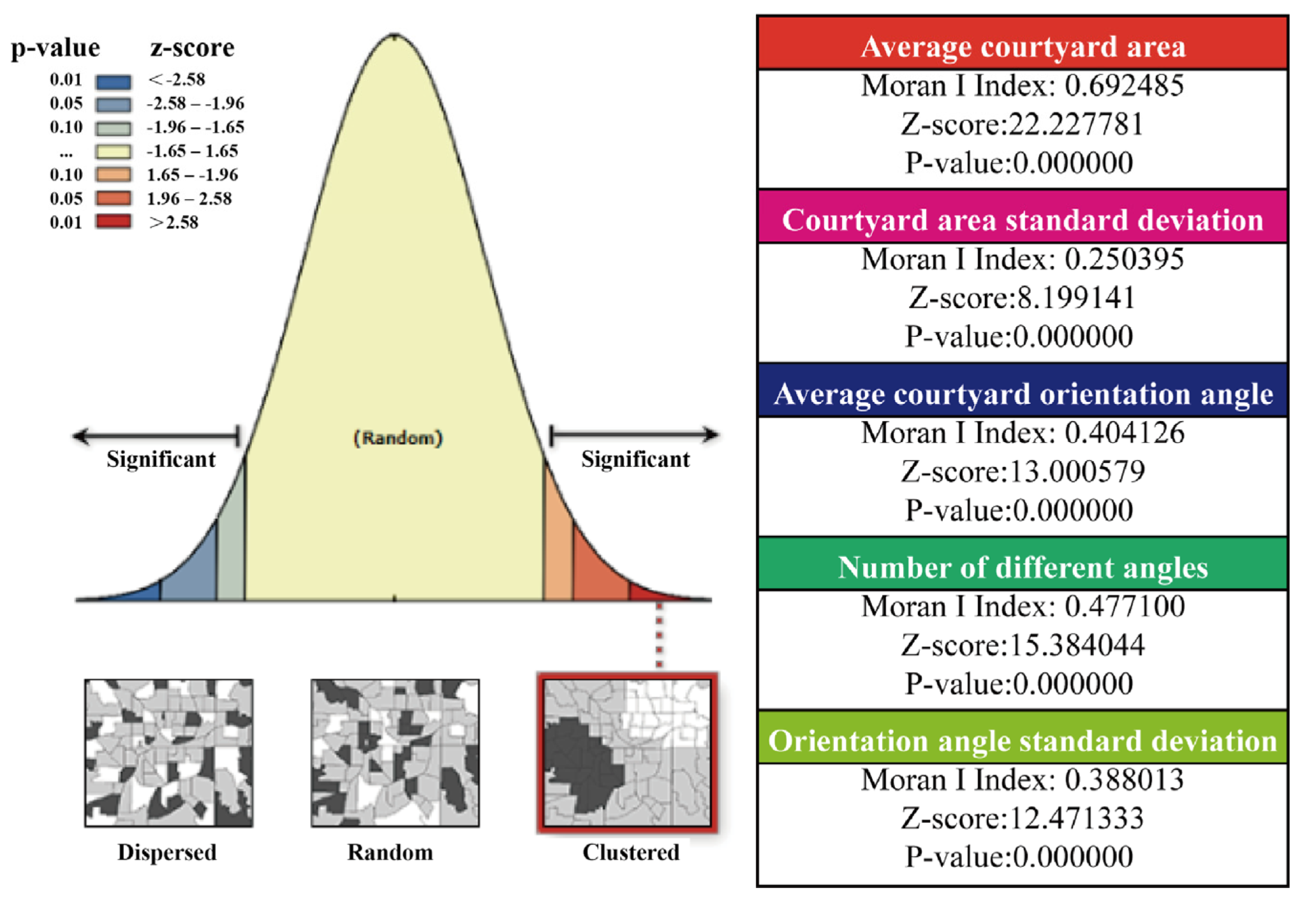
The results of cold and hot spot analysis further corroborate these observations. Spatial autocorrelation analysis reveals a significant clustering trend for courtyard area size, with a Moran’s I index of 0.69 and a z-score of 22.22 (Figure 6). Hot spots (areas with significantly larger courtyards) are concentrated in the central region of the county, whereas cold spots (areas with significantly smaller courtyards) are distributed in the western part.
Furthermore, the standard deviation of courtyard area was calculated for each village to characterize the internal consistency of courtyard sizes (Figure 5). In contrast to the clear gradient observed for average area, the spatial analysis indicates that the consistency of courtyard area is less distinctly patterned. Generally, the standard deviation is slightly lower in the northern regions compared to the south. Spatial autocorrelation analysis for the area standard deviation yielded a Moran’s I index of 0.25 and a z-score of 8.20 (Figure 6). This suggests that, although the degree of spatial clustering for the area standard deviation is less pronounced than for the average area, a statistically significant clustering trend still exists. Specifically, cold spots for the area standard deviation are located in the northwest, while hot spots are aggregated in the southern regions.
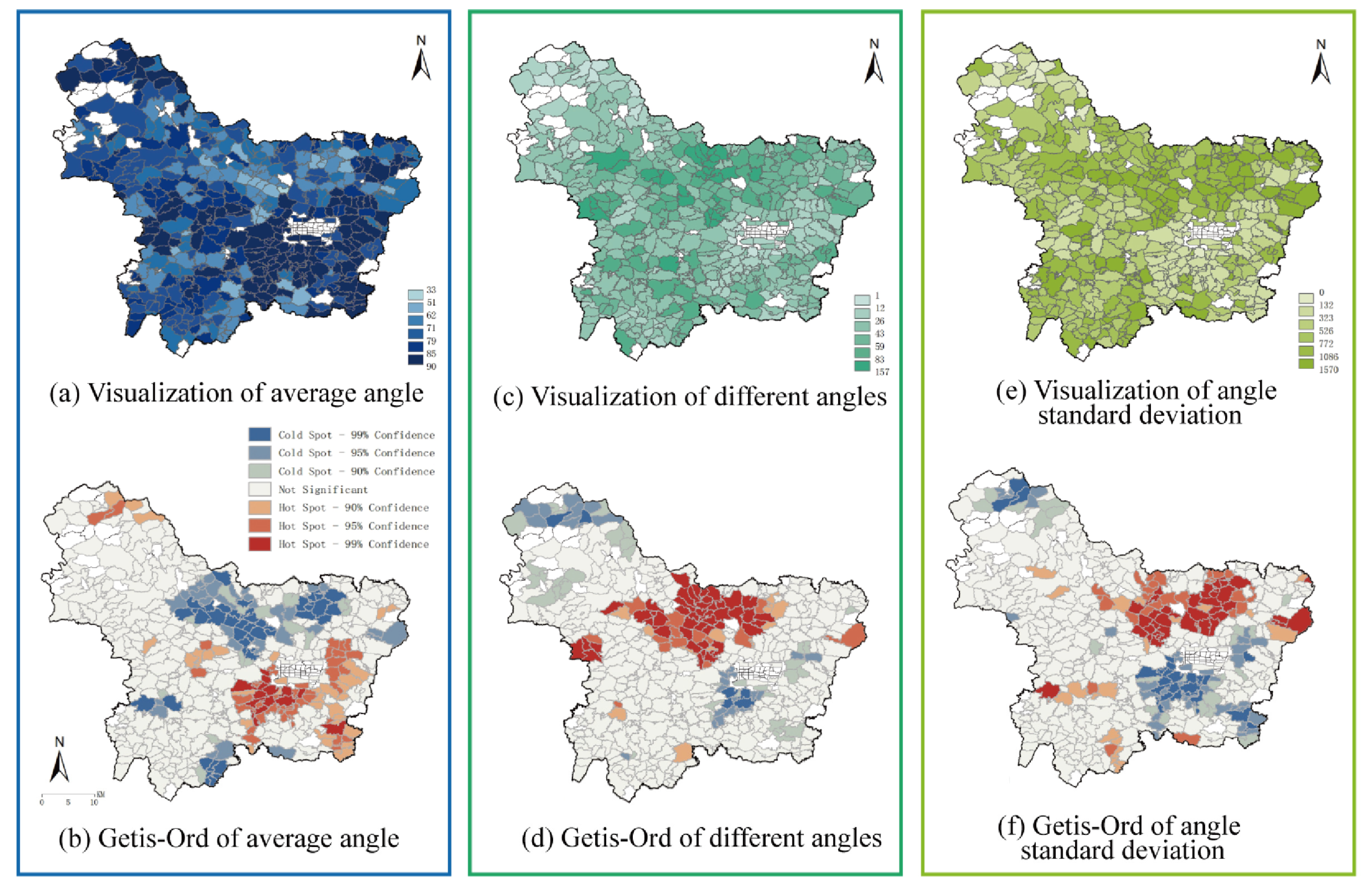
Regarding courtyard orientation, layouts oriented due north–south (around 90°) are primarily concentrated in the southeastern part of the study area, particularly surrounding Wu’an county town (Figure 7). A portion of Liangshuaixiu dwellings in the northwest also exhibit orientations clustered around 90°. Overall, villages with the highest average orientation angles (close to due south–north) are aggregated in the southeast, while those with smaller average angles (closer to east–west orientation) are concentrated in the northeastern part of the study area. Spatial autocorrelation results show a Moran’s I index of 0.40 and a z-score of 13.00, indicating that the spatial clustering of the average orientation angle is statistically significant and non-random.
To move beyond this central tendency, the number of distinct orientation angles per village was counted to characterize the diversity in courtyard orientation (Figure 7). Spatially, areas with a higher count and thus greater orientation diversity are mainly located in the peripheral zones at a moderate distance from the county town. Diversity decreases in areas very close to or very far from the town. Cold and hot spot analysis shows that villages with the highest angle counts are concentrated north of the county town, while diversity decreases in the immediate suburbs and the remote northwestern areas. Spatial autocorrelation yields a Moran’s I index of 0.47 and a z-score of 15.38, confirming that the spatial clustering of orientation diversity is statistically significant and not random (Figure 6).
Similarly, the standard deviation of courtyard orientation angles was calculated for each village and its spatial distribution was mapped (Figure 7). Overall, the spatial pattern of the orientation standard deviation shows some similarity to that of orientation diversity. Areas with a larger standard deviation are also concentrated in the peripheral zones farther from the county town, with hot spots located north of the town. Conversely, villages with a smaller standard deviation are clustered in the near suburbs and the remote northwest. Spatial autocorrelation analysis for the orientation standard deviation results in a Moran’s I index of 0.39 and a z-score of 12.47, demonstrating that its spatial clustering is also statistically significant (Figure 6).

3.3. Exploration of Influencing Mechanisms for Courtyard Morphology

Based on the geographic detector method, this study quantitatively reveals the statistical associations and potential drivers behind the spatial differentiation of various morphological indicators of Liangshuaixiu dwellings in Wu’an City. The results indicate that their spatial patterns are strongly associated with the synergistic interaction between the natural geographical environment and socio-economic factors through complex interplays. The dominant factors and key interactions statistically linked to each indicator are shown in Table 1.
The spatial differentiation of the average courtyard area is primarily statistically associated with climatic and topographic factors. Factor detection shows (Table 1) that air pressure (X11), wind speed (X6), and elevation (X1) have the strongest independent explanatory power, suggesting that regional climatic conditions and basic topography form a foundational background for courtyard scale. Interaction detection further reveals that interactions between natural factors and between natural and human factors show significantly enhanced explanatory power, such as the interaction between air pressure and distance to water systems. This implies that the formation of the average courtyard scale is statistically linked to the coupling of natural background and human activities, with the dominance of natural factors being more prominent.
The spatial pattern of courtyard area standard deviation (internal size variability) is also mainly statistically linked to natural climatic factors, but the independent explanatory power of each factor is relatively weak. Wind speed (X6) and elevation (X1) remain key factors. Notably, cultivated land area (X18), as a socio-economic land use factor, shows significant independent explanatory power. Interactions are widespread and strong (e.g., the interaction between X14 and X7), indicating that the coupling between natural climatic heterogeneity and the distribution of human activities is a statistical pattern shaping the discrete pattern of area.
The spatial differentiation of the average courtyard orientation angle is associated at the independent factor level primarily with extreme temperature and climatic dynamic factors. However, its core driving characteristic lies in the strong interaction effects, especially the reinforced statistical dependency between “human activity location” and “climate”. For example, the interaction between “distance to roads” (X4), which is insignificant alone, and “minimum temperature” (X7) yields the strongest explanatory power. This reveals that the distribution of infrastructure significantly regulates the collective preference for courtyard orientation through interaction with local climate conditions.
The spatial pattern of the number of different angles (orientation diversity) exhibits a distinct characteristic of “dual drivers: natural background and human activity”. Topographic and climatic factors provide the natural potential for diversity, while population (X14) and household count (X15) show comparable independent explanatory power, indicating that human settlement behavior itself is a core force co-varying with orientation complexity. The interaction network is extremely powerful, particularly the “human–climate” coupling (e.g., the interaction between X15 and X9), suggesting that orientation diversity is statistically associated with the non-linear feedback between population agglomeration and specific climatic conditions.
The spatial differentiation of courtyard angle standard deviation (internal orientation variability) most clearly reflects the strong statistical association with key physical geography processes. In factor detection, wind speed (X6) and minimum temperature (X7) have the strongest explanatory power. Interaction detection clearly points to the coupling of “climatic dynamics and topographic attributes” as the core, such as the interaction between wind speed and aspect having the strongest explanatory power. This essentially reflects a strong statistical link to a “wind–aspect” coupled geographical process. Human factors are not significant independently but show some statistical interaction with natural factors.
In summary, the spatial differentiation of various morphological indicators of Wu’an Liangshuaixiu dwellings shows strong statistical associations with multiple factors. The observed courtyard morphology is statistically complex, reflecting the interplay of a natural system providing context and a human system adapting to it. It is crucial to emphasize that while these statistical dependencies are robust, the methodological framework identifies correlation and co-occurrence, not direct causation.

4. Discussion

4.1. Computer Vision for Vernacular Architecture

This study demonstrates the significant efficacy of deep learning-based computer vision in the large-scale, automated identification and feature extraction of vernacular courtyard dwellings [47]. The achieved recognition accuracy (average error ~10% for both area and orientation) is acceptable for regional-scale morphological studies, confirming the feasibility of transitioning from labor-intensive manual surveys to AI-assisted mapping [45]. The success hinges on two key factors: first, the use of high-resolution winter imagery minimized occlusion, a crucial pre-processing step for rural building recognition; second, the model was trained on a dataset meticulously annotated by architectural professionals, ensuring that the machine-learned “courtyard” concept aligns with architectural domain knowledge. This pipeline—combining domain-informed data preparation, an appropriate model architecture for preserving spatial details, and expert-validated ground truth—offers a replicable framework for digitizing other vernacular building types [46].
This approach marks a significant methodological advancement over previous research paradigms in vernacular architecture studies. The traditional field survey-based studies, while rich in qualitative detail [19] and historical accuracy [23], are inherently labor-intensive and time-consuming, limiting their scope to small sample sizes [25]. This restriction fundamentally precludes the possibility of capturing the full spectrum of morphological variation across an entire region, leaving unanswered questions about whether documented cases are representative or exceptional [22]. In contrast, our deep learning-based semantic segmentation framework enables, for the first time in this research domain, a comprehensive census-scale analysis of building features across an entire county. It allows for robust spatial statistical analyses to identify meaningful clustering patterns, rather than relying on interpolated or extrapolated estimates from sparse samples [46].
The technical core of this advancement lies in our model architecture selection. HRNetV2 was specifically chosen for its distinctive ability to maintain high-resolution feature representations throughout the entire network hierarchy [47], unlike conventional encoder–decoder architectures that progressively down-sample feature maps to capture semantic context [40], only to later up-sample them for pixel-wise prediction [39]. This down-sampling process, while computationally efficient, inevitably sacrifices spatial precision [43], a critical drawback for delineating fine-grained courtyard boundaries that can be as narrow as 1–2 pixels in satellite imagery. By maintaining parallel streams of varying resolutions and repeatedly exchanging information across them, HRNetV2 produces feature maps that are simultaneously semantically rich and spatially precise.

4.2. Factors Influencing Vernacular Architectural Morphology

The geographic detector analysis reveals a nuanced, multi-layered driving mechanism behind courtyard morphology in Wu’an. Crucially, it moves beyond simplistic single-factor explanations, highlighting the paramount importance of interaction effects.
(1)
Natural factors as the dominant baseline
For fundamental attributes like average area and orientation, climatic (air pressure, wind, temperature) and topographic (elevation) factors exhibit the strongest independent explanatory power (q-values > 0.5 for area). This underscores that the basic “footprint” and solar orientation of dwellings are first-order responses to the regional environmental canvas, optimizing for thermal comfort, wind protection, and land use [54].
(2)
The primacy of interactions
The most significant finding is that for all morphology indicators—especially those related to variation (standard deviation) and diversity—the explanatory power of factor interactions far surpasses that of any single factor. This is particularly evident in combinations like Distance to Roads × Minimum Temperature for average orientation and Wind Speed × Aspect for orientation variability. These interactions reveal that the built environment is not shaped by environmental or social factors in isolation, but through their coupling. For instance, the strong Household Count × Maximum Temperature interaction for orientation diversity suggests that human settlement density and microclimate co-evolve, leading to more complex and varied building orientations [55].
(3)
Socioeconomic factors as amplifiers and modulators
While socioeconomic factors (population, household count, cultivated land) show moderate independent influence on diversity metrics, their most powerful role is as interactive partners with natural factors. They act as amplifiers of natural predispositions or as agents that introduce new layers of complexity in specific environmental settings [46]. This reframes the role of human agency in vernacular architecture from a passive “adapter” to an active “modulator” within environmental constraints [56].
These findings both complement and extend previous research on Chinese vernacular architecture, which has often qualitatively described the influence of feng shui [20], clan structure [23], or topography [48] on dwelling form. By quantitatively mapping these associations across an entire region, our study provides empirical weight to these conceptual frameworks. For example, the interaction between household count and temperature offers a measurable dimension to the long-held notion that social organization and microclimate jointly shape settlement patterns [24].
More broadly, the observed patterns resonate with studies of vernacular settlements worldwide. For instance, the strong influence of topography and climate on core dwelling attributes mirrors findings in Sumatra [57] and Iran [58] contexts, suggesting universal human–environment adaptation principles. However, the specific ways these factors interact, such as the modulating role of road networks on climatic influences, may reflect regionally unique socio-economic histories. This suggests that while the methodology is highly transferable, the resulting interpretations must be grounded in local contextual knowledge [59]. Future comparative studies applying this AI-driven approach across different cultural and geographical regions could help distinguish universal drivers of settlement form from culturally specific ones, thereby enhancing the generalizability of our findings [15].

4.3. Originality of the Research

(1)
Methodological innovation in architectural analysis
This study establishes a novel, transferable framework that integrates high-resolution semantic segmentation with spatial statistical methods for architectural heritage research. Unlike previous approaches that either conduct small-scale qualitative surveys or apply remote sensing solely for land cover classification, this research adapts cutting-edge computer vision techniques specifically for the fine-grained morphological analysis of vernacular architecture at regional scale. The methodological framework demonstrates how deep learning can bridge the gap between traditional architectural scholarship and geospatial science.
(2)
Paradigm shift from typological case studies to empirical census
By enabling the systematic analysis of over 134,000 courtyard units across southern Hebei, this research fundamentally shifts the scale of vernacular architecture investigation. Moving beyond the limitations of representative case selection, it generates the first comprehensive, empirically grounded dataset of courtyard morphology for this region. This data-intensive approach reveals previously undetectable spatial patterns transforming our understanding of vernacular architecture from localized typological knowledge to spatially explicit, population-level insights.
(3)
Quantitative elucidation of human–environment interaction mechanisms
This research advances beyond simple correlation analyses to quantitatively identify and rank the complex interaction effects among physical geographical factors shaping courtyard morphology. By employing geographically weighted regression and interaction detection methods, it reveals how combinations of natural factors produce spatially heterogeneous effects on architectural form. This provides a more sophisticated model of vernacular architecture as a dynamic human–environment feedback system, empirically demonstrating how traditional dwellings embody adaptive responses to their physical settings.

4.4. Limitations and Future Work

Several limitations should be acknowledged. First, while the computer vision model demonstrated acceptable overall accuracy, the validation process was constrained by a relatively limited sample size (n = 48). This limitation precludes a more granular, stratified analysis of systematic errors across different landscape contexts or building characteristics. Second, the 2D satellite view limits feature extraction to planimetric attributes (area, orientation); three-dimensional features like building height, roof form, and eave details are inaccessible [60]. Third, the temporal scope of this study is fundamentally cross-sectional, based on a composite of satellite imagery primarily from 2009 to the present. This temporal heterogeneity in the source data introduces an unquantified source of potential error. While winter imagery was prioritized to minimize vegetation occlusion, variations in sun angle, shadow length, and image quality across acquisition dates could subtly affect the consistency of courtyard boundary detection and area calculation. Fourth, some potentially important social and cultural variables were not included due to data unavailability [61].
Future research should: (1) incorporate 3D data sources (LiDAR, UAV photogrammetry) to capture volumetric features; (2) employ time-series analysis using historical imagery to track morphological change; (3) apply more complex models (e.g., interaction terms in spatial regression) to further dissect the nature of the identified couplings; and (4) extend this methodology to other cultural regions for comparative studies of vernacular adaptation patterns.

5. Conclusions

This study developed and applied an interdisciplinary methodology combining deep learning-based computer vision, GIS, and spatial statistics to map and analyze the courtyard morphology of Liangshuaixiu vernacular dwellings in Wu’an, southern Hebei, at an unprecedented scale and resolution. The core findings are threefold:
(1)
Methodological validation: The HRNetV2-based pipeline proved effective for the automated, large-scale identification and morphological parameter extraction of vernacular courtyards, achieving an accuracy suitable for regional analysis and providing a scalable digital survey tool.
(2)
Spatial patterns quantified: The research systematically quantified the spatial distribution of courtyard area and orientation, revealing clear spatial autocorrelation, west–east gradients in size, and complex, non-linear patterns in orientation diversity and variability.
(3)
Driving mechanisms decoded: The analysis demonstrated that courtyard morphology is not determined by single factors but emerges from a complex interplay. While natural climatic and topographic factors set the foundational constraints, the observed spatial patterns–particularly regarding diversity and internal variation–are predominantly driven by nonlinear interactions between these environmental factors and human socio-economic activities. This underscores vernacular architecture as a dynamic, coupled human-environment system.
This research contributes a significant, high-precision geospatial dataset for the cultural heritage of southern Hebei and offers a transferable, data-driven framework that advances the study of vernacular architecture from qualitative, case-based description towards quantitative, spatial-scientific analysis. It highlights the critical importance of considering factor interactions for understanding landscape form and provides a foundation for informed, evidence-based conservation and regional planning.

Author Contributions

Conceptualization, B.W.; methodology, L.L.; software, L.L.; validation, L.L.; formal analysis, L.L., X.L., Z.G. and S.T.; investigation, B.W. and L.L.; resources, L.L.; data curation, X.L., Z.G. and S.T.; writing—original draft preparation, L.L.; writing—review and editing, L.L.; visualization, L.L. and S.L.; supervision, B.W. All authors have read and agreed to the published version of the manuscript.

Funding

This research was funded by Hunan Provincial Social Science Achievement Evaluation Committee Project, grant number XSP24YBC490; MOE Humanities and Social Sciences Grant, grant number 24YJC850004; SIT Program at Hunan University, S202510532643; National Natural Science Foundation of China, grant number 52578016 and 52108010; Natural Science Foundation of Hunan Province, grant number 2025JJ50234; Science and Technology Program Project of Hunan Province, grant number 2025RC3096.

Data Availability Statement

The original contributions presented in this study are included in the article. Further inquiries can be directed to the corresponding author.

Acknowledgments

The authors have reviewed and edited the output and take full responsibility for the content of this publication.

Conflicts of Interest

The authors declare no conflicts of interest.

References

  1. Zerari, S.; Cirafici, A.; Sriti, L. Issues in the Expression of Local Identity in the Saharan Regions of Algeria: In Search of References to Vernacular Architecture. Conserv. Sci. Cult. Herit. 2022, 22, 181–206. [Google Scholar]
  2. Chohan, A.H.; Awad, J.; Ismail, M.A.; Arar, M.S. Integrating Technology and Heritage Design for Climate Resilient Courtyard House in Arid Region. Civ. Eng. J.-Tehran 2024, 10, 928–952. [Google Scholar] [CrossRef]
  3. Moscoso-Garcia, P.; Quesada-Molina, F. Analysis of Passive Strategies in Traditional Vernacular Architecture. Buildings 2023, 13, 1984. [Google Scholar] [CrossRef]
  4. Philokyprou, M.; Michael, A. Environmental Sustainability in the Conservation of Vernacular Architecture. The Case of Rural and Urban Traditional Settlements in Cyprus. Int. J. Archit. Herit. 2021, 15, 1741–1763. [Google Scholar] [CrossRef]
  5. Su, Y.W.; Li, M.; Cheng, M.S.; Qiang, M.L.; Zhou, X.B. A Study on the Architectural Form and Characteristics of Tusi Manors in the Yunnan-Tibet Region. Buildings 2025, 15, 1134. [Google Scholar] [CrossRef]
  6. Sharami, H.J.; Hosseini, S.J. Theoretical framework of the Isfahani style: Inspiring sustainable aspects of a vernacular urban development. Front. Archit. Res. 2024, 13, 349–369. [Google Scholar] [CrossRef]
  7. Sara, F.; Chaymae, B.; Hicham, M.; Sanae, A. Intermediate spaces in Moroccan vernacular architecture: Climatic and cultural challenges. In Proceedings of the 2024 International Colloquium on Vernacular Architecture, a Support for Territorial Development, Rabat, Morocco, 4–5 October 2024; pp. 69–80. [Google Scholar]
  8. Shahamat, H. Formal sustainability in Iran’s arid regions: Optimizing thermal performance through vernacular bioclimatic strategies. Archit. Sci. Rev. 2025, 1–18. [Google Scholar] [CrossRef]
  9. Yang, Q.X.; Lu, W.Z.; Xu, F.; Luo, X.H.; Wen, B.H. A passive strategy for energy-saving retrofitting of courtyard dwellings and its climatic adaptability. Energy Build. 2026, 352, 116811. [Google Scholar] [CrossRef]
  10. He, M.T.; Li, L.X.; Tao, S.M. Sustainable Design Methods Translated from the Thermodynamic Theory of Vernacular Architecture: Atrium Prototypes. Buildings 2024, 14, 3142. [Google Scholar] [CrossRef]
  11. Yang, C.; Misni, A. Analysis of Thermal Comfort in Single-Story Courtyard Vernacular Dwellings in Rural China: Passive Design Strategies for Adapting to the Climate. Buildings 2025, 15, 3964. [Google Scholar] [CrossRef]
  12. Wang, Y.Y.; Agkathidis, A.; Crompton, A. Parametrising historical Chinese courtyard-dwellings: An algorithmic design framework for the digital representation of Siheyuan iterations based on traditional design principles. Front. Archit. Res. 2020, 9, 751–773. [Google Scholar] [CrossRef]
  13. Rong, W.H.; Bahauddin, A. Heritage and Rehabilitation Strategies for Confucian Courtyard Architecture: A Case Study in Liaocheng, China. Buildings 2023, 13, 599. [Google Scholar] [CrossRef]
  14. Xu, F.; Bai, Y.; Wen, B.; Xie, W.; Huang, L.; Ou, Y.; Luo, X.; Yang, Q. Contemporary evolution of Tibetan-style dwellings under urbanization: A case study of the Shannan city. J. Asian Archit. Build. Eng. 2025, 1–18. [Google Scholar] [CrossRef]
  15. FLinas, A.; Chithra, K. Exploring Vernacular Architecture: Unravelling Characteristics and Typologies Through Expert Survey. Scires-It-Sci. Res. Inf. Technol. 2024, 14, 97–110. [Google Scholar]
  16. Dang, X.; Hong, Q.; Liu, W.; Wang, Y. China’s heritage governance blueprint: Revisiting evolutionary trajectories, reframing institutional priorities and mapping the national registry. Habitat Int. 2025, 165, 103541. [Google Scholar] [CrossRef]
  17. Salameh, M.; Touqan, B. From Heritage to Sustainability: The Future of the Past in the Hot Arid Climate of the UAE. Buildings 2023, 13, 418. [Google Scholar] [CrossRef]
  18. Gamage, W.; Lau, S.; Qin, H.; Gou, Z.H. Effectiveness of air-well type courtyards on moderating thermal environments in tropical Chinese Shophouse. Archit. Sci. Rev. 2017, 60, 493–506. [Google Scholar] [CrossRef]
  19. Li, Z.X.; Cao, X.; Wang, L. From Vernacular Syntax to Algorithmic Regenerative Design: Semiotic Decoding and Encoding of Kashgar’s Earthen Dwellings. Space Cult. 2025, 12063312251371878. [Google Scholar] [CrossRef]
  20. Wang, L.; Yang, D.Y.; Yang, Y.N.; Cui, Y.L.; Pan, H.S. Vernacular Wisdom in Hani Ethnic Courtyard Houses: Architectural Heritage and Construction Systems in the Samaba Terraced Landscape. Buildings 2025, 15, 3710. [Google Scholar] [CrossRef]
  21. Shetty, S.S.; Patil, S. Vernacular Architecture and Indoor Environmental Satisfaction: A Systematic Review of Influencing Factors. Architecture 2025, 5, 87. [Google Scholar] [CrossRef]
  22. Feng, H.C.; Xiao, J.L. Dynamic Authenticity: Understanding and Conserving Mosuo Dwellings in China in Transitions. Sustainability 2021, 13, 143. [Google Scholar] [CrossRef]
  23. Yang, M.J.; Gao, B.; Li, R.W. Spatial Evolution of Narrow-Courtyard Dwellings in Guanzhong Rural Areas of Shaanxi, China, from 1949 to the Present. Buildings 2025, 15, 4533. [Google Scholar] [CrossRef]
  24. Mekki, S.; Arigue, B.; Santi, G.; Sriti, L.; Pace, V.; Leporelli, E. Tracing the Morphogenesis and Formal Diffusion of Vernacular Mosques: A Typo-Morphological Study of Djebel Amour, Algeria. Buildings 2025, 15, 4277. [Google Scholar] [CrossRef]
  25. Kamelnia, H.; Hanachi, P.; Moayedi, M. Exploring the spatial structure of Toon historical town courtyard houses: Topological characteristics of the courtyard based on a configuration approach. J. Cult. Herit. Manag. Sustain. Dev. 2022, 14, 981–997. [Google Scholar] [CrossRef]
  26. Wu, L.Y.; Zhan, Q.C.; Li, Y.J. Three-Tiered Defensive System and Ethnic Fusion: A Study of Architectural Art in Guomari Fortress, Eastern Qinghai. Buildings 2025, 15, 2218. [Google Scholar] [CrossRef]
  27. Gao, J.N.; Shi, Y.; Cai, Y. Research on the Application of Uav Oblique Photogrammetry to Lilong Housing: Taking Meilan Lane as an Example. In Proceedings of the 29th CIPA Symposium on Documenting, Understanding, Preserving Cultural Heritage—Humanities and Digital Technologies for Shaping the Future, Florence, Italy, 25–30 June 2023; pp. 629–635. [Google Scholar]
  28. Huang, H.; Xie, Y.-Q.; Chen, J.-J.; Liang, S.; Chen, Z.-J. Bioclimatic design strategy of vernacular architecture in the south-east of China: A case study in Fujian, China. Int. J. Low-Carbon Technol. 2024, 19, 1–17. [Google Scholar] [CrossRef]
  29. Liang, L.H.; Wen, B.H.; Xu, F.; Yang, Q.X. From Poor Buildings to High Performance Buildings: The Spontaneous Green Evolution of Vernacular Architecture. Appl. Sci. 2023, 13, 10162. [Google Scholar] [CrossRef]
  30. Yazdi, H.; Vukorep, I.; Banach, M.; Moazen, S.; Nadolny, A.; Starke, R.; Bazazzadeh, H. Central Courtyard Feature Extraction in Remote Sensing Aerial Images Using Deep Learning: A Case-Study of Iran. Remote Sens. 2021, 13, 4843. [Google Scholar] [CrossRef]
  31. Spennemann, D.H.R. Generative Artificial Intelligence, Human Agency and the Future of Cultural Heritage. Heritage 2024, 7, 3597–3609. [Google Scholar] [CrossRef]
  32. Wang, H.M.; Gong, Y.K.; Zhang, Y.G.; Li, F. Artificial Intelligence for Sustainable Cultural Heritage: Practical Guidelines and Case-Based Evidence. Sustainability 2025, 17, 9192. [Google Scholar] [CrossRef]
  33. Peng, Z.R.; Lu, K.F.; Liu, Y.H.; Zhai, W. The Pathway of Urban Planning AI: From Planning Support to Plan-Making. J. Plan. Educ. Res. 2024, 44, 2263–2279. [Google Scholar] [CrossRef]
  34. Kamrowska-Zaluska, D. Impact of AI-Based Tools and Urban Big Data Analytics on the Design and Planning of Cities. Land 2021, 10, 1209. [Google Scholar] [CrossRef]
  35. Labib, R.; Nagy, Z. The Future of Artificial Intelligence in Buildings. Ashrae J. 2023, 65. [Google Scholar]
  36. Li, Y.L.X.; Chen, H.S.; Yu, P.J.; Yang, L. A Review of Artificial Intelligence Applications in Architectural Design: Energy-Saving Renovations and Adaptive Building Envelopes. Energies 2025, 18, 918. [Google Scholar] [CrossRef]
  37. Zhang, S.F.; Li, M.M.; Zhao, W.F.; Wang, X.Q.; Wu, Q.Y. Building Type Classification Using CNN-Transformer Cross-Encoder Adaptive Learning from Very High Resolution Satellite Images. IEEE J. Sel. Top. Appl. Earth Obs. Remote Sens. 2025, 18, 976–994. [Google Scholar] [CrossRef]
  38. Wang, Y.J.; Li, S.C.; Teng, F.; Lin, Y.H.; Wang, M.J.; Cai, H.F. Improved Mask R-CNN for Rural Building Roof Type Recognition from UAV High-Resolution Images: A Case Study in Hunan Province, China. Remote Sens. 2022, 14, 265. [Google Scholar] [CrossRef]
  39. Li, M.H.; Yu, Y.; Wei, H.N.; Chan, T.O. Classification of the qilou (arcade building) using a robust image processing framework based on the Faster R-CNN with ResNet50. J. Asian Archit. Build. Eng. 2024, 23, 595–612. [Google Scholar] [CrossRef]
  40. Wang, C.C.; Liu, H.H.; Pei, S.C.; Liu, K.H.; Liu, T.J. Modern Architecture Style Transfer for Ruin Buildings. In Proceedings of the 1st IEEE International Conference on Artificial Intelligence Circuits and Systems (AICAS), Hsinchu, Taiwan, 18–20 March 2019; pp. 293–294. [Google Scholar]
  41. Hu, H.; Liang, X.R.; Ding, Y.L.; Shang, Q.S.; Xu, B.; Ge, X.M.; Chen, M.; Zhong, R.F.; Zhu, Q. Semi-supervised adversarial recognition of refined window structures for inverse procedural facade modelling. ISPRS J. Photogramm. Remote Sens. 2022, 192, 215–231. [Google Scholar] [CrossRef]
  42. Ottoni, A.L.C.; Ottoni, L.T.C. A deep learning approach for cultural heritage building classification using transfer learning and data augmentation. J. Cult. Herit. 2025, 74, 214–224. [Google Scholar] [CrossRef]
  43. Czerniawski, T.; Leite, F. Automated segmentation of RGB-D images into a comprehensive set of building components using deep learning. Adv. Eng. Inform. 2020, 45, 101131. [Google Scholar] [CrossRef]
  44. Wong, M.O.; Ying, H.Q.; Yin, M.T.; Yi, X.Y.; Xiao, L.Z.; Duan, W.L.; He, C.C.; Tang, L. Semantic 3D reconstruction-oriented image dataset for building component segmentation. Autom. Constr. 2024, 165, 105558. [Google Scholar] [CrossRef]
  45. Yazdi, H.; Berenji, S.S.; Ludwig, F.; Moazen, S. Deep Learning in Historical Architecture Remote Sensing: Automated Historical Courtyard House Recognition in Yazd, Iran. Heritage 2022, 5, 3066–3080. [Google Scholar] [CrossRef]
  46. Wen, B.H.; Yang, Q.X.; Peng, F.; Liang, L.H.; Wu, S.H.; Xu, F. Evolutionary mechanism of vernacular architecture in the context of urbanization: Evidence from southern Hebei, China. Habitat Int. 2023, 137, 102814. [Google Scholar] [CrossRef]
  47. Wen, B.H.; Peng, F.; Yang, Q.X.; Lu, T.; Bai, B.F.; Wu, S.A.; Xu, F. Monitoring the green evolution of vernacular buildings based on deep learning and multi-temporal remote sensing images. Build. Simul. 2023, 16, 151–168. [Google Scholar] [CrossRef]
  48. Liu, Q.B.; Shang, B. The Impact of Geomorphological Factors on the Distribution of Typical Dwellings in Northern China. Rev. Int. Contam. Ambient. 2019, 35, 177–188. [Google Scholar] [CrossRef]
  49. Wen, B.H.; Yang, Q.X.; Xu, F.; Zhou, J.; Zhang, R.P. Phenomenon of courtyards being roofed and its significance for building energy efficiency. Energy Build. 2023, 295, 113282. [Google Scholar] [CrossRef]
  50. Baohua, W.; Qingxin, Y.; Lihua, L.; Feng, X. Architect’s Intervention Approach to the Spontaneous Green Evolution of Vernacular Buildings. In Design for Climate Adaptation; Faircloth, B., Zari, M.P., Thomsen, M.R., Tamke, M., Eds.; Springer International Publishing: Cham, Switzerland, 2023; pp. 551–565. [Google Scholar]
  51. HChen, L.; Zhang, L.; Yu, Y.; Wu, C.D.; Hua, T.; Gao, C.L. Photovoltaic Power Station Identification Based on High-Resolution Network and Google Earth Engine: A Case Study of Qinghai Province, Northwest China. Remote Sens. 2025, 17, 3896. [Google Scholar]
  52. Sun, Q.R.; Wang, X.P. Improved ResUNet Method for Extracting Buildings from Remote Sensing Images. Laser Optoelectron. Prog. 2025, 62, 0828003. [Google Scholar]
  53. Zhang, M.; Li, Y.C.; Shen, W.F. Research on the analysis of three-dimensional spatial pattern based on multi-scale geographically weighted regression. In Proceedings of the 6th International Conference on Geoscience and Remote Sensing Mapping-GRSM, Qingdao, China, 25–27 October 2024. [Google Scholar]
  54. Alnaim, M.M. The typology of courtyard space in Najdi Architecture, Saudi Arabia: A response to human needs, culture, and the environment. J. Asian Archit. Build. Eng. 2024, 23, 91–110. [Google Scholar] [CrossRef]
  55. Biradar, V.K.; Mama, S. Vernacular Architecture: A Sustainable Approach. In Proceedings of the National Conference on Sustainable Built Environment, IIT Roorkee, Roorkee, India, 11–12 April 2015; pp. 125–137. [Google Scholar]
  56. Al-Mohannadi, A.; Furlan, R.; Major, M.D. A Cultural Heritage Framework for Preserving Qatari Vernacular Domestic Architecture. Sustainability 2020, 12, 7295. [Google Scholar] [CrossRef]
  57. Roesler, S. Cross-cultural thermal knowledge: The case of large-scale tobacco barns in Sumatra (Indonesia). In Proceedings of the 6th International Congress on Construction History (ICCH), Brussels, Belgium, 9–13 July 2018; pp. 257–262. [Google Scholar]
  58. Mohamadabadi, H.D.; Ghanbaran, A.H.; Dehghan, A.A. The study of air distribution quality in the summer section of Iranian dry climate houses equipped with wind tower. Sustain. Cities Soc. 2022, 86, 104095. [Google Scholar] [CrossRef]
  59. Wu, K.; Wang, H.W.; Liu, H.; Yin, M.; Xu, J.H.; Qiang, M.L.; Su, Y.W. A Study on the Inheritance and Differentiation of Spatial Forms of Vernacular Architecture in the Yunnan-Tibet Area. Buildings 2025, 15, 2087. [Google Scholar] [CrossRef]
  60. Eltrapolsi, A.; Mahmoud, K.; Altan, H. A Review of the Geometric Proportions of Shaping a Courtyard of Traditional Architecture in Relation to Human Scale, Tripoli, Libya. Heritage 2022, 5, 2282–2297. [Google Scholar] [CrossRef]
  61. Al-Mohannadi, A.S.; Furlan, R. The Spatiality of the Vernacular Courtyard House in the Arabian Gulf Region. Heritage 2025, 8, 268. [Google Scholar] [CrossRef]
Figure 1. Schematic diagram of the research process.
Buildings 16 01118 g001
Figure 2. Study area and research subject.
Buildings 16 01118 g002
Figure 3. Overall distribution characteristics of data related to courtyard space.
Buildings 16 01118 g003
Figure 4. Comparison between predicted results and measured data.
Buildings 16 01118 g004
Figure 5. Spatial distribution and hotspot analysis of courtyard area.
Buildings 16 01118 g005
Figure 6. Spatial autocorrelation analysis of courtyard morphology.
Buildings 16 01118 g006
Figure 7. Spatial distribution and hotspot analysis of courtyard orientation angle.
Buildings 16 01118 g007
Table 1. Main driving factors for courtyard morphology.
Dependent VariableRankMain Driving Factor
(Independent q-Value)
Key Interaction Pair
(Interaction q-Value)
Interaction Type
Average courtyard area1X11 Air Pressure (0.563 ***)X11 & X5 Distance to Water System (0.664)Nonlinear Enhancement
2X6 Wind Speed (0.546 ***)X6 & X2 Aspect (0.628)Nonlinear Enhancement
3X1 Elevation (0.522 ***)X11 & X16 Resident Population (0.631)Two-factor Enhancement
Courtyard area standard deviation1X6 Wind Speed (0.137 ***)X14 Population & X7 Min Temperature (0.347)Nonlinear Enhancement
2X1 Elevation (0.129 ***)X6 Wind Speed & X10 Relative Humidity (0.349)Nonlinear Enhancement
3X18 Cultivated Land Area (0.098 ***)X1 Elevation & X14 Population (0.266)Two-factor Enhancement
Average courtyard orientation1X7 Min Temperature (0.197 ***)X7 Min Temperature & X4 Distance to Roads (0.364)Nonlinear Enhancement
2X1 Elevation (0.180 ***)X6 Wind Speed & X9 Max Temperature (0.404)Nonlinear Enhancement
3X6 Wind Speed (0.177 ***)X1 Elevation & X12 Precipitation (0.306)Two-factor Enhancement
Number of different angles1X1 Elevation (0.218 ***)X15 Households & X9 Max Temperature (0.523)Nonlinear Enhancement
2X14 Population (0.206 ***)X14 Population & X6 Wind Speed (0.507)Nonlinear Enhancement
3X15 Households (0.201 ***)X1 Elevation & X16 Resident Population (0.483)Two-factor Enhancement
Angle standard deviation1X6 Wind Speed (0.178 ***)X6 Wind Speed & X2 Aspect (0.342)Nonlinear Enhancement
2X7 Min Temperature (0.166 ***)X1 Elevation & X12 Precipitation (0.291)Two-factor Enhancement
3X1 Elevation (0.149 ***)X6 Wind Speed & X7 Min Temperature (0.314)Two-factor Enhancement
*** indicates p < 0.001.
Disclaimer/Publisher’s Note: The statements, opinions and data contained in all publications are solely those of the individual author(s) and contributor(s) and not of MDPI and/or the editor(s). MDPI and/or the editor(s) disclaim responsibility for any injury to people or property resulting from any ideas, methods, instructions or products referred to in the content.