Characterizing the Effects of Cloud-Based BIM Collaboration Tools on Design Coordination Processes



Abstract
1. Introduction
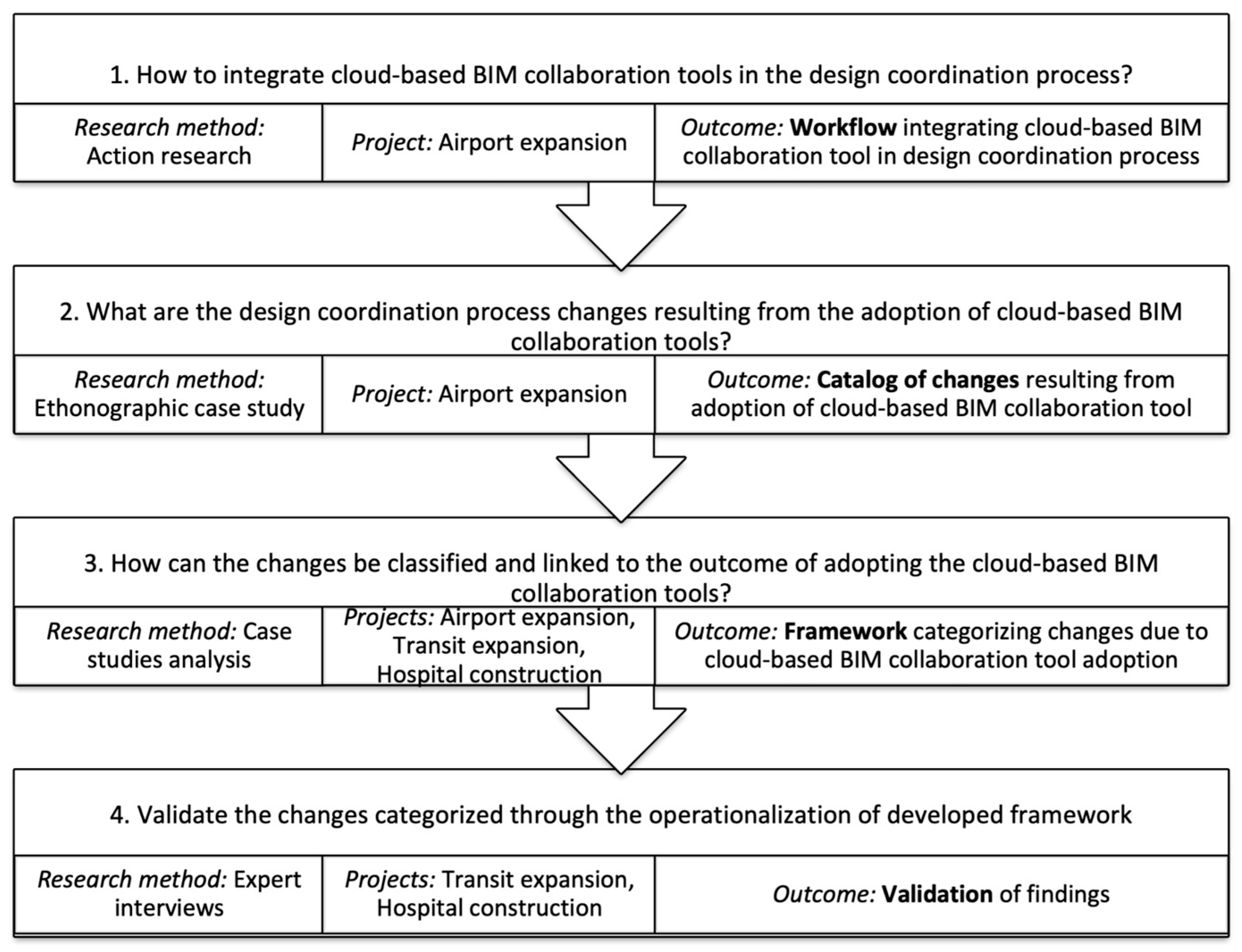
- What changes in the design coordination process result from adopting cloud-based BIM collaboration tools?
- How can these changes be categorized and linked to the impact of cloud-based BIM collaboration tools?
2. Literature Review
2.1. BIM-Based Design Coordination Process and Challenges
2.2. Cloud-Based BIM Collaboration Tools
2.3. Change Management and Technology Adoption in BIM Implementation
3. Research Methods
3.1. Action Research: Tool Integration
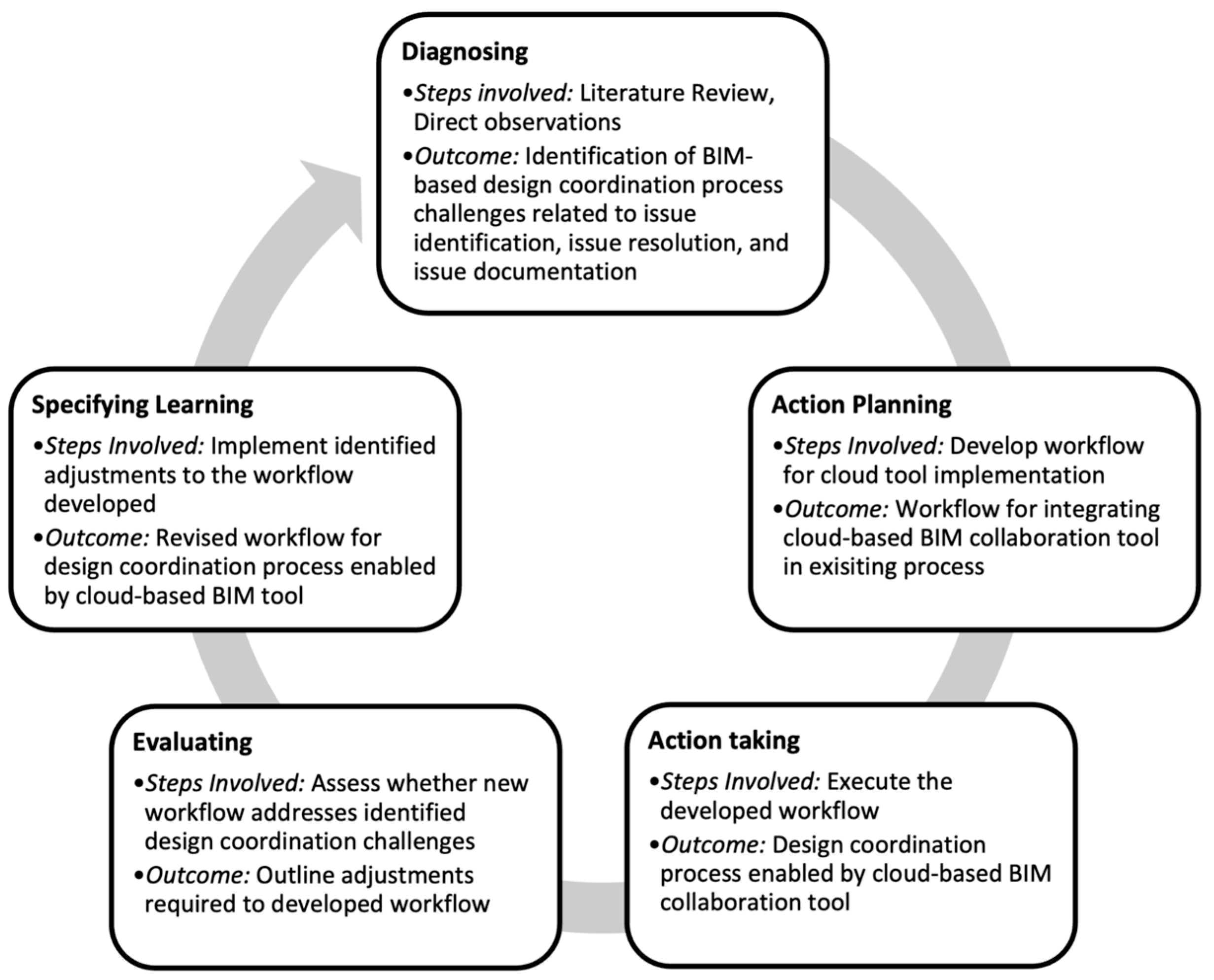
- Action Planning: BIM coordination inefficiencies were identified, and strategies for integrating the cloud-based tool were formulated.
- Action Taking: The cloud-based BIM tool was introduced and tested in the project’s design coordination meetings.
- Evaluating: Feedback from project participants was collected through observation and informal discussion.
- Specifying Learning: Refinements were made based on participant experiences; the final workflow is presented in the findings.
3.2. Ethnographic Case Study: Documenting Changes
3.3. Case Study Analysis: Framework Development
3.4. Expert Interviews: Framework Validation
4. Findings
4.1. Workflow for Integrating Cloud-Based BIM Collaboration Tool
4.1.1. Issue Identification
4.1.2. Issue Resolution
4.1.3. Issue Documentation
4.2. Outlining the Changes from Tool Adoption
4.2.1. Issue Identification
4.2.2. Issue Resolution
4.2.3. Issue Documentation
4.3. Framework for Analyzing Changes
4.4. Validation of Findings
4.5. Synthesis: Distinguishing Software Functionality, Practitioner Behavior, and Collaborative Mechanisms
5. Discussion
5.1. Need for Integrating Clash Detection Process in the Cloud-Based BIM Tool
5.2. Need for Aligning the Project’s Organizational Setup and Processes
- Model access: Only the general contractor had access to the Revizto model, which required designers to rely on them for coordination meeting data, leading to communication inefficiencies.
- Model data: The lack of direct designer access limited real-time collaboration, forcing reliance on intermediate updates.
- 2D drawing access: Revizto’s ability to overlay 3D models with 2D drawings was underutilized since contract terms restricted drawing submissions to major design milestones.
- Issue location: Participants often struggled to locate discussion topics within the model, a challenge that could have been mitigated with Revizto’s remote viewing functionality.
- BIM coordinator dependency: The BIM coordinator became the sole source for answering queries about dimensions, system types, and ownership, leading to inefficiencies.
- Issue resolution: Without direct Revizto access, designers needed gridline-referenced screenshots in their reports, which added unnecessary steps.
- Prioritization protocols: The absence of a standardized process for prioritizing and resolving issues led to misaligned urgency levels and delays.
5.3. Practical Recommendations for Cloud-Based BIM Tool Adoption
6. Limitations
7. Conclusions
Author Contributions
Funding
Data Availability Statement
Acknowledgments
Conflicts of Interest
References
- Mehrbod, S.; Staub-French, S.; Mahyar, N.; Tory, M. Characterizing Interactions with BIM Tools and Artifacts in Building Design Coordination Meetings. Autom. Constr. 2019, 98, 195–213. [Google Scholar] [CrossRef]
- Tatum, C.; Korman, T. Coordinating Building Systems: Process and Knowledge. J. Archit. Eng. 2000, 6, 116–121. [Google Scholar] [CrossRef]
- Lee, G.; Park, H.K.; Won, J. D3 City Project—Economic Impact of BIM-Assisted Design Validation. Autom. Constr. 2012, 22, 577–586. [Google Scholar] [CrossRef]
- Chua, D.; Tyagi, A. Process-Parameter-Interface Model for Lean Design Management. In Proceedings of the 9th Annual Conference of the International Group for Lean Construction (IGLC 9), Singapore, 6–8 August 2001. [Google Scholar]
- Liston, K.; Fischer, M.; Winograd, T. Focused Sharing of Information for Multidisciplinary Decision Making by Project Teams. J. Inf. Technol. Constr. 2003, 6, 69–82. [Google Scholar]
- Mehrbod, S.; Staub-French, S.; Tory, M. BIM-Based Building Design Coordination: Processes, Bottlenecks, and Considerations. Can. J. Civ. Eng. 2020, 47, 25–36. [Google Scholar] [CrossRef]
- Sacks, R.; Eastman, C.; Lee, G.; Teicholz, P. BIM Handbook: A Guide to Building Information Modeling for Owners, Managers, Designers, Engineers and Contractors, 3rd ed.; John Wiley & Sons: Hoboken, NJ, USA, 2018. [Google Scholar]
- Khanzode, A.; Reed, D.; Fischer, M. Benefits and Lessons Learned by Implementing Building VDC Technologies for Coordination of MEP Systems on a Large Healthcare Project. ITcon 2007, 12, 297–320. [Google Scholar]
- Lu, W.; Fung, A.; Peng, Y.; Liang, C.; Rowlinson, S. Demystifying Construction Project Time–Effort Distribution Curves: BIM and Non-BIM Comparison. J. Manag. Eng. 2015, 31, 04015010. [Google Scholar] [CrossRef]
- Fiorentino, M.; Uva, A.E.; Monno, G.; Radkowski, R. Augmented Technical Drawings: A Novel Technique for Natural Interactive Visualization of CAD Models. J. Comput. Inf. Sci. Eng. 2012, 12, 024503. [Google Scholar] [CrossRef]
- Leicht, R.M.; Messner, J.I.; Poerschke, U. INVOLVE: Developing Interactive Workspaces That Impact Communication and Task Performance When Using Virtual Prototypes. J. Comput. Civ. Eng. 2014, 28, 191–201. [Google Scholar] [CrossRef]
- Tory, M.; Staub-French, S.; Po, B.A.; Wu, F. Physical and Digital Artifact-Mediated Coordination in Building Design. Comput. Support. Coop. Work 2008, 17, 311–351. [Google Scholar] [CrossRef]
- Rekola, M.; Kojima, J.; Mäkeläinen, T. Formalized Knowledge Representation for Spatial Conflict Coordination of MEP Systems in New Building Projects. Archit. Eng. Des. Manag. 2010, 6, 264–278. [Google Scholar]
- Succar, B.; Kassem, M. Macro-BIM Adoption: Conceptual Structures. Autom. Constr. 2015, 57, 64–79. [Google Scholar] [CrossRef]
- Onungwa, I.; Olugu-Uduma, N.; Shelden, D.R. Cloud BIM Technology as a Means of Collaboration and Project Integration in Smart Cities. SAGE Open 2021, 11, 21582440211033250. [Google Scholar] [CrossRef]
- Bello, S.A.; Oyedele, L.O.; Akinade, O.O.; Bilal, M.; Delgado, J.M.D.; Akanbi, L.A.; Ajayi, A.O.; Owolabi, H.A. Cloud Computing in Construction Industry: Use Cases, Benefits and Challenges. Autom. Constr. 2021, 122, 103441. [Google Scholar] [CrossRef]
- Wang, Z.; Ouyang, B.; Sacks, R. Graph-Based Inter-Domain Consistency Maintenance for BIM Models. Autom. Constr. 2023, 154, 104979. [Google Scholar] [CrossRef]
- Mahamadu, A.-M.; Mahdjoubi, L.; Booth, C. Challenges to BIM-Cloud Integration: Implication of Security Issues on Secure Collaboration. In Proceedings of the 2013 IEEE 5th International Conference on Cloud Computing Technology and Science, Bristol, UK, 2–5 December 2013; pp. 209–214. [Google Scholar]
- Plume, J.; Mitchell, J. Collaborative Design Using a Shared IFC Building Model—Learning from Experience. Autom. Constr. 2007, 16, 28–36. [Google Scholar] [CrossRef]
- Singh, V.; Gu, N.; Wang, X. A Theoretical Framework of a BIM-Based Multi-Disciplinary Collaboration Platform. Autom. Constr. 2011, 20, 134–144. [Google Scholar] [CrossRef]
- Fernandes, R.P.L. Advantages and Disadvantages of BIM Platforms on Construction Site. Master’s Thesis, Instituto Superior Técnico, Lisbon, Portugal, 2013. [Google Scholar]
- Hu, Y.; Castro-Lacouture, D.; Eastman, C.M.; Navathe, S.B. Automatic Clash Correction Sequence Optimization Using a Clash Dependency Network. Autom. Constr. 2020, 115, 103205. [Google Scholar] [CrossRef]
- Esser, S.; Vilgertshofer, S.; Borrmann, A. Graph-Based Version Control for Asynchronous BIM Collaboration. Adv. Eng. Inform. 2022, 53, 101664. [Google Scholar] [CrossRef]
- Esser, S.; Vilgertshofer, S.; Borrmann, A. Version Control for Asynchronous BIM Collaboration: Model Merging through Graph Analysis and Transformation. Autom. Constr. 2023, 155, 105063. [Google Scholar] [CrossRef]
- Matthews, J.; Love, P.E.; Mewburn, J.; Stobaus, C.; Ramanayaka, C. Building Information Modelling in Construction: Insights from Collaboration and Change Management Perspectives. Prod. Plan. Control 2018, 29, 202–216. [Google Scholar] [CrossRef]
- Vass, S.; Gustavsson, T.K. Challenges When Implementing BIM for Industry Change. Constr. Manag. Econ. 2017, 35, 597–610. [Google Scholar] [CrossRef]
- Wong, J.; Wang, X.; Li, H.; Chan, G. A Review of Cloud-Based BIM Technology in the Construction Sector. J. Inf. Technol. Constr. 2014, 19, 281–291. [Google Scholar]
- Akponeware, A.O.; Adamu, Z.A. Clash Detection or Clash Avoidance? An Investigation into Coordination Problems in 3D BIM. Buildings 2017, 7, 75. [Google Scholar] [CrossRef]
- Mehrbod, S.; Staub-French, S.; Bai, W. Analysis of Bottlenecks in BIM-Based Building Design Coordination Process and Benchmarking State of the Art BIM Tools. In Proceedings of the Canadian Society for Civil Engineering Annual Conference, Vancouver, BC, Canada, 31 May—3 June 2017. [Google Scholar]
- Park, C.S.; Le, Q.T.; Pedro, A.; Lim, C.R. Interactive Building Anatomy Modeling for Experiential Building Construction Education. J. Prof. Issues Eng. Educ. Pract. 2016, 142, 04015019. [Google Scholar] [CrossRef]
- Xu, X. From Cloud Computing to Cloud Manufacturing. Robot. Comput.-Integr. Manuf. 2012, 28, 75–86. [Google Scholar] [CrossRef]
- Matthews, J.; Love, P.E.D.; Heinemann, S.; Chandler, R.; Rumsey, C.; Olatunj, O. Real Time Progress Management: Re-Engineering Processes for Cloud-Based BIM in Construction. Autom. Constr. 2015, 58, 38–47. [Google Scholar] [CrossRef]
- Lin, J.-R.; Hu, Z.-Z.; Zhang, J.-P.; Yu, F.-Q. A Natural-Language-Based Approach to Intelligent Data Retrieval and Representation for Cloud BIM. Comput.-Aided Civ. Infrastruct. Eng. 2016, 31, 18–33. [Google Scholar] [CrossRef]
- Cheng, J.C.; Ma, L.Y. A BIM-Based System for Demolition and Renovation Waste Estimation and Planning. Waste Manag. 2013, 33, 1539–1551. [Google Scholar] [CrossRef]
- Chuang, T.-H.; Lee, B.-C.; Wu, I.-C. Applying Cloud Computing Technology to BIM Visualization and Manipulation. In Proceedings of the 28th International Symposium on Automation and Robotics in Construction, Seoul, Republic of Korea; IAARC: Oulu, Finland, 2011; Volume 201, pp. 144–149. [Google Scholar]
- Du, J.; Zou, Z.; Shi, Y.; Zhao, D. Zero Latency: Real-Time Synchronization of BIM Data in Virtual Reality for Collaborative Decision-Making. Autom. Constr. 2018, 85, 51–64. [Google Scholar] [CrossRef]
- Wang, S. Graph Neural Network-Driven Text Classification for Fire-Door Defect Inspection in Pre-Completion Construction. Sci. Rep. 2025, 15, 44382. [Google Scholar]
- Wang, S. Development of an Automated Transformer-Based Text Analysis Framework for Monitoring Fire Door Defects in Buildings. Sci. Rep. 2025, 15, 43681. [Google Scholar] [CrossRef]
- Davis, F.D. Perceived Usefulness, Perceived Ease of Use, and User Acceptance of Information Technology. MIS Q. 1989, 13, 319–340. [Google Scholar]
- Venkatesh, V.; Morris, M.G.; Davis, G.B.; Davis, F.D. User Acceptance of Information Technology: Toward a Unified View. MIS Q. 2003, 27, 425–478. [Google Scholar] [CrossRef]
- Lee, S.; Yu, J.; Jeong, D. BIM Acceptance Model in Construction Organizations. J. Manag. Eng. 2015, 31, 04014048. [Google Scholar] [CrossRef]
- Hiatt, J.M. ADKAR: A Model for Change in Business, Government, and Our Community; Prosci Learning Center: Loveland, CO, USA, 2006. [Google Scholar]
- Susman, G.I.; Evered, R.D. An Assessment of the Scientific Merits of Action Research. Adm. Sci. Q. 1978, 23, 582–603. [Google Scholar] [CrossRef]
- Azhar, S.; Ahmad, I.; Sein, M.K. Action Research as a Proactive Research Method for Construction Engineering and Management. J. Constr. Eng. Manag. 2010, 136, 87–98. [Google Scholar] [CrossRef]
- Baskerville, R.; Pries-Heje, J. Grounded Action Research: A Method for Understanding IT in Practice. Account. Manag. Inf. Technol. 1999, 9, 1–23. [Google Scholar]
- Halcomb, E.J.; Hickman, L. Mixed Methods Research. Nurs. Stand. 2015, 29, 41–47. [Google Scholar] [CrossRef] [PubMed]
- Revizto. Available online: https://revizto.com/en/ (accessed on 11 November 2025).



| Airport Expansion | Transit Facility | Hospital Construction | |
|---|---|---|---|
| Project Description | Construction of a new parkade, a new central utility building, electrical infrastructure upgrades, sustainable energy systems, and a rainwater capture system | Construction of an operations and maintenance facility to support the inspection, service, maintenance, storage, and deployment of up to 96 light rail vehicles | Construction of a six-story and 75-bed Mental Health and Substance Use Wellness Centre with multi-level 450-stall underground parkade. |
| Project Location | Vancouver, Canada | Bellevue, USA | Vancouver, Canada |
| Project Budget | USD 460 million | USD 218 million | USD 210 million |
| Project Size | 200,000 sq. ft. | 165,000 sq. ft. | 223,889 sq. ft. |
| Delivery Model | Construction Manager | Design-Build | Design-Build |
| Airport Expansion | Transit Facility | Hospital Construction | |
|---|---|---|---|
| Scope of Revizto usage | Design coordination between stakeholders from different firms (contractor, architect, and engineering consultants) | Design coordination between stakeholders from the same firm (architect, and engineering consultants) | Design coordination between stakeholders from different firms (contractor, architect, engineering consultants, and operators) |
| Data Transferred | 3D models from Navisworks 2D sheets from Revit Clashes from Navisworks | 3D models from Revit Clashes from Navisworks | 3D models from Revit 2D sheets from Revit Clashes from Navisworks |
| Model Organization | Four models divided by components: Building model Parkade building model Site and ancillary building model Existing building model | Three models divided by components – Main Building #1 model Main Building #2 model Site and ancillary building model | 3 models differentiated by user: Consultant model—for design coordination and model task delegation. Contractor model—for construction coordination and site issue progress tracking Owner/operator model—for project review and internal collaboration |
| Update cycle and publisher | All the four models were updated on a weekly basis | All the 3 models were updated daily on an avg. | The consultant’s model was updated on an avg. every 2 days, the contractor’s model updated for construction milestones, and owner/operator’s model updated for milestone reviews |
| Issue Creation | Markups in 3D only in addition to issue creation through Navisworks Clash Sync | Markups in 3D only in addition to issue creation through Navisworks Clash Sync | Markups in 2D and 3D as well as issue creation through Navisworks Clash Sync |
| Design Process | Process View | Impact View | ||||
|---|---|---|---|---|---|---|
| Activity Lens | Functionality Lens | Artifact Lens | Benefit Lens | Challenge Lens | Severity Lens | |
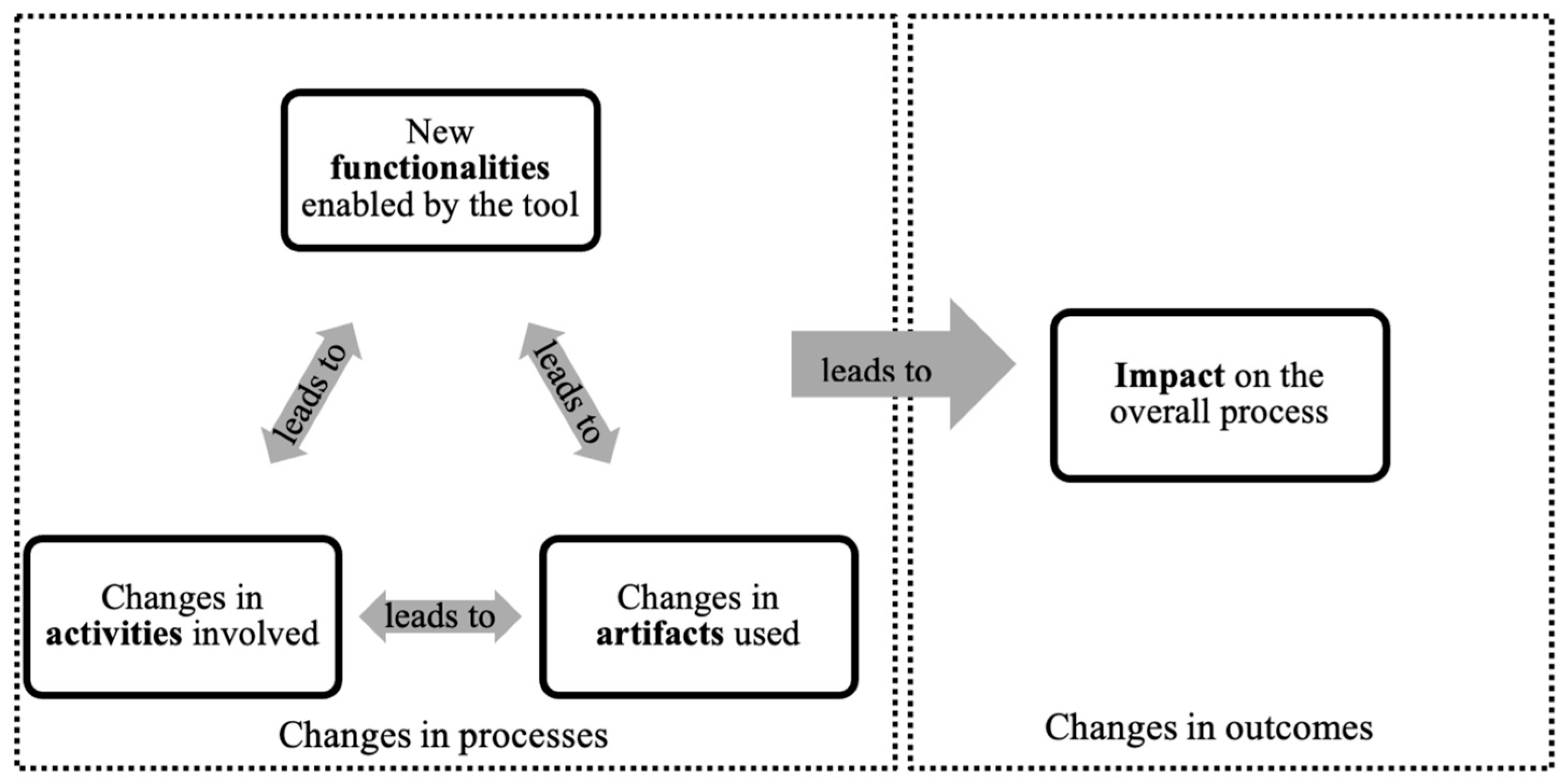
| Component of the processes | Steps in the process added or removed due to tool adoption | Functionalities of adopted tool enabling the change | Artifacts added or replaced as a result of adopting the tool | Observed benefits due to tool adoption | Observed challenges due to tool adoption | Severity of the changes due to tool adoption |
| Design Coordination Process Components | Process View | Impact View | ||||
|---|---|---|---|---|---|---|
| Activity Lens | Functionality Lens | Artifact Lens | Benefits | Challenges | Severity | |
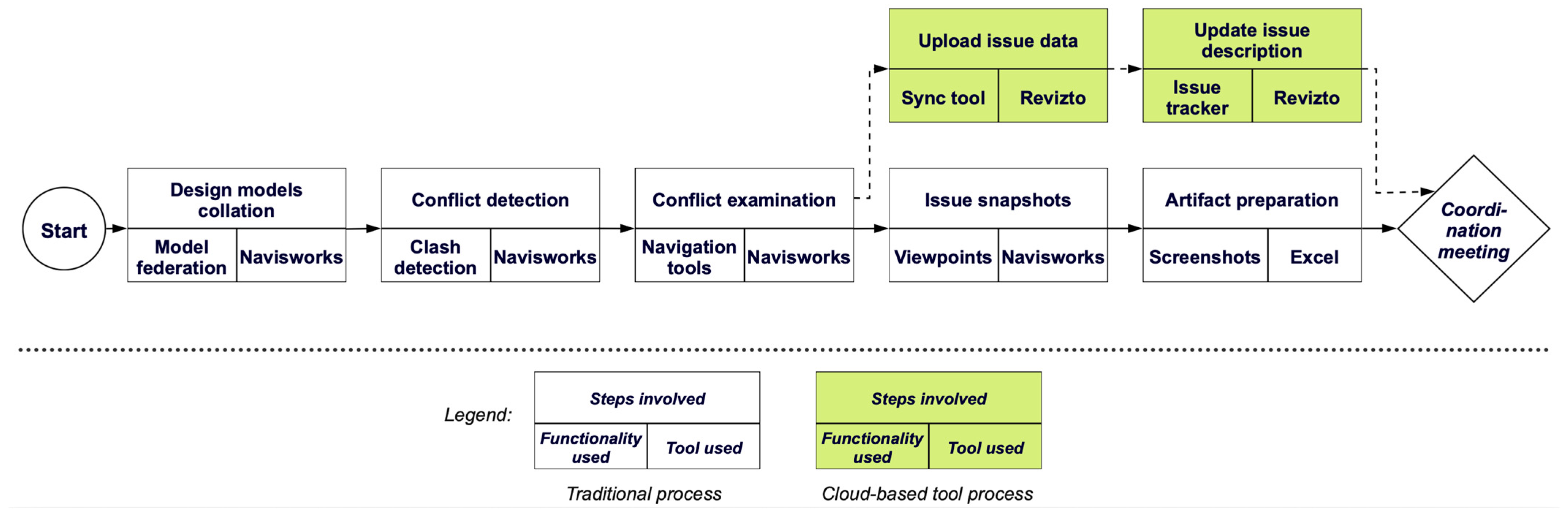
| Issue Identification | The steps involved in preparing the Excel tracker are eliminated with transition to Revizto The need for manually reviewing past issues in the issue tracker is removed | Model collation and clash detection continues to happen in Navisworks Viewpoint creation from Navisworks is now enabled by Revizto issue tracker | The use of Excel to maintain a manual issue tracker is removed because of similar functionality integrated within Revizto | Reduced transitions: For preparing the issue tracker Reduced activities: Resolved issues auto-update based on updated models—no need to manually check progress of all open issues and past discussion stay intact for open issues. | Shared definitions: Setting mutually acceptable priority for issues Learning curve: Onboarding new stakeholders and acclimatizing with the tool’s features | Activity lens—low (majority of the steps involved remain unchanged) Functionality lens—low (in-built issue tracker has similar functionalities to the Excel tracker) Artifact lens—medium (the external Excel tracker is replaced by in-built issue tracker) |
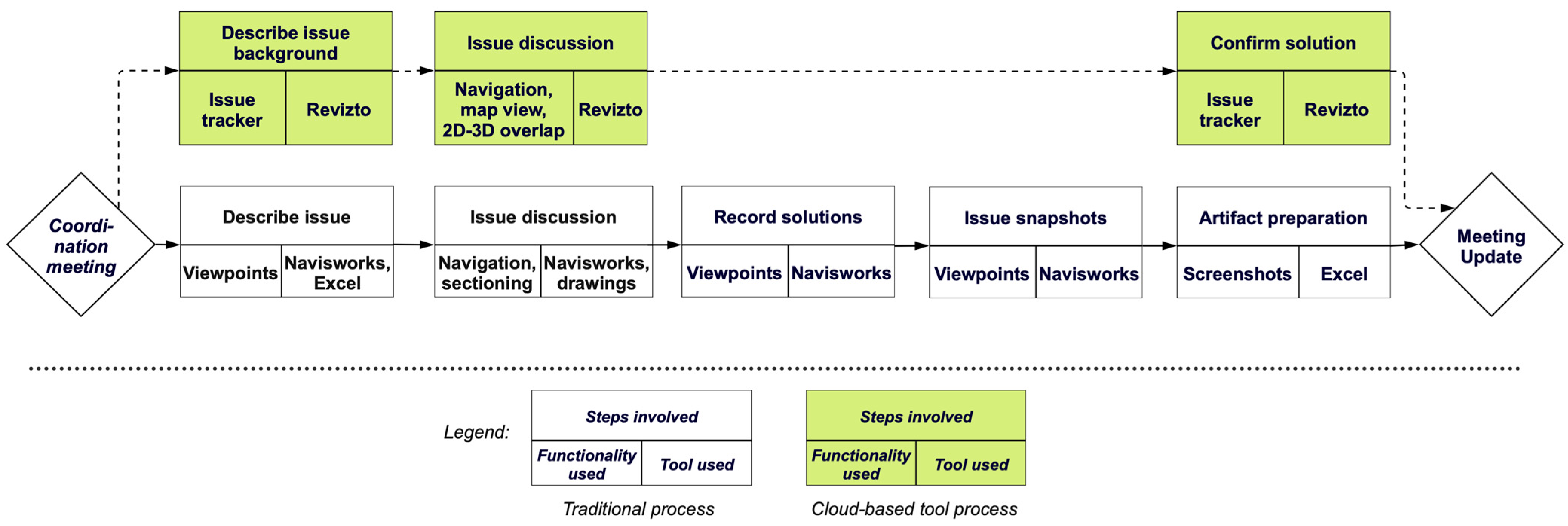
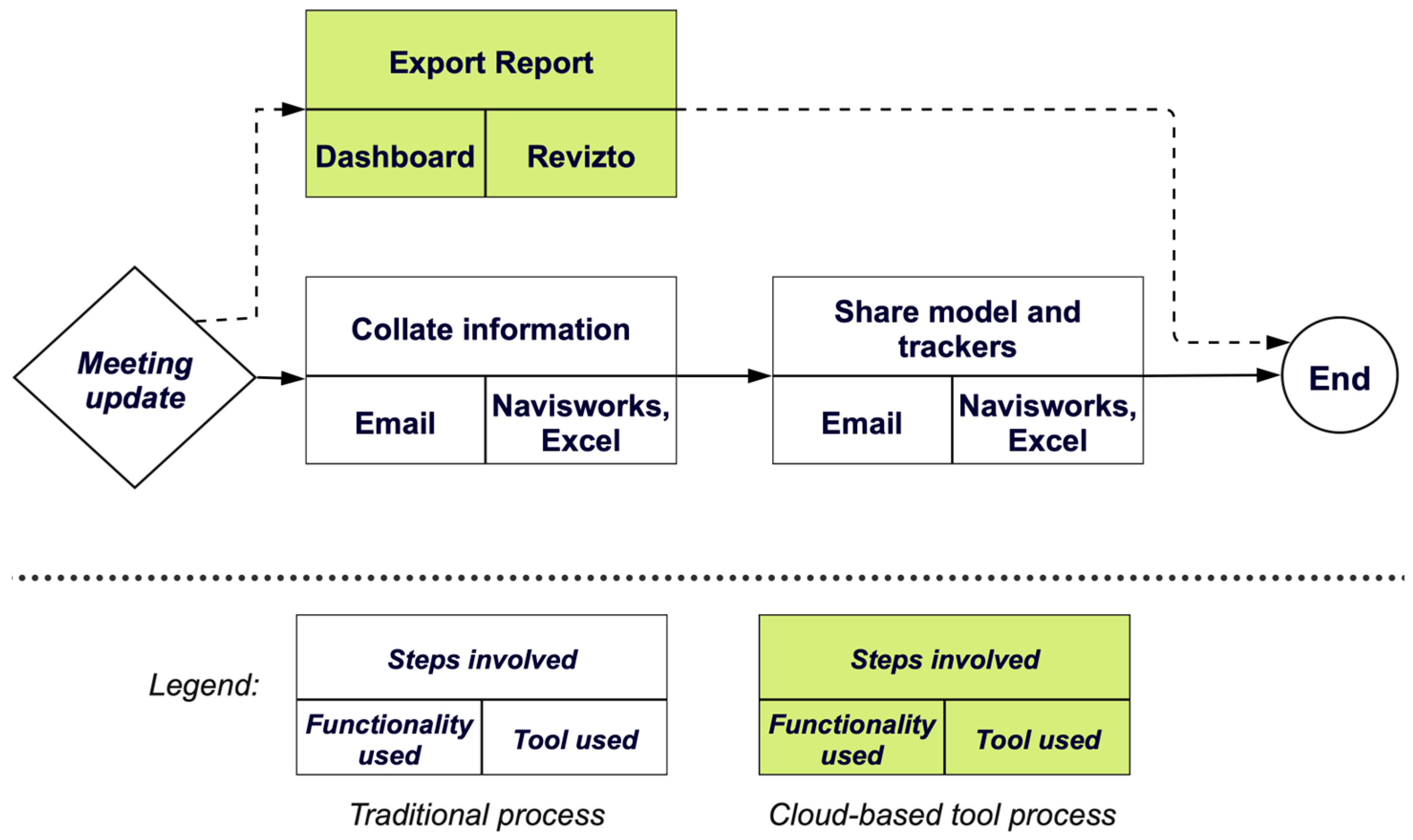
| Issue Resolution | The transitions required between Excel issue tracker and model are removed The transitions between 2D drawings and 3D model viewing are eliminated Meeting notes are added to the comment log | The common data environment of the cloud-BIM tool collates the meeting notes, model information, and issues for discussion The 2D-3D overlap feature enables viewing the 2D drawings for an area where the issue is located | Cloud-tool is the only tool used during the discussion in comparison to using 2D drawings, 3D models, and Excel tracker | Reduced transitions: For discussing issues during coordination meeting Increased information access: Cloud tool collates the 2D, 3D, and issue information | Meeting protocol: Setting issue discussion process—navigating by issues in each room vs. issues with a given priority Model size: Uploading drawings leading to large file sizes and slower navigation | Activity lens—medium (in-built features reduce the steps involved around discussing an Issue) Functionality lens—high (cloud tool enables functionalities such as 2D-3D model data overlap that was unavailable earlier) Artifact lens—high (need for external Excel issue tracker and 2D drawings eliminated) |
| Issue Documentation | The steps involved in preparing the Excel tracker are eliminated Manual addition of screenshots for issue not required Manual tracking of progress on issues not required | Issue tracker and cloud dashboard eliminate the need for Excel tracker Cloud-dashboard provides real-time status of design coordination progress | The Excel tracker is replaced with auto generated reports from online Revizto dashboard | Reduced activities: The manual workload of maintaining the Excel issue tracker is removed Increased efficiency: The task of categorizing the issues discussed during the meeting is automated by the cloud tool | Limited customizability: The auto-generated report offered limited formatting and text customization especially for adding legal disclosures | Activity lens—high (steps involved in maintaining external Excel tracker eliminated) Functionality lens—high (the in-built issue tracker can auto-generate reports for distribution) Artifact lens—high (need for external Excel tracker, model file with viewpoints, and screenshots of issues eliminated) |
| Design Coordination Process Components | Framework Lenses | Framework Findings | Interview Excerpts |
|---|---|---|---|
| Issue Identification | Activity Lens | Reduced steps: The steps involved in preparing the Excel tracker are eliminated Manual addition of screenshots for the issue is not required Manual tracking of progress on issues not required | “It gives you the opportunity to do visual as well as clash reviews, bunch of other things. But what I use it mostly for is visual clash reviews. So, you load all the models and kind of just navigate through them looking for obvious problems.” |
| Functionality Lens | Model collation and clash detection continues to happen in Navisworks Viewpoint creation from Navisworks is now enabled by the Revizto issue tracker | “Our issue tracker maintained a log of comments from all previous discussions from the design coordination meeting. We would set agenda items based on priorities of issues during the coordination meetings.” | |
| Artifact Lens | The use of Excel to maintain a manual issue tracker is removed because of similar functionality integrated within Revizto | “There’s lots of time saving. I also think that it allows our senior engineers that people who are a little less tech savvy to comfortably navigate the model with the fear of wrecking something” | |
| Impact Lens | Reduced transitions: For preparing the issue tracker Reduced activities: Resolved issues auto-update based on updated models—no need to manually check the progress of all open issues and past discussion stay intact for open issues. | “The BIM team would be the first to praise using it on all our projects. We’re looking at piloting in projects in other cities.” | |
| Issue Resolution | Activity Lens | The transitions required between Excel issue tracker and model are removed The transitions between 2D drawings and 3D model viewing are eliminated Meeting notes are added to the comment log | “The drawings overlap feature was key to getting the superintendents and site team involved in the BIM meetings” |
| Functionality Lens | The common data environment of the cloud-BIM tool collates the meeting notes, model information, and issues for discussion The 2D-3D overlap feature enables viewing the 2D drawings for an area where the issue is located | “If you’re in a 3D view, and there’s things blocking what you want to see, you can’t zoom past them, you have to, you have to find another way to look So, and now this software allows them to very simply with a few little mouse clicks, or, or keyboard strokes, walk around a model and really get a clear understanding of, of what’s been modeled and how it works and what, what everything means.” | |
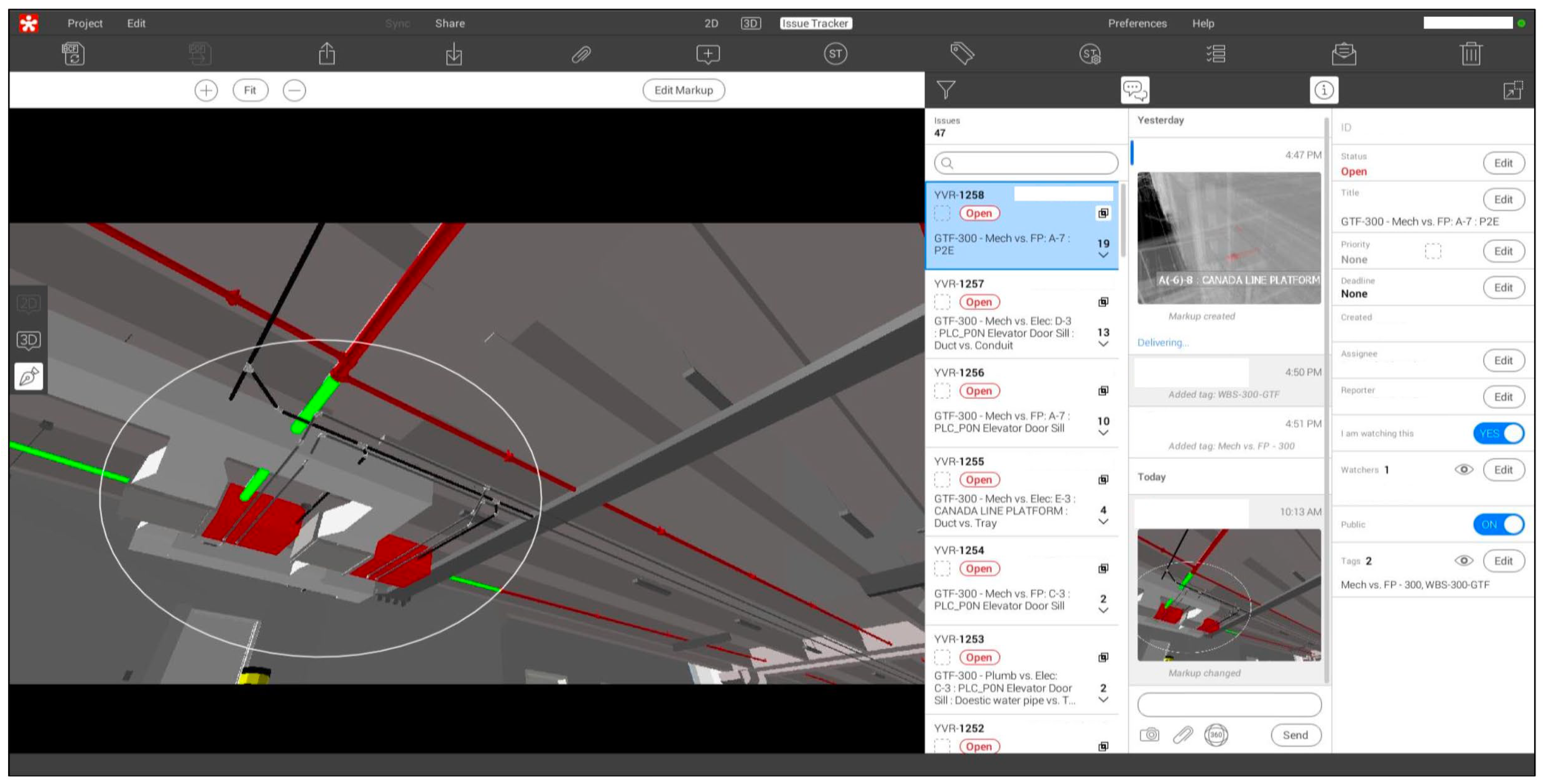
| Artifact Lens | Cloud-tool is the only tool used during the discussion in comparison to using 2D drawings, 3D models, and Excel tracker | “The map was a good feature to have during the meetings. We would often get lost in the model wasting time figuring out the location of the issue before it” | |
| Impact Lens | Reduced transitions: For discussing issues during coordination meeting Increased information access: Cloud tool collates the 2D, 3D, and issue information | “So, you can jump from a 2D plan to the 3D view, and you can jump back, and you can make comments here and see them and then and, and it keeps running comment log. So, you can see a comment, they can identify who needs to fix it, the person can fix it, re upload the model, and you can see the old versus the new and what was wrong and how they came to the solution.” | |
| Issue Documentation | Activity Lens | The steps involved in preparing the Excel tracker are eliminated Manual addition of screenshots for issue not required Manual tracking of progress on issues not required | “The biggest time savers were the reports. I would be spending almost whole day after the meeting putting everything together, that the report just did in one click” |
| Functionality Lens | Issue tracker and cloud dashboard eliminate the need for Excel tracker Cloud-dashboard provides real-time status of design coordination progress | “The project managers liked having an overview of the BIM meeting but rarely attended the coordination meetings. The dashboard became their gospel, and my PM asked me to schedule its emails for the whole team” | |
| Artifact Lens | The Excel tracker is replaced with auto generated reports from online Revizto dashboard | “Getting the designers onboard with the reports needed some push. Once they saw the links to the model in the report files, I think that won them over” | |
| Impact Lens | Reduced activities: The manual workload of maintaining the Excel issue tracker is removed Increased efficiency: The task of categorizing the issues discussed during the meeting is automated by the cloud tool | “I would be lost often with all the notes and screenshots I took during the meeting. Combining them took forever before using the issue reports.” |
| Coordination Stage | Software Functionality | Practitioner Behavior | Collaborative Mechanisms |
|---|---|---|---|
| Issue identification | Clash sync from Navisworks to Revizto; automated screenshot generation; built-in issue tracker with tagging by discipline and location; viewpoint creation linked to issues | BIM coordinators shifted from manually compiling Excel trackers to curating issues within the cloud platform; internal teams began adding pre-meeting comments to issues, increasing preparation quality; reduced need to manually review resolved issues against updated models | Issue preparation became a collaborative, comment-driven process rather than a single-coordinator task; discipline-based tagging introduced a shared classification system across project teams; priority-setting required negotiation of mutually acceptable severity definitions |
| Issue resolution | Centralized model viewer replacing separate Navisworks navigation; map view for spatial filtering by project quadrant; object filters for recoloring/hiding building systems; in-tool comment logging during meetings | Meeting participants relied on the cloud tool as the single source of context rather than cross-referencing Excel, drawings, and models; the BIM coordinator transitioned from model navigator to meeting facilitator; attendees engaged more actively with 3D spatial context during discussions | Coordination meetings shifted from multi-tool navigation to a single-platform discussion workflow; issue discussion order became driven by tool-based prioritization rather than ad hoc agenda-setting; real-time comment capture replaced post-meeting documentation, changing the meeting’s temporal structure |
| Issue documentation | Automated report generation from issue tracker data; live dashboards replacing static Excel trackers; cloud-based access to historical issue discussions and status updates | BIM coordinators were relieved of manual post-meeting compilation tasks; stakeholders began accessing issue status independently rather than waiting for distributed reports; documentation shifted from a retrospective task to a continuous, real-time activity | Accountability became more transparent as all comments and status changes were logged with timestamps and attributed to individuals; reporting transitioned from coordinator-mediated distribution to self-service access; documentation quality became less dependent on individual coordinator diligence |
| Indicator | Before Adoption | After Adoption | Change | Source |
|---|---|---|---|---|
| Issue Identification | ||||
| Tools required | 3 (Navisworks, Excel/Word tracker, 2D drawings) | 2 (Navisworks, Revizto) | −1 tool | Figure 3 and Figure 6; Section 4.2.1 |
| Manual steps eliminated | n/a | Excel tracker compilation; manual screenshot capture; manual progress review | 3 manual steps removed | Table 4, Activity lens; Section 4.2.1 |
| Artifacts replaced | External Excel/Word issue tracker | Revizto built-in issue tracker | 1 external artifact eliminated | Table 4, Artifact lens |
| Issue resolution | ||||
| Tools used during meetings | 3 (Excel tracker, Navisworks, 2D drawings) | 1 (Revizto) | −2 tools | Figure 4; Section 4.2.2 |
| Inter-tool transitions | Multiple (Excel, Navisworks, 2D drawings) | None (single platform) | All eliminated | Table 4, Activity lens; Section 4.2.2 |
| Meeting note capture | Manual (post-meeting) | In-tool (real time) | Post hoc to real-time | Section 4.2.2; Table 5 |
| Issue documentation | ||||
| Post-meeting manual artifacts | 3 (Excel tracker, screenshots, meeting notes) | 0 (auto-generated reports) | −3 manual artifacts | Figure 5; Section 4.2.3 |
| Issue status tracking | Static (manual Excel) | Dynamic (live dashboard) | Static to real-time | Table 4, Functionality lens; Section 4.2.3 |
Disclaimer/Publisher’s Note: The statements, opinions and data contained in all publications are solely those of the individual author(s) and contributor(s) and not of MDPI and/or the editor(s). MDPI and/or the editor(s) disclaim responsibility for any injury to people or property resulting from any ideas, methods, instructions or products referred to in the content. |
© 2026 by the authors. Licensee MDPI, Basel, Switzerland. This article is an open access article distributed under the terms and conditions of the Creative Commons Attribution (CC BY) license.
Share and Cite
Bhonde, D.; Zadeh, P.; Staub-French, S. Characterizing the Effects of Cloud-Based BIM Collaboration Tools on Design Coordination Processes. Buildings 2026, 16, 1316. https://doi.org/10.3390/buildings16071316
Bhonde D, Zadeh P, Staub-French S. Characterizing the Effects of Cloud-Based BIM Collaboration Tools on Design Coordination Processes. Buildings. 2026; 16(7):1316. https://doi.org/10.3390/buildings16071316
Chicago/Turabian StyleBhonde, Devarsh, Puyan Zadeh, and Sheryl Staub-French. 2026. "Characterizing the Effects of Cloud-Based BIM Collaboration Tools on Design Coordination Processes" Buildings 16, no. 7: 1316. https://doi.org/10.3390/buildings16071316
APA StyleBhonde, D., Zadeh, P., & Staub-French, S. (2026). Characterizing the Effects of Cloud-Based BIM Collaboration Tools on Design Coordination Processes. Buildings, 16(7), 1316. https://doi.org/10.3390/buildings16071316