Article

Seismic Performance of Steel Beam-to-Column Joints with SMA Bolts and Replaceable Ring Dampers

1
Research Institute of Highway Ministry of Transport, Beijing 100088, China
2
School of Civil and Environmental Engineering, Changsha University of Science and Technology, Changsha 410004, China
3
Bengbu Highway Management Service Center’s Directly Affiliated Branch Center, Bengbu 233000, China
4
Jinan Urban Construction Group, Jinan 250031, China
5
Chongqing Highway Affairs Center, Chongqing 401120, China
*
Author to whom correspondence should be addressed.
Buildings 2026, 16(6), 1209; https://doi.org/10.3390/buildings16061209
Submission received: 19 January 2026 / Revised: 11 March 2026 / Accepted: 16 March 2026 / Published: 18 March 2026
(This article belongs to the Section Building Structures)

Abstract

This paper proposes a novel prefabricated beam-to-column joint to increase the seismic performance and post-earthquake recoverability of steel frames, which use the shape memory alloy (SMA) bolts and replaceable steel ring dampers. The comparative analysis of the seismic behavior was conducted for three beam-to-column connection types using finite element models. The three connection types include those installed using internal SMA bolts, external SMA bolts, and external SMA bolts with novel ring dampers. In addition, the novel ring damper was analyzed separately. These analysis results indicate that the connection type installed using external SMA bolts is superior to that by internal SMA bolts for the seismic performance of beam-to-column joints. The beam-to-column joints have the best seismic performance among the three joints when equipped with the additional steel ring damper, which can be easily replaced. This ring damper can increase the energy dissipation by approximately 11% and effectively reduce the stress of SMA bolts, which can delay their failure. The increasing preload of SMA bolts and high-strength bolts has a certain positive effect on the improvement of the seismic performance. All of the three joints exhibit excellent self-centering characteristics, with residual displacements nearly at zero. The gap of replaceable ring dampers can keep the re-centering capacity and improve the energy dissipation of joints. However, the changes in the steel strength of dampers have little impact on the seismic performance. This study verifies the improvement of the replaceable ring dampers on the seismic performance and post-earthquake recoverability, providing a reference for the seismic design of resilient structures.

1. Introduction

During their service life, buildings are subjected to various loads, among which seismic actions leave a particularly strong impression. Traditional frame systems, characterized by high lateral stiffness and strength, are widely used structural forms in seismic zones. The failure of beam–column joints is the primary cause of frame structure collapse, making the seismic safety of beam–column connections critically important [1,2,3,4,5]. Frame joints exhibit high plastic deformation during earthquakes, thereby providing ductility and energy dissipation. However, the consequences of this plastic deformation are irreversible, posing challenges for post-earthquake repairs and resulting in resource wastage [6,7]. Consequently, the need for replacing beam–column joints has garnered attention, and corresponding solutions have been proposed [8,9,10].
In order to solve the problem of beam–column steel joints, researchers have improved the energy dissipation of the structure by studying components such as bolts, dampers, and fuses widely equipped in frame steel beam–column joints. Latour et al. [11] conducted experimental analysis on beam–column joints equipped with friction dampers and proposed a beam-to-column connection method that can dissipate seismic energy and avoid plastic damage to steel structures. Valente et al. [12,13,14] conducted a series of energy dissipation and stability tests on this new type of beam–column joint, and developed an innovative seismic composite steel frame with dissipative fuses. In order to further enhance the energy dissipation capacity, Oh et al. [15] conducted cyclic tests on three full-size steel structures with slit dampers and one specimen with a traditional anti-welding moment frame to verify the seismic performance of the connection. They proposed a structural system with dampers and found that the dissipation and plastic deformation of the structure were concentrated on the slit dampers, and did not affect the hysteresis performance of the joints. Vasdravellis et al. [16] studied the possibility of dissipating energy in partial-strength beam-to-column joints and in the connections between steel beams and floor slabs. Wolski et al. [17] equipped flange friction devices at the connection between beams and columns for cyclic loading testing, and further improved energy dissipation by introducing the flange friction device BFFD. D’Aniello et al. [18,19,20] studied various components widely used in steel frames and conducted finite element analysis on parameters such as bolt diameter, end plate thickness, and beam profile type, providing a theoretical basis for the design of beam–column joints and improving ductility and energy dissipation characteristics. Liu et al. [21,22] developed modular frame beam–column joints and obtained a series of beam–column performance curves through experiments and finite element analysis. Gardone et al. [23] proposed a steel bamboo-shaped energy dissipation device and found that it has good energy dissipation characteristics under cyclic loading.
Subsequently, shape memory alloy SMA has attracted widespread attention from researchers due to its unique ability to withstand large deformations and restore its original state [24,25]. The self-centering performance and high energy dissipation characteristics of hyper-elastic SMA enable structural elements to withstand structural vibrations caused by earthquakes [26,27,28]. In order to enhance the self-resetting effect of the structure, Xu et al. [29] analyzed the working conditions of a self-centering connecting rod with a post-tensioned shape memory alloy that provides both resetting force and energy dissipation capability. Analysis shows that self-centering chain links have good seismic performance. Heidari and Gharehbaghi [30] proposed a new truss moment frame system, which is a relatively efficient self-centering structural system. The structure is equipped with buckling-restrained supports on the side of the beam–column connection, and consumes energy through the relative motion of the upper and lower components of the truss beam. SMA is also used as a component for self-centering and stent connection [31,32,33]. McCormick and DesRoches et al. [34] applied steel SMA components to reinforced concrete structures and found that they have limited residual deformation and good energy dissipation capacity. Ocel et al. [35] found in their experiments that using SMA for connection in beams and columns exhibited repeatable and stable hysteresis behavior, as well as high energy dissipation and ductility capabilities. Sericher et al. conducted experiments on shear wing beam–column connections reinforced with steel and SMA bars and found that the system recovered most of the elastic displacement [36]. Farmani and Ghassemieh [37] proposed a self-centering beam–column connection using SMA bolts and end plates, and found that the beam-to-column connection has excellent self-centering performance. Xu et al. [38,39] modeled a self-centering eccentric frame using SMA bolts and PT high-strength steel bars and conducted a series of numerical simulations for verification. Afterwards, steel SMA was applied to the connection of bundle beams, and a new efficient structure for self-centering connection beams was proposed.
The beam-to-column joints connected by SMA bolts have excellent self-centering capacity and limited energy dissipation capacity. However, the additional energy dissipation device would reduce the self-centering capacity of beam-to-column joints, which would induce a larger residual displacement of structures under earthquakes. This paper proposed a novel replaceable steel ring damper with a gap, which is equipped on the beam-to-column joints. The comparative analysis of the seismic behavior was conducted for three different beam-to-column connection types using finite element models. The three connection types include those installed by internal SMA bolts, external SMA bolts, and external SMA bolts with novel ring dampers. In addition, the novel ring damper was analyzed separately. This study can provide a reference for the seismic design of resilient structures.

2. Finite Element Model Validation and Extension

2.1. Model Validation

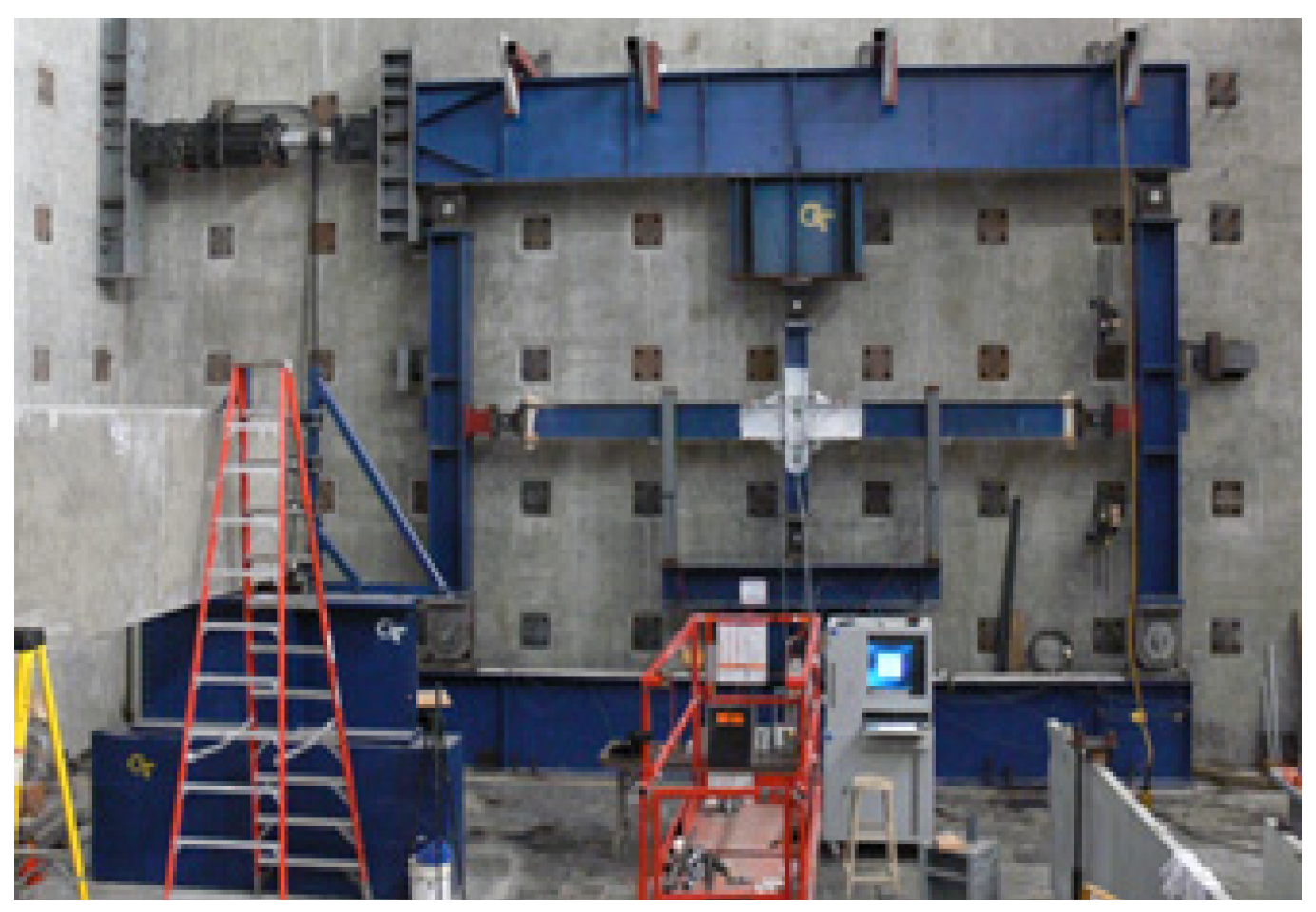
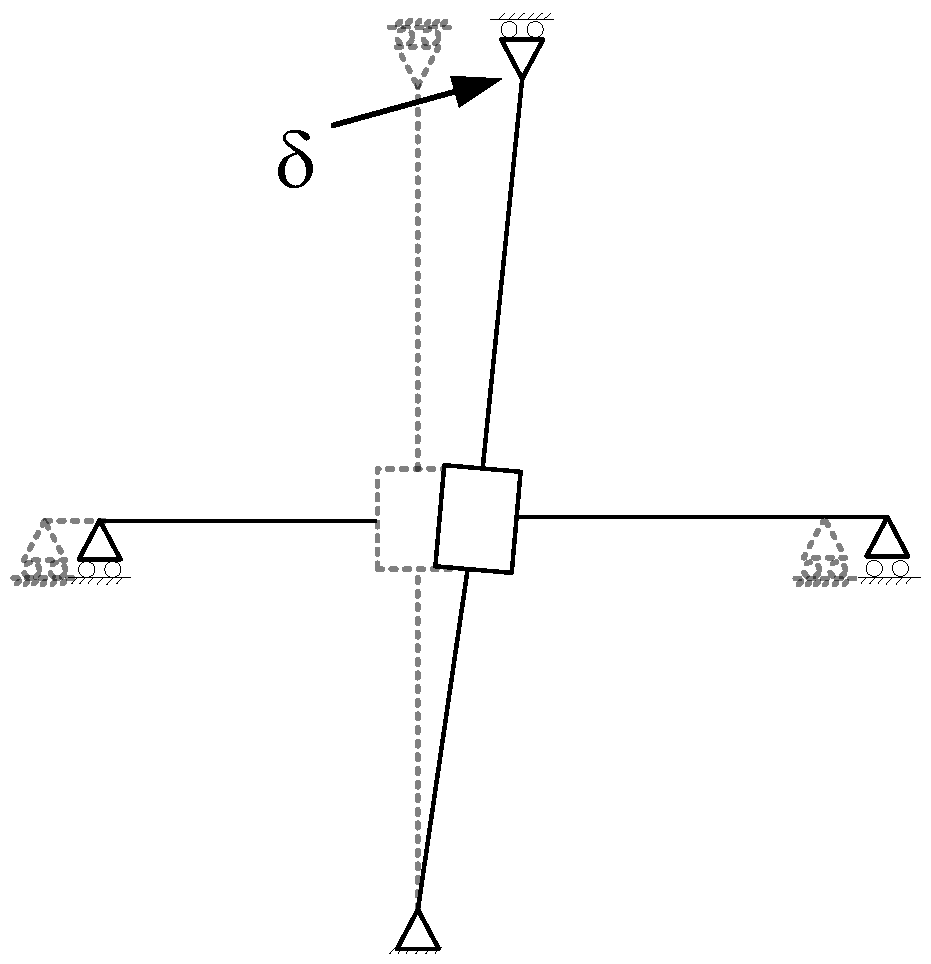
Speicher et al. [36] used SMA bolts to connect two 274 cm long W12 × 14 steel beams to a 178 cm long I-shaped W8 × 67 steel column, forming a typical strong-column and weak-beam connection configuration. Both the beams and the columns were made of A572 Grade 50 steel. Shear plates measuring 64.8 × 5.1 × 4.0 cm were welded to both sides of the column flange. The bottom of the column was fixed on a rigid support, while the other beam and column ends were connected using hinge support types. A lateral displacement was applied to the top of the column, causing horizontal displacement at the fixed hinge supports and inducing cyclic drift in the structure along the displacement direction. The on-site test images of the model loading and a schematic diagram of its boundary supports are shown in Figure 1 and Figure 2.
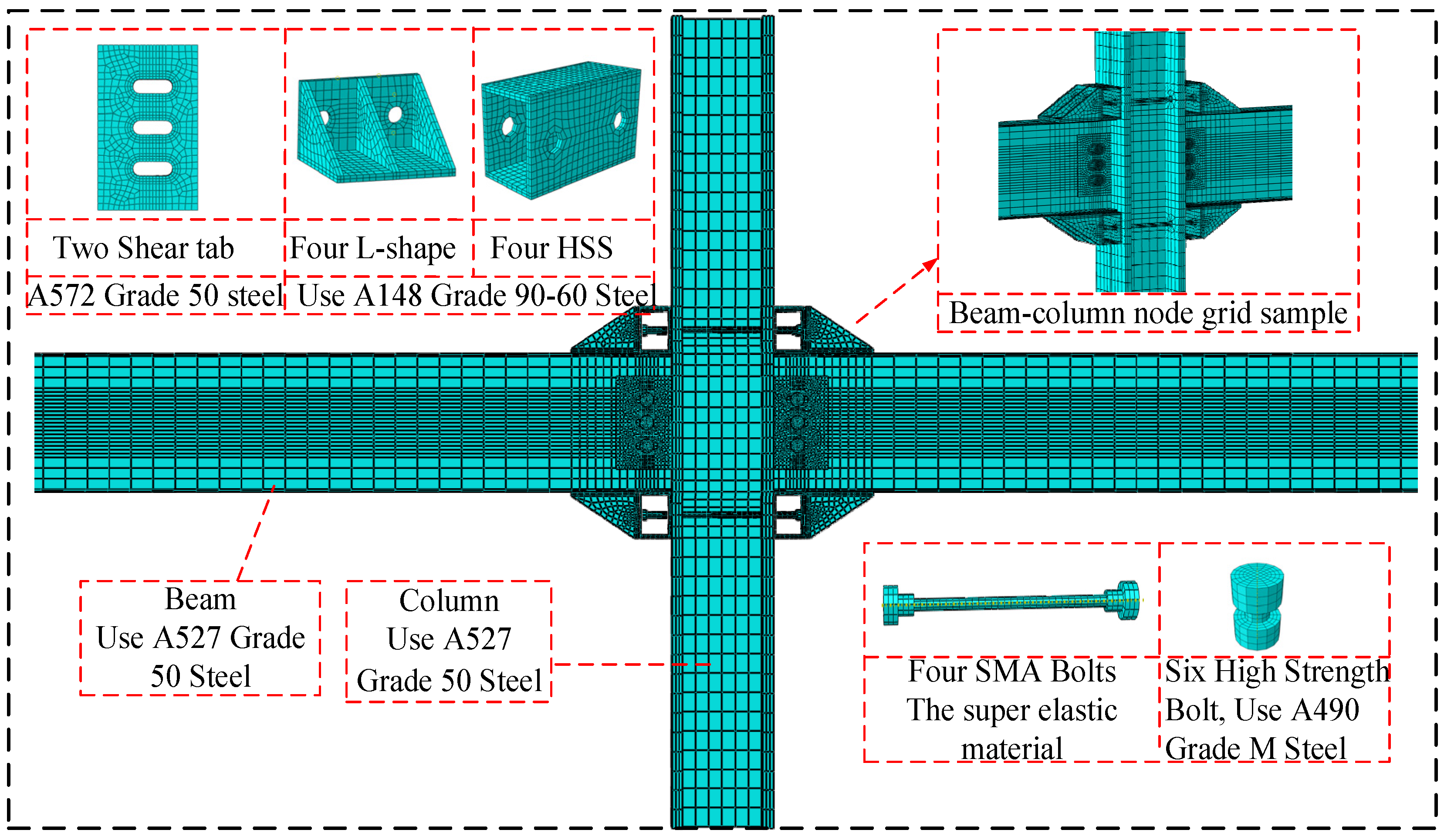
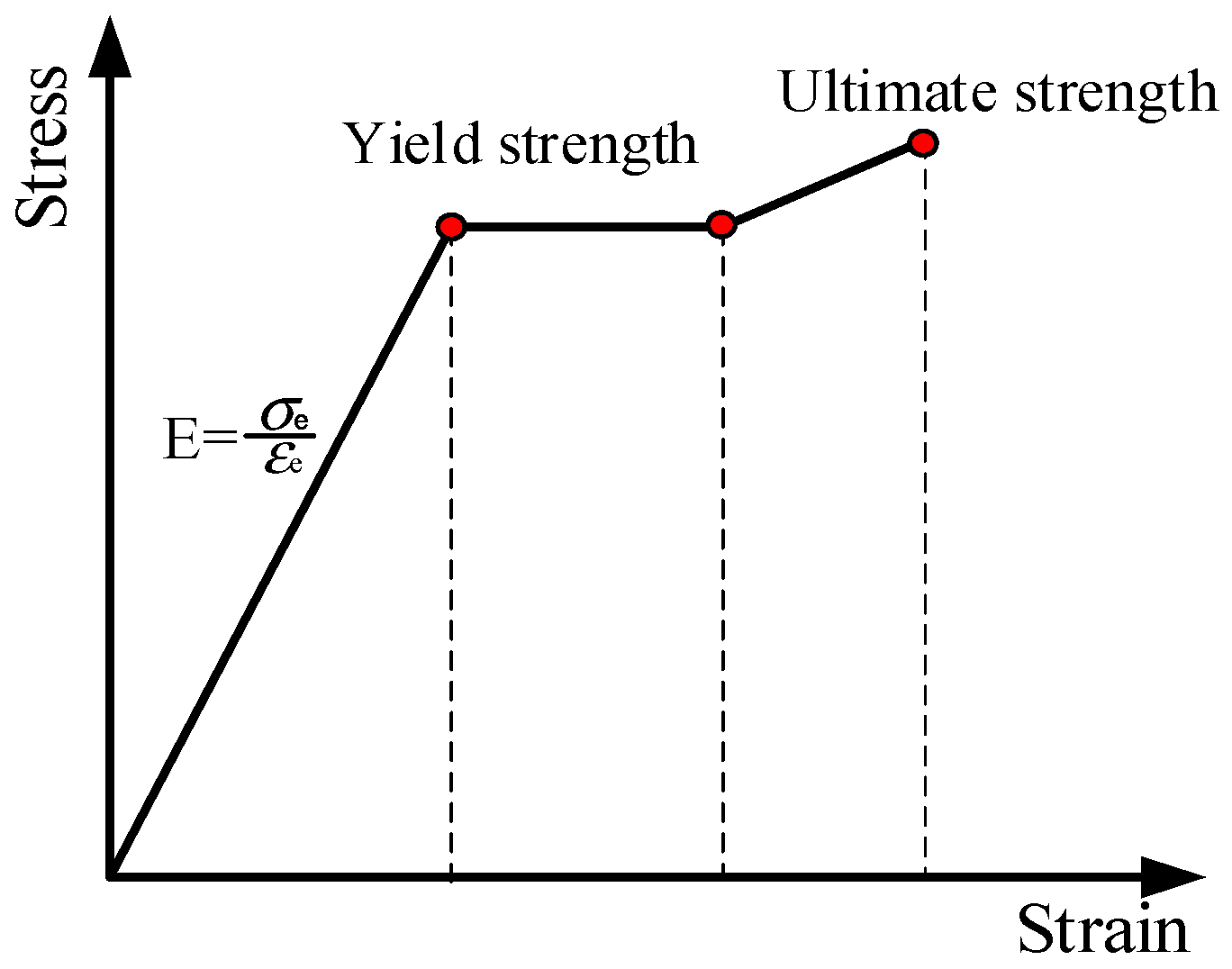
This study utilizes the finite element software ABAQUS/Standard to conduct numerical validation of an energy dissipation system for beam–column connections based on Shape Memory Alloys (SMAs). Figure 3 illustrates the mesh division and materials of the various components in the numerical model. The global mesh sizes for the high-strength bolts, SMA bolts, and friction plates are set to 2 mm, 4 mm, and 5 mm, respectively, with a denser mesh applied at the bolt areas where stress concentration occurs. To achieve more accurate computational results, the SMA components are modeled using standard three-dimensional 8-node linear C3D8 solid elements, while the other steel components employ reduced-integration three-dimensional 8-node linear C3D8R solid elements. The established model consists of 40,270 elements, including 36,046 C3D8R linear brick elements and 4224 C3D8 linear brick elements. The mesh sensitivity of the finite element model was analyzed, which can ensure the convergence of the calculation results. The steel beams and columns are made of A572 Grade 50 steel with a yield strength of 375 MPa. The steel brackets use A148 Grade 90-60 steel with a yield strength of 415 MPa. The bolts are made of A490 Grade M steel with a yield strength of 900 MPa. The specific material properties of the steel and SMA are obtained from the tensile specimen test results in reference [36]. The SuperElastic material model in ABAQUS/Standard was used to simulate the SMA material. The simplified constitutive curves for all the steel materials are shown in Figure 4. The characteristics of the special SMA reinforcement bundles are provided in Table 1 [40].
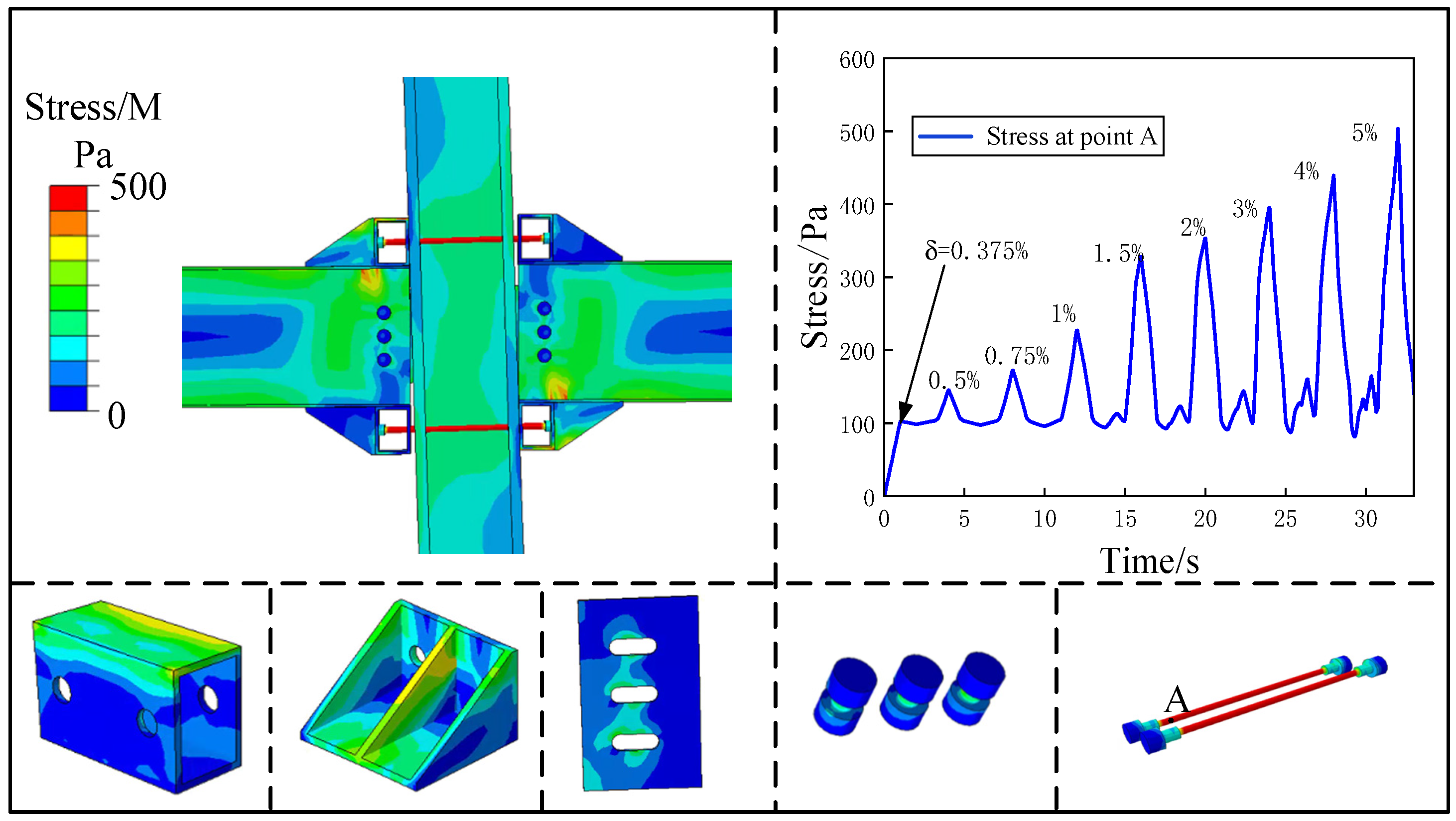
In the numerical model, the loading of the validation model should consider nonlinear geometric effects to improve computational accuracy. The L-shaped brackets and HSS steel brackets are connected to the beam flange using Tie constraints to ensure no relative displacement between them. Surface-to-surface contact is applied between the shear plate and the column, as well as between the brackets and the beam, to ensure a certain degree of sliding between them. All contact interactions include normal behavior and tangential behavior. According to the steel structure code [41], the normal contact behavior is defined as “hard contact”, while the tangential behavior is defined with a penalty friction coefficient of 0.3 for the steel–steel contact surface. The loading protocol of this numerical model is consistent with the experimental procedure. Specifically, cyclic drift loading is applied at the top node of the column using inter-story drift ratios of 0.375%, 0.5%, 0.75%, 1%, 2%, 3%, and 4% until failure of the SMA occurs, refer to Speicher et al. [36]. The inter-story drift ratio is the ratio of horizontal displacement to inter-story height.

2.2. Verification Result

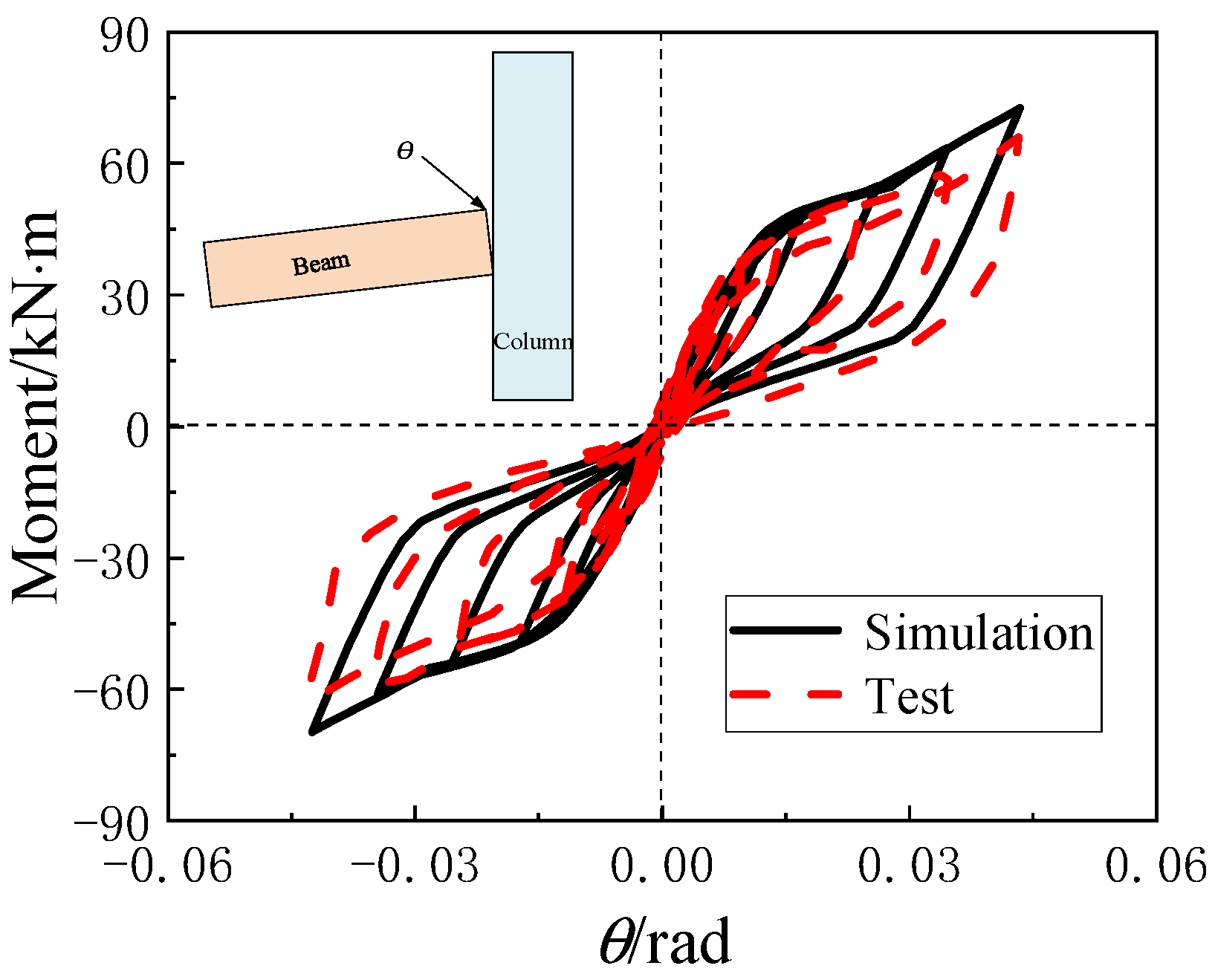
Figure 5 and Figure 6 show the final failure results and the hysteresis curve of the finite element model, respectively. Figure 5 shows that the SMA bolts work as soon as the displacement loading starts. Analysis indicates that the SMA has reached its failure strength σMf, while the stress values in the shear plate, bolts, and angle steel are relatively low and have not reached the yield strength. For specific experimental results, refer to Speicher et al. [36]. A comparison between the model test and the hysteresis curve results in Figure 6 shows that the curve results are in good agreement with the experimental data. Table 2 shows the main characteristic points of the hysteresis curves. This numerical validation model can be used to simulate the SMA connection behavior in beam–column joints. The flag shape of curves resulted from the SMA bolts and the beam–column connection type.

3. Design of New Energy Consuming Components

3.1. Device Design and Force Analysis

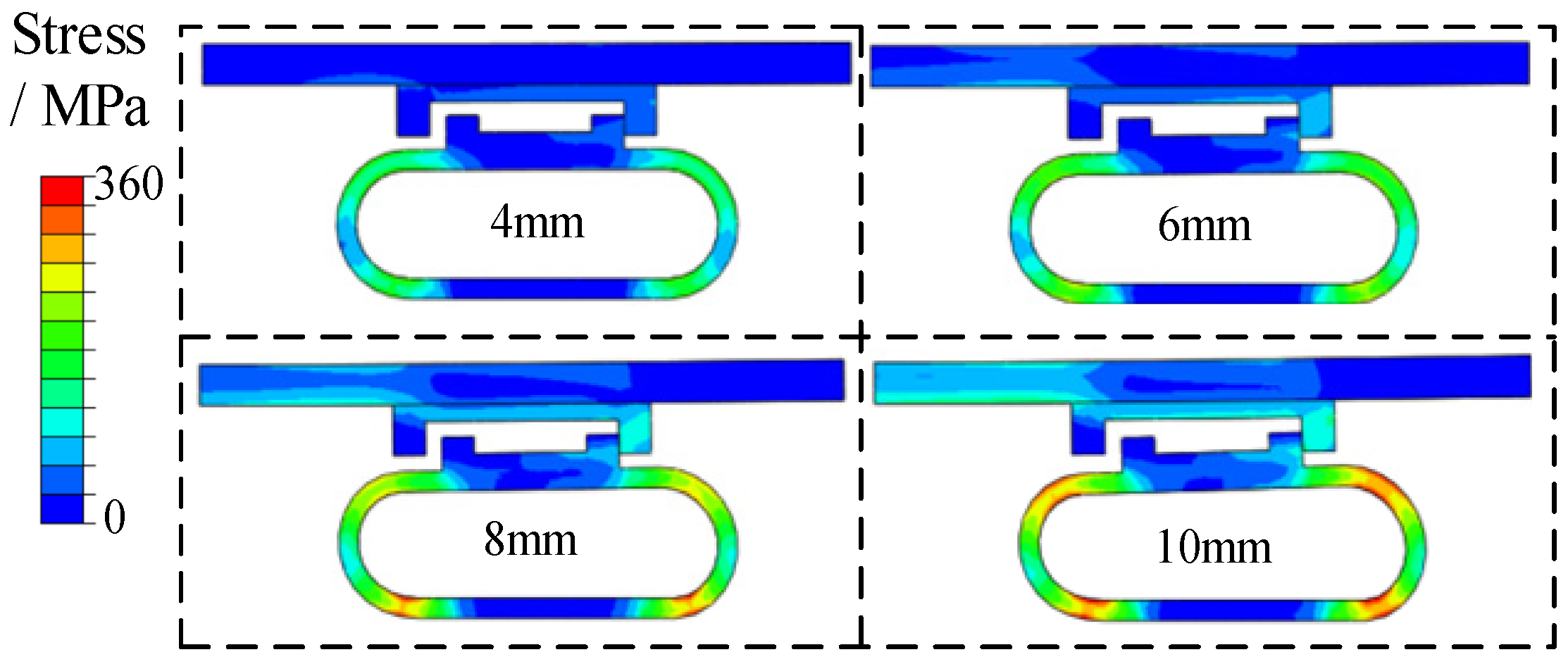
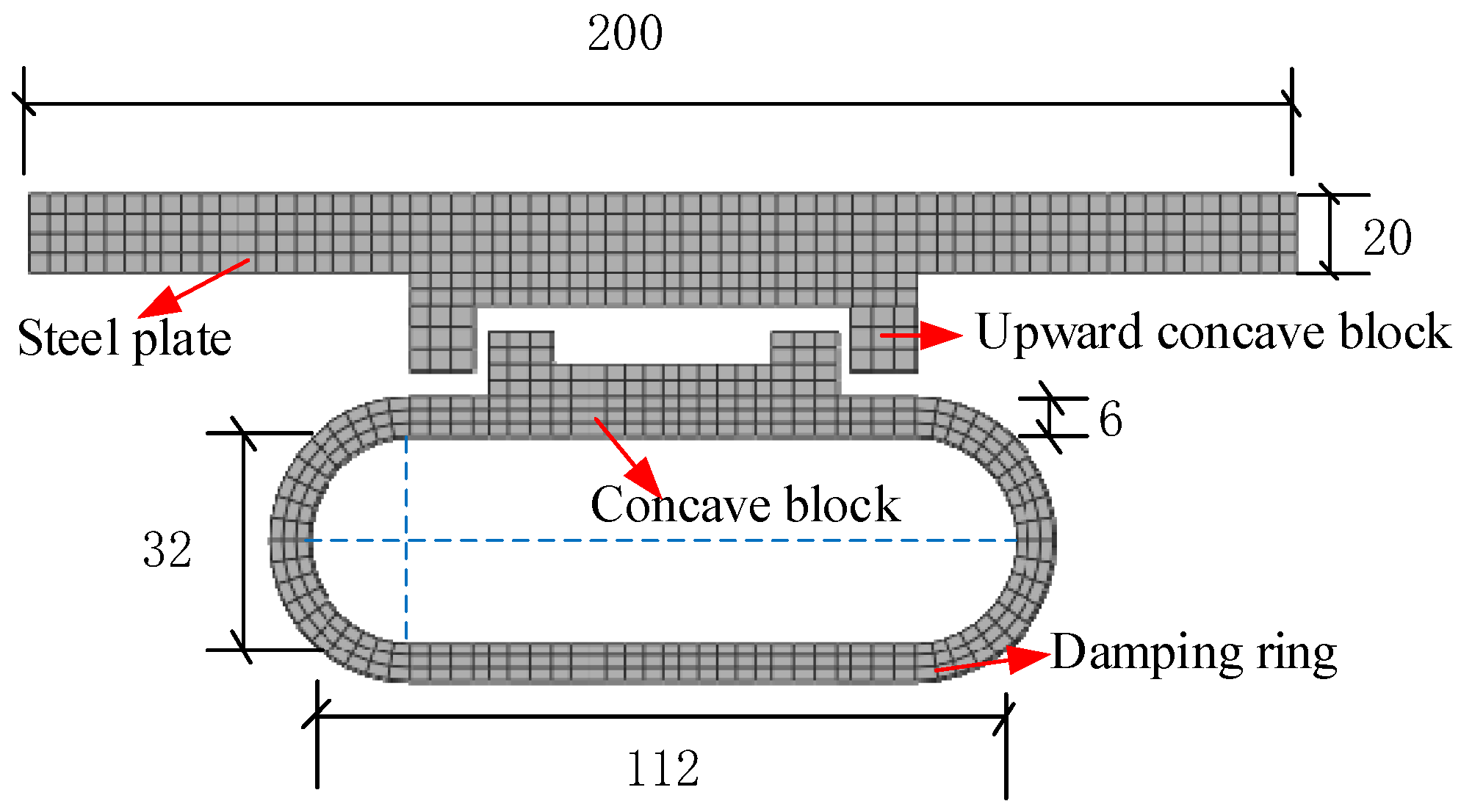
The above verification method indicates that using an SMA connection for beam-to-column joints has superior self-resetting performance, but the hysteresis curve of the model shows that its energy dissipation capacity still needs to be improved. To further improve its energy dissipation, this article designs a new type of energy dissipation device, as shown in the following figure. The detailed dimensions and refined finite element model are shown in Figure 7. The material used is LY160 low-yield soft steel with lower stiffness. The device consists of four components: upper steel plate, upper concave block, lower concave block, and ring dampers. Its core components are the lower concave block and ring dampers. For the convenience of assembly replacement, the left and right control clearances of the upper and lower concave blocks are 2.5 mm each. The ring dampers of the device adopt a three-dimensional 8-node linear solid element (C3D8R) with reduced integration, and the overall mesh size is 2 mm. The contact and verification methods are consistent. To simulate the true deformation of components under horizontal earthquake action, the bottom boundary of the model is kept fixed, and then a forced horizontal displacement is applied on the left side of the steel plate to push the upper concave block to move and contact with the lower concave block, triggering the deformation of the ring dampers. The loading scheme used in this article is cyclic loading with horizontal displacements of 4 mm, 6 mm, 8 mm, and 10 mm.
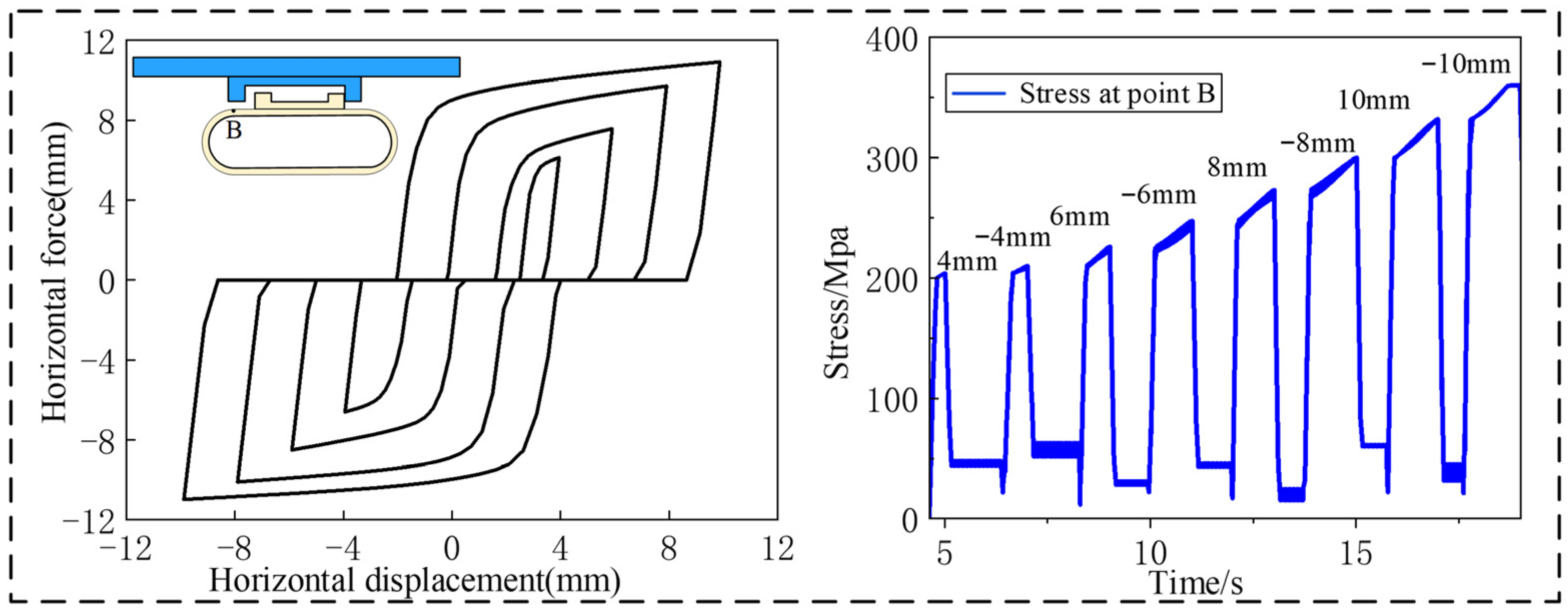
Figure 8 shows the stress state of the device under different horizontal displacements. It can be noted that under the action of horizontal displacement, the steel plate, upper concave block, and lower concave block did not reach yield, but the ring dampers had reached yield strength. Figure 9 shows the force–displacement curve of the novel dampers under horizontal load and the stress history curves of point B inside the ring damper. As shown, the hysteresis curve of the device is full and has good energy dissipation capacity. Combining Figure 8 and Figure 9, it can be observed that the upper steel plate mainly plays a pushing role, allowing the upper concave block to transmit horizontal loads to the lower concave block, which is connected to the ring dampers. The entire component is mainly composed of the ring dampers as the main energy dissipating element. Since the upper and lower components are not connected, it can be used as an assembled component, only replacing the severely deformed ring dampers and retaining the remaining non-yielding elements, which enhances the energy dissipation of the structure while maintaining the system’s recovery ability.

3.2. Modeling Introduction

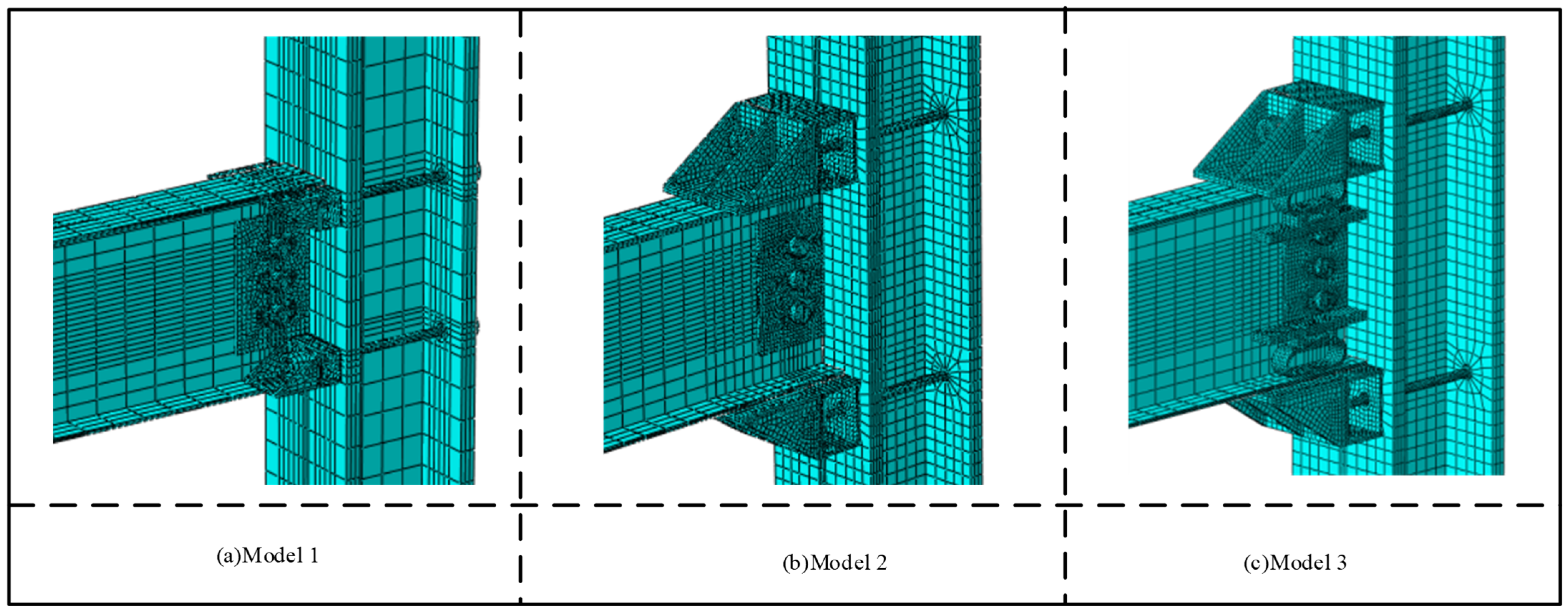
Based on the above numerical verification model, this paper conducted a performance analysis of beam-to-column joints. In order to increase energy dissipation while maintaining the self-resetting performance of the model, a new type of beam-to-column joint model was studied, which combines traditional models with new energy-consuming components. This article designs three models: SMA bolt internal, SMA bolt external, and SMA bolt external with energy dissipation components. Beams and columns of the same size were connected with SMA bolts, and L-shaped and HSS brackets were installed at the joints to strengthen the stiffness of the beam–column connection. At the same time, to prevent the SMA bolts from directly contacting the columns and causing plastic deformation, a thin steel plate is placed on the right side of the column to prevent excessive stress at the column connection. The specific model is shown in Figure 10. It is worth noting that in order to further enhance the performance of the verification joints, four new energy dissipation components were placed at the connection between the beam flange and the column flange in Figure 10c. The material of the annular damper is low-yield soft steel, and the material properties of the remaining shear plates and brackets are consistent with the verification model.
The mesh division of the three models at the boundary points is consistent with the validation model; that is, the mesh set at the SMA bolts, friction plates, brackets, and energy dissipation components is denser to obtain more accurate calculation results. The contact characteristics between the friction plate and the beam–column flange, as well as between the new energy dissipation component and the beam–column flange, are consistent with the set and validated models, all using “Tie” constraints. The loading scheme is subjected to cyclic loading with interlayer displacement ratios of 0.375%, 0.5%, 0.75%, 1%, 1.5%, 2%, 3%, 4%, 5%, and 6%.

4. Result Analysis

4.1. Failure Mode

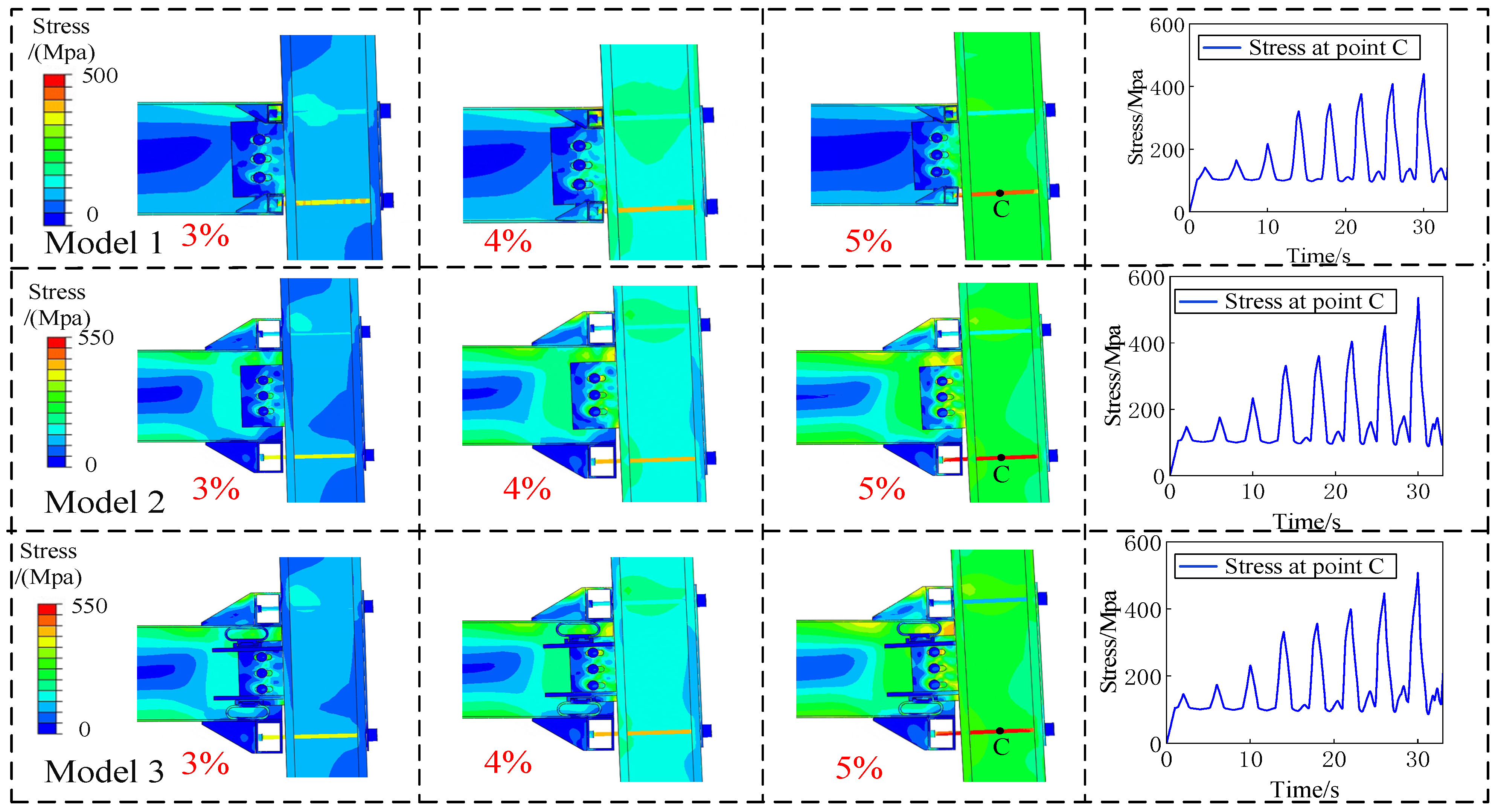
Figure 11 shows the stress states of joints for three models under drift displacement ratios of 3%, 4%, and 5%, respectively. As shown in the figure, as the load increases, the stress on the bolts also increases continuously. When the drift load reaches 5%, the SMA bolts under various working conditions have basically reached the failure strength σMf, while the high-strength bolts, shear plates, and supports have locally reached the yield strength. Taking the stress values of point C under various conditions, the stress values of point C in models 1, 2, and 3 are 441 MPa, 538 MPa, and 507 MPa, respectively. The stress in the external situation has increased by 97 MPa and 66 MPa compared to the internal situation, which fully demonstrates that the overall stress in the internal situation is smaller than that in the external situation. In further comparison with the external SMA bolt, the stress value at point C decreased by 31 MPa. This is due to the presence of energy dissipation components. Under the action of the drift load, the upper steel plate that constitutes the energy dissipation components bears a part of the horizontal force of the structure, sharing a part of the stress of the SMA bolt and further transmitting it to the ring dampers for energy dissipation. This not only makes the SMA bolt less prone to damage, but also makes the structure safer.

4.2. Load–Displacement Curves

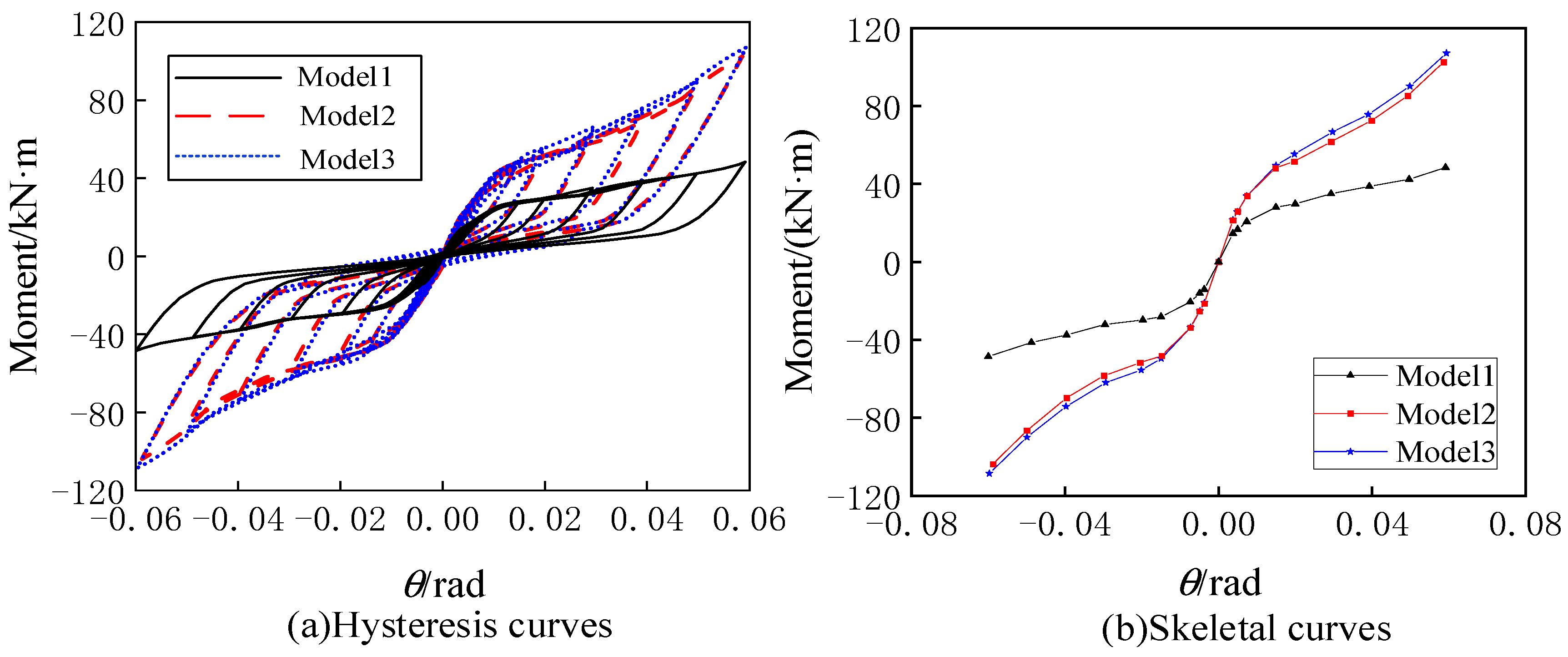
Figure 12 shows the hysteresis curves and skeleton curves of three models. From the figure, it can be intuitively seen that all models exhibit an increase in bending moment values with the increase in drift displacement, and all correspond to almost zero residual displacement. Further observation shows that the bending moment value of the external situation is significantly greater than that of the internal situation, and the fullness of its hysteresis curve is also better than that of the internal situation. Compared with the two types of SMA bolt external situations, the bending moment of Model 3 is overall located above that of Model 2. In summary, the energy absorption capacity of Models 1, 2, and 3 gradually increases.
As shown in the figure, with the increase in horizontal drift displacement, all model curves show an overall upward trend. The bearing capacity of Model 1 and Model 2 is lower than that of the Model 3 curve. Notably, the bearing capacity of the built-in case is significantly lower than that of the external case. The bearing capacity of Model 3 is also improved compared to that of Model 2 in the external case. For further analysis, the yield moment method [42] was used to determine the characteristic points of each model based on the skeleton curve. Table 3 lists the yield point and peak point data of each model. It can be observed that Models 1, 2, and 3 reached the yield state at displacement angles of 23, 36, and 37 rad, respectively. The yield bending moment and peak bending moment of Model 2 were 31 MPa and 48 MPa, respectively. Compared with Model 2, the yield bending moment increased by 38 MPa and 54 MPa, while that of Model 3 increased by 42 MPa and 59 MPa, respectively. The results show that the bending moment value of the external model is more than twice that of the internal model, while the difference in bending moment values between Models 2 and 3 is not significant. It can be seen that the built-in model has the lowest load-bearing capacity, and external SMA bolts can further improve the load-bearing capacity of the joints. The gap of replaceable ring dampers can delay the effect of the damper on the energy dissipation capacity, which can keep the re-centering capacity of joints.

4.3. Ductility

Ductility is an important indicator for measuring the seismic performance of a structure. The angular displacement ductility coefficient μ is used to measure the ductility of a component, which is the ratio of the ultimate rotation θ u to yield rotation θ y .
μ = θ u θ y
Table 4 shows the ductility coefficients of three models. It can be seen from the table that Model 1 corresponds to a ductility coefficient of around 2.5 under both positive and negative loading conditions, which is significantly higher than the ductility coefficient of around 1.6 for the external model. This indicates that Model 1 has a better ductility coefficient, but its bearing capacity is too low, which can easily lead to premature structural failure.

4.4. Energy Dissipation Capacity

The energy dissipation capacity of a structure refers to its ability to absorb energy during earthquakes under horizontal forces, and has always been an important indicator for evaluating the seismic performance of a structure. Generally, the area of the hysteresis curve is first calculated, and the area is used to reflect the energy dissipation capacity of a structure under horizontal seismic forces.
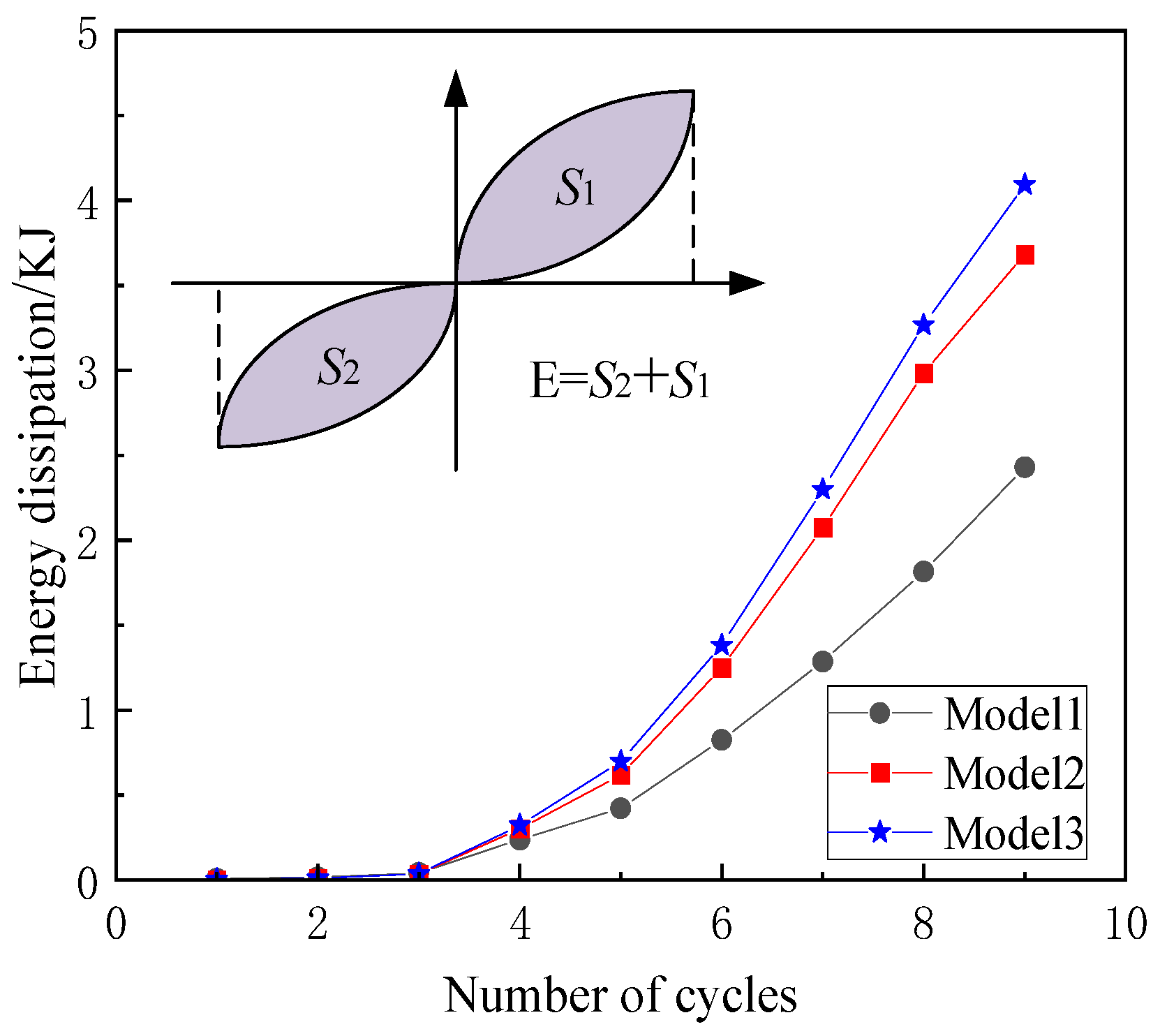
E = S 1 + S 2
The area referred to as S 1 + S 2 in the equation is the hysteresis loop.
Figure 13 illustrates the energy dissipation of three types of models under different inter-story displacements. From the figure, it can be seen that under the action of load, the energy dissipation of each model is relatively good. Comparing the energy dissipation curves of the three models, the energy dissipation of each circle of the external model is located above that of the internal model, and becomes more obvious with the increase in load. Compared with the external situation, Model 3 further increases energy dissipation under different loads compared to Model 2. For the convenience of intuitive reflection, this article calculates the total energy dissipation of Models 1, 2, and 3 as 7.09 KJ, 10.97 KJ, and 12.12 KJ, respectively. Model 2 increased its energy dissipation capacity by 55% compared to Model 1, and Model 3 increased its total energy dissipation by 11% compared to Model 2. It can be seen that the overall energy dissipation capacity of the external model is obviously better than that of the internal situation, and the energy dissipation capacity of Model 3 is the strongest in the external situation.

4.5. Stiffness Degradation Curve

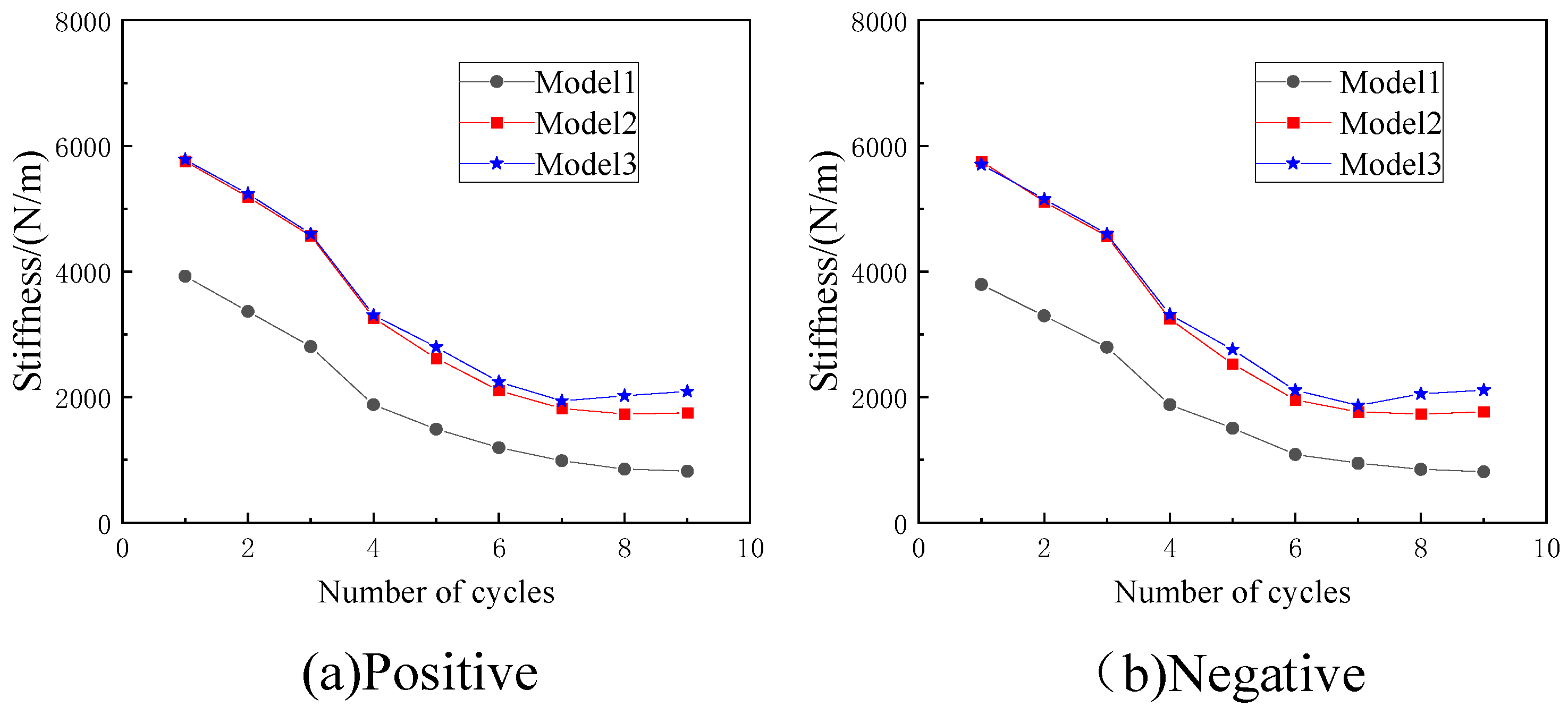
This article uses secant stiffness to describe the degradation process of the specimen, and the specific unloading stiffness degradation curve is shown in Figure 14. It is easy to see that the unloading stiffness of the three models deteriorates with increasing displacement under repeated drift loads. It is worth noting that the stiffness of Model 1 is relatively small from beginning to end, and Model 3 shows little change in initial stiffness compared to Model 2. However, when the load is increased in the later stage, it exhibits higher resistance to lateral displacement stiffness. Therefore, the SMA bolt location has a significant impact on the stiffness degradation of joints.

5. Parameter Analysis

5.1. Comparison of Model Parameters

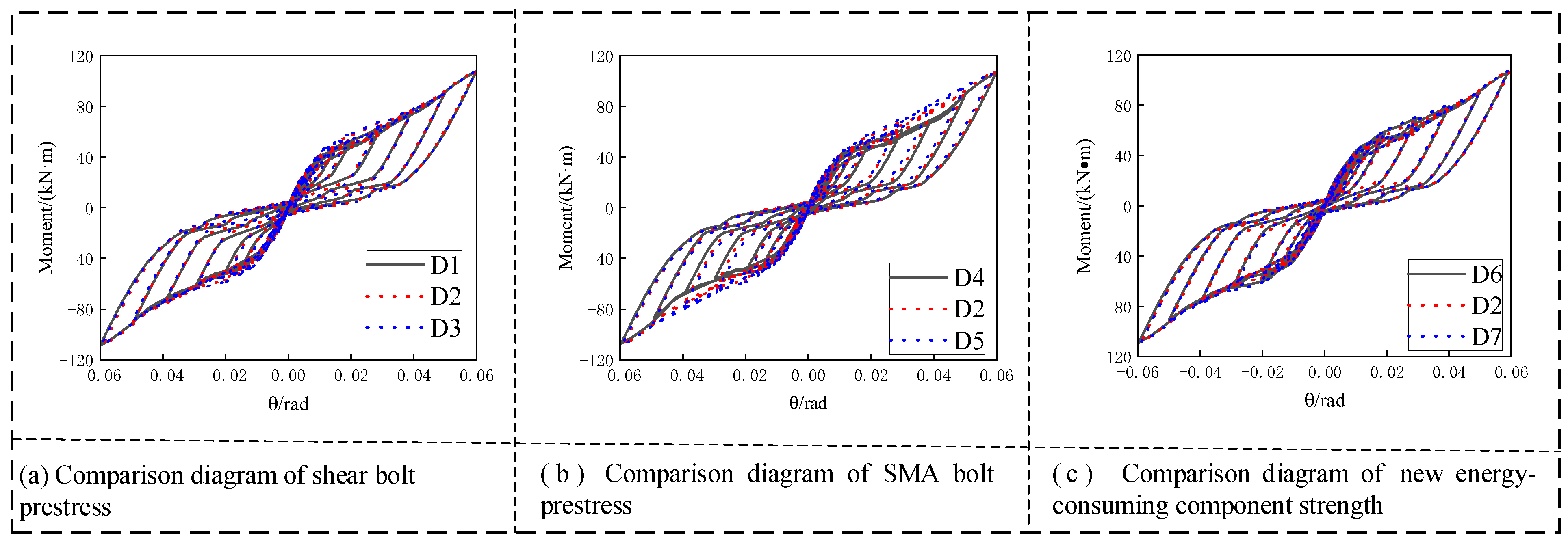
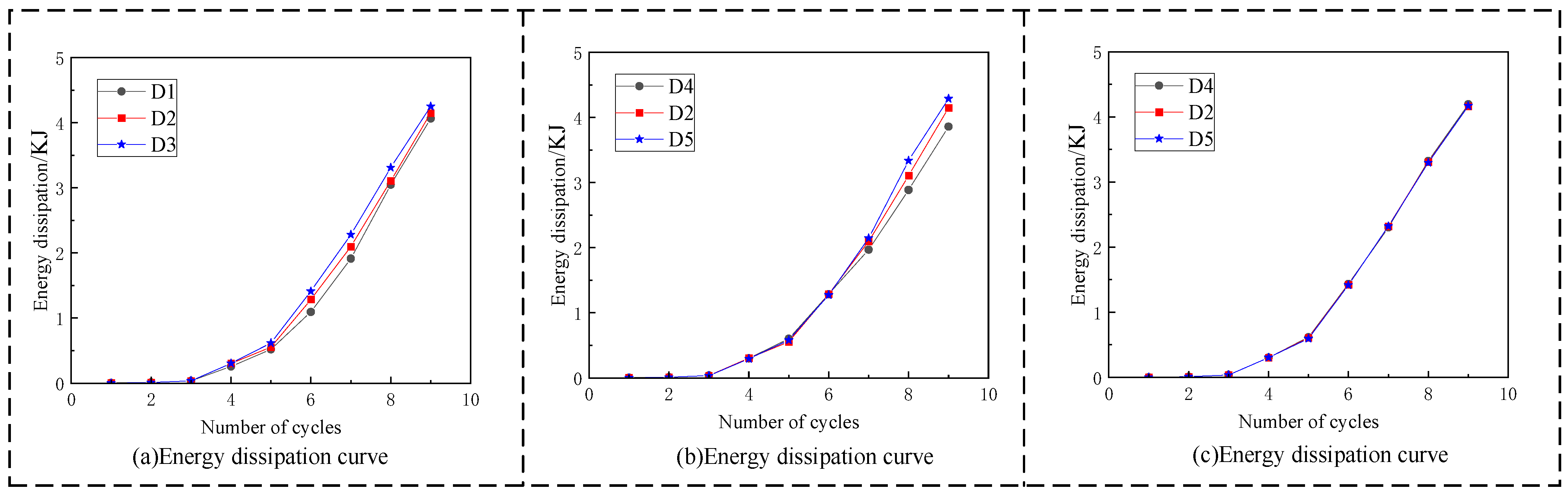
Based on the analysis of hysteresis curves, skeleton curves, ductility coefficients, energy dissipation curves, and unloading stiffness curves of the above models, it can be concluded that the comprehensive performance of Model 3, especially its energy dissipation capacity, is superior to that of Model 1 and Model 2. Therefore, a detailed parameter analysis of Model 3 was conducted, with the results shown below. Due to the fact that the energy dissipation capacity of self-centering structural systems largely depends on the parameter values of each major energy dissipating element, this article analyzed and compared seven types of models, including D1, D2, D3 models with different high-strength bolt pre-tightening forces; D3, D2, D4 models with different SMA bolt pre-tightening forces; and D6, D2, D7 models with different, new energy-dissipating element strengths. The parameter values of the corresponding energy-consuming components in the studied model are shown in Table 5.

5.2. Failure Modes of Different Models

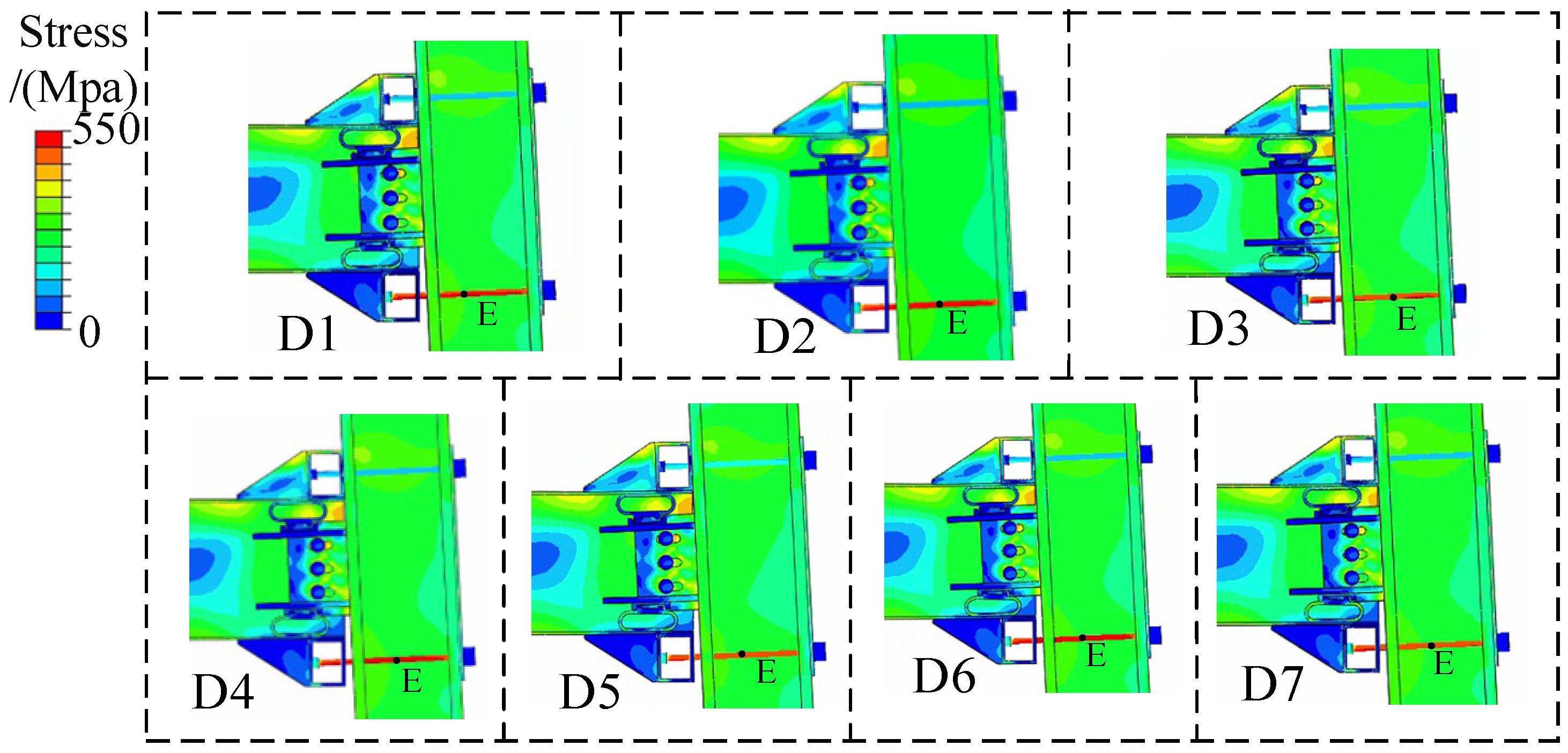
Figure 15 shows the failure situation under various parameter changes based on the damper model. It can be intuitively seen from the figure that all SMA bolts reach failure when the horizontal displacement is loaded to 5%. To further draw a clear conclusion, the stress values corresponding to the D1, 2, 3, 4, 5, 6, and 7 models at point E are 503 MPa, 505 MPa, 503 MPa, 507 MPa, 546 MPa, 507 MPa, and 501 MPa. It can be clearly analyzed that changing the pre-tightening force of SMA bolts has the greatest impact on the stress value of the model. The stress value of the D5 model increased by 41 MPa compared to that of the D2 model, while the other two parameter changes had little effect on the stress value of the model.

5.3. Load–Displacement Curves

Figure 16 presents the force–drift curves of various models. As shown in the figure, with the increase in bolt preload and damping strength, Figure 16a exhibits a slight increase in initial stiffness during the early loading phase. However, by the late loading stage, the stiffness remains largely unchanged, and the corresponding residual displacement also shows no significant variation. In Figure 16b, increasing the preload of the SMA bolt results in a noticeable upward trend in the hysteretic curve of the model. The residual displacement approaches zero, and the stiffness improves significantly. In Figure 16c, altering the stiffness of the damper does not cause substantial changes to the hysteretic curve of the model. This is because, although the damper contributes to energy dissipation, it is not the primary energy-dissipating component. Consequently, the results indicate that among the three factors, increasing the preload of the SMA bolt has a relatively significant impact on the hysteretic curve. The higher the SMA bolt preload, the more superior the hysteretic curve becomes. Increasing the preload of the shear plate bolt has a minor effect on the hysteretic curve, while changing the damping strength has no influence on the structure.
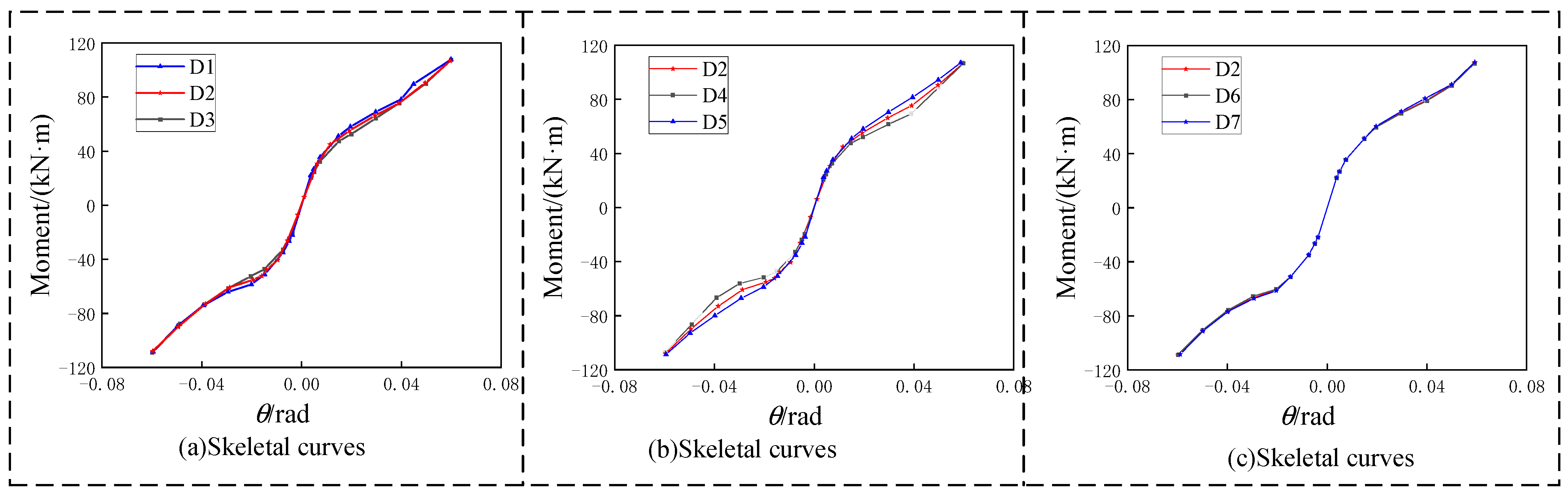
From the comparison of skeleton curves among the seven specimens and the characteristic points listed in Table 5, it can be clearly seen that increasing the pre-tightening force of the shear bolt in Figure 17a can reduce the displacement angle of the model under forward loading from 40.21 rad to 36.9 rad, and the yield bending moment also decreases from 77.77 MPa to 69.99 MPa. Moreover, the peak bending moment values increase significantly under each cyclic load when the horizontal load is 2% to 5%, but once the loading load is 6%, the bending moment values are all around 108 MPa. In Figure 17b, the skeleton curves of D2, D4, and D5 show a more significant improvement under the action of changing the preload force of SMA bolts, but the pattern is consistent with D1 to D3. At a load of 6%, the bending moment values are all around 106 MPa. The difference in skeleton curves in Figure 17c is not very significant. Therefore, a conclusion can be drawn. Changing the strength of the damper does not have a significant impact on the load-bearing capacity of the structure, but changing the pre-tightening force of the shear bolts and SMA bolts can improve the load-bearing capacity of the beam-to-column joint, especially by increasing the pre-tightening force of SMA bolts, which can achieve good results.
The ductility coefficient of general steel structures is between 3 and 5, as shown in Table 6. The minimum ductility coefficient of each model is 1.45, corresponding to D1, and the maximum is 1.77, corresponding to D6. Overall, the displacement ductility coefficients of D1–D7 models are between 1 and 2, which is due to the recovery characteristics of memory alloys. At the same time, it can be seen that the yield point and peak point of the specimen are not significantly different, but it can be seen that the ductility of the specimen increases with the increase in bolt preload and damping stiffness.

5.4. Energy Dissipation Curves

According to the comparison of energy dissipation curves shown in the figure below, it can be seen that the energy dissipation in Figure 18a has been relatively improved. Under horizontal cyclic loading, the energy dissipation per cycle has increased. The energy dissipation of D1, D2, and D3 is 11.55 KJ, 12.1 KJ, and 12.73 KJ, respectively. Overall, D3 has increased its overall energy dissipation by 10% compared to D1. The model in Figure 18b shows a significant improvement when the horizontal load is between 4% and 6%. This is because although the hysteresis curve of Model D5 rises faster, its hysteresis curve also falls faster. The energy dissipation of D4, D2, and D5 is calculated to be 11.56 KJ, 12.1 KJ, and 12.52 KJ, respectively. D5 has increased its energy dissipation capacity by more than 8% compared to D4. Because a higher initial prestress can cause an earlier yielding of SMA bolts, which improves the energy dissipation capacity of SMA bolts. Figure 18c is approximately an overlapping curve, so increasing the strength of the damper does not affect the energy dissipation capacity of the model. Overall, improving the pre-tension strength of shear plate bolts and SMA bolts can help to enhance the energy dissipation of the model.

6. Conclusions

This paper proposes a novel prefabricated beam-to-column joint to increase the seismic performance and post-earthquake recoverability of steel frames, which use shape memory alloy (SMA) bolts and replaceable steel ring dampers.
This study verifies the improvement in the seismic performance and post-earthquake recoverability by using the replaceable ring dampers, providing a reference for the seismic design of resilient structures.
To improve the seismic performance and post-earthquake recoverability of steel frames, SMA bolts and additional replaceable steel ring dampers were used in combination in this paper. Three connection types were investigated, including those installed by internal SMA bolts, external SMA bolts, and external SMA bolts with novel ring dampers. The main conclusions are as follows:
The connection type installed using external SMA bolts was superior to that installed using internal SMA bolts in terms of the seismic performance of beam-to-column joints. The beam-to-column joints had the best seismic performance among the three joints when equipped with the additional steel ring damper, which can be easily replaced. All of the three joints exhibited excellent self-centering characteristics, with residual displacements nearly at zero.
The novel replaceable steel ring dampers can increase the energy dissipation by approximately 11% and effectively reduce the stress of SMA bolts, which can delay their failure. The gap of ring dampers can maintain the re-centering capacity and improve the energy dissipation of joints. However, the changes in the steel strength of the dampers have little impact on the seismic performance.
The increasing preload of SMA bolts and high-strength bolts has a certain positive effect on the improvement of the seismic performance of beam-to-column joints. However, the steel strength of ring dampers has minimal influence on the seismic behavior of beam-to-column joints.
This paper does not take into account the presence of a floor slab, which may have an important influence on the energy dissipation capacity of joints.

Author Contributions

Conceptualization, H.H.; methodology, Y.Z.; validation, W.X., M.W. and T.Z.; investigation, S.C.; writing—original draft preparation, Y.Z., Z.F., Y.D. and H.H. All authors have read and agreed to the published version of the manuscript.

Funding

This research is funded by the Special Fund Project for Basic Scientific Research Business Expenses of Central Public Welfare Research Institutes (2025-9016A).

Data Availability Statement

The original contributions presented in the study are included in the article; further inquiries can be directed to the corresponding author.

Conflicts of Interest

Author Shu Cao was employed by the company Bengbu Highway Management Service Center’s Directly Affiliated Branch Center. Author Yiran Deng was employed by the company Jinan Urban Construction Group. Author Zhixuan Fei was employed by the company Chongqing Highway Affairs Center. The remaining authors declare that the research was conducted in the absence of any commercial or financial relationships that could be construed as potential conflicts of interest.

References

  1. Mitchell, D.; Devall, R.H.; Saatcioglu, M.; Simpson, R.; Tinawi, R.; Tremblay, R. Damage to concrete structures due to the 1994 Northridge earthquake. Can. J. Civ. Eng. 1995, 22, 361–377. [Google Scholar] [CrossRef]
  2. Fleischman, R.B.; Restrepo, J.I.; Pampanin, S.; Maffei, J.R.; Seeber, K.; Zahn, F.A. Damage Evaluations of Precast Concrete Structures in the 2010–2011 Canterbury Earthquake Sequence. Earthq. Spectra 2014, 30, 277–306. [Google Scholar] [CrossRef]
  3. Lu, C.; Dong, B.; Pan, J.; Shan, Q.; Hanif, A.; Yin, W. An investigation on the behavior of a new connection for precast structures under reverse cyclic loading. Eng. Struct. 2018, 169, 131–140. [Google Scholar] [CrossRef]
  4. Parastesh, H.; Hajirasouliha, I.; Ramezani, R. A new ductile moment-resisting connection for precast concrete frames in seismic regions: An experimental investigation. Eng. Struct. 2014, 70, 144–157. [Google Scholar] [CrossRef]
  5. Xu, F.; Wang, K.; Wang, S.; Li, W.; Liu, W.; Du, D. Experimental bond behavior of deformed rebars in half-grouted sleeve connections with insufficient grouting defect. Constr. Build. Mater. 2018, 185, 264–274. [Google Scholar] [CrossRef]
  6. Mou, B.; Zhao, F.; Wang, F.; Pan, W. Effect of reinforced concrete slab on the flexural behavior of composite beam to column joints: Parameter study and evaluation formulae. J. Constr. Steel Res. 2021, 176, 106425. [Google Scholar] [CrossRef]
  7. Mou, B.; Bai, Y.; Patel, V. Post-local buckling failure of slender and over-design circular CFT columns with high-strength materials. Eng. Struct. 2020, 210, 110197. [Google Scholar] [CrossRef]
  8. Dubina, D.; Stratan, A.; Dinu, F. Dual high-strength steel eccentrically braced frames with removable links. Earthq. Eng. Struct. Dyn. 2008, 37, 1703–1720. [Google Scholar] [CrossRef]
  9. Mansour, N.; Christopoulos, C.; Tremblay, R. Experimental Validation of Replaceable Shear Links for Eccentrically Braced Steel Frames. J. Struct. Eng. 2011, 137, 1141–1152. [Google Scholar] [CrossRef]
  10. Askariani, S.S.; Garivani, S.; Aghakouchak, A.A. Application of slit link beam in eccentrically braced frames. J. Constr. Steel Res. 2020, 170, 106094. [Google Scholar] [CrossRef]
  11. Latour, M.; Piluso, V.; Rizzano, G. Experimental analysis of beam-to-column joints equipped with sprayed aluminium friction dampers. J. Constr. Steel Res. 2018, 146, 33–48. [Google Scholar] [CrossRef]
  12. Valente, M.; Castiglioni, C.A.; Kanyilmaz, A. Dissipative devices for earthquake resistant composite steel structures: Bolted versus welded solution. Bull. Earthq. Eng. 2016, 14, 3613–3639. [Google Scholar] [CrossRef]
  13. Valente, M.; Castiglioni, C.A.; Kanyilmaz, A. Numerical investigations of repairable dissipative bolted fuses for earthquake resistant composite steel frames. Eng. Struct. 2017, 131, 275–292. [Google Scholar] [CrossRef]
  14. Valente, M.; Castiglioni, C.A.; Kanyilmaz, A. Welded fuses for dissipative beam-to-column connections of composite steel frames: Numerical analyses. J. Constr. Steel Res. 2017, 128, 498–511. [Google Scholar] [CrossRef]
  15. Oh, S.H.; Kim, Y.J.; Ryu, H.S. Seismic performance of steel structures with slit dampers. Eng. Struct. 2009, 31, 1997–2008. [Google Scholar] [CrossRef]
  16. Vasdravellis, G.; Valente, M.; Castiglioni, C.A. Dynamic response of composite frames with different shear connection degree. J. Constr. Steel Res. 2009, 65, 2050–2061. [Google Scholar] [CrossRef]
  17. Wolski, M.; Ricles, J.M.; Sause, R. Experimental Study of a Self-Centering Beam–Column Connection with Bottom Flange Friction Device. J. Struct. Eng. 2009, 135, 479–488. [Google Scholar] [CrossRef]
  18. Cassiano, D.; D’Aniello, M.; Rebelo, C. Seismic behaviour of gravity load designed flush end-plate joints. Steel Compos. Struct. 2018, 26, 621–634. [Google Scholar]
  19. Cassiano, D.; D’Aniello, M.; Rebelo, C. Parametric finite element analyses on flush end-plate joints under column removal. J. Constr. Steel Res. 2017, 137, 77–92. [Google Scholar] [CrossRef]
  20. Tartaglia, R.; D’Aniello, M.; Rassati, G.A. Proposal of AISC-compliant seismic design criteria for ductile partially-restrained end-plate bolted joints. J. Constr. Steel Res. 2019, 159, 364–383. [Google Scholar] [CrossRef]
  21. Liu, X.C.; Pu, S.H.; Zhang, A.L.; Zhan, X.X. Performance analysis and design of bolted connections in modularized prefabricated steel structures. J. Constr. Steel Res. 2017, 133, 360–373. [Google Scholar] [CrossRef]
  22. Liu, X.C.; Zhan, X.X.; Pu, S.H.; Zhang, A.L.; Xu, L. Seismic performance study on slipping bolted truss-to-column connections in modularized prefabricated steel structures. Eng. Struct. 2018, 163, 241–254. [Google Scholar] [CrossRef]
  23. Gardone, D.; Dolce, M.; Ponzo, F.C.; Coelho, E. Experimental behaviour of R/C frames retrofitted with dissipating and re-centring braces. J. Earthq. Eng. 2004, 8, 361–396. [Google Scholar] [CrossRef]
  24. Sun, L.; Huang, W.M.; Cheah, J.Y. The temperature memory effect and the influence of thermo-mechanical cycling in shape memory alloys. Smart Mater. Struct. 2010, 19, 055005. [Google Scholar] [CrossRef]
  25. Otsuka, K.; Ren, X. Physical metallurgy of Ti–Ni-based shape memory alloys. Prog. Mater. Sci. 2005, 50, 511–678. [Google Scholar] [CrossRef]
  26. Ma, H.; Wilkinson, T.; Cho, C. Feasibility study on a self-centering beam-to-column connection by using the superelastic behavior of SMAs. Smart Mater. Struct. 2007, 16, 1555–1563. [Google Scholar] [CrossRef]
  27. Razavilar, R.; Fathi, A.; Dardel, M.; Hadi, J.A. Dynamic analysis of a shape memory alloy beam with pseudoelastic behavior. J. Intell. Mater. Syst. Struct. 2018, 29, 1835–1849. [Google Scholar] [CrossRef]
  28. Fang, C.; Wang, W.; Qiu, C.; Hu, S.; Macrae, G.A.; Eatherton, M.R. Seismic resilient steel structures: A review of research, practice, challenges and opportunities. J. Constr. Steel Res. 2022, 191, 107172. [Google Scholar] [CrossRef]
  29. Xu, X.; Zhang, Y.; Luo, Y. Self-centering modularized link beams with post-tensioned shape memory alloy rods. Eng. Struct. 2016, 112, 47–59. [Google Scholar] [CrossRef]
  30. Heidari, A.; Gharehbaghi, S. Seismic performance improvement of Special Truss Moment Frames using damage and energy concepts. Earthq. Eng. Struct. Dyn. 2015, 44, 1055–1073. [Google Scholar] [CrossRef]
  31. Miller, D.J.; Fahnestock, L.A.; Eatherton, M.R. Development and experimental validation of a nickel–titanium shape memory alloy self-centering buckling-restrained brace. Eng. Struct. 2012, 40, 288–298. [Google Scholar] [CrossRef]
  32. Moradi, S.; Alam, M.S.; Asgarian, B. Incremental dynamic analysis of steel frames equipped with NiTi shape memory alloy braces. Struct. Des. Tall Spec. Build. 2014, 23, 1406–1425. [Google Scholar] [CrossRef]
  33. Asgarian, B.; Moradi, S. Seismic response of steel braced frames with shape memory alloy braces. J. Constr. Steel Res. 2011, 67, 65–74. [Google Scholar] [CrossRef]
  34. McCormick, J.; DesRoches, R.; Fugazza, D.; Auricchio, F. Seismic Assessment of Concentrically Braced Steel Frames with Shape Memory Alloy Braces. J. Struct. Eng. 2007, 133, 862–870. [Google Scholar] [CrossRef]
  35. Ocel, J.; DesRoches, R.; Leon, R.T.; Hess, W.G.; Krumme, R.; Hayes, J.R.; Sweeney, S. Steel Beam-Column Connections Using Shape Memory Alloys. J. Struct. Eng. 2004, 130, 732–740. [Google Scholar] [CrossRef]
  36. Speicher, M.S.; Desroches, R.; Leon, R.T. Experimental results of a NiTi shape memory alloy (SMA)-based recentering beam-column connection. Eng. Struct. 2011, 33, 2448–2457. [Google Scholar] [CrossRef]
  37. Farmani, M.A.; Ghassemieh, M. Shape memory alloy-based moment connections with superior self-centering properties. Smart Mater. Struct. 2016, 25, 075028. [Google Scholar] [CrossRef]
  38. Xu, X.; Zhang, Y.; Luo, Y. Self-centering eccentrically braced frames using shape memory alloy bolts and post-tensioned tendons. J. Constr. Steel Res. 2016, 125, 190–204. [Google Scholar] [CrossRef]
  39. Xu, X.; Tu, J.; Cheng, G.; Zheng, J.; Luo, Y. Experimental study on self-centering link beams using post-tensioned steel-SMA composite tendons. J. Constr. Steel Res. 2019, 155, 121–128. [Google Scholar] [CrossRef]
  40. Speicher, M.S. Cyclic Testing and Assessment of Shape Memory Alloy Recentering Systems. Ph.D. Thesis, Georgia Institute of Technology, Atlanta, GA, USA, 2010. [Google Scholar]
  41. Lama, L.; Zhou, F.; Bhatt, N.R. Structural performance and design of stainless steel SHS-concrete-carbon steel CHS double-skin stub columns. J. Constr. Steel Res. 2022, 190, 107155. [Google Scholar] [CrossRef]
  42. Fan, J.; Zhao, J. Experimental and numerical analysis of assembled steel beam to CFDST column joint. J. Constr. Steel Res. 2024, 218, 108697. [Google Scholar] [CrossRef]
Figure 1. On-site test photos.
Buildings 16 01209 g001
Figure 2. Schematic diagram of specimen boundary supports.
Buildings 16 01209 g002
Figure 3. Numerical model based on the SMA connection.
Buildings 16 01209 g003
Figure 4. Simplified diagram of the steel constitutive curve.
Buildings 16 01209 g004
Figure 5. Failure mode of the numerical model and stress values of SMA.
Buildings 16 01209 g005
Figure 6. Hysteresis curves of the test and numerical model.
Buildings 16 01209 g006
Figure 7. Finite element model of the new device (Unit: mm).
Buildings 16 01209 g007
Figure 8. Stress state of new energy-consuming components.
Buildings 16 01209 g008
Figure 9. Hysteresis curve of novel damper and stress curve at point B.
Buildings 16 01209 g009
Figure 10. Design of beam-to-column joint model.
Buildings 16 01209 g010
Figure 11. Stress states of beam–column joints under three working conditions.
Buildings 16 01209 g011
Figure 12. Hysteresis curves and skeleton curves of three types of models.
Buildings 16 01209 g012
Figure 13. Total energy dissipation under three types of models.
Buildings 16 01209 g013
Figure 14. Stiffness degradation curve.
Buildings 16 01209 g014
Figure 15. Failure modes of various models based on dampers.
Buildings 16 01209 g015
Figure 16. Comparison of hysteresis curves of D1–D7 models.
Buildings 16 01209 g016
Figure 17. Skeleton curves of D1–D7 models.
Buildings 16 01209 g017
Figure 18. Energy dissipation curve of D1–D7 models.
Buildings 16 01209 g018
Table 1. Material properties of SMA reinforcement.
Material PropertyValue
Elastic Modulus EA (GPa)30
Elastic Modulus EM (GPa)23
Austenite to Martensite Start Stress σMs (MPa)280
Austenite to Martensite Finish Stress σMf (MPa)500
Martensite to Austenite Start Stress σAs (MPa)320
Martensite to Austenite Finish Stress σAf (MPa)100
Poisson’s Ratio0.33
Transformation Strain εL0.04
Table 2. Main characteristic points of the hysteresis curves.
Inter-Story Drift RatioMoment (kN·m)
SimulationTest
1%34.1236.92
2%48.5450.83
3%57.8058.77
4%60.6167.58
Table 3. Schematic diagram of the main characteristic points of the loaded skeleton curve.
SpecimenDirectionYield PointPeak Point
θ y /10−3 M y /kN∙m θ u /10−3 M u /kN∙m
Model1Positive23.8431.8559.1748.43
Negative24.1330.960.0048.52
Model2Positive36.466958.6102.46
Negative37.4167.3758.83−103.82
Model3Positive37.2173.4859.37107.07
Negative37.871.8559.74108.5
Table 4. Characteristics and ductility coefficient of SMA loading skeleton curve.
Test PieceModel 1Model 2Model 3
PositiveNegativePositiveNegativePositiveNegative
μ2.482.491.601.571.601.58
Table 5. Model element parameter data under different bolt prestress and damper strength.
Model IDShear Tab Bolt PrestressSMA Bolt PrestressDamper Strength
D180 MPa100 MPa360
D2120 MPa100 MPa360
D3160 MPa100 MPa360
D4120 MPa80 MPa360
D5120 MPa120 MPa360
D6120 MPa100 MPa300
D7120 MPa100 MPa400
Table 6. Schematic diagram of the main characteristic points of skeleton curves loaded with D1–D7 and the ductility coefficient of the model.
Test PieceDirectionYield PointPeak Pointμ
θ y /10−3 M y /kN∙m θ u /10−3 M u
D1Positive40.2176.7759.89107.591.49
Negative41.3676.5459.96108.71.45
D2Positive37.2173.4859.37107.071.60
Negative37.871.8559.74108.51.58
D3Positive36.966.8459.88106.581.62
Negative41.169.9959.72107.491.45
D4Positive33.874.3958.72107.031.74
Negative35.1474.0859.42108.781.69
D5Positive35.1271.5458.96106.971.68
Negative35.9571.2759.01107.891.64
D6Positive33.370.9759.01106.611.77
Negative34.4169.8859.82108.751.74
D7Positive33.6173.8259.17107.751.76
Negative33.8770.1558.93108.411.74
Disclaimer/Publisher’s Note: The statements, opinions and data contained in all publications are solely those of the individual author(s) and contributor(s) and not of MDPI and/or the editor(s). MDPI and/or the editor(s) disclaim responsibility for any injury to people or property resulting from any ideas, methods, instructions or products referred to in the content.