Human–AI Collaboration in Architectural Design Education: Towards a Conceptual Framework

Abstract
1. Introduction
2. Literature Review
2.1. An Overview of Design Process and Creativity from an Architectural Perspective
2.2. Current Role of AI in Architecture and Architectural Education
2.3. Design Thinking vs. Algorithmic Thinking: Cognitive Aspects of Human–AI Collaboration in Architectural Design Education
3. Materials and Methods
3.1. Data Collection
3.2. Data Analysis
4. Results
5. Discussion
Interpretation of the Findings
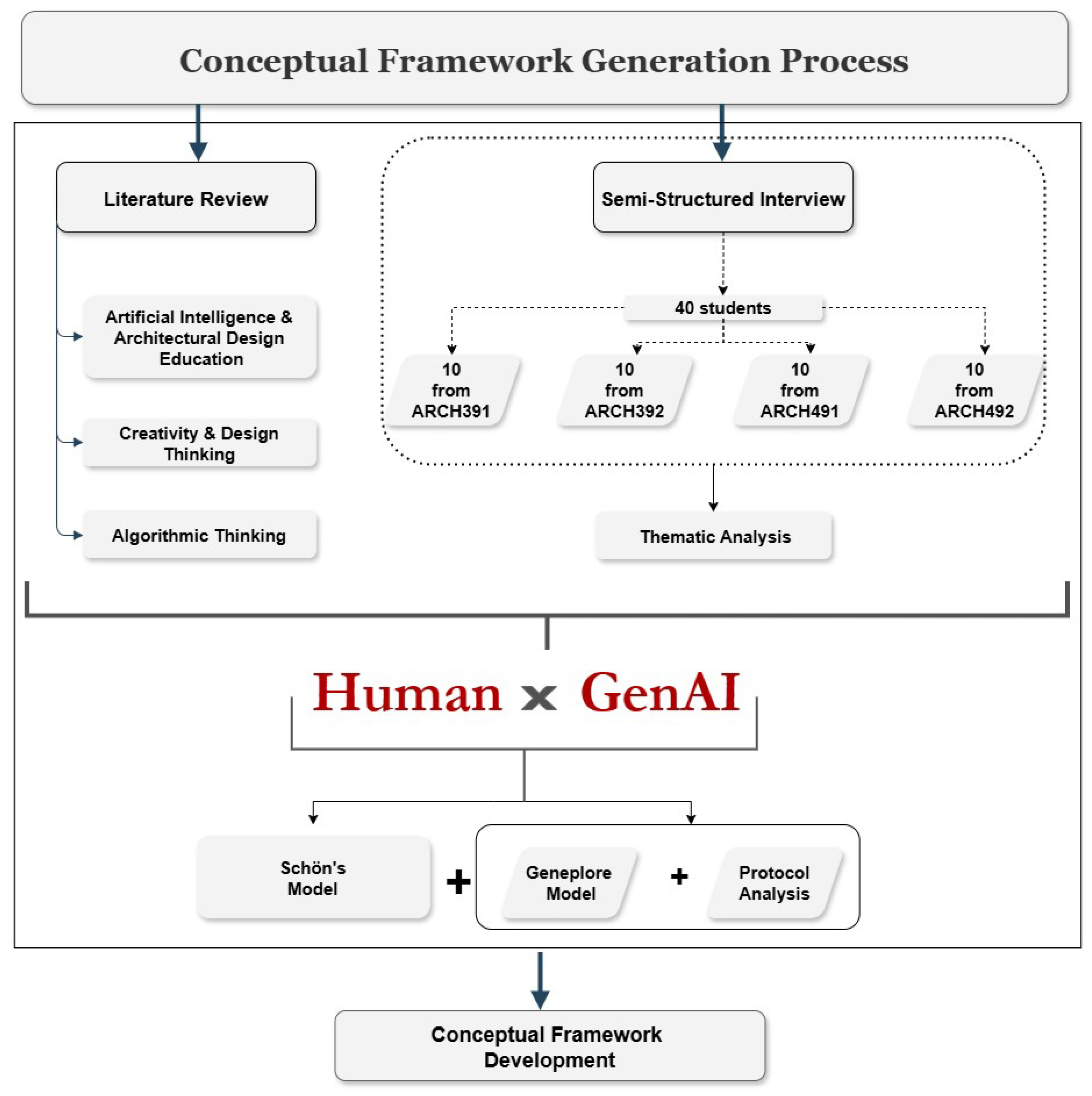
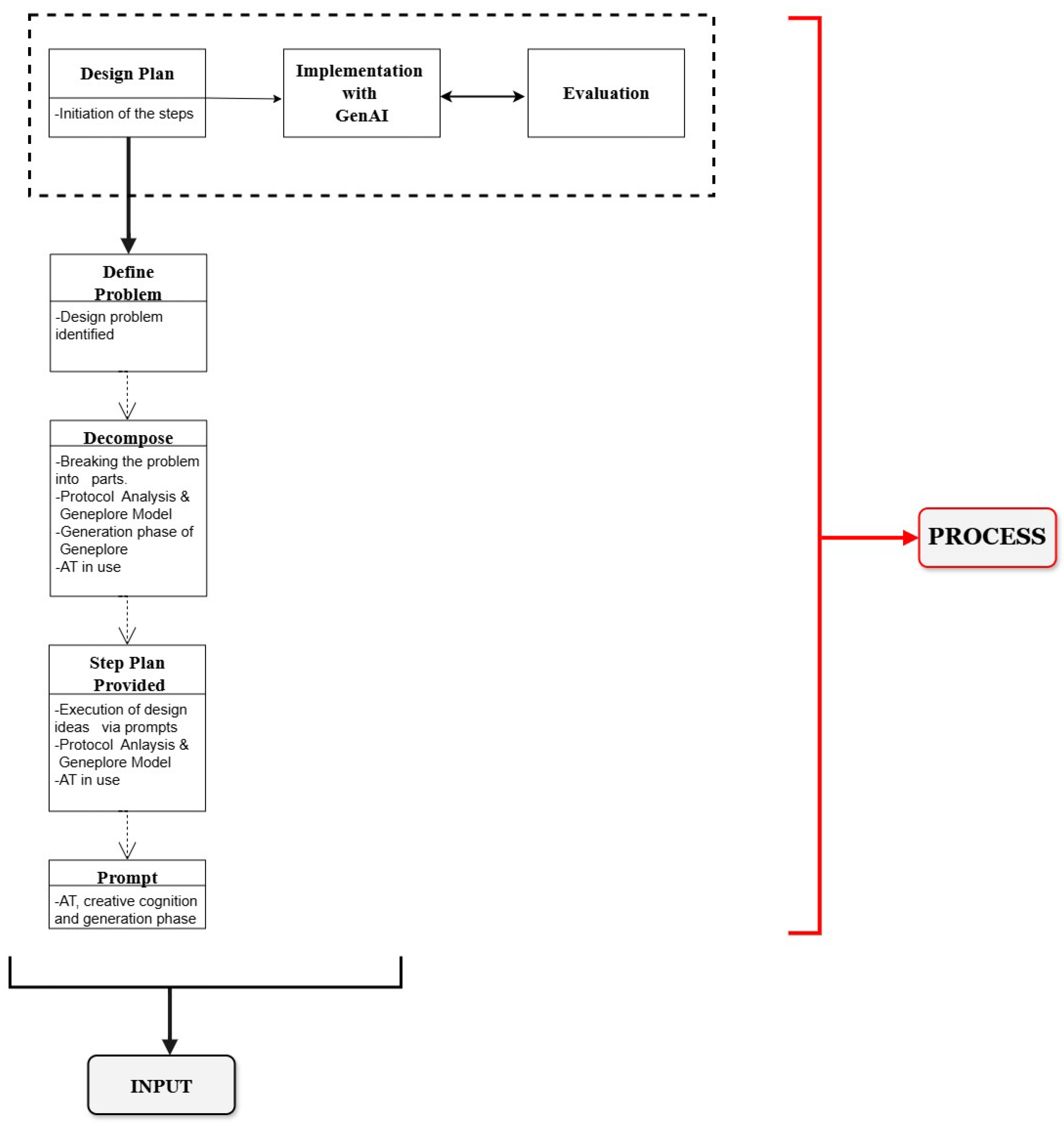
6. Conceptual Framework Formation
7. Limitations and Suggestions for Future Studies
8. Conclusions
Author Contributions
Funding
Institutional Review Board Statement
Informed Consent Statement
Data Availability Statement
Conflicts of Interest
Abbreviations
| AI | Artificial Intelligence |
| GenAI | Generative Artificial Intelligence |
| DT | Design Thinking |
| AT | Algorithmic Thinking |
Appendix A

| Interview Questions | ||
|---|---|---|
| First Section | ||
| ||
| Second Section | ||
| ||
| Main Theme | Sub-Theme | Code |
|---|---|---|
| Computer program usage | Programs for rendering, drawing and modeling | AutoCAD |
| Lumion | ||
| Revit | ||
| SketchUp | ||
| Rhino | ||
| Photoshop | ||
| Twinmotion | ||
| Other computer programs | ||
| Computational tool usage in design | Stage of design problem having computational tool adoption | Site analysis |
| Proposal/Initial idea | ||
| Concept | ||
| Site synthesis | ||
| Usage of AI | Specifying if ever used AI tools in project | Encountered, tried |
| Haven’t tried, no | ||
| Mediums that enabled the AI tool to be known | The platforms which give information | Social media platforms |
| By person | Friends | |
| Architectural magazines | Blogs, architectural websites | |
| Out of context | (Only mentioned in text) | |
| Design stages that have benefit of AI usage | Stages having beneficial usage | Concept |
| Proposal/Initial idea | ||
| Site analysis | ||
| Advantages and disadvantages of AI usage in design projects | Observed drawbacks | Feeling of dependence |
| Inhibition of creativity | ||
| Not accurate | ||
| Observed benefits | Time management, helpful | |
| Design stages to have the usage of AI | Conceptual phase | Ideation, concept |
| Development | 3D model, visuals/façade | |
| Presentation | Render, visual presentation | |
| Analysis | Site analysis, Case study | |
| Support for the designer role | Positive support | Support |
| Negative support | Will not support | |
| Out of context | (Only mentioned in text) | |
| Usage of AI for the future projects | AI will be used | Future projects will benefit from AI |
| AI will not be used | Future projects will not benefit from AI | |
| Not decided yet | Not sure and do not know whether to use AI | |
| Expectations from instructors for the use of AI tools | Restrictive manner | Should be restricted, Rejected |
| Supportive manner | Acceptance, Openness | |
| Extra Views | Feeling of guidance and not knowing (Only mentioned in text) | |
| Role of architect in the future | Remain similar | Same, in need |
| Alteration | Change, differ, evolve, | |
| Uncertain | Do not know, not sure | |
| The status of being worried as an architect in the era of AI | Feeling worried | Felt afraid, worried |
| Not being anxious | Thinking AI as tool, no worries |
References
- Hunde, B.R.; Woldeyohannes, A.D. Future prospects of computer-aided design (CAD)—A review from the perspective of artificial intelligence (AI), extended reality, and 3D printing. Results Eng. 2022, 14, 100478. [Google Scholar] [CrossRef] [Scilit]
- Guo, W.; Liang, Z.; Wang, C.; Li, X.; Hu, H.; Chen, S.; Yu, Q.; Zhao, Q. Student-AI collaborative creative Problem-Solving: The role of human agency. Comput. Educ. 2025, 239, 105433. [Google Scholar] [CrossRef] [Scilit]
- Joseph, A.; Kroll, D.; Srivastava, A.; Sharifi, E.; Datey, A. Collaboration in architectural design studio pedagogy: A literature review. CoDesign 2025, 1–27. [Google Scholar] [CrossRef] [Scilit]
- Komatina, D.; Miletić, M.; Ružičić, M.M. Embracing Artificial Intelligence (AI) in Architectural Education: A Step towards Sustainable Practice? Buildings 2024, 14, 2578. [Google Scholar] [CrossRef] [Scilit]
- Zhang, Z.; Fort, J.M.; Mateu, L.G. Exploring the Potential of Artificial intelligence as a tool for Architectural Design: A Perception Study using Gaudí’sWorks. Buildings 2023, 13, 1863. [Google Scholar] [CrossRef] [Scilit]
- Sanders, E.B.N.; Stappers, P.J. Co-creation and the new landscapes of design. CoDesign 2008, 4, 5–18. [Google Scholar] [CrossRef] [Scilit]
- Alexander, C.; Ishikawa, S.; Silverstein, M.; Jacobson, M.; Fiksdahl-King, I.; Angel, S. A Pattern Language: Towns, Buildings, Construction; Oxford University Press: New Yok, NU, USA, 1977. [Google Scholar]
- Sarı, U.; Pektaş, H.M.; Şen, Ö.F.; Çelik, H. Algorithmic thinking development through physical computing activities with Arduino in STEM education. Educ. Inf. Technol. 2022, 27, 6669–6689. [Google Scholar] [CrossRef] [Scilit]
- Katai, Z. The challenge of promoting algorithmic thinking of both sciences- and humanities-oriented learners. J. Comput. Assist. Learn. 2014, 31, 287–299. [Google Scholar] [CrossRef] [Scilit]
- Larkin, J.; Simon, H. Why a Diagram is (Sometimes) Worth Ten Thousand Words. Cogn. Sci. 1987, 11, 65–100. [Google Scholar] [CrossRef]
- Schön, D.A. The Reflective Practitioner: How Professionals Think in Action; Basic Books: New York, NY, USA, 1983. [Google Scholar]
- Cross, N. Descriptive models of creative design: Application to an example. Des. Stud. 1997, 18, 427–440. [Google Scholar] [CrossRef] [Scilit]
- Akin, Ö.; Lin, C. Design protocol data and novel design decisions. Des. Stud. 1995, 16, 211–236. [Google Scholar] [CrossRef] [Scilit]
- Lawson, B. How Designers Think; Routledge: London, UK, 2005. [Google Scholar] [CrossRef] [Scilit]
- Finke, R.A.; Ward, T.B.; Smith, S.M. Creative Cognition: Theory, Research, and Applications; MIT Press: Cambridge, MA, USA, 1992. [Google Scholar]
- Cikis, S.; Ek, F.I. Conceptualization by visual and verbal representations: An experience in an architectural design studio. Des. J. 2010, 13, 329–354. [Google Scholar] [CrossRef] [Scilit]
- Kristensen, T. The physical context of creativity. Creat. Innov. Manag. 2004, 13, 89–96. [Google Scholar] [CrossRef] [Scilit]
- Wallas, G. The Art of Thought; Harcourt, Brace: Orlando, FL, USA, 1926. [Google Scholar]
- Guilford, J.P. Creativity. Am. Psychol. 1950, 5, 444–454. [Google Scholar] [CrossRef] [Scilit] [PubMed]
- Smith, S.M.; Beda, Z. Unconscious work doesn’t work. Creat. Res. J. 2023, 35, 369–379. [Google Scholar] [CrossRef] [Scilit]
- Weisberg, R.W. Creativity: Beyond the Myth of Genius; W.H. Freeman & Co: New York, NY, USA, 1993. [Google Scholar]
- Russell, S.J.; Norvig, P.; Davis, E. Artificial intelligence: A Modern Approach; Prentice Hall: Saddle River, NJ, USA, 1995. [Google Scholar]
- Terzidis, K. Algorithmic Architecture; Routledge: London, UK, 2006. [Google Scholar]
- Başarır, L. Modelling AI in architectural education. Gazi Univ. J. Sci. 2022, 35, 1260–1278. [Google Scholar] [CrossRef] [Scilit]
- Bernstein, P.G. Architecture, Design, Data: Practice Competency in the Era of Computation; Birkhaüser: Basel, Switzerland, 2018. [Google Scholar]
- Popenici, S.A.D.; Kerr, S. Exploring the impact of artificial intelligence on teaching and learning in higher education. Res. Pract. Technol. Enhanc. Learn. 2017, 12, 22. [Google Scholar] [CrossRef] [Scilit]
- Jin, S.; Tu, H.; Li, J.; Fang, Y.; Qu, Z.; Xu, F.; Liu, K.; Lin, Y. Enhancing Architectural Education through Artificial Intelligence: A Case Study of an AI-Assisted Architectural Programming and Design Course. Buildings 2024, 14, 1613. [Google Scholar] [CrossRef] [Scilit]
- Wang, J.; Shi, Y.; Chen, X.; Lan, Y.; Liu, S. Teaching with Artificial Intelligence in Architecture: Embedding Technical Skills and Ethical Reflection in a Core Design Studio. Buildings 2025, 15, 3069. [Google Scholar] [CrossRef] [Scilit]
- Uncu, E.Ö.; Çağdaş, G. The pedagogical alignment of computational thinking to architecture education for the 21st century learners. J. Comput. Des. 2022, 3, 159–172. [Google Scholar] [CrossRef] [Scilit]
- Cross, N. Forty years of design research. Des. Stud. 2007, 28, 1–4. [Google Scholar] [CrossRef] [Scilit]
- Ball, L.J.; Christensen, B.T. Advancing an understanding of design cognition and design metacognition: Progress and prospects. Des. Stud. 2019, 65, 35–59. [Google Scholar] [CrossRef] [Scilit]
- Cross, N. Designerly Ways of Knowing; Springer Science & Business Media: Berlin/Heidelberg, Germany, 2006. [Google Scholar]
- Razzouk, R.; Shute, V. What is design thinking and why is it important? Rev. Educ. Res. 2012, 82, 330–348. [Google Scholar] [CrossRef] [Scilit]
- Knuth, D.E. Algorithms. Sci. Am. 1977, 236, 63–81. [Google Scholar] [CrossRef] [Scilit]
- Yusuf, A.; Noor, N.M. Modeling students’ algorithmic thinking growth trajectories in different programming environments: An experimental test of the Matthew and compensatory hypothesis. Smart Learn. Environ. 2024, 11, 38. [Google Scholar] [CrossRef] [Scilit]
- Ürey, Z.Ç.U. Fostering Creative Cognition in Design Education: A Comparative Analysis of Algorithmic and Heuristic Educational Methods in Basic Design Education. METU J. Fac. Archit. 2021, 38, 53–80. [Google Scholar] [CrossRef] [Scilit]
- Ostrowska-Wawryniuk, K.; Strzała, M.; Słyk, J. Form follows parameter: Algorithmic-Thinking-Oriented course for early-stage architectural education. Nexus Netw. J. 2022, 24, 503–522. [Google Scholar] [CrossRef] [Scilit]
- Vazquez, E. Teaching parametric design: Fostering algorithmic thinking through incomplete recipes. Open House Int. 2023, 49, 736–751. [Google Scholar] [CrossRef] [Scilit]
- Austin, M.; Qattan, W. I’m a visual thinker: Rethinking algorithmic education for architectural design. In Living Systems and Micro-Utopias: Towards Continuous Designing, Proceedings of the International Conference on Computer-Aided Architectural Design Research in Asia; The Association for Computer-Aided Architectural Design Research in Asia (CAADRIA): Hong Kong, 2016; pp. 829–838. [Google Scholar] [CrossRef] [Scilit]
- Tan, F. Translation of Form: A Model for Teaching Design Coding to Undergraduate Students. Nexus Netw. J. 2024, 26, 897–924. [Google Scholar] [CrossRef] [Scilit]
- Chen, X.; Xie, H.; Zou, D.; Hwang, G.-J. Application and theory gaps during the rise of Artificial Intelligence in Education. Comput. Educ. Artif. Intell. 2020, 1, 100002. [Google Scholar] [CrossRef] [Scilit]
- Crespo, S.; McCormick, F. Augmenting Digital Nature Generative Art as a Constructive Feedback Loop. In Machine Hallucinations: Architecture and Artificial Intelligence; Del Campo, M., Leach, N., Eds.; John Wiley & Sons: Oxford, UK, 2022; Volume 3, pp. 54–59. [Google Scholar]
- Çelik, T. Generative design experiments with artificial intelligence: Reinterpretation of shape grammar. Open House Int. 2023, 49, 822–842. [Google Scholar] [CrossRef] [Scilit]
- Tan, L.; Luhrs, M. Using Generative AI Midjourney to enhance divergent and convergent thinking in an architect’s creative design process. Des. J. 2024, 27, 677–699. [Google Scholar] [CrossRef] [Scilit]
- Flower, L.; John, R.H. A Cognitive Process Theory of Writing. Coll. Compos. Commun. 1981, 32, 365–387. [Google Scholar] [CrossRef] [Scilit]
- Kelly, N.; Gero, J.S. Design thinking and computational thinking: A dual process model for addressing design problems. Des. Sci. 2021, 7, e8. [Google Scholar] [CrossRef] [Scilit]
- Ericsson, K.A.; Simon, H.A. Protocol Analysis: Verbal Reports as Data; MIT Press: Cambridge, MA, USA, 1993. [Google Scholar]
- Braun, V.; Clarke, V. Reflecting on reflexive thematic analysis. Qual. Res. Sport Exerc. Health 2019, 11, 589–597. [Google Scholar] [CrossRef] [Scilit]
- Braun, V.; Clarke, V.; Rance, N. How to use thematic analysis with interview data (process research). In The Counselling and Psychotherapy Research Handbook; UWE Research Repository (UWE Bristol): Bristol, UK, 2014. [Google Scholar]
- Lee, J.H.; Ostwald, M.J. The relationship between divergent thinking and ideation in the conceptual design process. Des. Stud. 2022, 79, 101089. [Google Scholar] [CrossRef] [Scilit]
- Liang, C.J.; Le, T.H.; Ham, Y.; Mantha, B.R.K.; Cheng, M.H.; Lin, J.J. Ethics of artificial intelligence and robotics in the architecture, engineering, and construction industry. Autom. Constr. 2024, 162, 105369. [Google Scholar] [CrossRef] [Scilit]
- Yazici, G.; Dogan, F. Fostering metacognition in the design studio: The effect of minimal interventions on architectural students’ metacognitive awareness. Think. Ski. Creat. 2024, 54, 101651. [Google Scholar] [CrossRef] [Scilit]
- Brown, T.B.; Mann, B.; Ryder, N.; Subbiah, M.; Kaplan, J.; Dhariwal, P.; Neelakantan, A.; Shyam, P.; Sastry, G.; Askell, A.; et al. Language Models are Few-Shot Learners. arXiv 2020, arXiv:2005.14165. [Google Scholar] [CrossRef] [Scilit]
- Wang, L.; Xu, W.; Lan, Y.; Hu, Z.; Lan, Y.; Lee, R.K.-W.; Lim, E.-P. Plan-and-Solve prompting: Improving Zero-Shot Chain-of-Thought reasoning by large language models. arXiv 2023, arXiv:2305.04091. [Google Scholar] [CrossRef] [Scilit]
- Perkins, D.N. The Mind’s Best Work; Harvard University Press: Cambridge, MA, USA, 1981. [Google Scholar]
- Hou, C.; Zhu, G.; Sudarshan, V.; Lim, F.S.; Ong, Y.S. Measuring undergraduate students’ reliance on Generative AI during problem-solving: Scale development and validation. Comput. Educ. 2025, 234, 105329. [Google Scholar] [CrossRef] [Scilit]
- Amabile, T.M. Social psychology of creativity: A consensual assessment technique. J. Personal. Soc. Psychol. 1982, 43, 997–1013. [Google Scholar] [CrossRef]


| Data Extract | Initial Code | Sub-Theme | Theme |
|---|---|---|---|
| “For starting the proposal part and rendering of the plan. It’s easy for me and clear.” (P36) | Concept | Stages having beneficial usage | Design stages that have benefit of AI usage |
| Proposal/Initial idea | |||
| Site analysis | |||
| “I won’t use it in the future because the designer should be free.” (P24) | Future projects will not benefit from AI | AI will not be used | Usage of AI for the future projects |
| “I believe the instructors could find the right way in which it could be used and guide us through that.” (P3) | Openness, Acceptance | Supportive manner | Expectations from instructors regarding AI integration |
| Relation with the Model | Correlation Type with Schön’s Theory | Reflection Type |
|---|---|---|
| Reflection with protocol analysis | Direct relation | Reflection-on-action |
| Implementation of the process | Direct relation | Reflection-in-action |
| Geneplore part | Semi relation | Reflection-on-action & Reflection-in-action |
| Prompting | Indirect relation | Reflection-in-action |
Disclaimer/Publisher’s Note: The statements, opinions and data contained in all publications are solely those of the individual author(s) and contributor(s) and not of MDPI and/or the editor(s). MDPI and/or the editor(s) disclaim responsibility for any injury to people or property resulting from any ideas, methods, instructions or products referred to in the content. |
© 2026 by the authors. Licensee MDPI, Basel, Switzerland. This article is an open access article distributed under the terms and conditions of the Creative Commons Attribution (CC BY) license.
Share and Cite
Hikmet, Ş.; Ozay, N. Human–AI Collaboration in Architectural Design Education: Towards a Conceptual Framework. Buildings 2026, 16, 1097. https://doi.org/10.3390/buildings16061097
Hikmet Ş, Ozay N. Human–AI Collaboration in Architectural Design Education: Towards a Conceptual Framework. Buildings. 2026; 16(6):1097. https://doi.org/10.3390/buildings16061097
Chicago/Turabian StyleHikmet, Şerife, and Nazife Ozay. 2026. "Human–AI Collaboration in Architectural Design Education: Towards a Conceptual Framework" Buildings 16, no. 6: 1097. https://doi.org/10.3390/buildings16061097
APA StyleHikmet, Ş., & Ozay, N. (2026). Human–AI Collaboration in Architectural Design Education: Towards a Conceptual Framework. Buildings, 16(6), 1097. https://doi.org/10.3390/buildings16061097