Influence of Varying Curing Temperatures on the Mechanical and Durability-Related Performance of Multi-SCM Blended High-Strength Self-Compacting Concrete

Abstract
1. Introduction
2. Materials and Methods
2.1. Materials
2.2. Mix Proportion
2.3. Sample Preparation
2.4. Casting, Curing, and Testing Procedures
3. Results and Discussion
3.1. Fresh State
3.2. Mechanical Performance
Compressive Strength
3.3. Durability-Related Performance
3.3.1. Water Absorption
3.3.2. Bulk Electrical Resistivity (BER)
3.3.3. Length Change
4. Conclusions
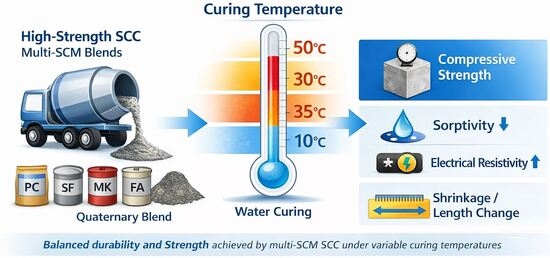
- The inclusion of high-reactivity SCMs such as SF and MK reduced the workability of SCC due to their high surface area and water demand, requiring increased superplasticizer dosage. In contrast, FA enhanced workability by promoting better flowability through its spherical particle shape and lower water demand.
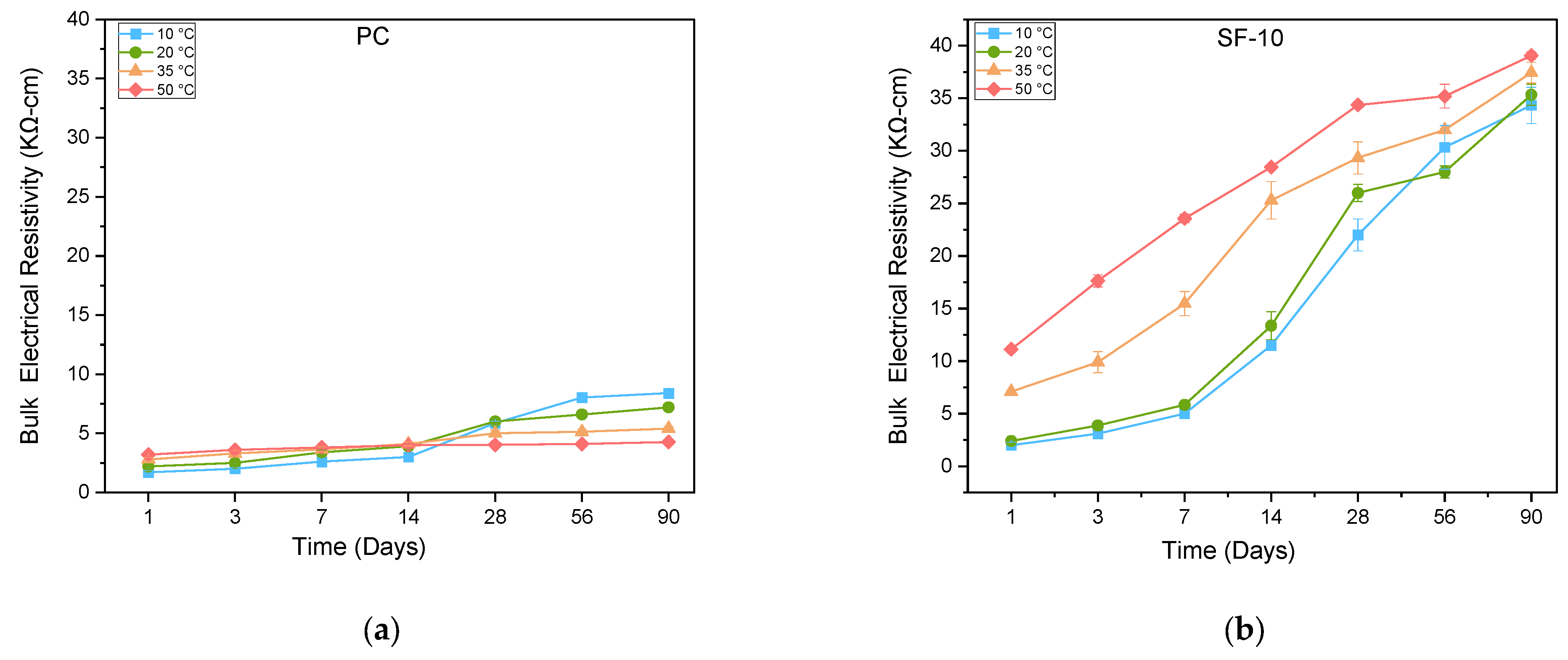
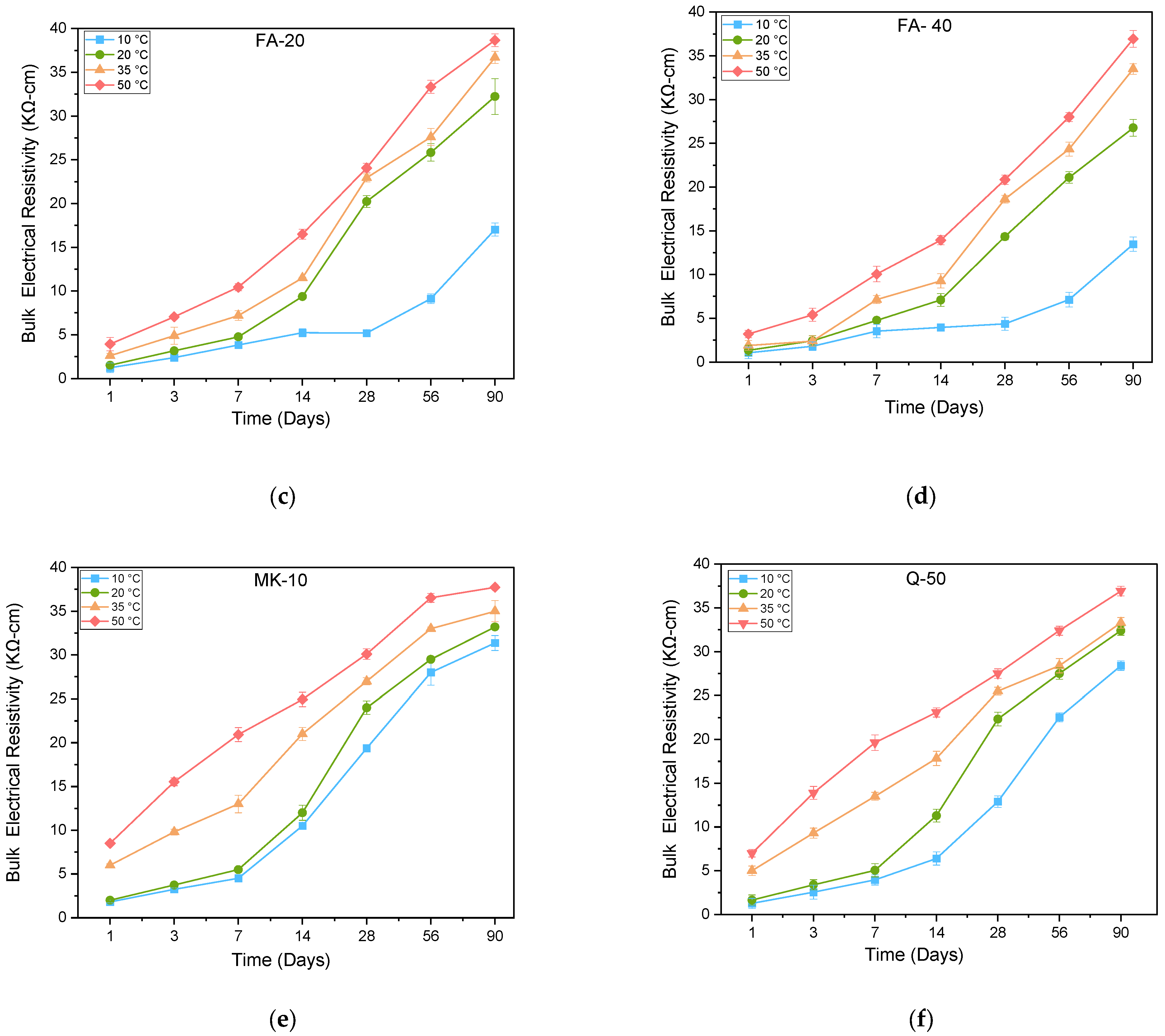
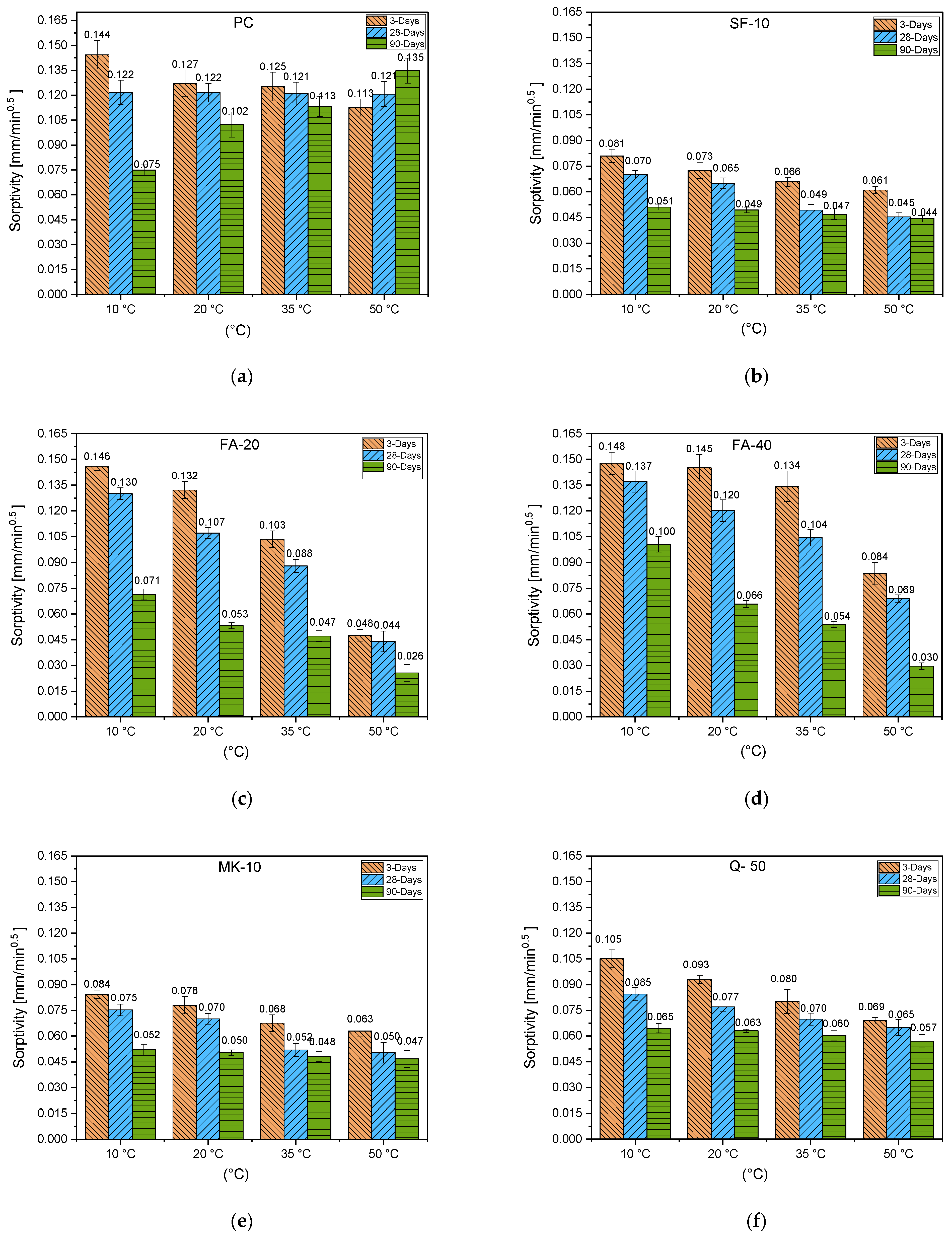
- Durability-related indicators such as sorptivity and electrical resistivity reflected the interplay between SCM type and curing regime. High temperatures were due to rapid pore refinement in SF and MK mixes. However, low temperatures resulted in higher early-age sorptivity and lower resistivity but allowed gradual long-term improvement, particularly in FA and Q-50 mixes.
- Length change was significantly influenced by curing temperature and SCM type. High temperatures accelerated hydration, causing early shrinkage in SF and MK mixes due to rapid internal water loss. In contrast, low temperature curing reduced early shrinkage in all mixes by slowing hydration and limiting self-desiccation. FA mixes showed minimal early shrinkage across all conditions, while the quaternary blend (Q-50) exhibited controlled and gradual shrinkage, combining early matrix densification with long-term stability.
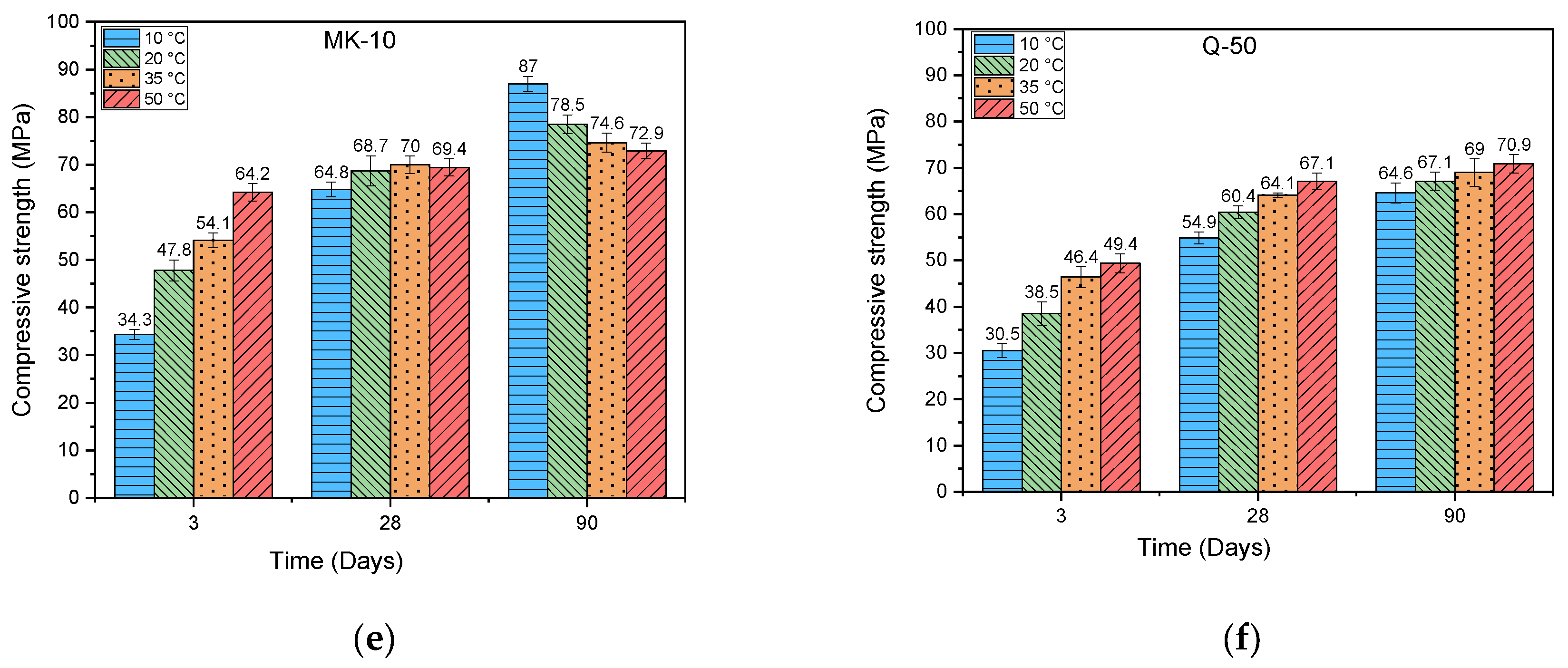
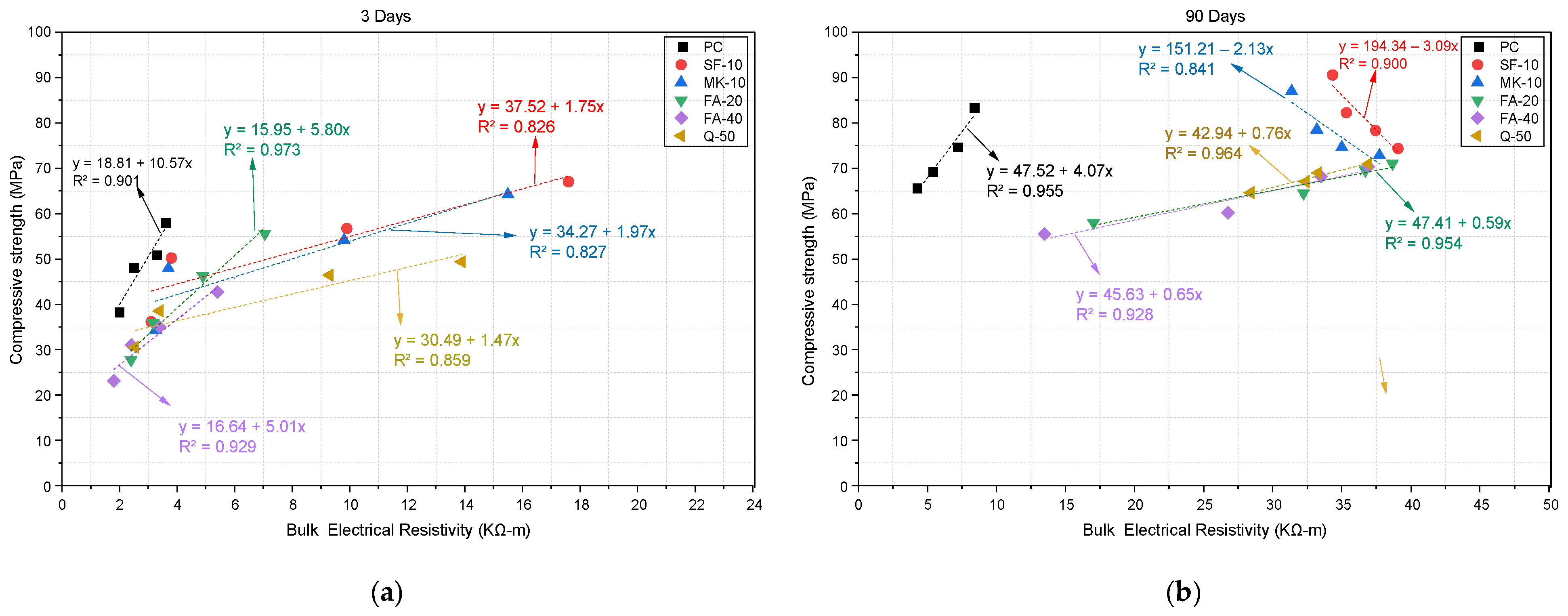
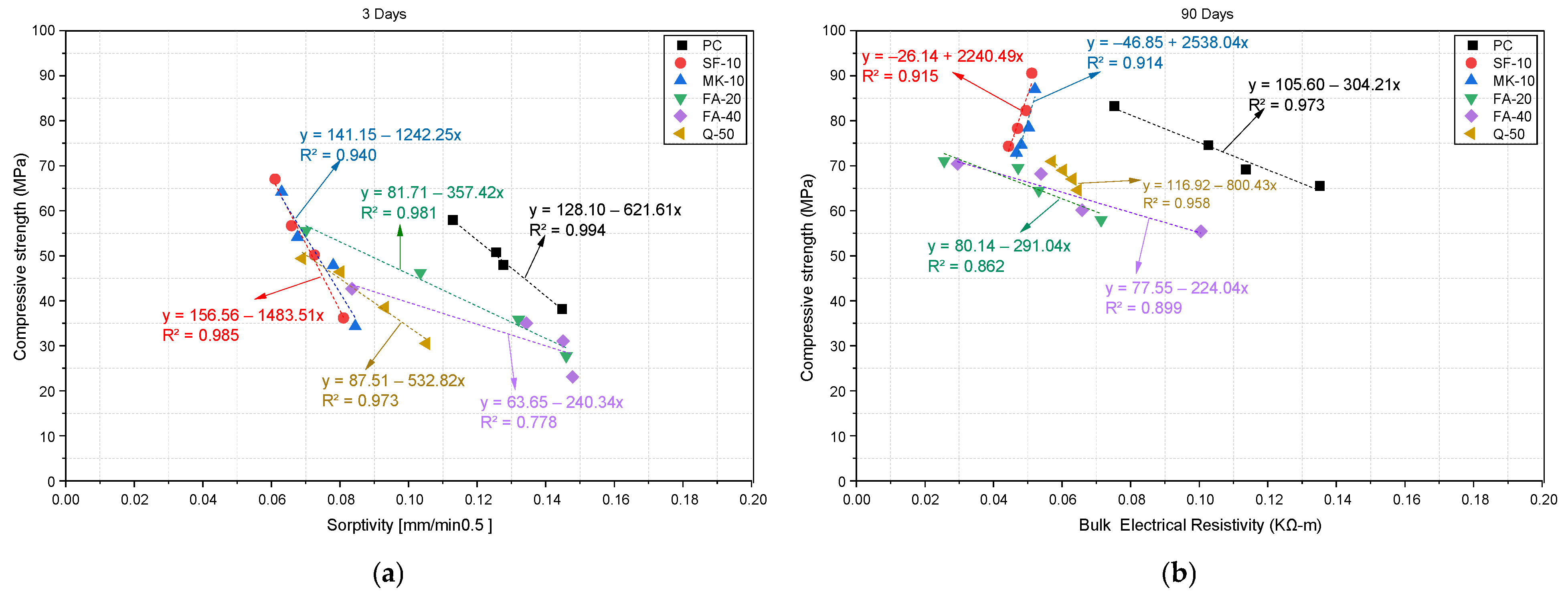
- The correlations between compressive strength and durability metrics (sorptivity and bulk electrical resistivity) were generally strong, particularly at later ages, confirming the interconnected development of mechanical and durability properties. This reinforces the importance of incorporating SCMs with varied reactivity profiles to enhance overall performance.
Author Contributions
Funding
Data Availability Statement
Conflicts of Interest
References
- Khatib, J.M. Performance of self-compacting concrete containing fly ash. Constr. Build. Mater. 2008, 22, 1963–1971. [Google Scholar] [CrossRef] [Scilit]
- Long, G.; Gao, Y.; Xie, Y. Designing more sustainable and greener self-compacting concrete. Constr. Build. Mater. 2015, 84, 301–306. [Google Scholar] [CrossRef] [Scilit]
- Okamura, H.; Ozawa, K. Self-compacting high performance concrete. Struct. Eng. Int. J. Int. Assoc. Bridge Struct. Eng. (IABSE) 1996, 6, 269–270. [Google Scholar] [CrossRef] [Scilit]
- Soleymani Ashtiani, M.; Scott, A.N.; Dhakal, R.P. Mechanical and fresh properties of high-strength self-compacting concrete containing class C fly ash. Constr. Build. Mater. 2013, 47, 1217–1224. [Google Scholar] [CrossRef] [Scilit]
- Zhu, W.; Gibbs, J.C.; Bartos, P.J.M. Uniformity of in situ properties of self-compacting concrete in full-scale structural elements. Cem. Concr. Compos. 2001, 23, 57–64. [Google Scholar] [CrossRef] [Scilit]
- Ma, A.; Abba, S.I.; Nuruddeen, M.M. Self-Compacting Concrete—A Review. Int. J. Innov. Technol. Explor. Eng. 2017, 6, 1–7. [Google Scholar]
- Mosafer, M.; Khodabakhshian, A.; Ghalehnovi, M. Case Studies in Construction Materials Optimizing the mechanical properties of sustainable self-compacting concrete contains industrial by-products by using Taguchi and Grey-Taguchi methods. Case Stud. Constr. Mater. 2025, 22, e04692. [Google Scholar] [CrossRef] [Scilit]
- Alshahrani, A.; Cui, T.; Almutlaqah, A.; Kulasegaram, S. Designing sustainable high-strength self-compacting concrete with high content of supplementary cementitious materials. Eur. J. Environ. Civ. Eng. 2024, 28, 1830–1849. [Google Scholar] [CrossRef] [Scilit]
- Gupta, N.; Siddique, R.; Belarbi, R. Sustainable and Greener Self-Compacting Concrete incorporating Industrial By-Products: A Review. J. Clean. Prod. 2021, 284, 124803. [Google Scholar] [CrossRef] [Scilit]
- Okamura, H.; Ouchi, M. Self Compacting Concrete—Research paper. J. Adv. Concr. Technol. 2003, 1, 5–15. [Google Scholar] [CrossRef] [Scilit]
- Ouldkhaoua, Y.; Benabed, B.; Abousnina, R.; Kadri, E.H.; Khatib, J. Effect of using metakaolin as supplementary cementitious material and recycled CRT funnel glass as fine aggregate on the durability of green self-compacting concrete. Constr. Build. Mater. 2020, 235, 117802. [Google Scholar] [CrossRef] [Scilit]
- Kolias, S.; Georgiou, C. The effect of paste volume and of water content on the strength and water absorption of concrete. Cem. Concr. Compos. 2005, 27, 211–216. [Google Scholar] [CrossRef] [Scilit]
- Klemczak, B.; Gołaszewski, J.; Smolana, A.; Gołaszewska, M.; Cygan, G. Shrinkage behaviour of self-compacting concrete with a high volume of fly ash and slag experimental tests and analytical assessment. Constr. Build. Mater. 2023, 400, 132608. [Google Scholar] [CrossRef] [Scilit]
- Ndahirwa, D.; Zmamou, H.; Lenormand, H.; Leblanc, N. The role of supplementary cementitious materials in hydration, durability and shrinkage of cement-based materials, their environmental and economic benefits: A review. Clean. Mater. 2022, 5, 100123. [Google Scholar] [CrossRef] [Scilit]
- Rozière, E.; Granger, S.; Turcry, P.; Loukili, A. Influence of paste volume on shrinkage cracking and fracture properties of self-compacting concrete. Cem. Concr. Compos. 2007, 29, 626–636. [Google Scholar] [CrossRef] [Scilit]
- Hwang, S.D.; Khayat, K.H. Effect of mixture composition on restrained shrinkage cracking of self-consolidating concrete used in repair. ACI Mater. J. 2008, 105, 499–509. [Google Scholar] [CrossRef] [Scilit]
- Leemann, A.; Lura, P.; Loser, R. Shrinkage and creep of SCC—The influence of paste volume and binder composition. Constr. Build. Mater. 2011, 25, 2283–2289. [Google Scholar] [CrossRef] [Scilit]
- Kalyana Chakravarthy, P.R.; Namratha, K. Strength and durability properties of high strength self compacting concrete. Mater. Today Proc. 2022, 69, 896–900. [Google Scholar] [CrossRef] [Scilit]
- Shaikh, F.U.A.; Supit, S.W.M. Chloride induced corrosion durability of high volume fly ash concretes containing nano particles. Constr. Build. Mater. 2015, 99, 208–225. [Google Scholar] [CrossRef] [Scilit]
- Wang, Y.; Cao, Y.; Zhang, P.; Ma, Y.; Zhao, T.; Wang, H.; Zhang, Z. Water absorption and chloride diffusivity of concrete under the coupling effect of uniaxial compressive load and freeze–thaw cycles. Constr. Build. Mater. 2019, 209, 566–576. [Google Scholar] [CrossRef] [Scilit]
- Castro, J.; Bentz, D.; Weiss, J. Effect of sample conditioning on the water absorption of concrete. Cem. Concr. Compos. 2011, 33, 805–813. [Google Scholar] [CrossRef] [Scilit]
- El Mir, A.; Nehme, S.G. Porosity of Self-compacting Concrete. Procedia Eng. 2015, 123, 145–152. [Google Scholar] [CrossRef] [Scilit]
- Tam, V.W.Y.; Soomro, M.; Evangelista, A.C.J. Quality improvement of recycled concrete aggregate by removal of residual mortar: A comprehensive review of approaches adopted. Constr. Build. Mater. 2021, 288, 123066. [Google Scholar] [CrossRef] [Scilit]
- Ali, B.H.S.H.; Faraj, R.H.; Saeed, M.A.H.; Ahmed, H.U.; Ahmed, F.W. Innovative machine learning approaches to predict the compressive strength of recycled plastic aggregate self-compacting concrete incorporating different waste ashes. Multiscale Multidiscip. Model. Exp. Des. 2024, 7, 2585–2604. [Google Scholar] [CrossRef] [Scilit]
- Rubene, S.; Vilnitis, M. Impact of low temperatures on compressive strength of concrete. Int. J. Theor. Appl. Mech. 2017, 2, 97–101. [Google Scholar]
- Liu, Z.; Jiao, W.; Sha, A.; Gao, J.; Han, Z.; Xu, W. Portland Cement Hydration Behavior at Low Temperatures: Views from Calculation and Experimental Study. Adv. Mater. Sci. Eng. 2017, 2017, 3927106. [Google Scholar] [CrossRef] [Scilit]
- Lothenbach, B.; Winnefeld, F.; Alder, C.; Wieland, E.; Lunk, P. Effect of temperature on the pore solution, microstructure and hydration products of Portland cement pastes. Cem. Concr. Res. 2007, 37, 483–491. [Google Scholar] [CrossRef] [Scilit]
- Escalante-García, J.I.; Sharp, J.H. The microstructure and mechanical properties of blended cements hydrated at various temperatures. Cem. Concr. Res. 2001, 31, 695–702. [Google Scholar] [CrossRef] [Scilit]
- Thomas, J.J.; Rothstein, D.; Jennings, H.M.; Christensen, B.J. Effect of hydration temperature on the solubility behavior of Ca-, S-, Al-, and Si-bearing solid phases in Portland cement pastes. Cem. Concr. Res. 2003, 33, 2037–2047. [Google Scholar] [CrossRef] [Scilit]
- Almutlaqah, A.; Alshahrani, A.; Maddalena, R.; Kulasegaram, S. Performance of self-compacting concrete with treated rice husk ash at different curing temperatures. J. Build. Eng. 2024, 97, 110652. [Google Scholar] [CrossRef] [Scilit]
- Hu, L.; Chen, Z.; Zhu, X.; Yang, H.; Zheng, X.; Liu, K. Effect of curing temperature on hydration and microstructure evolution of cement-based composites with extremely low w/b ratio. Dev. Built Environ. 2023, 16, 100267. [Google Scholar] [CrossRef] [Scilit]
- Turcry, P.; Loukili, A.; Barcelo, L.; Casabonne, J.M. Can the maturity concept be used to separate the autogenous shrinkage and thermal deformation of a cement paste at early age? Cem. Concr. Res. 2002, 32, 1443–1450. [Google Scholar] [CrossRef] [Scilit]
- Al-Shathr, B.; Abdulameer, A.; Al-Attar, T. The role of ambient temperature variation on drying shrinkage development of self-compacting Portland-limestone cement concrete. In Proceedings of the 3rd International Conference on Buildings, Construction and Environmental Engineering, Sharm el-Shiekh, Egypt, 23–25 October 2017; MATEC Web of Conferences: Les Ulis, France, 2018; Volume 162. [Google Scholar] [CrossRef] [Scilit]
- Jiang, C.; Jin, C.; Wang, Y.; Yan, S.; Chen, D. Effect of heat curing treatment on the drying shrinkage behavior and microstructure characteristics of mortar incorporating different content ground granulated blast-furnace slag. Constr. Build. Mater. 2018, 186, 379–387. [Google Scholar] [CrossRef] [Scilit]
- Lura, P.; Van Breugel, K.; Maruyama, I. Effect of curing temperature and type of cement on early-age shrinkage of high-performance concrete. Cem. Concr. Res. 2001, 31, 1867–1872. [Google Scholar] [CrossRef] [Scilit]
- Almutlaqah, A.; Alshahrani, A.; Maddalena, R.; Kulasegaram, S. Enhanced fib Model Code’s maturity function for strength prediction of self-compacting concrete containing supplementary cementitious materials. Constr. Build. Mater. 2025, 120, 115478. [Google Scholar] [CrossRef] [Scilit]
- Muralidharan, R.; Park, T.; Yang, H.M.; Lee, S.Y.; Subbiah, K.; Lee, H.S. Review of the effects of supplementary cementitious materials and chemical additives on the physical, mechanical and durability properties of hydraulic concrete. Materials 2021, 14, 7270. [Google Scholar] [CrossRef] [Scilit]
- Zhang, Z.; Zhang, B.; Yan, P. Hydration and microstructures of concrete containing raw or densified silica fume at different curing temperatures. Constr. Build. Mater. 2016, 121, 483–490. [Google Scholar] [CrossRef] [Scilit]
- Xu, G.; Tian, Q.; Miao, J.; Liu, J. Early-age hydration and mechanical properties of high volume slag and fly ash concrete at different curing temperatures. Constr. Build. Mater. 2017, 149, 367–377. [Google Scholar] [CrossRef] [Scilit]
- Papadakis, V.G.; Antiohos, S.; Tsimas, S. Supplementary cementing materials in concrete. Cem. Concr. Res. 2002, 32, 1533–1538. [Google Scholar] [CrossRef] [Scilit]
- Lothenbach, B.; Scrivener, K.; Hooton, R.D. Supplementary cementitious materials. Cem. Concr. Res. 2011, 41, 1244–1256. [Google Scholar] [CrossRef] [Scilit]
- Kadri, E.H.; Kenai, S.; Ezziane, K.; Siddique, R.; De Schutter, G. Influence of metakaolin and silica fume on the heat of hydration and compressive strength development of mortar. Appl. Clay Sci. 2011, 53, 704–708. [Google Scholar] [CrossRef] [Scilit]
- Naser, M.Z.; Uppala, V.A. Properties and material models for construction materials post exposure to elevated temperatures. Mech. Mater. 2020, 142, 103293. [Google Scholar] [CrossRef] [Scilit]
- Nasir, M.; Adesina, A.; Ibrahim, M.; Khan, M.U.; Baghabra Al-Amoudi, O.S.; Imran Ali, S.; Maslehuddin, M.; Saqer Alotaibi, K. Role of casting and curing conditions on the strength and drying shrinkage of greener concrete. Environ. Sci. Pollut. Res. 2022, 29, 72598–72610. [Google Scholar] [CrossRef] [Scilit] [PubMed]
- EFNARC. The European Guidelines for Self-Compacting Concrete Specification, Production and Use. In The European Guidelines for Self Compacting Concrete; EFNARC: Flums, Switzerland, 2005. [Google Scholar]
- 12390-3 BE; Testing Hardened Concrete—Part 3: Compressive Strength of Test Specimens. European Committee for Standardization: Brussels, Belgium, 2003.
- BS EN 12390-8; British Standard Testing Hardened Concrete. British Standard (BSI): London, UK, 2003.
- BS EN 12350-16; BSI Standards Publication Testing Hardened Concrete. British Standard (BSI): London, UK, 2019.
- ASTM C1876; Standard Test Method for Bulk Electrical Resistivity or Bulk Conductivity of Concrete. ASTM International: West Conshohocken, PA, USA, 2021; pp. 98–100. [CrossRef] [Scilit]
- ASTM C1585-13; Standard Test Method for Measurement of Rate of Absorption of Water by Hydraulic Cement Concretes. ASTM International: West Conshohocken, PA, USA, 2013; Volume 41, pp. 1–6.
- EN 12350-12:2010; Part 12: Self-Compacting Concrete—J-Ring Test. European Committee for Standardization: Brussels, Belgium, 2010.
- Barkat, A.; Kenai, S.; Menadi, B.; Kadri, E.H.; Khatib, J. Relationships between Mortar Spread and the Fresh Properties of SCC Containing Local Metakaolin. Infrastructures 2023, 8, 137. [Google Scholar] [CrossRef] [Scilit]
- Lu, C.; Yang, H.; Mei, G. Relationship between slump flow and rheological properties of self compacting concrete with silica fume and its permeability. Constr. Build. Mater. 2015, 75, 157–162. [Google Scholar] [CrossRef] [Scilit]
- Sfikas, I.P.; Badogiannis, E.G.; Trezos, K.G. Rheology and mechanical characteristics of self-compacting concrete mixtures containing metakaolin. Constr. Build. Mater. 2014, 64, 121–129. [Google Scholar] [CrossRef] [Scilit]
- Benaicha, M.; Roguiez, X.; Jalbaud, O.; Burtschell, Y.; Alaoui, A.H. Influence of silica fume and viscosity modifying agent on the mechanical and rheological behavior of self compacting concrete. Constr. Build. Mater. 2015, 84, 103–110. [Google Scholar] [CrossRef] [Scilit]
- Karthik, D.; Nirmalkumar, K.; Priyadharshini, R. Characteristic assessment of self-compacting concrete with supplementary cementitious materials. Constr. Build. Mater. 2021, 297, 123845. [Google Scholar] [CrossRef] [Scilit]
- Al-Oran, A.A.A.; Safiee, N.A.; Nasir, N.A.M. Fresh and hardened properties of self-compacting concrete using metakaolin and GGBS as cement replacement. Eur. J. Environ. Civ. Eng. 2022, 26, 379–392. [Google Scholar] [CrossRef] [Scilit]
- Liu, M. Self-compacting concrete with different levels of pulverized fuel ash. Constr. Build. Mater. 2010, 24, 1245–1252. [Google Scholar] [CrossRef] [Scilit]
- Tahmid, A.; Chowdhury, S.R.; Tonmoy, F.F.; Moon, T.K. Analyzing the Filling Ability Property of Self-Compacting Concrete Using Fly Ash and Superplasticizer. J. Civ. Constr. Eng. 2021, 7, 23–32. [Google Scholar] [CrossRef] [Scilit]
- Shrihari, S.; Seshagiri Rao, M.V.; Srinivasa Reddy, V. Evaluation of Cementing Efficiency of Quaternary Blended High Strength Self Compacting Concrete. Int. J. Res. Eng. Technol. 2016, 05, 260–265. [Google Scholar] [CrossRef] [Scilit]
- Gesoǧlu, M.; Güneyisi, E.; Özbay, E. Properties of self-compacting concretes made with binary, ternary, and quaternary cementitious blends of fly ash, blast furnace slag, and silica fume. Constr. Build. Mater. 2009, 23, 1847–1854. [Google Scholar] [CrossRef] [Scilit]
- Gajewicz-Jaromin, A.M.; McDonald, P.J.; Muller, A.C.A.; Scrivener, K.L. Influence of curing temperature on cement paste microstructure measured by 1H NMR relaxometry. Cem. Concr. Res. 2019, 122, 147–156. [Google Scholar] [CrossRef] [Scilit]
- Li, L.; Feng, T.; Li, Y.; Zhang, Y.; Sun, W.; Liu, Z. Evaluating the effect of high fly ash content and low curing temperature on early hydration heat of blended cement based on isothermal calorimetric method. Constr. Build. Mater. 2024, 430, 136110. [Google Scholar] [CrossRef] [Scilit]
- Khatib, J.M. Low Temperature Curing of Metakaolin Concrete. J. Mater. Civ. Eng. 2009, 21, 362–367. [Google Scholar] [CrossRef] [Scilit]
- Yousuf, S.; Shafigh, P.; Ibrahim, Z.; Hashim, H.; Panjehpour, M. Crossover effect in cement-based materials: A review. Appl. Sci. 2019, 9, 2776. [Google Scholar] [CrossRef] [Scilit]
- Gonzalez-Corominas, A.; Etxeberria, M.; Poon, C.S. Influence of steam curing on the pore structures and mechanical properties of fly-ash high performance concrete prepared with recycled aggregates. Cem. Concr. Compos. 2016, 71, 77–84. [Google Scholar] [CrossRef] [Scilit]
- Liu, J.; Li, Y.; Ouyang, P.; Yang, Y. Hydration of the silica fume-Portland cement binary system at lower temperature. Constr. Build. Mater. 2015, 93, 919–925. [Google Scholar] [CrossRef] [Scilit]
- Chen, L.; Zheng, K.; Xia, T.; Long, G. Mechanical property, sorptivity and microstructure of steam-cured concrete incorporated with the combination of metakaolin-limestone. Case Stud. Constr. Mater. 2019, 11, e00267. [Google Scholar] [CrossRef] [Scilit]
- Cano Barrita Fde, J.; Bremner, T.W.; Balcom, B.J. Effects of curing temperature on moisture distribution, drying and water absorption in self-compacting concrete. Mag. Concr. Res. 2003, 55, 517–524. [Google Scholar] [CrossRef]
- Güneyisi, E.; Gesoǧlu, M.; Karaoǧlu, S.; Mermerdaş, K. Strength, permeability and shrinkage cracking of silica fume and metakaolin concretes. Constr. Build. Mater. 2012, 34, 120–130. [Google Scholar] [CrossRef] [Scilit]
- Leung, H.Y.; Kim, J.; Nadeem, A.; Jaganathan, J.; Anwar, M.P. Sorptivity of self-compacting concrete containing fly ash and silica fume. Constr. Build. Mater. 2016, 113, 369–375. [Google Scholar] [CrossRef] [Scilit]
- Liu, B.; Luo, G.; Xie, Y. Effect of curing conditions on the permeability of concrete with high volume mineral admixtures. Constr. Build. Mater. 2018, 167, 359–371. [Google Scholar] [CrossRef] [Scilit]
- Chahal, N.; Siddique, R.; Rajor, A. Influence of bacteria on the compressive strength, water absorption and rapid chloride permeability of concrete incorporating silica fume. Constr. Build. Mater. 2012, 37, 645–651. [Google Scholar] [CrossRef] [Scilit]
- Morsy, M.S. Effect of temperature on hydration kinetics and stability of hydration phases of metakaolin-lime sludge-silica fume system. Ceram.—Silik. 2005, 49, 237–241. [Google Scholar]
- Liu, Y.; Presuel-Moreno, F.J. Normalization of temperature effect on concrete resistivity by method using Arrhenius law. ACI Mater. J. 2014, 111, 433–442. [Google Scholar] [CrossRef] [Scilit]
- Utkan, Ç.; Kesler, E.; Yıkıcı, T.A.; Akkaya, Y. Effects of curing temperature on chloride migration and electrical resistivity of concrete. In Proceedings of the Conference on Materials, Systems and Structures in Civil Engineering, Lyngby, Denmark, 15–29 August 2016; RILEM Publications: Bagneux, France, 2016. [Google Scholar]
- Gallucci, E.; Zhang, X.; Scrivener, K.L. Effect of temperature on the microstructure of calcium silicate hydrate (C-S-H). Cem. Concr. Res. 2013, 53, 185–195. [Google Scholar] [CrossRef] [Scilit]
- Liu, J.; Li, Y.; Yang, Y.; Cui, Y. Effect of low temperature on hydration performance of the complex binder of silica fume-portland cement. J. Wuhan Univ. Technol. Mater. Sci. Ed. 2014, 29, 75–81. [Google Scholar] [CrossRef] [Scilit]
- Siddique, R.; Khan, M.I. Supplementary Cementing Materials; Springer: Berlin/Heidelberg, Germany, 2011; pp. 67–119. [Google Scholar] [CrossRef] [Scilit]
- Jiang, C.; Yang, Y.; Wang, Y.; Zhou, Y.; Ma, C. Autogenous shrinkage of high performance concrete containing mineral admixtures under different curing temperatures. Constr. Build. Mater. 2014, 61, 260–269. [Google Scholar] [CrossRef] [Scilit]
- Maruyama, I.; Teramoto, A. Temperature dependence of autogenous shrinkage of silica fume cement pastes with a very low water–binder ratio. Cem. Concr. Res. 2013, 50, 41–50. [Google Scholar] [CrossRef] [Scilit]
- Klausen, A.E.; Kanstad, T.; Bjøntegaard, Ø.; Sellevold, E.J. The effect of curing temperature on autogenous deformation of fly ash concretes. Cem. Concr. Compos. 2020, 109, 103574. [Google Scholar] [CrossRef] [Scilit]
- Thomas, J.J.; Jennings, H.M. Effect of heat treatment on the pore structure and drying shrinkage behavior of hydrated cement paste. J. Am. Ceram. Soc. 2002, 85, 2293–2298. [Google Scholar] [CrossRef] [Scilit]
- Wang, L.; Yu, Z.; Liu, B.; Zhao, F.; Tang, S.; Jin, M. Effects of Fly Ash Dosage on Shrinkage, Crack Resistance and Fractal Characteristics of Face Slab Concrete. Fractal Fract. 2022, 6, 335. [Google Scholar] [CrossRef] [Scilit]





| Composition | SiO2 % | Al2O3 % | Fe2O3 % | CaO % | K2O % | Na2O % | MgO % | SO3 % | Specific Gravity |
|---|---|---|---|---|---|---|---|---|---|
| PC | 19.69 | 4.32 | 2.85 | 63.04 | 0.74 | 0.16 | 2.17 | 3.12 | 3.15 |
| SF | 85 | - | - | 1 | - | 4 | - | 2 | 2.2 |
| FA | 53.10 | 20.64 | 8.93 | 6.12 | 2.17 | 1.68 | 1.79 | 1.93 | 2.4 |
| MK | 57 | 36.97 | 0.40 | - | 1.46 | - | 1.26 | 0.54 | 2.5 |
| Mix ID | Water | Cementitious Material | SP | Aggregates | |||||
|---|---|---|---|---|---|---|---|---|---|
| Fine | Coarse | ||||||||
| PC | SF | FA | MK | Sand | Limestone | ||||
| PC-100 | 205.6 | 514.1 | - | - | - | 3.3 | 525 | 225 | 833.0 |
| SF-10 | 205.6 | 462.6 | 51.4 | - | - | 5.4 | 525 | 225 | 820.5 |
| MK-10 | 205.6 | 462.6 | - | - | 51.4 | 5 | 525 | 225 | 810 |
| FA-20 | 205.6 | 411.2 | - | 102.7 | - | 3.5 | 506.3 | 217 | 796 |
| FA-40 | 205.6 | 308.4 | - | 205.6 | - | 3 | 515.3 | 220.8 | 796.9 |
| Q-50 | 205.6 | 257.05 | 51.5 | 154.2 | 51.5 | 4 | 504.9 | 216.3 | 789.3 |
| Mix ID | Slump Flow Test Spread (mm) | T50 (s) | J-Ring Flow Test Spread (mm) | ΔD = D_slump − D_(J-ring) (mm) |
|---|---|---|---|---|
| PC-100 | 630 | 1.82 | 600 | 30 |
| SF-10 | 650 | 2.05 | 610 | 40 |
| MK-10 | 660 | 2.1 | 615 | 45 |
| FA-20 | 700 | 1.6 | 680 | 20 |
| FA-40 | 710 | 1.1 | 695 | 15 |
| Q-50 | 660 | 1.7 | 640 | 20 |
Disclaimer/Publisher’s Note: The statements, opinions and data contained in all publications are solely those of the individual author(s) and contributor(s) and not of MDPI and/or the editor(s). MDPI and/or the editor(s) disclaim responsibility for any injury to people or property resulting from any ideas, methods, instructions or products referred to in the content. |
© 2026 by the authors. Licensee MDPI, Basel, Switzerland. This article is an open access article distributed under the terms and conditions of the Creative Commons Attribution (CC BY) license.
Share and Cite
Degani, I.M.; Maddalena, R.; Kulasegaram, S. Influence of Varying Curing Temperatures on the Mechanical and Durability-Related Performance of Multi-SCM Blended High-Strength Self-Compacting Concrete. Buildings 2026, 16, 910. https://doi.org/10.3390/buildings16050910
Degani IM, Maddalena R, Kulasegaram S. Influence of Varying Curing Temperatures on the Mechanical and Durability-Related Performance of Multi-SCM Blended High-Strength Self-Compacting Concrete. Buildings. 2026; 16(5):910. https://doi.org/10.3390/buildings16050910
Chicago/Turabian StyleDegani, Ibrahim M., Riccardo Maddalena, and Sivakumar Kulasegaram. 2026. "Influence of Varying Curing Temperatures on the Mechanical and Durability-Related Performance of Multi-SCM Blended High-Strength Self-Compacting Concrete" Buildings 16, no. 5: 910. https://doi.org/10.3390/buildings16050910
APA StyleDegani, I. M., Maddalena, R., & Kulasegaram, S. (2026). Influence of Varying Curing Temperatures on the Mechanical and Durability-Related Performance of Multi-SCM Blended High-Strength Self-Compacting Concrete. Buildings, 16(5), 910. https://doi.org/10.3390/buildings16050910