Article

Machine Learning-Assisted Analysis of Fracture Energy in Externally Bonded Reinforcement on Groove Bond Strength Prediction


1
School of Engineering, Macquarie University, Sydney, NSW 2113, Australia
2
Institute of Research and Development, Duy Tan University, Da Nang 550000, Vietnam
3
School of Engineering & Technology, Duy Tan University, Da Nang 550000, Vietnam
4
Department of Civil Engineering, Faculty of Engineering, Ferdowsi University of Mashhad, Mashhad 9177948974, Iran
5
Department of Mechanical Engineering, New Mexico Institute of Mining and Technology (NMT), Socorro, NM 87801, USA
6
Center of Infrastructure Engineering, Western Sydney University, Penrith, NSW 2751, Australia
*
Author to whom correspondence should be addressed.
Buildings 2026, 16(5), 1070; https://doi.org/10.3390/buildings16051070
Submission received: 24 January 2026 / Revised: 15 February 2026 / Accepted: 5 March 2026 / Published: 8 March 2026
(This article belongs to the Section Building Structures)

Abstract

The tensile capacity of a connection is predicted through the use of established models, among which the bond behavior between CFRP layers and concrete is always considered. In structures reinforced with CFRP, the prediction of the bond force between concrete and CFRP is essential, as the connection must be designed to withstand the required tensile capacity. An underestimation can lead to inefficient design, while an overestimation risks premature debonding failure, potentially compromising structural safety and serviceability. In recent applications, the bond force between concrete and CFRP has been increased through the use of the Externally Bonded Reinforcement on Groove (EBROG) method. However, due to the structural complexity introduced by the grooved interface, accurate prediction of its bond strength remains challenging, and conventional analytical models may not fully capture the underlying nonlinear interactions. In this technique, CFRP layers are placed into grooves to enhance the interaction among the adhesive, concrete, and CFRP. However, due to the structural complexity of this connection, accurate prediction of its bond force is challenging and requires the application of artificial intelligence methods. This study develops a machine learning (ML) framework to predict the bond strength of the EBROG technique. Four ML models, Support Vector Machine (SVM), Gaussian Process Regression (GPR), Decision Tree, and XGBoost, were implemented, and their hyperparameters were optimized via Bayesian optimization. The models were evaluated using multiple statistical metrics, with the XGBoost algorithm demonstrating superior predictive performance, achieving an R2 of 0.987 and an RMSE of 0.522 kN. This represents an improvement of approximately 5.6% in R2 and a reduction of over 53% in RMSE compared to the existing analytical model. SHAP analysis provided interpretable, data-driven insights, revealing that fracture energy is the predominant factor governing bond strength and elucidating nonlinear interactions between key design parameters. This ML-fracture mechanics framework not only offers superior prediction but also advances the mechanistic understanding of the EBROG bond behavior.

1. Introduction

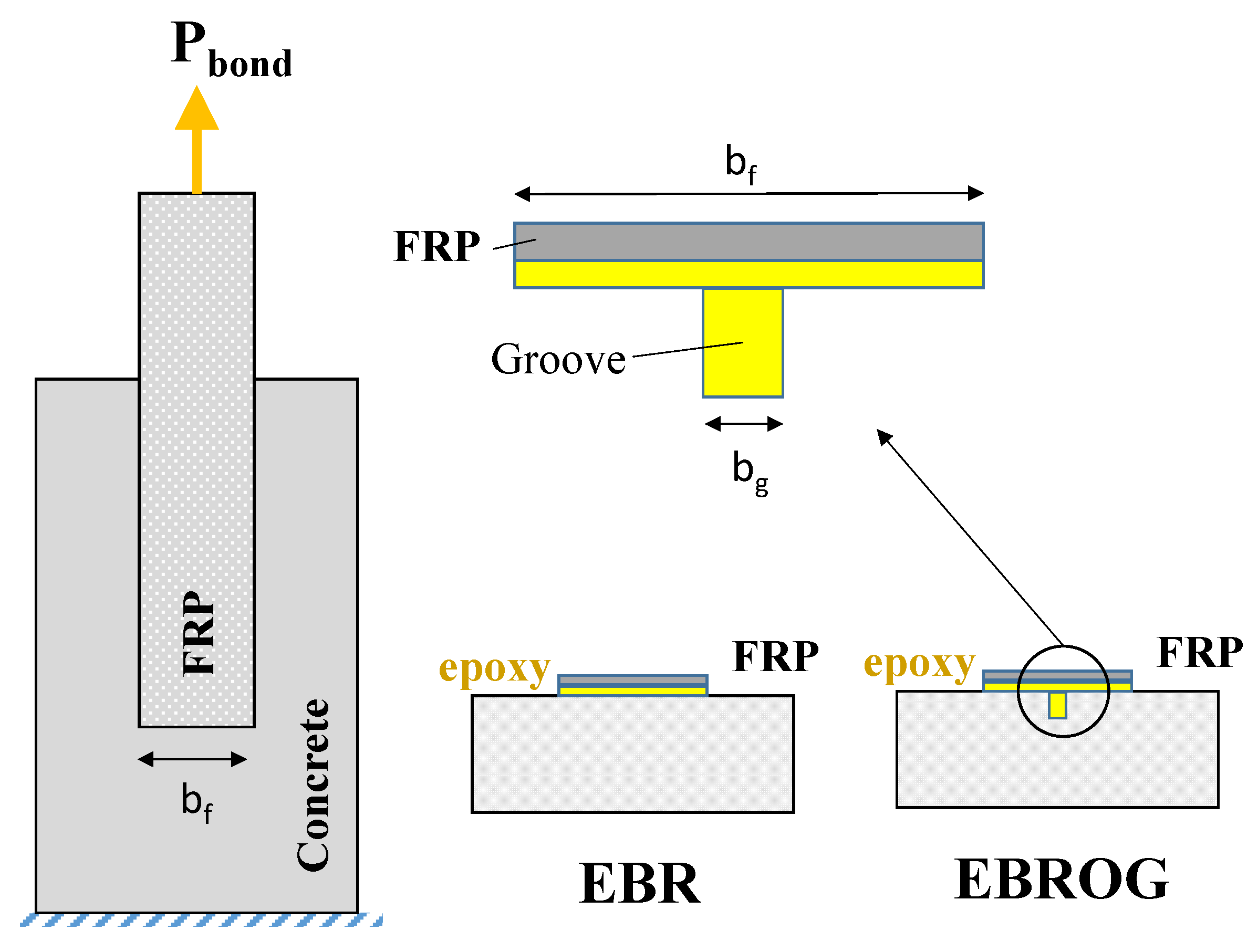
The strengthening of existing concrete structures has become a central concern in civil engineering, driven by ageing infrastructure, construction errors, changes in use, and evolving design codes. Among the various techniques developed, Fiber-Reinforced Polymer (FRP) systems externally bonded to concrete surfaces have gained widespread acceptance due to their high strength-to-weight ratio and corrosion resistance [1,2]. Traditional Externally Bonded Reinforcement (EBR), in which FRP is bonded directly to a prepared concrete surface, often suffers from premature debonding failures, limiting the full utilization of the FRP tensile capacity [3,4]. To overcome this, the Near-Surface Mounted (NSM) technique [5,6] was introduced, embedding FRP into grooves cut into the concrete, which provides excellent bond performance but requires deeper and more invasive grooves. Emerging as a hybrid solution, the Externally Bonded Reinforcement on Groove (EBROG) technique [7,8,9] combines the principles of EBR and NSM (Figure 1). By bonding FRP within shallow, longitudinal grooves cut into the concrete surface, EBROG aims to enhance mechanical interlocking while protecting the FRP. The fundamental advantage of EBROG lies in its composite bond mechanism. Unlike EBR, which relies primarily on adhesive and frictional forces, EBROG introduces significant mechanical interlocking and confinement by placing the FRP within a groove [10,11]. Research indicates that this multi-mechanism approach, combining adhesive bonding, interlocking, friction, and lateral confinement from the groove walls, typically results in bond strengths 15–40% higher than those achieved with conventional EBR [11]. This enhanced interaction fundamentally alters the failure mode, often promoting a more desirable concrete cohesive failure rather than brittle interfacial debonding. Groove dimensions are among the most extensively studied parameters. Groove depth is consistently identified as the most critical factor. An optimal depth range of 10–15 mm for Carbon FRP (CFRP) strips provides sufficient mechanical interlocking without risking damage to the concrete cover. Studies report bond strength increases of 25–35% over EBR within this range, with diminishing returns observed beyond depths of 20 mm [12]. Groove width should slightly exceed the FRP width, typically by 4–8 mm in total, to ensure adequate adhesive coverage without forming thick and weak adhesive layers. Spacing and edge distance are also critical parameters to prevent stress interaction and concrete cover separation failures [13,14]. The performance of the EBROG system is intrinsically linked to the properties of its constituent materials. The concrete substrate strength exhibits a direct, approximately square-root relationship with the maximum achievable bond stress. High-strength concrete is therefore required to attain higher bond capacities and, in some cases, to induce failure within the FRP itself, indicating optimal utilization of the strengthening system [14]. The adhesive plays an equally critical role and must provide a suitable balance of high tensile strength (25–40 MPa), appropriate elastic modulus (3–8 GPa), and sufficient ductility to ensure efficient and durable load transfer. Hong et al. [15] investigated RC slabs strengthened with CFRP plates using EBROG. Found flexural capacity increased by 15.9–62.3% compared to EBR, with performance improving with wider and more grooves. Breveglieri et al. [16] tested RC slabs with combined EBROG-EBR prestressed CFRP strips and an anchorage system. EBROG increased load capacity by over 32% compared to non-prestressed EBR. Heydari et al. [17] studied shear-deficient RC coupling beams retrofitted with CFRP using EBROG. The method eliminated debonding, increased ductility by 24% and maximum load by 60%, and improved energy dissipation by 66%. Khorasani et al. [18] proposed EBROG combined with FRP anchors for RC structural walls. Lateral load capacity increased by 36–61%, energy dissipation improved, and debonding was prevented. Shabani et al. [19] examined prestressed EBROG FRP-to-concrete joints. EBROG outperformed EBR, increasing bond strength by up to 195% at 30% prestress levels. Benaddache et al. [20] compared natural and synthetic fiber composites using EBR and EBROG. EBROG with natural fibers (FFRP) showed better load-bearing, ductility, and environmental performance than GFRP.
Comparative studies consistently position EBROG between EBR and NSM techniques. EBROG demonstrates approximately 30–40% higher bond strength than EBR, together with a shorter effective bond length, resulting in more compact and efficient anchorage systems. Although NSM may achieve slightly higher ultimate bond strengths due to deeper embedment, EBROG offers the significant advantage of being less invasive, causing minimal damage to the concrete cover, and providing greater versatility for FRP application and prestressing [11]. Understanding failure modes is essential for design purposes. Research categorizes failures into adhesive failure, indicating inadequate surface preparation, cohesive failure within the adhesive or concrete, concrete cover separation, a brittle and undesirable failure mode, and FRP rupture, which is considered the most favorable outcome as it reflects full bond efficiency. EBROG design generally aims to promote concrete cohesive failure, signifying that the bond system capacity exceeds the tensile strength of the concrete substrate [13].
Recent studies [21,22,23] have expanded the scope of EBROG beyond basic flexural strengthening. A significant advancement has been achieved in prestressed EBROG systems, in which an initial tensile strain is applied to the FRP, typically 20–30% of its capacity, prior to bonding. This approach provides immediate load relief to the structure, improves crack control, and further enhances bond strength by approximately 20–25% through increased interfacial pressure [10]. Furthermore, EBROG has demonstrated considerable potential in seismic retrofitting, particularly for shear-deficient elements such as reinforced concrete coupling beams, where it can increase shear capacity by 60–90% while preserving structural ductility, a key requirement for seismic performance [17]. Innovative applications in the torsional strengthening of beams and the punching shear strengthening of slabs are also being actively investigated, with positive results reported [24]. An empirical bond–slip model for FRP composites bonded to concrete using the EBROG technique was developed by Moghaddas et al. [25]. The study was conducted through an extensive experimental program, in which the effects of key parameters, including concrete compressive strength, groove dimensions, FRP strip width, and composite stiffness, were systematically examined. A bilinear bond–slip model was proposed, with separate equations formulated for the on-groove and out-of-groove regions to account for their distinct bond behaviors. The model was validated using nonlinear regression analysis and demonstrated significant enhancements in bond strength, maximum shear stress, and fracture energy for EBROG joints, as expressed in Equation (1). Equation (1) is presented as an analytical modification for predicting the bond strength P b of EBROG joints.
P b k N = b g G f , o n N / m m + b f b g G f , o u t N / m m 2 × E t t f N / m m
where b g and b f are the groove and FRP strip widths, respectively; G f , o n and G f , o u t are the fracture energies for the respective regions; and E t t f represents the stiffness of the FRP. While the bond behavior of the EBROG technique has been the subject of considerable research, a predictive model that leverages artificial intelligence to decode the complex, nonlinear relationships embedded within fracture mechanics parameters is lacking. While this analytical model provides a valuable fracture-mechanics-based framework, its additive formulation of fracture energy contributions from on-groove and off-groove regions may not fully encapsulate the complex, nonlinear interactions between material properties (fracture energy, FRP stiffness) and geometric parameters (widths). This limitation can lead to inaccuracies in bond strength prediction, which in turn affects the reliability, safety, and material efficiency of EBROG designs. This investigation aims to address this gap by employing a comprehensive dataset of tensile and bond tests to develop a robust machine learning model. Existing literature demonstrates the effectiveness of machine learning techniques in forecasting structural behavior and responses. Accordingly, this study addresses this gap by developing a hybrid ML-fracture mechanics framework. The primary objectives are (1) to achieve high-fidelity prediction of EBROG bond strength, and (2) to use explainable AI (XAI) techniques to extract new, interpretable insights into the relative influence and interaction of fracture energy, stiffness, and geometric parameters, thereby advancing the fundamental understanding for optimal EBROG design. Four algorithms, namely Support Vector Machine (SVM), Gaussian Process Regression (GPR), Decision Tree, and XGBoost, are implemented and compared. The performance and interpretability of these models are subsequently evaluated using established performance indices, with additional analysis devoted to feature importance and variable interactions through SHAP analysis.

2. Dataset Description

This study used data from 94 direct tensile tests on the EBROG system [25]. The measured parameters from these tests included maximum shear force, slip, fracture strain energy measured on and outside the grooves, groove width, FRP width, and FRP stiffness. These variables were used to determine the bond force between the concrete and the FRP. Initially, duplicate tests with identical input values were removed, resulting in 60 unique test results for the development of the machine learning model. The dataset was subsequently divided into two subsets, with 80% allocated for model training and 20% for model testing. Table 1 presents all input variables and the model output, namely bond force, together with their basic statistical characteristics.
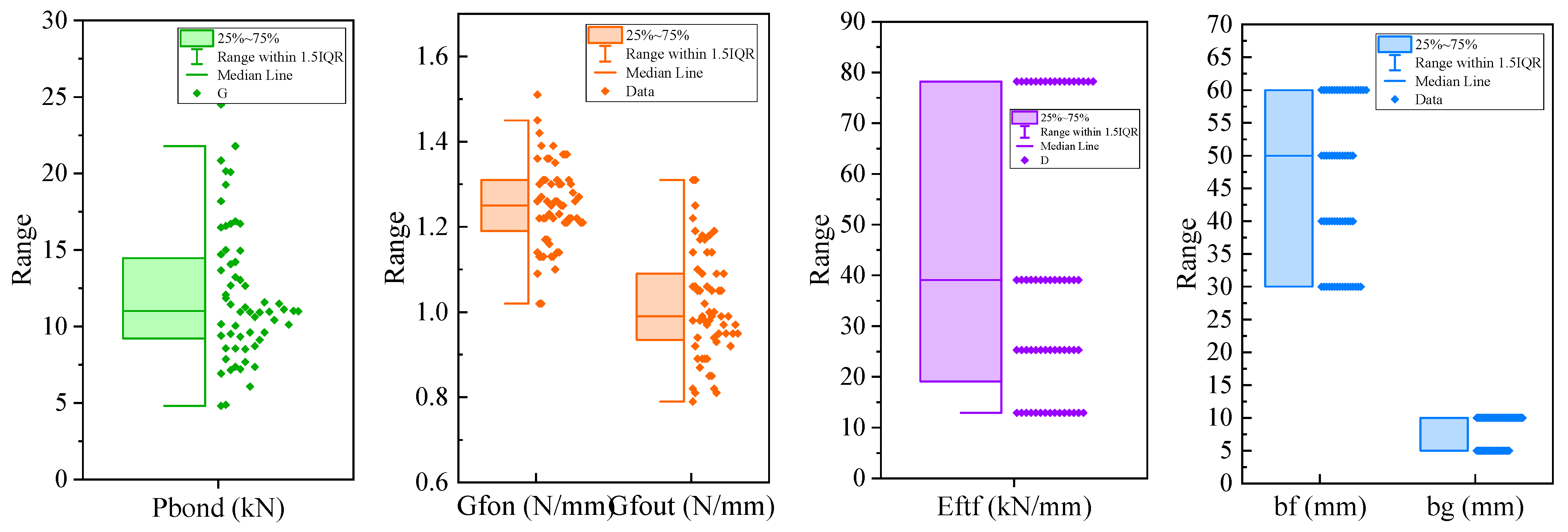
Figure 2 presents the box plots of the variables considered in this study. Groove width and FRP width are discrete rather than continuous parameters, as they were selected from a set of predefined values. Consequently, the corresponding data points appear clustered at distinct positions in the box plots. These selected widths span the range commonly adopted in practical applications. Similarly, FRP stiffness is governed by the material type; therefore, stiffness values are also concentrated at specific levels, reflecting those most frequently used in practice. In contrast, the fracture energy values, both within the groove and outside it, as well as the bond strength, exhibit continuous variation. The associated box plots indicate a well-distributed dataset, supporting its suitability for statistical analysis.
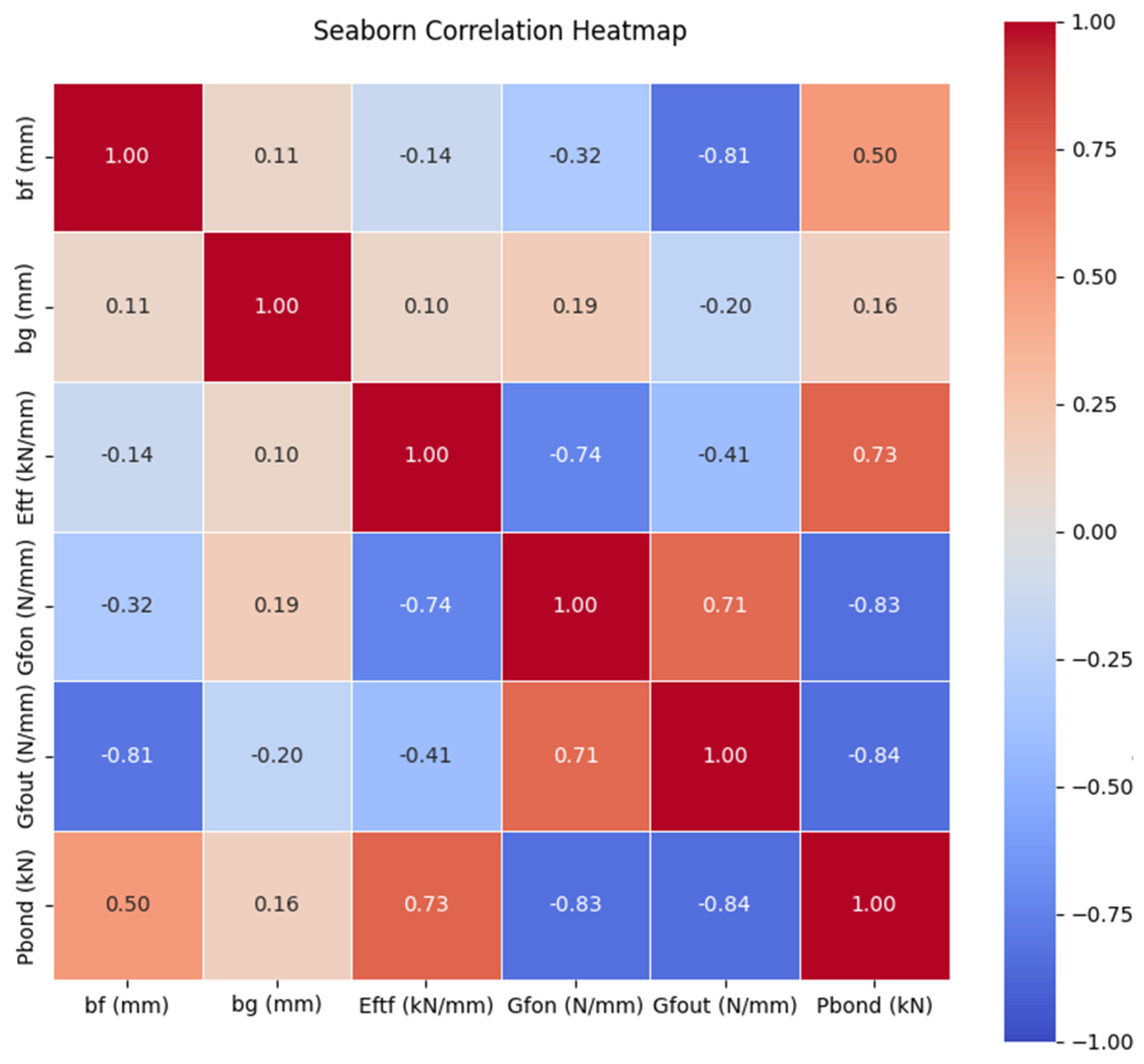
Figure 3 illustrates the correlations between the input parameters and the output variable of the problem. As shown, the correlation coefficient between FRP width and bond strength is 0.50, which is consistent with physical expectations, as increasing the FRP width enlarges the bonded surface area and, consequently, enhances the load carrying capacity. The correlation coefficient between groove width and bond strength is 0.16, indicating a weak but positive linear relationship. Although limited in magnitude, this trend suggests that increasing the groove width can contribute to higher bond strength by allowing a greater volume of adhesive within the groove, thereby improving load transfer. A strong relationship is observed between FRP stiffness and bond strength, with a correlation coefficient of 0.73. This reflects the fact that FRP layers with higher elastic modulus and thickness are capable of developing greater force prior to rupture. In contrast, fracture energy both within and outside the groove exhibits a strong inverse correlation with bond strength, with a coefficient of approximately −0.80. For a given maximum slip between the concrete substrate and the FRP layer, higher fracture energy corresponds to a reduction in the maximum transferable interfacial shear stress. Overall, these trends indicate that bond strength is governed by nonlinear interactions among the governing variables, thereby supporting the use of machine learning models for accurate prediction.
The machine learning models developed in this study are derived from and validated against the experimental dataset described in Table 1. Consequently, the practical applicability of the predictive models is confined to the parameter ranges defined therein: FRP width ( b f ) 30–60 mm, groove width ( b g ) 5–10 mm, FRP stiffness ( E f t f ) 12.9–78.2 kN/mm, fracture energy on-groove ( G f o n ) 1.02–1.51 N/mm, and fracture energy off-groove ( G f o u t ) 0.79–1.31 N/mm. Predictions for input values outside these ranges constitute extrapolation and should be treated with caution, as model behavior in such regions is unvalidated.

3. Methodological Framework

The research methodology was structured into a systematic, multi-stage framework to ensure a rigorous and transparent process for developing and interpreting the predictive ML models. The key stages are as follows:
  • The process commenced with the compilation of experimental bond test data from a dedicated study on EBROGs. Following acquisition, the dataset was curated by removing duplicate entries to create a set of unique experimental observations for model development.
  • The curated dataset was partitioned into distinct subsets: 80% for model training and hyperparameter tuning, and a held-out 20% for final, unbiased testing. The input features (FRP width, groove width, FRP stiffness, and fracture energies and the target output (bond strength) were explicitly defined.
  • Four distinct ML algorithms (SVM, GPR, Decision Tree, and XGBoost) were selected for their proven capability in handling nonlinear regression. A Bayesian Optimization routine was employed to automate the search for the optimal hyperparameter configuration for each model, balancing predictive performance and generalization ability. This stage incorporated 5-fold cross-validation on the training set to mitigate overfitting.
  • The trained models were evaluated on the unseen test set using a suite of statistical metrics (R2, RMSE, MAE, NSE, SI). Their performance was critically compared against each other and, most importantly, against the existing analytical model (Equation (1)) to establish a quantitative benchmark for improvement.
  • The best-performing model (XGBoost) was subjected to Explainable AI (XAI) analysis using SHAPThis stage aimed to move beyond a “black-box” prediction by quantifying global feature importance, visualizing parameter interactions via Partial Dependence Plots (PDPs), and providing local explanations for individual predictions.

4. Machine Learning Methods and Optimization

The Machine Learning (ML) models employed in this study include SVM, GPR, Decision Tree, and XGBoost. These approaches have been widely adopted in the literature to address complex nonlinear regression problems. Each model contains a set of internal parameters, referred to as hyperparameters, which govern its performance. To identify the optimal hyperparameter configurations, Bayesian optimization (BO) [26] was applied to all models to efficiently identify hyperparameter configurations that balance model complexity with generalization ability, thereby actively mitigating the risk of overfitting, which is a particular concern with limited data and high-capacity models like XGBoost. Table 2, Table 3, Table 4 and Table 5 summarize the parameter ranges considered and the corresponding optimal values selected by the BO procedure for each model. Furthermore, a 5-fold cross validation strategy was implemented for all models to mitigate overfitting during the training process. This approach ensures that model performance reflects average predictive accuracy across training and validation datasets, thereby substantially reducing the likelihood of overfitting.

4.1. Model Performance Evaluation

To quantitatively assess the predictive performance of the SVM, GPR, Decision Tree, and XGBoost models, several statistical metrics were employed. These include the coefficient of determination (R2), which quantifies the proportion of variance in the experimental data explained by each model; the root mean square error (RMSE), which measures the average magnitude of prediction errors; the mean square error (MSE); the mean absolute error (MAE); the Nash–Sutcliffe efficiency (NSE); and the scatter index (SI). These metrics are defined mathematically in Equations (2)–(7).
R 2 = ( n i = 1 n P e x p i P m o d i i = 1 n P e x p i i = 1 n P m o d i ) 2 ( n i = 1 n P e x p i 2 i = 1 n P e x p i 2 ) ( n i = 1 n P m o d i 2 i = 1 n P m o d i 2 )
R M S E = 1 n i = 1 n ( P e x p i P m o d i ) 2
M A E = 1 n i = 1 n P e x p i P m o d i
M A P E = i = 1 n P m o d i P e x p i i = 1 n P e x p i
N S E = 1 i = 1 n ( P e x p i P m o d i ) 2 i = 1 n ( P e x p i P e x p ¯ i ) 2
S I = R M S E P e x p ¯ i
In the above equations, P e x p represents the experimental value, P m o d denotes the model prediction, and n is the total number of data points. RMSE is considered an effective performance metric because it accounts for errors of all magnitudes, with smaller values, approaching zero, indicating better predictive accuracy [27,28,29,30]. High values of (R2) and NSE, in combination with low RMSE, MAE, MAPE, and SI, are commonly recognized as indicators of strong model performance [31].
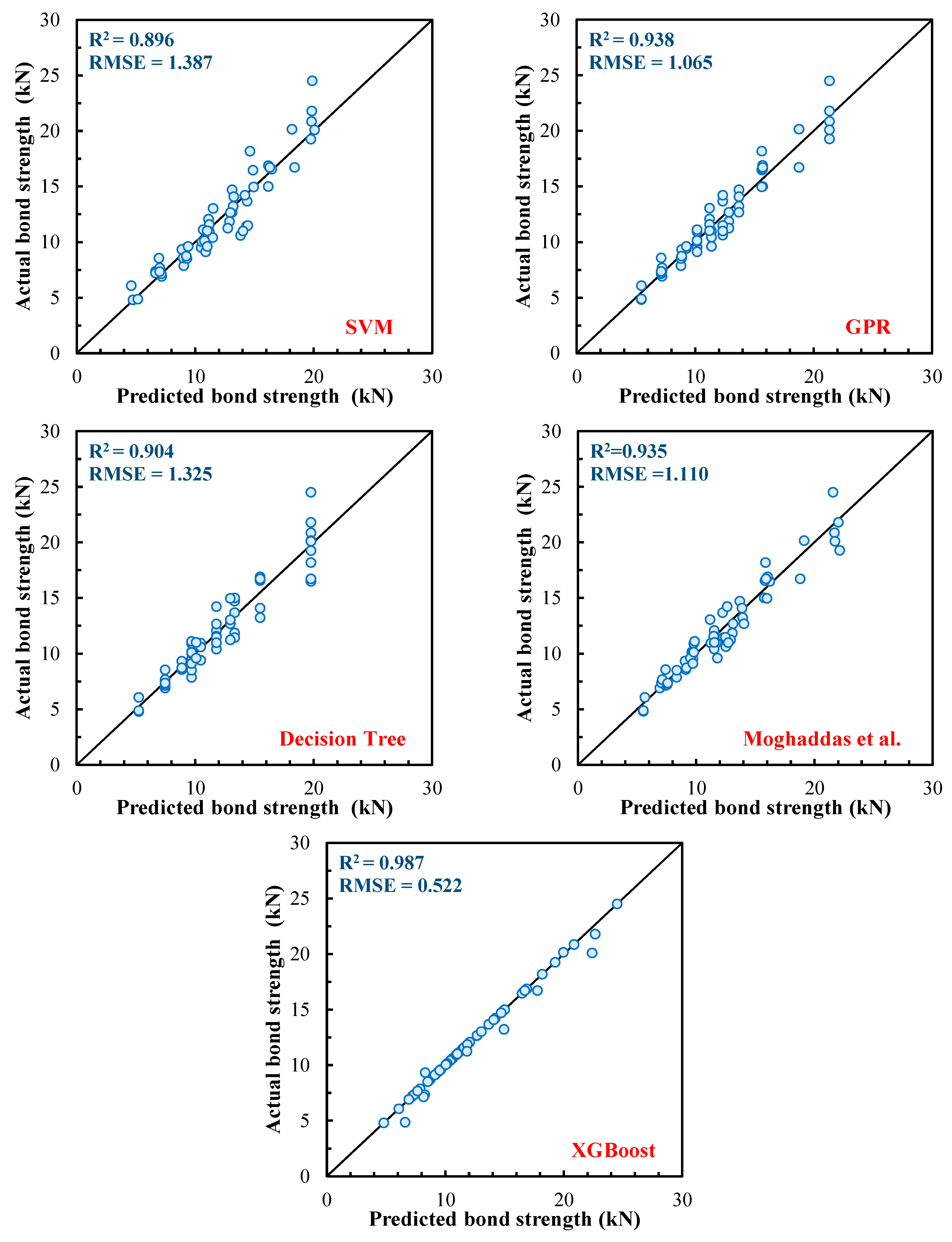
Figure 4 compares the experimental bond strengths with the values predicted by the machine learning models. As observed, the XGBoost model achieves the lowest prediction error (RMSE = 0.522) and the highest coefficient of determination (R2 = 0.987). The superior performance of this model can be attributed to its boosting mechanism, in which the residual errors from previous trees are iteratively incorporated into subsequent trees, leading to a substantial reduction in overall prediction error. Following XGBoost, the GPR model exhibits relatively high predictive accuracy, as it leverages probabilistic inference based on Gaussian distributions to model the underlying data structure. The SVM model demonstrates lower accuracy in comparison, primarily because its regression formulation relies on defining a linear decision boundary in the transformed feature space, which limits its capacity to fully capture the nonlinear behavior of the data. Nevertheless, it approximates the experimental results to a reasonable extent. The Decision Tree model predicts outputs using a minimum number of leaf nodes; however, for certain combinations of input parameters, it produces identical output values for different experimental observations. This behavior is reflected in Figure 4 by vertically aligned prediction points, resulting in relatively large errors. The Decision Tree algorithm partitions the feature space into rectangular regions through recursive binary splitting, and all samples falling within the same terminal node (leaf) receive the same predicted value, typically the mean of the training observations in that region. Unlike regression models that interpolate smoothly across the feature space, decision trees produce piecewise constant predictions. Consequently, when multiple test samples map to the same leaf node, they yield identical bond strength predictions, manifesting as the vertically aligned points observed in Figure 4. Among the error metrics reported in Table 6, the mean absolute error (MAE) most clearly highlights this limitation, yielding a comparatively high value (MAE = 0.984). Additionally, the model proposed by Moghaddas et al. [25] consistently generates predictions below the y = x reference line, indicating a systematic underestimation of the experimentally measured bond strength.

4.2. Residuals

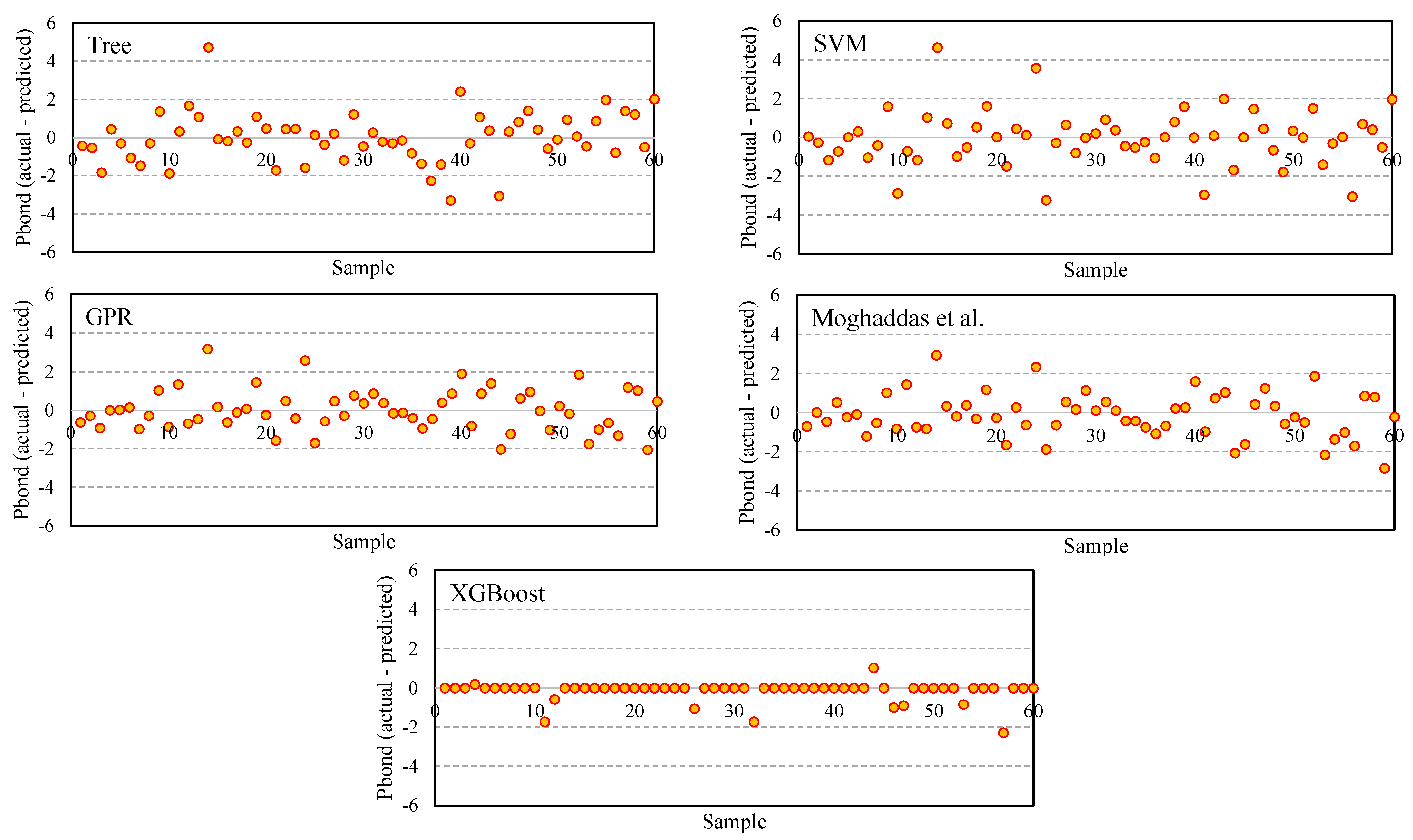
The residual values, defined as the difference between the experimentally measured bond strength and the values predicted by each model, are presented in Figure 5. The XGBoost model exhibits consistently smaller residuals compared with the other machine learning models. When a deviation greater than 2 kN is adopted as a threshold, approximately 10% of the predictions from the Decision Tree and SVM models exceed this limit. The corresponding proportions are 7% for the GPR model and 8% for the model proposed by Moghaddas et al. [25], whereas only 1.7% of the XGBoost predictions differ from the experimental values by more than 2 kN. This indicates that the XGBoost model is more effective in capturing high peak force values. Moreover, the use of cross-validation contributes to controlling overfitting and enhances the generalization capability of the models. An examination of the residual distributions further shows that most errors associated with the SVM model are negative, implying an overestimation of bond strength relative to the experimental measurements. In contrast, 57% of the residuals obtained from the model of Moghaddas et al. [25] are negative, indicating a tendency to underestimate bond strength. For the XGBoost model, negative residuals account for 48% of the data; however, their dispersion is smaller than that observed for the other models, reflecting its improved stability and predictive consistency.

5. Model Interpretation

5.1. Feature Importance

SHapley Additive exPlanations (SHAP), introduced by Lundberg and Lee [32], are employed in this study to interpret the predictions of black-box ML models [27]. This approach is grounded in cooperative game theory [33] and local explanation methods [34,35], providing a systematic framework for quantifying the contribution of individual input features to the model output. Consider a ML model that utilizes a set of n input features to predict an output N. Within the SHAP framework, the contribution and relative importance of each feature, denoted by ϕ i , to the model output υ N are determined based on its marginal contribution to the prediction [36]. These contribution values are computed according to Equation (8), enabling a transparent and consistent interpretation of the influence of each feature on the model response.
ϕ i = S N S ! n S 1 ! n ! υ S i υ S
Within the additive feature attribution framework, a linear function of binary features, denoted by g , is defined as expressed in Equation (9).
g z = ϕ 0 + i = 1 M ϕ i z i
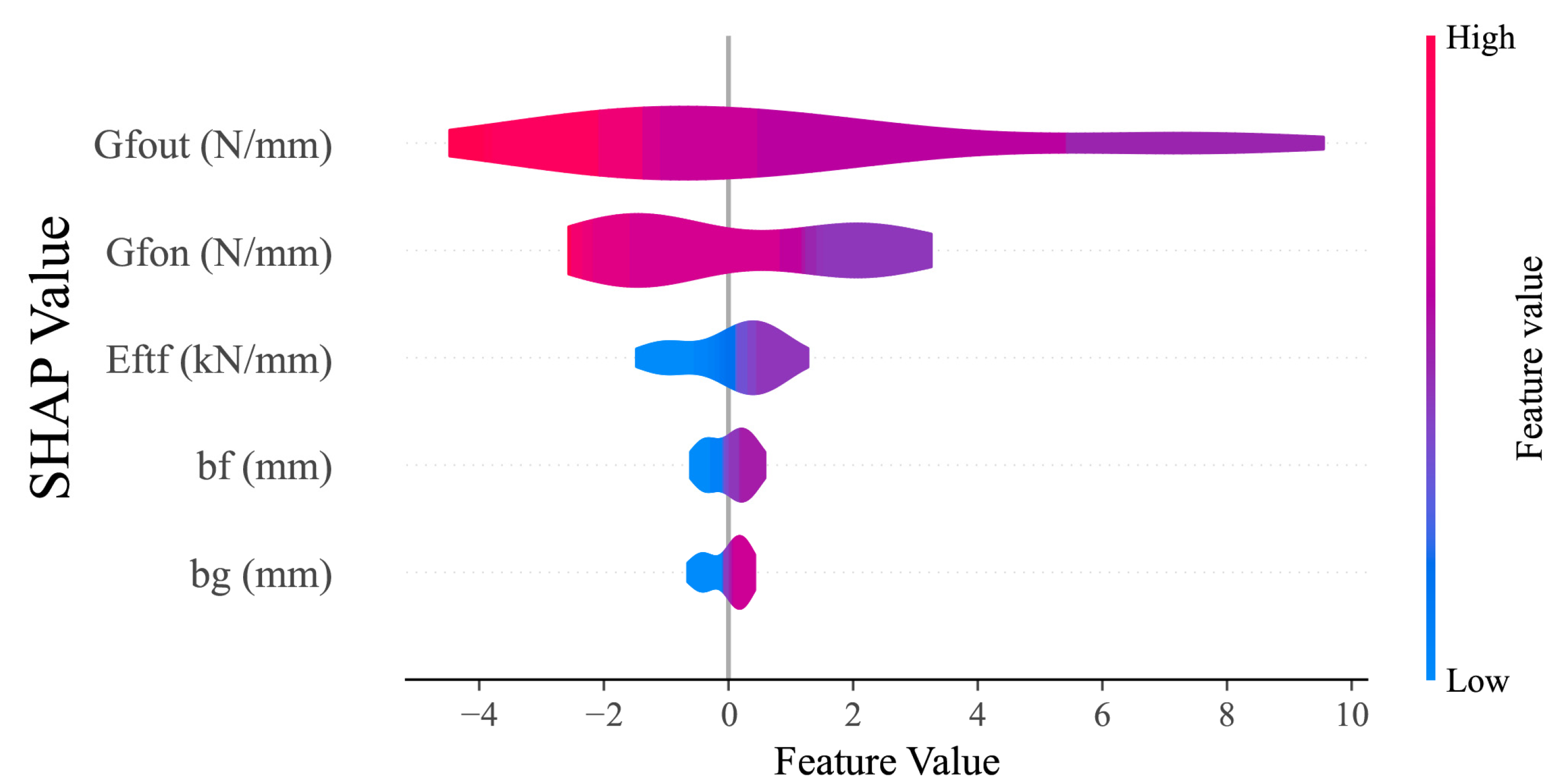
In this formulation, z 0 , 1 M , where each component takes a value of 1 when the corresponding feature is observed and 0 otherwise, and M represents the total number of input features [36]. Using this approach, the influence of each input variable on bond strength is systematically evaluated. Figure 6 presents a summary plot illustrating the relative importance of the input variables and their contributions to the predicted bond strength.
As shown in Figure 6, the fracture energy parameters exhibit a more pronounced influence on bond strength than the other variables considered. Fracture energy represents the area under the load–slip curve and therefore reflects a combined effect of the maximum transferable force and the ultimate displacement capacity observed in bond tests. Both fracture energy components demonstrate a positive contribution to bond strength [25]. Following fracture energy, the stiffness of the FRP plays a significant role in determining bond strength. An increase in layer thickness and elastic modulus enhances the load-carrying capacity prior to failure, resulting in a strong positive influence on bond strength [25]. In contrast, the width of the FRP shows a comparatively lower level of importance, indicating that the mechanical properties of the FRP material govern the response more strongly than its geometric width. Among all parameters, the groove width formed in the concrete substrate has the least influence on bond strength. These findings suggest that, when high bond strength is required, primary attention should be directed toward the properties of the resin adhesive that directly control interfacial behavior. In particular, the mechanical characteristics of the adhesive, including its ultimate shear strength, have a direct and significant impact on bond strength. In addition, the use of high-strength FRP layers is recommended, and where feasible, employing multiple FRP layers can substantially increase the stiffness parameter and further enhance bond performance. The SHAP summary plot translates the model’s learned patterns into quantitative design insight. The dominance of fracture energy ( G f o u t and G f o n ) over geometric parameters confirms that the bond performance is fundamentally governed by the adhesive-concrete interface’s ability to absorb energy prior to failure. This validates the central premise of fracture mechanics models for bond but provides a data-driven hierarchy: for a given concrete substrate, selecting an adhesive with optimized fracture toughness is more critical than marginal increases in FRP width or groove dimension. Furthermore, the strong influence of FRP stiffness ( E f t f ) highlights that composite debonding is not purely an interfacial problem but is coupled with the reinforcement’s axial rigidity. The groove width ( b g ) in the experimental dataset is not a continuous variable but rather takes only two discrete values: 5 mm and 10 mm. This limited variation stems from the original experimental design, which selected these two widths as representative of practical application ranges. With only two distinct values and an imbalanced distribution across the 60 specimens, the statistical variability of this parameter is severely constrained. Machine learning models, including SHAP, quantify feature importance based on the marginal contribution of a parameter as it varies within the training data. When a parameter exhibits minimal variation, its potential influence on the output cannot be fully learned or reflected in importance metrics, regardless of its true physical significance. This is a data-driven artifact, not a physical conclusion that groove width is unimportant.

5.2. Partial Dependence Plots (PDPs)

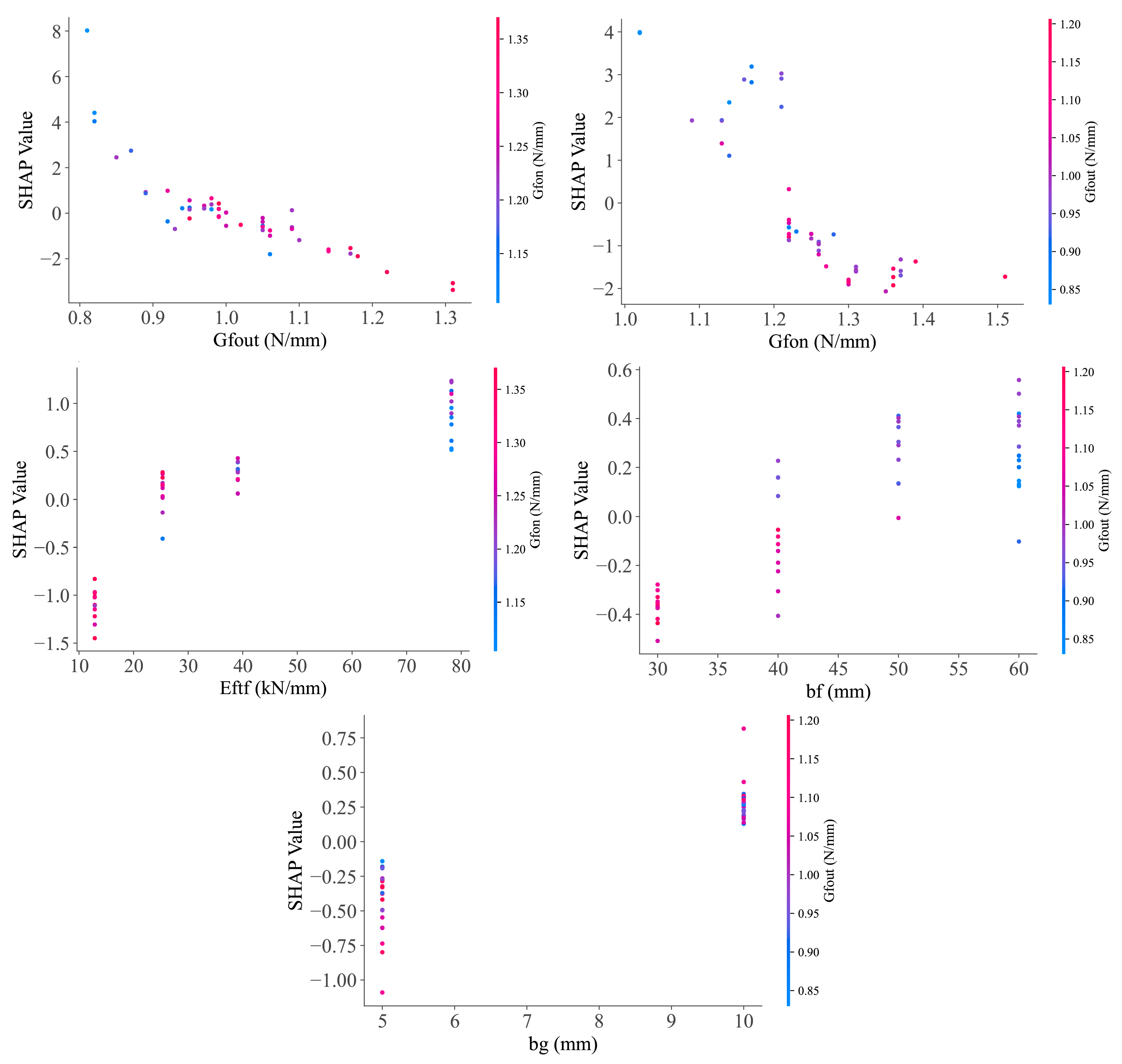
To examine the interactions among variables, partial dependence plots (PDPs) derived from the SHAP analysis were utilized (Figure 7). As observed, the PDP for Gfout shows a decreasing relationship with the corresponding SHAP values. A similar trend is evident for Gfon, indicating a nonlinear relationship between fracture energy and bond strength. This behavior may be attributed to the fact that an increase in fracture energy can induce greater brittleness in the FRP–concrete interface, thereby reducing the ultimate displacement capacity of the connection.
The influence of FRP stiffness on bond strength exhibits a nonlinear relationship. Bond strength increases sharply with FRP stiffness up to approximately 40 kN/mm, beyond which the rate of increase diminishes. A similar trend is observed for FRP width, where bond strength generally rises with increasing width; however, beyond 50 mm, the rate of increase slows, and in some cases, a slight decrease is noted. Groove width in the concrete substrate also shows a positive correlation with bond strength, a trend that aligns well with experimental observations [25]. The paramount importance of fracture energy ( G f o u t , G f o n ) conclusively identifies the failure mode as a fracture-dominated process. The parameter G_f integrates the adhesive’s strength and ductility; a higher value indicates an interface capable of sustaining greater stress and deformation before crack propagation. Therefore, to maximize bond strength and promote a ductile failure, primary design emphasis must be placed on selecting an adhesive with high fracture toughness. This finding directly supports the fracture mechanics basis of analytical models like Equation (1) and provides a clear material selection criterion. The strong positive influence of FRP stiffness ( E f t f ) reveals the coupled nature of the bond problem. A stiffer FRP reinforcement reduces the differential strain or slip between the FRP and concrete at a given load, leading to a more uniform interfacial shear stress distribution and a higher load required to initiate debonding cracks. This explains why simply increasing the bonded area (FRP width) is less effective than increasing the axial rigidity of the reinforcement itself. In design, this implies that for a given FRP material, using thicker plates or multiple layers (increasing t f ) may be more efficient for bond strength than using wider plates. The relatively lower SHAP importance of FRP width ( b f ) and groove width ( b g ) suggests their role is more nuanced. While increasing b f enlarges the bonded area, it also increases the risk of peel stress concentrations at the FRP ends, which can trigger premature debonding. The model’s data indicates that beyond a certain width, the net benefit diminishes. Similarly, the groove width ( b g ) is essential for creating the mechanical interlock and confinement that distinguishes EBROG from EBR and shifts the failure mode from adhesive to a more desirable cohesive concrete failure. These interpretative insights lead to a prioritized design strategy for strong EBROG joints:
  • Material Selection First: Optimize the adhesive for high fracture energy ( G f ) and the FRP for high stiffness ( E f t f ).
  • Groove Design for Failure Mode Control: Choose groove dimensions (depth, width) primarily to ensure concrete cohesive failure—typically by adhering to established guidelines (depth ~10–15 mm) rather than expecting them to be the main drivers of ultimate strength.
  • Width as a Secondary Variable: Adjust FRP width to meet overall strengthening requirements, acknowledging its lesser influence on the fundamental bond efficiency captured by this model.
This mechanistic interpretation bridges the gap between the black-box model outputs and the physical principles of EBROG behavior, providing actionable knowledge for engineers.

5.3. Local SHAP Analysis

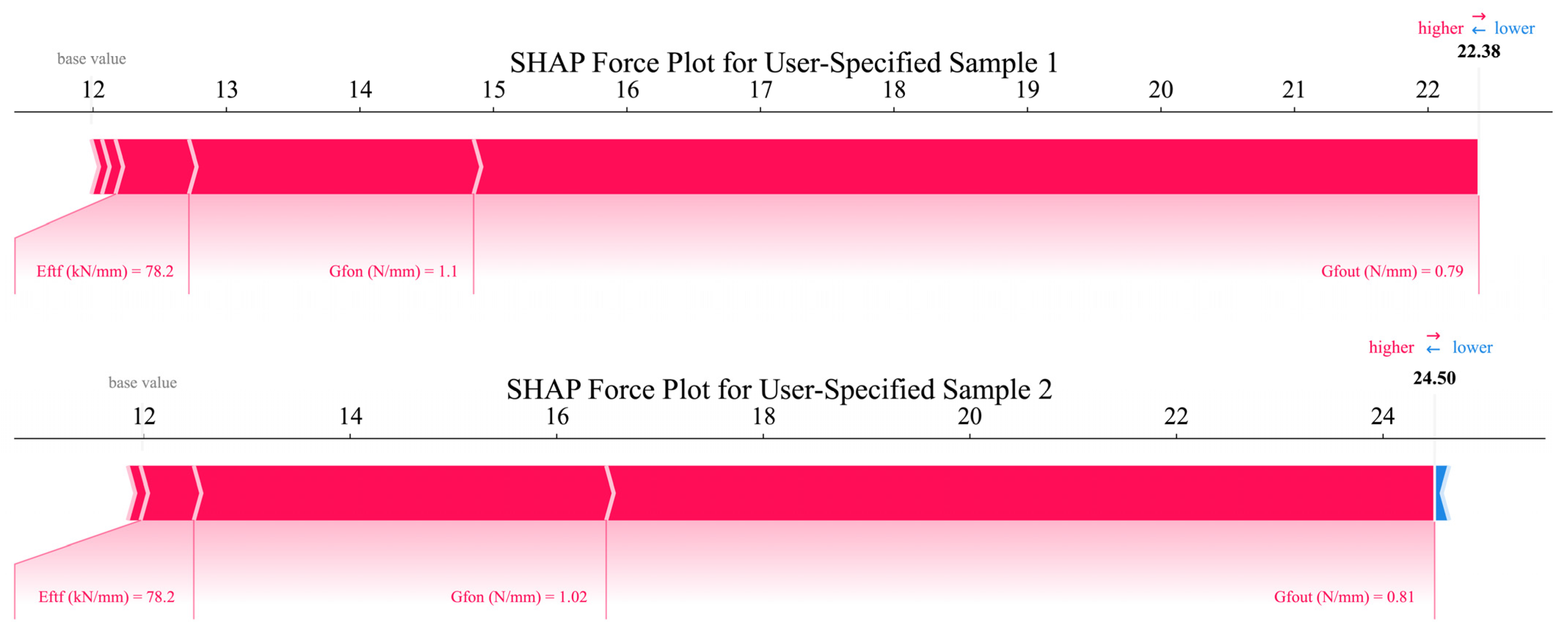
To assess the contribution of individual parameters to the bond strength of specific samples, a force plot can be employed according to Figure 8 [37]. Two samples were selected from the experimental dataset, and their corresponding values for FRP width, groove width, FRP stiffness, fracture energy on and off the groove, and bond strength are summarized in Table 7. The XGBoost model predicts bond strengths of 22.38 kN and 24.50 kN for the first and second samples, respectively, demonstrating the high predictive accuracy of the model. The baseline bond strength of the model is 12 kN.
The force plot indicates that the increase in bond strength from the baseline value of 12 kN to 22.38 kN and 24.50 kN is primarily driven by FRP stiffness and the fracture energies both within and outside the groove. Notably, the majority of the contribution arises from the fracture energy outside the grooved area. These three factors collectively enhance bond strength, with no parameter exerting a negative influence on the bond performance.
This study transcends a ML performance comparison by establishing a hybrid physics-informed data science framework specifically for the EBROG technique. This gap is significant because EBROG induces a fundamentally different, multi-mechanism bond (combining adhesion, mechanical interlocking, and confinement) compared to traditional Externally Bonded Reinforcement (EBR). Our work addresses this by using fracture energy parameters, the core of analytical EBROG models, as direct inputs to the ML algorithms. This creates a direct bridge between a well-established physical theory (fracture mechanics) and a powerful pattern-recognition tool (ML), ensuring the model’s predictions are grounded in the correct governing physics.

6. Limitations and Future Studies

According to the research results, it is evident that bond strength varies with different groove widths, and the effect of multiple grooves should also be considered. It should be noted that the dataset used in this study was derived from a laboratory-scale model. The primary limitation is the size and scope of the dataset. The final model was trained on 60 unique experimental samples sourced from a single study. Although rigorous techniques like Bayesian optimization and k-fold cross-validation were employed to curb overfitting, the generalizability of the model to radically new materials, geometries, or loading conditions beyond the ranges specified in Section 2 remains unproven.

7. Conclusions

In this study, the bond strength behavior between FRP and concrete was investigated using the EBROG method. Given that no highly accurate predictive model had yet been developed for bond strength data, four machine learning models—SVM, GPR, Decision Tree, and XGBoost—were employed for nonlinear regression, with their hyperparameters optimized using Bayesian Optimization (BO). The performance of these models was evaluated using multiple criteria assessing both error and predictive accuracy. Additionally, the influence of input parameters was analyzed globally and locally using the SHAP method, while interactions between variables were examined through partial dependence plots (PDPs). The key findings of this study are summarized as follows:
  • Among the ML models, XGBoost demonstrated superior performance, achieving the lowest error (RMSE = 0.522), the highest accuracy (R2 = 0.987), and excellent efficiency (NSE = 0.985, SI = 0.043). This model outperformed even the analytical model proposed by Moghaddas et al. [25].
  • The GPR model also exhibited higher accuracy and lower error compared to the analytical approach of Moghaddas et al. [25], indicating that relatively simple machine learning models can serve as effective alternatives to traditional analytical methods.
  • SHAP analysis revealed that the mechanical properties of the adhesive, which directly influence fracture energy, exert the greatest impact on bond strength in the EBROG reinforcement method.
  • The relationships between fracture energy and bond strength, as well as between FRP width and groove width with bond strength, were observed to be nonlinear: fracture energy showed a decreasing effect, whereas FRP and groove widths exhibited a nonlinear increasing trend with respect to bond strength.
  • The Bayesian Optimization method successfully identified the optimal hyperparameters for the XGBoost model. Moreover, the application of five-fold cross-validation effectively prevented overfitting, ensuring robust and generalizable predictions.

Author Contributions

Conceptualization, B.M., P.F. and Y.N.; Methodology, B.M., P.F., Y.N. and M.A.; Software, P.F. and Y.N.; Validation, B.M. and P.F.; Formal analysis, Y.N.; Investigation, B.M., P.F. and Y.N.; Data curation, Y.N. and M.A.; Writing—original draft, P.F. and Y.N.; Writing—review and editing, B.M., P.F., Y.N., M.A. and B.S.; Visualization, Y.N. and M.A.; Supervision, B.M. and B.S. All authors have read and agreed to the published version of the manuscript.

Funding

This research received no external funding.

Data Availability Statement

The data supporting the findings of this study is available from the corresponding author upon reasonable request.

Conflicts of Interest

The authors declare no conflicts of interest.

References

  1. Ammari, A.S.; Hosseini, S.A.; Mohammadrahimi, A.; Nouri, Y.; Rayegani, A.; Ebrahimi, M.; Heydari, P. CFRP Strengthened Corroded Steel Columns: An Experimental, Numerical, and Machine Learning Investigation. Structures 2025, 80, 109981. [Google Scholar] [CrossRef]
  2. Shabani Ammari, A.; Nouri, Y.; Ghasemi Jouneghani, H.; Hosseini, S.A.; Rayegani, A.; Ebrahimi, M.; Heydari, P. Flexural Strengthening of Corroded Steel Beams with CFRP by Using the End Anchorage: Experimental, Numerical, and Machine Learning Methods. Case Stud. Constr. Mater. 2025, 23, e04966. [Google Scholar] [CrossRef]
  3. Oehlers, D.J. Development of Design Rules for Retrofitting by Adhesive Bonding or Bolting Either FRP or Steel Plates to RC Beams or Slabs in Bridges and Buildings. Compos. Part A Appl. Sci. Manuf. 2001, 32, 1345–1355. [Google Scholar] [CrossRef]
  4. Taheri, F.; Shahin, K.; Widiarsa, I. On the Parameters Influencing the Performance of Reinforced Concrete Beams Strengthened with FRP Plates. Compos. Struct. 2002, 58, 217–226. [Google Scholar] [CrossRef]
  5. Siddika, A.; Al Mamun, M.A.; Alyousef, R.; Amran, Y.H.M. Strengthening of Reinforced Concrete Beams by Using Fiber-Reinforced Polymer Composites: A Review. J. Build. Eng. 2019, 25, 100798. [Google Scholar] [CrossRef]
  6. De Lorenzis, L.; Teng, J.-G. Near-Surface Mounted FRP Reinforcement: An Emerging Technique for Strengthening Structures. Compos. Part B Eng. 2007, 38, 119–143. [Google Scholar] [CrossRef]
  7. Mostofinejad, D.; Mahmoudabadi, E. Grooving as Alternative Method of Surface Preparation to Postpone Debonding of FRP Laminates in Concrete Beams. J. Compos. Constr. 2010, 14, 804–811. [Google Scholar] [CrossRef]
  8. Hosseini, A.; Mostofinejad, D. Experimental Investigation into Bond Behavior of CFRP Sheets Attached to Concrete Using EBR and EBROG Techniques. Compos. Part B Eng. 2013, 51, 130–139. [Google Scholar] [CrossRef]
  9. Fakharian, P.; Nouri, Y.; Ghanizadeh, A.R.; Safi Jahanshahi, F.; Naderpour, H.; Kheyroddin, A. Bond Strength Prediction of Externally Bonded Reinforcement on Groove Method (EBROG) Using MARS-POA. Compos. Struct. 2024, 349–350, 118532. [Google Scholar] [CrossRef]
  10. Moshiri, N.; Martinelli, E.; Czaderski, C.; Mostofinejad, D.; Hosseini, A.; Motavalli, M. Bond Behavior of Prestressed CFRP Strips-to-Concrete Joints Using the EBROG Method: Experimental and Analytical Evaluation. J. Compos. Constr. 2023, 27, 04022104. [Google Scholar] [CrossRef]
  11. Shabani, E.; Mostofinejad, D.; Saljoughian, A. Bond Behavior of Prestressed FRP Sheet-Concrete Joints: Comparison of EBROG and EBR Methods. Constr. Build. Mater. 2023, 400, 132752. [Google Scholar] [CrossRef]
  12. Moshiri, N.; Czaderski, C.; Mostofinejad, D.; Hosseini, A.; Motavalli, M. Effect of Groove Depth on Behavior of Prestressed CFRP Strips Bonded to Concrete by Using EBROG Method. In Proceedings of CICE 2020/2021, Proceedings of the 10th International Conference on FRP Composites in Civil Engineering, Istanbul, Turkey, 8–10 December 2021; Lecture Notes in Civil Engineering; Springer: Cham, Switzerland, 2022; Volume 198, pp. 2188–2196. ISBN 9783030881658. [Google Scholar]
  13. Codina, A.; Barris, C.; Jahani, Y.; Baena, M.; Torres, L. Experimental and Theoretical Study on the Flexural Behaviour of RC Beams Strengthened with Externally Bonded Reinforcement on Grooves CFRP Laminates. Eng. Struct. 2024, 299, 117091. [Google Scholar] [CrossRef]
  14. Zolfaghari, S.; Mostofinejad, D.; Fantuzzi, N.; Luciano, R.; Fabbrocino, F. Experimental Evaluation of FRP-Concrete Bond Using Externally-Bonded Reinforcement on Grooves (EBROG) Method. Compos. Struct. 2023, 310, 116693. [Google Scholar] [CrossRef]
  15. Hong, K.-N.; Ji, S.-W.; Son, D. Experimental Study to Evaluate the Flexural Behavior of RC Slabs Strengthened with CFRP Plates Using the EBROG Method. Constr. Build. Mater. 2025, 483, 141732. [Google Scholar] [CrossRef]
  16. Breveglieri, M.; Martinelli, E.; Moshiri, N.; Czaderski, C. Evaluation of the Flexural Capacity of RC Slabs Strengthened with Combined EBROG-EBR Prestressed CFRP Strips and an Innovative Composite Anchorage System. Eng. Struct. 2025, 339, 120677. [Google Scholar] [CrossRef]
  17. Heydari, P.; Mostofinejad, D.; Saljoughian, A. Seismic Retrofitting of Shear-Deficient RC Coupling Beams with FRP Composites through EBROG Technique. Eng. Struct. 2025, 341, 120861. [Google Scholar] [CrossRef]
  18. Khorasani, M.; Mostofinejad, D.; Muciaccia, G.; Kheyroddin, A. Flexural Strengthening of RC Structural Walls Using EBROG Method and FRP Anchors: Experimental and Analytical Insights. Structures 2025, 80, 109898. [Google Scholar] [CrossRef]
  19. Shabani, E.; Saljoughian, A.; Mostofinejad, D. Empirical Evaluation of Prestressed EBROG FRP Sheet-to-Concrete Joints. Constr. Build. Mater. 2025, 463, 140057. [Google Scholar] [CrossRef]
  20. Benaddache, L.; Belkadi, A.A.; Berkouche, A.; Maghaghi, B.; Kessal, O.; Aggoun, S. Advancing Structural Flexural Reinforcement with Natural and Synthetic Fiber Composites: Optimization of EBR and EBROG Methods Supported by DIC. Structures 2025, 80, 109866. [Google Scholar] [CrossRef]
  21. Khorasani, M.; Mostofinejad, D.; Muciaccia, G. Innovative FRP Shear Strengthening of RC Structural Walls Using EBROG Method and FRP Spike Anchors: An Experimental and Theoretical Study. Eng. Struct. 2026, 348, 121817. [Google Scholar] [CrossRef]
  22. Saljoughian, A.; Arefian, B.; Ansari, Z.; Mostofinejad, D. Flexural Performance of RC Beams Strengthened with Grid-Reinforced ECC Panels Using the EBROG Technique. Results Eng. 2026, 29, 108502. [Google Scholar] [CrossRef]
  23. Khorasani, M.; Mostofinejad, D.; MohammadSalehi, A. Seismic Rehabilitation of Flexure-Damaged RC Shear Walls Using a Hybrid UHPC–FRP Composites with EBROG-Installed Strips and FRP Anchors. Compos. Part C Open Access 2025, 18, 100665. [Google Scholar] [CrossRef]
  24. Abdoli, M.; Mostofinejad, D.; Eftekar, M.; Saljoughian, A. Torsional Strengthening of T-Shaped RC Members with FRP Composites Using EBROG Method: Experimental Investigation and Analysis. Constr. Build. Mater. 2024, 437, 136829. [Google Scholar] [CrossRef]
  25. Moghaddas, A.; Mostofinejad, D.; Saljoughian, A.; Ilia, E. An Empirical FRP-Concrete Bond-Slip Model for Externally-Bonded Reinforcement on Grooves. Constr. Build. Mater. 2021, 281, 122575. [Google Scholar] [CrossRef]
  26. Feurer, M.; Springenberg, J.; Hutter, F. Initializing Bayesian Hyperparameter Optimization via Meta-Learning. In Proceedings of the AAAI Conference on Artificial Intelligence, Austin, TX, USA, 25–30 January 2015; Volume 29. [Google Scholar]
  27. Nouri, Y.; Ali, M.; Fakharian, P. Flexural Behavior of Hybrid GFRP-Steel Reinforced Concrete Beam: Experimental and Explainable Artificial Intelligence. Eng. Struct. 2025, 345, 121565. [Google Scholar] [CrossRef]
  28. Ziaie, A.; Mehdizadeh, B.; Safi Jahanshahi, F.; Ahmadi, N.; Ghanizadeh, A.R. Prediction of Liquefaction-Induced Lateral Displacements Using Hybrid GBRT and EOA. J. Soft Comput. Civ. Eng. 2026, 10, 2061. [Google Scholar] [CrossRef]
  29. Nouri, Y.; Shirkhani, A.; Ghasemi Jouneghani, H.; Hemati, E.; De Domenico, D. Seismic Performance Assessment of Steel MRFs Retrofitted with Arc and Ring Dampers. J. Constr. Steel Res. 2026, 236, 109949. [Google Scholar] [CrossRef]
  30. Nouri, Y.; Ghanizadeh, A.R.; Safi Jahanshahi, F.; Fakharian, P. Data-Driven Prediction of Axial Compression Capacity of GFRP-Reinforced Concrete Column Using Soft Computing Methods. J. Build. Eng. 2025, 101, 111831. [Google Scholar] [CrossRef]
  31. Kumar, A.; Arora, H.C.; Kumar, K.; Garg, H. Performance Prognosis of FRCM-to-Concrete Bond Strength Using ANFIS-Based Fuzzy Algorithm. Expert Syst. Appl. 2023, 216, 119497. [Google Scholar] [CrossRef]
  32. Lundberg, S.M.; Lee, S.I. A Unified Approach to Interpreting Model Predictions. In Proceedings of the 31st International Conference on Neural Information Processing Systems, Long Beach, CA, USA, 4–9 December 2017; pp. 4766–4775. [Google Scholar]
  33. Štrumbelj, E.; Kononenko, I. Explaining Prediction Models and Individual Predictions with Feature Contributions. Knowl. Inf. Syst. 2014, 41, 647–665. [Google Scholar] [CrossRef]
  34. Ribeiro, M.T.; Singh, S.; Guestrin, C. “ Why Should i Trust You?” Explaining the Predictions of Any Classifier. In Proceedings of the 22nd ACM SIGKDD International Conference on Knowledge Discovery and Data Mining, San Francisco, CA, USA, 13–17 August 2016; pp. 1135–1144. [Google Scholar]
  35. Afzali, S.E.; Ghasemi, M.; Rahimiratki, A.; Mehdizadeh, B.; Yousefieh, N.; Asgharnia, M. Compaction and Compression Behavior of Waste Materials and Fiber-Reinforced Cement-Treated Sand. J. Struct. Des. Constr. Pract. 2025, 30, 04025007. [Google Scholar] [CrossRef]
  36. Shapley, L.S. A Value for ?-Person Games. In Classics in Game Theory; Princeton University Press: Princeton, NJ, USA, 2020; pp. 69–79. [Google Scholar] [CrossRef]
  37. Fakharian, P.; Bazrgary, R.; Ghorbani, A.; Tavakoli, D.; Nouri, Y. Compressive Strength Prediction of Green Concrete with Recycled Glass-Fiber-Reinforced Polymers Using a Machine Learning Approach. Polymers 2025, 17, 2731. [Google Scholar] [CrossRef]
Figure 1. EBR and EBROG method definitions.
Buildings 16 01070 g001
Figure 2. Box plot and distribution of data.
Buildings 16 01070 g002
Figure 3. Correlation heatmap for inputs and output.
Buildings 16 01070 g003
Figure 4. Relation between actual and predicted values for different models and Moghaddas et al. [25].
Buildings 16 01070 g004
Figure 5. The residuals for different model and Moghaddas et al. [25].
Buildings 16 01070 g005
Figure 6. SHAP summary plot for input parameters.
Buildings 16 01070 g006
Figure 7. SHAP PDPs for input parameters.
Buildings 16 01070 g007
Figure 8. SHAP force plot for two different samples.
Buildings 16 01070 g008
Table 1. Descriptive statistical properties for inputs and output.
ParameterMin.Max.MeanStandard DeviationSkewnessKurtosis(Q1)(Q3)
b f (mm)306045.511.85005−0.0599−1.5063060
b g (mm)5107.92.48584−0.34679−1.946510
E f t f (kN/mm)12.978.240.425.66070.57801−1.25519.178.2
G f o n (N/mm)1.021.511.20.100070.044020.1011.191.31
G f o u t (N/mm)0.791.311.00.125830.38283−0.3280.9351.09
P b o n d (kN)4.8124.512.04.321020.826410.3609.2214.455
Table 2. Hyperparameter search range and optimum values for SVM.
SVMBox ConstrainEpsilonKernel ScaleKernel Function
Optimum991.07820.00698271Linear
Search range[0.001–1000][0.0038769–387.6946][0.001–1000]Gaussian—Linear—Quadratic—Cubic
Table 3. Hyperparameter search range and optimum values for GPR.
GPRBasis FunctionKernel FunctionKernel ScaleSigma
OptimumZeroNonIsotropic squared exponential0.0830212.0435
Search rangeConstant-Zero-LinearNonIso/Isotropic exponential, NonIso/Isotropic Matern 3/2, NonIso/Isotropic Matern 5/2
NonIso/Isotropic rational quadratic, NonIso/Isotropic squared exponential
[0.0653–65.3][0.0001–43.2043]
Table 4. Hyperparameter search range and optimum values for Decision Tree.
Decision TreeMinimum Leaf Size
Optimum1
Search range[1–30]
Table 5. Hyperparameter search range and optimum values for XGBoost.
XGBoostColsample BytreeLearning RateMax DepthN EstimatorsSubsampleRandom State
Optimum0.9810860.1601773160.73898942
Search range[0.6–1.0][0.01–0.3][3–12][50–500][0.6–1.0]42
Table 6. Performance indices for different models.
ModelR2RMSEMAPMAENSESI
SVM0.8961.3878.2030.9750.8950.115
GPR0.9381.0656.8160.8330.9380.088
Decision Tree0.9041.3257.8950.9840.9040.110
Moghaddas et al. [25]0.9351.1107.2130.8740.9330.092
XGBoost0.9870.5221.9070.1900.9850.043
Table 7. Samples for force plot.
Sample b f (mm) b g (mm) E f t f (kN/mm) G f o n (N/mm) G f o u t (N/mm) P b o n d (kN)
Sample 1601078.21.10.7920.09
Sample 260578.21.020.8124.50
Disclaimer/Publisher’s Note: The statements, opinions and data contained in all publications are solely those of the individual author(s) and contributor(s) and not of MDPI and/or the editor(s). MDPI and/or the editor(s) disclaim responsibility for any injury to people or property resulting from any ideas, methods, instructions or products referred to in the content.