1. Introduction
With the rapid development of urbanization, a substantial amount of construction and demolition waste has been generated worldwide and will continue to increase in the next decades [
1,
2,
3,
4]. CDW is predominantly disposed by landfilling and open stacking, which not only cause social and environmental problems but also results in a significant waste of resources [
5,
6]. The proportion of concrete and brick waste in CDW is more than 80%; RP accounts for more than 20–30% of concrete and brick waste [
7]. Improving the reuse rate of concrete and brick waste is an effective way to reduce CDW and carbon emissions. Therefore, many scholars have studied the recycling of CDW and developed the recycling technology of CDW. The concrete and waste bricks in CDW are screened out and broken into recycled aggregates to produce recycled aggregate concrete [
8,
9,
10]. A number of investigations on the microscopic properties, mechanical properties, construction performance, and durability of recycled concrete have found that the use of recycled aggregate will reduce the performance of concrete, especially its durability and mechanical properties, which are very important to the service life of concrete [
11,
12,
13].
In the process of crushing and producing recycled aggregate, RP with a particle size below 150 μm can be obtained through a dust collector. The RP obtained in this way generally has a larger particle size (more than 75 μm) and lower activity than cement and cannot be directly used as a supplementary cementitious material in concrete production like fly ash and mineral powder. It is generally only used as an inert filler to improve the particle size distribution of concrete [
14,
15]. The main components of the RP contain SiO
2 and Al
2O
3, which is similar to the composition of fly ash and has a certain pozzolanic effect [
16,
17,
18].
In recent years, beyond material-scale investigations, recycled powders derived from construction and demolition waste—such as recycled concrete powder, brick powder, glass powder, and ceramic waste powder—have attracted increasing attention as supplementary cementitious materials or precursors in cement-based systems. As a supplementary cementitious material, RP has a very low carbon emission of about 32 kg/t, which promotes efficient carbon reduction in the construction industry [
19,
20,
21,
22]. To enhance the reactivity and broaden the application potential of RP, various activation methods—including mechanical grinding, chemical activation, thermal treatment, and carbonation—have been proposed and investigated. While numerous studies have reported their effects on hydration behavior, strength development, and durability [
23,
24], the reported results remain highly scattered and, in some cases, contradictory. Similar replacement levels of recycled powder have been shown to both improve and deteriorate mechanical and durability performance, indicating that empirical dosage-based conclusions are insufficient to explain the observed variability [
25,
26,
27].
Unlike existing review articles that primarily summarize preparation methods or report performance trends, the present review explicitly addresses the origin of these inconsistencies. The central premise of this work is that the performance of recycled powder cannot be evaluated solely based on replacement ratio or activation technique but must be interpreted through the coupled effects of source characteristics (parent material type, service age, and carbonation degree), particle-scale structure (size, morphology, and amorphization), and reaction environment. Accordingly, this review contributes beyond existing publications in three aspects: (i) it establishes a source–microstructure–reactivity–performance linkage to rationalize divergent experimental results; (ii) it critically compares mechanical, thermal, chemical, and CO2 activation methods from a mechanism- and applicability-oriented perspective, rather than strength enhancement alone; and (iii) it extends the discussion from paste and mortar systems to engineering-oriented applications, including UHPC, SCC, and reinforced concrete elements. These contributions aim to provide mechanism-based performance envelopes to support the rational and reliable utilization of recycled powder in sustainable concrete construction.
2. Fundamental Properties of RP
2.1. Production Technology
CDW mainly consists of concrete, brick, glass, ceramic, steel, plastic and wood waste [
28]. The reuse of waste concrete and bricks mainly includes the following four parts [
14,
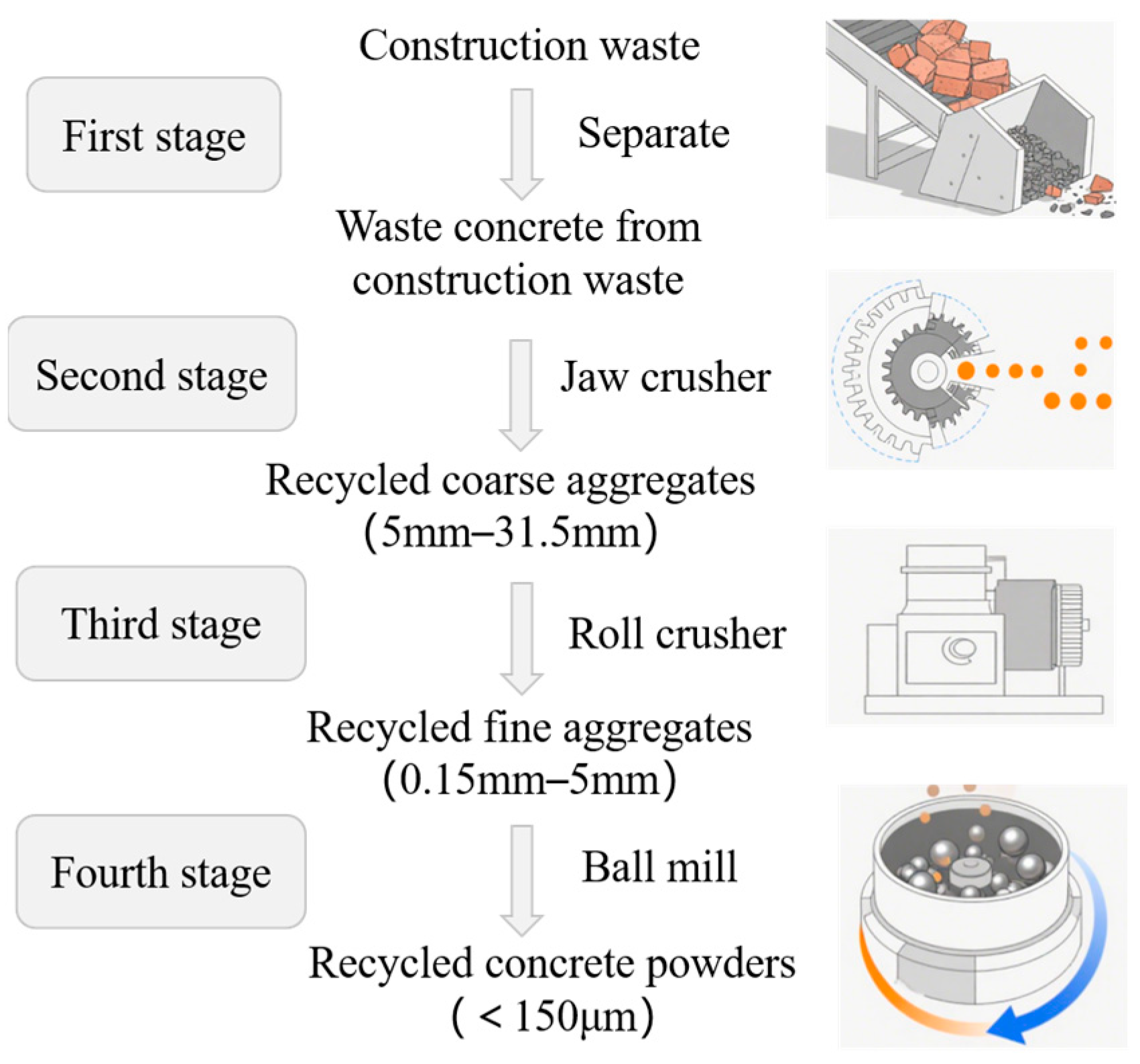
29]: (1) Separating waste concrete and bricks from other substances. (2) The waste concrete and bricks are broken into 5–31.5 mm recycled coarse aggregate by a jaw crusher, (3) The recycled coarse aggregate is further crushed into recycled fine aggregate with a particle size of 150 μm–5 mm by using a roll crusher. (4) A ball mill is used to produce RP, resulting in granulometry less than 150 μm [
30,
31].
Figure 1 shows the preparation process of RP. The RP directly obtained from the production of recycled aggregates from waste concrete and bricks has a large particle size and low activity and cannot be directly used as SCM in concrete [
32].
At present, the most commonly used RP preparation method is mechanical grinding. In general, a jaw crusher and roll crusher are used to produce aggregates with larger particle size, and a planetary ball mill is used to produce RP [
33]. In addition, RP can also be treated by wet grinding [
34,
35] and jet grinding [
36]. The micro-structure of RP produced by wet grinding and jet grinding is more regular than that produced by a ball mill, and the mechanical properties of concrete with wet-milled and jet-milled RP are better than those with ball-milled RP [
36]. The same treatment method can lead to different effects on different raw materials. In general, raw materials dominated by calcium-bearing phases (e.g., calcite) tend to exhibit lower grinding resistance than those rich in silicon-bearing phases (e.g., quartz), due to differences in mineralogical composition and microstructural characteristics, and are therefore relatively easier to grind [
37]. The grinding can increase the specific surface area and reduce the particle size of the RP. The specific surface area ranges from 170 to 860 m
2/kg, and the particle size ranges from 0.249 to 125 μm [
32].
In addition to the type of raw materials, grinding time also affects the specific surface area and particle size distribution. Researchers found that as the grinding time increased, the specific surface area increased and the particle size decreased. However, with the extension of time, the grinding efficiency decreases [
31,
38]. Dun et al. [
39] ground RP for 80 min, 100 min and 120 min, respectively. It was found that the particle size of 80 min changed greatly, and the particle size distribution of 100 min and 120 min was almost the same. Tang et al. [
40] also investigated the relationship between grinding time and specific surface area. It was found that with the increase in grinding time, the specific surface area increased rapidly in the early stage, showing a linear growth, and tended to be gentle in the later stage. Therefore, RPs from different sources need to be tested many times to determine the best grinding method and time.
2.2. Physical and Chemical Properties of RP
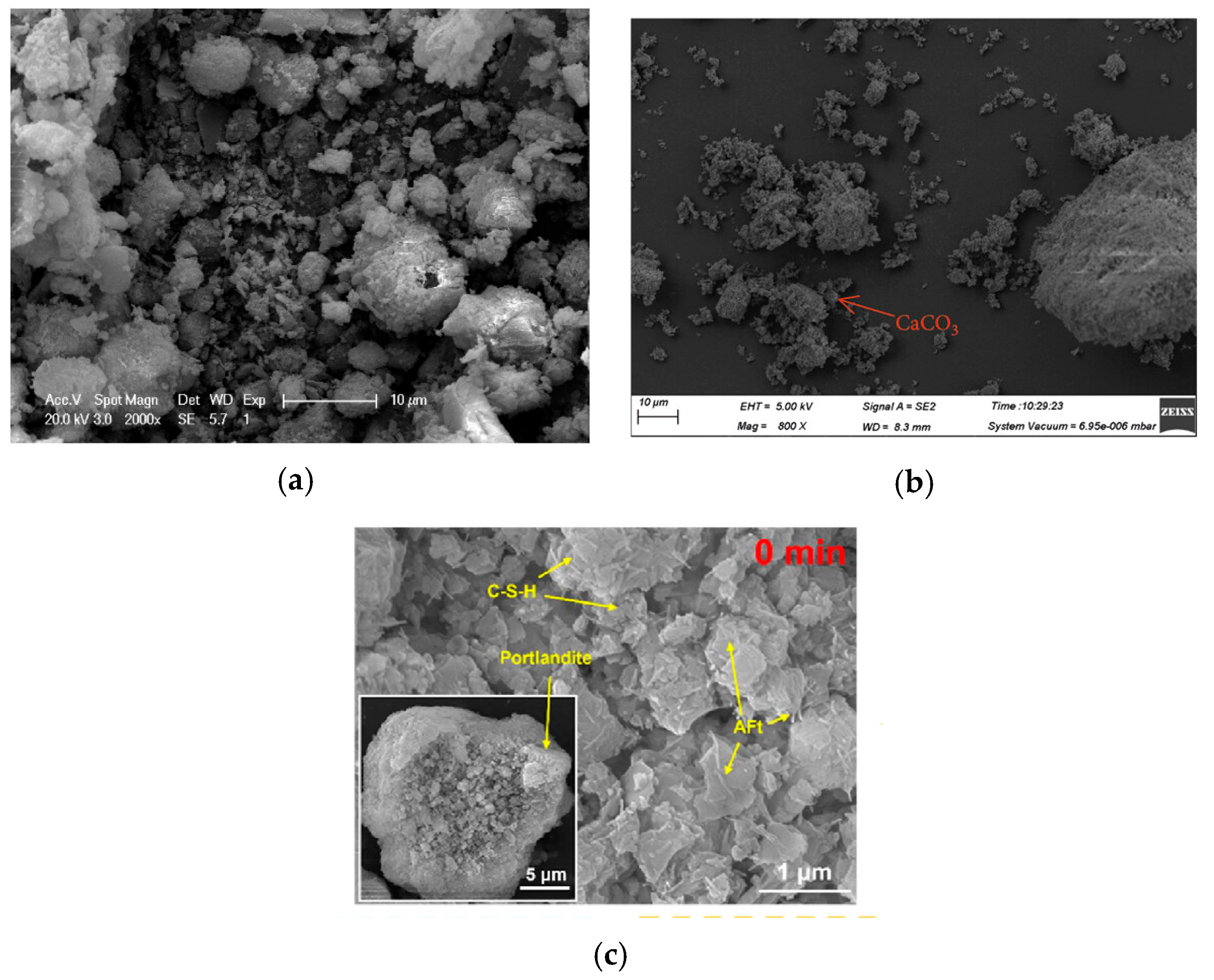
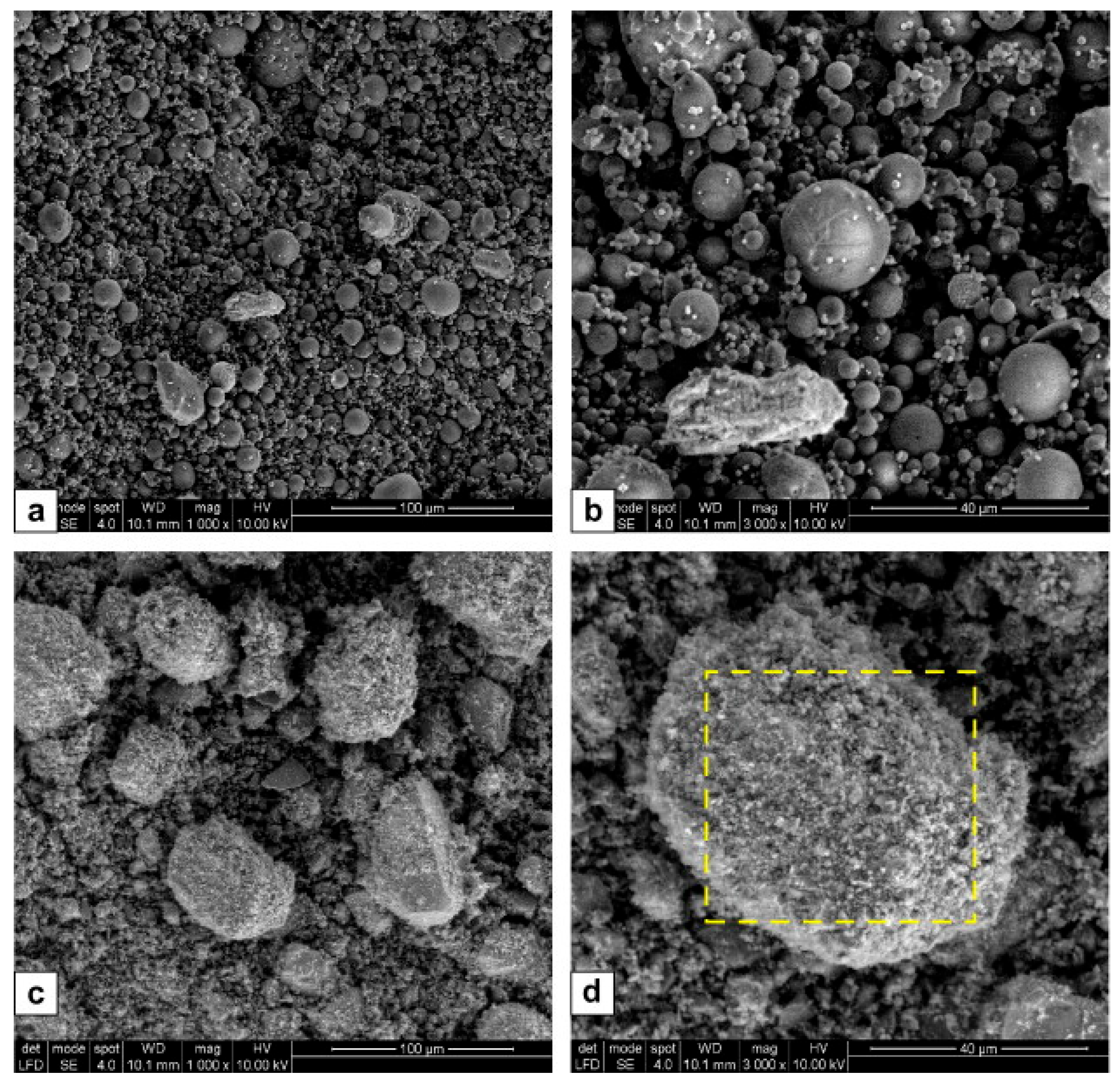
The microstructure of RP affects its application in cement-based materials. Different from the smooth spherical structure of fly ash [
41,
42,
43], RP exhibits irregular serrated morphology and a rough surface [
34,
44,
45,
46] (
Figure 2). This irregular particle shape of RP leads to poor fluidity and increased water demand [
47,
48,
49,
50]. On the other hand, Suwan et al. [
51,
52] found that the porous structure of the material can store water in advance. When the hydration water in the pores is insufficient, the stored water is released to further promote the secondary hydration of the slurry.
RP is obtained from crushed waste concrete and bricks, and the curing age of the parent concrete significantly influences its physicochemical properties and reactivity. Concrete subjected to longer curing periods and service cycles typically exhibits higher cement hydration levels, resulting in reduced unhydrated clinker phases (C
3S and C
2S) and increased proportions of stable hydration products [
53,
54]. Consequently, recycled powder from aged concrete generally possesses lower inherent hydraulicity or pozzolanic activity, primarily contributing through microfilling and nucleation effects within cementitious systems [
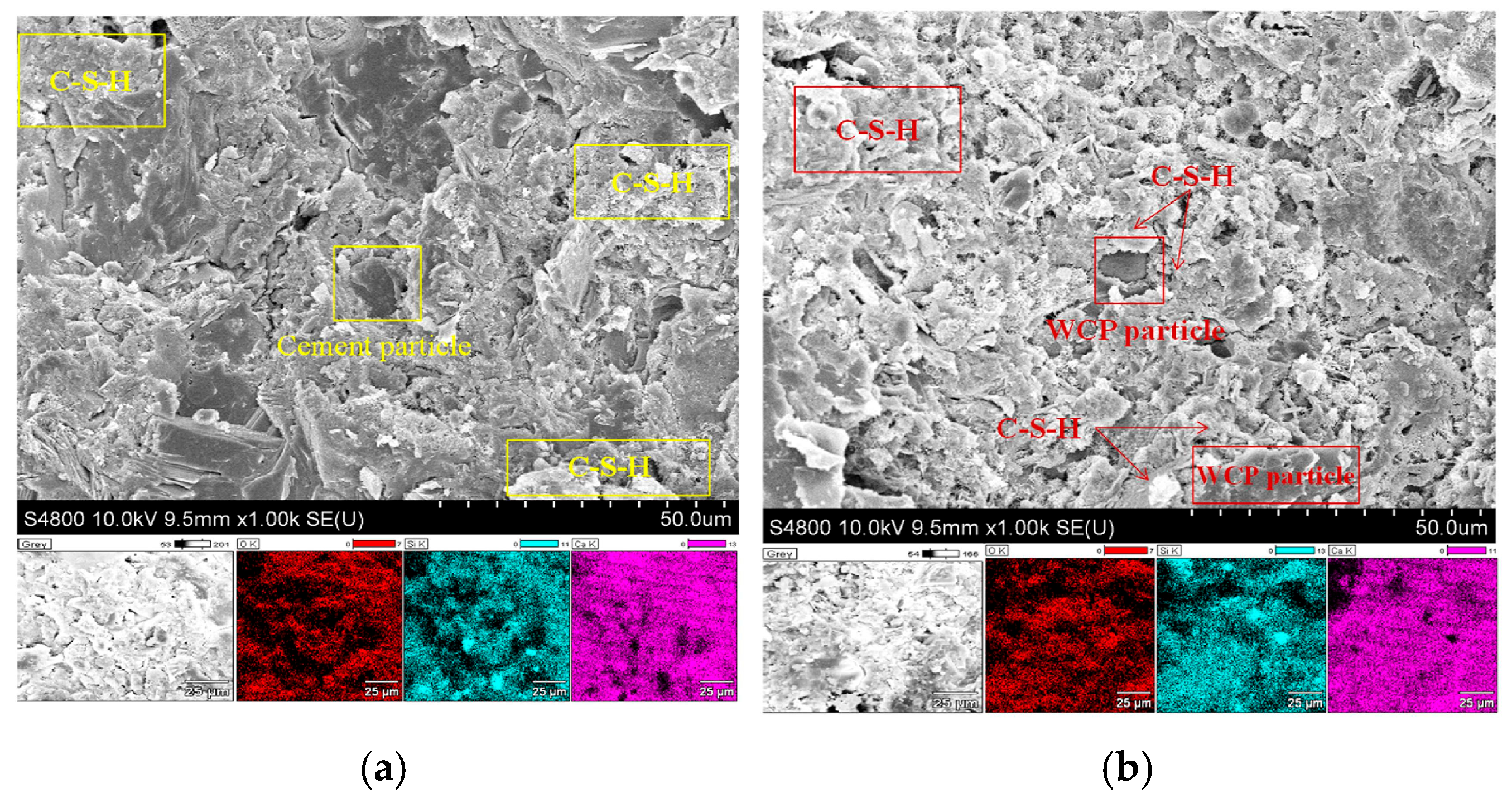
55]. Conversely, RP from fresh concrete or precast components with shorter curing periods retain more unhydrated cementitious minerals and metastable hydration products. CSH gel, unhydrated cement particles, SiO
2 particles, calcium aluminate hydrate (calcium aluminate), and calcium carbonate crystals can be observed in RP [
39,
56,
57] (
Figure 3). These materials can be reactivated in alkaline or strongly alkaline environments [
54,
58,
59]. Studies indicate that the physicochemical properties of recycled aggregates—such as particle size distribution, specific surface area, and water absorption—vary with the curing time of the source concrete. When recycled aggregates are used in new mixtures, these properties influence their rheological behavior and hydration kinetics [
60]. Furthermore, long-term environmental exposure—particularly carbonation—alters the Ca/Si ratio and structural order of hydration products, thereby influencing dissolution kinetics and reaction pathways during recycled powder reuse. Studies on carbonated recycled cement paste powder have confirmed this phenomenon [
61]. Therefore, differences in the curing age of source concrete and service conditions are critical factors determining the performance and applicability of recycled powders. SiO
2 primarily originates from fine aggregates and unreacted cement particles, while calcium carbonate crystals mainly stem from coarse aggregates and the carbonation of cementitious materials. The presence of these hydration products and crystals results in a complex surface structure and increased porosity of RP [
62]. Mechanical grinding can make surfaces smoother and increase fluidity [
63].
Although RP has diverse sources, its primary constituent elements including Ca, Si, Al, O, with the main oxides being calcium oxide, silicon dioxide, and aluminum oxide, as shown in
Table 1. Compared to cement, RP exhibits a higher silicon content and relatively lower calcium content, primarily due to the raw material sources used in RP production [
64,
65]. RP obtained from crushed waste concrete and bricks typically contains a high SiO
2 content, generally exceeding 30%. RP derived from crushed cement paste generally exhibits a high CaO content, typically exceeding 50%. The substantial Si and Al in RP, like supplementary cementitious materials such as fly ash, exhibit pozzolanic effects [
14]. Since some of the SiO
2 in RP originates from aggregates, which are inert materials, they lack pozzolanic activity [
32]. In summary, RP is a material with diverse sources, complex composition, rough surface, and high water absorption, which limits its application as a supplementary cementitious material in concrete. How to obtain RP with stable properties and high reactivity remains an ongoing research focus for scholars [
66,
67].
2.3. Activity Index
The activity index is the most critical indicator for RP when used as a supplementary cementitious material. Currently, the most widely adopted standards are the GB/T 1596–2017 [
74] and EN 450-1 [
75]. The activity index is defined as the ratio of the compressive strength of mortar containing 30% cementitious material to that of mortar without cementitious material. A higher ratio indicates a greater proportion of active components within the cementitious material [
74]. The RP activity index is closely related to the grinding equipment and time, source, and original strength of the waste concrete. Zhang et al. [
34] found that by using wet grinding to prepare RP, the D
50 could be reduced to 249 nm, thereby enhancing the early strength and water resistance of the mortar. Yu et al. [
36] found that RP ground using a jet mill exhibited a narrow particle size distribution, uniform particle shape, excellent filling effect, and activity as high as 70.2%, which was 7.4% higher than that achieved by vibratory ball milling. Grinding time primarily affects the particle size and specific surface area of RP. The activity index increases as the median particle size of RP decreases and the specific surface area Increases [
76,
77]. It can be observed that as grinding time increases, the activity index of RP gradually rises, but a threshold exists. The optimal grinding time is approximately 60 min. Prolonged grinding beyond this duration leads to a diminishing marginal gain—or even a slight decline—in RP activity, as the system approaches a mechanical activation saturation state. Consequently, further energy input mainly results in agglomeration and energy dissipation rather than additional structural activation, causing unnecessary resource and energy consumption. The source of RP also affects the activity index. Li et al. [
78] found that the activity index of RP gradually increased with the rising content of waste brick powder, primarily due to the higher concentration of active SiO
2 in the waste brick powder. Wu et al. [
44] conducted comparative tests on waste concrete powder, mortar powder and pure slurry powder. They found that recycled mortar powder exhibited the highest reactivity, while recycled concrete powder and pure slurry powder demonstrated reduced reactivity due to their higher content of hydration products and inert substances. Chen et al. [
79] compared the activity indices of waste concrete powder from different strength grades. They found that the activity index gradually increased with the rise in concrete’s initial strength.
2.4. Critical Synthesis: Why RP Properties Reported in the Literature Are Highly Scattered
A critical comparison of published studies indicates that the wide scatter in reported RP activity indices, strength contributions, and durability performance cannot be attributed to experimental uncertainty alone. Instead, it originates from fundamental differences in RP source characteristics. RP derived from aged and highly carbonated concrete is dominated by stable phases (calcite and low-Ca CSH) and therefore behaves primarily as an inert micro-filler. In contrast, RP obtained from younger concrete or precast waste may retain unhydrated clinker phases and metastable hydrates, enabling limited hydraulic or pozzolanic reactivity under alkaline conditions. Failure to explicitly report parent material age, exposure history, and carbonation degree explains why similar replacement ratios have led to contradictory conclusions in different studies. This observation highlights the necessity of moving from empirical replacement limits toward mechanism-based performance evaluation.
3. Micro-Properties of the Cementitious Materials with RP
3.1. Hydration Reaction
The hydration reaction of cementitious materials influences their microstructure and macroscopic properties. The addition of RP acts as a diluent, increasing the early heat release rate of cementitious materials and shortening the induction period [
80,
81,
82]. Research has found [
64,
65,
83,
84] that RP also exerts a nucleating effect, primarily promoting early hydration within the first 30 min. As time progresses, the hydration reaction weakens, resulting in a decrease in the cumulative heat released. Of course, hydration is also closely related to the dosage of RP. Chen et al. [
85] and Rahhal et al. [
86] found that both the hydration heat release rate and cumulative hydration heat decreased with increasing RP content. Shao et al. [
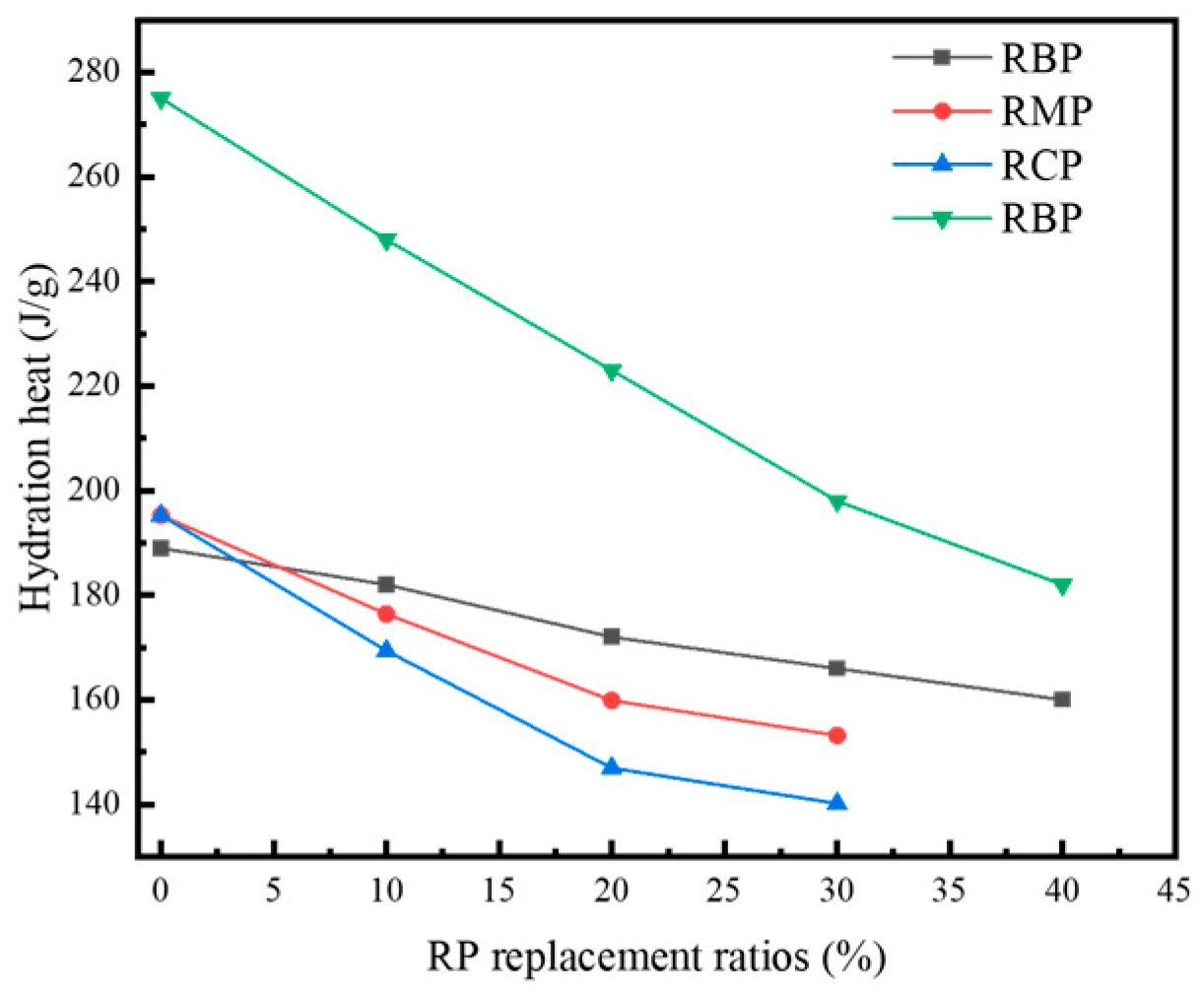
87] reached the same conclusion, reporting a 35.4% reduction in cumulative hydration heat after 3 days when RP content reached 40%.
Figure 4 shows the relationship between cumulative heat release during hydration and RP replacement ratio [
64,
87,
88,
89]. As the RP replacement ratio increases, the cumulative peak heat release decreases. Tang et al. [
40] found that cumulative heat release not only decreased with increasing RP replacement ratio but also exhibited a linear relationship between the two. The linear relationship equation is shown in Equation (1). The primary reason for the reduced hydration heat is that the active substances in RP are lower than those in cement, resulting in a decrease in the hydratable components [
90]; moreover, the addition of RP reduces the quantity of hydration products such as calcium hydroxide and CSH gel [
14]. However, this linear assumption may no longer be valid when RP contains a significant nano-sized fraction. Nano-scale RP particles possess extremely high specific surface area and surface energy and can act as effective nucleation centers for hydration products, particularly CSH gel. This nucleation and acceleration effect enhances early-age hydration kinetics and may partially compensate for, or even locally outweigh, the dilution effect caused by cement replacement.
where H
R is the hydration heat of the cementitious material and P
RP is the replacement rate of RP (%).
On the other hand, Hou et al. [
91] found that the cumulative hydration heat over 12 h for mixtures containing 10% and 20% RP was higher than that of the control group. Deng et al. [
64] achieved the same results by modifying RP through wet grinding. Reducing RP particle size to the nanoscale exposes more unhydrated particles, increasing the number of hydration reaction sites and causing the hydration heat to rise as RP content increases. Yang et al. [
35] and Wang et al. [
92] conducted experiments using ultrafine RP particles, demonstrating that RP nanoparticles accelerate the hydration rate, shorten the induction period, increase cumulative heat release, and promote hydration. Liu et al. [
83] modified RP with nano-silica, which served as a growth nucleus for CSH and other hydration products, accelerated C
3S dissolution, enhanced hydration rate, and increased hydration heat. Additionally, the amorphous silica in RP undergoes pozzolanic reactions with calcium hydroxide [
93], while calcium carbonate reacts with calcium aluminate in cement to form monoaluminate, further promoting hydration reactions [
66].
Further analysis of the hydration products of RP revealed that while the addition of RP altered the hydration process, the primary types of hydration products remained consistent, including calcium hydroxide, calcium carbonate, CSH and Aft [
94]. Peng et al. [
95] investigated the effect of RP on the hydration reaction of ultra-high-performance concrete and reached the same conclusion.
3.2. Elemental and Compound Composition
Figure 5 shows SEM images of cementitious materials containing RP and those without RP. SEM images reveal that the microstructure of slurries containing RP is more porous than that of RP-free slurries, exhibiting a greater number of pores and cracks. This is attributed to the presence of RP reducing the quantity of hydration products [
14]. At the same time, distinct RP particles can be observed, enveloped by hydration products such as CSH, which promote nucleation effects. The elemental analysis chart shows that the addition of RP reduces calcium content while increasing silicon content. This demonstrates that RP has a higher silicon content and lower calcium content than cement [
96].
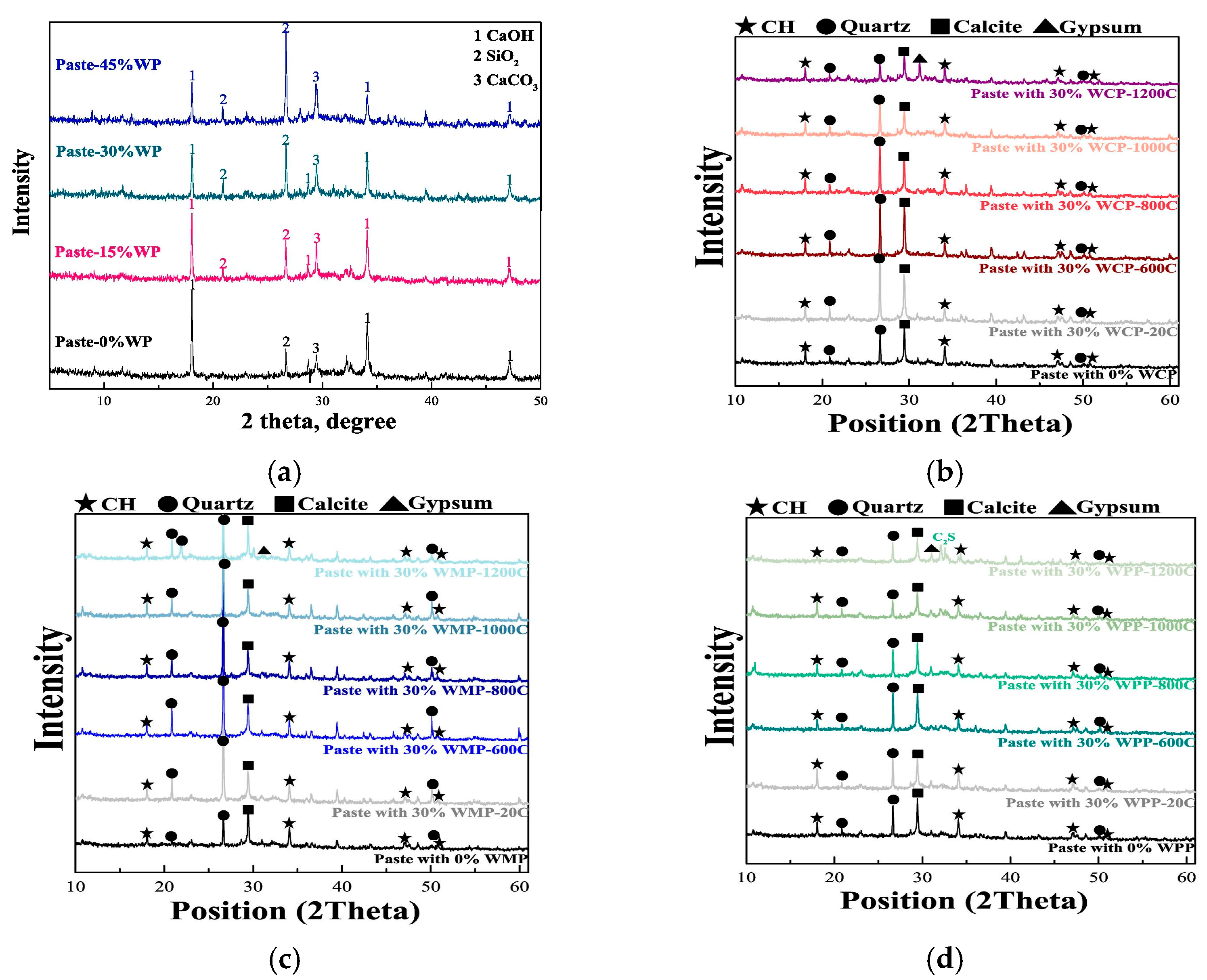
As shown in
Figure 6, XRD analysis of cementitious materials containing RP revealed that the primary mineral phases include calcium hydroxide, silica and calcium carbonate, along with Aft [
98,
99,
100], unhydrated C
2S and C
3S [
39,
64,
66], crystalline CSH gel [
66,
101,
102], gypsum [
39,
97] and tobermorite [
103]. Silica dioxide primarily originates from fine aggregates in RP. Part of the active SiO
2 promotes the hydration process of cementitious materials through the pozzolanic effect and microaggregate effect [
44,
104,
105,
106]; Ca(OH)
2, AFt and CSH gel originate from the hydration of cement [
39,
107]. Part of the Ca(OH)
2 originates from residual RP [
107]. Calcium carbonate originates from the carbonation of calcium hydroxide, with some introduced during the crushing of aggregates [
78,
104,
108]. As shown in
Figure 6a, the calcium hydroxide diffraction peak diminishes with the addition of RP. In cement-based systems, CH primarily originates from the hydration of silicate minerals in a cement clinker. RP contains a certain amount of amorphous or low-crystallinity components such as active SiO
2 and Al
2O
3. These active substances can undergo secondary reactions with CH generated during hydration, further consuming CH. Therefore, as RP content increases, the XRD diffraction peak of CH decreases [
49,
87,
109].
Overall, the addition of RP reduces the content of chemically bound water in cementitious materials, as incorporating RP decreases the amount of hydration products within the cementitious matrix [
90]. Ma et al. [
110] subjected RP to activation treatment at high temperatures and found no significant difference in mineral composition compared to untreated samples; Shen et al. [
56] subjected RP to carbonation treatment, increasing the calcium carbonate content while reducing the levels of calcium hydroxide, C
2S and C
3S, thereby refining the porous structure within the cement matrix. Wang et al. [
111] treated RP with TA and found no new characteristic peaks in the characterization of cement-based materials, indicating that TA also does not produce new compounds. Due to RP’s low calcium content and high silicon content, increasing RP dosage reduces the Ca/Si and Ca/(Al + Si) ratios [
95,
112]. Additionally, the incorporation of RP promotes secondary pozzolanic reactions with Ca(OH)
2, leading to the consumption of Ca
2+ and a gradual reduction in the Ca/Si ratio of the cementitious matrix. A lower Ca/Si ratio diminishes the supply of free calcium required for the conversion of AFt to AFm, thereby slowing the transformation of Aft into AFm.
3.3. Pore Structure
Pore structure and porosity are crucial to the durability and mechanical properties of cementitious materials [
113,
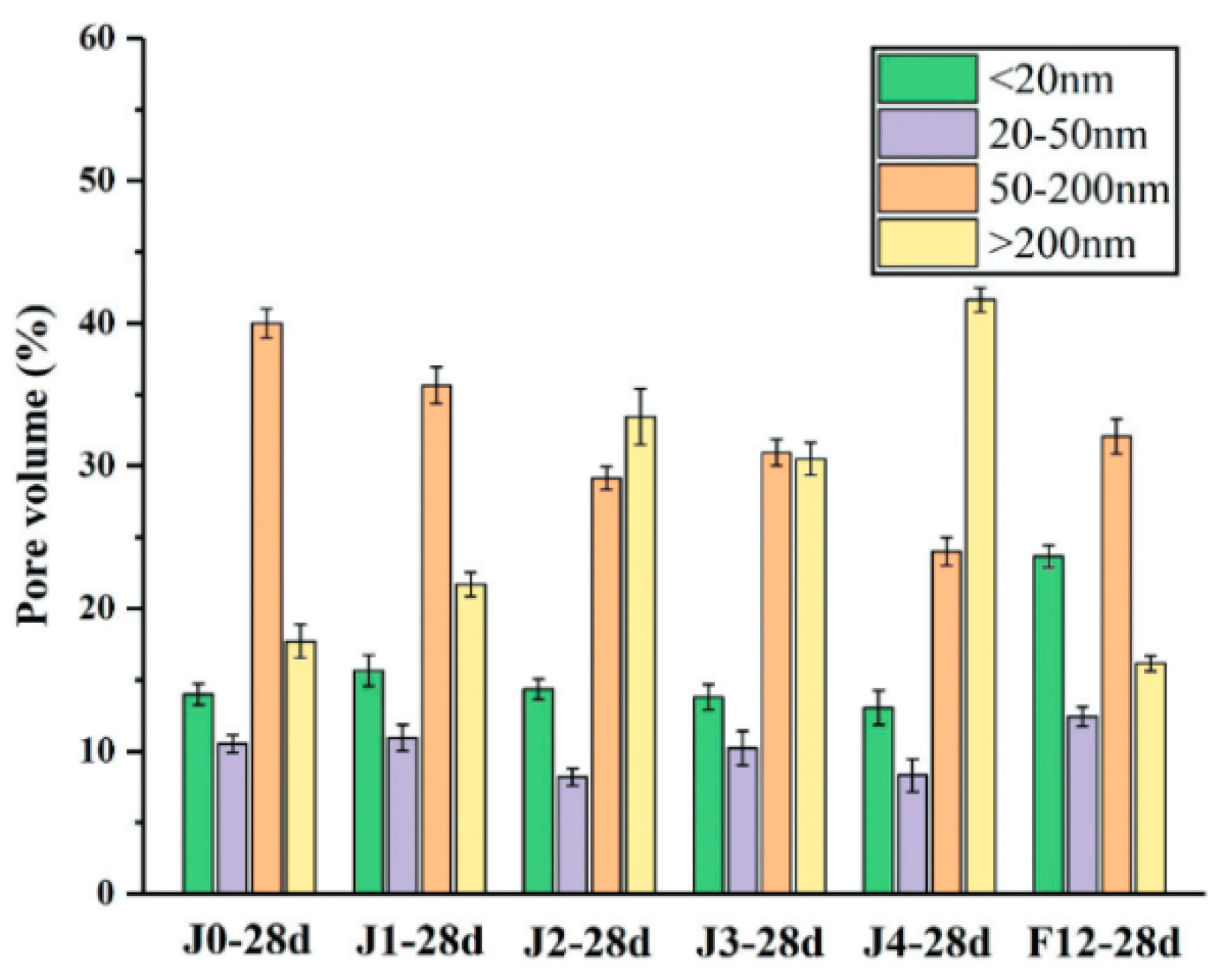
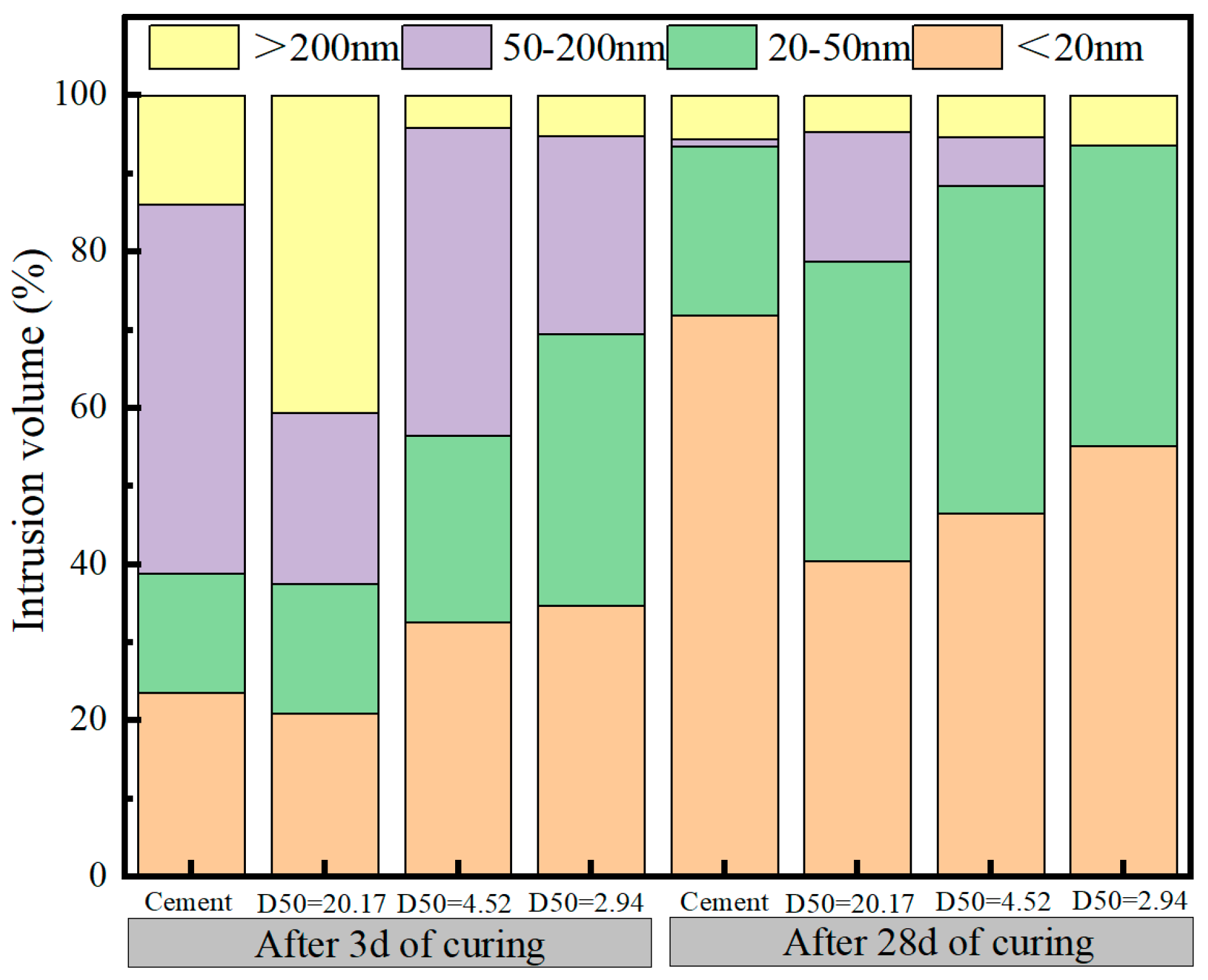
114]. Based on pore size and its effect on cement materials, pores can be classified as: harmless pores (<20 nm), pores with minor harm (20–50 nm), harmful pores (50–200 nm), andpores with significant harm (>200 nm) [
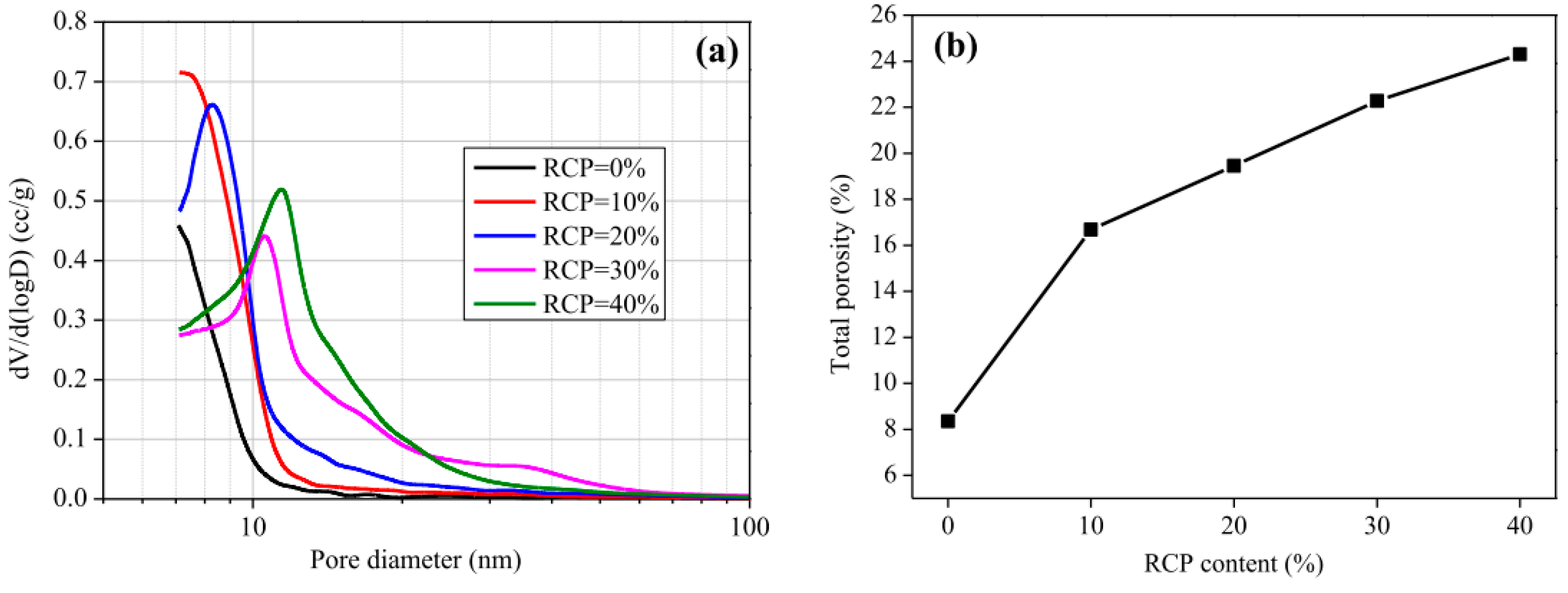
115]. Researchers have found that as the RP content increases, the pore size and total pore volume of cementitious materials also increase [
44,
45,
116,
117,
118,
119], as shown in
Figure 7. Chen et al. [
85,
120] found that at a RP content of 10%, the volume of harmless pores increased while that of harmful pores decreased. This indicates that the nucleation effect and microaggregate effect of RP promote more complete hydration reactions in cementitious materials, yielding greater quantities of hydration products. This process transforms harmful pores into harmless or less detrimental pores, resulting in a denser pore structure. When the RP content exceeds 40%, the harmful effects become significant as the pore volume increases substantially, as shown in
Figure 8. He et al. [
41] and Ma et al. [
17] similarly observed that incorporating small amounts of RP resulted in a denser pore structure, with increased volumes of gel pores and interlayer pores smaller than 10 nm in diameter. Research has demonstrated [
97,
117,
121,
122] that when the RP content exceeds 30%, the volume of hydration products decreases while the volume of harmful pores (>50 nm) increases, leading to a decline in the mechanical properties and durability of cement paste.
Extending the curing time can mitigate the adverse effects of RP on increasing the porosity of cementitious materials. This is because prolonged curing promotes pozzolanic reactions, generating more CSH gel and resulting in a denser pore structure [
122]. Zhao et al. [
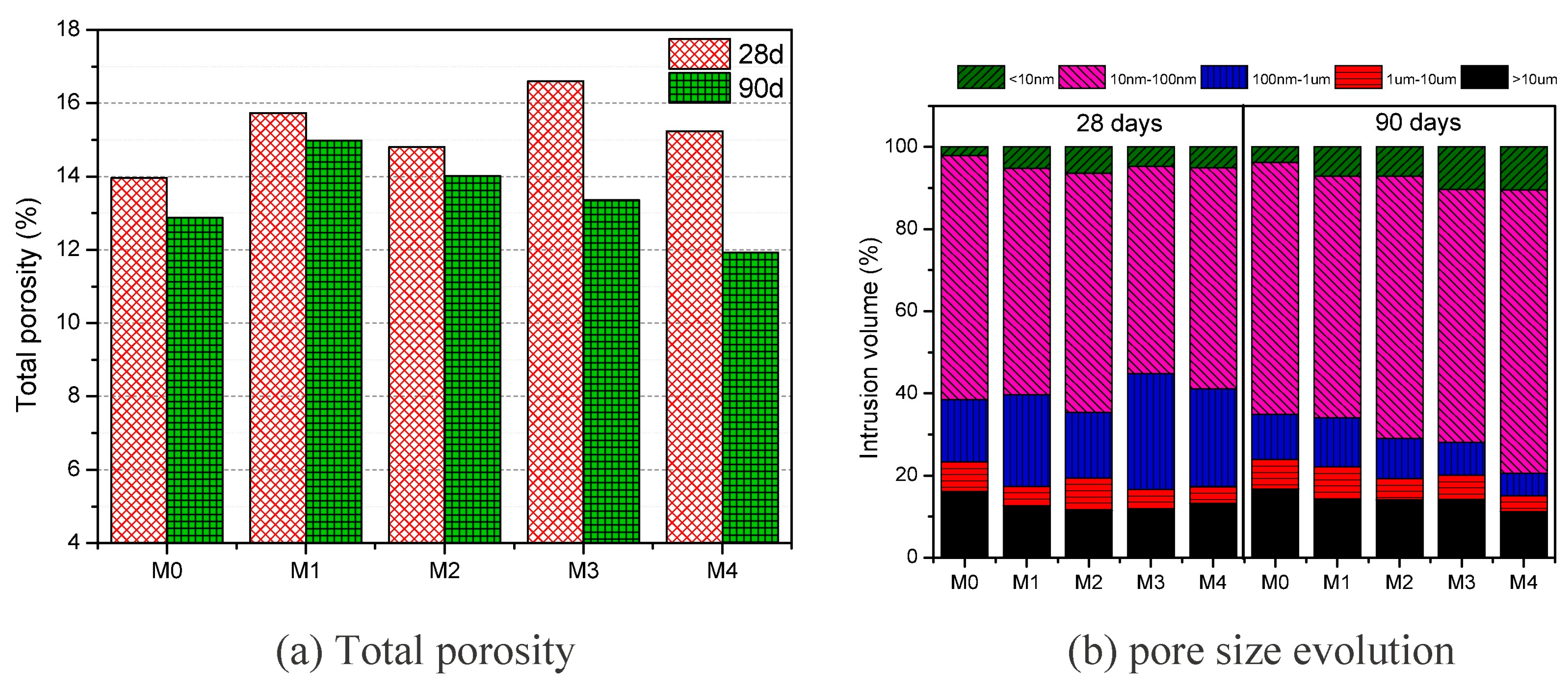
63] demonstrated through MIP and mechanical property tests on mortars with the same mix ratio at 28 d and 90 d that the total porosity after 90 d curing was reduced by about 5–20% compared to that after 28 d curing. Furthermore, pores smaller than 100 nm increased during the 90-day curing period, as shown in
Figure 9. This is mainly due to the combined effect of cement hydraulic reaction and secondary hydraulic reaction of CBP leading to a decrease in total porosity and optimization of pore structure. Some researchers also propose that RP exists within the capillary pores of the matrix. As curing time increases, water permeates into these capillary pores and undergoes secondary hydration reactions with RP, thereby filling the pores [
62,
123].
Additionally, increasing RP fineness can refine the pore structure, as finer RP particles exert nucleation and filling effects that promote hydration reactions [
120]. When the D
50 of RP is reduced below the threshold range of approximately 20–30 µm, a pronounced beneficial micro-filling effect occurs. At this particle size scale, the RP particles are sufficiently small to effectively fill interstitial spaces between cement grains and hydration products, leading to a denser particle packing structure. This physical filling effect significantly reduces the volume of larger capillary pores (>50 nm) and shifts the pore size distribution toward finer pores (<50 nm). From a micro- and nanostructural perspective, the refined pore structure directly influences the formation and morphology of the CSH gel. The presence of ultrafine particles provides abundant nucleation sites for CSH precipitation, promoting the more homogeneous and compact growth of CSH at the nanoscale. As a result, the CSH gel evolves from a loosely packed, fibrillar morphology toward a denser, foil-like or interlocked nanostructure with reduced gel pore connectivity. This transformation enhances the continuity of the solid phase and further constricts capillary channels. The combined effects of physical micro-filling and nanostructural densification of the CSH gel lead to a dominant pore population in the <50 nm range, which markedly decreases permeability and limits the transport pathways for aggressive agents (e.g., chloride ions and moisture). Consequently, durability-related properties are significantly improved.
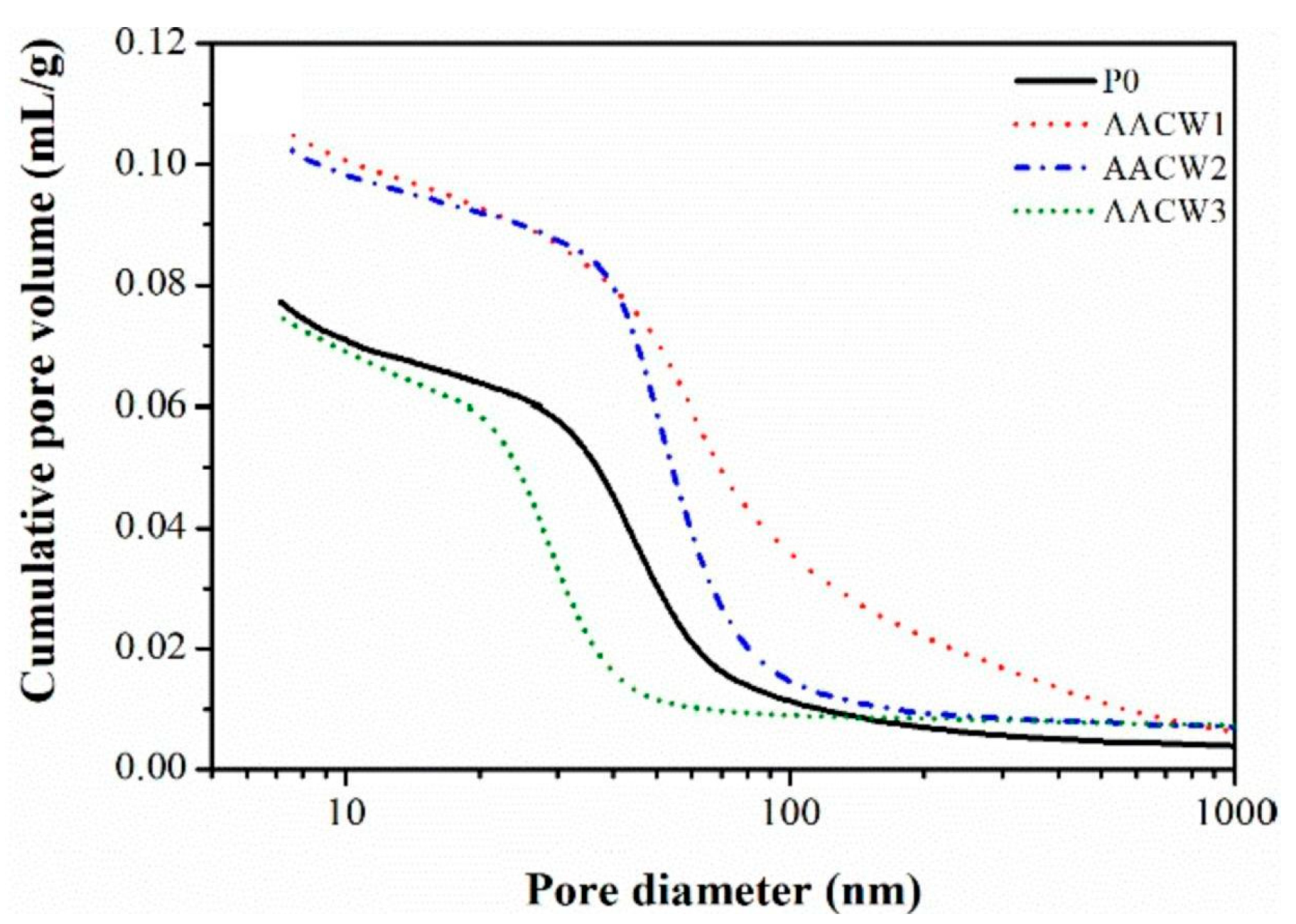
Figure 10 shows that the cumulative pore volume of cementitious materials containing RP increases with increasing RP particle size. Wei et al. [
122] found that increasing the fineness of RP compacted the pore structure of cementitious materials at both 3 d and 28 d, shifting pores from harmful and highly harmful ranges to less harmful and harmless regions, as shown in
Figure 11. He et al. [
103] demonstrated that when D
50 = 142 μm, the addition of RP deteriorates the pore structure of the cement matrix, resulting in negative effects, whereas when D
50 = 2.3 μm, it optimizes the pore structure of the cementitious material. Generally, RP with particle sizes greater than 75 microns reduces the hydration reaction, while high-fineness RP can improve the pore structure of cementitious materials [
124]. However, excessive addition of RP, regardless of fineness, will reduce the amount of hydration products and introduce harmful pores [
44,
85].
Of course, other treatments can be applied to RP to improve pore structure. Heat-treated RP can exert a better diluting effect, promoting further hydration, thereby converting more pores into harmless ones while reducing harmful pores [
122]. Researchers have found [
38,
97,
110,
125] that heat treatment within the temperature range of 600 °C to 1000 °C significantly refines the pore structure. Temperatures that are either too high or too low yield negligible effects on pore structure optimization. RP pretreated with carbonation contains more calcite, which can form carbonaluminate during hydration, inhibiting the transformation from AFt to AFm. The cumulative pore volume of the cement matrix gradually decreases as curing time increases [
66]. Additionally, scholars have employed TA and SMS to process RP, with both methods achieving denser pore structures and reduced pore diameters [
126,
127].
4. RCP Treatments
4.1. Mechanical Activation of RCPs
When using RP as an SCM, increasing its fineness is an effective method to enhance RP activity. Numerous studies have reported a positive correlation between RP activity index and grinding time [
32,
65,
128]. From a physical perspective, prolonged grinding increases the specific surface area of RP, thereby exposing a larger number of surface defects and nucleation sites, which can accelerate hydration reactions and contribute to matrix densification [
64,
129]. From a mechanochemical standpoint, mechanical activation forces induction of lattice distortion in the surface layer of particles; the crystal structure is transformed into an amorphous structure. This structural disorder reduces the activation energy required for dissolution and subsequent pozzolanic reactions [
63,
130].
XRD-based investigations provide direct evidence of this amorphization process. Gao et al. [
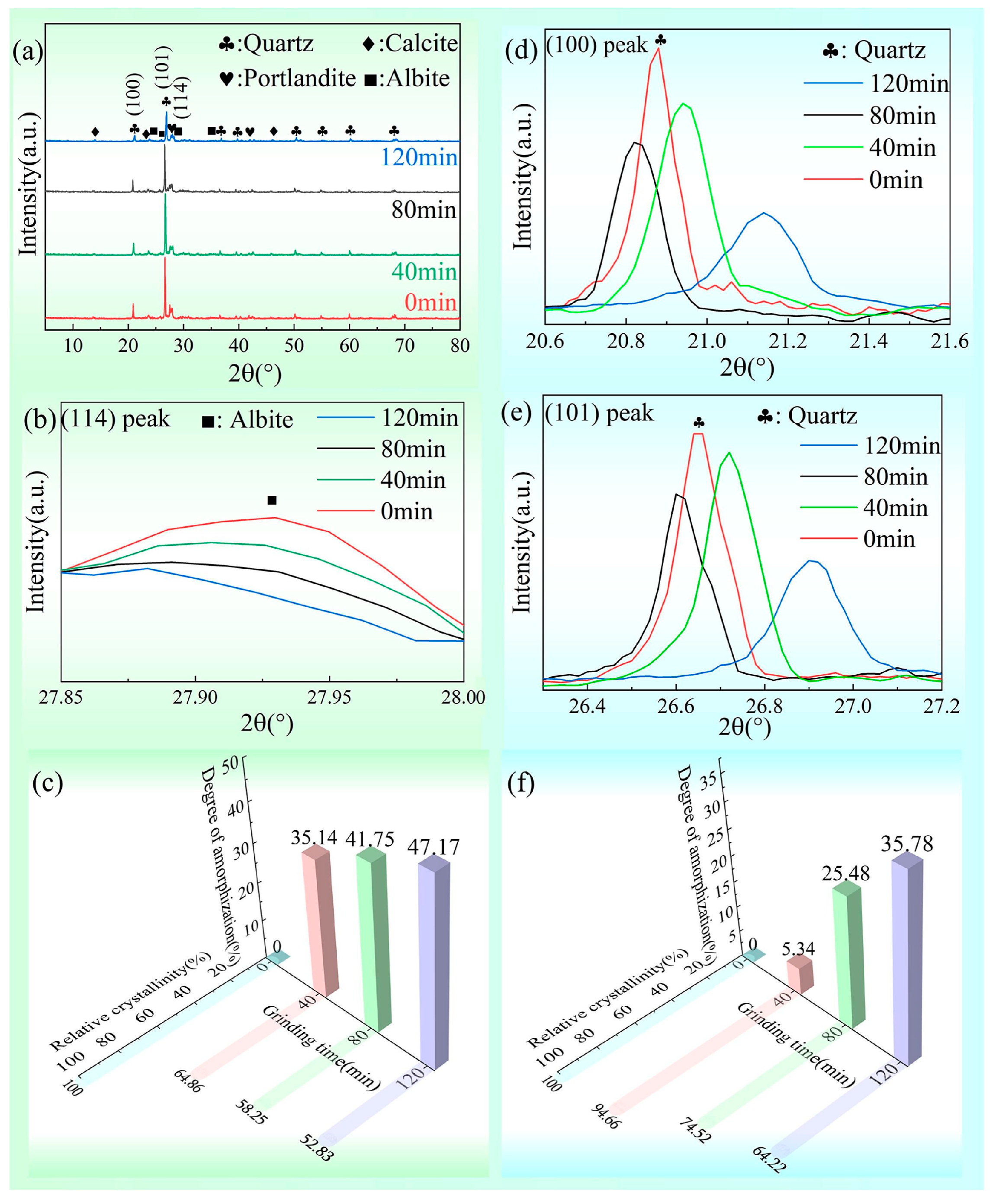
25] observed that with increasing mechanical activation time, the characteristic diffraction peaks of albite and quartz gradually weakened, as shown in
Figure 12, indicating a reduction in crystallinity. When the ball milling time was increased from 40 min to 80 min, the amorphization levels of Albite and SiO
2 rose from 35.14% and 5.34% to 41.75% and 25.48%, respectively. However, when the milling time was further extended from 80 min to 120 min, the amorphization levels decreased, suggesting that excessive grinding may promote particle agglomeration or structural reorganization, thereby offsetting the activation effect. Yu et al. [
36] found that after ball milling, the peak intensity of SiO
2 significantly decreased, and SiO
2 transformed from stable α-SiO
2 to amorphous SiO
2. The amorphous phase contributes to enhancing the hydration activity of cementitious materials.
In addition to mechanical activation, mineralogical interactions between RP and cement phases also influence performance. Additionally, when RP is incorporated into cementitious materials, the calcite present in RP particles smaller than 75 μm reacts with C
3A in cement to form calcium aluminate carbonate. This inhibits the transformation of AFt to AFm, thereby enhancing the strength of cementitious materials. This phenomenon does not occur when particle sizes exceed 75 μm [
124]. Moreover, as the grinding time of RP increases, the chemical energy required to break its Si-O and Al-O bonds decreases, further promoting the hydration process of the matrix [
63,
94].
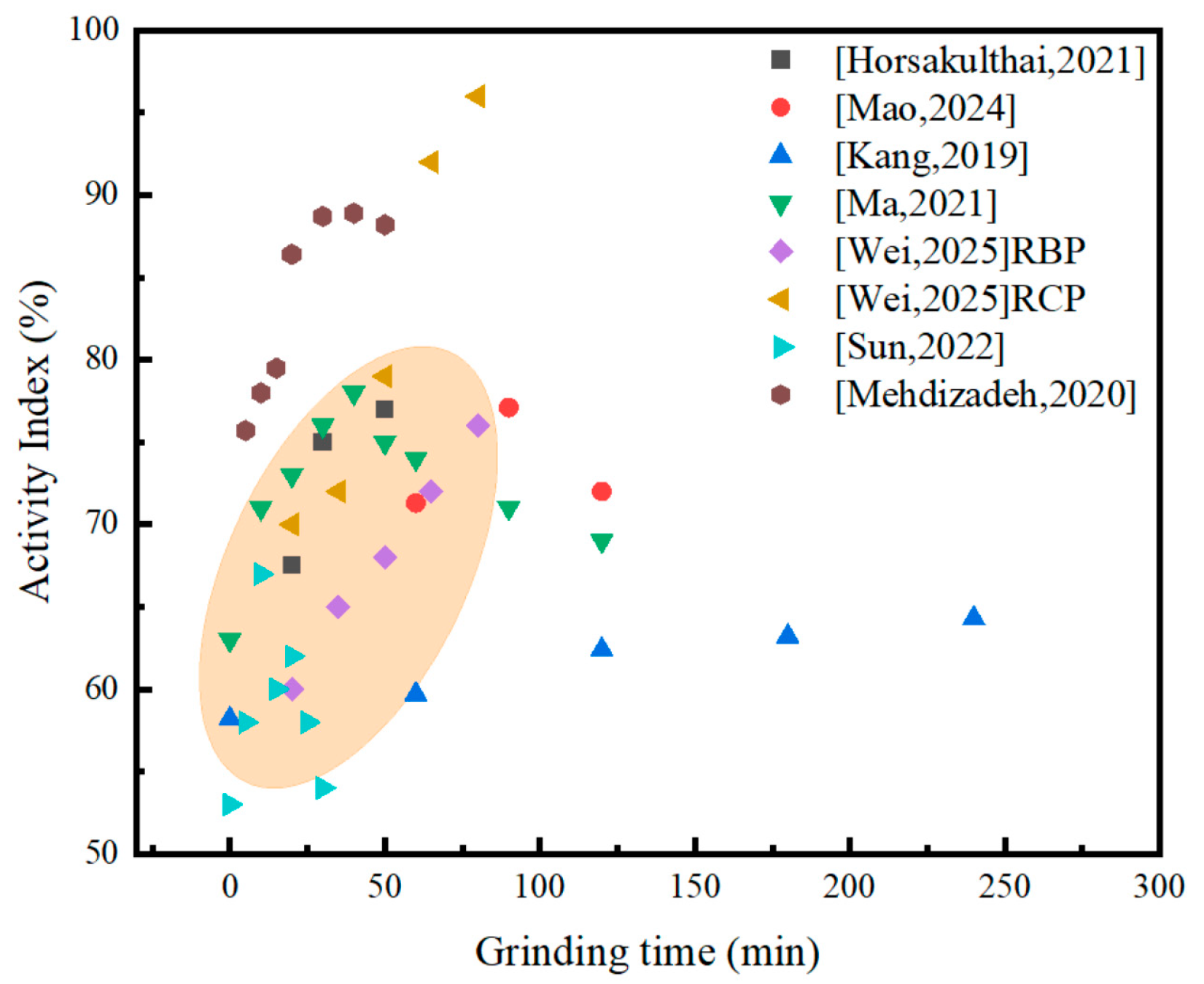
Researchers investigated the mechanical properties of cementitious materials, incorporating RP of different types and grinding durations. Liu et al. [
131] subjected RP to mechanical grinding for 20 min, 30 min, and 50 min, respectively. The activity index of RP increased by 67.5%, 75.0% and 77.0%. As shown in
Figure 13 [
77,
132,
133,
134,
135,
136], the activity index generally increases with grinding time; however, the rate of improvement gradually diminishes, indicating the existence of an optimal fineness range rather than a linear relationship.
Grinding time also significantly affects early-age performance and workability. As RP becomes finer, its specific surface area increases, leading to higher water demand due to enhanced water adsorption [
137,
138]. However, some scholars have found that mechanical grinding reduces particle size and rounds irregular particles, thereby decreasing internal friction within the pulp and lowering water demand [
63,
139]. These seemingly contradictory observations highlight the competing effects of particle refinement and surface energy. While RP addition generally reduces fluidity because of its high water absorption capacity [
95,
140], Che [
136] observed that flowability increased with grinding time and stabilized at approximately 20 min. Gao [
135] found that mechanical grinding reduced RP particle size, filling inter-particle voids and increasing flowability. However, as grinding time increased, the specific surface area expanded and surface energy rose, causing electrostatic forces to aggregate powder particles and decrease flowability. The optimal grinding time was determined to be 15 min.
4.2. Heat Treatment on RP
Heat treatment is another effective method for enhancing the reactivity of RP by modifying its physical and chemical characteristics. [
50,
118,
122,
129]. At elevated temperatures, hydration products and carbonate phases undergo thermal decomposition, generating highly reactive phases that can participate in subsequent hydration reactions [
141,
142].
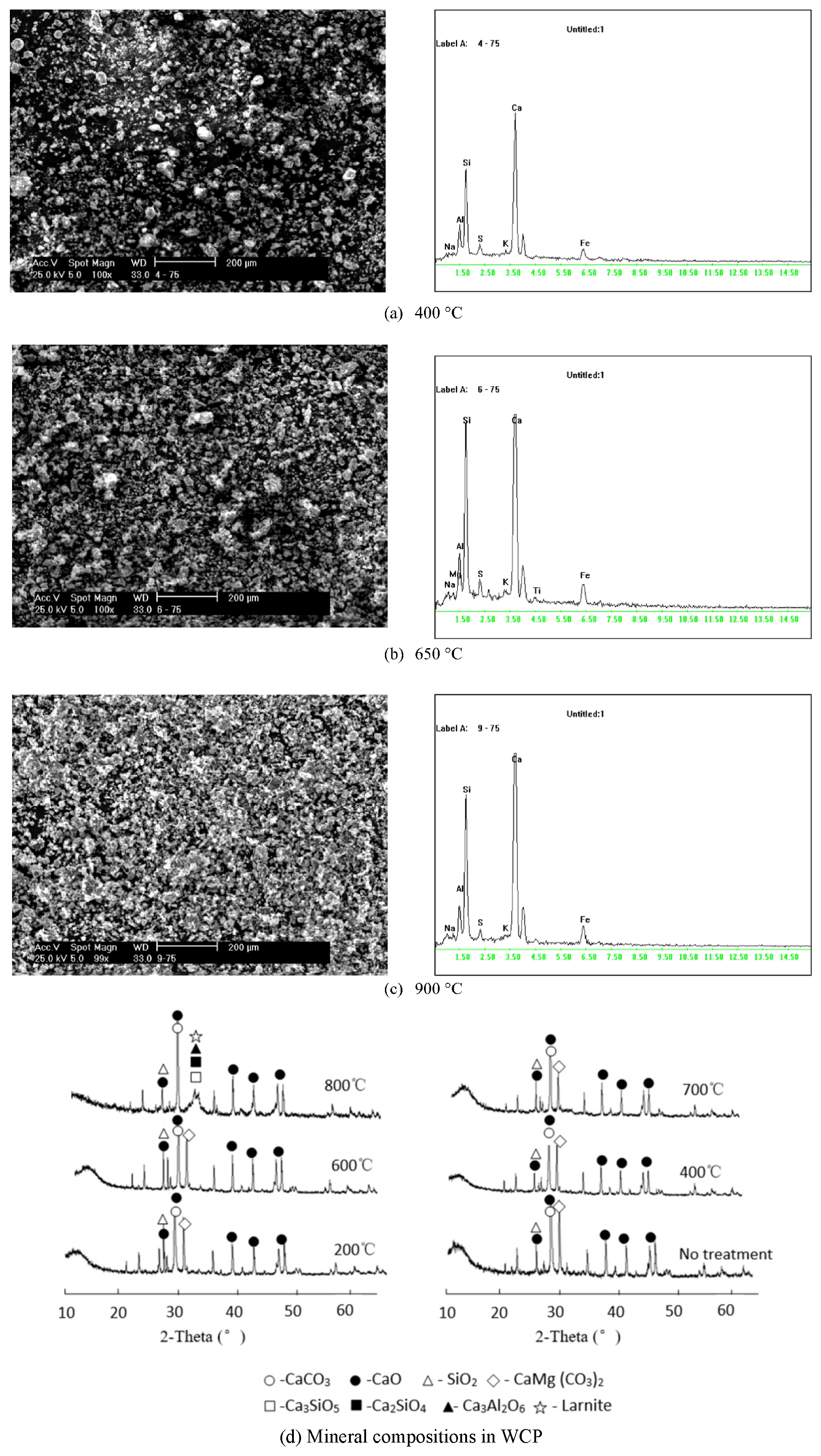
The decomposition process proceeds as follows: When the temperature reaches 300 °C to 400 °C, the hydration products AFt and CSH begin to decompose [
129]. At temperatures between 400 °C and 650 °C, calcium hydroxide decomposes and partial decarbonation of calcium carbonate begins; around 800 °C, calcium carbonate decomposes. The particles generated by these thermal decomposition processes become new active fillers [
43,
143]. Therefore, peaks of Ca
3SiO
5 and Ca
2SiO
4 were detected between 400 °C and 800 °C [
141], while peaks of CaO, C
2S, and C
3S were observed between 800 °C and 1000 °C. Anhydrous gypsum and amorphous SiO
2 were observed at 1200 °C [
97,
110,
121].
Figure 14 shows the SEM-EDS and XRD patterns of RP under different temperature treatments [
141,
144]. After heat treatment, the decomposition of compounds reduces RP particle size, resulting in a denser microstructure. As temperature increases, some particles transform into an amorphous state, diminishing the nucleation effect of RP particles [
145]. High temperatures alter the mineral phases of RP, but the primary elements remain unchanged. Therefore, heat treatment is an effective method for improving RP properties.
Kang et al. [
146] compared different activation methods for RP and found that mortar prepared using RP treated at 800 °C exhibited higher 28-day strength than that prepared using chemically or mechanically activated RP. Kim et al. [
50] subjected RP to treatment at 600 °C and 800 °C. This increased the compressive strength of the mortar by 19% and 16%, respectively, and improved its shrinkage resistance. Yang et al. [
147] and Ma et al. [
110] also found that RP treated at temperatures between 600 °C and 800 °C exhibited mortar compressive strengths 16% to 27% higher than untreated RP. However, there exists a threshold for heat treatment temperatures.
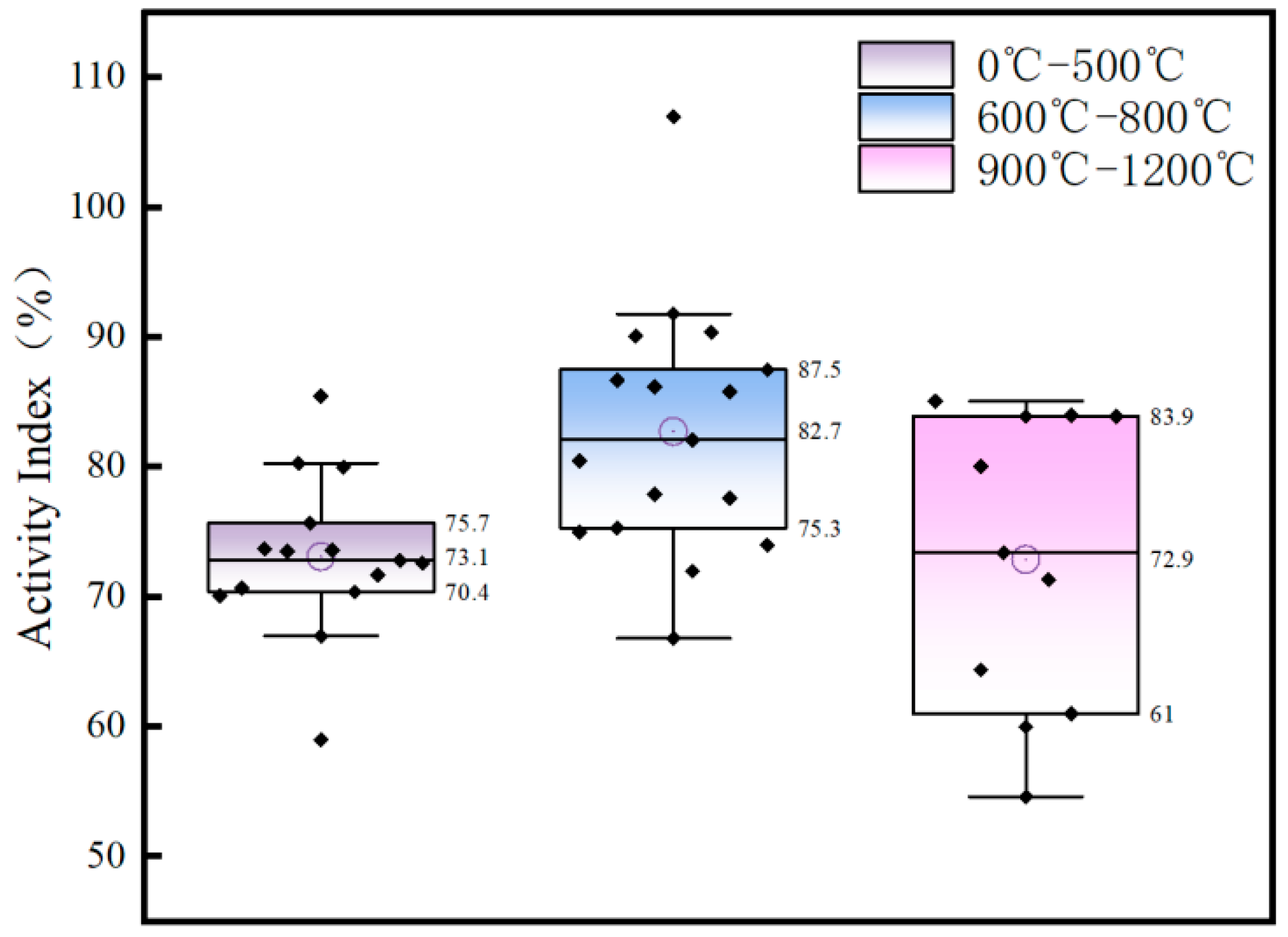
Figure 15 summarizes the changes in the activity index of RP across different treatment temperature ranges. The optimal heat treatment temperature for RP is 600 °C to 800 °C. Within this temperature range, first, Ca(OH)
2 is fully decomposed, maximizing the availability of reactive CaO. Second, CaCO
3 begins to partially decompose, which increases lattice distortion and promotes the formation of additional reactive calcium species without causing excessive sintering. Third, thermally unstable crystalline Ca–Si phases undergo partial breakdown into transient amorphous Ca–Si structures. These amorphous or poorly ordered phases exhibit higher Gibbs free energy and enhanced solubility under alkaline conditions, thereby significantly improving their reactivity during subsequent hydration or alkali activation. RP’s activity index significantly increases. When the temperature exceeds ~800 °C, recrystallization and solid-state reactions become dominant. This recrystallization reduces defect density, decreases specific surface area, and lowers the chemical potential driving dissolution, ultimately diminishing reactivity. Additionally, higher temperatures require greater energy consumption.
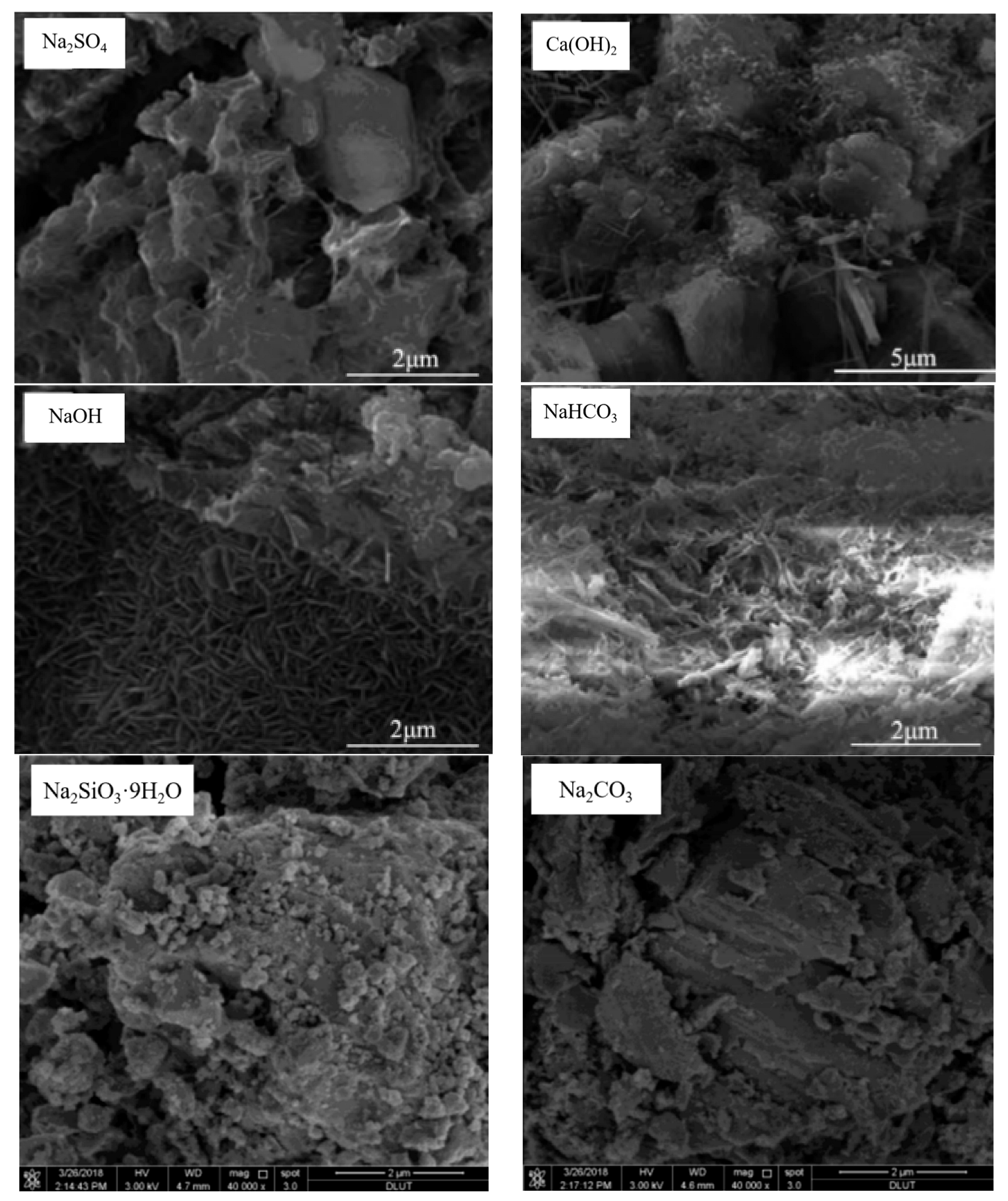
4.3. Chemical Activation Methods of RP
Enhancing the hydration capacity of RP through the use of reagents is also a commonly employed activation treatment method, primarily including alkali activation, salt activation, and other activation techniques. The corresponding reaction equations are shown in
Table 2. As shown in
Figure 16, SEM images of RP paste after excitation by different reagents are presented. More hydration products and a denser microstructure can be observed [
148,
149].
4.3.1. Alkali Activation
The incorporation of RP into concrete reduces its alkalinity and strength. Researchers have discovered that adding alkali activators can enhance its activity [
27,
146,
150]. Common alkali activators include CaO, Ca(OH)
2, Na(OH)
2 and sodium silicate. The OH
− ions in alkaline additives accelerate the breaking of Si-O and Al-O bonds, reducing the polymerization degree of the RP surface network polymer. This promotes the reaction between RP and cement hydration products in mortar, generating new cementitious products that densify the cement matrix structure [
148]. CaO and Ca(OH)
2 can also supply Ca
2+ for hydration, thereby promoting the formation of CSH gel, CASH gel and Aft [
151]. The Na
+ ions produced by NaOH ionization promote the depolymerization of the silicate network, releasing Ca
2+ and SiO
2 which react with OH
− to form CSH gel [
152]. As an alkali activator, sodium metasilicate not only provides an alkaline environment to promote the decomposition of silica and alumina components but also reacts with Ca
2+ and Al
3+ to form CSH or CASH gel, thereby enhancing strength [
153]. Kang et al. [
146] found that adding calcium hydroxide increased the compressive strength of RP mortar by 18.5% compared to non-activated mortar. Zhao et al. [
154] activated RP with calcium hydroxide and Na
2SiO
3·9H
2O, resulting in concrete strength increases of 3.5% and 4.5%, respectively. When Liu et al. [
151] modified RP with 10% CaO, the 28-day activity index increased by 30% compared to the unmodified material. Zhang et al. [
155] found that calcium hydroxide exhibited superior activation effects on RP compared to Na
2SiO
3·9H
2O at the same dosage, with an optimal Ca(OH)
2 content of 3.5%. At moderate Ca(OH)
2 additions, the released Ca
2+ ions participate effectively in the dissolution–precipitation reactions, promoting the formation of C–S–H gel and improving matrix densification. However, when the Ca(OH)
2 dosage exceeds an optimal threshold, excessive Ca
2+ ions accumulate in the pore solution, disturbing the local ionic equilibrium. Concurrently, non-uniform Ca
2+ diffusion promotes localized recrystallization and growth of coarse Ca(OH)
2 crystals, which are poorly bonded to the surrounding gel, leading to decreased strength [
152,
154].
4.3.2. Salt Activation
The addition of sulfates promotes the formation of calcium aluminate hydrates. Kang et al. [
146] demonstrated that adding sodium sulfate increased the compressive strength of RP mortar by 14.4% compared to non-activated mortar. Liu et al. [
137] found that when RP was modified with 1% gypsum, the 28-day activity index increased by 30% compared to the unmodified material. Cl
− can react with activated Al
2O
3 to form calcium aluminate hydrochloride, which participates in hydration and alters osmotic pressure, thereby improving mortar properties [
152]. When CaCl
2 is used as an activator, the optimal dosage is 3.5%. Strength increases initially and then decreases as the CaCl
2 dosage increases [
156]. The hydrolysis of Na
2CO
3 and NaHCO
3 produces a weakly alkaline solution that promotes the formation of cementitious materials and enhances reaction activity. Xu et al. [
152] found that the strength of cement paste initially increases and then decreases with increasing Na
2CO
3 content, with the optimum content being 3%. Dong et al. [
157] achieved a maximum specimen strength of 22 MPa at a Na
2CO
2 content of 10%.
4.3.3. Other Activators
Wang et al. [
111] employed tannic acid (TA) for RP modification. Calcium hydroxide diffraction peaks from RP treated with varying concentrations of TA diminished, yielding submicroscopic particles without generating new phases. These particles not only filled pores but also provided nucleation sites for cement hydration. Qu [
158] treated RP with triethanolamine and found the optimal incorporation level to be 0.01%. Compared to the unexcited sample, the 3 d and 28 d intensities increased by 79% and 46%, respectively. Triethanolamine exhibits strong alkalinity, promoting the depolymerization of Si-O and Al-O bonds. By providing excess electron pairs to form covalent bonds with cations in the RP, it generates gel substances [
159]. Additionally, it can promote surface dissolution of RP particles, thereby accelerating the hydration reaction process. Many researchers have also explored synergistic treatment of RP using alkali and salt composites, which can simultaneously leverage the advantages of alkali activation and salt activation to promote hydration and form a dense microstructure [
25,
26,
42,
43,
46,
160,
161]. Zhang et al. [
46] achieved the optimal activity index by blending Ca(OH)
2 and CaSO
4 in a 1:1 ratio. On one hand, OH
− stimulated the pozzolanic activity of RP, forming a dense CSH gel. On the other hand, Ca
+, SO
4− and OH
− promoted the formation of AFt, filling the pores. Dong [
157] investigated the composite treatment of RP using NaOH combined with Na
2SiO
3·9H
2O, Na
2CO
3, and Ca(OH)
2, observing its strength and microstructure. The results demonstrated that composite activation yielded superior effects compared to single-component addition. Among these, the composite activation of NaOH and Na
2SiO
3·9H
2O achieved the highest specimen strength (39 MPa). Through composite excitation treatment, part of the crystalline SiO
2 in RP dissolves under high alkalinity, generating more highly polymerized geopolymers, CSH and CASH. The particles on the specimen surface become smaller, and the structure becomes more compact.
Figure 16.
SEM images of RP paste with different activators [
148,
157].
Figure 16.
SEM images of RP paste with different activators [
148,
157].
4.4. CO2-Curing Treatment
Cementitious materials contain substantial amounts of calcium, which can improve their microstructure and mechanical properties through carbonation. This process also serves as an effective means for CO
2 sequestration [
66,
162,
163,
164]. In recent years, the technology of using CO
2 to cure recycled aggregates has been widely adopted. Results demonstrate that concrete made with CO
2-treated recycled aggregates exhibits superior workability and durability compared to untreated concrete [
165,
166]. Since the surface composition of recycled aggregates is similar to that of RP, researchers have recently employed CO
2 to treat RP and enhance its properties [
167,
168,
169]. The degree of carbonation in RP is primarily influenced by factors such as CO
2 pressure, concentration, temperature, humidity, and carbonation time [
26]. The optimal carbonation conditions established through a series of studies were set at 0.1 MPa [
124,
170], 20% [
171], 20 °C [
172,
173], and 70% [
174]. Equations (2)–(5) show the chemical reaction equations during the carbonization process [
124,
175].
As shown in Equation (2), calcium hydroxide in cementitious materials reacts with CO
2 to form CaCO
3. Other reactions primarily involve calcium silicate reacting with CO
2 to produce calcium carbonate. Therefore, in XRD analysis, the carbonized RP primarily exhibits peaks corresponding to CaCO
3, followed by aragonite and dolomite [
66,
84,
176]. TG results also indicate that RP treated with carbonization exhibits higher mass loss between 500 °C and 900 °C due to calcium carbonate decomposition [
177,
178]. When carbonated RP is incorporated into cementitious materials, the CaCO
3 within it reacts with aluminates to form structurally denser calcium aluminate semi-carbonate and calcium aluminate monocarbonate. This stabilizes the formation of Aft, thereby enhancing the performance of cementitious materials [
49]. On the other hand, compared to untreated RP, carbonized RP exhibits a denser microstructure due to the formation of CaCO
3 and silica gel, resulting in reduced porosity and an optimized pore size distribution [
49,
176]. The generated CaCO
3 particles exert a nucleation effect, promoting the rate of cement hydration and the production of hydration products [
179]. Additionally, Wu et al. [
49] and Kaliyavaradhan et al. [
176] noted that carbonization treatment increases particle size, primarily due to the formation of CaCO
3 particles with silica gel. In contrast, Mehdizadeh et al. [
180] concluded that carbonization treatment does not significantly alter the particle size distribution of RP.
The mechanical properties of RP after carbonization treatment have also been enhanced. Lu et al. [
66] found that the 28-day strength of mortar specimens containing 10% and 20% RP increased by 3.3 MPa and 14.2 MPa, respectively, after carbonation treatment. Kaliyavaradhan et al. [
176] replaced cement with 20% carbonized RP, achieving a 28-day activity index exceeding 75%. The interaction between C
3A and CaCO
3 to form calcium aluminate carbonate was a key factor in the increase in early strength. Zhu et al. [
26] found that the strength of RP mortar first increases and then decreases with increasing carbonation time, with an optimal treatment time of 10 h. Calcium carbonate particles formed during early carbonation exert a nucleation effect, while deep carbonation causes CSH depolymerization and weakens the reactivity between carbonation products and the cement paste. Wu et al. [
181] found that temperature also affects the activity of carbonized RP. At higher carbonization temperatures, vaterite transforms into calcite, resulting in larger particle sizes and greater thermodynamic stability, which enhances strength. Beyond calcite formation, the amorphous silica gel in carbonized RP can react with calcium hydroxide in the cement paste to form CSH gel, further improving strength [
84].
5. Applications of RP
5.1. SCM and Geopolymers with RP
RP exhibits pozzolanic activity and can be used as an SCM or precursor for producing geopolymers. When activated with an alkali activator, a zeolite structure can also be observed [
182,
183]. Ren et al. [
102] utilized the pozzolanic activity of RP to produce concrete blocks, substituting 20% RP for alkaline slag. Since RP exhibits lower pozzolanic activity than alkaline slag, this substitution reduces the strength of the concrete blocks. Liu et al. [
184] prepared mortar using RP from different sources as a replacement for fly ash, resulting in reduced workability and strength of the mortar. Liang et al. [
185] directly blended RP into alkali-activated fly ash and slag, observing reduced shrinkage and increased strength. Huo et al. [
186] and Wang et al. [
187] prepared geopolymers using RP and alkali activators. Bayer et al. [
188] conducted microstructural analysis on the prepared geopolymers, finding that increasing Si/Al ratios resulted in enhanced geopolymer strength. As the Si/Al ratio increases, the aluminosilicate framework of N–A–S–H gel transforms from short chains or low-connectivity units (Q
1–Q
2) to long chains and highly polymerized Q
3–Q
4 units, resulting in a more compact and continuous microstructure. Although RP has been demonstrated to improve chloride ion erosion resistance when used as a precursor for geopolymer preparation, durability remains a concern [
185,
189].
5.2. High Performance Concrete with RP
RP can be used as an inert filler in high-performance concrete. He et al. [
41] found that incorporating 30% RP into UHPC improved the bulk density between particles, with strength decreasing by only 3.9%. Peng et al. [
95] used RP to replace cement, and the compressive strength of UHPC decreased with increasing RP content. However, at a 50% replacement rate, the 28-day strength was comparable to that of the control group. The incorporation of RP improves the particle size distribution across multiple scales, enabling a denser particle arrangement and reducing initial inter-particle voids. In this context, fine powder functions predominantly as a physical filler rather than a chemically reactive component. Furthermore, results indicated that UHPC with RP exhibited excellent water resistance and significantly reduced early self-shrinkage. Qian et al. [
190] and Yao et al. [
100] further investigated that when the RP content is below 30%, the compressive strength of UHPC exhibits minimal variation while also improving microstructure and durability. This composition can be used to produce UHPC with excellent performance. When using RP to produce UHPC, it can serve as a diluent, improving cement utilization and reducing environmental impact. However, current research on RP-based UHPC primarily focuses on mechanical properties, and its effects on durability still require further validation.
5.3. Self-Compacting Concrete with RP
Researchers have discovered that RP can be used to prepare self-compacting concrete (SCC). However, due to RP’s high water absorption, admixtures must be added to adjust the mixture and achieve good workability [
191]. Kim et al. [
192] produced SCC by substituting cement with RP at 0%, 15%, 30% and 45% by weight. At 15% RP content, the 28-day compressive strength reached 30 Mpa. Blending RP with slag effectively improved the dry shrinkage rate and carbonation resistance of SCC. Duan et al. [
130] investigated the properties of SCC prepared by mixing RP with recycled aggregates at varying ratios. The study found that fully replacing fly ash with RP had no significant effect on workability, but compressive strength and splitting tensile strength decreased. X-ray CT results indicated that high RP content caused particle agglomeration, leading to higher porosity in the SCC and reduced durability.
5.4. Fiber-Reinforced Cementitious Composite Material with RP
Researchers incorporated RP into fiber-reinforced cementitious composites to evaluate its effects. Mao et al. [
193] investigated the performance of RP mixtures at different ratios and found that at a w/b ratio of 0.16, with RP replacement of 30%, silica fume content of 15%, and steel fiber content of 2%, the concrete’s workability showed no significant change. Furthermore, the addition of steel fibers enhanced both the strength and toughness of the concrete. Hlůžek et al. [
194] enhanced the RP concrete fiber–matrix interface by subjecting polymer fibers to plasma treatment, thereby improving the adhesion between synthetic fibers and the cement matrix. Liang et al. [
195] investigated the feasibility of using RP to prepare fiber-reinforced cementitious composites. The addition of RP reduced the quantity of hydration products and strength but increased the toughness index by 4.2–14.1%. By reducing the RP particle size and optimizing the microstructure, the strain-hardening properties of fiber-reinforced cementitious materials can be improved. Yu et al. [
196,
197] prepared ultra-ductile cementitious composites using RP as a substitute for fly ash, achieving stable strain hardening and fracture toughness while enhancing fiber bridging capacity. Li et al. [
198] enhanced the load-bearing capacity and crack resistance of cementitious materials using RP and PVA fibers. Yu et al. [
68] achieved maximum compressive and tensile strengths when substituting 25% RP for cement in fiber-reinforced cementitious composites.
5.5. Foam Concrete
Foam concrete has found widespread application in construction due to its low self-weight, high fluidity and excellent thermal insulation properties [
199,
200]. Research has demonstrated that the use of RP as an SCM for preparing foam concrete is feasible [
201,
202,
203]. Jin [
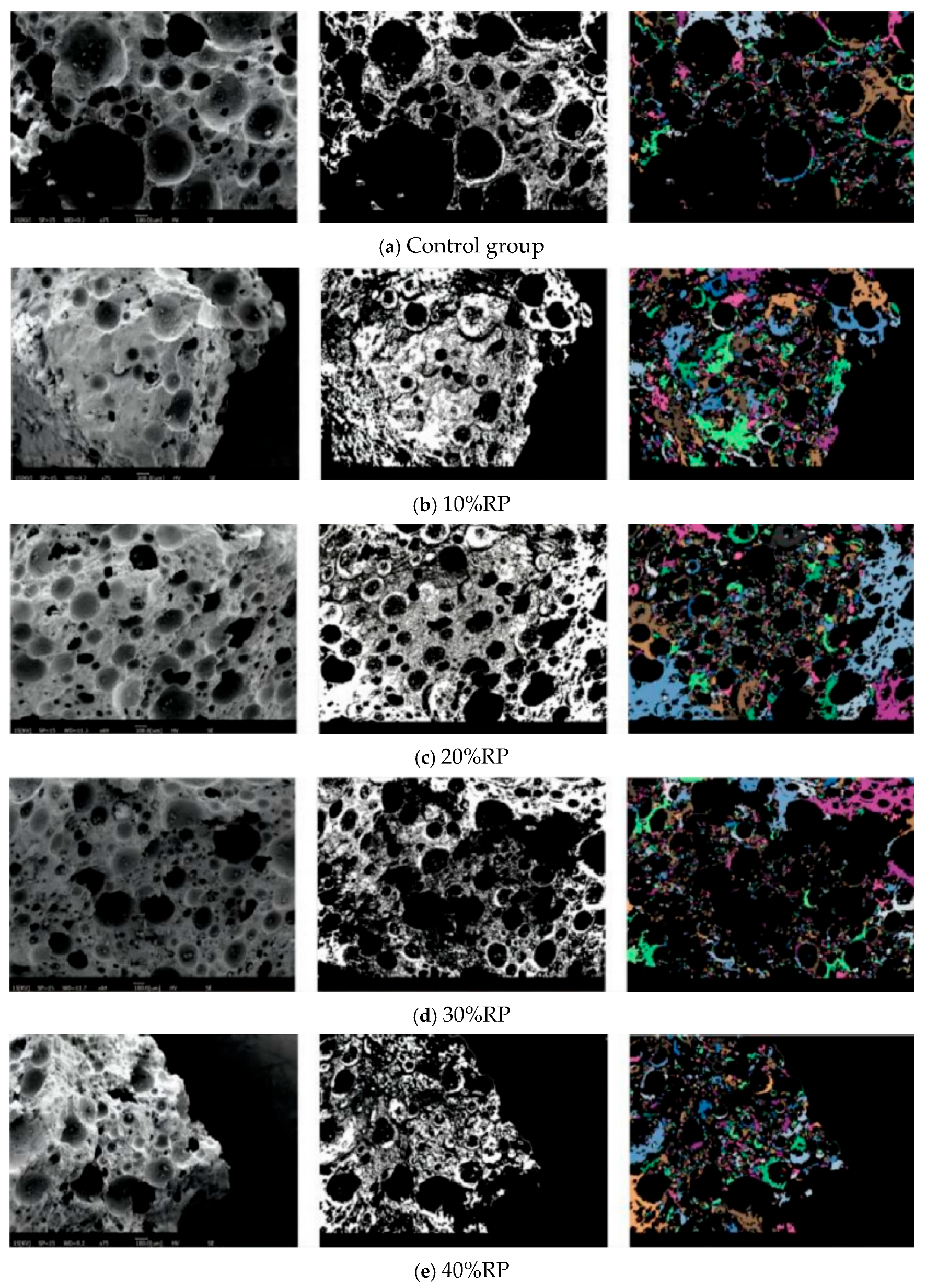
203] analyzed SEM images using the PCA system and found that as RP content increased, the total pore volume of foam concrete decreased and connectivity declined. This reduced water absorption and thermal conductivity while enhancing strength, as shown in
Figure 17. Zhang et al. [
204] prepared foam concrete by substituting cement with recycled powder produced using a jet mill. The addition of RP adjusted the particle size distribution of the system, optimizing the foam concrete’s skeletal structure. The 28-day compressive strength of the foam concrete reached 3.09 Mpa, representing an 11.6% increase compared to the control group. Li [
205] prepared foam concrete by substituting RP for cement. The RP foam concrete achieved the highest 28-day compressive strength at a 5% RP content. Liu et al. [
206] optimized the mix design of RP foam concrete through orthogonal experiments. When m(cement):m(RP):m(fly ash) = 70:15:15, both compressive strength and water absorption met the requirements. Chemical agents such as lime and sodium hydroxide can be employed to enhance the performance of RP foam concrete. While sodium hydroxide accelerates the setting time of foam concrete, its standalone use is not recommended.
5.6. Structural Applications
In recent years, increasing attention has been paid to the structural performance of reinforced concrete beams produced with recycled concrete incorporating RP. Existing research indicates that when appropriate replacement ratios and mix designs are employed, recycled powder-modified recycled concrete beams exhibit minimal differences compared to conventional concrete beams in terms of flexural capacity, stiffness development, and crack propagation behavior [
24,
207]. During flexural loading, RP contributes to matrix densification through micro-filling effects and potential pozzolanic reactions, which enhance the quality of the interfacial transition zone (ITZ) and delay the initiation and propagation of flexural cracks, thereby improving post-cracking load-carrying capacity [
208]. T.S. Mustafa et al. [
20] replaced cement and fine aggregate with waste glass powder to test the flexural properties of reinforced concrete beams. The results showed that beams containing 10% WG showed an increase in the cracking and ultimate loads, respectively, by 29.0% and 6.9% and beams containing 20% WG showed insignificant reductions in the cracking and ultimate loads. Gülden et al. [
21] activated waste ceramic powder with an alkali activator and substituted it for cement, finding that this resulted in only a 4.57% reduction in compressive strength with no loss in flexural load-carrying capacity. Furthermore, beams containing ceramic waste exhibited delayed crack initiation, narrower crack widths, and improved stiffness retention after the first cracking stage, resulting in stable load transfer.
5.7. Other Applications
Qian et al. [
209] prepared 3D-printed mortar using RP. Incorporating 10% RP increased the yield stress from 1423 Pa to 1573 Pa while maintaining the material’s viscosity. Hou et al. [
81] investigated the flowability, setting time, mechanical properties and hydration heat of 3D-printed mortar with varying RP replacement rates, demonstrating that 3D-printed mortar containing 10–30% RP exhibits excellent extrusion and constructability. Jiang et al. [
210] and Deng et al. [
211] employed RP to fabricate artificial aggregates. Although both drying shrinkage and mechanical properties were significantly lower than those of natural aggregates, the feasibility of this approach was demonstrated. Further research is needed on the interfacial transition zone between RP-prepared recycled aggregates and cementitious matrices. RP can also be converted into active fillers rich in calcium carbonate and silica gel, as well as amorphous NS, through processes such as carbonization or treatment with sodium carbonate solution, thereby enhancing the utilization value of RP [
73,
212,
213,
214]. Wang et al. [
215] incorporated RP into road support mortar, with results indicating that adding 10% RP enhanced both the compressive strength and toughness of the mortar. Kanda [
216] prepared ceramic tiles with high flexural strength using spark plasma sintering. Other researchers have employed RP as an adsorbent for phosphorus removal, SO
2 absorption, or CO
2 capture [
177,
217,
218]. Although these approaches represent novel applications for RP utilization, further research is still needed on their costs, industrial scalability and environmental impacts.
6. Impact on the Environment and Economy
Environmental and economic impacts are important factors in evaluating RP as a substitute for cement or as a supplementary cementitious material. Research indicates that RP is more effective in reducing CO
2 emissions and energy consumption [
103,
219,
220,
221]. Prasath Kalyanasundaram et al. [
222] significantly improved the carbon fixation capacity of RP by using thermomechanical treatment, with a carbon dioxide absorption rate of 9.83% and a carbonization degree of 45.62% in 24 h. Ismail Oguz Akgun et al. [
223] used waste volcanic tuff and recycled concrete powder to prepare concrete that reduced carbon emissions by 34–36% compared to conventional concrete. Zhao et al. [
63] indicated that replacing cement with 30% RP reduces CO
2 emissions by 179–271 kg per ton and lowers costs by 51–141 CNY. He et al. [
103] replaced cement with 20% RP, reducing CO
2 emissions by 162.4–186 kg per ton and lowering costs by 90–120 CNY. Qian et al. [
190] produced UHPC using RP at different dosages. CO
2 emissions decreased with increasing RP dosage, with the CO
2 emissions-to-strength ratios being 3.5, 3.3, 2.9, 2.7 and 2.5, respectively. The primary CO
2 emissions and energy consumption of RP depend on its activation process. Sun et al. [
224] found that extending the grinding time of RP from 25 min to 75 min increased CO
2 emissions from 236.25 kg to 673.75 kg. However, as grinding time increased, the specific surface area of RP also increased, creating additional CO
2 absorption sites that partially offset the emissions. Researchers compared the cost–benefit evolution of cement production versus RP activation, revealing that RP activation incurs lower costs and CO
2 emissions than cement. Cement calcination generally requires temperatures reaching 1400 °C, whereas RP’s optimal activation temperature range is 600–800 °C [
14,
63,
103].
Most existing studies assess the environmental benefits of RP utilization using region-specific assumptions. While RP generally exhibits lower embodied carbon than Portland cement, its net environmental benefit strongly depends on system boundaries, transportation distance, activation energy demand, and achievable cement replacement levels. From an economic perspective, RP is often regarded as a low-cost material; however, additional processing steps such as fine grinding, thermal treatment, or chemical activation may offset these advantages. Therefore, cost–benefit analyses should be conducted on a case-by-case basis, considering local energy prices, waste availability, and performance requirements.
7. Discussion
To rationalize the widely scattered and sometimes contradictory results reported in the literature, it is essential to move beyond a purely descriptive comparison of replacement ratios or activation methods. Existing review articles on recycled powder have provided comprehensive summaries of preparation techniques and macroscopic performance trends. However, most of them implicitly assume that RP behaves as a homogeneous supplementary cementitious material, which leads to empirical conclusions that are difficult to generalize across different studies. As a result, similar replacement levels or activation treatments have been reported to either improve or deteriorate mechanical and durability performance, without a clear explanation of the underlying causes.
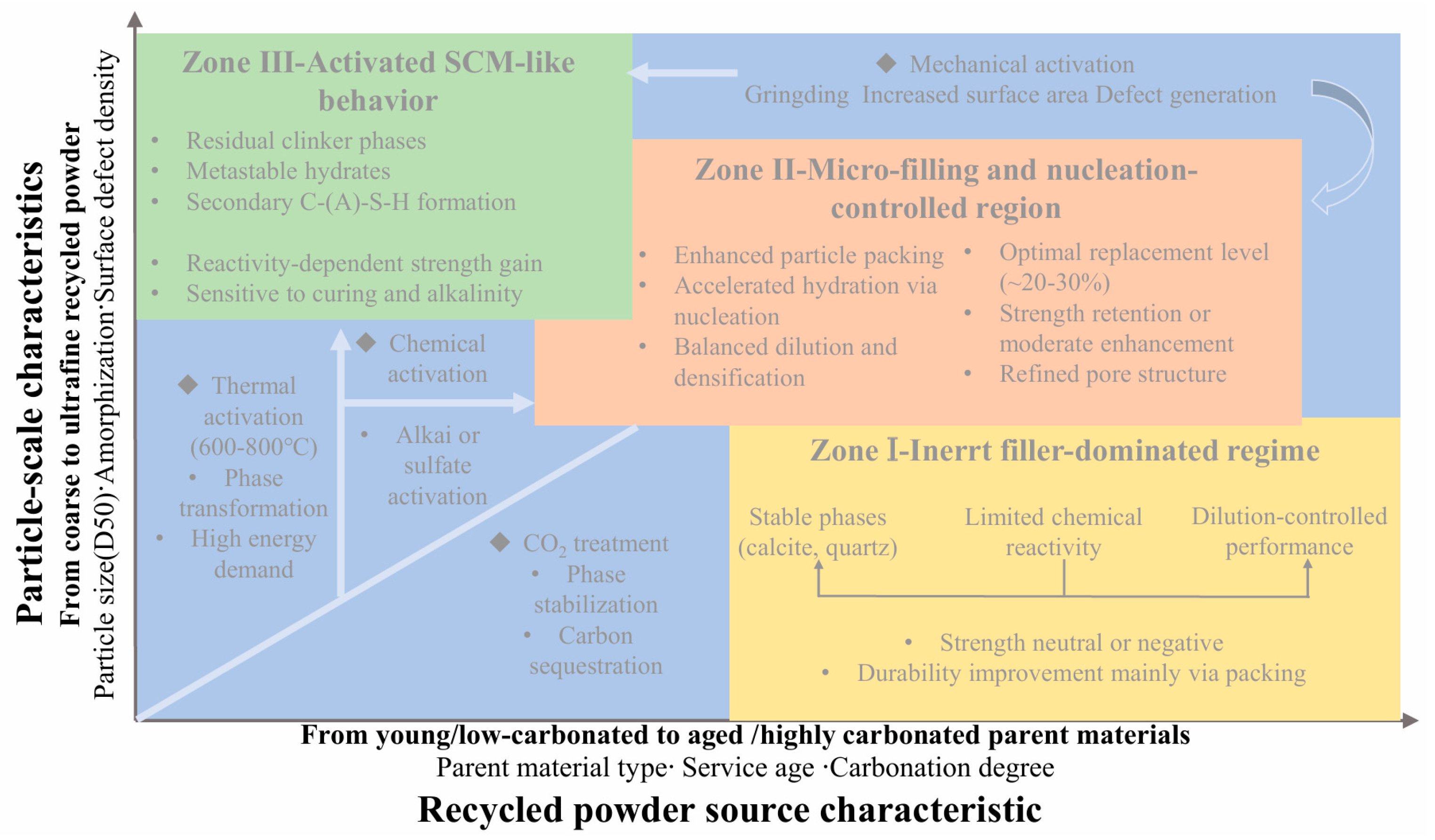
Based on a critical synthesis of experimental evidence, a zone-based conceptual framework is proposed to interpret the performance variability of RP in cementitious systems (
Figure 18). Rather than classifying RP solely by source or activation technique, this framework emphasizes the coupled effects of parent material characteristics, particle-scale structure, and reaction environment. In Zone I, RP functions predominantly as an inert filler, which is typically associated with highly carbonated parent concrete, coarse particle size, and limited amorphization. In this case, dilution effects dominate, and strength reduction is often observed at moderate to high replacement levels. In Zone II, partial activation and size reduction enable RP to contribute through micro-filling and nucleation effects, refining pore structure and accelerating early hydration without relying on strong intrinsic pozzolanic reactivity. In Zone III, intensive activation methods—such as fine grinding, thermal treatment, or coupled chemical–carbonation activation—can induce amorphization and secondary reactions, allowing RP to participate more actively in hydration or alkali-activated systems.
Importantly, this framework is not limited to region-specific observations but is consistent with findings reported in international studies on recycled cementitious fines and emerging supplementary cementitious materials. Previous research has shown that, similar to low-reactivity SCMs, the primary contribution of RP in most practical applications arises from dilution control, particle packing optimization, and microstructural densification, rather than from high pozzolanic reactivity. This explains why performance improvements are frequently reported in terms of durability and early-age hydration, while long-term strength enhancement remains limited unless intensive activation is applied. By explicitly linking these mechanisms to RP source characteristics and processing history, the present review provides a unifying explanation for the apparent inconsistencies across studies conducted in different regions and under different experimental conditions.
8. Conclusions and Engineering Implications
This review critically synthesizes recent research on recycled powder derived from construction and demolition waste and evaluates its role in cementitious materials from a mechanism-based perspective. Based on the analyzed literature, the following conclusions can be drawn:
(1) Recycled powder is not a single material but a spectrum of materials with fundamentally different reactivity. The chemical composition, mineralogical assemblage, and intrinsic reactivity of recycled powder are primarily governed by the parent material type, service age, and degree of carbonation. RP originating from aged and highly carbonated concrete or masonry is dominated by thermodynamically stable phases and therefore behaves mainly as an inert micro-filler, whereas RP derived from younger or less carbonated sources may retain unhydrated clinker minerals and metastable hydrates, enabling limited hydraulic or pozzolanic reactivity under suitable conditions.
(2) RP performance is controlled by coupled parameters rather than replacement ratio alone. Across different cementitious systems, threshold-type behavior is consistently observed. When the median particle size (D50) is reduced below approximately 20–30 μm and the replacement level is maintained below about 30%, dilution effects can be largely compensated by micro-filling and heterogeneous nucleation. Within this envelope, acceptable mechanical performance and pore structure refinement can be achieved. Beyond this range, performance degradation becomes dominant regardless of further activation, explaining many contradictory conclusions reported in the literature.
(3) Activation methods enhance RP reactivity through distinct mechanisms with clear applicability limits. Mechanical grinding increases surface area and defect density; thermal activation (typically 600–800 °C) generates highly reactive calcium-bearing phases; chemical activation promotes depolymerization and secondary gel formation; and CO2 treatment modifies phase assemblage while enabling carbon sequestration. No single activation route is universally optimal. The effectiveness of each method depends on RP source characteristics, targeted performance, and energy or environmental constraints.
(4) Microstructural regulation provides a unified explanation for macroscopic performance variability. Differences in strength development, hydration kinetics, and durability reported in the literature can be consistently interpreted by considering the balance between dilution, nucleation, micro-filling, and secondary reactions. Improvements in durability are primarily associated with pore structure refinement and densification of the CSH network, rather than with high intrinsic pozzolanic reactivity of RP.
(5) The environmental and economic advantages of RP are conditional rather than absolute. Although recycled powder generally exhibits lower embodied carbon and material cost than Portland cement, its net sustainability benefit is highly sensitive to system boundaries, transportation distance, and the energy demand of activation processes. Therefore, generalized claims of environmental superiority are not justified without application-specific life-cycle assessment. Overall, this review demonstrates that the utilization of recycled powder should be guided by mechanism-based performance envelopes rather than empirical replacement limits. Future research should focus on standardized source characterization, multi-scale structure–property relationships, and application-oriented mix design strategies to enable reliable, large-scale, and high-value use of recycled powder in sustainable cementitious materials.
Author Contributions
W.Z.: Conceptualization, Methodology, Investigation, Formal Analysis, Writing—Original Draft, Validation. Y.D.: Formal Analysis, Methodology, Writing—Review and Editing. Y.C.: Methodology, Writing—Review and Editing. S.L.: Conceptualization, Writing—Review and Editing, Supervision, Funding Acquisition, Project Administration. X.C.: Formal analysis, Writing—Review and Editing. Y.S.: Conceptualization, Writing—Review and Editing. Y.Y.: Methodology, Supervision, Writing—Review and Editing. K.W.: Methodology, Investigation. All authors have read and agreed to the published version of the manuscript.
Funding
This research was funded by Qingdao Natural Science Foundation, Grant No. 24-4-4-zrjj-198-jch, National Natural Science Foundation of China, Grant No. 52479125.
Data Availability Statement
The data presented in this study are available on request from the corresponding author.
Acknowledgments
Support from the Shandong Province Marine Environment Concrete Material Corrosion Control and Monitoring Research Innovation Team. And thanks to Qingdao Greensail Recycled Building Materials Co., Ltd., China, for providing support for this study.
Conflicts of Interest
Authors Yong Chen, Yingjie Yuan, and Kai Wang were employed by the company Qingdao Greensail Recycled Building Materials Co., Ltd. Author Yihui Sun was employed by the company Qingdao GreenSail Changyun Environmental Protection Building Materials Co., Ltd. The remaining authors declare that the research was conducted in the absence of any commercial or financial relationships that could be construed as a potential conflict of interest.
References
- Lu, B.; Zhang, Z. Optimal Mix Design for Recycled Fine Sand Mortar from Construction Waste. J. Zhejiang Univ. Sci. Technol. 2025, 53–54, 361–376. [Google Scholar]
- Lu, W. Big data analytics to identify illegal construction waste dumping: A Hong Kong study. Resour. Conserv. Recycl. 2019, 141, 264–272. [Google Scholar] [CrossRef]
- Wu, H.; Zuo, J.; Zillante, G.; Wang, J.; Yuan, H. Construction and demolition waste research: A bibliometric analysis. Archit. Sci. Rev. 2019, 62, 354–365. [Google Scholar] [CrossRef]
- Akhtar, A.; Sarmah, A.K. Construction and demolition waste generation and properties of recycled aggregate concrete: A global perspective. J. Clean. Prod. 2018, 186, 262–281. [Google Scholar] [CrossRef]
- Seror, N.; Portnov, B.A. Estimating the effectiveness of different environmental law enforcement policies on illegal C&D waste dumping in Israel. Waste Manag. 2020, 102, 241–248. [Google Scholar] [CrossRef] [PubMed]
- Xiao, J.; Ma, Z.; Ding, T. Reclamation chain of waste concrete: A case study of Shanghai. Waste Manag. 2016, 48, 334–343. [Google Scholar] [CrossRef] [PubMed]
- Zhang, J.; Zhou, Z.H.; Cheng, X. Formation Kinetics of Regenerated Cement Clinker Calcined by Using Wasted Recycling Concrete Powders as Raw Meals. Adv. Mater. Res. 2015, 1073–1076, 1309–1312. [Google Scholar] [CrossRef]
- Guo, Y.; Li, Q.; Shan, T.; Liu, G.; Gao, S.; Xu, Q. Simplified Mix Design Method for Recycled Coarse Aggregate Concrete. J. Shenyang Jianzhu Univ. 2017, 33, 1029–1038. [Google Scholar]
- Koushkbaghi, M.; Alipour, P.; Tahmouresi, B.; Mohseni, E.; Saradar, A.; Sarker, P.K. Influence of different monomer ratios and recycled concrete aggregate on mechanical properties and durability of geopolymer concretes. Constr. Build. Mater. 2019, 205, 519–528. [Google Scholar] [CrossRef]
- Evangelista, L.; Guedes, M.; de Brito, J.; Ferro, A.C.; Pereira, M.F. Physical, chemical and mineralogical properties of fine recycled aggregates made from concrete waste. Constr. Build. Mater. 2015, 86, 178–188. [Google Scholar] [CrossRef]
- Pacheco, J.; de Brito, J.; Chastre, C.; Evangelista, L. Experimental investigation on the variability of the main mechanical properties of concrete produced with coarse recycled concrete aggregates. Constr. Build. Mater. 2019, 201, 110–120. [Google Scholar] [CrossRef]
- Thomas, C.; de Brito, J.; Cimentada, A.; Sainz-Aja, J.A. Macro- and micro- properties of multi-recycled aggregate concrete. J. Clean. Prod. 2020, 245, 118843. [Google Scholar] [CrossRef]
- Jayasuriya, A.; Adams, M.P.; Bandelt, M.J. Understanding variability in recycled aggregate concrete mechanical properties through numerical simulation and statistical evaluation. Constr. Build. Mater. 2018, 178, 301–312. [Google Scholar] [CrossRef]
- Xiao, J.; Ma, Z.; Sui, T.; Akbarnezhad, A.; Duan, Z. Mechanical properties of concrete mixed with recycled powder produced from construction and demolition waste. J. Clean. Prod. 2018, 188, 720–731. [Google Scholar] [CrossRef]
- Gupta, T.; Siddique, S.; Sharma, R.K.; Chaudhary, S. Behaviour of waste rubber powder and hybrid rubber concrete in aggressive environment. Constr. Build. Mater. 2019, 217, 283–291. [Google Scholar] [CrossRef]
- Ye, T.; Zhou, Z.; Xiao, J.; Duan, Z. Effect of Carbonation Curing on the Properties of Recycled Micro-powder Foam Concrete. Bull. Chin. Soc. Ceram. 2025, 44, 872–882. [Google Scholar]
- Ma, Y.; Gong, J.; Ouyang, X.; Li, Z.; Wang, H.; Fu, J. Roles of recycled concrete powder on the properties of alkali-activated slag: Reaction products and microstructure development. Compos. Part B Eng. 2025, 301, 112493. [Google Scholar] [CrossRef]
- Tian, F.; Xie, X.S.; Hu, W.X. Research on Cement Pulverized Admixture of Waste Concrete Powder. Adv. Mater. Res. 2011, 194–196, 759–764. [Google Scholar] [CrossRef]
- Xiao, J. Fundamental Issues and Applications of Recycled Micro-Powder from Waste Concrete. Mater. Rep. 2023, 37, 1–10. [Google Scholar]
- Mustafa, T.S.; Beshlawy, S.A.E.; Nassem, A.R. Experimental study on the behavior of RC beams containing recycled glass. Constr. Build. Mater. 2022, 344, 128250. [Google Scholar] [CrossRef]
- Ulubeyli, G.Ç.; Cavuslu, M.; Dogan, Z.; ÜLger, T. Sustainable concrete using waste ceramic powder and coal-washed water: Experimental investigations and 3D numerical modelling of full-scale RC beams. Constr. Build. Mater. 2026, 507, 145082. [Google Scholar] [CrossRef]
- Thonemann, N.; Zacharopoulos, L.; Fromme, F.; Nühlen, J. Environmental impacts of carbon capture and utilization by mineral carbonation: A systematic literature review and meta life cycle assessment. J. Clean. Prod. 2022, 332, 130067. [Google Scholar] [CrossRef]
- Elsayed, M.; Abd-Allah, S.R.; Said, M.; El-Azim, A.A. Structural performance of recycled coarse aggregate concrete beams containing waste glass powder and waste aluminum fibers. Case Stud. Constr. Mater. 2023, 18, e01751. [Google Scholar] [CrossRef]
- Ahmed, K.S.; Rana, L.R.; Al-Moneim, A.; Ahmad, S.I. Effect of waste glass on the flexural response of reinforced concrete beams containing recycled brick aggregate. Clean. Mater. 2025, 18, 100348. [Google Scholar] [CrossRef]
- Gao, Q.; Li, X.-G.; Shi, X.-D.; Li, X.-L.; Lyu, X.-J.; Zhu, X.-N.; Ren, Y.-G. Clean and high-value recycling approach for waste concrete powder: Mechano-chemical activation of pozzolanic activity. Powder Technol. 2025, 458, 120988. [Google Scholar] [CrossRef]
- Zhu, D.; Yu, Q.; Wang, C.; Zhan, B.; Gao, P.; Fu, Y. Activation effect and principle of recycled powder by carbonation and chemical co-activation. Constr. Build. Mater. 2025, 482, 141581. [Google Scholar] [CrossRef]
- Zheng, Y.; Cui, K.; Zhao, Y.; Wu, W.; Shen, P.; Poon, C.S. Development of high-performance phosphogypsum-based cementitious materials through CO2-assisted alkali activation. Cem. Concr. Compos. 2025, 162, 106144. [Google Scholar] [CrossRef]
- Ma, Z.; Tang, Q.; Yang, D.; Ba, G.; Zhang, Y. Durability Studies on the Recycled Aggregate Concrete in China over the Past Decade: A Review. Adv. Civ. Eng. 2019, 2019, 4073130. [Google Scholar] [CrossRef]
- Cantero, B.; Bravo, M.; de Brito, J.; Sáez del Bosque, I.F.; Medina, C. Assessment of the Permeability to Aggressive Agents of Concrete with Recycled Cement and Mixed Recycled Aggregate. Appl. Sci. 2021, 11, 3856. [Google Scholar] [CrossRef]
- Marie, I.; Quiasrawi, H. Closed-loop recycling of recycled concrete aggregates. J. Clean. Prod. 2012, 37, 243–248. [Google Scholar] [CrossRef]
- Li, S.; Gao, J.; Li, Q.; Zhao, X. Investigation of using recycled powder from the preparation of recycled aggregate as a supplementary cementitious material. Constr. Build. Mater. 2021, 267, 120976. [Google Scholar] [CrossRef]
- Aquino Rocha, J.H.; Toledo Filho, R.D. The utilization of recycled concrete powder as supplementary cementitious material in cement-based materials: A systematic literature review. J. Build. Eng. 2023, 76, 107319. [Google Scholar] [CrossRef]
- Yang, Y.; Kang, Z.; Zhan, B.; Gao, P.; Yu, Q.; Wang, J.; Zhao, W.; Zhang, Y.; Bi, W.; Yang, C.; et al. Short Review on the Application of Recycled Powder in Cement-Based Materials: Preparation, Performance and Activity Excitation. Buildings 2022, 12, 1568. [Google Scholar] [CrossRef]
- Zhang, J.; Tan, H.; He, X.; Zhao, R.; Yang, J.; Su, Y. Nano particles prepared from hardened cement paste by wet grinding and its utilization as an accelerator in Portland cement. J. Clean. Prod. 2021, 283, 124632. [Google Scholar] [CrossRef]
- Yang, J.; Zeng, L.; Su, Z.; He, X.; Su, Y.; Zhao, R.; Gan, X. Wet-milling disposal of autoclaved aerated concrete demolition waste—A comparison with classical supplementary cementitious materials. Adv. Powder Technol. 2020, 31, 3736–3746. [Google Scholar] [CrossRef]
- Yu, X.; Li, R.; Dong, X.; Li, G.; Zhang, S. Effect of Mechanical Grinding on the Properties of Recycled Micropowder. J. Artif. Crystallogr. 2017, 46, 688–692. [Google Scholar]
- Caneda-Martínez, L.; Monasterio, M.; Moreno-Juez, J.; Martínez-Ramírez, S.; García, R.; Frías, M. Behaviour and Properties of Eco-Cement Pastes Elaborated with Recycled Concrete Powder from Construction and Demolition Wastes. Materials 2021, 14, 1299. [Google Scholar] [CrossRef] [PubMed]
- Xu, J.; Kang, A.; Wu, Z.; Gong, Y.; Xiao, P. The effect of mechanical-thermal synergistic activation on the mechanical properties and microstructure of recycled powder geopolymer. J. Clean. Prod. 2021, 327, 129477. [Google Scholar] [CrossRef]
- Dun, Z.; Wang, M.; Ren, L.; Dun, Z.; Černý, R. Tests Research on Grouting Materials of Waste-Concrete-Powder Cement for Goaf Ground Improvement. Adv. Mater. Sci. Eng. 2021, 2021, 9598418. [Google Scholar] [CrossRef]
- Tang, Q.; Ma, Z.; Wu, H.; Wang, W. The utilization of eco-friendly recycled powder from concrete and brick waste in new concrete: A critical review. Cem. Concr. Compos. 2020, 114, 103807. [Google Scholar] [CrossRef]
- He, Z.-H.; Han, X.-D.; Zhang, M.-Y.; Yuan, Q.; Shi, J.-Y.; Zhan, P.-M. A novel development of green UHPC containing waste concrete powder derived from construction and demolition waste. Powder Technol. 2022, 398, 117075. [Google Scholar] [CrossRef]
- Xie, F.; Bao, L.; Zheng, Y.; Chen, L.; Wang, R.; Li, G.; Cui, J. The mechanical properties, shrinkage mitigation, and bond performance of recycled powder based alkali-activated paste for surface enhancement of recycled concrete aggregate. Constr. Build. Mater. 2025, 486, 141993. [Google Scholar] [CrossRef]
- Ahmari, S.; Ren, X.; Toufigh, V.; Zhang, L. Production of geopolymeric binder from blended waste concrete powder and fly ash. Constr. Build. Mater. 2012, 35, 718–729. [Google Scholar] [CrossRef]
- Wu, H.; Yang, D.; Xu, J.; Liang, C.; Ma, Z. Water transport and resistance improvement for the cementitious composites with eco-friendly powder from various concrete wastes. Constr. Build. Mater. 2021, 290, 123247. [Google Scholar] [CrossRef]
- Zhou, Z.; Yang, Z.; Cheng, S.; Yang, L. Effect of recycled concrete powder on the performance of alkali-activated slag. Case Stud. Constr. Mater. 2025, 22, e04811. [Google Scholar] [CrossRef]
- Zhang, D.; Zhang, S.; Huang, B.; Yang, Q.; Li, J. Comparison of mechanical, chemical, and thermal activation methods on the utilisation of recycled concrete powder from construction and demolition waste. J. Build. Eng. 2022, 61, 105295. [Google Scholar] [CrossRef]
- Kong, X.; Yao, Y.; Kai, M.; Guan, Y.; Ding, X.; Gu, Z.; Liu, J. The assessment of the mechanical and durability properties of mortar prepared with carbon dioxide-treated recycled concrete-brick powder. Constr. Build. Mater. 2025, 466, 140305. [Google Scholar] [CrossRef]
- Zhao, S. Study on the Effects of Fineness and Dosage of Recycled Construction Micro-Powder on Cement Properties. New Century Cem. J. 2025, 31, 48–51. [Google Scholar]
- Wu, H.; Liang, C.; Xiao, J.; Ma, Z. Properties and CO2-curing enhancement of cement-based materials containing various sources of waste hardened cement paste powder. J. Build. Eng. 2021, 44, 102677. [Google Scholar] [CrossRef]
- Kim, J.; Ubysz, A. Thermal activation of multi-recycled concrete powder as supplementary cementitious material for repeated and waste-free recycling. J. Build. Eng. 2024, 98, 111169. [Google Scholar] [CrossRef]
- Suwan, T.; Wattanachai, P. Properties and Internal Curing of Concrete Containing Recycled Autoclaved Aerated Lightweight Concrete as Aggregate. Adv. Mater. Sci. Eng. 2017, 2017, 1–11. [Google Scholar] [CrossRef]
- Yang, J.; Wang, F.; Liu, Z.; Liu, Y.; Hu, S. Early-state water migration characteristics of superabsorbent polymers in cement pastes. Cem. Concr. Res. 2019, 118, 25–37. [Google Scholar] [CrossRef]
- Tam, V.W.Y.; Gao, X.F.; Tam, C.M. Microstructural analysis of recycled aggregate concrete produced from two-stage mixing approach. Cem. Concr. Res. 2005, 35, 1195–1203. [Google Scholar] [CrossRef]
- Padmini, A.K.; Ramamurthy, K.; Mathews, M.S. Influence of parent concrete on the properties of recycled aggregate concrete. Constr. Build. Mater. 2009, 23, 829–836. [Google Scholar] [CrossRef]
- Shi, C.; Li, Y.; Zhang, J.; Li, W.; Chong, L.; Xie, Z. Performance enhancement of recycled concrete aggregate—A review. J. Clean. Prod. 2016, 112, 466–472. [Google Scholar] [CrossRef]
- Gu, Z.; Jiang, L.; Ma, Z.; Jiang, Y.; Shen, P.; Poon, C.S. Achieving instantaneous activation of recycled concrete powder by hyper-gravity carbonation. Cem. Concr. Compos. 2025, 163, 106177. [Google Scholar] [CrossRef]
- Duan, Z.; Hou, S.; Xiao, J.; Singh, A. Rheological properties of mortar containing recycled powders from construction and demolition wastes. Constr. Build. Mater. 2020, 237, 117622. [Google Scholar] [CrossRef]
- Zhang, Z.; Yang, D.; Liu, X.; Shi, W.; Yu, J. Performance study of alkali-activated waste concrete powder mortar: Experimental study evaluation and molecular simulation. Cem. Concr. Compos. 2026, 167, 106454. [Google Scholar] [CrossRef]
- Rakhimova, N.; Shi, C. Upcycling of concrete wastes as precursors in alkali-activated materials: A review. Constr. Build. Mater. 2024, 436, 136978. [Google Scholar] [CrossRef]
- Li, S.; Liu, J.; Yu, C.; Li, Z.; Xie, W. Study on the performance of ternary blended cement with calcined clay and recycled concrete powder. Low-Carbon Mater. Green Constr. 2024, 2, 4. [Google Scholar] [CrossRef]
- Mao, Y.; Hu, X.; Alengaram, U.J.; Chen, W.; Shi, C. Use of carbonated recycled cement paste powder as a new supplementary cementitious material: A critical review. Cem. Concr. Compos. 2024, 154, 105783. [Google Scholar] [CrossRef]
- Horsakulthai, V. Effect of recycled concrete powder on strength, electrical resistivity, and water absorption of self-compacting mortars. Case Stud. Constr. Mater. 2021, 15, e00725. [Google Scholar] [CrossRef]
- Zhao, Y.; Gao, J.; Liu, C.; Chen, X.; Xu, Z. The particle-size effect of waste clay brick powder on its pozzolanic activity and properties of blended cement. J. Clean. Prod. 2020, 242, 118521. [Google Scholar] [CrossRef]
- Deng, X.; Guo, H.; Tan, H.; He, X.; Zheng, Z.; Su, Y.; Yang, J. An accelerator prepared from waste concrete recycled powder and its effect on hydration of cement-based materials. Constr. Build. Mater. 2021, 296, 123767. [Google Scholar] [CrossRef]
- Moreno-Juez, J.; Vegas, I.J.; Frías Rojas, M.; Vigil de la Villa, R.; Guede-Vázquez, E. Laboratory-scale study and semi-industrial validation of viability of inorganic CDW fine fractions as SCMs in blended cements. Constr. Build. Mater. 2021, 271, 121823. [Google Scholar] [CrossRef]
- Lu, B.; Shi, C.; Zhang, J.; Wang, J. Effects of carbonated hardened cement paste powder on hydration and microstructure of Portland cement. Constr. Build. Mater. 2018, 186, 699–708. [Google Scholar] [CrossRef]
- Kang, Y.L.a.X. Effect of Physical Excitation on the Properties of Recycled Fine Powder.pdf. ICO Conf. Ser. Earth Environ. Sci. 2019, 219, 012025. [Google Scholar]
- Yu, K.-Q.; Zhu, W.-J.; Ding, Y.; Lu, Z.-D.; Yu, J.-t.; Xiao, J.-Z. Micro-structural and mechanical properties of ultra-high performance engineered cementitious composites (UHP-ECC) incorporation of recycled fine powder (RFP). Cem. Concr. Res. 2019, 124, 105813. [Google Scholar] [CrossRef]
- Ma, Z.; Wu, Y.; Yang, D.; Fang, K.; Hou, S.; Dai, Y.; Wang, C. Upcycling of recycled brick powder as a substitute for precursor and sand in completely recycled geopolymer: From micro to macro perspective. Constr. Build. Mater. 2025, 476, 141300. [Google Scholar] [CrossRef]
- Moein, M.M.; Moein, A.M.; Saradar, A.; Rigby, S.E.; Tazari, H.; Karakouzian, M. Mechanical properties of Portland cement concrete mixed with different doses of recycled brick powder and steel fiber. Heliyon 2025, 11, e41900. [Google Scholar] [CrossRef]
- Yang, Y.; Xu, J.; Gao, P.; Zhan, B.; Yu, Q.; Ni, M.; Zhang, Y. Study on the hydration characteristics and mechanical properties of recycled powder-slag powder-cement system. Case Stud. Constr. Mater. 2024, 21, e03952. [Google Scholar] [CrossRef]
- Huang, J.; Chen, Y.; Yu, Q. Amorphous calcium carbonate formation from carbonated recycled cement powder: A novel carbonation-activated cementitious material. Compos. Part B Eng. 2025, 297, 112336. [Google Scholar] [CrossRef]
- Shen, P.; Zhang, Y.; Jiang, Y.; Zhan, B.; Lu, J.; Zhang, S.; Xuan, D.; Poon, C.S. Phase assemblance evolution during wet carbonation of recycled concrete fines. Cem. Concr. Res. 2022, 154, 106733. [Google Scholar] [CrossRef]
- G.T. 1596-2017; Fly Ash Used for Cement and Concrete. Ministry of Housing and Urban-Rural Development of the People’s Republic of China: Beijing, China, 2017.
- E. 450-1:2012; Fly Ash for Concrete. International Organization—European Committee for Standardization: Brussels, Belgium, 2012.
- Chastre, C.; Cong, L.; Jialin, L.; Jing, C.; Hailun, W.; Dong, L.; Mendonça, P. Study on the Application of Recycled Fine Powder in Ready-Mixed Concrete. MATEC Web Conf. 2019, 278, 01010. [Google Scholar] [CrossRef]
- Wang, H. Effect of Recycled Fine Powder on Shrinkage Cracking Properties of Concrete. Ind. Build. 2016, 46, 122–125+104. [Google Scholar]
- Li, S.; Li, Q.; Zhao, X.; Luo, J.; Gao, S.; Yue, G.; Su, D. Experimental Study on the Preparation of Recycled Admixtures by Using Construction and Demolition Waste. Materials 2019, 12, 1678. [Google Scholar] [CrossRef]
- Chen, X. Effect of Recycled Micro-powder on Compressive Strength of Ultra-High Performance Concrete. Eng. Mater. Equip. 2020, 38, 271–273. [Google Scholar]
- Hay, R.; Celik, K. Hydration, carbonation, strength development and corrosion resistance of reactive MgO cement-based composites. Cem. Concr. Res. 2020, 128, 105941. [Google Scholar] [CrossRef]
- Kalinowska-Wichrowska, K.; Kosior-Kazberuk, M.; Pawluczuk, E. The Properties of Composites with Recycled Cement Mortar Used as a Supplementary Cementitious Material. Materials 2019, 13, 64. [Google Scholar] [CrossRef]
- Prošek, Z.; Nežerka, V.; Hlůžek, R.; Trejbal, J.; Tesárek, P.; Karra’a, G. Role of lime, fly ash, and slag in cement pastes containing recycled concrete fines. Constr. Build. Mater. 2019, 201, 702–714. [Google Scholar] [CrossRef]
- Liu, X.; Liu, L.; Lyu, K.; Li, T.; Zhao, P.; Liu, R.; Zuo, J.; Fu, F.; Shah, S.P. Enhanced early hydration and mechanical properties of cement-based materials with recycled concrete powder modified by nano-silica. J. Build. Eng. 2022, 50, 104175. [Google Scholar] [CrossRef]
- Ouyang, X.; Wang, L.; Xu, S.; Ma, Y.; Ye, G. Surface characterization of carbonated recycled concrete fines and its effect on the rheology, hydration and strength development of cement paste. Cem. Concr. Compos. 2020, 114, 103809. [Google Scholar] [CrossRef]
- Chen, X. Experimental Study on the Use of Recycled Micro-Powder from Waste Concrete as an Admixture. Master’s Thesis, Qinghai University, Xining, China, 2018. [Google Scholar]
- Rahhal, V.F.; Trezza, M.A.; Tironi, A.; Castellano, C.C.; Pavlíková, M.; Pokorný, J.; Irassar, E.F.; Jankovský, O.; Pavlík, Z. Complex Characterization and Behavior of Waste Fired Brick Powder-Portland Cement System. Materials 2019, 12, 1650. [Google Scholar] [CrossRef]
- Shao, J. Properties of Recycled Clay Brick Powder-Cement Binding System. J. Southeast Univ. 2019, 49, 375–379. [Google Scholar]
- Che, X. Study on Rheological Properties, Mechanical Properties, and Hydration Mechanism of Recycled Micro-Powder Cementitious Systems Based on Alkali Activation Mechanism. Master’s Thesis, Qingdao University of Technology, Qingdao, China, 2023. [Google Scholar]
- Deng, X. Study on the Influence of Recycled Concrete Fine Powder on the Structure and Properties of Cementitious Materials. Master’s Thesis, Southwest University of Science and Technology, Mianyang, China, 2024. [Google Scholar]
- Chen, X. Effect of Recycled Powder on the Hydration Characteristics of Cement Paste. Bull. Chin. Soc. Ceram. 2016, 35, 2530–2536+2542. [Google Scholar] [CrossRef]
- Hou, S.; Xiao, J.; Duan, Z.; Ma, G. Fresh properties of 3D printed mortar with recycled powder. Constr. Build. Mater. 2021, 309, 125186. [Google Scholar] [CrossRef]
- Wang, T.; He, X.; Yang, J.; Zhao, H.; Su, Y. Nano-treatment of Autoclaved Aerated Concrete Waste and Its Usage in Cleaner Building Materials. J. Wuhan Univ. Technol. Mater. Sci. Ed. 2020, 35, 786–793. [Google Scholar] [CrossRef]
- Ma, Z.; Duan, Z.; Ba, G.; Sadowski, L. Effects of an Applied Load on the Chloride Penetration of Concrete with Recycled Aggregates and Recycled Powder. Adv. Civ. Eng. 2019, 2019, 1340803. [Google Scholar] [CrossRef]
- Zhao, L. Fundamental Properties and Application Research of Recycled Micro-Powder from Construction Waste. Master’s Thesis, Beijing University of Civil Engineering and Architecture, Beijing, China, 2019. [Google Scholar]
- Peng, S. Study on the Properties of Ultra-High Performance Concrete Matrix Prepared from Recycled Waste Concrete Powder. Bull. Chin. Soc. Ceram. 2019, 38, 2125–2130. [Google Scholar] [CrossRef]
- Ma, Z.; Liu, M.; Duan, Z.; Liang, C.; Wu, H. Effects of active waste powder obtained from C&D waste on the microproperties and water permeability of concrete. J. Clean. Prod. 2020, 257, 120518. [Google Scholar] [CrossRef]
- Wu, H.; Xu, J.; Yang, D.; Ma, Z. Utilizing thermal activation treatment to improve the properties of waste cementitious powder and its newmade cementitious materials. J. Clean. Prod. 2021, 322, 129074. [Google Scholar] [CrossRef]
- Liu, C.; Liu, H.; Wu, J. Effect of Recycled Mixed Powder on the Mechanical Properties and Microstructure of Concrete. J. Renew. Mater. 2022, 10, 1397–1414. [Google Scholar] [CrossRef]
- Diliberto, C.; Lecomte, A.; Aissaoui, C.; Mechling, J.-M.; Izoret, L. The incorporation of fine recycled concrete aggregates as a main constituent of cement. Mater. Struct. 2021, 54, 197. [Google Scholar] [CrossRef]
- Yao, P.; Yang, D.; Wang, C.; Ma, Z. Upcycling of construction waste powder for sustainable ultra-high performance engineered cementitious composites: Effects of waste powder source and content. Constr. Build. Mater. 2022, 349, 128789. [Google Scholar] [CrossRef]
- Wang, H.; Wang, L.; Shen, W.; Cao, K.; Sun, L.; Wang, P.; Cui, L. Compressive Strength, Hydration and Pore Structure of Alkali-Activated Slag Mortars Integrating with Recycled Concrete Powder as Binders. KSCE J. Civ. Eng. 2022, 26, 795–805. [Google Scholar] [CrossRef]
- Ren, P.; Li, B.; Yu, J.-G.; Ling, T.-C. Utilization of recycled concrete fines and powders to produce alkali-activated slag concrete blocks. J. Clean. Prod. 2020, 267, 122115. [Google Scholar] [CrossRef]
- He, X.; Zheng, Z.; Yang, J.; Su, Y.; Wang, T.; Strnadel, B. Feasibility of incorporating autoclaved aerated concrete waste for cement replacement in sustainable building materials. J. Clean. Prod. 2020, 250, 119455. [Google Scholar] [CrossRef]
- Zhang, H.; Xiao, J.; Tang, Y.; Duan, Z.; Poon, C.-s. Long-term shrinkage and mechanical properties of fully recycled aggregate concrete: Testing and modelling. Cem. Concr. Compos. 2022, 130, 104527. [Google Scholar] [CrossRef]
- Wu, R.; Zhao, T.; Zhang, P.; Yang, D.; Liu, M.; Ma, Z. Tensile Behavior of Strain Hardening Cementitious Composites (SHCC) Containing Reactive Recycled Powder from Various C&D Waste. J. Renew. Mater. 2021, 9, 743–765. [Google Scholar] [CrossRef]
- Gao, Y.; Cui, X.; Lu, N.; Hou, S.; He, Z.; Liang, C. Effect of recycled powders on the mechanical properties and durability of fully recycled fiber-reinforced mortar. J. Build. Eng. 2022, 45, 103574. [Google Scholar] [CrossRef]
- Keppert, M.; Davidová, V.; Doušová, B.; Scheinherrová, L.; Reiterman, P. Recycling of fresh concrete slurry waste as supplementary cementing material: Characterization, application and leaching of selected elements. Constr. Build. Mater. 2021, 300, 124061. [Google Scholar] [CrossRef]
- Chen, X.; Li, Y.; Zhu, Z.; Ma, L. Evaluation of waste concrete recycled powder (WCRP) on the preparation of low-exothermic cement. J. Build. Eng. 2022, 53, 104511. [Google Scholar] [CrossRef]
- Yang, J.; Huang, J.; Su, Y.; He, X.; Tan, H.; Yang, W.; Strnadel, B. Eco-friendly treatment of low-calcium coal fly ash for high pozzolanic reactivity: A step towards waste utilization in sustainable building material. J. Clean. Prod. 2019, 238, 117962. [Google Scholar] [CrossRef]
- Ma, Z.; Shen, J.; Wu, H.; Zhang, P. Properties and activation modification of eco-friendly cementitious materials incorporating high-volume hydrated cement powder from construction waste. Constr. Build. Mater. 2022, 316, 125788. [Google Scholar] [CrossRef]
- Wang, L.; Wang, J.; Wang, H.; Fang, Y.; Shen, W.; Chen, P.; Xu, Y. Eco-friendly treatment of recycled concrete fines as supplementary cementitious materials. Constr. Build. Mater. 2022, 322, 126491. [Google Scholar] [CrossRef]
- Dai, F. Study on the Effect of Recycled Micropowder on the Chloride Ion Resistance of Offshore Concrete. New Build. Mater. 2019, 46, 13–15+31. [Google Scholar]
- Cui, S.; Liu, P.; Cui, E.; Su, J.; Huang, B. Experimental study on mechanical property and pore structure of concrete for shotcrete use in a hot-dry environment of high geothermal tunnels. Constr. Build. Mater. 2018, 173, 124–135. [Google Scholar] [CrossRef]
- Shafiq, N.; Kumar, R.; Zahid, M.; Tufail, R.F. Effects of Modified Metakaolin Using Nano-Silica on the Mechanical Properties and Durability of Concrete. Materials 2019, 12, 2291. [Google Scholar] [CrossRef]
- Zhang, M.-h.; Li, H. Pore structure and chloride permeability of concrete containing nano-particles for pavement. Constr. Build. Mater. 2011, 25, 608–616. [Google Scholar] [CrossRef]
- Wu, H.; Wang, C.; Ma, Z. Drying shrinkage, mechanical and transport properties of sustainable mortar with both recycled aggregate and powder from concrete waste. J. Build. Eng. 2022, 49, 104048. [Google Scholar] [CrossRef]
- Wu, H.; Yang, D.; Ma, Z. Micro-structure, mechanical and transport properties of cementitious materials with high-volume waste concrete powder and thermal modification. Constr. Build. Mater. 2021, 313, 125477. [Google Scholar] [CrossRef]
- Vashistha, P.; Oinam, Y.; Kim, H.-K.; Pyo, S. Effect of thermo-mechanical activation of waste concrete powder (WCP) on the characteristics of cement mixtures. Constr. Build. Mater. 2023, 362, 129713. [Google Scholar] [CrossRef]
- Cantero, B.; Bravo, M.; de Brito, J.; Sáez del Bosque, I.F.; Medina, C. Water transport and shrinkage in concrete made with ground recycled concrete-additioned cement and mixed recycled aggregate. Cem. Concr. Compos. 2021, 118, 103957. [Google Scholar] [CrossRef]
- Chen, X.; Li, Y.; Bai, H.; Ma, L. Utilization of Recycled Concrete Powder in Cement Composite: Strength, Microstructure and Hydration Characteristics. J. Renew. Mater. 2021, 9, 2189–2208. [Google Scholar] [CrossRef]
- Ma, Z.; Yao, P.; Yang, D.; Shen, J. Effects of fire-damaged concrete waste on the properties of its preparing recycled aggregate, recycled powder and newmade concrete. J. Mater. Res. Technol. 2021, 15, 1030–1045. [Google Scholar] [CrossRef]
- Wei, M.; Chen, L.; Lei, N.; Li, H.; Huang, L. Mechanical properties and microstructures of thermally activated ultrafine recycled fine powder cementitious materials. Constr. Build. Mater. 2025, 475, 141195. [Google Scholar] [CrossRef]
- Sun, C.; Chen, L.; Xiao, J.; Zuo, J.; Wu, H. Effects of eco powders from solid waste on freeze-thaw resistance of mortar. Constr. Build. Mater. 2022, 333, 127405. [Google Scholar] [CrossRef]
- Mehdizadeh, H.; Ling, T.-C.; Cheng, X.; Mo, K.H. Effect of particle size and CO2 treatment of waste cement powder on properties of cement paste. Can. J. Civ. Eng. 2020, 48, 522–531. [Google Scholar] [CrossRef]
- Real, S.; Carriço, A.; Bogas, J.A.; Guedes, M. Influence of the Treatment Temperature on the Microstructure and Hydration Behavior of Thermoactivated Recycled Cement. Materials 2020, 13, 3937. [Google Scholar] [CrossRef] [PubMed]
- Wang, C.; Zhan, B.; Yu, Q.; Gao, P.; Guo, B.; Chu, Y.; Liu, Y.; Jiang, Q.; Hong, L.; Yang, Y. Experimental investigation and mechanism of sodium methyl silicate assisted carbonation activation of recycled concrete powder. Constr. Build. Mater. 2025, 486, 141995. [Google Scholar] [CrossRef]
- Xie, J. Study on the Method of Recycled Carbonation of Fine Powder in Recycled Concrete and the Mechanism of Controlling Carbonation Products. Master’s Thesis, Anhui University of Science and Technology, Huainan, China, 2022. [Google Scholar]
- Liu, Q.; Li, B.; Xiao, J.; Singh, A. Utilization potential of aerated concrete block powder and clay brick powder from C&D waste. Constr. Build. Mater. 2020, 238, 117721. [Google Scholar] [CrossRef]
- Bogas, J.A.; Carriço, A.; Pereira, M.F.C. Mechanical characterization of thermal activated low-carbon recycled cement mortars. J. Clean. Prod. 2019, 218, 377–389. [Google Scholar] [CrossRef]
- Duan, Z.; Singh, A.; Xiao, J.; Hou, S. Combined use of recycled powder and recycled coarse aggregate derived from construction and demolition waste in self-compacting concrete. Constr. Build. Mater. 2020, 254, 119323. [Google Scholar] [CrossRef]
- Liu, R. Experimental Study on Construction Waste Clay Brick Powder as an Active Blending Material. Master’s Thesis, Xi’an University of Architecture and Technology, Xi’an, China, 2017. [Google Scholar]
- Ma, Z. Study on the Effect and Mechanism of Composite Activation on the Activity of Recycled Micro-Powder from Waste Concrete. New Build. Mater. 2023, 51, 29–33+69. [Google Scholar]
- Yu, X. Study on the Activation Performance of Recycled Micro-powder from Dust Collection in Construction Waste Enterprises. Cement 2025, 52, 69–73. [Google Scholar] [CrossRef]
- Shang, B. Preparation and Fundamental Properties of Recycled Micro-Powder from Construction Waste. Jiangxi Build. Mater. 2024, 90–93. [Google Scholar]
- Gao, B. Study on Properties and Applications of Architectural Regenerated Micro-Powder. Master’s thesis, Shenyang Jianzhu University, Shenyang, China, 2021. [Google Scholar]
- Che, Y. Study on the Effects of Ball Milling Time and Composite Modifiers on the Properties of Recycled Micro-Powder Mortar. Master’s thesis, Shaoxing University of Arts and Sciences, Shaoxing, China, 2024. [Google Scholar]
- Liu, Y. Experimental Study on the Cementitious Properties of Recycled Fine Powder from Construction Waste. China Powder Technol. 2015, 21, 33–36. [Google Scholar]
- Zhang, X. Study on the Effects of Recycled Micro-powder on the Workability and Mechanical Properties of Concrete. Coal ash. 2015, 28, 3–510. [Google Scholar]
- Kim, Y.J.; Choi, Y.W. Utilization of waste concrete powder as a substitution material for cement. Constr. Build. Mater. 2012, 30, 500–504. [Google Scholar] [CrossRef]
- Chen, X. Experimental Study on the Micro-Powder Cementitious Properties of Recycled Waste Concrete. Concr. Cem. Prod. 2019, 46, 96–100. [Google Scholar] [CrossRef]
- Sui, Y.; Ou, C.; Liu, S.; Zhang, J.; Tian, Q. Study on Properties of Waste Concrete Powder by Thermal Treatment and Application in Mortar. Appl. Sci. 2020, 10, 998. [Google Scholar] [CrossRef]
- Lu, L.; He, Y.; Hu, S. Binding materials of dehydrated phases of waste hardened cement paste and pozzolanic admixture. J. Wuhan Univ. Technol. Mater. Sci. Ed. 2009, 24, 140–144. [Google Scholar] [CrossRef]
- Handoo, S.K.; Agarwal, S.; Agarwal, S.K. Physicochemical, mineralogical, and morphological characteristics of concrete exposed to elevated temperatures. Cem. Concr. Res. 2002, 32, 1009–1018. [Google Scholar] [CrossRef]
- Letelier, V.; Tarela, E.; Muñoz, P.; Moriconi, G. Combined effects of recycled hydrated cement and recycled aggregates on the mechanical properties of concrete. Constr. Build. Mater. 2017, 132, 365–375. [Google Scholar] [CrossRef]
- Zhang, Q.; Ye, G.; Koenders, E. Investigation of the structure of heated Portland cement paste by using various techniques. Constr. Build. Mater. 2013, 38, 1040–1050. [Google Scholar] [CrossRef]
- Kang, X. Study on the Effect of Different Excitation Methods on the Properties of Regenerated Micro-powder. Bull. Silic. Res. 2019, 38, 1135–1139. [Google Scholar] [CrossRef]
- Yang, L. Study on the Preparation of Recycled Cementitious Materials Using Recycled Concrete Micro-Powder. Master’s Thesis, Southeast University, Nanjing, China, 2016. [Google Scholar]
- Liu, D. Characterization of Recycled Micro-powder Properties and Activation of Potential Activity in Construction Waste. Bull. Chin. Soc. Ceram. 2016, 35, 2635–2641. [Google Scholar] [CrossRef]
- Deng, Y. Study on the Cementitious Properties of Powdered Concrete from Demolition Structures. Concr. Cem. Prod. 2011, 38, 59–62. [Google Scholar] [CrossRef]
- Villaquirán-Caicedo, M.A.; Mejía de Gutiérrez, R. Comparison of different activators for alkaline activation of construction and demolition wastes. Constr. Build. Mater. 2021, 281, 122599. [Google Scholar] [CrossRef]
- Liu, Y.; Lu, C.; Zhang, H.; Li, J. Experimental study on chemical activation of recycled powder as a cementitious material in mine paste backfilling. Environ. Eng. Res. 2016, 21, 341–349. [Google Scholar] [CrossRef]
- Xu, R. Activation and Application of Construction Waste Powder. Master’s Thesis, Wuhan University of Technology, Wuhan, China, 2011. [Google Scholar]
- Chi, M. Effects of modulus ratio and dosage of alkali-activated solution on the properties and micro-structural characteristics of alkali-activated fly ash mortars. Constr. Build. Mater. 2015, 99, 128–136. [Google Scholar] [CrossRef]
- Zhao, G. Fundamental Properties of Recycled Concrete Micro-Powder and Its Activation Technology. Ph.D. Thesis, China University of Mining and Technology, Xuzhou, China, 2014. [Google Scholar]
- Zhang, S. Compressive Strength and Activation of Recycled Micro-powder Concrete. Concrete 2015, 37, 49–52. [Google Scholar]
- Aydın, S. A ternary optimisation of mineral additives of alkali activated cement mortars. Constr. Build. Mater. 2013, 43, 131–138. [Google Scholar] [CrossRef]
- Dong, Z. Preparation of Regenerated Materials Based on Waste Concrete Polymers via Alkali Activation. Master’s Thesis, Dalian University of Technology, Dalian, China, 2018. [Google Scholar]
- Qu, M. Research on Regenerated Micro-Powder from Waste Concrete via Coupled Chemical-Thermal Treatment. Master’s Thesis, Henan University, Zhengzhou, China, 2022. [Google Scholar]
- Tang, Q. Early-Age Activation of Cementitious Systems with High Fly Ash Content Using Triethanolamine-Calcium Hydroxide. Bull. Chin. Soc. Ceram. 2018, 37, 2737–2742. [Google Scholar] [CrossRef]
- Zhang, G. Compressive Strength and Microstructure of Geopolymer Prepared from Diverse Solid Wastes. Cement 2025, 11–15. [Google Scholar] [CrossRef]
- Gu, Z.; Jiang, Y.; Ma, Z.; Shen, P.; Poon, C.S. A review on the utilization of recycled concrete powders: Preparation, activity excitation and application. Mater. Rep. Solidwaste Ecomater. 2025, 1, 9520002. [Google Scholar] [CrossRef]
- Liang, C.; Ma, H.; Pan, Y.; Ma, Z.; Duan, Z.; He, Z. Chloride permeability and the caused steel corrosion in the concrete with carbonated recycled aggregate. Constr. Build. Mater. 2019, 218, 506–518. [Google Scholar] [CrossRef]
- Zhan, B.J.; Xuan, D.X.; Zeng, W.; Poon, C.S. Carbonation treatment of recycled concrete aggregate: Effect on transport properties and steel corrosion of recycled aggregate concrete. Cem. Concr. Compos. 2019, 104, 103360. [Google Scholar] [CrossRef]
- Liang, C.; Pan, B.; Ma, Z.; He, Z.; Duan, Z. Utilization of CO2 curing to enhance the properties of recycled aggregate and prepared concrete: A review. Cem. Concr. Compos. 2020, 105, 103446. [Google Scholar] [CrossRef]
- Lu, J.; Cai, Z.; Gao, Y.; Yin, Y.; Ma, Z.; Liang, C. Effects of pretreatment methods on the properties of recycled aggregates and prepared concrete under CO2-curing. Case Stud. Constr. Mater. 2023, 18, e01826. [Google Scholar] [CrossRef]
- Liang, C.; Wang, S.; Cai, Z.; Yin, Y.; Gao, Y.; Guo, M.-Z.; Wang, X.; Ma, Z. Effects of CO2 curing methods on frost resistance and mechanical properties of recycled aggregate concrete. Case Stud. Constr. Mater. 2024, 20, e02973. [Google Scholar] [CrossRef]
- Zhao, Y.; Zheng, Y.; He, J.; Cui, K.; Shen, P.; Poon, C.S.; Peng, G.; Guo, R.; Xia, D. Development of reactive carbonate-calcined clay-cement (C4) composites through synchronizing aluminate-carbonate reaction: Toward high compressive strength and low carbon emission. Cem. Concr. Compos. 2025, 160, 106060. [Google Scholar] [CrossRef]
- Liu, S.; Yang, K.; Xu, L.; Duan, Z.; Xiao, J.; Yang, Z. Interaction of carbonated recycled concrete powder with calcium sulfoaluminate-belite cement: Early hydration kinetics and microstructure evolution. Constr. Build. Mater. 2025, 493, 143223. [Google Scholar] [CrossRef]
- Snellings, R.; Suraneni, P.; Skibsted, J. Future and emerging supplementary cementitious materials. Cem. Concr. Res. 2023, 171, 107199. [Google Scholar] [CrossRef]
- Shah, V.; Bishnoi, S. Analysis of Pore Structure Characteristics of Carbonated Low-Clinker Cements. Transp. Porous Media 2018, 124, 861–881. [Google Scholar] [CrossRef]
- Kashef-Haghighi, S.; Shao, Y.; Ghoshal, S. Mathematical modeling of CO2 uptake by concrete during accelerated carbonation curing. Cem. Concr. Res. 2015, 67, 1–10. [Google Scholar] [CrossRef]
- Liu, W.; Li, Y.-Q.; Tang, L.-P.; Dong, Z.-J. XRD and 29Si MAS NMR study on carbonated cement paste under accelerated carbonation using different concentration of CO2. Mater. Today Commun. 2019, 19, 464–470. [Google Scholar] [CrossRef]
- Glasser, F.P.; Pedersen, J.; Goldthorpe, K.; Atkins, M. Solubility reactions of cement components with NaCl solutions: I. Ca(OH)2 and C-S-H. Adv. Cem. Res. 2005, 17, 57–64. [Google Scholar] [CrossRef]
- Drouet, E.; Poyet, S.; Le Bescop, P.; Torrenti, J.-M.; Bourbon, X. Carbonation of hardened cement pastes: Influence of temperature. Cem. Concr. Res. 2019, 115, 445–459. [Google Scholar] [CrossRef]
- Monkman, S.; MacDonald, M.; Hooton, R.D.; Sandberg, P. Properties and durability of concrete produced using CO2 as an accelerating admixture. Cem. Concr. Compos. 2016, 74, 218–224. [Google Scholar] [CrossRef]
- Kaliyavaradhan, S.K.; Li, L.; Ling, T.-C. Response surface methodology for the optimization of CO2 uptake using waste concrete powder. Constr. Build. Mater. 2022, 340, 127758. [Google Scholar] [CrossRef]
- Mehdizadeh, H.; Cheng, X.; Mo, K.H.; Ling, T.-C. Upcycling of waste hydrated cement paste containing high-volume supplementary cementitious materials via CO2 pre-treatment. J. Build. Eng. 2022, 52, 104396. [Google Scholar] [CrossRef]
- Tan, H.; Li, M.; He, X.; Su, Y.; Zhang, J.; Pan, H.; Yang, J.; Wang, Y. Preparation for micro-lithium slag via wet grinding and its application as accelerator in Portland cement. J. Clean. Prod. 2020, 250, 119528. [Google Scholar] [CrossRef]
- Kaliyavaradhan, S.K.; Ling, T.-C.; Mo, K.H. CO2 sequestration of fresh concrete slurry waste: Optimization of CO2 uptake and feasible use as a potential cement binder. J. CO2 Util. 2020, 42, 101330. [Google Scholar] [CrossRef]
- Mehdizadeh, H.; Ling, T.-C.; Cheng, X.; Pan, S.-Y.; Hung Mo, K. CO2 Treatment of Hydrated Cement Powder: Characterization and Application Consideration. J. Mater. Civ. Eng. 2021, 33, 04021041. [Google Scholar] [CrossRef]
- Wu, Y.; Mehdizadeh, H.; Mo, K.H.; Ling, T.-C. High-temperature CO2 for accelerating the carbonation of recycled concrete fines. J. Build. Eng. 2022, 52, 104526. [Google Scholar] [CrossRef]
- Rovnaník, P.; Rovnaníková, P.; Vyšvařil, M.; Grzeszczyk, S.; Janowska-Renkas, E. Rheological properties and microstructure of binary waste red brick powder/metakaolin geopolymer. Constr. Build. Mater. 2018, 188, 924–933. [Google Scholar] [CrossRef]
- Brînduş-Simuţ, J.; Vyšvařil, M.; Bayer, P.; Keppert, M.; Rovnaníková, P. Effect of particle size of waste brick powder on the properties of alkaline activated materials. Int. Conf. Build. Mater. Prod. Technol. 2019, 379, 012019. [Google Scholar] [CrossRef]
- Liu, M.; Wu, H.; Yao, P.; Wang, C.; Ma, Z. Microstructure and macro properties of sustainable alkali-activated fly ash mortar with various construction waste fines as binder replacement up to 100%. Cem. Concr. Compos. 2022, 134, 104733. [Google Scholar] [CrossRef]
- Liang, G.; Liu, T.; Li, H.; Wu, K. Shrinkage mitigation, strength enhancement and microstructure improvement of alkali-activated slag/fly ash binders by ultrafine waste concrete powder. Compos. Part B Eng. 2022, 231, 109570. [Google Scholar] [CrossRef]
- Huo, W.; Zhu, Z.; Chen, W.; Zhang, J.; Kang, Z.; Pu, S.; Wan, Y. Effect of synthesis parameters on the development of unconfined compressive strength of recycled waste concrete powder-based geopolymers. Constr. Build. Mater. 2021, 292, 123264. [Google Scholar] [CrossRef]
- Wang, X.; Yan, Y.; Tong, X.; Gong, Y. Investigation of Mineral Admixtures on Mechanical Properties of Alkali-Activated Recycled Concrete Powders Cement. Buildings 2022, 12, 1234. [Google Scholar] [CrossRef]
- Rovnanikova, P.B.P. Effect of alkaline activator quantity and temperature of curing on the properties of alkali-activated brick dust. Mater. Sci. Eng. 2018, 385, 012004. [Google Scholar]
- Vafaei, M.; Allahverdi, A. Strength development and acid resistance of geopolymer based on waste clay brick powder and phosphorous slag. Struct. Concr. 2019, 20, 1596–1606. [Google Scholar] [CrossRef]
- Qian, D.; Yu, R.; Shui, Z.; Sun, Y.; Jiang, C.; Zhou, F.; Ding, M.; Tong, X.; He, Y. A novel development of green ultra-high performance concrete (UHPC) based on appropriate application of recycled cementitious material. J. Clean. Prod. 2020, 261, 121231. [Google Scholar] [CrossRef]
- Quan, H.; Kasami, H. Experimental Study on the Effects of Recycled Concrete Powder on Properties of Self-Compacting Concrete. Open Civ. Eng. J. 2018, 12, 430–440. [Google Scholar] [CrossRef]
- Kim, Y.-J. Quality properties of self-consolidating concrete mixed with waste concrete powder. Constr. Build. Mater. 2017, 135, 177–185. [Google Scholar] [CrossRef]
- Mao, X.; Qu, W.; Zhu, P. Mixture Optimization of Green Reactive Powder Concrete with Recycled Powder. J. Mater. Civ. Eng. 2019, 31, 04019033. [Google Scholar] [CrossRef]
- Hlůžek, R.; Trejbal, J.; Nežerka, V.; Demo, P.; Prošek, Z.; Tesárek, P. Improvement of bonding between synthetic fibers and a cementitious matrix using recycled concrete powder and plasma treatment: From a single fiber to FRC. Eur. J. Environ. Civ. Eng. 2022, 26, 3880–3897. [Google Scholar] [CrossRef]
- Liang, C.; Zhang, Y.; Wu, R.; Yang, D.; Ma, Z. The utilization of active recycled powder from various construction wastes in preparing ductile fiber-reinforced cementitious composites: A case study. Case Stud. Constr. Mater. 2021, 15, e00650. [Google Scholar] [CrossRef]
- Yu, J.; Jiang, F.; Yu, K.; Dong, F.; Duan, X. Deformability enhancement of fiber-reinforced cementitious composite by incorporating recycled powder. J. Reinf. Plast. Compos. 2020, 39, 119–131. [Google Scholar] [CrossRef]
- Yu, J.; Tian, L.; Wang, Y.; Liu, K. Mechanical Properties of Ultra-High Ductility Recycled Micropowder Cementitious Composites. Mater. Rep. 2019, 33, 1328–1334. [Google Scholar]
- Li, X.; Lv, X.; Zhou, X.; Meng, W.; Bao, Y. Upcycling of waste concrete in eco-friendly strain-hardening cementitious composites: Mixture design, structural performance, and life-cycle assessment. J. Clean. Prod. 2022, 330, 129911. [Google Scholar] [CrossRef]
- Asadi, I.; Shafigh, P.; Abu Hassan, Z.F.B.; Mahyuddin, N.B. Thermal conductivity of concrete—A review. J. Build. Eng. 2018, 20, 81–93. [Google Scholar] [CrossRef]
- Raj, A.; Sathyan, D.; Mini, K.M. Physical and functional characteristics of foam concrete: A review. Constr. Build. Mater. 2019, 221, 787–799. [Google Scholar] [CrossRef]
- Li, Y. Experimental Study on the Preparation of Foam Concrete Using Recycled Micro-Powder. Ph.D. Thesis, Inner Mongolia University of Science and Technology, Baotou, China, 2015. [Google Scholar]
- Zhang, X. Study on the Properties of Recycled Micro-Powder Foam Concrete from Construction Waste. Concr. Cem. Prod. 2020, 47, 96–98. [Google Scholar] [CrossRef]
- Jin, C. Experimental Study on Foam Concrete Prepared Using Recycled Micro-Powder from Waste Concrete. Master’s Thesis, Qinghai University, Xining, China, 2024. [Google Scholar]
- Zhang, S. Effective Replacement of Cement with Recycled Micro-powder in Foam Concrete Preparation. Bull. Chin. Soc. Ceram. 2018, 37, 2948–2953. [Google Scholar]
- Li, X. Preparation and Fundamental Properties of Recycled Micro-Powder Foam Concrete. Master’s Thesis, Beijing University of Civil Engineering and Architecture, Beijing, China, 2023. [Google Scholar]
- Liu, X.; Li, Y.J. Effects of Activator on the Properties of Brick Powder Foam Concrete. Appl. Mech. Mater. 2015, 777, 224–228. [Google Scholar] [CrossRef]
- Li, X.; Sun, H.; Fan, S.; Wen, L.; Sun, J.; Yu, H.; Zheng, X. Triaxial compression and seismic behavior of joints assembled using precast beams and columns strengthened with high-ductility recycled powder concrete. J. Build. Eng. 2025, 116, 114688. [Google Scholar] [CrossRef]
- Karalar, M.; Basaran, B.; Aksoylu, C.; Zeybek, O.; Althaqafi, E.; Beskopylny, A.N.; Stel, S.A.; Shcherban, E.M.; Umiye, O.A.; Ozkilic, Y.O. Utilizing recycled glass powder in reinforced concrete beams: Comparison of shear performance. Sci. Rep. 2025, 15, 6919. [Google Scholar] [CrossRef] [PubMed]
- Qian, H.; Hua, S.; Yue, H.; Feng, G.; Qian, L.; Jiang, W.; Zhang, L. Utilization of recycled construction powder in 3D concrete printable materials through particle packing optimization. J. Build. Eng. 2022, 61, 105236. [Google Scholar] [CrossRef]
- Jiang, Y.; Ling, T.-C.; Shi, M. Strength enhancement of artificial aggregate prepared with waste concrete powder and its impact on concrete properties. J. Clean. Prod. 2020, 257, 120515. [Google Scholar] [CrossRef]
- Deng, S.; Ren, P.; Jiang, Y.; Shao, X.; Ling, T.-C. Use of CO2-active BOFS binder in the production of artificial aggregates with waste concrete powder. Resour. Conserv. Recycl. 2022, 182, 106332. [Google Scholar] [CrossRef]
- Shen, P.; Sun, Y.; Liu, S.; Jiang, Y.; Zheng, H.; Xuan, D.; Lu, J.; Poon, C.S. Synthesis of amorphous nano-silica from recycled concrete fines by two-step wet carbonation. Cem. Concr. Res. 2021, 147, 106526. [Google Scholar] [CrossRef]
- Fang, X.; Xuan, D.; Zhan, B.; Li, W.; Poon, C.S. A novel upcycling technique of recycled cement paste powder by a two-step carbonation process. J. Clean. Prod. 2021, 290, 125192. [Google Scholar] [CrossRef]
- Tian, Y.; Jiang, J.; Ji, K.; Tian, J.; Yang, J.; Jia, K.; Lu, X. Quantitative influence of conditions on CO2-activation quality in recycled cement paste powder: Content, morphology and chemical reactivity of target product and CO2 sequestration capacity. Cem. Concr. Compos. 2025, 162, 106120. [Google Scholar] [CrossRef]
- Wang, L.; Wei, Y.; Wang, H.; Liu, Z.; Sun, L.; Yang, F. Influence of Recycled Concrete Fines Content on the Dynamic Mechanical Properties of Coal Mine Roadway Support Mortar. KSCE J. Civ. Eng. 2022, 26, 4644–4652. [Google Scholar] [CrossRef]
- Kanda, Y. Spark plasma sintering using calcareous waste concrete powder. Constr. Build. Mater. 2022, 349, 128726. [Google Scholar] [CrossRef]
- Liu, D.; Zhu, H.; Wu, K.; Wang, F.; Zhao, X.; Liao, Q. Understanding the effect of particle size of waste concrete powder on phosphorus removal efficiency. Constr. Build. Mater. 2020, 236, 117526. [Google Scholar] [CrossRef]
- Liu, D.; Quan, X.; Zhou, L.; Huang, Q.; Wang, C. Utilization of waste concrete powder with different particle size as absorbents for SO2 reduction. Constr. Build. Mater. 2021, 266, 121005. [Google Scholar] [CrossRef]
- Wu, Y.; Liu, C.; Liu, H.; Hu, H.; He, C.; Song, L.; Huang, W. Pore structure and durability of green concrete containing recycled powder and recycled coarse aggregate. J. Build. Eng. 2022, 53, 104584. [Google Scholar] [CrossRef]
- He, X.; Ma, Q.; Su, Y.; Zheng, Z.; Tan, H.; Peng, K.; Zhao, R. Humid hardened concrete waste treated by multiple wet-grinding and its reuse in concrete. Constr. Build. Mater. 2022, 350, 128485. [Google Scholar] [CrossRef]
- Basit, A.; Khan, M.A.; Ahmed, I.; Khan, M.N.A.; Umar, M. Effect of brick dust and lime powder on the performance of plain cement concrete. In IOP Conference Series: Materials Science and Engineering; IOP Publishing: Bristol, UK, 2018. [Google Scholar]
- Kalyanasundaram, P.; Rajput, A.S. Thermo-mechanical activation of recycled concrete powders for improved CO2 uptake and mineral stability. J. Build. Eng. 2025, 114, 114319. [Google Scholar] [CrossRef]
- Akgun, I.O.; Uysal, M.; Yilmaz, M. Sustainable geopolymer composites incorporating waste volcanic tuff and recycled geopolymer concrete powder as base materials. Constr. Build. Mater. 2026, 509, 145161. [Google Scholar] [CrossRef]
- Sun, C.; Chen, L.; Xiao, J.; Liu, Q.; Zuo, J. Low-Carbon and Fundamental Properties of Eco-Efficient Mortar with Recycled Powders. Materials 2021, 14, 7503. [Google Scholar] [CrossRef] [PubMed]
| Disclaimer/Publisher’s Note: The statements, opinions and data contained in all publications are solely those of the individual author(s) and contributor(s) and not of MDPI and/or the editor(s). MDPI and/or the editor(s) disclaim responsibility for any injury to people or property resulting from any ideas, methods, instructions or products referred to in the content. |