Influence of Cracks at the Middle-Height Layer Position on the Load-Bearing Capacity of Timber Beams: A Study Based on Small-Sized Specimens and a Large Sample Size


Abstract
1. Introduction
2. Materials and Methods
2.1. Wood Selection
2.2. Selection of Pre-Crack Locations for Experimental Specimens
2.3. Setup of Load-Bearing Capacity Experiments
2.4. Correlation Coefficient and Calculation Formula of Crack Influence
2.5. Data Analysis Methods
2.6. Numerical Simulation Method
3. Results
3.1. Experimental Data and Analysis of Defect-Free Specimens
3.2. Comparative Study of Specimens with Cracks Located at Different Horizontal Positions
3.3. Comparative Study of Specimens with Side-Opening Cracks
4. Discussion
4.1. Two Mechanical Phenomena and Their Mechanisms
4.2. The Positive Significance of Experimental Findings
4.3. Validity and Limitations of the Experimental Method
5. Conclusions
- (1)
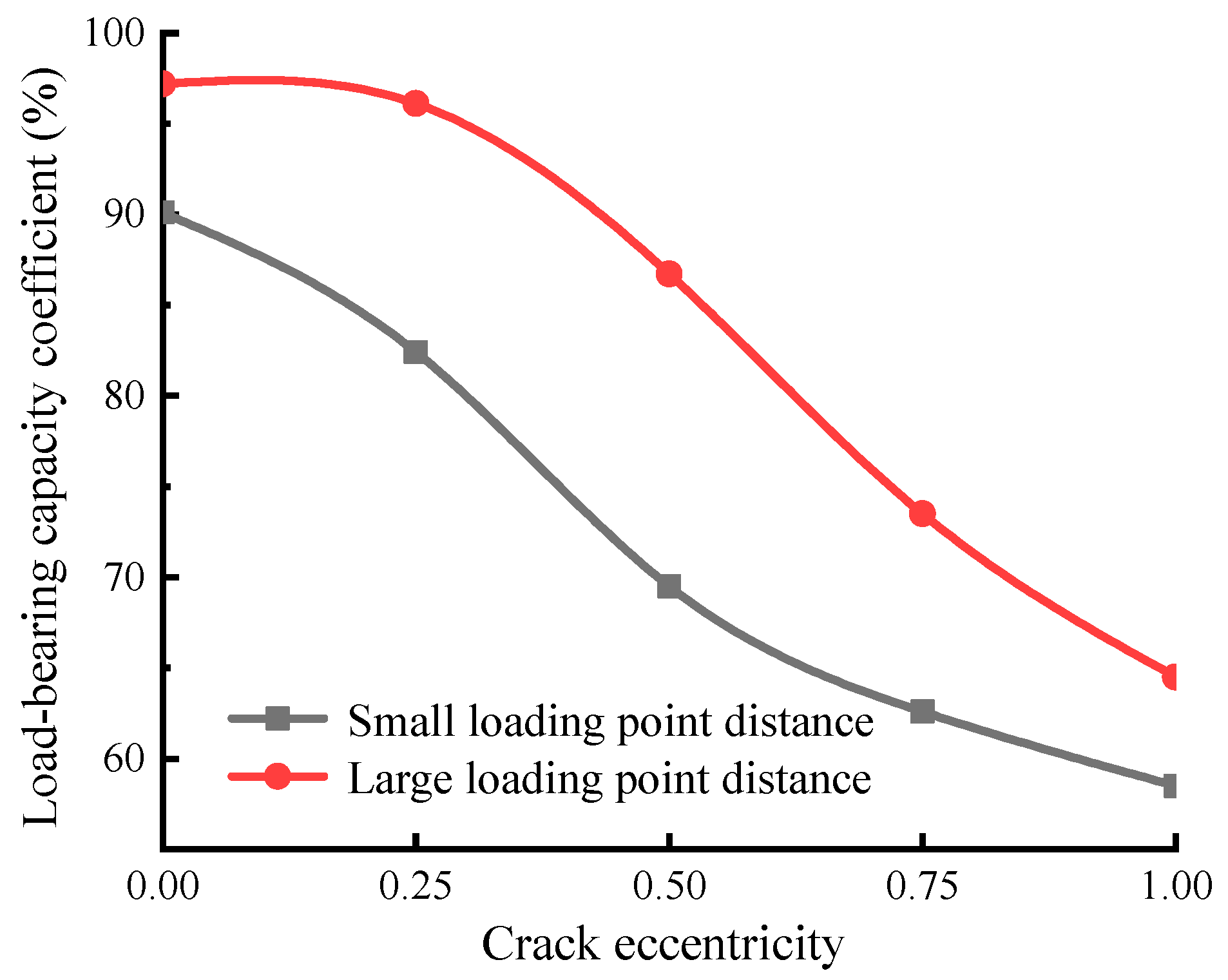
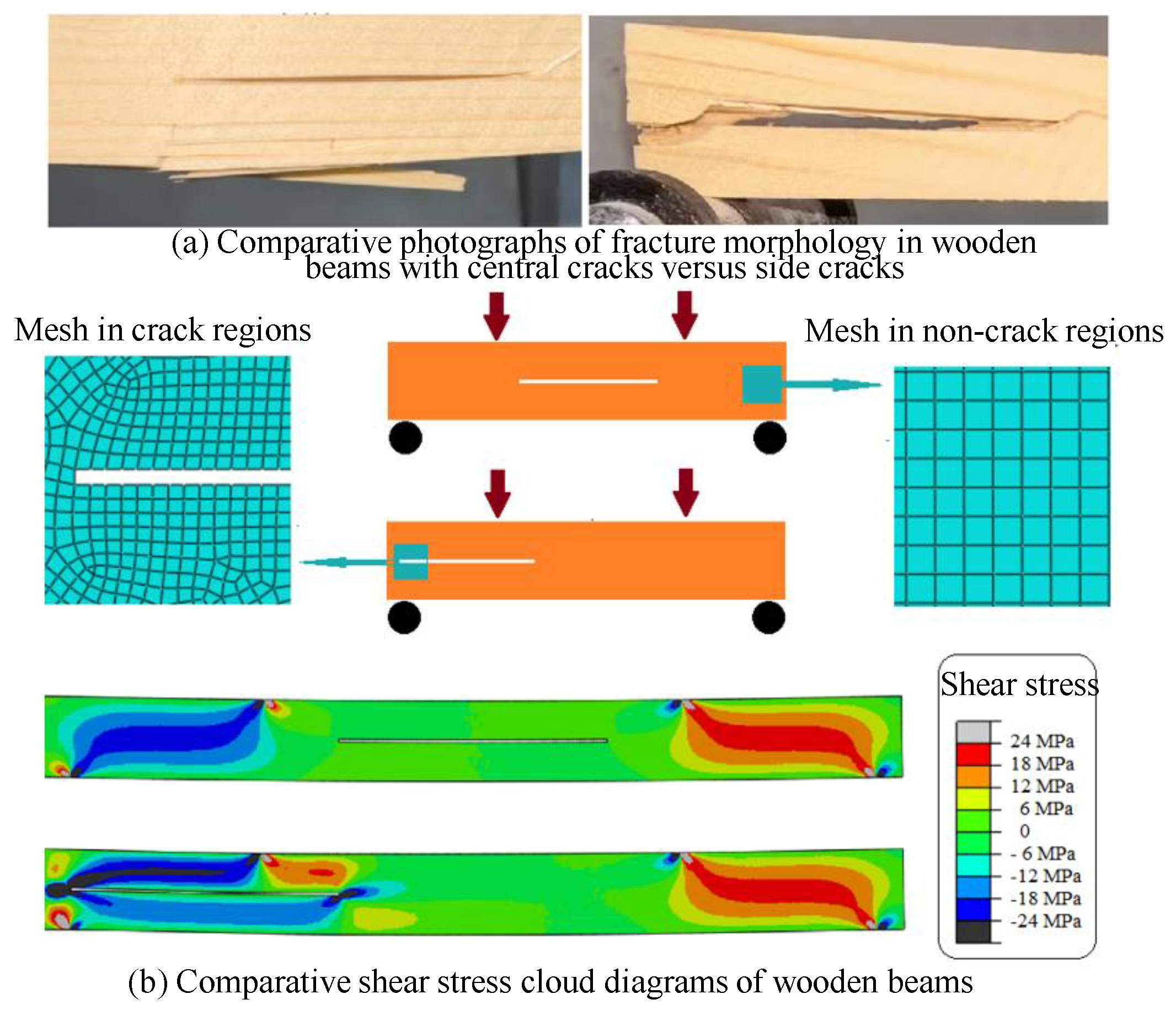
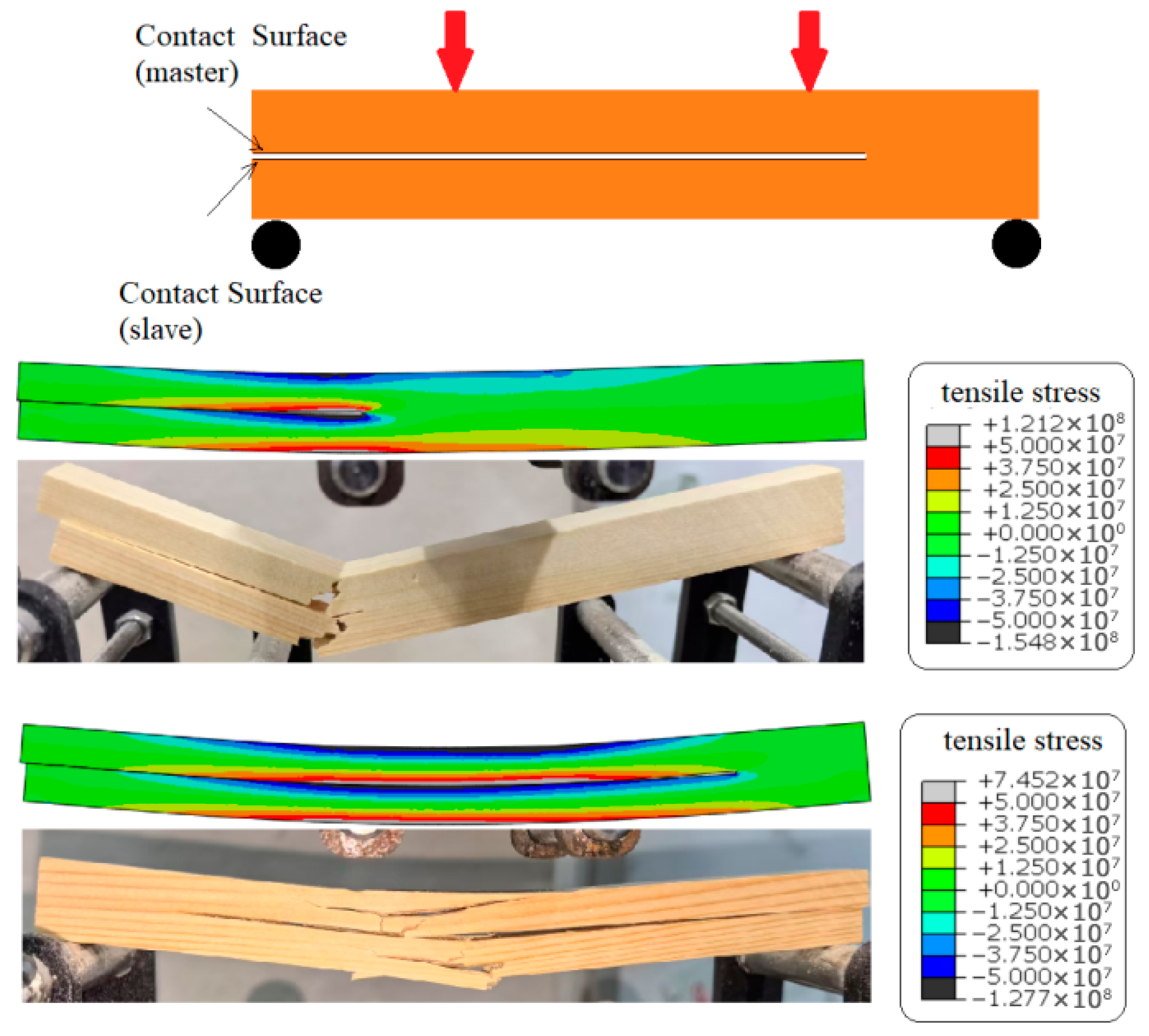
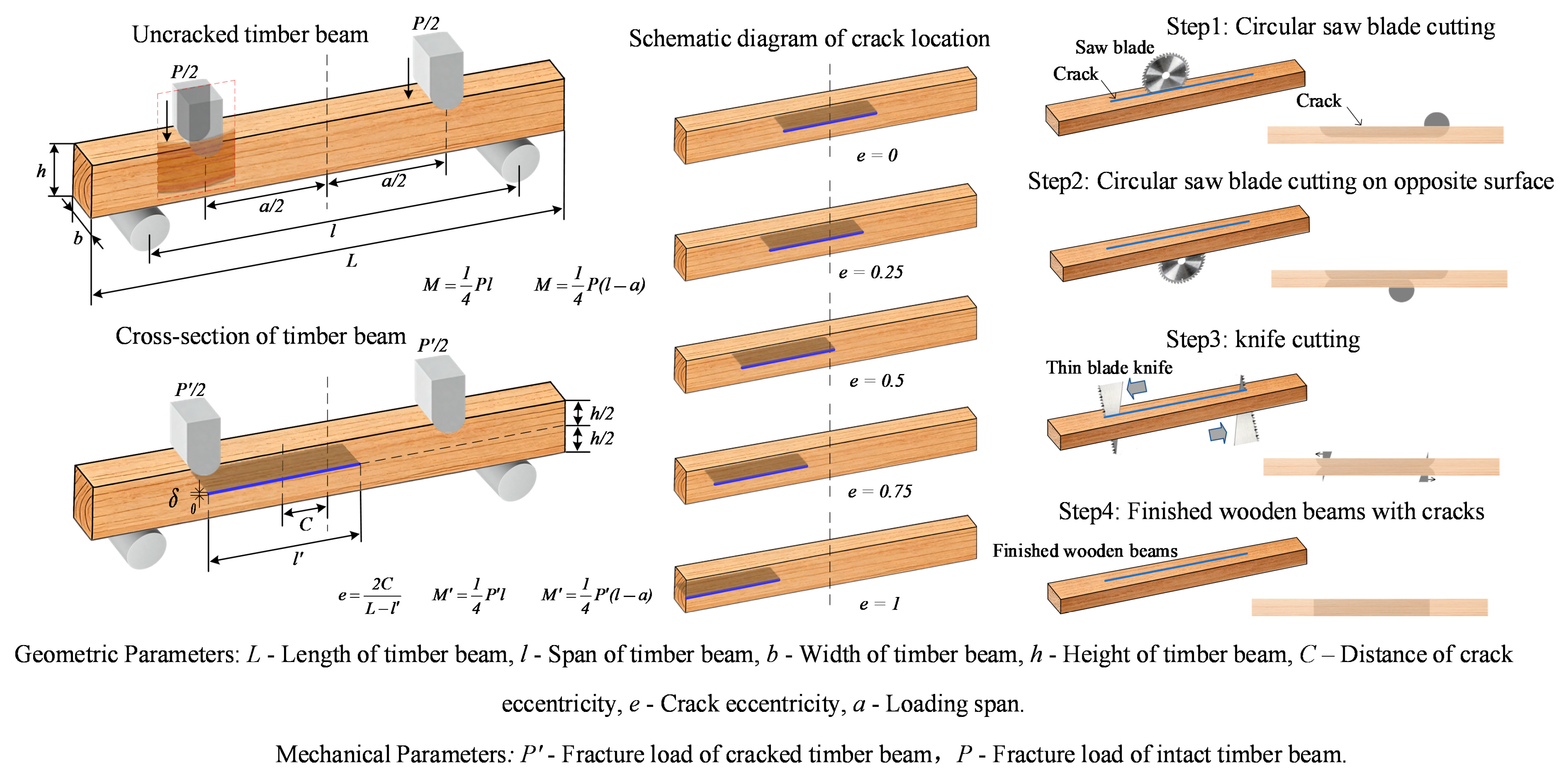
- A “critical eccentricity effect” exists for crack horizontal eccentricity, and its impact is significantly governed by the stress state. Under loading conditions with a large distance between loading points, when the crack is entirely within the pure bending region of the beam (e ≤ 0.25), the shear stress at the crack location is nearly zero, suppressing crack propagation. In this case, no significant reduction in load-bearing capacity is observed (R > 96%). Once the crack tip enters the shear-bending region (e > 0.25), shear stress drives crack propagation, leading to a sharp decline in load-bearing capacity at the transition point. This result indicates that the interaction between crack location and the structural stress field must be comprehensively considered when assessing crack risk.
- (2)
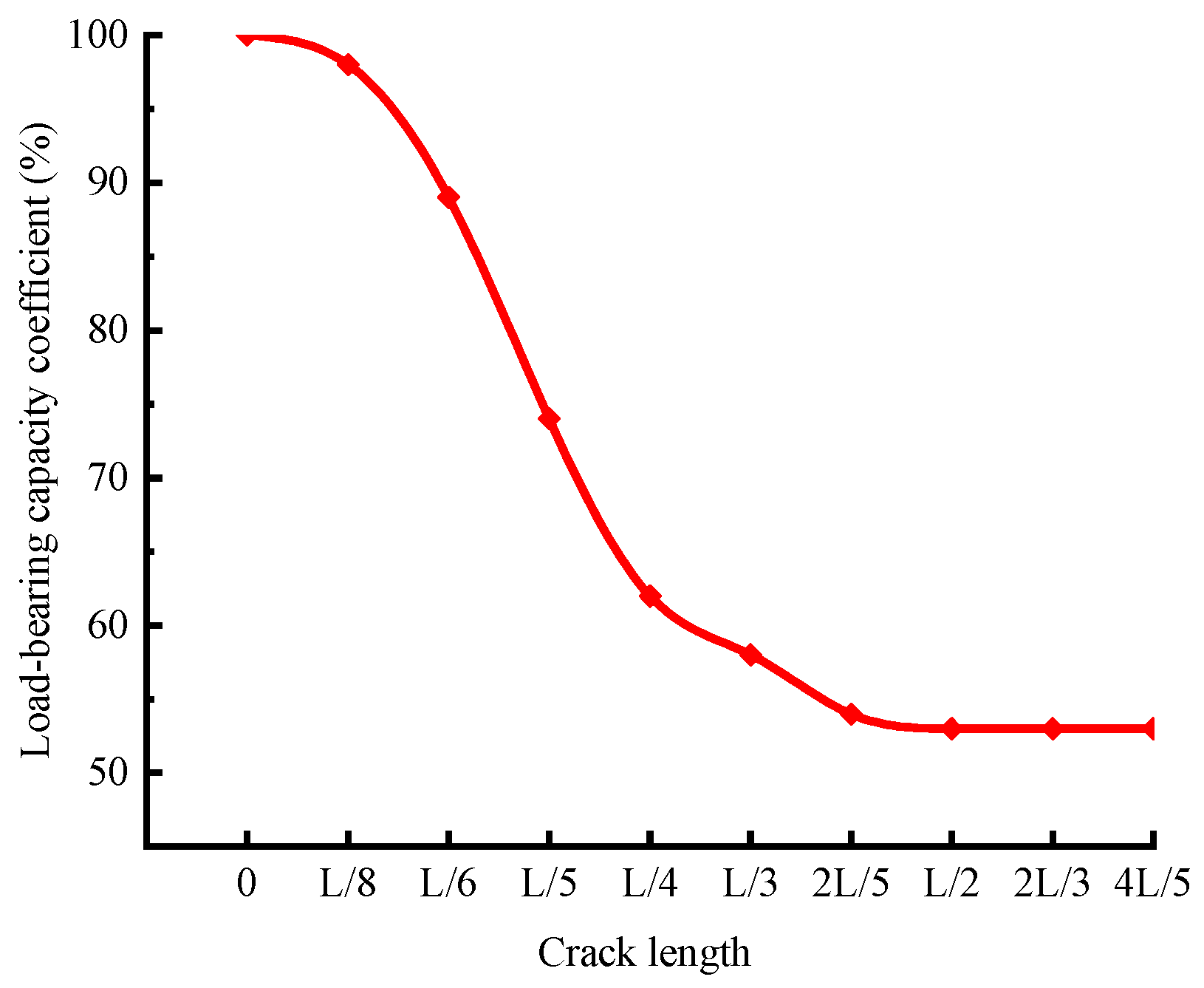
- The residual load-bearing capacity of side-open cracks (e = 1) decreases nonlinearly with increasing crack length and exhibits “damage saturation” characteristics. When the crack length does not exceed L/4, the load-bearing capacity is highly sensitive to crack length, declining rapidly. When the crack length is between L/4 and L/2 of the beam span, the rate of decline slows, entering a relatively stable plateau. Beyond L/2, the load-bearing capacity stabilizes, and further crack extension causes no significant weakening, indicating the occurrence of “damage saturation.” Statistical grouping results from Tukey HSD post hoc tests support this pattern: after the crack length reaches L/4, multiple long-crack groups show no statistically significant differences in load-bearing capacity (all belonging to Group C). Furthermore, when the crack extends to 2L/3, it is classified into Group D, indirectly supporting the persistence of “damage saturation” from a statistical perspective. This suggests the existence of a critical crack length beyond which further propagation no longer reduces the beam’s ultimate bending capacity.
- (3)
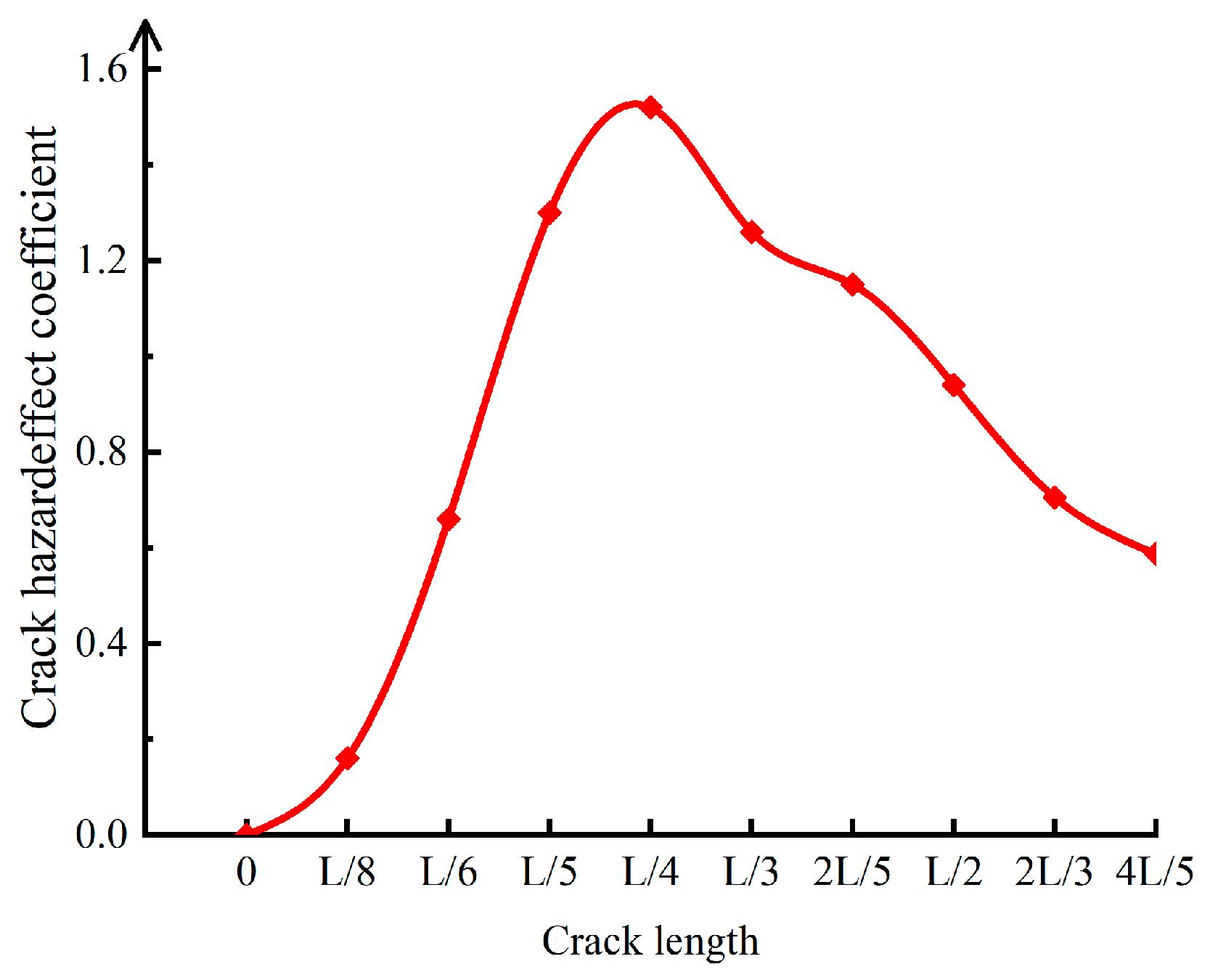
- The crack hazard efficacy coefficient (Λ) peaks at a crack length of approximately L/4, indicating that risk does not increase monotonically. At this length, although the crack is not the longest, its potential for propagation and its harmfulness in weakening load-bearing capacity is the highest, representing the most critical stage. Statistical analysis further confirms that the load-bearing capacity at a crack length of about L/4 is significantly different from that of groups with shorter cracks. Beyond this critical length, the hazard coefficient decreases because the load-bearing mechanism shifts to the independent capacities of the two segments formed by the crack.
Author Contributions
Funding
Data Availability Statement
Acknowledgments
Conflicts of Interest
Abbreviations
| AE | Acoustic emission |
| CV | Coefficient of variation |
| DIC | Digital image correlation |
| FE | Finite element |
References
- Estrella, X.; Guindos, P.; Almazán, J.L.; Malek, S. Efficient Nonlinear Modeling of Strong Wood Frame Shear Walls for Mid-Rise Buildings. Eng. Struct. 2020, 215, 110670. [Google Scholar] [CrossRef]
- Chakkour, T.; Perré, P. Developing the orthotropic linear-elastic model for wood applications using the FE method. Mater. Adv. 2024, 5, 7747–7765. [Google Scholar] [CrossRef]
- Zhan, T.; Jiang, J.; Lu, J.; Zhang, Y.; Chang, J. Temperature-Humidity-Time Equivalence and Relaxation in Dynamic Viscoelastic Response of Chinese Fir Wood. Constr. Build. Mater. 2019, 227, 116637. [Google Scholar] [CrossRef]
- Vidal-Sallé, E.; Chassagne, P. Constitutive Equations for Orthotropic Nonlinear Viscoelastic Behaviour Using a Generalized Maxwell Model Application to Wood Material. Mech. Time-Depend. Mater. 2007, 11, 127–142. [Google Scholar] [CrossRef]
- Majka, J.; Sydor, M. Analysis of Stress Development during Kiln Drying of Beech Timber. Eur. J. Wood Wood Prod. 2023, 81, 1189–1200. [Google Scholar] [CrossRef]
- Gril, J.; Jullien, D.; Bardet, S.; Yamamoto, H. Tree Growth Stress and Related Problems. J. Wood Sci. 2017, 63, 411–432. [Google Scholar] [CrossRef]
- Hu, X.Y.; Liu, Z.L.; Zhuang, Z. XFEM Study of Crack Propagation in Logs after Growth Stress Relaxation and Drying Stress Accumulation. Wood Sci. Technol. 2017, 51, 1447–1468. [Google Scholar] [CrossRef]
- Liu, H.C.; Wu, Y.; Li, A.Q.; Deng, Y. Analysis and Prospect of Restoration and Reinforcement Techniques for Cracked Wood Components of Ancient Buildings. Ind. Constr. 2023, 53, 29–44. [Google Scholar] [CrossRef]
- Han, X.; Zhou, H.B.; Huang, L.; Wang, S.Y.; Wang, W.B. Crack Types and Characteristics of Timber Members in Ancient Building in North China. Chin. J. Wood Sci. Technol. 2024, 38, 1–11. [Google Scholar] [CrossRef]
- Fang, H.; Sun, H.; Liu, W.; Wang, L.; Bai, Y.; Hui, D. Mechanical Performance of Innovative GFRP-Bamboo-Wood Sandwich Beams: Experimental and Modelling Investigation. Compos. Part B Eng. 2015, 79, 182–196. [Google Scholar] [CrossRef]
- Naychuk, A.Y. Estimation of Load-Bearing Capacity and Stiffness of Timber Beams with Through-Thickness Cracks. Adv. Mater. Res. 2013, 778, 361–368. [Google Scholar] [CrossRef]
- Halicka, A.; Ślósarz, S. Analysis of Behavior and Failure Modes of Timber Beams Prestressed with CFRP Strips. Compos. Struct. 2022, 301, 116171. [Google Scholar] [CrossRef]
- Zhang, B.; Xie, Q.; Xue, J. Study on the Flexural Behavior Evolution of Timber Beams with Natural Shrinkage Cracks in Historic Timber Structure. Structures 2025, 73, 108429. [Google Scholar] [CrossRef]
- Romanowicz, M.; Grygorczuk, M. The Effect of Crack Orientation on the Mode I Fracture Resistance of Pinewood. Int. J. Fract. 2024, 248, 27–48. [Google Scholar] [CrossRef]
- Qiu, L.P.; Zhu, E.C.; van de Kuilen, J.W.G. Modeling Crack Propagation in Wood by Extended Finite Element Method. Eur. J. Wood Wood Prod. 2014, 72, 273–283. [Google Scholar] [CrossRef]
- Nakao, T.; Susanti, C.M.E.; Yoshihara, H. Examination of the Failure Behavior of Wood with a Short Crack in the Radial–Longitudinal System by Single-Edge-Notched Bending Test. J. Wood Sci. 2012, 58, 453–458. [Google Scholar] [CrossRef]
- Tu, J.; Zhao, D.; Zhao, J.; Zhao, Q. Experimental Study on Crack Initiation and Propagation of Wood with LT-Type Crack Using Digital Image Correlation (DIC) Technique and Acoustic Emission (AE). Wood Sci. Technol. 2021, 55, 1577–1591. [Google Scholar] [CrossRef]
- Zlámal, J.; Mařík, R.; Vojáčková, B.; Cristini, V.; Brabec, M.; Praus, L.; Tippner, J. Elasto-Plastic Material Model of Green Beech Wood. J. Wood Sci. 2024, 70, 29. [Google Scholar] [CrossRef]
- Chi, X.; Tang, S.; Song, X.; Ren, Z.; Han, G.; Cheng, W.; Avramidis, S. Visible Dynamic Changes in the Mechanism of Water Evaporation Surface Formation during Wood Drying. Wood Sci. Technol. 2023, 57, 1061–1076. [Google Scholar] [CrossRef]
- Peng, S.; Qiao, Y.F.; Song, Y.; Xie, X.Q.; Yao, Y.K.; Jia, Y.S.; Wu, D.P. Study on Axial Compression Behavior of Pinus Sylvestris Var. Mongolica Splice Timber Columns. Case Stud. Constr. Mater. 2025, 23, e05452. [Google Scholar] [CrossRef]
- Li, Z.; Tao, X.; Zhao, Z.C.; Sun, H.Y.; Lei, Z. Mechanical Properties and Crack Propagation for Camphor Pine during Compression Process. Forg. Stamp. Technol. 2024, 49, 87–93. [Google Scholar] [CrossRef]
- Bazant, Z.P.; Ohtsubo, H.; Aoh, K. Stability and post-critical growth of a system of cooling or shrinkage cracks. Int. J. Fract. 1979, 15, 443–456. [Google Scholar] [CrossRef]
- Xiong, L.M.; Xing, X.F.; Lin, L.Y.; Zhou, Y.D.; Fu, F. Effects of High-Field-Intensity Microwave Treatment on Macroscopic Cracks in Mongolian Scotch Pine. China Wood Ind. 2020, 34, 1–4. [Google Scholar] [CrossRef]
- Toivanen, M.; Pajunen, S.; Emre Ilgın, H. Effect of Cracks on the Load-Carrying Capacity of Glulam. Wood Mater. Sci. Eng. 2025, 1–8. [Google Scholar] [CrossRef]
- Zhou, L.; Hu, X.; Liu, H.; Hou, X.A. Multi-model collaborative finite element approach for service-state analysis of timber components. BioResources 2026, 21, 1497–1514. [Google Scholar] [CrossRef]
- Jiang, Y.M.; Song, X.B.; Gu, X.L.; Wang, M.Q.; Shang, S.S. Experimental Study and Numerical Simulation on Flexural Behaviour of Longitudinally Cracked Wood Beams. In Proceedings of the 2015 International Conference on Electrical, Automation and Mechanical Engineering, Phuket, Thailand, 26–27 July 2015; Atlantis Press: Phuket, Thailand, 2015; pp. 675–679. [Google Scholar]




| a | M/ (g) | L/ (mm) | b/ (mm) | h/ (mm) | l′ | ρ1/ (kg·m−3) | ρ/ (kg·m−3) | Cρ | CW | P′/ (N) | M′/ (N·m) | Me′/ (N·m) |
|---|---|---|---|---|---|---|---|---|---|---|---|---|
| 4l/15 | 11.3 | 160 | 10.0 | 15.0 | L/2 | 471 | 479 | 0.996 | 1.000 | 946 | 26.5 | 26.4 |
| l/2 | 12.32 | 160.1 | 10.1 | 15.2 | 2L/3 | 501 | 512 | 0.932 | 0.964 | 1502 | 28.2 | 25.3 |
| Constitutive Parameters | ER (MPa) | ET (MPa) | EL (MPa) | GRL (MPa) | GRT (MPa) | GTL (MPa) | RT | RL | TL | σb (MPa) |
|---|---|---|---|---|---|---|---|---|---|---|
| Values | 800 | 400 | 10,000 | 620 | 70 | 540 | 0.6 | 0.03 | 0.03 | 60 |
| CV | 3.73% | 4.61% | 6.08% | 5.09% | 10.84% | 7.03% | 8.65% | 4.89% | 14.7% | / |
| a | Sample Size | Average Fracture Load/(N) | Equivalent Fracture Moment Value/(N·m) | |||
|---|---|---|---|---|---|---|
| Average/(N·m) | Max/(N·m) | Min/(N·m) | CV/% | |||
| 4l/15 | 60 | 1026 | 28.4 | 38.8 | 14.4 | 16.6 |
| l/2 | 60 | 1323 | 25.6 | 50.1 | 14.8 | 21.0 |
| e | a | Sample Size | Equivalent Fracture Moment Value/(N·m) | R/% | Λ | |||
|---|---|---|---|---|---|---|---|---|
| Average/(N·m) | Max/(N·m) | Min/(N·m) | CV/% | |||||
| 0 | 4l/15 | 60 | 25.6 | 32.6 | 18.9 | 15.5 | 90.1% | 0.297 |
| l/2 | 60 | 24.9 | 33.1 | 16.3 | 16.0 | 97.2% | 0.084 | |
| 0.25 | 4l/15 | 40 | 23.4 | 30.8 | 16.2 | 15.2 | 82.4% | 0.528 |
| l/2 | 40 | 24.6 | 36.2 | 19.7 | 13.1 | 96.1% | 0.117 | |
| 0.5 | 4l/15 | 40 | 19.8 | 30.4 | 13.7 | 16.5 | 69.5% | 0.915 |
| l/2 | 40 | 22.2 | 31.6 | 14.9 | 14.4 | 86.7% | 0.399 | |
| 0.75 | 4l/15 | 40 | 17.8 | 25.8 | 5.9 | 21.3 | 62.6% | 1.122 |
| l/2 | 40 | 18.8 | 23.3 | 14.6 | 10.9 | 73.5% | 0.795 | |
| 1 | 4l/15 | 60 | 16.6 | 24.6 | 10.8 | 17.8 | 58.5% | 1.245 |
| l/2 | 40 | 16.5 | 22.7 | 11.7 | 14.8 | 64.5% | 1.065 | |
| Crack Length | Sample Size | Equivalent Fracture Moment Value/(N·m) | R/% | Λ | TukeyHSD α = 0.05 | |||
|---|---|---|---|---|---|---|---|---|
| Average/(N·m) | Max/(N·m) | Min/(N·m) | CV/% | |||||
| L/8 | 40 | 27.91 | 36.47 | 20.98 | 12.65 | 98% | 0.16 | A |
| L/6 | 40 | 25.47 | 37.35 | 17.74 | 16.93 | 89% | 0.66 | B |
| L/5 | 40 | 21.18 | 32.59 | 13.89 | 23.93 | 74% | 1.30 | B |
| L/4 | 40 | 17.82 | 24.26 | 12.60 | 26.54 | 62% | 1.52 | C |
| L/3 | 60 | 16.61 | 24.59 | 10.81 | 17.83 | 58% | 1.26 | CD |
| 2L/5 | 40 | 15.48 | 21.51 | 8.77 | 19.46 | 54% | 1.15 | CD |
| L/2 | 40 | 15.15 | 25.22 | 7.87 | 24.47 | 53% | 0.94 | CD |
| 2L/3 | 40 | 15.07 | 25.05 | 8.69 | 20.34 | 53% | 0.71 | D |
| 4L/5 | 40 | 15.21 | 20.19 | 6.79 | 24.70 | 53% | 0.59 | CD |
Disclaimer/Publisher’s Note: The statements, opinions and data contained in all publications are solely those of the individual author(s) and contributor(s) and not of MDPI and/or the editor(s). MDPI and/or the editor(s) disclaim responsibility for any injury to people or property resulting from any ideas, methods, instructions or products referred to in the content. |
© 2026 by the authors. Licensee MDPI, Basel, Switzerland. This article is an open access article distributed under the terms and conditions of the Creative Commons Attribution (CC BY) license.
Share and Cite
Zhou, L.; Hu, X.; Liu, D.; Li, S.; Liu, H.; Hou, X. Influence of Cracks at the Middle-Height Layer Position on the Load-Bearing Capacity of Timber Beams: A Study Based on Small-Sized Specimens and a Large Sample Size. Buildings 2026, 16, 650. https://doi.org/10.3390/buildings16030650
Zhou L, Hu X, Liu D, Li S, Liu H, Hou X. Influence of Cracks at the Middle-Height Layer Position on the Load-Bearing Capacity of Timber Beams: A Study Based on Small-Sized Specimens and a Large Sample Size. Buildings. 2026; 16(3):650. https://doi.org/10.3390/buildings16030650
Chicago/Turabian StyleZhou, Le, Xiaoyi Hu, Dalie Liu, Sishi Li, Hongchao Liu, and Xin Hou. 2026. "Influence of Cracks at the Middle-Height Layer Position on the Load-Bearing Capacity of Timber Beams: A Study Based on Small-Sized Specimens and a Large Sample Size" Buildings 16, no. 3: 650. https://doi.org/10.3390/buildings16030650
APA StyleZhou, L., Hu, X., Liu, D., Li, S., Liu, H., & Hou, X. (2026). Influence of Cracks at the Middle-Height Layer Position on the Load-Bearing Capacity of Timber Beams: A Study Based on Small-Sized Specimens and a Large Sample Size. Buildings, 16(3), 650. https://doi.org/10.3390/buildings16030650