Article

Dynamic Responses of Steel-Framed Subassemblies Under Falling Debris Impact on Mid-Span of Steel Beam


1
Tianjin Key Laboratory of Civil Structure Protection and Reinforcement, Tianjin Chengjian University, Tianjin 300384, China
2
School of Civil Engineering, Tianjin Chengjian University, Tianjin 300384, China
3
College of Water Conservancy Engineering, Tianjin Agricultural University, Tianjin 300392, China
4
School of Civil Engineering, Tianjin University, Tianjin 300350, China
*
Authors to whom correspondence should be addressed.
Buildings 2026, 16(3), 581; https://doi.org/10.3390/buildings16030581
Submission received: 1 December 2025 / Revised: 24 January 2026 / Accepted: 25 January 2026 / Published: 30 January 2026
(This article belongs to the Section Building Structures)

Abstract

Falling debris impact from damaged upper structures is a key cause of building progressive collapse, yet relevant research lags behind that on column removal scenarios. This study uses ANSYS/LS-DYNA 16.0 to simulate the dynamic responses of steel-framed subassemblies with five typical beam–column connections under debris impact, with the finite element model validated by drop hammer tests and showing good agreement with the experimental results. Parametric analyses are conducted to explore the effects of the impact velocity, impactor mass, impact energy, and horizontal restraint on structural responses. The results show that under the same impact energy, the velocity and mass significantly affect the maximum impact force but barely the stable-stage force and maximum displacement; horizontal restraint exerts negligible effects at a low impact energy while a single horizontal restraint markedly impairs impact resistance at high energy. These findings are clarified via energy conservation, momentum theorem, and anti-collapse mechanisms. The study’s originality lies in systematically investigating the dynamic responses of the five subassemblies, deriving quantitative relationships between the impact parameters and impact force, duration, and horizontal restraint. It provides theoretical and technical support for anti-progressive collapse building design.

1. Introduction

After the September 11 attacks on the World Trade Center, research on the progressive collapse resistance of building structures has emerged as a global focus and a challenging topic in academic circles. To mitigate the risk of progressive collapse in building structures, the Alternate Path Method (APM) has been recommended for the progressive collapse-resistant design of structures by several codes and specifications, including those of GSA [1], DoD [2], and CECS [3]. In general, beam–column connections tend to be relatively weak points in structural systems, which play a crucial role in maintaining structural stability.
To investigate the mechanical behavior of beam–column connections in steel-framed structures, researchers such as Lew et al. [4], Sadek et al. [5], Yang et al. [6,7,8], Zhong et al. [9], Tan et al. [10], and Zong [11] have conducted a series of quasi-static tests on connections of various types. These connections include Welded Unreinforced Flange-Bolted web connections (WUF-B), Reduced Beam Section connections (RBS), angle steel connections, fin plate connections, end-plate connections, and modular connections.
Since progressive collapse is a dynamic process, relevant researchers have designed various loading methods to account for the influence of dynamic effects. Liu et al. [12] adopted the sudden column removal method to investigate the dynamic response of angle connections, analyzing the dynamic mechanical behavior of the connections through the force and displacement time history curves obtained from the tests. Tyas et al. [13] developed an experimental setup for high-rate loading using a high-pressure air pump, and Stoddart et al. [14] utilized this setup to study the dynamic response and failure of flexible connections under high strain rate conditions. The third method involves impact loading on structural specimens using a drop hammer test machine. Grimsmo et al. [15], Huo et al. [16], Chen et al. [17], and Wang et al. [18], respectively, designed drop hammer impact tests to analyze the dynamic response, energy absorption capacity, failure modes, and evaluation methods of varying connections.
If the remaining structure is unable to withstand the load redistribution after the failure of beam-to-column connections, the structural members above the failed region will collapse downward. The impact effect, i.e., the falling debris impact, imposed on the underlying structure is a crucial factor leading to progressive collapse. Kiakojouri et al. [19] noted that most existing studies on progressive collapse are carried out based on the column removal assumption, while research on impact-type collapse remains relatively limited. Consequently, relevant researchers have investigated the impact-type collapse behavior of frame structures under the falling debris impact. Wang et al. [20,21,22] and Wang et al. [23] conducted drop hammer impact tests to investigate the progressive collapse of steel frames and steel composite frames under the falling debris impact, and proposed a simplified calculation method for evaluating the impact response of steel frame substructures. However, the differences in mechanical properties of various beam-to-column connection types under the falling debris impact, as well as the analysis of more influencing factors, have not been fully studied, leaving room for further in-depth exploration.
Based on the research gaps on framed structures under the falling debris impact, the central research issues of this study are explicitly defined as follows: ① Are there significant differences in the dynamic responses (impact force, displacement, duration) and progressive collapse-resistant force mechanisms of steel-framed subassemblies with five typical beam–column connections (WUF-B, RBS, FP, RCC-F, RCC-E) under the falling debris impact on the mid-span of the beam? ② Under the same impact energy, how do the coupled effects of the impact parameters (mass, velocity) quantitatively affect the maximum impact force and impact duration of the structure? ③ Does the influence of horizontal constraint conditions on the impact-resistant performance of the structure depend on the impact energy, and what is its intrinsic mechanism? This study specifically addresses the above issues through experimentally validated finite element models, systematic parametric analyses, and theoretical derivations. Based on the progressive collapse resistance mechanism and mechanical theories, the variation law of dynamic response is discussed, providing a reliable theoretical basis and technical support for enhancing the progressive collapse resistance of building structures.

2. Brief Introduction to Drop Hammer Impact Tests

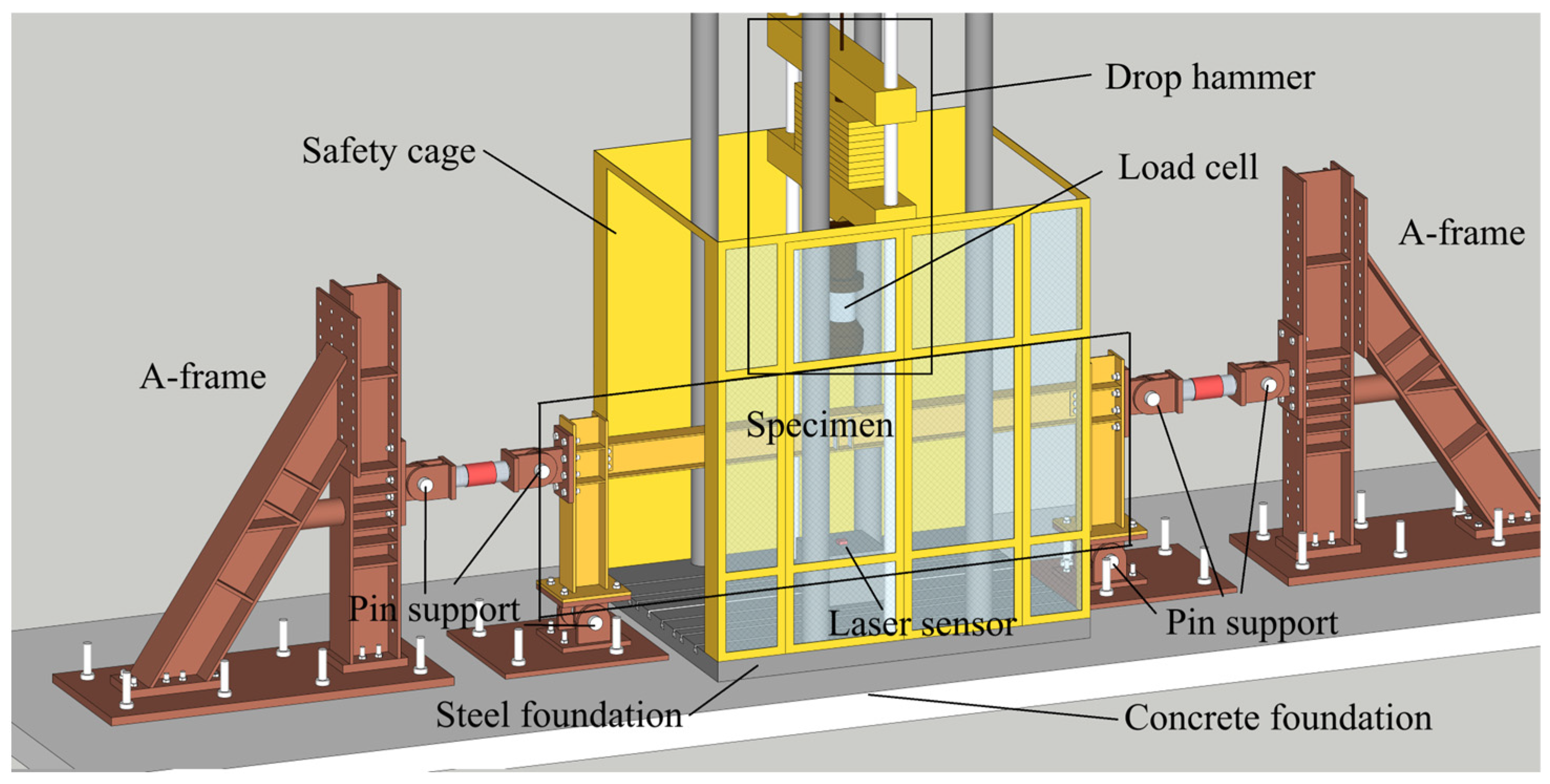
To investigate the dynamic response of steel-framed subassemblies subject to the falling debris impact, the impact test assumes that the structural floors above the specimen suffer severe damage under accidental loads and generate a downward falling debris impact. The test setup is illustrated in Figure 1. Horizontal constraints at both ends of the specimen are provided by “A”-framed supports to simulate the surrounding undamaged structural components. The column bases are connected to the rigid floor via hinged supports. Impact loads are applied using a high-performance drop hammer impact test machine.
In the drop hammer impact test, the impact force data were collected by a type 9393AU0109 load cell (Kistler Instrumente, Winterthur, Switzerland) installed on the drop hammer head. The load cell has a measuring capacity of 950 kN and a force measurement accuracy of ±0.5%. The vertical displacement at the mid-span of the beam was measured by a type HG-C1400 laser distance sensor (Panasonic, Osaka, Japan) with a measuring capacity of 400 mm and a displacement accuracy of ±0.3%. The SIRIUS STG (Dewesoft, Trbovlje, Slovenia) data acquisition system was employed to record the impact force and vertical displacement data. The sampling frequency of the impact force data was set at 100 kHz to ensure the ability to capture the rapid variation in instantaneous force during the impact process. The sampling frequency of the vertical displacement data was configured to 100 kHz as well. This enables time synchronization with the force sensor data, thus guaranteeing the correlation and accuracy of the time–force curves and displacement–time curves.
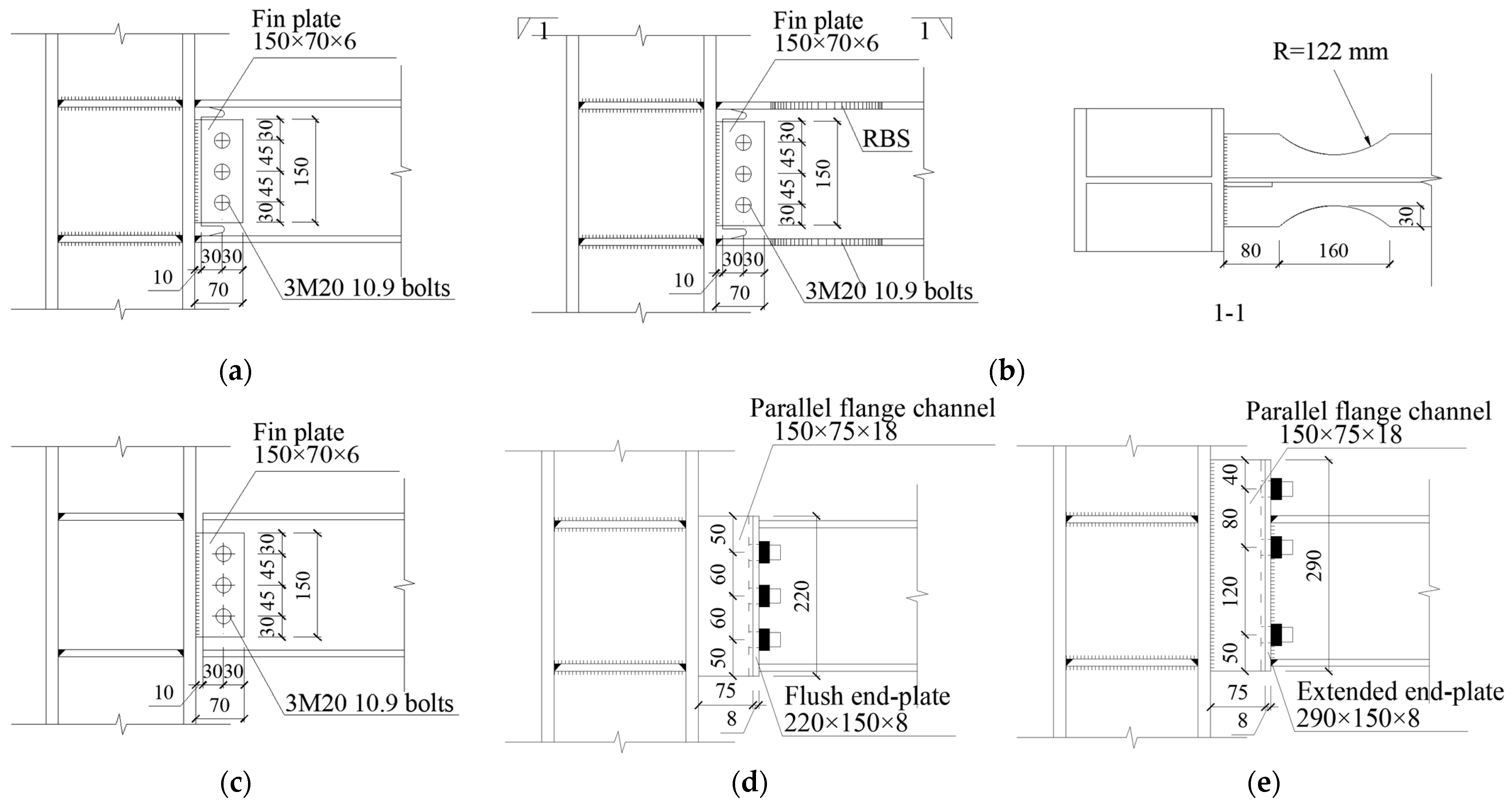
Five typical beam–column connection types are selected in this study, and their selection basis and engineering representativeness are as follows: ① The WUF-B connection (Welded Unreinforced Flange-Bolted Web connection) is representative of traditional high-strength connections in steel frame structures.; ② the RBS connection (Reduced Beam Section connection) guides the formation of plastic hinges through preset weakened sections, which is a typical seismically optimized connection and widely applied in buildings in high seismic risk areas; ③ the FP connection (fin plate connection) belongs to simple connections and is commonly used in light and medium-load steel frames due to its simple structure and low cost; ④ the RCC-F connection (Reversed Channel Connection with Flush end-plate) and RCC-E connection (Reversed Channel Connection with Extended end-plate) are newer-type connections in steel buildings [24]. They facilitate the connection between steel beams and circular steel tube columns, box-section columns, or H-section steel columns. The connection can be designed as a semi-rigid connection or a simple connection as required.
They improve the stiffness and ductility of the connection through the combination of channel steel and end-plate, adapting to the rapid construction needs of prefabricated buildings. The above five connection types cover typical categories of traditional and new-type, rigid, semi-rigid and simple, conventional design, and seismic optimization. Their differences in mechanical properties can fully reflect the impact-resistant performance of steel frames with different connections in practical engineering, ensuring the universality and engineering application value of the research conclusions.
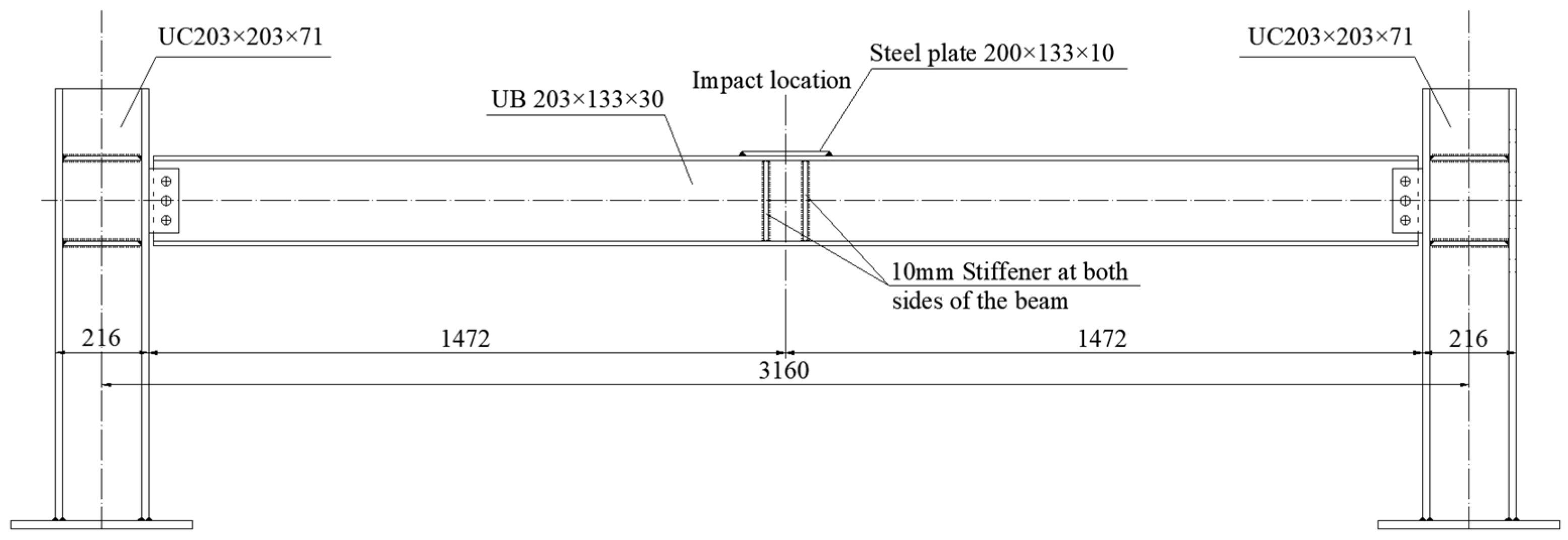
The specimen and impact load parameters are presented in Table 1, while the detailed dimensions of the steel-framed subassemblies and the five beam–column connection types are illustrated in Figure 2 and Figure 3.
All specimens have a column centerline span of 3160 mm. The cross-sectional dimensions of the steel beams and columns are UB 203 × 133 × 30 and UC 203 × 133 × 71, respectively. A steel plate and stiffeners were welded at the mid-span of the beam to restrict local out-of-plane deformation and torsion. The WUF-B, RBS, and FP connections all use 6 mm thick fin plates, while the RCC-F and RCC-E connections adopt PFC 150 × 75 × 18 channel sections and 8 mm thick end-plates.
S355 steel was used for the steel beams and columns of all specimens, and S275 steel was employed for other components of the specimens, including fin plates, end-plates, and channels. All specimens were fastened with M20 bolts of grade 10.9.

3. Finite Element Modelling and Validation

3.1. Establishment of Model

A finite element model was established using the general-purpose finite element program ANSYS/LS-DYNA to simulate the dynamic behavior of steel-framed subassemblies with different connection types under impact loads. The explicit dynamic solver of ANSYS/LS-DYNA can effectively avoid the convergence difficulties encountered in implicit analysis, making it highly suitable for solving complex nonlinear problems involving contact, large deformations, and material fracture.
The fundamental elements of the model adopt 8-node solid elements Solid 164. To improve computational efficiency, a reduced integration algorithm combined with hourglass control is employed to ensure the validity of the results. A mesh size of 40 mm was adopted for elements in the non-critical regions of the model. For critical regions, such as beam–column joints and large-deformation zones including the impact-receiving area, mesh refinement was performed. To determine the optimal mesh size for critical regions, trial calculations were conducted using mesh sizes of 40 mm, 20 mm, 10 mm, and 5 mm, respectively, with the corresponding calculated maximum impact forces being 636.3 kN, 583.6 kN, 564.7 kN, and 562.7 kN.
The results of the trial calculations indicate that the influence of reducing the element size in critical regions on the maximum impact force shows a decreasing trend. Specifically, when the element size in critical regions is reduced from 40 mm to 20 mm and then from 20 mm to 10 mm, the maximum impact force decreases by 8.3% and 3.2%, respectively. This is attributed to the fact that smaller-sized elements can more accurately capture the local contact stress distribution at the instant of impact. In contrast, when the element size is reduced from 10 mm to 5 mm, the variation in the maximum impact force is minimal, with a reduction of only 0.4%, indicating that the mesh discretization error is negligible at this point. Consequently, an element size of 10 mm was ultimately selected for the critical regions.
An elastoplastic model is used to simulate the uniaxial stress–strain curves of steel under static loading conditions. As steel is a typically strain rate-sensitive material, its yield strength increases with the rise in the strain rate. Therefore, the Cowper–Symonds strain rate model is adopted to account for the Dynamic Increase Factor (DIF) [25] of the yield stress of steel.
D I F = 1 + ( ε ˙ C ) 1 / p
where ε ˙ is the strain rate, and C and p are the Cowper–Symonds strain rate parameters. In this paper, the values of C and p for the steel material are set as 6844 s−1 and 3.91 according to Abramowicz and Jones [26] via drop weight impact tests, which were employed to match the force–displacement and energy absorption characteristics during the impact process. Since then, these parameters have been adopted and validated in a number of experimental and numerical simulation studies pertaining to low-velocity impact on steel structures [21,27,28,29].
The core reasons for selecting the 8-node solid element Solid164 in this model according to the LS-DYNA Keyword User’s Manual [30] and Schmied and Erhart [31] are as follows: ① Adaptability advantage: The Solid164 element supports the accurate coupling of the elastoplastic constitutive model and strain rate effect (Cowper–Symonds model), and its three-dimensional stress state solving capability can fully capture the complex mechanical responses (coupling of bending, axial force, and shear) of steel-framed subassemblies under impact loads, which is highly consistent with the characteristics of impact load; ② Limitations of shell elements: Shell elements are based on thin-plate theory, which can only accurately simulate in-plane force and bending deformation, but cannot effectively characterize the three-dimensional local shear deformation and stress gradient along the thickness direction in the mid-span of the beam and joint regions. However, the falling debris impact is a local concentrated load, which is prone to shear-dominated damage at the impact point and joint domains; ③ Necessity for simulating local shear: The Solid164 element can accurately calculate shear stress and shear strain through full integration (combined with hourglass control), especially capturing the local shear concentration phenomena in key regions such as the beam flange–web connection area and around bolt holes—shear failure in these regions is a core factor affecting the progressive collapse resistance of the structure, and the three-dimensional modeling capability of solid elements is crucial to ensure the accuracy of simulating such local responses.
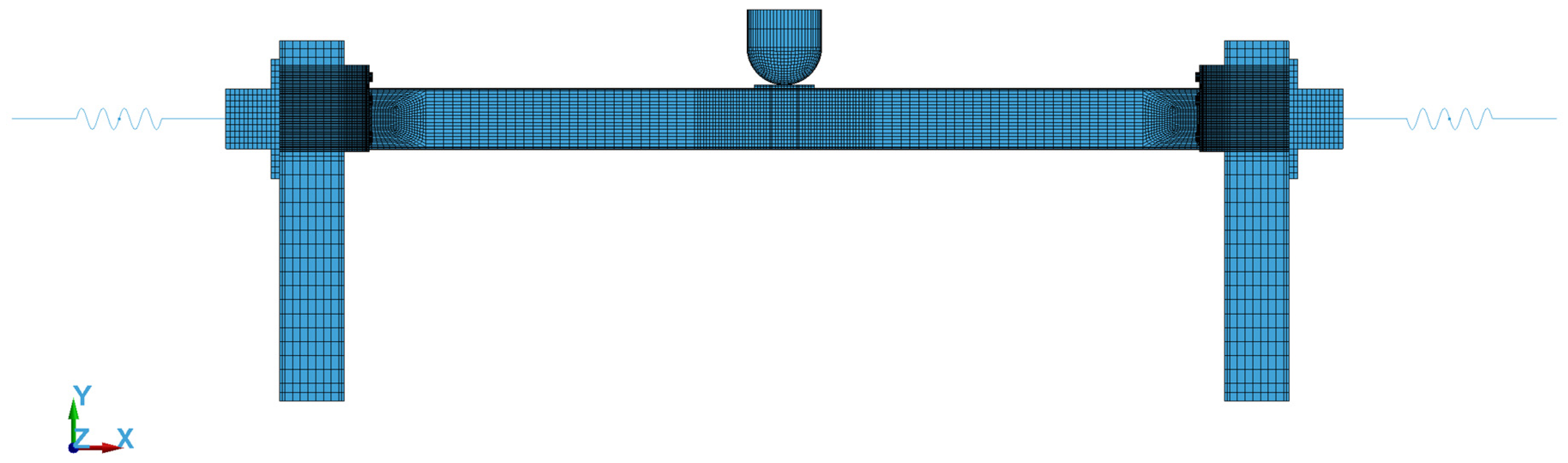
To improve the computational efficiency of the finite element model, the boundary conditions in the test were reasonably simplified. Ideal hinges were used at the column bases to replace the original hinged devices composed of one steel cylinder and two supports in the test. Link elements were adopted at both ends of the specimen to substitute the relatively complex horizontal bracing system in the test.
Instead of establishing a complete drop hammer with the same geometric dimensions as the test machine, only the spherical hammer head was retained in the model. The dynamic responses of the impact process, viz., the impact force, displacement, energy absorption, and stress distribution at the impact point and duration, are primarily determined by the total mass, impact velocity, and contact surface of the drop hammer [21,32,33]. In the model, the material density of the hammer head was adjusted to ensure that its total mass was consistent with that of the complete drop weight used in the experiment. Meanwhile, the initial impact velocity of the drop weight in the model was set to match the impact velocity of the drop weight in the experiment, which guaranteed the accuracy of the impact kinetic energy and momentum. The spherical shape of the hammer head in the model was identical to that of the drop weight hammer head in the experiment, thus avoiding the deviation in the impact force peak caused by changes in the contact conditions. This simplification method has been adopted in a number of studies related to drop hammer impact [21,32,33], and the consistency between its simulation results and experimental data has verified the reliability of this simplification.
In the finite element simulation, the material density of the hammer head was set to ensure that the mass of the drop hammer in the model was consistent with that in the test. To further enhance computational efficiency, the drop hammer was placed very close to the impacted area of the specimen, and its initial velocity was set according to the actual impact velocity in the test. The finite element model is illustrated in Figure 4.

3.2. Model Validation

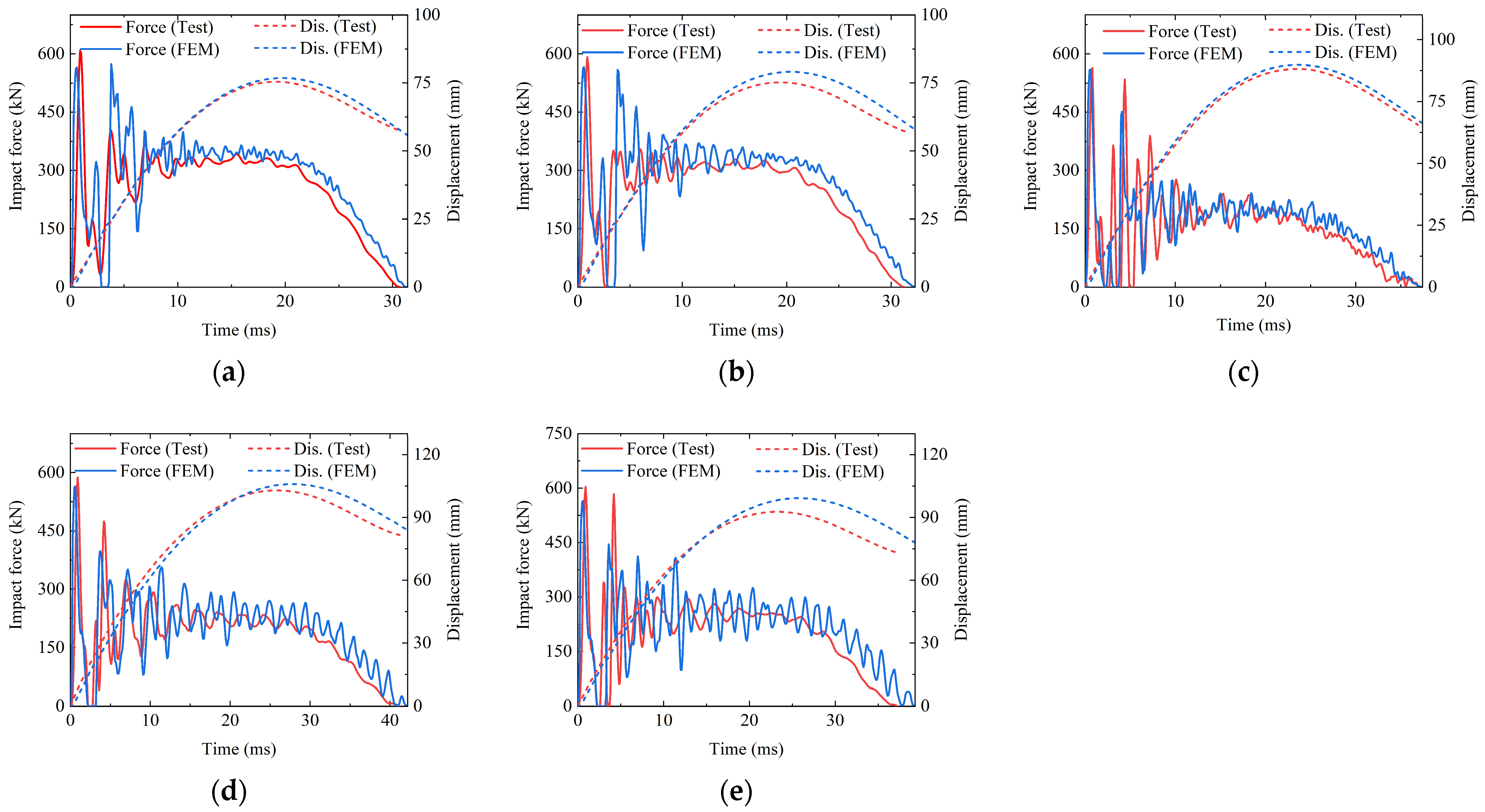
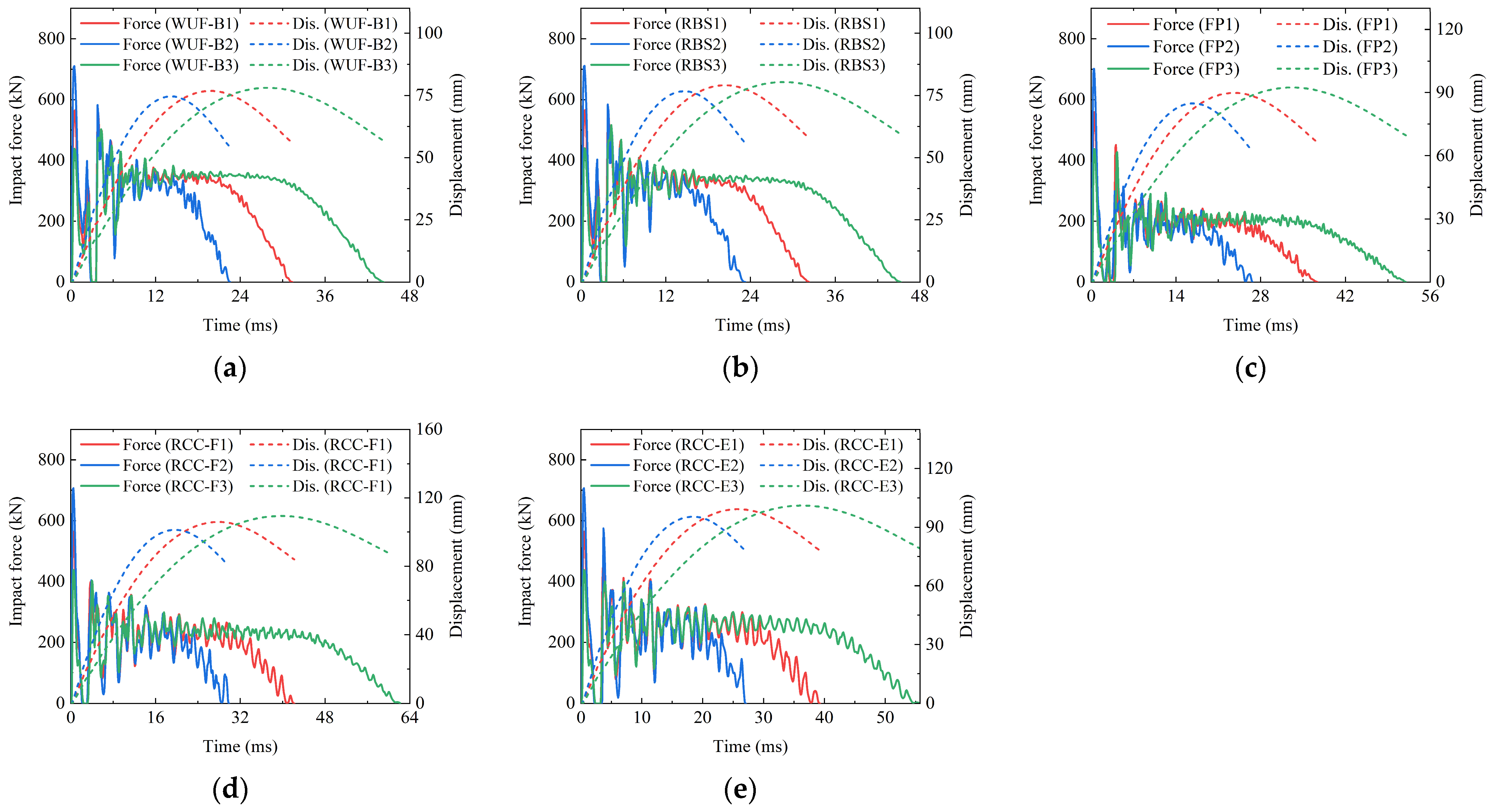
The test results of steel-framed subassemblies with different connection types under impact loads [20] were used to validate the accuracy of the finite element model calculations. Figure 5 presents a comparison of the impact force time history curves and the mid-span vertical displacement time history curves. Table 2 compares four key parameters during the impact process—namely, the maximum impact force Fmax, quasi-static load FP, maximum vertical displacement δmax, and impact duration t—between the test results and numerical simulation results, and provides the errors and RMSE between the two sets of results. The quasi-static load was calculated using Izzuddin’s energy method [34] based on the impact force–displacement relationship of the specimens. For all five specimens, the time history curves obtained from the finite element simulations are in good agreement with the experimental results. The average errors of the maximum impact force, quasi-static load, maximum vertical displacement, and impact duration are −4%, 8%, 4%, and 3%, respectively, and the root mean square errors (RMSEs) are 30.2 kN, 21.4 kN, 3.8 mm, and 1.2 ms, respectively. The above analysis demonstrates that the finite element model established in this study can reasonably and effectively simulate the dynamic responses of steel frames under impact loads.

4. Parametric Analysis

To further clarify the influences of factors such as the drop hammer mass, impact velocity, and horizontal constraints on the impact response of steel-framed subassemblies, a series of parametric analyses of steel frames under impact were conducted using the validated finite element model. Cases 1, 2, and 3 are designed to compare the effects of the drop hammer mass and impact velocity under the condition of constant impact energy. Specifically, Case 1 corresponds to the finite element results of the impact test; Case 2 reduces the drop hammer mass to 415 kg (295 kg for FP specimens) while increasing the impact velocity to 10.84 m/s; and Case 3 increases the drop hammer mass to 1660 kg (1160 kg for FP specimens) while decreasing the impact velocity to 5.42 m/s. Thus, although the drop hammer mass and velocity are altered in Cases 2 and 3, the kinetic energy carried by the impactor remains consistent with that in Case 1. To clarify the influence of the boundary conditions, Case 4 removes the horizontal constraint on the right side without changing the drop hammer impact parameters. Cases 5 and 6 investigate the influence of the boundary conditions after increasing the drop hammer mass to 1660 kg (1160 kg for FP specimens), where Case 5 is the case with horizontal constraints on both sides and Case 6 is the case with a horizontal constraint on one side. The case numbers and parameters are detailed in Table 3. The results of the parametric analysis are presented in Table 4.

4.1. Effect of Impact Parameter

Impact energy is directly influenced by the drop hammer mass and the drop hammer falling height (i.e., the impact velocity at the moment of collision). However, the same impact energy can be composed of an infinite number of combinations of drop hammer mass and impact velocity. For this reason, the validated finite element model was used to analyze the influences of these two impact parameters, viz., drop hammer mass and impact velocity, on the structural dynamic response. In the simulations, the drop hammer mass and impact velocity in Cases 2 and 3 were modified while keeping the drop hammer impact energy constant. The impact velocity and drop hammer mass were adjusted directly in the LS-DYNA keyword file. It should be noted that since the geometric dimensions of the drop hammer remained unchanged, the modification of the drop hammer mass was achieved by adjusting the material density.
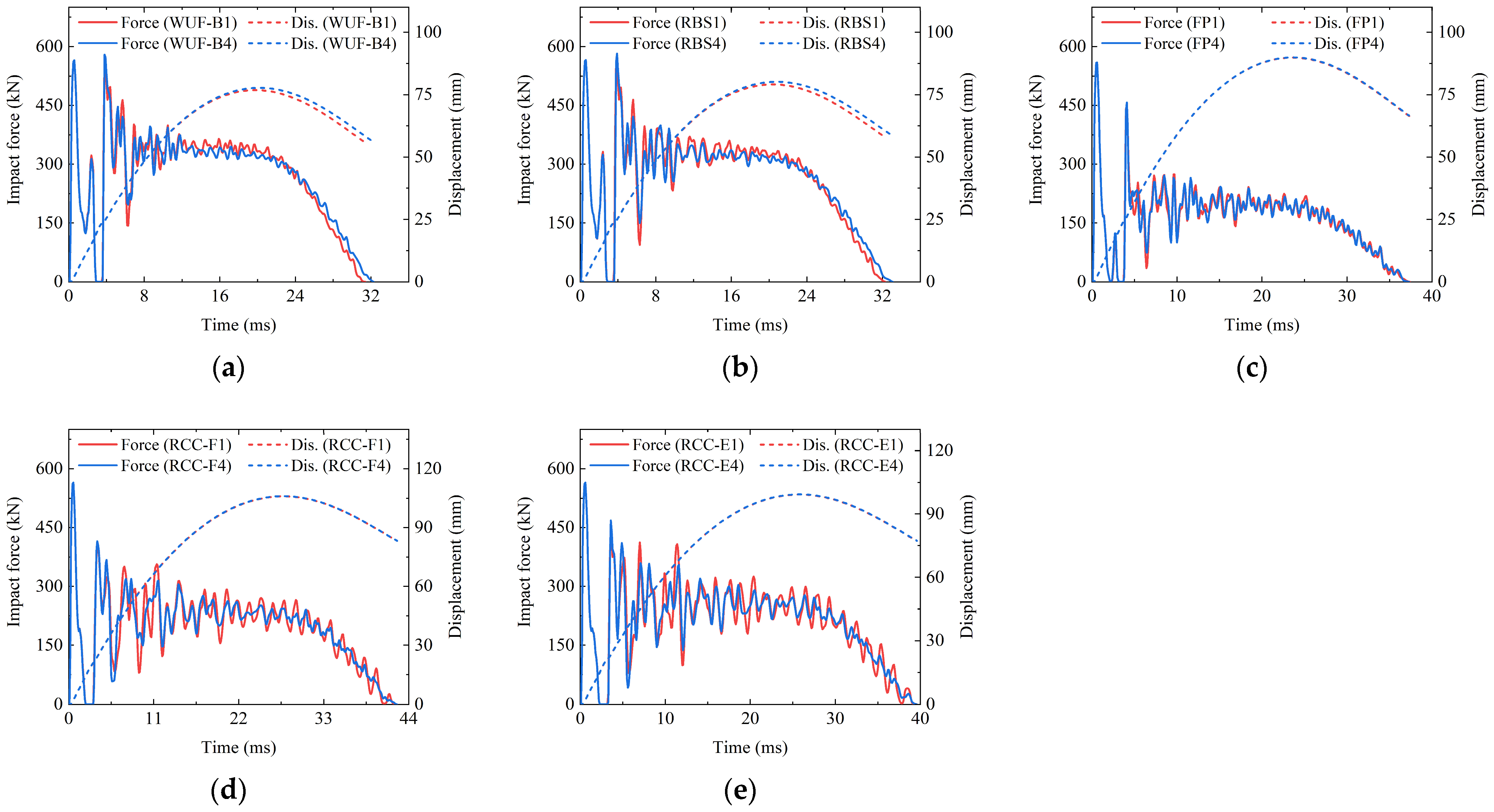
Table 4 presents the simulation results of Cases 1–3 for the five beam–column connection types. Figure 6 provides a comparison of the impact force time history curves and vertical displacement time history curves under the condition of constant impact energy but different impact velocities and drop hammer masses. Although the impact energy is the same across Cases 1–3 for all specimens, the time history curves exhibit significant differences. As shown in Figure 6, variations in the drop hammer mass and impact velocity have a notable influence on the maximum impact force and impact duration, but exert a relatively minor effect on the quasi-static load and maximum vertical displacement. Specimens tend to generate a higher maximum impact force and complete the impact process in a shorter time under a higher impact velocity. For each specimen, the differences in quasi-static load and maximum vertical displacement under different impact velocities and drop hammer masses are relatively small. When the impact velocity is relatively high and the drop hammer mass is small, the maximum vertical displacement of the specimen decreases slightly while the quasi-static load increases marginally. This is because the specimen deforms more rapidly under a higher impact velocity, and the impact process concludes in a shorter time, resulting in a higher strain rate compared to that under low-velocity impact. According to the Cowper–Symonds strain rate model (Equation (1)), the material yield strength is improved due to the increase in the Dynamic Increase Factor (DIF), enabling the specimen to absorb more impact energy per unit deformation. Therefore, under the same impact energy, only a smaller maximum vertical displacement is required to complete energy dissipation, and the quasi-static load slightly increases due to the improved material strength.
To further quantify the intensity of the influence of impact parameters on key responses, the normalized sensitivity coefficient S was adopted to clarify the degree of parameter influence on the corresponding responses. The normalized sensitivity coefficient can be expressed as follows:
S = Δ R / R 0 Δ P / P 0
where ΔP/P0 is the relative change rate of the parameter, and ΔR/R0 is the relative change rate of the response index. The larger the absolute value of the coefficient, the stronger the influence of the parameter on the response.
The quantitative results presented in Table 5 indicate that the sensitivity coefficients of the drop hammer mass with respect to the maximum impact force and impact duration are −0.365 and 0.499, respectively, while those of the impact velocity are 0.686 and −1.064, respectively. This reveals a negative correlation with the drop hammer mass and impact velocity, i.e., as the mass increases and the velocity decreases, the maximum impact force decreases and the impact duration prolongs. In contrast, the sensitivity coefficients of the drop weight mass and impact velocity with respect to the quasi-static load are only −0.027 and 0.048, respectively, and those with respect to the maximum displacement are 0.051 and −0.086, respectively. All these values are significantly lower than the sensitivity coefficients for the maximum impact force and impact duration, which is consistent with the qualitative analysis conclusions drawn previously.

4.2. Effect of Boundary Conditions

In the drop hammer impact test, horizontal constraints were installed at both ends of the specimens to simulate the restraining effect of the surrounding undamaged structure on the specimens. In the simulations of this section, the horizontal constraint on one side of the specimen in the finite element model was removed to analyze the effect of the constraint conditions on the impact dynamic response of the specimens. It should be clarified that the single-sided horizontal constraint in this study is set by only removing the right horizontal constraint, while the stiffness of the left horizontal constraint remains consistent with that of the double-sided constraint. This ensures that the asymmetry of the constraint setting is only reflected in the presence or absence of the single-sided constraint, not the asymmetric change in the stiffness.
Based on the simulation results of Cases 1 and 4 for the five beam–column connection types listed in Table 4, and the comparison of the impact force time history curves and vertical displacement time history curves presented in Figure 7, the results indicate that for all five specimens, the primary impact results, the impact force time history curves, and the displacement time history curves under the two horizontal constraint conditions are almost identical. Based on Figure 7, the root mean square errors (RMSEs) of the impact force time curves between the double-sided and single-sided horizontal constraint conditions for WUF-B, RBS, FP, RCC-F, and RCC-E are calculated as 20.9 kN, 22.5 kN, 14.0 kN, 28.2 kN, and 31.2 kN, respectively. Meanwhile, the RMSEs of the displacement time curves are 1.21 mm, 1.27 mm, 0.1 mm, 0.08 mm, and 0.08 mm, respectively. These RMSE results also indicate that the influence of the boundary conditions on the impact force time histories and displacement time histories is minimal.
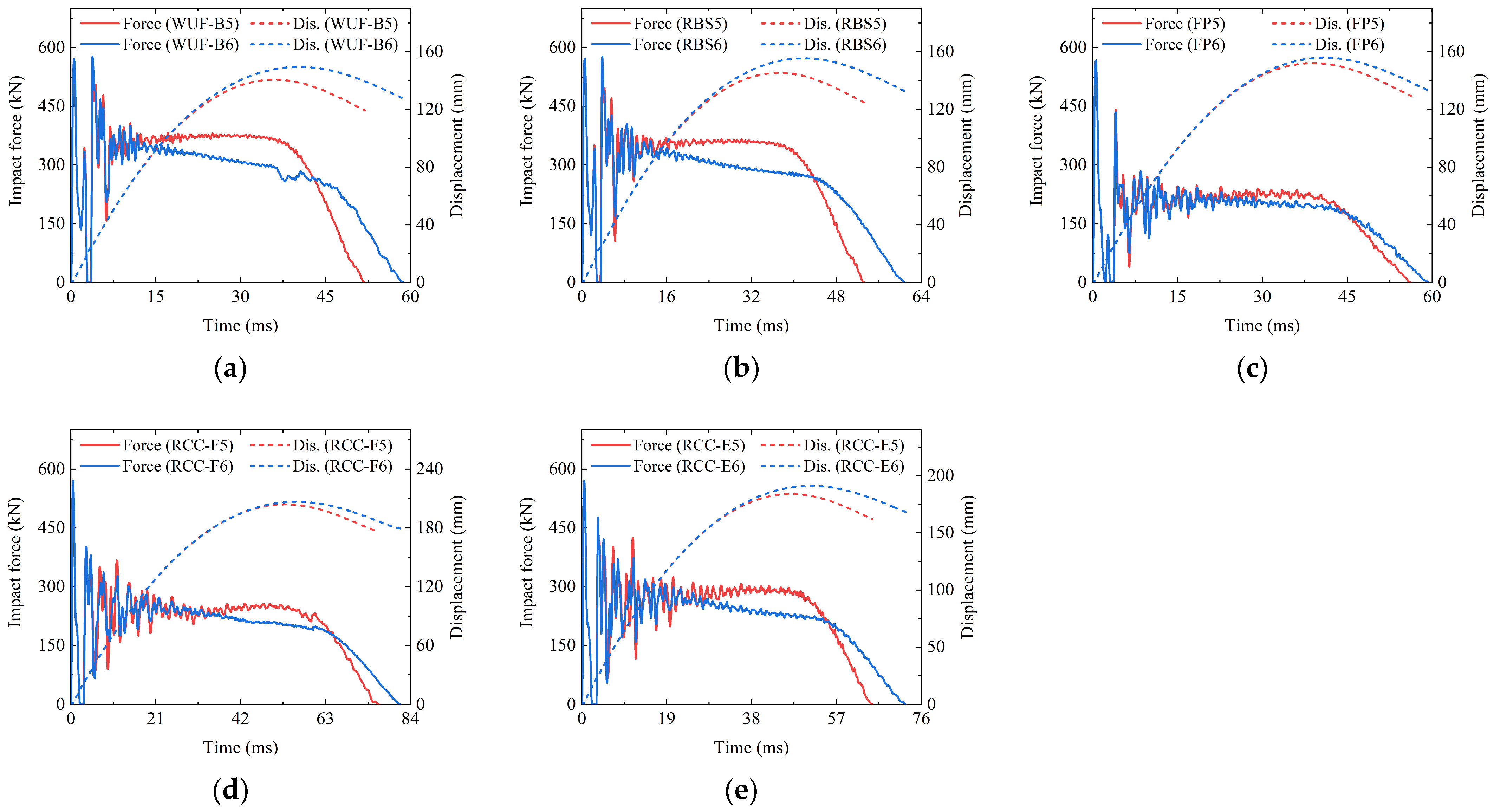
To further investigate the effect of the boundary conditions on the impact dynamic response, Cases 5 and 6 were established on the basis of Cases 1 and 4 for the five specimens by increasing the drop hammer mass to 1660 kg (impact energy of 48.8 kJ). The effect of the boundary conditions on the structural impact dynamic response was compared under the action of a higher impact energy.
Table 4 presents the simulation results of Cases 5 and 6 for the five beam–column connections. Figure 8 provides the corresponding comparison of the impact force time history curves and vertical displacement time history curves. Among the four key parameters, there is no significant change in the maximum impact force; the quasi-static load decreases noticeably, while the impact duration and maximum vertical displacement increase. The results indicate that under a higher impact energy, the steel-framed subassemblies lacking a horizontal constraint on one side exhibit a decrease in quasi-static load. Compared with the double-sided horizontal constraint condition, they require a longer time and greater deformation to resist the same impact energy.
The quantitative results presented in Table 6 indicate that the sensitivity coefficients of the horizontal constraints to the maximum impact force, quasi-static load, maximum vertical displacement, and impact duration are 0.002, −0.005, 0.006, and 0.013, respectively, under a lower impact energy. This demonstrates that the absence of a horizontal constraint on one side exerts a negligible influence on the main responses of the structure under low impact energy conditions.
Under higher impact energy conditions, the sensitivity coefficients of horizontal constraints with respect to the maximum impact force, quasi-static load, maximum vertical displacement, and impact duration are 0.003, −0.038, 0.024, and 0.307, respectively. This indicates that the absence of a horizontal constraint on one side has a minimal effect on the maximum impact force under high impact energy conditions, whereas its influence on the quasi-static load, maximum vertical displacement, and impact duration is significantly higher than that under low impact energy conditions.

5. Discussion on Load-Resisting Mechanism and Dynamic Response Under Impact Loading

The results of the parametric analysis indicate that the influence laws of each analyzed parameter on the impact dynamic response of the five beam–column connection specimens are consistent. However, for the same beam–column connection specimen, the differences in impact dynamic response among various cases are relatively significant. Based on the progressive collapse resistance mechanism of steel-framed subassemblies when the mid-span of the steel beam is subjected to impact loading, this section discusses the impact dynamic response of the steel-framed subassemblies in the RCC-E series cases.

5.1. Impact Process Based on Load-Resisting Mechanism

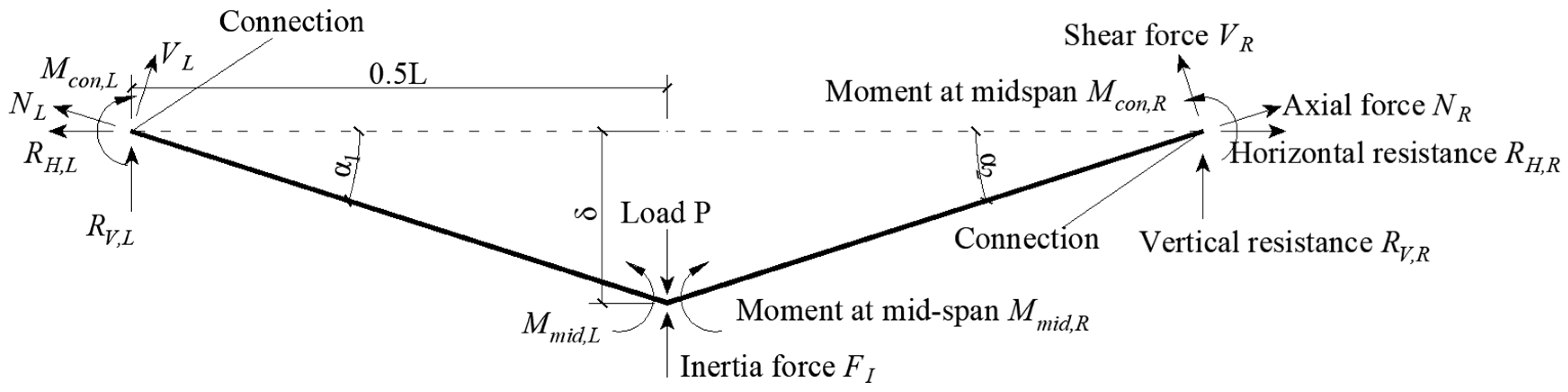
When the specimens undergo large deformations under mid-span impact loading, their force states are illustrated in Figure 9.
According to the force state of the steel-framed subassembly specimens, the force balance equation in the vertical direction can be expressed as follows:
P = F I + N L sin α 1 + N R sin α 2 Axial   force   action + M mid , L M con , L 1472 2 + δ 2 cos α 1 + M mid , R M con , R 1472 2 + δ 2 cos α 2 Flexural   action
As can be seen from Equation (3), when subjected to impact loading at the mid-span, the specimens resist the impact mainly through inertial force and the vertical load-carrying capacity generated by specimen deformation. The vertical load-carrying capacity consists of two components: flexural action and axial force action. The flexural action refers to the load-carrying capacity provided by the bending moments generated at the beam–column connection joints and the mid-span plastic hinge positions. The axial force action refers to the load-carrying capacity provided by the vertical component of the specimen’s axial force under large deformation conditions.
Post-buckling behavior is not considered independently in Equation (3), and this simplification is consistent with the core objectives and engineering practice of structural progressive collapse analysis. This study focuses on the overall progressive collapse resistance bearing mechanism of steel frame substructures under impact loading, whereas the post-buckling behavior of steel beams is mainly manifested as local instability on the compression side. The experimental results [20] also indicate that the steel-framed subassembly specimens are always dominated by in-plane force states under impact loading. Neglecting post-buckling behavior does not interfere with the revelation of the core bearing mechanism; instead, it can clarify the force equilibrium relationship and facilitate the analysis of key mechanical factors.
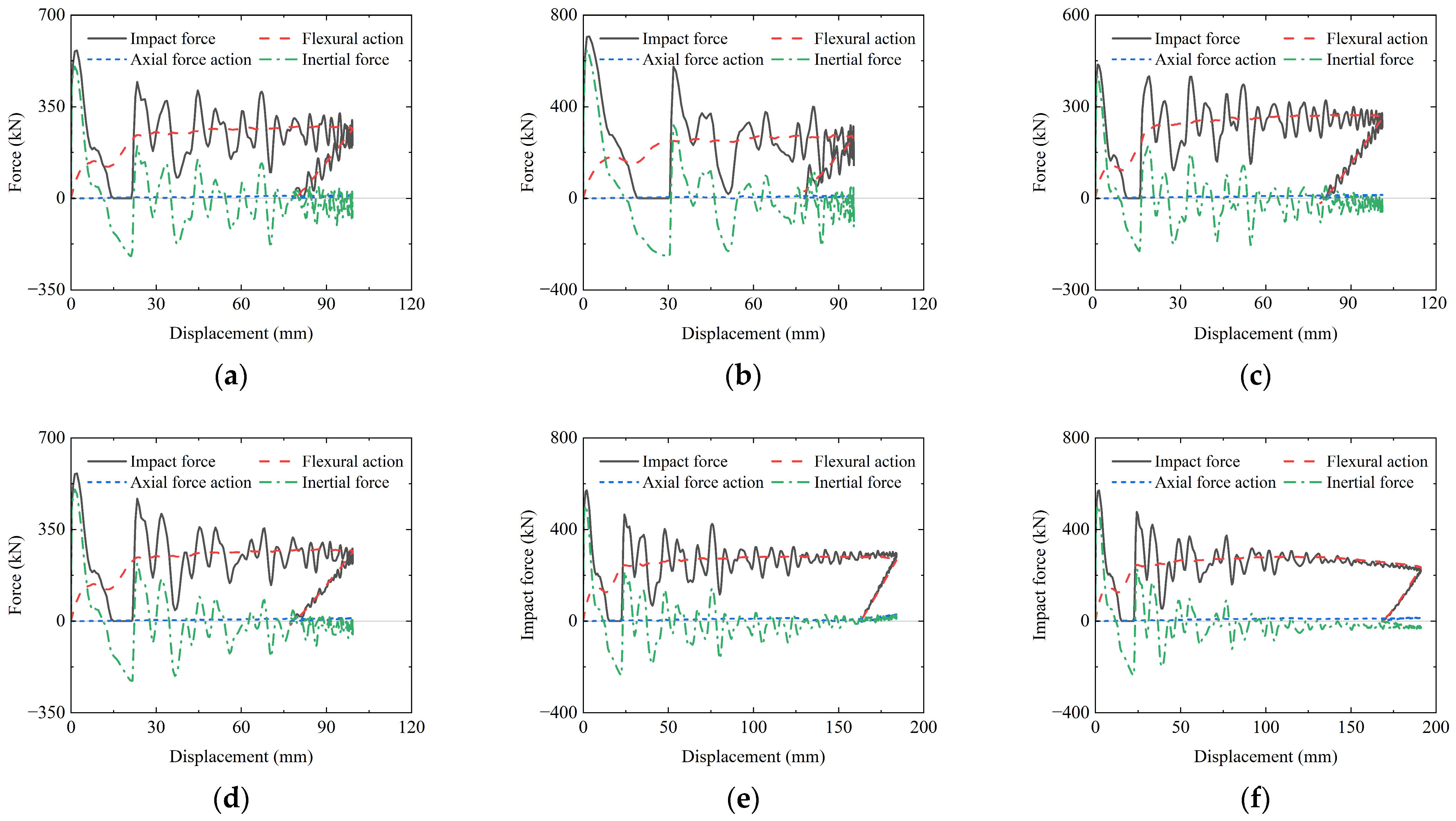
Based on Equation (3), the force time history curves of the steel-framed subassemblies in the RCC-E series cases can be plotted, as shown in Figure 10.
As can be seen from Figure 10, the progressive collapse load-carrying capacity mechanisms of the steel-framed subassemblies under impact loading are basically consistent across the six cases, consisting mainly of three components: flexural action, axial force action, and inertial force. The entire impact process can be divided into three stages:
Stage 1: When the drop hammer first contacts the steel beam, the impact force rises rapidly to the maximum value Fmax and then drops sharply to 0, with a brief separation between the drop hammer and the steel beam. No significant deformation occurs in the subassembly specimen during this stage. The load-carrying capacity from flexural action is in a phase of gradual increase, while the axial force action does not provide noticeable load-carrying capacity. The maximum impact force is mainly contributed by the inertial force.
Stage 2: After the secondary contact between the drop hammer and the steel beam, the contact area tends to move together at the same speed. The inertial force stabilizes, and the flexural action develops fully, becoming the main load-carrying capacity mechanism to resist the impact loading. This stage ends when both the drop hammer and the steel beam reach the maximum displacement with zero velocity.
Stage 3: After reaching the maximum displacement, the steel beam rebounds and drives the drop hammer to move in the opposite direction. The impact force and the load-carrying capacity of each mechanism gradually decrease until returning to 0 when the drop hammer separates from the steel beam.

5.2. Discussion on Dynamic Behavior

5.2.1. Effect of Impact Parameters on Maximum Impact Force

Cases RCC-E1, RCC-E2, and RCC-E3 analyze the dynamic response of steel-framed subassemblies under the same impact energy but different drop hammer masses and impact velocities. The force–displacement curves of the three cases are shown in Figure 10a–c. Combined with the results in Section 4.1, it can be concluded that for the same impact energy, changing the drop hammer mass and impact velocity has a significant effect on the maximum impact force Fmax and the impact duration t.
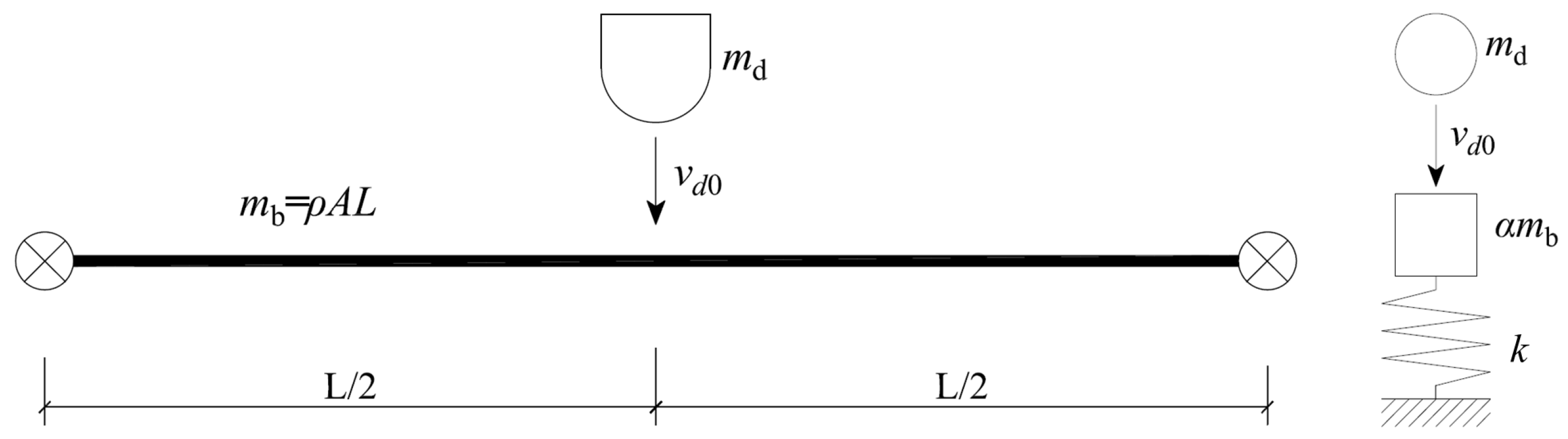
For Stage 1, the momentum of the system is conserved between the initial and final instants when the drop hammer impacts the steel beam, which is equivalent to the simplified single-degree-of-freedom system illustrated in Figure 11.
m d v d 0 = ( m d + α m b ) v t 1
where vt is the common velocity of the drop hammer and the impacted position of the steel beam at the end of Stage 1, and α represents the equivalent mass coefficient of the steel beam. According to Reference [20], the equivalent coefficient α is taken as 0.5. The change in momentum of the steel beam is equal to the impulse it acquires, with the impact force time curve assumed to be triangular in accordance with Figure 5e:
F ( t ) dt = 1 2 F max Δ t 1 = α m b v t 1
where Δ t 1 is the duration of Stage 1. Meanwhile, the energy of the system is
1 2 m d v d 0 2 = 1 2 ( m d + α m b ) v t 1 2 + 1 2 k δ t 1 2
where δt1 is the displacement occurring during Stage 1.
By combining Equations (4)–(6), the expressions for the maximum impact force Fmax can be derived as follows:
F max = v d 0 k m d α m b m d + α m b
Table 7 compares the simulated results and theoretical calculation values of the maximum impact force, from which it can be concluded that Equation (7) is capable of calculating the maximum impact force during the impact process with considerable accuracy.
As can be seen from Equation (7), the maximum impact force Fmax is related not only to the mass of the drop hammer but also to the impact velocity. Since the mass of the drop hammer md is much larger than the equivalent mass of the steel beam αmb, the influence of changes in the drop hammer mass on the ratio calculated by the formula is extremely small. This indicates that the maximum impact force is mainly affected by the impact velocity: the higher the impact velocity, the greater the maximum impact force.
Case 1 and Case 5 were subjected to the same impact velocity, while there was a significant difference in the drop weight mass, which was 830 kg and 1660 kg, respectively. However, the maximum impact forces of the two cases were 551.2 kN and 557.0 kN, respectively, with a negligible difference. The theoretical values of the maximum impact force for Case 1, Case 2, and Case 3 are 551.2 kN, 763.6 kN, and 393.6 kN, respectively. The impact energy was identical across the three cases. Specifically, Case 2, which featured a higher impact velocity coupled with a smaller drop weight mass, yielded the maximum impact force; by contrast, Case 3, characterized by a lower impact velocity and a larger drop weight mass, produced the minimum impact force; while Case 1, with moderate impact velocity and drop weight mass, exhibited an intermediate maximum impact force. The calculation results of the maximum impact force are also consistent with the aforementioned law governing the effects of the impact velocity and drop hammer mass on the maximum impact force, which was derived based on Equation (7).

5.2.2. Effect of Impact Parameters on Duration of Impact Process

From the moment the drop hammer contacts the steel beam until both reach the maximum displacement with zero velocity, i.e., Stage 1 and Stage 2, the change in momentum of the drop hammer during this process is equal to the impulse of the impact force, and thus the duration Δ t 12 of this process can be calculated as follows:
m d Δ v = m d ( v d 0 v d t ) = F I ( t ) dt F P Δ t 12 Δ t 12 = m d v d 0 F P
From Equation (8), the durations of the impact process for the first two stages of the three specimens can be calculated as 26.3 ms, 18.2 ms, and 37.6 ms, respectively.
In Stage 3, the drop hammer starts to accelerate and move reversely from rest until it separates from the steel beam. During this process, the final kinetic energy acquired by the drop hammer is equal to the work performed by the quasi-static load on the drop hammer, as shown in Equation (9), and the change in momentum of the drop hammer is equal to the impulse of the quasi-static load on it, as shown in Equation (10). Thus, the duration Δ t 3 of Stage 3 can be calculated as Equation (11).
1 2 m d v d 3 2 = 1 2 F P δ 3
m d v d 3 = 1 2 F p Δ t 3
Δ t 3 = 2 m d δ 3 F P
From Equation (11), the durations of Stage 3 for the three test specimens are calculated as 16.8 ms, 10.9 ms, and 24.7 ms, respectively. Accordingly, the theoretical values of the total impact process durations for the three test pieces are determined to be 43.1 ms, 29.1 ms, and 62.3 ms. The simulated values of the impact process durations presented in Table 4 are in good agreement with the theoretical values derived from Equations (8) and (11).

5.2.3. Discussion of Boundary Conditions

Based on the simulation results of RCC-E1 and RCC-E4, when the drop hammer mass is 830 kg, the boundary conditions have almost no influence on the impact dynamic response. According to the simulation results of RCC-E5 and RCC-E6, after the drop hammer mass is increased to 1660 kg, obvious differences in the impact force appear in the later stage of the impact process among the cases with different boundary conditions. As can be seen from a comparison of Figure 10e,f, the main reason for this difference is the reduction in the flexural bearing capacity of the test piece lacking a horizontal constraint on one side.
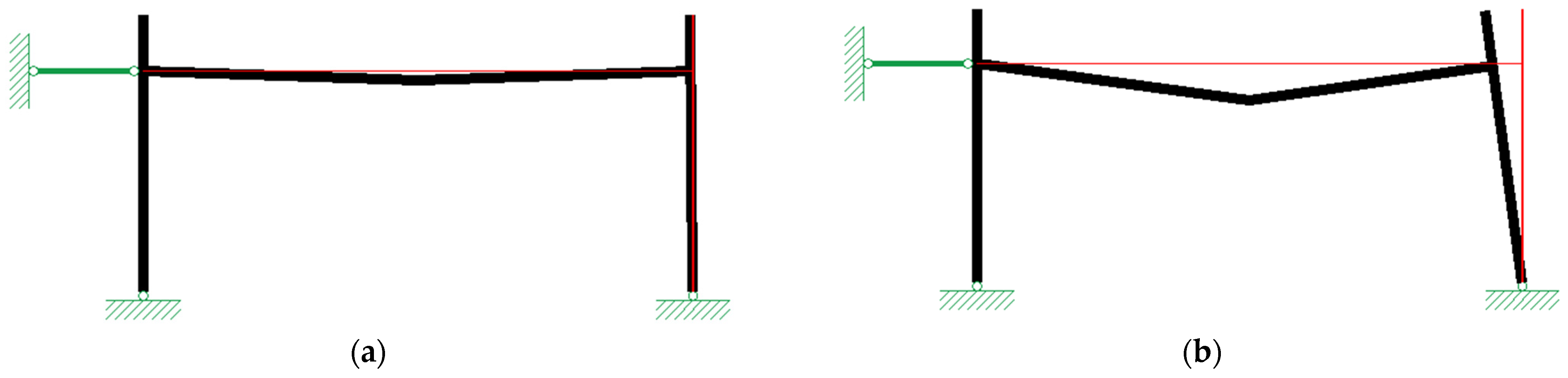
The deformations of the specimen lacking the right horizontal constraint under impact loads from drop hammers of different masses are illustrated in Figure 12. When the drop hammer mass is small, the impacted steel beam undergoes minimal deformation, with almost no horizontal displacement at the right-end joint of the beam, and the absence of a horizontal constraint has little effect on the impact dynamic response of the specimen. When the drop hammer mass is large, the impacted steel beam experiences significant deformation. The right steel column lacks the right horizontal constraint and is only supported by a hinged support at the column base. As the steel beam undergoes large deformation, the right steel column rotates freely around the hinged support at its base and moves synchronously with the right-end joint of the beam. This phenomenon reduces the rotational deformation and joint bending moment of the right joint, leading to a decrease in the flexural bearing capacity, and the specimen needs to undergo greater deformation to absorb the impact energy. Meanwhile, the reduction in the bearing capacity results in a decrease in the quasi-static load. As can be derived from Equations (8) and (11), the duration of the impact process increases, which is consistent with the trend of the simulation results in Table 4. The maximum impact force Fmax occurs in Phase 1 of the impact process. At this stage, the entire steel-framed subassembly, including the steel beam, has not yet undergone significant deformation, and all parameters in Equation (7) remain unchanged. Therefore, the maximum impact forces Fmax of Cases 5 and 6 are identical and unaffected by the boundary conditions. The numerical results also indicate that the variation in the boundary conditions exerts no influence on the maximum impact force.

6. Conclusions, Limitations, and Future Perspectives

6.1. Conclusions

In this study, ANSYS/LS-DYNA finite element software was employed to investigate the dynamic responses of steel frame substructures with five different beam–column connection types under floor drop impact loading. The accuracy of the model was verified through experiments, followed by parameter analysis. The anti-progressive collapse bearing mechanism and influencing factors of dynamic responses of steel frame substructures under impact loading were explored, and the main conclusions are as follows:
(1)
The finite element model established by the method in this paper can accurately simulate the dynamic responses of steel frame substructures with different connection types under impact loading. Comparisons of the key parameters, including impact force time history curves, mid-span vertical displacement time history curves, maximum impact force, quasi-static load, maximum vertical displacement, and impact process duration, show that the finite element simulation results are in good agreement with the experimental results, with errors within an acceptable range. This provides a reliable basis for subsequent parameter analysis.
(2)
Under constant impact energy, changes in the impact velocity and impactor mass have a significant influence on structural responses. Variations in the impact velocity and impactor mass obviously affect the maximum impact force and impact process duration: a higher impact velocity leads to a higher maximum impact force and a shorter impact process, while their effects on the quasi-static load and maximum vertical displacement are relatively minor. When the impact velocity is high and the drop hammer mass is small, the specimen exhibits increased material strength and enhanced impact resistance due to the high deformation rate and strain rate, resulting in smaller deformation under the same impact energy.
(3)
The relationships between the impact parameters and maximum impact force, as well as the impact process duration, were analyzed and derived. Based on the momentum theorem and energy conservation, theoretical calculation formulas for the maximum impact force and impact process duration were deduced. The theoretical calculation results are in good consistency with the finite element results, revealing the phenomenon that high-velocity and low-mass impacts generate a larger maximum impact force and a shorter impact process duration.
(4)
The influence of the boundary conditions on the structural impact dynamic response is related to the impact energy. When the drop hammer mass is 830 kg and the impact energy is 24.4 kJ, changes in the horizontal constraint conditions have almost no effect on the impact dynamic responses of specimens with the five node connection types. When the drop hammer mass is increased to 1660 kg and the impact energy reaches 48.8 kJ, the lack of a horizontal constraint on one side leads to a significant decrease in the structural bearing capacity under large impact loading. This is manifested by a reduction in the quasi-static load, and increases in the impact process duration and maximum vertical displacement—meaning the structure requires a longer time and greater deformation to resist the same impact energy. Based on energy conservation, the momentum theorem, and the anti-progressive collapse bearing mechanism during the impact process, the influence mechanism of the boundary conditions on the impact dynamic response is discussed.

6.2. Limitations

Although this study reveals the dynamic response laws and progressive collapse-resistant load-carrying mechanisms of steel-framed subassemblies under the falling debris impact through test validation and parametric analysis, there are still the following limitations:
(1)
Model simplification: The drop hammer is equivalently simulated by a spherical hammer head, without considering the irregular geometric shape and material heterogeneity of actual falling debris;
(2)
Load and scenario: The impact load only considers the concentrated impact of a single falling object, without involving more complex actual scenarios such as the continuous impact of multiple falling objects and eccentric impact;
(3)
Theoretical formula: The derivation of the theoretical equation for the maximum impact force (Equation (7)) is based on the assumption of a simplified single-degree-of-freedom system, which leads to a slightly larger deviation between the theoretical value and the simulation value in some working conditions, such as a low mass and high velocity, compared with other working conditions.

6.3. Future Perspectives

Based on the above limitations, future research can be carried out in the following directions:
(1)
Refined model and multi-physics coupling: Construct numerical models of falling debris with irregular shapes and heterogeneous materials, introduce complex contact algorithms considering surface roughness and material discreteness, and combine constraint stiffness test data of real structures to improve the model’s fidelity to actual engineering scenarios;
(2)
Expansion of complex impact scenarios and experimental validation: Conduct numerical simulations of working conditions such as the continuous impact of multiple falling objects, eccentric impact, and oblique impact, and design corresponding test devices for synchronous validation to establish a more comprehensive impact response database, providing more practical references for engineering impact-resistant design;
(3)
Multi-factor optimization of theoretical formulas: Break through the single-degree-of-freedom system assumption, introduce coupling terms for the collaborative force of multiple components, dynamic evolution factors of contact stiffness, and nonlinear correction terms for material strain rate sensitivity to improve its prediction accuracy under different impact parameter combinations.

Author Contributions

Conceptualization, H.W. and Z.C.; methodology, H.W., L.Z. and Z.C.; software, H.W.; validation, H.W., W.C. and L.Z.; formal analysis, H.W. and W.C.; investigation, H.W. and W.C.; data curation, H.W., W.C. and Y.W.; writing—original draft preparation, H.W.; writing—review and editing, H.W. and L.Z.; visualization, W.C., Y.W. and J.W.; supervision, L.Z. and Z.C.; project administration, J.W.; funding acquisition, H.W., L.Z. and J.W. All authors have read and agreed to the published version of the manuscript.

Funding

This research was funded by the National Natural Science Foundation of China (52408204, 52208193) and the Tianjin Natural Science Foundation Project (23JCYBJC00510).

Data Availability Statement

All data, models, and code generated or used during the study appear in the published article.

Conflicts of Interest

The authors declare no conflicts of interest.

References

  1. General Services Administration (GSA). Alternate Path Analysis and Design Guidelines for Progressive Collapse; General Services Administration (GSA): Washington, DC, USA, 2016. [Google Scholar]
  2. UFC 4-023-03; Design of Buildings to Resist Progressive Collapse. Department of Defense (DoD): Washington, DC, USA, 2024.
  3. T/CECS 392-2021; Standard for Anti-Collapse Design of Building Structures. China Association for Engineering Construction Standardization (CECS): Beijing, China, 2021.
  4. Lew, H.S.; Main, J.A.; Robert, S.D.; Sadek, F.; Chiarito, V.P. Performance of steel moment connections under a column removal scenario. I: Experiments. J. Struct. Eng. 2013, 139, 98–107. [Google Scholar] [CrossRef]
  5. Sadek, F.; Main, J.A.; Lew, H.S.; El-Tawil, S. Performance of steel moment connections under a column removal scenario. II: Analysis. J. Struct. Eng. 2013, 139, 108–119. [Google Scholar] [CrossRef]
  6. Yang, B.; Tan, K.H. Numerical analyses of steel beam-column joints subjected to catenary action. J. Struct. Eng. 2012, 70, 1–11. [Google Scholar] [CrossRef]
  7. Yang, B.; Tan, K.H. Experimental tests of different types of bolted steel beam-column joints under a central-column-removal scenario. Eng. Struct. 2013, 54, 112–130. [Google Scholar] [CrossRef]
  8. Yang, B.; Tan, K.H. Robustness of bolted-angle connections against progressive collapse: Experimental tests of beam-column joints and development of component-based models. J. Struct. Eng. 2013, 139, 1498–1514. [Google Scholar] [CrossRef]
  9. Zhong, W.; Tan, Z.; Meng, B. Comparative evaluation of collapse behavior at different structural levels with different connections. J. Constr. Steel Res. 2022, 193, 107280. [Google Scholar] [CrossRef]
  10. Tan, Z.; Zhong, W.H.; Li, C.F. Research on component joint models of semi-rigid joint model with top and seat angles and double web angles under progressive collapse. J. Dis. Prev. Mitig. Eng. 2019, 39, 445–453. [Google Scholar]
  11. Zong, L.; Zhang, Y.C.; Cui, J.; Zhang, H.S. Progressive collapse analysis on beam-column substructres of modular steel construction. Eng. Mech. 2024, 41, 56–67. [Google Scholar]
  12. Liu, C.; Fung, T.C.; Tan, K.H. Dynamic performance of flush end-plate beam-column connections and design applications in progressive collapse. J. Struct. Eng. 2016, 142, 04015074. [Google Scholar]
  13. Tyas, A.; Warren, J.A.; Stoddart, E.P.; Davison, J.B.; Tait, S.J.; Huang, Y. A methodology for combined rotation-extension testing of simple steel beam to column joints at high rates of loading. Exp. Mech. 2012, 52, 1097–1109. [Google Scholar] [CrossRef]
  14. Stoddart, E.P.; Byfield, M.P.; Davison, J.B.; Tyas, A. Strain rate dependent component based connection modelling for use in non-linear dynamic progressive collapse analysis. Eng. Struct. 2013, 55, 35–43. [Google Scholar] [CrossRef]
  15. Grimsmo, E.L.; Clausen, A.H.; Langseth, M.; Aalberg, A. An experimental study of static and dynamic behaviour of bolted end-plate joints of steel. Int. J. Impact Eng. 2015, 85, 132–145. [Google Scholar] [CrossRef]
  16. Huo, J.; Wang, N.; Chen, Y. Experimental study on collapse resistance of welded beam-column connection substructure of steel frame based on seismic design. J. Build. Struct. 2014, 35, 100–108. [Google Scholar]
  17. Chen, K.; Yang, B.; Zhang, Y.; Tan, K.H. Experimental tests on composite beam-column joint with WUF-B connection subjected to impact loads. Int. J. Impact Eng. 2023, 174, 104506. [Google Scholar] [CrossRef]
  18. Wang, H.T.; Huo, J.S.; Elchalakani, M.; Liu, Y.Z.; Zhang, S.Q. Dynamic performance of retrofitted steel beam-column connections subjected to impact loadings. J. Constr. Steel Res. 2021, 183, 106732. [Google Scholar] [CrossRef]
  19. Kiakojouri, F.; Biagi, V.D.; Chiaia, B.; Sheidaii, M.R. Progressive collapse of framed building structures: Current knowledge and future prospects. Eng. Struct. 2020, 106, 110061. [Google Scholar] [CrossRef]
  20. Wang, H.; Tan, K.H.; Yang, B. Experimental Tests of Steel Frames with Different Beam–Column Connections Under Falling Debris Impact. J. Struct. Eng. 2020, 146, 04019183. [Google Scholar] [CrossRef]
  21. Wang, H.; Yang, B.; Chen, K.; Elchalakani, M. Parametric analysis and simplified approach for steel-framed subassemblies with reverse channel connection under falling-debris impact. Eng. Struct. 2020, 225, 111263. [Google Scholar] [CrossRef]
  22. Wang, H.; Tan, K.H.; Yang, B. Impact resistance of steel frames with different beam-column connections subject to falling-floor impact on various locations. J. Struct. Eng. 2021, 147, 04021017. [Google Scholar]
  23. Wang, J.X.; Li, H.J.; Gao, S. Analysis and evaluation on residual impact resistance of CFST composite frames under column removal scenario. Thin-Walled Struct. 2025, 206, 112624. [Google Scholar]
  24. Wang, Y.C.; Xue, L. Experimental study of moment-rotation characteristics of reverse channel connections to tubular columns. J. Constr. Steel Res. 2013, 85, 92–104. [Google Scholar] [CrossRef]
  25. Livermore Software Technology Corporation (LSTC). LS-DYNA Keyword User’s Manual Volume II: Material Models; Livermore Software Technology Corporation (LSTC): Livermore, CA, USA, 2023. [Google Scholar]
  26. Abramowicz, W.; Jones, N. Dynamic axial crushing of square tubes. Int. J. Impact Eng. 1984, 2, 179–208. [Google Scholar] [CrossRef]
  27. Travanca, J.; Hao, H. Numerical analysis of steel tubular member response to ship bow impacts. Int. J. Impact Eng. 2014, 64, 101–121. [Google Scholar] [CrossRef]
  28. Singh, N.K.; Cadoni, E.; Singha, M.K.; Gupta, N.K. Dynamic tensile and compressive behaviors of mild steel at wide range of strain rates. J. Eng. Mech. 2013, 139, 1197–1206. [Google Scholar] [CrossRef]
  29. Cui, P.; Liu, Y.; Chen, F.; Huo, J. Dynamic behaviour of square tubular T-joints under impact loadings. J. Constr. Steel Res. 2018, 143, 208–222. [Google Scholar] [CrossRef]
  30. Livermore Software Technology Corporation (LSTC). LS-DYNA Keyword User’s Manual Volume I: Elements and Controls; Livermore Software Technology Corporation (LSTC): Livermore, CA, USA, 2023. [Google Scholar]
  31. Schmied, C.; Erhart, T. Updated review of solid element formulations in ls-dyna: Properties, limits, advantages, disadvantages. In Proceedings of the 2018 LS-DYNA Forum; DYNAmore GmbH: Bamberg, Germany, 2018. [Google Scholar]
  32. Li, H.; Chen, W.; Hao, H. Dynamic response of precast concrete beam with wet connection subjected to impact loads. Eng. Struct. 2019, 191, 247–263. [Google Scholar] [CrossRef]
  33. Wang, H.; Yang, B.; Zhou, X.; Kang, S. Numerical analyses on steel beams with fin-plate connections subjected to impact loads. J. Constr. Steel Res. 2016, 124, 101–112. [Google Scholar] [CrossRef]
  34. Izzuddin, B.A.; Vlassis, A.G.; Elghazouli, A.Y.; Nethercot, D.A. Progressive collapse of multi-storey buildings due to sudden column loss—Part I: Simplified assessment framework. Eng. Struct. 2008, 30, 1308–1318. [Google Scholar] [CrossRef]
Figure 1. Experimental setup.
Buildings 16 00581 g001
Figure 2. Details of specimens (Unit: mm).
Buildings 16 00581 g002
Figure 3. Details of beam–column connections (Unit: mm): (a) WUF-B; (b) RBS; (c) FP; (d) RCC-F; (e) RCC-E.
Buildings 16 00581 g003
Figure 4. Finite element model.
Buildings 16 00581 g004
Figure 5. Comparison of time history curves between impact tests and simulations: (a) WUF-B; (b) RBS; (c) FP; (d) RCC-F; (e) RCC-E.
Buildings 16 00581 g005
Figure 6. Effect of various impact parameters on time history curves: (a) WUF-B; (b) RBS; (c) FP; (d) RCC-F; (e) RCC-E.
Buildings 16 00581 g006
Figure 7. Effect of boundary conditions on time history curves (drop hammer mass = 830 kg or 590 kg): (a) WUF-B; (b) RBS; (c) FP; (d) RCC-F; (e) RCC-E.
Buildings 16 00581 g007
Figure 8. Effect of boundary conditions on time history curves (drop hammer mass = 1660 kg or 1180 kg): (a) WUF-B; (b) RBS; (c) FP; (d) RCC-F; (e) RCC-E.
Buildings 16 00581 g008
Figure 9. Force state of steel-framed subassembly subject to impact load on the mid-span of steel beam.
Buildings 16 00581 g009
Figure 10. Force–displacement curves of the RCC-E series cases: (a) RCC-E1; (b) RCC-E2; (c) RCC-E3; (d) RCC-E4; (e) RCC-E5; (f) RCC-E6.
Buildings 16 00581 g010
Figure 11. Simplified single-degree-of-freedom system.
Buildings 16 00581 g011
Figure 12. Deformations of specimens with single horizontal constraint: (a) drop hammer mass of 830 kg; (b) drop hammer mass of 1660 kg.
Buildings 16 00581 g012
Table 1. Parameters of drop hammer impact tests.
SpecimenMass of Drop Hammer
(kg)
Drop Height
(m)
Impact Velocity
(m/s)
Impact Energy
(kJ)
WUF-B8303.07.6724.4
RBS8303.07.6724.4
FP5903.07.6717.3
RCC-F8303.07.6717.3
RCC-E8303.07.6724.4
Table 2. Comparison of results between impact tests and simulations.
SpecimenMaximum Impact Force
(kN)
Quasi-Static Load
(kN)
Maximum Vertical
Displacement (mm)
Impact Duration
(ms)
TestFEMErrorTestFEMErrorTestFEMErrorTestFEMError
WUF-B607.9565.0−7%277.6310.212%75.476.82%30.731.42%
RBS563.8559.2−1%180.3194.98%88.289.82%36.937.41%
FP591.7565.8−4%276.4301.49%75.279.15%31.332.33%
RCC-F587.4564.6−4%211.2226.27%102.9105.93%41.242.22%
RCC-E603.5564.7−6%229.6242.05%92.799.27%37.339.35%
Average −4% 8% 4% 3%
RMSE30.221.43.81.2
Table 3. Summary of analysis parameters.
Specimenm
(kg)
H
(m)
v
(m/s)
E
(kJ)
H.C.Specimenm
(kg)
H
(m)
v
(m/s)
E
(kJ)
HC
WUF-B18303.07.6724.4DFP45903.07.6717.3S
WUF-B24156.010.8424.4DFP511603.07.6734.6D
WUF-B316601.55.4224.4DFP611603.07.6734.6S
WUF-B48303.07.6724.4SRCC-F18303.07.6724.4D
WUF-B516603.07.6748.8DRCC-F24156.010.8424.4D
WUF-B616603.07.6748.8SRCC-F316601.55.4224.4D
RBS18303.07.6724.4DRCC-F48303.07.6724.4S
RBS24156.010.8424.4DRCC-F516603.07.6748.8D
RBS316601.55.4224.4DRCC-F616603.07.6748.8S
RBS48303.07.6724.4SRCC-E18303.07.6724.4D
RBS516603.07.6748.8DRCC-E24156.010.8424.4D
RBS616603.07.6748.8SRCC-E316601.55.4224.4D
FP15903.07.6717.3DRCC-E48303.07.6724.4S
FP22956.010.8417.3DRCC-E516603.07.6748.8D
FP311801.55.4217.3DRCC-E616603.07.6748.8S
Note: In the table, m denotes the drop hammer mass, H represents the drop hammer falling height, v is the velocity of the drop hammer immediately before collision with the structure, and E stands for the impact energy of the drop hammer. H.C. denotes horizontal constraint, where D indicates double-sided horizontal constraint and S represents single-sided horizontal constraint.
Table 4. Results of parametric analysis.
SpecimenFmax
(kN)
FP
(kN)
δmax
(mm)
t
(ms)
SpecimenFmax
(kN)
FP
(kN)
δmax
(mm)
t
(ms)
WUF-B1565.0310.276.831.4FP4559.3188.989.937.3
WUF-B2710.2314.174.622.6FP5567.2205.2152.156.3
WUF-B3439.1309.078.144.3FP6567.2200.7155.859.4
WUF-B4579.6306.677.732.3RCC-F1564.8226.2105.942.2
WUF-B5572.1341.7140.652.0RCC-F2706.9232.1101.329.9
WUF-B6577.1321.6149.458.9RCC-F3438.2221.1109.462.2
RBS1565.8301.479.132.3RCC-F4564.6226.1106.042.5
RBS2711.1305.976.723.3RCC-F5570.7236.6204.076.3
RBS3440.4298.180.445.3RCC-F6570.7233.6206.781.5
RBS4582.2297.680.233.1RCC-E1564.7242.099.239.3
RBS5572.0330.8145.353.3RCC-E2706.9246.595.427.1
RBS6577.2310.1155.360.9RCC-E3438.2239.0101.155.7
FP1559.2189.089.837.4RCC-E4564.6241.799.339.6
FP2701.4194.984.926.7RCC-E5570.7262.2184.065.1
FP3437.7185.892.452.0RCC-E6570.7252.9191.172.5
Note: Fmax is the maximum impact force, FP is the quasi-static load during the impact process, δmax stands for the maximum displacement of the specimen during the impact process, and t is the duration of the impact process.
Table 5. Sensitivity coefficients of impact parameters to key responses.
Response IndicatorSensitivity Coefficient of Drop Hammer MassSensitivity Coefficient of Impact Velocity
Fmax−0.3650.686
Fp−0.0270.048
δmax0.051−0.086
t0.499−1.064
Table 6. Sensitivity coefficients of horizontal constraint to key responses.
Response IndicatorSensitivity Coefficient of Horizontal Constraints Under Lower Impact EnergySensitivity Coefficient of Horizontal Constraint Under Higher Impact Energy
Fmax0.0020.003
Fp−0.005−0.038
δmax0.0060.042
t0.0130.307
Table 7. Comparison of maximum impact force between numerical results and theoretical value.
CaseNumerical Results
(kN)
Theoretical Value
(kN)
ErrorRMSE
(kN)
1564.7551.2−2.4%33.9
2706.9763.68.0%
3438.2393.6−10.2%
4564.6551.2−2.4%
5570.7557.0−2.4%
6570.7557.0−2.4%
Disclaimer/Publisher’s Note: The statements, opinions and data contained in all publications are solely those of the individual author(s) and contributor(s) and not of MDPI and/or the editor(s). MDPI and/or the editor(s) disclaim responsibility for any injury to people or property resulting from any ideas, methods, instructions or products referred to in the content.