Concrete Material Variability and Machine Learning Model Performance: A Comprehensive Review





Abstract
1. Introduction
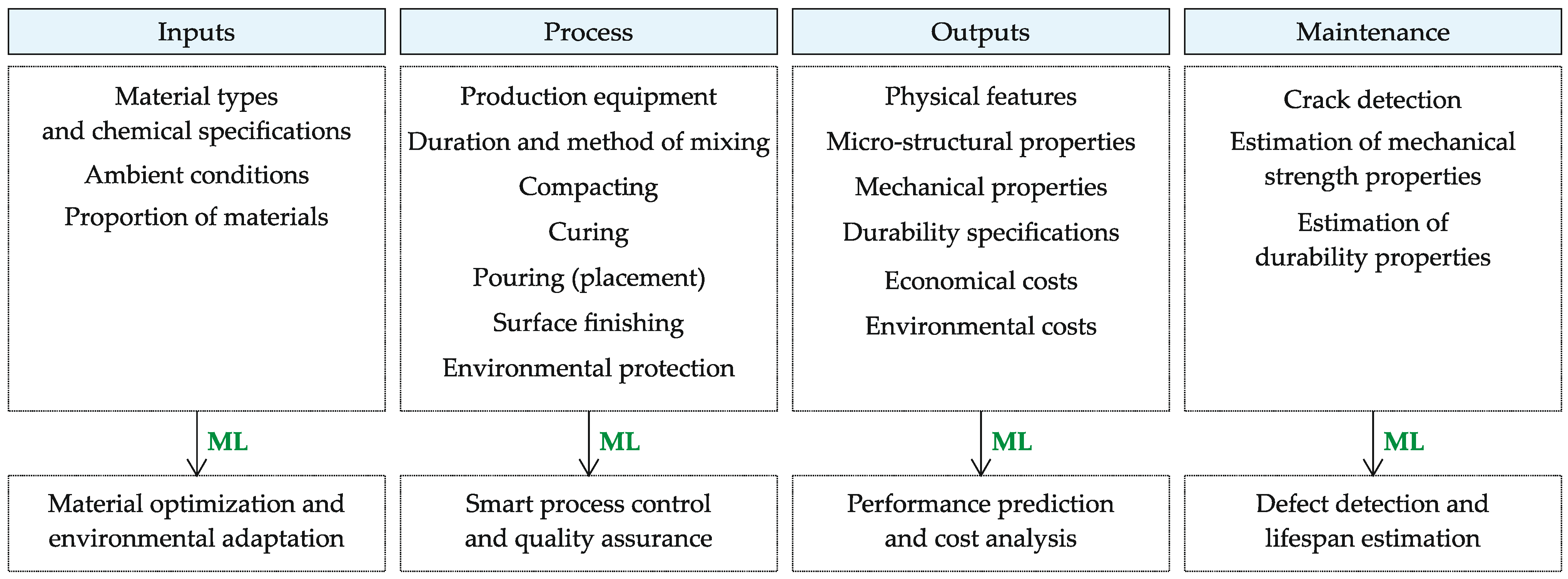
- Investigate effects of different concrete formulations, characterized by differences in compositional components, micro-structural features, curing regimes, and environmental conditions, on model accuracy.
- Review the range of data-driven methods used in the analysis of concrete behavior, which include supervised learning, unsupervised learning, reinforcement learning (RL), and hybrid architectures.
- Focus on the emerging approaches, including deep learning-based defect detection and reinforcement learning, to optimize the construction process.
- Determine existing challenges, such as heterogeneity, lack, and bias of data and suggest future paths to create predictive models that are reliable and transferable to one another.
2. Sources of Variability in Concrete
2.1. Composition
- Types of Cement: The hydration kinetics, strength development, and permeability of different cement formulations, including Portland cement and blended cements with additional cementitious materials (e.g., fly ash or silica fume), depend on the cement type used [44,45,46,47]. As an example, high-volume fly-ash mixes generally have a lower strength gain and better durability [48].
- Aggregates: Aggregates can have an impact on workability, packing density, and crack propagation depending on their size, shape, texture and mineralogical composition. The use of fine and coarse aggregates may lead to the occurrence of varying levels of porosity and mechanical properties.
- W/C Ratio: This ratio is one of the critical determinants of mechanical and durability quality of concrete. Lower water-to-cement ratio tends to pass a stronger and less permeable structural integrity, and higher ratios tend to pass better workability but have high porosities and less resistance. The difference in the W/C ratio of mix designs is another contributor of variations in performance measure, especially compressive strength and chemical attack resistance [49,50].
2.2. Microstructure
- Porosity and Pore Size Distribution: Variations in pore structure influence permeability, durability, and elastic properties. Higher porosity generally correlates with reduced strength and increased susceptibility to ingress of deleterious agents [53].
- Interfacial Transition Zones (ITZ): The weak boundary zone between aggregates and cement paste impacts crack initiation and propagation. Microstructural differences in ITZ thickness and quality can lead to inconsistent mechanical performance [54].
2.3. Curing Conditions
2.4. Environmental Exposure
- Freeze–Thaw Cycles: Repeated freezing and thawing cause internal damage, especially in porous concrete, affecting strength and increasing permeability.
- Thermal Shock Cycles: Sudden and extreme temperature fluctuations, such as those caused by fire exposure or rapid environmental changes, can induce thermal gradients within the concrete mass. These gradients generate internal stresses that promote cracking, spalling, and degradation of mechanical properties.
2.5. Linking ML Input Features to Fundamental Concrete Mechanisms
3. ML Algorithms for Concrete-Related Predictions
3.1. Data Processing, Harmonization, and Normalization of Multi-Source Experimental Datasets
3.2. Supervised Learning
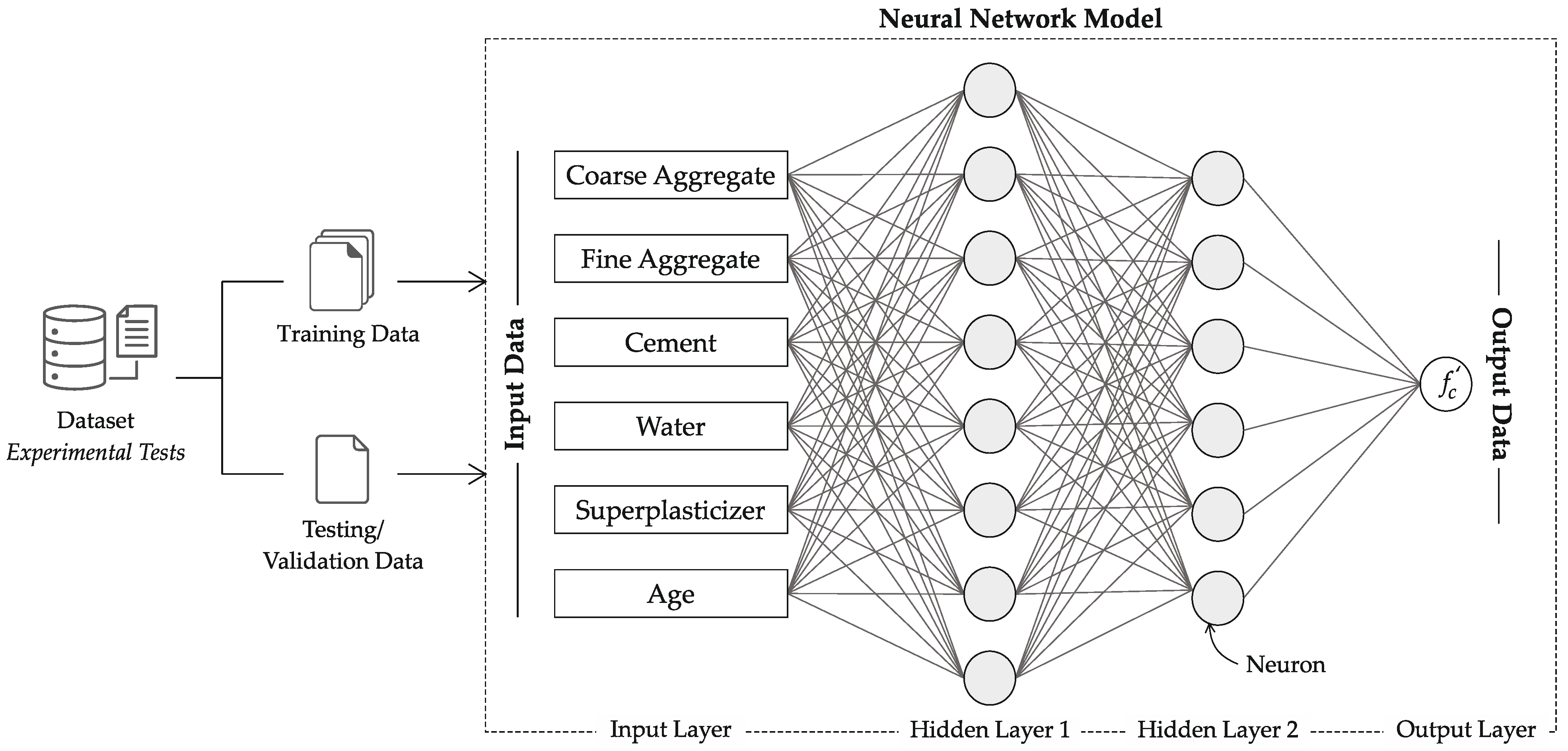
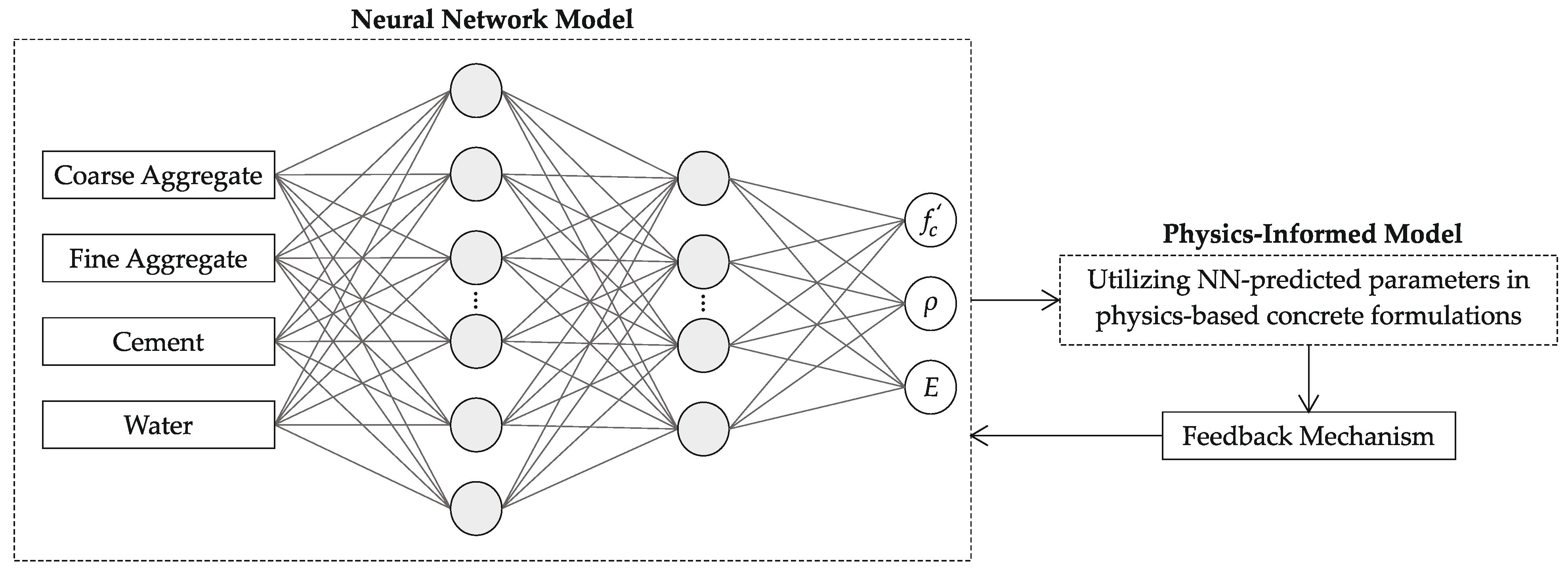
- Neural Network (NN): Neural networks are some computational models based on the structure and functioning of the human brain, made of layers of interconnected nodes (neurons) processing and transmitting information. NNs with more than one hidden layer (Deep Neural Networks, DNNs) have proven to be particularly effective in learning complex, nonlinear relationships over large datasets and are therefore highly effective in making long-term life predictions and in modeling time-dependent degradation processes. Recurrent Neural Networks (RNNs): This is a class of NN that processes sequential data by storing internal memory of past inputs, and it is amenable to time-dependent behavioral modeling. The CNNs are a particular form of DNNs that are capable of handling grid-like data, like images, and have been successfully used to detect cracks on images and classify surface damage [94,95,96]. Table 2 lists representative studies that have been carried out to compare ANN methods of predicting concrete properties.

| Study | Concrete Application | ML Methods Compared | Key Outcome (Best Performance) |
|---|---|---|---|
| Duan et al. [97] | Compressive strength | ANN | ANN model, trained on 146 datasets from 16 studies, effectively predicted compressive strength using 14 input parameters. Results demonstrated ANN’s strong generalization capability across diverse mix designs and recycled aggregate types. |
| Naderpour et al. [98] | Compressive strength | ANN | ANN model, trained on 139 datasets from 14 studies, successfully predicted compressive strength of RAC using six input parameters. The model demonstrated strong performance across a wide range of recycled aggregate types, confirming its utility for sustainable construction planning. |
| Loureiro et al. [6] | Compressive strength | ANN | ANN achieved highest accuracy (R2 ≈ 0.89) with lowest error, closely followed by Gradient Boosting. RF and SVR performed slightly lower. ANN’s advantage was balanced by GB’s greater interpretability |
| Al Yamani et al. [99] | Compressive strength | ANN | NN consistently outperformed other models, with RMSE values indicating highly accurate predictions. The model showed strong agreement between predicted and measured compressive strength, with correlation values above 0.8 after 28 days. |
| Khademi et al. [100] | Compressive strength | ANN, ANFIS, MLR | ANN and ANFIS outperformed MLR in predictive accuracy. MLR was more suitable for preliminary mix design, while ANN and ANFIS are better suited for mix optimization and high-accuracy applications. Including non-dimensional parameters significantly improved model accuracy. |
| Hammoudi et al. [101] | Compressive strength | ANN, Response Surface Methodology (RSM) | Both ANN and RSM effectively modeled compressive strength. ANN showed higher prediction accuracy across all ages (7, 28, 56 days). Strength decreased with higher RCA replacement. Cement content and slump were significant predictors. ANN outperformed RSM in statistical accuracy (R2, RMSE, RPD). |
| Chen et al. [102] | Multiple properties of concrete | Back-Propagation Neural Network (BPNN) | BPNN accurately modeled both material-to-property and property-to-property relationships. Average relative error remained under 7% for both models. A notable trade-off was observed between strength and permeability, supporting its use in predictive evaluations and test cost reduction. |
- Regression: Regression is a statistical process that is employed to model and predict continuous values by approximating a relationship between input variables and a target variable [103,104]. It is extensively used in the analysis and prediction of material behavior, including prediction of concrete strength in terms of mix proportions and curing conditions [23].
- Decision Trees (DTs): Decision trees divide the data into branches depending on the value of the feature to make a decision or prediction. They are also intuitive and simple to interpret and can be used in classification and regression tasks including the detection of the types of defects or structural health evaluation [105,106]. They are, however, subject to overfitting unless they are checked.
- Regression Trees: Regression trees are decision tree models applied to the prediction of the continuous numerical values by dividing data according to the feature thresholds. They are preferred due to their interpretability and capability of modeling complex and nonlinear relationships between mixed components and target properties. As an example, the regression trees can estimate the concrete compressive strength depending on the proportion of cement, water–cement ratio, and size of aggregate [83,84,85,86,87,88,89].
- Support Vector Machines (SVMs): Support vector machines identify the optimum boundary (hyper-plane) to divide the various classes in the data. They are very useful in categorization works like that of detecting defective and non-defective concrete or the classification of structural integrity. SVMs can handle high-dimensional data and are resistant to overfitting, when they are tuned well [19,90,91,92,93].
- Ensemble methods: Ensemble methods are those approaches that consolidate the forecasts of numerous base models, with the goal of improving accuracy and stability. Extreme Gradient Boosting (XGBoost) and Random Forest (RF) are two commonly used ensemble algorithms [107,108]. XGBoost constructs a sequence of decision trees, with each tree correcting the errors committed by the preceding trees using gradient boosting which has proven to be efficient and highly predictive, thus making it especially useful in the prediction of nonlinear relationships in concrete property prediction and mix design optimization [107]. Random Forests, on the other hand, are the aggregation of the several decision trees that are trained on random samples of data and features, and this assists in lowering overfitting and capturing different patterns. Random Forests have been widely used in classification and regression, as well as in defect detection applications [109,110] and durability prediction [111,112] in engineering.
- Long short-term memory (LSTM): LSTM is a particular model of recurrent neural network that can learn longer-range dependencies and temporal patterns in sequential data. LSTM addresses the issue of vanishing gradient which is inherent to traditional RNNs by storing memory cells and gating mechanisms that allow the model to learn complex time-series data. Structural health monitoring and predictive maintenance [113,114] are among the many applications of LSTM networks in which the importance of time dynamics is essential.
3.3. Unsupervised and Clustering Methods
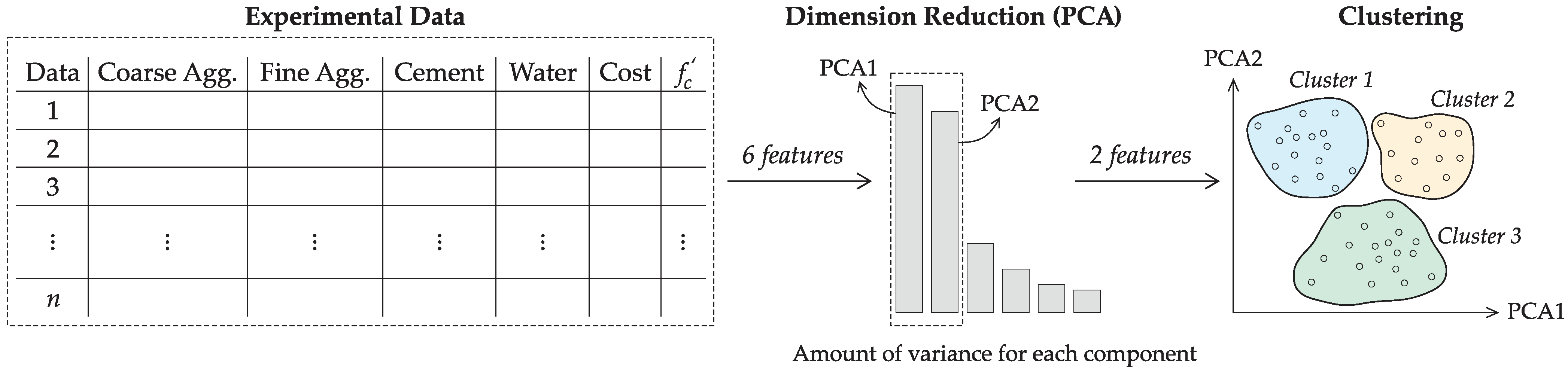
- Clustering Algorithms: These are algorithms that cluster together similar concrete samples using common properties and indicate natural clusters of performance, such as concrete classes or performance clusters. K-means divides data into a set number of clusters by minimizing the distance between the points and the center of the cluster. In hierarchical clustering, a tree-based hierarchy of nested clusters is formed by merging or splitting clusters based on similarity. Density-Based Spatial Clustering of Applications with Noise (DBSCAN) identifies clusters using the density of data points and is able to identify clusters of any shape as well as isolate noise data [136]. Gaussian Mixture Models (GMM) classify the data by assuming that it is a characteristic of a mixture of Gaussian distributions, where a point can be part of a cluster with different probabilities. The GMM can model overlapping and irregularities of clusters, unlike K-means [137,138]. The clustering techniques can be used to optimize mix designs by finding mixes with similar mechanical behavior formation [115,116,117,118,119,120,121,122].
- Dimensionality Reduction Techniques: Techniques are methods used to reduce the high dimension data to allow the analysis and visualization of the data. Principal Component Analysis (PCA) performs reduction in dimensionality that converts the data into a group of orthogonal principal components that represent the highest quantification of the variance to isolate the key variables that affect concrete performance, including the admixture quantities of individual minerals or moisture content. t-Distributed Stochastic Neighbor Embedding (t-SNE) is a nonlinear algorithm which maintains local relations and achieves the visualization of complex patterns in the reduced-dimensional space. Uniform Manifold Approximation and Projection (UMAP) is similarly a dimensionality reduction algorithm that preserves local and global data structure and usually is faster and more scalable. Those methodologies make visualization easier and aid in selection of features [123,124,125,126,127,128].
- Anomaly Detection Models: These are models that detect outliers that strongly deviate in normal patterns, including unusual curing conditions, unusual mix ratios, or unusual microsequences. The models help to identify such irregularities in the early stages of development of possible defects, material inconsistencies, or the non-compliance with quality, resulting in better quality management, safety, and reduction in the risk of structural failures in concrete use [129,130,131,132,133,134].
3.4. Reinforcement Learning Algorithm
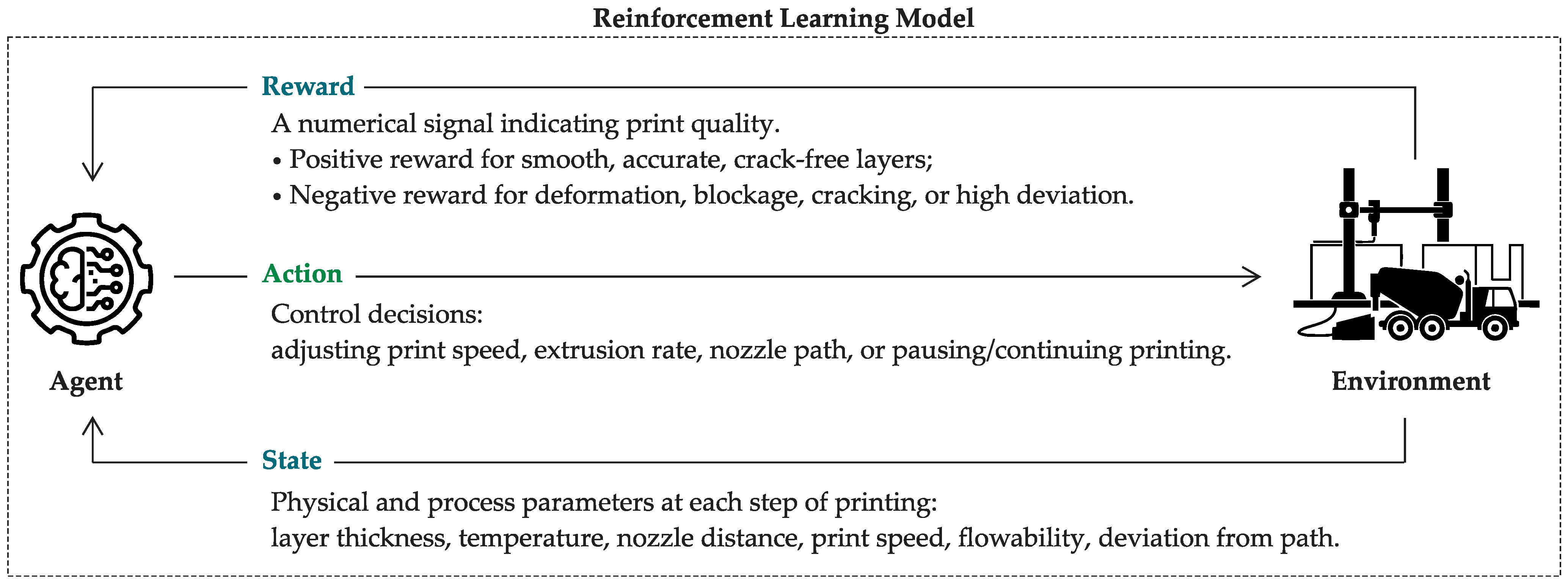
- Algorithmic Approaches: RL is based on a number of fundamental algorithmic approaches. The value-based approaches like Q-learning and Deep Q-Networks (DQN) are aimed at determining the value of expected reward of actions to make decisions. Policy-gradient approaches, like Proximal Policy Optimization (PPO), in contrast, modify agent behavior to achieve long-term rewards. Such approaches are generally used in the context of a Markov Decision Process (MDP) that views the environment as a sequence of states, actions, and rewards [148,149]. The actor–critic models have the advantages of both policy-based and value-based approaches, using a single network to find actions (actor) and another to analyze them (critic).
- Real-World Implementation Challenges:
- Limitations:
3.5. Hybrid and Physics-Informed Models
4. Comparative Evaluation of Established ML Methods in Concrete Research
4.1. Mix Design Modeling and Optimization
4.2. Hardened Concrete Properties Prediction
4.3. Fresh Concrete Behavior and Processability
5. General Trends
- Ensemble and boosting models consistently outperform single-learner models on heterogeneous concrete datasets.
- Model performance is strongly constrained by dataset diversity rather than algorithmic complexity alone.
- Curing- and environment-driven variability remains a dominant source of prediction uncertainty.
- Physics-informed approaches improve robustness under extrapolative conditions.
5.1. Key Insights and Cross-Study Lessons
Contrasting ML Paradigms Under Different Variability Regimes
6. Conclusions
Funding
Data Availability Statement
Conflicts of Interest
Abbreviations
| AI | Artificial Intelligence |
| NN | Artificial Neural Network |
| BNN | Bayesian Neural Network |
| CNN | Convolutional Neural Network |
| DBSCAN | Density-Based Spatial Clustering of Applications with Noise |
| DNN | Deep Neural Network |
| DT | Decision Trees |
| GMM | Gaussian Mixture Model |
| XGBoost | Extreme Gradient Boosting |
| GAN | Generative Adversarial Network |
| GGBS | Ground Granulated Blast-Furnace Slag |
| ITZ | Interfacial Transition Zones |
| KNN | K-Nearest Neighbors |
| LSTM | Long Short-Term Memory |
| MDP | Markov Decision Process |
| ML | Machine Learning |
| MLPNN | Multilayer Perceptron Neural Network |
| NN | Neural Network |
| PCA | Principal Component Analysis |
| PPO | Proximal Policy Optimization |
| RF | Random Forests |
| RL | Reinforcement Learning |
| RNN | Recurrent Neural Network |
| SVM | Support Vector Machine |
| t-SNE | t-distributed Stochastic Neighbor Embedding |
| UMAP | Uniform Manifold Approximation and Projection |
References
- Mostafaei, H.; Mostofinejad, D.; Ghamami, M.; Wu, C. Fully automated operational modal identification of regular and irregular buildings with ensemble learning. Structures 2023, 58, 105439. [Google Scholar] [CrossRef]
- Mostafaei, H.; Ghamami, M. State of the Art in Automated Operational Modal Identification: Algorithms, Applications, and Future Perspectives. Machines 2025, 13, 39. [Google Scholar] [CrossRef]
- Lagaros, N.D.; Plevris, V. Artificial intelligence (AI) applied in civil engineering. Appl. Sci. 2022, 12, 7595. [Google Scholar] [CrossRef]
- Harle, S.M. Advancements and challenges in the application of artificial intelligence in civil engineering: A comprehensive review. Asian J. Civ. Eng. 2024, 25, 1061–1078. [Google Scholar] [CrossRef]
- Gamil, Y. Machine learning in concrete technology: A review of current researches, trends, and applications. Front. Built Environ. 2023, 9, 1145591. [Google Scholar] [CrossRef]
- Loureiro, A.A.B.; Stefani, R. Comparing the performance of machine learning models for predicting the compressive strength of concrete. Discov. Civ. Eng. 2024, 1, 19. [Google Scholar] [CrossRef]
- Oviedo, A.I.; Londoño, J.M.; Vargas, J.F.; Zuluaga, C.; Gómez, A. Modeling and Optimization of Concrete Mixtures Using Machine Learning Estimators and Genetic Algorithms. Modelling 2024, 5, 642–658. [Google Scholar] [CrossRef]
- Li, Z.; Yoon, J.; Zhang, R.; Rajabipour, F.; Srubar, W.V., III; Dabo, I.; Radlińska, A. Machine learning in concrete science: Applications, challenges, and best practices. npj Comput. Mater. 2022, 8, 127. [Google Scholar] [CrossRef]
- Koya, B.P.; Aneja, S.; Gupta, R.; Valeo, C. Comparative analysis of different machine learning algorithms to predict mechanical properties of concrete. Mech. Adv. Mater. Struct. 2022, 29, 4032–4043. [Google Scholar] [CrossRef]
- Kumar, A.; Arora, H.C.; Kapoor, N.R.; Mohammed, M.A.; Kumar, K.; Majumdar, A.; Thinnukool, O. Compressive strength prediction of lightweight concrete: Machine learning models. Sustainability 2022, 14, 2404. [Google Scholar] [CrossRef]
- Ziolkowski, P.; Niedostatkiewicz, M. Machine learning techniques in concrete mix design. Materials 2019, 12, 1256. [Google Scholar] [CrossRef]
- DeRousseau, M.A.; Laftchiev, E.; Kasprzyk, J.R.; Rajagopalan, B.; Srubar, W.V., III. A comparison of machine learning methods for predicting the compressive strength of field-placed concrete. Constr. Build. Mater. 2019, 228, 116661. [Google Scholar] [CrossRef]
- Ziolkowski, P.; Niedostatkiewicz, M.; Kang, S.-B. Model-based adaptive machine learning approach in concrete mix design. Materials 2021, 14, 1661. [Google Scholar] [CrossRef] [PubMed]
- Pakzad, S.S.; Roshan, N.; Ghalehnovi, M. Comparison of various machine learning algorithms used for compressive strength prediction of steel fiber-reinforced concrete. Sci. Rep. 2023, 13, 3646. [Google Scholar] [CrossRef]
- Mostafaei, H. Modal Identification Techniques for Concrete Dams: A Comprehensive Review and Application. Sci 2024, 6, 40. [Google Scholar] [CrossRef]
- Nafees, A.; Amin, M.N.; Khan, K.; Nazir, K.; Ali, M.; Javed, M.F.; Aslam, F.; Musarat, M.A.; Vatin, N.I. Modeling of mechanical properties of silica fume-based green concrete using machine learning techniques. Polymers 2021, 14, 30. [Google Scholar] [CrossRef]
- Nazar, S.; Yang, J.; Ahmad, W.; Javed, M.F.; Alabduljabbar, H.; Deifalla, A.F. Development of the new prediction models for the compressive strength of nanomodified concrete using novel machine learning techniques. Buildings 2022, 12, 2160. [Google Scholar] [CrossRef]
- Shang, M.; Li, H.; Ahmad, A.; Ahmad, W.; Ostrowski, K.A.; Aslam, F.; Joyklad, P.; Majka, T.M. Predicting the mechanical properties of RCA-based concrete using supervised machine learning algorithms. Materials 2022, 15, 647. [Google Scholar] [CrossRef] [PubMed]
- Nafees, A.; Khan, S.; Javed, M.F.; Alrowais, R.; Mohamed, A.M.; Mohamed, A.; Vatin, N.I. Forecasting the mechanical properties of plastic concrete employing experimental data using machine learning algorithms: DT, MLPNN, SVM, and RF. Polymers 2022, 14, 1583. [Google Scholar] [CrossRef]
- Pham, A.-D.; Ngo, N.-T.; Nguyen, Q.-T.; Truong, N.-S. Hybrid machine learning for predicting strength of sustainable concrete. Soft Comput. 2020, 24, 14965–14980. [Google Scholar] [CrossRef]
- Yaseen, Z.M. Machine learning models development for shear strength prediction of reinforced concrete beam: A comparative study. Sci. Rep. 2023, 13, 1723. [Google Scholar] [CrossRef] [PubMed]
- Wan, Z.; Xu, Y.; Šavija, B. On the use of machine learning models for prediction of compressive strength of concrete: Influence of dimensionality reduction on the model performance. Materials 2021, 14, 713. [Google Scholar] [CrossRef] [PubMed]
- Ahmad, A.; Ostrowski, K.A.; Maślak, M.; Farooq, F.; Mehmood, I.; Nafees, A. Comparative study of supervised machine learning algorithms for predicting the compressive strength of concrete at high temperature. Materials 2021, 14, 4222. [Google Scholar] [CrossRef]
- Hosseinzadeh, M.; Mousavi, S.S.; Hosseinzadeh, A.; Dehestani, M. An efficient machine learning approach for predicting concrete chloride resistance using a comprehensive dataset. Sci. Rep. 2023, 13, 15024. [Google Scholar] [CrossRef] [PubMed]
- Mostafaei, H.; Ashoori Barmchi, M.; Bahmani, H. Seismic Resilience and Sustainability: A Comparative Analysis of Steel and Reinforced Structures. Buildings 2025, 15, 1613. [Google Scholar] [CrossRef]
- Wani, S.R.; Suthar, M. Utilizing machine learning approaches within concrete technology offers an intelligent perspective towards sustainability in the construction industry: A comprehensive review. Multiscale Multidiscip. Model. Exp. Des. 2025, 8, 1. [Google Scholar] [CrossRef]
- Prasittisopin, L. Machine learning (ML) and deep learning (DL) in sustainable concrete construction: Review, trend and gap analyses. J. Asian Archit. Build. Eng. 2025, 1–29. [Google Scholar] [CrossRef]
- Mobasheri, F.; Hosseinpoor, M.; Yahia, A.; Pourkamali-Anaraki, F. Machine Learning as an Innovative Engineering Tool for Controlling Concrete Performance: A Comprehensive Review. Arch. Comput. Methods Eng. 2025, 32, 4723–4767. [Google Scholar] [CrossRef]
- Khan, K.; Ahmad, W.; Amin, M.N.; Ahmad, A. A systematic review of the research development on the application of machine learning for concrete. Materials 2022, 15, 4512. [Google Scholar] [CrossRef]
- Neville, A.M. Properties of Concrete; Pearson Education India: Chennai, India, 1963. [Google Scholar]
- Mehta, P.K.; Monteiro, P. Concrete: Microstructure, Properties, and Materials; McGraw-Hill: New York, NY, USA, 2006. [Google Scholar]
- Mostafaei, H.; Kelishadi, M.; Bahmani, H.; Wu, C.; Ghiassi, B. Development of sustainable HPC using rubber powder and waste wire: Carbon footprint analysis, mechanical and microstructural properties. Eur. J. Environ. Civ. Eng. 2025, 29, 399–420. [Google Scholar] [CrossRef]
- Mostafaei, H.; Bahmani, H. Sustainable High-Performance Concrete Using Zeolite Powder: Mechanical and Carbon Footprint Analyses. Buildings 2024, 14, 3660. [Google Scholar] [CrossRef]
- Bahmani, H.; Mostafaei, H.; Santos, P.; Fallah Chamasemani, N. Enhancing the mechanical properties of Ultra-High-Performance Concrete (UHPC) through silica sand replacement with steel slag. Buildings 2024, 14, 3520. [Google Scholar] [CrossRef]
- Ivanov, V.; Chu, J.; Stabnikov, V. Basics of construction microbial biotechnology. In Biotechnologies and Biomimetics for Civil Engineering; Springer: Berlin/Heidelberg, Germany, 2014; pp. 21–56. [Google Scholar]
- Aïtcin, P.-C. High Performance Concrete; CRC Press: Boca Raton, FL, USA, 1998. [Google Scholar]
- Shapland, A.; Stefani, E. Archaeology Behind the Battle Lines; Routledge: Abingdon, UK, 2017. [Google Scholar]
- Nodehi, M.; Ozbakkaloglu, T.; Gholampour, A.; Mohammed, T.; Shi, X. The effect of curing regimes on physico-mechanical, microstructural and durability properties of alkali-activated materials: A review. Constr. Build. Mater. 2022, 321, 126335. [Google Scholar] [CrossRef]
- Bahmani, H.; Mostafaei, H.; Mohamad Momeni, R.; Khoshoei, S.M. Utilization of Waste Marble Sludge in Self-Compacting Concrete: A Study on Partial Replacement of Cement and Fine Aggregates. Sustainability 2025, 17, 8523. [Google Scholar] [CrossRef]
- Bahmani, H.; Mostafaei, H.; Rostampour, M.A. Utilization of Stone Quarry Sludge in the Development of Environmentally Friendly High-Strength Concrete. J. Compos. Sci. 2025, 9, 648. [Google Scholar] [CrossRef]
- Boddepalli, U.; Panda, B.; Ranjani Gandhi, I.S. Rheology and printability of Portland cement based materials: A review. J. Sustain. Cem.-Based Mater. 2023, 12, 789–807. [Google Scholar] [CrossRef]
- Arunothayan, A.R.; Nematollahi, B.; Khayat, K.H.; Ramesh, A.; Sanjayan, J.G. Rheological characterization of ultra-high performance concrete for 3D printing. Cem. Concr. Compos. 2023, 136, 104854. [Google Scholar] [CrossRef]
- Gao, H.; Jin, L.; Chen, Y.; Chen, Q.; Liu, X.; Yu, Q. Rheological behavior of 3D printed concrete: Influential factors and printability prediction scheme. J. Build. Eng. 2024, 91, 109626. [Google Scholar] [CrossRef]
- Bahmani, H.; Mostafaei, H.; Wu, C. Innovative Uses of Iron Ore Tailings in Sustainable Concrete: An In-Depth Review of Achievements, Future Potential, and Strategic Directions. Arab. J. Sci. Eng. 2025, 1–20. [Google Scholar] [CrossRef]
- Bahmani, H.; Mostafaei, H. Eco-Friendly Self-Compacting Concrete Incorporating Waste Marble Sludge as Fine and Coarse Aggregate Substitute. Buildings 2025, 15, 3218. [Google Scholar] [CrossRef]
- Bahmani, H.; Mostafaei, H.; Mostofinejad, D. Review of energy dissipation mechanisms in concrete: Role of advanced materials, mix design, and curing conditions. Sustainability 2025, 17, 6723. [Google Scholar] [CrossRef]
- Rostampour, M.A.; Mostofinejad, D.; Bahmani, H.; Mostafaei, H. Crack Assessment Using Acoustic Emission in Cement-Free High-Performance Concrete Under Mechanical Stress. J. Compos. Sci. 2025, 9, 380. [Google Scholar] [CrossRef]
- Bahmani, H.; Mostofinejad, D. Comparative analysis of environmental, social, and mechanical aspects of high-performance concrete with calcium oxide-activated slag reinforced with basalt, and recycled PET fibers. Case Stud. Constr. Mater. 2024, 20, e02895. [Google Scholar] [CrossRef]
- Kim, Y.-Y.; Lee, K.-M.; Bang, J.-W.; Kwon, S.-J. Effect of W/C ratio on durability and porosity in cement mortar with constant cement amount. Adv. Mater. Sci. Eng. 2014, 2014, 273460. [Google Scholar] [CrossRef]
- Piasta, W.; Zarzycki, B. The effect of cement paste volume and w/c ratio on shrinkage strain, water absorption and compressive strength of high performance concrete. Constr. Build. Mater. 2017, 140, 395–402. [Google Scholar] [CrossRef]
- Bahmani, H.; Mostafaei, H. Impact of Fibers on the Mechanical and Environmental Properties of High-Performance Concrete Incorporating Zeolite. J. Compos. Sci. 2025, 9, 222. [Google Scholar] [CrossRef]
- Mostafaei, H.; Bahmani, H.; Mostofinejad, D. Damping Behavior of Fiber-Reinforced Concrete: A Comprehensive Review of Mechanisms, Materials, and Dynamic Effects. J. Compos. Sci. 2025, 9, 254. [Google Scholar] [CrossRef]
- Bahmani, H.; Mostofinejad, D. A novel high-performance concrete based on calcium oxide-activated materials reinforced with different fibers. Dev. Built Environ. 2023, 15, 100201. [Google Scholar] [CrossRef]
- Samarakoon, M.H.; Ranjith, P.G.; Duan, W.H.; De Silva, V.R.S. Properties of one-part fly ash/slag-based binders activated by thermally-treated waste glass/NaOH blends: A comparative study. Cem. Concr. Compos. 2020, 112, 103679. [Google Scholar] [CrossRef]
- Sasui, S.; Kim, G.; Nam, J.; van Riessen, A.; Eu, H.; Chansomsak, S.; Alam, S.F.; Cho, C.H. Incorporation of waste glass as an activator in Class-C Fly Ash/GGBS based Alkali activated material. Materials 2020, 13, 3906. [Google Scholar] [CrossRef]
- Gao, X.; Yu, Q.L.; Lazaro, A.; Brouwers, H.J.H. Investigation on a green olivine nano-silica source based activator in alkali activated slag-fly ash blends: Reaction kinetics, gel structure and carbon footprint. Cem. Concr. Res. 2017, 100, 129–139. [Google Scholar] [CrossRef]
- Ogundiran, M.B.; Nugteren, H.W.; Witkamp, G.-J. Geopolymerisation of fly ashes with waste aluminium anodising etching solutions. J. Environ. Manag. 2016, 181, 118–123. [Google Scholar] [CrossRef]
- Rodríguez, E.D.; Bernal, S.A.; Provis, J.L.; Paya, J.; Monzo, J.M.; Borrachero, M.V. Effect of nanosilica-based activators on the performance of an alkali-activated fly ash binder. Cem. Concr. Compos. 2013, 35, 1–11. [Google Scholar] [CrossRef]
- El-Naggar, M.R.; El-Dessouky, M.I. Re-use of waste glass in improving properties of metakaolin-based geopolymers: Mechanical and microstructure examinations. Constr. Build. Mater. 2017, 132, 543–555. [Google Scholar] [CrossRef]
- Puertas, F.; Torres-Carrasco, M. Use of glass waste as an activator in the preparation of alkali-activated slag. Mechanical strength and paste characterisation. Cem. Concr. Res. 2014, 57, 95–104. [Google Scholar] [CrossRef]
- Adesanya, E.; Ohenoja, K.; Di Maria, A.; Kinnunen, P.; Illikainen, M. Alternative alkali-activator from steel-making waste for one-part alkali-activated slag. J. Clean. Prod. 2020, 274, 123020. [Google Scholar] [CrossRef]
- Font, A.; Soriano, L.; de Moraes Pinheiro, S.M.; Tashima, M.M.; Monzó, J.; Borrachero, M.V.; Payá, J. Design and properties of 100% waste-based ternary alkali-activated mortars: Blast furnace slag, olive-stone biomass ash and rice husk ash. J. Clean. Prod. 2020, 243, 118568. [Google Scholar] [CrossRef]
- Yaseri, S.; Verki, V.M.; Mahdikhani, M. Utilization of high volume cement kiln dust and rice husk ash in the production of sustainable geopolymer. J. Clean. Prod. 2019, 230, 592–602. [Google Scholar] [CrossRef]
- Prusty, S.R.; Panigrahi, R.; Jena, S. Characterisation and life-cycle assessment of alkali-activated concrete using industrial wastes. Int. J. Environ. Sci. Technol. 2024, 21, 2923–2938. [Google Scholar] [CrossRef]
- Saha, A.; Aditto, F.S.; Kundu, L.; Sobuz, M.H.R.; Sunny, M.M.H. Analysis of waste glass as a partial substitute for coarse aggregate in self-compacting concrete: An experimental and machine learning study. J. Build. Eng. 2024, 98, 111112. [Google Scholar] [CrossRef]
- Sathvik, S.; Oyebisi, S.; Kumar, R.; Shakor, P.; Adejonwo, O.; Tantri, A.; Suma, V. Analyzing the influence of manufactured sand and fly ash on concrete strength through experimental and machine learning methods. Sci. Rep. 2025, 15, 4978. [Google Scholar] [CrossRef]
- Bentegri, H.; Rabehi, M.; Kherfane, S.; Nahool, T.A.; Rabehi, A.; Guermoui, M.; Alhussan, A.A.; Khafaga, D.S.; Eid, M.M.; El-Kenawy, E.-S.M. Assessment of compressive strength of eco-concrete reinforced using machine learning tools. Sci. Rep. 2025, 15, 5017. [Google Scholar] [CrossRef]
- Bangaru, S.S.; Wang, C.; Hassan, M.; Jeon, H.W.; Ayiluri, T. Estimation of the degree of hydration of concrete through automated machine learning based microstructure analysis—A study on effect of image magnification. Adv. Eng. Inform. 2019, 42, 100975. [Google Scholar] [CrossRef]
- Laqsum, S.A.; Zhu, H.; Haruna, S.I.; Ibrahim, Y.E.; Al-shawafi, A. Mechanical and Impact Strength Properties of Polymer-Modified Concrete Supported with Machine Learning Method: Microstructure Analysis (SEM) Coupled with EDS. J. Compos. Sci. 2025, 9, 101. [Google Scholar] [CrossRef]
- Li, Y.; Ma, Y.; Tan, K.H.; Qian, H.; Liu, T. Microstructure-informed deep learning model for accurate prediction of multiple concrete properties. J. Build. Eng. 2024, 98, 111339. [Google Scholar] [CrossRef]
- Ghosh, A.; Ransinchung, G.D. Application of machine learning algorithm to assess the efficacy of varying industrial wastes and curing methods on strength development of geopolymer concrete. Constr. Build. Mater. 2022, 341, 127828. [Google Scholar] [CrossRef]
- Sun, B.; Huang, Y.; Liu, G.; Wang, W. Prediction of compressive strength of concrete under various curing conditions: A comparison of machine learning models and empirical mathematical models. Innov. Infrastruct. Solut. 2024, 9, 262. [Google Scholar] [CrossRef]
- Ahmad, S.A.; Ahmed, H.U.; Rafiq, S.K.; Ahmad, D.A. Machine learning approach for predicting compressive strength in foam concrete under varying mix designs and curing periods. Smart Constr. Sustain. Cities 2023, 1, 16. [Google Scholar] [CrossRef]
- Zhang, M.; Gu, Z.; Zhao, Y.; Fu, Y.; Kong, X. Compressive strength prediction of cement base under sulfate attack by machine learning approach. Case Stud. Constr. Mater. 2024, 21, e03652. [Google Scholar] [CrossRef]
- Li, Y.; Shi, J.; Shen, J.; Jin, K.; Fan, M.; Liu, X. Prediction of the Sulfate Attack Resistance of Concrete Based on Machine-Learning Algorithms. J. Comput. Civ. Eng. 2024, 38, 04024043. [Google Scholar] [CrossRef]
- Taffese, W.Z.; Sistonen, E.; Puttonen, J. CaPrM: Carbonation prediction model for reinforced concrete using machine learning methods. Constr. Build. Mater. 2015, 100, 70–82. [Google Scholar] [CrossRef]
- Ehsani, M.; Ostovari, M.; Mansouri, S.; Naseri, H.; Jahanbakhsh, H.; Nejad, F.M. Machine learning for predicting concrete carbonation depth: A comparative analysis and a novel feature selection. Constr. Build. Mater. 2024, 417, 135331. [Google Scholar] [CrossRef]
- Tran, V.Q.; Mai, H.V.T.; To, Q.T.; Nguyen, M.H. Machine learning approach in investigating carbonation depth of concrete containing Fly ash. Struct. Concr. 2023, 24, 2145–2169. [Google Scholar] [CrossRef]
- Li, Y.; Jin, K.; Lin, H.; Shen, J.; Shi, J.; Fan, M. Analysis and prediction of freeze-thaw resistance of concrete based on machine learning. Mater. Today Commun. 2024, 39, 108946. [Google Scholar] [CrossRef]
- Rathnayaka, M.; Karunasingha, D.; Gunasekara, C.; Wijesundara, K.; Law, D.W.; Lokuge, W. Systematic Analysis of the Impact of Data Preprocessing Techniques on Machine-Learning Model Performance: A Case Study of a Compressive Strength Prediction Model for Geopolymer Concrete. J. Comput. Civ. Eng. 2025, 39, 04025051. [Google Scholar] [CrossRef]
- Hasan, M.R.; Shuvo, A.K.; Pranto, E.B.; Hasan, M.; Miah, M.M. Data-driven prediction of concrete strength by machine learning: Hybrid-fiber-reinforced recycled aggregate concrete. World J. Eng. 2025; in press. [Google Scholar]
- Barbhuiya, S.; Sharif, M.S. Integrating Machine Learning with Concrete Science: Bridging Traditional Testing and Advanced Predictive Modelling. In 2024 International Conference on Innovation and Intelligence for Informatics, Computing, and Technologies (3ICT); IEEE: New York, NY, USA, 2024; pp. 88–93. [Google Scholar]
- Young, B.A.; Hall, A.; Pilon, L.; Gupta, P.; Sant, G. Can the compressive strength of concrete be estimated from knowledge of the mixture proportions?: New insights from statistical analysis and machine learning methods. Cem. Concr. Res. 2019, 115, 379–388. [Google Scholar] [CrossRef]
- Kabiru, O.A.; Owolabi, T.O.; Ssennoga, T.; Olatunji, S.O. Performance comparison of SVM and ANN in predicting compressive strength of concrete. IOSR J. Comput. Eng. 2014, 16, 88–94. [Google Scholar] [CrossRef]
- Chou, J.-S.; Tsai, C.-F.; Pham, A.-D.; Lu, Y.-H. Machine learning in concrete strength simulations: Multi-nation data analytics. Constr. Build. Mater. 2014, 73, 771–780. [Google Scholar] [CrossRef]
- Duan, J.; Asteris, P.G.; Nguyen, H.; Bui, X.-N.; Moayedi, H. A novel artificial intelligence technique to predict compressive strength of recycled aggregate concrete using ICA-XGBoost model. Eng. Comput. 2021, 37, 3329–3346. [Google Scholar] [CrossRef]
- Gupta, S.M. Support vector machines based modelling of concrete strength. Int. J. Intel. Technol. 2007, 3, 12–18. [Google Scholar]
- Chou, J.-S.; Pham, A.-D. Enhanced artificial intelligence for ensemble approach to predicting high performance concrete compressive strength. Constr. Build. Mater. 2013, 49, 554–563. [Google Scholar] [CrossRef]
- Deepa, C.; SathiyaKumari, K.; Sudha, V.P. Prediction of the compressive strength of high performance concrete mix using tree based modeling. Int. J. Comput. Appl. 2010, 6, 18–24. [Google Scholar] [CrossRef]
- Erdal, H.I. Two-level and hybrid ensembles of decision trees for high performance concrete compressive strength prediction. Eng. Appl. Artif. Intell. 2013, 26, 1689–1697. [Google Scholar] [CrossRef]
- Nafees, A.; Javed, M.F.; Khan, S.; Nazir, K.; Farooq, F.; Aslam, F.; Musarat, M.A.; Vatin, N.I. Predictive modeling of mechanical properties of silica fume-based green concrete using artificial intelligence approaches: MLPNN, ANFIS, and GEP. Materials 2021, 14, 7531. [Google Scholar] [CrossRef] [PubMed]
- Khan, M.A.; Aslam, F.; Javed, M.F.; Alabduljabbar, H.; Deifalla, A.F. New prediction models for the compressive strength and dry-thermal conductivity of bio-composites using novel machine learning algorithms. J. Clean. Prod. 2022, 350, 131364. [Google Scholar] [CrossRef]
- Salem, N.M.; Deifalla, A. Evaluation of the strength of slab-column connections with FRPs using machine learning algorithms. Polymers 2022, 14, 1517. [Google Scholar] [CrossRef] [PubMed]
- Ebid, A.; Deifalla, A. Using artificial intelligence techniques to predict punching shear capacity of lightweight concrete slabs. Materials 2022, 15, 2732. [Google Scholar] [CrossRef]
- Dong, W.; Huang, Y.; Lehane, B.; Ma, G. XGBoost algorithm-based prediction of concrete electrical resistivity for structural health monitoring. Autom. Constr. 2020, 114, 103155. [Google Scholar] [CrossRef]
- Kaloop, M.R.; Kumar, D.; Samui, P.; Hu, J.W.; Kim, D. Compressive strength prediction of high-performance concrete using gradient tree boosting machine. Constr. Build. Mater. 2020, 264, 120198. [Google Scholar] [CrossRef]
- Duan, Z.-H.; Kou, S.-C.; Poon, C.-S. Prediction of compressive strength of recycled aggregate concrete using artificial neural networks. Constr. Build. Mater. 2013, 40, 1200–1206. [Google Scholar] [CrossRef]
- Naderpour, H.; Rafiean, A.H.; Fakharian, P. Compressive strength prediction of environmentally friendly concrete using artificial neural networks. J. Build. Eng. 2018, 16, 213–219. [Google Scholar] [CrossRef]
- Al Yamani, W.H.; Ghunimat, D.M.; Bisharah, M.M. Modeling and predicting the sensitivity of high-performance concrete compressive strength using machine learning methods. Asian J. Civ. Eng. 2023, 24, 1943–1955. [Google Scholar] [CrossRef]
- Khademi, F.; Jamal, S.M.; Deshpande, N.; Londhe, S. Predicting strength of recycled aggregate concrete using artificial neural network, adaptive neuro-fuzzy inference system and multiple linear regression. Int. J. Sustain. Built Environ. 2016, 5, 355–369. [Google Scholar] [CrossRef]
- Hammoudi, A.; Moussaceb, K.; Belebchouche, C.; Dahmoune, F. Comparison of artificial neural network (ANN) and response surface methodology (RSM) prediction in compressive strength of recycled concrete aggregates. Constr. Build. Mater. 2019, 209, 425–436. [Google Scholar] [CrossRef]
- Chen, S.; Zhao, Y.; Bie, Y. The prediction analysis of properties of recycled aggregate permeable concrete based on back-propagation neural network. J. Clean. Prod. 2020, 276, 124187. [Google Scholar] [CrossRef]
- Atici, U. Prediction of the strength of mineral admixture concrete using multivariable regression analysis and an artificial neural network. Expert Syst. Appl. 2011, 38, 9609–9618. [Google Scholar] [CrossRef]
- Khademi, F.; Akbari, M.; Jamal, S.M.; Nikoo, M. Multiple linear regression, artificial neural network, and fuzzy logic prediction of 28 days compressive strength of concrete. Front. Struct. Civ. Eng. 2017, 11, 90–99. [Google Scholar] [CrossRef]
- Karbassi, A.; Mohebi, B.; Rezaee, S.; Lestuzzi, P. Damage prediction for regular reinforced concrete buildings using the decision tree algorithm. Comput. Struct. 2014, 130, 46–56. [Google Scholar] [CrossRef]
- Salkhordeh, M.; Mirtaheri, M.; Soroushian, S. A decision-tree-based algorithm for identifying the extent of structural damage in braced-frame buildings. Struct. Control Health Monit. 2021, 28, e2825. [Google Scholar] [CrossRef]
- Gogineni, A.; Panday, I.K.; Kumar, P.; Paswan, R.K. Predicting compressive strength of concrete with fly ash and admixture using XGBoost: A comparative study of machine learning algorithms. Asian J. Civ. Eng. 2024, 25, 685–698. [Google Scholar] [CrossRef]
- Dabiri, H.; Farhangi, V.; Moradi, M.J.; Zadehmohamad, M.; Karakouzian, M. Applications of decision tree and random forest as tree-based machine learning techniques for analyzing the ultimate strain of spliced and non-spliced reinforcement bars. Appl. Sci. 2022, 12, 4851. [Google Scholar] [CrossRef]
- Patel, S.; Jokhakar, V.N. A random forest based machine learning approach for mild steel defect diagnosis. In 2016 IEEE International Conference on Computational Intelligence and Computing Research (ICCIC); IEEE: New York, NY, USA, 2016; pp. 1–8. [Google Scholar]
- Chun, P.-J.; Ujike, I.; Mishima, K.; Kusumoto, M.; Okazaki, S. Random forest-based evaluation technique for internal damage in reinforced concrete featuring multiple nondestructive testing results. Constr. Build. Mater. 2020, 253, 119238. [Google Scholar] [CrossRef]
- Iqbal, M.; Zhang, D.; Jalal, F.E. Durability evaluation of GFRP rebars in harsh alkaline environment using optimized tree-based random forest model. J. Ocean Eng. Sci. 2022, 7, 596–606. [Google Scholar] [CrossRef]
- Liu, Y.; Cao, Y.; Wang, L.; Chen, Z.-S.; Qin, Y. Prediction of the durability of high-performance concrete using an integrated RF-LSSVM model. Constr. Build. Mater. 2022, 356, 129232. [Google Scholar] [CrossRef]
- Panfeng, B.; Songlin, Z.; Hongyu, C.; Caiwei, L.; Pengtao, W.; Lichang, Q. Structural monitoring data repair based on a long short-term memory neural network. Sci. Rep. 2024, 14, 9974. [Google Scholar] [CrossRef] [PubMed]
- Pagano, D. A predictive maintenance model using long short-term memory neural networks and Bayesian inference. Decis. Anal. J. 2023, 6, 100174. [Google Scholar] [CrossRef]
- Dorafshan, S.; Thomas, R.J.; Maguire, M. Comparison of deep convolutional neural networks and edge detectors for image-based crack detection in concrete. Constr. Build. Mater. 2018, 186, 1031–1045. [Google Scholar] [CrossRef]
- Debroy, S.; Sil, A. An apposite transfer-learned DCNN model for prediction of structural surface cracks under optimal threshold for class-imbalanced data. J. Build. Pathol. Rehabil. 2022, 7, 83. [Google Scholar] [CrossRef]
- Ali, L.; Alnajjar, F.; Jassmi, H.A.; Gocho, M.; Khan, W.; Serhani, M.A. Performance evaluation of deep CNN-based crack detection and localization techniques for concrete structures. Sensors 2021, 21, 1688. [Google Scholar] [CrossRef]
- Silva, W.R.L.d.; Lucena, D.S.d. Concrete cracks detection based on deep learning image classification. Proceedings 2018, 2, 489. [Google Scholar] [CrossRef]
- Zaidi, S.S.A.; Ansari, M.S.; Aslam, A.; Kanwal, N.; Asghar, M.; Lee, B. A survey of modern deep learning based object detection models. Digit. Signal Process. 2022, 126, 103514. [Google Scholar] [CrossRef]
- Deng, J.; Dong, W.; Socher, R.; Li, L.-J.; Li, K.; Fei-Fei, L. Imagenet: A large-scale hierarchical image database. In 2009 IEEE Conference on Computer Vision and Pattern Recognition; IEEE: New York, NY, USA, 2009; pp. 248–255. [Google Scholar]
- Pan, S.J.; Yang, Q. A survey on transfer learning. IEEE Trans. Knowl. Data Eng. 2010, 22, 1345–1359. [Google Scholar] [CrossRef]
- Golding, V.P.; Gharineiat, Z.; Munawar, H.S.; Ullah, F. Crack detection in concrete structures using deep learning. Sustainability 2022, 14, 8117. [Google Scholar] [CrossRef]
- Yu, Y.; Samali, B.; Rashidi, M.; Mohammadi, M.; Nguyen, T.N.; Zhang, G. Vision-based concrete crack detection using a hybrid framework considering noise effect. J. Build. Eng. 2022, 61, 105246. [Google Scholar] [CrossRef]
- Su, C.; Wang, W. Concrete cracks detection using convolutional neuralnetwork based on transfer learning. Math. Probl. Eng. 2020, 2020, 7240129. [Google Scholar] [CrossRef]
- Yang, Q.; Shi, W.; Chen, J.; Lin, W. Deep convolution neural network-based transfer learning method for civil infrastructure crack detection. Autom. Constr. 2020, 116, 103199. [Google Scholar] [CrossRef]
- Islam, M.M.; Hossain, M.B.; Akhtar, M.N.; Moni, M.A.; Hasan, K.F. CNN based on transfer learning models using data augmentation and transformation for detection of concrete crack. Algorithms 2022, 15, 287. [Google Scholar] [CrossRef]
- Ali, R.; Chuah, J.H.; Talip, M.S.A.; Mokhtar, N.; Shoaib, M.A. Structural crack detection using deep convolutional neural networks. Autom. Constr. 2022, 133, 103989. [Google Scholar] [CrossRef]
- Li, S.; Zhao, X. Image-based concrete crack detection using convolutional neural network and exhaustive search technique. Adv. Civ. Eng. 2019, 2019, 6520620. [Google Scholar] [CrossRef]
- Cohn, R.; Holm, E. Unsupervised machine learning via transfer learning and k-means clustering to classify materials image data. Integr. Mater. Manuf. Innov. 2021, 10, 231–244. [Google Scholar] [CrossRef]
- Gairola, S.; Shah, R.; Narayanan, P.J. Unsupervised image style embeddings for retrieval and recognition tasks. In Proceedings of the IEEE/CVF Winter Conference on Applications of Computer Vision (WACV), Snowmass Village, CO, USA, 1–5 March 2020; pp. 3281–3289. [Google Scholar]
- Ji, X.; Henriques, J.F.; Vedaldi, A. Invariant information clustering for unsupervised image classification and segmentation. In Proceedings of the IEEE/CVF International Conference on Computer Vision (ICCV), Seoul, Republic of Korea, 27 October–2 November 2019; pp. 9865–9874. [Google Scholar]
- Tuia, D.; Camps-Valls, G. Semisupervised remote sensing image classification with cluster kernels. IEEE Geosci. Remote Sens. Lett. 2009, 6, 224–228. [Google Scholar] [CrossRef]
- Clancy, T.C.; Khawar, A.; Newman, T.R. Robust signal classification using unsupervised learning. IEEE Trans. Wirel. Commun. 2011, 10, 1289–1299. [Google Scholar] [CrossRef]
- Noh, Y.; Koo, D.; Kang, Y.-M.; Park, D.; Lee, D. Automatic crack detection on concrete images using segmentation via fuzzy C-means clustering. In 2017 International Conference on Applied System Innovation (ICASI); IEEE: New York, NY, USA, 2017; pp. 877–880. [Google Scholar]
- Schmarje, L.; Santarossa, M.; Schröder, S.-M.; Koch, R. A survey on semi-, self-and unsupervised learning for image classification. IEEE Access 2021, 9, 82146–82168. [Google Scholar] [CrossRef]
- Deng, D. DBSCAN clustering algorithm based on density. In 2020 7th International Forum on Electrical Engineering and Automation (IFEEA); IEEE: New York, NY, USA, 2020; pp. 949–953. [Google Scholar]
- Wang, J.; Jiang, J. Unsupervised deep clustering via adaptive GMM modeling and optimization. Neurocomputing 2021, 433, 199–211. [Google Scholar] [CrossRef]
- Vidya Sagar, R. Verification of the applicability of the Gaussian mixture modelling for damage identification in reinforced concrete structures using acoustic emission testing. J. Civ. Struct. Health Monit. 2018, 8, 395–415. [Google Scholar] [CrossRef]
- Ahn, K.U.; Park, C.S. Application of deep Q-networks for model-free optimal control balancing between different HVAC systems. Sci. Technol. Built Environ. 2020, 26, 61–74. [Google Scholar] [CrossRef]
- Adam, B.; Smith, I.F. Reinforcement learning for structural control. J. Comput. Civ. Eng. 2008, 22, 133–139. [Google Scholar] [CrossRef]
- An, Y.; Xia, T.; You, R.; Lai, D.; Liu, J.; Chen, C. A reinforcement learning approach for control of window behavior to reduce indoor PM2. 5 concentrations in naturally ventilated buildings. Build. Environ. 2021, 200, 107978. [Google Scholar] [CrossRef]
- Andriotis, C.P.; Papakonstantinou, K.G. Managing engineering systems with large state and action spaces through deep reinforcement learning. Reliab. Eng. Syst. Saf. 2019, 191, 106483. [Google Scholar] [CrossRef]
- Andriotis, C.P.; Papakonstantinou, K.G. Deep reinforcement learning driven inspection and maintenance planning under incomplete information and constraints. Reliab. Eng. Syst. Saf. 2021, 212, 107551. [Google Scholar] [CrossRef]
- Apolinarska, A.A.; Pacher, M.; Li, H.; Cote, N.; Pastrana, R.; Gramazio, F.; Kohler, M. Robotic assembly of timber joints using reinforcement learning. Autom. Constr. 2021, 125, 103569. [Google Scholar] [CrossRef]
- Arora, S.; Doshi, P. A survey of inverse reinforcement learning: Challenges, methods and progress. Artif. Intell. 2021, 297, 103500. [Google Scholar] [CrossRef]
- Azuatalam, D.; Lee, W.-L.; De Nijs, F.; Liebman, A. Reinforcement learning for whole-building HVAC control and demand response. Energy AI 2020, 2, 100020. [Google Scholar] [CrossRef]
- Petro, Y.; Ojiako, U.; Williams, T.; Marshall, A. Organizational ambidexterity: A critical review and development of a project-focused definition. J. Manag. Eng. 2019, 35, 03119001. [Google Scholar] [CrossRef]
- Whitehead, S.D.; Lin, L.-J. Reinforcement learning of non-Markov decision processes. Artif. Intell. 1995, 73, 271–306. [Google Scholar] [CrossRef]
- Zhu, Q.; Leibowicz, B.D. A Markov decision process approach for cost-benefit analysis of infrastructure resilience upgrades. Risk Anal. 2022, 42, 1585–1602. [Google Scholar] [CrossRef]
- Tipu, R.K.; Shah, O.A.; Vats, S.; Purohit, S. Enhancing Concrete Properties Through the Integration of Recycled Coarse Aggregate: A Machine Learning Approach for Sustainable Construction. In 2024 4th International Conference on Innovative Practices in Technology and Management (ICIPTM); IEEE: New York, NY, USA, 2024; pp. 1–5. [Google Scholar]
- Mater, Y.; Kamel, M.; Karam, A.; Bakhoum, E. ANN-Python prediction model for the compressive strength of green concrete. Constr. Innov. 2023, 23, 340–359. [Google Scholar] [CrossRef]
- Wang, X.Q.; Chen, P.; Chow, C.L.; Lau, D. Artificial-intelligence-led revolution of construction materials: From molecules to Industry 4.0. Matter 2023, 6, 1831–1859. [Google Scholar] [CrossRef]
- Chaabene, W.B.; Flah, M.; Nehdi, M.L. Machine learning prediction of mechanical properties of concrete: Critical review. Constr. Build. Mater. 2020, 260, 119889. [Google Scholar] [CrossRef]
- Dinesh, A.; Prasad, B.R. Predictive models in machine learning for strength and life cycle assessment of concrete structures. Autom. Constr. 2024, 162, 105412. [Google Scholar] [CrossRef]
- DeRousseau, M.; Kasprzyk, J.; Srubar, W.V., III. Computational design optimization of concrete mixtures: A review. Cem. Concr. Res. 2018, 109, 42–53. [Google Scholar] [CrossRef]
- Chen, F.; Xu, W.; Wen, Q.; Zhang, G.; Xu, L.; Fan, D.; Yu, R. Advancing concrete mix proportion through hybrid intelligence: A multi-objective optimization approach. Materials 2023, 16, 6448. [Google Scholar] [CrossRef]
- Raissi, M.; Perdikaris, P.; Karniadakis, G.E. Physics-informed neural networks: A deep learning framework for solving forward and inverse problems involving nonlinear partial differential equations. J. Comput. Phys. 2019, 378, 686–707. [Google Scholar] [CrossRef]
- Rahman, M.A.; Zhang, T.; Lu, Y. PINN-CHK: Physics-informed neural network for high-fidelity prediction of early-age cement hydration kinetics. Neural Comput. Appl. 2024, 36, 13665–13687. [Google Scholar] [CrossRef]
- Varghese, S.; Anand, R.; Paliwal, G. Physics-Informed Neural Network for Concrete Manufacturing Process Optimization. arXiv 2024, arXiv:2408.14502. [Google Scholar] [CrossRef]
- Golafshani, E.M.; Behnood, A. Estimating the optimal mix design of silica fume concrete using biogeography-based programming. Cem. Concr. Compos. 2019, 96, 95–105. [Google Scholar] [CrossRef]
- Zhang, J.; Huang, Y.; Ma, G.; Nener, B. Mixture optimization for environmental, economical and mechanical objectives in silica fume concrete: A novel frame-work based on machine learning and a new meta-heuristic algorithm. Resour. Conserv. Recycl. 2021, 167, 105395. [Google Scholar] [CrossRef]
- Naseri, H.; Jahanbakhsh, H.; Hosseini, P.; Nejad, F.M. Designing sustainable concrete mixture by developing a new machine learning technique. J. Clean. Prod. 2020, 258, 120578. [Google Scholar] [CrossRef]
- Golafshani, E.M.; Arashpour, M.; Kashani, A. Green mix design of rubbercrete using machine learning-based ensemble model and constrained multi-objective optimization. J. Clean. Prod. 2021, 327, 129518. [Google Scholar] [CrossRef]
- Dabbaghi, F.; Tanhadoust, A.; Nehdi, M.L.; Nasrollahpour, S.; Dehestani, M.; Yousefpour, H. Life cycle assessment multi-objective optimization and deep belief network model for sustainable lightweight aggregate concrete. J. Clean. Prod. 2021, 318, 128554. [Google Scholar] [CrossRef]
- Motlagh, S.A.T.; Naghizadehrokni, M. An extended multi-model regression approach for compressive strength prediction and optimization of a concrete mixture. Constr. Build. Mater. 2022, 327, 126828. [Google Scholar] [CrossRef]
- Shamsabadi, E.A.; Salehpour, M.; Zandifaez, P.; Dias-da-Costa, D. Data-driven multicollinearity-aware multi-objective optimisation of green concrete mixes. J. Clean. Prod. 2023, 390, 136103. [Google Scholar] [CrossRef]
- Li, Y.; Shen, J.; Lin, H.; Li, Y. Optimization design for alkali-activated slag-fly ash geopolymer concrete based on artificial intelligence considering compressive strength, cost, and carbon emission. J. Build. Eng. 2023, 75, 106929. [Google Scholar] [CrossRef]
- Huang, Y.; Huo, Z.; Ma, G.; Zhang, L.; Wang, F.; Zhang, J. Multi-objective optimization of fly ash-slag based geopolymer considering strength, cost and CO2 emission: A new framework based on tree-based ensemble models and NSGA-II. J. Build. Eng. 2023, 68, 106070. [Google Scholar] [CrossRef]
- Wang, S.; Xia, P.; Wang, Z.; Meng, T.; Gong, F. Intelligent mix design of recycled brick aggregate concrete based on swarm intelligence. J. Build. Eng. 2023, 71, 106508. [Google Scholar] [CrossRef]
- Sun, C.; Wang, K.; Liu, Q.; Wang, P.; Pan, F. Machine-learning-based comprehensive properties prediction and mixture design optimization of ultra-high-performance concrete. Sustainability 2023, 15, 15338. [Google Scholar] [CrossRef]
- Dong, W.; Huang, Y.; Cui, A.; Ma, G. Mix design optimization for fly ash-based geopolymer with mechanical, environmental, and economic objectives using soft computing technology. J. Build. Eng. 2023, 72, 106577. [Google Scholar] [CrossRef]
- Chen, H.; Cao, Y.; Liu, Y.; Qin, Y.; Xia, L. Enhancing the durability of concrete in severely cold regions: Mix proportion optimization based on machine learning. Constr. Build. Mater. 2023, 371, 130644. [Google Scholar] [CrossRef]
- Liu, K.; Zheng, J.; Dong, S.; Xie, W.; Zhang, X. Mixture optimization of mechanical, economical, and environmental objectives for sustainable recycled aggregate concrete based on machine learning and metaheuristic algorithms. J. Build. Eng. 2023, 63, 105570. [Google Scholar] [CrossRef]
- Hafez, H.; Teirelbar, A.; Tošić, N.; Ikumi, T.; de la Fuente, A. Data-driven optimization tool for the functional, economic, and environmental properties of blended cement concrete using supplementary cementitious materials. J. Build. Eng. 2023, 67, 106022. [Google Scholar] [CrossRef]
- Zheng, W.; Shui, Z.; Xu, Z.; Gao, X.; Zhang, S. Multi-objective optimization of concrete mix design based on machine learning. J. Build. Eng. 2023, 76, 107396. [Google Scholar] [CrossRef]
- Golafshani, E.M.; Kim, T.; Behnood, A.; Ngo, T.; Kashani, A. Sustainable mix design of recycled aggregate concrete using artificial intelligence. J. Clean. Prod. 2024, 442, 140994. [Google Scholar] [CrossRef]
- Shahrokhishahraki, M.; Malekpour, M.; Mirvalad, S.; Faraone, G. Machine learning predictions for optimal cement content in sustainable concrete constructions. J. Build. Eng. 2024, 82, 108160. [Google Scholar] [CrossRef]
- Yuan, Z.; Zheng, W.; Qiao, H. Machine learning based optimization for mix design of manufactured sand concrete. Constr. Build. Mater. 2025, 467, 140256. [Google Scholar] [CrossRef]
- Taffese, W.Z.; Hilloulin, B.; Zaccardi, Y.V.; Marani, A.; Nehdi, M.L.; Hanif, M.U.; Kamath, M.; Nunes, S.; von Greve-Dierfeld, S.; Kanellopoulos, A. Machine learning in concrete durability: Challenges and pathways identified by RILEM TC 315-DCS towards enhanced predictive models. Mater. Struct. 2025, 58, 145. [Google Scholar] [CrossRef]
- Luo, D.; Wang, K.; Wang, D.; Sharma, A.; Li, W.; Choi, I.H. Artificial intelligence in the design, optimization, and performance prediction of concrete materials: A comprehensive review. npj Mater. Sustain. 2025, 3, 14. [Google Scholar] [CrossRef]
- Hilloulin, B.; Umunnakwe, R. Machine learning-aided prediction of shrinkage in modern concrete: Focus on mix proportions and SCMs. J. Build. Eng. 2024, 98, 111410. [Google Scholar] [CrossRef]
- Li, W.; Li, H.; Liu, C.; Min, K. Concrete Creep Prediction Based on Improved Machine Learning and Game Theory: Modeling and Analysis Methods. Buildings 2024, 14, 3627. [Google Scholar] [CrossRef]
- Lunardi, L.R.; Cornélio, P.G.; Prado, L.P.; Nogueira, C.G.; Felix, E.F. Hybrid Machine Learning Model for Predicting the Fatigue Life of Plain Concrete Under Cyclic Compression. Buildings 2025, 15, 1618. [Google Scholar] [CrossRef]
- Zhang, M.; Kang, R. Machine learning methods for predicting the durability of concrete materials: A review. Adv. Cem. Res. 2025, 37, 502–517. [Google Scholar] [CrossRef]
- Shishegaran, A.; Varaee, H.; Rabczuk, T.; Shishegaran, G. High correlated variables creator machine: Prediction of the compressive strength of concrete. Comput. Struct. 2021, 247, 106479. [Google Scholar] [CrossRef]
- Schossler, R.T.; Ullah, S.; Alajlan, Z.; Yu, X. Improving Decision-Making in 3D Concrete Printing Through Shap-Guided Machine Learning: Predictive Models and Feature Importance for Yield Stress and Viscosity. Available online: https://papers.ssrn.com/sol3/papers.cfm?abstract_id=4536032 (accessed on 26 January 2025).
- Meyer, M.; Langer, A.; Mehltretter, M.; Beyer, D.; Coenen, M.; Schack, T.; Haist, M.; Heipke, C. Image-based Deep Learning for the time-dependent prediction of fresh concrete properties. arXiv 2024, arXiv:2402.06611. [Google Scholar] [CrossRef]
- Xiao, S.; Li, J.; Wang, Z.; Chen, Y.; Tofighi, S. Advancing additive manufacturing through machine learning techniques: A state-of-the-art review. Future Internet 2024, 16, 419. [Google Scholar] [CrossRef]
- Mattera, G.; Caggiano, A.; Nele, L. Optimal data-driven control of manufacturing processes using reinforcement learning: An application to wire arc additive manufacturing. J. Intell. Manuf. 2025, 36, 1291–1310. [Google Scholar] [CrossRef]
- Morcous, G.; Lounis, Z. Prediction of onset of corrosion in concrete bridge decks using neural networks and case-based reasoning. Comput.-Aided Civ. Infrastruct. Eng. 2005, 20, 108–117. [Google Scholar] [CrossRef]
- Rosso, M.M.; Asso, R.; Aloisio, A.; Di Benedetto, M.; Cucuzza, R.; Greco, R. Corrosion effects on the capacity and ductility of concrete half-joint bridges. Constr. Build. Mater. 2022, 360, 129555. [Google Scholar] [CrossRef]



| Source of Variability | Examples | Impact on Concrete Properties | Implications for ML Models | Suggested Strategies |
|---|---|---|---|---|
| Composition | Cement type, water-to-cement ratio, SCMs, admixtures [65,66,67] | Controls strength, permeability, workability | Shifts in statistical distributions reduce generalization; models may overfit specific mix ranges | Expand dataset diversity; feature normalization; transfer learning |
| Microstructure | Porosity, ITZ quality, hydration products [68,69,70] | Governs stiffness, toughness, durability | Microstructural data often sparse → underrepresented features | Physics-informed ML; imaging-based ML; hybrid models |
| Curing Conditions | Temperature, humidity, curing duration, curing method [71,72,73] | Affects strength development, shrinkage, cracking | Time-dependent behaviors often ignored → inaccurate predictions | Use time-series models (RNN, LSTM); explicit encoding of curing regimes |
| Environmental Exposure | Freeze–thaw, carbonation, chloride/sulfate attack [24,74,75,76,77,78,79] | Long-term durability and degradation | Highly nonlinear degradation patterns difficult to capture | Ensemble learning; anomaly detection; coupling with mechanistic models |
| Ref | Concrete | Inputs | ML Model(s) | Optimization | Objectives |
|---|---|---|---|---|---|
| [160] | Silica fume concrete | Cement, SF, W/B, CA, FA, SP, age | Biogeography-based programming (BBP) | Constrained biogeography-based optimization (CBBO) | Uniaxial compressive strength (UCS) ≥ req, Cost ↓ |
| [161] | Silica fume concrete (SFC) | Cement, SF, W/B, FA, CA, SP, age, Maximum size of coarse aggregate | NN | multi-objective beetle antennae search (MOBAS) | UCS ↑, Cost ↓, CO2 ↓ |
| [162] | Sustainable concrete | Cement, SCM, W/B, CA, FA, SP, Age | ANN, SVM, regression | Genetic algorithm (GA), water cycle algorithm (WCA), soccer league comp. | UCS ↑, Cost ↓, CO2 ↓, Energy ↓ |
| [163] | Rubbercrete | Cement (MC), W/B, CA, FA, SP, SF, waste coarse rubber (WCR), waste fine rubber (WFR), Age | M5P + MGEP (ensemble) | Grey wolf optimization (GWO) | UCS ↑, Cost ↓, CO2 ↓, WR use ↑ |
| [164] | Lightweight aggregate concrete | Fine LECA, Coarse LECA, SP, W/B, cement, SF, Powder stone | DBN | GA + LCA | Strength ↑, Cost ↓, Env. footprint ↓ |
| [165] | Conventional concretes | Cement, agg., W/B, SP | ANN, RF, DT, Polynomial Regression | NSGA-II | UCS ↑, Cost–CS balance |
| [166] | SCM concretes (5 SCMs) | Cement, FA, slag, SF, WMP, WGP, agg., SP, W/B | Multiple linear regression (MLR), K nearest neighbors (KNN), SVM, Gaussian process (GP), RF, ANN, GBM, XGBM (best) | Multicollinearity-aware MOO (MA-MOO) | UCS ≈ target, Cost ↓, Env. ↓ |
| [167] | Fly ash–slag geopolymer | Slag, FA, NaOH, Na2SiO3, SP, CA, FA, W/B | Gaussian Process Regression (GPR), RF, GB, BPNN | PSO | UCS ↑, Cost ↓, CO2 ↓ |
| [168] | Fly ash–slag geopolymer | FA, slag, Na-silicate, curing | RF, extremely randomized tree (ERT), GBR, XGBR | Non-Dominated Sorting Genetic Algorithm 2 (NSGA-II) | UCS ↑, Cost ↓, CO2 ↓ |
| [169] | Recycled brick aggregate (RBA) concrete | Cement, W/B, RBA, crushed tile ratio (CT), crushed brick ratio (CB), and natural aggregate (NA) ratio. | NN, SVM, RF, Extreme learning machine (ELM), Generalized regression neural network (GRNN), XGB, GWO-BP (best) | MOO (swarm) | UCS ↑, Cost ↓, CO2 ↓ |
| [170] | UHPC | SF, FA, slag, FA., CA, W/B, steel fiber, W/B, SP | XGBoost (best), RF, GBR, LR, NN, DT. | AHP | UCS ↑, Flexural ↑, Workability ↑, Shrinkage ↓, Cost ↓, CO2 ↓ |
| [171] | Fly ash-based geopolymer | Fly ash chem. composition, mix proportions, curing conditions | NN | NSGA-II (MODO) | UCS ↑, Cost ↓, CO2 ↓ |
| [172] | Cold-region durability | Cement, FA, CA, SP, W/B | RF | NSGA-II | Durability ↑, Cost ↓ |
| [173] | Recycled aggregate concrete (RAC) | Cement, sand, W/B, CA, FA, Strength grade of cement, RCA, curing, admixtures | NN, GPR, RF, Classification and regression tree (CART), gradient boosting decision trees (GBDT), XGB (best) | CMOPSO | UCS ↑, Cost ↓, CO2 ↓, Energy ↓ |
| [174] | Blended-cement concrete (Opt-bcc) | OPC + 5 SCMs + func. reqs | Pre-bcc ML | GA (Opt-bcc) | Strength, Workability, Cost ↓, CO2 ↓ |
| [175] | Conventional concrete (industrial DB) | Cement, FA, slag, sand, CA, admixtures, W/B | Gradient Boosting (best) | NSGA-III, C-TAEA | UCS ↑, Binder efficiency ↑, Cost ↓ |
| [176] | Recycled aggregate concrete | Cement, FA, Slag, SF, RA, RWA, SP, TA | Elastic Net regression, KNN, NN, SVM, DT, RF, XGBoost, Light Gradient Boosting (LGBoost), Category Boosting (CatBoost), and Stacking methods | MOWCA, Monte Carlo + SHAP | UCS ↑, Cost ↓, CO2 ↓ |
| [177] | Conventional concrete | 28- and 90-day UCS, slump, size, CA, W | Elastic Net (best), ANN, RF, DT | Regression-based cement prediction | Cement ↓ (~10%), CO2 ↓ (~10%), UCS maintained |
| [178] | Manufactured sand concrete (MSC) | Cement, FA, M-sand, CA, SP, W/B | NN, RF, SVR, XGBoost (best) | NSGA-II | UCS ↑, Durability ↑, Cost ↓ |
Disclaimer/Publisher’s Note: The statements, opinions and data contained in all publications are solely those of the individual author(s) and contributor(s) and not of MDPI and/or the editor(s). MDPI and/or the editor(s) disclaim responsibility for any injury to people or property resulting from any ideas, methods, instructions or products referred to in the content. |
© 2026 by the authors. Licensee MDPI, Basel, Switzerland. This article is an open access article distributed under the terms and conditions of the Creative Commons Attribution (CC BY) license.
Share and Cite
Bahmani, H.; Mostafaei, H.; Santos, P.; Ferrández, D. Concrete Material Variability and Machine Learning Model Performance: A Comprehensive Review. Buildings 2026, 16, 556. https://doi.org/10.3390/buildings16030556
Bahmani H, Mostafaei H, Santos P, Ferrández D. Concrete Material Variability and Machine Learning Model Performance: A Comprehensive Review. Buildings. 2026; 16(3):556. https://doi.org/10.3390/buildings16030556
Chicago/Turabian StyleBahmani, Hadi, Hasan Mostafaei, Paulo Santos, and Daniel Ferrández. 2026. "Concrete Material Variability and Machine Learning Model Performance: A Comprehensive Review" Buildings 16, no. 3: 556. https://doi.org/10.3390/buildings16030556
APA StyleBahmani, H., Mostafaei, H., Santos, P., & Ferrández, D. (2026). Concrete Material Variability and Machine Learning Model Performance: A Comprehensive Review. Buildings, 16(3), 556. https://doi.org/10.3390/buildings16030556