Article

Mechanical Behavior and Energy Evolution of Coal–Rock Composites Under Mining-Induced Stress

1
School of Civil and Ocean Engineering, Jiangsu Ocean University, Lianyungang 222005, China
2
Jiangsu Institute of Marine Resources Development (Lianyungang), Lianyungang 222005, China
3
School of Infrastructure Engineering, Dalian University of Technology, Dalian 116024, China
4
School of Mechanics and Civil Engineering, China University of Mining and Technology-Beijing, Beijing 100083, China
5
School of Civil Engineering, Qingdao University of Technology, Qingdao 266520, China
*
Authors to whom correspondence should be addressed.
Buildings 2026, 16(3), 473; https://doi.org/10.3390/buildings16030473
Submission received: 1 December 2025 / Revised: 19 January 2026 / Accepted: 21 January 2026 / Published: 23 January 2026

Abstract

To investigate the mechanical properties, energy evolution, and failure behavior of coal–rock composite structures under mining disturbances, a mining-induced stress path was designed based on the actual stress evolution ahead of a mining face. Triaxial tests were carried out under these stress conditions on coal–rock composite samples at various confining pressures, supplemented by conventional triaxial compression tests for comparison. The results show that the coal–rock composite samples exhibited marked brittle failure under mining-induced stress, with no sign of the brittle–ductile transition observed in conventional triaxial tests as the confining pressure increased. Using dual circumferential extensometers, it was found that the circumferential deformation of the coal and rock was initially governed by their intrinsic mechanical properties and later controlled by crack propagation. At higher confining pressures, the growth rate of circumferential strain at failure increased significantly, indicating that deeper excavations result in more severe unloading-induced failure. Comparative analysis revealed that the coal component had a higher elastic energy density and faster energy accumulation and release rates than the rock, identifying coal as the dominant medium for elastic energy storage and release within the composite samples. Furthermore, at peak stress in mining-induced stress tests, the coal showed less circumferential deformation than in conventional tests, while the rock exhibited the opposite trend, confirming the presence of a bonding constraint effect at the coal–rock interface. These findings enhance our understanding of the mechanical behaviors and failure mechanisms of coal–rock composites under mining disturbances, thus providing practical guidance for ensuring safety and efficiency in deep coal mining.

1. Introduction

To meet the growing energy demand driven by the rapid economic development in China, coal mining activities are progressively extending to greater depths. According to statistics, there are currently over 40 coal mines in China with depths exceeding 1 km, and an additional 30 such deep mines are expected to be constructed within the next 5 to 10 years [1]. The complex geomechanical environment at greater depths poses significant challenges to deep mining, particularly with the notable increases in the frequency and intensity of dynamic disasters such as rock bursts. Incomplete data indicate that, as of February 2023, rock bursts have occurred in 150 coal mines with an average mining depth of over 800 m across China; specifically, 85 rock burst incidents were recorded in mines with depths less than 600 m, while 159 incidents occurred in mines deeper than 600 m [2]. Owing to the naturally stratified distribution of coal seams, both coal and rock strata jointly bear loads during mining activities. Therefore, the stability of the mining field depends on the overall mechanical response of the coal–rock composite structure rather than that of the coal or rock mass alone. Consequently, investigating the mechanical behaviors and failure mechanisms of coal–rock composites is of great significance for preventing coal mine disasters and ensuring safe and efficient production.
In recent years, scholars have conducted extensive and insightful explorations into the mechanical properties and failure behaviors of coal–rock composite samples. Zuo et al. [3,4] analyzed the differences in failure modes, mechanical characteristics, and acoustic emission behaviors of coal, rock, and coal–rock composite samples under various stress conditions, demonstrating that the failure of coal–rock composite samples primarily occurs within the weaker coal mass. Building on this, based on uniaxial compression tests of soft rock, hard coal, and soft rock–hard coal composite samples, Song et al. [5] found that the mechanical properties of the composite samples were predominantly controlled by the coal. Their work also revealed the material–structure synergistic failure mechanism in soft rock–hard coal composite samples. Various factors influencing the mechanical properties and failure behavior of coal–rock composite samples have been investigated, such as the loading rate [6,7], coal–rock height ratio [8,9], rock strength [10], interface inclination and mechanical properties [11,12,13,14], as well as the inclination and width of pre-existing fractures [15,16,17,18]. Additionally, Jiang et al. [19] studied the failure behaviors of soft rock–coal composite samples under dynamic disturbances.
A number of studies have also been conducted on the bursting propensity of coal–rock composites. Li et al. [20] performed numerous bursting propensity tests on coal–rock composite samples and found that the measured bursting propensity indices of combined coal–rock models were consistently higher than those of pure coal samples. They therefore recommended the use of combined coal–rock models for evaluating the bursting propensity of coal–rock masses. Lu et al. [21], Song et al. [22], Gong et al. [23], and Zuo et al. [24] investigated the bursting propensity of different types of coal–rock composite samples, indicating that the bursting propensity of the composite samples rises with increases in the coal sample’s strength, rock sample’s strength, rock-to-coal height ratio, sample homogeneity, and loading rate. These studies have enhanced our understanding of the failure behaviors and bursting propensity of coal–rock composite samples, providing valuable insights for the prevention and control of coal–rock composite dynamics-induced disasters.
However, the aforementioned research findings were primarily obtained from conventional uniaxial and triaxial compression tests. In a realistic mining environment, affected by mining disturbance, the stress of the coal and rock masses in front of the working face is redistributed. Its stress state will experience the complete mining-induced mechanics process from the in situ stress to the increase in axial stress and the decrease in confining pressure, and then to failure and unloading, that is, the mining-induced stress state [25]. Since the mechanical behavior of materials is closely related to their stress state, research on the mechanical behavior and failure mechanisms of coal–rock composites should account for the effects of mining-induced stress. In recent years, scholars such as Zhang et al. [26], Yang et al. [27], and Xiao et al. [28] have conducted true triaxial loading and unloading tests on coal–rock composite samples, providing new insights into the mechanisms of rock burst. However, such tests do not take into account the real mining-induced stress environment. For a specific mining layout, as the working face advances, the magnitude of the peak axial stress and the ratio of axial to lateral stress follow specific patterns [29].
Since rock bursts occur due to the dynamic failure phenomenon resulting from the sudden release of accumulated elastic energy within the coal–rock mass, investigating this process from an energy perspective can reveal the fundamental mechanism underlying rock bursts. Chen et al. [30] conducted triaxial compression tests on coal–rock composite samples and analyzed the proportion of accumulated energy in each component of the composite. They concluded that the coal component serves as the primary carrier for energy accumulation. Zuo et al. [31] analyzed the evolution of elastic energy in both coal and rock within composite samples under uniaxial loading. They found that the difference in peak elastic energy density between the two materials is closely related to the intensity of failure in the composite samples and, based on this, established a differential energy instability model for the composite coal–rock system. Employing particle flow simulations, Bai et al. [32] explored crack propagation in coal–rock composites and elucidated their instability mechanism through the energy release interaction between coal and rock. However, these studies were also primarily based on conventional uniaxial and triaxial compression tests.
In summary, recent investigations into the mechanical properties, energy evolution, and failure behavior of coal–rock composite samples predominantly relied on conventional uniaxial and triaxial compression tests, which significantly differ from the actual stress state of coal–rock masses under mining disturbances. In response to this discrepancy, this study designed a mining-induced stress path based on the actual stress evolution characteristics in front of a coal mining face. Triaxial tests under mining-induced stress were conducted on coal–rock composite samples under various predetermined confining pressures alongside conventional triaxial compression tests for comparison. The deformation, strength, and energy evolution laws of the coal–rock composite samples under mining-induced stress were investigated, with a particular emphasis on comparing the differences in deformation and energy evolution between the coal and rock components within the composite.

2. Materials and Methods

2.1. Sample Preparation

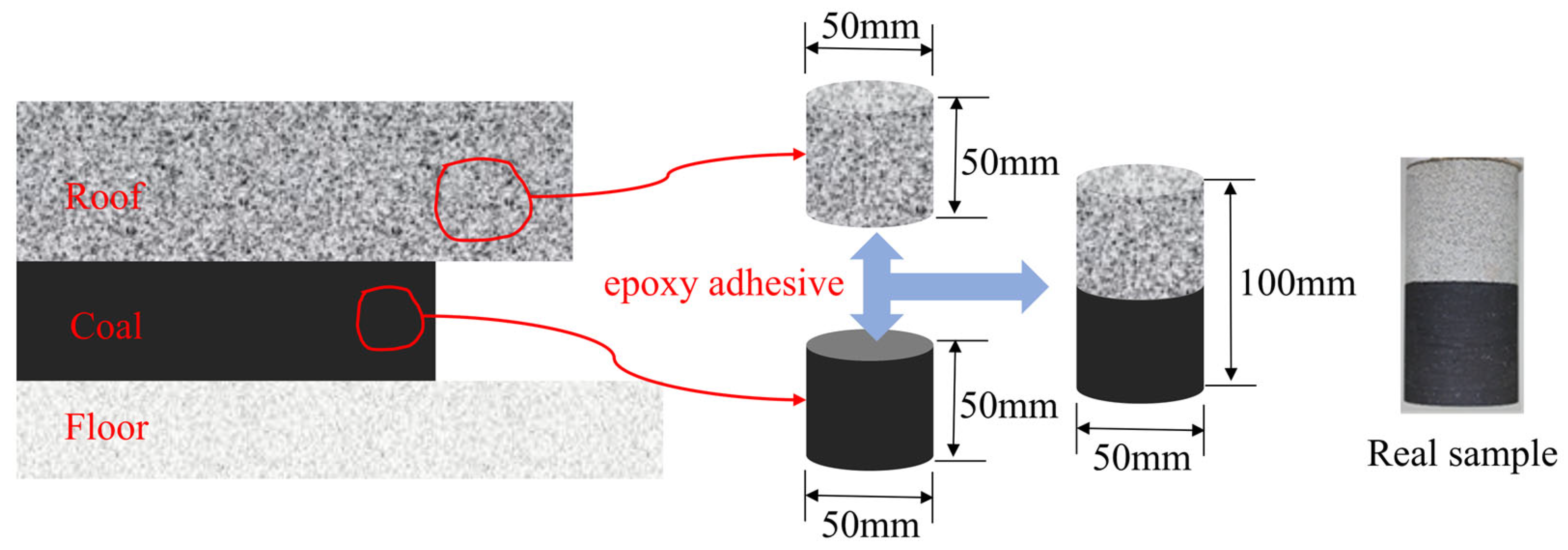
The coal and rock samples were collected from the No. 311306 working face of the Bayangaole Coal Mine at a burial depth exceeding 600 m. The rock samples acquired from the roof zone were identified as medium sandstone. The mineral compositions of the coal and medium sandstone, as determined by X-ray diffraction analysis, are presented in Table 1 and Table 2, respectively. After undergoing drilling, cutting, and grinding, the samples were processed into cylindrical specimens measuring 50 mm in diameter and 50 mm in height. The processing accuracy—including parallelism, flatness, and verticality—was verified to comply with the International Society for Rock Mechanics (ISRM) standards. Finally, the coal and rock specimens were bonded together using epoxy adhesive to form a combined coal–rock sample with approximate dimensions of ϕ50 mm × 100 mm. The preparation process is shown in Figure 1.

2.2. Testing Equipment

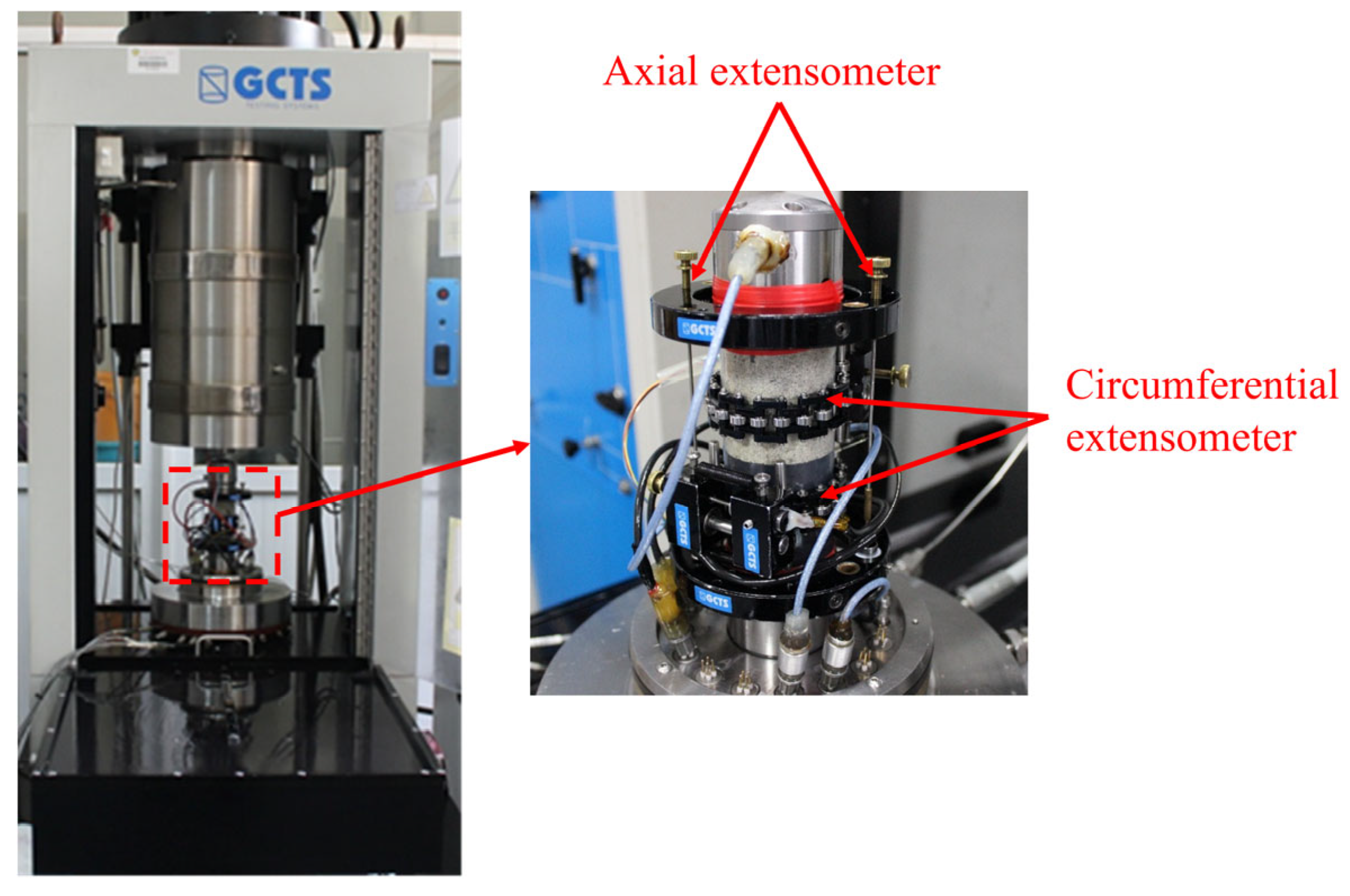
The mechanical tests were conducted using a rapid triaxial rock testing system (RTR-1000,manufactured by GCT Semiconductor Inc. in California, USA) in the State Key Laboratory for Fine Exploration and Intelligent Development of Coal Resources at the China University of Mining and Technology (Beijing). This system is a closed-loop, digitally servo-controlled apparatus with a maximum axial load capacity of 1000 kN and a confining pressure capability of up to 140 MPa. Axial and circumferential displacements were measured using linear variable differential transformer (LVDT) extensometers, each with a measurement range of −2.5 mm to 2.5 mm. Due to the distinct mechanical properties of coal and rock, the circumferential deformations of these two materials in the combined sample were expected to differ significantly under mining-induced stress. To accurately capture these differences, two identical sets of circumferential extensometers were installed on the coal and rock portions (Figure 2). By adjusting the testing system’s parameters, the circumferential deformations of both materials could be monitored simultaneously throughout the experiment.

2.3. Testing Procedure

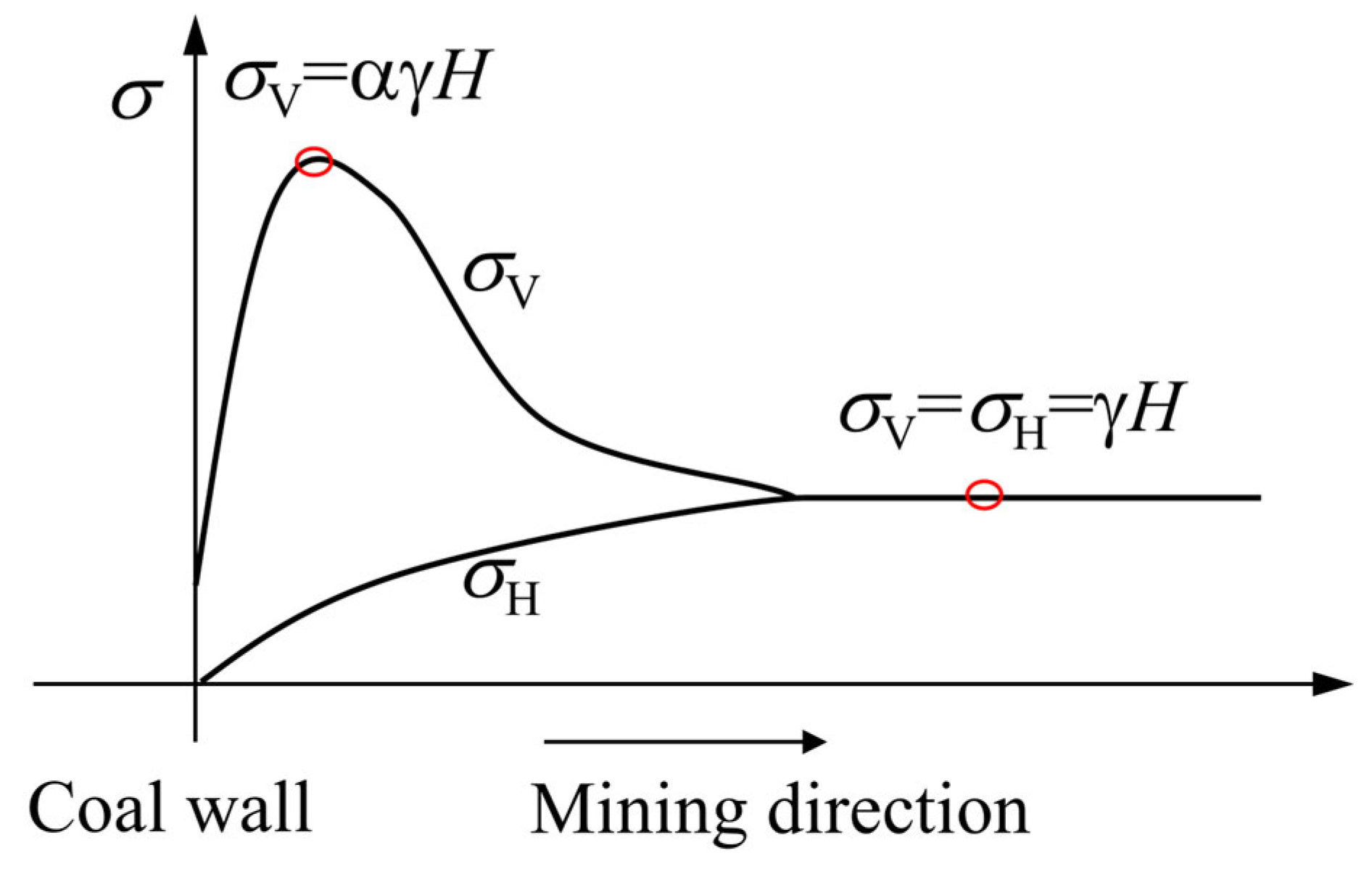
Due to coal seam excavation, the stress field ahead of the mining face becomes redistributed [33]. According to the study by Xie et al. [25], deep coal seams are initially in a hydrostatic pressure state. The pressure distribution in front of the mining face can be described as follows (Figure 3): as the distance to the mining face decreases, the vertical stress σ V gradually increases from the in situ stress level to a peak value, which then drops rapidly to a residual stress level due to the failure of the coal and rock mass. In contrast, the horizontal stress σ H gradually decreases from the in situ stress to approximately zero. As illustrated in Figure 3, α denotes the vertical stress concentration factor, γ represents the average unit weight of the overburden, and H refers to the mining depth.
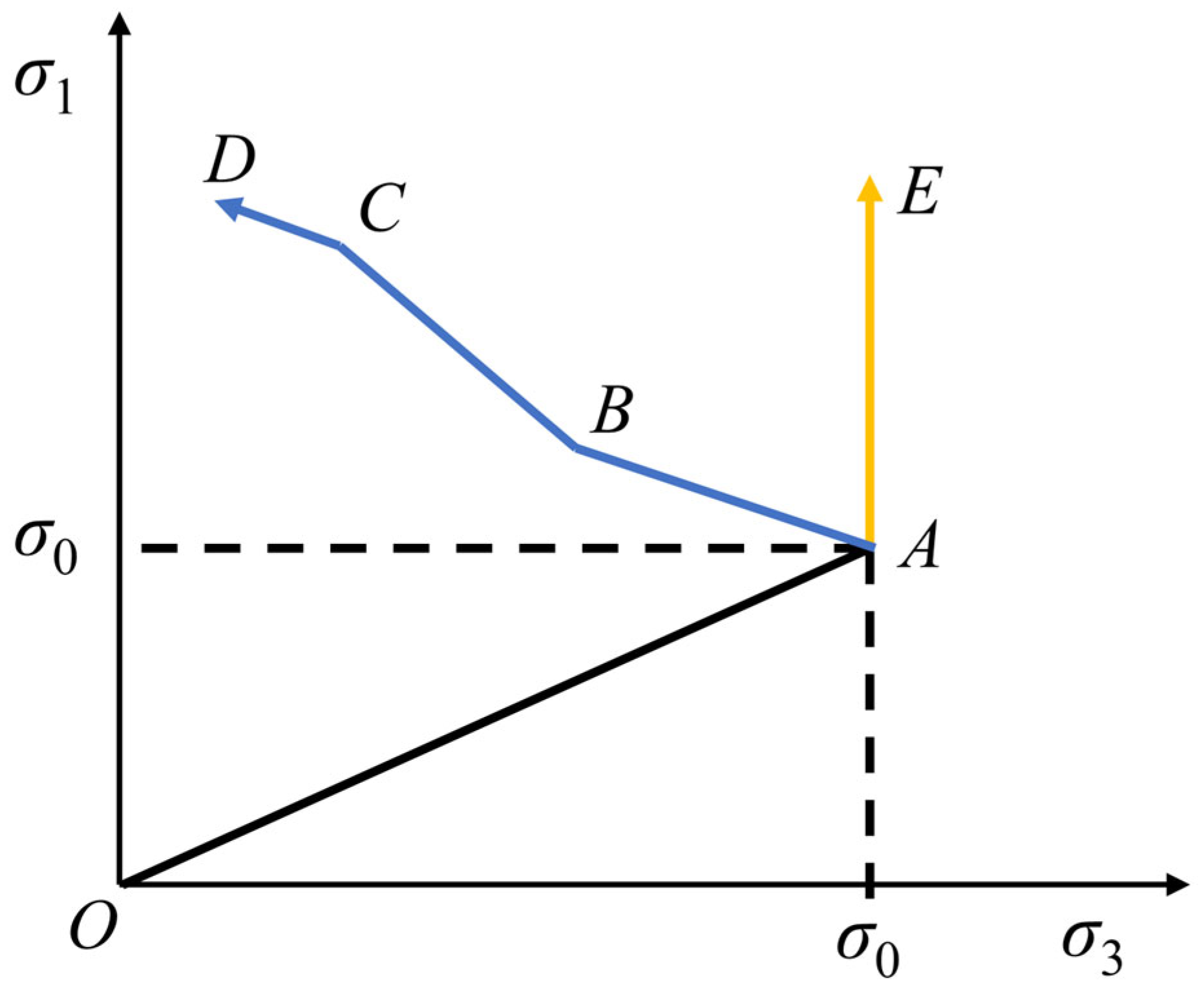
To simulate the mining-induced stress environment described above under laboratory conditions, Xie et al. proposed a loading path (O-A-B-C) (Figure 4), which consists of three stages: the hydrostatic pressure stage (OA), the first unloading stage (AB), and the second unloading stage (BC). During stage OA, both the axial stress σ 1 and confining stress σ 3 were simultaneously increased using a manual stepwise loading method until its reached a predetermined value σ 0 , simulating the initial hydrostatic stress state of the coal–rock mass. In the subsequent unloading stages (AB and BC), the axial stress was increased at two different rates, while the confining stress was decreased at a constant rate. All loading and unloading rates during these stages were controlled using stress-based feedback.
Due to limitations of the testing system, stress-controlled unloading near the peak strength often led to sudden sample failure and potential damage to the extensometers. To mitigate this, an additional third unloading stage (CD) was introduced. In this stage, the axial stress was controlled based on axial strain rate, while the confining stress was unloaded at the same rate as in the previous unloading stages. The specific loading and unloading rates for all stages are provided in Table 3. The predetermined initial stress σ 0 was set to 10, 15, 20, and 30 MPa, respectively.
For comparison, conventional triaxial compression tests were also performed on coal–rock composite samples to investigate the influence of confining pressure unloading on their mechanical behavior. The corresponding loading path (OAE) is shown in Figure 4; in this path, the loading rate during stage AE was set to 2 × 10⁻⁴/min. The confining pressures in these tests were kept constant at 5, 10, 20, and 30 MPa, respectively.

3. Experimental Results

3.1. Stress–Strain Curves and Mechanical Characteristics

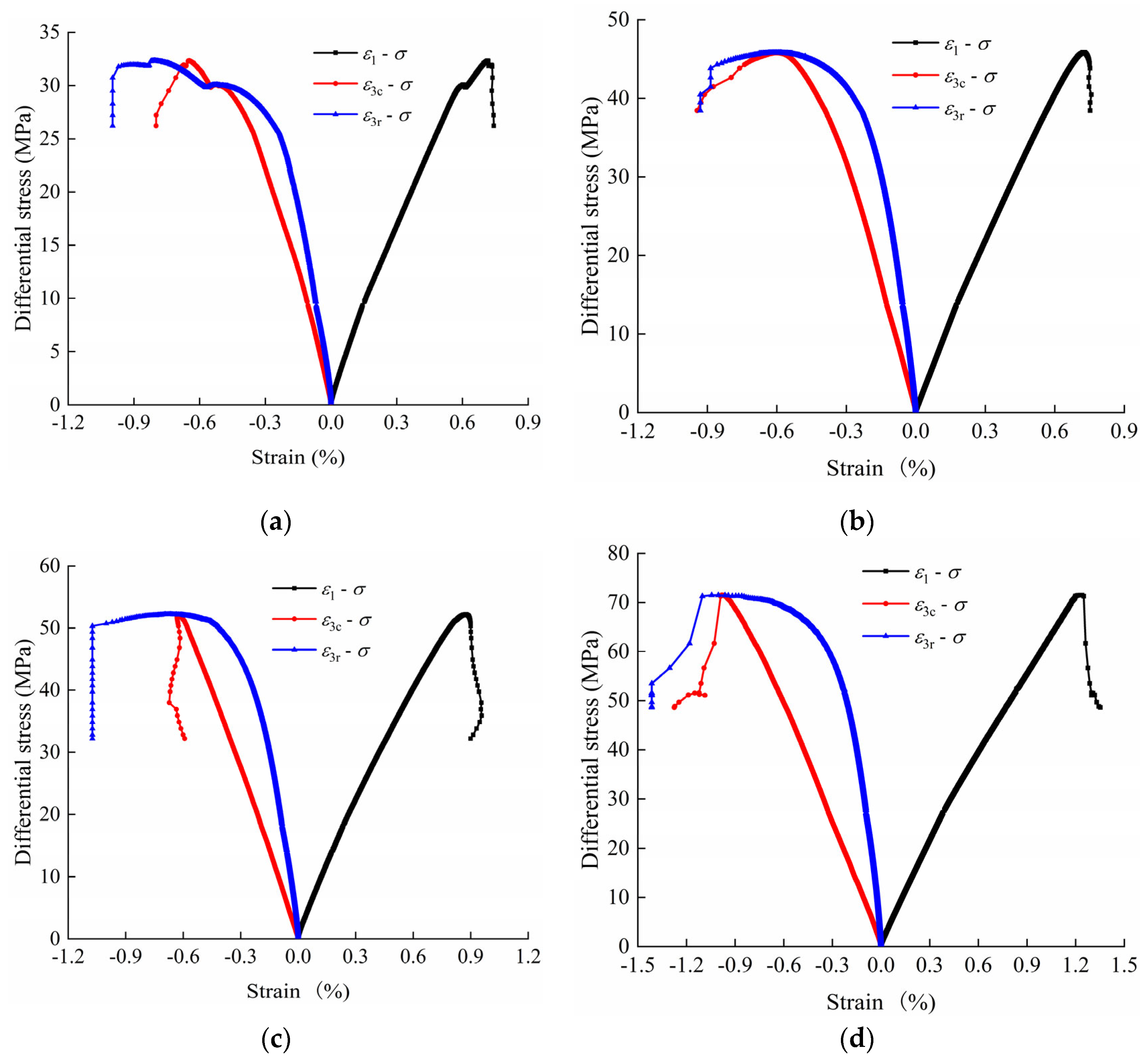
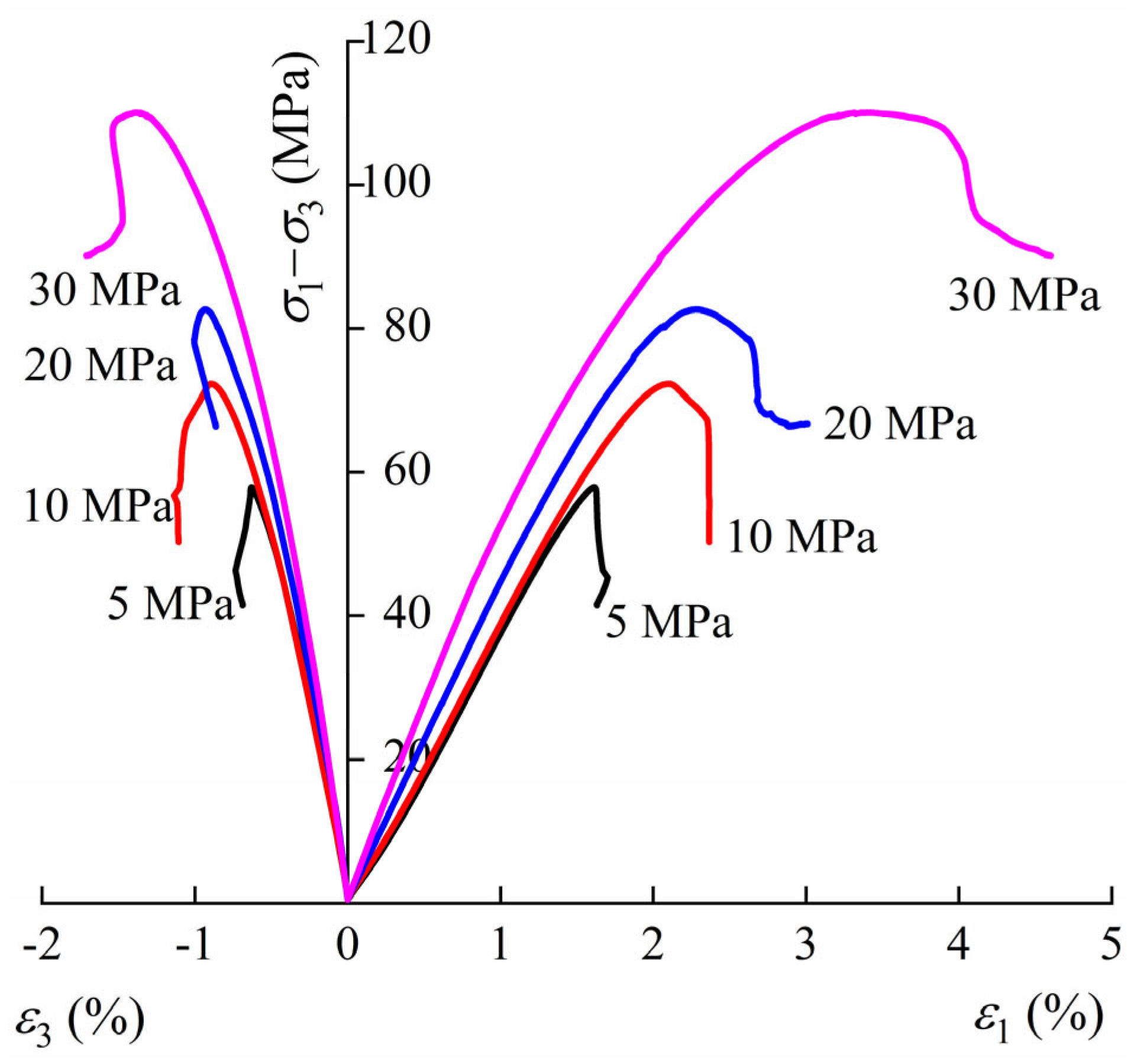
The typical stress–strain curves of the coal–rock composite samples under different confining pressures in the mining-induced stress tests (denoted by UC) are shown in Figure 5. The corresponding mechanical parameters are summarized in Table 4. Table 4 lists the standard deviation s of the peak stress and elastic modulus. It can be seen that the errors of the test results under each predetermined confining pressure are all small. In both Figure 5 and Table 4, ε 1 , ε 3 r , and ε 3 c denote the axial strain of the composite sample, the circumferential strain of the rock portion, and the circumferential strain of the coal portion, respectively. The elastic modulus E listed in Table 4 refers to the secant modulus.
Under each confining pressure, a total of four composite samples were tested: two equipped with circumferential extensometers and the other two with acoustic emission sensors. All samples were instrumented with axial extensometers to measure axial deformation. For comparison, conventional triaxial compression tests (denoted by CC) were conducted on two composite samples under each confining pressure, using only one circumferential extensometer per sample. Figure 6 presents the typical stress–strain curves from the conventional triaxial compression tests, with the corresponding mechanical parameters provided in Table 5. Table 5 calculates the absolute error d of the peak stress and elastic modulus. It can be seen that, except for the confining pressure of 30 MPa, the errors of the test results under the other confining pressures are small. The observed scatter in the experimental results does not affect the validity of the main trends and conclusions derived from them.
A comparison of Figure 5 and Figure 6 reveals that the axial stress–strain curves under mining-induced stress exhibited nonlinear hardening upon loading and lack a distinct linear elastic phase, which is typically observed in conventional compression tests. The composite samples under mining-induced stress showed negligible plastic deformation before reaching peak strength. After the peak, the axial stress decreased rapidly at all confining pressures in the mining-induced stress tests. In contrast, the conventional compression tests displayed a clear transition from brittle to ductile behavior with increasing confining pressure. These results indicate that the coal–rock composite samples exhibit pronounced brittle failure characteristics under mining-induced stress.
As shown in Figure 5, the circumferential strain of the coal increased approximately linearly until the peak strength was reached. In contrast, the circumferential strain of the rock exhibited an initial linear increase, followed by a nonlinear rapid growth phase. A comparison of the circumferential strains revealed that the deformation of the coal consistently exceeded that of the rock prior to reaching the peak strength. However, at the peak strength, the circumferential strain of the rock markedly increased and ultimately surpassed that of the coal. These observations indicate that, during the initial loading stage, the circumferential deformations of both materials are governed primarily by their intrinsic mechanical properties—specifically, the higher Poisson’s ratio of coal compared to that of rock. In the later loading stages, the behavior becomes dominated by crack propagation. Due to the greater extent of crack penetration within the rock, its circumferential dilatation becomes more pronounced than that of coal. It should be noted that the circumferential strain mentioned here is the measurement result at a specific location of coal or rock.

3.2. Circumferential Strain Rates

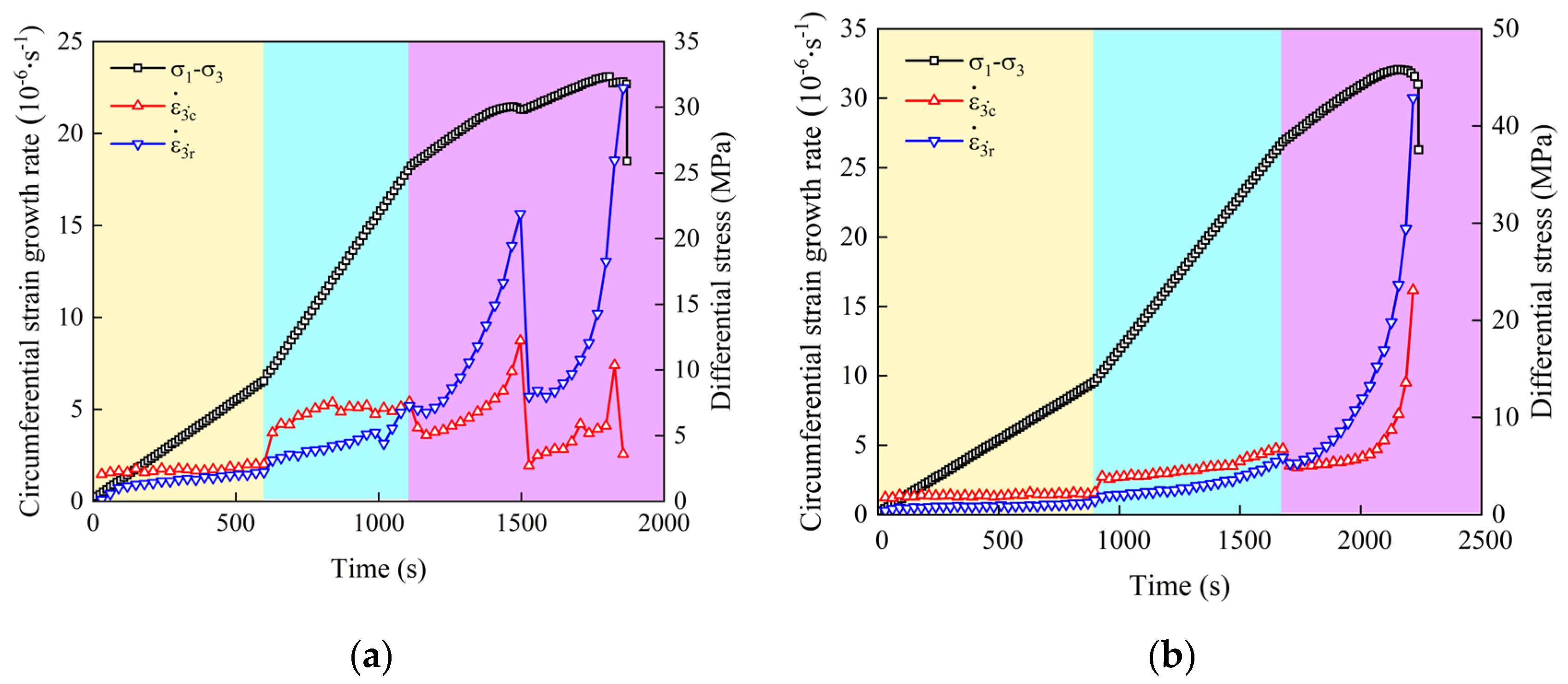
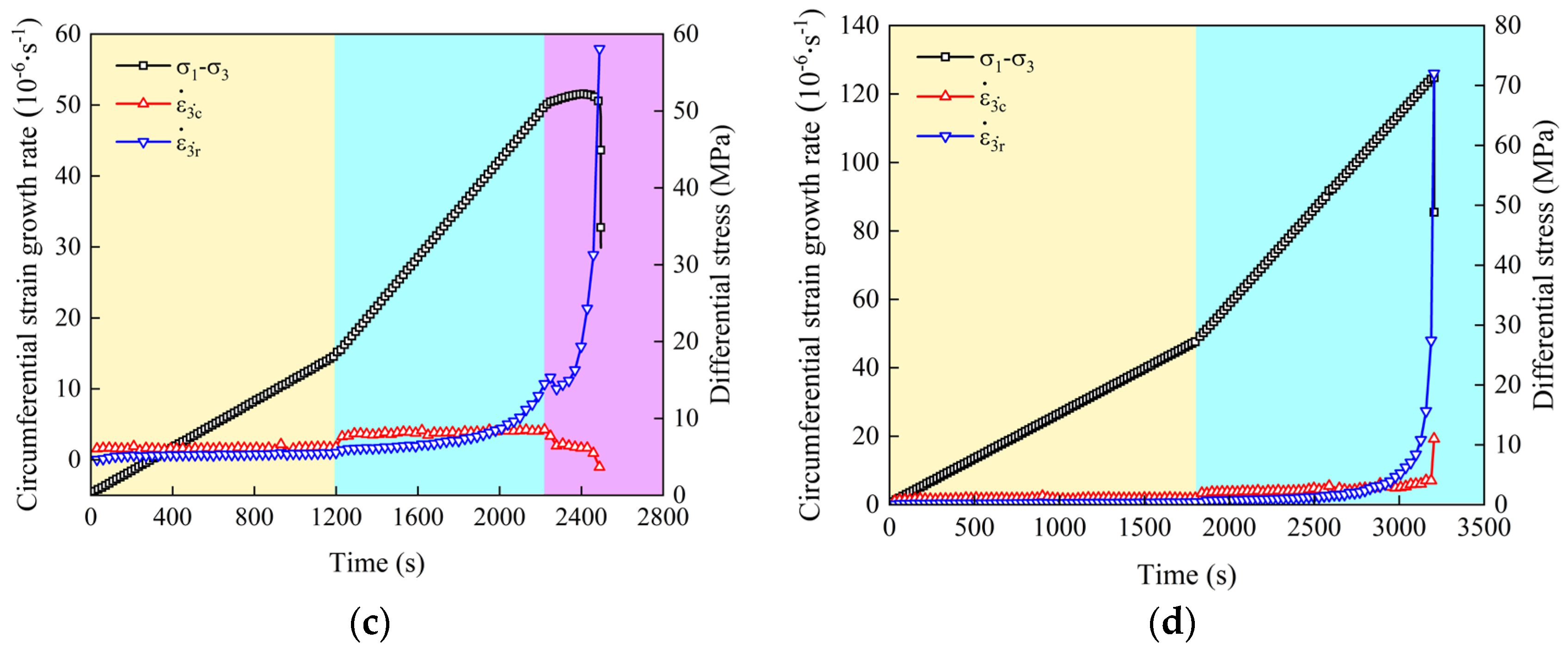
Figure 7 compares the rates of circumferential strain change in the coal and rock portions of the combined samples. The different unloading stages are differentiated by color: yellow denotes the first unloading stage, cyan the second, and magenta the third. During the first unloading stage, the circumferential strain in both the coal and rock gradually increased under all predetermined confining pressures, with the coal exhibiting a moderately higher growth rate than the rock. Upon entering the second unloading stage, the rates of circumferential strain change significantly increased in both materials. At confining pressures of 10 MPa and 15 MPa, the coal continued to deform more rapidly than the rock. However, at 20 MPa and 30 MPa, the circumferential strain change rate of the rock increased sharply toward the end of this stage and surpassed that of the coal, indicating the onset of pronounced dilatation in the rock. In the final unloading stage, the rate of circumferential strain change in the rock increased exponentially, far exceeding that in the coal. When this strain reached a critical threshold, the axial stress dropped abruptly. Furthermore, Figure 7 shows that higher predetermined confining pressures led to markedly greater circumferential strain rates in the rock at ultimate failure, confirming that deeper excavation results in more severe failure of the rock mass due to unloading.

3.3. Failure Morphology

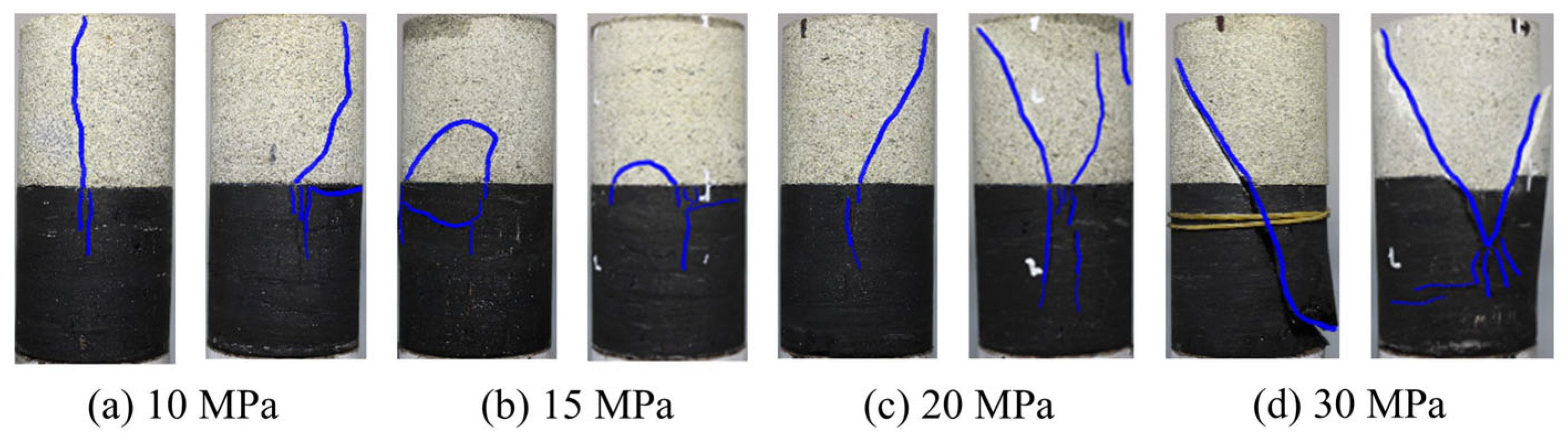
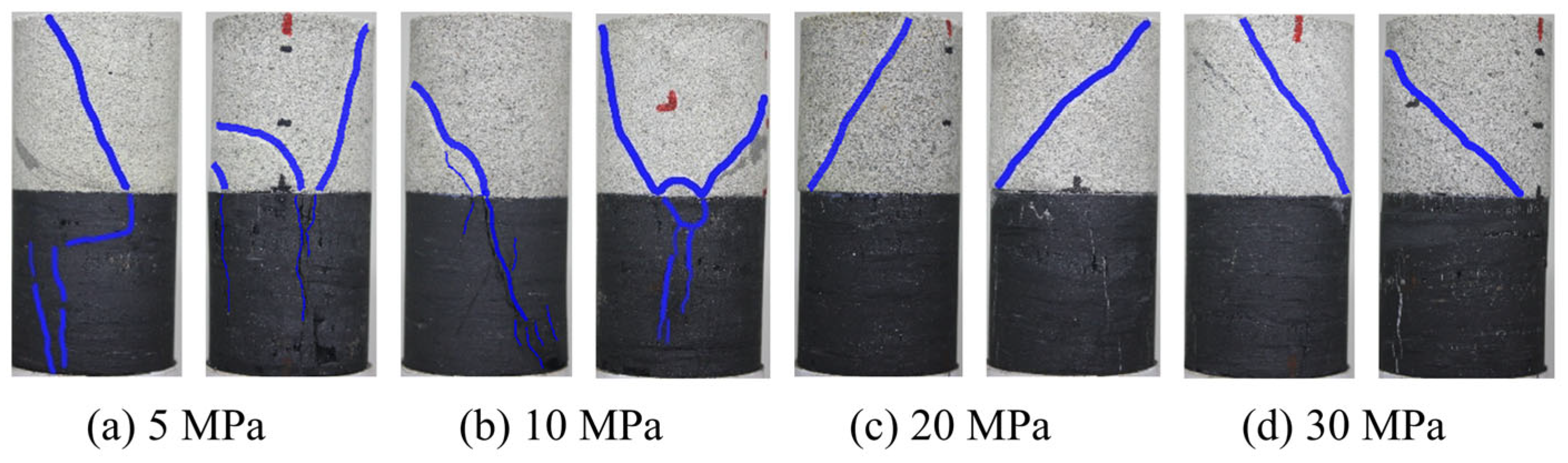
Figure 8 compares the failure morphology of the composite samples under different predetermined confining pressures. It can be observed that as the confining pressure increased, the extent of damage in the coal progressively intensified, with the crack propagation depth becoming more pronounced. In the rock portion, both the crack propagation angle (i.e., the angle between the fracture surface and the direction of the maximum principal stress) and the number of cracks exhibited an increasing trend. At low confining pressures, the combined samples primarily undergo tensile splitting failure. With increasing confining pressure, the failure mode gradually transitioned to shear failure, which is consistent with the failure characteristics observed under conventional triaxial loading (Figure 9). However, there was a notable difference in the damage evolution of the coal: under conventional triaxial loading, the degree of coal damage tended to decrease with higher confining pressures, whereas under mining-induced stress, the opposite trend was observed. This divergence is attributed to the distinct confining pressure states in the two testing scenarios. Coal mining experience has shown that deep excavations often lead to significantly intensified mining pressure and severe roadway deformation due to excavation unloading effects, frequently resulting in large-scale regional failure. The present experimental results reflect this engineering phenomenon to a considerable extent.

4. Energy Evolution Law of Composite Samples

4.1. Methodology for Strain Energy Calculation

Under the assumption that heat exchange is negligible during the loading process, the external work W performed on the rock by the testing machine is entirely converted into the rock’s internal energy U according to the first law of thermodynamics:
U = W
One part of the energy U absorbed by the rock is dissipated through the growth of microcracks, resulting in plastic deformation and damage; this is defined as the dissipated energy Ud. The other part is stored internally as elastic energy, which is released entirely or partially upon rock failure, and is known as the releasable elastic energy Ue. Therefore, the internal energy of the rock can be expressed as
U = U d + U e
In the principal stress space, the energy absorbed per unit volume of rock and the corresponding releasable elastic strain energy can be formulated as follows [34]:
U = σ 1 d ε 1 + σ 2 d ε 2 + σ 3 d ε 3
U e = 1 2 σ 1 ε 1 e + 1 2 σ 2 ε 2 e + 1 2 σ 3 ε 3 e
where σ i (i = 1, 2, 3) represents the principal stress components, and ε i and ε i e (i = 1, 2, 3) are the total strain and elastic strain in the direction of each principal stress, respectively. According to the Generalized Hooke’s Law, the elastic strain is given by
ε i e = 1 E u i σ i υ u i σ j + σ k
where E u i and υ u i (i = 1, 2, 3) denote the unloading elastic modulus and Poisson’s ratio in the corresponding principal stress directions, respectively.
Assuming the rock is isotropic, meaning that the unloading elastic modulus and Poisson’s ratio are identical in all three principal stress directions, the energy absorbed per unit volume of rock and the releasable elastic strain energy stored can, respectively, be expressed as
U = σ 1 d ε 1 + 2 σ 3 d ε 3 + U 0
U e = 1 2 E u 1 σ 1 2 + 2 σ 3 2 2 υ u 1 2 σ 1 σ 3 + σ 3 2
where E u 1 and υ u 1 represent the axial unloading elastic modulus and Poisson’s ratio, respectively; U0 is the work performed during the initial hydrostatic compression phase to the predefined confining pressure σ 3 0 , which defined by the following expression [35]:
U 0 = 3 1 2 υ 0 2 E 0 σ 3 0 2
where E 0 and υ 0 are the initial elastic modulus and Poisson’s ratio, respectively.
Numerous studies [36,37] on the elastic modulus of rocks under loading and unloading conditions, based on cyclic loading–unloading tests, have shown that the unloading elastic modulus initially slightly increases with rising stress, stabilizes, and then decreases in the late yielding and post-peak stages. Notably, the unloading modulus consistently exceeds the loading modulus at identical stress levels. Correspondingly, this study conducted uniaxial cyclic loading–unloading tests on coal (denoted by CL-C), rock (denoted by CL-R), and coal–rock composite samples (denoted by CL-RC). The testing protocol comprised loading to 60%, 80%, and 100% of the estimated uniaxial compressive strength (UCS) in successive cycles (each unloaded to 2 MPa), followed by a final loading cycle until complete failure.
Table 6 presents the elastic moduli during cyclic loading and unloading of the specimens, where E1 represents elastic modulus at first loading, Eu1i (i = 1, 2, 3) represents the axial unloading elastic modulus for each cycle, and E ¯ u 1 is the average unloading modulus. It can be observed that all unloading elastic moduli exceeded the initial loading modulus. For coal samples, the ratio of the average unloading modulus to the initial loading modulus ranged from 1.07 to 1.13; for rock samples, this ratio ranged from 1.29 to 1.39; and for coal–rock composite samples, the ratio fell within 1.17 to 1.24. To facilitate the calculation of elastic strain energy, the unloading elastic moduli of the coal, rock, and composite samples were set as 1.1, 1.35, and 1.2 times their respective initial elastic moduli. A similar calculation method was also adopted by Huang et al. [35]. Considering that Poisson’s ratio exhibits a small variation range and differences in its value have minimal impact on the calculation results of elastic strain energy [38], in this study, the initial Poisson’s ratio replaced the unloading Poisson’s ratio.
Given the distinct mechanical properties of coal and rock, which lead to markedly different energy accumulation behaviors, the energy analysis for the composite sample requires separate calculations for each component. Accordingly, the input energy density and the elastic energy density can be expressed as
U = V rc σ 1 d ε 1 + 2 V r σ 3 d ε 3 r + 2 V c σ 3 d ε 3 c + U 0 r V r + U 0 c V c V rc
U e = ( U r e V r + U c e V c ) V rc
U r e = 1 2 E u 1 r σ 1 2 + 2 σ 3 2 2 υ u 1 r 2 σ 1 σ 3 + σ 3 2
U c e = 1 2 E u 1 c σ 1 2 + 2 σ 3 2 2 υ u 1 c 2 σ 1 σ 3 + σ 3 2
where V rc , V r , and V c denote the volumes of the composite sample, rock mass, and coal mass, respectively; U r e and U c e represent the elastic energy densities of the rock and coal within the composite sample, respectively; U 0 r and U 0 c are the input energy densities of the rock and coal during the hydrostatic pressure stage, respectively; E u 1 r and υ u 1 r are the axial unloading elastic modulus and Poisson’s ratio of the rock, respectively; and E u 1 c and υ u 1 c are the axial unloading elastic modulus and Poisson’s ratio of the coal, respectively.
It should be noted that, due to the assumptions involved in the calculation of energy density, the absolute values obtained should be interpreted with caution. Nevertheless, the evolution patterns and comparative trends discussed in the following sections remain reliable.

4.2. Ratios of Elastic Energy and Dissipated Energy to Input Energy

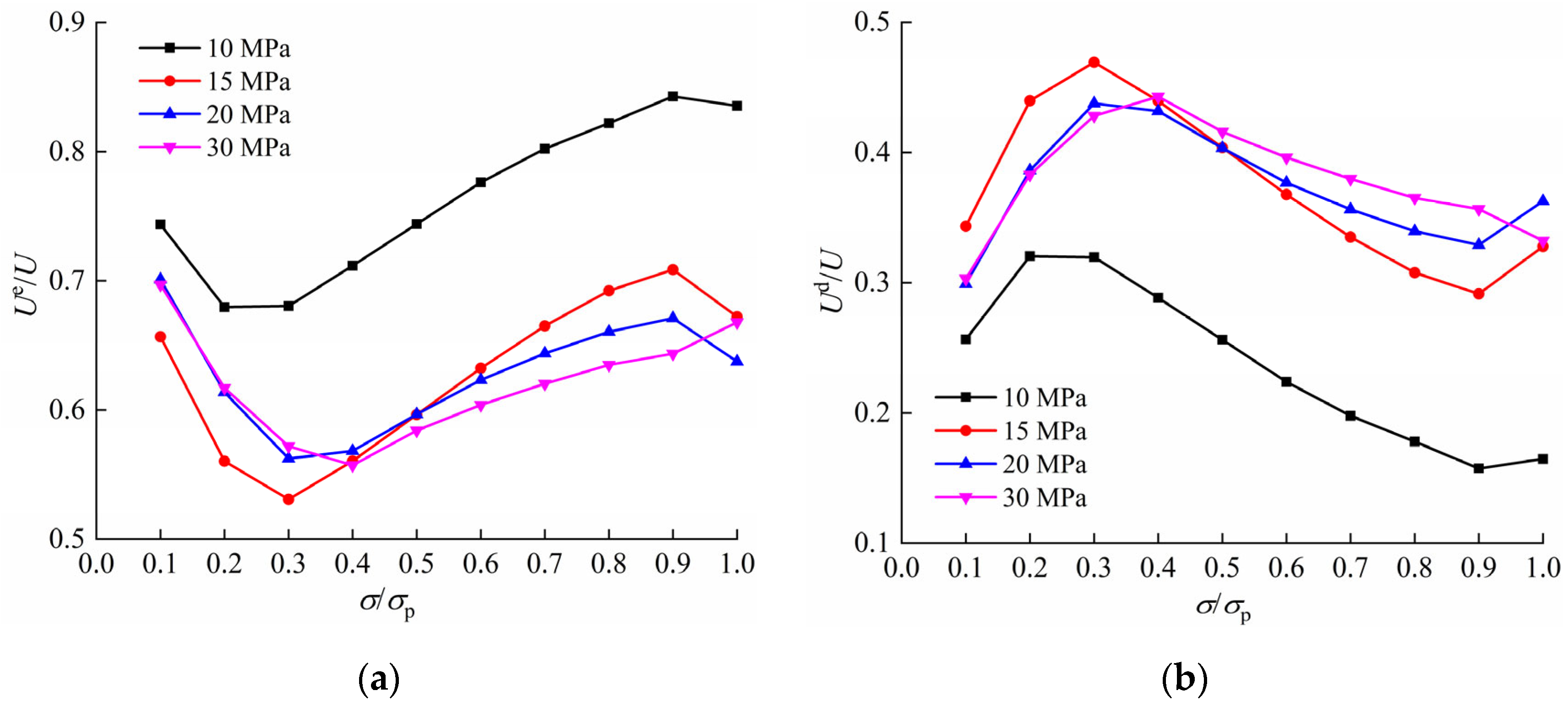
Figure 10 compares the evolution of the ratios of elastic energy and dissipated energy to the total input energy in the combined samples under different predetermined confining pressures. As shown in Figure 10a, the proportion of elastic energy initially decreased during early loading, and then continuously increased as the stress level rose. This behavior occurs because the confining pressure is continuously unloaded under mining-induced stress, reducing lateral confinement. As a result, energy consumed by circumferential deformation increases steadily. In the initial loading phase, the axial stress increased relatively slowly, supplying only limited energy, which caused the proportion of elastic energy to initially decrease. As loading continued, the axial stress supplied sufficient energy to the sample. Beyond the energy consumed by crack initiation, propagation, and circumferential deformation, the majority of the energy was stored as elastic energy, leading to a rapid increase in its proportion. This ratio peaked when the stress reached approximately 90% of the peak strength. Beyond this point, the ratio decreased again, indicating macroscopic changes in the sample’s internal structure and unstable crack growth.
Notably, at a predetermined confining pressure of 30 MPa, the proportion of elastic energy did not decrease after reaching 90% of the peak strength and continued to increase. As shown in Figure 8d, the sample failed during the second unloading stage under this pressure. Figure 5d shows that the sample exhibited negligible plastic deformation before reaching the peak strength. Upon reaching the peak strength, a sudden increase in axial deformation occurred, followed by an instantaneous stress drop, reflecting extreme brittleness. Consequently, the proportion of elastic energy continued to increase until failure.
As shown in Figure 10a, the proportion of elastic energy was highest in the samples tested at a predetermined confining pressure of 10 MPa compared to other confining pressures at the same stress level. For higher confining pressures, this relationship became distinct during the middle and late loading stages: the greater the predetermined confining pressure, the lower the proportion of elastic energy at an equivalent stress level. In the failure morphologies shown in Figure 7, it is evident that under mining-induced stress, damage became more severe as the confining pressure increased. This is reflected in the increased fracture development within the coal and a transition from tensile to shear failure modes. More extensive damage and a greater number of shear fractures require greater energy consumption for crack propagation during loading. Consequently, less energy is stored elastically, leading to a lower proportion of elastic energy at higher confining pressures. At 10 MPa, the samples developed primarily tensile fractures with limited overall damage. Hence, less energy was dissipated through fracture propagation, allowing a larger portion of the input energy to be stored as elastic energy. This resulted in a noticeably higher elastic energy ratio compared to other confining pressures.
Figure 10b presents the evolution of the ratio of dissipated energy to total input energy under different confining pressures. The change trend of dissipated energy was inversely related to that of elastic energy, consistent with energy conservation principles. A detailed discussion is omitted here for brevity.

4.3. Peak Elastic Energy Density

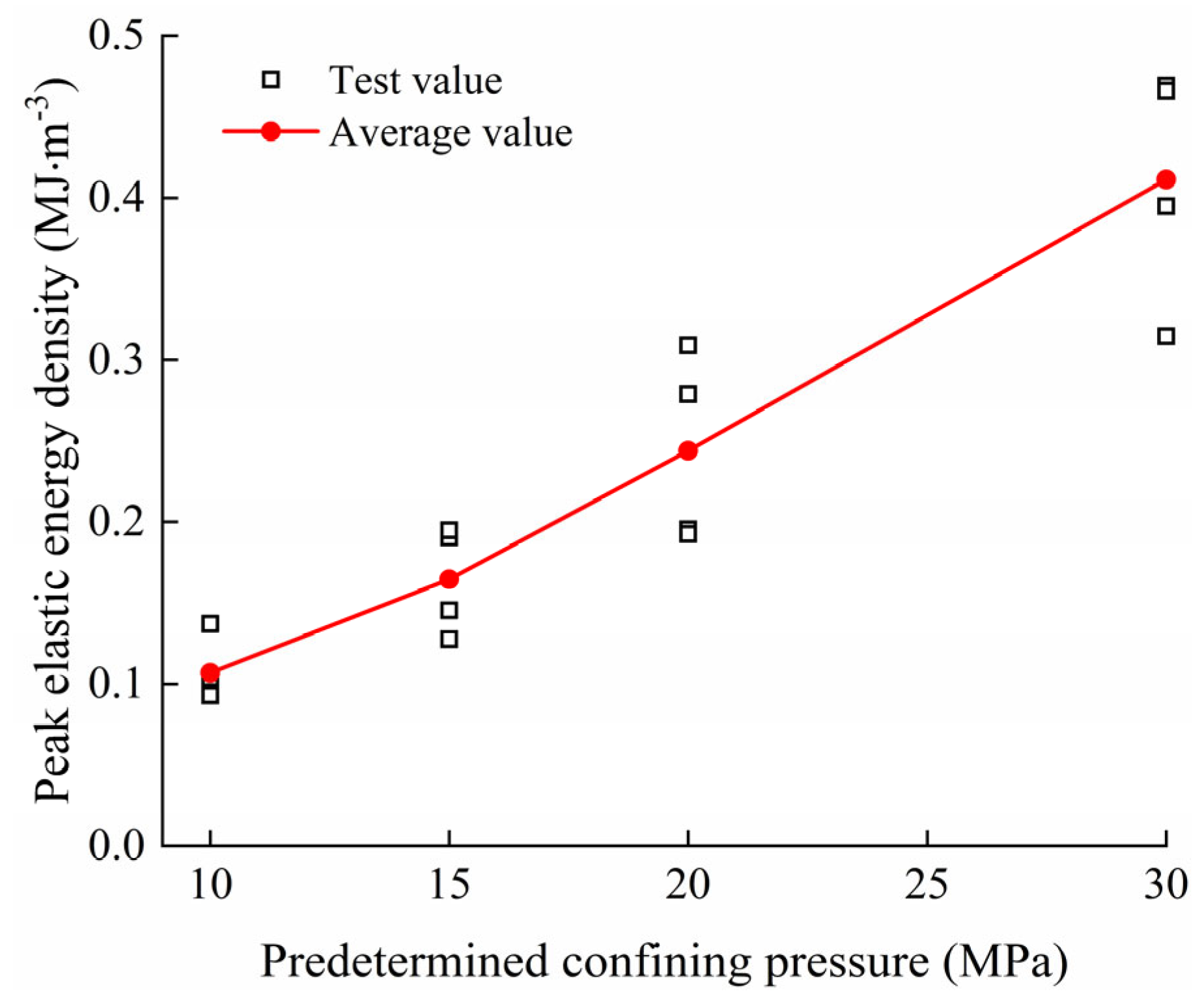
Figure 11 shows the peak elastic energy density of the coal–rock composite samples under mining-induced stress. It can be seen that as the predetermined confining pressure increased, the peak elastic energy density of the samples also gradually increased. The predetermined confining pressure here can represent different stratum depths, with higher values indicating deeper strata. This trend is consistent with the behavior observed under conventional triaxial loading, indicating that the energy storage capacity of coal–rock masses increase with greater mining depths. The accumulation of high levels of elastic energy poses a significant risk: once released instantaneously due to external disturbance, it can trigger severe dynamic failures. This mechanism is a major contributing factor to the increased frequency of rock bursts, coal and gas outbursts, and other mining-induced disasters as extraction activities advance to deeper formations.

4.4. Comparison of Elastic Energy Density Between Coal and Rock Components

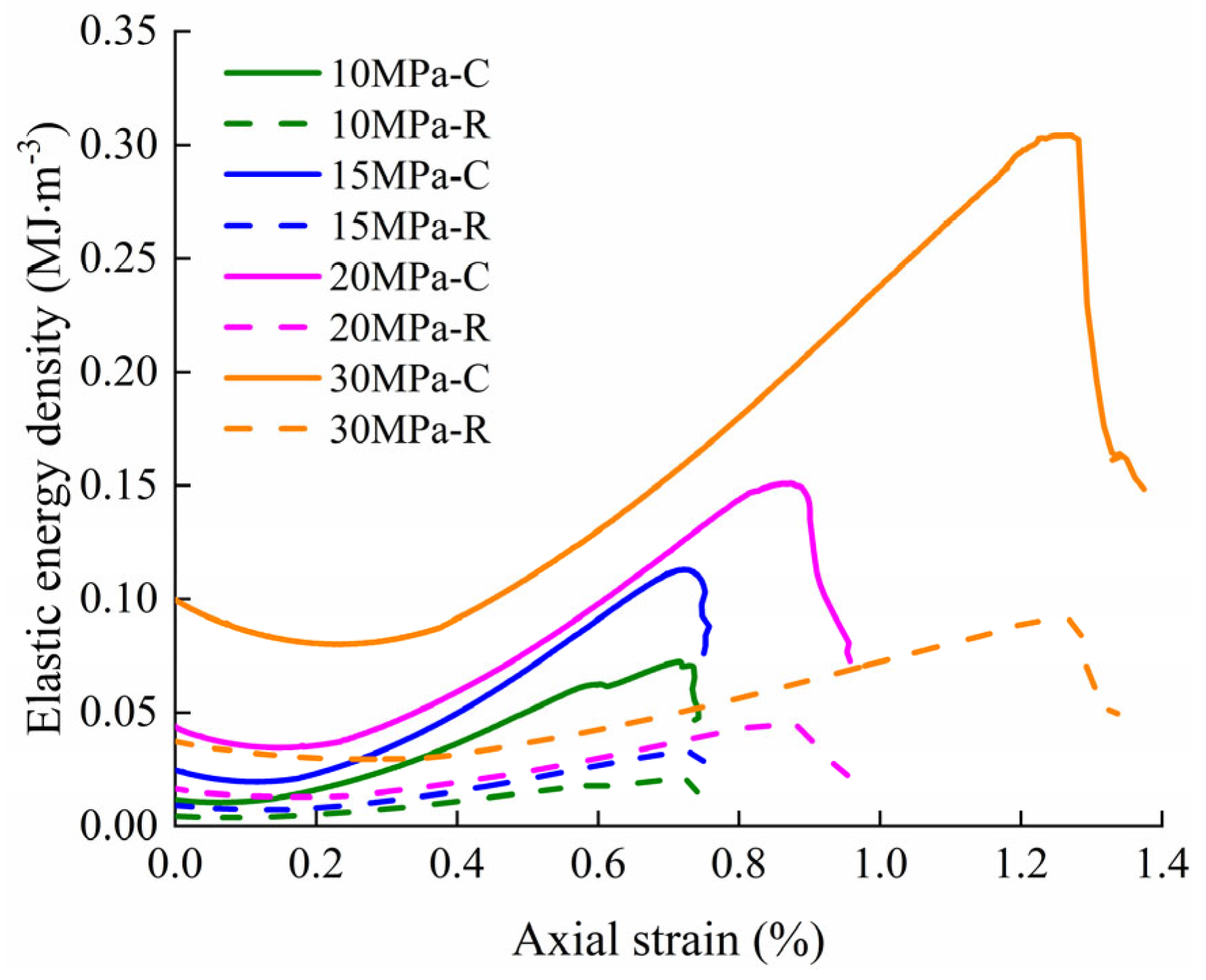
Figure 12 illustrates the evolution of elastic energy density in the coal and rock components of the composite samples under mining-induced stress. It is evident that the elastic energy density in the coal exceeded that in the rock throughout the deformation and failure process across all predetermined confining pressures. Moreover, the difference in elastic energy density between the two materials became more pronounced as the confining pressure increased.
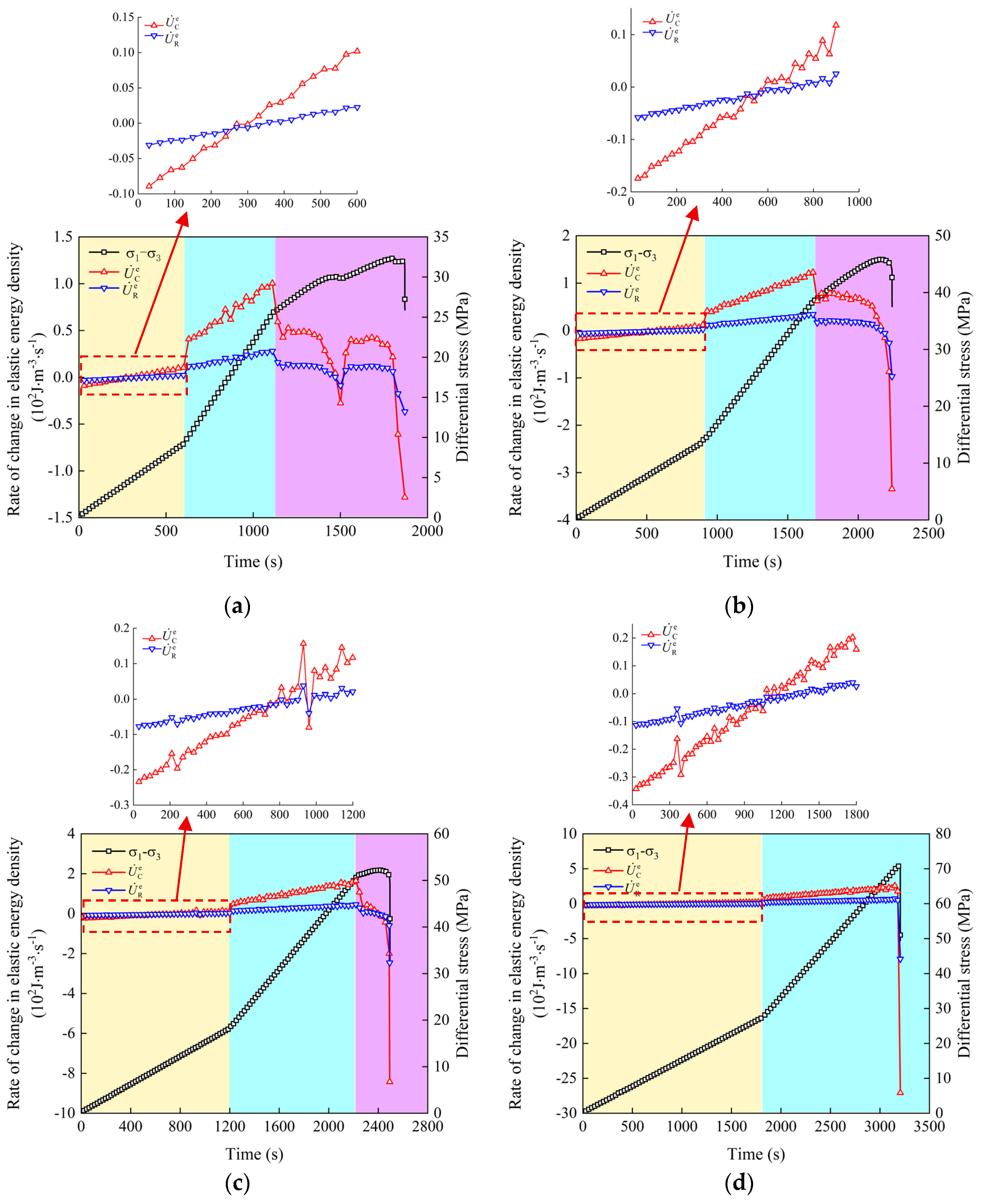
Figure 13 further compares the rate of change in elastic energy density between the coal (denoted by U ˙ C e ) and rock (denoted by U ˙ R e ) under mining-induced stress, where the meaning of the colored fringes is consistent with those in Figure 7. Initially, the rate of change in elastic energy is negative for both materials, but the coal exhibited a more rapid decline than the rock. By the later part of the first unloading phase, the rate of change turned positive for both components, with the coal surpassing the rock, marking the onset of energy accumulation. Upon entering the second unloading phase, the rate of increase in elastic energy density significantly accelerated in the coal, far exceeding that of the rock and indicating that the coal served as the primary reservoir of elastic energy during this stage. In the early part of the third unloading phase, both materials experienced a period of stable energy accumulation, although this period was shorter for the coal than for the rock. Subsequently, the rate of energy change gradually decreased for both components, followed by a sharp decline due to the drop in stress. The magnitude of this decrease was substantially greater in the coal than in the rock.
These findings indicate that the coal not only accumulates and releases a greater amount of elastic energy, but also does so at a higher rate compared to the rock. Thus, the coal acts as the dominant component in both the accumulation and release of elastic energy within the composite sample.

5. Discussion

5.1. Comparison of Peak Stress and Axial Strain Under Two Different Stress Conditions

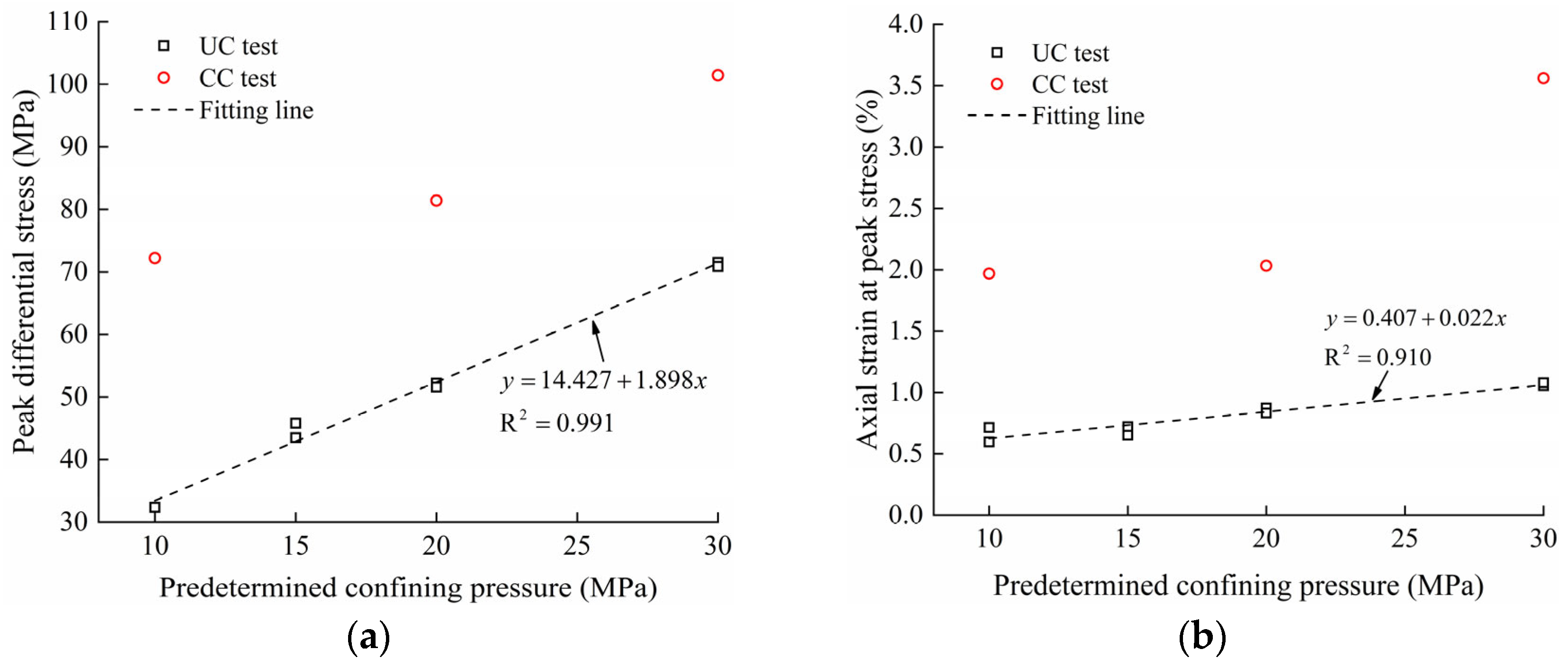
Figure 14 compares the peak differential stress and the corresponding axial strain of the composite samples under both mining-induced stress and conventional triaxial compression tests. The results from the conventional triaxial compression tests are average values at the corresponding confining pressures. Figure 14 shows that, in the mining-induced stress tests, the composite samples’ compressive strength increased almost linearly with the predetermined confining pressure. Nevertheless, the values were markedly lower than those obtained from the conventional triaxial compression tests. Under mining-induced stress, the axial strain at peak stress increased with confining pressure in a manner similar to compressive strength. Similarly, these values were significantly lower than the results of conventional triaxial compression tests.
This behavior can be attributed to the continuous unloading of confining pressure in the mining-induced stress tests, which progressively reduces the lateral constraint on the sample. Under such conditions, internal cracks propagate and coalesce more readily. In contrast, the confining pressure remains constant in conventional triaxial tests, providing sustained lateral support that enhances both strength and deformation resistance. Consequently, the samples under applied mining-induced stress failed more easily, resulting in a notably lower compressive strength and axial strain at failure.

5.2. Comparison of Peak Circumferential Strain Between Coal and Rock Components

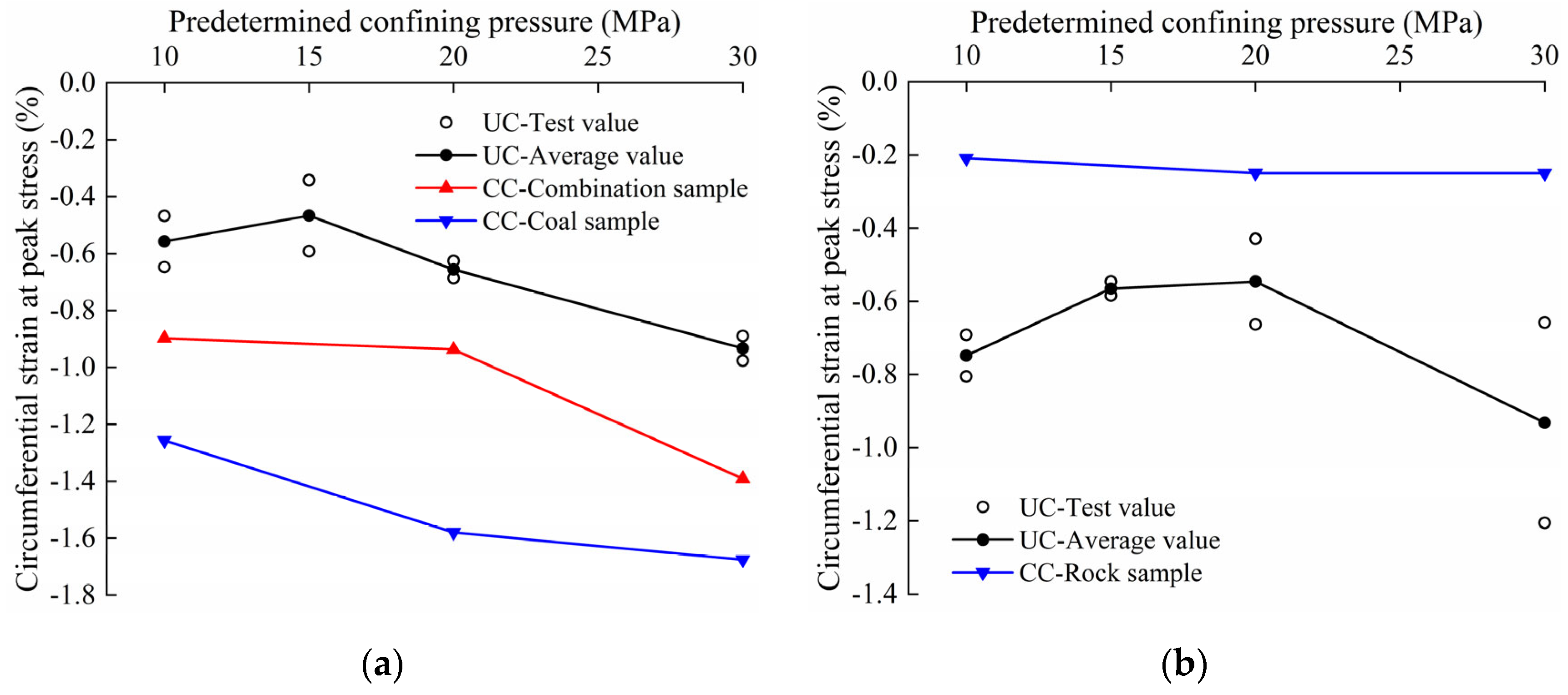
Figure 15 presents the circumferential strain at peak stress for both the coal and rock components within the composite samples under mining-induced stress. These values were compared with those obtained from coal samples, rock samples, and the coal within composite samples under conventional triaxial loading. The results from the conventional triaxial compression tests are average values at the corresponding confining pressures. It can be observed that the circumferential strain at peak stress under mining-induced stress exhibited considerable scatter. In contrast, the axial strain at peak stress demonstrated a clear, consistent trend, as shown in Figure 14b. This variability can be attributed to the fact that circumferential strain was measured at specific local points on the sample. Combined with the inherent heterogeneity of the coal–rock materials, this localized measurement approach can lead to greater variability in the test results.
As shown in Figure 15a, the circumferential strain at peak stress of the coal in the mining-induced stress tests first decreased and then increased with the rising predetermined confining pressure. These strain values are lower than those of the coal in the composite samples under conventional triaxial loading and significantly lower than those of standalone coal samples under conventional triaxial compression at corresponding confining pressures. In Figure 15b, it can be observed that the circumferential strain at peak stress of the rock under mining-induced stress also exhibited an initial decrease followed by an increase as the confining pressure rose. However, in this case, the values are higher than those of standalone rock samples under conventional triaxial loading at equivalent pressures. A comparison of Figure 15a,b reveals that, under the applied mining-induced stress, the coal in the composite samples showed less circumferential deformation at peak stress than standalone coal under conventional triaxial loading, while the rock within the composite displayed greater circumferential deformation than standalone rock under conventional loading.
This behavior cannot be attributed solely to confining pressure unloading, as both the coal and rock experienced the same unloading conditions during the mining-induced stress tests. The influence of axial peak stress can also be ruled out. This is because the compressive strengths of both standalone coal and rock under conventional triaxial loading were higher than those of the composite samples under mining-induced stress.
The primary factor explaining these observations is the constraint effect imposed by coal–rock interface bonding [39,40]. Given that coal has a higher Poisson’s ratio than sandstone, the two materials must deform compatibly when bonded together in the epoxy-bonded composite sample. As a result, the coal experiences a radial restraining force that inhibits its circumferential deformation, whereas the rock is subjected to an opposing force that promotes its circumferential expansion. This interpretation is further supported by comparing the circumferential strain of coal within the epoxy-bonded composite samples and standalone coal samples under conventional triaxial loading, as shown in Figure 15a. It should be noted that only one circumferential strain measurement device was employed during the conventional triaxial testing of the composite samples. Therefore, while the deformation of the coal was recorded, corresponding data for the rock deformation were not obtained. For this reason, Figure 15b does not include comparative circumferential strain results for the rock within the epoxy-bonded composite samples under conventional triaxial loading. A limitation of this study is the use of an epoxy-bonded interface. This raises the question of how well the observed interface constraint represents true in situ behavior, a point that should be addressed in future work.

6. Conclusions

The following conclusions can be drawn from this study:
(1)
The coal–rock composite samples exhibited pronounced brittle failure under the mining-induced stress applied in this study, without showing the brittle–ductile transition observed in conventional triaxial tests as the confining pressure increased.
(2)
During the initial loading stage, the circumferential deformation of the coal and rock is governed primarily by their intrinsic mechanical properties. In later stages, deformation becomes dominated by crack propagation.
(3)
With increasing predetermined confining pressure, the circumferential strain rate at failure rises significantly, indicating that deeper excavation leads to more severe unloading-induced failure in the coal–rock masses.
(4)
At peak stress, the coal in the composite samples under the mining-induced stress applied in this study showed lower circumferential deformation than standalone coal under conventional triaxial loading, while the rock exhibited the opposite behavior. This confirms the presence of an interfacial constraint effect between coal and rock.
(5)
Under the mining-induced stress applied in this study, the coal within the composite samples displayed higher elastic energy density and faster energy accumulation and release rates compared to the rock, indicating that the coal acted as the primary medium for elastic energy storage and liberation.
Based on the above findings, three recommendations for mining operations in the Bayangaole Coal Mine are proposed: (1) Implement immediate support after roadway driving and ensure continuous advance of hydraulic supports during longwall mining to prevent brittle collapse of the coal–rock composites. (2) Since the coal seam serves as the primary medium for elastic energy accumulation, techniques such as large-diameter drilling in coal seams and water injection into coal seams should be employed to weaken its energy storage capacity prior to mining. (3) As mining depth increases, roadway support strength must be enhanced correspondingly to mitigate large rock displacements induced by intense unloading. However, it should be noted that the direct applicability of the above conclusions may be constrained by specimen size effects, simplified geometric configurations, and the laboratory-defined stress paths. The influence of size effect on their applicability will be discussed in the next step.

Author Contributions

Conceptualization, J.Z. and B.G.; methodology, H.L. and X.Z.; validation, J.W.; formal Analysis, F.J.; investigation, H.S.; resources, X.Z.; data curation, H.S. and L.D.; writing—original draft preparation, H.S.; writing—review and editing, J.Z.; supervision, B.G. All authors have read and agreed to the published version of the manuscript.

Funding

This work is supported by the National Natural Science Foundation of China (52225404, 12532020, 52204140), the Key Research and Development Program of Xinjiang Uygur Autonomous Region (2024B03017), and the Taishan Scholar Program of Shandong Province (tsqnz20240825).

Data Availability Statement

The raw data supporting the conclusions of this article will be made available by the authors on request.

Conflicts of Interest

The authors declare no conflicts of interest.

References

  1. He, M.C.; Wu, Y.Y.; Gao, Y.B.; Tao, Z.G. Research progress of rock mechanics in deep mining. J. China Coal Soc. 2024, 49, 75–99. [Google Scholar] [CrossRef]
  2. Pan, Y.S.; Song, Y.M.; Liu, J. Pattern change and new situation of coal mine rockburst prevention and control in China. Chin. J. Rock Mech. Eng. 2023, 42, 2081–2095. [Google Scholar] [CrossRef]
  3. Zuo, J.P.; Xie, H.P.; Wu, A.M.; Liu, J.F. Investigation on failure mechanisms and mechanical behaviors of deep coal-rock single body and combined body. Chin. J. Rock Mech. Eng. 2011, 30, 84–92. [Google Scholar]
  4. Zuo, J.P.; Pei, J.L.; Liu, J.F.; Peng, R.D.; Li, Y.C. Investigation on acoustic emission behavior and its time-space evolution mechanism in failure process of coal-rock combined body. Chin. J. Rock Mech. Eng. 2011, 30, 1564–1570. [Google Scholar]
  5. Song, H.Q.; Zuo, J.P.; Liu, H.Y.; Zuo, S.H. The strength characteristics and progressive failure mechanism of soft rock-coal combination samples with consideration given to interface effects. Int. J. Rock Mech. Min. Sci. 2021, 138, 104593. [Google Scholar] [CrossRef]
  6. Huang, B.X.; Liu, J.W. The effect of loading rate on the behavior of samples composed of coal and rock. Int. J. Rock Mech. Min. Sci. 2013, 61, 23–30. [Google Scholar] [CrossRef]
  7. Cai, R.H.; Pan, Y.S.; Xiao, Y.H.; Liu, F.Y. Study on loading rate and rock-coal strength ratio effect on mechanical properties of coal-rock combination. J. Min. Sci. 2024, 60, 196–209. [Google Scholar] [CrossRef]
  8. Chen, S.J.; Yin, D.W.; Zhang, B.L.; Ma, H.F.; Liu, X.Q. Mechanical characteristics and progressive failure mechanism of roof-coal pillar structure. Chin. J. Rock Mech. Eng. 2017, 36, 1588–1598. [Google Scholar] [CrossRef]
  9. Guo, P.H.; Yang, K.; Li, J.Z.; Chi, X.L.; Liu, W.J.; Wang, C.C.; Wu, X.H. Mechanical properties and energy migration mechanisms of coal-rock composite with different height ratios under gas-containing conditions. J. Mater. Res. Technol. 2025, 36, 7996–8006. [Google Scholar] [CrossRef]
  10. Liu, J.; Li, Q.P.; Wang, X.R.; Wang, Z.Q.; Lu, S.Q.; Sa, Z.Y.; Wang, H. Dynamic multifractal characteristics of acoustic emission about composite coal-rock samples with different strength rock. Chaos Soliton Fract. 2022, 164, 112725. [Google Scholar] [CrossRef]
  11. Gu, X.B.; Guo, W.Y.; Zhang, C.G.; Zhang, X.F.; Guo, C.Q.; Wang, C. Effect of interfacial angle on the mechanical behaviour and acoustic emission characteristics of coal-rock composite specimens. J. Mater. Res. Technol. 2022, 21, 1933–1943. [Google Scholar] [CrossRef]
  12. Xu, C.; Wang, W.H.; Wang, K.; Hu, K.; Cao, Z.G.; Zhang, Y. Influence of coal-rock interface inclination on the damage and failure law of original coal-rock combination. Eng. Fail. Anal. 2024, 161, 108275. [Google Scholar] [CrossRef]
  13. Xu, C.; Yang, T.; Wang, K.; Yuan, Y.W.; Guo, L. Influence of primary interface characteristics on mechanical properties and damage evolution of coal-rock combination. Eng. Fail. Anal. 2024, 164, 108658. [Google Scholar] [CrossRef]
  14. Li, X.Z.; Zhang, J.H.; Li, Z.H.; Heng, S.; Wang, S.L.; Tian, Y.N. Failure characteristics and crack propagation process of coal-rock combinations under mine-induced stress. J. Appl. Geophys. 2025, 236, 105668. [Google Scholar] [CrossRef]
  15. Ma, S.Z.; Liu, K.W.; Guo, T.F.; Yang, J.C.; Li, X.D.; Yan, Z.X. Experimental and numerical investigation on the mechanical characteristics and failure mechanism of cracked coal & rock-like combined sample under uniaxial compression. Theor. Appl. Fract. Mech. 2022, 122, 103583. [Google Scholar] [CrossRef]
  16. Zhao, X.L.; Liao, Z.Y.; Zhang, X.F.; Cao, P.W.; Li, R.; Zhu, J.B. Influence of pre-existing crack on rockburst characteristics in coal-rock combination: A laboratory investigation. Int. J. Rock Mech. Min. Sci. 2024, 178, 105753. [Google Scholar] [CrossRef]
  17. Chen, G.B.; Tang, W.; Chen, S.J.; Wang, E.Y.; Wang, C.Y.; Li, T.; Zhang, G.H. Damage effect and deterioration mechanism of mechanical properties of fractured coal-rock combined body under water-rock interaction. Rock Mech. Rock Eng. 2025, 58, 513–537. [Google Scholar] [CrossRef]
  18. Wang, K.X.; Gao, Y.T.; Zhou, Y.; Wang, H.J. Mechanical behaviors and failure mechanisms of rock-backfill-coal composite with pre-existing fissures under unilateral constraint loading. Mater. Today Commun. 2025, 46, 112821. [Google Scholar] [CrossRef]
  19. Jiang, Y.J.; Liang, B.; Wang, D.; Luan, H.J.; Zhang, G.C.; Dong, L.; Chen, L.G. Experimental study on failure mechanical properties and acoustic emission characteristics of soft rock–coal combination under dynamic disturbance. Eng. Fail. Anal. 2024, 158, 108016. [Google Scholar] [CrossRef]
  20. Li, J.Q.; Qi, Q.X.; Mao, D.B.; Wang, Y.X. Discussion on evaluation method of bursting liability with composite model of coal and rock. Chin. J. Rock Mech. Eng. 2005, 24 (s1), 4805–4810. [Google Scholar]
  21. Lu, C.P.; Dou, L.M.; Wu, X.R. Experimental research on rules of burst tendency evolution and acoustic-electromagnetic effects of compound coal-rock samples. Chin. J. Rock Mech. Eng. 2007, 26, 2549–2555. [Google Scholar] [CrossRef]
  22. Song, L.S.; Zhao, S.K.; Liu, J.; Wei, X.Z.; Han, R.J.; Jiang, H.B. Experimental research on rules of rock burst tendency evolution and mechanical properties of “roof-coal” structure body. J. China Coal Soc. 2014, 39 (s1), 23–30. [Google Scholar] [CrossRef]
  23. Gong, F.Q.; Ye, H.; Luo, Y. Rate effect on the burst tendency of coal-rock combined body under low loading rate range. J. China Coal Soc. 2017, 42, 2852–2860. [Google Scholar] [CrossRef]
  24. Zuo, J.P.; Chen, Y.; Cui, F. Investigation on mechanical properties and rock burst tendency of different coal-rock combined bodies. J. China Univ. Min. Technol. 2018, 47, 81–87. [Google Scholar] [CrossRef]
  25. Xie, H.P.; Zhou, H.W.; Liu, J.F.; Gao, F.; Zhang, R.; Xue, D.J.; Zhang, Y. Mining-induced mechanical behavior in coal seams under different mining layouts. J. China Coal Soc. 2011, 36, 1067–1074. [Google Scholar] [CrossRef]
  26. Zhang, C.Y.; Pan, J.F.; Xia, Y.X.; Yang, G.Y. Research on impact failure characteristics of coal-rock combination bodies under true triaxial loading and unloading conditions. Chin. J. Rock Mech. Eng. 2020, 39, 1522–1533. [Google Scholar] [CrossRef]
  27. Yang, K.; Liu, W.J.; Ma, Y.K.; Yu, R.J.; Chi, X.L. Experimental study of impact failure characteristics of coal-rock combination bodies under true triaxial loading and single face unloading. Rock Soil Mech. 2022, 43, 15–27. [Google Scholar] [CrossRef]
  28. Xiao, X.C.; Liu, H.Y.; Ding, X.; Xu, J.; Fan, Y.F. Mechanical properties and acoustic emission evolution of coal-rock combination under unidirectional unloading condition. Coal Sci. Technol. 2023, 51, 71–83. [Google Scholar] [CrossRef]
  29. Xie, H.P.; Zhao, X.P.; Liu, J.F.; Zhang, R.; Xue, D.J. Influence of different mining layouts on the mechanical properties of coal. Int. J. Min. Sci. Technol. 2012, 22, 749–755. [Google Scholar] [CrossRef]
  30. Chen, G.B.; Zhang, J.; Li, Y.; Liu, F.X.; Li, T.; Zhang, G.H. Energy distribution law of coal-rock combined body under confining pressure effect. Acta Geophys. 2023, 71, 1831–1843. [Google Scholar] [CrossRef]
  31. Zuo, J.P.; Song, H.Q. Energy evolution law and differential energy instability model of coal-rock combined body. J. China Coal Soc. 2022, 47, 3037–3051. [Google Scholar] [CrossRef]
  32. Bai, J.W.; Hou, B.; Ma, J.B.; Feng, G.R.; Wang, S.Y.; Cui, B.Q.; Zhao, Y.T. Force chains evolution and crack characteristics of multiple coal-rock sandwich composite structure by using particle flow code. Mater. Today Commun. 2024, 38, 108220. [Google Scholar] [CrossRef]
  33. Yang, W.; Lin, B.Q.; Qu, Y.A.; Li, Z.W.; Zhai, C.; Jia, L.L.; Zhao, W.Q. Stress evolution with time and space during mining of a coal seam. Int. J. Rock Mech. Min. Sci. 2011, 48, 1145–1152. [Google Scholar] [CrossRef]
  34. Boresi, A.P.; Schmidt, R.J. Advanced Mechanics of Materials, 6th ed.; Wiley: London, UK, 2002; pp. 79–93. [Google Scholar]
  35. Huang, D.; Li, Y.R. Conversion of strain energy in triaxial unloading tests on marble. Int. J. Rock Mech. Min. Sci. 2014, 66, 160–168. [Google Scholar] [CrossRef]
  36. Su, C.D.; Xiong, Z.Q.; Zhai, X.X.; Gu, M. Analysis of deformation and strength characteristics of coal samples under the triaxial cyclic loading and unloading stress path. J. Min. Saf. Eng. 2014, 31, 456–461. [Google Scholar] [CrossRef]
  37. Wei, Y.L.; Yang, C.H.; Guo, Y.T.; Liu, W.; Wang, L.; Xu, J.B. Experimental research on deformation and fracture characteristics of shale under cyclic loading. Chin. J. Geotech. Eng. 2015, 37, 2262–2271. [Google Scholar] [CrossRef]
  38. Qiu, S.L.; Feng, X.T.; Xiao, J.Q.; Zhang, C.Q. An experimental study on the pre-peak unloading damage evolution of marble. Rock Mech. Rock Eng. 2014, 47, 401–419. [Google Scholar] [CrossRef]
  39. Del Greco, O.; Ferrero, A.M.; Oggeri, C. Experimental and analytical interpretation of the behaviour of laboratory tests on composite specimens. Int. J. Rock Mech. Min. Sci. Geom. Abstr. 1993, 30, 1539–1543. [Google Scholar] [CrossRef]
  40. Tziallas, G.P.; Saroglou, H.; Tsiambaos, G. Determination of mechanical properties of flysch using laboratory methods. Eng. Geol. 2013, 166, 81–89. [Google Scholar] [CrossRef]
Figure 1. Coal–rock composite sample preparation process.
Buildings 16 00473 g001
Figure 2. Photo of setting for axial and circumferential extensometers.
Buildings 16 00473 g002
Figure 3. Schematic diagram of stress distribution ahead of the coal mining face.
Buildings 16 00473 g003
Figure 4. Stress path setting.
Buildings 16 00473 g004
Figure 5. Stress–strain curves obtained in mining-induced stress tests. (a) UC-10-2; (b) UC-15-1; (c) UC-20-1; (d) UC-30-1.
Buildings 16 00473 g005
Figure 6. Stress–strain curves obtained in conventional triaxial compression tests.
Buildings 16 00473 g006
Figure 7. Circumferential strain rate of coal and rock components under different confining pressures. (a) 10 MPa; (b) 15 MPa; (c) 20 MPa; (d) 30 MPa.
Buildings 16 00473 g007aBuildings 16 00473 g007b
Figure 8. Failure morphology of composite samples in the mining-induced stress tests.
Buildings 16 00473 g008
Figure 9. Failure morphology of composite samples in the conventional triaxial compression tests.
Buildings 16 00473 g009
Figure 10. Ratios of elastic energy and dissipative energy to input energy for composite samples under different confining pressures. (a) elastic energy; (b) dissipative energy.
Buildings 16 00473 g010
Figure 11. Peak elastic energy density of composite samples under mining-induced stress.
Buildings 16 00473 g011
Figure 12. Evolution of elastic energy density in coal and rock components.
Buildings 16 00473 g012
Figure 13. Rate of change in elastic energy density of coal and rock components under different confining pressures. (a) 10 MPa; (b) 15 MPa; (c) 20 MPa; (d) 30 MPa.
Buildings 16 00473 g013
Figure 14. Variation in peak differential stress and axial strain of composite samples with confining pressures. (a) peak differential stress; (b) axial strain at peak stress.
Buildings 16 00473 g014
Figure 15. Variation in peak circumferential strain of coal and rock components with confining pressures. (a) coal; (b) rock.
Buildings 16 00473 g015
Table 1. Mineral compositions of coal.
CompositionCalciteQuartzKaoliniteAmorphous Matter
Content/%4.130.641.3893.85
Table 2. Mineral compositions of medium sandstone.
CompositionQuartzAlbiteMicroclinePyriteKaoliniteClinochloreIllite
Content/%33.2925.353.470.2433.272.312.07
Table 3. Testing parameters for the three unloading stages.
Loading DirectionStage AB α B Stage BC α C Stage CD
σ 1 0.5 MPa/min1.51.5 MPa/min2.82 × 10−4/min
σ 3 −0.4 MPa/min−0.4 MPa/min−0.4 MPa/min
Note: α B , α C denote the vertical stress concentration factors at points B and C, respectively.
Table 4. Mechanical parameters obtained in mining-induced stress tests.
Predetermined Stress (MPa)Sample NumberPeak Stress (MPa)Strain at Peak Stress (%)Elastic Modulus (GPa)
s ε 1 ε 3 r ε 3 c s
10UC-10-132.352.650.596−0.692−0.4683.680.67
UC-10-232.350.715−0.805−0.6473.69
UC-10-337.910.6124.83
UC-10-433.440.5124.85
15UC-15-145.821.560.721−0.584−0.5924.700.35
UC-15-243.490.651−0.546−0.3424.84
UC-15-343.750.7164.44
UC-15-442.030.7374.04
20UC-20-152.222.390.873−0.663−0.6264.570.20
UC-20-251.570.832−0.429−0.6864.57
UC-20-355.830.8464.96
UC-20-456.180.9174.55
30UC-30-171.501.281.055−1.206−0.9774.140.55
UC-30-270.881.079−0.658−0.8905.12
UC-30-372.741.1755.19
UC-30-473.741.2435.35
Note: The symbol “–” denotes that no corresponding data are available.
Table 5. Mechanical parameters obtained in conventional triaxial compression tests.
Confining Pressure (MPa)Sample NumberPeak Stress (MPa)Strain at Peak Stress (%)Elastic Modulus (GPa)
d ε 1 ε 3 c d
5CC-5-157.930.641.613−0.6293.990.12
CC-5-257.291.5694.11
10CC-10-172.340.252.107−0.8974.040.57
CC-10-272.091.8324.61
20CC-20-182.702.612.297−0.9374.430.86
CC-20-280.091.7705.29
30CC-30-1110.0817.283.420−1.3915.341.34
CC-30-292.803.7024.00
Note: The symbol “–” denotes that no corresponding data are available.
Table 6. Elastic moduli of samples under uniaxial cyclic loading and unloading.
Sample E 1 /GPa E u 11 /GPa E u 12 /GPa E u 13 /GPa E ¯ u 1 /GPa E ¯ u 1 / E 1
CL-C-12.452.732.832.781.13
CL-C-22.172.382.322.322.341.08
CL-C-32.102.112.242.392.251.07
CL-R-19.9913.8514.0413.6413.841.39
CL-R-29.0311.4511.7611.6211.611.29
CL-R-39.0912.4812.4911.8012.261.35
CL-RC-13.304.034.104.184.101.24
CL-RC-23.373.893.904.033.941.17
CL-RC-33.544.294.344.414.351.23
Note: The symbol “–” denotes that no corresponding data are available.
Disclaimer/Publisher’s Note: The statements, opinions and data contained in all publications are solely those of the individual author(s) and contributor(s) and not of MDPI and/or the editor(s). MDPI and/or the editor(s) disclaim responsibility for any injury to people or property resulting from any ideas, methods, instructions or products referred to in the content.