Article

Experimental Evaluation of the Impacts of Suspended Particle Device Smart Windows with Glare Control on Occupant Thermal and Visual Comfort Levels in Winter

by
Sue-Young Choi
,
Soo-Jin Lee
and
Seung-Yeong Song
*
Department of Architectural and Urban Systems Engineering, Ewha Womans University, Seoul 03760, Republic of Korea
*
Author to whom correspondence should be addressed.
Buildings 2026, 16(2), 444; https://doi.org/10.3390/buildings16020444

Submission received: 22 December 2025 / Revised: 13 January 2026 / Accepted: 17 January 2026 / Published: 21 January 2026

Abstract

The building sector accounts for approximately 30% of global energy use. The demand for energy-efficient, high-performance buildings is increasing given the increasing awareness of the climate crisis. The building envelope greatly influences overall building energy performance. Considering the broad shift from passive to adaptive systems, smart window technologies are attracting attention. Despite their potential, few scholars have examined occupant comfort in spaces with smart windows. This gap is addressed herein by comparatively analyzing occupants’ responses to thermal and visual environments in a room with a smart window (RoomSW) and a room with a conventional window (RoomCW) in a residential building in winter. The smart window is operated via a glare-prevention tint control strategy. The results reveal that under thermal conditions comparable to those in an actual dwelling, wintertime smart window tinting for glare prevention does not decrease occupants’ thermal sensation or satisfaction. Regarding visual comfort, conditions in RoomSW and RoomCW satisfy the minimum illuminance requirement of 200 lx, but glare occurs in RoomCW with a mean New Daylight Glare Index (DGIN) of 24.1, compared to 9.6 in RoomSW. Questionnaire results indicate greater satisfaction with the luminous environment in RoomSW relative to RoomCW, with scores of +1.4 and +0.2, respectively.

1. Introduction

The building sector accounts for 30% of global energy consumption and 27% of the total CO2 emissions; in the absence of appropriate measures, its share is projected to increase to approximately 70% by 2050 [1]. As the climate crisis driven by global warming becomes a tangible reality, the demand for energy-efficient, high-performance buildings continues to grow. Among the various components of a building, the envelope, in particular, significantly influences its overall energy performance. However, conventional passive envelope systems often exhibit suboptimal energy performance [2,3]. With the increasing conversion of passive systems into adaptive systems [4], smart window technologies have emerged.
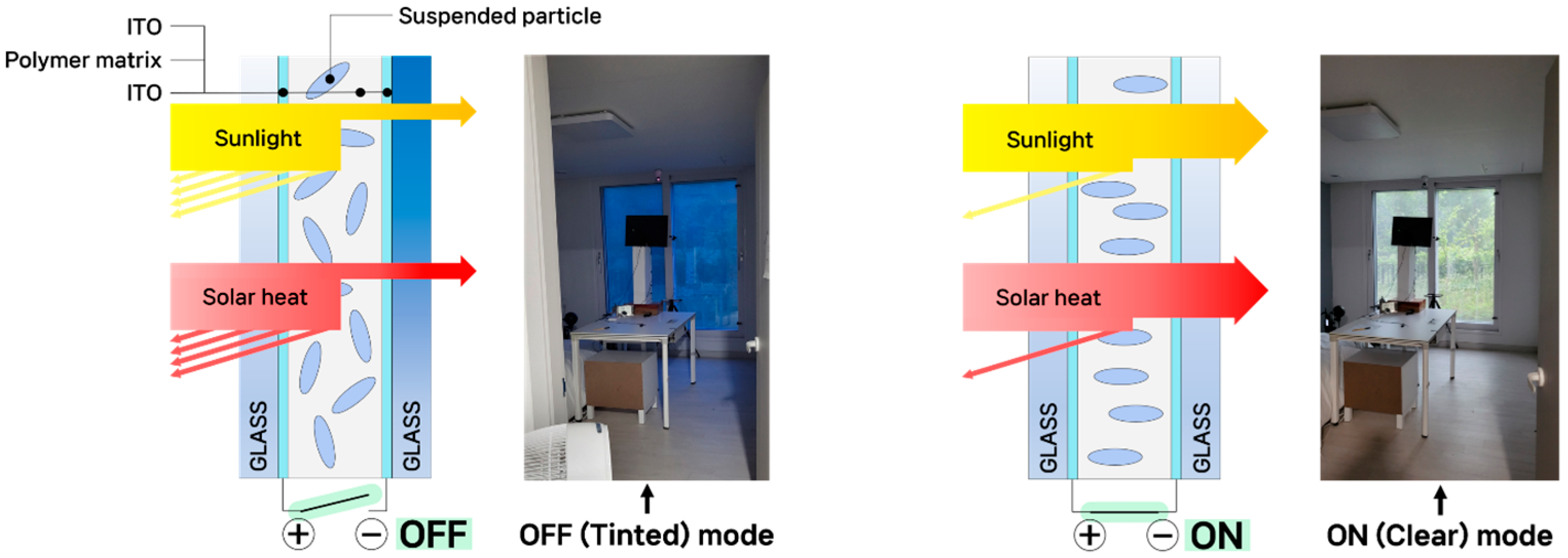
Smart windows represent functional glazing systems that can be used to control solar radiation entering a building by adjusting the solar heat gain coefficient (SHGC) and visible transmittance (VT). These systems are classified into passive and active types depending on whether electrical power is required for their operation. The smart window applied in this study is an active suspended particle device (SPD) window, which operates on the principle that particles randomly dispersed in the off (tinted) state become aligned in the on (clear) state, allowing light to pass through. SPD smart windows are characterized by a very short switching (tinting) time and by the ability to finely adjust the transmittance at multiple levels according to the magnitude of the applied alternating current (AC) power. The operating principle of the smart window is illustrated in Figure 1, which shows its appearance in the tinted and clear states. By appropriately controlling the smart window in response to indoor and outdoor environmental conditions and occupant preferences, it is possible to achieve both energy savings and increased occupant comfort (e.g., preventing glare while maintaining adequate illuminance). With growing interest in green buildings and sustainable architecture and advances in related technologies, the smart window market is expected to expand in the future. According to a market research report by the International Market Analysis Research and Consulting (IMARC) group [5], the smart window market size is projected to increase from USD 1.2773 billion in 2023 to USD 3.88 billion in 2032, corresponding to a compound annual growth rate (CAGR) of approximately 12.7%.
Smart windows are still considered an emerging technology, and real-world applications remain relatively limited. For their wider use and adoption, it is necessary to evaluate their performance levels across various applications and establish appropriate control strategies. However, although smart windows adjust the SHGC and VT through tinting and directly influence occupants’ thermal and visual comfort levels, existing studies on smart windows have seldom addressed occupant comfort [6,7]. In addition, research analyzing how occupants actually perceive spaces where smart windows are applied is very scarce. To address this research gap, an experiment is conducted to investigate how the wintertime tinting of smart windows affects people, and occupants’ responses to thermal and visual environments in a space with a tinted smart window or a conventional window are compared and analyzed.
First, thermal and visual comfort evaluation indices for the occupants were examined, after which the evaluation items, indices, and test cases were defined. Participants were then recruited, and measurements and surveys were conducted in an experimental building where a smart window and a conventional window were installed. Data were collected on temperature, predicted mean vote (PMV), work plane illuminance, new daylight glass index (DGIN), and survey responses to the thermal and visual environments. These data were used to analyze the impacts of the wintertime tinting of smart windows on the perceived thermal and visual comfort levels of the occupants. The aims of this study were to promote the efficient use of smart windows and contribute to the realization of sustainable, high-performance buildings.

2. Literature Review

Numerous scholars have conducted simulations and experiments focused on the multifaceted performance of smart windows. Mesloub et al. [8] evaluated the energy-saving potential and visual comfort improvement levels of SPD smart windows using the simulation tools Diva-for-Rhino (a legacy Solemma daylighting/visual-comfort plugin) and EnergyPlus. The smart window was operated under three control conditions, namely, fully clear, fully tinted, and automatically tinted according to incident solar radiation, and it was compared to a conventional window for each orientation. The simulation results were as follows: (1) in the fully tinted case, the cooling energy demand significantly decreased compared with that in the other cases, but the very low VT made it difficult to establish an adequate luminous environment, and (2) in the case where the window was automatically controlled to tint according to solar radiation, energy savings could be achieved while blocking glare and providing appropriate daylighting. Jahangir et al. [9] investigated the energy saving potential of smart windows in Tehran using DesignBuilder. The smart window optical states were modeled to respond to incident solar radiation intensity and were tailored to Tehran’s climate. Heating, cooling, lighting, and total power consumption were calculated hourly and annually, with a comfort temperature set at 22 °C. The results indicated that photochromic windows achieved the highest energy savings of 11.7% compared to the baseline, followed by electrochromic (8.2%) and thermochromic windows (2.0%). Khatibi et al. [10] proposed a hybrid control algorithm for electrochromic smart windows that switches control logic based on occupancy: a just-in-time strategy when occupants are present and a deep-learning-based predictor when the building is unoccupied. Using DesignBuilder with a 15 min timestep to simulate a building across six climate classes in Iran and adopting PMV as the decision variable (transparent when PMV is within [ 0.5 ,     + 0.5 ] ), the hybrid approach increased energy savings for lighting, cooling, and heating by at least 26.12% (31.02% on average) and improved energy efficiency by at least 8.44% compared to its constituent algorithms.
Masi et al. [11] conducted an experiment in a test room measuring 5.0 m in width and depth and 6.0 m in height to investigate the lighting and cooling energy-saving performance of smart windows. The results revealed that when the smart window was in a clear state, the lighting energy demand was the lowest and the cooling energy demand was the highest, leading to the greatest overall energy demand. In contrast, the case in which the window was tinted on the basis of the work plane illuminance reduced the total lighting and cooling energy demand by 3%, yielding the most favorable overall performance. Lee, Choi, and Song [12] installed an SPD smart window in a typical residential building and analyzed its effects on thermal and visual comfort and energy performance during the intermediate season (September–October) and the heating season (December) according to sky conditions and a tint control strategy. Four tint control cases were considered: fully clear (Case 1); tinting when the indoor air temperature exceeded 24 °C (Case 2); tinting to maintain an indoor work plane illuminance of at least 200 lx (Case 3); and tinting to prevent glare while ensuring the minimum required illuminance (Case 4). The experimental results revealed that in the intermediate season, an automatic control strategy based on indoor work plane illuminance was considered effective, whereas in the heating season, an automatic control strategy triggered by glare occurrence was considered effective in terms of balancing visual comfort and heating energy performance. Ghosh, Norton, and Duffy [13] installed a conventional window and an SPD smart window in two cubic test boxes with dimensions of 0.7 m × 0.7 m × 0.7 m and evaluated daylighting performance under different sky conditions. Useful daylight illuminance (UDI), daylight factor (DF), and daylight glare index (DGI) were adopted as evaluation metrics. The results indicated that setting the transmittance of the SPD smart window to an intermediate level was effective for maintaining the UDI, DF, and DGI values within appropriate ranges. However, there is a notable scarcity of in situ studies that evaluate occupant responses to smart windows installed in operational buildings. Therefore, this research aims to bridge this gap by providing empirical evidence from an experimental investigation into the impact of smart windows on occupant thermal and visual comfort.

3. Review of Occupant Comfort Indicators

3.1. PMV

Thermal sensation is a concept that represents the perceived degree of cold or warmth, and ISO 7730 [14] and ASHRAE Standard 55 [15] define it using a seven-point scale from −3 to +3 (Table 1). An index that represents the thermal sensation of occupants on this seven-point scale is the PMV, for which the range from −0.5 to +0.5 is regarded as representing thermally comfortable conditions.
The PMV model, proposed by P.O. Fanger [16], is calculated by combining four physical environmental variables, i.e., air temperature, relative humidity, mean radiant temperature (MRT), and air velocity, and two personal variables, namely, metabolic rate (met) and clothing insulation (clo). By considering all six factors that influence thermal sensation, the PMV is distinguished from other indices, such as effective temperature (ET) and operating temperature (OT), and it enables the assessment of thermal sensation while considering diverse occupant activity and clothing levels. The use of the PMV is recommended only when the air velocity is less than 0.20 m/s, and is the PMV can be derived from Equations (1)–(4).
P M V = [ 0.303 × e x p ( 0.036 × M ) + 0.028 ] × { ( M W ) 3.05 × 10 3 × [ 5733 6.99 × ( M W ) P a ]   0.42 × [ ( M W ) 58.15 ] 1.7 × 10 5 × M × ( 5867 P a ) 0.0014 × M × ( 34 t a ) 3.96 × 10 8 × f c l × [ ( t c l + 273 ) 4 ( t r ¯ + 273 ) 4 ] f c l × h c × ( t c l t a ) }              
t c l = 35.7 0.028 × ( M W ) I c l × { 3.96 × 10 8 × f c l × [ ( t c l + 273 ) 4 ( t r ¯ + 273 ) 4 ] + f c l × h c × ( t c l t a ) }
h c = { 2.38 × | t c l t a | 0.25         f o r         2.38 × | t c l t a | 0.25 > 12.1 × v a r 12.1 × v a r                                         f o r         2.38 × | t c l t a | 0.25 < 12.1 × v a r }
f c l = { 1.00 + 1.290 × I c l           f o r           I c l   0.078   m 2 K / W   1.05 + 0.645 × I c l           f o r           I c l > 0.078   m 2 K / W   }
  • M = metabolic rate ( W / m 2 ) ;
  • * 1 metabolic rate = 1 met = 58.2   W / m 2 ;
  • W = effective mechanical power ( W / m 2 ) ;
  • I c l = clothing insulation ( m 2 K / W ) ;
  • * 1 clothing unit = 1 clo = 0.155   m 2 K / W;
  • f c l = clothing surface area factor;
  • t a = air temperature ( ) ;
  • t r ¯ = mean radiant temperature ( ) ;
  • v a r = relative air velocity ( m / s ) ;
  • P a = water vapor partial pressure (Pa);
  • h c = convective heat transfer coefficient ( W / m 2 ) ;
  • t c l = clothing surface temperature ( ) .

3.2. DGIN

According to the International Commission on Illumination (CIE) [17], glare is classified into discomfort glare and disability glare. Discomfort glare refers to glare that causes discomfort without impairing the visibility or visual performance of the occupant. Conversely, disability glare refers to glare that temporarily causes a physical impairment of visual function such that the occupant cannot see a given object. To make appropriate use of the benefits of daylighting in buildings, glare control is essential. In contrast to research on disability glare, research on the mechanisms underlying glare discomfort, particularly glare caused by daylight, is limited [18,19], and because glare is inherently based on the subjective judgment of an occupant, evaluating both its occurrence and intensity is difficult. Nonetheless, several indices have been studied and developed to provide an objective evaluation of glare, including the unified glare rating (UGR), visual comfort probability (VCP), daylight glare probability (DGP), and daylight glare index (DGI). Among these parameters, DGP and DGI have been developed for the assessment of glare induced by daylight rather than electric lighting, and both are calculated using the same variables with different weights.
On the basis of experimental results obtained with an artificial large-area light source, Hopkinson [20] modified the British glare index (BGI) and proposed the DGI calculation formulas given in Equations (5) and (6). BGI, developed at a building research station, is an early index that was introduced for the quantitative assessment of glare. Subsequently, Chauvel [21] compared subjectively assessed glare with glare values derived from the calculation formulas and, by replacing L s in the denominator of Equation (6) with L w , redefined the expression for G (Equation (7)).
D G I = 10 log i = 1 n G
G = 0.478 × { L s 1.6 × Ω i 0.8 L b + ( 0.07 ω 0.5 × L s ) }
G = 0.478 × { L s 1.6 × Ω i 0.8 L b + ( 0.07 ω 0.5 × L w ) }
  • L s : Luminance of each segment of the light source ( c d / m 2 );
  • L b : Average luminance of environmental surfaces within the field of view ( c d / m 2 );
  • L w : Composition-weighted window luminance ( c d / m 2 );
  • Ω : Solid angle of the light source ( s r );
  • ω : Solid angle of the window ( s r ).
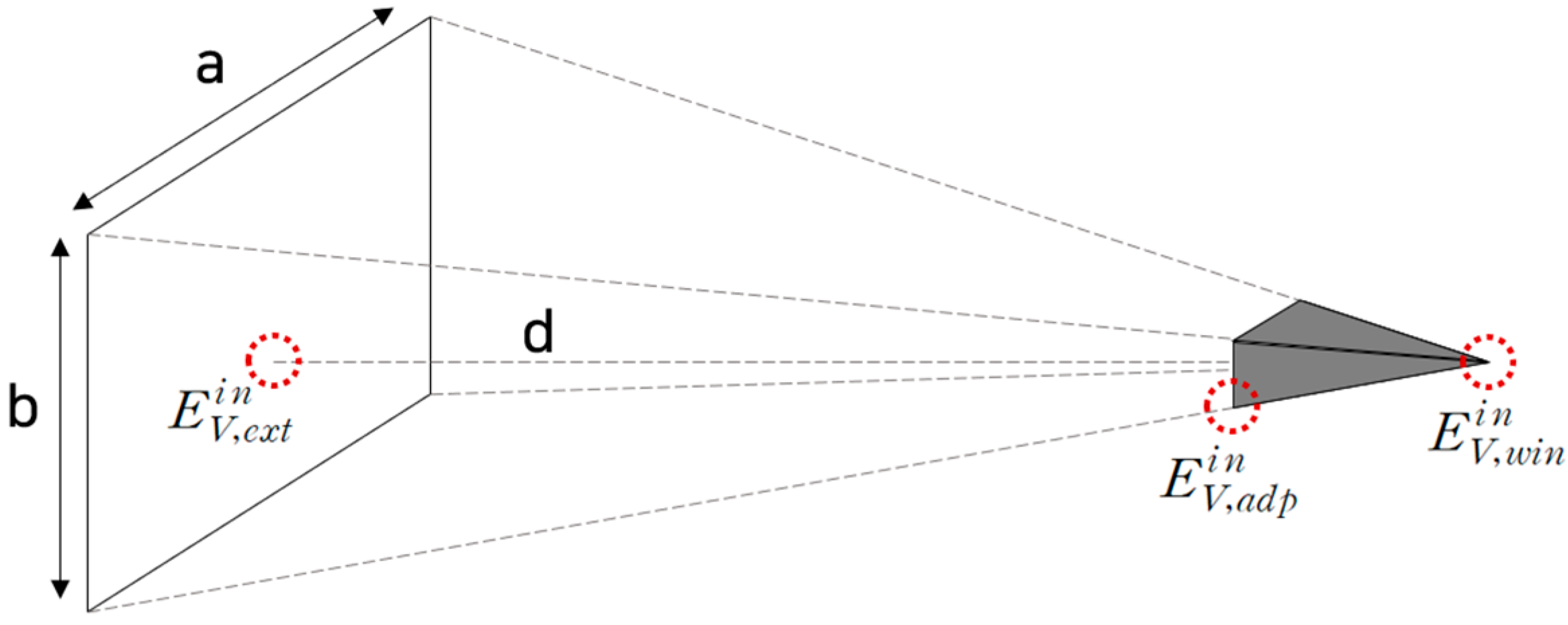
However, in these equations, deriving L s , L b , and L w using a luminance meter or imaging technique is not straightforward and suffers from limited accuracy, and additional data processing is required to define surfaces with uniform luminance levels. In relation to these issues, Nazzal [22] devised a method based on illuminance measurements instead of luminance. After further modification and refinement, the proposed DGIN [23], which enables the evaluation of discomfort glare caused by direct sunlight. A DGIN is an index that can be applied to nonuniform light sources that has been developed to better account for occupant comfort. The DGIN is obtained using Equation (8), and glare is considered to occur when its value exceeds 22 (Table 2). The variables related to Equation (8) are determined by Figure 2 and Equations (9)–(16).
D G I N = 8 l o g 10 { 0.25 { [ ( L e x t 2 Ω p N ) ] [ L a d p + 0.07 ( ( L w i n 2 ω N ) ) 0.5 ] } }
X   =   a / 2 d ,   Y   =   b / 2 d
A = X / [ ( 1 + X 2 ) ] ,   B = Y / [ ( 1 + X 2 ) ] ,   C = Y / [ ( 1 + Y 2 ) ] ,   D = X / [ ( 1 + Y 2 ) ]
ϕ = ( A a r c t a n B + C a r c t a n D ) / π
Ω p N = 2 π ϕ
ω N = [ a b cos ( a r c t a n ( X ) ) cos ( a r c t a n ( Y ) ) ] / d 2
L e x t = E V , e x t i n / [ 2 ( π 1 ) ]
L a d p = E V , a d p i n / π
L w i n   =   E V , w i n i n / 2 π ϕ

4. Materials and Methods

4.1. Evaluation Indicators and Case Definitions

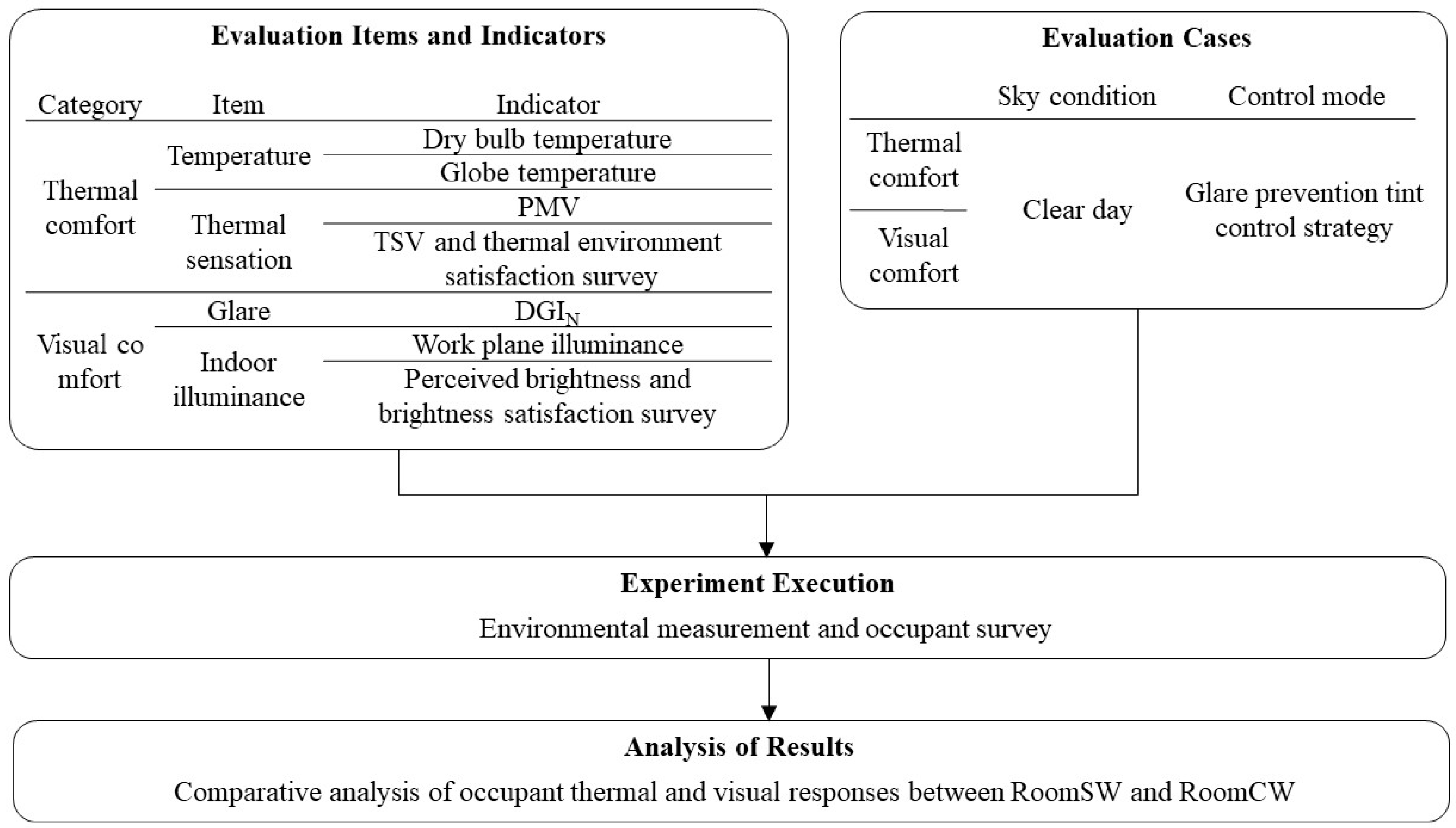
Figure 3 illustrates the overall research flowchart, while Table 3 details the evaluation items and indices defined for thermal and visual comfort. Temperature and thermal sensation were selected as evaluation items for thermal comfort, whereas glare and indoor illuminance were selected as evaluation items for visual comfort. For temperature, dry bulb and globe temperatures were adopted as objective evaluation indices. For thermal sensation, the PMV was used as an objective index, and the thermal sensation vote (TSV) and a questionnaire on satisfaction with the thermal environment were employed as subjective indices. For glare, the DGIN was adopted as an objective evaluation index, whereas for indoor illuminance, work plane illuminance was used as an objective index, and survey responses on perceived indoor brightness and brightness satisfaction were used as subjective indices. For thermal comfort, objective assessments based on dry bulb temperature, globe temperature, and PMV were compared with the subjective questionnaire responses of the subjects. For visual comfort, objective analyses of glare occurrence and illuminance adequacy were conducted using the DGIN and work plane illuminance, and these results were compared with the subjective questionnaire responses of the subjects.
From an energy performance perspective, in winter, it is advantageous not to tint smart windows because tinting can reduce solar heat gains and thereby increase heating energy consumption. However, even in winter, it is necessary to prevent glare by tinting the smart window. Previous research [12] has shown that in winter, a glare prevention tint control strategy that keeps the smart window clear under normal conditions and tints it in a stepwise manner when glare is likely to occur is the most effective strategy when both energy and comfort are considered. Accordingly, in this study, occupant thermal and visual comfort levels were evaluated with a glare prevention tint control strategy, which is expected to be widely applied as a smart window tint control approach for winter because it can maximize the benefits of smart windows.
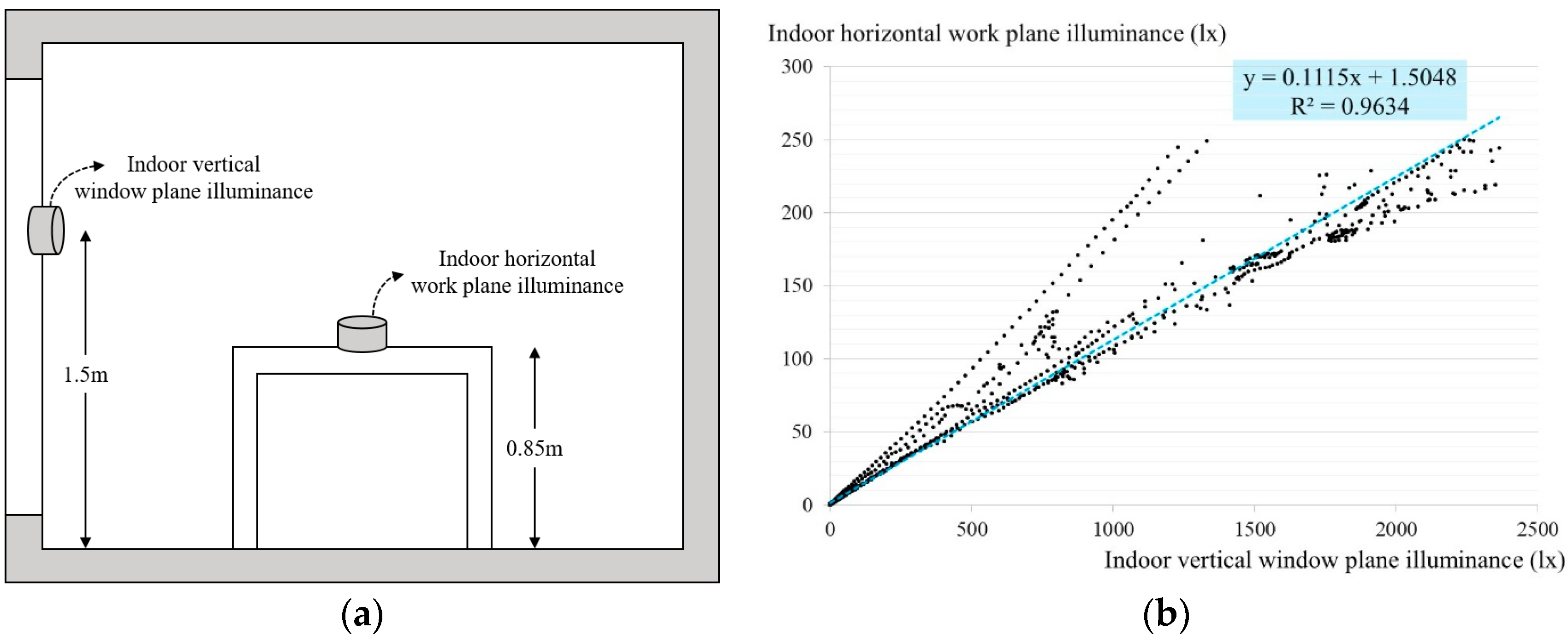
A glare prevention tint control algorithm for the smart window was developed to maintain a horizontal work plane illuminance of at least 200 lx at the center of the room while preventing glare. The minimum indoor illuminance requirement was set in reference to the Korean Industrial Standard (KS A 3011) [24]. In the case study building, horizontal work plane illuminance and indoor vertical illuminance at the window plane were measured, and a regression equation was derived (Figure 4), from which it was confirmed that to ensure a horizontal work plane illuminance of at least 200 lx, the indoor vertical illuminance at the window plane had to be at least 1814 lx. Specifically, the regression analysis established a relationship between the indoor vertical illuminance at the window plane (x) and the indoor horizontal work plane illuminance (y), yielding the equation y = 0.1115x + 1.5048 with an R2 of 0.9634. The illuminance data were collected at 1 min intervals from 20 April to 23 April 2022 (n = 4312 for each variable). Accordingly, the VT values and tinting levels of the smart window were subdivided into ten steps according to the outdoor illuminance level (Table 4). To prevent rapid oscillations in tinting near threshold conditions, a minimum dwell time of 1 min was implemented, ensuring the tint state remained constant for at least 1 min before any subsequent adjustment. For the smart window installed in this study, the VT ranged from a minimum of 0.013 in the fully tinted state to a maximum of 0.333 in the clear state. For example, when the measured outdoor illuminance (outdoor vertical illuminance at the window plane) was 80,000 lx, the smart window tinted to a VT of 0.034 (tinting level 9), thereby reducing VT so that glare would not occur while maintaining a horizontal work plane illuminance of at least 200 lx at the center of the room.
The evaluation cases for thermal and visual comfort were all configured under the same environmental conditions. The thermal environment was controlled so that the PMV remained within ±0.5, a common control target for indoor thermal environments [15], to approximate typical residential indoor conditions. In the luminous environment, no electric lighting was used to evaluate daylighting performance, and the minimum indoor illuminance requirement was set to 200 lx [24]. Because glare prevention tint control was not activated under overcast conditions, the analysis was limited to clear days, as determined on the basis of sky conditions.
Sky conditions were determined from hourly total cloud cover data obtained from the Open MET Data Portal of the Korea Meteorological Administration (KMA) [25]. Total cloud cover represents the fraction of the sky dome covered by clouds, and the World Meteorological Organization (WMO) expresses cloud cover in eighths using the unit okta [26]. When clouds covered approximately 5/8 of the sky (5 oktas), direct solar radiation decreased sharply, whereas diffuse solar radiation still had a significant effect. The WMO classifies conditions with a cloud cover of 6/8 or more as cloudy (Table 5), and Matuszko [27] reported that the highest solar radiation intensity could be observed for total cloud cover levels between 3/8 and 6/8 because of the reflection and scattering effects of convective cumulus clouds. On the basis of the WMO classification and previous research findings, conditions with a total cloud cover of less than 6/8 were defined as clear days and those with 6/8 or more were defined as cloudy days.

4.2. Experimental Building

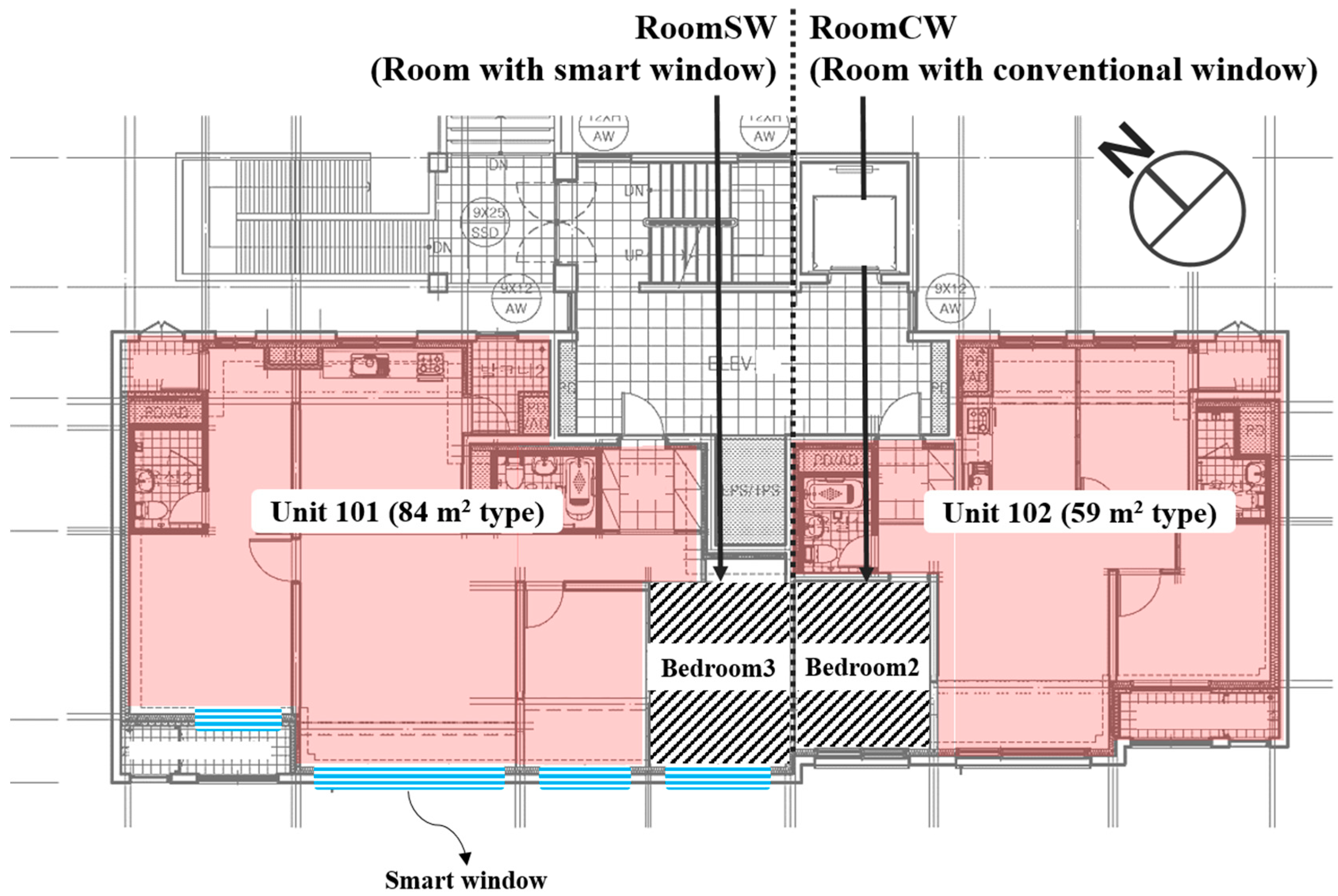
The case study building is a multifamily residential-type experimental building located in Sejong, Republic of Korea, and it is oriented to the southwest. Each floor consists of one 84 m2 unit (Unit 101) and one 59 m2 unit (Unit 102) (Figure 5). An SPD smart window was installed on the main façade of Unit 101, whereas a conventional double-glazed window was installed on the main façade of Unit 102. Bedroom 3 in Unit 101 (RoomSW, room with a smart window) and Bedroom 2 in Unit 102 (RoomCW, room with a conventional window) were selected as the experimental spaces because their floor areas were similar and their window sizes were identical, making them suitable for comparative analysis. No additional solar control devices were installed in the RoomSW or RoomCW, and the internal heat gains due to occupants, lighting, and equipment were kept the same in both rooms. The window performance characteristics for each room are summarized in Table 6.

4.3. Measurements

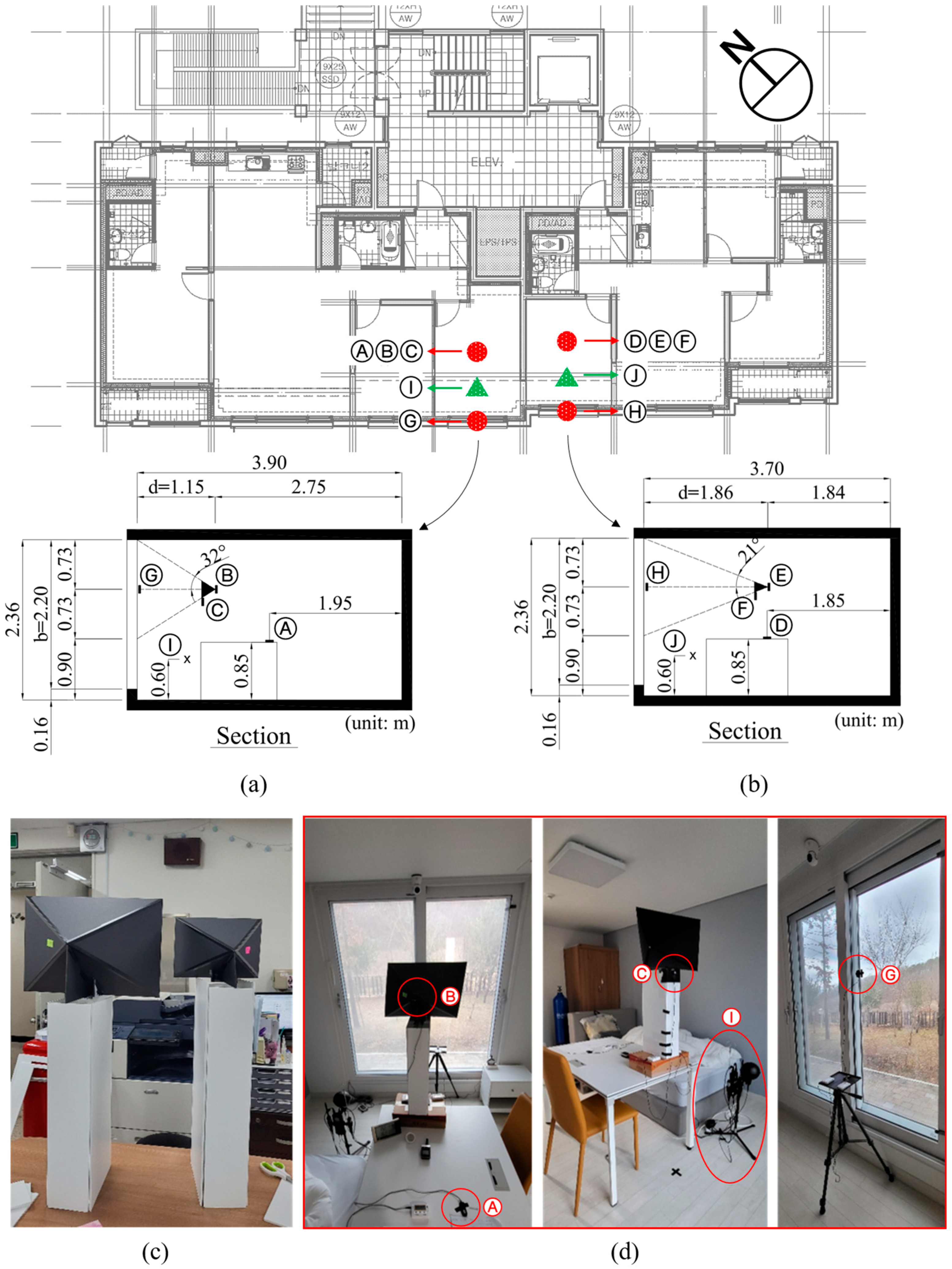
To evaluate the thermal and visual comfort levels of the occupants associated with smart window tinting, the experimental setup and instruments were arranged as shown in Figure 6, and the detailed specifications of the measurement instruments are listed in Table 7. To measure thermal environmental variables, multifunctional environmental meters (Ⓘ, Ⓙ; model: Testo 480, Testo SE & Co. KGaA, Titisee-Neustadt, Germany) were installed in the RoomSW and RoomCW at a height of 0.6 m at the center of each room, positioned 1.0 m away from the window. The dry bulb temperature, globe temperature, and PMV were recorded at 1 min intervals, and the met and clo values were entered according to the conditions of the occupants who responded to the TSV questionnaire. To measure the luminous environmental variables, illuminance sensors (Ⓐ–Ⓗ; model: TR-74Ui, T&D Corporation, Matsumoto, Japan) were installed. The data collected from illuminance sensors Ⓑ, Ⓒ, Ⓔ, and Ⓕ installed on the front and rear surfaces of the shields (Figure 6c), together with the data from sensors Ⓖ and Ⓗ attached to the indoor side of the window, were used to calculate the DGIN, whereas illuminance sensors Ⓐ and Ⓓ installed at a height of 0.85 m above the floor were used to measure the indoor work plane illuminance. The dimensions of the shields and the locations of all the instruments were determined and set in accordance with the DGIN calculation method and procedures presented in previous research [23]. In addition, an illuminance sensor for operating the glare prevention tint control algorithm was installed separately outdoors. To avoid shading effects that could occur if it were attached directly to the window, it was mounted vertically on the exterior wall adjacent to the window. All illuminance data were recorded at 1 min intervals.

4.4. Subjects

A total of 16 participants participated in the experiment. All participants had resided in Seoul, South Korea, for at least one year, ensuring they shared a similar living background. A pre-experiment questionnaire was used to collect data on participants’ age, height, weight, personal preferences for thermal and luminous environments, and health conditions on the day of the experiment (Table 8). The results confirmed that none of the participants were particularly sensitive to light or heat. All questionnaire data were anonymized, and all participants provided consent for the use of their information. Participants were advised to refrain from strenuous exercise and alcohol consumption on the day before the experiment, and all of them underwent a 30 min stabilization period [28] in a waiting area prior to the start of the experiment. Participants who normally wore glasses or contact lenses did so during the experiment. The experiments were conducted in accordance with the ethical principles of the 1964 Declaration of Helsinki [29]. All the participants were fully informed about the experimental procedures and details and were advised that they had the right to withdraw from the experiment at any time and for any reason.

4.5. Experimental Procedures

In December 2023 (winter), TSV, thermal environment satisfaction, brightness perception, and brightness satisfaction surveys were conducted a total of eight times (Table 9), with two participants taking part in each session. The sky conditions on each survey date were checked, and the survey dates corresponding to the thermal and visual comfort evaluation cases were organized as shown in Table 10.
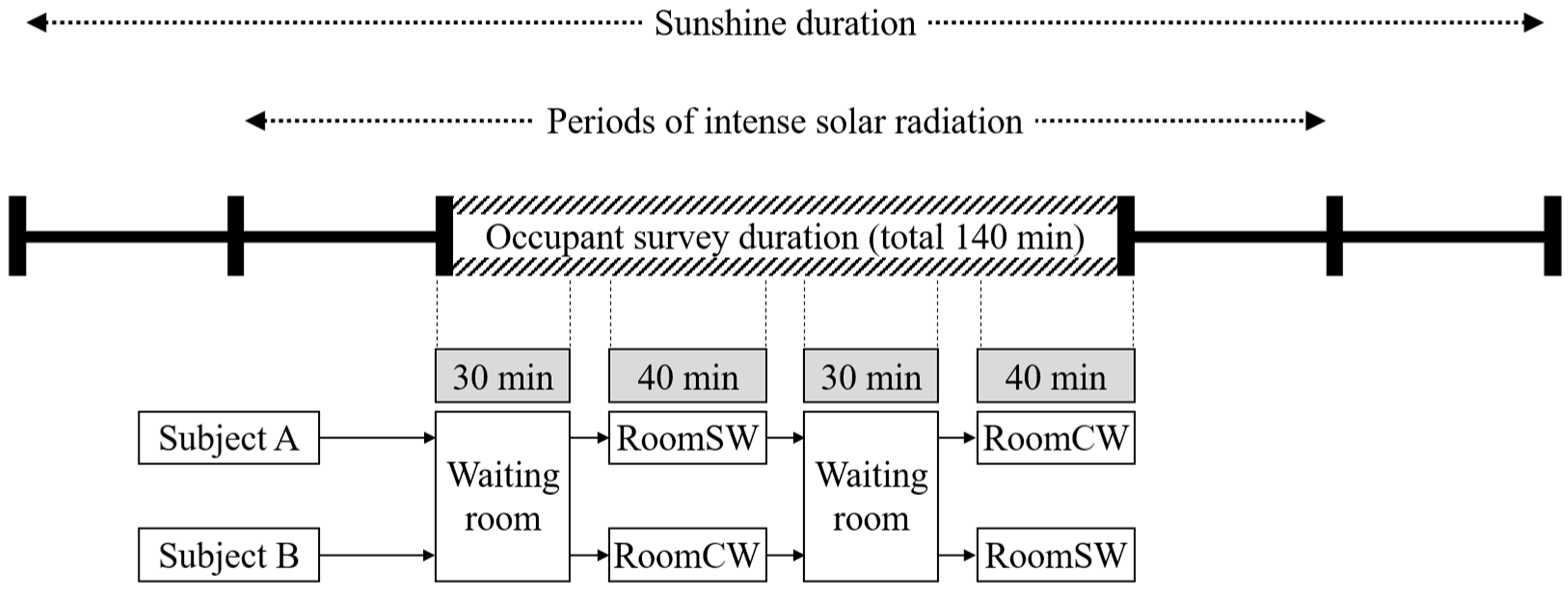
Before entering the RoomSW and RoomCW, all participants spent a certain period in a waiting area for stabilization. The waiting area was controlled such that the PMV was within ±0.5 and the air velocity was below 0.2 m/s [15], and the horizontal illuminance was set to 400–500 lx using electric lighting. All participants wore clothing corresponding to an insulation level of 1.0 clo, and the metabolic rate was set to 1.0 met (seated, relaxed) [14]. As shown in Figure 7, the experiment was conducted such that two participants first spent 30 min stabilizing in the waiting area and then moved to the RoomSW and RoomCW, where they remained for 40 min. This process was repeated twice in a crossover manner (total duration of 140 min). Each participant experienced both the RoomSW and RoomCW once, resulting in two data sets per room being obtained for each experimental day.
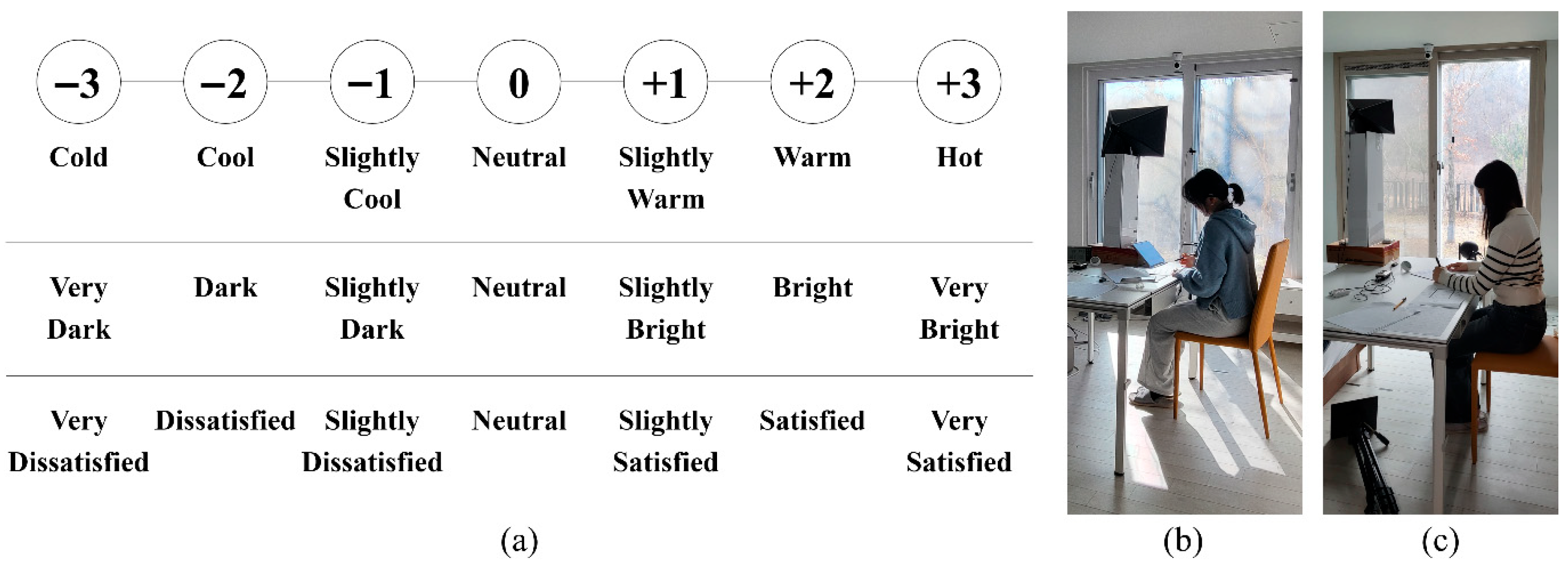
Before the participants entered, both the RoomSW and RoomCW were kept open, and the thermal environment was adjusted using heating equipment so that the PMV was maintained within ±0.5. The surveys were conducted between 12:00 and 15:00, when solar radiation was relatively strong. After the participants entered, the doors were closed, and the experiment was conducted without electric lighting. Using heating equipment that automatically turned off upon reaching the target temperature and turned back on when the temperature fell below the target, the PMV in the experimental rooms was maintained within ±0.5 throughout the experimental period. From the time the participants entered the RoomSW and RoomCW, they responded to questionnaires on the TSV, their satisfaction with the thermal environment, the perceived brightness, and their satisfaction with the brightness at 10 min intervals. The questionnaire scales for each evaluation item and a scene of the occupants completing the survey are shown in Figure 8. On the basis of the questionnaire results, the subjective responses of the occupants to the thermal and luminous environments were quantified.

4.6. Data Processing and Analysis

During the survey period, environmental variables related to thermal and visual comfort levels were measured at 1 min intervals, and the questionnaire responses of the occupants were collected at 10 min intervals. In accordance with the experimental schedule, which was designed so that the two participants alternated between the rooms, survey data for both thermal and visual comfort in the RoomSW and RoomCW were obtained from a total of six participants for each room (two participants per day over three days). At 10 min intervals, the measurement data and the occupant questionnaire responses were collected and examined, and average values of each variable over the entire survey period were obtained.
Statistical analysis was performed using IBM SPSS Statistics® 28.0.0.0 (IBM Corp., Armonk, NY, USA). For the physical measurement data, 30 data points were obtained for each variable; thus, normality was assumed based on the Central Limit Theorem (n ≥ 30) without a separate normality test. In contrast, for the subjective survey data, the five responses collected from each participant were aggregated into a single mean value to ensure statistical independence, resulting in a sample size of 6 (n = 6). The normality of these aggregated responses was verified using the Shapiro–Wilk test, which confirmed that the data followed a normal distribution (p > 0.05). Subsequently, paired sample t-tests were conducted to compare the conditions. Specifically, two-tailed tests were employed for thermal comfort metrics (e.g., PMV, TSV) to examine whether there was a significant difference between RoomSW and RoomCW conditions without assuming directionality. Conversely, one-tailed tests were applied to visual comfort metrics (e.g., DGIN, work plane illuminance) based on the directional hypothesis that RoomSW would result in lower values compared to RoomCW. A result was considered statistically significant when the p-value was less than 0.05 [30,31,32].
In addition, the effect size was examined to determine the practical magnitude of the differences between groups. Effect size is an index used to assess statistical power, and in the case of t tests, Cohen’s d is typically used [33,34]. Cohen’s d is interpreted in terms of its absolute value, and it indicates how large the actual difference between groups is. A value of 0.2 ≤ Cohen’s d < 0.5 is interpreted as a small effect, 0.5 ≤ Cohen’s d < 0.8 as a medium effect, and Cohen’s d ≥ 0.8 as a large effect.

5. Results

5.1. Thermal Comfort

5.1.1. Dry Bulb and Globe Temperatures

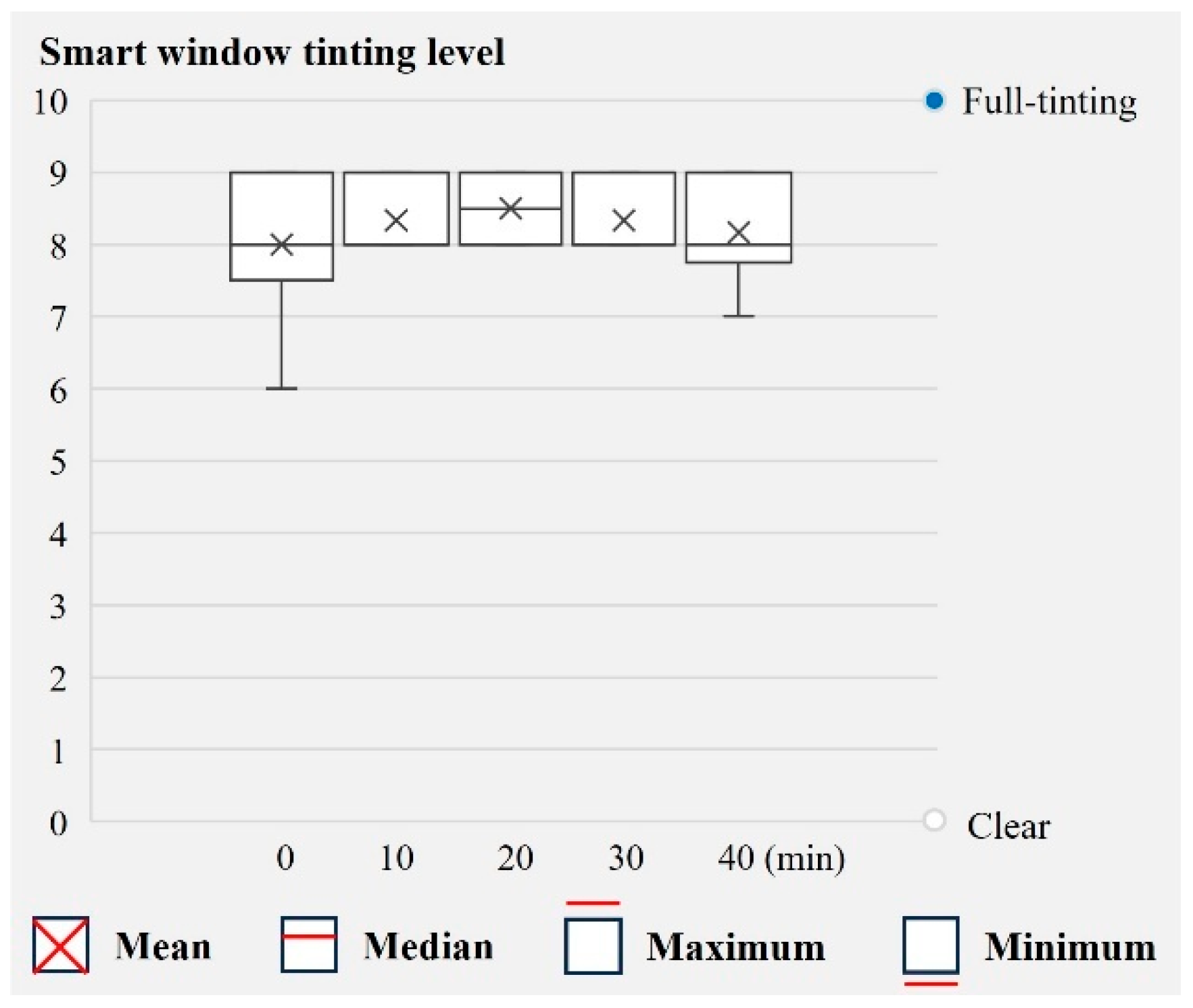
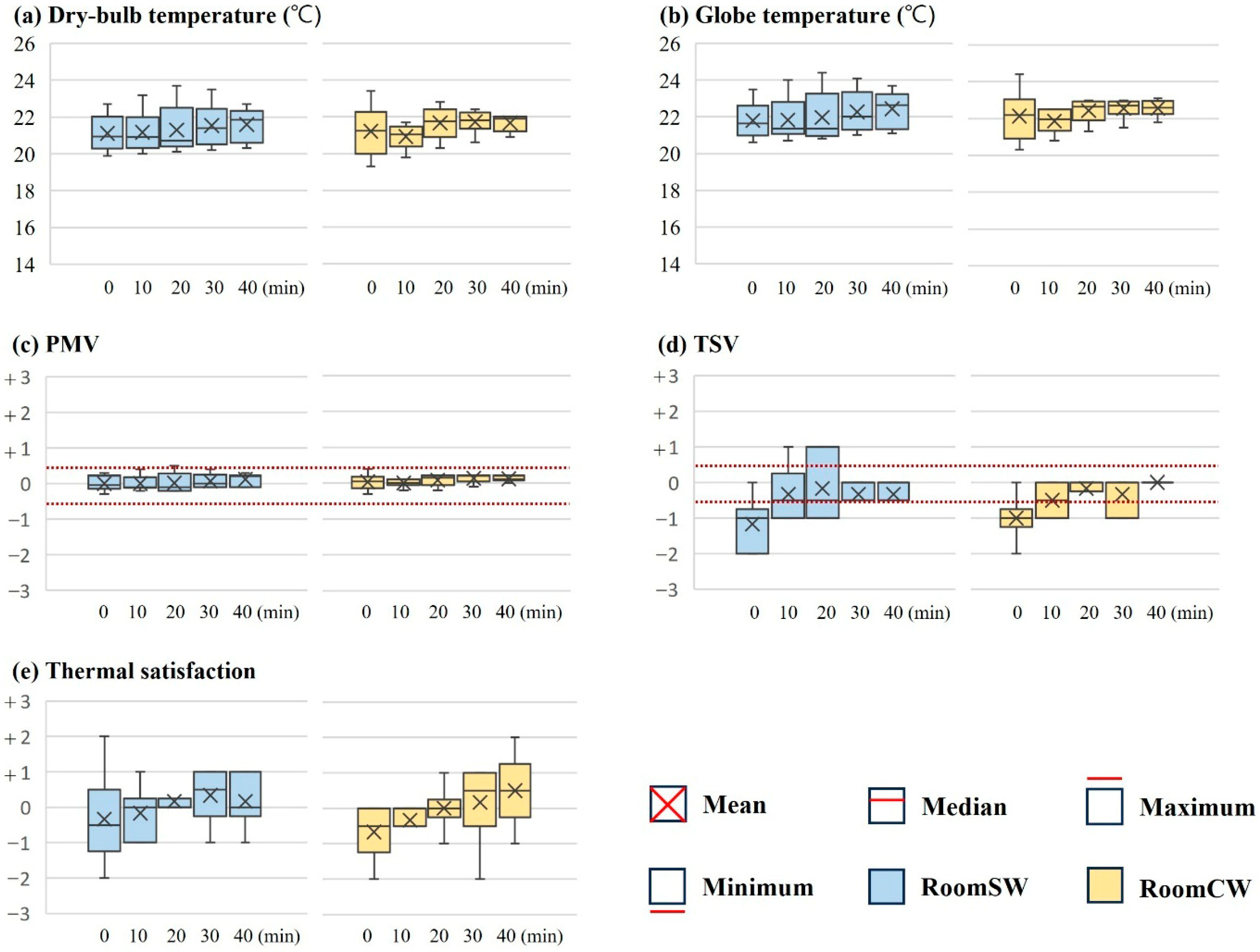
On the three clear days analyzed (10, 17, and 24 December), the average tinting level of the smart window during the survey period (12:00–15:00) was level 8 (Figure 9), and Figure 10 shows the temperature indices over the 40 min survey period. The dry bulb temperatures in the RoomSW and RoomCW (Figure 10a) ranged from approximately 19 °C to 24 °C, and the globe temperature (Figure 10b) ranged from 20 °C to 25 °C. Prior to the experiment, the indoor temperature range corresponding to the PMV within ±0.5 was identified and used to set the target temperature. The heaters were operated such that they switched off automatically upon reaching the setpoint and switched on again when the temperature fell below it. As a result, the dry bulb and globe temperatures varied within a certain range, and the mean dry bulb and globe temperatures during the survey period were 21.4 °C and 22.3 °C, respectively, in the RoomSW and 21.3 °C and 22.1 °C, respectively, in the RoomCW. Statistical analysis revealed that the differences in dry bulb and globe temperatures between the two rooms were not statistically significant, and the effect sizes were very small, indicating a minimal difference (Table 11).

5.1.2. Thermal Sensation

The thermal sensation indices during the 40 min survey period are shown in Figure 10. The PMV values (Figure 10c) in both rooms were controlled to remain within ±0.5 throughout the survey, in accordance with the predefined environmental conditions, and the mean PMV values in the RoomSW and RoomCW were 0.0 and +0.1, respectively. With respect to the TSV responses of the occupants (Figure 10d), the TSV values in both RoomSW and RoomCW were within the comfort range except at the time of entry, and the occupants generally perceived the rooms to be cooler than those indicated by the PMV index. The mean TSV values were −0.5 and −0.4 in the RoomSW and RoomCW, respectively, indicating no substantial difference between the two spaces. In the case of thermal environment satisfaction (Figure 10e), large variations were observed depending on individual tendencies, and the mean satisfaction scores were 0.0 and −0.1 in the RoomSW and RoomCW, respectively, indicating no substantial difference between the two rooms, similar to the TSV responses. Statistical analysis revealed that the differences in PMV, TSV, and thermal environment satisfaction between the two rooms were not statistically significant, and considering the effect sizes, these differences could be interpreted as practically negligible (Table 11). Although the glare prevention tint control algorithm was in operation, the subjective thermal sensation and satisfaction of the occupants did not differ from those in the room with a conventional window. The results suggested that in the absence of a meaningful difference in the physical thermal environment, smart window tinting would not induce changes in the thermal sensation or satisfaction of the occupants, and its influence would likely be further reduced by the fact that the smart window was not in a fully tinted state.

5.2. Visual Comfort

5.2.1. Glare

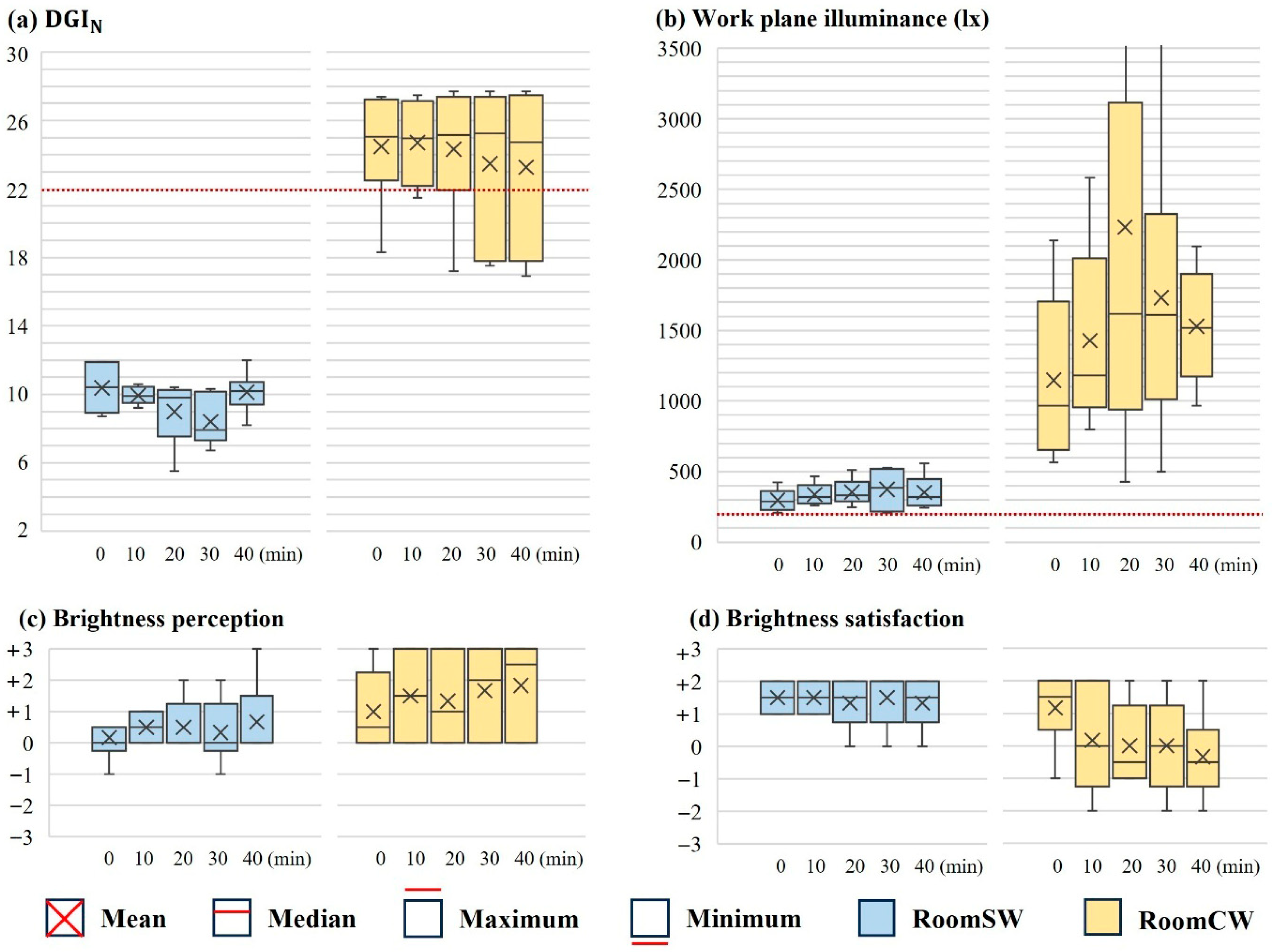
The glare index data during the 40 min survey period are shown in Figure 11. In the RoomSW, the DGIN (Figure 11a) remained below 22, the threshold for judging the occurrence of glare, throughout the survey, indicating that glare did not occur. In contrast, in the RoomCW, the mean DGIN exceeded 22 at all times, and when interpreted with reference to the median, the DGIN was above 22 in more than half of the cases, indicating that glare occurred. The mean DGIN values in the RoomSW and RoomCW were 9.6 and 24.1, respectively. Statistical analysis revealed that the difference in the DGIN between the two rooms was statistically significant (p < 0.001), and considering the effect size (Cohen’s d ≥ 0.8), this difference could be interpreted as very large in practical terms (Table 11).

5.2.2. Indoor Illuminance

The indoor illuminance data during the 40 min survey period are shown in Figure 11. In the RoomSW, the indoor work plane illuminance (Figure 11b) remained between 200 lx and 600 lx throughout the survey period, satisfying the minimum illuminance requirement. In the RoomCW, the work plane illuminance ranged from 500 lx to 7000 lx, showing much greater variation in the measured illuminance than in the RoomSW and generally exceeding the minimum required illuminance of 200 lx by a large margin. The mean work plane illuminance values were 342.7 lx in the RoomSW and 1614.7 lx in the RoomCW. The mean values of the perceived brightness (Figure 11c) and brightness satisfaction (Figure 11d) of the occupants were +0.4 and +1.4, respectively, in the RoomSW and +1.5 and +0.2, respectively, in the RoomCW. On the basis of the response scales, the participants perceived RoomCW to be brighter than RoomSW was, whereas their level of satisfaction with the luminous environment was greater for RoomSW. Statistical analysis revealed that the differences in work plane illuminance (p < 0.001) and brightness satisfaction (p < 0.05) between the two rooms were statistically significant. However, the difference in perceived brightness was not statistically significant (p = 0.07). Regarding effect sizes, the differences in work plane illuminance and brightness satisfaction were interpreted as large (Cohen’s d ≥ 0.8), whereas the difference in perceived brightness was interpreted as medium (0.5 ≤ Cohen’s d < 0.8) (Table 11). These results suggest that while the participants experienced a substantial difference in actual illuminance and satisfaction levels between the two spaces, the difference in perceived brightness was marginally less distinct.

6. Discussion

This study conducted a comparative analysis of occupant responses to thermal and visual environments in RoomSW versus RoomCW. Regarding thermal comfort, we hypothesized that the subtle nuances arising from the smart window’s operation, such as the bluish tint, might influence occupant thermal perception, even when the thermal environment was controlled to mimic a real residential setting via active heating. However, the results indicated that the tinting for glare prevention had no significant impact on occupants’ thermal sensation or thermal satisfaction. Numerous previous studies related to the hue-heat hypothesis have reported that the color of lighting or the spatial environment can influence occupants’ thermal sensation, task performance, or cognitive abilities [35,36,37,38,39]. However, the absence of such an effect in this study may be attributed to the fact that tinting occurred intermittently based on glare conditions and did not reach the fully tinted state.
Regarding visual comfort, although the work plane illuminance and perceived brightness in RoomSW were lower than those in RoomCW, brightness satisfaction was found to be significantly higher in RoomSW. Indoor illuminance is a critical determinant of occupant comfort and task performance, prompting organizations such as the CIE and Illuminating Engineering Society of North America (IES) to recommend a work plane illuminance of 500 lx for general office tasks [40]. Similarly, the Korean Industrial Standard (KS A 3011) suggests a range of 300–600 lx for keyboard work [24]. Furthermore, while the original UDI framework defined 100–2000 lx as useful, Mardaljevic et al. [41] expanded this classification to account for discomfort, defining illuminance levels exceeding 3000 lx as ‘exceeded’—a range associated with glare and overheating. In the present study, the illuminance levels in RoomCW were frequently observed to exceed not only the recommended minimums for standard tasks but also these upper thresholds for visual comfort (e.g., >1000 lx or >3000 lx). This suggests that the excessive brightness in RoomCW likely contributed to the lower brightness satisfaction reported by occupants, despite the abundance of light.
The limitations of this study and suggestions for future research are as follows: First, while smart windows can be controlled based on various variables such as indoor temperature, illuminance, and occupancy, this study established a control logic based on the single objective of glare prevention. Indeed, numerous preceding studies have explored control strategies utilizing these diverse variables [42,43,44,45,46]. Future research should adopt a multi-objective optimization (MOO) approach to control smart windows and investigate their complex, combined effects on the indoor environment [47]. Second, because the analysis was restricted to clear days during which glare prevention tint control was actively implemented, the sample size was inevitably limited. To obtain more statistically reliable results, future studies should aim to recruit additional participants and significantly increase the sample size. Third, the experimental exposure time was relatively short. If occupants were to reside in the space for extended periods, as in an actual residential environment, the intermittent tinting of the smart window could have different cumulative effects on their thermal and visual comfort. To further verify the validity of winter glare prevention tint control, subsequent research should investigate occupant comfort levels during long-term exposure. Fourth, this study did not include an economic analysis, such as a cost–benefit or life-cycle cost (LCC) assessment. Although smart windows contribute to building energy efficiency, their relatively high initial installation cost remains a barrier to widespread adoption. Therefore, future research should verify the economic feasibility by quantitatively comparing the energy cost savings against the initial investment. Finally, this study was conducted in a residential building in South Korea during the winter season. To achieve resilient and sustainable smart window applications globally, future research should expand its scope to address diverse climatic conditions and building types.

7. Conclusions

This study aimed to provide appropriate control strategies and support the efficient operation of smart window technologies by analyzing the impact of wintertime smart window tinting on the perceived thermal and visual comfort levels of occupants. To this end, evaluation items, indices, and cases for thermal and visual comfort were defined. An experimental environment was established in a residential-style test building equipped with both a smart window and a conventional window. Data on the indoor temperature, PMV, DGIN, work plane illuminance, and occupant questionnaire responses related to thermal and visual comfort were collected to enable a comprehensive comparative analysis of the effects of smart window tinting on thermal and visual comfort. In the experiments, the smart window was operated under a glare prevention tint control strategy, in which the tint level was adjusted stepwise only when glare occurred. This technology could be widely applied as a smart window tint control method in winter. The main findings of this study were as follows:
  • With respect to thermal comfort, the heating system was controlled to maintain the PMV within the target range of ±0.5 throughout the occupied period. Under this controlled thermal condition (with dry-bulb and globe temperatures maintained within the corresponding operating ranges), the occupant survey results indicated no substantial differences between RoomSW and RoomCW in terms of thermal sensation and satisfaction when applying the smart-window glare prevention tint control strategy in test spaces replicating an actual dwelling. The results of the paired-samples t-test confirmed that the differences between RoomSW and RoomCW were not statistically significant (p > 0.05). Therefore, wintertime smart window tinting for glare prevention did not impair the thermal sensation or satisfaction of occupants.
  • With respect to visual comfort, glare did not occur in RoomSW, whereas in the RoomCW, the DGIN exceeded 22, indicating the occurrence of glare. For the indoor illuminance, both RoomSW and RoomCW satisfied the minimum required illuminance of 200 lx. According to the occupant survey results, the participants were satisfied with the luminous environment in both RoomSW and RoomCW, with higher levels of satisfaction in RoomSW. These findings were confirmed to be statistically significant (p < 0.05).

Author Contributions

Conceptualization, S.-Y.C.; methodology, S.-Y.C., S.-J.L. and S.-Y.S.; validation, S.-Y.C.; formal analysis, S.-Y.C. and S.-Y.S.; investigation, S.-Y.C.; resources, S.-Y.C. and S.-J.L.; data curation, S.-Y.C.; writing—original draft preparation, S.-Y.C.; writing—review and editing, S.-Y.C., S.-J.L. and S.-Y.S.; visualization, S.-Y.C.; supervision, S.-J.L. and S.-Y.S.; project administration, S.-J.L.; funding acquisition, S.-J.L. All authors have read and agreed to the published version of the manuscript.

Funding

This research was funded by a National Research Foundation of Korea (NRF) grant provided by the Korean government (MSIT), grant number RS-2023-00210963.

Institutional Review Board Statement

This study was conducted in accordance with the principles of the Declaration of Helsinki. Formal ethical approval was not required because the research involved a fully anonymized, minimal-risk survey that collected no personally identifiable or sensitive information.

Data Availability Statement

Data will be made available on request.

Acknowledgments

During the preparation of this work, the authors used ChatGPT (GPT-4; OpenAI, San Francisco, CA, USA) to improve the readability and flow of the manuscript. After using this tool, the authors reviewed and edited the content as needed and take full responsibility for the content of the publication. The authors gratefully acknowledge the participation of all subjects in the experiment.

Conflicts of Interest

The authors declare no conflicts of interest.

References

  1. International Energy Agency. The Energy Efficiency Policy Package: Key Catalyst for Building Decarbonisation and Climate Action—Analysis—(n.d.). Available online: https://www.iea.org/commentaries/the-energy-efficiency-policy-package-key-catalyst-for-building-decarbonisation-and-climate (accessed on 15 September 2025).
  2. Anand, V.; Kadiri, V.L.; Putcha, C. Passive buildings: A state-of-the-art review. J. Infrastruct. Preserv. Resil. 2023, 4, 3. [Google Scholar] [CrossRef] [PubMed]
  3. Brito-Coimbra, S.; Aelenei, D.; Gloria Gomes, M.; Moret Rodrigues, A. Building Façade Retrofit with Solar Passive Technologies: A Literature Review. Energies 2021, 14, 1774. [Google Scholar] [CrossRef]
  4. Favoino, F.; Loonen, R.C.G.M.; Michael, M.; Michele, G.D.; Avesani, S. 5—Advanced fenestration—Technologies, performance and building integration. In Rethinking Building Skins Transformative Technologies and Research Trajectories; Gaparri, E., Brambilla, A., Lobaccaro, G., Goia, F., Andaloro, A., Sangiorgio, A., Eds.; Woodhead Publishing: London, UK, 2022; pp. 117–154. [Google Scholar] [CrossRef]
  5. IMARC Group. Smart Window Market Report by Technology, Type, Application, and Region; IMARC Group: St. Brooklyn, NY, USA, 2025; pp. 2024–2032. [Google Scholar]
  6. Teixeira, H.; Moret, A.R.; Aelenei, D.; Gomes, M.G. Literature review of solar control smart building glazing: Technologies, performance, and research insights. Build. Environ. 2025, 274, 112784. [Google Scholar] [CrossRef]
  7. Rashidzadeh, Z.; Heidari Matin, N. A Comparative Study on Smart Windows Focusing on Climate-Based Energy Performance and Users’ Comfort Attributes. Sustainability 2023, 15, 2294. [Google Scholar] [CrossRef]
  8. Mesloub, A.; Ghosh, A.; Touahmia, M.; Albaqawy, G.A.; Alsolami, B.M.; Ahriz, A. Assessment of the overall energy performance of an SPD smart window in a hot desert climate. Energy 2022, 252, 124073. [Google Scholar] [CrossRef]
  9. Jahangir, M.H.; Aboutorabi, R. Comparison of energy consumption and life cycle assessment in a building equipped with smart windows (electrochromic, thermochromic and photochromic): Case study in Tehran. Results Eng. 2026, 29, 108878. [Google Scholar] [CrossRef]
  10. Khatibi, A.; Jahangir, M.H.; Astaraei, F.R. Energy and comfort evaluation of a novel hybrid control algorithm for smart electrochromic windows: A simulation study. Sol. Energy 2022, 241, 671–685. [Google Scholar] [CrossRef]
  11. Masi, R.F.D.; Festa, V.; Gigante, A.; Ruggiero, S.; Vanoli, G.p. The incidence of smart windows in building energy saving and future climate projections. Energy Rep. 2022, 8, 283–289. [Google Scholar] [CrossRef]
  12. Lee, S.J.; Choi, S.Y.; Song, S.Y. Suspended Particle Device Windows in Residential Buildings: Measurement-based Assessment of Comfort and Energy Performance for Optimal Control in Intermediate and Heating Season. Energy Build. 2024, 330, 115339. [Google Scholar] [CrossRef]
  13. Ghosh, A.; Norton, B.; Duffy, A. Daylighting performance and glare calculation of a suspended particle device switchable glazing. Sol. Energy 2016, 132, 114–128. [Google Scholar] [CrossRef]
  14. ISO 7730; Ergonomics of the Thermal Environment. International Organization for Standardization: Vernier, Switzerland, 2005.
  15. ANSI/ASHRAE Standard 55; Thermal Environmental Conditions for Human Occupancy. American Society of Heating, Refrigerating and Air-Conditioning Engineers: Atlanta, GA, USA, 2020.
  16. Fanger, P.O.; Toftum, J. Extension of the PMV model to non-air-conditioned buildings in warm climates. Energy Build. 2002, 34, 533–536. [Google Scholar] [CrossRef]
  17. International Commission on Illumination (CIE). International Lighting Vocabulary, 4th ed.; (CIE 17.4-1987); CIE Central Bureau: Vienna, Austria, 1987. [Google Scholar]
  18. Osterhaus, W.K.E. Discomfort glare assessment and prevention for daylight applications in office environments. Sol. Energy 2005, 79, 140–158. [Google Scholar] [CrossRef]
  19. Clear, R. Discomfort glare: What do we actually know? Light. Res. Technol. 2013, 45, 141–158. [Google Scholar] [CrossRef]
  20. Hopkinson, R.G. Architectural Physics: Lighting; HMSO: London, UK, 1963; pp. 225–242. [Google Scholar]
  21. Chauvel, P.; Collins, B.; Dogniaux, R.; Longmore, J. Glare from windows: Current views of problem. Light. Res. Tech. 1982, 14, 31–46. [Google Scholar] [CrossRef]
  22. Nazzal, A.A. A new daylight glare evaluation method, Introduction of the monitoring control and calculation method. Energy Build. 2001, 33, 256–257. [Google Scholar] [CrossRef]
  23. Nazzal, A.A. A new evaluation method for daylight discomfort glare. Int. J. Ind. Ergon. 2005, 35, 295–306. [Google Scholar] [CrossRef]
  24. Korean Standards Association. KS A 3011: Recommended levels of illumination. In Korean Industrial Standards; Korean Standards Association: Seoul, Republic of Korea, 1998. [Google Scholar]
  25. Korea Meteorological Administration. KMA Weather Data Service, Open MET Data Portal. Available online: https://data.kma.go.kr/resources/html/en/aowdp.html (accessed on 14 August 2024).
  26. World Meteorological Organization. World Weather Information Service, Definition of Oktas. Available online: https://worldweather.wmo.int/oktas.htm (accessed on 14 August 2024).
  27. Matuszko, D. Influence of the extent and genera of cloud cover on solar radiation intensity. Int. J. Climatol. 2012, 32, 2403–2414. [Google Scholar] [CrossRef]
  28. Wu, Z.; Li, N.; Schiavon, S. Experimental evaluation of thermal comfort, SBS symptoms and physiological responses in a radiant ceiling cooling environment under temperature step-changes. Build. Environ. 2022, 224, 109512. [Google Scholar] [CrossRef]
  29. World Medical Association (WMA). WMA Declaration of Helsinki—Ethical Principles for Medical Research Involving Human Subjects. In Proceedings of the 64th WMA General Assembly, Fortaleza, Brazil, 16–19 October 2013. [Google Scholar]
  30. Hajialiani, S.; Rostami, F.; Ahmadvand, M.; Mirakzadeh, A.A.; Azadi, H. Assessment of effect size and social indicators sustainability in the context of international rural development projects in Iran: Using BACI framework. ESI 2025, 27, 100871. [Google Scholar] [CrossRef]
  31. Cui, C.; Guo, Z.; Liu, Y.; Han, N.; Song, J.; Chen, Y.; Zheng, Y.; Sheng, C.; Balmer, L.; Li, H.; et al. Tissue-specific distribution of microplastics in human blood and carotid plaques: A paired sample analysis. Environ. Int. 2025, 203, 109743. [Google Scholar] [CrossRef] [PubMed]
  32. Zhang, Y.; Altan, H. A comparison of occupant comfort in a conventional high-rise office block and a contemporary environmentally concerned building. Build. Environ. 2011, 46, 535–545. [Google Scholar] [CrossRef]
  33. Salahuddin, M.F. Bridging theory and practice: Enhancing pharmacology education through simulation-based learning and statistical analysis training. Curr. Pharm. Teach. Learn. 2025, 17, 102440. [Google Scholar] [CrossRef]
  34. Schreiber, J.B.; Amin, M.E.K. Core reporting expectations for quantitative manuscripts using independent and dependent t tests, one way ANOVA, OLS regression, and chi square. Curr. Pharm. Teach. Learn. 2025, 17, 102462. [Google Scholar] [CrossRef]
  35. Keis, O.; Helbig, H.; Streb, J.; Hille, K. Influence of blue-enriched classroom lighting on students’ cognitive performance. Trends Neurosci. Educ. 2014, 3, 86–92. [Google Scholar] [CrossRef]
  36. Winzen, J.; Albers, F.; Marggraf-Micheel, C. The influence of coloured light in the aircraft cabin on passenger thermal comfort. Light. Res. Technol. 2014, 46, 465–475. [Google Scholar] [CrossRef]
  37. Huebner, G.M.; Shipworth, D.T.; Gauthier, S.; Witzel, C.; Raynham, P.; Chan, W. Saving energy with light? Experimental studies assessing the impact of colour temperature on thermal comfort. Energy Res. Soc. Sci. 2016, 15, 45–57. [Google Scholar] [CrossRef]
  38. Huang, R.-H.; Lee, L.; Chiu, Y.-A.; Sun, Y. Effects of correlated color temperature on focused and sustained attention under white LED desk lighting. Color Res. Appl. 2015, 40, 281–286. [Google Scholar] [CrossRef]
  39. Minguillon, J.; Lopez-Gordo, M.A.; Renedo-Criado, D.A.; Sanchez-Carrion, M.J.; Pelayo, F. Blue lighting accelerates post-stress relaxation: Results of a preliminary study. PLoS ONE 2017, 12, e0186399. [Google Scholar] [CrossRef]
  40. Illuminating Engineering Society. The Lighting Handbook, 10th ed.; Illuminating Engineering Society: New York, NY, USA, 2011. [Google Scholar]
  41. Mardaljevic, J.; Andersen, M.; Roy, N.; Christoffersen, J. Daylighting metrics: Is there a relation between useful daylight illuminance and daylight glare probability? In Proceedings of the First Building Simulation and Optimization Conference (BSO12), Loughborough, UK, 10–11 September 2012. [Google Scholar]
  42. Krarti, M. Energy performance of control strategies for smart glazed windows applied to office buildings. J. Build. Eng. 2022, 45, 103462. [Google Scholar] [CrossRef]
  43. Hemaida, A.; Ghosh, A.; Sundaram, S.; Mallick, T.K. Simulation study for a switchable adaptive polymer dispersed liquid crystal smart window for two climate zones (Riyadh and London). Energy Build. 2021, 251, 111381. [Google Scholar] [CrossRef]
  44. Iluyemi, D.C.; Nundy, S.; Shaik, S.; Tahir, A.; Ghosh, A. Building energy analysis using EC and PDLC based smart switchable window in Oman. Sol. Energy 2022, 237, 301–312. [Google Scholar] [CrossRef]
  45. Mesloub, A.; Ghosh, A.; Kolsi, L.; Alshenaifi, M. Polymer-Dispersed Liquid Crystal (PDLC) smart switchable windows for less-energy hungry buildings and visual comfort in hot desert climate. J. Build. Eng. 2022, 59, 105101. [Google Scholar] [CrossRef]
  46. Dussault, J.-M.; Sourbron, M.; Gosselin, L. Reduced energy consumption and enhanced comfort with smart windows: Comparison between quasi-optimal, predictive and rule-based control strategies. Energy Build. 2016, 127, 680–691. [Google Scholar] [CrossRef]
  47. Alsukkar, M.; Ibrahim, A.; Eltaweel, A. Multi-objective optimization of daylighting systems for energy efficiency and thermal-visual comfort in buildings: A review. Build. Environ. 2016, 288, 113921. [Google Scholar] [CrossRef]
Figure 1. Schematic of the operating principle and tinting states under different control modes.
Buildings 16 00444 g001
Figure 2. Schematic diagram of the DGIN calculation process. a is the width of the window; b is the height of the window, d is the distance between the window and the measurement position (m); and E V ,   e x t i n , E V ,   a d p i n , and E V ,   w i n i n are the measured illuminance values.
Buildings 16 00444 g002
Figure 3. Flowchart of the overall research methodology.
Buildings 16 00444 g003
Figure 4. (a) Cross-sectional view of the illuminance sensor installation. (b) Regression model correlating indoor horizontal work plane illuminance with vertical window plane illuminance.
Buildings 16 00444 g004
Figure 5. Floor plan of the experimental building.
Buildings 16 00444 g005
Figure 6. (a,b) Cross-sectional views of the equipment setup in RoomSW and RoomCW. (c) Image of the shields. (d) Overall view of the experimental setup (Room SW).
Buildings 16 00444 g006
Figure 7. Diagram of the survey procedure.
Buildings 16 00444 g007
Figure 8. (a) 7-point scales used for TSV (top), brightness perception (middle), and satisfaction (bottom). Photographs of the survey being conducted in (b) RoomSW and (c) RoomCW.
Buildings 16 00444 g008
Figure 9. Smart window tinting levels during the survey period in RoomSW.
Buildings 16 00444 g009
Figure 10. Boxplots of thermal comfort indicators during occupancy in RoomSW and RoomCW.
Buildings 16 00444 g010
Figure 11. Boxplots of visual comfort indicators during occupancy in RoomSW and RoomCW.
Buildings 16 00444 g011
Table 1. Thermal sensation scale.
ValueThermal Sensation
−3Cold
−2Cool
−1Slightly cool
0Neutral
+1Slightly warm
+2Warm
+3Hot
Table 2. DGIN scale.
DGINLevel of Glare
16Just perceptible
16   <   DGI N    18Perceptible
18   <   DGI N    20Just acceptable
20   <   DGI N    22Acceptable
22   <   DGI N    24Just uncomfortable
24   <   DGI N    26Uncomfortable
Table 3. Evaluation items and indicators.
CategoryItemIndicatorTypes of Indicators
ObjectiveSubjective
Thermal comfortTemperatureDry bulb temperatureO
Globe temperatureO
Thermal
sensation
PMVO
TSV and thermal environment satisfaction survey O
Visual comfortGlareDGINO
Indoor
illuminance
Work plane illuminanceO
Perceived brightness and
brightness satisfaction survey
O
Table 4. Smart window VT and tinting levels corresponding to outdoor illuminance.
Outdoor Illuminance (lx)VTSmart Window Tinting LevelAC Input (V)
≥139,4760.013Level 10 (Full-tinting)0 V
≥53,3300.034Level 930 V
≥17,2700.105Level 850 V
≥11,7000.155Level 760 V
≥93970.193Level 670 V
≥79900.227Level 580 V
≥72840.249Level 490 V
≥67680.268Level 3100 V
≥64550.281Level 2110 V
≥62540.290Level 1120 V
6254>0.333Level 0 (Clear)220 V
Table 5. Classification of sky conditions based on oktas.
Weather SymbolsOktasDefinitionCategory
Buildings 16 00444 i0010 oktas (0/8)Sky clear (SKC)Fine
Buildings 16 00444 i0021 okta (1/8)Few clouds (FEW)Fine
Buildings 16 00444 i0032 oktas (2/8)FEWFine
Buildings 16 00444 i0043 oktas (3/8)Scattered clouds (SKT)Partly cloudy
Buildings 16 00444 i0054 oktas (4/8)SKTPartly cloudy
Buildings 16 00444 i0065 oktas (5/8)Broken clouds (BKN)Partly cloudy
Buildings 16 00444 i0076 oktas (6/8)BKNCloudy
Buildings 16 00444 i0087 oktas (7/8)BKNCloudy
Buildings 16 00444 i0098 oktas (8/8)Overcast (OVC)Overcast
Table 6. Specifications of the window systems.
CompositionStateU Value
( W / m 2 K )
SHGCVT
Smart window(Outer glazing)
9SPD-10Ar-5CL
(Inner glazing)
5CL-14Ar-5LE
Full tinting0.9290.1500.013
Untinting (Clear)0.9290.2900.333
Conventional window(Outer glazing)
5CL-12Ar-5LE
(Inner glazing)
5CL-12Ar-5LE
-0.9430.3520.523
Table 7. Equipment specifications and accuracy details.
CategoryDeviceMeasuring RangeAccuracy
Thermal
comfort
T&D
TR-74Ui
Illuminance 0~130,000 lx10~100,000 lx: ±5%
(25 °C, 50%RH)
Visual
comfort
Testo 480
(1)
Air temperature 0~50 °C
(2)
Globe temperature 0~120 °C
(3)
Relative humidity 0~100%
(4)
Air velocity 0~5 m/s
(1)
±0.5 °C
(2)
±0.25 °C + 0.3% of the measured value
(3)
±1.0%RH + 0.7% of the measured value for 0–90%RH, ±1.4%RH + 0.7% of the measured value for 90–100%RH
(4)
±0.03 m/s + 4% of the measured value
Table 8. Demographic characteristics of the participants.
MeanMedianMinMax
Age33.425.021.059.0
Height (cm)161.2161.5155.0168.0
Weight (kg)55.454.047.068.0
BMI21.320.819.324.9
Table 9. Survey dates and observed sky conditions.
Survey Dates
12/0312/0612/1012/1312/1712/2012/2412/31
CloudyCloudyClearCloudyClearCloudyClearCloudy
Table 10. Thermal and visual comfort evaluation cases and corresponding survey dates.
CategoryCaseSky ConditionEnvironmental ConditionSurvey Date
Thermal comfortCase WT1Clear dayAdjusted to maintain a
PMV range of ±0.5
12/10, 12/17, 12/24
Visual comfortCase WV1Clear dayAdjusted to maintain a
PMV range of ±0.5
12/10, 12/17, 12/24
Table 11. Statistical results of the paired samples t test for thermal and visual comfort indicators.
Averagep ValueCohen’s d
Thermal comfortRoomSW_DT—RoomCW_DT−0.100.280.11
RoomSW_GT—RoomCW_GT−0.080.330.08
RoomSW_PMV—RoomCW_PMV0.010.360.07
RoomSW_TSV—RoomCW_TSV−0.070.810.10
RoomSW_TS—RoomCW_TS+0.100.790.11
Visual comfortRoomSW_DGIN—RoomCW_DGIN−14.49<0.0014.00
RoomSW_WPI—RoomCW_WPI−1271.02<0.0011.08
RoomSW_BP—RoomCW_BP−1.030.070.71
RoomSW_BS—RoomCW_BS+1.23<0.051.11
DT: dry bulb temperature, GT: globe temperature, TS: thermal satisfaction, WPI: work plane illuminance, BP: brightness perception, BS: brightness satisfaction.
Disclaimer/Publisher’s Note: The statements, opinions and data contained in all publications are solely those of the individual author(s) and contributor(s) and not of MDPI and/or the editor(s). MDPI and/or the editor(s) disclaim responsibility for any injury to people or property resulting from any ideas, methods, instructions or products referred to in the content.