Article

Optimizing Engineering Transaction Mode for Megaprojects Under Intelligent Construction: A Pythagorean Fuzzy-Prospect Decision-Making Approach


1
School of Civil Engineering, Suzhou University of Science and Technology, Suzhou 215011, China
2
School of Business, East China University of Science and Technology, Shanghai 200237, China
*
Author to whom correspondence should be addressed.
Buildings 2026, 16(2), 403; https://doi.org/10.3390/buildings16020403
Submission received: 18 November 2025 / Revised: 11 January 2026 / Accepted: 16 January 2026 / Published: 18 January 2026

Abstract

The diffusion of intelligent construction technologies has improved construction efficiency and information integration, while also increasing the complexity and uncertainty of governance decisions in megaprojects. In particular, selecting an appropriate Engineering Transaction Mode (ETM) under intelligent construction involves multiple conflicting criteria, expert judgments, and loss-averse risk preferences, which are not fully captured by conventional multi-criteria decision-making methods. This study proposes a decision-making model that combines Pythagorean fuzzy sets (PFSs) and prospect theory to support ETM selection for megaprojects under intelligent construction. The model constructs an ETM evaluation system grounded in a systematic literature review and questionnaire evidence, encodes expert judgments using PFSs, determines expert and criterion weights via information-utility and fuzzy-entropy measures, and aggregates perceived gains and losses relative to positive and negative ideal solutions through prospect theory. A mega-pumping station project with four ETM alternatives is used for validation. Results indicate that “Self-management + Network-based integrated application + Consultant assistance” achieves the highest prospect value and is consistently ranked first; the same ordering is obtained using TOPSIS and a fuzzy comprehensive evaluation method, demonstrating robustness. The study contributes to theory by coupling hybrid fuzzy representation with loss-aversion-based behavioral aggregation for ETM governance under intelligent construction and provides practitioners with a transparent, replicable decision tool to support ETM selection in complex, uncertainty-laden megaprojects.

1. Introduction

The rapid advancement of digital technologies, such as Building Information Modeling (BIM), big data analytics, and artificial intelligence, has catalyzed the rise of intelligent construction, transforming the construction industry [1]. While these technologies improve project efficiency, quality, and sustainability, they also introduce significant complexity and uncertainty into project governance, creating new challenges for decision-making [2,3].
In mega-construction projects, the combination of large scale, numerous stakeholders, and tightly coupled technical systems creates particularly high levels of complexity and uncertainty. Previous studies have quantitatively measured such complexity across multiple dimensions and shown that traditional planning and control approaches need to be complemented by more advanced digital and model-based decision tools in order to remain effective in these contexts [4,5]. Moreover, intelligent construction adds new tools to existing projects; it changes how participants interact and how information and risks are distributed. Traditional transaction modes were designed for sequential, document-based processes with clear contractual boundaries, but intelligent construction platforms create continuous, data-intensive interaction across organizational lines. This mismatch indicates that conventional Engineering Transaction Modes (ETMs) must be explicitly adapted to remain suitable for megaprojects under intelligent construction [6,7]. In short, intelligent construction creates a decision context that challenges the assumptions underlying many existing ETM and MCDM approaches [8].
However, existing ETM frameworks and MCDM tools are still largely rooted in conventional delivery environments. Most ETM studies treat digital technologies as auxiliary enablers and implicitly assume stable contractual interfaces, which leaves key platform-governance issues —such as data ownership and accountability, interoperability, and cross-organizational real-time coordination—largely unmodeled in intelligent construction settings. Likewise, widely used MCDM approaches often rely on crisp or weakly fuzzy assessments with static linear aggregation, and typically assume risk-neutral decision makers; as a result, they struggle to represent (i) highly hesitant and conflicting expert judgments and (ii) stakeholders’ loss-averse preferences when facing severe uncertainty. These limitations lead to a clear research gap: prior work has not yet provided an ETM decision framework for megaprojects under intelligent construction. Against this background, this study asks how ETM selection for megaprojects under intelligent construction can be supported by a decision model that reflects both informational uncertainty and loss-averse decision behavior. To address this question, this study first identifies three core dimensions at the project level—intelligent construction application methods, owner management strategies, and intelligent construction building methods—and integrates them into an ETM evaluation framework. Building on this framework, the paper then develops a Pythagorean fuzzy prospect-based MCDM model for optimizing ETM selection in mega-intelligent construction projects [9,10].
In engineering transaction decisions, megaproject owners and participants often hold conflicting views and incomplete information, leading to both strong opposition and substantial hesitation. Compared to traditional fuzzy representations, PFSs are better suited to capture information asymmetry and attitude conflicts among decision-makers [11,12,13]. At the same time, prospect theory shows that decision-makers are not fully rational: they are typically more sensitive to losses than to gains and overweight extreme outcomes, especially under high uncertainty [14]. In the context of ETM selection for megaprojects, stakeholders tend to be more concerned with avoiding unacceptable risks than with maximizing expected returns, which makes prospect theory particularly relevant for modeling their behavioral risk preferences. Accordingly, this study combines PFSs with prospect theory to construct a multi-attribute group decision-making model for ETM selection under intelligent construction.
This study makes two main contributions. Methodologically, it advances project governance research by introducing a novel PFS-based decision model that extends traditional multi-criteria decision-making approaches. Practically, it provides actionable insights for project owners and policymakers to design ETMs that align with intelligent construction scenario, thereby enhancing governance efficiency and supporting the successful delivery of megaprojects. The subsequent sections of this paper are organized as follows: Section 2 reviews the literature on intelligent construction and engineering transaction governance; Section 3 proposes a prospect theory-based PFS decision-making model; Section 4 applies this model to a case study of a mega-pumping station project; Section 5 discusses the findings and their implications; and Section 6 summarizes key findings, outlines research limitations, and suggests future research directions.

2. Literature Review

With the rapid advancement of intelligent construction technologies, the building industry faces unprecedented challenges and opportunities [15]. While these technologies improve project efficiency and sustainability, they also introduce complex decision-making challenges [4]. Conventional ETMs, which were developed for sequential, document-based project delivery, provide limited support for platform-oriented collaboration, data-driven risk allocation, and cross-organizational coordination in mega-intelligent construction projects [16]. Systematic reviews of digital platforms in the built environment further indicate that the current knowledge base remains fragmented across disciplines and application domains, and that platform-governance challenges are repeatedly identified but insufficiently operationalized for project-governance decision-making [17,18]. Consequently, transaction models within the intelligent construction context require adaptive adjustments to address these emerging technological and managerial challenges [19].
Recent studies on intelligent construction have highlighted the role of data-driven decision-making tools. For example, Ahmed [20] and Ram [21] show that integrating big data analytics into project decision processes can improve project performance and decision quality, thereby laying a foundation for more evidence-based transaction decisions. In parallel, a growing body of research has examined governance structures and transaction modes for engineering projects. An [22] proposes a multi-attribute group decision-making method for optimizing governance structures in engineering project transactions. While Ding [23] and Kan [24] design and simulate comprehensive transaction governance models that integrate delivery methods, management structures, contract types, and organizational arrangements. These studies emphasize the importance of aligning transaction governance with project characteristics, but they give limited attention to platform governance and dynamic risk allocation mechanisms under intelligent construction.
Another stream of work develops fuzzy and MCDM-based approaches for project-related selection problems. Wu [25] combines BIM, AHP, and fuzzy comprehensive evaluation to improve decision-making efficiency in EPC projects. Liang [26] employs hesitant fuzzy TOPSIS to support multi-party decisions in prefabricated megaprojects. And Ahmed [27] uses a SWARA–TOPSIS framework to select appropriate project delivery systems. Karami [28] develop an interval-valued fuzzy SWARA–CoCoSo model to support contractor selection under uncertainty. Zulqarnain [29] introduce a q-rung orthopair fuzzy hypersoft set–based group decision model to optimize construction company selection. These methods demonstrate the usefulness of fuzzy MCDM techniques under uncertainty, yet they typically focus on single decision dimensions (such as supplier or delivery system selection) and do not incorporate behavioral risk preferences in ETM design.
Existing research can be categorized into three complementary dimensions: (1) Smart construction studies focusing on digital tools (such as BIM and big data analytics) and process performance enhancement; (2) Transaction governance discussions centered on project delivery models, management frameworks, contract types, and organizational arrangements; (3) Fuzzy/multi-criteria decision-making models supporting multi-criteria decision-making in uncertain environments. However, within the context of smart construction, these three areas of research have yet to form an integrated whole, particularly in the selection of ETM for megaprojects. Specifically, platform-enabled governance mechanisms are often not translated into concrete evaluation metrics within ETM decision-making. Simultaneously, risk allocation remains largely confined to static considerations in contract design, failing to reflect its data-driven, dynamically evolving governance characteristics. Furthermore, existing fuzzy or traditional multi-criteria decision-making methods still predominantly employ fixed weights and risk-neutral assumptions, making it difficult to capture the hesitation and conflicts within decision-making groups operating in highly uncertain environments. They also fail to adequately account for the widespread loss aversion psychology prevalent among stakeholders.
To address these shortcomings, this study distinguishes itself from existing approaches in three key aspects: (i) it deeply integrates smart construction platform characteristics with governance requirements into the ETM evaluation system, rather than treating digital technology merely as an auxiliary tool; (ii) it employs Pythagorean fuzzy sets to characterize uncertainty and divergence in multi-stakeholder assessments, overcoming the limitations of traditional precise or simple fuzzy evaluations; (iii) it incorporates prospect theory to reflect decision-makers’ loss-averse behavioral tendencies in ETM selection, replacing risk-neutral aggregation methods. Table 1 organizes representative studies across these dimensions and clarifies how the framework developed in this paper advances the evolution of ETM decision support in mega-scale smart construction projects.
This study aims to address these gaps by proposing a comprehensive framework for optimizing engineering transaction modes in megaprojects under intelligent construction scenarios. The framework integrates a fuzzy decision model with behavioral risk preferences to better address the complex governance and decision-making challenges of modern megaprojects [30].

3. Methodology

In the mode of major project transactions in the intelligent construction scenario, the transaction mode of a project in an intelligent construction scenario can be identified based on the characteristics of the project, the needs of the project’s legal entity, the governance capabilities of the project’s legal entity, and the project’s construction environment, which could be counted as the optimal design of the ETM.
Previous research on Pythagorean fuzzy decision-making suggests that prospect theory provides a natural behavioral extension for PFS-based models. For example, one study developed a prospect theory-based MCDM method for evaluating alternative options with Pythagorean fuzzy numbers, while another proposed a cumulative prospect theory–based TODIM (CPT–TODIM) approach under 2-tuple linguistic PFSs. These works argue that Pythagorean fuzzy sets effectively handle uncertainty in linguistic evaluations, whereas cumulative prospect theory captures decision-makers’ psychological factors, thereby improving the behavioral realism of decision outcomes [31,32].
Based on these insights, this study integrates PFSs and prospect theory into the optimization of transaction models for megaproject engineering within intelligent construction scenario. At this stage, the evaluation process is relatively structured, with expert judgment largely manifesting as a trade-off between supporting and opposing a given transaction model (e.g., experience, cost). Therefore, the PFSs are adopted to flexibly capture this polarized and hesitant assessment. At the same time, prospect theory acknowledges that decision-makers are not entirely rational: they tend to be more sensitive to potential losses than to equivalent gains, and they place disproportionate emphasis on extreme outcomes. In the context of engineering transactions, stakeholders typically prioritize “risk avoidance” over “profit maximization,” and prospect theory provides an appropriate behavioral foundation for modeling their risk attitudes. Therefore, PFSs are employed to represent ambiguous, conflict-prone evaluative information, while prospect theory is used to encode loss-averse risk preferences. Their combination yields a more comprehensive and behaviorally consistent representation of ETM decision-making within intelligent building environments.

3.1. Pythagorean Fuzzy Set and Prospect Theory

For a nonempty set X = { x 1 , x 2 , x 3 , , x n } , a Pythagorean fuzzy set on X is defined as:
P = { x , P ( u p ( x ) , ν p ( x ) ) x X }
In the equation, u p ( x ) [ 0 , 1 ] , v p ( x ) [ 0 , 1 ] and ( u p ( x ) ) 2 + ( v p ( x ) ) 2 < 1 , u p ( x ) , v p ( x ) represent the degree of affiliation and non-affiliation, respectively. The hesitation degree is π p ( x ) = 1 ( u p ( x ) ) 2 ( v p ( x ) ) 2 , ( u p ( x ) , ν p ( x ) ) is known as the Pythagorean fuzzy number [33].
Zadeh and Kahneman introduced the concept of prospect theory based on game theory and psychology [34]. Prospect theory suggests that before the act of decision-making occurs, the decision-maker establishes a reference point based on a plan. When the decision maker receives a payoff and the payoff is close to the reference point, the decision maker is risk-averse. And when the decision maker faces a loss and the loss is close to the reference point, the decision maker is more inclined to take the risk. Decision makers tend to be loss-averse. The value function and the probability weighting function are central to prospect theory. The value function is usually constructed based on risk, return, and risk loss. It involves two independent variables: the base reference point and the amount of change relative to it.
In addition, the slope of the value function for gains is less steep than that for losses. The value function can be expressed as [35]:
W ( x ) = { x a , x 0 λ ( x ) β , x < 0
In Equation (2), α represents the concavity and convexity of the gain region, β represents the concavity and convexity of the loss region, λ represents the degree of loss aversion, and α < 1, β > 1, λ > 1 [36].

3.2. Influence Factor Set Construction

3.2.1. Identification of Influencing Factors

Determination of the influencing factors of the ETMs of megaprojects in the context of intelligent construction is the prerequisite and foundation for optimizing the transaction mode. Therefore, in order to ensure the smooth implementation of the transaction activities of major projects, it is necessary to deeply explore the factors affecting the transaction mode. This study intends to use literature analysis to identify the influencing factors, followed by a questionnaire to test the reliability of the system of influencing factors of the transaction mode, and finally, a table of key influencing factors.
The current academic research on the influence mechanism of the transaction mode has not yet formed a complete system, and the analysis frameworks proposed by different scholars are significantly different, which makes it difficult to accurately grasp the key factors in practice. In response to this gap, the application of the literature analysis method has special value: by systematically integrating and analyzing a huge amount of literature, the fragmented research results are united and aggregated, thus providing a solid theoretical foundation for scientifically identifying the influencing factors of the transaction mode. This study searched and screened the literature in mainstream databases such as Elsevier, Emerald, Taylor & Francis, and Springer. Fifteen papers were finally selected for this study, and the following thirteen key influences were identified, as shown in Table 2.

3.2.2. Reliability Testing

After completing the initial construction of the set of influencing factors of the ETMs of megaprojects in the context of intelligent construction, the feasibility and reliability of the influencing factors in the design of the transaction mode need to be analyzed. In this study, the reliability of the system of factors influencing the transaction mode was tested using a questionnaire containing three primary indicators and dividing the primary indicators into 13 secondary indicators on a five-point Likert-type scale in order to assess the level of importance of each indicator. The ratings range from 1 (indicating unimportant) to 5 (indicating important), providing respondents with a clear basis for evaluation. Given that the topic of this study is the model of engineering project transactions, the respondents of the questionnaire were specifically selected to include project legal entity stakeholders, market players, and third-party researchers. By distributing the questionnaires, we aim to collect authentic and comprehensive relevant data to provide strong support for the subsequent analyses and research. A total of 200 questionnaires were distributed, of which 155 were retrieved, and after excluding 6 invalid questionnaires, a total of 149 were obtained, with a questionnaire recovery rate of 74.5 percent.
Given that the system of factors influencing the model of major engineering project transactions is a system comprising three primary indicators and 13 factors, its internal consistency reflects the system’s dimensional framework. Therefore, Cronbach’s alpha coefficient method was used in this study to discern the reliability of the questionnaire. The overall reliability of the 149 questionnaires is shown in Table 3. The values of Cronbach’s Alpha coefficient for all the indicators are greater than 0.8, the values of CITC coefficients are greater than 0.5, and the Cronbach’s Alpha if Item Deleted are greater than 0.7, which indicates that the questionnaire of the influences on the transaction mode is scientific and reasonable.
As a result, a table of key influences on the model of major project transactions in the context of intelligent construction can be derived, as shown in Figure 1.

3.3. Engineering Transaction-Mode Optimization

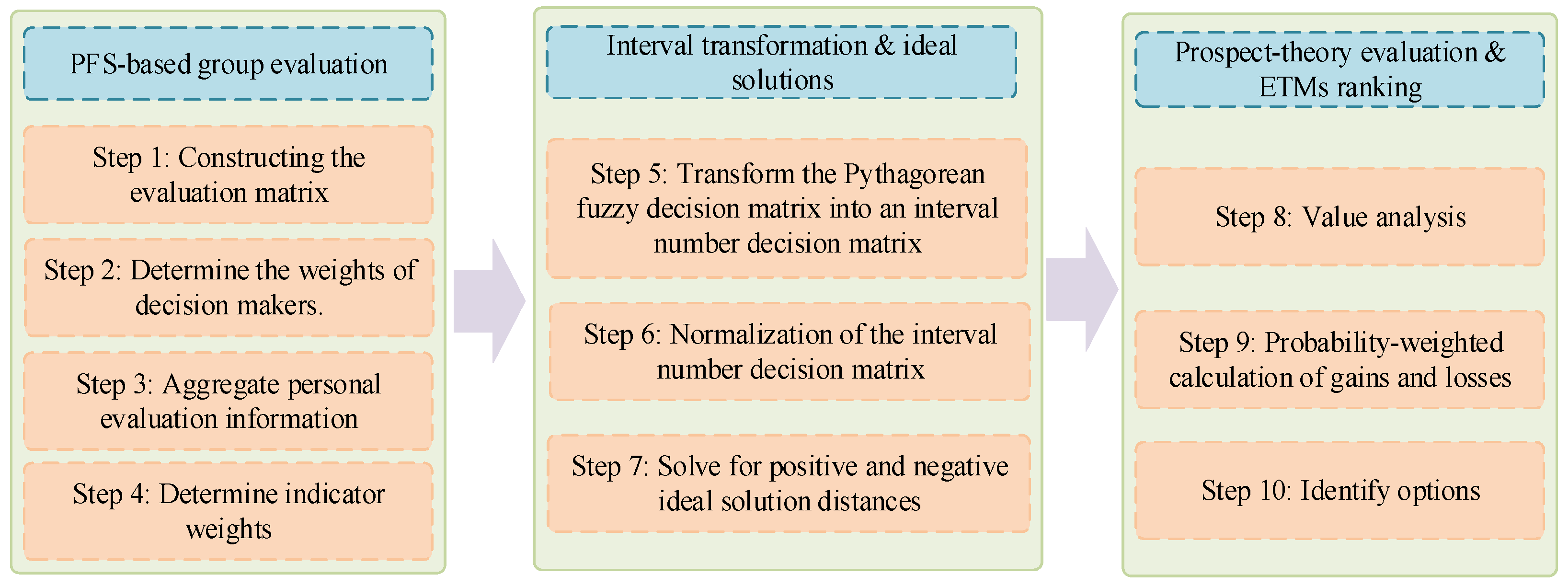
Building upon the theoretical foundation of PFSs and prospect theory, an optimization decision-making method for transaction mode is constructed. The optimization process is shown in Figure 2.
Step 1: Constructing the evaluation matrix.
Decision makers are invited to assess the adaptability of each option across indicators based on the influencing factors shown in Table 1. The evaluation results need to be given by using a PFS. Let the assessment results be Y k = ( Y 1 , Y 2 , , Y l ) , which can be expressed as:
Y k =   B 1       B 2     B n     A 1 A 2 A m Y 11 k Y 12 k Y 1 n k Y 21 k Y 22 k Y 2 n k Y m 1 k Y m 2 k Y m n k
where Y i j k ˙ = ( u i j k ˙ , v i j k ˙ ) represents the evaluated value of the decision maker D k ’s regarding the influence factor B j on the alternative A i .
Step 2: Determine the weights of decision makers.
The determination of decision makers’ weights is important for the reliability of the decision results. Decision makers from different fields are often involved in the decision analysis process. Decision makers are usually familiar with the indicators in their area of expertise, but not with all indicators. Therefore, to effectively address this issue and thus enhance the reliability of decision-making, this study proposes a more refined method for determining the weights of decision-makers based on evaluating the level of information utility.
To measure the information utility of each decision maker, we first construct the group average decision matrix R = ( r i j ) m × n , which represents the average level of evaluation information provided by the decision group. It is obtained as follows:
r i j = ( u i j , v i j ) = ( 1 k = 1 l ( 1 ( u i j ) 2 ) 1 / l , k = 1 l ( v i j ) 1 / l )
Then, the information utility of each decision maker is evaluated by the distance between his/her individual decision matrix R k and the group average matrix R in the Pythagorean fuzzy environment.
Let R k = ( u i j k , v i j k ) m × n and R = ( u i j , v i j ) m × n and denote the corresponding hesitation degrees by π i j k = 1 u i j k 2 v i j k 2 , π i j = 1 u i j 2 v i j 2 .
The Pythagorean fuzzy Hamming distance [52] between is defined as R k and R is defined as
d 1 ( R k , R ) = 1 4 m n i = 1 n j = 1 m ( ( u i j ) 2 ( u i j ) 2 + ( v i j ) 2 ( v i j ) 2 + ( π i j k ) 2 ( π i j ) 2 )
and the corresponding Chebyshev distance [53] is
d + ( R k , R ) = m a x 1 j m 1 i n { ( u i j ) 2 ( u i j ) 2 , ( v i j ) 2 ( v i j ) 2 , ( π i j k ) 2 ( π i j ) 2 }
In Equations (5) and (6) ( k = 1 , 2 , , l ) .
Based on the Hamming distance and Chebyshev distance, the combined distance can be calculated:
d ( R k , R ) = ρ d 1 ( R k , R ) + ( 1 ρ ) d + ( R k , R )
In Equation (7), ρ [ 0 , 1 ] is the control parameter.
Based on the combined distance, the weight of a decision maker can be defined as:
λ k = 1 d R k , R ¯ k = 1 l   ( d R k , R ¯ ) k = 1 , 2 , , l
Step 3: Aggregate personal evaluation information.
After the decision makers’ weights are determined, we need to aggregate the individual evaluation information to obtain a collective evaluation matrix. The following formula is used to calculate the collective decision matrix R = r i j n × m :
r i j = u i j , v i j = 1 k = 1 l   1 u i j k 2 λ k , k = 1 l   v i j k λ k
Step 4: Determine indicator weights.
Entropy can effectively describe the uncertainty and unpredictability of incomplete information. Let R ~ = r ~ i j m × n be the aggregated Pythagorean fuzzy decision matrix, where r ~ i j = u i j , v i j denotes the collective membership and non-membership degrees of alternative A i with respect to indicator B j , and the corresponding hesitation degree is π i j = 1 u i j 2 v i j 2 .
Pythagorean fuzzy entropy can be calculated by the following formula:
E A j = 1 n i = 1 n   1 u i j k 2 v i j k 2 1 + π i j k 2
Based on the entropy magnitude, the indicator weights can be calculated using the following equation:
w j = 1 E A j j = 1 n   ( 1 E A j )
Step 5: Transform the Pythagorean fuzzy decision matrix into an interval number decision matrix.
The group Pythagorean fuzzy decision matrix R = r i j n × m is transformed into the interval number decision matrix X = x i j u , x i j v . The transformation is calculated as:
x i j u = 1 u i j 2
x i j v = 1 v i j 2
Step 6: Normalization of the interval number decision matrix.
The normalized formula for the interval number decision matrix is:
r i j u = 1 / x i j v i = 1 m   1 / x i j u 2 , r i j ν = 1 / x i j u i = 1 m   1 / x i j v 2
Step 7: Solve for positive and negative ideal solution distances.
The choice of reference point is crucial for applying prospect theory. In this study, two ideal reference points, positive and negative, are used to assess gains and losses. The positive and negative ideal reference points are as follows:
r i j + = r i j u + , r i j v + = m a x i = 1 m   r i j u , m a x i = 1 m   r i j v
r i j = r i j u , r i j v = m i n i = 1 m   r i j u , m i n i = 1 m   r i j v
Gains and losses in the value function can be expressed as the distance between the indicator and the corresponding positive or negative ideal reference points. Let the normalized distances between the alternative A i and the positive and negative ideal reference points be d r i j , r i j + and d r i j , r i j . d r i j , r i j + and d r i j , r i j can be calculated by the following equations:
d r i j , r i j + = r i j u r i j u + 2 + r i j v r i j v + 2
d r i j , r i j = r i j u r i j u 2 + r i j v r i j v 2
Step 8: Value analysis.
According to Equation (2), the value function for the j indicator of Alternative A i is calculated as follows:
v + d r i j , r i j = d r i j , r i j β
ν d r i j , r i j + = θ d r i j , r i j + α
In Equations (19) and (20), α and β α 0 , β 1 represent the degree of preference for gains and losses, respectively, and θ represents the risk aversion coefficient [36].
Step 9: Probability-weighted calculation of gains and losses.
Let the probability influencing each decision indicator be w = w 1 , w 2 , , w n . The probability weighting functions for gains and losses are set to w + w j and w w j . w + w j and w w j can be calculated by the following equation:
w + w j = w j γ w j γ + 1 w j γ 1 / γ
w w j = w j δ w j δ + 1 w j δ 1 / δ
In Equations (21) and (22), r is the risk-return attitude coefficient and 0 < γ < 1 ; δ is the risk-loss attitude coefficient, 0 < δ < 1 .
Step 10: Identify options.
The prospect value for the alternative can be calculated by the following equation:
V i = j = 1 m   v + d r i j , r i j w + w j + j = 1 m   v d r i j , r i j + w w j
The higher the value of V i , the better the alternative. Then, the alternatives can be sorted according to the prospect value. Finally, the optimal solution is obtained according to the sorting result.

4. Case Analysis

4.1. Case Background

Consider a mega-pumping station project with a total installed capacity of 8 × 8000 kW, a total design pumping flow of 70 m3/s, and a single-machine-design pumping flow of 12.5 m3/s. The pumping station project in the direction of the water flow has a sequentially arranged inlet, inlet sluice gate, inlet front of the pool, inlet pipe, main pumping room, outlet pipe, and outlet pipe through the water measuring room, connected to the outlet pool. The pumping station project has a design estimate of $1437 million. The project is proposed to be implemented in the form of intelligent construction, and its transaction mode now needs to be designed according to the characteristics of the project before implementation.
Project Characteristics: According to the engineering grading indexes in SL252-2017 “Water Conservancy and Hydropower Engineering Grade Classification and Flood Standard,” issued by the Ministry of Water Resources, the grade of the main building of the hub project is grade 1, and the grade of the secondary building is grade 3 [54].
Requirements of the project owner: the planned duration of the project is 38 months according to the overall project schedule, and the investment is planned to be completed within four years.
Quality objectives of the project owner: the requirement is to ensure that the pass rate of unit works is 100 percent and to strive for high-quality engineering projects.

4.2. Transaction-Mode Design

From a governance perspective, the mega-pumping station project is mainly exposed to three categories of risks. First, schedule and interface risks stem from the long construction duration and the need to coordinate multiple contractors and equipment suppliers. Second, there are technical and data-related risks associated with the adoption of intelligent construction platforms in the water conservancy sector. Third, contractual and regulatory risks arising from complex approval procedures and multi-departmental oversight.
These risk factors are explicitly reflected in the 13 key indicators constructed in Section 3.2. For example, X6 “Intelligent construction application costs” captures the trade-off between the additional investment in digital platforms and the potential reduction in rework and coordination costs; X9 “Project complexity” reflects not only the physical scale of the works, but also the number of participating organizations, the coupling between design and construction, and the intensity of information exchange. Indicators such as X1 “Intelligent construction application experience” and X3 “Participant management experience” characterize the governance capacity of the project legal entity, whereas X11 “External institutional conditions” and X12 “Construction market situation” represent the regulatory and market environment in which the transaction takes place.
By mapping the specific risk profile of the pumping station project to these indicators, the decision variables in the model are directly anchored in the project’s transaction governance challenges. Therefore, the model designed in Section 3.3 can be applied to make decisions regarding the ETM for this case.
Firstly, for the intelligent construction application methods, the common methods are project-based technology application, technology-based collaborative cooperation, and network-based integrated application. For this project, the project owner intends to maximize the overall benefits of the project through intelligent construction. Although the pumping station project complexity is relatively low compared with mega-cross-regional projects, the operation and maintenance of the station involve long-term, continuous monitoring and control, which can benefit significantly from network-based integrated application of intelligent construction technologies. Compared with a fully network-based integrated application, ‘technology-based collaboration’ emphasizes project-level deployment of BIM, progress tracking, and on-site sensing technologies to support information sharing among the owner, designers, contractors, and supervisors. For the pumping station project, this configuration can already improve coordination efficiency and decision transparency at a relatively moderate cost and with lower organizational complexity. Therefore, the project legal entity prefers to adopt technology-based collaboration or a network-based integrated application.
Secondly, for the project owner management mode, the traditional project owner management mode mainly includes autonomous management, entrusted management, and cooperative management. For this project, the project is a relatively traditional pumping station construction, the project complexity is low, construction management is not difficult, and the project has a relatively rich project management experience. Therefore, after much consideration, the project owner proposes to opt for the use of an autonomous management approach (IM approach) for the construction of the project.
Finally, for the intelligent construction method, the common ways today are the owner construction method, the designer-led construction method, the commissioned third-party construction method, and the consultant-assisted construction method. For this project, since the application of intelligent construction in the water conservancy industry is still in its infancy, the project legal entity has relatively little experience in intelligent construction and management. Therefore, the project legal person can choose three modes for the construction of the intelligent construction platform, such as the design-led construction method, the commissioned third-party construction method, and the consultant-assisted construction method. However, considering that the third party may not be familiar with the project situation, the delegated third-party build model was not considered. In the end, taking into account the actual situation of the project, the project’s legal entity initially proposed to adopt the consultant-assisted construction mode or the design-led construction mode for the construction and operation management of the intelligent construction.
In summary, according to the characteristics of the project, after preliminary analysis, the study achieves the following combination of feasible transaction modes for the project:
Self-management + Technology-based collaboration + Consultant assistance (A1);
Self-management + Technology-based collaboration + Designer-led (A2);
Self-management + Network-based integrated application + Consultant assistance (A3);
Self-management + Network-based integrated application + Designer-led (A4).
It is proposed to select the optimal transaction mode from the above four feasible alternatives as follows.
Step 1: Constructing an evaluation indicator system for the transaction mode.
Based on the previous analyses, the decision criteria are divided into three aspects: the subject of the transaction, the object of the transaction, and the transaction environment, each of which contains several indicators. Thus, the evaluation index system of the transaction mode is constructed.
Step 2: Obtain a decision matrix.
According to the actual situation of the project, four experts were invited to score for each alternative on the evaluation indicators to obtain a decision matrix. The evaluation results need to be expressed in terms of Pythagorean fuzzy numbers.
Step 3: Determine the weight of the decision maker.
Based on the evaluation results of the decision makers, using Equations (4)–(8), the decision makers’ weights are calculated, as shown in Table 4.
Step 4: Aggregate the decision matrix.
After determining the decision-maker weights, the evaluation matrix after aggregating the individual evaluation information using Equation (9) is shown in Table 5.
Step 5: Determine attribute weights.
The attribute weights can be calculated based on the decision matrix and the attribute weight calculation methods provided in the previous section, Equations (10) and (11). The calculated attribute weights are shown in Table 6.
Step 6: Transform the Pythagorean fuzzy decision matrix into an interval number decision matrix.
The Pythagorean fuzzy decision matrix can be transformed into an interval number decision matrix according to the transformation Equations (12) and (13).
Step 7: Normalization of the interval number decision matrix.
The interval number decision matrix is normalized using Equation (14).
Step 8: Calculate the positive and negative ideal solution distances.
Calculate the distance between the normalized decision matrix and the positive and negative ideal solutions according to the interval number decision matrix and the ideal distance calculation methods (15) to (18).
Step 9: Value analysis.
The value of the value function for each scenario can be calculated according to Equations (19) and (20).
Step 10: Probability weighting of gains and losses.
According to Equations (21) and (22), the probability weights of gain and loss of each indicator can be calculated.
Step 11: Identification of alternatives.
According to the probability weights of gain and loss of each indicator and the method of calculating the prospect value, Equation (23), the prospect value of each alternative can be calculated, and the results of the calculation are shown in Table 7.
The alternatives were ranked according to their prospect values. The higher the prospect value, the better the solution. For this project, the ranking order is V 3 > V 4 > V 2 > V 1 . Clearly, ‘Self-management + Network-based integrated application + Consultant assistance’ (A3) is the optimal option.
To further assess the effectiveness of the proposed approach, its decision outcome is compared with the results obtained from the TOPSIS method and Fuzzy comprehensive evaluation model. The decision outcomes of each model are shown in Table 8.
As shown in Table 8, the three decision-making methods produce exactly the same ranking order, namely A 3 > A 4 > A 2 > A 1 , and all identify alternative A3, as the optimal scheme. This complete consistency across the proposed PFS–prospect theory model, the TOPSIS method, and the fuzzy comprehensive evaluation model indicates that the ranking result is robust with respect to different modeling assumptions and computational procedures. In particular, although the three approaches are grounded in distinct theoretical foundations, the convergence of their outcomes provides strong evidence that alternative A3 is indeed the most appropriate ETMs for the case project and confirms the validity and reliability of the proposed decision model.

5. Findings and Discussion

Based on the decision-making framework constructed in Section 3 and the case evaluation results presented in Section 4, this section will synthesize key findings, explore theoretical and practical implications, and outline research limitations and future directions.
(1)
Discussion
In this study, the proposed PFS–prospect ETM decision model is defined as a modular decision-support construct that maps a set of ETM alternatives, a project-level evaluation criteria system, and multi-stakeholder Pythagorean fuzzy assessments into prospect values and a final ETM ranking under loss-averse risk preferences. In response to the research gaps outlined in the preceding section, (i) platform-oriented intelligent construction governance is incorporated by embedding platform-enabled coordination and governance requirements into the ETM criteria system; (ii) fuzzy and hesitant judgments are captured through PFS-based assessments that explicitly model support, opposition, and hesitation; and (iii) behavioral risk preferences are represented via prospect theory, enabling loss-averse evaluation of gains and losses relative to reference points. These mechanisms help explain the case results and the observed preference for governance arrangements that mitigate unacceptable downside risks.
The case results show that the alternative “Self-management + Network-based integrated application + Consultant assistance” (A3) consistently achieves the highest prospect value and is ranked as the preferred ETM for the mega-pumping station project. At the same time, the overall ranking order of the four alternatives is identical to that obtained from the TOPSIS method and the fuzzy comprehensive evaluation model, which suggests that the outcome is not an artifact of a specific modeling technique but reflects a stable preference structure under different decision frameworks. This finding is consistent with prior research showing that data-driven and platform-based decision support can support higher-quality decisions in complex construction environments [20,21].
Although research findings indicate that A3 is the optimal option, it is necessary to explain from a governance perspective why this option is superior. In the context of a mega-pumping station project, the combination of ‘Self-management + Network-based integrated application + Consultant assistance’ (A3) provides a more balanced and robust governance structure than other the ETM alternatives. First, self-management enhances alignment between project governance and the owner’s long-term strategic objectives, while reducing the risk of opportunistic behavior arising from excessive delegation. Second, the network-based integrated application ensure all stakeholders are connected to a unified intelligent construction platform. This arrangement enhances information transparency. For megaprojects involving numerous work packages and complex interdependencies, such platform-based integration is critical for controlling schedule risks, managing design changes, and coordinating on-site construction activities. Third, consultant assistance compensates for the limited technical and managerial capabilities of owner organizations in operating intelligent platforms and managing complex contracts. Professional consultants can provide specialized support in BIM implementation, data governance, risk management, and claim prevention, thereby enhancing decision-making quality while preserving the owner’s ultimate authority. Consequently, A3 is consistently favored by the three decision-making methods in this case study.
The preference for A3 also aligns with, but extends, existing research on transaction governance and ETM design. An’s [22] multi-attribute group decision-making model and Ding’s [23] and Kan’s [24] transaction governance frameworks highlight the importance of matching transaction modes to project characteristics, governance capacity, and external constraints. At the methodological level, the empirical findings confirm the usefulness of fuzzy MCDM approaches for construction-related decisions [25,26,27].
Beyond the specific case of a mega-pumping station project, the proposed decision framework is not inherently restricted to this type. Conceptually, the Pythagorean fuzzy–prospect theory structure can be transferred to other intelligent construction projects—such as transport infrastructure, energy facilities, or large-scale housing developments—so long as the evaluation criteria and indicator system are appropriately re-specified. In practice, such adaptation would require recalibrating the index system to reflect sector-specific governance concerns and engaging with owners, contractors, and regulators in each context to validate the relevance and weighting of the indicators.
(2)
Theoretical implications
Methodologically, this study advances project governance research by reframing the selection of ETMs for megaprojects under intelligent construction as a Pythagorean fuzzy multi-attribute group decision-making problem. Unlike traditional MCDM approaches commonly used in ETM or project delivery system studies—such as AHP- or TOPSIS-based models that rely on crisp scores and implicitly assume risk-neutral, fully rational decision makers—this study represents expert evaluations in the form of Pythagorean fuzzy sets and aggregates them at both the indicator and group levels [55,56]. In doing so, it extends conventional MCDM formulations from a “single-layer, crisp evaluation + fixed weight” paradigm to a framework that can explicitly accommodate hesitation, opposition, and ambiguity in expert judgments while still producing an operational decision rule for ETM selection [57,58].
Building on this PFS, the paper further contributes methodologically by embedding prospect theory into the ETM evaluation process. Existing fuzzy decision models in construction management usually treat preferences as linear or risk-neutral, focusing mainly on how to express linguistic uncertainty, but not on how decision makers distort gains, losses, and probabilities. By introducing a prospect-theoretic value function into a PFS-based decision space, this study provides a behaviorally enriched MCDM model: the ranking of ETM alternatives is not only a function of their multi-criteria performance, but also of stakeholders’ loss aversion and non-linear risk perception. This strengthens the theoretical link between decision modeling and realistic governance behavior in mega-intelligent construction projects, and demonstrates how PFSs and prospect theory can be jointly operationalized to extend traditional MCDM methods in project governance research.
(3)
Practical implications
Practically, the proposed ETM decision model, developed in Section 3 and illustrated in Section 4, offers a structured and operable tool for project owners and public authorities to design engineering transaction modes that fit intelligent construction scenarios. In real decision settings, practitioners can begin by defining a feasible set of ETM alternatives. Next, they can adopt the criteria system proposed in this study, or tailor the indicators to local regulations and the specific project type. They can then convene a panel of key stakeholders to provide Pythagorean fuzzy assessments that reflect support, opposition, and hesitation. Finally, by computing criterion weights and prospect values, decision makers can obtain an ETM ranking under loss-averse preferences. The resulting prospect values and rankings provide an auditable basis for comparing alternatives and justifying governance choices beyond single-dimensional considerations such as cost or schedule.
(4)
Limitations
At the same time, these results should be interpreted with caution. Both the empirical scope of this study and its underlying theoretical assumptions impose limitations on the generalizability of the results. From a governance perspective, megaprojects can be categorized into three types—public, public–private partnership (PPP) projects, and commercial projects—each with distinct objectives, risk profiles, and governance requirements [59]. This study also did not explicitly incorporate the institutional and public interest particularities of different project types into the design of the ETM assessment framework. Moreover, the rapid adoption of intelligent construction technologies is challenging traditional project governance theories, suggesting that transaction governance arrangements may require adjustments in large-scale public, PPP, and commercial projects. These considerations limit the generalizability of the proposed model; therefore, caution is needed when applying it to other categories of megaprojects.

6. Conclusions

This study proposes an evaluation framework for ETMs and a Pythagorean fuzzy–prospect multi-attribute group decision model to support ETM selection for megaprojects under intelligent construction. Using experts’ Pythagorean fuzzy assessments as inputs and prospect theory-based gain–loss aggregation relative to ideal reference points, the model produces criterion weights, prospect values, and a ranked set of ETM alternatives. The case study of a mega-pumping station project indicates that “Self-management + Network-based integrated application + Consultant assistance” (A3) achieves the highest prospect value, and the same ranking is obtained with TOPSIS and a fuzzy comprehensive evaluation method, suggesting that the decision outcome is robust across different techniques. Governance analysis further indicates that A3 provides a balanced configuration in terms of owner control, platform-based coordination, and external expert support, which aligns with the characteristics and risk profile of the case project, thereby demonstrating that the proposed model can support ETM selection for megaprojects under intelligent construction in the presence of informational uncertainty and loss-averse decision behavior.
Theoretically, this study extends ETM decision research by integrating platform-governance criteria, PFS-based representation of hesitant group judgments, and prospect theory-based loss aversion within a unified selection model. Practically, it provides an implementable procedure that outputs prospect values and an ETM ranking to support owners and policymakers in comparing alternatives and justifying governance choices. Future research may further validate these findings across different types of large-scale projects—such as public projects, PPP projects, and commercial projects—by expanding the empirical sample size and calibrating behavioral parameters more precisely based on field evidence.

Author Contributions

Conceptualization, X.L., R.Y. and S.L.; Methodology, R.Y.; Formal analysis, R.Y.; Investigation, R.Y.; Resources, X.L. and S.L.; Data curation, R.Y.; Writing—original draft, X.L.; Writing—review and editing, X.L., R.Y. and S.L.; Visualization, S.L.; Supervision, X.L. and S.L. All authors have read and agreed to the published version of the manuscript.

Funding

This research was funded by [Shanghai Talent Program Pujiang Project] grant number [24PJC017], [the Fundamental Research Funds for the Central Universities], [Suzhou Science and Technology Plan (Basic Research) Project] grant number [SJC2023002], and [Major Project of Philosophy and Social Science Research in Colleges and Universities of Jiangsu Province] grant number [2025SJYB1055].

Data Availability Statement

The original contributions presented in this study are included in the article. Further inquiries can be directed to the corresponding author.

Conflicts of Interest

The authors declare no conflicts of interest.

Abbreviations

The following abbreviations are used in this manuscript:
ETMEngineering Transaction Mode
PFSPythagorean Fuzzy Set
BIMBuilding Information Modeling

References

  1. Chang, G.K.; Xu, G.; Correia, A.G.; Nazarian, S. Intelligent Construction for Infrastructure—The Framework. In Advances in Transportation Geotechnics IV; Springer: Cham, Switzerland, 2022; Volume 3, pp. 193–204. [Google Scholar]
  2. Cheng, Z. Research on the Relational Governance of Construction Project Transaction. Appl. Mech. Mater. 2013, 368–370, 1922–1926. [Google Scholar] [CrossRef] [Scilit]
  3. Liao, C.; Zhong, J.; Luo, Y.; Hu, J. Research on the Governance of Agent Construction Project from the Perspective of Transaction Cost Theory. In Proceedings of the ICCREM 2021: Challenges of the Construction Industry under the Pandemic; American Society of Civil Engineers (ASCE): Reston, VA, USA, 2021; pp. 470–478. [Google Scholar]
  4. Jin, S.T. Measuring complexity in mega construction projects: Fuzzy comprehensive evaluation and grey relational analysis. Eng. Constr. Archit. Manag. 2026, 33, 284–317. [Google Scholar] [CrossRef] [Scilit]
  5. Zhou, Y.; Ding, L.Y.; Wang, X.Y.; Truijens, M.; Luo, H.B. Applicability of 4D modeling for resource allocation in mega liquefied natural gas plant construction. Autom. Constr. 2015, 50, 50–63. [Google Scholar] [CrossRef] [Scilit]
  6. Perumal, T.; Sulaiman, M.N.; Leong, C.Y. ECA-based interoperability framework for intelligent building. Autom. Constr. 2013, 31, 274–280. [Google Scholar] [CrossRef] [Scilit]
  7. Li, P.X.; Lu, Y.J.; Yan, D.; Xiao, J.Z.; Wu, H.C. Scientometric mapping of smart building research: Towards a framework of human-cyber-physical system (HCPS). Autom. Constr. 2021, 129, 103776. [Google Scholar] [CrossRef] [Scilit]
  8. Kaya, I.; Kahraman, C. A comparison of fuzzy multicriteria decision making methods for intelligent building assessment. J. Civ. Eng. Manag. 2014, 20, 59–69. [Google Scholar] [CrossRef] [Scilit]
  9. Wang, D.D.; Fang, S.Z.; Fu, H.W. The effectiveness of evolutionary governance in mega construction projects: A moderated mediation model of relational contract and transaction cost. J. Civ. Eng. Manag. 2019, 25, 340–352. [Google Scholar] [CrossRef] [Scilit]
  10. Yi, B.; Nie, N.L.S. Effects of Contractual and Relational Governance on Project Performance: The Role of BIM Application Level. Buildings 2024, 14, 3185. [Google Scholar] [CrossRef] [Scilit]
  11. Fang, M.; Ding, G.; Zhao, Y. Pythagorean Fuzzy Decision-Making Algorithm and Its Application in Selection of Cloud Computing Product. Comput. Eng. Appl. 2019, 55, 241–246. [Google Scholar] [CrossRef]
  12. Zhang, Q.; Chen, G.; Yan, Q. A new calculation method for membership degree and non-membership degree of PFS. In Proceedings of the Proceedings of the 39th Chinese Control Conference; IEEE: New York, NY, USA, 2020; pp. 6082–6085. [Google Scholar]
  13. Ashraf, S.; Abdullah, S.; Aslam, M.; Qiyas, M.; Kutbi, M.A. Spherical fuzzy sets and its representation of spherical fuzzy t-norms and t-conorms. J. Intell. Fuzzy Syst. 2019, 36, 6089–6102. [Google Scholar] [CrossRef] [Scilit]
  14. Chang, L.X.; Zhao, S.W. Risk evaluation of prefabricated building construction based on PTF-VIKOR of prospect theory. Alex. Eng. J. 2025, 115, 147–159. [Google Scholar] [CrossRef] [Scilit]
  15. Das, D.K. Integrating IoT and AI for Sustainable Energy-Efficient Smart Building: Potential, Barriers and Strategic Pathways. Sustainability 2025, 17, 10313. [Google Scholar] [CrossRef] [Scilit]
  16. Abdullahi, I.; Watters, C.; Kapogiannis, G.; Lemanski, M.K. Role of Digital Strategy in Managing the Planning Complexity of Mega Construction Projects. Sustainability 2023, 15, 13809. [Google Scholar] [CrossRef] [Scilit]
  17. Berlato, M.; Binni, L.; Durmus, D.; Gatto, C.; Giusti, L.; Massari, A.; Toldo, B.M.; Cascone, S.; Mirarchi, C. Digital Platforms for the Built Environment: A Systematic Review Across Sectors and Scales. Buildings 2025, 15, 2432. [Google Scholar] [CrossRef] [Scilit]
  18. Jaskula, K.; Kifokeris, D.; Papadonikolaki, E.; Rovas, D. Common data environments in construction: State-of-the-art and challenges for practical implementation. Constr. Innov.-Engl. 2025, 25, 1522–1541. [Google Scholar] [CrossRef] [Scilit]
  19. Gorod, A.; Nguyen, T.; Hallo, L. Systems engineering decision-making: Optimizing and/or satisficing? In Proceedings of the 2017 Annual IEEE International Systems Conference (SysCon) 2017; IEEE: New York, NY, USA, 2017; pp. 1–6. [Google Scholar] [CrossRef] [Scilit]
  20. Ahmed, R.; Shaheen, S.; Philbin, S.P. The role of big data analytics and decision-making in achieving project success. J. Eng. Technol. Manag. 2022, 65, 101697. [Google Scholar] [CrossRef] [Scilit]
  21. Ram, J.; Desgourdes, C. Using big data analytics (BDA) for improving decision-making performance in projects. J. Eng. Technol. Manag. 2024, 74, 101849. [Google Scholar] [CrossRef] [Scilit]
  22. An, X.W.; Zhao, W.; Wang, X. Engineering transaction structure optimization via improved social network dynamics and entropy integration. J. Asian Archit. Build. Eng. 2025, 1–15. [Google Scholar] [CrossRef] [Scilit]
  23. Ding, J.; Jia, J.; Hu, L.; Wang, N. Design Path of Construction Project Transaction Mode based on Value-added Analysis of Project Objectives. J. Eng. Stud. 2017, 9, 482–489. [Google Scholar] [CrossRef] [Scilit]
  24. Kan, H.; Lu, Y.; Le, Y.; Hu, Y.; Zhang, X. Agent-based computational model for project transaction governance. Syst. Eng.-Theory Pract. 2017, 37, 972–981. [Google Scholar]
  25. Wu, Y.J.; He, X.M.; Cui, T.Y.; Wu, M.Z. Decision-Making Evaluation and Optimization Strategies for Construction EPC Project Developers Utilizing BIM Technology. Adv. Civ. Eng. 2024, 2024, 694580. [Google Scholar] [CrossRef] [Scilit]
  26. Liang, R.; Li, R.; Yan, X.; Xue, Z.Z.; Wei, X. Evaluating and selecting the supplier in prefabricated megaprojects using extended fuzzy TOPSIS under hesitant environment: A case study from China. Eng. Constr. Archit. Manag. 2023, 30, 1902–1931. [Google Scholar] [CrossRef] [Scilit]
  27. Ahmed, M.N.; Aswed, G.K.; Mohammed, H.A. Decision-Making for Project Delivery System in Construction Projects Based on SWARA-TOPSIS Methods. Tikrit J. Eng. Sci. 2024, 31, 306–313. [Google Scholar] [CrossRef] [Scilit]
  28. Karami, S.; Mousavi, S.M.; Antucheviciene, J. Enhancing Contractor Selection Process by a New Interval-Valued Fuzzy Decision-Making Model Based on SWARA and CoCoSo Methods. Axioms 2023, 12, 729. [Google Scholar] [CrossRef] [Scilit]
  29. Zulqarnain, R.M.; Siddique, I.; Mahboob, A.; Ahmad, H.; Askar, S.; Gurmani, S.H. Optimizing construction company selection using einstein weighted aggregation operators for q-rung orthopair fuzzy hypersoft set. Sci. Rep. 2023, 13, 6511. [Google Scholar] [CrossRef] [Scilit]
  30. Xin, G.; Ying, L. Multi-attribute decision-making based on comprehensive hesitant fuzzy entropy. Expert Syst. Appl. 2024, 237, 121459. [Google Scholar] [CrossRef] [Scilit]
  31. Chen, L.; Luo, N. Pythagorean fuzzy multi-criteria decision-making based on prospect theory. Syst. Eng.-Theory Pract. 2020, 40, 726–735. [Google Scholar] [CrossRef]
  32. Zhang, Y.; Wei, G.; Guo, Y.; Wei, C. TODIM method based on cumulative prospect theory for multiple attribute group decision-making under 2-tuple linguistic Pythagorean fuzzy environment. Int. J. Intell. Syst. 2021, 36, 2548–2571. [Google Scholar] [CrossRef] [Scilit]
  33. Yager, R.R.; Abbasov, A.M. Pythagorean Membership Grades, Complex Numbers, and Decision Making. Int. J. Intell. Syst. 2013, 28, 436–452. [Google Scholar] [CrossRef] [Scilit]
  34. Fortin, I.; Hlouskova, J. Prospect theory and asset allocation. Q. Rev. Econ. Financ. 2024, 94, 214–240. [Google Scholar] [CrossRef] [Scilit]
  35. Wu, Y.; Xu, C.; Zhang, T. Evaluation of renewable power sources using a fuzzy MCDM based on cumulative prospect theory: A case in China. Energy 2018, 147, 1227–1239. [Google Scholar] [CrossRef] [Scilit]
  36. Tversky, A.; Kahneman, D. Advances in prospect theory: Cumulative representation of uncertainty. J. Risk Uncertain. 1992, 5, 297–323. [Google Scholar] [CrossRef] [Scilit]
  37. An, X.; Wang, Z.; Li, H.; Ding, J. Project Delivery System Selection with Interval-Valued Intuitionistic Fuzzy Set Group Decision-Making Method. Group Decis. Negot. 2018, 27, 689–707. [Google Scholar] [CrossRef] [Scilit]
  38. Li, H.; Qin, K.; Li, P. Selection of project delivery approach with unascertained model. Kybernetes 2015, 44, 238–252. [Google Scholar] [CrossRef] [Scilit]
  39. Feghaly, J.; El Asmar, M.; Ariaratnam, S.; Bearup, W. Selecting project delivery methods for water treatment plants. Eng. Constr. Archit. Manag. 2020, 27, 936–951. [Google Scholar] [CrossRef] [Scilit]
  40. Al Nahyan, M.T.; Hawas, Y.E.; Raza, M.; Aljassmi, H.; Maraqa, M.A.; Basheerudeen, B.; Mohammad, M.S. A fuzzy-based decision support system for ranking the delivery methods of mega projects. Int. J. Manag. Proj. Bus. 2018, 11, 122–143. [Google Scholar] [CrossRef] [Scilit]
  41. Moon, H.; Cho, K.; Hong, T.; Hyun, C. Selection Model for Delivery Methods for Multifamily-Housing Construction Projects. J. Manag. Eng. 2011, 27, 106–115. [Google Scholar] [CrossRef] [Scilit]
  42. Meshref, A.N.; Elkasaby, E.A.; Wageh, O. Innovative reliable approach for optimal selection for construction infrastructures projects delivery systems. Innov. Infrastruct. Solut. 2020, 5, 56. [Google Scholar] [CrossRef] [Scilit]
  43. Alotaibi, R.; Sohail, M.; Edum-Fotwe, F.T.; Soetanto, R. Determining project control system effectiveness in construction project delivery. Eng. Constr. Archit. Manag. 2025; ahead-of-print. [CrossRef] [Scilit]
  44. Zhu, J.-W.; Zhou, L.-N.; Li, L.; Ali, W. Decision Simulation of Construction Project Delivery System under the Sustainable Construction Project Management. Sustainability 2020, 12, 2202. [Google Scholar] [CrossRef] [Scilit]
  45. Ahmed, S.; El-Sayegh, S. Critical Review of the Evolution of Project Delivery Methods in the Construction Industry. Buildings 2021, 11, 11. [Google Scholar] [CrossRef] [Scilit]
  46. Kahvandi, Z.; Saghatforoush, E.; ZareRavasan, A.; Viana, M.L. A Review and Classification of Integrated Project Delivery Implementation Enablers. J. Constr. Dev. Ctries. 2020, 25, 219–236. [Google Scholar] [CrossRef] [Scilit]
  47. Meshref, A.N.; Elkasaby, E.A.; Wageh, O. Identifying Innovative Reliable Criteria Governing the Selection of Infrastructures Construction Project Delivery Systems. Open Eng. 2021, 11, 269–280. [Google Scholar] [CrossRef] [Scilit]
  48. Luo, S.-Z.; Cheng, P.-F.; Wang, J.-Q.; Huang, Y.-J. Selecting Project Delivery Systems Based on Simplified Neutrosophic Linguistic Preference Relations. Symmetry 2017, 9, 151. [Google Scholar] [CrossRef] [Scilit]
  49. Pooyan, M.-R.; Al-Sakkaf, A.; Abdelkader, E.M.; Zayed, T.; Gopakumar, G. An Integrated Framework for Selecting the Optimum Project Delivery System in Post-conflict Construction Projects. Int. J. Civ. Eng. 2023, 21, 1359–1384. [Google Scholar] [CrossRef] [Scilit]
  50. Kwofie, T.E.; Ellis, F.Y.A.; Opoku, D. Significant governance factors in PPP infrastructure delivery performance in Ghana. J. Public Procure. 2021, 21, 97–118. [Google Scholar] [CrossRef] [Scilit]
  51. Liu, B.; Xue, B.; Huo, T.; Shen, G.; Fu, M. Project external environmental factors affecting project delivery systems selection. J. Civ. Eng. Manag. 2019, 25, 276–286. [Google Scholar] [CrossRef] [Scilit]
  52. Zhang, X.; Xu, Z. Extension of TOPSIS to Multiple Criteria Decision Making with Pythagorean Fuzzy Sets. Int. J. Intell. Syst. 2014, 29, 1061–1078. [Google Scholar] [CrossRef] [Scilit]
  53. Wan, S.-P.; Jin, Z.; Dong, J.-Y. Pythagorean fuzzy mathematical programming method for multi-attribute group decision making with Pythagorean fuzzy truth degrees. Knowl. Inf. Syst. 2018, 55, 437–466. [Google Scholar] [CrossRef] [Scilit]
  54. Ministry of Water Resources of the People’s Republic of China. Classification and Flood Criteria of Water and Hydropower Projects (SL 252-2017). Available online: http://www.mwr.gov.cn/english/Documents/WaterStandards/202510/t20251001_2073721.html (accessed on 15 January 2026).
  55. ElMarkaby, A.; Sanad, A.; Elyamany, A.; Yehia, E. Multi-criteria decision support system for bridge construction system selection utilizing value engineering and TOPSIS. Innov. Infrastruct. Solut. 2023, 8, 295. [Google Scholar] [CrossRef] [Scilit]
  56. Kalan, D.; Ozbek, M.E. Development of a Construction Project Bidding Decision-Making Tool. Pract. Period. Struct. Des. Constr. 2020, 25, 04019032. [Google Scholar] [CrossRef] [Scilit]
  57. Singh, S.; Ganie, A.H. On some correlation coefficients in Pythagorean fuzzy environment with applications. Int. J. Intell. Syst. 2020, 35, 682–717. [Google Scholar] [CrossRef] [Scilit]
  58. Azzam, A.A.; Aldawood, M.; Abu-Gdairi, R. Pythagorean Fuzzy Soft Somewhat Continuous Functions. Eur. J. PURE Appl. Math. 2024, 17, 4147–4163. [Google Scholar] [CrossRef] [Scilit]
  59. Koppenjan, J. Chapter 10: Public–Private Partnership and Mega-Projects. In Decision-Making on Mega-Projects; Edward Elgar Publishing: Camberley, UK, 2008; p. 189. [Google Scholar]
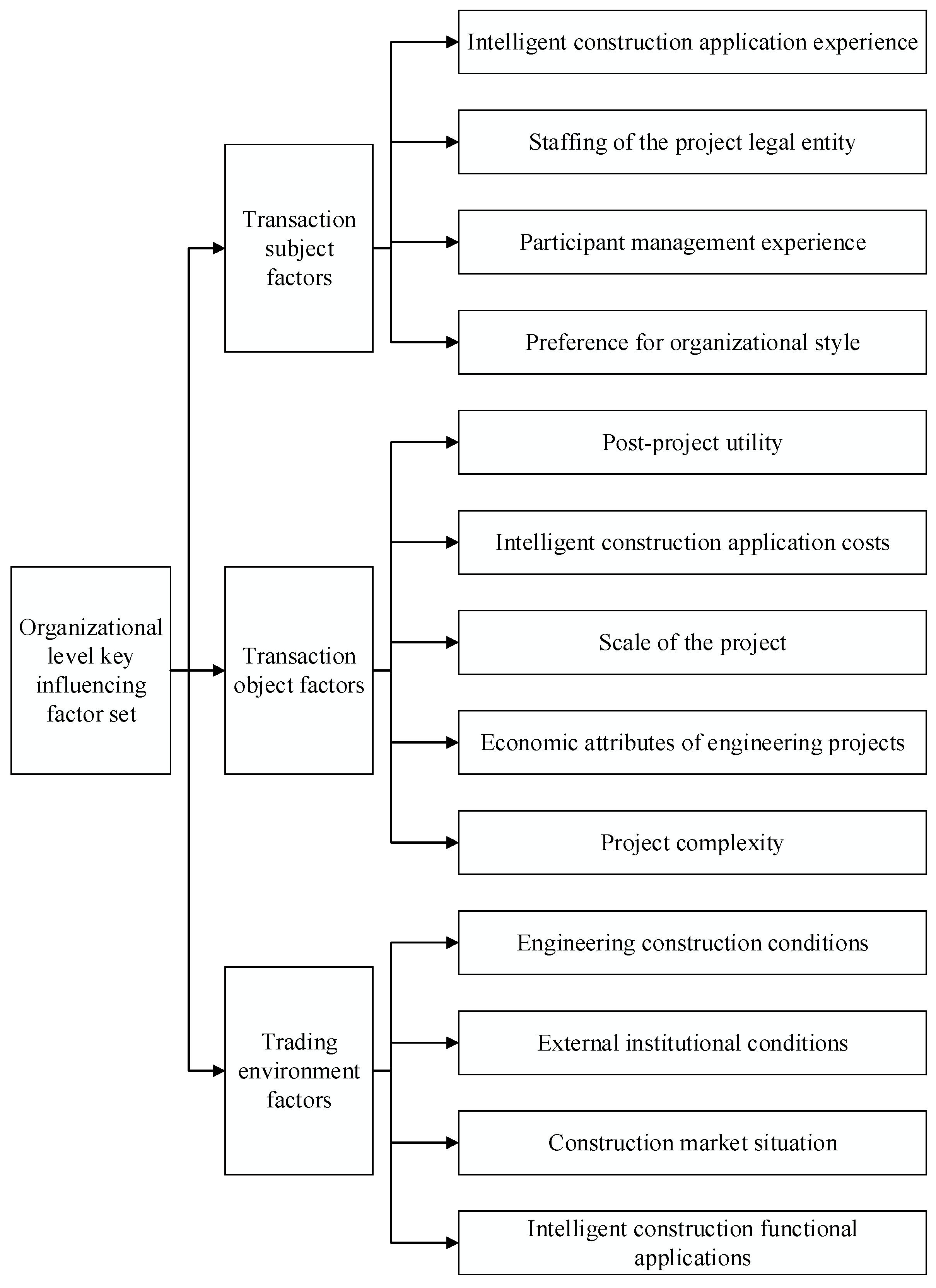
Figure 1. A system of influencing factors for the engineering transaction mode.
Buildings 16 00403 g001
Figure 2. ETM Optimization Diagrammatic Workflow.
Buildings 16 00403 g002
Table 1. Comparative analysis of existing decision models for ETM.
Research AreasStudyMain Limitation Relative to This Study
(a)
Data-driven decision support in projects
[21]Focuses on how big data analytics improves general project decision-making and performance, but does not explicitly address ETM selection or transaction governance design for megaprojects under intelligent construction, nor does it model fuzzy judgments or loss-averse behavioral preferences.
(b)
Governance structure and transaction-mode design
[22,23,24]Provides valuable conceptual frameworks for governance structures and transaction modes, yet typically abstracts from the digital environment of intelligent construction and lacks a quantitative multi-attribute decision model that can handle fuzzy information and stakeholders’ heterogeneous risk attitudes.
(c)
Fuzzy/MCDM-based selection methods
[25,26,27,28,29]Employ fuzzy and MCDM techniques to cope with uncertainty in specific decisions such as supplier or delivery system selection, but seldom target the comprehensive optimization of ETM for mega-intelligent construction projects or incorporate behavioral risk preferences and platform-governance considerations.
(d)
Optimization of ETM for megaprojects under intelligent construction
This studyIntegrates advanced fuzzy modeling and behavioral decision theory in a unified ETM optimization framework tailored to megaprojects under intelligent construction
Table 2. Table of indicators of impact factors.
Level 1 IndicatorsFactorsReferences
A1 Transaction subject factorX1 Intelligent construction application experience[37,38,39,40,41,42,43,44]
X2 Staffing of the project legal entity[39,40,42,45]
X3 Participant management experience[37,38,39,40,41,42,43,44,45,46,47,48,49]
X4 Preference for organizational style[43,44,47,49,50]
A2 Transaction object factorsX5 Post-project utility[37,39,40,41,44,45,50]
X6 Intelligent construction application costs[37,38,42,44,46,47,48,49,51]
X7 Scale of the project[37,38,39,40,41,43,47]
X8 Economic attributes of engineering projects[37,38,39,40,41,43,44,46,50]
X9 Project complexity[37,38,43,45,49,50]
A3 Trading environment factorsX10 Engineering construction conditions[37,39,41,45,47,48,49,51]
X11 External institutional conditions[37,40,41,42,46,47,48,49,50,51]
X12 Construction market situation[37,41,42,44,47,48,49,51]
X13 Intelligent construction functional applications[42,43,45,50,51]
Table 3. Reliability analysis of the index system.
NormCITCCronbach’s Alpha If Item DeletedCronbach’s α
X10.7020.7890.842
X20.6580.808
X30.6720.802
X40.6770.801
X50.6250.7900.826
X60.6040.796
X70.6530.783
X80.6070.795
X90.6180.792
X100.7410.8090.861
X110.6930.830
X120.6840.833
X130.7150.820
Table 4. Weight of decision maker.
Decision MakerWeighting
D1 λ 1 0.257
D2 λ 2 0.251
D3 λ 3 0.249
D4 λ 4 0.243
Table 5. Aggregated decision matrix.
Options B 1 B 2 B 3 B 4 B 5 B 6 B 7
u i j ν i j u i j ν i j u i j ν i j u i j ν i j u i j ν i j u i j ν i j u i j
A 1 0.870.330.850.290.850.260.820.240.820.300.820.300.88
A 2 0.830.300.880.240.860.290.840.330.850.240.800.370.89
A 3 0.910.290.930.150.920.180.920.180.890.250.900.220.93
A 4 0.910.220.930.210.920.230.880.320.890.270.850.260.88
Options B 7 B 8 B 9 B 10 B 11 B 12 B 13
ν i j u i j ν i j u i j ν i j u i j ν i j u i j ν i j u i j ν i j u i j ν i j
A 1 0.290.830.270.880.230.880.300.870.260.780.260.820.34
A 2 0.250.870.310.890.240.910.200.880.290.760.230.830.38
A 3 0.150.920.200.950.150.910.190.930.180.850.190.930.17
A 4 0.210.900.230.930.230.860.180.910.230.810.240.930.27
Table 6. Weight of indicator.
Primary CriteriaWeightingSub-StandardLocal WeightGlobal Weight
w 1 0.339 w 11 0.22740.0696
w 12 0.27350.0837
w 13 0.26060.0798
w 14 0.23840.0730
w 2 0.319 w 21 0.22970.0722
w 22 0.20880.0656
w 23 0.21410.0831
w 24 0.19980.0775
w 25 0.23070.0895
w 3 0.342 w 31 0.27110.0807
w 32 0.28000.0834
w 33 0.19200.0572
w 34 0.25720.0766
Table 7. Prospect value of alternative schemes.
Alternative SchemesProspect Value
A 1 −0.1439
A 2 −0.1021
A 3 0.0515
A 4 0.0230
Table 8. Results of different ETMs decision-making methods.
MethodRanking Order (from Best to Worst)Optimal Alternative
TOPSIS A 3 > A 4 > A 2 > A 1 A3
Fuzzy comprehensive evaluation model A 3 > A 4 > A 2 > A 1 A3
The decision-making method proposed in this paper A 3 > A 4 > A 2 > A 1 A3
Disclaimer/Publisher’s Note: The statements, opinions and data contained in all publications are solely those of the individual author(s) and contributor(s) and not of MDPI and/or the editor(s). MDPI and/or the editor(s) disclaim responsibility for any injury to people or property resulting from any ideas, methods, instructions or products referred to in the content.