Article

Multi-Objective Optimization Design of a Metakaolin–Slag-Based Binary Solid Waste Geopolymer Mortar Mix Proportion Using Response Surface Methodology


School of Water Conservancy and Architectural Engineering, Tarim University, Alar 843300, China
*
Author to whom correspondence should be addressed.
Buildings 2026, 16(2), 402; https://doi.org/10.3390/buildings16020402

Submission received: 8 December 2025 / Revised: 8 January 2026 / Accepted: 15 January 2026 / Published: 18 January 2026
(This article belongs to the Section Building Materials, and Repair & Renovation)

Abstract

This study focuses on the development of sustainable construction materials via geopolymers synthesized from metakaolin and slag, aiming to identify environmentally friendly alternatives for construction material systems. A metakaolin–slag geopolymer mortar (MK–slag) was prepared using metakaolin and slag as fully solid waste raw materials, with sodium silicate solution and sodium hydroxide acting as composite activators. Initially, single-factor experiments were conducted to determine the optimal ranges for metakaolin–slag content, water/binder ratio, and water glass modulus. Subsequently, response surface methodology was employed to develop regression equations that analyze the main and interaction effects of these variables on the 7-day and 28-day compressive strength and water absorption of the mortar. The optimal mix ratio was then identified. The microstructure and formation mechanisms of MK–slag mortar were studied using scanning electron microscopy (SEM), X-ray diffraction (XRD), and mercury intrusion porosimetry (MIP). The results indicate that all factors follow quadratic polynomial relationships with the response variables, showing a regression coefficient (R2) greater than 0.98, indicating an excellent model fit and prediction accuracy. According to model predictions, the optimal mix parameters under multi-objective optimization were found to be a metakaolin-to-slag ratio of 45%: 55%, a water/binder ratio of 0.45, and a water glass modulus of 1.3. After 28 days of curing, the primary hydration products were gel-like substances such as N-A-S-H and C-A-S-H. These gels interweave and overlap to form a high-density, structurally robust binary solid waste geopolymer mortar. This approach expands the application of solid waste materials, such as metakaolin and slag, while enhancing the recycling and utilization efficiency of these waste products.

1. Introduction

Cement production accounts for approximately 7–8% of all global carbon dioxide emissions, with the manufacture of one ton of cement releasing about 0.8–1.0 tons of CO2 [1]. Driven by rapid urbanization, the construction industry continues to expand, leading to a sustained increase in cement demand. Without effective mitigation measures, global carbon emissions are expected to rise sharply [2]. This trend further exacerbates challenges related to climate system disruption, ecological degradation, resource depletion, and socioeconomic instability [3,4]. Notably, the cement industry is projected to become the third-largest source of industrial carbon emissions worldwide, following the energy and transportation sectors, potentially hindering the achievement of the Paris agreement targets [5]. Consequently, the development and application of novel and low-carbon construction materials have become increasingly urgent, particularly in the context of new building construction. Against this backdrop, geopolymers have emerged as a promising class of sustainable cementitious materials.
Geopolymers are synthesized from aluminosilicate precursors activated by alkaline solutions. Under appropriate curing conditions, these materials undergo a sequence of dissolution, monomeric rearrangement, and polycondensation reactions, ultimately forming a hardened, environmentally friendly cementitious system. The chemical nature of the alkaline activator plays a critical role in governing this process. Activation with NaOH alone provides a sufficiently high pH environment to dissolve aluminosilicate precursors; however, it may result in a delayed gel formation period. In contrast, sodium silicate solution supplies additional soluble silicate species, facilitating the formation of a denser and mechanically stronger matrix. Previous studies have demonstrated that using silicate-based activators can significantly accelerate the polycondensation process without a detectable induction period [6]. N.B. Singh et al. [7] reported that, under identical concentration conditions, the compressive strength of geopolymers follows the order Na2SiO3 > NaOH. Similarly, Ning Li et al. [8] observed that NaOH-only activation leads to insufficient silica availability for forming a continuous composite gel network. Research by D. Vaičiukynienė et al. [9] further indicated that the combined use of sodium silicate and NaOH markedly enhances both mechanical properties and durability, underscoring the importance of optimizing the sodium silicate-to-NaOH ratio in geopolymer formulations.
Although extensive research has been conducted on geopolymer materials derived from various solid wastes, many industrial by-products (e.g., low-cost fly ash, coal gangue, untreated red mud, and inert iron tailings) exhibit inherent limitations related to low reaction rate, complex processing requirements, poor durability, or suboptimal mechanical performance. In contrast, metakaolin (MK), produced by the high-temperature calcination of natural clay minerals, exhibits high and stable reactivity, making it a valuable geopolymer precursor. Zuhua Zhang et al. [10] reported that MK activated with silicate-based alkaline solutions at appropriate molar ratios achieved a 28-day compressive strength exceeding 31 MPa, whereas carbonate-based activators are less effective. However, geopolymer systems based solely on MK often suffer from poor workability and prolonged setting times.
Granulated blast furnace slag, a by-product of steel manufacturing obtained through molten slag quenching, offers excellent early-age high reactivity and calcium availability, which can effectively compensate for the shortcomings of MK-based systems. In the system, C-(A)-S-H gel will form to increase the strength. Nevertheless, geopolymer systems composed entirely of slag are prone to excessively rapid reactions, leading to fast setting and significant shrinkage. Under a fixed composition of 60% MK and 40% Slag, Hui Peng et al. [11] investigated the effects of alkaline activator concentration, liquid-to-solid ratio, and water glass modulus on the setting time and compressive strength of geopolymer paste, finding that the difference between the initial and final setting times was approximately 10 min. Although increasing the liquid-to-solid ratio enhanced the reaction degree up to 86.3%, it also increased porosity and reduced compressive strength. C.K. Yip et al. [12] reported the coexistence of calcium silicate hydrate (C-S-H) and geopolymer gel in MK-based geopolymer mortars, noting that the coexistence depends strongly on the activator alkalinity and the MK–slag ratio. Mohammad Ali Asaad et al. [13] examined the effects of varying MK and slag contents on mechanical strength and durability, with slag substitution levels up to 25%. Their results showed that incorporating 5–10% of MK reduced both porosity and carbonation depth compared to a 100% slag content. Ziqi Yao et al. [14] employed a central composite design using the liquid-to-solid ratio (L/S) and water glass modulus (Ms) as variables and identified an optimal mix (L/S = 0.75 and Ms = 1.55) that balanced workability and strength. Compared to the control specimen, the mix reduced the initial setting time by 71.8% while increasing fluidity and compressive strength by 15.3%. These findings collectively demonstrate that MK and Slag can complement each other, improving overall matrix performance. However, reported optimal precursor proportions vary widely, and MK is often used as a minor additive in slag systems. Research focusing on the performance optimization and interaction mechanisms of MK–slag composite mortars remains limited.
Moreover, existing studies reveal complex interactive effects among multiple influencing factors. Most previous research on geopolymer materials has relied on single-factor tests, orthogonal tests, gray relational analysis, or projection pursuit methods. While these approaches are widely applied, they often fail to adequately capture and consider multi-factor interactions, struggle to represent the inherent complexity of real systems, and lack sufficient accuracy in modeling multidimensional nonlinear relationships [15]. Additionally, the parameter ranges selected in MK–slag geopolymer mortar studies are typically narrow, restricting comprehensive exploration of factor influences. The properties of geopolymer mortars are strongly affected by the coupled interactions among precursor chemistry, water glass modulus, and system water content. Despite this, systematic investigations using response surface methodology (RSM) to simultaneously optimize compressive strength and water absorption of MK–slag geopolymer mortar (rather than pastes) remain scarce. In particular, the development of accurate predictive models and in-depth analysis of factor interactions requires further attention [16]. RSM, a mathematical and statistical optimization technique, enables the establishment of quantitative relationships between process parameters and response variables, allowing for the simultaneous evaluation of main and interaction effects and facilitating precise prediction and systematic optimization [17].
Therefore, this study employs metakaolin and slag as composite precursors, activated by a combined alkaline activator consisting of sodium silicate solution and NaOH. First, single-factor experiments were conducted across a broad range of levels to examine the effects of precursor proportions, water/binder ratio, and water glass modulus on the 7-day compressive strength, 28-day compressive strength, and water absorption rate of MK–slag geopolymer mortar, aiming to elucidate the mechanisms underlying performance enhancement. Based on these results, the sensitivity of each factor and the trends of their effects on the performance indicators were screened from the single-factor experiments, and the factor levels in the response surface model were comprehensively selected accordingly, including precursor proportions (45%:55%, 55%:45%, and 65%:35%), water/binder ratio (0.45, 0.47, and 0.49), and water glass modulus (1.1, 1.3, and 1.5). Response surface modeling was then conducted, and regression models were established, taking the 7-day compressive strength, 28-day compressive strength, and water absorption as response values, to analyze the individual and interactive effects of each factor on the responses, optimize the experimental parameters, and determine the optimal mix proportion of MK–slag. Furthermore, scanning electron microscopy (SEM), X-ray diffraction (XRD), and mercury intrusion porosimetry (MIP) were employed to investigate the microstructure of MK–slag geopolymer mortar at the optimal formulation, thereby elucidating the mechanisms of performance enhancement and the visualization process of structure evolution.
The findings of this study overcome limitations associated with traditional experimental approaches, improve the accuracy of predictive modeling for mechanical strength and durability of MK–slag geopolymer materials, clarify the interactions between influencing factors and performance indicators, and contribute to reducing the environmental burden associated with industrial waste disposal. Ultimately, this research supports the development of high-performance, cost-effective, and sustainable alkali-activated cementitious materials, offering a theoretical foundation for greener alternatives to conventional cement.

2. Experiments

2.1. Raw Materials

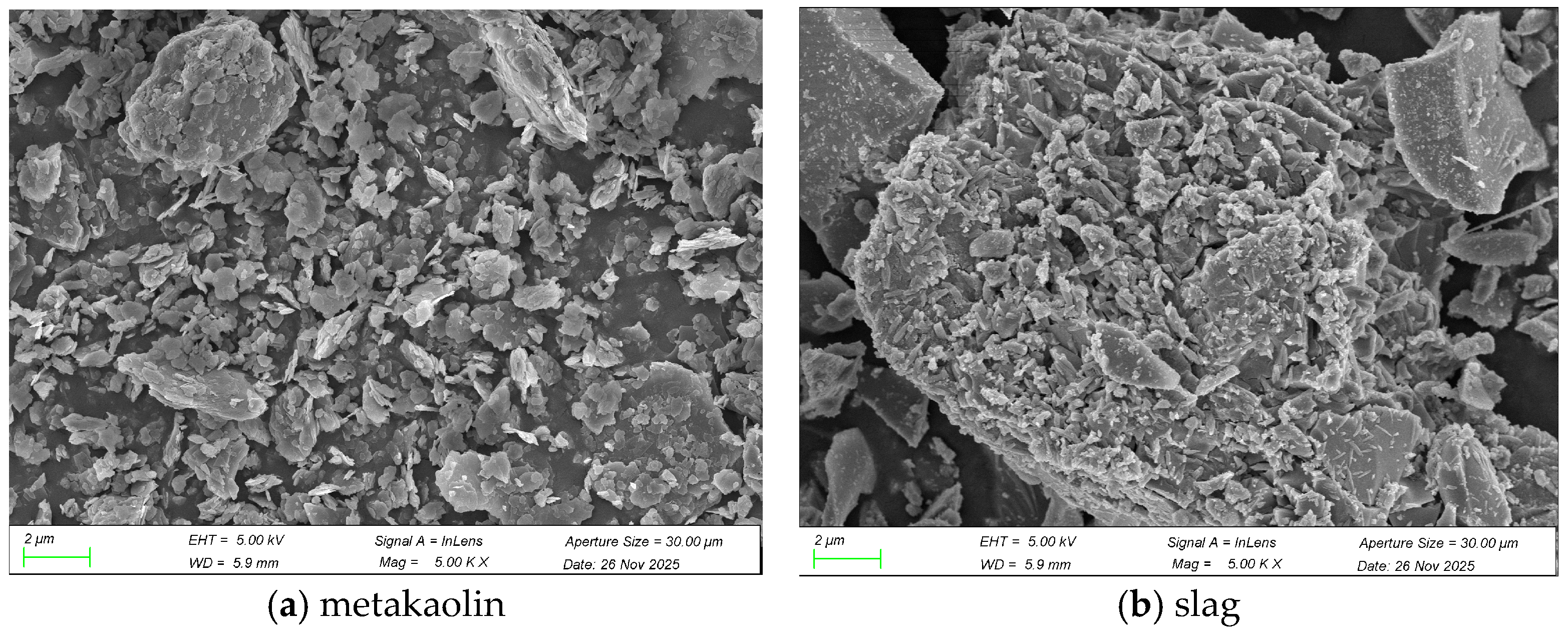
The metakaolin used in this study was supplied by Chenyi Refractory Materials & Abrasives Co., Ltd. (Gongyi City, Henan Province, China). It was produced through raw material pretreatment, calcination, reactivity modification, and final processing. This material exhibits high pozzolanic activity, with a fineness of 1250 mesh and an activity index of 110. The slag was obtained from Bairun Refractory Materials Co., Ltd. (Gongyi City, Henan Province, China) and classified as S95-grade slag. It was produced via furnace quenching, drying, and grinding, and exhibits latent hydraulic reactivity. The chemical compositions of the two precursors, determined via X-ray fluorescence (XRF), are provided in Table 1, and their morphologies are shown in Figure 1.
The alkaline activator consisted of a mixed solution of sodium hydroxide and sodium silicate, with the water glass modulus adjusted as required. The sodium silicate solution was supplied by Zhichen Refractory Materials Co., Ltd. (Jiashan City, Zhejiang Province, China). It had a chemical composition of Na2SiO3, a modulus of 2.3, a Baumé degree of 50, Na2O and SiO2 contents of 13.5% and 30%, respectively, and a moisture content of 56.5%. Sodium hydroxide was provided by Puhui Chemical Raw Materials & Reagents Co., Ltd. (Shaoguan City, Guangdong Province, China) in the form of analytically pure solid granules with a purity ≥96%. Standard medium-grade sand was obtained locally from Tarim University, Aral City, Xinjiang, China. Tap water from Aral City was used for all mixing procedures.

2.2. Experimental Design

Based on preliminary experiments conducted by the research group and previous studies by Zhan [18] on MK–slag systems, the alkali equivalent was fixed at 12%. Under this condition, the effects of varying metakaolin-to-slag ratios, water/binder ratios, and water glass modulus on the compressive strength of specimens at different curing ages were systematically investigated. The detailed mix proportions are presented in Table 2. In this study, the alkali equivalent refers to the mass percentage of Na2O contributed by the alkaline activator relative to the total mass of the cementitious materials. The specific calculation follows the methodology described by Yi Ming [19]. Metakaolin–slag content denotes the mass ratio between the two precursors, with the total precursor content normalized to 100%. The water/binder ratio is defined as the mass ratio of total water (including both the water content in the sodium silicate solution and additional mixing water) to the mass of the cementitious materials. The water glass modulus refers to the molar ratio of SiO2 to Na2O in the alkaline activator and was adjusted by blending sodium hydroxide with the sodium silicate solution.
Based on the outcomes of the single-factor tests, a three-factor, three-level Box–Behnken Design (BBD) was employed using response surface methodology (RSM). The selected independent variables were the metakaolin–slag ratio (X1), water/binder ratio (X2), and silicate modulus (X3). The response variables were the 7-day compressive strength (Y1), 28-day compressive strength (Y2), and 28-day water absorption (Y3). The factors and their coded levels are presented in Table 3.

2.3. Preparation and Testing Methods for Geopolymer Materials

2.3.1. Preparation of Geopolymer Mortar

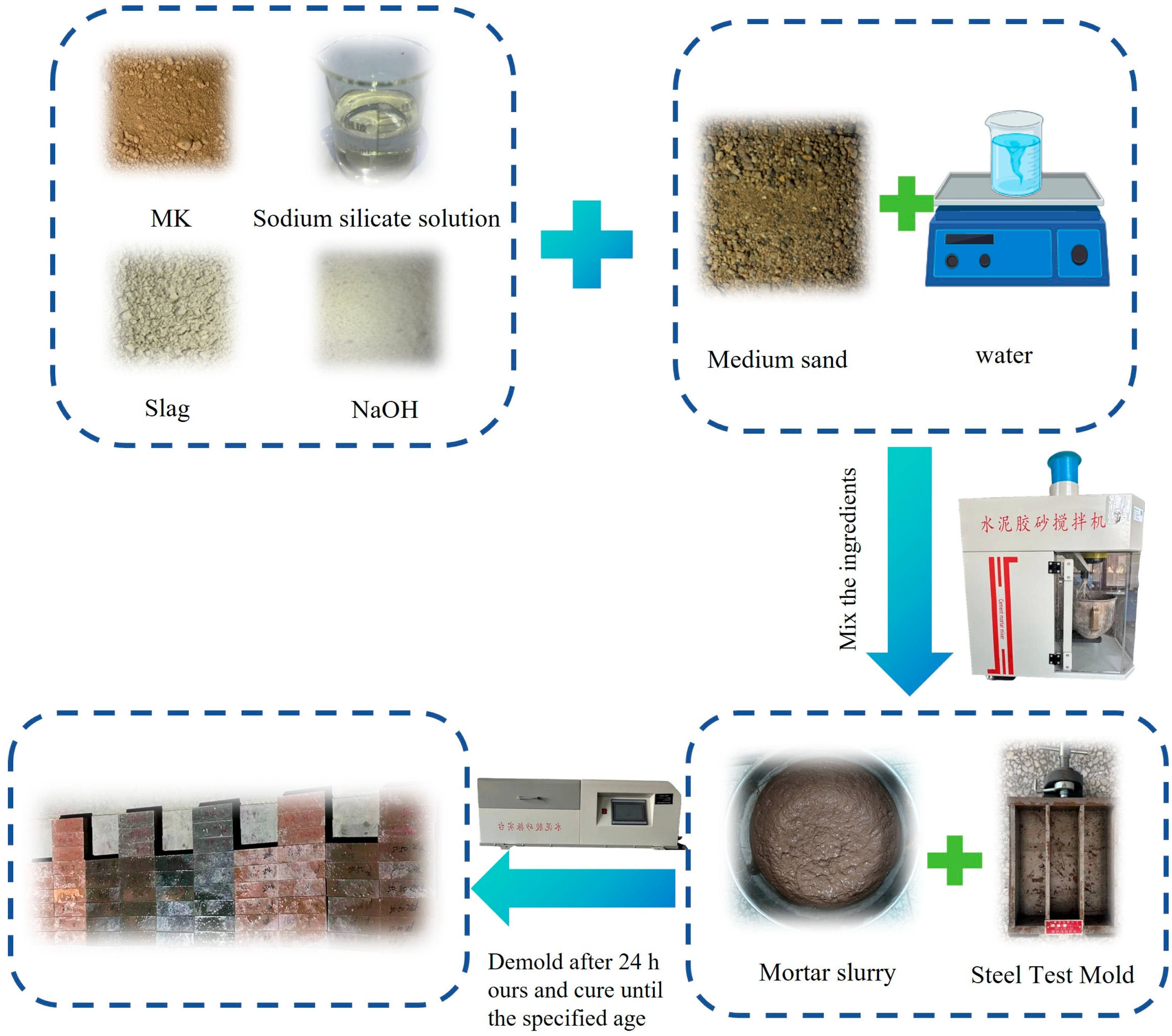
The specimen preparation process for this experiment followed the relevant specifications [20]. The alkaline activator was prepared by dissolving the required amount of sodium hydroxide into the sodium silicate solution, followed by 24 h of sealed storage at room temperature. Predetermined quantities of metakaolin, slag, and additional water were then weighed. The activator and additional water were added to the mixer first, followed by the solid precursors. The mixing sequence was as follows: (1) 30 s at low speed; (2) addition of sand over the next 30 s while maintaining low speed; (3) 30 s at high speed; (4) a 90 s rest period, during which mortar adhered to the blades and bowl walls was scraped back into the mixture; (5) a final 60 s at high speed.
The fresh mortar was cast into 40 mm × 40 mm × 160 mm prism molds in two layers and compacted on a vibrating table for 120 s. Three parallel specimens were prepared for each group. Specimens were cured in a standard curing chamber for 24 h prior to demolding, then returned to the curing chamber until the designated testing ages. The preparation process is illustrated in Figure 2.

2.3.2. Mechanical Testing

Compressive strength tests were conducted in accordance with the Chinese standard GB/T 17671-2021 [21] (aligned with ISO methods). A constant loading rate of 2400 N/s was applied until failure. Compressive strength was calculated based on the maximum failure load and a known loading area of 1600 mm2.

2.3.3. Durability Testing

Water absorption was measured following the Chinese standard JGJ/T 70-2009 [22]. After 28 days of curing, specimens were oven-dried at 105 °C for 48 h to obtain the dry mass. They were then immersed in water for 48 h, surface-dried with a damp cloth, and weighed to determine the saturated mass. Water absorption was computed as per the standard.

2.3.4. SEM Test

Specimens at designated curing ages were crushed, and central fragments of controlled size were selected. To stop hydration, samples were immersed in anhydrous ethanol for 48 h and dried below 50 °C until constant weight was achieved. Microstructural observations were conducted using an Apreo S high-resolution field-emission scanning electron microscope (SEM) to analyze the mechanisms governing mechanical and durability performance.

2.3.5. XRD Test

Small pieces were taken from the central region of the samples that had been cured to the specified age. These pieces were dried to a constant weight, then ground and passed through a 200-mesh sieve. XRD analysis was performed using a Rigaku SmartLab SE diffractometer with a scan speed of 10°/min, a range of 10–80°, and a step size of 0.02°.

2.3.6. MIP Test

Small samples with a maximum side length not exceeding 1 cm were taken from the core of the material and dried at a temperature not exceeding 50 °C until constant weight was achieved. During testing, the contact angle was set to 130°, the pressure range was 0.1–61,000 psia, and the vacuum time was 5 min. The equivalent pore-throat diameter was calculated using the Washburn equation, D = 4 γ cos θ P where D is the pore-throat diameter, γ is the surface tension of mercury, θ is the contact angle, and P is the applied pressure. Pore structure analysis was conducted using a Micromeritics AutoPore V 9600 instrument.

3. Results and Discussion

3.1. Compressive Strength

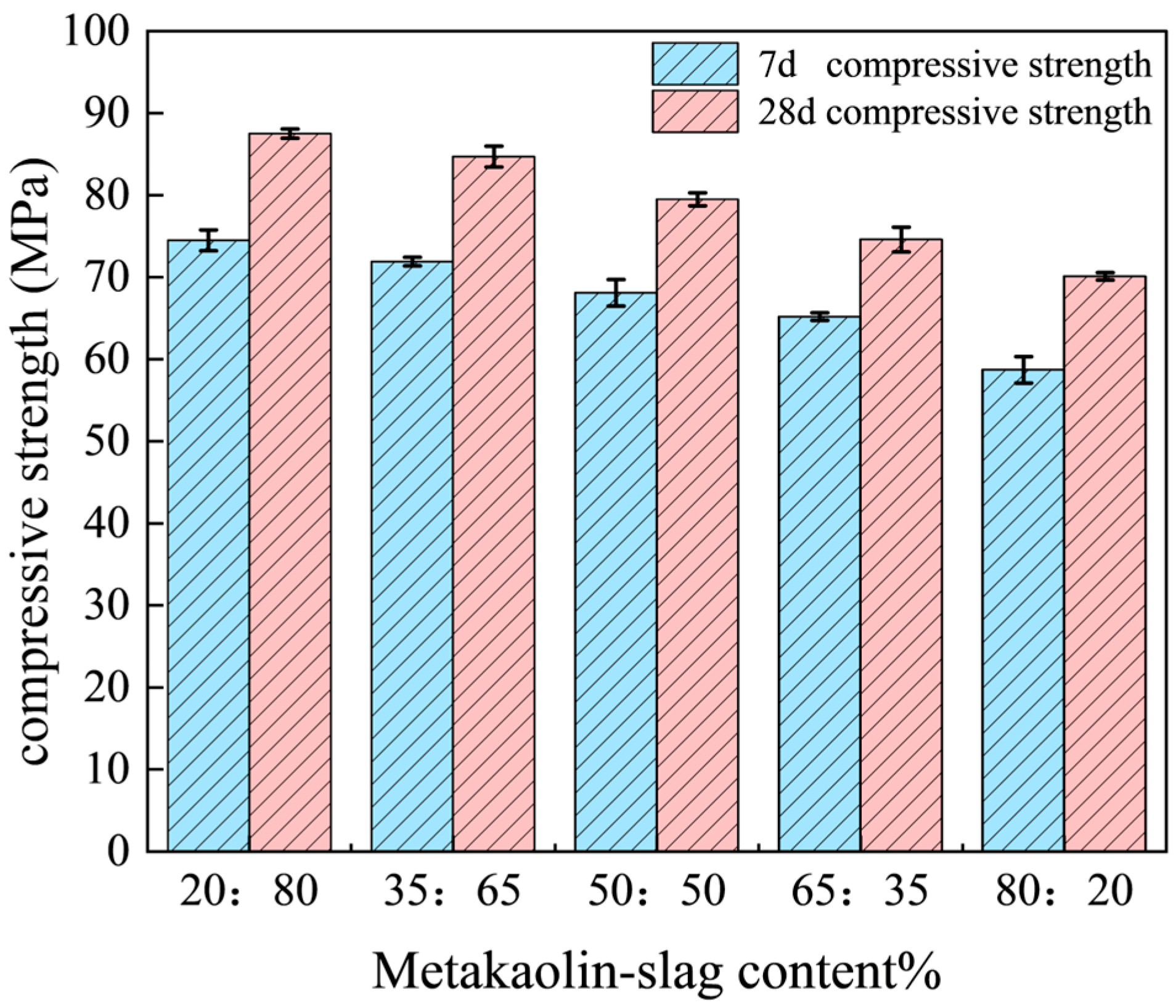
Mechanical strength is a key indicator for evaluating the load-bearing capacity and failure resistance of mortar. Figure 3 illustrates the effect of metakaolin and slag content on the compressive strength of MK–slag mortar at different curing ages. Both the 7-day and 28-day compressive strengths increase with higher slag content. Notably, the 7-day strength already exceeds 80% of the 28-day value. This is because slag is an amorphous material rich in calcium-aluminosilicate glassy phases, which exhibit certain hydraulic properties. In a highly alkaline pore solution (a composite solution with high pH and ion concentration), these glassy phases in slag depolymerize more rapidly. When reacted with metakaolin, they further promote the dissolution of additional glassy phases, reducing the time required to achieve higher compressive strength and generating C-S-H gel. This is consistent with the early-age hydration products detected in the XRD experiments, particularly in the 2θ range of 25–35°, as discussed later.
Moreover, as the metakaolin-to-slag ratio shifts from 80:20 to 20:80, the 7-day compressive strength increases from 58.7 MPa to 74.5 MPa, and the 28-day compressive strength rises from 70.1 MPa to 87.5 MPa. This trend in strength development can be attributed to the increased slag content, which raises the concentration of calcium ions within the system. Under the synergistic effect of the alkaline activator, this not only enhances the dissolution of both metakaolin and slag but also accelerates the formation of C-(N)-A-S-H gel [23]. With higher slag content, the system develops a stronger, more interconnected composite gel network composed of C-(A)-S-H and N-A-S-H, which fills the pores within the structure. This is supported by the MIP results, which show that the porosity of samples cured for 28 days decreases by 2.14% compared to those cured for shorter periods, thus enhancing the macroscopic mechanical properties of MK–slag mortar.
Additionally, at the 7-day curing age, when the proportion of metakaolin and slag changed from 65%:35% to 50%:50%, the compressive strength increased from 65.2 MPa to 68.1 MPa, a 4.45% increase. At the 28-day curing age, the compressive strength rose from 74.6 MPa to 79.5 MPa, corresponding to a 6.57% increase. These increments were the smallest observed across the five levels of variation, indicating that continuously increasing slag content does not result in a significant change in the growth rate of compressive strength, though the strength continues to rise as slag content increases.
Research by Li et al. [24] demonstrated that when slag content reached 30%, the 28-day compressive strength reached 73.4 MPa. The increase in slag content provides additional calcium sources, thereby enhancing the compressive strength of the matrix, which aligns with the findings of this study. The lower strength observed in their study may be due to the use of fly ash as the precursor, which reacts more slowly. However, excessive slag content can lead to issues such as increased cracking due to shrinkage, rapid setting, and high early heat release. Therefore, there is an optimal range where the synergistic effects of metakaolin and slag achieve the best performance. In the MK–slag system, more nucleation sites are created, refining the pore structure and densifying the interfacial transition zone between aggregates and paste. This, in turn, enhances the mechanical strength of the MK–slag mortar.
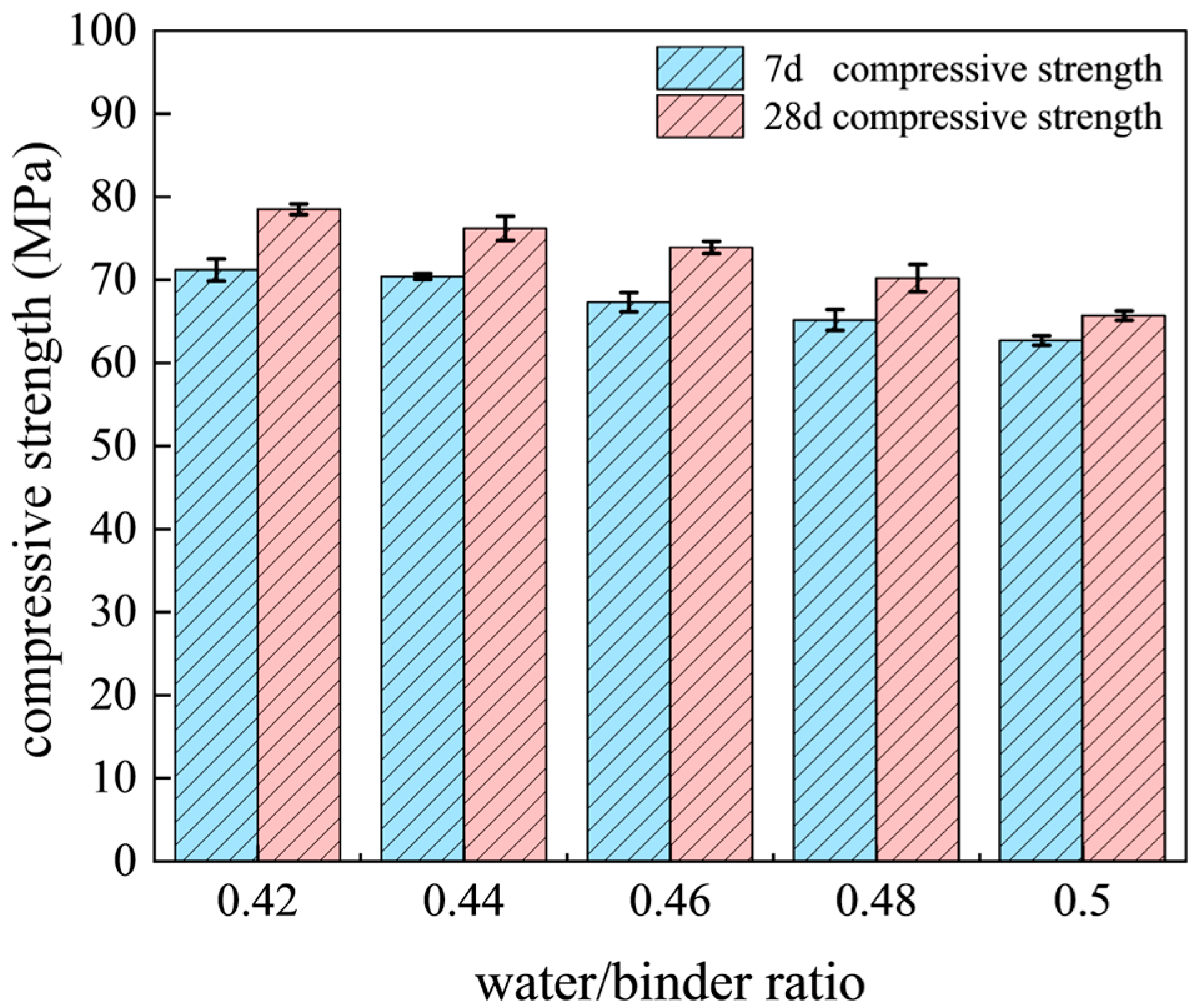
As shown in Figure 4, increasing the water/binder ratio from 0.42 to 0.50 results in decreased compressive strength at all curing ages. The 7-day strengths were 71.2, 70.4, 67.3, 65.2, and 62.7 MPa, and the 28-day strengths were 78.5, 76.2, 73.9, 70.2, and 65.2 MPa, respectively. Increasing water content reduces solution alkalinity and molar silicate concentration, limiting precursor dissolution and silicoaluminate polymerization, thereby reducing C-(N)-A-S-H formation efficiency [25]. Minor stability is observed for water/binder ratios 0.42–0.44 and 0.46–0.48, where a relatively dense gel has already formed. Within these ranges, small increases in water/binder ratio do not significantly disrupt the internal structure; instead, they produce thinner hydration products and slightly larger capillary pores. The negative effect of excess water on strength is partially offset by improved workability and reduced temperature rise, minimizing void formation.
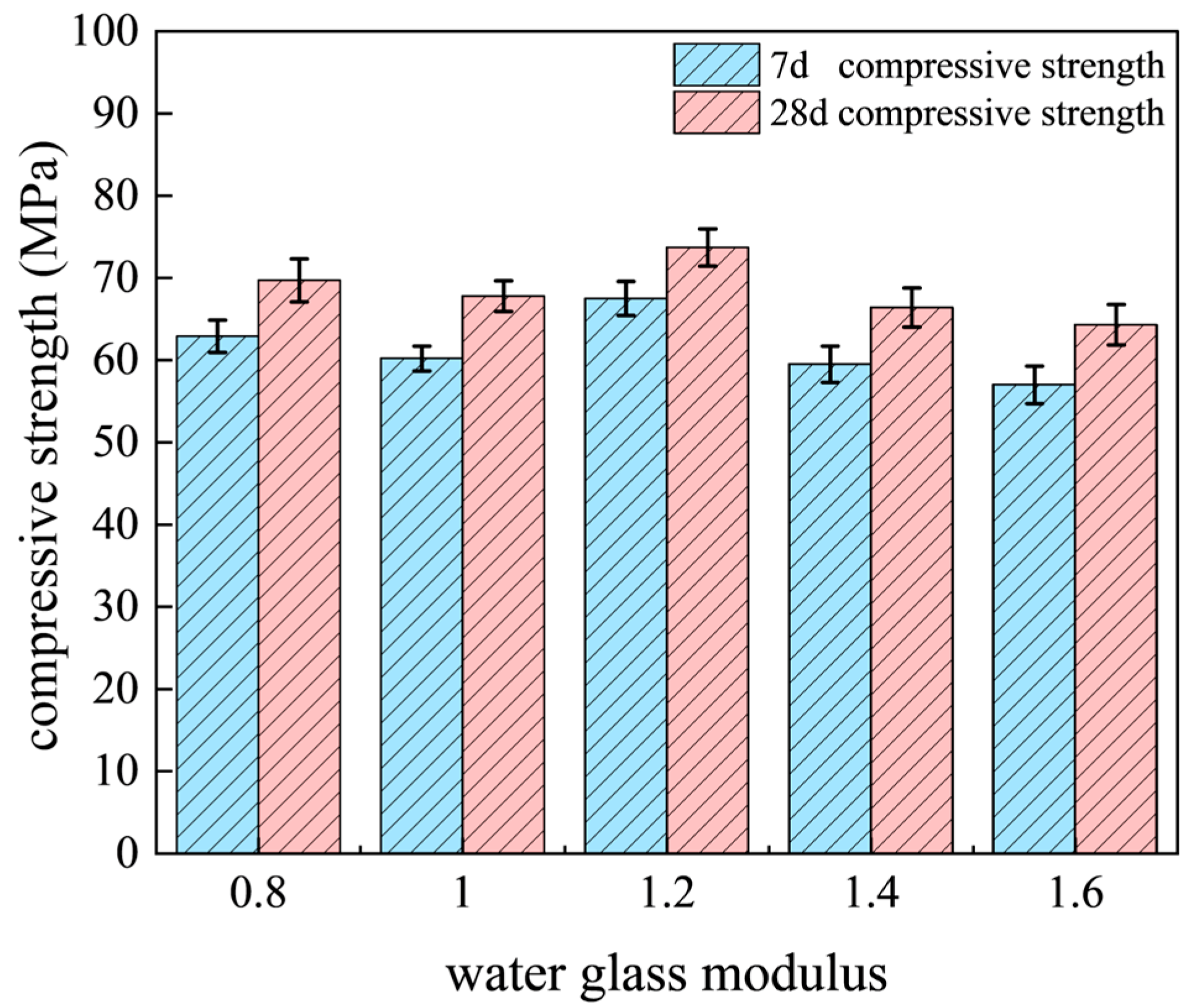
As shown in Figure 5, when the water glass modulus varies from 0.8 to 1.6, the compressive strength of specimens with water glass moduli of 0.8 and 1.0 is lower than that of specimens with a modulus of 1.2 at both curing ages. can be attributed to the fact that a lower water glass modulus requires a higher amount of sodium hydroxide for adjustment. The higher concentration of OH ions significantly accelerated the depolymerization of the precursors [26]. However, the system at lower moduli contains relatively fewer Al and Si oligomers, which limits the maximum strength. At a modulus of 1.2, the OH content is sufficient but not excessive, allowing for effective Ca2+ precipitation and adequate silicate availability, which promotes rapid cross-linking and results in the highest compressive strength. Increasing the modulus to 1.4 and 1.6 reduces the OH concentration, slowing ion exchange and leaving excess silica in the form of poorly integrated colloids, thereby reducing strength. This is consistent with findings by Liu et al. [27], who reported that when the modulus of the alkaline activator is 1.2, no degradation occurs due to a high OH concentration, while the compactness of the matrix increases, porosity decreases, and compressive strength is maximized. The lowest strength at a modulus of 1.6 is attributed to insufficient OH and slower nonexchange rates. Therefore, a water glass modulus close to 1.2 is optimal.

3.2. Water Absorption Rate

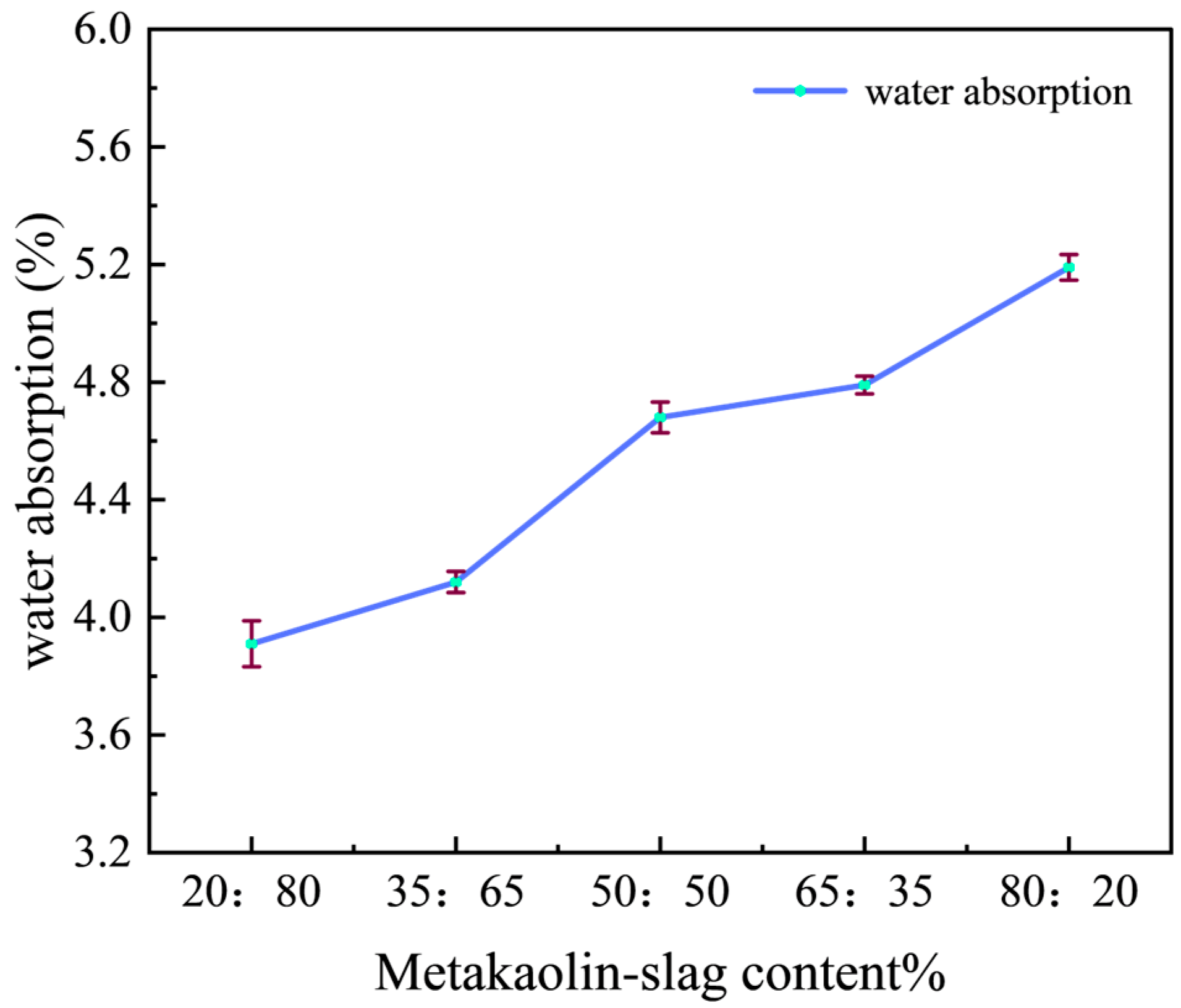
Water absorption characterizes the mortar’s capacity to absorb and retain moisture under specific curing conditions and reflects the volume and connectivity of open pores, serving as a key durability indicator. Figure 6 shows the variation in water absorption of MK–slag mortar with different precursor ratios. From lowest to highest metakaolin content, water absorption rates were 3.91%, 4.12%, 4.68%, 4.79%, and 5.19%, respectively. Lower metakaolin and higher slag content correspond to better performance. Metakaolin requires more water, reducing slurry flowability and trapping air voids, increasing water absorption. Replacing metakaolin with slag optimizes particle size distribution, refines pore size, reduces capillary connectivity, and lowers water absorption [28]. Notably, increasing metakaolin from 50% to 65% marginally increases absorption from 4.68% to 4.79%, indicating that the generated composite gels have filled larger pores. Excessive slag beyond this point may reduce pore optimization benefits and introduce cracking risk [29].
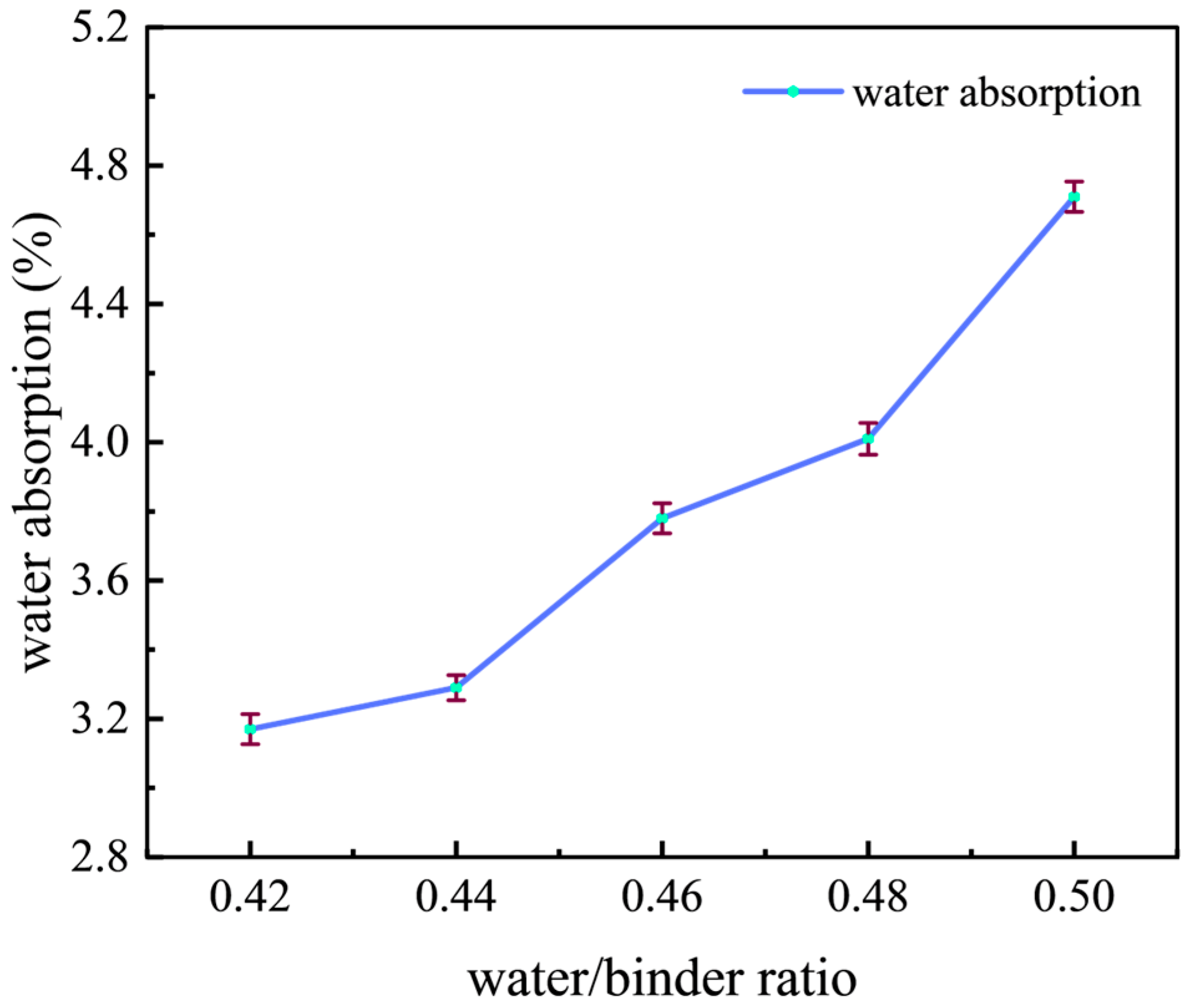
Figure 7 shows the effect of water/binder ratio on water absorption. Water absorption increases with higher water/binder ratios, with corresponding rates of 3.17%, 3.29%, 3.78%, 4.01%, and 4.71%. Higher water content elevates free water in the system, resulting in larger initial capillary pores. Post-curing, water evaporation leaves more pores, and gel formation is less dense [30]. Minor increases in absorption for ratios 0.42–0.44 and 0.46–0.48 (0.12% and 0.23%) are attributed to good workability, minimizing trapped air, and offsetting porosity increases. Beyond 0.48, new permeation pore networks form, explaining the significant absorption increase at 0.50. Practical water/binder ratio selection should balance durability and workability.
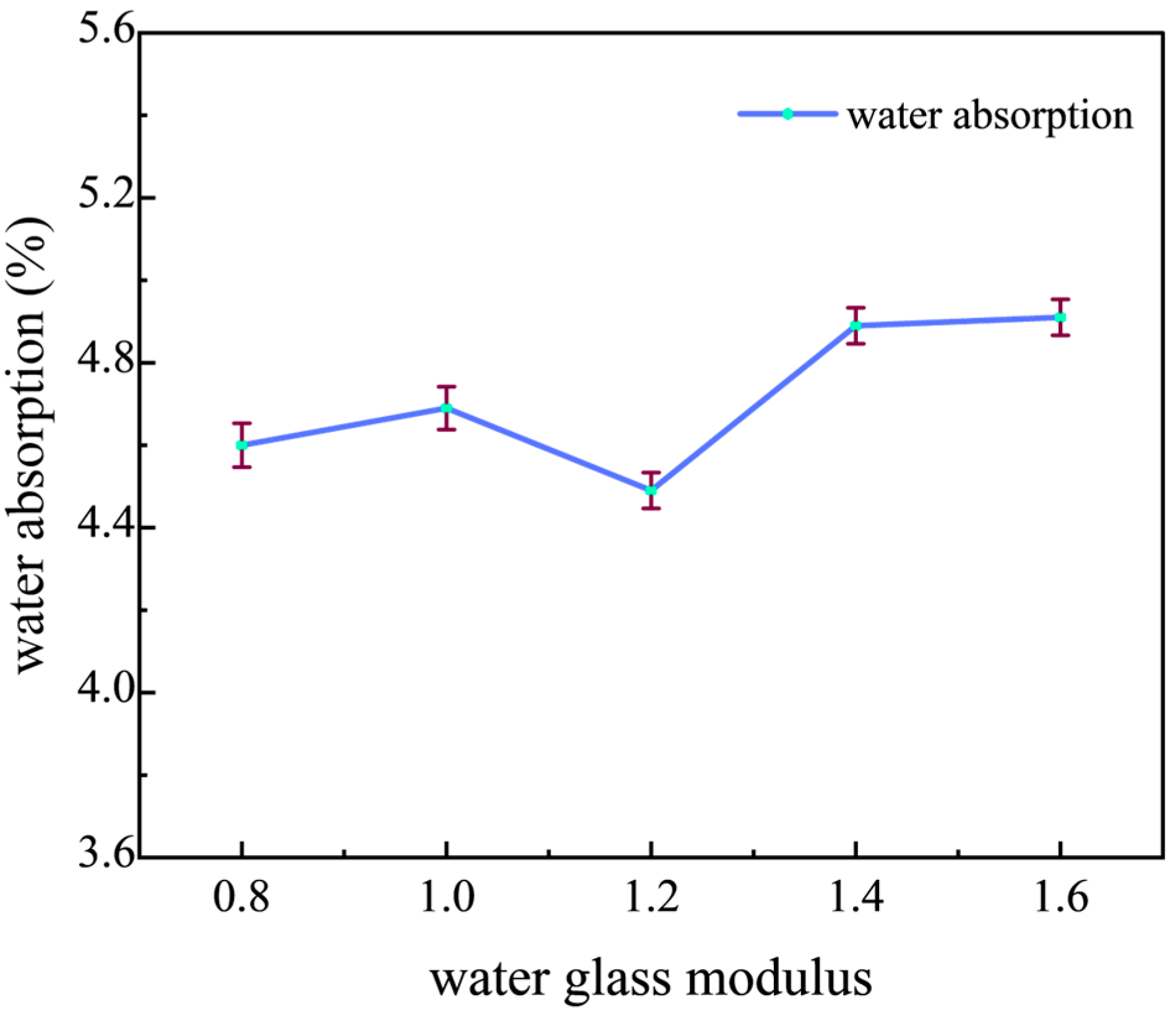
Figure 8 demonstrates the effect of water glass modulus on water absorption, mirroring compressive strength trends. At moduli 0.8 and 1.0, rapid reactions and slight silicon deficiency result in coarser capillary pores and higher absorption. At modulus 1.2, required alkalinity and ion concentration achieve maximum gel volume and fine pore structure, yielding minimum absorption (4.49%). Further increasing modulus reduces OH content, forming weaker gels and larger capillary pores, increasing absorption and reducing durability [31].

3.3. Response Surface Methodology for Optimizing MK–Slag Mix Proportion

3.3.1. Regression Equations and Analysis of Variance

The 7-day compressive strength, 28-day compressive strength, and water absorption rate for each mix design are listed in Table 4. Regression analysis was performed for metakaolin-to-slag ratio, water/binder ratio, and silicate modulus. Second-order polynomial regression models for response variables Y1, Y2, and Y3 are presented in Equations (1), (2), and (3), respectively. Statistical results and ANOVA are shown in Table 5.
All model p-values are <0.0001, indicating high statistical significance. Lack-of-fit p-values exceed 0.05, confirming a non-significant lack-of-fit relative to pure error. Therefore, the models accurately fit the experimental data and can be used for prediction and analysis.
Y 1 = 63.90 6.09 X 1 3.41 X 2 + 1.25 X 3 + 0.3000 X 1 X 2 + 3.33 X 1 X 3 2.88 X 2 X 3 + 1.05 X 1 2 + 0.3000 X 2 2 4.97 X 3 2
Y 2 = 73.90 5.05 X 1 5.11 X 2 1.71 X 3 + 0.5750 X 1 X 2 1.48 X 1 X 3 1.50 X 2 X 3 1.58 X 1 2 2.90 X 2 2 2.45 X 3 2
Y 3 = 3.61 + 0.3750 X 1 + 0.3700 X 2 + 0.0025 X 3 0.0100 X 1 X 2 0.1100 X 1 X 3 0.0700 X 2 X 3 + 0.2575 X 1 2 + 0.1075 X 2 2 + 0.3425 X 3 2

3.3.2. Analysis of Response Surface Model Prediction Accuracy

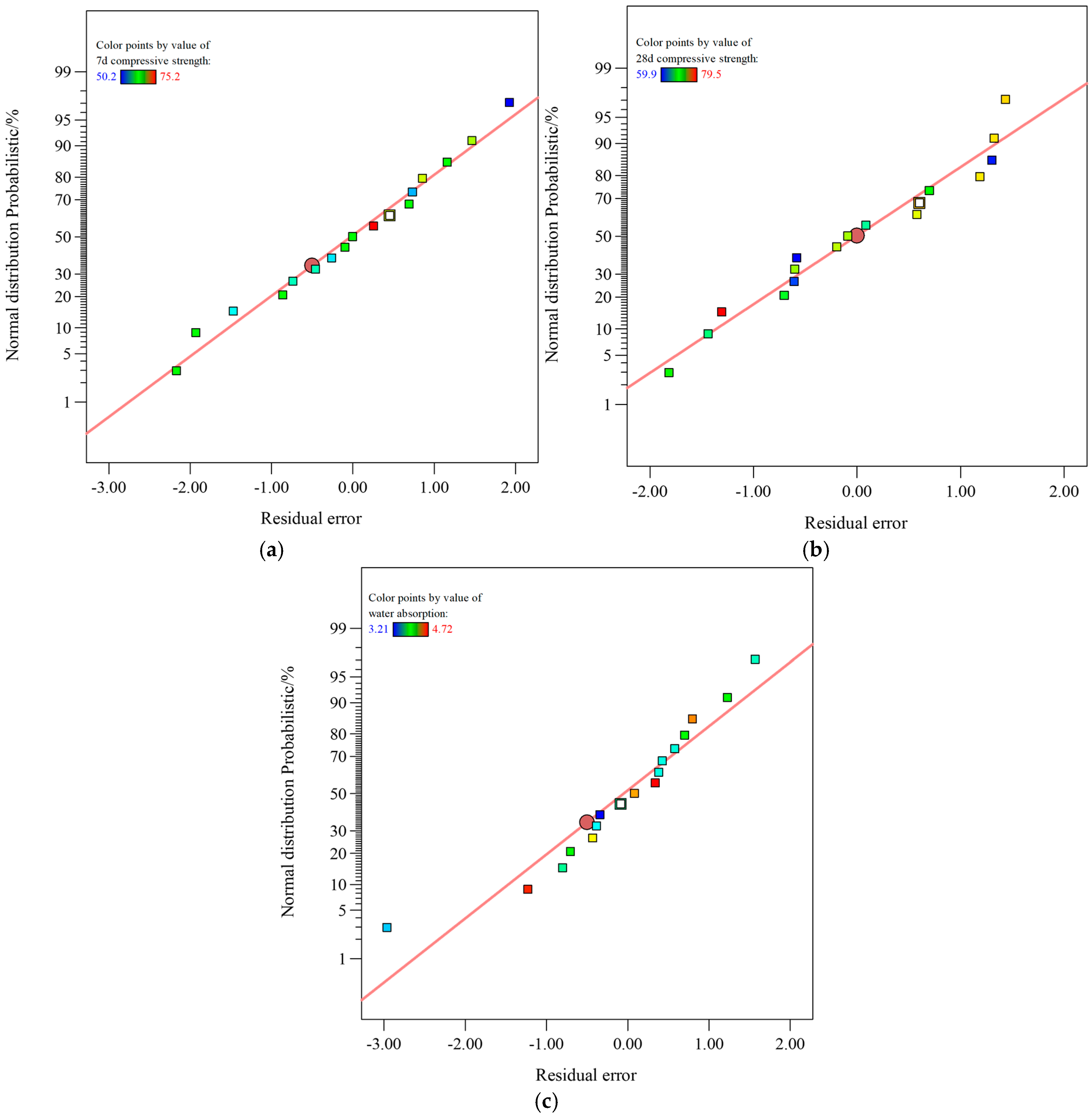
Figure 9 presents the residual analysis plots for MK–slag. The standardized residuals exhibit minimal fluctuation, indicating that the experimental data points are randomly distributed, thereby validating the rationality of the sampling points. Additionally, the scatter points in each residual plot align closely along a straight line, with only a few minor deviations. This suggests that the residuals follow a normal distribution, with no outliers detected during model fitting. As a result, the regression models can be effectively interpreted using a polynomial approach.
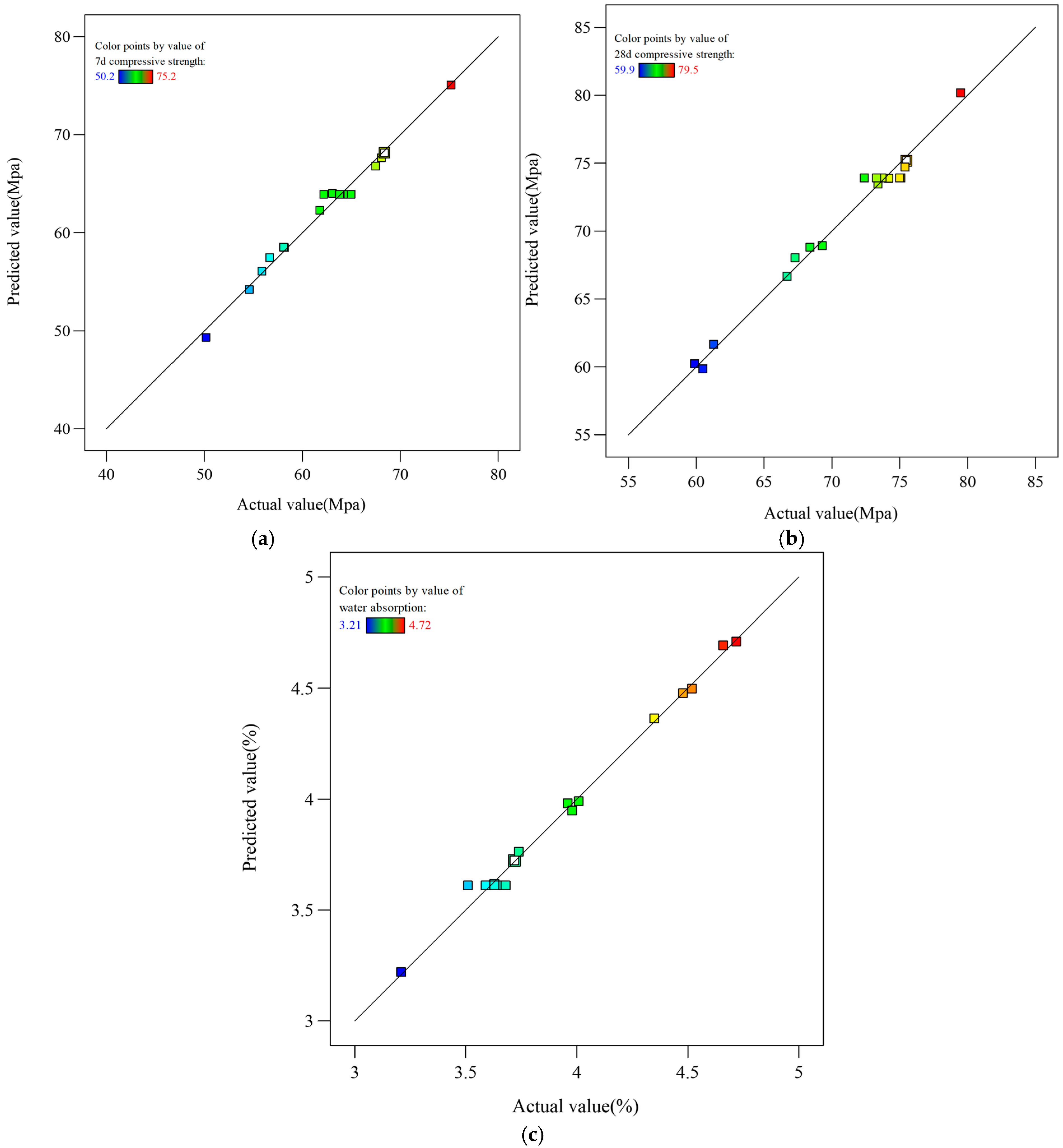
As shown in Figure 10, the comparison between experimental and predicted values for the testing indicators of MK–slag demonstrates that the experimental and predicted values are predominantly aligned along the y = x line, with no significant deviations. The few outliers observed may be attributed to variations in specimen preparation or testing instrument inconsistencies, which represent controllable errors and do not undermine the reliability of the model. Overall, the model accurately captures the variation trends in compressive strength and water absorption, demonstrating strong reliability.

3.3.3. Response Surface Analysis

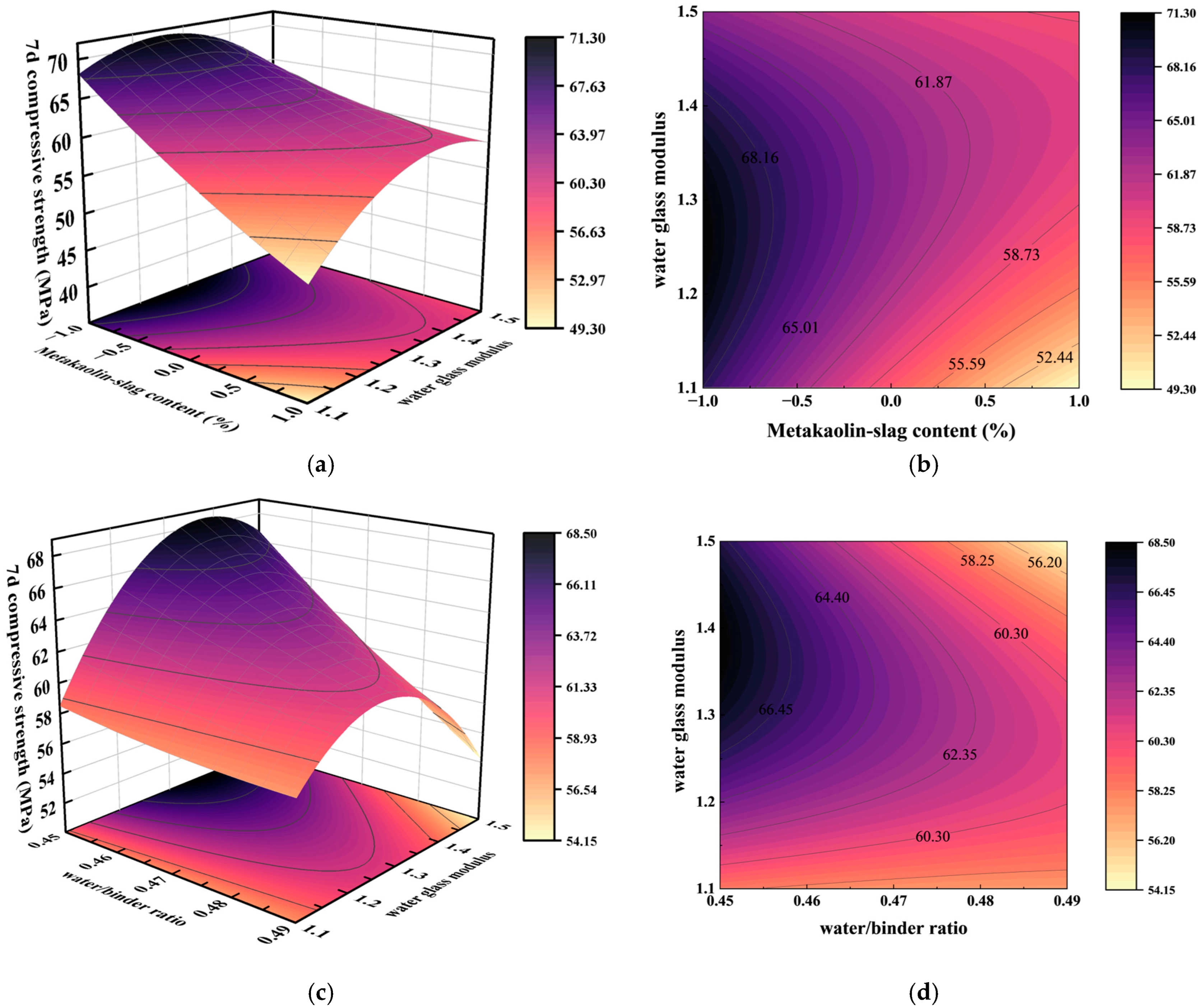
The 3D surface plots and contour lines derived from the regression model allow intuitive analysis of how factor interactions influence MK–slag compressive strength at 7 days, as shown in Figure 11. Based on Table 5, the order of influence for X1, X2, X3, and their interactions on 7-day compressive strength is as follows: X1 > X32 > X2 > X1X3 > X2X3 > X3 > X12. Specifically, X1, X2, and X32 exert highly significant effects, while X1X3, X2X3, X3, and X12 are significant. X1X2 and X22 are insignificant.
Figure 11a,b shows a gently domed surface with steep, closely spaced contour lines, indicating a strong X1X3 interaction and a significant effect of X32. With X3 fixed, 7-day compressive strength increases as X1 decreases (i.e., higher slag content). Slag’s high CaO content, combined with Na+ and Ca2+ ions of similar ionic radii and electronegativity, facilitates synergistic ion exchange, transforming N-A-S-H gel into (C,N)-A-S-H gel [32]. C-(A)-S-H gel precipitates rapidly under Ca2+ influence, bonding with N-A-S-H and accelerating early gel formation and densification [33]. As X3 increases, the surface shows a downward concave trend. At low water glass modulus, high OH and Na+ concentrations induce rapid silicoaluminate dissolution, but gel forms unevenly, reducing strength. At moderate X3, sufficient [AlO4]5− and [SiO4]4− tetrahedral monomers enable balanced dissolution and condensation, achieving peak strength. Excessively high X3 increases silica but reduces effective OH, slowing bond breakage and gelation, decreasing strength [34].
Figure 11c,d illustrates that the 7-day compressive strength peaks at X3 = 1.3 and X2 = 0.45. Higher X2 increases free water, diluting Na+ and OH, reducing silicate reactivity, and delaying gelation. Water evaporation leaves extensive pore networks, increasing porosity and reducing early strength. This confirms the negative correlation between X2 and 7-day compressive strength [35].
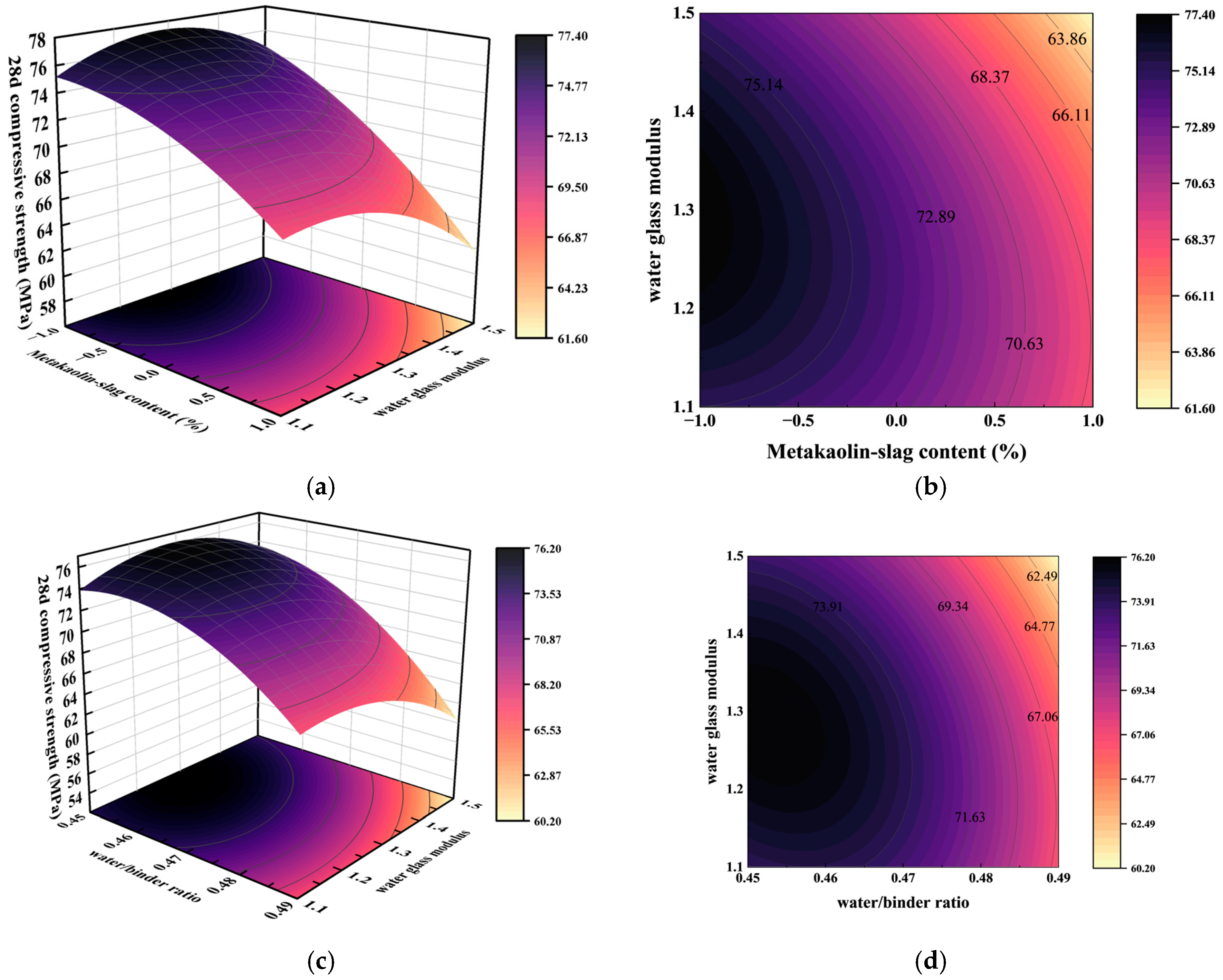
For 28-day compressive strength, Figure 12a,b and Table 5 show that X2 > X1 > X22 > X32 > X3 > X12 > X2X3 > X1X3 in order of influence. X1 and X2 have highly significant effects. The response surface exhibits a broad arched profile with gently sloping ridges. Peak 28-day strength (79.5 MPa) occurs at high slag content and moderate modulus. Compared with the 7-day curve, the slope is gentler, as early-age C-(A)-S-H gel formation from slag accelerates strength, whereas later-stage N-A-S-H network formation from metakaolin dominates [36].
Figure 12c,d show that with X2 fixed at 0.45 and 0.49, 28-day strength decreases as X3 rises, consistent with trends at 7 days. Higher water/binder ratios slow hydration, weaken bonding, increase shrinkage and porosity, and reduce strength [37]. Low OH and excess free alkali at inappropriate modulus values can precipitate Na2CO3 and NaHCO3 on the surface, further reducing mechanical performance [38].
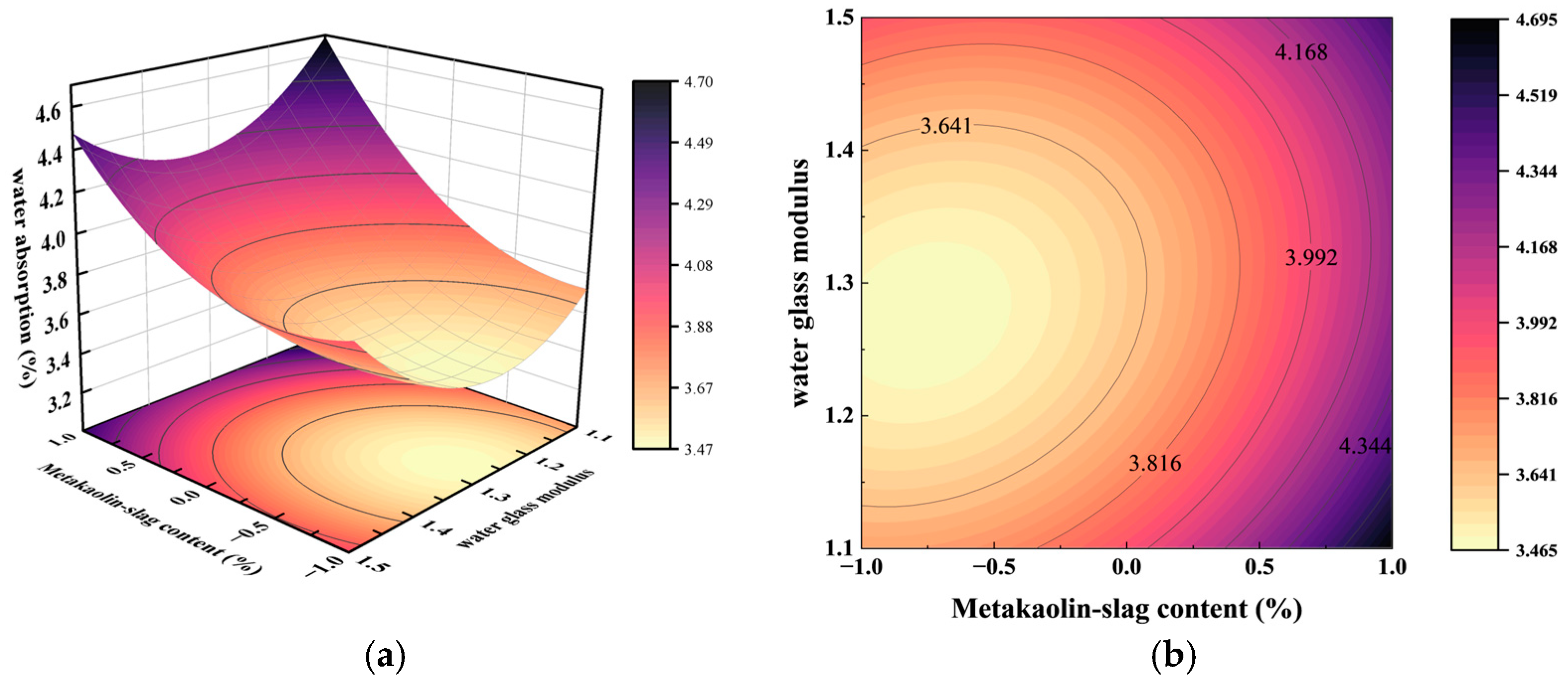
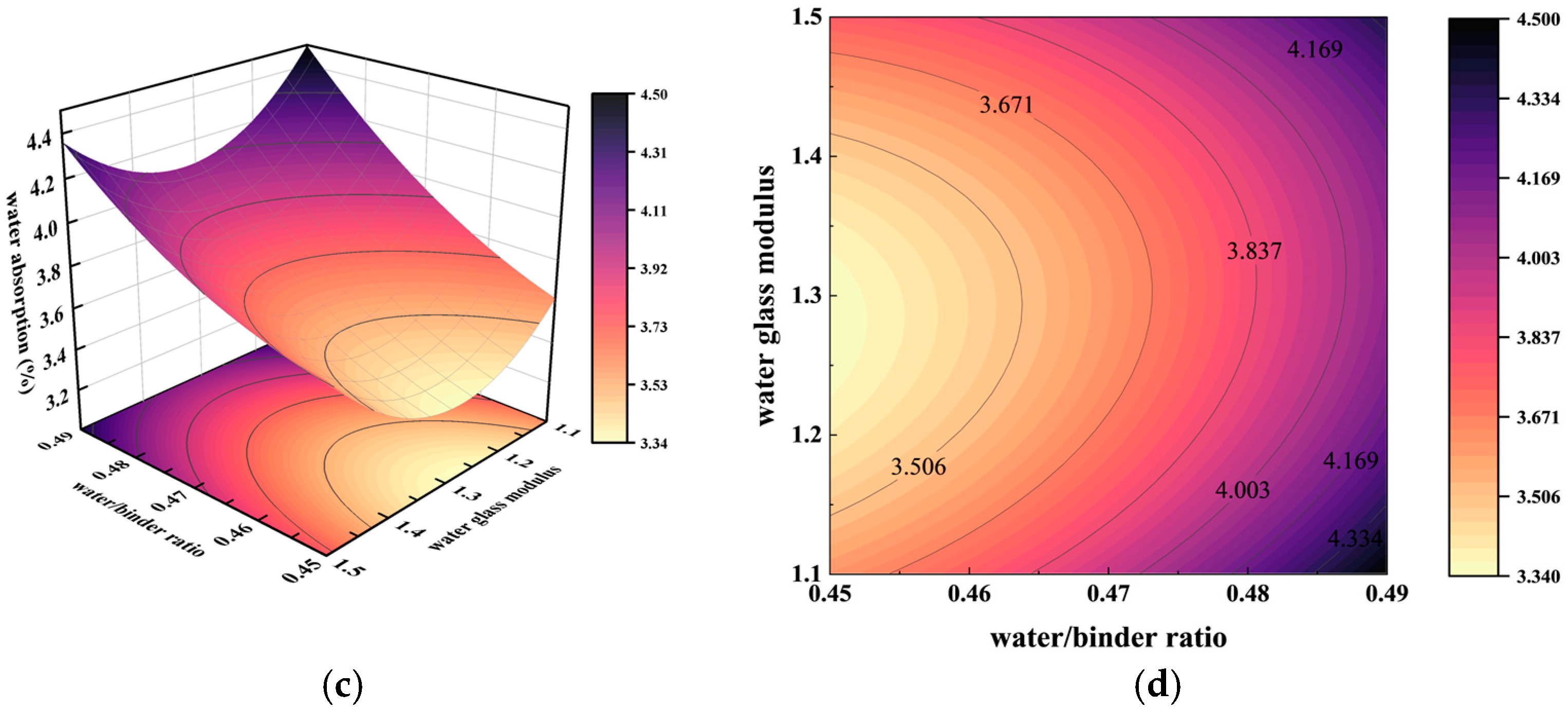
Based on the regression model, a surface plot and contour lines for the 28-day water absorption rate of MK–slag were generated to analyze the effects of individual factors and their interaction terms. The results are shown in Figure 13. Table 5 presents the order of influence of factors and their interaction terms on the 28-day water absorption rate of MK–slag: X1 > X2 > X32 > X12 > X22 > X1X3 > X2X3. Among these, X1, X2, X32, and X12 exert a highly significant influence on the 28-day water absorption rate, while X22, X1X3, and X2X3 show significant effects. The remaining terms are insignificant.
Figure 13a,b depicts the response surfaces for 28-day water absorption. X1 has a stronger effect than X3, with water absorption being lowest at a moderate modulus and slightly higher slag proportion. X3 exhibits a U-shaped effect: too-low results in silicate and charge imbalance, while too-high promotes premature gel film formation, hindering reactions and increasing absorption. Water absorption is minimized when X1 ≈ −0.5, reflecting an optimal gel network that blocks capillary connectivity [32]. Contour lines along X2 indicate that water adsorption is more sensitive to the water/binder ratio. Low X2 and moderate X3 levels achieve the best balance between silicate supply and OH concentration, maximizing durability [39].
As observed in Figure 13c,d, the response surface approximates a “valley-like” region, where this data set exhibits the lowest water absorption at the minimum water/binder ratio and moderate water glass modulus levels. The contour lines form an elliptical shape tilted along the X2 axis. The color variation in contour lines in the X2 direction is more pronounced than in the X3 direction, indicating that water absorption is more sensitive to X2, while X3 has a smaller but still significant influence. The ANOVA table confirms these characteristics, showing that X2, X22, and the X2X3 interaction term are the primary factors influencing the response value, while X3 and X32 act as secondary factors. This order of significance is common in alkali-activated systems. Within the structure, free water content regulates connected porosity, and polymerization kinetics primarily respond to changes in the silicate modulus [40,41].
Water absorption exhibits a monotonic trend with variations in X2. At low X2 levels, the moisture within the system is sufficient to activate the precursor and promote gel formation while avoiding the adverse effects of pore coarsening, which occur at higher X2 levels. This trend was explicitly documented in Yu Diao’s study, where the lowest water absorption values consistently corresponded to moderate liquid phase content [42]. At this point, the dense gel network reduces the matrix porosity, enhancing the mortar’s durability. Along the X3 axis, the water absorption rate first decreases and then increases. The primary reasons for this trend align with previously discussed content and research by Du et al. [43], so further elaboration is omitted. Under the interaction of X2 and X3, the combination of low X2 and high X3 levels fails to compensate for the adverse effects of limited solubility and ion mobility. When X2 reaches its minimum value, and X3 is at a moderate level, the best balance between silicate supply and OH concentration is achieved. However, at high X2 levels, even with the optimal X3 value, durability performance deteriorates due to pore coarsening.
Ultimately, with the optimization objectives set to maximize the 7-day and 28-day compressive strengths while minimizing the water absorption rate, and with the weights and assigned importance of the three indicators all set equally to 1, the software automatically determined the optimization direction. Using the multi-objective optimization method based on the Derringer–Suich desirability function in the software, the optimal mix proportion obtained through the software’s numerical optimization function is as follows: metakaolin-to-slag ratio of 45:55, water/binder ratio of 0.45, and water glass modulus of 1.3. Three parallel experiments resulted in 7-day and 28-day compressive strengths of 73.8 MPa and 79.6 MPa, respectively, with water absorption of 3.36%. The response surface model predicted 75 MPa, 80.1 MPa, and 3.22%, with relative errors below 5%, confirming that the relative errors between the experimental and predicted values of the model are small and the prediction accuracy is high.

3.4. Microstructural Analysis

3.4.1. SEM Analysis

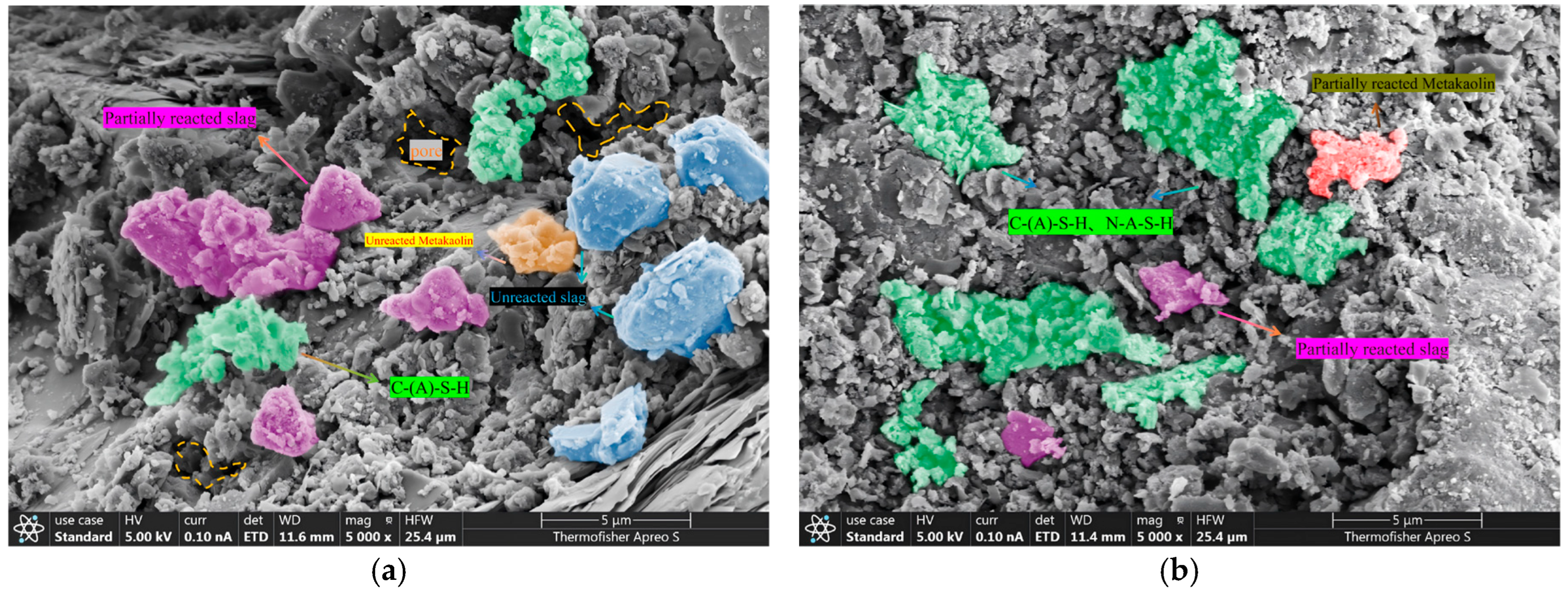
Figure 14 shows the microscopic images of MK–slag at the optimal mix proportion under different curing ages. Figure 14a displays the sample cured for 3 days, where unreacted slag particles with irregular blocky or flaky shapes and relatively smooth surfaces are visible, along with layered or flaky aggregates of MK and partially reacted raw materials coated with gel [44]. This suggests that the polymerization reaction of MK–slag is still in its early stages. The synergistic reaction between slag and the alkaline activator releases Ca2+, while metakaolin, containing Al2O3 and SiO2, undergoes hydration to produce Al3+ and Si4+. The small amount of gel observed on the surfaces of MK and slag is likely loose C-S-H gel [45]. Additionally, a few pores and microcracks are visible within the structure, which may be attributed to shrinkage caused by incomplete bonding strength of the matrix during early curing—a common phenomenon in the early-age stages of geopolymer materials.
As shown in Figure 14b, after curing for 28 days, no unreacted raw materials are visible. A relatively dark, low-density gel transition zone has formed around some slag particles, while partially reacted fine MK particles are embedded within the gel. Flocculent C-(A)-S-H and three-dimensional network-like N-A-S-H gels are observed to be interwoven and overlapped, contributing to enhancement of performance [46]. These features indicate that the geopolymerization reaction has reached completion, with the original phases having reacted and transformed into substantial amounts of N-A-S-H and C-(A)-S-H gel products. These gel products work together to support the mechanical strength and durability of MK–slag. Moreover, the fine cracks seen at earlier stages have disappeared in this aged sample. This densification with increasing curing age is attributed to the formation of a more compact structure within the matrix, where C-(A)-S-H and N-A-S-H gels are interconnected and bonded, largely filling the pores formed at earlier stages and thereby enhancing durability [47].

3.4.2. XRD Analysis

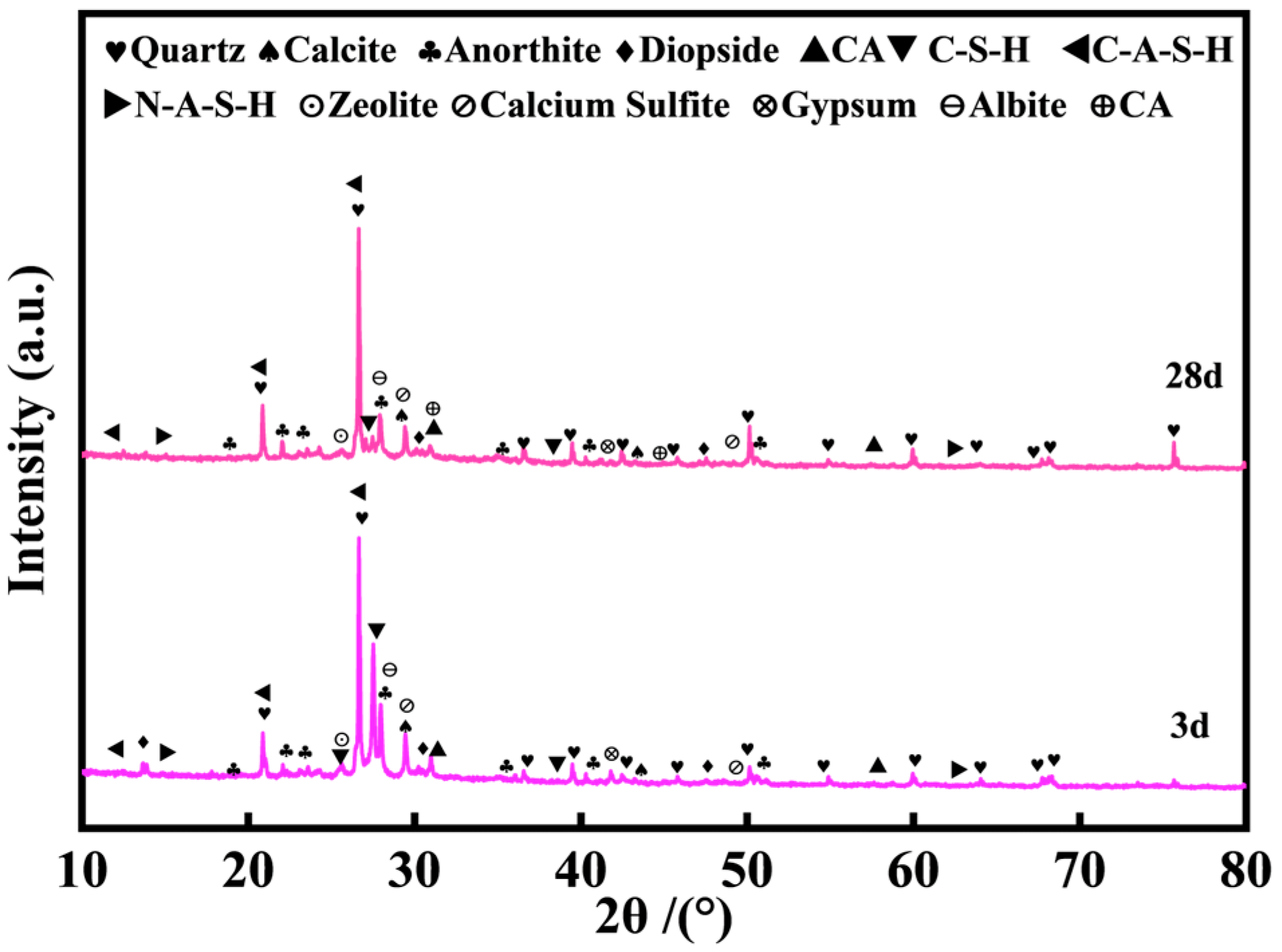
Figure 15 presents the XRD patterns of MK–slag at the optimal mix proportion after 3 days and 28 days of curing. In both curves, distinct peaks of raw minerals such as quartz, calcite, plagioclase, actinolite, diopside, and aluminosilicates are clearly visible. Among these, the quartz peak at around 26° and the calcite peak at around 29° are particularly prominent, indicating their crystalline forms. The presence of calcite may be attributed to carbonation during sample curing or processing.
Compared to the 3-day pattern, the characteristic peaks of raw crystalline phases such as quartz, plagioclase, and diopside persist in the 28-day pattern, with no significant new intense crystalline peaks emerging. This suggests that the primary reaction products in the system are amorphous or poorly crystalline gels. Meanwhile, weak crystalline products associated with C-S-H, C-A-S-H, N-A-S-H, and zeolites are observed in the 2θ range of 25–35°, reflecting the ongoing dissolution–polycondensation reactions and the gradual formation of a gel network as curing progresses [48].
Considering the chemical composition of the raw materials (metakaolin being rich in SiO2/Al2O3 and slag rich in CaO/MgO) under alkaline activation, the Si-Al-O precursors from MK tend to form N-A-S-H gel, while the Ca and partial Al/Si released from slag promote the formation of C-S-H/C-A-S-H gels. Over time, the structurally unstable C-S-H gel decreases, and the system becomes primarily dominated by N-A-S-H and C-A-S-H gels. Their combined effect fosters the gradual development of a composite gel framework, primarily consisting of N-A-S-H and C-A-S-H. This drives the evolution of the matrix from one dominated by abundant residual crystalline phases and minimal hydration gels at early ages to a structure governed by a continuous gel network [49].
In summary, under the optimal mix proportion, the MK–slag system undergoes a well-developed geopolymerization reaction by 28 days, characterized by a reduction in crystalline reactants and an increase in amorphous cementitious products. This supports the formation of a dense and continuous three-dimensional network structure, which is consistent with the products observed via SEM.

3.4.3. MIP Analysis

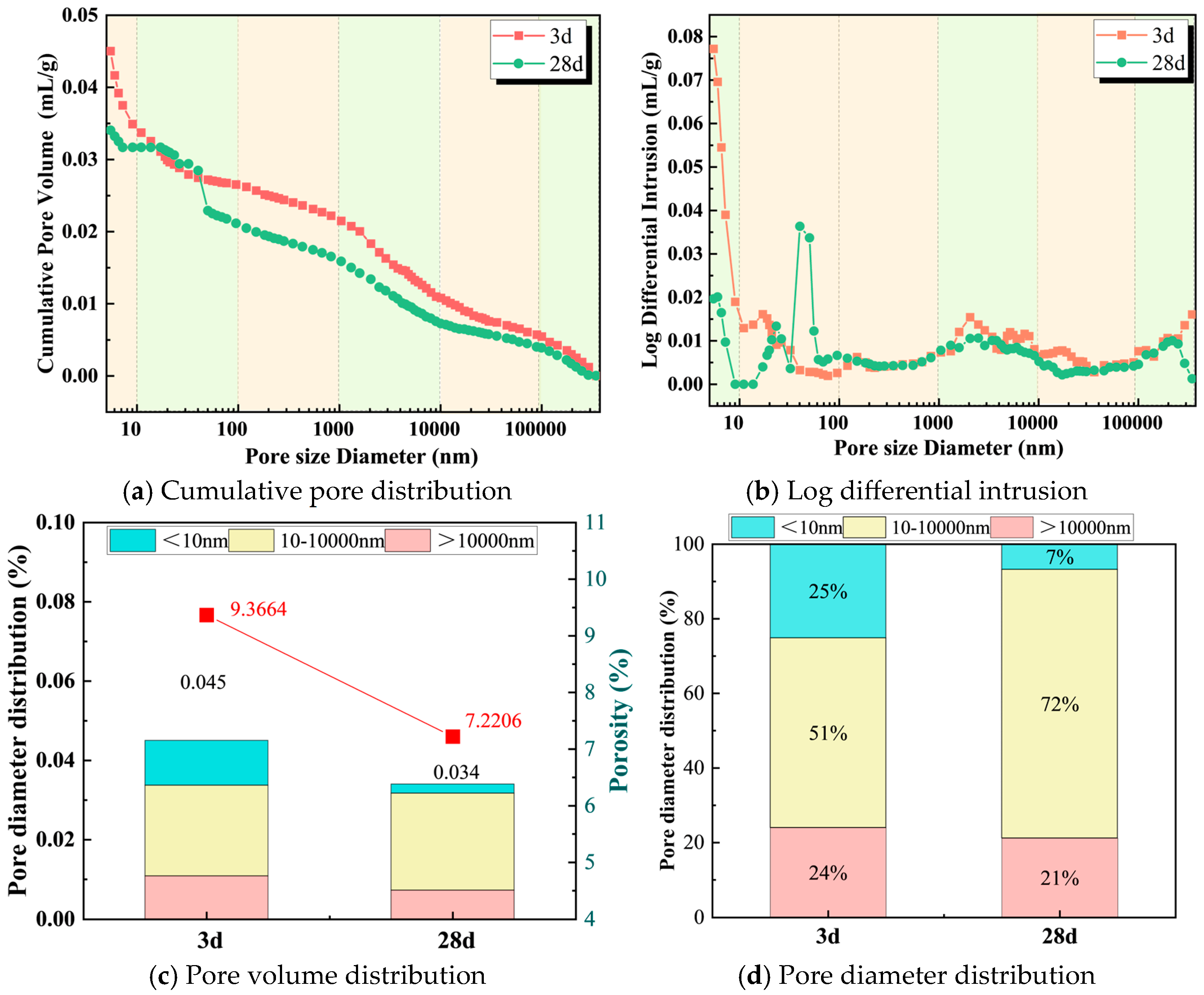
Based on pore size and formation mechanism, Mindess et al. [50] classify pores into gel pores, capillary pores, and air voids. Gel pores (<10 nm) contain water bound by hydrogen bonds and primarily influence shrinkage and creep. Capillary pores (10 nm–10 μm) form from channels left after water evaporation, not filled by hydration products. Macropores (>10 μm) result from insufficient compaction.
Figure 16a,b shows that at 3 days, MK–slag exhibits a rapid decrease in cumulative pore volume with increasing pore size, whereas the 28-day curve is relatively flat with lower overall values. At 3 days, significant changes occur in pore volumes >1000 nm and <10 nm, with minor variation in the 10–1000 nm range. By 28 days, cumulative pore volume increases rapidly within 10–100 nm and >1000 nm, reflecting lower overall porosity (Figure 16c). Differential curves show that pores at 3 days concentrate between 1000 and 10,000 nm, while at 28 days, pore changes mainly occur within 10–100 nm. Integral curves indicate that 28-day samples have smaller critical pore sizes.
At 3 days, the differential pore volume shows a prominent peak >100 nm, indicating numerous harmful interconnected pores. Maximum peak occurs at 5.48 nm, with secondary peaks at 1595.47 nm and 291,213.35 nm, dominated by gel pores and macropores. By 28 days, differential pore volume decreases and distribution becomes more uniform, reflecting refinement and homogenization of the pore structure. Figure 16c,d shows that total pore content decreases across all pore sizes, with absolute pore volume dropping from 0.045 mL/g to 0.034 mL/g. Most pores remain below 10,000 nm, accounting for over 75%. Relative porosity shows gel pore proportion decreasing from 25% (3 days) to 7% (28 days), capillary pores increasing from 51% to 72%, and macropores decreasing from 24% to 21%. Total porosity reduces from 9.37% to 7.22%, and median pore diameter decreases from 734.41 nm to 684.28 nm.
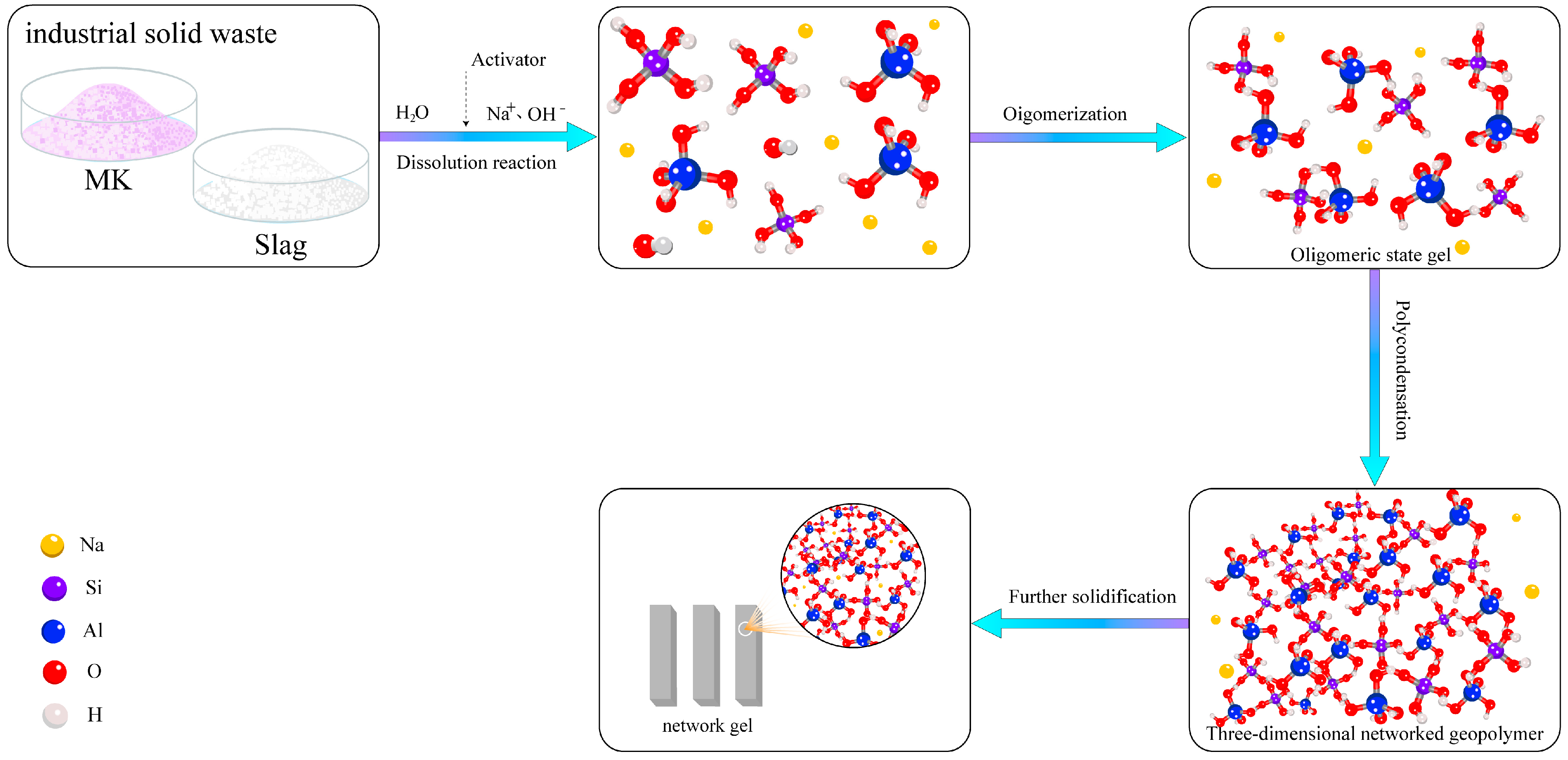
These changes are attributed to incomplete hydration at early stages, leading to a high proportion of gel pores and matrix shrinkage, with capillary and macropores further supporting this observation [51]. After complete curing of the 28-day specimen, the reduction in gel pores indicates that the hydration reaction has progressed, with smaller pores being incorporated into the expanding gel network. These increase in capillary pores reflects ongoing water evaporation and polymerization. Large pores diminish as residual voids are filled by hydration products, consistent with SEM observations. Figure 17 illustrates the mechanism behind MK–slag’s enhanced mechanical strength and durability.

4. Conclusions

This study systematically investigated the effects of metakaolin-blended slag content, water/binder ratio, and water glass modulus on MK–slag’s compressive strength and water absorption using a single-factor experimental approach. Optimal factor ranges were selected based on these results. A Box–Behnken design (BBD) combined with response surface methodology (RSM) was then employed to optimize MK–slag’s mechanical strength and durability and to examine interactions among factors. SEM, XRD, and MIP analyses were integrated to elucidate the micro-reaction mechanisms. Key findings include the following:
  • Single-factor experiments demonstrated that metakaolin–slag content, water/binder ratio, and water glass modulus significantly affect MK–slag properties. Increasing slag content improves mechanical strength and durability. Higher water/binder ratios decrease both strength and durability. Compressive strength initially increases and then decreases with water glass modulus, while water absorption is lowest at intermediate modulus values. At a modulus of 1.2, water absorption reaches 4.49%.
  • RSM analysis yielded a quadratic polynomial model for 7-day and 28-day compressive strength and water absorption. Significant interactions among factors were observed. At a metakaolin–slag ratio of 45:55, water/binder ratio of 0.45, and water glass modulus of 1.3, 7-day and 28-day compressive strengths reached 73.8 MPa and 79.6 MPa, respectively, with water absorption at 3.36%.
  • SEM, XRD, and MIP analyses show that with curing age, MK–slag hydration products increase, forming abundant N-A-S-H and C-(A)-S-H gels. These gels interlock to form a dense structure, enhancing mechanical strength and durability and clarifying the reaction mechanism of MK–slag.
  • A comparative analysis with traditional cementitious materials shows that geopolymer materials reduce carbon emissions by 81.26–85.50% and lower carbon emission costs by 60.07–72.64%, demonstrating significant environmental benefits and a strong potential for practical application. For further details, refer to Appendix A.
  • Although water absorption was used in this study as an indicator of pore connectivity to assess durability performance, this approach has certain limitations. Future research should incorporate additional durability indicators, such as moisture absorption and chloride ion permeability, to provide a more comprehensive evaluation of the durability of MK–slag mortar. Building on existing research, a more robust multi-objective optimization framework should be proposed to offer a theoretical basis for the development of solid waste-based green cementitious materials with excellent performance and cost-effectiveness.

Author Contributions

Conceptualization, L.Z. and D.C.; methodology, R.Y.; software, R.Y.; validation, R.Y.; formal analysis, R.G. and P.L.; investigation, L.Z.; resources, L.Z.; writing—original draft preparation, R.Y.; supervision, R.G. and D.C.; project administration, L.Z.; funding acquisition, L.Z. All authors have read and agreed to the published version of the manuscript.

Funding

This research was funded by the Key Laboratory of Water Engineering Materials of Ministry of Water Resources, China Institute of Water Resources and Hydropower Research (Open Research Fund Project) grant number EMF202408; Scientific Expedition Project of the Ministry of Science and Technology grant number 2022xjkk010601.

Data Availability Statement

The original contributions presented in the study are included in the article; further inquiries can be directed to the corresponding author.

Conflicts of Interest

All authors certify that they have no affiliations with or involvement in any organization or entity with any financial or non-financial interest in the subject matter or materials discussed in this manuscript.

Appendix A

Table A1. Quantitative analysis of the environmental and economic benefits of MK–slag geopolymer mortar.
Indicator NameTraditional Portland
Cement
MK–Slag Geopolymer Materials (This Study)Comparison of
Differences
Data Sources and
Explanation
Material Carbon Emissions (kg CO2/t)814–870462–682Reduced by 21.61–43.24%Calculated based on experimental results
Carbon emission costs (yuan/t)57.5215.74–22.97Reduced by 60.07–72.64%Without large-scale limestone calcination and high-temperature combustion processes
Carbon Footprint of Cementitious Materials (kg CO2-eq per t Slag)High (919)Low (767–839)Geopolymer materials are more environmentally friendlySlag is an industrial by-product
Industrial solid waste utilization rateLow (0–20%)High (55%)The effect is obviousIncrease waste utilization

References

  1. Supriya; Chaudhury, R.; Sharma, U.; Thapliyal, P.C.; Singh, L.P. Low-CO2 emission strategies to achieve net zero target in cement sector. J. Clean. Prod. 2023, 417, 137466. [Google Scholar] [CrossRef]
  2. Watari, T.; Cao, Z.; Hata, S.; Nansai, K. Efficient use of cement and concrete to reduce reliance on supply-side technologies for net-zero emissions. Nat. Commun. 2022, 13, 4158. [Google Scholar] [CrossRef]
  3. Lu, Z.; Li, W.; Yue, R. Investigation of the long-term supply–demand relationships of ecosystem services at multiple scales under SSP–RCP scenarios to promote ecological sustainability in China’s largest city cluster. Sustain. Cities Soc. 2024, 104, 105295. [Google Scholar] [CrossRef]
  4. Choy, Y.K.; Onuma, A.; Lee, K.E. The Nexus of Industrial–Urban Sustainability, the Circular Economy, and Climate–Ecosystem Resilience: A Synthesis. Sustainability 2025, 17, 2620. [Google Scholar] [CrossRef]
  5. Cheng, D.; Reiner, D.M.; Yang, F.; Cui, C.; Meng, J.; Shan, Y.; Liu, Y.; Tao, S.; Guan, D. Projecting future carbon emissions from cement production in developing countries. Nat. Commun. 2023, 14, 8213. [Google Scholar] [CrossRef]
  6. El Fadili, H.; Ait-Khouia, Y.; Ouffa, N.; Taha, Y.; Moukannaa, S.; Benzaazoua, M. Comprehensive review on alkaline dissolution of aluminosilicates and its role in the mechanisms and properties of geopolymers and alkali-activated materials. Case Stud. Constr. Mater. 2025, 23, e05330. [Google Scholar] [CrossRef]
  7. Singh, N.B.; Middendorf, B. Geopolymers as an alternative to Portland cement: An overview. Constr. Build. Mater. 2020, 237, 117455. [Google Scholar] [CrossRef]
  8. Li, N.; Shi, C.; Zhang, Z. Understanding the roles of activators towards setting and hardening control of alkali-activated slag cement. Compos. Part B Eng. 2019, 171, 34–45. [Google Scholar] [CrossRef]
  9. Vaičiukynienė, D.; Nizevičienė, D.; Kantautas, A.; Bocullo, V.; Kielė, A. Alkali Activated Paste and Concrete Based on of Biomass Bottom Ash with Phosphogypsum. Appl. Sci. 2020, 10, 5190. [Google Scholar] [CrossRef]
  10. Zhang, Z.H.; Zhu, H.J.; Zhou, C.H.; Wang, H. Geopolymer from kaolin in China: An overview. Appl. Clay Sci. 2016, 119, 31–41. [Google Scholar] [CrossRef]
  11. Zhong, Q.; Tian, X.; Xie, G.; Luo, X.; Peng, H. Investigation of Setting Time and Microstructural and Mechanical Properties of MK/GGBFS-Blended Geopolymer Pastes. Materials 2022, 15, 8431. [Google Scholar] [CrossRef]
  12. Yip, C.K.; Lukey, G.C.; van Deventer, J.S.J. The coexistence of geopolymeric gel and calcium silicate hydrate at the early stage of alkaline activation. Cem. Concr. Res. 2005, 35, 1688–1697. [Google Scholar] [CrossRef]
  13. Asaad, M.A.; Huseien, G.F.; Memon, R.P.; Ghoshal, S.K.; Mohammadhosseini, H.; Alyousef, R. Enduring performance of alkali-activated mortars with metakaolin as granulated blast furnace slag replacement. Case Stud. Constr. Mater. 2022, 16, e00845. [Google Scholar] [CrossRef]
  14. Yao, Z.; Luo, L.; Qin, Y.; Cheng, J.; Qu, C. Research on mix design and mechanical performances of MK-GGBFS based geopolymer pastes using central composite design method. Sci. Rep. 2024, 14, 9101. [Google Scholar] [CrossRef]
  15. Martínez, A.; Miller, S.A. A review of drivers for implementing geopolymers in construction: Codes and constructability. Resour. Conserv. Recycl. 2023, 199, 107238. [Google Scholar] [CrossRef]
  16. Esievo, O.P.; Awodiji, C.T.G. Response Surface Model for Predicting the Compressive Strength of Metakaolin Geopolymer Concrete. J. Archit. Civ. Eng. 2025, 10, 24–32. [Google Scholar] [CrossRef]
  17. Veza, I.; Spraggon, M.; Fattah, I.M.R.; Idris, M. Response surface methodology (RSM) for optimizing engine performance and emissions fueled with biofuel: Review of RSM for sustainability energy transition. Results Eng. 2023, 18, 101213. [Google Scholar] [CrossRef]
  18. Zhan, J. Study on the Volume Stability of Alkali-Activated Metakaolin-Slag Composite Cementitious Materials. Doctoral Dissertation, Ningxia University, Yinchuan, China, 2022. [Google Scholar]
  19. Yi, M. Research on the Preparation and Properties of Geopolymer Mortar. Doctoral Dissertation, Zhejiang Sci-Tech University, Hangzhou, China, 2020. [Google Scholar]
  20. ISO 679:2009; Cement—Test Methods—Determination of Strength. International Organization for Standardization: Geneva, Switzerland, 2009.
  21. GB/T 17671-2021; Test Method of Cement Mortar Strength (ISO Method) (ISO 679:2009, Cement—Test Methods—Determination of Strength, MOD). State Administration for Market Regulation and Standardization Administration of China: Beijing, China, 2021.
  22. JGJ/T 70-2009; Standard for Test Method of Basic Properties of Construction Mortar. Ministry of Construction of the People’s Republic of China: Beijing, China, 2009.
  23. Zhu, H.; Liang, G.; Li, H.; Wu, Q.; Zhang, C.; Yin, Z.; Hua, S. Insights to the sulfate resistance and microstructures of alkali-activated metakaolin/slag pastes. Appl. Clay Sci. 2021, 202, 105968. [Google Scholar] [CrossRef]
  24. Xiao, L.; Zhang, C.; Zhang, H.; Jiang, Z. Internal Curing Effects of Slag on Properties and Microstructure of Ambient-Cured Fly Ash-Based Geopolymer Mortar. Buildings 2024, 14, 3846. [Google Scholar] [CrossRef]
  25. Chen, C.; Shenoy, S.; Sasaki, K.; Zhang, H.; Tian, Q. Influence of liquid-to-solid ratios on properties and microstructure of coal gasification slag-based one-part geopolymer. Case Stud. Constr. Mater. 2024, 20, e02924. [Google Scholar] [CrossRef]
  26. Xie, F.; Liu, Z.; Zhang, D.; Wang, J.; Huang, T.; Wang, D. Reaction kinetics and kinetics models of alkali activated phosphorus slag. Constr. Build. Mater. 2020, 237, 117728. [Google Scholar] [CrossRef]
  27. Liu, J.; Shi, X.; Zhang, G.; Li, L. Study the Mechanical Properties of Geopolymer under Different Curing Conditions. Minerals 2023, 13, 690. [Google Scholar] [CrossRef]
  28. Wang, M.; Liu, Q.; Liang, X.; Xu, J.; Li, Z.; Liang, R.; Sun, G. Influence of Metakaolin on Properties of Magnesium Potassium Phosphate Cement with High Water-to-Solid Ratio. J. Mater. Civ. Eng. 2022, 34, 04022227. [Google Scholar] [CrossRef]
  29. Zhang, B.; Zhu, H.; Cheng, Y.; Huseien, G.F.; Shah, K.W. Shrinkage mechanisms and shrinkage-mitigating strategies of alkali-activated slag composites: A critical review. Constr. Build. Mater. 2022, 318, 125993. [Google Scholar] [CrossRef]
  30. Peng, H.; Yang, Y.; Ge, Y.; Li, Y.; Shi, X. Metakaolin-Based Geopolymer Features Different Pore Structure Characteristics from Ordinary Portland Cement Paste: A Mechanistic Study. J. Mater. Civ. Eng. 2022, 34, 04022321. [Google Scholar] [CrossRef]
  31. Zhao, H.; Ding, J.; Huang, Y.; Tang, Y.; Xu, W.; Huang, D. Experimental analysis on the relationship between pore structure and capillary water absorption characteristics of cement-based materials. Struct. Concr. 2019, 20, 1750–1762. [Google Scholar] [CrossRef]
  32. Nan, F.; Shen, Q.; Zou, S.; Yang, H.; Sun, Z.; Yang, J. Capillary Water Absorption Characteristics of Steel Fiber-Reinforced Concrete. Buildings 2025, 15, 1542. [Google Scholar] [CrossRef]
  33. Zhang, D.; Yang, Z.; Kang, D.; Fang, C.; Jiao, Y.; Wang, K.; Mi, S. Study on the mechanism of Ca2+ and Na+ interaction during the hydration of multi-source solid waste geopolymers. J. Build. Eng. 2023, 69, 106177. [Google Scholar] [CrossRef]
  34. Zhang, H.-Y.; Liu, J.-C.; Wu, B. Mechanical properties and reaction mechanism of one-part geopolymer mortars. Constr. Build. Mater. 2021, 273, 121973. [Google Scholar] [CrossRef]
  35. Cui, Y.; Wang, D.; Wang, Y.; Sun, R.; Rui, Y. Effects of the n(H2O: Na2Oeq) ratio on the geopolymerization process and microstructures of fly ash-based geopolymers. J. Non-Cryst. Solids 2019, 511, 19–28. [Google Scholar] [CrossRef]
  36. Burciaga-Díaz, O.; Escalante-García, J.I. Structural transition to well-ordered phases of NaOH-activated slag-metakaolin cements aged by 6 years. Cem. Concr. Res. 2022, 156, 106791. [Google Scholar] [CrossRef]
  37. Liu, Y.; Zhang, S.; Fang, Z.; Sun, M.; Fan, Y.; Shah, S.P. Influence of Water-to-Binder Ratio on Autogenous Shrinkage and Electrical Resistivity of Cement Mortar. Buildings 2025, 15, 1444. [Google Scholar] [CrossRef]
  38. Charitha, V.; Athira, G.; Bahurudeen, A.; Shekhar, S. Carbonation of alkali activated binders and comparison with the performance of ordinary Portland cement and blended cement binders. J. Build. Eng. 2022, 53, 104513. [Google Scholar] [CrossRef]
  39. Zhuang, S.; Wang, Q.; Zhang, M. Water absorption behaviour of concrete: Novel experimental findings and model characterization. J. Build. Eng. 2022, 53, 104602. [Google Scholar] [CrossRef]
  40. Firdous, R.; Stephan, D. Effect of silica modulus on the geopolymerization activity of natural pozzolans. Constr. Build. Mater. 2019, 219, 31–43. [Google Scholar] [CrossRef]
  41. Kamakshi, T.A.; Reddy, K.C.; Subramaniam, K.V.L. Studies on rheology and fresh state behavior of fly ash-slag geopolymer binders with silica. Mater. Struct. 2022, 55, 65. [Google Scholar] [CrossRef]
  42. Diao, Y.; Zhu, D.; Hu, Q.; Wang, C.; Hu, H.; Zhang, L.; Huang, J. Self-curing strategy of granite waste powder by calcined and alkaline activation: Mechanical and durability properties. J. Build. Eng. 2025, 103, 112214. [Google Scholar] [CrossRef]
  43. Du, X.; Hu, K.; Ma, H.; Chen, Y.; Zhang, W.; Chen, G.; Qiao, P. Effect of calcium-to-aluminum ratio on gel structure and performance of geopolymer artificial aggregates for sustainable asphalt pavements. Constr. Build. Mater. 2025, 491, 142755. [Google Scholar] [CrossRef]
  44. Duraman, S.B.; Richardson, I.G. Microstructure & properties of steel-reinforced concrete incorporating Portland cement and ground granulated blast furnace slag hydrated at 20 °C. Cem. Concr. Res. 2020, 137, 106193. [Google Scholar] [CrossRef]
  45. Zhang, Y.; He, Y.; Cui, X.; Liu, L. Enhancing Freeze–Thaw Resistance of Alkali-Activated Slag by Metakaolin. ACS Omega 2023, 8, 20869–20880. [Google Scholar] [CrossRef]
  46. Jia, Z.; Chen, C.; Zhou, H.; Zhang, Y. The characteristics and formation mechanism of the dark rim in alkali-activated slag. Cem. Concr. Compos. 2020, 112, 103682. [Google Scholar] [CrossRef]
  47. Walkley, B.; San Nicolas, R.; Sani, M.A. Phase evolution of C-(N)-ASH/NASH gel blends investigated via alkali-activation of synthetic calcium aluminosilicate precursors. Cem. Concr. Res. 2016, 89, 120–135. [Google Scholar] [CrossRef]
  48. Zhang, G.-Y.; Sun, D.-L.; Han, Y.; Wang, J.; Xia, J.; Zhu, J.; Miao, Y.-H. Low-alkalinity activation of calcium carbide slag for blast furnace slag-based materials: Synergistic effects of carbonation curing on performance and microstructure. J. Build. Eng. 2025, 113, 114190. [Google Scholar] [CrossRef]
  49. Burciaga-Díaz, O.; Magallanes-Rivera, R.X.; Escalante-García, J.I. Alkali-activated slag-metakaolin pastes: Strength, structural, and microstructural characterization. J. Sustain. Cem.-Based Mater. 2013, 2, 111–127. [Google Scholar] [CrossRef]
  50. Mindess, S.; Young, J.F.; Darwin, D. Concrete, 2nd ed.; Prentice-Hall: Upper Saddle River, NJ, USA, 2003. [Google Scholar]
  51. Zhang, L.; Qian, X.; Lin, T.; Ruan, S.; Yan, D.; Qian, K. Is early drying shrinkage still determined by the mesopore content? A case study of cement paste with minerals. J. Build. Eng. 2022, 50, 104187. [Google Scholar] [CrossRef]
Figure 1. SEM images of metakaolin and slag.
Buildings 16 00402 g001
Figure 2. Specimen preparation flowchart.
Buildings 16 00402 g002
Figure 3. Effect of cementitious component composition on compressive strength.
Buildings 16 00402 g003
Figure 4. Effect of water/binder ratio on compressive strength.
Buildings 16 00402 g004
Figure 5. Effect of water glass modulus on compressive strength.
Buildings 16 00402 g005
Figure 6. Effect of cementitious component composition on water absorption rate.
Buildings 16 00402 g006
Figure 7. Effect of water/binder ratio on water absorption.
Buildings 16 00402 g007
Figure 8. Effect of water glass modulus on water absorption rate.
Buildings 16 00402 g008
Figure 9. Residual distribution plots: (a) 7-day compressive strength; (b) 28-day compressive strength; (c) Water absorption rate.
Buildings 16 00402 g009
Figure 10. Comparison of experimental and predicted results: (a) 7-day compressive strength; (b) 28-day compressive strength; (c) Water absorption rate.
Buildings 16 00402 g010
Figure 11. Three-dimensional surface and contour plots of 7-day compressive strength: (a) Metakaolin vs. slag and water glass modulus—3D (Water/binder ratio = 0.47); (b) Metakaolin vs. slag and water glass modulus—contour; (c) Water/binder ratio and water glass modulus—3D (Metakaolin vs. slag = 0); (d) Water/binder ratio and water glass modulus—contour.
Buildings 16 00402 g011
Figure 12. Three-dimensional surface and contour plots of 28-day compressive strength: (a) Metakaolin vs. slag and water glass modulus—3D (Water/binder ratio = 0.47); (b) Metakaolin vs. slag and water glass modulus—contour; (c) Water/binder ratio and water glass modulus—3D (Metakaolin vs. slag = 0); (d) Water/binder ratio and water glass modulus—contour.
Buildings 16 00402 g012
Figure 13. Three-dimensional surface and contour plots of water absorption rate: (a) Metakaolin vs. slag and water glass modulus—3D (Water/binder ratio = 0.47); (b) Metakaolin vs. slag and water glass modulus—contour; (c) Water/binder ratio and water glass modulus—3D (Metakaolin vs. slag = 0); (d) Water/binder ratio and water glass modulus—contour.
Buildings 16 00402 g013aBuildings 16 00402 g013b
Figure 14. Micrographs of samples at different curing ages: (a) 3-day; (b) 28-day.
Buildings 16 00402 g014
Figure 15. XRD patterns of samples at different curing ages.
Buildings 16 00402 g015
Figure 16. MIP results for samples at different curing ages: (a) Cumulative pore distribution; (b) Log differential intrusion; (c) Pore volume distribution; (d) Pore diameter distribution.
Buildings 16 00402 g016
Figure 17. Schematic diagram of the reaction mechanism of MK–slag.
Buildings 16 00402 g017
Table 1. Chemical composites of raw materials (%).
OxidesSiO2Al2O3Fe2O3CaOMgOSO3Other
Metakaolin52.2243.490.630.521.090.371.68
Slag31.4414.290.3142.078.642.182.07
Table 2. Single-factor experimental mix proportion.
NumberMK–Slag Content/%Water/Binder RatioWater Glass Modulus
120:800.461.2
235:650.461.2
350:500.461.2
465:350.461.2
580:200.461.2
665:350.421.2
765:350.441.2
865:350.461.2
965:350.481.2
1065:350.501.2
1165:350.480.8
1265:350.481.0
1365:350.481.2
1465:350.481.4
1565:350.481.6
Table 3. Factors and levels affecting response surface design.
Influencing FactorsFactor NumberCoded Value
−101
Metakaolin-slag content/%X145:5555:4565:35
water/binder ratioX20.450.470.49
water glass modulus X31.11.31.5
Note: Metakaolin-slag content % is Quality Ratio. In the following, the quality ratio of metakaolin-to-slag is replaced by a coded value.
Table 4. Response surface method test results.
NumberMetakaolin–Slag Content/%Water/Binder RatioWater Glass ModulusY1/MPaY2/MPaY3/%
1−10.451.375.279.53.21
210.451.361.869.34.01
3−10.491.368.168.43.96
410.491.355.960.54.72
5−10.471.168.475.53.72
610.471.150.267.34.66
7−10.471.563.175.43.98
810.471.558.261.34.48
900.451.158.174.23.63
1000.491.156.766.74.52
1100.451.567.573.43.74
1200.491.554.659.94.35
1300.471.364.675.13.59
1400.471.36573.73.64
1500.471.363.973.33.51
1600.471.363.8753.68
1700.471.362.272.43.63
Table 5. Statistical Results and Variance Analysis.
Source7 d Compressive Strength28 d Compressive StrengthWater Absorption
F-Valuep-ValueF-Valuep-ValueF-Valuep-Value
Model55.39<0.000152.37<0.0001117.76<0.0001
X1251.92<0.0001179.92<0.0001374.11<0.0001
X279.17<0.0001184.40<0.0001364.20<0.0001
X310.620.013920.690.00260.01660.9010
X1X20.30590.59741.170.31600.13300.7261
X1X337.580.00057.670.027716.100.0051
X2X328.100.00117.940.02596.520.0379
X123.940.08749.210.019092.84<0.0001
X220.32200.588131.230.000816.180.0050
X3288.56<0.000122.290.0022164.25<0.0001
Lack-of-fit1.050.46080.66350.66160.35740.7878
R 2 = 0.9862 R pre 2 = 0.8901R2 = 0.9854 R pre 2 = 0.9666R2 = 0.9934 R pre 2 = 0.9697
R adj 2 = 0.9683C.V. = 1.74% R adj 2 = 0.9666C.V. = 1.51% R adj 2 = 0.9688C.V. = 1.39%
Disclaimer/Publisher’s Note: The statements, opinions and data contained in all publications are solely those of the individual author(s) and contributor(s) and not of MDPI and/or the editor(s). MDPI and/or the editor(s) disclaim responsibility for any injury to people or property resulting from any ideas, methods, instructions or products referred to in the content.