Toward Low-Carbon Construction: A Review of Red Mud Utilization in Cementitious Materials and Geopolymers for Sustainability and Cost Benefits


Abstract
1. Introduction
2. Characterization of Red Mud: From Waste to Resource
2.1. Production Process and Physical Properties
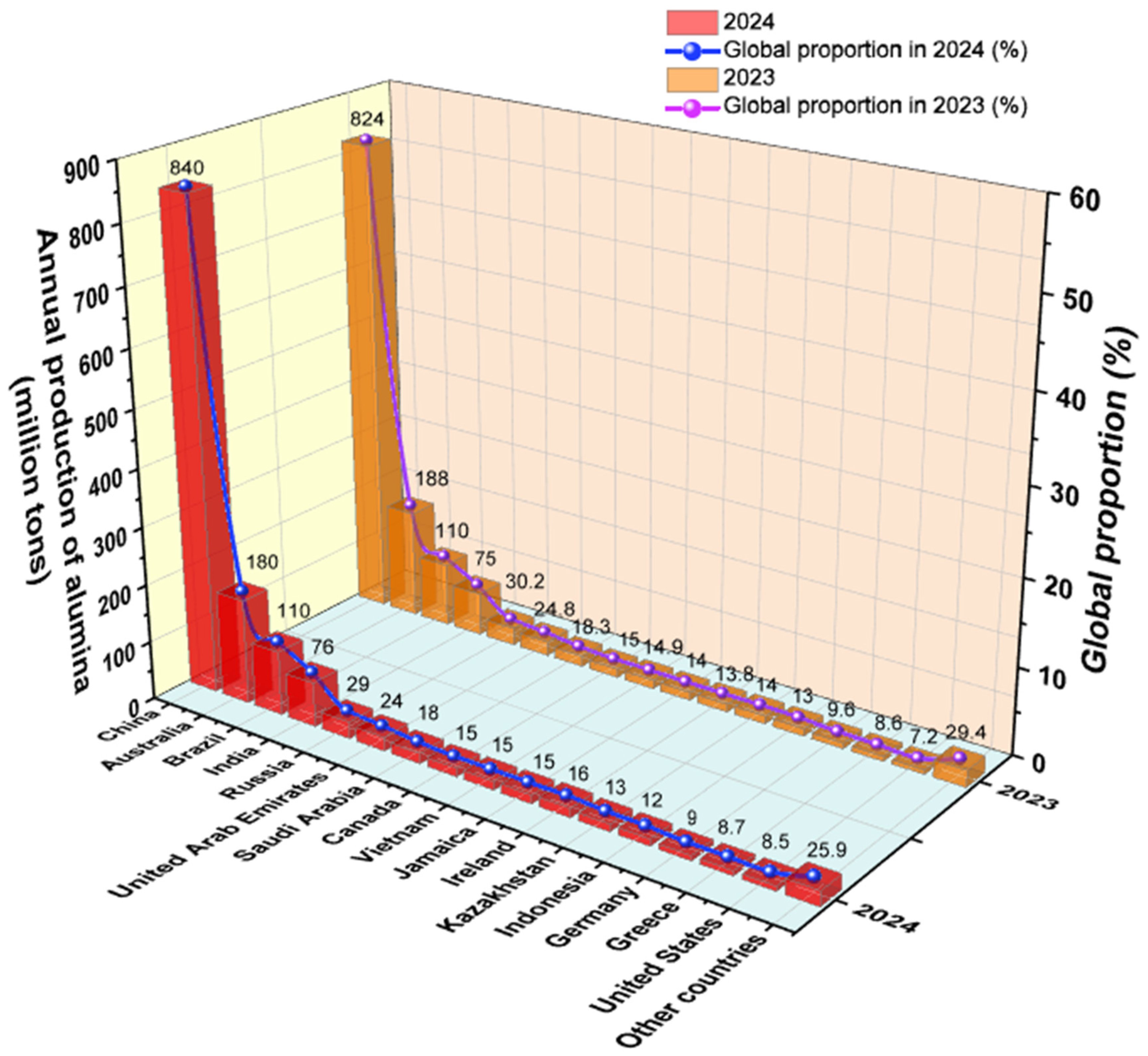
2.2. Chemical and Mineralogical Composition

| Types | Bayer | Sintering | Combined | |
|---|---|---|---|---|
| Main minerals | Boehmite, Anorthite, Calcite, Sodium aluminosilicate, Perovskite, Hematite, etc. | Boehmite, Perovskite, Calcite, Nepheline, Dicalcium silicate, Tetracalcium aluminoferrite, etc. | Dicalcium silicate, Calcite, Nepheline, Hematite or Magnetite, Tetracalcium aluminoferrite, etc. | |
| Composition (wt%) | SiO2 | 3–20 | 20–23 | 20.0–20.5 |
| CaO | 2–8 | 46–49 | 43.7–46.8 | |
| Al2O3 | 10–20 | 5–7 | 5.4–7.5 | |
| Fe2O3 | 30–60 | 7–10 | 6.1–7.5 | |
| MgO | / | 1.2–1.6 | / | |
| Na2O | 2–10 | 1.2–1.6 | 2.8–3.0 | |
| K2O | / | 0.2–0.4 | 0.5–0.7 | |
| K2O | trace-10 | 2.5–3.0 | 6.1–7.7 | |
| LOI | 10–15 | 6–10 | / | |
| Ref. | Region | Composition (wt%) | LOI | |||||||||
|---|---|---|---|---|---|---|---|---|---|---|---|---|
| SiO2 | Al2O3 | CaO | Na2O | Fe2O3 | MgO | TiO2 | P2O5 | SO3 | K2O | |||
| [32] | Shangdong, China | 21.90 | 7.96 | 38.84 | 2.32 | 6.57 | 1.60 | / | / | / | 0.41 | 17.42 |
| [33] | Shangxi, China | 29.18 | 30.01 | 15.96 | 8.22 | 8.71 | 0.89 | 2.7 | / | 2.73 | 0.8 | 8.84 |
| [34] | Guizhou, China | 25.90 | 8.5 | 38.40 | 3.10 | 5.0 | 1.50 | 4.40 | / | / | 0.20 | 11.10 |
| [35] | Australia | 12.2 | 24.39 | 4.38 | 4.9 | 30.6 | 0.26 | 3.25 | / | / | 0.63 | 11.50 |
| [36] | Brazil | 16.62 | 30.35 | 4.12 | 10.8 | 27.5 | / | 3.98 | 0.4 | 0.06 | 2.84 | 13.00 |
| [37] | India | 9.89 | 19.31 | 2.41 | 5.72 | 41.9 | / | 9.12 | 0.31 | / | / | 10.10 |
| [38] | Russia | 8.85 | 11.03 | 22.03 | 0.4 | 37.83 | 1.02 | 3.63 | 0.53 | / | 0.11 | 14.00 |
| [39] | United Arab Emirates | 6.0 | 12.2 | 1.0 | 1.5 | 57.0 | / | 8.1 | 0.5 | 0.14 | / | / |
| [40] | Saudi Arabia | 19.66 | 29.79 | 5.09 | 24.05 | 12.97 | 0.4 | 5.12 | 0.29 | 1.65 | 0.09 | 11.51 |
| [41] | Canada | 10.52 | 22.12 | 1.36 | 6.82 | 38.92 | 0.1 | 7.61 | 0.21 | 0.59 | 0.55 | 10.51 |
| [42] | Vietnam | 4.25 | 18.98 | 0.87 | 2.06 | 49.9 | / | 5.62 | / | / | 0.05 | 16.52 |
| [43] | Jamaica | 3.9 | 16.4 | 6.2 | 1.7 | 48.5 | / | 6.7 | / | / | / | 13.10 |
| [44] | Ireland | 9.65 | 23.6 | 6.4 | 5.3 | 30.4 | / | 17.85 | / | / | / | 10.10 |
| [45] | Kazakhstan | 11.19 | 10.47 | 6.33 | 7.33 | 46.95 | / | 7.9 | / | / | / | / |
| [46] | Indonesia | 14.7 | 19.22 | 2.61 | 7.54 | 38.5 | 0.37 | 2.52 | / | / | 0.3 | 12.36 |
| [47] | Germany | 5.4 | 16.2 | 5.22 | 4.0 | 44.8 | 0.13 | 12.33 | 0.45 | 0.31 | 0.27 | 10.20 |
| [48] | Greece | 5.34 | 25.09 | 9.05 | 1.99 | 42.68 | / | 4.98 | / | / | / | 10.04 |
| [47] | United States | 8.50 | 18.40 | 7.73 | 6.10 | 35.50 | 0.09 | 6.31 | 1.19 | 0.48 | 0.47 | 14.2 |
3. Utilization Pathways in Low-Carbon Construction Materials
3.1. Use in Artificial Aggregate Preparation
3.2. Use as a Cement Replacement and Geopolymers
4. Sustainability and Economic Assessment
4.1. Embodied Carbon and Carbon Emission Reduction Potential
4.2. Embodied Energy and Resource Efficiency
4.3. Material Cost
| Raw Material | Embodied Carbon [(kg CO2)/kg] | Embodied Energy (MJ/kg) | Material Cost (CNY/kg) a |
|---|---|---|---|
| OPC | 0.912 [59] | 5.5 [59] | 0.73 [59] |
| RM | 0.015 [74] | 0 [61] | 0 [61] |
| Sulphoaluminate OPC | 0.4 [62] | 2.2 [75] | 0.286 [62] |
| Gypsum | 0.00816 [76] | 0.09 [76] | 0.23 [76] |
| Coal gangue | 0.032 [77] | 0.62 [77] | 0.015 [78] |
| FA | 0.004 [61] | 0.1 [61] | 0.32 [61] |
| Calcium carbide slag | 0 [79] | 0 [79] | 0.08 [79] |
| GGBS | 0.042 [59] | 0.2 [59] | 0.46 [59] |
| Limestone powder | 0.017 [59] | 0.35 [59] | 0.348 [59] |
| River sand | 0.005 [80] | 0.081 [80] | 0.093 [80] |
| Silica sand | 0.025 [80] | 0.17 [80] | 0.18 [80] |
| Sea sand | 0 [81] | 0 [81] | 0 [81] |
| Coarse aggregate | 0.005 [61] | 0.083 [61] | 0.38 [61] |
| Sodium silicate | 0.43 [82] | 4.6 [82] | 0.79 [83] |
| Sodium hydroxide | 0.86 [82] | 10.8 [84] | 2.16 [85] |
| Water | 0.001 [61] | 0.1 [61] | 0.0064 [61] |
| Superplasticizer | 1.88 [61] | 11.47 [61] | 9.16 [61] |
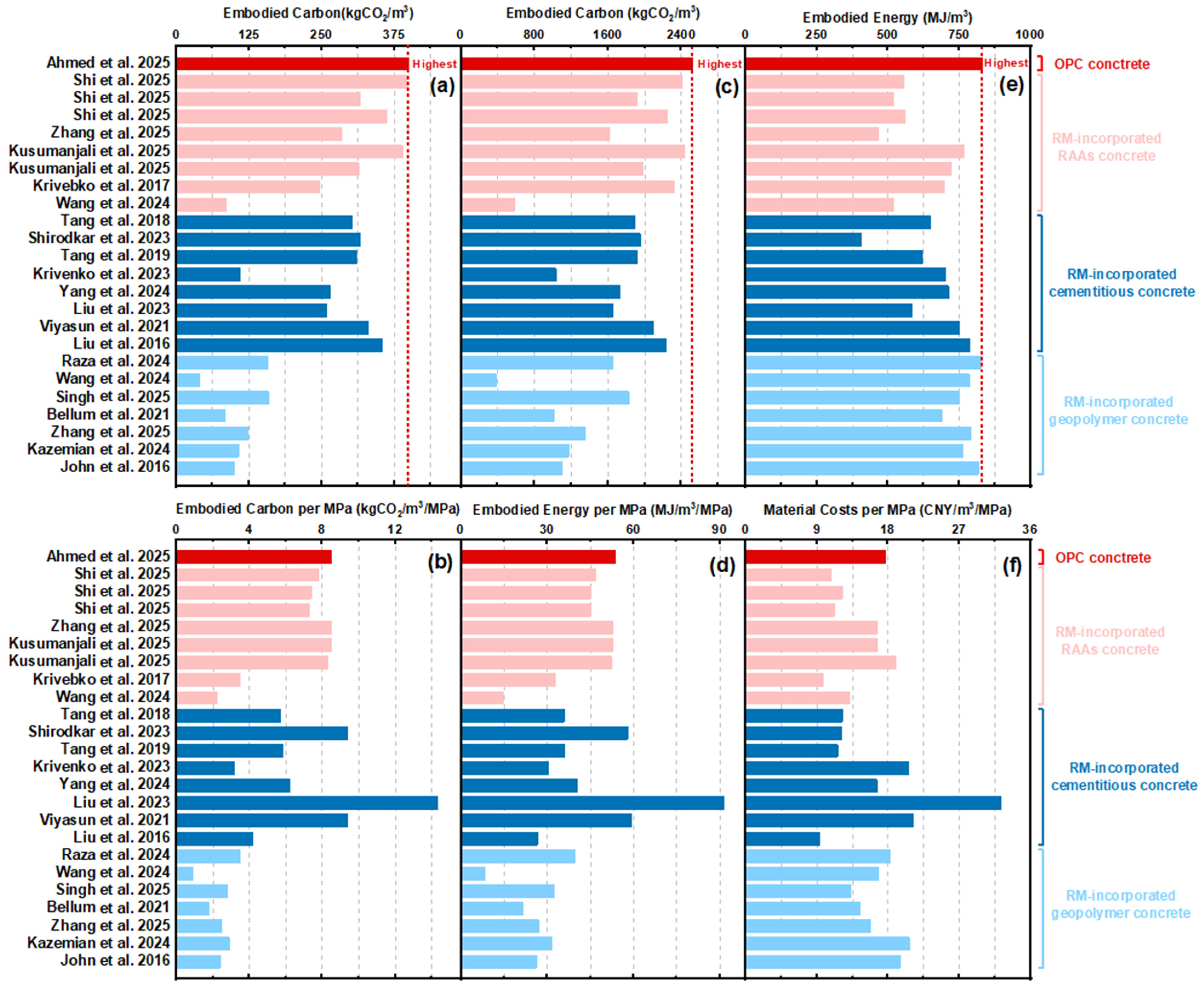
| Type | ID | Ref. | Precursors/Binder Content | Curing Regime | Compressive Strength (MPa) | Embodied Carbon (kgCO2/m3) | Embodied Energy (MJ/m3) | Material Costs (CNY/m3) | Embodied Carbon per MPa (kgCO2/m3/MPa) | Embodied Energy per MPa (MJ/m3/MPa) | Material Costs per MPa (CNY/m3/MPa) |
|---|---|---|---|---|---|---|---|---|---|---|---|
| OPC concrete | (1) | [86] | 100% OPC | RT (28d) | 46.9 | 398.8 | 2522.0 | 831.3 | 8.5 | 53.8 | 17.7 |
| RM-incorporated RAAs concrete | (1) | [68] | 90% OPC + 10% FA | RT (28d) | 51.3 | 397.8 | 2407.1 | 556.4 | 7.8 | 46.9 | 10.8 |
| (2) | [68] | 70% OPC + 20% FA | RT (28d) | 42.6 | 316.1 | 1921.1 | 519.5 | 7.4 | 45.1 | 12.2 | |
| (3) | [68] | 80% OPCt + 20% FA | 60 °C (12 h) + RT (28d) | 49.8 | 362.1 | 2243.4 | 558.9 | 7.3 | 45.0 | 11.2 | |
| (4) | [62] | 100% Sulphoaluminate OPC | RT (28d) | 54.5 | 285.0 | 1620.2 | 465.6 | 5.2 | 29.7 | 8.5 | |
| (5) | [67] | 100% OPC | RT (28d) | 46.0 | 389.2 | 2434.2 | 766.1 | 8.5 | 52.9 | 16.7 | |
| (6) | [67] | 100% OPC | RT (28d) | 37.9 | 313.6 | 1980.9 | 721.9 | 8.3 | 52.3 | 19.0 | |
| (7) | [87] | 97.5% GGBS + 3.5% OPCt | RT (28d) | 70.8 | 246.8 | 2316.8 | 696.2 | 3.5 | 32.7 | 9.8 | |
| (8) | [60] | 38% GGBS + 38% FA + 9.5% FGD + 9.5% RM + 5% OPC | RT (28d) | 39.7 | 86.3 | 579.0 | 518.6 | 2.2 | 14.6 | 13.1 | |
| RM-incorporated cementitious concrete | (1) | [51] | 59.3% OPC + 35.6% FA + 5.1% RM | RT (28d) | 53.1 | 301.9 | 1899.6 | 649.9 | 5.7 | 35.8 | 12.2 |
| (2) | [88] | 90% OPC + 10% RM | RT (28d) | 33.7 | 315.8 | 1949.6 | 407.2 | 9.4 | 57.9 | 12.1 | |
| (3) | [89] | 59.3% OPC + 40.7% RM | RT (28d) | 53.5 | 310.8 | 1919.4 | 619.5 | 5.8 | 35.9 | 11.6 | |
| (4) | [90] | 30% GGBS + 60% RM + 10% OPCt | RT (28d) | 34.0 | 109.8 | 1034.8 | 701.3 | 3.2 | 30.4 | 20.6 | |
| (5) | [91] | 70% OPC + 15% RM + 15% Coal gangue | RT (28d) | 42.8 | 265.4 | 1732.6 | 712.2 | 6.2 | 40.5 | 16.6 | |
| (6) | [35] | 90% OPC + 10% RM | RT (28d) | 18.1 | 258.9 | 1655.8 | 584.5 | 14.3 | 91.5 | 32.3 | |
| (7) | [92] | 80% OPC + 20% RM | RT (28d) | 35.3 | 330.2 | 2097.1 | 749.6 | 9.4 | 59.4 | 21.2 | |
| (8) | [93] | 53.6% OPC + 27.8% FA + 18.6% RM | RT (28d) | 83.8 | 353.2 | 2228.8 | 788.4 | 4.2 | 26.6 | 9.4 | |
| RM-incorporated geopolymer concrete | (1) | [94] | 40% RM + 45% GGBFS + 15% Gypsum | 80 °C (24 h) + RT (28d) | 45.3 | 157.6 | 1654.0 | 826.6 | 3.5 | 39.7 | 18.3 |
| (2) | [60] | 38% GGBS + 38% FA + 9.5% FGD + 9.5% RM + 5% Clinker | RT (28d) | 46.6 | 40.6 | 377.4 | 785.1 | 0.9 | 8.1 | 16.8 | |
| (3) | [37] | 30% RM + 50% FA + 20% GGBS | RT (28d) | 56.4 | 158.6 | 1827.3 | 748.9 | 2.8 | 32.4 | 13.3 | |
| (4) | [95] | 90% FA + 10% RM | RT (28d) | 47.5 | 84.0 | 1015.6 | 688.5 | 1.8 | 21.4 | 14.5 | |
| (5) | [96] | 50% RM + 50% GGBS | 60 °C (12 h) + RT (7d) | 50.0 | 124.2 | 1352.5 | 792.6 | 2.5 | 27.0 | 15.8 | |
| (6) | [97] | 60% GGBS + 25% FA + 15% RM | RT (28d) | 36.9 | 106.9 | 1171.0 | 762.7 | 2.9 | 31.7 | 20.7 | |
| (7) | [98] | 40% RM + 60% GGBS | RT (28d) | 42.0 | 100.4 | 1105.8 | 817.7 | 2.4 | 26.3 | 19.5 |

5. Conclusions
- Challenges in Direct Reuse of RM: The direct application of RM is limited by the presence of insoluble alkaline compounds, trace radioactive elements, and high Fe2O3 content. Furthermore, its chemical and mineralogical composition varies depending on the bauxite source and the specific alumina refining process. Globally, RM typically contains CaO, Al2O3, SiO2, and Fe2O3, with average contents of 9.89 wt%, 12.43 wt%, 19.11 wt%, and 33.57 wt%, respectively. These factors restrict its direct use in certain construction applications.
- Enhancement of Material Properties through RM Incorporation: Incorporating approximately 30% RM into concrete significantly densifies the microstructure and improves interfacial bonding, reducing porosity and enhancing compressive strength. RM contributes reactive oxides and acts as a filler, resulting in mechanical performance comparable to that of conventional NAs. This approach not only improves concrete performance but also provides substantial environmental benefits by reducing the extraction of natural resources.
- RM as a Supplementary Cementitious Material: RM demonstrates considerable potential as a partial replacement for OPC or as a supplementary cementitious material due to its amorphous aluminosilicate and calcium silicate phases. Desulfurized RM has been shown to accelerate hydration and improve strength in blended and supersulfated cement systems. Furthermore, carbonation curing promotes CO2 uptake, enhancing the environmental performance of RM-based cementitious materials.
- Geopolymerization of RM: RM-based geopolymers exhibit high compressive strength and effectively immobilize heavy metals. The combined effects of reactive oxides and filler action in RM significantly enhance the reactivity, mechanical performance, and sustainability of geopolymer concrete, highlighting its potential as a viable alternative to conventional cement-based materials.
- Environmental and Economic Benefits of RM-Dominated Concrete: Concretes incorporating RM as RAAs, cementitious replacements, or geopolymers demonstrate substantially lower embodied carbon, reduced embodied energy, and decreased material costs compared with conventional OPC concrete. These advantages underscore the potential of RM-based concretes to contribute to more sustainable and cost-effective construction practices.
Funding
Data Availability Statement
Conflicts of Interest
References
- Zhu, X.; Jin, Q. Exploring the carbon neutrality pathway for china’s aluminium industry: An analysis from 1950 to 2060. Appl. Energy 2025, 393, 126090. [Google Scholar] [CrossRef]
- Archambo, M.; Kawatra, S.K. Red mud: Fundamentals and new avenues for utilization. Miner. Process. Extr. Metall. Rev. 2021, 42, 427–450. [Google Scholar] [CrossRef]
- Li, Z.; Zhang, J.; Lei, Z.; Gao, M.; Sun, J.; Tong, L.; Chen, S.; Wang, Y. Designing low-carbon fly ash based geopolymer with red mud and blast furnace slag wastes: Performance, microstructure and mechanism. J. Environ. Manag. 2024, 354, 120362. [Google Scholar] [CrossRef]
- Nie, Q.; Li, H.; Yang, H.; Zhang, R.; Shang, W.; Wang, R. Enhancing properties of bayer red mud -class f fly ash geopolymer composites via ground granulated blast furnace slag and calcium carbide slag incorporation. Buildings 2025, 15, 4013. [Google Scholar] [CrossRef]
- Wu, D.; Zhang, H.; Cheng, Y.; Yu, P.; Fu, T. Research status and carbon reduction analysis of red mud in the field of building materials. Particuology 2025, 104, 313–331. [Google Scholar] [CrossRef]
- Guo, K.; Dong, H.; Zhang, J.; Zhang, L.; Li, Z. Experimental study of alkali-activated cementitious materials using thermally activated red mud: Effect of the si/al ratio on fresh and mechanical properties. Buildings 2025, 15, 565. [Google Scholar] [CrossRef]
- Qin, T.; Luo, H.; Han, R.; Zhao, Y.; Chen, L.; Liu, M.; Gui, Z.; Xing, J.; Chen, D.; He, B.-J. Red mud in combination with construction waste red bricks for the preparation of low-carbon binder materials: Design and material characterization. Buildings 2024, 14, 3982. [Google Scholar] [CrossRef]
- Molineux, C.J.; Newport, D.J.; Ayati, B.; Wang, C.; Connop, S.P.; Green, J.E. Bauxite residue (red mud) as a pulverised fuel ash substitute in the manufacture of lightweight aggregate. J. Clean. Prod. 2016, 112, 401–408. [Google Scholar] [CrossRef]
- Narendra, S.; Vasugi, V. Development of red mud based sintered artificial aggregates with various industrial wastes. Mater. Res. Express 2024, 11, 66401. [Google Scholar] [CrossRef]
- Shi, Y.; Guo, W.; Jia, Y.; Xue, C.; Qiu, Y.; Zhao, Q.; Wang, D. Preparation of non-sintered lightweight aggregate ceramsite based on red mud-carbide slag-fly ash: Strength and curing method optimization. J. Clean. Prod. 2022, 372, 133788. [Google Scholar] [CrossRef]
- Chen, S.; Xiang, Z.; Yao, N.; Liu, G.; Hou, C.; Li, Z. Effects of superabsorbent polymer on mechanical properties of cemented paste backfill and its mechanism evolution. Constr. Build. Mater. 2024, 445, 137911. [Google Scholar] [CrossRef]
- Xu, M.; Zhao, Q.; Mo, L.; Chen, B. Preparation of carbon-negative artificial lightweight aggregates by carbonating sintered red mud (srm): CO2 sequestration, microstructure and performance. J. Clean. Prod. 2024, 469, 143207. [Google Scholar] [CrossRef]
- Liu, J.; Li, M.; Jin, H.; Cheng, L.; Xing, F. The role of different ratios of biochar in the artificial lightweight cold-bonded aggregates (alcbas) containing high volume of red mud (rm). Constr. Build. Mater. 2024, 422, 135815. [Google Scholar] [CrossRef]
- Yang, J.; Wang, Z.; Luo, H.; Wang, H.; Chen, L.; Liu, M.; Tang, M.; He, B.-J. Preparation and properties of alkali-activated red mud-based artificial lightweight aggregates. Constr. Build. Mater. 2024, 449, 138304. [Google Scholar] [CrossRef]
- Xu, M.; Zhang, Y.; Xie, W.; Liu, P.; Mo, L. Alkali buffering-driven carbon sequestration and performance enhancement in artificial aggregates produced from steel slag and red mud under low concentration CO2. Constr. Build. Mater. 2025, 492, 142998. [Google Scholar] [CrossRef]
- Yang, Z.; Zhao, S.; Li, X.; Yang, S.; Zhang, K. Synergistic optimization of synthesis processes for geopolymer from solely red mud: Precursor activation, activator and water-to-binder ratio. J. Environ. Chem. Eng. 2025, 13, 118007. [Google Scholar] [CrossRef]
- Zhao, X.; Jiang, J.; Ou, X.; Chen, M.; Wei, D.; Cai, X.; Song, W.; Yu, P. Interfacial study of steel slag-red mud-based geopolymer concrete with cement concrete substrates: Bond strength and crack evolution. J. Build. Eng. 2025, 113, 114083. [Google Scholar] [CrossRef]
- Zhou, L.; Xu, X.; Wang, Q.; Park, J.; Han, Y.; Guo, L.; Chen, R. Microscopic mechanisms and durability evaluation under freeze-thaw conditions of heavy metal solidification in red mud-slag geopolymer. J. Environ. Chem. Eng. 2024, 12, 114768. [Google Scholar] [CrossRef]
- Abdel-Raheem, M.; Go, L.M.; Pin, M.A.; Marti, B.O. Uses of Red Mud as a Construction Material; AEI: Washington, DC, USA, 2017; pp. 388–399. [Google Scholar]
- Lima, M.S.; Thives, L.P.; Haritonovs, V.; Bajars, K. Red mud application in construction industry: Review of benefits and possibilities. In IOP Conference Series: Materials Science and Engineering; IOP Publishing: Bristol, UK, 2017; p. 12033. [Google Scholar]
- Aygun, B.F.; Uysal, M. Revolutionary optimization: Synthetic fiber-reinforced geopolymer mortars with metazeolite and red mud for unmatched durability and sustainability. Mater. Today Sustain. 2025, 29, 101062. [Google Scholar] [CrossRef]
- Li, Z.; Dong, H.; Wang, Y.; Men, J.; Wang, J.; Zhao, X.; Zou, S. Valorization of alkali–thermal activated red mud for high-performance geopolymer: Performance evaluation and environmental effects. Buildings 2025, 15, 2471. [Google Scholar] [CrossRef]
- Sunkpho, J.; Thangavel, P.; Kumar, D.R.; Wipulanusat, W.; Doh, J.-H. Sustainable use of red mud in concrete: Assessing mechanical strength, durability, and performance through machine learning models. Green Technol. Sustain. 2025, 4, 100283. [Google Scholar] [CrossRef]
- Kelessidis, V.C.; Tsamantaki, C.; Dalamarinis, P. Effect of pH and electrolyte on the rheology of aqueous wyoming bentonite dispersions. Appl. Clay Sci. 2007, 38, 86–96. [Google Scholar] [CrossRef]
- Liu, Y.; Lin, C.; Wu, Y. Characterization of red mud derived from a combined bayer process and bauxite calcination method. J. Hazard. Mater. 2007, 146, 255–261. [Google Scholar] [CrossRef] [PubMed]
- Song, Y.; Li, Y.; Lu, J.; Hua, L.; Gu, Y.; Yang, Y. Strengthening and toughening mechanisms of martensite-bainite microstructure in 2 gpa ultra-high strength steel during hot stamping. Sci. China-Technol. Sci. 2025, 68, 1520201. [Google Scholar] [CrossRef]
- Cui, W.; Cui, Q.; Dong, X.; Liu, J.; Song, K.; Xie, M.; Yao, X. Current research status and emerging trends in utilization of red mud resources: A study based on bibliometric network analysis. Constr. Build. Mater. 2024, 442, 137605. [Google Scholar] [CrossRef]
- Wu, P.; Wei, C.; Liu, X.; Zhang, Z.; Xue, Y.; Liu, X. Impact of hematite in red mud on hydration characteristics and environmental performance of cementitious materials. Cem. Concr. Compos. 2025, 160, 106035. [Google Scholar] [CrossRef]
- Sandu, T.; Sarbu, A.; Zavoianu, R.; Spatarelu, C.P.; Florea, M.; Bradu, C.; Mara, E.L.; Dragut, D.V.; Alexandrescu, E.; Zaharia, A.; et al. New ways to use the red mud waste as raw material for inorganic- organic hybrid hydrogels. Int. J. Miner. Process. 2017, 169, 111–118. [Google Scholar] [CrossRef]
- Feng, Y.; Yang, C. Analysis on physical and mechanical properties of red mud materials and stockpile stability after dilatation. Adv. Mater. Sci. Eng. 2018, 2018, 8784232. [Google Scholar] [CrossRef]
- He, A.P.; Hu, Z.L.; Cao, D.G.; Zeng, J.M.; Wu, B.L.; Wang, L.J. Comprehensive utilization of red mud remaining in alumina production. Adv. Mater. Res. 2014, 881–883, 663–666. [Google Scholar] [CrossRef]
- Gong, C.; Yang, N. Effect of phosphate on the hydration of alkali-activated red mud–slag cementitious material. Cem. Concr. Res. 2000, 30, 1013–1016. [Google Scholar] [CrossRef]
- Zhang, W.; Liu, X.; Wang, Y.; Li, Z.; Li, Y.; Ren, Y. Binary reaction behaviors of red mud based cementitious material: Hydration characteristics and na+ utilization. J. Hazard. Mater. 2021, 410, 124592. [Google Scholar] [CrossRef]
- Liu, W.; Yang, J.; Xiao, B. Review on treatment and utilization of bauxite residues in china. Int. J. Miner. Process. 2009, 93, 220–231. [Google Scholar] [CrossRef]
- Liu, Y.; Zhuge, Y.; Chen, X.; Duan, W.; Fan, R.; Outhred, L.; Wang, L. Micro-chemomechanical properties of red mud binder and its effect on concrete. Compos. Part B Eng. 2023, 258, 110688. [Google Scholar] [CrossRef]
- Manfroi, E.P.; Cheriaf, M.; Rocha, J.C. Microstructure, mineralogy and environmental evaluation of cementitious composites produced with red mud waste. Constr. Build. Mater. 2014, 67, 29–36. [Google Scholar] [CrossRef]
- Singh, S.; Amalkar, M.; Dutta, M.C.; Rendi, D.E. Mechanically activated red mud based geopolymer for advanced concrete applications: Synthesis and properties. Iran. J. Sci. Technol. Trans. Civ. Eng. 2025, 49, 5967–5980. [Google Scholar] [CrossRef]
- Zinoveev, D.V.; Diubanov, V.G.; Shutova, A.V.; Ziniaeva, M.V. Recycling of red muds with the extraction of metals and special additions to cement. Russ. Metall. (Metally) 2015, 2015, 19–21. [Google Scholar] [CrossRef]
- Weng, X.; Haynes, R.J.; Zhou, Y.F. Manufactured soil: A new use for bauxite residue. Sci. Total Environ. 2024, 955, 177105. [Google Scholar] [CrossRef]
- Alelweet, O.; Pavia, S.; Lei, Z. Pozzolanic and cementing activity of raw and pyro-processed saudi arabian red mud (rm) waste. Recent Prog. Mater. 2021, 3, 47. [Google Scholar] [CrossRef]
- Hairi, S.N.M.; Jameson, G.N.L.; Rogers, J.J.; Mackenzie, K.J.D. Synthesis and properties of inorganic polymers (geopolymers) derived from bayer process residue (red mud) and bauxite. J. Mater. Sci. 2015, 50, 7713–7724. [Google Scholar] [CrossRef]
- Thang, N.H.; Nhung, L.T.; Quyen, P.V.T.H.; Phong, D.T.; Khe, D.T.; Van Phuc, N. Development of heat resistant geopolymer-based materials from red mud and rice husk ash. In AIP Conference Proceedings; AIP Publishing LLC: New York, NY, USA, 2018; p. 40005. [Google Scholar]
- Gordon, J.N.; Pinnock, W.R.; Moore, M.M. A preliminary investigation of strength development in jamaican red mud composites. Cem. Concr. Compos. 1996, 18, 371–379. [Google Scholar] [CrossRef]
- Atasoy, A. An investigation on characterization and thermal analysis of the aughinish red mud. J. Therm. Anal. Calorim. 2005, 81, 357–361. [Google Scholar] [CrossRef]
- Abdulvaliyev, R.A.; Tastanov, E.A.; Gladyshev, S.V.; Beisembekova, K.O.; Akhmadiyeva, N.K. Wasteless processing of red mud by hydrogarnet technology. In Proceedings of the Bauxite Residue Valorisation and Best Practices Conference, Leuven, Belgium, 5–7 October 2015; pp. 171–177. [Google Scholar]
- Damayanti, R.; Khareunissa, H. Composition and characteristics of red mud: A case study on tayan bauxite residue from alumina processing plant at west kalimantan. Indones. Min. J. 2016, 19, 179–190. [Google Scholar]
- Snars, K.; Gilkes, R.J. Evaluation of bauxite residues (red muds) of different origins for environmental applications. Appl. Clay Sci. 2009, 46, 13–20. [Google Scholar] [CrossRef]
- Davris, P.; Balomenos, E.; Panias, D.; Paspaliaris, I. Selective leaching of rare earth elements from bauxite residue (red mud), using a functionalized hydrophobic ionic liquid. Hydrometallurgy 2016, 164, 125–135. [Google Scholar] [CrossRef]
- Colangelo, F.; Messina, F.; Di Palma, L.; Cioffi, R. Recycling of non-metallic automotive shredder residues and coal fly-ash in cold-bonded aggregates for sustainable concrete. Compos. Part B Eng. 2017, 116, 46–52. [Google Scholar] [CrossRef]
- Qian, L.-P.; Ahmad, M.R.; Lao, J.-C.; Dai, J.-G. Recycling of red mud and flue gas residues in geopolymer aggregates (GPA) for sustainable concrete. Resour. Conserv. Recycl. 2023, 191, 106893. [Google Scholar] [CrossRef]
- Tang, W.C.; Wang, Z.; Liu, Y.; Cui, H.Z. Influence of red mud on fresh and hardened properties of self-compacting concrete. Constr. Build. Mater. 2018, 178, 288–300. [Google Scholar] [CrossRef]
- Luo, Z.; Ge, M.; Liu, L.; Liu, X.; Zhang, W.; Ye, J.; Gao, M.; Yang, Y.; Zhang, M.; Liu, X. Desulfurization-modified red mud for supersulfated cement production: Insights into hydration kinetics, microstructure, and mechanical properties. Compos. Part B Eng. 2025, 297, 112340. [Google Scholar] [CrossRef]
- Shafique, M.T.; Siddique, S.; Khalid, H.R.; Adekunle, S.K.; Hanif, A.; Ahmad, S.; Al-Dulaijan, S. Investigating the impact of red mud substitution on physicochemical properties of carbonated cement composites. J. Build. Eng. 2025, 113, 114087. [Google Scholar] [CrossRef]
- Wang, S.; Zou, F.; Luo, H. An all solid waste CO2 sequestration material consist of multiple calcium silicate clinkers by carbide slag, copper tailing and red mud: Clinker crystal transformation and carbonation hardening properties. Constr. Build. Mater. 2024, 450, 138534. [Google Scholar] [CrossRef]
- Liu, P.; Yin, S.; Zheng, S.; Zhang, X.; Wang, Z.; Li, X. Study on dynamic characteristics of cement-modified red mud-based silty soil under traffic load. Soil Dyn. Earthq. Eng. 2025, 198, 109650. [Google Scholar] [CrossRef]
- Liu, Q.; Zhang, X.; Jiang, Q.; Xia, Y.; Hou, D.; Li, L. Effects of nano-Al2O3, nano-MgO and nano-Fe2O3 on the properties of cement-based 3D printing: A comparative study. J. Build. Eng. 2025, 111, 113322. [Google Scholar]
- Liu, Z.; Xia, Y.; Li, H.; Shi, Y.; Wu, J.; Yan, J.; Wang, L. Synergistic utilization of municipal solid waste incineration fly ash and red mud as low-carbon alkali-activators in one-part geopolymer. Chem. Eng. J. 2025, 522, 168140. [Google Scholar] [CrossRef]
- Ke, Y.; Liang, S.; Duan, H.; Quan, J.; Li, X.; Hou, H.; Hu, J.; Yang, Y.; Liu, X.; Zuo, Y.; et al. Insights into solidification mechanism of cr(iii) and cr(vi) in chromite ore processing residue via composite geopolymers synthesized from calcined red mud and granulated blast furnace slag. J. Hazard. Mater. 2025, 496, 139185. [Google Scholar] [CrossRef] [PubMed]
- Lao, J.-C.; Ma, R.-Y.; Xu, L.-Y.; Li, Y.; Shen, Y.-N.; Yao, J.; Wang, Y.-S.; Xie, T.-Y.; Huang, B.-T. Fly ash-dominated high-strength engineered/strain-hardening geopolymer composites (hs-egc/shgc): Influence of alkalinity and environmental assessment. J. Clean. Prod. 2024, 447, 141182. [Google Scholar] [CrossRef]
- Li, Z.; Gao, X.; Lu, D.; Dong, J. Early hydration properties and reaction kinetics of multi-composite cement pastes with supplementary cementitious materials (scms). Thermochim. Acta 2022, 709, 179157. [Google Scholar] [CrossRef]
- Xu, L.-Y.; Lao, J.-C.; Qian, L.-P.; Shi, D.-D.; Lan, J.; Xie, T.-Y.; Hou, D.; Huang, B.-T. Upcycling red mud into high-strength high-ductility engineered geopolymer composites (egc): Toward superior performance and sustainability. Compos. Part B Eng. 2025, 305, 112713. [Google Scholar] [CrossRef]
- Li, Z.; Lu, D.; Gao, X. Multi-objective optimization of gap-graded cement paste blended with supplementary cementitious materials using response surface methodology. Constr. Build. Mater. 2020, 248, 118552. [Google Scholar] [CrossRef]
- Occhicone, A.; Vukčević, M.; Bosković, I.; Mingione, S.; Ferone, C. Alkali-activated red mud and construction and demolition waste-based components: Characterization and environmental assessment. Materials 2022, 15, 1617. [Google Scholar] [CrossRef] [PubMed]
- Li, Z.; Gao, M.; Lei, Z.; Tong, L.; Sun, J.; Wang, Y.; Wang, X.; Jiang, X. Ternary cementless composite based on red mud, ultra-fine fly ash, and GGBS: Synergistic utilization and geopolymerization mechanism. Case Stud. Constr. Mater. 2023, 19, e02410. [Google Scholar] [CrossRef]
- Shobeiri, V.; Bennett, B.; Xie, T.; Visintin, P. A comprehensive assessment of the global warming potential of geopolymer concrete. J. Clean. Prod. 2021, 297, 126669. [Google Scholar] [CrossRef]
- Fang, Y.; Ahmad, M.R.; Lao, J.-C.; Qian, L.-P.; Dai, J.-G. Development of artificial geopolymer aggregates with thermal energy storage capacity. Cem. Concr. Compos. 2023, 135, 104834. [Google Scholar] [CrossRef]
- Kusumanjali, G.; Tejas, S.; Chatterjee, A.; Pasla, D. Utilization of bauxite residue as fine aggregate for the development of structural concrete: An approach towards sustainable construction materials. Case Stud. Constr. Mater. 2025, 22, e04348. [Google Scholar] [CrossRef]
- Shi, Y.; Liao, Q.; Li, J.; Zhao, Q. Preparation of red mud-calcium carbide slag-based low-carbon lightweight aggregate concrete: Mechanical performance and interfacial transition zone microstructural analysis. Constr. Build. Mater. 2025, 468, 140311. [Google Scholar] [CrossRef]
- Ghalehnovi, M.; Roshan, N.; Taghizadeh, A.; Asadi, S.E.; Ali, H.S.; de Brito, J. Production of environmentally friendly concrete incorporating bauxite residue and silica fume. J. Mater. Civ. Eng. 2022, 34, 4021423. [Google Scholar] [CrossRef]
- Ma, C.; Zhao, B.; Guo, S.; Long, G.; Xie, Y. Properties and characterization of green one-part geopolymer activated by composite activators. J. Clean. Prod. 2019, 220, 188–199. [Google Scholar] [CrossRef]
- Nikbin, I.M.; Aliaghazadeh, M.; Charkhtab, S.; Fathollahpour, A. Environmental impacts and mechanical properties of lightweight concrete containing bauxite residue (red mud). J. Clean. Prod. 2018, 172, 2683–2694. [Google Scholar] [CrossRef]
- Zhang, C.; Zhang, X.; Wu, C.; Yang, S.; Yu, T.; Wang, W.; Hu, Z. Development of high performance and low-carbon red mud based lightweight concrete: A novel strategy for transforming red mud into sustainable concrete. Constr. Build. Mater. 2025, 491, 142714. [Google Scholar] [CrossRef]
- Li, Z.; Dong, H.; Zhao, X.; Wang, K.; Gao, X. Utilisation of bayer red mud for high-performance geopolymer: Competitive roles of different activators. Case Stud. Constr. Mater. 2025, 23, e05047. [Google Scholar] [CrossRef]
- Shi, J.; Liu, Y.; Li, Z.; Lei, J.; Yin, K.; Zhang, Z.; Xie, N. Upcycling use of red mud-based solid waste in engineered cementitious composites: Properties, activation mechanism, and life-cycle assessment. J. Clean. Prod. 2024, 447, 141504. [Google Scholar] [CrossRef]
- Zhu, H.; Zhang, D.; Wang, T.; McBain, M.; Li, V.C. Intrinsic self-stressing and low carbon engineered cementitious composites (ecc) for improved sustainability. Cem. Concr. Res. 2021, 149, 106580. [Google Scholar] [CrossRef]
- Zhou, J.; Meng, S.; Zha, L. Development and mechanistic study of sustainable grouting materials for highway mined-out areas using waste glass powder, blast furnace slag, and carbide slag. Constr. Build. Mater. 2025, 486, 141978. [Google Scholar] [CrossRef]
- Qing, S.; Li, C. Mechanical properties and microstructure of low carbon high-strength engineered cementitious composites with supplementary cementitious material. Case Stud. Constr. Mater. 2025, 22, e04164. [Google Scholar] [CrossRef]
- Gao, S.; Zhao, S.; Yang, L.; Wang, Y.; Guan, X.; Zhang, H.; Luo, S. Synergistic effects of fly ash-cement slurry and CO2 mineralization on coal gangue aggregate and its concrete properties. Constr. Build. Mater. 2025, 465, 140225. [Google Scholar] [CrossRef]
- Gao, X.; Yao, X.; Yang, T.; Zhou, S.; Wei, H.; Zhang, Z. Calcium carbide residue as auxiliary activator for one-part sodium carbonate-activated slag cements: Compressive strength, phase assemblage and environmental benefits. Constr. Build. Mater. 2021, 308, 125015. [Google Scholar] [CrossRef]
- Lyu, B.-C.; Guo, L.-P.; Fei, X.-P.; Wu, J.-D.; Bian, R.-S. Preparation and properties of green high ductility geopolymer composites incorporating recycled fine brick aggregate. Cem. Concr. Compos. 2023, 139, 105054. [Google Scholar] [CrossRef]
- Lao, J.-C.; Huang, B.-T.; Xu, L.-Y.; Khan, M.; Fang, Y.; Dai, J.-G. Seawater sea-sand engineered geopolymer composites (egc) with high strength and high ductility. Cem. Concr. Compos. 2023, 138, 104998. [Google Scholar] [CrossRef]
- Zhong, H.; Zhang, M. Effect of recycled tyre polymer fibre on engineering properties of sustainable strain hardening geopolymer composites. Cem. Concr. Compos. 2021, 122, 104167. [Google Scholar] [CrossRef]
- Xu, L.-Y.; Huang, B.-T.; Lan-Ping, Q.; Dai, J.-G. Enhancing long-term tensile performance of engineered cementitious composites (ecc) using sustainable artificial geopolymer aggregates. Cem. Concr. Compos. 2022, 133, 104676. [Google Scholar] [CrossRef]
- He, S.; Ding, L.; Xiong, Z.; Spicer, R.A.; Farnsworth, A.; Valdes, P.J.; Wang, C.; Cai, F.; Wang, H.; Sun, Y.; et al. A distinctive Eocene Asian monsoon and modern biodiversity resulted from the rise of eastern Tibet. Sci. Bull. 2022, 67, 2245–2258. [Google Scholar] [CrossRef]
- McLellan, B.C.; Williams, R.P.; Lay, J.; van Riessen, A.; Corder, G.D. Costs and carbon emissions for geopolymer pastes in comparison to ordinary portland cement. J. Clean. Prod. 2011, 19, 1080–1090. [Google Scholar] [CrossRef]
- Ahmed, W.; Ye, C.; Lu, G.; Ng, S.T.; Liu, G.; Wang, Y. Low-carbon concrete comprising high-volume pozzolan and recycled aggregate: Evaluating mechanical performance, microstructure, environmental impact, and cost efficiency. J. Clean. Prod. 2025, 518, 145796. [Google Scholar] [CrossRef]
- Krivenko, P.; Kovalchuk, O.; Pasko, A.; Croymans, T.; Hult, M.; Lutter, G.; Vandevenne, N.; Schreurs, S.; Schroeyers, W. Development of alkali activated cements and concrete mixture design with high volumes of red mud. Constr. Build. Mater. 2017, 151, 819–826. [Google Scholar] [CrossRef]
- Shirodkar, V.; Patel, R.; Verma, M.; Mahate, V. An investigation into the durability of concrete using red mud as a substitute in cement. Mater. Today Proc. 2023, in press. [Google Scholar] [CrossRef]
- Tang, W.C.; Wang, Z.; Donne, S.W.; Forghani, M.; Liu, Y. Influence of red mud on mechanical and durability performance of self-compacting concrete. J. Hazard. Mater. 2019, 379, 120802. [Google Scholar] [CrossRef]
- Krivenko, P.V.; Kovalchuk, O.; Zozulynets, V. 9—Alternative binders—High volume bauxite red mud alkali activated cements and concretes. In Recycled Concrete; Woodhead Publishing: Cambridge, UK, 2023; pp. 283–308. [Google Scholar]
- Yuan, Q.; Wang, L.; Kong, D.; Han, Y.; Ren, C.; Tian, Y.; Zhu, G. Synergistic action and effect mechanism of coal gangue powder and red mud on the properties of concretes. J. Build. Eng. 2024, 98, 110999. [Google Scholar] [CrossRef]
- Viyasun, K.; Anuradha, R.; Thangapandi, K.; Kumar, D.S.; Sivakrishna, A.; Gobinath, R. Investigation on performance of red mud based concrete. Mater. Today Proc. 2021, 39, 796–799. [Google Scholar] [CrossRef]
- Liu, R.-X.; Poon, C.-S. Utilization of red mud derived from bauxite in self-compacting concrete. J. Clean. Prod. 2016, 112, 384–391. [Google Scholar] [CrossRef]
- Raza, A.; Selmi, A.; Elhadi, K.M.; Ghazouani, N.; Chen, W. Strength analysis and microstructural characterization of calcined red mud based-geopolymer concrete modified with slag and phosphogypsum. J. Mater. Res. Technol. 2024, 33, 6168–6181. [Google Scholar] [CrossRef]
- Bellum, R.R.; Venkatesh, C.; Madduru, S.R.C. Influence of red mud on performance enhancement of fly ash-based geopolymer concrete. Innov. Infrastruct. Solut. 2021, 6, 215. [Google Scholar] [CrossRef]
- Zhang, X.; Wang, Y.; Han, J.; Li, X. Creep and mechanical behavior after sustained loading of red mud-slag based geopolymer concrete at early-age. Case Stud. Constr. Mater. 2025, 23, e04980. [Google Scholar] [CrossRef]
- Kazemian, F.; Hassani, A. Exploring mechanical and fracture properties in geopolymer concrete with ternary precursor waste materials through laboratory investigations and statistical analysis. J. Build. Eng. 2024, 95, 110294. [Google Scholar] [CrossRef]
- John, E.; Chalapuram, K.M.; Shebin, P.; Mohan, H.K.; Frazana, Z. Geopolymer concrete using red mud and ggbs. Int. Res. J. Eng. Technol. 2016, 3, 5. [Google Scholar]


Disclaimer/Publisher’s Note: The statements, opinions and data contained in all publications are solely those of the individual author(s) and contributor(s) and not of MDPI and/or the editor(s). MDPI and/or the editor(s) disclaim responsibility for any injury to people or property resulting from any ideas, methods, instructions or products referred to in the content. |
© 2026 by the author. Licensee MDPI, Basel, Switzerland. This article is an open access article distributed under the terms and conditions of the Creative Commons Attribution (CC BY) license.
Share and Cite
Li, Z. Toward Low-Carbon Construction: A Review of Red Mud Utilization in Cementitious Materials and Geopolymers for Sustainability and Cost Benefits. Buildings 2026, 16, 362. https://doi.org/10.3390/buildings16020362
Li Z. Toward Low-Carbon Construction: A Review of Red Mud Utilization in Cementitious Materials and Geopolymers for Sustainability and Cost Benefits. Buildings. 2026; 16(2):362. https://doi.org/10.3390/buildings16020362
Chicago/Turabian StyleLi, Zhiping. 2026. "Toward Low-Carbon Construction: A Review of Red Mud Utilization in Cementitious Materials and Geopolymers for Sustainability and Cost Benefits" Buildings 16, no. 2: 362. https://doi.org/10.3390/buildings16020362
APA StyleLi, Z. (2026). Toward Low-Carbon Construction: A Review of Red Mud Utilization in Cementitious Materials and Geopolymers for Sustainability and Cost Benefits. Buildings, 16(2), 362. https://doi.org/10.3390/buildings16020362