Article

The Politics of Green Buildings: Neoliberal Environmental Governance and LEED’s Uneven Geography in Istanbul

1
Department of Architecture, Faculty of Art Design and Architecture, Sakarya University, Sakarya 54050, Turkey
2
Department of Painting, Faculty of Art Design and Architecture, Sakarya University, Sakarya 54050, Turkey
*
Author to whom correspondence should be addressed.
Buildings 2026, 16(2), 363; https://doi.org/10.3390/buildings16020363 (registering DOI)
Submission received: 22 November 2025 / Revised: 21 December 2025 / Accepted: 24 December 2025 / Published: 15 January 2026
(This article belongs to the Section Architectural Design, Urban Science, and Real Estate)

Abstract

This study critically examines the relationship between neoliberal environmentalism and green certification systems by quantitatively analyzing LEED-certified buildings in Istanbul. It explores how green building practices intersect with market-oriented urban environmental governance through an analysis of the spatial distribution, ownership types, access typologies, and functional uses of certified projects. The findings reveal that nearly 80% of LEED-certified buildings in Istanbul are developed by private companies, and that 88.6% of these buildings are private spaces with limited or no public access. These projects are predominantly high-end offices or residential developments, with a large share holding “Gold” certification. Correlation analysis identifies an inverse relationship between LEED project density and socioeconomic vulnerability, raising critical questions about spatial justice and equity in access to sustainable urban environments. This study contributes to the growing body of critical literature that frames urban sustainability not merely as a technocratic checklist of standards but as a normative and contested terrain in which justice, equity, and inclusivity must be placed at the center.

1. Introduction

Emerging in the aftermath of Keynesianism, neoliberalism is the most influential political and economic ideological project in global governance in the 21st century [1,2,3,4]. Neoliberal governance has operated to date in the form of diverse governance models, yet this paper focuses specifically on the ‘neoliberalization’ [5] of environmental regulation [6] as a part of a growing trend toward the neoliberalization of nature [5,7,8,9]. The promotion of market-based approaches that frame nature and ecosystems as objects of privatization, commercialization, and commodification is a fundamental characteristic of neoliberal international environmental governance [10]. This approach represents a conceptual convergence of neoliberal economic principles and environmental discourse, advancing the incorporation of ecological concerns into capitalist systems and practices, including business activities such as international trade [11]. Following Michel Foucault on the notion of ‘governmentality’ [12,13], it can be claimed that in the case of international environmental governance a green kind of governmentality and a modernization of an ecological kind are involved in the international climate regime discourse and thus, ‘rendering climate change governable’ [14] is a global governmentality per se by its focus: the issue of Earth’s carbon cycle. In this sense we strongly agree with Andrew and Cortese that disclosure practices and regulations on climate action have fostered the ideological landscape of neoliberalism [15] and since “much of the power of neoliberalism stems from the way in which it structures the wider ‘policy environment’” [3], neoliberalization of nature or climate regime in specific needs more attention than it acquires. Tracing the existing agendas reveals that neoliberalization of the climate regime led to significant changes in the normative principles for international climate change actions, the institutional structures that guarantee agreement, and the decision-making processes that influence procedural justice [16]. Thus, we think that the environmental regulation, management, and governance, which refers to the foregrounding of market mechanisms and private initiatives in solving environmental problems, needs to be closely monitored and reviewed from a critical point. In the present context of this study, Foucault’s concept of governmentality, defined as “the ensemble formed by institutions, procedures, analyses and reflections, calculations and tactics” [17], provides a critical lens for understanding green certification as a contemporary technology of governance. Rather than operating solely as a technical or environmental assessment tool, green certification embodies a neoliberal rationality that organizes conduct through standards, benchmarks, and performance metrics. In this sense, certification systems function as governmental apparatuses that “allow the exercise of a particular form of power” [17], by translating sustainability into calculable, auditable, and comparable indicators, while simultaneously producing a complex field of saviors that are, expert knowledges, rating protocols, and best-practice discourses that render urban development governable at a distance. Through this standards-based mode of governance, responsibility for environmental performance is displaced from collective political deliberation to individualized and market-oriented practices of compliance, thereby reshaping sustainability as a matter of technical optimization rather than socio-ecological justice.
One of the contentions of this paper is that these practices often ignore the dimension of public regulation and social equality [16,18,19] as well as global justice [20,21]. The ignorance is also methodical and there is an increasing body of literature emphasizing that dominant discussions about climate change are significantly depoliticized [22,23,24,25,26]. According to Ciplet and Roberts, this happens when norms are portrayed as common-sense, objective, or neutral, while considerations of equity and justice are depicted as value-laden and normative, thus being seen as ’political’ [16]. However, we believe it is the other way around. It means that depolitization itself is deliberately political. Hence it is important to address that the discussions on climate change often intentionally overlook the connection between carbon emissions, global warming, and the uneven social and environmental associations that neoliberal globalization relies on [18].
It is crucial to notice that the problem of climate crisis is not a crisis of capitalist government [27] and thus, the solution should not be sought in “a capital-centered account of globalization” [18]. In this sense, it is true that the climate crisis demands from us new forms of policy-making, yet the scope of these policies and the organizations that oversee them do not seem to be properly comprehended [15]. Such an incompetence results in what Methmann conceptualizes as “climate protection function as an empty signifier,” in so far as climate action is incorporated “into the global hegemonic order without changing the basic social structures of the world economy” [28].
Green certification systems can be understood as a concrete manifestation of this logic. Although such systems present sustainability as a measurable and standardized objective through individual scoring models, these systems frequently divorce environmental responsibility [29] from its socio-economic and political contexts. In this sense, certification does not simply measure environmental performance, but functions as a governing instrument through which sustainability is rendered legible, comparable, and investable, often abstracted from its broader socio-economic consequences. As a result, parallel with Methmann’s diagnosis, we think that green certification risks functioning as a depoliticized signifier of climate action, while neoliberal forms of urban governmentality shape contemporary adaptation policies through privatization, branding, and environmental entrepreneurship [30,31,32,33].
It is important to note that moving from “precautionary, ‘command-and control’ state regulatory solutions to private, market-based solutions” has been gradual [31]. For example, Featherstone claims that “one set of climate change politics constituted through Cop 15 was about ways of enrolling carbon into new marketized relations and extending practices of neo-liberalization” [18]. From the proposal of carbon regulation emerging “within non-elected coalitions of multinationals operating through private, not-for-profit entities” [15] to the rise in emissions trading within the UNFCCC process there operated a neoliberal logic aligned exclusively with private sector interests [34,35,36].
The environmental governance being so complex and layered, some scholars indicate that the nexus between neoliberalism, environment, and environmental politics needs urgent further analysis in critical research since not much attention has been given to the specific ways neoliberalism in the form of environmental governance per se [6,37,38]. It is partly because of the general claim that as any ideal political project, neoliberalism does not exist in a perfect form [39] and partly because there has not been an entirely linear process in the adoption of neoliberal governance in the UNFCCC during any phase [16].
By following McCarthy and Prudham, who emphasized that since environmental change and politics of environment are deeply interconnected, neoliberalism is also an environmental project, and that it is necessarily so [6], we focus on one specific example in this study in order to “unpack the complex interplay” [6] between neoliberalism, politics of environment, and environmental policies. To this end, the paper presents a critical approach to neoliberal environmental governance via urban-related policies and practices of green certification through the empirical example of the city of Istanbul (Türkiye), one of the famous and intriguing megacities of the world. To situate this analysis, the following section outlines the conceptual foundations of green building and certification, while reviewing the critical literature that informs the paper’s analytical framework.

2. On Green Building, Green Certification and Criticisms

2.1. A Brief Introduction to Green Building and Certification

The emergence of sustainable architecture and urban planning policies in the 1970s has been largely welcomed worldwide in terms of reducing environmental problems and fighting climate change. Following the early 90s [40], the concerns about climate change and environmental sustainability have led to the spread of green building practices in these fields on a global scale, specifically in the construction and real estate sectors [41,42,43,44]. It is mostly due to the fact that the construction industry is one important accomplice for environmental degradation [40,45] the building sector carries maximum potential for saving energy and reduction in pollution [46]. In this sense, in line with the international climate concern goals as well as sustainability goals, encouraging energy-efficient and environmentally friendly buildings in cities, reducing carbon emissions, and creating healthy living spaces; green buildings aim to reduce environmental burden by providing benefits such as lower carbon emissions, energy and water savings, and waste minimization [42,47,48,49]. Green building practices involve designing and building structures in a sustainable manner and making the structures resource-efficient throughout the processes from selecting the site and designing the building to the construction process, operation, maintenance, and renovation [42,47,49,50]. Not surprisingly, green building practices have developed their own rating systems to monitor the promises of minimizing resource consumption and pollution. Companies and investors are interested in green certificates due to their prestige and long-term operating cost advantages. Indeed, many companies incorporate sustainability into their corporate strategies and utilize green building assessment systems in their building projects to achieve both an environmentally friendly image and operational efficiency [42,44]. Besides the USA’s green certification system LEED, there are almost 600 green rating systems that exist worldwide [51] and developers pursue such certifications for various benefits, including tax incentives, the ability to market their projects as sustainable, and attract eco-conscious buyers [52,53,54] and tenants [50,55].
One of the most well-known certification systems developed in this context [45] is the Leadership in Energy and Environmental Design (LEED) certification launched in the USA in 1998 by the Green Building Council [56]. LEED is a “voluntary, consensus-based” rating system for assessing the sustainability and energy aspects of green buildings. Being essentially a performance standard [40], over the past 32 years, it has evolved into an internationally recognized global protocol system for managing green building projects and performance, providing a detailed framework for the design, construction, operation, and assessment of sustainable buildings. LEED rates the sustainable features of new commercial buildings in six categories, which are (a) location and siting, (b) water efficiency, (c) energy and atmosphere, (d) materials and resources, (e) indoor environmental quality, and (7) innovation and design” [55]. The number of LEED-certified green buildings has increased rapidly worldwide in recent years. Thousands of projects worldwide are adopting this certification and striving to meet sustainability criteria, including energy efficiency [57], water conservation, and healthier indoor environments.
More than 6000 new LEED-certified commercial projects will be implemented in countries outside the US by 2023, and USGBC presents this fact as proof that green building is spreading globally [56].

2.2. Criticisms

Green certification programs, such as LEED (USA) and BREEAM (UK), face criticism for failing to assess post-construction performance metrics, including carbon emissions [58]. Moreover, some studies show that real performance assessments of LEED-certified green buildings do not provide energy savings as much as they promise [59,60]. For example, a comprehensive performance assessment of 100 LEED-certified buildings in the USA, conducted by Newsham, reveals that 30% of these buildings consume more energy than conventionally designed structures [59]. Additionally, Scofield’s analysis of the same group of buildings indicates that there is no significant difference in source energy consumption between LEED-certified buildings and conventional ones [60].
Green growth and ecological modernization discourses can sometimes turn into deceptive marketing tactics called greenwashing, where real effects are exaggerated or negative aspects are hidden for the sake of an environmental friendly image [55,61]. In this sense, we take notice of environmental activists who underscore the possibility of LEEDwashing [62,63] and agree with the ecological architects Kurani and Rivard that LEED cannot be a long-term solution but should only be seen as a business and marketing tool since depending on optional programs of private parties might endanger sincere sustainability standards capable of genuinely optimistic impact in the related local communities [64].
Sustainability assessments frequently cite social equity criteria, and many certification systems rely solely on additive scoring models; thus, social and economic impacts are sidelined in practice and “references to social equity occurs in credits or criteria that are focused narrowly on social equity as an idea” [19]. In this sense, there are also growing social and legal concerns on the liability of green building constructions and green certification, including LEED [58,64,65]. Critics emphasize that environmental sustainability issues are complex and related policies do not provide equal benefits to everyone, which may even lead to unexpected negative results [66,67,68,69,70]. More importantly, a growing body of literature has emerged on how sustainability-oriented projects can exacerbate socio-spatial injustices in cities [64,71,72,73,74]. It is emphasized that urban green transformation projects [75], especially in districts where low-income citizens live [76,77] can make those areas attractive to the middle-upper classes and exclude existing residents [78] and lead to green gentrification [79,80,81,82,83,84]. These studies support the claim that sustainability policies are intertwined with neoliberal urbanization strategies such as carbon trading, the dissemination of green building certificates through voluntary market mechanisms, and private sector incentives for urban agriculture or renewable energy investments.
These critiques also provide a framework for analyzing how green certification systems can perpetuate socio-spatial inequalities when integrated into market-driven urban development processes. This point is especially relevant in Istanbul, where rapid neoliberal urban transformation, real estate speculation, and unequal access to public goods are prevalent. These concerns are particularly significant for the present study and serve as the foundation for the empirical analysis that follows.

3. Case Study Context

In the case of Istanbul, after the 2000s, the city aimed to quickly establish itself as a global finance and service center, which fostered an entrepreneurial spirit in environmental policies. For instance, some mega-projects [85,86] that have elevated Istanbul’s status on the international stage incorporate environmental sustainability into their marketing strategies. Green buildings are often addressed within the discourse of the green economy; they are adopted for their contribution to economic growth and brand value rather than their environmental benefits. Therefore, green rating systems such as LEED are in high demand for quasi environmental sustainability reasons, often individually executed for new constructions and prioritizing profit instead of public benefit. This leads to the interest in LEED in Türkiye since the late 2000s and Türkiye has become one of the leading countries in green-certified construction, such as China, Canada and India. As of the end of 2020, a total of 428 projects in Türkiye had received LEED certification. By 2023, Türkiye had become one of the top five countries in terms of LEED certifications, with an addition of 36 new LEED projects each year [56]. Accordingly, Türkiye ranks in the top ten in terms of the total number of certifications among 167 countries implementing LEED, and projects spread across 34 different cities [56].
The majority of these green-certified projects are in Istanbul. In fact, 40 of the 49 projects that received LEED certification in Türkiye in 2021 were in Istanbul. Consequently, Istanbul is definitely the center of the green building trend in the country. The city is experiencing a green building boom while also undergoing intense neoliberal urban transformation processes [87,88,89,90] as a megacity with deep socio-economic gaps. Urban transformation projects that gained momentum in Istanbul during the 2010s. A significant number of projects were realized in the form of LEED-certified “prestige” complexes, which carry a “high potential for realizing investments encourage foreign investors” [91]. They have altered the spatial texture of the city, and in some regions, the population profile, land values, and right to use green space have caused serious controversy [87,90,92,93,94]. The state also supports the concept of green building in the public sphere. For instance, several new public hospitals and schools (e.g., Kadıköy Atatürk High School, rebuilt in 2021 due to earthquake risk became the first LEED Platinum certified school in Türkiye) in Istanbul have been constructed according to LEED standards, with the goal of benefiting both the environment and society. As a result, Istanbul provides a compelling example for examining the balance between the environmental benefits and social costs associated with green buildings.

3.1. Data and Methodology

This study adopts a quantitative, descriptive, and exploratory research design to examine green building certification as a form of urban environmental governance. Rather than assessing the environmental performance of individual buildings, the analysis focuses on the socio-spatial, institutional, and governance dimensions of green certification in Istanbul. Given that LEED is the most widely adopted and institutionally dominant green certification system in Türkiye, and particularly in Istanbul, LEED-certified buildings are selected as the empirical sample through which these dynamics are examined. The methodological approach is intentionally structured to identify patterns, concentrations, and associations that illuminate how sustainability is mobilized through market-oriented mechanisms in an uneven urban context.

3.1.1. Data Sources

The primary dataset consists of all LEED-registered and LEED-certified projects located within the administrative boundaries of Istanbul between 2009 and the end of 2024. Project-level data were obtained from publicly available records provided by the United States Green Building Council (USGBC). This dataset includes information on certification year, certification level, project location, ownership type, access typology, and functional use. After data cleaning and verification, the final dataset comprised 403 projects. It is important to note that the USGBC directory lists all certified projects; however, due to confidentiality requests by project owners, 30 projects have restricted access to specific qualitative attributes (such as “Type of Project Owner Organization” and “Functional Use Type”). Nevertheless, some quantitative data essential for this study, including Certification Level, Score, Area (in square meters), and Certification Date, remain publicly available, even for these confidential projects.
To examine socio-spatial inequality, district-level social vulnerability data were incorporated from the Open Door Unit of the Istanbul Governorate, based on official statistics from 2022 to 2023. These data report the frequency of social assistance applications by district and are used as a proxy indicator of socio-economic vulnerability.

3.1.2. Data Processing and Classification

The raw USGBC dataset includes highly granular and heterogeneous classifications, particularly with respect to ownership and project typologies. For analytical clarity and comparability, variables were systematically reclassified into analytically meaningful categories aligned with the study’s theoretical framework.
Project ownership was grouped into six categories: privately held corporations, publicly traded corporations, government institutions, public educational institutions, private educational institutions, and non-profit organizations. Access typology was classified as public, semi-public, or private, based on the extent of user accessibility. Functional use was categorized into five primary groups: office, residential/housing, service sector (including education, healthcare, hospitality, and retail), industrial, and other. Projects listed as “confidential” by the USGBC, for which one or more key variables were unavailable, were retained in the dataset and coded as “unknown” to avoid artificial exclusion.
Spatial data were organized at the district level, allowing for comparative analysis across Istanbul’s heterogeneous urban geography. Descriptive statistics were generated for all variables, and distributions were visualized using tables, charts, and thematic maps.

3.1.3. Exploratory Correlation Analysis: Green Building Density and Socio-Economic Vulnerability

To investigate the socio-spatial dimensions of sustainable urban development, a district-based analytical framework was adopted instead of simple project-level coordinate mapping. LEED-certified projects were aggregated by administrative district using the USGBC dataset and cross-referenced with social assistance application statistics from the Istanbul Governorate Open Door Unit (2002–2023). Crucially, to mitigate demographic distortions, social assistance figures were normalized by district population to derive comparable vulnerability rates (applications per 1000 inhabitants).
This methodological approach facilitated an exploratory correlation analysis to test the relationship between green building density and urban poverty. The analysis further incorporated a refinement process to exclude high-leverage outliers—such as isolated mega-projects (e.g., airports, finance centers) and specific islands—that do not reflect the standard urban fabric. These spatial and statistical outputs serve to reveal the structural patterns of socio-spatial inequality and provide empirical context for discussions on urban governance.

3.1.4. Analytical Strategy

The analysis proceeds in two primary stages. First, descriptive statistics are used to trace temporal trends in LEED certification, identify dominant certification levels, and examine the distribution of projects by ownership, access type, and functional use. Second, spatial analysis is integrated with an exploratory correlation analysis. This stage maps the geographical concentration of LEED-certified buildings to reveal patterns of clustering and absence, while simultaneously examining the relationship between project density and district-level rates of social assistance applications. The analysis focuses on revealing spatial patterns relevant to questions of urban governance and socio-spatial inequality.
This correlation analysis is not intended to establish causality. Instead, it serves as an exploratory tool to identify associations between sustainability investments and socio-economic vulnerability, consistent with the study’s critical governance perspective. Deviations from general trends are examined in a contextual manner, particularly in districts influenced by mega-projects or large-scale corporate developments.

3.1.5. Methodological Scope and Limitations

The methodological design is deliberately focused on governance structures, spatial patterns, and institutional dynamics. Consequently, the study does not evaluate post-construction environmental performance, operational energy use, or lifecycle carbon emissions of certified buildings. Such assessments would require longitudinal performance data and qualitative methods, which are beyond the scope of the present research. Despite these limitations, the dataset enables a rigorous examination of how green certification operates within Istanbul’s neoliberal urban regime. By foregrounding ownership structures, access conditions, and spatial distribution, the methodology provides empirical grounding for a critical analysis of sustainability as a socially differentiated and politically mediated practice.

4. Findings

4.1. A Timeline of LEED Certification in Istanbul (2009–2024)

Looking at the distribution of LEED certifications in Istanbul over the years, it can be seen that the process, which began in 2009, gained significant momentum between 2014 and 2018 (Figure 1). While only two projects received certification in 2009 and 2010, the annual number of certifications reached 35 in 2015 and 41 in 2016 and peaked at 83 in 2018. Following this peak, fluctuations and a downward trend in the annual number of certifications are notable. For example, while 23 projects were certified in 2019, the number of projects receiving certification remained relatively stable between 28 and 39 between 2020 and 2021. Subsequently, 21 projects were completed in 2022, and only 16 in 2023. As of October 2024, 30 projects have been completed, indicating a recovery compared to the previous two years. While 210 LEED-certified projects are reported in Istanbul as of mid-2019, the current dataset of this study shows that this number has risen to 403 by the end of 2024. This increase indicates that the demand for green building certification in Istanbul has increased significantly in just five years.
The table below provides detailed information on the number of certified projects by year:
This chronological distribution shows that green building certification in Istanbul gained momentum in the mid-2010s but was then affected by economic and sectoral fluctuations. The certification boom observed in 2018 coincided with the peak of the city’s construction and real estate market [95,96]. Many large projects were completed and certified during this period, propelling Istanbul to the top ranks in international LEED rankings. Indeed, by 2020, Türkiye ranked sixth globally in total LEED-certified area. In the period after 2018, however, the economic downturn in Türkiye, the currency crisis, and the slowdown in the construction sector led to a decline in the number of annual certifications [96]. In particular, the decrease in the number of projects started after 2018 explains the low certification figures reflected in 2022–2023. However, it is also likely that the COVID-19 pandemic around 2020 slowed down the certification processes by affecting construction and delivery times. The partial increase observed in 2024 suggests that green building applications, capital-focused rental projects, and urban transformation initiatives are once again on the agenda.

4.2. LEED Rating Levels Among Certified Projects in Istanbul

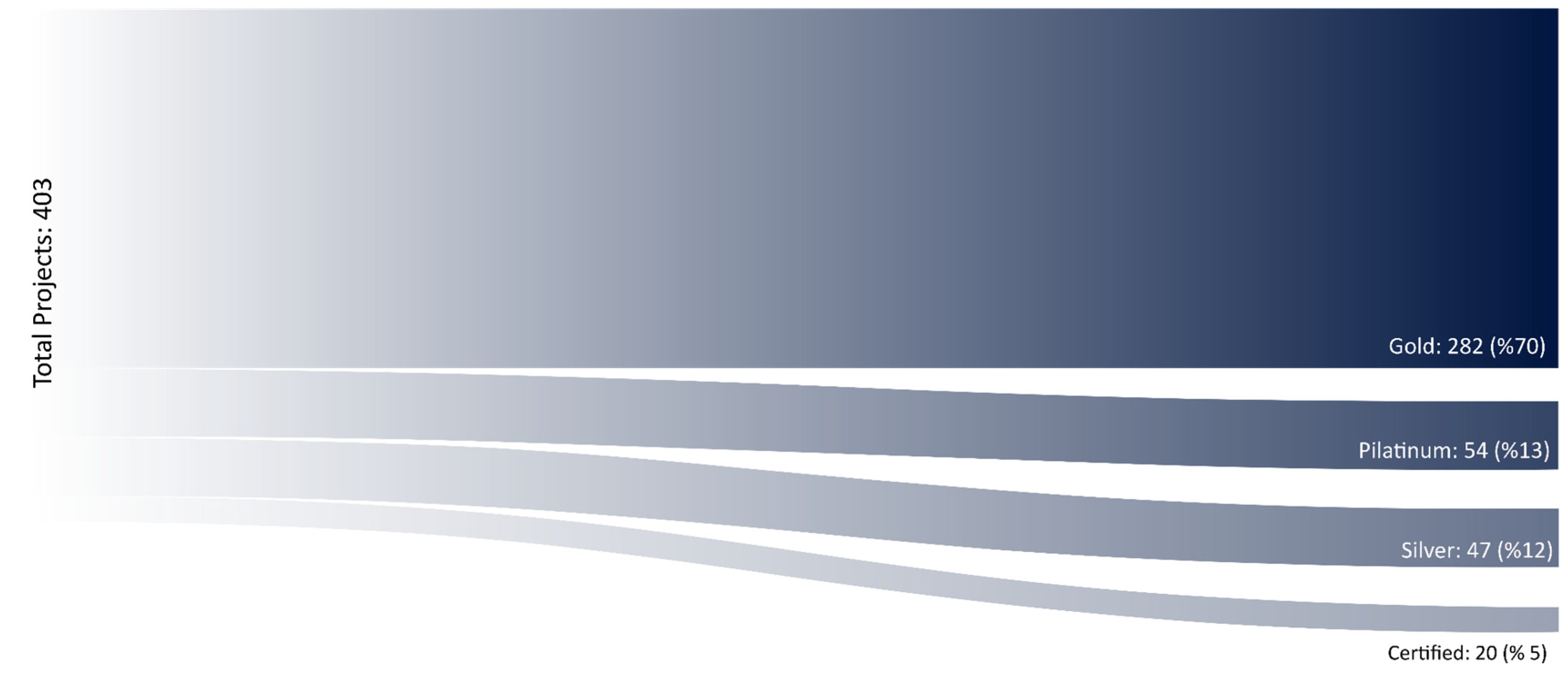
When examining the certification levels of LEED-certified projects in Istanbul, it is notable that the Gold level is predominant (Figure 2). Approximately 70% of all projects (282 projects) have received LEED Gold certification. In contrast, the percentage of projects that have achieved the highest level, Platinum certification, remains at 13% (54 projects). Projects with a Silver certification rank third at 12% (47 projects), while the proportion of projects with the lowest certification level, Certified, is relatively low at 5% (20 projects). This distribution indicates that projects in Istanbul generally achieve mid-to-high scores in the LEED evaluation system; however, relatively few projects reach the highest level, Platinum. The following table presents the number of projects by certification level:

4.3. Type of Project Owner Organization

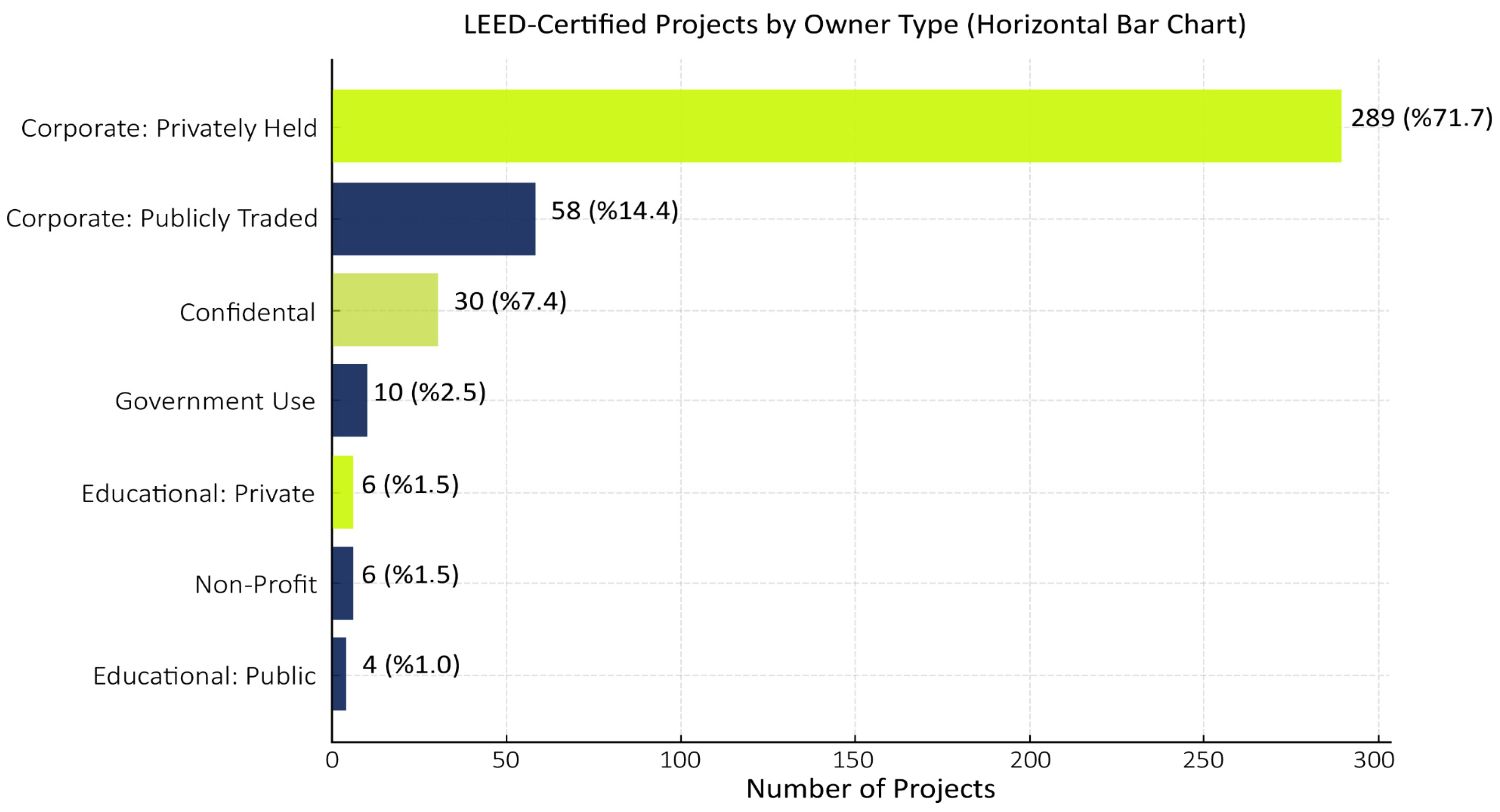
Figure 3 shows that most LEED-certified projects in Istanbul are privately owned. Approximately 86% of the total 403 projects have been carried out by for-profit actors, including private companies (both privately held and publicly traded), investment firms, and private educational institutions. Private companies alone account for a significant 71.7% share. Publicly traded companies follow with a 14.4% share. Projects owned by public institutions are limited; those carried out by government agencies and public universities account for only 3.5% of the total. Non-profit organizations and foundation universities, which focus on social benefits, comprise approximately 3% of the total. The remaining 7.4% includes projects whose ownership is undisclosed or classified as “confidential.” This distribution reveals that market actors primarily drive sustainability investments in Istanbul and that the presence of public institutions in this area is minimal.

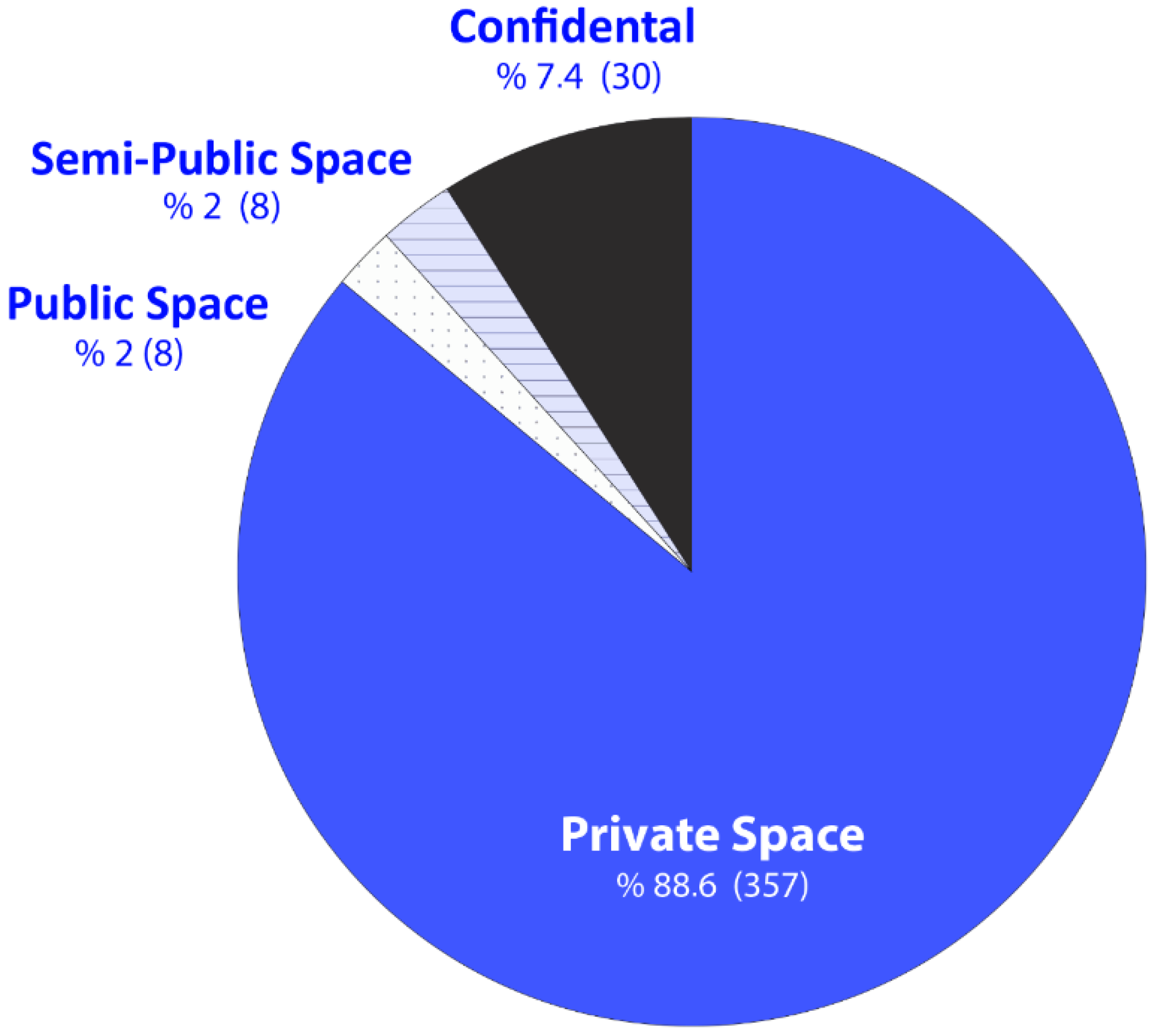
4.4. Distribution of LEED Projects by Access Type

As shown in Figure 4, the spatial distribution of LEED-certified projects in Istanbul is concentrated in private spaces. 88% of projects fall into the ‘private space’ category, which serves only specific user groups and is closed to the public. In contrast, ‘public spaces’ open to the public account for only 2% of the total. Similarly, ‘semi-public’ areas catering to a limited user group also account for 2%. The remaining 7%, for which no spatial type information is available in the records, is classified as ‘unknown.’ This distribution reveals that green building applications in Istanbul are limited mainly in terms of social access. The few projects defined as public spaces are limited to examples such as hospitals, mosques, cultural centers, and sports halls. Projects classified as semi-public include spaces such as museums, schools, guesthouses, and university campuses. Although these structures have public characteristics, they are mostly privately owned, and access is based on certain conditions, often requiring paid entry.

4.5. LEED Projects by Functional Use Type

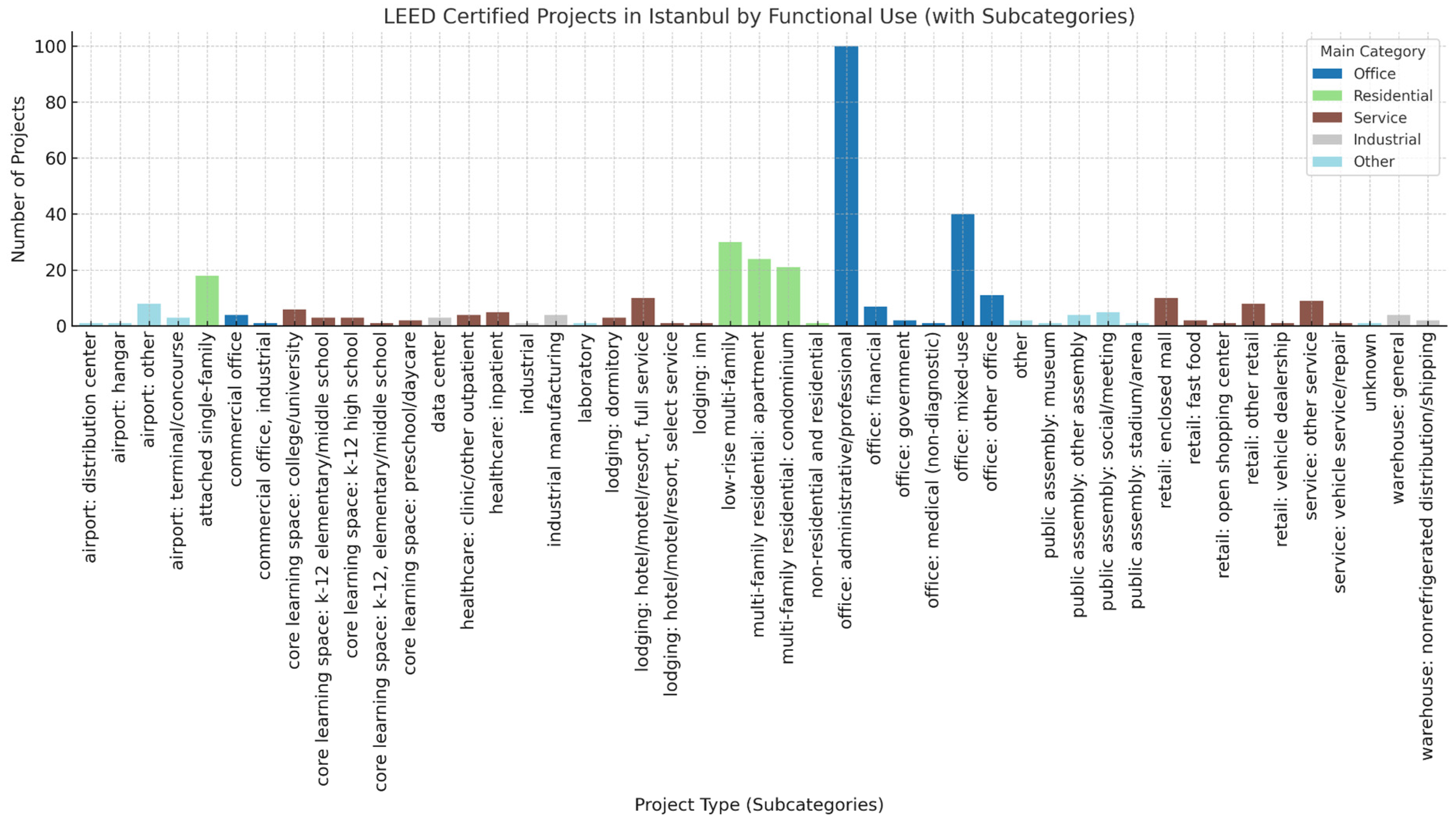
When certified projects in Istanbul are examined according to their type of functional use, it is seen that the most significant share belongs to office projects (Figure 5). Of the 403 projects, 166 (41%) are office buildings, including company headquarters, office towers, and business centers. The second largest group comprises residential (residences) and service sector buildings, roughly equal in size. There are 94 projects (23%) in the residence/residential category and 95 projects (24%) in the service category. The service sector encompasses educational buildings (such as schools and universities), healthcare facilities (including hospitals and clinics), hotels, shopping centers, and other commercial service establishments. The number of certified projects with industrial functions is relatively low, with only 14 (3%) falling into this group. This includes industrial uses such as manufacturing facilities, warehouses, and data centers. Four projects (1%) are classified under the ‘Other’ category, including structures such as laboratories and mixed-use buildings that do not fit into any specific category. Finally, 30 projects are confidential and do not have usage data available.

4.6. Exploratory Correlation Analysis: Green Building Density and Socio-Economic Vulnerability

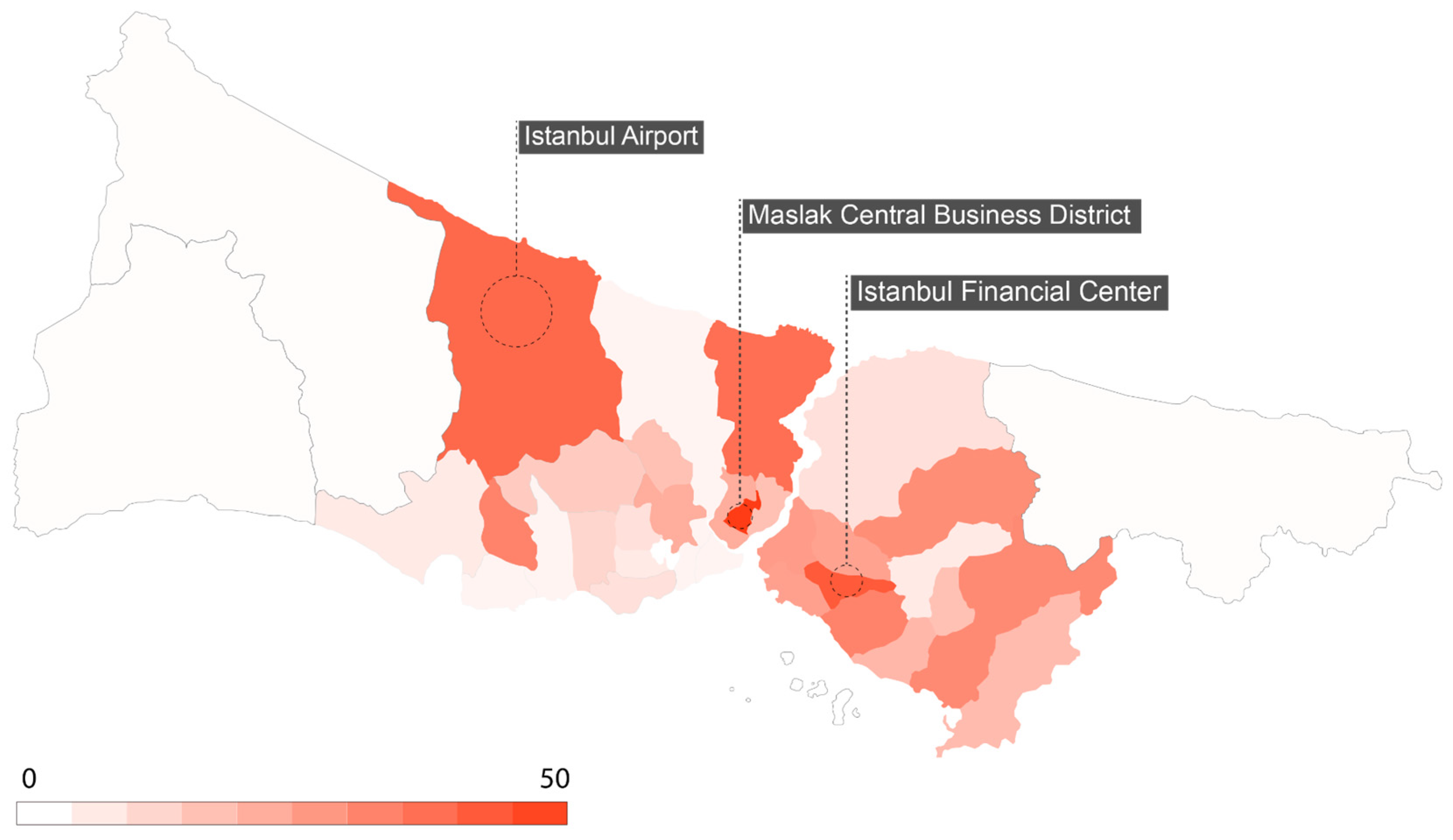
The geographical distribution of LEED-certified projects within Istanbul shows a spatially uneven concentration (Figure 6). According to the data, projects are clustered in certain city districts. Şişli leads with a total of 49 projects, followed by Ataşehir with 35 projects, Arnavutköy, home to the new airport, with 33 projects, and Sarıyer with 30 projects. These four districts account for approximately 37% of all certified projects. Esenyurt and Maltepe follow the list with 23 projects each, Pendik with 21 projects, Çekmeköy with 20 projects, Üsküdar with 17 projects, and Kadıköy with 16 projects. The remaining 19 districts outside the top 10 account for approximately 26% of all projects, comprising 106. It is essential to emphasize that 30 projects in the dataset are classified as confidential, meaning their location information remains undisclosed. In general, districts such as Şişli, Sarıyer, and Arnavutköy stand out on the European side. In contrast, districts such as Ataşehir, Üsküdar, Maltepe, Pendik, and Çekmeköy are notable on the Asian side. In contrast, the number of LEED-certified projects in the historic city center districts (such as Fatih) and the less developed northern and western suburban districts (e.g., Çatalca, Silivri, Sultanbeyli, no projects were found in the dataset) is negligible.
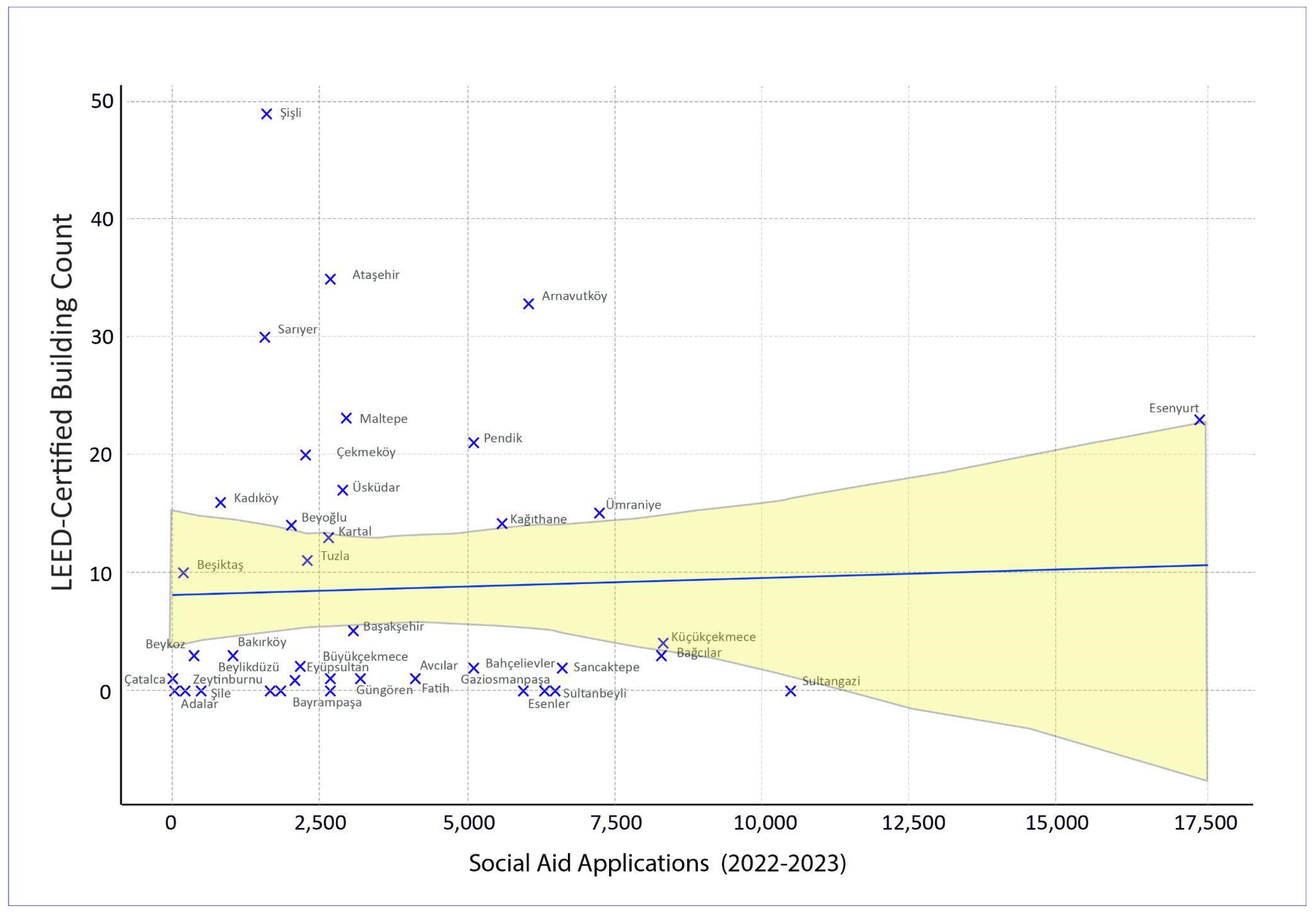
In the present study, a comprehensive correlation analysis is conducted to investigate the spatial distribution of LEED-certified buildings across various districts in Istanbul, juxtaposing this data with the frequency of social assistance applications within the same geographical areas. The data utilized in this analysis is sourced from USGBC and the Open Door Unit of the Istanbul Governorate, based on statistics from 2022 to 2023. Social assistance application figures were normalized by district population to calculate an “application rate per 1000 inhabitants” to account for demographic disparities.
Initial analysis of the full dataset (N = 39) revealed no significant linear correlation due to the presence of specific high-leverage outliers that distorted the district-level trends. Consequently, a refined analysis was conducted by excluding four districts, Arnavutköy, Esenyurt, Adalar (Princes’ Islands), and Ümraniye, whose unique characteristics do not represent the general urban fabric of Istanbul. Arnavutköy and Ümraniye were removed because their high green building counts are driven by isolated mega-projects, the Istanbul Airport and the Istanbul Finance Center (IFC), respectively, which operate as enclosed enclaves independent of the local socio-economic reality. Similarly, Esenyurt was identified as a statistical anomaly where 19 of its 23 certifications stem from a single large-scale residential development [97], creating a misleading profile of high social vulnerability co-existing with high green density. Finally, Adalar was excluded due to its disconnected geography; as an archipelago where motorized vehicle traffic is prohibited and strict conservation laws apply, it remains structurally isolated from the real estate investment cycles that drive development on the mainland.
Upon excluding these anomalies (N = 35), the analysis revealed a highly significant inverse relationship between green building density and social vulnerability. The Spearman rank correlation coefficient was calculated rs = −0.40 (p = 0.018 < 0.05), providing strong statistical confirmation that as the rate of social assistance applications increases, the number of LEED-certified projects significantly decreases.
This finding reveals a statistically significant association that aligns with arguments in the literature, suggesting that market-oriented sustainability practices may operate in a spatially selective manner, coinciding with existing socio-spatial inequalities. In Istanbul, they operate in a spatially selective manner, clustering in affluent districts such as Beşiktaş and Kadıköy while systematically bypassing socially vulnerable areas like Sultanbeyli, Sultangazi, and Esenler, thereby reinforcing existing socio-spatial inequalities (see Figure 7).
This finding highlights the complex relationship between environmental initiatives and social equity. It encourages us to reconsider how these projects are implemented by integrating socio-economic sustainability goals in order to foster a more just society. The evidence supports the argument that green investment projects do not necessarily lead to improvements in social welfare or increased happiness for the community [98].

5. Discussion

5.1. Market-Driven Sustainability: Temporal Trends of LEED Certification in Istanbul

In the discussions on environmental neoliberalism, it is reported that sustainability is detached from structural environmental transformation goals and transformed into a marketing tool compatible with capital accumulation [99]. LEED certification trends in Istanbul (Figure 1) support this observation, as the temporal fluctuations indicate that green building practices are more influenced by market-oriented dynamics and developed based on private sector investments rather than public regulations. Certification activities generally increase during periods of intense private investment and decrease significantly during economic downturns. In the absence of public policies that mandate sustainable construction, green building initiatives remain at the level of voluntary and prestige-oriented corporate strategies, which limits the continuity and spread of these practices.
Furthermore, green building practices promise lower carbon emissions, less resource consumption, and healthier living spaces [42,47,48]. However, their implementation in Istanbul is closely linked to the strategic priorities of the construction and real estate sectors. In this context, we believe that the LEED certification curve in Istanbul reflects the fragile nature of environmental neoliberalism: environmental goals are subject to market performance; sustainability only gains importance when it contributes to criteria such as reputation, competitive strength, or property value, as literature suggests [42,51].

5.2. The Dominance of Gold: LEED Certification as Strategic Branding in Istanbul

The distribution of LEED certification levels in Istanbul reveals a dominance of Gold-level certifications, while Platinum certifications are relatively rare. This trend indicates that many developers view Gold certification as an optimal balance between cost and reputational gains, allowing them to benefit from the symbolic value of sustainability without undertaking the additional financial and technical commitments required for Platinum certification. The widespread adoption of Gold-level certifications reminds us of greenwashing activities in which private certification systems often fail to deliver significant ecological benefits. Instead, they serve to legitimize routine business practices under the guise of sustainability rather than signifying a profound environmental transformation [18,22]. In Istanbul, where LEED-certified buildings are concentrated in high-value investment areas, certification models demonstrate that the ecological dimension of sustainability is subject to imperatives such as market visibility, urban competitiveness, and capital accumulation [cf. 44,55,58,64]

5.3. Green Privilege in the City: Who Benefits from LEED in Istanbul?

Neoliberal governance practices shape environmental policies through voluntary certification systems, while the public sector is largely excluded [3,10] or assumes only symbolic roles. Findings on the types of organizations that own LEED-certified buildings in Istanbul (Figure 3) suggest that the state plays a minimal role in guiding the ecological transformation of the urban environment; green building practices are adopted mainly by market actors in cities; and a capital-driven framework shapes sustainability efforts. This situation indicates that international environmental certifications such as LEED have not found sufficient ground in İstanbul, in areas potentially generating public benefit. The data displays the trend of delegating environmental policy responsibility to private actors, as defined in the neoliberal environmentalism literature [4,6]. The near absence of civil society organizations, cooperatives, or community-based initiatives as actors and the failure to integrate public buildings, such as municipal service structures, state schools, social housing, or hospitals, into international green certification systems such as LEED reveal that in Istanbul, sustainability practices are sufficiently permeated by the social fabric and, therefore, sustainability goals remain weak. The concentration of green building investments in structures with limited user profiles poses a risk that sustainability may become a privileged consumption object. In this context, a condition defined as ‘green privilege’ emerges, as environmental benefits are often limited to groups that can afford or utilize these structures [64,82].

5.4. The Unequal Access to Green Buildings

The project categories with the highest number of LEED certifications correspond to the sectors where urban rent is highest. In residential projects, certification turns environmental awareness rhetoric into a marketable component of luxury lifestyles in the housing market, thereby triggering green gentrification dynamics [80,82]. This trend supports critiques that sustainability tends to function as a ‘green facade’ or ‘sustainability shield’ [15] in the city. While certified projects offer positive examples in terms of energy efficiency and environmentally friendly design, the primary benefit of this transformation is concentrated in the living and working spaces of high-income groups. This can also be observed in the findings regarding access type, in parallel with the studies [10,64,82], which highlight that sustainability practices often contradict the principle of social inclusion, and environmental benefits tend to be limited to specific groups. This spatial inequality is also related to the aforementioned shift in responsibility from the public to the private sector, one of the fundamental dynamics of neoliberal environmental governance.

5.5. Sustainability as Prestige and the Real Estate Logic of LEED in Istanbul

Not surprisingly, the distribution of the LEED projects by functional use type also indicates that sustainability practices in Istanbul are concentrated in high-yield real estate sectors. The widespread use of LEED certification in office projects and the low proportion of industrial projects reveal that corporate actors use sustainability credentials as a prestige indicator and a brand value enhancer, and that sustainability efforts have not been sufficiently integrated into carbon-intensive sectors. Thus, the data support the literature that the certification has been transformed into a market-oriented tool for producing a green image [55,58,64].

5.6. The Socio-Spatial Segregation of LEED-Certified Buildings

The spatial distribution of LEED-certified buildings in Istanbul by district reveals how urban sustainability practices are intertwined with existing socio-economic inequalities. Districts such as Şişli, Ataşehir, and Sarıyer, which are concentrated with finance and service sectors and cater to high-income groups, host the majority of LEED-certified buildings. In contrast, such buildings are almost nonexistent in districts with low-income levels. Correlation analyses reveal a significant inverse relationship between LEED building density and the rates of social assistance applications. Literature notes that sustainability-focused projects often risk deepening spatial segregation rather than reinforcing urban justice [71,82]. The data suggest that environmental sustainability investments are spatially patterned in ways that align with existing socio-spatial segregation in Istanbul, as they often refrain from such investments in socio-economically vulnerable neighborhoods.
On the other hand, LEED density in some districts can be directly linked to large-scale new construction projects: For example, the high LEED project density seen in the Arnavutköy district is mainly due to new developments within the Istanbul Airport complex. Istanbul Airport’s terminal building is recognized as the world’s largest LEED Gold-certified building within the LEED system. In addition, the airport complex hosts LEED Gold-certified facilities such as the Ali Kuşçu Mosque, Cartier Istanbul Airport, Turkish Airlines operations center facility (OC-CT), INA DHL cargo terminal building, state guesthouse, ATC tower, İGA-Çelebi technical maintenance workshop building, İGA-Çelebi cargo warehouse building, Havaş INA station building, and Havaş INA warehouse building. These large-scale, environmentally certified structures at the airport contribute to Arnavutköy’s high LEED rating. However, it is known that these projects are located within the Terkos Basin and Northern Forests, an ecologically highly sensitive area, and along bird migration routes. Numerous scientific studies and professional organization reports have demonstrated that this mega-project has caused significant ecological damage [100,101,102,103,104]. Therefore, it is highly problematic to legitimize such projects based on sustainability principles while disregarding the environmental context in which they are constructed.
Similarly, the concentration of LEED-certified buildings in the Şişli and Sarıyer districts is mainly due to high-quality office projects in the Maslak Business Centre. Şişli is the center of trade and finance, home to luxury shopping malls such as Zorlu Center, Cevahir, and Trump Towers, along with numerous skyscrapers and corporate centers. Sarıyer (Maslak) stands out with its modern business centers, luxury residences, and high-quality shopping malls. These qualities drive the increase in the number of LEED-certified buildings in the district. The concentration in Ataşehir stems from corporate buildings constructed around the Istanbul Financial Centre. In such buildings, environmental certifications can generally be considered corporate prestige elements preferred by capital groups seeking integration with global markets, rather than as an indicator of ecological awareness. These examples show that most LEED-certified buildings are located in large-scale corporate investment areas, disconnected from the socio-economic fabric. The buildings are disconnected from their surrounding neighborhoods, relying instead on external capital flows. This trend is also noticeable in districts like Esenyurt, Maltepe, and Pendik. For instance, known for TOKİ’s mass housing projects, Esenyurt attracts low- and middle-income families and students, boasting high-density housing complexes. Conversely, shopping malls like Marmara Park, Torium AVM, Akbatı, and affordable luxury housing projects with social amenities are also concentrated in the district. This duality results in the high need for social assistance and numerous LEED-certified buildings in the same district. LEED-certified projects in Pendik and Maltepe are typically luxury residential complexes or commercial centers within the site, forming exclusive urban areas that stand apart from the district’s overall socio-economic profile. These data reveal that urban sustainability investments in Istanbul are spatially unequally distributed.
This situation possesses the potential to initiate a phenomenon referred to as green gentrification. The transformation projects that gained momentum in Istanbul in the 2010s dramatically transformed the socio-spatial structure in many areas; green building investments have become tools that maximize investment value rather than serving the public interest [87,94]. However, when sustainability policies are integrated with the goal of equitable urbanization, examples guided by public institutions can also be produced. The construction of some public hospitals (Okmeydanı Training & Research Hospital; Basaksehir Ikitelli City Hospital; Kartal Lütfi Kırdar Hospital) and school buildings (Kadikoy Municipality Bahriye Uçok Kindergarten; Atatürk Science High School) and places of worship (Ali Kuşcu Mosque; Tecnnopark 3rd Stage Buildings Mosque) in Istanbul, according to LEED standards, demonstrates that such governance is possible. However, current practices are predominantly capital-driven and reproduce spatial inequalities under the guise of an environmentally friendly image. In conclusion, the spatial distribution of LEED projects in Istanbul demonstrates how the discourse of environmental sustainability has been commodified within a neoliberal framework, prioritizing capital accumulation over social benefit.
Read through a Foucauldian lens, the results of this study indicate that green building certification functions as a form of governmentality, operating through calculative standards and benchmarking practices that guide urban development without direct regulatory intervention. By rendering sustainability visible and actionable primarily through performance metrics, certification regimes shape how environmental responsibility is enacted while leaving broader socio-institutional relations only partially exposed. The uneven spatial distribution of certified buildings and the selective opacity of certain project attributes thus point to a mode of environmental governance that privileges measurability and compliance over inclusive deliberation. This does not negate the environmental value of certification frameworks; rather, it underscores their political character as governing technologies that structure sustainability in ways compatible with existing urban power relations. Framed in this way, the findings invite a broader reflection on the limits of certification-led sustainability and set the stage for considering how alternative or complementary planning approaches might address the social and spatial inequalities that such governance mechanisms tend to reproduce.

6. Conclusions

This study examines how sustainability is unevenly institutionalized through green certification practices in Istanbul, drawing attention to the ways in which green credentials may be instrumentalized in the production of socio-spatial inequality. The dataset enables a systematic analysis of LEED-certified building projects across time, ownership structures, access typologies, functional uses, and spatial distribution. While observed clustering may partly reflect broader real-estate dynamics, the analysis treats these patterns as analytically meaningful rather than incidental, allowing for an examination of how sustainability is institutionalized, how environmental responsibility is redistributed between public and private actors, and how certification practices contribute to differentiated socio-spatial outcomes. Framed by theories of neoliberal environmental governance, the analysis identifies observable patterns and empirical tensions that emerge when voluntary green certification systems operate within uneven urban and socio-economic contexts.
The findings indicate that LEED-certified projects in Istanbul are unevenly distributed across districts and are more frequently associated with private ownership structures and restricted access regimes. These associations raise critical questions about how market-driven sustainability instruments intersect with existing real estate geographies, development intensities, and socio-economic disparities. Interpreted through a critical governmentality lens, these patterns suggest potential misalignments between environmental certification objectives and broader social equity concerns. In this respect, the findings align with critical scholarship suggesting that green certifications may function as instruments of market-oriented environmental governance, contributing to a form of quasi-environmentalism that prioritizes capital accumulation over substantive ecological and social transformation.
Regarding the broader implications of green certification, the critical literature reviewed in this study highlights how weak contextual integration between certified buildings and their surrounding urban environments may raise concerns related to the realization of the right to the city, as articulated by Harvey [105]. In the case of Istanbul, green certification can be understood as part of a wider governance rationality in which sustainability objectives are pursued through market-oriented instruments and positive environmental intentions. Where socio-economic dimensions are insufficiently integrated into green urban planning processes, such initiatives risk failing to address, and may inadvertently reproduce, existing inequalities related to access, inclusion, and urban rights.
It is important to emphasize that this study does not claim that LEED certification directly produces exclusion, reinforces inequality, or determines justice outcomes. On the contrary, the expansion of green certification systems as instruments of ecological transition, particularly in public and publicly accessible spaces, holds significant potential for advancing environmental justice. Nevertheless, both the literature and the findings suggest that in their current form, especially in megacities such as Istanbul, where governance is predominantly shaped by market forces, their capacity to contribute to climate justice and collective well-being remains limited. Without the systematic integration of social accessibility, ecological context, and distributive justice into green building metrics, such practices risk reinforcing urban elitism under the guise of sustainability.
These concerns resonate with an expanding body of interdisciplinary scholarship in urban and environmental studies that calls for the re-politicization of urban sustainability, emphasizing that it should not be understood merely as a technocratic checklist of standards, but as a normative and contested arena shaped by questions of justice, power, and inclusivity. In Foucauldian terms, these patterns can be understood as effects of governmentality, whereby sustainability standards function as techniques through which environmental responsibility is governed, normalized, and delegated within neoliberal urban contexts.
Taken together, the contribution of this paper lies in its role as a hypothesis-generating and critical diagnostic inquiry into the governmentality of sustainability through voluntary green certification. By combining descriptive spatial analysis with theory-informed interpretation, the study highlights areas in which green certification warrants closer scrutiny from a social sustainability and governance perspective. The paper should therefore be read not as an evaluation of LEED’s technical effectiveness, but as a basis for further empirical inquiry into the social dimensions of sustainability and green certification in rapidly transforming urban contexts such as Istanbul.

Author Contributions

Conceptualization, E.D. and T.A.O.; Formal analysis, E.D.; Investigation, E.D. and T.A.O.; Resources, E.D.; Data curation, E.D.; Writing—original draft, E.D. and T.A.O.; Writing—review & editing, E.D. and T.A.O.; Visualization, E.D. All authors have read and agreed to the published version of the manuscript.

Funding

This research received no external funding.

Data Availability Statement

This study is based on online data from the United States Green Building Council (USGBC) and the Open Door Unit of the Istanbul Governorate, based on statistics from 2023. USGBC data are publicly available at http://www.usgbc.org (accessed on 1 December 2025) The Open Door Unit of the Istanbul Governorate data is publicly available at http://www.istanbul.gov.tr/istanbulun-sosyo-ekonomik-analizi-2023-tamamlandi. (accessed on 1 December 2025).

Conflicts of Interest

The authors have no competing interests or funding to declare that are relevant to this article’s content.

References

  1. Laclau, E.; Mouffe, C. Hegemony and Socialist Strategy: Towards a Radical Democratic Politics; Verso: London, UK, 1985. [Google Scholar]
  2. Harvey, D. Spaces of Hope; Edinburgh University Press: Edinburgh, UK, 2000. [Google Scholar]
  3. Peck, J. Neoliberalizing states: Thin policies/hard outcomes. Prog. Hum. Geogr. 2001, 25, 445–455. [Google Scholar] [CrossRef]
  4. Heynen, N.; Robbins, P. The neoliberalization of nature: Governance, privatization, enclosure and valuation. Cap. Nat. Soc. 2005, 16, 5–8. [Google Scholar] [CrossRef]
  5. Peck, J.; Tickell, A. Neoliberalizing space. In Spaces of Neoliberalism: Urban Restructuring in Western Europe and North America; Brenner, N., Theodore, N., Eds.; Wiley-Blackwell: Oxford, UK, 2002; pp. 33–57. [Google Scholar]
  6. McCarthy, J.; Prudham, S. Neoliberal nature and the nature of neoliberalism. Geoforum 2004, 35, 275–283. [Google Scholar] [CrossRef]
  7. Mansfield, B. Neoliberalism in the Oceans: “Rationalization,” Property Rights, and the Commons Question. Geoforum 2004, 35, 313–326. [Google Scholar] [CrossRef]
  8. Castree, N. Neoliberalising nature: Processes, effects, and evaluations. Environ. Plan. A 2008, 40, 153–173. [Google Scholar] [CrossRef]
  9. Bühler, E.A.; Gautreau, P.; Oliveira, V.L. (Im)pertinences of a theoretical approach: The neoliberalization of nature. Soc. Nat. 2020, 32, 526–539. [Google Scholar]
  10. Bakker, K. Neoliberalizing nature? Market environmentalism in water supply in England and Wales. Ann. Assoc. Am. Geogr. 2005, 95, 542–565. [Google Scholar] [CrossRef]
  11. Dent, C.M. Neoliberal environmentalism, climate interventionism and the trade-climate nexus. Sustainability 2022, 14, 15804. [Google Scholar] [CrossRef]
  12. Foucault, M. Security, Territory, Population: Lectures at the Collège de France, 1977–1978; Senellart, M., Ed.; Burchell, G., Translator; Palgrave Macmillan: London, UK, 2007. [Google Scholar]
  13. Foucault, M. The Birth of Biopolitics: Lectures at the Collège de France, 1978–1979; Senellart, M., Ed.; Burchell, G., Translator; Palgrave Macmillan: New York, NY, USA, 2008. [Google Scholar]
  14. Oels, A. Rendering climate change governable: From biopower to advanced liberal government. J. Environ. Policy Plan. 2005, 7, 185–207. [Google Scholar] [CrossRef]
  15. Andrew, J.; Cortese, C. Free market environmentalism and the neoliberal project: The case of the Climate Disclosure Standards Board. Crit. Perspect. Account. 2013, 24, 397–409. [Google Scholar] [CrossRef]
  16. Ciplet, D.; Roberts, J.T. Climate change and the transition to neoliberal environmental governance. Glob. Environ. Change 2017, 46, 148–156. [Google Scholar] [CrossRef]
  17. Foucault, M. Governmentality. In The Foucault Effect: Studies in Governmentality; Burchell, G., Gordon, C., Miller, P., Eds.; Harvester Wheatsheaf: London, UK, 1991; pp. 87–104. [Google Scholar]
  18. Featherstone, D.J. The contested politics of climate change and the crisis of neo-liberalism. ACME Int. J. Crit. Geogr. 2013, 12, 44–64. [Google Scholar]
  19. Yeeles, A.; Sosalla-Bahr, K.; Ninete, J.; Wittmann, M.; Jimenez, F.; Brittin, J. Social equity in sustainability certification systems for the built environment: Understanding concepts, value, and practice implications. Environ. Res. Infrastruct. Sustain. 2023, 3, 035003. [Google Scholar] [CrossRef]
  20. Okereke, C. Global Justice and Neoliberal Environmental Governance; Routledge: New York, NY, USA, 2007. [Google Scholar]
  21. Maltais, A.; McKinnon, C. (Eds.) The Ethics of Climate Governance; Rowman & Littlefield International: London, UK, 2015. [Google Scholar]
  22. Swyngedouw, E. Apocalypse forever? Theory Cult. Soc. 2010, 27, 213–232. [Google Scholar] [CrossRef]
  23. Goeminne, G. Lost in translation: Climate denial and the return of the political. Glob. Environ. Polit. 2012, 12, 1–8. [Google Scholar] [CrossRef]
  24. Kenis, A. Post-politics contested: Why multiple voices on climate change do not equal politicization. EPC Politics Space 2019, 37, 831–848. [Google Scholar] [CrossRef]
  25. Pepermans, Y.; Maeseele, P. The politicization of climate change: Problem or solution? Wiley Interdiscip. Rev. Clim. Change 2016, 7, 478–485. [Google Scholar] [CrossRef]
  26. Yazar, M.; Daloglu Cetinkaya, I.; Baykal Fide, E.; Haarstad, H. Diffusion of global climate policy: National depoliticization, local repoliticization in Turkey. Glob. Environ. Change 2023, 81, 102699. [Google Scholar] [CrossRef]
  27. Chakrabarty, D. The climate of history: Four theses. Crit. Inq. 2009, 35, 197–222. [Google Scholar] [CrossRef]
  28. Methmann, C.P. “Climate protection” as empty signifier: A discourse-theoretical perspective on climate mainstreaming in world politics. Millennium 2010, 39, 345–372. [Google Scholar]
  29. Cai, S.; Gou, Z. Are Green Spaces More Available and Accessible to Green Building Users? A Comparative Study in Texas. Land 2023, 12, 226. [Google Scholar] [CrossRef]
  30. Beder, S. Research note—Neoliberal think tanks and free market environmentalism. Environ. Politics 2001, 10, 128–133. [Google Scholar] [CrossRef]
  31. Gareau, B.J. From Precaution to Profit: Contemporary Challenges to Environmental Protection in the Montreal Protocol; Yale University Press: New Haven, CT, USA, 2013. [Google Scholar]
  32. Whitehead, M. Neoliberal urban environmentalism and the adaptive city: Towards a critical urban theory of climate change. Urban Stud. 2013, 50, 1348–1367. [Google Scholar] [CrossRef]
  33. Qian, H.; Wu, J.; Zheng, S. Entrepreneurship, sustainability, and urban development. Small Bus. Econ. 2024, 62, 463–469. [Google Scholar] [CrossRef]
  34. Newell, P.; Paterson, M. A climate for business: Global warming, the state and capital. Rev. Int. Political Econ. 1998, 5, 679–703. [Google Scholar] [CrossRef]
  35. Lohmann, L. Neoliberalism and the calculable world: The rise of carbon trading. In Upsetting the Offset: The Political Economy of Carbon Markets; Böhm, S., Ed.; Mayfly: London, UK, 2009; pp. 25–40. [Google Scholar]
  36. Turhan, E.; Gündoğan, A.C. Price and prejudice: The politics of carbon market establishment in Turkey. Turk. Stud. 2019, 20, 512–540. [Google Scholar] [CrossRef]
  37. Stoner, A. Things are getting worse on our way to catastrophe: Neoliberal environmentalism, repressive desublimation, and the autonomous ecoconsumer. Crit. Sociol. 2020, 47, 491–506. [Google Scholar] [CrossRef]
  38. Fremstad, A.; Paul, M. Neoliberalism and climate change: How the free-market myth has prevented climate action. Ecol. Econ. 2022, 197, 107353. [Google Scholar] [CrossRef]
  39. Brenner, N.; Peck, J.; Theodore, N. Variegated neoliberalization: Geographies, modalities, pathways. Glob. Netw. 2010, 10, 182–222. [Google Scholar] [CrossRef]
  40. Yudelson, J. Green Building A to Z: Understanding the Language of Green Building; New Society Publishers: Gabriola Island, BC, Canada, 2007. [Google Scholar]
  41. Berardi, U. Sustainability assessment in the construction sector: Rating systems and rated buildings. Sustain. Dev. 2012, 20, 411–424. [Google Scholar] [CrossRef]
  42. Kibert, C.J. Green buildings: An overview of progress. Fl. St. Univ. J. Land Use Environ. Law 2018, 19, 491–502. [Google Scholar]
  43. Xiaosen, H.; Yu, A. Analytical review of green building development studies. J. Green Build. 2017, 12, 130–148. [Google Scholar] [CrossRef]
  44. Leskinen, N.; Vimpari, J.; Junnila, S. A review of the impact of green building certification on the cash flows and values of commercial properties. Sustainability 2020, 12, 2729. [Google Scholar] [CrossRef]
  45. Wong, J.K.W.; Kuan, K.L. Implementing BEAM Plus for BIM-based sustainability analysis. Autom. Constr. 2014, 44, 163–175. [Google Scholar] [CrossRef]
  46. IPCC. Climate Change 2007: The Physical Science Basis: Contribution of Working Group I to the Fourth Assessment Report of the Intergovernmental Panel on Climate Change; Solomon, S., Qin, D., Manning, M., Chen, Z., Marquis, M., Averyt, K., Tignor, M.M.B., Miller, H.L., Eds.; Cambridge University Press: Cambridge, UK; New York, NY, USA, 2007; 996p; Available online: https://www.ipcc.ch/report/ar4/wg1/ (accessed on 23 December 2025).
  47. Circo, C.J. Using mandates and incentives to promote sustainable construction and green building projects in the private sector: A call. Penn State Law Rev. 2007, 112, 731–782. [Google Scholar]
  48. Laustsen, J. Energy Efficiency Requirements in Building Codes: Energy Efficiency Policies for New Buildings; International Energy Agency (IEA): Paris, France, 2008. [Google Scholar]
  49. Olabi, A.; Shehata, N.; Issa, U.; Mohamed, O.; Mahmoud, M.; Abdelkareem, M.; Abdelzaher, M. The role of green buildings in achieving the Sustainable Development Goals. Int. J. Thermofluids 2025, 25, 101002. [Google Scholar] [CrossRef]
  50. Olubunmi, O.A.; Xia, P.B.; Skitmore, M. Green building incentives: A review. Renew. Sustain. Energy Rev. 2016, 59, 1611–1621. [Google Scholar] [CrossRef]
  51. Doan, D.T.; Ghaffarianhoseini, A.; Naismith, N.; Zhang, T.; Ghaffarianhoseini, A.; Tookey, J. A critical comparison of green building rating systems. Build. Environ. 2017, 123, 243–260. [Google Scholar] [CrossRef]
  52. Alam, Z.; Hossain, M.; Wang, L. The economic and cultural motives of green price premium. Br. Account. Rev. 2025, 57, 101698. [Google Scholar] [CrossRef]
  53. Xu, Z. The double-edged sword effect of green certification: Empirical evidence from an online travel platform. J. Hosp. Tour. Manag. 2025, 65, 101342. [Google Scholar] [CrossRef]
  54. Anand, Y.; Davidson, B.G.J.; George, J.P.; Muttungal, P.V.E. Eco-conscious consumers’ green real estate decisions in India: The role of social commerce. Prop. Manag. 2025, 43, 517–539. [Google Scholar] [CrossRef]
  55. Fletcher, L.K. Green construction costs and benefits: Is national regulation warranted? Nat. Resour. Environ. 2009, 24, 18–24. [Google Scholar]
  56. USGBC. Top 10 Countries for LEED National Profile: Turkey. Available online: https://www.usgbc.org/articles/top-10-countries-leed-national-profile-turkey (accessed on 1 August 2025).
  57. Pushkar, S. Impact of “Optimize Energy Performance” Credit Achievement on the Compensation Strategy of Leadership in Energy and Environmental Design for Existing Buildings Gold-Certified Office Space Projects in Madrid and Barcelona, Spain. Buildings 2023, 13, 2656. [Google Scholar] [CrossRef]
  58. Bergquist, A.-K.; Jones, G. Private regulation, institutional entrepreneurship and climate change: A business history perspective. In Harvard Business School Working Paper No. 24-041; Harvard Business School: Boston, MA, USA, 2024. [Google Scholar]
  59. Newsham, G.R.; Mancini, S.; Birt, B.J. Do LEED-certified buildings save energy? Yes, but…. Energy Build. 2009, 41, 897–905. [Google Scholar] [CrossRef]
  60. Scofield, J.H. Do LEED-certified buildings save energy? Not really…. Energy Build. 2009, 41, 1386–1390. [Google Scholar] [CrossRef]
  61. Marciniak, A. Greenwashing as an example of ecological marketing: A misleading practice. Comp. Econ. Res. Cent. East. Eur. 2009, 12, 49–59. [Google Scholar] [CrossRef]
  62. Jones, G. Profits and Sustainability. A History of Green Entrepreneurship; Oxford University Press: Oxford, 2017. [Google Scholar]
  63. Bowers, B.; Boyd, N.; McGoun, E. Greenbacks, green banks, and greenwashing via LEED: Assessing banks’ performance in sustainable construction. Sustainability 2020, 13, 208. [Google Scholar] [CrossRef]
  64. Kurani, D.; Rivard, N. The limits of LEED. In Architecture and Sustainability: Critical Perspectives for Integrated Design—Generating Sustainability Concepts from Architectural Perspectives; Ahmed, Z.K., Allacker, K., Eds.; Acco Publishing: Leuven, Belgium, 2015; pp. 161–166. [Google Scholar]
  65. Sulkowski, A.J. LEEDigation: The risks, why we don’t see more, and practical guidance related to green building contracts. Real Estate Law J. 2010, 39, 192–205. [Google Scholar]
  66. Edwards, B. Rough Guide to Sustainability, 3rd ed.; RIBA Publishing: London, UK, 2010. [Google Scholar]
  67. Beckerman, W. Sustainable development: Is it a useful concept? Environ. Values 1994, 3, 191–209. [Google Scholar] [CrossRef]
  68. Draper, J.; McKinnon, C. The ethics of climate-induced community displacement and resettlement. Wiley Interdiscip. Rev. Clim. Change 2018, 9, e519. [Google Scholar] [CrossRef]
  69. Gibbons, L.V. Regenerative—The new sustainable? Sustainability 2020, 12, 5483. [Google Scholar] [CrossRef]
  70. Wagner, T.; Lutz, R.J.; Weitz, B.A. Corporate hypocrisy: Overcoming the threat of inconsistent corporate social responsibility perceptions. J. Mark. 2009, 73, 77–91. [Google Scholar] [CrossRef]
  71. Suárez, A.M.; López-Mejuto, U.; García Docampo, M.; Varela-García, F.A. Sustainability, spatial justice and social cohesion in city planning: What does a case study on urban renaturalisation teach us? Urban Sci. 2025, 9, 94. [Google Scholar] [CrossRef]
  72. Russo, A. Renaturing for urban wellbeing: A socioecological perspective on green space quality, accessibility, and inclusivity. Sustainability 2024, 16, 5751. [Google Scholar] [CrossRef]
  73. Venter, Z.; Figari, H.; Krange, O.; Gundersen, V. Environmental justice in a very green city: Spatial inequality in exposure to urban nature, air pollution, and heat in Oslo, Norway. Sci. Total Environ. 2023, 858, 160193. [Google Scholar] [CrossRef]
  74. Ali, L.; Haase, A.; Heiland, S. Gentrification through green regeneration? Analyzing the interaction between inner-city green space development and neighborhood change in the context of regrowth: The case of Lene-Voigt-Park in Leipzig, Eastern Germany. Land 2020, 9, 24. [Google Scholar] [CrossRef]
  75. Anguelovski, I.; Connolly, J.; Brand, A.L. From landscapes of utopia to the margins of the green urban life: For whom is the new green city? City 2018, 22, 417–436. [Google Scholar] [CrossRef]
  76. Dale, A.; Newman, L. Sustainable development for some: Green urban development and affordability. Local Environ. 2009, 14, 669–681. [Google Scholar] [CrossRef]
  77. García Lamarca, M.; Anguelovski, I.; Cole, H.V.S.; Connolly, J.; Argüelles, L.; Baró, F.; Loveless, S.; Pérez del Pulgar, C.; Shokry, G. Urban green boosterism and city affordability: For whom is the ‘branded’ green city? Urban Stud. 2021, 58, 90–112. [Google Scholar] [CrossRef]
  78. Łaszkiewicz, E. Towards green gentrification? The interplay between residential change, the housing market, and park proximity. Hous. Stud. 2024, 39, 2280–2299. [Google Scholar] [CrossRef]
  79. Gould, K.A.; Lewis, T.L. Green Gentrification: Urban Sustainability and the Struggle for Environmental Justice; Routledge: London, UK, 2016. [Google Scholar]
  80. Cole, H.V.; García-Lamarca, M.; Connolly, J.J.; Anguelovski, I. Are green cities healthy and equitable? Unpacking the relationship between health, green space, and gentrification. J. Epidemiol. Community Health 2017, 71, 1118–1121. [Google Scholar] [CrossRef]
  81. Rigolon, A.; Németh, J. Green gentrification or ‘just green enough’: Do park location, size and function affect whether a place gentrifies or not? Urban Stud. 2019, 57, 402–420. [Google Scholar] [CrossRef]
  82. Anguelovski, I.; Connolly, J.J.T.; Pearsall, H.; Shokry, G.; Checker, M.; Maantay, J.; Gould, K.; Lewis, T.; Marolo, A.; Roberts, J.T. Why green “climate gentrification” threatens poor and vulnerable populations. Proc. Natl. Acad. Sci. USA 2019, 116, 26139–26143. [Google Scholar] [CrossRef]
  83. Anguelovski, I.; Connolly, J.J.T.; Cole, H.; Garcia-Lamarca, M.; Triguero-Mas, M.; Baró, F.; Martin, N.; Conesa, D.; Shokry, G.; del Pulgar, C.P.; et al. Green gentrification in European and North American cities. Nat. Commun. 2022, 13, 31572. [Google Scholar] [CrossRef] [PubMed]
  84. Lewartowska, E.; Anguelovski, I.; Oscilowicz, E.; Triguero-Mas, M.; Cole, H.; Shokry, G.; Pérez-del-Pulgar, C.; Connolly, J.J. Racial inequity in green infrastructure and gentrification: Challenging compounded environmental racisms in the green city. Int. J. Urban Reg. Res. 2024, 48, 294–322. [Google Scholar] [CrossRef]
  85. Dogan, E.; Stupar, A. The limits of growth: A case study of three mega-projects in Istanbul. Cities 2017, 60, 281–288. [Google Scholar] [CrossRef]
  86. Lovering, J.; Turkmen, H. Bulldozer neo-liberalism in Istanbul: The state-led construction of property markets and the displacement of the urban poor. Int. Plan. Stud. 2011, 16, 73–96. [Google Scholar] [CrossRef]
  87. Enlil, Z.M. The neoliberal agenda and the changing urban form of Istanbul. Int. Plan. Stud. 2011, 16, 5–25. [Google Scholar] [CrossRef]
  88. Türkün, A. Urban regeneration and hegemonic power relationships. Int. Plan. Stud. 2011, 16, 61–72. [Google Scholar] [CrossRef]
  89. Güzey, Ö. The last round in restructuring the city: Urban regeneration becomes Turkey’s state policy of disaster prevention. Cities 2016, 50, 40–53. [Google Scholar] [CrossRef]
  90. Cengiz, S.; Atmiş, E.; Gormüş, S. The impact of economic growth oriented development policies on landscape changes in Istanbul Province in Turkey. Land Use Policy 2019, 87, 104086. [Google Scholar] [CrossRef]
  91. Istil, S.A.; Górecki, J.; Diemer, A. Study on Certification Criteria of Building Energy and Environmental Performance in the Context of Achieving Climate Neutrality. Sustainability 2023, 15, 2770. [Google Scholar] [CrossRef]
  92. Balaban, O. The negative effects of the construction boom on urban planning and environment in Turkey: Unraveling the role of the public sector. Habitat Int. 2012, 36, 26–35. [Google Scholar] [CrossRef]
  93. Pala, Ö.N.; Acar, S. Assessing a greening tool through the lens of green gentrification: Socio-spatial change around the Nation’s Gardens of Istanbul. Cities 2024, 150, 105023. [Google Scholar] [CrossRef]
  94. Boyalı, A.; Baykan, A. An analysis of Validebağ Grove from the lens of urban political ecology. Manisa Celal Bayar Univ. J. Soc. Sci. 2024, 22, 387–410. [Google Scholar] [CrossRef]
  95. Yamak, N.; Koçak, S.; Samut, S. Türkiye’de inşaat sektörünün kısa ve uzun dönem dinamikleri. J. Econ. Manag. Res. 2018, 7, 96–113. [Google Scholar]
  96. Turkish Statistical Institute. Construction Turnover and Production Indices, 2004–2024. Available online: http://www.tuik.gov.tr (accessed on 1 August 2025).
  97. CM Mimarlık. (n.d.). Tekfen Hepİstanbul. Available online: https://cmmimarlik.com.tr/proje/tekfen-hepistanbul/ (accessed on 1 December 2025).
  98. Rui, J. Green disparities, happiness elusive: Decoding the spatial mismatch between green equity and happiness from vulnerable perspectives. Cities 2025, 163, 106063. [Google Scholar] [CrossRef]
  99. Heynen, N.; McCarthy, J.; Prudham, W.S.; Robbins, P. (Eds.) Neoliberal Environments: False Promises and Unnatural Consequences; Routledge: London, UK, 2007. [Google Scholar]
  100. TMMOB. 3. Havalimanı Teknik Raporu; Türk Mühendis ve Mimar Odaları Birliği, İstanbul İl Koordinasyon Kurulu: İstanbul, Türkiye, 2014. [Google Scholar]
  101. TMMOB. Kanal İstanbul ve Yenişehir Rezerv Alanı Teknik İnceleme Raporu; Türk Mühendis ve Mimar Odaları Birliği, Çevre Mühendisleri Odası İstanbul Şubesi: İstanbul, Türkiye, 2018. [Google Scholar]
  102. İstanbul Planlama Ajansı (İPA). Kanal İstanbul Çalıştay Raporu (Canal Istanbul Workshop Report); iPA Yayınları: İstanbul, Türkiye, 2020; Available online: https://ipa.istanbul/yayinlarimiz/genel/kanal-istanbul-calistayi-raporu/ (accessed on 25 July 2025).
  103. Giritlioglu, P.P. From mega-projects and environmental sustainability perspective: An artificial waterway project overview—Canal Istanbul Project. In Understanding Environmental Policy After COVID-19; Peter Lang: Berlin, Germany, 2022. [Google Scholar]
  104. Aysev, E. Urbanization processes of Northern Istanbul in the 2000s: Yavuz Sultan Selim Bridge and the Northern Marmara Highway. METU J. Fac. Archit. 2022, 39, 137–164. [Google Scholar]
  105. Harvey, D. The right to the city. New Left Rev. 2008, 53, 23–39. [Google Scholar] [CrossRef]
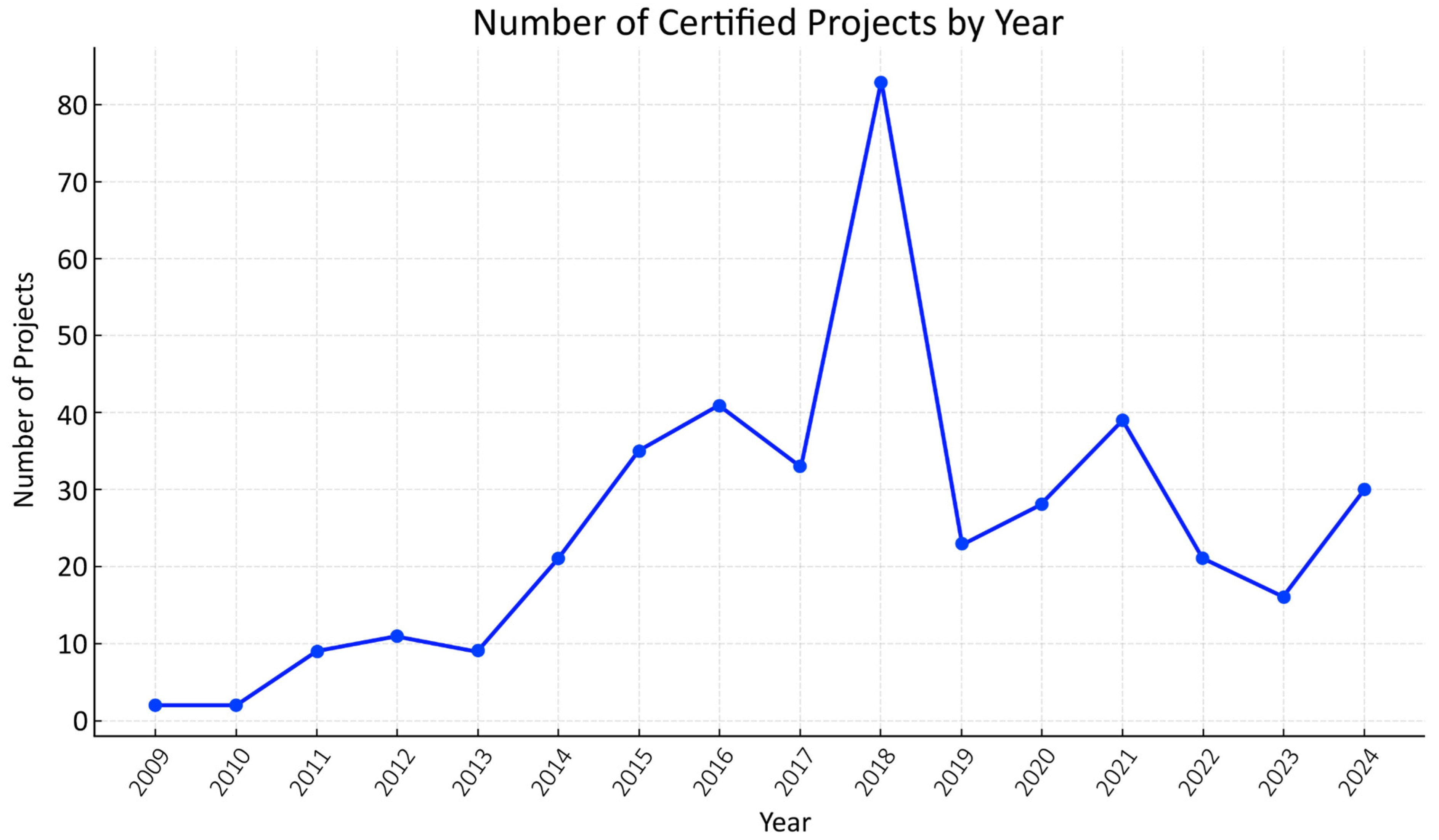
Figure 1. Number of LEED-certified projects in Istanbul by year (2009–2024). Source: Illustrated by authors.
Buildings 16 00363 g001
Figure 2. Distribution of projects in Istanbul according to LEED certification levels. Source: Illustrated by authors.
Buildings 16 00363 g002
Figure 3. Distribution of LEED-Certified projects by owner type. Source: Illustrated by authors.
Buildings 16 00363 g003
Figure 4. Distribution of certified projects by type of space.
Buildings 16 00363 g004
Figure 5. Distribution of LEED-certified projects by functional type. Source: Illustrated by authors.
Buildings 16 00363 g005
Figure 6. Distribution of LEED-certified projects by district in Istanbul.
Buildings 16 00363 g006
Figure 7. Correlation Analysis: LEED Certified Buildings and Social Assistance Applications in Istanbul Districts. Source: Visualized by the authors. Data: USGBC and the Open Door Unit of the Istanbul Governorate, 2022–2023.
Buildings 16 00363 g007
Disclaimer/Publisher’s Note: The statements, opinions and data contained in all publications are solely those of the individual author(s) and contributor(s) and not of MDPI and/or the editor(s). MDPI and/or the editor(s) disclaim responsibility for any injury to people or property resulting from any ideas, methods, instructions or products referred to in the content.