From Brundtland to Net-Zero Buildings: Governing Sustainable Development in the Built Environment

 , , ,
, , ,
Abstract
1. Introduction
2. Materials and Methods
3. Key Weaknesses of the Sustainable Development Concept in the Built Environment
3.1. Weakness One: The Concept Does Not Reflect Changes in Socioeconomic Development
3.1.1. Socioeconomic Change Matters More in Buildings Because of Long-Lived Lock-In
3.1.2. Digitalization and New Governance Conditions Are Reshaping Sustainable Development Practice
3.1.3. From Chapter Review to Sector Misalignments: Why the 1987 Framing No Longer Maps Cleanly onto Buildings
3.1.4. The UN’s Evolving Frameworks Underline Why Brundtland’s Concept Must Be Updated for Buildings
3.1.5. Continued Reliance on the Literature Is Precisely Why Updating Matters
3.2. Weakness Two: Conceptual Vagueness and Boundary Ambiguity in the Built Environment
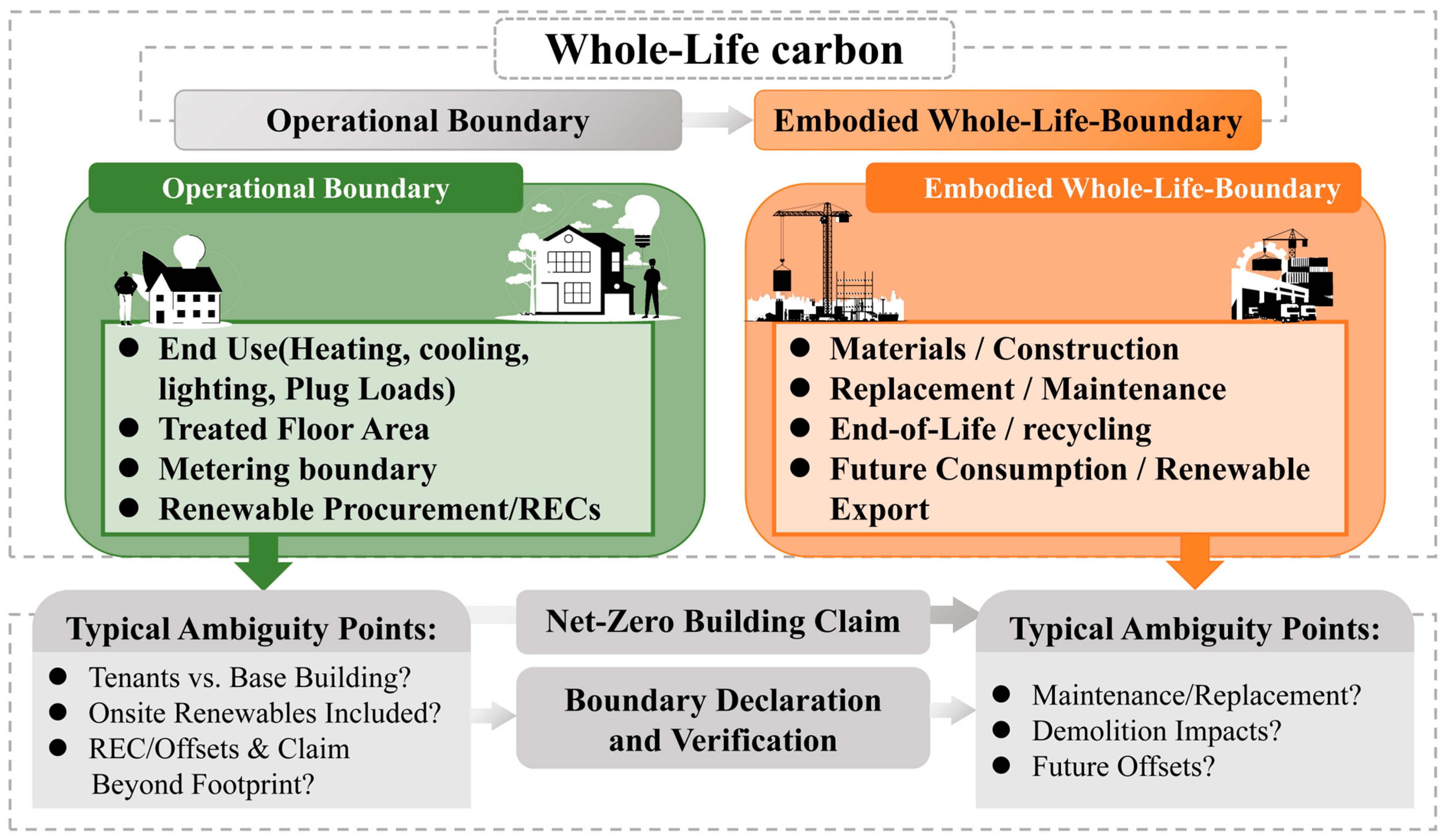
3.2.1. Direct Misuse: Invoking “Sustainable Development” to Justify Inconsistent Boundaries and Unverifiable Claims in Buildings
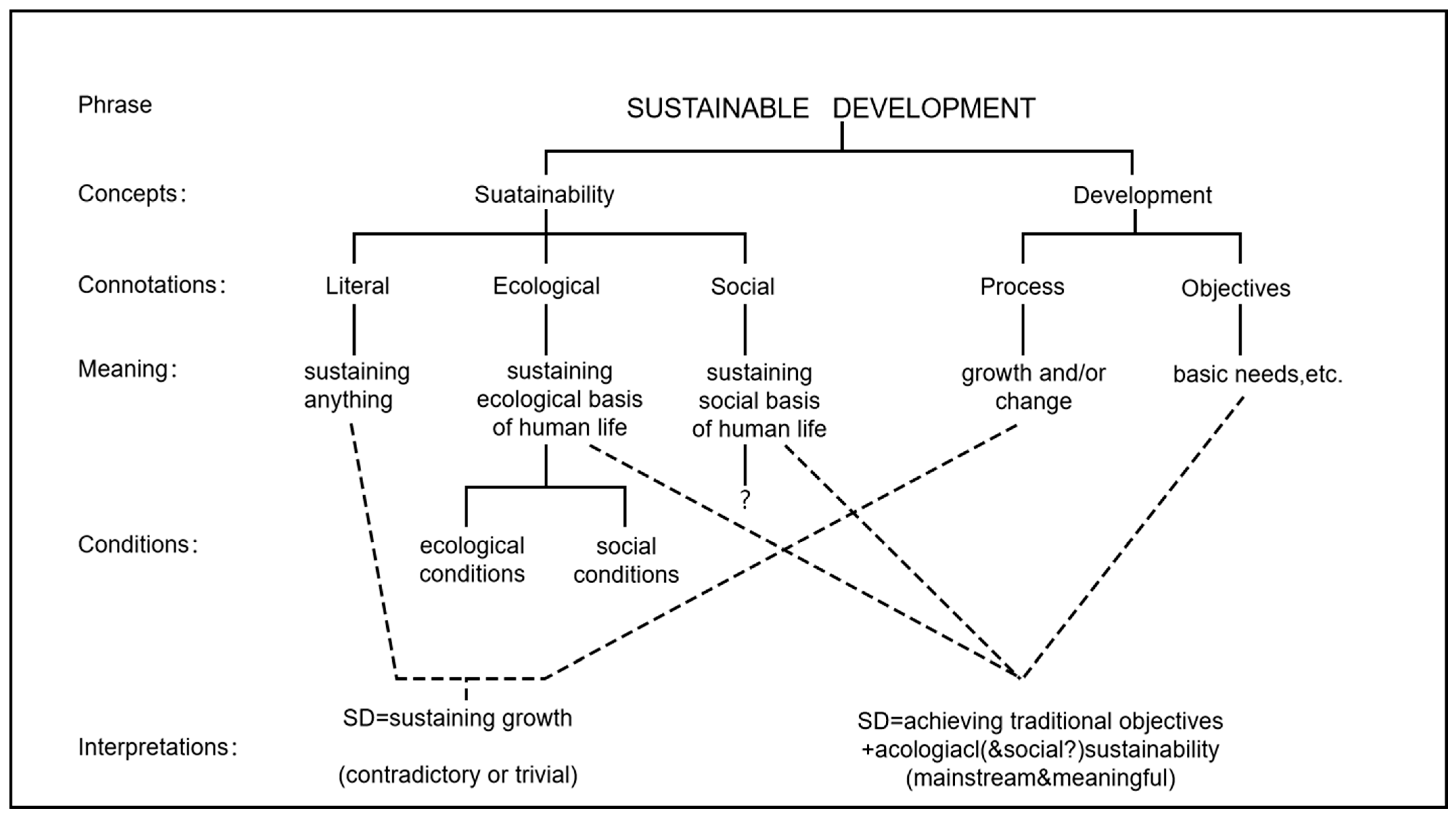
3.2.2. Indirect Misuse: Conflating Sustainable Development with “Sustainable Growth” in the Built Environment
4. Possible Solutions to Improve the Sustainable Development Concept for the Built Environment
4.1. Recommendation One: Establish a Standing Review-and-Update Mechanism for Sustainable Development in the Built Environment
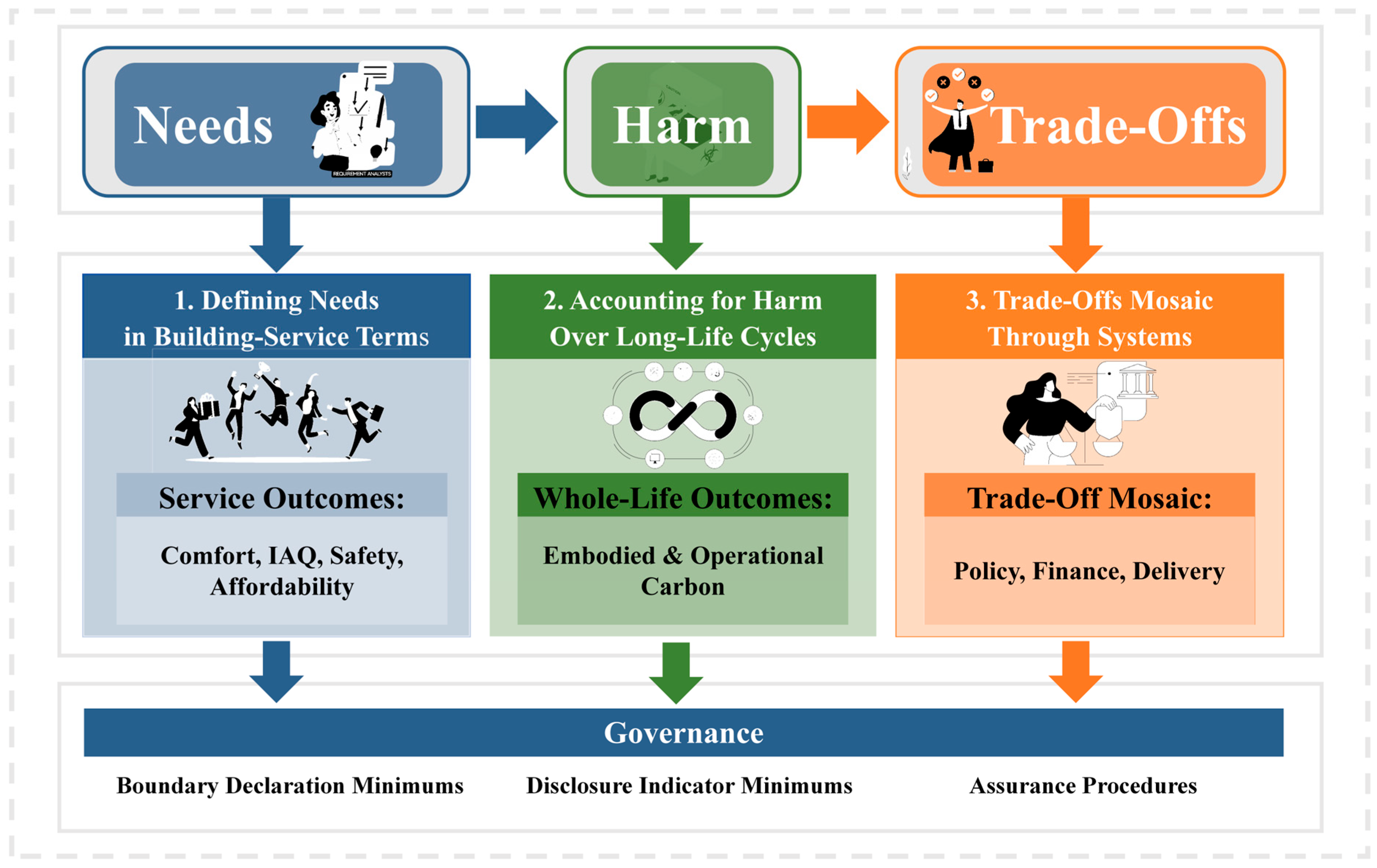
- A refined interpretive statement of “needs”, “harm”, and acceptable trade-offs in built-environment terms;
- A boundary guidance note that standardizes key scopes and accounting choices (operational versus embodied carbon, time horizons, and the treatment of offsets);
- A minimum indicator set that links energy performance and whole-life carbon with occupant well-being (health, comfort), affordability, accessibility, and resilience;
- A short “implementation implications” brief that links the conceptual update to the alignment and verification functions described in Recommendation Two.
4.2. Recommendation Two: Create an Implementation-Alignment, Verification, and Capacity-Building Organization for Built-Environment Sustainable Development
- Tool alignment and interoperability. Building on the clarified concept produced under Recommendation One, the organization would publish baseline requirements that existing net-zero and green building tools can map to—especially around boundary declarations (operational vs. embodied carbon; time horizons), minimum metric definitions, and disclosure expectations. This is best framed as an interoperability layer rather than a replacement of existing standards. The objective is to reduce fragmentation and make claims comparable across jurisdictions and certification systems.
- Verification principles and assurance pathways. The organization would articulate minimum verification expectations (what evidence is required, how performance is checked, and which claims require third-party review), thereby reducing greenwashing risk and raising confidence in building performance statements. A practical way to operationalize this is to define tiered assurance levels with explicit deliverables and trigger conditions. Tier 1 would require a standardized disclosure package (Table 1) with a completed boundary declaration template, traceable data sources, and a claim reconciliation sheet that reports residual emissions and any RECs/offsets used. Tier 2 would add independent verification through structured document review and consistency checks, ensuring that declared boundaries align with reported metrics, that calculations reconcile arithmetically, and that key inputs can be corroborated through spot checks against metering evidence and material/LCA assumptions. Tier 3 would be required for high-stakes or public-facing claims and would include audited verification with performance checks against measured operation where feasible, plus validation of offset quality criteria. By explicitly tying each tier to the Table 1 evidence items, the same “net-zero/low-carbon” label becomes auditable rather than rhetorical. This function aligns with the broader governance insight that credible net-zero pathways depend on accountability structures and transparent reporting, not merely on aspirational targets.
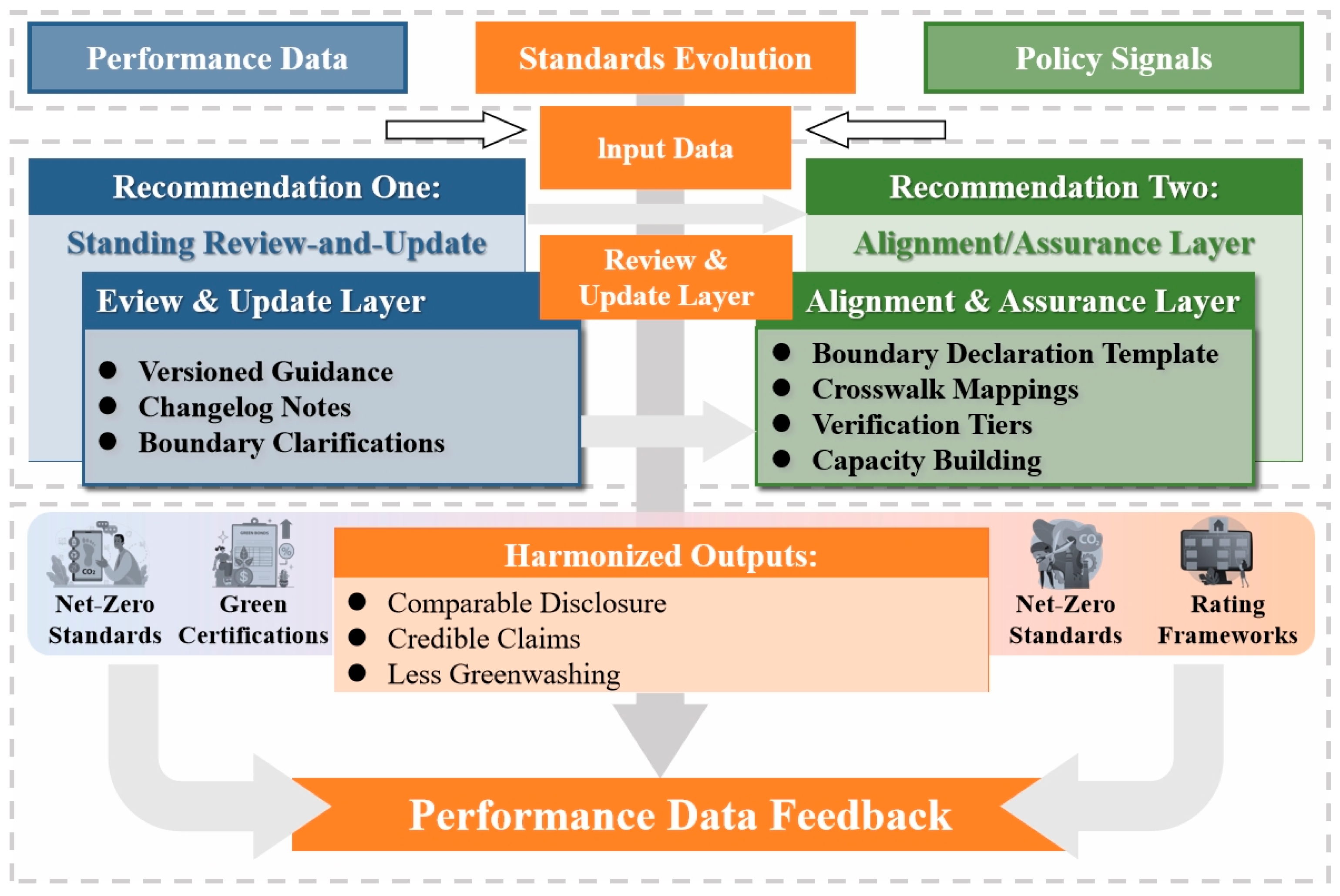
- Professional capacity building for AEC implementation. Because buildings are delivered through complex actor networks, concept-consistent implementation depends on trained professionals who can apply boundaries, metrics, and verification consistently. This capacity gap is amplified—not resolved—by digitalization: as BIM/digital twins and data-intensive M&V proliferate, weak boundary competence, low data literacy, and unclear assurance responsibilities become binding constraints on producing comparable and auditable sustainability claims. The organization would therefore accredit training content (rather than monopolizing training), develop role-based competencies (design, construction, commissioning, operations, auditing), and encourage harmonized professional standards that reduce interpretive drift in practice. To support diffusion at scale, these competency profiles and training materials can be embedded in university and continuing-professional education curricula and referenced by professional bodies and accreditation schemes, thereby mainstreaming boundary, metric, and assurance-related skills across AEC roles. Figure 7 summarizes this governance architecture as a closed loop: performance data, standards evolution, and policy signals feed the standing review-and-update function, which issues versioned guidance, changelog notes, and boundary clarifications; these are then operationalized by the assurance layer through boundary declaration templates, crosswalk mappings, verification tiers, and capacity building, yielding harmonized outputs that in turn generate performance data feedback for the next update cycle.
5. Conclusions
Author Contributions
Funding
Data Availability Statement
Conflicts of Interest
References
- Calvin, K.; Dasgupta, D.; Krinner, G.; Mukherji, A.; Thorne, P.W.; Trisos, C.; Romero, J.; Aldunce, P.; Barrett, K.; Blanco, G.; et al. IPCC, 2023: Climate Change 2023: Synthesis Report. Contribution of Working Groups I, II and III to the Sixth Assessment Report of the Intergovernmental Panel on Climate Change; Core Writing Team, Lee, H., Romero, J., Eds.; IPCC: Geneva, Switzerland, 2023. [Google Scholar] [CrossRef]
- United Nations Environment Programme; Global Alliance for Buildings and Construction. Not Just Another Brick in the Wall: The Solutions Exist—Scaling Them Will Build on Progress and Cut Emissions Fast. Global Status Report for Buildings and Construction 2024/2025; United Nations Environment Programme: Nairobi, Kenya, 2025. [Google Scholar] [CrossRef]
- Seto, K.C.; Davis, S.J.; Mitchell, R.B.; Stokes, E.C.; Unruh, G.; Ürge-Vorsatz, D. Carbon lock-in: Types, causes, and policy implications. Annu. Rev. Environ. Resour. 2016, 41, 425–452. [Google Scholar] [CrossRef]
- Tong, D.; Zhang, Q.; Zheng, Y.; Caldeira, K.; Shearer, C.; Hong, C.; Qin, Y.; Davis, S.J. Committed emissions from existing energy infrastructure jeopardize 1.5 °C climate target. Nature 2019, 572, 373–377. [Google Scholar] [CrossRef]
- Intergovernmental Panel On Climate Change (IPCC) (Ed.) Buildings. Climate Change 2022—Mitigation of Climate Change, 1st ed.; Cambridge University Press: Cambridge, UK, 2023; pp. 953–1048. [Google Scholar] [CrossRef]
- Cabeza, L.F.; Rincón, L.; Vilariño, V.; Pérez, G.; Castell, A. Life cycle assessment (LCA) and life cycle energy analysis (LCEA) of buildings and the building sector: A review. Renew. Sustain. Energy Rev. 2014, 29, 394–416. [Google Scholar] [CrossRef]
- Dixit, M.K.; Culp, C.H.; Fernández-Solís, J.L. System boundary for embodied energy in buildings: A conceptual model for definition. Renew. Sustain. Energy Rev. 2013, 21, 153–164. [Google Scholar] [CrossRef]
- Röck, M.; Saade, M.R.M.; Balouktsi, M.; Rasmussen, F.N.; Birgisdottir, H.; Frischknecht, R.; Habert, G.; Lützkendorf, T.; Passer, A. Embodied GHG emissions of buildings—The hidden challenge for effective climate change mitigation. Appl. Energy 2020, 258, 114107. [Google Scholar] [CrossRef]
- Brundtland, G.H. Our Common Future—Call for Action. Environ. Conserv. 1987, 14, 291–294. [Google Scholar] [CrossRef]
- World Commission on Environment and Development. Report of the World Commission on Environment and Development: Our Common Future; United Nations General Assembly: New York, NY, USA, 1987. [Google Scholar]
- Hopwood, B.; Mellor, M.; O’Brien, G. Sustainable development: Mapping different approaches. Sustain. Dev. 2005, 13, 38–52. [Google Scholar] [CrossRef]
- Robert, K.W.; Parris, T.M.; Leiserowitz, A.A. What is sustainable development? Goals, indicators, values, and practice. Environ. Sci. Policy Sustain. Dev. 2005, 47, 8–21. [Google Scholar] [CrossRef]
- RICS. Whole Life Carbon Assessment (WLCA) for the Built Environment; RICS: London, UK, 2024. [Google Scholar]
- Sartori, I.; Napolitano, A.; Voss, K. Net zero energy buildings: A consistent definition framework. Energy Build. 2012, 48, 220–232. [Google Scholar] [CrossRef]
- UKGBC. Net Zero Carbon Buildings Framework; UKGBC: London, UK, 2019. [Google Scholar]
- United Nations Department of Economic and Social Affairs. The Sustainable Development Goals Report 2023, Special ed.; United Nations: New York, NY, USA, 2023. [Google Scholar] [CrossRef]
- Bouzarovski, S.; Petrova, S. A global perspective on domestic energy deprivation: Overcoming the energy poverty–fuel poverty binary. Energy Res. Social. Sci. 2015, 10, 31–40. [Google Scholar] [CrossRef]
- World Health Organization, United States; France, United States (Eds.) WHO Housing and Health Guidelines; World Health Organization: Geneva, Switzerland, 2018. [Google Scholar]
- Ibn-Mohammed, T.; Greenough, R.; Taylor, S.; Ozawa-Meida, L.; Acquaye, A. Operational vs. embodied emissions in buildings—A review of current trends. Energy Build. 2013, 66, 232–245. [Google Scholar] [CrossRef]
- De Wilde, P. The gap between predicted and measured energy performance of buildings: A framework for investigation. Autom. Constr. 2014, 41, 40–49. [Google Scholar] [CrossRef]
- Newsham, G.R.; Mancini, S.; Birt, B.J. Do LEED-certified buildings save energy? Yes, but…. Energy Build. 2009, 41, 897–905. [Google Scholar] [CrossRef]
- Kibert, C.J. Sustainable Construction: Green Building Design and Delivery; John Wiley & Sons: Hoboken, NJ, USA, 2016. [Google Scholar]
- Yiu, W.Y. Life Cycle Assessment in the Construction Industry. Master’s Thesis, The University of Hong Kong, Hong Kong, China, 2001. [Google Scholar] [CrossRef]
- Ramesh, T.; Prakash, R.; Shukla, K.K. Life cycle energy analysis of buildings: An overview. Energy Build. 2010, 42, 1592–1600. [Google Scholar] [CrossRef]
- Sartori, I.; Hestnes, A.G. Energy use in the life cycle of conventional and low-energy buildings: A review article. Energy Build. 2007, 39, 249–257. [Google Scholar] [CrossRef]
- Dixit, M.K. Life cycle embodied energy analysis of residential buildings: A review of literature to investigate embodied energy parameters. Renew. Sustain. Energy Rev. 2017, 79, 390–413. [Google Scholar] [CrossRef]
- Moncaster, A.M.; Rasmussen, F.N.; Malmqvist, T.; Houlihan Wiberg, A.; Birgisdottir, H. Widening understanding of low embodied impact buildings: Results and recommendations from 80 multi-national quantitative and qualitative case studies. J. Clean. Prod. 2019, 235, 378–393. [Google Scholar] [CrossRef]
- Pomponi, F.; Moncaster, A. Embodied carbon mitigation and reduction in the built environment—What does the evidence say? J. Environ. Manag. 2016, 181, 687–700. [Google Scholar] [CrossRef]
- Anand, C.K.; Amor, B. Recent developments, future challenges and new research directions in LCA of buildings: A critical review. Renew. Sustain. Energy Rev. 2017, 67, 408–416. [Google Scholar] [CrossRef]
- Anderson, J.; Moncaster, A. Embodied carbon of concrete in buildings, part 1: Analysis of published EPD. Build. Cities 2020, 1, 198–217. [Google Scholar] [CrossRef]
- De Wolf, C.; Pomponi, F.; Moncaster, A. Measuring embodied carbon dioxide equivalent of buildings: A review and critique of current industry practice. Energy Build. 2017, 140, 68–80. [Google Scholar] [CrossRef]
- Pomponi, F.; Moncaster, A.; De Wolf, C. Furthering embodied carbon assessment in practice: Results of an industry-academia collaborative research project. Energy Build. 2018, 167, 177–186. [Google Scholar] [CrossRef]
- Pomponi, F.; Lenzen, M. Hybrid life cycle assessment (LCA) will likely yield more accurate results than process-based LCA. J. Clean. Prod. 2018, 176, 210–215. [Google Scholar] [CrossRef]
- Pomponi, F.; Moncaster, A. Scrutinising embodied carbon in buildings: The next performance gap made manifest. Renew. Sustain. Energy Rev. 2018, 81, 2431–2442. [Google Scholar] [CrossRef]
- Berardi, U. Clarifying the new interpretations of the concept of sustainable building. Sustain. Cities Soc. 2013, 8, 72–78. [Google Scholar] [CrossRef]
- Lélé, S.M. Sustainable development: A critical review. World Dev. 1991, 19, 607–621. [Google Scholar] [CrossRef]
- Marszal, A.J.; Heiselberg, P.; Bourrelle, J.S.; Musall, E.; Voss, K.; Sartori, I.; Napolitano, A. Zero energy building—A review of definitions and calculation methodologies. Energy Build. 2011, 43, 971–979. [Google Scholar] [CrossRef]
- Twinn, R.; Desai, K.; Box, P. Net Zero Carbon Buildings: A Framework Definition; UK Green Building Council: London, UK, 2019. [Google Scholar]
- Berardi, U. Sustainability assessment in the construction sector: Rating systems and rated buildings. Sustain. Dev. 2012, 20, 411–424. [Google Scholar] [CrossRef]
- Haapio, A.; Viitaniemi, P. A critical review of building environmental assessment tools. Environ. Impact Assess. Rev. 2008, 28, 469–482. [Google Scholar] [CrossRef]
- Delmas, M.A.; Burbano, V.C. The drivers of greenwashing. Calif. Manag. Rev. 2011, 54, 64–87. [Google Scholar] [CrossRef]
- Lyon, T.P.; Maxwell, J.W. Greenwash: Corporate environmental disclosure under threat of audit. J. Econ. Manag. Strategy 2011, 20, 3–41. [Google Scholar] [CrossRef]
- Kim, E.-H.; Lyon, T.P. Greenwash vs. Brownwash: Exaggeration and undue modesty in corporate sustainability disclosure. Organ. Sci. 2015, 26, 705–723. [Google Scholar] [CrossRef]
- World Green Building Council. What Is a Net Zero Carbon Building? World Green Building Council: London, UK, 2019. [Google Scholar]
- IEA. Final Energy Consumption of Buildings Relative to Other Sectors; IEA: Paris, France, 2022; Available online: https://www.iea.org/data-and-statistics/charts/final-energy-consumption-of-buildings-relative-to-other-sectors-2022 (accessed on 19 January 2026).
- Brundtland, G.H. Our Common Future; Reprinted; Oxford University Press: Oxford, UK, 1987. [Google Scholar]
- Geels, F.W. Technological transitions as evolutionary reconfiguration processes: A multi-level perspective and a case-study. Res. Policy 2002, 31, 1257–1274. [Google Scholar] [CrossRef]
- Unruh, G.C. Understanding carbon lock-in. Energy Policy 2000, 28, 817–830. [Google Scholar] [CrossRef]
- ISO 14040:2006(en); Environmental Management—Life Cycle Assessment—Principles and Framework. ISO: Geneva, Switzerland, 2006.
- ISO 14044:2006(en); Environmental Management—Life Cycle Assessment—Requirements and Guidelines. ISO: Geneva, Switzerland, 2006.
- National Standards Authority of Ireland. Sustainability of Construction Works, Assessment of Environmental Performance of Buildings: Calculation Method; NSAI: Dublin, Ireland, 2011. [Google Scholar]
- Castro, C.J. Sustainable development: Mainstream and critical perspectives. Organ. Environ. 2004, 17, 195–225. [Google Scholar] [CrossRef]
- Olson, M. The productivity slowdown, the oil shocks, and the real cycle. J. Econ. Perspect. 1988, 2, 43–69. [Google Scholar] [CrossRef]
- Baily, M.N.; Gordon, R.J.; Nordhaus, W.D.; Romer, D. The productivity slowdown, measurement issues, and the explosion of computer power. Brook. Pap. Econ. Act. 1988, 1988, 347–431. [Google Scholar] [CrossRef]
- OECD. Future-Proofing Real Estate Investment: Place-Based Risks; OECD Publishing: Paris, France, 2025. [Google Scholar] [CrossRef]
- Siew, R.Y.J. Climate-related financial disclosure and the property and construction sector. Proc. Inst. Civ. Eng. Eng. Sustain. 2021, 174, 3–8. [Google Scholar] [CrossRef]
- Fisch-Romito, V.; Guivarch, C.; Creutzig, F.; Minx, J.C.; Callaghan, M.W. Systematic map of the literature on carbon lock-in induced by long-lived capital. Environ. Res. Lett. 2021, 16, 053004. [Google Scholar] [CrossRef]
- Mastrucci, A.; Marvuglia, A.; Leopold, U.; Benetto, E. Life cycle assessment of building stocks from urban to transnational scales: A review. Renew. Sustain. Energy Rev. 2017, 74, 316–332. [Google Scholar] [CrossRef]
- Akbarnezhad, A.; Xiao, J. Estimation and minimization of embodied carbon of buildings: A review. Buildings 2017, 7, 5. [Google Scholar] [CrossRef]
- Vial, G. Understanding digital transformation: A review and a research agenda. J. Strateg. Inf. Syst. 2019, 28, 118–144. [Google Scholar] [CrossRef]
- Juez, F. Digital Technologies Directly Benefit 70 Percent of SDG Targets, Say ITU, UNDP and Partners; UNDP: New York, NY, USA, 2023. [Google Scholar]
- Tariq, W.; Chen, Y.; Tariq, A.; Sumbal, M.S. Digital governance for sustainable development: A holistic review, framework, and roadmap. Technol. Soc. 2026, 84, 103135. [Google Scholar] [CrossRef]
- Hilty, L.M. ICT Innovations for Sustainability; Springer International Publishing Imprint: Berlin/Heidelberg, Germany, 2015. [Google Scholar] [CrossRef]
- Raihan, A. A review of the potential opportunities and challenges of the digital economy for sustainability. Innov. Green Dev. 2024, 3, 100174. [Google Scholar] [CrossRef]
- Sacks, R.; Eastman, C.; Lee, G.; Teicholz, P. BIM Handbook: A Guide to Building Information Modeling for Owners, Managers, Designers, Engineers and Contractors, 3rd ed.; John Wiley & Sons, Inc: Hoboken, NJ, USA, 2018. [Google Scholar]
- Boje, C.; Guerriero, A.; Kubicki, S.; Rezgui, Y. Towards a semantic construction digital twin: Directions for future research. Autom. Constr. 2020, 114, 103179. [Google Scholar] [CrossRef]
- Amasyali, K.; El-Gohary, N.M. A review of data-driven building energy consumption prediction studies. Renew. Sustain. Energy Rev. 2018, 81, 1192–1205. [Google Scholar] [CrossRef]
- Wei, Y.; Zhang, X.; Shi, Y.; Xia, L.; Pan, S.; Wu, J.; Han, M.; Zhao, X. A review of data-driven approaches for prediction and classification of building energy consumption. Renew. Sustain. Energy Rev. 2018, 82, 1027–1047. [Google Scholar] [CrossRef]
- Vinuesa, R.; Azizpour, H.; Leite, I.; Balaam, M.; Dignum, V.; Domisch, S.; Felländer, A.; Langhans, S.D.; Tegmark, M.; Nerini, F.F. The role of artificial intelligence in achieving the sustainable development goals. Nat. Commun. 2020, 11, 233. [Google Scholar] [CrossRef]
- Morley, J.; Floridi, L.; Kinsey, L.; Elhalal, A. From what to how: An initial review of publicly available AI ethics tools, methods and research to translate principles into practices. Sci. Eng. Ethics 2020, 26, 2141–2168. [Google Scholar] [CrossRef]
- Mastrucci, A.; Byers, E.; Pachauri, S.; Rao, N.D. Improving the SDG energy poverty targets: Residential cooling needs in the global south. Energy Build. 2019, 186, 405–415. [Google Scholar] [CrossRef]
- Satterthwaite, D.; Archer, D.; Colenbrander, S.; Dodman, D.; Hardoy, J.; Mitlin, D.; Patel, S. Building resilience to climate change in informal settlements. One Earth 2020, 2, 143–156. [Google Scholar] [CrossRef]
- Naja, S.; Din Makhlouf, M.M.E.; Chehab, M.A.H. An ageing world of the 21st century: A literature review. Int. J. Community Med. Public Health 2017, 4, 4363. [Google Scholar] [CrossRef]
- United Nations Department of Economic and Social Affairs. World Population Ageing 2020 Highlights: Living Arrangements of Older Persons; United Nations: New York, NY, USA, 2020. [Google Scholar]
- Intergovernmental Panel On Climate Change (IPCC). Climate Change 2022—Impacts, Adaptation and Vulnerability: Working Group II Contribution to the Sixth Assessment Report of the Intergovernmental Panel on Climate Change, 1st ed.; Cambridge University Press: Cambridge, UK, 2023. [Google Scholar] [CrossRef]
- Zhao, S.X.B.; Wong, K.K.K. The sustainability dilemma of China’s township and village enterprises: An analysis from spatial and functional perspectives. J. Rural. Stud. 2002, 18, 257–273. [Google Scholar] [CrossRef]
- Xu, H.; Liu, D.; Wu, H. Environmental regionalization for the management of township and village enterprises in China. J. Environ. Manag. 2001, 63, 203–210. [Google Scholar] [CrossRef]
- Li, C.; Pradhan, P.; Chen, G.; Kropp, J.P.; Schellnhuber, H.J. Carbon footprint of the construction sector is projected to double by 2050 globally. Commun. Earth Env. 2025, 6, 831. [Google Scholar] [CrossRef] [PubMed]
- Fankhauser, S.; Smith, S.M.; Allen, M.; Axelsson, K.; Hale, T.; Hepburn, C.; Kendall, J.M.; Khosla, R.; Lezaun, J.; Mitchell-Larson, E.; et al. The meaning of net zero and how to get it right. Nat. Clim. Change 2022, 12, 15–21. [Google Scholar] [CrossRef]
- Hale, T.; Smith, S.M.; Black, R.; Cullen, K.; Fay, B.; Lang, J.; Mahmood, S. Assessing the rapidly-emerging landscape of net zero targets. Clim. Policy 2022, 22, 18–29. [Google Scholar] [CrossRef]
- Meadowcroft, J.; Rosenbloom, D. Governing the net-zero transition: Strategy, policy, and politics. Proc. Natl. Acad. Sci. USA 2023, 120, e2207727120. [Google Scholar] [CrossRef]
- Griggs, D.; Stafford-Smith, M.; Gaffney, O.; Rockström, J.; Öhman, M.C.; Shyamsundar, P.; Steffen, W.; Glaser, G.; Kanie, N.; Noble, I. Sustainable development goals for people and planet. Nature 2013, 495, 305–307. [Google Scholar] [CrossRef]
- Holden, E.; Linnerud, K.; Banister, D. Sustainable development: Our common future revisited. Global Environ. Change 2014, 26, 130–139. [Google Scholar] [CrossRef]
- Hedlund-de Witt, A. Rethinking sustainable development: Considering how different worldviews envision “development” and “quality of life”. Sustainability 2014, 6, 8310–8328. [Google Scholar] [CrossRef]
- OECD. Home, Green Home: Policies to Decarbonise Housing; OECD: Paris, France, 2023; Volume 1751. [Google Scholar] [CrossRef]
- Sachs, J.D. From Millennium Development Goals to Sustainable Development Goals. Lancet 2012, 379, 2206–2211. [Google Scholar] [CrossRef] [PubMed]
- Redclift, M. Sustainable Development, 1st ed.; Routledge: London, UK, 2002. [Google Scholar] [CrossRef]
- Solow, R. An almost practical step toward sustainability. Resour. Policy 1993, 19, 162–172. [Google Scholar] [CrossRef]
- Waas, T.; Hugé, J.; Verbruggen, A.; Wright, T. Sustainable development: A bird’s eye view. Sustainability 2011, 3, 1637–1661. [Google Scholar] [CrossRef]
- Malerba, D. Just Transitions: A Review of How to Decarbonise Energy Systems While Addressing Poverty and Inequality Reduction; German Institute of Development and Sustainability: Bonn, Germany, 2022. [Google Scholar] [CrossRef]
- Lublóy, Á.; Keresztúri, J.L.; Berlinger, E. Quantifying firm-level greenwashing: A systematic literature review. J. Environ. Manag. 2025, 373, 123399. [Google Scholar] [CrossRef] [PubMed]
- World Green Building Council. Bringing embodied carbon upfront. In Coordinated Action for the Building and Construction Sector to Tackle Embodied Carbon Circular Cities and Regions Initiative; World Green Building Council: London, UK, 2019. [Google Scholar]
- Probst, B.S.; Toetzke, M.; Kontoleon, A.; Díaz Anadón, L.; Minx, J.C.; Haya, B.K.; Schneider, L.; Trotter, P.A.; West, T.A.P.; Gill-Wiehl, A.; et al. Systematic assessment of the achieved emission reductions of carbon crediting projects. Nat. Commun. 2024, 15, 9562. [Google Scholar] [CrossRef]
- Doan, D.T.; Ghaffarianhoseini, A.; Naismith, N.; Zhang, T.; Ghaffarianhoseini, A.; Tookey, J. A critical comparison of green building rating systems. Build. Environ. 2017, 123, 243–260. [Google Scholar] [CrossRef]
- Afroz, Z.; Burak Gunay, H.; O’Brien, W. A review of data collection and analysis requirements for certified green buildings. Energy Build. 2020, 226, 110367. [Google Scholar] [CrossRef]
- Matisoff, D.C.; Noonan, D.S.; Mazzolini, A.M. Performance or marketing benefits? The case of LEED certification. Environ. Sci. Technol. 2014, 48, 2001–2007. [Google Scholar] [CrossRef]
- Anguelovski, I.; Connolly, J.J.T.; Pearsall, H.; Shokry, G.; Checker, M.; Maantay, J.; Gould, K.; Lewis, T.; Maroko, A.; Roberts, J.T. Why green “climate gentrification” threatens poor and vulnerable populations. Proc. Natl. Acad. Sci. USA 2019, 116, 26139–26143. [Google Scholar] [CrossRef]
- Zhu, W.; Yuan, C. Urban heat health risk assessment in Singapore to support resilient urban design—By integrating urban heat and the distribution of the elderly population. Cities 2023, 132, 104103. [Google Scholar] [CrossRef]
- Sax, D.L.; Nesbitt, L.; Quinton, J. Improvement, not displacement: A framework for urban green gentrification research and practice. Environ. Sci. Policy 2022, 137, 373–383. [Google Scholar] [CrossRef]
- Ness, D. Growth in floor area: The blind spot in cutting carbon. Emerald Open Res. 2023, 1. [Google Scholar] [CrossRef]
- Meadows, D.; Randers, J. The Limits to Growth, 1st ed.; Routledge: London, UK, 2012. [Google Scholar] [CrossRef]
- Zhong, X.; Hu, M.; Deetman, S.; Steubing, B.; Lin, H.X.; Hernandez, G.A.; Harpprecht, C.; Zhang, C.; Tukker, A.; Behrens, P. Global greenhouse gas emissions from residential and commercial building materials and mitigation strategies to 2060. Nat. Commun. 2021, 12, 6126. [Google Scholar] [CrossRef]
- Fainstein, S.S. New Directions in Planning Theory. Urban Aff. Rev. 2000, 35, 451–478. [Google Scholar] [CrossRef]
- Leccese, M.; McCormick, K.; Congress for the New Urbanism (Eds.) Charter of the New Urbanism; McGraw Hill: New York, NY, USA, 2000. [Google Scholar]
- Trudeau, D. New urbanism as sustainable development? Geogr. Compass 2013, 7, 435–448. [Google Scholar] [CrossRef]
- Creutzig, F.; Niamir, L.; Bai, X.; Callaghan, M.; Cullen, J.; Díaz-José, J.; Figueroa, M.; Grubler, A.; Lamb, W.F.; Leip, A.; et al. Demand-side solutions to climate change mitigation consistent with high levels of well-being. Nat. Clim. Change 2022, 12, 36–46. [Google Scholar] [CrossRef]
- Urge-Vorsatz, D.; Petrichenko, K.; Staniec, M.; Eom, J. Energy use in buildings in a long-term perspective. Curr. Opin. Environ. Sustain. 2013, 5, 141–151. [Google Scholar] [CrossRef]
- Van Heerden, R.; Edelenbosch, O.Y.; Daioglou, V.; Le Gallic, T.; Baptista, L.B.; Di Bella, A.; Colelli, F.P.; Emmerling, J.; Fragkos, P.; Hasse, R.; et al. Demand-side strategies enable rapid and deep cuts in buildings and transport emissions to 2050. Nat. Energy 2025, 10, 380–394. [Google Scholar] [CrossRef]
- Van Driel, M.; Biermann, F.; Kim, R.E.; Vijge, M.J. International organisations as ‘custodians’ of the sustainable development goals? Fragmentation and coordination in sustainability governance. Glob. Policy 2022, 13, 669–682. [Google Scholar] [CrossRef]
- Pickering, J.; Hickmann, T.; Bäckstrand, K.; Kalfagianni, A.; Bloomfield, M.; Mert, A.; Ransan-Cooper, H.; Lo, A.Y. Democratising sustainability transformations: Assessing the transformative potential of democratic practices in environmental governance. Earth Syst. Gov. 2022, 11, 100131. [Google Scholar] [CrossRef]
- Sörlin, S.; Warde, P.; Akerman, I.; Höglund Hellgren, J.; Höhler, S.; Isberg, E.; Samosír, G.; Schrøder, T.H. The great dispersal: The fall and rise of global environmental governance. Ambio 2025, 54, 1267–1288. [Google Scholar] [CrossRef] [PubMed]



| Dimension | Minimum Disclosure | Boundary Notes | Minimum Evidence | Anchor Refs |
|---|---|---|---|---|
| Boundary declaration | Functional unit, floor area definition, assessment period, geography, building type; included/excluded scopes | Declare operational scope and whole-life scope; explicitly list exclusions and rationale | Completed boundary declaration template; data-source register; version/date of method used | [5,7,13,14,15] |
| Operational energy performance | Annual delivered energy by carrier and key end uses; intensity metric normalized by area | Specify metering boundary; treatment of on-site generation/export; weather normalization approach | Utility bills/submetering logs; metering plan; basic QA/QC | [5,20,106,107] |
| Operational GHG emissions | Annual operational GHG; grid emission factor source and year; time-matching approach if claimed | Must state emission factor source and temporal alignment; treatment of RECs/guarantees-of-origin and double counting | Calculations workbook; factor source documentation; traceability for certificates if used | [5,108] |
| Whole-life carbon/embodied + life-cycle | Whole-life carbon result; breakdown at minimum into embodied vs. operational; major contributors | Declare system boundary: product/construction, use-stage replacements/maintenance, end-of-life; treatment of refurbishment scenarios and end-of-life assumptions | LCA report summary with inputs list; EPD coverage statement; data quality level | [6,7,8,13,19,28,31,92] |
| Net-zero claim components | Claimed net-zero type; on-site vs. off-site renewables; residual emissions; offsets used | Explicitly state whether embodied/WLC is included; offsets only after reductions; disclose additionality/durability criteria used | Renewable procurement evidence; offset certificates; disclosure of residuals and reconciliation | [5,14,15] |
| Occupant well-being | Minimum set of IEQ/comfort proxies and basic safety/health considerations | Report whether metrics are design-stage, commissioning-stage, or operational monitoring; state assumptions and limitations | Commissioning records; monitoring snapshot or POE plan; referenced guideline basis | [18] |
| Affordability/energy burden | Affordability indicator and distributional note | State household/income basis or tenant type; disclose data source and whether it is modeled or measured | Administrative data source or documented assumptions; calculation note | [17] |
| Accessibility and resilience | If relevant, disclose accessibility baseline and resilience-related performance statement | Mark as context-dependent; specify hazard scenario and scope if claimed | Scenario description; cited standard/guideline if used | [5,16] |
Disclaimer/Publisher’s Note: The statements, opinions and data contained in all publications are solely those of the individual author(s) and contributor(s) and not of MDPI and/or the editor(s). MDPI and/or the editor(s) disclaim responsibility for any injury to people or property resulting from any ideas, methods, instructions or products referred to in the content. |
© 2026 by the authors. Licensee MDPI, Basel, Switzerland. This article is an open access article distributed under the terms and conditions of the Creative Commons Attribution (CC BY) license.
Share and Cite
Li, M.; Duan, H.; Wang, Y.; Lin, Z.; Yu, X.; Zhao, H. From Brundtland to Net-Zero Buildings: Governing Sustainable Development in the Built Environment. Buildings 2026, 16, 789. https://doi.org/10.3390/buildings16040789
Li M, Duan H, Wang Y, Lin Z, Yu X, Zhao H. From Brundtland to Net-Zero Buildings: Governing Sustainable Development in the Built Environment. Buildings. 2026; 16(4):789. https://doi.org/10.3390/buildings16040789
Chicago/Turabian StyleLi, Mingliang, Hengjie Duan, Yiying Wang, Zhanlue Lin, Xintian Yu, and Hongyu Zhao. 2026. "From Brundtland to Net-Zero Buildings: Governing Sustainable Development in the Built Environment" Buildings 16, no. 4: 789. https://doi.org/10.3390/buildings16040789
APA StyleLi, M., Duan, H., Wang, Y., Lin, Z., Yu, X., & Zhao, H. (2026). From Brundtland to Net-Zero Buildings: Governing Sustainable Development in the Built Environment. Buildings, 16(4), 789. https://doi.org/10.3390/buildings16040789