Review

Toward Integrated Computational Design: A Systematic Mapping of AAD–FEM Practices in Conceptual Structural Engineering

by
Lars Olav Toppe
*,
Villem Vaktskjold
,
Marcin Luczkowski
,
Francesco Mirko Massaro
and
Anders Rønnquist
Department of Structural Engineering, Norwegian University of Science and Technology (NTNU), Richard Birkelands vei 1A, 7034 Trondheim, Norway
*
Author to whom correspondence should be addressed.
Buildings 2026, 16(2), 271; https://doi.org/10.3390/buildings16020271
Submission received: 27 November 2025 / Revised: 18 December 2025 / Accepted: 29 December 2025 / Published: 8 January 2026

Abstract

The early stages of structural design increasingly make use of computational tools that support rapid exploration, performance-informed decision-making, and closer interaction between design and engineering. This systematic mapping study examines how Algorithm-Aided Design (AAD) and the Finite Element Method (FEM) are applied and combined in conceptual design workflows. Based on a structured search across three academic databases and a coding scheme applied to 87 publications, the literature is mapped according to algorithmic strategies, FEM applications, element types, disciplinary domains, and levels of integration. The results show that algorithmic and predictive approaches are reported with increasing frequency after 2020, alongside growing use of surrogate models and optimisation routines. Linear-elastic analyses and shell- or beam-based models are frequently reported, particularly in civil engineering contexts, while nonlinear, dynamic, and solid-element analyses appear more prominently in mechanical domains. More tightly coupled AAD–FEM workflows become increasingly visible after 2021, reflecting a growing interest in real-time or near-real-time simulation feedback during early design exploration. At the same time, the literature highlights persistent challenges related to computational cost, fragmented toolchains, limited interoperability, and the relatively limited use of multiscale or advanced material models in conceptual design. Taken together, the findings suggest that continued progress toward more integrated AAD–FEM workflows is closely tied to advances in computational efficiency, improved data exchange and interoperability, and the development of more accessible design–analysis environments across disciplinary boundaries.

1. Introduction

1.1. Introduction and Motivation

The early stage of a project is rarely defined by precision but rather by openness and exploration of ideas, functions, and overarching strategies before any constraints are set. This early stage, often referred to as the conceptual design phase (CD), is guided by the principle of avoiding premature commitments to forms, dimensions, or materials, and instead keeping options open to identify the most promising directions [1]. Historically, the roles of architect and engineer were often closely intertwined, embodied in the figure of the “master builder” who carried responsibility for both design and construction, before professional boundaries gradually became more distinct [2]. In contemporary practice, the design is carried out as a multidisciplinary process in which several engineering and design disciplines contribute actively from the earliest stages of conceptual development [3]. Such early involvement is important for identifying feasibility issues and reducing the risk of developing concepts that later prove difficult or impossible to construct. Interdisciplinary teams, therefore, collaborate from the outset, aiming to develop concepts that reflect multiple perspectives and move toward an optimised solution.
At the same time, digital tools have substantially reshaped collaboration across disciplines. Computer-aided design (CAD) [4] and Building Information Modelling (BIM) [5] have become increasingly prevalent in architectural and engineering practice over the past decades, serving as key enablers of integrated and data-driven workflows. These platforms offer a shared digital environment in which multiple actors can work simultaneously. In contrast, Algorithm-Aided Design (AAD) [6] enables the rapid generation of alternative schemes that can inform discussion and guide early choices. Yet the promise of such tools also highlights a long-standing challenge: the need to assess structural feasibility early in the process, typically through rapid, simplified analyses that provide sufficient accuracy to guide evolving design decisions.
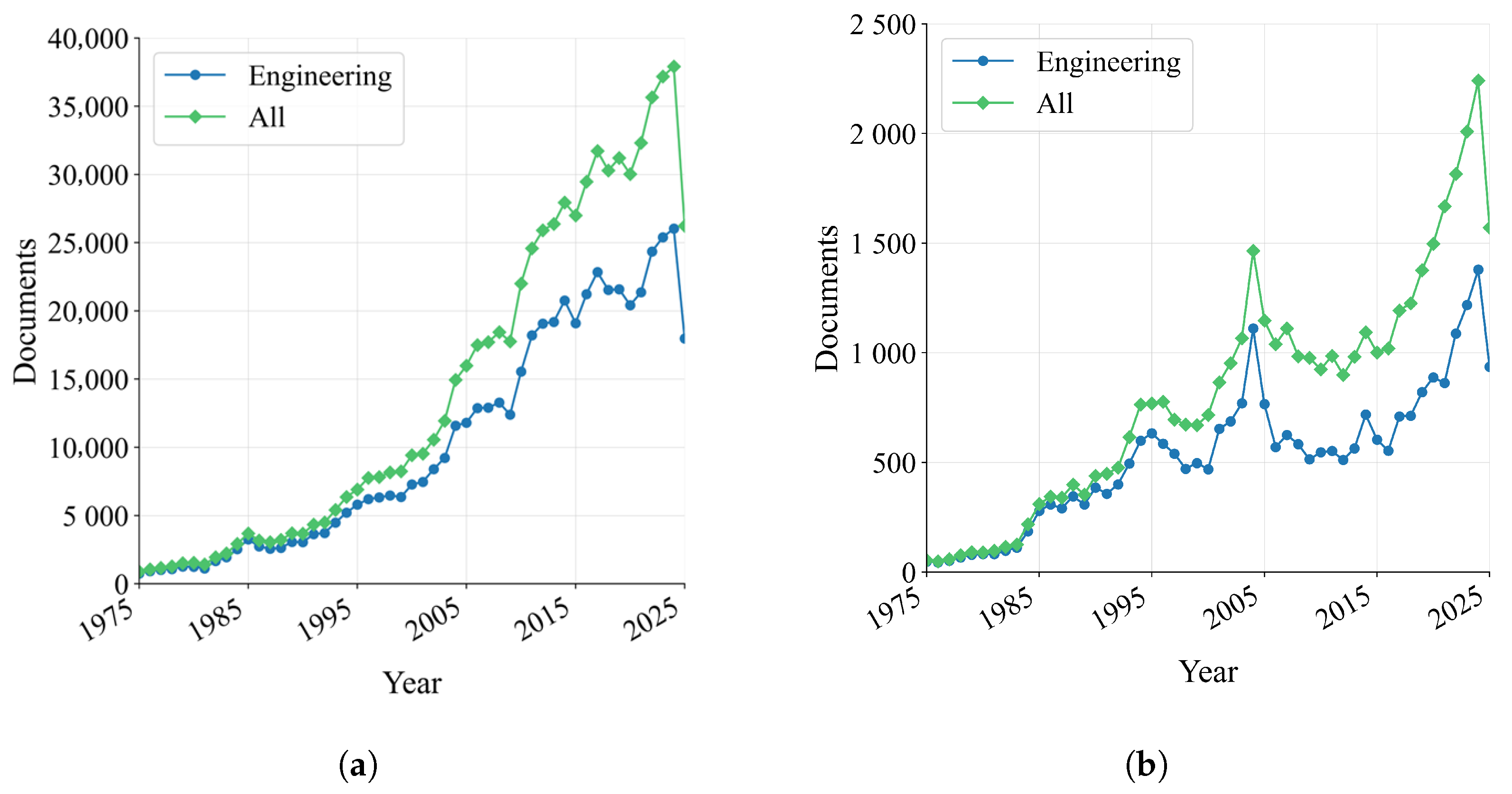
AAD can expand the range of alternatives explored in the early design stages and may facilitate the integration of structural assessment within the design loop. A central method in this regard is the Finite Element Method (FEM), which has become the most widely used general procedure for the numerical analysis of engineering structures and continua [7]. In the conceptual phase, FEM is typically employed not to deliver high-fidelity predictions, but to provide rapid insight into load paths, stiffness, deformation tendencies, and the structural feasibility of early geometric decisions [8]. Its role, however, may be shifting. Rather than being confined to late-stage verification, FEM is increasingly investigated for its potential integration into early design stages in conjunction with AAD, where it can act as a performance layer for evaluating large numbers of design variants and providing early feedback on structural behaviour. This integration supports the timely assessment of design alternatives and opens possibilities for improving material efficiency, structural performance, cost, or sustainability. The increasing relevance of these methods is reflected in recent publication activity, with a clear upward trend in research related to both AAD and FEM; see Figure 1.
While these developments are most frequently discussed within the context of structural and architectural engineering, similar trends can also be observed in other disciplines, such as mechanical engineering. At the authors’ department, the structural and mechanical engineering disciplines collaborate closely due to a shared specialisation for the Finite Element Method. In many contexts, the term civil engineering is commonly used as a collective term encompassing both disciplines. For the present study, the scope is therefore limited to the structural, mechanical, and bridge engineering disciplines, reflecting the authors’ areas of specialisation. Within these fields, the authors observe that design activities typically take place within comparable design phases, in which geometry, load paths, material properties, stiffness, and functional constraints must be explored before detailed modelling becomes feasible. In this context, FEM is frequently employed as a primary means of evaluating structural or mechanical behaviour during the conceptual design stage, often under conditions characterised by limited information and high uncertainty. Consequently, these disciplines face similar methodological challenges, including the need to balance model simplicity with predictive accuracy, to efficiently explore large design spaces, and to validate emerging design concepts through rapid analytical assessment.
From this perspective, adopting a cross-disciplinary view enables an examination of whether methodological developments in one domain exhibit parallels or transferable principles that are relevant to another, as well as whether shared patterns or domain-specific divergences can be identified in how computational tools support conceptual design. The growing interest in both AAD and FEM across disciplines underscores their increasing importance in early design phases, reflecting an ongoing development toward more data-informed and performance-driven exploration. In this context, a systematic mapping of recent research provides a structured means of identifying how these methods are currently applied, how they interact within conceptual workflows, and how their integration continues to shape early-stage decision-making across different disciplinary contexts.

1.2. Research Questions

To investigate how Algorithm-Aided Design and the Finite Element Method are used within the conceptual design stage, the following research questions (RQs) guided the systematic mapping:
  • How is Algorithm-Aided Design applied to support structural exploration, optimisation, and decision-making in conceptual design?
  • In what ways has the Finite Element Method been integrated into early-stage design workflows, and how has its role evolved over time?
  • What are the main trends, gaps, and challenges reported across the literature regarding the integration of these methods and technologies in the early stages of structural design?
The remainder of this paper is organised as follows: Section 2 details the methodology of systematic mapping, including search strategies, inclusion and exclusion criteria, and the coding framework. Section 3 presents the attribute scheme, which defines the coding categories used in the mapping, including research type, disciplinary domain, algorithm category, integration level, and several FEM-related attributes. Section 4 presents the results of the mapping. Section 5 discusses key findings, trends, and gaps identified in the literature. Finally, Section 6 concludes by outlining implications for future research and practice in structural design. Appendix A is added to provide the complete citation tables underlying the mapping results.

1.3. Definitions

For clarity and completeness, this study applies the following definitions:
Structural Engineer: For the purpose of this article, defined as an engineer specialised in the design and analysis of load-bearing systems, ranging from buildings and bridges to mechanical assemblies and components, responsible for ensuring that structures are safe, stable, and efficient with respect to materials, applied loads, and boundary conditions across diverse engineering contexts.
Algorithm-Aided Design (AAD): Design workflows where algorithms, parametric, generative, or optimisation are used to generate, explore, or refine structural geometry in interaction with material and load constraints [6]. Unlike traditional CAD, AAD actively searches and shapes the design space, enabling closer integration with analytical methods such as the Finite Element Method (FEM) during the conceptual design phase.
Finite Element Method (FEM): A numerical technique for solving structural mechanics problems by discretising geometry into elements and approximating their behaviour under loads and boundary conditions [7]. In the context of early-stage design, FEM enables rapid verification of structural alternatives, providing insight into load paths, stiffness, and stability before detailed modelling.
Generative Design: A computational design approach where algorithms generate and evaluate multiple design alternatives based on defined objectives and constraints. In early-stage design, generative design enables the exploration of parametric relationships and performance-driven forms through the integration of generation and analysis [8].

2. Methodology

A systematic mapping methodology was adopted to capture a broad overview of the field by coding studies according to predefined attributes rather than analysing them in depth. This approach makes it possible to identify prevailing trends, research gaps, and the range of current applications where computational design generation and structural analysis intersect. The procedure follows the framework proposed by Petersen et al. [9] and further developed by Haakonsen et al. [10].
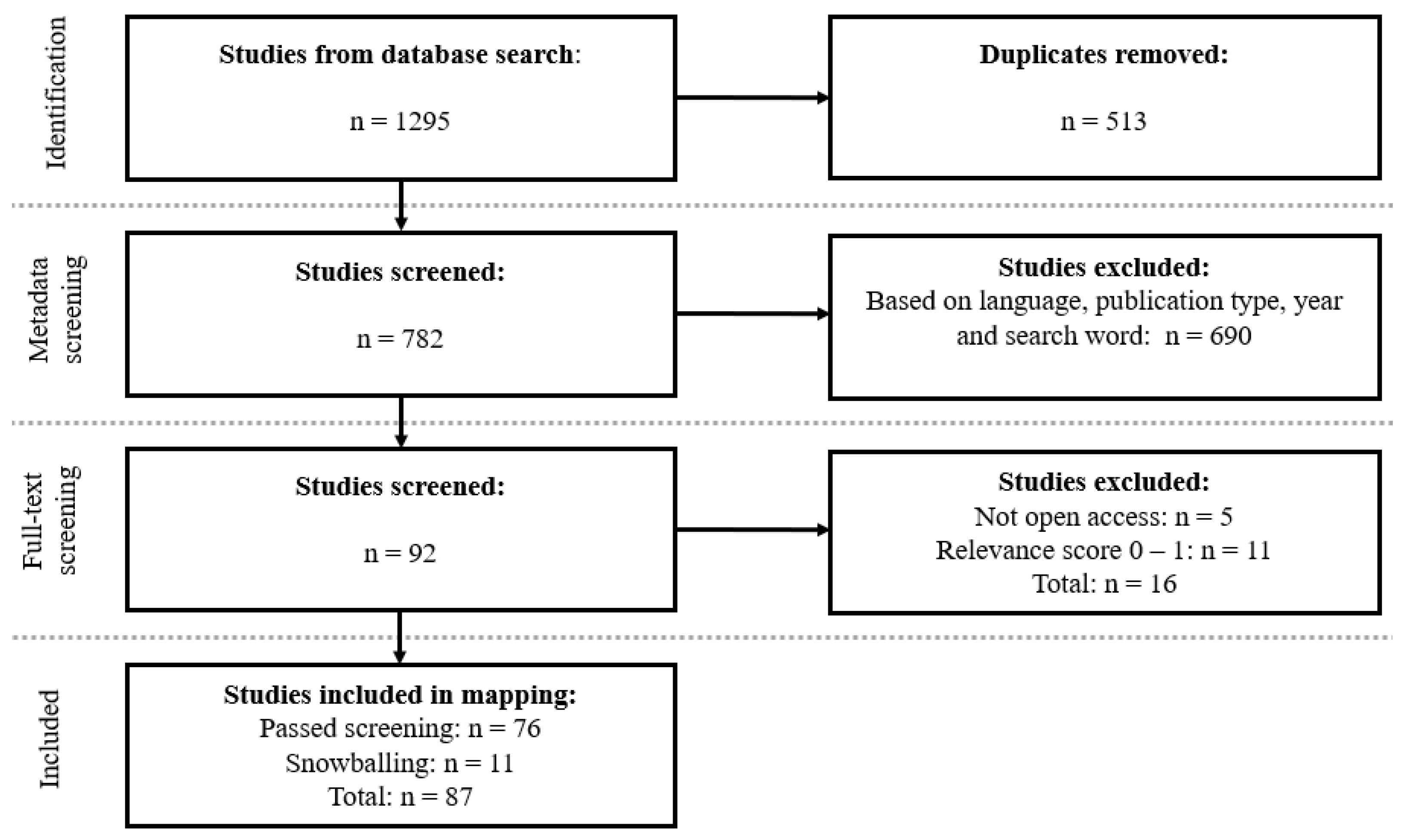
The process involved several stages. First, a search strategy was developed using carefully selected keywords, applied to titles, abstracts, and metadata across three academic databases. The resulting collection was processed through automated metadata-based filtering to remove duplicates and clearly irrelevant records. The remaining studies were then assessed through a full-text review to assign a relevance score based on predefined criteria. After screening, the retained publications were coded according to a set of attributes covering research type, disciplinary domain, algorithmic approach, integration level, and key FEM-related characteristics. Finally, a snowballing step was conducted to identify additional relevant studies. Figure 2 illustrates the overall process from keyword selection to the final coded dataset.
Upon finalising the set of included studies, each paper was analysed and classified according to the predefined mapping attributes. This step ensured a consistent basis for organising the literature, allowing the mapping to provide a structured overview of the field. The outcome provides an overview of the thematic landscape of current research, offering a basis for identifying prevailing directions and potential areas for further exploration.

2.1. Databases and Search Query

The literature search was carried out on 30 October 2025 across three academic databases: Scopus, Web of Science, and Engineering Village. The search applied a comprehensive strategy designed to capture publications combining AAD and FEM in the conceptual design phase.
The construction of the search string followed a structured keyword strategy in which three dimensions were defined: what (design focus), where (application domain), and how (method/analysis). Within each dimension, synonyms and related terms were connected with the Boolean operator OR, while the three dimensions themselves were combined with AND. This ensured that only studies addressing all dimensions simultaneously were included in the initial dataset. The complete set of keywords and the resulting publication counts are summarised in Table 1 and Table 2. A representation of the full search string used in the databases is provided below for completeness.
(“algorithm aided design” OR “algorithm assisted design” OR “algorithmic design” OR “parametric design” OR “parametric model*” OR “generative design” OR “computational design” OR “rule-based design” OR “knowledge-based design” OR “performance-based design” OR “design optim*” OR “form-finding” OR “aad”) AND (“conceptual design” OR “concept” OR “early stage” OR “prototyping” OR “early appraisal” OR “sketching” OR “conceptualisation”) AND (“finite element analysis” OR “finite element method”) AND (structural OR mechanical OR bridge) AND (engineering OR design* OR model* OR simulation*)

2.2. Screening

The screening procedure was carried out in two successive steps, starting with an automated metadata-based filtering and followed by a structured relevance assessment. Presenting the process as a unified sequence ensured both transparency and a consistent narrowing of the dataset toward publications of substantive relevance.
The initial step involved a coarse screening to remove material that did not meet basic formal and topical requirements. Using Python 3.11.9 scripts, all retrieved records were automatically checked against a set of objective criteria, and duplicate entries were removed from databases. Publications were retained only if they had the following characteristics:
  • Unique (i.e., not duplicates across databases);
  • Written in English;
  • Published in peer-reviewed journal articles;
  • Published within the last ten years;
  • Contained at least two of the extended search terms defined in the keyword set listed below, evaluated across title, author keywords, and abstract. (Extended keyword set:
    Finite element method*, Automation of FEM*, 3D solid elements*,
    Karamba3D*, Autodesk React*, Robot to Dynamo*, FEM-design*,
    Artificial inteligence*, AI-Driven*, digital fabrication*,
    Parametric design*, Algorithm aided design*, Knowledge based design*, Conceptual design*, Architecture engineering construction*.
    Note: The wildcard * denotes variations in word forms (e.g., singular/plural and common spelling variants).)
This metadata-based filtering offered a reproducible way of reducing noise in the dataset while maintaining adequate breadth for subsequent analysis.
After passing the metadata filtering stage, a download process was initiated to collect all available PDF files in order to enable a comprehensive full-text review. The articles were assessed against a set of predefined parameters to ensure alignment with the scope of the systematic mapping. Each article was assigned a relevance score ranging from 0 to 5, where each predefined category could contribute one point. Articles receiving a score of 0–1 were excluded, while those scoring between 2 and 5 were retained for further verification. The results of the full-text assessment are presented in Table 3.
  • Conceptual design phase: +1 if the article addresses a conceptual, early-stage, or preliminary design phase.
  • Implementation or practical application: +1 if the study includes an implementation, case study, tool development, or demonstrative application.
  • Relevance to building, construction, or structural engineering: +1 if the publication shows clear relevance to these domains.
  • Use of FEM or an equivalent computational method: +1 if FEM, structural analysis, or an equivalent method is applied.
  • Scholarly quality (conditional): +1 if the article demonstrates adequate academic quality.

2.3. Verification

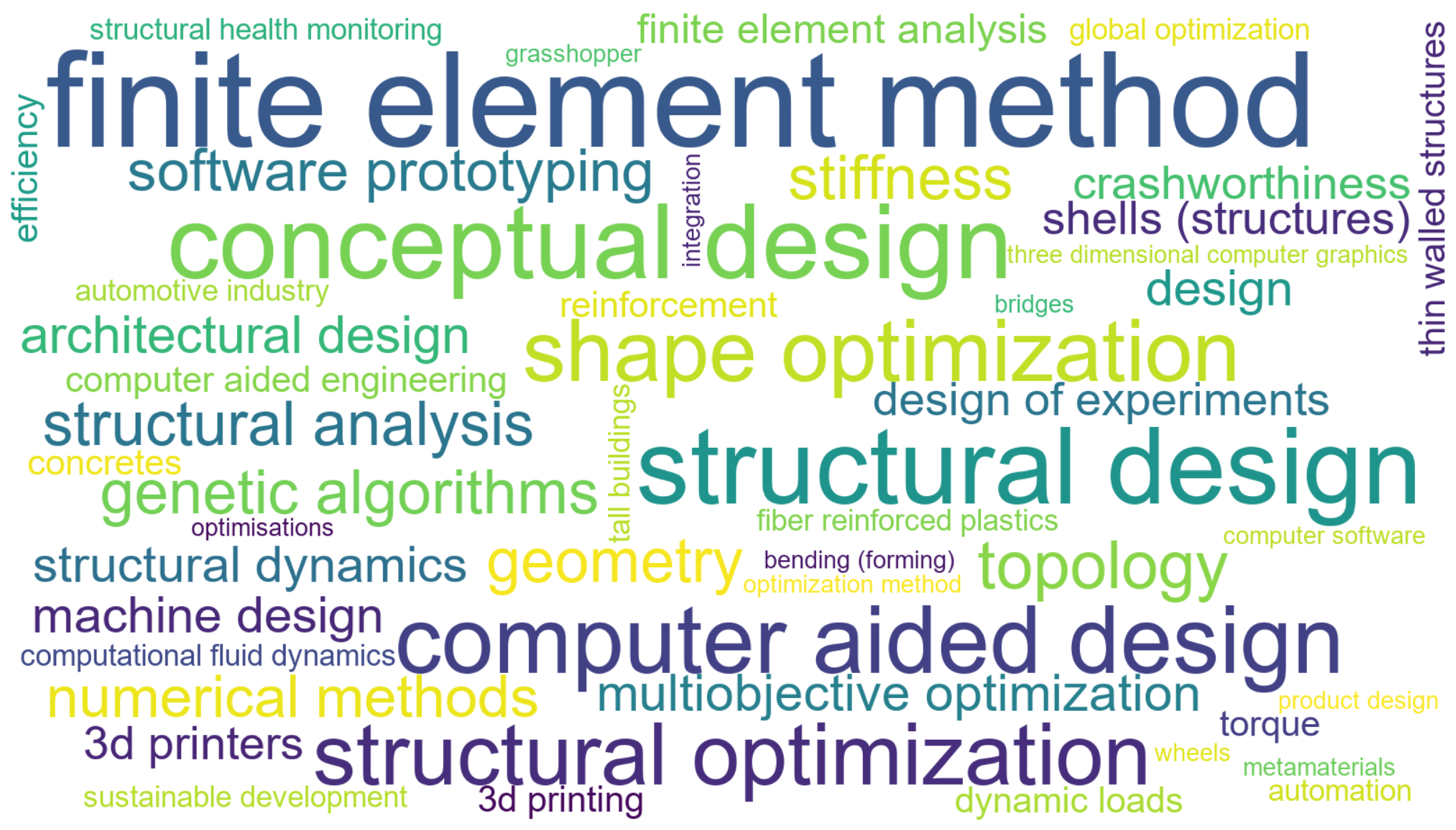
After the automated and manual screening steps, 76 publications were retained for analysis. A limited snowballing step later identified 11 additional relevant studies, primarily recent or adjacent publications, bringing the final dataset to 87 studies. To verify that the search strategy had captured the central body of literature, the aggregated author keywords from the 76 publications were compiled into a word cloud, shown in Figure 3. The distribution of the 50 most frequent terms aligns closely with the thematic focus of the mapping study: dominant expressions such as Finite Element Method, conceptual design, structural design, computer-aided design, structural optimisation, and shape optimisation reflect the core intersection of computational design and structural analysis. Additional frequently occurring terms—including structural analysis, topology, genetic algorithms, geometry, and architectural design—illustrate the breadth and consistency of the included research. Taken together, the keyword analysis indicates that the search query captured the relevant landscape without requiring further refinement, and the additional studies identified through snowballing provide supplementary confirmation that the main corpus was successfully retrieved.

3. Attribute Scheme

A systematic examination of the reviewed publications was carried out to structure the dataset and support the analysis of patterns relevant to the research questions formulated in Section 1.2. Eight descriptive attributes were defined: research type, disciplinary domain, algorithm category, integration level, FEM role, FEM application, FEM element, and FEM software. The attributes were initially applied across all included publications by a single author and subsequently reviewed through consensus-based validation among the authors. This process involved joint discussion and agreement on the interpretation and classification of the attributes to ensure clarity, consistency, and conceptual alignment. Together, they organise the studies according to methodological, disciplinary, and computational characteristics and serve as the basis for analysing trends and relationships across the dataset in order to address the research questions.

Attribute Definitions

The following section defines each attribute and its subcategories, which are presented in Table 4, Table 5, Table 6, Table 7, Table 8, Table 9, Table 10 and Table 11. These attributes provide a structured basis for organising the dataset and for analysing trends relevant to the research questions.
Research Type: This attribute characterises the primary research orientation of each study. When multiple orientations are present, the dominant one is selected. Subcategories are listed in Table 4.
Disciplinary Domain: This attribute identifies the disciplinary context addressed by each publication, distinguishing between civil structures, mechanical components, mechanical systems, and general material optimisation studies. Definitions are provided in Table 5.
Algorithm Category: This attribute classifies studies according to the level of algorithmic involvement in the design process—from manual parametric modelling to search-based optimisation and predictive modelling using data-driven methods. Subcategories appear in Table 6.
Integration Level: This attribute describes how tightly AAD and FEM are coupled within the workflow, ranging from sequential use to partial or fully automated integration. The three levels are defined in Table 7.
FEM Role: This attribute specifies the functional purpose of FEM within the workflow—whether used for validation, design steering, or as training data for predictive models. These roles, which may occur at different integration levels, are defined in Table 8.
FEM Application: This attribute categorises the type of FEM analysis performed in each study, such as linear elasticity, nonlinear behaviour, dynamics, buckling, or fracture modelling. The full set of applications is presented in Table 9.
FEM Element: This attribute records the type of finite elements used—beam, shell, solid, or unspecified—reflecting the level of geometric abstraction adopted in the analysis. Subcategories are provided in Table 10.
FEM Software: Finally, this attribute identifies the computational environment used for analysis, distinguishing between software primarily suited to beam/shell models, full 3D solvers, and self-developed tools. Categories are listed in Table 11.
The attribute scheme presented above provides a structured basis for organising the dataset and analysing the literature. Together, these attributes enable the identification of methodological tendencies, application patterns, and emerging directions within the intersection of AAD and FEM. The corresponding distributions and results are presented in Section 4, and their implications are further discussed in Section 5.

4. Results

This section presents the results of the systematic mapping by reporting how the reviewed publications are distributed across the defined attributes. It begins with an overview of the research types, followed by a summary of the disciplinary domains represented in the dataset, illustrating that the two primary disciplines examined in the mapping are well represented. The analysis then progresses to a more detailed examination of the computational characteristics of the literature, including the types of algorithms employed, the degree to which FEM is integrated into the design process, and the role assigned to FEM within conceptual design activities. Finally, the results provide an overview of the modelling complexity adopted in the reviewed studies, characterised through the attributes FEM application, FEM element and FEM software. Together, these visualisations highlight the dominant patterns, tendencies and methodological orientations present in the reviewed literature.

4.1. Research Type

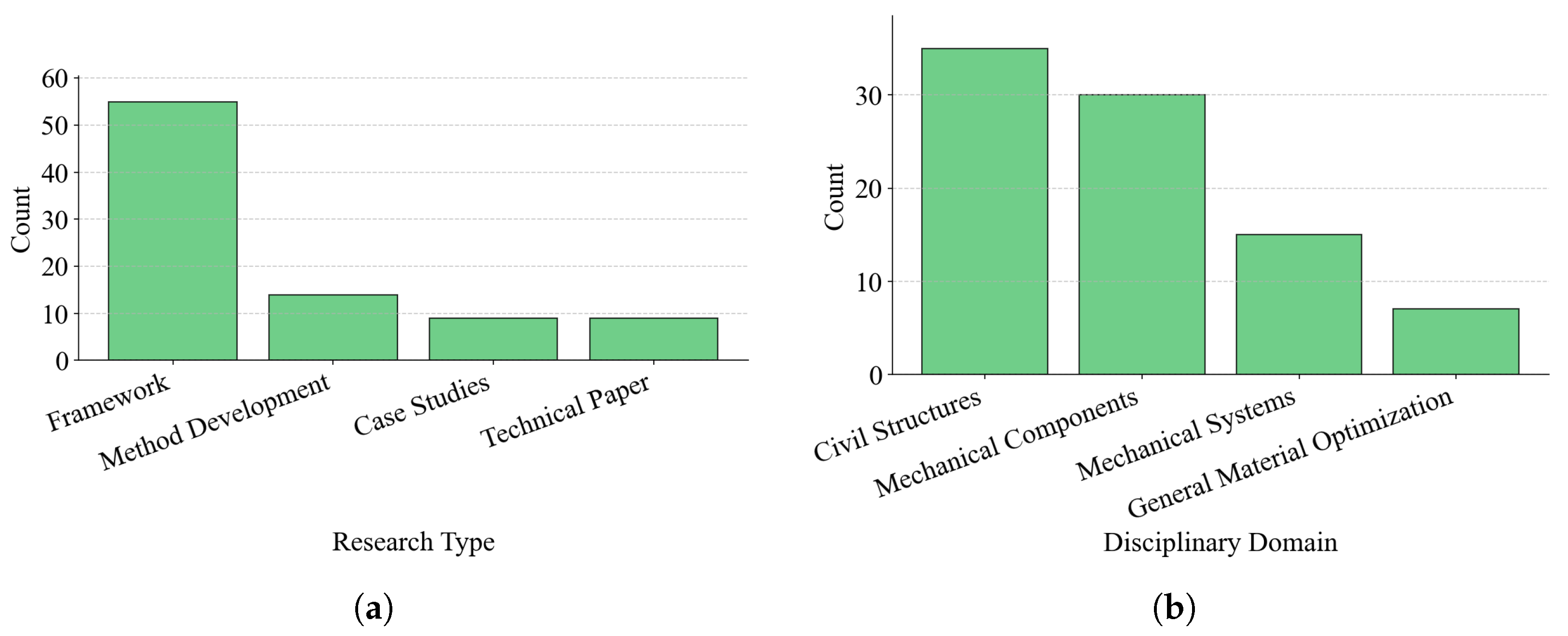
The distribution of the reviewed studies across the defined research types is presented in Figure 4a. Studies categorised as Framework constitute approximately 63%, the dominant group. These works develop integrated workflows combining algorithmic or parametric modelling with FEM-based analysis [13,40,43,62,74,76,79,88], often extended with optimisation or data-driven procedures [28,53,70,73,90,91]. Many implement iterative feedback loops between geometry generation, simulation, and performance evaluation [13,43,62,73,74,76,79,84,88], including frameworks for mechanical/product design [28,70,91], and integrated design-to-analysis environments for architectural or additive-manufacturing contexts [13,18,40,43,76,84,88].
Studies classified as Method Development account for approximately 16%. They advance FEM-based analysis through algorithmic and surrogate innovations without physical implementation, including neural-network or “smart” finite elements for adaptive stiffness modelling [27,38,64] and graph-embedded or hierarchical surrogates that accelerate field prediction and design tasks [45,92]. Method-oriented optimisation studies target topology, composites, and crashworthiness via multi-objective, Bayesian, or evolutionary strategies [51,54,69,77]. A recent contribution also explores hybrid AI–FEM formulations, embedding large language models within simulation-validated design loops [72].
Studies categorised as Case Studies represent approximately 10%. These works apply established computational design and FEM workflows in practical design or prototyping contexts [75,93]. Architectural examples include performance-based and topology-optimised structures, where multi-material building systems and concrete shells are analysed under realistic loads and fabrication constraints [57,75,93]. Mechanical studies integrate algorithmic modelling with FEM-based optimisation and testing, e.g., morphing UAV wings and compliant rotary mechanisms that link simulation to physical prototypes [15,31,34]. At the product scale, similar workflows guide the optimisation of 3D-printed orthotic braces and hot-stamped automotive components, combining digital design with validated structural simulation [46,60,61].
Studies categorised as Technical Papers constitute approximately 10%. A recurring pattern is thermo-mechanical and residual-stress analysis in manufacturing with numerical–experimental validation, including laser beam forming, wire-arc additive manufacturing, and welded joints [11,17,32]. Material and component response is examined via established FE procedures, e.g., fractures in functionally graded materials and wear in self-lubricating bearings [21,24]. System-level evaluation relies on standard models rather than new methods, such as vibroacoustic prediction of lightweight vehicle structures and efficiency analysis of cycloid transmissions [12,58]. Predictive or comparative simulations verify accuracy and behaviour without proposing methodological innovations, for example, adjoint ROM–based aircraft optimisation and quantitative comparison of form-finding strategies for concrete shells [25,85].

4.2. Disciplinary Domain

As shown in Figure 4b, approximately 40% of the reviewed publications fall within the Civil Structures category, covering buildings, bridges, and shell systems directly associated with the construction industry. Parametric and FEM-integrated modelling is frequently employed for shell and grid-shell form-finding [13,57,60,69,71,75,76,80,82,87], where architectural geometry is developed in parallel with structural behaviour. Several studies couple geometric parameters with load response evaluation in iterative design environments, using constraint-based or multi-objective optimisation to refine stiffness and weight distribution [13,69,71,80,89,90,91,94]. Applications include bridge arches, concrete shells, and roof grids generated through FEM-linked evolutionary search [18,84,85,88]. Other contributions integrate fabrication and material constraints into generative workflows for complex shells [19,49,66,76,81], while biomimetic or weaving-inspired geometries further extend structural exploration across architectural scales [23,41,78].
Approximately 34% of the reviewed publications fall under Mechanical Components, focusing on individual parts or products analysed for strength, stiffness, and performance. Several studies optimise mechanical brackets and braces through parametric–FEM workflows coupled with evolutionary or multi-objective search algorithms such as NSGA-II and cost-driven loops [33,48,77,92]. Component-level modelling of panels and connectors in lightweight or composite structures employs gradient-free strategies for topology and shape refinement [61,62,70,79]. Surrogate and adjoint-assisted pipelines predict deformation or stiffness to accelerate iterative redesign [22,25,45,52,72], while hybrid AI–FEM loops support data-driven tuning of mechanical performance [20,83]. Examples include optimised joints and ribs verified through FEM simulation and testing [31,46,67], as well as contact and failure analyses linking design and experimental validation [15,17,32,34,59].
Approximately 17% of the reviewed studies are categorised as Mechanical Systems, covering assemblies such as aerospace frames, wind turbines, and automotive structures where multiple mechanical components interact. Generative frameworks for aircraft and rotor systems combine parametric modelling with FEM-based optimisation to minimise weight and control vibration response [35,42,47,74]. Automotive and energy systems are optimised for crashworthiness and stiffness using iterative FE simulations that refine topology and material layout under multiple loading conditions [30,51,54]. Turbine and rotor analyses integrate aerodynamic and structural feedback to predict deformation and stress propagation across coupled components [12,35,36,55]. Validation of welded and composite assemblies combines numerical and experimental methods to assess fatigue and residual stresses [11,26,58], demonstrating system-scale FEM workflows where geometric and physical interactions are analysed concurrently.
Approximately 8% of the dataset is categorised as General Material Optimisation. Studies in this group address topology optimisation and material efficiency independent of disciplinary context, where parametric–FEM workflows link geometry generation with structural response evaluation [43,44,63]. Programmable frameworks and surrogate-assisted models are employed to explore efficient material layouts and adaptive structural behaviour [50,53], while two-dimensional formulations are used to test hierarchical and lightweight material configurations [21,43].

4.3. Algorithm Category

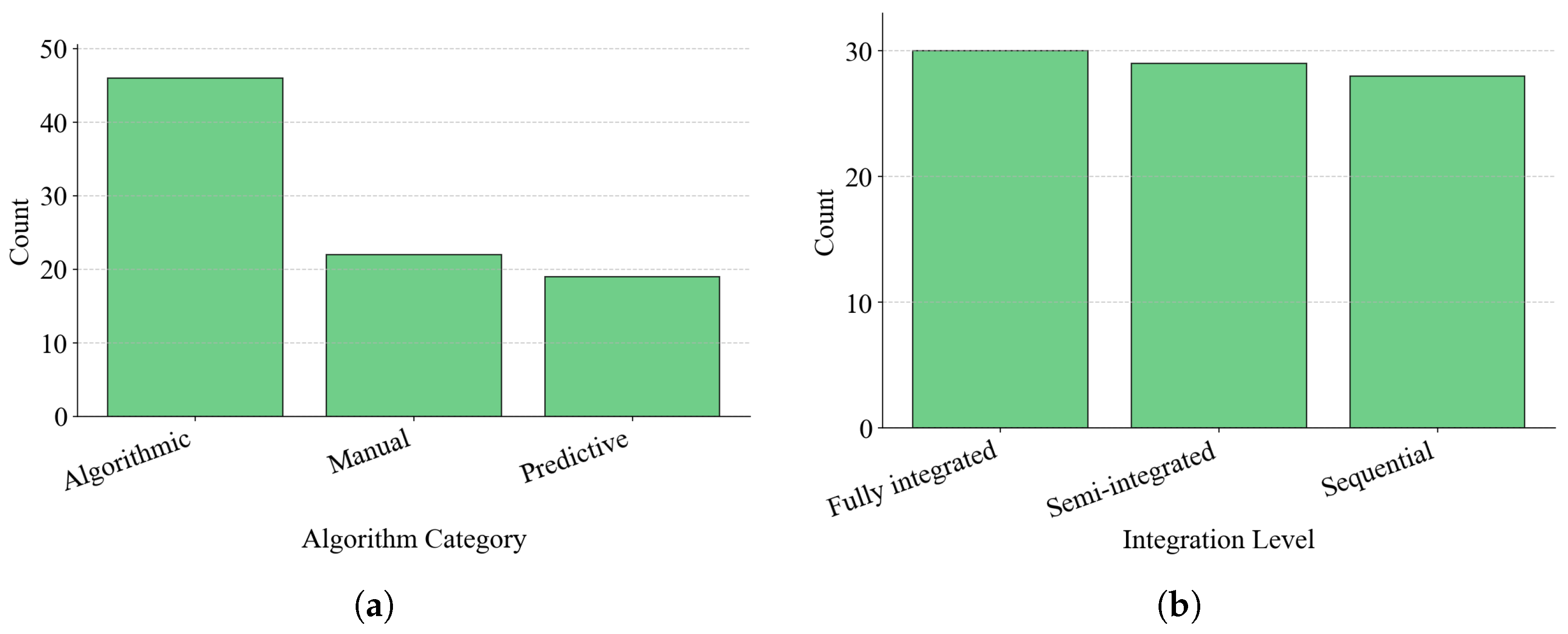
Figure 5a shows the distribution of the different algorithm categories. Around 25% of the studies fall under Manual Parametric Design, emphasising designer-driven exploration through the direct manipulation of parameters, rules, and model behaviour [66]. These workflows combine intuitive geometric modelling with FEM-based evaluation in tools such as Grasshopper–Karamba3D, Abaqus, or ANSYS [43,44,49,60,85]. Manual frameworks are common in parametric lattice and bracing studies [46,60,85], as well as in comparative analyses of shell morphologies and surface patterning [43,67,82]. These methods are often applied to architectural and product-scale case studies, where geometric transparency and iterative control are prioritised over computational optimisation [44,46,60,85]. Across this group, parameters are manually adjusted to assess design sensitivity or performance trade-offs rather than to converge toward algorithmic optima [43,67,82,85].
The largest share of the dataset—approximately 53%—belongs to the Algorithmic Optimisation category, in which heuristic, evolutionary, or multi-objective algorithms iteratively evaluate design variants. Common platforms include Galapagos, Octopus, NSGA-II, and BESO, frequently coupled with FEM solvers to optimise geometry, material distribution, or cost–performance balance [13,48,69,77,86,87]. Typical applications range from truss and frame optimisation [33,48,65,77] to composite layup and metamaterial tuning [13,69,89,94]. Several works implement fully integrated design-to-analysis workflows, connecting Grasshopper-based generation with external FEM tools for iterative evaluation [62,79,84,88]. Algorithmic frameworks are also used in hybrid design environments, embedding optimisation loops into architecture, product, or aerospace domains [18,47,74,93]. Across these studies, formal search replaces intuition with systematic exploration, yielding reproducible improvements in stiffness, mass, and material efficiency [13,33,48,69,89].
Approximately 22% of the reviewed studies fall into the Predictive Modelling category, employing surrogate or machine-learning models to approximate physical simulation outputs and accelerate design exploration. Neural networks, Gaussian processes, and reduced-order models are used to predict stress, deformation, or aerodynamic performance, enabling rapid feedback during optimisation [20,52,71,83,90,91]. Recent works integrate these learned estimators directly within FEM-based design loops, combining data-driven prediction with adjoint-compatible or ROM techniques to retain physical accuracy at reduced computational cost [25,45,72,78,92]. Collectively, these approaches demonstrate a methodological development toward hybrid AI–FEM frameworks that couple predictive intelligence with parametric and optimisation workflows, achieving unprecedented speed and efficiency in structural and aerodynamic performance evaluation [25,52,78,83,90,92].

4.4. Integration Level of FEM

Figure 5b shows that the three integration levels are almost evenly represented in the dataset, with sequential, semi-integrated, and fully integrated workflows each accounting for approximately one-third of the reviewed studies.
The Sequential category comprises works where AAD and FEM are executed as separate steps, with geometry or analytical models developed first and FEM applied only afterward for structural verification. This pattern is characteristic in shell and bridge form-finding [19,57,75,80,82,85], in parametric or analytically driven mechanical components [12,31,33,59], and in metamaterial, lattice, or biomimetic systems [53,67]. Manufacturing- and materials-oriented studies follow the same structure, using FEM to predict stresses, residual strains, fracture behaviour, or wear without feeding results back into design [11,17,21,24,32]. Across these works, any design refinement remains manual, and FEM functions purely as a post-process evaluation step.
The Semi-integrated category comprises studies where AAD and FEM interact iteratively but without continuous two-way coupling. In structural and mechanical workflows, FEM responses guide repeated updates of parametric or optimisation-based models [18,20,43,44,61,62]. Generative and machine-learning approaches incorporate FEM through surrogate modelling, training data generation, or batch evaluation [13,48,58,81,83]. Architectural and fabrication-focused studies employ comparable semi-iterative loops [37,49,78,84], while materials and component-level applications use FEM in parameter sweeps, metamodels, or automated evaluation pipelines [15,34,35,47]. In all cases, FEM meaningfully informs design decisions, but the interaction relies on discrete updates rather than fully integrated real-time exchange.
The Fully integrated category includes studies where AAD and FEM operate within unified design frameworks that support continuous or near-continuous feedback between geometry, analysis, and optimisation. Many works embed FEM directly in multi-objective or topology optimisation loops, enabling iterative updates to form, thickness, or material layout [63,69,70,77,94]. Similar tightly coupled workflows appear in performance-based design of tall buildings, bridges, and various shell or composite systems [71,73,76,86,87,88,93]. Aerospace and mechanical applications integrate adjoint or surrogate-enhanced FEM directly in CAD-based shape optimisation [25,51,52,54,74]. Another group embeds FEM into data-driven pipelines, where neural networks or graph-based surrogates are trained on FEM results and reintroduced into the loop [38,45,64,90,91,92]. Across these studies, FEM functions not merely as an evaluator but as the primary computational engine steering geometry generation, decision-making, and optimisation.

4.5. FEM Role

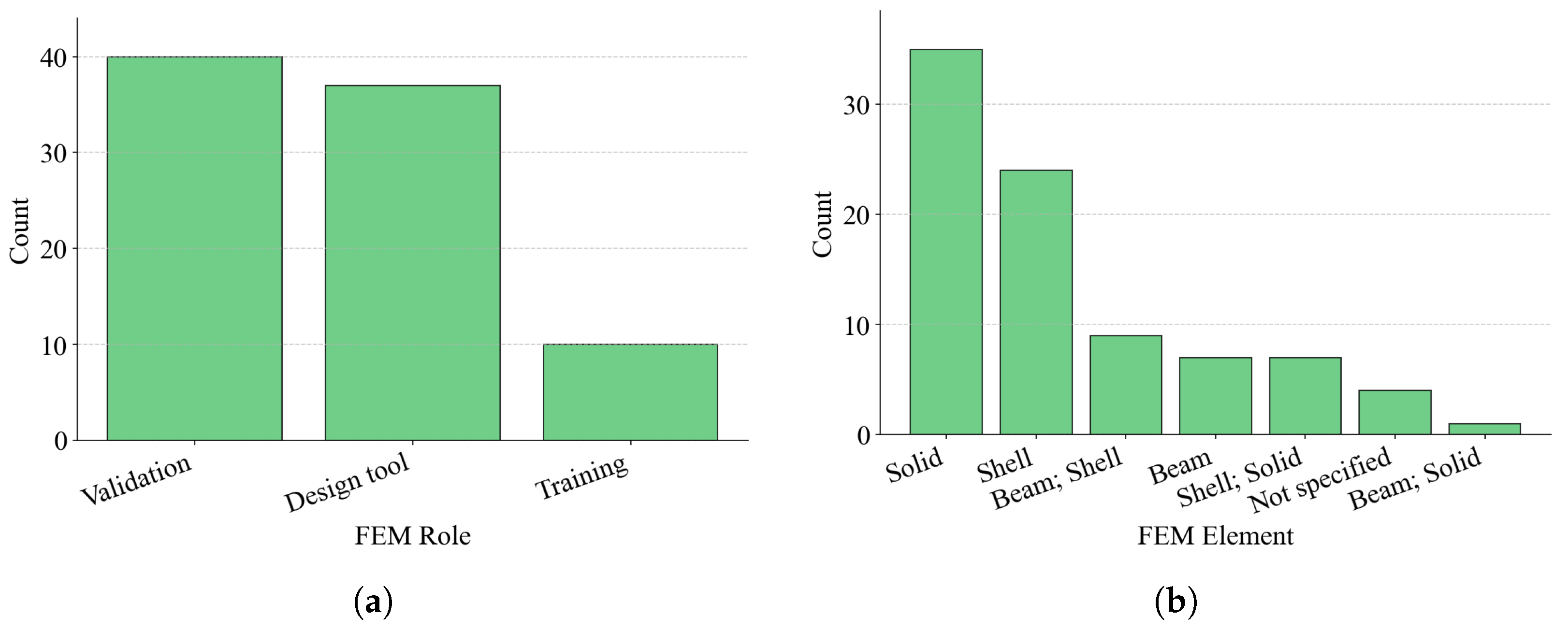
The Validation role constitutes the largest share of the dataset, at approximately 46%, where FEM is used solely to confirm structural or mechanical behaviour after geometry or design parameters have been established, as illustrated in Figure 6a. Architectural and civil case studies typically perform form-finding, analytical derivations or parametric modelling first, then run FEM as a one-off consistency check on shells, grids or hybrid structural systems [12,19,28,31,33,59,75,80,82,85]. Similar sequential workflows appear in manufacturing and materials research, where FEM reproduces experimentally observed stress, deformation or thermal fields rather than steering new variants [11,17,27,32,36]. A smaller semi-integrated subset iterates between parameter updates and FEM for biomimetic lattices, bending-active structures and metamaterials, but analysis still evaluates predefined options instead of driving automatic redesign [35,37,39,43,44,53,78].
The Design tool category accounts for roughly 43% of the studies, in which FEM acts as a generative engine that steers design decisions throughout iterative optimisation and parametric update cycles. Architectural and civil studies embed FEM within form-finding or topology loops for tall-building wind systems, long-span bridges, and free-form or bending-active shells, so that structural performance feeds back directly into geometric changes [13,49,71,81,84,86,88,94]. Related generative workflows couple FEM with reciprocal or morphing structures and aero-structural behaviour, such that each analysis step reshapes canopy, wing, or shell geometry [15,52,65,74]. In mechanical and marine applications, FEM-based iterations adjust laminate layouts, patch geometries, and shell thicknesses to balance weight, stiffness, and crash or buckling performance [34,47,61,70]. Several frameworks further couple FEM with adjoint solvers, surrogate models, and CAD- or knowledge-based systems so that geometry generation, meshing, and structural evaluation run inside a single automated loop [25,30,56,79,93]. Across these examples, FEM is not a final check but the computational engine that shapes the evolving design space.
The Training category represents around 11% of the studies, where FEM primarily serves as a generator of high-fidelity datasets used to build predictive or surrogate models that later accelerate or replace simulation in design workflows. This includes generative or early-stage frameworks where FEM-derived responses underpin GAN-based structural improvement, vibroacoustic metrics, and variable-complexity optimisation of lightweight girders [58,68,83]. More tightly integrated approaches train graph- and metamodel-based surrogates on FEM fields for rapid stress prediction, topology refinement, or detailed response estimation [45,63,92]. FEM-based training also underlies ANN-driven optimisation of wind-load resisting systems and broader data-driven design pipelines that substitute the solver inside multi-objective search [90,91]. At the solver and element level, ML and FEM merge into hybrid formulations in which learned models approximate stiffness or force–state relationships directly, compressing the cost of assembly and analysis while retaining FEM consistency [38,64].

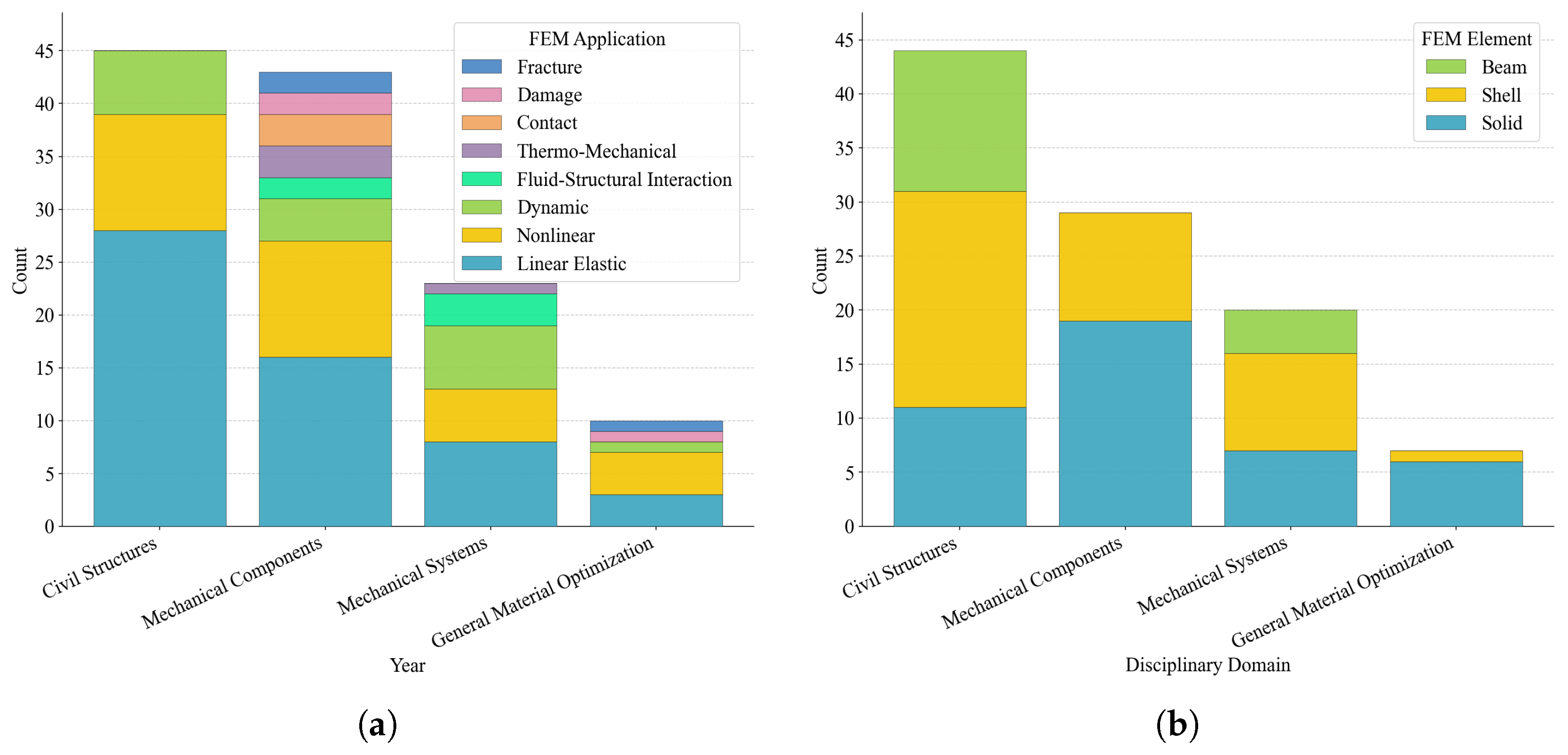
4.6. FEM Element

Figure 6b illustrates the distribution of FEM-elements, where solid elements dominate with about 41%. These are employed across civil [93,95], mechanical [20,28,31,33], and material-oriented analyses [34,43,50,53], often within optimisation, CAD automation, or AI-driven frameworks [56,72,83,92]. Nonlinear, thermo-mechanical, and contact effects are frequent [16,17,24,32], reflecting solids’ versatility for full 3D stress, heat, and deformation modelling [23,55,78,79,89]. Shell elements account for 38% and are widely used in thin-walled, lightweight, curvature-sensitive applications, including composite and aerospace optimisation [25,48,52,77]. They are also frequently applied in civil engineering, particularly for performance-driven analysis of curved or thin-walled structures [18,19,49,75,85]. In mechanical engineering, shell formulations similarly support the modelling of thin-walled components in automotive, biomedical, and energy-absorbing systems [54,60,61,66,67]. Furthermore, parametric and AI-assisted frameworks extend shell-element usage to fracture analysis, vibroacoustics, and GNN-based surrogates [21,26,45,58,68,91].
Beam elements represent about 16%, primarily for lattice, truss, and reciprocal systems where axial–bending behaviour dominates; they underpin equilibrium-based and generative design [69,80,81,82] and adaptive, textile, bending-active prototypes [41], emphasising parametric form-finding, geometric nonlinearity, and algorithmic optimisation. Combined elements are used sparingly but strategically: beam–shell couplings support tall-building form finding, fuselage/pressure-hull sizing, and parametric bridge design [30,47,84,86], while shell–solid hybrids enable generative and multi-objective workflows for cultural-heritage mounts, lightweight wheels, multi-material bridges, and crashworthy plates [13,51,70,88]. Although most studies combine element types within a single workflow, some apply them sequentially; for example, a simplified beam model is first used in Karamba3D for rapid evaluation, followed by a higher-fidelity solid-element analysis in ANSYS for verification [39]. Emerging ML-assisted “smart” elements further blur boundaries and accelerate analysis [38,64].

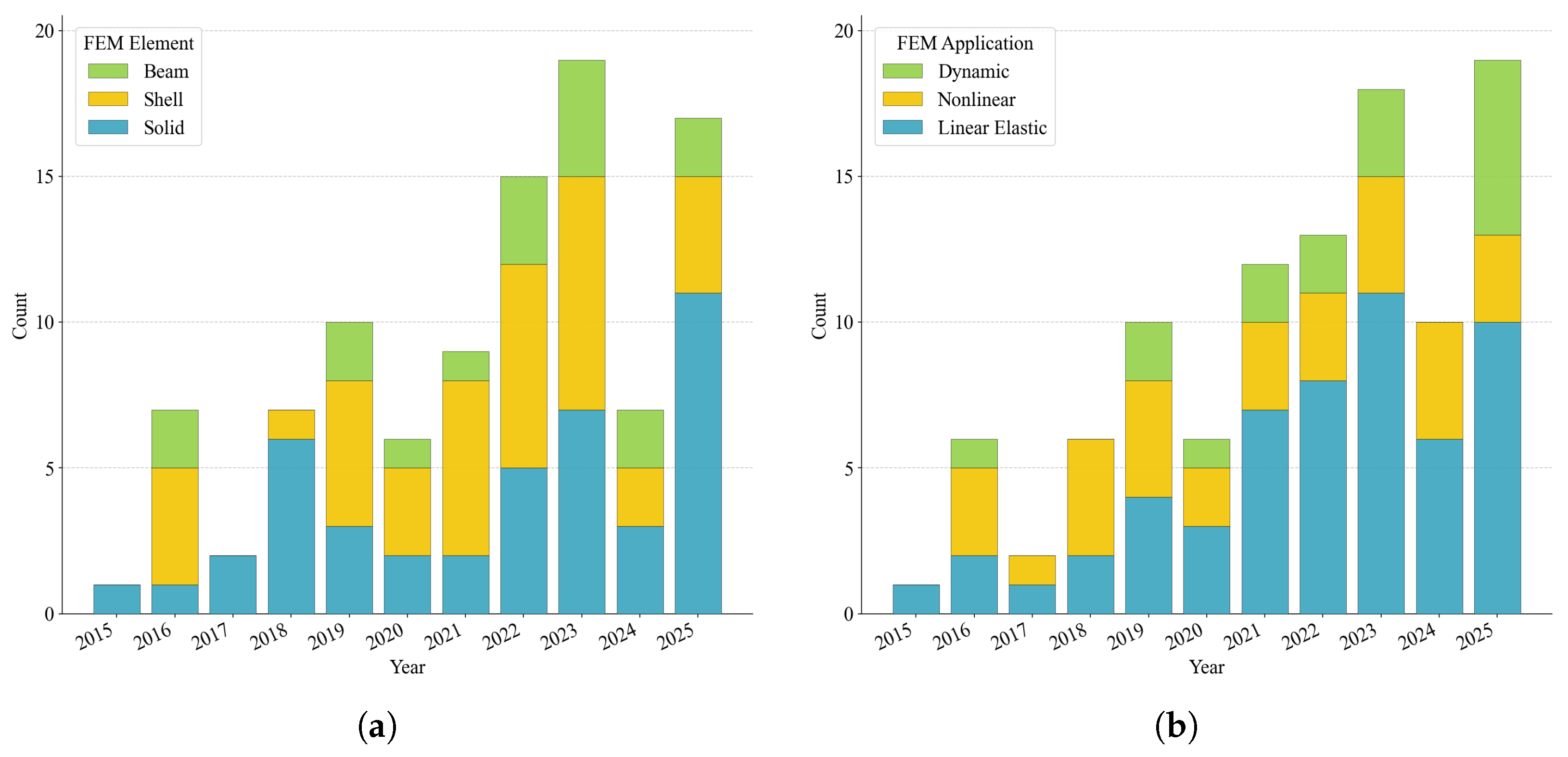
4.7. FEM Application

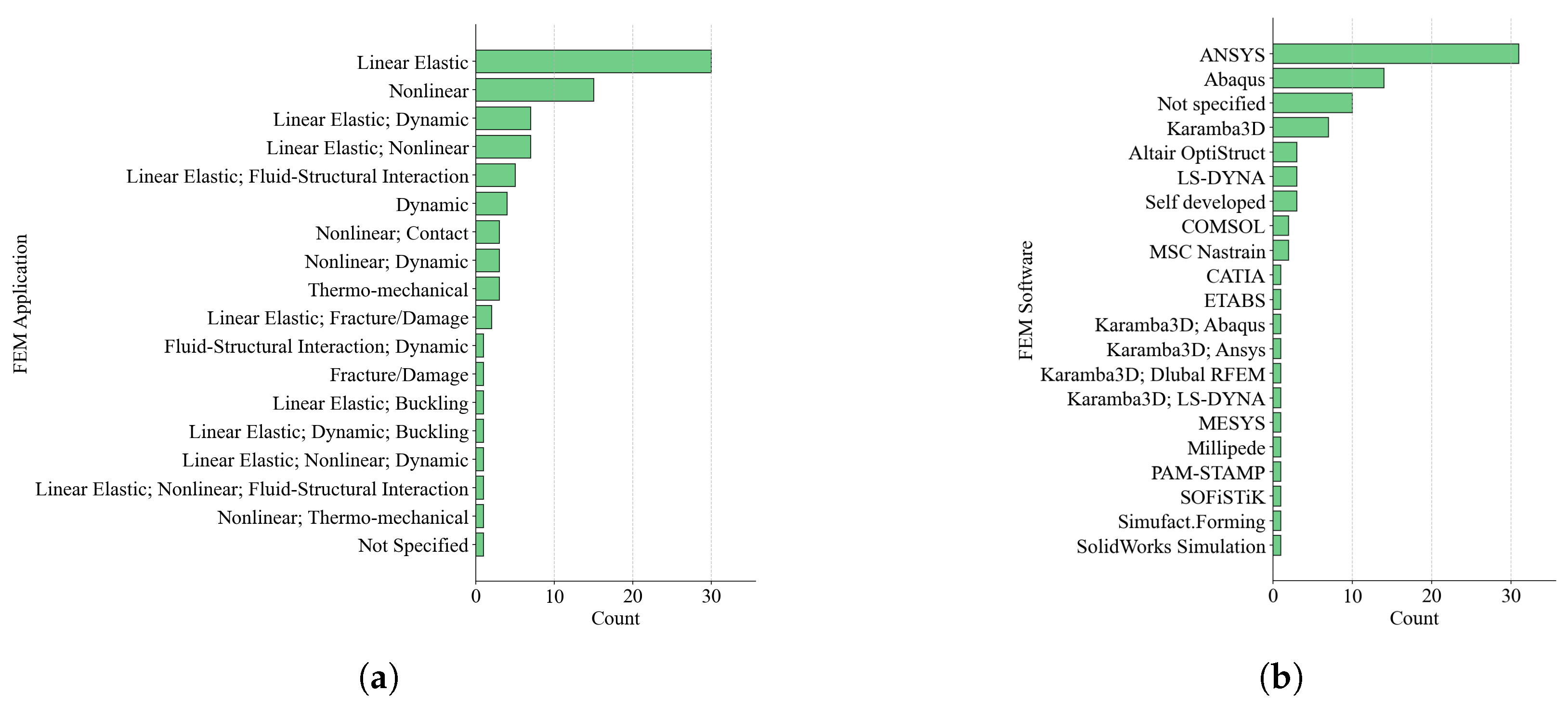
The category FEM Application classifies the types of finite element analyses employed across the reviewed studies, as illustrated in Figure 7a. Among these, linear-elastic analyses account for about 45%, representing the dominant approach for static structural evaluation of conventional materials. In mechanical applications, cost-optimised bearing systems and lightweight composite structures are modelled through linear-elastic simulations to predict stiffness and stress distributions [31,33,46]. Parametric and CAD-integrated methods further link geometry and material behaviour [12,62,79]. In civil studies, linear elasticity supports form-finding of bridges and shell structures [19,75,84,85,89], while generative and AI-augmented frameworks apply it for material-informed and predictive modelling [45,64,72,78,95].
Nonlinear analyses constitute approximately 25% of the reviewed studies and address large deformations, contact, plasticity, and post-buckling phenomena. In lightweight and biomimetic systems, geometric nonlinearity is central to capturing snap-through and bending-active effects, particularly in ribbed domes and textile or reciprocal structures [41,44], as well as in flexible hybrid sheets and air-supported or tensairity concepts [37,49,68,82]. Material and contact nonlinearities represent the largest group in metallic and composite components, where LS-Dyna, ANSYS, and surrogate-based optimisation frameworks [47,56,61,92] enable realistic post-yield and crash simulations. Studies on frictional dissipation and compliant mechanisms [34,53] emphasise constitutive nonlinearity verified through experiments.
Beyond purely linear or nonlinear analyses, several studies integrate multiple FEM applications to address coupled physical phenomena. Combined linear-elastic–dynamic analyses are frequently employed to capture wind-induced or vibrational effects in tall buildings [71,91], composite and wind turbine structures [52,77], and parametric bridge optimisation [86,93]. Fluid–structure interaction is explored through coupled CFD–FEM frameworks for aircraft and energy systems [20,25], morphing wings, and tidal turbines [15,50,55]. Hybrid linear–nonlinear analyses address geometric and material coupling in composite and latticed structures [35,48,80,83], while contact-driven nonlinear simulations appear in tribological and biomedical contexts [16,24,28]. Dynamic nonlinear analyses remain crucial for biomimetic and crashworthiness investigations [43,51,67]. Other hybrid combinations, such as thermo-mechanical or fluid–dynamic–nonlinear coupling, also appear sporadically but constitute rare, specialised cases within the corpus reviewed.

4.8. FEM Software

Figure 7b shows the distribution of FEM environments, where commercial solvers constitute and reflect differing modelling demands across scales. Beam and shell-oriented software such as Karamba3D, Millipede, SOFiSTiK, and ETABS is prevalent in civil studies emphasising geometric efficiency, rapid iteration, and integration with parametric workflows [80,81,84]. In contrast, shell and solid-based solvers including ANSYS, Abaqus, LS-Dyna, and Altair OptiStruct constitute the largest share of the field, collectively representing more than half of all studies, and are applied for detailed nonlinear, contact, and dynamic analyses in structural, mechanical, and manufacturing contexts [17,20,43,51,88]. Finally, a smaller share of studies rely on self-developed codes for domain-specific simulation or AI-enhanced surrogate frameworks [38,48,64,72,92,95], highlighting an ongoing trend toward customised, lightweight solvers that bridge research experimentation with computational efficiency.

5. Discussion

This section discusses the main findings from the mapping and interprets how Algorithm-Aided Design and the Finite Element Method are currently integrated and applied in early-stage structural design. Beyond summarising the discussion, the paper examines three main topics: how methodological tendencies evolve, how integration depth shapes the role of FEM within computational workflows, and how disciplinary contexts influence modelling practices. The section first reviews general patterns in algorithm use, integration levels, and FEM applications and then synthesizes these patterns to highlight broader trends, cross-domain differences, and the structural limitations that continue to shape AAD–FEM practice.
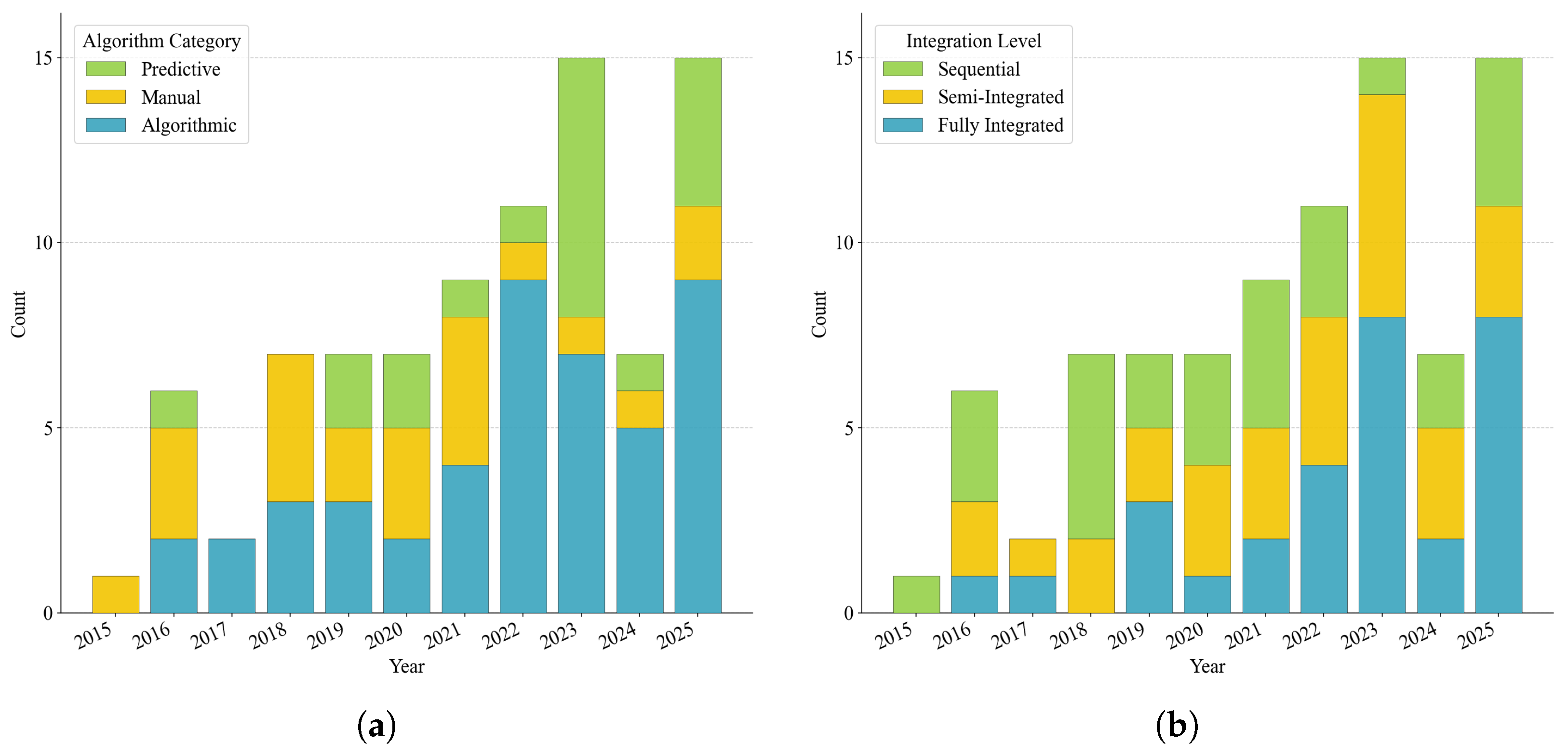
Figure 8a shows a clear temporal trend in the methodological tendencies of the reviewed studies. Both algorithmic and predictive approaches increase notably over time, with a particularly marked rise after 2020–2021. Algorithmic methods represent the majority of all studies, accounting for approximately 53%, and show substantial growth in the most recent years. Predictive approaches, although fluctuating from year to year, also show a clear upward trend relative to earlier periods, increasing from about 13% before 2020 to roughly 25% between 2020 and 2025, with marked peaks in 2023 and 2025. In contrast, manual procedures decline significantly, constituting around 50% of studies in the early period (2015–2018) but falling to below 15% in the most recent years (2024–2025). Together, these developments indicate a broader disciplinary transition toward more automated, data-informed, and computationally driven design paradigms within both civil and mechanical contexts [72,78,90].
Figure 8b and Figure 9 together illustrate how the relationship between FEM and AAD has evolved in both integration depth and functional role. The temporal distribution in Figure 8b shows a development from predominantly sequential workflows toward increasingly integrated approaches. In the years before 2020, sequential processes make up the largest share of contributions, exemplified by classical CAE workflows [19,28], where FEM is applied only after design decisions have been made. Semi-integrated workflows also appear regularly during this period, such as in the design of bending-active structures [49] and FEM-informed topology pattern generation for shells [96], where FEM contributes iteratively but remains external to the generative process.
Fully integrated approaches remain uncommon until 2021, after which their prevalence increases sharply, particularly in 2023 and 2025, when they account for more than half of the studies in those years. Representative examples include multi-material topology optimisation for long-span bridges [88], parametric–FEA co-optimisation in bridge design [86], and real-time surrogate-enhanced FEM workflows [92]. Comparable levels of integration also appear in mechanical engineering, such as the iterative composite-chassis optimisation [65], and the ML-enhanced element formulation presented in [38]. Across these examples, FEM operates directly within the design loop rather than as a downstream validator, supporting the observed rise in fully integrated workflows.
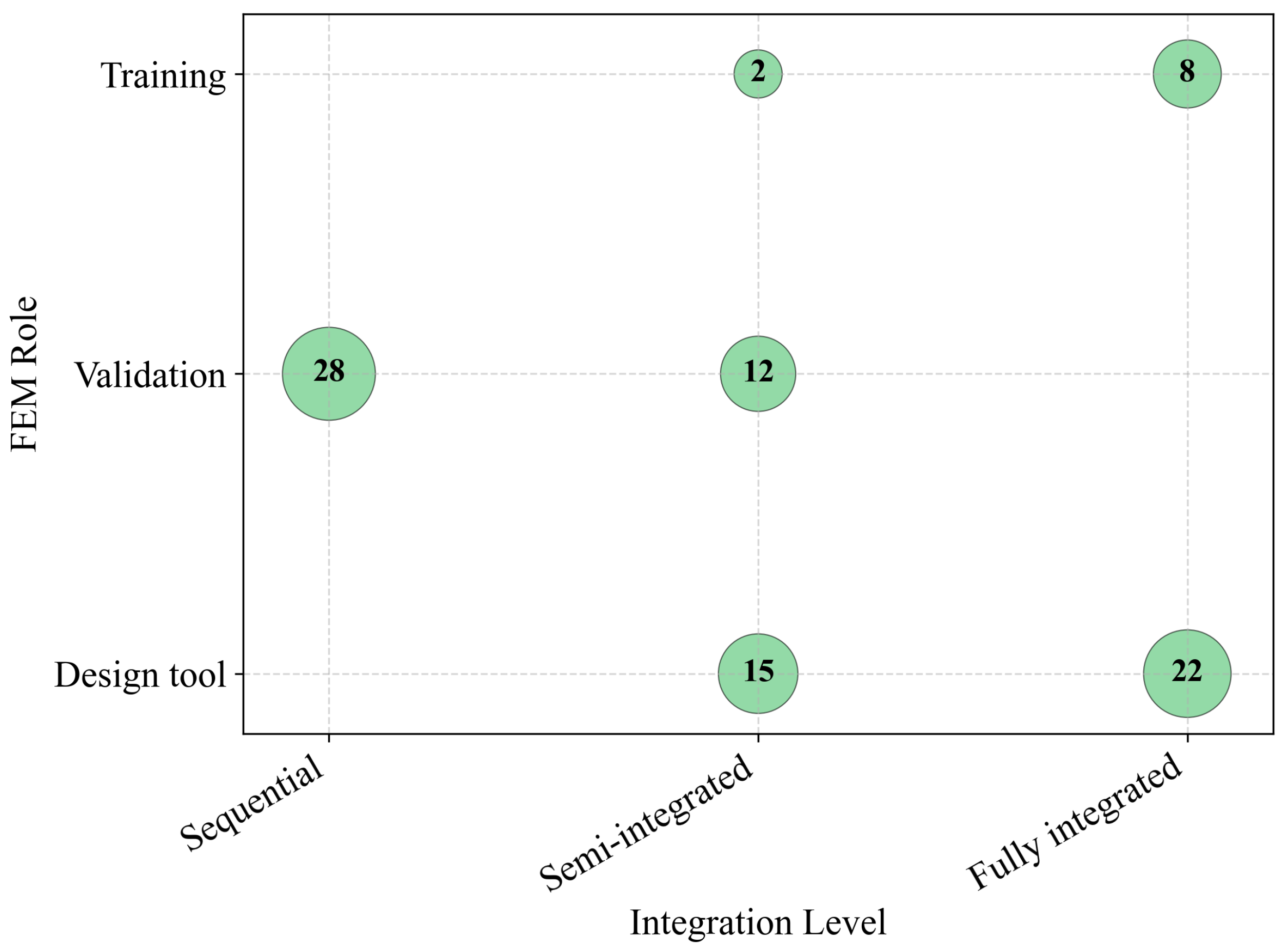
Figure 9 further contextualises this trend by showing how integration levels relate to FEM’s functional role. Sequential workflows rely overwhelmingly on FEM for validation—around 70% of all validation-oriented studies fall in this category. Semi-integrated workflows show a more balanced distribution, although validation remains the largest group. Fully integrated cases present a clear contrast: they constitute the majority of studies where FEM acts as an active design tool or as a generator of training data for ML-based models. This pattern reflects how increased integration depth correlates with workflows in which FEM directly shapes the design space through optimisation, surrogate modelling, or iterative computational feedback.
Taken together, the trends in algorithmic methods and integration depth describe how AAD–FEM workflows are evolving at a procedural level. What these temporal patterns do not show, however, is how practices differ across disciplinary domains, in which established modelling traditions and performance priorities shape the role that FEM can realistically play in early-stage design. Before interpreting the figures, one methodological clarification is needed: whereas the algorithm-type and integration-level plots in Figure 8 count one entry per study, the FEM plots in Figure 10 and Figure 11 reflect the total number of modelling operations. If a study used both shell and solid elements, or both linear and nonlinear analyses, each choice is counted.
With this in mind, clear disciplinary patterns emerge in Figure 10a. Civil studies overwhelmingly favour linear-elastic analyses, accounting for about 62% of all applications, with nonlinear and dynamic analyses making up the remaining 38%. Mechanical studies show a broader distribution: 37% linear elastic, 26% nonlinear, 9% dynamic, and 28% across thermo-mechanical, contact, fracture, damage, and fluid–structure interaction analyses. A similar divide appears for the use of elements, seen in Figure 10b. Civil work relies predominantly on shell and beam elements—around 75% of all instances—reflecting priorities such as geometric flexibility, computational efficiency, and surface-based modelling. Mechanical components and systems instead favour solid elements, around 66% in component-level studies and up to 35% in system-level analyses, supporting use cases requiring high-resolution stress fields, contact behaviour, and complex boundary interactions.
Finally, Figure 11 shows a gradual increase in modelling complexity across the reviewed period. Nonlinear analyses represent a substantial and persistent share of all applications, remaining near one-third of the total throughout the dataset, and their presence does not diminish in later years, indicating that more advanced material and geometric behaviours have become a stable expectation rather than an exceptional case. Dynamic analyses, first appearing in 2016, show a steady upward trend and become increasingly common toward the end of the period. Considered together with the growing interest in algorithmic and predictive methods, these developments indicate a general movement toward more analysis-informed early-stage workflows across both civil and mechanical domains. Even so, the underlying practices vary considerably, and alignment between disciplines remains partial. Because more advanced analyses may also increase computational cost, there is continued motivation for techniques that help manage simulation effort and facilitate more responsive design–analysis processes.
Computation time emerges as a central limiting factor in bridging these domains. Multiple studies report that high-fidelity FEM or coupled simulation pipelines require hours to days per optimisation run, which severely restricts the number of iterations that are feasible in early-stage exploration. For example, in [55], a multidisciplinary optimisation workflow combining CAD modelling, CFD simulation, and FEM analysis requires on the order of a week, whereas metamodel-based surrogates reduce this to about four hours. Likewise, Refs. [46,56] report single-run FE analyses with runtimes of 1.5–2.2 h, explicitly noting that such computational costs limit how well simulation can support design and repeated decision cycles. Similar concerns appear in [77], where additional algorithmic pruning is introduced to avoid “time-consuming calculations of unfeasible paths,” and in interactive or XR-based frameworks such as [95], which deliberately simplify FE models to maintain “computational immediacy” and “virtually real-time structural feedback” in conceptual design.
As modelling complexity increases—evident in the growing diversity of FEM applications shown in Figure 11—simulation overhead rises accordingly, and long runtimes tend to push analysis toward a downstream validation role rather than an active participant in early exploration. In response, surrogate and learning-based acceleration strategies have become a defining feature of recent work. Graph-based FEM surrogates such as [45,92] demonstrate that carefully designed GNN architectures can provide stress fields and even optimised designs in milliseconds to seconds, replacing many full FEM solvers in digital prototyping and manufacturability studies. At the solver level, element- and stiffness-surrogate approaches such as [38,64] explicitly reduce the computational cost of existing finite element formulations, reporting speedups of up to approximately 90% in nonlinear regimes by replacing iterative constitutive updates and numerical integration with trained neural models. Hybrid AI–CAE frameworks such as [72] further cut computation by shrinking the number of required simulations: one study shows that an LLM-assisted workflow can achieve comparable design guidance with roughly 27 FEM evaluations instead of 756 regression-based evaluations, corresponding to a reduction from nearly 25 h of cumulative simulation time to a small fraction of that. More broadly, reviews such as [90] identify AI-empowered surrogate modelling as a rapidly growing strategy precisely because it replaces time-consuming numerical evaluations in design and optimisation.
Taken together, these advances substantiate a shift in how simulation operates within design workflows. Rather than functioning solely as a passive verifier at the end of a sequential pipeline, accelerated and predictive models increasingly enable simulation to act as an interactive design partner: providing near-real-time feedback during sketching and form-finding [95], supporting conversational and designer-driven exploration [57], and driving automated or semi-automated optimisation loops in close contact with geometry generation [45,92]. This trajectory aligns with the post-2021 proliferation of predictive approaches in Figure 8a, indicating that algorithmic innovation in surrogate and learning-based methods and the drive for computational acceleration are increasingly co-evolving forces in design computation.
Hardware evolution amplifies these developments. The rapid increase in GPU processing power [97], multicore architectures, and cloud computing has made near real-time simulation feasible even for complex FEM models [57,81]. These capabilities underpin the emergence of deep learning surrogates capable of replicating high-fidelity stress fields and topology patterns within milliseconds [45,78,90]. The widespread adoption of Python-based libraries such as TensorFlow, PyTorch, and NumPy has further lowered the barrier to implementing and integrating such models in architectural and mechanical workflows, facilitating their coupling with parametric design environments. In addition to the mapped studies, a supplementary review published after our systematic search—Rostami et al. (2025)—illustrates a parallel development in aerospace engineering, where extended-reality (XR) and digital-twin environments are combined to enable real-time visualisation and synchronised simulation feedback between virtual and physical models [98]. As reflected by the upward trajectory of predictive studies in Figure 8a, methodological and infrastructural developments are deeply intertwined: growing computational capacity enables deeper learning architectures, which in turn invite new forms of generative and exploratory simulation.
Nevertheless, technological capability has not yet produced full methodological integration. While mechanical and aerospace engineering benefit from decades of CAD–CAE coupling and standardised data schemas [55], civil workflows remain fragmented across incompatible platforms, with sequential processes that introduce long feedback loops and information loss [57,95]. In principle, interoperability in the AEC sector is intended to be supported through the use of open, vendor-neutral BIM standards, which aim to facilitate model exchange across disciplines. One example commonly used in industry is Industry Foundation Classes (IFCs) [99]. From a technical perspective, however, fragmentation persists due to limitations in how such BIM standards are implemented and adopted within contemporary design and analysis workflows. Although these standards provide a rich geometric and semantic framework, their practical use is constrained by the heterogeneity of disciplinary requirements across structural engineering, HVAC, manufacturing, and electrical systems. As a result, models are rarely populated with complete, discipline-specific metadata at the level required to support integrated computational workflows.
Structural analysis illustrates this limitation clearly. Although BIM schemas formally include entities intended to represent analysis definitions and results, these capabilities are seldom utilised in practice. FEM results are rarely written back into shared BIM models, and only in recent years have some commercial FEM solvers begun to accept BIM-based geometry as input. Even where such functionality exists, it typically requires substantial manual intervention, including repair and reinterpretation of analytical models. This is partly because FEM representations in early-stage design commonly rely on simplified abstractions, such as beam and shell elements defined by lines and surfaces, rather than boundary representation or solid models typically used in BIM environments. Consequently, data exchange is often reduced to static file transfers, requiring manual redefinition of loads, supports, material properties, and meshes, and preventing associative feedback between design and analysis models. Parametric environments such as Grasshopper in Rhino support rapid modelling but still rely on manual or semi-automated file-based exchanges when interfacing with solvers like Abaqus, ANSYS, or OptiStruct [57,77]. Recent work addresses these gaps through bespoke, scriptable pipelines—such as OptiStruct-based mesh reconstruction and batch execution [77] or knowledge-object automation linking CAD, meshing, process simulation, and FEA across heterogeneous tools [56], yet these solutions demand significant programming literacy. As noted by Olsson [57] and Torghabehi [81], the necessity of custom scripts, mesh-repair routines, and multi-step preprocessing limits broader adoption, underscoring that AEC workflows remain less integrated and more brittle than the tightly coupled, data-model-driven practices established in mechanical and aerospace domains.
Immersive and real-time environments offer a complementary route toward integration. Frameworks such as HeXA integrate haptic feedback, extended reality (XR), and in-house FEM solvers to provide instantaneous tactile responses to material and structural behaviour during sketching and modelling [38,95]. Similarly, Rasoulzadeh et al. [78] combine 4D sketching, neural surface reconstruction, and micromechanics-based material modelling to link geometry creation directly with structural feedback. To contextualise these findings, a recent review published after the systematic mapping—Rostami et al. (2025)—demonstrates comparable developments in aerospace engineering, where XR and digital-twin technologies enable real-time visualisation and structural simulation feedback within collaborative design environments [98]. Together, these systems reflect a gradual methodological development toward tighter coupling between geometric modelling, structural simulation, and sensory feedback. Rather than replacing existing practices, such approaches expand the design process by integrating physical interaction and real-time analytical insight. The convergence of FEM, AI, and XR thus broadens the role of computation beyond numerical efficiency; it becomes a medium for collaborative, multisensory reasoning across design and engineering domains.
Despite rapid progress, persistent barriers remain. Interoperability issues, fragmented datasets, and steep learning curves continue to impede widespread use of integrated AAD–FEM workflows [78,90]. Professional fee structures and project timelines rarely incentivise early-stage structural feedback, reinforcing sequential rather than parallel collaboration [78]. The continued dominance of linear-elastic analyses in Figure 11—still exceeding more than half of all occurrences—illustrates that advanced nonlinear or data-driven methods remain largely confined to research contexts. Overcoming these limitations will require not only computational advances but also institutional and educational ones: shared ontologies, open data standards, and cross-disciplinary literacy capable of translating between design intent and analytical rigour.
Beyond the individual challenges identified across the reviewed literature, the mapped results indicate that recent developments in AAD–FEM workflows are closely tied to the increasing adoption of artificial intelligence and data-driven methods. The sharp rise in publications after 2020, together with the growing share of predictive and surrogate-based approaches, suggests that AI functions less as a separate research direction and more as a unifying enabling layer across interoperability, multiscale modelling, and usability. At a pragmatic level, AI has lowered barriers to participation in research and practice by improving access to technical literature and tools, including automated translation and documentation support, thereby contributing to a broader and more geographically diverse research landscape. More fundamentally, AI-driven methods allow engineers to develop, test, and deploy computational workflows with substantially reduced implementation effort compared to earlier generations of FEM-based automation. Tasks that previously required extensive solver-specific programming, such as mesh handling, model conversion, or performance evaluation, can now be abstracted through surrogate models, learned mappings, or automated code generation.
From a technical perspective, this shift has direct implications for the previously identified challenges. Interoperability can increasingly be addressed through semantic and geometric translation layers built on top of open BIM and parametric representations, rather than through brittle file-based exchange alone. Multiscale material and structural behaviour can be integrated hierarchically by combining simplified analytical or beam and shell models with selectively deployed high-fidelity simulations, supported by AI-based reduced-order models that limit computational cost. Usability is similarly affected, as scripting, optimisation, and model orchestration become more accessible through higher-level abstractions and automated workflow generation. These developments align with the emergence of early-stage, data-rich design environments in commercial and consultancy contexts, such as generative planning and feasibility platforms that aim to integrate geometric, environmental, and structural information within unified systems (e.g., Autodesk Forma [100], formerly Spacemaker, and platform ecosystems within the Trimble software landscape [101]). While still limited in scope, such tools illustrate a broader trajectory toward embedding structural performance reasoning directly into conceptual design environments. Taken together, the mapped trends point toward a concrete integration path in which high-fidelity FEM, extending beyond beam abstractions to shell and solid models, is progressively embedded within parametric design workflows, supported by hierarchical model fidelity and AI-assisted reduction techniques. This trajectory is further reinforced by recent standardisation efforts, such as Eurocode 3 Part 1-14 (Design Assisted by Finite Element Analysis), which formalise the use of FEM within code-compliant structural assessment and indicate a broader shift toward deeper integration of FEM into early-stage design and routine engineering practice. In summary, the trajectory of AAD–FEM integration is characterised by simultaneous expansion and fragmentation. Analytical complexity, computational speed, and algorithmic diversity are all increasing, yet practical implementation remains constrained by disciplinary silos and technical barriers. These advances, including machine-learning surrogates, GPU-enabled real-time feedback, and immersive data-informed environments, suggest a future in which structural reasoning is integrated into the creative process rather than treated as an external validation step. Realising this potential will depend on making these systems not only faster and more accurate, but also more interoperable, transparent, and cognitively accessible across the civil, mechanical, and computational design communities that employ them.

6. Conclusions

This systematic mapping study examined how Algorithm-Aided Design (AAD) and the Finite Element Method (FEM) are applied and integrated in early-stage structural design. Across the 87 reviewed studies, the results reveal a field undergoing both expansion and fragmentation: analytical ambition, algorithmic sophistication, and computational capability are increasing, yet practical implementation remains constrained by heterogeneous tools, fragmented data models, and discipline-specific traditions. As shown in Figure 11, linear elastic analyses remain the largest group, representing slightly above 50% of all FEM applications, while Figure 10 shows that shell and beam elements account for around 75% of civil-domain use. Nonlinear analyses consistently represent around 33% of total operations (Figure 11), and dynamic analyses show a gradual increase from 2016 onward, indicating that more advanced modelling approaches have become an established component of many early-stage workflows.
  • RQ1. How is Algorithm-Aided Design (AAD) applied to support structural exploration, optimisation, and decision-making in conceptual design?
The reviewed studies indicate that Algorithm-Aided Design is applied in conceptual structural design primarily to support parametric exploration, comparison of design alternatives, and performance-informed refinement. As shown in Figure 8a, algorithmic approaches account for the largest share of the reviewed literature across the entire period. However, this prevalence does not necessarily imply deep integration with structural analysis. Figure 8b and Figure 9 show that FEM is most commonly applied within sequential or semi-integrated workflows, where its role is primarily evaluative rather than generative. As a result, support for structural exploration and early decision-making is often indirect, relying on comparisons between discrete design options rather than continuous, analysis-driven feedback. At the same time, the temporal distributions in Figure 8b indicate a gradual increase in more tightly coupled AAD–FEM workflows in recent years. In these cases, FEM or FEM-derived surrogate models are embedded more directly within the design process, enabling earlier performance evaluation, iterative optimisation, and more systematic decision-making under uncertainty. Overall, the findings suggest that AAD currently supports conceptual structural design through a combination of exploratory design generation and selective structural evaluation, with emerging evidence of more integrated approaches toward the end of the reviewed period.
  • RQ2. In what ways has the Finite Element Method (FEM) been integrated into early-stage design workflows, and how has its role evolved over time?
As illustrated in Figure 11, FEM use in conceptual design has diversified in both analytical scope and integration depth. Linear-elastic analyses remain the most common, representing slightly above 50% of all occurrences, while nonlinear analyses form a stable proportion of around 30% across the entire reviewed period. Dynamic analyses first appeared in 2016 and became increasingly frequent toward 2025, reflecting a gradual broadening of analytical ambition. According to Figure 10, civil studies rely predominantly on shell and beam elements, which together account for approximately 75% of all civil-domain operations. Mechanical studies, by contrast, employ solid elements more frequently due to the need to capture detailed stress fields, contact phenomena, and multiphysics behaviour.
Integration depth shows a comparable development. Figure 8b demonstrates that sequential workflows are the most common in earlier years, whereas fully integrated AAD–FEM workflows grow more common after 2021, becoming the predominant category in 2023 and 2025. Recent advances—including surrogate models, GPU-accelerated solvers, reduced-order schemes, and hybrid AI–CAE frameworks—allow stress prediction, stiffness evaluation, or topology updates to be computed within milliseconds or seconds. These capabilities increasingly enable FEM to function as an interactive design partner rather than a downstream validation tool, bringing analysis closer to the pace and fluidity required in early-stage design.
  • RQ3. What are the main trends, gaps, and challenges reported across the literature regarding the integration of these methods and technologies in the early stages of structural design?
The literature highlights a movement toward more tightly connected workflows that combine AAD, FEM, machine learning, micromechanics, and XR. Algorithmic and predictive methods together account for nearly 90% of studies published after 2021 (Figure 8a), reflecting a growing interest in computationally informed, feedback-oriented design processes. Several challenges nevertheless remain. High computational cost continues to limit iteration speed, particularly for nonlinear and multiphysics analyses. Interoperability issues are frequently reported in civil contexts, not because parametric environments such as Grasshopper are inherently limiting, but because external analysis tools are embedded in fragmented, file-based workflows with limited support for associative data exchange, standardised schemas, and integrated design–analysis feedback. Prior literature indicates that mechanical workflows benefit more consistently from established CAD–CAE associativity and standardised data schemas. Additional challenges include the limited integration of multiscale or advanced material models and the considerable programming literacy often required to maintain bespoke pipelines. A supplementary review published after our mapping [98] reports similar developments in aerospace, where XR and digital-twin systems aim to improve real-time simulation feedback. Data-driven and AI-based methods also emerge in the literature as enabling components across these challenges, particularly by supporting faster performance estimation and reducing implementation effort in integration pipelines. Taken together, these findings suggest that progress toward seamless AAD–FEM integration will depend not only on computational advances, but also on improved interoperability, shared data standards, and broader cross-disciplinary accessibility.

Future Work

Future research should aim to strengthen the methodological and technical foundations required for seamless integration between Algorithm-Aided Design (AAD) and the Finite Element Method (FEM) in conceptual structural design. A central direction is to bring advanced FEM analyses—including solid elements, nonlinear behaviour, and dynamic response—earlier into the design process, enabling more realistic structural performance to be captured without compromising the interactivity needed during early-stage exploration. Achieving this will depend on further development of real-time or near-real-time computational pipelines, where surrogate models, GPU-accelerated solvers, and adaptive hybrid schemes can deliver structural feedback fast enough to support iterative design.
Equally important is the need for greater interoperability and shared data standards, particularly in civil contexts where fragmented toolchains and manual exchanges between parametric environments and external solvers remain common. Addressing these challenges will require not only technical solutions such as unified ontologies, bidirectional data schemas, and model-view-consistent data structures, but also the creation of cross-domain infrastructures comparable to those established in mechanical engineering. The integration of multiscale and advanced material models, which remains limited in current AAD–FEM systems, represents another promising research avenue, especially as emerging materials and fabrication methods demand richer constitutive descriptions than those typically available in conceptual design.
Further work is also needed to reduce practical barriers to adoption. Many existing frameworks require substantial programming literacy and bespoke pipeline management; developing more accessible interfaces, higher-level abstractions, and designer-oriented tools will be essential to enable broader uptake. Immersive and extended-reality (XR) environments, shown to offer intuitive, sensory forms of structural feedback, remain largely experimental; strengthening their coupling with robust, real-time FEM could significantly change how designers engage with structural reasoning. The field would benefit from shared benchmarks, open datasets, and systematic evaluation frameworks that enable consistent comparison of emerging methods across disciplines and use cases.
In parallel, future research should more explicitly investigate the role of artificial intelligence as an enabling integration layer within AAD FEM workflows. Rather than treating AI as a standalone optimisation or prediction technique, further work is needed to understand how data-driven models can support interoperability, hierarchical model fidelity, and workflow automation across heterogeneous design and analysis environments.
Together, these directions indicate that future progress will require advances not only in computational performance but also in interoperability, material modelling, usability, and methodological standardisation. Strengthening these foundations will help move advanced analysis from the periphery of the design process to the centre of creative, performance-informed decision-making.


Author Contributions

Conceptualisation, L.O.T. and M.L.; methodology, L.O.T.; software, L.O.T. and V.V.; validation, L.O.T., M.L. and V.V.; formal analysis, L.O.T.; investigation, L.O.T.; resources, L.O.T.; data curation, L.O.T.; writing—original draft preparation, L.O.T.; writing—review and editing, M.L., V.V., F.M.M., A.R. and L.O.T.; visualization, L.O.T.; supervision, M.L.; project administration, M.L.; funding acquisition, M.L. All authors have read and agreed to the published version of the manuscript.

Funding

This research received no external funding.

Data Availability Statement

This repository includes the final filtered BibTeX file resulting from the metadata screening, as well as the Python scripts used for the automated metadata filtering, categorisation, and data cleaning. The repository is available at: https://github.com/larsolavtoppe/Systematic-Mapping, (accessed on 27 November 2025).

Conflicts of Interest

The authors declare no conflicts of interest.

Appendix A. Citation Tables for Results

Table A1. Classification of the reviewed articles by research type.
Framework Method Development Case Studies Technical Paper
[13,14,16,18,19,20,22,23,26,28,29,30,33,36,37,39,40,41,43,44,48,49,50,52,53,55,56,59,62,63,65,66,67,68,70,71,73,74,76,78,79,80,81,82,84,86,87,88,89,90,91,94,95,96,102][27,35,38,42,45,47,51,54,64,69,72,77,83,92][15,31,34,46,57,60,61,75,93][11,12,17,21,24,25,32,58,85]
Table A2. Classification of the reviewed articles by application domain.
Civil Structures Mechanical Components Mechanical Systems General Material Optimisation
[13,18,19,23,37,38,39,41,49,57,64,66,68,69,71,73,75,76,78,80,81,82,84,85,86,87,88,89,90,91,93,94,95,96,102][14,15,16,17,20,22,24,25,27,28,31,32,33,34,45,46,48,52,56,59,60,61,62,67,70,72,77,79,83,92][11,12,26,30,35,36,40,42,47,51,54,55,58,65,74][21,29,43,44,50,53,63]
Table A3. Classification of the reviewed articles by algorithm type.
Manual Algorithmic Predictive
[12,14,15,16,17,19,26,30,31,36,37,43,44,46,49,57,60,66,67,75,82,85][11,13,18,21,22,24,27,28,29,32,33,34,35,39,40,41,42,47,48,50,53,54,55,56,59,61,62,65,69,73,74,76,77,79,80,81,84,86,87,88,89,93,94,95,96,102][20,23,25,38,45,51,52,58,63,64,68,70,71,72,78,83,90,91,92]
Table A4. Classification of the reviewed articles by integration level.
Sequential Semi-Integrated Fully Integrated
[11,12,14,16,17,19,21,24,27,28,29,31,32,33,36,42,53,57,59,60,66,67,75,80,82,85,89,95][13,15,18,20,22,23,26,30,34,35,37,39,43,44,47,48,49,50,55,58,61,62,72,78,81,83,84,96,102][25,38,40,41,45,46,51,52,54,56,63,64,65,68,69,70,71,73,74,76,77,79,86,87,88,90,91,92,93,94]
Table A5. Classification of the reviewed articles by FEM role.
Validation Design Tool Training
[11,12,14,16,17,18,19,21,23,24,27,28,29,31,32,33,35,36,37,39,42,43,44,48,53,57,59,60,66,67,72,75,78,80,82,85,89,95,96,102][13,15,20,22,25,26,30,34,40,41,46,47,49,50,51,52,54,55,56,61,62,65,69,70,71,73,74,76,77,79,81,84,86,87,88,93,94][38,45,58,63,64,68,83,90,91,92]
Table A6. Classification of the reviewed articles by FEM element.
Beam Beam; Shell Beam; Solid Not Specified Shell Shell; Solid Solid
[36,41,69,80,81,82,96][30,38,42,47,64,73,84,86,87][39][46,57,62,90][18,19,21,25,26,27,37,45,48,49,52,54,58,60,61,66,67,68,74,75,77,85,91,102][13,51,65,70,76,88,94][11,12,14,15,16,17,20,22,23,24,28,29,31,32,33,34,35,40,43,44,50,53,55,56,59,63,71,72,78,79,83,89,92,93,95]
Table A7. Classification of the reviewed articles by FEM software.
ABAQUS ANSYS Altair OptiStruct CATIA COMSOL ETABS Karamba3D Karamba3D; ABAQUS Karamba3D; ANSYS Karamba3D; Dlubal RFEM Karamba3D; LS-Dyna LS-Dyna MESYS MSC Nastrain Millipede Not Specified PAM-STAMP SOFiSTiK Self Developed Simufact.Forming SolidWorks Simulation
[14,15,23,45,53,56,63,68,78,82,88,93,94,102][11,12,17,20,21,22,24,26,28,30,31,32,34,35,40,42,43,44,47,50,52,54,55,60,65,66,69,71,75,80,83][13,29,77][79][16,74][91][18,19,41,81,84,86,96][87][39][73][76][51,61,67][33][25,58][49][27,36,38,46,57,62,70,85,89,90][92][37][48,64,95][59][72]
Table A8. Classification of the reviewed articles by FEM application.
Dynamic Fluid–Structure Interaction; Dynamic Fracture/Damage Linear Elastic Linear Elastic; Buckling Linear Elastic; Dynamic Linear Elastic; Dynamic; Buckling Linear Elastic; Fluid–Structure Interaction Linear Elastic; Fluid–Structure Interaction Linear Elastic; Fracture/Damage Linear Elastic; Nonlinear Linear Elastic; Nonlinear; Dynamic Linear Elastic; Nonlinear; Fluid–Structure Interaction Nonlinear Nonlinear; Contact Nonlinear; Dynamic Nonlinear; Thermo-Mechanical Not Specified Thermo-Mechanical
[22,36,40,42][58][27][12,13,18,19,23,26,29,31,33,45,46,60,62,64,65,66,72,74,75,78,79,81,84,85,89,90,94,95,96,102][69][52,54,71,77,86,91,93][88][15,20,55][25,50][21,70][35,39,48,73,76,80,83][38][30][14,34,37,41,44,47,49,53,56,61,63,68,82,87,92][16,24,28][43,51,67][11][57][17,32,59]

References

  1. Cross, N. Design Thinking: Understanding How Designers Think and Work, 1st. ed ed.; Bloomsbury Academic: London, UK; Oxford, UK, 2016. [Google Scholar]
  2. Kostof, S. The Architect: Chapters in the History of the Profession; Oxford University Press: Oxford, UK, 1977. [Google Scholar]
  3. Awomolo, O. Exploring Multiple Disciplines in Building Design Practice. Enq. J. Archit. Res. 2019, 16, 29–45. [Google Scholar] [CrossRef]
  4. Encarnação, J.L.; Lindner, R.; Schlechtendahl, E.G. History and Basic Components of CAD. In Computer Aided Design; Springer: Berlin/Heidelberg, Germany, 1990; pp. 7–112. [Google Scholar] [CrossRef]
  5. Sacks, R.; Eastman, C.; Lee, G.; Teicholz, P. BIM Handbook: A Guide to Building Information Modeling for Owners, Designers, Engineers, Contractors, and Facility Managers, 1st ed.; Wiley: Hoboken, NJ, USA, 2018. [Google Scholar] [CrossRef]
  6. Tedeschi, A.; Lombardi, D. The Algorithms-Aided Design (AAD). In Informed Architecture: Computational Strategies in Architectural Design; Hemmerling, M., Cocchiarella, L., Eds.; Springer International Publishing: Cham, Switzerland, 2018; pp. 33–38. [Google Scholar] [CrossRef]
  7. Zienkiewicz, O.C.; Taylor, R.L. (Eds.) The Finite Element Method for Solid and Structural Mechanics, 6th ed.; Elsevier Butterworth-Heinemann: Amsterdam, The Netherlands; Boston, MA, USA, 2005. [Google Scholar]
  8. Peters, B.; Peters, T. Inside Smartgeometry: Expanding the Architectural Possibilities of Computational Design, 1st ed.; Wiley: Hoboken, NJ, USA, 2013. [Google Scholar] [CrossRef]
  9. Petersen, K.; Feldt, R.; Mujtaba, S.; Mattsson, M. Systematic Mapping Studies in Software Engineering. In Proceedings of the 12th International Conference on Evaluation and Assessment in Software Engineering (EASE), Bari, Italy, 26–27 June 2008; BCS Learning & Development: Swindon, UK, 2008. [Google Scholar] [CrossRef]
  10. Haakonsen, S.M.; Rønnquist, A.; Labonnote, N. Fifty years of shape grammars: A systematic mapping of its application in engineering and architecture. Int. J. Archit. Comput. 2023, 21, 5–22. [Google Scholar] [CrossRef]
  11. Akinlabi, S.A. Experimental Study and Finite Element Analysis of Laser Beam Formed Steel for Enhanced Structural Integrity. Ph.D. Thesis, University of Johannesburg, Johannesburg, South Africa, 2016. [Google Scholar]
  12. Bao, J.; He, W. Parametric design and efficiency analysis of the output-pin-wheel cycloid transmission. Int. J. Control Autom. 2015, 8, 349–362. [Google Scholar] [CrossRef]
  13. Belluomo, L.; Bici, M.; Campana, F. A Generative Design Method for Cultural Heritage Applications: Design of Supporting Structures for Artefacts. Comput.-Aided Des. Appl. 2023, 20, 663–681. [Google Scholar] [CrossRef]
  14. Calvo-Echenique, A.; Cegonino, J.; Chueca, R.; Perez-del Palomar, A. Stand-alone lumbar cage subsidence: A biomechanical sensitivity study of cage design and placement. Comput. Methods Programs Biomed. 2018, 162, 211–219. [Google Scholar] [CrossRef]
  15. Chanzy, Q.; Keane, A. Analysis and experimental validation of morphing UAV wings. Aeronaut. J. 2018, 122, 390–408. [Google Scholar] [CrossRef]
  16. Chung, C. A simplified application (APP) for the parametric design of screw-plate fixation of bone fractures. J. Mech. Behav. Biomed. Mater. 2018, 77, 642–648. [Google Scholar] [CrossRef] [PubMed]
  17. Damjanovic, D.; Pavkovic, M.; Khan, R.; Scappatiacci, L. Experimental and Numerical Evaluation of Residual Stresses Caused by Welding the Nozzle to the Header. Teh. Vjesn. 2025, 32, 1868–1875. [Google Scholar] [CrossRef]
  18. Dede, G. Performance-driven design methodology for habitation shell design in extreme conditions on Mars. Front. Archit. Res. 2022, 11, 224–238. [Google Scholar] [CrossRef]
  19. Dzwierzynska, J.; Prokopska, A. Pre-rationalized parametric designing of roof shells formed by repetitive modules of Catalan surfaces. Symmetry 2018, 10, 105. [Google Scholar] [CrossRef]
  20. Giuffre, A.; Colonna, P.; Pini, M. Design Optimization of a High-Speed Twin-Stage Compressor for Next-Gen Aircraft Environmental Control System. J. Eng. Gas Turbines Power 2023, 145, 031017. [Google Scholar] [CrossRef]
  21. Hebbar, I.; Boulenouar, A.; Ait Ferhat, Y. Two-dimensional fracture analysis of FGM under mechanical loading. J. Mater. Eng. Struct. 2020, 7, 241–252. [Google Scholar]
  22. Hu, B.; Sun, Y.; Wu, S. Vibration characteristics and lead stress optimization for printed circuit board with PQFP under random loads. Microelectron. Reliab. 2025, 171, 115817. [Google Scholar] [CrossRef]
  23. Kordell, J. Parametric Design and Experimental Validation of Conjugate Stress Sensors for Structural Health Monitoring. Ph.D. Thesis, University of Maryland, College Park, MD, USA, 2021. [Google Scholar]
  24. Luo, L.; Wang, X.; Liu, H.; Zhu, L. Number simulation analysis of self-lubricating joint bearing liner wear. Int. J. Interact. Des. Manuf. 2019, 13, 23–34. [Google Scholar] [CrossRef]
  25. Merle, A.; Bekemeyer, P.; Gortz, S.; Keye, S.; Reimer, L. Adjoint high-dimensional aircraft shape optimization using a CAD-ROM parameterization. CEAS Aeronaut. J. 2023, 14, 729–738. [Google Scholar] [CrossRef]
  26. Mozzillo, R.; Marzullo, D.; Tarallo, A.; Bachmann, C.; Di Gironimo, G. Development of a master model concept for DEMO vacuum vessel. Fusion Eng. Des. 2016, 112, 497–504. [Google Scholar] [CrossRef]
  27. Nedjar, B. On a concept of directional damage gradient in transversely isotropic materials. Int. J. Solids Struct. 2016, 88–89, 56–67. [Google Scholar] [CrossRef] [PubMed]
  28. Panda, S.; Panda, S. A multi objective optimum design approach for rolling element bearing. Int. J. Interact. Des. Manuf. 2018, 12, 1095–1108. [Google Scholar] [CrossRef]
  29. Papallo, I.; Solari, D.; Onofrio, I.; Ugga, L.; Cuocolo, R.; Martorelli, M.; Russo, T.; Bove, I.; Cavallo, L.M.; Gloria, A. Preoperative definition and new concept design of 3D printed buttress model to sealskull base after endoscopic endonasal surgery. Rapid Prototyp. J. 2024, 30, 1956–1973. [Google Scholar] [CrossRef]
  30. Schwinn, D.; Kohlgruber, D.; Scherer, J.; Siemann, M. A parametric aircraft fuselage model for preliminary sizing and crashworthiness applications. CEAS Aeronaut. J. 2016, 7, 357–372. [Google Scholar] [CrossRef]
  31. Shiva, P.; Singh, G.D.; Kukal, R.; Kumar, S. Design and fabrication of wing of a high-payload aerial vehicle. Int. J. Mech. Prod. Eng. Res. Dev. 2020, 10, 551–562. [Google Scholar]
  32. Srivastava, S.; Garg, R.K.; Sachdeva, A.; Sharma, V.S.; Singh, S.; Gupta, M.K. Distribution of temperature and residual stresses in GMA-DED based wire-arc additive manufacturing. Rapid Prototyp. J. 2023, 29, 2001–2018. [Google Scholar] [CrossRef]
  33. Terwey, J.; Mendelin, J. Design-to-cost for TRB-TRB wind turbine main bearing systems. Forsch. Ingenieurwesen/Eng. Res. 2025, 89, 18. [Google Scholar] [CrossRef]
  34. Wang, P.; Yang, S.; Xu, Q. Design and Optimization of a New Compliant Rotary Positioning Stage with Constant Output Torque. Int. J. Precis. Eng. Manuf. 2018, 19, 1843–1850. [Google Scholar] [CrossRef]
  35. Agarwal, A.; Mthembu, L. Modelling and FE Simulation of HVC Using Multi Objective Response Surface Optimization Techniques. Rev. Compos. Mater. Av. 2021, 31, 307–315. [Google Scholar] [CrossRef]
  36. Arany, L.; Bhattacharya, S.; Macdonald, J.H.G.; Hogan, S.J. Closed form solution of eigen frequency of monopile supported offshore wind turbines in deeper waters incorporating stiffness of substructure and SSI. Soil Dyn. Earthq. Eng. 2016, 83, 18–32. [Google Scholar] [CrossRef]
  37. Brancart, S.; Popovic-Larsen, O.; De Laet, L.; de Temmerman, N. Rapidly assembled reciprocal systems with bending-active components: The reciplydome project. J. Int. Assoc. Shell Spat. Struct. 2019, 60, 65–77. [Google Scholar] [CrossRef]
  38. Capuano, G.; Rimoli, J.J. Smart finite elements: A novel machine learning application. Comput. Methods Appl. Mech. Eng. 2019, 345, 363–381. [Google Scholar] [CrossRef]
  39. Castriotto, C.; Tavares, F.; Celani, G.; Popovic Larsen, O.; Browne, X. Clamp links: A novel type of reciprocal frame connection. Int. J. Archit. Comput. 2022, 20, 378–399. [Google Scholar] [CrossRef]
  40. Chen, J.; Wang, J.; Zhu, R.; Zhang, W.; Teng, D. Parametric simulation of piezoelectric transducer based on finite element method. Sens. Rev. 2025, 45, 296–312. [Google Scholar] [CrossRef]
  41. Cui, Z.; Zhang, S.; Viscuso, S.; Zanelli, A. Weaving Octopus: An Assembly–Disassembly-Adaptable Customized Textile Hybrid Prototype. Buildings 2023, 13, 2413. [Google Scholar] [CrossRef]
  42. Dawood, S.D.S.; Harithuddin, A.S.M.; Harmin, M.Y. Modal Analysis of Conceptual Microsatellite Design Employing Perforated Structural Components for Mass Reduction. Aerospace 2022, 9, 23. [Google Scholar] [CrossRef]
  43. Efstathiadis, A.; Symeonidou, I.; Tsongas, K.; Tzimtzimis, E.K.; Tzetzis, D. Parametric Design and Mechanical Characterization of 3D-Printed PLA Composite Biomimetic Voronoi Lattices Inspired by the Stereom of Sea Urchins. J. Compos. Sci. 2023, 7, 3. [Google Scholar] [CrossRef]
  44. Efstathiadis, A.; Symeonidou, I.; Tzimtzimis, E.K.; N Avtzis, D.N.; Tsongas, K.; Tzetzis, D. Parametric Design and Mechanical Characterization of a Selective Laser Sintering Additively Manufactured Biomimetic Ribbed Dome Inspired by the Chorion of Lepidopteran Eggs. Biomimetics 2025, 10, 1. [Google Scholar] [CrossRef]
  45. Fu, X.; Zhou, F.; Peddireddy, D.; Kang, Z.; Jun, M.B.G.; Aggarwal, V. A finite element analysis surrogate model with boundary oriented graph embedding approach for rapid design. J. Comput. Des. Eng. 2023, 10, 1026–1046. [Google Scholar] [CrossRef]
  46. Girase, S.K.; Kumar, K.; Bhadane, D.B.; Bankar, M.S.; Garade, B. Optimized Structural Design and Prototyping Techniques for Polymer-Matrix Composites in Manufacturing. J. Polym. Compos. 2024, 12, S154–S161. [Google Scholar]
  47. Helal, M.; Fathallah, E.; Alghtani, A.H.; Osman, H.S.; Hu, J.W.; Eleashy, H. Minimizing Buoyancy Factor of Metallic Pressure-Hull Subjected to Hydrostatic Pressure. Intell. Autom. Soft Comput. 2023, 35, 769–793. [Google Scholar] [CrossRef]
  48. Komurcu, E.; Kefal, A.; Abdollahzadeh, M.; Basoglu, M.; Kisa, E.; Yildiz, M. Towards composite suspension control arm: Conceptual design, structural analysis, laminate optimization, manufacturing, and experimental testing. Compos. Struct. 2024, 327, 117704. [Google Scholar] [CrossRef]
  49. Kriklenko, E. Complex bending-active structures from continuous flexible planar sheets or a hybrid structure introducing the use of spacer fabrics. Archit. Eng. Des. Manag. 2021, 17, 242–263. [Google Scholar] [CrossRef]
  50. Li, X.; Zhu, L.; Fan, S.; Wei, Y.; Wu, D.; Gong, S. A novel design method based on multi–objective optimization for graded lattice structure by additive manufacturing. Rapid Prototyp. J. 2024, 30, 1170–1190. [Google Scholar] [CrossRef]
  51. Liu, K.; Wu, T.; Detwiler, D.; Panchal, J.; Tovar, A. Design for Crashworthiness of Categorical Multimaterial Structures Using Cluster Analysis and Bayesian Optimization. J. Mech. Des. 2019, 141, 121701. [Google Scholar] [CrossRef]
  52. Ma, Y.Z.; Wei, J.; Liu, W.D.; Zhi, P.P.; Zhao, Z.Z.; Xu, C.; Li, H.S. Design optimization of composite wind turbine blade using complete constrained expected improvement-subset simulation optimization. Renew. Energy 2025, 249, 123187. [Google Scholar] [CrossRef]
  53. McCrary, A.; Hashemi, M.S.; Sheidaei, A. Programmable Bidirectional Mechanical Metamaterial with Tunable Stiffness and Frictional Energy Dissipation. Adv. Theory Simulations 2022, 5, 2200135. [Google Scholar] [CrossRef]
  54. Meng, Y.; Liang, Y.; Zhao, Q.; Qin, J. Research on Torsional Property of Body-In-White Based on Square Box Model and Multiobjective Genetic Algorithm. Math. Probl. Eng. 2021, 2021, 7826496. [Google Scholar] [CrossRef]
  55. Munjulury, R.C.; Najafabadi, H.N.; Safavi, E.; Olvander, J.; Krus, P.; Karlsson, M. A comprehensive computational multidisciplinary design optimization approach for a tidal power plant turbine. Adv. Mech. Eng. 2017, 9, 1687814017695174. [Google Scholar] [CrossRef]
  56. Olofsson, J.; Salomonsson, K.; Johansson, J.; Amouzgar, K. A methodology for microstructure-based structural optimization of cast and injection moulded parts using knowledge-based design automation. Adv. Eng. Softw. 2017, 109, 44–52. [Google Scholar] [CrossRef][Green Version]
  57. Olsson, J. In Conversation with Simulation: The Application of Numerical Simulation to the Design of Structural Nodal Connections. Ph.D. Thesis, Chalmers University of Technology, Göteborg, Sweden, 2020. [Google Scholar]
  58. Persson, P.; Floden, O.; Pedersen, B. Predicting vibroacoustic performance of thin-walled lightweight structures during conceptual design. Finite Elem. Anal. Des. 2020, 169, 103342. [Google Scholar] [CrossRef]
  59. Quagliato, L.; Berti, G.A.; Kim, D.; Kim, N. Contact geometry estimation and precise radial force prediction for the radial-axial ring rolling process. Int. J. Mater. Form. 2018, 11, 789–805. [Google Scholar] [CrossRef]
  60. Rizza, R.; Liu, X.; Anewenter, V. Effect of Window and Hole Pattern Cut-Outs on Design Optimization of 3D Printed Braces. Front. Rehabil. Sci. 2022, 3, 889905. [Google Scholar] [CrossRef]
  61. Shi, D.; Watanabe, K.; Naito, J.; Funada, K.; Yasui, K. Design optimization and application of hot-stamped B pillar with local patchwork blanks. Thin-Walled Struct. 2022, 170, 108523. [Google Scholar] [CrossRef]
  62. Shi, B. Optimization of CAD information integration system using computer network design. Comput.-Aided Des. Appl. 2022, 19, 113–122. [Google Scholar] [CrossRef]
  63. Stromberg, N. Efficient detailed design optimization of topology optimization concepts by using support vector machines and metamodels. Eng. Optim. 2020, 52, 1136–1148. [Google Scholar] [CrossRef]
  64. Tandale, B.; Markert, B.; Stoffel, M. Intelligent stiffness computation for plate and beam structures by neural network enhanced FEM. Int. J. Numer. Methods Eng. 2022, 123, 4001–4031. [Google Scholar] [CrossRef]
  65. Tsirogiannis, E.C.; Stavroulakis, G.E.; Makridis, S.S. Optimised ultrafast lightweight design and finite element modelling of a CFRP monocoque electric car chassis. Int. J. Electr. Hybrid Veh. 2019, 11, 255–287. [Google Scholar] [CrossRef]
  66. Waqas, H.M.; Shi, D.Y.; Tong, L.; Imran, M.; Khan, S.Z.; Ahmed, W.; Qureshi, S.R. Conceptual design of composite bridge sandwich structure. Appl. Sci. 2021, 11, 214. [Google Scholar] [CrossRef]
  67. Wu, J.; Zhang, Y.; Zhang, F.; Hou, Y.; Yan, X. A bionic tree-liked fractal structure as energy absorber under axial loading. Eng. Struct. 2021, 245, 112914. [Google Scholar] [CrossRef]
  68. Yin, S.; Zhu, M.; Liang, H.; Zhao, D. Conceptual design optimization of tensairity girder using variable complexity modeling method. Int. J. Aeronaut. Space Sci. 2016, 17, 29–36. [Google Scholar] [CrossRef]
  69. Yu, D.; Wu, Y.; Zhao, Z.; Zhu, Q. Topology optimization method of truss structures considering length constraints. Structures 2025, 77, 109079. [Google Scholar] [CrossRef]
  70. Zhang, S.; Li, R.; Lu, D.; Xu, L.; Xu, W. Multi-Objective Optimization Design of Assembled Wheel Lightweight Based on Implicit Parametric Method and Modified NSGA-II. IEEE Access 2023, 11, 71387–71406. [Google Scholar] [CrossRef]
  71. Alanani, M.; Elshaer, A. Performance-based layout optimization framework of tall buildings subjected to dynamic wind load. Eng. Struct. 2025, 336, 120333. [Google Scholar] [CrossRef]
  72. Chien, C.T.; Chien, C.H. Hybrid AI-Driven Computer-Aided Engineering Optimization: Large Language Models Versus Regression-Based Models Validated Through Finite-Element Analysis. Appl. Sci. 2025, 15, 10123. [Google Scholar] [CrossRef]
  73. Dasari, S.K.; Fantuzzi, N.; Trovalusci, P.; Panei, R.; Pingaro, M. Optimal Design of a Canopy Using Parametric Structural Design and a Genetic Algorithm. Symmetry 2023, 15, 142. [Google Scholar] [CrossRef]
  74. Jiang, L.; Gu, X.D.; Chen, S. Generative design of bionic structures via concurrent multiscale topology optimization and conformal geometry method. J. Mech. Des. 2021, 143, 011701. [Google Scholar] [CrossRef]
  75. Marmo, F.; Demartino, C.; Candela, G.; Sulpizio, C.; Briseghella, B.; Spagnuolo, R.; Xiao, Y.; Vanzi, I.; Rosati, L. On the form of the Musmeci’s bridge over the Basento river. Eng. Struct. 2019, 191, 658–673. [Google Scholar] [CrossRef]
  76. Nuh, M.; Oval, R.; Orr, J.J. Designing and prototyping of a reconfigurable segmented fan concrete shell as a flooring system. Archit. Struct. Constr. 2025, 5, 8. [Google Scholar] [CrossRef]
  77. Pourabdollah, P.; Finger, L.; Alhourani, R.; Frerich, T.; Höfer, R.; Gehlhoff, F.; Kriegesmann, B. Automated composite design generation and optimization using variable angle tow plies for aerospace applications. Compos. Struct. 2025, 372, 119511. [Google Scholar] [CrossRef]
  78. Rasoulzadeh, S.; Senk, V.; Konigsberger, M.; Reisinger, J.; Kovacic, I.; Fussl, J.; Wimmer, M. A Novel Integrative Design Framework Combining 4D Sketching, Geometry Reconstruction, Micromechanics Material Modelling, and Structural Analysis. Adv. Eng. Inform. 2023, 57, 102074. [Google Scholar] [CrossRef] [PubMed]
  79. Saric, I.; Muratovic, E.; Muminović, A.; Muminovic, A.J.; Čolić, M.; Delic, M.; Pervan, N.; Mešić, E. Integrated intelligent CAD system for interactive design, analysis and prototyping of compression and torsion springs. Appl. Sci. 2022, 12, 353. [Google Scholar] [CrossRef]
  80. Tan, Y.; Zhang, Y.; Zhang, Q.; Fan, F. A conceptual design approach for mega-latticed structures based on combinatorial equilibrium modelling. Eng. Struct. 2024, 306, 117833. [Google Scholar] [CrossRef]
  81. Torghabehi, O.O. Generative Reciprocity: A Computational Approach for Performance-Based and Fabrication-Aware Design of Reciprocal Systems. Ph.D. Thesis, University of Michigan, Ann Arbor, MI, USA, 2020. [Google Scholar]
  82. Wan, Z.; Ohlbrock, P.O.; D’Acunto, P.; Cao, Z.; Fan, F.; Schwartz, J. A form-finding approach for the conceptual design of air-supported structures using 3D graphic statics. Comput. Struct. 2021, 243, 106401. [Google Scholar] [CrossRef]
  83. Yüksel, N.; Börklü, H.R. A Generative Deep Learning Approach for Improving the Mechanical Performance of Structural Components. Appl. Sci. 2024, 14, 3564. [Google Scholar] [CrossRef]
  84. Baghbanan, A.M.; Alaghmandan, M.; Golabchi, M.; Barazandeh, F. Architectural Form Finding and Computational Design of Tall Building Applying Topology Optimization against Lateral Loads. J. Archit. Eng. 2023, 29, 04022038. [Google Scholar] [CrossRef]
  85. Congiu, E.; Fenu, L.; Briseghella, B. Comparison of Form-finding Methods to Shape Concrete Shells for Curved Footbridges. Struct. Eng. Int. 2021, 31, 527–535. [Google Scholar] [CrossRef]
  86. de Moraes, V.N.; Buttignol, T.E.T. Parametric modeling for automated intelligent design of concrete beam bridges: A global and local optimization approach. Struct. Concr. 2025, 26, 4083–4102. [Google Scholar] [CrossRef]
  87. Laccone, F.; Menicagli, S.; Cignoni, P.; Malomo, L. Computational design of segmented concrete shells made of post-tensioned precast flat tiles. Structures 2024, 62, 106156. [Google Scholar] [CrossRef]
  88. Li, Y.; Lai, Y.; Lu, G.; Yan, F.; Wei, P.; Xie, Y.M. Innovative design of long-span steel–concrete composite bridge using multi-material topology optimization. Eng. Struct. 2022, 269, 114838. [Google Scholar] [CrossRef]
  89. Xiao, Y.; Hack, N.; Kloft, H.; Lowke, D.; Mai, I.; D’Acunto, P. Constraint-based form-finding of space trusses for Injection 3D Concrete Printing through Vector-based Graphic Statics. Addit. Manuf. 2025, 103, 104751. [Google Scholar] [CrossRef]
  90. Yang, M.; Jiang, P.; Zang, T.; Liu, Y. Data-driven intelligent computational design for products: Method, techniques, and applications. J. Comput. Des. Eng. 2023, 10, 1561–1578. [Google Scholar] [CrossRef]
  91. Alanani, M.; Elshaer, A. ANN-based optimization framework for the design of wind load resisting system of tall buildings. Eng. Struct. 2023, 285, 116032. [Google Scholar] [CrossRef]
  92. Zhou, H.; Zhao, Y.; Li, H.; Pfaff, T.; Li, N. A multi-level graph-based surrogate model for real-time high-fidelity sheet forming simulations. Adv. Eng. Inform. 2025, 66, 103458. [Google Scholar] [CrossRef]
  93. Li, Y.; Ding, J.; Zhang, Z.; Zhou, X.; Makvandi, M.; Yuan, P.F.; Xie, Y.M. Practical application of multi-material topology optimization to performance-based architectural design of an iconic building. Compos. Struct. 2023, 325, 117603. [Google Scholar] [CrossRef]
  94. Meng, X.; Xiong, Y.; Xie, Y.M.; Sun, Y.; Zhao, Z.L. Shape–thickness–topology coupled optimization of free-form shells. Autom. Constr. 2022, 142, 104476. [Google Scholar] [CrossRef]
  95. Senk, V.; Ghazanfari, M.; Rasoulzadeh, S.; Vasylevska, K.; Kovács, B.I.; Mortezapoor, S.; Vonach, E.; Kovaˇci´c, I.; Füssl, J.; Kaufmann, H.; et al. HeXA: Haptic-enhanced eXtended reality framework for material-informed Architectural design. J. Build. Eng. 2025, 108, 112707. [Google Scholar] [CrossRef]
  96. Oval, R.; Rippmann, M.; Mesnil, R.; Van Mele, T.; Baverel, O.; Block, P. Feature-based topology finding of patterns for shell structures. Autom. Constr. 2019, 103, 185–201. [Google Scholar] [CrossRef]
  97. Herrero-Pérez, D.; Martínez-Barberá, H. Multi-GPU Acceleration for Finite Element Analysis in Structural Mechanics. Appl. Sci. 2025, 15, 1095. [Google Scholar] [CrossRef]
  98. Rostami, M.; Pradhan, P.; Karki, N.; Omorodion, J.; Milani, P.; Kamoonpuri, J.; Liu, H.Y.; Chung, J. A comprehensive review of extended reality and its application in aerospace engineering. Prog. Aerosp. Sci. 2025, 157, 101118. [Google Scholar] [CrossRef]
  99. IFC 4.3 Documentation, buildingSMART International. Available online: https://ifc43-docs.standards.buildingsmart.org/ (accessed on 18 December 2025).
  100. Forma Site Design, Autodesk. Available online: https://www.autodesk.com/products/forma/overview (accessed on 18 December 2025).
  101. Trimble. Available online: https://www.trimble.com/en/about (accessed on 18 December 2025).
  102. Popescu, M.; Rippmann, M.; Liew, A.; Reiter, L.; Flatt, R.J.; Van Mele, T.; Block, P. Structural design, digital fabrication and construction of the cable-net and knitted formwork of the KnitCandela concrete shell. Structures 2021, 31, 1287–1299. [Google Scholar] [CrossRef]
Figure 1. Annual number of Scopus-indexed publications (1970–2025) retrieved from separate keyword searches for (a) “Finite Element Method” (FEM) and (b) “Algorithm Aided Design” (AAD). Each panel shows results for the subject-area filter “Engineering” and for all subject areas combined. The apparent decline in 2025 reflects that the publication year is not yet complete in Scopus.
Buildings 16 00271 g001
Figure 2. Process flowchart illustrating the systematic mapping and the corresponding number of publications per step.
Buildings 16 00271 g002
Figure 3. Word cloud depicting the range of keywords found in the screened studies.
Buildings 16 00271 g003
Figure 4. Distribution of (a) research types (Section 4.1) and (b) disciplinary domains (Section 4.2) among the 87 reviewed studies. Each study is counted once per category.
Buildings 16 00271 g004
Figure 5. Distribution of (a) algorithm category (Section 4.3) and (b) integration level of FEM (Section 4.4) among the 87 reviewed studies. Each study is counted once per category.
Buildings 16 00271 g005
Figure 6. Distribution of (a) FEM role (Section 4.5) and (b) FEM element (Section 4.6) among the 87 reviewed studies. Each study is counted once per category; in (b), element combinations are reported for studies employing multiple element types.
Buildings 16 00271 g006
Figure 7. Distribution of (a) FEM application (Section 4.7) and (b) FEM software (Section 4.8) among the studies. Each study is counted once per category; in both (a,b), combinations are reported for studies employing multiple FEM applications or software tools.
Buildings 16 00271 g007
Figure 8. Distribution of algorithm categories (a) and levels of integration (b) across publication years in the reviewed studies. Each study is counted once per category. The figure illustrates an increasing use of algorithmic and predictive approaches alongside a gradual movement towards more integrated design workflows.
Buildings 16 00271 g008
Figure 9. Comparison of integration level and FEM role in the reviewed studies. Each study is counted once per category. The figure shows that sequential use of FEM is most frequently associated with validation, while semi-integrated and fully integrated workflows more often involve FEM as a design tool.
Buildings 16 00271 g009
Figure 10. Distribution of FEM applications (a) and FEM element types (b) across disciplinary domains. FEM applications and element types are counted per occurrence, as individual publications may include multiple applications and elements. The figure highlights differences in modelling focus and element usage across domains.
Buildings 16 00271 g010
Figure 11. Distribution of FEM elements (a) and FEM applications (b) across publication years in the reviewed studies. FEM applications and element types are counted per occurrence, as individual publications may include multiple applications and elements. The figure indicates an increasing use of more advanced element types and a broader range of FEM applications over time.
Buildings 16 00271 g011
Table 1. Publication count sourced from databases.
DatabaseNr. of Publications
Scopus495
Web of Science255
Engineering Village545
Table 2. Search query keywords used in this study.
WhatWhereHow
Algorithm Aided Design, Algorithm Assisted Design, Algorithmic Design, Parametric Design, Parametric Model *, Generative Design, Computational Design, Rule-based Design, Knowledge-based Design, Performance-based Design, Design Optim *, Form-finding, AADConceptual Design, Concept, Design *, Early Stage, Prototyping, Early Appraisal, Sketching, Conceptualisation, Structural *, Mechanical *, Bridge *, Engineering *Finite Element Analysis, Finite Element Method, Simulation *
Note: The wildcard * denotes variations in word forms (e.g., singular/plural and common spelling variants).
Table 3. Relevance evaluation of the reviewed articles. The table summarises the relevance scoring of articles subjected to full-text review. Publications with scores of 0–1 were excluded from the dataset, whereas articles scoring 2–5 were retained.
Authors Evaluation 2 3 4 5
[11,12,13,14,15,16,17,18,19,20,21,22,23,24,25,26,27,28,29,30,31,32,33,34][35,36,37,38,39,40,41,42,43,44,45,46,47,48,49,50,51,52,53,54,55,56,57,58,59,60,61,62,63,64,65,66,67,68,69,70][71,72,73,74,75,76,77,78,79,80,81,82,83][84,85,86,87,88,89]
Table 4. Research type.
Category Definition
FrameworkDevelopment of an integrated methodology or workflow combining multiple tools or techniques (e.g., FEM, parametric modelling, optimisation, ML) into a coherent design process.
Method DevelopmentTheoretical or computational research focused on developing or improving algorithms, numerical methods, or simulation procedures, typically without physical implementation.
Case StudyApplication of existing methods in a specific project or prototype, demonstrating practical integration of AAD and FEM in real or physical contexts.
Technical PaperEmpirical, numerical, or analytical study focusing on technical performance, validation, or analysis using established methods without proposing new methodological contributions.
Table 5. Disciplinary domain.
Category Definition
Civil StructuresBuildings, bridges, or other load-bearing structures directly associated with the construction industry. Includes form-finding studies where architectural expression and geometry are integral to the structural concept.
Mechanical ComponentsIndividual parts or products are typically analysed for strength, stiffness, or performance. Also includes component-level studies within the mechanical field.
Mechanical SystemsAssemblies or systems within the mechanical domain that involve multiple interacting components, such as aerospace structures, wind turbines, or automotive systems.
General Material OptimisationStudies focusing on topology optimisation, material efficiency, or structural form generation, independent of a specific disciplinary context.
Table 6. Algorithm category.
Category Definition
Manual Parametric DesignDesigner-controlled adjustment of parameters to explore the design space without algorithmic decision-making. Represents rule-based or direct manipulation workflows.
Algorithmic OptimisationIterative testing and evaluation of design variants to identify improved or optimal outcomes through trial-and-error search, without learning from data.
Predictive ModellingUse of trained models to predict structural or performance outcomes, replacing or approximating direct FEM simulations.
Table 7. Integration level.
Category Definition
SequentialAAD and FEM are applied successively without direct coupling. The design geometry is generated in one environment, and FEM analysis is performed independently in another to evaluate or validate the result. Any feedback between the two systems occurs manually.
Semi-integratedAAD and FEM are partially coupled through iterative or automated routines, often via optimisation algorithms or scripted data exchange. FEM results inform design decisions, but the process is not continuously synchronised or real-time.
Fully integratedAAD and FEM operate within a unified or fully automated environment, allowing continuous two-way data exchange. Design generation and structural analysis occur simultaneously, often supported by custom platforms or machine-learning models trained on FEM data.
Table 8. FEM role.
Table 8. FEM role.
Category Definition
ValidationFEM is used to verify or evaluate structural performance after design generation. This typically occurs in sequential or semi-integrated workflows where analysis serves as a post-design check rather than a design driver.
Design ToolFEM actively informs the design process through iterative optimisation or performance-driven feedback. Analysis results guide adjustments to geometry or parameters, characteristic of semi-integrated and fully integrated workflows.
ML TrainingFEM simulations are used to generate training data for machine-learning or surrogate models that predict structural behaviour. These models may replace or complement FEM in real-time or fully integrated design systems.
Table 9. FEM application.
Category Definition
Linear ElasticSmall-deformation analyses assuming linear-elastic material behaviour; baseline static evaluation.
NonlinearAnalyses, including geometric, material, or contact nonlinearity; covers large deformations and nonlinear buckling.
DynamicsTime- or frequency-dependent analyses such as modal, harmonic, or transient response.
BucklingLinear eigenvalue buckling analyses estimating critical loads and instability modes.
Fracture/DamageAnalyses of crack initiation, propagation, or fatigue using fracture- or damage-mechanics methods.
Fluid–Structure Interaction (FSI)Coupled analyses capturing interactions between fluid flow and structural response.
Thermo-mechanicalCoupled thermal–structural analyses accounting for temperature-dependent behaviour or thermal loads.
ContactAnalyses involving contact, friction, or separation between interacting structural parts.
Not SpecifiedFEM mentioned without details on analysis type or formulation.
Table 10. FEM element.
Category Definition
BeamOne-dimensional elements representing slender structural members or frames. Commonly used in conceptual studies to model global behaviour with simplified geometry.
ShellSurface-based elements suitable for thin-walled or curved geometries. Frequently applied in architectural and lightweight structures where surface behaviour is dominant.
SolidVolumetric three-dimensional elements representing full material behaviour. Typically used for detailed analysis of complex geometries or when stress distribution through the volume is of interest.
Not SpecifiedStudies that reference FEM without providing details about the element type or modelling approach.
Table 11. FEM software.
Category Definition
FEM Software for Beam and Shell ModelsEnvironments primarily applied to frame-based and surface-based structures, well suited for conceptual and architectural applications where geometry and efficiency are prioritised. This group includes Karamba3D, Millipede, SOFiSTiK, and ETABS.
FEM Software for Shell and Solid ModelsComprehensive solvers capable of advanced simulation, including nonlinear, contact, and multiphysics analysis. Typically used for structural, mechanical, or manufacturing studies requiring detailed 3D representation. This group includes ANSYS, Abaqus, COMSOL, LS-DYNA, Altair OptiStruct, MSC Nastran, PAM-STAMP, CATIA, Dlubal RFEM, Simufact.Forming, SolidWorks Simulation and MESYS.
Self-developed ToolsSelf-developed code created by the authors.
Not SpecifiedPublications that reference FEM analysis without naming or describing the software environment employed.
Disclaimer/Publisher’s Note: The statements, opinions and data contained in all publications are solely those of the individual author(s) and contributor(s) and not of MDPI and/or the editor(s). MDPI and/or the editor(s) disclaim responsibility for any injury to people or property resulting from any ideas, methods, instructions or products referred to in the content.