Article

Impact of Ground Improvement on Soil Dynamic Properties and Design Spectrum

by
Zeynep Kayışoğlu
1,*,
Sami Oğuzhan Akbaş
2 and
İlker Kalkan
3
1
Department of Civil Engineering, Graduate School of Natural and Applied Sciences, Kırıkkale University, 71450 Kırıkkale, Turkey
2
Department of Civil Engineering, Faculty of Engineering, Gazi University, 06500 Ankara, Turkey
3
Department of Civil Engineering, Faculty of Engineering and Natural Sciences, Kırıkkale University, 71450 Kırıkkale, Turkey
*
Author to whom correspondence should be addressed.
Buildings 2026, 16(2), 270; https://doi.org/10.3390/buildings16020270
Submission received: 1 December 2025 / Revised: 28 December 2025 / Accepted: 5 January 2026 / Published: 8 January 2026
(This article belongs to the Section Building Structures)

Abstract

Turkey is located on an active seismic belt, making the accurate determination of soil properties and earthquake effects essential for safe and reliable structural design. This study investigates the influence of ground improvement on the dynamic behavior of the soil at the construction site of the 950-bed Aydın City Hospital. Evaluations were carried out in terms of the dominant period, local site class and spectral characteristics to assess the effectiveness of the improvement applications. For this purpose, field tests conducted before the improvement were repeated afterward and the obtained data were compared. Local site classes were determined for both unimproved and improved soil conditions based on the relevant seismic code provisions. Furthermore, using site-specific data, nonlinear time-history analyses were performed and site-specific response spectra were obtained for 11 earthquake records at DD-1 and DD-2 seismic hazard levels (return periods of 475 and 2475 years). These spectra were then compared with the corresponding design spectra. The analyses revealed that ground improvement significantly affects not only the bearing capacity and liquefaction potential but also the dynamic behavior, dominant period and local site class of the soil.

1. Introduction

Turkey lies within one of the world’s most active seismic belts, where frequent and potentially destructive earthquakes pose significant risks to the built environment [1]. In this context, the seismic performance of structures is strongly influenced by local soil conditions and their dynamic characteristics. The first step toward earthquake-resistant construction is the accurate and sufficient identification of the geotechnical properties of the soil on which the structure will be founded. This requirement becomes particularly critical at sites where ground improvement is applied, as such applications directly modify soil behavior under seismic loading. Ensuring compatibility between soil behavior and structural response during an earthquake plays a key role in minimizing potential seismic damage [2].
Seismic wave propagation and the resulting ground motion characteristics are governed by local soil conditions. Variations in soil stiffness, stratification and material damping significantly affect the frequency content and temporal characteristics of earthquake ground motions. These factors directly control site dynamic response and define site-specific behavior. Grasso and Sammito (2025) demonstrated that site-specific effects, particularly in geologically complex environments, may significantly influence seismic ground response and may not always be adequately captured by simplified code-based approaches [3]. Therefore, reliable ground motion prediction requires an accurate representation of subsurface conditions supported by geotechnical and geophysical investigations.
Kramer (1996) emphasized that the dynamic behavior of soils should be evaluated within the framework of wave propagation theory due to the continuous nature of geological materials [2]. Based on this theoretical background, modern seismic design codes explicitly incorporate dynamic soil parameters into site classification schemes. Accordingly, the Turkish Building Earthquake Code classifies soils using dynamic parameters such as shear wave velocity (Vs) and site response characteristics [4]. Similarly, Borcherdt (1994) noted that strong ground motion records, borehole data and numerical modeling results provide a reliable basis for incorporating local geological conditions into earthquake-resistant design and that soil classes can be clearly defined based on these data [5]. Consequently, soil properties governing seismic wave propagation are directly reflected in local site classification and structural design decisions.
The dynamic properties of soils also have a direct influence soil-structure interaction. Structural design should therefore consider the predominant period of the soil, as resonance effects may become significant when the natural frequencies of the soil and structure are close. Castelli et al. (2024) showed that resonance associated with the proximity between the predominant frequencies of input ground motions and soil resonance frequencies plays a key role in seismic motion amplification [6]. Their findings emphasize that such effects should be evaluated within a fully coupled soil–structure interaction framework. Under these conditions, structural response may be significantly amplified, potentially leading to severe damage or collapse.
For structures to be constructed on problematic soils, ground improvement measures are commonly required. When the bearing capacity of the soil is inadequate, these measures are implemented to enhance bearing capacity, whereas in cases where liquefaction or excessive settlement is expected, they are applied to mitigate such problems [7]. In engineering practice, the effectiveness of ground improvement is generally verified through field tests by evaluating static performance criteria, such as bearing capacity and liquefaction resistance. However, the influence of ground improvement on the dynamic soil properties governing site response and seismic demand is often not explicitly assessed. Consequently, it remains unclear whether ground improvement alters the predominant period of the soil and the associated local site class. Such changes may directly affect the dynamic behavior of superstructures constructed on improved ground and may therefore lead to significant variations in seismic design parameters.
This situation highlights the importance of accurately characterizing post- improvement soil conditions. Changes induced by ground improvement may modify the predominant period of the soil and the associated local site class, which can directly influence the dynamic characteristics of superstructures constructed on improved ground. As emphasized by Abate et al. (2022), site-specific analyses that properly account for soil conditions may significantly modify surface response spectra and resonance effects may develop when the natural vibration periods of the soil–structure system become close [8]. Consequently, inadequate definition of post-improvement soil conditions may lead to misinterpretation of seismic demand and inappropriate structural design decisions.
Numerous studies have investigated the effects of ground improvement on the dynamic behavior of soils using experimental methods, field-supported analyses and numerical modeling. The available literature consistently indicates that ground improvement affects not only static performance indicators, such as bearing capacity and settlement, but also dynamic parameters governing seismic site response, including soil stiffness, predominant period and site-specific spectral characteristics.
A substantial portion of the existing literature is based on site-specific investigations conducted on soft or potentially problematic soil profiles. Kim et al. (2012) examined stone column improvement in soft clay using 1 g shaking table tests and showed that stiffness enhancement shortened the predominant period and reduced deformation demand [9]. Stuedlein et al. (2015), based on site-specific MASW measurements and one-dimensional site response analyses, demonstrated that stone columns in silty sand and liquefiable soils increased shear wave velocity, reduced the natural period and limited surface motion amplification [10]. Bildik et al. (2019) reported that deep soil mixing applications in high-plasticity clays resulted in significant increases in shear wave velocity and noticeable reductions in seismic displacements [11]. Davran et al. (2023) investigated jet-grout applications in alluvial soils through numerical analyses and showed that ground improvement effectively limits excess pore water pressure generation and horizontal displacements under seismic loading [12]. Similarly, Korkmaz et al. (2023) focused on injection-based improvement in liquefiable sandy soils and demonstrated that improvement significantly mitigates liquefaction-induced settlements and pore water pressure buildup; however, their results also indicated that stiffness enhancement after improvement may, under certain conditions, alter the site-specific spectral response and lead to changes in local site classification [13].
Collectively, these site-based investigations demonstrate that ground improvement can significantly modify seismic site response by altering soil stiffness and dynamic characteristics. Although increased stiffness generally reduces deformation demand, it may also result in period-dependent changes in seismic demand, confirming that the seismic effects of ground improvement are not uniform and should be evaluated within a site-specific framework.
In parallel, several studies have examined the dynamic effects of ground improvement using idealized or parametric soil profiles to isolate fundamental response mechanisms. Martin and Olgun (2009) demonstrated that stiffness enhancement associated with deep mixing can modify site response characteristics using three-dimensional numerical models [14]. Han and Orense (2013) performed one-dimensional parametric analyses and highlighted the potential for short-period surface acceleration amplification, particularly for shallow improvements [15]. Similarly, Sedighi et al. (2016) showed that surface seismic demand may increase or decrease depending on improvement geometry and replacement ratio [16]. Although investigations based on idealized or parametric soil profiles provide valuable insight into response mechanisms, their lack of field validation limits direct applicability to real engineering sites.
Overall, the reviewed literature indicates that ground improvement does not result in a uniform seismic response. While stiffness enhancement is often associated with reduced deformation and motion amplification, several studies have shown that it may also lead to increased spectral accelerations within specific period ranges. This variability is primarily controlled by improvement method, replacement ratio, improvement depth and soil stratigraphy, highlighting the necessity of site-specific evaluation.
In this study, geotechnical and geophysical data obtained before and after ground improvement are systematically evaluated to provide a consistent basis for dynamic analyses. Field investigations are used to quantify changes in key dynamic soil parameters, including shear wave velocity profiles and indicators of local site classification. Unlike many previous studies that focus primarily on soil response parameters, the novelty of this research lies in explicitly examining how improvement-induced changes in soil dynamic properties are reflected in site-specific response spectra under different earthquake hazard levels, which constitute fundamental inputs for structural seismic design.
The study focuses on the 950-bed Aydın City Hospital site, where ground improvement was required due to settlement- and liquefaction-related deficiencies. Local site classes were determined for both unimproved and improved conditions in accordance with [4]. Nonlinear time-domain analyses were then performed for DD-1 and DD-2 seismic hazard levels using DEEPSOIL v7.0. The resulting site-specific surface response spectra were compared with the design spectra prescribed in [4] and the American regulation [17] to evaluate the influence of ground improvement on seismic demand relevant to structural design [4,17].

2. Case Study Description

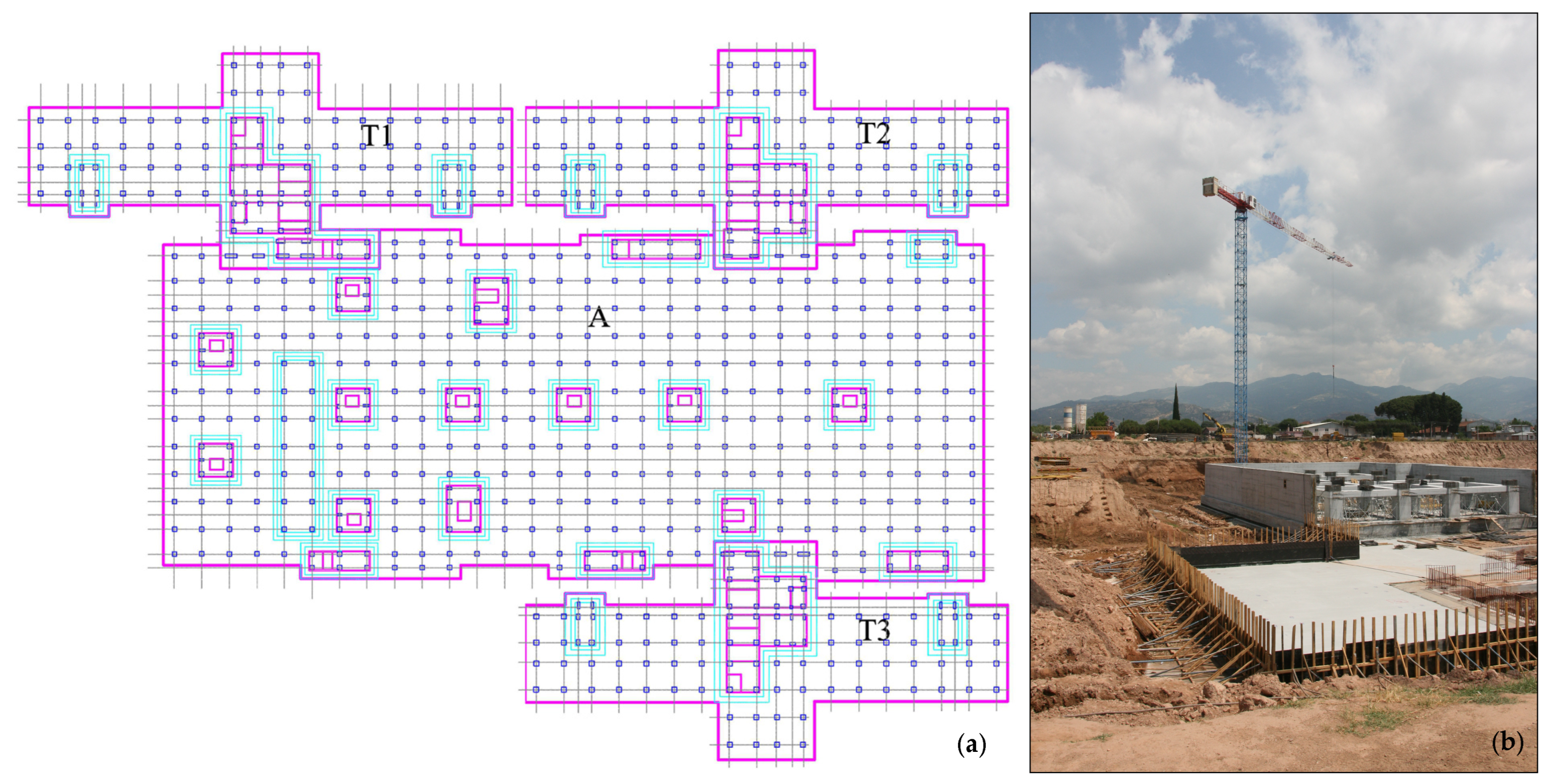
The structure examined in this study is the 950-bed Aydın City Hospital, located in the Aegean Region of western Türkiye. The complex consists of four main blocks, namely T1, T2, T3 and A, all founded on a single raft foundation system. Blocks T1 and T2 comprise a total of 10 storeys including two basement levels, Block T3 has 9 storeys including two basement levelsand Block A consists of 6 storeys including one basement level. The raft foundation layout, block arrangement and column configuration are presented in Figure 1.
Static bearing capacity and settlement analyses for the building blocks were evaluated based on the geotechnical investigations reported by Tekin (2020) [18]. According to the report, the average vertical contact stresses beneath the raft foundation are approximately 250 kPa for all blocks. In contrast, the allowable bearing capacity of the soil varies between approximately 793 and 1854 kPa, depending on the block location. These results indicate that bearing capacity failure is not a governing concern for the foundation system.
However, the settlement and liquefaction analyses reveal a different controlling mechanism. The analyses indicate the presence of liquefaction potential down to a depth of approximately 16 m below the foundation level. In addition, the calculated total settlements, particularly for Blocks T1, T2 and T3, exceed the commonly accepted allowable settlement limit reported in the literature. These findings demonstrate that the primary geotechnical problem at the site is excessive settlement and liquefaction-related performance, rather than bearing capacity insufficiency.
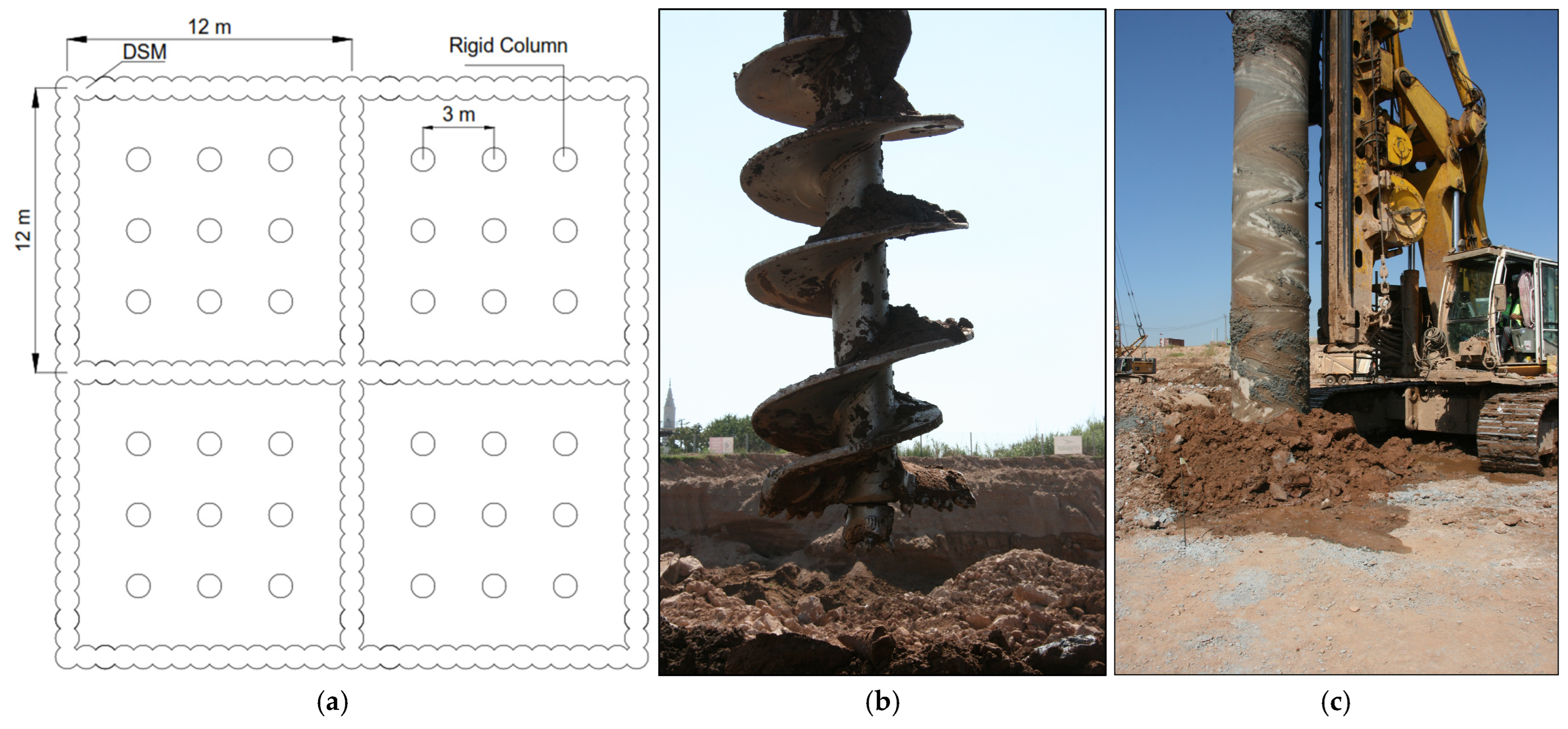
Accordingly, the ground improvement strategy was defined based on the foundation contact stress levels and the anticipated deformation behaviour under seismic loading, rather than on foundation area considerations. The geotechnical report by Tekin (2020) [18] recommended the application of deep soil mixing columns with a diameter of 100 cm extending to a depth of 16 m to mitigate liquefaction effects. In addition, rigid columns (unreinforced bored piles) with a diameter of 100 cm and a length of 24 m were proposed to reduce total and differential settlements. These ground improvement measures were implemented on site as part of the construction process. In this study, soil conditions before and after ground improvement are evaluated comparatively. A schematic representation of the applied ground improvement layout is shown in Figure 2. Representative photographs from the construction site illustrating the applied ground improvement techniques are presented in Figure 3.

3. Materials and Methods

3.1. Field and Laboratory Investigations

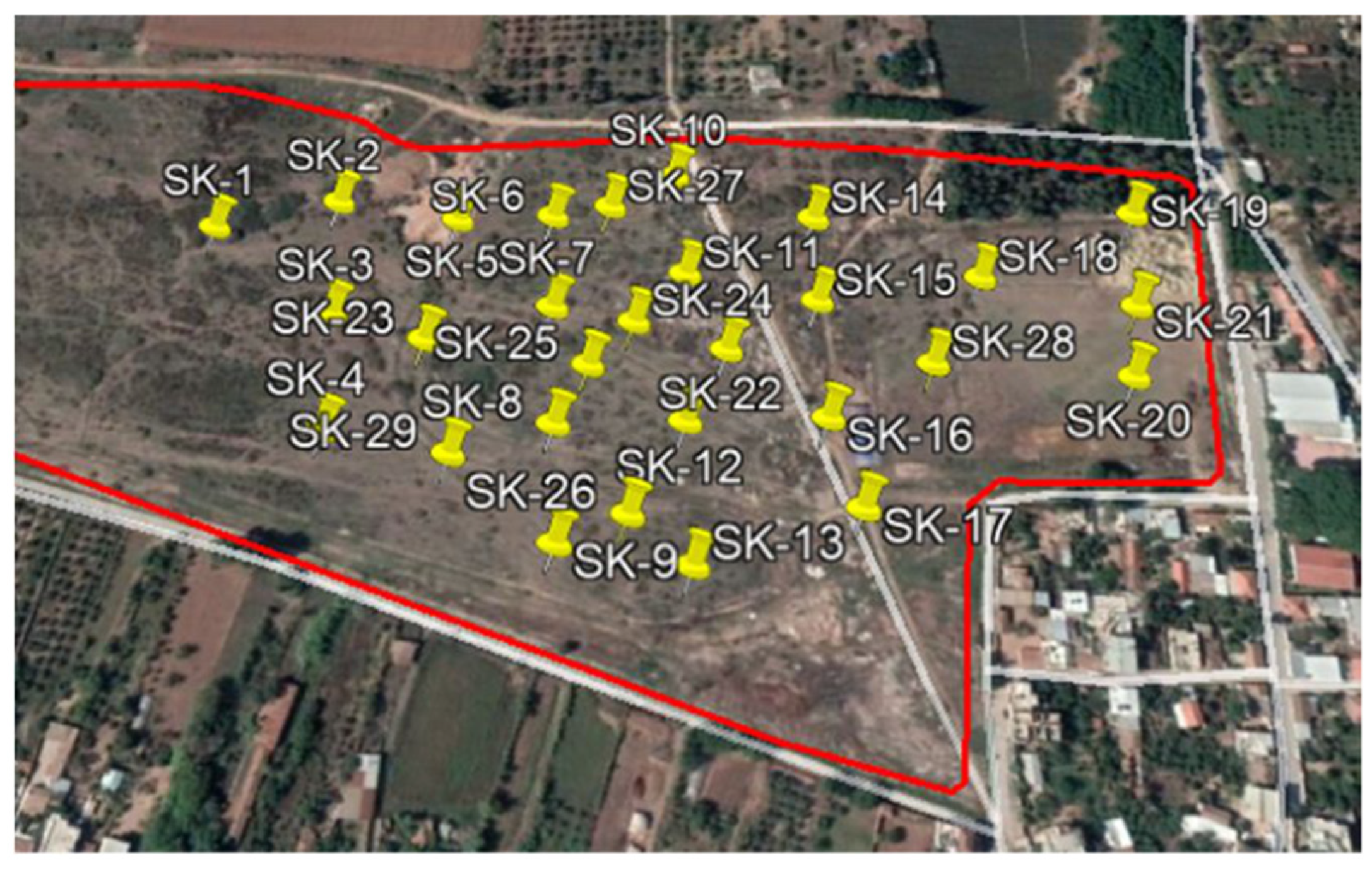
Subsurface investigations for the unimproved soil were conducted by Koşum and Hasoğlu (2020) [19]. A total of 29 boreholes were drilled, with depths ranging from 30.5 m to 41.0 m, resulting in a total drilling length of 1030 m. Field Standard Penetration Test (SPT) N-values obtained from the boreholes in the unimproved soil are presented in Table 1 and the borehole layout is shown in Figure 3. Evaluation of the borehole data indicates that the soil profile mainly consists of silty sand (SM) and low-plasticity silt (ML) layers.
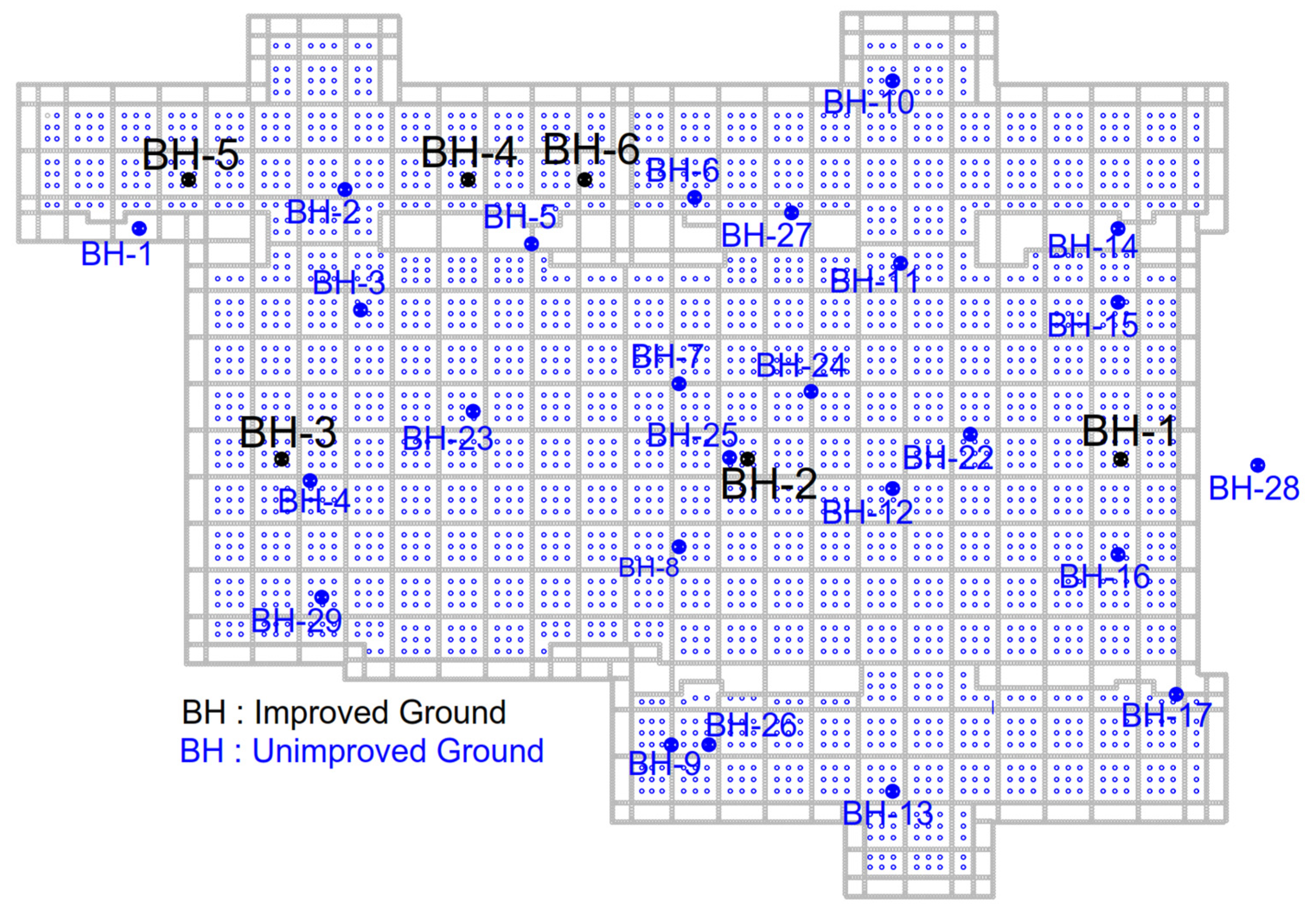
Subsurface investigations for the improved soil were conducted by Şekerler (2021) [20]. A total of six boreholes were drilled, each with a depth of 40 m. The total drilling length was 240 m. The locations of the boreholes in the improved soil were selected considering the positions of the boreholes drilled in the unimproved soil. Field SPT blow counts (SPT-N) are presented in Table 2. The borehole layout is shown in Figure 4.
Based on the soil classifications identified during the site investigations, raw SPT-N values obtained from field tests were corrected by the authors in accordance with Section 16B.2.1.1 of the reference [4] and the corresponding N60 and N1.60 values were calculated. Energy correction was applied using Equation (1). SPT correction factors were incorporated into the calculations based on Table 16B.1 of the reference [4]. Since an automatic trip hammer was used during the tests, the energy correction factor (CE) was taken as 0.90.
N60 = N × CE
In silty sand layers subjected to dynamic loading, excess pore water pressure may develop due to low permeability conditions, which can affect the reliability of measured SPT-N values. Therefore, silty sand corrections were applied to layers located below the groundwater table with SPT-N values greater than 15. These corrections were performed in accordance with [4] using Equation (2).
N′ = 15 + 0.5 × (N − 15)
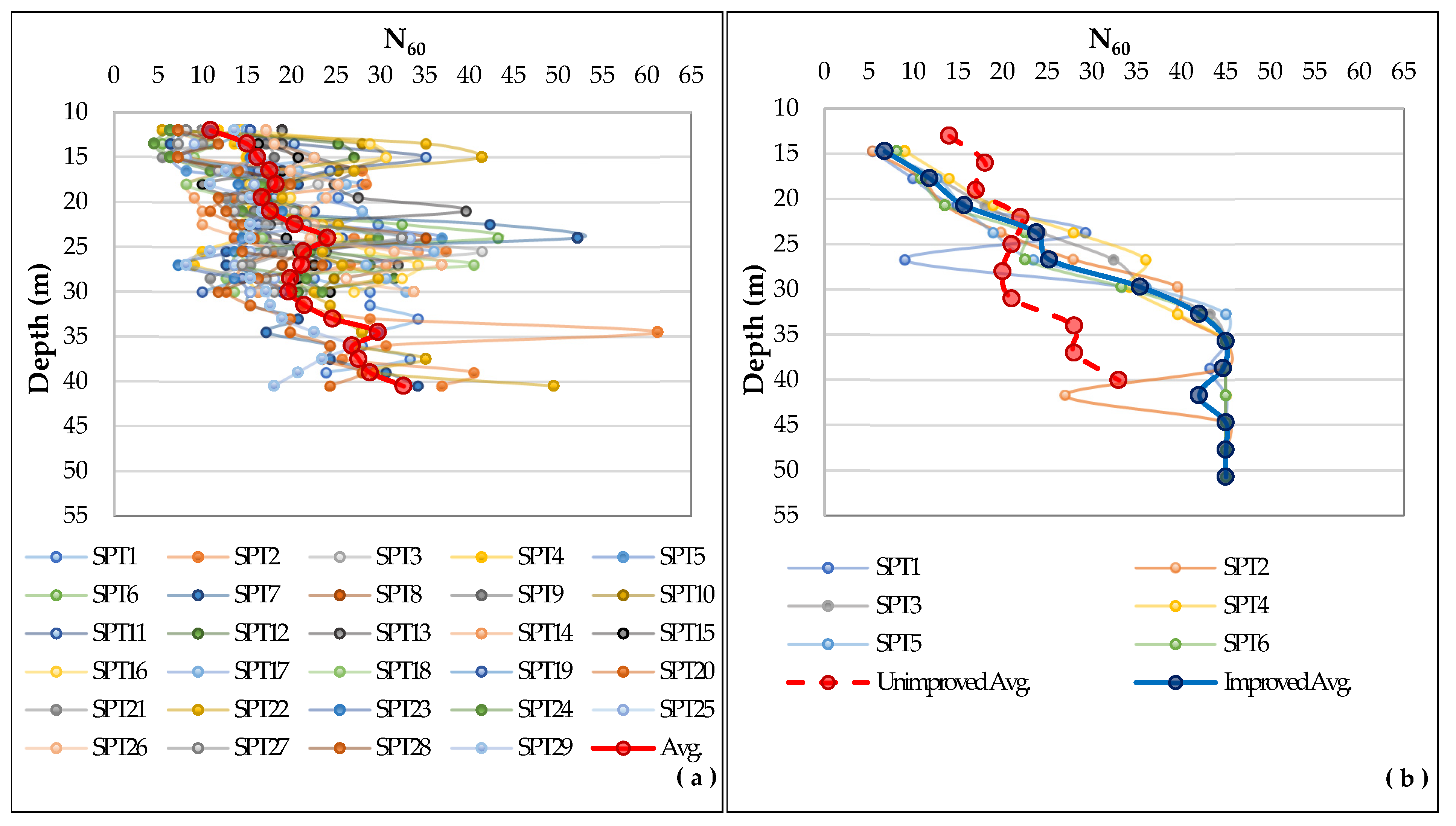
The variation of N60 values with depth for the unimproved and improved soils is shown in Figure 5. For the unimproved soil, the N60 values obtained from different boreholes are found to fall within similar ranges at approximately the same depths and the average N60 values vary between 10 and 30 with increasing depth.
In the improved soil profile, the N60 values obtained up to a depth of 6 m remained close to those of the unimproved ground, likely due to incomplete binder hydration and curing during ongoing construction activities. This observation is consistent with findings in the literature, where the unconfined compressive strength of DSM columns has been shown to increase with time. Ikegami et al. (2005) found that the ratio of field to design strength increased from 2.8 after 3 months to 5.8 after 20 years [21], while Topolnicki (2016) reported that, based on approximately 4000 wet-mixed specimens, the 28-day strength was 2.45 times higher than the 7-day strength and the 56-day strength was 1.25 times higher than the 28 day strength [22]. These findings suggest that early-stage field tests may underestimate the degree of improvement, particularly in the upper 6 m, where curing is still incomplete, while the deeper zones exhibit more advanced binder reactions and greater mixing efficiency. Although the investigated time periods differ among the studies, the reported results consistently indicate a time-dependent increase in the strength of DSM columns and the findings are therefore in agreement in terms of the observed trend.
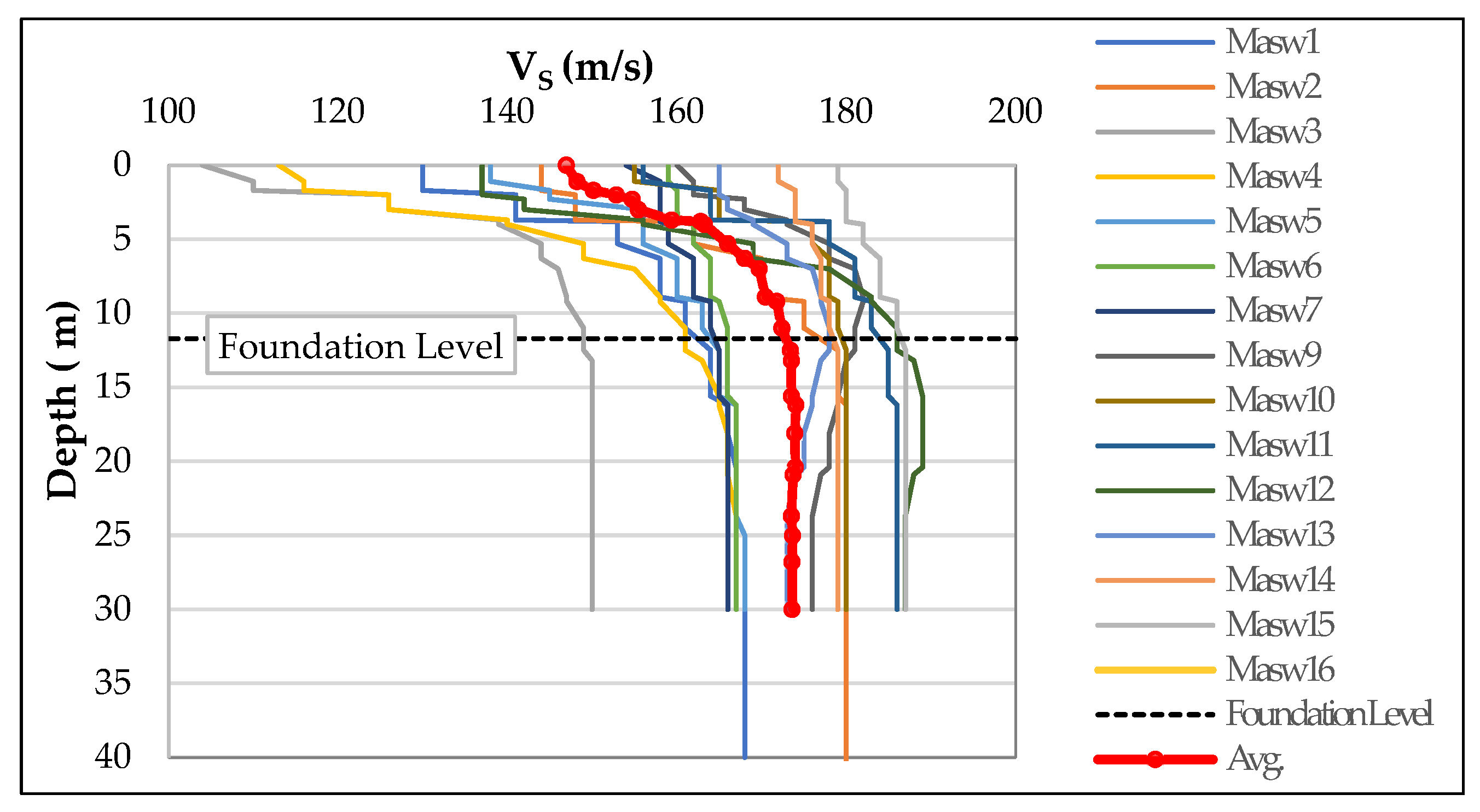
In addition to the SPTs, shear wave velocity (Vs) measurements were conducted to evaluate the dynamic behavior of the soil. In the unimproved soil, 16 seismic refraction tests, 16 multichannel analysis of surface waves (MASW) measurements, 13 microtremor measurements and 13 downhole seismic (DES) tests were performed by Koşum and Hasoğlu (2020) to obtain shear wave velocity data [19]. The variation of shear wave velocity (Vs) with depth is shown in Figure 6.
In the unimproved soil, shear wave velocity (Vs) values ranged from 100–179 m/s up to the foundation level and 147–186 m/s below it. However, despite the increase observed in SPT-N values below the foundation level, the shear wave velocities did not show a significant increase and remained nearly constant at relatively low levels. Therefore, the shear wave velocity of the soil at each depth was calculated using the assumptions proposed by Wair et al. (2012), as expressed in Equations (3) and (4) and then compared with the measured values [23]. In these equations, σ′v denotes the effective vertical overburden stress.
Silty Soils      26 × N600.17 × σ’v0.32
Sandy Soils      30 × N600.23 × σ’v0.23
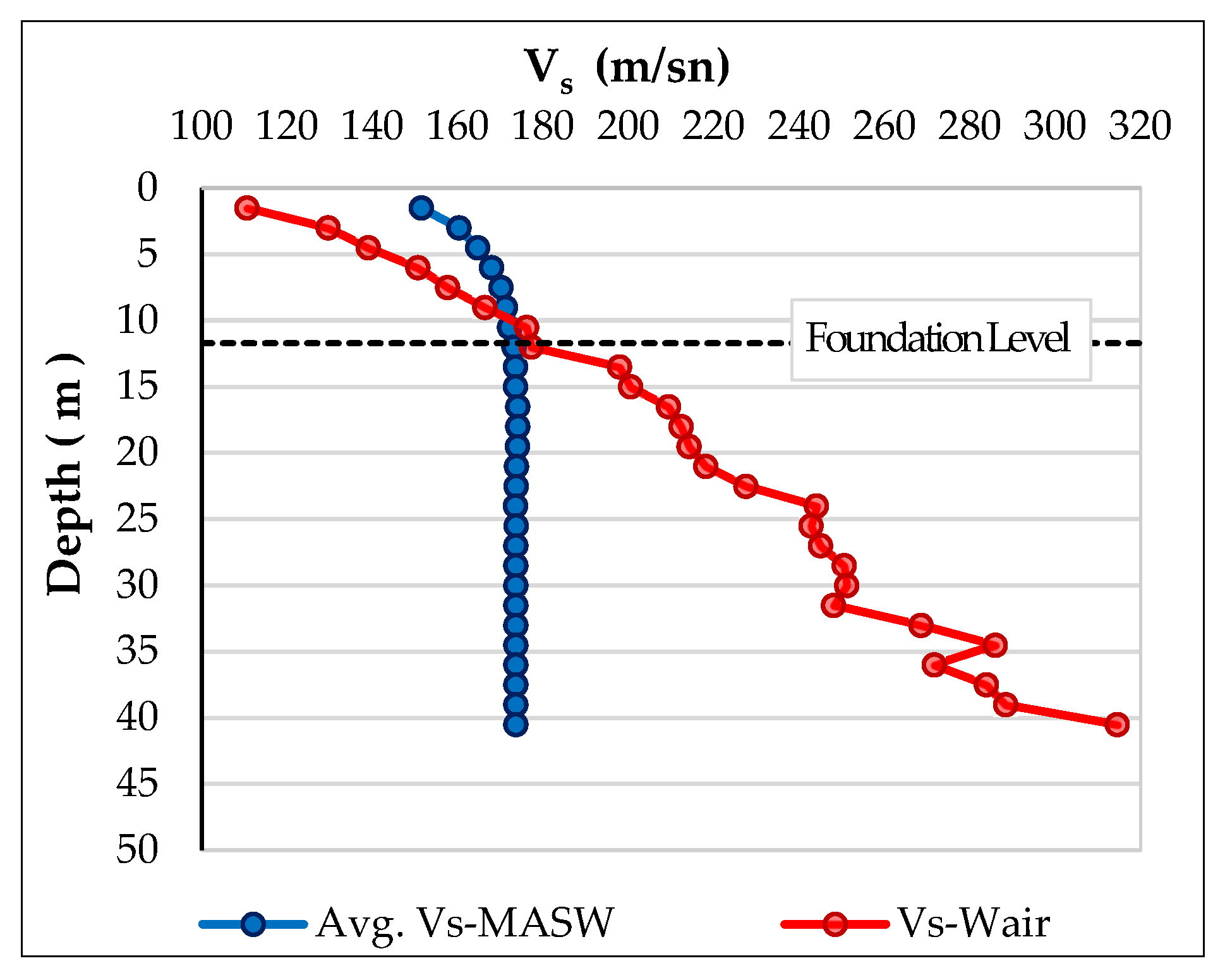
As shown in Figure 7 shows the shear wave velocity (Vs) values calculated based on the assumptions proposed by Wair et al. (2012) [23], together with the average shear wave velocity (Vs) values obtained from the MASW measurements. As shown in the figure, the calculated values increase below the foundation level and range approximately between 180 and 314 m/s.
Given these discrepancies between the measured and calculated values, the limited increase in shear-wave velocities observed in the MASW measurements of the unimproved soil profile below the foundation level is attributed to soil conditions and methodological constraints rather than measurement errors. Due to the fine-grained nature of the SM–ML soil and the low shear-wave velocity contrast between adjacent layers, the phase velocities of surface waves at different frequencies do not exhibit sufficient differentiation to clearly capture stiffness variations across the stratigraphy. In surface-wave methods, the dispersion curve represents the frequency-dependent variation of phase velocity. This condition prevents the development of a well-defined dispersion curve representing the frequency-dependent variation of phase velocity and leads to a marked reduction in inversion resolution with increasing depth. As noted by Foti et al. (2018), surface-wave methods provide limited resolving capability in fine-grained and heterogeneous soils characterized by low velocity contrast and low-frequency dispersion data introduce substantial uncertainty in the estimation of deeper layer properties [24]. Therefore, the limited increase observed in the measured MASW profiles of the unimproved soil reflects the inherent limitations of the method and the natural characteristics of the soil. Accordingly, the shear-wave velocity (Vs) values obtained from empirical correlations were adopted in the soil profile analyses.
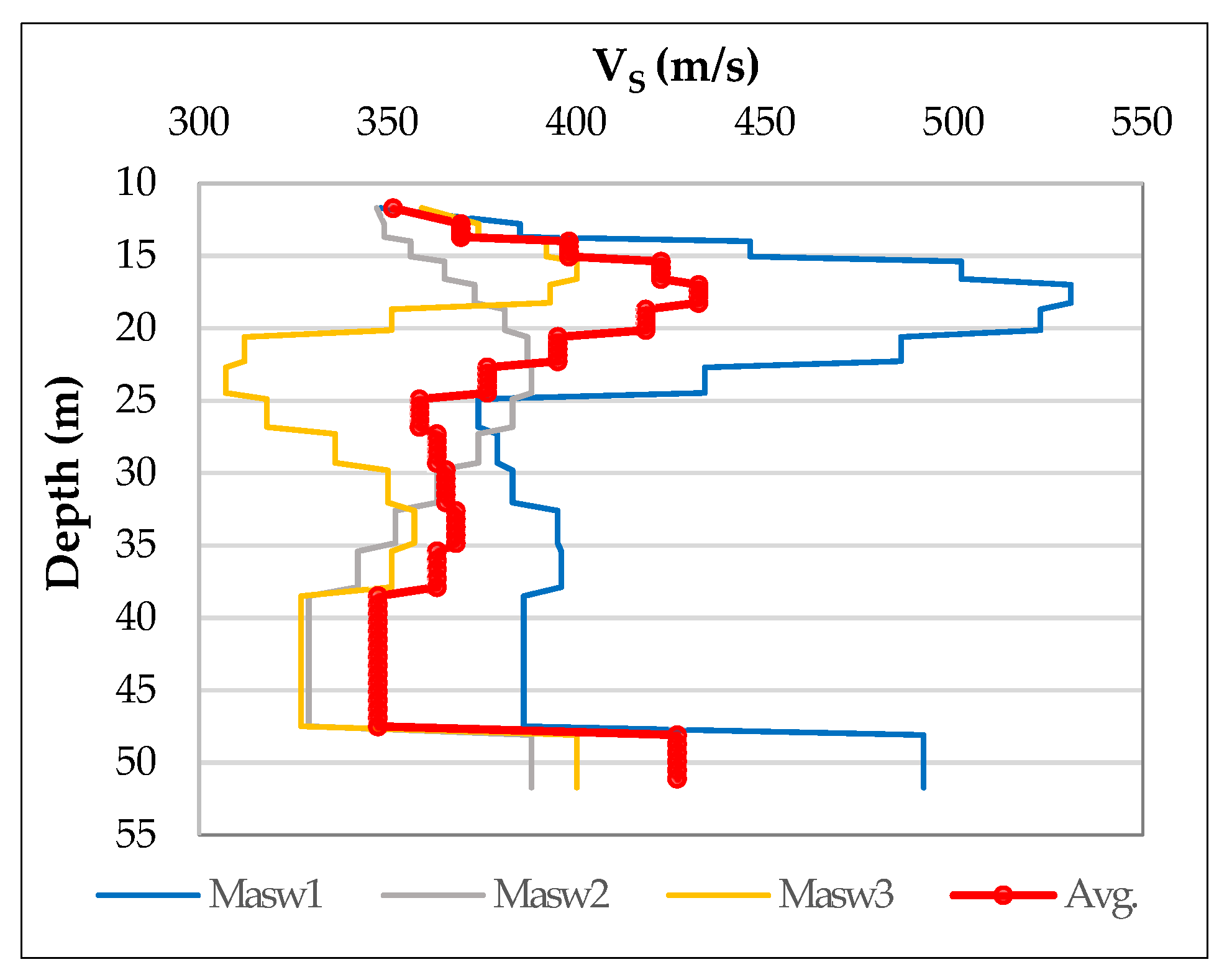
In the improved ground, shear wave velocity (Vs) data were obtained by Ateş (2021) through multichannel analysis of surface waves (MASW) measurements conducted along three profiles [25]. The variation of shear wave velocity (Vs) with depth is shown in Figure 8. For the improved soil, the Vs values ranged between 305 and 530 m/s below the foundation level, showing a distinct increase with depth.
Within the scope of this study, a nonlinear site-specific ground response analysis was performed considering the soil data obtained from field and laboratory investigations. For such analyses to be conducted reliably, it is necessary to define not only the idealized not only the idealized soil profile but also the depth and dynamic properties of the engineering bedrock. However, the engineering bedrock was not encountered during the site investigation boreholes. Therefore, regional deep borehole data provided by the General Directorate of Mineral Research and Exploration (MTA), located approximately 4.5 km from the study area, were evaluated to characterize the deeper subsurface conditions.
According to the MTA borehole logs, soil layers extend to a depth of approximately 60 m, weathered rock units are present between depths of 60 and 120 m and more competent rock units are encountered below approximately 120 m. Based on the stratigraphic sequence, lithological descriptions and regional geological setting, the more competent rock units below a depth of 120 m were accepted as the engineering bedrock in the ground response analyses.
The relationship between shear wave velocity and soil–rock classification has been widely discussed in the literature. Nath (2007) and Morikawa et al. (2008) classified materials with shear wave velocities greater than 3000 m/s as seismic bedrock [26,27]. Additionally, Nath (2007) defined layers with shear wave velocities ranging from 400 to 760 m/s as engineering bedrock [26]. Similarly, Akgün et al. (2013) classified materials with shear wave velocities between 760 and 3000 m/s as engineering rock and those exceeding 3000 m/s as seismic bedrock [28].
Based on the Turkish Building Earthquake Code, the engineering bedrock in this study was classified as local site class ZB. Considering the classifications proposed in the literature and the shear wave velocity ranges defined for local site class ZB in [4], a shear wave velocity of 1500 m/s was adopted for the engineering bedrock.
In this context, Pandey and Jakka (2022) [29] demonstrated that, for sites characterized by soft soil conditions (NEHRP site class D), soil layers below a certain depth do not significantly influence the transfer function and this critical depth often corresponds to the engineering bedrock. In such sites, the seismic site response is primarily governed by the dynamic properties of the shallow soil layers.
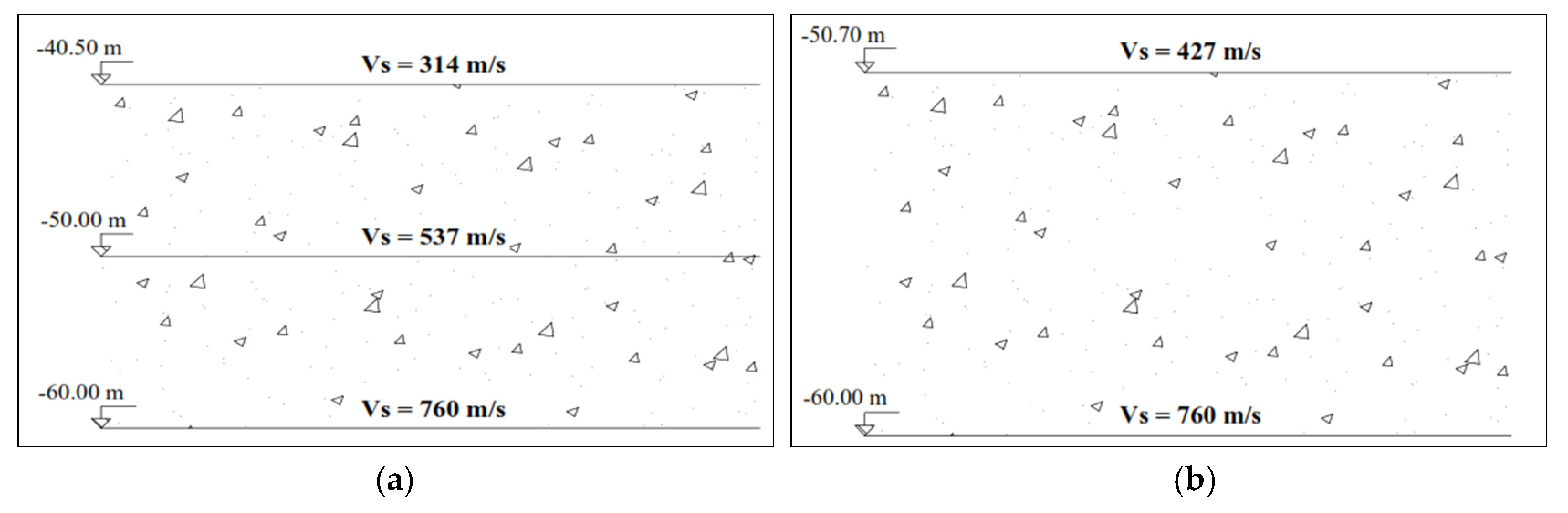
For the unimproved soil profile within the depth range of 40–60 m and for the improved soil profile within the depth range of 50–60 m, no direct geophysical measurements were available. Therefore, the shear wave velocity within these depth intervals was assumed to increase gradually and linearly from the shear wave velocity of the deepest measured layer up to 760 m/s, based on the soil–rock boundary criterion proposed by Ambraseys et al. (1996) [30]. To implement this approach, the relevant depth intervals were discretized into 10 m thick layers and the shear wave velocity values were assigned assuming a linear variation with depth. This approach was adopted to avoid abrupt impedance changes at the soil–rock transition and to ensure more realistic wave propagation conditions in the ground response analyses. The idealized shear wave velocity (Vs) profiles defined based on this approach are presented in Figure 9.
Based on the borehole data and the results of field and laboratory tests, the soil profiles were evaluated and idealized soil profiles were developed for both cases. The idealized soil profiles for the unimproved and improved soils are given in Table 3 and Table 4, respectively. In Table 3 and Table 4, PI (%) denotes the plasticity index, ϕ′ represents the effective internal friction angle, and K0 is the coefficient of earth pressure at rest.
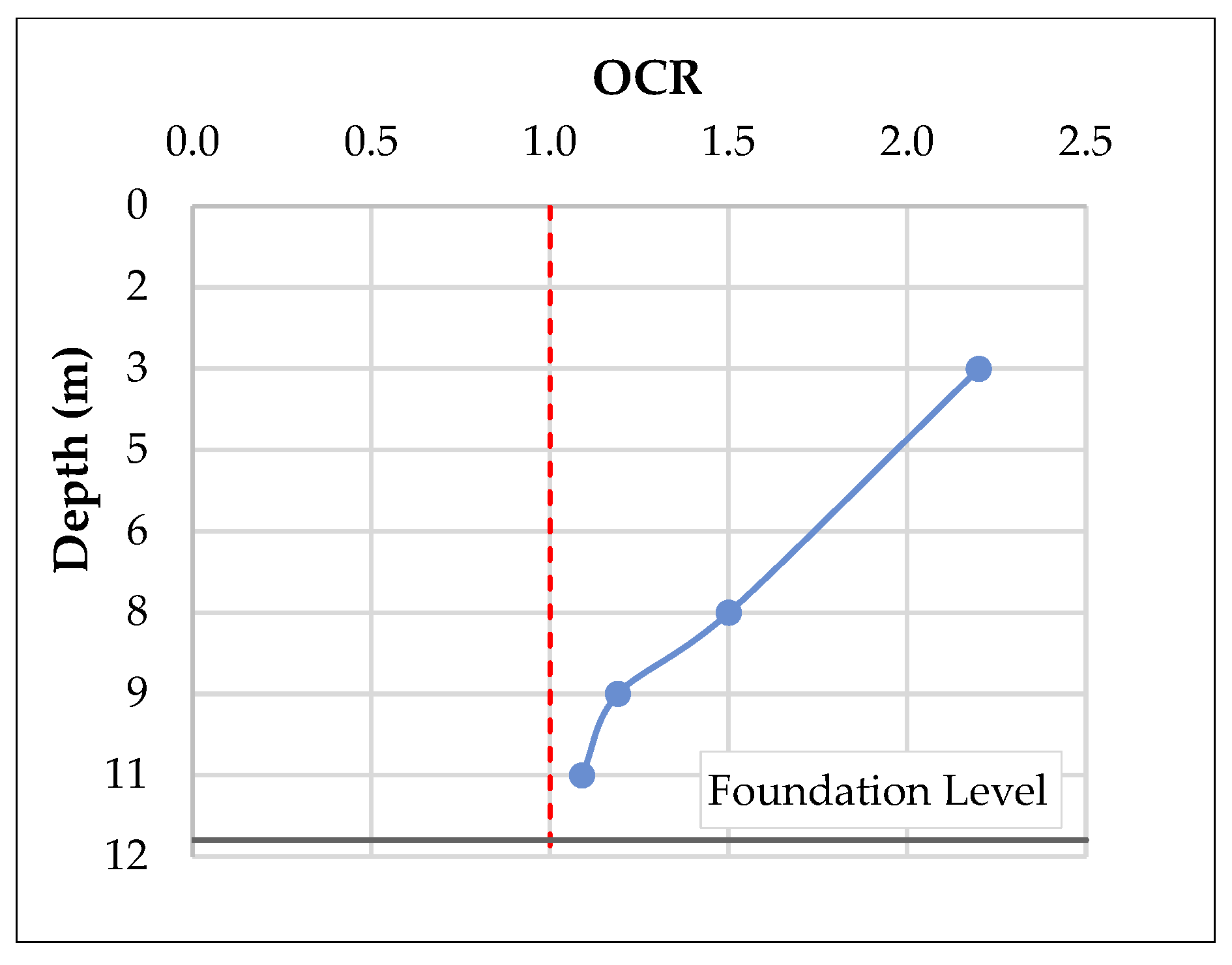
During the development of the idealized soil profiles, the overconsolidation ratio (OCR) was evaluated to represent the consolidation state of the soil layers based on one-dimensional consolidation test results. Although no consolidation tests were performed below the foundation level, the available data indicate a decreasing trend of OCR with depth, approaching unity. Accordingly, the soil layers below the foundation level were assumed to be normally consolidated and the variation of OCR with depth is presented in Figure 10. The resulting OCR values were incorporated into the idealized soil profiles.
Table 5 summarizes the empirical approaches adopted to estimate the effective internal friction angle (ϕ′) and the coefficient of earth pressure at rest (K0) for SM and ML soil layers. For silty sand (SM) layers, ϕ′ values were estimated using empirical correlations derived from standardized SPT data. For low-plasticity silt (ML) layers, ϕ′ was estimated using empirical correlations developed for sands and normally consolidated clays, considering the transitional mechanical behavior of silt soils. The representative ϕ′ values obtained from these approaches were subsequently used to estimate K0.

3.2. Selection of Earthquake Records

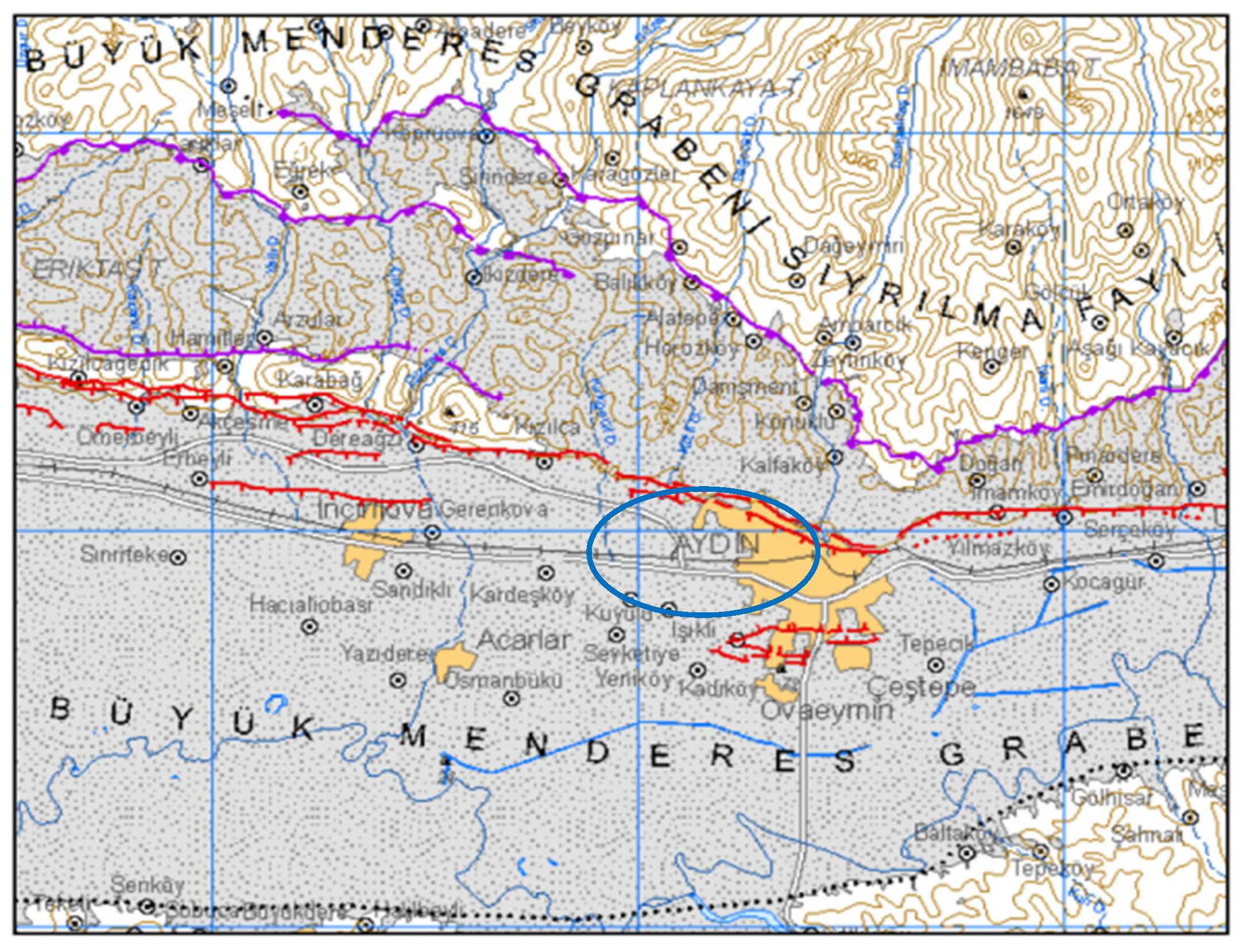
The province of Aydın, located in western Turkey, lies within a region characterized by numerous normal faults that form the Aegean Extension System, which was developed as a result of the northward movement of the African Plate and the westward displacement of Anatolia caused by the collision of the Arabian Plate pushing the Anatolian Plate westward [36,37]. Aydın is situated to the north of the Büyük Menderes Graben, known as a subsidence plain, where numerous active faults with varying dip angles exist between the rocks and alluvial deposits. The map prepared by the General Directorate of Mineral Research and Exploration (MTA) is given in Figure 11.
Aydın and its surroundings have suffered significant damage from numerous destructive earthquakes that occurred both in the historical period (pre-1900) and in the instrumental period (post-1900). Studies conducted in the region indicate that the earthquakes in the Aydın area were generated by normal and strike-slip faults. Examination of historical earthquake records shows that earthquake magnitudes in the region ranged between 5.0 and 6.8 [36], while the magnitudes calculated by Altunel et al. (based on fault lengths) were found to range between 5.0 and 7.0 [37].
During the selection of earthquake records, fault distances, the significant duration (D5–95), defined as the time interval between 5% and 95% of the total ground-motion energy, between 5% and 95% of the total ground-motion energy, the average shear-wave velocity (Vs30) and the compatibility among the selected records were considered in accordance with Article 2.5.1.1 of [4]. Since site response analyses are performed by propagating the input motion from the engineering bedrock toward the ground surface, the earthquake records were selected and scaled to match the spectral acceleration values corresponding to the ZB bedrock site class. Therefore, the shear-wave velocity (Vs30) of the bedrock was taken within the range of 760–1500 m/s, as specified in Table 16.1 of the reference [4]. A total of eleven earthquake ground-motion records were selected from the Pacific Earthquake Engineering Research Center (PEER) Database, considering the regional seismic characteristics and the selected accelerograms are presented in Table 6 [38].
For the ZB bedrock site class, the mapped spectral acceleration coefficients, peak ground acceleration (PGA), peak ground velocity (PGV) and the design spectral acceleration coefficients corresponding to the DD-1 and DD-2 earthquake levels obtained from the Turkey Earthquake Hazard Map are given in Table 7. The target spectrum was generated based on these coefficients [4,39].
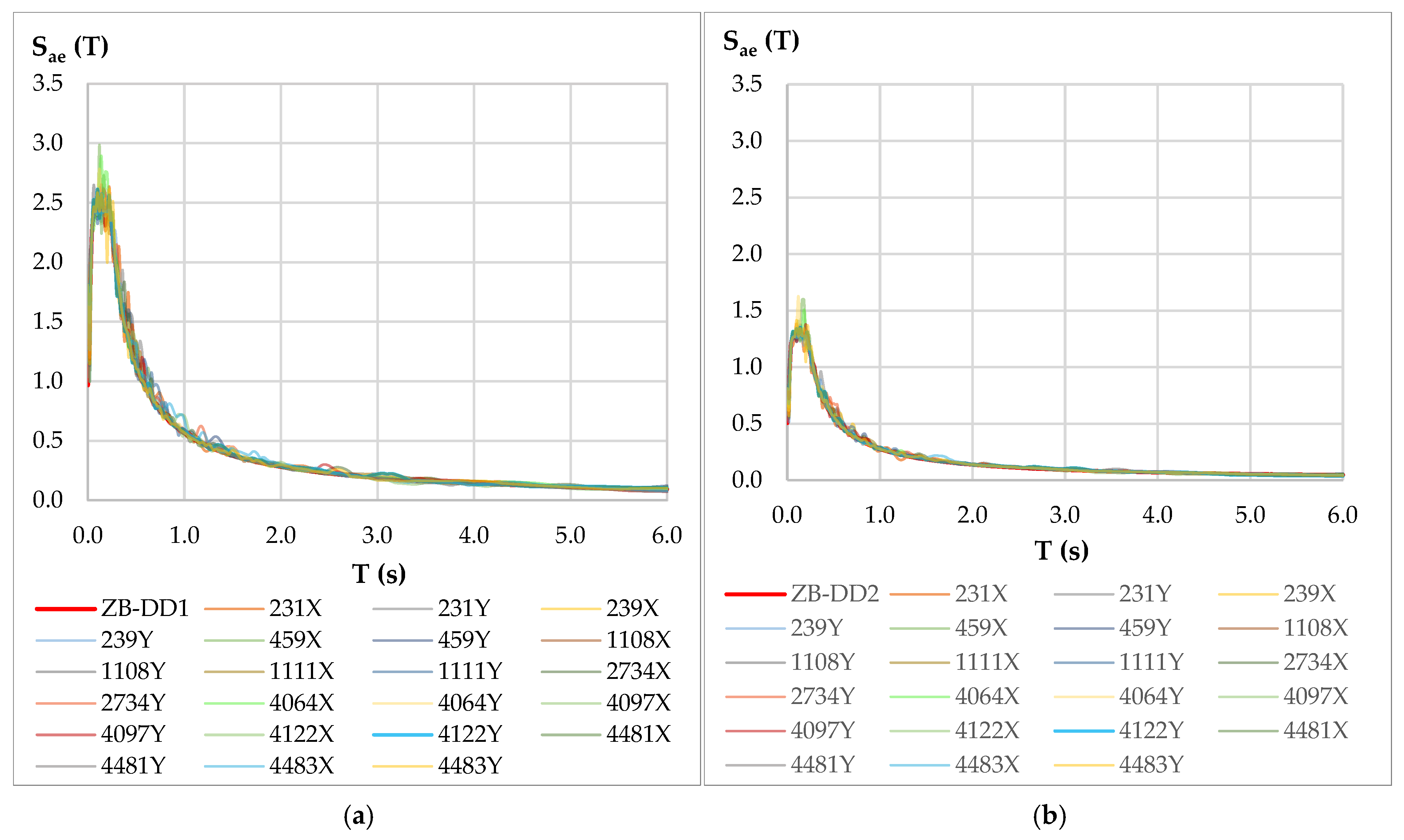
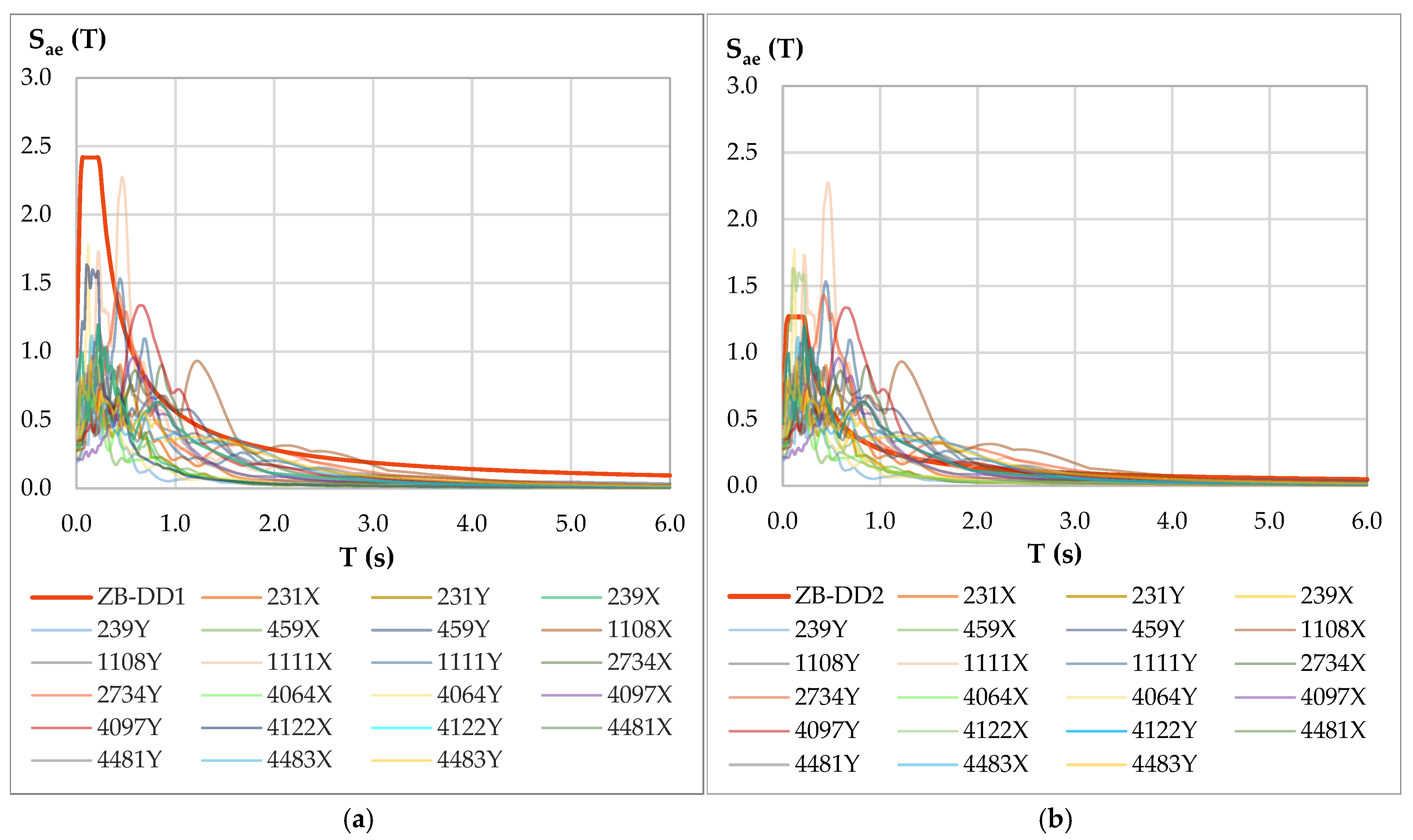
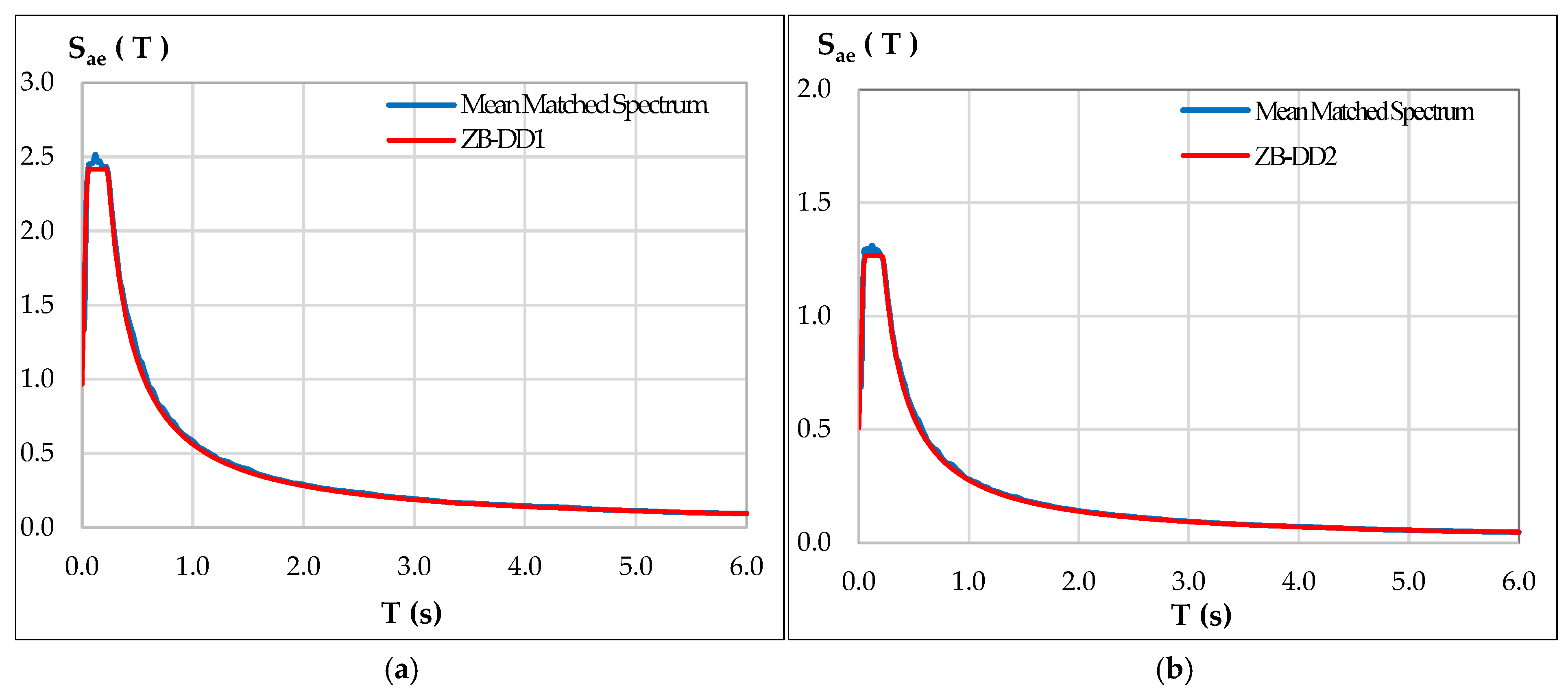
The selected earthquake records were spectrally matched to the target spectrum using the SeismoMatch software v2023 [40]. During the matching process, it was ensured that, for both DD-1 and DD-2 seismic hazard levels, the response spectrum ordinates of each individual record were not lower than 90% of the target design spectrum ordinates over the considered period range, in accordance with [4]. The response spectra of the raw (unscaled) ground-motion records are presented in Figure 12, while the response spectra of each individually spectrally matched ground-motion record are shown in Figure 13. The comparison between the mean response spectrum obtained from the spectrally matched records and the target design spectrum is presented in Figure 14.


4. Site Specific Ground Response Analysis

The site-specific ground response analyses were performed for both soil profiles at DD-1 and DD-2 seismic hazard levels using the DEEPSOIL v7.0 software [41]. This software models soil behavior by employing linear time- or frequency-domain, equivalent-linear frequency-domain and nonlinear time-domain analysis methods. In this study, the analyses were conducted using the nonlinear time-domain method. Nonlinear stress–strain models consider the actual loading–unloading cycles during the analysis to more accurately represent the real behavior of the soil. These models realistically simulate the shear behavior of soil samples under cyclic (repeated) loading conditions [42].
To perform the nonlinear time-domain analyses in DEEPSOIL, it is essential to select an appropriate constitutive model that represents the shear stress–strain (τ–γ) behavior of the soil at different strain levels. In this study, the GQ/H (General Quadratic/Hyperbolic) model was used as the default model for simulating nonlinear soil behavior.
The GQ/H model was developed by Groholski et al. (2016) based on the experimental soil model proposed by Darendeli (2001) [43,44]. Darendeli characterized soil behavior at small and medium strain levels through resonant column and torsional shear tests, while for large strain levels, a predictive modeling approach was employed due to insufficient experimental data [44]. The GQ/H model proposed by Groholski et al. (2016) improves upon this by providing a curve-fitting technique that automatically corrects the predicted behavior at large strains, thereby enabling a more realistic representation of the soil’s shear stress–strain relationship across both small and large strain levels [43].
In addition, the nonlinear time-domain analyses performed using DEEPSOIL v7.0 were based on the Non-Masing MRDF (Modulus Reduction and Damping Factor) model developed by Phillips and Hashash (2009) [45]. This model extends the assumptions of the classical Masing rule, offering a more realistic representation of soil behavior under cyclic loading conditions. It accounts for the pressure-dependent hyperbolic stress–strain relationship and the variation in stiffness and damping ratios with strain. Thus, the soil response can be modeled more accurately at both small and large deformation levels.
Furthermore, DEEPSOIL v7.0 has the capability to account for the generation of excess pore water pressure in soils with liquefaction potential. The excess pore water pressure for sands and silts was evaluated based on the models proposed by Matasovic and Vucetic (1993) [46]. Additionally, Carlton (2014) developed correlations for the curve-fitting parameters proposed by Matasovic and Vucetic specifically for sands [47].

5. Analysis Results

5.1. Field and Laboratory Results

In this section, the SPT and shear wave velocity (Vs) data for both the unimproved and improved soil profiles were jointly evaluated and the local site classes were determined in accordance with [4].
For the unimproved soil, the average shear wave velocity (Vs30) and the corrected SPT blow counts (N60) calculated for the upper 30 m layer are given in Table 8 and Table 9, respectively.
According to the [4], the (N60)30 value range for the ZD local site class is between 15 and 50, while the (Vs)30 value ranges from 180 to 360 m/s. Since the calculated values fall within these ranges, the local site class for the unimproved soil was categorized as ZD.
For the unimproved soil, the average shear wave velocity (Vs30) and the corrected SPT blow counts (N60) calculated for the upper 30 m layer are given in Table 10 and Table 11, respectively.
In the SPT-N measurements conducted after the improvement application, no significant increase in blow counts was observed up to a depth of 12 m; moreover, within the first 6 m, lower values were recorded compared to the unimproved soil conditions. However, beyond a depth of 12 m, a notable increase in SPT-N values was observed, indicating that the ground improvement had an effective influence on soil strength. The shear wave velocity values, on the other hand, showed a significant increase at all depths compared to the unimproved soil. Due to the low SPT-N blow counts within the first 12 m, the calculated (N60)30 values were found to be lower than the corresponding (Vs)30 values. Therefore, the (Vs)30 values were taken as the basis for determining the local site class.
According to the [4], the (Vs)30 range for the ZC local site class is between 360 and 760 m/s [4]. Since the calculated (Vs)30 value falls within this range, the local site class of the improved soil was determined as ZC. The results of the field and laboratory studies demonstrated that the applied ground improvement not only enhanced the bearing capacity and mitigated liquefaction and settlement problems, but also significantly influenced the dynamic properties of the soil.

5.2. Site Specific Analysis Results

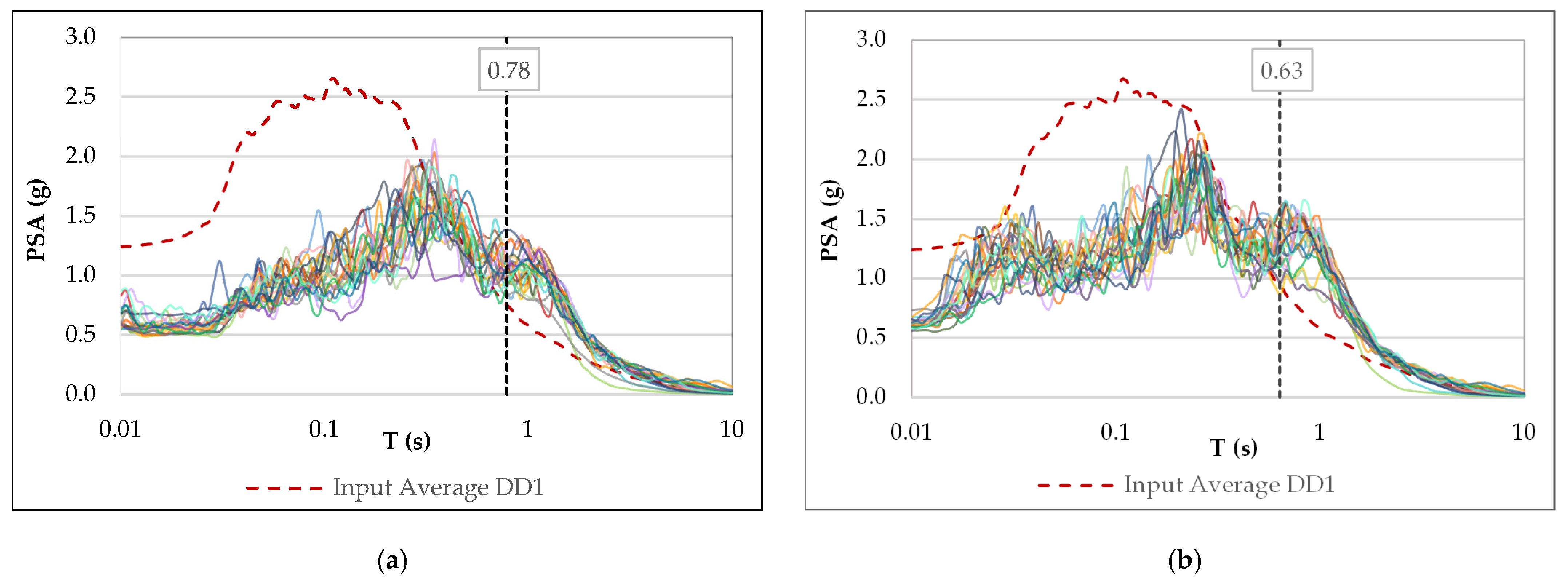
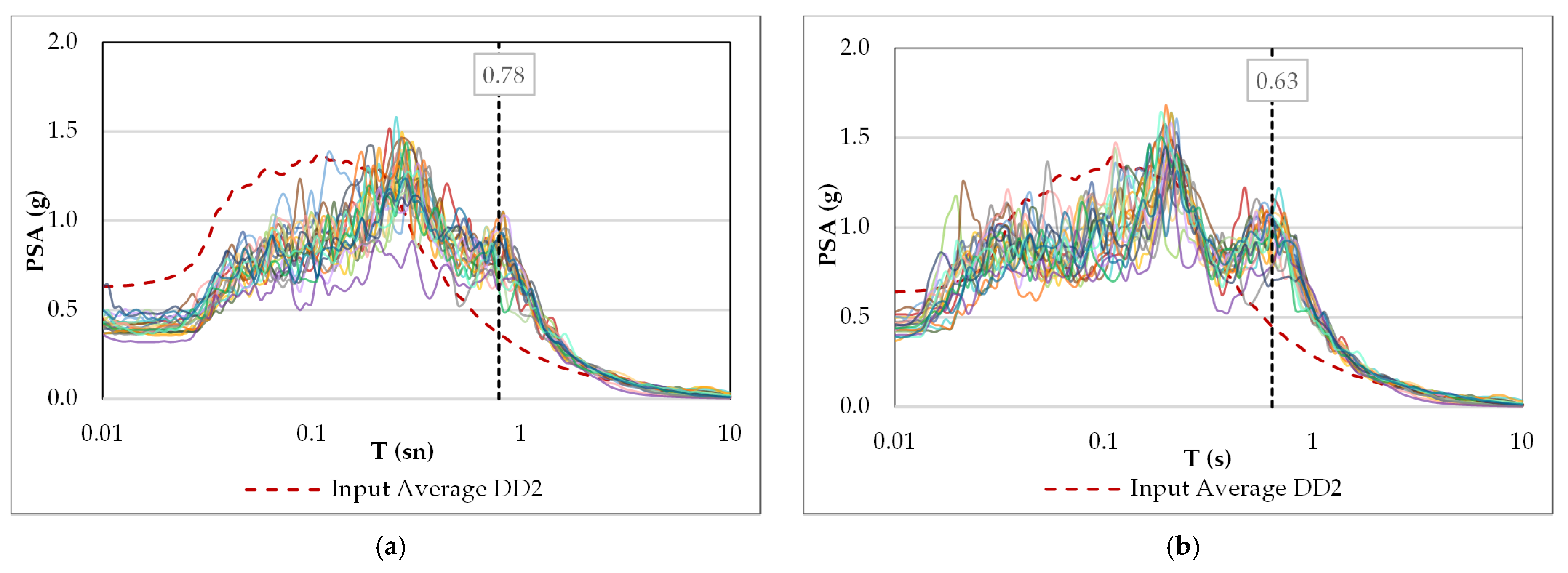
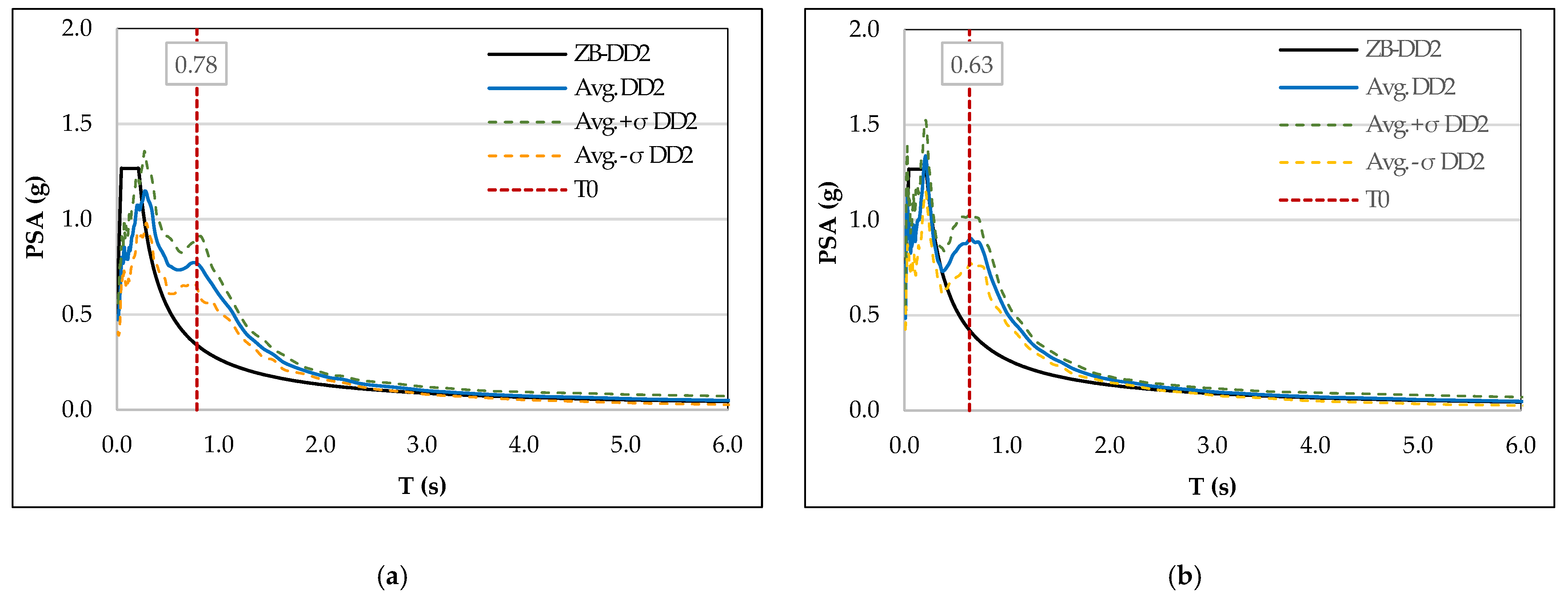
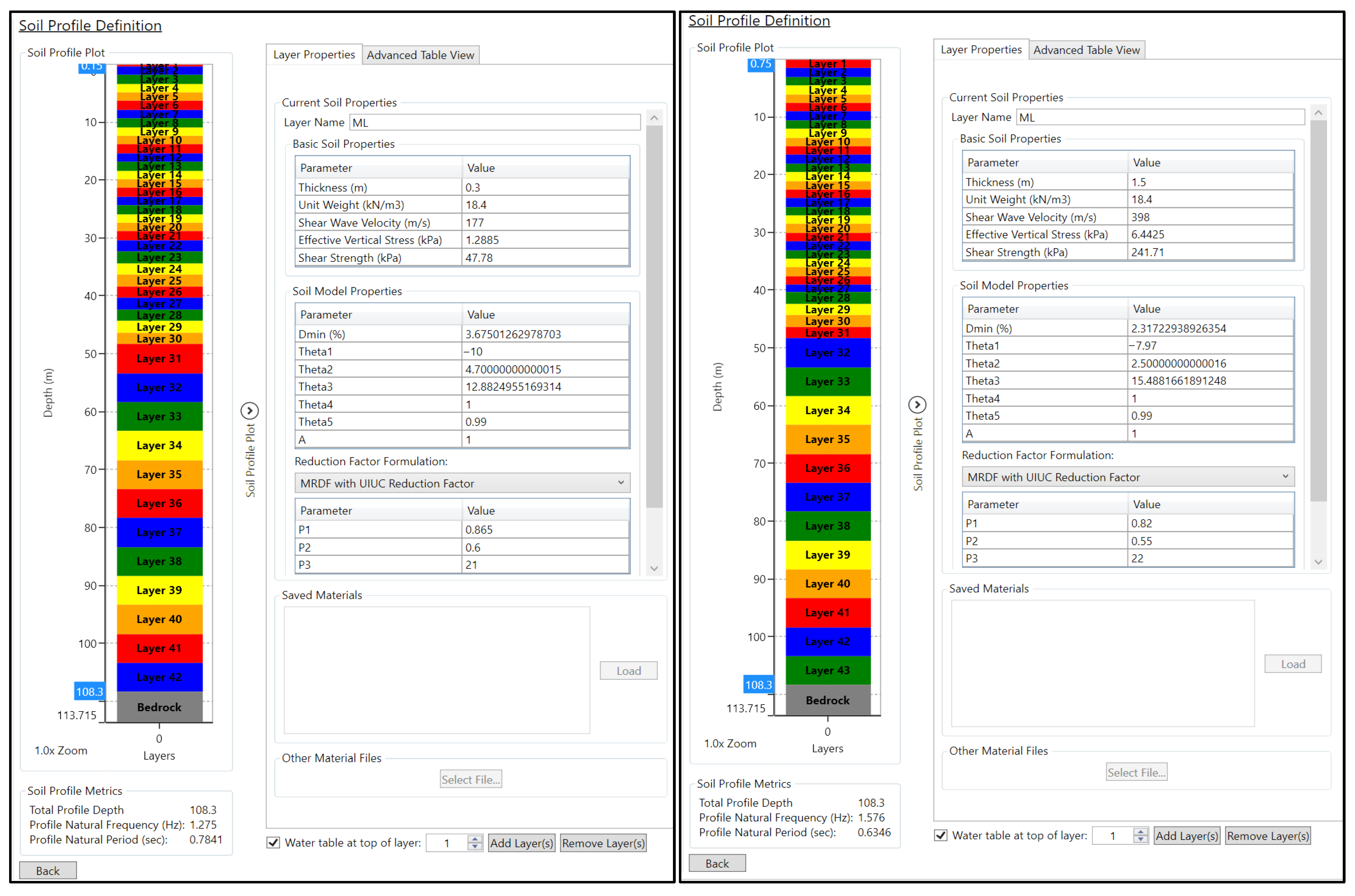
As a result of the analyses performed in DEEPSOIL v7.0 software for both soil profiles at the DD-1 and DD-2 earthquake levels, surface spectral accelerations were obtained for both horizontal components of the 11 earthquake records. The soil profiles used in the DEEPSOIL v7.0 analyses for the unimproved and improved cases are given in Figure 15. In the unimproved soil profile, the increase in soil stiffness following the ground improvement caused the fundamental period of the soil profile (T0) to decrease from 0.78 s to 0.63 s.
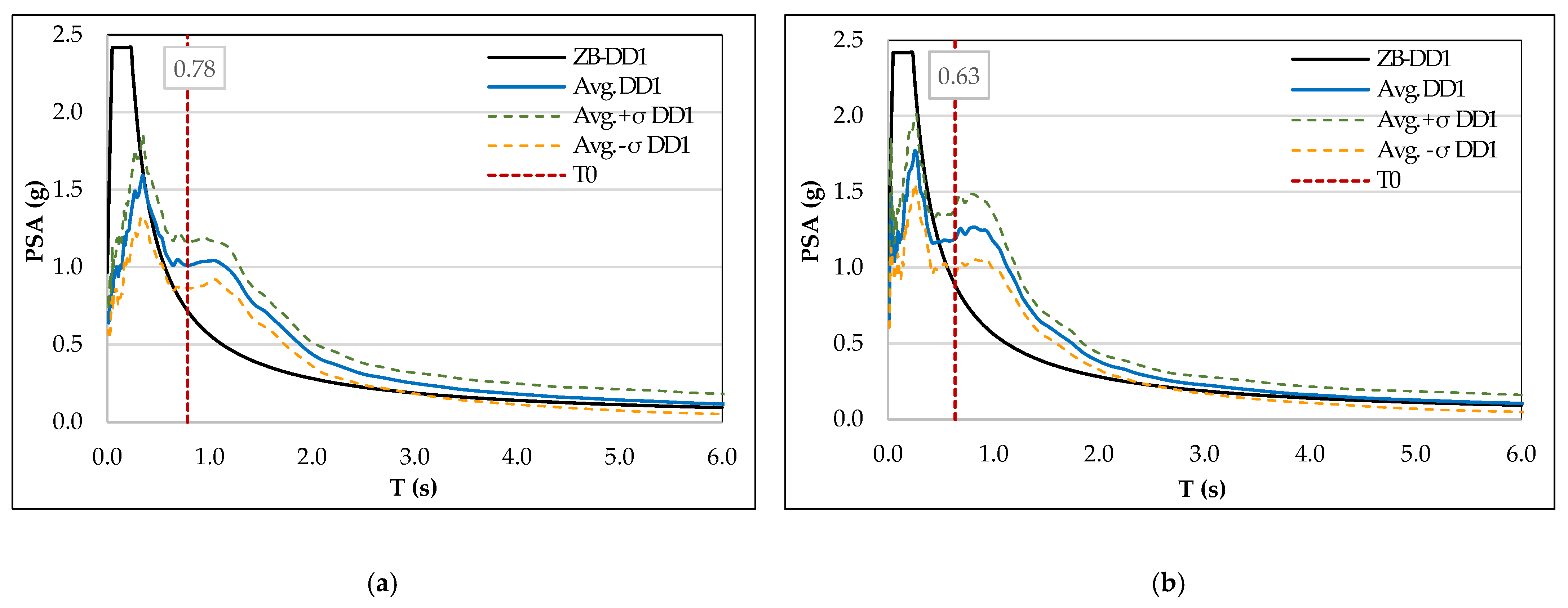
At the DD-1 seismic level, the average surface acceleration values obtained from the two horizontal components of 11 earthquake records for both soil profiles are given in Figure 16. The comparison of the averaged surface spectral acceleration values with the bedrock spectrum (ZB-DD1) is given in Figure 17.
At the DD-2 seismic level, the average surface acceleration values obtained from the two horizontal components of 11 earthquake records for both soil profiles are given in Figure 18. The comparison of the averaged surface spectral acceleration values with the bedrock spectrum (ZB-DD2) is given in Figure 19.
According to the analysis results at the DD-1 earthquake level, as shown in Figure 17, the surface acceleration values for both soil profiles were damped within the period range between TA = 0.05 and TB = 0.23, as defined in [4] for the ZB local site class, whereas amplification occurred around the 1.0 s period compared to the bedrock acceleration records [4].
At the DD-2 earthquake level, as shown in Figure 19, it was similarly observed that, within the period range between TA = 0.05 and TB = 0.21, the surface acceleration values for the unimproved soil profile were attenuated but approached the design spectrum values, while those for the improved soil profile were amplified. Additionally, amplification around the 1.0 s period was identified for both soil profiles.
It was observed that, at the DD-1 earthquake level, significant amplification of surface spectral acceleration values occurred compared to the bedrock within the period range of 0.36–6.0 s for the unimproved soil profile and 0.5–6.0 s for the improved soil profile. Similarly, at the DD-2 earthquake level, amplification was observed within the period range of 0.25–6.0 s for the unimproved soil profile and 0.19–6.0 s for the improved soil profile. Although the natural vibration periods of both soil profiles fall within these ranges, the maximum amplification did not occur at those periods. Therefore, the observed amplification was interpreted not as a resonance effect but as a local amplification associated with the nonlinear behavior of the soil.
In addition, at both DD-1 and DD-2 earthquake levels, it was determined that the maximum acceleration values within the TA and TB period ranges were lower in the unimproved soil compared to the improved soil. The applied ground improvement increased the soil stiffness, causing a significant portion of the earthquake energy to shift toward shorter periods, which resulted in higher spectral acceleration values within this range compared to the unimproved soil. Youd et al. (2005) stated that early softening may suppress short-period components, thereby reducing the expected surface amplification effect, but may also lead to a tendency for amplification in long-period components due to soil softening [48]. The observations obtained in this study are consistent with the findings reported in the literature.
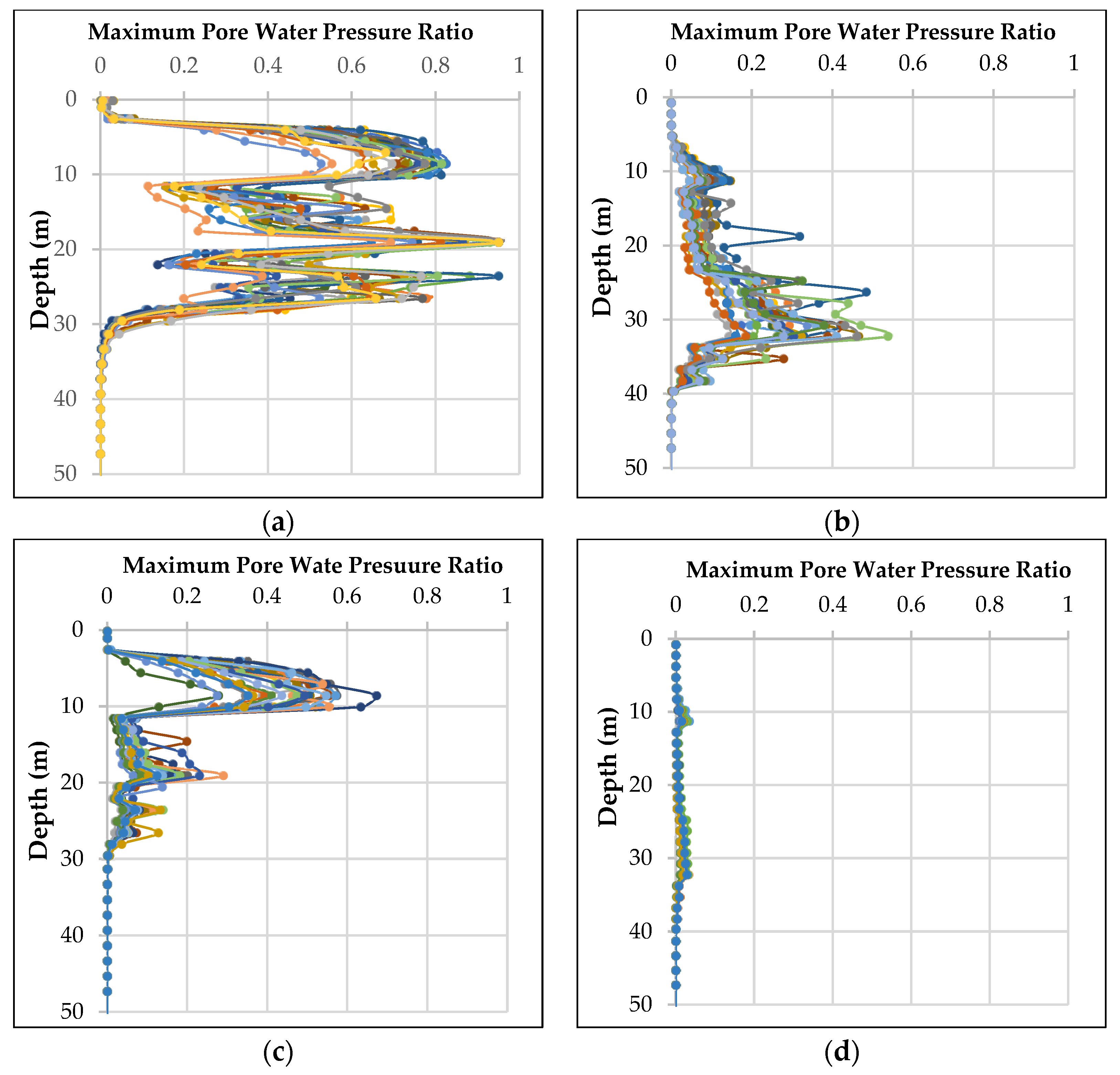
The excess pore water pressure data obtained from the site-specific ground response analyses are given in Figure 20. In the unimproved soil profile, at the DD-1 earthquake level, the pore pressure ratio (ru) was found to approach 1. Seed et al. (1982) stated that when the pore pressure ratio (ru) reaches 1, the effective stress between soil particles becomes zero and this condition is defined as “initial liquefaction” [49]. This finding is consistent with the results obtained in this study, indicating that the effective stress in the soil decreased and the liquefaction potential emerged. The increase in pore water pressure reduced the soil stiffness, causing attenuation of high-frequency components and consequently, a decrease in surface accelerations compared to the bedrock accelerations.
As shown in Figure 20, in the unimproved soil profile at the DD-2 earthquake level, the pore pressure ratio (ru) was found to range between 0.3 and 0.7, indicating a reduction in liquefaction potential and posing a stiffer soil response. The primary reason for this behavior is that, at the DD-1 earthquake level, higher acceleration values triggered liquefaction in the soil, whereas at the DD-2 level, the lower seismic energy limited the increase in pore water pressure.
For the improved soil profile, analyses conducted at the DD-1 earthquake level revealed that the maximum pore pressure ratio (ru) remained within the range of 0.05–0.55 in the upper 20 m. At the DD-2 earthquake level, these values decreased to the range of 0.02–0.04 across all earthquake records.
These results indicate that the pore pressure ratio values remain well below the critical threshold levels commonly associated with liquefaction in the literature, demonstrating that the applied ground improvement effectively eliminated the liquefaction potential. Following the improvement, the accumulation of pore water pressure within the soil significantly decreased, allowing the effective stress to be maintained and preventing the development of conditions that could trigger liquefaction.
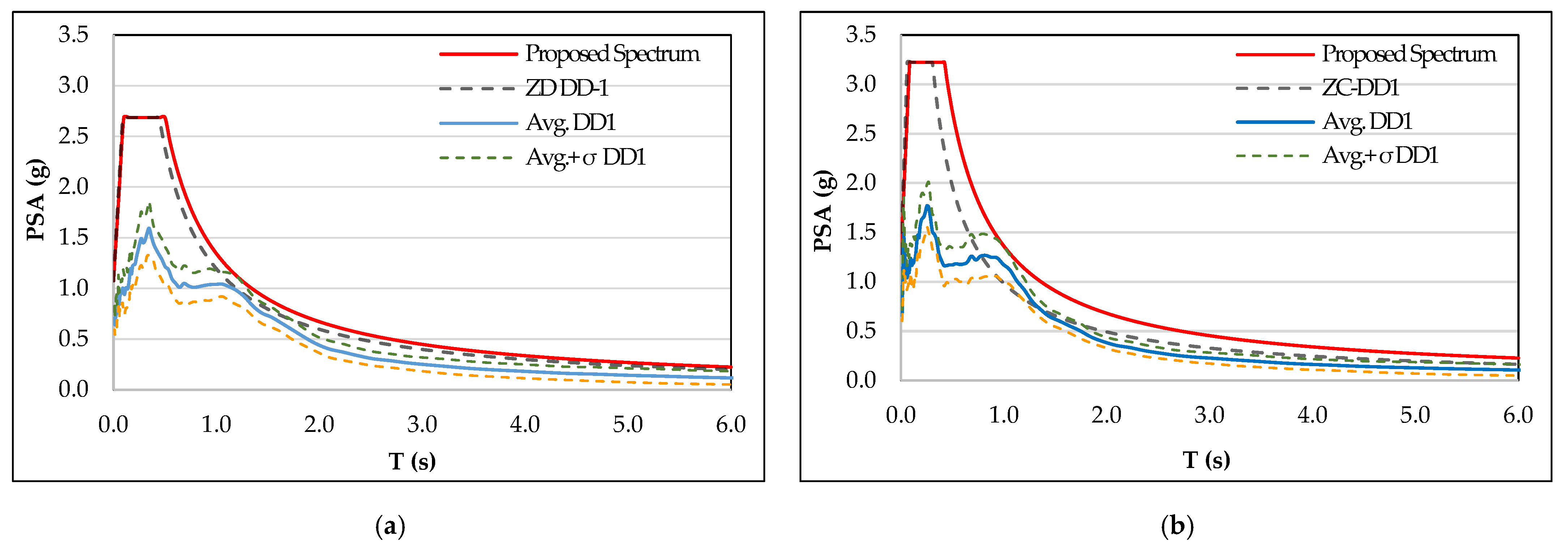
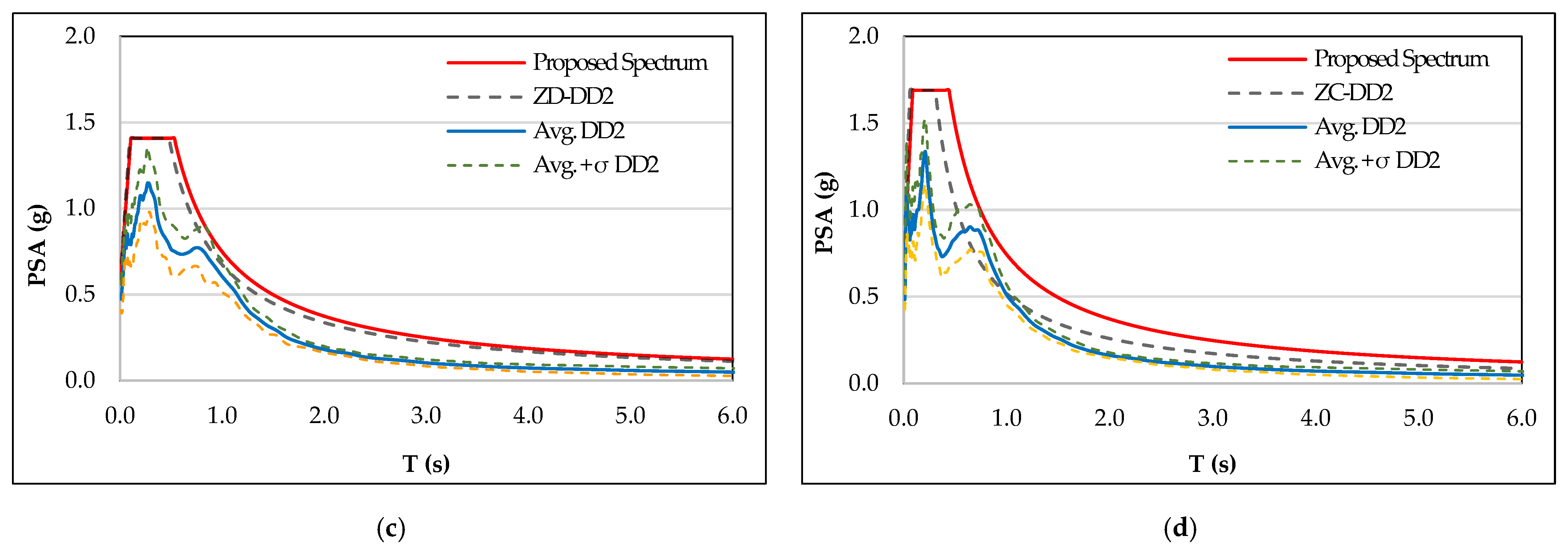
Based on the field test data, horizontal design spectra were generated in accordance with the [4] definitions for the local site classes identified as ZD for the unimproved soil and ZC for the improved soil [4]. These spectra were compared with the surface spectral acceleration values obtained from the site-specific ground response analyses, as presented in Figure 21. This comparison was conducted to evaluate the consistency between the modeling results and the field measurements and to verify the reliability of the site-specific design spectrum.
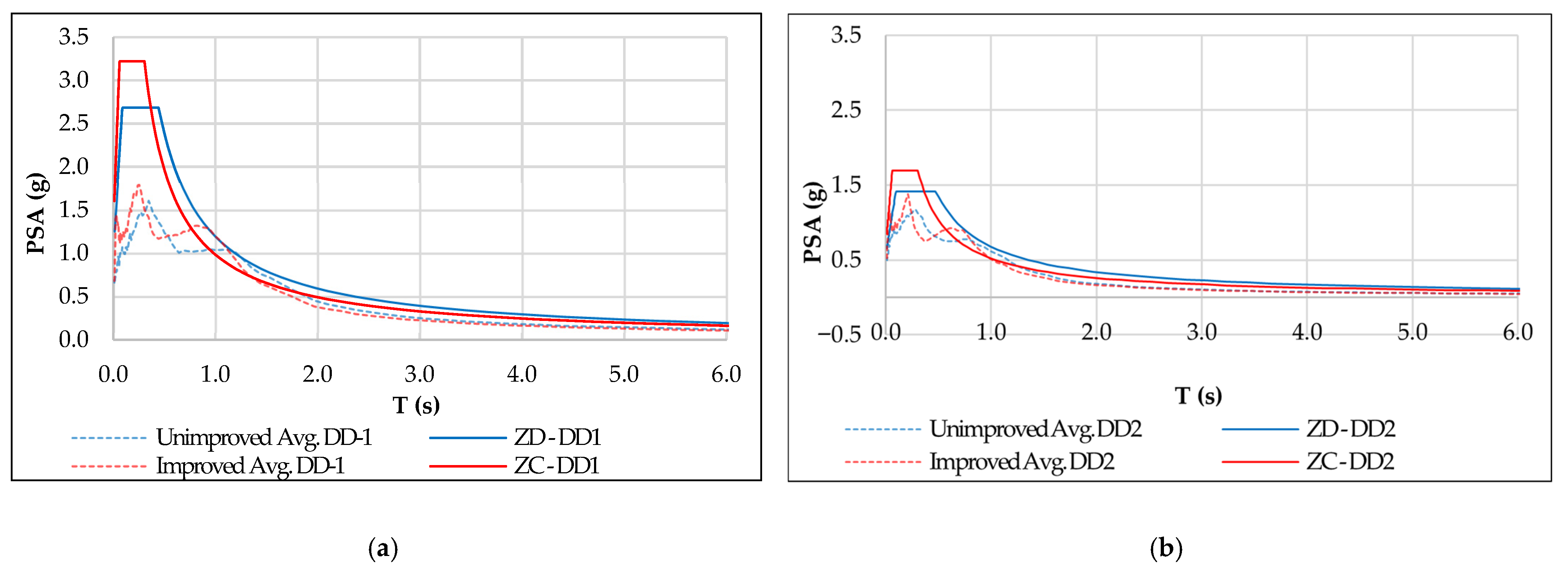
Figure 22 shows the comparison of the site-specific response spectra obtained for the unimproved and improved soil profiles with the design spectra defined in [4] at the DD-1 and DD-2 seismic levels [17]. At the DD-1 level, the surface spectral acceleration values for both soil profiles remained below the design spectrum in the short-period range. Examination of the site-specific spectra indicates that the improved soil profile produced spectral acceleration values closer to the design spectrum in this range compared with the unimproved soil. In the long-period range, the unimproved soil profile yielded slightly higher values. At the DD-2 level, the spectra of both soil profiles exhibited values that were closer to the design spectrum.

6. Conclusions

This study investigates the effects of ground improvement applications carried out at the Aydın (a city in the western part of Turkey) City Hospital site on the dynamic properties of the soil and the design spectrum. Initially, field and laboratory data obtained for both the unimproved and improved soil profiles were evaluated and the local site classes of the soil profiles were determined in accordance with the provisions of [4,17]. Subsequently, using the parameters derived from the field and laboratory tests, soil profiles were developed for both cases and nonlinear time-domain analyses were performed in DEEPSOIL v7.0 software. The main findings obtained from the analyses are summarized below:
(1)
Based on the field test results, shear wave velocity (Vs30) calculated for the upper 30 m layer was found to be 236 m/s for the unimproved soil and 375 m/s for the improved soil. According to [4], these values correspond to local site classes ZD and ZC, respectively, indicating a significant increase in soil stiffness after improvement [4].
(2)
Following the ground improvement, the SPT-N measurements indicated no significant increase in blow counts within the first 12 m of depth; however, beyond 12 m, the SPT-N values showed a considerable rise compared to the unimproved soil, demonstrating the effectiveness of the improvement in enhancing soil strength. In contrast, the pronounced increase in shear wave velocity (Vs) resulted in the local site class changing from ZD to ZC. This finding highlights the critical importance of the Vs parameter in evaluating soil behavior during dynamic analyses.
(3)
After the ground improvement, the natural period of the soil decreased from 0.78 s to 0.63 s. This indicates that the improvement increased the stiffness of the soil, enabling it to transmit higher-frequency components more effectively.
(4)
At the DD-1 seismic hazard level, the spectral acceleration values obtained at the surface were found to be attenuated within the TA and TB period range defined for the ZB local site class in [4], for both soil profiles when compared to the bedrock [4]. At the DD-2 level, as the seismic intensity decreased, the spectral acceleration values of the unimproved soil profile were attenuated and yielded results very close to those of the bedrock, whereas the improved soil profile exhibited an amplification trend. At both seismic levels, the maximum acceleration values of the unimproved soil were lower than those of the improved soil. This indicates that the applied ground improvement increased the stiffness of the soil, transferring a significant portion of the seismic energy to the short-period range and resulting in higher spectral acceleration values in that range.
(5)
In the unimproved soil, the pore water pressure ratio (ru) reached approximately 1.0 at the DD-1 seismic hazard level, indicating a high liquefaction potential. At the DD-2 level, the ru values ranged between 0.3 and 0.7. In the improved soil profile; however, the ru values ranged between 0.05 and 0.55 at the DD-1 level and between 0.02 and 0.04 at the DD-2 level. These results clearly demonstrate that the ground improvement significantly reduced the liquefaction potential, rendering the soil safe in terms of liquefaction.
(6)
At the DD-1 seismic hazard level, the site-specific spectra for both soil profiles remained below the design spectrum at short periods; however, the improved soil produced results closer to the design spectrum. At longer periods, the unimproved soil profile exhibited higher spectral accelerations. At the DD-2 level, the spectra of both profiles yielded values closer to the design spectrum, with a noticeable improvement in overall agreement for the improved soil profile.
(7)
The field data and analysis results indicate that the applied ground improvement had a significant influence on the dynamic properties of the soil. Considering these changes is critically important for ensuring the safety and reliability of structural design. Therefore, it is recommended that the dynamic properties of the soils be re-evaluated through site investigations following the improvement and that structural design be carried out accordingly.
(8)
Despite the valuable insights provided by this study, some limitations should be acknowledged. The analyses were conducted based on site-specific data obtained from a single project and the findings may therefore not be directly generalized to different soil conditions or improvement techniques. Future research may focus on extending the proposed approach to different geological settings, alternative ground improvement methods and three-dimensional site response analyses to further evaluate the influence of ground improvement on soil dynamic properties.

Author Contributions

Conceptualization, İ.K., S.O.A. and Z.K.; methodology, İ.K., S.O.A. and Z.K.; software, Z.K.; validation, İ.K., S.O.A. and Z.K.; formal analysis, Z.K.; investigation, Z.K.; resources, Z.K.; data curation, Z.K.; writing—original draft preparation, Z.K.; writing—review and editing, İ.K. and S.O.A.; visualization, Z.K.; supervision, İ.K. and S.O.A.; project administration, İ.K. and S.O.A. All authors have read and agreed to the published version of the manuscript.

Funding

This research received no external funding.

Data Availability Statement

The original contributions presented in the study are included in the article, further inquiries can be directed to the corresponding author.

Conflicts of Interest

The authors declare that there are no known conflicts of interest associated with this publication. The authors have no relevant financial or non-financial interests to disclose.

References

  1. Kalafat, D.; Zulfikar, A.C.; Okuyan Akcan, S. Seismicity of Turkey and Real-Time Seismology Applications in Determining Earthquake Hazard. Acad. Platf. J. Nat. Hazards Disaster Manag. 2021, 2, 96–111. (In Turkish) [Google Scholar] [CrossRef]
  2. Kramer, S.L. Geotechnical Earthquake Engineering; Prentice Hall: Upper Saddle River, NJ, USA, 1996. [Google Scholar]
  3. Grasso, S.; Sammito, M.S.V. Assessment of 2D Site Effects for Seismic Microzonation Studies: Application to Eastern Sicily (Italy). Bull. Earthq. Eng. 2025, 23, 3889–3922. [Google Scholar] [CrossRef]
  4. T.C. Çevre ve Şehircilik Bakanlığı. Türkiye Bina Deprem Yönetmeliği (TBDY 2018). Ankara, 2018. Available online: https://www.resmigazete.gov.tr/eskiler/2018/03/20180318M1-2-1.pdf (accessed on 2 December 2024). (In Turkish)
  5. Borcherdt, R.D. Estimates of Site-Dependent Response Spectra for Design (Methodology and Justification). Earthq. Spectra 1994, 10, 617–653. [Google Scholar] [CrossRef]
  6. Castelli, F.; Grasso, S.; Lentini, V.; Sammito, M.S.V. Nonlinear 3D Finite Element Analysis of a Coupled Soil–Structure System by a Deterministic Approach. Geosciences 2024, 14, 100. [Google Scholar] [CrossRef]
  7. Terzaghi, K.; Peck, R.B.; Mesri, G. Soil Mechanics in Engineering Practice, 3rd ed.; John Wiley & Sons: New York, NY, USA, 1996. [Google Scholar]
  8. Abate, G.; Fiamingo, A.; Massimino, M.R. Sustainable Building: The Role of the Soil Parameters on Earthquake Safety. In Environmental Challenges in Civil Engineering II. ECCE 2022; Zembaty, Z., Perkowski, Z., Beben, D., Massimino, M.R., Lavan, O., Eds.; Springer Nature: Cham, Switzerland, 2023; Volume 322, pp. 32–47. [Google Scholar] [CrossRef]
  9. Kim, J.M.; Son, S.-W.; Mahmood, K.; Ryu, J.H. Site Response and Shear Behavior of Stone Column-Improved Ground under Seismic Loading. In Proceedings of the 15th World Conference on Earthquake Engineering (15WCEE), Lisbon, Portugal, 24–28 September 2012. Paper No. 1974. [Google Scholar]
  10. Stuedlein, A.W.; Abdollahi, A.; Mason, H.B.; French, R. Shear Wave Velocity Measurements of Stone Column Improved Ground and Effect on Site Response. In Proceedings of the International Foundations Congress and Equipment Expo, San Antonio, TX, USA, 17–21 March 2015. [Google Scholar] [CrossRef]
  11. Bildik, S.; Savaşeri, K.; Duale, A.Y.; Büyükgökçe, F.; Laman, M. İyileştirilmiş Zeminlerin Performansının Sayısal ve Deneysel Olarak Değerlendirilmesi. In Proceedings of the 8th International Geotechnical Symposium, Istanbul, Turkey, 13–15 November 2019. (In Turkish) [Google Scholar]
  12. Davran, S.; Özocak, A.; Sert, S.; Bol, E. Alüvyon zeminlerin sıvılaşma potansiyelinin sayısal analiz ile belirlenmesi ve zemin iyileştirmesinin analize etkileri. Politek. Derg. 2023, 3, 1029–1041. (In Turkish) [Google Scholar] [CrossRef]
  13. Korkmaz, G.; Sargın, S.; Şenoğlu, G.; Öztoprak, S. Sıvılaşabilir zeminde enjeksiyonla iyileştirme öncesi ve sonrası dinamik davranışın karşılaştırması üzerine. In Proceedings of the 9. Geoteknik Sempozyumu, Istanbul, Turkey, 22–24 November 2023. (In Turkish) [Google Scholar] [CrossRef]
  14. Martin, J.R.; Olgun, C.G. Numerical Modeling of the Seismic Response of Soil-Mixed Reinforced Ground. In Proceedings of the 17th International Conference on Soil Mechanics and Geotechnical Engineering, Alexandira, Egypt, 5–9 October 2009; pp. 2296–2299. [Google Scholar]
  15. Han, C.Y.; Orense, R.P. Influence of Ground Improvement on the Surface Response of Liquefiable Ground. In Proceedings of the 2013 NZSEE Annual Conference, Wellington, New Zealand, 26–28 April 2013. [Google Scholar]
  16. Sedighi, P.; Schweiger, H.F.; Wehr, J. Effect of Jet-Grout Columns on the Seismic Response of Layered Soil Deposits. Int. J. Geomech. 2016, 16, 04016025. [Google Scholar] [CrossRef]
  17. ASCE. Minimum Design Loads and Associated Criteria for Buildings and Other Structures (ASCE/SEI 7-22). Reston, VA, USA, 2022. Available online: https://www.asce.org/publications-and-news/codes-and-standards/asce-sei-7-22 (accessed on 1 January 2024).
  18. Tekin, E. Aydın İli Efeler İlçesi 131 Ada 1 Parsel Bazında Zemin ve Temel Etüdü Geoteknik Raporu; Gazi Üniversitesi Mühendislik Fakültesi Döner Sermaye İşletmesi: Ankara, Turkey, 2020. (In Turkish) [Google Scholar]
  19. Koşum, S.S.; Hasoğlu, İ. Aydın 950 Yataklı Şehir Hastanesi Projesi Parsel Bazında Zemin ve Temel Etüdü Raporu (Rapor No: 2020/82); ZEM-S Mühendislik Jeolojik Araştırma İnş. San. ve Tic. Ltd. Şti.: Aydın, Turkey, 2020. (In Turkish) [Google Scholar]
  20. Şekerler, F. 950 Yataklı Aydın Şehir Hastanesi Ilave Zemin Sondajları Veri Raporu; Zemin-Yapı Mühendislik: Aydın, Turkey, 2021. (In Turkish) [Google Scholar]
  21. Ikegami, M.; Ichiba, T.; Ohnishi, K.; Terashi, M. Long Term Property of Cement Treated Soil 20 Years After Construction. In Proceedings of the 16th International Conference on Geotechnical Engineering, Osaka, Japan, 12–15 September 2005. [Google Scholar]
  22. Topolnicki, M. General Overview and Advances in Deep Soil Mixing. In Proceedings of the XXIV Geotechnical Conference: Design, Construction and Controls of Soil Improvement Systems, Torino, Italy, 25–26 February 2016; pp. 1–27. [Google Scholar]
  23. Wair, B.R.; DeJong, J.T.; Shantz, T. Guidelines for Estimation of Shear Wave Velocity Profiles; Pacific Earthquake Engineering Research Center (PEER), University of California: Berkeley, CA, USA, 2012. [Google Scholar]
  24. Foti, S.; Hollender, F.; Garofalo, F.; Albarello, D.; Asten, M.; Bard, P.-Y.; Comina, C.; Cornou, C.; Cox, B.; Di Giulio, G.; et al. Guidelines for the Good Practice of Surface Wave Analysis: A Product of the InterPACIFIC Project. Bull. Earthq. Eng. 2018, 16, 2367–2420. [Google Scholar] [CrossRef]
  25. Ateş, B. Aydın 950 Yataklı Devlet Hastanesi Ek Zemin İyileştirme Kontrolüne Yönelik Jeofizik Zemin Araştırma Raporu; PROJEO Mühendislik Ltd. Şti.: Ankara, Turkey, 2021. (In Turkish) [Google Scholar]
  26. Nath, S.K. Seismic Microzonation Framework—Principles & Applications. In Proceedings of the Workshop on Microzonation, Bangalore, India, 26–27 June 2007. [Google Scholar]
  27. Morikawa, N.; Senna, S.; Hayakawa, Y.; Fujiwara, H. Application and Verification of the “Recipe” to Strong-Motion Evaluation for the 2005 West Off Fukuoka Earthquake (Mw = 6.6). In Proceedings of the 14th World Conference on Earthquake Engineering, Beijing, China, 12–17 October 2008. [Google Scholar]
  28. Akgün, M.; Gönenç, T.; Pamukçu, O.; Özyalın, Ş.; Özdağ, Ö.C. Interpretation of Integrated Geophysical Methods for the Determination of Engineering Bedrock: İzmir New City Center; Chamber of Geophysical Engineers of Turkey (UCTEA): Ankara, Turkey, 2013. [Google Scholar]
  29. Pandey, B.; Jakka, R.S. Selection of an Appropriate Bedrock for Site Amplification Studies. Nat. Hazards 2022, 112, 2167–2195. [Google Scholar] [CrossRef]
  30. Ambraseys, N.N.; Simpson, K.U.; Bommer, J.J. Prediction of Horizontal Response Spectra in Europe. Earthq. Eng. Struct. Dyn. 1996, 25, 371–400. [Google Scholar] [CrossRef]
  31. Wolff, T.F. Pile capacity prediction using parameter functions. Geotech. Spec. Publ. 1989, 23, 96–107. [Google Scholar]
  32. Hatanaka, M.; Uchida, A. Empirical correlation between penetration resistance and internal friction angle of sandy soils. Soils Found. 1996, 36, 1–9. [Google Scholar] [CrossRef] [PubMed]
  33. Kulhawy, F.H.; Mayne, P.W. Manual on Estimating Soil Properties for Foundation Design; EPRI EL-6800, Research Project 1493-6; Electric Power Research Institute (EPRI): Palo Alto, CA, USA, 1990. [Google Scholar]
  34. Sorensen, K.K.; Okkels, N. Correlation between drained shear strength and plasticity index of undisturbed overconsolidated clays. In Proceedings of the 18th International Conference on Soil Mechanics and Geotechnical Engineering (ICSMGE), Paris, France, 1–6 September 2013; pp. 1–4. [Google Scholar]
  35. Jaky, J. The coefficient of earth pressure at rest. J. Soc. Hung. Archit. Eng. 1944, 355–358. [Google Scholar]
  36. AFAD. Aydın İRAP—İl Afet Risk Azaltma Planı. Available online: https://aydin.afad.gov.tr (accessed on 9 July 2025). (In Turkish)
  37. Altunel, E.; Akyüz, S.; Meghraoui, M.; Kıyak, N.G.; Karabacak, V.; Yalçıner, C.Ç. Archaeoseismology and Paleoseismology of the Büyük Menderes Fault Zone (Project No: 105Y348); Eskişehir Osmangazi University: Eskişehir, Turkey, 2009. (In Turkish) [Google Scholar]
  38. Pacific Earthquake Engineering Research Center (PEER). Ground Motion Database. Available online: https://ngawest2.berkeley.edu (accessed on 5 January 2024).
  39. AFAD. Türkiye Deprem Tehlike Haritası. Available online: https://tdth.afad.gov.tr/TDTH/main.xhtml (accessed on 22 June 2025).
  40. Seismosoft SeismoMatch—A Computer Program for Spectrum Matching of Earthquake Records. 2023. Available online: www.seismosoft.com (accessed on 1 January 2024).
  41. Hashash, Y.M.A. DEEPSOIL 7.0 User Manual and Tutorial; University of Illinois at Urbana-Champaign: Champaign, IL, USA, 2020. [Google Scholar]
  42. Bolisetti, C. Site Response, Soil–Structure Interaction and Structure–Soil–Structure Interaction for Performance Assessment of Buildings and Nuclear Structures. Ph.D. Thesis, University at Buffalo, State University of New York, Buffalo, NY, USA, 2014. [Google Scholar]
  43. Groholski, D.R.; Hashash, Y.M.A.; Musgrove, M.; Harmon, J.; Kim, B.; Stewart, J.P. Simplified Model for Small-Strain Nonlinearity and Strength in 1D Seismic Site Response Analysis. J. Geotech. Geoenviron. Eng. 2016, 142, 04016042. [Google Scholar] [CrossRef]
  44. Darendeli, M.B. Development of a New Family of Normalized Modulus Reduction and Material Damping Curves. Ph.D. Thesis, University of Texas at Austin, Austin, TX, USA, 2001. [Google Scholar]
  45. Phillips, C.; Hashash, Y.M.A. Damping Formulation for Nonlinear 1D Site Response Analyses. Soil Dyn. Earthq. Eng. 2009, 29, 1143–1158. [Google Scholar] [CrossRef]
  46. Matasovic, N.; Vucetic, M. Cyclic Characterization of Liquefiable Sands. J. Geotech. Eng. 1993, 119, 1805–1822. [Google Scholar] [CrossRef]
  47. Carlton, B.D. An Improved Description of the Seismic Response of Sites with High Plasticity Soils, Organic Clays and Deep Soft Soil Deposits. Master’s Thesis, University of California, Berkeley, CA, USA, 2014. [Google Scholar]
  48. Youd, T.L.; Bray, J.D.; Carter, B. L Influence of soil softening and liquefaction on spectral acceleration. J. Geotech. Geoenviron. Eng. 2005, 131, 811–825. [Google Scholar] [CrossRef]
  49. Seed, H.B.; Lee, K.L. Liquefaction of Saturated Sands during Cyclic Loading. J. Soil Mech. Found. Div. 1966, 92, 105–134. [Google Scholar] [CrossRef]
Figure 1. (a) Foundation plan of the Aydın City Hospital (Aegean Region, Turkey) showing the layout of Blocks T1, T2, T3 and A; (b) photograph of the construction site during foundation works.
Buildings 16 00270 g001
Figure 2. (a) Schematic layout of the applied ground improvement measures beneath the raft foundation; (b) deep soil mixing (DSM) auger during installation; (c) rigid column installation at the construction site.
Buildings 16 00270 g002
Figure 3. Layout of borehole locations (SK) for the unimproved soil at the project site. (SK denotes boreholes drilled during the subsurface investigations of the unimproved ground.).
Buildings 16 00270 g003
Figure 4. Layout of borehole locations for the improved and unimproved soils (square symbols indicate boreholes in improved ground, while circular symbols indicate boreholes in unimproved ground).
Buildings 16 00270 g004
Figure 5. Variation of N60 values with depth for (a) the unimproved soil and (b) the improved soil.
Buildings 16 00270 g005
Figure 6. Variation of shear wave velocity (Vs) with depth for the unimproved soil.
Buildings 16 00270 g006
Figure 7. Comparison of the measured (MASW) and calculated (Wair et al., 2012) [23] shear wave velocities (Vs) with depth for the unimproved soil.
Buildings 16 00270 g007
Figure 8. Variation of shear wave velocity (Vs) with depth for the improved soil.
Buildings 16 00270 g008
Figure 9. Idealized shear wave velocity (Vs) profiles for (a) unimproved soil (40–60 m) and (b) improved soil (50–60 m).
Buildings 16 00270 g009
Figure 10. Variation of overconsolidation ratio (OCR) with depth along the soil profile.
Buildings 16 00270 g010
Figure 11. Active fault map of Aydın Province (General Directorate of Mineral Research and Exploration, MTA) [36].
Buildings 16 00270 g011
Figure 12. (a) Target response spectrum (ZB–DD1) and response spectra of the raw (unscaled) selected ground-motion records; (b) Target response spectrum (ZB–DD2) and response spectra of the raw (unscaled) selected ground-motion records.
Buildings 16 00270 g012
Figure 13. (a) Target response spectrum (ZB–DD1) and response spectra of the individually spectrally matched ground-motion records; (b) Target response spectrum (ZB–DD2) and response spectra of the individually spectrally matched ground-motion records.
Buildings 16 00270 g013
Figure 14. (a) Comparison between the mean response spectrum obtained from the spectrally matched ground-motion records and the target response spectrum (ZB–DD1); (b) Comparison between the mean response spectrum obtained from the spectrally matched ground-motion records and the target response spectrum (ZB–DD2).
Buildings 16 00270 g014
Figure 15. Soil profiles derived from DEEPSOIL v7.0 software, where the left and right panels represent the unimproved and improved soils, respectively.
Buildings 16 00270 g015
Figure 16. Surface spectral acceleration values at the DD-1 seismic level for the unimproved (a) and improved (b) soil profiles. (Each colored curve represents an individual earthquake record).
Buildings 16 00270 g016
Figure 17. Comparison of the mean surface spectral acceleration values of 11 earthquake records with the bedrock spectrum at the DD-1 seismic level for the unimproved (a) and the improved (b) soil profiles.
Buildings 16 00270 g017
Figure 18. Surface spectral acceleration values at the DD-2 seismic level for the unimproved (a) and improved (b) soil profiles. (Each colored curve represents an individual earthquake record).
Buildings 16 00270 g018
Figure 19. Comparison of the mean surface spectral acceleration values of 11 earthquake records with the bedrock spectrum at the DD-2 seismic level for the unimproved (a) and the improved (b) soil profiles.
Buildings 16 00270 g019
Figure 20. Pore pressure ratio (ru) profiles for (a) unimproved and (b) improved soil profiles at the DD-1 seismic level and (c) unimproved and (d) improved soil profiles at the DD-2 seismic level (Each colored profile represents one of the 11 earthquake records).
Buildings 16 00270 g020
Figure 21. Site-specific proposed design spectra for (a) the unimproved and (b) the improved soil profiles at the DD-1 earthquake level and for (c) the unimproved and (d) the improved soil profiles at the DD-2 earthquake level.
Buildings 16 00270 g021aBuildings 16 00270 g021b
Figure 22. Comparison of site-specific response spectra for the unimproved and improved soil profiles with [4] design spectra for (a) DD-1 and (b) DD-2 earthquake levels.
Buildings 16 00270 g022
Table 1. Field SPT-N values obtained from boreholes in the unimproved soil.
Depth (m)SPT-N Value
1234567891011121314151617181920212223242526272829
12.00231716138888168158217121718717151161279199815
13.5021262515867121931302821112132171213111139165102081317
15.002531311877882034393025823342110896461779258820
16.50214739159151916192827223013212031152122203017121722131614
18.0031483616222223221820221840911174392029192216222041202212
19.502823261718181519212220194610152237141415142117161738161319
21.003131301915161414202025247311192747151612162421161433151422
22.503329281626364725193732342411183741181815194116251635241717
24.003730271641485839193442372117284117221515174916333734362017
25.502668461119161424203134343838313240321820213715161735191612
27.0025443710171714211642383256342538484518181742815154116269
28.502533271618191919214033354319233653141615123315242043191817
30.00323232182227192221362723R18273058151114132517261960201319
31.503232 19 17 27
33.003849 23 22 28
34.503368 19 22 31
36.004753 27 27 30
37.505942 27 26 39
39.003845 34 31 50
40.50 41 38 27 55
Table 2. Field SPT-N values obtained from boreholes in the improved soil.
Depth (m)N1.60
123456
14.706671079
17.70111214161412
20.70181520211715
23.70502927312125
26.70103136402625
29.70374440384037
32.70474448445047
35.70505050505050
38.70485050505050
41.70503050505050
44.70505050505050
47.70505050505050
50.70505050505050
Table 3. Idealized soil profile for the unimproved ground.
Depth (m)Soil ClassN1.60PI (%)ϕ′K0Vs (m/s)Depth (m)Soil ClassN1.60PI (%)ϕ′K0Vs (m/s)
Groundwater Level −3.10   Foundation Level −11.70
12.0012.45ML1010310.4917728.5028.95ML1711310.48250
13.5013.95ML1412310.4919830.0030.45ML1711310.48251
15.0015.45ML159310.4820031.5031.95ML157320.47248
16.5016.95SM12-340.4420933.0033.45ML2212310.48268
18.0018.45SM16-350.4221234.5034.95ML2410320.47286
19.5019.95SM13-340.4421436.0036.45ML209320.47272
21.0021.45SM14-340.4421837.5037.95ML2310320.47284
22.5022.95SM17-350.4222739.0039.45ML229320.47288
24.0024.45ML2111320.4824440.5040.95ML3312320.46314
25.5025.95ML1712310.4924350.0050.45ML--32-537
27.0027.45ML1712310.4924559.5060.00ML--32-760
60.00120.00Rock1500
Table 4. Idealized soil profile for the improved ground.
Depth (m)Soil ClassN1.60PI (%)Φ′K0Vs (m/s)Depth (m)Soil ClassN1.60PI (%)ϕ′K0Vs (m/s)
Groundwater Level-Foundation Level −11.70
14.7015.15ML----39835.7036.15SM4510340.44366
17.7018.15ML----43238.7039.15ML4510340.44347
20.7021.15ML17-370.4039541.7042.15ML4210340.45347
23.7024.15SM23-390.3737644.7045.15ML4510340.44347
26.7027.15SM2611320.4735847.7048.15ML4510340.44387
29.7030.15SM3611330.4636450.7051.15ML4510340.44427
32.7033.15SM4212330.4536851.1560.00ML--340.44760
60.00120.00Rock1500
Table 5. Empirical approaches adopted for the estimation of effective internal friction angle (φ′) and coefficient of earth pressure at rest (K0) for SM and ML soil layers.
Soil TypeParameterEmpirical ApproachReference
SM (Silty Sand)ϕ′Based on SPT-derived correlationsWolff (1989); Hatanaka & Uchida (1996); Kulhawy & Mayne (1990) [31,32,33]
ML (Low-Plasticity Silt)Φ′Correlations for sands and normally consolidated claysWolff (1989); Sorensen & Okkels (2013); Terzaghi et al. (1996) [7,31,34]
SM, MLK0Estimated from effective friction angleJaky (1944) [35]
Table 6. Selected ground motion records [38].
Record NoEarthquake NameMechanismYearMwD5–95 (s)Rjb (km)(Vs)30 (m/s)
RSN231Mammoth Lakes-01Normal19806.0610.912.56537.16
RSN239Mammoth Lakes-06SS19805.947.19.65537.16
RSN459Morgan HillSS19846.197.39. 85663.31
RSN1108Kobe (Japan)SS19956.907.00.901043.00
RSN1111Kobe (Japan)SS19956.9011.27.08609.00
RSN2734Chi-Chi_Taiwan-04 (Taiwan)SS19996.207.46.02553.43
RSN4064Parkfield-02_CA (CA, USA)SS20046.006.34.25656.75
RSN4097Parkfield-02_CA (CA, USA)SS20046.006.41.60648.09
RSN4122Parkfield-02_CA (CA, USA)SS20046.006.94. 66510.92
RSN4481L’Aquila ItalyNormal20096.308.40.00685.00
RSN4483L’Aquila ItalyNormal20096.3011.60.00717.00
Table 7. Spectral acceleration coefficients and design parameters for the local site class ZB [39].
Latitude: 37.834         Longitude: 27.788Bedrock Site Class: ZB
Earthquake Ground Motion Level DD-2DD-1
Short-period map spectral acceleration coefficientSS1.4082.686
1 s Period Map Spectral Acceleration CoefficientS10.3450.702
Short-period design spectral acceleration coefficientSDS1.2672.417
1 s Period Design Spectral Acceleration CoefficientSD10.2760.562
Peak ground acceleration (g)PGA0.5771.060
Peak ground velocity (cm/s)PGV35.26366.532
Table 8. Average shear wave velocity (Vs)30 for the upper 30 m layer of the unimproved soil.
Depth (m)h (m)Vs (m/s)h/Vs (s)Depth (m)h (m)Vs (m/s)h/Vs (s)
12.5013.200.701770.004020.9023.702.802200.0127
13.2015.602.401920.012523.7025.001.302360.0055
15.6016.200.602000.003025.0026.801.802430.0074
16.2018.101.902070.009226.8030.003.202470.0129
18.1020.402.302130.010830.0040.0010.002760.03617
20.4020.900.502140.0023
(Vs)30 = 236 (m/s)
Table 9. Corrected SPT blow counts (N60)30 for the upper 30 m layer of the unimproved soil.
Depth (m)h (m)N60h/N60 (m)Depth (m)h (m)N60h/N60 (m)
12.0013.501.50110.136427.0028.501.50220.0682
13.5015.001.50150.100028.5030.001.50200.0750
15.0016.501.50170.088230.0031.501.50200.0750
16.5018.001.50180.083331.5033.001.50210.0714
18.0019.501.50190.078933.0034.501.50250.0600
19.5021.001.50170.088234.5036.001.50300.0500
21.0022.501.50180.083336.0037.501.50270.0556
22.5024.001.50210.071437.5039.001.50280.0536
24.0025.501.50250.060039.0040.501.50290.0517
25.5027.001.50220.0682
(N60)30 = 20
Table 10. Average shear wave velocity (Vs)30 for the upper 30 m layer of the improved soil.
Depth (m)h (m)Vs (m/s)h/Vs (s)Depth (m)h (m)Vs (m/s)h/Vs (s)
11.7012.801.103510.003122.7024.902.203760.0058
12.8014.001.203690.003224.9027.302.403580.0067
14.0015.401.403980.003527.3029.802.503630.0069
15.4017.001.604220.003829.8032.602.803650.0077
17.0018.701.704320.003932.6035.402.803680.00761
18.7020.601.904180.004535.4038.503.103630.0085
(Vs)30 = 375 (m/s)
Table 11. Corrected SPT blow counts (N60)30 for the upper 30 m layer of the improved soil.
Depth (m) h (m)N60h/N60 (m) Depth (m)h (m)N60h/N60 (m)
17.7020.709.00160.562532.7035.703.00450.0667
20.7023.703.00240.125035.7038.703.00450.0667
23.7026.703.00260.115438.7041.703.00420.0714
26.7029.703.00360.083341.7044.703.00450.0667
29.7032.703.00420.071444.7047.703.00450.0667
(N60)30 = 23
Disclaimer/Publisher’s Note: The statements, opinions and data contained in all publications are solely those of the individual author(s) and contributor(s) and not of MDPI and/or the editor(s). MDPI and/or the editor(s) disclaim responsibility for any injury to people or property resulting from any ideas, methods, instructions or products referred to in the content.