Performance Assessment of Gypsum-Based Composites with Coconut Fibers: Durability, Circularity, and Environmental Impact Assessment

 ,
,  and
and 
Abstract
1. Introduction
2. Materials and Methods
2.1. Materials
2.1.1. Primary Raw Materials
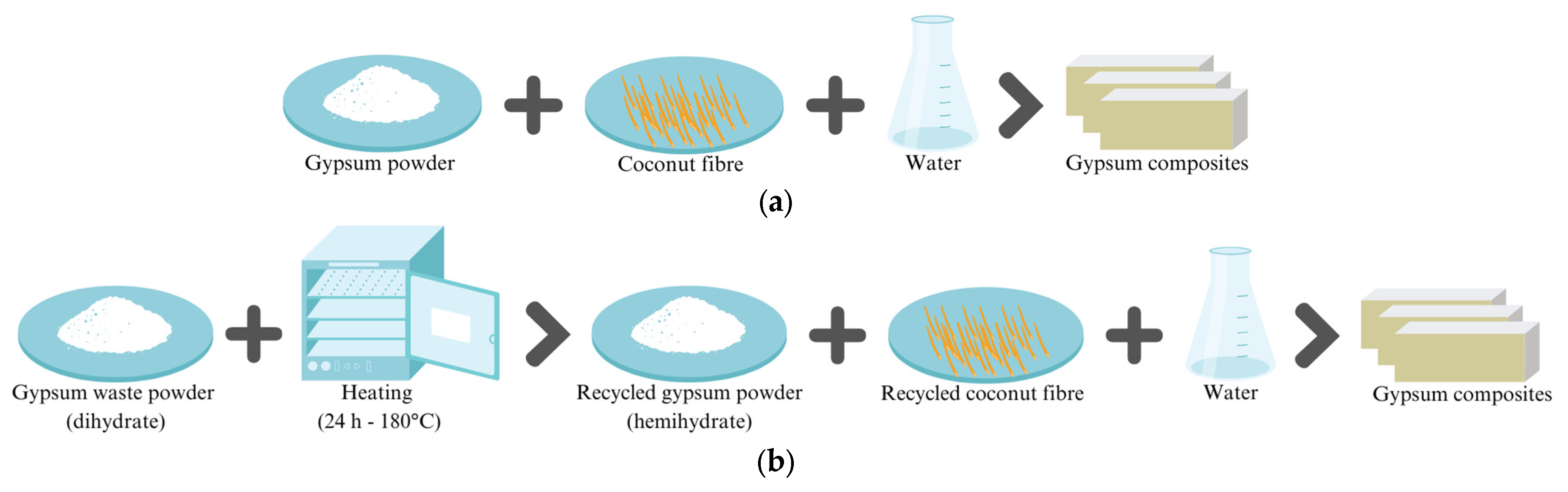
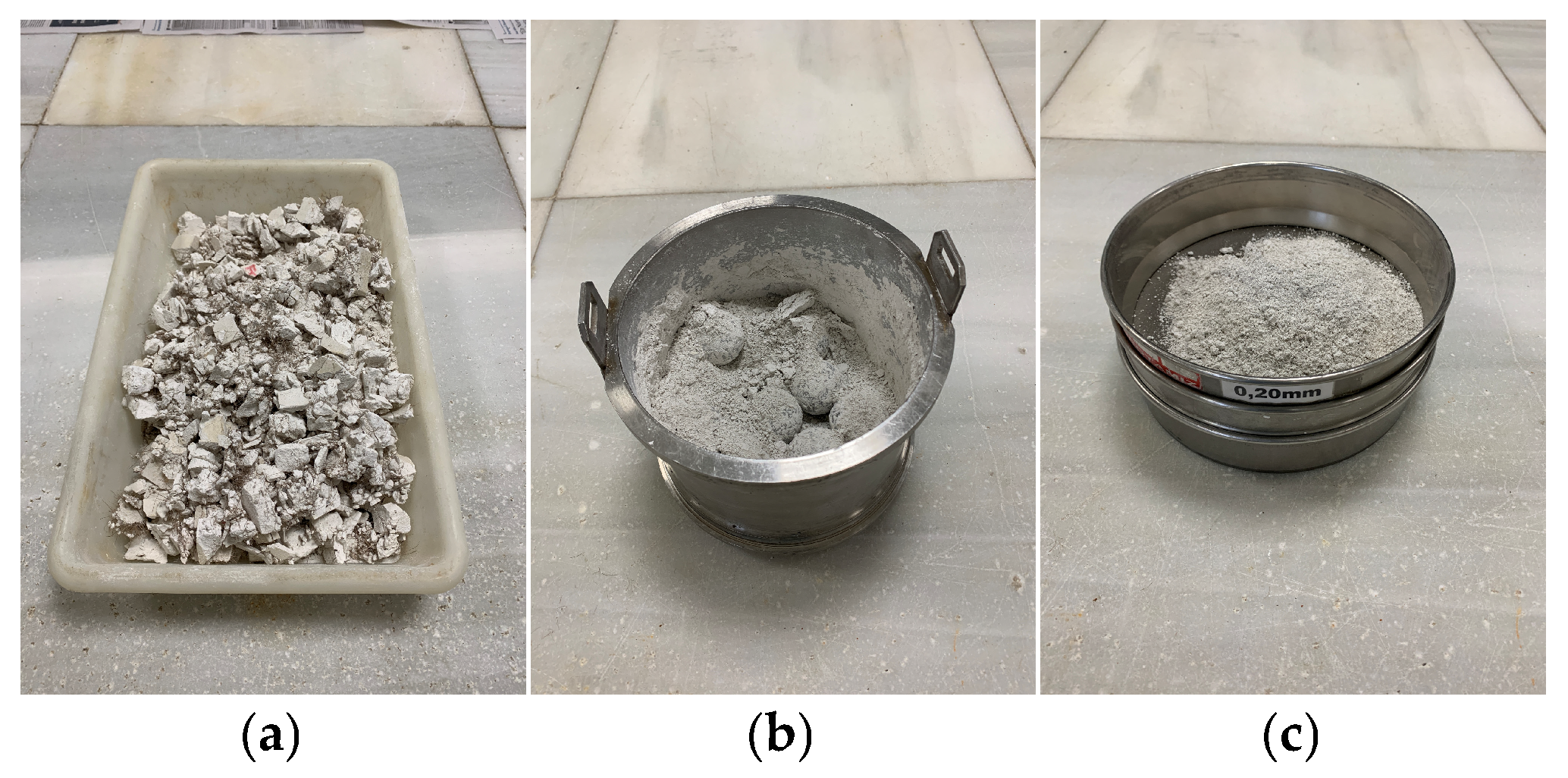
2.1.2. Recycled Materials

| Reference | Source of Recycled Gypsum | Temperature (°C) | ||||
|---|---|---|---|---|---|---|
| 100 | 140 | 150 | 100 | 180 | ||
| Time (h) | ||||||
| [42] | Gypsum Plasterboard Waste (GPW) from the waste powder produced during the plasterboard cutting process. | 6 | 3 | 3 | ||
| 24 | 6 | 6 | ||||
| Flue Gas Desulphurization (FGD). | 6 | 3 | 3 | |||
| 24 | 6 | 6 | ||||
| [43] | Flue Gas Desulphurization (FGD gypsum). | 6 | 3 | |||
| 24 | 6 | |||||
| Gypsum waste from plasterboard production (GPW) from the powder generated during the plasterboard cutting process at a manufacturing plant. | 6 | 3 | ||||
| 24 | 6 | |||||
| [39] | Gypsum plasterboard sheets (12.5 mm) waste from cutting or losses during the drywall ceiling installation process. | 24 | ||||
| [44] | GPW generated by local construction sites. | 1 | ||||
| [38] | Standard 12.5 mm thick gypsum plasterboard sheets from cutting or waste generated during the construction of walls and lining using drywall. | 24 | ||||
| [45] | Gypsum waste collected from civil construction projects. | 0.5 | 0.5 | 0.5 | ||
| 1.0 | 1.0 | 1.0 | ||||
| 1.5 | 1.5 | 1.5 | ||||
| 2.0 | 2.0 | 2.0 | ||||
| 2.5 | 2.5 | 2.5 | ||||
| 3.5 | 3.5 | 3.5 | ||||
| [26] | Waste material produced during the production of gypsum plasterboard in the factory. | 24 | ||||
| [29] | Recycled gypsum obtained from specimens made with commercial gypsum by the author. | 3 | ||||
2.2. Composites Preparation
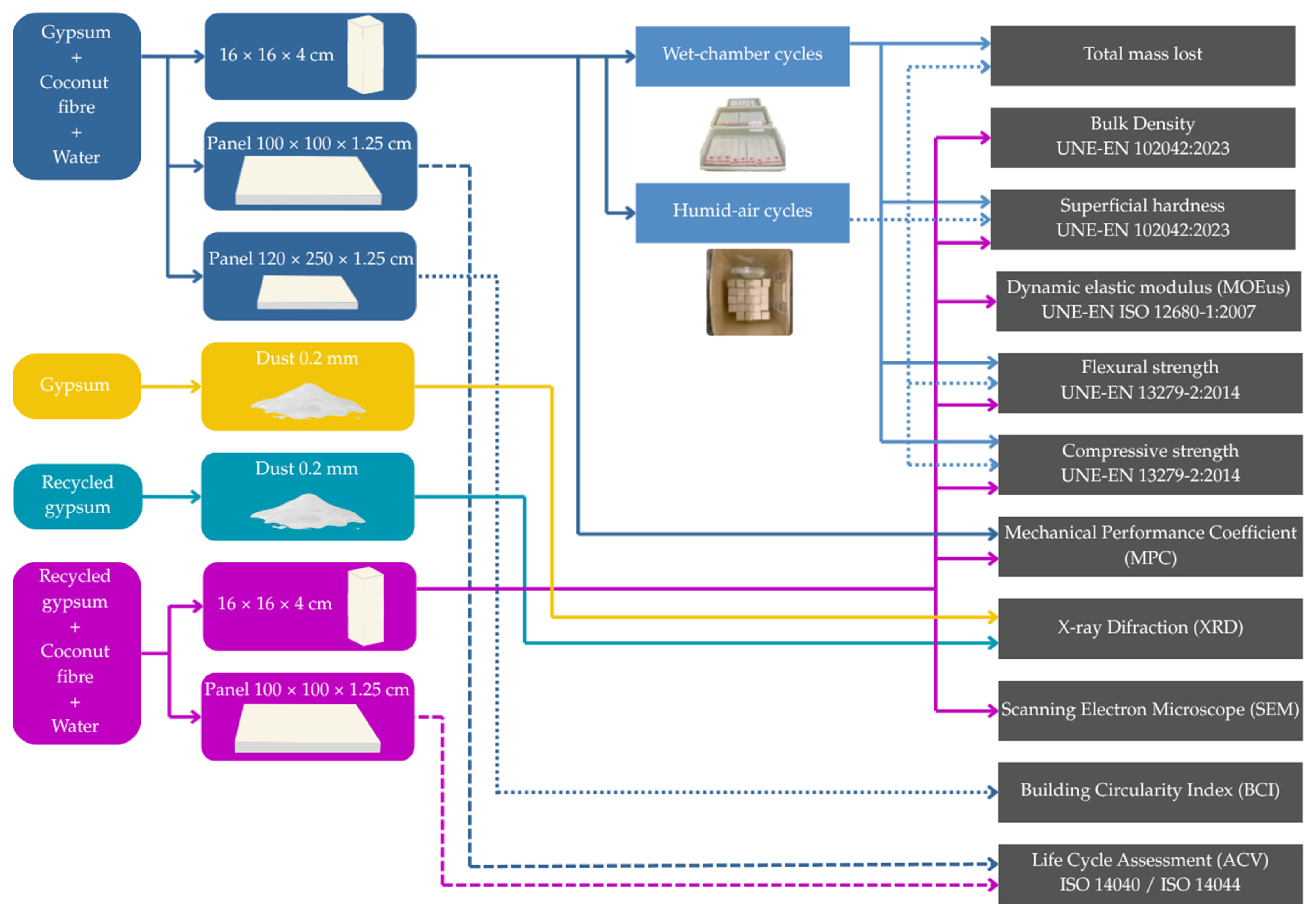
2.3. Experimental Program
2.3.1. Durability of Gypsum Composites with Coconut Fibers
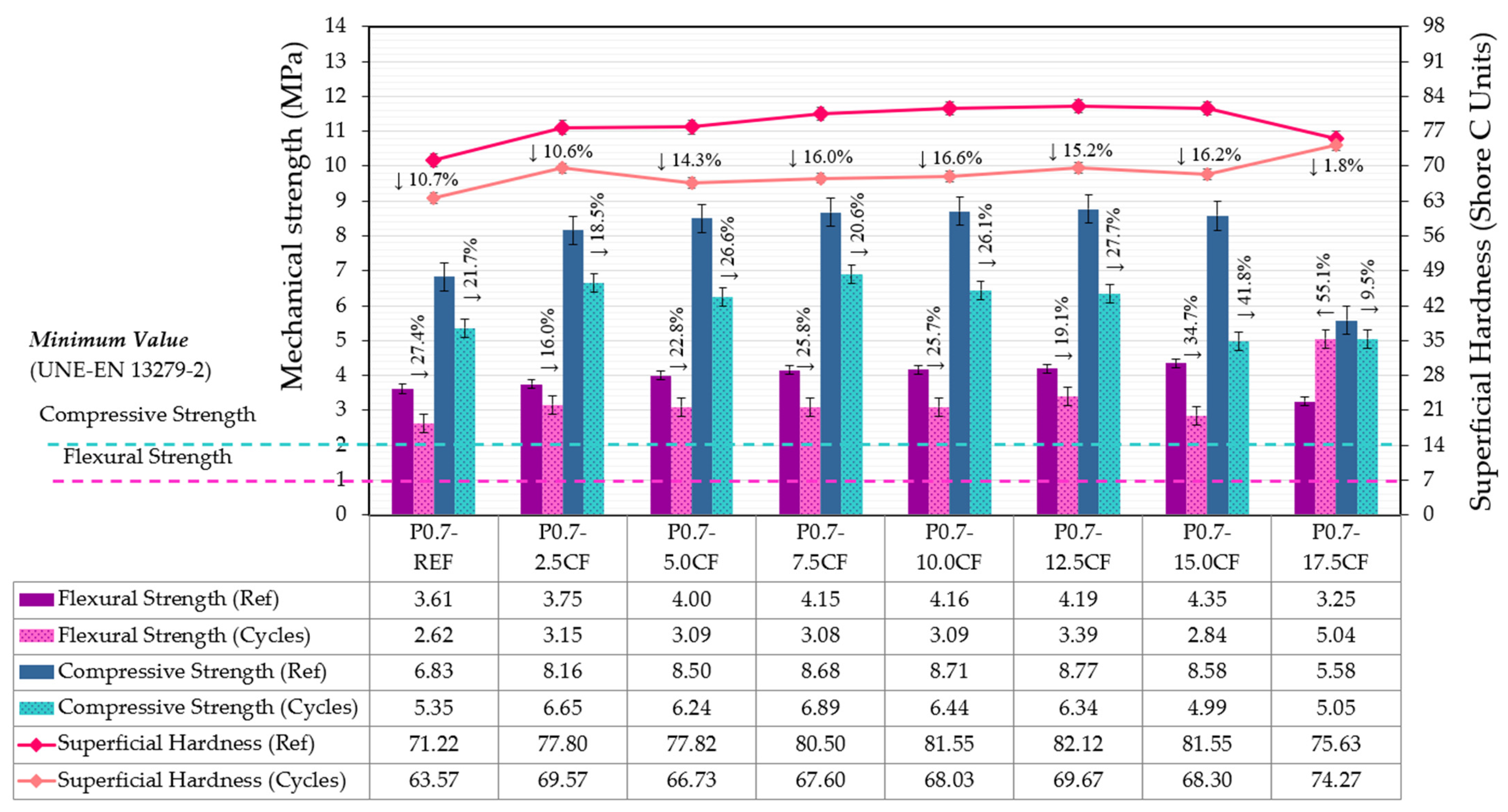
- Water-oven cycles: This is a non-standardized test designed by del Río Merino [51], which allows for the analysis of the physical stability and mechanical performance of the composites after exposure to controlled cycles. For each dosage, three standardized prismatic test specimens measuring 4 × 4 × 16 cm were prepared for the control group (not subjected to cycling), and another three test specimens were prepared for the group subjected to accelerated aging. For each formulation, standardized prismatic specimens measuring 4 × 4 × 16 cm were prepared, forming a control group without treatment and another group subjected to three 48-h cycles. The cycles consisted of 24 h of immersion in water, followed by 24 h of drying in an oven at 40 ± 2 °C and 50 ± 1% relative humidity. Upon completion of the cycles, the samples were evaluated and compared with the control group to determine total mass loss, surface hardness, flexural strength, and compressive strength.
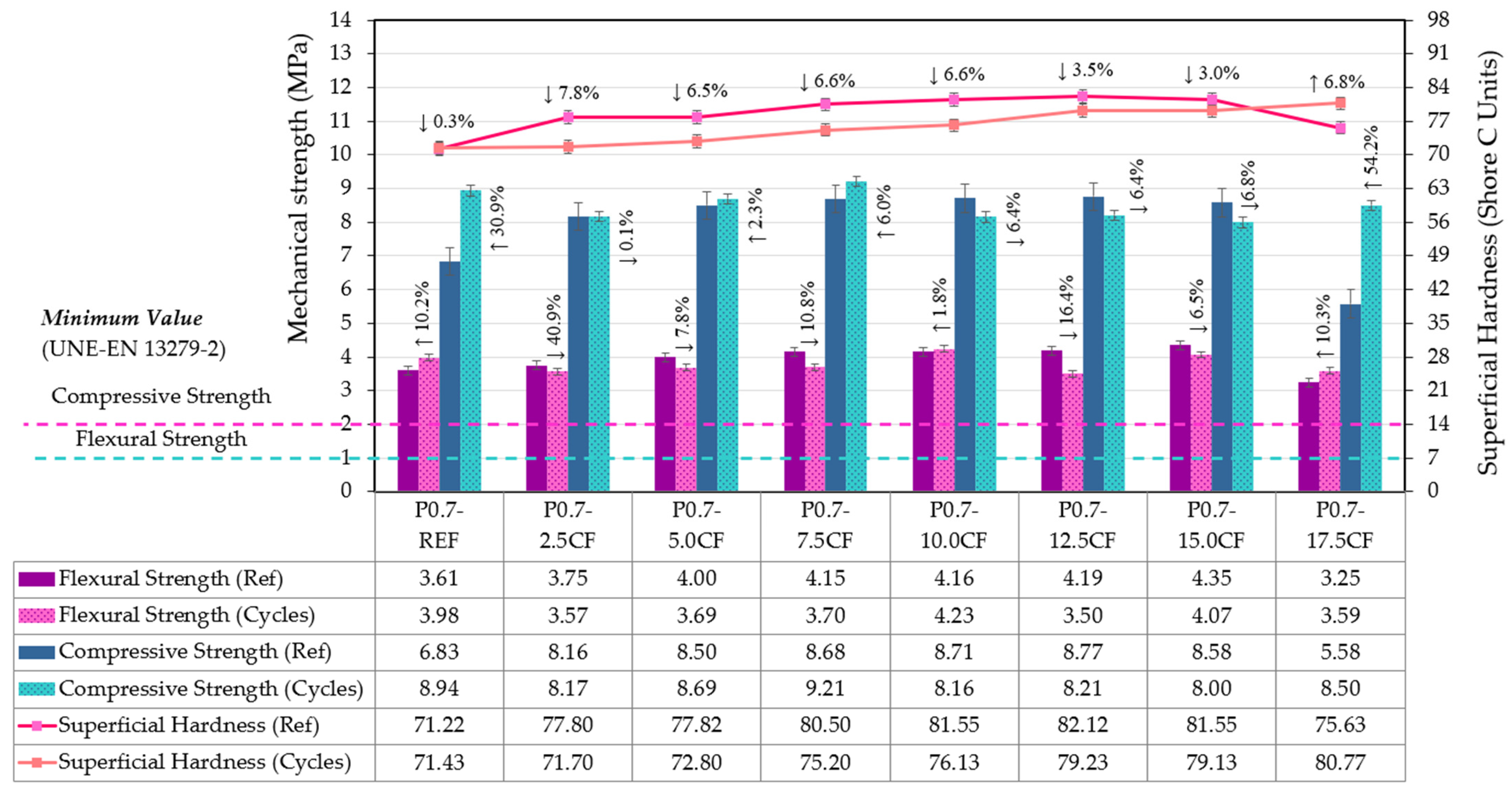
- Wet–dry cycles: This is an accelerated aging test in which, for each dosage, three standardized prismatic test specimens measuring 4 × 4 × 16 cm were prepared for the control group (not subjected to cycling) and another three for the group subjected to aging. The test specimens were subjected to 40 cycles [51]. Each cycle included a 24-h phase at 90 ± 5% relative humidity and 20 ± 2 °C, followed by a 24-h phase at 55 ± 5% relative humidity and 18 ± 2 °C. In each series, three specimens were tested per batch. Upon completion of the cycles, the properties of total mass loss, density, surface hardness, flexural strength, and compressive strength were evaluated and compared with a control series.
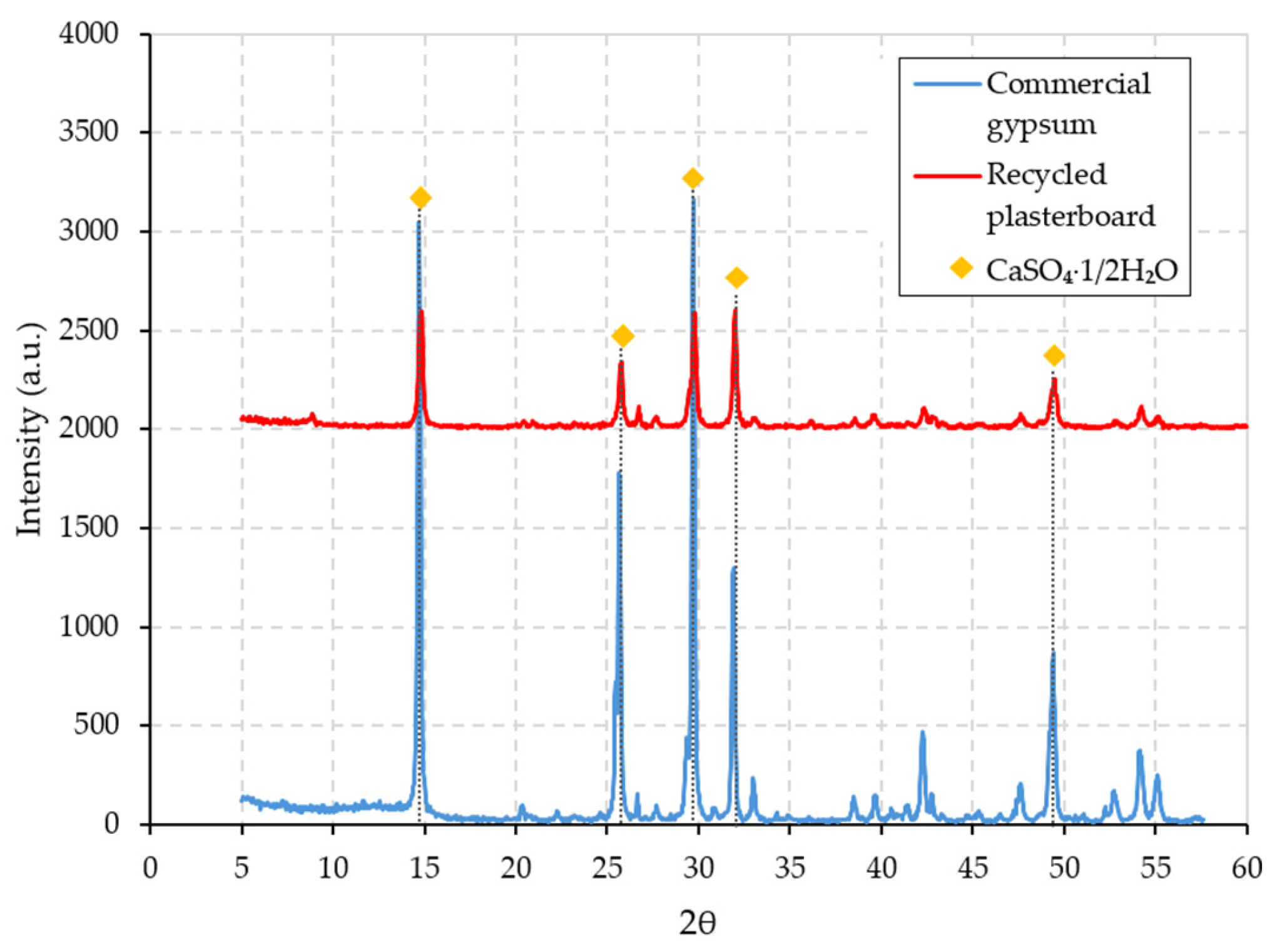
2.3.2. X-Ray Diffraction (XRD)
2.3.3. Physical-Mechanical Characterization
- Bulk density: Density was determined in accordance with UNE 102042:2023 [47] as the ratio of the dry mass to the volume of the specimens, using prismatic test specimens of standardized dimensions (4 × 4 × 16 cm). The dry mass was measured using an electronic balance (Europe 3000 RH, Gibertini, Novate Milanese, Italy) with a precision of ± 0.01 g, and the dimensions were recorded with a digital caliper with a precision of ± 0.01 mm, thereby allowing the specimen’s total volume to be calculated. Density was recorded as the average value of three specimens for each formulation evaluated.
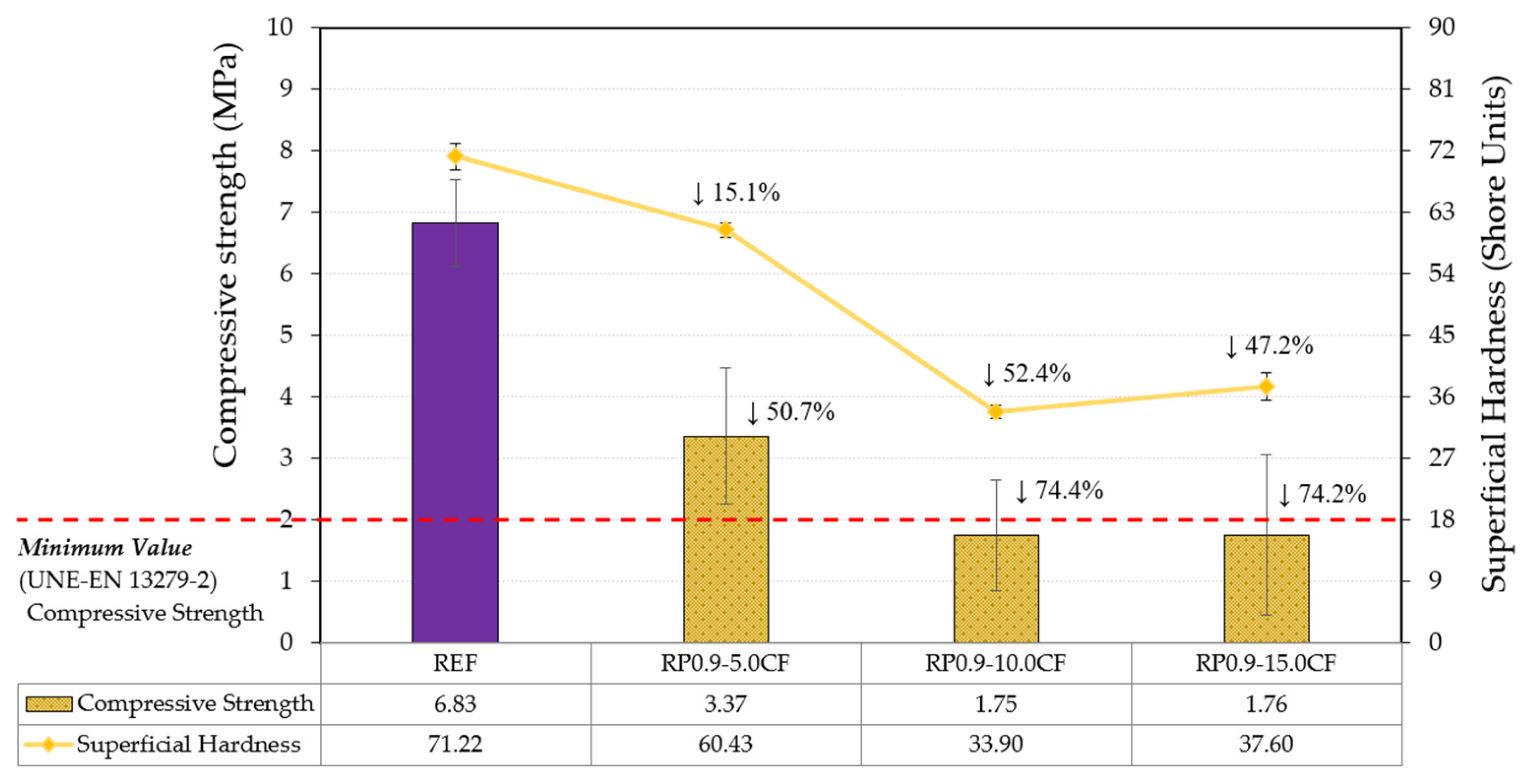
- Surface hardness: Surface hardness was determined in accordance with the UNE 102042:2023 standard [47]. Three standardized prismatic specimens measuring 4 × 4 × 16 cm were used for each batch. Measurements were taken with a Shore C durometer (Baxlo Precisions, Barcelona, Spain) on two parallel longitudinal faces of each specimen, with five measurements per face and a minimum distance of 2 cm from the edges and between measurement points. The final result was obtained by averaging all measurements.
- Dynamic Modulus of Elasticity (MOEus): This test was used to analyze the influence of coconut fiber incorporation on the elasticity of composites made with recycled gypsum, following the specifications of the UNE-EN ISO 12680-1:2007 standard [48]. Three standardized prismatic specimens measuring 4 × 4 × 16 cm were used for each batch. Measurements were taken using an Ibertest Ultrasonic Tester E46 (Ibertest, Madrid, Spain) (220 V, 50 Hz) along the longitudinal axis of the specimens. Vaseline was applied to the interface to optimize coupling between the probes and the specimen surface.
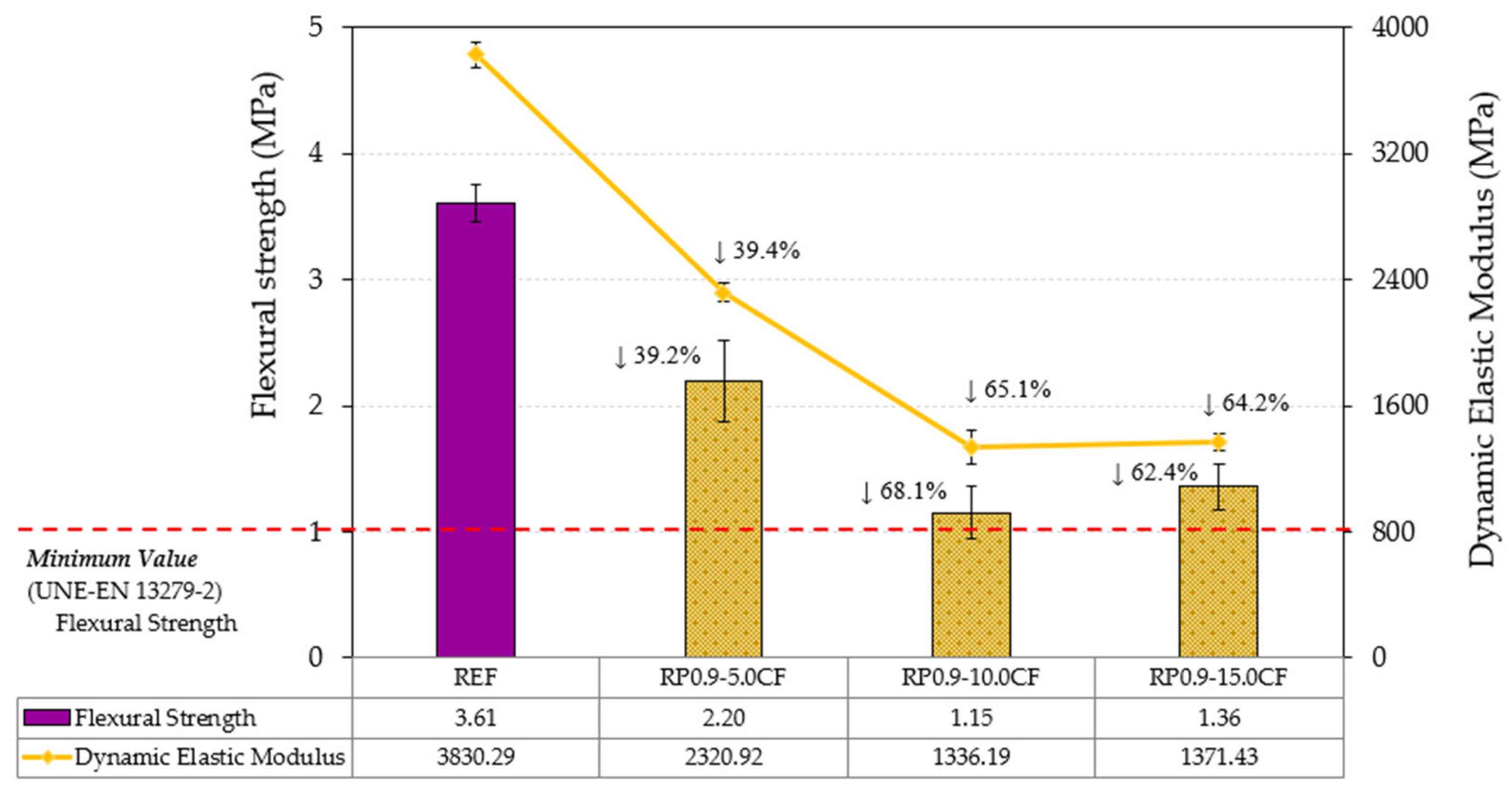
- Flexural strength: The test was conducted in accordance with the specifications of standard UNE-EN 13279-2:2014 [46], using standardized prismatic specimens measuring 4 × 4 × 16 cm, and was performed on an Ibertest AUTOTEST 200-10SW universal hydraulic press (Ibertest, Madrid, Spain) with a maximum capacity of 10 kN. For each formulation, three specimens were evaluated, and the strength was calculated as the average of the obtained values.
- Compressive strength: This test was conducted in accordance with the UNE-EN 13279-2:2014 [46] standard, using the two halves resulting from the flexural test. The equipment used was an AUTOTEST 200-10SW universal hydraulic press from Ibertest. For each mix, six specimens were tested by applying an axial load at a constant rate of 20 N/s, and the final result was recorded as the average compressive strength obtained.
- Mechanical Performance Coefficient (MPC): In order to gain a deeper understanding of the technical efficiency of the developed mixtures and to standardize the impact of variations in the matrix and the water-to-binder ratio, the MPC was determined. This analysis is based on the concept of the “appropriate lightweighting coefficient” originally proposed by del Río Merino [51] and adapted in recent studies on the optimization of lightweight plasters [52], which establish that the strength of plaster depends primarily on its porosity and, therefore, on its density.
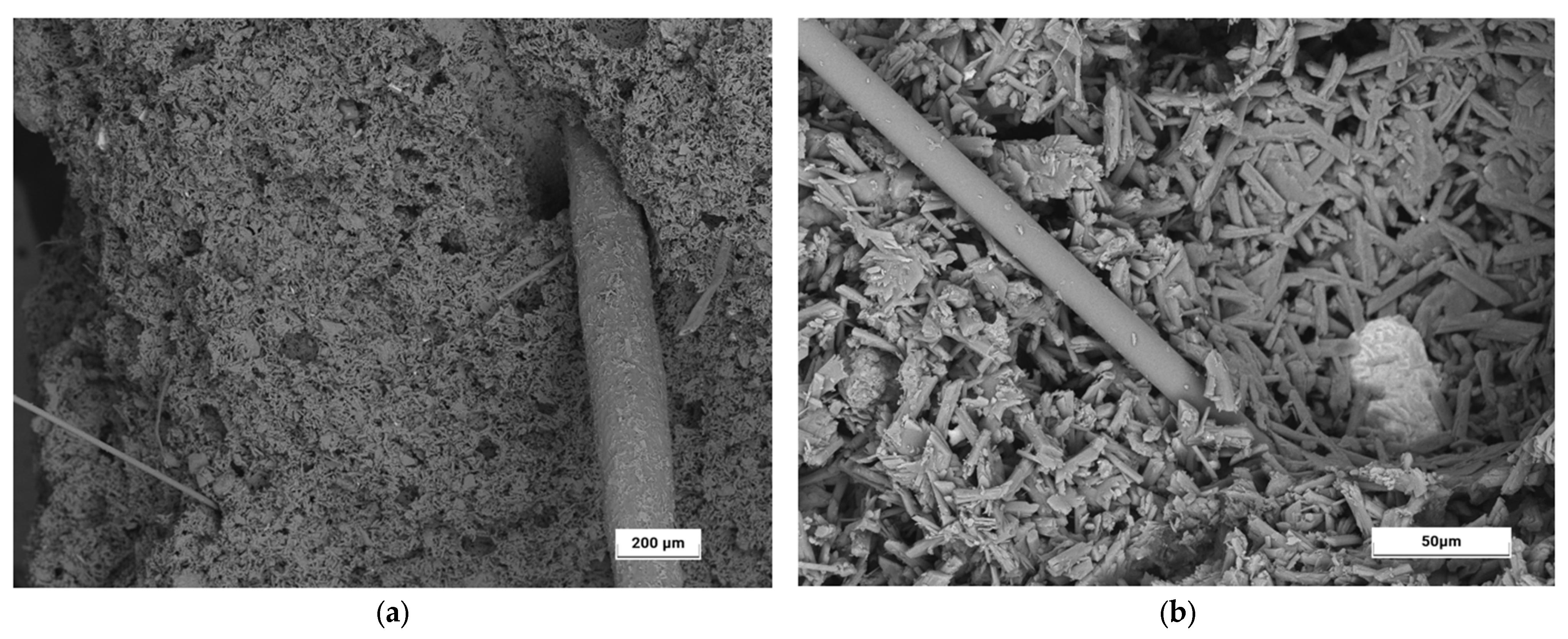
- Scanning Electron Microscopy (SEM): Analysis using SEM allowed us to examine the morphology and internal structure of the composites made from recycled gypsum, evaluating aspects such as coconut fiber integration into the matrix, crystal arrangement, and pore distribution. A Jeol JSM-820 microscope (Jeol, Tokyo, Japan), operated at 20 kV and equipped with an X-ray energy-dispersive analysis system (EDX, Oxford Instruments, Abingdon, UK), was used for observation. Before analysis, the specimens were coated with a thin gold film using a Cressington 108 metallizer (Cressington Scientific Instruments, Watford, UK) to ensure adequate electron beam conductivity.
2.3.4. Environmental Assessment
- Building Circularity Index (BCI): The BCI is a metric that quantifies the circularity potential of a building, construction system, or building material throughout its life cycle as a percentage [30,53,54]. The BCI methodology is based on calculating the average percentage of Materials Recovered and Materials Returned by mass, as given by Equation (3).
- Life Cycle Assessment (LCA): This is a standardized methodology used to comprehensively evaluate the environmental impact of a product or service, following ISO 14040 and ISO 14044 standards [49,50]. In this study, the objective of the LCA was to study and compare three different proportions of recycled coconut fiber in composites with commercial gypsum and recycled gypsum. Furthermore, a “cradle-to-gate” approach was employed, using the cut-off principle [8,49], according to which recycled materials enter the system with zero environmental impact, and only the impacts associated with processing and transportation operations carried out within the system’s boundaries are accounted for. In the scenario studied, coconut fiber waste is generated during the industrial processing of products made from these fibers (organic mats and rolls) and cannot be reintroduced into the production process due to its short length. Meanwhile, gypsum waste is generated during gypsum board production and is recycled at the same factory. In this regard, for recycled gypsum, crushing and grinding, thermal treatment, and screening were considered; for obtaining recycled coconut fibers, the impacts of cutting and transport were considered. Regarding transport logistics, the model was based on a gypsum factory located in Madrid (Spain) and the average distance to domestic coconut fiber product manufacturers in Spain. It is important to highlight that this study utilizes waste fibers generated as a by-product during the manufacturing of coconut fiber boards. Since the international transport and raw material importation are fully allocated to the primary commercial products, these waste fibers enter our system boundary with zero initial burden at the Spanish manufacturing sites, in accordance with the cut-off allocation approach. The Spanish energy mix was used to meet electricity consumption loads (regarding the energy consumption involved in panel manufacturing, as well as the recycling process for recycled materials). The defined functional unit is 1 m2 of 12.5-mm-thick board intended for lightweight partitions. Table 8 presents the life-cycle inventory (LCI) of inputs to the system for each component analyzed. The sources of the data for raw materials were drawn from existing EPDs of Spanish companies (in the case of commercial gypsum) [58], in accordance with the standard EN15804:2012 [8], and the remaining materials were obtained from the Ecoinvent v3.10 database using SimaPro software version 9.5 (PRé Sustainability, Amersfoort, The Netherlands) [59]. The methodology used to determine the potential environmental impacts was CML-IA baseline v3.10 [60], and the following categories were analyzed: Global Warming Potential (GWP); Abiotic Depletion Potential of Fossil Fuels (ADP_ff); Ozone Depletion Potential (ODP); Acidification Potential (AP); Eutrophication Potential (EP); and Tropospheric Ozone Formation Potential (POCP).
3. Results and Discussion
3.1. Durability
3.1.1. Water-Oven Cycles
3.1.2. Wet–Drying Cycles
3.2. Physicochemical Characterization of Recycled Gypsum Powder
XRD of Commercial Gypsum and Recycled Powder
3.3. Physical and Mechanical Characterization of Specimens Containing Recycled Gypsum
3.3.1. Bulk Density
3.3.2. Flexural Strength and Dynamic Elastic Modulus
3.3.3. Compressive Strength and Superficial Hardness
3.3.4. Mechanical Performance Coefficient (MPC)
3.3.5. SEM
3.4. Environmental Assessment
3.4.1. Circularity Calculation
3.4.2. Life Cycle Assessment
4. Conclusions
- Composites made from commercial gypsum and coconut fibers exhibited moderate losses in mass, surface hardness, and mechanical strength following accelerated aging cycles, while consistently remaining above the minimum regulatory values. The results indicate that incorporating coconut fiber serves as a hygrothermal stabilizer, mitigating mass loss and improving retention of mechanical properties after the cycles.
- The use of recycled gypsum as a binder in coconut fiber composites resulted in reductions in all evaluated properties compared to the commercial reference series. Density decreased by up to 24.2%, reflecting the lower density of the coconut fibers and the higher porosity of the recycled matrix. Regarding mechanical properties, decreases of up to 47.2% in surface hardness were recorded for the formulation containing 15% coconut fibers. Similarly, the dynamic elastic modulus decreased by up to 64.2%, reflecting the lower stiffness of the recycled gypsum. Regarding mechanical performance, although flexural strength decreased by up to 62.4%, all formulations exceeded the minimum threshold of 1 MPa required by the standard. However, in the compression test, with decreases of up to 74.4%, only the formulation containing 5.0% fiber (3.37 MPa) met the minimum regulatory requirement. Therefore, it is identified as the most technically promising recycled gypsum composition of all those tested, since the use of fiber contents exceeding 5.0% in recycled gypsum matrices limits their suitability for applications with compressive load requirements.
- The experimental material separation procedure determined that 50.34% of the gypsum and 44.99% of the coconut fibers are recoverable after the recycling of a panel made from these materials. When these values are incorporated into the BCI calculation and a weighting factor of 0.5 associated with under-recycling is applied, the index reaches a maximum of 13.7% for the formulation with the highest coconut fiber content (P0.7-17.5CF). These results show that, although the physical recovery of materials is substantial, effective circularity is limited by the loss of material quality after recycling. However, the incorporation of coconut fibers during the composite manufacturing phase helps improve the BCI, reinforcing its potential as a circular economy strategy applied to lightweight construction systems.
- The incorporation of recycled coconut fiber into composites with commercial gypsum produces a progressive reduction in environmental impacts across all categories, primarily due to the decrease in gypsum content. This improvement is most notable in ODP, with reductions of up to 14%. On the other hand, replacing natural gypsum with recycled gypsum yields much more substantial improvements, with reductions exceeding 90% in ODP and around 80% in GWP compared to the baseline. It should be noted that the cut-off principle was applied, which directly influenced the results obtained. Finally, although the increase in fiber continues to reduce impacts in composites with recycled gypsum, factors such as fiber transportation and higher water consumption limit the potential for a much greater reduction in impact.
Author Contributions
Funding

Data Availability Statement
Acknowledgments
Conflicts of Interest
References
- Pierrehumbert, R. There is no Plan B for dealing with the climate crisis. Bull. At. Sci. 2019, 75, 215–221. [Google Scholar] [CrossRef] [Scilit]
- Comisión Europea. Reglamento (UE) 2024/3110 del Parlamento Europeo y del Consejo, de 12 de Diciembre de 2024, por el que se Establecen Condiciones Armonizadas Para la Comercialización de Productos de Construcción; Diario Oficial de la Unión Europea: Luxembourg, 2024; pp. 1–114. Available online: http://data.europa.eu/eli/reg/2024/3110/oj (accessed on 3 May 2026).
- Global Alliance for Buildings and Construction. 2024/2025 Global Status Report for Buildings and Construction; United Nations Environment Programme: Nairobi, Kenya, 2024. [Google Scholar]
- Green Building Council España (GBCe). Descarbonizar La Edificación En Todo Su Ciclo de Vida—Guía Paso a Paso Para Ciudades; GBCe: Madrid, Spain, 2023. [Google Scholar]
- Parlamento Europeo y Consejo de la Unión Europea. Directiva (UE) 2024/1275 del Parlamento Europeo y del Consejo de 24 de Abril de 2024 Relativa a la Eficiencia Energética de los Edificios (Versión Refundida); Diario Oficial de la Unión Europea: Luxembourg, 2024; Available online: http://data.europa.eu/eli/dir/2024/1275/oj (accessed on 3 May 2026).
- European Commission. The European Green Pact. 2019. Available online: https://sustainabledevelopment.un.org/post2015/transformingourworld (accessed on 3 August 2025).
- Comisión Europea. Nuevo Plan de Acción Para La Economía Circular: Por Una Europa Más Limpia Y Más Competitiva; COM(2020) 98 final; Comisión Europea: Bruselas, Belgium, 2020. [Google Scholar]
- UNE-EN 15804:2012+A2:2020; Sostenibilidad en la Construcción. Declaraciones Ambientales de Producto. Reglas de Categoría de Producto Básicas Para Productos de Construcción. UNE: Madrid, Spain, 2020.
- United Nations Environment Programme. Building Materials and the Climate: Constructing a New Future; United Nations Environment Programme: Nairobi, Kenya, 2023. [Google Scholar]
- Programa DAP® construcción. RCP 100. Reglas de Categoría de Producto (RCP) Genéricas Para Preparar una Declaración Ambiental de Producto (DAPcons®) Sobre Productos de Construcción; Versión 3; Col·legi d’Aparelladors, Arquitectes Tècnics i Enginyers d’Edificació de Barcelona (CAATEEB): Barcelona, Spain, 2021. [Google Scholar]
- Ministerio de Vivienda y Agenda Urbana. Documento Básico HE Ahorro de Energía. Código Técnico de La Edificación; Ministerio de Vivienda y Agenda Urbana: Madrid, Spain, 2022.
- Naciones Unidas. Marco de Indicadores Mundiales Para Los Objetivos de Desarrollo Sostenible Y Metas de La Agenda 2030 Para El Desarrollo Sostenible; United Nations: New York, NY, USA, 2021. [Google Scholar]
- Parlamento Europeo y Consejo de la Unión Europea. Directiva 2008/98/CE del Parlamento Europeo y del Consejo, de 19 de Noviembre de 2008, Sobre los Residuos y por la que se Derogan Determinadas Directivas; Diario Oficial de la Unión Europea: Luxembourg, 2008; Volume L 312, pp. 3–30. [Google Scholar]
- Ministerio para la Transición Ecológica y el Reto Demográfico. España Circular 2030. Estrategia Española de Economía Circular; MITECO: Madrid, Spain, 2020.
- Zaragoza-Benzal, A.; Ferrández, D.; Atanes-Sánchez, E.; Saíz, P. Study of the hygroscopic properties of environmentally friendly lightened composites through waste recovery. Constr. Build. Mater. 2023, 404, 133219. [Google Scholar] [CrossRef] [Scilit]
- Rodríguez-Robalino, M.F.; Ferrández, D.; Verdú-Vázquez, A.; Zaragoza-Benzal, A. Development and Performance of Coconut Fibre Gypsum Composites for Sustainable Building Materials. Buildings 2025, 15, 1899. [Google Scholar] [CrossRef] [Scilit]
- Braiek, A.; Karkri, M.; Adili, A.; Ibos, L.; Ben Nasrallah, S. Estimation of the thermophysical properties of date palm fibers/gypsum composite for use as insulating materials in building. Energy Build. 2017, 140, 268–279. [Google Scholar] [CrossRef] [Scilit]
- Iucolano, F.; Caputo, D.; Leboffe, F.; Liguori, B. Mechanical behavior of plaster reinforced with abaca fibers. Constr. Build. Mater. 2015, 99, 184–191. [Google Scholar] [CrossRef] [Scilit]
- Ferrández, D.; Álvarez, M.; Zaragoza-Benzal, A.; Cobo-González, Á.; Santos, P. Development and Characterization of Innovative Hemp–Gypsum Composites for Application in the Building Industry. Appl. Sci. 2024, 14, 2229. [Google Scholar] [CrossRef] [Scilit]
- Vidales-Barriguete, A.; Atanes-Sánchez, E.; del Río-Merino, M.; Piña-Ramírez, C. Analysis of the improved water-resistant properties of plaster compounds with the addition of plastic waste. Constr. Build. Mater. 2020, 230, 116956. [Google Scholar] [CrossRef] [Scilit]
- Leiva-Aguilera, M.J. Escayola Aditivada con Residuos de Cáscara de Arroz. Doctoral Dissertation, Universidad Politécnica de Madrid, Madrid, Spain, 2017. [Google Scholar]
- Zaragoza-Benzal, A.; Ferrández, D.; Diaz-Velilla, J.P.; Zúñiga-Vicente, J.A. Manufacture and characterisation of a new lightweight plaster for application in wet rooms under circular economy criteria. Case Stud. Constr. Mater. 2023, 19, e02380. [Google Scholar] [CrossRef] [Scilit]
- Zaragoza-Benzal, A.; Ferrández, D.; Barrios, A.M.; Morón, C. Water Resistance Analysis of New Lightweight Gypsum-Based Composites Incorporating Municipal Solid Waste. J. Compos. Sci. 2024, 8, 393. [Google Scholar] [CrossRef] [Scilit]
- Trio Maseda, M.; Ortuño, M.G.; Ontiveros Beltranena, C.; Díaz Muñoz, J.Á.; Galindo Rodríguez, M.E.; Martín Moreno, P.I. Yeso Y Alabastro. Panorama Minero 2022; Instituto Geológico y Minero de España: Madrid, Spain, 2024. [Google Scholar]
- Instituto Nacional de Estadística. Cuentas Medioambientales: Cuenta de Los Residuos. Año 2021; INE: Madrid, Spain, 2023. [Google Scholar]
- Zaragoza-Benzal, A.; Ferrández, D.; Santos, P.; Mateus, R.; Atanes-Sánchez, E. Towards the design of new circular composites for lightweight construction products based on gypsum and plastic waste. J. Build. Eng. 2025, 107, 112796. [Google Scholar] [CrossRef] [Scilit]
- Ferrández, D.; Zaragoza-Benzal, A.; Atanes-Sánchez, E.; Merillas, B.; Mateus, R.; Santos, P. Study of Different Recycling Approaches for Gypsum-Based Composites with Recycled Rubber Aggregates. Buildings 2025, 15, 577. [Google Scholar] [CrossRef] [Scilit]
- Gordon, A.M.; Prieto Barrio, M.I.; Cobo Escamilla, A.; Leal Matilla, A. From waste to resource: Exploring the recyclability and performance of gypsum-graphene nanofiber composites. Resour. Conserv. Recycl. Adv. 2024, 23, 200222. [Google Scholar] [CrossRef] [Scilit]
- Li, Z.; Xu, K.; Peng, J.; Wang, J.; Zhang, J.; Li, Q. Study on mechanical strength and water resistance of organosilicon waterproofing agent blended recycled gypsum plaster. Case Stud. Constr. Mater. 2021, 14, e00546. [Google Scholar] [CrossRef] [Scilit]
- One Click LCA. Building Circularity: Circular Assessment. 2026. Available online: https://help.oneclicklca.com/en/articles/275740-building-circularity-circular-assessment (accessed on 3 May 2026).
- IBERYOLA®. Iberyola® E-30/E35. Technical Sheet. 2023. Available online: https://www.placo.es/documents/fichas-tecnicas/ft-iberyola-es.pdf (accessed on 26 May 2025).
- UNE-EN 13279-1:2009; Gypsum Binders and Gypsum Plasters—Part 1: Definitions and Requirements. Asociación Española de Normalización: Madrid, Spain, 2009.
- Unión Europea. Reglamento (UE) n-305/2011 del Parlamento Europeo y del Consejo, de 9 de Marzo de 2011, por el que se Establecen Condiciones Armonizadas Para la Comercialización de Productos de Construcción y se Deroga la Directiva 89/106/CEE del Consejo; Diario Oficial de la Unión Europea: Luxembourg, 2011; pp. 5–43. [Google Scholar]
- Subdirección de Calidad de las Aguas. Características de Calidad de las Aguas. In Análisis Completo; Canal de Isabel II: Madrid, Spain, 2023.
- Sanou, I.; Bamogo, H.; Sory, N.; Gansoré, A.; Millogo, Y. Effect of the coconut fibers and cement on the physico-mechanical and thermal properties of adobe blocks. Heliyon 2024, 10, e38752. [Google Scholar] [CrossRef] [Scilit] [PubMed]
- Quintanilla Alas, M.E. Industrialización de La Fibra de Estopa de Coco; Trabajo de Graduación, Universidad de El Salvador: San Salvador, El Salvador, 2010. [Google Scholar]
- Stelte, W.; Reddy, N.; Barsberg, S.; Sanadi, A.R. Coir from Coconut Processing Waste as a Raw Material for Applications Beyond Traditional Uses. BioResources 2023, 18, 2187–2212. [Google Scholar] [CrossRef] [Scilit]
- Erbs, A.; Nagalli, A.; Carvalho, K.Q.; Mymrin, V.; Passig, F.H.; Mazer, W. Properties of recycled gypsum from gypsum plasterboards and commercial gypsum throughout recycling cycles. J. Clean. Prod. 2018, 183, 1314–1322. [Google Scholar] [CrossRef] [Scilit]
- Erbs, A.; Nagalli, A.; Querne de Carvalho, K.; Mazer, W.; de Moraes Erbs, M.; Paz, D.H.F.; Lafayette, K.P.V. Development of plasterboard sheets exclusively from waste. J. Build. Eng. 2021, 44, 102524. [Google Scholar] [CrossRef] [Scilit]
- Camarini, G.; Pinto, M.C.C.; Moura, A.G.; Manzo, N.R. Effect of citric acid on properties of recycled gypsum plaster to building components. Constr. Build. Mater. 2016, 124, 383–390. [Google Scholar] [CrossRef] [Scilit]
- Geraldo, R.H.; Pinheiro, S.M.M.; Silva, J.S.; Andrade, H.M.C.; Dweck, J.; Gonçalves, J.P.; Camarini, G. Gypsum plaster waste recycling: A potential environmental and industrial solution. J. Clean. Prod. 2017, 164, 288–300. [Google Scholar] [CrossRef] [Scilit]
- Pedreño-Rojas, M.A.; De Brito, J.; Flores-Colen, I.; Pereira, M.F.C.; Rubio-de-Hita, P. Influence of gypsum wastes on the workability of plasters: Heating process and microstructural analysis. J. Build. Eng. 2020, 29, 101143. [Google Scholar] [CrossRef] [Scilit]
- Pedreño-Rojas, M.A.; Flores-Colen, I.; De Brito, J.; Rodríguez-Liñán, C. Influence of the heating process on the use of gypsum wastes in plasters: Mechanical, thermal and environmental analysis. J. Clean. Prod. 2019, 215, 444–457. [Google Scholar] [CrossRef] [Scilit]
- Geraldo, R.H.; Souza, J.D.; Campos, S.C.; Fernandes, L.F.R.; Camarini, G. Pressured recycled gypsum plaster and wastes: Characteristics of eco-friendly building components. Constr. Build. Mater. 2018, 191, 136–144. [Google Scholar] [CrossRef] [Scilit]
- Fernandes Cordon, H.C.; Carvalho Cagnoni, F.; Furlan Ferreira, F. Comparison of physical and mechanical properties of civil construction plaster and recycled waste gypsum from São Paulo, Brazil. J. Build. Eng. 2019, 22, 504–512. [Google Scholar] [CrossRef] [Scilit]
- UNE-EN 13279-2:2014; Yesos de Construcción Y Conglomerantes a Base de Yeso Para La Construcción. Parte 2: Métodos de Ensayo. AENOR: Madrid, Spain, 2014; p. 24.
- Asociación Española de Normalización. UNE 102042:2023; Yesos Y Escayolas de Construcción. Aljez (o Piedra de Yeso). Otros Métodos de Ensayo. UNE: Madrid, Spain, 2023.
- UNE-EN ISO 12680-1:2007; Productos Refractarios. Determinación del Módulo de Elasticidad Dinámico por el Método de la Frecuencia de Resonancia. Parte 1: Método de la Probeta en Flexión. AENOR: Madrid, Spain, 2007.
- ISO 14040; Gestión Ambiental. Análisis de Ciclo de Vida. Principios y Marco de Referencia. ISO: Ginebra, Switzerland, 2006.
- ISO 14044; Gestión Ambiental. Análisis de Ciclo de Vida. Requisitos y Directrices. ISO: Ginebra, Switzerland, 2006.
- Del Río Merino, M. Elaboración y Aplicaciones Constructivas de Paneles Prefabricados de Escayola Aligerada y Reforzada con Fibras de Vidrio E y Otros Aditivos. Doctoral Dissertation, Universidad Politécnica de Madrid, Madrid, Spain, 1999. [Google Scholar]
- Santa Cruz Astorqui, J.; del Río Merino, M.; Villoria Sáez, P.; Porras-Amores, C. Analysis of the Relationship between Density and Mechanical Strength of Lightened Gypsums: Proposal for a Coefficient of Lightening. Adv. Mater. Sci. Eng. 2017, 2017, 7092521. [Google Scholar] [CrossRef] [Scilit]
- Timm, J.; Ries, R.; Passuello, A. Modular steel panel for walls: Life cycle environmental impact, life cycle cost, and potential for material circulation. Build. Environ. 2025, 267, 112209. [Google Scholar] [CrossRef] [Scilit]
- One Click LCA. Building Circularity. Available online: https://help.oneclicklca.com/en/articles/275737-building-circularity (accessed on 27 August 2025).
- Foundation, E.M.; Design, G. Circularity Indicators: An Approach to Measuring Circularity; Ellen MacArthur Foundation: Isle of Wight, UK, 2015. [Google Scholar]
- González, A.; Sendra, C.; Herena, A.; Rosquillas, M.; Vaz, D. Methodology to assess the circularity in building construction and refurbishment activities. Resour. Conserv. Recycl. Adv. 2021, 12, 200051. [Google Scholar] [CrossRef] [Scilit] [PubMed]
- Urlainis, A.; Paciuk, M.; Shohet, I.M. Service Life Prediction and Life Cycle Costs of Light Weight Partitions. Appl. Sci. 2024, 14, 1233. [Google Scholar] [CrossRef] [Scilit]
- International EPD System. Environmental Product Declaration: Standard Plasterboard 12.5 Mm; International EPD System: Estocolmo, Sweden, 2022. [Google Scholar]
- Base de Datos Ecoinvent. Available online: https://ecoinvent.org/database/ (accessed on 3 May 2026).
- Leiden University. CML-IA Characterisation Factors; Center of Environmental Science (CML): Leiden, The Netherlands, 2016. [Google Scholar]
- Lanzón, M.; García-Ruiz, P.A. Effect of citric acid on setting inhibition and mechanical properties of gypsum building plasters. Constr. Build. Mater. 2012, 28, 506–511. [Google Scholar] [CrossRef] [Scilit]
- Karua, P.; Ahammad, R.; Islam, M.S.; Arifuzzaman, M. Effect of fiber content on flexural properties of jute fiber reinforced perlite/gypsum composite core-based sandwich structures. Constr. Build. Mater. 2024, 446, 137899. [Google Scholar] [CrossRef] [Scilit]
- Yuksel, O.; Sandberg, M.; Baran, I.; Ersoy, N.; Hattel, J.H.; Akkerman, R. Material characterization of a pultrusion specific and highly reactive polyurethane resin system: Elastic modulus, rheology, and reaction kinetics. Compos. Part B Eng. 2021, 207, 108543. [Google Scholar] [CrossRef] [Scilit]




| Reference | Virgin Materials | Recycled Materials | No. of Cycles | Properties Analyzed (*) | |||
|---|---|---|---|---|---|---|---|
| A | B | C | D | ||||
| Water-Stove Cycles | |||||||
| [20] | Gypsum type A; Water | Plastic cable waste (<3 mm) | 2 | - | ▪ | ▪ | ▪ |
| [21] | E-35 plaster; Water | Rice husk residue; Rice husk ash | 1 | ▪ | ▪ | ▪ | ▪ |
| Wet Chamber Cycles | |||||||
| [22] | E-35 plaster; Water; Universal solvent | Expanded polystyrene (EPS) | 10 | - | ▪ | ▪ | ▪ |
| ELT textile fiber | - | ▪ | ▪ | ▪ | |||
| [23] | E-35 plaster; Water; Universal solvent | ELT rubber aggregate (0–0.8 mm) | 5 | ▪ | - | ▪ | ▪ |
| ELT rubber aggregate (0–0.8 mm); Expanded polystyrene (EPS) | ▪ | - | ▪ | ▪ | |||
| [20] | Type A gypsum; Water | Plastic cable waste (<3 mm) | 1 | ▪ | ▪ | ▪ | ▪ |
| [21] | E-35 plaster; Water | Rice husk residue; Rice husk ash | 1 | ▪ | ▪ | ▪ | ▪ |
| Reference | Virgin Materials | Recycled Materials | Source of Gypsum | Properties Analyzed (*) | ||||||||||||
|---|---|---|---|---|---|---|---|---|---|---|---|---|---|---|---|---|
| A | B | C | D | E | A | G | H | I | J | A | L | M | ||||
| [26] | Type B1 gypsum; Water; Ethyl acetate | Recycled gypsum plasterboard; Recycled EPS solution | Waste generated from the manufacture of gypsum boards | ▪ | ▪ | ▪ | ▪ | ▪ | ▪ | ▪ | ▪ | |||||
| [27] | Gypsum E3-5; Water | Recycled gypsum; Recycled rubber aggregates from ELT (between 1.0 and 2.5 mm) | Recycled gypsum obtained from test specimens prepared by the author, SERIES 1 (gypsum E-35 and ELT granulate and powder) and SERIES 2 (recycled gypsum from SERIES 1 and ELT granulate and powder) | ▪ | ▪ | ▪ | ▪ | ▪ | ▪ | |||||||
| Recycled gypsum; Recycled rubber aggregates from ELT (<0.8 mm) | ||||||||||||||||
| [28] | Type B1 gypsum; LS-class graphene nanofibers; Distilled water | Recycled gypsum with concentrations of LS-class graphene nanofibers | Recycled gypsum obtained from test specimens prepared by the author, based on gypsum type B1 and graphene nanofibers LS class | ▪ | ▪ | ▪ | ▪ | ▪ | ▪ | ▪ | ▪ | ▪ | ||||
| [29] | Organosilicon waterproofing agent; Water | Recycled plaster | Recycled plaster obtained from commercial plaster processed by the author | ▪ | ▪ | ▪ | ▪ | |||||||||
| Sample | Commercial Gypsum (g) | Water (g) | Coconut Fiber (g) |
|---|---|---|---|
| P0.7-REF | 1000 | 700.0 | – |
| P0.7-2.5CF | 975 | 682.5 | 2.8 |
| P0.7-5.0CF | 950 | 665.0 | 5.6 |
| P0.7-7.5CF | 925 | 647.5 | 8.3 |
| P0.7-10.0CF | 900 | 630.0 | 11.1 |
| P0.7-12.5CF | 875 | 612.5 | 13.9 |
| P0.7-15.0CF | 850 | 595.0 | 16.7 |
| P0.7-17.5CF | 825 | 577.5 | 19.4 |
| Sample | Recycled Gypsum (g) | Water (g) | Coconut Fiber (g) |
|---|---|---|---|
| RP0.9-5.0CF | 950 | 855.0 | 5.6 |
| RP0.9-10.0CF | 900 | 810.0 | 11.1 |
| RP0.9-15.0CF | 850 | 765.0 | 16.7 |
| Material | Weighting Factor | |
|---|---|---|
| Recovered (material recovery) | New material from renewable sources, circular. | 1 |
| Recycled material with lower emissions than an equivalent new material; circular. | 1 | |
| Materials reused from another project, with little or no additional emissions. | 1 | |
| New material, not circular. | 0 | |
| Returned (recovery of used materials) | Preparation of materials for later reuse, reducing future emissions. | 1 |
| Processing of materials in a closed-loop system (maintaining the original quality of the material) | 1 | |
| Open-loop material processing (producing a lower-quality material) | 0.5 | |
| Materials incinerated to generate energy. | 0.5 | |
| Materials sent to landfills (may not fully disintegrate or decompose). | 0 | |
| Sample | Gypsum (g) | Water (g) | Coconut Fiber (g) |
|---|---|---|---|
| P0.7-REF | 43,750.00 | 30,625.00 | 0.00 |
| P0.7-2.5CF | 42,656.25 | 29,859.38 | 122.50 |
| P0.7-5.0CF | 41,562.50 | 29,093.75 | 245.00 |
| P0.7-7.5CF | 40,468.75 | 28,328.13 | 363.13 |
| P0.7-10.0CF | 39,375.00 | 27,562.50 | 485.63 |
| P0.7-12.5CF | 38,281.25 | 26,796.88 | 608.13 |
| P0.7-15.0CF | 37,187.50 | 26,031.25 | 730.63 |
| P0.7-17.5CF | 36,093.75 | 25,265.63 | 848.75 |
| Panel | Commercial Gypsum (kg) | Recycled Gypsum (kg) | Water (kg) | Coconut Fiber (kg) |
|---|---|---|---|---|
| P0.7-REF | 14.58 | - | 10.21 | - |
| P0.7-5.0CF | 13.85 | - | 9.70 | 0.08 |
| P0.7-10.0CF | 13.13 | - | 9.19 | 0.16 |
| P0.7-15.0CF | 12.40 | - | 8.68 | 0.24 |
| RP0.9-5.0CF | - | 13.85 | 12.47 | 0.08 |
| RP0.9-10.0CF | - | 13.13 | 11.81 | 0.16 |
| RP0.9-15.0CF | - | 12.40 | 11.16 | 0.24 |
| Mass (g) | ||||||||
|---|---|---|---|---|---|---|---|---|
| Series | P0.7 | P0.7-2.5CF | P0.7-5.0CF | P0.7-7.5CF | P0.7-10.0CF | P0.7-12.5CF | P0.7-15.0CF | P0.7-17.5CF |
| No cycles | 280.07 ± 9.95 | 269.69 ± 10.02 | 267.43 ± 6.20 | 266.54 ± 7.31 | 265.80 ± 7.27 | 265.69 ± 8.99 | 265.45 ± 6.29 | 252.88 ± 7.03 |
| With cycles | 265.08 ± 3.73 | 270.56 ± 2.41 | 269.40 ± 2.75 | 270.94 ± 2.90 | 269.73 ± 2.05 | 269.76 ± 3.19 | 263.49 ± 1.65 | 263.58 ± 1.78 |
| Variation (%) | −5.4 | +0.3 | +0.7 | +1.7 | +1.5 | +1.5 | −0.7 | +4.2 |
| Mass (g) | ||||||||
|---|---|---|---|---|---|---|---|---|
| Series | P0.7 | P0.7-2.5CF | P0.7-5.0CF | P0.7-7.5CF | P0.7-10.0CF | P0.7-12.5CF | P0.7-15.0CF | P0.7-17.5CF |
| No cycles | 280.07 ± 9.95 | 269.69 ± 10.02 | 267.43 ± 6.20 | 266.54 ± 7.31 | 265.80 ± 7.27 | 265.69 ± 8.99 | 265.45 ± 6.29 | 252.88 ± 7.03 |
| With cycles | 273.24 ± 2.33 | 266.82 ± 2.32 | 272.66 ± 0.66 | 270.37± 84 | 271.06 ± 47 | 270.09 ± 1.49 | 268.27 ± 0.97 | 265.40 ± 4.81 |
| Variation (%) | −2.4 | −1.1 | +2.0 | +1.4 | +2.0 | +1.7 | +1.1 | +5.0 |
| Bulk Density (kg/m3) | ||||
|---|---|---|---|---|
| Series | Reference | RP0.9-5.0CF | RP0.9-10.0CF | RP0.9-15.0CF |
| Bulk density (kg/m3) | 1094.01 ± 62.24 | 1007.68 ± 4.71 | 829.69 ± 1.70 | 845.31 ± 6.43 |
| Variation (%) | — | −7.9 | −24.2 | −22.7 |
| Binder | Ratio (w/b) | MPC | REF | Coconut Fiber | ||
|---|---|---|---|---|---|---|
| 5% | 10% | 15% | ||||
| Commercial gypsum | 0.7 | Kflex | 3.30 | 3.83 | 4.01 | 4.20 |
| Recycled gypsum | 0.9 | - | 2.18 | 1.39 | 1.61 | |
| Commercial gypsum | 0.7 | Kcomp | 6.24 | 8.14 | 8.39 | 8.27 |
| Recycled gypsum | 0.9 | - | 3.34 | 2.11 | 2.09 | |
| Sample | Gypsum (g) | Coconut Fiber (g) | Gypsum Weighting (%) | Coconut Fiber Weighting (%) | Recovered Gypsum (g) | Recovered Coconut Fiber (g) | Recovery Potential Gypsum (%) | Recovery Potential Coconut Fiber (%) |
|---|---|---|---|---|---|---|---|---|
| P0.7-2.5CF | 2047.50 | 5.88 | 15.48% | 3.60% | 1030.71 | 2.65 | 50.34 | 44.99 |
| P0.7-5.0CF | 1995.00 | 11.76 | 15.08% | 7.20% | 1004.29 | 5.29 | 50.34 | 44.99 |
| P0.7-7.5CF | 1942.50 | 17.43 | 14.68% | 10.67% | 977.86 | 7.84 | 50.34 | 44.99 |
| P0.7-10.0CF | 1890.00 | 23.31 | 14.29% | 14.27% | 951.43 | 10.49 | 50.34 | 44.99 |
| P0.7-12.5CF | 1837.50 | 29.19 | 13.89% | 17.87% | 925.00 | 13.13 | 50.34 | 44.99 |
| P0.7-15.0CF | 1785.00 | 35.07 | 13.49% | 21.47% | 898.57 | 15.78 | 50.34 | 44.99 |
| P0.7-17.5CF | 1732.50 | 40.74 | 13.10% | 24.94% | 872.14 | 18.33 | 50.34 | 44.99 |
| Total | 13,230.00 | 163.38 | 100.00% | 100.00% | 6660.00 | 73.50 |
| Sample | Input phase (Materials Recovered) | In the End-of-Life Phase (Material Returned) | BCI (%) | |||||||
|---|---|---|---|---|---|---|---|---|---|---|
| Coconut Fiber (g) | Gypsum (g) | Totalmi (g) | Materials Recovered | Downcycling Coconut Fiber (g) | Downcycling Gypsum (g) | Disposed Materials (g) Coconut Fiber/ Gypsum | Totalwo (g) | Material Returned | ||
| Ren (g) | Virgin (g) | Dow (g) | Dow (g) | |||||||
| P0.7- REF | 0.00 | 43,750.00 | 43,750.00 | 0.000 | 0.000 | 22,023.75 | 21,726.25 | 43,750.00 | 0.252 | 0.126 |
| P0.7-2.5CF | 122.50 | 42,656.25 | 42,778.75 | 0.003 | 55.11 | 21,473.16 | 21,250.48 | 42,778.75 | 0.252 | 0.127 |
| P0.7-5.0CF | 245.00 | 41,562.50 | 41,807.50 | 0.006 | 110.26 | 20,922.56 | 20,774.71 | 41,807.50 | 0.252 | 0.129 |
| P0.7-7.5CF | 363.13 | 40,468.75 | 40,831.88 | 0.009 | 163.37 | 20,371.97 | 20,296.54 | 40,831.88 | 0.251 | 0.130 |
| P0.7-10.0CF | 485.63 | 39,375.00 | 39,860.63 | 0.012 | 218.49 | 19,821.38 | 19,820.77 | 39,860.63 | 0.251 | 0.132 |
| P0.7-12.5CF | 608.13 | 38,281.25 | 38,889.38 | 0.016 | 273.60 | 19,270.78 | 19,345.00 | 38,889.38 | 0.251 | 0.133 |
| P0.7-15.0CF | 730.63 | 37,187.50 | 37,918.13 | 0.019 | 328.71 | 18,720.19 | 18,869.23 | 37,918.13 | 0.251 | 0.135 |
| P0.7-17.5CF | 848.75 | 36,093.75 | 36,942.50 | 0.023 | 381.85 | 18,169.59 | 18,391.05 | 36,942.50 | 0.251 | 0.137 |
| Mixture | Module | ADP (MJ) | GWP (kg CO2eq) | ODP (kgCFC-11eq) | AP (kg SO2eq) | POCP (kg C2H4 eq) | EP (kg PO4 eq) |
|---|---|---|---|---|---|---|---|
| REF | A1 | 3.21 × 101 | 1.90 × 100 | 2.33 × 10⁻⁷ | 7.60 × 10⁻³ | 3.65 × 10⁻⁴ | 9.98 × 10⁻⁴ |
| A2 | 0.00 × 100 | 0.00 × 100 | 0.00 × 100 | 0.00 × 100 | 0.00 × 100 | 0.00 × 100 | |
| A3 | 3.84 × 10⁻¹ | 3.01 × 10⁻² | 5.55 × 10⁻¹⁰ | 1.27 × 10⁻⁴ | 5.53 × 10⁻⁶ | 2.90 × 10⁻⁵ | |
| Total | 3.25 × 101 | 1.93 × 100 | 2.34 × 10⁻⁷ | 7.72 × 10⁻³ | 3.71 × 10⁻⁴ | 1.03 × 10⁻³ | |
| P0.7-5.0CF | A1 | 3.08 × 101 | 1.82 × 100 | 2.22 × 10⁻⁷ | 7.31 × 10⁻³ | 3.51 × 10⁻⁴ | 9.69 × 10⁻⁴ |
| A2 | 1.04 × 10⁻¹ | 7.44 × 10⁻³ | 1.33 × 10⁻¹⁰ | 1.86 × 10⁻⁵ | 1.17 × 10⁻⁶ | 4.73 × 10⁻⁶ | |
| A3 | 3.66 × 10⁻¹ | 2.87 × 10⁻² | 5.29 × 10⁻¹⁰ | 1.21 × 10⁻⁴ | 5.28 × 10⁻⁶ | 2.77 × 10⁻⁵ | |
| Total | 3.12 × 101 | 1.86 × 100 | 2.23 × 10⁻⁷ | 7.45 × 10⁻³ | 3.57 × 10⁻⁴ | 1.00 × 10⁻³ | |
| P0.7-10.0CF | A1 | 2.94 × 101 | 1.75 × 100 | 2.11 × 10⁻⁷ | 7.01 × 10⁻³ | 3.36 × 10⁻⁴ | 9.39 × 10⁻⁴ |
| A2 | 1.04 × 10⁻¹ | 7.44 × 10⁻³ | 1.33 × 10⁻¹⁰ | 1.86 × 10⁻⁵ | 1.17 × 10⁻⁶ | 4.73 × 10⁻⁶ | |
| A3 | 3.48 × 10⁻¹ | 2.73 × 10⁻² | 5.03 × 10⁻¹⁰ | 1.16 × 10⁻⁴ | 5.02 × 10⁻⁶ | 2.63 × 10⁻⁵ | |
| Total | 2.99 × 101 | 1.78 × 100 | 2.11 × 10⁻⁷ | 7.15 × 10⁻³ | 3.43 × 10⁻⁴ | 9.70 × 10⁻⁴ | |
| P0.7-15.0CF | A1 | 2.81 × 101 | 1.68 × 100 | 2.00 × 10⁻⁷ | 6.72 × 10⁻³ | 3.22 × 10⁻⁴ | 9.09 × 10⁻⁴ |
| A2 | 3.09 × 10⁻¹ | 2.22 × 10⁻² | 3.98 × 10⁻¹⁰ | 5.53 × 10⁻⁵ | 3.48 × 10⁻⁶ | 1.41 × 10⁻⁵ | |
| A3 | 3.30 × 10⁻¹ | 2.59 × 10⁻² | 4.77 × 10⁻¹⁰ | 1.10 × 10⁻⁴ | 4.76 × 10⁻⁶ | 2.50 × 10⁻⁵ | |
| Total | 2.87 × 101 | 1.72 × 100 | 2.00 × 10⁻⁷ | 6.89 × 10⁻³ | 3.30 × 10⁻⁴ | 9.48 × 10⁻⁴ | |
| RP0.9-5.0CF | A1 | 1.06 × 101 | 3.25 × 10⁻¹ | 1.82 × 10⁻⁸ | 1.14 × 10⁻³ | 6.57 × 10⁻⁵ | 2.54 × 10⁻⁴ |
| A2 | 1.04 × 10⁻¹ | 7.44 × 10⁻³ | 1.33 × 10⁻¹⁰ | 1.86 × 10⁻⁵ | 1.17 × 10⁻⁶ | 4.73 × 10⁻⁶ | |
| A3 | 4.09 × 10⁻¹ | 3.21 × 10⁻² | 5.91 × 10⁻¹⁰ | 1.36 × 10⁻⁴ | 5.89 × 10⁻⁶ | 3.09 × 10⁻⁵ | |
| Total | 1.12 × 101 | 3.65 × 10⁻¹ | 1.89 × 10⁻⁸ | 1.30 × 10⁻³ | 7.27 × 10⁻⁵ | 2.90 × 10⁻⁴ | |
| RP0.9-10.0CF | A1 | 1.04 × 101 | 3.30 × 10⁻¹ | 1.76 × 10⁻⁸ | 1.17 × 10⁻³ | 6.62 × 10⁻⁵ | 2.62 × 10⁻⁴ |
| A2 | 1.04 × 10⁻¹ | 7.44 × 10⁻³ | 1.33 × 10⁻¹⁰ | 1.86 × 10⁻⁵ | 1.17 × 10⁻⁶ | 4.73 × 10⁻⁶ | |
| A3 | 3.89 × 10⁻¹ | 3.05 × 10⁻² | 5.62 × 10⁻¹⁰ | 1.29 × 10⁻⁴ | 5.60 × 10⁻⁶ | 2.94 × 10⁻⁵ | |
| Total | 1.09 × 101 | 3.68 × 10⁻¹ | 1.83 × 10⁻⁸ | 1.32 × 10⁻³ | 7.30 × 10⁻⁵ | 2.96 × 10⁻⁴ | |
| RP0.9-15.0CF | A1 | 1.01 × 101 | 3.35 × 10⁻¹ | 1.71 × 10⁻⁸ | 1.21 × 10⁻³ | 6.68 × 10⁻⁵ | 2.70 × 10⁻⁴ |
| A2 | 3.09 × 10⁻¹ | 2.22 × 10⁻² | 3.98 × 10⁻¹⁰ | 5.53 × 10⁻⁵ | 3.48 × 10⁻⁶ | 1.41 × 10⁻⁵ | |
| A3 | 3.69 × 10⁻¹ | 2.89 × 10⁻² | 5.32 × 10⁻¹⁰ | 1.22 × 10⁻⁴ | 5.31 × 10⁻⁶ | 2.79 × 10⁻⁵ | |
| Total | 1.08 × 101 | 3.86 × 10⁻¹ | 1.80 × 10⁻⁸ | 1.38 × 10⁻³ | 7.56 × 10⁻⁵ | 3.12 × 10⁻⁴ |
Disclaimer/Publisher’s Note: The statements, opinions and data contained in all publications are solely those of the individual author(s) and contributor(s) and not of MDPI and/or the editor(s). MDPI and/or the editor(s) disclaim responsibility for any injury to people or property resulting from any ideas, methods, instructions or products referred to in the content. |
© 2026 by the authors. Licensee MDPI, Basel, Switzerland. This article is an open access article distributed under the terms and conditions of the Creative Commons Attribution (CC BY) license.
Share and Cite
Rodríguez-Robalino, M.F.; Zaragoza-Benzal, A.; Verdú-Vázquez, A.; Ferrández, D. Performance Assessment of Gypsum-Based Composites with Coconut Fibers: Durability, Circularity, and Environmental Impact Assessment. Buildings 2026, 16, 3082. https://doi.org/10.3390/buildings16153082
Rodríguez-Robalino MF, Zaragoza-Benzal A, Verdú-Vázquez A, Ferrández D. Performance Assessment of Gypsum-Based Composites with Coconut Fibers: Durability, Circularity, and Environmental Impact Assessment. Buildings. 2026; 16(15):3082. https://doi.org/10.3390/buildings16153082
Chicago/Turabian StyleRodríguez-Robalino, María Fernanda, Alicia Zaragoza-Benzal, Amparo Verdú-Vázquez, and Daniel Ferrández. 2026. "Performance Assessment of Gypsum-Based Composites with Coconut Fibers: Durability, Circularity, and Environmental Impact Assessment" Buildings 16, no. 15: 3082. https://doi.org/10.3390/buildings16153082
APA StyleRodríguez-Robalino, M. F., Zaragoza-Benzal, A., Verdú-Vázquez, A., & Ferrández, D. (2026). Performance Assessment of Gypsum-Based Composites with Coconut Fibers: Durability, Circularity, and Environmental Impact Assessment. Buildings, 16(15), 3082. https://doi.org/10.3390/buildings16153082