Article

Water Washing: An Efficient Solution for the Total Recovery of Construction and Demolition Wastes


1
Departament d’Enginyeria Minera, Industrial i TIC, Universitat Politècnica de Catalunya Barcelona Tech, Av. Bases de Manresa 61-63, 08242 Manresa, Spain
2
Departament de Mineralogia, Petrologia i Geologia Aplicada, Universitat de Barcelona, Carrer Martí i Franquès s/n, 08028 Barcelona, Spain
3
Departament d’Enginyeria Civil i Ambiental, Universitat Politécnica de Catalunya Barcelona Tech, 08034 Barcelona, Spain
4
Hercal Zero SL, Carretera de Montcada, 880, 08227 Terrassa, Spain
*
Author to whom correspondence should be addressed.
Buildings 2026, 16(15), 2995; https://doi.org/10.3390/buildings16152995
Submission received: 21 June 2026 / Revised: 23 July 2026 / Accepted: 26 July 2026 / Published: 28 July 2026

Abstract

The reuse of the finest fraction derived from recycled aggregate washing has been investigated for the manufacture of mortars. This practice contributes to the circular economy and lowers CO2 emissions in the manufacturing of construction materials. A distinction was made between concrete-rich residues (RH) and mixed concrete–ceramic wastes (RHM). Chemical and mineralogical analyses of samples collected over a two-year period revealed consistent homogeneity over time. The RH residues are richer in CaO, primarily as calcite. Conversely, higher ceramic content in the waste correlates with increased SiO2, Al2O3, and K2O concentrations, predominantly as phyllosilicates and feldspars. Ettringite and portlandite occur in trace amounts. DTA-TG analysis reveals the presence of minor contents of portlandite and C-S-H gel. Mortars were prepared by replacing 10%, 20%, and 30% of Portland cement (OPC) with concrete-derived (RH) and mixed concrete–ceramic (RHM) wastes. At 10% and 20% substitution, both wastes yielded similar strengths, confirming their high potential for masonry mortars without prior treatment. However, at 30% replacement, RH provided markedly higher compressive and flexural strengths than RHM, likely due to a greater presence of the C-S-H gel phase in concrete waste. While 10% and 20% replacements successfully meet the 70% Strength Activity Index (SAI) threshold, a 30% limit severely reduces strength. Consequently, substitutions of 30% or higher require mechanical or thermal activation to enhance CDW reactivity. Given the minimal performance gap between RH and RHM, processing mixed CDW streams uniformly is recommended to maximize economic viability and ensure batch homogeneity in industrial washing plants.

1. Introduction

The cement industry is currently confronting complex, dual challenges: while global demand is projected to rise in the coming years, its environmental footprint must be mitigated. Firstly, this industry demands vast amounts of mineral resources to sustain an annual global production exceeding 10 billion tons [1]. For context, approximately 14 billion tons of concrete was consumed in 2020, requiring 4.2 billion tons of cement; a figure initially projected to reach 4.7 billion tons by 2050 [2]. However, the strategic integration of clinker substitutes as supplementary cementitious materials (SCMs) is successfully flattening these projected curves, shifting the industry away from these critical manufacturing thresholds [3]. In fact, there is a slight decline in Portland cement production between 2023 and 2024, with 4.1 and 4.0 billion tons, respectively [4].
Environmentally, the stakes remain high. The production of a single ton of Portland cement releases nearly one ton of CO2 into the atmosphere [5]. Consequently, cement manufacturing stands as one of the primary drivers of anthropogenic greenhouse gases, accounting for 4% and 8% of total global CO2 emissions [6,7].
On the other hand, the accumulation of construction and demolition waste (CDW) is a major problem. Construction and demolition activities are the main source of waste in the EU, where the construction sector produces around 36% of total waste [8]. This waste is generally considered inert, but it has been found that a wide variability exists and it sometimes contains potentially toxic metals and organic compounds that can cause significant environmental pollution [9,10]. Currently, a significant portion of this waste is recycled, although the degree of recovery varies greatly from one country to another, with some European countries exceeding 80–90% recovery [11]. However, the high recovery rates of CDW are mainly due to the recovery of coarse aggregates. Fine CDW are rarely recovered [12]. High recovery rates in Europe are primarily achieved due to the use of these wastes in low-value applications, such as landfill backfilling and road sub-bases, which limits the potential for progress toward a truly circular waste management [13,14].
Recycling the finest fraction, with a diameter <500 µm, is particularly problematic because its use as aggregate produces concretes with lower durability, meaning that this fraction is recycled to a limited extent [15]. This finer waste accounts for between 20 and 30% of the total [16], which means that a considerable amount of CDW still remains without being used.
CDW fines come from cement paste and fine aggregates that make up concrete. CDW fines also include soil that has been extracted together with demolition products. The composition of CDW fines varies depending on where they come from and the type of sand and aggregates used in the manufacture of the original concrete.
However, far from being a problem, CDW fines represent an opportunity to be used as a raw material to replace Portland cement and, in this way, reduce the CO2 footprint involved in its manufacture. Between 80 and 85% of the CO2 emissions produced by concrete production are associated with clinker production [17]. Most of these emissions are caused by the decarbonation of limestone, which is the primary component of OPC, during thermal treatment, as well as the burning of fossil fuels in the pyroprocessing unit. The remaining emissions are the result of energy consumption in the grinding process, the energy used by air coolers, and the transport of the material [18,19]. Therefore, partially replacing Portland cement with these materials would contribute to cleaner mortar and concrete production, in line with the Paris Agreement’s goal of net-zero carbon emissions by 2050 [20].
Construction and demolition waste (CDW) recycling plants employ various processing flowcharts to separate and reclaim waste components. In most facilities, the primary objective is to isolate coarse aggregates for reuse in new mortars and concretes. However, studies show that concrete manufactured with recycled aggregates typically exhibits reduced mechanical properties and durability [21,22]. To ensure high-quality recycled aggregates, their surfaces must be thoroughly cleaned [23,24].
While screening can separate aggregates from the finest fractions, achieving superior cleanliness requires advanced processing, such as air-stripping or water washing—with water washing yielding the most effective results [25]. Ferrández et al. [26] demonstrated that incorporating a washing phase for recycled sands used in mortar production improves their physical and mechanical properties as a raw material. This process significantly reduces both the fine particle content and the water absorption coefficient. Consequently, these plants typically operate a water recycling loop, where flocculant-assisted sedimentation removes silt and clay particles (<63 µm). To recycle water and minimize its environmental footprint, these fine particles are subsequently separated from the wastewater using filter presses. Traditionally, this residual silt cake is sent to landfills. However, given the massive volumes generated, rising transportation costs, and dwindling landfill capacities, silt disposal has escalated into a critical environmental and economic challenge.
The finest fraction of CDW consists predominantly of hydrated cement paste—composed of calcium hydroxide, amorphous calcium silicate hydrates (C-S-H), and calcium aluminate hydrates—alongside fine aggregate fractions, brick remnants, gypsum, and soil. This complex mixture shares a chemical profile remarkably similar to Portland cement, albeit with a higher silica enrichment.
Valuable synergies can be realized by diverting these CDW fines from landfills and utilizing them as supplementary cementitious materials (SCMs), a strategy that directly supports global CO2 emission reduction targets [27]. Over the past few decades, various industrial byproducts have been proposed as SCMs to mitigate the carbon footprint caused by cement production, including combustion ashes, blast furnace slags, and metakaolin, which have been extensively investigated [28,29]. However, granulated blast furnace slag and coal fly ash have recently faced severe supply shortages [30,31].
Furthermore, metakaolin, which is derived from the partial dehydroxylation of kaolin through thermal treatment, is frequently directed toward applications that are more economically viable than cement production. Nevertheless, certain sustainable approaches utilize kaolin byproducts from the aluminum phosphate industry [32]. Driven by these supply chain constraints, utilizing CDW fines as SCMs has emerged as a highly attractive, sustainable alternative currently under investigation for mortar and concrete manufacturing [33,34]. This fine fraction retains remnants of hydrated cement paste and ceramic residues, which effectively act as pozzolanic or latent hydraulic binding agents [35,36]. Despite these promising avenues, challenges remain, such as the need to ensure the consistency of recycled raw materials and to determine substitution rates based on performance requirements. Meeting these challenges requires ongoing research, standardized production processes, and a deeper understanding of the behavior of recycled cementitious materials across their applications [37]. In addition, a critical gap remains in the existing literature regarding the operational reality of recycling plants. While previous research has evaluated generic CDW fines or simulated laboratory-screened fractions, there is a profound scarcity of data on the actual ultra-fine residual silt cake generated continuously by flocculant-assisted industrial filter presses during advanced aggregate washing. Furthermore, because CDW streams are inherently heterogeneous, the long-term temporal stability of these industrial filter-press wastes remains unmapped. This lack of longitudinal data presents a major barrier to their industrial scalability, as cement manufacturers require strict compositional consistency to adopt new binders.
To bridge these gaps, this study presents a highly novel approach by evaluating industrial filter-cake residues categorized into two distinct, realistic streams: concrete-derived fractions (RH) and mixed concrete–ceramic fractions (RHM). Crucially, the novelty of this work lies in its longitudinal scope: these industrial materials were rigorously sampled and monitored over a continuous two-year period to systematically analyze their compositional variability and chemical homogeneity over time. Therefore, the aim of this study is to assess the comprehensive optimization of CDW management via advanced aggregate washing, driving the construction sector closer to a “zero-waste” circular economy. Concurrently, this research aims to provide scalable solutions for reducing CO2 emissions, thereby mitigating the impacts of global climate change. To ensure easy integration into processing plants, this proposal offers a simple and cost-effective treatment.
The solid waste recovered from washing recycled aggregates—including excavated soils from construction and demolition sites—has been previously evaluated as cementitious material for manufacturing mortars and geopolymers [38,39,40]. Although initial findings indicate that these raw fine wastes exhibit low hydraulic reactivity [12,41], their reactivity can be markedly enhanced through targeted pretreatment methods. One approach is mechanical activation, which reduces particle size, increases specific surface area, and decreases crystallinity [16]. Other methods include alkali activation, which induces geopolymerization or alkaline synthesis using chemical activators [42], and thermal activation, which dehydroxylates hydrated phases and transforms clay minerals into amorphous, highly pozzolanic phases [43].
Beyond SCM applications, CDW fines have also been explored as raw feedstocks for new clinker production [44,45]. When thermally treated at high temperatures (600–800 °C), hydrated cement can undergo dehydroxylation and lose its bound water and can therefore be used again. An analogous transformation occurs in clay minerals during thermal treatment at 500–900 °C, altering their crystalline structures into highly reactive amorphous phases and successfully rendering the treated materials pozzolanic [46].

2. Materials and Methods

2.1. Materials

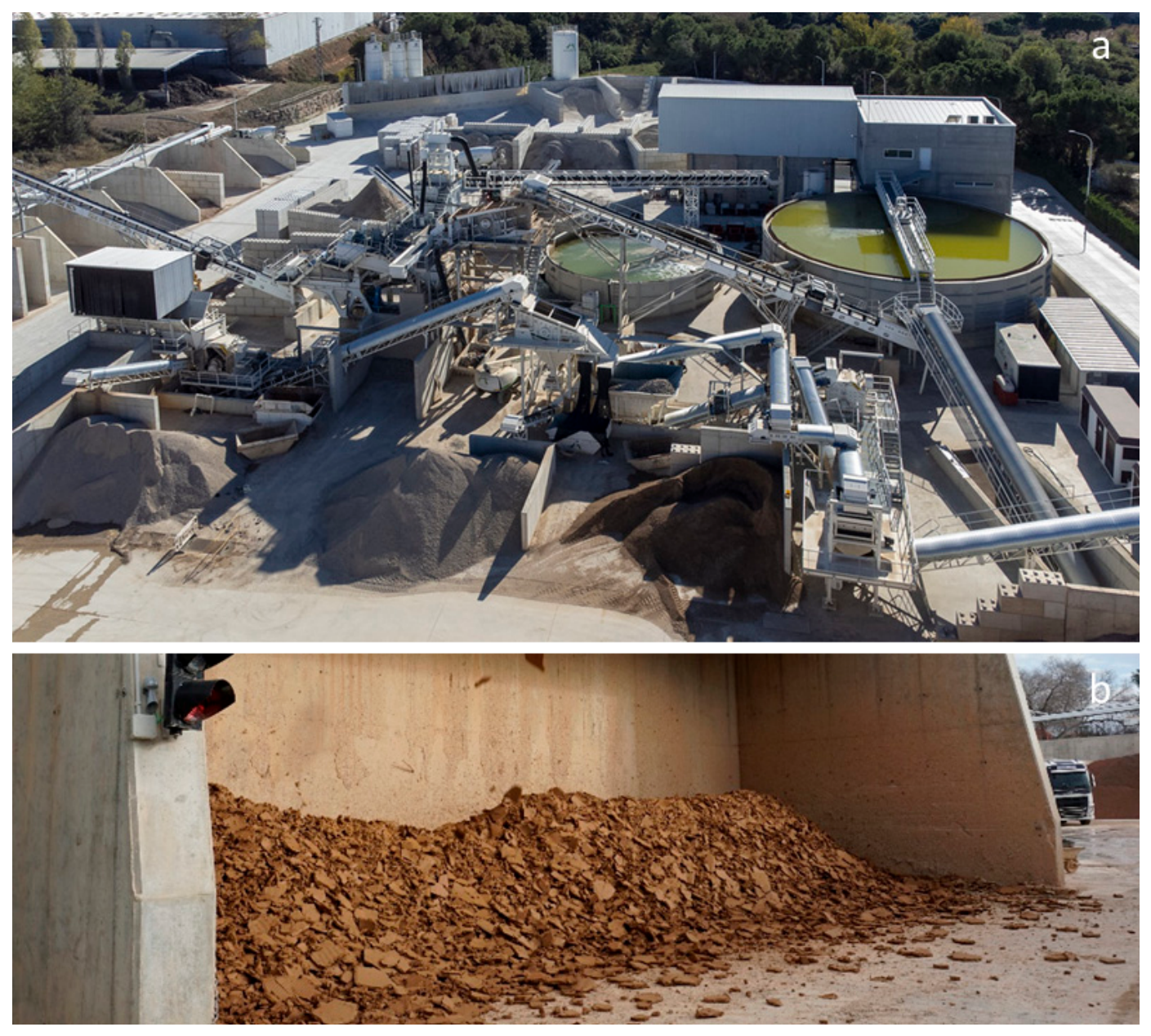
This study evaluated the use of CDW fines produced at an innovative valorization plant (Figure 1) located in Terrassa, Catalonia.
The facility processes CDW to recover high-quality aggregates suitable for manufacturing new mortars and concrete. The characteristics of the aggregates produced at the plant are detailed in [47].
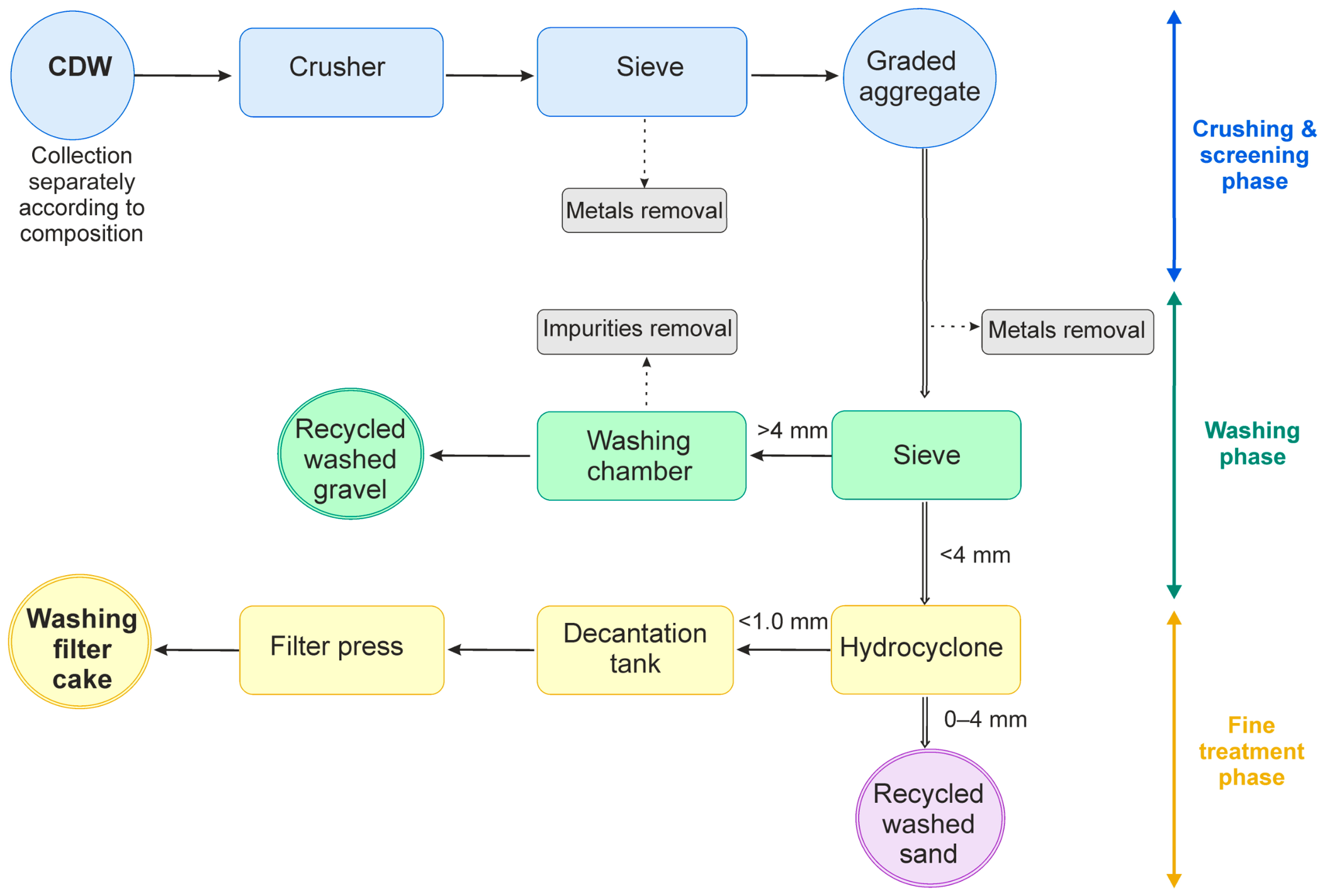
The flow diagram of the processing of the incoming CDW is presented in Figure 2. The incoming debris is sorted by composition: concrete debris (RH), with more than 95% concrete, and mixed debris (RHM), containing a maximum of 30% of ceramic material. Both material streams are treated independently using the same process: an initial crushing and screening phase, followed by a washing stage to remove impurities. During washing, material smaller than 4.0 mm is separated by size, resulting in washed recycled sand without the finest particles, which remain suspended in the water.
To recycle the washing water, these suspended fine particles are separated in the settling tank by adding flocculants, which promote particle agglomeration and precipitation. The sediment accumulation at the base of the tank is passed through a filtration system that retains the mineral particles, collecting them as a washing filter cake.
To determine their compositional variability, the filter-cake materials were sampled at different intervals over a two-year period. This sampling approach provides novel insights for ultra-fine materials intended for use as SCMs, as it allows for the analysis of plant-level variability—a crucial factor when scaling up the utilization of these wastes to an industrial level. While long-term variability studies exist for aggregates [48], research on this specific type of material remains limited. Subsequently, two compositions representative of the two types of treated waste (RH and RHM) were selected for mortar manufacturing.
Upon drying, the filter-cake particles agglomerate into a solid mass that must be de-agglomerated for use as cementitious raw material. Although particle size is critical to the binding properties of cementitious materials, grinding to enhance comminution can consume significant energy, incurring both economic and environmental costs. In this study, a grinding process was implemented to reverse the agglomeration that occurs during the drying of CDW sludge cakes. Grinding was performed in a conventional ball mill with a residence time of 30 min to achieve a fineness comparable to that of OPC, ensuring all particles passed below 200 µm.
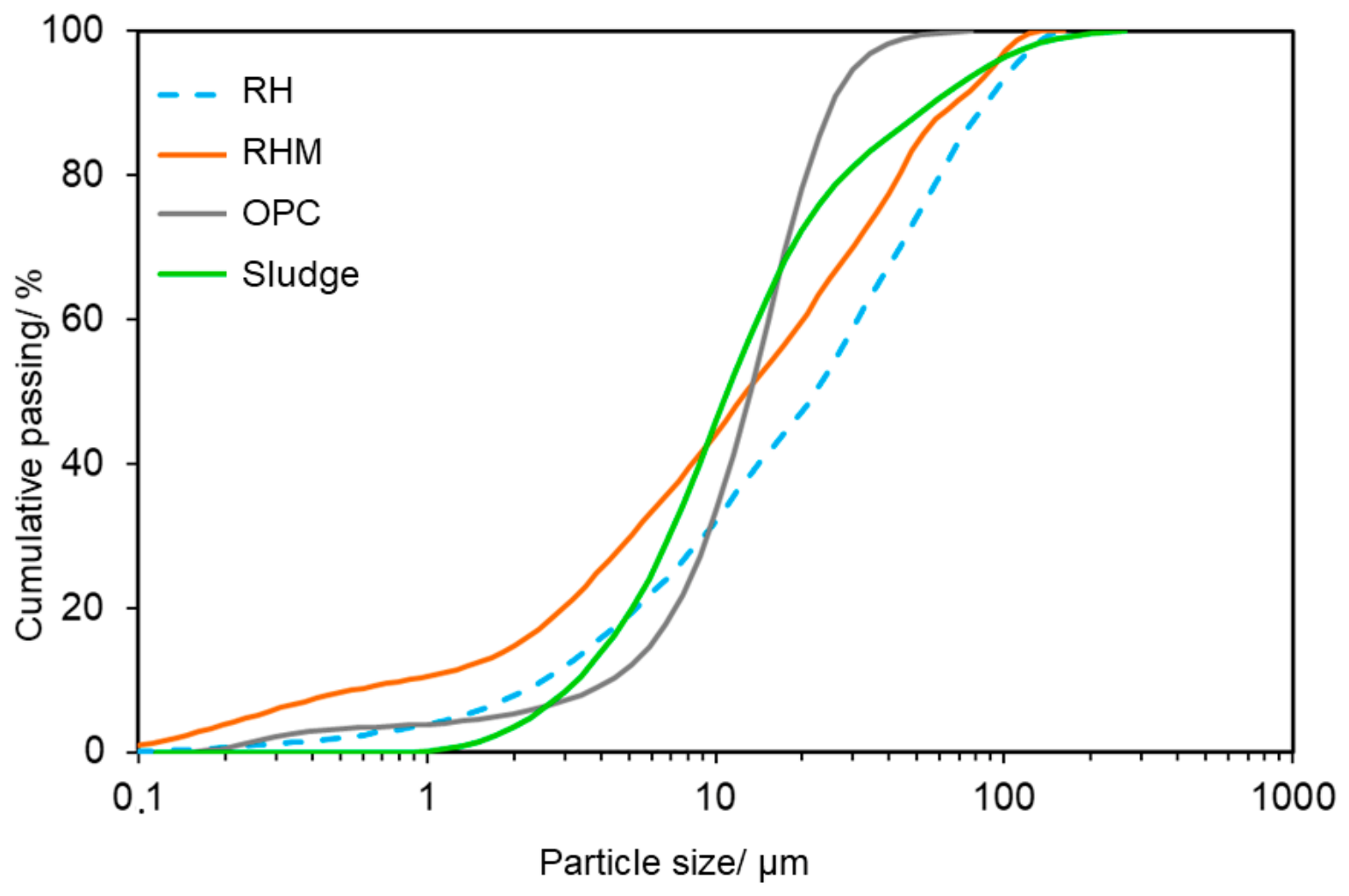
The particle size distributions of the OPC and the suspended sludge particles prior to flocculation were evaluated (Figure 3). The particle size distribution was determined using a Horiba 400 particle size analyzer (Horiba, Kyoto, Japan). The average particle size of the solids suspended in the washing sludge was similar to that of Portland cement; the maximum size of OPC was 77 µm, whereas the solids in the sludge reached up to 262 µm. The concrete-dominated waste (RH) displayed a slightly larger particle size than the ceramic-containing waste (RHM). Specifically, the RH material exhibited a median particle size (d50) of 22.3 µm and d90 of 86.3 µm, whereas these parameters were 12.8 µm and 67.7 µm for the RHM material, respectively.
To prepare the mortars, standard limestone sand and ordinary Portland cement type CEM I 52.5 R were utilized. The chemical composition and properties of this cement have been previously detailed in [49].

2.2. Testing Procedure

Cement pastes and mortars were prepared following the standard UNE-EN 1015-2 [50]. Pastes were made with OPC and with a substitution of 10, 20 and 30 wt% of CDWs type RH and RHM in substitution of OPC. Mortar mixtures were formulated with a fixed sand-to-cementitious materials ratio of 3:1 and a constant water-to-cement ratio of 0.5.
The mixing sequence was executed systematically to ensure maximum homogeneity and reproducible fresh-state properties. Initially, the binder (OPC + RH or RHM) was combined with 80% of the total design water and mechanically agitated for 30 s to initiate hydration and slurry formation. Subsequently, fine aggregate in a saturated surface-dry (SSD) state was introduced, followed by an additional 30 s of mechanical mixing. To conclude the primary mixing phase, the remaining 20% of the water, pre-blended with the superplasticizer, was incorporated, and the system was homogenized for 40 s. Following this initial phase, the mechanical mixer was paused to manually scrape the paddle and bowl walls, ensuring the complete incorporation of any adhering material. Mechanical agitation was then resumed for an additional 60 s. Upon completion of the mixing cycle, the fresh mixture was cast into 160 × 40 × 40 mm molds and consolidated via mechanical compaction to eliminate entrapped air.
The molds were stored in a climate-controlled chamber for 24 h at 20 °C and 95% relative humidity prior to demolding. After this, the test specimens were removed from the molds and subjected to additional curing under the same environmental conditions until they reached the test curing age. After demolding, the samples were transferred to a controlled environmental chamber, maintained at specified temperature and relative humidity levels, until reaching their designated curing ages.
To determine the workability of the fresh mortar, a slump flow test was conducted in accordance with the UNE-EN 1015-3 standard [51]. All dosages were adjusted to achieve a consistent slump flow of 160 mm, which ensures proper workability and classifies them as plastic mortars (P) according to the UNE-EN 1015-3 [51] standard. To maintain this consistency, a superplasticizer was added, with the required dosage increasing alongside higher CDW contents. Specifically, incorporating 10%, 20%, and 30% RH required multiplying the baseline superplasticizer dosage by 3.8, 6.0, and 12.36, respectively. For RHM substitutions, the demand was somewhat lower, requiring multipliers of 3.6, 4.4, and 9.6 for 10%, 20%, and 30% replacements, respectively. This lower superplasticizer demand for RHM compared to RH aligns with the findings reported by other authors [52].
Next, mortar mixtures were prepared with the different cement/CDW ratios to evaluate their mechanical strength at 7, 28 and 60 days of curing, according to UNE-EN 1015-11 [53]. Flexural strength was determined using a three-point bending test on three specimens per sample. Compressive strength was subsequently evaluated on three of the prism halves obtained after the flexural fracture. All mechanical results are provided as absolute values and as relative percentages compared to the reference OPC mortar, calculated as the Strength Activity Index (SAI) in accordance with the ASTM C311/C311M standard [54].

2.3. Analytical Methods

The chemical composition was determined by X-ray fluorescence spectrometry (XRF) using a portable epsilon 1 spectrometer (Malvern Panalytical, Malvern, Worcestershire, UK). Selected samples were also cross-checked at ALS laboratories to validate the results.
The mineralogy of the CDWs was identified via X-ray diffraction (XRD) using a Bruker D8-A25 powder diffractometer (Bruker Corporation, Billerica, MA, USA). The instrument operated with Cu Kα (λ = 1.5406 Å for Kα1 and λ = 1.5445 Å for Kα2, I1/I2 = 1.89) 40 kV and 40 mA, a Ni monochromator to filter Cu Kβ radiation and a Lynxeye detector (PSD). Scans were performed from 5° to 60° 2θ with a step size of 0.019° and a counting time of 0.8 s per step. Phase identification and semiquantitative evaluation were conducted using PANalytical X’Pert HighScore software, Version 2.0.1 (PANanalytical, Almelo, The Netherlands). In some samples, the amount of amorphous phase present was quantified. For this purpose, 25% alumina was added as a standard.
Fourier transform infrared (FTIR) spectra were recorded using a Perkin-Elmer System 2000 FTIR spectrometer (Waltham, MA, USA) across a vibrational range of 400–4000 cm−1.
Differential thermal analysis and thermogravimetry (DTA-TG) was performed using a Netzsch analyzer model STA 409 C (NETZSCH, Selb, Germany). The analysis was conducted over a temperature range of 25 to 1100 °C, at a heating rate of 10 °C/min under a nitrogen atmosphere (50 mL/min), utilizing alumina crucibles. Perkin Elmer 0419-0197 aluminum oxide served as the reference.

3. Results and Discussion

3.1. Chemical Composition

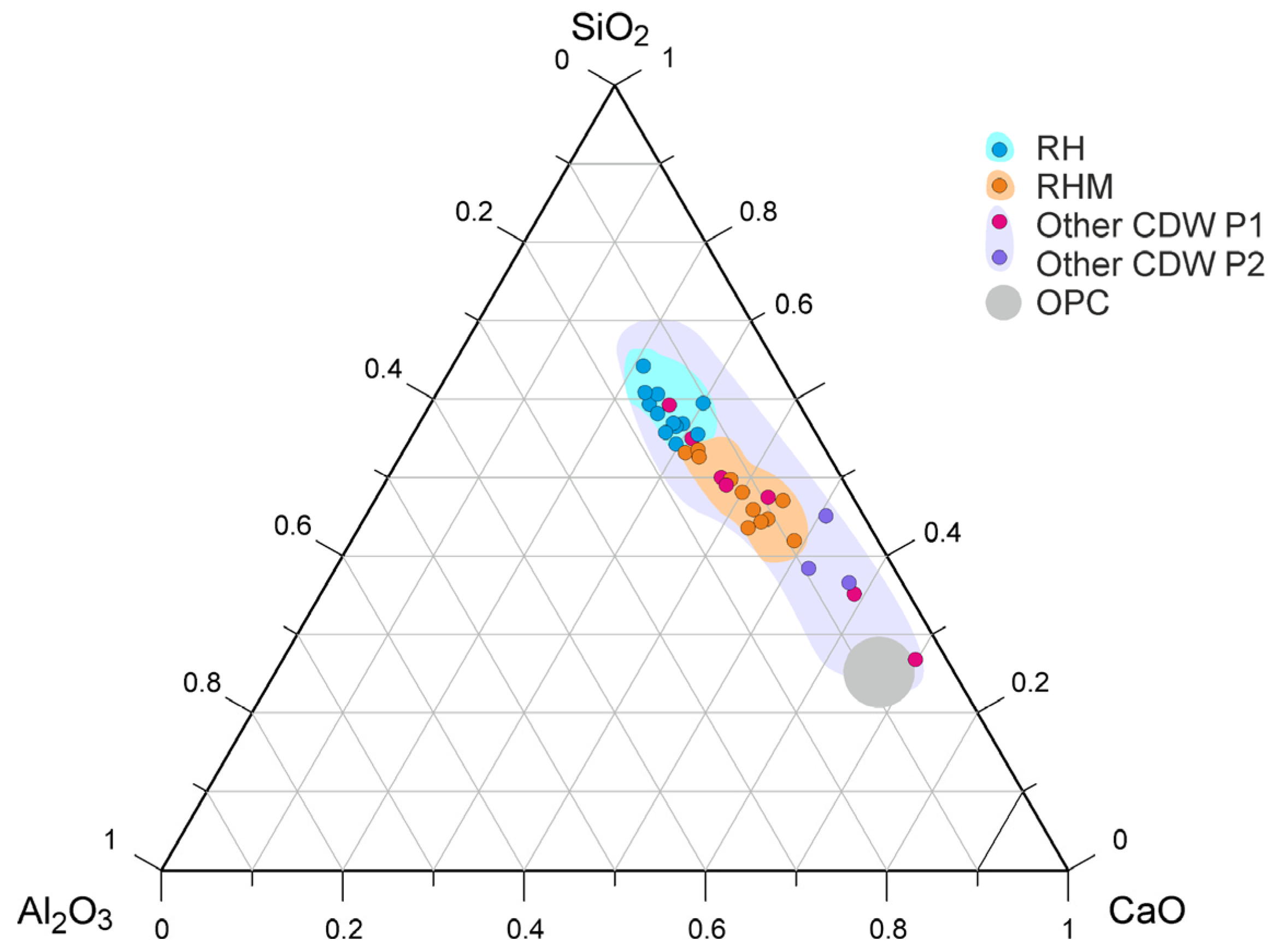
Figure 4 shows the ternary relationship of CaO, SiO2, and Al2O3 in the studied waste materials, alongside data from other nearby processing facilities for comparison. Plant P1 is located in the same geographic region, whereas Plant P2 is located near Vitoria in the Basque Country, an area also dominated primarily by limestone. As detailed in Table 1, the chemical composition of CDW washing residues varies as a function of the concrete-to-ceramic waste ratio.
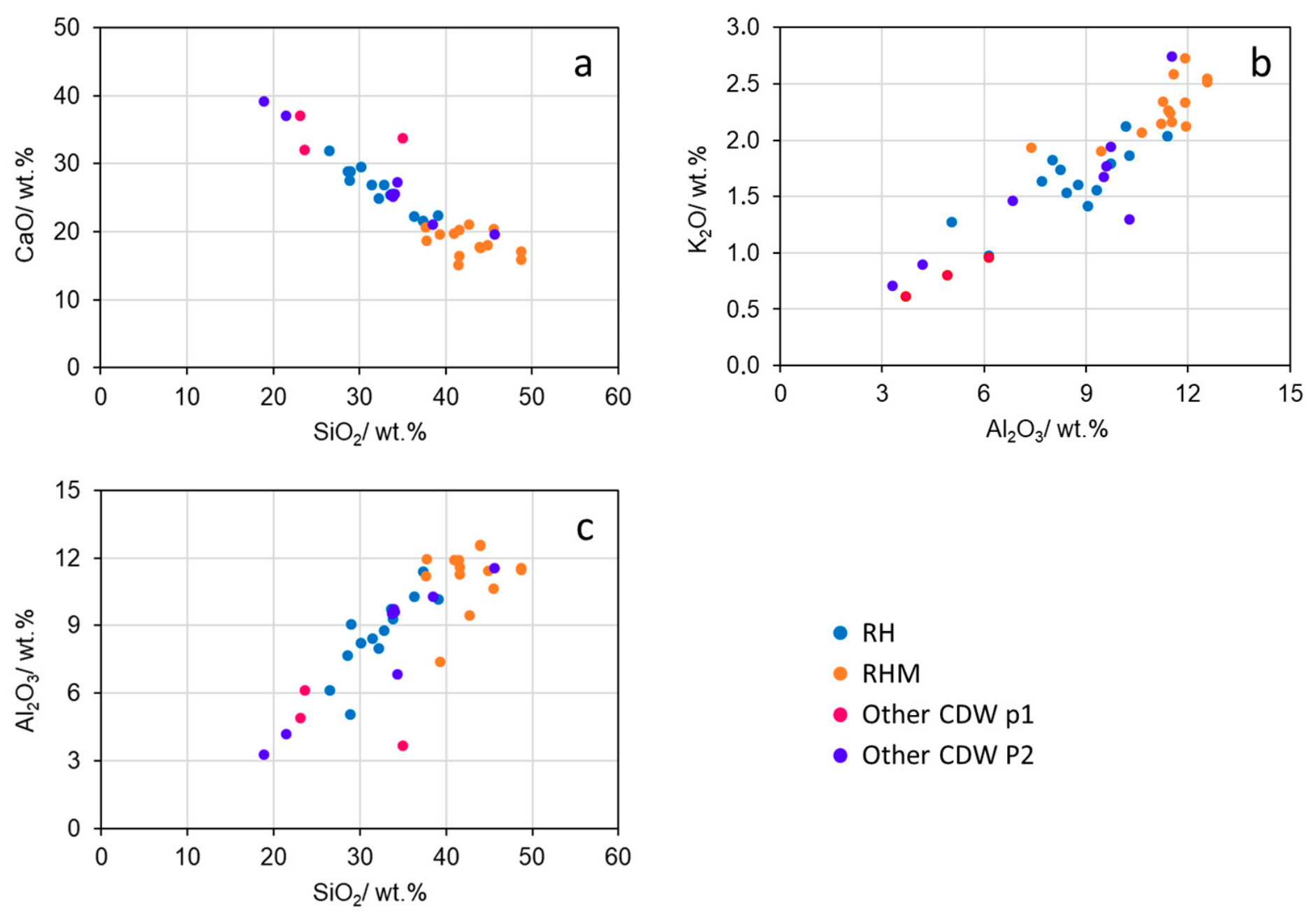
Specifically, SiO2 ranges from 26.50 to 48.71%, CaO varies between 36.49 and 31.50%, Al2O3 spans 5.05 to 12.55%, and K2O ranges from 0.98 to 2.59%. This variability is directly driven by the proportion of the ceramic fraction: a higher concentration of concrete debris elevates the CaO content, whereas an increased ceramic fraction enriches the waste in SiO2, Al2O3, and K2O. These elemental dynamics are further supported by oxide correlation trends (Figure 5); CaO and SiO2 show a negative correlation, whereas Al2O3, SiO2, and K2O display a clear positive correlation.
The SO3 content typically ranges from 0.5 to 2.5%, though it reached 5.5% on one occasion, indicating the localized presence of residual construction gypsum.
The chemical composition of RH and RHM has been compared with that of CDW from other plants in the region (Figure 4), and all follow a similar trend. This is to be expected, since the plants receive demolition waste from sites relatively close to their location and, therefore, from buildings of a similar construction type. For example, in the Vallès region, limestone is abundant, so the aggregates typically used in concrete are limestone, with occasional amounts of dolomite. Similarly, the soil residues generated during demolition are of the same type; in this case, they consist of quaternary detrital materials. CDW of the Mediterranean region of Valencia also exhibits a similar chemical composition [55].

3.2. Mineralogical Composition

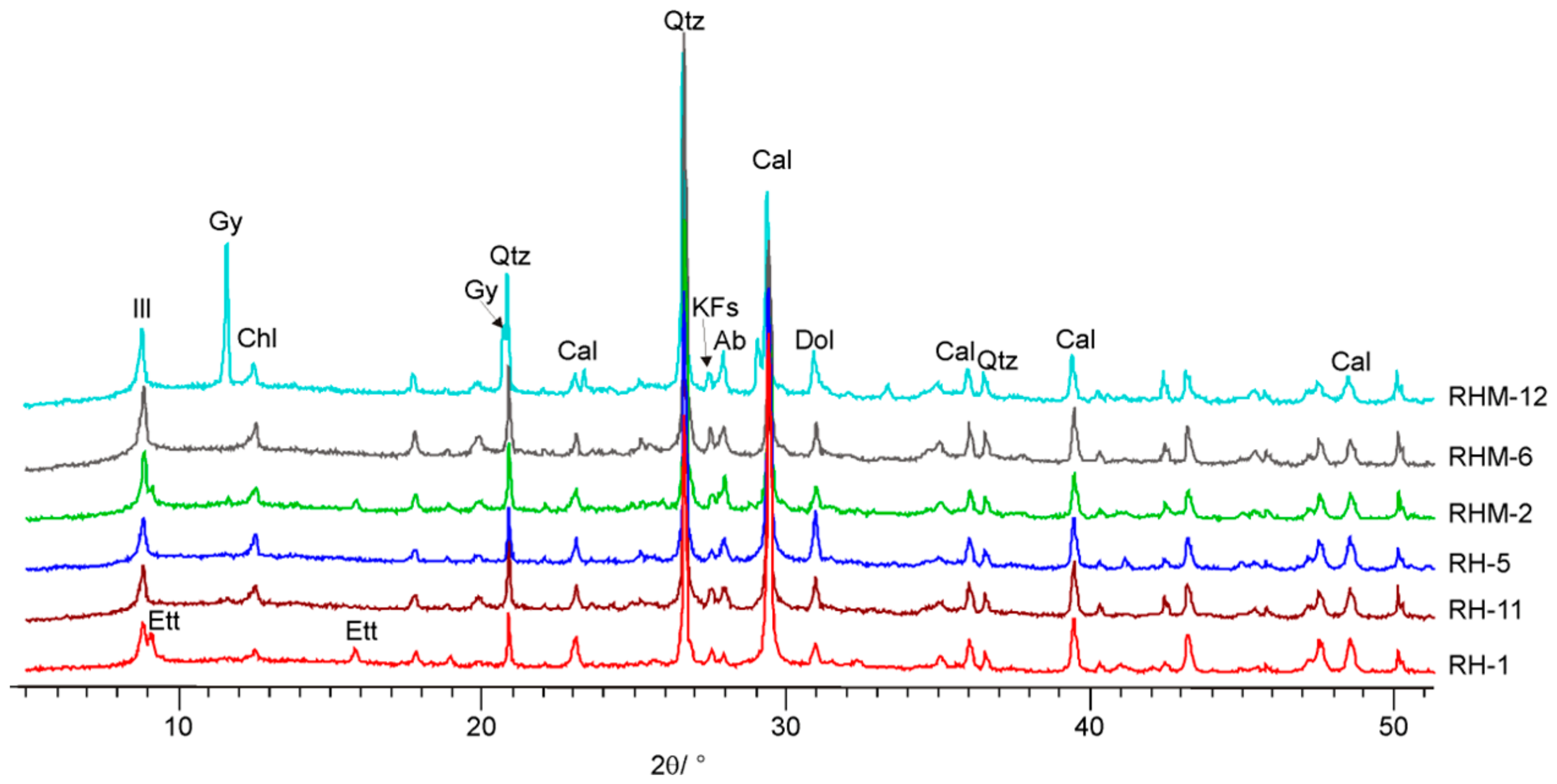
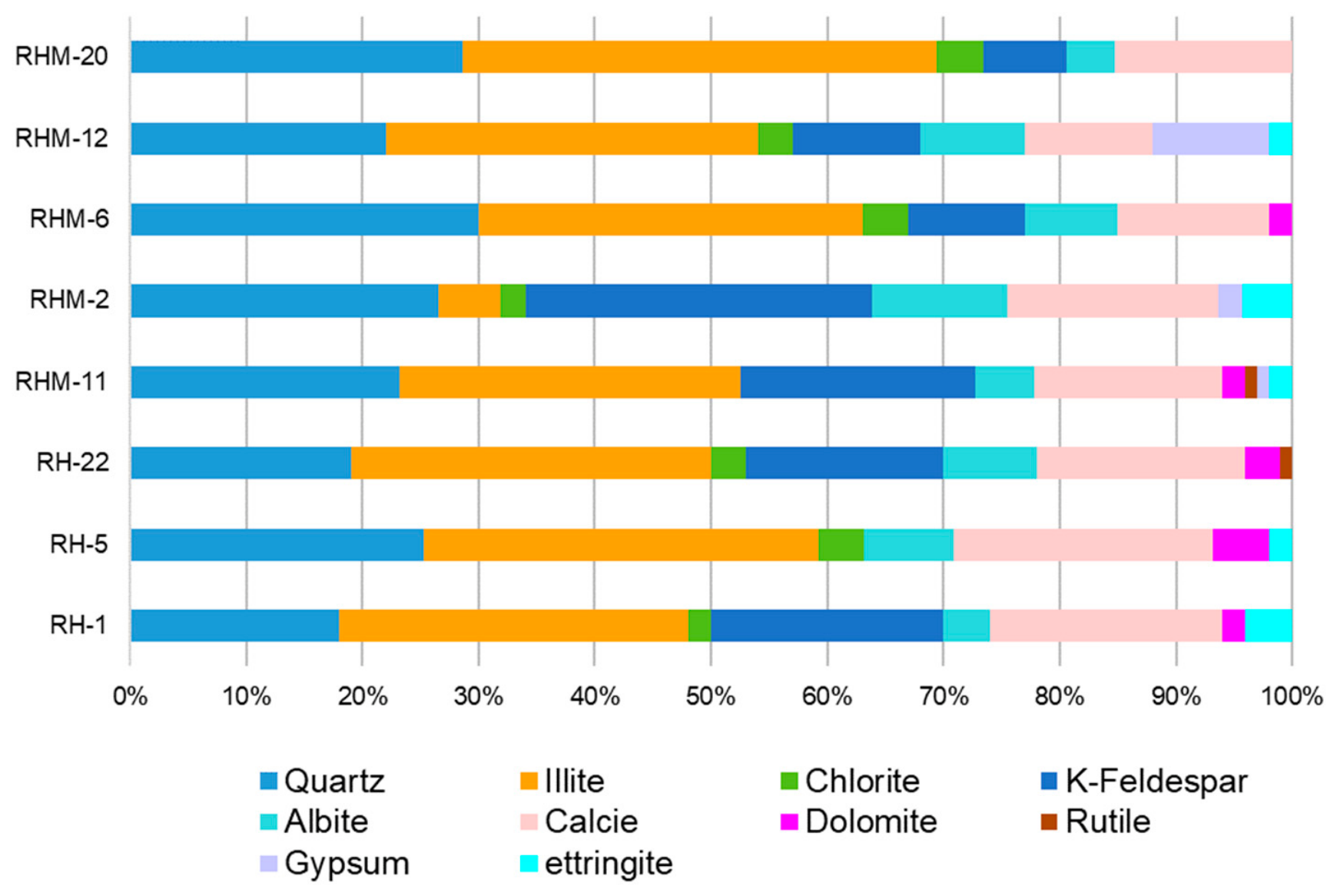
The mineralogy of CDW is fairly constant, with the proportion of mineral phases varying according to the ratio of concrete to ceramic waste. The main crystalline phases are calcite and quartz. A minor amount of dolomite is also present (Figure 6).
The calcite content varies between 11 wt.% and 25 wt.%, being more abundant in concrete-rich waste. Quartz, illite, and chlorite become more prominent as the ceramic content increases. The quartz content ranges from 18 to 30 wt.%, and illite reaches up to 39 wt.%. This elevated content could be due to the mineral phases of the ceramic fraction or to soil materials carried over during demolition and might also be slightly overrepresented because of a preferred orientation arising from the laminar structure of muscovite [56].
No portlandite has been detected. Ettringite (or thaumasite) is present in minor amounts, making it only noticeable in a few XRD patterns of both concrete and concrete–ceramic wastes. However, both ettringite and thaumasite were observed via SEM, even in wastes where they remained below the XRD detection limit (Figure 7).
The XRD patterns clearly show the presence of an amorphous phase, the proportion of which varies widely between 13 and 28% of the total. This amorphous phase originates mainly from the C-S-H gel generated during the hydration of Portland cement that remains in the concrete waste and the amorphous phase generated during the heating cycle applied to form the ceramic materials now found in the residue. One of these components is predominantly found in the HR wastes and the other in the HMR wastes, respectively.
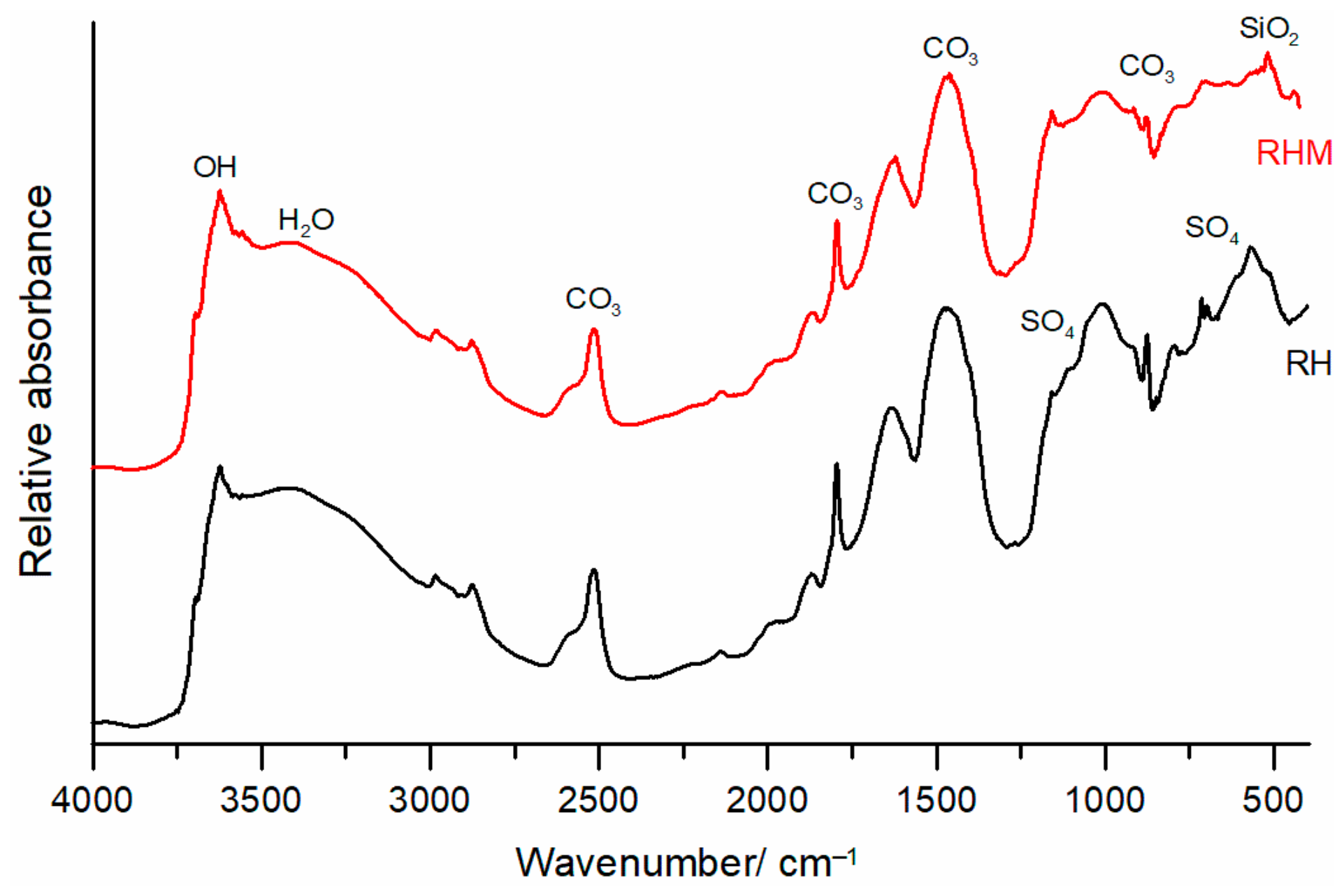
FTIR spectra allow for a more precise characterization of the phases present in the studied residues. This is of particular interest for the C-S-H gel, which, lacking a crystalline structure, cannot be detected by XRD; however, it can be characterized through its chemical bonds using FTIR [57]. Figure 8 shows the profiles of both types of waste used. In both cases, an absorption band is observed at 953–958 cm−1, which is associated with the Si–O–Si stretching vibration, which can be attributed to the Si–O bonds from the C-S-H gel [57]. A weakly defined vibration appears at 1150 cm−1 in the RH spectrum, attributed to SO42− groups [58]. The spectra also exhibit bands due to the CO32− group bonds characteristic of calcite, located at 251, 1796, 1465 and 714 cm−1. Additionally, both cases display a vibration at 3610 cm−1 corresponding to the OH groups of portlandite [59]. The vibrations at 1630 cm−1 are due to H–O–H bonds and, in some cases, have been attributed to the C-S-H gel phase [60].

3.3. Thermal Properties

While XRD provides very limited information regarding non-crystalline phases, thermal analysis proves helpful in this regard. It provides insights into the potential existence of the C-S-H gel phase formed during Portland cement hydration, as well as the presence of other hydrated phases. The existence of these phases is of great importance, as they contribute to the material’s reactivity, enabling its use as a binder in mortar hardening. Furthermore, TG allows for the quantification of carbonates present within the sample.
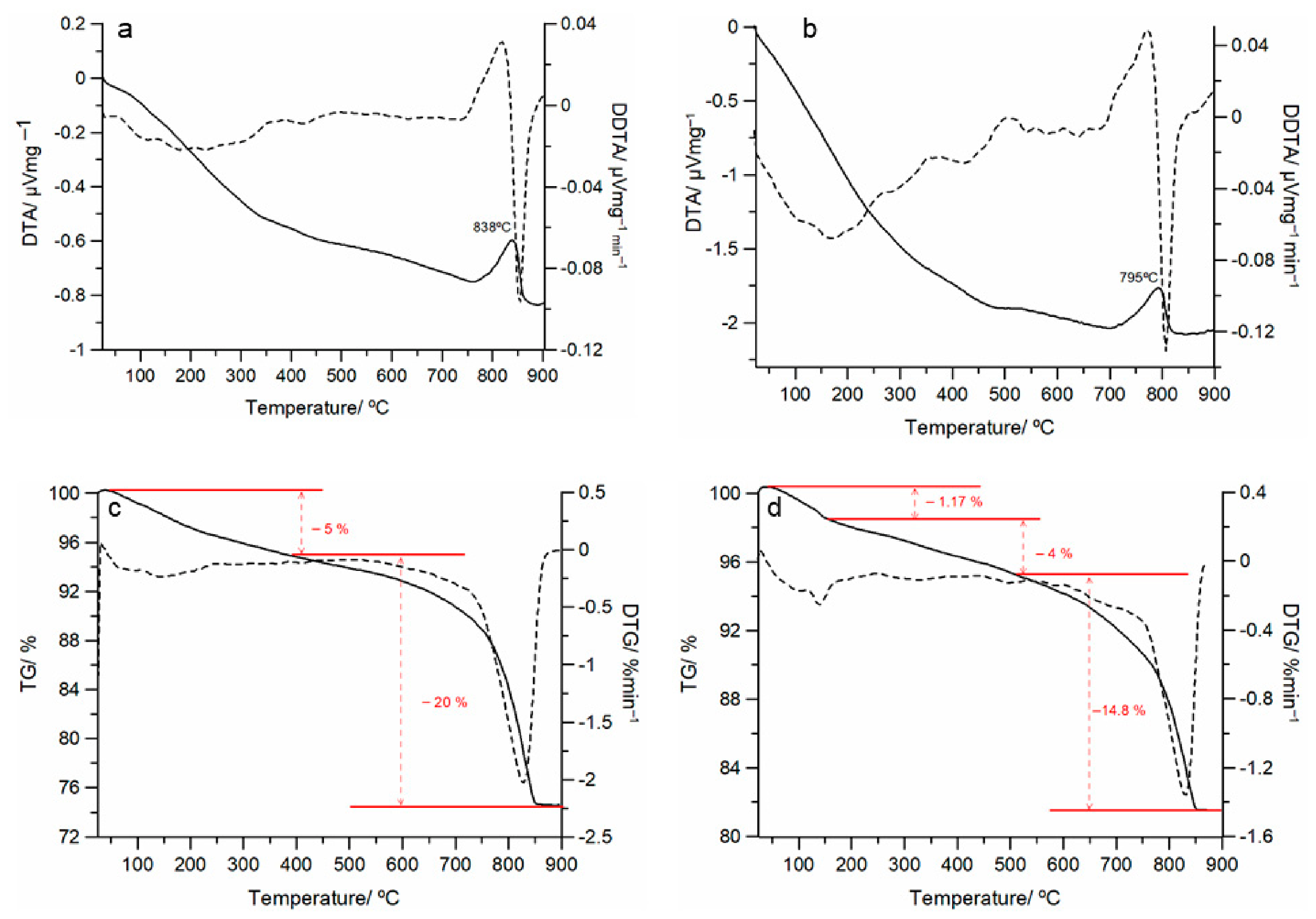
The DTA–TG and their derivative curves, DDTA–DTG, for the raw waste materials used as SCM replacements are shown in Figure 9. In the DDTA curve, a slight exothermic peak is observed between 100 °C and 300 °C, which could be attributed to moisture loss but also to the dehydroxylation of a gel C-S-H phase resulting from the hydration of OPC. In addition, four endothermic events are evidenced. Only two events were recorded in the RHM wastes; the first endothermic peak occurs at 144 °C and could be related to the decomposition of ettringite or gypsum [61]. The DTA curve from RHM (Figure 9b) displays an endothermic peak at 390 °C attributed to dehydration of clays. A much smaller endothermic event occurs around 500 °C, only perceptible through the DDTA curve, which is attributed to portlandite dehydroxylation [62,63]. The primary endothermic peak for both types of CDW occurs between 800 °C and 870 °C, corresponding to the carbonate calcination.
For the RH waste, a total weight loss of approximately 18–25 wt.% was observed; 4–7 wt.% occurs below 600 °C due to the dehydroxylation of the gel phase and clays. Above this temperature, the decarbonation of calcite and minor dolomite takes place, resulting in a mass loss of 11.0–20 wt.%. In the case of the RHM waste, the mass losses are slightly lower, with a total loss of 16–20 wt.%, consisting of 3.3–5.5 wt.% from dehydroxylation and 12.5–14.8 wt.% from decarbonation.

3.4. Mechanical Properties of Mortars

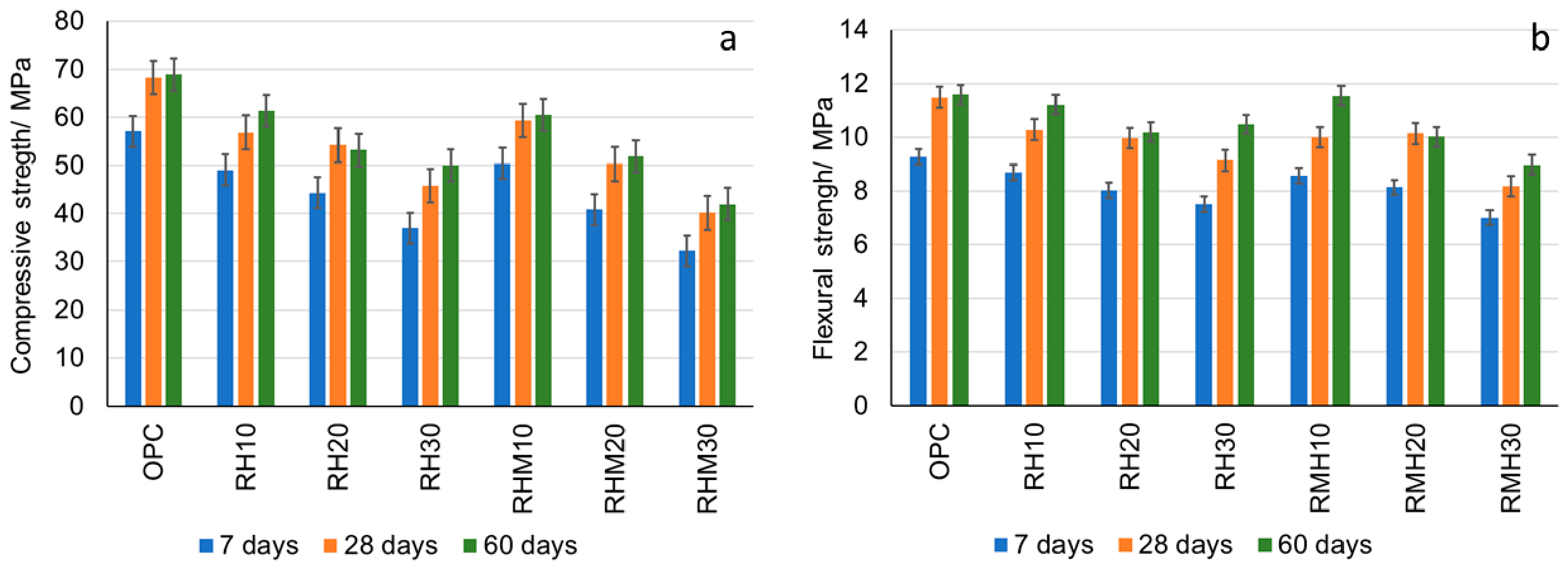
Figure 10 shows the compressive and flexural strengths of mortars prepared with construction and demolition waste (CDW), along with their performance relative to the CDW-free control mortar. These results complete and confirm the previous study presented in Martinez et al. [64] obtained with wastes from the same recycling plant. Compressive strength decreases with increasing cement replacement levels. For a low substitution level of 10%, compressive strength was higher when RHM was used compared to RH, reaching 28-day compressive strengths of 56.9 MPa for RH and 59.4 MPa for RHM. This has also been reported in other cases, where it has been attributed to the higher reactivity of ceramic waste due to its higher amorphous aluminosilicate phase content [65]. In contrast, at higher substitution levels, concrete and mixed ceramic wastes exhibit similar strength values, although mixtures containing ceramic components show slightly lower results, with values of 54.2 and 45.8 MPa for 20% and 30% substitutions with RH, respectively, and 50.3 and 40.2 MPa for 20% and 30% substitutions with RHM.
In all cases, longer curing times reduce the percentage of flexural strength loss compared to the control. For RH substitution, the strengths reach 94%, 82%, and 77% of the control value at 10%, 20%, and 30% replacement levels, respectively. For RHM replacements, the values are slightly lower, reaching 93%, 80%, and 65%.
Regarding flexural strength, the behavior follows a pattern similar to that of compressive strength. The highest values are obtained at 10% replacement, and the lowest strengths are obtained at 30%. For both mortars made with concrete-rich waste replacement and those containing more ceramics, flexural strength increases considerably from 28 to 60 days of curing. In the latter case, no decrease in flexural strength is observed at 10% replacement, and the reduction is low for 20% substitutions, with 94% and 92%, in the RH and RHM substitutions, respectively.
In all cases, the reduction in strengths with the cement substitution ratio is attributed to the reduction of reactive phases, such as the CSH gel and portlandite [66,67]. The results obtained indicate that the ratio of strength reduction is similar to or less than the replacement ratio, except in the case of 30% RHM, where it decreases more. Typically, the replacement of OPC with CDW does not exceed 30%, although Oliveira et al. replace up to 25% of the PC with the fine fraction <150 mm of CDW for concrete and up to 50% for mortar [68].

3.5. Strength Activity Index

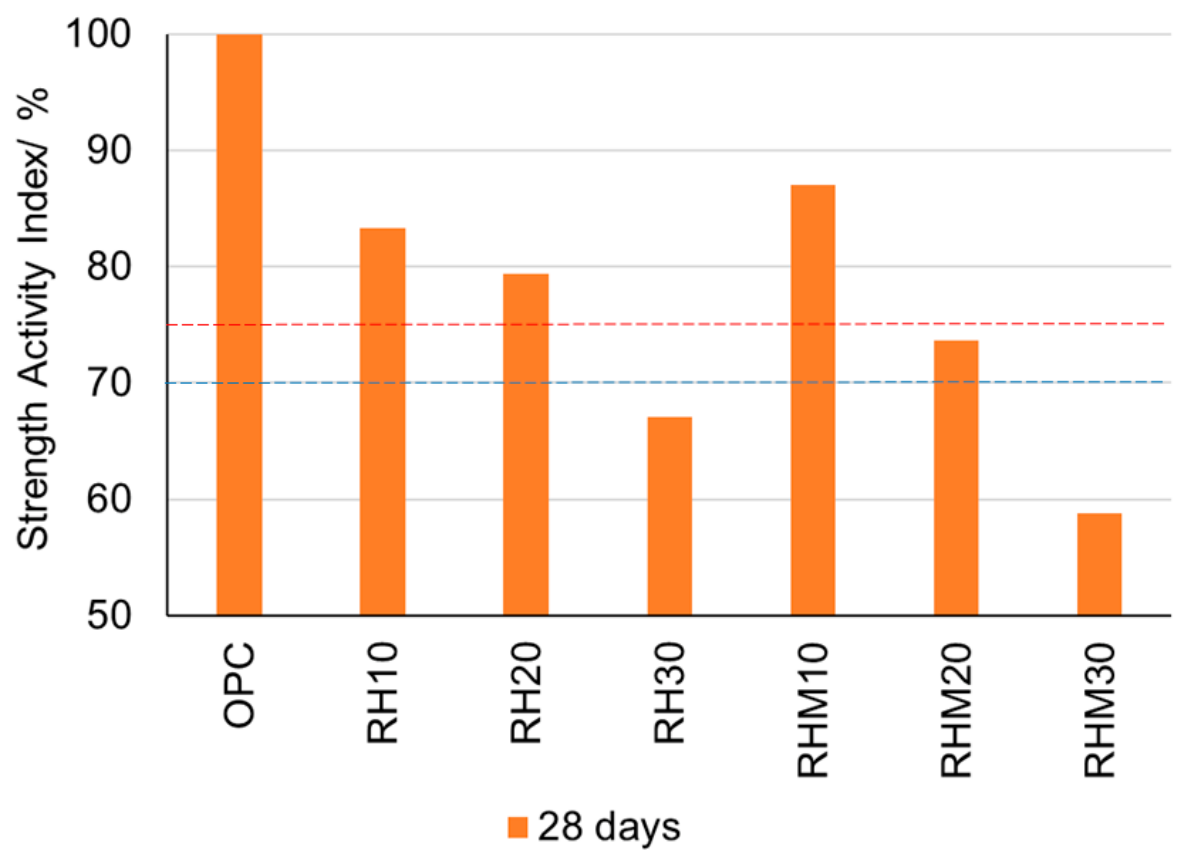
The SAI allows for the evaluation of the reactivity of cementitious materials by comparing their strength performance against reference mortars formulated exclusively with OPC [69]. For the substitution to be acceptable, the SAI must not be lower than 70% [70], or even this limit was established in 75% [71]. The requirement of 70% is satisfied for 10% and 20% OPC replacements with RH and RHM but not for the 30% substitution level (Figure 11). If this limit is set at 75%, even the RHM with a 20% substitution rate would not meet the requirement, but only by a narrow margin (Table 2). The lower reactivity of the residues with higher ceramic content could be attributed to a lower content of C-S-H gel.
For OPC substitutions of 30%, the SAI drops too low; therefore, replacements at this or higher dosages should not be performed using these residues without prior treatment. These treatments could involve activation methods. On one hand, a decrease in particle size would be expected to yield higher mechanical strength [72,73]. However, the particle size of ceramic waste is already on the same order of magnitude as that of Portland cement. It should be noted that reducing the particles to even smaller sizes would require a significant amount of energy. Oliveira et al. [74] produced mortars with partial replacement of cement by concrete powder obtained at different grinding times and found that compressive strength increases with grinding time for low substitutions but not in the case of a substitution reaching 25%.
This size reduction would promote better compaction, lowering porosity and consequently increasing strength [75]. Much lower reductions in compressive strength than those reported in this study have been found in other cases where ceramic waste with smaller particle sizes was used [76]. On the other hand, thermal treatment of the used CDWs represents another alternative to enhance their reactivity and thus achieve higher strength, as successfully demonstrated in several studies [77,78].
Numerous studies have highlighted the notable pozzolanic activity of the ceramic fraction in construction and demolition waste [79,80]. This has led several researchers to propose the necessity of a strict separation between concrete- and ceramic-derived fines, allowing the latter to be specifically utilized in the formulation of the mortar paste [81]. However, the findings of the present study demonstrate that, in the absence of an activation process, concrete fines yield higher mechanical strengths than their ceramic counterparts, though the variance is minimal. Despite the potential reactivity of ceramic waste, it must also be considered that concrete residues still contain the C-S-H gel phase, which is ultimately responsible for the binding properties of cement.
Because the difference in performance is not highly significant between Rh and RHM, the economic and operational viability of separating these waste streams must be carefully evaluated for each specific case. Furthermore, it should be noted that implementing such a differentiation in washing plants could result in a less homogeneous fine fraction compared to a unified treatment process for all incoming waste.

4. Conclusions

The solids precipitated from the aggregate washing water of the studied recycling plant exhibit a chemical and mineralogical composition with a limited range of variability. Depending on the type of aggregate being washed, the resulting sludges are either predominantly carbonated—when concrete residues prevail—or more siliceous, containing higher amounts of Al2O3 and K2O, when ceramic residues are abundant.
The results obtained illustrate the high potential of studied CDW as alternative raw materials for cementitious applications. At low Portland cement substitution rates, the differences in strength between mortars incorporating concrete waste and those made with mixed waste are minor. However, at 30% replacement level, the RHs yield markedly higher values.
The 28-day mechanical strengths confirm that the investigated CDWs can successfully substitute Portland cement at 10% and 20% replacement levels in masonry mortars. Higher substitution rates, however, require an activation process of the CDW fines, such as mechanical or thermal treatment, to enhance the reactivity of the CDW fines.
Mortars formulated with concrete-rich CDWs (RH) exhibit higher compressive and flexural strengths than those from concrete–ceramic waste (RHM). This superior performance is attributed to the higher concentration of the C-S-H gel phase within the RH waste.
Partial replacement of OPC with RH and RHM residues is structurally viable at 10% and 20% replacement levels, successfully satisfying the standard 70% Strength Activity Index (SAI) threshold, whereas at 30% of substitution or higher, mechanical performance drops markedly below acceptable limits. Consequently, high-dosage replacements should not be performed without prior activation. Future studies should focus on mechanical and thermal activation methods to assess their application and enhance material performance. Incorporating other waste materials, such as kaolinitic clays or waste glass, to evaluate the efficiency of ternary mixtures also represents a challenge for future research. Another critical challenge to address in the future is the life cycle assessment of these materials.
While some literature advocates for strictly separating concrete and ceramic fines, this study shows that the difference in mechanical performance between RH and RHM is minimal. Because the strength variations are minor, the high economic and operational costs of industrial separation may not be justified. Furthermore, a unified treatment process is preferred as it prevents the risk of producing less homogeneous fine fractions in washing plants.

Author Contributions

Conceptualization, P.A. and A.M.; methodology, P.A. and D.A.; software, A.M. and M.G.-V.; validation, D.A., H.A. and A.M.; formal analysis, A.M., C.F. and M.G.-V.; investigation, P.A. and A.M.; resources, P.A. and C.A.; data curation, P.A. and A.M.; writing—original draft preparation, P.A., A.M. and C.A.; writing—review and editing, P.A.; visualization, P.A.; supervision, P.A.; project administration, P.A.; funding acquisition, P.A. All authors have read and agreed to the published version of the manuscript.

Funding

This work is part of the PID 2022- 1415140B-I00 project funded by the Spanish Ministry of Economy and Competitiveness research MICIU/AEI/10.13039/5011000011033 and FEDER, UE. and of the ACE091/23/000976, funded by Catalan Agency for Business Competitiveness. The Research was carried out with the support of Generalitat de Catalunya to the Consolidated Research Groups SGR 01041 (RIIS), SGR 0026 (GEOXiS).

Data Availability Statement

The original contributions presented in this study are included in the article. Further inquiries can be directed to the corresponding author.

Acknowledgments

The authors thank Susanna Valls for her support in the laboratory tasks, Mercedes Aguilar for the FTIR analyses, and the reviewers and editor for their constructive comments. During the preparation of this manuscript/study, the authors used Gemini, an AI language model developed by Google, for the grammatical revision.

Conflicts of Interest

Clara Alvarado was employed by the company Hercal. The remaining authors declare that the research was conducted in the absence of any commercial or financial relationships that could be construed as a potential conflict of interest.

References

  1. Shivaprasad, K.N.; Yang, H.M.; Singh, J.K. A path to carbon neutrality in construction: An overview of recent progress in recycled cement usage. J. CO2 Util. 2024, 83, 102816. [Google Scholar] [CrossRef] [Scilit]
  2. GCCA. The GCCA 2050 Cement and Concrete Industry Roadmap for Net Zero Concrete. Available online: https://gccassociation.org/concretefuture/wp-content/uploads/2021/10/GCCA-Concrete-Future-Roadmap.pdf (accessed on 8 January 2026).
  3. Riley, I. Cement demand forecast 2050. Glob. Cem. Mag. 2025, 12–18. [Google Scholar]
  4. USGS. Cement. Available online: https://pubs.usgs.gov/periodicals/mcs2025/mcs2025-cement.pdf (accessed on 13 June 2026).
  5. Meyer, C. The greening of the concrete industry. Cem. Concr. Compos. 2009, 31, 601–605. [Google Scholar] [CrossRef] [Scilit]
  6. Schneider, M.; Romer, M.; Tschudin, M.; Bolio, H. Sustainable cement production—Present and future. Cem. Concr. Res. 2011, 41, 642–650. [Google Scholar] [CrossRef] [Scilit]
  7. Olsson, J.A.; Miller, S.A.; Alexander, M.G. Near-term pathways for decarbonizing global concrete production. Nat. Commun. 2023, 14, 4574. [Google Scholar] [CrossRef] [Scilit] [PubMed]
  8. European Statistics-Eurostat. 2020. Available online: https://projects2014-2020.interregeurope.eu/smartwaste/news/news-article/11804/construction-demolition-waste-generation-in-the-eu/ (accessed on 25 April 2024).
  9. Butera, S.; Christensen, T.H.; Astrup, T.F. Composition and leaching of construction and demolition waste: Inorganic elements and organic compounds. J. Hazard. Mater. 2014, 276, 302–311. [Google Scholar] [CrossRef] [Scilit] [PubMed]
  10. Molla, A.S.; Tang, P.; Sher, W.; Bekele, D.N. Chemicals of concern in construction and demolition waste fine residues: A systematic literature review. J. Environ. Manag. 2021, 299, 113654. [Google Scholar] [CrossRef] [Scilit]
  11. Patrisia, Y.; Law, D.W.; Zhang, J. Quantifying concrete recarbonation potential: A life cycle approach to carbon uptake. EIA Rev. 2026, 118, 108300. [Google Scholar] [CrossRef] [Scilit]
  12. de Lima, D.O.; de Lira, D.S.; Rojas, M.F.; Junior, H.S. Assessment of the potential use of construction and demolition waste (CDW) fines as eco-pozzolan in binary and ternary cements. Constr. Build. Mater. 2024, 411, 134320. [Google Scholar] [CrossRef] [Scilit]
  13. Dils, E. Construction and Demolition Waste: Challenges and Opportunities in a Circular Economy. ETC/WMGE Report 1/2020. 2020. Available online: https://www.eea.europa.eu/publications/construction-and-demolition-waste-challenges/construction-and-demolition-waste-challenges (accessed on 25 April 2024).
  14. Idir, R.; Djerbi, A.; Tazi, N. Optimising the Circular Economy for Construction and DemolitionWaste Management in Europe: Best Practices, Innovations and Regulatory Avenues. Sustainability 2025, 17, 3586. [Google Scholar] [CrossRef] [Scilit]
  15. Gastaldi, D.; Canonico, F.; Capelli, L.; Buzzi, L.; Boccaleri, E.; Irico, S. An investigation on the recycling of hydrated cement from concrete demolition waste. Cem. Concr. Compos. 2015, 61, 29–35. [Google Scholar] [CrossRef] [Scilit]
  16. Tang, Q.; Ma, Z.; Wu, H.; Wang, W. The utilization of eco-friendly recycled powder from concrete and brick waste in new concrete: A critical review. Cem. Concr. Compos. 2020, 114, 103807. [Google Scholar] [CrossRef] [Scilit]
  17. Miller, S.A.; Horvath, A.; Monteiro, P.J. Readily implementable techniques can cut annual CO2 emissions from the production of concrete by over 20%. Environ. Res. Lett. 2016, 11, 074029. [Google Scholar] [CrossRef] [Scilit]
  18. Benhelal, E.; Shamsaei, E.; Rashid, M.I. Challenges against CO2 abatement strategies in cement industry: A review. J. Environ. Sci. 2021, 104, 84–101. [Google Scholar] [CrossRef] [Scilit]
  19. de Brito, J.; Kurda, R. The past and future of sustainable concrete: A critical review and new strategies on cement-based materials. J. Clean. Prod. 2021, 281, 123558. [Google Scholar] [CrossRef] [Scilit]
  20. Fennell, P.; Driver, J.; Bataille, C.; Davis, S.J. Cement and steel—Nine steps to net. Nature 2022, 603, 574–577. [Google Scholar] [CrossRef] [Scilit] [PubMed]
  21. Silva, R.V.; de Brito, J.; Dhir, R.K. Tensile strength behaviour of recycled aggregate concrete. Constr. Build. Mater. 2015, 83, 108–118. [Google Scholar] [CrossRef] [Scilit]
  22. Pedro, D.; de Brito, J.D.; Evangelista, L. Structural concrete with simultaneous incorporation of fine and coarse recycled concrete aggregates: Mechanical, durability and long-term properties. Constr. Build. Mater. 2017, 154, 194–309. [Google Scholar] [CrossRef] [Scilit]
  23. Katz, A. Treatments for the improvement of recycled aggregate. J. Mater. Civ. Eng. 2004, 16, 597–603. [Google Scholar] [CrossRef] [Scilit]
  24. Shi, C.; Li, Y.; Zhang, J.; Li, W.; Chong, L.; Xie, Z. Performance enhancement of recycled concrete aggregate—A review. J. Clean. Prod. 2016, 112, 466–472. [Google Scholar] [CrossRef] [Scilit]
  25. Burdier, M.; Anshassi, M.; Guo, Y.; Laux, S.J.; Townsend, T.G. Enhancing the beneficial reuse properties of construction and demolition debris fines using lab-scale washing. Resour. Conserv. Recycl. 2022, 183, 106361. [Google Scholar] [CrossRef] [Scilit]
  26. Ferrández, D.; Saiz, P.; Zaragoza-Benzal, A.; Zuniga-Vicente, J.A. Towards a more sustainable environmentally production system for the treatment of recycled aggregates in the construction industry: An experimental study. Heliyon 2023, 9, e16641. [Google Scholar] [CrossRef] [Scilit] [PubMed]
  27. Kaptan, K.; Cunha, S.; Aguiar, J. A review: Construction and demolition waste as a novel source for CO2 reduction in portland cement production for concrete. Sustainability 2024, 16, 585. [Google Scholar] [CrossRef] [Scilit]
  28. Sakir, S.; Raman, S.N.; Safiuddin, M.; Kaish, A.A.; Mutalib, A.A. Utilization of by-products and wastes as supplementary cementitious materials in structural mortar for sustainable construction. Sustainability 2020, 12, 3888. [Google Scholar] [CrossRef] [Scilit]
  29. Nodehi, M.; Taghvaee, V.M. Applying circular economy to construction industry through use of waste materials: A review of supplementary cementitious materials, plastics, and ceramics. Circ. Econ. Sustain. 2022, 2, 987–1020. [Google Scholar] [CrossRef] [Scilit]
  30. Zhang, Y.; Zhang, L.; Wang, Q.; Gao, T.; Zhang, W.; Shang, Y.; Li, Z. Low-carbon cementitious materials from industrial wastes: Synergistic sulfate-alkali activation of granulated blast furnace slag and lithium slag. Waste Dispos. Sustain. Energy 2026, 8, 139–158. [Google Scholar] [CrossRef] [Scilit]
  31. Li, Y.; Eyley, S.; Thielemans, W.; Yuan, Q.; Li, J. Valorization of deep soil mixing residue in cement-based materials. Resour. Conserv. Recycl. 2022, 187, 106597. [Google Scholar] [CrossRef] [Scilit]
  32. Elsebaei, M.; Mavroulidou, M.; Micheal, A.; Centeno, M.A.; Shamass, R.; Rispoli, O. Dealuminated Metakaolin in Supplementary Cementitious Material and Alkali-Activated Systems: A Review. Appl. Sci. 2025, 15, 8599. [Google Scholar] [CrossRef] [Scilit]
  33. Alam, O.; Li, G.; Zheng, X.; Sultana, N.; Du, D. The effect of green supply chain management practices in reduction of construction wastes and carbon emission in Bangladesh. J. Mater. Cycles Waste Manag. 2024, 26, 2491–2508. [Google Scholar] [CrossRef] [Scilit]
  34. Dughaishi, H.A.; Leong, G.W.; Mo, K.H.; Milad, A. Utilization of recycled concrete powder in sustainable cement production: A critical review. J. Build. Eng. 2026, 122, 115727. [Google Scholar] [CrossRef] [Scilit]
  35. Meng, T.; Hong, Y.; Ying, K.; Wang, Z. Comparison of technical properties of cement pastes with different activated recycled powder from construction and demolition waste. Cem. Concr. Compos. 2021, 120, 104065. [Google Scholar] [CrossRef] [Scilit]
  36. Sui, Y.; Ou, C.; Liu, S.; Zhang, J.; Tian, Q. Study on properties of waste concrete powder by thermal treatment and application in mortar. Appl. Sci. 2020, 10, 998. [Google Scholar] [CrossRef] [Scilit]
  37. Barbhuiya, S.; Das, B.B.; Adak, D. A comprehensive review on integrating sustainable practices and circular economy principles in concrete industry. J. Environ. Manag. 2024, 370, 122702. [Google Scholar] [CrossRef] [Scilit]
  38. Lampris, C.; Lupo, R.; Cheeseman, C.R. Geopolymerisation of silt generated from construction and demolition waste washing plants. Waste Manag. 2009, 29, 368–373. [Google Scholar] [CrossRef] [Scilit] [PubMed]
  39. Sargent, P.; Sandanayake, M.; Law, D.W.; Hughes, D.J.; Shifa, F.; Borthwick, B.; Scott, P. Strength, mineralogical, microstructural and CO2 emission assessment of waste mortars comprising excavated soil, scallop shells and blast furnace slag. Constr. Build. Mater. 2024, 411, 134425. [Google Scholar] [CrossRef] [Scilit]
  40. Maruthupandian, S.; Chrysanthou, A.; Kanellopoulos, A. Assessing the upcycling potential of construction and demolition waste derived silt: Activation, physicochemical and mineralogical characterisation. Constr. Build. Mater. 2025, 493, 143163. [Google Scholar] [CrossRef] [Scilit]
  41. Vigil de la Villa Mencía, R.; Rojas, M.F.; Martínez-Ramírez, S.; Fernández-Carrasco, L.; Cociña, E.V.; García-Giménez, R. Reactivity of binary construction and demolition waste mix as supplementary cementitious materials. Materials 2021, 14, 6481. [Google Scholar] [CrossRef] [Scilit]
  42. Reig, L.; Tashima, M.M.; Soriano, L.; Borrachero, M.V.; Monzó, J.; Payá, J. Alkaline activation of ceramic waste materials. Waste Biomass Valorization 2013, 4, 729–736. [Google Scholar] [CrossRef] [Scilit]
  43. Zhang, D.; Zhang, S.; Huang, B.; Yang, Q.; Li, J. Comparison of mechanical, chemical, and thermal activation methods on the utilisation of recycled concrete powder from construction and demolition waste. J. Build. Eng. 2022, 61, 105295. [Google Scholar] [CrossRef] [Scilit]
  44. Galbenis, C.T.; Tsimas, S. Use of construction and demolition wastes as raw materials in cement clinker production. China Particuology 2006, 4, 83–85. [Google Scholar] [CrossRef] [Scilit]
  45. Zhutovsky, S.; Shishkin, A. Recycling of hydrated Portland cement paste into new clinker. Constr. Build. Mater. 2021, 280, 122510. [Google Scholar] [CrossRef] [Scilit]
  46. Zhao, D.; Khoshnazar, R. Microstructure of cement paste incorporating high volume of low-grade metakaolin. Cem. Concr. Compos. 2020, 106, 103453. [Google Scholar] [CrossRef] [Scilit]
  47. Etxeberria, M.; Konoiko, M.; Garcia, C.; Perez, M.Á. Water-washed fine and coarse recycled aggregates for real scale concretes production in Barcelona. Sustainability 2022, 14, 708. [Google Scholar] [CrossRef] [Scilit]
  48. Saiz Martínez, P.; Ferrández, D.; Melane-Lavado, A.; Zaragoza-Benzal, A. Characterization of Three Types of Recycled Aggregates from Different Construction and Demolition Waste: An Experimental Study for Waste Management. Int. J. Environ. Res. Public Health 2023, 20, 3709. [Google Scholar] [CrossRef] [Scilit] [PubMed]
  49. Thomas, M.; Ślosarczyk, A. Effect of Municipal Solid Waste Slag on the Durability of Cementitious Composites in Terms of Resistance to Freeze–Thaw Cycling. Materials 2023, 16, 626. [Google Scholar] [CrossRef] [Scilit] [PubMed]
  50. UNE-EN 1015-2; Methods of Test for Mortar for Masonry Part 2: Bulk Sampling of Mortars and Preparation of Test Mortars. Asociación Española de Normalización y Certificación AENOR: Madrid, Spain, 1999.
  51. UNE-EN 1015-3; Methods of Test for Mortar for Masonry Part 3: Determination of Consistence of Fresh Mortar (by Flow Table). Asociación Española de Normalización y Certificación AENOR: Madrid, Spain, 1999.
  52. Duan, Z.; Hou, S.; Xiao, J.; Li, B. Study on the essential properties of recycled powders from construction and demolition waste. J. Clean. Prod. 2020, 253, 119865. [Google Scholar] [CrossRef] [Scilit]
  53. UNE-EN 1015-11; Methods of Test for Mortar for Masonry Part 11: Determination of the Flexural and Compressive Strength of Hardened Mortar. Asociación Española de Normalización y Certificación AENOR: Madrid, Spain, 2007.
  54. ASTM C311/C311M; Standard Test Methods for Sampling and Testing Fly Ash or Natural Pozzolans for Use in Portland-Cement Concrete. ASTM International: West Conshohocken, PA, USA, 2018.
  55. Borrachero, M.V.; Payá, J.; Brito, S.; Segura, Y.P.; Soriano, L.; Tashima, M.M.; Monzó, J.M. Reusing construction and demolition waste to prepare alkali-activated cement. Materials 2022, 15, 3437. [Google Scholar] [CrossRef] [Scilit] [PubMed]
  56. Kleeberg, R.; Monecke, T.; Hillier, S. Preferred orientation of mineral grains in sample mounts for quantitative XRD measurements: How random are powder samples? Clays Clay Miner. 2008, 56, 404–415. [Google Scholar] [CrossRef] [Scilit]
  57. Del Bosque, I.S.; Martínez-Ramírez, S.; Blanco-Varela, M.T. FTIR study of the effect of temperature and nanosilica on the nano structure of C–S–H gel formed by hydrating tricalcium silicate. Constr. Build. Mater. 2014, 52, 314–323. [Google Scholar] [CrossRef] [Scilit]
  58. Pacewska, B.; Wilińska, I. Usage of supplementary cementitious materials: Advantages and limitations: B. Pacewska, I. Wilińska. J. Therm. Anal. Calorim. 2000, 142, 371–393. [Google Scholar]
  59. Lodeiro, I.G.; MacPhee, D.E.; Palomo, A.; Fernández-Jiménez, A. Effect of alkalis on fresh C–S–H gels. FTIR analysis. Cem. Concr. Res. 2009, 39, 147–153. [Google Scholar] [CrossRef] [Scilit]
  60. Zedan, S.R.; Mohamed, M.R.; Ahmed, D.A.; Mohammed, A.H. Effect of demolition/construction wastes on the properties of alkali activated slag cement. HBRC J. 2017, 13, 331–336. [Google Scholar] [CrossRef] [Scilit]
  61. Cai, Q.; Jiang, J.; Ma, B.; Shao, Z.; Hu, Y.; Qian, B.; Wang, L. Efficient removal of phosphate impurities in waste phosphogypsum for the production of cement. Sci. Total Environ. 2021, 780, 146600. [Google Scholar] [CrossRef] [Scilit] [PubMed]
  62. Pane, I.; Hansen, W. Investigation of blended cement hydration by isothermal calorimetry and thermal analysis. Cem. Concr. Res. 2005, 35, 1155–1164. [Google Scholar] [CrossRef] [Scilit]
  63. Nighot, N.S.; Kumar, R. A comprehensive study on the synthesis and characterization of eco-cementitious binders using different kind of industrial wastes for sustainable development. Dev. Built Environ. 2023, 14, 100135. [Google Scholar] [CrossRef] [Scilit]
  64. Martínez, A.; Alfonso, P.; Garcia-valles, M.; Aponte, D.F.; Valls, S.; Fontanet, C. Use of CDW fines as substitutes for Portland cement in the manufacture of mortars. In Proceedings of the 6th Ibero-American Congress on Special Concretes (HACBAC 2025), Faro, Portugal, 18–19 September 2025. [Google Scholar]
  65. Zhou, C.; Wang, D.; Zhan, P.; Tao, H.; Li, M.; Wang, J. A review of recycled micro-powder concrete: Material treatment, performance and mechanism. Dev. Built Environ. 2026, 25, 100861. [Google Scholar] [CrossRef] [Scilit]
  66. Sevim, O.; Alakara, E.H.; Guzelkucuk, S. Fresh and hardened properties of cementitious composites incorporating firebrick powder from construction and demolition waste. Buildings 2022, 13, 45. [Google Scholar] [CrossRef] [Scilit]
  67. Gao, Y.; Chen, J.; Li, Q.; Su, T.; Li, M.; Li, B.; Mei, X. Research Progress on the Preparation and Performance of Recycled Mortars Using Solid Waste-Based Cementitious Materials. Coatings 2025, 15, 1483. [Google Scholar] [CrossRef] [Scilit]
  68. Oliveira, T.C.; Dezen, B.G.; Possan, E. Use of concrete fine fraction waste as a replacement of Portland cement. J. Clean. Prod. 2020, 273, 123126. [Google Scholar] [CrossRef] [Scilit]
  69. Donatello, S.; Tyrer, M.; Cheeseman, C.R. Comparison of test methods to assess pozzolanic activity. Cem. Concr. Compos. 2010, 32, 121–127. [Google Scholar] [CrossRef] [Scilit]
  70. Kaptan, K.; Cunha, S.; Aguiar, J. A review of the utilization of recycled powder from concrete waste as a cement partial replacement in cement-based materials: Fundamental properties and activation methods. Appl. Sci. 2024, 14, 9775. [Google Scholar] [CrossRef] [Scilit]
  71. Horsakulthai, V. Effect of recycled concrete powder on strength, electrical resistivity, and water absorption of self-compacting mortars. Case Stud. Constr. Mater. 2021, 15, e00725. [Google Scholar] [CrossRef] [Scilit]
  72. Jesus, C.; Camões, A.; Malheiro, R.; Ribeiro, M.; Aguiar, J.; Reis, R. Fineness effect evaluation on the mechanical activity index of glass powder. In FIB International Conference on Concrete Sustainability; Springer Nature: Cham, Switzerland, 2024; pp. 438–445. [Google Scholar]
  73. Ma, Z.; Tang, Q.; Wu, H.; Xu, J.; Liang, C. Mechanical properties and water absorption of cement composites with various fineness and contents of waste brick powder from C&D waste. Cem. Concr. Compos. 2020, 114, 103758. [Google Scholar] [CrossRef] [Scilit]
  74. Oliveira, D.R.B.; Leite, G.; Possan, E.; Marques Filho, J. Concrete powder waste as a substitution for Portland cement for environment-friendly cement production. Constr. Build. Mater. 2023, 397, 132382. [Google Scholar] [CrossRef] [Scilit]
  75. Tuğluca, M.S.; Teksin, E.; Taj, K.; Şahin, O.; İlcan, H.; Gülcan, E.; Şahmaran, M. Mechanochemical transformation of waste bricks: A study on grinding optimization and pozzolanic activity. Powder Technol. 2025, 460, 121030. [Google Scholar] [CrossRef] [Scilit]
  76. Chen, X.F.; Zhang, X.C.; Peng, Y. Recycled clay brick powder as a dual-function additive: Mitigating the alkali–silica reaction (ASR) and enhancing strength in eco-friendly mortar with hybrid waste glass and clay brick aggregates. Materials 2025, 18, 2838. [Google Scholar] [CrossRef] [Scilit] [PubMed]
  77. Tokareva, A.; Kaassamani, S.; Waldmann, D. Fine demolition wastes as Supplementary cementitious materials for CO2 reduced cement production. Constr. Build. Mater. 2023, 392, 131991. [Google Scholar] [CrossRef] [Scilit]
  78. Wang, K.; Zha, X. Optimizing Construction Spoil Reactivity for Cementitious Applications: Effects of Thermal Treatment and Alkaline Activation. Buildings 2024, 14, 2954. [Google Scholar] [CrossRef] [Scilit]
  79. Barreto, E.D.S.; Stafanato, K.V.; Marvila, M.T.; de Azevedo, A.R.G.; Ali, M.; Pereira, R.M.L.; Monteiro, S.N. Clay ceramic waste as pozzolan constituent in cement for structural concrete. Materials 2021, 14, 2917. [Google Scholar] [CrossRef] [Scilit] [PubMed]
  80. Tokareva, A.; Kaassamani, S.; Waldmann, D. Using ceramic demolition wastes for CO2-reduced cement production. Constr. Build. Mater. 2024, 426, 135980. [Google Scholar] [CrossRef] [Scilit]
  81. Bianchini, G.; Marrocchino, E.; Tassinari, R.; Vaccaro, C. Recycling of construction and demolition waste materials: A chemical–mineralogical appraisal. Waste Manag. 2005, 25, 149–159. [Google Scholar] [CrossRef] [Scilit] [PubMed]
Figure 1. CDW recovery plant for obtaining washed recycled aggregates. (a) General view; (b) detail of the cake.
Buildings 16 02995 g001
Figure 2. Flow diagram of the processes followed by the CDW in the studied recycling plant.
Buildings 16 02995 g002
Figure 3. Particle size distribution of the wastes and OPC used in the mortar.
Buildings 16 02995 g003
Figure 4. CaO–SiO2–Al2O3 diagram of the CDW investigated in this research.
Buildings 16 02995 g004
Figure 5. Relationships between the content of different oxides in the samples studied: (a) SiO2 versus CaO; (b) Al2O3 versus K2O; (c) SiO2 versus Al2O3.
Buildings 16 02995 g005
Figure 6. XRD patterns of the CDW samples collected in different periods of time. Ett, ettringite; III, illite; Gy, gypsum; Qtz, quartz; KFs, K-feldspar; Ab, albite; Cal, calcite; Dol, dolomite, Chl, chlorite.
Buildings 16 02995 g006
Figure 7. Semiquantitative composition of the crystalline phases present in the studied CDW.
Buildings 16 02995 g007
Figure 8. FTIR spectra of RH and RHM.
Buildings 16 02995 g008
Figure 9. (a) DTA and DDTA curves of the RH wastes; (b) DTA and DDTA curves of the RHM wastes; (c) TG and DTG curves of the RH wastes; (d) TG and DTG curves of the RHM wastes. Derivative curves are represented by dashed lines.
Buildings 16 02995 g009
Figure 10. Strength development of different mortar mixes, control and substitution of 10, 20 and 30% of RH and RHM. (a) Compressive strength; (b) flexural strength. Error bars indicate standard deviation.
Buildings 16 02995 g010
Figure 11. SAI of the two mortar mixes, RH and RHM. The blue dashed line indicates the SAI limit specified by [70], and the red dashed line represents the limit according to [71].
Buildings 16 02995 g011
Table 1. Mean chemical composition and standard deviation (σ) of RH and RHM wastes.
CDW TypeNº Samples SiO2Al2O3TiO2Fe2O3MgOCaONa2OK2OP2O5SO3MnOLOI
RH9Mean30.397.850.433.731.8927.850.481.510.121.830.0722.53
σ2.4841.5550.0840.7410.1822.2220.0210.2800.0180.6070.0061.741
RHM15Mean40.5311.100.584.642.0619.220.582.230.141.710.0817.73
σ3.4201.2600.0770.6930.2032.3320.0400.2520.0291.2560.0141.647
OPC 18.403.520.252.691.1461.100.010.850.174.190.09-
Table 2. SAI values (%) for mortars with RH and RHM at different rates of substitution and curing times.
Curing TimeRH10RH20RH30RHM10RHM20RHM30
7 days85.977.764.888.371.556.5
28 days83.379.467.187.073.758.8
60 days89.077.272.687.875.360.9
Disclaimer/Publisher’s Note: The statements, opinions and data contained in all publications are solely those of the individual author(s) and contributor(s) and not of MDPI and/or the editor(s). MDPI and/or the editor(s) disclaim responsibility for any injury to people or property resulting from any ideas, methods, instructions or products referred to in the content.