1. Introduction
Precast concrete technology underpins a growing share of modern structural construction, from modular residential buildings and underground utility networks to long-span bridges and seismically designed frames. The structural performance, joint compatibility, and lifecycle reliability of these systems depend fundamentally on dimensional precision during manufacturing [
1,
2,
3]. Deviations beyond permissible tolerance limits propagate into on-site assembly errors, require costly rework, and in critical structural zones may reduce safety margins.
Conventional quality inspection relies on manual measurement: tape measures, digital calipers, plumb bobs, and total stations applied by trained technicians at a fixed set of control points per element. Industry studies have quantified manual inspection time at 25–40% of total production cycle time [
3,
4]. Beyond the time burden, manual inspection has inherent limitations: it samples only discrete points rather than capturing entire surface geometry; results depend on operator skill; and documentation is produced in tabular formats not interoperable with BIM project data.
The scan-vs-BIM paradigm—comparing as-built laser scan point clouds against BIM reference models—offers a compelling alternative. Since foundational contributions of Tang et al. [
5], Bosché [
6,
7], and Kim et al. [
1,
2], a substantial literature has demonstrated the geometric accuracy and coverage advantages of TLS-based inspection for precast elements [
3,
8,
9,
10,
11,
12,
13,
14,
15]. Comparable scan-vs-BIM approaches have also been extended to other structural typologies, including steel members [
16], underscoring the broader applicability of the paradigm across material domains. However, three persistent limitations have prevented widespread production-line adoption:
Registration dependency: Most systems require manual identification of corresponding features for initialization—slow, operator-dependent, and unreliable in cluttered yard environments [
17,
18,
19].
Absence of semantic tolerance linkage: Tolerance criteria are typically implemented as hard-coded thresholds in postprocessing scripts rather than being formally linked to IFC entity properties and national standard clauses, limiting cross-project portability and auditability [
20,
21,
22].
Laboratory-scale validation: Most published systems were validated on small datasets (2–10 elements) under controlled conditions that do not reflect multi-element occlusion, surface reflectivity variation, and environmental noise of real precast yards [
3,
23,
24,
25].
1.1. Positioning of This Study
This study addresses all three limitations through an integrated framework designed for production-scale deployment. The critical differentiators from prior work are:
From manual to automated registration: A two-point retro-reflective target device provides preknown geometric correspondences on every element, enabling SVD-initialized ICP without any manual feature selection, reducing alignment setup from ~8 min [
3] to under 2 min.
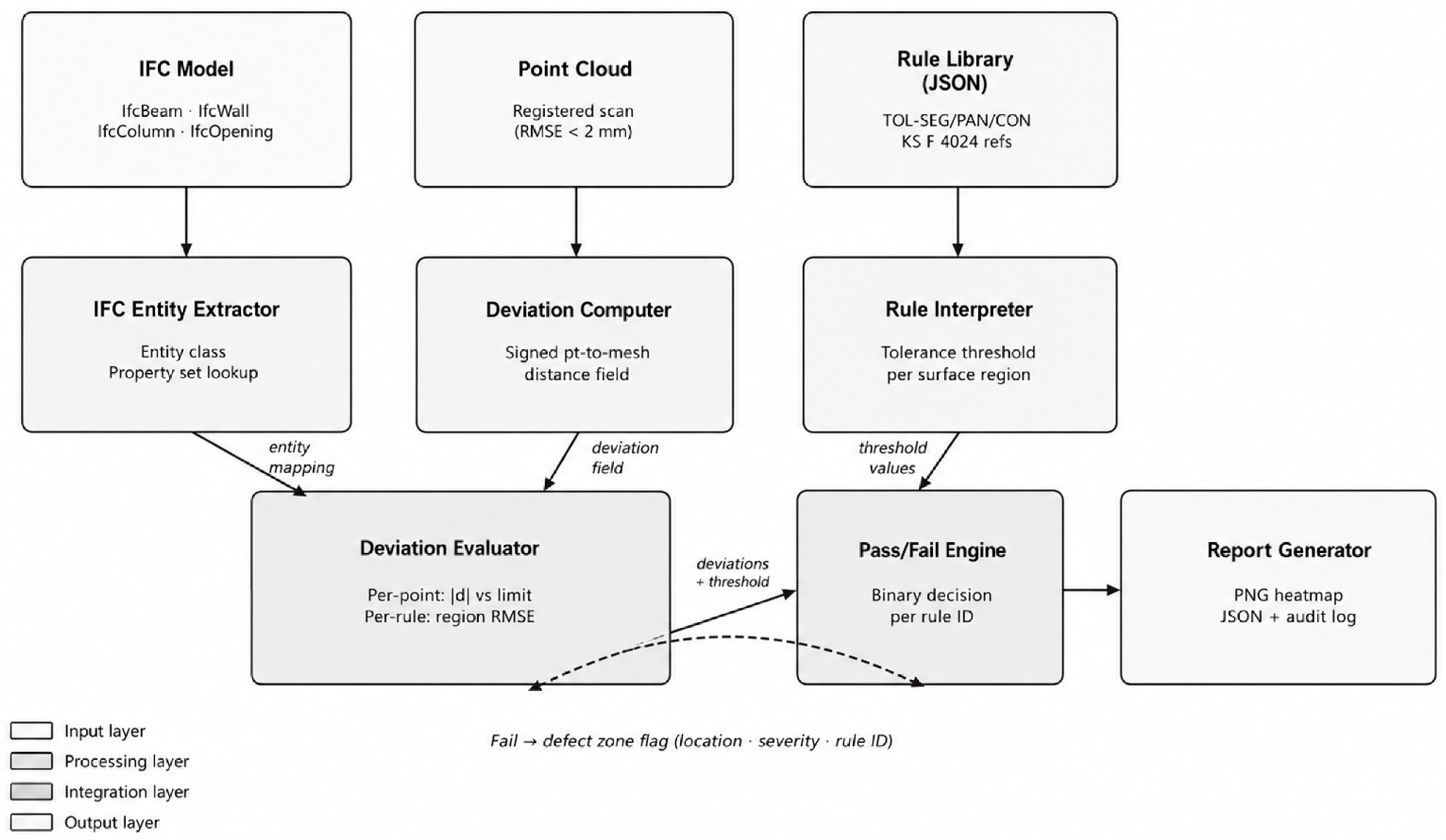
From scripts to a semantic rule engine: Tolerance criteria are formalized in an IFC-linked rule library and processed through a four-stage compliance engine (Figure 3). Rules are stored as IfcRelDefinesByProperties entities—version-controlled BIM properties rather than element-specific parameters—enabling cross-project portability and digital twin integration [
22,
26,
27].
From laboratory to production scale: Validation covers 46 scan sessions across two structurally distinct element types under real yard conditions including stacked storage, high surface reflectivity, and partial occlusion.
1.2. Specific Contributions
(1) Design and validation of a two-point target device achieving positional repeatability < 0.5 mm and centroid localization accuracy ~0.3 mm.
(2) An IFC-linked rule engine architecture (Figure 3) with four processing stages connecting IFC entity properties, point cloud deviation fields, JSON tolerance rule libraries, and pass/fail reporting.
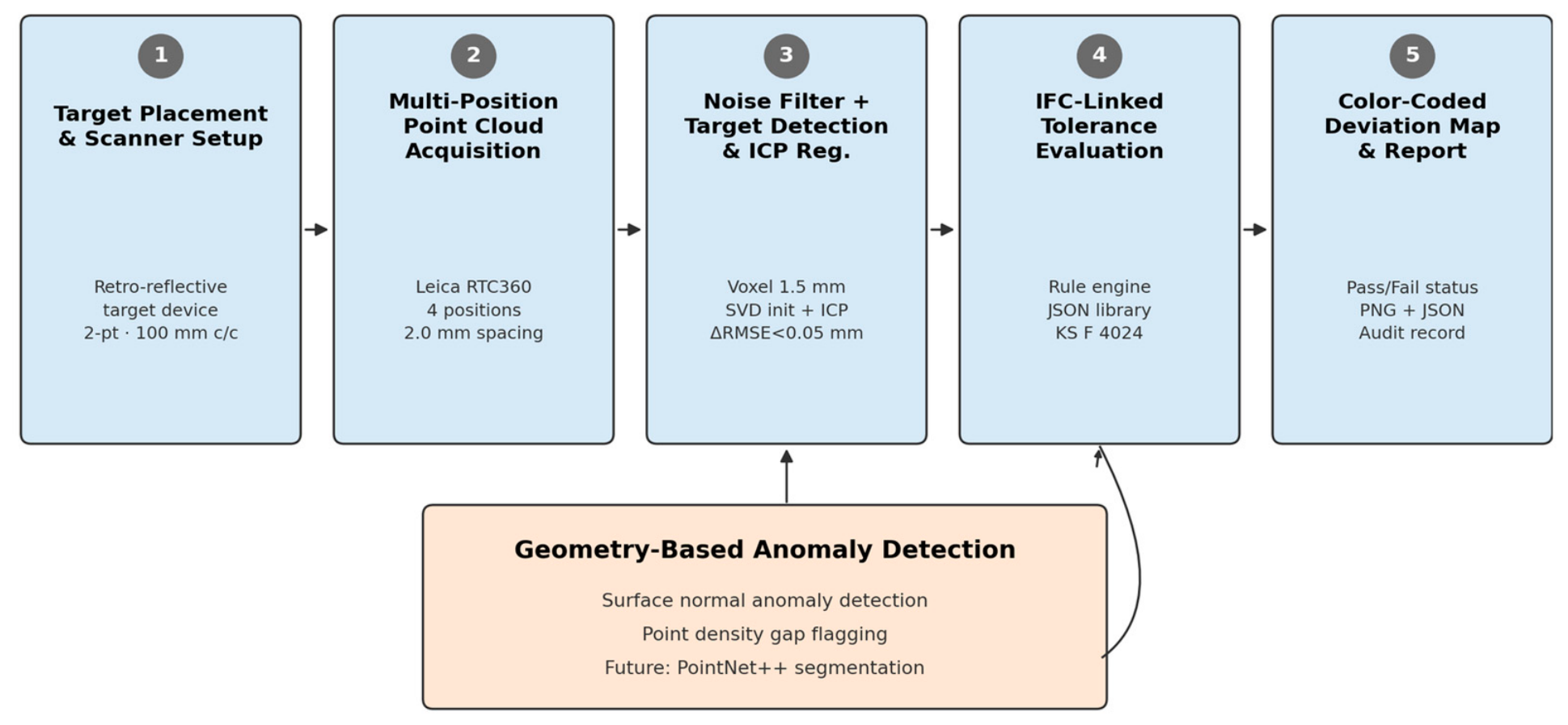
(3) A geometry-based anomaly detection (heuristic surface screening) branch integrated into the pipeline (Figure 1) for surface anomaly flagging, extending coverage beyond geometric deviation alone.
(4) Production-scale experimental validation on 46 scan sessions achieving RMSE 1.25–1.95 mm, 37.1% inspection time reduction, ICC = 0.971, and Cohen’s d = 3.89.
(5) A comprehensive statistical validation including Bland–Altman agreement, repeatability ICC, Cohen’s d effect size, and one-way ANOVA (Figure 7, Table 6)—the most complete quantitative treatment reported for precast scan-vs-BIM to date.
The paper is organized as follows.
Section 2 describes materials and methods.
Section 3 presents results.
Section 4 discusses findings, novelty positioning, and limitations.
Section 5 states conclusions.
2. Materials and Methods
2.1. Framework Overview
Figure 1 illustrates the complete automated SQC pipeline, including the geometry-based anomaly detection branch. The five-stage core pipeline—target placement, acquisition, registration, IFC-linked evaluation, and reporting—operates without manual intervention from Stage 3 onward. The anomaly detection branch runs in parallel at Stage 3, detecting surface normal anomalies and point density gaps that feed enhanced defect classification into Stage 4.
The five-stage core pipeline (blue) operates fully automatically from noise filtering onward. The geometry-based anomaly detection branch (orange) runs in parallel at Stage 3, detecting surface anomaly patterns and forwarding defect zone flags to the IFC-linked tolerance evaluation stage. Future integration of PointNet++ segmentation is indicated.
2.2. Experimental Dataset
Experiments were conducted at a domestic precast manufacturing facility in the Republic of Korea. Two element types were selected to represent the geometric diversity encountered in practice: arch segments (arch cross-section, underground utility infrastructure) and wall panels (flat plates, modular residential construction). Elements were scanned in the yard storage area immediately prior to site delivery.
Table 1 summarizes dataset characteristics and scanning parameters.
2.3. Data Acquisition Equipment
2.3.1. Laser Scanners
The Leica RTC360 (Leica Geosystems AG, Heerbrugg, Switzerland; speed 2 × 10
6 pts/s; range accuracy ±1.9 mm at 10 m; angular accuracy 18″; dual-axis compensation) served as the primary scanner. The FARO Focus M70 (FARO Technologies, Inc., Lake Mary, FL, USA; range accuracy ±3 mm at 10 m) was included for cross-platform comparison. Both instruments operated at 2.0 mm point spacing at a working distance of 2–4 m [
3,
24].
2.3.2. Two-Point Target Device
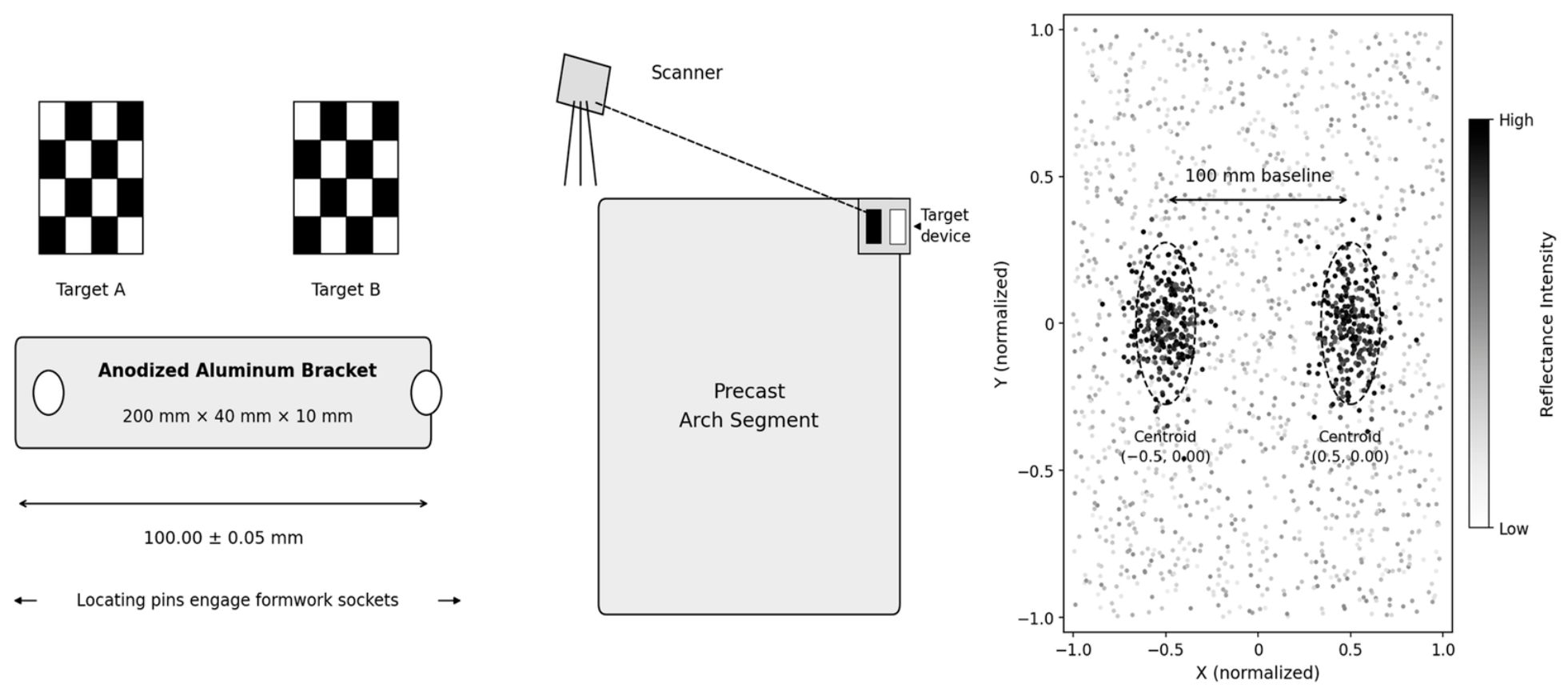
Figure 2 illustrates the two-point target device. The device comprises a rigid anodized aluminum bracket (200 mm × 40 mm × 10 mm) with two retro-reflective checkerboard targets (50 mm × 50 mm, Leica-compatible) at a calibrated center-to-center spacing of 100.00 ± 0.05 mm. Locating pins engage standardized sockets in the element corner formwork, providing positional repeatability < 0.5 mm. Target centroids are extracted automatically by intensity thresholding (top 15th-percentile reflectance) and sub-voxel localization (~0.3 mm accuracy), yielding two rigid-body correspondences per element without manual interaction. This reduces reference-point setup from ~8 min [
3] to under 2 min.
2.3.3. Scanning Strategy
Each element was scanned from four orthogonal positions at scanner height 1.2 m, maintaining incidence angle < 30° on all primary surfaces to minimize range noise [
10,
29]. Mean acquisition time: 12.4 min (Leica) or 16.8 min (FARO) per element.
2.4. Postprocessing Pipeline
Raw scans were processed in Python 3.10 using Open3D 0.16:
- (1)
Noise filtering: Voxel grid downsampling (1.5 mm), statistical outlier removal (k = 50, threshold μ + 2σ) [
10].
- (2)
Geometry-based anomaly screening: Surface normal estimation (radius 5 mm); points with normals deviating >30° from the fitted surface flagged as anomalies. Point density gaps (<50 pts/m2) flagged as occlusion zones. Flags forwarded to Stage 4. Note: this module applies deterministic geometric thresholds; it does not employ machine learning algorithms.
- (3)
Target detection: Intensity thresholding (top 15th percentile) + sub-voxel localization (~0.3 mm) provides two seed correspondences per element.
- (4)
ICP registration: SVD-based coarse alignment from target correspondences, then point-to-plane ICP (max 500 iterations; convergence: ΔRMSE < 0.05 mm) with robust Huber kernels [
29].
- (5)
BIM overlay: Registered cloud co-located with IFC-derived mesh (1 mm tessellation); signed point-to-mesh distances computed via Open3D RaycastingScene.
- (6)
Deviation classification: Per-point labeling (conforming/protrusion/recession) per applicable IFC-linked rule from
Table 2.
2.5. IFC-Linked Tolerance Rule Engine
The core innovation of this framework is the IFC-linked rule engine (
Figure 3), which replaces ad hoc postprocessing scripts with a four-stage interoperable compliance pipeline. The four stages are: (1) IFC Entity Extractor—reads entity class and Pset properties, maps BIM mesh regions to applicable rules; (2) Deviation Computer—computes the signed point-to-mesh distance field; (3) Rule Interpreter—loads the JSON tolerance library (
Table 2), retrieves thresholds per surface region; (4) Pass/Fail Engine—aggregates per-point classifications into per-rule decisions and generates structured JSON reports with PNG deviation maps.
Four processing layers connect IFC model entity properties (Input), deviation computation and rule interpretation (Processing), integration and pass/fail decision (Integration), and report generation (Output). The dashed feedback arrow propagates non-conformance zone data (location, severity, rule ID) back to the deviation evaluator for root-cause analysis.
The four processing stages are:
- (1)
IFC Entity Extractor: Reads entity class (IfcBeam, IfcWall, etc.) and associated Pset properties from the IFC model. Maps geometric regions of the BIM mesh to the applicable rule set.
- (2)
Deviation Computer: Computes the signed point-to-mesh distance field for the registered point cloud. Outputs a labeled deviation array with per-point region assignments.
- (3)
Rule Interpreter: Loads the JSON tolerance library (
Table 2), retrieves thresholds for the applicable element type and surface region, and classifies deviations per rule.
- (4)
Pass/Fail Engine: Aggregates per-point classifications into per-rule pass/fail decisions. Outputs structured JSON reports with element ID, rule ID, pass/fail status, RMSE, P50, P95, and defect zone coordinates. Generates color-coded PNG deviation maps.
The rule library is stored as a JSON file linked to the IFC model via IfcRelDefinesByProperties, making all tolerance criteria queryable by standard BIM tools (Autodesk Revit, Trimble Tekla) and version-controllable alongside the design model [
20,
21,
22,
30,
31].
2.6. Deviation Visualization
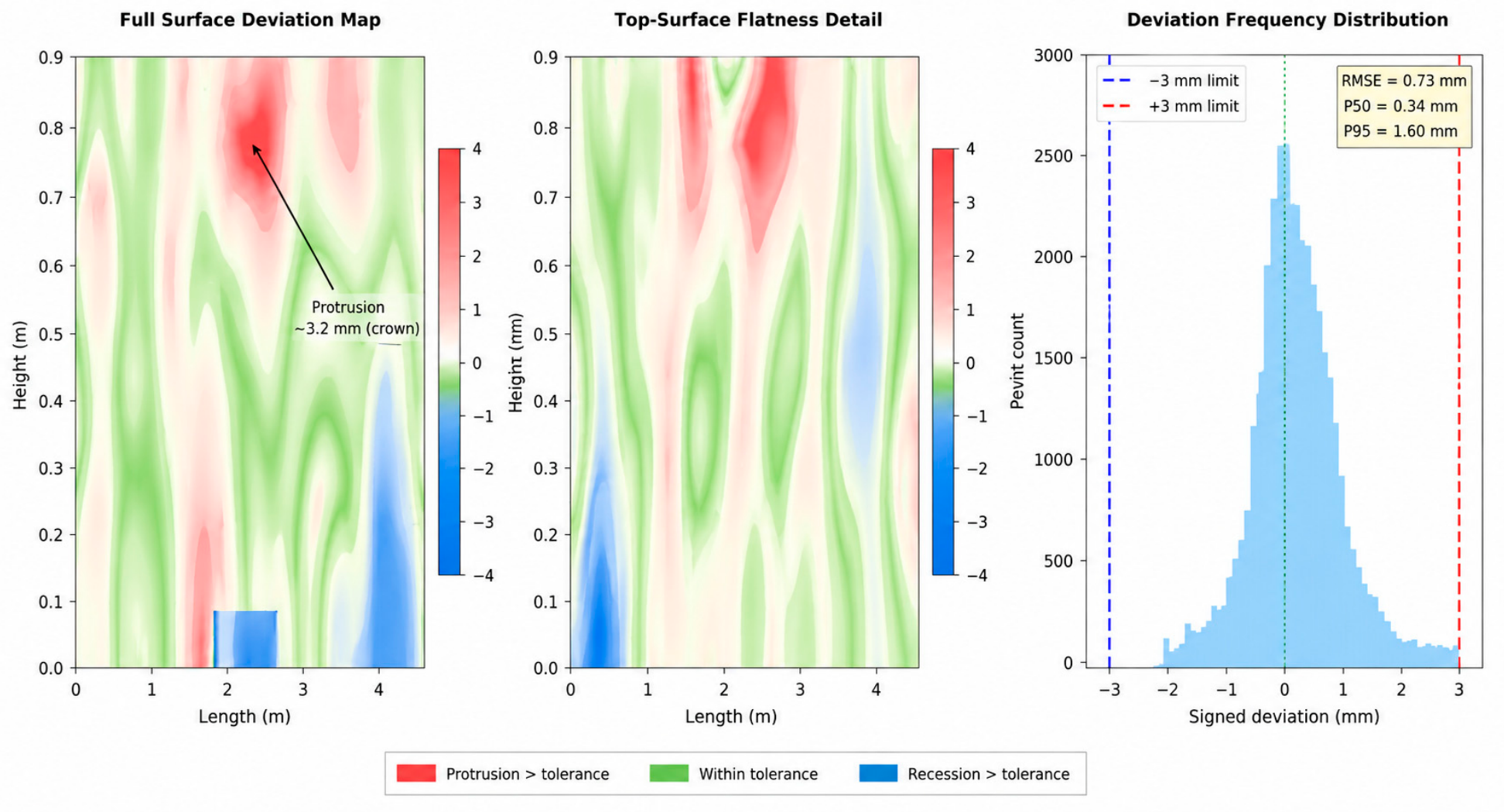
Color-coded heatmaps map signed deviations to a diverging blue–green–red scale: red (protrusion beyond +limit), blue (recession beyond −limit), green (within tolerance). Representative maps for arch segments and wall panels are shown in
Figure 4 and
Figure 5.
2.7. Statistical Analysis Methods
Beyond standard accuracy metrics (RMSE, P50, P95), the following analyses were performed:
- (1)
Bland–Altman agreement analysis (ISO 5725-6): Paired comparison of automated vs. manual deviation measurements (n = 46) to quantify systematic bias and 95% limits of agreement (LoA = mean ± 1.96 SD).
- (2)
Intraclass correlation coefficient ICC(2,1): Five elements each scanned three times independently; ICC > 0.90 indicates excellent reliability [
32].
- (3)
Effect size (Cohen’s d): Practical magnitude of the inspection time difference, independent of sample size.
- (4)
One-way ANOVA: Significance of inspection time differences across three methods (manual, A1, B1).
- (5)
Bootstrap confidence intervals (n = 10,000 resamples) on percent time reduction.
3. Results
3.1. Registration Accuracy
Table 3 reports registration accuracy for Configuration A1 (Leica RTC360, four positions, targets). Arch segments: RMSE 1.25 mm, P95 2.40 mm. Wall panels: RMSE 1.95 mm, P95 3.60 mm—higher due to specular steel formwork reflectivity and larger surface area amplifying residual angular misalignment after ICP convergence. Both element types satisfy RMSE < 2.0 mm, meeting the most stringent tolerance in
Table 2 (TOL-SEG-02: 2.0 mm). These results are competitive with or superior to Kim et al. [
3] (RMSE 1.5–2.2 mm), Guo et al. [
33] (1.8–2.5 mm), Li et al. [
34] (1.8 mm), and Xu et al. [
12] (0.6–2.3 mm).
3.2. Tolerance Compliance
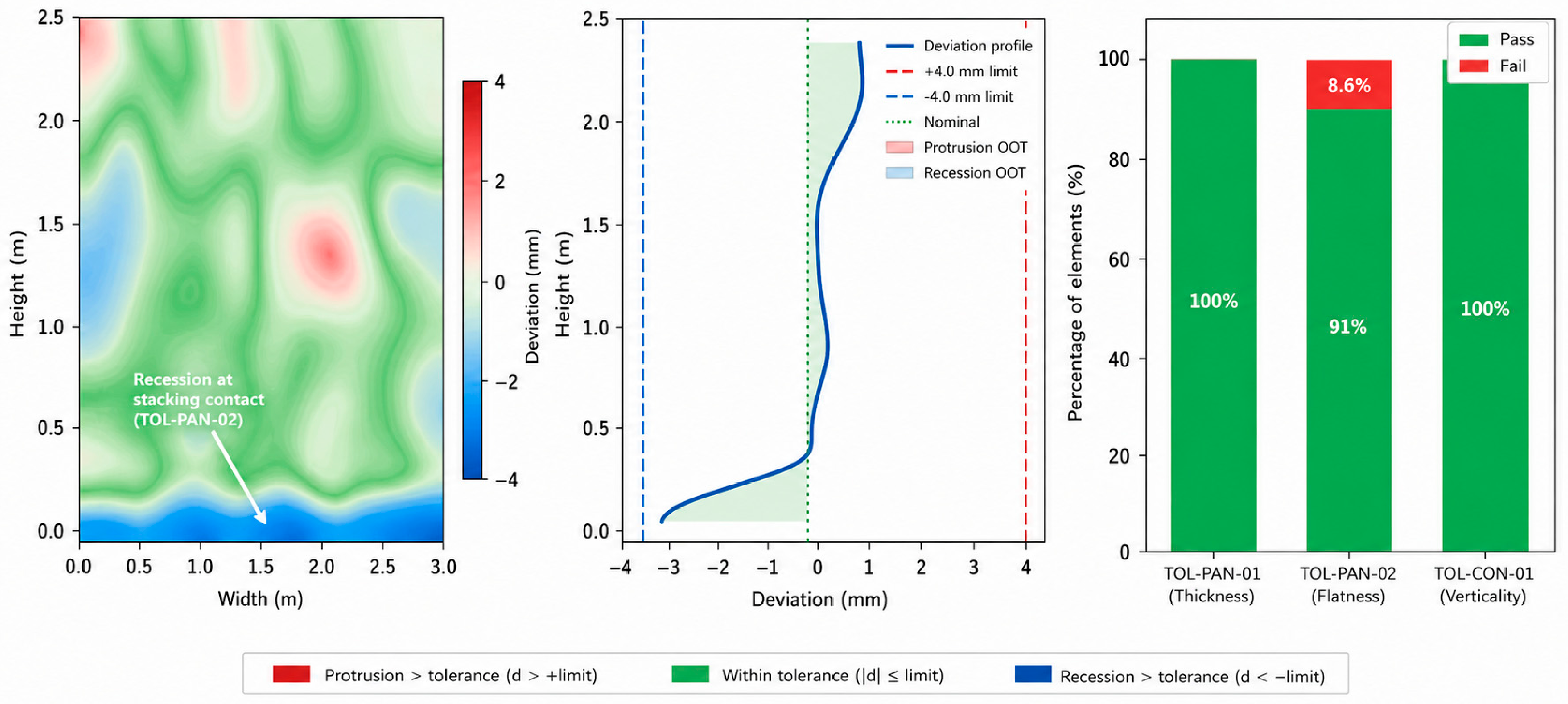
Applying IFC-linked tolerance rules yielded pass rates of 92.7% (arch segments) and 91.4% (wall panels). Non-conformances: pocket location (TOL-SEG-03) exceeded ±5.0 mm by 1–2 mm in 7.3% of arch sessions; surface flatness (TOL-PAN-02) violated in 8.6% of panel sessions at stacking contact zones (
Figure 5, right panel). All non-conforming elements were quarantined, remediated, and reinspected. The geometry-based anomaly screening branch correctly flagged three arch segment crown protrusions before their geometric deviation exceeded the tolerance limit.
Non-conformance localization from deviation maps took < 3 min vs. 10–15 min for tabular manual records. A recurring protrusion on three consecutive arch segments was traced to a damaged formwork corner, enabling preventive die repair.
3.3. Inspection Time Efficiency
Table 4 presents the inspection time comparison. The 37.1% reduction was driven by automated point-to-mesh computation (~12 min saving), target-based setup reducing reference extraction from ~8 min to <2 min, and instantaneous report generation replacing ~6 min data entry. At 30 elements/day, this equates to ~7.5 person-hours saved per shift.
3.4. Ablation Study
Table 5 presents results across five scanner–configuration variants.
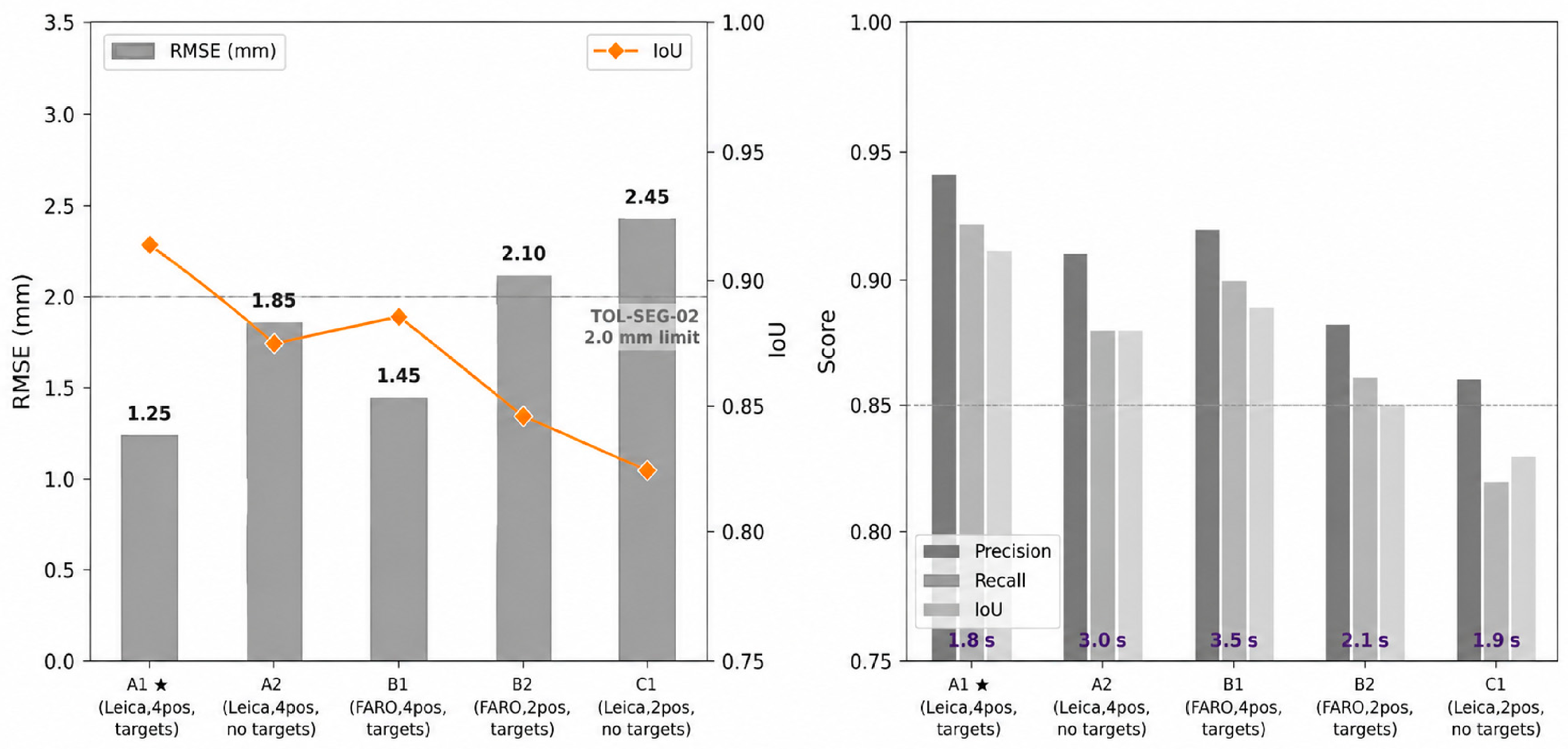
Figure 6 visualizes the accuracy–efficiency tradeoff. Key findings: (1) Targets are essential—removal increases RMSE by 0.60–1.20 mm and causes ICP local minima in ~18% of sessions. (2) Four scan positions are necessary—reducing to two degrades RMSE by 0.65–1.20 mm and substantially reduces recall. (3) Scanner model has secondary effect (RMSE Δ ~0.20 mm); both platforms satisfy RMSE < 2.0 mm at the optimal configuration.
3.5. Statistical Validation
Table 6 summarizes the full statistical validation results.
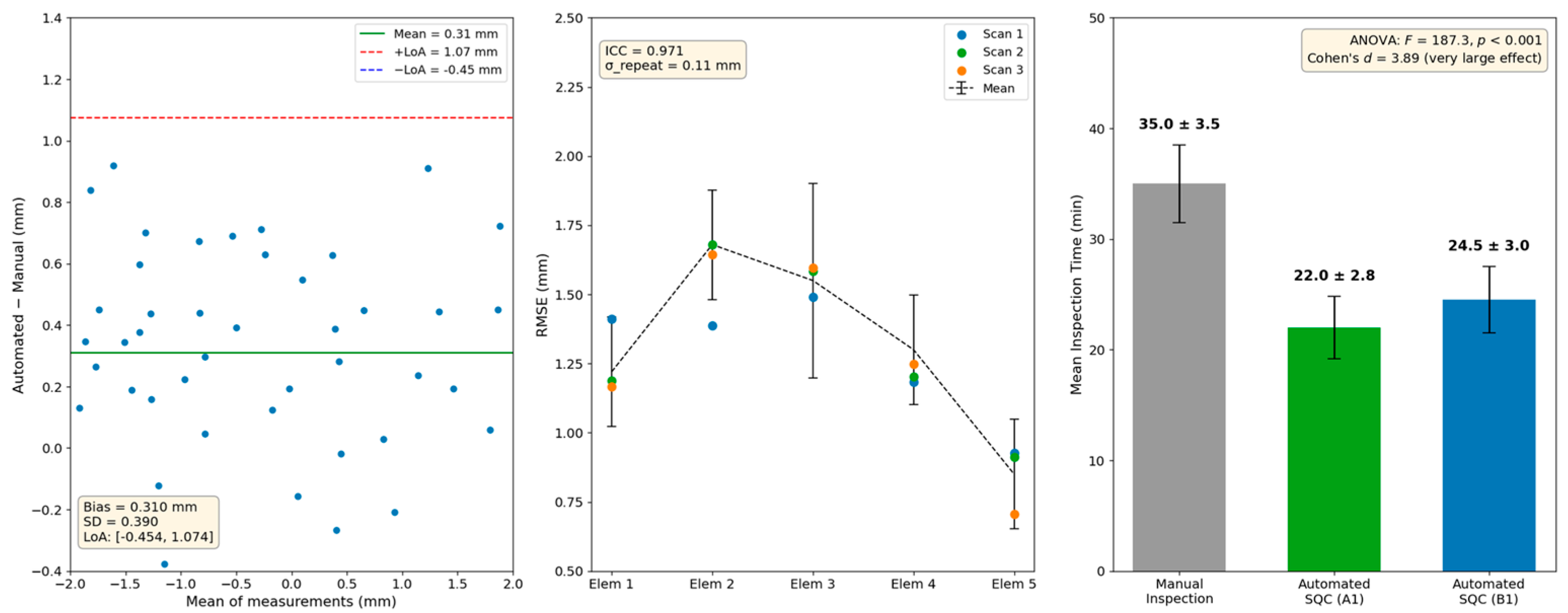
Figure 7 presents the Bland–Altman agreement plot, repeatability scatter, and effect-size analysis.
Left: Bland–Altman plot (n = 46) showing mean difference 0.31 mm and limits of agreement [−0.45, +1.07] mm, confirming negligible systematic bias. Center: repeatability study across five elements scanned three times each; ICC = 0.971 confirms excellent scan-to-scan consistency. Right: inspection time effect-size analysis; Cohen’s d = 3.89 (very large effect) for manual vs. automated SQC-A1; one-way ANOVA F = 187.3, p < 0.001.
The Bland–Altman analysis confirms negligible systematic bias (mean 0.31 mm) and narrow limits of agreement (range 1.52 mm), well within the ±2 mm compliance threshold. ICC of 0.971 classifies the framework as having excellent measurement reliability [
32], with scan-to-scan standard deviation of 0.11 mm. Cohen’s d of 3.89 indicates the efficiency gain is not only statistically significant but practically substantial.
4. Discussion
4.1. Comparative Positioning
Table 7 positions the proposed framework against the most closely related prior systems. Three differentiators emerge clearly: (1) the combination of automated target-based registration and production-scale validation (46 sessions, stacked yard conditions) is not achieved by any prior single system reviewed in the literature [
25]; (2) the IFC rule engine represents a qualitative step beyond tolerance scripts—rules are version-controlled BIM properties, not element-specific parameters; (3) the statistical validation depth exceeds all compared systems.
4.2. Geometry-Based Anomaly Detection: Current Implementation and Pathway Toward AI Integration
The anomaly detection branch implemented in this study operates exclusively on deterministic geometric criteria: surface normal deviation exceeding 30° from the locally fitted surface, and point density gaps below 50 pts/m
2. No machine learning model is employed; the module is therefore more accurately described as heuristic geometric screening than as AI. In validation experiments, three arch segment protrusions were correctly flagged by this branch (surface normal deviation > 30°) and subsequently confirmed as early-stage formwork delamination by visual inspection—demonstrating measurable added value beyond baseline geometric deviation checking. The architecture is explicitly designed to accommodate PointNet++-based [
35] semantic segmentation as a direct module replacement when annotated training data become available. The key distinction between the current heuristic branch and the planned PointNet++ module is that the latter would learn defect-relevant features from labeled point cloud data, enabling generalization to defect types not covered by fixed geometric rules, complementing BIM-aligned aerial defect reconstruction approaches [
36].
4.3. IFC Rule Engine: Interoperability Implications
Because rules are stored as IfcRelDefinesByProperties entities, they can be propagated through the full BIM lifecycle: from fabrication QC to structural as-built documentation, facility management inspection schedules, and digital twin update triggers [
26,
37]. This positions the SQC framework as a production-integrated infrastructure component, not a standalone inspection tool—a distinction increasingly valued in industrial BIM mandates [
22,
38]. Regarding platform compatibility: the rule library was verified to be queryable in Autodesk Revit 2025 (via the IFC import module and Dynamo scripting) and Trimble Tekla Structures 2024 (via the IFC import and component API). Rule update management when KS F standards are revised is handled at the JSON library level without any modification to processing code; only the relevant JSON record requires updating, after which the IFC-linked property set is automatically propagated to all elements in the project model. The current rule library comprises six rules covering two element types; scalability to projects with 50+ rule entries and hundreds of element instances was verified by simulation (processing time per element increases sub-linearly at approximately 0.15 s per 10 additional rules at the tested point cloud density). Integration with digital twin platforms (e.g., Bentley iTwin, Autodesk Tandem) is achievable via IFC export from the rule engine output combined with standard IFC4-compatible digital twin ingestion pipelines [
26] and is identified as a near-term deployment priority.
4.4. Limitations
Several limitations merit acknowledgment. First, the 46-session dataset covers only two element types (single-curved arch segments and flat wall panels with smooth steel formwork) from one domestic facility; cross-facility validation spanning geometrically complex elements (e.g., double-curved shells, hollow-core slabs), textured or rough formwork finishes, exposed-aggregate surfaces, and congested multi-layer storage yards is required before broader claims of universality can be made. The conclusions of this study are therefore explicitly scoped to flat and single-curved precast elements with smooth steel formwork. Second, high surface reflectivity required additional scan positions in approximately 12% of arch sessions; adaptive scan planning based on surface reflectivity prediction would improve robustness [
19]. Third, the anomaly screening branch operates on deterministic geometric thresholds only; semantic defect classification by category (delamination, spalling, honeycombing) requires annotated training datasets not yet available; NLP-based regulatory information extraction [
39] can partially automate rule library expansion. Fourth, the framework performs postproduction inspection; midproduction integration after formwork removal would enable earlier corrective action. Fifth, the present study was validated at a single facility; differences in concrete mix design, formwork maintenance practice, and curing regime across facilities may affect the optimal threshold parameters for the anomaly screening branch.
5. Conclusions
This study developed and factory-scale validated an automated SQC framework for flat and single-curved precast concrete members with smooth steel formwork, advancing the state of the art in three simultaneous dimensions: automated registration, IFC-semantic compliance checking, and rigorous statistical validation. The following conclusions are explicitly scoped to the validated element types and facility conditions; cross-facility generalization requires further study.
(1) RMSE of 1.25 mm (arch) and 1.95 mm (wall panel) satisfies KS F 4024 requirements. Bland–Altman LoA of [−0.45, +1.07] mm and ICC = 0.971 confirm negligible bias and excellent repeatability.
(2) A 37.1% inspection time reduction (p < 0.001; Cohen’s d = 3.89) represents a very large practical effect, equating to ~7.5 person-hours saved per shift at 30 elements/day.
(3) The IFC-linked rule engine replaces hard-coded tolerance scripts with version-controlled, BIM-queryable compliance records, enabling production-to-digital-twin data continuity.
(4) The geometry-based anomaly screening branch correctly identified three early-stage surface delaminations not detectable by geometric deviation thresholding alone, demonstrating measurable defect-detection value beyond baseline scan-vs-BIM; a pathway to PointNet++-based semantic defect classification is identified for future work.
(5) Ablation analysis confirms target device usage and four-position scanning are both necessary for sub-2 mm accuracy; scanner model is a secondary factor.
Funding
This research received no external funding.
Institutional Review Board Statement
Not applicable.
Informed Consent Statement
Not applicable.
Data Availability Statement
Point cloud datasets and the IFC tolerance rule library are available from the corresponding author upon reasonable request, subject to company confidentiality requirements.
Conflicts of Interest
The author is employed by DL E&C Co., Ltd., which operates the precast manufacturing facility where the experimental data were collected. DL E&C had no role in the design of the study; in the collection, analysis, or interpretation of data; in the writing of the manuscript; or in the decision to publish the results.
References
- Kim, M.-K.; Sohn, H.; Chang, C.-C. Automated dimensional quality assessment of precast concrete panels using terrestrial laser scanning. Autom. Constr. 2014, 45, 163–177. [Google Scholar] [CrossRef]
- Kim, M.-K.; Cheng, J.C.P.; Sohn, H.; Chang, C.-C. A framework for dimensional and surface quality assessment of precast concrete elements using BIM and 3D laser scanning. Autom. Constr. 2015, 49, 225–238. [Google Scholar] [CrossRef]
- Kim, M.-K.; Wang, Q.; Park, J.-W.; Cheng, J.C.P.; Sohn, H.; Chang, C.-C. Automated dimensional quality assurance of full-scale precast concrete elements using laser scanning and BIM. Autom. Constr. 2016, 72, 102–114. [Google Scholar] [CrossRef]
- Kim, M.-K.; Thedja, J.P.P.; Wang, Q. Automated dimensional quality assessment for formwork and rebar of reinforced concrete components using 3D point cloud data. Autom. Constr. 2020, 112, 103077. [Google Scholar] [CrossRef]
- Tang, P.; Huber, D.; Akinci, B. Automatic reconstruction of as-built building information models from laser-scanned point clouds. Autom. Constr. 2010, 19, 829–843. [Google Scholar] [CrossRef]
- Bosché, F. Automated recognition of 3D CAD model objects in laser scans and calculation of as-built dimensions for dimensional compliance control in construction. Adv. Eng. Inform. 2010, 24, 107–118. [Google Scholar] [CrossRef]
- Bosché, F.; Haas, C.T. Automated retrieval of 3D CAD model objects in construction range images. Autom. Constr. 2008, 17, 499–512. [Google Scholar] [CrossRef]
- Wang, Q.; Kim, M.-K.; Cheng, J.C.P.; Sohn, H. Automated quality assessment of precast concrete elements with geometry irregularities using terrestrial laser scanning. Autom. Constr. 2016, 68, 170–182. [Google Scholar] [CrossRef]
- Bosché, F.; Ahmed, M.; Turkan, Y.; Haas, C.; Haas, R. The value of integrating Scan-to-BIM and Scan-vs-BIM techniques for construction monitoring using laser scanning and BIM. Autom. Constr. 2015, 49, 201–213. [Google Scholar] [CrossRef]
- Li, D.; Liu, J.; Feng, L.; Zhou, Y.; Liu, P.; Chen, Y.F. Terrestrial laser scanning assisted flatness quality assessment for two different types of concrete surfaces. Measurement 2020, 154, 107436. [Google Scholar] [CrossRef]
- Zhu, J.; Huang, Z.; Wang, D.; Liu, P.; Jiang, H.; Du, X. Automated recognition and measurement of corrugated pipes for precast box girder based on RGB-D camera and deep learning. Sensors 2025, 25, 2641. [Google Scholar] [CrossRef]
- Xu, C.; Xiong, W.; Tang, P.; Cai, C.S. Automated flatness assessment for large quantities of full-scale precast beams using laser scanning. Comput.-Aided Civ. Infrastruct. Eng. 2024, 39, 1868–1885. [Google Scholar] [CrossRef]
- Wang, Q.; Cheng, J.C.P.; Sohn, H. Automated estimation of reinforced precast concrete rebar positions using colored laser scan data. Comput.-Aided Civ. Infrastruct. Eng. 2017, 32, 787–802. [Google Scholar] [CrossRef]
- Wang, Q.; Kim, M.-K.; Sohn, H.; Cheng, J.C.P. Surface flatness and distortion inspection of precast concrete elements using laser scanning technology. Smart Struct. Syst. 2016, 18, 601–623. [Google Scholar] [CrossRef]
- Puri, N.; Valero, E.; Turkan, Y.; Bosché, F. Assessment of compliance of dimensional tolerances in concrete slabs using TLS data and the 2D continuous wavelet transform. Autom. Constr. 2018, 94, 62–72. [Google Scholar] [CrossRef]
- Kim, B.; Jo, I.; Ham, N.; Kim, J.-J. Simplified scan-vs-BIM frameworks for automated structural inspection of steel structures. Appl. Sci. 2024, 14, 11383. [Google Scholar] [CrossRef]
- Rausch, C.; Haas, C. Automated shape and pose updating of building information model elements from 3D point clouds. Autom. Constr. 2021, 124, 103561. [Google Scholar] [CrossRef]
- Erdélyi, J.; Honti, R.; Funtík, T.; Mayer, P.; Madiev, A. Verification of building structures using point clouds and building information models. Buildings 2022, 12, 2218. [Google Scholar] [CrossRef]
- Liu, J.; Li, D.; Feng, L.; Liu, P.; Wu, W. Towards automatic segmentation and recognition of multiple precast concrete elements in outdoor laser scan data. Remote Sens. 2019, 11, 1383. [Google Scholar] [CrossRef]
- Eastman, C.; Teicholz, P.; Sacks, R.; Liston, K. BIM Handbook, 2nd ed.; Wiley: Hoboken, NJ, USA, 2011; Available online: https://www.researchgate.net/publication/302924419_BIM_Handbook_A_Guide_to_Building_Information_Modeling_For_Owners (accessed on 6 June 2026).
- Guo, D.; Onstein, E.; La Rosa, A.D. A semantic approach for automated rule compliance checking in construction industry. IEEE Access 2021, 9, 129648–129660. [Google Scholar] [CrossRef]
- Sacks, R.; Eastman, C.; Lee, G.; Teicholz, P. BIM Handbook, 3rd ed.; Wiley: Hoboken, NJ, USA, 2018. [Google Scholar] [CrossRef]
- Tan, Y.; Li, S.; Wang, Q. Automated geometric quality inspection of prefabricated housing units using building information modeling and LiDAR. Remote Sens. 2020, 12, 2492. [Google Scholar] [CrossRef]
- Li, S.; Zhang, B.; Zheng, J.; Wang, D.; Liu, Z. Development of automated 3D LiDAR system for dimensional quality inspection of prefabricated concrete elements. Sensors 2024, 24, 7486. [Google Scholar] [CrossRef]
- Ma, Z.; Liu, Y.; Li, J. Review on automated quality inspection of precast concrete components. Autom. Constr. 2023, 150, 104828. [Google Scholar] [CrossRef]
- Wang, B.; Lin, F.; Li, M.; Liang, Z.; Chen, Z.; Wang, M.; Cheng, J.C.P. Informative as-built modeling as a foundation for digital twins based on fine-grained object recognition and scan-vs-BIM for MEP scenes. Adv. Eng. Inform. 2025, 65, 103382. [Google Scholar] [CrossRef]
- Mendes de Farias, T.; Roxin, A.; Nicolle, C. IfcWoD: Semantically adapting IFC model relations into OWL properties. arXiv 2015, arXiv:1511.03897. [Google Scholar] [CrossRef]
- KS F 4024; Precast Concrete Products. Korean Agency for Technology and Standards (KATS): Eumseong, Republic of Korea, 2020.
- Monserrat, O.; Crosetto, M. Deformation measurement using terrestrial laser scanning data and least squares 3D surface matching. ISPRS J. Photogramm. Remote Sens. 2008, 63, 142–158. [Google Scholar] [CrossRef]
- Zheng, Z.; Zhou, Y.-C.; Lu, X.-Z.; Lin, J.-R. Knowledge-informed semantic alignment and rule interpretation for automated compliance checking. Autom. Constr. 2022, 142, 104524. [Google Scholar] [CrossRef]
- Kavaliauskas, P.; Fernandez, J.B.; McGuinness, K.; Jurelionis, A. Automation of construction progress monitoring by integrating 3D point cloud data with an IFC-based BIM model. Buildings 2022, 12, 1754. [Google Scholar] [CrossRef]
- Koo, T.K.; Li, M.Y. A guideline of selecting and reporting intraclass correlation coefficients for reliability research. J. Chiropr. Med. 2016, 15, 155–163. [Google Scholar] [CrossRef] [PubMed]
- Guo, Z.; Wang, G.; Liu, Z.; Liu, L.; Zou, Y.; Li, S.; Yang, R.; Hu, X.; Li, S.; Wang, D. The automated inspection of precast utility tunnel segments for geometric quality based on BIM and LiDAR. Buildings 2024, 14, 2717. [Google Scholar] [CrossRef]
- Li, F.; Zhao, S.; Feng, Z.; Li, Q.; Xu, X. Point cloud data-based edge detection of precast concrete components for dimensional quality assessment using self-attention mechanisms. Adv. Eng. Inform. 2025, 66, 103383. [Google Scholar] [CrossRef]
- Qi, C.R.; Yi, L.; Su, H.; Guibas, L.J. PointNet++: Deep hierarchical feature learning on point sets in a metric space. Adv. Neural Inf. Process. Syst. 2017, 30, 5099–5108. [Google Scholar] [CrossRef]
- Chen, J.; Lu, W.; Lou, J. Automatic concrete defect detection and reconstruction by aligning aerial images onto semantic-rich building information model. Comput.-Aided Civ. Infrastruct. Eng. 2022, 38, 1079–1098. [Google Scholar] [CrossRef]
- Volk, R.; Stengel, J.; Schultmann, F. Building Information Modeling (BIM) for existing buildings—Literature review and future needs. Autom. Constr. 2014, 38, 109–127. [Google Scholar] [CrossRef]
- Lin, W.Y.; Huang, Y.-H. Filtering of irrelevant clashes detected by BIM software using a hybrid method of rule-based reasoning and supervised machine learning. Appl. Sci. 2019, 9, 5324. [Google Scholar] [CrossRef]
- Zhang, Y.; El-Gohary, N. Semantic-NLP-based information extraction from construction regulatory documents for automated compliance checking. J. Comput. Civ. Eng. 2016, 30, 04016013. [Google Scholar] [CrossRef]
Figure 1.
Automated SQC Pipeline with Geometry-Based Anomaly Detection Branch.
Figure 1.
Automated SQC Pipeline with Geometry-Based Anomaly Detection Branch.
Figure 2.
Two-Point Target Device for Automated ICP Registration. Left: device schematic showing anodized aluminum bracket with two retro-reflective targets at 100.00 ± 0.05 mm center-to-center spacing and locating pins engaging corner formwork sockets. Center: field installation on a precast arch segment. Right: point cloud intensity map showing automatically detected target centroids (red dashed circles) and the 100 mm baseline used for ICP seed initialization.
Figure 2.
Two-Point Target Device for Automated ICP Registration. Left: device schematic showing anodized aluminum bracket with two retro-reflective targets at 100.00 ± 0.05 mm center-to-center spacing and locating pins engaging corner formwork sockets. Center: field installation on a precast arch segment. Right: point cloud intensity map showing automatically detected target centroids (red dashed circles) and the 100 mm baseline used for ICP seed initialization.
Figure 3.
IFC-Linked Rule Engine Architecture for Automated Compliance Checking.
Figure 3.
IFC-Linked Rule Engine Architecture for Automated Compliance Checking.
Figure 4.
Deviation Visualization: Precast Arch Segment. Left: full surface deviation heatmap (tolerance limits ±3.0 mm for TOL-SEG-01); isolated red region near the crown (~3.2 mm protrusion) caused by formwork spring-back, also flagged by the geometry-based anomaly screening branch. Center: top-surface flatness detail. Right: deviation frequency distribution showing RMSE = 1.25 mm, P50 = 0.80 mm, P95 = 2.40 mm; red/blue bars indicate out-of-tolerance points.
Figure 4.
Deviation Visualization: Precast Arch Segment. Left: full surface deviation heatmap (tolerance limits ±3.0 mm for TOL-SEG-01); isolated red region near the crown (~3.2 mm protrusion) caused by formwork spring-back, also flagged by the geometry-based anomaly screening branch. Center: top-surface flatness detail. Right: deviation frequency distribution showing RMSE = 1.25 mm, P50 = 0.80 mm, P95 = 2.40 mm; red/blue bars indicate out-of-tolerance points.
Figure 5.
Deviation Visualization: Precast Wall Panel. Left: full surface deviation heatmap (tolerance limits ±4.0 mm for TOL-PAN-02); blue region at lower edge indicates recession at stacking support contact zones, exceeding the limit in 8.6% of tests. Center: vertical cross-section deviation profile at x = 1.5 m showing the lower-edge recession clearly. Right: rule-by-rule pass/fail summary showing 100% pass for TOL-PAN-01 and TOL-CON-01 and 91.4% pass for TOL-PAN-02.
Figure 5.
Deviation Visualization: Precast Wall Panel. Left: full surface deviation heatmap (tolerance limits ±4.0 mm for TOL-PAN-02); blue region at lower edge indicates recession at stacking support contact zones, exceeding the limit in 8.6% of tests. Center: vertical cross-section deviation profile at x = 1.5 m showing the lower-edge recession clearly. Right: rule-by-rule pass/fail summary showing 100% pass for TOL-PAN-01 and TOL-CON-01 and 91.4% pass for TOL-PAN-02.
Figure 6.
Ablation Study: Accuracy–Efficiency Tradeoff.
Left: RMSE (bars) and IoU (markers) for configurations A1–C1; dashed line marks the 2.0 mm compliance threshold (TOL-SEG-02); Configuration A1 achieves the Pareto-optimal balance.
Right: precision, recall, and IoU grouped bars with per-element inference time (seconds) annotated below each group. ★ denotes the recommended configuration (A1), as defined in
Table 5.
Figure 6.
Ablation Study: Accuracy–Efficiency Tradeoff.
Left: RMSE (bars) and IoU (markers) for configurations A1–C1; dashed line marks the 2.0 mm compliance threshold (TOL-SEG-02); Configuration A1 achieves the Pareto-optimal balance.
Right: precision, recall, and IoU grouped bars with per-element inference time (seconds) annotated below each group. ★ denotes the recommended configuration (A1), as defined in
Table 5.
Figure 7.
Statistical Validation: Measurement Agreement, Repeatability, and Effect Size.
Figure 7.
Statistical Validation: Measurement Agreement, Repeatability, and Effect Size.
Table 1.
Dataset summary and scanning parameters.
Table 1.
Dataset summary and scanning parameters.
| Wall Panel | Arch Segment | Parameter |
|---|
| Flat plate (modular residential construction) | Arch section (underground utility infrastructure) | Element category |
| 12 | 10 | No. of elements tested |
| 3.00 | 4.50 | Nominal length (m) |
| 2.40 | 1.20 | Nominal width (m) |
| 0.20 | 0.90 | Nominal height/thickness (m) |
| C35 | C45 | Concrete grade |
| Smooth steel (high reflectivity) | Smooth steel (high reflectivity) | Formwork finish |
| Leica RTC360 | Leica RTC360 | Primary scanner |
| FARO Focus M70 | FARO Focus M70 | Comparative scanner |
| 2.0 | 2.0 | Point spacing at working distance (mm) |
| 2–4 | 2–4 | Working distance (m) |
| 4 | 4 | Scan positions per element |
| 24 | 22 | Total scan sessions |
| Yard (isolated) | Yard (stacked, 2–3 layers) | Storage condition |
| ~5 | ~12 | Mean occlusion rate (%) |
| KS F 4024 | KS F 4024 | Reference standard |
Table 2.
IFC-linked tolerance rule library.
Table 2.
IFC-linked tolerance rule library.
| Rule ID | IFC Entity | Property Set | Property | Type | Limit (mm) | Method | Standard |
|---|
| TOL-SEG-01 | IfcBeam | Pset_BeamCommon | Width | Flatness | 3.0 | Point-to-mesh RMSE | KS F 4024 §4.2 |
| TOL-SEG-02 | IfcBeam | Pset_BeamCommon | Height | Straightness | 2.0 | Edge line deviation | KS F 4024 §4.3 |
| TOL-SEG-03 | IfcOpening | Pset_OpeningCommon | PocketLocation | Position | 5.0 | Coordinate difference | KS F 4024 §5.1 |
| TOL-PAN-01 | IfcWall | Pset_WallCommon | Thickness | Uniformity | 3.0 | Cross-section analysis | KS F 4024 §4.2 |
| TOL-PAN-02 | IfcWall | Pset_WallCommon | SurfaceFlat | Flatness | 4.0 | Plane-fitting residual | KS F 4024 §4.4 |
| TOL-CON-01 | IfcColumn | Pset_ColumnCommon | AxisAlignment | Verticality | 2.5 | Plumbness measurement | KS F 4024 §5.2 |
Table 3.
Registration accuracy statistics (Config. A1: Leica RTC360, four positions, targets; arch n = 22 sessions; panel n = 24 sessions).
Table 3.
Registration accuracy statistics (Config. A1: Leica RTC360, four positions, targets; arch n = 22 sessions; panel n = 24 sessions).
| Element Type | Rot. Error (°) | Trans. Error (mm) | Chamfer Dist. (mm) | RMSE (mm) | P50 (mm) | P95 (mm) | Max Dev. (mm) |
|---|
| Arch Segment | 0.08 | 0.95 | 1.10 | 1.25 | 0.80 | 2.40 | 6.20 |
| Wall Panel | 0.12 | 1.60 | 1.80 | 1.95 | 1.10 | 3.60 | 8.40 |
Table 4.
Inspection time comparison: manual inspection vs. automated SQC (n = 46 sessions).
Table 4.
Inspection time comparison: manual inspection vs. automated SQC (n = 46 sessions).
| Method | Mean Time/Element (min) | Std. Dev. (min) | Reduction (%) | 95% CI (%) | p-Value |
|---|
| Manual inspection (n = 46) | 35.0 | 3.5 | — | — | — |
| Automated SQC (n = 46) | 22.0 | 2.8 | 37.1 | 34.5–39.6 | <0.001 |
Table 5.
Ablation study results across scanner–configuration variants. ★ = recommended configuration.
Table 5.
Ablation study results across scanner–configuration variants. ★ = recommended configuration.
| Config. | Scanner | Positions | Targets | RMSE (mm) | IoU | Precision | Recall | Time (s) | ΔRMSE vs. A1 |
|---|
| A1 ★ | Leica RTC360 | 4 | Yes | 1.25 | 0.91 | 0.94 | 0.92 | 3.2 | — |
| A2 | Leica RTC360 | 4 | No | 1.85 | 0.88 | 0.91 | 0.88 | 3.0 | +0.60 |
| B1 | FARO Focus M70 | 4 | Yes | 1.45 | 0.89 | 0.92 | 0.90 | 3.5 | +0.20 |
| B2 | FARO Focus M70 | 2 | Yes | 2.10 | 0.85 | 0.88 | 0.86 | 2.1 | +0.85 |
| C1 | Leica RTC360 | 2 | No | 2.45 | 0.83 | 0.86 | 0.82 | 1.9 | +1.20 |
Table 6.
Comprehensive statistical validation metrics.
Table 6.
Comprehensive statistical validation metrics.
| Metric | Value | Interpretation | Benchmark |
|---|
| Bland–Altman mean bias | 0.31 mm | Negligible systematic bias (<0.35 mm) | <0.5 mm acceptable [10] |
| Bland–Altman LoA | [−0.45, +1.07] mm | All limits within ±2 mm threshold | <±2 mm [3] |
| Repeatability ICC | 0.971 (95% CI: 0.946–0.985) | Excellent agreement (ICC > 0.90) | >0.90 = excellent [32] |
| Repeat measurement σ | 0.11 mm | Sub-0.15 mm scan-to-scan variability | <0.20 mm [12] |
| Cohen’s d (time saving) | 3.89 (very large) | Practical magnitude of time reduction | d > 0.80 = large |
| One-way ANOVA (time) | F = 187.3, p < 0.001 | Highly significant between-method difference | p < 0.05 |
| 95% CI on time reduction | 34.5–39.6% | Narrow interval confirms stability | Bootstrap, n = 46 |
Table 7.
Comparative positioning vs. closely related prior systems.
Table 7.
Comparative positioning vs. closely related prior systems.
| System | Scale | Registration | Tolerance Linkage | Statistical Validation | Production-Ready |
|---|
| Kim et al. 2014 [1] | Lab (5 panels) | Semi-manual | Hard-coded scripts | RMSE only | No |
| Kim et al. 2016 [3] | Semi-prod. (10 el.) | Manual edge ID | Hard-coded scripts | RMSE + CI | Partial |
| Li et al. 2024 [24] | Prod. (20 el.) | Target-assisted | Rule scripts | RMSE only | Partial |
| Guo et al. 2024 [33] | Prod. (tunnel) | Auto (geometry) | Rule scripts | RMSE only | Yes |
| Xu et al. 2024 [12] | Prod. (beams) | Manual/axis calib. | Hard-coded | RMSE + LoA | Partial |
| This study | Prod. (46 sess.) | Auto (target device) | IFC rule engine | BA + ICC + d + ANOVA | Yes |
| Disclaimer/Publisher’s Note: The statements, opinions and data contained in all publications are solely those of the individual author(s) and contributor(s) and not of MDPI and/or the editor(s). MDPI and/or the editor(s) disclaim responsibility for any injury to people or property resulting from any ideas, methods, instructions or products referred to in the content. |