Generating Future Weather Data for Building Energy Simulations: A Review of Methods, Applications and Challenges

Abstract
1. Introduction
- (1)
- To assess the effectiveness of methods employed in the generation and application of future weather data for BES.
- (2)
- To provide guidance on the selection of methods for generating future weather data.
- (3)
- To identify knowledge gaps and outline paths for future studies.
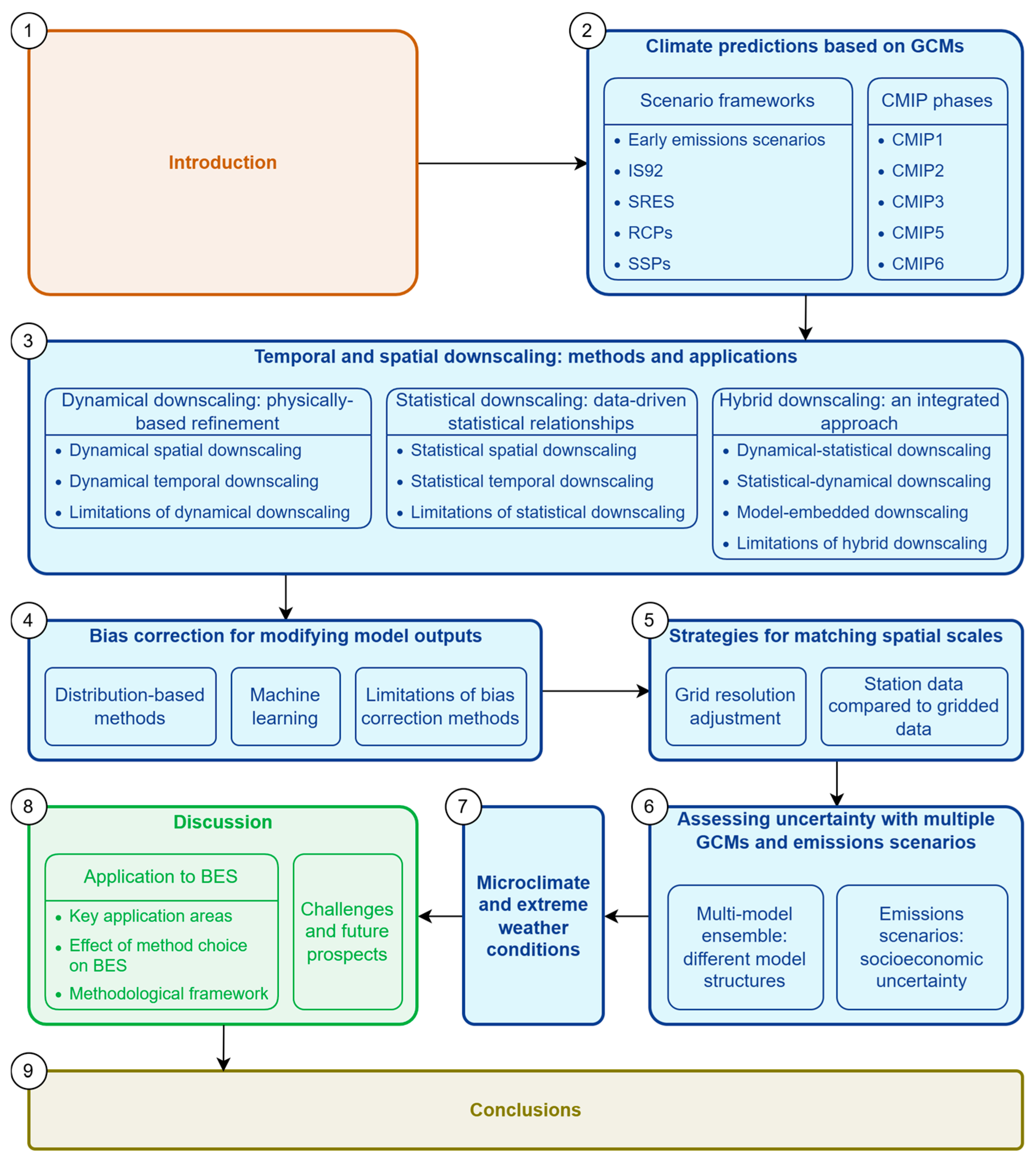
2. Climate Predictions Based on General Circulation Models
3. Temporal and Spatial Downscaling: Methods and Applications
3.1. Dynamical Downscaling: Physically Based Refinement
3.1.1. Dynamical Spatial Downscaling
3.1.2. Dynamical Temporal Downscaling
3.1.3. Limitations of Dynamical Downscaling
3.2. Statistical Downscaling: Data-Driven Statistical Relationships
3.2.1. Statistical Spatial Downscaling
- Kriging: provides the best linear unbiased prediction (e.g., [70]).
- Inverse Distance Weighting: provides a proximity-based deterministic estimation (e.g., [71]).
- Spline interpolation: generates a smoothed surface from data points (e.g., [72]).
3.2.2. Statistical Temporal Downscaling
- x = predicted hourly value;
- x0 = baseline hourly value for a weather variable;
- ∆xm = a predicted absolute change in monthly mean value.
- x = predicted hourly value;
- αm = a predicted relative change in monthly mean value;
- x0 = baseline hourly value for a weather variable.
- x = predicted hourly value;
- x0 = baseline hourly value for a weather variable;
- ∆xm = a predicted absolute change in monthly mean value;
- αm = a predicted relative change in monthly mean value;
- = baseline monthly mean value for a weather variable.
3.2.3. Limitations of Statistical Downscaling
3.3. Hybrid Downscaling: An Integrated Approach
3.3.1. Dynamical-Statistical Downscaling
3.3.2. Statistical-Dynamical Downscaling
3.3.3. Model-Embedded Downscaling
- PIML: PIML integrates physical principles and domain knowledge into models, enabling the creation of physically consistent models with enhanced capabilities such as increased data efficiency and an accelerated training process [87]. Therefore, machine learning models are designed to obey the physical principles (e.g., conservation laws) by incorporating these physical principles into the loss function or model architecture. For instance, Feng et al. [88] developed a physics-informed neural network framework for downscaling river flow simulations to the subgrid scale. By embedding the Saint-Venant equations into the learning objective, the model achieves satisfactory accuracy in downscaling river flow from a coarse grid with limited observational data assimilated, demonstrating the effectiveness of the PIML strategy for downscaling. Additional approaches to integrate physics into machine learning for weather and climate modeling are summarized by Kashinath et al. [87].
- Parameterization replacement: a trained machine learning model (e.g., artificial neural networks [89]) is used to replace specific, computationally expensive physical parameterization schemes, offering a pathway to more efficient climate simulations.
3.3.4. Limitations of Hybrid Downscaling
4. Bias Correction for Modifying Model Outputs
4.1. Distribution-Based Methods
4.2. Machine Learning
4.3. Limitations of Bias Correction Methods
5. Strategies for Matching Spatial Scales
5.1. Grid Resolution Adjustment
5.2. Station Data Compared to Gridded Data
6. Assessing Uncertainty with Multiple General Circulation Models and Emissions Scenarios
6.1. Multi-Model Ensemble: Different Model Structures
6.2. Emissions Scenarios: Socioeconomic Uncertainty
7. Microclimate and Extreme Weather Conditions
8. Discussion
8.1. Application to Building Energy Simulation
8.1.1. Key Application Areas
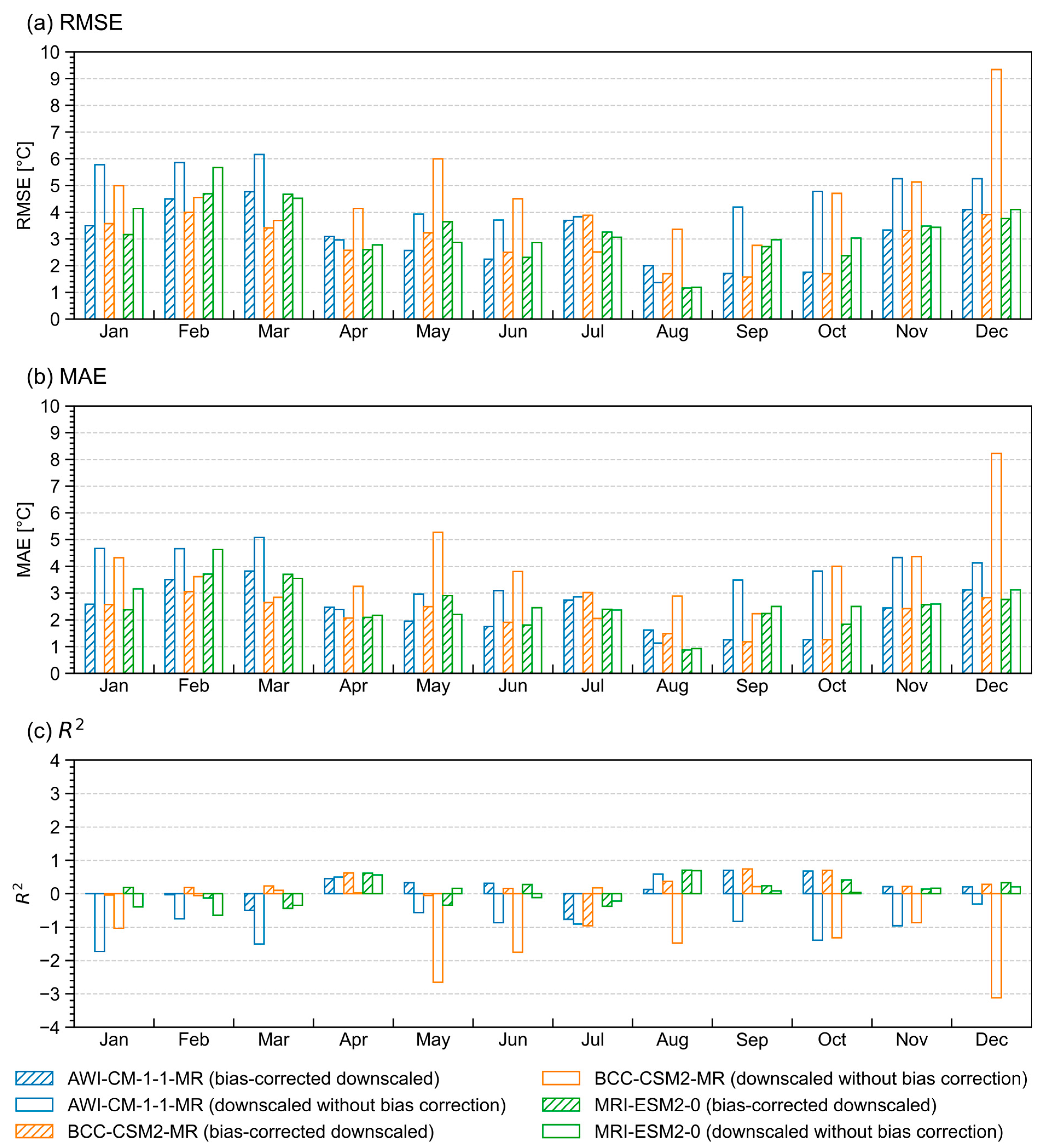
8.1.2. Effect of Method Choice on Building Energy Simulation
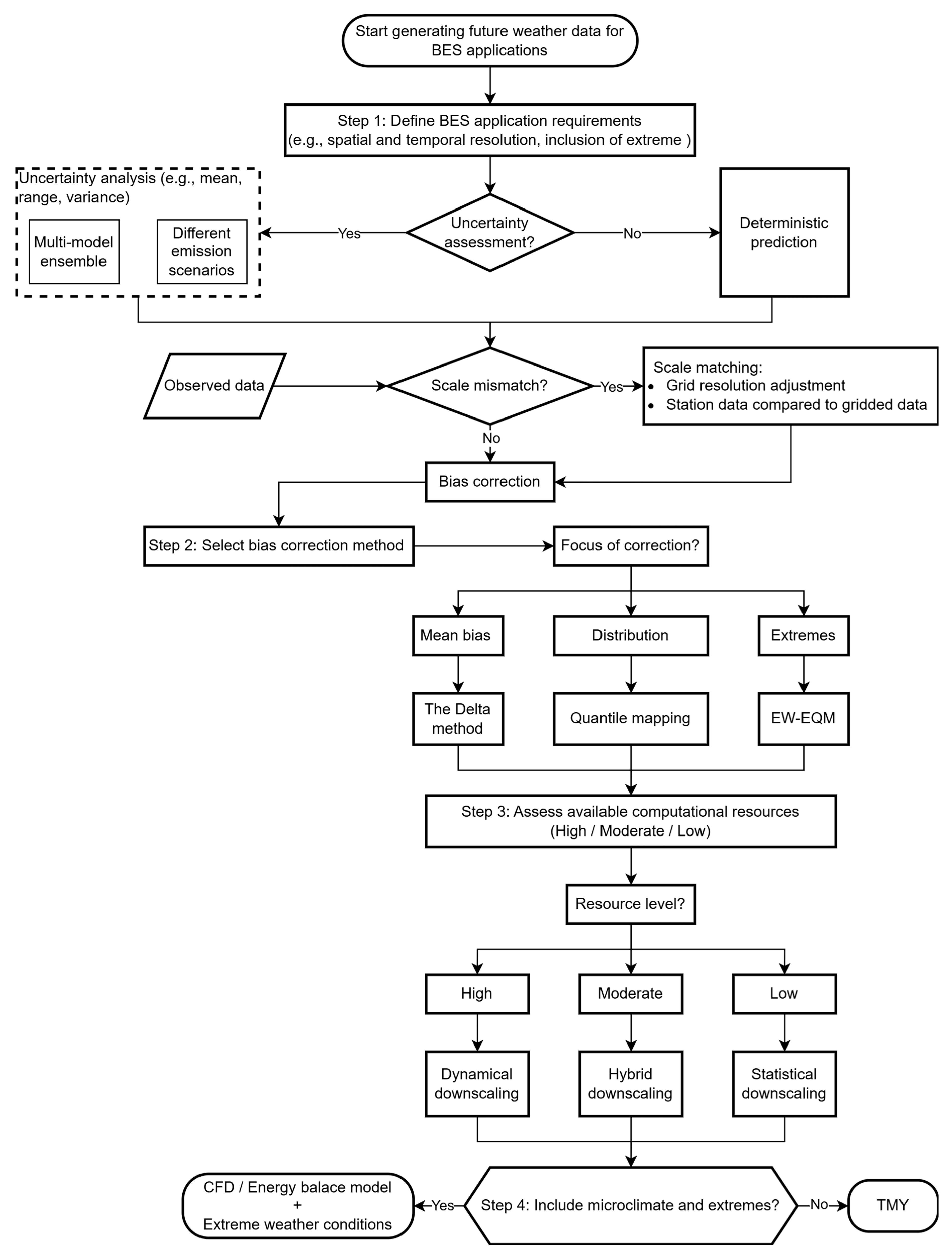
8.1.3. Methodological Framework
- Xbc,proj = bias-corrected projected air temperature [°C];
- Xref,base = reference air temperature during the baseline period [°C];
- ∆X = temperature change factor [°C].
- dbt = predicted hourly air temperature [°C];
- dbt0 = baseline hourly air temperature [°C];
- ∆TEMPm = predicted change in monthly mean air temperature [°C];
- αdbtm = scaling factor for stretching;
- = baseline monthly mean air temperature [°C].
- αdbtm = scaling factor for stretching;
- ∆TMAXm = predicted change in monthly mean daily maximum air temperature [°C];
- ∆TMINm = predicted change in monthly mean daily minimum air temperature [°C];
- = baseline monthly mean daily maximum air temperature [°C];
- = baseline monthly mean daily minimum air temperature [°C].
8.2. Challenges and Future Prospects
9. Conclusions
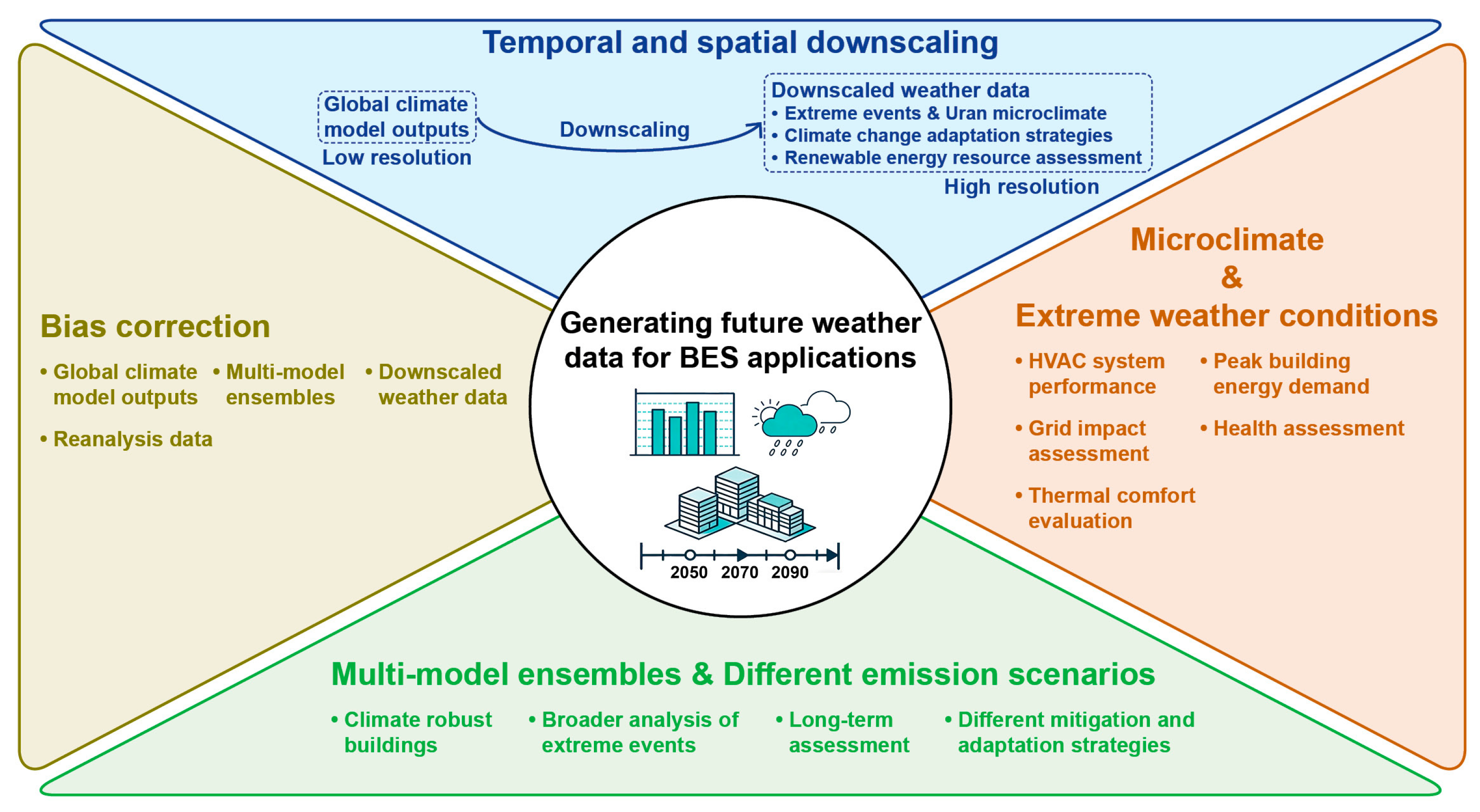
- Dynamical downscaling with RCMs enables high-resolution simulations of local climate conditions, often with high computational costs. Statistical downscaling requires relatively low computational resources, but it depends on the availability of observational data and can be constrained by historical records. The use of hybrid downscaling requires careful evaluation based on the application context, due to the respective advantages and limitations of dynamical and statistical downscaling.
- Bias correction reduces the systematic errors in GCM outputs and their downscaled results, but its dependence on the stationarity assumption may limit its applicability in BES, especially for extreme weather events.
- The selection of methods for downscaling and bias correction involves different trade-offs, requiring consideration of specific characteristics of model-variable-region combinations.
- Differences in GCM structures and socioeconomic development pathways highlight the necessity of employing a multi-model ensemble approach and probability analysis to address uncertainties in future weather predictions.
- The inclusion of microclimate data in future weather files enables the integration of local weather conditions into BES. Furthermore, the consideration of extreme weather conditions shifts the focus of building design from responding to typical weather conditions to achieving resilience to extreme weather events.
Author Contributions
Funding
Data Availability Statement
Conflicts of Interest
Abbreviations
| Baseline monthly mean value for a weather variable | |
| ∆X | Temperature change factor (°C) |
| ∆xm | Predicted absolute change in monthly mean value |
| AR4 | Fourth Assessment Report |
| AR5 | Fifth Assessment Report |
| AR6 | Sixth Assessment Report |
| BES | Building energy simulation |
| CDD | Cooling degree days (°C⋅day) |
| CFD | Computational Fluid Dynamics |
| CMIP | Coupled Model Intercomparison Project |
| D | Total number of days |
| Dis_T_F | Statistical distribution-based transfer functions |
| DM | Delta Multiplicative |
| DQM | Detrended Quantile Mapping |
| ECMWF | European Centre for Medium-Range Weather Forecasts |
| EQM | Empirical Quantile Mapping |
| ERA5-Land | The fifth generation European Centre for Medium-Range Weather Forecasts reanalysis-Land |
| ESGF | Earth System Grid Federation |
| EVS | Explained Variance Score |
| EW-EQM | Extremes-Weighted Empirical Quantile Mapping |
| FDCs | Flow duration curves |
| Fx(⋅) | Cumulative distribution function |
| GAN | Generative Adversarial Network |
| GCM | General circulation model/Global climate model |
| GP regression | Gaussian process regression |
| H/L | High/Large |
| HDD | Heating degree days (°C⋅day) |
| Ht | Hourly exceedance conditions |
| HVAC | Heating, ventilation and air conditioning |
| IPCC | Intergovernmental Panel on Climate Change |
| IS92 | IPCC 1992 emissions scenarios |
| JSD | Jensen–Shannon divergence |
| KGE | Kling–Gupta efficiency |
| KS test | Kolmogorov–Smirnov test |
| L/S | Low/Small |
| LS | Linear scaling |
| LSTM | Long Short-Term Memory |
| LT | Linear Transformation |
| M | Moderate |
| MAE | Mean Absolute Error |
| MdAE | Median Absolute Error |
| MIP | Model Intercomparison Project |
| MSLE | Mean Squared Logarithmic Error |
| N | Number of hours exceeding a threshold |
| n | Number of hours |
| Nm | Minimum number of consecutive days |
| NSE | Nash–Sutcliffe Efficiency |
| Pbias | Percent bias |
| PIML | Physics-informed machine learning |
| PR | Polynomial Regression |
| PSS | Perkins Skill Score |
| QDM | Quantile Delta Mapping |
| QM | Quantile Mapping |
| R2 | Coefficient of Determination |
| RCM | Regional Climate Model |
| RCP | Representative Concentration Pathway |
| RMSE | Root Mean Square Error |
| SAR | Second Assessment Report |
| SRES | Special Report on Emissions Scenarios |
| SSP | Shared Socioeconomic Pathway |
| Ta | Daily ambient temperature (e.g., daily maximum temperature, °C) |
| TAR | Third Assessment Report |
| Tb | Base temperature (°C) |
| Td | Daily average outdoor dry-bulb temperature on day d (°C) |
| Th | Air temperature at hour h in the period p (°C) |
| Ttd | Threshold (°C) |
| TMY | Typical meteorological year |
| Maximum temperature in the period p (°C) | |
| Tr | Return period (years) |
| UHI | Urban Heat Island |
| UWG | Urban Weather Generator |
| x | Predicted hourly values |
| x0 | Baseline hourly values for a weather variable |
| Xbc,proj | Bias-corrected projected air temperature (°C) |
| Xgcm,base | GCM-simulated air temperature during the baseline period (°C) |
| Xgcm,proj | GCM-simulated projected air temperature (°C) |
| Xh | Hourly threshold (e.g., outdoor dry-bulb temperature, °C) |
| Xref,base | Reference air temperature during the baseline period (°C) |
| Xt | Hourly variable (e.g., outdoor dry-bulb temperature, °C) |
| Return level (e.g., air temperature, °C) | |
| Morphed hourly air temperature | |
| Average air temperature | |
| yi | Hourly air temperature |
| αm | Predicted relative change in monthly mean value |
References
- Fan, Y.; Fang, C. GHG Emissions and Energy Consumption of Residential Buildings—A Systematic Review and Meta-Analysis. Environ. Monit. Assess. 2023, 195, 885. [Google Scholar] [CrossRef]
- González-Torres, M.; Pérez-Lombard, L.; Coronel, J.F.; Maestre, I.R.; Yan, D. A Review on Buildings Energy Information: Trends, End-Uses, Fuels and Drivers. Energy Rep. 2022, 8, 626–637. [Google Scholar] [CrossRef]
- Albers, R.A.W.; Bosch, P.R.; Blocken, B.; van den Dobbelsteen, A.A.J.F.; van Hove, L.W.A.; Spit, T.J.M.; van de Ven, F.; van Hooff, T.; Rovers, V. Overview of Challenges and Achievements in the Climate Adaptation of Cities and in the Climate Proof Cities Program. Build. Environ. 2015, 83, 1–10. [Google Scholar] [CrossRef]
- Vasaturo, R.; van Hooff, T.; Kalkman, I.; Blocken, B.; van Wesemael, P. Impact of Passive Climate Adaptation Measures and Building Orientation on the Energy Demand of a Detached Lightweight Semi-Portable Building. Build. Simul. 2018, 11, 1163–1177. [Google Scholar] [CrossRef]
- Fumo, N. A Review on the Basics of Building Energy Estimation. Renew. Sustain. Energy Rev. 2014, 31, 53–60. [Google Scholar] [CrossRef]
- Xu, P.; Huang, Y.J.; Miller, N.; Schlegel, N.; Shen, P. Impacts of Climate Change on Building Heating and Cooling Energy Patterns in California. Energy 2012, 44, 792–804. [Google Scholar] [CrossRef]
- Kutty, N.A.; Barakat, D.; Darsaleh, A.O.; Kim, Y.K. A Systematic Review of Climate Change Implications on Building Energy Consumption: Impacts and Adaptation Measures in Hot Urban Desert Climates. Buildings 2024, 14, 13. [Google Scholar] [CrossRef]
- Jafarpur, P.; Berardi, U. Effects of Climate Changes on Building Energy Demand and Thermal Comfort in Canadian Office Buildings Adopting Different Temperature Setpoints. J. Build. Eng. 2021, 42, 102725. [Google Scholar] [CrossRef]
- van Hooff, T.; Blocken, B.; Hensen, J.L.M.; Timmermans, H.J.P. On the Predicted Effectiveness of Climate Adaptation Measures for Residential Buildings. Build. Environ. 2014, 82, 300–316. [Google Scholar] [CrossRef]
- Perkins, S.E.; Alexander, L. V On the Measurement of Heat Waves. J. Clim. 2013, 26, 4500–4517. [Google Scholar] [CrossRef]
- van Hooff, T.; Blocken, B.; Timmermans, H.J.P.; Hensen, J.L.M. Analysis of the Predicted Effect of Passive Climate Adaptation Measures on Energy Demand for Cooling and Heating in a Residential Building. Energy 2016, 94, 811–820. [Google Scholar] [CrossRef]
- Lei, M.; van Hooff, T.; Blocken, B.; Pereira Roders, A. The Predicted Effect of Climate Change on Indoor Overheating of Heritage Apartments in Two Different Chinese Climate Zones. Indoor Built Environ. 2022, 31, 1986–2006. [Google Scholar] [CrossRef]
- Woldemeskel, F.M.; Sharma, A.; Sivakumar, B.; Mehrotra, R. Quantification of Precipitation and Temperature Uncertainties Simulated by CMIP3 and CMIP5 Models. J. Geophys. Res. Atmos. 2016, 121, 3–17. [Google Scholar] [CrossRef]
- Maraun, D.; Wetterhall, F.; Ireson, A.M.; Chandler, R.E.; Kendon, E.J.; Widmann, M.; Brienen, S.; Rust, H.W.; Sauter, T.; Themeßl, M.; et al. Precipitation Downscaling under Climate Change: Recent Developments to Bridge the Gap between Dynamical Models and the End User. Rev. Geophys. 2010, 48, RG3003. [Google Scholar] [CrossRef]
- Liu, S.; Kwok, Y.T.; Lau, K.K.-L.; Tong, H.W.; Chan, P.W.; NG, E. Development and Application of Future Design Weather Data for Evaluating the Building Thermal-Energy Performance in Subtropical Hong Kong. Energy Build. 2020, 209, 109696. [Google Scholar] [CrossRef]
- Belcher, S.; Hacker, J.; Powell, D. Constructing Design Weather Data for Future Climates. Build. Serv. Eng. Res. Technol. 2005, 26, 49–61. [Google Scholar] [CrossRef]
- Bhanage, V.; Lee, H.S.; Kubota, T.; Pradana, R.P.; Fajary, F.R.; Arya Putra, I.D.G.; Nimiya, H. City-Wise Assessment of Suitable CMIP6 GCM in Simulating Different Urban Meteorological Variables over Major Cities in Indonesia. Climate 2023, 11, 100. [Google Scholar] [CrossRef]
- Lei, M.; van Hooff, T.; Blocken, B.; Pereira Roders, A. The Predicted Effect of Preservation Scenarios on Indoor Overheating for the Renovation of Heritage-Listed Apartment-Style Lilong Houses in Shanghai under Climate Change. Built Herit. 2025, 9, 16. [Google Scholar] [CrossRef]
- Chan, A.L.S.; Chow, T.T.; Fong, S.K.F.; Lin, J.Z. Generation of a Typical Meteorological Year for Hong Kong. Energy Convers. Manag. 2006, 47, 87–96. [Google Scholar] [CrossRef]
- Pissimanis, D.; Karras, G.; Notaridou, V.; Gavra, K. The Generation of a “Typical Meteorological Year” for the City of Athens. Sol. Energy 1988, 40, 405–411. [Google Scholar] [CrossRef]
- Wilcox, S.; Marion, W. Users Manual for TMY3 Data Sets; Technical Report NREL/TP-581-43156; National Renewable Energy Laboratory: Golden, Colorado, USA, 2008. [Google Scholar]
- Hall, I.J.; Prairie, R.R.; Anderson, H.E.; Boes, E.C. Generation of a Typical Meteorological Year; Sandia National Laboratories: Albuquerque, NM, USA, 1978. [Google Scholar]
- Yang, L.; Lam, J.C.; Liu, J.; Tsang, C.L. Building Energy Simulation Using Multi-Years and Typical Meteorological Years in Different Climates. Energy Convers. Manag. 2008, 49, 113–124. [Google Scholar] [CrossRef]
- Sun, J.; Li, Z.; Li, C.; Feng, X. Effect of Typical Meteorological Year Selection on Integrated Daylight Modeling and Building Energy Simulation. Low-Carbon Mater. Green Constr. 2023, 1, 14. [Google Scholar] [CrossRef]
- Moazami, A.; Nik, V.M.; Carlucci, S.; Geving, S. Impacts of Future Weather Data Typology on Building Energy Performance—Investigating Long-Term Patterns of Climate Change and Extreme Weather Conditions. Appl. Energy 2019, 238, 696–720. [Google Scholar] [CrossRef]
- Pan, R.; Xie, M.; Chen, M.; Zhang, Y.; Ma, J.; Zhou, J. The Impact of Heat Waves on the Mortality of Chinese Population: A Systematic Review and Meta-Analysis. Medicine 2023, 102, e33345. [Google Scholar] [CrossRef] [PubMed]
- Tong, S.; Wang, X.Y.; Yu, W.; Chen, D.; Wang, X. The Impact of Heatwaves on Mortality in Australia: A Multicity Study. BMJ Open 2014, 4, e003579. [Google Scholar] [CrossRef]
- D’Ippoliti, D.; Michelozzi, P.; Marino, C.; De’Donato, F.; Menne, B.; Katsouyanni, K.; Kirchmayer, U.; Analitis, A.; Medina-Ramón, M.; Paldy, A.; et al. The Impact of Heat Waves on Mortality in 9 European Cities: Results from the EuroHEAT Project. Environ. Health 2010, 9, 37. [Google Scholar] [CrossRef]
- Yau, Y.H.; Hasbi, S. A Review of Climate Change Impacts on Commercial Buildings and Their Technical Services in the Tropics. Renew. Sustain. Energy Rev. 2013, 18, 430–441. [Google Scholar] [CrossRef]
- Li, Y.; Wang, W.; Wang, Y.; Xin, Y.; He, T.; Zhao, G. A Review of Studies Involving the Effects of Climate Change on the Energy Consumption for Building Heating and Cooling. Int. J. Environ. Res. Public Health 2021, 18, 40. [Google Scholar] [CrossRef] [PubMed]
- Bazazzadeh, H.; Nadolny, A.; Safaei, S.S.H. Climate Change and Building Energy Consumption: A Review of the Impact of Weather Parameters Influenced by Climate Change on Household Heating and Cooling Demands of Buildings. Eur. J. Sustain. Dev. 2021, 10, 1–12. [Google Scholar] [CrossRef]
- Li, D.H.W.; Yang, L.; Lam, J.C. Impact of Climate Change on Energy Use in the Built Environment in Different Climate Zones—A Review. Energy 2012, 42, 103–112. [Google Scholar] [CrossRef]
- Campagna, L.M.; Fiorito, F. On the Impact of Climate Change on Building Energy Consumptions: A Meta-Analysis. Energies 2022, 15, 354. [Google Scholar] [CrossRef]
- Tajuddeen, I.; Sajjadian, S.M. Climate Change and the Built Environment—A Systematic Review. Environ. Dev. Sustain. 2024, 28, 549–590. [Google Scholar] [CrossRef]
- Barbosa, R.; Vicente, R.; Santos, R. Comfort and Buildings: Climate Change Vulnerability and Strategies. Int. J. Clim. Change Strateg. Manag. 2016, 8, 670–688. [Google Scholar] [CrossRef]
- Herrera, M.; Natarajan, S.; Coley, D.A.; Kershaw, T.; Ramallo-González, A.P.; Eames, M.; Fosas, D.; Wood, M. A Review of Current and Future Weather Data for Building Simulation. Build. Serv. Eng. Res. Technol. 2017, 38, 602–627. [Google Scholar] [CrossRef]
- Ren, Z. A Literature Review on the Use of Weather Data for Building Thermal Simulations. Energies 2025, 18, 3653. [Google Scholar] [CrossRef]
- Yassaghi, H.; Hoque, S. An Overview of Climate Change and Building Energy: Performance, Responses and Uncertainties. Buildings 2019, 9, 166. [Google Scholar] [CrossRef]
- IPCC. Climate Change: The IPCC Scientific Assessment; Houghton, J.T., Jenkins, G.J., Ephraums, J.J., Eds.; Cambridge University Press: Cambridge, UK, 1990. [Google Scholar]
- IPCC. Climate Change 1992: The Supplementary Report to the IPCC Scientific Assessment; Houghton, J.T., Callander, B.A., Varney, S.K., Eds.; Cambridge University Press: Cambridge, UK, 1992. [Google Scholar]
- IPCC. Climate Change 1995: The Science of Climate Change. Contribution of Working Group I to the Second Assessment Report of the Intergovernmental Panel on Climate Change; Houghton, J.T., Filho Meira, L.G., Callander, B.A., Harris, N., Kattenberg, A., Maskell, K., Eds.; Cambridge University Press: Cambridge, UK, 1996. [Google Scholar]
- IPCC. Special Report on Emissions Scenarios. A Special Report of Working Group III of the Intergovernmental Panel on Climate Change; Nakićenović, N., Swart, R., Eds.; Cambridge University Press: Cambridge, UK, 2000. [Google Scholar]
- IPCC. Climate Change 2001: The Scientific Basis. Contribution of Working Group I to the Third Assessment Report of the Intergovernmental Panel on Climate Change; Houghton, J.T., Ding, Y., Griggs, D.J., Noguer, M., van der Linden, P.J., Dai, X., Maskell, K., Johnson, C.A., Eds.; Cambridge University Press: Cambridge, UK; New York, NY, USA, 2001. [Google Scholar]
- IPCC. Climate Change 2007: The Physical Science Basis. Contribution of Working Group I to the Fourth Assessment Report of the Intergovernmental Panel on Climate Change; Solomon, S., Qin, D., Manning, M., Chen, Z., Marquis, M., Averyt, K.B., Tignor, M., Miller, H.L., Eds.; Cambridge University Press: Cambridge, UK; New York, NY, USA, 2007. [Google Scholar]
- van Vuuren, D.P.; Edmonds, J.; Kainuma, M.; Riahi, K.; Thomson, A.; Hibbard, K.; Hurtt, G.C.; Kram, T.; Krey, V.; Lamarque, J.-F.; et al. The Representative Concentration Pathways: An Overview. Clim. Change 2011, 109, 5–31. [Google Scholar] [CrossRef]
- Moss, R.H.; Edmonds, J.A.; Hibbard, K.A.; Manning, M.R.; Rose, S.K.; van Vuuren, D.P.; Carter, T.R.; Emori, S.; Kainuma, M.; Kram, T.; et al. The next Generation of Scenarios for Climate Change Research and Assessment. Nature 2010, 463, 747–756. [Google Scholar] [CrossRef]
- IPCC. Climate Change 2013: The Physical Science Basis. Contribution of Working Group I to the Fifth Assessment Report of the Intergovernmental Panel on Climate Change; Stocker, T.F., Qin, D., Plattner, G.-K., Tignor, M., Allen, S.K., Boschung, J., Nauels, A., Xia, Y., Bex, V., Midgley, P.M., Eds.; Cambridge University Press: Cambridge, UK; New York, NY, USA, 2013. [Google Scholar]
- O’Neill, B.C.; Kriegler, E.; Ebi, K.L.; Kemp-Benedict, E.; Riahi, K.; Rothman, D.S.; van Ruijven, B.J.; van Vuuren, D.P.; Birkmann, J.; Kok, K.; et al. The Roads Ahead: Narratives for Shared Socioeconomic Pathways Describing World Futures in the 21st Century. Glob. Environ. Change 2017, 42, 169–180. [Google Scholar] [CrossRef]
- van Vuuren, D.P.; Kriegler, E.; O’Neill, B.C.; Ebi, K.L.; Riahi, K.; Carter, T.R.; Edmonds, J.; Hallegatte, S.; Kram, T.; Mathur, R.; et al. A New Scenario Framework for Climate Change Research: Scenario Matrix Architecture. Clim. Change 2014, 122, 373–386. [Google Scholar] [CrossRef]
- IPCC. Climate Change 2021: The Physical Science Basis. Contribution of Working Group I to the Sixth Assessment Report of the Intergovernmental Panel on Climate Change; Masson-Delmotte, V., Zhai, P., Pirani, A., Connors, S.L., Péan, C., Berger, S., Caud, N., Chen, Y., Goldfarb, L., Gomis, M.I., et al., Eds.; Cambridge University Press: Cambridge, UK; New York, NY, USA, 2021. [Google Scholar]
- Fan, X.; Miao, C.; Gou, J.; Wu, Y.; Zhang, Q. Coupled Model Intercomparison Project and Its Research Progress in Simulation Performance. Prog. Geogr. 2023, 42, 1204–1215. (In Chinese) [Google Scholar] [CrossRef]
- Wang, L.; Liu, X.; Brown, H. Prediction of the Impacts of Climate Change on Energy Consumption for a Medium-Size Office Building with Two Climate Models. Energy Build. 2017, 157, 218–226. [Google Scholar] [CrossRef]
- Covey, C.; AchutaRao, K.M.; Cubasch, U.; Jones, P.; Lambert, S.J.; Mann, M.E.; Phillips, T.J.; Taylor, K.E. An Overview of Results from the Coupled Model Intercomparison Project. Glob. Planet. Change 2003, 37, 103–133. [Google Scholar] [CrossRef]
- Meehl, G.A.; Boer, G.J.; Covey, C.; Latif, M.; Stouffer, R.J. The Coupled Model Intercomparison Project (CMIP). Bull. Am. Meteorol. Soc. 2000, 81, 313–318. [Google Scholar] [CrossRef]
- Touzé-Peiffer, L.; Barberousse, A.; Le Treut, H. The Coupled Model Intercomparison Project: History, Uses, and Structural Effects on Climate Research. WIREs Clim. Change 2020, 11, e648. [Google Scholar] [CrossRef]
- Soares, P.M.M.; Lemos, G.; Lima, D.C.A. Critical Analysis of CMIPs Past Climate Model Projections in a Regional Context: The Iberian Climate. Int. J. Climatol. 2023, 43, 2250–2270. [Google Scholar] [CrossRef]
- Eyring, V.; Bony, S.; Meehl, G.A.; Senior, C.A.; Stevens, B.; Stouffer, R.J.; Taylor, K.E. Overview of the Coupled Model Intercomparison Project Phase 6 (CMIP6) Experimental Design and Organization. Geosci. Model Dev. 2016, 9, 1937–1958. [Google Scholar] [CrossRef]
- Meehl, G.A.; Covey, C.; Delworth, T.; Latif, M.; McAvaney, B.; Mitchell, J.F.B.; Stouffer, R.J.; Taylor, K.E. THE WCRP CMIP3 Multimodel Dataset: A New Era in Climate Change Research. Bull. Am. Meteorol. Soc. 2007, 88, 1383–1394. [Google Scholar] [CrossRef]
- Taylor, K.E.; Stouffer, R.J.; Meehl, G.A. An Overview of CMIP5 and the Experiment Design. Bull. Am. Meteorol. Soc. 2012, 93, 485–498. [Google Scholar] [CrossRef]
- O’Neill, B.C.; Tebaldi, C.; van Vuuren, D.P.; Eyring, V.; Friedlingstein, P.; Hurtt, G.; Knutti, R.; Kriegler, E.; Lamarque, J.-F.; Lowe, J.; et al. The Scenario Model Intercomparison Project (ScenarioMIP) for CMIP6. Geosci. Model Dev. 2016, 9, 3461–3482. [Google Scholar] [CrossRef]
- Rummukainen, M. State-of-the-art with Regional Climate Models. WIREs Clim. Change 2010, 1, 82–96. [Google Scholar] [CrossRef]
- Zhang, G.; Zhu, S.; Zhang, N.; Zhang, G.; Xu, Y. Downscaling Hourly Air Temperature of WRF Simulations Over Complex Topography: A Case Study of Chongli District in Hebei Province, China. J. Geophys. Res. Atmos. 2022, 127, e2021JD035542. [Google Scholar] [CrossRef]
- Sharma, A.; Conry, P.; Fernando, H.J.S.; Hamlet, A.F.; Hellmann, J.J.; Chen, F. Green and Cool Roofs to Mitigate Urban Heat Island Effects in the Chicago Metropolitan Area: Evaluation with a Regional Climate Model. Environ. Res. Lett. 2016, 11, 064004. [Google Scholar] [CrossRef]
- Sachindra, D.A.; Huang, F.; Barton, A.; Perera, B.J.C. Potential Improvements to Statistical Downscaling of General Circulation Model Outputs to Catchment Streamflows with Downscaled Precipitation and Evaporation. Theor. Appl. Climatol. 2015, 122, 159–179. [Google Scholar] [CrossRef]
- Samuelsson, P.; Jones, C.G.; Willén, U.; Ullerstig, A.; Gollvik, S.; Hansson, U.; Jansson, C.; Kjellström, E.; Nikulin, G.; Wyser, K. The Rossby Centre Regional Climate Model RCA3: Model Description and Performance. Tellus A Dyn. Meteorol. Oceanogr. 2011, 63, 4–23. [Google Scholar] [CrossRef]
- Hanel, M.; Buishand, T.A. On the Value of Hourly Precipitation Extremes in Regional Climate Model Simulations. J. Hydrol. 2010, 393, 265–273. [Google Scholar] [CrossRef]
- Wu, J.; Gao, X. Present Day Bias and Future Change Signal of Temperature over China in a Series of Multi-GCM Driven RCM Simulations. Clim. Dyn. 2020, 54, 1113–1130. [Google Scholar] [CrossRef]
- Koné, B.; Diedhiou, A.; Touré, N.E.; Sylla, M.B.; Giorgi, F.; Anquetin, S.; Bamba, A.; Diawara, A.; Kobea, A.T. Sensitivity Study of the Regional Climate Model RegCM4 to Different Convective Schemes over West Africa. Earth Syst. Dyn. 2018, 9, 1261–1278. [Google Scholar] [CrossRef]
- Jacobeit, J.; Hertig, E.; Seubert, S.; Lutz, K. Statistical Downscaling for Climate Change Projections in the Mediterranean Region: Methods and Results. Reg. Environ. Change 2014, 14, 1891–1906. [Google Scholar] [CrossRef]
- Li, M.; Shao, Q.; Renzullo, L. Estimation and Spatial Interpolation of Rainfall Intensity Distribution from the Effective Rate of Precipitation. Stoch. Environ. Res. Risk Assess. 2010, 24, 117–130. [Google Scholar] [CrossRef]
- Ipek, A.F.; Altas, A.; Serencam, U.; Dabanli, I. Spatio-Temporal Drought Assessment by Using the Innovative Probability of Drought Severity (PDS) Method. Water Resour. Manag. 2025, 39, 5135–5150. [Google Scholar] [CrossRef]
- Bergonse, R.; Reis, E. Reconstructing Pre-Erosion Topography Using Spatial Interpolation Techniques: A Validation-Based Approach. J. Geogr. Sci. 2015, 25, 196–210. [Google Scholar] [CrossRef]
- Bhakare, S.; Matiu, M.; Zardi, D. Spatial Downscaling of Daily Precipitation Using Convolutional Neural Network-Based Model in Complex Mountainous Terrain: Trentino and South Tyrol, Northern Italy. J. Hydrol. Reg. Stud. 2025, 61, 102591. [Google Scholar] [CrossRef]
- Chan, A.L.S. Developing Future Hourly Weather Files for Studying the Impact of Climate Change on Building Energy Performance in Hong Kong. Energy Build. 2011, 43, 2860–2868. [Google Scholar] [CrossRef]
- Bravo Dias, J.; Carrilho da Graça, G.; Soares, P.M.M. Comparison of Methodologies for Generation of Future Weather Data for Building Thermal Energy Simulation. Energy Build. 2020, 206, 109556. [Google Scholar] [CrossRef]
- Meteotest Meteonorm Handbook Part I: Software. Available online: https://meteonorm.com/assets/downloads/mn80_software.pdf (accessed on 13 February 2021).
- Yaoming, L.; Qiang, Z.; Deliang, C. Stochastic Modeling of Daily Precipitation in China. J. Geogr. Sci. 2004, 14, 417–426. [Google Scholar] [CrossRef]
- van Paassen, A.H.; Luo, Q.X. Weather Data Generator to Study Climate Change on Buildings. Build. Serv. Eng. Res. Technol. 2002, 23, 251–258. [Google Scholar] [CrossRef]
- Mangukiya, N.K.; Sharma, A. Deep Learning-Based Approach for Enhancing Streamflow Prediction in Watersheds with Aggregated and Intermittent Observations. Water Resour. Res. 2025, 61, e2024WR037331. [Google Scholar] [CrossRef]
- Al Kajbaf, A.; Bensi, M.; Brubaker, K.L. Temporal Downscaling of Precipitation from Climate Model Projections Using Machine Learning. Stoch. Environ. Res. Risk Assess. 2022, 36, 2173–2194. [Google Scholar] [CrossRef]
- Malik, S.; Kang, E.; Kang, Y.; Im, J. Bridging Temporal Gaps: AI-Based Temporal Downscaling of Biweekly NH3 to Daily Scale with Spatial Transferability. J. Hazard. Mater. 2025, 496, 139166. [Google Scholar] [CrossRef]
- Dixon, K.W.; Lanzante, J.R.; Nath, M.J.; Hayhoe, K.; Stoner, A.; Radhakrishnan, A.; Balaji, V.; Gaitán, C.F. Evaluating the Stationarity Assumption in Statistically Downscaled Climate Projections: Is Past Performance an Indicator of Future Results? Clim. Change 2016, 135, 395–408. [Google Scholar] [CrossRef]
- Araya-Osses, D.; Casanueva, A.; Román-Figueroa, C.; Uribe, J.M.; Paneque, M. Climate Change Projections of Temperature and Precipitation in Chile Based on Statistical Downscaling. Clim. Dyn. 2020, 54, 4309–4330. [Google Scholar] [CrossRef]
- Jebeile, J.; Lam, V.; Räz, T. Understanding Climate Change with Statistical Downscaling and Machine Learning. Synthese 2021, 199, 1877–1897. [Google Scholar] [CrossRef]
- Tran Anh, Q.; Taniguchi, K. Coupling Dynamical and Statistical Downscaling for High-Resolution Rainfall Forecasting: Case Study of the Red River Delta, Vietnam. Prog. Earth Planet. Sci. 2018, 5, 28. [Google Scholar] [CrossRef]
- Lauer, A.; Devaney, J.; Kieu, C.; Kravitz, B.; O’Brien, T.A.; Robeson, S.M.; Staten, P.W.; Vu, T.A. A Convection-permitting Dynamically Downscaled Dataset over the Midwestern United States. Geosci. Data J. 2023, 10, 429–446. [Google Scholar] [CrossRef]
- Kashinath, K.; Mustafa, M.; Albert, A.; Wu, J.-L.; Jiang, C.; Esmaeilzadeh, S.; Azizzadenesheli, K.; Wang, R.; Chattopadhyay, A.; Singh, A.; et al. Physics-Informed Machine Learning: Case Studies for Weather and Climate Modelling. Philos. Trans. R. Soc. A Math. Phys. Eng. Sci. 2021, 379, 20200093. [Google Scholar] [CrossRef]
- Feng, D.; Tan, Z.; He, Q. Physics-Informed Neural Networks of the Saint-Venant Equations for Downscaling a Large-Scale River Model. Water Resour. Res. 2023, 59, e2022WR033168. [Google Scholar] [CrossRef]
- Weber, A.; Köcher, G.; Mayer, B. Parameterization of 3D Cloud Geometry and a Neural-Network-Based Fast Forward Operator for Polarized Radiative Transfer. Atmos. Meas. Tech. 2025, 18, 5805–5821. [Google Scholar] [CrossRef]
- Cavus, M.; Jiang, J.; Allahham, A.; Sun, H. A Physics-Informed Machine Learning Framework for Climate-Aware Digital Twins in Decentralised Energy Systems. Appl. Energy 2026, 416, 128013. [Google Scholar] [CrossRef]
- Reddy, P.J.; Matear, R.; Taylor, J.; Thatcher, M. Limitation of Super-Resolution Machine Learning Approach to Precipitation Downscaling. Sci. Rep. 2025, 15, 30070. [Google Scholar] [CrossRef]
- Zhang, H.; Chapman, S.; Trancoso, R.; Toombs, N.; Syktus, J. Assessing the Impact of Bias Correction Approaches on Climate Extremes and the Climate Change Signal. Meteorol. Appl. 2024, 31, e2204. [Google Scholar] [CrossRef]
- Gao, X.; Sokolov, A.; Schlosser, C.A. A Large Ensemble Global Dataset for Climate Impact Assessments. Sci. Data 2023, 10, 801. [Google Scholar] [CrossRef]
- Ukumo, T.Y.; Edamo, M.L.; Abdi, D.M.; Derebe, M.A. Evaluating Water Availability under Changing Climate Scenarios in the Woybo Catchment, Ethiopia. J. Water Clim. Change 2022, 13, 4130–4149. [Google Scholar] [CrossRef]
- Prasanna, V. Statistical Bias Correction Method Applied on CMIP5 Datasets over the Indian Region during the Summer Monsoon Season for Climate Change Applications. Theor. Appl. Climatol. 2018, 131, 471–488. [Google Scholar] [CrossRef]
- Mendez, M.; Calvo-Valverde, L.-A.; Hidalgo-Madriz, J.-A.; Araya-Obando, J.-A. Assessing the Effect of Bias Correction Methods on the Development of Intensity–Duration–Frequency Curves Based on Projections from the CORDEX Central America GCM-RCM Multimodel-Ensemble. Water 2024, 16, 3473. [Google Scholar] [CrossRef]
- Hay, L.E.; Wilby, R.L.; Leavesley, G.H. A comparison of delta change and downscaled gcm scenarios for three mountainous basins in the united states. JAWRA J. Am. Water Resour. Assoc. 2000, 36, 387–397. [Google Scholar] [CrossRef]
- Niranjan Kumar, K.; Thota, M.S.; Ashrit, R.; Mitra, A.K.; Rajeevan, M.N. Quantile Mapping Bias Correction Methods to IMDAA Reanalysis for Calibrating NCMRWF Unified Model Operational Forecasts. Hydrol. Sci. J. 2022, 67, 870–885. [Google Scholar] [CrossRef]
- Cannon, A.J.; Sobie, S.R.; Murdock, T.Q. Bias Correction of GCM Precipitation by Quantile Mapping: How Well Do Methods Preserve Changes in Quantiles and Extremes? J. Clim. 2015, 28, 6938–6959. [Google Scholar] [CrossRef]
- Rohith, A.N.; Cibin, R. An Extremes-Weighted Empirical Quantile Mapping for Global Climate Model Data Bias Correction for Improved Emphasis on Extremes. Theor. Appl. Climatol. 2024, 155, 5515–5523. [Google Scholar] [CrossRef]
- Pastén-Zapata, E.; Jones, J.M.; Moggridge, H.; Widmann, M. Evaluation of the Performance of Euro-CORDEX Regional Climate Models for Assessing Hydrological Climate Change Impacts in Great Britain: A Comparison of Different Spatial Resolutions and Quantile Mapping Bias Correction Methods. J. Hydrol. 2020, 584, 124653. [Google Scholar] [CrossRef]
- Liu, S.; Raghavan, S.V.; Nguyen, N.S.; Ona, B.J.; Ngai, S.T.; Zhang, X. Improving the Regional Precipitation Simulation Corrected by Satellite Observation Using Quantile Mapping. Remote Sens. 2025, 17, 1716. [Google Scholar] [CrossRef]
- Zhang, S.; Harrop, B.; Leung, L.R.; Charalampopoulos, A.-T.; Barthel Sorensen, B.; Xu, W.; Sapsis, T. A Machine Learning Bias Correction on Large-Scale Environment of High-Impact Weather Systems in E3SM Atmosphere Model. J. Adv. Model. Earth Syst. 2024, 16, e2023MS004138. [Google Scholar] [CrossRef]
- Rampal, N.; Gibson, P.B.; Sherwood, S.; Abramowitz, G.; Hobeichi, S. A Reliable Generative Adversarial Network Approach for Climate Downscaling and Weather Generation. J. Adv. Model. Earth Syst. 2025, 17, e2024MS004668. [Google Scholar] [CrossRef]
- Tanimu, B.; Bello, A.-A.D.; Abdullahi, S.A.; Ajibike, M.A.; Yaseen, Z.M.; Kamruzzaman, M.; bin Muhammad, M.K.I.; Shahid, S. Comparison of Conventional and Machine Learning Methods for Bias Correcting CMIP6 Rainfall and Temperature in Nigeria. Theor. Appl. Climatol. 2024, 155, 4423–4452. [Google Scholar] [CrossRef]
- Le, X.-H.; Lee, G.; Jung, K.; An, H.; Lee, S.; Jung, Y. Application of Convolutional Neural Network for Spatiotemporal Bias Correction of Daily Satellite-Based Precipitation. Remote Sens. 2020, 12, 2731. [Google Scholar] [CrossRef]
- Nourani, V.; Bahghanam, A.H.; Pourali, H.; Bejani, M.; Gebremichael, M. Bias Correcting the Precipitation Dynamics of Regional Climate Models via Kernel-Aware 2D Convolutional-Long Short-Term Memory. J. Hydrol. 2025, 657, 133068. [Google Scholar] [CrossRef]
- Wang, F.; Tian, D. On Deep Learning-Based Bias Correction and Downscaling of Multiple Climate Models Simulations. Clim. Dyn. 2022, 59, 3451–3468. [Google Scholar] [CrossRef]
- Zhang, B.; Yu, H.; Hu, Z.; Yue, P.; Tang, Z.; Luo, H.; Wang, G.; Cheng, S. A Machine Learning-Based Observational Constraint Correction Method for Seasonal Precipitation Prediction. Adv. Atmos. Sci. 2025, 42, 36–52. [Google Scholar] [CrossRef]
- François, B.; Thao, S.; Vrac, M. Adjusting Spatial Dependence of Climate Model Outputs with Cycle-Consistent Adversarial Networks. Clim. Dyn. 2021, 57, 3323–3353. [Google Scholar] [CrossRef]
- Hess, P.; Drüke, M.; Petri, S.; Strnad, F.M.; Boers, N. Physically Constrained Generative Adversarial Networks for Improving Precipitation Fields from Earth System Models. Nat. Mach. Intell. 2022, 4, 828–839. [Google Scholar] [CrossRef]
- Holthuijzen, M.; Beckage, B.; Clemins, P.J.; Higdon, D.; Winter, J.M. Robust Bias-Correction of Precipitation Extremes Using a Novel Hybrid Empirical Quantile-Mapping Method. Theor. Appl. Climatol. 2022, 149, 863–882. [Google Scholar] [CrossRef]
- de Velde, J.; Demuzere, M.; De Baets, B.; Verhoest, N.E.C. Impact of Bias Nonstationarity on the Performance of Uni- and Multivariate Bias-Adjusting Methods: A Case Study on Data from Uccle, Belgium. Hydrol. Earth Syst. Sci. 2022, 26, 2319–2344. [Google Scholar] [CrossRef]
- Vidrio-Sahagún, C.T.; He, J.; Pietroniro, A. Improved Correction of Extreme Precipitation Through Explicit and Continuous Nonstationarity Treatment and the Metastatistical Approach. Water Resour. Res. 2025, 61, e2024WR037721. [Google Scholar] [CrossRef]
- Rocheta, E.; Evans, J.P.; Sharma, A. Assessing Atmospheric Bias Correction for Dynamical Consistency Using Potential Vorticity. Environ. Res. Lett. 2014, 9, 124010. [Google Scholar] [CrossRef]
- Sippel, S.; Otto, F.E.L.; Forkel, M.; Allen, M.R.; Guillod, B.P.; Heimann, M.; Reichstein, M.; Seneviratne, S.I.; Thonicke, K.; Mahecha, M.D. A Novel Bias Correction Methodology for Climate Impact Simulations. Earth Syst. Dyn. 2016, 7, 71–88. [Google Scholar] [CrossRef]
- Ehret, U.; Zehe, E.; Wulfmeyer, V.; Warrach-Sagi, K.; Liebert, J. HESS Opinions “Should We Apply Bias Correction to Global and Regional Climate Model Data?”. Hydrol. Earth Syst. Sci. 2012, 16, 3391–3404. [Google Scholar] [CrossRef]
- Kim, K.B.; Kwon, H.-H.; Han, D. Intercomparison of Joint Bias Correction Methods for Precipitation and Flow from a Hydrological Perspective. J. Hydrol. 2022, 604, 127261. [Google Scholar] [CrossRef]
- Kupilik, M.; Witmer, F.; Grill, O. Bias Estimation and Downscaling for Regional Climate Models Using Gaussian Process Regression. IEEE Access 2024, 12, 118362–118370. [Google Scholar] [CrossRef]
- Okirya, M.; Du Plessis, J.A. Evaluating Bias Correction Methods Using Annual Maximum Series Rainfall Data from Observed and Remotely Sensed Sources in Gauged and Ungauged Catchments in Uganda. Hydrology 2025, 12, 113. [Google Scholar] [CrossRef]
- Song, Y.H.; Chung, E.-S. Intercomparison of Bias Correction Methods for Precipitation of Multiple GCMs across Six Continents. Geosci. Model Dev. 2025, 18, 8017–8045. [Google Scholar] [CrossRef]
- Boudali Errebai, F.; Strebel, D.; Carmeliet, J.; Derome, D. Impact of Urban Heat Island on Cooling Energy Demand for Residential Building in Montreal Using Meteorological Simulations and Weather Station Observations. Energy Build. 2022, 273, 112410. [Google Scholar] [CrossRef]
- Rebora, N.; Silvestro, F.; Rudari, R.; Herold, C.; Ferraris, L. Downscaling Stream Flow Time Series from Monthly to Daily Scales Using an Auto-Regressive Stochastic Algorithm: StreamFARM. J. Hydrol. 2016, 537, 297–310. [Google Scholar] [CrossRef]
- Haerter, J.O.; Eggert, B.; Moseley, C.; Piani, C.; Berg, P. Statistical Precipitation Bias Correction of Gridded Model Data Using Point Measurements. Geophys. Res. Lett. 2015, 42, 1919–1929. [Google Scholar] [CrossRef]
- Zou, Y.; Xiang, K.; Zhan, Q.; Li, Z. A Simulation-Based Method to Predict the Life Cycle Energy Performance of Residential Buildings in Different Climate Zones of China. Build. Environ. 2021, 193, 107663. [Google Scholar] [CrossRef]
- Coronato, T.; Zaninelli, P.G.; Abalone, R.; Carril, A.F. Climate Change Projections for Building Energy Simulation Studies: A CORDEX-Based Methodological Approach to Manage Uncertainties. Clim. Change 2024, 177, 43. [Google Scholar] [CrossRef]
- Troup, L.; Eckelman, M.J.; Fannon, D. Simulating Future Energy Consumption in Office Buildings Using an Ensemble of Morphed Climate Data. Appl. Energy 2019, 255, 113821. [Google Scholar] [CrossRef]
- Tian, W.; de Wilde, P. Uncertainty and Sensitivity Analysis of Building Performance Using Probabilistic Climate Projections: A UK Case Study. Autom. Constr. 2011, 20, 1096–1109. [Google Scholar] [CrossRef]
- Chen, K.; Boomsma, J.; Holmes, H.A. A Multiscale Analysis of Heatwaves and Urban Heat Islands in the Western U.S. during the Summer of 2021. Sci. Rep. 2023, 13, 9570. [Google Scholar] [CrossRef]
- Goodess, C.; Berk, S.; Ratna, S.B.; Brousse, O.; Davies, M.; Heaviside, C.; Moore, G.; Pineo, H. Climate Change Projections for Sustainable and Healthy Cities. Build. Cities 2021, 2, 812–836. [Google Scholar] [CrossRef] [PubMed]
- Li, J.; Mao, Y.; Ouyang, J.; Zheng, S. A Review of Urban Microclimate Research Based on CiteSpace and VOSviewer Analysis. Int. J. Environ. Res. Public Health 2022, 19, 4741. [Google Scholar] [CrossRef]
- Tao, Z.; Sun, H.; Deng, B.; Wang, J.; Calautit, J. Integrating Computational Fluid Dynamics (CFD) and Machine Learning to Improve Urban Green Infrastructure for Heat Mitigation and Air Quality: A Systematic Review. Build. Environ. 2025, 284, 113516. [Google Scholar] [CrossRef]
- Toparlar, Y.; Blocken, B.; Maiheu, B.; van Heijst, G.J.F. A Review on the CFD Analysis of Urban Microclimate. Renew. Sustain. Energy Rev. 2017, 80, 1613–1640. [Google Scholar] [CrossRef]
- Yang, S.; Zhan, D.; Stathopoulos, T.; Zou, J.; Shu, C.; Wang, L.L. Urban Microclimate Prediction Based on Weather Station Data and Artificial Neural Network. Energy Build. 2024, 314, 114283. [Google Scholar] [CrossRef]
- Detommaso, M.; Costanzo, V.; Nocera, F. Application of Weather Data Morphing for Calibration of Urban ENVI-Met Microclimate Models. Results Crit. Issues Urban Clim. 2021, 38, 100895. [Google Scholar] [CrossRef]
- Akkose, G.; Meral Akgul, C.; Dino, I.G. Educational Building Retrofit under Climate Change and Urban Heat Island Effect. J. Build. Eng. 2021, 40, 102294. [Google Scholar] [CrossRef]
- Bruse, M.; Fleer, H. Simulating Surface–Plant–Air Interactions inside Urban Environments with a Three Dimensional Numerical Model. Environ. Model. Softw. 1998, 13, 373–384. [Google Scholar] [CrossRef]
- Crank, P.J.; Sailor, D.J.; Ban-Weiss, G.; Taleghani, M. Evaluating the ENVI-Met Microscale Model for Suitability in Analysis of Targeted Urban Heat Mitigation Strategies. Urban Clim. 2018, 26, 188–197. [Google Scholar] [CrossRef]
- Bueno, B.; Norford, L.; Hidalgo, J.; Pigeon, G. The Urban Weather Generator. J. Build. Perform. Simul. 2013, 6, 269–281. [Google Scholar] [CrossRef]
- Xu, G.; Li, J.; Shi, Y.; Feng, X.; Zhang, Y. Improvements, Extensions, and Validation of the Urban Weather Generator (UWG) for Performance-Oriented Neighborhood Planning. Urban Clim. 2022, 45, 101247. [Google Scholar] [CrossRef]
- Bande, L.; Afshari, A.; Al Masri, D.; Jha, M.; Norford, L.; Tsoupos, A.; Marpu, P.; Pasha, Y.; Armstrong, P. Validation of UWG and ENVI-Met Models in an Abu Dhabi District, Based on Site Measurements. Sustainability 2019, 11, 4378. [Google Scholar] [CrossRef]
- Yu, F.-W.; Ho, W.-T.; Wong, C.-F.J. Impact of Extreme Climates on Sustainable Cooling: A Case Study of a Subtropical Office Building. Urban Clim. 2025, 63, 102583. [Google Scholar] [CrossRef]
- Machard, A.; Salvati, A.P.; Tootkaboni, M.; Gaur, A.; Zou, J.; Wang, L.L.; Baba, F.; Ge, H.; Bre, F.; Bozonnet, E.; et al. Typical and Extreme Weather Datasets for Studying the Resilience of Buildings to Climate Change and Heatwaves. Sci. Data 2024, 11, 531. [Google Scholar] [CrossRef]
- Cao, J.; Yang, X.; Li, M. A New Approach for Selecting Extreme Meteorological Years to Support Building Energy Simulation. Energy 2025, 341, 139541. [Google Scholar] [CrossRef]
- Doutreloup, S.; Fettweis, X.; Rahif, R.; Elnagar, E.; Pourkiaei, M.S.; Amaripadath, D.; Attia, S. Historical and Future Weather Data for Dynamic Building Simulations in Belgium Using the Regional Climate Model MAR: Typical and Extreme Meteorological Year and Heatwaves. Earth Syst. Sci. Data 2022, 14, 3039–3051. [Google Scholar] [CrossRef]
- Semenov, M.A. Simulation of Extreme Weather Events by a Stochastic Weather Generator. Clim. Res. 2008, 35, 203–212. [Google Scholar] [CrossRef]
- Zhang, P.; Li, Y.; Wei, Z.; Hui, P. The Geography of Climate Concern: A Large-Scale Analysis of Public Discourse on Extreme Heat in China Using Social Media and Explainable AI. Environ. Impact Assess. Rev. 2026, 117, 108227. [Google Scholar] [CrossRef]
- Morakinyo, T.E.; Ren, C.; Shi, Y.; Lau, K.K.-L.; Tong, H.-W.; Choy, C.-W.; Ng, E. Estimates of the Impact of Extreme Heat Events on Cooling Energy Demand in Hong Kong. Renew. Energy 2019, 142, 73–84. [Google Scholar] [CrossRef]
- Hosseini, M.; Javanroodi, K.; Nik, V.M. High-Resolution Impact Assessment of Climate Change on Building Energy Performance Considering Extreme Weather Events and Microclimate—Investigating Variations in Indoor Thermal Comfort and Degree-Days. Sustain. Cities Soc. 2022, 78, 103634. [Google Scholar] [CrossRef]
- Wang, Z.; Leung, M.; Mukhopadhyay, S.; Sunkara, S.V.; Steinschneider, S.; Herman, J.; Abellera, M.; Kucharski, J.; Ruggiero, P. Compound Coastal Flooding in San Francisco Bay under Climate Change. npj Nat. Hazards 2025, 2, 3. [Google Scholar] [CrossRef]
- Ibrahim, N.A.; Wan Alwi, S.R.; Manan, Z.A.; Mustaffa, A.A.; Kidam, K. Risk Matrix Approach of Extreme Temperature and Precipitation for Renewable Energy Systems in Malaysia. Energy 2022, 254, 124471. [Google Scholar] [CrossRef]
- Li, D.; Yin, B.; Feng, J.; Dosio, A.; Geyer, B.; Qi, J.; Shi, H.; Xu, Z. Present Climate Evaluation and Added Value Analysis of Dynamically Downscaled Simulations of CORDEX—East Asia. J. Appl. Meteorol. Climatol. 2018, 57, 2317–2341. [Google Scholar] [CrossRef]
- Hoegh-Guldberg, O.; Jacob, D.; Taylor, M.; Guillén Bolaños, T.; Bindi, M.; Brown, S.; Camilloni, I.A.; Diedhiou, A.; Djalante, R.; Ebi, K.; et al. The Human Imperative of Stabilizing Global Climate Change at 1.5 °C. Science 2019, 365, eaaw6974. [Google Scholar] [CrossRef] [PubMed]
- Shen, P.; Wang, M.; Liu, J.; Ji, Y. Hourly Air Temperature Projection in Future Urban Area by Coupling Climate Change and Urban Heat Island Effect. Energy Build. 2023, 279, 112676. [Google Scholar] [CrossRef]
- Hosseini, M.; Bigtashi, A.; Lee, B. Generating Future Weather Files under Climate Change Scenarios to Support Building Energy Simulation—A Machine Learning Approach. Energy Build. 2021, 230, 110543. [Google Scholar] [CrossRef]
- Muñoz Sabater, J. ERA5-Land Hourly Data from 1950 to Present. Copernicus Climate Change Service (C3S) Climate Data Store (CDS). 2019. Available online: https://cds.climate.copernicus.eu/datasets/reanalysis-era5-land?tab=overview (accessed on 15 February 2025).
- Petrie, R.; Denvil, S.; Ames, S.; Levavasseur, G.; Fiore, S.; Allen, C.; Antonio, F.; Berger, K.; Bretonnière, P.-A.; Cinquini, L.; et al. Coordinating an Operational Data Distribution Network for CMIP6 Data. Geosci. Model Dev. 2021, 14, 629–644. [Google Scholar] [CrossRef]
- Semmler, T.; Danilov, S.; Gierz, P.; Goessling, H.F.; Hegewald, J.; Hinrichs, C.; Koldunov, N.; Khosravi, N.; Mu, L.; Rackow, T.; et al. Simulations for CMIP6 with the AWI Climate Model AWI-CM-1-1. J. Adv. Model. Earth Syst. 2020, 12, e2019MS002009. [Google Scholar] [CrossRef]
- Wu, T.; Lu, Y.; Fang, Y.; Xin, X.; Li, L.; Li, W.; Jie, W.; Zhang, J.; Liu, Y.; Zhang, L.; et al. The Beijing Climate Center Climate System Model (BCC-CSM): The Main Progress from CMIP5 to CMIP6. Geosci. Model Dev. 2019, 12, 1573–1600. [Google Scholar] [CrossRef]
- Yukimoto, S.; Kawai, H.; Koshiro, T.; Oshima, N.; Yoshida, K.; Urakawa, S.; Tsujino, H.; Deushi, M.; Tanaka, T.; Hosaka, M.; et al. The Meteorological Research Institute Earth System Model Version 2.0, MRI-ESM2.0: Description and Basic Evaluation of the Physical Component. J. Meteorol. Soc. Jpn. Ser. II 2019, 97, 931–965. [Google Scholar] [CrossRef]
- Semmler, T.; Danilov, S.; Rackow, T.; Sidorenko, D.; Barbi, D.; Hegewald, J.; Sein, D.; Wang, Q.; Jung, T. AWI AWI-CM1.1MR Model Output Prepared for CMIP6 CMIP Historical; Version 20181218; Earth System Grid Federation, 2018. [Google Scholar] [CrossRef]
- Wu, T.; Chu, M.; Dong, M.; Fang, Y.; Jie, W.; Li, J.; Li, W.; Liu, Q.; Shi, X.; Xin, X.; et al. BCC BCC-CSM2MR Model Output Prepared for CMIP6 CMIP Historical; Version 20181126; Earth System Grid Federation, 2018. [Google Scholar] [CrossRef]
- Yukimoto, S.; Koshiro, T.; Kawai, H.; Oshima, N.; Yoshida, K.; Urakawa, S.; Tsujino, H.; Deushi, M.; Tanaka, T.; Hosaka, M.; et al. MRI MRI-ESM2.0 Model Output Prepared for CMIP6 CMIP Historical; Version 20190222; Earth System Grid Federation, 2019. [Google Scholar] [CrossRef]
- Semmler, T.; Danilov, S.; Rackow, T.; Sidorenko, D.; Barbi, D.; Hegewald, J.; Pradhan, H.K.; Sein, D.; Wang, Q.; Jung, T. AWI AWI-CM1.1MR Model Output Prepared for CMIP6 ScenarioMIP Ssp245; Version 20190529; Earth System Grid Federation, 2018. [Google Scholar] [CrossRef]
- Xin, X.; Wu, T.; Shi, X.; Zhang, F.; Li, J.; Chu, M.; Liu, Q.; Yan, J.; Ma, Q.; Wei, M. BCC BCC-CSM2MR Model Output Prepared for CMIP6 ScenarioMIP Ssp245; Version 20190314; Earth System Grid Federation, 2019. [Google Scholar] [CrossRef]
- Yukimoto, S.; Koshiro, T.; Kawai, H.; Oshima, N.; Yoshida, K.; Urakawa, S.; Tsujino, H.; Deushi, M.; Tanaka, T.; Hosaka, M.; et al. MRI MRI-ESM2.0 Model Output Prepared for CMIP6 ScenarioMIP Ssp245; Version 20190222; Earth System Grid Federation, 2019. [Google Scholar] [CrossRef]
- O’Neill, B.C.; Kriegler, E.; Riahi, K.; Ebi, K.L.; Hallegatte, S.; Carter, T.R.; Mathur, R.; van Vuuren, D.P. A New Scenario Framework for Climate Change Research: The Concept of Shared Socioeconomic Pathways. Clim. Change 2014, 122, 387–400. [Google Scholar] [CrossRef]
- Riahi, K.; van Vuuren, D.P.; Kriegler, E.; Edmonds, J.; O’Neill, B.C.; Fujimori, S.; Bauer, N.; Calvin, K.; Dellink, R.; Fricko, O.; et al. The Shared Socioeconomic Pathways and Their Energy, Land Use, and Greenhouse Gas Emissions Implications: An Overview. Glob. Environ. Change 2017, 42, 153–168. [Google Scholar] [CrossRef]
- Buster, G.; Benton, B.N.; Glaws, A.; King, R.N. High-Resolution Meteorology with Climate Change Impacts from Global Climate Model Data Using Generative Machine Learning. Nat. Energy 2024, 9, 894–906. [Google Scholar] [CrossRef]



| No. | Author (Year) | Aim | Key Focus | Implications for Building Energy Simulation (BES) | Bias Correction | Uncertainty Analysis * |
| 1 | Li et al. (2012) [32] | To review studies on the impact of climate change on building energy use in different climate zones |
|
| Not included | Input |
| 2 | Yau & Hasbi (2013) [29] | To review the effects of climate change on commercial buildings and their technical services in the tropics |
|
| Not included | Input |
| 3 | Barbosa et al. (2016) [35] | To investigate vulnerability factors affecting thermal comfort in residential buildings under climate change and adaptive strategies |
|
| Not included | Input, methodology |
| 4 | Herrera et al. (2017) [36] | To assess the methods for creating weather variables for use in building simulation |
|
| Not included | Input, methodology |
| 5 | Yassaghi & Hoque (2019) [38] | To review methods to develop high-resolution weather files and the climate change impact on building energy performance |
|
| Not included | Input, methodology |
| 6 | Bazazzadeh et al. (2021) [31] | To study the effects of climate change on building energy consumption |
|
| Not included | Input |
| 7 | Li et al. (2021) [30] | To summarize studies on the effects of climate change on building energy consumption and the methods adopted |
|
| Not included | Not included |
| 8 | Campagna & Fiorito (2022) [33] | To map the impacts of climate change on building energy consumption |
|
| Included | Input, methodology |
| 9 | Kutty et al. (2024) [7] | To document building energy performance and adaptation measures in the Middle East Gulf states under climate change |
|
| Included | Input, methodology |
| 10 | Tajuddeen & Sajjadian (2024) [34] | To evaluate passive and active solutions for climate change mitigation and adaptation |
|
| Not included | Input |
| 11 | Ren (2025) [37] | To provide an overview of the development and use of weather files in building performance simulations |
|
| Included | Input, methodology |
| Aspect | Previous Reviews | The Present Study | What Is New |
|---|---|---|---|
| Focus on bias correction | Lack of detailed bias correction analysis | Specific analysis on bias correction methods, including their limitations | Integration of bias correction into a methodological framework for BES under climate change |
| Uncertainty analysis | Few reviews provided a structured uncertainty classification. | Explicit uncertainty classification | Uncertainty classification and propagation pathways |
| Methodological framework for weather file generation | Lack of a methodological framework for generating future weather files | A methodological framework integrating downscaling, bias correction and uncertainty propagation | A methodological framework for method selection in generating future weather files |
| Trade-off analysis of cost-effectiveness | Insufficient detail in cost-effectiveness trade-off analysis | A trade-off analysis between computational cost and representativeness | Discussion of the effect of method choice on BES |
| Scenario Framework | Representative Scenario | Key Characteristic | IPCC Report |
|---|---|---|---|
| Early emissions scenarios | Scenario A (Business as Usual), Scenario B, Scenario C, and Scenario D [39] | Four main emissions scenarios were developed [39]. | IPCC First Assessment Report, 1990 [39] |
| IPCC 1992 emissions scenarios (IS92) | IS92a-f [40] | Based on different socioeconomic assumptions [40] | IPCC Second Assessment Report (SAR), 1995 [41] |
| IPCC Special Report on Emissions Scenarios (SRES) | Six scenario groups: A1FI, A1B, A1T, A2, B1, B2 [42] | Four scenario families describing alternative socioeconomic development pathways [42] | IPCC Third Assessment Report (TAR), 2001 [43] and IPCC Fourth Assessment Report (AR4), 2007 [44] |
| Representative Concentration Pathways (RCPs) | Four pathways: RCP2.6, RCP4.5, RCP6.0 and RCP8.5 [45,46] | Radiative forcing-based scenarios consistent with different socioeconomic storylines [45] | IPCC Fifth Assessment Report (AR5), 2013 [47] |
| Shared Socioeconomic Pathways (SSPs) | Five SSP narratives: SSP1, SSP2, SSP3, SSP4 and SSP5 [48] | A scenario matrix architecture combining SSPs with climate forcing levels (RCPs) [49] | IPCC Sixth Assessment Report (AR6), 2021 [50] |
| CMIP Phase | Start Year | Key Innovations | Associated IPCC Report | Scenario Framework |
|---|---|---|---|---|
| CMIP1 | 1995 | Initiated after IPCC SAR [41] | Constant forcing: climate forcing under constant conditions [53] | |
| CMIP2 | 1997 | IPCC TAR [43] | Perturbed: a 1% per year atmospheric carbon dioxide increase [53,54] | |
| CMIP3 | 2003 | IPCC AR4 [44] | SRES scenarios: SRES A2, SRES A1B, SRES B1 [42] | |
| CMIP5 | 2008 | IPCC AR5 [47] | RCP scenarios: RCP2.6, RCP4.5, RCP6.0, RCP8.5 [46] | |
| CMIP6 | 2014 | IPCC AR6 [50] | ScenarioMIP: combinations of SSP and forcing pathway (e.g., SSP5–8.5) [60] |
| Author (Year) | Region | Methods Compared * | Variables | Metrics ** | Key Findings |
|---|---|---|---|---|---|
| Kim et al. (2022) [118] | Thorverton basin | QM | Daily precipitation and flow | Ensemble spread, Gamma distribution parameters, FDCs, percentage error | Bias correction of both precipitation and flow performed best in reducing bias. |
| Kupilik et al. (2024) [119] | A sub-Arctic region | EQM, GP regression | Daily maximum temperature | RMSE, PSS, Mean Bias | EQM showed a higher RMSE and greater distributional mismatch than GP regression. |
| Zhang et al. (2024) [92] | Queensland, Australia | LS, QM, Dis_T_F | Precipitation, minimum and maximum temperature, radiation, vapor pressure, mean sea level pressure | KGE, PSS | LS and EQM are the best approaches for mean climatology. |
| Okirya & Du Plessis (2025) [120] | Uganda | QM, LT, DM, PR | Annual maximum rainfall | RMSE, MAE, Pbias, NSE, KS test | QM outperformed other methods (e.g., RMSE was reduced from 29.20 mm to 19.00 mm). |
| Song & Chung (2025) [121] | Six continents: South America, North America, Africa, Europe, Asia, Oceania | QDM, EQM, DQM | Daily precipitation | RMSE, MAE, R2, Pbias, NSE, KGE, MdAE, MSLE, EVS, JSD | EQM performed best across most metrics (RMSE: 0.30, MAE: 0.18, R2: 0.98, KGE: 0.87, NES: 0.93, EVS: 0.99). |
| Aspect | ENVI-Met (CFD Model) | The UWG (Energy Balance Model) |
|---|---|---|
| Core methodology | CFD | Energy balance model |
| Spatial scale | Microscale (e.g., grid size = 5 m) | Mesoscale (e.g., urban scale) |
| Temporal resolution | Second-scale time-step simulation | Hourly-resolution weather data generation |
| Vegetation modeling | Detailed (vegetation modeling based on physical processes) | Simplified (fraction-based vegetation representation) |
| Coupling with BES | Indirect (e.g., post-processing of microclimate outputs) | Direct (e.g., as a weather file modifier) |
| Outputs | Spatially distributed microclimate outputs | Urban canopy-level time-series weather data |
| Computational cost | High | Low |
| Typical application | Local microclimate, street canyons, green infrastructure | BES, urban heat island estimation |
| Indicator | Definition | Example Calculation | Application Scenario | Reference |
|---|---|---|---|---|
| Maximum or minimum value | The maximum or minimum value over a period. | with = maximum temperature in the period p [°C]; Th = air temperature at hour h in the period p [°C]; all hours within the period p (h∈p). | Peak building energy demand for heating or cooling. | [147] |
| Return period | The average time interval between occurrences of an event exceeding a threshold. | with Tr = return period (years); = return level (e.g., air temperature, °C); Fx(⋅) = cumulative distribution function. | Characterization of the frequency of occurrence and risk of extreme events. | [146] |
| Heating degree days (HDD) or cooling degree days (CDD) | The cumulative sum of daily positive deviations of outdoor dry-bulb temperature above (for CDD) or below (for HDD) a base temperature. | with CDD = cooling degree days [°C⋅day]; Td = daily average outdoor dry-bulb temperature on day d [°C]; Tb = base temperature [°C]; D = total number of days. | Annual building energy demand for heating and cooling. | [148,149] |
| Frequency of exceedance | Number of hours with a variable exceeding a threshold. | with Xt = hourly variable (e.g., outdoor dry-bulb temperature, °C); Xh = an hourly threshold (e.g., outdoor dry-bulb temperature, °C); Ht = hourly exceedance conditions; N = number of hours exceeding a threshold; n = Number of hours. | Assessment of cooling hours and thermal comfort. | [150] |
| Heatwave | A period of high temperature during which the daily ambient temperature is not below a threshold for a minimum number of consecutive days. | for Nm consecutive days. with Ta = daily ambient temperature (e.g., daily maximum temperature, °C); Ttd = a threshold [°C]; Nm the minimum number of consecutive days. | Evaluation of overheating risk and system stress during heatwave events. | [9,151] |
| Generalizability | Stationarity Assumption and Extremes | Output Data Resolution | Physical Principles | Computational Resources and Data Requirements | ||||||||
|---|---|---|---|---|---|---|---|---|---|---|---|---|
| Approaches and methods | Spatial transferability | Future scenario applicability | Stationarity assumption | Representation of extremes | Spatial resolution | Temporal resolution | Physical consistency | Physical mechanisms | Computational cost | Input data requirements ** | ||
| Temporal and spatial downscaling | Dynamical downscaling | M | H/L | (-) | M | H/L | H/L | H/L | H/L | H/L | H/L | |
| Statistical downscaling | L/S | M | H/L | L/S | M | H/L | L/S | L/S | L/S | M | ||
| Hybrid downscaling | M | H/L | M | M | H/L | H/L | M | M | M | H/L | ||
| Bias correction | Distribution-based methods | The Delta method | L/S | M | H/L | L/S | (-) | (-) | L/S | (-) | L/S | L/S |
| Quantile mapping | L/S | M | H/L | M | (-) | (-) | L/S | (-) | L/S | M | ||
| Machine learning | L/S | M | M | M | (-) | (-) | M | M | M | H/L | ||
| Strategies for matching spatial scales | Grid resolution adjustment | (-) | (-) | (-) | L/S | H/L | (-) | L/S | (-) | L/S | L/S | |
| Station data compared to gridded data | (-) | (-) | (-) | L/S | H/L | (-) | L/S | (-) | L/S | L/S | ||
| Assessing uncertainty | Multi-model ensemble | H/L | H/L | (-) | H/L | (-) | (-) | M | M | H/L | H/L | |
| Emissions scenarios | (-) | H/L | (-) | (-) | (-) | (-) | (-) | (-) | L/S | L/S | ||
| Microclimate and extreme weather conditions | Microclimate | L/S | M | (-) | M | H/L | H/L | H/L | H/L | H/L | H/L | |
| Extreme weather conditions | M | H/L | L/S | H/L | M | H/L | M | M | M | M | ||
| Application Requirement | Recommended Method * | Explanation |
|---|---|---|
| Spatiotemporal downscaling + low computational cost | Statistical downscaling + distribution-based bias correction | Computationally efficient |
| Spatiotemporal downscaling + high physical consistency | Dynamical downscaling | High physical consistency but high computational cost |
| Focus on extremes | Dynamical/hybrid downscaling + EW-EQM | Representation of extremes |
| Uncertainty quantification | Multi-model ensemble + different emissions scenarios | Climate model structural uncertainty and socioeconomic uncertainty |
| Mesoscale (e.g., urban scale) + low computational cost | The UWG (energy balance model) | Direct coupling with BES |
| Microscale + high spatial resolution (e.g., grid size = 5 m) | ENVI-met (CFD model) | Local microclimate modeling |
| RMSE [°C] | MAE [°C] | R2 [-] | ||||
|---|---|---|---|---|---|---|
| GCM | Downscaled Without Bias Correction | Bias-Corrected Downscaled | Downscaled Without bias Correction | Bias-Corrected Downscaled | Downscaled Without Bias Correction | Bias-Corrected Downscaled |
| AWI-CM-1-1-MR | 4.61 | 3.26 | 3.54 | 2.37 | 0.686 | 0.843 |
| BCC-CSM2-MR | 4.96 | 3.07 | 3.91 | 2.24 | 0.637 | 0.861 |
| MRI-ESM2-0 | 3.53 | 3.29 | 2.67 | 2.43 | 0.816 | 0.840 |
Disclaimer/Publisher’s Note: The statements, opinions and data contained in all publications are solely those of the individual author(s) and contributor(s) and not of MDPI and/or the editor(s). MDPI and/or the editor(s) disclaim responsibility for any injury to people or property resulting from any ideas, methods, instructions or products referred to in the content. |
© 2026 by the authors. Licensee MDPI, Basel, Switzerland. This article is an open access article distributed under the terms and conditions of the Creative Commons Attribution (CC BY) license.
Share and Cite
Lei, M.; Tang, D.; Chen, S.; Yan, S. Generating Future Weather Data for Building Energy Simulations: A Review of Methods, Applications and Challenges. Buildings 2026, 16, 2384. https://doi.org/10.3390/buildings16122384
Lei M, Tang D, Chen S, Yan S. Generating Future Weather Data for Building Energy Simulations: A Review of Methods, Applications and Challenges. Buildings. 2026; 16(12):2384. https://doi.org/10.3390/buildings16122384
Chicago/Turabian StyleLei, Muxi, Disha Tang, Sixuan Chen, and Shuming Yan. 2026. "Generating Future Weather Data for Building Energy Simulations: A Review of Methods, Applications and Challenges" Buildings 16, no. 12: 2384. https://doi.org/10.3390/buildings16122384
APA StyleLei, M., Tang, D., Chen, S., & Yan, S. (2026). Generating Future Weather Data for Building Energy Simulations: A Review of Methods, Applications and Challenges. Buildings, 16(12), 2384. https://doi.org/10.3390/buildings16122384