Article

Data-Driven Multi-Objective Design of Mass Concrete: Balancing Strength, Thermal Control, and Durability

1
China Construction Third Engineering Bureau (Shenzhen) Co., Ltd., Shenzhen 518000, China
2
School of Environment and Civil Engineering, Dongguan University of Technology, Dongguan 523808, China
*
Author to whom correspondence should be addressed.
Buildings 2026, 16(12), 2350; https://doi.org/10.3390/buildings16122350
Submission received: 7 May 2026 / Revised: 6 June 2026 / Accepted: 10 June 2026 / Published: 12 June 2026
(This article belongs to the Section Building Materials, and Repair & Renovation)

Abstract

Mass concrete design presents a significant challenge due to the inherent conflicts among key performance metrics: high compressive strength, low heat of hydration, and low water absorption (a key durability indicator). Traditional trial-and-error methods are inefficient and fail to systematically navigate these complex trade-offs. To address this, this study proposes a data-driven multi-objective optimization framework for mass concrete mix design. A comprehensive experimental dataset of 64 mixtures was established by varying the water-to-binder ratio (0.40–0.55), fly ash content (0–120 kg/m3), and slag content (0–120 kg/m3), with cement content fixed at 400 kg/m3. Kriging surrogate models were developed to accurately map the nonlinear relationships between these design variables and the three performance responses. These models were then integrated with the NSGA-II algorithm to generate a Pareto-optimal front of solutions. The framework’s predictive accuracy and generalization capability were rigorously validated through out-of-sample experiments, demonstrating prediction errors consistently below 10%. The results provide a quantified map of feasible engineering compromises, enabling engineers to select tailored mixtures for specific project priorities, such as low-heat mixes for dams or high-strength mixes for foundations.

1. Introduction

Mass concrete is a fundamental material in large-scale infrastructure projects such as dams, bridge piers, foundations, and massive retaining walls, where the sheer volume of concrete placement leads to significant heat generation during cement hydration [1]. Unlike conventional concrete, the primary challenge in mass concrete is not merely achieving sufficient compressive strength but controlling the temperature rise induced by heat of hydration, which, if mismanaged, can result in thermal cracking, reduced long-term durability, and compromised structural integrity [2,3]. The heat of hydration is therefore a critical performance indicator, alongside compressive strength and durability-related properties such as water absorption.
To mitigate the heat of hydration and improve sustainability, mineral admixtures—particularly fly ash and ground granulated blast-furnace slag (GGBS)—are widely incorporated as partial replacements for cement [4,5]. These supplementary cementitious materials (SCMs) not only reduce the overall cement content and thus the heat of hydration but also enhance the pore structure and long-term strength through pozzolanic and hydraulic reactions [6,7]. However, the incorporation of SCMs introduces complex tradeoffs: while increasing fly ash or slag content generally lowers the heat of hydration and reduces water absorption (a key indicator of durability), it may also lead to a significant reduction in early-age compressive strength [8,9]. Conversely, lowering the water-to-binder (W/B) ratio improves strength but often increases the risk of autogenous shrinkage and may elevate the heat of hydration if the cement content is not adjusted accordingly [10].
The design of mass concrete mixtures is further complicated by the synergistic and antagonistic interactions among multiple variables. In typical practice, the mixture parameters include the water-to-binder ratio, fly ash content, and slag content, each of which simultaneously influence compressive strength, water absorption, and heat of hydration [11]. For example, a lower W/B ratio enhances compressive strength and reduces permeability (thus lowering water absorption) but tends to increase heat of hydration due to higher cementitious reactivity. Similarly, increasing fly ash content reduces heat of hydration and improves long-term durability by refining the pore structure, but excessive fly ash may delay compressive strength development and lead to unacceptably low early-age compressive strength [12,13]. Slag exhibits a dual behavior: moderate replacement can improve both compressive strength and durability while lowering heat, but high replacement levels may impair workability and increase water absorption if the mixture is not properly designed [14].
Traditional trial-and-error approaches to mass concrete mixture design are not only time-consuming and resource-intensive but also incapable of systematically capturing the nonlinear interactions among variables [15,16]. Empirical guidelines, such as those from ACI 207 or Chinese standards, provide safe ranges for SCM replacement but do not offer tailored solutions that simultaneously optimize multiple, often conflicting, performance criteria. Statistical methods like response surface methodology (RSM) can model pairwise interactions but are typically limited to single-objective optimization or small design spaces [17]. Emerging machine learning techniques show promise but require extensive datasets and computational power, and they often lack interpretability for engineering practice [18].
A critical gap therefore persists in holistically addressing the multi-dimensional nature of mass concrete design, where improving one property (e.g., compressive strength) may degrade another (e.g., heat of hydration or durability). This challenge calls for a systematic, data-driven optimization framework capable of navigating the tradeoffs among compressive strength, water absorption, and heat of hydration simultaneously.
Multi-objective optimization algorithms have recently emerged as powerful tools for solving such conflicting design problems [19,20]. By identifying a set of Pareto-optimal solutions—where no objective can be improved without worsening another—these methods provide engineers with a spectrum of viable mixture designs rather than a single “optimal” solution. The Non-dominated Sorting Genetic Algorithm II (NSGA-II) has been successfully applied in various construction materials contexts, including self-compacting concrete, high-performance fiber-reinforced concrete, and recycled aggregate concrete [21,22,23]. However, limited research has been conducted on the systematic multi-objective optimization of mass concrete mixtures considering the three critical performance metrics: compressive strength, water absorption (as a durability proxy), and heat of hydration.
To bridge this gap, the present study proposes a multi-objective optimization framework for mass concrete mixtures with tunable compressive strength, water absorption, and heat of hydration. This work specifically targets the three-way trade-off inherent to mass concrete: high compressive strength vs. low heat of hydration vs. low water absorption. While Kriging and Non-dominated Sorting Genetic Algorithm II (NSGA-II) have been used individually in concrete research, their integrated application to mass concrete with a systematic 64-mixture experimental design has not been reported. The design variables include water-to-binder ratio (0.40–0.55), fly ash content (0–120 kg/m3), and slag content (0–120 kg/m3), with the cement content kept constant at 400 kg/m3 to ensure a fixed baseline. A comprehensive experimental dataset of 64 mixtures is first established. A Kriging surrogate model is then developed to capture the nonlinear relationships between the three input variables and the three performance indicators. This surrogate model is integrated with the NSGA-II algorithm to generate a Pareto front of optimal mixtures. The optimized designs are analyzed to reveal the underlying tradeoffs and to provide context-dependent recommendations for mass concrete applications, such as dams (low heat of hydration priority), structural foundations (high strength priority), or water-retaining structures (low water absorption priority). The proposed framework offers a rational, efficient, and practical approach for the multi-objective design of high-performance mass concrete.

2. Materials and Experiments

In this study, a multi-objective optimization framework to design mass concrete mixtures with tunable compressive strength, water absorption, and heat of hydration was proposed. The mass concrete specimens with different water-to-binder ratios (W/B), fly ash contents, and slag contents were prepared. Then, the tests of compressive strength, water absorption, and heat of hydration were conducted to obtain the experimental data for optimizing the three objectives concurrently. Further, the optimized mixtures were experimentally validated against experimental results under the same proportions to demonstrate the efficacy.

2.1. Specimen Fabrication

The binder system comprised Portland cement (PC 42.5, meeting GB 175-2023 specifications), supplemented with Grade I fly ash (per GB/T 1596-2017) and ground granulated blast-furnace slag (GGBS, Grade S95 per GB/T 18046-2017), the materials were provided by Juncheng Yongxing Technology Co., Ltd., Wuhan, China, the composition and loss on ignition are presented in Table 1 and Table 2. The Portland cement (PC 42.5) is manufactured from clinker, gypsum, and three or more supplementary materials (including granulated blast-furnace slag, fly ash, pozzolana, limestone, and sandstone), with a total supplementary material content of 15–50% by mass. The presence of these blended constituents, particularly limestone (which decomposes as CO2 upon ignition) and unburnt carbon in fly ash/pozzolana, results in a higher Loss on Ignition (LOI = 12.08%, see Table 1) compared to ordinary Portland cement. While this LOI exceeds typical values for pure Portland cement, the same cement batch was used across all 64 mixtures, ensuring a consistent baseline for comparing the effects of fly ash and slag. Crushed stone with a maximum particle size of 20 mm served as coarse aggregate, and natural river sand was used as fine aggregate. Tap water was used for mixing. To enhance the effect of mix proportion optimization, a total of 64 groups of mix ratios were adopted, covering four W/B ratios (0.40, 0.45, 0.50, 0.55), four fly ash contents (0, 40, 80, 120 kg/m3), and four slag contents (0, 40, 80, 120 kg/m3), as presented in Table 3. The cement content was fixed at 400 kg/m3, while fly ash and slag contents varied from 0 to 120 kg/m3 each. Consequently, the total binder content (cement + fly ash + slag) ranged from 400 to 640 kg/m3. For each mixture, the water content was calculated as (total binder) × (W/B) to maintain the specified water-to-binder ratio. The sand and gravel contents were kept constant at 580 kg/m3 and 770 kg/m3, respectively, to isolate the effects of the three variable parameters on the concrete’s paste–aggregate system. This design reflects realistic mass concrete practice, where adding SCMs increases total binder and water proportionally. These 64 mixture combinations were determined using the full factorial design protocol, compared to random sampling, as it prevents clustering or gaps. This ensures that the experimental data adequately capture the nonlinear relationships among the three design variables for subsequent surrogate modelling. Specimens were cast in cubic molds (150 mm × 150 mm × 150 mm) for compressive strength and water absorption tests. All specimens were placed in a controlled environment chamber maintaining 20 °C ± 2 °C and 95 ± 5% RH for the initial 24 h prior to demolding, followed by standard curing under identical environmental parameters until the testing age (28 days). Separately, an identical batch of fresh paste was transferred directly into isothermal calorimeters (TAM Air, Ai Yitong Network Technology Co., Ltd., Shanghai, China) for heat of hydration measurement.

2.2. Performance Characterization

To systematically characterize material performance, a comprehensive experimental protocol was implemented, including compressive strength determination at 28-day curing age, water absorption analysis through 24 h immersion testing, and heat of hydration measurement via isothermal calorimetry. These tests established critical performance data for mix optimization.

2.2.1. Compressive Strength Test

The compressive strength of mass concrete was evaluated in accordance with GB/T 50081-2019 protocols. Prior to testing, the cubic specimens (150 mm × 150 mm × 150 mm) were surface-dried to remove excess moisture. A servo-controlled universal testing machine with a minimum capacity of 2000 kN was used to apply a continuous axial load at a constant rate of 0.25 MPa/s until failure. Three specimens per mixture were tested, and the average value was reported.

2.2.2. Water Absorption Test

Water absorption assessment of 28-day cured specimens followed GB/T 50081-2019. Specimens were water-saturated at 22 ± 2 °C until constant saturated mass (Ms). Subsequent oven-drying at 100 ± 5 °C for 24 h established dry mass (Md) with a blower drying oven. Water absorption (WA, %) was calculated via:
W A = M s M d M d × 100
Triplicate measurements were performed for each mixture, and results were averaged to ensure precision. To enhance accuracy, specimens with visible cracks or defects were excluded [24].

2.2.3. Heat of Hydration Measurement

The heat of hydration of cementitious pastes was measured using a TAM Air isothermal calorimeter (TA Instruments) at 20.0 ± 0.1 °C. Paste samples (approximately 20 g) were prepared with the same water-to-binder ratio and binder composition as the corresponding concrete mixtures, following the mixing procedure of GB/T 17671-2021 (for cement paste preparation only). However, the hydration heat measurement itself was conducted using isothermal calorimetry as described below. Within 10 min after mixing, each paste sample was sealed in a glass ampoule with a rubber-sealed cap to prevent moisture loss. Baseline correction was performed using an inert reference (calcined alumina) in each calorimeter channel. Heat flow was recorded for 72 h, and the cumulative heat of hydration at 72 h (kJ/kg binder) was taken as the representative value for optimization. This 72 h period captures >85% of the total heat of hydration for the studied binder systems (including fly ash and slag) and is commonly used in mix optimization studies. All mixtures were tested in duplicate; the average value is reported, and the coefficient of variation between duplicates was consistently below 5%. It should be noted that the 72 h cumulative heat of hydration measured on paste samples under isothermal conditions (20 °C) serves as a material-intrinsic indicator for comparing the heat generation potential of different binder systems. This value does not directly represent the actual temperature rise in mass concrete, which depends on element size, heat dissipation, and thermal conductivity; nevertheless, it is widely used in mix design optimization for its reproducibility and efficiency in screening multiple proportions.

2.3. Multi-Objective Optimization Model

A multi-objective optimization model was established to determine optimal mass concrete mixtures that simultaneously improve compressive strength while reducing both water absorption and heat of hydration, explicitly addressing the intrinsic trade-offs among these performance criteria. The optimization was formulated with three concurrent objectives: maximizing compressive strength and minimizing water absorption and heat of hydration. For multi-objective optimization, NSGA-II was selected as NSGA-II uses fast non-dominated sorting and crowding distance to maintain a diverse set of Pareto-optimal solutions without requiring user-defined weights, which is advantageous when the relative importance of compressive strength, heat of hydration, and water absorption is not predetermined. Moreover, unlike weighted sum approaches that struggle with non-convex Pareto fronts, NSGA-II can handle the nonlinear interactions inherent in concrete mix design [25].
Based on preliminary experimental findings, the water-to-binder ratio (W/B), fly ash content, and slag content were identified as the three most influential mixture parameters affecting the targeted properties. These variables were therefore selected as design factors and bounded within practical ranges: W/B from 0.40 to 0.55, fly ash from 0 to 120 kg/m3, and slag from 0 to 120 kg/m3. To ensure a consistent binder system baseline, the cement content was held constant at 400 kg/m3. This setup led to the following mathematical formulation of the multi-criteria optimization problem for mass concrete [26,27]:
m i n { h y d r a t i o n   h e a t ,   c o m p r e s s i v e   s t r e n g t h ,   w a t e r   a b s o r p t i o n } s . t . 0   f l y   a s h   c o n t e n t 120               0 s l a g   c o n t e n t 120 0.4 W a t e r / b i n d e r   r a t i o 0.55
To establish the relationship between the three mixture design variables (water-to-binder ratio, fly ash content, and slag content) and the corresponding performance responses, a Kriging-based surrogate modeling approach was implemented. This statistical interpolation method is particularly advantageous for constructing response surfaces from sparse experimental data, offering not only precise function approximation but also explicit estimation of prediction confidence intervals [28,29,30,31]. The predictive capability and reliability of the constructed surrogate models were rigorously assessed using multiple quantitative metrics: the coefficient of determination (R2) to measure overall fit quality, the relative maximum error (RME) to capture worst-case deviation, and the relative average error (RAE) to evaluate average prediction accuracy. These evaluation criteria are mathematically expressed as follows:
R 2 = 1 i = 1 n   y i y ^ i 2 i = 1 n   y i y ¯ 2
R M E = 1 n · m a x y i y ^ i i = 1 n   y i y ^ i
R A E = i = 1 n   y i y ^ i i = 1 n   y i y ¯
where n signifies sampling points number, yi denotes the actual response values obtained from experimental measurements at the sampling point i, y ^ i refers to the predicted values generated by the surrogate model, and y ¯ represents the average value of yi.

3. Results

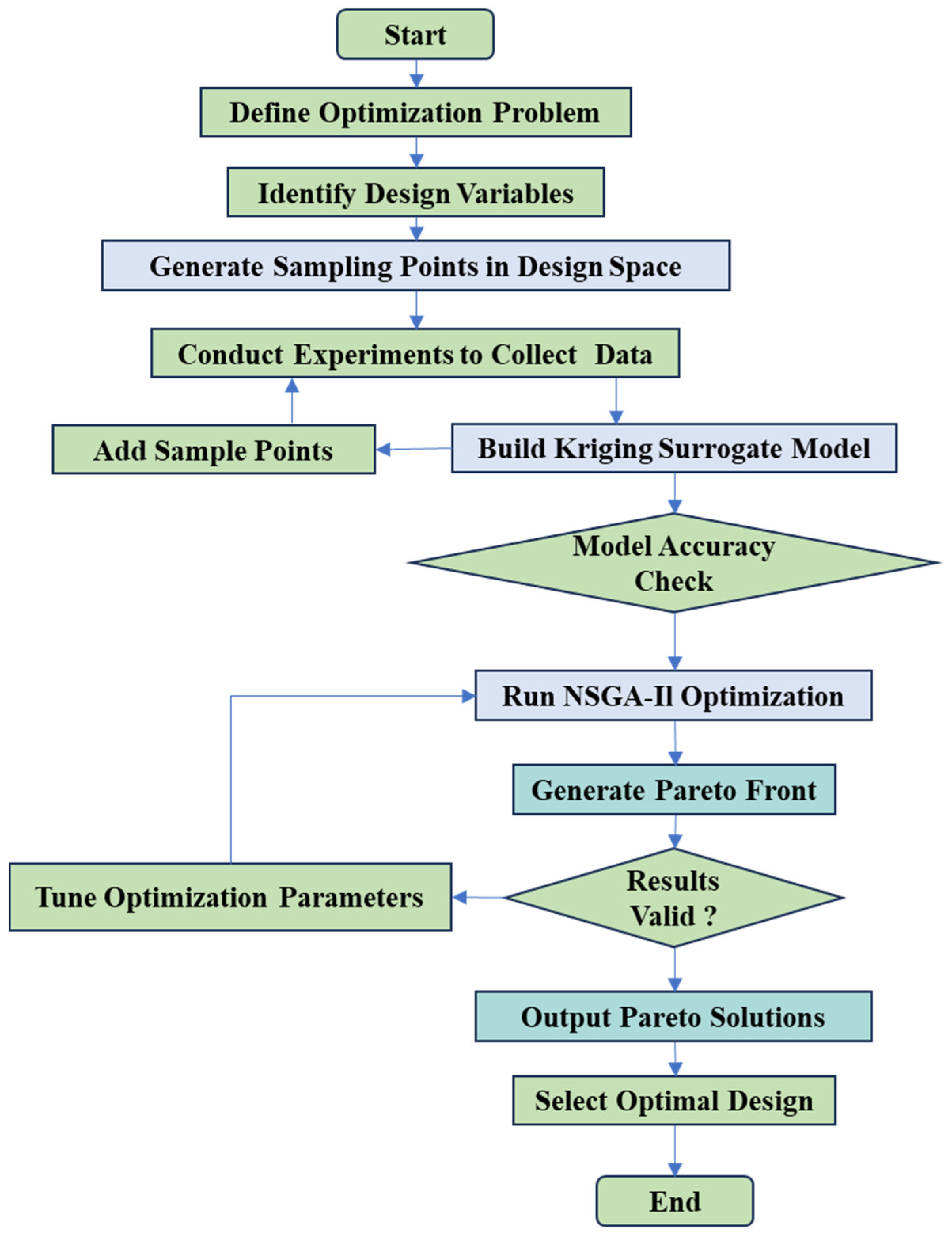
Figure 1 illustrates the comprehensive methodology employed for the multi-objective decision-making procedure in mass concrete mix design. The process commences with the formulation of the optimization problem and the determination of relevant design parameters. Subsequently, sampling points are generated and corresponding experimental tests are performed to acquire the necessary dataset. A Kriging-based surrogate model is then constructed to approximate the complex relationships between inputs and outputs. Following this, the NSGA–II algorithm is implemented to perform the optimization, yielding the Pareto-optimal frontier, which is subsequently verified through validation procedures. The final stage involves the presentation of feasible solutions and the identification of the most suitable design configuration.

3.1. Kriging Model Establishment

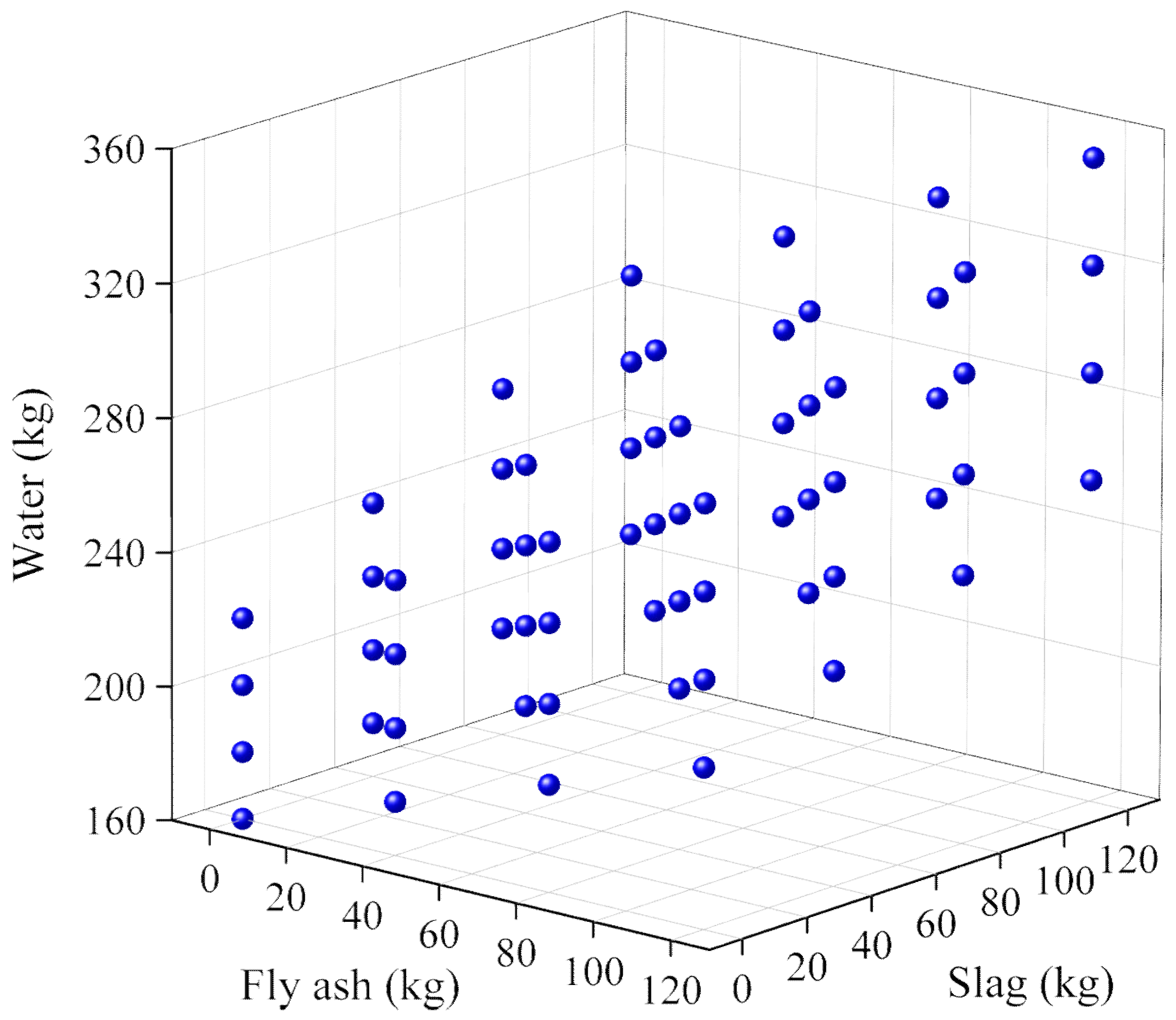
Three distinct Kriging surrogate models are established to represent the individual performance metrics: compressive strength, heat of hydration, and water absorption. The dataset is compiled using a systematic full-factorial design protocol in accordance with the experimental methodology [32,33,34]. In this study, the Kriging surrogate model was chosen for three reasons: (a) Kriging provides exact interpolation at the sampled points, which is desirable when experimental measurements are assumed noise-free; (b) it offers a built-in estimate of prediction uncertainty (mean squared error), unlike RSM or neural networks; and (c) for a moderate dataset of 64 points with nonlinear but not highly complex relationships, Kriging balances accuracy and computational cost more effectively than neural networks. As depicted in Figure 2, this protocol yielded 64 unique mix configurations that served as the foundation for model development and assessment. This strategic sampling technique guarantees comprehensive exploration of the parameter space while eliminating experimental redundancy and enhancing data utilization efficiency. The entire dataset is derived exclusively from laboratory measurements, with no computational simulations employed.
The experimental matrix follows the same uniform distribution principle to maintain consistency with the overall testing protocol. Physical testing was performed for each mixture to quantify the target responses, with the complete experimental outcomes documented in Table 3.

3.2. Predictive Accuracy

Higher R-squared coefficients demonstrate stronger concordance between surrogate model outputs and experimental measurements, while lower RME and RAE values signify higher accuracy. Additional verification points within the design space were generated to compute these metrics, with results for compressive strength, heat of hydration, and water absorption listed in Table 4, which presents the validation metrics for the three Kriging surrogate models developed for mass concrete mix design, evaluating their predictive accuracy using the coefficient of determination R2, RME and RAE. The models demonstrate consistently high fidelity: R2 values range from 0.9518 to 0.9732, indicating that 95.2–97.3% of the observed variance in compressive strength, heat of hydration, and water absorption is explained by the models—well above the conventional threshold of 0.90 for reliable surrogate modeling. Correspondingly, the RME values (0.0625–0.0741) are low relative to the typical magnitude of the responses, reflecting small absolute prediction errors, while the RAE values (0.0775–0.1164) confirm that the average absolute error constitutes less than 12% of the mean experimental response. Notably, the model for heat of hydration achieves the highest accuracy (R2 = 0.9518, RAE = 0.0775), likely due to its strong dependence on binder composition and W/B ratio—parameters well-captured by the full-factorial design. Overall, these results validate the robustness and generalization capability of the Kriging models, establishing their suitability for integration into the NSGA-II optimization framework with minimal risk of propagating significant prediction bias.

3.3. Kriging Response Surface

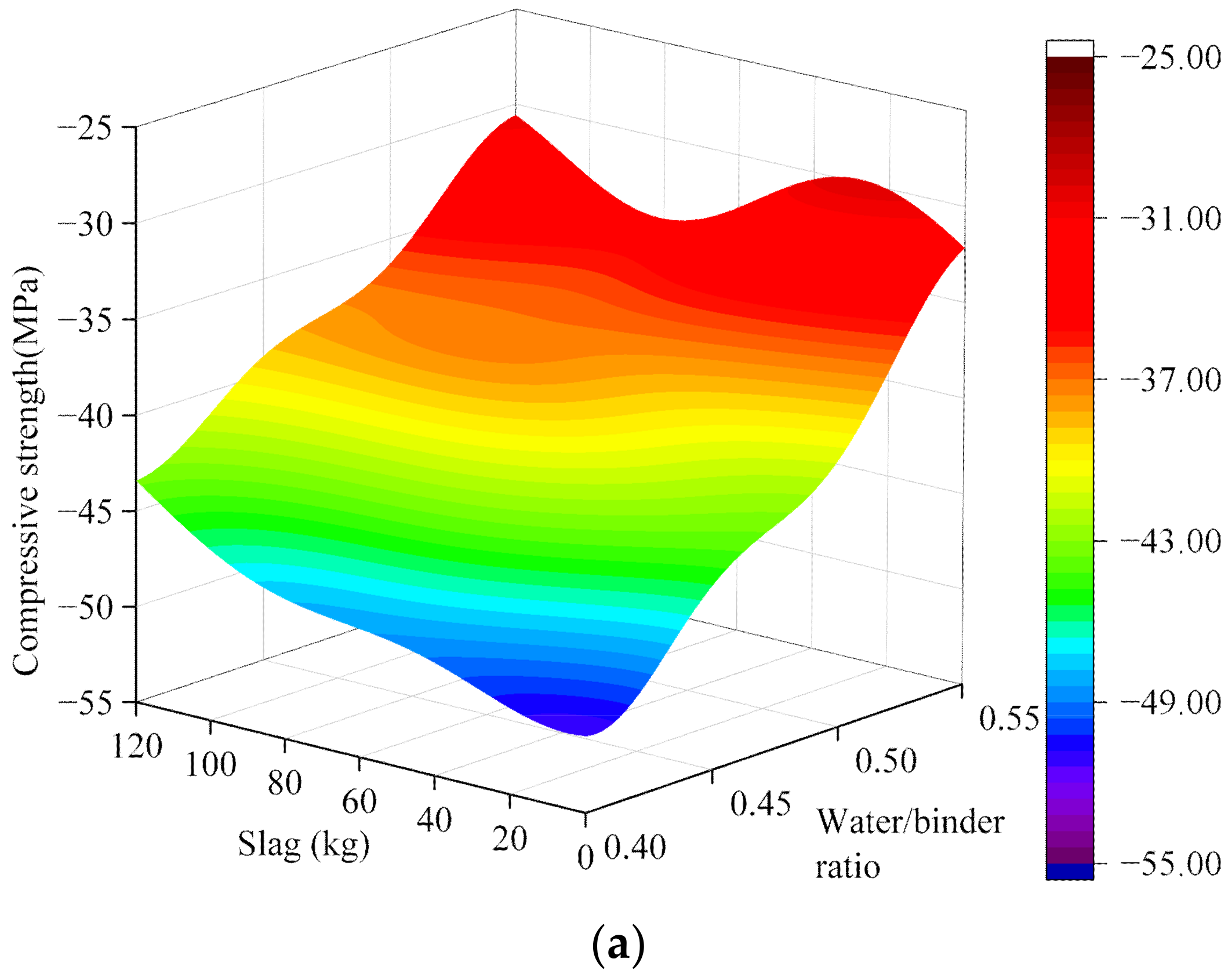
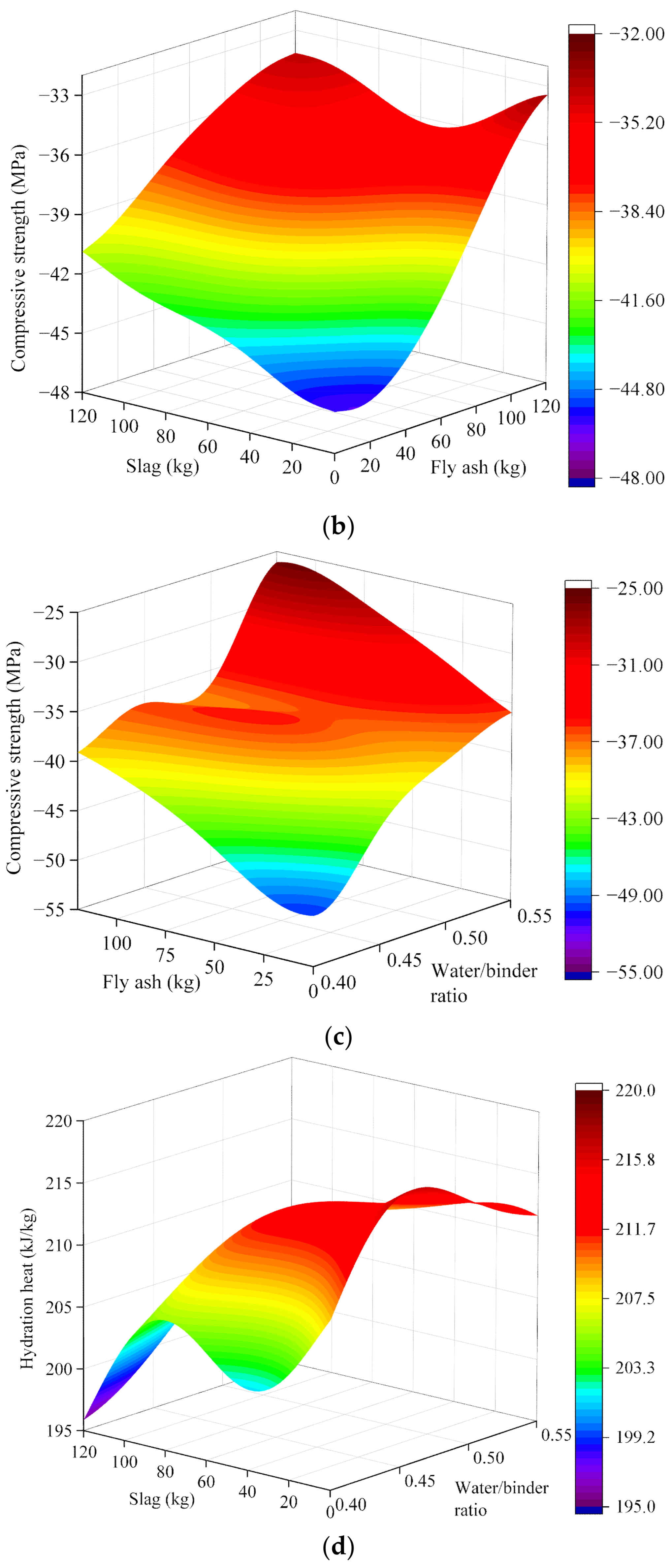
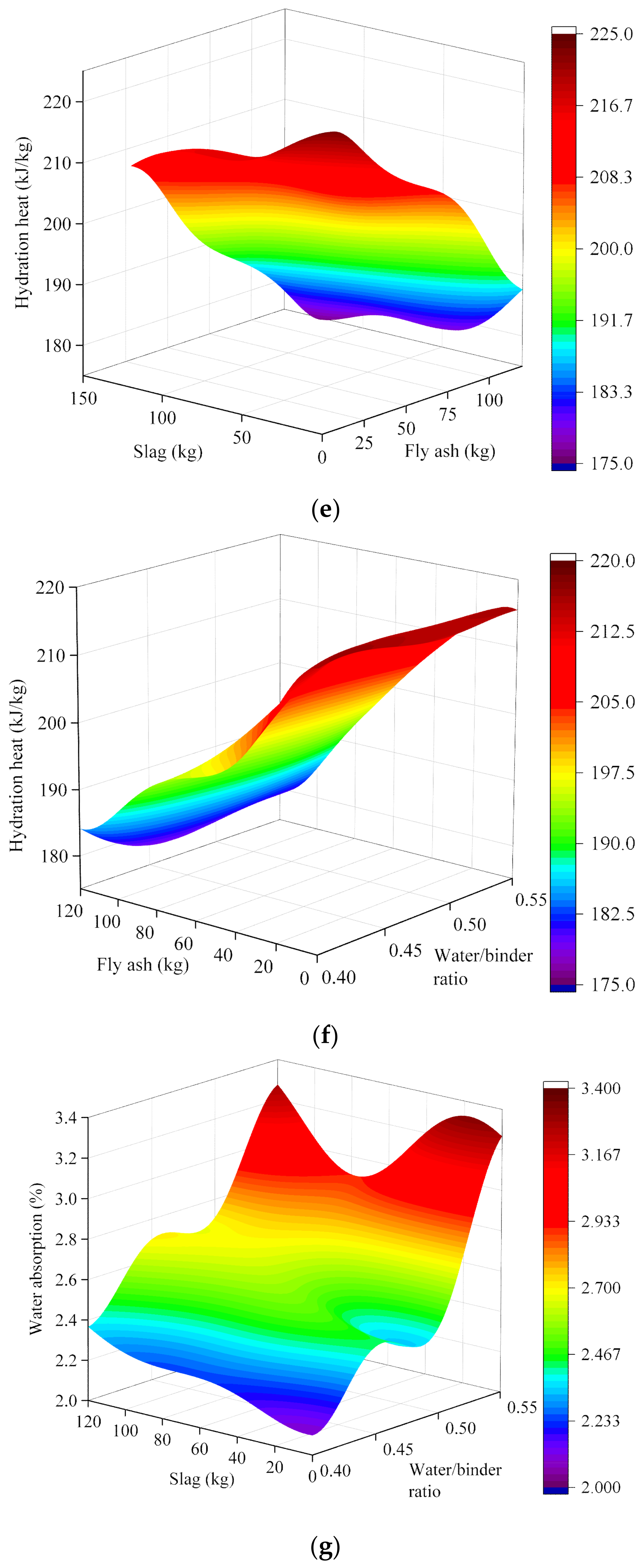
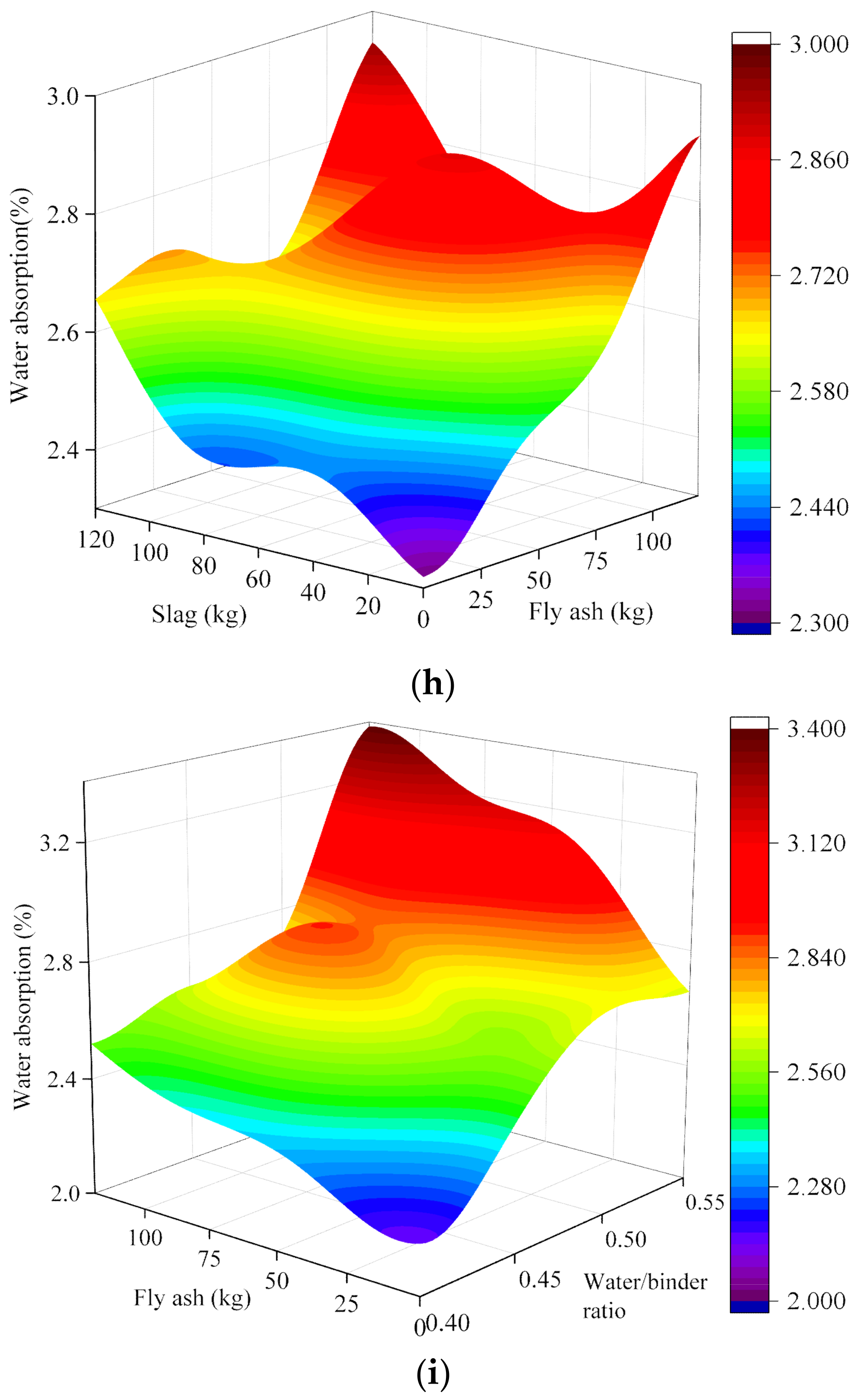
Figure 3 presents a set of Kriging response surfaces that map the complex, nonlinear relationships between key mixture variables—slag content, fly ash content, and water-to-binder (W/B) ratio—and the three critical performance metrics of mass concrete: compressive strength, heat of hydration, and water absorption. The first group of plots (Figure 3a–c) reveals that compressive strength is most sensitive to the W/B ratio, with compressive strength increasing dramatically as the ratio decreases from 0.55 to 0.40. Slag exhibits a moderate positive effect on compressive strength, especially at lower W/B ratios, while fly ash shows a dilutive effect, reducing compressive strength when its content is increased at a fixed slag level. Further, in Figure 3b, the interaction between slag and fly ash shows a competitive or dilutive effect: at a fixed slag level, increasing fly ash content leads to a reduction in compressive strength, reflecting fly ash’s slower pozzolanic reaction compared to slag’s more immediate hydraulic contribution. The second group (Figure 3d–f) demonstrates that the heat of hydration is primarily controlled by the total content of supplementary cementitious materials (SCMs). Figure 3d shows that both a higher slag content and a higher W/B ratio reduce the heat output, though the SCM effect is far more significant than the dilution effect of water. Figure 3e,f reinforce this, showing that any increase in either slag or fly ash leads to a substantial decrease in heat of hydration, with the lowest heat values occurring at the highest combined SCM dosages. The third group (Figure 3g–i) shows that water absorption, a key durability indicator, is most effectively minimized by a low W/B ratio, which refines the concrete’s pore structure. The role of mineral admixtures is secondary but beneficial; both slag and fly ash contribute to a reduction in water absorption by filling capillary pores and generating additional C-S-H gel through their reactions, and their influence is secondary to that of the W/B ratio. Collectively, these surfaces provide a powerful visual tool for understanding the inherent trade-offs in mass concrete design: strategies that maximize compressive strength (low W/B, high slag) conflict with those that minimize heat (high total SCM), while durability is best served by a low W/B ratio. These surfaces form the essential predictive foundation for the subsequent multi-objective optimization, enabling the identification of Pareto-optimal mixtures that strategically navigate these competing demands.

3.4. Pareto Front

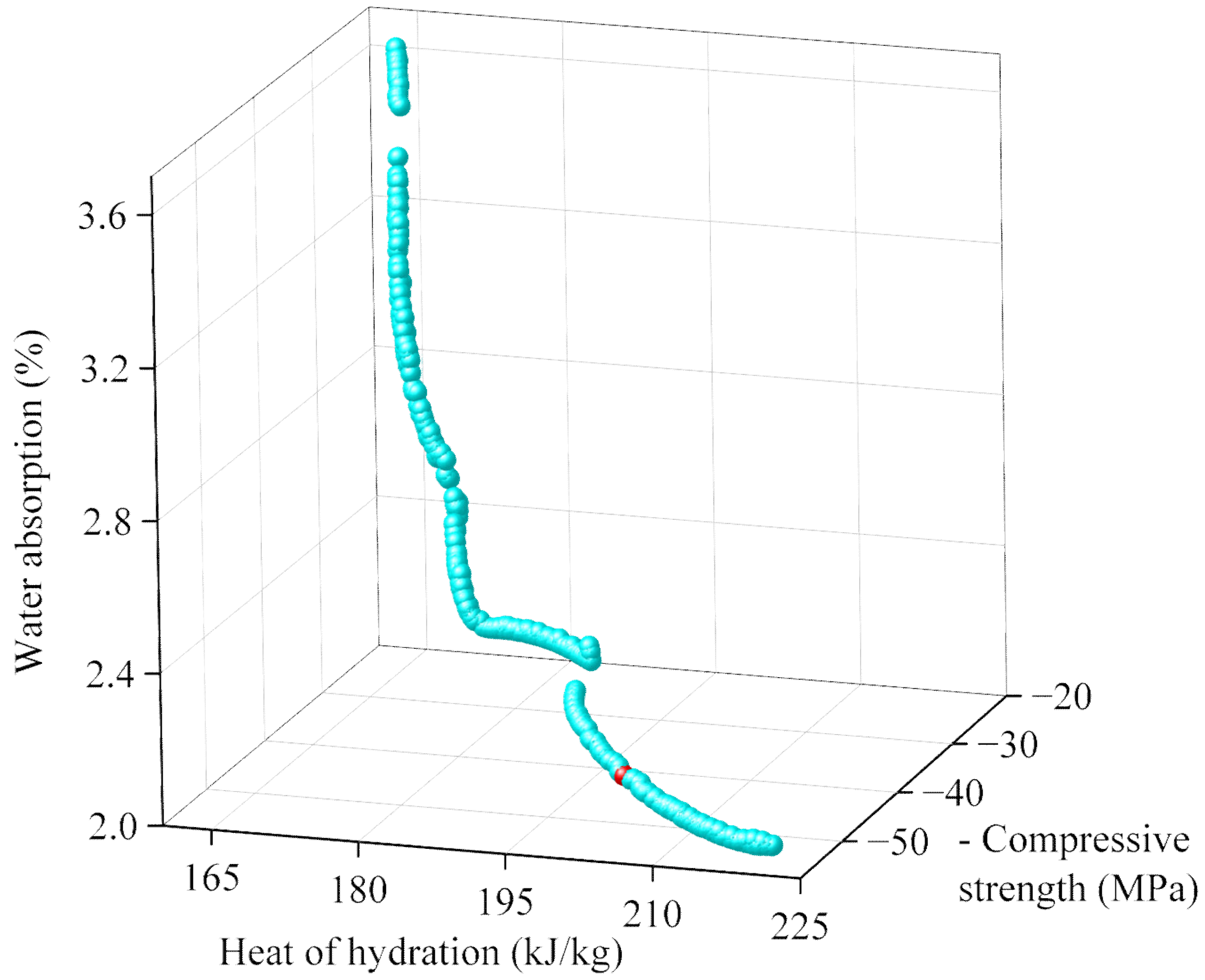
Figure 4 presents the Pareto front and the identified desired optimal point from the multi-objective optimization of mass concrete. This three-dimensional surface comprises non-dominated solutions where improving one objective—compressive strength, heat of hydration, or water absorption—necessarily compromises at least one other. The Pareto-optimal mixtures, the data points presented in the figure, represent property-dependent “best compromises” rather than a single universal solution. For example, high-strength mixtures (e.g., >60 MPa) are associated with a higher heat of hydration (>250 kJ/kg), while low-heat mixtures (<180 kJ/kg) typically exhibit lower compressive strength and higher water absorption. Each solution on the Pareto front is optimal for specific engineering priorities. The single red point on the front represents the selected “desired” mixture, which achieves a balanced compromise with a predicted compressive strength of 50.46 MPa, a low heat of hydration of 203.12 kJ/kg, and excellent durability indicated by a water absorption of only 2.13%. This specific solution, corresponding to a low W/B ratio of 0.40, along with moderate slag (19.22 kg/m3) and fly ash (30.97 kg/m3) contents (presented in Table 5), was chosen as the optimal design for a general high-performance application. Its validity is confirmed by experimental results (Table 6), which show close agreement with predictions (errors < 7%), demonstrating the robustness of the NSGA-II framework in navigating complex performance conflicts to deliver a scientifically optimized concrete mixture.

3.5. Generalization Validation

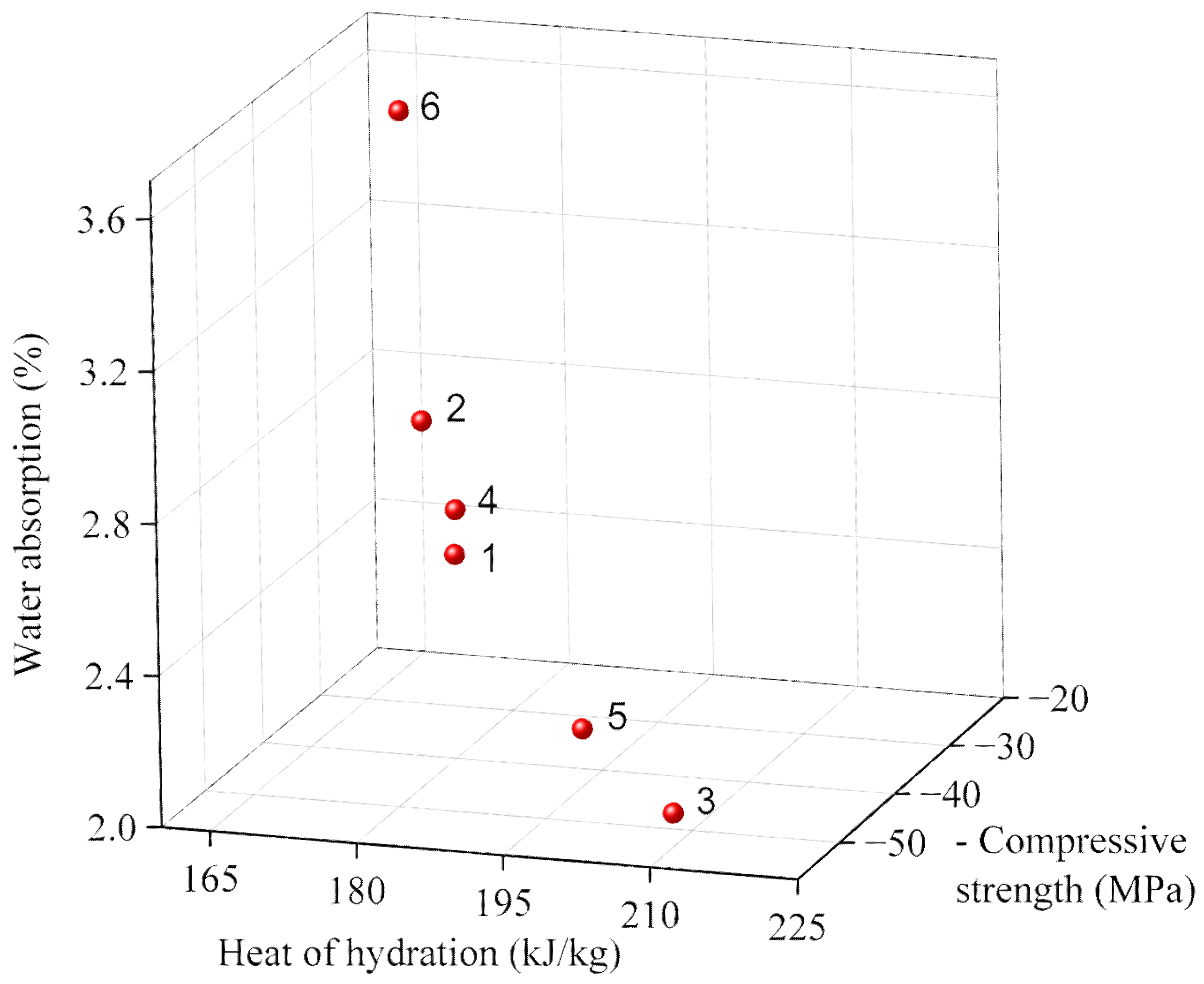
The generalization capacity of the proposed multi-objective optimization framework is critically assessed through an out-of-sample validation protocol. As shown in Figure 5, six distinct mixture designs were strategically selected from the computationally derived Pareto front; these mixtures were explicitly excluded from the original 64-point experimental dataset used to train the Kriging surrogate models. This selection ensures a rigorous test of the model’s predictive power on entirely new data points within the defined design space.
The results of this validation are quantified in Table 7. The table compares the model’s predicted values for compressive strength, heat of hydration, and water absorption against the actual experimental measurements for each of the six fabricated mixtures. The analysis reveals a high degree of fidelity between prediction and reality. The vast majority of the relative errors across all performance metrics are confined within a narrow band of approximately 2% to 9%. For example, Point 3 demonstrates a strong agreement with only a 5.31% error in its heat of hydration prediction, while Point 6 shows excellent accuracy for the same metric with a mere 3.71% error. Although a few individual data points, such as the heat of hydration for Point 4 (10.67% error), slightly exceed the 10% threshold, these minor deviations are within acceptable engineering tolerances, considering the complex physicochemical processes involved and the natural variability inherent in concrete testing.
This close alignment between the model’s forecasts and the laboratory outcomes provides compelling evidence that the Kriging-NSGA-II framework has successfully learned the fundamental, nonlinear relationships governing mass concrete performance. It confirms that the model is not overfit to the training data but possesses robust generalization ability. Consequently, engineers can have high confidence that the Pareto-optimal solutions generated by this framework will translate into real-world mixtures that reliably achieve the targeted balance among strength, thermal control, and durability.

4. Discussion

The multi-objective optimization framework successfully navigates the complex, competing demands of mass concrete performance, yielding a Pareto front that is not merely a collection of data points but a quantified map of feasible engineering compromises. The validated accuracy of this front, with out-of-sample prediction errors consistently below 10% (Table 7), confirms that the underlying Kriging-NSGA-II model has captured the true physics of the system, transforming it from a theoretical construct into a reliable design tool.
A critical insight from the Pareto front is the quantification of the “cost” of prioritizing one performance metric over another. For instance, moving from a low-strength, low-heat solution (e.g., Point 6 in Table 7: 29 MPa, 173 kJ/kg) to a high-strength, moderate-heat solution (e.g., Point 3: 47 MPa, 221 kJ/kg) reveals that a significant gain of 18 MPa in compressive strength comes at the cost of an approximate 48 kJ/kg increase in heat of hydration—a quantifiable trade-off that was previously only understood qualitatively. This precise quantification allows engineers to make informed, value-based decisions aligned with specific project constraints, such as thermal stress limits in a dam or minimum compressive strength requirements for a foundation.
Furthermore, the location of the six validation points across the breadth of the Pareto front (Figure 5) demonstrates the model’s robustness not just at a single optimum but across the entire spectrum of optimal solutions. The fact that even mixtures with extreme property balances—such as the very low-strength, ultra-low-heat mixture (Point 6) or the relatively high-strength, low-absorption mixture (Point 3)—are predicted with high fidelity underscores the model’s generalization capability. This suggests that the initial 64-mixture experimental design was sufficiently comprehensive to capture the global behavior of the response surfaces, including their nonlinearities and interactions, as visualized in Figure 3.
The multi-objective optimization results for three performance responses are presented in Figure 5, with the corresponding mix proportions exhibiting strong engineering applicability. However, for specific project requirements, dual-objective optimization approaches (Figure 6) provide viable alternatives under specialized conditions.
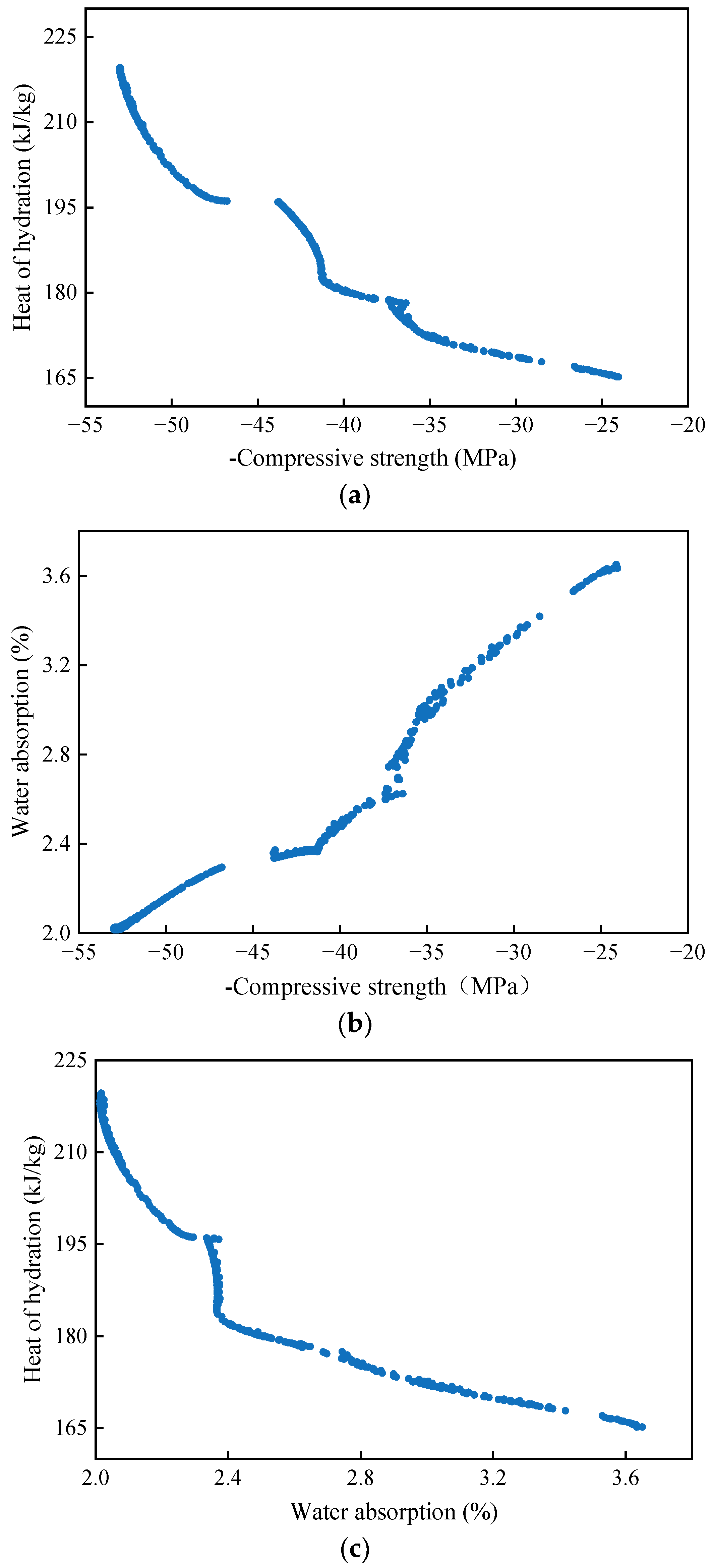
Figure 6a delineates the most fundamental conflict in mass concrete design. The projection reveals a strong, inverse relationship between these two objectives, forming a steep Pareto boundary. This indicates that significant gains in compressive strength are inextricably linked to substantial increases in heat of hydration. For instance, mixtures achieving compressive strength above 50 MPa consistently exhibit a heat of hydration exceeding 220 kJ/kg, while those designed for minimal thermal output (<180 kJ/kg) are constrained to a compressive strength below 35 MPa. This quantified trade-off is valuable for projects like massive dams or thick foundations, where thermal cracking is a primary concern [35]; it establishes a clear performance boundary, demonstrating that ultra-high strength cannot be achieved without accepting a high thermal risk, thus necessitating complementary thermal control measures.
Figure 6b illustrates a more nuanced, yet still present, compromise. The Pareto boundary here is less steep than in Figure 6a, suggesting a greater potential for synergistic optimization. A wide range of mixtures can achieve a balanced performance; for example, a compressive strength between 40–50 MPa with water absorption below 2.5%. This “desired point” is highly relevant for general structural applications requiring both adequate load-bearing capacity and long-term durability. However, the frontier also reveals a performance limit: pushing compressive strength beyond approximately 55 MPa yields diminishing returns in terms of further reducing water absorption, and may even lead to a slight increase due to factors like autogenous shrinkage at very low water-to-binder ratios. This insight guides engineers to set realistic targets, avoiding over-design that offers marginal durability benefits at a high cost to other properties.
Figure 6c presents a notably different dynamic, characterized by a positive synergy. The Pareto front shows that strategies that effectively reduce heat of hydration—primarily through the high-volume incorporation of supplementary cementitious materials (SCMs) like fly ash and slag—simultaneously tend to lower water absorption. This occurs because SCMs refine the pore structure through pozzolanic reactions, reducing permeability. Consequently, this projection identifies a highly efficient design pathway for applications where both thermal control and durability are paramount, such as marine structures or water-retaining tanks [36]. An engineer can confidently select a mixture from the lower-left region of this plot, knowing that optimizing for one objective will inherently benefit the other.
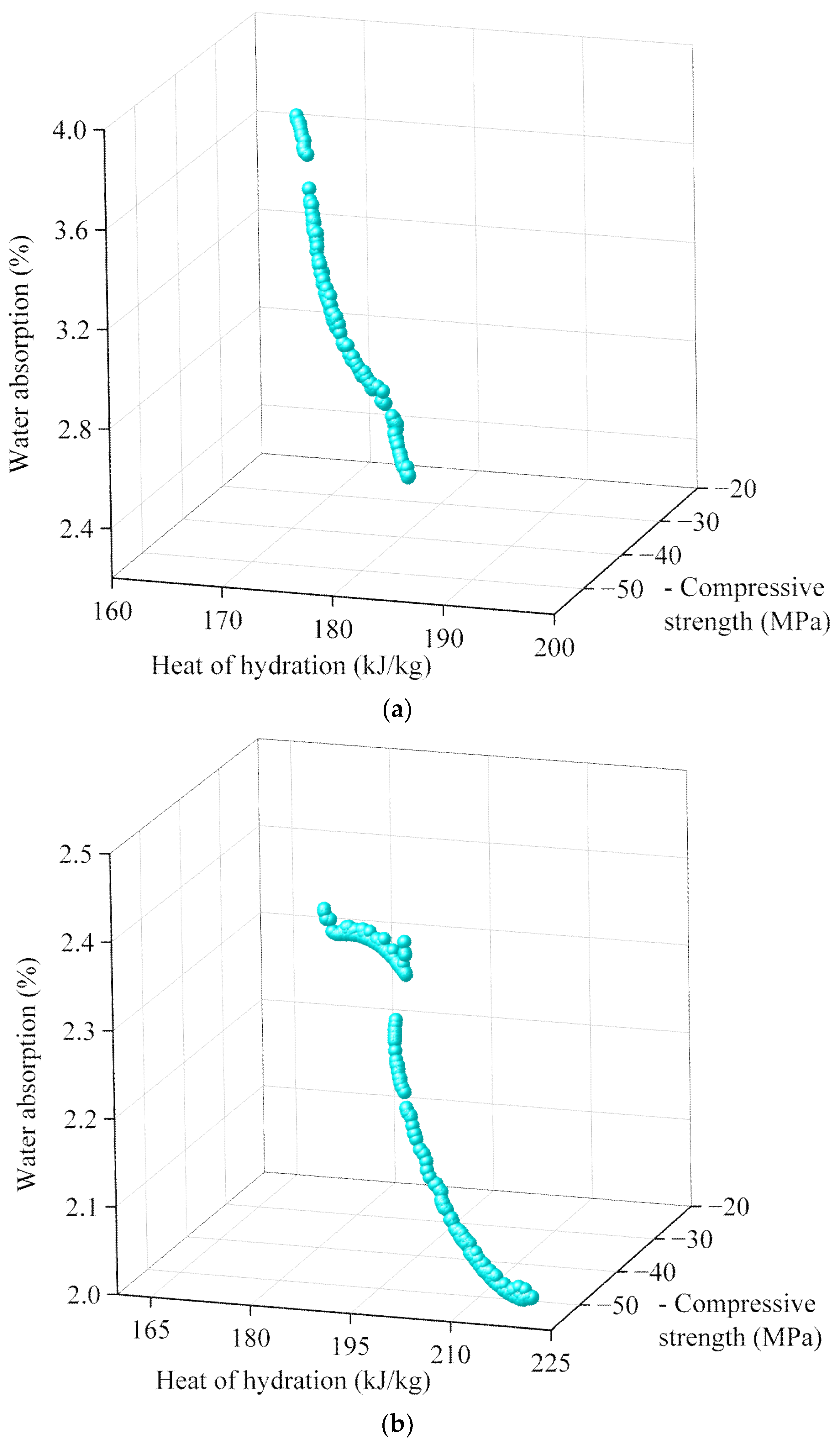
In addition, the Pareto front quantifies performance boundaries, guiding engineers to set realistic targets. For example, Figure 7a indicates that achieving a heat of hydration below 180 kJ/kg while maintaining a compressive strength above 40 MPa is unfeasible with the given material system and design space. This defines a clear thermal–strength boundary for low-heat applications like massive dams. Additionally, Figure 7b shows that when the compressive strength exceeds 45 MPa, keeping water absorption below 2.4% is not possible, highlighting a fundamental strength–durability trade-off.
These insights yield generalized and quantifiable design rules for mass concrete optimization, which represent a key novelty of this study. For instance:
Rule 1 (thermal–strength boundary): To achieve a low-heat mixture (heat of hydration < 180 kJ/kg) for thermal cracking control, the design must accept a compressive strength below 40 MPa. This can be accomplished by using a high total volume of supplementary cementitious materials (e.g., combined fly ash and slag > 160 kg/m3).
Rule 2 (strength–durability boundary): For a high-strength application (compressive strength > 45 MPa), the design should prioritize a low water-to-binder ratio (≤0.45) and moderate slag content, accepting that water absorption will likely be at or above 2.4%.
Rule 3 (synergy between heat and absorption): Reducing heat of hydration through high-volume SCMs simultaneously lowers water absorption, making this a preferred design pathway for marine or water-retaining structures.
These rules are not dataset-specific but reflect the underlying physicochemical behavior of mass concrete. They emerge directly from the validated Pareto front and provide engineers with actionable, quantified thresholds—something that traditional empirical guidelines cannot offer.
Beyond the quantified trade-offs, the Pareto front can be further interpreted from an engineering decision-making perspective by dividing it into three distinct zones based on performance combinations:
(1)
High-strength but risky zone (compressive strength > 55 MPa): These mixtures exhibit high heat of hydration (>230 kJ/kg) and moderately low water absorption, but the thermal cracking risk is substantial unless active cooling measures are applied. This zone is recommended only when compressive strength is the absolute priority and thermal control can be ensured.
(2)
Balanced and safe zone (compressive strength 35–55 MPa, heat of hydration 180–230 kJ/kg, water absorption 2.0–2.8%): This zone offers the best compromise for general mass concrete applications, where no single objective is pushed to an extreme. Most of the validated points (e.g., Points 3 and 5 in Table 7) lie in this region.
(3)
Low-heat but uneconomical zone (heat of hydration < 180 kJ/kg): These mixtures require a very high SCM content (combined fly ash and slag often >160 kg/m3), which significantly reduces compressive strength (<35 MPa) and may increase material handling costs. While safe for thermal control, they are often uneconomical for structural load-bearing elements.
By overlaying these interpretable zones onto the Pareto front, engineers can quickly identify whether a candidate design falls into a safe, risky, or uneconomical region relative to their project priorities.
Compared to conventional trial-and-error methods, our framework offers three practical advantages: (a) it quantifies the exact cost of improving one objective at the expense of another; (b) it provides a validated set of Pareto-optimal mixtures that cover the entire design space, eliminating guesswork; and (c) it reduces experimental effort by using a one-time 64-mixture dataset to generate solutions for any project priority.
Further, in the experimental design of this study, cement content was fixed at 400 kg/m3 while fly ash and slag were added (0–120 kg/m3 each), leading to a total binder content ranging from 400 to 640 kg/m3. Consequently, water content also varied proportionally to maintain the specified water-to-binder ratio. This design choice differs from an equal-binder substitution approach (where cement is reduced when SCMs are added to keep the total binder constant). The addition approach was adopted for two reasons: (i) it mirrors a common industrial practice where a minimum cement content is specified (e.g., for strength or durability requirements) and SCMs are added as supplementary materials; and (ii) fixing the cement content isolates the clinker contribution, allowing us to independently examine the absolute effects of FA and slag. However, the observed performance changes reflect not only the chemical effects of FA and slag but also the physical effect of increased paste volume (e.g., better particle packing, higher water demand, greater heat generation capacity). For instance, increasing total binder from 400 to 640 kg/m3 (with W/B fixed) increases the paste fraction, which generally enhances compressive strength and reduces water absorption but also increases hydration heat. Therefore, the optimization results represent net engineering effects under the addition protocol. Engineers directly applying the Pareto-optimal mixtures will obtain the reported total binder contents.
In conclusion, the integration of a high-fidelity surrogate model with a powerful multi-objective optimizer provides a paradigm shift in mass concrete design. It moves the field beyond empirical rules and isolated single-objective studies towards a holistic, predictive, and customizable approach. The validated Pareto front serves as a decision-support platform, enabling the selection of a mixture that is demonstrably optimal for a given set of project-specific priorities, thereby ensuring both structural performance and long-term durability while mitigating the risk of thermal cracking.

5. Conclusions

This study proposes a multi-objective optimization framework for mass concrete mixture design, targeting tunable compressive strength, heat of hydration, and water absorption. Key performance indicators were optimized via the Kriging-NSGA-II method to balance these inherently conflicting objectives. The study’s primary conclusions are as follows:
(1)
A robust multi-objective optimization framework for mass concrete mix proportion is established and validated. This work specifically addresses the three-way conflict (compressive strength, heat of hydration, water absorption) that is critical to mass concrete. By defining the water-to-binder ratio, fly ash content, and slag content as design variables, a Kriging surrogate model was built from 64 experimental mixtures and integrated with the NSGA-II algorithm to generate a reliable Pareto front of optimal solutions.
(2)
The framework effectively quantifies and navigates critical trade-offs among compressive strength, thermal output, and durability. It enables tailored designs for specific engineering priorities: low-heat mixtures for massive structures like dams, high-strength mixtures for foundations, or low-absorption mixtures for aggressive environments. The 2D projections of the Pareto front provide clear, actionable insights into these performance compromises.
(3)
The model demonstrates a strong predictive accuracy and generalization capability, with out-of-sample validation errors consistently below 10%. This confirms its viability as a practical decision-support tool for real-world engineering, allowing for the rational selection of a mixture that optimally balances project-specific requirements for structural performance, thermal control, and long-term durability.
This study demonstrates the viability of multi-objective optimization frameworks for designing mass concrete with tunable compressive strength, heat of hydration, and water absorption characteristics. Furthermore, the derived Pareto-optimal solutions not only establish material proportion optimizations but also create a multi-criteria decision space, enabling engineers to systematically select mixtures aligned with functional requirements, thermal control constraints, or durability priorities. For example, a low-heat mixture with moderate compressive strength may be deployed in massive dam construction to mitigate thermal cracking risks, while a high-strength (but higher-heat) mixture could be allocated for foundation elements where structural capacity is paramount and thermal management measures are feasible. However, the optimization results are specific to the investigated design space. Extrapolation beyond these ranges is not validated. The Kriging model assumes stationarity, which may not capture all nonlinearities. Therefore, the framework is a comparative, data-driven tool for the studied material system, not a universal design solution. New experimental data would be required to apply it to different cement or aggregate types. Future work may incorporate finite element simulations to evaluate the thermal and mechanical performance of the optimized mixtures at the structural level, thereby linking mix design to field-scale behavior.

Author Contributions

Conceptualization, J.T. and L.C.; Methodology, J.T., Z.L. and J.Z.; Software, X.A. and J.Z.; Validation, L.C.; Formal analysis, W.W.; Resources, W.W.; Data curation, J.T., Z.L. and J.Z.; Writing—original draft, X.A. and J.Z.; Writing—review & editing, J.Z.; Visualization, Z.L.; Supervision, W.W.; Funding acquisition, X.A. and L.C. All authors have read and agreed to the published version of the manuscript.

Funding

The authors would like to acknowledge the financial support from the Research on Intelligent Curing System for Large Volume Concrete in Construction Projects (11001202508187).

Data Availability Statement

The original contributions presented in this study are included in the article. Further inquiries can be directed to the corresponding author.

Conflicts of Interest

Authors Jianxiang Tong, Wenbin Wang, Zhenxiao Liu and Lu Chang were employed by the company China Construction Third Engineering Bureau Group (Shenzhen) Co., Ltd. The remaining authors declare that the research was conducted in the absence of any commercial or financial relationships that could be construed as a potential conflict of interest.

References

  1. Han, D.G.; Ying, C.L.; Qi, Y.J.; Liu, Q.H.; Wu, R.; Xia, C. Automatic Design and Monitoring of Mass Concrete Based on Information Technology. Buildings 2024, 14, 3248. [Google Scholar] [CrossRef]
  2. Zhang, H.; Su, C.; Chen, X.; Song, Z.Z.; Zhan, W.J. Calculation of Mass Concrete Temperature and Creep Stress under the Influence of Local Air Heat Transfer. Comput. Model. Eng. Sci. 2024, 140, 2977–3000. [Google Scholar] [CrossRef]
  3. Zhao, L.; He, T.; Niu, M.; Chang, X.L.; Wang, L.; Wang, Y. Effect of Limestone Powder Mixing Methods on the Performance of Mass Concrete. Materials 2024, 17, 617. [Google Scholar] [CrossRef]
  4. He, J.J.; Sun, C.W.; Wang, X.Z. Study on the Effect of Fly Ash on Mechanical Properties and Seawater Freeze–Thaw Resistance of Seawater Sea Sand Concrete. Buildings 2024, 14, 2191. [Google Scholar] [CrossRef]
  5. Zhang, S.; Qiu, Z.D.; Li, G.Q.; Jiang, H.; Li, Z.Q.; Yang, X.C.; Lu, S. Influence mechanism of autoclaved aerated concrete waste on the hydration of blended cement with high-volume slag. Constr. Build. Mater. 2024, 447, 138180. [Google Scholar] [CrossRef]
  6. Zhang, Y.D.; Li, H.Y.; Zhang, H.; Zhang, H.J.; Zhou, X.L.; Xu, Z.Y.; Liu, Z.H. Effects of Temperature-Control Admixtures on Shrinkage and Mechanical Properties of Fly Ash Concrete: Experiments and Modeling. Materials 2025, 18, 3757. [Google Scholar] [CrossRef] [PubMed]
  7. Miao, Y.C.; Ju, S.Y.; Wang, H.; Lu, Z.Y.; Yang, L.; Lin, J.L.; Jiang, J.Y.; Feng, T.T. Effect of lithology on the freeze-thaw damage behavior of tunnel slag concrete: Experimental and numerical investigations. J. Build. Eng. 2025, 114, 114324. [Google Scholar] [CrossRef]
  8. Azmakan, A.; Ahmadi, J.; Shahani, A.; Badarloo, B.; Garbowski, T. Optimal Quantity Investigation of Metakaolin and Silica Fume in Production of Durable Acid Resistance Alkali Activated Slag Concrete. Buildings 2024, 14, 21. [Google Scholar] [CrossRef]
  9. Rostami, M.; Nasrollahzadeh, K.; Behravan, A. Performance evaluation of sustainable one-part alkali-activated slag concrete with silica fume and polypropylene fiber in acidic environments. J. Sustain. Cem.-Based Mater. 2025, 14, 593–612. [Google Scholar] [CrossRef]
  10. Tran, M.V.; La, H.; Nguyen, T. Hybrid machine learning for predicting hydration heat in pipe-cooled mass concrete structures. Constr. Build. Mater. 2025, 481, 141558. [Google Scholar] [CrossRef]
  11. Wang, B.; Song, Y. Study on the Hydration Heat Effect and Pipe Cooling System of a Mass Concrete Pile Cap. Buildings 2024, 14, 2413. [Google Scholar] [CrossRef]
  12. Orozco, C.; Tangtermsirikul, S.; Babel, S.S. Unraveling the environmental and economic impacts of fly ash utilization on mass concrete considering industry practices. J. Mater. Cycles Waste Manag. 2024, 26, 1403–1417. [Google Scholar] [CrossRef]
  13. Afsoosbiria, H.; Machowska, A. Development of Sustainable Concrete Using By-Products as a Green Material, and Potential Solutions for Sustainability in Mass Concrete Construction-Comprehensive Review. Sustainability 2025, 17, 9983. [Google Scholar] [CrossRef]
  14. Wang, X.Y. Low-Carbon Slag Concrete Design Optimization Method Considering the Coupled Effects of Formwork Stripping, Strength Progress, and Carbonation Durability. Buildings 2025, 15, 1316. [Google Scholar] [CrossRef]
  15. Cao, J.Q.; Lai, T.; Xu, L.Y.; Xu, J.J. A novel optimization design framework for mix proportion of mass concrete: A case study of foundation in super high-rise buildings. Case Stud. Constr. Mater. 2025, 23, e04819. [Google Scholar] [CrossRef]
  16. Shang, Y.Q.; Ke, Z.J.; Lin, P.; Ren, Q.H.; Zhang, W.S.; Wang, X.W.; Li, X.T.; Gong, F.Y.; Wang, S.Q.; Wang, B.F.; et al. Empowering knowledge graphs with hybrid retrieval-augmented generation for the intelligent mix scheme of mass concrete. Case Stud. Constr. Mater. 2025, 23, e04979. [Google Scholar] [CrossRef]
  17. Li, H.; Chen, L.J.; Chen, H.N.; Su, R.K.L.; Yu, K.Q. Environmental factors affecting accelerated carbonation of recycled concrete aggregates using response surface methodology. J. Clean. Prod. 2024, 474, 143599. [Google Scholar] [CrossRef]
  18. Ziolkowski, P. Influence of Optimization Algorithms and Computational Complexity on Concrete Compressive Strength Prediction Machine Learning Models for Concrete Mix Design. Materials 2025, 18, 1386. [Google Scholar] [CrossRef] [PubMed]
  19. Abbas, Y.M.; Babiker, A.; Elwakeel, A.; Khan, M.I. Cost–Performance Multi-Objective Optimization of Quaternary-Blended Cement Concrete. Buildings 2025, 15, 4074. [Google Scholar] [CrossRef]
  20. Gu, Y.; Fan, R.Y.; Li, Y.K.; Zhao, J.Q.; Song, Z.J.; Chu, H.Q. Multi-Objective Optimization for Nano-Silica-Modified Concrete Based on Explainable Machine Learning. Nanomaterials 2025, 15, 1423. [Google Scholar] [CrossRef]
  21. Sun, B.; Wang, P.; Guo, J.; Zheng, Y.X.; Zhang, P.; Wang, J.; Tan, J.J. Intelligent mix design of steel fiber reinforced concrete using a particle swarm algorithm based on a multi-objective optimization model. J. Build. Eng. 2024, 96, 110653. [Google Scholar] [CrossRef]
  22. Zhang, J.C.; Liu, H.X.; Lin, Z.J.; Dong, P.; Zheng, Y. Engineering high–performance SCC through multidimensional tradeoffs: Co–optimizing mechanical property, workability, and durability. Case Stud. Constr. Mater. 2026, 24, e05696. [Google Scholar] [CrossRef]
  23. Fan, M.T.; Li, Y.; Shen, J.L.; Jin, K.K.; Shi, J.J. Multi-objective optimization design of recycled aggregate concrete mixture proportions based on machine learning and NSGA-II algorithm. Adv. Eng. Softw. 2024, 192, 103631. [Google Scholar] [CrossRef]
  24. Kuttagola, I.; Prashanth, M.H. Development and performance evaluation of self-compacting lightweight alkali-activated concrete incorporating hydroton clay balls. Structures 2025, 71, 108124. [Google Scholar] [CrossRef]
  25. Yang, L.; Xia, Y.Q.; Wang, N.; Xu, Y.G.; Zhong, W.; Lin, Y.; Chong, N. Hydration Hardening of Early Strength Low-Heat Cement under a Low-Pressure Environment. J. Mater. Civ. Eng. 2024, 36, 17345. [Google Scholar] [CrossRef]
  26. Li, Y.; Li, Y.; Liu, J.; Li, W.; She, L. Optimization of some properties of hydraulic asphalt concrete mix using RSM and NSGA-II. Constr. Build. Mater. 2024, 438, 137317. [Google Scholar] [CrossRef]
  27. Kashani, A.R.; Gandomi, A.H.; Azizi Camp, C.V. Multi-objective optimization of reinforced concrete cantilever retaining wall: A comparative study. Struct. Multidiscip. Optim. 2022, 65, 262. [Google Scholar] [CrossRef]
  28. Moni, R.F.S.L.; Silva, T.A.A.; Gomes, V.L.M.; Hallak, P.T.; Katarzyna, B.; Fabrizio, S. Geometric effects of sustainable auxetic structures integrating the particle swarm optimization and finite element method. Mater. Res. 2014, 17, 747–757. [Google Scholar] [CrossRef]
  29. Jiang, Z.J.; Li, Z.Q.; Yao, Z.J. Multi-objective optimization in fixed-outline floorplanning with reinforcement learning. Comput. Electr. Eng. 2024, 120, 109784. [Google Scholar] [CrossRef]
  30. Dong, P.; Hu, J.; Gong, Z.; Li, Y.; Liu, J.; Cao, J.; Lin, C.; Ding, W. Design strategies of cementitious metamaterials (CMs) with tunable bandgaps: Density customization and geometric optimization. J. Build. Eng. 2024, 95, 110132. [Google Scholar] [CrossRef]
  31. Wang, Y.; Zhao, W.; Zhou, G.; Gao, Q.; Wang, C. Optimization of an auxetic jounce bumper based on Gaussian process metamodel and series hybrid GA-SQP algorithm. Struct. Multidiscip. Optim. 2018, 57, 2515–2525. [Google Scholar] [CrossRef]
  32. Peng, L.G.; Miao, X.; Zhu, J.X.; Zhang, M.Q.; Zheng, X.Q.; Li, H.Y.; Wang, Y.Z.; Jiang, X.; Huang, B.T. Hybrid machine learning and multi-objective optimization for intelligent design of green and low-carbon concrete. Sustain. Mater. Technol. 2025, 45, e01605. [Google Scholar] [CrossRef]
  33. Lan, X.K.; Huang, Q.; Zhou, T.; Feng, S.S. Optimal design of a novel cylindrical sandwich panel with double arrow auxetic core under air blast loading-ScienceDirect. Def. Technol. 2020, 16, 617–626. [Google Scholar] [CrossRef]
  34. Wang, W.J.; Zhang, W.M.; Guo, M.F.; Yang, J.S.; Ma, L. Energy absorption characteristics of a lightweight auxetic honeycomb under low-velocity impact loading. Thin-Walled Struct. 2023, 185, 110577. [Google Scholar] [CrossRef]
  35. Ren, Q.; Li, M.; Shen, Y. A new interval prediction method for displacement behavior of concrete dams based on gradient boosted quantile regression. Struct. Control Health Monit. 2022, 29, e2859. [Google Scholar] [CrossRef]
  36. Lee, T.; Kim, D.; Cho, S.; Kim, M.O. Advancements in Surface Coatings and Inspection Technologies for Extending the Service Life of Concrete Structures in Marine Environments: A Critical Review. Buildings 2025, 15, 304. [Google Scholar] [CrossRef]
Figure 1. The multi-objective decision-making procedure in mass concrete mix design. Data from [22].
Buildings 16 02350 g001
Figure 2. In total, 64 sampling points were obtained via the full-factorial design method.
Buildings 16 02350 g002
Figure 3. Kriging response surface of mass concrete: (a) compressive strength—slag and water/binder ratio; (b) compressive strength—slag and fly ash; (c) compressive strength—fly ash and water/binder ratio; (d) heat of hydration—slag and water/binder ratio; (e) heat of hydration—slag and fly ash; (f) heat of hydration—fly ash and water/binder ratio; (g) water absorption—slag and water/binder ratio; (h) water absorption—slag and fly ash; and (i) water absorption—fly ash and water/binder ratio.
Buildings 16 02350 g003aBuildings 16 02350 g003bBuildings 16 02350 g003cBuildings 16 02350 g003d
Figure 4. Pareto front and desired point of mass concrete mix proportion. The front is qualitatively divided into three interpretable zones based on engineering risk and economy: (a) high-strength but risky (compressive strength > 55 MPa, high heat of hydration); (b) balanced and safe (compressive strength 35–55 MPa, moderate heat and absorption); (c) and low-heat but uneconomical (heat < 180 kJ/kg, compressive strength < 35 MPa).
Buildings 16 02350 g004
Figure 5. Verified data points from Pareto front for different mass concrete mix proportion.
Buildings 16 02350 g005
Figure 6. 2D projection of Pareto front for mass concrete mix proportion: (a) based on compressive strength and heat of hydration; (b) based on compressive strength and water absorption; and (c) based on water absorption and heat of hydration.
Buildings 16 02350 g006
Figure 7. Specific requirements for mass concrete mix proportion: (a) heat of hydration below 180 kJ/kg while compressive strength is below 40 MPa; (b) water absorption below 2.4% while compressive strength exceeds 45 MPa.
Buildings 16 02350 g007
Table 1. Composition and loss on ignition of cement.
CompositionAl2O3SO3SiO2Fe2O3MgOCaOLOI
Mass (%)5.644.5317.224.081.5453.1512.08
Table 2. Composition and loss on ignition of fly ash and slag.
CompositionSiO2Al2O3Fe2O3CaOMgOSO3Na2OK2OLOI
Fly ash (%)47.7621.148.327.853.912.561.341.124.07
Slag (%)34.278.052.3141.157.262.720.810.751.5
Table 3. Mix proportion design of SCC and the test results of sample basic performance.
Water/Binder
Ratio
Cement
(kg)
Fly Ash
(kg)
Slag
(kg)
Water
(kg)
Sand
(kg)
Stone
(kg)
Compressive
Strength
(MPa)
Water
Absorption
(%)
Heat
of Hydration
(kJ/kg)
0.44000016058077052.12.06220.3
0.440004017658077051.62.12217.6
0.440008019258077048.92.20214.3
0.4400012020858077047.32.34208.5
0.440040017658077049.62.19205.1
0.4400404019258077047.82.26197.2
0.4400408020858077046.32.30201.6
0.44004012022458077042.22.38191.5
0.440080019258077043.82.53202.7
0.4400804020858077043.92.35198.5
0.4400808022458077040.82.42188.4
0.44008012024058077041.32.38182.7
0.4400120020858077040.52.46187.4
0.440012040224580770392.53185.6
0.44001202024058077039.52.51182.2
0.440012012025658077038.62.63181.3
0.454000018058077045.82.32223.5
0.4540004019858077044.22.45217.3
0.4540008021658077042.72.43215.7
0.45400012023458077040.82.66211.2
0.4540040019858077044.52.48213.8
0.45400404021658077039.82.60208.6
0.45400408023458077037.52.65207.3
0.454004012025258077038.22.69195.6
0.4540080021658077038.72.61205.5
0.45400804023458077036.42.85196.4
0.45400808025258077035.32.79190.1
0.454008012027058077035.52.63186.3
0.45400120023458077033.42.92187.9
0.4540012040252580770362.66178.5
0.454001208027058077035.42.70178.7
0.4540012012028858077034.22.95175.5
0.54000020058077041.82.53218.9
0.540004022058077039.72.66215.6
0.540008024058077038.62.67214
0.5400012026058077039.42.61207.8
0.540040022058077040.22.44212.6
0.5400404024058077036.52.53210.5
0.5400408026058077036.82.72208.4
0.54004012028058077035.22.75202
0.540080024058077036.62.70205.3
0.54008040260580770342.98195.4
0.5400808028058077037.82.72188.1
0.54008012030058077033.52.91182.3
0.5400120026058077036.42.73187.4
0.54001204028058077037.12.63183.3
0.54001208030058077035.32.85175.2
0.540012012032058077034.83.12172.8
0.554000022058077037.22.77217.6
0.5540004024258077036.82.56215.8
0.5540008026458077034.52.89215.6
0.55400012028658077032.13.24211.3
0.5540040024258077030.53.41209.6
0.55400404026458077028.93.36208.4
0.55400408028658077033.42.94205.7
0.554004012030858077029.83.28203.2
0.5540080026458077026.83.52204.8
0.55400804028658077027.63.26196.5
0.55400808030858077026.53.3190.1
0.554008012033058077024.93.48185.4
0.55400120028658077027.33.37178.8
0.554001204030858077025.83.29184.9
0.554001208033058077025.53.55171.2
0.5540012012035258077024.23.58166.5
Table 4. Accuracy of Kriging surrogate models for mass concrete mix proportion.
Mass ConcreteR2RMERAE
Compressive strength0.97320.07410.0892
Heat of hydration0.95180.06250.0775
Water absorption0.96490.06330.1164
Table 5. Optimal mix proportion (marked with red dots in the Figure 4) for mass concrete.
Compressive Strength (MPa)Heat of Hydration (kJ/kg)Water Absorption (%)Fly Ash (kg)Slag (kg)Water/Binder Ratio
50.46203.122.1330.9719.220.4
Table 6. Comparison between the predicted value of the multi-objective optimization model and the experimental results for mass concrete mix proportion.
PerformanceOptimization ResultsExperimental ResultsRelative
Error to the
Experiment
Compressive strength (MPa)50.4653.796.19%
Heat of hydration (kJ/kg)203.12195.673.81%
Water absorption (%)2.132.286.58%
Table 7. Comparison between the optimization results and the experimental results for mass concrete mix proportion.
PointPerformanceOptimization
Results
Experimental
Results
Relative
Error to the
Experiment
1Compressive strength (MPa)39.2335.679.98
Heat of hydration (kJ/kg)179.64195.558.14
Water absorption (%)2.532.376.75
2Compressive strength (MPa)36.339.528.15
Heat of hydration (kJ/kg)174.68188.417.29
Water absorption (%)2.842.891.75
3Compressive strength (MPa)51.7747.399.24
Heat of hydration (kJ/kg)209.09220.825.31
Water absorption (%)2.072.247.59
4Compressive strength (MPa)37.3938.162.02
Heat of hydration (kJ/kg)178.65161.4210.67
Water absorption (%)2.622.437.82
5Compressive strength (MPa)48.6144.928.21
Heat of hydration (kJ/kg)198.05183.467.95
Water absorption (%)2.232.068.25
6Compressive strength (MPa)26.5929.379.47
Heat of hydration (kJ/kg)167.01173.453.71
Water absorption (%)3.533.365.06
Disclaimer/Publisher’s Note: The statements, opinions and data contained in all publications are solely those of the individual author(s) and contributor(s) and not of MDPI and/or the editor(s). MDPI and/or the editor(s) disclaim responsibility for any injury to people or property resulting from any ideas, methods, instructions or products referred to in the content.