Article

Ring-Shaped Polyvinylidene Fluoride Piezoelectric Sensor for Real-Time Surface Crack Monitoring in Reinforced Concrete Beams
1
School of Civil Engineering, Chongqing Jiaotong University, Chongqing 400074, China
2
School of Civil Engineering and Architecture, Northeast Electric Power University, Jilin 132012, China
3
Key Laboratory of Intelligent Lifeline Protection and Emergency Technology for Resident ATY, Wenzhou University of Technology, Wenzhou 325000, China
*
Authors to whom correspondence should be addressed.
Buildings 2026, 16(11), 2242; https://doi.org/10.3390/buildings16112242
Submission received: 31 March 2026 / Revised: 12 May 2026 / Accepted: 18 May 2026 / Published: 2 June 2026

Abstract

Real-time monitoring of surface cracks in reinforced concrete (RC) beams is critical to structural safety and service performance evaluation. Current structural crack monitoring still faces prominent scientific and technical bottlenecks: conventional unidirectional sensors cannot achieve multi-directional collaborative sensing, rigid piezoelectric materials exhibit poor compatibility with the large deformation of concrete, and there is a lack of quantitative mapping relationships from sensing signals to crack parameters, making it difficult to simultaneously measure crack width, angle, and morphology. This paper presents a novel ring-shaped piezoelectric sensor based on polyvinylidene fluoride (PVDF) and an annular piezoelectric sensing mechanism for real-time monitoring of crack angle, width, and morphology. The sensor incorporates a laminated structure with four strip sensing units for multi-directional strain detection. Experiments were conducted on RC beams under various loading conditions, and finite element analysis was performed using COMSOL Multiphysics. An innovative crack damage index (B) was introduced to assess structural damage quantitatively. Results demonstrate high sensor sensitivity and stable output. Voltage signals increase both with crack width and crack angle, showing responses of 0.045 mV, 0.041 mV, and 0.023 mV for crack angles of 60°, 45°, and 30°, respectively, at a crack width of 9 mm. Strong consistency between experimental and simulation data validates the effectiveness of the mechanism in monitoring the direction, width, and types of cracks. The crack damage index B exhibits a positive correlation with the structural stress response, enabling a quantitative assessment of damage. This study is applicable to the prestressed concrete box girders and T-beams commonly used in large-span bridges, which are typically with a main span of 20–50 m, a beam length of 6–30 m, a section height of 1.2–2.5 m, and designed for Grade C35–C50 concrete. The findings provide a practical foundation for real-time crack monitoring in large-scale bridge beam members.

1. Introduction

Crack monitoring of reinforced concrete (RC) beams is a core issue in structural health monitoring (SHM) for bridges and civil engineering structures. Cracks not only weaken structural integrity and load-bearing capacity but also accelerate corrosion of internal steel bars, leading to potential safety hazards and economic losses [1,2,3]. Timely and accurate acquisition of crack parameters such as width, angle, and propagation morphology is critical for damage assessment, life prediction, and maintenance decision-making.
In terms of material and process optimization, researchers have improved the crack resistance and crack controllability of beam members by optimizing concrete mix proportions, reinforcing steel layout, and developing new composite materials. Meanwhile, numerical calculation and simulation methods, such as the finite element method, discrete element method, and extended finite element method (XFEM), have been widely adopted to simulate the initiation and propagation mechanism of cracks, reveal the evolution law of cracks, and predict structural service life, providing theoretical support for the design of monitoring schemes.
In the development and application of sensing technology, traditional monitoring methods include strain gauge measurement [4], acoustic emission (AE) [5], distributed fiber optic sensing [6,7], and machine vision [8,9,10,11]. Strain gauges can only capture local strain and cannot reflect global stress distribution, making it difficult to identify crack orientation and morphology. Acoustic emission has high sensitivity to damage initiation, but it faces challenges such as signal irreversibility, environmental interference, and difficulty in quantitative characterization of crack geometry [12,13]. Machine vision and digital image correlation can track crack evolution dynamically, but they rely heavily on lighting conditions, algorithm stability, and computational efficiency, which restrict high-precision real-time monitoring in field environments. Optical fiber sensors enable distributed measurement with high precision, yet they are limited by high cost, complex installation, and sensitivity to temperature and pressure [14,15,16].
In recent years, piezoelectric sensors have become a research hotspot due to their high sensitivity, fast response, easy integration, and low cost [17]. Piezoelectric ceramics (PZT) have strong piezoelectric effects and wide bandwidth, and have been widely used in concrete stress monitoring and damage detection based on electromechanical impedance [18,19]. However, PZT is brittle, has poor flexibility, and weak compatibility with concrete deformation, making it unsuitable for monitoring large-opening cracks. Polyvinylidene fluoride (PVDF) features high flexibility, good impedance matching, corrosion resistance, and low dielectric loss, showing unique advantages in structural health monitoring [20]. Nevertheless, conventional single-axis or unidirectional PVDF sensors can hardly realize synchronous measurement of multi-directional strain, and thus cannot identify crack angle and propagation direction. Existing multi-sensor arrays or distributed layouts suffer from complex wiring, low integration, inconsistent sensitivity, and difficulties in data fusion, resulting in insufficient capability for full-parameter characterization of cracks.
Meanwhile, machine learning and intelligent sensing technologies have provided new approaches for structural health monitoring [21,22,23,24,25]. In environments with strong interference and high uncertainty, machine learning enables sensing data denoising, anomaly detection, and long-term prediction. For instance, under complex conditions such as extreme typhoons, the method based on kernel regression basis functions and improved Bayesian dynamic linear models can achieve high-precision multi-step prediction of uncertainty in structural health monitoring sensing data, significantly improving monitoring reliability in harsh environments [26]. In addition, RFID wireless sensing technology has developed rapidly in crack monitoring. Featuring passive operation, wireless transmission, easy deployment, and strong resistance to harsh environments, it has become a new research frontier in structural surface crack identification and long-term distributed monitoring, and relevant advances have been systematically reviewed and summarized [27]. Despite the continuous breakthroughs in intelligent algorithms and emerging sensing technologies, existing methods still struggle to simultaneously realize integrated quantitative monitoring of crack width, angle, and morphology. Moreover, obvious shortcomings remain in flexible adaptation, large-deformation monitoring, and multi-directional collaborative sensing.
Although PVDF/PZT-based piezoelectric sensing systems have achieved certain results in concrete crack monitoring, four critical scientific and technical gaps remain unresolved:
(1)
Most sensors are unidirectional or single-point measurement, lacking an integrated multi-directional sensing mechanism, making it impossible to synchronously monitor crack width, angle, and morphology;
(2)
The mismatch between rigid piezoelectric materials and concrete deformation limits the monitoring range and stability for large-width cracks;
(3)
There is a lack of quantitative mapping models from voltage signals to multi-parameter crack features, leading to difficulties in accurate inversion of crack geometry;
(4)
Few studies establish a unified damage evaluation index coupling crack width, angle, and morphology, making quantitative assessment of structural damage incomplete.
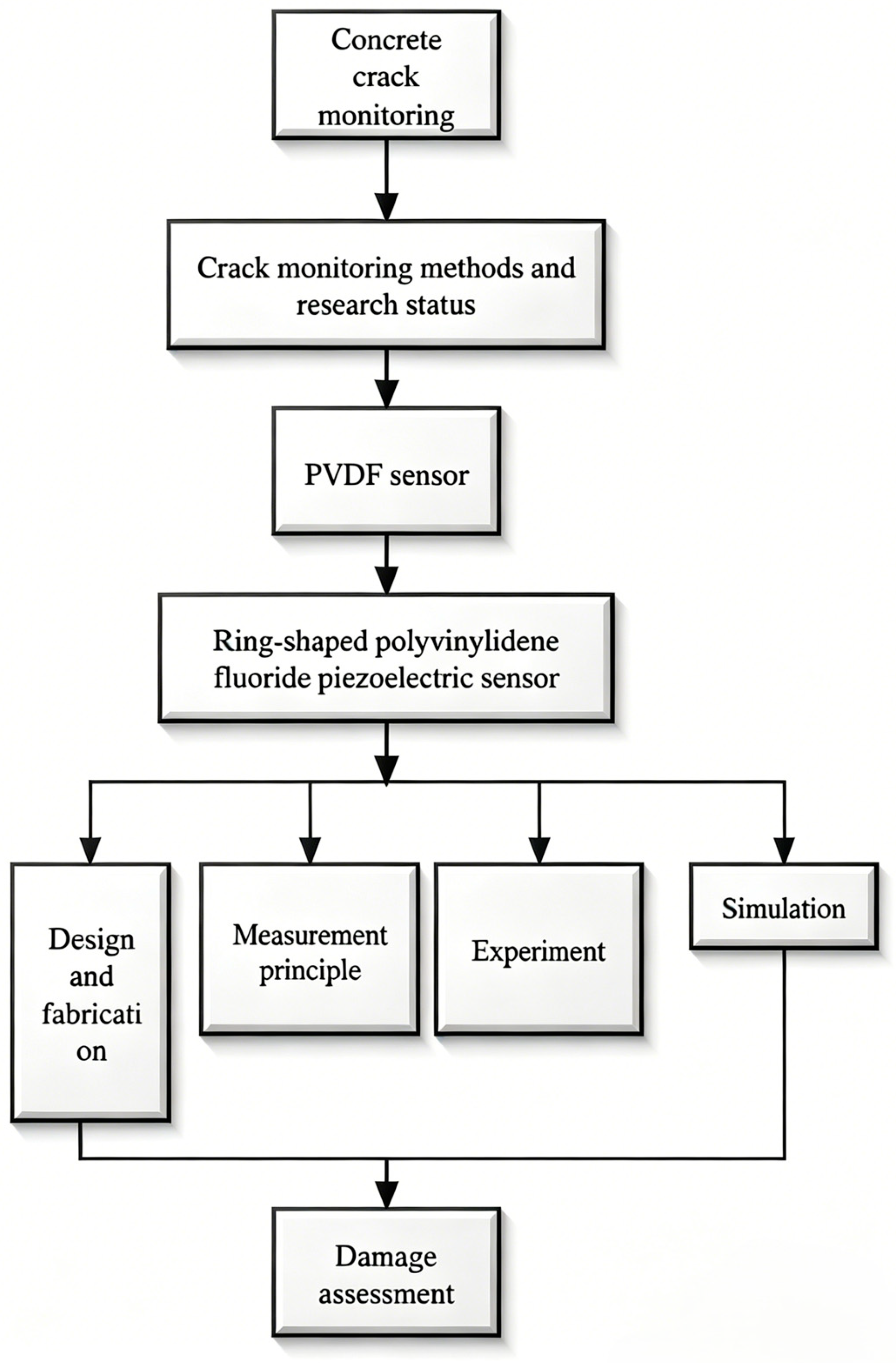
In view of the above scientific shortcomings and practical engineering demands, this paper aims to develop a novel ring-shaped PVDF piezoelectric sensor suitable for the service conditions of reinforced concrete beams, reveal the monitoring mechanism of the composite annular sensor, and establish the quantitative correlation law between crack multi-parameters and sensing signals. Combined with laboratory tests and numerical simulations, the monitoring performance of the sensor is verified, and a crack damage evaluation index is constructed. This study forms an integrated real-time crack monitoring technical system that integrates sensor acquisition, experimental verification, simulation analysis and damage assessment, providing theoretical basis and engineering application references for the safety monitoring of girder components of large-scale bridges. The technical roadmap is shown in Figure 1.

2. Sensor Design and Monitoring Mechanism and Research Method for Defect Interaction

2.1. Fabrication of Ring-Shaped PVDF Sensor

Compared to traditional PZT piezoelectric ceramics, PVDF material exhibits superior corrosion resistance, creep resistance, and wear resistance. The dielectric constant of PVDF is 7.25 C2/(N·m2), characterized by low dielectric loss and excellent electrical conductivity. When combined with a PDMS substrate, PVDF offers an extended strain range, making it more suitable for large-scale crack monitoring [28,29].
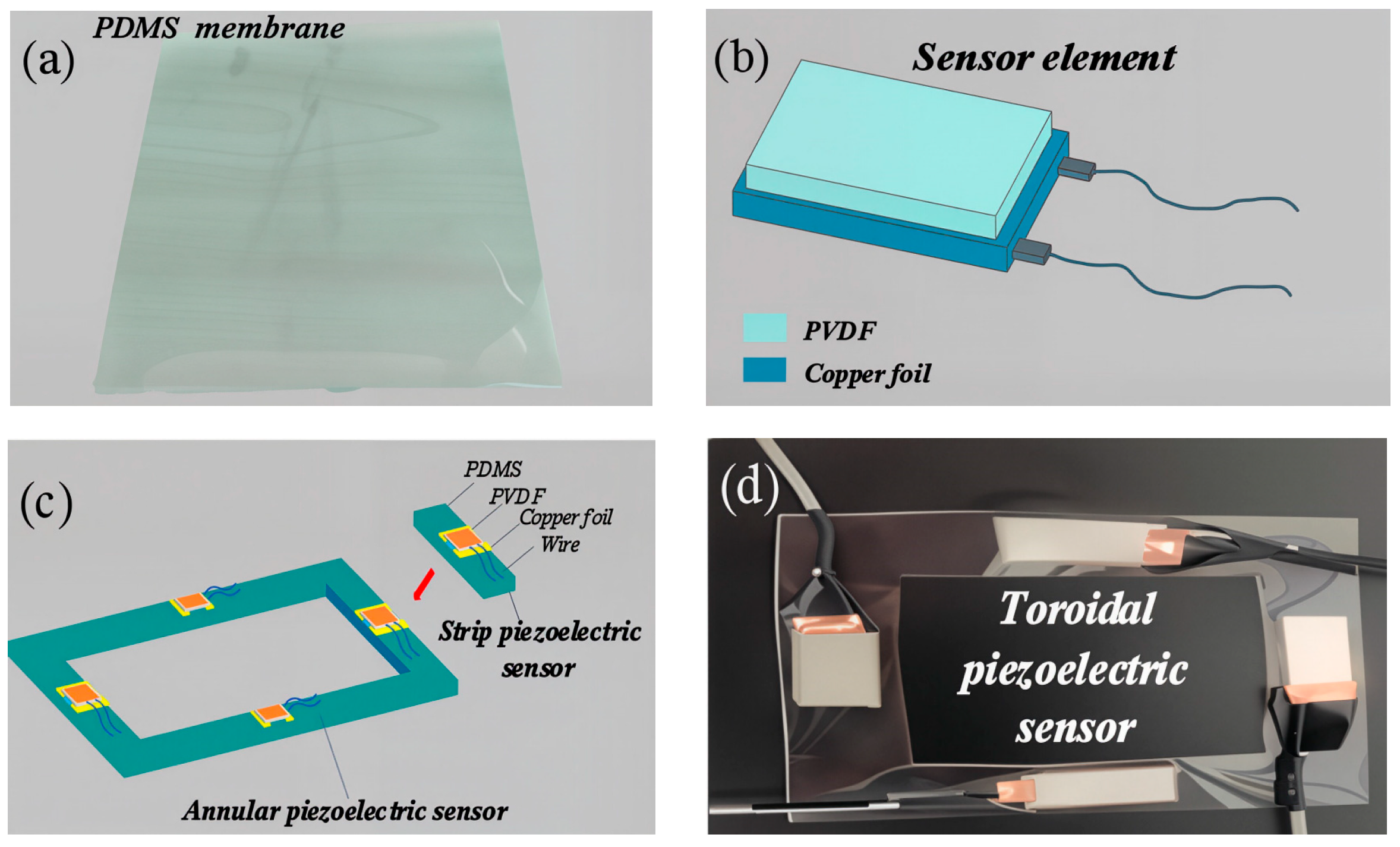
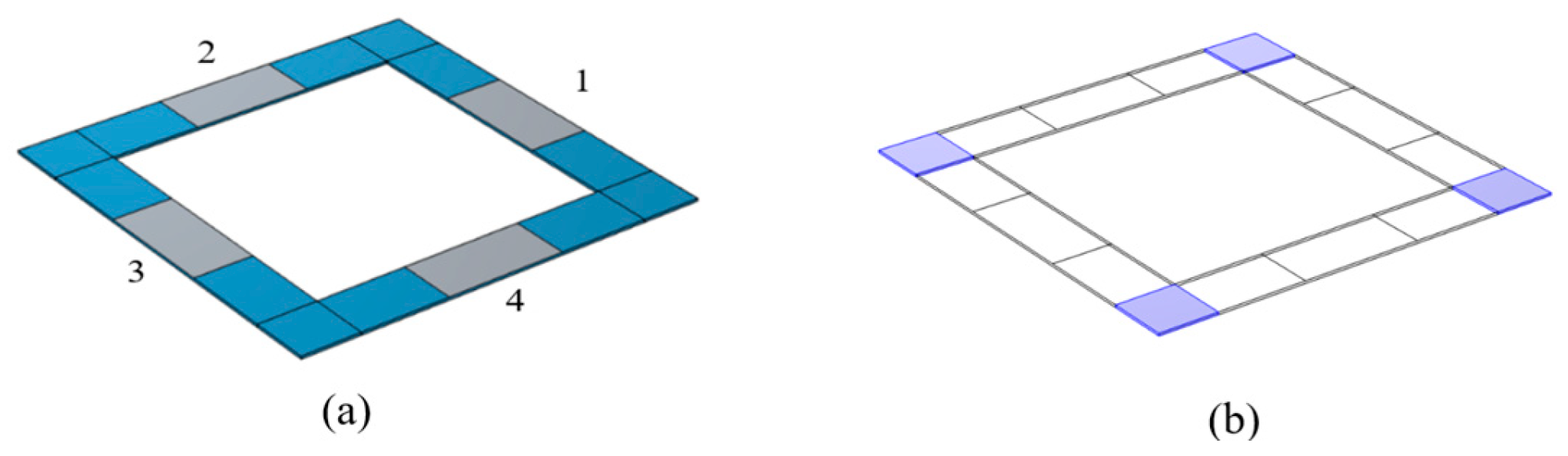
The designed ring-shaped piezoelectric sensor consists of a PDMS (polydimeth-ylsiloxane) flexible substrate, epoxy resin, copper-foil conductive tape, and four strip PVDF sensors. Leveraging the positive piezoelectric effect and the principle of multi-directional sensing [30], this sensor incorporates multiple sensitive elements along with conversion components. The sensitive elements are capable of directly detecting multi-directional strains and converting them into electrical signals via the conversion components. This design facilitates comprehensive monitoring of surface cracks in concrete structures across multiple directions throughout their lifespan. The structural design of the ring-shaped piezoelectric sensor is illustrated in Figure 2. The detailed fabrication process is outlined as follows:
(1)
A ring-shaped PDMS substrate was selected as the bottom layer of the sensor.
(2)
PVDF film was adhered to the center of the upper surface of the PDMS substrate using epoxy resin. The actual reasons for selecting epoxy resin are its high bonding strength, good waterproof sealing performance, stable insulation, and good compatibility with both PVDF and PDMS, which ensure reliable adhesion and protective sealing of the laminated sensor structure. Positioning the sensor at the center enhances its compatibility with the overall structure.
(3)
A silver layer with a thickness of 1 μm was deposited on the outer edge of the PVDF film.
(4)
One end of the PDMS substrate was affixed with a shielding wire using copper-foil conductive tape, while the other end was connected to the electroplated silver surface and led to the shielding wire. The dimensions of the PVDF film are 1 cm × 2 cm, with a thickness of 28 μm. The outer ring has a side length of 7 cm, while the inner ring has a side length of 5 cm and a thickness of 500 μm.
Three additional sensors were fabricated using the same methodology, and the ring piezoelectric sensors were installed accordingly. In this study, PVDF film was obtained from Microfine Electronics Company, and PDMS was obtained from Dawan Plastic Industrial Company (model ZHK-2). The specific performance parameters are detailed in Table 1 and Table 2.
Figure 2. Sensor preparation process: (a) PDSM menbrane, (b) Sensor element, (c) Annular piezoelectic sensor, (d) Toroidal piezoelectic sensor.
Buildings 16 02242 g002

2.2. Monitoring Mechanism of RC Beam Surface Cracks Based on PVDF Ring Piezoelectric Sensor

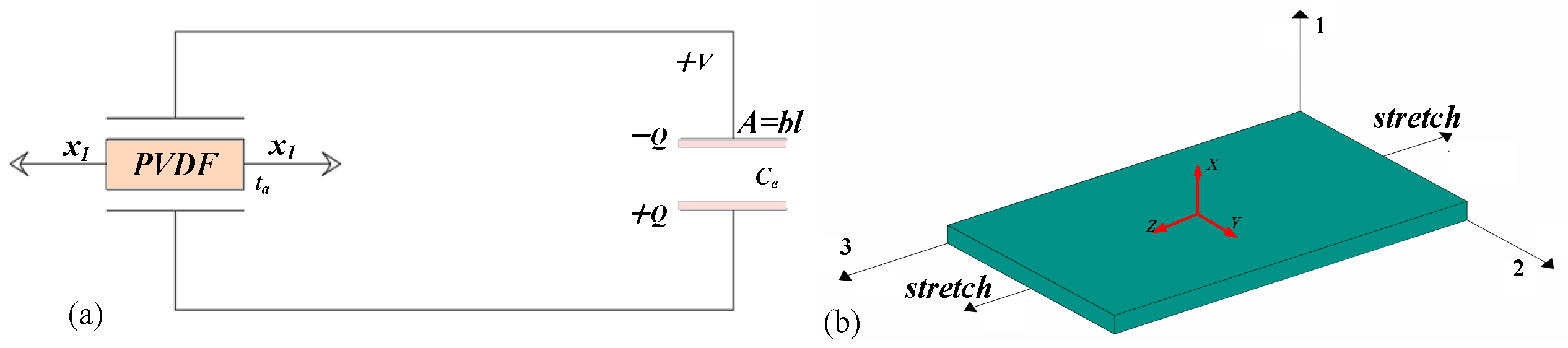
Under adverse loading conditions and complex service environments, crack formation exhibits randomness and diversity [31]. Consequently, it is challenging for a single sensor to conduct multi-angle analysis of these cracks. Therefore, a ring-shaped crack sensor is introduced, specifically designed for monitoring crack mechanisms on the surface of RC beams. The PVDF strip piezoelectric sensor is positioned on the surface of the structure. According to the positive piezoelectric effect, when external forces induce cracks, the sensor deformation corresponds to the crack width, resulting in the generation of equal positive and negative charges on its upper and lower surfaces. By analyzing and processing the output signal, it becomes possible to identify both the state and progression of structural cracks. The strain measurement circuit and the coordinate system for the piezoelectric element in relation to the bar crack sensor are illustrated in Figure 3.
As shown in Figure 3, the designed PVDF crack sensor utilizes passive monitoring technology. In this configuration, the PVDF material is subjected to mechanical freedom while experiencing an electrical short circuit; thus, the first type of piezoelectric equation is utilized, with the polarization of the PVDF occurring along the tensile direction. Assuming a thickness for the PVDF and defining the upper and lower electrode areas as A = bl (where b represents the width of the electrode and l represents the length of the electrode), an internal electric field is established within the working environment. When a strain of a certain magnitude occurs on the sensor, it can be noted that:
x 1 = s 11 E X 1 + d 31 E 3
D 3 = d 31 X 1 + ε 33 X E 3
In the formula, s 11 E represents the elastic compliance constant, the piezoelectric constant d31 represents the charge generated by the unit stress on the 3-axis on the 1-axis, ε 33 x is the dielectric constant, D3 is the electric displacement, E3 is the electric field, and X1 represents stress.
To provide a more intuitive understanding of the relationship between voltage, capacitance, and charge, the charge amplifier of the KD-5007 is employed to amplify the charge Q generated on PVDF. Subsequently, the DH-5922N high-performance dynamic signal test and analysis system is utilized for data collection and storage. Therefore, the conversion formula can be expressed as follows:
D 3 = Q A = C e A V
E 3 = V t a
where V represents the voltage, Q represents the charge amount, and Ce represents the capacitance of the DH-5922N high-performance dynamic signal test analysis system.
The voltage–strain conversion relationship can be derived from Equations (1)–(4):
V ( x 1 : C e ) = 1 C e + ( 1 k 31 2 ) C A d 31 s 11 E x 1
where K31 is the electromechanical coupling coefficient of PVDF material; C is the capacitance of PVDF; it can be seen from Equation (5) that when the measuring instrument is the same as the PVDF capacitance value, the voltage signal error is the smallest and the measurement accuracy is higher.
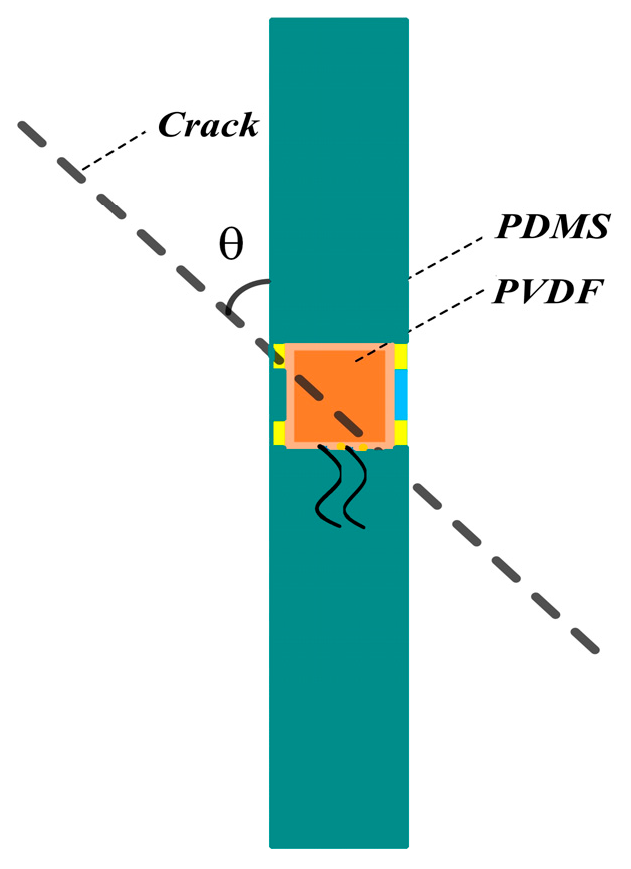
When the sensor monitors the crack, because the direction of the crack is unknown, it is assumed that the crack develops in a straight line, and the Angle between the direction and the sensor is θ. When the PVDF strip sensor is subjected to vertical tension x1, the stress X1 of PVDF and the strain of PDMS are.
X 1 = x 1 s 11 E + d 31 V s 11 E t a
x 2 = X 1 + N x 1 N
In the formula, x2 and N represent the strain and elastic modulus of PDMS, respectively.
Since the elastic modulus of PDMS is greater than that of PVDF, assuming that PVDF bears all the bonding forces, the PDMS elongation is given by:
Δ x = x 2 ( l 0 l 1 ) + x 1 l 1
where l0 represents the total length, and l1 represents the length of the PVDF. As shown in Figure 4, the relationship between the PDMS elongation and the crack width b is expressed as:
Δ x = b sin θ
where θ is the angle between the crack direction and the sensor. Combining Equations (8) and (9), and considering the relationship between voltage and strain from Equation (5), the voltage–crack width relationship can be derived as:
λ V = b sin θ
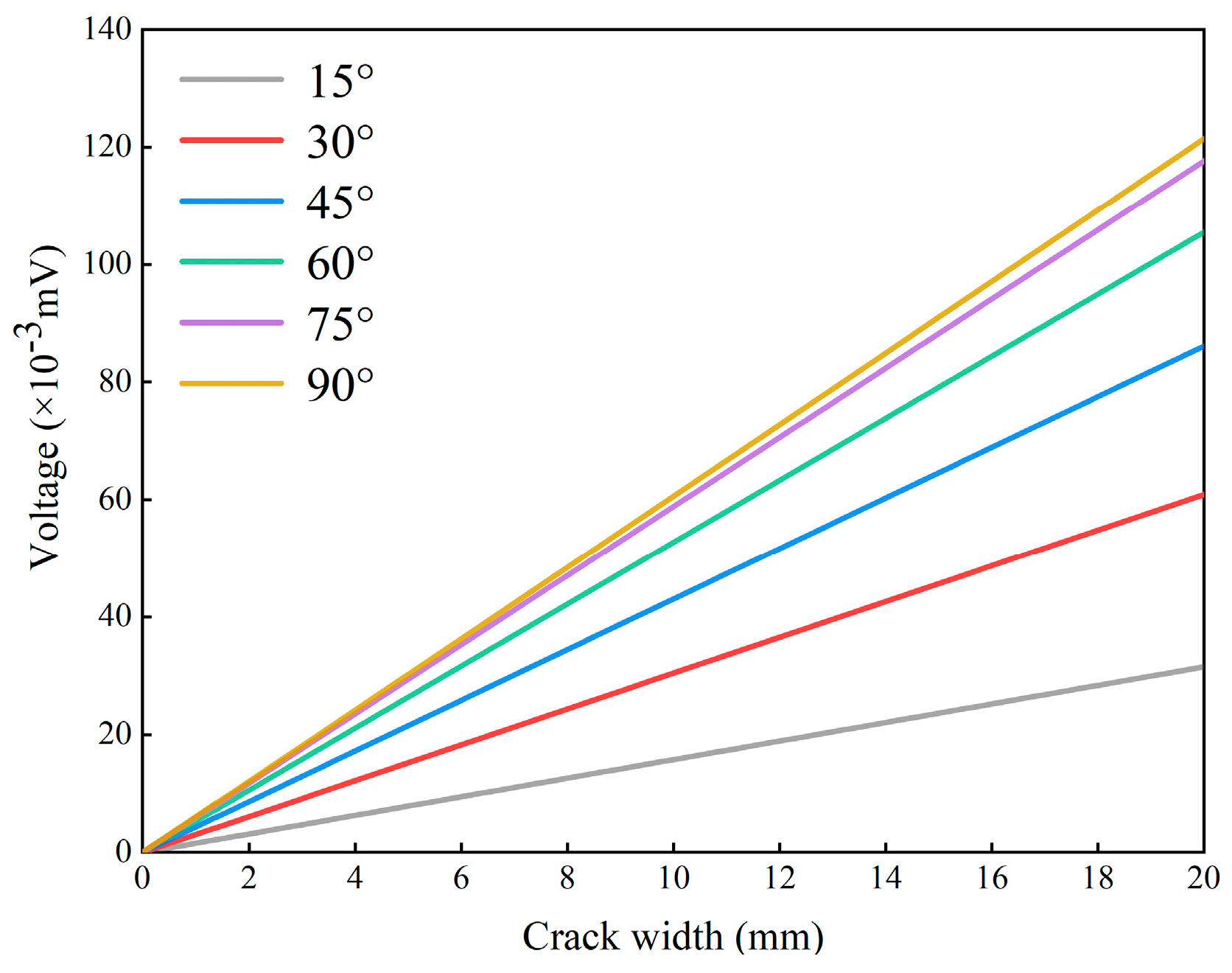
where V represents the measured voltage, and λ represents the piezoelectric coupling coefficient. When C is the same as Ce, the parameters related to PVDF are substituted to calculate λ = 1/6.09. Thus, the voltage signal and crack width map of each 15° crack are drawn, as shown in Figure 5.
It can be observed from Figure 5 that the output voltage signal of the PVDF strip piezoelectric sensor is directly proportional to the crack width, increasing as the crack width enlarges. Additionally, as the crack angle increases, the slope of the broken line rises gradually, indicating a decrease in the intersection angle between the crack and the electric field equipotential lines. This results in a diminished influence of the crack on the internal electric field and a slight enhancement of the voltage signal.
From the above, it is evident that the strip crack sensor can effectively monitor the crack width of RC beams. However, a single sensor faces challenges in accurately determining both the angle and direction of structural cracks. Therefore, to comprehensively assess structural crack damage, four strip sensors are integrated into a toroidal crack sensor, and the monitoring mechanism of this toroidal sensor is further investigated
In engineering, cracks frequently develop on the bottom and sides of RC beams. Consequently, this paper focuses on monitoring these two areas. The formation of cracks at the bottom occurs rapidly, resulting in a minimal time difference for the crack’s passage through the sensor; thus, the width can be measured directly. In contrast, side cracks propagate more slowly, making it challenging to observe or measure their direction of propagation directly. Therefore, it is essential to determine the direction of crack development using a toroidal piezoelectric sensor. The underlying principle is as follows:
(1)
Beam bottom surface crack monitoring
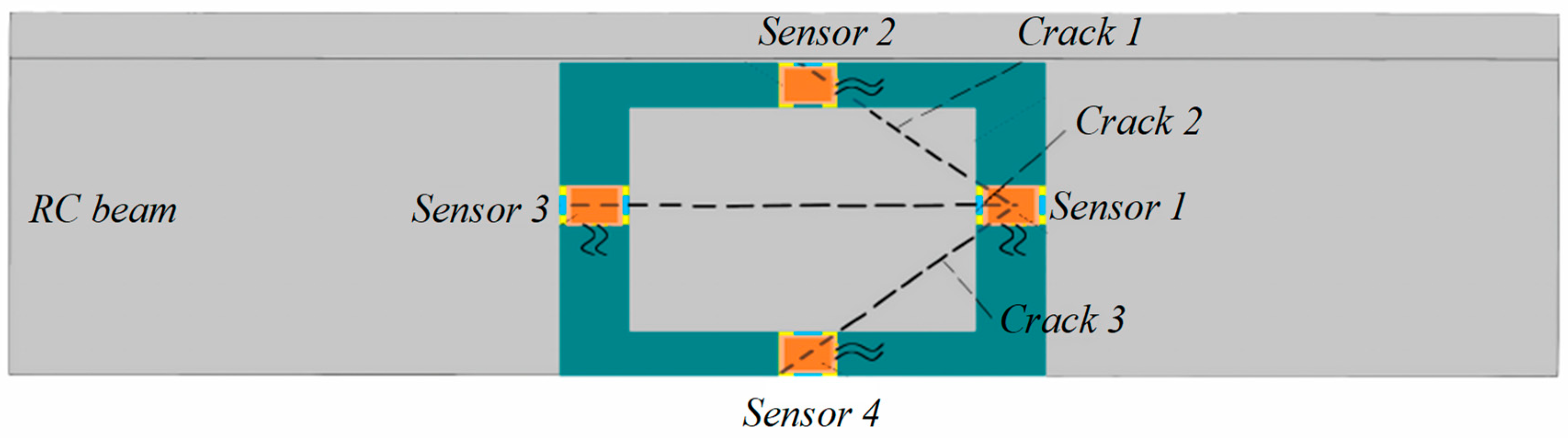
Based on the assumption that cracks at the bottom of the beam propagate along a straight line, it is observed that different sensors yield varying responses to signals transmitted through these cracks. As illustrated in Figure 6, three distinct crack conditions were established for analysis to ascertain both the development angle and width of the cracks. Various crack paths and sensor responses were simulated to derive relevant crack parameters. Since the monitoring mechanism for Crack 3 is identical to that of Crack 1, a detailed description of Crack 3’s monitoring mechanism is omitted.
For crack 1, both sensors 1 and 2 satisfy Equation (9). The development angle of the initial crack can be expressed as:
θ 1 + θ 2 = 90 °
In the formula, θ1 and θ2 represent the initial angles of the No. 1 sensor and the initial angle measured by the No. 2 sensor, respectively. At this stage, as the crack length is substantial, it becomes necessary to measure the crack width, which can be expressed as:
b 1 = b 2 = λ V 1 2 + V 2 2
In the formula, b1 and b2 represent the measurement widths of the No. 1 sensor and No. 2 sensor, respectively. V1 and V2 represent the measured voltages of the No. 1 sensor and No. 2 sensor, respectively. λ represents the piezoelectric coupling coefficient, λ = 1/6.08.
When analyzing the characteristics of crack 2, it is not feasible to directly calculate the crack angle and width because the initial angles of sensors 1 and 3 correspond to the crack width. However, by comparing the voltage signals from the bar piezoelectric sensor with those during the cracking process, one can deduce the initial angle of crack 2. Subsequently, the crack width can be determined based on the point at which growth ceases in the voltage signal.
(2)
Beam side crack monitoring
According to Figure 5, when monitoring crack propagation on the side of the beam, Sensor No. 1 is designated as the starting point for capturing the initial signal. Concurrently, voltage variations from Sensors No. 2 and No. 4 are observed to ascertain the initiation position of crack formation. Ultimately, crack behavior is assessed by integrating data from these three sensors, which corresponds to the three cases presented in Table 3. Once the direction of crack growth is established, Sensors No. 2, No. 3, and No. 4 are continuously monitored. An increase in signal from any sensor indicates that cracking is propagating in that specific direction, thereby facilitating effective monitoring of crack propagation patterns.

3. Experiment

3.1. Experiment Preparation

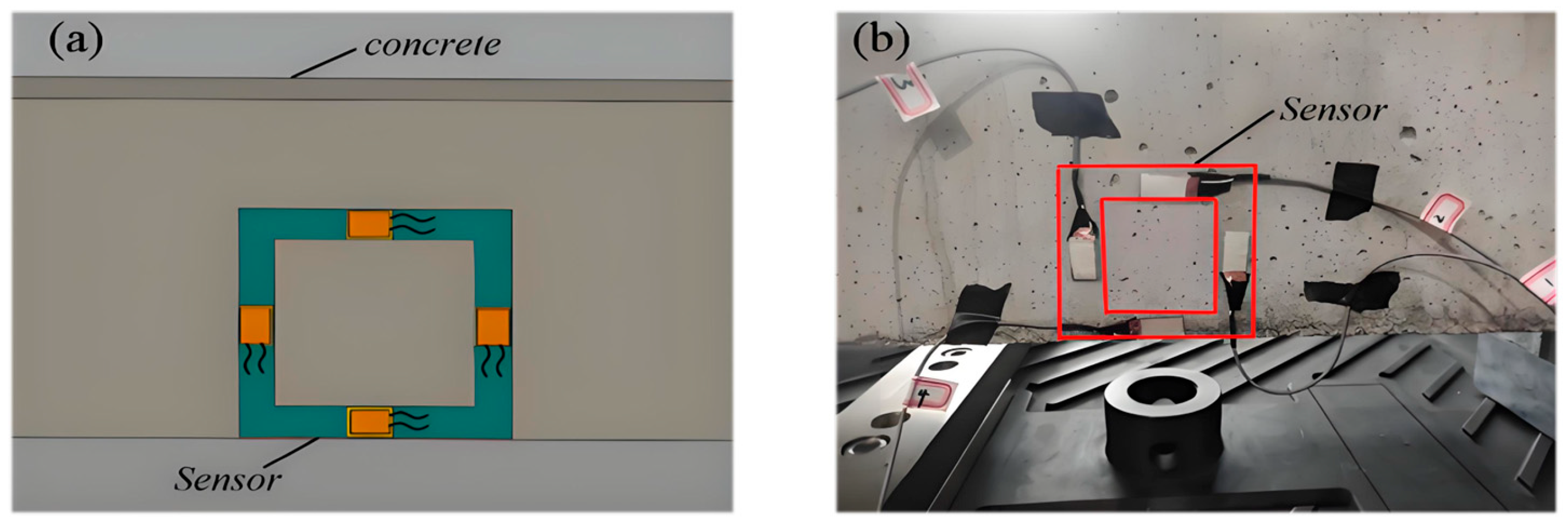
To assess the feasibility of monitoring surface cracks in RC beams using toroidal PVDF piezoelectric sensors, a crack monitoring test was designed for an RC beam measuring 150mm × 150 mm × 600 mm, as illustrated in Figure 6. The annular piezoelectric sensors were respectively adhered to the exact center positions on the front and side surfaces of the pre-existing crack. Subsequently, two iron blocks are affixed on either side of the prefabricated crack using adhesive (502 glue, Shanghai Suguang Adhesive Co., Ltd., Shanghai, China) to stabilize a large deformation extensometer (Model: YHD-100, Beijing Aerospace Measurement & Control Technology Co., Ltd., Beijing, China) and accurately measure the width of crack propagation. The sensors are arranged in a counterclockwise manner and are designated as No. 1, No. 2, No. 3, and No. 4. Data acquisition was performed using a DH5922N dynamic signal analysis system (Donghua Testing Technology Co., Ltd., Jingjiang, Jiangsu, China), and data processing was conducted using OriginPro 2021 software (OriginLab Corporation, Northampton, MA, USA). Corresponding repeated tests and statistical analysis were carried out on the strip sensors in the preliminary stage. The coefficient of variation of valid data is less than 5%, which meets the experimental requirements.
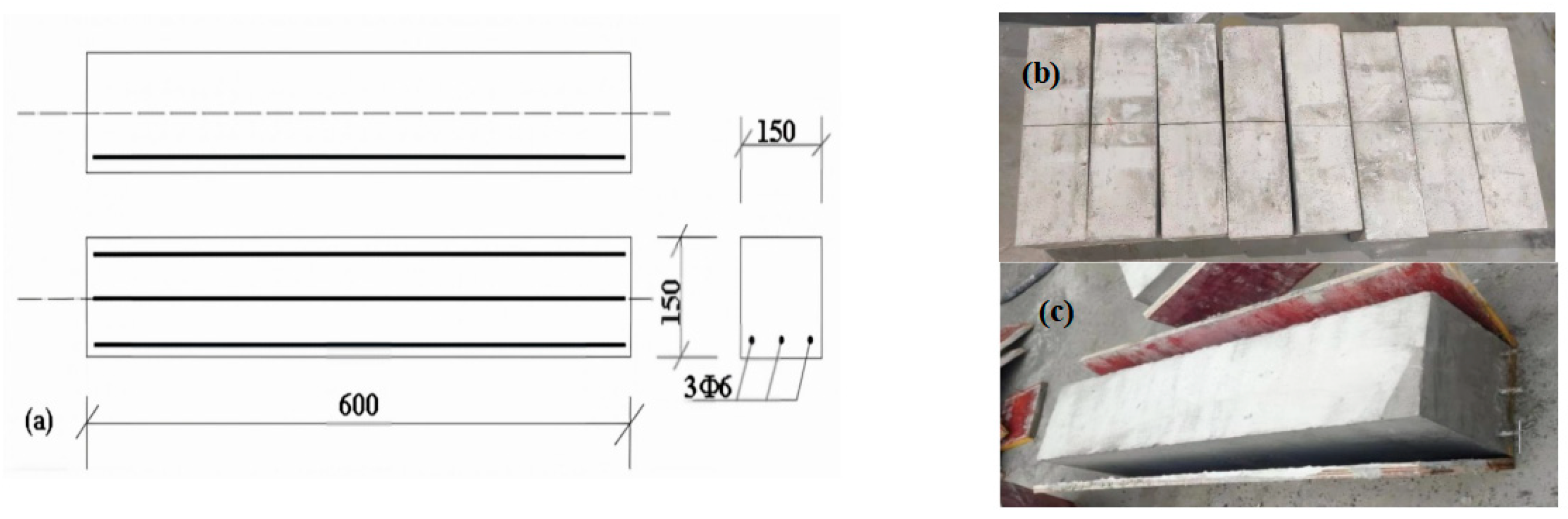
To facilitate the layout of the sensor, after the concrete solidified, a crack with a depth of 2 cm was prefabricated in the center of the bottom of the concrete to ensure that the crack expanded from the bottom after the concrete was stressed. Finally, the specimen was cured in the natural state for 28 days. HRB400 steel bars with a diameter of 6 mm were used in the test. The thickness of the protective layer from the bottom of the beam and on both sides was 25 cm and 15 cm, respectively. The eight reinforced concrete specimens adopted the 42.5R early strength cement mix ratio, as shown in Table 4. The physical diagram of the RC beam is shown in Figure 7b,c. It is worth noting that all experiments in this study were carried out under a constant indoor environment of 25 °C and relative humidity of 50% ± 5%. The core of this work lies in the structural development of a novel annular PVDF crack sensor and the feasibility verification of concrete crack detection, focusing on sensor configuration, crack response law and preliminary sensing mechanism. To focus on the main research objective, only a single constant temperature and humidity condition was adopted for benchmark tests, and systematic calibration as well as quantitative analysis of environmental effects under multi-gradient temperature and humidity conditions have not been conducted for the time being.

3.2. Experiment Process

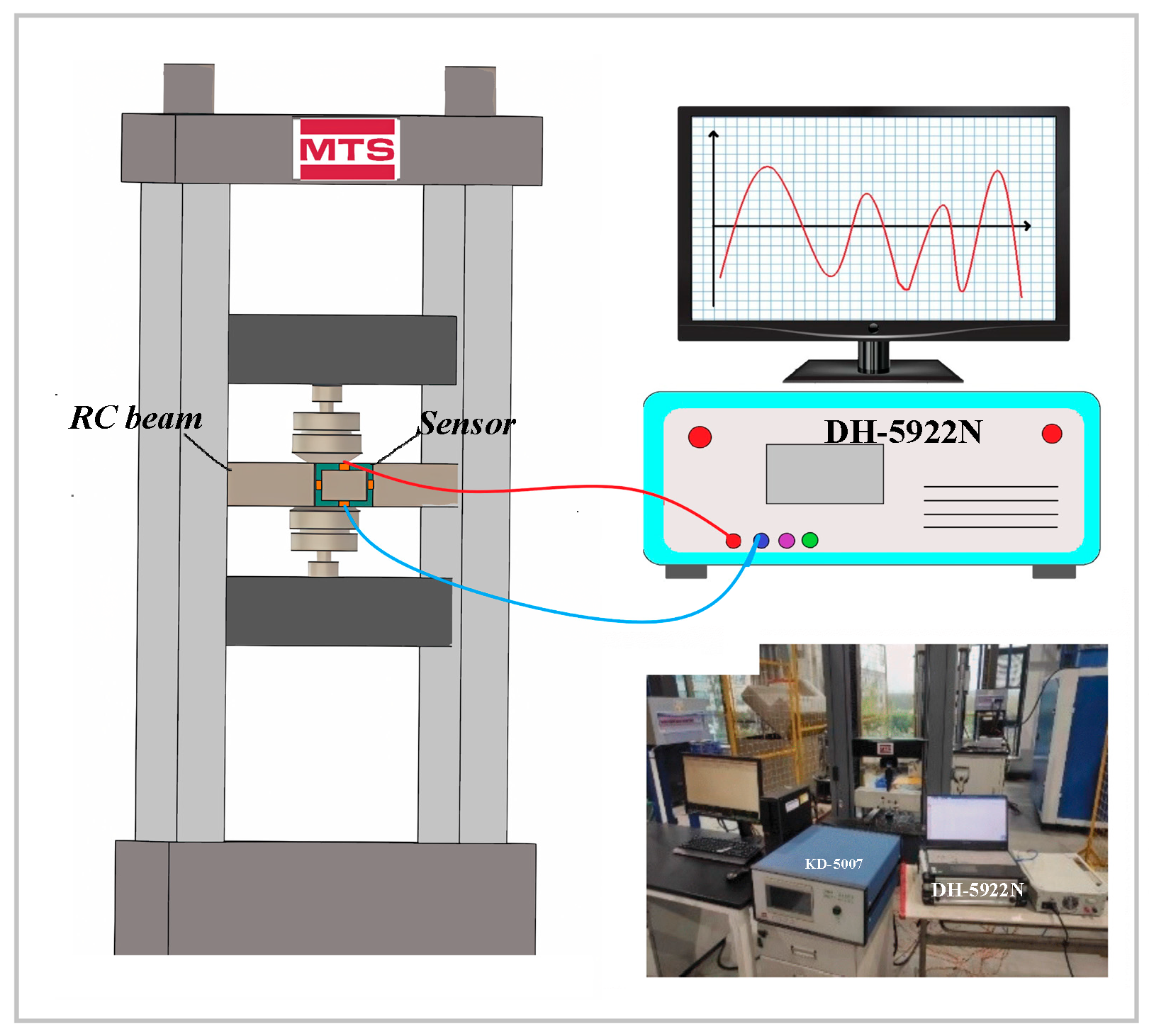
The experimental setup is detailed in Table 5. The reinforced concrete beam is positioned within the MTS 810 servo-hydraulic system and subjected to loading at rates of 300 mm/min and 100 mm/min, respectively. The electrical signals are amplified using the KD-5007 charge amplifier (Jiangsu Donghua Testing Technology Co., Ltd., Jingjiang, Jiangsu, China). At the same time, real-time voltage data from the four sensors are collected and analyzed through the DH-5922N dynamic signal testing and analysis system, as illustrated in Figure 8 As a high-performance dynamic signal test system, DH-5922N has a linear error within ±0.05%FS and an indication error below ±0.1% of the reading. Its strain measurement accuracy is 1.0 με, the 2-h zero drift is within 3 με, and the bridge circuit nonlinear error is less than 0.05%. The sampling frequency was set to 500 Hz, the system noise was controlled within ≤5 μVrms, and a 50 Hz power frequency notch filter together with a 100 Hz low-pass filter was adopted for signal denoising. KD-5007 is a multi-channel charge amplifier for converting piezoelectric sensor charge signals into voltage signals. It works within 0.3 Hz–100 kHz, with a maximum input charge of ±2 × 10⁶ pC and adjustable gain of 0.1–100 mV/Unit. The linear error is within ±0.1%FS, the indication accuracy is better than ±1% of the reading, and the harmonic distortion is lower than 0.3%, satisfying dynamic test signal conditioning requirements.
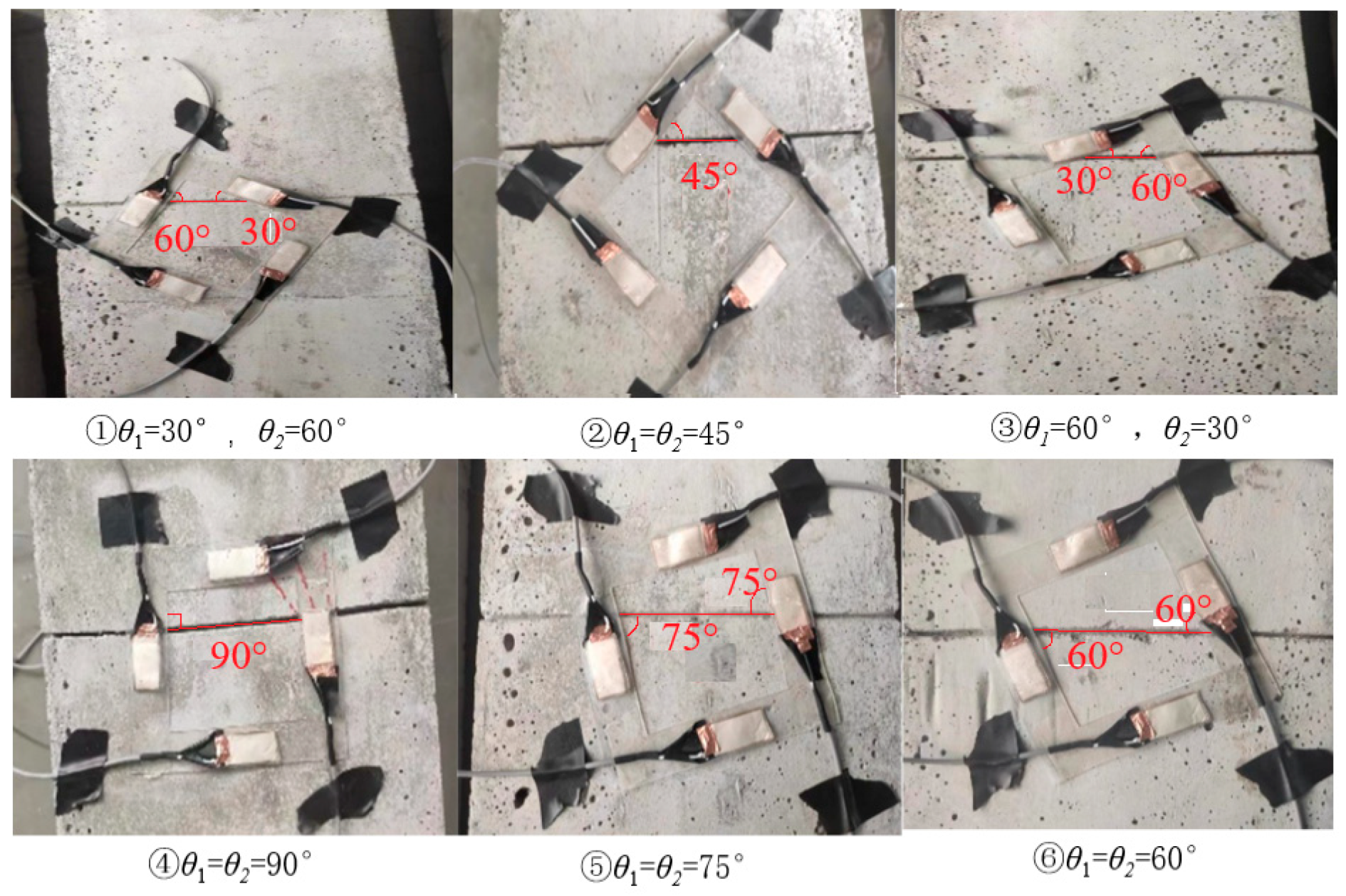
A total of 8 concrete specimens were used in this study. Among them, 6 specimens were adopted to monitor the crack propagation at the beam bottom, and the other 2 were used for sensor monitoring on the beam side. In the initial stage of the experiment presented in Table 5, three types of cracks on the bottom surface of the beam are monitored, as illustrated in Figure 9. Due to the symmetrical nature of crack 1 and crack 3, only crack 1 and crack 2 were examined in this study. Additionally, to investigate the effects of varying cracking angles and widths on the voltage signal, six different cracking angles (30°, 45°, 60°, and 90°) along with six cracking widths (1 mm, 3 mm, and 9 mm) were established. The specific data is detailed in Table 6.
In the second stage of Table 6, two sets of comparative experiments were conducted as part of the side monitoring experiment on the RC beam. To ensure that the sensors could effectively capture data after the initiation of side cracking, two sets of sensors were initially installed at positions corresponding to both ends of the prefabricated crack located at the bottom of the structure. These sensors were secured with tape to prevent them from detaching during the testing process. Following installation, a load was applied to the beam, as illustrated in Figure 10. Specifically, Sensor No. 1 is positioned at the bottom of the beam. At the same time, Sensor Nos. 2, 3, and 4 are arranged in a counterclockwise direction around it.

3.3. Experimental Result

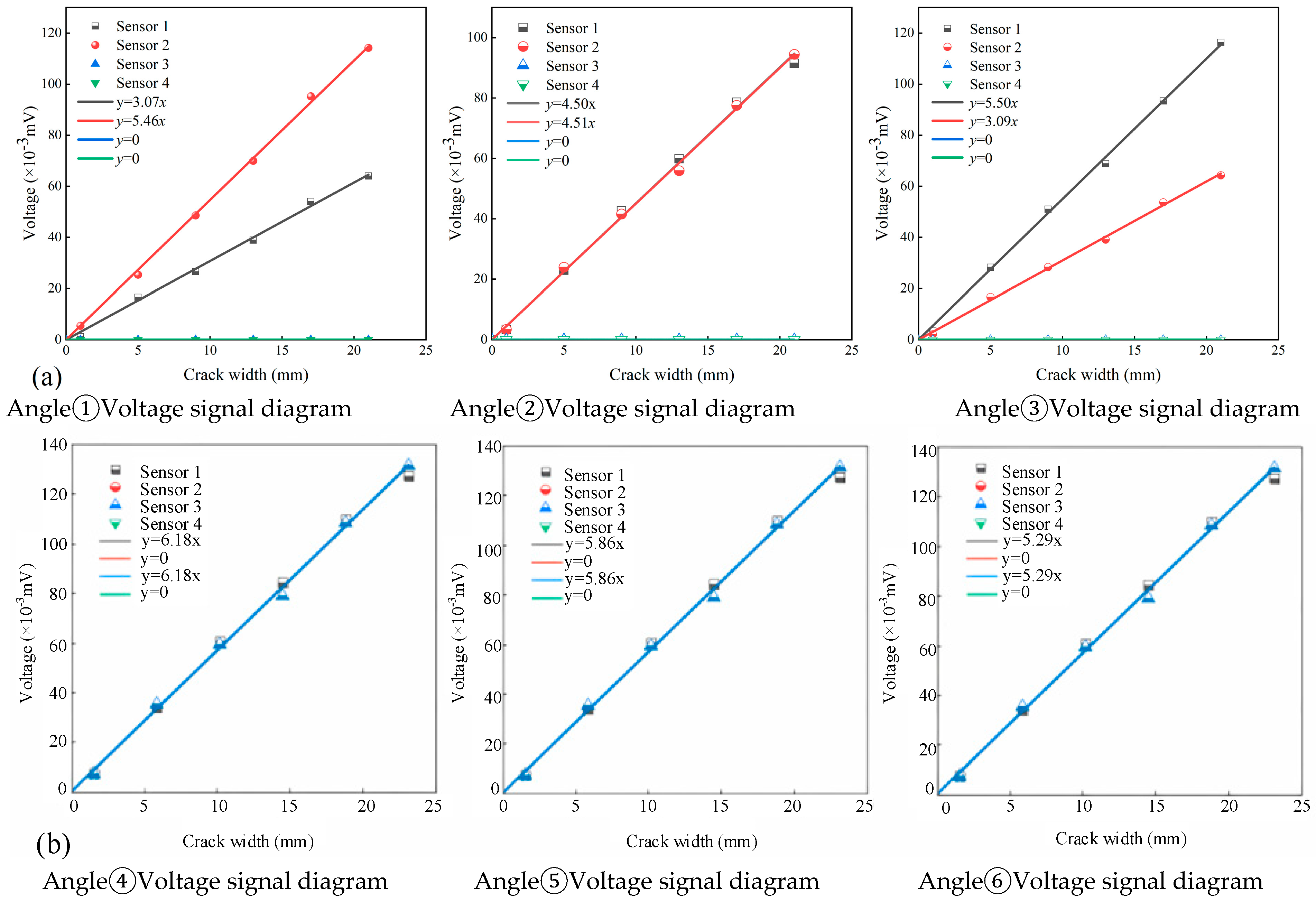
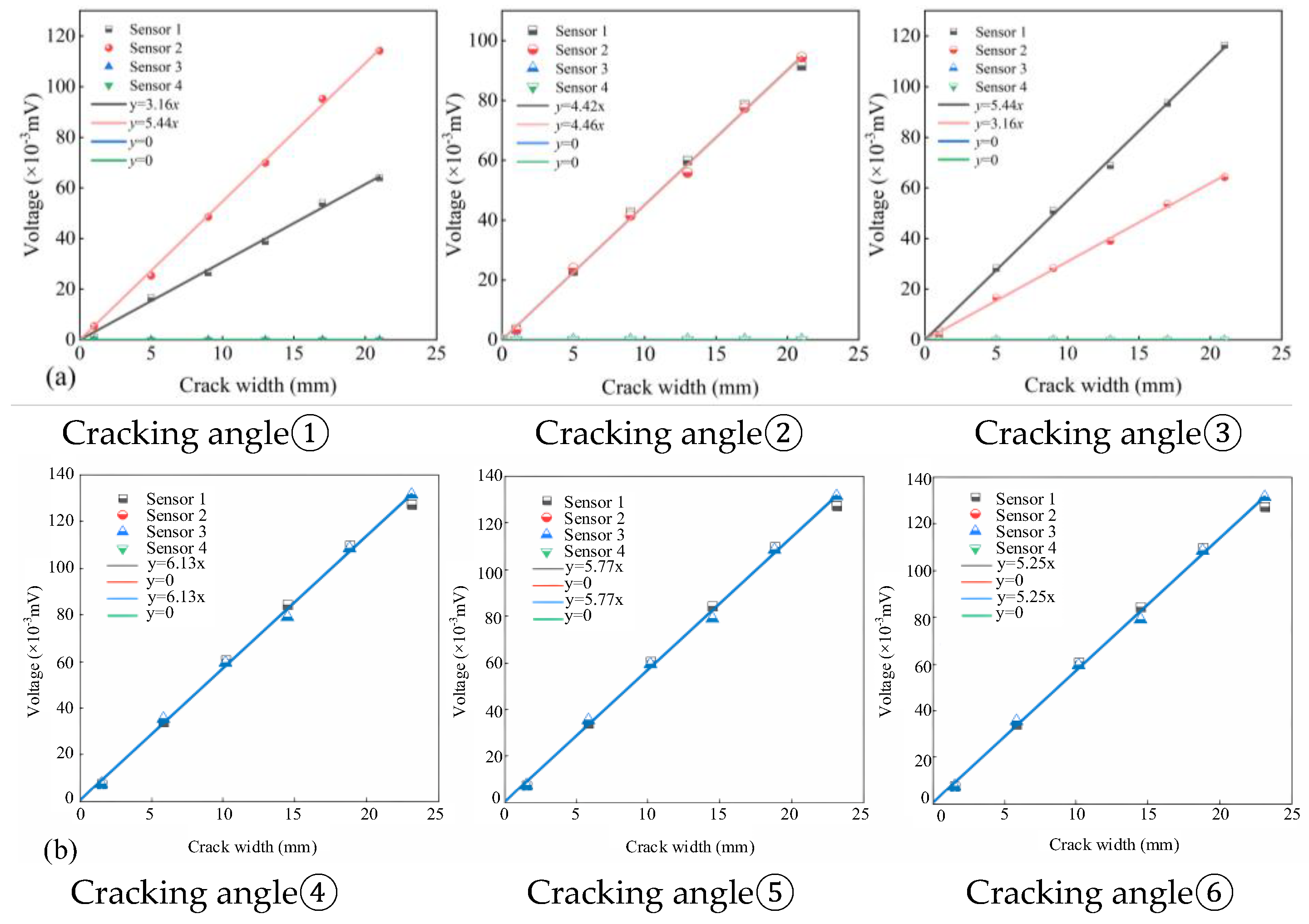
Figure 10 illustrates the real-time voltage signal and crack width of the bottom surface of the beam as the servo-hydraulic system is loaded during the initial stage of sensor testing. The diagram indicates that, during the monitoring of cracks 1 and 2, the sensor voltage signal increases as the crack width increases, indicating the development of the cracks. Furthermore, it is observed that the sensor signals for monitoring larger-angle cracks consistently exceed those for smaller-angle cracks. The specific trends are outlined as follows:
It can be observed from Figure 11a that for crack 1, the sensors generating voltage signals are designated as No. 1 and No. 2. As the load increases, the width of the crack progressively enlarges, resulting in a corresponding rise in the voltage signal. This indicates a proportional relationship between crack width and voltage signal intensity. When comparing voltage signals at different angles, it is noted that when the crack width measures 9 mm, the recorded voltage signals at angles of 60°, 45°, and 30 ° are, respectively, 0.045 mV, 0.041 mV, and 0.023 mV. It can be observed that the voltage signal increase signals also rise with increasing crack width, and their magnitudes coincide when measured at similar sizes. This observation suggests that when sensors are symmetrically arranged, they maintain an identical angle relative to the cracks, resulting in equivalent signals as the crack angle increases, indicating a positive correlation between damage to the beam structure and the crack angle. Consequently, as the crack angle increases, so does the degree of damage. It can be seen from Figure 10b that crack 2 generates voltage signals from the No. 1 and No. 3 sensors, and these voltage signals also increase with the increase in crack width.
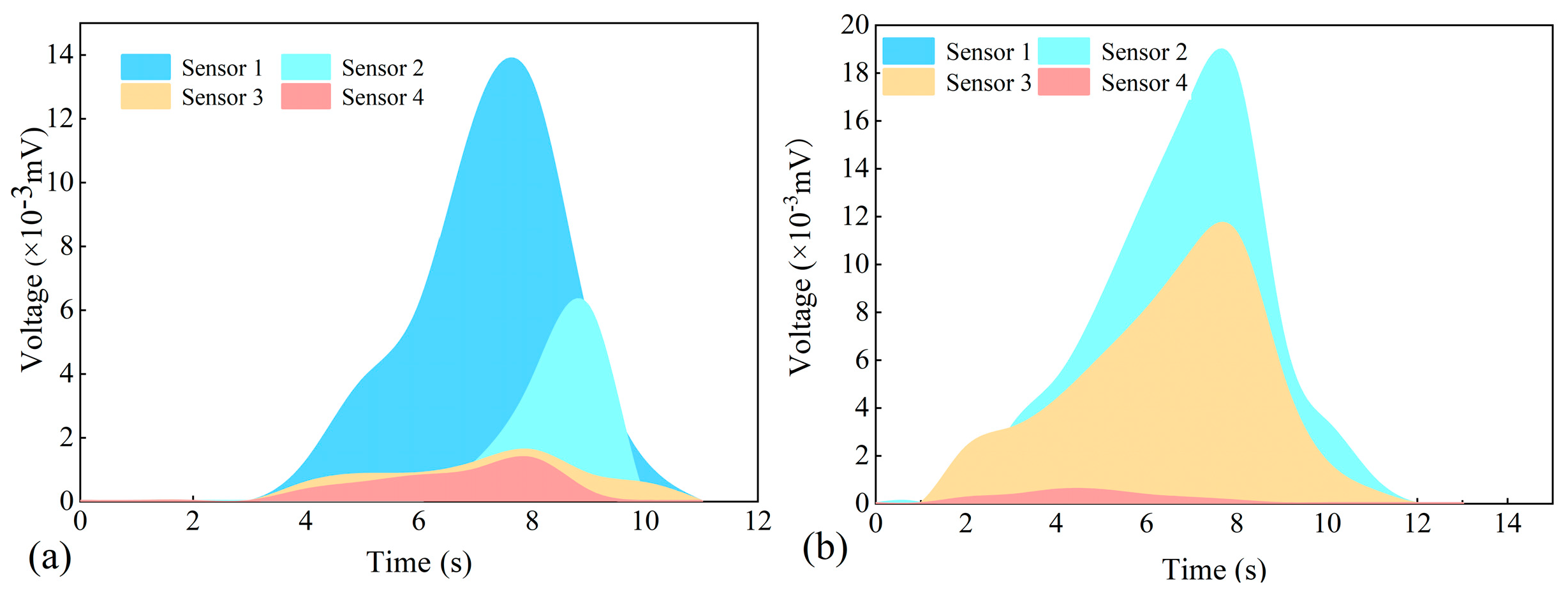
Figure 12 presents two sets of monitoring voltage signals obtained from the ring crack sensor during the RC beam experiment conducted in the second stage of the study. As illustrated in Figure 11, with the progression of side cracks, the two sets of voltage signal diagrams exhibit distinct characteristics. The primary difference lies in the combination of sensors and the magnitude of signals that generate these voltage outputs. A detailed analysis of these results is provided below.
It can be observed from Figure 11a that all sensors produce voltage signals. Among these, the maximum voltage signal recorded is 0.014 mV for Sensor No. 1, followed by 0.006 mV for Sensor No. 3. This indicates that the crack is generated due to the displacement of the left and right sections of the concrete, extending through Sensors No. 1 and No. 3. From Figure 12b, it is evident that Sensors No. 1, No. 2, and No. 4 also generate voltage signals. The maximum voltage value recorded by Sensor No. 1 is 0.019 mV, followed by Sensor No. 4 at 0.011 mV. This indicates that the crack formation is attributed to the displacement of the left and right sections of the concrete, which extends through both Sensor No. 1 and Sensor No. 4. Furthermore, a comparison between the first group and the second group reveals that the voltage signals in the latter appear earlier and exhibit higher peak values, suggesting that cracks in this second group propagate at a faster rate and possess a greater width. Additionally, it can be observed from the diagram that when the voltage signal reaches its peak value, a noticeable trend of deviation is followed by a decline in the signal. This phenomenon indicates that at this point, the beam has completely cracked and stabilized, resulting in a weakening of the voltage signal until it ultimately disappears.

3.4. Finite Element Verification

The three-dimensional modeling of the toroidal piezoelectric sensor was conducted using COMSOL software v6.3, ensuring that the model dimensions were consistent with those used in experimental setups. Voltage signals from the sensor located at both the bottom and side of the reinforced concrete beam were obtained through simulation under various working conditions. A comprehensive analysis was conducted to investigate the impact of various crack angles, widths, and cracking patterns on the degree of damage to beam members. The details are as follows:

3.4.1. Corrosion Depth and Axial Spacing

In the experiment, the toroidal piezoelectric sensor is constructed from PVDF, PDMS, silver plating, copper foil, conductive tape, shielding wire, and epoxy resin. Given the small diameter of the shielded wire, its volume’s impact on the sensor’s force can be considered negligible. Consequently, to simplify the model and enhance convergence speed during analysis, the region occupied by the wire is substituted with epoxy resin in the modeling process. The specific steps are as follows:
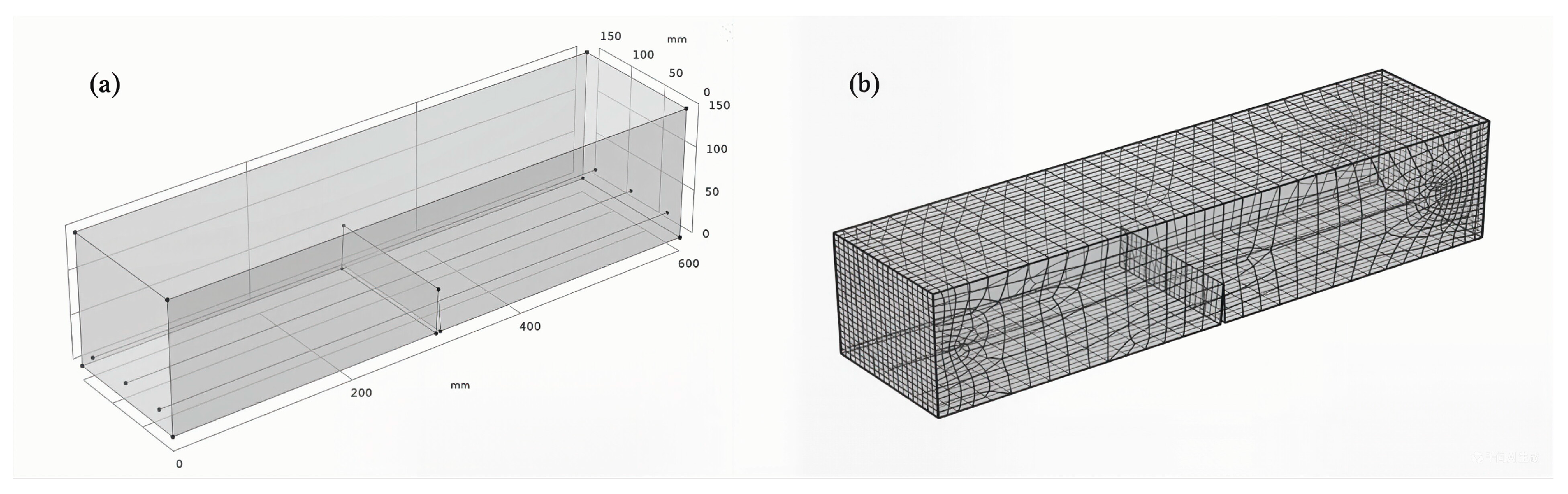
Firstly, the physical field interfaces of ‘solid mechanics’ and ‘piezoelectric multilayer shell’ within structural mechanics are utilized, with an emphasis on ‘steady-state research’ for analysis. Secondly, a geometric model of the toroidal piezoelectric sensor is established. This model consists of three layers: the bottom layer is a PDMS annular flexible substrate; the second layer comprises four PVDF sensors positioned at the center of each edge of the substrate; and the third layer features an external silver-plated film. The materials used include Polydimethylsiloxane (PDMS), Polyvinylidene fluoride (PVDF), and Silver [solid], as specified in the COMSOL material library. Secondly, parameters such as Poisson’s ratio, density, Young’s modulus, and relative dielectric constant were established. Subsequently, the crack development was simulated by defining the boundary conditions at the consolidation points between the four sensing sheets. Finally, a free tetrahedral mesh was employed for model meshing, followed by numerical simulation. The maximum unit size of the grid was set to 1 mm, while the minimum unit size was 0.01 mm. The maximum growth rate of units was specified as 1.3, with a curvature factor of 0.2 and a resolution in narrow areas set to 1. This is illustrated in Figure 13.

3.4.2. Analysis of Experiment and Simulation Results

In the simulation of crack monitoring at the bottom of the beam, voltage signals corresponding to different crack widths under cracking Angles ① and ② were obtained. The center point of the PVDF sensor is designated as the reference point, and data fitting was performed to establish a relationship between the voltage signal and crack width. The voltage responses for cracks 1 and 2 at three different cracking angles are presented in Figure 13a and Figure 13b, respectively.
Figure 14 presents a comparison of voltage signal curves from different sensors. The voltage signals corresponding to the two types of cracks exhibit a gradual increase as the crack width develops. It is observed that the voltage signals from various sensors remain consistent at identical crack widths. As illustrated in Figure 14a, the voltage signals are generated by Sensors No. 1 and No. 2, indicating that the crack initiates at Sensor No. 1 and progressively extends towards Sensor No. 2. Furthermore, when the crack width reaches 21 mm, the signal amplitudes recorded by Sensors No. 2 and No. 1 under Angle ① are measured at 0.15 mV and 0.062 mV, respectively. Under Angle ②, both sensors yield identical readings of 0.090 mV; while under Angle ③, Signal amplitudes for Sensors No. 1 and No. 2 are again recorded as 0.15 mV and 0.062 mV, respectively. This data indicates that for a given crack width, an increase in crack angle correlates with an enhancement in the magnitude of the generated voltage signal. It can be observed from Figure 14b that the voltage signals are generated by Sensors No. 1 and No. 3. As the cracking angle decreases gradually from positions ④ to ⑥, the peak values of the signals also exhibit a corresponding decrease, measuring at 0.132 mV, 0.127 mV, and 0.110 mV, respectively. Notably, at each specific cracking angle, the signal magnitudes recorded by both sensors are identical, resulting in overlapping lines on the graph. A comparison with experimental results indicates a strong correlation between them. Thus, it is verified that the derived annular piezoelectric sensing mechanism can well monitor the direction and width of crack development.
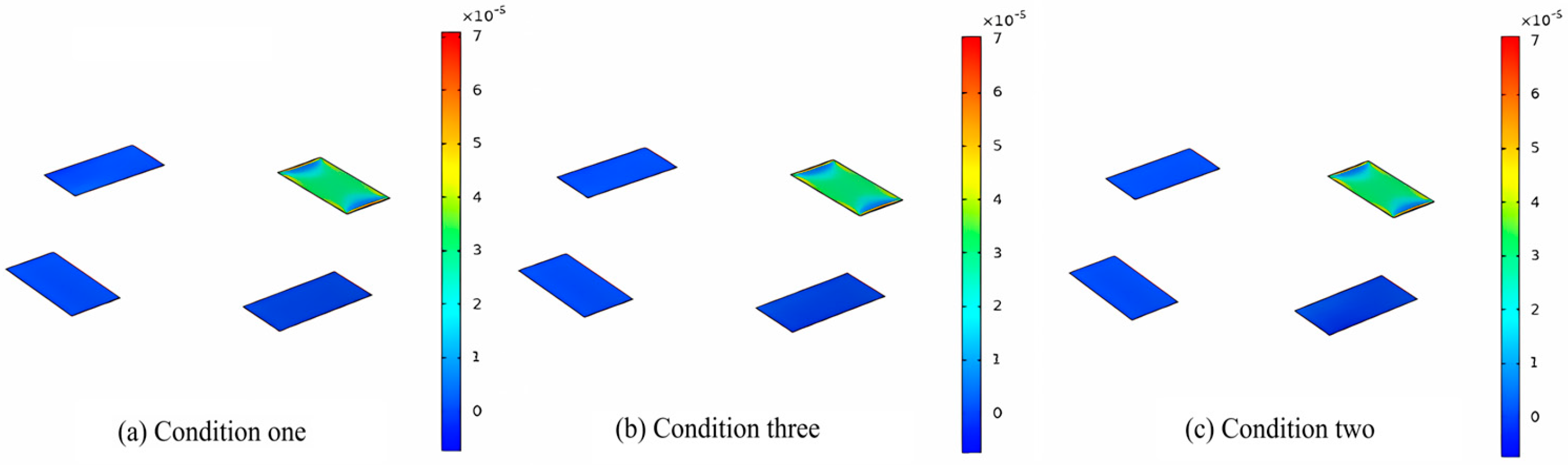
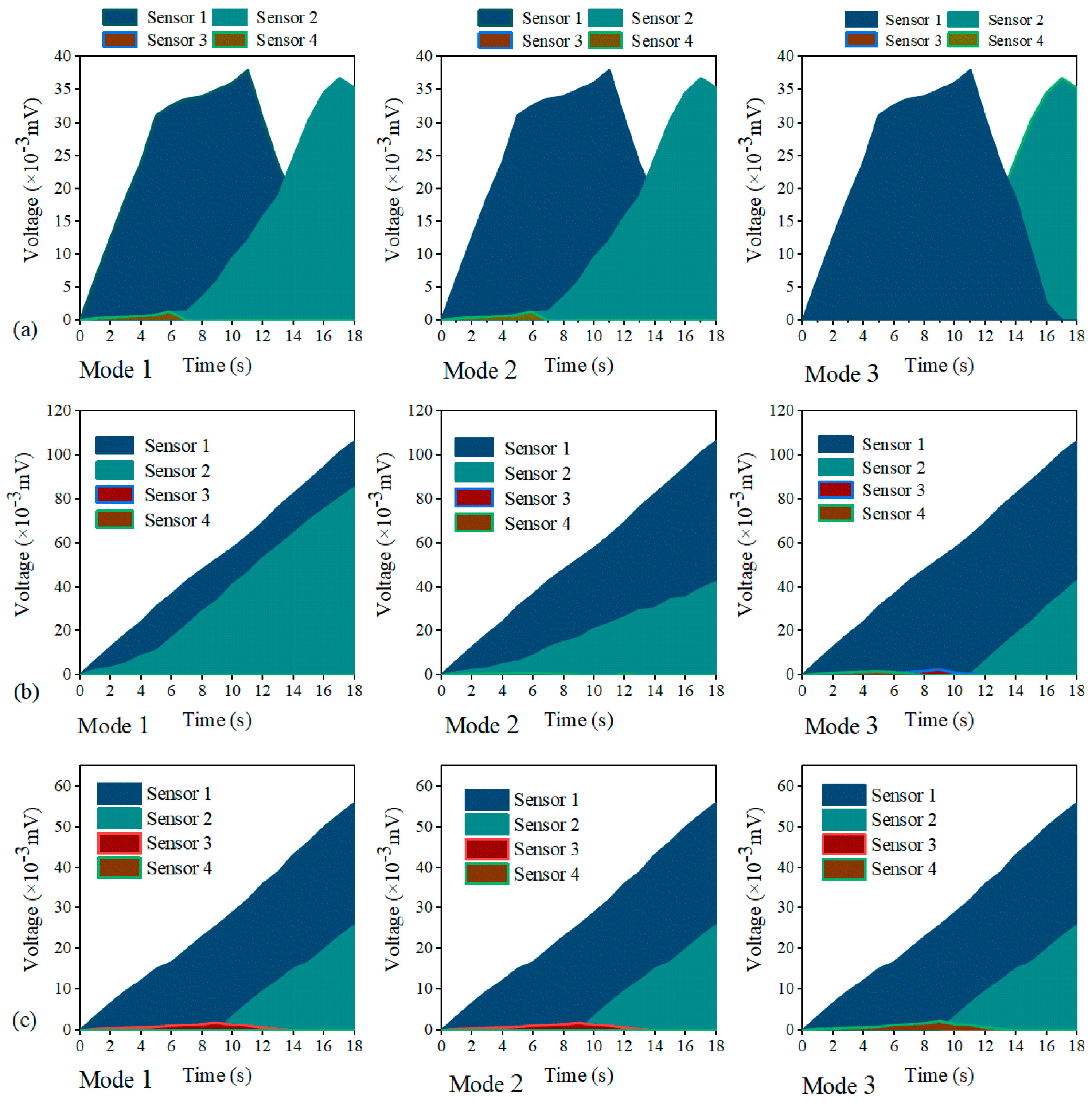
In the simulation of beam-side monitoring, assuming that the crack develops from the No. 1 sensor and the width reaches 5 mm, voltage signal graphs are obtained under three working conditions. Figure 15 shows the voltage signal response sizes under different working conditions. It can be seen from Figure 14 that Condition 1: No. 1 and No. 2 sensors generate voltage signals, and the signal of the No. 1 sensor is significantly larger than that of the No. 2 sensor. Condition 2: No. 1 and No. 4 sensors generate voltage signals, and the signal of the No. 1 sensor is significantly larger than that of the No. 4 sensor. Condition 3: Sensors No. 1, No. 2, and No. 4 generate voltage signals. The voltage signal of the No. 1 sensor is the largest, and the displacement of the upper and lower parts of the concrete determines the signals generated by the No. 2 and No. 4 sensors. The results above demonstrate that the toroidal piezoelectric sensor can effectively monitor three types of side cracks.
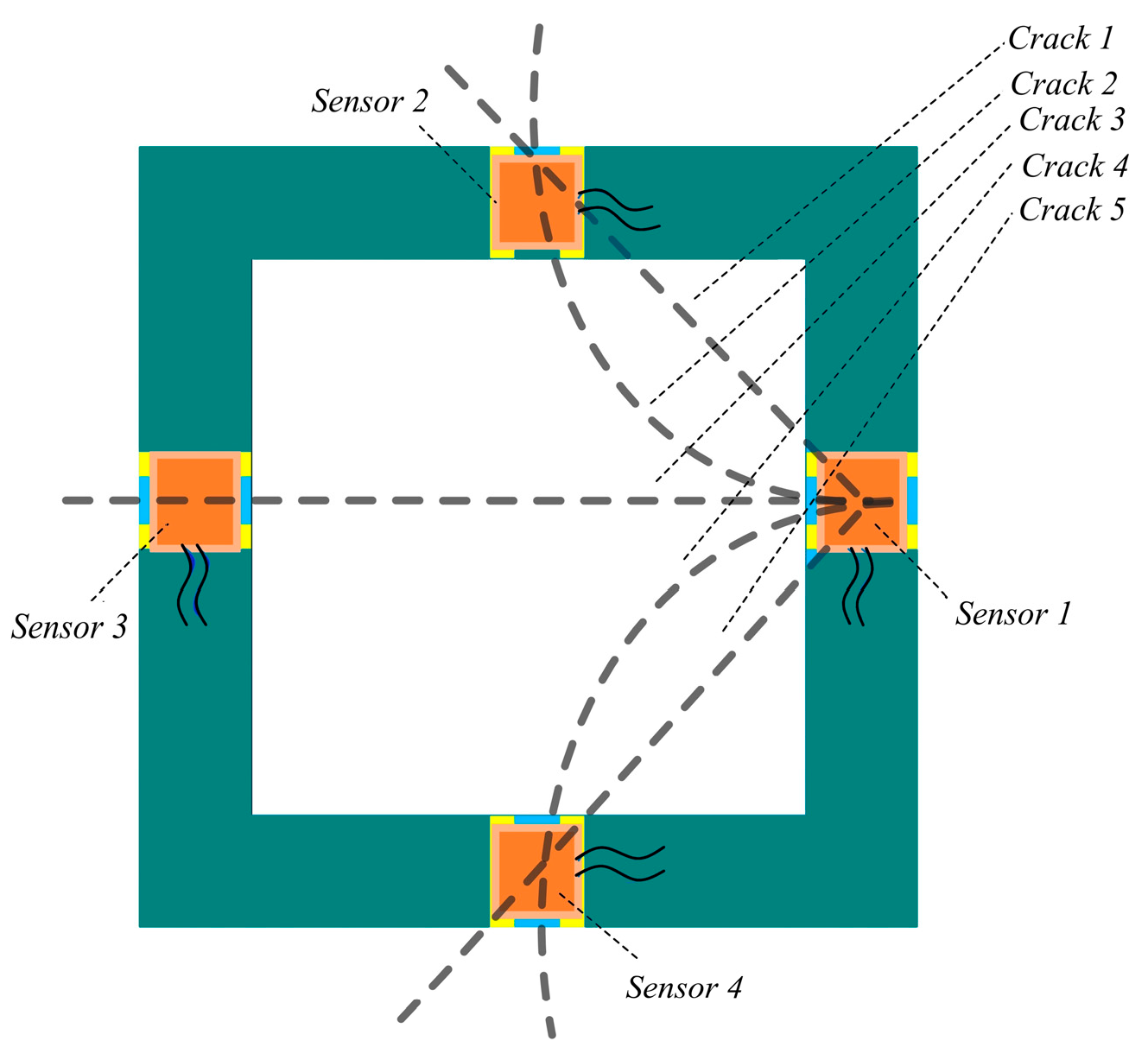
To further investigate the monitoring mechanism of beam-side cracks, it is assumed that the cracks propagate in a straight line from Sensor No. 1, resulting in five distinct types of cracks, as illustrated in Figure 16. Given the symmetrical nature of the crack propagation, only the first three modes of expansion will be discussed below.
Firstly, the boundary conditions for the four consolidation points of the sensing device are established to simulate the progression of three types of cracks. The voltage signals from the four sensing plates are acquired through multiple calculations, and a curve depicting the relationship between crack voltage signals and time is generated, as illustrated in Figure 16.
As illustrated in Figure 17a, the signals from sensors No. 1 and No. 2 for the first type of crack are distinctly observable, with signal amplitudes gradually increasing as the crack propagates. Following the signal’s peak, the output from sensor No. 1 begins to decline, while the voltage signal from sensor No. 2 accelerates in response. This indicates that as the crack fully develops, its tensile effect diminishes progressively, leading to a weakening and eventual disappearance of the signal from sensor No. 1. At this juncture, the crack extends towards sensor No. 2, thereby activating its voltage response.
In contrast, Figure 17b illustrates the signals generated by sensors No. 1 and No. 2 for the second type of crack; these signals are generally more pronounced than those observed in Figure 17a. Notably, the output from sensor No. 1 consistently remains higher than that of sensor No. 2 throughout the crack propagation process, exhibiting no decrease despite the ongoing expansion of the crack. In addition, the peak value of the voltage signal is measured at 0.110 mV, which significantly exceeds the peak values observed for the first and third cracks, specifically 0.037 mV and 0.055 mV, respectively. This indicates that while the fracture development of the second crack occurs at a slower rate, it results in more severe structural damage and a more intense response. As illustrated in Figure 17c, the signal response associated with the third crack exhibits similarities to that of the second crack; however, it is noteworthy that sensor signal responses are more pronounced for Cracks No. 1 and No. 3.
By comparing the voltage signals measured during the experiment, it was observed that the working conditions of both the third crack (2) and the second crack (2) align closely with the monitoring experimental data. This finding validates that the ring piezoelectric sensor is capable of effectively monitoring the development patterns of side cracks in beams.

4. Crack Damage Index Analysis

The structural damage degree is comprehensively affected by crack angle, crack width and crack propagation pattern, all of which exert substantial influences on the bearing performance of reinforced concrete beams. Therefore, accurate characterization of multi-factor crack characteristics is essential to quantitatively evaluate structural damage state. Nevertheless, traditional crack evaluation methods mostly rely merely on crack width, while neglecting the coupling effect of crack angle and morphology, making it difficult to achieve a comprehensive and reasonable damage assessment. On this basis, this paper proposes a crack damage index B, which incorporates crack width, propagation angle and morphological characteristics to establish a multi-factor evaluation framework and realize a more comprehensive quantitative characterization of structural crack damage. It should be noted that the proposed index B is only an exploratory attempt in this research, and its theoretical mechanism and applicability still lack sufficient experimental verification under complex working conditions. Subsequent research will carry out extensive specimen tests and numerical simulations to further calibrate the index parameters, improve the theoretical system, and verify its engineering applicability and generalization performance.
B = b c o s 2 θ μ
In the formula, b represents the width of the crack at the bottom of the beam, θ represents the angle between the crack at the bottom of the beam and the vertical direction of the beam, and μ = 1, 2, 3, 4, 5 represents the five types of cracks on the side of the beam. Since the first crack is consistent with the fifth crack, the second crack, and the fourth crack, likely, the third crack will also be consistent with these. Therefore, the following discussion focuses on the development of the first, second, and third types of cracks.

4.1. Numerical Test of Crack Damage Index

To investigate the influence of damage index B on reinforced concrete structures under various crack development patterns, this section utilizes COMSOL software to construct a model of a reinforced concrete structure. By applying loads to its boundaries for numerical simulation, we obtain the maximum stress at the upper part of the reinforced concrete structure as well as the maximum stress in the bottom steel reinforcement. Furthermore, an in-depth analysis is conducted to examine how both concrete and steel bar stresses impact the structural damage index. The specific modeling steps are outlined as follows:
Firstly, a geometric model of the reinforced concrete beam is established. The dimensions of the model are 150 mm × 150 mm × 600 mm, which correspond to those of the test specimen utilized in the experiment above. Three ribbed bars with a diameter of 6 mm are positioned at the bottom, as illustrated in Figure 18a. Secondly, relevant material properties are retrieved from the material library. Specifically, concrete with a C35 strength grade is employed, and parameters such as Poisson’s ratio and density are sequentially defined. Subsequently, fixed constraints are applied at both ends of the beam, while a downward boundary load of 30 N/m2 is imposed on its upper surface. Finally, physical fields are applied; mesh generation and solution processes follow suit. Fixed constraints are applied at both ends of the concrete beam. The steel reinforcements are divided into 20 fixed units in a distributed manner. The upper and lower edges of the left and right sides of the concrete beam are also divided into 20 fixed units by distribution. The remaining regions are meshed with ultra-fine elements to improve computational accuracy. The mesh generation of the cracked reinforced concrete beam is shown in Figure 17b.
Before the simulation, to accurately describe the cracking phenomenon in concrete structures and to simulate crack propagation, a preset crack is established, followed by conducting a steady-state analysis. Concurrently, the width of the crack at mid-span on the bottom surface is set to 5 mm, while the propagation length of the side crack is determined based on monitoring data from ring piezoelectric sensors. Additionally, three types of cracks with varying angles are introduced at the bottom of the model, along with three distinct forms of crack propagation on the sides. This results in a total of nine combinations of different crack conditions.

4.2. Results and Analysis

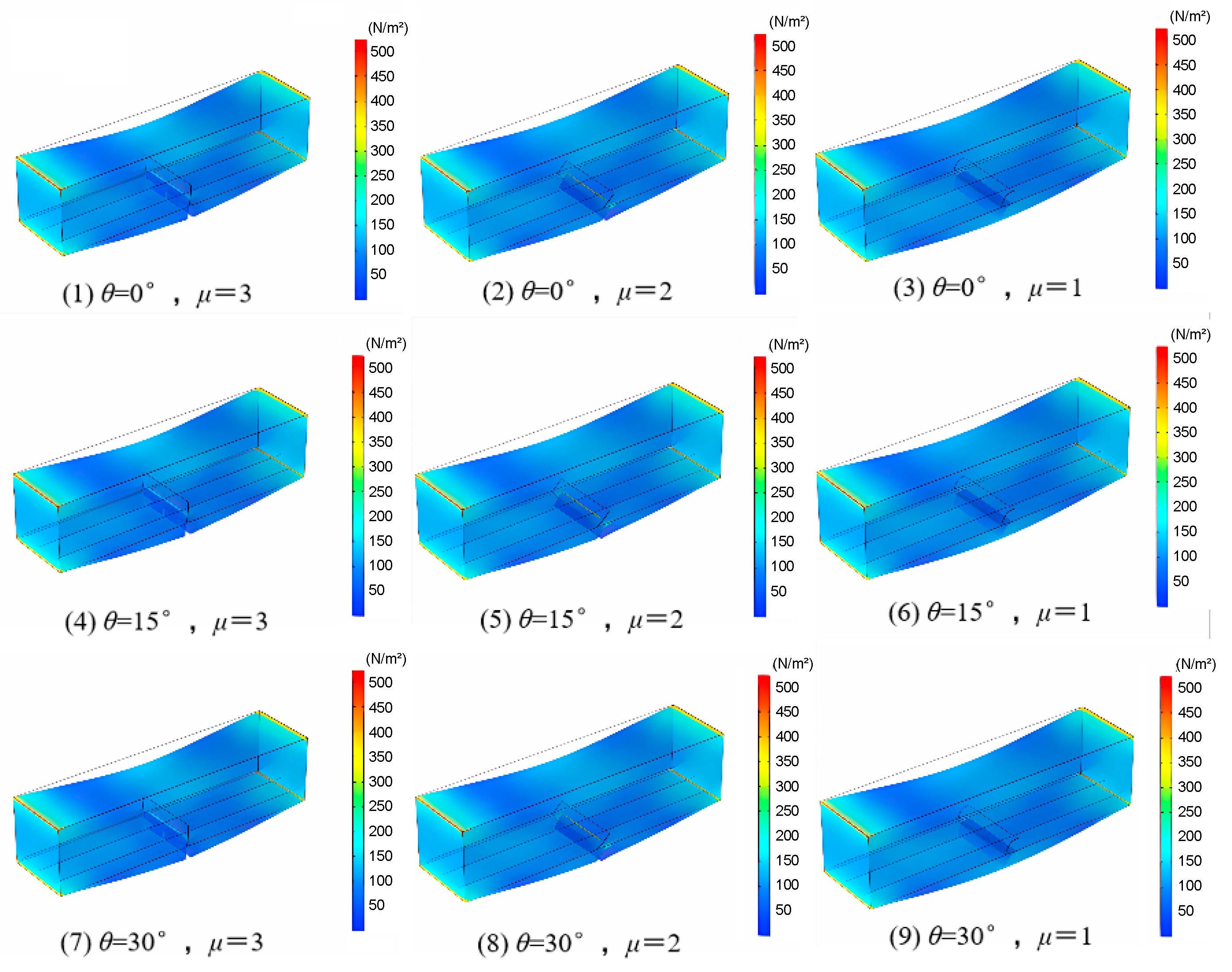
Through calculations, stress distribution diagrams for the upper surface of the concrete mid-span and the bottom steel reinforcement corresponding to nine different types of crack combinations have been obtained, as illustrated in Figure 19. Specifically, Figure 19 presents the stress distribution diagram for the upper surface of the concrete span.
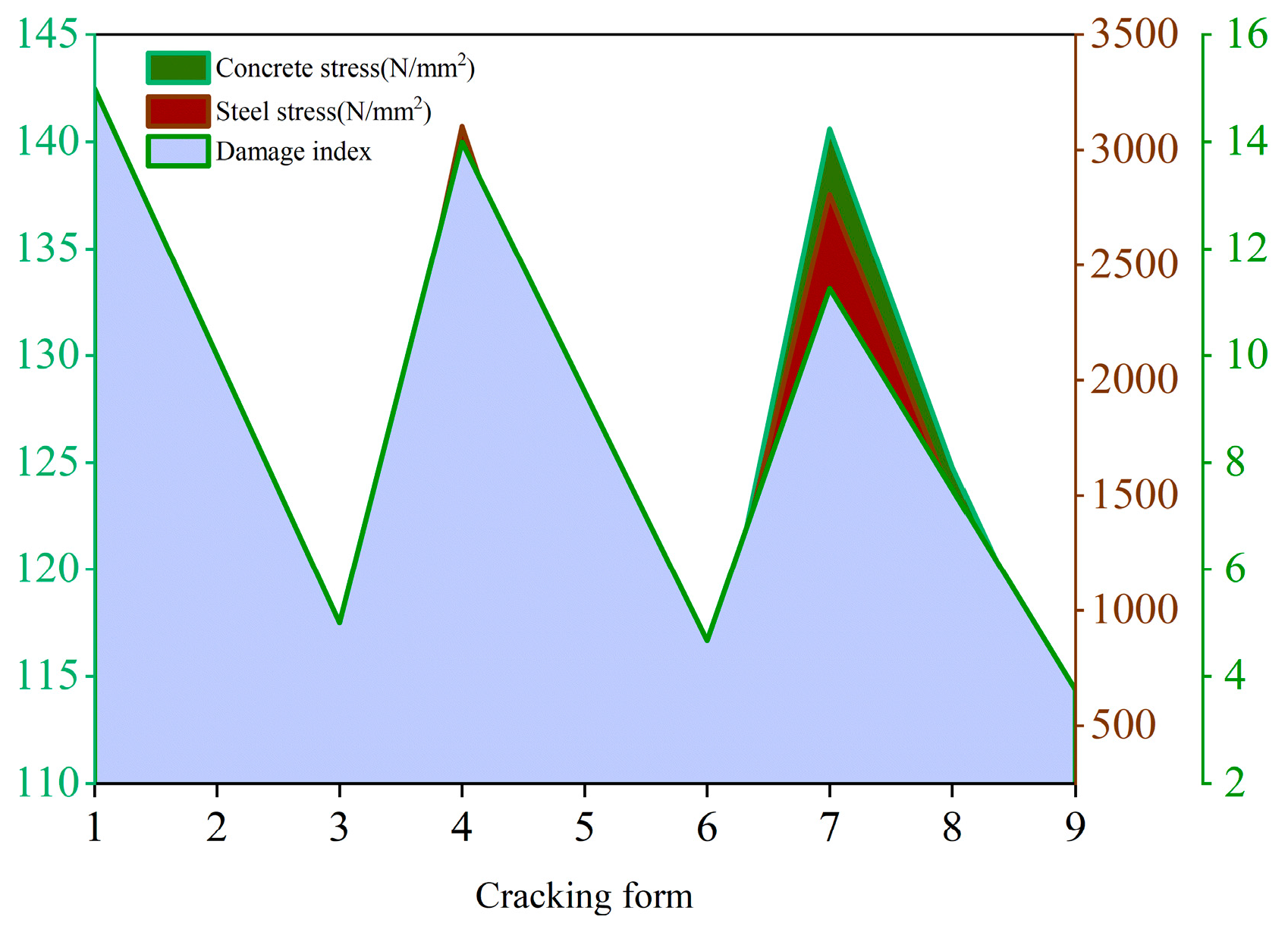
After organizing the data, the maximum stress on the upper surface of the concrete span and the stress in the bottom reinforcement were obtained, as presented in Table 7. From Table 7, it is evident that under various crack forms, the stress in the steel bars significantly exceeds that of the concrete. This indicates that after a bottom crack occurs in a reinforced concrete beam, steel bars serve as the primary load-bearing elements. Under conditions with identical crack angles on the bottom surface, the stresses in the steel bars corresponding to cracks from third to first on one side are measured at 3126.090 Pa, 1524.390 Pa, and 623.090 Pa, respectively. The stress values of concrete are estimated at 139.01 Pa, 123.62 Pa, and 112.73 Pa, respectively. These results indicate a gradual decrease in the stress of both concrete and steel reinforcement bars, suggesting that the third crack inflicts the most significant damage to the structure. Furthermore, for cracks of similar types located on the side surfaces, it is observed that a smaller cracking angle at the bottom leads to an increase in stress within the steel bar; conversely, there is relatively little change in stress across the middle section of the upper surface of the concrete. This finding highlights that variations in crack angles have a more pronounced effect on steel reinforcement than on concrete itself.
It can be observed from Figure 20 that the crack damage index aligns with the stress variation trends of both concrete and steel reinforcement bars. When the cracking angle of the bottom crack remains constant, different forms of side cracks exert varying effects on the crack damage index. The structural stress exhibits a positive correlation with the crack damage index; specifically, an increase in structural stress and steel bar stress corresponds to a rise in the crack damage index. Analysis indicates that a higher crack damage index signifies a more pronounced impact on structural integrity. Consequently, the influence of various types of cracks on reinforced concrete structures can be effectively characterized by utilizing the crack damage index.

5. Conclusions

(1)
The developed ring-shaped piezoelectric sensor effectively increases the strain range by superimposition of two materials, PVDF and PDMS. Meanwhile, the ring-shaped sensor was split into four strip units for structural analysis. Based on an in-depth study of the strip sensor’s monitoring mechanism, a novel ring-shaped piezoelectric sensing mechanism was proposed to achieve real-time monitoring of cracks on the bottom and sides of the RC beam.
(2)
In the monitoring experiment of reinforced concrete beam cracks, the ring piezoelectric sensor exhibits a rapid response. Specifically, the voltage signal increases as the crack width enlarges, and notable differences are observed in the reactions corresponding to various crack widths. At a constant width, it is observed that the voltage signal decreases as the cracking angle is reduced. For instance, when the crack width measures 9 mm, the recorded voltage signals at angles of 60°, 45°, and 30 ° are 0.045 mV, 0.041 mV, and 0.023 mV, respectively. The experimental results verify the sensitivity and reliability of the ring piezoelectric sensor in crack monitoring.
(3)
In the simulation process, the results obtained for the crack at the bottom of the beam demonstrate a strong correlation with experimental data. The voltage signals corresponding to both cracks exhibit a gradual increase as the width of the cracks develops. Additionally, an analysis of the first three propagation modes of side cracks in the beam reveals that their peak voltage signal values are 0.110 mV, 0.037 mV, and 0.055 mV, respectively. The findings indicate that while the second crack propagates more slowly than both the first and third cracks, it incurs more severe structural damage and elicits a more intense response. The simulation of the experimental data verifies the reliability of the experimental results, and the feasibility of the ring piezoelectric sensing mechanism is further verified.
(4)
The crack damage index is introduced as a metric for assessing the impact of various types of cracks on concrete structures. Five distinct forms of crack development have been modeled through numerical simulations. The findings indicate that the crack damage index exhibits a positive correlation with structural stress, as determined through the analysis of various cracking scenarios; specifically, the index increases in tandem with rising structural and steel stresses. This study validates the applicability of the crack damage index in characterizing the effects of diverse crack forms on reinforced concrete structures.

6. Merits and Limitations of the Study

  • Merits:
(1)
In existing studies, PZT piezoelectric ceramics exhibit high stiffness and significant brittleness, resulting in poor compatibility with large deformations of concrete, making it difficult to stably monitor cracks wider than 5 mm [18,19]. Conventional unidirectional PVDF sensors can only measure strain in a single direction and cannot identify crack angle or propagation direction [21]. Although multi-sensor arrays can improve coverage, they suffer from complex wiring, inconsistent sensitivity, and difficult data fusion [15].
This study adopts a PVDF-PDMS laminated flexible structure, which significantly broadens the strain monitoring range and can adapt to wide cracks up to 21 mm. Four strip sensing units are integrated in an annular layout to achieve multi-directional cooperative sensing, enabling simultaneous measurement of crack width, angle, and propagation morphology. Experiments show that at a crack width of 9 mm, the voltage responses for cracks of 60°, 45°, and 30° are 0.045 mV, 0.41 mV, and 0.023 mV, respectively. A clear quantitative mapping between sensing signals and crack parameters is established, overcoming the unidirectional limitation of traditional PVDF and the rigid-brittle drawback of PZT.
(2)
Distributed fiber optical sensors feature high precision and distributed measurement capability, but they are costly, complex to install, sensitive to temperature and pressure, and thus have limited field applicability [16,17]. Most fiber optical systems can only measure crack width and struggle to directly invert crack angle and three-dimensional morphology.
The annular PVDF sensor in this paper is low-cost, easy to install by bonding, and outputs stably under constant temperature and humidity. It realizes integrated monitoring of width, angle, and morphology, which is difficult for conventional single-set fiber systems. It offers a better cost-performance ratio for local multi-parameter crack monitoring of bridge girders, whereas fiber optics are more suitable for long-distance full-field structural monitoring.
(3)
Machine vision and DIC enable full-field crack imaging and dynamic tracking, but they rely heavily on lighting conditions, algorithm stability, and computing power, making high-precision real-time monitoring difficult in harsh field environments [12,22]. Vibration and varying illumination significantly degrade measurement accuracy.
The annular PVDF sensor outputs millisecond-level real-time electrical signals with stronger anti-interference ability. It can establish a stable quantitative relationship between voltage and crack parameters, supporting automatic data acquisition and damage early warning. Vision technology is suitable for global morphology observation, while piezoelectric sensors are ideal for local real-time quantitative monitoring, and the two can form a complementary system.
(4)
Acoustic emission is highly sensitive to crack initiation, but its signals are irreversible, easily disturbed by ambient noise, and difficult to use for quantifying crack geometric parameters [6,13]. It cannot continuously track the evolution of crack width and angle.
The sensor in this paper provides real-time and repeatable voltage signals with a clear quantitative mapping to crack width and angle. Combined with the proposed crack damage index B, it enables quantitative assessment of structural damage. It overcomes the difficulty of geometric quantification in AE and supports the whole-process tracking from crack initiation to stabilization.
  • Limitations:
(1)
The designed strip strain sensor is suitable for rapid strain measurement. Under slow tensile conditions, charge leakage of PVDF occurs obviously, making it difficult to establish a stable relationship between strain and charge signal. The influence mechanism of charge leakage on the sensing performance of the strip strain sensor needs further study.
(2)
The proposed ring-shaped crack sensor is developed on the basis of the strip sensor. It can identify the width and direction of rapidly propagating cracks, and qualitatively distinguish the causes and forms of slowly developing cracks. The established damage index can quantitatively evaluate the hazard degree of cracks. However, only single crack propagation is investigated in this paper. Considering the complexity of crack development in practical engineering, it is necessary to explore new methods for real-time monitoring of slowly growing cracks and identification of multiple cracks.
(3)
The proposed crack damage index B is only applicable to the concrete beams under the experimental conditions in this study. Its applicability and generalization in practical engineering structures need further verification.
(4)
The quality monitoring method of steel plate reinforcement based on PZT and PVDF stress wave only performs well on laboratory concrete beams. In practical engineering, it is susceptible to vehicle load and other environmental interferences, and the debonding forms of steel plates are diverse. Further research combined with practical engineering scenarios is required for method optimization and application promotion.

7. Prospect

(1)
Aiming at the charge leakage problem of the strip strain sensor under slow tensile conditions, combined with the strain characteristics of reinforced concrete materials, we will further explore the influence mechanism of charge leakage of PVDF materials. The structural design of the sensor and signal acquisition system will be optimized, and a charge compensation module will be integrated to establish a stable correlation between slow strain and charge signals, so as to improve the sensor’s adaptability to different strain rates.
(2)
In view of the complexity of crack morphology in practical engineering, based on the structural advantages of the existing ring-shaped crack sensor, research on synchronous multi-crack identification technology will be carried out. The layout of sensing units and signal analysis algorithms will be optimized to realize synchronous monitoring of the width, direction and propagation rate of multiple cracks. Meanwhile, the propagation mechanism of slow-growing cracks will be deeply investigated, and a real-time monitoring method suitable for slow cracks will be developed to enhance the identification accuracy of the sensor under various crack conditions.
(3)
To address the insufficient universality of crack damage index B, the scope of experimental research will be expanded by selecting reinforced concrete members with different strength grades and cross-sectional forms. Combined with the mechanical characteristics of various practical engineering structures, the calculation model of the damage index will be optimized. Its applicability will be verified through massive field measured engineering data, and a crack damage evaluation system applicable to diverse engineering scenarios will be established.
(4)
The steel plate reinforcement quality monitoring method based on PZT and PVDF stress waves will be further optimized. Considering interference factors in practical engineering such as vehicle loads, temperature variation and humidity erosion, anti-interference signal processing algorithms will be designed. According to different debonding forms of steel plates, a multi-condition debonding identification model will be constructed. On-site engineering tests will be conducted to verify the feasibility and reliability of the method, promoting its large-scale application in practical engineering projects.
(5)
Combined with the theoretical system of reinforced concrete structures, the coupled research between sensing technology and structural mechanical properties will be deepened. By integrating sensor monitoring data with structural stress analysis and crack propagation prediction, a full-life cycle monitoring and safety early warning system for cracks in concrete structures will be constructed, providing a scientific theoretical and technical basis for the operation, maintenance and management of engineering structures.

Author Contributions

Conceptualization, R.F.; methodology, R.F. and M.T.; software, D.L.; validation, Y.Z.; formal analysis, D.L.; investigation, H.W.; resources, R.F.; data curation, D.L.; writing—original draft preparation, D.L. and S.Z.; writing—review and editing, S.Z.; visualization, Y.Z.; supervision, D.L.; project administration, H.W.; funding acquisition, D.L. All authors have read and agreed to the published version of the manuscript.

Funding

This research was funded by the Science and Technology Research Program of Chongqing Municipal Education Commission Grant KJZD-K202503403,and Project number in the feld of technology Grant CSTB2024NSCQ-MSX0545, The Hechuan District of Chongqing Municipal Research Project HCKJ-2025-79, School-level research project CRKZK2023001, the 2025 National Undergraduate Innovation Training Program Research Project 202513548006, and Chongqing Natural Science Foundation of China (Grant Nos. cstc2021jcyj-msxmX1168 and cstb2022nscq-msx1655), the State Key Laboratory of Structural Dynamics of Bridge Engineering (Grant Nos. 202205), and the Open Fund of State Key Laboratory of the Mountain Bridge and Tunnel Engineering (Grant Nos. SKLBT-ZD2102 and SKLBT-19-007).

Data Availability Statement

The raw data supporting the conclusion of this article will be made available by the authors, without undue reservation.

Conflicts of Interest

The authors declare that they have no known competing financial interests or personal relationships that could have appeared to influence the work reported in this paper.

References

  1. Erdem, S.; Hanbay, S.; Blankson, M.A.; Şahin, Ö. Self-Sensing Damage Assessment and Image-Based Surface Crack Quantification of Carbon Nanofibre Reinforced Concrete. Constr. Build. Mater. 2017, 134, 520–529. [Google Scholar] [CrossRef]
  2. Aslani, F.; Dehestani, M.; Jahangir, H. Probabilistic impacts of corrosion on structural failure and performance limits of reinforced concrete beams. Constr. Build. Mater. 2022, 265, 120316. [Google Scholar] [CrossRef]
  3. Zanuy, C.; de la Fuente, P.; Albajar, L. Effect of fatigue degradation of the compression zone of concrete in reinforced concrete sections. Eng. Struct. 2007, 29, 2908–2920. [Google Scholar] [CrossRef]
  4. Shen, Q.; Huang, D.; Rao, Q.; Yi, W.; Sun, D.; Li, Z. Interaction and Initiation Mechanism of Non-Parallel Multiple Cracks by Strain Gauge Method. Trans. Nonferrous Met. Soc. China 2024, 34, 1655–1668. [Google Scholar] [CrossRef]
  5. Huang, J.; Zhang, Z.; Zheng, B.; Qin, R.; Wen, G.; Cheng, W.; Chen, X. Acoustic Emission Technology-Based Multifractal and Unsupervised Clustering on Crack Damage Monitoring for Low-Carbon Steel. Measurement 2023, 217, 113042. [Google Scholar] [CrossRef]
  6. Ashraf, S.; Rucka, M. Microcrack Monitoring and Fracture Evolution of Polyolefin and Steel Fibre Concrete Beams Using Integrated Acoustic Emission and Digital Image Correlation Techniques. Constr. Build. Mater. 2023, 395, 132306. [Google Scholar] [CrossRef]
  7. Tan, X.; Du, J.; Zhang, Q.; Meng, W.; Bao, Y. Monitoring Restrained Shrinkage and Cracks of Ultra-High-Performance Concrete (UHPC) Using Distributed Fiber Optic Sensors. Constr. Build. Mater. 2024, 422, 135789. [Google Scholar] [CrossRef]
  8. Yiğit, A.Y.; Uysal, M. Automatic Crack Detection and Structural Inspection of Cultural Heritage Buildings Using UAV Photogrammetry and Digital Twin Technology. J. Build. Eng. 2024, 94, 109952. [Google Scholar] [CrossRef]
  9. Zhang, Y.; Cheng, L.; Jiang, Z.; Ma, C. In-Situ Visual Monitoring for Multi-Scale Defects Detection in Laser Powder Bed Fusion. Addit. Manuf. 2024, 96, 104576. [Google Scholar] [CrossRef]
  10. Wu, D.; Yin, L.; Gao, Y.; Miao, Z.; Wang, Y. Internal Crack Detection Based on Thermal Excitation Enabled Digital Image Correlation Method. Measurement 2024, 227, 114262. [Google Scholar] [CrossRef]
  11. Xu, G.; Yue, Q.; Liu, X. Real-time monitoring of Concrete Crack Based on Deep Learning Algorithms and Image Processing Techniques. Adv. Eng. Inform. 2023, 58, 102214. [Google Scholar] [CrossRef]
  12. Ma, C.; Zhou, Z.; Liu, J.; Cui, Z.; Kundu, T. A Signal Energy-Based Approach for Acoustic Source Localization in Composite Laminates. Mech. Syst. Signal Process. 2024, 221, 111709. [Google Scholar] [CrossRef]
  13. Seleznev, M.; Weidner, A.; Biermann, H. Detection of Early Fatigue Damage during Ultrasonic Fatigue Testing of Steel by Acoustic Emission Monitoring. Int. J. Fatigue 2024, 185, 108367. [Google Scholar] [CrossRef]
  14. Guo, Y.; Zhang, Y.; Pan, Z.; Zhou, W. Recent Progress of Sensing and Machine Learning Technologies for Process Monitoring and Defects Detection in Wire Arc Additive Manufacturing. J. Manuf. Process. 2024, 125, 489–511. [Google Scholar] [CrossRef]
  15. Berrocal, C.G.; Fernandez, I.; Rempling, R. Crack Monitoring in Reinforced Concrete Beams by Distributed Optical Fiber Sensors. Struct. Infrastruct. Eng. 2021, 17, 124–139. [Google Scholar] [CrossRef]
  16. Zhao, L.; Tang, F.; Li, G.; Lin, Z.; Li, H.-N. Crack Monitoring of Tension Members with Distributed Fiber Optic Sensor Considering Substrate Strain Redistribution and Coating. Eng. Struct. 2024, 300, 117267. [Google Scholar] [CrossRef]
  17. Song, G.; Gu, H.; Mo, Y.L.; Hsu, T.T.C.; Dhonde, H. Concrete structural health monitoring using embedded piezoceramic transducers. Smart Mater. Struct. 2007, 16, 959–965. [Google Scholar] [CrossRef]
  18. Tang, M.; Liu, X.; Zheng, S.; Wang, Y.; Chai, J. Electric Field Control of Piezoelectricity in Textured PMN-PZT Ceramics. J. Mater. Sci. Technol. 2024, 141, 136–146. [Google Scholar] [CrossRef]
  19. Pan, H.H.; Guan, J.C. Stress and Strain Behavior Monitoring of Concrete through Electromechanical Impedance Using Piezoelectric Cement Sensor and PZT Sensor. Constr. Build. Mater. 2022, 324, 126685. [Google Scholar] [CrossRef]
  20. Pan, L.; Wang, Y.; Jin, Q.; Hu, Z.; Zhou, Z.; Zhu, M. Self-Poled PVDF/Recycled Cellulose Composite Fibers Utilizing Cellulose Nanocrystals to Induce PVDF β-Phase Formation through Wet-Spinning as a Flexible Fabric Piezoelectric Sensor. Chem. Eng. J. 2024, 479, 147742. [Google Scholar] [CrossRef]
  21. Ding, W.; Yang, H.; Yu, K.; Shu, J. Crack detection and quantification for concrete structures using UAV and transformer. Autom. Constr. 2023, 152, 104929. [Google Scholar] [CrossRef]
  22. Ma, K.; Meng, X.; Hao, M.; Huang, G.; Hu, Q.; He, P. Research on the efficiency of bridge crack detection by coupling deep learning frameworks with convolutional neural networks. Sensors 2023, 23, 7272. [Google Scholar] [CrossRef] [PubMed]
  23. Yang, Y.; Li, L.; Yao, G.; Du, H.; Chen, Y.; Wu, L. An improved intelligent real-time crack detection method for bridge based on improved target detection algorithm and transfer learning. Front. Mater. 2024, 11, 1351938. [Google Scholar] [CrossRef]
  24. Kaveh, H.; Alhajj, R. Recent advances in crack detection technologies for structures: A survey of 2022–2023 literature. Front. Built Environ. 2024, 10, 1321634. [Google Scholar] [CrossRef]
  25. Zhao, C.; Ye, Z.; Zhang, Z.; Cao, Y.; Wu, L. A review on deep learning-based segmentation methods for concrete cracks in bridges and pavements. Front. Sci. Eng. 2025, 5, 722–732. [Google Scholar] [CrossRef]
  26. Wang, Q.; Wang, C.; Ma, Z.; Chen, W.; Ni, Y.; Wang, C.; Yan, B.; Guan, P. Bayesian dynamic linear model framework for structural health monitoring data forecasting and missing data imputation during typhoon events. Struct. Health Monit. 2022, 22, 1562–1581. [Google Scholar] [CrossRef]
  27. Ran, S.; Wang, Q.; Wang, J.; Ni, Y.; Guo, Z.; Luo, Y. A Concise State-of-the-Art Review of Crack Monitoring Enabled by RFID Technology. Appl. Sci. 2024, 14, 3213. [Google Scholar] [CrossRef]
  28. Zhang, F.; Gong, L.; Wang, F.; Zhou, H. Embedded Pt-PVDF Sensor without Compromising Mechanical Properties of GFRP for on-Line Sensing. Thin-Walled Struct. 2023, 187, 110702. [Google Scholar] [CrossRef]
  29. Deng, X.; Li, C.; Yuan, M.; Jiao, H. PDMS/Graphene Oxide Coated Wood-Based Composite Phase Change Materials with Efficient Solar-Thermal-Electric Conversion. Appl. Therm. Eng. 2025, 263, 125394. [Google Scholar] [CrossRef]
  30. Wang, X.; Kong, H.; Wang, K.; Chen, Q. Dynamic Stress Monitoring for RC Beam Using PMN-PT-Based Three-Direction Normal Stress Sensor. Structures 2024, 68, 107091. [Google Scholar] [CrossRef]
  31. Zhang, J.; Dong, W.; Zhang, B. Experimental Study on Local Crack Propagation of Concrete under Three-Point Bending. Constr. Build. Mater. 2023, 401, 132699. [Google Scholar] [CrossRef]
Figure 1. Technical roadmap.
Buildings 16 02242 g001
Figure 3. Piezoelectric element working principle diagram: (a) Strain test circuit diagram of strip piezoelectric sensor; (b) Piezoelectric element coordinate system.
Buildings 16 02242 g003
Figure 4. Measured schematic diagram of strip piezoelectric sensor.
Buildings 16 02242 g004
Figure 5. Voltage signal diagram of strip piezoelectric sensor.
Buildings 16 02242 g005
Figure 6. Crack development diagram of beam bottom surface.
Buildings 16 02242 g006
Figure 7. Concrete sample diagram: (a) Internal reinforcement diagram of the structure; (b,c) Concrete test block object pictures.
Buildings 16 02242 g007
Figure 8. Crack monitoring experimental device diagram.
Buildings 16 02242 g008
Figure 9. Sticking position diagram of beam bottom sensor.
Buildings 16 02242 g009
Figure 10. Monitoring diagram of beam side cracks: (a) Side monitoring model diagram; (b) Side monitoring physical map.
Buildings 16 02242 g010
Figure 11. Voltage signal and crack width of beam bottom crack: (a) Voltage signal diagram of crack 1; (b) Voltage signal diagram of crack 2.
Buildings 16 02242 g011
Figure 12. The second group of voltage signal diagram: (a) The first group of voltage signal diagram; (b) The second group of voltage signal diagram.
Buildings 16 02242 g012
Figure 13. Model of toroidal piezoelectric sensor: (a) illustration of model; (b) setting of consolidation point.
Buildings 16 02242 g013
Figure 14. Voltage response of cracks on the bottom of beam: (a) The voltage response of three sets of crack Angles of crack 1 with crack width; (b) The voltage response of three sets of crack Angles of crack 2 with crack width.
Buildings 16 02242 g014
Figure 15. Voltage signal diagram of side crack development form.
Buildings 16 02242 g015
Figure 16. The form of crack development.
Buildings 16 02242 g016
Figure 17. The voltage signal diagram of the crack at the bottom of the beam: (a) The voltage signal diagram of the first crack development; (b) The voltage signal diagram of the second crack development; (c) The voltage signal diagram of the third crack development.
Buildings 16 02242 g017
Figure 18. Reinforced concrete modeling: (a) illustration of model; (b) Grid division diagram.
Buildings 16 02242 g018
Figure 19. Stress diagram of the concrete structure.
Buildings 16 02242 g019
Figure 20. Stress and damage index of different cracking forms.
Buildings 16 02242 g020
Table 1. Parameters of corrosion defects.
Relative Dielectric Constant ε 0 (KHz)Sound Velocity
C(m/s)
Acoustic Impedance (kg/sm4)Electromechanical Coupling Coefficient
K33 (%)
Yield Strength (N/m2) ρ (kg/m3)Service Temperature (°C)
9.5 ± 1.020002.5~3 × 10410~1444–55 × 1061.78 × 103−40~80
Table 2. Mechanical properties of PDMS film.
Service Temperature (°C)Hardness
(A)
Tensile Strength (MPa)Tearing Strength (KN/m)Elastic ModulusTearing Elongation (%)Dielectric Strength (KV/mm)Dielectric Constant (1 MHz)Volume Resistance (Ω·cm)
−40~20050471.6100122.71014
Table 3. Crack-cracking table.
Cracking Situation of CracksDisplacement StatusThe Sensor Generates a Signal
Situation 1Upward displacement of the upper part of sensor No. 1No. 1 and No. 2 sensors
Situation 2Downward displacement of the lower part of sensor No. 1No. 1 and No. 4 sensors
Situation 3The upper and lower parts of the No. 1 sensor have upward and downward displacements at the same time.No. 1, No. 2 and No. 4 sensors
Table 4. 42.5R Laboratory early strength cement mix ratio.
CementSandAggregateWater
416.7624.21159.1200
Table 5. Layout of experimental conditions.
Experimental StageExperimental SiteSensor Arrangement
first stageThe bottom surface of reinforced concreteThe crack passes through the adjacent sensing element
The crack passes through the opposite sensing element.
the second stageSide of reinforced concreteThe positive side of the crack-cracking section
Table 6. Layout of experimental conditions.
Initiation AngleFracture Width
Crack 1① θ1 = 30°, θ2 = 60°
② θ1 = 45°, θ2 = 45°
③ θ1 = 60°, θ2 = 30°
1 mm
5 mm
9 mm
13 mm
17 mm
21 mm
Crack 2④ θ1 = 90°, θ3 = 90°
⑤ θ1 = 75°, θ3 = 75°
⑥ θ1 = 60°, θ3 = 60°
Table 7. Different cracking forms of reinforced concrete stress table.
Angle Cracking Modeθ (°)μStress (Pa)
ConcreteSteel Reinforcement
103139.013126.090
202123.621524.390
301112.73623.090
4153139.453102.980
5152123.951506.234
6151113.11619.647
7303140.602807.452
8302124.781487.005
9301112.44617.089
Disclaimer/Publisher’s Note: The statements, opinions and data contained in all publications are solely those of the individual author(s) and contributor(s) and not of MDPI and/or the editor(s). MDPI and/or the editor(s) disclaim responsibility for any injury to people or property resulting from any ideas, methods, instructions or products referred to in the content.