Article

Influence of Ambient Vibration and Monotonic Loading on FEM Updating of Cross-Laminated Timber (CLT) Panels Used in the Building Industry


1
Department of Civil Engineering, Karadeniz Technical University, 61080 Trabzon, Türkiye
2
Earthquake and Structural Health Monitoring Research Center, Karadeniz Technical University, 61080 Trabzon, Türkiye
3
Trabzon Teknokent, Dynamic Academy Software Construction Ind. Trade Limited Company, 61080 Trabzon, Türkiye
4
Department of Forest Industry Engineering, Karadeniz Technical University, 61080 Trabzon, Türkiye
5
Department of Construction Technologies, Avrasya University, 61000 Trabzon, Türkiye
6
Department of Construction Technologies, Karadeniz Technical University, 61080 Trabzon, Türkiye
7
Furniture and Decoration Program, Materials and Material Processing Technologies, Vocational School of Technical Sciences, Recep Tayyip Erdoğan University, 53100 Rize, Türkiye
8
HC Panel Forest Products Consulting Services Industry and Trade Limited Company, 61081 Trabzon, Türkiye
9
Department of Materials and Material Processing Technologies, Arsin Vocational School, Karadeniz Technical University, 61080 Trabzon, Türkiye
10
Department of Wood Mechanics and Technology, Istanbul University-Cerrahpasa, 34473 Istanbul, Türkiye
*
Author to whom correspondence should be addressed.
Buildings 2026, 16(11), 2237; https://doi.org/10.3390/buildings16112237
Submission received: 12 March 2026 / Revised: 8 May 2026 / Accepted: 19 May 2026 / Published: 2 June 2026
(This article belongs to the Section Building Structures)

Abstract

Cross-laminated timber (CLT) is recognized as a leading engineered wood product because of its sustainability, reduced carbon footprint, and growing application in civil engineering structures. However, the numerical modeling of CLT systems is challenging due to numerous connection details and the lack of standardized models. This study evaluates the effect of different types of experimental data on the finite element model (FEM) updating process for CLT panels. To this end, 30 CLT panels with varying configurations were subjected to monotonic loading to characterize their load–displacement responses, and ambient vibration tests were conducted to identify their dynamic characteristics. Initial FEMs of the CLT panels were developed and then updated using three different approaches: displacement-based, frequency-based, and a combined method. The results indicated that updating based solely on displacement data accurately captures static responses but fails to adequately represent modal behavior. In contrast, frequency-based updating yielded reliable natural frequencies but resulted in significant discrepancies in displacement predictions. The combined updating method provided consistent results, reducing displacement differences to 0–14.29% with an average of 3.23%, while maintaining frequency discrepancies below 5%. Overall, the results show that obtaining a reliable numerical model of CLT systems requires combining different types of experimental data.

1. Introduction

In recent years, global policies aimed at achieving sustainable development goals and a carbon-neutral future have accelerated the shift toward eco-friendly materials in the construction sector. As a result, interest in wood or hybrid wood solutions in buildings is increasing significantly. Cross-laminated timber (CLT) has become a preferred material in sustainable building systems, particularly for shear walls and slabs, due to its high load-bearing capacity and rigidity [1,2]. In addition, CLT’s environmental benefits, ease of construction, and fire performance have made it, along with the structural systems built with it, a popular research topic in recent years [3,4,5].
Research on the mechanical properties of CLT material, the behavior of connection details, and the structural performance of CLT walls has increased significantly. Studies examining CLT material properties have investigated the in-plane and out-of-plane behavior of panels under compression, shear, bending, and their combined effects [6,7,8,9,10]. In structures designed with CLT panels, wall-slab connections [11,12], in-plane wall-wall connections [13], and orthogonal wall connections [14,15] are of critical importance. In CLT panel systems, metal hold-downs and angle brackets are commonly used for connections, and screwed joints are typically employed between adjacent panels. Numerous studies have investigated the performance of these connection types. To this end, uniaxial tests were conducted on bracket connections between adjacent CLT wall panels, as well as between CLT wall panels and the foundation [16]. Lam et al. [17] experimentally examined the coupling effect on CLT angle connections, highlighting that such loading conditions may reduce the resistance capacity of these joints. Chen et al. [18] investigated the seismic performance of CLT structures incorporating novel dissipative angle brackets and hold-downs with soft-steel and rubber. High-capacity connections developed for these panels have been investigated experimentally and numerically [19,20,21,22,23]. Moreover, CLT panels have been widely employed for the retrofit of existing structures, as well as for the reconstruction of roof systems [24,25,26].
Finite element models (FEMs) are widely used in engineering for structural analysis, structural health monitoring, and damage detection. However, FEM approaches may not accurately capture all physical and geometric details of real structures, leading to discrepancies between numerical results and actual measurements from static and/or dynamic tests [27,28,29]. These discrepancies are particularly evident in timber constructions utilizing CLT panels, where numerous and complex connection configurations complicate the realistic simulation of seismic behavior using FEMs. Porcu et al. [30] stated that such challenges stem from limited experimental evidence, the lack of standard structural models for connections, and the inadequate support provided by current design codes. Therefore, reliable analysis of CLT wall systems depends on validating the numerical models through experimental data and accurately representing the actual behavior of critical connection regions within the model.
Due to inherent uncertainties in initial modeling, such as those related to material properties, boundary conditions, and mesh sizes, the initial FEM of a structure often fails to accurately represent its current structural behavior. Therefore, model updating is essential to calibrate the initial FEM so that it can reliably predict values obtained from experimental measurements [31,32,33]. Both non-destructive and destructive measurements can be used to obtain reference experimental data for the verification of FEMs of structures. For this purpose, ambient and forced vibration tests are widely used as non-destructive tests to identify experimental dynamic characteristics such as natural frequencies, mode shapes, and damping ratios [34,35,36,37,38,39,40,41,42]. On the other hand, destructive tests such as loading tests and shake table experiments enable the capture of the nonlinear behavior of structural elements and connections, including hysteretic energy dissipation capacity and local failure modes. These data serve as valuable inputs for validating numerical models of structures [43,44,45,46,47,48,49]. In CLT-based timber systems, the overall structural response is strongly influenced by connection behavior. Due to this complexity, model updating approaches that rely on a single type of experimental data may not fully represent the actual behavior of the structure and may introduce considerable uncertainty into the numerical model. For applications where structural reliability and seismic performance are important, integrating multiple types of experimental evidence becomes essential.
Although many studies have investigated the mechanical behavior of CLT panels and timber structural systems, limited attention has been paid to how the choice of experimental data affects the outcome of the model updating process itself. In recent years, most updating studies have primarily relied on modal parameters obtained from ambient vibration tests. While this approach can achieve good agreement in dynamic characteristics, it does not necessarily ensure consistency in static displacement responses under loading. The analysis of timber structures is further constrained by modeling complexity, insufficient design code guidance, and the lack of reliable experimental data and validated structural models for connections. To address this gap, the present study evaluates displacement-based, frequency-based, and combined updating strategies within a unified framework, with emphasis on the use of experimentally derived data. The primary objective of this study is to systematically evaluate how different types of experimental reference data influence the accuracy and reliability of FEM updating for CLT panels. By comparing displacement-based, frequency-based, and combined updating approaches within a unified framework, this study aims to identify a balanced calibration strategy capable of capturing both static and dynamic structural responses. To achieve this, 30 CLT panels with varying wood species and strength grade configurations were produced and tested under both ambient vibration and monotonic loading conditions. Also, FEM updating studies were carried out by using these experimental data.

2. Materials and Methods

2.1. Wood Material

In this study, spruce (Picea orientalis L.), one of the most commonly used softwood species in CLT production, was selected as the representative coniferous species. In addition, alder (Alnus glutinosa subsp. barbata (C.A. Mey.) Yalt.), a fast-growing hardwood species, was chosen as the representative broadleaf species. Spruce and alder timbers were commercially obtained from different regions in accordance with the visual grading requirements specified in TS 1265 [50] and TS EN 14081-1 [51], respectively, comprising three quality grades for spruce and two for alder. All timbers were planed on four sides and supplied in a kiln-dried condition. The moisture content of the timbers was carefully maintained within the optimal range for CLT production, at 12 ± 3%. Prior to CLT fabrication, the boards were cut to dimensions of 120 × 10 × 1.8 cm and 240 × 10 × 1.8 cm.

2.2. Determination of Strength Classes of Timber According to the EN 338 Standard

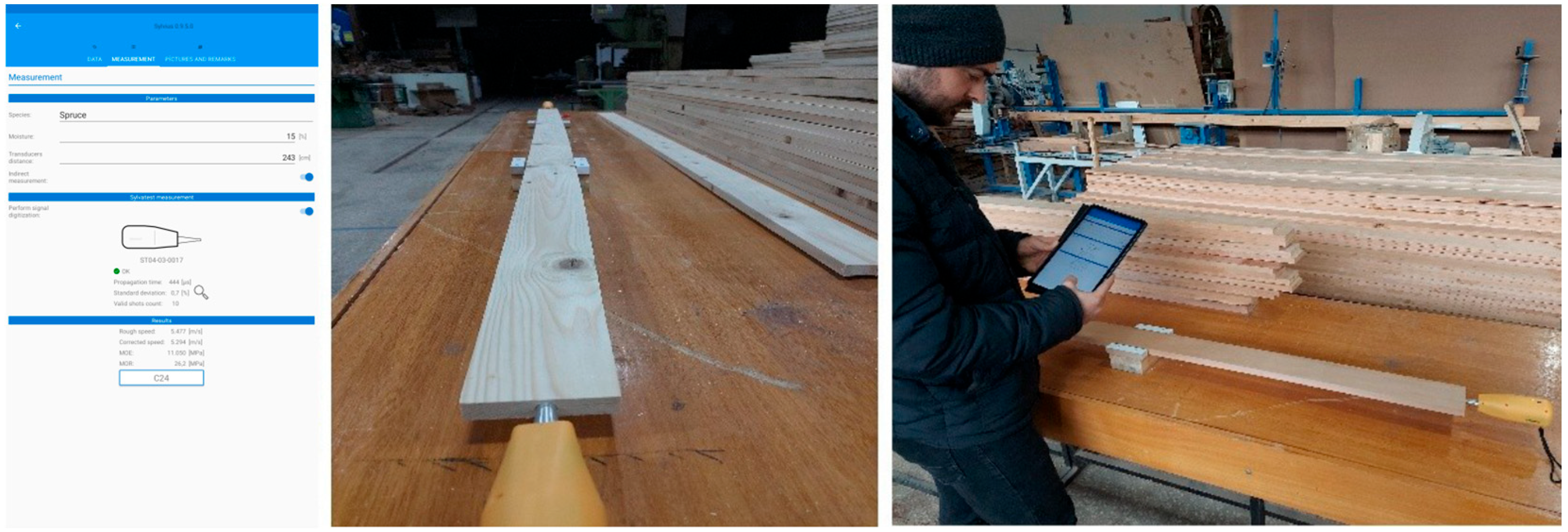
The strength classes of visually graded timbers were determined in accordance with EN 338 [52] prior to CLT production by means of non-destructive testing methods. For this purpose, the Sylvatest 4 acoustic testing device, developed by CBS-CBT, was employed (Figure 1). The device measures the transit time of ultrasonic waves propagating through the wood material between two transducers (transmitter and receiver) and automatically calculates the bending strength using its integrated software. It then classifies the timber according to the relevant standard and presents the measurement results graphically. As a result of the non-destructive tests, spruce and alder timbers were classified into strength classes C and D, respectively, according to EN 338. Among these classified groups, C16, C22, and C30 grade spruce timbers, along with D18, D30, and D40 grade alder timbers, were selected for use in CLT production within the scope of this study.
Table 1 presents the average values of selected physical and mechanical properties of the timber used in CLT production, determined using non-destructive methods. A comparison with the strength class limit values specified in EN 338 indicates that the results in Table 1 comply with the corresponding standard requirements.

2.3. Production of CLT Panels

Based on the wood species and their strength classes defined in EN 338, layer combination groups were formed, and a polyurethane adhesive was applied to the timber surfaces at a spread rate of 160 g/m2. A single-component polyurethane structural adhesive was used for bonding the timber lamellas. According to the manufacturer’s technical data sheet, the adhesive exhibits an average shear strength of approximately 8–10 MPa and a tensile bond strength exceeding 10 MPa. The elastic modulus of the cured adhesive is reported to be in the range of 2000–3000 MPa. These values are consistent with those commonly reported in the literature for structural polyurethane adhesives used in CLT production. The adhesive layer thickness was controlled during manufacturing to ensure uniform bonding performance between adjacent lamellas.
The CLT panels were then assembled by arranging the layers perpendicular to each other. During the lay-up process, special attention was paid to the annual ring orientation of the boards within each layer to minimize dimensional changes in the final product. Accordingly, alder, spruce, and hybrid (alder–spruce combination) lay-ups were prepared.
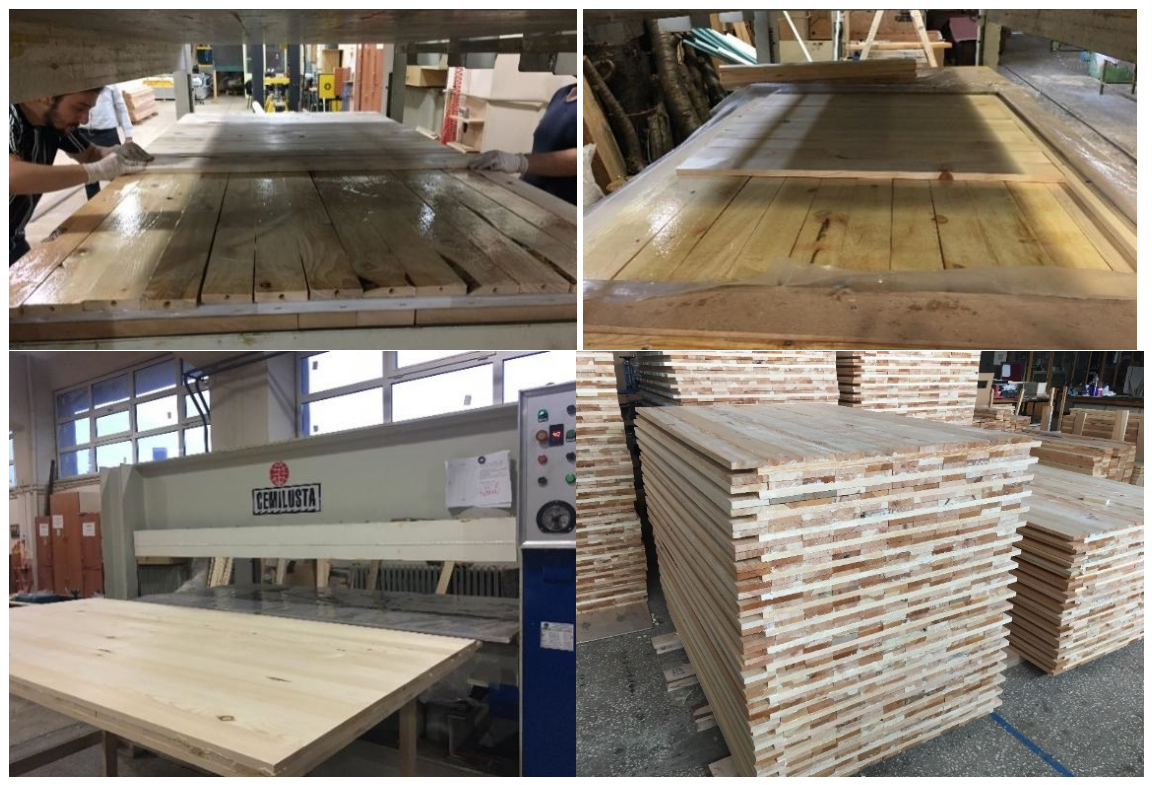
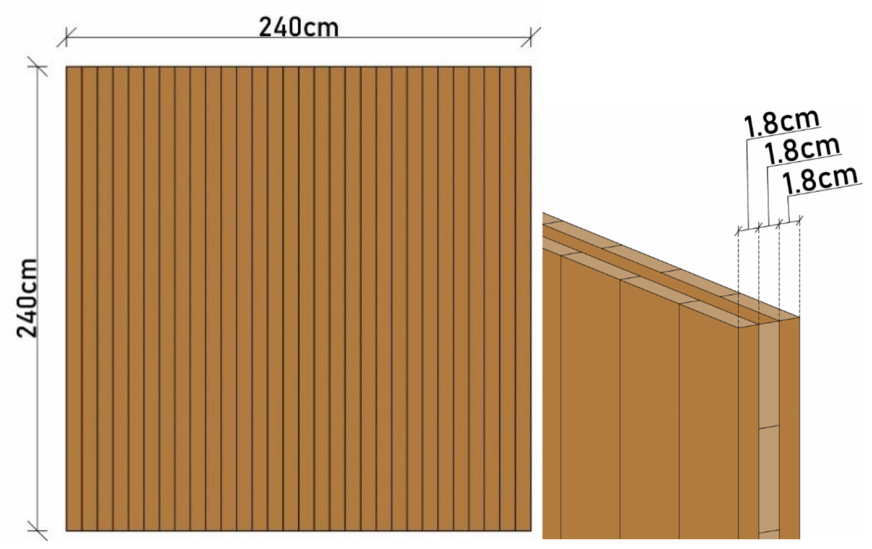
The three-layer lay-ups were subsequently subjected to pressing. The pressing process was carried out under industrial conditions using a hydraulic press capable of both vertical and lateral pressing. A cold-press method was applied, with the vertical press pressure set to 0.8 N/mm2 for spruce and hybrid panels and 1.2 N/mm2 for alder panels. Additionally, a lateral pressing pressure ranging between 0.276 N/mm2 and 0.550 N/mm2 was applied to minimize gaps between the timber lamellas. Representative images of the production stages are presented in Figure 2. Each CLT panel used in the study has dimensions of 240 cm in both length and height, with a total thickness of 5.4 cm across three layers. The geometric features of the CLT panels are depicted in Figure 3, while Table 2 presents the panel configurations categorized by wood species, quality, and layer composition.

2.4. Experimental Program

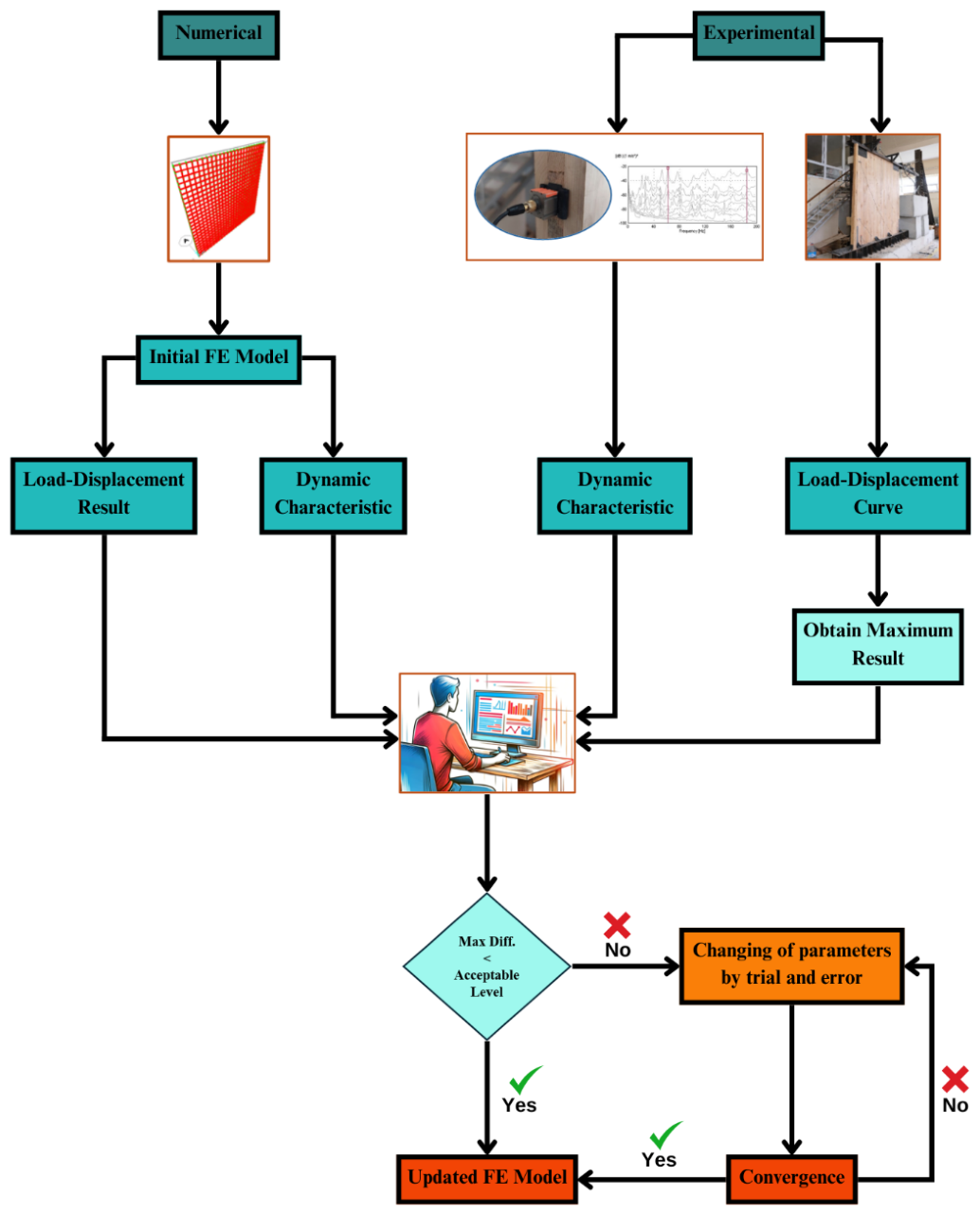
In this study, a total of 30 CLT panels with different material combinations and strength classes were produced to enable a comprehensive investigation of their structural behavior. Both ambient vibration tests and monotonic loading tests were carried out on these panels, providing extensive experimental data on their dynamic properties and load–displacement responses. The initial FEMs of the panels were developed in the SAP2000 program version 17.1.1 and subsequently updated using frequency-based, displacement-based, and combined approaches, allowing a comparative assessment of how different types of experimental data influence the model updating process. The sequential framework followed throughout the experimental and numerical stages is summarized in the methodological flowchart presented in Figure 4.

2.4.1. Ambient Vibration Tests

Experimental modal testing is widely used to identify the dynamic characteristics of structures based on measured vibration data. Depending on the source of the excitation, this technique is generally divided into three categories: (i) ambient vibration tests, (ii) free vibration tests, and (iii) forced vibration tests [54,55]. In this study, the dynamic characteristics of the CLT panels were determined using ambient vibration tests. This method utilizes raw vibration data generated by natural excitations such as wind, traffic, or ground motion, which are then processed using identification algorithms operating in either the frequency or time domain. Frequency-domain methods are based on the analysis of the signal measured at each point and the correlation between the signals. Time-domain methods are based on the time history of the signal at each point or on fitting a model using correlation functions [56,57,58]. Various modal parameter identification methods can be employed for this purpose, including Peak Picking (PP), Frequency Domain Decomposition (FDD), and Enhanced Frequency Domain Decomposition (EFDD) in the frequency domain, as well as Random Decrement, Recursive Techniques, and Stochastic Subspace Identification (SSI) in the time domain [59,60,61]. In this study, the EFDD method in the frequency domain was adopted to identify the dynamic characteristics of the CLT panels.
Enhanced Frequency Domain Decomposition Method
The EFDD method is an advanced version of the Frequency Domain Decomposition (FDD) method. This method is widely used for structural identification [62,63,64,65,66]. This technique identifies modes by pinpointing peaks in singular value decomposition (SVD) graphs derived from the spectral density function of the response. The EFDD method enables the identification of damping ratios [59]. The mathematical relationship between the unknown input and the measured response in the EFDD method is expressed in Equation (1). Further details about solving Equation (1) and its parameters can be found in the literature [67,68]:
G y y j ω = H * j ω G x x j ω H T ( j ω )
where the matrix Gxx represents the power spectral density of the input, with r denoting the number of inputs, while Gyy is the power spectral density matrix of the responses, with m indicating the number of responses. The matrix H( ω ) is the frequency response function matrix, characterized by dimensions m × r.
Instrumentation and Measurement Setup
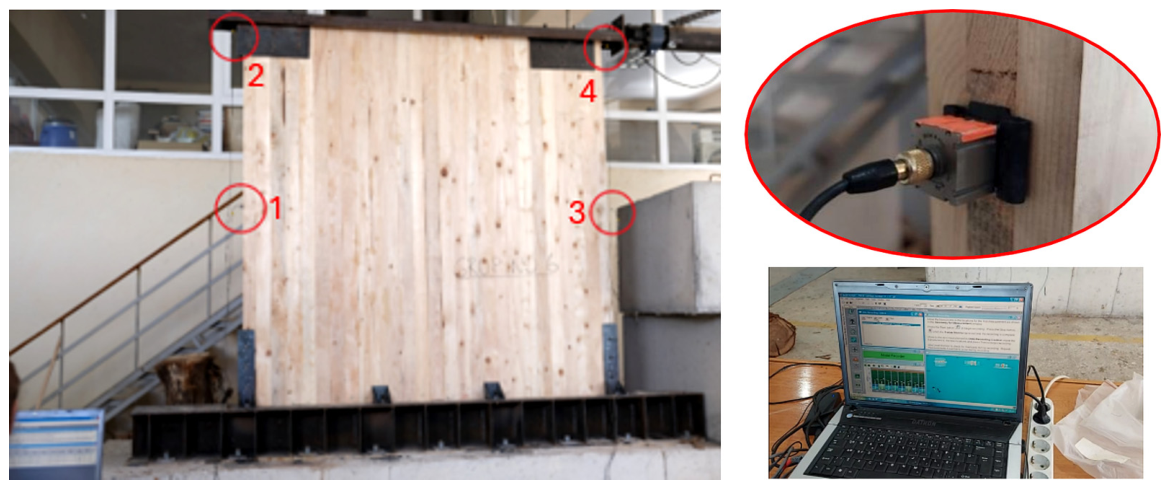
The dynamic characteristics of the CLT panels were determined using a measurement system consisting of a B&K 4506 tri-axial accelerometer (Bruel and Kjaer, Virum, Denmark), a B&K 3560 data acquisition unit (Bruel and Kjaer, Virum, Denmark), and the related signal processing software. The B&K 4506 accelerometer, which was installed at selected points on the panels, has a sensitivity of 0.5 V/g, an operational frequency range of 0.3–2000 Hz, and a maximum measurable acceleration of ±14 g. Figure 5 shows the accelerometer layout and some views from the ambient vibration tests. During each measurement, four accelerometers were used: two were placed at the top corner points (2 and 4), and two were placed at the edge points (1 and 3) at the middle height of the CLT panels. The recorded vibration signals were collected through the 17-channel B&K 3560 data acquisition system and subsequently processed using the PULSE software version 11.2 [69]. Raw signals were collected over a 15 min measurement period, considering the frequency range 0–400 Hz. Dynamic characteristics were then extracted using the OMA software version 4.0 [70] based on the processed response data.

2.4.2. Monotonic Loading Tests

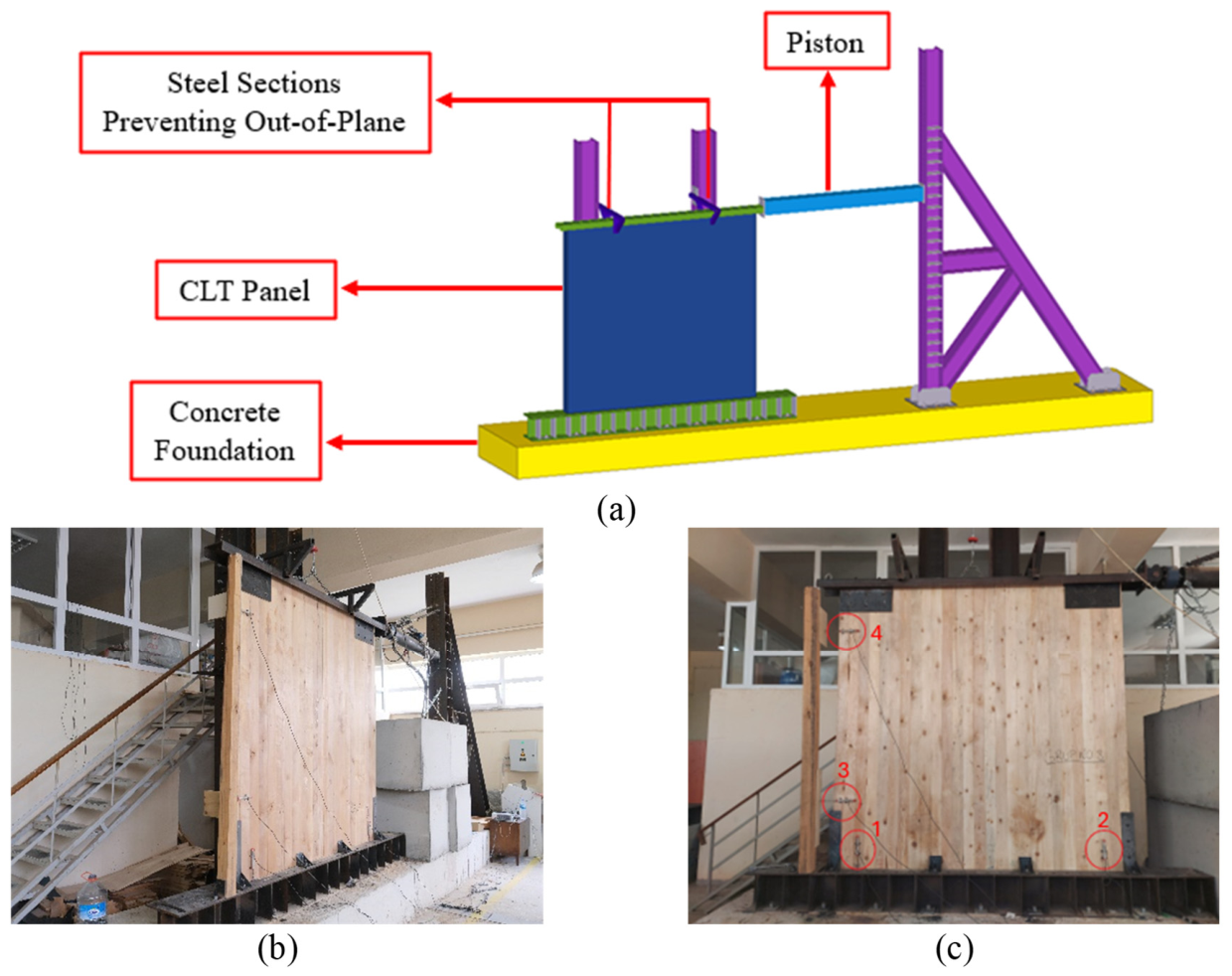
The primary objective of the monotonic loading tests was to evaluate the strength, stiffness, and deformation capacity of CLT panels under lateral loading. These tests are typically conducted using hydraulic actuators, employing various loading scenarios to characterize how the panels behave under different configurations [71,72,73]. During testing, CLT panels were connected to a high-rigidity steel profile anchored to the concrete foundation using eight angle brackets (Figure 6a). To restrain out-of-plane motion, two additional steel profiles were installed along the top edge of the panels (Figure 6b). LVDTs were installed at four locations on the CLT panels to record displacements during the monotonic loading tests (Figure 6c). The first two LVDTs were positioned to monitor the vertical displacements occurring at the joints of the CLT panels. The other two LVDTs were used to measure the lateral displacements at the top and bottom ends of the CLT panels during the monotonic loading tests. The loading was applied using a 200 kN capacity hydraulic actuator.
The loading protocols for the panels were selected according to the ASTM E 72–13a standard [74]. During the experimental tests, CLT panels were loaded until damage occurred and the maximum load and displacement values were recorded. For this purpose, the loading was applied in three linear increments of 3.5 kN, 7.0 kN, and 10.5 kN. If no damage was observed at these levels, the test continued until the CLT panel reached a peak displacement of 100 mm.

2.5. Numerical Modeling

Initial FEM of the CLT Panels

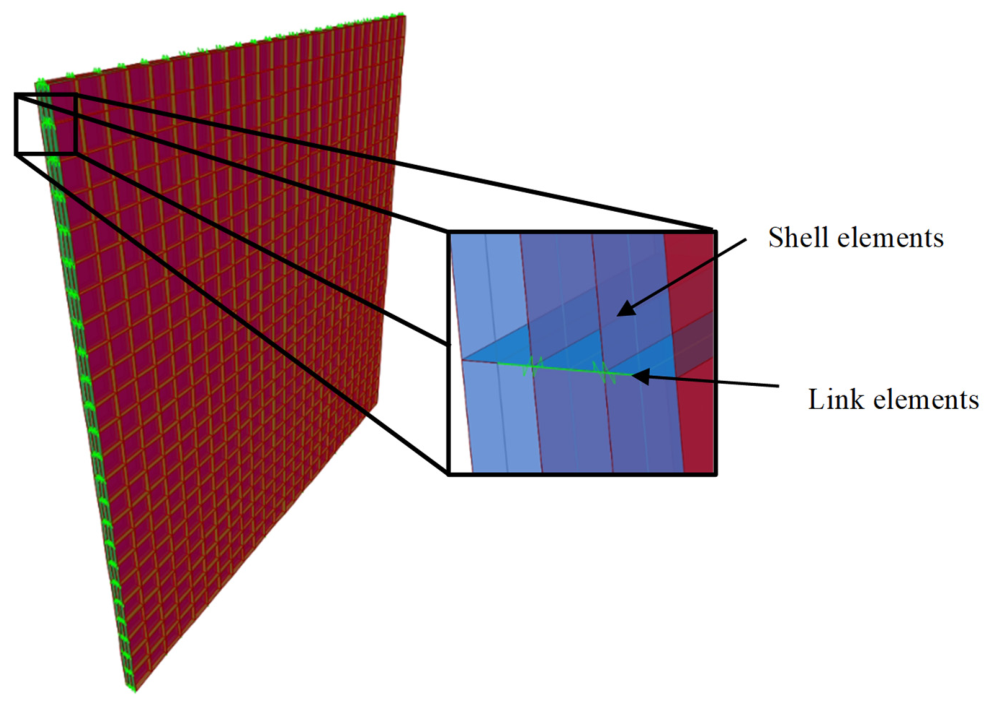
FEMs of CLT panels were developed using the SAP2000 software. In numerical modeling, shell elements were assigned to the CLT panels, and different elastic properties were assigned along the principal material directions. In-plane and out-of-plane elastic modulus were defined separately to account for the layered structure of CLT. This approach allows for a more realistic representation of the anisotropic behavior of CLT panels. The material properties were derived from material tests and standard values specified in EN 338. Each layer forming the CLT was strongly bonded to the other with adhesive. Therefore, the connection between the different shell elements was provided by rigid link elements that restrain displacement and rotational movement. Indeed, no de-lamination was observed between the layers of the CLT panels in monotonic loading tests. Following the definition of material properties, a mesh size of 10 cm was adopted based on the results of convergence studies. A mesh sensitivity analysis was conducted to evaluate the influence of mesh size on displacement responses. Comparisons between different mesh densities showed that the selected mesh size of 10 cm yielded reasonably accurate results. The steel H-profile was anchored to the formwork prior to concrete casting to provide a rigid support for the CLT panels on the reinforced concrete foundation, which was constructed as part of the laboratory test setup. Spring elements were assigned in the models to represent the connection details between the CLT panels and the rigid foundation. The spring elements were used to represent the global connection behavior between structural components, and the assigned parameters should be interpreted as effective stiffness values rather than direct representations of local connection strength. These values implicitly account for the combined effects of connection slip, stiffness degradation, and boundary conditions observed in the experimental setup. These elements were modeled as linear elastic elements without incorporating nonlinear or inelastic behavior. The stiffness values were defined based on calibration with experimental results rather than being directly calculated using code-based expressions. This simplified representation was intentionally adopted to focus on the influence of global connection stiffness on the model updating process rather than on the local nonlinear connection mechanisms. Each FEM comprised 1875 nodes, 1728 area elements, and 1250 link elements. To prevent out-of-plane behavior during the experiments, a steel profile was placed along the top edge of the CLT panels. This restraint condition was also included in the FEMs. A view of the FEM configuration for the CLT panels is presented in Figure 7.
For each initial numerical model, the material properties of the CLT panels were assigned according to the values specified in EN 338, and these properties are summarized in Table 3. In this table, fm,k, ft,0,k, ft,90, fc,0,k, ft,90,k and fv,k denote strength properties for bending, tension parallel, tension perpendicular, compression parallel, compression perpendicular and shear, respectively. E0,mean, E0.05, E90,mean, Gmean, ρk, and ρmean represent the mean modulus of elasticity parallel, 5% modulus of elasticity parallel, mean modulus of elasticity perpendicular, mean shear modulus, characteristic density and mean density.

3. Results and Discussion

3.1. Dynamic Characteristics of CLT Panels

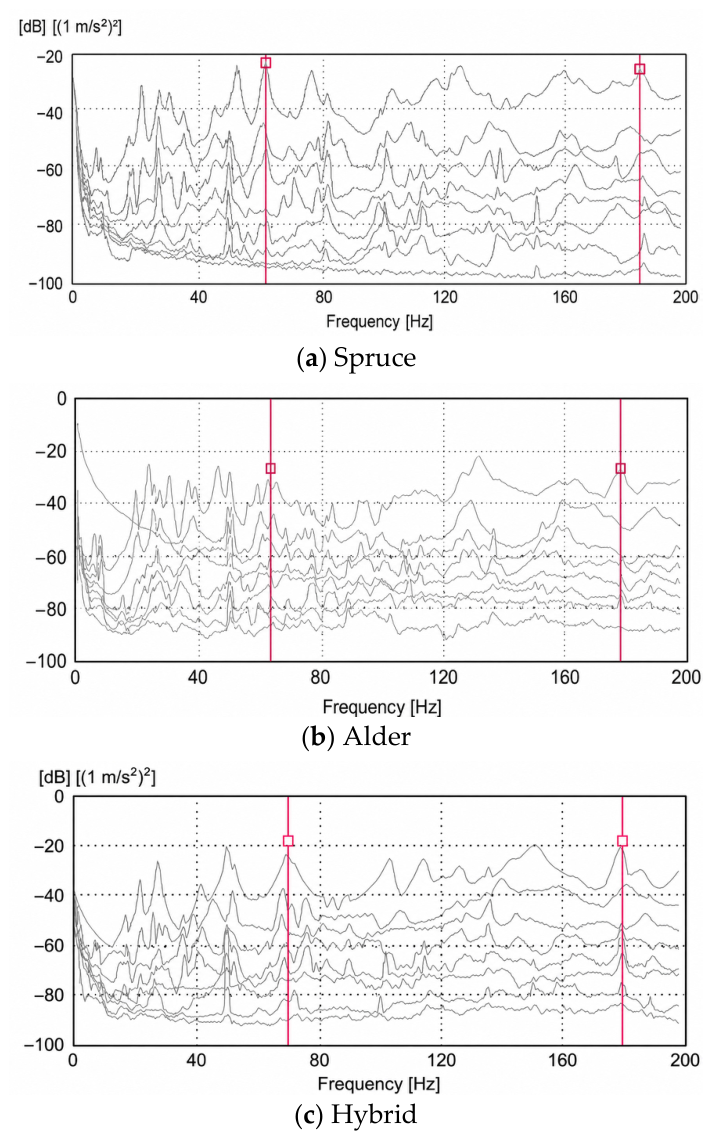
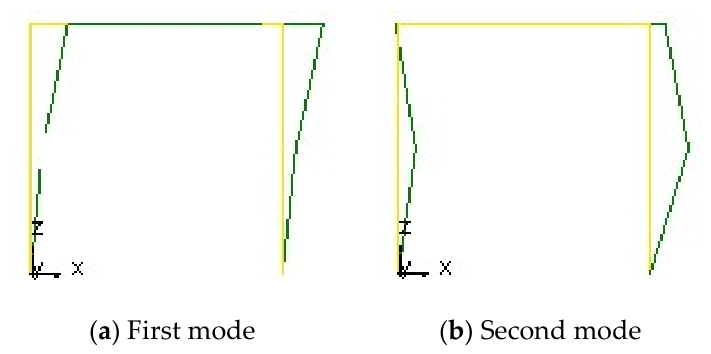
Figure 8 presents the spectral density matrices obtained using the EFDD method. Due to space constraints, the spectral plots for all 30 CLT panels are not included; instead, one representative plot from each group is provided. The analysis was focused on in-plane modes of the CLT panels, and the peaks were selected accordingly. Figure 9 shows the first and second mode shapes obtained from the ambient vibration tests. The mode shapes of the CLT panels were experimentally identified using amplitude and phase information obtained in the vibration tests. As all panels exhibited nearly identical mode shapes, only a single representative illustration is provided. Table 4 presents the natural frequencies related to the first two in-plane modes for each CLT panel.

3.2. Experimental Results from Monotonic Loading Tests

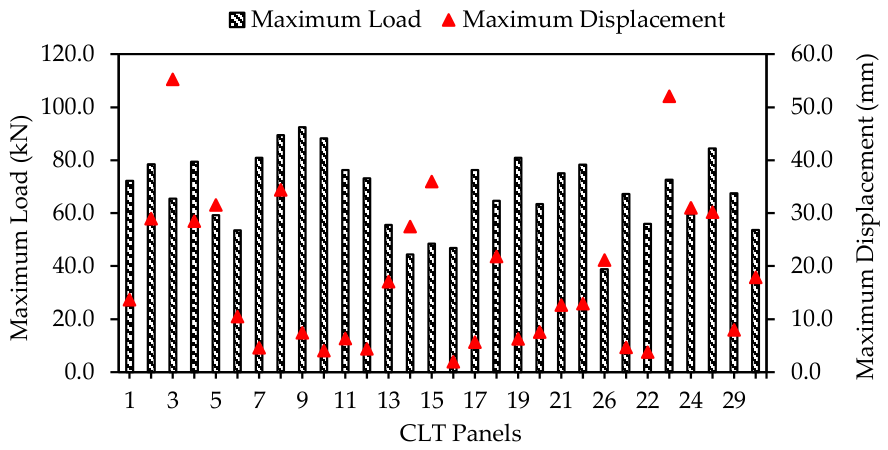
The load–displacement curves obtained from the monotonic tests were used to qualitatively evaluate stiffness and deformation characteristics of the panels, although only peak values are presented for consistency in the model updating process. The results obtained from the monotonic loading tests are summarized in Figure 10. The experimental findings indicate that both maximum load and displacement values vary significantly depending on the wood type, strength class, and layer configuration of the CLT panels. The minimum displacement was 0.2 cm for CLT panel number 16, and the maximum displacement was 5.53 cm for CLT panel number 3. In addition, CLT group number 9 reached the highest load-carrying capacity of 92.43 kN, while CLT group number 26 reached 38.9 kN. These results demonstrate that there is no direct proportional relationship between load-carrying capacity and maximum displacement.

3.3. Initial FEM Results and Discrepancies

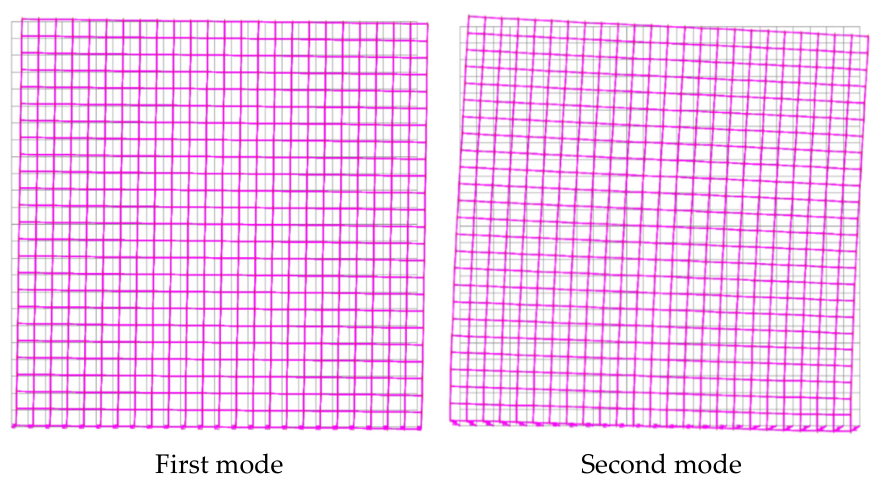
The first two in-plane modes obtained from the numerical analyses are presented in Figure 11. Since all models exhibited nearly identical mode shapes, only a single representative illustration is provided. Similar in-plane mode shapes were obtained experimentally and numerically. Table 5 summarizes the natural frequencies obtained from the modal analyses and the maximum displacement values obtained from the static analyses, along with the corresponding experimental results for comparison. Significant differences were observed when the numerical and experimental maximum displacements were compared, with differences reaching up to 107.32%. A similar inconsistency was observed in the natural frequencies, where the deviations between the experimental and numerical values reached 47.96% for the first mode and 79.89% for the second mode. These large discrepancies indicate that the initial FEM did not adequately capture the actual structural behavior of the CLT panels. This can be attributed to modeling assumptions, particularly in representing connection behavior and boundary conditions, as well as the inherent variability and anisotropic nature of timber materials. The influence of parameters such as material properties, load-carrying behavior, analysis techniques, and connection systems on timber structural performance has been addressed in previous studies [75,76,77]. Therefore, model updating was required to improve the accuracy and reliability of the numerical predictions.

3.4. FEM Updating Procedures for the CLT Panels

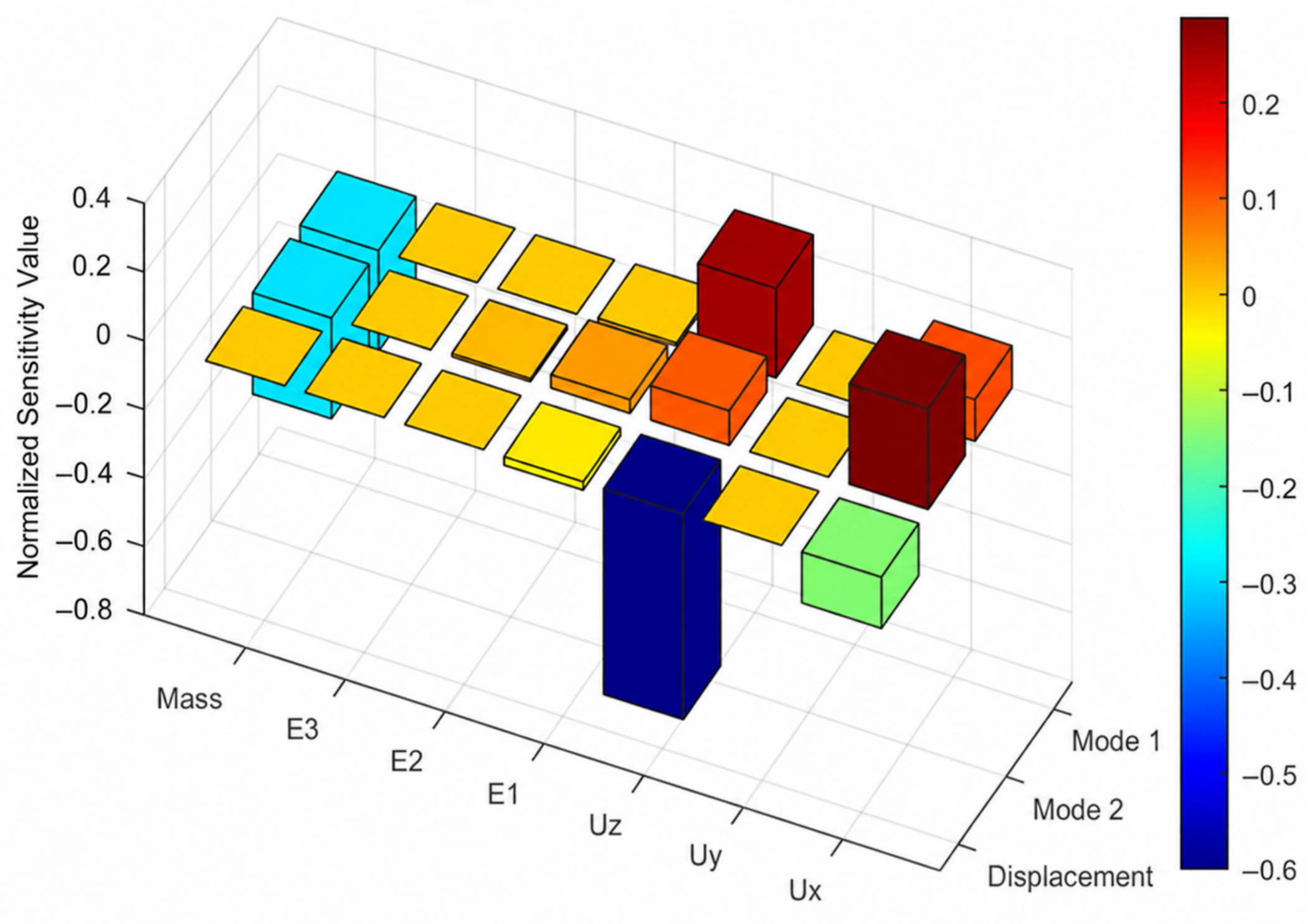
To improve the accuracy of the numerical predictions, a three-stage FEM updating procedure was implemented. In the first stage, a displacement-based updating method was applied using the peak displacements obtained from the monotonic loading tests as reference experimental data. In the second stage, a frequency-based updating procedure was conducted, where the natural frequencies identified from the ambient vibration tests were taken as reference experimental data. Finally, a combined updating strategy was adopted in the third stage, in which both peak displacement values from the static tests and natural frequencies from the dynamic tests were simultaneously considered to achieve a more reliable numerical representation of structural behavior. In FEM updating, the selection of uncertain parameters to be calibrated is critical because these parameters directly affect the model’s ability to represent the actual structural behavior [34]. In order to address this, a normalized sensitivity analysis was performed. In this analysis, the following parameters were considered as potential sources of uncertainty: spring stiffness parameters (Ux, Uy, Uz), modulus of elasticity (E1, E2, E3) and mass. Figure 12 shows the normalized sensitivity matrix which indicates the normalized sensitivity of four uncertain parameters versus with the first two natural frequencies and displacements. The sensitivity results indicated that the spring stiffness parameters (particularly Ux and Uz) and the mass have the highest influence on the responses used in the calibration process. In contrast, the contribution of the timber elastic properties (E1, E2, E3) was observed to be relatively limited. However, within the scope of this study, the mass of the specimens is known with high accuracy, and therefore it was not treated as an uncertain parameter in the model updating stage. Considering both the sensitivity results and the physical reliability of the parameters, the spring stiffness parameters were identified as the dominant uncertain variables and were consequently used in the model updating process.
In this study, a trial-and-error-based calibration strategy was adopted to enable an interpretable assessment of how different types of experimental data influence the model updating process. The findings indicate that the choice of reference data plays a more critical role than the pursuit of a mathematically optimal solution, particularly in complex systems such as CLT panels where connection behavior governs the structural response. In this context, the combined use of displacement and frequency data provides a more reliable and balanced representation of both static and dynamic behavior. Future studies may incorporate optimization-based approaches to further improve computational efficiency and robustness.

3.5. Displacement-Based FEM Updating

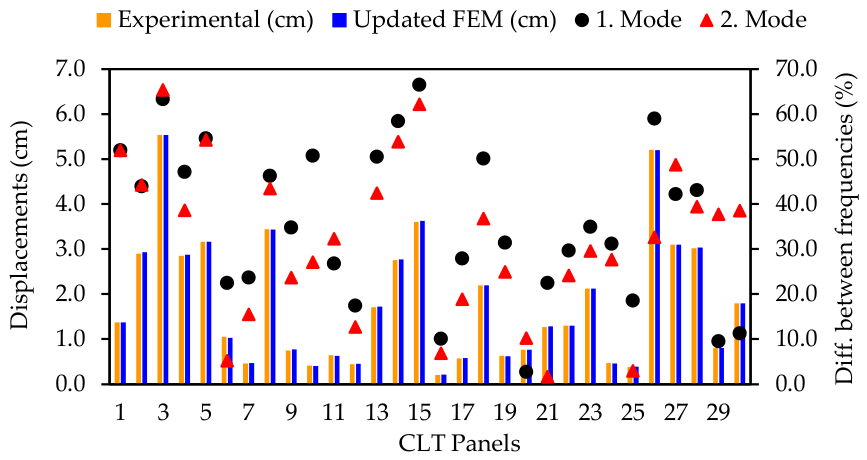
At this stage, maximum displacements from the monotonic loading tests served as the reference data, and the FEMs were calibrated by modifying the stiffness values of the spring elements at the support locations. Table 6 presents a comparison of maximum displacement values obtained before and after FEM updating. The final spring stiffnesses for the connection were obtained between 75 kN/m and 800 kN/m for Ux and Uy, and between 200 kN/m and 10,000 kN/m for Uz. The differences in maximum displacements reached up to 107.32% before the model updating process, while the maximum differences in these values after model updating were reduced to 5%. This indicates a good agreement between the experimental and numerical displacement responses following the model updating. Although the updated model provided reasonable agreement with experimental peak displacements, this did not ensure an accurate representation of the full structural response. To better clarify this, the first two in-plane natural frequencies obtained after the FEM updating are presented in Table 7. Figure 13 further compares the differences between numerical displacements and natural frequencies following displacement-based updating. The comparison shows that differences in natural frequencies range between 2.65% and 66.42% for the first mode and between 1.66% and 65.31% for the second mode (Table 7).

3.6. Frequency-Based FEM Updating

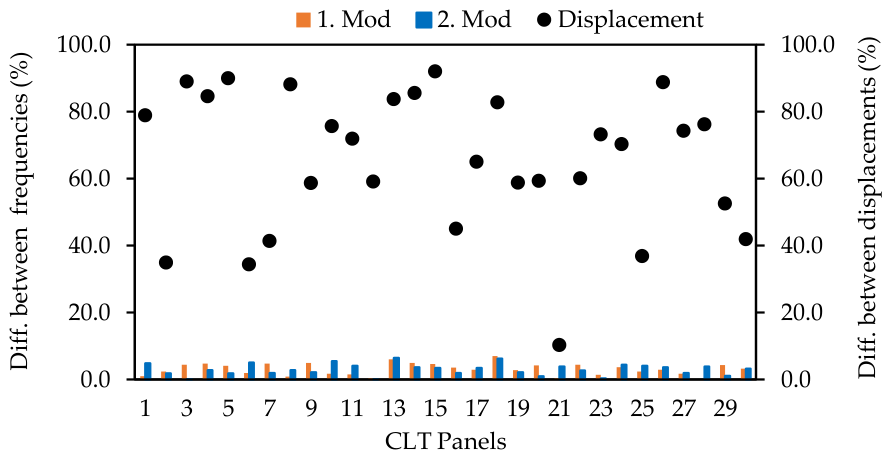
At this stage, the natural frequencies obtained from ambient vibration tests were taken as reference, and the FEMs were updated by treating the stiffness of the spring elements at the support point as an uncertain parameter. Table 8 compares the first two experimental natural frequencies with those predicted by the updated FEM. Following the calibration process, the final connection spring stiffnesses were identified within the ranges of 650 kN/m to 1200 kN/m for Ux and Uy, and 500 kN/m to 4200 kN/m for Uz. The differences in natural frequencies reached up to 79.89% before model updating, while the maximum differences in these values after model updating were reduced to 7.09% for the first mode and 6.45% for the second mode. This indicates good agreement between the experimental and numerical dynamic characteristics following the model updating process. However, similar to the displacement-based updating stage, relying solely on one type of experimental data is insufficient to fully characterize structural behavior. To better clarify this situation, Table 9 presents the maximum displacement values obtained after frequency-based FEM updating. Figure 14 further compares the differences between numerical and experimental displacements and natural frequencies. While frequency predictions align closely with experimental results, displacement differences remain significant, reaching 91%. These results clearly demonstrate that frequency-based FEM updating alone is not adequate for reliable FEM validation.

3.7. Combined FEM Updating Using Static and Dynamic Test Results

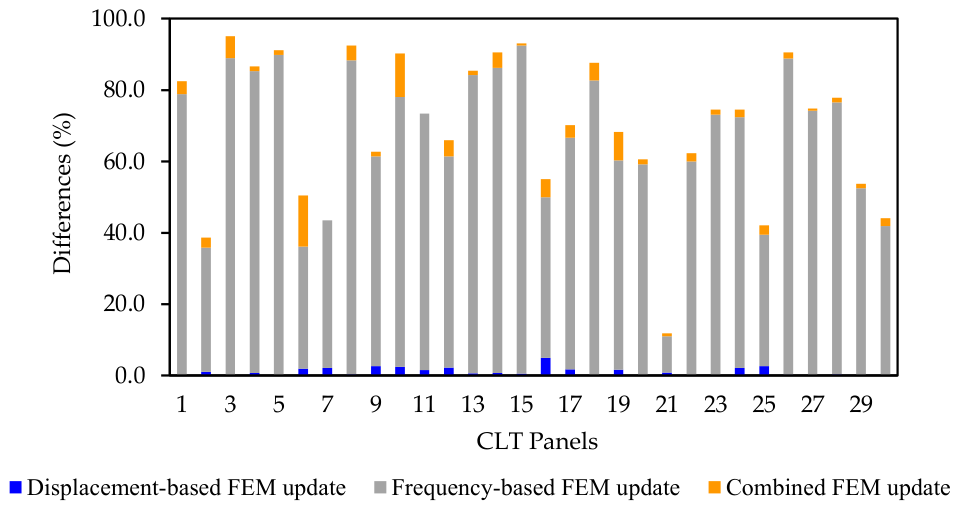
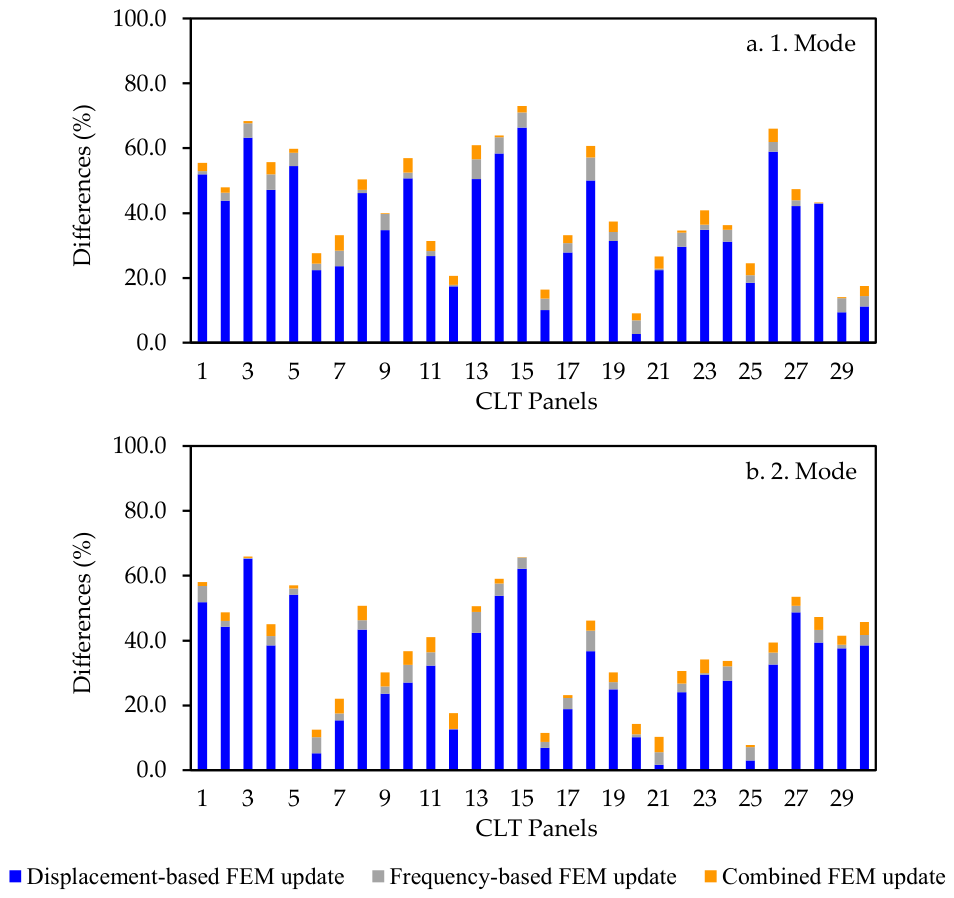
Dynamic characteristics and displacement responses are widely used in FEM updating of engineering structures. Nevertheless, earlier comparisons between experimental and numerical results demonstrate that relying on either modal parameters or displacement data alone is inadequate for accurate calibration. Therefore, both types of data must be evaluated together, forming the basis of the combined FEM updating approach adopted at this stage. The FEMs were calibrated by modifying the spring elements at the supports, and their modeling formulation was revised during the updating process. This change was motivated by the experimental observation that, once the tensile forces transferred to the upper region of the CLT panels exceeded a certain level, gaps developed at some of the nailed connections. Accordingly, the spring elements were defined to behave as nearly rigid under compressive forces and to deform under tensile forces according to the stiffness of the connecting element. Table 10 presents the first two in-plane natural frequencies and maximum displacement values after combined FEM updating. Figure 15 and Figure 16 show the maximum displacement and natural frequency values obtained from FEMs updated using different experimental datasets.
As illustrated in Figure 15 and Figure 16 and Table 10, the differences between experimental and numerical maximum displacements ranged from 0% to 14.29% with the combined updating method. In displacement-based and frequency-based updating, these values ranged from 0% to 5.00% and from 10.24% to 91.94%, respectively. Similarly, the differences between natural frequencies with the combined updating method ranged from 0.25% to 4.77% for the first mode and from 0.08% to 4.84% for the second mode. In displacement-based updating, these values reached 66.42% for the first mode and 65.31% for the second mode. Additionally, in frequency-based updating, the corresponding differences ranged from 0.03% to 7.09% for the first mode and from 0.07% to 6.45% for the second mode.
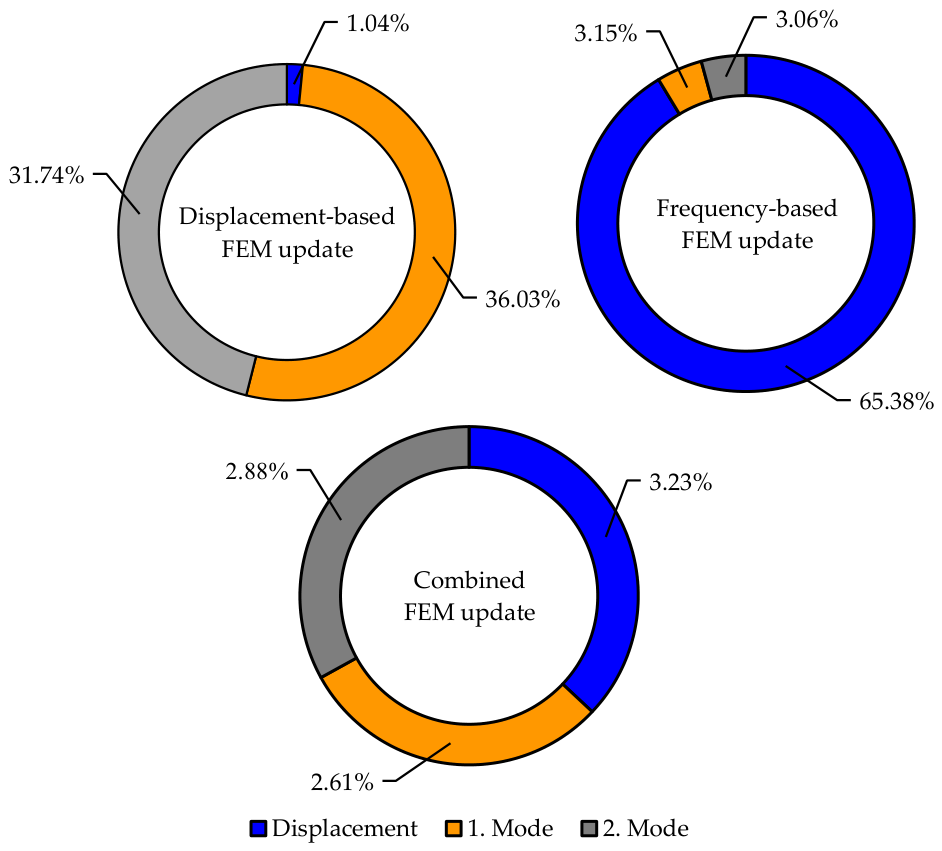
The average differences between experimental and numerical maximum displacements and natural frequencies for 30 CLT panels under different FEM updating procedures are reported in Figure 17. For the displacement-based, frequency-based and combined FEM updating procedures, the average differences in maximum displacements were 1.04%, 65.38%, and 3.23%, respectively. The differences in natural frequencies were calculated as 36.03%, 3.15%, and 2.61% for the first mode, and 31.74%, 3.06%, and 2.88% for the second mode, respectively. By comparing Figure 15, Figure 16 and Figure 17, it is evident that updating the FEM based on a single parameter produces acceptable agreement only for that specific parameter, while the responses associated with other parameters deviate considerably from the experimental results. This highlights that model updating must incorporate not only modal properties but also additional structural responses such as displacements to achieve a reliable and comprehensive evaluation.

4. Conclusions

This study aimed to evaluate the effects of different experimental data types on the FEM updating process of CLT panels by using both experimental and numerical approaches. To achieve this, 30 CLT panels with varying configurations were tested through ambient vibration measurements and monotonic lateral loading to obtain their dynamic characteristics and load–displacement responses. Initial FEMs of the CLT panels were developed in the SAP2000 program and were subsequently updated using experimental data with frequency-based, displacement-based, and combined methods. The results derived from each approach were compared with the experimental findings to assess the effectiveness of different reference datasets in improving model accuracy.
The initial FEMs exhibited significant discrepancies with respect to experimental data, with differences reaching up to 107% in displacement and up to 79% in natural frequencies. Although displacement-based updating reduced the error in peak displacements to 4.76%, it failed to accurately represent modal behavior, with frequency differences remaining as high as 66%. Similarly, frequency-based updating reduced frequency discrepancies to approximately 6–7% but resulted in considerable errors in displacement predictions. These results clearly demonstrate that relying on a single type of experimental data leads to an incomplete representation of structural behavior. The combined updating approach, which simultaneously considers both displacement and frequency responses, provided the most reliable and consistent results. This method reduced the differences between numerical and experimental maximum displacements to 0–14.29%, while decreasing discrepancies in natural frequencies to 0.25–4.77% for the first mode and 0.08–4.84% for the second mode. The differences in displacements and frequencies were minimized compared to single-parameter updating approaches, revealing that the integration of multiple types of experimental data is required for reliable FEM calibration of CLT systems.
The results indicate that reliable FEM updating of CLT panels requires the combined use of loading tests and vibration test results. In addition, the selection of uncertain parameters is essential to reduce initial modeling errors and enhance model reliability. In this context, the appropriate selection of connection spring stiffnesses plays a critical role in minimizing initial discrepancies. Given the significant influence of connections on overall structural performance, the study emphasizes this parameter as a critical input for both research and engineering applications. Nevertheless, these findings are dependent on several factors such as geometric properties and connection types, and their generalization requires careful consideration of the underlying assumptions.
This analysis acknowledges the limitations affecting the calibration process due to the use of a manual model update and, consequently, the consideration of a small number of uncertain parameters. The selection of uncertain parameters is a key step and requires careful attention to obtain adequate matching between numerical and experimental data. To achieve this, material properties, geometric properties, additional masses, and boundary conditions can be selected as uncertain parameters. In this study, only the spring stiffnesses representing the connections were considered as uncertain parameters due to the use of manual updating procedures. Although increasing the number of these parameters can clearly improve the level of agreement between datasets, the expansion of uncertain parameters in manual model updating significantly complicates the updating procedure. Future studies should focus on improving FEM updating procedures for CLT systems by incorporating a wider range of uncertain parameters through automated or optimization-based approaches. In particular, the use of experimentally derived material properties, along with the consideration of boundary conditions, is expected to enhance model accuracy. Additionally, extending experimental investigations to include dynamic loading conditions would enable a more comprehensive evaluation of structural behavior.

Author Contributions

Conceptualization, A.C.A., A.K.K., F.S., A.D., N.A. and C.D.; methodology, A.C.A., H.Ö., A.K.K., F.S., F.Y.O., A.D., O.İ., A.U.B., N.A. and C.D.; software, A.K.K., F.S. and F.Y.O.; validation, A.K.K., F.S. and F.Y.O.; formal analysis, H.Ö., A.K.K., F.S., F.Y.O., A.D., O.İ. and A.U.B.; investigation, A.C.A., H.Ö., F.S., F.Y.O., A.D., A.U.B., N.A. and C.D.; resources, A.C.A., N.A. and C.D.; data curation, H.Ö., A.K.K., F.Y.O., A.D., O.İ. and A.U.B.; writing—original draft preparation, F.S.; writing—review and editing, A.C.A., N.A. and C.D.; visualization, H.Ö., A.K.K. and F.Y.O.; supervision, A.C.A. and C.D.; project administration, C.D. All authors have read and agreed to the published version of the manuscript.

Funding

This research was funded by the Turkish Academy of Sciences (TÜBA).

Data Availability Statement

The data presented in this study are available at reasonable request from the corresponding author.

Acknowledgments

This work was supported by the Scientific and Technological Research Council of Türkiye (TÜBİTAK) under Research Grant No. 220O012.

Conflicts of Interest

Author Ahmet Can Altunişik was employed by the company Trabzon Teknokent, Dynamic Academy Software Construction Ind. Trade Limited Company. Authors Hasan Öztürk and Cenk Demirkir were employed by the company HC Panel Forest Products Consulting Services Industry and Trade Limited Company. The remaining authors declare that the research was conducted in the absence of any commercial or financial relationships that could be construed as a potential conflict of interest.

References

  1. He, M.; Sun, X.; Li, Z. Bending and compressive properties of cross-laminated timber (CLT) panels made from Canadian hemlock. Constr. Build. Mater. 2018, 185, 175–183. [Google Scholar] [CrossRef]
  2. Chen, J.; Wang, R.; Furuta, T.; Xiong, H. Experimental research on lateral performance of CLT shear walls with novel dissipative angle brackets and hold-downs. J. Build. Eng. 2024, 86, 108929. [Google Scholar] [CrossRef]
  3. Polastri, A.; Giongo, I.; Angeli, A.; Brandner, R. Mechanical characterization of a prefabricated CLT connection system. Eng. Struct. 2018, 167, 705–715. [Google Scholar] [CrossRef]
  4. Pierobon, F.; Huang, M.; Simonen, K.; Ganguly, I. Environmental benefits of hybrid CLT structures. J. Build. Eng. 2019, 26, 100862. [Google Scholar] [CrossRef]
  5. Liu, J.; Fischer, E.C. Review of large-scale CLT compartment fire tests. Constr. Build. Mater. 2022, 318, 126099. [Google Scholar] [CrossRef]
  6. Li, X.; Ashraf, M.; Subhani, M.; Kremer, P.; Kafle, B.; Ghabraie, K. Bending properties of heterogeneous lamella layups in CLT. Constr. Build. Mater. 2020, 247, 118525. [Google Scholar] [CrossRef]
  7. He, M.; Sun, X.; Ren, H.; Li, Z.; Feng, W. Experimental study on the system effect of bending cross-laminated timber fabricated with Karamatsu larch. Constr. Build. Mater. 2021, 299, 124271. [Google Scholar] [CrossRef]
  8. Zhou, Y.; Shen, Z.; Li, H.; Lu, Y.; Wang, Z. In-plane shear failure mode of CLT panels. J. Wood Sci. 2022, 68, 36. [Google Scholar] [CrossRef]
  9. Huang, Z.; Huang, D.; Chui, Y.H.; Shen, Y.; Daneshvar, H.; Sheng, B.; Chen, Z. Modeling of CLT panels loaded with combined out-of-plane bending and compression. Eng. Struct. 2022, 250, 113335. [Google Scholar] [CrossRef]
  10. Huang, Z.; Jiang, L.; Ni, C.; Chen, Z. Analytical models for calculating the shear capacity of CLT under out-of-plane bending. J. Wood Sci. 2023, 69, 14. [Google Scholar] [CrossRef]
  11. Gavric, I.; Fragiacomo, M.; Ceccotti, A. Cyclic behaviour of typical metal connectors for cross-laminated (CLT) structures. Mater. Struct. 2015, 48, 1841–1857. [Google Scholar] [CrossRef]
  12. Chen, J.; He, Z.; Wei, Y.; Wang, R.; Furuta, T.; Xiong, H. Seismic performance of CLT shear walls anchored with energy-dissipation connections: Experimental investigation and parametric analysis. Eng. Struct. 2025, 331, 120011. [Google Scholar] [CrossRef]
  13. Wang, X.; He, M.; Li, Z. CLT shear walls with supplemental energy dissipators. J. Build. Eng. 2023, 66, 105943. [Google Scholar] [CrossRef]
  14. Brown, J.R.; Li, M.; Tannert, T.; Moroder, D. Experimental study on orthogonal joints in cross-laminated timber with self-tapping screws installed with mixed angles. Eng. Struct. 2021, 228, 111560. [Google Scholar] [CrossRef]
  15. Han, T.; Popovski, M.; Tannert, T.; Tesfamariam, S. Numerical and analytical research of CLT shear wall structures considering the influence of orthogonal wall connections. Structures 2025, 82, 110623. [Google Scholar] [CrossRef]
  16. Schneider, J.; Shen, Y.; Stiemer, S.F.; Tesfamariam, S. Assessment and comparison of experimental and numerical model studies of cross-laminated timber mechanical connections under cyclic loading. Constr. Build. Mater. 2015, 77, 197–212. [Google Scholar] [CrossRef]
  17. Liu, J.; Lam, F. Experimental test of coupling effect on CLT angle bracket connections. Eng. Struct. 2018, 171, 862–873. [Google Scholar] [CrossRef]
  18. Chen, J.; Wu, Z.; Zheng, Y.; Furuta, T.; Xiong, H. Full-scale shaking table tests of cross-laminated timber structures adopting dissipative angle brackets and hold-downs with soft-steel and rubber. Eng. Struct. 2024, 313, 118292. [Google Scholar] [CrossRef]
  19. Gavric, I.; Fragiacomo, M.; Ceccotti, A. Cyclic behavior of typical screwed connections for cross-laminated (CLT) structures. Eur. J. Wood Wood Prod. 2015, 73, 179–191. [Google Scholar] [CrossRef]
  20. Ottenhaus, L.M.; Li, M.; Smith, T. Structural performance of large-scale dowelled CLT connections under monotonic and cyclic loading. Eng. Struct. 2018, 176, 41–48. [Google Scholar] [CrossRef]
  21. Ringhofer, A.; Brandner, R.; Blaß, H.J. Design approaches for dowel-type fasteners in CLT. Eng. Struct. 2018, 171, 849–861. [Google Scholar] [CrossRef]
  22. Moerman, B.; Li, M.; Smith, T.; Lim, H. Design and cyclic testing of bolted end plate connections between steel link beams and CLT. Constr. Build. Mater. 2022, 353, 129060. [Google Scholar] [CrossRef]
  23. Moerman, B.; Li, M.; Palermo, A.; Smith, T.; Lim, H. Cyclic testing and repair of coupled CLT walls with steel link beams. J. Struct. Eng. 2024, 150, 04023216. [Google Scholar] [CrossRef]
  24. Longarini, N.; Crespi, P.; Zucca, M. The influence of the geometrical features on the seismic response of historical churches reinforced by different cross lam roof-solutions. Bull. Earthq. Eng. 2022, 20, 6813–6852. [Google Scholar] [CrossRef]
  25. Aloisio, A.; Alaggio, R.; Fragiacomo, M. Equivalent viscous damping of cross-laminated timber structural archetypes. J. Struct. Eng. 2021, 147, 04021012. [Google Scholar] [CrossRef]
  26. Longarini, N.; Crespi, P.; Zucca, M.; Scamardo, M. Numerical evaluation of the equivalent damping ratio due to dissipative roof structure in the retrofit of historical churches. Appl. Sci. 2025, 15, 3286. [Google Scholar] [CrossRef]
  27. Altunişik, A.C.; Genç, A.F.; Günaydin, M.; Okur, F.Y.; Karahasan, O.Ş. Dynamic response of a historical armory building using the finite element model validated by the ambient vibration test. J. Vib. Control 2018, 24, 5472–5484. [Google Scholar] [CrossRef]
  28. Günaydin, M. Seismic performance evaluation of a fire-exposed historical structure using an updated finite element model. Eng. Fail. Anal. 2019, 106, 104149. [Google Scholar] [CrossRef]
  29. Türkay, A. Dynamic characteristics of composite cantilever beams. Buildings 2025, 15, 1608. [Google Scholar] [CrossRef]
  30. Porcu, M.C.; Bosu, C.; Gavrić, I. Non-linear dynamic analysis of CLT structures. J. Build. Eng. 2018, 19, 480–493. [Google Scholar] [CrossRef]
  31. Eriez, S.; Duvnjak, I.; Jiménez-Alonso, J.F. Review of finite element model updating methods for structural applications. Structures 2022, 41, 684–723. [Google Scholar] [CrossRef]
  32. Monchetti, S.; Viscardi, C.; Betti, M.; Clementi, F. Bayesian updating vs. approximate Bayesian computation for masonry towers. Bull. Earthq. Eng. 2024, 22, 3491–3509. [Google Scholar] [CrossRef]
  33. Ghannadi, P.; Kourehli, S.S.; Nguyen, A. Experimental validation of an efficient strategy for FE model updating and damage identification in tubular structures. Nondestruct. Test. Eval. 2025, 40, 3424–3463. [Google Scholar] [CrossRef]
  34. Hashim, H.; Ibrahim, Z.; Razak, H.A. Dynamic characteristics and model updating of damaged slab from ambient vibration measurements. Measurement 2013, 46, 1371–1378. [Google Scholar] [CrossRef]
  35. Altunişik, A.C.; Okur, F.Y.; Genç, A.F.; Günaydin, M.; Adanur, S. Automated model updating of historical masonry structures based on ambient vibration measurements. J. Perform. Constr. Facil. 2018, 32, 04017126. [Google Scholar] [CrossRef]
  36. Bassoli, E.; Vincenzi, L.; D’Altri, A.M.; de Miranda, S.; Forghieri, M.; Castellazzi, G. Ambient vibration-based finite element model updating of an earthquake-damaged masonry tower. Struct. Control Health Monit. 2018, 25, e2150. [Google Scholar] [CrossRef]
  37. Nasery, M.M.; Hüsem, M.; Okur, F.Y.; Altunışık, A.C.; Nasery, M.E. Model updating-based automated damage detection of composite column–beam connections. Struct. Control Health Monit. 2020, 27, e2600. [Google Scholar] [CrossRef]
  38. Saidin, S.S.; Kudus, S.A.; Jamadin, A.; Anuar, M.A.; Amin, N.M.; Ibrahim, Z.; Zakaria, A.B.; Sugiura, K. OMA-based FE model updating of UHPC bridge. Case Stud. Constr. Mater. 2022, 16, e01117. [Google Scholar]
  39. Kurent, B.; Ao, W.K.; Pavic, A.; Pérez, F.; Brank, B. Modal testing and finite element model updating of a full-scale hybrid timber–concrete building. Eng. Struct. 2023, 289, 116250. [Google Scholar] [CrossRef]
  40. Altunışık, A.C.; Sunca, F.; Sevim, B. Modal parameter identification and seismic assessment of historical timber structures under near-fault and far-fault ground motions. Structures 2023, 47, 1624–1651. [Google Scholar] [CrossRef]
  41. Altunişik, A.C.; Öztürk, M.M.; Genç, A.F.; Kaya, A.; Akbulut, Y.E.; Sunca, F.; Günaydin, M. Estimating fundamental frequency of masonry arches under elevated temperature: Numerical analysis and validation using ambient vibration tests. Arch. Civ. Mech. Eng. 2024, 25, 23. [Google Scholar] [CrossRef]
  42. Qin, S.; Han, S.; Liao, S.; Zhou, Y. FE model updating of a bridge using ambient vibration measurements and adaptive kriging. Eng. Optim. 2025, 57, 1778–1799. [Google Scholar] [CrossRef]
  43. Ye, J.; Jiang, L. Analytical model and shaking table validation of cold-formed steel shear wall building. Sustainability 2018, 10, 3188. [Google Scholar] [CrossRef]
  44. Pul, S.; Senturk, M.; Ilki, A.; Hajirasouliha, I. Monolithic-like precast concrete column–foundation connection. Eng. Struct. 2021, 246, 113090. [Google Scholar] [CrossRef]
  45. Öztürk, F.; Mojtabaei, S.M.; Şentürk, M.; Pul, S.; Hajirasouliha, I. Buckling behaviour of cold-formed steel sigma and lipped channel members. Thin-Walled Struct. 2022, 173, 108963. [Google Scholar] [CrossRef]
  46. Kaya, A.; Adanur, S.; Bello, R.A.; Genç, A.F.; Okur, F.Y.; Sunca, F.; Günaydin, M.; Altunişik, A.C.; Sevim, B. Post-earthquake damage assessments of URM buildings by shake table test and numerical visualization. Eng. Fail. Anal. 2023, 143, 106858. [Google Scholar] [CrossRef]
  47. Türkay, A.; Altun, F. Critical torque values of reinforced concrete walls. Int. J. Civ. Eng. 2023, 21, 1181–1194. [Google Scholar] [CrossRef]
  48. Tian, L.; Yang, M.; Liu, J.; Ma, Z.; Gong, J.; Chen, H.; Luo, X. Shake table tests of transmission tower-line systems. Thin-Walled Struct. 2024, 197, 111584. [Google Scholar] [CrossRef]
  49. Sunca, F. Seismic performance of 170 kV line trap systems. Appl. Sci. 2025, 15, 10734. [Google Scholar] [CrossRef]
  50. TS 1265; Sawn Timber (Coniferous)-For Building Construction. Turkish Standards Institution: Ankara, Türkiye, 2012.
  51. TS EN 14081-1; Timber Structures—Strength Graded Structural Timber with Rectangular Cross Section—Part 1: General Requirements. Turkish Standards Institution: Ankara, Türkiye, 2019.
  52. TS EN 338; Structural Timber—Strength Classes. Turkish Standards Institution: Ankara, Türkiye, 2016.
  53. Birinci, A.U.; Öztürk, H.; Demirkır, C. Determination of some mechanical properties of timber of different strength classes by non-destructive and destructive methods. Wood Ind. Eng. 2025, 7, 11–22. [Google Scholar]
  54. Kim, C.W.; Zhang, F.L.; Chang, K.C.; McGetrick, P.J.; Goi, Y. Ambient and vehicle-induced vibration data of a steel truss bridge subject to artificial damage. J. Bridge Eng. 2021, 26, 04721002. [Google Scholar] [CrossRef]
  55. Saidin, S.S.; Jamadin, A.; Abdul Kudus, S.; Mohd Amin, N.; Anuar, M.A. An overview: The application of vibration-based techniques in bridge structural health monitoring. Int. J. Concr. Struct. Mater. 2022, 16, 69. [Google Scholar] [CrossRef]
  56. Ramos, J.L.F. Damage Identification on Masonry Structures Based on Vibration Signatures. Doctoral Dissertation, Universidade do Minho, Braga, Portugal, 2007. [Google Scholar]
  57. Di Matteo, A.; Masnata, C.; Russotto, S.; Bilello, C.; Pirrotta, A. A novel identification procedure from ambient vibration data. Meccanica 2021, 56, 797–812. [Google Scholar] [CrossRef]
  58. Russotto, S.; Di Matteo, A.; Pirrotta, A. An innovative structural dynamic identification procedure combining time domain OMA technique and GA. Buildings 2022, 12, 963. [Google Scholar] [CrossRef]
  59. Sevim, B.; Bayraktar, A.; Altunişik, A.C.; Adanur, S.; Akköse, M. Modal parameter identification of a prototype arch dam using enhanced frequency domain decomposition and stochastic subspace identification techniques. J. Test. Eval. 2010, 38, 588–597. [Google Scholar] [CrossRef]
  60. Hasani, H.; Freddi, F. Operational modal analysis on bridges: A comprehensive review. Infrastructures 2023, 8, 172. [Google Scholar] [CrossRef]
  61. Mostafaei, H.; Ghamami, M. State of the Art in Automated Operational Modal Identification: Algorithms, Applications, and Future Perspectives. Machines 2025, 13, 39. [Google Scholar] [CrossRef]
  62. Jacobsen, N.J.; Andersen, P.; Brincker, R. Using enhanced frequency domain decomposition as a robust technique to harmonic excitation in operational modal analysis. In Proceedings of ISMA2006: International Conference on Noise Vibration Engineering; Katholieke Universiteit: Leuven, Belgium, 2006. [Google Scholar]
  63. Günaydin, M.; Sunca, F.; Altunişik, A.C.; Ergün, M.; Okur, F.Y. Nondestructive experimental measurement, model updating, and fatigue life assessment of Çarşamba suspension bridge. J. Bridge Eng. 2022, 27, 05021017. [Google Scholar] [CrossRef]
  64. Sunca, F.; Okur, F.Y.; Altunişik, A.C.; Kahya, V. Optimal sensor placement for laminated composite and steel cantilever beams by the effective independence method. Struct. Eng. Int. 2021, 31, 85–92. [Google Scholar] [CrossRef]
  65. Sunca, F.; Ergün, M.; Altunişik, A.C.; Günaydin, M.; Okur, F.Y. Modal identification and fatigue behavior of Eynel steel arch highway bridge with calibrated models. J. Civ. Struct. Health Monit. 2021, 11, 1337–1354. [Google Scholar] [CrossRef]
  66. Altunisik, A.C.; Sevim, B.; Sunca, F.; Okur, F.Y. Optimal sensor placements for system identification of concrete arch dams. Adv. Concr. Constr. 2021, 11, 397–407. [Google Scholar]
  67. Brincker, R.; Zhang, L.; Andersen, P. Modal identification from ambient responses using frequency domain decomposition. In Proceedings of the International Modal Analysis Conference (IMAC): IMAC 18, San Antonio, TX, USA, 7–10 February 2000; pp. 625–630. [Google Scholar]
  68. Bendat, J.S.; Piersol, A.G. Random Data: Analysis and Measurement Procedures; John Wiley & Sons: Hoboken, NJ, USA, 2011. [Google Scholar]
  69. PULSE. Analyzers and Solutions, 11.2 ed.; Bruel and Kjaer, Sound and Vibration Measurement A/S: Virum, Denmark, 2006. [Google Scholar]
  70. OMA, Release 4.0; Computer Software; Structural Vibration Solution: Aalborg, Denmark, 2006.
  71. Popovski, M.; Schneider, J.; Schweinsteiger, M. Lateral load resistance of cross-laminated wood panels. In Proceedings of the World Conference on Timber Engineering, Riva del Garda, Italy, 20–24 June 2010. [Google Scholar]
  72. Shadravan, S.; Ramseyer, C.C. Investigation of wood shear walls subjected to lateral load. Structures 2018, 16, 82–96. [Google Scholar] [CrossRef]
  73. D’Arenzo, G.; Ruggeri, E.M.; Fossetti, M. Lateral performance of cross-laminated timber shear walls connected to perpendicular walls: Experimental tests and analytical modeling. J. Struct. Eng. 2024, 150, 04024080. [Google Scholar] [CrossRef]
  74. ASTM E72–13a; Standard Test Methods of Conducting Strength Tests of Panels for Building Construction. ASTM International: West Conshohocken, PA, USA, 2013.
  75. Celik, H.K.; Sakar, G.; Isleem, H.F. A comparative study of the analysis model for timber structures: Addressing nonlinearities and connection behaviour. BioResources 2025, 20, 3587–3603. [Google Scholar] [CrossRef]
  76. Jayasekara, L.M.B.; Foster, R.M. Constitutive and numerical modelling for timber-metal connections under large deformations. Eng. Struct. 2024, 315, 118462. [Google Scholar] [CrossRef]
  77. Tulebekova, S.; Malo, K.A.; Rønnquist, A.; Nåvik, P. Modeling stiffness of connections and non-structural elements for dynamic response of taller glulam timber frame buildings. Eng. Struct. 2022, 261, 114209. [Google Scholar] [CrossRef]
Figure 1. Determination of timber strength classes using an acoustic testing device.
Buildings 16 02237 g001
Figure 2. Representative views of the CLT production stages.
Buildings 16 02237 g002
Figure 3. Geometric properties of CLT panels.
Buildings 16 02237 g003
Figure 4. Flowchart of the study.
Buildings 16 02237 g004
Figure 5. Accelerometer layout and representative views from the ambient vibration tests.
Buildings 16 02237 g005
Figure 6. Test setup for the monotonic loading and positions of LVDTs (a) test setup; (b) test specimen; (c) LVDT layout.
Buildings 16 02237 g006
Figure 7. Numerical model representation of the CLT panels.
Buildings 16 02237 g007
Figure 8. Spectral density matrices obtained using the EFDD method.
Buildings 16 02237 g008
Figure 9. Experimentally identified first two in-plane modes of CLT panels.
Buildings 16 02237 g009
Figure 10. Distribution of maximum load and displacement values for each panel.
Buildings 16 02237 g010
Figure 11. Numerically identified first two in-plane modes.
Buildings 16 02237 g011
Figure 12. Normalized sensitivity analysis of static and dynamic responses.
Buildings 16 02237 g012
Figure 13. The comparison of maximum displacements and natural frequencies after displacement-based FEM updating.
Buildings 16 02237 g013
Figure 14. Maximum displacements and natural frequencies after frequency-based FEM updating.
Buildings 16 02237 g014
Figure 15. Differences in numerical maximum displacements compared to experimental data.
Buildings 16 02237 g015
Figure 16. Differences in natural frequencies compared to experimental data.
Buildings 16 02237 g016
Figure 17. Average differences between the experimental results and the FEM results for all updating procedures.
Buildings 16 02237 g017
Table 1. Physical and mechanical properties of structural timber.
Wood SpeciesStrength ClassesMean Density
(kg/m3)
Moisture Content
(%)
Mean Bending Strength
(MPa) [53]
SpruceC1637213.116.97
C2241612.622.80
C3046213.031.12
AlderD1857411.818.98
D3064311.931.26
D4066112.441.79
Table 2. CLT panels produced according to different configurations.
Wood Type
SpruceAlderHybrid
Group
Number
Layer
Combination
Group
Number
Layer
Combination
Group
Number
Layer
Combination
1C16–C16–C1610D18–D18–D1819C16–D18–C16
2C22–C22–C2211D30–D30–D3020C22–D30–C22
3C30–C30–C3012D40–D40–D4021C30–D40–C30
4C16–C22–C1613D18–D30–D1822D18–C16–D18
5C22–C16–C2214D30–D18–D3023D30–C22–D30
6C16–C30–C1615D18–D40–D1824D40–C30–D40
7C30–C16–C3016D40–D18–D4025C16–D30–C16
8C22–C30–C2217D30–D40–D3026C16–D40–C16
9C30–C22–C3018D40–D30–D4027C22–D40–C22
28D18–C22–D18
29D18–C30–D18
30D30–C30–D30
Table 3. Mechanical strength and stiffness properties of the wood material.
Wood ClassStrength Properties (N/mm2)Stiffness Properties (kN/mm2)Density (kg/m3)
fm,kft,0,kft,90,kfc,0,kft,90,kfv,kE0,meanE0.05E90,meanGmeanρkρmean
C1616100.4172.23.28.05.40.270.50310370
C2222130.4202.43.810.06.70.330.63340410
C3030180.4232.74.012.08.00.400.75380460
D1818110.6187.53.49.580.630.59475570
D3030180.6238.04.011.09.20.730.69530640
D4040240.6268.34.013.010.90.860.81550660
Table 4. Experimentally identified natural frequencies for each CLT panel.
Group NumberWood TypeLayer CombinationFrequency (Hz)
First ModeSecond Mode
1SpruceC16–C16–C1663.03177.2
2SpruceC22–C22–C2262.03177.1
3SpruceC30–C30–C3062.09184.7
4SpruceC16–C22–C1667.91170.1
5SpruceC22–C16–C2261.49169.8
6SpruceC16–C30–C1664.18141.3
7SpruceC30–C16–C3069.04178.9
8SpruceC22–C30–C2264.15174.8
9SpruceC30–C22–C3063.51185.8
10AlderD18–D18–D1860.81189.6
11AlderD30–D30–D3061.98189.6
12AlderD40–D40–D4059.58180.4
13AlderD18–D30–D1874.03176.3
14AlderD30–D18–D3065.84175.3
15AlderD18–D40–D1873.44186.5
16AlderD40–D18–D4063.07177.4
17AlderD30–D40–D3060.58177.0
18AlderD40–D30–D4074.50173.7
19HybridC16–D18–C1668.23177.7
20HybridC22–D30–C2265.60176.5
21HybridC30–D40–C3043.85174.0
22HybridD18–C16–D1864.44175.8
23HybridD30–C22–D3063.00192.4
24HybridD40–C30–D4066.97183.0
25HybridC16–D30–C1665.62174.4
26HybridC16–D40–C1676.84157.6
27HybridC22–D40–C2254.91182.0
28HybridD18–C22–D1864.03184.4
29HybridD18–C30–D1840.95174.9
30HybridD30–C30–D3042.42183.8
Table 5. Comparison of the initial FEM results with experimental data.
Group Number Displacement (cm)Natural Frequencies (Hz)
First ModeSecond Mode
Initial FEMExperimentDif. (%)Initial FEMExperimentDif. (%)Initial FEMExperimentDif. (%)
10.611.3755.4750.6663.0319.63260.17177.246.82
20.752.9074.1448.5762.0321.70274.53177.155.01
30.615.5388.9746.1462.0925.69282.67184.753.04
40.792.8572.2849.9467.9126.46257.63170.151.46
50.623.1680.3848.2661.4921.52251.17169.847.92
60.541.0548.5747.1264.1826.58254.18141.379.89
70.670.4645.6547.569.0431.20288.26178.961.13
80.853.4475.2947.7264.1525.61270.95174.855.01
90.760.751.3346.9063.5126.15286.04185.853.95
100.850.41107.3241.1560.8132.33228.93189.620.74
110.630.641.5639.0361.9837.03231.62189.622.16
120.600.4436.3638.6459.5835.15247.04180.436.94
130.531.7169.0140.4174.0345.41225.81176.328.08
140.422.7584.7339.7065.8439.70234.54175.333.79
150.463.6087.2240.2673.4445.18226.28186.521.33
160.390.2095.0039.4263.0737.50249.65177.440.73
170.630.5710.5338.9060.5835.79232.12177.031.14
180.592.1973.0638.7774.5047.96246.57173.741.95
190.680.637.9446.7868.2331.44242.84177.736.66
200.050.7693.4244.6565.631.94254.72176.544.32
210.691.2745.6743.1743.851.55266.89174.053.39
220.541.3058.4643.6864.4432.22240.63175.836.88
230.682.1267.9241.5563.0034.05244.42192.427.04
240.490.474.2640.7166.9739.21258.08183.041.03
250.650.3871.0545.6865.6230.39238.20174.436.58
260.385.2192.7146.4676.8439.54238.45157.651.30
270.643.1079.3544.4454.9119.07254.94182.040.08
280.813.0273.1843.2464.0332.47239.29184.429.77
290.560.8030.0042.6540.954.15237.12174.935.57
300.501.7972.0741.0342.423.28242.47183.831.92
Table 6. Comparison of maximum displacements before and after displacement-based FEM updating.
Group NumberInitial FEMDiff. (%)ExperimentDiff. (%)Updated FEM
10.6155.471.370.001.37
20.7574.142.901.032.93
30.6188.975.530.005.53
40.7972.282.850.702.87
50.6280.383.160.003.16
60.5448.571.051.901.03
70.6745.650.462.170.47
80.8575.293.440.293.43
90.761.330.752.670.77
100.85107.320.412.440.40
110.631.560.641.560.63
120.6036.360.442.270.45
130.5369.011.710.581.72
140.4284.732.750.732.77
150.4687.223.600.563.62
160.3995.000.205.000.21
170.6310.530.571.750.58
180.5973.062.190.002.19
190.687.940.631.590.62
200.0593.420.760.000.76
210.6945.671.270.791.28
220.5458.461.300.001.30
230.6867.922.120.002.12
240.494.260.472.130.46
250.6571.050.382.630.39
260.3892.715.210.195.20
270.6479.353.100.003.10
280.8173.183.020.333.03
290.5630.000.800.000.80
300.5072.071.790.001.79
Table 7. The first two natural frequencies obtained after displacement-based FEM updating.
Group NumberModal Analysis
First Mode (Hz)Second Mode (Hz)
Exp.Difference (%)Updated ModelExp.Difference (%)Updated Model
163.0351.9330.30177.251.8785.29
262.0343.8834.81177.144.2498.75
362.0963.2622.81184.765.3164.07
467.9147.1435.90170.138.55104.52
561.4954.5027.98169.854.1877.79
664.1822.3949.81141.35.15148.58
769.0423.6552.71178.915.44151.27
864.1546.2034.51174.843.4498.87
963.5134.7041.47185.823.61141.94
1060.8150.7391.66189.627.02240.83
1161.9826.7245.42189.632.25128.46
1259.5817.4249.20180.412.67157.55
1374.0350.4536.68176.342.38101.58
1465.8458.3827.40175.353.8580.90
1573.4466.4224.66186.562.1670.57
1663.0710.0556.73177.46.84189.54
1760.5827.8643.70177.018.84143.66
1874.5050.0537.21173.736.75109.87
1968.2331.3646.83177.724.93133.40
2065.602.6563.86176.510.15194.41
2143.8522.3953.67174.01.66171.11
2264.4429.5845.38175.824.06133.50
2363.0034.8741.03192.429.50135.65
2466.9731.1346.12183.027.64132.41
2565.6218.4953.49174.42.95179.54
2676.8458.9331.56157.632.60106.22
2754.9142.1831.75182.048.6793.42
2864.0343.0036.50184.439.37111.81
2940.959.4537.08174.937.64109.06
3042.4211.2037.67183.838.48113.07
Table 8. The first two natural frequencies obtained after frequency-based FEM updating.
1st Mode (Hz)2nd Mode (Hz)
Group NumberExperimentalDif. (%)Updated ModelExperimentalDif. (%)Updated Model
163.031.0562.37177.24.94182.49
262.032.3760.56177.11.83180.34
362.094.4559.33184.70.15184.98
467.914.7964.66170.12.82174.90
561.494.1158.96169.81.90173.02
664.182.0362.88141.35.06148.45
769.044.7465.77178.92.04182.55
864.150.9563.54174.82.81179.72
963.515.0160.33185.82.20189.89
1060.811.7361.86189.65.52179.13
1161.981.5861.00189.64.15181.74
1259.580.4359.32180.40.07180.27
1374.036.1269.50176.36.45187.68
1465.844.9862.56175.33.71181.8
1573.444.6270.05186.53.49193.00
1663.073.5865.33177.41.96180.87
1760.582.9158.82177.03.49170.82
1874.507.0969.22173.76.29184.62
1968.232.8066.32177.72.21181.63
2065.604.2562.81176.5 0.98178.23
2143.850.5043.63174.03.90167.22
2264.444.4161.60175.82.69180.53
2363.001.5063.96192.40.42191.60
2466.973.7364.47183.04.48191.20
2565.622.3864.06174.44.11181.56
2676.842.9774.56157.63.71163.45
2754.911.7855.89182.02.04178.29
2864.030.0364.01184.43.91191.61
2940.954.3239.18174.91.08176.79
3042.423.2541.04183.83.29177.75
Table 9. Comparison of maximum displacements before and after frequency-based updating.
Group NumberDisplacement (cm)
Initial FEMDiff. (%)ExperimentalDiff. (%)Updated FEM
10.6155.471.3778.830.29
20.7574.142.9034.831.89
30.6188.975.5388.970.61
40.7972.282.8584.560.44
50.6280.383.1689.870.32
60.5448.571.0534.290.69
70.6745.650.4641.300.27
80.8575.293.4488.080.41
90.761.330.7558.670.31
100.85107.320.4175.610.72
110.631.560.6471.880.18
120.6036.360.4459.090.18
130.5369.011.7183.630.28
140.4284.732.7585.450.40
150.4687.223.6091.940.29
160.3995.000.2045.000.11
170.6310.530.5764.910.20
180.5973.062.1982.650.38
190.687.940.6358.730.26
200.0593.420.7659.210.31
210.6945.671.2710.241.40
220.5458.461.3060.000.52
230.6867.922.1273.110.57
240.494.260.4770.210.14
250.6571.050.3836.840.24
260.3892.715.2188.680.59
270.6479.353.1074.190.80
280.8173.183.0276.160.72
290.5630.000.8052.500.38
300.5072.071.7941.901.04
Table 10. Comparison of experimental and numerical results after combined FEM updating.
Group NumberModal AnalysisMonotonic Loading
First Mode (Hz)Second Mode (Hz)Displacement (cm)
Exp.Difference (%)Updated ModelExp.Difference (%)Updated ModelExp.Updated Model
163.032.5464.63177.21.19179.311.371.32
262.031.6663.06177.12.61172.482.902.98
362.090.6962.52184.70.42183.935.535.19
467.913.7565.36170.13.70176.402.852.81
561.491.2060.75169.80.99171.483.163.12
664.183.1966.23141.32.26144.501.051.20
769.044.7765.75178.94.57187.080.460.46
864.153.2366.22174.84.46182.603.443.30
963.510.2563.35185.84.33177.760.750.76
1060.814.4763.53189.64.20181.630.410.46
1161.983.1363.92189.64.69180.700.640.64
1259.582.7457.95180.44.84171.670.440.42
1374.034.3970.78176.31.79179.451.711.73
1465.840.5965.45175.31.48172.702.752.63
1573.442.0371.95186.50.08186.653.603.62
1663.072.7461.34177.42.69182.180.200.21
1760.582.4462.06177.00.85178.500.570.55
1874.503.6077.18173.73.12179.122.192.30
1968.233.2865.99177.73.04183.100.630.58
2065.602.1364.20176.53.13182.020.760.75
2143.853.7645.50174.04.74165.751.271.28
2264.440.6864.88175.83.85182.571.301.33
2363.004.5165.84192.44.29184.152.122.15
2466.971.4566.00183.01.64186.000.470.46
2565.623.6663.22174.40.67173.240.380.37
2676.844.1880.05157.63.13162.545.215.30
2754.913.4656.81182.02.77176.963.103.12
2864.030.3064.22184.44.03176.973.023.06
2940.950.2741.06174.92.74170.110.800.81
3042.423.0943.73183.83.96176.521.791.75
Disclaimer/Publisher’s Note: The statements, opinions and data contained in all publications are solely those of the individual author(s) and contributor(s) and not of MDPI and/or the editor(s). MDPI and/or the editor(s) disclaim responsibility for any injury to people or property resulting from any ideas, methods, instructions or products referred to in the content.