Resource Utilization of Red Mud in Low-Carbon Binders: A Review of Reaction Mechanisms, Performance, and Microstructure


Abstract
1. Introduction
2. Physical and Mineralogical Characteristics of Red Mud
3. Fresh-State Performance of RM-Based Cementitious Binders
3.1. Workability Behavior
3.2. Setting Behavior
4. Mechanical Performance of RM-Based Cementitious Binders
4.1. Compressive Strength Development
4.2. Flexural and Splitting Tensile Strength
5. Durability Performance of RM-Based Cementitious Binders
6. Microstructural and Phase Characterization
6.1. XRD: Phase Assemblage and Reaction Products
6.2. FTIR: Gel Chemistry and Polymerization Features
6.3. SEM: Morphology, Pore Structure, and Matrix Densification
7. Conclusions and Future Research Directions
- RM characteristics as primary controls. The engineering performance of RM-based systems is strongly governed by RM’s particle size distribution, specific surface area and porosity, moisture-related properties, and the fraction of reactive aluminosilicates. These parameters dictate liquid demand and dissolution kinetics, thereby controlling workability, setting behavior, and the extent of geopolymerization or hydration.
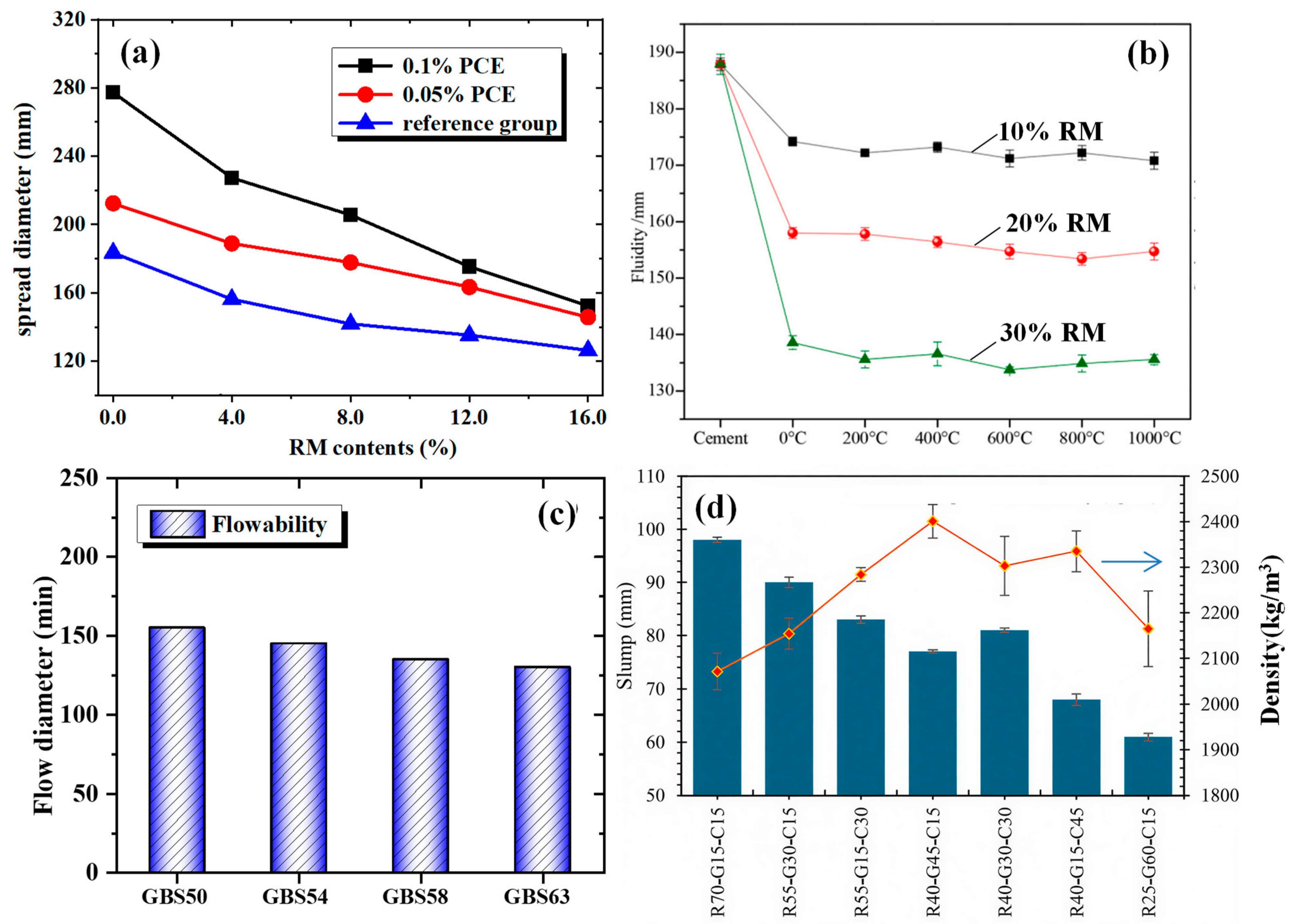
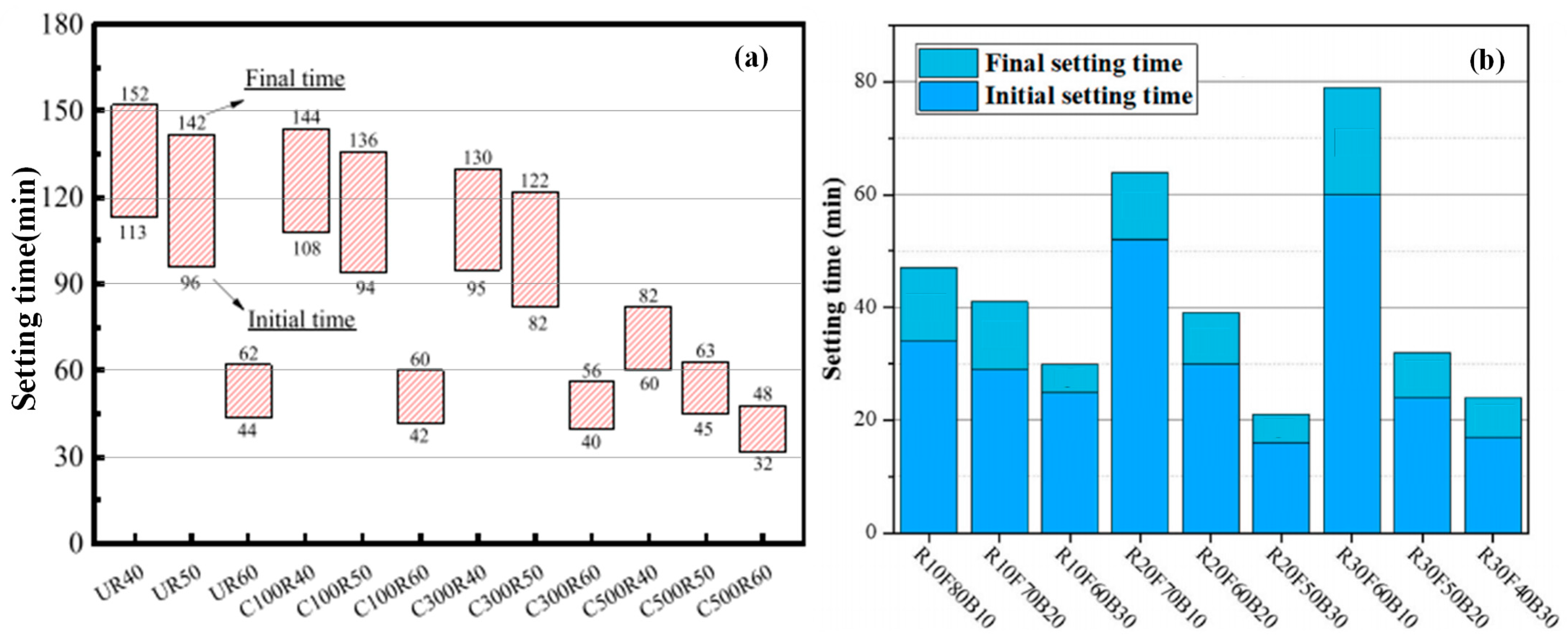
- Fresh-state penalty and its governing mechanisms. RM’s fine, porous texture and high-water retention commonly increase yield stress and viscosity while reducing flowability. These same features can delay setting by lowering effective free water and slowing early reaction progress. The magnitude and direction of these effects are further modulated by RM calcination, which alters surface characteristics and reactivity, and by calcium-bearing additions, which can accelerate early gel formation and exacerbate stiffening if not properly managed.
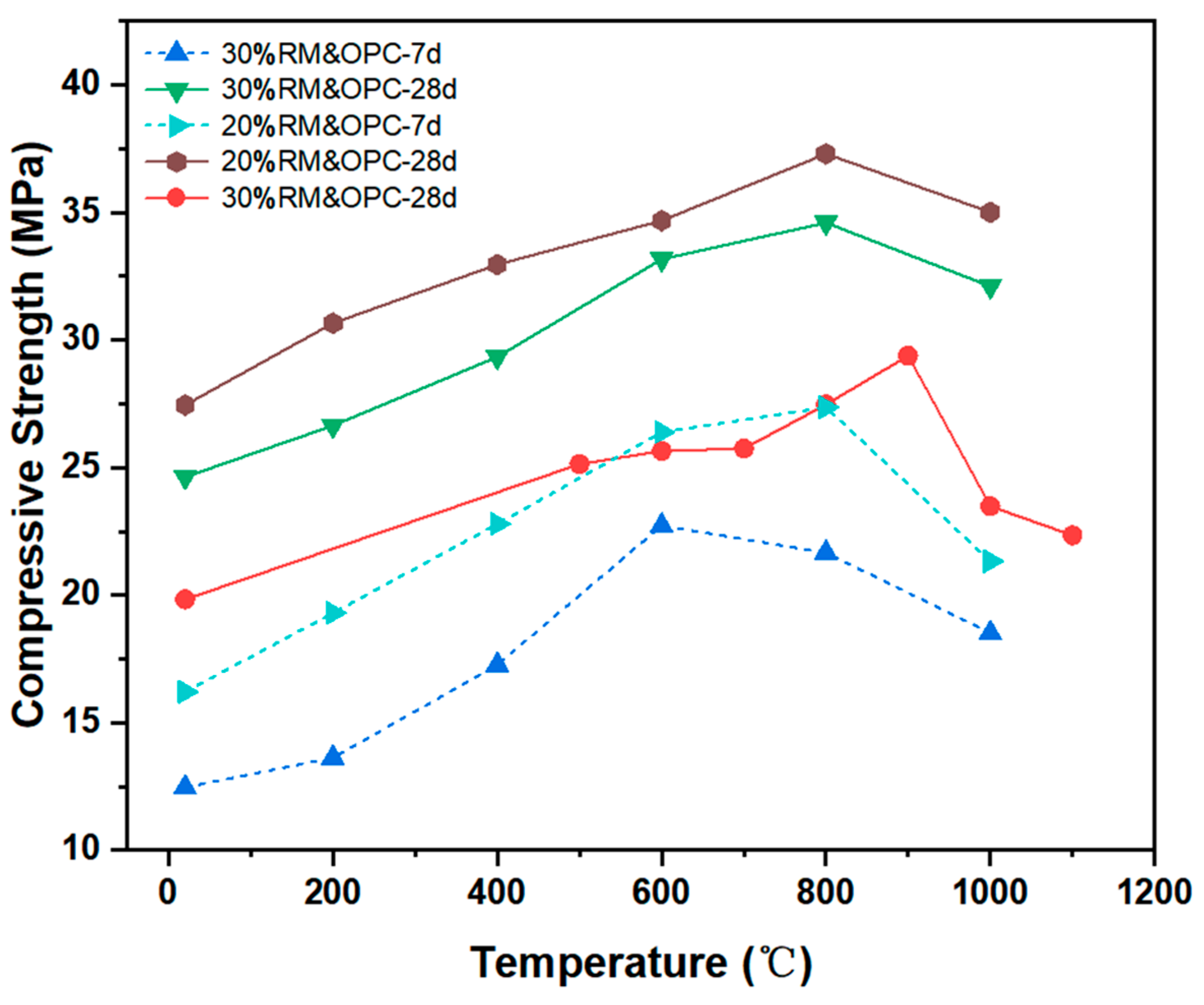
- Strength development exhibits an optimal RM range. Moderate RM incorporation can contribute to additional binding gel formation and matrix refinement, supporting strength development. However, beyond a practical threshold frequently reported around ~20% replacement in the surveyed studies, clinker dilution and incomplete RM reaction tend to dominate, leading to increased porosity and pore connectivity and a decline in compressive, tensile, and flexural strength. Thermal activation and/or calcium-rich co-precursors can partially mitigate this limitation by enhancing dissolution and promoting denser gel networks.
- Durability gains are largely transport-controlled and mix-dependent. RM addition is often associated with improved resistance to chloride ingress, sulfate attack, freeze–thaw damage, and water erosion when pore connectivity is reduced, and a compact gel matrix is formed. Synergistic blending with GGBS and/or PG further enhances durability by promoting the co-development of N-A-S-H and C-(A)-S-H gels and refining pore structure. However, excessive RM may still increase total porosity and water absorption in some mixtures.
- Microstructural evidence supports the structure-property link. XRD, FTIR, and SEM analyses consistently show that RM dosage and calcination alter phase assemblage, gel chemistry, and pore structure. RM contents up to ~20% generally promote better particle-gel integration and a more continuous amorphous reaction matrix, whereas higher dosages often exhibit increased unreacted or agglomerated particles, larger pore gaps, and reduced gel continuity features consistent with the observed deterioration in workability and strength at elevated RM levels.
Funding
Data Availability Statement
Conflicts of Interest
References
- Zaland, S.; Wang, J.; Li, K.; Sadat, S.I.; Akhunzada, K. Geopolymers as a sustainable alternative to portland cement: Synthesis, durability, applications, environmental impacts, and cost analysis. Renew. Sustain. Energy Rev. 2026, 225, 116157. [Google Scholar] [CrossRef]
- Li, Z.; Dong, H.; Wang, Y.; Men, J.; Wang, J.; Zhao, X.; Zou, S. Valorization of alkali–thermal activated red mud for high-performance geopolymer: Performance evaluation and environmental effects. Buildings 2025, 15, 2471. [Google Scholar] [CrossRef]
- Wen, X.-J.; Zhan, Q.; Wu, D.; Xu, J.; Qian, B.; Xu, Q.; Su, T.; Liu, Z.; Fei, Z.; Guo, H. Construction of an s-scheme Bi12O17Cl2/CeO2 heterojunction for efficient photocatalytic degradation of ciprofloxacin and hydrogen evolution. J. Taiwan Inst. Chem. Eng. 2026, 188, 106769. [Google Scholar] [CrossRef]
- Wang, Y.; Shi, Y.; Yang, T.; Wang, W.; Sun, Z.; Zhang, Y. Structural performance warning based on computer intelligent monitoring and fractional -order multi-rate kalman fusion method. Fractal Fract. 2026, 10, 186. [Google Scholar] [CrossRef]
- Xu, L.; Ran, B.; Hu, X.; Sun, J.; Fan, D.; Jiang, Y.; Lu, D. Multi-scale insights into carbonation-induced changes in recycled cement paste and its carbon capture potential. J. Build. Eng. 2026, 117, 114849. [Google Scholar] [CrossRef]
- Mahmoodi, O.; Siad, H.; Lachemi, M.; Dadsetan, S.; Şahmaran, M. Optimized application of ternary brick, ceramic and concrete wastes in sustainable high strength geopolymers. J. Clean. Prod. 2022, 338, 130650. [Google Scholar] [CrossRef]
- Xu, L.; Wang, J.; Huang, R.; Wang, Y.; Ran, B.; Hu, X.; Lv, T.; Zhou, X.; Wang, S.; Dai, X. Effects of accelerated carbonation on the chemical and microstructural evolution of recycled different scms blended cement pastes. Cem. Concr. Compos. 2025, 164, 106259. [Google Scholar] [CrossRef]
- Xu, L.-P.; Wei, D.; Liu, H.-B.; Li, G.-H.; Jiang, T. Super-high bed homogeneous sintering for iron ores with low carbon emissions. J. Clean. Prod. 2025, 529, 146848. [Google Scholar] [CrossRef]
- Li, Z.; Zhang, J.; Lei, Z.; Gao, M.; Sun, J.; Tong, L.; Chen, S.; Wang, Y. Designing low-carbon fly ash based geopolymer with red mud and blast furnace slag wastes: Performance, microstructure and mechanism. J. Environ. Manag. 2024, 354, 120362. [Google Scholar] [CrossRef]
- Wu, X.; He, J.; Tian, J.; Liu, M.; Zheng, Y.; Zhang, W.; Yuan, J.; Wang, W.-W.; Fu, H.; Wang, R. Multi-scale performance of underwater-castable ultra-high-volume fly-ash eco-friendly engineered cementitious composites: Microstructural characterization, workability, mechanical properties and environmental effects. Constr. Build. Mater. 2026, 506, 144870. [Google Scholar] [CrossRef]
- Liu, Y.; Zhang, S.; Ni, W.; Guan, D.; Chen, X.; Zhao, T.; Wu, Z.; Zheng, Y. The influence of alkaline activation on coal gasification slag–MSWI FA based binder and its associated hydration mechanism. Constr. Build. Mater. 2024, 453, 139112. [Google Scholar] [CrossRef]
- Jia, H.; Yao, S.; Tang, X.; Zheng, M.; Dong, Y.; Fan, F.; Yang, S.; Zhang, H. Multi-objective machine learning for health-oriented O3 and PM2.5 control: Integrating voc photochemical consumption and source apportionment. J. Hazard. Mater. 2026, 505, 141483. [Google Scholar] [CrossRef]
- Xu, L.; Wang, J.; Hu, X.; Ran, B.; Wu, T.; Zhou, X.; Xiong, Y. Physical performance, durability, and carbon emissions of recycled cement concrete and fully recycled concrete. Constr. Build. Mater. 2024, 447, 138128. [Google Scholar] [CrossRef]
- Jovičević-Klug, M.; Filho, I.R.S.; Springer, H.; Adam, C.; Raabe, D. Green steel from red mud through climate-neutral hydrogen plasma reduction. Nature 2024, 625, 703–709. [Google Scholar] [CrossRef]
- Suman; Tripathy, A. CO2 capture using red mud & mechanically-activated red mud and its kinetics under ambient conditions. Chem. Eng. J. 2024, 498, 155609. [Google Scholar] [CrossRef]
- Liu, Y.; Huang, Z.; Luo, X.; Ma, H.; Li, Z. Insights of airborne transmission within urban rail transit carriage environments after the COVID-19 pandemic. Indoor Built Environ. 2026. online ahead of print. [Google Scholar] [CrossRef]
- Fu, H.; Tian, J.; Chin, C.-L.; Liu, H.; Yuan, J.; Tang, S.; Mai, R.; Wu, X. Axial compression behavior of gfrp-steel composite tube confined seawater sea-sand concrete intermediate long columns. Eng. Struct. 2025, 333, 120157. [Google Scholar] [CrossRef]
- Li, Z.; Dong, H.; Zhao, X.; Wang, K.; Gao, X. Utilisation of bayer red mud for high-performance geopolymer: Competitive roles of different activators. Case Stud. Constr. Mater. 2025, 23, e05047. [Google Scholar] [CrossRef]
- Luo, B.; Su, Y.; Hu, X.; Chen, Z.; Chen, Y.; Ding, X. Strength behavior and microscopic mechanisms of geopolymer-stabilized waste clays considering clay mineralogy. J. Clean. Prod. 2025, 530, 146877. [Google Scholar] [CrossRef]
- Sun, Y.; Liu, J.; Chen, J.; Li, G.; Liang, M.; Zhang, M. Soft/hard interface design of bismuth nanodots embedded in Ti3C2Tx mxene for highly efficient dechlorination battery deionization. Desalination 2025, 614, 119183. [Google Scholar] [CrossRef]
- Huang, Z.; Liu, Y.; Ma, H.; Luo, X.; Li, Z. Numerical investigation of exhaled droplet transmission and infection probability prediction in a subway compartment under ventilation and passenger effects with an improved Wells-Riley equation. Int. J. Heat. Mass. Transf. 2026, 265, 128809. [Google Scholar] [CrossRef]
- Fu, H.; Tian, J.; Chen, S.; Chin, C.-L.; Ma, C.-K. Axial compressive performance of cfrp-steel composite tube confined seawater sea-sand concrete intermediate slender columns. Constr. Build. Mater. 2024, 441, 137399. [Google Scholar] [CrossRef]
- Wang, S.; Luo, F.; Fo, J.; Lv, Y.; Wang, C. Two-stage spatiotemporal decoupling configuration of SOP and multi-level electric-hydrogen hybrid energy storage based on feature extraction for distribution networks with ultra-high DG penetration. Appl. Energy 2025, 398, 126438. [Google Scholar] [CrossRef]
- Ma, S.; Zhang, Z.; Liu, X.; Li, Y.; Zeng, Q.; Zhang, W. Reuse of red mud in magnesium potassium phosphate cement: Reaction mechanism and performance optimization. J. Build. Eng. 2022, 61, 105290. [Google Scholar] [CrossRef]
- Raza, A.; Selmi, A.; Elhadi, K.M.; Ghazouani, N.; Chen, W. Strength analysis and microstructural characterization of calcined red mud based-geopolymer concrete modified with slag and phosphogypsum. J. Mater. Res. Technol. 2024, 33, 6168–6181. [Google Scholar] [CrossRef]
- Xu, L.; Huang, R.; Li, M.; Li, K.; Leng, F.; Ran, B.; Wang, J. From demolition to decarbonization: Synergistic hydration and sustainability of thermally activated recycled concrete powders. J. Environ. Manag. 2026, 401, 128902. [Google Scholar] [CrossRef]
- De Oliveira, D.R.C.; Rossi, C.R. Concretes with red mud coarse aggregates. Mater. Res. 2012, 15, 333–340. [Google Scholar] [CrossRef]
- Shi, Y.; Liao, Q.; Li, J.; Zhao, Q. Preparation of red mud-calcium carbide slag-based low-carbon lightweight aggregate concrete: Mechanical performance and interfacial transition zone microstructural analysis. Constr. Build. Mater. 2025, 468, 140311. [Google Scholar] [CrossRef]
- Zhang, C.; Hu, Z.; Cheng, G.; Wu, C.; Li, J.; Jiang, W.; Wang, X.; Yang, S.; Wang, W. Collaborative recycling of red mud and fgd-gypsum into multi-shell cold bonded lightweight aggregates: Synergistic effect, structure design and application in sustainable concrete. Constr. Build. Mater. 2023, 379, 131134. [Google Scholar] [CrossRef]
- Kusumanjali, G.; Tejas, S.; Chatterjee, A.; Pasla, D. Utilization of bauxite residue as fine aggregate for the development of structural concrete: An approach towards sustainable construction materials. Case Stud. Constr. Mater. 2025, 22, e04348. [Google Scholar] [CrossRef]
- Krivenko, P.; Kovalchuk, O.; Pasko, A.; Croymans, T.; Hult, M.; Lutter, G.; Vandevenne, N.; Schreurs, S.; Schroeyers, W. Development of alkali activated cements and concrete mixture design with high volumes of red mud. Constr. Build. Mater. 2017, 151, 819–826. [Google Scholar] [CrossRef]
- Wang, J.; Ren, C.; Huang, T.; Li, X.; Cao, W.; Zhu, Y.; Wei, P.; Wang, D.; Liu, Z. Performances of concrete with binder and/or aggregates replacement by all-solid waste materials. J. Clean. Prod. 2024, 450, 141929. [Google Scholar] [CrossRef]
- Shirodkar, V.; Patel, R.; Verma, M.; Mahate, V. An investigation into the durability of concrete using red mud as a substitute in cement. Mater. Today Proc. 2023, in press. [Google Scholar] [CrossRef]
- Tang, W.C.; Wang, Z.; Donne, S.W.; Forghani, M.; Liu, Y. Influence of red mud on mechanical and durability performance of self-compacting concrete. J. Hazard. Mater. 2019, 379, 120802. [Google Scholar] [CrossRef]
- Krivenko, P.V.; Kovalchuk, O.; Zozulynets, V. 9—Alternative binders—High volume bauxite red mud alkali activated cements and concretes. In Recycled Concrete; Woodhead Publishing: Sawston, UK, 2023; pp. 283–308. [Google Scholar]
- Liu, Y.; Zhuge, Y.; Chen, X.; Duan, W.; Fan, R.; Outhred, L.; Wang, L. Micro-chemomechanical properties of red mud binder and its effect on concrete. Compos. Part B Eng. 2023, 258, 110688. [Google Scholar] [CrossRef]
- Viyasun, K.; Anuradha, R.; Thangapandi, K.; Kumar, D.S.; Sivakrishna, A.; Gobinath, R. Investigation on performance of red mud based concrete. Mater. Today Proc. 2021, 39, 796–799. [Google Scholar] [CrossRef]
- Liu, R.-X.; Poon, C.-S. Utilization of red mud derived from bauxite in self-compacting concrete. J. Clean. Prod. 2016, 112, 384–391. [Google Scholar] [CrossRef]
- Singh, S.; Amalkar, M.; Dutta, M.C.; Rendi, D.E. Mechanically activated red mud based geopolymer for advanced concrete applications: Synthesis and properties. Iran. J. Sci. Technol. Trans. Civ. Eng. 2025, 49, 5967–5980. [Google Scholar] [CrossRef]
- Bellum, R.R.; Venkatesh, C.; Madduru, S.R. Influence of red mud on performance enhancement of fly ash-based geopolymer concrete. Innov. Infrastruct. Solut. 2021, 6, 215. [Google Scholar] [CrossRef]
- Zhang, X.; Wang, Y.; Han, J.; Li, X. Creep and mechanical behavior after sustained loading of red mud-slag based geopolymer concrete at early-age. Case Stud. Constr. Mater. 2025, 23, e04980. [Google Scholar] [CrossRef]
- Kazemian, F.; Hassani, A. Exploring mechanical and fracture properties in geopolymer concrete with ternary precursor waste materials through laboratory investigations and statistical analysis. J. Build. Eng. 2024, 95, 110294. [Google Scholar] [CrossRef]
- John, E.; Chalapuram, K.M.; Shebin, P.; Mohan, H.K.; Frazana, Z. Geopolymer concrete using red mud and ggbs. Int. Res. J. Eng. Technol. 2016, 3, 668–671. [Google Scholar]
- Ghalehnovi, M.; Roshan, N.; Hakak, E.; Shamsabadi, E.A.; de Brito, J. Effect of red mud (bauxite residue) as cement replacement on the properties of self-compacting concrete incorporating various fillers. J. Clean. Prod. 2019, 240, 118213. [Google Scholar] [CrossRef]
- Song, Y.; Dong, M.; Wang, Z.; Qian, X.; Yan, D.; Shen, S.; Zhang, L.; Sun, G.; Lai, J.; Ruan, S. Effects of red mud on workability and mechanical properties of autoclaved aerated concrete (aac). J. Build. Eng. 2022, 61, 105238. [Google Scholar] [CrossRef]
- Yuan, Q.; Wang, L.; Kong, D.; Han, Y.; Ren, C.; Tian, Y.; Zhu, G. Synergistic action and effect mechanism of coal gangue powder and red mud on the properties of concretes. J. Build. Eng. 2024, 98, 110999. [Google Scholar] [CrossRef]
- Tang, W.C.; Wang, Z.; Liu, Y.; Cui, H.Z. Influence of red mud on fresh and hardened properties of self-compacting concrete. Constr. Build. Mater. 2018, 178, 288–300. [Google Scholar] [CrossRef]
- Wu, C.-R.; Tang, W.; Zhan, B.-J.; Kou, S.-C. Feasibility study on using red mud as a viscosity-modifying agent for self-compacting concrete. Constr. Build. Mater. 2024, 445, 137871. [Google Scholar] [CrossRef]
- Wu, C.-R.; Zhan, B.-J.; Tang, W.; Kou, S.-C. Synergistic reuse of red mud and circulating fluidised bed fly ash in self-compacting recycled concrete. Constr. Build. Mater. 2025, 470, 140533. [Google Scholar] [CrossRef]
- Yao, Z.; Li, Y.; Fu, H.; Tian, J.; Zhou, Y.; Chin, C.-L.; Ma, C.-K. Research on concrete crack and depression detection method based on multi-level defect fusion segmentation network. Buildings 2025, 15, 1657. [Google Scholar] [CrossRef]
- Ghalehnovi, M.; Shamsabadi, E.A.; Khodabakhshian, A.; Sourmeh, F.; de Brito, J. Self-compacting architectural concrete production using red mud. Constr. Build. Mater. 2019, 226, 418–427. [Google Scholar] [CrossRef]
- Shilar, F.A.; Ganachari, S.V.; Patil, V.B.; Khan, T.M.Y.; Javed, S.; Baig, R.U. Optimization of alkaline activator on the strength properties of geopolymer concrete. Polymers 2022, 14, 2434. [Google Scholar] [CrossRef]
- Liu, Y.; Qin, Z.; Chen, B. Experimental research on magnesium phosphate cements modified by red mud. Constr. Build. Mater. 2020, 231, 117131. [Google Scholar] [CrossRef]
- Senff, L.; Modolo, R.C.E.; Silva, A.S.; Ferreira, V.M.; Hotza, D.; Labrincha, J.A. Influence of red mud addition on rheological behavior and hardened properties of mortars. Constr. Build. Mater. 2014, 65, 84–91. [Google Scholar] [CrossRef]
- Senff, L.; Hotza, D.; Labrincha, J.A. Effect of red mud addition on the rheological behaviour and on hardened state characteristics of cement mortars. Constr. Build. Mater. 2011, 25, 163–170. [Google Scholar] [CrossRef]
- Tang, L.; He, Z.; Yang, R.; Pei, S.; Zou, M.; Qin, M. High temperature calcined red mud-cement mortar: Workability, mechanical properties, hydration mechanism, and microstructure. Sustain. Chem. Pharm. 2024, 41, 101717. [Google Scholar] [CrossRef]
- Song, H.; Gauvin, F.; Liu, T.; Sun, X.; Dong, Z.; Wang, F.; Chen, X.; Brouwers, H.J.H. Understanding of municipal solid waste incineration (MSWI) bottom ash/cement blends: Impact of natural fiber on mechanical strength and leaching behavior. J. Build. Eng. 2026, 120, 115330. [Google Scholar] [CrossRef]
- Wang, L.; Feng, W.; Lazaro, S.A.M.; Li, X.; Cheng, Y.; Wang, Z. Engineering properties of soil-based controlled low-strength materials made from local red mud and silty soil. Constr. Build. Mater. 2022, 358, 129453. [Google Scholar] [CrossRef]
- Ma, S.; Cao, Z.; Wei, C.; Shao, Y.; Wu, P.; Zhang, Z.; Liu, X. Red mud-modified magnesium potassium phosphate cement used as rapid repair materials: Durability, bonding property, volume stability and environment performance optimization. Constr. Build. Mater. 2024, 415, 135144. [Google Scholar] [CrossRef]
- Zhang, W.; Liu, X.; Wang, Y.; Li, Z.; Li, Y.; Ren, Y. Binary reaction behaviors of red mud based cementitious material: Hydration characteristics and Na+ utilization. J. Hazard. Mater. 2021, 410, 124592. [Google Scholar] [CrossRef]
- Liu, J.; Ren, F.; Ding, T.; Jia, J. Exploring the effect mechanism of bayer red mud on cement hydration and mechanical properties. Constr. Build. Mater. 2024, 435, 136741. [Google Scholar] [CrossRef]
- Shi, X.; Su, Y.; Luo, J.; Zhang, Y.; Hu, R. Preparation and performance optimization of fly ash- slag- red mud based geopolymer mortar: Simplex-centroid experimental design method. Constr. Build. Mater. 2024, 450, 138573. [Google Scholar] [CrossRef]
- Zhang, C.; Wang, G.; Wu, C.; Li, J.; Wu, S.; Jiang, W.; Wang, X.; Wang, W.; Feng, M. Investigation of hierarchical porous cold bonded lightweight aggregates produced from red mud and solid-waste-based cementitious material. Constr. Build. Mater. 2021, 308, 124990. [Google Scholar] [CrossRef]
- Wu, H.; Zhang, Z.; Yang, J.; Xue, C.; Duan, S.; Zhang, G.; Ma, J.; Guo, S.; Deng, J. One-step fabrication of CuFe2O4/CuAl2O4 Fenton-like catalytic ceramic membranes using coal fly ash for synergistic filtration-catalysis. J. Clean. Prod. 2026, 544, 147734. [Google Scholar] [CrossRef]
- Song, H.; Jiang, Z.; Luinenburg, T.S.; Gauvin, F.; Fu, X.; Sun, X.; Dong, Z.; Wang, F.; Fan, H.; Chen, X.; et al. Study on the carbonization coating treatment of municipal solid waste incineration fine bottom ash as aggregates: CO2 capture, contaminants solidification, on-site application scale. Cem. Concr. Compos. 2026, 170, 106596. [Google Scholar] [CrossRef]
- Cen, X.; Zhang, Y.; Zhang, H. Investigation on the mechanical and microstructure properties of masonry cement-red mud-carbide slag-based paste. Case Stud. Constr. Mater. 2024, 21, e03979. [Google Scholar] [CrossRef]
- Liu, S.; Pan, C.; Zhang, H.; Yao, S.; Shen, P.; Guan, X.; Shi, C.; Li, H. Development of novel mineral admixtures for sulphoaluminate cement clinker: The effects of wet carbonation activated red mud. J. Build. Eng. 2023, 67, 105920. [Google Scholar] [CrossRef]
- Feng, Y.; Alves, Z.; Peng, L.; Novais, R. The impact of industrial waste on hydration behavior, mechanical performance, and water resistance of magnesium oxychloride cement. Constr. Build. Mater. 2025, 489, 142320. [Google Scholar] [CrossRef]
- Liu, Y.; Zhang, S.; Chen, X.; Guan, D.; Li, Y.; Chen, D.; Ni, W.; Shao, A. Influence of FGD gypsum crystal form change on performance and hydration processes of solid waste-based binders. Chem. Eng. J. 2025, 513, 162793. [Google Scholar] [CrossRef]
- Sun, H.; Xie, M.; Jia, L.; Xie, X. Development of low-carbon binders from ground granulated blast furnace slag activated by red mud, phosphogypsum, and calcium carbide slag: Mechanical and hydration properties. J. Build. Eng. 2025, 111, 113229. [Google Scholar] [CrossRef]
- Geng, J.; Zhou, M.; Li, Y.; Chen, Y.; Han, Y.; Wan, S.; Zhou, X.; Hou, H. Comparison of red mud and coal gangue blended geopolymers synthesized through thermal activation and mechanical grinding preactivation. Constr. Build. Mater. 2017, 153, 185–192. [Google Scholar] [CrossRef]
- Song, H.; Hon, K.C.; Gauvin, F.; Pantaleo, S.; Berger, F.; Chen, W.; Brouwers, H.J.H. Durability assessment of alkyl ketene dimer hydrophobic treatment of bio-based thermal insulation materials. Resour. Conserv. Recycl. 2025, 212, 107983. [Google Scholar] [CrossRef]
- Lemougna, P.N.; Wang, K.-T.; Tang, Q.; Cui, X.-M. Synthesis and characterization of low temperature (<800 °C) ceramics from red mud geopolymer precursor. Constr. Build. Mater. 2017, 131, 564–573. [Google Scholar] [CrossRef]
- Zhao, Y.; Jiang, S.; An, Z.; Luo, B. Experimental Investigation of the Bearing-Deformation Behavior of Broken Rocks in Goafs Under Various Influencing Factors. Appl. Sci. 2026, 16, 4276. [Google Scholar] [CrossRef]
- Zhang, M.; Zhao, M.; Zhang, G.; Mann, D.; Lumsden, K.; Tao, M. Durability of red mud-fly ash based geopolymer and leaching behavior of heavy metals in sulfuric acid solutions and deionized water. Constr. Build. Mater. 2016, 124, 373–382. [Google Scholar] [CrossRef]
- Zhang, W.; Xie, G.; Hu, J.; Niu, R.; Wang, Z.; Liu, J.; Xing, F. Hazardous wastes used as hybrid precursors for geopolymers: Cosolidification/stabilization of mswi fly ash and bayer red mud. Chem. Eng. J. 2023, 474, 145966. [Google Scholar] [CrossRef]
- Zakira, U.; Zheng, K.; Xie, N.; Birgisson, B. Development of high-strength geopolymers from red mud and blast furnace slag. J. Clean. Prod. 2023, 383, 135439. [Google Scholar] [CrossRef]
- Wu, P.; Wei, C.; Liu, X.; Zhang, Z.; Xue, Y.; Liu, X. Impact of hematite in red mud on hydration characteristics and environmental performance of cementitious materials. Cem. Concr. Compos. 2025, 160, 106035. [Google Scholar] [CrossRef]
- Yu, Y.; Wang, C.; Wang, W.; Lu, K.; Chen, Z.; Zhao, D.; Ju, B.-F.; Zhou, S. Determination of elastic constants in unidirectional CFRP laminates using neural networks and laser ultrasonic bulk waves. Compos. Part A Appl. Sci. Manuf. 2026, 207, 109827. [Google Scholar] [CrossRef]
- Wang, S.; Jin, H.; Deng, Y.; Xiao, Y. Comprehensive utilization status of red mud in China: A critical review. J. Clean. Prod. 2021, 289, 125136. [Google Scholar] [CrossRef]
- Li, Z.; Gao, M.; Lei, Z.; Tong, L.; Sun, J.; Wang, Y.; Wang, X.; Jiang, X. Ternary cementless composite based on red mud, ultra-fine fly ash, and ggbs: Synergistic utilization and geopolymerization mechanism. Case Stud. Constr. Mater. 2023, 19, e02410. [Google Scholar] [CrossRef]
- Mi, H.; Yi, L.; Wu, Q.; Xia, J.; Zhang, B. Preparation of high-strength ceramsite from red mud, fly ash, and bentonite. Ceram. Int. 2021, 47, 18218–18229. [Google Scholar] [CrossRef]
- Song, C.; Zhang, H.; Dong, Y.; Pei, L.; Liu, H.; Jiang, J.; Xu, H. Investigation on the fabrication of lightweight aggregate with acid-leaching tailings of vanadium-bearing stone coal minerals and red mud. Chin. J. Chem. Eng. 2021, 32, 353–359. [Google Scholar] [CrossRef]
- Hou, D.; Wu, D.; Wang, X.; Gao, S.; Yu, R.; Li, M.; Wang, P.; Wang, Y. Sustainable use of red mud in ultra-high performance concrete (uhpc): Design and performance evaluation. Cem. Concr. Compos. 2021, 115, 103862. [Google Scholar] [CrossRef]
- Manfroi, E.P.; Cheriaf, M.; Rocha, J.C. Microstructure, mineralogy and environmental evaluation of cementitious composites produced with red mud waste. Constr. Build. Mater. 2014, 67, 29–36. [Google Scholar] [CrossRef]
- Zhang, F.; Falchetto, A.C.; Wang, D.; Li, Z.; Sun, Y.; Lin, W. Prediction of asphalt rheological properties for paving and maintenance assistance using explainable ma-chine learning. Fuel 2025, 396, 135319. [Google Scholar] [CrossRef]
- Xu, L.; Wang, J.; Huang, R.; Li, B.; Ran, B.; Hu, X. Investigations on micro-mechanical properties of the itzs between recycled aggregates and recycled cement paste. Constr. Build. Mater. 2024, 450, 138640. [Google Scholar] [CrossRef]
- Bai, M.; Song, L.; Xiao, Q.; Sun, J.; Liu, H. Development of low-carbon engineered cementitious composites incorporating lithium slag: Mechanical properties, microstructure evolution, and life cycle assessment. Constr. Build. Mater. 2026, 520, 145983. [Google Scholar] [CrossRef]
- Shi, Y.; Wang, Y.; Wang, L.-N.; Wang, W.-N.; Yang, T.-Y. Bridge Cable Performance Warning Method Based on Temperature and Displacement Monitoring Data. Buildings 2025, 15, 2342. [Google Scholar] [CrossRef]
- Guo, K.; Dong, H.; Zhang, J.; Zhang, L.; Li, Z. Experimental study of alkali-activated cementitious materials using thermally activated red mud: Effect of the Si/Al ratio on fresh and mechanical properties. Buildings 2025, 15, 565. [Google Scholar] [CrossRef]
- Peng, G.-F.; Wang, X.-F.; Ding, H.; Jia, Y.-J. Effect of calcined red mud on the mechanical properties and microstructure of ultra-high performance concrete. Constr. Build. Mater. 2025, 484, 141891. [Google Scholar] [CrossRef]
- Li, Z. Toward Low-Carbon Construction: A Review of Red Mud Utilization in Cementitious Materials and Geopolymers for Sustainability and Cost Benefits. Buildings 2026, 16, 362. [Google Scholar] [CrossRef]
- Xu, L.; Li, M.; Hu, X.; Ran, B.; Li, K.; Wang, J. Thermal-activated recycled cement as a dual-role binder in limestone calcined clay cement (lc3): Hydration mechanism, performance, and sustainability implications. Constr. Build. Mater. 2026, 512, 145359. [Google Scholar] [CrossRef]
- Zhang, L.; Zhang, L.; Chen, Y.; Tan, C.; Song, R.; Gao, S. Efficient ammonia sequestration by al-based mof composites: Synergistic regulation of supports and loading strategies and investigation of the adsorption mechanism. J. Indian Chem. Soc. 2026, 103, 102422. [Google Scholar] [CrossRef]
- Wu, X.; Ouyang, X.; Tian, J.; Zheng, Y.; Yuan, J.; Wang, W.-W.; Zuo, Y.; Fu, H.; Yu, W.; Wang, R. Self-sensing mechanism and theoretical model of prestressed frp-ecc multifunctional composite beams under bending loads. Structures 2026, 87, 111585. [Google Scholar] [CrossRef]
- Long, Q.; Zhao, Y.; Zhang, B.; Yang, H.; Luo, Z.; Li, Z.; Zhang, G.; Liu, K. Interfacial behavior of slag, fly ash, and red mud-based geopolymer mortar with concrete substrate: Mechanical properties and microstructure. Buildings 2024, 14, 652. [Google Scholar] [CrossRef]
- Tong, L.; Fu, L.; Wu, B.; Xu, C.; Lim, C.W.; Ding, H. Particle Shape Effect on Creep and Fluidity of Granular Packing. J. Eng. Mech. 2025, 151. [Google Scholar] [CrossRef]
- Liu, Z.; Dong, T.; Lv, Y.; Qi, X.; Shui, Z. A novel ultra-high performance concrete incorporating fiber mesh reinforcement and a stress-oriented layered structure. Structures 2026, 88, 111770. [Google Scholar] [CrossRef]
- Cui, Y.; Chen, S.; Li, L.; Wang, X.; Liu, J. Atomistic insights into the hydration behavior of N-A-S-H Gel via Ca2+ substitution: A molecular dynamics simulation study. J. Non-Cryst. Solids 2026, 673, 123892. [Google Scholar] [CrossRef]
- Cui, W.; Liu, J.; He, G.; Duan, W.; Li, X.; Dong, X. Evaluation of active silica-alumina content and reactivity in bayer process red mud. Constr. Build. Mater. 2024, 418, 135502. [Google Scholar] [CrossRef]



| Ref. | Matrix | RM with | Experiments | ||||||||||||||||||||||||||||||||
|---|---|---|---|---|---|---|---|---|---|---|---|---|---|---|---|---|---|---|---|---|---|---|---|---|---|---|---|---|---|---|---|---|---|---|---|
| F/S | T500 | JR | ST | LB | CS | FS | FC | RT | DT | TC | CP | EM | SR | HT | WP | TS | STT | WR | CR | WA | SK | ES | PT | UPV | XRD | TA | FTIR | SEM | EDS | BSE | MIP | ICP | |||
| [27] | Concrete | MK, Silica | ● | ● | ● | ● | ● | ● | |||||||||||||||||||||||||||
| [28] | Concrete | OPC, FA | ● | ● | ● | ● | ● | ● | |||||||||||||||||||||||||||
| [29] | Concrete | GBFS, FGD-gypsum, sulphoaluminate OPC | ● | ● | ● | ● | ● | ● | ● | ● | ● | ● | ● | ● | ● | ||||||||||||||||||||
| [30] | Concrete | OPC | ● | ● | ● | ● | ● | ● | ● | ● | |||||||||||||||||||||||||
| [31] | Concrete | OPC, GGBS | ● | ● | ● | ● | ● | ● | |||||||||||||||||||||||||||
| [32] | Concrete | GGBS, FA, FGD, Clinker | ● | ● | ● | ● | ● | ● | ● | ● | ● | ● | |||||||||||||||||||||||
| [33] | Concrete | OPC | ● | ● | ● | ● | |||||||||||||||||||||||||||||
| [34] | Concrete | OPC, FA | ● | ● | ● | ● | ● | ||||||||||||||||||||||||||||
| [35] | Concrete | OPC, GGBS | ● | ● | ● | ● | ● | ● | ● | ● | ● | ||||||||||||||||||||||||
| [36] | Concrete | OPC | ● | ● | ● | ● | ● | ● | ● | ||||||||||||||||||||||||||
| [37] | Concrete | OPC | ● | ● | ● | ● | ● | ||||||||||||||||||||||||||||
| [38] | Concrete | OPC, FA | ● | ● | ● | ● | ● | ● | ● | ● | ● | ||||||||||||||||||||||||
| [39] | Concrete | FA, GGBS | ● | ● | ● | ● | ● | ● | ● | ● | ● | ||||||||||||||||||||||||
| [40] | Concrete | FA | ● | ● | ● | ● | |||||||||||||||||||||||||||||
| [41] | Concrete | Silica fume, GGBS | ● | ● | ● | ● | |||||||||||||||||||||||||||||
| [42] | Concrete | FA, GGBS | ● | ● | ● | ● | ● | ● | |||||||||||||||||||||||||||
| [43] | Concrete | GGBS | ● | ● | ● | ● | |||||||||||||||||||||||||||||
| [44] | Concrete | OPC | ● | ● | ● | ● | ● | ● | ● | ● | ● | ||||||||||||||||||||||||
| [45] | Concrete | Lime, OPC, FA, PG | ● | ● | ● | ● | ● | ● | |||||||||||||||||||||||||||
| [46] | Concrete | OPC, Coal gangue | ● | ● | ● | ● | ● | ● | ● | ● | |||||||||||||||||||||||||
| [47] | Concrete | OPCt, FA | ● | ● | ● | ● | ● | ● | ● | ● | ● | ||||||||||||||||||||||||
| [48] | Concrete | OPC | ● | ● | ● | ● | ● | ||||||||||||||||||||||||||||
| [49] | Concrete | CFB FA, OPC | ● | ● | ● | ● | ● | ● | ● | ||||||||||||||||||||||||||
| [50] | Concrete | PC | ● | ● | ● | ● | ● | ● | ● | ||||||||||||||||||||||||||
| [51] | Concrete | White OPC, Filler | ● | ● | ● | ● | ● | ● | ● | ● | ● | ● | ● | ● | |||||||||||||||||||||
| [52] | Concrete | GGBS | ● | ● | ● | ● | ● | ● | ● | ● | ● | ● | |||||||||||||||||||||||
| [25] | Concrete | GGBS, Calcium sulfate dihydrate | ● | ● | ● | ● | ● | ● | ● | ● | ● | ● | ● | ● | ● | ● | ● | ||||||||||||||||||
| [53] | Mortar | Magnesia | ● | ● | ● | ● | ● | ● | ● | ● | ● | ||||||||||||||||||||||||
| [54] | Mortar | OPC | ● | ● | ● | ● | ● | ● | |||||||||||||||||||||||||||
| [55] | Mortar | OPC | ● | ● | ● | ● | |||||||||||||||||||||||||||||
| [56] | Mortar | OPC, GBFS | ● | ● | ● | ● | ● | ● | ● | ||||||||||||||||||||||||||
| [57] | Mortar | OPC clinker | ● | ● | ● | ● | ● | ● | ● | ● | ● | ||||||||||||||||||||||||
| [58] | Mortar | OPC | ● | ● | ● | ● | |||||||||||||||||||||||||||||
| [59] | Mortar | Magnesia, KH2PO4 | ● | ● | ● | ● | ● | ● | ● | ● | |||||||||||||||||||||||||
| [60] | Mortar | OPC | ● | ● | ● | ● | ● | ● | |||||||||||||||||||||||||||
| [61] | Mortar | OPC, Recycled brick powder | ● | ● | ● | ● | ● | ● | |||||||||||||||||||||||||||
| [62] | Mortar | FA, GGBS | ● | ● | ● | ● | ● | ● | |||||||||||||||||||||||||||
| [63] | Paste | Lime stone, Diabase, Aluminum ash, PG | ● | ● | ● | ● | ● | ● | ● | ||||||||||||||||||||||||||
| [64] | Paste | Magnesia, FA | ● | ● | ● | ● | ● | ● | ● | ● | |||||||||||||||||||||||||
| [24] | Paste | Magnesia, KH2PO4 | ● | ● | ● | ● | ● | ● | ● | ||||||||||||||||||||||||||
| [65] | Paste | OPC, FA, Desulfurization gypsum | ● | ● | ● | ● | ● | ● | ● | ● | ● | ||||||||||||||||||||||||
| [66] | Paste | OPC, Masonry OPC, Carbide slag | ● | ● | ● | ● | ● | ● | ● | ||||||||||||||||||||||||||
| [67] | Paste | CSA clinker | ● | ● | ● | ● | ● | ● | ● | ● | |||||||||||||||||||||||||
| [68] | Paste | Biomass FA, MK, Copper slag | ● | ● | ● | ● | ● | ● | ● | ||||||||||||||||||||||||||
| [69] | Paste | / | ● | ● | ● | ● | ● | ||||||||||||||||||||||||||||
| [70] | Paste | GGBS, Calcium carbide slag, PG | ● | ● | ● | ● | ● | ● | ● | ● | ● | ||||||||||||||||||||||||
| [9] | Paste | FA, GGBS | ● | ● | ● | ● | ● | ● | ● | ● | ● | ||||||||||||||||||||||||
| [71] | Paste | Coal gangue | ● | ● | ● | ● | ● | ● | |||||||||||||||||||||||||||
| [72] | Paste | / | ● | ● | ● | ● | ● | ● | ● | ● | |||||||||||||||||||||||||
| [2] | Paste | GGBS | ● | ● | ● | ● | ● | ● | ● | ● | ● | ● | |||||||||||||||||||||||
| [73] | Paste | / | ● | ● | ● | ● | ● | ● | ● | ● | ● | ||||||||||||||||||||||||
| [74] | Paste | GGBS | ● | ● | ● | ● | ● | ● | ● | ||||||||||||||||||||||||||
| [75] | Paste | FA | ● | ● | ● | ● | ● | ● | |||||||||||||||||||||||||||
| [76] | Paste | MFA | ● | ● | ● | ● | ● | ● | ● | ||||||||||||||||||||||||||
| [77] | Paste | GGBS, Silica fume | ● | ● | ● | ● | |||||||||||||||||||||||||||||
| [78] | Paste | OPC, BFS, Hematite powder | ● | ● | ● | ● | ● | ● | ● | ● | ● | ● | ● | ||||||||||||||||||||||
| [18] | Paste | GGBS | ● | ● | ● | ● | ● | ● | ● | ||||||||||||||||||||||||||
| Physical Characteristics | Value | Units |
|---|---|---|
| Particle size | 0.005–0.075 | mm |
| Specific surface area | 64.09–186.9 | m2/g |
| Specific gravity | 2.7–3.0 | |
| Natural density | 1800–2070 | kg/m3 |
| Dry density | 1150–1490 | kg/m3 |
| Moisture content | 86.01–89.97 | % |
| Water-holding rate | 79.03–93.23 | % |
| Water-liberating rate | 5–14.93 | % |
| Void ratio | 2.53–2.95 | / |
| Melting point | 1200–1500 | °C |
| Ref. | Morphology | Mineralogy |
|---|---|---|
| [26] | Loose, porous, and irregular in structure | Hematite, Quartz, and Aluminum oxide |
| [82] | Deep-red color with fine particle size | Calcite, Hematite, Diaspore, Chlorite, Cancrinite, Hydrocalcium aluminate garnet, and Gibbsite |
| [83] | / | Cancrinite, Calcite, and Hematite |
| [24] | Blocky particles, fine and unevenly distributed with irregular shapes | Cancrinite, Ca3Al2(SiO4)(OH)8, Hematite, Ca5(SiO4)2(OH)2, and Ca(OH)2 |
| [84] | Fine and uneven particles | Cancrinite, Calcite, Gibbsite, Hematite, Kaolinite, Katoite, and Perovskite |
| [61] | Particles exhibit irregular flaky structures with rough and porous surfaces | Cancrinite, Boehmite, Gibbsite, Anatase, Calcite, and Hematite |
| [9] | / | Quartz, Calcium Aluminum oxide, Hematite, and Analcime |
| [72] | / | Kaolinite, Doyleite, Muscovite, Quartz, Calcite, and Hematite |
| [78] | / | Cancrinite, Katoite, Andradite, and Hematite |
| [36] | Particles have porous surfaces and irregular shapes | Boehmite, Gibbsite, Ilmenite, Hematite, Katoite, and Goethite |
| Ref. | Type | RM as OPC Replacement (wt%) | ||||||||
|---|---|---|---|---|---|---|---|---|---|---|
| 0 | 5 | 10 | 15 | 20 | 25 | 30 | 35 | 40 | ||
| [67] | Paste | 28.1 | 25.9 | 27.1 | 30.1 | 33.4 | 26.9 | / | / | / |
| [53] | Concrete | 84.1 | / | 87.5 | / | 90.3 | / | 88.2 | / | 79.2 |
| [68] | Paste | 38.8 | 38.7 | 34.5 | / | 39.2 | / | 26.7 | / | / |
| [59] | Mortar | 63.6 | / | 70.6 | / | 70.9 | / | 65.3 | / | / |
| [50] | Concrete | 45.1 | / | / | / | 43.3 | / | 39.0 | / | 35.7 |
| [44] | Concrete | 41.5 | / | 41.6 | / | 45.3 | / | 44.0 | / | 37.3 |
| [37] | Concrete | 32.4 | / | 31.1 | / | 34.9 | / | 33.2 | / | / |
| [60] | Mortar | 32.6 | / | 33.7 | / | 35.5 | / | 22.3 | / | 21.1 |
Disclaimer/Publisher’s Note: The statements, opinions and data contained in all publications are solely those of the individual author(s) and contributor(s) and not of MDPI and/or the editor(s). MDPI and/or the editor(s) disclaim responsibility for any injury to people or property resulting from any ideas, methods, instructions or products referred to in the content. |
© 2026 by the author. Licensee MDPI, Basel, Switzerland. This article is an open access article distributed under the terms and conditions of the Creative Commons Attribution (CC BY) license.
Share and Cite
Li, Z. Resource Utilization of Red Mud in Low-Carbon Binders: A Review of Reaction Mechanisms, Performance, and Microstructure. Buildings 2026, 16, 2140. https://doi.org/10.3390/buildings16112140
Li Z. Resource Utilization of Red Mud in Low-Carbon Binders: A Review of Reaction Mechanisms, Performance, and Microstructure. Buildings. 2026; 16(11):2140. https://doi.org/10.3390/buildings16112140
Chicago/Turabian StyleLi, Zhiping. 2026. "Resource Utilization of Red Mud in Low-Carbon Binders: A Review of Reaction Mechanisms, Performance, and Microstructure" Buildings 16, no. 11: 2140. https://doi.org/10.3390/buildings16112140
APA StyleLi, Z. (2026). Resource Utilization of Red Mud in Low-Carbon Binders: A Review of Reaction Mechanisms, Performance, and Microstructure. Buildings, 16(11), 2140. https://doi.org/10.3390/buildings16112140