


Abstract
The cement industry plays a critical role in infrastructure development, but is a major contributor to CO2 emissions, driving the search for low-carbon binders that can also valorize industrial wastes. This review examines the engineering performance of red mud (RM)-based binder systems, highlighting the relationships between mixture design, processing, fresh-state behavior, mechanical properties, durability, and microstructural evolution. Special attention is given to how RM’s particle characteristics and mineralogical/chemical composition influence reactivity during geopolymerization, thereby affecting strength development and pore structure. Across the literature, moderate RM incorporation (commonly ≤15–20%) generally preserves workable fresh properties and adequate compressive strength, whereas higher RM contents (≥30%) often increase total porosity and pore connectivity, resulting in reductions in strength and durability. To mitigate these drawbacks, effective strategies such as thermal activation of RM and synergistic blending with supplementary cementitious materials like ground granulated blast-furnace slag and phosphogypsum are consistently reported to enhance reaction extent, densify the gel matrix, refine pore structure, and improve long-term durability. Overall, RM-based cementitious binders demonstrate considerable potential for both structural and non-structural applications; however, further research is needed on long-term performance under realistic exposure conditions, scale-up and quality control to address RM variability, and performance-based mix design guidelines to support reliable field implementation.
1. Introduction
Concrete is one of the most widely used construction materials worldwide and remains indispensable for modern infrastructure and socio-economic development. Global demand is enormous, with annual concrete production estimated at approximately 30 billion tons [1], placing sustained pressure on the supply of ordinary Portland cement (OPC), the primary binder in conventional concrete. However, OPC production is energy-intensive and inherently carbon-intensive, owing to high-temperature clinker production and process-related decarbonation, which result in substantial CO2 emissions [2,3,4,5]. The cement industry is reported to contribute roughly 7–8% of total anthropogenic CO2 emissions, representing a significant bottleneck for decarbonizing the construction sector and achieving climate-neutral targets. In line with global net-zero ambitions for 2050 [6,7], the development of low-carbon binders capable of delivering engineering performance comparable to OPC has become both a research and industrial priority. Within this context, geopolymer alkali-activated aluminosilicate binders have emerged as a promising alternative, offering the potential to reduce energy consumption and CO2 footprint while enabling the valorization of industrial by-products as precursors [8,9,10].
Red mud (RM), a highly alkaline residue generated during alumina production, has received increasing attention as a feedstock for geopolymer and other cementitious systems. RM is widely recognized as one of the most challenging industrial wastes, as large volumes are typically stockpiled in ponds, dry stacks, or landfills and, in extreme cases, released into the environment, posing long-term risks associated with alkalinity and the potential leaching of hazardous constituents [11,12,13]. In addition to its environmental impact, RM disposal imposes a substantial economic burden, estimated at roughly 5% of the value of alumina production [14]. Consequently, transforming RM from a waste stream into a value-added construction resource is appealing from both environmental and economic perspectives. While RM has been investigated for a range of applications, including water and soil treatment, adsorption/catalysis, metal recovery, and CO2 capture/mineralization [15,16,17,18,19,20,21,22,23], the construction sector remains the most practical pathway for large-scale utilization, given its high material throughput and tolerance for heterogeneous raw materials. In this context, employing RM as a partial OPC replacement or as a geopolymer precursor offers dual benefits: reducing clinker-dependent binder demand while providing a scalable route for RM valorization and safer waste management [24,25,26].
Nevertheless, translating RM utilization into reliable construction materials remains challenging and highly sensitive to performance. RM exhibits significant variability in fineness, alkalinity, reactive fraction, and mineral assemblage, depending on the bauxite source and refining conditions. These characteristics govern activation and dissolution kinetics, reaction products, and ultimately the engineering behavior from fresh to hardened states. From a performance-oriented perspective, the key questions are how RM content and processing parameters influence fresh workability and early-age build-up, how these effects propagate to strength development and dimensional stability, and whether the resulting matrix can maintain long-term durability under transport- and exposure-driven deterioration. These macroscopic responses are ultimately rooted in microstructural evolution, particularly gel chemistry, pore structure refinement and connectivity, and interfacial characteristics. Accordingly, this review synthesizes and compares published studies on RM-containing geopolymer and cementitious composites, including paste, mortar, and concrete, emphasizing structure-property relationships and the effectiveness of common enhancement strategies (e.g., activation, curing regimes, and blending with supplementary cementitious materials) in meeting practical performance requirements. The time span is primarily 2010–2026, with seminal earlier works also included. Inclusion criteria were peer-reviewed, English-language articles focusing on RM in cementitious binders and providing quantitative performance data. Table 1 summarizes the reviewed literature by precursor system, composite type, and test program, providing a consistent basis for benchmarking and highlighting key gaps for field implementation.
Table 1.
Specifications of RM-based cementitious systems and frequency matrix of their experiments.
2. Physical and Mineralogical Characteristics of Red Mud
Several intrinsic properties of RM are critical for its application in cementitious and geopolymer composites, as they directly influence fresh behavior, reaction kinetics, and the development of the hardened microstructure, which in turn governs mechanical performance and durability. The optimal calcination temperature for RM typically ranges from 600 to 800 °C, with a holding time commonly between 1 and 3 h. The mineralogical transformations at each temperature stage involve dehydration, dehydroxylation, and decarbonation. Among these, particle characteristics and water-related properties are the primary factors. RM with finer particles and higher moisture content typically forms a loose, porous assemblage, increasing water absorption and demand, thereby reducing workability and potentially delaying setting. Simultaneously, a high specific surface area expands the reactive interface: in OPC-based systems, it can enhance pozzolanic reactions with calcium hydroxide, contributing to the gradual formation of additional cementitious products and supporting long-term strength and durability [38]. In alkali-activated RM systems, finer particles and larger surface area generally promote the dissolution of aluminosilicate species in the activator and accelerate geopolymerization, leading to a more continuous three-dimensional gel network and consequently improved mechanical properties and durability [39,69,79].
Beyond particle fineness, the internal porosity and moisture state of RM significantly affect mixture proportioning by influencing the effective water-to-solid ratio and alkaline activator demand. As summarized in Table 2, RM reported in the literature typically exhibits a fine particle size range (0.005–0.075 mm) and a high specific surface area, reflecting strong adsorption capacity and high liquid demand, which can markedly alter fresh rheology [80]. Moreover, the extremely high moisture content (86.01–89.97%) and high water-holding rate (79.03–93.23%), combined with a relatively low water-liberating rate (5–14.93%) and large void ratio (2.53–2.95), indicate that a substantial portion of mixing water or activator may be immobilized within RM’s porous structure rather than contributing to initial flow or reaction. This explains why RM addition often necessitates careful adjustment of liquid dosage or the use of pre-treatment/pre-conditioning to prevent apparent loss of workability, delayed setting, and incomplete activation, particularly at higher RM contents.
Table 2.
Physical properties of RM.
In addition, particle morphology and mineralogical composition strongly influence both the packing behavior and potential reactivity of RM. Studies compiled in Table 3 consistently describe RM as loose, porous, and irregular, often exhibiting blocky, flaky, or aggregated particles with rough surfaces [26]. Such features generally increase water absorption and can hinder particle dispersion, yet they may also provide abundant sites for interfacial bonding and deposition of reaction products. Mineralogically, RM shows a recurring suite of crystalline phases across different sources, dominated by iron-bearing minerals (e.g., hematite, goethite, ilmenite) and silica-rich minerals (e.g., quartz), alongside alkaline and calcium/aluminum-bearing phases such as calcite, cancrinite, katoite, gibbsite, boehmite, and calcium-aluminum oxides/hydroxides [9,61,81]. Overall, the literature converges on RM being porous and irregular with consistently present hematite-quartz assemblages, whereas source-dependent variations in Ca-Al-Na-bearing phases (e.g., calcite, cancrinite, katoite, and Al(OH)3 polymorphs) appear to drive differences in workability, required activator dosage, gel chemistry, and the strength-durability balance observed across RM-based systems.
Table 3.
Morphology and mineralogical characteristics of RM.
Overall, RM performance results from the combined effects of particle fineness and shape, porosity-moisture state, and mineralogical/reactive fraction. The porous texture and high-water retention typically increase liquid demand and can impair workability if not properly accounted for, whereas reactive aluminosilicate components may participate in secondary hydration or geopolymerization, densifying the matrix and enhancing strength and durability when mixture design and activation are appropriately controlled [75,80]. Beyond its physical and mineralogical features, RM is characterized by a highly alkaline nature, typically exhibiting a pH in the range of 10–13 when slurried, owing to the residual sodium hydroxide and sodium carbonate from the Bayer process. The Na2O content in RM can vary significantly, generally ranging from 2 to 10 wt%, depending on the bauxite source and refining efficiency.
3. Fresh-State Performance of RM-Based Cementitious Binders
3.1. Workability Behavior
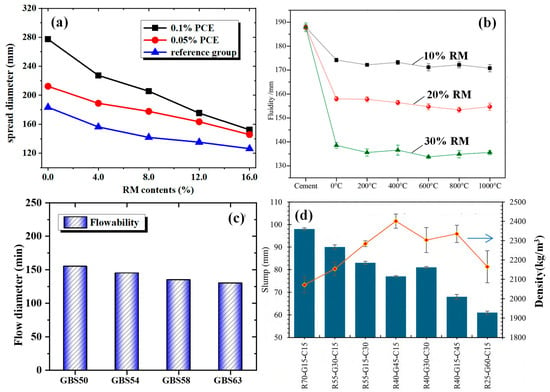
The use of RM as a partial OPC replacement or a geopolymer precursor has a pronounced effect on the fresh behavior of composites, with workability being the most sensitive and consistently reported parameter. Across the literature, increasing RM content typically results in a marked reduction in slump or flowability [46,48,64,84,85,86]. This behavior is primarily governed by RM’s fine particle size, high specific surface area, and porous texture, which collectively increase liquid absorption and reduce the amount of free water available for lubrication, thereby raising mixture viscosity and yield stress. As illustrated in Figure 1b, workability loss intensifies with increasing RM dosage, and in many cases cannot be fully compensated even with high dosages of superplasticizer, indicating that the limitation arises not only from particle dispersion but also from the intrinsic water-retention and internal-friction effects of RM particles. Consistently, the combination of high surface area and internal porosity elevates water demand and particle-particle interactions, further diminishing fluidity [54,87].
Figure 1.
Workability of RM-based geopolymer slurry under different (a) RM contents [48], (b) RM calcination temperatures [56], (c) GGBS content [2], and (d) combined GGBS and PG contents [25].
For RM-based geopolymer systems, workability is further influenced by processing conditions and co-precursor selection, particularly the calcination state of RM and the addition of calcium-bearing constituents such as ground granulated blast-furnace slag (GGBS) and phosphogypsum (PG) [18,88]. The net effect of calcination on workability is governed by the interplay between altered particle morphology, reduced water absorption from LOI removal, and the sharply increased reactivity that accelerates stiffening [57]. Similarly, as illustrated in Figure 1c,d, highly reactive GGBS dissolves rapidly in alkaline media and promotes early formation of C-(A)-S-H-type gels, increasing internal friction and reducing flowability [2]. These observations highlight that practical mix design must simultaneously address reaction control and liquid management. Strategies include pre-conditioning or pre-saturating RM to moderate liquid uptake, optimizing the water-to-solid ratio and activator modulus, employing combined superplasticizer-retarder systems when rapid gelation dominates, staging the addition of highly reactive GGBS or PG to prevent abrupt structural build-up, and selecting an appropriate RM calcination temperature that balances reactivity gains against excessive loss of workability.
3.2. Setting Behavior
Setting behavior in RM-containing binders is governed by the combined effects of RM particle characteristics (shape and size), liquid demand, and the availability of reactive phases. When RM replaces a substantial portion of OPC, overall hydration intensity typically decreases due to the reduced amount of clinker available for hydration [89]. Additionally, RM particles generally possess a high specific surface area and internal porosity, which can adsorb and retain part of the mixing water, lowering the effective free water available for hydration and ion transport [55]. Consistent with these mechanisms, several studies report that RM addition suppresses the heat evolution rate of fresh mortar and shifts hydration to later ages, resulting in delayed stiffening and longer final setting times [53,64]. Similar retardation effects have also been observed in other binder systems; for instance, RM incorporation has been shown to extend the setting time of magnesium potassium phosphate cement (MKPC) paste [24]. Notably, even at relatively low replacement levels (e.g., 2.5–10%), RM can measurably alter early-age stiffening behavior, highlighting the sensitivity of setting to variations in water availability and particle nucleation/packing conditions [44].
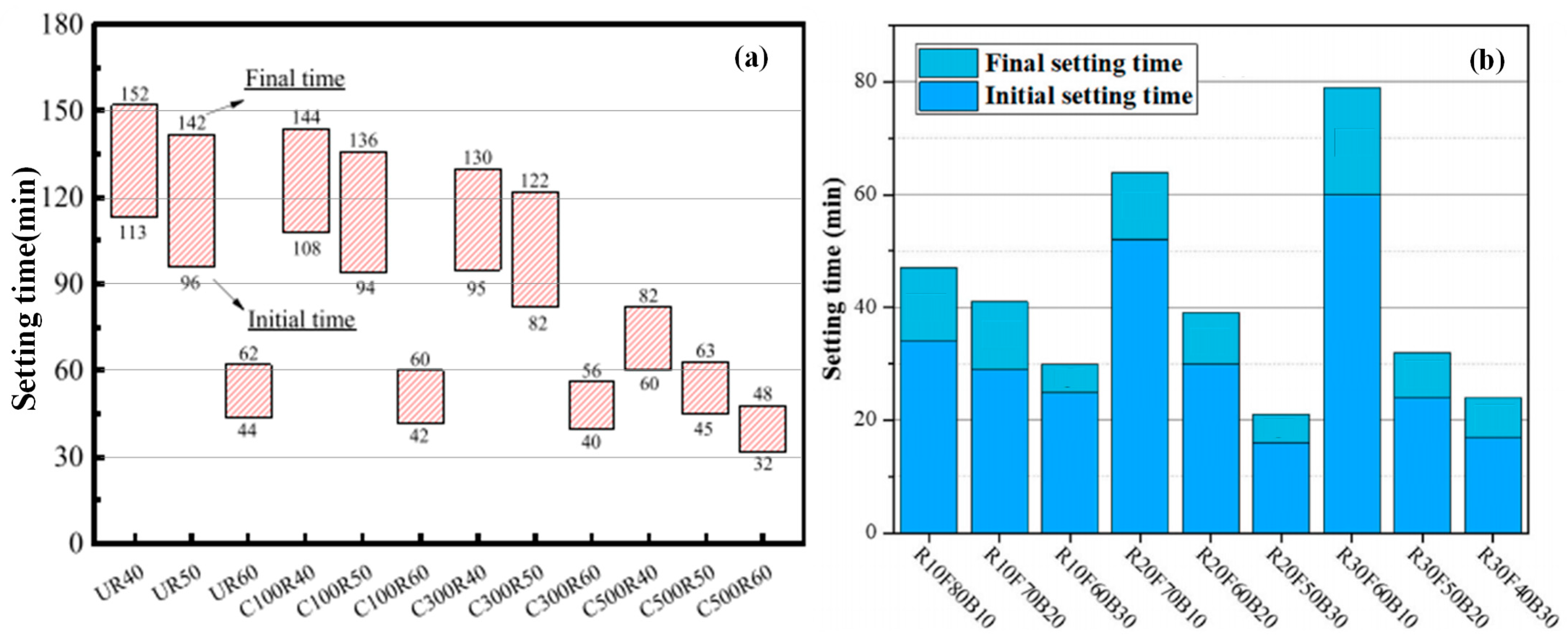
The net effect of RM on setting time, however, is not universally retarding and strongly depends on RM pre-treatment and synergistic co-precursors such as GGBS [73,90]. As shown in Figure 2a, at a constant RM content, increasing the calcination temperature markedly shortens the setting time. This acceleration is generally attributed to the altered surface characteristics of calcined RM, including increased fineness and changes in surface chemistry, which enhance nucleation and provide additional sites for hydration product precipitation, thereby promoting earlier structure build-up [91]. Similarly, Figure 2b shows that GGBS addition reduces both initial and final setting times. The high reactivity of CaO-rich GGBS enables rapid dissolution and Ca2+ supply in alkaline environments, promoting early formation of C-(A)-S-H-type gels and accelerating solidification [9]. Overall, RM tends to retard setting in OPC-dominant systems due to clinker dilution and increased liquid sequestration by its porous, high-surface-area particles, whereas under calcination or in the presence of high-calcium co-precursors such as GGBS, enhanced nucleation and rapid gel formation can dominate, shifting the net response toward accelerated setting.
Figure 2.
The setting time of RM-based geopolymers under different conditions: (a) RM calcination temperature [91], and (b) GGBS addition [9].
4. Mechanical Performance of RM-Based Cementitious Binders
4.1. Compressive Strength Development
Compressive strength is a key indicator of mechanical performance and structural reliability in cementitious composites [92]. When RM is used as a partial replacement for OPC, its effect on compressive strength depends largely on the replacement level and RM reactivity. The reactive aluminosilicate fraction in RM can participate in hydration or alkali-activation reactions, generating additional gel products and promoting matrix densification [12,80]. However, excessive RM content may increase porosity and weaken the load-bearing skeleton due to clinker dilution and incomplete reaction, thereby reducing strength [55]. Across the studies summarized in Table 4, 28-day compressive strength is generally maintained or even enhanced up to approximately 15–20% RM replacement, whereas mixtures with ≥30% RM more frequently exhibit a decline, with strengths commonly ranging from ~22–65 MPa in paste/mortar and further reductions observed at 40% replacement. This pattern suggests a practical threshold near ~20%, reflecting the balance between (i) limited RM reactivity and clinker dilution, which reduces the amount of strength-contributing binder [93], and (ii) beneficial filler, pozzolanic, or activation contributions from RM that can enhance densification when RM dosage remains moderate [91,94,95].
Table 4.
Compressive strength results (MPa) at 28 days with variation in RM percentage.
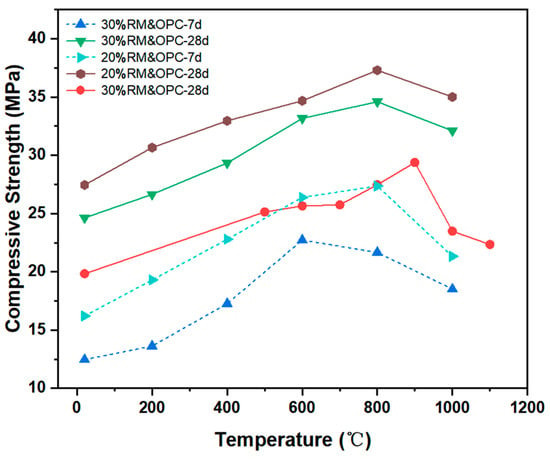
The influence of calcination on strength development is further illustrated in Figure 3, where compressive strength generally increases as the calcination temperature rises to below approximately 800 °C. Within this range, calcined RM more readily releases reactive Si and Al species and promotes pore refinement, facilitating the formation of additional binding phases such as C-(A)-S-H gel and gismondine crystals, thereby enhancing mechanical performance [38]. Strength can be further improved through synergistic blending with calcium-bearing additions such as GGBS and PG. In particular, the combined use of PG and GGBS has been reported to significantly increase the compressive strength of calcined RM-based geopolymer, primarily due to enhanced Ca2+ availability, which accelerates dissolution and polycondensation and promotes the formation of additional reaction products [25]. Notably, some studies observe non-linear responses to PG dosage, where strength may initially increase, then decrease, and rise again at higher PG contents; this behavior is commonly associated with variations in the amount and morphology of AFt and C-(A)-S-H type gels and their combined effects on matrix compactness [70]. Increasing the proportion of GGBS generally produces further strength gains, consistent with a shift in the binding gel from predominantly N-A-S-H toward Ca-enriched C-A-S-H, which is typically more effective in densifying the microstructure and enhancing load transfer [85].
Figure 3.
The compressive strength of RM-based geopolymers containing thermally activated RM [56,57,96].
4.2. Flexural and Splitting Tensile Strength
Flexural strength and splitting tensile strength are critical indicators of concrete’s resistance to bending failure and crack initiation or propagation, and they can be more sensitive than compressive strength to changes in microcracking, interfacial quality, and pore structure. When RM is used as a partial replacement of OPC, both properties generally decrease with increasing RM content. This trend arises from the combined effects of clinker dilution and RM’s limited early-age reactivity in many systems, which reduces the amount of strength-contributing hydration or gel products. In addition, RM’s fine, porous particles tend to increase liquid demand and promote particle agglomeration at high dosages, hindering dispersion and resulting in a less uniform binder matrix. Consequently, the volume of unreacted or weakly bonded particles and associated voids increases, elevating porosity and reducing crack-bridging capability, which is reflected in diminished flexural and splitting tensile strengths. Consistent with this mechanism, flexural strength at different curing ages progressively decreases with higher RM replacement, indicating a clear negative correlation [66]. Similarly, higher porosity and more agglomerated unreacted particles promote stress concentration and facilitate crack growth, thereby lowering splitting tensile strength [46].
Notably, these adverse effects can be mitigated through RM activation and calcium-assisted strengthening. Increasing RM calcination temperature enhances reactivity and improves the bonding and continuity of reaction gels, while incorporating GGBS supplies readily available Ca2+ and promotes the formation of calcium-rich gel products. Replacing OPC with calcined RM in RM-based geopolymer systems can increase 28-day flexural strength by up to 21.4%. Furthermore, GGBS addition produces substantial gains: a mixture containing 33% GGBS achieves a 110% increase in compressive strength, while 20% GGBS yields the highest improvement in splitting tensile strength (35%). These enhancements are commonly attributed to the formation of dense, interlocked calcium-based binding phases (e.g., C-(A)-S-H-type gels), which improve matrix compactness and the interfacial transition zone, thereby increasing resistance to bending and crack propagation.
5. Durability Performance of RM-Based Cementitious Binders
While enhanced mechanical performance is important, the long-term durability of RM-containing binders ultimately determines their feasibility for field application. In service, durability is manifested in resistance to coupled transport- and reaction-driven deterioration processes, including chloride ingress, sulfate attack, freeze–thaw damage, carbonation, water absorption, and alkali–silica reaction (ASR). In addition to these classical durability indices, the environmental durability of RM-bearing systems is also closely related to the long-term stability of potentially hazardous elements originally present in RM (e.g., trace heavy metals). These pathways are strongly governed by pore connectivity, tortuosity, and the compactness of reaction products and the interfacial transition zone (ITZ), rather than by a single, universal “RM effect” applicable to all mixtures [97].
For transport-controlled degradation, several studies report improved resistance at appropriate RM dosages. Resistance to chloride ion penetration generally increases with RM content, which is commonly attributed to a filler/packing effect and reduced capillary pore connectivity that impedes ion transport pathways [84]. A similar trend is observed for sulfate exposure: Partial OPC replacement with RM enhances sulfate resistance, consistent with a more compact microstructure and reduced transport accessibility for sulfate ions [51]. Additionally, incorporating RM into a magnesium potassium phosphate cement (MKPC) matrix improves resistance to water erosion under freeze–thaw conditions, with ~10% RM providing the best overall performance. This suggests an optimal balance between matrix densification and the risk of introducing additional weak or porous regions at higher dosages [59]. In contrast, porosity and water absorption are often reported to increase at high RM contents [54], highlighting that total pore volume may rise even when pore connectivity is partially disrupted. This distinction helps reconcile seemingly conflicting observations: RM can increase water demand and total porosity at elevated replacement levels yet still improve specific durability metrics if it refines pore connectivity or tortuosity, or promotes the formation of less-permeable phases. From a cementitious-materials perspective, durability enhancement is frequently linked to hydration and microstructure refinement; the hydration enhancement mechanism of modified RM can be understood as providing additional nucleation sites and/or reactive aluminosilicate components, accelerating binder formation and promoting a denser solid skeleton and refined pore structure [98].
RM-based geopolymers, in particular, are widely reported to exhibit excellent durability when an adequately dense gel network is achieved. For instance, they can retain up to 98% of compressive strength with an accelerated carbonation depth of only 1.7 mm after 28 days, outperforming conventional OPC-based references. Flexural strength retention coefficients of 1.01–1.19 have been reported following exposure to simulated seawater, dilute acid, and sulfate solutions, with only ~2.7% strength loss observed after 50 freeze–thaw cycles [74]. These results are generally attributed to the formation of a compact hardened matrix with a low proportion of harmful pores, which acts as an effective barrier against ion ingress and moisture transport; consistent excellent resistance to sulfate attack and deionized water has also been documented [75]. Durability can be further enhanced through synergistic blending. RM-based geopolymers containing 45% GGBS and 15% PG exhibit markedly improved performance, including an 85.78% reduction in charge passed during chloride penetration tests, over 90% reduction in mass loss under sulfate attack, and ~40% reduction in mass loss after freeze–thaw cycling. These improvements are commonly linked to the co-development of a denser, more continuous N-A-S-H and C-(A)-S-H gel network promoted by PG and GGBS, which refines pore structure and reduces transport accessibility [25].
6. Microstructural and Phase Characterization
The effects of RM dosage and calcination temperature on geopolymer performance are ultimately governed by microstructural evolution, which controls reaction extent, gel chemistry, and pore structure development. Accordingly, this section interprets the microstructural changes induced by RM content and calcination temperature using complementary evidence from XRD, FTIR, and SEM, and links these changes to the macroscopic properties described above.
6.1. XRD: Phase Assemblage and Reaction Products
XRD analysis indicates that RM-containing binders retain a portion of RM-derived crystalline phases after reaction, while the type and extent of newly formed products depend strongly on the system type (OPC-based or alkali-activated) as well as on RM dosage and calcination temperature. In these systems, quartz, calcite, and hematite are commonly detected as inherited phases, whereas the principal binding gels are largely amorphous or poorly crystalline and are therefore typically reflected in changes to the amorphous hump rather than by sharp diffraction peaks.
For the RM-OPC blended system, the diffractogram indicates the presence of crystalline hydration-related products such as Ca5(SiO4)2(OH)2, CaAl2Si2O8•2H2O, and Na3Al3Si3O12•2H2O. In this OPC-dominant context, calcium availability is high, and the hydration environment favors the formation of Ca-bearing hydrates. Meanwhile, the coexistence of Na-Al-Si crystalline signatures is consistent with secondary crystallization of alkali aluminosilicate phases, often zeolitic-type products, from the pore solution. The appearance or intensification of these phases at ~20% RM replacement supports the macroscopic observation that moderate RM contents can promote matrix densification and strength development through a combination of filler/packing effects and limited reactive contribution under cement hydration conditions [60]. In contrast, RM-based geopolymer composites with different RM contents under alkali activation [77]. These specimens show persistent peaks of quartz (~22° 2θ), calcite (~29°), and hematite (~33–37°), reflecting the relatively inert fraction of RM. Notably, the disappearance of the katoite peak (~17–18°) and the emergence of a hydrated calcium aluminate phase (~10–12°) at relatively low RM contents suggest that alkali activation promotes phase transformation and precipitation of Ca-Al-bearing hydrates when sufficient reactive Ca and Al are available. However, at excessive RM dosages, the pronounced increase in the Al4Si8O20(OH)4 peak (~28.5–29.3°) implies that higher RM contents can shift the balance toward residual or less-reacted aluminosilicate crystalline signatures (or crystallization of aluminosilicate phases), consistent with a reduced effective reaction degree and weaker gel formation [77]. Importantly, in geopolymer systems, the primary binding phase is typically an amorphous N-A-S-H-type gel, whereas C-(A)-S-H becomes more relevant only when sufficient Ca is available. Therefore, any discussion of C-(A)-S-H formation should be explicitly tied to Ca supply, whether from RM itself or from Ca-rich co-precursors.
The role of thermal activation compares RM calcined at different temperatures. Increasing the calcination temperature induces progressive mineralogical restructuring, for example, the decomposition or transformation of carbonate- and aluminosilicate-related phases such as calcite and cancrinite, and importantly, increases the proportion of disordered or amorphous material. This is evidenced by the development and broadening of the amorphous hump in the 20–35° (2θ) region, which becomes more pronounced as the temperature approaches ~800 °C. Such broadening reflects the conversion of silicoaluminate minerals into metastable, disordered structures with enhanced dissolution potential in alkaline solutions, providing a microstructural basis for the improved reactivity and strength development observed in suitably calcined RM-based geopolymer matrices [57,99].
6.2. FTIR: Gel Chemistry and Polymerization Features
FTIR analysis provides complementary evidence for how RM dosage and thermal treatment influence the gel chemistry and polymerization state in RM-containing binders. In the mid-infrared region, bands between 800 and 1200 cm−1 are generally assigned to stretching vibrations of Si-O and Al-O bonds, and changes in band position or shape are commonly interpreted as variations in the polymerization degree and local structural environment of [Si(Al)O4] tetrahedra. Increasing RM content from 10% to 20% has been reported to shift the main band near ~977 cm−1 toward lower wavenumbers, frequently associated with the development of calcium-containing binding gels (e.g., C-(A)-S-H-type products) and a modified silicate network environment in RM-based composites [18,41].
Thermal activation further alters the spectral features. High-temperature calcination of RM leads to a comparatively narrower baseline and broadened absorption features, consistent with partial disruption of Si-O-T (T = Si or Al) linkages, a reduction in the initial polymerization degree of silicoaluminate structures, and consequently an enhanced dissolution potential for reactive Si and Al species during subsequent activation. In addition, the band around ~1096 cm−1 (asymmetric stretching of Si-O-Si/Si-O-Al) shifts to lower wavenumbers after alkali activation, indicating that Si-O and Al-O units are reorganized and incorporated into newly formed binding networks. The influence of RM dosage is evident in the shift in the Si-O bending vibration from ~471 cm−1 to approximately 451–469 cm−1, accompanied by increased gel-related features. Collectively, these spectral shifts are consistent with more extensive gel formation and a progressively more compact reaction matrix, aligning with the mechanical improvements observed in appropriately proportioned RM-containing systems.
6.3. SEM: Morphology, Pore Structure, and Matrix Densification
SEM observations provide direct visualization of how RM dosage and calcination temperature influence particle integration, gel continuity, and pore structure features that underpin both reaction progression and mechanical performance [60]. When RM replacement is ≤20%, particles of varying morphologies and sizes are generally well embedded within a continuous gel matrix, and abundant amorphous reaction products are observed, indicating a relatively dense and well-bonded microstructure. However, when RM content exceeds ~20%, more irregular and weakly reacted particles are often present, accompanied by larger pore gaps and reduced gel continuity, consistent with the strength reductions and increased porosity reported at higher replacement levels [61].
Calcination introduces additional particle-scale microstructural changes. Increasing calcination temperature markedly modifies the internal pore structure and surface texture of RM particles, promoting stronger interparticle bonding and the formation of larger aggregates with higher apparent density. This densification is commonly attributed to thermally induced softening or sintering: partial surface melting and the formation of transient liquid phases can fill accessible pores, facilitate reactions among mineral phases, and promote grain-boundary rearrangement, resulting in a more compact particle skeleton after cooling [100].
RM creates a highly alkaline environment that promotes early-age dissolution and reaction, while GGBS refines the matrix through its own activation and pozzolanic contribution, supplying additional Ca to support the formation of calcium-enriched binding gels and improved interfacial bonding. Together, these effects enhance mechanical performance.
7. Conclusions and Future Research Directions
This review synthesizes current progress on RM-based geopolymer and RM-containing binder systems, with particular emphasis on how RM’s physical characteristics and mineralogical/chemical features govern reaction processes and, in turn, influence fresh behavior, mechanical performance, durability, and microstructural evolution. Based on the literature surveyed, the following conclusions can be drawn:
- RM characteristics as primary controls. The engineering performance of RM-based systems is strongly governed by RM’s particle size distribution, specific surface area and porosity, moisture-related properties, and the fraction of reactive aluminosilicates. These parameters dictate liquid demand and dissolution kinetics, thereby controlling workability, setting behavior, and the extent of geopolymerization or hydration.
- Fresh-state penalty and its governing mechanisms. RM’s fine, porous texture and high-water retention commonly increase yield stress and viscosity while reducing flowability. These same features can delay setting by lowering effective free water and slowing early reaction progress. The magnitude and direction of these effects are further modulated by RM calcination, which alters surface characteristics and reactivity, and by calcium-bearing additions, which can accelerate early gel formation and exacerbate stiffening if not properly managed.
- Strength development exhibits an optimal RM range. Moderate RM incorporation can contribute to additional binding gel formation and matrix refinement, supporting strength development. However, beyond a practical threshold frequently reported around ~20% replacement in the surveyed studies, clinker dilution and incomplete RM reaction tend to dominate, leading to increased porosity and pore connectivity and a decline in compressive, tensile, and flexural strength. Thermal activation and/or calcium-rich co-precursors can partially mitigate this limitation by enhancing dissolution and promoting denser gel networks.
- Durability gains are largely transport-controlled and mix-dependent. RM addition is often associated with improved resistance to chloride ingress, sulfate attack, freeze–thaw damage, and water erosion when pore connectivity is reduced, and a compact gel matrix is formed. Synergistic blending with GGBS and/or PG further enhances durability by promoting the co-development of N-A-S-H and C-(A)-S-H gels and refining pore structure. However, excessive RM may still increase total porosity and water absorption in some mixtures.
- Microstructural evidence supports the structure-property link. XRD, FTIR, and SEM analyses consistently show that RM dosage and calcination alter phase assemblage, gel chemistry, and pore structure. RM contents up to ~20% generally promote better particle-gel integration and a more continuous amorphous reaction matrix, whereas higher dosages often exhibit increased unreacted or agglomerated particles, larger pore gaps, and reduced gel continuity features consistent with the observed deterioration in workability and strength at elevated RM levels.
Finally, to accelerate field adoption of RM-based cementitious binders, future work should move beyond short-term strength metrics and focus on long-term durability validation under realistic exposure conditions, such as coupled chloride-carbonation, sulfate-wetting/drying, and freeze–thaw with deicing salts. Robust correlations between laboratory indicators and service-life performance also need to be established. Given the pronounced variability of RM arising from bauxite source and refining processes, systematic approaches are required to quantify compositional and physical fluctuations, define acceptable property ranges, and develop practical pre-processing or classification strategies to ensure consistent performance. Concurrently, scale-up and standardization demand reproducible production protocols including activation and curing control, quality assurance, and environmental compliance, such as leaching assessment alongside harmonized test methods and performance criteria aligned with construction practice. Ultimately, the deployment of RM-based systems will benefit from performance-based mix design frameworks that explicitly balance workability, setting, strength, and durability trade-offs. This can be achieved through optimized water-to-solid ratios and activator chemistry, tailored incorporation of Ca-rich co-precursors (e.g., GGBS or PG), and microstructure-guided design tools, enabling reliable, low-carbon construction materials at scale.
Funding
This work was financially supported by the National Natural Science Foundation of China (Grant No. 52368046; 52578405), State Key Laboratory of Safety and Resilience of Civil Engineering in Mountain Area (Grant No. HJGZ2024205), and the Key Research and Development Program of Jiangxi Province in China (Grant Nos. 20240N006, 20224BAB204074).
Data Availability Statement
No new data were created or analyzed in this study.
Conflicts of Interest
The author declares no conflicts of interest.
References
- Zaland, S.; Wang, J.; Li, K.; Sadat, S.I.; Akhunzada, K. Geopolymers as a sustainable alternative to portland cement: Synthesis, durability, applications, environmental impacts, and cost analysis. Renew. Sustain. Energy Rev. 2026, 225, 116157. [Google Scholar] [CrossRef] [Scilit]
- Li, Z.; Dong, H.; Wang, Y.; Men, J.; Wang, J.; Zhao, X.; Zou, S. Valorization of alkali–thermal activated red mud for high-performance geopolymer: Performance evaluation and environmental effects. Buildings 2025, 15, 2471. [Google Scholar] [CrossRef] [Scilit]
- Wen, X.-J.; Zhan, Q.; Wu, D.; Xu, J.; Qian, B.; Xu, Q.; Su, T.; Liu, Z.; Fei, Z.; Guo, H. Construction of an s-scheme Bi12O17Cl2/CeO2 heterojunction for efficient photocatalytic degradation of ciprofloxacin and hydrogen evolution. J. Taiwan Inst. Chem. Eng. 2026, 188, 106769. [Google Scholar] [CrossRef] [Scilit]
- Wang, Y.; Shi, Y.; Yang, T.; Wang, W.; Sun, Z.; Zhang, Y. Structural performance warning based on computer intelligent monitoring and fractional -order multi-rate kalman fusion method. Fractal Fract. 2026, 10, 186. [Google Scholar] [CrossRef] [Scilit]
- Xu, L.; Ran, B.; Hu, X.; Sun, J.; Fan, D.; Jiang, Y.; Lu, D. Multi-scale insights into carbonation-induced changes in recycled cement paste and its carbon capture potential. J. Build. Eng. 2026, 117, 114849. [Google Scholar] [CrossRef] [Scilit]
- Mahmoodi, O.; Siad, H.; Lachemi, M.; Dadsetan, S.; Şahmaran, M. Optimized application of ternary brick, ceramic and concrete wastes in sustainable high strength geopolymers. J. Clean. Prod. 2022, 338, 130650. [Google Scholar] [CrossRef] [Scilit]
- Xu, L.; Wang, J.; Huang, R.; Wang, Y.; Ran, B.; Hu, X.; Lv, T.; Zhou, X.; Wang, S.; Dai, X. Effects of accelerated carbonation on the chemical and microstructural evolution of recycled different scms blended cement pastes. Cem. Concr. Compos. 2025, 164, 106259. [Google Scholar] [CrossRef] [Scilit]
- Xu, L.-P.; Wei, D.; Liu, H.-B.; Li, G.-H.; Jiang, T. Super-high bed homogeneous sintering for iron ores with low carbon emissions. J. Clean. Prod. 2025, 529, 146848. [Google Scholar] [CrossRef] [Scilit]
- Li, Z.; Zhang, J.; Lei, Z.; Gao, M.; Sun, J.; Tong, L.; Chen, S.; Wang, Y. Designing low-carbon fly ash based geopolymer with red mud and blast furnace slag wastes: Performance, microstructure and mechanism. J. Environ. Manag. 2024, 354, 120362. [Google Scholar] [CrossRef] [Scilit]
- Wu, X.; He, J.; Tian, J.; Liu, M.; Zheng, Y.; Zhang, W.; Yuan, J.; Wang, W.-W.; Fu, H.; Wang, R. Multi-scale performance of underwater-castable ultra-high-volume fly-ash eco-friendly engineered cementitious composites: Microstructural characterization, workability, mechanical properties and environmental effects. Constr. Build. Mater. 2026, 506, 144870. [Google Scholar] [CrossRef] [Scilit]
- Liu, Y.; Zhang, S.; Ni, W.; Guan, D.; Chen, X.; Zhao, T.; Wu, Z.; Zheng, Y. The influence of alkaline activation on coal gasification slag–MSWI FA based binder and its associated hydration mechanism. Constr. Build. Mater. 2024, 453, 139112. [Google Scholar] [CrossRef] [Scilit]
- Jia, H.; Yao, S.; Tang, X.; Zheng, M.; Dong, Y.; Fan, F.; Yang, S.; Zhang, H. Multi-objective machine learning for health-oriented O3 and PM2.5 control: Integrating voc photochemical consumption and source apportionment. J. Hazard. Mater. 2026, 505, 141483. [Google Scholar] [CrossRef] [Scilit]
- Xu, L.; Wang, J.; Hu, X.; Ran, B.; Wu, T.; Zhou, X.; Xiong, Y. Physical performance, durability, and carbon emissions of recycled cement concrete and fully recycled concrete. Constr. Build. Mater. 2024, 447, 138128. [Google Scholar] [CrossRef] [Scilit]
- Jovičević-Klug, M.; Filho, I.R.S.; Springer, H.; Adam, C.; Raabe, D. Green steel from red mud through climate-neutral hydrogen plasma reduction. Nature 2024, 625, 703–709. [Google Scholar] [CrossRef] [Scilit]
- Suman; Tripathy, A. CO2 capture using red mud & mechanically-activated red mud and its kinetics under ambient conditions. Chem. Eng. J. 2024, 498, 155609. [Google Scholar] [CrossRef] [Scilit]
- Liu, Y.; Huang, Z.; Luo, X.; Ma, H.; Li, Z. Insights of airborne transmission within urban rail transit carriage environments after the COVID-19 pandemic. Indoor Built Environ. 2026. online ahead of print. [Google Scholar] [CrossRef] [Scilit]
- Fu, H.; Tian, J.; Chin, C.-L.; Liu, H.; Yuan, J.; Tang, S.; Mai, R.; Wu, X. Axial compression behavior of gfrp-steel composite tube confined seawater sea-sand concrete intermediate long columns. Eng. Struct. 2025, 333, 120157. [Google Scholar] [CrossRef] [Scilit]
- Li, Z.; Dong, H.; Zhao, X.; Wang, K.; Gao, X. Utilisation of bayer red mud for high-performance geopolymer: Competitive roles of different activators. Case Stud. Constr. Mater. 2025, 23, e05047. [Google Scholar] [CrossRef] [Scilit]
- Luo, B.; Su, Y.; Hu, X.; Chen, Z.; Chen, Y.; Ding, X. Strength behavior and microscopic mechanisms of geopolymer-stabilized waste clays considering clay mineralogy. J. Clean. Prod. 2025, 530, 146877. [Google Scholar] [CrossRef] [Scilit]
- Sun, Y.; Liu, J.; Chen, J.; Li, G.; Liang, M.; Zhang, M. Soft/hard interface design of bismuth nanodots embedded in Ti3C2Tx mxene for highly efficient dechlorination battery deionization. Desalination 2025, 614, 119183. [Google Scholar] [CrossRef] [Scilit]
- Huang, Z.; Liu, Y.; Ma, H.; Luo, X.; Li, Z. Numerical investigation of exhaled droplet transmission and infection probability prediction in a subway compartment under ventilation and passenger effects with an improved Wells-Riley equation. Int. J. Heat. Mass. Transf. 2026, 265, 128809. [Google Scholar] [CrossRef] [Scilit]
- Fu, H.; Tian, J.; Chen, S.; Chin, C.-L.; Ma, C.-K. Axial compressive performance of cfrp-steel composite tube confined seawater sea-sand concrete intermediate slender columns. Constr. Build. Mater. 2024, 441, 137399. [Google Scholar] [CrossRef] [Scilit]
- Wang, S.; Luo, F.; Fo, J.; Lv, Y.; Wang, C. Two-stage spatiotemporal decoupling configuration of SOP and multi-level electric-hydrogen hybrid energy storage based on feature extraction for distribution networks with ultra-high DG penetration. Appl. Energy 2025, 398, 126438. [Google Scholar] [CrossRef] [Scilit]
- Ma, S.; Zhang, Z.; Liu, X.; Li, Y.; Zeng, Q.; Zhang, W. Reuse of red mud in magnesium potassium phosphate cement: Reaction mechanism and performance optimization. J. Build. Eng. 2022, 61, 105290. [Google Scholar] [CrossRef] [Scilit]
- Raza, A.; Selmi, A.; Elhadi, K.M.; Ghazouani, N.; Chen, W. Strength analysis and microstructural characterization of calcined red mud based-geopolymer concrete modified with slag and phosphogypsum. J. Mater. Res. Technol. 2024, 33, 6168–6181. [Google Scholar] [CrossRef] [Scilit]
- Xu, L.; Huang, R.; Li, M.; Li, K.; Leng, F.; Ran, B.; Wang, J. From demolition to decarbonization: Synergistic hydration and sustainability of thermally activated recycled concrete powders. J. Environ. Manag. 2026, 401, 128902. [Google Scholar] [CrossRef] [Scilit]
- De Oliveira, D.R.C.; Rossi, C.R. Concretes with red mud coarse aggregates. Mater. Res. 2012, 15, 333–340. [Google Scholar] [CrossRef] [Scilit]
- Shi, Y.; Liao, Q.; Li, J.; Zhao, Q. Preparation of red mud-calcium carbide slag-based low-carbon lightweight aggregate concrete: Mechanical performance and interfacial transition zone microstructural analysis. Constr. Build. Mater. 2025, 468, 140311. [Google Scholar] [CrossRef] [Scilit]
- Zhang, C.; Hu, Z.; Cheng, G.; Wu, C.; Li, J.; Jiang, W.; Wang, X.; Yang, S.; Wang, W. Collaborative recycling of red mud and fgd-gypsum into multi-shell cold bonded lightweight aggregates: Synergistic effect, structure design and application in sustainable concrete. Constr. Build. Mater. 2023, 379, 131134. [Google Scholar] [CrossRef] [Scilit]
- Kusumanjali, G.; Tejas, S.; Chatterjee, A.; Pasla, D. Utilization of bauxite residue as fine aggregate for the development of structural concrete: An approach towards sustainable construction materials. Case Stud. Constr. Mater. 2025, 22, e04348. [Google Scholar] [CrossRef] [Scilit]
- Krivenko, P.; Kovalchuk, O.; Pasko, A.; Croymans, T.; Hult, M.; Lutter, G.; Vandevenne, N.; Schreurs, S.; Schroeyers, W. Development of alkali activated cements and concrete mixture design with high volumes of red mud. Constr. Build. Mater. 2017, 151, 819–826. [Google Scholar] [CrossRef] [Scilit]
- Wang, J.; Ren, C.; Huang, T.; Li, X.; Cao, W.; Zhu, Y.; Wei, P.; Wang, D.; Liu, Z. Performances of concrete with binder and/or aggregates replacement by all-solid waste materials. J. Clean. Prod. 2024, 450, 141929. [Google Scholar] [CrossRef] [Scilit]
- Shirodkar, V.; Patel, R.; Verma, M.; Mahate, V. An investigation into the durability of concrete using red mud as a substitute in cement. Mater. Today Proc. 2023, in press. [Google Scholar] [CrossRef] [Scilit]
- Tang, W.C.; Wang, Z.; Donne, S.W.; Forghani, M.; Liu, Y. Influence of red mud on mechanical and durability performance of self-compacting concrete. J. Hazard. Mater. 2019, 379, 120802. [Google Scholar] [CrossRef] [Scilit]
- Krivenko, P.V.; Kovalchuk, O.; Zozulynets, V. 9—Alternative binders—High volume bauxite red mud alkali activated cements and concretes. In Recycled Concrete; Woodhead Publishing: Sawston, UK, 2023; pp. 283–308. [Google Scholar]
- Liu, Y.; Zhuge, Y.; Chen, X.; Duan, W.; Fan, R.; Outhred, L.; Wang, L. Micro-chemomechanical properties of red mud binder and its effect on concrete. Compos. Part B Eng. 2023, 258, 110688. [Google Scholar] [CrossRef] [Scilit]
- Viyasun, K.; Anuradha, R.; Thangapandi, K.; Kumar, D.S.; Sivakrishna, A.; Gobinath, R. Investigation on performance of red mud based concrete. Mater. Today Proc. 2021, 39, 796–799. [Google Scholar] [CrossRef] [Scilit]
- Liu, R.-X.; Poon, C.-S. Utilization of red mud derived from bauxite in self-compacting concrete. J. Clean. Prod. 2016, 112, 384–391. [Google Scholar] [CrossRef] [Scilit]
- Singh, S.; Amalkar, M.; Dutta, M.C.; Rendi, D.E. Mechanically activated red mud based geopolymer for advanced concrete applications: Synthesis and properties. Iran. J. Sci. Technol. Trans. Civ. Eng. 2025, 49, 5967–5980. [Google Scholar] [CrossRef] [Scilit]
- Bellum, R.R.; Venkatesh, C.; Madduru, S.R. Influence of red mud on performance enhancement of fly ash-based geopolymer concrete. Innov. Infrastruct. Solut. 2021, 6, 215. [Google Scholar] [CrossRef] [Scilit]
- Zhang, X.; Wang, Y.; Han, J.; Li, X. Creep and mechanical behavior after sustained loading of red mud-slag based geopolymer concrete at early-age. Case Stud. Constr. Mater. 2025, 23, e04980. [Google Scholar] [CrossRef] [Scilit]
- Kazemian, F.; Hassani, A. Exploring mechanical and fracture properties in geopolymer concrete with ternary precursor waste materials through laboratory investigations and statistical analysis. J. Build. Eng. 2024, 95, 110294. [Google Scholar] [CrossRef] [Scilit]
- John, E.; Chalapuram, K.M.; Shebin, P.; Mohan, H.K.; Frazana, Z. Geopolymer concrete using red mud and ggbs. Int. Res. J. Eng. Technol. 2016, 3, 668–671. [Google Scholar]
- Ghalehnovi, M.; Roshan, N.; Hakak, E.; Shamsabadi, E.A.; de Brito, J. Effect of red mud (bauxite residue) as cement replacement on the properties of self-compacting concrete incorporating various fillers. J. Clean. Prod. 2019, 240, 118213. [Google Scholar] [CrossRef] [Scilit]
- Song, Y.; Dong, M.; Wang, Z.; Qian, X.; Yan, D.; Shen, S.; Zhang, L.; Sun, G.; Lai, J.; Ruan, S. Effects of red mud on workability and mechanical properties of autoclaved aerated concrete (aac). J. Build. Eng. 2022, 61, 105238. [Google Scholar] [CrossRef] [Scilit]
- Yuan, Q.; Wang, L.; Kong, D.; Han, Y.; Ren, C.; Tian, Y.; Zhu, G. Synergistic action and effect mechanism of coal gangue powder and red mud on the properties of concretes. J. Build. Eng. 2024, 98, 110999. [Google Scholar] [CrossRef] [Scilit]
- Tang, W.C.; Wang, Z.; Liu, Y.; Cui, H.Z. Influence of red mud on fresh and hardened properties of self-compacting concrete. Constr. Build. Mater. 2018, 178, 288–300. [Google Scholar] [CrossRef] [Scilit]
- Wu, C.-R.; Tang, W.; Zhan, B.-J.; Kou, S.-C. Feasibility study on using red mud as a viscosity-modifying agent for self-compacting concrete. Constr. Build. Mater. 2024, 445, 137871. [Google Scholar] [CrossRef] [Scilit]
- Wu, C.-R.; Zhan, B.-J.; Tang, W.; Kou, S.-C. Synergistic reuse of red mud and circulating fluidised bed fly ash in self-compacting recycled concrete. Constr. Build. Mater. 2025, 470, 140533. [Google Scholar] [CrossRef] [Scilit]
- Yao, Z.; Li, Y.; Fu, H.; Tian, J.; Zhou, Y.; Chin, C.-L.; Ma, C.-K. Research on concrete crack and depression detection method based on multi-level defect fusion segmentation network. Buildings 2025, 15, 1657. [Google Scholar] [CrossRef] [Scilit]
- Ghalehnovi, M.; Shamsabadi, E.A.; Khodabakhshian, A.; Sourmeh, F.; de Brito, J. Self-compacting architectural concrete production using red mud. Constr. Build. Mater. 2019, 226, 418–427. [Google Scholar] [CrossRef] [Scilit]
- Shilar, F.A.; Ganachari, S.V.; Patil, V.B.; Khan, T.M.Y.; Javed, S.; Baig, R.U. Optimization of alkaline activator on the strength properties of geopolymer concrete. Polymers 2022, 14, 2434. [Google Scholar] [CrossRef] [Scilit]
- Liu, Y.; Qin, Z.; Chen, B. Experimental research on magnesium phosphate cements modified by red mud. Constr. Build. Mater. 2020, 231, 117131. [Google Scholar] [CrossRef] [Scilit]
- Senff, L.; Modolo, R.C.E.; Silva, A.S.; Ferreira, V.M.; Hotza, D.; Labrincha, J.A. Influence of red mud addition on rheological behavior and hardened properties of mortars. Constr. Build. Mater. 2014, 65, 84–91. [Google Scholar] [CrossRef] [Scilit]
- Senff, L.; Hotza, D.; Labrincha, J.A. Effect of red mud addition on the rheological behaviour and on hardened state characteristics of cement mortars. Constr. Build. Mater. 2011, 25, 163–170. [Google Scholar] [CrossRef] [Scilit]
- Tang, L.; He, Z.; Yang, R.; Pei, S.; Zou, M.; Qin, M. High temperature calcined red mud-cement mortar: Workability, mechanical properties, hydration mechanism, and microstructure. Sustain. Chem. Pharm. 2024, 41, 101717. [Google Scholar] [CrossRef] [Scilit]
- Song, H.; Gauvin, F.; Liu, T.; Sun, X.; Dong, Z.; Wang, F.; Chen, X.; Brouwers, H.J.H. Understanding of municipal solid waste incineration (MSWI) bottom ash/cement blends: Impact of natural fiber on mechanical strength and leaching behavior. J. Build. Eng. 2026, 120, 115330. [Google Scholar] [CrossRef] [Scilit]
- Wang, L.; Feng, W.; Lazaro, S.A.M.; Li, X.; Cheng, Y.; Wang, Z. Engineering properties of soil-based controlled low-strength materials made from local red mud and silty soil. Constr. Build. Mater. 2022, 358, 129453. [Google Scholar] [CrossRef] [Scilit]
- Ma, S.; Cao, Z.; Wei, C.; Shao, Y.; Wu, P.; Zhang, Z.; Liu, X. Red mud-modified magnesium potassium phosphate cement used as rapid repair materials: Durability, bonding property, volume stability and environment performance optimization. Constr. Build. Mater. 2024, 415, 135144. [Google Scholar] [CrossRef] [Scilit]
- Zhang, W.; Liu, X.; Wang, Y.; Li, Z.; Li, Y.; Ren, Y. Binary reaction behaviors of red mud based cementitious material: Hydration characteristics and Na+ utilization. J. Hazard. Mater. 2021, 410, 124592. [Google Scholar] [CrossRef] [Scilit]
- Liu, J.; Ren, F.; Ding, T.; Jia, J. Exploring the effect mechanism of bayer red mud on cement hydration and mechanical properties. Constr. Build. Mater. 2024, 435, 136741. [Google Scholar] [CrossRef] [Scilit]
- Shi, X.; Su, Y.; Luo, J.; Zhang, Y.; Hu, R. Preparation and performance optimization of fly ash- slag- red mud based geopolymer mortar: Simplex-centroid experimental design method. Constr. Build. Mater. 2024, 450, 138573. [Google Scholar] [CrossRef] [Scilit]
- Zhang, C.; Wang, G.; Wu, C.; Li, J.; Wu, S.; Jiang, W.; Wang, X.; Wang, W.; Feng, M. Investigation of hierarchical porous cold bonded lightweight aggregates produced from red mud and solid-waste-based cementitious material. Constr. Build. Mater. 2021, 308, 124990. [Google Scholar] [CrossRef] [Scilit]
- Wu, H.; Zhang, Z.; Yang, J.; Xue, C.; Duan, S.; Zhang, G.; Ma, J.; Guo, S.; Deng, J. One-step fabrication of CuFe2O4/CuAl2O4 Fenton-like catalytic ceramic membranes using coal fly ash for synergistic filtration-catalysis. J. Clean. Prod. 2026, 544, 147734. [Google Scholar] [CrossRef] [Scilit]
- Song, H.; Jiang, Z.; Luinenburg, T.S.; Gauvin, F.; Fu, X.; Sun, X.; Dong, Z.; Wang, F.; Fan, H.; Chen, X.; et al. Study on the carbonization coating treatment of municipal solid waste incineration fine bottom ash as aggregates: CO2 capture, contaminants solidification, on-site application scale. Cem. Concr. Compos. 2026, 170, 106596. [Google Scholar] [CrossRef] [Scilit]
- Cen, X.; Zhang, Y.; Zhang, H. Investigation on the mechanical and microstructure properties of masonry cement-red mud-carbide slag-based paste. Case Stud. Constr. Mater. 2024, 21, e03979. [Google Scholar] [CrossRef] [Scilit]
- Liu, S.; Pan, C.; Zhang, H.; Yao, S.; Shen, P.; Guan, X.; Shi, C.; Li, H. Development of novel mineral admixtures for sulphoaluminate cement clinker: The effects of wet carbonation activated red mud. J. Build. Eng. 2023, 67, 105920. [Google Scholar] [CrossRef] [Scilit]
- Feng, Y.; Alves, Z.; Peng, L.; Novais, R. The impact of industrial waste on hydration behavior, mechanical performance, and water resistance of magnesium oxychloride cement. Constr. Build. Mater. 2025, 489, 142320. [Google Scholar] [CrossRef] [Scilit]
- Liu, Y.; Zhang, S.; Chen, X.; Guan, D.; Li, Y.; Chen, D.; Ni, W.; Shao, A. Influence of FGD gypsum crystal form change on performance and hydration processes of solid waste-based binders. Chem. Eng. J. 2025, 513, 162793. [Google Scholar] [CrossRef] [Scilit]
- Sun, H.; Xie, M.; Jia, L.; Xie, X. Development of low-carbon binders from ground granulated blast furnace slag activated by red mud, phosphogypsum, and calcium carbide slag: Mechanical and hydration properties. J. Build. Eng. 2025, 111, 113229. [Google Scholar] [CrossRef] [Scilit]
- Geng, J.; Zhou, M.; Li, Y.; Chen, Y.; Han, Y.; Wan, S.; Zhou, X.; Hou, H. Comparison of red mud and coal gangue blended geopolymers synthesized through thermal activation and mechanical grinding preactivation. Constr. Build. Mater. 2017, 153, 185–192. [Google Scholar] [CrossRef] [Scilit]
- Song, H.; Hon, K.C.; Gauvin, F.; Pantaleo, S.; Berger, F.; Chen, W.; Brouwers, H.J.H. Durability assessment of alkyl ketene dimer hydrophobic treatment of bio-based thermal insulation materials. Resour. Conserv. Recycl. 2025, 212, 107983. [Google Scholar] [CrossRef] [Scilit]
- Lemougna, P.N.; Wang, K.-T.; Tang, Q.; Cui, X.-M. Synthesis and characterization of low temperature (<800 °C) ceramics from red mud geopolymer precursor. Constr. Build. Mater. 2017, 131, 564–573. [Google Scholar] [CrossRef] [Scilit]
- Zhao, Y.; Jiang, S.; An, Z.; Luo, B. Experimental Investigation of the Bearing-Deformation Behavior of Broken Rocks in Goafs Under Various Influencing Factors. Appl. Sci. 2026, 16, 4276. [Google Scholar] [CrossRef] [Scilit]
- Zhang, M.; Zhao, M.; Zhang, G.; Mann, D.; Lumsden, K.; Tao, M. Durability of red mud-fly ash based geopolymer and leaching behavior of heavy metals in sulfuric acid solutions and deionized water. Constr. Build. Mater. 2016, 124, 373–382. [Google Scholar] [CrossRef] [Scilit]
- Zhang, W.; Xie, G.; Hu, J.; Niu, R.; Wang, Z.; Liu, J.; Xing, F. Hazardous wastes used as hybrid precursors for geopolymers: Cosolidification/stabilization of mswi fly ash and bayer red mud. Chem. Eng. J. 2023, 474, 145966. [Google Scholar] [CrossRef] [Scilit]
- Zakira, U.; Zheng, K.; Xie, N.; Birgisson, B. Development of high-strength geopolymers from red mud and blast furnace slag. J. Clean. Prod. 2023, 383, 135439. [Google Scholar] [CrossRef] [Scilit]
- Wu, P.; Wei, C.; Liu, X.; Zhang, Z.; Xue, Y.; Liu, X. Impact of hematite in red mud on hydration characteristics and environmental performance of cementitious materials. Cem. Concr. Compos. 2025, 160, 106035. [Google Scholar] [CrossRef] [Scilit]
- Yu, Y.; Wang, C.; Wang, W.; Lu, K.; Chen, Z.; Zhao, D.; Ju, B.-F.; Zhou, S. Determination of elastic constants in unidirectional CFRP laminates using neural networks and laser ultrasonic bulk waves. Compos. Part A Appl. Sci. Manuf. 2026, 207, 109827. [Google Scholar] [CrossRef] [Scilit]
- Wang, S.; Jin, H.; Deng, Y.; Xiao, Y. Comprehensive utilization status of red mud in China: A critical review. J. Clean. Prod. 2021, 289, 125136. [Google Scholar] [CrossRef] [Scilit]
- Li, Z.; Gao, M.; Lei, Z.; Tong, L.; Sun, J.; Wang, Y.; Wang, X.; Jiang, X. Ternary cementless composite based on red mud, ultra-fine fly ash, and ggbs: Synergistic utilization and geopolymerization mechanism. Case Stud. Constr. Mater. 2023, 19, e02410. [Google Scholar] [CrossRef] [Scilit]
- Mi, H.; Yi, L.; Wu, Q.; Xia, J.; Zhang, B. Preparation of high-strength ceramsite from red mud, fly ash, and bentonite. Ceram. Int. 2021, 47, 18218–18229. [Google Scholar] [CrossRef] [Scilit]
- Song, C.; Zhang, H.; Dong, Y.; Pei, L.; Liu, H.; Jiang, J.; Xu, H. Investigation on the fabrication of lightweight aggregate with acid-leaching tailings of vanadium-bearing stone coal minerals and red mud. Chin. J. Chem. Eng. 2021, 32, 353–359. [Google Scholar] [CrossRef] [Scilit]
- Hou, D.; Wu, D.; Wang, X.; Gao, S.; Yu, R.; Li, M.; Wang, P.; Wang, Y. Sustainable use of red mud in ultra-high performance concrete (uhpc): Design and performance evaluation. Cem. Concr. Compos. 2021, 115, 103862. [Google Scholar] [CrossRef] [Scilit]
- Manfroi, E.P.; Cheriaf, M.; Rocha, J.C. Microstructure, mineralogy and environmental evaluation of cementitious composites produced with red mud waste. Constr. Build. Mater. 2014, 67, 29–36. [Google Scholar] [CrossRef] [Scilit]
- Zhang, F.; Falchetto, A.C.; Wang, D.; Li, Z.; Sun, Y.; Lin, W. Prediction of asphalt rheological properties for paving and maintenance assistance using explainable ma-chine learning. Fuel 2025, 396, 135319. [Google Scholar] [CrossRef] [Scilit]
- Xu, L.; Wang, J.; Huang, R.; Li, B.; Ran, B.; Hu, X. Investigations on micro-mechanical properties of the itzs between recycled aggregates and recycled cement paste. Constr. Build. Mater. 2024, 450, 138640. [Google Scholar] [CrossRef] [Scilit]
- Bai, M.; Song, L.; Xiao, Q.; Sun, J.; Liu, H. Development of low-carbon engineered cementitious composites incorporating lithium slag: Mechanical properties, microstructure evolution, and life cycle assessment. Constr. Build. Mater. 2026, 520, 145983. [Google Scholar] [CrossRef] [Scilit]
- Shi, Y.; Wang, Y.; Wang, L.-N.; Wang, W.-N.; Yang, T.-Y. Bridge Cable Performance Warning Method Based on Temperature and Displacement Monitoring Data. Buildings 2025, 15, 2342. [Google Scholar] [CrossRef] [Scilit]
- Guo, K.; Dong, H.; Zhang, J.; Zhang, L.; Li, Z. Experimental study of alkali-activated cementitious materials using thermally activated red mud: Effect of the Si/Al ratio on fresh and mechanical properties. Buildings 2025, 15, 565. [Google Scholar] [CrossRef] [Scilit]
- Peng, G.-F.; Wang, X.-F.; Ding, H.; Jia, Y.-J. Effect of calcined red mud on the mechanical properties and microstructure of ultra-high performance concrete. Constr. Build. Mater. 2025, 484, 141891. [Google Scholar] [CrossRef] [Scilit]
- Li, Z. Toward Low-Carbon Construction: A Review of Red Mud Utilization in Cementitious Materials and Geopolymers for Sustainability and Cost Benefits. Buildings 2026, 16, 362. [Google Scholar] [CrossRef] [Scilit]
- Xu, L.; Li, M.; Hu, X.; Ran, B.; Li, K.; Wang, J. Thermal-activated recycled cement as a dual-role binder in limestone calcined clay cement (lc3): Hydration mechanism, performance, and sustainability implications. Constr. Build. Mater. 2026, 512, 145359. [Google Scholar] [CrossRef] [Scilit]
- Zhang, L.; Zhang, L.; Chen, Y.; Tan, C.; Song, R.; Gao, S. Efficient ammonia sequestration by al-based mof composites: Synergistic regulation of supports and loading strategies and investigation of the adsorption mechanism. J. Indian Chem. Soc. 2026, 103, 102422. [Google Scholar] [CrossRef] [Scilit]
- Wu, X.; Ouyang, X.; Tian, J.; Zheng, Y.; Yuan, J.; Wang, W.-W.; Zuo, Y.; Fu, H.; Yu, W.; Wang, R. Self-sensing mechanism and theoretical model of prestressed frp-ecc multifunctional composite beams under bending loads. Structures 2026, 87, 111585. [Google Scholar] [CrossRef] [Scilit]
- Long, Q.; Zhao, Y.; Zhang, B.; Yang, H.; Luo, Z.; Li, Z.; Zhang, G.; Liu, K. Interfacial behavior of slag, fly ash, and red mud-based geopolymer mortar with concrete substrate: Mechanical properties and microstructure. Buildings 2024, 14, 652. [Google Scholar] [CrossRef] [Scilit]
- Tong, L.; Fu, L.; Wu, B.; Xu, C.; Lim, C.W.; Ding, H. Particle Shape Effect on Creep and Fluidity of Granular Packing. J. Eng. Mech. 2025, 151. [Google Scholar] [CrossRef] [Scilit]
- Liu, Z.; Dong, T.; Lv, Y.; Qi, X.; Shui, Z. A novel ultra-high performance concrete incorporating fiber mesh reinforcement and a stress-oriented layered structure. Structures 2026, 88, 111770. [Google Scholar] [CrossRef] [Scilit]
- Cui, Y.; Chen, S.; Li, L.; Wang, X.; Liu, J. Atomistic insights into the hydration behavior of N-A-S-H Gel via Ca2+ substitution: A molecular dynamics simulation study. J. Non-Cryst. Solids 2026, 673, 123892. [Google Scholar] [CrossRef] [Scilit]
- Cui, W.; Liu, J.; He, G.; Duan, W.; Li, X.; Dong, X. Evaluation of active silica-alumina content and reactivity in bayer process red mud. Constr. Build. Mater. 2024, 418, 135502. [Google Scholar] [CrossRef] [Scilit]

Disclaimer/Publisher’s Note: The statements, opinions and data contained in all publications are solely those of the individual author(s) and contributor(s) and not of MDPI and/or the editor(s). MDPI and/or the editor(s) disclaim responsibility for any injury to people or property resulting from any ideas, methods, instructions or products referred to in the content. |
© 2026 by the author. Licensee MDPI, Basel, Switzerland. This article is an open access article distributed under the terms and conditions of the Creative Commons Attribution (CC BY) license.