Article

In Situ Test on Pre-Mixed Fluid-Solidified Soil Pile for Embankment Foundation Treatment

1
Shandong High-Speed Group Innovation Research Institute, Jinan 250014, China
2
State Key Laboratory of Intelligent Transportation System, Beijing 100088, China
3
School of Qilu Transportation Engineering, Shandong University, Jinan 250002, China
4
School of Civil Engineering, Suzhou University of Science and Technology, Suzhou 215011, China
5
State Key Laboratory of Precision Blasting, Hohai University, Nanjing 210024, China
*
Author to whom correspondence should be addressed.
Buildings 2026, 16(11), 2063; https://doi.org/10.3390/buildings16112063
Submission received: 5 April 2026 / Revised: 8 May 2026 / Accepted: 20 May 2026 / Published: 22 May 2026
(This article belongs to the Section Building Structures)

Abstract

Cement–soil mixing piles commonly face the problem of insufficient pile quality during on-site construction, and traditional measures such as increasing grouting pressure or enhancing mixing intensity are difficult to resolve effectively. The development of flowable solidified soil technology offers a new path for innovating soil pile reinforcement techniques. Based on an in situ test, this research proposes and introduces a new technology for pre-mixed fluid-solidified soil piles (PSPs). This technique effectively improves pile quality and significantly enhances pile bearing capacity by pre-mixing flowable solidified soil and then grouting it after pre-drilling holes with a screw drill. The results show that reinforcement of soil piles using the pre-mixed flowable solidified soil and pre-drilled grouting process has significantly improved pile quality, with better core sample integrity and uniformity. The results indicate that the characteristic bearing capacity of the uniform-section PSP is 252 kPa, meeting the design requirement of 130 kPa. The ultimate bearing capacity of the uniform-section PSP is 177% higher than that of the uniform-section CMP. In addition, the ultimate bearing capacity of the PSP after variable-section treatment is 153% higher than that of the uniform-section PSP. Finally, new design recommendations have been proposed, specifically calculation formulas for the load-bearing capacity and settlement of composite foundations based on current standards.

1. Introduction

With the continuous expansion of China’s infrastructure construction, especially the rapid development of highways, railways, ports, and urban underground spaces, foundation treatment technology has become a key link to ensure the safety and stability of projects. Liu and Zhao [1] systematically reviewed the progress of foundation treatment technology and theoretical research in China, pointing out that a batch of new technologies and new processes with distinctive features have emerged in recent years, and standardization of construction has gradually improved, providing important support for engineering practice under complex geological conditions. At the same time, engineering safety issues have increasingly drawn attention. Wen et al. [2] analyzed the severity of truck accidents on mountain highways and their influencing factors, revealing the critical role of road conditions, alignment design, and protective measures in accident risk, further highlighting the foundational support role of foundation treatment technology in improving overall road safety.
In the field of foundation treatment, in addition to traditional drainage consolidation and chemical reinforcement methods, some innovative treatment technologies have been developed in recent years. Lu et al. [3] proposed an explicit analytical solution considering stress variations with depth for the consolidation problem of vertical drainage wells under multi-level loads, analyzed well resistance and smear effects, and explored three attenuation patterns of horizontal permeability coefficients, providing a theoretical basis for the design of drainage consolidation. Shen et al. [4] studied the application mechanism of the gas injection desaturation method in sand liquefaction resistance by physical experiments and two-phase flow simulations. Sun et al. [5] invented the Soil Continuous Solidification Pile Group (SCS group piles). Indoor half-model experiments showed that its ultimate compressive bearing capacity is four to nine times higher than that of traditional pile groups and provided design recommendations for continuous solidification depth. These technologies enrich the methods of foundation treatment, but each has specific applicable conditions and limitations.
As one of the most widely used techniques in soft foundation treatment, cement–soil mixing piles have made significant progress in recent years in pile type innovation, construction process optimization, and bearing mechanism research. Lyv et al. [6] optimized the pile layout parameters of cement–soil mixing piles through indoor mix ratio and on-site pile formation tests, focusing on coastal soft foundations, proposing a four-mix–four-spray process and a cement mass fraction of 16–18%, which can effectively shorten construction time while ensuring pile quality. Liu et al. [7] developed a bidirectional cement–soil mixing pile, and comparative on-site tests demonstrated that its pile body strength and socio-economic benefits are superior to those of conventional mixing piles. Yi et al. [8] further developed variable-diameter bidirectional cement–soil mixing piles, used to treat multi-layer weak foundations where the intermediate soft soil layer is located. Field test piles confirmed that this process can form a new type of pile with an enlarged intermediate section.
In terms of variable cross-section piles, Liu et al. [9] proposed the T-shaped deep soil-cement mixing pile (TDM pile). Through field tests, it was found that, compared with traditional constant-section piles, TDM piles not only reduce settlement and improve stability but also lower costs. Yi et al. [10,11,12] studied the vertical bearing mechanism, failure modes, and composite foundation bearing capacity of T-shaped piles in soft soil through indoor model tests, full-scale field tests, and numerical simulations, finding that stress concentration and failure are prone to occur in the slender section below the enlarged head, and, based on this, proposed a simplified method for calculating ultimate bearing capacity. Zhou et al. [13] analyzed the effects of wall thickness, pile diameter, and pile length on bearing performance through laboratory tests and numerical models, suggesting that piles with a diameter of 600 mm have the optimal unit volume bearing capacity. Yi et al. [14] used three-dimensional numerical simulations to study the behavior of variable-section mixing piles reinforcing layered weak foundations under embankment loads and found that there is an optimal pile diameter ratio that minimizes surface settlement.
In the research and application of new types of mixing piles, Wu et al. [15] studied the bearing characteristics of spiral core mixing piles through laboratory model tests and numerical simulations, finding that their bearing capacity is 1.44 times higher than that of traditional circular core piles, and explored the optimal value of the thread height ratio. Li et al. [16] conducted field tests on Deep Mixing Jet (DMJ) integrated cement–soil mixing pile groups targeting the silty soil regions of the Yellow River floodplain, analyzing the effects of displacement rate and pile spacing on settlement control and bearing capacity. Wang et al. [17] studied the temperature field changes during the process of reinforcing soft soil with cement–soil mixing piles, providing a new perspective for understanding the impact of cement hydration heat on pile performance. Yan et al. [18] combined field static load tests with a DEM-FDM coupled model to investigate the relative displacement characteristics at the pile–cement–soil interface for different core pile types (pipe piles, square piles, and nodal piles), and proposed the principle of relative displacement superposition. Su et al. [19], based on the theory of elastic dynamics, derived the analytical solution of dynamic impedance for concrete-core cement–soil mixing piles under horizontal dynamic loads and analyzed the effects of pile radius, elastic modulus, and soil density on dynamic response. Xia et al. [20] compared the reinforcement effects of bidirectional mixing (BDM) and the conventional unidirectional mixing process, confirming that BDM can significantly enhance pile strength and reduce energy consumption. Chen et al. [21] revealed the shielding effect of deep cement–soil mixing pile rows on anchored sheet pile wharves in soft clay through centrifuge experiments and three-dimensional numerical simulations, elucidating the soil arching effect and stress transfer mechanism. Zhao et al. [22,23] conducted field tests and numerical simulations on bidirectional helical mixing piles (BHCM) and fiber-reinforced helical mixing piles (FHSCM) in marine soft soil, showing that the new pile types significantly improved both vertical and horizontal bearing performance and had superior economic efficiency, with PVA fibers physically bridging to enhance the cement–soil’s crack resistance and toughness. Singh et al. [24] proposed a multi-wing deep cement–soil mixing pile and analyzed its failure mode through three-dimensional numerical simulation, indicating that reasonable shape factors and wing spacing design can effectively improve pile bearing capacity. Zhang et al. [25] studied the seismic performance of pile groups with cement–soil mixing piles at different reinforcement depths in liquefiable sand through shaking table tests, finding that DCM piles can significantly suppress excess pore water pressure accumulation and reduce structural displacement and pile bending moments.
Although cement–soil mixing piles, T-shaped piles, and screw piles have achieved certain results in foundation treatment, each still has obvious limitations. Traditional cement–soil mixing piles use in situ mixing technology, and the uniformity of the pile body is greatly affected by variations in soil layers, often resulting in quality issues such as strength dispersion and core sample breakage. T-shaped piles (such as nail-shaped mixing piles), while increasing bearing capacity through variable cross-section design, rely on complex retractable mixing blades for construction, and the uniformity problem caused by in situ mixing has not been fundamentally resolved. Screw piles rely on helical blades for load bearing, and their bearing capacity is sensitive to soil conditions and construction torque, with a tendency to become unstable in soft soils. To address these issues, this paper proposes the Pre-mixed Slurry-Solidified Pile (PSP)—a technology that pre-mixes soil, solidifying agents, and water on the surface into a flowable solidified soil, which is then injected through pre-drilled holes. This method can solve the unevenness and insufficient pile quality caused by in situ cement–soil mixing and significantly increase the pile’s bearing capacity. Compared with traditional techniques such as borehole grouting, cement–soil replacement, and cemented soil applications, the pre-mixed fluid-solidified soil pile (PSP) has fundamental differences. Borehole grouting involves an additional post-grouting process on a concrete pile foundation, whereas the PSP directly uses pre-mixed flowable cemented soil to form a pile in a single press-injection, without an independent concrete core. The cement–soil replacement method emphasizes in situ soil extraction and surface mixing followed by backfilling, usually forming piles with a uniform cross-section. Although PSPs also use pre-mixed soil, they employ a spraying and press-injection process that can simultaneously create variable cross-section structures, and the mixture is strictly proportioned flowable cemented soil, offering superior homogeneity and strength stability. Cement–soil piles often adopt in situ mixing processes, where the uniformity of the pile is greatly affected by soil layer variations. PSPs may address the uniformity issue through pre-mixing, and due to high-quality pile, variable cross-section structures can be introduced to achieve enhanced performance. Pre-mixed fluid-solidified soil piles (PSPs), as a new technology, still require further development in terms of theoretical research and design systems. Therefore, this research provides a preliminary introduction to the technical principles and processes of the new technology, its characteristics and advantages, and the construction machinery involved. It also conducts testing of pile integrity and load-bearing capacity in conjunction with on-site engineering applications, and derives calculation equations for the bearing capacity and settlement deformation of composite foundations based on existing standards.

2. Test Preparation

2.1. Setups

The principle of pre-mixed fluid-solidified soil piles (PSPs) is to use a rotary drilling rig to excavate the natural foundation soil to form a hole, and then pour pre-mixed, uniform flowable solidified soil to replace the foundation soil in its original position. Since the two have similar unit weights, the additional stress caused is minimal, thus enabling replacement in the original position. Therefore, the adopted fluid-solidified soil is pre-mixed, and the flowable soil is stirred uniformly to ensure that the completed piles are intact, uniform, and consistent. Due to the good fluidity of the fluid-solidified soil, the self-weight and fluidity of the solidified soil guarantee the compaction of the poured flowable solidified soil.
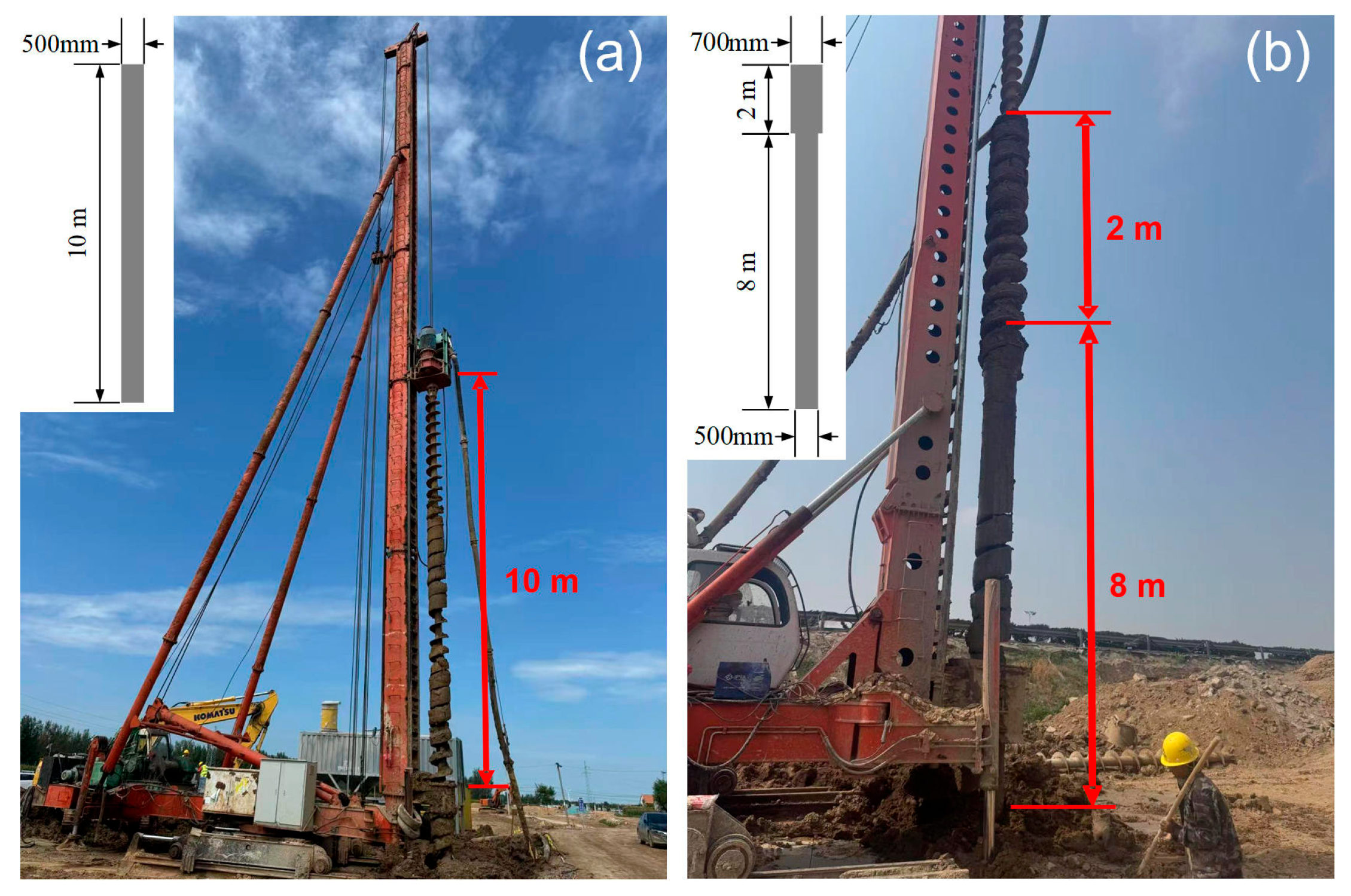
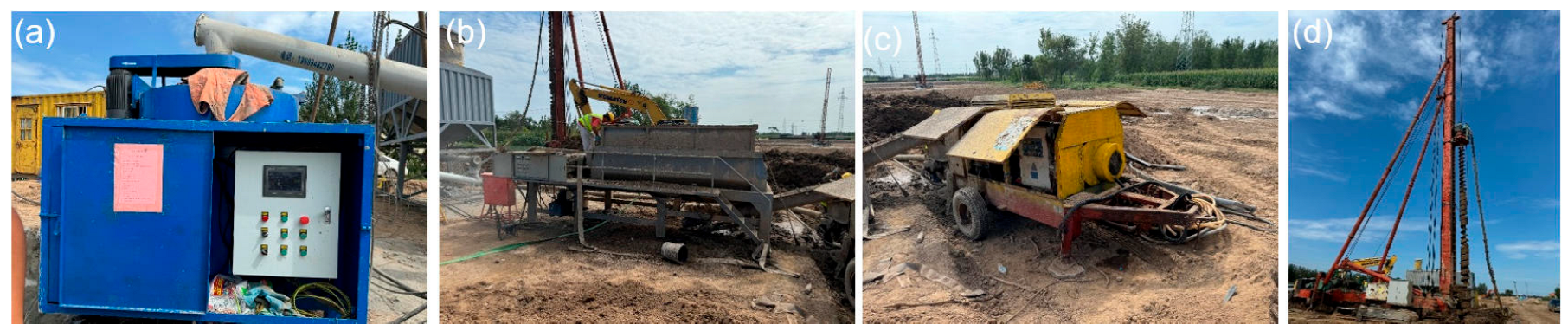
The construction machine and equipment required for the implementation of pre-mixed flow-solidified soil piles are shown in Figure 1, and mainly include: a rotary drilling rig; rotary drill rods with lengths ranging from 8 to 20 m; a solidification slurry mixer; a flowable solidified soil mixer; a pump with a pressure of not less than 10 MPa; and an excavator (for on-site soil transportation). By combining drill rods of different diameters and lengths, it is possible to construct uniform cross-section piles, as well as piles with variable cross-sections. The combination of drill rods used in this in situ test is shown in Figure 2.

2.2. Materials and Pile Parameters

Three types of piles (CMP, uniform-section PSP, and variable-section PSP) were tested, with three repetitions for each type. All piles had a length of 10 m and a base diameter of 500 mm, with the same mix ratio (water:binder:soil = 1:1.12:4.94 by mass) and were cured for 28 days. The variable-section PSP featured an enlarged section (2 m long, 700 mm in diameter). Core sampling, unconfined compressive strength (UCS) tests, and static load tests were conducted on each pile. Table 1 presents the complete test matrix from the field experiments, as shown below.

2.3. Experimental Procedure

To ensure the uniform mixing of flowable solidified soil, a two-step mixing method is adopted. In the first step, the cement slurry is mixed. The cement slurry is prepared with a water–cement ratio of 0.89. After the cement slurry is prepared, it is poured into the flowable solidified soil mixer, and the soil is added while stirring, continuing until the flowable solidified soil reaches a uniformly fluid state. It should be noted that during the preparation of the cement slurry, the water–cement ratio should be adjusted according to the flowable solidified soil mix and taking into account the natural water content of the on-site foundation soil.
The technology of pre-mixed fluid-solidified soil piles uses long spiral drilling to pre-establish the borehole. During the drilling process, the rotation of the spiral blades of the long spiral drill rod drives the screw into the foundation soil under its own weight. The vertical radial expansion force generated by the power rotation presses the soil, loosening it, and then the soil is discharged to the surface, along the spiral blades of the drill rod, forming the borehole. Once the spiral drill rod reaches the designed elevation at the pile base, drilling is stopped, and the drill rod remains in the borehole. At this time, the drill rod provides certain support to the borehole, preventing the collapse of the borehole walls. At the same time as the drilling, fluid-solidified soil is mixed. Water is thoroughly stirred with cement or other solidifying materials in a cement slurry mixing tank, then conveyed to a fluid soil mixing tank, to which the soil cuttings from the helical drilling machine are added and mixed until achieving a uniform flowable state. This mixture is pumped through the pump and the inner conduit of the drill rod into the borehole. During the grouting process, the drill rod is gradually lifted, and after the fluidized solidified soil has been poured to the designed pile tip elevation, a pile is formed. The test site mainly consists of silty clay and silt, which have good self-stability, and no collapse was observed during the drilling process. In addition, PSPs adopt the method of forming piles by pouring pre-mixed flowable solidified soil, and the mix ratio used provides the mixture with good fluidity and self-compacting properties. Core sampling results on-site indicate that the PSP cores are uniform and dense, with no obvious stratification.
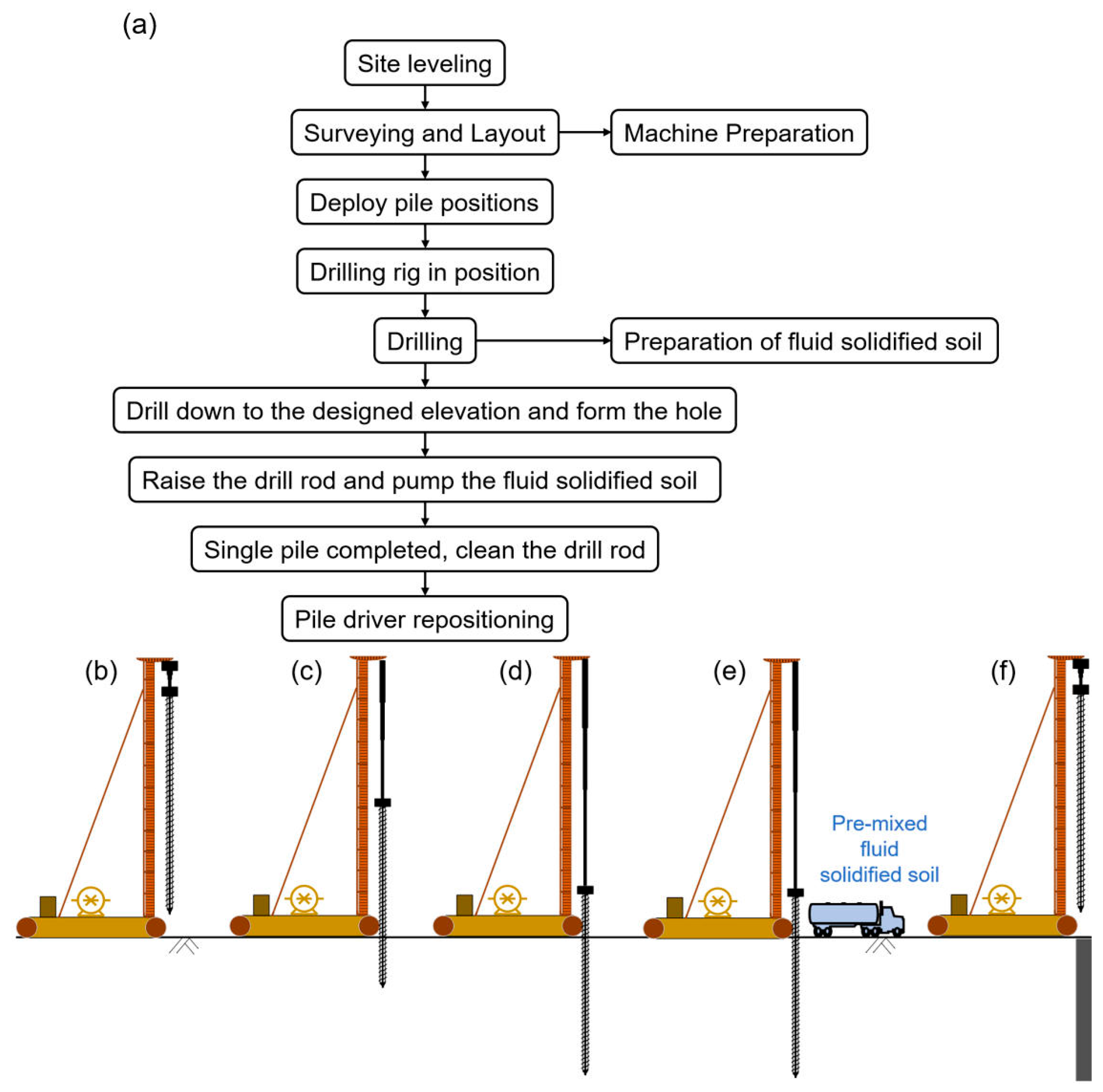
The specific construction process includes: site entry → site leveling → measurement and staking (while completing the installation and debugging of construction machinery) → marking pile positions → positioning the drilling rig → starting the drilling rig and drilling with the drill rod (while preparing the flowable solidified soil) → drilling to the designed elevation at the pile base (pre-hole completion) → pouring flowable solidified soil, simultaneously lifting the drill rod to the designed pile tip elevation during pouring → completion of a single pile, cleaning the drill rod → moving the piling rig to construct the next pile. The construction process flow is shown in Figure 3.
It is noteworthy that when conducting tests on pre-mixed fluid-solidified soil piles (PSPs), the flowable cemented soil should first have the cementitious stabilizer evenly mixed with water. The water-to-cement ratio (by mass) should be controlled within the range of 1.0 ± 0.1, adjusted dynamically according to the moisture content of the borehole spoil. The water-to-solid ratio (mass ratio of water to dry soil and stabilizer) should be controlled within 45% ± 3%, and the slump of the flowable cemented soil should be 200 mm ± 30 mm. The amount of curing agent added to the flowable solidified soil should not be less than 15%. It is recommended that the mass ratio of the flowable solidified soil be water:dry soil:curing agent = 1.00:4.94:1.12. During lifting the drill rod to pour the flowable solidified soil, the rod should be lifted slowly, keeping the guide pipe level with the surface of the flowable solidified soil to ensure a dense pour. The pouring process of the flowable solidified soil should be continuous to ensure the pile is cast in one go. If there is a pause of more than 1.5 h, the drill rod should be lifted slowly 2–3 times, with a lifting distance of 0.2–0.3 m, before continuing the pouring to ensure the integrity of the joint position. The pumping pressure is regulated by the hydraulic system of the concrete delivery pump, and a pressure gauge is installed at the pump outlet for real-time monitoring. During normal pouring, the pump pressure is controlled between 0.3 and 0.6 MPa. When encountering variable cross-section construction, the pump pressure temporarily increases to 0.8–1.2 MPa, working in conjunction with the drill bit’s jet expansion device to achieve pile end enlargement. It should be noted that the actual grouting volume is determined by recording the total amount of slurry discharged from the mixing station. Before constructing each pile, the theoretical grouting volume is calculated, and after construction, it is compared with the actual total amount pumped. The pile construction results indicate that the deviation of the actual grouting volume in this test from the theoretical value is within ±5%, and the piles are well filled. The drilling process of the spiral drill rod should be conducted at a uniform and continuous speed, with a drilling rate of 2.0–3.0 m/min and a lifting rate of 1.5–2.0 m/min. After the construction of the pre-mixed flowable grouting-reinforced soil piles is completed, a 300–500 mm thick cement–soil cushion with a cement content of 4% should be placed on top of the piles, with a compaction degree of no less than 90%. It is advisable to set a layer of reinforcement at the bottom of the cushion.

3. In Situ Test

3.1. Project Overview

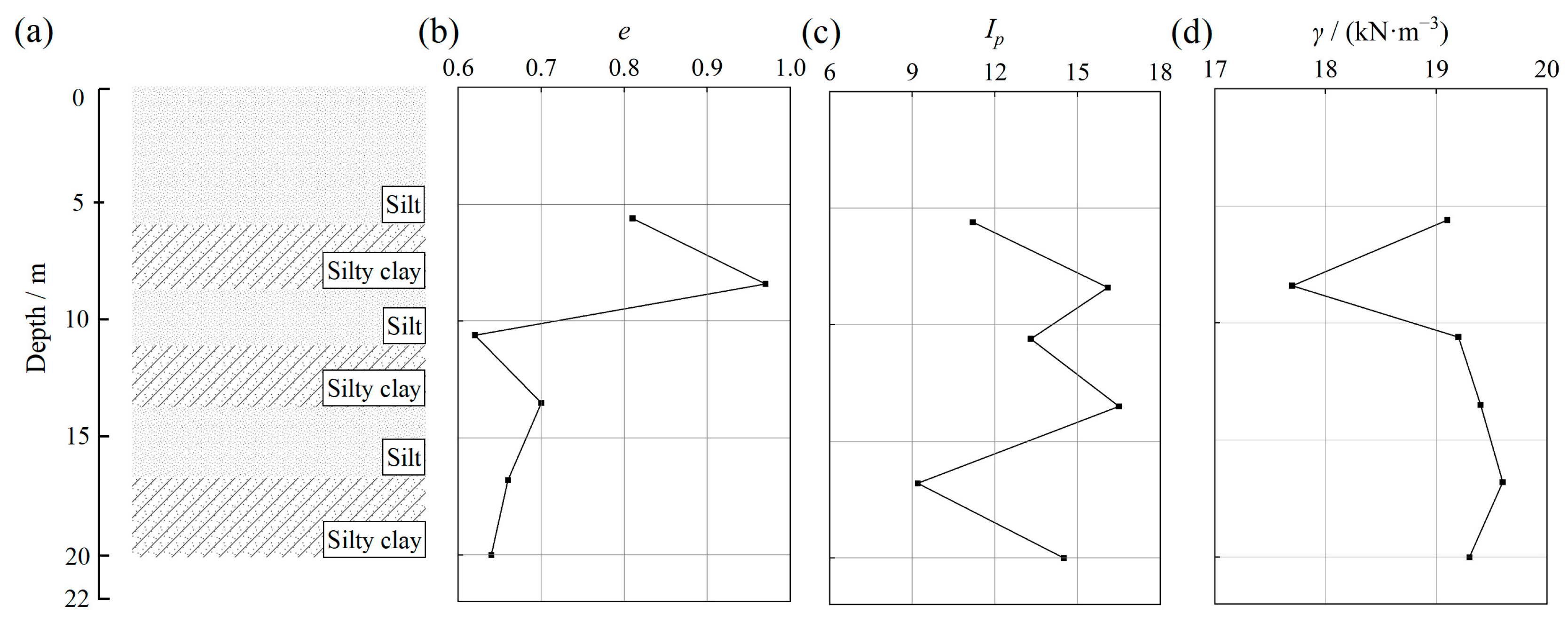
Based on a highway bridgehead foundation treatment project in Shandong Province, the on-site engineering application of pre-mixed fluid-solidified soil piles was carried out. The bridgehead foundation treatment section is a widened section, and the design adopts cement–soil mixing piles, with a cement content of no less than 60 kg per meter. The pile spacing is 1.8 m, the pile diameter is 500 mm, and the pile length is available in two options: 8 m and 10 m. The design value of the bearing capacity of a single pile is 130 kN, and the design value of the bearing capacity of the composite foundation is 130 kPa. According to Chinese standards [26], the 28-day strength can be used as a reference for project acceptance and quality control. Therefore, selecting the 28-day strength can be directly used for preliminary design and quality control. The compressive strength of the pile body shall not be less than 1.45 MPa at 28 days. The embankment fill height is 4.32–4.55 m. The site soil layers are mainly silty clay and silt, belonging to the Quaternary Holocene series (Q4): Layer 1 is silt, with an average stratified thickness of 5.6 m; Layer 2 is silty clay, with a stratified thickness of 2.8 m; Layer 3 is silt, with interbedded silty sand, and a stratified thickness of 2.2 m; Layer 4 is silty clay, with a stratified thickness of 2.9 m; Layer 5 is silt, with a stratified thickness of 3.3 m; and Layer 6 is silty clay, with a stratified thickness of 3.2 m. The parameters of the experimental site’s soil layers are shown in Figure 4.

3.2. Pile Quality

Two combinations of drill rods are employed to achieve pre-mixed fluid-solidified soil piles (PSPs) of different cross-sectional types. For constant cross-section PSPs, piles were formed by using drill rods of equal diameter to complete the hole in a single operation and then pouring. For T-shaped variable cross-section PSPs, different diameter drill rods were combined. By switching the drill rods, it is possible to reliably form pile holes with an enlarged end or variable cross-sectional shape, providing an accurate geometric boundary for subsequent pouring of fluidized solidified soil.
To ensure the quality of the pile construction, the in situ work strictly implements the following three controls: (1) Ensure that the flowable solidified soil is thoroughly mixed at the mixing station, strictly controlling the water-to-solid ratio, the amount of solidifying agent, and the mixing time, so that the mixture has good fluidity and homogeneity. (2) Maintain coordination between the drill extraction speed and the pumping and pouring volume of the flowable solidified soil to prevent pile breakage or diameter reduction caused by excessively fast extraction. At the same time, it is necessary to ensure the continuous and stable supply of flowable solidified soil during the pouring process. (3) After all piles are completed, implement strict site protection, prohibiting any vehicle passage or other construction activities within 14 days to prevent disturbance or damage to piles with insufficient early strength.
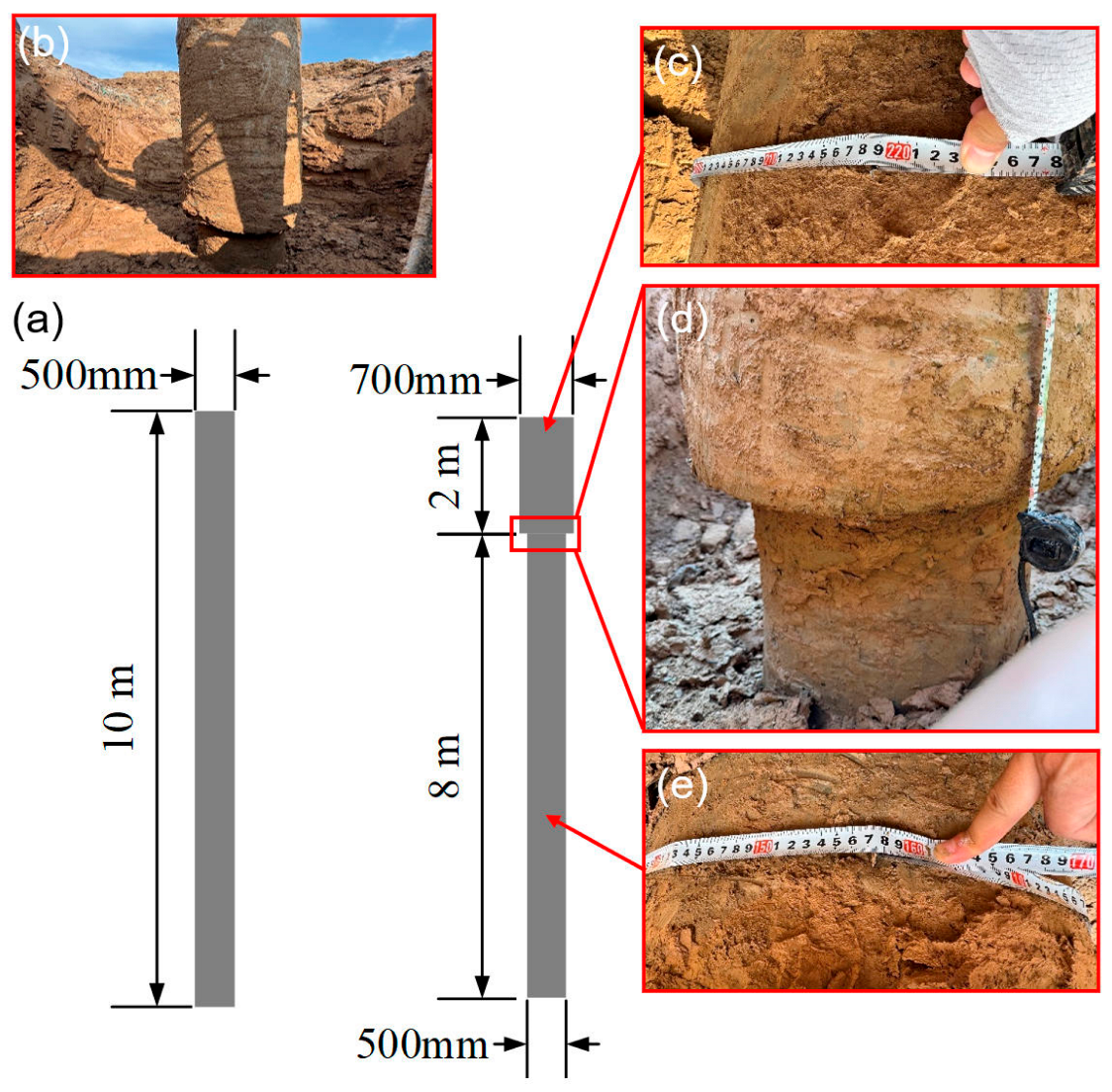
Based on the original design, cement–soil mixing piles are replaced with pre-mixed, fluid-solidified soil piles, while keeping the design index consistent with the original design. Applications were carried out for two types of piles: uniform-section and variable-section piles. The uniform-section pile has a diameter of 500 mm and a length of 10 m. The variable -section pile has a diameter of 500 mm for the non-enlarged section with a length of 8 m, and a diameter of 700 mm for the enlarged section with a length of 2 m, with the total pile length remaining at 10 m. A diagram of the pile structure is shown in Figure 5a.
Subsequently, 28 days after construction, the pile heads of the variable-section pre-mixed fluid-solidified soil piles were excavated for inspection. The excavation depth was 2.5 m, and the actual conditions after excavation are shown in Figure 5b–e. From the on-site excavation results of the pile heads, it can be seen that the pre-mixed fluid-solidified soil piles have excellent formation quality. Since measuring the pile diameter directly is relatively difficult, the perimeter of the pile was measured to verify the pile diameter. The measurement results indicate that the pile diameter matches the design dimensions. The outline of the enlarged section of the variable-section pile is clear, the interface is neat, and the height of the variable-diameter section is 2 m, consistent with the design dimensions. The pre-mixed flowable pouring process has achieved excellent pile-forming results.

4. Results and Analysis of Pre-Mixed Fluid-Solidified Soil Piles

4.1. Unconfined Compressive Strength of Core Samples

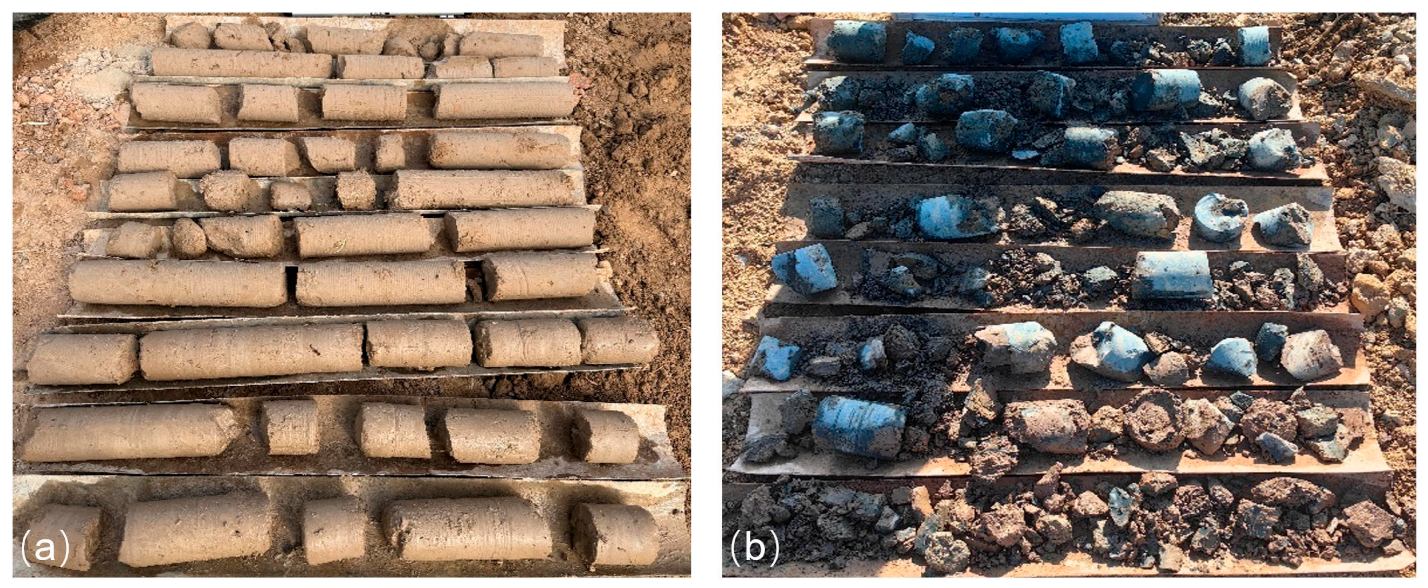
After curing for 28 days, core testing was conducted on the piles, and the photos of the core test results are shown in Figure 6. It should be noted that the design diameter, length, construction machinery, and curing environment of the two pile types are all the same. The on-site core extraction clearly shows that the pre-mixed fluid-solidified soil pile (PSP) cores exhibit a continuous columnar form, with uniform and consistent pile bodies throughout, hard and intact, with a few portions appearing blocky, mainly caused by damage from collisions with the core drilling rod during extraction. The integrity of the PSP cores is significantly better than that of the cement–soil mixed pile (CMP) cores. The CMP cores lack a columnar shape, with a few portions forming blocks and many parts appearing loose and fragmented. Additionally, the status of the cores shows that some of the foundation soil appears yellow-brown, while the block portions of the cores are dark blue. This indicates that the loose yellow-brown core material did not contain cement or contained only a small amount of cement, which was insufficient to solidify the soil.
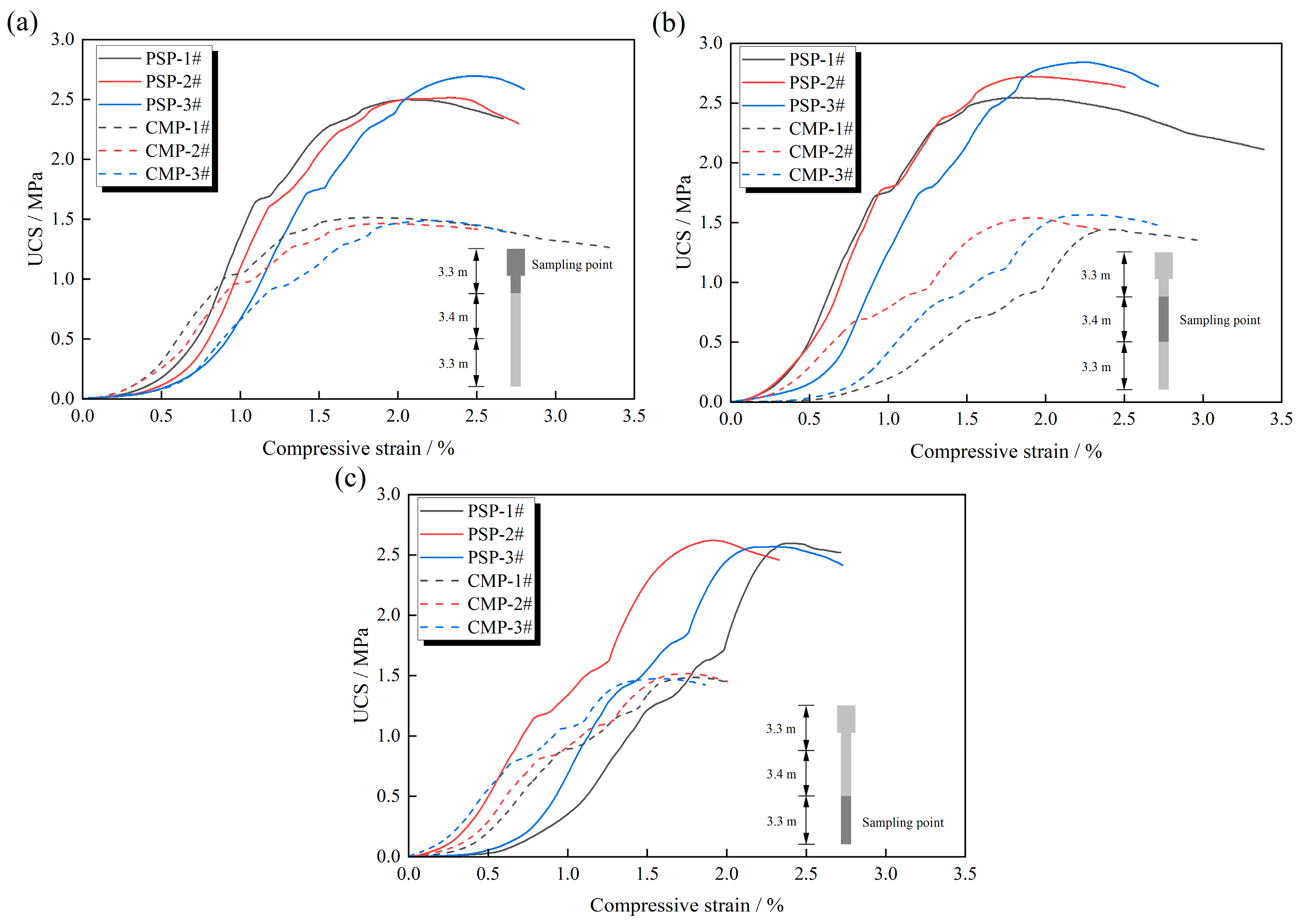
The unconfined compressive strength (UCS) of the PSP core samples at different sampling points was tested, with a minimum value of 2.50 MPa and a maximum value of 2.84 MPa. The test results show low variability and are relatively reliable, with an average value of 2.62 MPa, exceeding the design requirement of 1.45 MPa. Compared with the CMPs, the UCS of PSPs has a significant improvement. The core sample strength curve is shown in Figure 7.
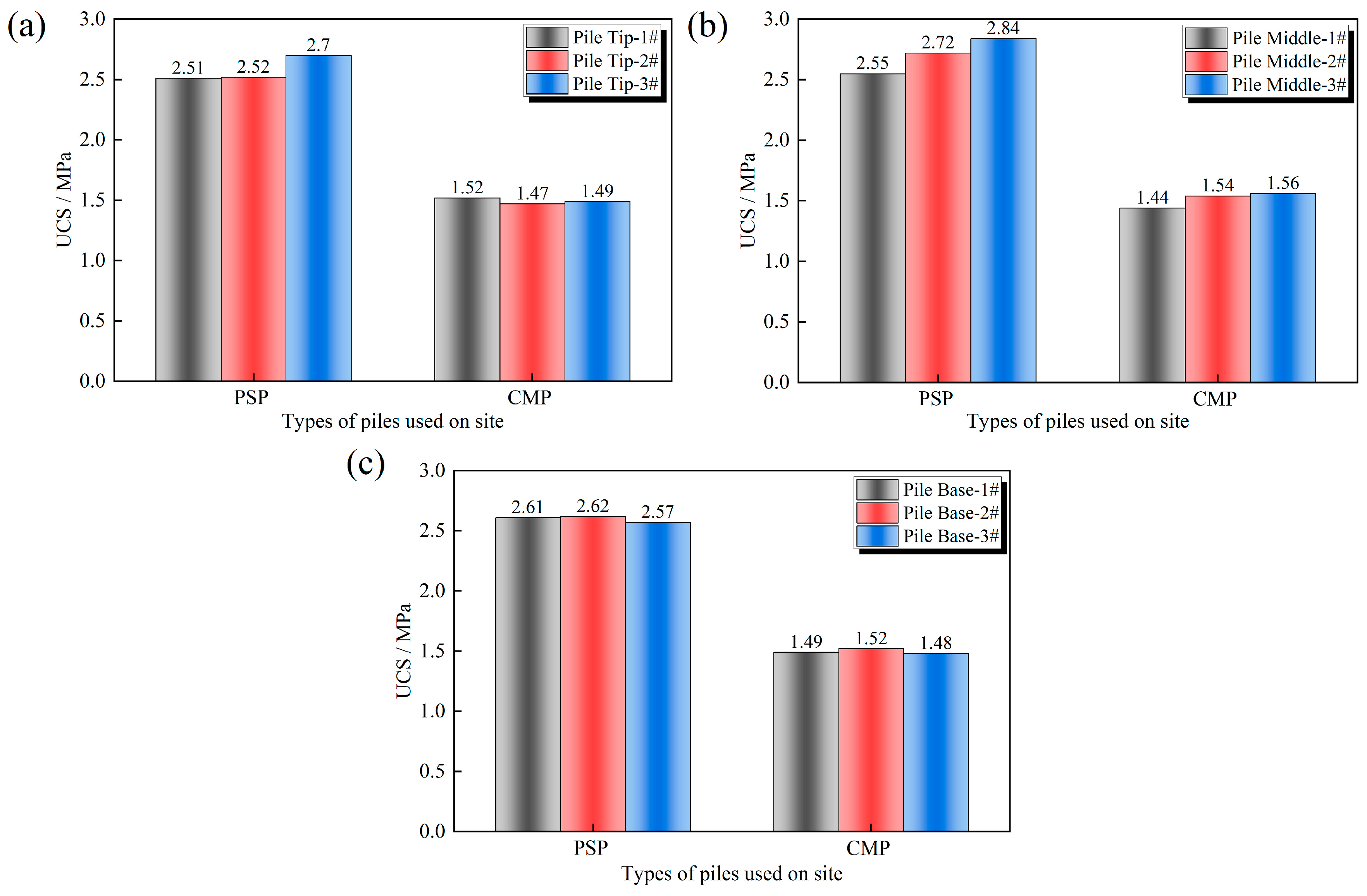
Figure 8 compares the mechanical properties of the soil–cement surrounding two types of piles at different longitudinal positions of the pile shaft (upper, middle, lower) on-site. Table 2 shows the statistical details of the UCS of the testing piles. The results indicate that the UCS of the PSP is significantly higher than that of the CMP along the entire pile length, with the average strength being approximately 1.7–1.8 times that of the CMP. Among them, the UCS of the middle samples of the PSP is the highest (average of 2.70 MPa), showing an overall longitudinal distribution pattern of “middle > lower > upper”. This may be because the upper part is most affected by evaporation and disturbances, resulting in the lowest strength. The lower part has a high moisture content, which dilutes the curing agent, leading to medium strength. The middle part has a stable curing environment and moderate confinement, hence exhibiting the highest strength. In contrast, the UCS of the CMP remains highly uniform throughout the pile length (average 1.49–1.51 MPa), but the strength is significantly lower. This may be due to the deterioration of soil mechanical properties caused by the disturbance during the construction of mixed-in-place piles.

4.2. Ultimate Bearing Capacity and Characteristic Value of Single Pile

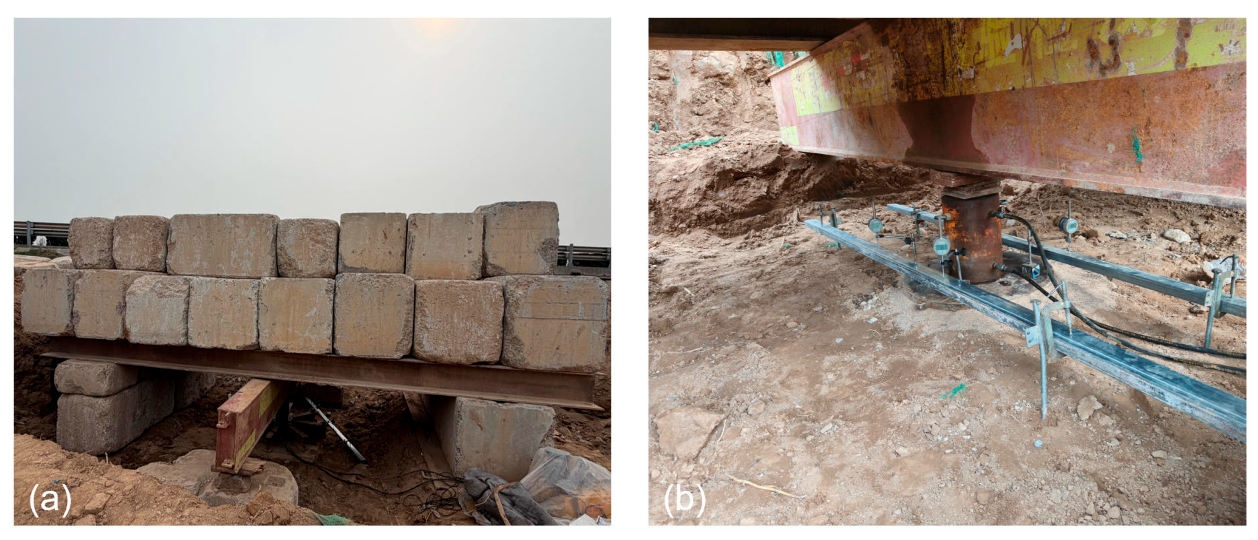
According to Chinese standard requirements [26], the weight platform for static load tests on single piles and composite foundations is made of concrete blocks, with each concrete block weighing 5 tons. Based on the required test load, 10% additional load is added, and different numbers of blocks are arranged accordingly, as shown in Figure 9. When applying the load to the pile, it is achieved through jacks placed beneath the weight platform. By lifting the jacks, the load from the weight platform is transferred to the I-shaped steel beams, and then passed from the jacks and steel beams to the pile and foundation. A bearing plate is placed on top of the pile or foundation. For the static load test of a single pile, the bearing plate has the same diameter as the pile, 500 mm and 700 mm. For the static load test of a composite foundation, the bearing plate is designed as a square steel plate with a side length of 1.67 m, based on the area reinforced by a single pile, and the thickness of all bearing plates is 25 mm.
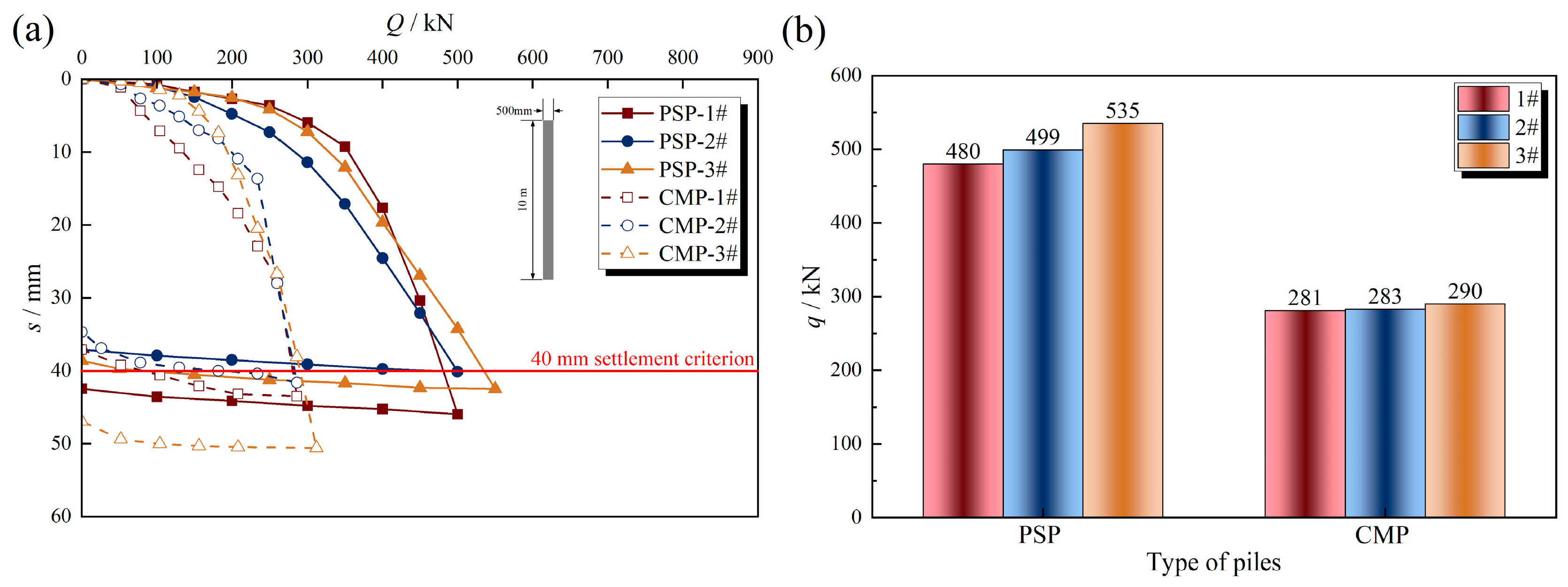
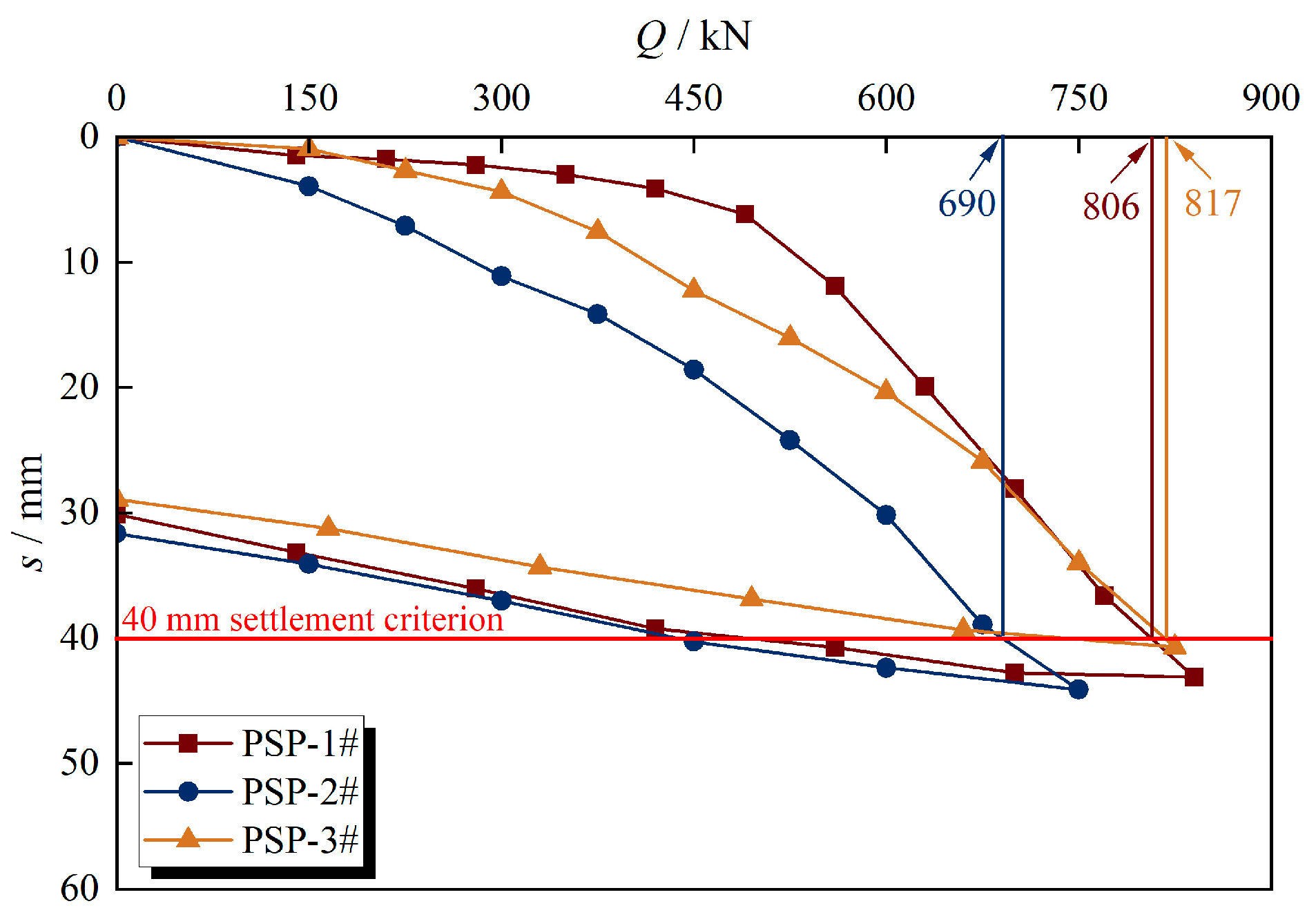
After 28 days of pile curing, vertical static load tests were conducted to measure the ultimate bearing capacity of single piles for uniform-section and variable-section pre-mixed fluid-solidified soil piles (PSPs) and uniform-section cement–soil mixing piles (CMPs). Three piles of each type were randomly tested, and the test results are shown in Figure 10 and Figure 11. According to JGJ 340-2015 [26], when the pile diameter is less than 800 mm, and the Q-s curve is of a gentle variation type, the load corresponding to a pile tip settlement of 40 mm is taken as the ultimate bearing capacity of the pile. Table 3 presents the statistical details of the ultimate bearing capacity of single piles, from which it can be seen that the data dispersion is relatively good.
From the test results, it can be observed that the ultimate bearing capacities of uniform-section pre-mixed fluid-solidified soil piles are 480 kN, 499 kN, and 535 kN, respectively, with an average of 504 kN, representing an increase of 177% compared to a CMP with uniform cross-section. According to JGJ 340-2015 [26], the characteristic value of bearing capacity is taken as half of the ultimate bearing capacity. Therefore, the characteristic value of the single pile bearing capacity for the uniform-section (PSP) is 252 kN, whereas the characteristic value of the single pile bearing capacity for the original uniform-section CMP is 142 kN, representing an increase of 77.5%, meeting the engineering design requirement of 130 kN.
The average ultimate bearing capacity of a single variable-section PSP is 770 kN, an increase of 153% compared to a PSP with a uniform cross-section (504 kN). It can be seen that the single pile bearing capacity of the PSP is significantly improved compared to the CMP, and the bearing capacity of the variable-section PSP is significantly higher than that of the constant-section PSP. This may be due to the tip resistance provided by the enlarged section at the variable cross-section. Since this study did not conduct on-site measurements of pile body stress–strain or pile tip soil pressure, the analysis of the load transfer mechanism remains at the macroscopic speculation level. Issues such as whether there is load concentration near the enlarged end of the variable-section pile and how the side friction is redistributed need to be measured in the future using embedded strain sensors or distributed optical fiber technologies.

4.3. Characteristic Value of Bearing Capacity of Composite Foundation

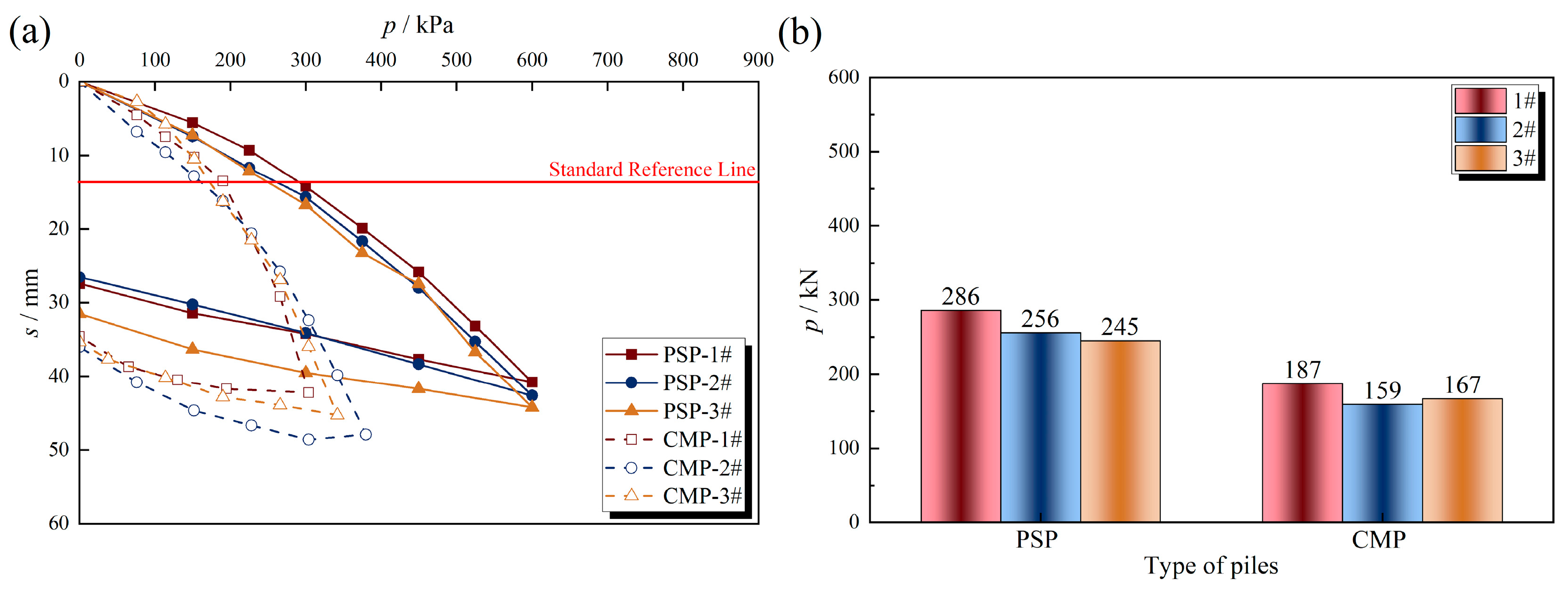
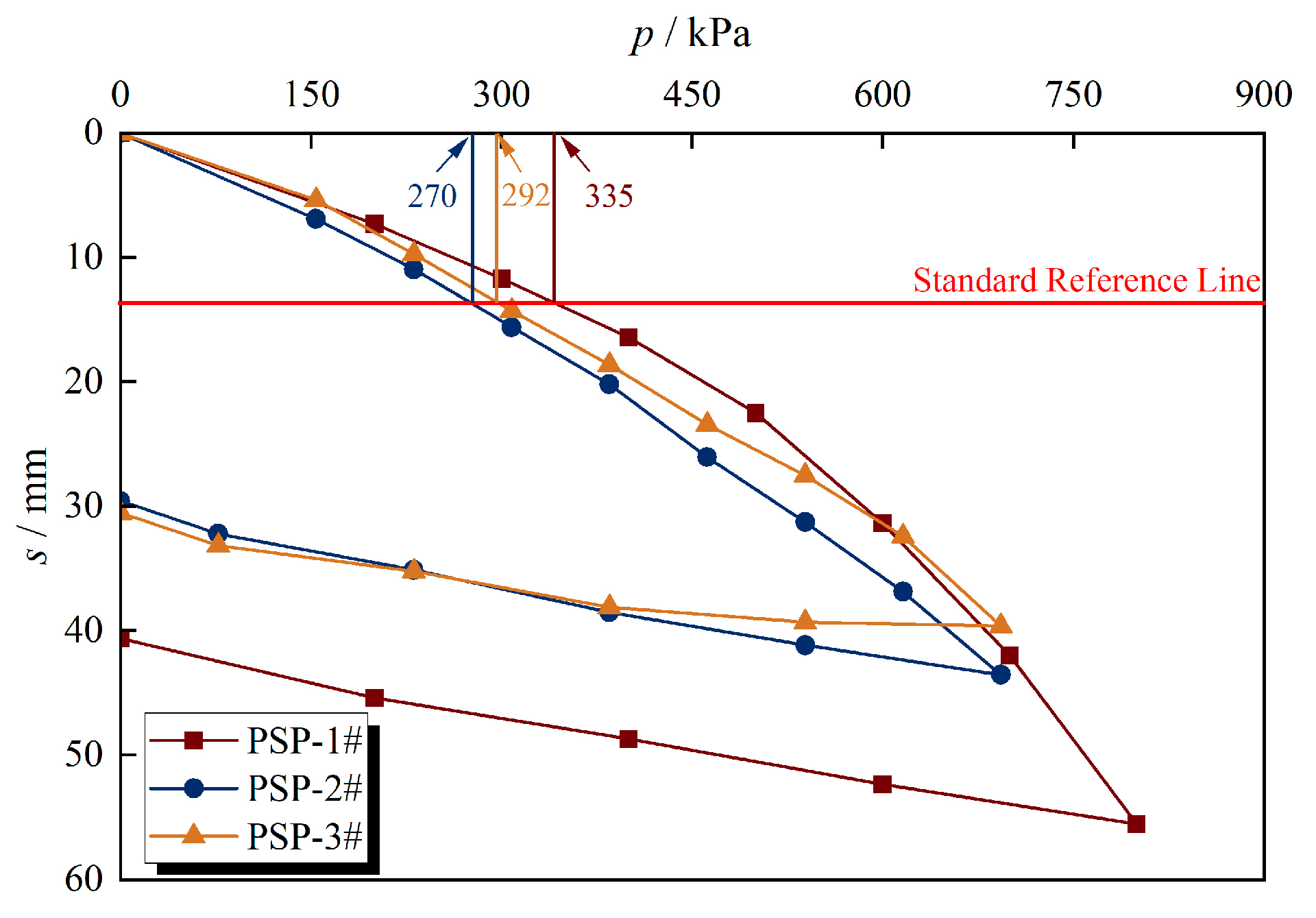
After 28 days of pile maintenance, composite foundation load tests were carried out on uniform-section and variable-section pre-mixed fluid-solidified soil piles (PSPs), as well as uniform-section cement–soil mixing piles (CMPs). Three piles of each type were tested, and the results are shown in Figure 12 and Figure 13, respectively. Table 4 presents the statistical details of the characteristic value of foundation bearing capacity. The characteristic value of the bearing capacity of the composite foundation was determined in accordance with the relative deformation requirements specified in JGJ 340-2015 [26], where the load corresponding to a deformation equal to 0.008 times the size of the bearing plate was taken as the characteristic bearing capacity. In the test, the pile spacing was 1.8 m, and a square bearing plate with a side length of 1.67 m was used, resulting in a corresponding control deformation of 13.36 mm. From the p-s curve of the test results, it can be determined that the average characteristic value of the bearing capacity of the foundation reinforced with a uniform-section PSP is 262 kPa, representing an increase of 53.2% compared to the average characteristic value of 171 kPa for the foundation reinforced with a uniform-section CMP.
Similarly, the average characteristic bearing capacity of the variable-section PSP is 299 kPa, representing an increase of approximately 74.8% compared to the uniform-section CMP. The derivation of the bearing capacity calculation formula for composite foundations reinforced with pre-mixed fluid-solidified soil piles will be discussed in the next section.

5. Foundation Design

5.1. Calculation of Bearing Capacity of Composite Foundation

Pre-mixed fluid-solidified soil piles (PSPs), cement–soil mixing piles (CMPs), and rammed cement–soil piles all belong to flexible piles. Their composite foundation design is carried out according to the design of flexible pile composite foundations. According to JGJ 340-2015 [26], the characteristic value of the bearing capacity of PSP’s composite foundation can be determined based on on-site static load tests of single-pile or multi-pile composite foundations. For preliminary design, it could be estimated by Equation (1):
f s p k = m R a A p + β 1 m f s k
where fspk is the characteristic value of the composite foundation bearing capacity (kPa); m is the pile–soil area replacement ratio; Ra is the characteristic value of the single pile bearing capacity (kN); Ap is the cross-sectional area of the pile (m2); β is the reduction coefficient of the bearing capacity of the soil between piles, ranging from 0.5 to 1.0; and fsk is the characteristic value of the bearing capacity of the soil between piles (kPa).
The form of a pre-mixed fluid-solidified soil pile can be either of uniform cross-section or variable cross-section. When a variable cross-section pile is used, the cross-sectional area of the pile is taken as the cross-sectional area of the widened portion of the variable cross-section.
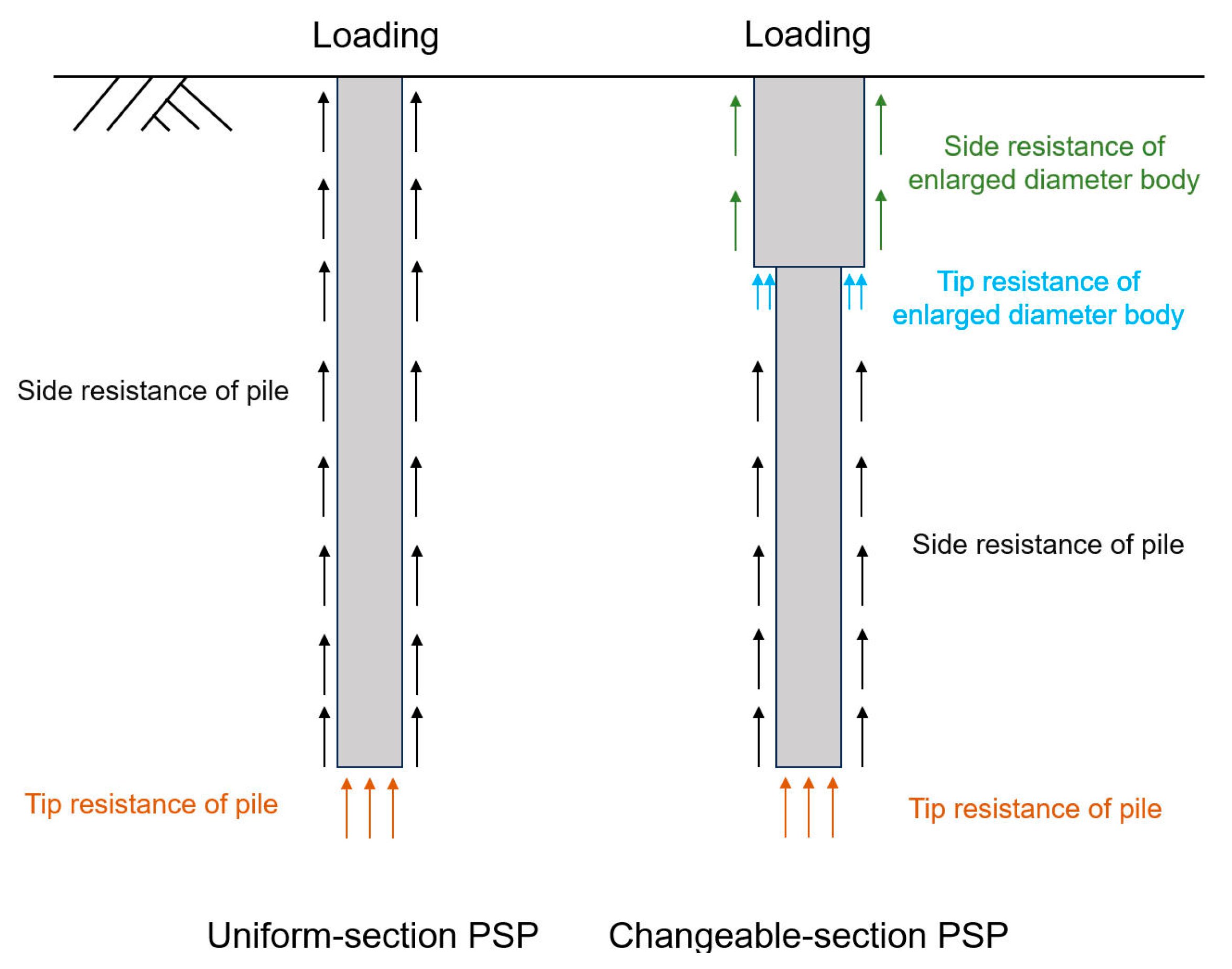
The characteristic value of the bearing capacity of PSPs can be determined based on on-site single-pile static load tests. According to the bearing and stress analysis of the pile body (Figure 14), during preliminary design, it can also be determined according to Equations (2) and (3). Among them, Equation (2) applies to the calculation of the single pile bearing capacity of a uniform-section PSP, while Equation (3) applies to the calculation of the single pile bearing capacity of a variable-section PSP.
R a = μ p i = 1 n q s i l i + q p A p
R a = γ μ p i = 1 n q s i l i + μ p j = 1 m q s j l j + q p A p + q p A p
where Ra is the characteristic value of single pile bearing capacity (kN); μp is the perimeter of a uniform cross-section pile or non-enlarged section for variable cross-section piles (m); qsi is the characteristic value of side resistance of the pile in the i-th soil layer (kPa); li is the thickness of the i-th soil layer (m); qp is the characteristic value of the end-bearing capacity of the pile’s tip soil (kPa); Ap is the cross-sectional area of the pile tip (m2); γ is the bearing capacity enhancement factor for the enlarged section, taken as 1.2–1.3; μp is the perimeter of the enlarged section of a variable cross-section pile (m); μp is the perimeter of the non-enlarged section of a variable cross-section pile (m); qsj is the characteristic value of the side resistance of the pile in the j-th soil layer (kPa); lj is the thickness of the j-th soil layer (m); qp is the characteristic value of tip resistance of the enlarged section in a variable cross-section pile (kPa); and Ap is the difference between the tip’s cross-sectional area of the enlarged section and the cross-sectional area of a non-enlarged pile (m2).
After calculating the single pile bearing capacity according to Equations (2) and (3), it is further necessary to verify whether the pile strength meets the bearing capacity requirements. If the strength meets the requirements, the value calculated from the equation is adopted; if the pile strength does not meet the requirements, the characteristic value of the single pile bearing capacity is taken as the product of the pile strength and the cross-sectional area of a pile with a constant section (for non-expanded variable-section piles).
Table 5 below presents the theoretical values of single pile bearing capacity for uniform-section PSPs and variable-section PSPs. The results indicate that the theoretical value of single pile bearing capacity for variable-section PSPs is significantly higher than that for uniform-section PSPs. Among them, the theoretical value of single pile bearing capacity for variable-section PSPs is within 5% of the measured value, showing very close agreement. Using the single pile bearing capacity characteristic value calculation formula recommended in the code provides a more reliable estimation of single pile bearing capacity, while the error in estimating the single pile bearing capacity of uniform-section PSPs is relatively large, exceeding 20%. This may be due to the fact that the pile-side resistance values in the geological survey report are generally high, whereas the actual side resistance of the strata is relatively low. The reason is that the spacing of the exploration points set out in the report is relatively large (approximately 500 m per point), which fails to adequately reveal the spatial variability of the strata, leading to certain discrepancies between the theoretical values and the in situ measured values.

5.2. Calculation of Settlement of Composite Foundation

The settlement of a composite foundation is mainly composed of the settlement of the cushion layer, the reinforced area, and the underlying stratum. The cushion layer is relatively thin, resulting in a small amount of compression deformation, and its compression deformation is essentially completed during the embankment construction process; therefore, the deformation of the cushion layer can be neglected. The settlement of the composite foundation primarily comprises the settlement s1 of the reinforced area and the settlement s2 of the underlying layer.
Because the pre-mixed fluid-solidified soil pile could be seen as flexible, the settlement deformation of the reinforced area of the composite foundation is calculated using the composite modulus method. The calculation of the settlement s1 of the reinforced area of the composite foundation is shown in Equation (4):
s 1 = i = 1 n p i E p s i l i
where Δpi is the additional stress of the i-th layer of soil in the reinforced zone (kPa); Epsi is the composite compression modulus of the i-th layer of soil in the reinforced zone (kPa).
The composite compression modulus Eps of the soil in the reinforced composite foundation area can be calculated according to Equation (5):
E p s = m E p + 1 m E s
where Ep is the compression modulus of the pile (kPa); Es is the compression modulus of the soil between piles (kPa); and m is the area replacement ratio.
The calculation of the settlement for the underlying layer s2 is carried out using the layered summation method, and the calculation formula is shown in Equation (6):
S 2 = j = 1 m p j E s j l j
where Δpj is the additional stress of the j-th layer of the underlying soil (kPa); Esj is the compression modulus of the j-th layer of the underlying soil (kPa).
The additional stress on the underlying soil layer is calculated according to the equivalent block method, treating the reinforced composite foundation area as a whole, equivalent block. The loading surface of the underlying layer coincides with the loading surface of the reinforced area. The equivalent block has side resistance, and the pre-mixed fluid-solidified soil piles are considered as in situ displacement, without taking into account the self-weight of the piles. Therefore, the calculation formula for the additional stress on the underlying layer is as follows:
p = B D p 2 B + 2 D l ρ B D
where Δp is the additional stress on the lower bed layer (kPa); B and D are the width and length of the load-bearing surface (m); p is the additional stress in the reinforced area (kPa); l is the thickness of the reinforced area; and ρ is the average density of the equivalent side resistance of the solid body (kPa).

6. Limitations and Future Research Prospects

This study has the following limitations, which require further investigation. First, the field tests were conducted only on a specific silty clay/silt site in Shandong, and the number of tests for each pile type was limited (three piles each), mainly due to budget and testing constraints, and were conducted according to the minimum number of tests required by current standards. Therefore, to promote the application of PSP technology, systematic physical model tests and in situ field tests should be carried out in more typical geological conditions in the future. Second, the design formula presented in this paper was initially simplified based on JGJ 340-2015 [26], and has not yet incorporated tip correction factors or the spatial effects of pile–soil interactions; future research should combine more systematic load transfer measurement data (such as embedding strain sensors or distributed optical fibers along the pile to obtain axial force distribution curves under different load levels) to quantitatively reveal the true bearing mechanism of variable-section PSPs and propose more targeted design modification methods. In addition, to address the statistical uncertainty of small-sample bearing capacity data, Monte Carlo simulations and probabilistic analyses can be introduced in the future to improve the reliability of the evaluation results.

7. Conclusions

As an efficient foundation reinforcement technique, pre-mixed fluid-solidified soil piles have easily controllable pile quality, rapid construction speed, and high bearing capacity. This technology holds significant potential for promotion and broad application in the reinforcement of weak foundations for high-grade highways. This research focuses on the foundation treatment technology using pre-mixed fluid-solidified soil piles, conducting in situ test, as well as theoretical derivations of the bearing capacity and settlement deformation of composite foundations. The main conclusions are as follows.
(1) Based on the core samples, the use of the flowable solidified soil pre-mixing and pre-formed hole grouting process has significantly improved the quality of the reinforced soil piles compared to the traditional in situ mixing method, with better overall integrity and uniformity of the core samples. Excavation results at the pile heads indicate that the formed variable-section pre-mixed fluid-solidified soil piles have transition body dimensions consistent with the design, with clear contours and neat interfaces, achieving the desired effect.
(2) The bearing capacity of pre-mixed fluid-solidified soil pile has been significantly improved. The characteristic bearing capacity of the PSP with a uniform cross-section is 252 kN, meeting the design requirement of 130 kN. In terms of ultimate bearing capacity, the PSP with a uniform cross-section shows a significant increase of 177% compared to the CMP with a uniform cross-section. The variable cross-section PSP further increases by 153% compared to the PSP with a uniform cross-section, indicating that the variable cross-section configuration has a more prominent effect on enhancing bearing capacity.
(3) The bearing capacity of composite foundations treated with pre-mixed fluid-solidified soil piles (PSPs) has been significantly improved compared to the bearing capacity characteristics of the original cement–soil mixing pile composite foundations. The characteristic value of the foundation bearing capacity for a PSP with a uniform-section is 2.01 times the original design value. After being treated with a variable-section PSP, the characteristic value of the foundation bearing capacity is further increased by 14% compared to the uniform-section case.
(4) Based on existing standards, equations for the bearing capacity and settlement deformation of composite foundations treated with pre-mixed fluid-solidified soil piles were derived considering both uniform and variable cross-sections. The proposed equations require a few parameters and have clear physical significance, making them suitable for on-site application of this technology.


Author Contributions

Writing—original draft, Y.Y. and G.X.; Visualization Y.Y. and R.S.; Methodology, Y.Y., G.X., Y.C. and R.S.; Writing–Review and Editing, Y.C. and R.S.; Supervision, Y.Y. and Y.C. All authors have read and agreed to the published version of the manuscript.

Funding

This research was funded by the Shandong Province Natural Science Foundation Joint Fund for Innovative Development Project, grant number ZR2025LZN019.

Data Availability Statement

Data are contained within the article.

Acknowledgments

We gratefully acknowledge the support of the State Key Laboratory of Integrated Intelligent Transportation System for this project.

Conflicts of Interest

The authors declare no conflicts of interest.

References

  1. Liu, H.; Zhao, M. Review of ground improvement technical and its application in China. China Civ. Eng. J. 2016, 49, 96–115. [Google Scholar]
  2. Wen, H.; Ma, Z.; Zhao, S.; Wu, L.; Huang, K. Analysis of factors affecting truck accidents on Mountainous Freeways. J. South China Univ. Technol. (Nat. Sci. Ed.) 2025, 53, 93–103. [Google Scholar]
  3. Lu, M.; Xie, K.; Wang, S. Consolidation of vertical drain with depth-varying stress induced by multi-stage loading. Comput. Geotech. 2011, 38, 1096–1101. [Google Scholar] [CrossRef]
  4. Shen, R.; Chen, Y.; Guo, J.; Sarajpoor, S.; Chen, R. Investigation on evolution mechanism of air injection desaturation region: Physical experiments and twophase flow simulation. Soil Dyn. Earthq. Eng. 2026, 203, 110114. [Google Scholar] [CrossRef]
  5. Sun, T.; Wang, C.; Xu, D.; Lin, Z.; Yang, J.; Liu, S.; Yang, F. Effect of Solidified Depth on the Vertical Compressive Bearing Characteristics of the Soil Continuously Solidified Pile Group Foundation. Appl. Sci. 2023, 13, 12850. [Google Scholar] [CrossRef]
  6. Lu, G.; Ge, J.; Xiao, H. Treatment of coastal soft foundation with cement-soil mixing pile. J. Shandong Univ. (Eng. Sci.) 2020, 50, 73–81. [Google Scholar]
  7. Liu, S.; Xi, P.; Chu, H.; Gong, N. Research on practice of bidirectional deep mixing cement-soil columns for reinforcing soft ground. Rock. Soil. Mech. 2007, 28, 560–564. [Google Scholar]
  8. Yi, Y.; Liu, S.; Zhao, W.; Sun, H.; Chen, W.; Li, H. Installation of variable diameter soil-cement double mixed column. Chin. J. Geotech. Eng. 2010, 32, 387–390. [Google Scholar]
  9. Liu, S.; Du, Y.; Yi, Y.; Puppala, A. Field Investigations on Performance of T-Shaped Deep Mixed Soil Cement Column-Supported Embankments over Soft Ground. J. Geotech. Geoenviron. Eng. 2012, 138, 718–727. [Google Scholar] [CrossRef]
  10. Yi, Y.; Liu, S.; Puppala, A. Laboratory modelling of T-shaped soil–cement column for soft ground treatment under embankment. Geotechnique 2015, 66, 85–89. [Google Scholar] [CrossRef]
  11. Yi, Y.; Liu, S.; Puppala, A. Bearing capacity of composite foundation consisting of T-shaped soil-cement column and soft clay. Transp. Geotech. 2018, 15, 47–56. [Google Scholar] [CrossRef]
  12. Yi, Y.; Liu, S.; Puppala, A.; Xi, P. Vertical bearing capacity behaviour of single T-shaped soil–cement column in soft ground: Laboratory modelling, field test, and calculation. Acta Geotech. 2017, 12, 1077–1088. [Google Scholar] [CrossRef]
  13. Zhou, C.; Zheng, X.; Zhang, S.; Li, C.; Yang, Y.; Han, J. Study on Load-Bearing Characteristics and Engineering Applications for Cement–Soil Pipe Pile. Buildings 2025, 15, 912. [Google Scholar] [CrossRef]
  14. Yi, Y.; Xi, W.; Liu, S.; Jing, F. Numerical simulation of variable diameter deep mixed columns-treated layered soft ground under highway embankment load. Chin. J. Geotech. Eng. 2013, 35, 433–438. [Google Scholar]
  15. Wu, L.; Gao, Y.; Du, Y.; Xuan, J.; Nao, J.; Li, S.; Li, J.; Wang, Y.; Zhang, H.; Cao, L.; et al. Model Testing and Numerical Simulation of the Bearing Characteristics of Screw-Core Cement Mixing Pile. Buildings 2025, 15, 41. [Google Scholar] [CrossRef]
  16. Li, P.; Lei, T.; Xu, C.; Zhang, Y.; Li, L.; Wei, H.; Yao, Z.; Yao, K. Performance of Drilling–Mixing–Jetting Deep Cement Mixing Pile Groups in the Yellow River Floodplain Area. Buildings 2026, 16, 162. [Google Scholar] [CrossRef]
  17. Wang, Z.; Xu, W.; Xu, Q.; Wang, Y.; Zhu, Y. Research on Temperature Field of Cement-Mixing Pile-Reinforced Soft Soil Foundation. Buildings 2024, 14, 845. [Google Scholar] [CrossRef]
  18. Yan, Y.; Liu, X.; Li, B.; Liu, Y.; Hu, Z.; Li, Y. Study on Bearing Characteristics and Load Transfer Behavior of a Slurry-Modified Stiffened Deep Cement Mixing Pile considering Core Pile Types. Int. J. Geomech. 2026, 26, 04026077. [Google Scholar] [CrossRef]
  19. Su, G.; Liu, H.; Dai, G.; Chen, X.; Deng, Y. Dynamic Analysis of a Concrete-Cored Deep Cement Mixing Pile under Horizontal Dynamic Loads. Buildings 2023, 13, 1378. [Google Scholar] [CrossRef]
  20. Xia, H.; Du, G.; Qin, D.; Wang, F.; Mao, Z.; Chen, Z. Cement Pile Reinforcement for Soft Soil Foundation Using Bidirectional Deep Mixing. Soil Mech. Found. Eng. 2024, 61, 491–498. [Google Scholar] [CrossRef]
  21. Chen, S.; Guan, Y.; Dai, J. Shielding effects of deep cement mixing column rows on an anchored sheet pile quay in soft clay: Three-dimensional centrifuge and numerical modeling. Acta Geotech. 2024, 19, 2145–2161. [Google Scholar] [CrossRef]
  22. Zhao, J.; Zong, Z.; Huang, Y.; Lu, M.; Huang, D.; Guo, C. Vertical and lateral bearing performance of bidirectional Helix-Stiffened cement mixing piles on marine soft soil sites: Field tests and numerical simulations. Ocean Eng. 2025, 323, 120678. [Google Scholar] [CrossRef]
  23. Zhao, J.; Zong, Z.; Lu, M.; Huang, D. Bearing capacity and buckling stability of fiber reinforced Soil-cement helix stiffened cement mixing piles in marine soft soil sites. Ocean Eng. 2025, 342, 122925. [Google Scholar] [CrossRef]
  24. Singh, M.; Yao, K.; Lei, T.; Liu, S.; Zhang, Y.; Yao, Z.; Beer, M. Load-bearing performance and failure behavior of multi-flange deep cement mixing columns. Mar. Georesour. Geotechnol. 2026, 44, 883–897. [Google Scholar] [CrossRef]
  25. Zhang, D.; Wang, A.; Ding, X. Seismic response of pile groups improved with deep cement mixing columns in liquefiable sand: Shaking table tests. Can. Geotech. J. 2022, 59, 994–1006. [Google Scholar] [CrossRef]
  26. Hou, W.; Shi, F.; Xu, G.; Gao, W.; Liu, Y.; Xu, T.; Liu, Y.; Li, Y.; Zhang, J.; Chen, H.; et al. Technical Specifications for Building Foundation Inspection: JGJ 340-2015; Ministry of Housing and Urban-Rural Development of the People’s Republic of China: Beijing, China, 2015. [Google Scholar]
Figure 1. Construction of pre-mixed fluid-solidified soil pile: (a) cement slurry mixing tank; (b) flowable solidified soil mixing horizontal tank; (c) pump; (d) spiral drilling machine.
Buildings 16 02063 g001
Figure 2. Combination of pile and drill rod with different cross-sectional forms: (a) equal cross-section; (b) variable cross-section.
Buildings 16 02063 g002
Figure 3. Construction process of pre-mixed fluid-solidified soil pile: (a) process flow diagram; (b) drilling dig in position; (c) drilling; (d) pile hole completed; (e) pump fluid-solidified soil; (f) soil pile formation.
Buildings 16 02063 g003
Figure 4. Site soil parameters: (a) soil layer classification; (b) porosity ratio; (c) plasticity index; (d) unit weight.
Buildings 16 02063 g004
Figure 5. The in situ quality of pre-mixed fluid-solidified soil pile: (a) diagram of uniform cross-section pile and variable cross-section pile; (b) pile head excavation; (c) perimeter of pile at expanded section; (d) variable pile cross-section; (e) perimeter of pile at non-expanded section.
Buildings 16 02063 g005
Figure 6. Core drilling: (a) pre-mixed fluid-solidified soil pile core sample; (b) cement–soil mixing pile core sample.
Buildings 16 02063 g006
Figure 7. Unconfined compressive strength of core sample in PSP and CMP with uniform cross-section: (a) sampling point at pile tip; (b) sampling point at pile middle; (c) sampling point at pile base.
Buildings 16 02063 g007
Figure 8. Comparison of the UCS of two types of piles with uniform cross-section: (a) pile tip; (b) pile middle; (c) pile base.
Buildings 16 02063 g008
Figure 9. In situ static load test: (a) concrete block counterweight; (b) load monitoring system.
Buildings 16 02063 g009
Figure 10. Comparison of performance of piles with uniform cross-section: (a) the Q-s curve of PSP and CMP; (b) ultimate bearing capacity of a single pile.
Buildings 16 02063 g010
Figure 11. The Q-s curve and ultimate bearing capacity of a single PSP with variable cross-section.
Buildings 16 02063 g011
Figure 12. Comparison of performance of composite foundation with uniform cross-section piles: (a) the p-s curve of PSP and CMP; (b) characteristic value of foundation bearing capacity of PSP and CMP.
Buildings 16 02063 g012
Figure 13. The p-s curve and characteristic value of the foundation bearing capacity of PSP with variable cross-section.
Buildings 16 02063 g013
Figure 14. Diagram of bearing capacity with different types of pre-mixed fluid-solidified soil piles.
Buildings 16 02063 g014
Table 1. Details of the conducted in situ tests.
TypeLength (m)Diameter
(mm)
Enlarged-Section SizeWater: Binder Content: Soil *Curing AgeNumberTesting Method
CMP10500/1:1.12:4.9428d3Core sampling, UCS, Load Test
Uniform-section PSP10500/1:1.12:4.9428d3Core sampling, UCS, Load Test
Variable-section PSP 10500Length: 2 m
Diameter: 700 mm
1:1.12:4.9428d3Core sampling, UCS, Load Test
* The wet density of the flowable solidified soil is 1730 kg/m3, and the water content of the foundation soil is 28%.
Table 2. UCS statistical details of CMP and PSP.
TypeLocationMeanStandard DeviationCoefficient of Variation
CMPTip1.490.021.38
Middle1.510.053.47
Base1.500.021.14
PSPTip2.580.093.39
Middle2.700.124.40
Base2.600.020.83
Table 3. Statistical details of ultimate bearing capacity of single pile.
TypeMeanStandard DeviationCoefficient of Variation
CMP284.673.861.36
PSP504.6722.814.52
Table 4. Statistical details of characteristic value of foundation bearing capacity.
TypeMeanStandard DeviationCoefficient of Variation
CMP17111.786.89
PSP262.3317.336.60
Table 5. Comparison of measured and theoretical bearing capacities of different pile types.
TypeTheoretical Value of Single Pile Bearing CapacityMeasured Value of Single Pile Bearing CapacityError
Uniform-section PSP32925223.4%
Variable-section PSP373385−3.2%
Disclaimer/Publisher’s Note: The statements, opinions and data contained in all publications are solely those of the individual author(s) and contributor(s) and not of MDPI and/or the editor(s). MDPI and/or the editor(s) disclaim responsibility for any injury to people or property resulting from any ideas, methods, instructions or products referred to in the content.