1. Introduction
The existing reinforced concrete building stock constructed prior to the implementation of modern seismic design provisions exhibits, in many regions worldwide, an insufficient level of structural safety. Major earthquakes over recent decades have highlighted recurrent vulnerabilities associated with brittle failure mechanisms, inadequate detailing, and limited global ductility [
1,
2,
3,
4,
5,
6,
7,
8,
9]. In this context, structural retrofitting interventions represent an essential requirement for seismic risk mitigation and for extending the service life of existing buildings [
10,
11].
In Japan, the development of retrofitting systems based on prefabricated and pre-stressed external frames has demonstrated high efficiency in increasing lateral load-bearing capacity and improving the global response under seismic actions, without interrupting building operation during construction [
12]. The method involves the installation of an independent external frame, selectively connected to the existing structure, with force transfer achieved either through friction-based mechanisms or by means of reinforced concrete slabs cast in situ.
Previous works [
13,
14,
15,
16] have demonstrated that external structural systems can significantly modify the global seismic response of existing buildings by increasing lateral stiffness and redistributing seismic demand. Other contributions [
14,
17,
18] further confirm that integrated retrofit solutions and advanced exoskeleton configurations lead to similar improvements in dynamic response and structural efficiency.
According to the literature, experimental and numerical studies on steel exoskeleton systems confirm their effectiveness in reducing lateral deformations and increasing the seismic resistance of structures [
19,
20], highlighting a considerable decrease in interstory displacements and top displacements.
At the same time, the literature widely recognizes the importance of the interaction between the existing structure and the exoskeleton, as well as the role of connections, in ensuring structural performance [
14,
15]. However, most studies focus mainly on global response parameters, rather than on the explicit definition of the hierarchy of load transfer mechanisms. In general, properly designed connection systems facilitate distributed force transfer and reduce the probability of brittle failures at the interface between the existing structure and the added exoskeleton [
13,
15].
Although the entire performance of these solutions has been validated through post-earthquake assessments and standardized structural analysis procedures [
12], the existing literature provides limited treatment of the local force transfer mechanisms at structural interfaces and of the hierarchy of connections involved in achieving composite action within the retrofitted system [
21,
22,
23,
24,
25,
26]. More specifically, the treatment of local force transfer mechanisms at structural interfaces and their integration within a broader hierarchy of connections governing composite action remains incomplete, particularly in retrofitted systems. Existing interface shear models do not fully capture the actual resistance mechanisms, often oversimplifying or neglecting key contributions such as anchor action, frictional behaviour, or the interaction between different transfer components [
21,
22]. Experimental and analytical investigations emphasize that the mechanical characterization of interfaces, especially in new-to-old concrete scenarios typical of retrofits, is still not well established and exhibits significant gaps in understanding [
21,
22,
23,
24]. At the connection level, research on shear connectors and compound member behaviours points out that their influence on global structural performance is not fully explored, with many studies treating connectors in isolation rather than as part of an interacting system [
25,
26]. This fragmented approach leads to a lack of consideration for the hierarchical nature of load transfer from local interface mechanisms, through discrete connectors, to the global structural response, which is of great importance for achieving reliable composite action. In particular, the distribution of forces within post-installed anchor groups and its correlation with the global structural response have not been extensively detailed in previous studies.
The literature shows that previous studies have mainly focused on global response indicators or advanced nonlinear analyses [
17,
18], while simplified approaches can provide a clearer resolution between local internal forces and overall structural behaviour. Such methods are particularly useful in design-oriented applications, although their limitations under nonlinear conditions should be recognized. In addition, nonlinear analyses remain essential for a comprehensive evaluation of seismic performance, especially in understanding energy dissipation and possible failure mechanisms [
18,
19,
20].
In parallel, the current European legislative framework requires a phased approach to the rehabilitation of the existing building stock. According to Directive (EU) 2018/844 [
27] on the energy performance of buildings, energy efficiency interventions must be implemented only after ensuring adequate structural safety. Consequently, seismic retrofitting becomes a prerequisite for any integrated modernization strategy aimed at reducing the carbon footprint associated with existing buildings.
In this context, the present study proposes an integrated seismic retrofitting strategy based on the implementation of a monolithic reinforced concrete external exoskeleton, connected to the existing structure through post-installed reinforcement bars. The analysed case study refers to an existing building located in Romania, modelled using linear response spectrum analysis.
The main contribution of this study lies in a comprehensive assessment of the interaction between local connection behaviour and global structural response in retrofitted systems. Specifically, Section Cut procedures are employed to accurately determine the internal forces transmitted at the interface between the existing structure and the external exoskeleton. A comparative analysis of three distinct types of structural connections is carried out to evaluate their role in force transfer mechanisms. Based on this analysis, the study identifies the hierarchy governing seismic force transfer across the system, providing insight into how different connection components interact, analysing the relationship between the local behaviour of these connections and the resulting improvement in global structural performance.
Although the analysis is conducted on a model calibrated for the seismic conditions in Romania, the proposed methodology is consistent with the European design framework for seismic analysis and concrete fastenings, particularly EN 1992-4 [
28] and EN 1998-1 [
29], while also complying with the national seismic provisions of P100-1/2013 [
30] and the general reinforced concrete design rules of EN 1992-1-1 [
31]. Therefore, the approach can be adapted to equivalent seismic contexts, provided that the relevant national parameters and detailing requirements are properly considered.
This work extends current knowledge on exoskeleton-based seismic strengthening strategies. The presented research provides new insights into the role of the anchoring system used to connect the exoskeleton to the existing structure, while highlighting the effectiveness of reinforced concrete exoskeleton systems in reducing interstory displacements in existing buildings.
2. Structural Concept and Exoskeleton Configuration
2.1. Structural Context and Geometric Constraints
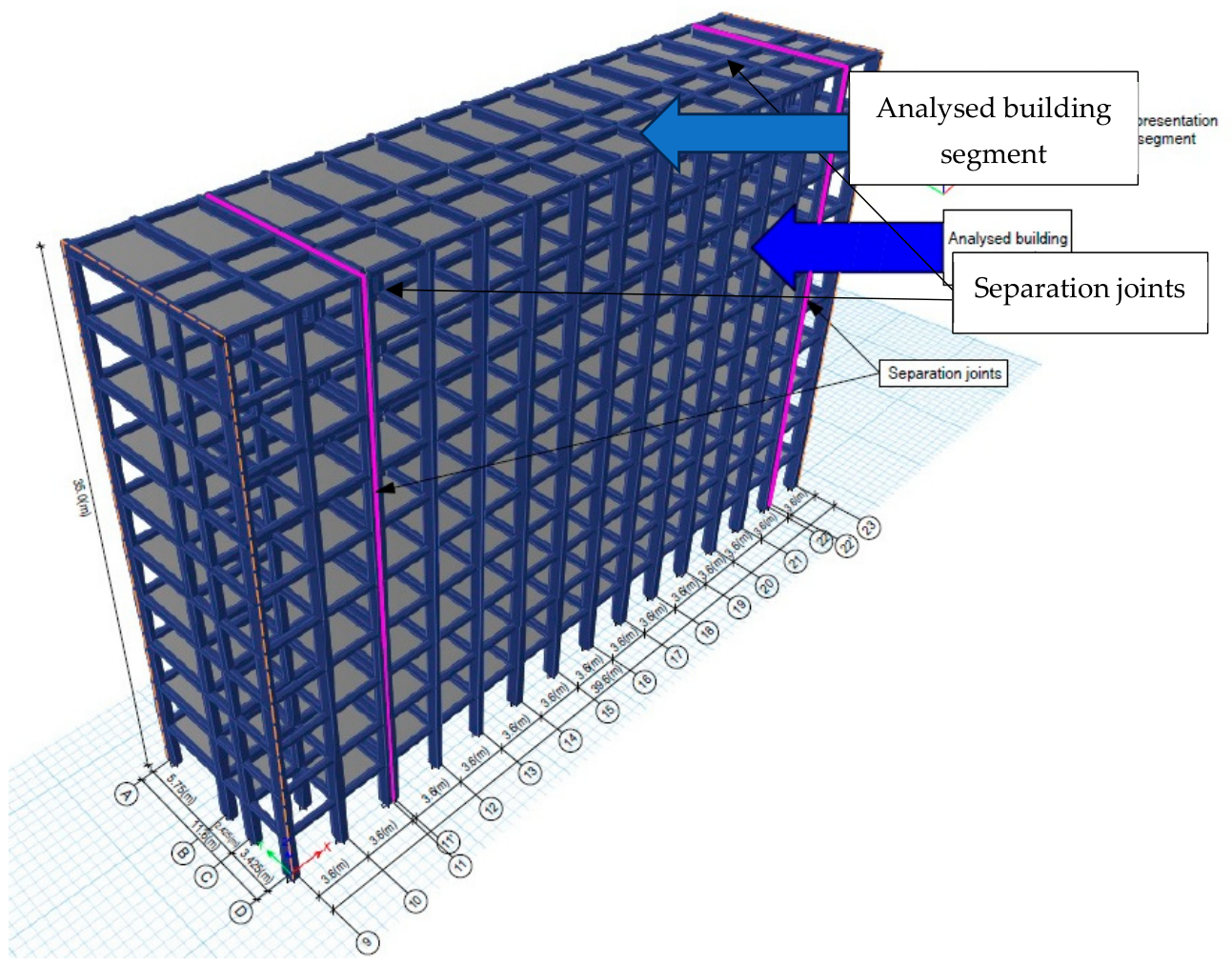
The analysed structure corresponds to an interior structural segment of a building located in Romania, composed of six structural modules separated by seismic separation joints. The evaluation of the analysed segment was carried out using a dedicated structural design software (ETABS v20.0.0, CSI, Walnut Creek, CA, USA), in accordance with the main provisions of EN 1998-1 [
29] and P100-1/2013 [
30] for the seismic assessment of existing reinforced concrete buildings.
The presence of narrow separation joints between adjacent segments imposed significant constraints on the intervention strategy, especially in terms of controlling lateral displacements along the longitudinal direction of the building. In this context, the adopted consolidation solution, by attaching an exoskeleton, aims mainly to reduce relative displacements along the X direction in order to prevent potential interactions between adjacent segments during seismic action.
The geometry and positioning of the exoskeleton are therefore governed by actual geometric constraints rather than solely by theoretical structural optimization considerations. The implementation of the monolithic reinforced concrete external exoskeleton is connected to the existing structure through post-installed reinforcement bars designed in accordance with EN 1992-4 [
28] and EN 1992-1-1 [
31].
The structural analysis was performed under linear elastic conditions, in accordance with the preliminary design and comparative assessment stage required by the technical norms. Within the multicriteria analysis, the evaluation criteria are translated into quantifiable indicators. In the case of multi-storey structures subjected to seismic action, according to the norms, the commonly used performance indicators include: (i) the maximum lateral displacement at the top level, used for evaluating the global structural response; (ii) the maximum interstorey drift value, compared with the allowable limits specified by the current design codes; (iii) the variation in interstorey drifts along the building height, which allows the identification of possible deformation concentrations (soft storey effect); (iv) the fundamental vibration period, used as an indirect indicator of global stiffness and (v) the level of internal forces transferred between structural subsystems, particularly relevant in the case of structures strengthened using external systems.
The studies conducted mainly led to the evaluation of global lateral displacements and interstory displacements (relative displacements between levels), both for the existing structure and for the one with exoskeleton.
The three-dimensional model of the analysed segment is shown in
Figure 1, with the characteristics presented in
Table 1.
2.2. Adopted Exoskeleton Configuration
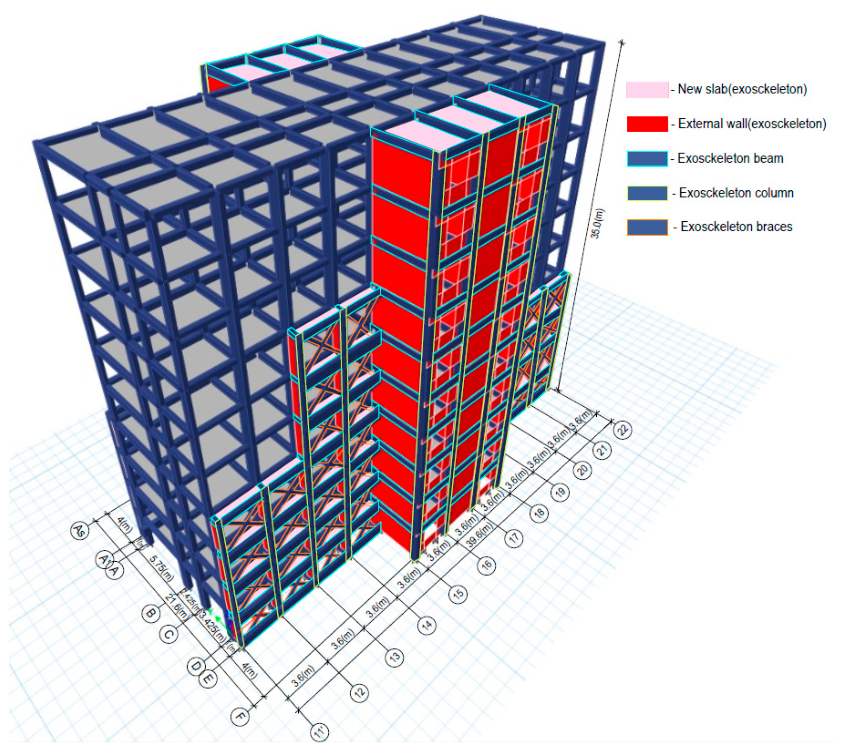
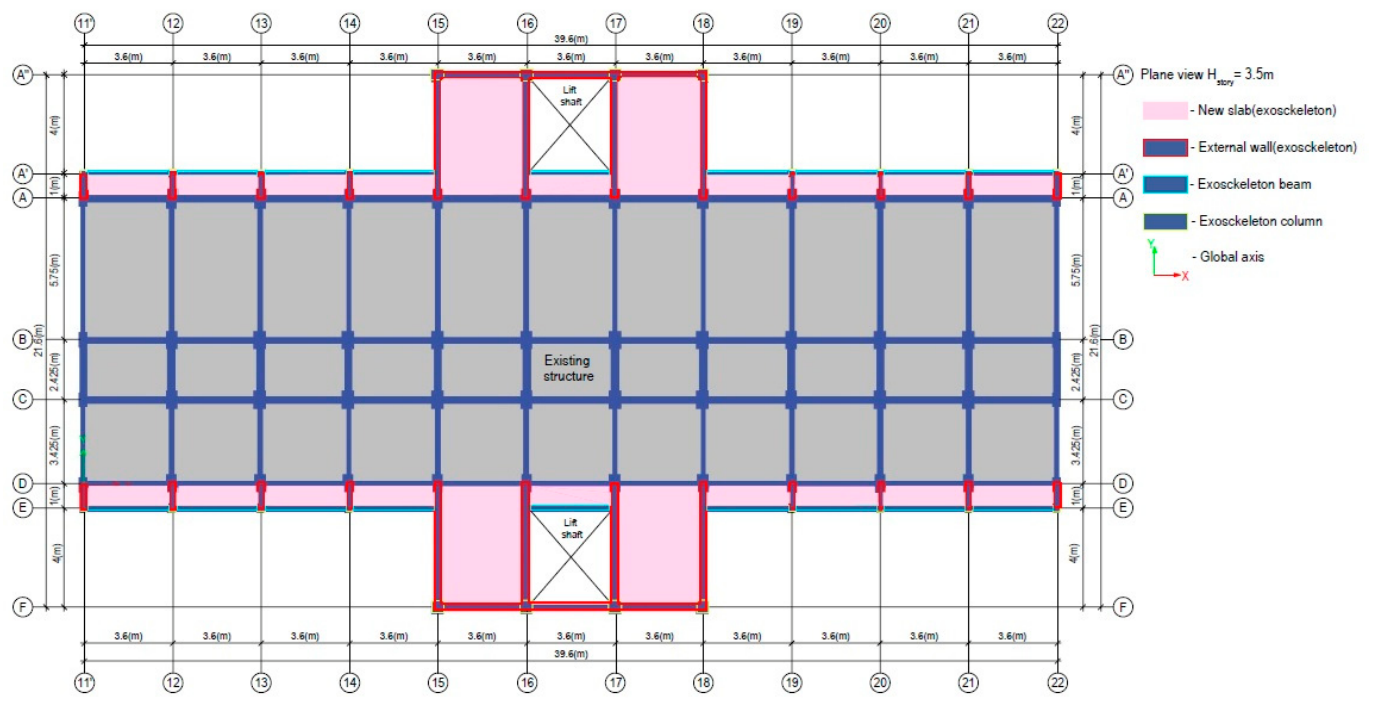
The exoskeleton was arranged along two opposite façades of the analysed segment, in the longitudinal direction of the building (X direction). The system was entirely cast in situ and consists of reinforced concrete frames combined with reinforced concrete structural walls, forming a dual structural system. The three-dimensional model of the retrofitted model with a reinforced concrete exoskeleton is presented in
Figure 2. The plan configuration and placement of the exoskeleton are shown in
Figure 3.
The characteristics of reinforced concrete exoskeleton are given in
Table 2.
The introduction of structural walls was not arbitrary but was driven by the need to significantly increase lateral stiffness in the critical direction, given that the intervention was limited to only two façades. Due to this geometric constraint, it was necessary to adopt elements capable of providing a substantial contribution to the global lateral resistance and reinforced concrete walls were identified as the most effective solution in this regard. Their high in-plane stiffness and capacity to resist both shear and bending actions make them particularly suitable for controlling lateral displacements and reducing deformation demands under seismic loading. The walls were selectively arranged at specific levels, avoiding excessive increases in mass and additional gravity demands, while ensuring the targeted displacement performance was achieved.
The existing structure consists exclusively of reinforced concrete frames. The exoskeleton operates as an added structural subsystem, supported by its own foundations independent of the existing infrastructure. In the present study, the modelling focuses on the behaviour of the superstructure, without detailing the analysis of the new foundations or the soil–structure interaction.
2.3. Interaction Principle Between the Existing Structure and the Exoskeleton
The composite action between the existing structure and the exoskeleton is achieved at each floor level where the exoskeleton is present, through post-installed reinforcement bars. The transfer of global shear forces between the two systems is predominantly carried out through the floor diaphragms.
The structural modelling was performed using semi-rigid diaphragms to capture a realistic in-plane force distribution and to avoid the assumption of artificially rigid floor levels. The joints between the existing structure and the exoskeleton were modelled as common nodes, an assumption that implies displacement compatibility at the interface.
This approach enables the evaluation of the global demand transmitted at the interface, while the internal forces extracted through local Section Cut procedures are subsequently used for the design of the connections, in accordance with the provisions of EN 1992-4 [
28].
Unlike retrofitting systems based on prefabricated prestressed frames developed and implemented in Japan [
12], the solution proposed in the present study relies on a monolithic reinforced concrete system connected to the existing structure through post-installed reinforcement bars. In this configuration, the floor diaphragms act as load distribution elements between the two structural systems, providing a higher degree of continuity but also increasing the complexity of the interaction mechanisms at the interface, particularly under seismic loading. This approach introduces a higher degree of continuity but also increases the complexity of the interaction mechanisms at the interface, particularly under seismic load conditions.
The adopted approach emphasizes the analysis of local force transfer mechanisms and the hierarchy of connection types, in correlation with the enhancement of the global structural performance, to capture the multi-scale nature of composite action. This hierarchical perspective has significant importance, as the efficiency of the retrofit solution depends not only on the individual performance of each connection component, but also on their coordinated behaviour within the overall structural system. By explicitly linking local connection behaviour to global structural response, the proposed approach enables a more comprehensive assessment of performance.
3. Structural Modelling and Methodology for Internal Force Evaluation
3.1. Structural Modelling in ETABS Software
The numerical modelling was performed using specialised integrated structural analysis and design software ETABS v20.0.0, CSI, Walnut Creek, CA-USA. through the development of two distinct three-dimensional models: the initial structural model (existing structure) and the retrofitted structural model, including the reinforced concrete exoskeleton.
The existing structure was modelled as a reinforced concrete frame system, using frame elements for beams and columns and shell elements for floor slabs. The diaphragms were defined as semi-rigid to allow a realistic in-plane force distribution and to avoid artificial stiffening of the floor levels.
The structural analysis was performed using linear response spectrum analysis, in accordance with EN 1998-1 [
29] and the national code P100-1/2013 [
30], employing bidirectional seismic load combinations. For the retrofitted model, a behaviour factor q = 5 was adopted, corresponding to a dual structural system (reinforced concrete frames + walls).
The main characteristics of the initial model are summarized in
Table 3.
The retrofitted model includes the exoskeleton arranged along two façades, consisting of reinforced concrete frames and structural walls connected to the existing structure at floor level through post-installed reinforcement bars fastened with adhesive anchor systems [
32]. The joints between the existing and the new structure were modelled as common nodes, implying displacement compatibility at the interface. The connection between the existing structure and the exoskeleton was modelled by means of common nodes at the interface, which implies full displacement compatibility and no relative slip between the two systems. This modelling assumption reflects an ideal composite behaviour, in which the floor diaphragms ensure the effective distribution of horizontal forces and enable the engagement of the external system in the global structural response.
The main characteristics of the retrofitted model are presented in
Table 4.
In the modelling process, the exoskeleton foundations were conceptually considered independent from the existing infrastructure; the analysis presented herein focuses exclusively on the behaviour of the superstructure.
3.2. Procedure for Internal Force Extraction Using the Section Cut Method
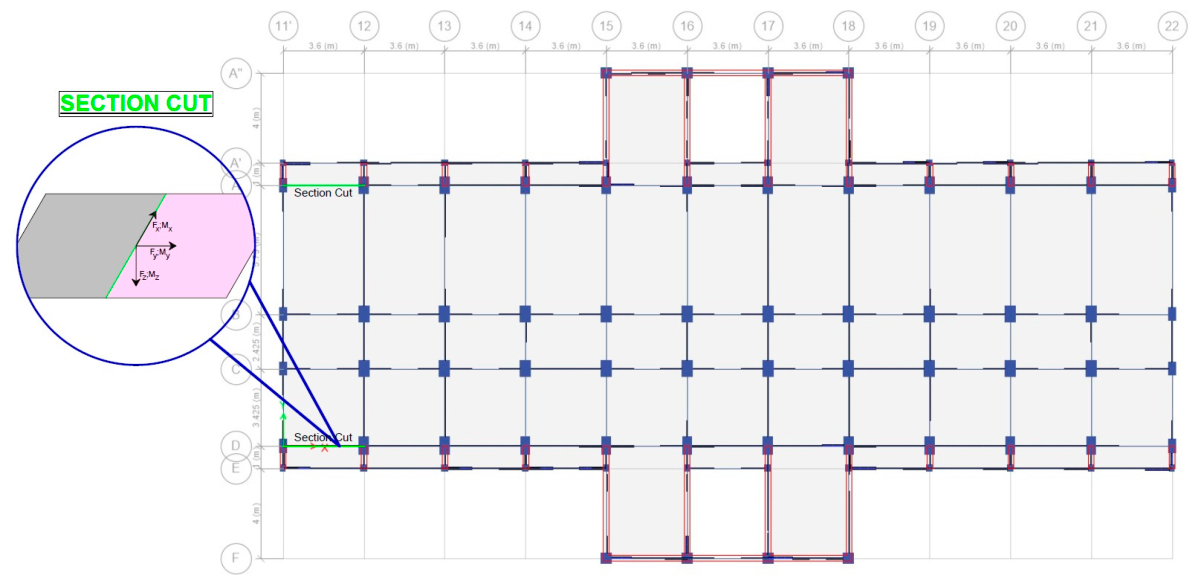
To enable the integration of internal resultants from the structural elements directly involved in force transfer, namely the relevant beams, columns, walls, and slabs, thus providing a consistent evaluation of the global forces and bending moments transmitted through the interface, the internal forces at the connection between the existing structure and the exoskeleton were determined through the definition of local Section Cut regions. These regions were strategically positioned at the composite action zones, where the interaction between the two structural systems is most significant, as illustrated in
Figure 4.
In the local coordinate system of the Section Cut, the results are provided in terms of internal forces (Nx, Ny, Nz) and internal moments (Mx, My, Mz). These components are used for the design of the connections, depending on the type of interface considered.
For each of the three analysed interface types, the maximum absolute values of the internal forces and moments resulting from the governing seismic load combinations were considered.
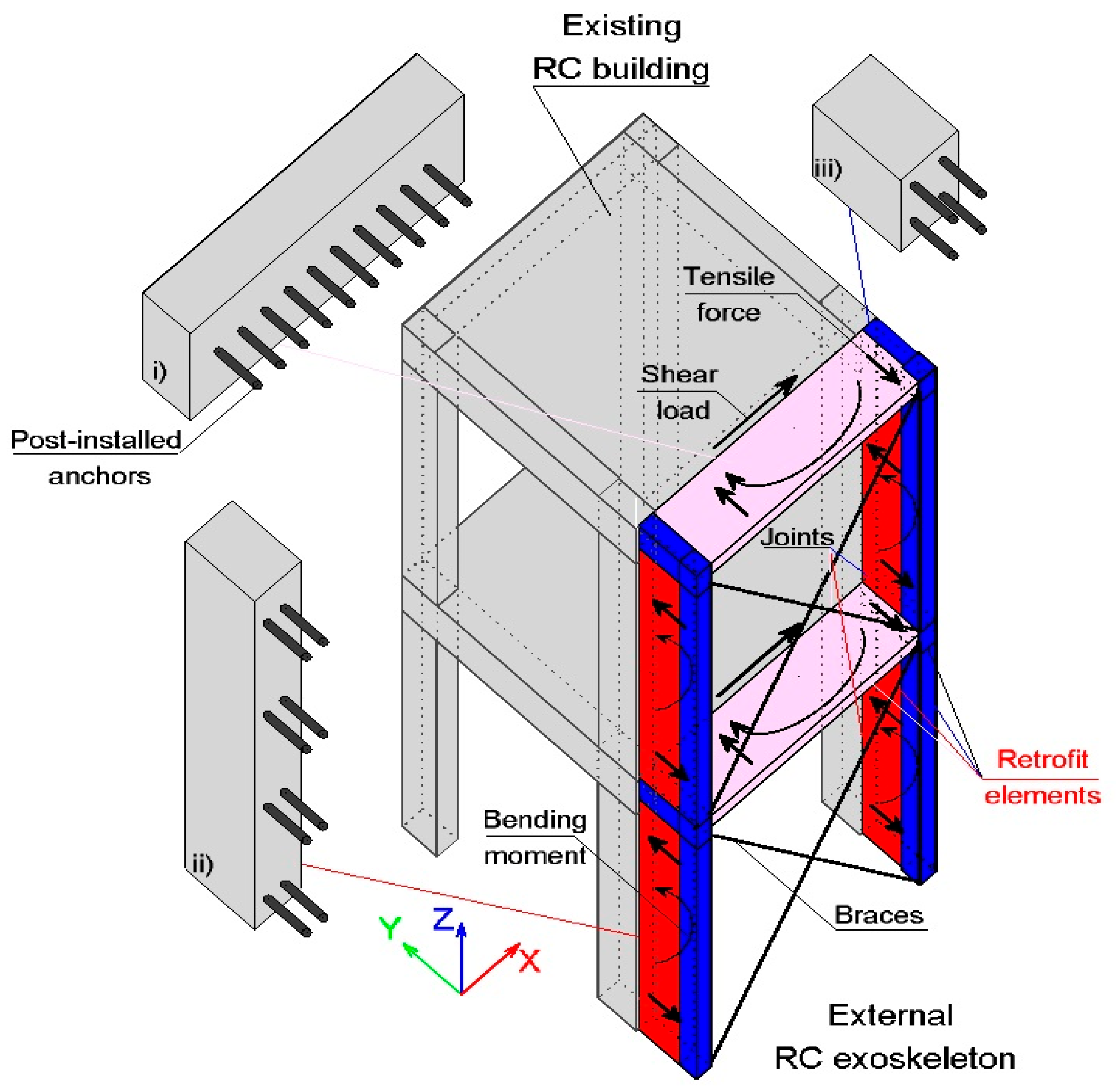
The analysis of the structural connections was carried out for three distinct interface types identified in the composite action zone between the existing structure and the exoskeleton (
Figure 5):
- (i)
Existing slab-to-new slab interface;
- (ii)
Existing column–to-new external wall interface;
- (iii)
New beam–to-existing column joint interface.
The Section Cut region selected for the detailed analysis of interface forces is positioned at elevation z = 3.50 m, corresponding to the first floor level, at the axis characterised by the minimum existing column cross-section (35 × 65 cm). This choice was deliberately governed by constructive rather than purely structural criteria. Along the longitudinal direction of the building, the existing column cross-sections vary significantly: columns located at the seismic separation joint axis (axis 11′ and its symmetric counterpart, axis 22) have the minimum width of 35 cm, whereas columns on the remaining axes reach widths of up to 45 cm at ground level. Since the exoskeleton wall thickness was kept constant at 25 cm across all levels—a value constrained by the minimum available column width at the seismic gap—the selected axis represents the most restrictive condition from an execution standpoint. In terms of force demand, the analysed axis does not correspond to the most critical location: axes 15 and 18 (symmetric) govern the force distribution, followed by axes 16 and 17, with axis 11′ ranking third in order of severity. Nevertheless, this axis was selected as the basis for the connection design exemplification because it reflects the geometrically most constrained condition, where the available anchoring width is minimum. It is emphasized that in a real design scenario, each interface node must be verified individually, as the internal forces vary along the building length. The diameter and anchorage length of the post-installed bars may be adjusted at each node to satisfy the local demand, the goal being to maintain a consistent and practically executable anchoring layout throughout the exoskeleton.
3.3. Correlation Between Global Internal Forces and Local Demands in Anchor Groups
The global internal forces extracted using the Section Cut method were employed to evaluate the demands in the post-installed anchor groups, assuming a linear distribution of normal stresses over the effective height of the interface.
The axial force in each anchor was determined using the classical elastic model for anchor groups subjected to combined axial force and bending moment (
N +
M), based on the assumptions of strain compatibility and equal stiffness of the connectors [
33,
34].
where
- −
represents the design axial force extracted through the Section Cut;
- −
represents the design bending moment in the plane of the interface;
- −
represents the maximum force in anchor;
- −
is the total number of anchors in the group;
- −
is the distance of each anchor from the centroid of the group;
- −
represents the sum of the squared distances of all anchors from the centroid of the group.
The shear force component was distributed uniformly within the anchor group, assuming elastic behaviour and comparable stiffness of the connectors. The stress distribution in the anchor group under the combined axial force through the Section Cut and bending moment in the plane of the interface is conceptually depicted in
Figure 5.
4. Design and Analysis of Structural Connections
4.1. Interfaces Analysis Numerical Results
The results were derived through numerical simulations conducted in ETABS v20.0.0 (CSI, Walnut Creek, CA-USA).
Details about making the connection with anchors (no. of anchors, diameter spacing used, and anchorage length,
Lv) and the maximum design values of the internal forces and moments obtained for each type of interface analysed are summarized in
Table 5.
The global internal forces were extracted using the Section Cut method over a representative region located at elevation z = 3.50 m, including exclusively the structural elements directly involved in force transfer.
Regarding the beam-column joint interface, the internal forces were determined based on the seismic and gravitational load combinations relevant for the serviceability limit state, and the combination generating the maximum effects in the analysed interface was selected.
The local demands in the anchor groups were evaluated using the elastic model for anchor groups subjected to combined N + M actions, based on the assumption of linear strain distribution and on the conditions of compatibility and equilibrium [
33,
34]. The maximum force in the outermost anchor was determined using the elastic model based on a linear distribution of stresses within the anchor group [
33,
34,
35].
The resistance verifications were performed in accordance with EN 1992-4 [
18], EN 1992-1-1 [
21], and the European Technical Assessment documents for chemical anchors (ETA Sika AnchorFix) [
35]. The
NRd,i represents the pull-out resistance governed by bond, according to EN 1992-4 and ETA [
28,
35].
The existing-to-new slab interface was analysed over an effective length of Lef = 3.20 m, including exclusively the structural elements directly involved in force transfer.
Table 6 highlights the connection type configurations and the numerical maximum force in each anchor,
NEd,i,max, calculated with Equation (1) using the forces and moments presented in
Table 5.
- (i)
For the existing slab-to-new slab interface the values extracted through the Section Cut indicate significantly higher levels of in-plane forces and in-plane rotational moment compared to the other two analysed types.
This observation confirms that the primary transfer of seismic actions between the existing structure and the exoskeleton is achieved through the floor diaphragms (slabs).
From a mechanical standpoint, the floor slabs act as force redistribution layers, generating:
Consequently, the reinforced concrete slabs become the dominant load transfer path for horizontal actions and the key element of the global composite mechanism. The order-of-magnitude difference between the demands in the slab-to-slab connection and those identified in the vertical or nodal connections confirms this mechanical hierarchy.
- (ii)
In the case of the existing column-to-new external wall interface the shear verification indicated that the friction mechanism at the interface does not govern the design. The dominant demand is governed by the axial force–bending moment interaction, consistent with the identified global mechanism.
- (iii)
The obtained values for the new beam-to-existing column joint interface are significantly lower than those corresponding to the slab-to-slab interface, confirming the secondary structural role of this connection.
4.2. Numerical Results Synthesis and Structural Interpretation
The numerical comparison of the results obtained for the three connection types highlights a differentiated distribution of internal forces or moments, and a distinct structural role of each interface within the global composite mechanism.
The results indicate that there are:
maximum demands in the existing slab-to-new slab interface (moment up to 262 kNm and a utilization ratio of 0.73);
significant axial and bending demands in the existing column-to-new external wall interface, yet with a resistance reserve (η ≈ 0.95);
reduced demands in new beam-to-existing column joint interface (η ≈ 0.68).
The correlation of the three connection types leads to the following structural interpretation:
The exoskeleton interacts with the existing structure predominantly through the floor diaphragms;
The existing column-to-new external wall and new beam-to-existing column joint interfaces primarily ensure kinematic compatibility between the existing structure and the exoskeleton, transferring axial and bending effects resulting from the global redistribution of internal forces;
The direct shear detachment mechanism at the existing column-to-new external wall interface is not governing;
The new beam-to-existing column joint interfaces play a secondary structural role within the global mechanism.
Therefore, the relatively low shear force observed in the existing column-to-new external wall connection represents a consequence of the actual force redistribution mechanism rather than a limitation of the adopted analytical model. The identified mechanical hierarchy confirms that system performance is controlled by diaphragm coupling, and the design of connectors should primarily focus on the slab-to-slab interface, without overestimating the role of shear in vertical interfaces.
5. Global Performance Assessment
The introduction of the reinforced concrete exoskeleton leads to a significant modification of the dynamic structural response, primarily through an increase in global stiffness and a redistribution of seismic demand. The presence of the external structural system enhances the lateral load-resisting mechanism, resulting in a more efficient transfer of seismic forces and a reduction in deformation demands on the existing structure.
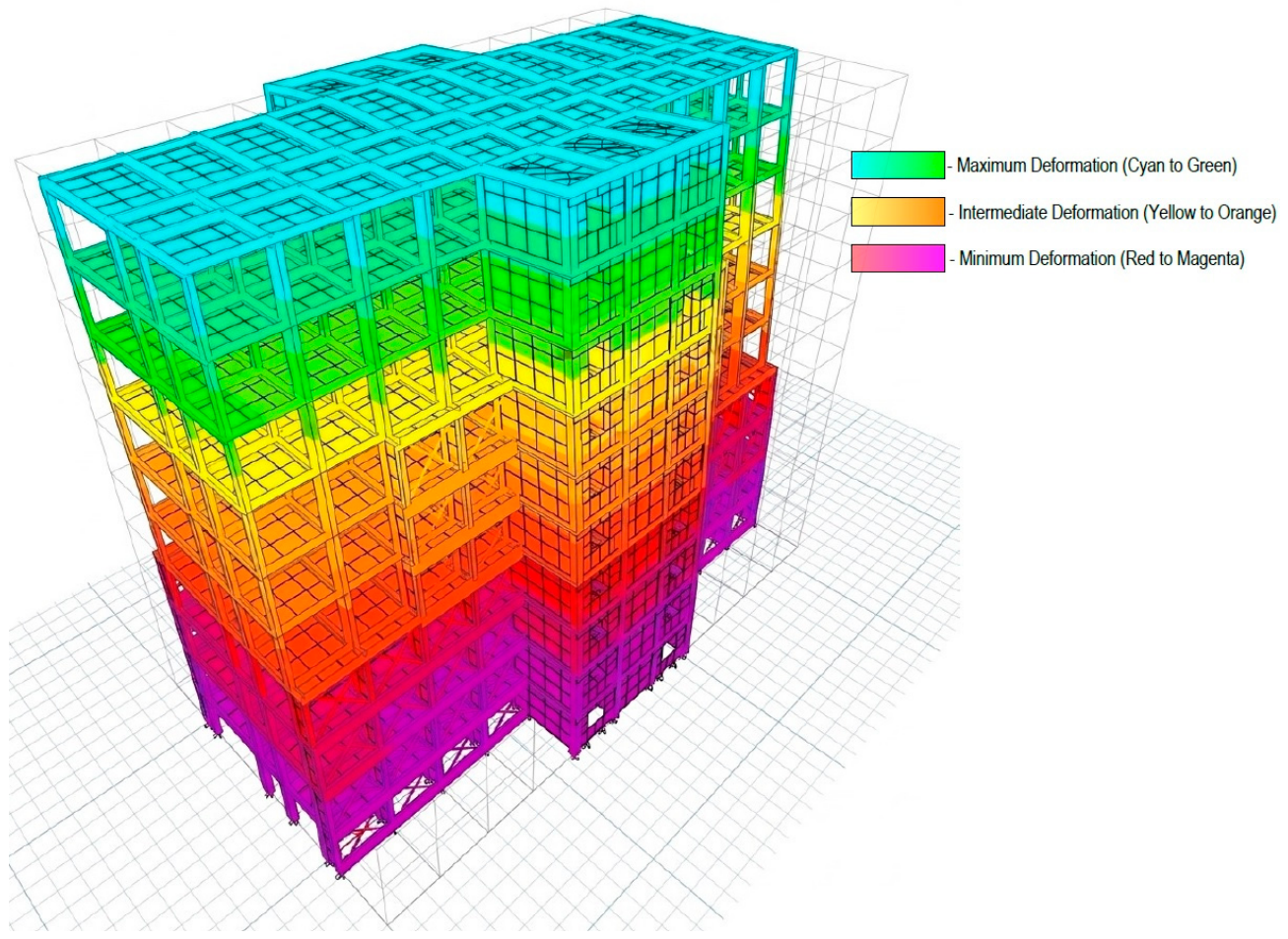
An important indicator of this improvement is the substantial reduction in the fundamental vibration period, which decreases from T1 = 2.06 s in the initial configuration to T1 = 0.731 s in the retrofitted system, corresponding to a reduction of approximately 65% and reflecting a marked increase in global lateral stiffness. The shift toward shorter vibration periods also implies a modification of the structure’s position on the design response spectrum, leading to a different distribution of seismic forces and generally lower displacement demands. The first vibration mode of the retrofitted structure is illustrated in
Figure 6. The deformed shape confirms a globally regular behaviour, characterised by a progressive increase in lateral displacement from the base toward the top level, without significant torsional components, with a translational mode along the Y direction. This modal response is consistent with the dual structural system configuration of the exoskeleton, in which the reinforced concrete walls provide the dominant lateral stiffness contribution.
The effectiveness of the retrofit solution is further confirmed by the comparative results summarised in
Table 7 and
Table 8. Along the X direction, the maximum lateral displacement decreases from 191.87 mm to 48.39 mm, while the maximum interstorey drift is reduced from 27.51 mm to 11.96 mm. Along the Y direction, the displacement decreases from 215.96 mm to 157.01 mm, and the drift from 28.51 mm to 24.73 mm. It is noted that the existing structure exceeds the SLS displacement limit of 175 mm on both principal directions, confirming the necessity of the consolidation intervention. The retrofitted structure satisfies the displacement limit along the X direction, with a value of 48.39 mm, while along the Y direction the recorded value of 157.01 mm remains below the admissible threshold of 175 mm, but with a reduced safety margin. The interstorey drift values for both configurations remain within the ULS admissible limit of 87.5 mm (corresponding to 0.025 × h, with h = 3500 mm [
30]). However, the significant reductions observed after the introduction of the exoskeleton confirm the improvement in deformation control and the reduction in the risk of soft-storey mechanisms. The more pronounced reduction along the X direction is consistent with the spatial configuration of the exoskeleton, in which the reinforced concrete walls provide a substantially higher lateral stiffness contribution along the longitudinal direction. The comparative results are presented in
Table 7 and
Table 8.
The more pronounced reduction along the X direction suggests that the exoskeleton provides a higher contribution to stiffness in this direction, likely due to the configuration and continuity of the reinforced concrete walls. This directional efficiency highlights the importance of the spatial arrangement and connectivity of the exoskeleton elements in governing the overall structural response. The exoskeleton-type system shows significant potential in controlling lateral displacements, particularly along the longitudinal direction, where the additional stiffening provided by the reinforced concrete walls leads to a substantial reduction in drift and global displacements.
These results show the effectiveness of the exoskeleton-type retrofit system in enhancing global seismic performance. The significant reductions in both interstorey drift and top displacements confirm its capacity to control lateral deformations, while the modification of the dynamic characteristics indicates a more robust and stable structural behaviour under seismic loading.
6. Discussion
The study investigated the global and local behaviour of a reinforced concrete exoskeleton retrofit solution applied to an existing structure, through the evaluation of force transfer mechanisms and seismic performance before and after intervention.
The results of the present study are consistent with and further refine the literature on exoskeleton-based retrofit strategies, which show that external structural systems can significantly modify the global seismic response of existing buildings by increasing lateral stiffness and redistributing seismic demand [
13,
14,
15,
16].
The substantial reduction in the fundamental vibration period observed in this study, from 2.06 s to 0.73 s (a decrease of approximately 65%), confirms the stiffening effect of the reinforced concrete exoskeleton and aligns with previous findings showing that integrated retrofit solutions and advanced exoskeleton configurations improve dynamic response and structural efficiency [
14,
17,
18].
The significant reductions in interstorey displacements, reaching approximately 56.5% along the X direction and 13.3% along the Y direction for interstorey drift, and approximately 74.8% along X and 27.3% along Y for maximum lateral displacements, are in agreement with experimental and numerical studies, which consistently confirm the effectiveness of such systems in reducing lateral deformations and enhancing seismic resistance [
19,
20,
36,
37]. These improvements can be interpreted as a direct consequence of both increased stiffness and enhanced load redistribution mechanisms, as emphasized in performance-based design approaches [
18]. From a broader perspective, these results reinforce the role of exoskeletons as efficient retrofit solutions capable of improving both safety and serviceability in existing structures.
Beyond global performance, the present study provides additional insight into the mechanisms governing force transfer, which are often only implicitly addressed in previous works. The current findings show that seismic force transfer is primarily governed by diaphragm coupling, while vertical interfaces mainly ensure compatibility and redistribution of axial and bending effects. This hierarchical interpretation extends the conceptual understanding proposed in earlier studies and clarifies how composite action is achieved in practice.
The results highlight that shear detachment at the interface between the existing columns-to-new exterior wall is not a determining mechanism of failure and aligns with the approach in the literature [
13,
15], according to which connection systems spread over the entire contact surface ensure a uniform distribution of forces and reduce the risk of brittle failure at the interface. This supports the working hypothesis that local failure modes do not control the overall structural response. At the same time, it highlights the importance of execution quality, particularly regarding post-installed anchors and connection detailing, which are recognized for ensuring reliable composite behaviour [
20]. The actual performance of the system depends on strict compliance with installation procedures for post-installed anchors, including drilling, hole cleaning, and adhesive injection, in accordance with the relevant technical documentation and approvals [
32].
A significant methodological contribution of this study is the use of the Section Cut approach within a linear response spectrum framework to identify dominant force transfer paths. While previous studies have mainly relied on global response indicators or advanced nonlinear analyses [
17,
18], the present approach provides a transparent and rational method for linking local internal forces to global structural behaviour.
7. Conclusions
This study broadens the existing understanding of exoskeleton-based seismic strengthening strategies. It offers new perspectives on the function of the anchorage system connecting the exoskeleton to the existing structure, while also emphasizing the efficiency of reinforced concrete exoskeletons in limiting seismic displacements in existing buildings.
The results presented in
Section 4 indicate a non-uniform distribution of internal forces among the three analysed connection types. The order-of-magnitude differences between the slab-to-slab interface and the vertical interfaces reveal the existence of a dominant load transfer path for seismic actions.
From a systemic perspective, the interaction between the existing structure and the exoskeleton is predominantly governed by diaphragm coupling, while the existing column-to-new external wall and new beam-to-existing column joint interfaces primarily contribute to ensuring kinematic compatibility and redistributing axial and bending effects resulting from the global structural response.
This mechanical hierarchy explains both the substantial reduction in interstorey drift and global displacements (
Section 5) and the non-critical nature of shear at the existing column-to-new external wall interface. The direct shear detachment mechanism is not governed under the adopted analytical assumptions, and the local new beam-to-existing column connections play a secondary structural role within the global mechanism.
The analysis was performed using linear response spectrum procedures, assuming ideal connections and globally elastic behaviour. This approach allows the identification of dominant force transfer paths and the establishment of the hierarchy of relevant connections; however, it does not explicitly capture nonlinear phenomena such as:
interface slip;
adhesive degradation in the case of chemical anchors;
cyclic stiffness reduction;
progressive cracking of concrete in the anchorage zone.
The Section Cut method provides integrated resultants at the interface level, suitable for design and relative comparisons, but does not allow investigation of three-dimensional local stress distributions or progressive failure mechanisms around each individual anchor.
Therefore, the conclusions should be interpreted within the framework of the adopted analytical assumptions, without extrapolating nonlinear behaviours that were not explicitly modelled.
Nevertheless, for the purpose of this study, namely identifying dominant mechanisms and evaluating the global efficiency of the intervention, the adopted model provides a coherent and mechanically consistent representation of the retrofitted system behaviour.
From an applied perspective, the analysed solution demonstrates that an external reinforced concrete exoskeleton intervention can substantially modify the global response of an existing building, significantly reducing both interstorey drift and maximum top displacements.
The adopted configuration enables retrofit execution exclusively from the exterior, without interrupting building operation, which is essential for structures with continuous occupancy. The solution is also adaptable to cases where the building is part of a complex composed of multiple segments separated by structural joints, and the diaphragm-based composite principle can be replicated in other seismic contexts, with appropriate adjustment of design parameters to local code requirements.
In addition, the proposed structural intervention can serve as a fundamental prerequisite for the subsequent implementation of energy efficiency measures, ensuring both the safety and long-term functionality of the building. By strengthening the existing structural system and improving its seismic performance through the introduction of an exoskeleton system, the building becomes more suitable for the integration of modern thermal insulation solutions, high-performance building envelopes, energy-efficient technical installations, and sustainable architectural strategies such as green façades supported by the exoskeleton structure. The use of the exoskeleton as a support for vegetated façades creates a multifunctional solution, combining structural reinforcement with environmental and architectural benefits. Green façades integrated on the exoskeleton not only enhance the visual identity of the building, but also improve thermal regulation, reduce solar gains, mitigate the urban heat island effect, enhance air quality, and contribute to urban biodiversity. This integrated approach is fully aligned with European sustainability objectives, which emphasize the reduction of carbon emissions and the decarbonization of the existing building stock, while promoting resilient, safe, and energy-efficient built environments.
Future research should therefore focus on extending the proposed methodology toward nonlinear global analyses, as well as detailed local modelling of anchor groups and interface behaviour. Large-scale experimental validation is also necessary to confirm the identified hierarchy of force transfer mechanisms and to better quantify the interaction between local and global responses under realistic loading conditions. Such developments would contribute to bridging the gap between analytical models and practical implementation, supporting the advancement of reliable and design-oriented guidelines for exoskeleton-based retrofit systems.





 ,
,