The Development and Optimization of Machine Learning Models for Predicting the Shear Capacity of Corroded Reinforced Concrete Beams

 ,
,  ,
,  ,
, 
 and
and
Abstract
1. Introduction
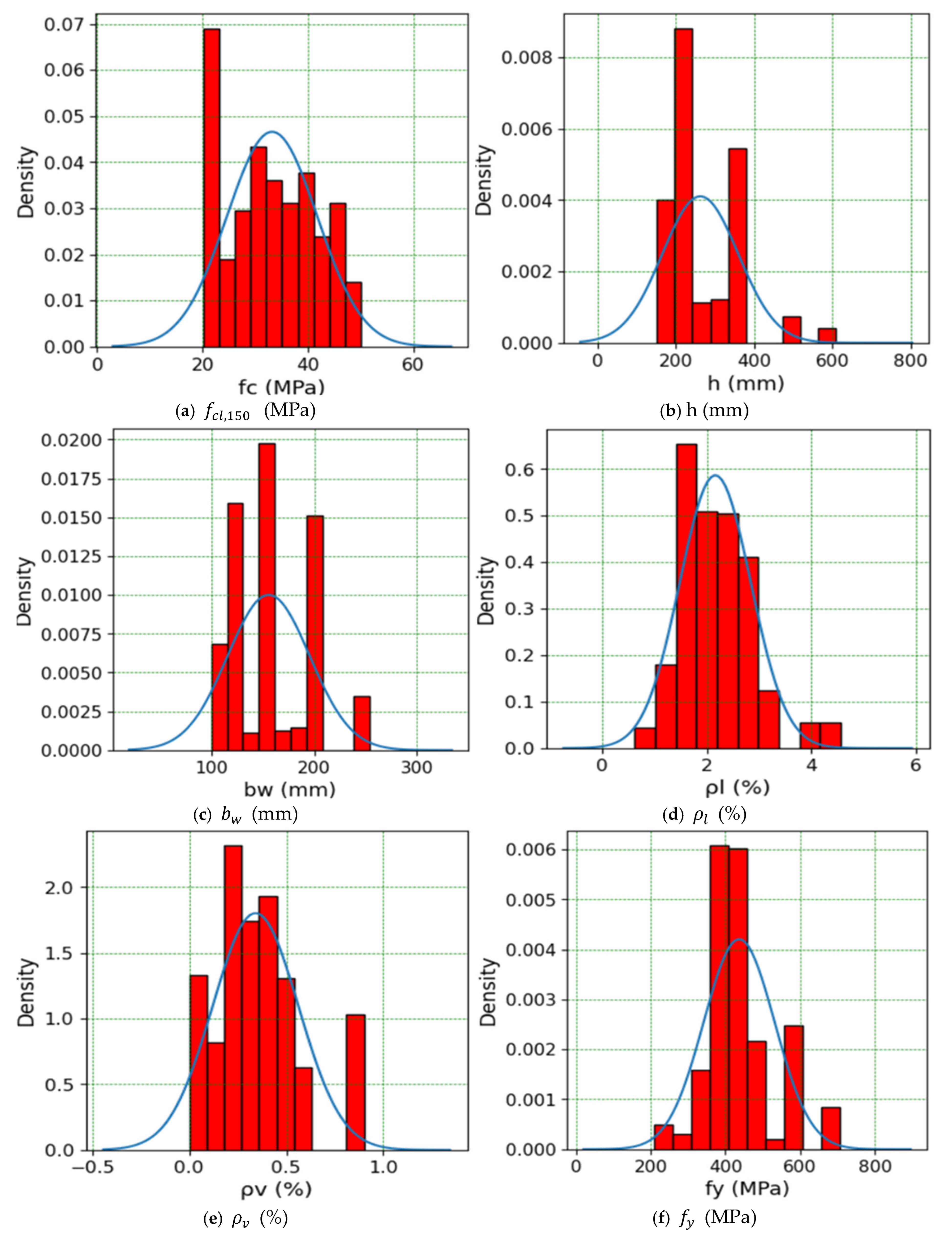
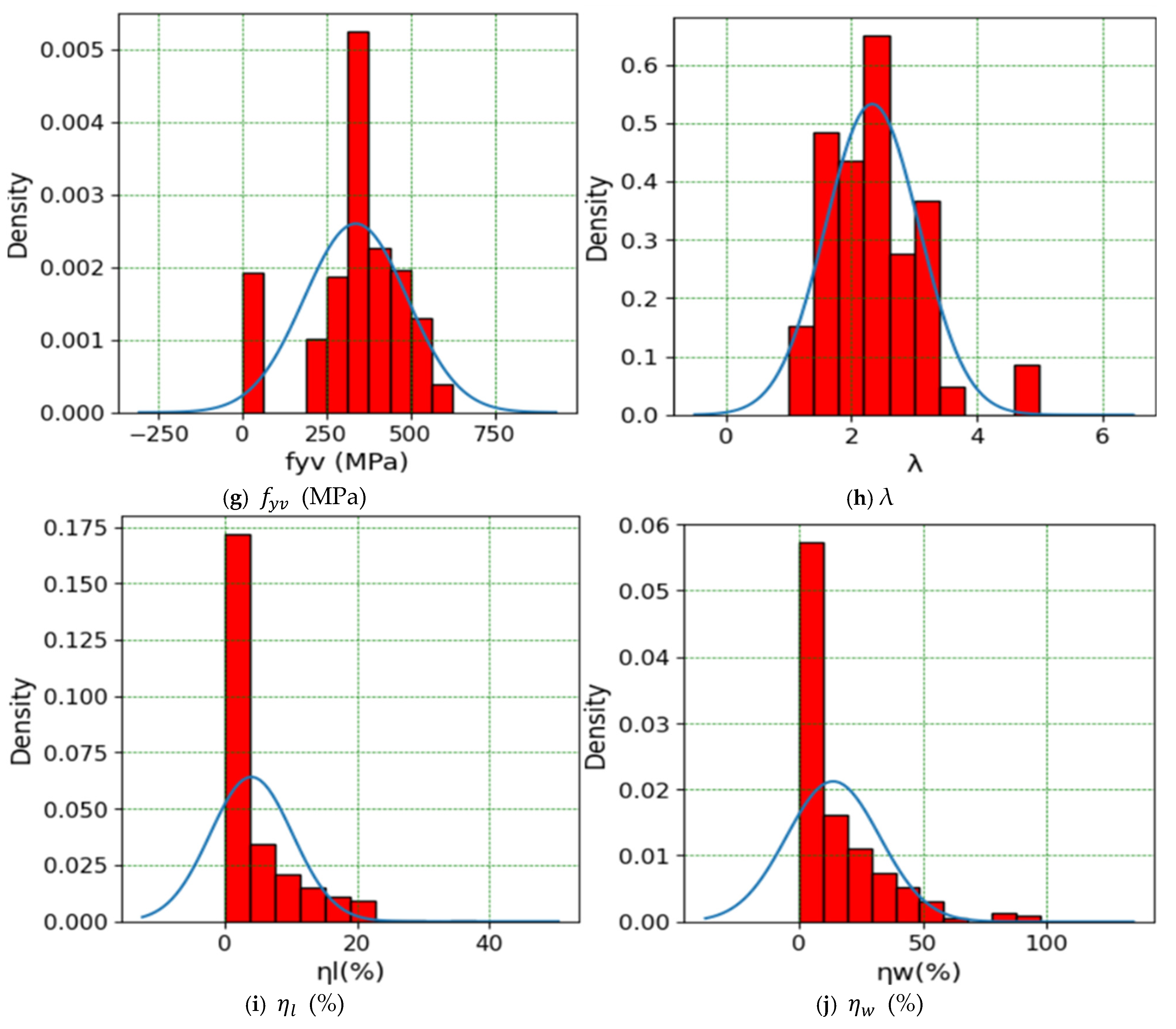
2. Experimental Data of CRCBs
3. ML-Based Predictive Models
3.1. Fundamentals of ML Techniques
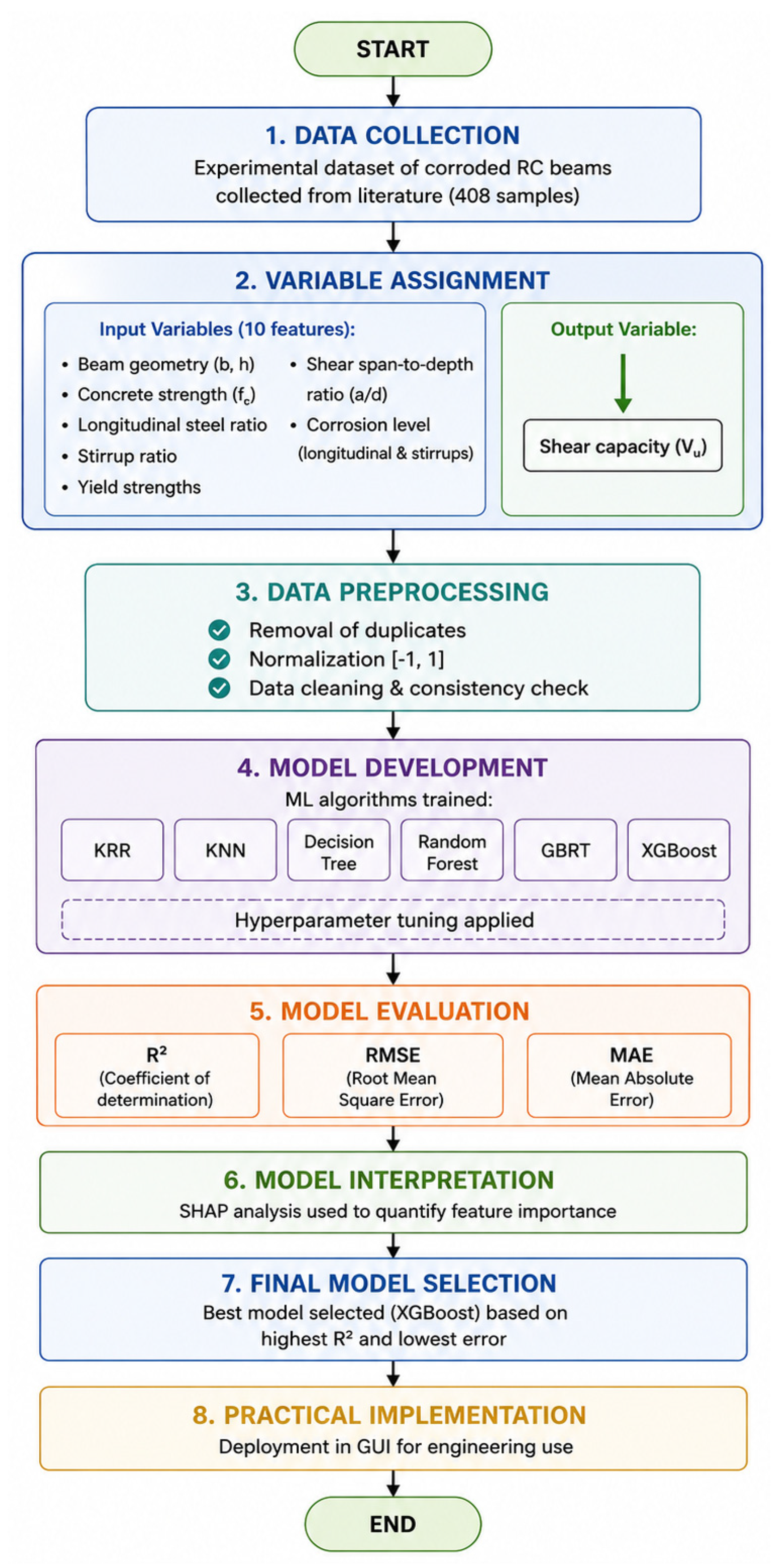
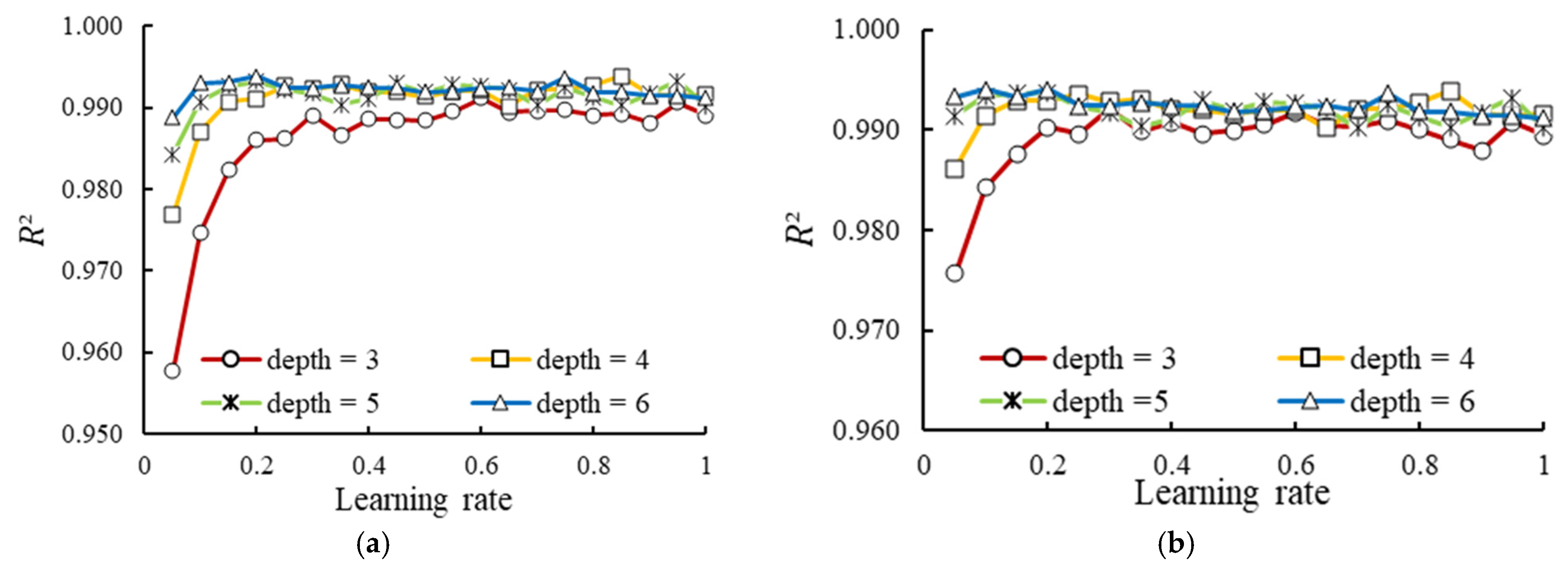
3.2. Construction of ML-Based Predictive Models
- ▪
- Split the training dataset into K non-overlapping folds of equal size, ensuring each observation participates exactly once in training and validation.
- ▪
- Train the model on K − 1 folds and validate using the remaining fold.
- ▪
- Perform this cycle K times to compute K performance measures.
4. Results and Discussion
4.1. Evaluation of Model Predictions
4.2. Comparison with Existing Analytical Models
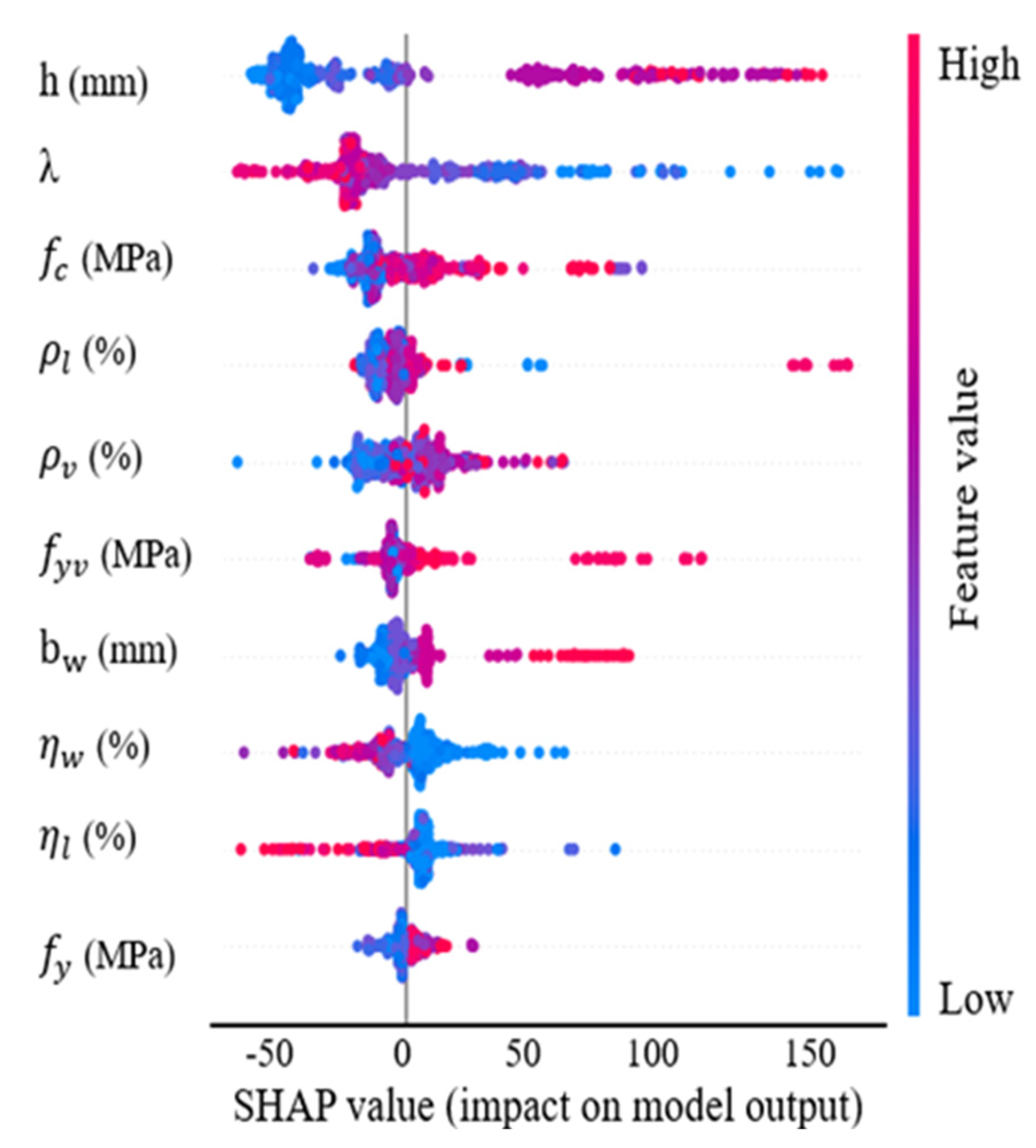
4.3. XGBoost Model Explainability Using SHAP Approach
4.4. Discussion and Comparative Analysis with Previously Developed XGBoost-Based Structural Models
4.5. Graphical User Interface
5. Parametric Study
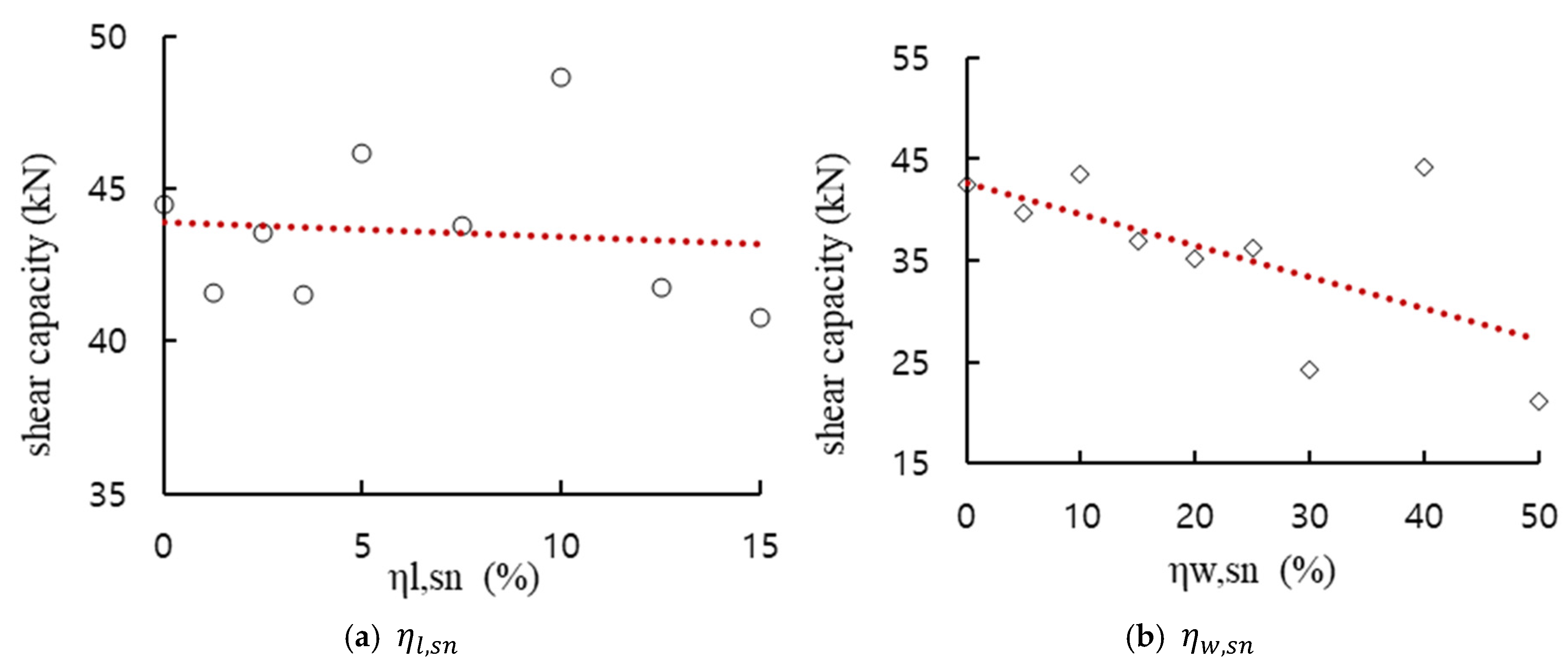
5.1. Longitudinal Reinforcement and Stirrups’ Corrosion Ratio
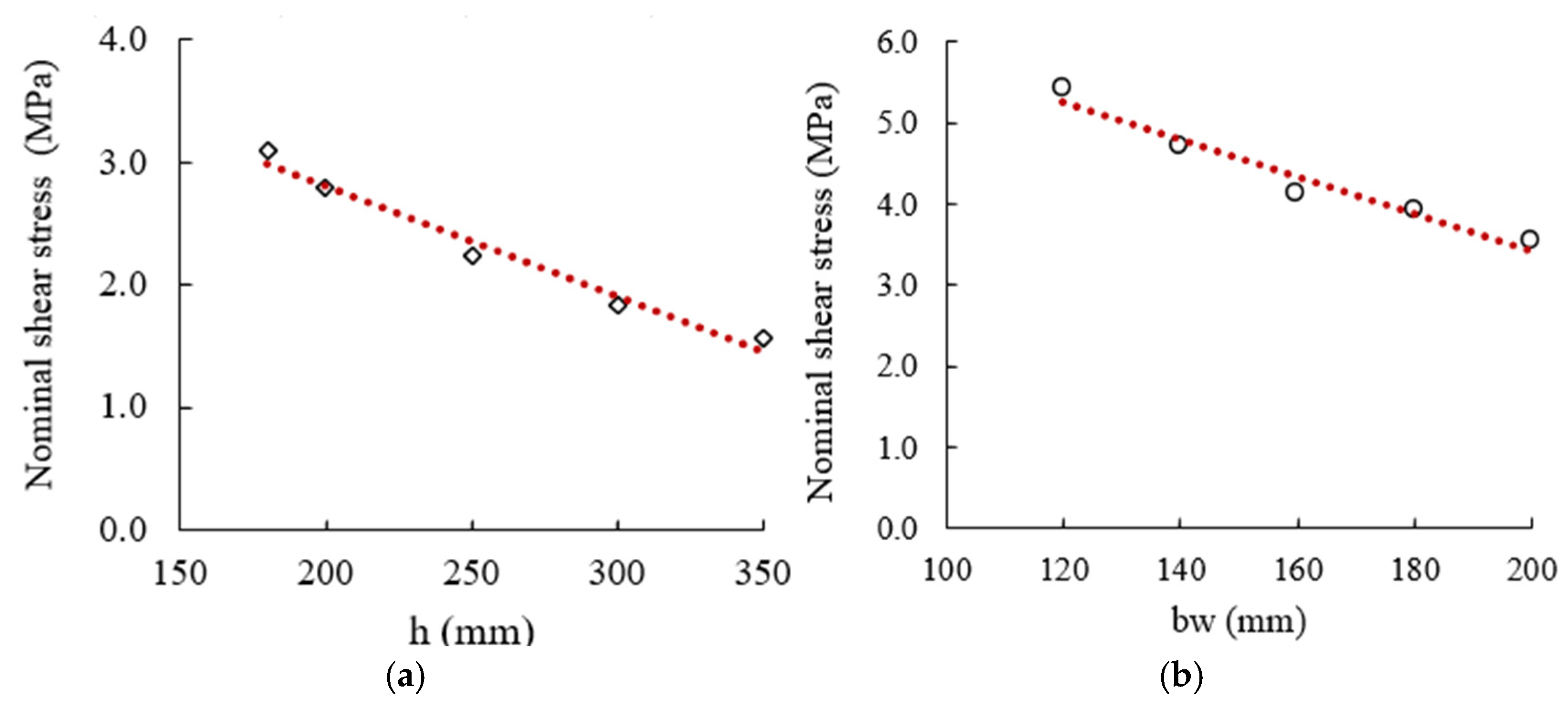
5.2. Effective Beam Depth and Beam Width
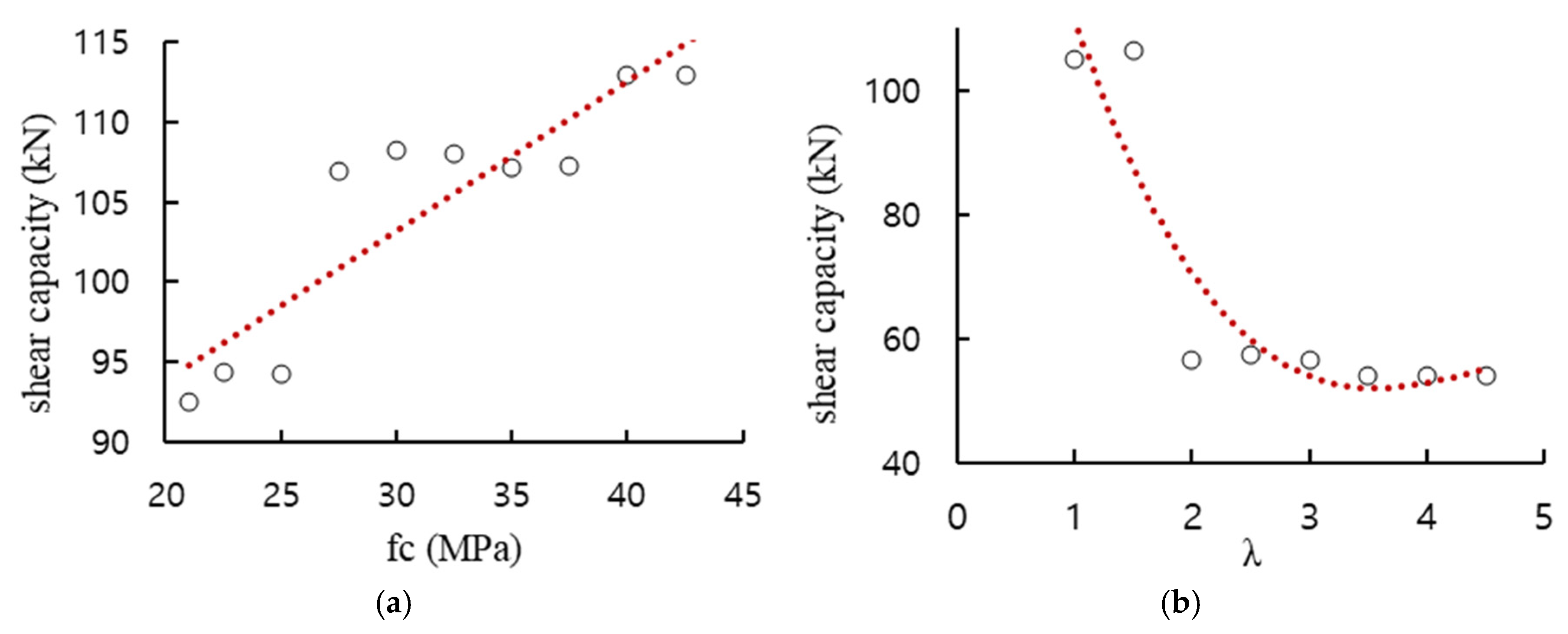
5.3. Concrete Strength and Shear Span-to-Depth Ratio
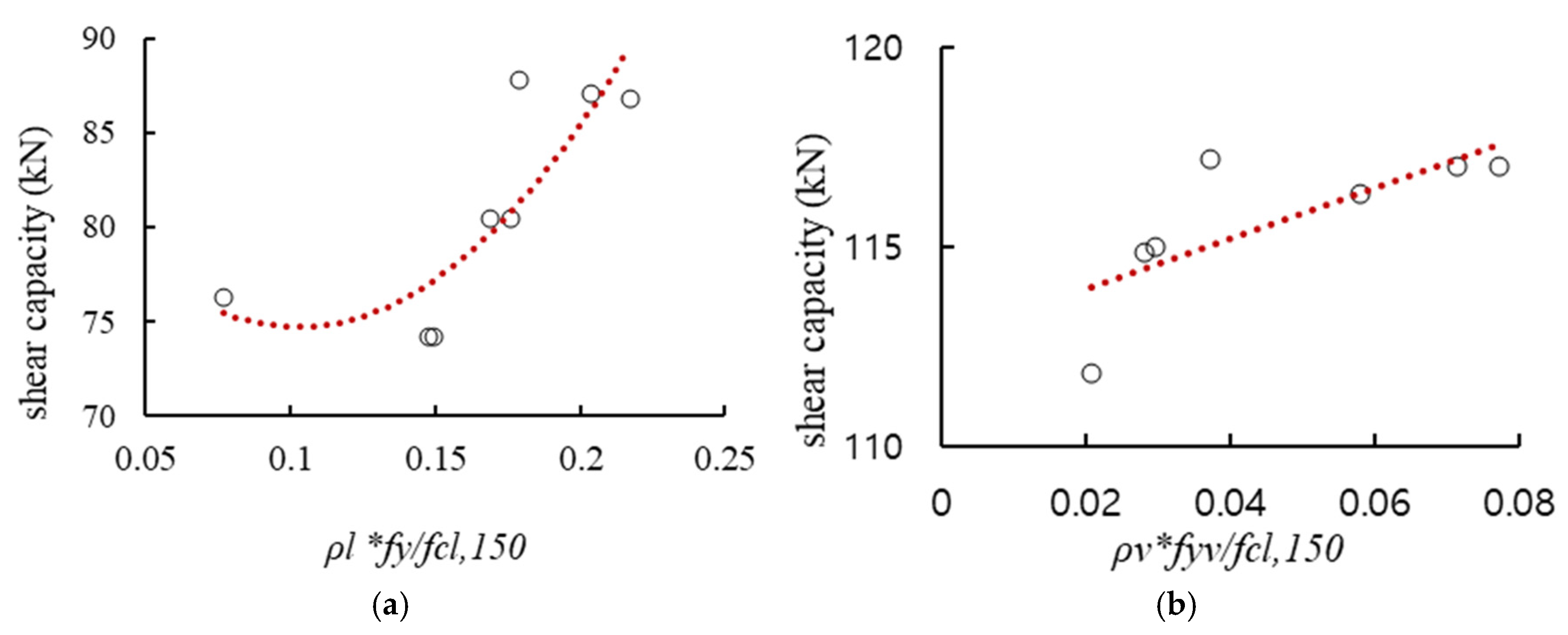
5.4. Longitudinal Reinforcements and Stirrups’ Normalized Strength
6. Conclusions
- Corrosion significantly reduces the performance of RC beams by decreasing reinforcement area, weakening bond strength, and causing brittle shear failure. The study confirms that beam depth, shear span-to-depth ratio, and concrete compressive strength are the key parameters controlling shear capacity degradation and corrosion-induced deterioration in reinforced concrete systems.
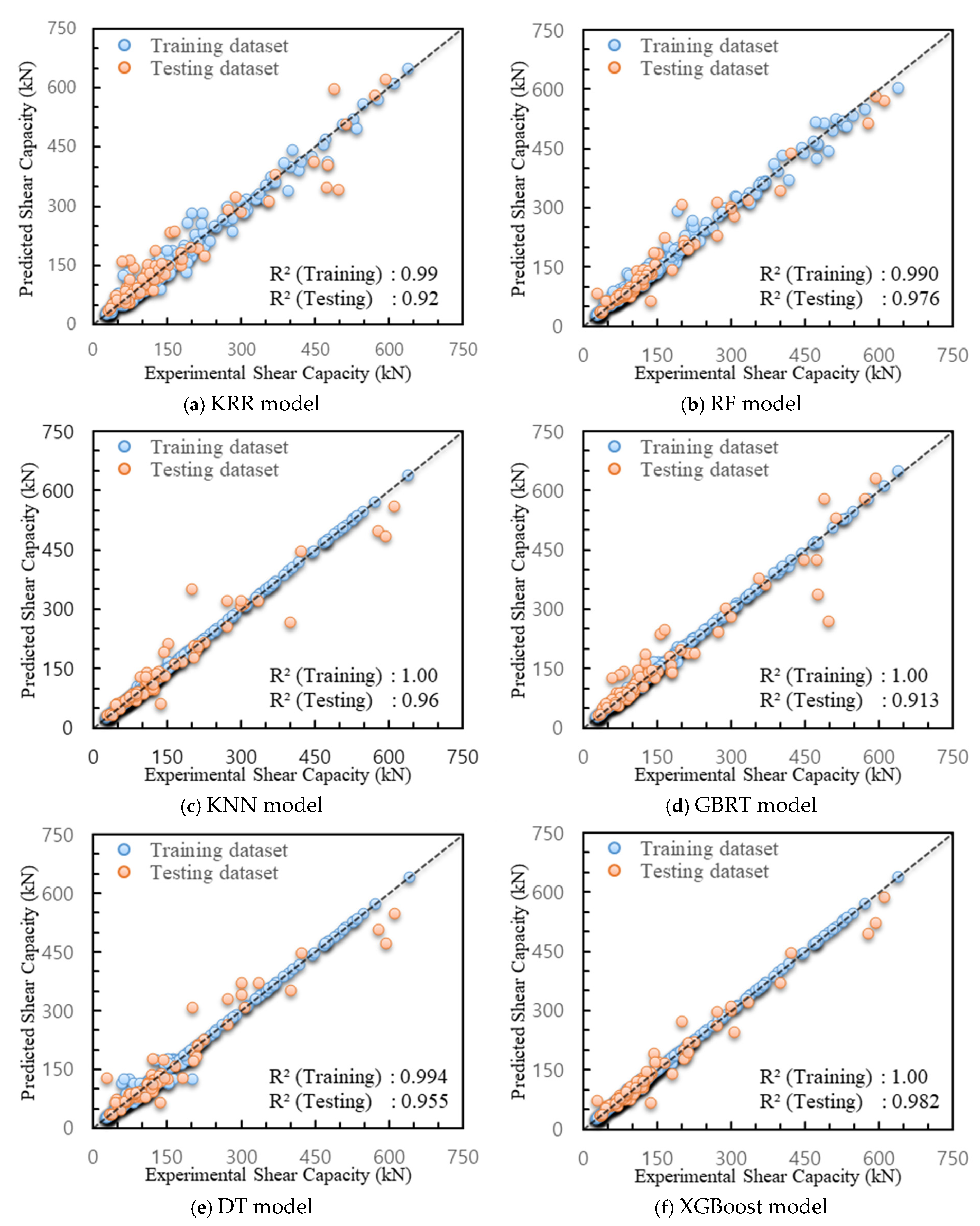
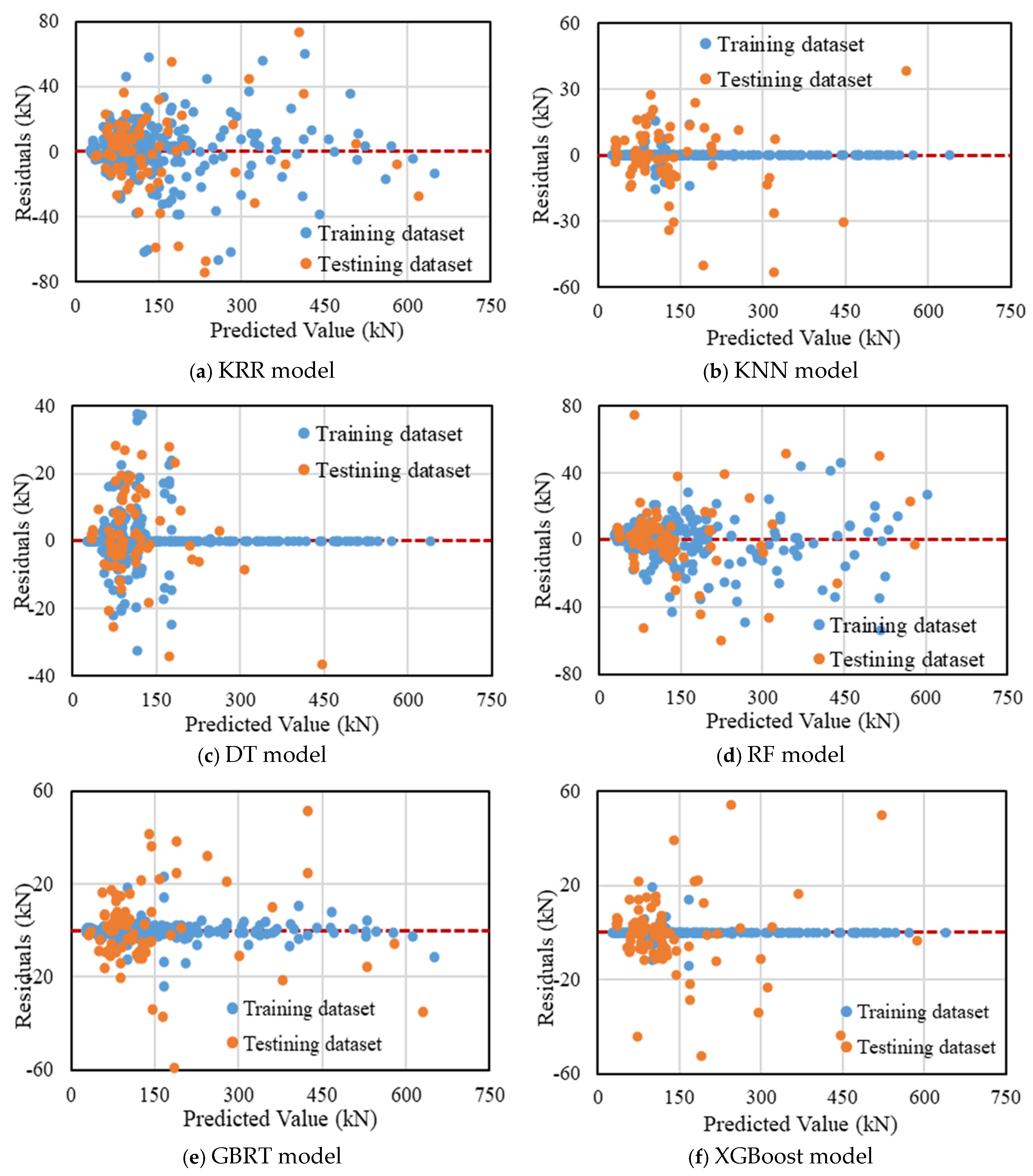
- The XGBoost model demonstrates superior performance in predicting the shear capacity of CRCBs, achieving an of 0.994 along with the lowest RMSE (11.61), MAE (3.388), and MAPE (2.37%). By comparison, the KRR model exhibits the lowest predictive accuracy, with an of 0.9784 and higher error values: RMSE of 22.10, MAE of 12.76, and MAPE of 10.40%.
- The use of an expanded dataset (408 experimental samples) and systematic hyperparameter tuning significantly improved model stability and generalization compared to previously reported studies, making the proposed model more reliable for diverse structural conditions.
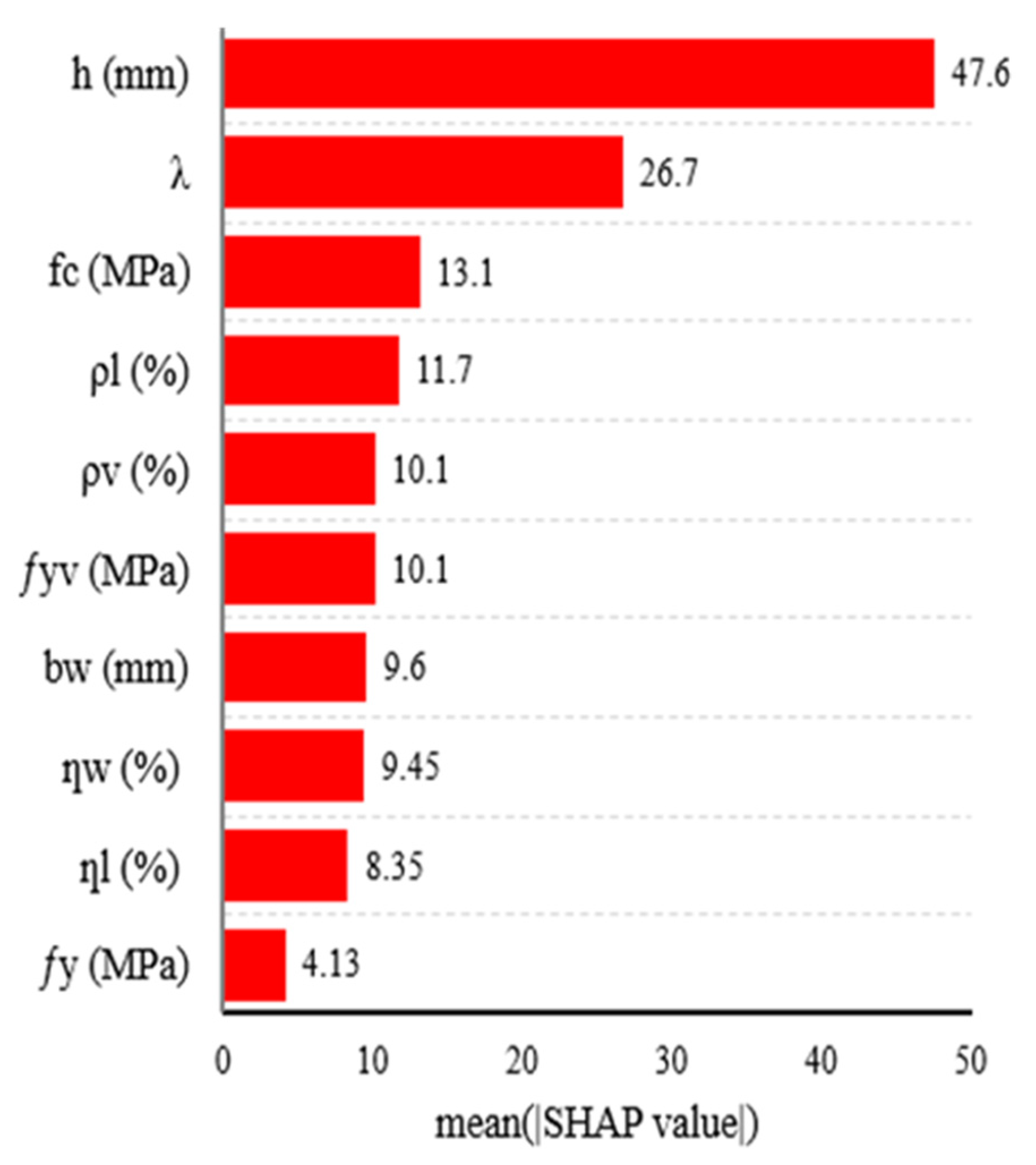
- The relative importance of input parameters ranked by SHAP on the shear capacity of CRCBs is in the following order: beam depth (h), shear span-to-depth ratio (λ), concrete compressive strength (), and longitudinal reinforcement ratio ().
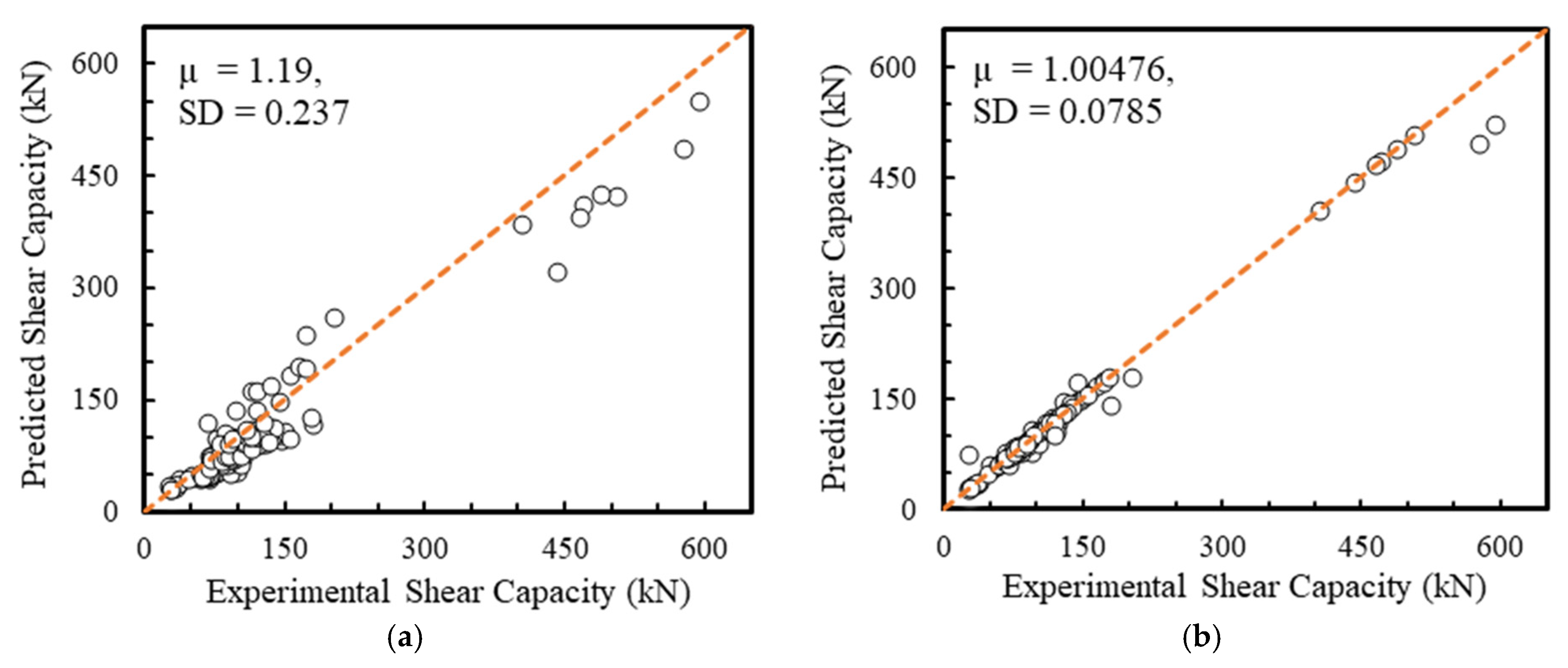
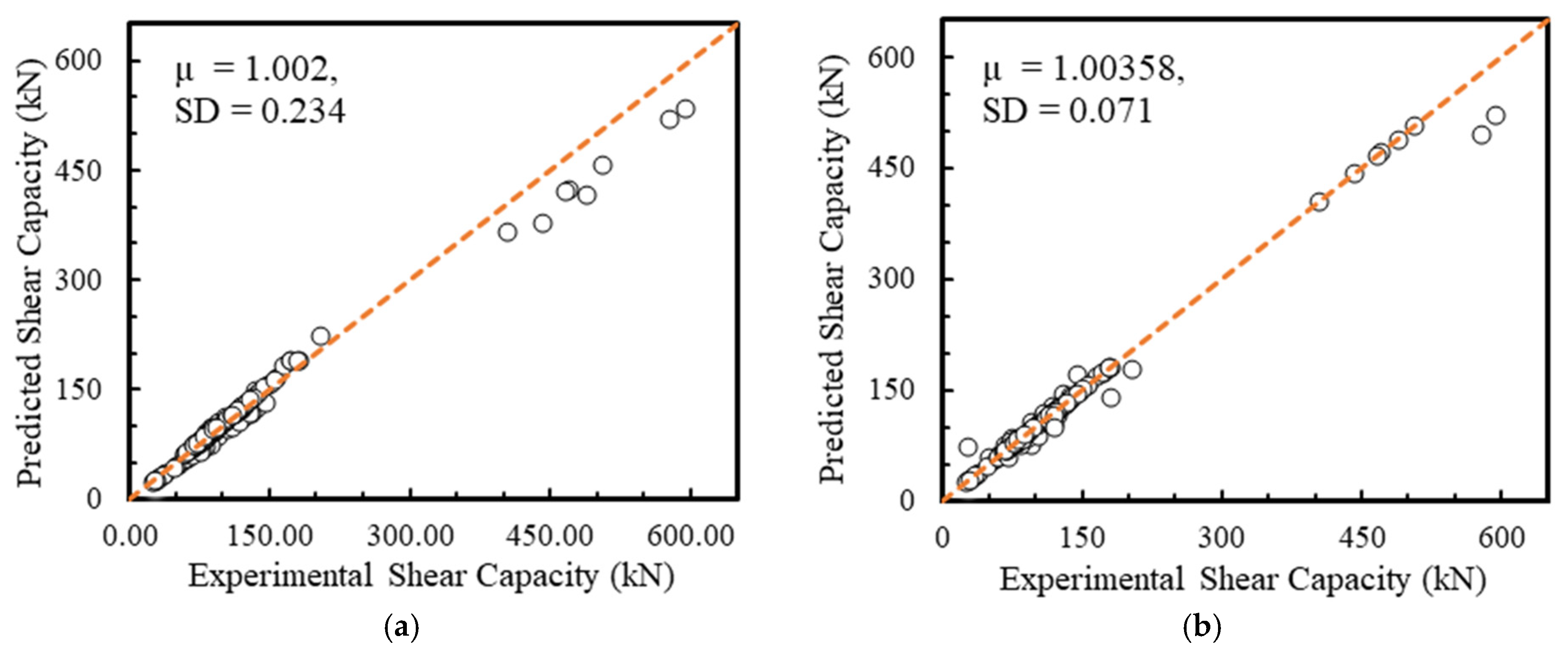
- The parametric study highlights that the XGBoost model demonstrates superior performance and reliability under varying geometric and material properties of CRCBs.
- The developed model provides a fast and practical tool for estimating the shear capacity of corroded RC beams and can support structural assessment and maintenance planning. Nevertheless, its application should be limited to conditions similar to those represented in the dataset, and further validation using additional experimental or field data is recommended for broader generalization.
Author Contributions
Funding
Data Availability Statement
Acknowledgments
Conflicts of Interest
Nomenclature
| Stress at the vertical stirrups placed below the neutral axis in a D-region | |
| Yield strength of stirrups (corroded) | |
| Residual area of stirrups after corrosion | |
| Original area of the stirrups | |
| Effective width of the corrosion-damaged beam section | |
| Shear resistance of the concrete of the CRC beam | |
| Concrete cover in both cross-sectional width directions | |
| Cross-sectional area of the horizontal reinforcement placed in the web in a D-region | |
| Mean shear reinforcement yield strength | |
| Concrete cover of stirrups | |
| Strength reduction factor for concrete cracked in shear | |
| y | Corresponding actual value |
| ξ | Size and slenderness effect factor |
| Beam width | |
| Yield strength of stirrups | |
| Stirrup ratio | |
| Longitudinal reinforcement ratio | |
| Reinforcement area loss ratio of stirrups | |
| Concrete contribution to shear strength | |
| Minimum concrete contribution to shear strength | |
| Contribution of horizontal web reinforcement to shear strength in a D-region | |
| Shear resistance of the stirrups of the CRC beam | |
| Shear resistance of concrete due to diagonal tension failure | |
| Shear resistance of concrete due to shear compression failure | |
| j | Coefficient is generally taken as 1/1.15 |
| Tensile strength of concrete | |
| Spacing of vertical reinforcement in a D-region | |
| Spacing of horizontal reinforcement in the web in a D-region | |
| Cross-sectional area of vertical reinforcement in a D-region | |
| Mean concrete tensile strength | |
| z | inner lever arm; |
| Predicted value | |
| Mean of all y values in the dataset | |
| Area loss ratio of the stirrup | |
| λ | Shear span-to-depth ratio |
| h | Beam depth |
| Yield strength of longitudinal reinforcement | |
| Yield strength of stirrups | |
| Reinforcement area loss ratio of longitudinal bars | |
| Shear reinforcement contribution to shear strength | |
| Maximum shear force | |
| Contribution of vertical web reinforcement to shear strength in a D-region |
Appendix A

| References | No. of Tests | (MPa) | h (mm) | (mm) | (%) | (%) | (MPa) | (MPa) | λ | (%) | (%) | (kN) |
|---|---|---|---|---|---|---|---|---|---|---|---|---|
| Rodriguez, Ortega, and Casal [26] | 10 | 35–37 | 200 | 150 | 1.77 | 0.22–0.45 | 585 | 626 | 4.7 | 10.7–16.9 | 66–97.2 | 26.6–38.6 |
| Xu and Niu [38] | 21 | 28.4–30.6 | 200 | 120 | 1.92 | 0.32 | 416 | 275 | 1–2 | 0 | 0–40.3 | 47.7–146.8 |
| Higgins and Farrow III [27] | 8 | 29.3–33.40 | 610 | 254 | 1.9 | 0.39–0.49 | 441 | 496 | 2.04 | 0 | 0–33.8 | 405–594 |
| Xuetian and Huiguang [81] | 10 | 27 | 200 | 150 | 2.3 | 0.25 | 210 | 275 | 1.5–2.2 | 0–2.9 | 0–2 | 75.9–131 |
| Zhao and Jin [47] | 28 | 22.5 | 180 | 150 | 2.26–2.79 | 0.19–0.45 | 369 | 332 | 2.2–3.1 | 0–19 | 0–8.3 | 60–104 |
| Xue, Seki, and Chen [84] | 8 | 33.3–39.3 | 240 | 120 | 2.17 | 0.39 | 706 | 300 | 1.5–3.2 | 5–16.6 | 0 | 70.5–124.3 |
| Xue, Seki, and Song [86] | 10 | 33.1–35.1 | 240 | 120 | 2.17 | 0.39–0.52 | 706 | 300 | 2.6 | 0–1.8 | 0–34.2 | 69.5–87.9 |
| Xia, Jin, and Li [33] | 18 | 22.5 | 200 | 120 | 2.62 | 0.48–0.56 | 300–435 | 322–464 | 1.5 | 0 | 0–54.15 | 85.2–138.2 |
| El-Sayed, Hussain, and Shuraim [32] | 6 | 34.6–44.4 | 350 | 200 | 3.27 | 0.25–0.5 | 480 | 495 | 3 | 0 | 9.8–24.5 | 136–204 |
| Imam and Azad [30] | 13 | 33.1 | 220–240 | 140–150 | 1.22–1.48 | 0.84–0.9 | 580 | 560 | 1.57–1.76 | 0 | 22.8–52.7 | 80.9–119.1 |
| Lu, Li, Li, Zhao, Tang, and Sun [91] | 20 | 40.8–50 | 300 | 200 | 2.2 | 0.1–0.2 | 390 | 339–524 | 2–3.5 | 0–16.5 | 0–55.6 | 93.8–181.5 |
| Liu [83] | 24 | 32–40 | 240–350 | 200 | 2.15 | 0.14–0.25 | 390 | 339–524 | 2–3.5 | 0–12.1 | 0–60.1 | 93.8–181.5 |
| Taqi, Mashrei, and Oleiwi [100] | 19 | 34.5–45 | 150 | 100 | 1.25 | 0–0.84 | 560 | 0–534 | 2.8 | 0–20 | 0 | 39.5–78 |
| Juarez, Guevara, Fajardo, and Castro-Borges [28] | 16 | 21 | 350 | 200 | 1.68 | 0.25–0.33 | 420 | 420 | 2 | 0 | 0–21.25 | 68–121 |
| Fu, Huang, Dong, Song, and Zhang [103] | 12 | 24 | 150 | 100 | 2.46 | 0.81 | 400 | 325 | 1.17–2.34 | 0–9.64 | 0–19.48 | 47.3–109.9 |
| Li, Huang, Lu, Zhou, Mansour, Kai, Qin, and Wang [104] | 9 | 27.4 | 370 | 180 | 4.56 | 0.31 | 410 | 325 | 1–3 | 0 | 0–12 | 163.9–313.6 |
| Tan and Kien [99] | 8 | 20.1 | 200 | 150 | 1.67 | 0 | 328.5 | 0 | 2.5 | 0–4.99 | 0 | 30.2–37.6 |
| Alaskar, Alqarni, Alfalah, El-Sayed, Mohammadhosseini, and Alyousef [98] | 9 | 38–44 | 350 | 200 | 4 | 0.14–0.57 | 480 | 380–400 | 3 | 0 | 0–15.6 | 126.5–238 |
| Azam and Soudki [82] | 8 | 47.3 | 350 | 150 | 2.17 | 0–0.18 | 400 | 0–384 | 1.6 | 0–4.64 | 0 | 191.63–497.13 |
| El-Sayed, Hussain, and Shuraim [89] | 14 | 29.4–38 | 350 | 200 | 3 | 0.25–0.5 | 480 | 495 | 1–2 | 0 | 0–24 | 512–1105 |
| Guo, Wang, Xie, Shi, and Yu [94] | 14 | 20.1 | 200 | 120 | 1.47 | 0.56 | 335 | 235 | 2.4–3 | 0–14.77 | 0 | 60.11–92.32 |
| Sahmaran, Anil, Lachemi, Yildirim, Ashour, and Acar [87] | 10 | 45.5–46.3 | 220 | 150 | 2.62 | 0.37 | 400 | 235 | 2.5 | 0–20.41 | 0–20.41 | 62.3–227 |
| Huang, Ye, Jin, Jin and Xu [96] | 12 | 44.8 | 150 | 100 | 1.8 | 0.38 | 450 | 380 | 1.69 | 0–19.83 | 0–31.67 | 54.3–131.4 |
| Biswas, Iwanami, Chijiwa, and Uno [93] | 7 | 31 | 350 | 200 | 0.62 | 0.2 | 463 | 352 | 2.75 | 0–38 | 0 | 90–272 |
| Tan, Kien, and Giang [102] | 8 | 25.1 | 200 | 150 | 1.67 | 0 | 328 | 0 | 2.5 | 0–4.99 | 0 | 30.2–37.6 |
| Sathe and Patil [105] | 4 | 30 | 150 | 150 | 1.37 | 0.45 | 510 | 510 | 5 | 0 | 0–16.1 | 75–110 |
| Suffern [80] | 15 | 35.7–45.4 | 350 | 125 | 2.62 | 0–0.83 | 414 | 0–414 | 1–2 | 0 | 0–18.7 | 150–473 |
| Shehab, Mahmoud, and Mansoor [97] | 8 | 36.64–42 | 200 | 150 | 1.65 | 0.25–0.34 | 603 | 523–543 | 2.5–3 | 0 | 0–15.3 | 104.41–142.43 |
| Han, Lee, Yi and Kim [95] | 8 | 39.2 | 250 | 170 | 2.24 | 0 | 400 | 0 | 2.96 | 0–7.91 | 0 | 58.5–153.1 |
| Zheng, Li, Zhang, and Yan [101] | 4 | 37.24 | 300 | 150 | 2 | 0.188 | 442 | 370 | 2.31 | 0 | 0–13.9 | 183.77–213.27 |
| Wang, Zhang, Zhang, Ma, and Liu [88] | 14 | 25.96–38.32 | 500 | 250 | 1.64 | 0.31 | 365.7 | 350 | 1.77 | 0 | 0–51 | 225–370 |
| Ye, Zhang, and Gu [90] | 13 | 26.85–32.19 | 260 | 130 | 1.74–2.6 | 0.515 | 450.5–459 | 369.6 | 2.22 | 0–14 | 0–27 | 50.3–91.9 |
| Lachemi, Al-Bayati, Sahmaran, and Anil [85] | 20 | 42.9–45.5 | 220 | 150 | 2.2 | 0.38 | 450 | 369 | 2.5 | 0–20.41 | 0 | 45.1–200.6 |
| Maximum | 50.0 | 610.0 | 254.0 | 4.6 | 0.9 | 706.0 | 626.0 | 5.0 | 38.0 | 97.2 | 1105.0 | |
| Minimum | 20.1 | 150.0 | 100.0 | 0.6 | 0.0 | 210.0 | 0.0 | 1.0 | 0.0 | 0.0 | 26.6 | |
| Mean | 33.2 | 262.7 | 156.1 | 2.2 | 0.3 | 437.8 | 338.1 | 2.3 | 4.2 | 13.9 | 155.6 | |
| SD | 8.6 | 97.3 | 39.9 | 0.7 | 0.2 | 95.7 | 153.3 | 0.8 | 6.4 | 19.0 | 150.6 |
| Group | h | λ | ||||||||
|---|---|---|---|---|---|---|---|---|---|---|
| MPa | mm | mm | % | % | MPa | MPa | -- | % | % | |
| G1 | 35 | 200 | 150 | 1.77 | 0.22 | 585 | 626 | 4.7 | 0 | 10 |
| 35 | 200 | 150 | 1.77 | 0.22 | 585 | 626 | 4.7 | 1.25 | 10 | |
| 35 | 200 | 150 | 1.77 | 0.22 | 585 | 626 | 4.7 | 2.5 | 10 | |
| 35 | 200 | 150 | 1.77 | 0.22 | 585 | 626 | 4.7 | 3.5 | 10 | |
| 35 | 200 | 150 | 1.77 | 0.22 | 585 | 626 | 4.7 | 5 | 10 | |
| 35 | 200 | 150 | 1.77 | 0.22 | 585 | 626 | 4.7 | 7.5 | 10 | |
| 35 | 200 | 150 | 1.77 | 0.22 | 585 | 626 | 4.7 | 10 | 10 | |
| 35 | 200 | 150 | 1.77 | 0.22 | 585 | 626 | 4.7 | 12.5 | 10 | |
| 35 | 200 | 150 | 1.77 | 0.22 | 585 | 626 | 4.7 | 15 | 10 | |
| G2 | 35 | 200 | 150 | 1.77 | 0.22 | 585 | 626 | 4.7 | 2.5 | 0 |
| 35 | 200 | 150 | 1.77 | 0.22 | 585 | 626 | 4.7 | 2.5 | 5 | |
| 35 | 200 | 150 | 1.77 | 0.22 | 585 | 626 | 4.7 | 2.5 | 10 | |
| 35 | 200 | 150 | 1.77 | 0.22 | 585 | 626 | 4.7 | 2.5 | 15 | |
| 35 | 200 | 150 | 1.77 | 0.22 | 585 | 626 | 4.7 | 2.5 | 20 | |
| 35 | 200 | 150 | 1.77 | 0.22 | 585 | 626 | 4.7 | 2.5 | 25 | |
| 35 | 200 | 150 | 1.77 | 0.22 | 585 | 626 | 4.7 | 2.5 | 30 | |
| 35 | 200 | 150 | 1.77 | 0.22 | 585 | 626 | 4.7 | 2.5 | 40 | |
| 35 | 200 | 150 | 1.77 | 0.22 | 585 | 626 | 4.7 | 2.5 | 50 | |
| G3 | 22.5 | 180 | 150 | 2.79 | 0.25 | 369 | 332 | 3.1 | 0 | 30 |
| 22.5 | 200 | 150 | 2.79 | 0.25 | 369 | 332 | 3.1 | 0 | 30 | |
| 22.5 | 250 | 150 | 2.79 | 0.25 | 369 | 332 | 3.1 | 0 | 30 | |
| 22.5 | 300 | 150 | 2.79 | 0.25 | 369 | 332 | 3.1 | 0 | 30 | |
| 22.5 | 350 | 150 | 2.79 | 0.25 | 369 | 332 | 3.1 | 0 | 30 | |
| G4 | 28.4 | 200 | 120 | 1.92 | 0.32 | 416 | 275 | 1 | 0 | 20 |
| 28.4 | 200 | 140 | 1.92 | 0.32 | 416 | 275 | 1 | 0 | 20 | |
| 28.4 | 200 | 160 | 1.92 | 0.32 | 416 | 275 | 1 | 0 | 20 | |
| 28.4 | 200 | 180 | 1.92 | 0.32 | 416 | 275 | 1 | 0 | 20 | |
| 28.4 | 200 | 200 | 1.92 | 0.32 | 416 | 275 | 1 | 0 | 20 | |
| G5 | 21 | 300 | 200 | 2.2 | 0.16 | 390 | 373 | 3.5 | 15.6 | 44 |
| 22.5 | 300 | 200 | 2.2 | 0.16 | 390 | 373 | 3.5 | 15.6 | 44 | |
| 25 | 300 | 200 | 2.2 | 0.16 | 390 | 373 | 3.5 | 15.6 | 44 | |
| 27.5 | 300 | 200 | 2.2 | 0.16 | 390 | 373 | 3.5 | 15.6 | 44 | |
| 30 | 300 | 200 | 2.2 | 0.16 | 390 | 373 | 3.5 | 15.6 | 44 | |
| 32.5 | 300 | 200 | 2.2 | 0.16 | 390 | 373 | 3.5 | 15.6 | 44 | |
| 35 | 300 | 200 | 2.2 | 0.16 | 390 | 373 | 3.5 | 15.6 | 44 | |
| 37.5 | 300 | 200 | 2.2 | 0.16 | 390 | 373 | 3.5 | 15.6 | 44 | |
| 40 | 300 | 200 | 2.2 | 0.16 | 390 | 373 | 3.5 | 15.6 | 44 | |
| 42.5 | 300 | 200 | 2.2 | 0.16 | 390 | 373 | 3.5 | 15.6 | 44 | |
| G6 | 29.7 | 200 | 120 | 1.92 | 0.32 | 416 | 275 | 1 | 0 | 40.3 |
| 29.7 | 200 | 120 | 1.92 | 0.32 | 416 | 275 | 1.5 | 0 | 40.3 | |
| 29.7 | 200 | 120 | 1.92 | 0.32 | 416 | 275 | 2 | 0 | 40.3 | |
| 29.7 | 200 | 120 | 1.92 | 0.32 | 416 | 275 | 2.5 | 0 | 40.3 | |
| 29.7 | 200 | 120 | 1.92 | 0.32 | 416 | 275 | 3 | 0 | 40.3 | |
| 29.7 | 200 | 120 | 1.92 | 0.32 | 416 | 275 | 3.5 | 0 | 40.3 | |
| 29.7 | 200 | 120 | 1.92 | 0.32 | 416 | 275 | 4 | 0 | 40.3 | |
| 29.7 | 200 | 120 | 1.92 | 0.32 | 416 | 275 | 4.5 | 0 | 40.3 | |
| G7 | 27 | 200 | 150 | 0.99 | 0.25 | 210 | 275 | 2.2 | 2.5 | 2 |
| 27 | 200 | 150 | 1.9 | 0.25 | 210 | 275 | 2.2 | 2.5 | 2 | |
| 27 | 200 | 150 | 1.92 | 0.25 | 210 | 275 | 2.2 | 2.5 | 2 | |
| 27 | 200 | 150 | 2.17 | 0.25 | 210 | 275 | 2.2 | 2.5 | 2 | |
| 27 | 200 | 150 | 2.26 | 0.25 | 210 | 275 | 2.2 | 2.5 | 2 | |
| 27 | 200 | 150 | 2.3 | 0.25 | 210 | 275 | 2.2 | 2.5 | 2 | |
| 27 | 200 | 150 | 2.62 | 0.25 | 210 | 275 | 2.2 | 2.5 | 2 | |
| 27 | 200 | 150 | 2.79 | 0.25 | 210 | 275 | 2.2 | 2.5 | 2 | |
| G8 | 32 | 350 | 200 | 2.15 | 0.14 | 390 | 476 | 2.5 | 2.2 | 17.6 |
| 32 | 350 | 200 | 2.15 | 0.19 | 390 | 476 | 2.5 | 2.2 | 17.6 | |
| 32 | 350 | 200 | 2.15 | 0.2 | 390 | 476 | 2.5 | 2.2 | 17.6 | |
| 32 | 350 | 200 | 2.15 | 0.25 | 390 | 476 | 2.5 | 2.2 | 17.6 | |
| 32 | 350 | 200 | 2.15 | 0.39 | 390 | 476 | 2.5 | 2.2 | 17.6 | |
| 32 | 350 | 200 | 2.15 | 0.48 | 390 | 476 | 2.5 | 2.2 | 17.6 | |
| 32 | 350 | 200 | 2.15 | 0.52 | 390 | 476 | 2.5 | 2.2 | 17.6 |
References
- Al-Sulaimani, G.; Kaleemullah, M.; Basunbul, I. Influence of corrosion and cracking on bond behavior and strength of reinforced concrete members. Struct. J. 1990, 87, 220–231. [Google Scholar]
- Alonso, C.; Andrade, C.; Rodriguez, J.; Diez, J.M. Factors controlling cracking of concrete affected by reinforcement corrosion. Mater. Struct. 1998, 31, 435–441. [Google Scholar] [CrossRef]
- Fernandez, I.; Bairán, J.M.; Marí, A.R. Corrosion effects on the mechanical properties of reinforcing steel bars. Fatigue and σ–ε behavior. Constr. Build. Mater. 2015, 101, 772–783. [Google Scholar] [CrossRef]
- Zhang, W.; Liu, X.; Huang, Y.; Tong, M.-N. Reliability-based analysis of the flexural strength of concrete beams reinforced with hybrid BFRP and steel rebars. Arch. Civ. Mech. Eng. 2022, 22, 171. [Google Scholar] [CrossRef]
- Ma, Y.; Lu, B.; Guo, Z.; Wang, L.; Chen, H.; Zhang, J. Limit equilibrium method-based shear strength prediction for corroded reinforced concrete beam with inclined bars. Materials 2019, 12, 1014. [Google Scholar] [CrossRef]
- Ma, Y.; He, Y.; Wang, L.; Zhang, J. Probabilistic reconstruction for spatiotemporal sensor data integrated with Gaussian process regression. Probabilistic Eng. Mech. 2022, 69, 103264. [Google Scholar] [CrossRef]
- Ma, Y.; He, Y.; Wang, G.; Wang, L.; Zhang, J.; Lee, D. Corrosion fatigue crack growth prediction of bridge suspender wires using Bayesian gaussian process. Int. J. Fatigue 2023, 168, 107377. [Google Scholar] [CrossRef]
- Huang, H.; Huang, M.; Zhang, W.; Pospisil, S.; Wu, T. Experimental investigation on rehabilitation of corroded RC columns with BSP and HPFL under combined loadings. J. Struct. Eng. 2020, 146, 04020157. [Google Scholar] [CrossRef]
- Hao, X.-K.; Zhang, H.-Y.; Deng, T.; Zhou, Y.; Shi, T.; Corr, D.J. Experimental and theoretical investigation of low-shrinkage alkali-activated materials permanent formwork reinforced concrete prisms under axial load. Constr. Build. Mater. 2025, 500, 144156. [Google Scholar] [CrossRef]
- Alyousif, A.; Anil, O.; Sahmaran, M.; Lachemi, M.; Yildirim, G.; Ashour, A.F. Tests of high-performance fiber-reinforced concrete beams with different shear span-to-depth ratios and main longitudinal reinforcement. J. Reinf. Plast. Compos. 2015, 34, 1491–1505. [Google Scholar] [CrossRef]
- Lu, Z.-H.; Lun, P.-Y.; Li, W.; Luo, Z.; Li, Y.; Liu, P. Empirical model of corrosion rate for steel reinforced concrete structures in chloride-laden environments. Adv. Struct. Eng. 2019, 22, 223–239. [Google Scholar] [CrossRef]
- Guo, Y.-T.; Nie, X.; Fan, J.; Tao, M.-X. Shear resistance of steel–concrete–steel deep beams with bidirectional webs. Steel Compos. Struct. Int. J. 2022, 42, 299–313. [Google Scholar]
- Jung, J.-S.; Lee, B.Y.; Lee, K.-S. Experimental study on the structural performance degradation of corrosion-damaged reinforced concrete beams. Adv. Civ. Eng. 2019, 2019, 9562574. [Google Scholar] [CrossRef]
- Gjørv, O.E. Durability Design of Concrete Structures in Severe Environments; CRC Press: Boca Raton, FL, USA, 2009. [Google Scholar]
- Pape, T.M.; Melchers, R.E. Performance of 45-year-old corroded prestressed concrete beams. Proc. Inst. Civ. Eng.-Struct. Build. 2013, 166, 547–559. [Google Scholar] [CrossRef]
- Melchers, R.E.; Chaves, I.A. Durability of reinforced concrete bridges in marine environments. Struct. Infrastruct. Eng. 2020, 16, 169–180. [Google Scholar] [CrossRef]
- Mohamed, N.; Boulfiza, M.; Evitts, R. Corrosion of carbon steel and corrosion-resistant rebars in concrete structures under chloride ion attack. J. Mater. Eng. Perform. 2013, 22, 787–795. [Google Scholar] [CrossRef]
- Basyoni, M.H.; Aref, M.A. Composition and origin of the sabkha brines, and their environmental impact on infrastructure in Jizan area, Red Sea Coast, Saudi Arabia. Environ. Earth Sci. 2016, 75, 105. [Google Scholar] [CrossRef]
- Qiao, H.-X.; Gong, W.; Shi, Y.-Y.; Wanjiru, M.E.; Dong, J.-M. Experimental study on magnesium oxychloride cement concrete. Emerg. Mater. Res. 2016, 5, 248–255. [Google Scholar] [CrossRef]
- Deng, Y.; Yan, C.; Li, J.; Liu, S.; Zhang, J.; Wang, J. Seismic deformation of reinforced concrete piers corroded by saline soil. Bull. Earthq. Eng. 2022, 20, 6763–6788. [Google Scholar] [CrossRef]
- Tian, Y.; Liu, Y.; Xie, Y.-M.; Zhang, G.-Y.; Ye, H.-L.; Yan, D.-M.; Li, Y.-J.; Li, B.; Xue, H.-J.; Cai, Q. Coupled effects of chlorides and sulfates on steel reinforcement corrosion in concrete structures: A comprehensive review. Case Stud. Constr. Mater. 2025, 22, e04263. [Google Scholar] [CrossRef]
- An, J.; Cho, J.-Y.; Choi, J. Influence of combined freeze–thaw cycles and seawater saturation on the flexure behavior of reinforced concrete beams. Structures 2025, 82, 110677. [Google Scholar] [CrossRef]
- Sutrisno, W.; Suprobo, P.; Wahyuni, E.; Iranata, D. Microstructural investigation of reinforced concrete exposed to cyclic wetting and drying. Int. J. Adv. Sci. Eng. Inf. Technol. 2018, 8, 411–417. [Google Scholar] [CrossRef]
- Wang, Y.-G.; He, X.-J.; Nie, Q.; Cheng, Z.-Y. Theoretical Confirmation of Temperature Gradient Characteristics in Concrete Bridges through Refined Thermal Analysis. Case Stud. Therm. Eng. 2025, 77, 107572. [Google Scholar] [CrossRef]
- Qin, C.; Xun, K.; Yuan, Q.; Zhang, M.; Hua, Q.; Wu, T.; Zhou, B. Study on the flexural performance of 4D steel fiber-reinforced concrete under freeze-thaw cycles. Constr. Build. Mater. 2026, 514, 145619. [Google Scholar] [CrossRef]
- Rodriguez, J.; Ortega, L.; Casal, J. Load carrying capacity of concrete structures with corroded reinforcement. Constr. Build. Mater. 1997, 11, 239–248. [Google Scholar] [CrossRef]
- Higgins, C.; Farrow, W.C., III. Tests of reinforced concrete beams with corrosion-damaged stirrups. ACI Mater. J. 2006, 103, 133. [Google Scholar]
- Juarez, C.; Guevara, B.; Fajardo, G.; Castro-Borges, P. Ultimate and nominal shear strength in reinforced concrete beams deteriorated by corrosion. Eng. Struct. 2011, 33, 3189–3196. [Google Scholar] [CrossRef]
- Xu, S.; Niu, D. The shear behavior of corroded reinforced concrete beam. In Proceedings of the International Conference on Advances in Concrete and Structures; RILEM Publications SARL: Champs-sur-Marne, France, 2003; pp. 409–415. Available online: https://www.rilem.net/publication/publication/37?id_papier=456 (accessed on 14 March 2025).
- Imam, A.; Azad, A.K. Prediction of residual shear strength of corroded reinforced concrete beams. Int. J. Adv. Struct. Eng. 2016, 8, 307–318. [Google Scholar] [CrossRef]
- Val, D.V. Deterioration of strength of RC beams due to corrosion and its influence on beam reliability. J. Struct. Eng. 2007, 133, 1297–1306. [Google Scholar] [CrossRef]
- El-Sayed, A.K.; Hussain, R.R.; Shuraim, A.B. Influence of stirrup corrosion on shear strength of reinforced concrete slender beams. ACI Struct. J. 2016, 113, 1223. [Google Scholar] [CrossRef]
- Xia, J.; Jin, W.-L.; Li, L.-Y. Shear performance of reinforced concrete beams with corroded stirrups in chloride environment. Corros. Sci. 2011, 53, 1794–1805. [Google Scholar] [CrossRef]
- Suffern, C.; El-Sayed, A.; Soudki, K. Shear strength of disturbed regions with corroded stirrups in reinforced concrete beams. Can. J. Civ. Eng. 2010, 37, 1045–1056. [Google Scholar] [CrossRef]
- Webster, M.P. The Assessment of Corrosion-Damaged Concrete Structures. Ph.D. Thesis, University of Birmingham, Birmingham, UK, 2000. [Google Scholar]
- Higgins, C.; Farrow, W.C., III; Potisuk, T.; Miller, T.H.; Yim, S.C.; Holcomb, G.R.; Cramer, S.D.; Covino, B.S., Jr.; Bullard, S.J.; Ziomek-Moroz, M. Shear Capacity Assessment of Corrosion-Damaged Reinforced Concrete Beams: Appendices; Oregon Department of Transportation Research Unit: Salem, OR, USA, 2003. [Google Scholar]
- Liang, Q.Q. Performance-Based Optimization of Structures: Theory and Applications; CRC Press: Boca Raton, FL, USA, 2004. [Google Scholar]
- Xu, S.; Niu, D. The shear behavior of corroded simply supported reinforced concrete beam. J. Build. Struct. 2004, 25, 98–104. [Google Scholar]
- Yu, F. The Test Research and Analysis on the Shear Strength of Diagonal Section in Corroded Reinforced Concrete Beam. Master’s Thesis, Hohai University, Nanjing, China, 2005. Available online: https://d.wanfangdata.com.cn/thesis/Y716961 (accessed on 5 May 2026).
- Xue, X.; Seki, H. Influence of longitudinal bar corrosion on shear behavior of RC beams. J. Adv. Concr. Technol. 2010, 8, 145–156. [Google Scholar] [CrossRef]
- Bhargava, K.; Mori, Y.; Ghosh, A. Time-dependent reliability of corrosion-affected RC beams—Part 1: Estimation of time-dependent strengths and associated variability. Nucl. Eng. Des. 2011, 241, 1371–1384. [Google Scholar] [CrossRef]
- Higgins, C.; Farrow, W.C., III; Turan, O.T. Analysis of reinforced concrete beams with corrosion damaged stirrups for shear capacity. Struct. Infrastruct. Eng. 2012, 8, 1080–1092. [Google Scholar] [CrossRef]
- Khan, I.; François, R.; Castel, A. Experimental and analytical study of corroded shear-critical reinforced concrete beams. Mater. Struct. 2014, 47, 1467–1481. [Google Scholar] [CrossRef]
- Campione, G.; Cannella, F.; Cavaleri, L. Shear and flexural strength prediction of corroded RC beams. Constr. Build. Mater. 2017, 149, 395–405. [Google Scholar] [CrossRef]
- Coronelli, D.; Gambarova, P. Structural assessment of corroded reinforced concrete beams: Modeling guidelines. J. Struct. Eng. 2004, 130, 1214–1224. [Google Scholar] [CrossRef]
- Potisuk, T.; Higgins, C.C.; Miller, T.H.; Yim, S.C. Finite element analysis of reinforced concrete beams with corrosion subjected to shear. Adv. Civ. Eng. 2011, 2011, 706803. [Google Scholar] [CrossRef]
- Zhao, Y.-X.; Jin, W.-L. Analysis on shearing capacity of concrete beams with corroded stirrups. J.-Zhejiang Univ. Eng. Sci. 2008, 42, 19–24. [Google Scholar]
- Li, S.-B.; Zhang, X. Analysis for shear capacity of reinforced concrete beams with corrosion stirrups. Eng. Mech. 2011, 28, 60–063. [Google Scholar] [CrossRef]
- Zhu, J. Effect of Corroded Longitudinal Reinforcements on Shear Capacity of Simple Supported Concrete Beam Without Stirrups. Master’s Thesis, Nanchang University, Nanchang, China, 2007. Available online: https://oversea.cnki.net/kcms2/article/abstract?v=8kKd7LBMH3x_hFcoVvaKGqNCfqicTCkoSAOZRm_NNXv48rcwf4RCZXrQGaCbJpcbJRIW3-czln83-IelIIB0hvWWM84RZDb7s39sxn0Al85Wnx-C5gQgZ-J-d2YuAtkkecU9bhbIpxxA8unfwVLKNcEOu0q4iqHoW6uul1N3MU_6vuu7rSh2NQ==&uniplatform=OVERSEA&language=EN (accessed on 5 May 2026).
- Lu, Z.-H.; Li, H.; Li, W.; Zhao, Y.-G.; Dong, W. An empirical model for the shear strength of corroded reinforced concrete beam. Constr. Build. Mater. 2018, 188, 1234–1248. [Google Scholar] [CrossRef]
- Hassan, A.; Saleh, R.A.; Al-Sameai, H.; de Moura, J.; Alomayri, T.; Zhang, C. Novel hybrid machine learning framework for high-fidelity prediction of fly ash-based geopolymer concrete strength. Compos. Struct. 2025, 378, 119906. [Google Scholar] [CrossRef]
- Nie, Q.; Zhang, J.; Wang, Y.; Wang, D.; Wang, Q.; Shi, Y.; Wang, C. Physics-Informed Machine Learning for Predicting Stress Wave Transmission Across Realistic Rock Joints. IEEE Access 2025, 13, 212735–212744. [Google Scholar] [CrossRef]
- Zhou, Z.; Tu, H.; Yang, J.; Gao, S.; Liu, Y.; Sun, Y.; Song, J. Prediction and analysis of slurry pressure in the upper cutting face of a shield based on a GA-APSO-RF ensemble model. Int. J. Geomech. 2025, 25, 04025292. [Google Scholar] [CrossRef]
- Lv, L.; Huang, Y.; Lei, L.; Han, B. Machine learning models with monotonic constraints for predicting bond strength between reinforcing bars and UHPC. Structures 2026, 87, 111552. [Google Scholar] [CrossRef]
- Long, X.; Li, H.; Iyela, P.M.; Kang, S.-B. Predicting the bond stress–slip behavior of steel reinforcement in concrete under static and dynamic loadings by finite element, deep learning and analytical methods. Eng. Fail. Anal. 2024, 161, 108312. [Google Scholar] [CrossRef]
- Song, X.; Wang, W.; Deng, Y.; Su, Y.; Jia, F.; Zaheer, Q.; Long, X. Data-driven modeling for residual velocity of projectile penetrating reinforced concrete slabs. Eng. Struct. 2024, 306, 117761. [Google Scholar] [CrossRef]
- Gul, M.; Catbas, F.N. Statistical pattern recognition for Structural Health Monitoring using time series modeling: Theory and experimental verifications. Mech. Syst. Signal Process. 2009, 23, 2192–2204. [Google Scholar] [CrossRef]
- Cury, A.; Crémona, C. Pattern recognition of structural behaviors based on learning algorithms and symbolic data concepts. Struct. Control Health Monit. 2012, 19, 161–186. [Google Scholar] [CrossRef]
- Qiao, L.; Esmaeily, A.; Melhem, H.G. Signal pattern recognition for damage diagnosis in structures. Comput.-Aided Civ. Infrastruct. Eng. 2012, 27, 699–710. [Google Scholar] [CrossRef]
- Shahin, R.I.; Ahmed, M.; Yehia, S.A. Elastic Buckling of Prismatic Web Plate under Shear with Simply-Supported Boundary Conditions. Buildings 2023, 13, 2879. [Google Scholar] [CrossRef]
- Shahin, R.I.; Ahmed, M.; Yehia, S.A.; Liang, Q.Q. ANN model for predicting the elastic critical buckling coefficients of prismatic tapered steel web plates under stress gradients. Eng. Struct. 2023, 294, 116794. [Google Scholar] [CrossRef]
- Shaeer, Z.A.S.A.; Shahin, R.I.; El-Baghdady, G.I.; Yehia, S.A. Numerical and Analytical Solution for Nonlinear Free Vibration of Tapered beams. Mansoura Eng. J. 2024, 49, 6. [Google Scholar] [CrossRef]
- Shahin, R.I.; Ahmed, M.; Liang, Q.Q.; Yehia, S.A. Predicting the web crippling capacity of cold-formed steel lipped channels using hybrid machine learning techniques. Eng. Struct. 2024, 309, 118061. [Google Scholar] [CrossRef]
- Zhang, Y.; Burton, H.V. Pattern recognition approach to assess the residual structural capacity of damaged tall buildings. Struct. Saf. 2019, 78, 12–22. [Google Scholar] [CrossRef]
- Feng, D.-C.; Liu, Z.-T.; Wang, X.-D.; Chen, Y.; Chang, J.-Q.; Wei, D.-F.; Jiang, Z.-M. Machine learning-based compressive strength prediction for concrete: An adaptive boosting approach. Constr. Build. Mater. 2020, 230, 117000. [Google Scholar] [CrossRef]
- Ahmed, M.; Yehia, S.; Shahin, R.; Emara, M.; Patel, V.I.; Liang, Q.Q. Numerical analysis of circular steel–reinforced concrete-filled steel tubular stub columns. Mag. Concr. Res. 2024, 76, 303–318. [Google Scholar] [CrossRef]
- Ahmed, M.; Shahin, R.I.; Yehia, S.A.; Emara, M.; Patel, V.I.; Liang, Q.Q. Nonlinear analysis of square steel-reinforced concrete-filled steel tubular short columns considering local buckling. Struct. Concr. 2024, 25, 69–84. [Google Scholar] [CrossRef]
- Yehia, S.A.; Shahin, R.I.; Fayed, S. Compressive behavior of eco-friendly concrete containing glass waste and recycled concrete aggregate using experimental investigation and machine learning techniques. Constr. Build. Mater. 2024, 436, 137002. [Google Scholar] [CrossRef]
- Zhang, J.; Sato, T.; Iai, S.; Hutchinson, T. A pattern recognition technique for structural identification using observed vibration signals: Linear case studies. Eng. Struct. 2008, 30, 1439–1446. [Google Scholar] [CrossRef]
- Zhang, J.; Sato, T.; Iai, S.; Hutchinson, T. A pattern recognition technique for structural identification using observed vibration signals: Nonlinear case studies. Eng. Struct. 2008, 30, 1417–1423. [Google Scholar] [CrossRef]
- Goh, A.T. Prediction of ultimate shear strength of deep beams using neural networks. Struct. J. 1995, 92, 28–32. [Google Scholar]
- Zhang, J.; Sun, Y.; Li, G.; Wang, Y.; Sun, J.; Li, J. Machine-learning-assisted shear strength prediction of reinforced concrete beams with and without stirrups. Eng. Comput. 2022, 38, 1293–1307. [Google Scholar] [CrossRef]
- Cladera, A.; Marí, A. Shear design procedure for reinforced normal and high-strength concrete beams using artificial neural networks. Part I: Beams without stirrups. Eng. Struct. 2004, 26, 917–926. [Google Scholar] [CrossRef]
- Wakjira, T.G.; Abushanab, A.; Ebead, U.; Alnahhal, W. FAI: Fast, accurate, and intelligent approach and prediction tool for flexural capacity of FRP-RC beams based on super-learner machine learning model. Mater. Today Commun. 2022, 33, 104461. [Google Scholar] [CrossRef]
- Uddin, M.N.; Yu, K.; Li, L.-Z.; Ye, J.; Tafsirojjaman, T.; Alhaddad, W. Developing machine learning model to estimate the shear capacity for RC beams with stirrups using standard building codes. Innov. Infrastruct. Solut. 2022, 7, 227. [Google Scholar] [CrossRef]
- Yaseen, Z.M. Machine learning models development for shear strength prediction of reinforced concrete beam: A comparative study. Sci. Rep. 2023, 13, 1723. [Google Scholar] [CrossRef]
- Kumar, A.; Arora, H.C.; Kapoor, N.R.; Kumar, K.; Hadzima-Nyarko, M.; Radu, D. Machine learning intelligence to assess the shear capacity of corroded reinforced concrete beams. Sci. Rep. 2023, 13, 2857. [Google Scholar] [CrossRef]
- Asteris, P.G.; Nguyen, T.-A. Prediction of shear strength of corrosion reinforced concrete beams using Artificial Neural Network. J. Sci. Transp. Technol. 2022, 2, 1–12. [Google Scholar] [CrossRef]
- Fu, B.; Feng, D.-C. A machine learning-based time-dependent shear strength model for corroded reinforced concrete beams. J. Build. Eng. 2021, 36, 102118. [Google Scholar] [CrossRef]
- Suffern, C.A. Shear Behaviour of Disturbed Regions in Reinforced Concrete Beams with Corrosion Damaged Shear Reinforcement. Master’s Thesis, University of Waterloo, Waterloo, ON, Canada, 2008. [Google Scholar]
- Xue-tian, L.; Hui-guang, Y. Degradation mechanism and predicting models of shearing capacity for corroded reinforced concrete beams. J. Xuzhou Inst. Technol. 2010, 25, 58–63. Available online: https://caod.oriprobe.com/articles/45382809/Degradation_Mechanism_and_Predicting_Models_of_She.htm (accessed on 5 May 2026).
- Azam, R.; Soudki, K. Structural performance of shear-critical RC deep beams with corroded longitudinal steel reinforcement. Cem. Concr. Compos. 2012, 34, 946–957. [Google Scholar] [CrossRef]
- Liu, S. Research on Shear Behavior of Corroded RC Beams. Master’s Thesis, Central South University, Changsha, China, 2013. Available online: https://oversea.cnki.net/kcms2/article/abstract?v=8kKd7LBMH3wioe-pMOJ2uVSkCNGlWMRqQeJMN5v9z1kw8S8JDAD4kVnfqy43jsxn61IZGcWeu0JHGHCXIXJVj26OHzqGuTkK6oMKlGBzMuljpjzUDOyMP2cDcBEeg9eTwLAvYTTYi312UIIJHp3MNLxweg_XY-rG0nHtq0mI6EWj5SCfaw4ngg==&uniplatform=OVERSEA&language=EN (accessed on 5 May 2026).
- Xue, X.; Seki, H.; Chen, Z. Shear capacity of RC beams containing corroded longitudinal bars. In Proceedings of the Thirteenth East Asia-Pacific Conference on Structural Engineering and Construction (EASEC-13); Hokkaido University Collection of Scholarly and Academic Papers: Hokkaido, Japan, 11–13 September 2013; p. C-6-2. Available online: https://eprints.lib.hokudai.ac.jp/repo/huscap/all/54300/easec13-C-6-2.pdf (accessed on 5 May 2026).
- Lachemi, M.; Al-Bayati, N.; Sahmaran, M.; Anil, O. The effect of corrosion on shear behavior of reinforced self-consolidating concrete beams. Eng. Struct. 2014, 79, 1–12. [Google Scholar] [CrossRef]
- Xue, X.; Seki, H.; Song, Y. Shear behavior of RC beams containing corroded stirrups. Adv. Struct. Eng. 2014, 17, 165–177. [Google Scholar] [CrossRef]
- Sahmaran, M.; Anil, Ö.; Lachemi, M.; Yildirim, G.; Ashour, A.; Acar, F. Effect of corrosion on shear behavior of reinforced engineered cementitious composite beams. ACI Struct. J. 2015, 112, 771–782. [Google Scholar] [CrossRef]
- Wang, L.; Zhang, X.; Zhang, J.; Ma, Y.; Liu, Y. Effects of stirrup and inclined bar corrosion on shear behavior of RC beams. Constr. Build. Mater. 2015, 98, 537–546. [Google Scholar] [CrossRef]
- El-Sayed, A.K.; Hussain, R.R.; Shuraim, A.B. Effect of stirrup corrosion on the shear strength of reinforced concrete short beams. J. Civ. Eng. Manag. 2016, 22, 491–499. [Google Scholar] [CrossRef]
- Ye, Z.; Zhang, W.; Gu, X. Deterioration of shear behavior of corroded reinforced concrete beams. Eng. Struct. 2018, 168, 708–720. [Google Scholar] [CrossRef]
- Lu, Z.-H.; Li, H.; Li, W.; Zhao, Y.-G.; Tang, Z.; Sun, Z. Shear behavior degradation and failure pattern of reinforced concrete beam with chloride-induced stirrup corrosion. Adv. Struct. Eng. 2019, 22, 2998–3010. [Google Scholar] [CrossRef]
- Zhang, H.; Wu, J.; Jin, F.; Zhang, C. Effect of corroded stirrups on shear behavior of reinforced recycled aggregate concrete beams strengthened with carbon fiber-reinforced polymer. Compos. Part B Eng. 2019, 161, 357–368. [Google Scholar] [CrossRef]
- Biswas, R.K.; Iwanami, M.; Chijiwa, N.; Uno, K. Effect of non-uniform rebar corrosion on structural performance of RC structures: A numerical and experimental investigation. Constr. Build. Mater. 2020, 230, 116908. [Google Scholar] [CrossRef]
- Guo, X.; Wang, H.; Xie, K.; Shi, T.; Yu, D. Experimental and numerical study on the influence of corrosion rate and shear span ratio on reinforced concrete beam. Adv. Mater. Sci. Eng. 2020, 2020, 4718960. [Google Scholar] [CrossRef]
- Han, S.J.; Lee, D.; Yi, S.T.; Kim, K.S. Experimental shear tests of reinforced concrete beams with corroded longitudinal reinforcement. Struct. Concr. 2020, 21, 1763–1776. [Google Scholar] [CrossRef]
- Huang, L.; Ye, H.; Jin, X.; Jin, N.; Xu, Z. Corrosion-induced shear performance degradation of reinforced concrete beams. Constr. Build. Mater. 2020, 248, 118668. [Google Scholar] [CrossRef]
- Shehab, R.; Mahmoud, A.; Mansoor, Y. The effect of corroded stirrups on shear behavior of reinforced concrete beams. In Proceedings of the IOP Conference Series: Materials Science and Engineering; IOP Publishing: Bristol, UK, 2020; p. 012127. [Google Scholar]
- Alaskar, A.; Alqarni, A.S.; Alfalah, G.; El-Sayed, A.K.; Mohammadhosseini, H.; Alyousef, R. Performance evaluation of reinforced concrete beams with corroded web reinforcement: Experimental and theoretical study. J. Build. Eng. 2021, 35, 102038. [Google Scholar] [CrossRef]
- Tan, N.N.; Kien, N.T. An experimental study on the shear capacity of corroded reinforced concrete beams without shear reinforcement. J. Sci. Technol. Civ. Eng. (JSTCE) -HUCE 2021, 15, 55–66. [Google Scholar] [CrossRef]
- Taqi, F.Y.; Mashrei, M.A.; Oleiwi, H.M. Experimental study on the effect of corrosion on shear strength of fibre-reinforced concrete beams. Structures 2021, 33, 2317–2333. [Google Scholar] [CrossRef]
- Zheng, A.; Li, S.; Zhang, D.; Yan, Y. Shear strengthening of RC beams with corrosion-damaged stirrups using FRP grid-reinforced ECC matrix composites. Compos. Struct. 2021, 272, 114229. [Google Scholar] [CrossRef]
- Tan, N.N.; Kien, N.T.; Giang, N.H. Structural performance of corroded RC beams without shear reinforcement. Mag. Civ. Eng. 2022, 112, 11211. [Google Scholar]
- Fu, C.; Huang, J.; Dong, Z.; Song, C.; Zhang, Y. Shear behavior of reinforced concrete beams subjected to accelerated non-uniform corrosion. Eng. Struct. 2023, 286, 116081. [Google Scholar] [CrossRef]
- Li, W.-W.; Huang, J.-Q.; Lu, Y.; Zhou, Y.-W.; Mansour, W.; Kai, M.-F.; Qin, S.-F.; Wang, P. Steel corrosion induced shear performance deterioration of RC beams: Experimental investigation and numerical simulation. Case Stud. Constr. Mater. 2024, 20, e03266. [Google Scholar] [CrossRef]
- Sathe, S.; Patil, S. Influence of deteriorated stirrups on the shear performance of RC beams incorporating fly ash and enhanced with carbon fiber-reinforced polymer strengthening. Innov. Infrastruct. Solut. 2024, 9, 123. [Google Scholar] [CrossRef]
- Hastie, T.; Tibshirani, R.; Friedman, J.H.; Friedman, J.H. The Elements of Statistical Learning: Data Mining, Inference, and Prediction; Springer: Berlin/Heidelberg, Germany, 2009; Volume 2. [Google Scholar]
- Yu, H.; Kim, S. SVM Tutorial-Classification, Regression and Ranking. In Handbook of Natural Computing; Springer: Berlin/Heidelberg, Germany, 2012; Volume 1, pp. 479–506. [Google Scholar]
- Modaresi, F.; Araghinejad, S.; Ebrahimi, K. A comparative assessment of artificial neural network, generalized regression neural network, least-square support vector regression, and K-nearest neighbor regression for monthly streamflow forecasting in linear and nonlinear conditions. Water Resour. Manag. 2018, 32, 243–258. [Google Scholar] [CrossRef]
- Sutton, C.D. Classification and regression trees, bagging, and boosting. In Handbook of Statistics; Elsevier: Amsterdam, The Netherlands, 2005; Volume 24, pp. 303–329. [Google Scholar]
- Svetnik, V.; Liaw, A.; Tong, C.; Culberson, J.C.; Sheridan, R.P.; Feuston, B.P. Random forest: A classification and regression tool for compound classification and QSAR modeling. J. Chem. Inf. Comput. Sci. 2003, 43, 1947–1958. [Google Scholar] [CrossRef]
- Friedman, J.H. Greedy function approximation: A gradient boosting machine. Ann. Stat. 2001, 29, 1189–1232. [Google Scholar] [CrossRef]
- Chen, T.; Guestrin, C. Xgboost: A scalable tree boosting system. In Proceedings of the 22nd ACM SIGKDD International Conference on Knowledge Discovery and Data Mining; Association for Computing Machinery: New York, NY, USA, 2016; pp. 785–794. [Google Scholar]
- Yehia, S.A.; Shahin, R.I. Critical Buckling Coefficient of Tapered Web Plate girder under Compression and Bending Stresses. Mansoura Eng. J. 2023, 48, 7. [Google Scholar] [CrossRef]
- Hamoda, A.; Shahin, R.I.; Ahmed, M.; Abadel, A.A.; Baktheer, A.; Yehia, S.A. Strengthening of reinforced concrete columns incorporating different configurations of stainless-steel plates. Structures 2024, 64, 106577. [Google Scholar] [CrossRef]
- Yehia, S.; Shahin, R. Elastic local buckling of trapezoidal plates under linear stress gradients. Mag. Civ. Eng. 2024, 17, 12609. [Google Scholar]
- Yehia, S.A.; Tayeh, B.; Shahin, R.I. Critical buckling coefficient for simply supported tapered steel web plates. Struct. Eng. Mech. 2024, 90, 273. [Google Scholar]
- Liashchynskyi, P.; Liashchynskyi, P. Grid search, random search, genetic algorithm: A big comparison for NAS. arXiv 2019, arXiv:1912.06059. [Google Scholar] [CrossRef]
- Bakouregui, A.S.; Mohamed, H.M.; Yahia, A.; Benmokrane, B. Explainable extreme gradient boosting tree-based prediction of load-carrying capacity of FRP-RC columns. Eng. Struct. 2021, 245, 112836. [Google Scholar]
- Wakjira, T.G.; Ibrahim, M.; Ebead, U.; Alam, M.S. Explainable machine learning model and reliability analysis for flexural capacity prediction of RC beams strengthened in flexure with FRCM. Eng. Struct. 2022, 255, 113903. [Google Scholar] [CrossRef]
- Feng, D.-C.; Wang, W.-J.; Mangalathu, S.; Hu, G.; Wu, T. Implementing ensemble learning methods to predict the shear strength of RC deep beams with/without web reinforcements. Eng. Struct. 2021, 235, 111979. [Google Scholar] [CrossRef]
- Nguyen, H.; Vu, T.; Vo, T.P.; Thai, H.-T. Efficient machine learning models for prediction of concrete strengths. Constr. Build. Mater. 2021, 266, 120950. [Google Scholar] [CrossRef]
- Cakiroglu, C.; Islam, K.; Bekdaş, G.; Isikdag, U.; Mangalathu, S. Explainable machine learning models for predicting the axial compression capacity of concrete filled steel tubular columns. Constr. Build. Mater. 2022, 356, 129227. [Google Scholar] [CrossRef]
- Cladera, A.; Marí, A.; Ribas, C. Mechanical model for the shear strength prediction of corrosion-damaged reinforced concrete slender and non slender beams. Eng. Struct. 2021, 247, 113163. [Google Scholar] [CrossRef]
- Yehia, S.A.; Fayed, S.; Zakaria, M.H.; Shahin, R.I. Prediction of RC T-Beams Shear Strength based on machine learning. Int. J. Concr. Struct. Mater. 2024, 18, 52. [Google Scholar] [CrossRef]
- GUI. Available online: https://huggingface.co/spaces/saad-yehia/XGBoost-CRCBs (accessed on 3 May 2026).
- ASCE-ACI. The shear strength of reinforcement concrete members. J. Struct. Eng. 1973, 99, 1091–1187. [Google Scholar] [CrossRef]






| Name of the Measure | Notation | Expression |
|---|---|---|
| Coefficient of determination | ||
| Root mean squared error | RMSE | RMSE = |
| Mean absolute error | MAE | MAE = |
| Mean absolute percentage error | MAPE |
| Model | Parameters |
|---|---|
| KRR | alpha = 0.01, degree = 1, kernel = “rbf”, gamma = 0.41. |
| KNN | n_neighbors = 2, p = 1, weights = ‘distance’, algorithm = ‘auto’, leaf_size = 40. |
| DT | max_depth = 10, min_samples_leaf = 1, min_samples_split = 2, max_features = ‘sqrt’. |
| RF | max_depth = 20, max_features = ‘auto’, min_samples_leaf = 1, min_samples_split = 2, n_estimators = 200. |
| GBRT | learning_rate = 0.1, max_depth = 20, max_features =‘sqrt’, min_samples_leaf = 3, min_samples_split = 10, n_estimators = 100. |
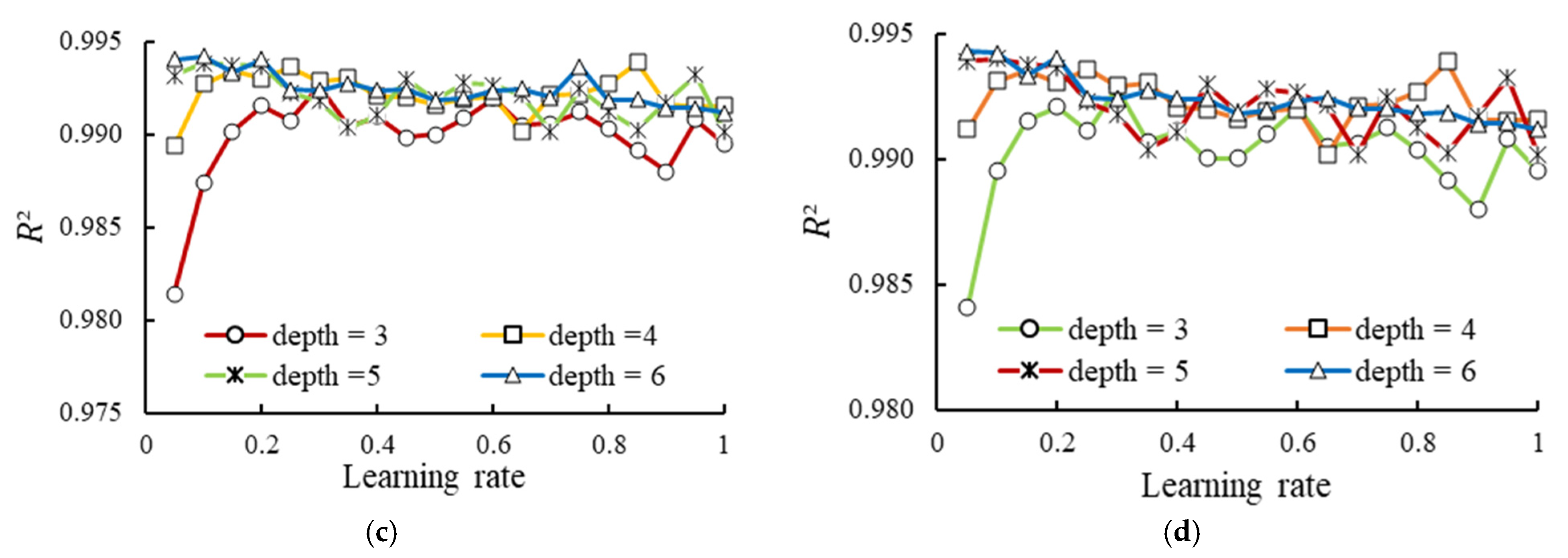
| XGBoost | colsample_bytree = 0.8, learning_rate = 0.2, max_depth = 6, n_estimators = 400, subsample = 1. |
| Model | Dataset | Performance Measures | |||
|---|---|---|---|---|---|
| RMSE (kN) | MAE (kN) | MAPE (%) | (%) | ||
| KRR | Training dataset | 15.96 | 10.15 | 8.35 | 99.00 |
| Test dataset | 37.65 | 23.16 | 18.55 | 92.00 | |
| All | 22.10 | 12.76 | 10.40 | 97.84 | |
| KNN | Training dataset | 2.10 | 0.42 | 0.373 | 1.00 |
| Test dataset | 36.88 | 19.84 | 10.87 | 96.23 | |
| All | 16.64 | 4.32 | 2.48 | 98.77 | |
| DT | Training dataset | 10.42 | 4.38 | 4.56 | 99.40 |
| Test dataset | 40.5 | 22.64 | 15.97 | 95.50 | |
| All | 20.41 | 8.048 | 6.86 | 98.16 | |
| RF | Training dataset | 13.60 | 7.75 | 5.45 | 99.00 |
| Test dataset | 29.50 | 16.66 | 11.83 | 97.60 | |
| All | 17.95 | 9.54 | 6.74 | 98.57 | |
| GBRT | Training dataset | 3.940 | 1.69 | 1.195 | 1.00 |
| Test dataset | 39.40 | 21.28 | 14.70 | 91.3 | |
| All | 18.00 | 5.630 | 3.91 | 98.57 | |
| XGBoost | Training dataset | 2.00 | 0.418 | 0.371 | 1.00 |
| Test dataset | 25.60 | 15.20 | 10.31 | 98.20 | |
| All | 11.61 | 3.388 | 2.37 | 99.40 | |
Disclaimer/Publisher’s Note: The statements, opinions and data contained in all publications are solely those of the individual author(s) and contributor(s) and not of MDPI and/or the editor(s). MDPI and/or the editor(s) disclaim responsibility for any injury to people or property resulting from any ideas, methods, instructions or products referred to in the content. |
© 2026 by the authors. Licensee MDPI, Basel, Switzerland. This article is an open access article distributed under the terms and conditions of the Creative Commons Attribution (CC BY) license.
Share and Cite
Yehia, S.A.; Ahmed, M.; Hussein, A.B.; Patel, V.I.; Liang, Q.Q.; Fayed, S.; Hamoda, A.; Shahin, R.I. The Development and Optimization of Machine Learning Models for Predicting the Shear Capacity of Corroded Reinforced Concrete Beams. Buildings 2026, 16, 2037. https://doi.org/10.3390/buildings16102037
Yehia SA, Ahmed M, Hussein AB, Patel VI, Liang QQ, Fayed S, Hamoda A, Shahin RI. The Development and Optimization of Machine Learning Models for Predicting the Shear Capacity of Corroded Reinforced Concrete Beams. Buildings. 2026; 16(10):2037. https://doi.org/10.3390/buildings16102037
Chicago/Turabian StyleYehia, Saad A., Mizan Ahmed, Ardalan B. Hussein, Vipulkumar Ishvarbhai Patel, Qing Quan Liang, Sabry Fayed, Ahmed Hamoda, and Ramy I. Shahin. 2026. "The Development and Optimization of Machine Learning Models for Predicting the Shear Capacity of Corroded Reinforced Concrete Beams" Buildings 16, no. 10: 2037. https://doi.org/10.3390/buildings16102037
APA StyleYehia, S. A., Ahmed, M., Hussein, A. B., Patel, V. I., Liang, Q. Q., Fayed, S., Hamoda, A., & Shahin, R. I. (2026). The Development and Optimization of Machine Learning Models for Predicting the Shear Capacity of Corroded Reinforced Concrete Beams. Buildings, 16(10), 2037. https://doi.org/10.3390/buildings16102037