Review

Review on Quality Monitoring Methods for 3D Printed Concrete

1
School of Civil Engineering and Architecture, East China Jiaotong University, Nanchang 330013, China
2
School of Civil Engineering, Chongqing University, Chongqing 400045, China
3
School of Design and Built Environment, Curtin University, Perth, WA 6102, Australia
*
Author to whom correspondence should be addressed.
Buildings 2026, 16(10), 1852; https://doi.org/10.3390/buildings16101852
Submission received: 8 March 2026 / Revised: 7 April 2026 / Accepted: 14 April 2026 / Published: 7 May 2026

Abstract

3D printed concrete technology has demonstrated great potential in transforming construction methods, improving efficiency, and reducing environmental impacts. However, the current quality control and identification of 3D printed concrete mainly rely on manual experience and traditional non-real-time measurements, enabling the printed quality to face major challenges. Although an increasing number of studies have investigated automated quality monitoring and defect detection in 3D printed concrete, a dedicated review that systematically synthesizes these methods is still lacking. This paper provides a comprehensive review of automated quality monitoring methods for 3D printed concrete, focusing on current techniques, challenges, and future applications. Optical image processing and machine learning have been successfully used to detect defects in 3D printed concrete, although these methods have limitations in real-time performance, automation, and data quality. Further, deep learning-based methods have shown great potential in improving the accuracy and automation of defect detection, although data annotation, model generalization, large-scale construction projects, and real-time integration still face challenges. Finally, the integration of quality monitoring with building information modeling and further developments in multi-source data fusion, data augmentation, real-time adaptive control, and active quality control are recommended to address current challenges.

1. Introduction

The transformation of the global manufacturing industry has enabled 3D printing technology to gradually demonstrate its wide application prospects in numerous fields [1,2]. In the construction industry, 3D printing concrete (3DPC) is the most common additive construction technology due to computer-controlled automated processes to build structures or buildings, depositing concrete materials layer by layer [3,4]. 3DPC technology was originally applied to the production of small models as a rapid prototyping method, which can be traced back to the 90s of the last century [5,6]. 3DPC technology has advantages such as high efficiency, environmental protection, and automated performance, becoming a development strategy and the future development direction of the construction industry [7,8].
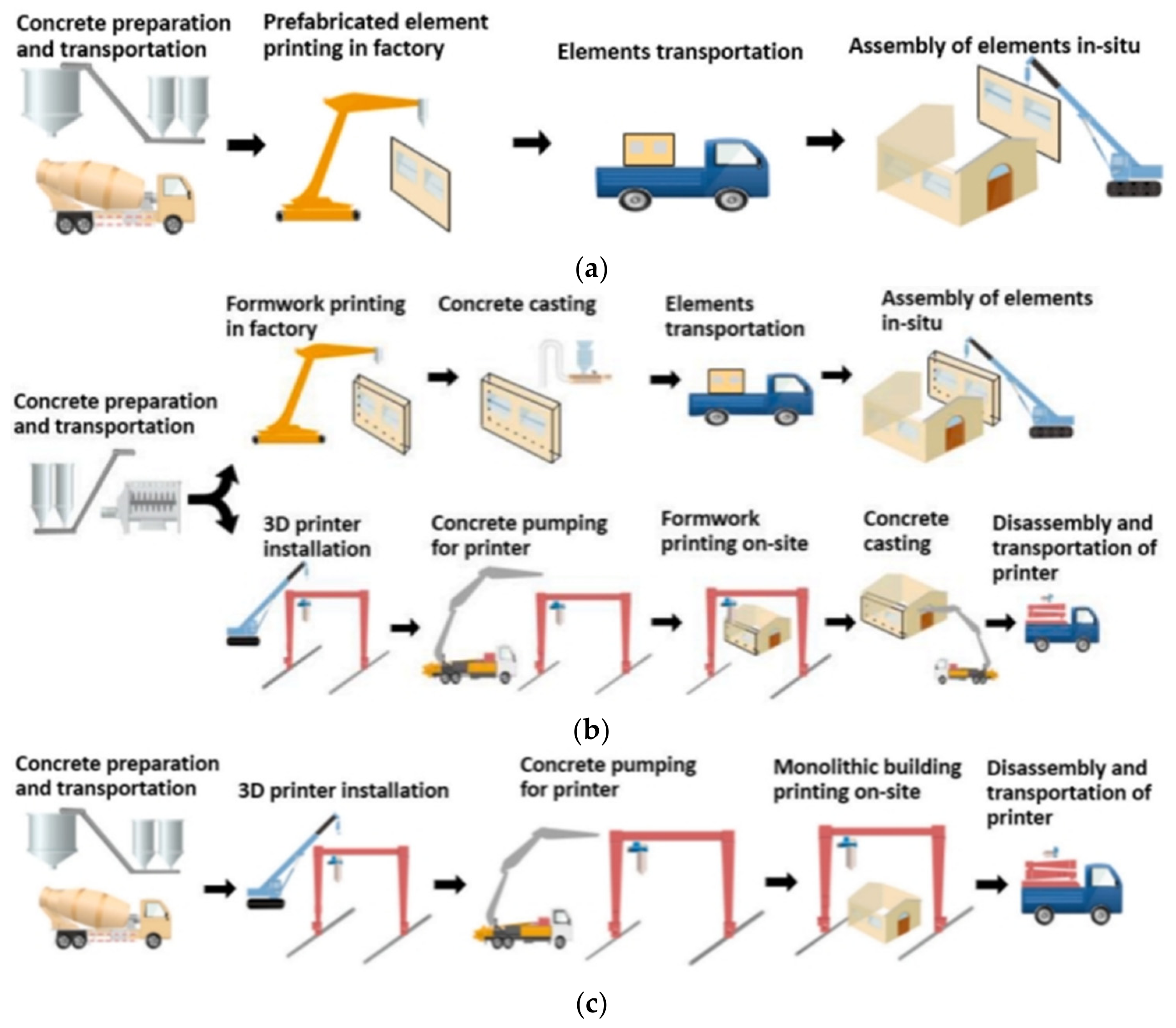
As shown in Figure 1, 3DPC is generally applied in the construction field in three forms: 3D printing of modular, printing by contoured formwork, and on-site printing [9,10,11]. printing of modular breaks down an integrated structure into modules, which are printed in a factory with a controlled environment and then assembled into a complete building through transportation and on-site assembly [12,13]. The 3D printing by contoured formwork involves fabricating formwork for structures via 3D printing technology [14]. Subsequently, conventional concrete casting technology is applied to formwork when the formwork is completed, thereby forming the final architectural structure [15,16]. On-site printing is directly printed at construction sites using 3D printing equipment to produce entire buildings [17]. 3D printing of modular and the 3D printing by contoured formwork can be further integrated with prefabricated construction [18]. This combination leverages the significant advantages of 3D printing and prefabrication technologies, aligning with the current trends toward building industrialization and green, sustainable development [19].
However, current 3D printing technology mainly relies on pre-defined digital models for printing. Meanwhile, it is limited to fixed processes and parameters and lacks the ability to adapt and adjust in real time to environmental changes, although the operation is relatively simple [20]. Moreover, 3D printing technology is undergoing a transformation from digitalization to intelligence as demand becomes increasingly complex [21]. Sensing capability serves as the foundation of intelligent transformation of 3D printing technology, enabling printed equipment to perceive changes in the external environment in real time and convert these changes into data inputs [22,23]. Using these data inputs, the 3D printing system can adjust and control the process in response to real-time feedback, thereby improving both print quality and operational efficiency [24,25].
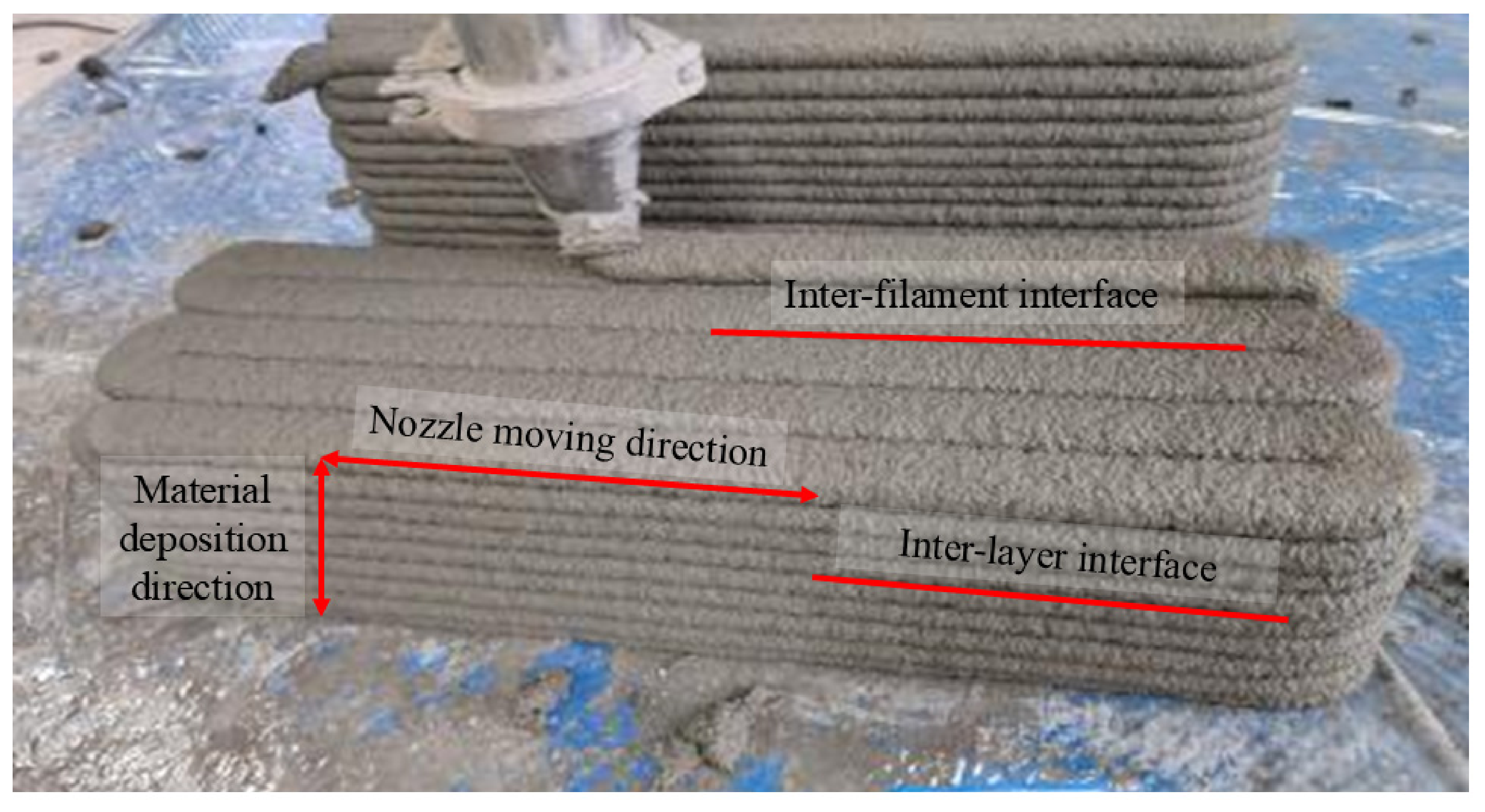
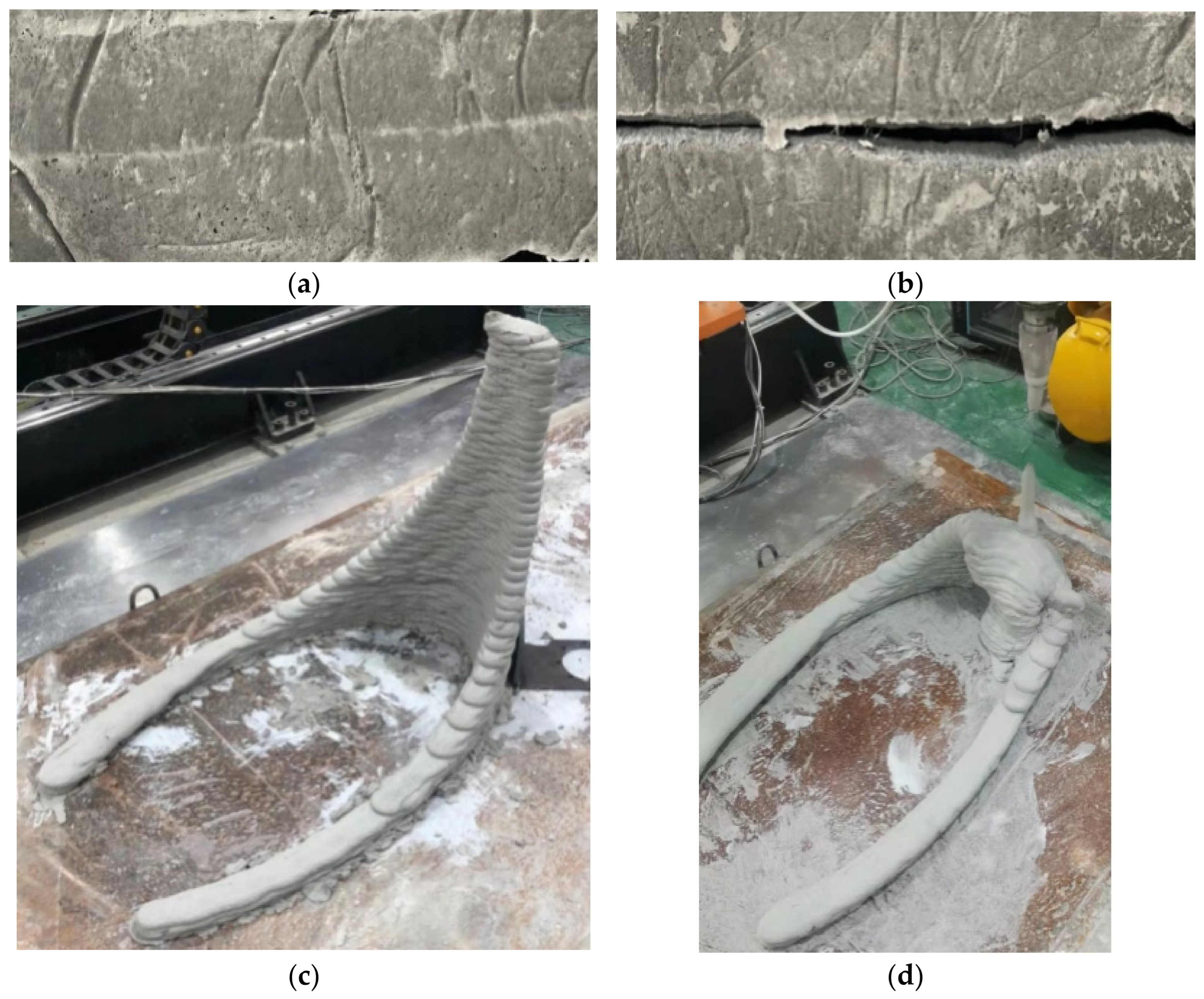
Figure 2 shows direction and interface of the component using 3DPC technology. The printed layer deformation in the interlayer direction accumulates layer by layer, resulting in the loss of bonding at the interlayer interface, which leads to serious damage to the overall performance of the printing structure, as shown in Figure 3b [26]. Among them, any mistake in the printing process may lead to defects in the final structure, which will affect its structural strength and safety in actual construction, and even lead to the collapse of the building structure, as shown in Figure 3d [23,27]. The quality of 3DPC is directly related to the stability and service life of the structure in the construction industry. Therefore, precision and forming quality control play a crucial role in the concrete 3DPC [28].
To ensure the reliable application of 3DPC in buildings, accurate control throughout the entire printing process in multiple aspects is necessary, including the real-time monitoring and adjustment of factors such as printer parameters, environmental temperature, and the work performance of the printed concrete material [29,30,31]. To face these challenges, smart control systems and real-time feedback mechanisms are critical, enabling the equipment to perceive and adjust parameters during the printing process [20,24]. The stability and consistency of the printed structure quality can be effectively guaranteed due to the above process. Therefore, the research and development of quality monitoring and control systems for 3DPC is of great practical significance [25].
However, quality monitoring and control in 3DPC largely depend on manual inspection of anomalies and the experience of operators in process regulation [32,33]. Meanwhile, non-real-time measurements such as rheological characterization of materials and monitoring of environmental humidity and temperature are supplemented [34,35]. Furthermore, operators must interrupt the printing process and manually adjust appropriate printer and material parameters based on experience when anomalies are observed [36]. Nevertheless, this conventional approach exhibits several limitations, including low efficiency, strong reliance on operator experience, and susceptibility to subjective judgment [36,37,38]. Moreover, previous studies have identified additional drawbacks, such as high labor costs, limited accuracy, and significant time consumption, which hinder the adoption of concrete 3D printing in large-scale and building-level construction [36,39]. Consequently, the development of real-time and automated quality monitoring and control methods for the concrete 3D printing process has become essential to address these challenges.
Previous reviews have paid limited attention to the quality monitoring and defect detection of 3DPC, mainly focusing on the material properties and printing paths of 3DPC. A comprehensive guideline is needed to assist researchers in selecting appropriate algorithm models and monitoring directions for quality monitoring, improving the mechanical properties and forming accuracy of 3DPC. As a result, this paper summarizes the current state of knowledge on 3DPC quality monitoring methods, including optical image processing, machine learning, and deep learning methods. The main research focuses are as follows:
(1)
The categories of 3DPC defects and printing orientations are defined.
(2)
The categories, advantages, disadvantages, and real-time performance of quality monitoring methods are presented in 3DPC.
(3)
The sensor types and monitoring orientations used in 3DPC quality monitoring methods are systematically reviewed
(4)
The current limitations and future research directions of existing 3DPC quality monitoring methods are discussed.

2. Methodology

A systematic literature review was conducted using three major global academic databases, namely ProQuest, Scopus, and Web of Science, which cover databases such as ScienceDirect, SpringerLink, ASCE, Wiley Online Library, PubMed, and Taylor and Francis. Focusing on the core issues addressed in this study, an initial search was carried out within the scope of titles, abstracts, and author keywords using specific search terms. Specifically, the initial keywords included printed concrete, 3D concrete printing, 3D printed concrete control, 3D printed concrete monitoring, 3D printed concrete defect detection, vision-based 3D printed concrete, challenges for 3D printing concrete, and deep-learning-based 3D printed concrete. The included literature mainly consisted of peer-reviewed papers published in authoritative international journals. To further improve the quality of the review, conference papers and book chapters, and these were also taken into consideration.
After a comprehensive review of the literature on 3D printed concrete monitoring, 24 core studies were ultimately selected. Based on the different inspection targets, the identified methods were classified into two categories: quality monitoring during the 3D printed concrete process and microscopic defect inspection methods for 3D printed concrete. Subsequently, the methods used for quality monitoring during the 3D printed concrete process were further classified into two categories according to the monitoring algorithms employed: optical image processing methods and machine learning methods.
Based on the reviewed literature and the multi-scale nature of defect formation, defects in 3D printed concrete can be classified into categories associated with dimensional deviation, morphological instability, and material discontinuity. Specifically, abnormal height represents deviations in vertical geometric accuracy. Filament width and layer width describe lateral dimensional deviations at different deposition scales. Layer deformation and layer curvature reflect post-deposition shape instability. Material defects and filament defects indicate discontinuity and inconsistency during material extrusion and deposition. This classification is more applicable to process monitoring, image recognition, and quality assessment in 3D-printed concrete.

3. Quality Monitoring During the 3D Printed Concrete Process

Due to significant advantages in non-contact monitoring, optical methods employing are now widely adopted in industrial applications [40]. These methods reduce physical interference with the monitored object and provide broad applicability, particularly in complex or hazardous environments [41]. As a result, optical methods have been effectively applied to process monitoring in 3DPC to reduce on-site intervention during the printing process [42,43,44]. As shown in Table 1, existing studies classify optical monitoring methods for concrete 3D printing into three main categories: optical image processing, machine learning, and deep learning-based methods.
Real-time capability and accuracy are the key criteria for evaluating quality monitoring and control methods in 3DPC. Systems meet real-time requirements to respond promptly and ensure printed quality because the printing process is dynamic. Moreover, forming accuracy critically determines the mechanical performance of printed building components in the fabrication of large-scale structures. Monitoring methods need to satisfy the requirements of accuracy and real-time.

3.1. Quality Monitoring Methods Based on Optical Image Processing

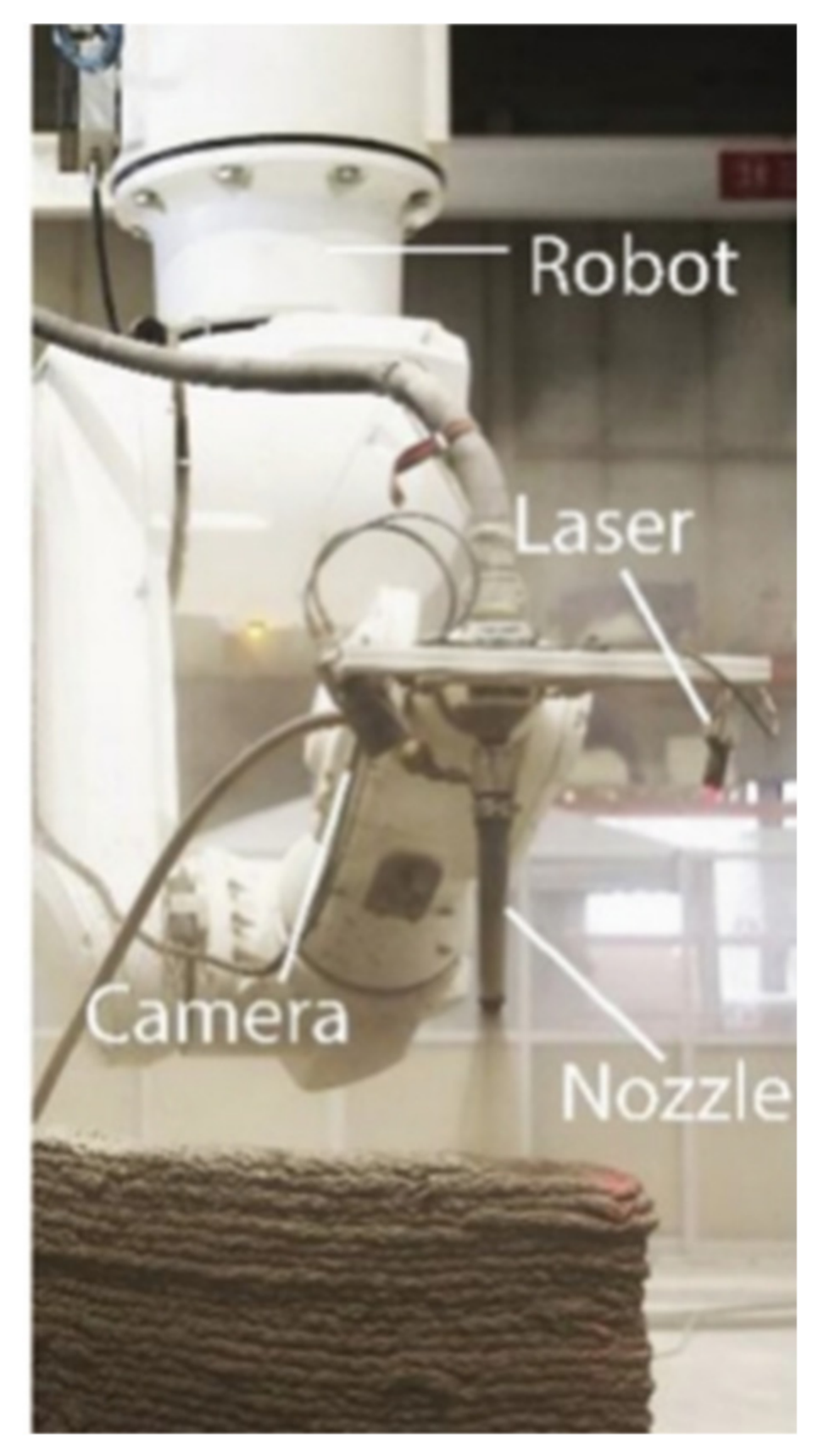
Traditional optical image processing algorithms were the earliest methods used for quality monitoring in 3DPC. As illustrated in Figure 4, time of flight (ToF) utilizes optical distance sensors to measure the distance between the sensor and the uppermost printed layer [45,46]. Further, abnormal height along the inter-filament direction is detected by maintaining a stable distance. However, this approach requires high-precision equipment and involves considerable cost despite providing real-time feedback. Moreover, monitoring coverage of this method is limited, and its performance is sensitive to environmental conditions during the printing process. Furthermore, monitoring the printed filament width or printed layer width of an individual printed filament provides only a local assessment of geometric anomalies. In addition, ToF-based methods depend on predefined rules or static models, constraining generalization capability and preventing adaptive adjustment of monitoring strategies in real time. Thereby, it can only be applied to extremely limited, simple scenarios.
Optical algorithms with more complex features demonstrate greater advantages in concrete 3D printing quality monitoring compared to TOF with simple mechanisms. Senthilnathan et al. [47] applied a local binary pattern (LBP) algorithm to detect defects by texture analysis, achieving defect detection accuracy at 80.45% with a single-layer analysis time of less than 5 s. LBP is a widely used texture feature extraction technique using comparison of the pixel values in a local image region with the value of the central pixel and converts the results into binary numbers. Texture variation can be quantified through measures such as information entropy, enabling assessment of surface quality in 3DPC. This method measures texture variation in local regions by calculating information entropy, thereby assessing the quality of 3DPC. To improve detection accuracy, Senthilnathan [48] combined LBP with gray-level co-occurrence matrix (GLCM), which captures texture features by analyzing the gray-level relationships between pixel pairs in an image. This combined method achieved an accuracy of 90% and a single-layer analysis time of less than 10 s in identifying anomalies in printed layers. However, these methods can only analyze the flow performance of the printable material based on the surface characteristics of the printed material.
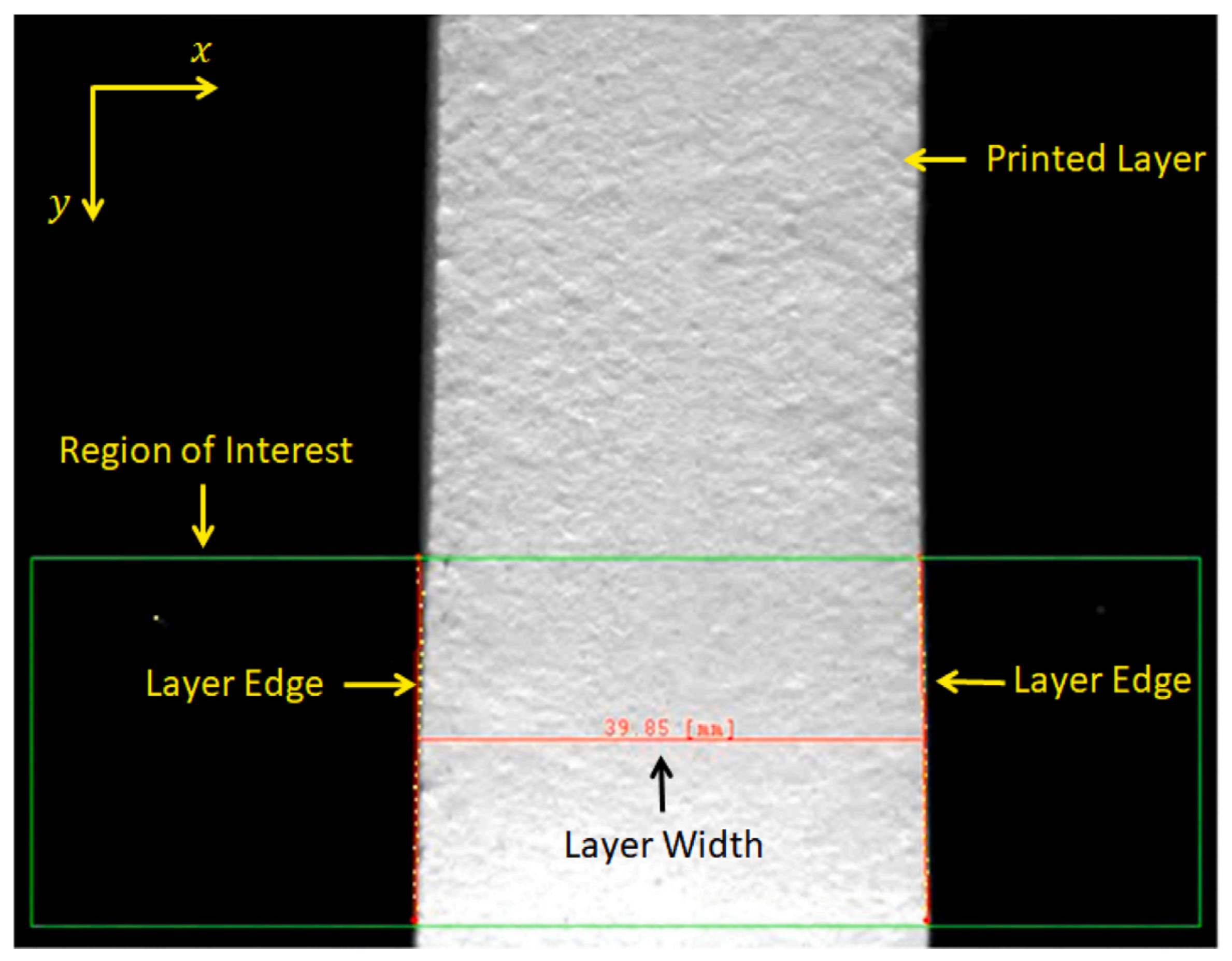
To obtain more detailed information, Kazemian et al. [49] employed LBP and a Gaussian filter to segment printed filament boundaries in the interlayer direction during the 3DPC process. This method enables a preliminary determination of the width of the uppermost individual filament and evaluates the forming quality of the printed layer based on this width, as illustrated in Figure 5. This method combines the value of each pixel in the image with the weighted average of its surrounding pixels through a Gaussian filter, thereby reducing false detection caused by noise and extracting the edges of the printed filaments. Similarly, Barjuei et al. [50] adopted the classical Canny edge detection algorithm to extract boundary information of single-layer filaments during the printing process, obtaining a visual processing speed of 10 frames per second (FPS), as shown in Figure 6.
However, these traditional optical image processing algorithms rely on manually defined parameters such as threshold settings, parameter selection in edge detection algorithms, and configurations for image smoothing and filtering [51]. These parameters need to be manually adjusted to accommodate different images or environmental conditions when the construction environment changes, such as variations in lighting, temperature, and humidity [52]. The surface of 3DPC often exhibits irregular characteristics, while environmental factors at the construction site, such as lighting, humidity, and temperature, may vary significantly. Manual parameter tuning reduces computational efficiency and limits algorithm adaptability in dynamic construction environments, leading to a low level of automation.

3.2. Quality Monitoring Methods Using Machine Learning

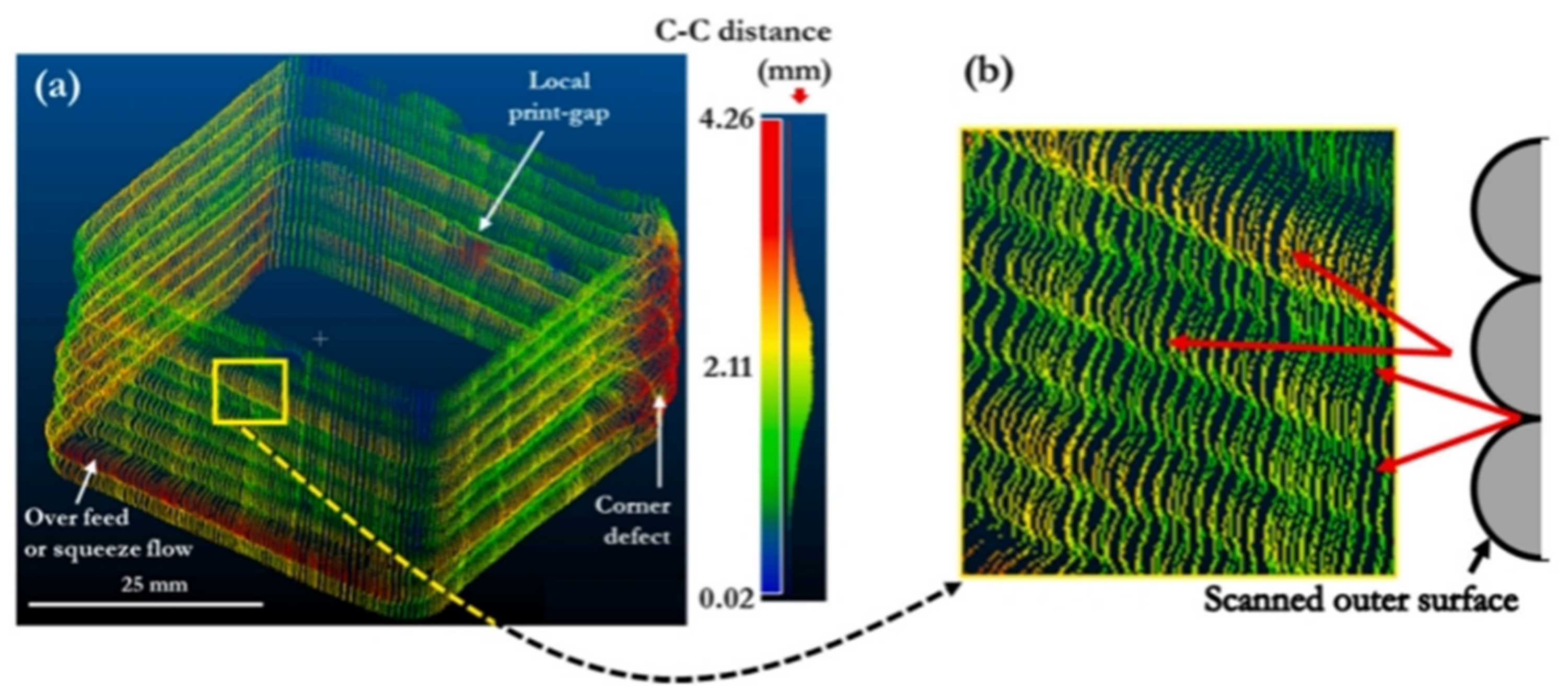
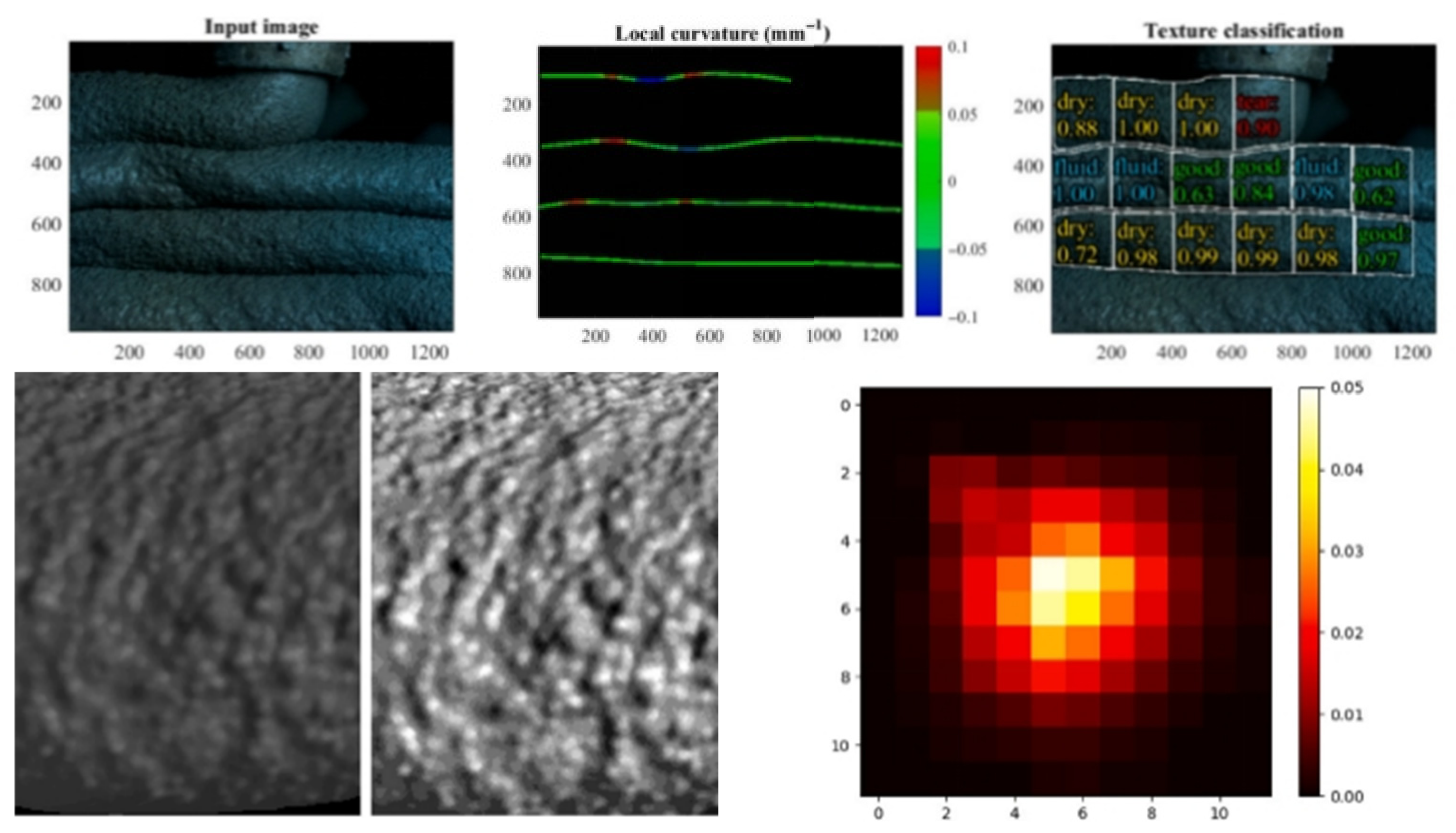
Compared to quality detection approaches based on traditional optical image processing algorithms, machine learning methods can learn from large volumes of data and extract complex patterns and relationships embedded within the data. Besides, machine learning techniques can automatically extract image features and utilize them to perform accurate quality assessment, overcoming the limitations of conventional methods in handling complex data [53]. Nair [54] employed the iterative closest point (ICP) algorithm to register point cloud data obtained from 3DPC and employed hierarchical clustering for preliminary point cloud segmentation. As shown in Figure 7, a geometric model of 3DPC is established to assess the printed quality through comparison with the design model. However, this framework is a post-process evaluation and does not support real-time quality monitoring or adaptive control during printing. Besides, traditional machine learning algorithms still face challenges when they process 3DPC images, which exhibit complex morphological characteristics.
Traditional machine learning methods and optical image processing algorithms require substantial manual intervention of algorithmic parameters and models to improve geometric feature extraction. Consequently, these approaches lack sufficient accuracy and generalization capability in concrete 3D printing quality monitoring and control, while their level of automation remains limited.
Deep learning has emerged as a powerful branch of machine learning and has demonstrated substantial advantages in computer vision. Deep learning has substantial potential in industrial production quality monitoring, outperforming traditional methods [55]. Deep learning employs multilayer neural network architectures and learns hierarchical feature representations directly from large-scale raw data through iterative weight optimization [56]. The automated feature learning mechanism reduces reliance on manual intervention, enabling the identification of subtle data variations, which enhances generalization capability and predictive accuracy [57]. Deep learning has significantly improved efficiency and accuracy in industrial production, especially in quality monitoring and defect detections [58].
Convolutional Neural Networks (CNNs), as data-driven deep learning algorithms, have become among the most influential techniques in computer vision in recent years. CNN has made remarkable progress in object detection and image segmentation tasks. CNN utilizes hierarchical multilayer architectures to learn feature representations directly from large-scale raw datasets, demonstrating exceptional capability in image analysis applications [59]. CNN can automatically extract features from a large amount of raw data through its multi-layer structure, and demonstrate powerful capabilities, especially in image data processing [60]. Convolutional neural networks can identify local features in images and fuse local information, which endows them with stronger robustness and accuracy in image processing. They perform better than traditional machine learning methods [61].
CNN-based approaches have shown considerable promise in concrete surface crack detection applications. In these fields, the automatic feature extraction ability of convolutional neural networks makes the detection process no longer rely on manually designed features, thus significantly improving detection accuracy. Industrial quality inspection systems based on convolutional neural networks have higher accuracy and stronger adaptability [62]. They can perform real-time monitoring in complex industrial environments and greatly reduce the dependence on labor-intensive manual inspection [63]. Meanwhile, in concrete crack detection, convolutional neural network methods can efficiently identify the location, shape, and size of cracks, providing a more efficient and accurate means for quality monitoring [64]. Convolutional neural networks improve detection accuracy and reduce the labor intensity of manual inspection, enabling automation and high efficiency in large-scale production compared with traditional manual inspection.
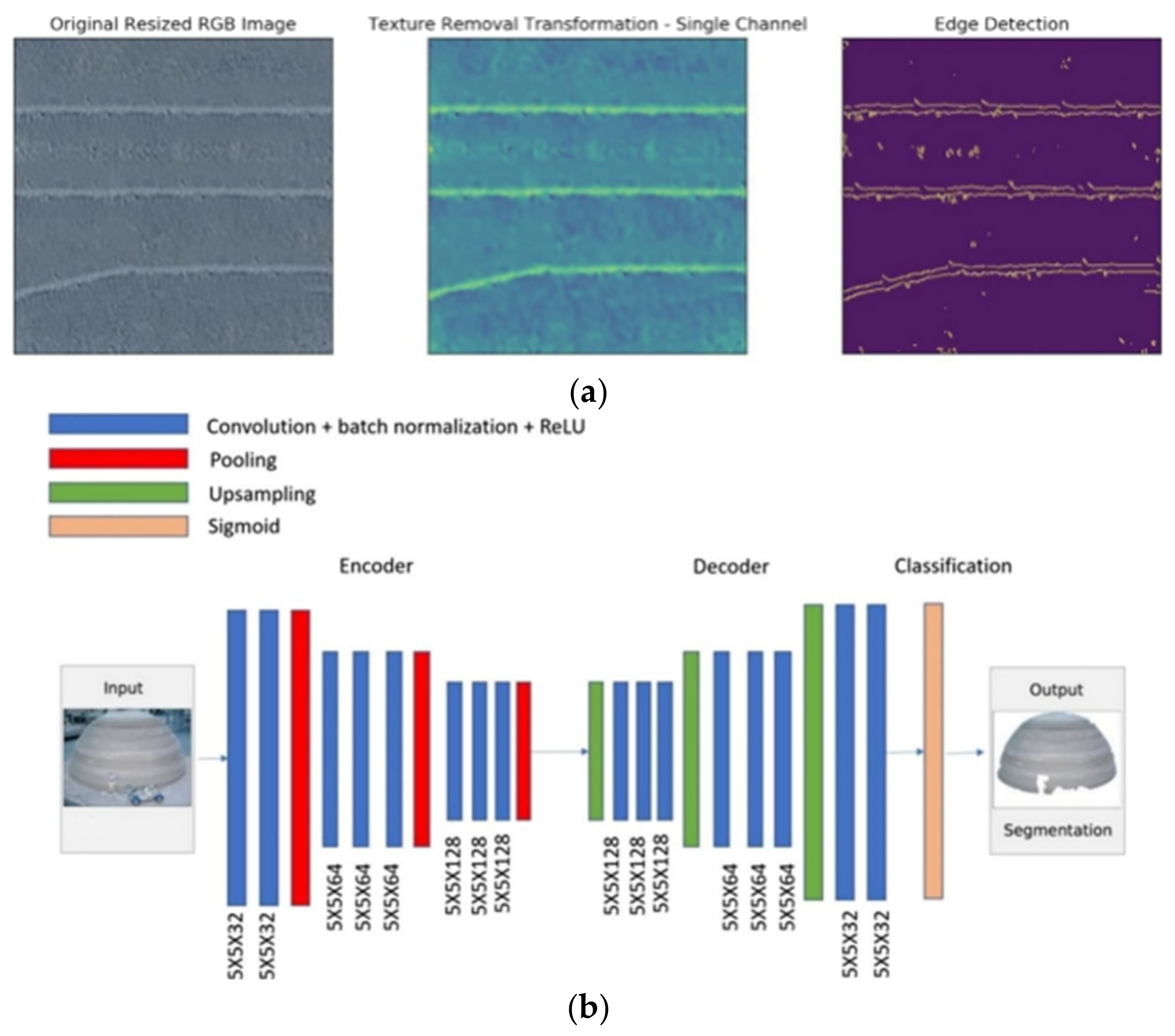
Given the advantages of CNNs in quality monitoring of concrete materials, they have also been applied in 3DPC [13]. Davtalab et al. [65] employed a CNN-based U-Net to segment interlayer interface lines during the printing process, achieving an F-score of 91%. Local deformation regions of printed layers were identified based on the segmentation results, thereby supporting operator decision-making, as shown in Figure 8a. U-Net represents a classical CNN architecture designed for image segmentation and is particularly suitable for pixel-level detection tasks. Contextual information is extracted through an encoder–decoder structure, and high-resolution features are restored during decoding, enabling segmentation of interlayer interfaces in the concrete 3D printing process, as illustrated in Figure 8b. Subsequently, Rill-Garcia et al. [66] adopted the U-Net to segment interlayer interface lines and printed layer curvature, detecting abnormal printed regions by the magnitude of curvature variation. Additionally, binary pattern analysis and GLCM were applied to generate heat maps of the material surface of 3DPC. Ultimately, overall printed quality was assessed by the integrating material state and the interlayer interface conditions, as presented in Figure 9. Compared with traditional machine learning and optical algorithms, CNN-based segmentation methods enable the identification of more complex targets and the extraction of more representative information in 3DPC. However, the information generated by these two earlier U-Net-based methods is not available in real time, which limits their effectiveness in guiding the printing process. Meanwhile, additional training data are needed to improve the reliability of the model because the training data used in these two methods comprises fewer than 1000 samples.
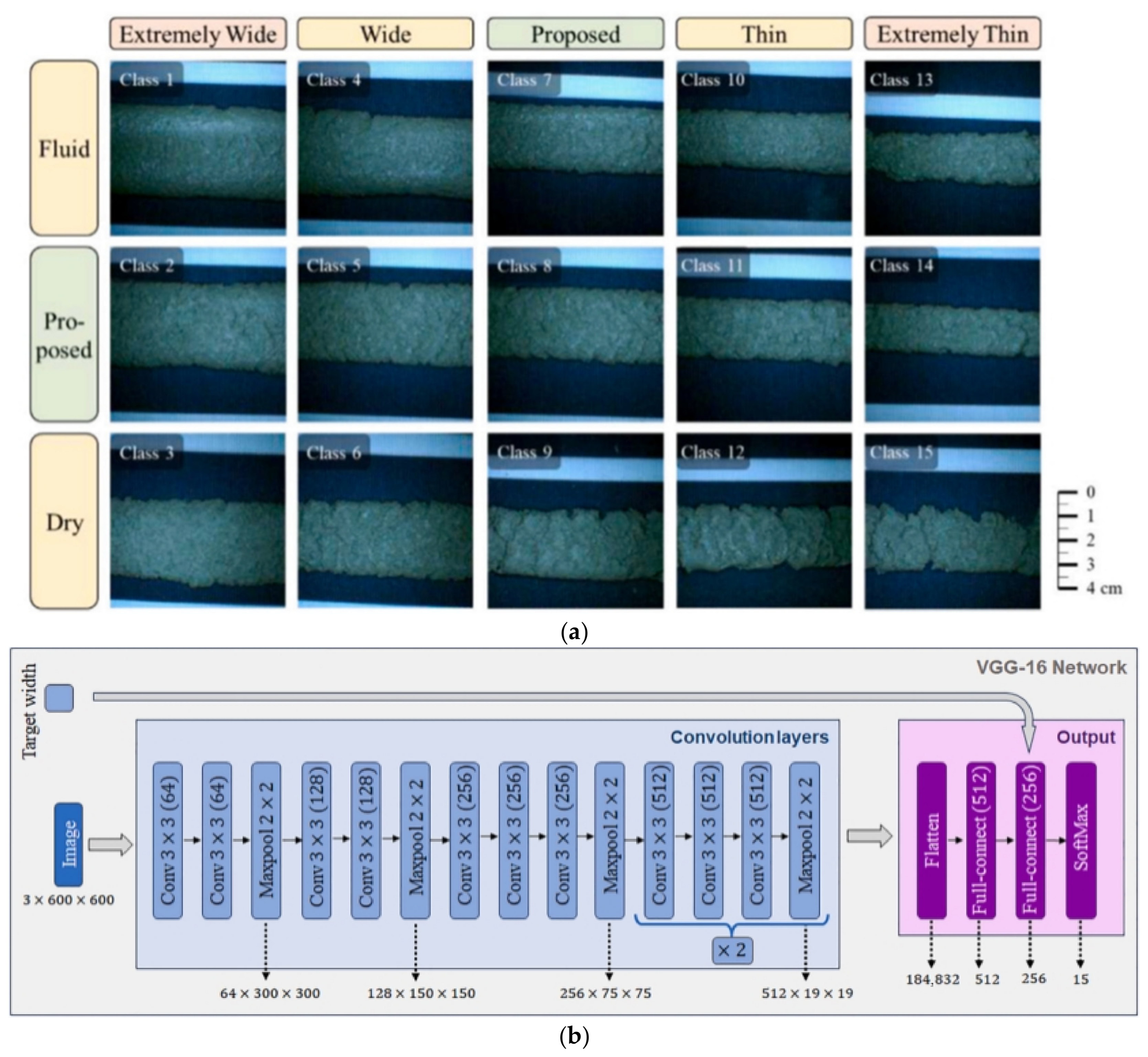
To improve accuracy and real-time performance, Zhang et al. [67] trained a CNN model using more than 3000 samples to classify the material states in the inter-filament direction of concrete 3DPC, as shown in Figure 10a. Meanwhile, an initial Visual Geometry Group (VGG) network is improved by reducing computational parameters to enhance its real-time performance, as shown in Figure 10b. However, this method still suffers from the inherent limitations of the CNN architecture, which relies on sliding windows to extract local features and cannot directly capture global information.
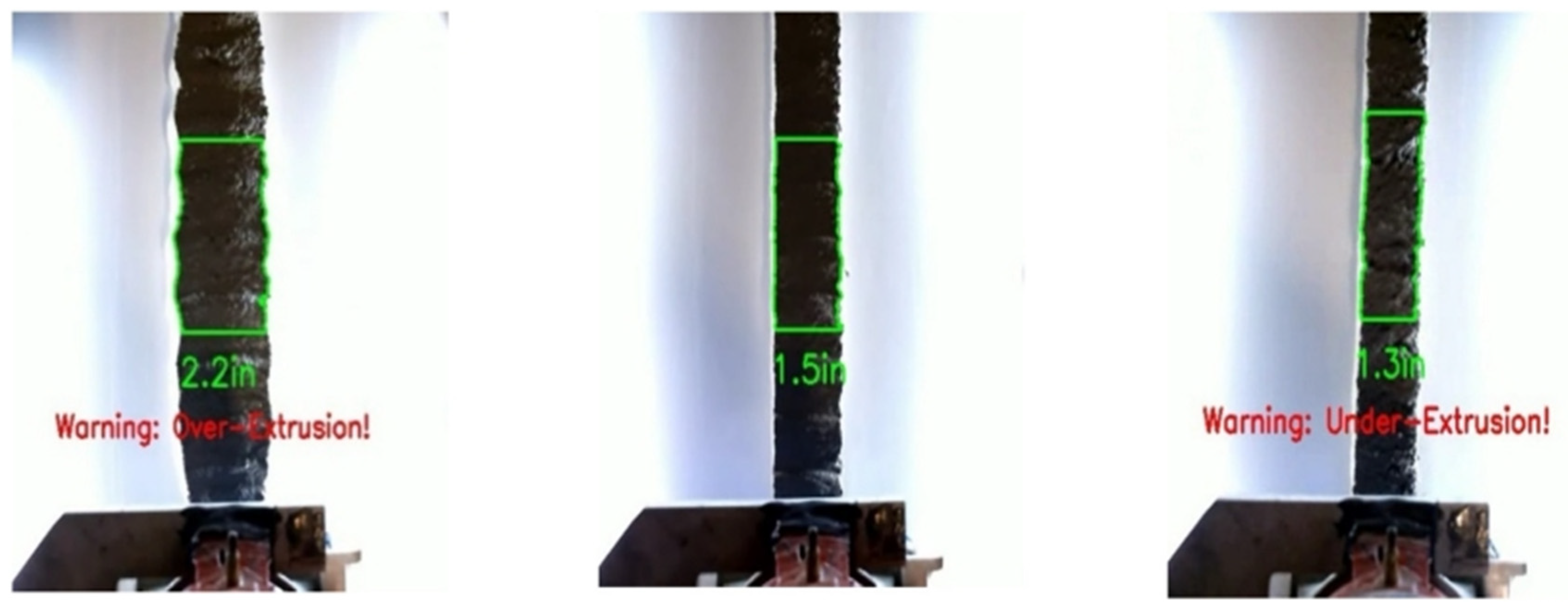
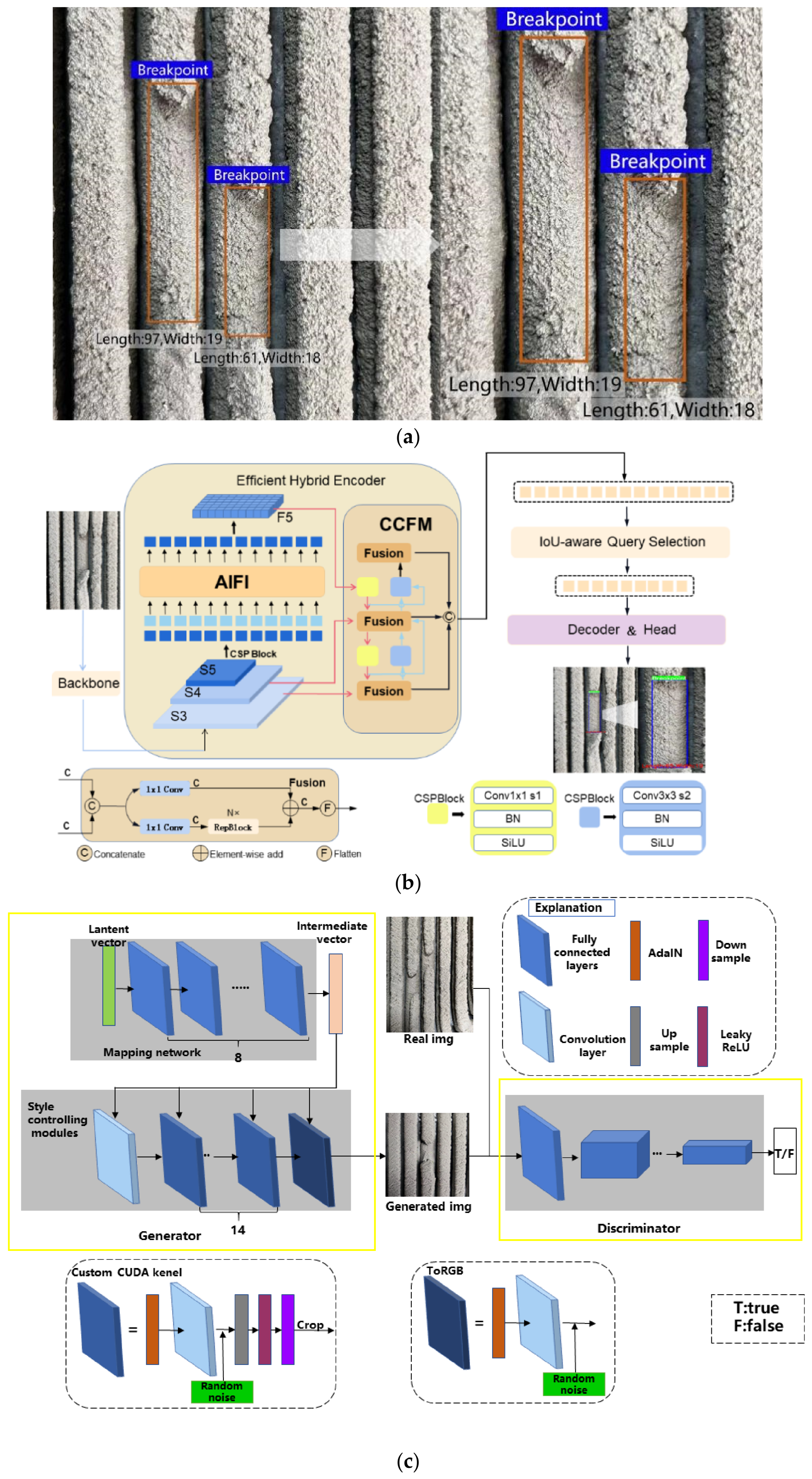
In contrast, Transformer networks overcome the limitations of CNNs in local feature processing [68]. Through the self-attention mechanism, each pixel in the image can directly interact with all other pixels in the input sequence [69]. Using the Transformer, Zhao et al. [70] proposes a method for real-time detection of printed filament defects during the printing process from the nozzle moving direction using a transformer-based object detection algorithm, as shown in Figure 11a. As shown in Figure 11b, its original Transformer-based object detection algorithm is improved through multiple strategies to enhance detection accuracy and computational efficiency. Further, a generative algorithm is applied to produce synthetic data to address the limited size of the printed filament dataset, as shown in Figure 11c. Through these methods, a high accuracy of mean average precision at an intersection over union threshold of 0.50 (mAP50) at 98.1% and a high real-time performance of 74 FPS are achieved for defect detection of printed filaments.
In summary, the real-time performance of current deep learning-based detection methods during the printing processes has gradually improved, and the underlying models have evolved from simple architectures to more sophisticated designs, leading to higher monitoring accuracy. However, the assessment is usually conducted from a single perspective and mainly focuses on surface appearance or local geometric anomalies. Comprehensive monitoring of overall quality remains difficult using a single detection method, while multiple methods targeting different monitoring objects must be integrated to obtain a complete evaluation of 3DPC quality.
Table 1. Algorithm, sensor, recognized target, and monitoring direction for quality monitoring of 3DPC during the printing process.
Algorithm TypeSensorRecognized TargetAlgorithmMonitoring DirectionReal TimeRef.
Optical image processingDistance sensorAbnormal heightToFNozzle moving direction[45]
Laser sensorAbnormal heightToFNozzle moving direction[46]
RGB cameraMaterial defectLBPDeposition direction×[47]
RGB cameraMaterial defectLBP, GLCMDeposition direction×[48]
RGB cameraFilament widthGaussian filterNozzle moving direction[49]
Grayscale cameraLayer widthCannyMaterial deposition direction[50]
Machine learning3D scanningLayer deformationICPMaterial deposition direction×[54]
Deep learningRGB cameraLayer curvatureSemantic segmentationMaterial deposition direction×[65]
RGB cameraMaterial defectImage classificationNozzle moving direction[66]
RGB cameraFilament defectObject detectionNozzle moving direction[70]

4. Microscopic Defect Inspection Methods for 3D Printed Concrete

Macroscopic defects in concrete originate from the progressive evolution of microscopic defects [71]. Due to the formwork-free and layer-by-layer construction process of 3DPC, each printed filament must rapidly obtain sufficient stiffness to support the load from the upper layers within a short period [30]. This characteristic requires the concrete material to possess rapid setting ability and to develop initial strength quickly [72]. However, the rapid setting of cement-based materials and the extrusion effect of the nozzle can significantly alter the internal microstructure of the printed filament, affect the morphology and distribution of pores and cracks, and aggravate the initiation and evolution of micro-defects [73]. Therefore, dynamic detection and quantitative evaluation of microscopic defects within 3DPC are essential before they develop into macroscopic quality problems.
Microcracks and micropores constitute the primary types of microscopic defects observed in 3DPC materials [74,75]. A unified classification standard for microscopic defects has not yet been established. Referenced from conventionally cast concrete indicates that microcracks in 3DPC are typically defined as having widths of 0.1–10 μm [76]. Pores with diameters exceeding 1 mm are usually defined as macropores, while micropores typically exhibit diameters smaller than 10 μm [77,78].
CT is a primary technique for quantifying internal defects in 3DPC because it can reconstruct the three-dimensional internal structure of the material [79]. However, high-resolution CT places high demands on equipment, operation, and computational resources. At small scales, dense aggregates can also introduce noise and blurring artifacts, which reduces the accuracy of microscopic defect identification and quantitative analysis [80]. Compared with CT, SEM offers clear advantages for two-dimensional defect characterization, including higher magnification, better spatial resolution, and lower cost [81,82]. Conventional SEM analysis still depends largely on manual interpretation, which limits its objectivity and repeatability [83].
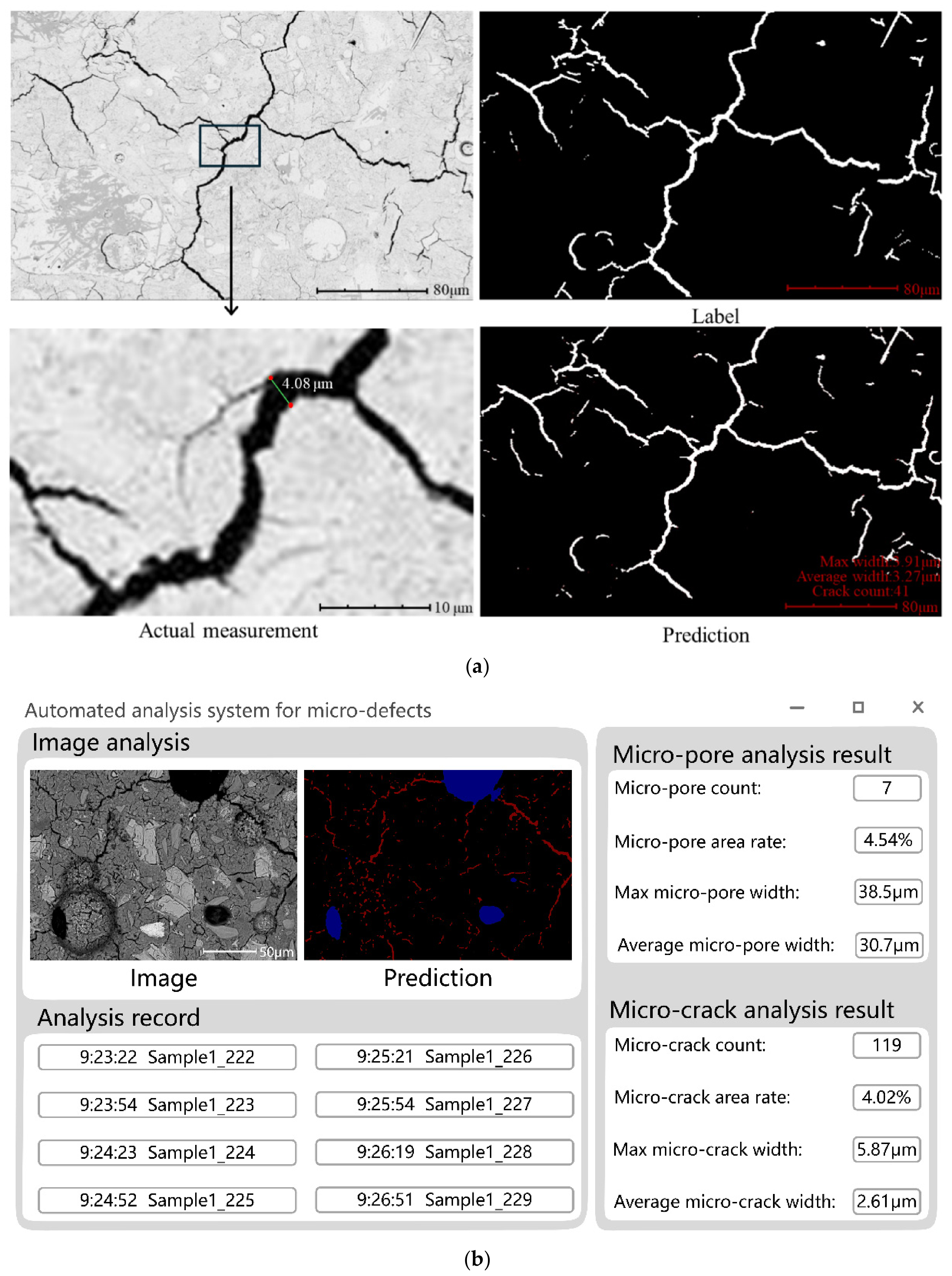
With the development of deep learning and its widespread application in image analysis, CNNs have been used as feature extractors to identify complex components in SEM images, thereby improving the capability for automated quantification. Subsequently, deep learning was also applied to the detection of microscopic defects in 3DPC materials. As shown in Figure 12a, Zhao et al. [81,84] employed a Transformer architecture to detect microcracks in SEM images of 3DPC and measured their widths at the pixel level, achieving a mean pixel accuracy (mPA) of 83.32% and an average relative error of 6.03% for the microcrack area ratio. To improve measurement accuracy, a deep learning-based super-resolution reconstruction method is adopted to enhance the quality of the original images, obtaining an mPA of 87.61% and a microcrack width measurement accuracy of over 95%. Subsequently, Zhao et al. [85] used a deep learning-based method to quantify the number, width, and proportion of micro-defects, developing a dedicated detection system based on this approach, as shown in Figure 12b. Therefore, the methods for detecting microscopic defects in 3DPC are evolving from experience-dependent qualitative observation towards automated and quantitative analysis. Future research can further enhance detection accuracy and robustness, integrating these methods into a multi-scale quality assessment framework.

5. Future Challenges and Expected Applications

5.1. Future Challenges

5.1.1. Lack of Quality Evaluation Framework

Although considerable progress has been made in defect detection and process monitoring for 3DPC, a systematic quality evaluation framework has not yet been fully established [86,87,88]. Most existing studies focus on specific monitoring targets, such as dimensional deviation, surface morphology, filament consistency, or internal defects, but the criteria used to assess these indicators are often inconsistent [89,90]. Different studies usually adopt different evaluation metrics, testing conditions, and judgment thresholds, which makes it difficult to compare results directly or form a unified understanding of printing quality [91,92,93]. In addition, the quality of 3DPC involves multiple aspects, including geometric accuracy, surface finish, interlayer bonding performance, mechanical integrity, and long-term durability [28,94,95,96,97]. These aspects are closely related, yet they are still commonly assessed in an isolated manner rather than within an integrated framework. As a result, current quality assessment methods still lack standardization, comparability, and systematic applicability in practical construction scenarios. Therefore, future research needs to establish a more comprehensive quality evaluation system for 3DPC to provide a more reliable basis for quality judgment, technology comparison, and engineering implementation.

5.1.2. Insufficient Data Quality and Quantity

Despite the rapid progress of optical sensing, machine learning, and deep learning methods in 3DPC quality monitoring, several critical challenges remain [98,99]. One of the main limitations lies in the insufficient quality and quantity of available data. Existing deep learning-based methods rely heavily on annotated datasets, yet the collection of high-quality 3DPC data is still difficult [100,101,102,103]. Variations in lighting conditions, camera angles, printing speed, nozzle movement, material rheology, and environmental temperature and humidity can significantly affect image consistency and data reliability during the printing process [104]. These factors increase the difficulty of building robust datasets with strong representativeness. In addition, the annotation of defects in 3DPC often requires substantial manual effort and expert knowledge, especially for subtle geometric anomalies, interlayer deformation, and microscopic defects [85,105]. As a result, many current studies are still based on relatively small datasets, which restricts the generalization capability, stability, and practical applicability of trained models in complex construction scenarios. Therefore, future research needs to establish larger, more diverse, and more standardized datasets, while also improving data augmentation, synthetic data generation, and cross-condition data acquisition strategies to enhance model robustness and transferability.

5.1.3. Acquiring Comprehensive Quality Information

A single detection method is still insufficient to obtain comprehensive quality information for 3DPC [106]. Current monitoring approaches usually focus on only one specific target, such as filament width, layer height, surface texture, local deformation, or microscopic cracks [107]. Although these methods can provide useful information for a particular aspect of quality evaluation, they cannot fully reflect the overall condition of the printed structure. The quality of 3DPC is inherently multi-scale and multi-dimensional, involving geometric accuracy, surface morphology, interlayer bonding, material state, and internal defect evolution [108]. A monitoring framework based on only one sensor or one algorithm can hardly capture all these aspects simultaneously. Consequently, future studies should move towards multi-source data fusion and multi-modal collaborative monitoring by integrating different sensing techniques, such as RGB imaging, depth sensing, point cloud analysis, and microscopic imaging, together with multiple algorithmic approaches.

5.1.4. Limited Robustness Under Complex Conditions

Although vision-based quality monitoring methods have shown promising performance in 3DPC, their robustness under complex conditions remains insufficiently verified [109]. Most existing studies have been conducted under relatively regular printing conditions, whereas actual printing often involves curved paths, directional changes, start–stop events, and local overlaps [110]. These factors can affect extrusion stability, surface quality, and defect formation, and may also cause local time delays that influence moisture evaporation, hydration, and interlayer bonding [111,112]. In addition, practical construction environments often involve varying lighting, dust, vibration, occlusion, and material variability, which can reduce image quality and weaken the reliability of defect detection. As a result, current vision-based methods may have limited applicability in complex field scenarios. Therefore, future research should validate monitoring approaches under more realistic printing and environmental conditions, and further explore sensor fusion strategies to improve robustness and support more reliable quality assessment [113,114].

5.2. Expected Applications

5.2.1. Applications Integrated with Building Information Modeling (BIM)

BIM provides a digital platform for the management of geometric information, construction parameters, material properties, and project coordination throughout the whole life cycle of a building [115,116,117]. BIM can support the real-time comparison between the design model and the as-built printed state when it combines with quality monitoring technologies in 3DPC [29,118]. Monitoring data obtained during the printing process, such as geometric deviation, layer height variation, surface defects, and dimensional errors, can be continuously mapped to the BIM environment [119,120]. This integration can improve the visualization and traceability of quality information, making it easier to identify deviations from the designed structure and assess their potential influence on structural performance and construction progress [121]. Therefore, the integration of quality monitoring with BIM can facilitate data sharing among designers, engineers, and construction managers, thereby improving decision-making efficiency and enhancing process coordination.

5.2.2. Active Quality Control During the Printing Process

Most existing studies focus mainly on defect detection, quality evaluation, or post-process analysis, but the direct use of monitoring results for immediate printing adjustment remains limited. By combining real-time sensing, intelligent data analysis, and automated control strategies, future 3DPC systems are expected to achieve closed-loop quality control [106]. In such a framework, monitoring results related to filament morphology, deposition accuracy, layer deformation, or surface defects can be rapidly analyzed and fed back to the printing system [91]. The printer can then actively adjust key parameters, such as printing speed, extrusion rate, nozzle height, or path planning, in response to detected abnormalities [122]. This application has strong potential to reduce error accumulation, improve structural consistency, and enhance printing reliability under varying construction conditions. As a result, active quality control is expected to become a key step towards autonomous, adaptive, and intelligent 3DPC construction systems.

5.2.3. Applications in Large Construction Projects

Monitoring studies in 3DPC are still conducted at laboratory scale, while future applications are expected to extend to large construction projects [123]. In full-scale printing, monitoring systems need to deal with wider sensing coverage, more complex structural geometries, and longer printing durations [3,95]. This requires monitoring strategies with better spatial coverage and stronger adaptability, such as multi-sensor configurations or mobile sensing systems [124]. In addition, large-scale construction will generate a much greater amount of monitoring data, which places higher demands on data transmission, processing efficiency, and real-time response [125]. Future research should promote the development of more efficient computational frameworks to support large-scale monitoring tasks [126]. Relevant experience from computer vision and artificial intelligence in other cement-based and masonry materials may also provide useful references for the future development of 3DPC monitoring systems [95,127,128,129]. This cross-material knowledge may help improve the practical applicability and scalability of vision-based monitoring methods in large construction projects [130,131,132,133,134,135,136,137,138,139]. At the same time, vision-based monitoring methods should be further integrated with industrial printing systems, including equipment control, path planning, and digital management platforms, so as to improve their practical applicability in automated and intelligent 3DPC construction.

6. Concluding Remarks

The integration of 3D printing technology with construction has shown significant potential in revolutionizing the construction industry, providing enhanced efficiency and reduced environmental impacts. However, quality identification for 3DPC is primarily reliant on manual experience and conventional non-real-time measurements, such as material rheology and environmental testing. To enhance the automation of 3D printed concrete and facilitate its use in large-scale and building-scale construction, this paper reviews the existing quality monitoring methods for 3D printed concrete. Meanwhile, the algorithm categories, advantages and limitations, real-time performance, sensor types, and monitoring orientations adopted in these methods were also reviewed. Based on the present study, the following conclusions are drawn:
(1)
Traditional machine learning methods and optical image processing methods, including approaches based on ToF, LBP, GLCM, Gaussian filtering, and Canny edge detection, can capture features such as layer height variations, filament width, boundary morphology, and surface texture, which enable their use in the preliminary evaluation of printed quality. However, these methods rely heavily on manually defined thresholds and parameter settings, enabling their robustness, generalization capability, and level of automation to remain insufficient for complex and dynamic printing environments.
(2)
Deep learning has significantly improved the accuracy and automation of quality monitoring in 3DPC. CNN-based and Transformer-based methods can extract more representative features and detect more complex defects than traditional optical and conventional machine learning approaches, while recent model improvements have also enhanced real-time performance. However, current studies still mainly focus on surface appearance or local geometric anomalies from a single perspective, which limits their ability to comprehensively evaluate overall printed quality.
(3)
Microscopic defect detection is essential for evaluating the internal quality of 3D printed concrete because these defects strongly affect structural compactness and failure behavior. Deep-learning-based methods can identify micro-defects more accurately and quantitatively, including the measurement of micro-crack width, micro-defect number, and micro-defect proportion. Microscopic defect detection in 3DPC is shifting from subjective qualitative assessment towards automated and quantitative analysis, although further improvements are still needed in accuracy, robustness, and multi-scale integration.
(4)
Challenges in quality monitoring of 3DPC still limit its establishment of a systematic quality evaluation framework, the improvement of data quality and quantity, the acquisition of more comprehensive quality information, and the enhancement of robustness under complex construction conditions. These still limit the standardization, reliability, and practical applicability of current monitoring methods of 3DPC.
(5)
The expected applications of quality monitoring in 3DPC mainly include BIM-assisted quality management, active quality control during the printing process, and implementation in large construction projects. These directions can improve the visualization and traceability of quality information, support real-time adjustment of printing parameters, and promote the practical scalability of vision-based monitoring methods for 3DPC.

Author Contributions

Conceptualization, Z.L. and H.Z.; methodology, Z.L. and H.Z.; formal analysis, Z.L.; investigation, Z.L.; writing—original draft preparation, Z.L.; writing—review and editing, Z.L., H.Z., and X.W.; supervision, H.Z. and X.W. All authors have read and agreed to the published version of the manuscript.

Funding

This research received no external funding.

Data Availability Statement

The data presented in this study are available on request from the corresponding author.

Conflicts of Interest

The authors declare no conflicts of interest.

References

  1. Balletti, C.; Ballarin, M.; Guerra, F. 3D printing: State of the art and future perspectives. J. Cult. Herit. 2017, 26, 172–182. [Google Scholar] [CrossRef]
  2. Wang, B.; Zhai, M.; Yao, X.; Wu, Q.; Yang, M.; Wang, X.; Huang, J.; Zhao, H. Printable and mechanical performance of 3D printed concrete employing multiple industrial wastes. Buildings 2022, 12, 374. [Google Scholar] [CrossRef]
  3. Guamán-Rivera, R.; Martínez-Rocamora, A.; García-Alvarado, R.; Muñoz-Sanguinetti, C.; González-Böhme, L.F.; Auat-Cheein, F. Recent developments and challenges of 3D-printed construction: A review of research fronts. Buildings 2022, 12, 229. [Google Scholar] [CrossRef]
  4. Wang, B.; Yao, X.; Yang, M.; Zhang, R.; Huang, J.; Wang, X.; Dong, Z.; Zhao, H. Mechanical performance of 3D printed concrete in steam curing conditions. Materials 2022, 15, 2864. [Google Scholar] [CrossRef]
  5. Savini, A.; Savini, G. A short history of 3D printing, a technological revolution just started. In 2015 ICOHTEC/IEEE International History of High-Technologies and Their Socio-Cultural Contexts Conference (HISTELCON); IEEE: New York, NY, USA, 2015. [Google Scholar]
  6. Zhu, B.; Wang, Y.; Sun, J.; Wei, Y.; Ye, H.; Zhao, H.; Wang, X. An experimental study on the influence of waste rubber particles on the compressive, flexural and impact properties of 3D printable sustainable cementitious composites. Case Stud. Constr. Mater. 2023, 19, e02607. [Google Scholar] [CrossRef]
  7. Chua, C.K.; Leong, K.F. 3D Printing and Additive Manufacturing: Principles and Applications (with Companion Media Pack)-of Rapid Prototyping; World Scientific Publishing Company: Singapore, 2014. [Google Scholar]
  8. Wang, Y.; Sun, J.; Wang, X.; Li, S.; Zhao, H.; Huang, B.; Cao, Y.; Saafi, M. Multi-objective optimization of engineered cementitious composite based on machine learning and generative adversarial network. J. Build. Eng. 2024, 96, 110471. [Google Scholar] [CrossRef]
  9. Xiao, J.; Ji, G.; Zhang, Y.; Ma, G.; Mechtcherine, V.; Pan, J.; Wang, L.; Ding, T.; Duan, Z.; Du, S. Large-scale 3D printing concrete technology: Current status and future opportunities. Cem. Concr. Compos. 2021, 122, 104115. [Google Scholar] [CrossRef]
  10. Hollister, S.J.; Flanagan, C.L.; Zopf, D.A.; Morrison, R.J.; Nasser, H.; Patel, J.J.; Ebramzadeh, E.; Sangiorgio, S.N.; Wheeler, M.B.; Green, G.E. Design control for clinical translation of 3D printed modular scaffolds. Ann. Biomed. Eng. 2015, 43, 774–786. [Google Scholar] [CrossRef]
  11. Lim, J.H.; Weng, Y.; Pham, Q.-C. 3D printing of curved concrete surfaces using Adaptable Membrane Formwork. Constr. Build. Mater. 2020, 232, 117075. [Google Scholar] [CrossRef]
  12. Xiao, J.; Zou, S.; Yu, Y.; Wang, Y.; Ding, T.; Zhu, Y.; Yu, J.; Li, S.; Duan, Z.; Wu, Y. 3D recycled mortar printing: System development, process design, material properties and on-site printing. J. Build. Eng. 2020, 32, 101779. [Google Scholar] [CrossRef]
  13. Wang, J.; Liu, H.; Sun, J.; Huang, B.; Wang, Y.; Zhao, H.; Saafi, M.; Wang, X. Research on concrete early shrinkage characteristics based on machine learning algorithms for multi-objective optimization. J. Build. Eng. 2024, 89, 109415. [Google Scholar] [CrossRef]
  14. Li, W.; Lin, X.; Bao, D.W.; Xie, Y.M. A review of formwork systems for modern concrete construction. In Structures; Elsevier: Amsterdam, The Netherlands, 2022. [Google Scholar]
  15. Jipa, A.; Dillenburger, B. 3D printed formwork for concrete: State-of-the-art, opportunities, challenges, and applications. 3D Print. Addit. Manuf. 2022, 9, 84–107. [Google Scholar] [CrossRef]
  16. Tang, W.; Sun, J.; Wang, Y.; Chen, Z.; Tang, Y.; Wang, D.; Zhao, H.; Wang, X. Electromagnetic absorption properties of 3D printed fiber-oriented composites under different paths. Constr. Build. Mater. 2024, 416, 135140. [Google Scholar] [CrossRef]
  17. Sun, J.; Wang, Y.; Yang, X.; Wang, H.; Li, S.; Al-azzani, H.; Zhao, H.; Wang, X. Red mud utilization in fiber-reinforced 3D-printed concrete: Mechanical properties and environmental impact analysis. Constr. Build. Mater. 2025, 462, 139830. [Google Scholar] [CrossRef]
  18. Wang, B.; Yang, M.; Liu, S.; Liu, X.; Zhao, H.; Wang, X.; Liang, Y.; Yao, X. Research on mechanical properties of a 3D concrete printing component-optimized path by multimodal analysis. Sustainability 2024, 16, 9388. [Google Scholar] [CrossRef]
  19. Han, D.; Yin, H.; Qu, M.; Zhu, J.; Wickes, A. Technical analysis and comparison of formwork-making methods for customized prefabricated buildings: 3D printing and conventional methods. J. Archit. Eng. 2020, 26, 04020001. [Google Scholar] [CrossRef]
  20. Kotta, S.; Nair, A.; Alsabeelah, N. 3D printing technology in drug delivery: Recent progress and application. Curr. Pharm. Des. 2018, 24, 5039–5048. [Google Scholar] [CrossRef]
  21. Zhao, H.; Wang, X.; Sun, J.; Wang, Y.; Chen, Z.; Wang, J.; Xu, X. Artificial intelligence powered real-time quality monitoring for additive manufacturing in construction. Constr. Build. Mater. 2024, 429, 135894. [Google Scholar] [CrossRef]
  22. Xu, Y.; Wu, X.; Guo, X.; Kong, B.; Zhang, M.; Qian, X.; Mi, S.; Sun, W. The boom in 3D-printed sensor technology. Sensors 2017, 17, 1166. [Google Scholar] [CrossRef]
  23. Bi, Z.; Da Xu, L.; Wang, C. Internet of things for enterprise systems of modern manufacturing. IEEE Trans. Ind. Inform. 2014, 10, 1537–1546. [Google Scholar]
  24. Rindfleisch, A.; O’Hern, M.; Sachdev, V. The digital revolution, 3D printing, and innovation as data. J. Prod. Innov. Manag. 2017, 34, 681–690. [Google Scholar] [CrossRef]
  25. Wu, H.-C.; Chen, T.-C.T. Quality control issues in 3D-printing manufacturing: A review. Rapid Prototyp. J. 2018, 24, 607–614. [Google Scholar] [CrossRef]
  26. Nerella, V.N.; Hempel, S.; Mechtcherine, V. Effects of layer-interface properties on mechanical performance of concrete elements produced by extrusion-based 3D-printing. Constr. Build. Mater. 2019, 205, 586–601. [Google Scholar] [CrossRef]
  27. Baumann, F.; Roller, D. Vision based error detection for 3D printing processes. In MATEC Web of Conferences; EDP Sciences: Les Ulis, France, 2016. [Google Scholar]
  28. Şahin, H.G.; Mardani, A. Mechanical properties, durability performance and interlayer adhesion of 3DPC mixtures: A state-of-the-art review. Struct. Concr. 2023, 24, 5481–5505. [Google Scholar] [CrossRef]
  29. Quah, T.K.N.; Tay, Y.W.D.; Lim, J.H.; Tan, M.J.; Wong, T.N.; Li, K.H.H. Concrete 3D printing: Process parameters for process control, monitoring and diagnosis in automation and construction. Mathematics 2023, 11, 1499. [Google Scholar] [CrossRef]
  30. Paul, S.C.; Van Zijl, G.P.; Tan, M.J.; Gibson, I. A review of 3D concrete printing systems and materials properties: Current status and future research prospects. Rapid Prototyp. J. 2018, 24, 784–798. [Google Scholar] [CrossRef]
  31. Siddika, A.; Mamun, M.A.A.; Ferdous, W.; Saha, A.K.; Alyousef, R. 3D-printed concrete: Applications, performance, and challenges. J. Sustain. Cem.-Based Mater. 2020, 9, 127–164. [Google Scholar] [CrossRef]
  32. Gosselin, C.; Duballet, R.; Roux, P.; Gaudillière, N.; Dirrenberger, J.; Morel, P. Large-scale 3D printing of ultra-high performance concrete—A new processing route for architects and builders. Mater. Des. 2016, 100, 102–109. [Google Scholar] [CrossRef]
  33. Mohan, M.K.; Rahul, A.; De Schutter, G.; Van Tittelboom, K. Extrusion-based concrete 3D printing from a material perspective: A state-of-the-art review. Cem. Concr. Compos. 2021, 115, 103855. [Google Scholar] [CrossRef]
  34. Ma, G.; Wang, L. A critical review of preparation design and workability measurement of concrete material for largescale 3D printing. Front. Struct. Civ. Eng. 2018, 12, 382–400. [Google Scholar] [CrossRef]
  35. Bos, F.; Wolfs, R.; Ahmed, Z.; Salet, T. Additive manufacturing of concrete in construction: Potentials and challenges of 3D concrete printing. Virtual Phys. Prototyp. 2016, 11, 209–225. [Google Scholar] [CrossRef]
  36. Tay, Y.W.D.; Panda, B.; Paul, S.C.; Noor Mohamed, N.A.; Tan, M.J.; Leong, K.F. 3D printing trends in building and construction industry: A review. Virtual Phys. Prototyp. 2017, 12, 261–276. [Google Scholar] [CrossRef]
  37. Khan, M.S.; Sanchez, F.; Zhou, H. 3-D printing of concrete: Beyond horizons. Cem. Concr. Res. 2020, 133, 106070. [Google Scholar] [CrossRef]
  38. Cai, J.; Wang, J.; Zhang, Q.; Du, C.; Meloni, M.; Feng, J. State-of-the-art of mechanical properties of 3D printed concrete. Case Stud. Constr. Mater. 2024, 21, e03847. [Google Scholar] [CrossRef]
  39. Sun, J.; Huang, Y.; Aslani, F.; Ma, G. Properties of a double-layer EMW-absorbing structure containing a graded nano-sized absorbent combing extruded and sprayed 3D printing. Constr. Build. Mater. 2020, 261, 120031. [Google Scholar] [CrossRef]
  40. Zang, H.; Zhang, X.; Zhu, B.; Fatikow, S. Recent advances in non-contact force sensors used for micro/nano manipulation. Sens. Actuators A Phys. 2019, 296, 155–177. [Google Scholar] [CrossRef]
  41. Fu, Y.; Shang, Y.; Hu, W.; Li, B.; Yu, Q. Non-contact optical dynamic measurements at different ranges: A review. Acta Mech. Sin. 2021, 37, 537–553. [Google Scholar] [CrossRef]
  42. Dabous, S.A.; Feroz, S. Condition monitoring of bridges with non-contact testing technologies. Autom. Constr. 2020, 116, 103224. [Google Scholar] [CrossRef]
  43. Rao, A.S.; Radanovic, M.; Liu, Y.; Hu, S.; Fang, Y.; Khoshelham, K.; Palaniswami, M.; Ngo, T. Real-time monitoring of construction sites: Sensors, methods, and applications. Autom. Constr. 2022, 136, 104099. [Google Scholar] [CrossRef]
  44. Taffese, W.Z.; Sistonen, E. Machine learning for durability and service-life assessment of reinforced concrete structures: Recent advances and future directions. Autom. Constr. 2017, 77, 1–14. [Google Scholar] [CrossRef]
  45. Wolfs, R.J.; Bos, F.P.; van Strien, E.C.; Salet, T.A. A real-time height measurement and feedback system for 3D concrete printing. In High Tech Concrete: Where Technology and Engineering Meet; Springer: Berlin/Heidelberg, Germany, 2018. [Google Scholar]
  46. Lindemann, H.; Gerbers, R.; Ibrahim, S.; Dietrich, F.; Herrmann, E.; Dröder, K.; Raatz, A.; Kloft, H. Development of a shotcrete 3D-printing (SC3DP) technology for additive manufacturing of reinforced freeform concrete structures. In RILEM International Conference on Concrete and Digital Fabrication; Springer: Berlin/Heidelberg, Germany, 2018. [Google Scholar]
  47. Senthilnathan, S.; Raphael, B. Using computer vision for monitoring the quality of 3d-printed concrete structures. Sustainability 2022, 14, 15682. [Google Scholar] [CrossRef]
  48. Senthilnathan, S.; Raphael, B. Quality monitoring of Concrete 3D Printed elements using computer vision-based texture extraction technique. In ISARC. Proceedings of the International Symposium on Automation and Robotics in Construction; IAARC Publications: Ann Arbor, MI, USA, 2023. [Google Scholar]
  49. Kazemian, A.; Yuan, X.; Davtalab, O.; Khoshnevis, B. Computer vision for real-time extrusion quality monitoring and control in robotic construction. Autom. Constr. 2019, 101, 92–98. [Google Scholar] [CrossRef]
  50. Barjuei, E.S.; Courteille, E.; Rangeard, D.; Marie, F.; Perrot, A. Real-time vision-based control of industrial manipulators for layer-width setting in concrete 3D printing applications. Adv. Ind. Manuf. Eng. 2022, 5, 100094. [Google Scholar]
  51. Parker, J.R. Algorithms for Image Processing and Computer Vision; John Wiley & Sons: Hoboken, NJ, USA, 2010. [Google Scholar]
  52. Ding, K.; Ma, K.; Wang, S.; Simoncelli, E.P. Comparison of full-reference image quality models for optimization of image processing systems. Int. J. Comput. Vis. 2021, 129, 1258–1281. [Google Scholar] [CrossRef] [PubMed]
  53. Khan, A.I.; Al-Habsi, S. Machine learning in computer vision. Procedia Comput. Sci. 2020, 167, 1444–1451. [Google Scholar] [CrossRef]
  54. Nair, S.A.; Sant, G.; Neithalath, N. Mathematical morphology-based point cloud analysis techniques for geometry assessment of 3D printed concrete elements. Addit. Manuf. 2022, 49, 102499. [Google Scholar] [CrossRef]
  55. Islam, M.R.; Zamil, M.Z.H.; Rayed, M.E.; Kabir, M.M.; Mridha, M.F.; Nishimura, S.; Shin, J. Deep learning and computer vision techniques for enhanced quality control in manufacturing processes. IEEE Access 2024, 12, 121449–121479. [Google Scholar] [CrossRef]
  56. Wang, H.; Tan, Z.; Liang, Y.; Li, F.; Zhang, Z.; Ju, L. A novel multi-layer stacking ensemble wind power prediction model under Tensorflow deep learning framework considering feature enhancement and data hierarchy processing. Energy 2024, 286, 129409. [Google Scholar] [CrossRef]
  57. Adekunle, B.I.; Chukwuma-Eke, E.C.; Balogun, E.D.; Ogunsola, K.O. Machine learning for automation: Developing data-driven solutions for process optimization and accuracy improvement. Mach. Learn. 2021, 2, 800–808. [Google Scholar] [CrossRef]
  58. Hernavs, J.; Ficko, M.; Klančnik, L.; Rudolf, R.; Klančnik, S. Deep learning in industry 4.0–brief overview. J. Prod. Eng. 2018, 21, 1–5. [Google Scholar] [CrossRef]
  59. Khan, A.A.; Laghari, A.A.; Awan, S.A. Machine learning in computer vision: A review. EAI Endorsed Trans. Scalable Inf. Syst. 2021, 8, e4. [Google Scholar] [CrossRef]
  60. Rehman, T.U.; Mahmud, M.S.; Chang, Y.K.; Jin, J.; Shin, J. Current and future applications of statistical machine learning algorithms for agricultural machine vision systems. Comput. Electron. Agric. 2019, 156, 585–605. [Google Scholar] [CrossRef]
  61. Zangana, H.M.; Mohammed, A.K.; Mustafa, F.M. Advancements and Applications of Convolutional Neural Networks in Image Analysis: A Comprehensive Review. J. Ilm. Comput. Sci. 2024, 3, 16–29. [Google Scholar] [CrossRef]
  62. Li, H.; Yang, R.; Xu, S.; Xiao, Y.; Zhao, H. Intelligent checking method for construction schemes via fusion of knowledge graph and large language models. Buildings 2024, 14, 2502. [Google Scholar] [CrossRef]
  63. Bhatt, D.; Patel, C.; Talsania, H.; Patel, J.; Vaghela, R.; Pandya, S.; Modi, K.; Ghayvat, H. CNN variants for computer vision: History, architecture, application, challenges and future scope. Electronics 2021, 10, 2470. [Google Scholar] [CrossRef]
  64. Ali, R.; Chuah, J.H.; Talip, M.S.A.; Mokhtar, N.; Shoaib, M.A. Structural crack detection using deep convolutional neural networks. Autom. Constr. 2022, 133, 103989. [Google Scholar] [CrossRef]
  65. Davtalab, O.; Kazemian, A.; Yuan, X.; Khoshnevis, B. Automated inspection in robotic additive manufacturing using deep learning for layer deformation detection. J. Intell. Manuf. 2022, 33, 771–784. [Google Scholar] [CrossRef]
  66. Rill-García, R.; Dokladalova, E.; Dokládal, P.; Caron, J.-F.; Mesnil, R.; Margerit, P.; Charrier, M. Inline monitoring of 3D concrete printing using computer vision. Addit. Manuf. 2022, 60, 103175. [Google Scholar] [CrossRef]
  67. Zhang, H.; Tan, Y.; Hao, L.; Zhang, S.; Xiao, J.; Poon, C.S. Intelligent real-time quality control for 3D-printed concrete with near-nozzle secondary mixing. Autom. Constr. 2024, 160, 105325. [Google Scholar] [CrossRef]
  68. Arkin, E.; Yadikar, N.; Xu, X.; Aysa, A.; Ubul, K. A survey: Object detection methods from CNN to transformer. Multimed. Tools Appl. 2023, 82, 21353–21383. [Google Scholar] [CrossRef]
  69. Qi, Z.; Liu, D.; Zhang, J.; Chen, J. Micro-concrete crack detection of underwater structures based on convolutional neural network. Mach. Vis. Appl. 2022, 33, 74. [Google Scholar] [CrossRef]
  70. Zhao, H.; Sun, J.; Wang, X.; Wang, Y.; Su, Y.; Wang, J.; Wang, L. Real-time and high-accuracy defect monitoring for 3D concrete printing using transformer networks. Autom. Constr. 2025, 170, 105925. [Google Scholar] [CrossRef]
  71. Gao, Y.; Sun, H. Influence of initial defects on crack propagation of concrete under uniaxial compression. Constr. Build. Mater. 2021, 277, 122361. [Google Scholar] [CrossRef]
  72. Kumar, M.J.; Srikanth, M.; Rao, K.J. Strength characteristics of self-curing concrete. Nature 2012, 20, M40. [Google Scholar]
  73. Ding, S.; Li, J.; Wang, M. Study on Mechanical Properties of Composite Basalt Fiber 3D-Printed Concrete Based on 3D Meso-Structure. Materials 2025, 18, 3379. [Google Scholar] [CrossRef]
  74. Yuan, S.; Chua, C.K.; Zhou, K. 3D-printed mechanical metamaterials with high energy absorption. Adv. Mater. Technol. 2019, 4, 1800419. [Google Scholar] [CrossRef]
  75. Liu, C.; Yue, S.; Zhou, C.; Sun, H.; Deng, S.; Gao, F.; Tan, Y. Anisotropic mechanical properties of extrusion-based 3D printed layered concrete. J. Mater. Sci. 2021, 56, 16851–16864. [Google Scholar] [CrossRef]
  76. Gao, X.; Lo, Y.; Tam, C. Investigation of micro-cracks and microstructure of high performance lightweight aggregate concrete. Build. Environ. 2002, 37, 485–489. [Google Scholar] [CrossRef]
  77. Moon, H.Y.; Kim, H.S.; Choi, D.S. Relationship between average pore diameter and chloride diffusivity in various concretes. Constr. Build. Mater. 2006, 20, 725–732. [Google Scholar] [CrossRef]
  78. Geng, Z.; She, W.; Zuo, W.; Lyu, K.; Pan, H.; Zhang, Y.; Miao, C. Layer-interface properties in 3D printed concrete: Dual hierarchical structure and micromechanical characterization. Cem. Concr. Res. 2020, 138, 106220. [Google Scholar] [CrossRef]
  79. Taheri-Shakib, J.; Al-Mayah, A. Applications of X-ray computed tomography to characterize corrosion-induced cracking evolution in reinforced concrete: A review. J. Build. Eng. 2024, 90, 109420. [Google Scholar] [CrossRef]
  80. Liu, D.; Cao, K.; Tang, Y.; Zhong, A.; Jian, Y.; Gong, C.; Meng, X. Ultrasonic and X-CT measurement methods for concrete deterioration of segmental lining under wetting-drying cycles and sulfate attack. Measurement 2022, 204, 111983. [Google Scholar] [CrossRef]
  81. Zhao, H.; Jassmi, H.A.; Liu, X.; Wang, Y.; Chen, Z.; Wang, J.; Lei, Z.; Wang, X.; Sun, J. Artificial intelligence based microcracks research in 3D printing concrete. Constr. Build. Mater. 2024, 457, 139049. [Google Scholar] [CrossRef]
  82. Saran, A.A.; Magudeswaran, P. SEM analysis on sustainable high performance concrete. Int. J. Innov. Res. Sci. Eng. Technol. 2017, 6, 11. [Google Scholar]
  83. Su, J.; Li, J.J.I.A. Show auto-adaptive and tell: Learned from the SEM image challenge. IEEE Access 2021, 9, 51494–51500. [Google Scholar] [CrossRef]
  84. Zhao, H.; Wang, X.; Chen, Z.; Liu, X.; Wang, Y.; Wang, J.; Sun, J. Microcrack investigations of 3D printing concrete using multiple transformer networks. Autom. Constr. 2025, 172, 106017. [Google Scholar] [CrossRef]
  85. Zhao, H.; Wang, X.; Sun, J.; Wu, F.; Liu, X.; Chen, Z.; Wang, Y. Automated analysis system for micro-defects in 3D printed concrete. Autom. Constr. 2025, 173, 106105. [Google Scholar] [CrossRef]
  86. He, H.; Zhu, Z.; Zhang, Y.; Zhang, Z.; Famakinwa, T.; Yang, R. Machine condition monitoring for defect detection in fused deposition modelling process: A review. Int. J. Adv. Manuf. Technol. 2024, 132, 3149–3178. [Google Scholar] [CrossRef]
  87. Chen, Y.; Zhang, Y.; Liu, Z.; Zhang, W.; Pang, B.; Zhang, Y.; Wang, D. Quantitative surface quality evaluation for 3D-printed concrete with coarse aggregate through 3D scanning. Case Stud. Constr. Mater. 2024, 20, e03077. [Google Scholar] [CrossRef]
  88. Sun, J.; Xiao, J.; Li, Z.; Feng, X. Experimental study on the thermal performance of a 3D printed concrete prototype building. Energy Build. 2021, 241, 110965. [Google Scholar] [CrossRef]
  89. Kwon, S.; Hwang, D. Understanding and resolving 3D printing challenges: A systematic literature review. Processes 2025, 13, 1772. [Google Scholar] [CrossRef]
  90. Skibicki, S.; Federowicz, K.; Hoffmann, M.; Chougan, M.; Sibera, D.; Cendrowski, K.; Techman, M.; Pacheco, J.N.; Liard, M.; Sikora, P. Potential of reusing 3D printed concrete (3DPC) fine recycled aggregates as a strategy towards decreasing cement content in 3DPC. Materials 2024, 17, 2580. [Google Scholar] [CrossRef] [PubMed]
  91. Mishra, S.K.; Snehal, K.; Das, B.; Chandrasekaran, R.; Barbhuiya, S. From printing to performance: A review on 3D concrete printing processes, materials, and life cycle assessment. J. Build. Pathol. Rehabil. 2025, 10, 117. [Google Scholar] [CrossRef]
  92. Bradshaw, J.; Si, W.; Khan, M.; McNally, C. Emerging insights into the durability of 3D-printed concrete: Recent advances in mix design parameters and testing. Designs 2025, 9, 85. [Google Scholar] [CrossRef]
  93. Kruger, J.; Zeranka, S.; van Zijl, G. 3D concrete printing: A lower bound analytical model for buildability performance quantification. Autom. Constr. 2019, 106, 102904. [Google Scholar] [CrossRef]
  94. Babafemi, A.J.; Kolawole, J.T.; Miah, M.J.; Paul, S.C.; Panda, B. A concise review on interlayer bond strength in 3D concrete printing. Sustainability 2021, 13, 7137. [Google Scholar] [CrossRef]
  95. Hassan, A.; Alomayri, T.; Noaman, M.F.; Zhang, C. 3D printed concrete for sustainable construction: A review of mechanical properties and environmental impact. Arch. Comput. Methods Eng. 2025, 32, 2713–2743. [Google Scholar] [CrossRef]
  96. Lao, W.; Li, M.; Wong, T.N.; Tan, M.J.; Tjahjowidodo, T. Improving surface finish quality in extrusion-based 3D concrete printing using machine learning-based extrudate geometry control. Virtual Phys. Prototyp. 2020, 15, 178–193. [Google Scholar] [CrossRef]
  97. Lee, Y.J.; Lee, S.-H.; Kim, J.H.; Jeong, H.; Han, S.-J.; Kim, K.S. Interlayer bond strength of 3D printed concrete members with ultra high performance concrete (UHPC) mix. Buildings 2024, 14, 2060. [Google Scholar] [CrossRef]
  98. Lee, S.; Jeong, M.; Cho, C.-S.; Park, J.; Kwon, S. Deep learning-based pc member crack detection and quality inspection support technology for the precise construction of osc projects. Appl. Sci. 2022, 12, 9810. [Google Scholar] [CrossRef]
  99. Westphal, E.; Seitz, H. Machine learning for the intelligent analysis of 3D printing conditions using environmental sensor data to support quality assurance. Addit. Manuf. 2022, 50, 102535. [Google Scholar] [CrossRef]
  100. Ioannidou, A.; Chatzilari, E.; Nikolopoulos, S.; Kompatsiaris, I. Deep learning advances in computer vision with 3d data: A survey. ACM Comput. Surv. (CSUR) 2017, 50, 1–38. [Google Scholar] [CrossRef]
  101. Samavati, T.; Soryani, M. Deep learning-based 3D reconstruction: A survey. Artif. Intell. Rev. 2023, 56, 9175–9219. [Google Scholar] [CrossRef]
  102. Griffiths, D.; Boehm, J. A review on deep learning techniques for 3D sensed data classification. Remote Sens. 2019, 11, 1499. [Google Scholar] [CrossRef]
  103. Ahmed, E.; Saint, A.; Shabayek, A.E.R.; Cherenkova, K.; Das, R.; Gusev, G.; Aouada, D.; Ottersten, B. A survey on deep learning advances on different 3D data representations. arXiv 2018, arXiv:1808.01462. [Google Scholar]
  104. Yin, H.; Kong, F.; Middel, A.; Dronova, I.; Xu, H.; James, P. Cooling effect of direct green façades during hot summer days: An observational study in Nanjing, China using TIR and 3DPC data. Build. Environ. 2017, 116, 195–206. [Google Scholar] [CrossRef]
  105. Xu, S.; Lin, X.-T.; Chen, X. Numerical investigation of anisotropic in 3D printed concrete specimens considering the effects of weak interfaces and pore-induced defects. Constr. Build. Mater. 2025, 502, 144388. [Google Scholar] [CrossRef]
  106. Zhang, N.; Sanjayan, J. Pumping-less 3D concrete printing using quick nozzle mixing. Autom. Constr. 2024, 166, 105609. [Google Scholar] [CrossRef]
  107. Zhang, H.; Cao, S.; Yilmaz, E. Polymer shape effect on damage evolution, internal defects and crack propagation of 3D-printed polymer-based cementitious backfill. Constr. Build. Mater. 2023, 406, 133386. [Google Scholar] [CrossRef]
  108. Wu, W.; Chen, R.; Chen, Q.; Lu, Y.; Zhao, Y. Recent Advances of 3D Structure Based Micro Energy Storage Devices. Adv. Mater. Technol. 2025, 10, e00898. [Google Scholar] [CrossRef]
  109. Farrokhsiar, P.; Gursoy, B.; Duarte, J.P. A comprehensive review on integrating vision-based sensing in extrusion-based 3D printing processes: Toward geometric monitoring of extrusion-based 3D concrete printing. Constr. Robot. 2024, 8, 21. [Google Scholar] [CrossRef]
  110. Mahmud, M.S.; Mkawe, P.N.; Nyagilo, V.O. A Comprehensive Analysis Of Non-Planar Toolpath Optimization In Multi-Axis 3D Printing: Evaluating The Efficiency Of Curved Layer Slicing Strategies. Rev. Appl. Sci. Technol. 2025, 4, 274–308. [Google Scholar] [CrossRef]
  111. Moelich, G.M.; Kruger, J.; Combrinck, R. Modelling the interlayer bond strength of 3D printed concrete with surface moisture. Cem. Concr. Res. 2021, 150, 106559. [Google Scholar] [CrossRef]
  112. Luo, Q.; Li, Y.; Zhang, Z.; Peng, X.; Geng, G. Influence of substrate moisture on the interfacial bonding between calcium silicate hydrate and epoxy. Constr. Build. Mater. 2022, 320, 126252. [Google Scholar] [CrossRef]
  113. Li, S.; Nguyen-Xuan, H.; Tran, P. Digital design and parametric study of 3D concrete printing on non-planar surfaces. Autom. Constr. 2023, 145, 104624. [Google Scholar] [CrossRef]
  114. Daneshvar, D.; Rabiei, M.; Gupta, S.; Najmeddine, A.; Prihar, A.; Moini, R. Geometric fidelity of interlocking bodies in two-component robotic additive manufacturing. In RILEM International Conference on Concrete and Digital Fabrication; Springer: Berlin/Heidelberg, Germany, 2024. [Google Scholar]
  115. Meng, Q.; Zhang, Y.; Li, Z.; Shi, W.; Wang, J.; Sun, Y.; Xu, L.; Wang, X. A review of integrated applications of BIM and related technologies in whole building life cycle. Eng. Constr. Archit. Manag. 2020, 27, 1647–1677. [Google Scholar] [CrossRef]
  116. Xu, X.; Ma, L.; Ding, L. A framework for BIM-enabled life-cycle information management of construction project. Int. J. Adv. Robot. Syst. 2014, 11, 126. [Google Scholar] [CrossRef]
  117. Wang, T.; Chen, H.-M. Integration of building information modeling and project management in construction project life cycle. Autom. Constr. 2023, 150, 104832. [Google Scholar] [CrossRef]
  118. He, R.; Li, M.; Gan, V.J.; Ma, J. BIM-enabled computerized design and digital fabrication of industrialized buildings: A case study. J. Clean. Prod. 2021, 278, 123505. [Google Scholar] [CrossRef]
  119. Kim, M.-K.; Cheng, J.C.; Sohn, H.; Chang, C.-C. A framework for dimensional and surface quality assessment of precast concrete elements using BIM and 3D laser scanning. Autom. Constr. 2015, 49, 225–238. [Google Scholar] [CrossRef]
  120. Rebolj, D.; Pučko, Z.; Babič, N.Č.; Bizjak, M.; Mongus, D. Point cloud quality requirements for Scan-vs-BIM based automated construction progress monitoring. Autom. Constr. 2017, 84, 323–334. [Google Scholar] [CrossRef]
  121. Chi, H.-L.; Wang, X.; Jiao, Y. BIM-enabled structural design: Impacts and future developments in structural modelling, analysis and optimisation processes. Arch. Comput. Methods Eng. 2015, 22, 135–151. [Google Scholar] [CrossRef]
  122. Altun, F.; Bayar, A.; Hamzat, A.K.; Asmatulu, R.; Ali, Z.; Asmatulu, E. AI-driven innovations in 3D printing: Optimization, automation, and intelligent control. J. Manuf. Mater. Process. 2025, 9, 329. [Google Scholar] [CrossRef]
  123. Kloft, H.; Lowke, D.; Hack, N. An innovative and efficient technology for 3D printing of large-scale concrete components. In Drymix Mortar Yearbook 3D Special; Drymix.info: München, Germany, 2019; pp. 38–43. [Google Scholar]
  124. Du, R.; Santi, P.; Xiao, M.; Vasilakos, A.V.; Fischione, C. The sensable city: A survey on the deployment and management for smart city monitoring. IEEE Commun. Surv. Tutor. 2018, 21, 1533–1560. [Google Scholar] [CrossRef]
  125. Liu, X.; Iftikhar, N.; Xie, X. Survey of real-time processing systems for big data. In Proceedings of the 18th International Database Engineering & Applications Symposium, Porto, Portugal, 7–9 July 2014. [Google Scholar]
  126. Asch, M.; Moore, T.; Badia, R.; Beck, M.; Beckman, P.; Bidot, T.; Bodin, F.; Cappello, F.; Choudhary, A.; De Supinski, B. Big data and extreme-scale computing: Pathways to convergence-toward a shaping strategy for a future software and data ecosystem for scientific inquiry. Int. J. High Perform. Comput. Appl. 2018, 32, 435–479. [Google Scholar] [CrossRef]
  127. Bos, F.P.; Menna, C.; Pradena, M.; Kreiger, E.; da Silva, W.L.; Rehman, A.U.; Weger, D.; Wolfs, R.; Zhang, Y.; Ferrara, L. The realities of additively manufactured concrete structures in practice. Cem. Concr. Res. 2022, 156, 106746. [Google Scholar] [CrossRef]
  128. Garcés, G.; García-Alvarado, R.; Bunster, V.; Muñoz-Sanguinetti, C. Additive Construction 4.0: A systematic review of 3D concrete printing for Construction 4.0. Eng. Constr. Archit. Manag. 2025. [Google Scholar] [CrossRef]
  129. Van Damme, H. Challenges and opportunities for concrete in the digital era. In Gulf Conference on Sustainable Built Environment; Springer: Berlin/Heidelberg, Germany, 2020. [Google Scholar]
  130. Khalaf, M.A.; Ban, C.C.; Ramli, M. The constituents, properties and application of heavyweight concrete: A review. Constr. Build. Mater. 2019, 215, 73–89. [Google Scholar] [CrossRef]
  131. Ouda, A.S. Development of high-performance heavy density concrete using different aggregates for gamma-ray shielding. Prog. Nucl. Energy 2015, 79, 48–55. [Google Scholar] [CrossRef]
  132. Chica, L.; Alzate, A. Cellular concrete review: New trends for application in construction. Constr. Build. Mater. 2019, 200, 637–647. [Google Scholar] [CrossRef]
  133. Panesar, D. Cellular concrete properties and the effect of synthetic and protein foaming agents. Constr. Build. Mater. 2013, 44, 575–584. [Google Scholar] [CrossRef]
  134. Raj, A.; Sathyan, D.; Mini, K. Physical and functional characteristics of foam concrete: A review. Constr. Build. Mater. 2019, 221, 787–799. [Google Scholar] [CrossRef]
  135. Ramamurthy, K.; Nambiar, E.K.; Ranjani, G.I.S. A classification of studies on properties of foam concrete. Cem. Concr. Compos. 2009, 31, 388–396. [Google Scholar] [CrossRef]
  136. Narayanan, N.; Ramamurthy, K. Structure and properties of aerated concrete: A review. Cem. Concr. Compos. 2000, 22, 321–329. [Google Scholar] [CrossRef]
  137. Qu, X.; Zhao, X. Previous and present investigations on the components, microstructure and main properties of autoclaved aerated concrete–A review. Constr. Build. Mater. 2017, 135, 505–516. [Google Scholar] [CrossRef]
  138. Eliche-Quesada, D.; Sandalio-Pérez, J.; Martínez-Martínez, S.; Pérez-Villarejo, L.; Sánchez-Soto, P.J. Investigation of use of coal fly ash in eco-friendly construction materials: Fired clay bricks and silica-calcareous non fired bricks. Ceram. Int. 2018, 44, 4400–4412. [Google Scholar] [CrossRef]
  139. Eliche-Quesada, D.; Martínez-García, C.; Martínez-Cartas, M.; Cotes-Palomino, M.; Pérez-Villarejo, L.; Cruz-Pérez, N.; Corpas-Iglesias, F. The use of different forms of waste in the manufacture of ceramic bricks. Appl. Clay Sci. 2011, 52, 270–276. [Google Scholar] [CrossRef]
Figure 1. Construction methods using 3DPC: (a) printing of modular, (b) printing by contoured formwork, (c) on-site printing [12].
Buildings 16 01852 g001
Figure 2. Direction and interface of the component using 3DPC technology.
Buildings 16 01852 g002
Figure 3. Defects of 3DPC during the printing process: (a) interlayer interface with normal printing process, (b) interlayer interface after deformation accumulation, (c) normal printed structure, and (d) collapsed structure due to anomalies during the printing process.
Buildings 16 01852 g003
Figure 4. Distance measurement from the sensor to the topmost printed layer using laser triangulation [46].
Buildings 16 01852 g004
Figure 5. Monitoring printed filament width via local binary pattern [49].
Buildings 16 01852 g005
Figure 6. Thickness control of single-layer printing filament by Canny edge detection [50].
Buildings 16 01852 g006
Figure 7. The iterative closest point algorithm calculates point cloud distances to determine the geometric dimensions of the printed structure: (a) point cloud image and (b) scanned outer surface [54].
Buildings 16 01852 g007
Figure 8. Interlayer interface segmentation based on a convolutional neural network method: (a) Interface segmentation rendering and (b) U-Net model architecture [65].
Buildings 16 01852 g008
Figure 9. Quality assessment of concrete 3D printing using U-Net and gray co-occurrence matrix [66].
Buildings 16 01852 g009
Figure 10. Assessment of 3DPC material quality by deep learning: (a) Evaluation methodology and (b) Improved VGG network [67].
Buildings 16 01852 g010
Figure 11. Defect detection of printed filament using deep learning: (a) detection result, (b) algorithm framework improvement, and (c) virtual data generation [70].
Buildings 16 01852 g011
Figure 12. Detection of microscopic defects in 3DPC using deep learning: (a) microscopic crack measurement and (b) microscopic defect detection system [81,84,85].
Buildings 16 01852 g012
Disclaimer/Publisher’s Note: The statements, opinions and data contained in all publications are solely those of the individual author(s) and contributor(s) and not of MDPI and/or the editor(s). MDPI and/or the editor(s) disclaim responsibility for any injury to people or property resulting from any ideas, methods, instructions or products referred to in the content.