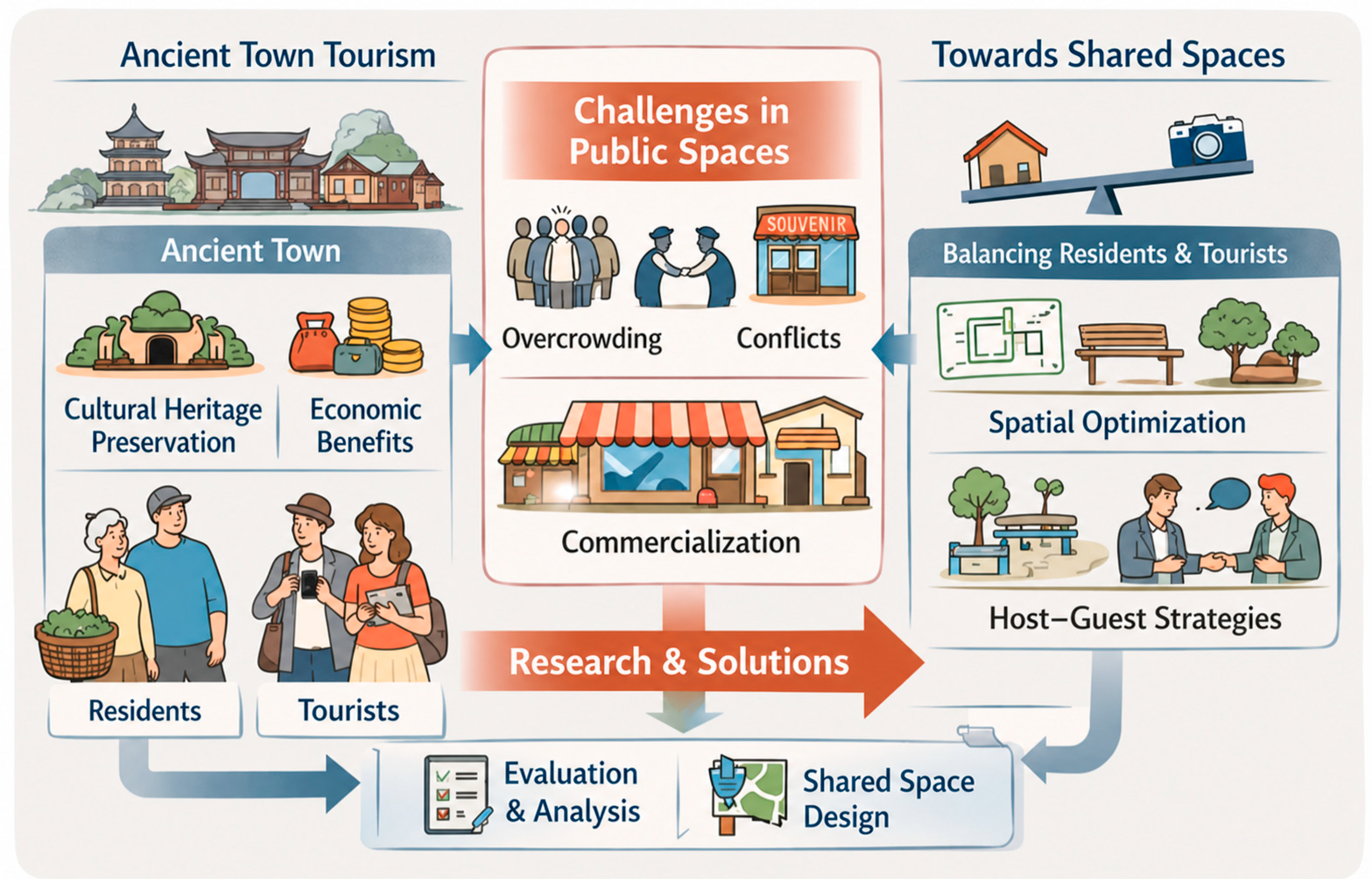
Balancing Residents and Tourists: Evaluating Public Building Spaces in Ancient Towns of Fujian, China, Using the IPA–Kano Model
 , ,
, ,  and
and 
Abstract
1. Introduction
1.1. Research Background
1.2. Dimensions of Public Building Space Evaluation in Ancient Towns
1.3. Indicators of Public Building Space Evaluation in Ancient Towns
1.4. Research Gap and Research Objectives
2. Research Methodology
2.1. Research Objectives and Analytical Framework
2.2. IPA–Kano Model
- Obtain data on importance and satisfaction through questionnaires.
- Obtain implicit importance. Explicit importance refers to respondents’ direct evaluation of the importance of public space elements in the ancient town. Implicit importance cannot be directly observed. It is inferred indirectly from respondents’ evaluations of other related aspects, thereby reflecting contextual significance. A bivariate correlation analysis is conducted between the importance and satisfaction of the same factors. The resulting correlation coefficient represents the value of implicit importance for each factor. The formula is as follows:
- 3.
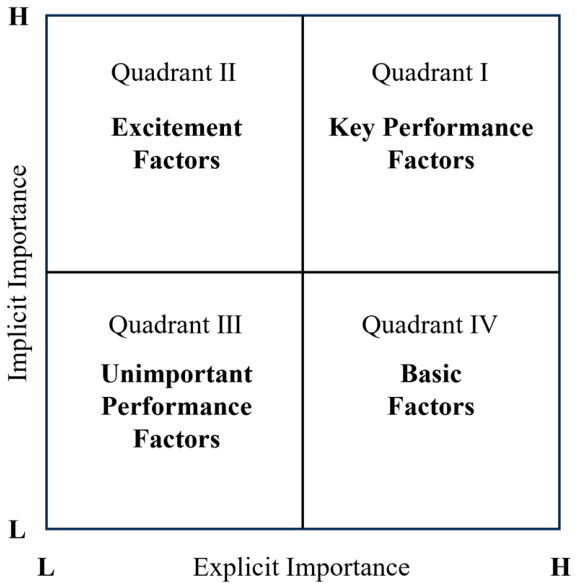
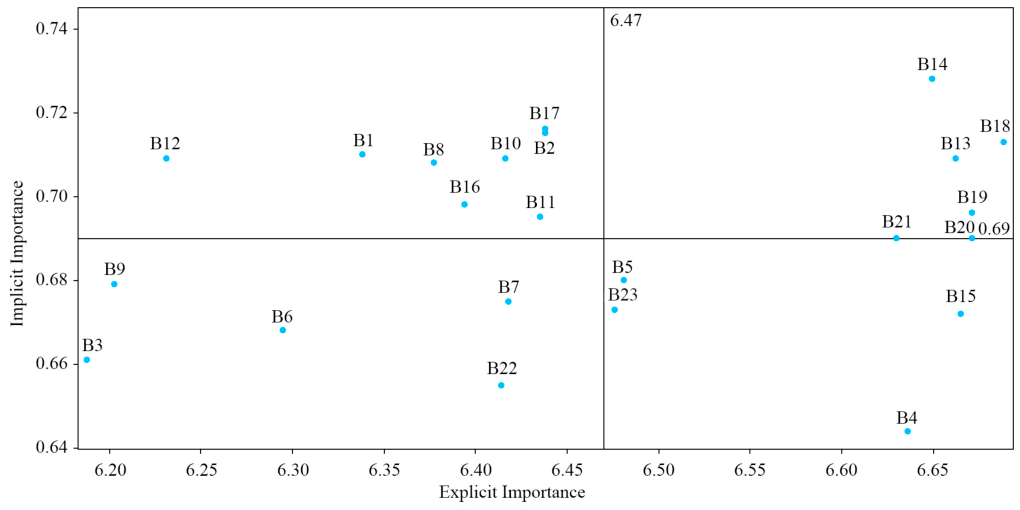
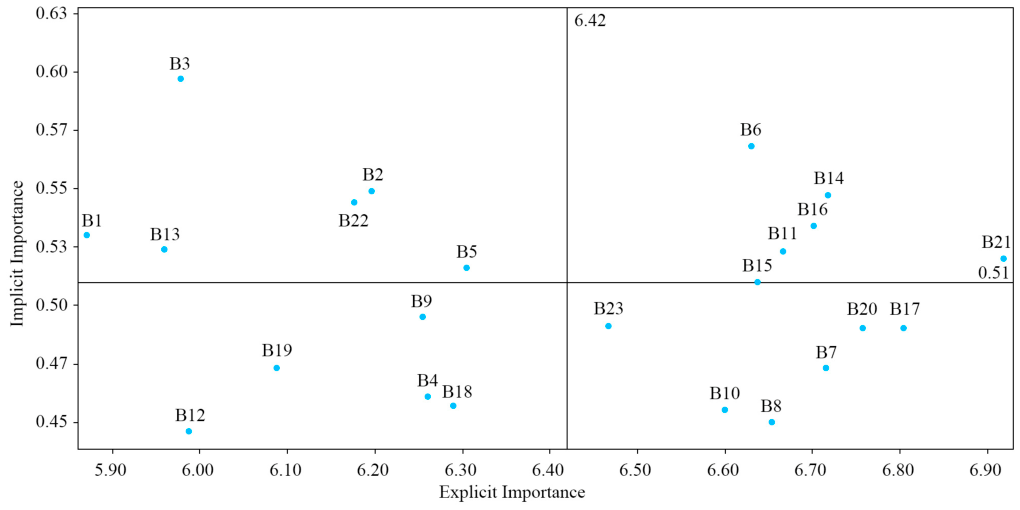
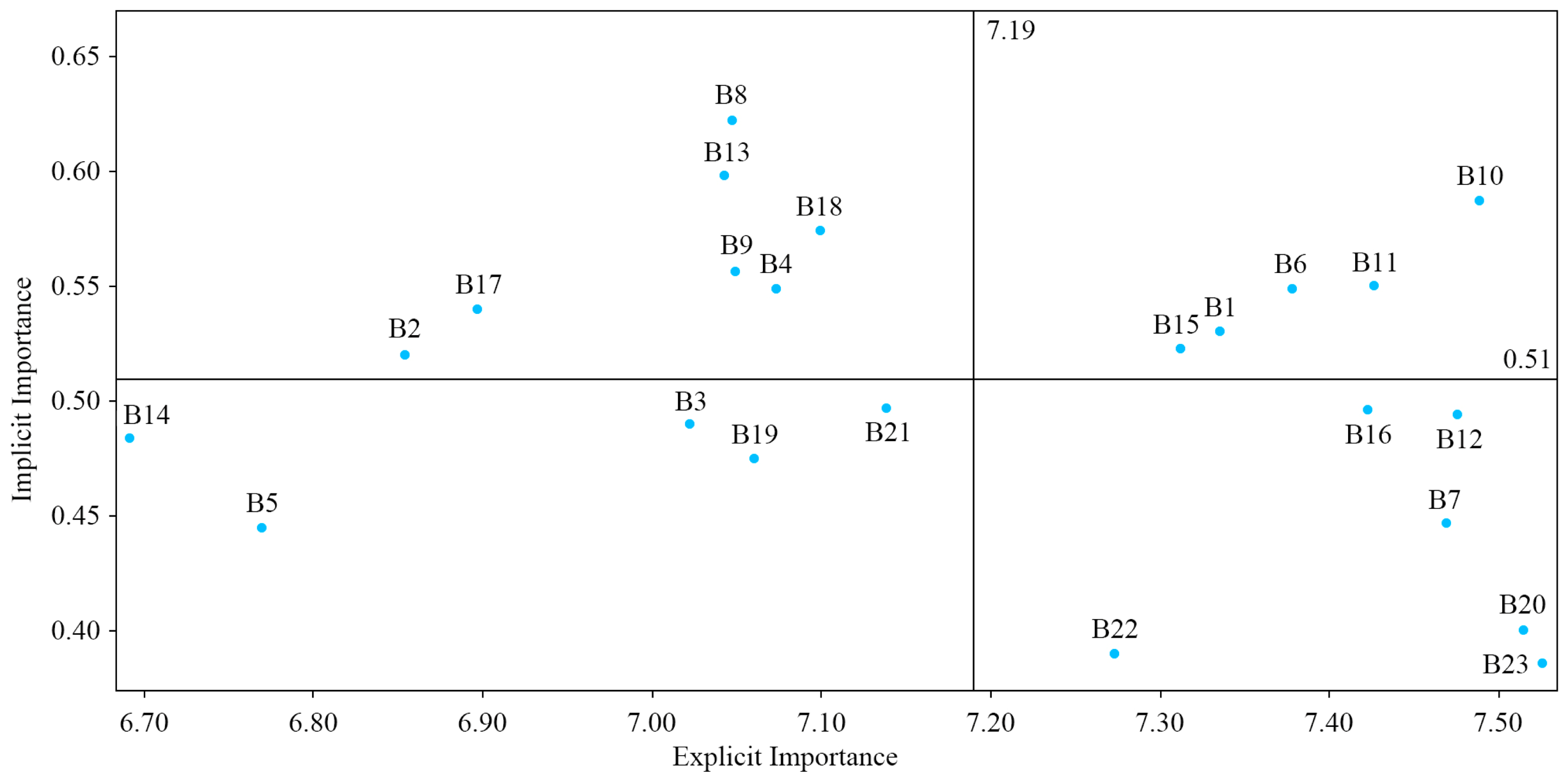
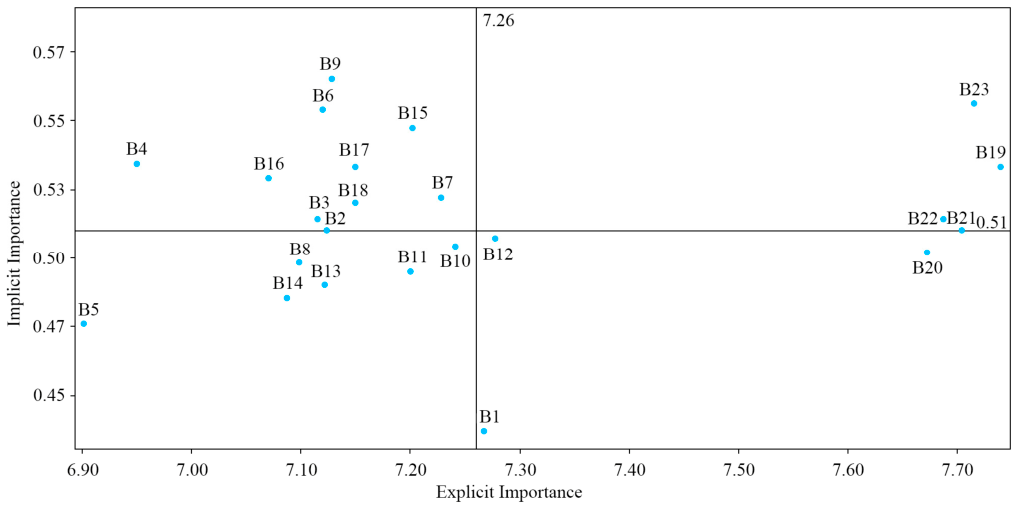
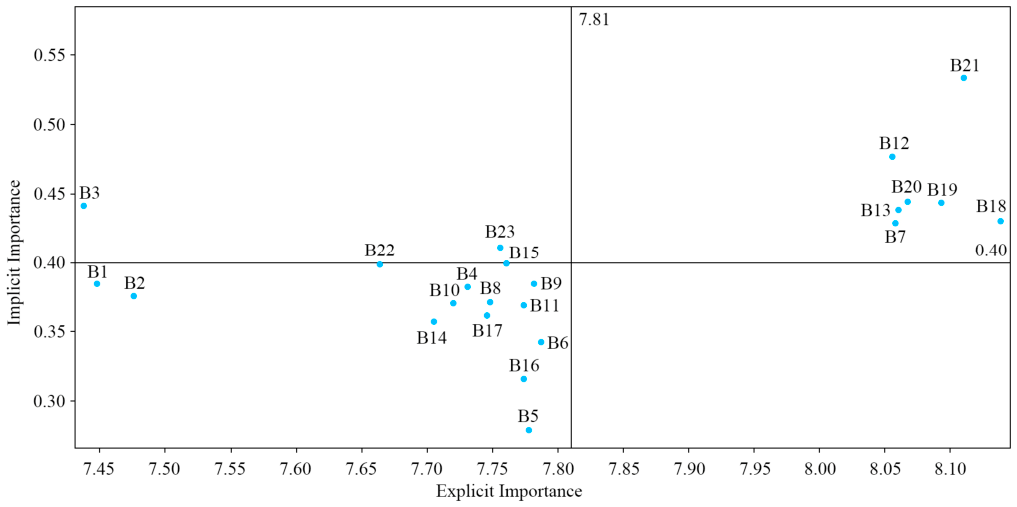
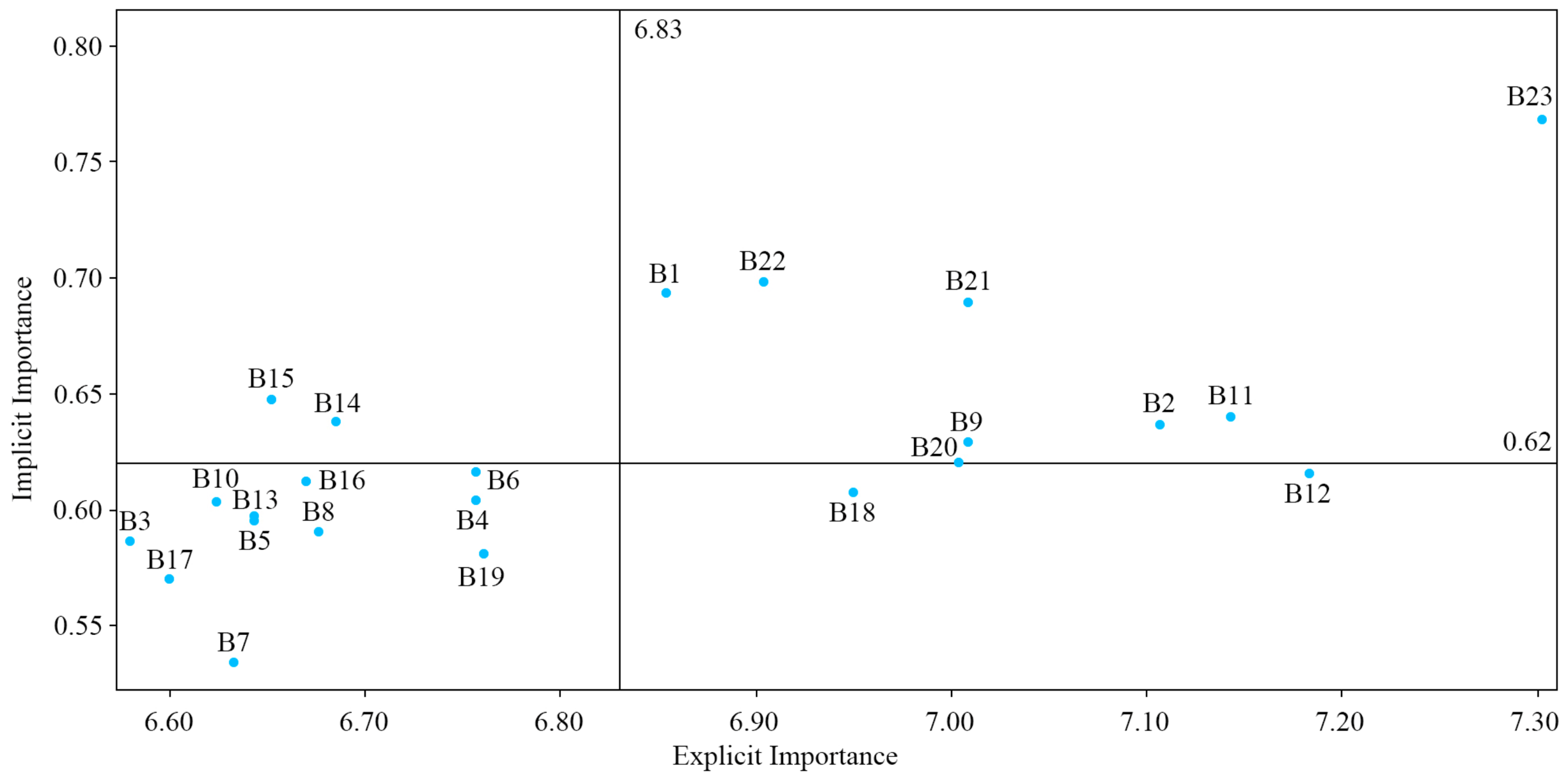
- The quadrant diagram is drawn by combining explicit importance and implicit importance.
- 4.
- Key factors were identified based on the quadrant classification results and the priority ranking of satisfaction (see Table 1). In this study, satisfaction was divided into three levels. Ranks 1–8 indicate good satisfaction. Ranks 9–15 represent average satisfaction performance. Ranks 16–23 reflect poor satisfaction.
- 5.
- Conduct a comparative analysis of the experimental results.
2.3. Establishing the Evaluation System
2.4. Questionnaire Design
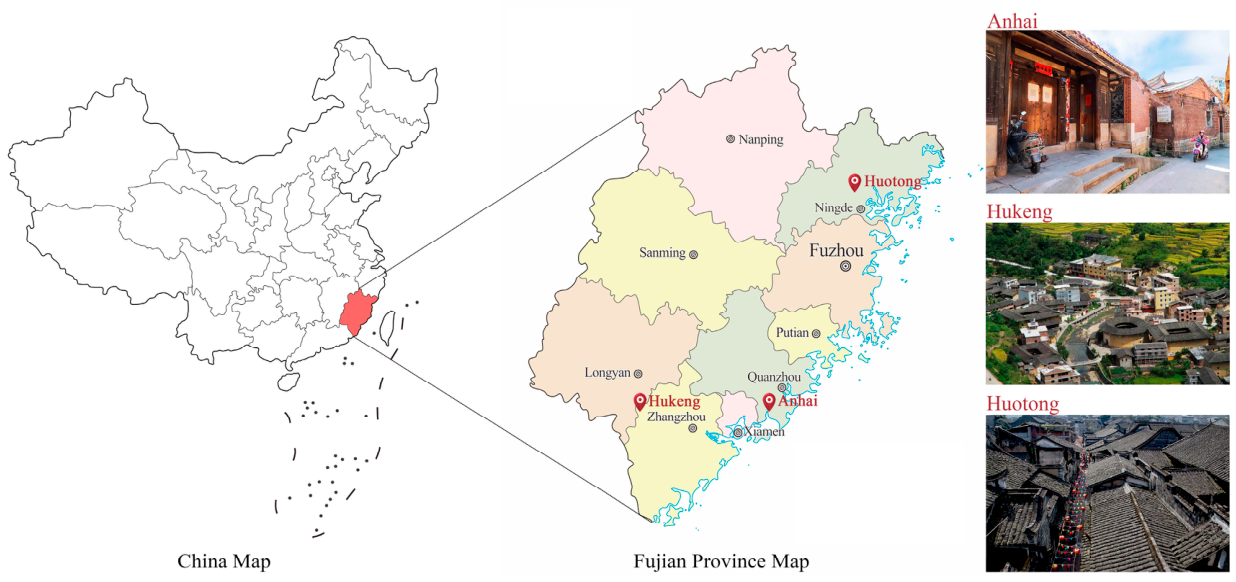
2.5. Study Area
3. Result Analysis
3.1. Anhai Ancient Town
3.1.1. Importance and Satisfaction Results of Anhai
3.1.2. Quadrant Attribution Results of Anhai
3.1.3. Priority Results of Anhai
3.2. Hukeng Ancient Town
3.2.1. Importance and Satisfaction Results of Hukeng
3.2.2. Quadrant Attribution Results of Hukeng
3.2.3. Priority Results of Hukeng
3.3. Huotong Ancient Town
3.3.1. Importance and Satisfaction Results of Huotong
3.3.2. Quadrant Attribution Results of Huotong
3.3.3. Priority Results of Huotong
3.4. Comparative Results Across the Three Ancient Towns
3.4.1. Overall Comparison of Importance and Satisfaction
3.4.2. Comparison of Quadrant Attribution Results
3.4.3. Cross-Town Comparison of Priority Indicators
3.4.4. Supplementary Statistical Validation of Shared Indicators
4. Discussion
4.1. Overall Differences Between Residents and Tourists
4.2. Interpretation of Town-Specific Patterns
4.3. Space Optimization Strategies for Ancient Towns
4.4. Limitations
5. Conclusions
Author Contributions
Funding
Institutional Review Board Statement
Informed Consent Statement
Data Availability Statement
Acknowledgments
Conflicts of Interest
References
- Richards, G. Cultural Tourism: An Integrative Review. Tour. Manag. Stud. 2025, 21, 19–31. [Google Scholar] [CrossRef]
- China Tourism Academy (Data Center of the Ministry of Culture and Tourism). China Ancient Town Tourism Development Report (2024); China Tourism Academy (Data Center of the Ministry of Culture and Tourism): Beijing, China, 2024.
- Wang, L.; Ding, J.; Chen, M.; Sun, Y.; Tang, X.; Ge, M. Exploring Tourists’ Multilevel Spatial Cognition of Historical Town Based on Multi-Source Data—A Case Study of Feng Jing Ancient Town in Shanghai. Buildings 2022, 12, 1833. [Google Scholar] [CrossRef]
- Zhou, X.; Wang, J.; Zhang, S. Evaluation of Community Tourism Empowerment of Ancient Town Based on Analytic Hierarchy Process: A Case Study of Zhujiajiao, Shanghai. Sustainability 2021, 13, 2882. [Google Scholar] [CrossRef]
- Yang, L.; Wall, G. Heritage Tourism in a Historic Town in China: Opportunities and Challenges. J. China Tour. Res. 2022, 18, 1073–1098. [Google Scholar] [CrossRef]
- Wu, Y.; Xu, J.; Xiang, H.; Xie, M.; Tan, Y. Historical Culture and Tourist Perception: A Social Network Analysis of Spatial Structure and Auspicious Symbolism in Minnan Village. NPJ Herit. Sci. 2025, 13, 214. [Google Scholar] [CrossRef]
- Zou, Y.; Yang, Y.; Li, Y.; Liao, J.; Xiao, H. How Do Tourists’ Heritage Spatial Perceptions Affect Place Identity? A Case Study of Quanzhou, China. J. Hosp. Tour. Manag. 2023, 55, 460–470. [Google Scholar] [CrossRef]
- McCartney, G.; Chen, Y. Co-Creation Tourism in an Ancient Chinese Town. J. China Tour. Res. 2020, 16, 159–182. [Google Scholar] [CrossRef]
- Sun, Z.; Han, T.; Wang, X.; Wang, L.; Fu, H.; Li, Y.; Zhong, Z.; Liu, J.; Huang, H.; Wu, Z. Bidirectional Mapping Modeling of Pipeline Vertical Deformation and Axial Strain Based on Multi-Source Monitoring Data and Machine Learning. J. Pipeline Sci. Eng. 2026, in press, journal pre-proof. [Google Scholar] [CrossRef]
- Yao, Z.; Li, Y.; Fu, H.; Tian, J.; Zhou, Y.; Chin, C.-L.; Ma, C.-K. Research on Concrete Crack and Depression Detection Method Based on Multi-Level Defect Fusion Segmentation Network. Buildings 2025, 15, 1657. [Google Scholar] [CrossRef]
- Dilixiati, D.; Bell, S. The Use of Public Spaces in Traditional Residential Areas after Tourism-Oriented Renovation: A Case Study of Liu Xing Street in Yining, China. Land 2025, 14, 1041. [Google Scholar] [CrossRef]
- Van, T.V.; Minh, T.L.; Quoc, T.H.; Van, S.Q.; Ngoc, U.D.T. Cultural Hybridity: The Vitality of Hoi an Ancient Town World Cultural Heritage. AIP Conf. Proc. 2021, 2406, 030026. [Google Scholar] [CrossRef]
- Rozmiarek, M.; Malchrowicz-Mośko, E.; Kazimierczak, M. Overtourism and the Impact of Tourist Traffic on the Daily Life of City Residents: A Case Study of Poznan. J. Tour. Cult. Change 2022, 20, 718–734. [Google Scholar] [CrossRef]
- Del Bianco, C.; Montedoro, L. Cultural Tourism Pressure on Historic Centres: Its Impact on Public Space and Intervention Strategies for Its Mitigation. Florence, Italy, as a Case Study. Sr. Mieszk. 2023, 42, 80–86. [Google Scholar] [CrossRef]
- UNWTO (Ed.) Overtourism? Understanding and Managing Urban Tourism Growth Beyond Perceptions; UNWTO: Madrid, Spain, 2018. [Google Scholar]
- Moleiro, D.F.; Carneiro, M.J.; Breda, Z. Assessment of Residents’ Perceptions and Attitudes towards the Appropriation of Public Spaces by Tourists: The Case of Aveiro. Int. J. Tour. Cities 2021, 7, 922–942. [Google Scholar] [CrossRef]
- Zhang, J.; Zhao, Z.; Liu, Y.; Li, X. The Spatial Characteristics and Formation Mechanism of Conflicts in Tourism Community Under the Background of Landscape-Village Integration: A Case Study of Dong Village in Zhaoxing. Econ. Geogr. 2022, 11, 216–224. [Google Scholar] [CrossRef]
- Chen, C.; Zhao, L. Study on the Modernization Characteristics and Protection Strategies of Ancient Towns Under Tourism Commercialization—Taking Nuanquan Ancient Town in Wei County as an Example. In People’s City, Planning Empowerment: Proceedings of the 2022 China Annual National Planning Conference (09: Urban Cultural Her-Itage Conservation); School of Architecture and Urban Planning, Huazhong University of Science and Technology: Wuhan, China; Hubei Urbanization Engineering Technology Research Center: Wuhan, China, 2022; pp. 1246–1256. [Google Scholar]
- Lyu, J.; Huang, Y.; Wang, L. When Essence Is Lost: The Consequences of Commercialization in Historical Towns. J. Travel Res. 2023, 63, 1671–1687. [Google Scholar] [CrossRef]
- Fu, H.; Tian, J.; Chin, C.-L.; Liu, H.; Yuan, J.; Tang, S.; Mai, R.; Wu, X. Axial Compression Behavior of GFRP-Steel Composite Tube Confined Seawater Sea-Sand Concrete Intermediate Long Columns. Eng. Struct. 2025, 333, 120157. [Google Scholar] [CrossRef]
- Fu, H.; Zhao, H.; Pan, Z.; Wu, Z.; Chin, C.-L.; Ma, C.-K. Behaviour of Corroded Circular Steel Tube Strengthened with External FRP Tube Grouting Under Eccentric Loading: Numerical Study. Structures 2023, 56, 104810. [Google Scholar] [CrossRef]
- Fu, H.; Tian, J.; Chen, S.; Chin, C.-L.; Ma, C.-K. Axial Compressive Performance of CFRP-Steel Composite Tube Confined Seawater Sea-Sand Concrete Intermediate Slender Columns. Constr. Build. Mater. 2024, 441, 137399. [Google Scholar] [CrossRef]
- Fu, H.; Zhang, J.; Wu, Z.; Chin, C.-L.; Ma, C.-K. Nonlinear Analysis of Axial-Compressed Corroded Circular Steel Pipes Reinforced by FRP-Casing Grouting. J. Constr. Steel Res. 2023, 201, 107689. [Google Scholar] [CrossRef]
- Fu, H.; Guo, K.; Wu, Z.; Mai, R.; Chin, C.L.; Ma, C.-K. Experimental Investigation of a Novel CFRP-Steel Composite Tube-Confined Seawater-Sea Sand Concrete Intermediate Long Column. Int. J. Integr. Eng. 2024, 16, 466–475. [Google Scholar] [CrossRef]
- Jiang, S.; Wu, L.; Chen, C.; Tian, J.; Ling, C.; Mai, R.; Fu, H.; Lyu, P.; Cui, H. FRP–Steel Composite Tube Confined Seawater–Sea-Sand Concrete Columns: State-of-the-Art Review. Buildings 2026, 16, 1351. [Google Scholar] [CrossRef]
- Guo, S.; Shi, C.; Qian, Y.; Feng, L.; Yue, M. The Evolution and Case Analysis of Rural Host-Guest Sharing Public Space from the Perspective of Tourism Development. Mod. Urban Res. 2024, 29–35. [Google Scholar]
- Zheng, J.; He, J.; Tang, H. The Vitality of Public Space and the Effects of Environmental Factors in Chinese Suburban Rural Communities Based on Tourists and Residents. Int. J. Environ. Res. Public Health 2023, 20, 263. [Google Scholar] [CrossRef]
- Wu, X.; He, J.; Tian, J.; Liu, M.; Zheng, Y.; Zhang, W.; Yuan, J.; Wang, W.-W.; Fu, H.; Wang, R. Multi-Scale Performance of Underwater-Castable Ultra-High-Volume Fly-Ash Eco-Friendly Engineered Cementitious Composites: Microstructural Characterization, Workability, Mechanical Properties and Environmental Effects. Constr. Build. Mater. 2026, 506, 144870. [Google Scholar] [CrossRef]
- Tian, J.; Zhu, W.; Wu, X.; Zheng, Y.; Zhang, W.; Yuan, J.; Wang, W.-W.; Fu, H.; Liu, M. Multiscale Performance of Embedded Current Collector Cement-Based Double-Layer Capacitor for Building-Energy Storage Integration: Microstructure, Mechanical and Electrochemical Properties. Energy Build. 2026, 356, 117125. [Google Scholar] [CrossRef]
- Wu, X.; Ouyang, X.; Tian, J.; Zheng, Y.; Yuan, J.; Wang, W.-W.; Zuo, Y.; Fu, H.; Yu, W.; Wang, R. Self-Sensing Mechanism and Theoretical Model of Prestressed FRP-ECC Multifunctional Composite Beams under Bending Loads. Structures 2026, 87, 111585. [Google Scholar] [CrossRef]
- Bramwell, B.; Lane, B. Critical Research on the Governance of Tourism and Sustainability. J. Sustain. Tour. 2011, 19, 411–421. [Google Scholar] [CrossRef]
- Mandić, A.; Kennell, J. Smart Governance for Heritage Tourism Destinations: Contextual Factors and Destination Management Organization Perspectives. Tour. Manag. Perspect. 2021, 39, 100862. [Google Scholar] [CrossRef]
- Chen, J.; Sun, S.; Lin, K.; Lin, J. Post-Utilization Evaluation of Public Space in Traditional Villages and Towns from the Perspective of Space Syntax. J. South Archit. 2024, 1, 22–34. [Google Scholar] [CrossRef]
- Song, S.; Li, M.; Li, H.; Juan, Y. Study on the Optimization of Public Space in Suburban Villages Based on the Evaluation of Villagers’ Satisfaction: A Case Study of Shilipu Village in Guandu Town, Zhengzhou City. Archit. Cult. 2024, 95–97. [Google Scholar] [CrossRef]
- Ding, W.; Wei, Q.; Jin, J.; Nie, J.; Zhang, F.; Zhou, X.; Ma, Y. Research on Public Space Micro-Renewal Strategy of Historical and Cultural Blocks in Sanhe Ancient Town Under Perception Quantification. Sustainability 2023, 15, 2790. [Google Scholar] [CrossRef]
- Ma, H.; Zhou, Q.; Duo, D.; A, L.; Yu, D.; Chan, C.-S. Evaluating Public Spaces of Tourist Villages by Combining Analytic Hierarchy Process and Importance-Performance Analysis: A Case Study of Jiaochangwei in Shenzhen, China. China City Plan. Rev. 2020, 29, 61–73. [Google Scholar]
- Yu, X. Research on the Evaluation and Optimization of Public Space in Shawan Ancient Town Based on the Degree of Female Visitors’ Satisfaction. Master’s Thesis, Harbin Institute of Technology, Harbin, China, 2019. [Google Scholar]
- Zagroba, M.; Szczepańska, A.; Senetra, A. Analysis and Evaluation of Historical Public Spaces in Small Towns in the Polish Region of Warmia. Sustainability 2020, 12, 8356. [Google Scholar] [CrossRef]
- Xiong, Y.; Zhu, T.; Zhai, T.; Zhu, Y. Research on the Vitality Improvement of Rural Public Space Landscape in Jiangnan Area. Zhuangshi 2022, 124–126. [Google Scholar] [CrossRef]
- Zheng, H.; Qin, Y.; Qiu, D. Resilience Evaluation of Production-Living-Ecology Space of Tourist Towns in Southern Jiangsu. Mod. Urban Res. 2023, 17–23. [Google Scholar] [CrossRef]
- Wang, F. Study on Evaluation and Improvement of Spatial Vitality of Chinese Traditional Villages. Master’s Thesis, Southwest University of Science and Technology, Mianyang, China, 2019. [Google Scholar]
- Zhao, G.; Weng, Y.; Chen, Z. Comprehensive Evaluation of Public Space in Urban Villages from the Perspective of Social Network: A Case Study of Tangxia Village in Guangzhou. In Proceedings of the 10th International Conference on Social Science, Education and Humanities Research, Paris, France, 17–18 December 2022; pp. 17–18. [Google Scholar]
- Gao, J.; Hu, S.; Wang, X.; Liu, C. Analysis on the Evaluation of Public Activity Space in Nanpu Village of Taiyuan. Urban. Archit. 2021, 18, 174–177. [Google Scholar] [CrossRef]
- Kalniņa, A.; Ņitavska, N. The Quality of the Public Open Space in Engure Village in Latvia. Proc. Latv. Univ. Agric. Landsc. Archit. Art. 2017, 11, 23–32. [Google Scholar] [CrossRef]
- Kamińska, W.; Mularczyk, M. Attractiveness of Central Public Spaces in Small Polish Towns Based on a Spatial Order Analysis. Land 2021, 10, 1327. [Google Scholar] [CrossRef]
- Fang, Q.; Zhu, Y. Study on Optimization of Public Space in Huizhou Traditional Villages from the Perspective of Behavioral Demand. Front. Sci. Technol. Eng. Manag. 2021, 40, 90–96. [Google Scholar]
- Jia, X.; Yan, B.; Wang, J.; Fang, L. Evaluation and Optimization Paths of Design Elements of Underground Building Atria Based on IPA–Kano Model. Buildings 2023, 13, 789. [Google Scholar] [CrossRef]
- Kuo, Y.-F.; Chen, J.-Y.; Deng, W.-J. IPA–Kano Model: A New Tool for Categorising and Diagnosing Service Quality Attributes. Total Qual. Manag. Bus. Excell. 2012, 23, 731–748. [Google Scholar] [CrossRef]
- Fang, D.; Wang, X.; Sun, S. Optimization Strategies of Bus Transit Service Quality Based on IPA-Kano Model: A Case Study of Public Transport in Harbin. Sci. Technol. Eng. 2020, 20, 13454–13459. [Google Scholar]
- Arbore, A.; Busacca, B. Rejuvenating Importance-performance Analysis. J. Serv. Manag. 2011, 22, 409–429. [Google Scholar] [CrossRef]
- Chen, L.; Tan, S.; Yang, C.; He, Q. Research on the Evaluation of Urban Greenway Environmental Recreation Satisfaction from the Perspective of Perceived Value: A Case Study of Jiulongpo Greenway in Chongqing. Chin. Landsc. Archit. 2022, 38, 76–81. [Google Scholar] [CrossRef]
- Matzler, K.; Sauerwein, E.; Heischmidt, K. Importance-Performance Analysis Revisited: The Role of the Factor Structure of Customer Satisfaction. Serv. Ind. J. 2003, 23, 112–129. [Google Scholar] [CrossRef]
- Vavra, T.G. Improving Your Measurement of Customer Satisfaction: A Guide to Creating, Conducting, Analyzing, and Reporting Customer Satisfaction Measurement Programs; ASQC Quality Press: Milwaukee, Wisconsin, 1997. [Google Scholar]
- Anhai Town People’s Government. General Profile and Characteristics of Anhai Town; Jinjiang Municipal People’s Government: Jinjiang, China, 2021.
- Fujian Provincial Department of Culture and Tourism. Basic Information and Statistical Summary of Star-Rated Tourist Hotels in Fujian Province (2023.3); Fujian Provincial Department of Culture and Tourism: Fuzhou, China, 2023.
- Quanzhou Evening News. Quanzhou’s Total Tourism Revenue Surpassed CNY 100 Billion in 2023; Quanzhou Net: Quanzhou, China, 2024. [Google Scholar]
- Jinjiang Economic Daily “Over 1.2 Million Visits and Tourism Consumption Exceeding RMB 70 Million in Anhai: Activating Holiday Consumption Through Cultural Tourism Integration” 2026. Available online: https://www.ijjnews.com/jllapp/folder18/folder26/folder5327/2026-03-04/477721.shtml#477721 (accessed on 9 April 2026).
- Hukeng Town People’s Government. General Profile of Hukeng Town; Yongding District People’s Government, Longyan City: Longyan, China, 2022.
- Longyan Municipal Bureau of Statistics; Longyan Survey Team of the National Bureau of Statistics. Statistical Communiqué of Longyan on National Economic and Social Development in 2023; Longyan Municipal Bureau of Statistics: Longyan, China, 2024.
- Huotong Town People’s Government. Development Positioning and Planning Strategy of Huotong Town During the 14th Five-Year Plan Period; Jiaocheng District People’s Government, Ningde City: Ningde, China, 2021.
- Huotong Town People’s Government. Huotong Town Government Work Report (2023); Jiaocheng District People’s Government, Ningde City: Ningde, China, 2024.
- Ningde Municipal Bureau of Statistics. Ningde’s Economic and Social Development: A Statistical Review on the 75th Anniversary of the Founding of the People’s Republic of China; Ningde Municipal Bureau of Statistics: Ningde, China, 2024.
- Jiang, S.; Liu, J. Comparative Study of Cultural Landscape Perception in Historic Districts from the Perspectives of Tourists and Residents. Land 2024, 13, 353. [Google Scholar] [CrossRef]
- Chen, J.; Li, X.; Chen, J.; Xu, L.; Feng, H.; Zhu, R. Identifying and Prioritising Public Space Demands in Historic Districts: Perspectives from Tourists and Local Residents in Yangzhou. Land 2025, 14, 1921. [Google Scholar] [CrossRef]
- Zhang, L.; Zhang, D.; Tang, Z.; Qi, Y.; Wang, M. A Study on the Perceptual Differences in Street Space in Historic and Cultural Districts from the Host–Guest Shared Perspective: A Case Study of the Sajinqiao Area in Xi’an, China. Buildings 2025, 15, 4517. [Google Scholar] [CrossRef]
- Wang, J.; Zhao, D. Residents’ Satisfaction with Public Spaces in Old Urban Residential Communities: A PLS-SEM and IPMA-Based Case Study of Nankai District, Tianjin. Land 2025, 14, 2363. [Google Scholar] [CrossRef]
- Chen, N.; Fang, D. Exploring Public Space Satisfaction in Old Residential Areas Based on Impact-Asymmetry Analysis. Sustainability 2024, 16, 2557. [Google Scholar] [CrossRef]
- Cui, H.; Maliki, N.Z.; Wang, Y. The Role of Urban Parks in Promoting Social Interaction of Older Adults in China. Sustainability 2024, 16, 2088. [Google Scholar] [CrossRef]
- Qi, J.; Mazumdar, S.; Vasconcelos, A.C. Understanding the Relationship between Urban Public Space and Social Cohesion: A Systematic Review. Int. J. Community Well-Being 2024, 7, 155–212. [Google Scholar] [CrossRef]
- Song, J.; Dai, L. Study on the Tourist Satisfaction on the Toilets of Scenic Area in Zhangye Based on the Revised IPA Method. Tour. Res. 2021, 83–95. [Google Scholar] [CrossRef]
- Simpson, C. Judges Deny Potty Parity. Chic. Sun-Times 2000, 4, 3. [Google Scholar]
- Nguyen, A.-M.; Maroko, A.R.; Blake, S.; Sugita, E.; Fazzioni, N.H.; Lomboy, M.F.T.C.; Bukenya, J.; Cole, H.V.S.; Gregorio, E.R.; Hopper, K.J.; et al. Exploring the Availability and Accessibility of Menstrual Friendly Public Toilets (MFPTs) in Urban Spaces: A Global Multi-City Audit Study. Health Place 2025, 92, 103412. [Google Scholar] [CrossRef] [PubMed]
- Tao, X.; Bao, J.; Wang, Z.; Zhang, M. Study on the Design Innovation of Public Toilets in Scenic Areas—Taking the Reconstruction of the Public Toilet of Fairy Lake Botanical Garden of Chinese Academy of Sciences in Shenzhen as an Example. Chin. Landsc. Archit. 2020, 36, 48–53. [Google Scholar] [CrossRef]
- Zhu, H.; Guan, H.; Han, Y.; Li, W. A Study of Tourists’ Holiday Rush-Hour Avoidance Travel Behavior Considering Psychographic Segmentation. Sustainability 2019, 11, 3755. [Google Scholar] [CrossRef]
- Wang, Y. Research on Trail Planning of Fuzhou Jinji Mountain Park Based on the Concept of Forest Climatotherapy. Master’s Thesis, Fujian Agriculture and Forestry University, Fuzhou, China, 2016. [Google Scholar]
- Mihalic, T.; Kuščer, K. Can Overtourism Be Managed? Destination Management Factors Affecting Residents’ Irritation and Quality of Life. Tour. Rev. 2022, 77, 16–34. [Google Scholar] [CrossRef]
- Dadizadeh, N.A.; Doğan, E. Community Engagement and Sustainable Heritage Tourism: Mediating Role of Archaeological Heritage Interpretation. Conserv. Manag. Archaeol. Sites 2024, 26, 175–206. [Google Scholar] [CrossRef]
- Risteskia, M.; Kocevskia, J.; Arnaudov, K. Spatial Planning and Sustainable Tourism as Basis for Developing Competitive Tourist Destinations. Procedia-Soc. Behav. Sci. 2012, 44, 375–386. [Google Scholar] [CrossRef]
- James, E.E.; Essien, A.U. Infrastructure and Sustainable Tourism Development in Nigeria. IOSR J. Humanit. Soc. Sci. 2019, 24, 72–80. [Google Scholar]
- Tang, Z.; Zhang, D.; Zhang, L.; Qi, Y.; Wang, M. Evaluation of Residents’ Satisfaction with Cultural Spaces in Historic Districts Based on ERG Theory—A Case Study of Longweiguan Historic and Cultural District in Dali City, China. Buildings 2025, 15, 4413. [Google Scholar] [CrossRef]
- Lin, Y.; Gu, X.; Xie, H.; Chen, C.-L.; Lin, Y.; Gu, X.; Xie, H.; Chen, C.-L. An Initial Exploration of Historical District Service Experiences and Humanistic Innovation and Development: Taking Zhongshan Road in Quanzhou, Fujian Province as an Example. Urban Resil. Sustain. 2026, 4, 29–46. [Google Scholar] [CrossRef]
- Hosseini, K.; Stefaniec, A.; Hosseini, S.P. World Heritage Sites in Developing Countries: Assessing Impacts and Handling Complexities toward Sustainable Tourism. J. Destin. Mark. Manag. 2021, 20, 100616. [Google Scholar] [CrossRef]
- Xi, L.; Zhang, H.; Li, S.; Cheng, J. Integrating Fuzzy Kano Model and Fuzzy Importance–Performance Analysis to Analyse the Attractive Factors of New Products. Int. J. Distrib. Sens. Netw. 2020, 16, 1550147720920222. [Google Scholar] [CrossRef]



| Priority | Factors | Satisfaction Ranking |
|---|---|---|
| 1 | Basic factors | 16–23 |
| 2 | Key performance factors | 16–23 |
| 3 | Excitement factors | 16–23 |
| 4 | Basic factors | 9–15 |
| 5 | Key performance factors | 9–15 |
| 6 | Excitement factors | 9–15 |
| Dimensions | Indicators | Indicator Explanation |
|---|---|---|
| A1 Traditional Style [33,34,36,37] | B1 The authenticity of traditional architecture [33] | The preservation status of traditional buildings reflects their authenticity. They have maintained their historical style and architectural features. |
| B2 The degree of coordination between new and old architectural styles [38] | The new buildings are in harmony with the historical buildings, avoiding the destruction of the overall style of the ancient town. | |
| B3 Number of aborigines [40] | The number of local residents who have lived long-term in areas where historical buildings are concentrated is significant. | |
| B4 The holding of folk activities [33,34] | Various folk activities are held frequently, such as festivals and traditional ceremonies, enhancing the ancient town’s cultural atmosphere and enriching the experience of residents and tourists. | |
| B5 The characteristic degree of landscape sketches [37,39] | The landscape sketches in the ancient town’s public spaces have distinct features, such as sculptures, installation artworks, and frescos, which can reflect the regional culture. | |
| B6 The impact of online publicity [41] | Promote the ancient town’s traditional features through online channels such as official websites, social media, and tourism platforms. | |
| A2 Sensory Experience [33,34,35,36,37] | B7 The integrity of walking paths [42] | The design of walking paths is coherent and clear, seamlessly connecting various locations to facilitate convenient pedestrian movement. |
| B8 The scale of the space [42] | The public space’s height-to-width ratio is appropriate, so residents and tourists will not feel uncomfortable when it is too open or narrow. | |
| B9 Sequential changes in space [39,43] | The public space is rich in visual and functional changes, with a strong sense of layering and interest. | |
| B10 The size of the space [42] | The size of the public space is appropriate to meet the needs of both residents and tourists. | |
| B11 The crowd density [42] | The public space maintains an appropriate crowd density throughout different periods, with its design effectively dispersing crowds to prevent overcrowding, thereby ensuring people’s comfort and safety. | |
| B12 Paving material for the floor [42] | The flooring material in public spaces is comfortable, flat, and non-slip. | |
| B13 The number of plants [39,43,44] | The appropriate quantity of plants in public spaces reflects the degree of greening and ecological value of the area. | |
| B14 The abundance of plants [39,43,44] | The public spaces boast a wealth of plant species and layers, enhancing their ecological diversity and aesthetics. | |
| A3 Supporting Facilities [33,36,37] | B15 Rest facilities [37,45,46] | The quantity and materials of seating, pavilions, and other rest facilities in public spaces fulfil the needs of residents and tourists. |
| B16 Map guidance [37] | Public spaces have sufficient signs and maps with precise information, ensuring that residents and tourists can quickly understand the ancient town’s layout. | |
| B17 The types of business [37,45,46] | Commercial activities in public spaces are diverse, with various shops and restaurants catering to different groups. | |
| B18 Night lighting settings [45,46] | The public space has a comprehensive lighting system with adequate lighting equipment and well-planned locations to ensure the safety and visibility of nighttime activities. | |
| B19 Monitoring facility settings [45,46] | In public spaces, there is a comprehensive surveillance system with ample cameras strategically placed to ensure the area’s safety. | |
| B20 Public toilet settings [37,45,46] | There are sufficient clean and well-maintained public toilets in public spaces, including an adequate number of female squatting cubicles inside. | |
| B21 Trash bin settings [37,46] | The number of garbage bins in public spaces is sufficient, and their placement is logical, which helps maintain a tidy environment. | |
| B22 Sun and rain shelter facilities [37] | Shading and rain shelters are installed in public spaces to protect individuals from harsh weather conditions. | |
| B23 Maintenance of environment and facilities [36] | There are regular cleaning and maintenance needs for public spaces, including cleaning, garbage disposal, greening maintenance, and upkeep of public facilities. |
| Variable | Category | Anhai Ancient Town | Hukeng Ancient Town | Huotong Ancient Town | Total |
|---|---|---|---|---|---|
| Respondent category | Residents | 464 (49.95%) | 464 (50.22%) | 464 (50.22%) | 1392 (50.13%) |
| Tourists | 465 (50.05%) | 460 (49.78%) | 460 (49.78%) | 1385 (49.87%) | |
| Gender (Residents) | Male | 215 (46.34%) | 237 (51.08%) | 215 (46.34%) | 667 (47.92%) |
| Female | 249 (53.66%) | 227 (48.92%) | 249 (53.66%) | 725 (52.08%) | |
| Gender (Tourists) | Male | 219 (47.10%) | 228 (49.57%) | 238 (51.74%) | 685 (49.46%) |
| Female | 246 (52.90%) | 232 (50.43%) | 222 (48.26%) | 700 (50.54%) |
| Sample Source | Cronbach α Coefficient | KMO Value/p Value |
|---|---|---|
| Anhai Ancient Town residents | 0.993 | 0.992/0.000 |
| Anhai Ancient Town tourists | 0.983 | 0.987/0.000 |
| Hukeng Ancient Town residents | 0.983 | 0.987/0.000 |
| Hukeng Ancient Town tourists | 0.985 | 0.990/0.000 |
| Huotong Ancient Town residents | 0.974 | 0.982/0.000 |
| Huotong Ancient Town tourists | 0.989 | 0.992/0.000 |
| Case Study | Administrative Area (km2) | Permanent Population (Approx.) | Main Tourist Attractions | Tourism Resource Types | National/International Recognitions | Tourist Arrivals in the Prefecture-Level City (2023, Million) | Number of Star-Rated Hotels in the Prefecture-Level City |
|---|---|---|---|---|---|---|---|
| Anhai Ancient Town | 55.72 | 230,000 | Anping Bridge (component of a World Cultural Heritage property), Longshan Temple, and Shijing Academy | Historical–cultural tourism + ecological sightseeing | National Historic and Cultural Town; China National AAAA Tourist Attraction (Anping Bridge) | 86.53 | 51 |
| Hukeng Ancient Town | 96.5 | 26,000 | Fujian Tulou (World Cultural Heritage) | World Heritage tourism + Hakka cultural tourism + ecological sightseeing | World Cultural Heritage; National Historic and Cultural Town; China National AAAAA Tourist Attraction | 64.10 | 22 |
| Huotong Ancient Town | 167 | 35,000 | Ming and Qing Ancient Street, the Huangju Irrigation Project (World Heritage Irrigation Structure), and Huayan Temple | Natural landscape tourism + historical–cultural tourism + religious–cultural tourism | National Historic and Cultural Town; World Heritage Irrigation Structure | 62.07 | 10 |
| Dimensions | Indicators | Anhai Ancient Town | Hukeng Ancient Town | Huotong Ancient Town | |||
|---|---|---|---|---|---|---|---|
| Residents | Tourists | Residents | Tourists | Residents | Tourists | ||
| Average Score of Importance | Average Score of Importance | Average Score of Importance | Average Score of Importance | Average Score of Importance | Average Score of Importance | ||
| A1 | B1 | 6.338 | 5.871 | 7.335 | 7.267 | 7.448 | 6.854 |
| B2 | 6.438 | 6.196 | 6.854 | 7.124 | 7.476 | 7.107 | |
| B3 | 6.188 | 5.978 | 7.022 | 7.115 | 7.438 | 6.580 | |
| B4 | 6.636 | 6.260 | 7.073 | 6.950 | 7.731 | 6.757 | |
| B5 | 6.481 | 6.305 | 6.770 | 6.902 | 7.778 | 6.643 | |
| B6 | 6.295 | 6.630 | 7.378 | 7.120 | 7.787 | 6.757 | |
| A2 | B7 | 6.418 | 6.716 | 7.469 | 7.228 | 8.058 | 6.633 |
| B8 | 6.377 | 6.654 | 7.047 | 7.098 | 7.748 | 6.676 | |
| B9 | 6.203 | 6.254 | 7.049 | 7.128 | 7.782 | 7.009 | |
| B10 | 6.416 | 6.600 | 7.488 | 7.241 | 7.720 | 6.624 | |
| B11 | 6.435 | 6.667 | 7.426 | 7.200 | 7.774 | 7.143 | |
| B12 | 6.231 | 5.987 | 7.475 | 7.278 | 8.056 | 7.183 | |
| B13 | 6.662 | 5.959 | 7.043 | 7.122 | 8.060 | 6.643 | |
| B14 | 6.649 | 6.718 | 6.692 | 7.087 | 7.705 | 6.685 | |
| A3 | B15 | 6.665 | 6.637 | 7.312 | 7.202 | 7.761 | 6.652 |
| B16 | 6.394 | 6.701 | 7.422 | 7.070 | 7.774 | 6.670 | |
| B17 | 6.438 | 6.804 | 6.897 | 7.150 | 7.746 | 6.600 | |
| B18 | 6.688 | 6.290 | 7.099 | 7.150 | 8.138 | 6.950 | |
| B19 | 6.671 | 6.088 | 7.060 | 7.739 | 8.093 | 6.761 | |
| B20 | 6.671 | 6.757 | 7.514 | 7.672 | 8.067 | 7.004 | |
| B21 | 6.630 | 6.918 | 7.138 | 7.704 | 8.110 | 7.009 | |
| B22 | 6.414 | 6.176 | 7.273 | 7.687 | 7.664 | 6.904 | |
| B23 | 6.476 | 6.467 | 7.525 | 7.715 | 7.756 | 7.302 | |
| Dimensions | Indicators | Anhai Ancient Town | Hukeng Ancient Town | Huotong Ancient Town | |||||||||
|---|---|---|---|---|---|---|---|---|---|---|---|---|---|
| Residents | Tourists | Residents | Tourists | Residents | Tourists | ||||||||
| Average Score of Satisfaction | Sort | Average Score of Satisfaction | Sort | Average Score of Satisfaction | Sort | Average Score of Satisfaction | Sort | Average Score of Satisfaction | Sort | Average Score of Satisfaction | Sort | ||
| A1 | B1 | 6.381 | 15 | 6.411 | 9 | 7.622 | 1 | 7.237 | 11 | 7.720 | 11 | 7.561 | 2 |
| B2 | 6.416 | 10 | 6.665 | 7 | 7.103 | 6 | 7.143 | 19 | 7.709 | 12 | 7.143 | 21 | |
| B3 | 6.241 | 21 | 5.985 | 14 | 6.819 | 23 | 7.315 | 8 | 7.726 | 10 | 7.185 | 17 | |
| B4 | 6.287 | 19 | 6.374 | 10 | 6.948 | 13 | 7.059 | 23 | 7.744 | 8 | 7.539 | 3 | |
| B5 | 6.403 | 12 | 5.978 | 15 | 7.351 | 2 | 7.141 | 20 | 7.295 | 19 | 6.878 | 23 | |
| B6 | 6.747 | 1 | 6.576 | 8 | 7.084 | 7 | 7.459 | 2 | 7.468 | 18 | 7.043 | 22 | |
| A2 | B7 | 6.405 | 11 | 6.065 | 13 | 7.282 | 3 | 7.135 | 21 | 7.517 | 14 | 7.474 | 6 |
| B8 | 6.241 | 22 | 6.232 | 11 | 6.882 | 18 | 7.426 | 5 | 7.487 | 17 | 7.372 | 7 | |
| B9 | 6.621 | 2 | 5.841 | 22 | 6.875 | 20 | 7.443 | 3 | 7.489 | 16 | 7.200 | 16 | |
| B10 | 6.401 | 13 | 6.222 | 12 | 6.832 | 22 | 7.315 | 9 | 7.509 | 15 | 7.146 | 20 | |
| B11 | 6.431 | 8 | 5.828 | 23 | 6.957 | 12 | 7.437 | 4 | 7.134 | 22 | 7.170 | 19 | |
| B12 | 6.468 | 6 | 6.716 | 3 | 6.942 | 14 | 7.148 | 16 | 7.765 | 6 | 7.578 | 1 | |
| B13 | 6.377 | 16 | 5.892 | 20 | 7.172 | 5 | 7.146 | 17 | 7.772 | 5 | 7.491 | 5 | |
| B14 | 6.610 | 3 | 6.748 | 1 | 6.996 | 9 | 7.298 | 10 | 7.789 | 3 | 7.511 | 4 | |
| A3 | B15 | 6.397 | 14 | 5.961 | 16 | 7.028 | 8 | 7.330 | 7 | 7.733 | 9 | 7.348 | 8 |
| B16 | 6.541 | 5 | 6.669 | 6 | 6.905 | 17 | 7.207 | 13 | 7.776 | 4 | 7.178 | 18 | |
| B17 | 6.429 | 9 | 5.875 | 21 | 6.938 | 15 | 7.343 | 6 | 7.802 | 1 | 7.209 | 15 | |
| B18 | 6.466 | 7 | 6.675 | 5 | 6.882 | 19 | 7.150 | 15 | 7.746 | 7 | 7.298 | 10 | |
| B19 | 6.597 | 4 | 5.935 | 18 | 6.994 | 10 | 7.176 | 14 | 7.685 | 13 | 7.278 | 13 | |
| B20 | 6.360 | 17 | 5.931 | 19 | 6.927 | 16 | 7.146 | 18 | 7.802 | 2 | 7.280 | 12 | |
| B21 | 6.313 | 18 | 6.682 | 4 | 7.189 | 4 | 7.217 | 12 | 7.147 | 21 | 7.239 | 14 | |
| B22 | 6.237 | 23 | 5.951 | 17 | 6.854 | 21 | 7.087 | 22 | 7.121 | 23 | 7.309 | 9 | |
| B23 | 6.244 | 20 | 6.733 | 2 | 6.961 | 11 | 7.509 | 1 | 7.185 | 20 | 7.283 | 11 | |
| Dimensions | Indicators | Anhai Ancient Town | Hukeng Ancient Town | Huotong Ancient Town | |||
|---|---|---|---|---|---|---|---|
| Residents | Tourists | Residents | Tourists | Residents | Tourists | ||
| Implicit Importance | Implicit Importance | Implicit Importance | Implicit Importance | Implicit Importance | Implicit Importance | ||
| A1 | B1 | 0.710 ** | 0.530 ** | 0.530 ** | 0.437 ** | 0.384 ** | 0.693 ** |
| B2 | 0.715 ** | 0.549 ** | 0.520 ** | 0.510 ** | 0.375 ** | 0.636 ** | |
| B3 | 0.661 ** | 0.597 ** | 0.490 ** | 0.514 ** | 0.441 ** | 0.586 ** | |
| B4 | 0.644 ** | 0.461 ** | 0.549 ** | 0.534 ** | 0.382 ** | 0.604 ** | |
| B5 | 0.680 ** | 0.516 ** | 0.445 ** | 0.476 ** | 0.279 ** | 0.595 ** | |
| B6 | 0.668 ** | 0.568 ** | 0.549 ** | 0.554 ** | 0.342 ** | 0.616 ** | |
| A2 | B7 | 0.675 ** | 0.473 ** | 0.447 ** | 0.522 ** | 0.428 ** | 0.534 ** |
| B8 | 0.708 ** | 0.450 ** | 0.622 ** | 0.498 ** | 0.371 ** | 0.590 ** | |
| B9 | 0.679 ** | 0.495 ** | 0.556 ** | 0.565 ** | 0.384 ** | 0.629 ** | |
| B10 | 0.709 ** | 0.455 ** | 0.587 ** | 0.504 ** | 0.370 ** | 0.603 ** | |
| B11 | 0.695 ** | 0.523 ** | 0.550 ** | 0.495 ** | 0.369 ** | 0.640 ** | |
| B12 | 0.709 ** | 0.446 ** | 0.494 ** | 0.507 ** | 0.476 ** | 0.615 ** | |
| B13 | 0.709 ** | 0.524 ** | 0.598 ** | 0.490 ** | 0.438 ** | 0.597 ** | |
| B14 | 0.728 ** | 0.547 ** | 0.484 ** | 0.485 ** | 0.357 ** | 0.638 ** | |
| A3 | B15 | 0.672 ** | 0.510 ** | 0.523 ** | 0.547 ** | 0.399 ** | 0.647 ** |
| B16 | 0.698 ** | 0.534 ** | 0.496 ** | 0.529 ** | 0.316 ** | 0.612 ** | |
| B17 | 0.716 ** | 0.490 ** | 0.540 ** | 0.533 ** | 0.361 ** | 0.570 ** | |
| B18 | 0.713 ** | 0.457 ** | 0.574 ** | 0.520 ** | 0.430 ** | 0.607 ** | |
| B19 | 0.696 ** | 0.473 ** | 0.475 ** | 0.533 ** | 0.443 ** | 0.581 ** | |
| B20 | 0.690 ** | 0.490 ** | 0.400 ** | 0.502 ** | 0.444 ** | 0.620 ** | |
| B21 | 0.690 ** | 0.520 ** | 0.497 ** | 0.510 ** | 0.533 ** | 0.689 ** | |
| B22 | 0.655 ** | 0.544 ** | 0.390 ** | 0.514 ** | 0.398 ** | 0.698 ** | |
| B23 | 0.673 ** | 0.491 ** | 0.386 ** | 0.556 ** | 0.411 ** | 0.768 ** | |
| Quadrant Name | Anhai Ancient Town | Hukeng Ancient Town | Huotong Ancient Town | ||||
|---|---|---|---|---|---|---|---|
| Residents | Tourists | Residents | Tourists | Residents | Tourists | ||
| Indicator Attribution | Indicator Attribution | Indicator Attribution | Indicator Attribution | Indicator Attribution | Indicator Attribution | ||
| Basic factors | B4 The holding of folk activities B5 The characteristic degree of landscape sketches B15 Rest facilities B23 Maintenance of environment and facilities | B7 The integrity of walking paths B8 The scale of the space B10 The size of the space B17 The types of business B20 Public toilet settings B23 Maintenance of environment and facilities | B7 The integrity of walking paths B12 Paving material for the floor B16 Map guidance B20 Public toilet settings B22 Sun and rain shelter facilities B23 Maintenance of environment and facilities | B1 The authenticity of traditional architecture B12 Paving material for the floor B20 Public toilet settings | B12 Paving material for the floor B18 Night lighting settings | ||
| Key performance factors | B13 The number of plants B14 The abundance of plants B18 Night lighting settings B19 Monitoring facility settings B20 Public toilet settings B21 Trash bin settings | B6 The impact of online publicity B11 The crowd density B14 The abundance of plants B15 Rest facilities B16 Map guidance B21 Trash bin settings | B1 The authenticity of traditional architecture B6 The impact of online publicity B10 The size of the space B11 The crowd density B15 Rest facilities | B19 Monitoring facility settings B21 Trash bin settings B22 Sun and rain shelter facilities B23 Maintenance of environment and facilities | B7 The integrity of walking paths B12 Paving material for the floor B13 The number of plants B18 Night lighting settings B19 Monitoring facility settings B20 Public toilet settings B21 Trash bin settings | B1 The authenticity of traditional architecture B2 The degree of coordination between new and old architectural styles B9 Sequential changes in space B11 The crowd density B20 Public toilet settings B21 Trash bin settings B22 Sun and rain shelter facilities B23 Maintenance of environment and facilities | |
| Excitement factors | B1 The authenticity of traditional architecture B2 The degree of coordination between new and old architectural styles B8 The scale of the space B10 The size of the space B11 The crowd density B12 Paving material for the floor B16 Map guidance B17 The types of business | B1 The authenticity of traditional architecture B2 The degree of coordination between new and old architectural styles B3 Number of aborigines B5 The characteristic degree of landscape sketches B13 The number of plants B22 Sun and rain shelter facilities | B2 The degree of coordination between new and old architectural styles B4 The holding of folk activities B8 The scale of the space B9 Sequential changes in space B13 The number of plants B17 The types of business B18 Night lighting settings | B2 The degree of coordination between new and old architectural styles B3 Number of aborigines B4 The holding of folk activities B6 The impact of online publicity B7 The integrity of walking paths B9 Sequential changes in space B15 Rest facilities B16 Map guidance B17 The types of business B18 Night lighting settings | B3 Number of aborigines B15 Rest facilities B22 Sun and rain shelter facilities B23 Maintenance of environment and facilities | B14 The abundance of plants B15 Rest facilities | |
| Unimportant performance factors | B3 Number of aborigines B6 The impact of online publicity B7 The integrity of walking paths B9 Sequential changes in space B22 Sun and rain shelter facilities | B4 The holding of folk activities B9 Sequential changes in space B12 Paving material for the floor B18 Night lighting settings B19 Monitoring facility settings | B3 Number of aborigines B5 The characteristic degree of landscape sketches B14 The abundance of plants B19 Monitoring facility settings B21 Trash bin settings | B5 The characteristic degree of landscape sketches B8 The scale of the space B10 The size of the space B11 The crowd density B13 The number of plants B14 The abundance of plants | B1 The authenticity of traditional architecture B2 The degree of coordination between new and old architectural styles B4 The holding of folk activities B5 The characteristic degree of landscape sketches B6 The impact of online publicity B8 The scale of the space B9 Sequential changes in space B10 The size of the space B11 The crowd density B14 The abundance of plants B16 Map guidance B17 The types of business | B3 Number of aborigines B4 The holding of folk activities B5 The characteristic degree of landscape sketches B6 The impact of online publicity B7 The integrity of walking paths B8 The scale of the space B10 The size of the space B13 The number of plants B16 Map guidance B17 The types of business B19 Monitoring facility settings | |
| Priority | Anhai Ancient Town | Hukeng Ancient Town | Huotong Ancient Town | |||||||
|---|---|---|---|---|---|---|---|---|---|---|
| Residents | Tourists | Residents | Tourists | Residents | Tourists | |||||
| Indicators | Indicators | Indicators | Indicators | Indicators | Indicators | |||||
| 1 | B4 The holding of folk activities B23 Maintenance of environment and facilities | B17 The types of business B20 Public toilet settings | B16 Map guidance B20 Public toilet settings B22 Sun and rain shelter facilities | B12 Paving material for the floor B20 Public toilet settings | ||||||
| 2 | B13 The number of plants B20 Public toilet settings B21 Trash bin settings | B11 The crowd density B15 Rest facilities | B10 The size of the space | B22 Sun and rain shelter facilities | B21 Trash bin settings | B2 The degree of coordination between new and old architectural styles B9 Sequential changes in space B11 The crowd density | ||||
| 3 | B8 The scale of the space | B13 The number of plants B22 Sun and rain shelter facilities | B8 The scale of the space B9 Sequential changes in space B18 Night lighting settings | B2 The degree of coordination between new and old architectural styles B4 The holding of folk activities B7 The integrity of walking paths | B22 Sun and rain shelter facilities B23 Maintenance of environment and facilities | |||||
| 4 | B5 The characteristic degree of landscape sketches B15 Rest facilities | B7 The integrity of walking paths B8 The scale of the space B10 The size of the space | B12 Paving material for the floor B23 Maintenance of environment and facilities | B1 The authenticity of traditional architecture | B18 Night lighting settings | |||||
| 5 | B11 The crowd density | B19 Monitoring facility settings B21 Trash bin settings | B7 The integrity of walking paths B19 Monitoring facility settings | B20 Public toilet settings B21 Trash bin settings B22 Sun and rain shelter facilities B23 Maintenance of environment and facilities | ||||||
| 6 | B1 The authenticity of traditional architecture B2 The degree of coordination between new and old architectural styles B10 The size of the space B17 The types of business | B1 The authenticity of traditional architecture B3 Number of aborigines B5 The characteristic degree of landscape sketches | B4 The holding of folk activities B17 The types of business | B16 Map guidance B18 Night lighting settings | B3 Number of aborigines B15 Rest facilities | |||||
| Ancient Town | Indicator | Measure | Residents (Mean ± SD) | Tourists (Mean ± SD) | t | p | Cohen’s d |
|---|---|---|---|---|---|---|---|
| Anhai | B1 | Importance | 6.34 ± 2.28 | 5.87 ± 1.48 | 3.703 | <0.001 | 0.245 |
| B1 | Satisfaction | 6.38 ± 2.23 | 6.41 ± 1.53 | −0.234 | 0.815 | −0.016 | |
| B5 | Importance | 6.48 ± 2.11 | 6.31 ± 1.44 | 1.478 | 0.140 | 0.094 | |
| B5 | Satisfaction | 6.40 ± 2.18 | 5.98 ± 1.53 | 3.437 | 0.001 | 0.223 | |
| B8 | Importance | 6.38 ± 2.31 | 6.65 ± 1.71 | −2.078 | 0.038 | −0.133 | |
| B8 | Satisfaction | 6.24 ± 2.21 | 6.23 ± 1.46 | 0.074 | 0.941 | 0.005 | |
| B10 | Importance | 6.42 ± 2.26 | 6.60 ± 1.71 | −1.401 | 0.162 | −0.090 | |
| B10 | Satisfaction | 6.40 ± 2.18 | 6.22 ± 1.50 | 1.462 | 0.144 | 0.096 | |
| B13 | Importance | 6.66 ± 2.06 | 5.96 ± 1.54 | 5.891 | <0.001 | 0.385 | |
| B13 | Satisfaction | 6.38 ± 2.30 | 5.89 ± 1.55 | 3.765 | <0.001 | 0.250 | |
| B15 | Importance | 6.67 ± 2.06 | 6.64 ± 1.64 | 0.276 | 0.783 | 0.016 | |
| B15 | Satisfaction | 6.40 ± 2.16 | 5.96 ± 1.58 | 3.509 | <0.001 | 0.233 | |
| B17 | Importance | 6.44 ± 2.19 | 6.80 ± 1.82 | −2.776 | 0.006 | −0.179 | |
| B17 | Satisfaction | 6.43 ± 2.22 | 5.88 ± 1.44 | 4.504 | <0.001 | 0.294 | |
| B20 | Importance | 6.67 ± 2.08 | 6.76 ± 1.65 | −0.704 | 0.481 | −0.048 | |
| B20 | Satisfaction | 6.36 ± 2.20 | 5.93 ± 1.53 | 3.452 | 0.001 | 0.227 | |
| Hukeng | B4 | Importance | 7.07 ± 1.74 | 6.95 ± 1.51 | 1.151 | 0.250 | 0.074 |
| B4 | Satisfaction | 6.95 ± 1.67 | 7.06 ± 1.51 | −1.054 | 0.292 | −0.069 | |
| B12 | Importance | 7.48 ± 1.58 | 7.28 ± 1.66 | 1.856 | 0.064 | 0.123 | |
| B12 | Satisfaction | 6.94 ± 1.51 | 7.15 ± 1.65 | −1.981 | 0.048 | −0.133 | |
| B16 | Importance | 7.42 ± 1.74 | 7.07 ± 1.59 | 3.218 | 0.001 | 0.210 | |
| B16 | Satisfaction | 6.91 ± 1.68 | 7.21 ± 1.50 | −2.882 | 0.004 | −0.188 | |
| B18 | Importance | 7.10 ± 1.70 | 7.15 ± 1.67 | −0.459 | 0.647 | −0.030 | |
| B18 | Satisfaction | 6.88 ± 1.61 | 7.15 ± 1.63 | −2.513 | 0.012 | −0.167 | |
| B20 | Importance | 7.51 ± 1.45 | 7.67 ± 1.63 | −1.563 | 0.118 | −0.104 | |
| B20 | Satisfaction | 6.93 ± 1.71 | 7.15 ± 1.57 | −2.026 | 0.043 | −0.134 | |
| B22 | Importance | 7.27 ± 1.62 | 7.69 ± 1.65 | −3.855 | <0.001 | −0.257 | |
| B22 | Satisfaction | 6.85 ± 1.68 | 7.09 ± 1.54 | −2.199 | 0.028 | −0.149 | |
| Huotong | B21 | Importance | 8.11 ± 0.96 | 7.01 ± 1.81 | 11.512 | <0.001 | 0.760 |
| B21 | Satisfaction | 7.15 ± 0.69 | 7.24 ± 1.77 | −1.047 | 0.296 | −0.067 | |
| B22 | Importance | 7.66 ± 1.20 | 6.90 ± 1.87 | 7.344 | <0.001 | 0.484 | |
| B22 | Satisfaction | 7.12 ± 0.72 | 7.31 ± 1.72 | −2.168 | 0.031 | −0.144 | |
| B23 | Importance | 7.76 ± 1.21 | 7.30 ± 1.86 | 4.384 | <0.001 | 0.293 | |
| B23 | Satisfaction | 7.19 ± 0.72 | 7.28 ± 1.77 | −1.095 | 0.274 | −0.067 |
Disclaimer/Publisher’s Note: The statements, opinions and data contained in all publications are solely those of the individual author(s) and contributor(s) and not of MDPI and/or the editor(s). MDPI and/or the editor(s) disclaim responsibility for any injury to people or property resulting from any ideas, methods, instructions or products referred to in the content. |
© 2026 by the authors. Licensee MDPI, Basel, Switzerland. This article is an open access article distributed under the terms and conditions of the Creative Commons Attribution (CC BY) license.
Share and Cite
Zhang, X.; Chen, J.; Lyu, P.; Zhang, B.; Chin, C.-L.; Ma, C.-K.; Fu, H.; Cui, H. Balancing Residents and Tourists: Evaluating Public Building Spaces in Ancient Towns of Fujian, China, Using the IPA–Kano Model. Buildings 2026, 16, 1851. https://doi.org/10.3390/buildings16091851
Zhang X, Chen J, Lyu P, Zhang B, Chin C-L, Ma C-K, Fu H, Cui H. Balancing Residents and Tourists: Evaluating Public Building Spaces in Ancient Towns of Fujian, China, Using the IPA–Kano Model. Buildings. 2026; 16(9):1851. https://doi.org/10.3390/buildings16091851
Chicago/Turabian StyleZhang, Xiao, Jing Chen, Ping Lyu, Baowen Zhang, Chee-Loong Chin, Chau-Khun Ma, Hao Fu, and Hanwen Cui. 2026. "Balancing Residents and Tourists: Evaluating Public Building Spaces in Ancient Towns of Fujian, China, Using the IPA–Kano Model" Buildings 16, no. 9: 1851. https://doi.org/10.3390/buildings16091851
APA StyleZhang, X., Chen, J., Lyu, P., Zhang, B., Chin, C.-L., Ma, C.-K., Fu, H., & Cui, H. (2026). Balancing Residents and Tourists: Evaluating Public Building Spaces in Ancient Towns of Fujian, China, Using the IPA–Kano Model. Buildings, 16(9), 1851. https://doi.org/10.3390/buildings16091851