Article

Research on the Seismic Mitigation and Reinforcement Control Effect Based on the Development of Low-Frequency Viscoelastic Damping Materials

1
College of Civil and Transportation Engineering, Hohai University, Nanjing 210024, China
2
College of Civil Engineering, Jiangsu Open University, Nanjing 210019, China
3
China-Pakistan Belt and Road Joint Laboratory on Smart Disaster Prevention of Major Infrastructures, Southeast University, Nanjing 210096, China
4
Institute of Dynamics and Smart Disaster Prevention, Northeastern University, Shenyang 110819, China
*
Author to whom correspondence should be addressed.
Buildings 2026, 16(1), 30; https://doi.org/10.3390/buildings16010030
Submission received: 3 November 2025 / Revised: 16 December 2025 / Accepted: 19 December 2025 / Published: 21 December 2025

Abstract

Viscoelastic dampers (VEDs) in seismic structures comprehensively enhance the dynamic performance of the structure by dissipating energy, providing additional stiffness and damping. The optimization analysis of dampers is the core link to ensure the safety, economy, and effectiveness of seismic design schemes. This work aims to develop low-frequency high-performance viscoelastic damping materials (VEMs) and verify the seismic control effect through three-dimensional solid engineering structure analysis. Four different damping systems of Acrylate Rubber (ACM) based viscoelastic materials were fabricated and performance characterization tests were conducted. The results indicate that all four damping modification systems can significantly improve the energy dissipation capacity of viscoelastic damping materials at low-frequency room temperature. The viscoelastic damping material with the best comprehensive performance has been selected and applied to the viscoelastic dampers of the three-dimensional shock-absorbing structure. Through the analysis of the structural vibration control effect, the universality of the vibration control effect of ACM-based viscoelastic materials under different seismic loads was further verified. It provides a feasible approach for the trans-scale research of “Material–Device–Structure” in viscoelastic damping technology.

1. Introduction

Viscoelastic shock absorption technology has attracted widespread attention from numerous scholars due to its strong energy dissipation capacity, reliable performance, low cost, and no need for additional energy, and has been applied in a large number of practical projects [1,2,3,4]. Recently, the application of viscoelastic dampers in practical engineering has been promoted, and many scholars have conducted research on viscoelastic damping materials and viscoelastic seismic reduction structures [5,6,7]. Li et al. [8] proposed the PP-ANN model, whose accuracy and adaptability are validated. Yi et al. [9] developed the application of viscoelastic dampers for reinforcement in practical engineering through linearizing the nonlinear segmented skeleton curve model. Wu et al. [10] established a PC frame structure system with a sector-shaped guide rail viscoelastic damper.
Since the 1990s, Chang et al. [11,12,13] have conducted systematic theoretical and experimental research on viscoelastic damping technology based on two typical building structures, steel frames and concrete frames, and verified the damping effect of viscoelastic dampers. Shen et al. [14] verified the seismic reduction effect of viscoelastic dampers on steel–concrete frame structures through a combination of vibration table tests and numerical simulations. Xu et al. [15,16,17,18] developed various forms of viscoelastic dampers and conducted systematic research on viscoelastic damping structures. They conducted the first large-scale viscoelastic damping frame structure vibration table test and optimization test in China, and added viscoelastic damping devices to the Chongming Changjiang Bridge in Shanghai, Kunming Planning Center, and Haikou Meilan International Airport terminal to resist structural earthquakes and wind-induced vibration disasters.
Zhou et al. [19,20] conducted vibration table tests with added viscoelastic dampers, and verified the control effect of viscoelastic dampers by analyzing the structural dynamic characteristics and seismic response. Xu [21] conducted a vibration table test on a viscoelastic damping wall steel frame seismic structure, studying the influence of viscoelastic damping walls on the vibration modes of a four-story steel frame structure. Yamazaki et al. [22] conducted full-scale vibration table tests on wooden frame structures with added viscoelastic dampers. The test model had high stiffness and eccentricity characteristics, and the structure showed that viscoelastic dampers could significantly suppress the torsional effect of the structure. Kim et al. [23] analyzed the torsional effect of irregular frame structures and studied the suppression effect of viscoelastic dampers on torsion. Min et al. [24] verified the vibration control effect of viscoelastic dampers on structure through seismic performance tests. Lewandowski et al. [25] used the complex modulus model of viscoelastic dampers based on viscoelastic damping frame structures, and analyzed the dynamic characteristics of the frame structure under different models. Kasai et al. [26] added high-hardness viscoelastic dampers to the structure and conducted theoretical and experimental studies to verify the damping effect of the dampers.
Most scholars focused on the design methods and engineering benefits of viscoelastic dampers in structures based on actual engineering structures [27,28]. Shukla et al. [29] studied the optimization design method of viscoelastic dampers for a 20-story shear frame model. During the optimization, inter-story displacement was used as the control index, and three different viscoelastic mechanical models were used for analysis to determine the optimal arrangement scheme of viscoelastic dampers in the structure.
The above research indicates that viscoelastic damping technology is an effective vibration control method with broad application prospects. However, most of the research on viscoelastic shock absorption mainly focuses on the device and structural levels [30,31], and there are relatively few trans-scale studies on shock absorption structures based on an optimization analysis of viscoelastic materials. The characterization performance of viscoelastic damping materials directly determines the energy dissipation performance of viscoelastic dampers, which determines their dynamic response control effect on viscoelastic seismic reduction structures [32]. Therefore, it is necessary to start from improving the characterization performance of viscoelastic materials and carry out a control effect analysis of viscoelastic damping structures.
In this paper, four different damping modified systems of viscoelastic damping materials based on the ACM matrix were developed and characterization performance tests were conducted. The low-frequency high-damping viscoelastic material with the best comprehensive performance were selected based on a comparison and analysis of the experimental results. Based on this, the dynamic response of structures without and with viscoelastic dampers installed under the action of natural and artificial seismic waves has been compared and analyzed based on the OpenSEES software (OpenSEES3.3.0), in order to verify the seismic control effect of the developed viscoelastic dampers.

2. Characterization and Optimization of Viscoelastic Damping Materials

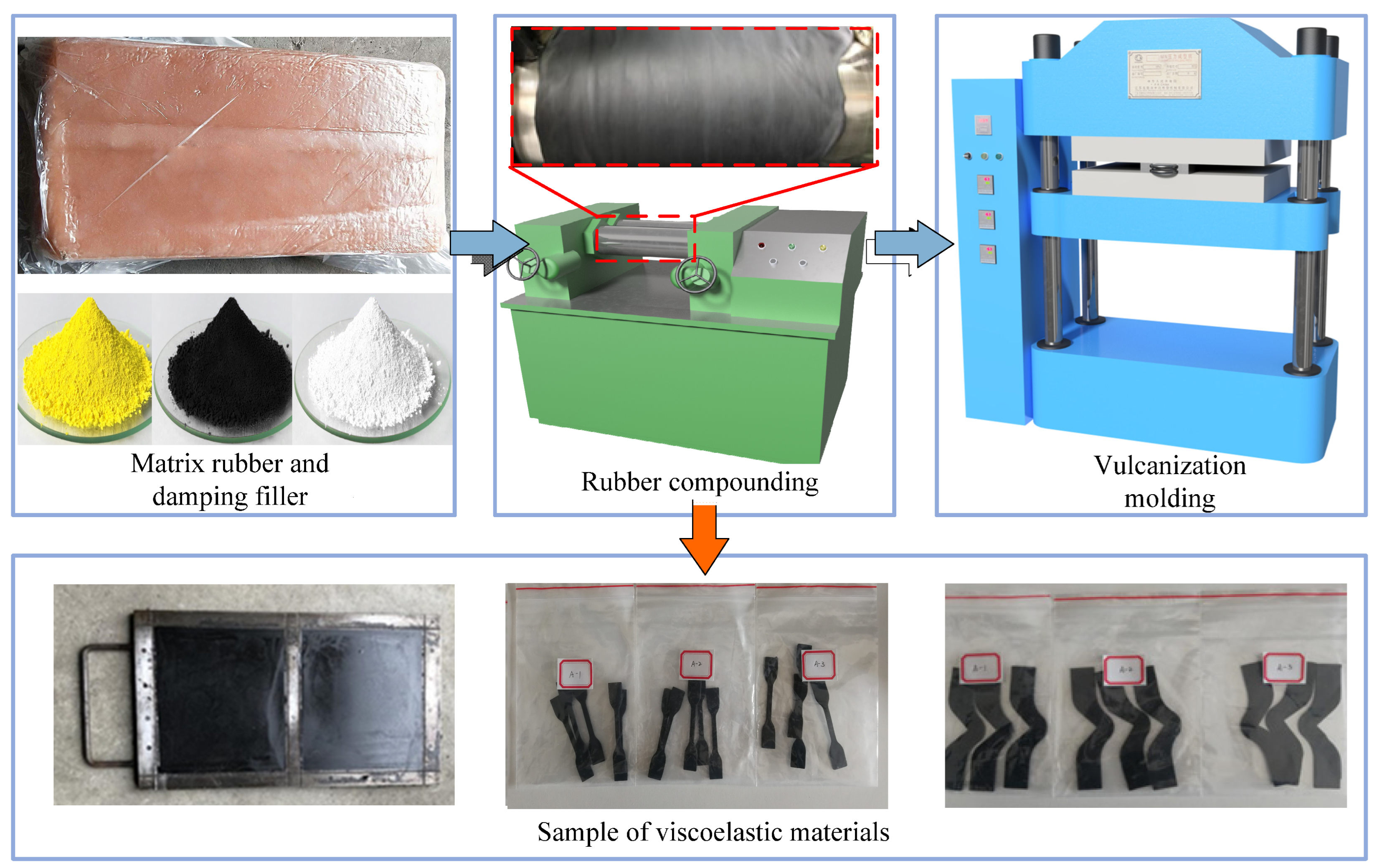
The preparation of viscoelastic materials involves steps such as weighing the base rubber and ingredients, plasticizing the raw rubber, mixing after adding additives, and vulcanization molding. As a vibration-damping material with excellent energy dissipation effects, it is essential to conduct tests including vulcanization performance, mechanical properties, and dynamic mechanical analysis to ensure it possesses both superior damping performance and mechanical properties. The specific preparation steps and testing methods are as follows.

2.1. Preparation Process of VEM

Plasticizing: Plasticizing involves the mechanical breakdown of rubber’s macromolecular chains to alter its rheological properties, reduce elasticity, increase plasticity, and improve processing performance, ensuring smooth progress in subsequent steps such as mixing and vulcanization. During plasticizing, the rubber undergoes intense mechanical shear, leading to chain scission. The active free radicals of the broken chains become stabilized by combining with other free radical acceptors, resulting in shorter molecules and enhanced plasticity.
Mixing: Mixing refers to the entire process of combining raw rubber with various compounding agents on a rubber mixer, achieving a uniform dispersion through kneading, and then shaping it into sheets. The resulting mixture is called mixed rubber or compound, where the distribution of raw rubber is continuous, while that of the compounding agents is discontinuous. During mixing, mechanical forces are applied to blend the rubber with the compounding agents, ensuring the uniform dispersion of powdered fillers and promoting chemical and physical interactions among multiple components of the compound. This forms a complex microscopic multiphase structure, fundamentally altering the properties of the mixed rubber.
Vulcanization: Vulcanization is the process of mixing vulcanizing agents and accelerators into rubber, followed by heat treatment or other methods to create cross-links between the linear molecular chains of rubber, forming a three-dimensional network structure. This process fundamentally alters the microscopic structure of rubber molecules, significantly improving their properties. During vulcanization, various properties of rubber change with vulcanization time. The vulcanization process can be divided into the scorch stage, heat vulcanization stage, flat vulcanization stage, and over-vulcanization stage. For viscoelastic damping materials, their damping performance is in conflict with their physical and mechanical properties. The determination of the optimal vulcanization point should primarily consider the dynamic mechanical properties of the material while also taking into account its physical and mechanical properties.
Organic hybrid damping material is a polymer with polar side groups, in which a large amount of organic polar low molecules are added. By adjusting the molding process parameters, a uniformly dispersed molecular composite is formed, which exhibits high damping characteristics through the interaction between the polymer and low molecules. The main intermolecular interaction force is hydrogen bonding, which forms a hydrogen-bonding network structure between a large number of damping small molecules and polar matrices, giving the material good damping performance. Therefore, the influence of different types of damping small molecules on the mechanical and damping properties of the ACM matrix viscoelastic materials was studied through a material testing analysis.
First, the effect of several different damping agents on the physical and dynamic mechanical properties of the ACM matrix viscoelastic materials was studied in this work. ACM, different types of damping agents, and other coordination systems were added in order on the double-roll open mill, and, then, we thin the lower plate. The mixed rubber was parked for more than 24 h, and then the vulcanization temperature and positive vulcanization time t90 were measured by a vulcanizing instrument. Finally, the ACM/damping agent viscoelastic material is vulcanized on a flat vulcanizing machine.

2.2. Performance Characterization of VEM

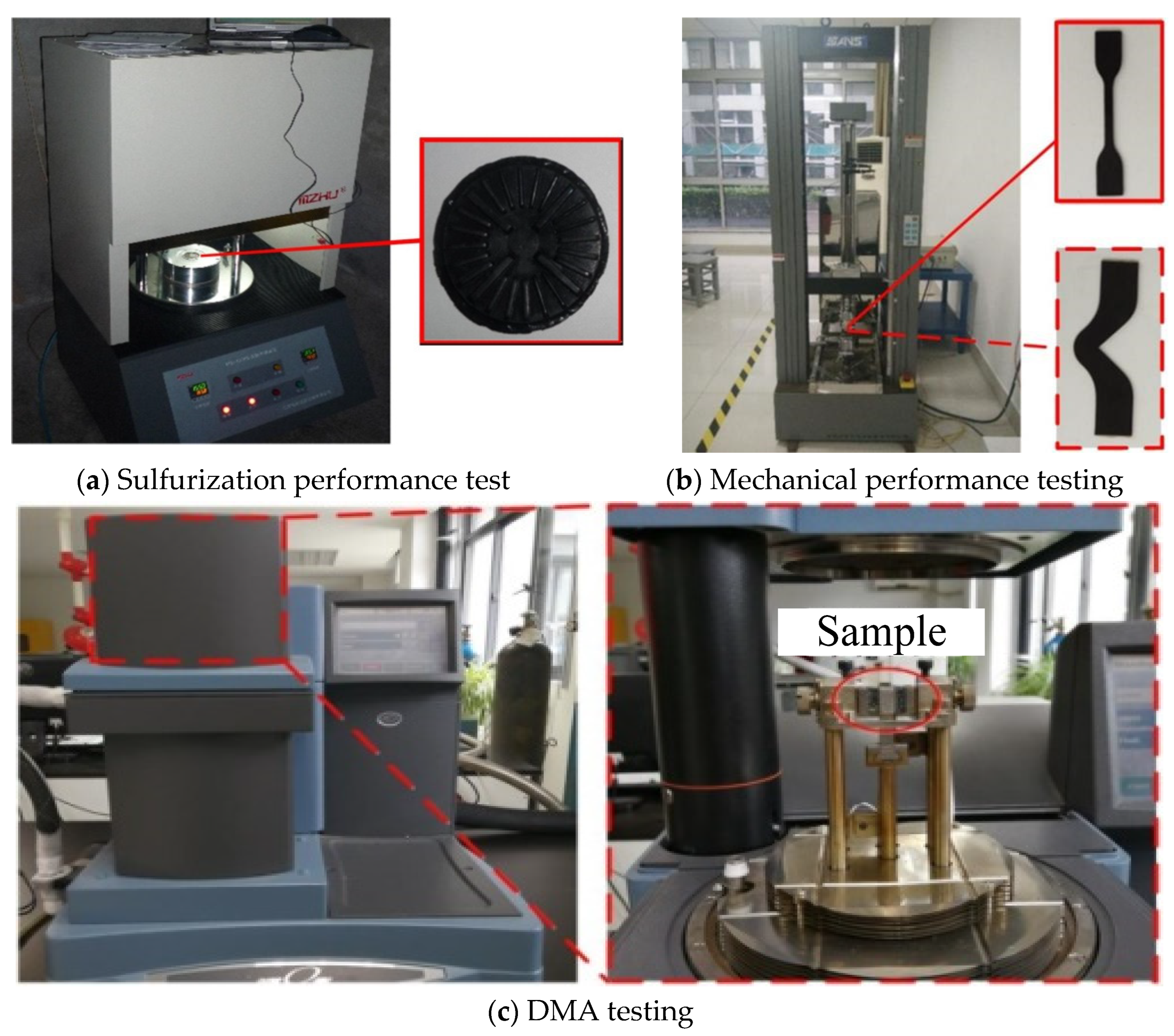
Sulfurization performance test: Using the MDR-2000E rotorless vulcanizing apparatus(Yangzhou Jinghui Testing Machinery Co. Ltd., Yangzhou, China) (Figure 1a), the vulcanization characteristic curve of the mixed rubber was tested. During the test, the burning time (t10), positive vulcanization time (t90), and other data of the rubber material were recorded.
Physical and mechanical performance testing: The physical and mechanical performance test samples are dumbbell-shaped and right-angled splines (Figure 2), and the ZY-5000 N electronic tensile testing machine (Figure 1b) is used to test the tensile stress–strain curve, tensile strength, elongation at break, and other data of viscoelastic materials according to the GB/T 528-2009 standard [33]. The hardness of the viscoelastic materials is tested by a LX-A Shore hardness tester.
Dynamic mechanical performance testing: This is performed by using the Q800 dynamic mechanical thermal analyzer (TA instrument, New Castle, DE, USA) (Figure 1c) in shear mode. In temperature sweep mode, the heating rate was 3 °C/min, the frequency was 1 Hz, and the amplitude was 1 μm. The sample size for DMA testing is uniformly 10 mm in length, 10 mm in width, and 4 mm in thickness.
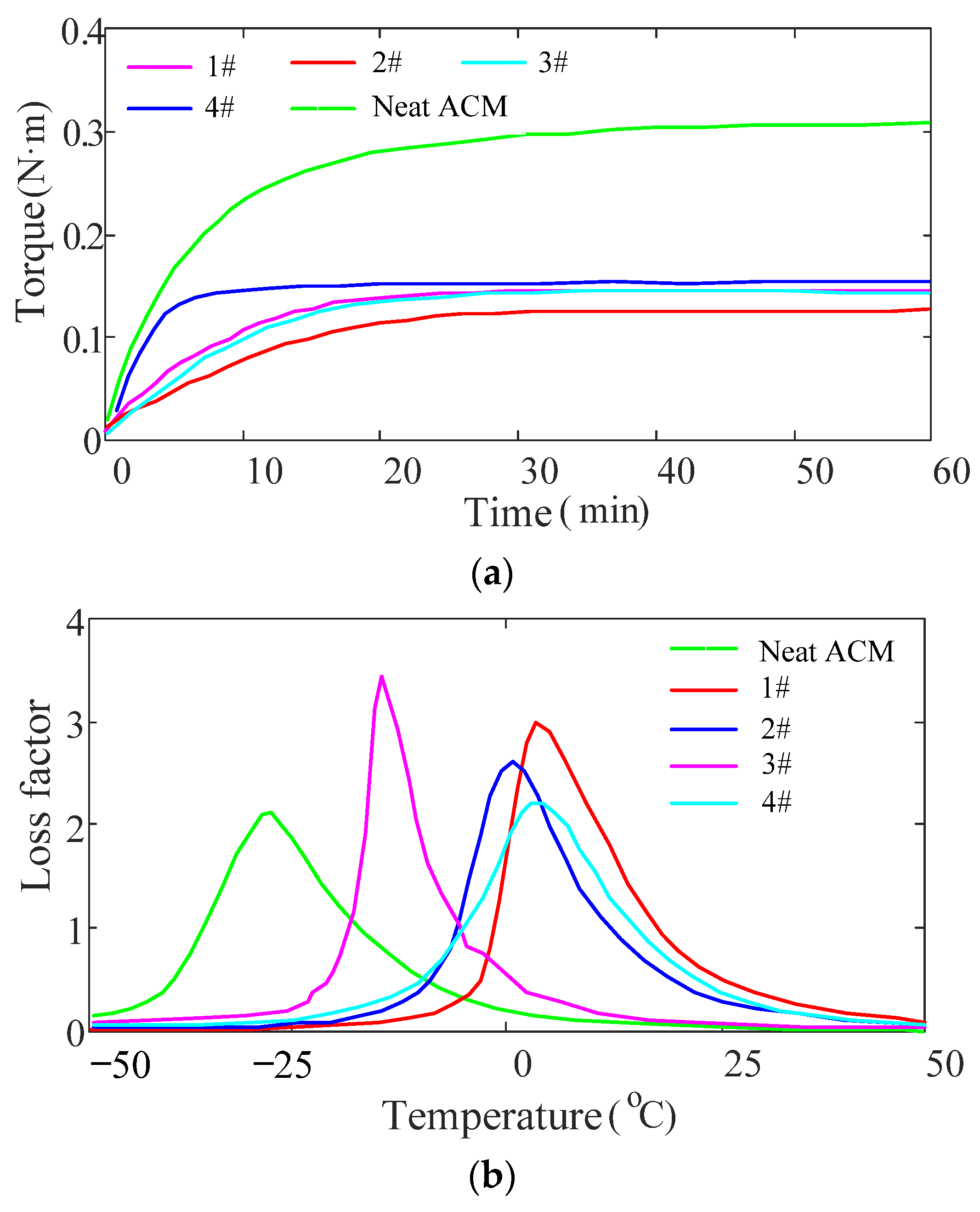
The effects of different types of damping agents on the vulcanization performance, physical and mechanical properties, and dynamic mechanical properties of the ACM matrix viscoelastic materials are shown in Figure 3a and Table 1. It can be seen that, after adding the damping agent, the torque of the blend decreased completely. This is because, at a vulcanization temperature of 160 °C, the damping agent is in a molten state and acts as a plasticizer in the vulcanized rubber. It can also be explained as the obstruction of phenolic small molecules through spatial shielding, which interferes with the normal crosslinking reaction between the vulcanizing agent and the rubber molecular chain. Therefore, the effective cross-linking points formed per unit volume decrease, manifested macroscopically as a decrease in the final torque value of the vulcanization curve, that is, a decrease in the cross-linking density. Different damping agents have increased the vulcanization rate of ACM-based viscoelastic materials to varying degrees, with damping agent 4# showing the largest increase in the vulcanization rate. At the same time, it can be seen that the torque of ACM/damping-based viscoelastic materials decreases, possibly due to the adsorption of some sodium stearate and potassium stearate by the damping agent, which reduces the crosslinking degree of the blend. It can be seen that the four damping agents have different effects on the mechanical properties of the ACM matrix viscoelastic materials. Overall, the ACM/damping agent 1# viscoelastic material has better comprehensive mechanical properties.
The dynamic mechanical properties of the ACM matrix viscoelastic materials filled with different types of damping agents are shown in Figure 3b, and the damping performance data are shown in Table 2. From the figure, it can be seen that all hybrid materials of ACM have only one transition peak, indicating that all four damping agents have excellent compatibility with ACM. Compared with pure ACM, the peak loss factor of the four small-molecule hybrid materials (1#, 2#, 3#, and 4#) has been increased to varying degrees, and the glass transition temperature has been raised from 2.20 to 3.30, 2.89, 3.50, and 2.30, respectively. Among them, the material with added damping agent 3# has the largest increase in the peak loss factor, but its effective temperature range has significantly narrowed. After adding small-molecule damping agents, the Tg of the acrylic rubber matrix viscoelastic material increased from −28.90 °C to 3.69, −0.64, −14.64, and 4.16, respectively. Among them, the glass transition temperature of materials with added damping agents 1# and 4# is closest to room temperature and the effective temperature range is similar. Due to the fact that the damping peak of the material with added damping agent 1# is much higher than that of damping agent 4#, damping agent 1# has the best effect on improving the damping of the ACM matrix viscoelastic materials.

3. Establishment of Viscoelastic Damping Engineering Model

3.1. Overview of Engineering Examples

To analyze the seismic control effect of the developed viscoelastic damper on the structure, the seismic engineering of a primary school in Yunnan was selected and the dynamic response of the structure with and without the installation of viscoelastic dampers analyzed by OpenSEES.
The seismic reduction structure analyzed is a teaching building of a primary school in Yunnan. The structure is a six-story structure with an L-shaped plan and a total height of 22.4 m. One floor has a height of 1.6 m, the top floor has a height of 5.2 m, and the remaining floors have a height of 3.9 m. The X direction is the long-span direction of the structure, with a length of 78 m, and the Y direction is the short-span direction of the structure, with a length of 18 m. The basic natural period of the structure is 1.02 s. The designed basic seismic acceleration of the area is 0.2 g, and the designed earthquake group is the third group. The site soil is a Class II site with a characteristic period of 0.65 s. The survey and design data indicate that this structure is a key fortification. The structural model was developed in OpenSees as a fully three-dimensional model. NonlinearBeamColumn elements were used for both beams and columns. The fiber sections included both concrete and reinforcing steel. The concrete nonlinearity was represented using the Concrete02 material model, while the steel reinforcement was modeled using Steel01 to capture its yielding behavior. Floor slabs were modeled using equivalent uniform loads distributed onto the supporting beam elements. The inherent damping of the structure was represented through Rayleigh damping, where the damping coefficients were calibrated such that the first two vibration modes had a damping ratio of 0.05.
To ensure the correctness of the model, OpenSEES (OpenSEES3.3.0), Etabs (ETABS V20), and YJK (YJK V4.0) software were used to model the structure, and the model was preliminarily validated through modal analysis (Table 3). The main reason for the difference in the basic vibration modes of building structures calculated by the three software is due to the simplified assumptions of modeling and the different mesh densities of finite element models.

3.2. Layout Scheme of Viscoelastic Dampers

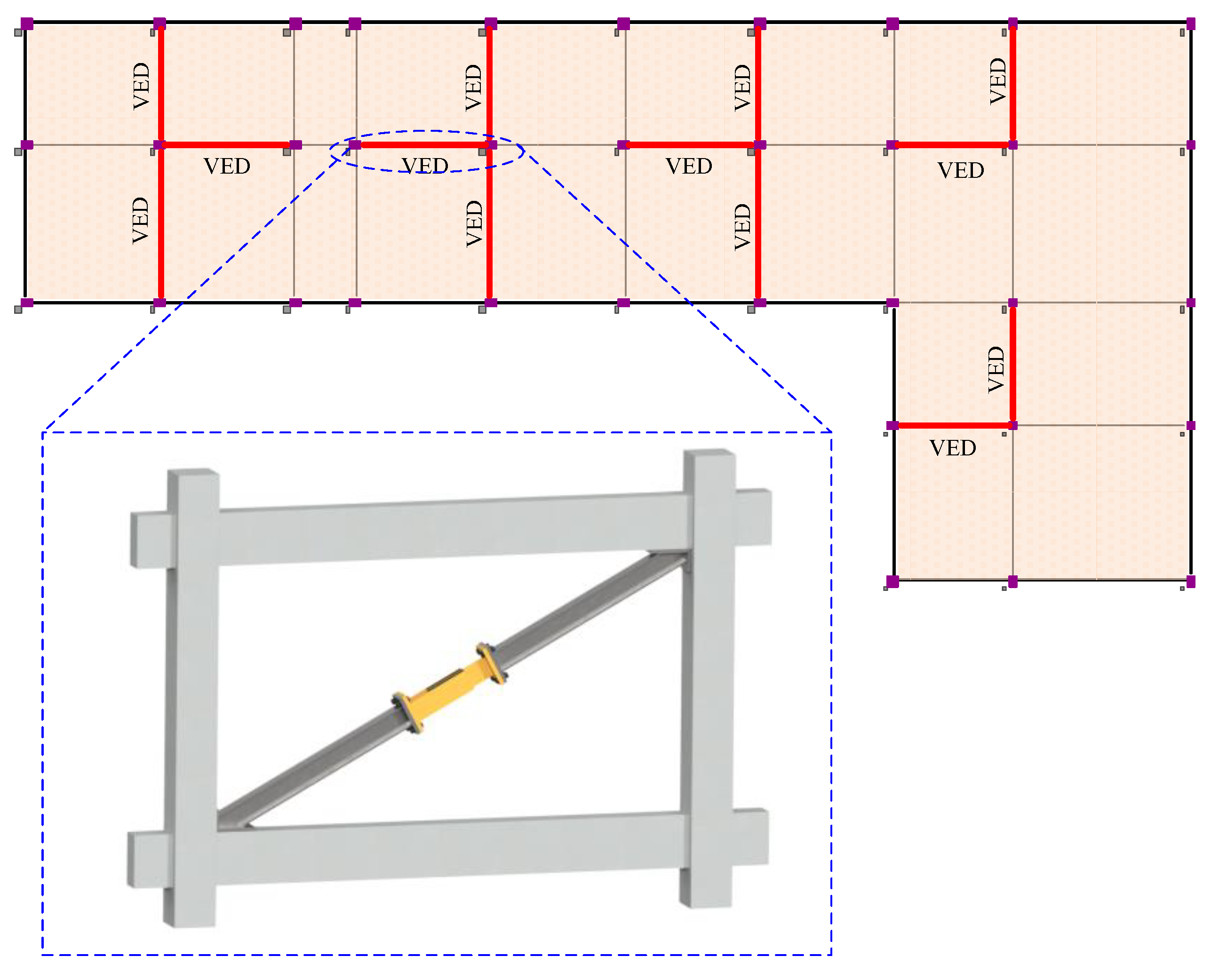
The vibration control methods for building structures generally include two methods: vibration isolation and vibration reduction [34,35]. Vibration isolation is achieved by setting a flexible isolation layer at the bottom of the building to block the transmission of ground vibration to the upper structure [36,37]. The effect is excellent but the cost is high, mainly suitable for important new buildings. Vibration reduction involves installing dampers inside the structure to dissipate the vibration energy [38,39], which is economical, flexible, and widely applicable. It is a very effective seismic reinforcement method for existing buildings. Considering the actual characteristics and fortification level of the project, a total of 78 viscoelastic dampers are used in the structure, with 13 dampers arranged on each floor, including 5 dampers in the X direction and 8 dampers in the Y direction. The specific arrangement plan is shown in Figure 4. The various performance parameters of the viscoelastic damper meet the requirements of the relevant specifications, as shown in Table 4. Each viscoelastic damper was represented using a truss element configuration. The truss elements were placed diagonally between two nodes located at the upper and lower stories of the structure. Each damper was represented following the Kelvin model, using two parallel truss elements that correspond to the elastic energy storage behavior and the viscous energy dissipation behavior [40,41,42].
The viscoelastic damper is connected to the main structure through node plates and embedded parts, as shown in Figure 4. Under earthquake action, the embedded parts should be in an elastic state and should not undergo sliding, local instability, or other damage to ensure that the deformation of the energy dissipation device is mainly provided by viscoelastic dampers. The node plate mainly bears the supporting role provided by the damper. Therefore, in addition to having a sufficient bearing capacity and stiffness, measures such as increasing the thickness of the node plate or setting stiffeners should also be taken to prevent out-of-plane instability.

3.3. Selection of Seismic Waves

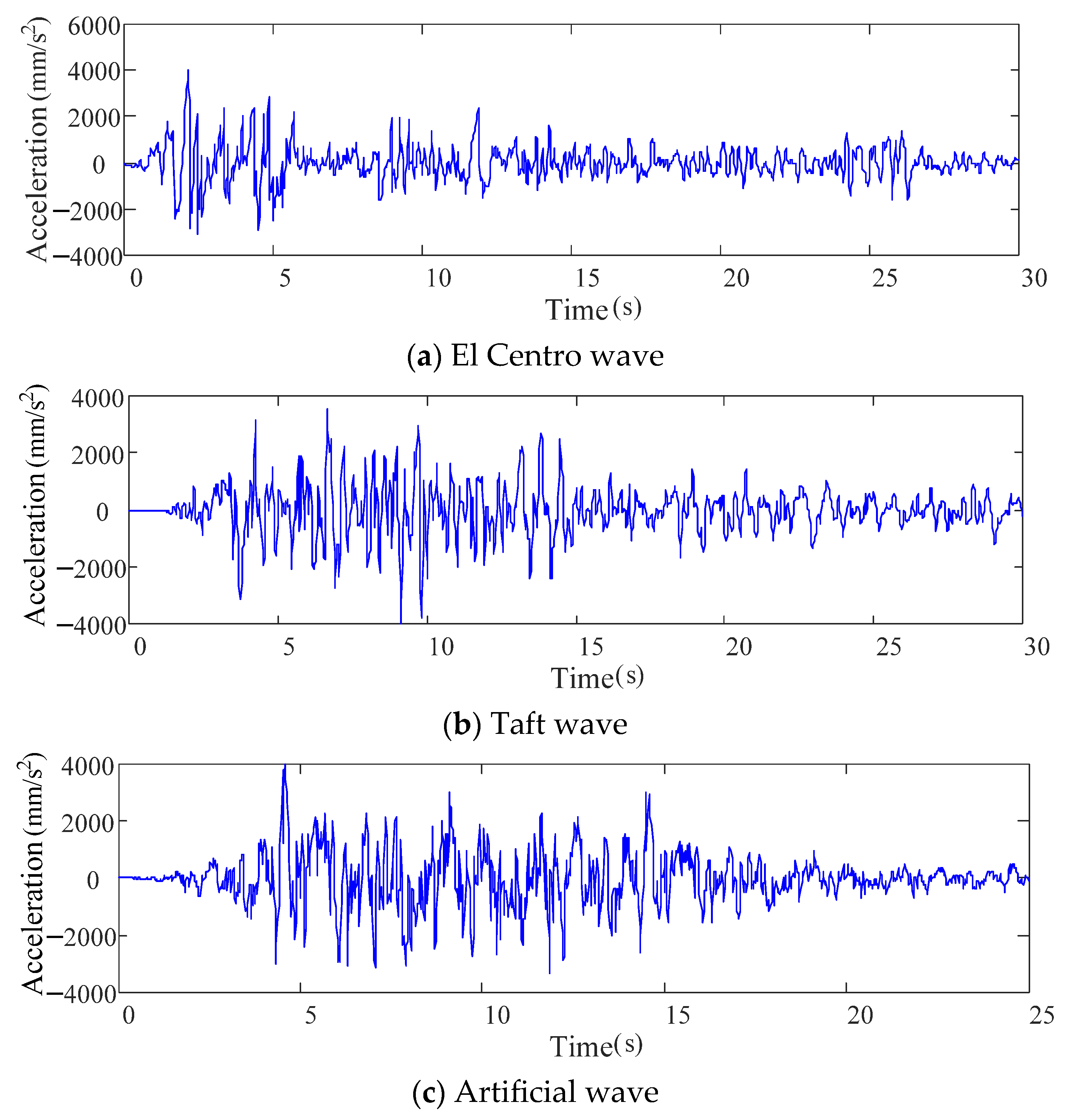
In reality, earthquakes have uncertainty and it is difficult to accurately predict the actual seismic conditions that the structure will experience. To ensure the accuracy of the dynamic analysis results of the seismic reduction structure, it is necessary to reasonably select the input seismic action. The two actual strong earthquake records are the El Centro wave in 1940 and the Taft wave in 1952, and their acceleration time histories are shown in Figure 5.
For artificial waves, the trigonometric series method is usually used for synthesis, which considers non-stationary characteristics, which can be expressed by the following equation:
a t = f t a s t
where f t can be chosen as follows:
f t = t / t 1 2 t < t 1 1 t 1 t < t 2 e c t t 2 t 2 t < t 3 0 t 3 t < T
The Gaussian stationary stochastic process in Equation (1) can be synthesized using the trigonometric series, and can be expressed using either the sine or cosine functions. The specific expression is as follows:
a s t = 1 N C k sin ω k t + φ k
or
a s t = 1 N C k cos ω k t + φ k
where ω k and C k can be determined as follows:
C k = 2 S ω k Δ ω Δ ω = 2 π / T ω k = k Δ ω
In the analysis and calculation of this chapter, the power spectral density function adopts the Jin Jingqing model, and its expression is as follows:
S g ω = ω g 4 + 4 ς g 2 ω g 2 ω 2 ω g 2 ω 2 2 + 4 ς g 2 ω g 2 ω 2 S 0
where ω g is the dominant frequency of the surface cover layer; ς g is the damping ratio of the surface cover layer; and S 0 is the spectral intensity factor.
Based on the above analysis, the artificial wave acceleration time history obtained is shown in Figure 5. The three seismic waves mentioned above are acceleration time histories adjusted to 400 gal amplitude, which are used for the seismic analysis of structures with viscoelastic dampers.

4. Analysis of the Viscoelastic Damping Effect of the Structure

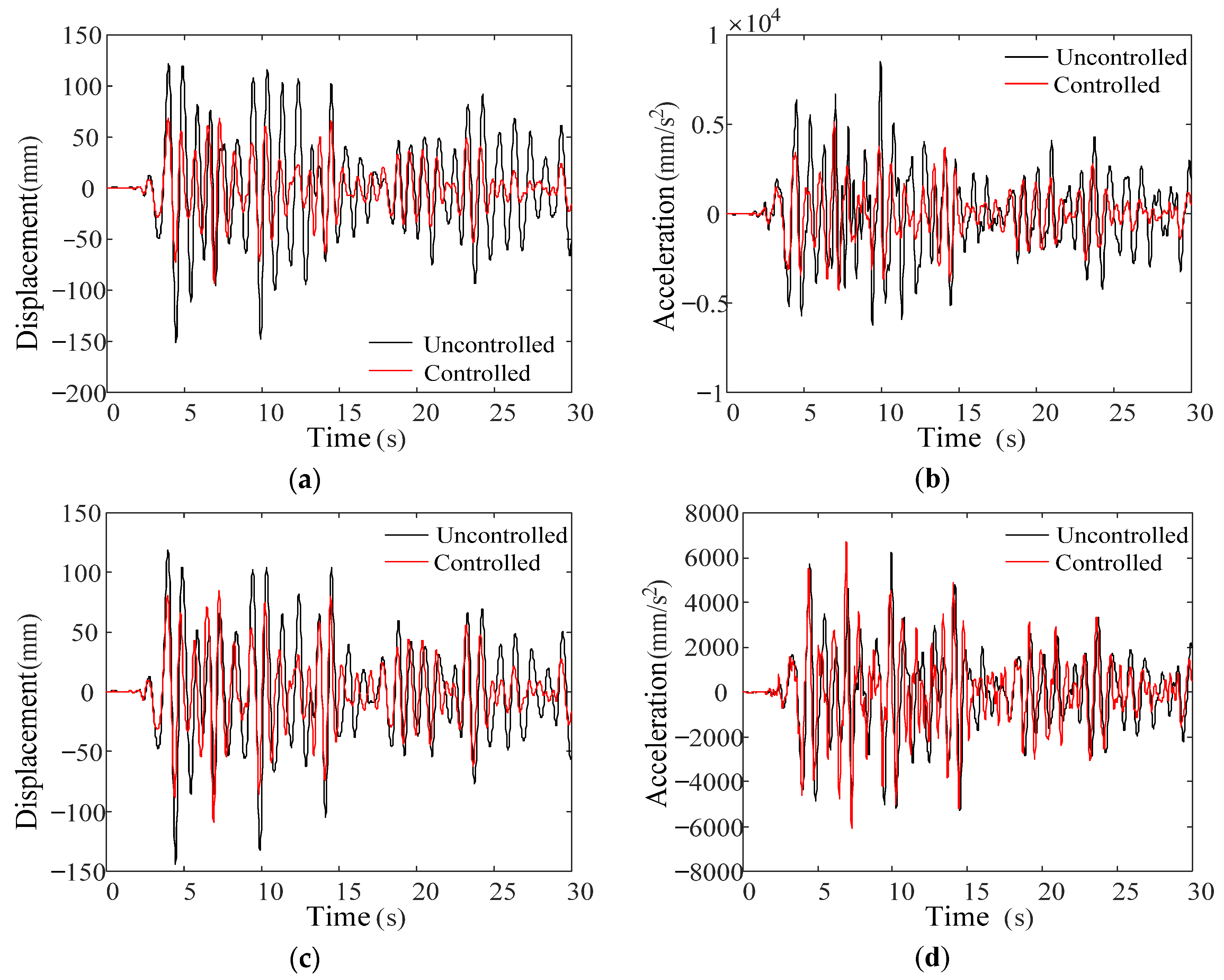
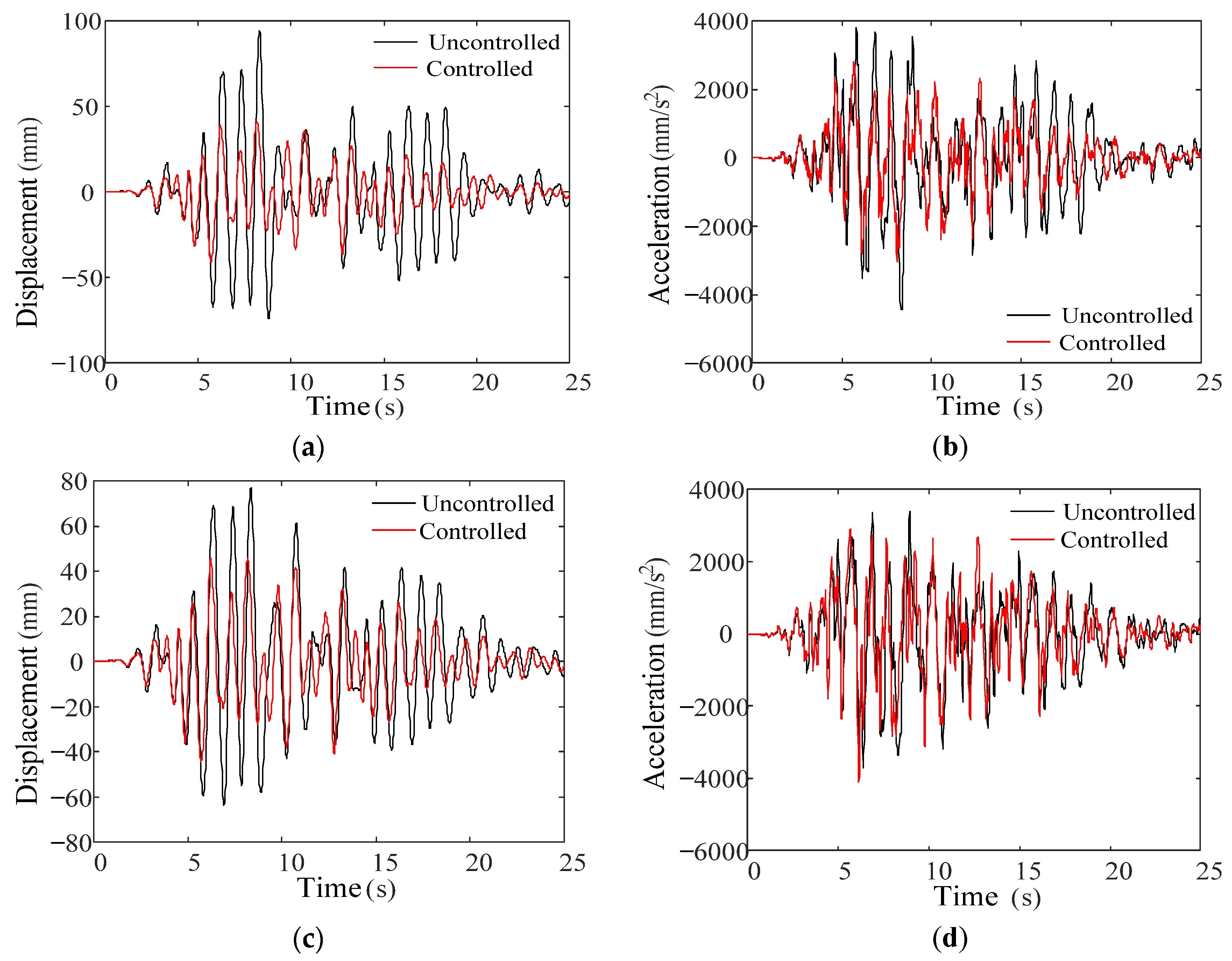
The dynamic response of the structure without viscoelastic dampers (uncontrolled) and with viscoelastic dampers (controlled) has been calculated under El Centro waves, Taft waves, and artificial waves, and the dynamic response of the structures under a rare earthquake has been analyzed. Considering that there are many working conditions analyzed in the paper, only the dynamic response results of the displacement and acceleration of the structure under El Centro waves, Taft waves, and artificial waves are provided in detail here.

4.1. Under El Centro Wave Action

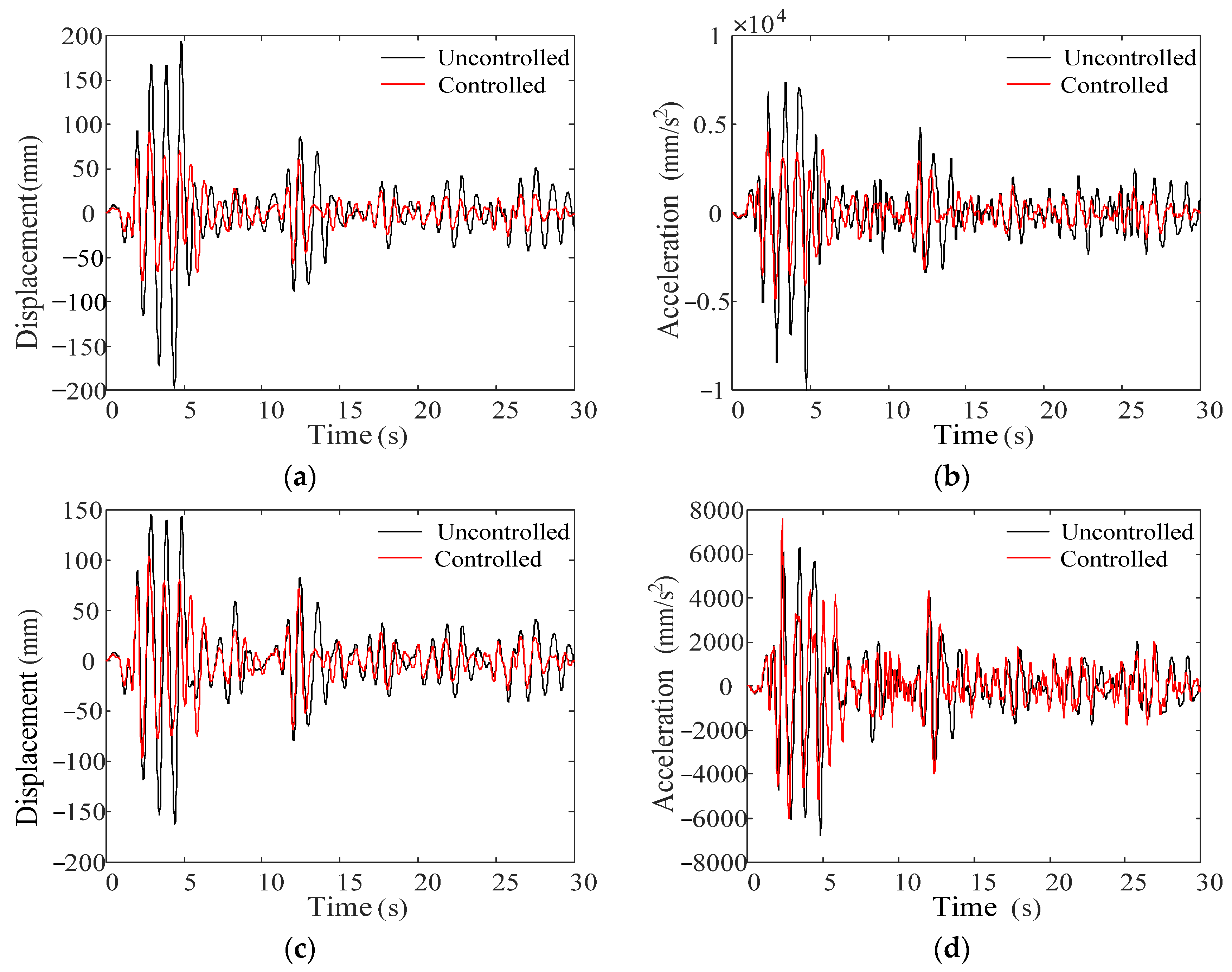
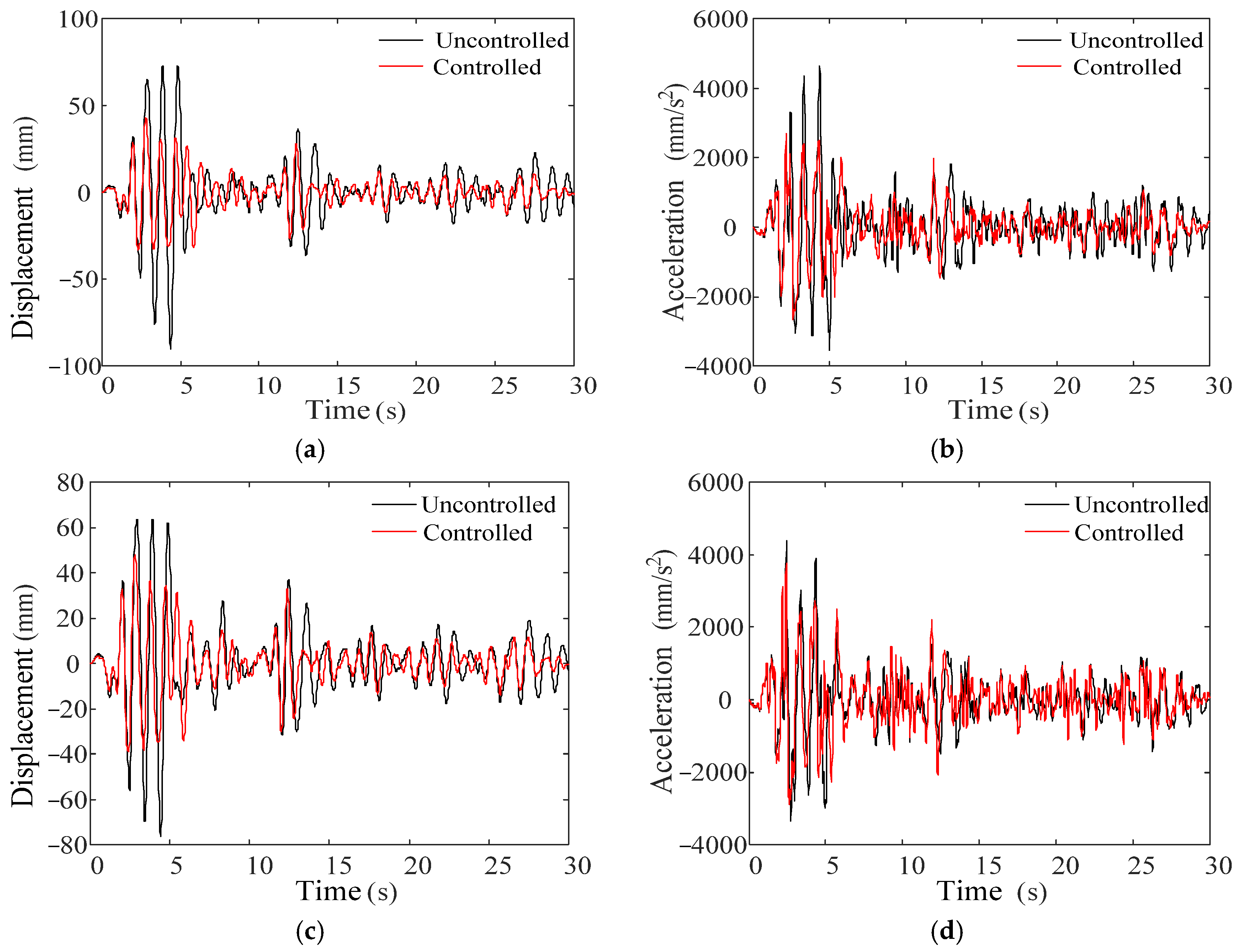
Figure 6 and Figure 7, respectively, show the comparison of the displacement and acceleration time history curves of the top and middle layers in the X and Y directions of the structure under the action of El Centro waves. Table 5 shows the control effect of the viscoelastic damping structure under El Centro wave action.
Compared with uncontrolled structures, when using viscoelastic dampers for control, except for a slight increase in the top acceleration in the Y direction, the other dynamic responses are significantly reduced. Specifically, as shown in Figure 6a, in the X direction, the maximum displacement of the top layer without control is 193.1 mm, while it is 90.5 mm with control, a decrease of 53.1%. According to Figure 6b, the maximum acceleration of the top layer is 7.35 m/s2 without control, while the maximum acceleration response is 4.55 m/s2 with control, a decrease of 38.1%. According to Figure 6c, in the Y direction, the maximum displacement of the top layer without control is 145.5 mm, while, in the controlled structure, the maximum displacement of the top layer is 103.9 mm, a decrease of 28.6%. According to Figure 6d, the maximum acceleration of the top layer without control is 6.27 m/s2, while, in the controlled structure, it is 7.59 m/s2, an increase of 21.1%.
According to Figure 7a, in the X direction, the maximum displacement of the third layer without control is 72.7 mm, while it is 43.2 mm with control, a decrease of 40.6%. According to Figure 7b, the maximum acceleration of the third layer without control is 4.65 m/s2, while it is 2.68 m/s2 with control, a decrease of 42.3%. According to Figure 7c, in the Y direction, the maximum displacement of the third layer without control is 63.6 mm, while the maximum displacement response of the third layer with control decreased to 47.9 mm, a decrease of 24.8%. According to Figure 7d, the maximum acceleration at the third layer without control is 4.39 m/s2, while, in the controlled structure, it is 3.75 m/s2, a decrease of 14.6%. The results show that the displacement of the structure is significantly reduced when installing dampers, and the acceleration may slightly increase, mainly due to the dampers increasing the stiffness of the structure.
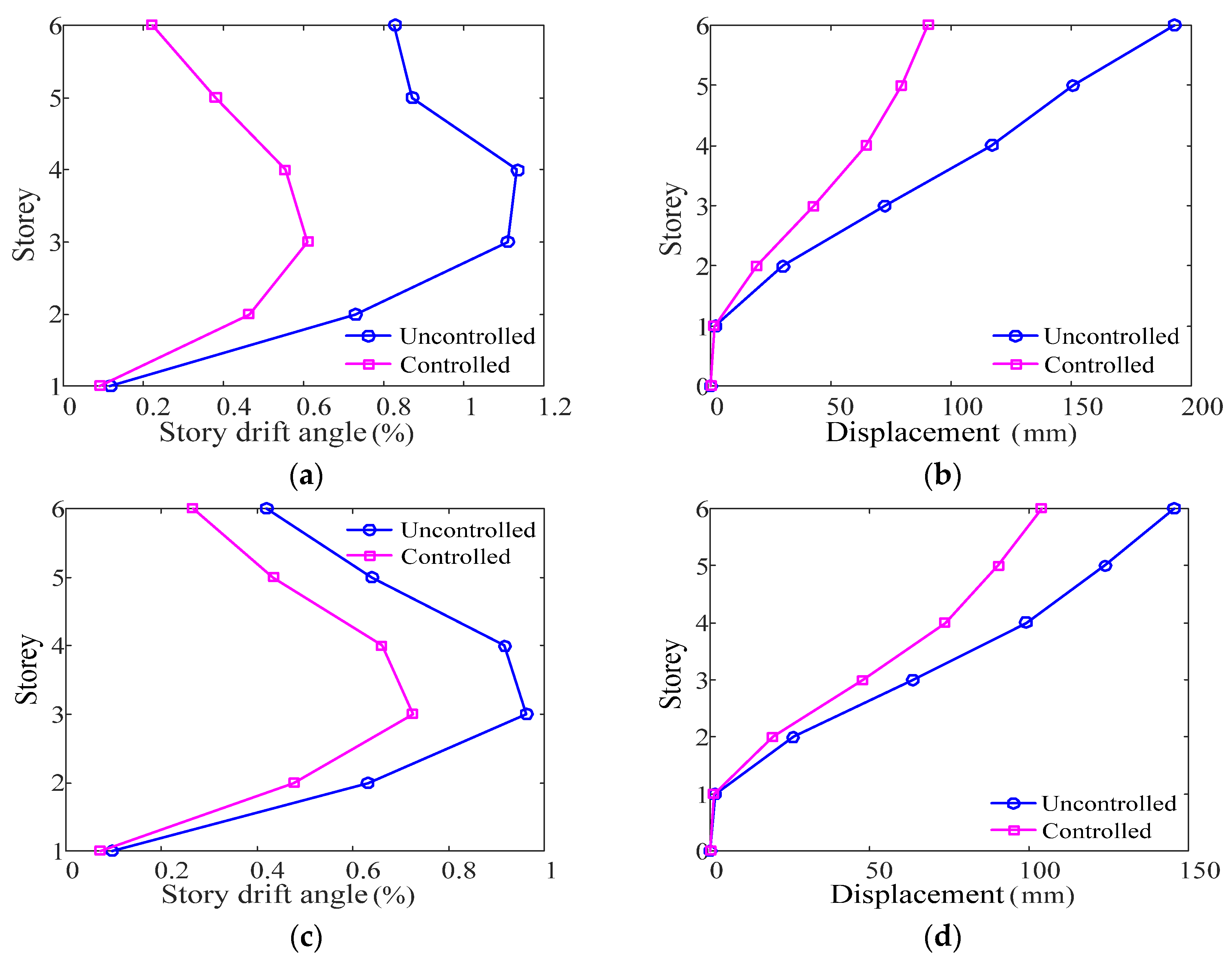
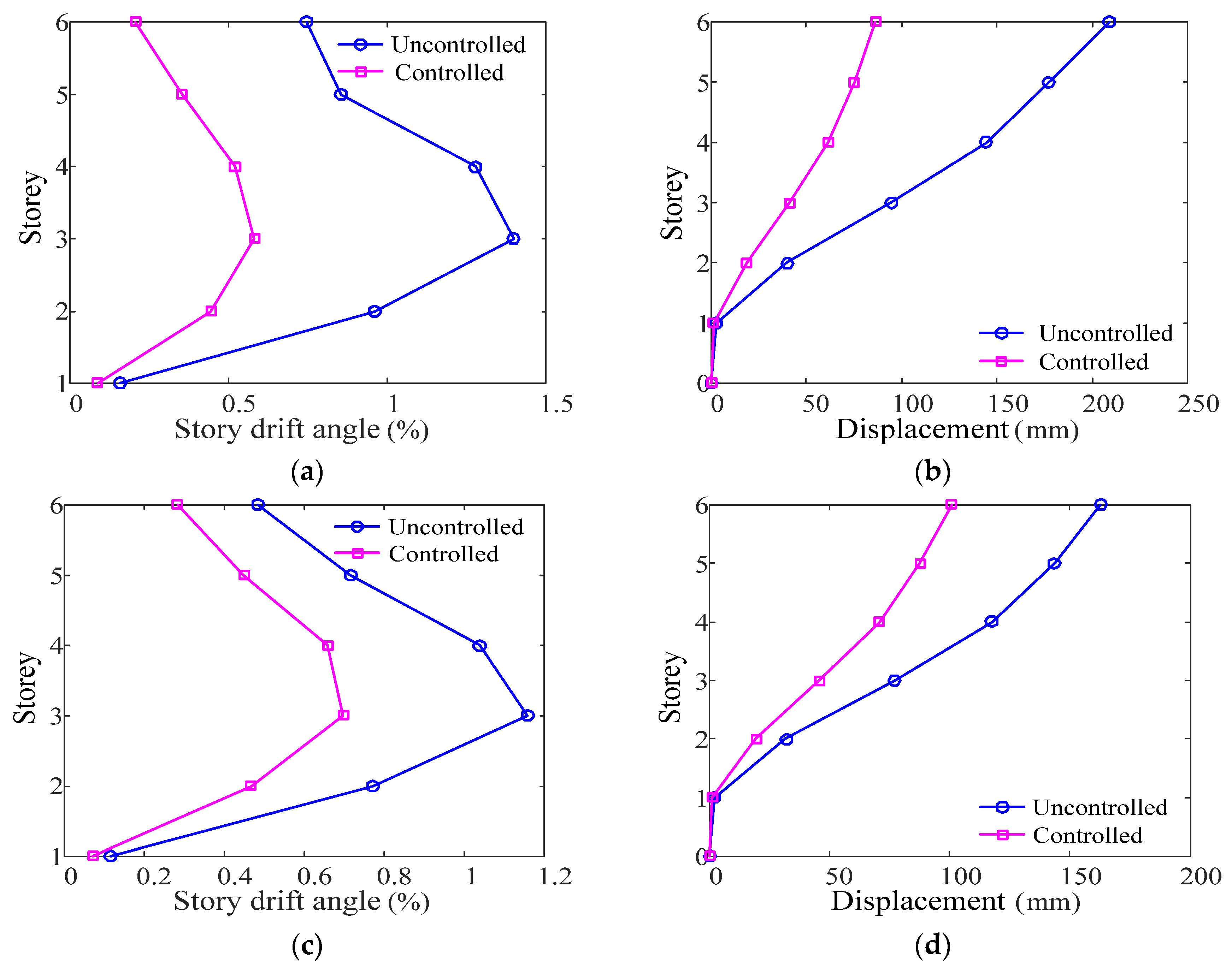
To further analyze the control effect of the viscoelastic damper developed in this paper, the distribution of the inter-story displacement angles and displacement response envelopes under various seismic waves is plotted. Figure 8a,b show the distribution of the maximum inter-story displacement angles and maximum displacement responses in the X direction on each floor under the action of El Centro waves. According to Figure 8a, the maximum inter-story displacement angle in the X direction occurs in the middle floor. The maximum inter-story displacement angles of the uncontrolled and controlled structures are 1.13% and 0.61%, respectively. According to the Code [43], the inter-story displacement angle of building structures under rare earthquakes must be less than 1/50. It is shown in Figure 8d that the maximum displacements of the first to sixth floors in the X direction of uncontrolled structures under rare earthquakes are 1.88 mm, 30.31 mm, 72.69 mm, 116.85 mm, 150.75 mm, and 193.12 mm, respectively. The maximum displacements of each floor in the X direction of controlled structures are 1.46 mm, 19.51 mm, 43.16 mm, 64.63 mm, 79.41 mm, and 90.48 mm, respectively. The maximum displacements of each floor in the X direction of controlled structures are reduced by 22.0%, 35.6%, 40.6%, 44.7%, 47.3%, and 53.1%, respectively.
Figure 8c,d show the distribution of the maximum inter-story displacement angle and maximum displacement response in the Y direction on each floor under El Centro waves. According to Figure 8c, the maximum inter-story displacement angle in the Y direction occurs in the middle floor. The maximum inter-story displacement angle in the Y direction of the controlled structure is reduced by 24.7%. As shown in Figure 8d, the maximum displacement of each layer in the controlled structure is significantly reduced. Specifically, under rare earthquakes, the maximum displacements of the first to sixth floors in the Y direction of uncontrolled structures are 1.54 mm, 26.17 mm, 63.62 mm, 99.02 mm, 123.77 mm, and 145.54 mm, respectively. The maximum displacements of each floor in the Y direction of controlled structures are 1.15 mm, 19.70 mm, 47.86 mm, 73.60 mm, 90.48 mm, and 103.95 mm, respectively. The maximum displacements of each floor in the Y direction of controlled structures are reduced by 25.3%, 24.7%, 24.8%, 25.7%, 26.9%, and 28.6%, respectively.

4.2. Under Taft Wave Action

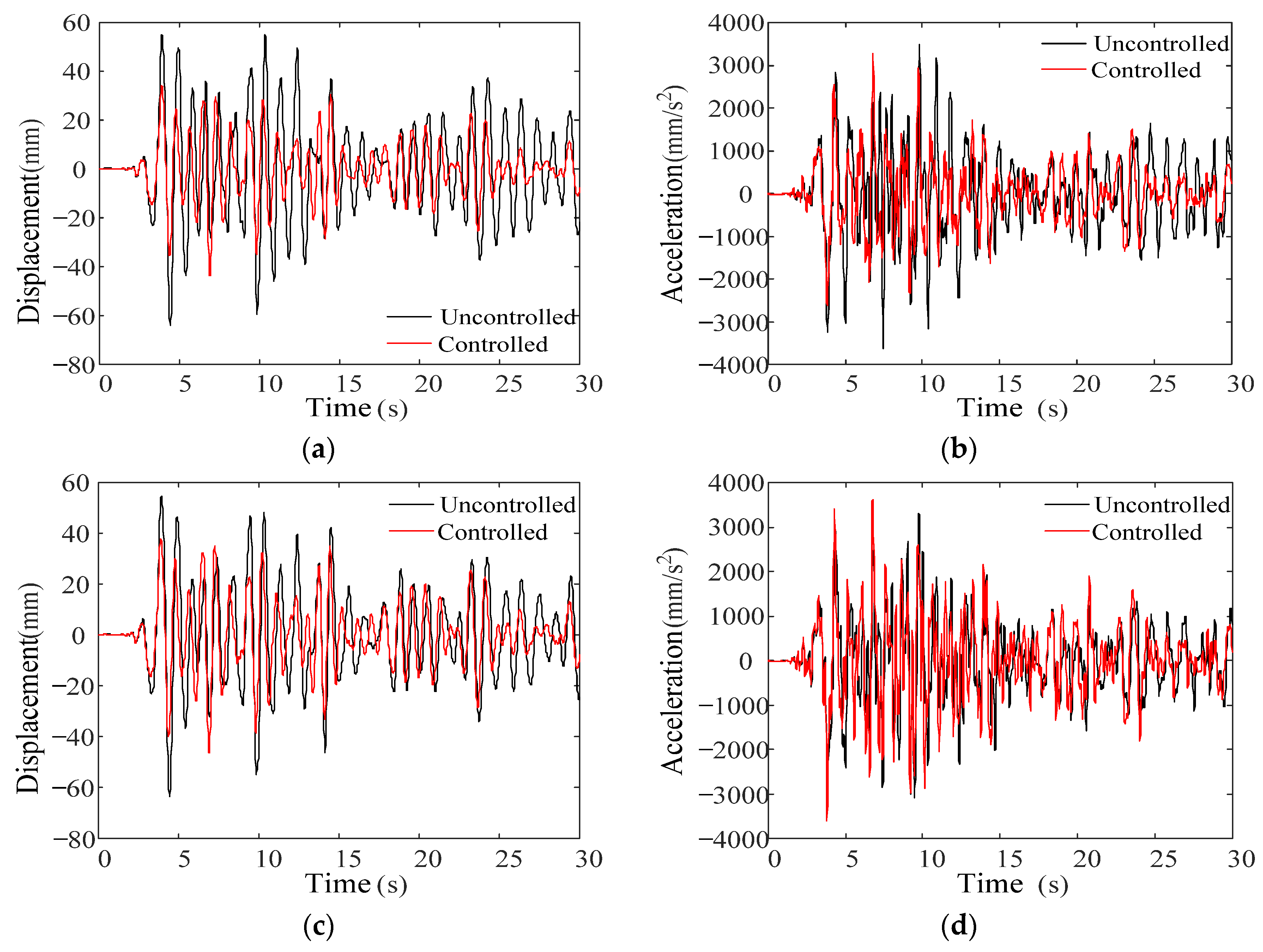
Figure 9 and Figure 10, respectively, show the comparison of the displacement and acceleration time history curves of the top and middle layers in the X and Y directions of the structure under Taft waves. Table 6 shows the control effect of the viscoelastic damping structure under Taft wave action.
Compared with uncontrolled structures, when viscoelastic dampers are added, the dynamic responses are significantly reduced except for a small change in acceleration in the Y direction. Specifically, as shown in Figure 9a, in the X direction, the maximum displacement of the top layer without control is 121.2 mm, while it is 68.1 mm with control, a decrease of 43.8%. According to Figure 9b, the maximum acceleration of the top layer is 8.53 m/s2 when there is no control, while the maximum acceleration response is 5.13 m/s2 when there is control, a decrease of 39.8%. According to Figure 9c, in the Y direction, the maximum displacement of the top layer without control reached 118.7 mm, while, in the controlled structure, the maximum displacement of the top layer decreased to 84.5 mm, a decrease of 28.8%. According to Figure 9d, the maximum acceleration of the top layer is 6.25 m/s2, while, in the controlled structure, it is 6.72 m/s2, an increase of 7.5%.
According to Figure 10a, in the X direction, the maximum displacement of the third layer without control is 55.1 mm, while it is 34.2 mm with control, a decrease of 37.8%. According to Figure 10b, the maximum acceleration of the third layer without control is 3.48 m/s2, while it is 3.28 m/s2 with control, a decrease of 5.6%. According to Figure 10c, in the Y direction, the maximum displacement response of the third layer of the structure reached 54.4 mm without control, while the maximum displacement response of the top layer with control decreased to 38.0 mm, a decrease of 30.2%. According to Figure 10d, the maximum acceleration of the top layer without control is 3.30 m/s2, while it is 3.61 m/s2 with control, an increase of 9.5%. Overall, under the action of Taft waves, viscoelastic dampers can effectively control the dynamic response of the structures.
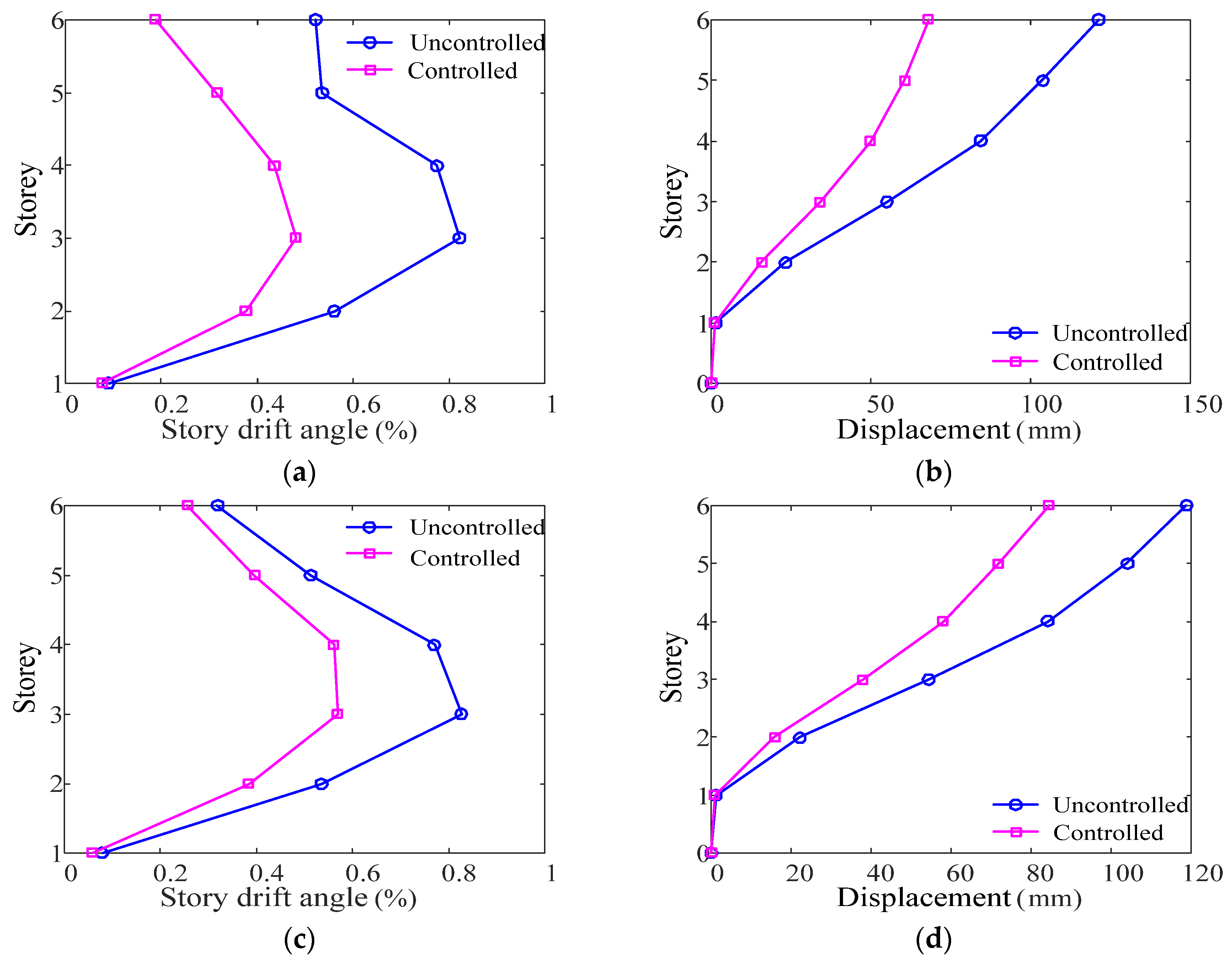
Figure 11a,b show the distribution of the maximum inter-story displacement angle and maximum displacement response in the X direction on each floor under Taft waves. According to Figure 11a, the maximum inter-story displacement angle in the X direction occurs in the middle floor. The maximum inter-story displacement angle in the X direction with control is reduced by 41.6%. Furthermore, as shown in Figure 11b, the maximum displacement of each layer with control is significantly reduced. Specifically, under rare earthquakes, the maximum displacements of the first to sixth floors in the X direction of uncontrolled structures are 1.45 mm, 23.30 mm, 55.07 mm, 84.42 mm, 103.73 mm, and 121.2 mm, respectively. The maximum displacements of each floor in the X direction of controlled structures are 1.22 mm, 15.80 mm, 34.25 mm, 49.98 mm, 60.45 mm, and 68.11 mm, respectively. The maximum displacement of each floor in the X direction with control are reduced by 16.1%, 32.2%, 37.8%, 40.8%, 41.7%, and 43.8%, respectively.
According to Figure 11c, the maximum inter-story displacement angle in the Y direction of the structure occurs in the middle floor. The maximum inter-story displacement angle in the Y direction with control is reduced by 31.1%. Furthermore, as shown in Figure 11d, the maximum displacement of each layer in the controlled structure is significantly reduced. The maximum displacements of the first to sixth floors in the Y direction of uncontrolled structures under rare earthquakes are 1.27 mm, 22.16 mm, 54.39 mm, 84.12 mm, 103.93 mm, and 118.65 mm, respectively. The maximum displacements of each floor in the Y direction of controlled structures are 0.94 mm, 15.89 mm, 37.98 mm, 57.92 mm, 71.90 mm, and 84.48 mm, respectively. The maximum displacements of each floor in the Y direction of controlled structures are reduced by 25.9%, 28.3%, 30.2%, 31.1%, 30.8%, and 28.8%, respectively.

4.3. Under Artificial Wave Action

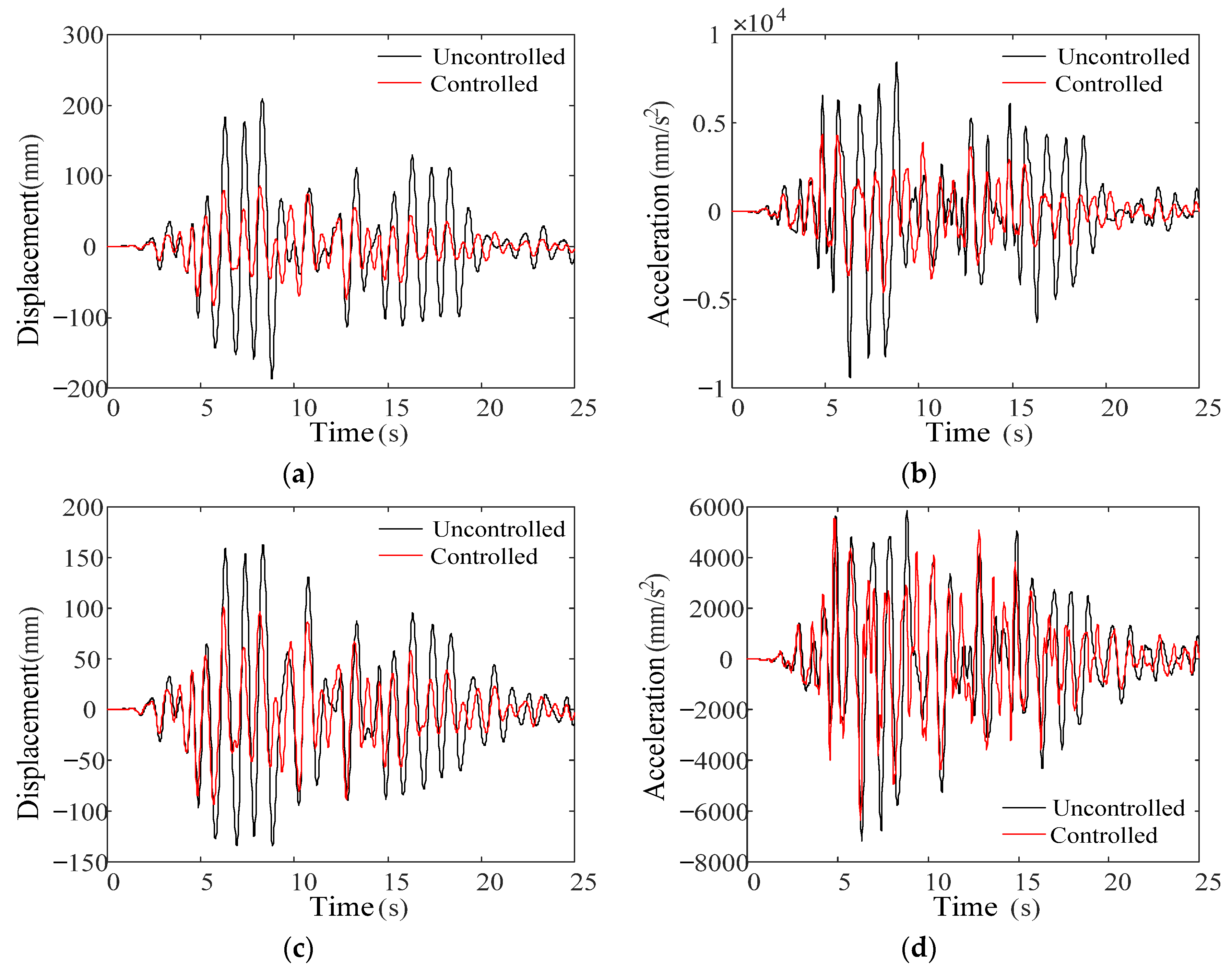
Figure 12 and Figure 13 show the comparison of the displacement and acceleration time history curves in the X and Y directions of the structure under artificial waves, respectively. Table 7 shows the control effect of the viscoelastic damping structure under Artificial wave action.
Compared with uncontrolled structures, when using viscoelastic dampers for control, the other dynamic responses in the two directions are significantly reduced. Specifically, as shown in Figure 12a, in the X direction, the maximum displacement response of the top layer without control is 208.7 mm, while it is 86.1 mm with control, a decrease of 58.8%. According to Figure 12b, the maximum acceleration response of the top layer is 8.44 m/s2 without control, while the maximum acceleration response is 4.33 m/s2 with control, a decrease of 48.7%. According to Figure 12c, in the Y direction, the maximum displacement response of the top layer of the uncontrolled structure reached 162.8 mm, while the maximum displacement response of the top layer with control decreased to 100.8 mm, a decrease of 38.1%. According to Figure 12d, the maximum acceleration response at the top without control is 5.87 m/s2, while, in the controlled structure, it is 5.55 m/s2, a decrease of 5.4%.
According to Figure 13a, in the X direction, the maximum displacement response of the third layer is 94.4 mm without control, while it is 41.3 mm with control, a decrease of 56.2%. According to Figure 13b, the maximum acceleration of the third layer with control is 3.81 m/s2, while it is 2.80 m/s2 with control, a decrease of 26.6%. According to Figure 13c, in the Y direction, the maximum displacement of the third layer without control reached 77.0 mm, the maximum displacement response of the third layer with control decreased to 45.8 mm, a decrease of 40.6%. According to Figure 13d, the maximum acceleration of the third layer without control is 3.4 m/s2, while, in the controlled structure, it is 2.93 m/s2, a decrease of 14.0%. Therefore, under the action of artificial waves, viscoelastic dampers can effectively control the dynamic response of structures.
Figure 14a,b show the distribution of the maximum inter-story displacement angle and maximum displacement in the X direction on each floor under the action of artificial waves. According to Figure 14a, the maximum inter-story displacement angle in the X direction occurs in the middle floor. The maximum inter-story displacement angle in the X direction with control is reduced by 58.4%. Furthermore, as shown in Figure 14b, the maximum displacement of each layer with control is significantly reduced. Specifically, the maximum displacements of the first to sixth floors in the X direction without control under rare earthquakes are 2.51 mm, 39.92 mm, 94.37 mm, 144.23 mm, 177.05 mm, and 208.73 mm, respectively. The maximum displacements of each floor in the X direction of controlled structures are 1.39 mm, 18.70 mm, 41.31 mm, 61.52 mm, 75.31 mm, and 86.05 mm, respectively. The maximum displacements of each floor in the X direction of controlled structures are reduced by 44.5%, 53.2%, 56.2%, 57.3%, 57.5%, and 58.8%, respectively.
According to Figure 14c, the maximum inter-story displacement angle in the Y direction of the structure occurs in the middle floor. The maximum inter-story displacement angle in the Y direction with control is reduced by 39.9%. Furthermore, as shown in Figure 14d, the maximum displacement of each layer in the controlled structure is significantly reduced. Specifically, under rare earthquakes, the maximum displacements of the first to sixth floors in the Y direction of uncontrolled structures are 1.84 mm, 31.86 mm, 77.03 mm, 117.54 mm, 143.59 mm, and 162.85 mm, respectively. The maximum displacements of each floor in the Y direction of controlled structures are 1.16 mm, 19.34 mm, 45.76 mm, 70.69 mm, 87.53 mm, and 100.77 mm, respectively. Compared with uncontrolled structures, the maximum displacements of each floor in the Y direction of controlled structures are reduced by 37.1%, 39.3%, 40.6%, 39.9%, 39.0%, and 38.1%, respectively.
It can be concluded that, under natural and artificial wave excitations, viscoelastic dampers have good seismic control effects on the dynamic response of structures in both directions. For the X direction, the maximum inter-story displacement angle and maximum top story displacement of the viscoelastic damping structure decreased by up to 58.4% and 58.8%, respectively, while the peak top story acceleration decreased by up to 48.7%; For the Y direction, the maximum inter-story displacement angle and maximum top story displacement of the viscoelastic damping structure decreased by up to 39.9% and 40.6%, respectively, while the peak top story acceleration decreased by up to 14.6%.


5. Conclusions

In this paper, four different damping-modified systems of viscoelastic damping materials based on the ACM matrix were developed and characterization performance tests were conducted. The low-frequency high-damping viscoelastic material with the best comprehensive performance were selected based on a comparison and analysis of the experimental results. Additionally, the dynamic responses of structures under natural and artificial seismic waves were comparatively analyzed and conducted with and without viscoelastic dampers to verify the seismic control effectiveness of the developed viscoelastic damping materials. The main conclusions obtained are as follows:
  • Different damping agents have increased the vulcanization rate of the ACM matrix viscoelastic materials to varying degrees. All hybrid materials of ACM have only one transition peak, indicating that all four damping agents have excellent compatibility with ACM. Compared with pure ACM, the peak loss factors of the four small-molecule hybrid materials have been increased to varying degrees, and the glass transition temperatures have shifted towards room temperature.
  • The damper based on developed viscoelastic materials exhibits significant control effects on various dynamic responses of the structure. Under the action of different seismic waves, the top displacement of the viscoelastic damping structure can be reduced by up to 58.8%, the maximum inter-story drift angle can be reduced by up to 58.4%, and the top acceleration can be decreased by up to 48.7%.
  • The glass transition temperature of the viscoelastic material with added damping agent 1 is closest to room temperature, and the peak loss factor increases to 3.3, which is selected for the viscoelastic damper for the dynamic analysis of viscoelastic damping structures. The analysis results show that the disaster resistance resilience of the structure is significantly enhanced. It provides a way to achieve a cross-scale analysis, from viscoelastic damping technology materials to structures.

Author Contributions

Conceptualization, J.-X.H.; Methodology, T.G. and C.X.; Software, Z.-W.H.; Validation, J.-X.H.; Formal analysis, Z.-W.H.; Investigation, C.X. and Z.F.; Resources, T.G.; Writing—original draft, T.G.; Writing—review & editing, Z.F.; Supervision, Z.F.; Project administration, Z.-W.H. All authors have read and agreed to the published version of the manuscript.

Funding

This study was financially supported by the National Science Fund for Young Scholars (Grant No. 52508342), Natural Science Foundation of Jiangsu Province (Grant No. BK20230966), Special Funding Project of China Postdoctoral Science Foundation (Grant No. 2023TQ0105), and Natural Science Foundation of the Jiangsu Higher Education Institutions of China (Grant No. 23KJB130003).

Data Availability Statement

The original contributions presented in the study are included in the article, further inquiries can be directed to the corresponding author.

Conflicts of Interest

The authors declare no conflict of interest.

References

  1. Shu, Z.; You, R.; Xie, Y. Viscoelastic Dampers for Vibration Control of Building Structures: A State-of-Art Review. J. Earthq. Eng. 2024, 28, 3558–3585. [Google Scholar] [CrossRef]
  2. Lewandowski, R.; Litewka, P.; Aasecka-Plura, M.; Pawlak, Z.M. Dynamics of Structures, Frames, and Plates with Viscoelastic Dampers or Layers: A Literature Review. Buildings 2023, 13, 2223. [Google Scholar] [CrossRef]
  3. Zhang, H.; Li, A.; Su, Y.; Xu, G.; Sha, B. Viscoelastic Dampers for Civil Engineering Structures: A Systematic Review of Constructions, Materials, and Applications. J. Build. Eng. 2024, 96, 110597. [Google Scholar] [CrossRef]
  4. Sato, D.; Chang, T.-W.; Chen, Y. Effects of Different Frequency Sensitivity Models of a Viscoelastic Damper on Wind-Induced Response of High-Rise Buildings. Buildings 2022, 12, 2182. [Google Scholar] [CrossRef]
  5. Xu, J.; Sun, D.; Liu, E.; Guo, T.; Li, A. Optimal Design of Right-Angle Viscoelastic Dampers for Seismic Performance of Ancient Timber Structure via Improved Multi-Objective Particle Swarm Algorithm. Structures 2025, 77, 109123. [Google Scholar] [CrossRef]
  6. Ge, X.; Azim, I.; Li, C.; Gong, J.; Liu, M.; Zhao, C. Seismic Responses of Structure with Six-Element Generalized Model Viscoelastic Dampers. Soil Dyn. Earthq. Eng. 2023, 164, 107610. [Google Scholar] [CrossRef]
  7. Xu, Y.; He, Q.; Guo, Y.-Q.; Huang, X.-H.; Dong, Y.-R.; Hu, Z.-W.; Kim, J. Experimental and Theoretical Investigation of Viscoelastic Damper by Applying Fractional Derivative Method and Internal Variable Theory. Buildings 2023, 13, 239. [Google Scholar] [CrossRef]
  8. Li, Q.-Q.; Xu, Z.-D.; Zhao, Q.; Dong, Y.-R.; Wang, X.-W.; Liu, T.-F. Physics-Guided Surrogate Modeling of Dynamic Mechanical Properties of Viscoelastic Dampers Considering Micromolecular Chain Structures. Structures 2025, 74, 108533. [Google Scholar] [CrossRef]
  9. Yi, D.; Fan, Y.; Pan, Y. Hysteretic Behavior Characterization of Mortise and Tenon Joints Reinforced Using Viscoelastic Dampers in Historic Timber Frames. J. Struct. Eng. 2025, 151, 04025024. [Google Scholar] [CrossRef]
  10. Wu, C.; Li, D.; Deng, X.; Yang, C.; Xu, X. Experimental Study on Precast Concrete Moment-Resisting Frame System with Sector Lead Viscoelastic Dampers. Struct. Control Health Monit. 2021, 28, e2746. [Google Scholar] [CrossRef]
  11. Chang, K.C.; Soong, T.T.; Oh, S.-T.; Lai, M.L. Seismic Behavior of Steel Frame with Added Viscoelastic Dampers. J. Struct. Eng. 1995, 121, 1418–1426. [Google Scholar] [CrossRef]
  12. Chang, K.C.; Chen, S.J.; Lai, M.L. Inelastic Behavior of Steel Frames with Added Viscoelastic Dampers. J. Struct. Eng. 1996, 122, 1178–1186. [Google Scholar] [CrossRef]
  13. Chang, K.-C.; Lin, Y.-Y. Seismic Response of Full-Scale Structure with Added Viscoelastic Dampers. J. Struct. Eng. 2004, 130, 600–608. [Google Scholar] [CrossRef]
  14. Shen, K.L.; Soong, T.T.; Chang, K.C.; Lai, M.L. Seismic Behaviour of Reinforced Concrete Frame with Added Viscoelastic Dampers. Eng. Struct. 1995, 17, 372–380. [Google Scholar] [CrossRef]
  15. Xu, Z.D.; Liao, Y.X.; Ge, T.; Xu, C. Experimental and Theoretical Study of Viscoelastic Dampers with Different Matrix Rubbers. J. Eng. Mech. 2016, 142, 04016051. [Google Scholar] [CrossRef]
  16. Xu, Z.-D.; Xu, C.; Hu, J. Equivalent Fractional Kelvin Model and Experimental Study on Viscoelastic Damper. J. Vib. Control 2015, 21, 2536–2552. [Google Scholar] [CrossRef]
  17. Xu, Z.-D.; Wang, D.-X.; Shi, C.-F. Model, Tests and Application Design for Viscoelastic Dampers. J. Vib. Control 2011, 17, 1359–1370. [Google Scholar] [CrossRef]
  18. Xu, Z.-D.; Xu, L.-Z.; Xu, F.-H. Study on the Iced Quad-Bundle Transmission Lines Incorporated with Viscoelastic Antigalloping Devices. J. Dyn. Syst. Meas. Control 2015, 137, 061009. [Google Scholar] [CrossRef]
  19. Shunming, G.; Ying, Z.; Lu, X. Testing design and numerical analyses of shaking table test on structure added with viscoelastic dampers. Earthquke Eng. Eng. Dyn. 2014, 34, 224–229. [Google Scholar]
  20. Gong, S.; Zhou, Y. Experimental Study and Numerical Simulation on a New Type of Viscoelastic Damper with Strong Nonlinear Characteristics. Struct. Control Health Monit. 2017, 24, e1897. [Google Scholar] [CrossRef]
  21. Xu, J.; Li, A. Mechanical Properties of a “5+4” Viscoelastic Damping Wall Based on Full-Scale Laboratory Tests. Shock Vib. 2016, 2016, 6961805. [Google Scholar] [CrossRef]
  22. Yamazaki, Y.; Kasai, K.; Sakata, H. Torsional Seismic Response Reduction by Passive Control Devise for Conventional Post-and-Beam One-Story Wooden House with Stiffness Eccentricity. In Proceedings of the 7th International Conference on Urban Earthquake Engineering (7CUEE) & 5th International Conference on Earthquake Engineering (5ICEE), Tokyo Institute of Technology, Tokyo, Japan, 3–5 March 2010; Tokyo Institute of Technology: Tokyo, Japan, 2010. [Google Scholar]
  23. Kim, J.; Bang, S. Optimum Distribution of Added Viscoelastic Dampers for Mitigation of Torsional Responses of Plan-Wise Asymmetric Structures. Eng. Struct. 2002, 24, 1257–1269. [Google Scholar] [CrossRef]
  24. Min, K.-W.; Kim, J.; Lee, S.-H. Vibration Tests of 5-Storey Steel Frame with Viscoelastic Dampers. Eng. Struct. 2004, 26, 831–839. [Google Scholar] [CrossRef]
  25. Lewandowski, R.; Pawlak, Z. Dynamic Analysis of Frames with Viscoelastic Dampers Modelled by Rheological Models with Fractionalderivatives. J. Sound Vib. 2011, 330, 923–936. [Google Scholar] [CrossRef]
  26. Kasai, K.; Nishizawa, K.; Ooki, Y.; Tanaka, Y.; Tanaka, K.; Nishimoto, K.; Yamazaki, H. Static/Dynamic Tests of High-Hardness Rubber for Response Control and Its Time History Analysis Method. J. Struct. Constr. Eng. Trans. AIJ 2011, 76, 785–794. [Google Scholar] [CrossRef][Green Version]
  27. Besher, A.R.E.; Saito, T. Capacity Spectrum Method for Buildings with Viscoelastic Dampers Using Developed Equivalent Damping Ratio Formula. ASCE-ASME J. Risk Uncertain. Eng. Syst. Part Civ. Eng. 2025, 11, 04025077. [Google Scholar] [CrossRef]
  28. Kasai, K.; Osabel, D.M.; Sato, D. Dynamic Response Characterization and Simplified Analysis Methods for Viscoelastic Dampers Considering Heat Transfer. Earthq. Eng. Struct. Dyn. 2023, 52, 27–50. [Google Scholar] [CrossRef]
  29. Shukla, A.K.; Datta, T.K. Optimal Use of Viscoelastic Dampers in Building Frames for Seismic Force. J. Struct. Eng. 1999, 125, 401–409. [Google Scholar] [CrossRef]
  30. Xu, Y.; Mao, M.; Huang, X.-H.; Guo, Y.-Q.; Yang, Y.; Dong, Y.-R.; Shah, S.A.A.; Gao, X.; Usman, M.; Jeong, S.-H. Comparative Investigation of Dynamic Damping and Fracture in Viscoelastic Dampers with Two Different Interfacial Bonding Types: Molecular Dynamics Simulations and Device Tests. J. Build. Eng. 2025, 116, 114582. [Google Scholar] [CrossRef]
  31. Xu, Y.; Xu, Z.-D.; Hu, H.; Guo, Y.-Q.; Huang, X.-H.; Zhang, Z.-W.; Zhang, T.; Xu, C. Experiment, Simulation, and Theoretical Investigation of a New Type of Interlayer Connections Enhanced Viscoelastic Damper. Int. J. Struct. Stab. Dyn. 2025, 25, 2550045. [Google Scholar] [CrossRef]
  32. Zhang, J.; Zhang, C. Using Viscoelastic Materials to Mitigate Earthquake-Induced Pounding between Adjacent Frames with Unequal Height Considering Soil-Structure Interactions. Soil Dyn. Earthq. Eng. 2023, 172, 107988. [Google Scholar] [CrossRef]
  33. GB/T 528-2009; Rubber, Vulcanized or Thermoplastic-Determination of Tensile Stress-Strain Properties. General Administration of Quality Supervision, Inspection and Quarantine of the People’s Republic of China, China National Standardization Administration: Beijing, China, 2009. (In Chinese)
  34. Hu, Z.-W.; Xu, Z.-D.; Zhang, L.-Y.; He, J.-X.; Chen, Z.-H.; Dong, Y.-R.; Miao, Q.-S.; Li, W.-F.; Du, X.-L. Experimental and Numerical Studies of a Novel Multidimensional Isolation and Mitigation Device for Precast Wall Panel Systems. J. Struct. Eng. 2025, 151, 04025172. [Google Scholar] [CrossRef]
  35. Li, J.; Hu, Z.; Xu, Z.; Guo, Y. Three-Dimensional Dynamic Analysis of Ancient Buildings with Novel High Damping Isolation Trenches. J. Vib. Control 2022, 28, 2409–2420. [Google Scholar] [CrossRef]
  36. Liu, X.-Y.; Xu, Z.-D.; Huang, X.-H.; Tao, Y.; El Naggar, H. Experimental Investigation and Analytical Solution for the Coupled Seismic Response of 3D Base-Isolated Structures. Soil Dyn. Earthq. Eng. 2025, 199, 109693. [Google Scholar] [CrossRef]
  37. Zhang, J.; Li, Y.; Ding, Y.; Guan, X. Using the Improved Inner Slider to Enhance Overturning Resistance of DFPB-Isolated Structure Subjected to Poundings. Soil Dyn. Earthq. Eng. 2023, 173, 108158. [Google Scholar] [CrossRef]
  38. Tao, Y.; Xu, Z.-D.; Dong, Y.-R.; Dai, J.; Wei, Y.; Liu, X.-Y.; Huang, X.-H. Hybrid Simulation Testing and Energy Framework for Performance-Based Assessment of Structures under Earthquake-Fire Sequential Hazards. J. Build. Eng. 2025, 106, 112614. [Google Scholar] [CrossRef]
  39. Xu, Z.-D. Horizontal shaking table tests on structures using innovative earthquake mitigation devices. J. Sound Vib. 2009, 325, 34–48. [Google Scholar] [CrossRef]
  40. Li, A. Vibration Control for Building Structures: Theory and Applications; Springer: Berlin/Heidelberg, Germany, 2020. [Google Scholar]
  41. Zhao, J.; Li, K.; Zhang, X.-C. Multidimensional vibration reduction control of the frame structure with magnetorheological damper. Struct. Control. Health Monit. 2020, 27, e2572. [Google Scholar] [CrossRef]
  42. Zheng, D.; Guo, H.; Mao, X. Shaking table test on irregular and complex connected structure. J. Build. Eng. 2023, 79, 107833. [Google Scholar] [CrossRef]
  43. GB 50011-2010; Code for Seismic Design of Buildings. Ministry of Housing and Urban-Rural Development of the People’s Republic of China: Beijing, China, 2010. (In Chinese)
Figure 1. Performance characterization of viscoelastic materials.
Buildings 16 00030 g001
Figure 2. Development process of viscoelastic damping materials.
Buildings 16 00030 g002
Figure 3. Performance characterization of viscoelastic damping material: (a) sulfurization performance of ACM filled with different types of damping agents; and (b) damping performance of ACM filled with different types of damping agents.
Buildings 16 00030 g003
Figure 4. Arrangement scheme of dampers in viscoelastic seismic structure.
Buildings 16 00030 g004
Figure 5. Time history of seismic wave acceleration.
Buildings 16 00030 g005
Figure 6. Comparison of dynamic response between uncontrolled and controlled structure at the top layer under El Centro wave action: (a) displacement response of top layer in X direction; (b) acceleration response of top layer in X direction; (c) displacement response of top layer in Y direction; and (d) acceleration response of top layer in Y direction.
Buildings 16 00030 g006
Figure 7. Comparison of dynamic response between uncontrolled and controlled structure at the third layer under El Centro wave action: (a) displacement response of the third layer in the X direction; (b) acceleration response of the third layer in the X direction; (c) displacement response of the third layer in the Y direction; and (d) acceleration response of the third layer in the Y direction.
Buildings 16 00030 g007
Figure 8. Envelope diagram of inter-story displacement angle and displacement response of each floor under El Centro wave action: (a) maximum inter-story displacement angle of each floor in the X direction; (b) envelope diagram of displacement response of each floor in the X direction; (c) maximum inter-story displacement angle of each floor in the Y direction; and (d) envelope diagram of displacement response of each floor in the Y direction.
Buildings 16 00030 g008
Figure 9. Comparison of dynamic response between uncontrolled and controlled structure at the top layer under Taft wave action: (a) displacement response of top layer in X direction; (b) acceleration response of top layer in X direction; (c) displacement response of top layer in Y direction; and (d) acceleration response of top layer in Y direction.
Buildings 16 00030 g009
Figure 10. Comparison of dynamic response between uncontrolled and controlled structure at the third layer under Taft wave action: (a) displacement response of the third layer in the X direction; (b) acceleration response of the third layer in the X direction; (c) displacement response of the third layer in the Y direction; and (d) acceleration response of the third layer in the Y direction.
Buildings 16 00030 g010
Figure 11. Envelope diagram of inter-story displacement angle and displacement response of each floor under Taft wave action: (a) maximum inter-story displacement angle of each floor in the X direction; (b) envelope diagram of displacement response of each floor in the X direction; (c) maximum inter-story displacement angle of each floor in the Y direction; and (d) envelope diagram of displacement response of each floor in the Y direction.
Buildings 16 00030 g011
Figure 12. Comparison of dynamic response between uncontrolled and controlled structure at the top layer under artificial wave action: (a) displacement response of top layer in X direction; (b) acceleration response of top layer in X direction; (c) displacement response of top layer in Y direction; and (d) acceleration response of top layer in Y direction.
Buildings 16 00030 g012
Figure 13. Comparison of dynamic response between uncontrolled and controlled structure at the third layer under artificial wave action: (a) displacement response of the third layer in the X direction; (b) acceleration response of the third layer in the X direction; (c) displacement response of the third layer in the Y direction; and (d) acceleration response of the third layer in the Y direction.
Buildings 16 00030 g013
Figure 14. Envelope diagram of inter-story displacement angle and displacement response of each floor under artificial wave action: (a) maximum inter-story displacement angle of each floor in the X direction; (b) envelope diagram of displacement response of each floor in the X direction; (c) maximum inter-story displacement angle of each floor in the Y direction; and (d) envelope diagram of displacement response of each floor in the Y direction.
Buildings 16 00030 g014
Table 1. Sulfurization and mechanical properties of ACM-filled with different types of damping agents.
SampleNeat ACMDamping Agent 1#Damping Agent 2#Damping Agent 3#Damping Agent 4#
t10/min1.41.752.532.121.23
t90/min21.517.0020.2317.626.50
(t90t10)−1/min−10.0500.0660.0510.0650.159
ML/N·m0.050.020.0170.0140.025
MH/N·m0.310.1450.1320.1430.152
MH-ML/N·m0.260.1250.1150.1290.127
Tensile strength (MPa)0.754.862.820.503.08
Elongation at break (%)182403356295287
Tear strength (kN/m)3.586.383.442.784.13
Shore hardness7069706872
Table 2. Dynamic mechanical properties of ACM filled with different types of damping agents.
Sampletan δmaxTg (°C)T (°C)
Neat ACM2.20−28.9035.04
ACM/Damping agent 1#3.303.6937.10
ACM/Damping agent 2#2.89−0.6436.71
ACM/Damping agent 3#3.50−14.6429.41
ACM/Damping agent 4#2.304.1639.66
Table 3. Comparison of structural modal results calculated by different software.
Modal OrderOpenSEES EtabsYJK
Cycle (s)Mode ShapeCycle (s)Mode ShapeCycle (s)Mode Shape
11.031X direction1.06X direction1.056X direction
20.99Y direction0.973Y direction0.981Y direction
30.907Torsion0.863Torsion0.866Torsion
Table 4. Performance parameters of viscoelastic dampers.
ParameterValue
Shear area of viscoelastic material layer Av (m2)0.1
Thickness of viscoelastic material layer hv (mm)12
Equivalent stiffness Ke (kN/m)55,000
Equivalent damping Ce (kN·s/m)9015
Table 5. Control effect of viscoelastic damping structure under El Centro wave action.
FloorDirectionResponseUncontrolledControlledControl Effect
Top floorX directionDisplacement193.1 mm90.5 mm−53.1%
Acceleration7.35 m/s24.55 m/s2−38.1%
Y directionDisplacement145.5 mm103.9 mm−28.6%
Acceleration6.27 m/s27.59 m/s2+21.1%
Third floorX directionDisplacement72.7 mm43.2 mm−40.6%
Acceleration4.65 m/s22.68 m/s2−42.3%
Y directionDisplacement63.6 mm47.9 mm−24.8%
Acceleration4.39 m/s23.75 m/s2−14.6%
Table 6. Control effect of viscoelastic damping structure under Taft wave action.
FloorDirectionResponseUncontrolled ControlledControl Effect
Top floorX directionDisplacement121.2 mm68.1 mm−43.8%
Acceleration8.53 m/s25.13 m/s2−39.8%
Y directionDisplacement118.7 mm84.5 mm−28.8%
Acceleration6.25 m/s26.72 m/s2+7.5%
Third floorX directionDisplacement55.1 mm34.2 mm−37.8%
Acceleration3.48 m/s23.28 m/s2−5.6%
Y directionDisplacement54.4 mm38.0 mm−30.2%
Acceleration3.30 m/s23.61 m/s2+9.5%
Table 7. Control effect of viscoelastic damping structure under artificial wave action.
Floor DirectionResponseUncontrolledControlledControl Effect
Top floorX directionDisplacement208.7 mm86.1 mm−58.8%
Acceleration8.44 m/s24.33 m/s2−48.7%
Y directionDisplacement162.8 mm100.8 mm−38.1%
Acceleration5.87 m/s25.55 m/s2−5.4%
Third floorX directionDisplacement94.4 mm41.3 mm−56.2%
Acceleration3.81 m/s22.80 m/s2−26.6%
Y directionDisplacement77.0 mm45.8 mm−40.6%
Acceleration3.4 m/s22.93 m/s2−14.0%
Disclaimer/Publisher’s Note: The statements, opinions and data contained in all publications are solely those of the individual author(s) and contributor(s) and not of MDPI and/or the editor(s). MDPI and/or the editor(s) disclaim responsibility for any injury to people or property resulting from any ideas, methods, instructions or products referred to in the content.