Unraveling the Impact Mechanisms of Built Environment on Urban Vitality: Integrating Scale, Heterogeneity, and Interaction Effects

 , ,
, , 
Abstract
1. Introduction
- (1)
- For vitality measurement, relevant studies have moved beyond traditional indicators such as population density or POIs (Points of Interest), turning instead to data such as mobile phone signaling [15], heat maps [16], social media check-ins [17], and online merchant reviews [18] to construct a comprehensive vitality evaluation system that reflects multidimensional attributes including social, economic, and cultural aspects [19]. Correspondingly, the characterization of the built environment has become increasingly refined, expanding from the classic 5D framework [20] to three-dimensional building morphology [21] and micro-level street quality based on street view image analysis [22], greatly enriching the dimensions and depth of research.
- (2)
- In terms of the influencing mechanism, traditional research based on Jacobs’ theory often assumes that density, mixture, and other factors have a linear correlation with vitality. However, the latest empirical studies on high-density Asian cities are challenging this assumption. Liu et al. [22] utilized research conducted in Shanghai to find that the built environment has a non-linear threshold effect on vitality (for example, the promoting effect only becomes significant when building coverage exceeds 18%). Zhan et al. [23] confirmed the phenomenon of diminishing marginal effects on social vitality after the population density exceeds 10,000 people/km2 in their study in Hangzhou. These findings suggest that in the real world, the impact of the built environment on vitality is complex and multifaceted, and is often not a simple linear relationship.
- (3)
- In terms of analytical methods, research progress is mainly reflected in the revelation of spatial heterogeneity in the impact of the built environment on urban vitality. Researchers have gradually recognized that the impact of the built environment on vitality is not homogeneous in space, and the limitations of traditional global regression models, such as OLS, have become increasingly apparent. Thus, geographically weighted regression (GWR) and its improved models, especially multiscale geographically weighted regression (MGWR), have been widely applied [16,19]. Meanwhile, as research has deepened, scholars have found that there is not a simple linear relationship between built environment factors (especially density and mixity) and vitality. Various machine learning models have been introduced to explore and identify threshold effects in the impact of the built environment [21,22].
2. Methods
2.1. Research Framework
2.2. Analytic Methods
2.2.1. Optimal Parameters-Based GeoDetector (OPGD)
2.2.2. Multiscale Geographically Weighted Regression (MGWR)
2.3. Identify the Optimal Analysis Scale
3. Study Area and Data
3.1. Study Area and Analysis Unit
3.2. Indicator System and Data Sources

| Dimension | Indicator | Description | Refs. | |
|---|---|---|---|---|
| Primary | Secondary | |||
| Concentration | Population | Population Density (PD, persons/km2) | Persons per kilometer square | [48,49,50] |
| Facilities | Density of Commercial Facilities (Den_B, units/km2) | Number of commercial facilities per square kilometer | [51] | |
| Density of Public Service Facilities (Den_A, units/km2) | Number of public service facilities per kilometer square | [52] | ||
| Density of Attractions (Den_P, units/km2) | Number of attractions per kilometer square | [53,54] | ||
| Ratio of Green Land (RGL, %) | Ratio of green land to land area | [55] | ||
| Buildings | Floor-area Ratio (FAR, NA) | The ratio of total building area to land area | [55] | |
| Building Density (BD, %) | Building footprint density | [56] | ||
| Mixed use | Function | Mixture of POIs (MP, NA) | The Shannon–Weaver diversity of all POI types | [57] |
| Equilibrium Degree of POIs (EDP, NA) | The Shannon–Weaver evenness of all POI types | |||
| The Third Place | Density of the Third Place (Den_T, units /km2) | The ratio of the number of third place facilities to land area | [58] | |
| Short block | Scale | Intersection Density (ID, units/km2) | Number of road intersections per kilometer square | [33,35,57] |
| Road Density (RD, km/km2) | Total road length per kilometer square | |||
| Network structure | Road Centerline Connectivity (Lconn, NA) | The average ease of reaching a destination for each link | ||
| Betweenness Euclidean (BTBEn, NA) | The potential of the road to act as a through-movement corridor | |||
| Aged buildings | Age | Building Age Diversity (BAD, NA) | Mixing degree of building age | [59,60] |
| Average of Building Age (ABA, year) | The average age of all the buildings | |||
| Equilibrium Degree of Building Age (EDBA, NA) | The balanced distribution of buildings of different ages | |||
| Housing Price | Average Price of Second-hand Housing (APSH, RMB/m2) | The average price per unit area of all traded second-hand housing | [59,61] | |
| Accessibility | Transportation | Number of Bus Stops (NBS, units) | Number of bus stops within each grid | [62] |
| Number of Subway Stations (NS, units) | Number of subway stations within each grid | [63,64] | ||
| Boundary Vacuum | Isolation | Distance to Boundary Vacuum (DBV, m) | Distance from each grid to the nearest boundary vacuum Element | [33,65] |
4. Results
4.1. The Optimal Analysis Scale
4.2. Overall Correlation
4.2.1. Single-Model Analysis Results
4.2.2. Model Results Comparison
4.3. Spatial Heterogeneity
4.3.1. Local Heterogeneity
4.3.2. Stratified Heterogeneity
4.4. Results of the Interaction Effect
5. Discussion
5.1. Optimal Scale for Vitality Research
5.2. Overall Characteristics of Vitality-Influencing Factors
- (1)
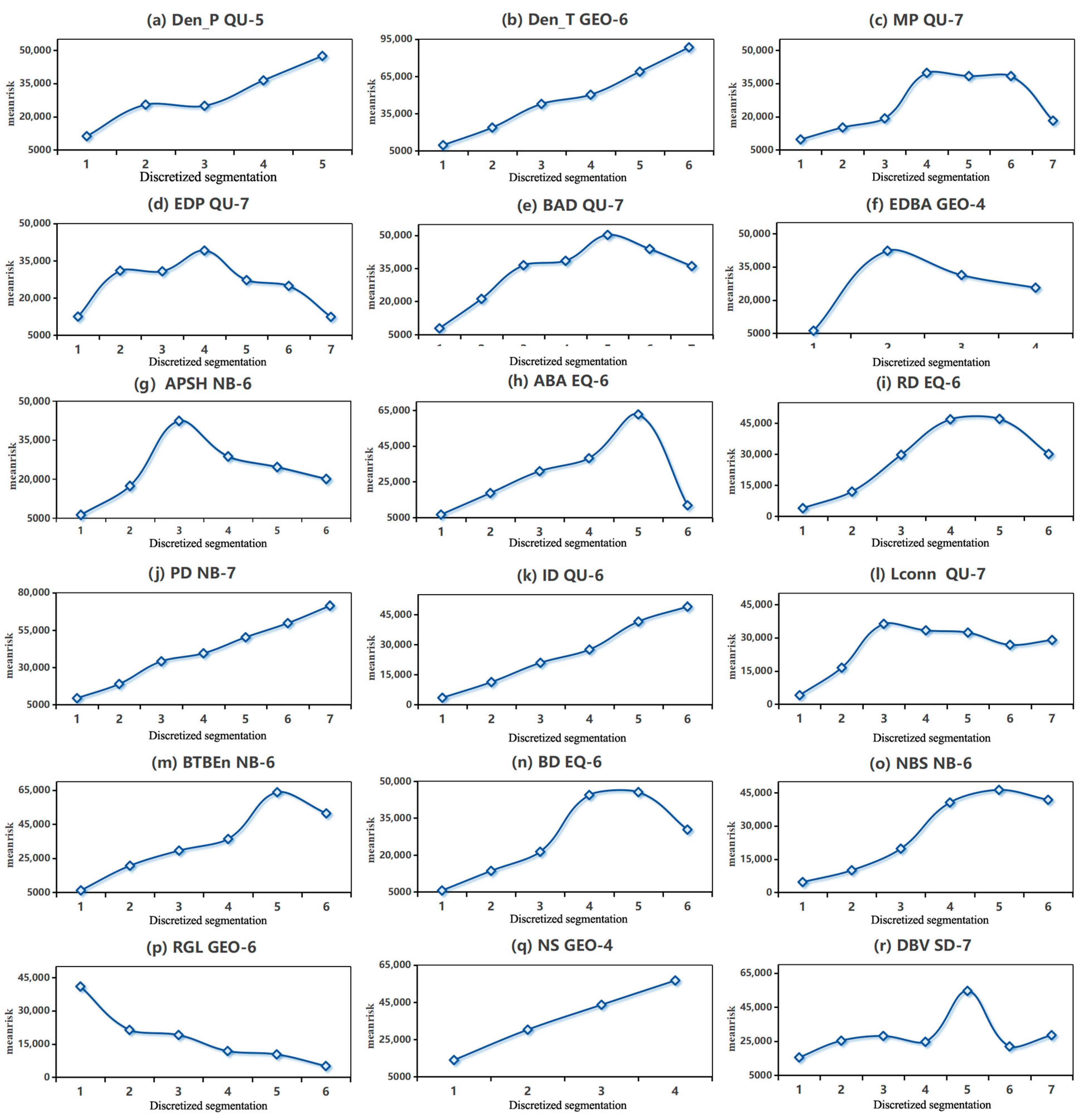
- Structural characteristics of POIs (MP and EDP). Moderate functional mixing enhances vitality, whereas excessive singularity or a lack of functional dominance leads to insufficiency. Appropriately balanced POI mixing and evenness are known to promote pedestrian and leisure activities, thus attracting more foot traffic [77]. However, hyper-diversification without prominent features can blur an area’s functional positioning, resulting in an adverse impact on the development of local vitality.
- (2)
- Road network and its structural characteristics (RD, BTBEn, and Lconn). Ample road density and high accessibility are widely recognized as beneficial [78,79], primarily by enhancing public transportation, improving walkability, and ensuring access to destinations. However, this positive relationship is not absolute. Beyond a certain threshold, excessive road density—often correlated with high connectivity and betweenness centrality—can become counterproductive. In line with Downs’ Law [80], a denser road network may induce a proportional increase in motor vehicle traffic (elasticity coefficient ≈ 1).
- (3)
- Aged buildings and their composite features (ABA, BAD and EDBA). Historic buildings often possess a unique charm, serving as crucial material embodiments of local character [81]. The integration of new and old buildings, a core prerequisite for organic urban regeneration, has also been shown to significantly enhance urban vitality [82,83]. However, when the average building age of an area becomes excessively high, it often signifies widespread issues, such as functional obsolescence, deteriorated facilities, and an inability to accommodate contemporary business models [84].
- (4)
- Building density (BD). Moderate building density ensures compact development [85], providing the physical spatial framework for urban activities and serving as a prerequisite for accommodating diverse activities and attracting pedestrian traffic [86]. However, once building density exceeds a certain threshold, its marginal effect on vitality turns negative. This is primarily because excessive density encroaches upon urban public spaces, leading to a reduction in spatial comfort and environmental quality [87,88].
5.3. Spatial Heterogeneity of Vitality-Influencing Factors
5.4. Interactive Impact of Built Environment Factors on Vitality
6. Conclusions
Author Contributions
Funding
Data Availability Statement
Conflicts of Interest
References
- Martinez-Fernandez, C.; Audirac, I.; Fol, S.; Cunningham-Sabot, E. Shrinking Cities: Urban Challenges of Globalization. Int. J. Urban Reg. Res. 2012, 36, 213–225. [Google Scholar] [CrossRef]
- Long, Y.; Wu, K. Shrinking Cities in a Rapidly Urbanizing China. Environ. Plan. A 2016, 48, 220–222. [Google Scholar] [CrossRef]
- Haase, A.; Rink, D.; Grossmann, K.; Bernt, M.; Mykhnenko, V. Conceptualizing Urban Shrinkage. Environ. Plan. A 2014, 46, 1519–1534. [Google Scholar] [CrossRef]
- Jacobs, J. The Death and Life of Great American Cities; Vintage Books: New York City, NY, USA, 1961; ISBN 978-0-679-74195-4. [Google Scholar]
- Batty, M. The New Science of Cities; The MIT Press: Cambridge, MA, USA, 2013; ISBN 978-0-262-31823-5. [Google Scholar]
- Wu, C.; Ye, X.; Ren, F.; Du, Q. Check-in Behaviour and Spatio-Temporal Vibrancy: An Exploratory Analysis in Shenzhen, China. Cities 2018, 77, 104–116. [Google Scholar] [CrossRef]
- Mouratidis, K.; Poortinga, W. Built Environment, Urban Vitality and Social Cohesion: Do Vibrant Neighborhoods Foster Strong Communities? Landsc. Urban Plan. 2020, 204, 103951. [Google Scholar] [CrossRef]
- Pan, C.; Guo, J.; Li, H.; Wu, J.; Qiu, N.; Wu, S. Study on the Influence Mechanism of Machine-Learning-Based Built Environment on Urban Vitality in Macau Peninsula. Buildings 2025, 15, 1557. [Google Scholar] [CrossRef]
- Lyu, G.; Angkawisittpan, N.; Fu, X.; Sonasang, S. Investigating the Relationship between Built Environment and Urban Vitality Using Big Data. Sci. Rep. 2025, 15, 579. [Google Scholar] [CrossRef] [PubMed]
- Roof, K.; Oleru, N. Public Health: Seattle and King County’s Push for the Built Environment. J. Environ. Health 2008, 71, 24–27. [Google Scholar] [PubMed]
- Handy, S.L.; Boarnet, M.G.; Ewing, R.; Killingsworth, R.E. How the Built Environment Affects Physical Activity: Views from Urban Planning. Am. J. Prev. Med. 2002, 23, 64–73. [Google Scholar] [CrossRef]
- Ewing, R.; Cervero, R. Travel and the Built Environment: A Meta-Analysis. J. Am. Plan. Assoc. 2010, 76, 265–294. [Google Scholar] [CrossRef]
- Mehaffy, M. A New Pattern Language for Growing Regions; Sustasis Foundation: Portland, OR, USA, 2020. [Google Scholar]
- Moreno, C.; Allam, Z.; Chabaud, D.; Gall, C.; Pratlong, F. Introducing the “15-Minute City”: Sustainability, Resilience and Place Identity in Future Post-Pandemic Cities. Smart Cities 2021, 4, 93–111. [Google Scholar] [CrossRef]
- Wu, W.; Niu, X. Influence of Built Environment on Urban Vitality: Case Study of Shanghai Using Mobile Phone Location Data. J. Urban Plan. Dev. 2019, 145, 04019007. [Google Scholar] [CrossRef]
- Li, M.; Pan, J. Assessment of Influence Mechanisms of Built Environment on Street Vitality Using Multisource Spatial Data: A Case Study in Qingdao, China. Sustainability 2023, 15, 1518. [Google Scholar] [CrossRef]
- Lu, S.; Shi, C.; Yang, X. Impacts of Built Environment on Urban Vitality: Regression Analyses of Beijing and Chengdu, China. Int. J. Environ. Res. Public Health 2019, 16, 4592. [Google Scholar] [CrossRef]
- Li, Q.; Cui, C.; Liu, F.; Wu, Q.; Run, Y.; Han, Z. Multidimensional Urban Vitality on Streets: Spatial Patterns and Influence Factor Identification Using Multisource Urban Data. ISPRS Int. J. Geo-Inf. 2022, 11, 2. [Google Scholar] [CrossRef]
- Wu, W.; Liu, X.; Zhou, Y.; Zhao, K. Spatial Heterogeneity of Built Environment’s Impact on Urban Vitality Using Multi-Source Big Data and MGWR. Sci. Rep. 2025, 15, 23459. [Google Scholar] [CrossRef]
- Wu, W.; Ma, Z.; Guo, J.; Niu, X.; Zhao, K. Evaluating the Effects of Built Environment on Street Vitality at the City Level: An Empirical Research Based on Spatial Panel Durbin Model. Int. J. Environ. Res. Public Health 2022, 19, 1664. [Google Scholar] [CrossRef]
- Lin, J.; Zhuang, Y.; Zhao, Y.; Li, H.; He, X.; Lu, S. Measuring the Non-Linear Relationship between Three-Dimensional Built Environment and Urban Vitality Based on a Random Forest Model. Int. J. Environ. Res. Public Health 2023, 20, 734. [Google Scholar] [CrossRef] [PubMed]
- Liu, W.; Yang, Z.; Gui, C.; Li, G.; Xu, H. Investigating the Nonlinear Relationship Between the Built Environment and Urban Vitality Based on Multi-Source Data and Interpretable Machine Learning. Buildings 2025, 15, 1414. [Google Scholar] [CrossRef]
- Zhan, D.; Wang, Y.; Wu, Q.; Zhang, W. Nonlinear Effects of the Urban Built Environment on Urban Vitality: A Case Study of Hangzhou, China. J. Geogr. Sci. 2025, 35, 1183–1203. [Google Scholar] [CrossRef]
- Li, Z.; Zhao, G. Revealing the Spatio-Temporal Heterogeneity of the Association between the Built Environment and Urban Vitality in Shenzhen. ISPRS Int. J. Geo-Inf. 2023, 12, 433. [Google Scholar] [CrossRef]
- Li, J.; Lin, S.; Kong, N.; Ke, Y.; Zeng, J.; Chen, J. Nonlinear and Synergistic Effects of Built Environment Indicators on Street Vitality: A Case Study of Humid and Hot Urban Cities. Sustainability 2024, 16, 1731. [Google Scholar] [CrossRef]
- Lee, S.; Cho, N. Nonlinear and Interaction Effects of Multi-Dimensional Street-Level Built Environment Features on Urban Vitality in Seoul. Cities 2025, 165, 106145. [Google Scholar] [CrossRef]
- Wang, J.-F.; Li, X.-H.; Christakos, G.; Liao, Y.-L.; Zhang, T.; Gu, X.; Zheng, X.-Y. Geographical Detectors-Based Health Risk Assessment and Its Application in the Neural Tube Defects Study of the Heshun Region, China. Int. J. Geogr. Inf. Sci. 2010, 24, 107–127. [Google Scholar] [CrossRef]
- Wang, J.-F.; Zhang, T.-L.; Fu, B.-J. A Measure of Spatial Stratified Heterogeneity. Ecol. Indic. 2016, 67, 250–256. [Google Scholar] [CrossRef]
- Mehaffy, M.W.; Salingaros, N.A. Design for a Living Planet: Settlement, Science, and the Human Future; Sustasis Foundation: Portland, OR, USA, 2015; ISBN 978-0-9893469-5-5. [Google Scholar]
- Song, Y.; Wang, J.; Ge, Y.; Xu, C. An Optimal Parameters-Based Geographical Detector Model Enhances Geographic Characteristics of Explanatory Variables for Spatial Heterogeneity Analysis: Cases with Different Types of Spatial Data. GISci. Remote Sens. 2020, 57, 593–610. [Google Scholar] [CrossRef]
- He, Q.; Yan, M.; Zheng, L.; Wang, B. Spatial Stratified Heterogeneity and Driving Mechanism of Urban Development Level in China under Different Urban Growth Patterns with Optimal Parameter-Based Geographic Detector Model Mining. Comput. Environ. Urban Syst. 2023, 105, 102023. [Google Scholar] [CrossRef]
- Fotheringham, A.S.; Yang, W.; Kang, W. Multiscale Geographically Weighted Regression (MGWR). Ann. Am. Assoc. Geogr. 2017, 107, 1247–1265. [Google Scholar] [CrossRef]
- Sung, H.; Lee, S. Residential Built Environment and Walking Activity: Empirical Evidence of Jane Jacobs’ Urban Vitality. Transp. Res. Part D Transp. Environ. 2015, 41, 318–329. [Google Scholar] [CrossRef]
- Chiaradia, A.; Hillier, B.; Schwander, C.; Wedderburn, M. Spatial Centrality, Economic Vitality/Viability. In Proceedings of the 7th International Space Syntax Symposium, Stockholm, Sweden, 8–11 June 2009. [Google Scholar]
- Fang, C.; He, S.; Wang, L. Spatial Characterization of Urban Vitality and the Association with Various Street Network Metrics from the Multi-Scalar Perspective. Front. Public Health 2021, 9, 677910. [Google Scholar] [CrossRef] [PubMed]
- Aoki, T. Activity Space Compactness Index from the Viewpoint of Trip Arrival Point by Lifestyle Activity Purpose in a Mature Conurbation. Sustain. Cities Soc. 2023, 88, 104302. [Google Scholar] [CrossRef]
- Wang, T.; Wang, L.; Ning, Z.-Z. Spatial Pattern of Tourist Attractions and Its Influencing Factors in China. J. Spat. Sci. 2020, 65, 327–344. [Google Scholar] [CrossRef]
- Gao, F.; Li, S.; Tan, Z.; Wu, Z.; Zhang, X.; Huang, G.; Huang, Z. Understanding the Modifiable Areal Unit Problem in Dockless Bike Sharing Usage and Exploring the Interactive Effects of Built Environment Factors. Int. J. Geogr. Inf. Sci. 2021, 35, 1905–1925. [Google Scholar] [CrossRef]
- Min, M.; Lin, C.; Duan, X.; Jin, Z.; Zhang, L. Spatial Distribution and Driving Force Analysis of Urban Heat Island Effect Based on Raster Data: A Case Study of the Nanjing Metropolitan Area, China. Sustain. Cities Soc. 2019, 50, 101637. [Google Scholar] [CrossRef]
- Oldenburg, R. The Great Good Place: Cafes, Coffee Shops, Bookstores, Bars, Hair Salons, and Other Hangouts at the Heart of a Community; Hachette Books: New York, NY, USA, 1999; ISBN 978-0-7867-5241-6. [Google Scholar]
- Jeffres, L.W.; Bracken, C.C.; Jian, G.; Casey, M.F. The Impact of Third Places on Community Quality of Life. Appl. Res. Qual. Life 2009, 4, 333–345. [Google Scholar] [CrossRef]
- Mehta, V.; Bosson, J.K. Third Places and the Social Life of Streets. Environ. Behav. 2010, 42, 779–805. [Google Scholar] [CrossRef]
- Li, Z.; Chen, B.; Huang, Y.; Wang, H.; Wang, Y.; Yuan, Y.; Li, X.; Chen, J.M.; Xu, B.; Gong, P. Enhanced Mapping of Essential Urban Land Use Categories in China (EULUC-China 2.0): Integrating Multimodal Deep Learning with Multisource Geospatial Data. Sci. Bull. 2025, 70, 3029–3041. [Google Scholar] [CrossRef]
- Chen, Y.; Xu, C.; Ge, Y.; Zhang, X.; Zhou, Y. A 100 m Gridded Population Dataset of China’s Seventh Census Using Ensemble Learning and Big Geospatial Data. Earth Syst. Sci. Data 2024, 16, 3705–3718. [Google Scholar] [CrossRef]
- Shrestha, N. Detecting Multicollinearity in Regression Analysis. Am. J. Appl. Math. Stat. 2020, 8, 39–42. [Google Scholar] [CrossRef]
- Wheeler, D.; Tiefelsdorf, M. Multicollinearity and Correlation among Local Regression Coefficients in Geographically Weighted Regression. J. Geogr. Syst. 2005, 7, 161–187. [Google Scholar] [CrossRef]
- Daoud, J.I. Multicollinearity and Regression Analysis. J. Phys. Conf. Ser. 2017, 949, 012009. [Google Scholar] [CrossRef]
- Paköz, M.Z.; Işık, M. Rethinking Urban Density, Vitality and Healthy Environment in the Post-Pandemic City: The Case of Istanbul. Cities 2022, 124, 103598. [Google Scholar] [CrossRef] [PubMed]
- He, Q.; He, W.; Song, Y.; Wu, J.; Yin, C.; Mou, Y. The Impact of Urban Growth Patterns on Urban Vitality in Newly Built-up Areas Based on an Association Rules Analysis Using Geographical ‘Big Data’. Land Use Policy 2018, 78, 726–738. [Google Scholar] [CrossRef]
- Lan, F.; Gong, X.; Da, H.; Wen, H. How Do Population Inflow and Social Infrastructure Affect Urban Vitality? Evidence from 35 Large-and Medium-Sized Cities in China. Cities 2020, 100, 102454. [Google Scholar] [CrossRef]
- Liu, L.; Dong, Y.; Lang, W.; Yang, H.; Wang, B. The Impact of Commercial-Industry Development of Urban Vitality: A Study on the Central Urban Area of Guangzhou Using Multisource Data. Land 2024, 13, 250. [Google Scholar] [CrossRef]
- Long, Y.; Huang, C. Does Block Size Matter? The Impact of Urban Design on Economic Vitality for Chinese Cities. Environ. Plan. B Urban Anal. City Sci. 2019, 46, 406–422. [Google Scholar] [CrossRef]
- Wang, F.; Liu, Z.; Shang, S.; Qin, Y.; Wu, B. Vitality Continuation or Over-Commercialization? Spatial Structure Characteristics of Commercial Services and Population Agglomeration in Historic and Cultural Areas. Tour. Econ. 2019, 25, 1302–1326. [Google Scholar] [CrossRef]
- Zeng, C.; Song, Y.; He, Q.; Shen, F. Spatially Explicit Assessment on Urban Vitality: Case Studies in Chicago and Wuhan. Sustain. Cities Soc. 2018, 40, 296–306. [Google Scholar] [CrossRef]
- Xia, C.; Yeh, A.G.-O.; Zhang, A. Analyzing Spatial Relationships between Urban Land Use Intensity and Urban Vitality at Street Block Level: A Case Study of Five Chinese Megacities. Landsc. Urban Plan. 2020, 193, 103669. [Google Scholar] [CrossRef]
- Jiang, Y.; Han, Y.; Liu, M.; Ye, Y. Street Vitality and Built Environment Features: A Data-Informed Approach from Fourteen Chinese Cities. Sustain. Cities Soc. 2022, 79, 103724. [Google Scholar] [CrossRef]
- Wang, S.; Deng, Q.; Jin, S.; Wang, G. Re-Examining Urban Vitality through Jane Jacobs’ Criteria Using GIS-sDNA: The Case of Qingdao, China. Buildings 2022, 12, 1586. [Google Scholar] [CrossRef]
- He, S.; Yu, S.; Wei, P.; Fang, C. A Spatial Design Network Analysis of Street Networks and the Locations of Leisure Entertainment Activities: A Case Study of Wuhan, China. Sustain. Cities Soc. 2019, 44, 880–887. [Google Scholar] [CrossRef]
- Gómez-Varo, I.; Delclos-Alio, X.; Miralles-Guasch, C. Jane Jacobs Reloaded: A Contemporary Operationalization of Urban Vitality in a District in Barcelona. Cities 2022, 123, 103565. [Google Scholar] [CrossRef]
- Gordon, P.; Ikeda, S. Does Density Matter? In Handbook of Creative Cities; Edward Elgar Publishing: Cheltenham, UK, 2011. [Google Scholar]
- Zhang, Z.; Liu, J.; Wang, C.; Zhao, Y.; Zhao, X.; Li, P.; Sha, D. A Spatial Projection Pursuit Model for Identifying Comprehensive Urban Vitality on Blocks Using Multisource Geospatial Data. Sustain. Cities Soc. 2024, 100, 104998. [Google Scholar] [CrossRef]
- Li, X.; Li, Y.; Jia, T.; Zhou, L.; Hijazi, I.H. The Six Dimensions of Built Environment on Urban Vitality: Fusion Evidence from Multi-Source Data. Cities 2022, 121, 103482. [Google Scholar] [CrossRef]
- Fu, C.; Huang, Z.; Scheuer, B.; Lin, J.; Zhang, Y. Integration of Dockless Bike-Sharing and Metro: Prediction and Explanation at Origin-Destination Level. Sustain. Cities Soc. 2023, 99, 104906. [Google Scholar] [CrossRef]
- Yan, Y.; Chen, Q. Spatial Heterogeneity and Nonlinearity Study of Bike-Sharing to Subway Connections from the Perspective of Built Environment. Sustain. Cities Soc. 2024, 114, 105766. [Google Scholar] [CrossRef]
- De Nadai, M.; Staiano, J.; Larcher, R.; Sebe, N.; Quercia, D.; Lepri, B. The Death and Life of Great Italian Cities: A Mobile Phone Data Perspective. In Proceedings of the 25th International Conference on World Wide Web, Montréal, QC, Canada, 11 April 2016; pp. 413–423. [Google Scholar]
- Wang, J.; Liao, Y.; Liu, X. Tutorial on Spatial Data Analysis; Science Press: Beijing, China, 2019; ISBN 978-7-03-060789-8. [Google Scholar]
- Ma, W.; Wang, N.; Li, Y.; Sun, D.J. 15-Min Pedestrian Distance Life Circle and Sustainable Community Governance in Chinese Metropolitan Cities: A Diagnosis. Humanit. Soc. Sci. Commun. 2023, 10, 364. [Google Scholar] [CrossRef]
- Wu, H.; Wang, L.; Zhang, Z.; Gao, J. Analysis and Optimization of 15-Minute Community Life Circle Based on Supply and Demand Matching: A Case Study of Shanghai. PLoS ONE 2021, 16, e0256904. [Google Scholar] [CrossRef]
- He, M.; Li, J.; Shi, Z.; Liu, Y.; Shuai, C.; Liu, J. Exploring the Nonlinear and Threshold Effects of Travel Distance on the Travel Mode Choice across Different Groups: An Empirical Study of Guiyang, China. Int. J. Environ. Res. Public Health 2022, 19, 16045. [Google Scholar] [CrossRef]
- Zhu, S.; Bai, Z.; Gan, Z.; Jin, S.; Zhang, C.; Wang, J. Simulation of the Spatial Pattern of Scenic Spots Combining Optimal Scale and Deep Learning. Front. Earth Sci. 2022, 10, 887043. [Google Scholar] [CrossRef]
- Zhu, N.; Zeng, G.; Li, X.; Zhong, Z. Optimum Spatial Scale of Regional Tourism Cooperation Based on Spillover Effects in Tourism Flows. Tour. Econ. 2023, 29, 409–436. [Google Scholar] [CrossRef]
- Yue, Y.; Zhuang, Y.; Yeh, A.G.O.; Xie, J.-Y.; Ma, C.-L.; Li, Q.-Q. Measurements of POI-Based Mixed Use and Their Relationships with Neighbourhood Vibrancy. Int. J. Geogr. Inf. Sci. 2017, 31, 658–675. [Google Scholar] [CrossRef]
- Wu, W.; Niu, X.; Li, M. Influence of Built Environment on Street Vitality: A Case Study of West Nanjing Road in Shanghai Based on Mobile Location Data. Sustainability 2021, 13, 1840. [Google Scholar] [CrossRef]
- Yang, J.; Cao, J.; Zhou, Y. Elaborating Non-Linear Associations and Synergies of Subway Access and Land Uses with Urban Vitality in Shenzhen. Transp. Res. Part A Policy Pract. 2021, 144, 74–88. [Google Scholar] [CrossRef]
- Hu, Y.; Liang, C. Study on the Spatial Relationship between Road Network and the Diversity of Urban Public Facilities: The Case of the Central Area of Changsha City. J. Eng. Appl. Sci. 2024, 71, 156. [Google Scholar] [CrossRef]
- Yue, H.; Zhu, X. Exploring the Relationship between Urban Vitality and Street Centrality Based on Social Network Review Data in Wuhan, China. Sustainability 2019, 11, 4356. [Google Scholar] [CrossRef]
- Kang, C.; Fan, D.; Jiao, H. Validating Activity, Time, and Space Diversity as Essential Components of Urban Vitality. Environ. Plan. B Urban Anal. City Sci. 2021, 48, 1180–1197. [Google Scholar] [CrossRef]
- Huang, J.; Hu, X.; Wang, J.; Lu, A. How Diversity and Accessibility Affect Street Vitality in Historic Districts? Land 2023, 12, 219. [Google Scholar] [CrossRef]
- Huang, B.; Zhou, Y.; Li, Z.; Song, Y.; Cai, J.; Tu, W. Evaluating and Characterizing Urban Vibrancy Using Spatial Big Data: Shanghai as a Case Study. Environ. Plan. B Urban Anal. City Sci. 2020, 47, 1543–1559. [Google Scholar] [CrossRef]
- Downs, A. The Law of Peak-Hour Expressway Congestion. Traffic Q. 1962, 16, 393–409. [Google Scholar]
- Kurniawan, G.J.; Soemardiono, B.; Novianto, D. Cultural Resonance: Enhancing Heritage Identity of Spaces with Digital Engagement. J. Archit. Des. Urban. 2025, 7, 91–100. [Google Scholar] [CrossRef]
- Wangbao, L. Spatial Impact of the Built Environment on Street Vitality: A Case Study of the Tianhe District, Guangzhou. Front. Environ. Sci. 2022, 10, 966562. [Google Scholar] [CrossRef]
- King, K. Jane Jacobs and ‘The Need for Aged Buildings’: Neighbourhood Historical Development Pace and Community Social Relations. Urban Stud. 2013, 50, 2407–2424. [Google Scholar] [CrossRef]
- Buitelaar, E.; Moroni, S.; De Franco, A. Building Obsolescence in the Evolving City. Reframing Property Vacancy and Abandonment in the Light of Urban Dynamics and Complexity. Cities 2021, 108, 102964. [Google Scholar] [CrossRef]
- Yeh, A.G.-O.; Li, X. A Cellular Automata Model to Simulate Development Density for Urban Planning. Environ. Plan. B Plan. Des. 2002, 29, 431–450. [Google Scholar] [CrossRef]
- Pan, C.; Zhou, J.; Huang, X. Impact of Check-In Data on Urban Vitality in the Macao Peninsula. Sci. Program. 2021, 2021, 7179965. [Google Scholar] [CrossRef]
- Wen, L.; Kenworthy, J.; Marinova, D. Higher Density Environments and the Critical Role of City Streets as Public Open Spaces. Sustainability 2020, 12, 8896. [Google Scholar] [CrossRef]
- Cui, G.; Wang, M.; Fan, Y.; Xue, F.; Chen, H. Assessment of Health-Oriented Layout and Perceived Density in High-Density Public Residential Areas: A Case Study of Shenzhen. Buildings 2024, 14, 3626. [Google Scholar] [CrossRef]
- Zhao, Y.; Ponzini, D.; Zhang, R. The Policy Networks of Heritage-Led Development in Chinese Historic Cities: The Case of Xi’an’s Big Wild Goose Pagoda Area. Habitat Int. 2020, 96, 102106. [Google Scholar] [CrossRef]
- Zhao, L.; Fan, X.; Lin, H.; Hong, T.; Hong, W. Impact of Expressways on Land Use Changes, Landscape Patterns, and Ecosystem Services Value in Nanping City, China. Pol. J. Environ. Stud. 2021, 30, 2935–2946. [Google Scholar] [CrossRef]
- Shi, X.; Liu, D.; Gan, J. A Study on the Relationship between Road Network Centrality and the Spatial Distribution of Commercial Facilities—A Case of Changchun, China. Sustainability 2024, 16, 3920. [Google Scholar] [CrossRef]
- Mackett, R.L.; Thoreau, R. Transport, Social Exclusion and Health. J. Transp. Health 2015, 2, 610–617. [Google Scholar] [CrossRef]
- Xie, Z.; Huang, B.; Lee, H.F.; Liu, Y.; Zhen, F. Unraveling the Determinants of Intra-City Commuting Flows with a Spatially Weighted Interaction Model: Nanjing, China as a Case Study. Cities 2025, 162, 105962. [Google Scholar] [CrossRef]
- Niu, X.; Wu, W.; Li, M. Influence of Built Environment on Street Vitality and Its Spatiotemporal Characteristics Based on LBS Positioning Data. Urban Plan. Int. 2019, 34, 28–37. [Google Scholar] [CrossRef]
- Li, M.; Liu, J.; Lin, Y.; Xiao, L.; Zhou, J. Revitalizing Historic Districts: Identifying Built Environment Predictors for Street Vibrancy Based on Urban Sensor Data. Cities 2021, 117, 103305. [Google Scholar] [CrossRef]
- Bernabeu-Bautista, Á.; Serrano-Estrada, L.; Marti, P. The Role of Successful Public Spaces in Historic Centres. Insights Soc. Media Data. Cities 2023, 137, 104337. [Google Scholar] [CrossRef]
- Duan, J.; Lan, W.; Jiang, Y. An Evaluation Approach to Spatial Identity in Historic Urban Areas from a Humanistic Perspective. Front. Archit. Res. 2022, 11, 806–814. [Google Scholar] [CrossRef]
- Pourbahador, P.; Brinkhuijsen, M. Municipal Strategies for Protecting the Sense of Place through Public Space Management in Historic Cities: A Case Study of Amsterdam. Cities 2023, 136, 104242. [Google Scholar] [CrossRef]


| Variables | MGWR Model | Factor Detector | Correlation Type | ||
|---|---|---|---|---|---|
| q-Value | p | ||||
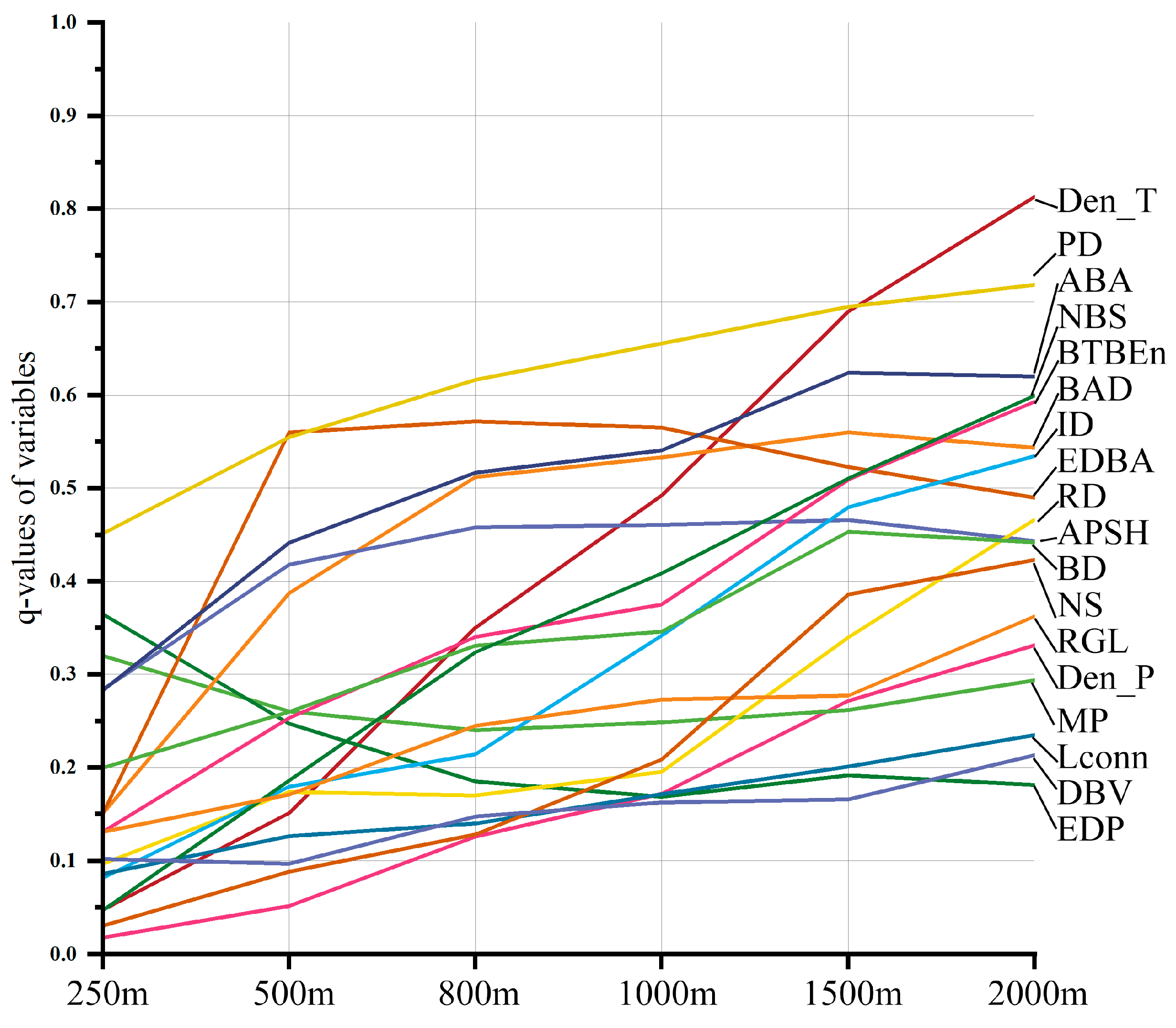
| Den_P | −0.044 * | 0.386 | 0.331 *** | 0.000 | Linear and Non-Linear |
| Den_T | 0.340 * | 1.000 | 0.813 *** | 0.000 | Linear and Non-Linear |
| MP | 0.014 | 0.000 | 0.294 *** | 0.000 | Non-Linear |
| EDP | 0.004 | 0.000 | 0.181 *** | 0.000 | Non-Linear |
| BAD | 0.047 | 0.000 | 0.543 *** | 0.000 | Non-Linear |
| EDBA | 0.006 | 0.000 | 0.490 *** | 0.000 | Non-Linear |
| APSH | −0.009 | 0.000 | 0.443 *** | 0.000 | Non-Linear |
| ABA | 0.052 | 0.000 | 0.624 *** | 0.000 | Non-Linear |
| RD | −0.081 * | 0.000 | 0.481 *** | 0.000 | Non-Linear |
| PD | 0.258 * | 1.000 | 0.718 *** | 0.000 | Linear and Non-Linear |
| ID | 0.116 * | 1.000 | 0.534 *** | 0.000 | Linear and Non-Linear |
| Lconn | 0.032 | 0.000 | 0.235 *** | 0.000 | Non-Linear |
| BTBEn | 0.053 * | 0.482 | 0.593 *** | 0.000 | Linear and Non-Linear |
| BD | −0.014 | 0.000 | 0.448 *** | 0.000 | Non-Linear |
| NBS | 0.306 * | 0.965 | 0.599 *** | 0.000 | Linear and Non-Linear |
| RGL | −0.047 | 0.000 | 0.362 *** | 0.000 | Non-Linear |
| NS | 0.056 * | 1.000 | 0.423 *** | 0.000 | Linear and Non-Linear |
| DBV | −0.017 | 0.000 | 0.213 *** | 0.000 | Non-Linear |
| Overall parameters | R2 = 0.944 Adjust R2 = 0.934 AICc = 74.409 σ2 = 0.066 | NA | NA | ||
| Variables | Coefficients | Significance (% of Features) | ||||
|---|---|---|---|---|---|---|
| Mean | Standard Error | Minimum | Median | Maxium | ||
| intersect | −0.0016 | 0.0956 | −0.2375 | −0.0078 | 0.1821 | 78 (34.21) |
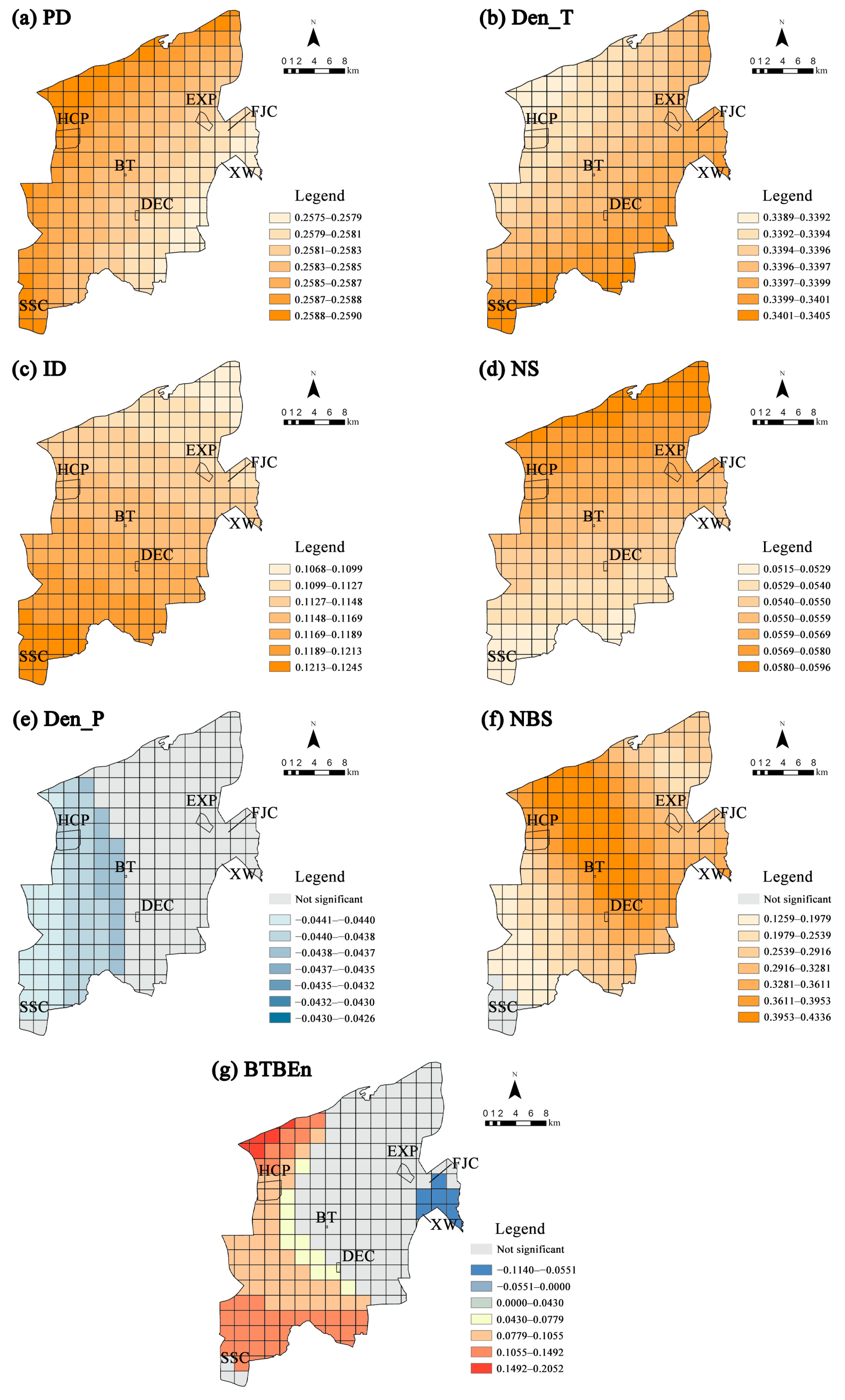
| Den_P | −0.0436 | 0.0003 | −0.0442 | −0.0437 | −0.0426 | 88 (38.60) |
| Den_T | 0.3397 | 0.0003 | 0.3389 | 0.3397 | 0.3405 | 228 (100.00) |
| MP | 0.0139 | 0.0039 | 0.0059 | 0.0138 | 0.0239 | 0 (0.00) |
| EDP | 0.004 | 0.0009 | 0.0027 | 0.0038 | 0.0066 | 0 (0.00) |
| BAD | 0.0472 | 0.0015 | 0.0433 | 0.0474 | 0.0505 | 0 (0.00) |
| EDBA | 0.006 | 0.004 | −0.0015 | 0.0059 | 0.0161 | 0 (0.00) |
| APSH | −0.0089 | 0.0021 | −0.0139 | −0.0088 | −0.0046 | 0 (0.00) |
| ABA | 0.052 | 0.0019 | 0.0479 | 0.0521 | 0.0559 | 0 (0.00) |
| PD | 0.2584 | 0.0003 | 0.2575 | 0.2585 | 0.259 | 228 (100.00) |
| RD | −0.0805 | 0.0002 | −0.0809 | −0.0806 | −0.0798 | 0 (0.00) |
| ID | 0.1158 | 0.0038 | 0.1068 | 0.1157 | 0.1245 | 228 (100.00) |
| Lconn | 0.0315 | 0.0012 | 0.0294 | 0.0315 | 0.0343 | 0 (0.00) |
| BTBEn | 0.0527 | 0.0669 | −0.1141 | 0.068 | 0.2052 | 110 (48.25) |
| BD | −0.0139 | 0.0008 | −0.0158 | −0.0138 | −0.0125 | 0 (0.00) |
| NS | 0.0555 | 0.002 | 0.0515 | 0.0554 | 0.0596 | 228 (100.00) |
| NBS | 0.3064 | 0.0821 | 0.126 | 0.3124 | 0.4336 | 220 (96.49) |
| RGL | −0.0473 | 0.0016 | −0.0496 | −0.0474 | −0.0421 | 0 (0.00) |
| DBV | −0.0175 | 0.0013 | −0.0213 | −0.0174 | −0.0149 | 0 (0.00) |
| Areas | Measures |
|---|---|
| Heritage protection areas |
|
| Peripheral areas |
|
| Areas impacted by large transportation facilities or spatial isolation | Adjust regional road density and development intensity |
Disclaimer/Publisher’s Note: The statements, opinions and data contained in all publications are solely those of the individual author(s) and contributor(s) and not of MDPI and/or the editor(s). MDPI and/or the editor(s) disclaim responsibility for any injury to people or property resulting from any ideas, methods, instructions or products referred to in the content. |
© 2025 by the authors. Licensee MDPI, Basel, Switzerland. This article is an open access article distributed under the terms and conditions of the Creative Commons Attribution (CC BY) license.
Share and Cite
Jiang, X.; Tian, J.; Li, J.; Ye, D.; Lan, W.; Wu, D.; Tian, N.; Yin, J. Unraveling the Impact Mechanisms of Built Environment on Urban Vitality: Integrating Scale, Heterogeneity, and Interaction Effects. Buildings 2026, 16, 29. https://doi.org/10.3390/buildings16010029
Jiang X, Tian J, Li J, Ye D, Lan W, Wu D, Tian N, Yin J. Unraveling the Impact Mechanisms of Built Environment on Urban Vitality: Integrating Scale, Heterogeneity, and Interaction Effects. Buildings. 2026; 16(1):29. https://doi.org/10.3390/buildings16010029
Chicago/Turabian StyleJiang, Xiji, Jialin Tian, Jiaqi Li, Dan Ye, Wenlong Lan, Dandan Wu, Naiji Tian, and Jie Yin. 2026. "Unraveling the Impact Mechanisms of Built Environment on Urban Vitality: Integrating Scale, Heterogeneity, and Interaction Effects" Buildings 16, no. 1: 29. https://doi.org/10.3390/buildings16010029
APA StyleJiang, X., Tian, J., Li, J., Ye, D., Lan, W., Wu, D., Tian, N., & Yin, J. (2026). Unraveling the Impact Mechanisms of Built Environment on Urban Vitality: Integrating Scale, Heterogeneity, and Interaction Effects. Buildings, 16(1), 29. https://doi.org/10.3390/buildings16010029