Evolution of Colorimetry in 3D-Printed Samples Exposed to External Weather Conditions, Used in Smart Façades


Abstract
1. Introduction
1.1. Importance of Colorimetry in 3D Printing Applications
1.2. Context and Relevance of Smart Façades
1.3. Objectives of This Study
2. Literature Review
2.1. Three-Dimensional Printing Technologies Used in Outdoor Applications
2.2. Effects of Weather Conditions on Materials
2.3. Methods for Evaluating Color Stability
3. Materials and Methods
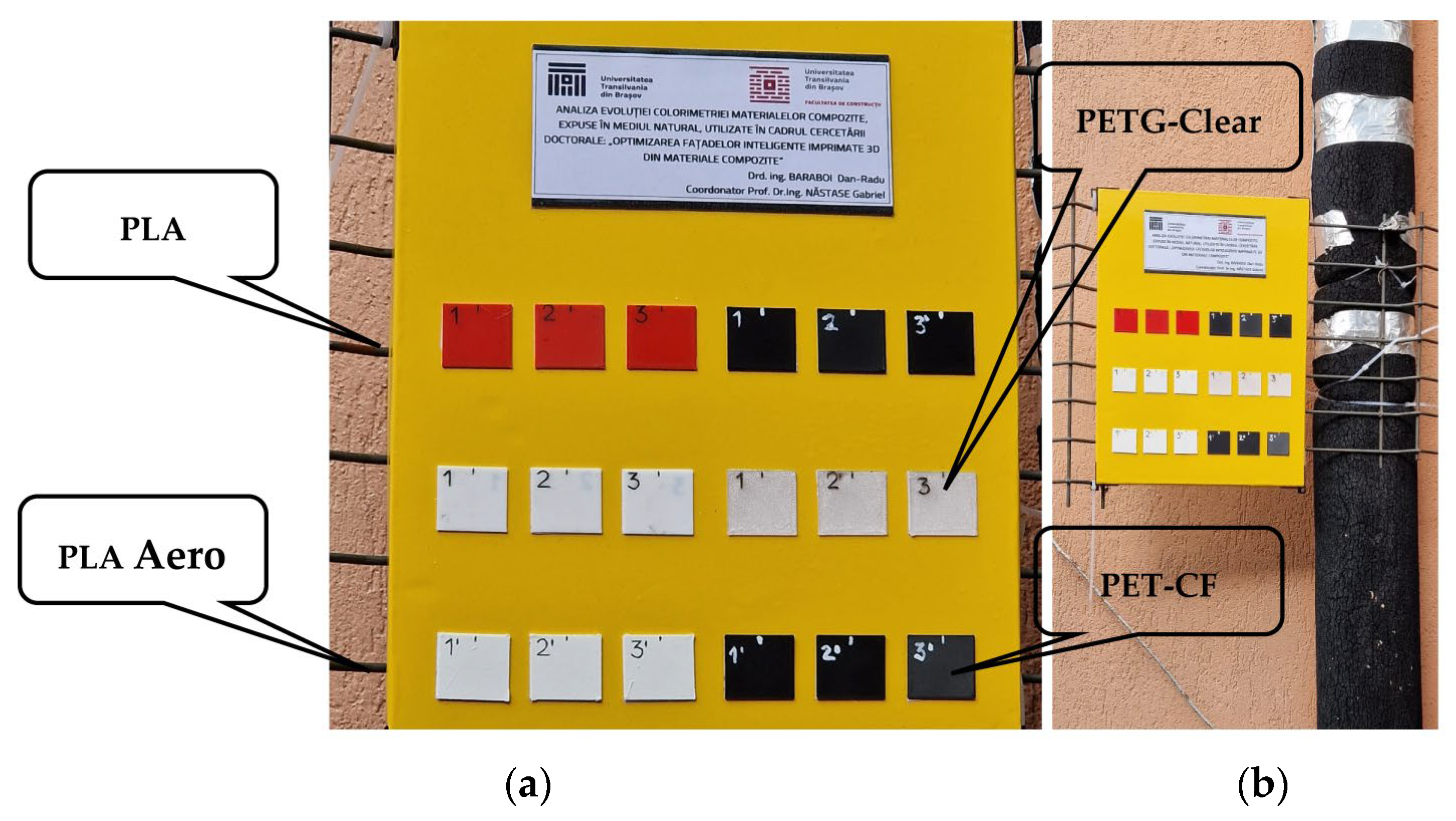
3.1. Selection of 3D-Printed Materials
- PLA Basic (White): Polylactic Acid.
- PLA Basic (Red): Polylactic Acid.
- PLA Basic (Black): Polylactic Acid.
- PLA Aero (Light Gray): foaming grade of Polylactic Acid, Bambu PLA Aero.
- PETG (Clear): ReFill PETG 3D-Printing material by Formfutura.
- PET-CF (Black): Bambu PET-CF.
- Excellent strength, heat resistance, and low moisture absorption.
- Tensile Strength: 74 MPa (X-Y), 35 MPa (Z).
- Impact Strength: 36 kJ/m2 (X-Y, notched), 4.5 kJ/m2 (Z).
- High levels of toughness and z-layer strength, as well as biodegradable attributes.
- Tensile Strength: 35 MPa (X-Y), 31 MPa (Z).
- Impact Strength: 26.6 kJ/m2 (X-Y, notched), 13.8 kJ/m2 (Z).
- Low density, light.
- Tensile Strength: 24 ± 2 MPa (X-Y), 18 ± 3 MPa(Z).
- Impact Strength: 28.8 kJ/m2; 8.2 kJ/m2 (notched)(X-Y) 3.1 ± 0.7 kJ/m2 (Z).
- Waterproofed applications, very easy to 3D print for general purpose.
- Tensile Strength at Break: 20 MPa.
Three-Dimensional Printing Parameters
3.2. Geographical and Climatic Context
3.3. Exposure Protocols to Weather Conditions
3.4. Color Measurement Protocol and Equipment
4. Results
4.1. Colorimetric Analysis of Samples
4.2. Evaluation of Color Stability of Tested Materials and Statistical Significance
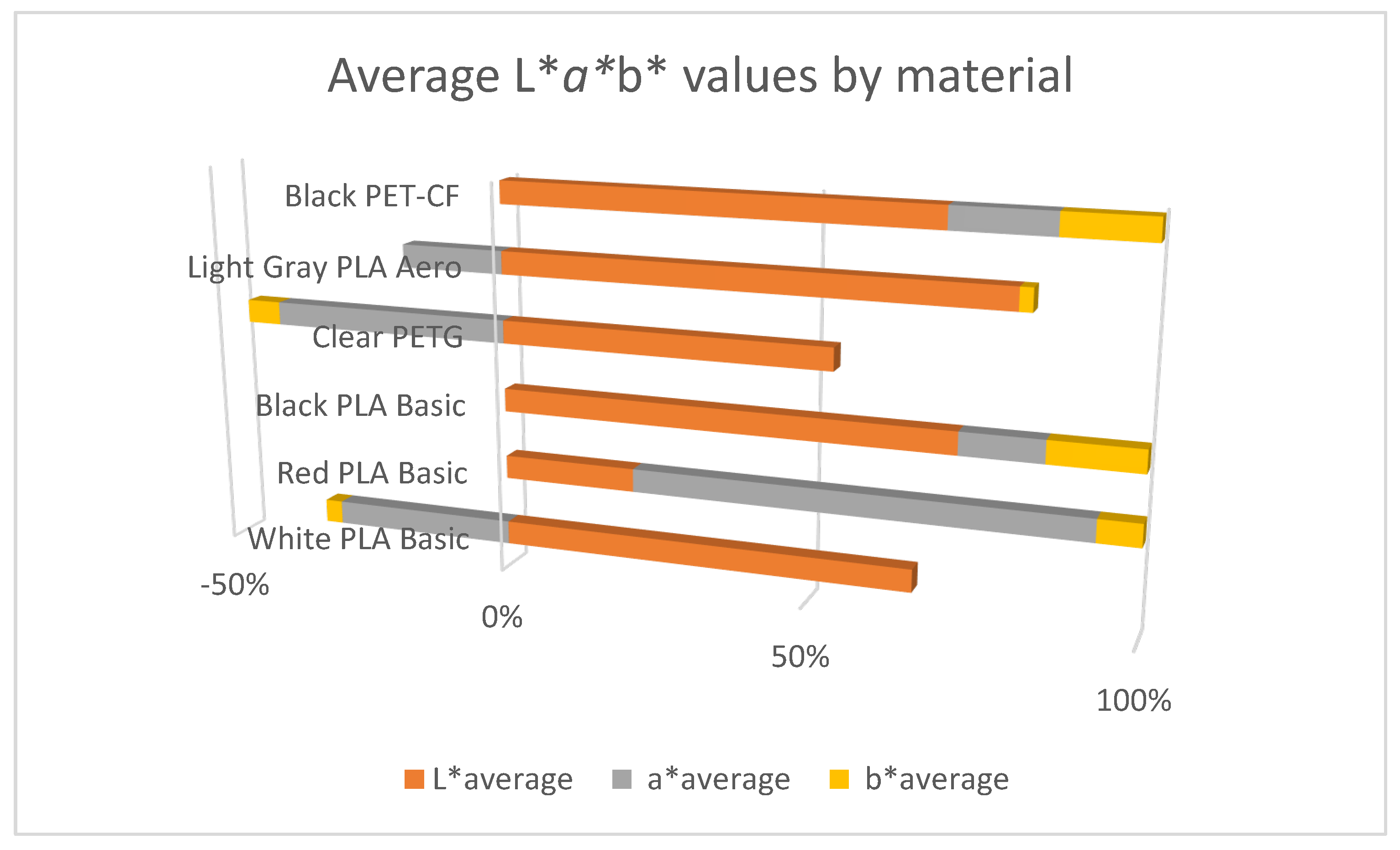
4.3. Data Comparison in L*a*b* Color Space
5. Discussion
5.1. Interpretation of the Obtained Results: A Multifaceted Analysis
5.2. Factors Influencing Color Changes: A Deeper Dive
- UV-induced polymer degradation (e.g., PLA and PETG):
- Pigment degradation and the stabilizing role of carbon black:
- The role of additives and the material morphology:
5.3. Limitations of This Study
- The duration of exposure and climatic seasonality: The four-month exposure period (November 2024–March 2025) was strategically chosen to analyze the harsh winter conditions in Brașov. However, this relatively short duration and focus on a single season does not fully capture long-term degradation patterns (e.g., multi-year) nor the full effects of other seasons (e.g., intense UV radiation in summer, wet/dry cycles in spring/autumn). Therefore, the results provide an initial picture, but cannot be directly extrapolated to very-long-term outdoor applications or to various climatic zones.
- A lack of indoor controls: This study focused on exposure to real-world outdoor conditions without the use of parallel controls indoors. While this maximizes the ecological validity, it limits the ability to isolate the precise contribution of individual environmental factors (e.g., UV radiation versus temperature fluctuations versus humidity) and to separate weather-induced color changes from potential intrinsic variations in the material over time.
- The sample size: The use of three samples (N = 3) for each material, although acceptable for preliminary statistical analysis, represents a relatively small sample size. This can limit the statistical power to detect subtle differences and generalize the findings to a wider population of 3D-printed products of the same type. A larger sample size would increase the robustness and reliability of the statistical conclusions.
- The absence of microstructural validation: This study focused exclusively on colorimetric changes. A deeper understanding of degradation mechanisms at the molecular or morphological level (e.g., bond breaking, rearrangement of polymer chains, surface erosion) would benefit from complementary microstructural analyses such as scanning electron microscopy (SEM), Fourier transform infrared spectroscopy (FTIR), or differential scanning calorimetry (DSC). Without these analyses, the interpretation of color changes relies more on macroscopic observations than on direct evidence of small-scale alterations.
5.4. Implications for Smart Façade Design: Charting a Course Forward
6. Conclusions and Recommendations
6.1. Summary of Main Findings and Their Practical Implications
- Architects and façade designers: In the selection of materials for smart façades, it is recommended to prioritize polymers (such as PET-CF Black or Black PLA) with proven colorimetric stability in outdoor conditions. Materials with low stability (e.g., Clear PETG) should only be used with effective protective coatings or in applications where long-term esthetics are not critical, or in environments protected from direct UV radiation.
- Materials engineers: This study highlights the need for the continued development of 3D-printable materials with inherent resistance to UV and degradation. Incorporating UV stabilizers and inorganic pigments with shielding properties, such as carbon black, is an effective strategy for improving the esthetic durability.
- Manufacturers: understanding the performance profile of materials is crucial to make accurate claims about the durability of products and provide appropriate recommendations for use.
6.2. Recommendations for Material Selection and Design of Smart Façades
- Informed material selection: Choose 3D-printed materials based on comprehensive weather resistance data, especially for esthetically critical applications. This involves the careful evaluation of color stability, color variation, and degradation mechanisms.
- A layered and protective design: For less stable materials, integrate design elements that minimize direct exposure to UV radiation or precipitation. Consider using protective coatings (e.g., UV-resistant varnishes) to extend the esthetic and functional life of 3D-printed elements [34].
- Color-specific considerations: recognize that dark materials (especially carbon-based ones) can provide superior color stability over open or transparent variants, making them a suitable choice for applications that require exceptional esthetic durability.
6.3. Future Research Directions
- Accelerated aging experiments and correlations: Developing and validating robust correlations between accelerated aging tests in the lab and real-world performance is essential. This would facilitate the rapid evaluation of new protective materials and coatings, speeding up the selection and innovation process.
- Microstructural characterization and compositional analysis: the integration of microscopic (e.g., SEM) and spectroscopic (e.g., FTIR) analyses would deepen the understanding of the mechanisms of material degradation, providing insights into the chemical and physical changes underlying colorimetric alterations.
- Evaluation of new materials and combinations: Exploring new polymers, composites and combinations of materials with improved inherent resistance to environmental factors (e.g., biopolymers, recycled materials with advanced stabilizers) could lead to the development of more sustainable solutions for smart façades. This section serves as a synthesis of the key findings derived from this study, offering actionable recommendations for the selection of 3D-printed materials in the context of smart façade applications, and outlining promising avenues for future research endeavors aimed at further advancing the field.
Author Contributions
Funding
Data Availability Statement
Conflicts of Interest
Abbreviations
| 3D | Three-Dimensional |
| ABS | Acrylonitrile Butadiene Styrene |
| CIE | International Commission on Illumination (Commission Internationale de l’Éclairage) |
| PLA | Polylactic Acid |
| PETG | Polyethylene Terephthalate Glycol-modified |
| PET-CF | Polyethylene Terephthalate with Carbon Fiber |
| FDM | Fused Deposition Modeling |
| GPS | Global Positioning System |
| ICAO | International Civil Aviation Organization |
| UV | Ultraviolet |
| ANOVA | Analysis of Variance |
| SPSS | Statistical Package for the Social Sciences |
| a*, L*, b* | coordinate values |
References
- Clydesdale, F.M.; Ahmed, E.M. Colorimetry—Methodology and applications∗. C R C Crit. Rev. Food Sci. Nutr. 1978, 10, 243–301. [Google Scholar] [CrossRef] [PubMed]
- Keshan Balavandy, S.; Li, F.; Macdonald, N.P.; Maya, F.; Townsend, A.T.; Frederick, K.; Guijt, R.M.; Breadmore, M.C. Scalable 3D printing method for the manufacture of single-material fluidic devices with integrated filter for point of collection colourimetric analysis. Anal. Chim. Acta 2021, 1151, 238101. [Google Scholar] [CrossRef] [PubMed]
- Ovadiuc, E.-P.; Calotă, R.; Năstase, I.; Bode, F. Integration of Phase-Change Materials in Ventilated Façades: A Review Regarding Fire Safety and Future Challenges. Fire 2024, 7, 244. [Google Scholar] [CrossRef]
- Firoozi, A.A. Smart facades in architecture: Driving energy efficiency and adaptive urban design. SSRN 2023. Available online: https://ssrn.com/abstract=4631796 (accessed on 26 December 2025).
- Attia, S.; Lioure, R.; Declaude, Q. Future trends and main concepts of adaptive facade systems. Energy Sci. Eng. 2020, 8, 3255–3272. [Google Scholar] [CrossRef]
- Calotă, R.; Pop, O.; Croitoru, C.; Bode, F.; Berville, C.; Ovadiuc, E. Performance analysis of solar collectors with nano-enhanced phase change materials during transitional periods between cold and warm seasons in the continental temperate climates. J. Energy Storage 2025, 114, 115659. [Google Scholar] [CrossRef]
- Calotă, R.; Bode, F.; Souliotis, M.; Croitoru, C.; Fokaides, P.A. Bridging the gap: Discrepancies in energy efficiency and smart readiness of buildings. Energy Rep. 2024, 12, 5886–5898. [Google Scholar] [CrossRef]
- Nadagouda, M.N.; Ginn, M.; Rastogi, V. A review of 3D printing techniques for environmental applications. Curr. Opin. Chem. Eng. 2020, 28, 173–178. [Google Scholar] [CrossRef]
- Roberson, D.A.; Espalin, D.; Wicker, R.B. 3D printer selection: A decision-making evaluation and ranking model. Virtual Phys. Prototyp. 2013, 8, 201–212. [Google Scholar] [CrossRef]
- Ma, Y.; Winsun, S. A brief introduction to 3D printing technology. In Proceedings of the GRC 2015, Radisson Blu, Dubai, 19–21 April 2015. [Google Scholar]
- Girip, A.; Calotă, R.; Savaniu, I.M.; Ilie, A.; Ovadiuc, E.; Tonciu, O. Mathematical Modeling and Energy Consumption Evaluation of R-600a Refrigeration Systems for Vending Machines Using Efficient Heat Exchangers. Results Eng. 2025, 26, 105208. [Google Scholar] [CrossRef]
- Maděra, J.; Kočí, V.; Dolezelová, M.; Cáchová, M.; Jerman, M.; Cerný, R. Influence of weather-affected material characteristics on appearance of freeze/thaw cycles in building envelopes. In AIP Conference Proceedings; American Institute of Physics Inc.: Melville, NY, USA, 2017; Volume 1866. [Google Scholar] [CrossRef]
- Beach, D. Environmental effects on polymeric materials. In Plastics and the Environment; John Wiley & Sons: Hoboken, NJ, USA, 2003; p. 313. [Google Scholar]
- Espinar, C.; Bona, A.D.; Pérez, M.M.; Pulgar, R. Color and optical properties of 3D printing restorative polymer-based materials: A scoping review. J. Esthet. Restor. Dent. 2022, 34, 853–864. [Google Scholar] [CrossRef]
- Yuan, J.; Tian, J.; Chen, C.; Chen, G. Experimental Investigation of Color Reproduction Quality of Color 3D Printing Based on Colored Layer Features. Molecules 2020, 25, 2909. [Google Scholar] [CrossRef]
- Stanic, M.; Lozo, B.; Gregor Svetec, D. Colorimetric properties and stability of 3D prints. Rapid Prototyp. J. 2012, 18, 120–128. [Google Scholar] [CrossRef]
- Ghasemi, S.; Mahboub, F.; Babaloo, A.; Zohdi, M.; Etemadpour, A.; Yasamineh, N. Evaluating the color stability of temporary crowns fabricated by 3-dimensional printing and manual methods. Gen. Dent. 2024, 72, 40–46. [Google Scholar] [PubMed]
- Arikawa, H.; Kanie, T.; Fujii, K.; Shinohara, N.; Takahashi, H.; Inoue, K. A Method for Evaluating Color Stability of Light-cured Composite Resins Using an Experimental Filter. Dent. Mater. J. 2000, 19, 338–345. [Google Scholar] [CrossRef] [PubMed][Green Version]
- Poggio, C.; Vialba, L.; Berardengo, A.; Federico, R.; Colombo, M.; Beltrami, R.; Scribante, A. Color Stability of New Esthetic Restorative Materials: A Spectrophotometric Analysis. J. Funct. Biomater. 2017, 8, 26. [Google Scholar] [CrossRef]
- Năstase, G.; Şerban, A.; Dragomir, G.; Bolocan, S.; Brezeanu, A.I. Box window double skin façade. Steady state heat transfer model proposal for energetic audits. Energy Build. 2016, 112, 12–20. [Google Scholar] [CrossRef]
- Bulmez, A.M.; Dragomir, G.; Bolocan, S.I.; Brezeanu, A.I.; Fratu, M.; Iordan, N.F.; Gocz, N.; Calotă, R. Carbon Footprint Evaluation and Reduction Strategies for a Residential Building in Romania: A Case Study. Buildings 2025, 15, 938. [Google Scholar] [CrossRef]
- Năstase, G.; Doboși, I.S.; Brezeanu, A.I.; Taus, D.; Tăbăcaru, M.B.; Vuțoiu, B.G.; Rusu, D.; Bulmez, A.M.; Iordan, N.F. Experimental Heat Transfer, Sound Insulation and Interior Comfort Parameters Assessment on a Box Double-Skin Façade. Buildings 2022, 12, 730. [Google Scholar] [CrossRef]
- Bulmez, A.M.; Brezeanu, A.I.; Dragomir, G.; Fratu, M.; Iordan, N.F.; Bolocan, S.I.; Rozorea, L.; Popa, E.C.; Năstase, G. CFD Analysis for a New Trombe Wall Concept. Buildings 2024, 14, 579. [Google Scholar] [CrossRef]
- Bulmez, A.-M.; Brezeanu, A.-I.; Dragomir, G.; Talabă, O.-M.; Năstase, G. An Analysis of Romania’s Energy Strategy: Perspectives and Developments since 2020. Climate 2024, 12, 101. [Google Scholar] [CrossRef]
- Porter, L.A., Jr.; Washer, B.M.; Hakim, M.H.; Dallinger, R.F. User-Friendly 3D Printed Colorimeter Models for Student Exploration of Instrument Design and Performance. J. Chem. Educ. 2016, 93, 1305–1309. [Google Scholar] [CrossRef]
- Lehmann, K.M.; Igiel, C.; Schmidtmann, I.; Scheller, H. Four color-measuring devices compared with a spectrophotometric reference system. J. Color Appear. Dent. 2010, 38, e65–e70. [Google Scholar] [CrossRef]
- Hill, B.; Roger, T.; Vorhagen, F.W. Comparative analysis of the quantization of color spaces on the basis of the CIELAB color-difference formula. ACM Trans. Graph. TOG 1997, 16, 109–154. [Google Scholar] [CrossRef]
- CAL, E.; GÜNERI, P.; KOSE, T. Comparison of digital and spectrophotometric measurements of colour shade guides. J. Oral Rehabil. 2006, 33, 221–228. [Google Scholar] [CrossRef]
- ISO/CIE 11664-4; Colorimetry—Part 4: CIE 1976 Lab* colour space. ISO/CIE: Geneva, Switzerland, 2019.
- Kim, T.K. Understanding one-way ANOVA using conceptual figures. Korean J. Anesthesiol. 2017, 70, 22. [Google Scholar] [CrossRef]
- Ganesh, A.; Ankesh, M.; Reddy, P.V.; Goyal, G.; Thakur, M.S.; Jain, A. One-way analysis of variance (ANOVA). Vigyan Varta 2024, 5, 110–112. [Google Scholar]
- Abdi, H.; Williams, L.J. Tukey’s honestly significant difference (HSD) test. Encycl. Res. Des. 2010, 3, 1–5. [Google Scholar]
- Nanda, A.; Mohapatra, B.B.; Mahapatra, A.P.K.; Mahapatra, A.P.K.; Mahapatra, A.P.K. Multiple comparison test by Tukey’s honestly significant difference (HSD): Do the confident level control type I error. Int. J. Stat. Appl. Math. 2021, 6, 59–65. [Google Scholar] [CrossRef]
- Ekincioğlu, G. Non-destructive methods determination of thermal shock resistance of natural building stones applicated with different water repellent chemicals on their surfaces. Gospod. Surowcami Miner.-Miner. Resour. Manag. 2023, 39, 81–101. [Google Scholar]



| Key Points | Description |
|---|---|
| Consistency and accuracy | Colorimetry provides a quantitative measurement of color, enabling consistent color reproduction across various batches of 3D-printed materials, which is critical for product design. |
| Material selection | Different printing materials exhibit varying color characteristics and stability. Colorimetric analysis aids in selecting polymers that meet esthetic requirements and outdoor durability. |
| Esthetic appeal | In smart façades, color impacts the design and integration of structures in their environments. Understanding colorimetry enhances the visual impact and functionality of buildings. |
| Performance evaluation | Colorimetric measurements evaluate how materials behave under various environmental conditions, including color stability under sunlight, moisture, or pollutants, important for outdoor use. |
| Aspect | Description |
|---|---|
| Definition and characteristics | Smart façades are dynamic building envelopes that respond to changing environmental conditions, optimizing energy consumption and improving indoor climate. They may include automated shading systems, responsive materials, and integrated solar technology. |
| Energy efficiency | Smart façades reduce energy consumption by adapting to external conditions such as sunlight and temperature, minimizing heating and cooling loads, which leads to lower operational costs and a smaller carbon footprint. |
| Sustainability | They provide sustainable solutions by using recyclable materials and incorporating renewable energy sources. Smart façades support green building certifications and environmentally friendly practices. |
| Esthetic integration | The design allows for creativity and customization, enabling architects to use advanced materials and colorimetry to create visually appealing buildings that also maintain functionality. |
| User experience and comfort | Beyond energy efficiency, smart façades enhance occupant comfort with better natural light control and improved air quality, contributing to a healthier indoor environment for various building types. |
| Technological advancements | Integration of IoT and AI allows for real-time monitoring and adaptive responses, making smart façades more intuitive and efficient, opening avenues for further innovations in construction and architecture. |
| Market trends | The increasing demand for smart façades is driven by growing awareness of sustainability, advancements in material science, and a shift towards smart cities, making it essential for stakeholders to understand these trends |
| Objective | Description |
|---|---|
| Evaluate colorimetric performance | Assess the color stability and changes in various 3D-printed polymer materials exposed to natural weathering conditions, analyzing the extent of color fading and discoloration. |
| Analyze material differences | Compare the colorimetric performance across different types of 3D-printed materials to identify polymers that demonstrate superior durability and resistance to weather-induced color changes. |
| Understand environmental impact | Explore how environmental factors specific to Brasov, Romania, affect the color stability of 3D-printed materials, including the impact of UV exposure, moisture, and temperature fluctuations. |
| Inform material selection | Provide insights and recommendations for designers and engineers on selecting suitable materials for outdoor 3D printing applications, particularly for smart façades. |
| Contribute to sustainable practices | Investigate the implications of color stability and material durability on the sustainability of 3D-printed products, supporting environmentally friendly design principles in construction. |
| Enhance design guidelines | Develop guidelines and best practices related to colorimetry for the design and implementation of outdoor 3D-printed elements, ensuring performance aligns with esthetic and functional requirements. |
| Advance research in smart façades | Contribute to the broader research field on smart façades by providing valuable data that enhance understanding of how 3D-printed elements can be effectively integrated into these innovative designs. |
| Parameter | Bambu PLA Basic | Bambu PETG | Bambu PET-CF | Bambu PLA-Aero | Unit |
|---|---|---|---|---|---|
| Type | PLA | PETG | PET-CF | PLA-Aero | |
| Vendor | Bambu Lab | Bambu Lab | Bambu Lab | Bambu Lab | |
| Diameter | 1.75 | 1.75 | 1.75 | 1.75 | mm |
| Flow ratio | 0.98 | 0.95 | 1 | 0.6 | |
| Density | 1.26 | 1.25 | 1.29 | 1.21 | g/cm3 |
| Shrinkage | 100 | 100 | 100 | 100 | % |
| Softening temperature | 45 | 70 | 185 | 45 | |
| Nozzle temperature | |||||
| Initial layer | 220 | 250 | 270 | 220 | °C |
| Other layers | 220 | 245 | 270 | 220 | °C |
| Recommended (min/max) | 190/240 | 230/270 | 260/290 | 210/260 | °C |
| Bed temperature | |||||
| Cool plate | 45/45 | 70/70 | 80/80 | 0/0 | °C |
| SuperTack (initial/other) | |||||
| Cool Plate (initial/other) | 35/35 | 0/0 | 0/0 | 35/35 | °C |
| Engineering plate (initial/other) | 0/0 | 70/70 | 80/80 | 0/0 | °C |
| Smooth PEI/high temp (initial/other) | 65/65 | 70/70 | 100/100 | 65/65 | °C |
| Textured PEI (initial/other) | 65/65 | 70/70 | 100/100 | 65/65 | °C |
| Max volumetric speed | 21 | 6 | 8 | 6 | mm3/s |
| Max speed | 90 | 90 | 90 | 90 | mm/s |
| Filament prime volume | 45 (ext.)/60 (hotend) | 45 (ext.)/60 (hotend) | 45 (ext.)/60 (hotend) | 45 (ext.)/60 (hotend) | mm3 |
| Filament ramming length | 5 (ext.)/10 (hotend) | 10 (ext.)/10 (hotend) | 10 (ext.)/10 (hotend) | 10 (ext.)/10 (hotend) | mm |
| Layer height | 0.12 | 0.12 | 0.12 | 0.12 | mm |
| Line width (default) | 0.42 | 0.42 | 0.42 | 0.42 | mm |
| Line width (initial layer) | 0.5 | 0.5 | 0.5 | 0.5 | mm |
| Sparse infill density | 100 | 100 | 100 | 100 | % |
| Sparse infill pattern | Rectilinear | Rectilinear | Rectilinear | Rectilinear | |
| Infill/wall overlap | 100 | 100 | 100 | 100 | % |
| Infill direction | 45 | 45 | 45 | 45 | ° |
| Top shell layers | 0 | 0 | 0 | 0 | |
| Top shell thickness | 1 | 1 | 1 | 1 | |
| Bottom shell layers | 0 | 0 | 0 | 0 | |
| Top/bottom surface pattern | Monotonic | Monotonic | Monotonic | Monotonic | |
| Seam scarf | None | None | None | None | |
| Brim width | 3 | 3 | 3 | 3 | mm |
| Infill gap | 100 | 100 | 100 | 100 | % |
| Rib wall | Disabled | Disabled | Disabled | Disabled | |
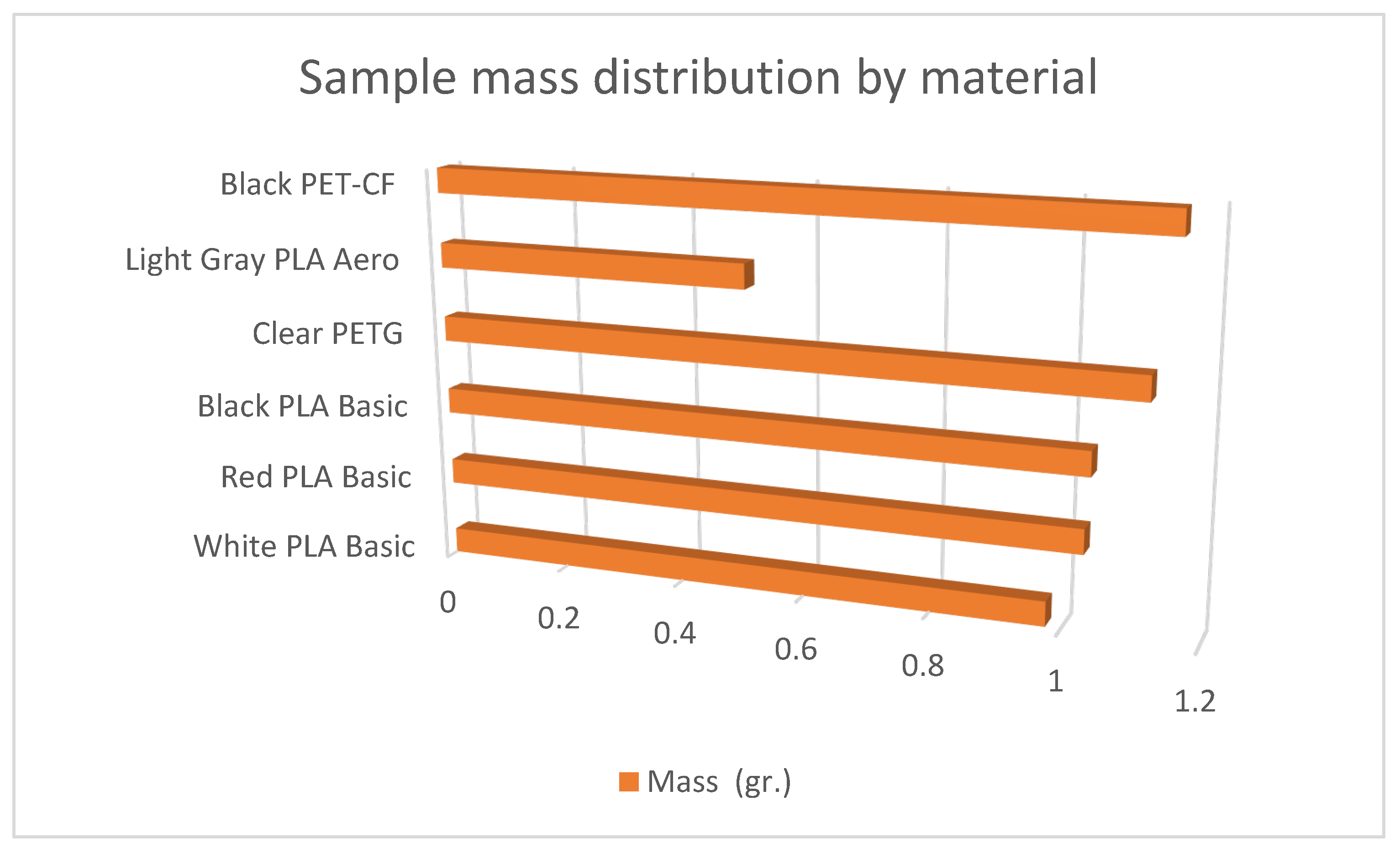
| Material | ID | Mass (gr.) | L* | a* | b* |
|---|---|---|---|---|---|
| White PLA Basic | 1 | 0.98 | 84.36 | −39.43 | −3.59 |
| 2 | 0.97 | 84.31 | −39.22 | −3.67 | |
| 3 | 0.98 | 84.73 | −37.73 | −3.76 | |
| Red PLA Basic | 1 | 1.03 | 32.44 | 108.7 | 9.98 |
| 2 | 1.03 | 32.68 | 108.1 | 10.01 | |
| 3 | 1.03 | 32.89 | 107.3 | 9.93 | |
| Black PLA Basic | 1 | 1.04 | 28.65 | 4.61 | 5.45 |
| 2 | 1.04 | 28.08 | 5.50 | 5.88 | |
| 3 | 1.03 | 28.37 | 4.89 | 5.48 | |
| Clear PETG | 1 | 1.12 | 72.74 | −56.97 | −7.8 |
| 2 | 1.11 | 73.66 | −52.25 | −7.63 | |
| 3 | 1.12 | 72.83 | −55.53 | −8.07 | |
| Light-Gray PLA Aero | 1 | 0.51 | 89.52 | −18.97 | 2.17 |
| 2 | 0.51 | 89.49 | −18.97 | 2.24 | |
| 3 | 0.51 | 89.33 | −18.93 | 2.30 | |
| Black PET-CF | 1 | 1.15 | 31.67 | 6.32 | 6.76 |
| 2 | 1.16 | 31.99 | 7.38 | 6.27 | |
| 3 | 1.15 | 32.09 | 7.86 | 6.09 |
| Material | ID | Mass (gr.) | L* | a* | b* |
|---|---|---|---|---|---|
| White PLA Basic | 1 | 0.98 | 85.11 | −27.26 | 4.63 |
| 2 | 0.96 | 84.31 | −39.22 | 4.92 | |
| 3 | 0.99 | 84.73 | −37.73 | 5.26 | |
| Red PLA Basic | 1 | 1.04 | 33.43 | 107.5 | 9.90 |
| 2 | 1.03 | 33.69 | 106.0 | 10.35 | |
| 3 | 1.03 | 35.16 | 101.3 | 10.18 | |
| Black PLA Basic | 1 | 1.05 | 28.82 | 4.07 | 6.26 |
| 2 | 1.03 | 29.92 | 6.42 | 6.54 | |
| 3 | 1.06 | 29.53 | 5.91 | 6.21 | |
| Clear PETG | 1 | 1.12 | 67.80 | −42.56 | 4.84 |
| 2 | 1.12 | 67.76 | −42.34 | 4.95 | |
| 3 | 1.11 | 67.72 | −42.12 | 5.06 | |
| Light-Gray PLA Aero | 1 | 0.50 | 84.77 | −28.39 | 2.40 |
| 2 | 0.51 | 85.78 | −27.54 | 2.16 | |
| 3 | 0.52 | 85.37 | −28.27 | 1.81 | |
| Black PET-CF | 1 | 1.16 | 31.04 | 7.52 | 11.05 |
| 2 | 1.16 | 31.23 | 8.03 | 10.63 | |
| 3 | 1.17 | 31.32 | 8.52 | 10.42 |
| Material | Mean | Median | Std. Deviation |
|---|---|---|---|
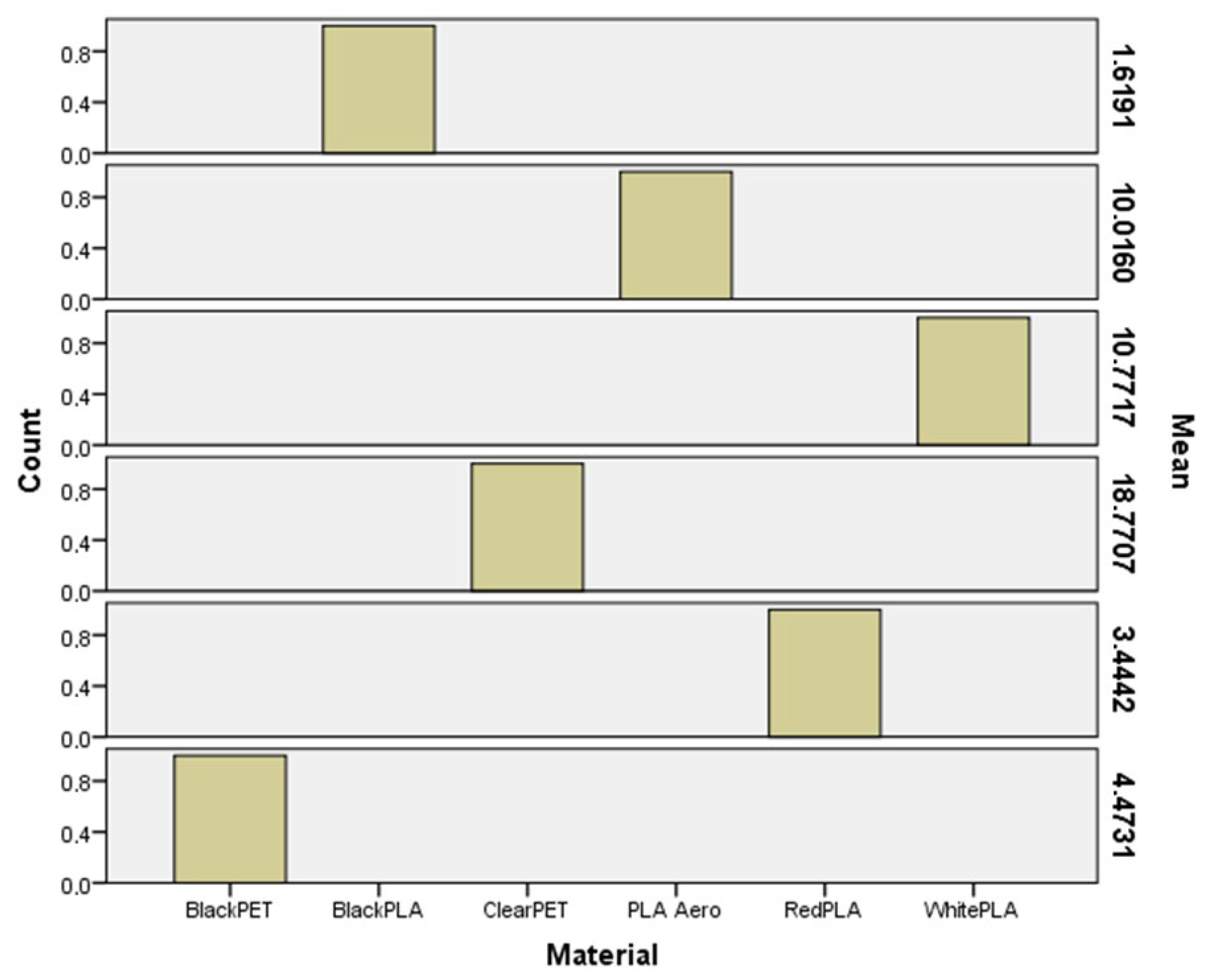
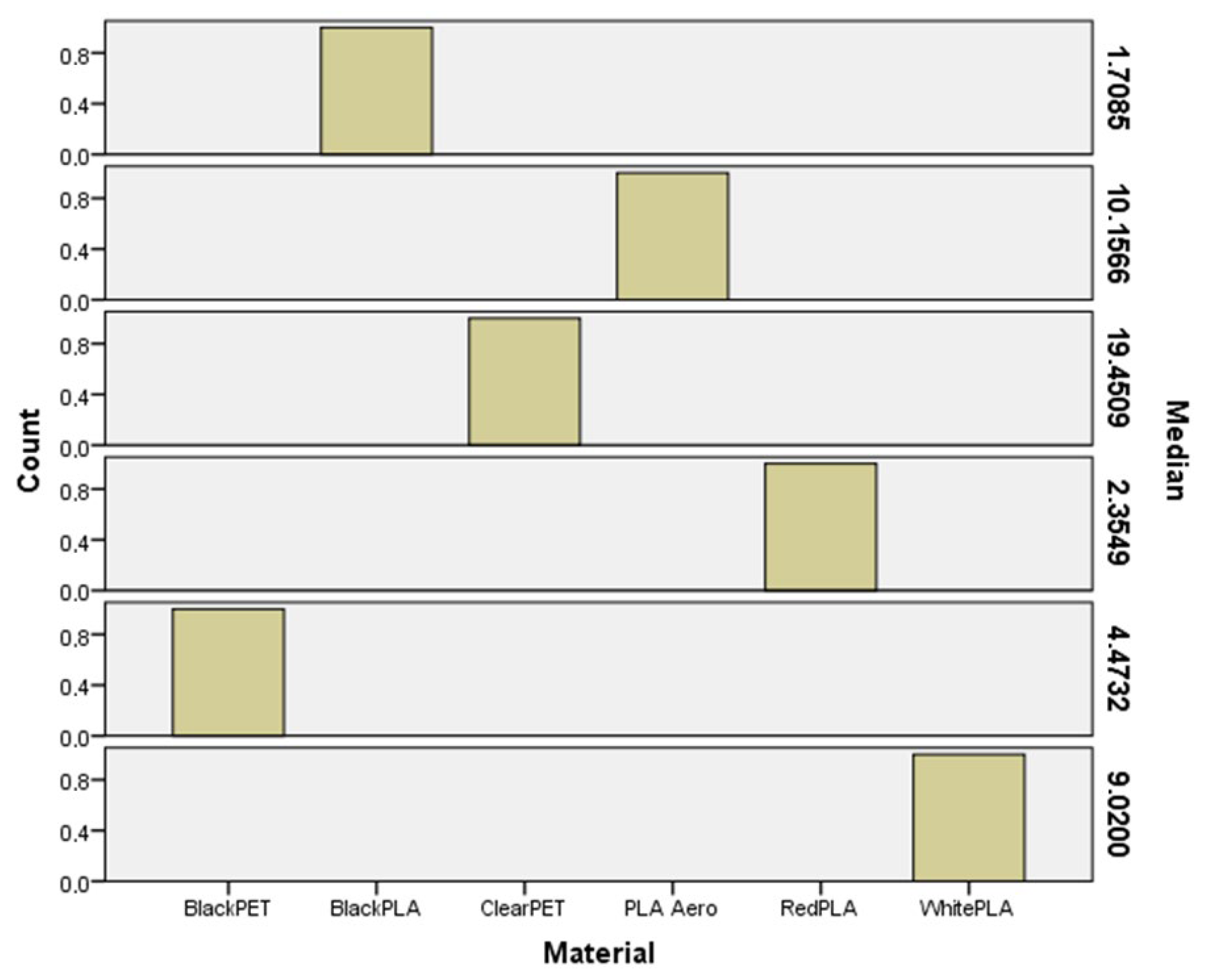
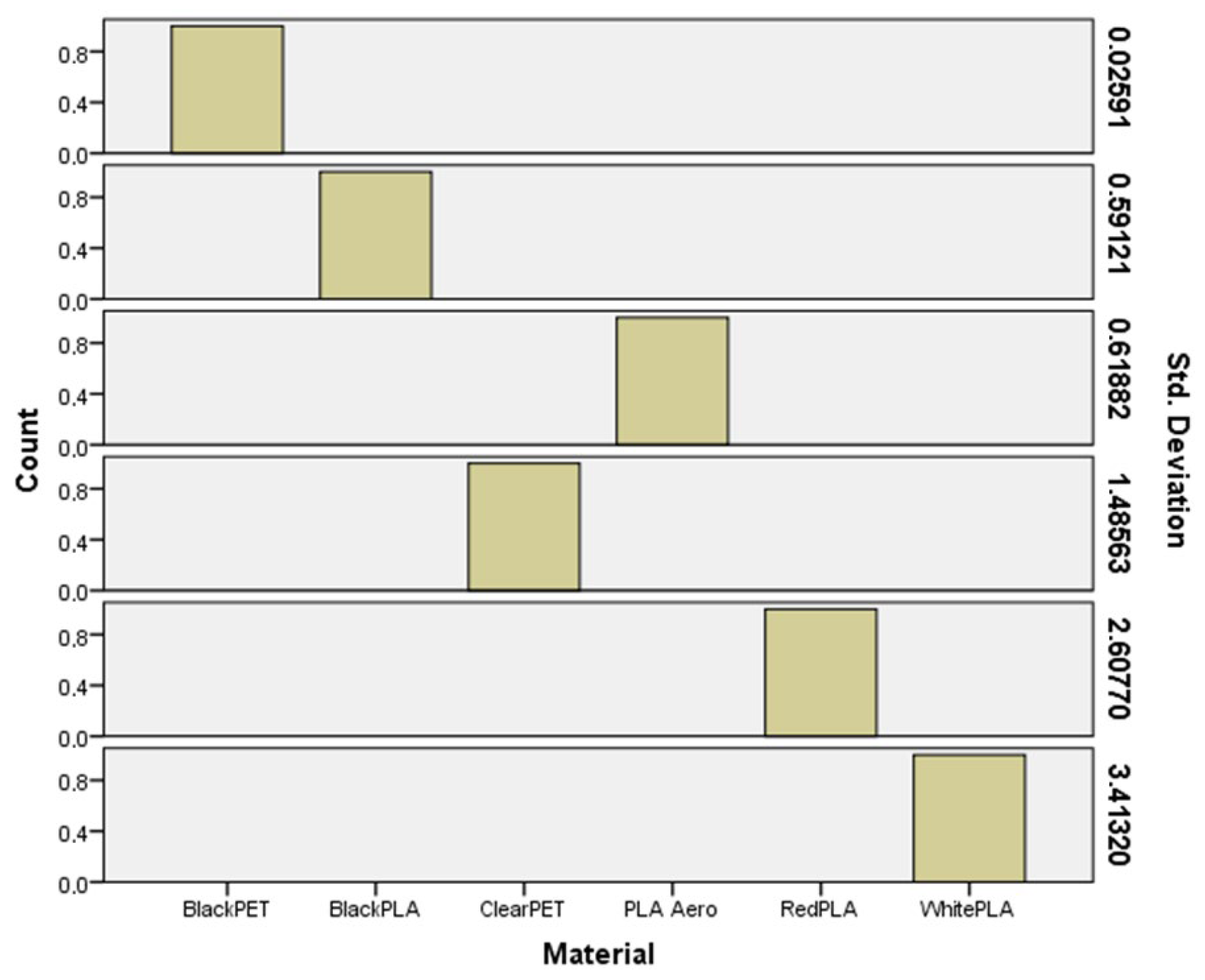
| Black PET-CF | 4.4731 | 4.4732 | 0.02591 |
| Black PLA | 1.6191 | 1.7085 | 0.59121 |
| Clear PETG | 18.7707 | 19.4509 | 1.48563 |
| PLA Aero | 10.0160 | 10.1566 | 0.61882 |
| Red PLA | 3.4442 | 2.3549 | 2.60770 |
| White PLA | 10.7717 | 9.0200 | 3.41320 |
| ANOVA DeltaE | |||||
|---|---|---|---|---|---|
| Sum of Squares | df | Mean Square | F | Sig. | |
| Between Groups | 604.396 | 5 | 120.879 | 33.907 | 0.000 |
| Within Groups | 42.781 | 12 | 3.565 | ||
| Total | 647.177 | 17 | |||
| DeltaE | ||||
|---|---|---|---|---|
| Tukey HSD | ||||
| Material (Numeric) | N | Subset for Alpha = 0.05 | ||
| 1 | 2 | 3 | ||
| 3-BlackPLA | 3 | 1.6191 | ||
| 2-RedPLA | 3 | 3.4442 | ||
| 6-BlackPET-CF | 3 | 4.4731 | ||
| 5-PLA Aero | 3 | 10.0160 | ||
| 1-WhitePLA | 3 | 10.7717 | ||
| 4-ClearPETG | 3 | 18.7707 | ||
| Sig. | 0.472 | 0.996 | 1.000 | |
| Means for groups in homogeneous subsets are displayed. | ||||
| Uses Harmonic Mean Sample Size = 3.000. | ||||
Disclaimer/Publisher’s Note: The statements, opinions and data contained in all publications are solely those of the individual author(s) and contributor(s) and not of MDPI and/or the editor(s). MDPI and/or the editor(s) disclaim responsibility for any injury to people or property resulting from any ideas, methods, instructions or products referred to in the content. |
© 2026 by the authors. Licensee MDPI, Basel, Switzerland. This article is an open access article distributed under the terms and conditions of the Creative Commons Attribution (CC BY) license.
Share and Cite
Baraboi, D.-R.; Năstase, G.; Sima, R.; Șerban, A. Evolution of Colorimetry in 3D-Printed Samples Exposed to External Weather Conditions, Used in Smart Façades. Buildings 2026, 16, 197. https://doi.org/10.3390/buildings16010197
Baraboi D-R, Năstase G, Sima R, Șerban A. Evolution of Colorimetry in 3D-Printed Samples Exposed to External Weather Conditions, Used in Smart Façades. Buildings. 2026; 16(1):197. https://doi.org/10.3390/buildings16010197
Chicago/Turabian StyleBaraboi, Dan-Radu, Gabriel Năstase, Răzvan Sima, and Alexandru Șerban. 2026. "Evolution of Colorimetry in 3D-Printed Samples Exposed to External Weather Conditions, Used in Smart Façades" Buildings 16, no. 1: 197. https://doi.org/10.3390/buildings16010197
APA StyleBaraboi, D.-R., Năstase, G., Sima, R., & Șerban, A. (2026). Evolution of Colorimetry in 3D-Printed Samples Exposed to External Weather Conditions, Used in Smart Façades. Buildings, 16(1), 197. https://doi.org/10.3390/buildings16010197