Article

Post-Fire Behavior of Thin-Plated Unstiffened T-Stubs Connected to Rigid Base

by
Yasin Onuralp Özkılıç
1,2,3
1
Faculty of Engineering, Department of Civil Engineering, Necmettin Erbakan University, Konya 42000, Turkey
2
Department of Unique Buildings and Constructions Engineering, Don State Technical University, Gagarin Sq. 1, Rostov-on-Don 344003, Russia
3
Department of Technical Sciences, Western Caspian University, Baku 1001, Azerbaijan
Buildings 2025, 15(22), 4113; https://doi.org/10.3390/buildings15224113
Submission received: 10 October 2025 / Revised: 10 November 2025 / Accepted: 13 November 2025 / Published: 14 November 2025
(This article belongs to the Special Issue Structural Response of Buildings in Fire)

Abstract

Despite tremendously valuable work on the T-stub, its safety and reliability in post-fire conditions remain a major concern. It is well known that steel is sensitive to high temperatures. Material degradation at high temperatures is likely to cause the T-stub to yield or gradually collapse, potentially leading to the failure of the entire structure. Recent studies have shown that steel joints exhibit a significant change in moment-rotational response post-fire, as the joint’s load–displacement behavior and failure modes change with increasing exposed temperature. However, studies on T-stubs at high post-fire temperatures are very limited. In this study, the aim is to investigate the post-fire load–displacement curves, ductility, plastic, and ultimate capacities of the unstiffened T-stub connected to a rigid base as a function of the exposed temperature. Of the 36 unstiffened T-stubs tested, 30 were subjected to high temperatures. The selected temperature values were 400 °C, 600 °C, 800 °C, 1000 °C, and 1200 °C. A thin plate of 10 mm was selected for the flange of the T-stub in order to obtain mode 1 behavior. Bolts of M16 and M24 were utilized in order to investigate the effects of bolt diameter on the behavior due to the change in distance of plastic hinges. Furthermore, the distances from a T-stub stem to bolt row (pf) of 40 mm, 60 mm, and 80 mm were selected. As pf values decrease, the plastic capacity increases, while the ultimate displacement capacity and the ductility decrease. A direct relation between pf and yield displacement, and between pf and ultimate capacity, was not detected. As the applied temperature increases, the yield displacement increases and the ductility decreases. No significant change in either the plastic or ultimate capacity was observed up to 400 °C. At higher exposed temperatures, the plastic and ultimate capacity decrease as the applied elevated temperature increases. A significant reduction in the plastic and ultimate capacity was especially observed after post-fire exposure to 1000 °C and 1200 °C. The effects of elevated temperature are more pronounced for the plastic capacity of materials. Reduction factors for both plastic and ultimate capacities were proposed to account for the post-fire effects. The proposed reduction factors can predict the effects of a post-fire environment with high accuracy. The results were compared with AISC 358 and Eurocode 3, and it was revealed that the current standards underestimate the actual capacities. A modified calculation, including a reduction factor, is proposed to obtain more accurate results of unstiffened T-stubs for post-fire conditions.

1. Introduction

After the collapse of the World Trade Center, the investigation of the durability of steel structures subjected to accidental loading (impact, explosion, and fire hazard) has become a major concern. If any steel structure is exposed to fire for a long time without collapsing, it will start to cool down after the fire is extinguished, aided by the surrounding air as the temperatures drop. During cooling, steel members develop residual forces and deformations due to the shrinkage of steel, which could create a more hazardous situation than during the fire itself [1].
Bolted connections are utilized due to their various advantages over the welded connections, such as high ductility, strength, and energy dissipation capacity [2,3]. Bolted beam-to-column connections are critical structural elements that transfer loads between components and experience significant deformations, influencing local ductility and overall stability; therefore, their failure can cause system collapse, necessitating special attention in both design and construction [4]. However, in the event of a fire, the bolted connections lose their strength with an increase in temperature. The collapse of bolted connections can trigger the gradual collapse of floors under impact or overload. This can cause a rapid fire spread between floors, leading to the collapse of unsupported columns on intermediate floors. Therefore, investigations should be performed on the fire performance of various types of steel structures to limit fire loss and the post-fire performance of buildings. The size of the fire fluctuates dramatically. Large-scale fires that result in the immediate collapse of steel structures are uncommon [5].
A significant number of experimental, numerical, and analytical studies were conducted to investigate the behavior of T-stubs at room temperature in the last 5 years. These studies focused on many aspects of T-stubs, such as stiffness, ductility, resistance, and failure mechanisms. The authors [6,7,8] studied prying action experimentally and numerically. The studies [9,10,11] compared the experimental results with Eurocode and/or AISC. It was indicated that the experimental results differed from the predicted values. The authors [12,13,14] studied T-stubs made of high-strength steel such as Q690. T-stubs made of stainless steel were also examined by the authors [15,16,17,18]. The behavior and performance of the wire arc additively manufactured T-stubs were also examined [19,20,21]. Loading rate and preloading effects were studied [22]. The effects of stiffeners were examined by the authors [23,24,25]. Cyclic performance of T-stubs, both at the component level and at the structural member level, was investigated by many studies [26,27,28,29,30,31,32,33]. Some studies focused on deriving and improving the constitutive models for force–displacement relationship and formulas for prying actions and resistances of T-stubs [7,8,34,35,36,37,38,39,40,41,42]. Different kinds of machine learning algorithms were utilized to predict the capacity, failure modes, and load displacement curves [43,44,45,46].
Although many studies are available on the performance of T-stubs at room temperature, few studies were conducted for fire scenarios. Gao et al. [47] tested 12 unstiffened T-stub joints under elevated temperatures up to 847 °C, and subsequently carried out numerical analyses. It was reported that increasing the thickness of the flange or the diameter of the bolt decreased deformation capacity. The experimental findings indicated that a thin flange and a sufficiently large bolt can enhance the critical temperatures and ductility of T-stub joints. Der et al. [48] performed a numerical parametric study on T-stubs subjected to elevated temperatures up to 700 °C. It was reported that initial stiffness and capacity reduced as temperature increased. Concerning ductility, the deformation capacity of T-stubs decreases at elevated temperatures when the failure mode is governed by bolt failure, whereas elevated temperatures increase ductility when the failure mode is governed by plate failure.
Spyrou et al. [49] studied mild steel T-stubs made of mild steel of S275 at elevated temperatures up to 740 °C. Barata et al. [50] conducted numerical and experimental studies on T-stubs made of mild steel grade S355 under ambient and elevated temperatures of 500 °C and 600 °C. It was indicated that the capacity and stiffness reduced as the temperature increased, and the failure modes depended on the varying temperature. Li et al. [51] carried out numerical simulations on T-stubs in fire scenarios. The following two scenarios were considered: (i) loading under constant temperature and (ii) heating under constant load. Maljaars and Matteis [52] tested aluminum T-stubs at elevated temperatures up to 290 °C. Heidarpour and Bradford [53] developed an analytical model to predict the behavior of T-stubs at elevated temperatures. Wang et al. [54] carried out an experimental study on T-stubs having a thin-walled flange, which were made of Q690 high-strength steel. It was indicated that failure modes altered with increasing temperature. Eurocode 3 underestimated the capacity of high-strength steel T-stubs. T-stubs with steel grades of Q355, Q690, S690, and S900 were studied by [55] at elevated temperatures ranging from 300 °C to 600 °C, increasing by 100 °C. It was reported that the estimation of Eurocode 3 was inaccurate under ambient temperature conditions when the distance from a T-stub stem to bolt row (pf) is large. Thread-fixed one-side bolted T-stubs at elevated temperatures of 500 °C and 700 °C were tested by You et al. [56]. At elevated temperatures, unfavorable failure modes were not observed. It was indicated that the loading rate at high temperatures can change the failure mode [57]. Increasing the loading rate led to more ductile behavior of T-stubs.
Cho et al. [58] examined the tensile capacity of bolted connections with high-strength steel at elevated temperature and post-fire. The results showed that high-strength steel behaved differently at elevated temperature and post-fire. Dhamane et al. [59] tested T-stubs made of S700 high-strength steel at elevated temperatures up to 800 °C and cooled to room temperature post-fire. It was reported that failure modes depend on the temperature. It was also declared that Eurocode gave a better prediction for experimental results than AISC, but the reason for this could not be specified. Ribeiro et al. [60,61] conducted numerical analyses to investigate the performance of T-stubs both at elevated temperature and post-fire.
It is both time-consuming and wasteful to demolish fire-exposed structures altogether and replace them with new ones. Direct reuse or reinforcement of such structures may compromise safety; occupants, however, may be left feeling unsafe. As such, reliable evaluations are crucial in determining whether fire-exposed buildings should be demolished, repaired, or reused [62]. Therefore, a detailed examination of the post-fire performance of the bolted connections is important.
Studies examining the post-fire behavior of T-stubs are very limited. Sagiroglu [63] tested five beam-to-column connections with T-components under post-fire conditions. It was indicated that large deformations at low capacity and early failure can be observed. Qiang et al. [64] conducted numerical analyses on HSS T-stubs at elevated temperatures in order to take into account axial forces. Mahmood et al. [65] conducted numerical analyses to investigate the post-fire performance of austenitic stainless-steel T-stubs with four bolts per row. Wang et al. [5] examined post-fire performance of hole-anchored bolted T-stubs. The tests were carried out in three stages: loading at ambient temperature, exposure to fire (500 °C and 700 °C) under loading, and loading after cooling. It was reported that these T-stubs can regain at least 80.9% of their ultimate strength and 87.1% of their yield strength, respectively.
Although several studies have examined the high-temperature response of T-stubs, most are restricted to maximum temperatures of 800 °C, and there are scarce investigations on their post-fire behavior under more severe conditions. This study fills this gap by conducting a comprehensive experimental program up to 1200 °C, extending beyond the scope of previous research. The aim of the study is to investigate the post-fire behavior of unstiffened T-stubs with a thin plate connected to a rigid base. The parameters were selected in order to examine the mode 1 behavior. Based on the findings, reduction factors are developed for both plastic and ultimate capacities, providing a practical modification to existing design codes. These contributions aim to enhance the accuracy and reliability of T-stub design in post-fire structural assessment.

2. The Behavior and Calculation of T-Stubs

EN1993-1-8 (EC3) [66] provides the calculations required for the design of T-stub connections. The component methods are adapted according to the Eurocode specification for calculating the capacity of end plate connections. In this method, the capacities of the failure modes are calculated, and the failure mode that yields the lowest capacity governs the capacity of T-stubs. The behavior of T-stubs is defined by three modes. Complete flange yielding is observed in Mode 1, while bolt failure is observed in Mode 3. Both flange yielding and bolt failure are expected to occur in Mode 2. Failure mode 1 is associated with the flange of the T-stub, where plastic hinges form at the toe of the welds and the edges of the bolt row. This failure mode exhibits ductile behavior, allowing significant plastic deformation. In contrast, failure mode 3 is characterized by bolt failure in tension and shows limited ductility. Failure mode 2 represents a combination of the first and third failure modes, where the flange yields near the toe of the weld before the bolts fail in tension. These failure modes are illustrated in Figure 1.
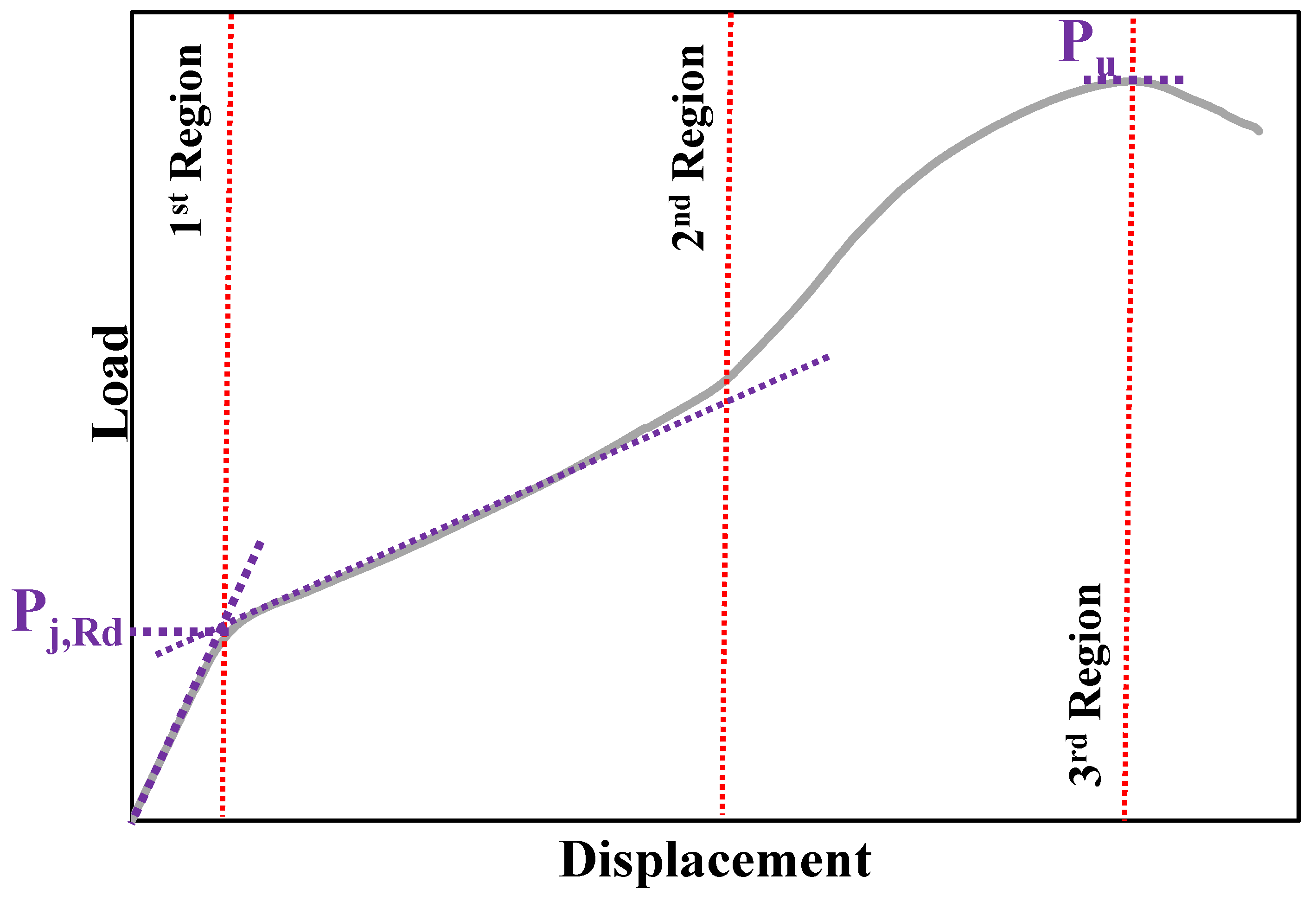
The load displacement of the T-stub, which was governed by failure mode 1, can be divided into three regions [11,67]. The typical load displacement of the T-stub is shown in Figure 2. In the first region, elastic deformation of the flange T-stub is observed before the appearance of the yield lines. The second region initiates the formation of the yield lines and exhibits strain hardening. In this region, stiffness decreases, but the load capacity increases. In the third region, strain hardening effects and an increase in capacities continue. Moreover, second-order effects are initiated and membrane actions develop, resulting in an increase in stiffness. Finally, the specimens fail due to either bolt rupture or flange fracture. Figure 2 demonstrates the typical load displacement response of T-stubs governed by failure mode 1. The plastic capacity or design capacity (Pj,Rd) is considered as the intersection point of tangent lines passing through the first and second slopes [68,69,70,71,72,73]. The ultimate capacity (Pu) is the maximum load carried by T-stubs.
The capacity of Failure Mode 1 can be calculated by two different methods (Method 1 and Method 2). Method 1 assumes that the bolt forces the concrete towards the center line of the bolt. On the other hand, the effects of bolt/washer size are included in Method 2, which assumes that the bolt forces are distributed beneath the washer and/or the nut. Therefore, Method 2 results in a higher capacity than Method 1. These values can be calculated from Equations (1)–(3).
Method   1   F T , 1 R d = 4 M p , 1 R d m
Method   2   F T , 1 R d = 32 n 2 d w M p , 1 R d 8 m n d w m + n
n = min e x ; 1.25 m   M p , 1 R d = 0.25 l eff , 1 t p 2 F yp
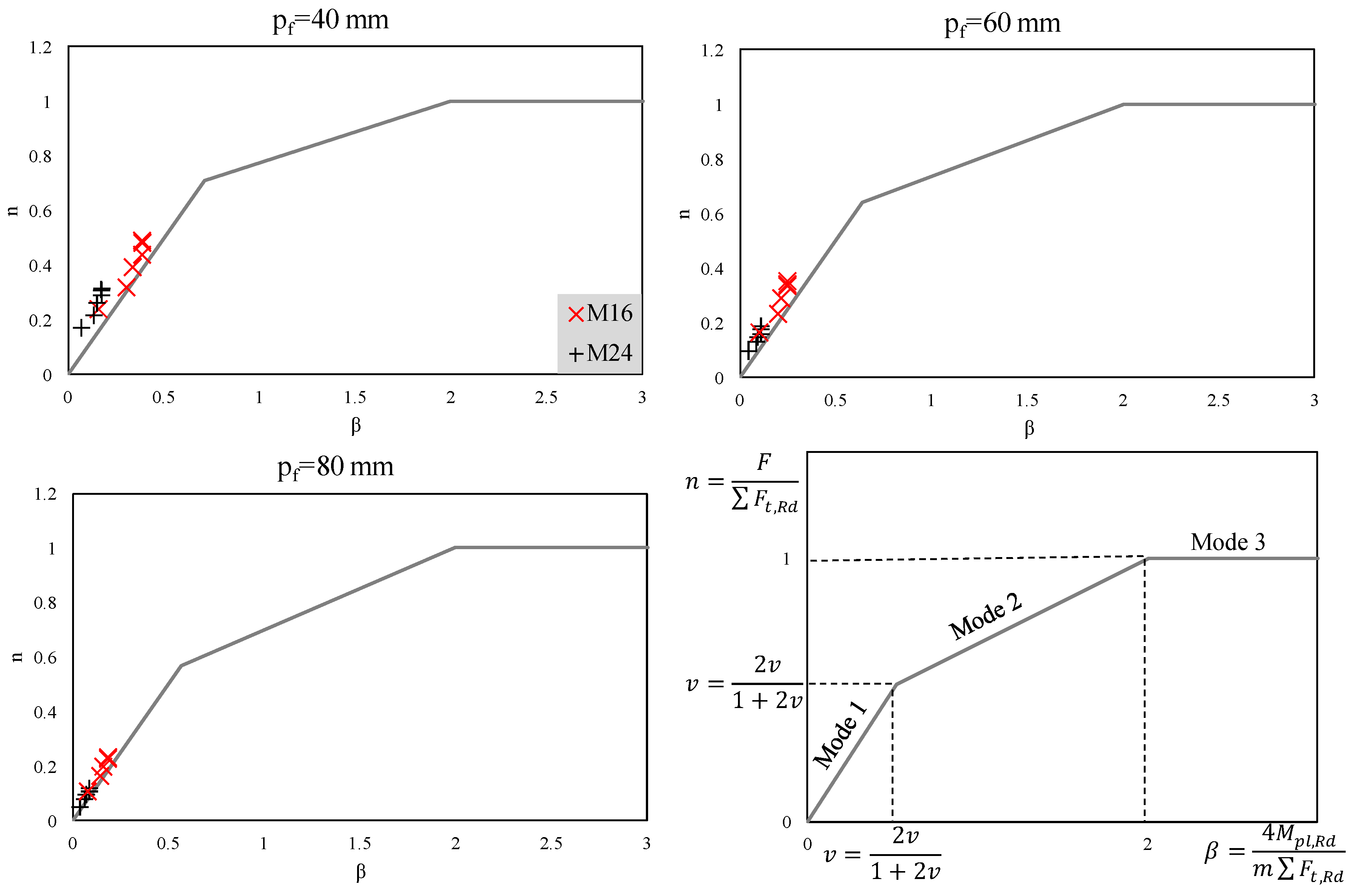
In order to determine the failure mode, constants β and η, which the geometrical and material features of the T-stub, are defined [23] (see Equations (4)–(6)). The constant β is the ratio of Mode 1 (Method 1) to Mode 3 according to EC3. On the other hand, ν is computed as the ratio of edge distance (ex) to m. Mode 1 is defined as between 0 and 2 ν 1 + 2 ν . Mode 2 is defined as between 2 ν 1 + 2 ν and 2, and Mode 3 occurs above 2.
β = F T , 1 R d F T , 3 R d
η = F F T , R d
ν = e x m
Extended end plate connections used in moment-resisting frames can also be designed in accordance with AISC 358 [74] for seismic applications. AISC 358 only adopts a thick end plate design approach. This approach is discussed in Design Guide 04 [75]. The thin plate design approach is only suitable for non-seismic applications and is covered in Design Guide 16 [76]. The yield lines provided are the same, regardless of either the thin or the thick plate approach. No direct calculations are available for T-stubs; therefore, the yield line and equations were transferred for T-stub connections and are given in Equation (7).
P A I S C = F y t p 2 b p p f

3. Materials and Methods

3.1. Design of Experiments

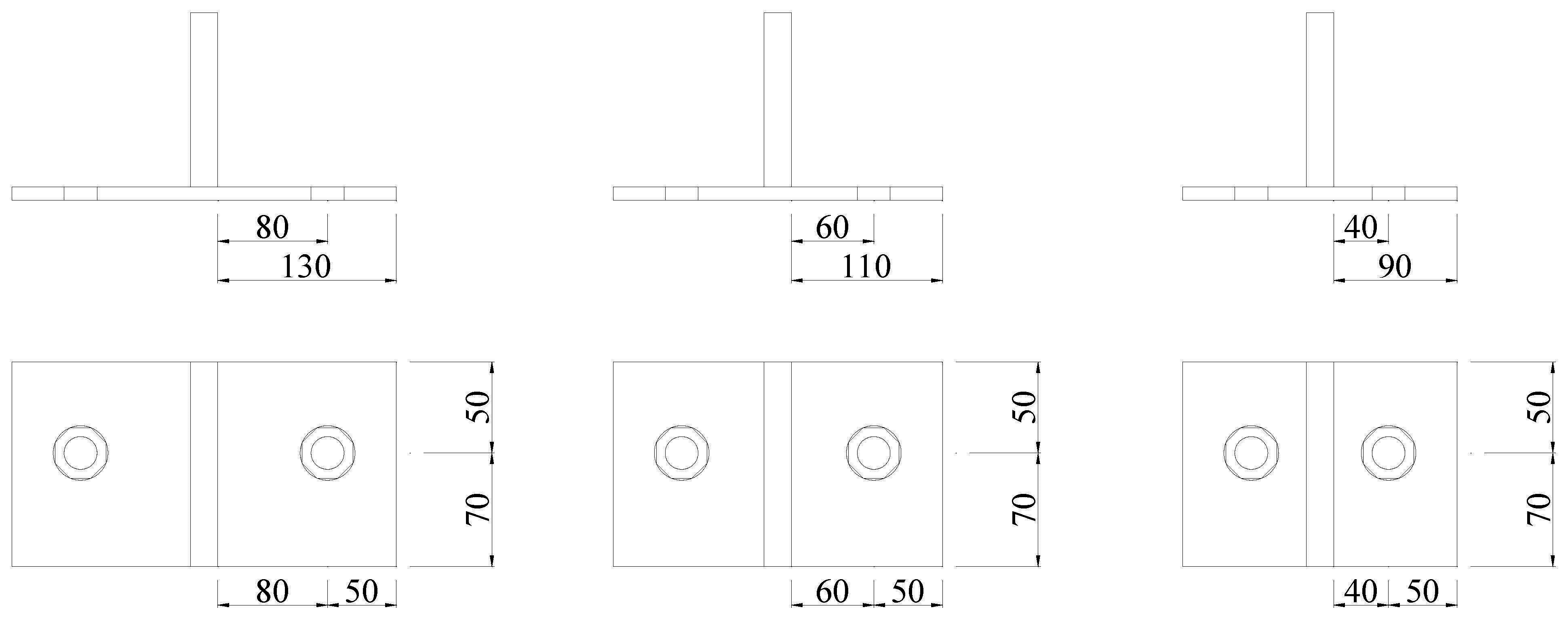
Thirty-six unstiffened T-stubs were designed for a testing program. Three different variables were considered. The distance from the T-stub stem to the bolt row (pf), the bolt diameter, and the elevated temperature were considered as variables. The T-stubs were fabricated from S275 structural steel plates. The thickness of the T-stub flange was kept constant at 10 mm. The flange thickness of the T-stub was selected in order to observe mode 1 behavior. pf values of 40 mm, 60 mm, and 80 mm were chosen. Two different bolt diameters were considered in order to examine the effects of bolt diameter on the capacity of the T-stub by changing the distance of the plastic hinges. Bolt diameters of 24 mm and 16 mm were considered. Bolt holes were drilled with a clearance of 2 mm above the bolt diameter. For connecting the stem to the flange, full penetration fillet welds with a throat thickness of 6 mm were applied on both sides of the stem to ensure symmetry and sufficient strength. The dimensions of T-stubs are shown in Figure 3. Elevated temperatures of 400 °C, 600 °C, 800 °C, 1000 °C, and 1200 °C were chosen. Table 1 summarizes the parameters that are utilized in this study.
The experimental program was planned as a full factorial experimental design to comprehensively investigate the effects of the fundamental parameters influencing the mechanical behavior of T-stub connections. The 2 × 3 × 6 full factorial experimental design, created by considering all combinations of the aforementioned parameters, encompasses a total of 36 different experimental conditions. Each condition represents a unique combination of geometry, scale, and temperature effects. This full factorial structure allows for the systematic evaluation of all main effects and possible interactions, thereby ensuring that the sensitivity of each parameter can be distinguished both physically and statistically.
While 1200 °C represents a condition beyond practical structural functionality, its inclusion allows exploration of the worst-case degradation and supports development of conservative reduction factors for post-fire design. The heating process was carried out in a large oven to ensure even temperature distribution over the T-stubs. The initial heating rate was approximately 100 °C/h; as the temperature increased, the heating rate was gradually reduced. After the target temperature was reached, the specimens were held at that temperature for two hours. The specimens were then left in the oven to cool naturally to room temperature. In addition, specimens at room temperature were tested as a reference. These reference specimens are shown at a temperature of 24 °C.
It should be noted that the bolts were not heated for two reasons. First, at temperatures of 1000 °C and 1200 °C, bolts and nuts could not be used due to thread deformation problems. Second, the aim was to induce failure at the flange of T-stubs. The plastic capacity is primarily flange-controlled and thus less sensitive to bolt heating. In other words, keeping bolts at ambient strength biases the system toward failure mode 1, which aligns with the aim of the study.
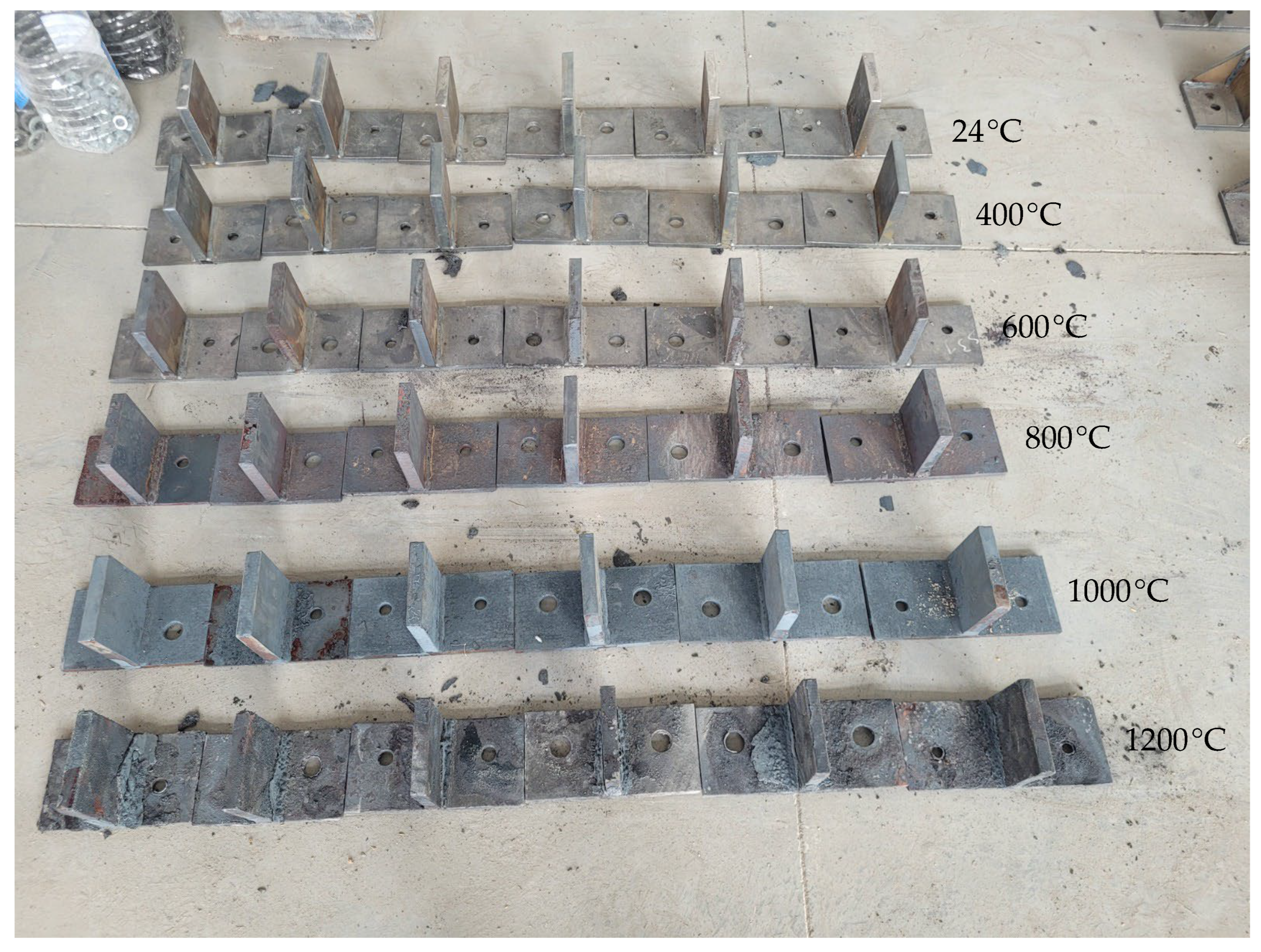
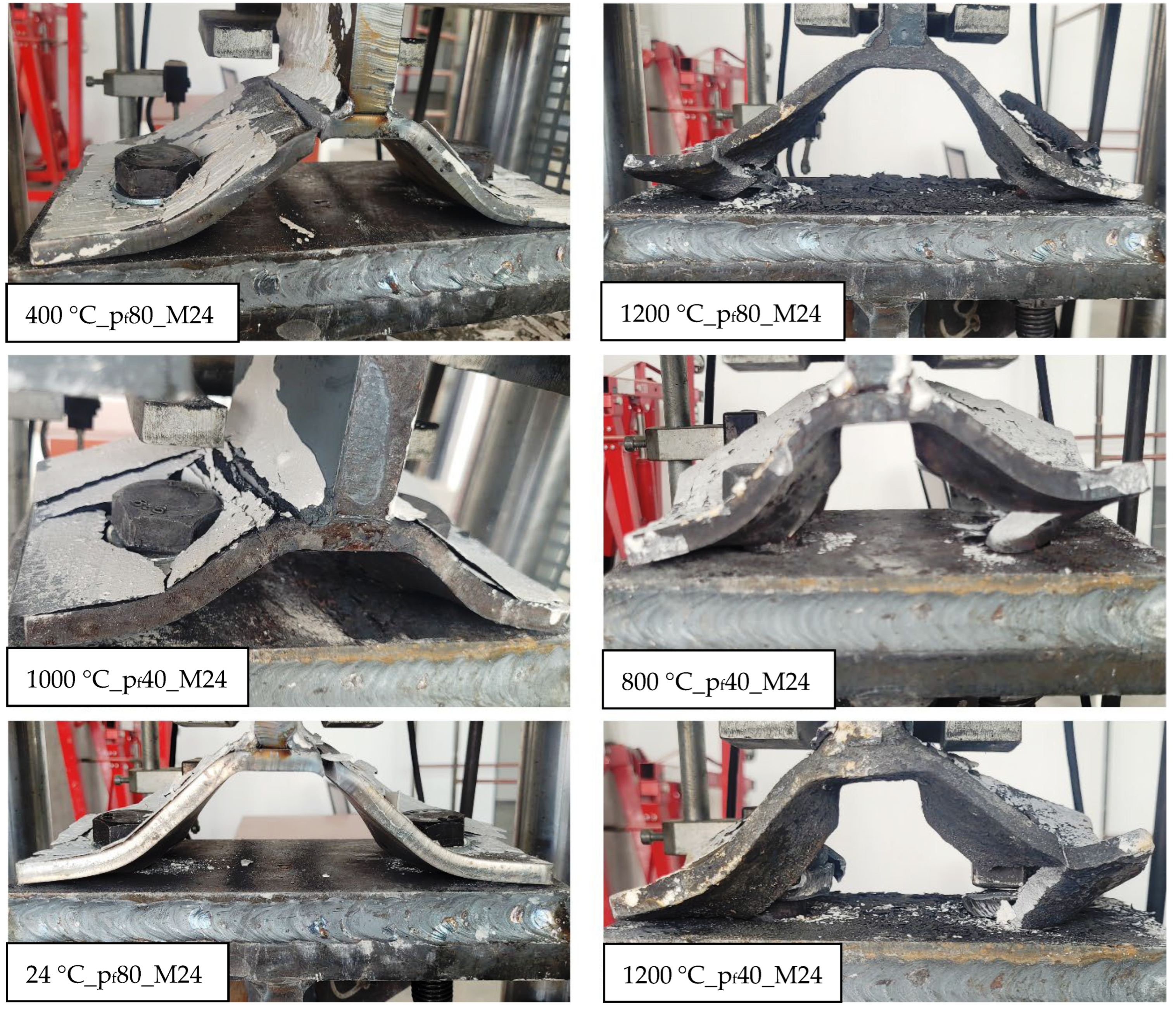
T-stubs after elevated temperature are shown in Figure 4. There was no significant visible difference in the T-stubs at 24 °C, 400 °C, and 600 °C. On the other hand, visible differences started to appear in T-stubs at a temperature of 800 °C. At 1000 °C, color change and surface deformations started to occur. However, especially at 1200 °C, the deterioration increased significantly. The progressive color change visible in Figure 4 corresponds to the tempering and oxidation sequence typical of carbon steel, which reflects surface oxide formation.

3.2. Material Properties

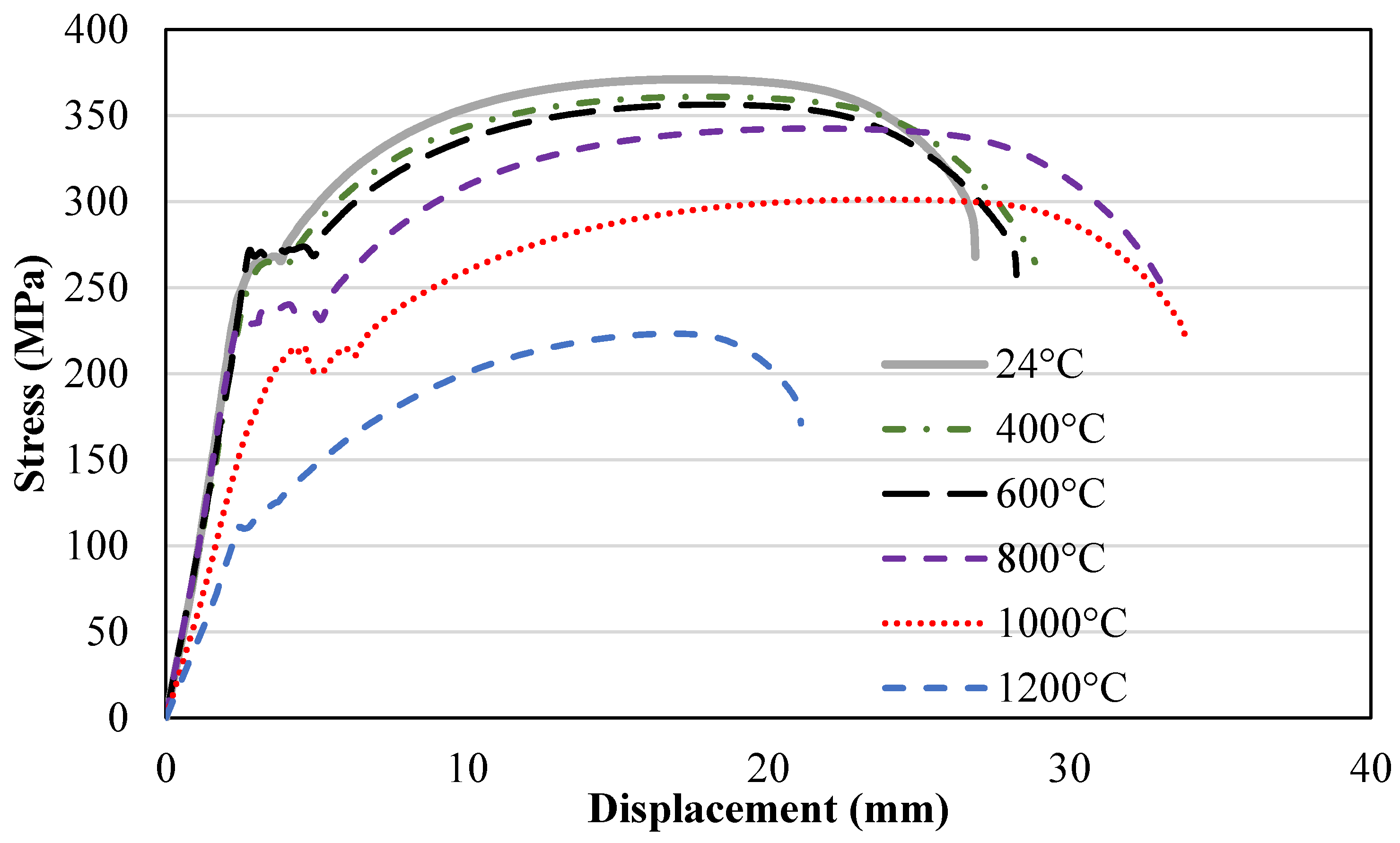
To determine the material properties of the test specimens, coupons were subjected to tensile tests. Coupon samples cut from the flange plates were subjected to the same heating and cooling cycle as the T-stubs. Each coupon was placed in the furnace, heated to the target temperature, and held for two hours to achieve thermal uniformity. Subsequently, the furnace was turned off, and the coupons were allowed to cool gradually to room temperature in the oven together with the T-stub specimens. This procedure ensured comparable thermal exposure between coupons and T-stubs. The results of each coupon test in terms of yield stress and ultimate stress are given in Table 2. Stress displacement curves of the coupons are shown in Figure 5.
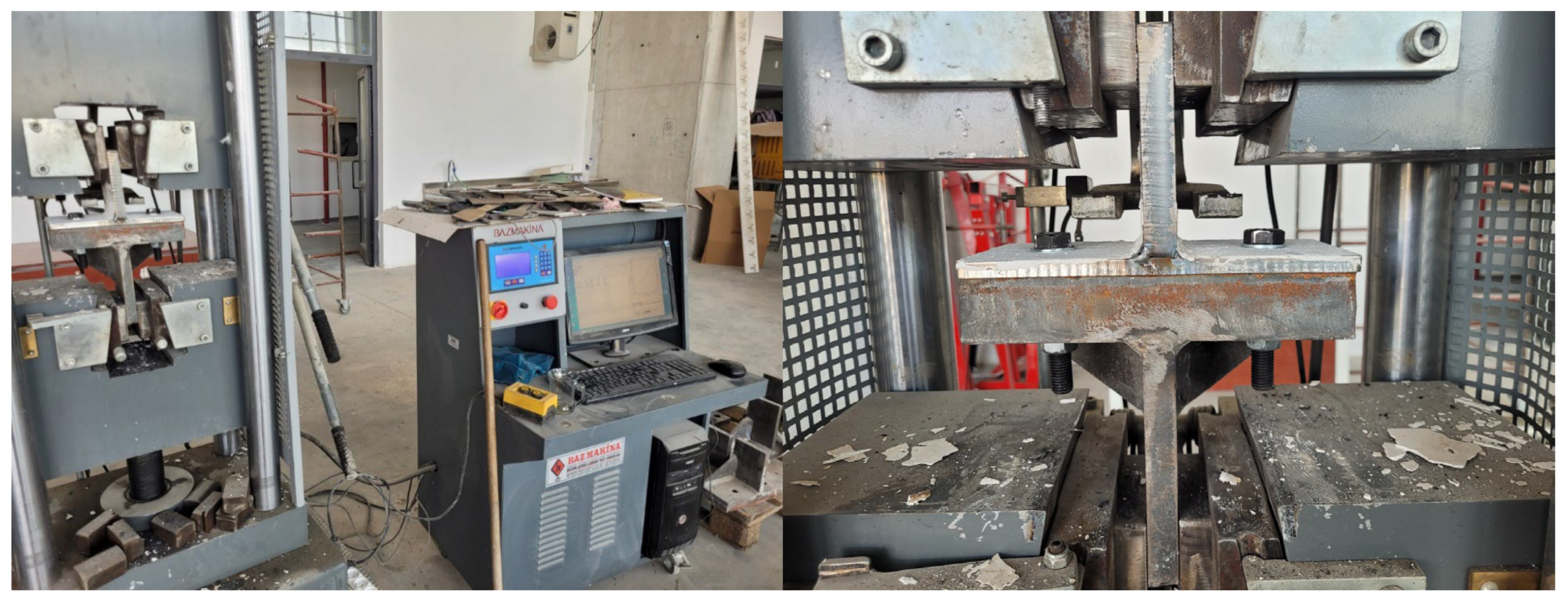
After the change in temperature was applied to the T-stubs, tests were carried out using the test setup shown in Figure 6. T-stubs were assumed to be symmetric about their width. T-stubs were tested on a rigid support. The rigid support had a total thickness of 40 mm and was reinforced with additional stiffeners. The stem thickness was chosen to be 20 mm to ensure elastic behavior of the stem. Pre-tension was applied by first snug-tightening and then tightening with a calibrated torque wrench to reach the target preload (70% bolt strength).

4. Experimental Results

4.1. Failure Modes

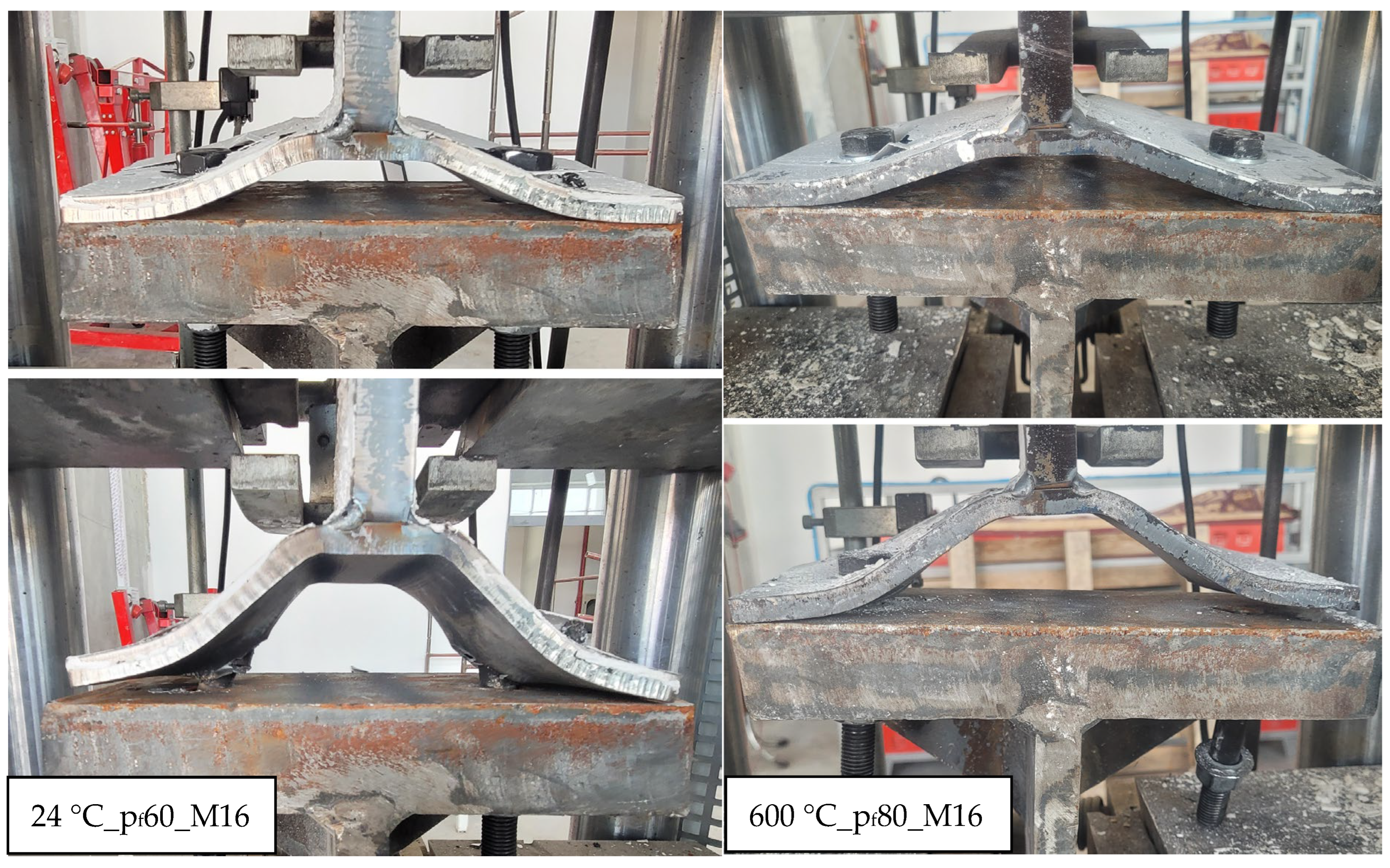
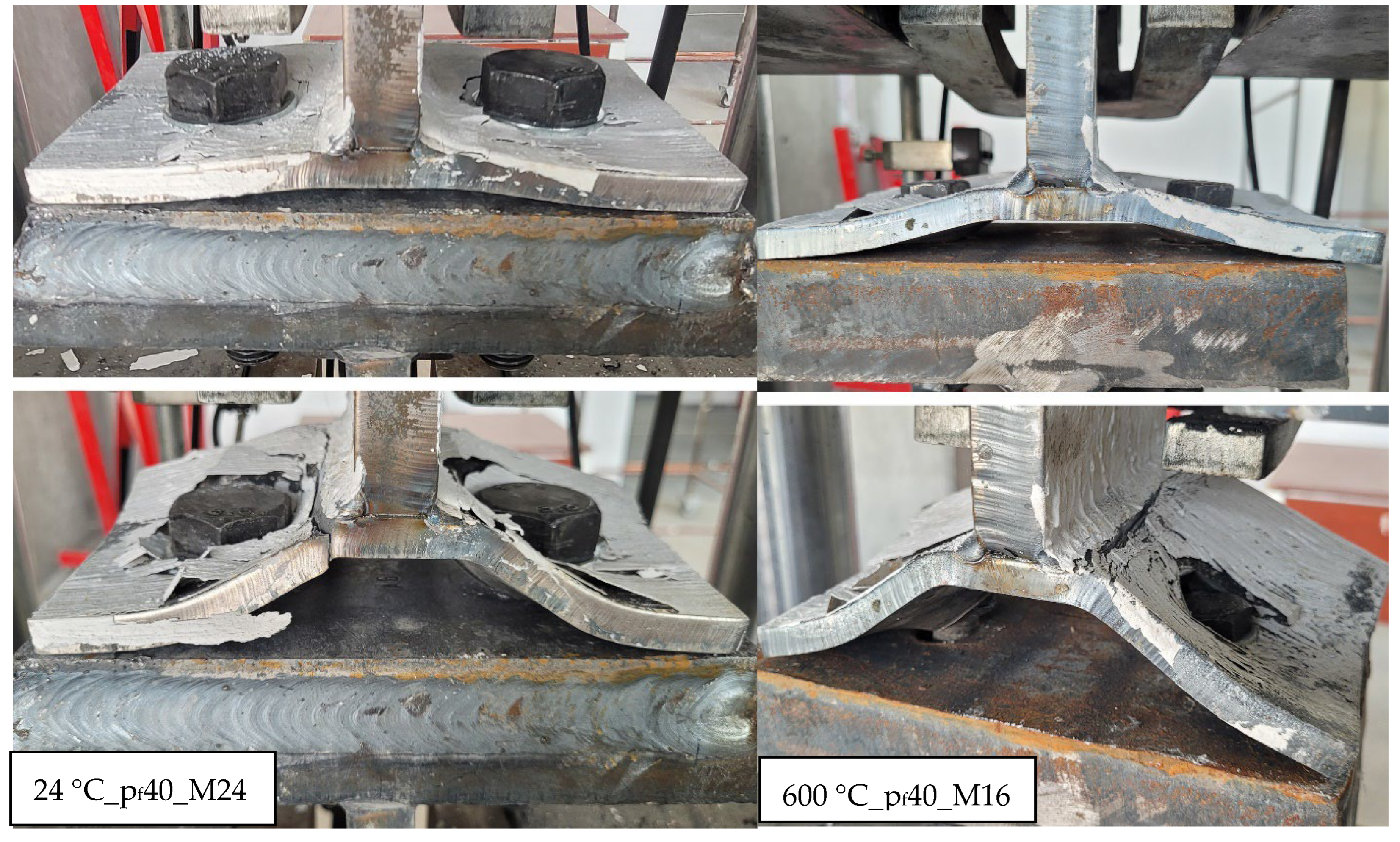
As previously indicated, the specimens were designed to fail in failure mode 1. The determination of failure modes based on the dimensions and mechanical properties of the experimental specimens is depicted in Figure 7. For most of the specimens, failure mode 1 was observed. However, the specimens failed in different ways. All specimens experienced significant deformations, which led to different failures at the end of the experiments. The specimens with M16 bolts generally resulted in bolt failure at the end of the experiments. Especially in specimens with a pf of 60 mm and 80 mm, the behavior of Mode 1 with bolt failure was clearly examined (Figure 8). Similar behavior was also reported by [67,77]. On the other hand, all specimens with M24 bolts experienced complete yielding of the flange, resulting in flange failure. Figure 9 shows failure mode 1 with flange failure for the specimens with both M16 and M24 bolts.
In several tests, particularly for specimens with smaller pf values or after exposure to temperatures of 600–800 °C, the loading was stopped when the flange rotation exceeded the displacement limit of the test setup while maintaining a stable but reduced load level. This condition, denoted as “excessive deformations” in Table 3, corresponds to a ductile over-rotation of the flange accompanied by visible deformation and elongation of bolt holes but without complete bolt or flange fracture.
Bolt failures were only observed with the specimens including M16 bolts and a pf of 60 mm and 80 mm. Bolt failures were observed after a large level of displacement, and all were ductile. For the rest of the specimens, the bolt failure was not observed. Two types of flange failure shown in Figure 10 were recorded. The first type occurred at the edge of the weld (Flange F. 1). The crack initiated from the center and progressed towards the edges of the T-stub. The second type of failure occurred at the bolt line parallel to the stem (Flange F. 2). The crack initiated from a point close to the bolt hole and traveled towards the flange edge. All of the Failure F. 2 (except one) was observed with the specimens exposed to a temperature equal to or higher than 800 °C. The failure modes are reported in Table 3.
Yield capacity of all specimens was governed by failure mode 1. However, in some specimens (pf = 40 mm), failure occurred before second-order and membrane effects could fully develop due to the increase in the short lever arm, which increases local bending demand. Consequently, the load–displacement curve sometimes resembled Mode 2; however, the observed deformation shape indicates that the capacity was governed by Mode 1. On the other hand, prying and membrane action effects at large rotations progressively increased bolt tension, culminating in ductile bolt rupture in some specimens with M16 bolts. These bolt failures appeared as an ultimate failure after the full development of the failure mode 1 mechanism, and this can also be seen from the load displacement curves of these samples. Thus, for capacity evaluation, the governing mode in both cases remains failure mode 1.
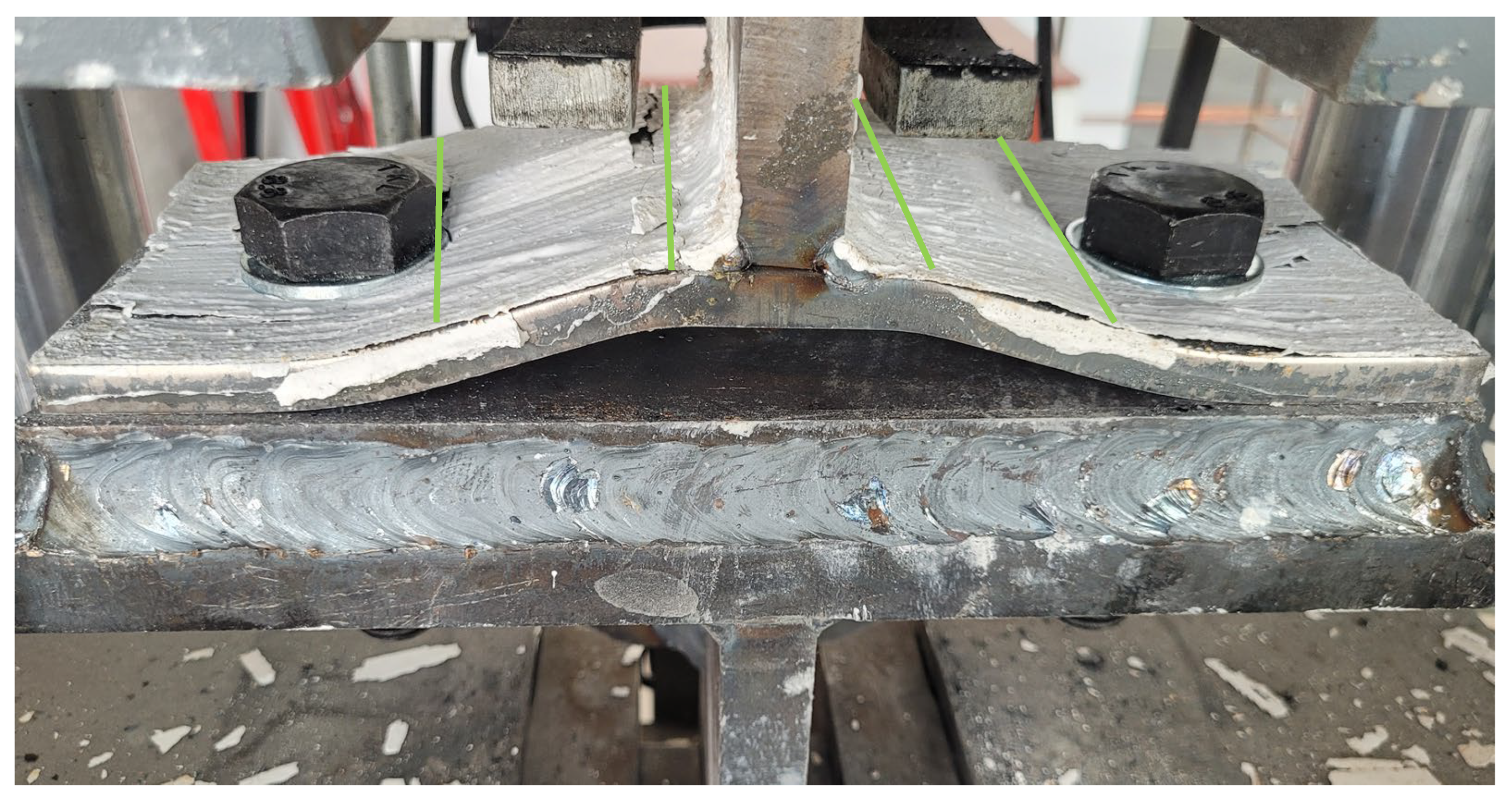
To detect the yield lines, whitewash was applied to specimens. However, due to deterioration in the surface of the specimens, which were exposed to high temperatures, the whitewash application failed on some specimens. In other words, the whitewash technique was effective for specimens tested at ambient temperature, 400 °C, 600 °C, and 800 °C, allowing clear observation of yield line development. At higher exposure levels (1000 °C and 1200 °C), severe surface oxidation and scaling caused the whitewash to flake or detach, making yield lines indistinguishable. For these specimens, yield line mechanisms were determined based on observed deformation shapes and crack propagation. A general trend was, therefore, considered when determining the yield lines. Two yield lines depicted in Figure 11 were observed during the experiments. One yield line parallels the weld lines to the stem. The other yield line coincides with the line of the bolt row, which is parallel to the stem. This yield line passes the edge of the washer. A similar yield line was reported by [11]. The first yield line was defined in [11] as occurring at a distance of 0.8 times tw from the stem, while the second yield line was identified as occurring at a distance of 0.75 times db from the center of the bolt row. In this study, the proposed yield line mechanism by [11] is further modified with the reduction factor to include the effects of temperature applications.

4.2. Load–Displacement Curves

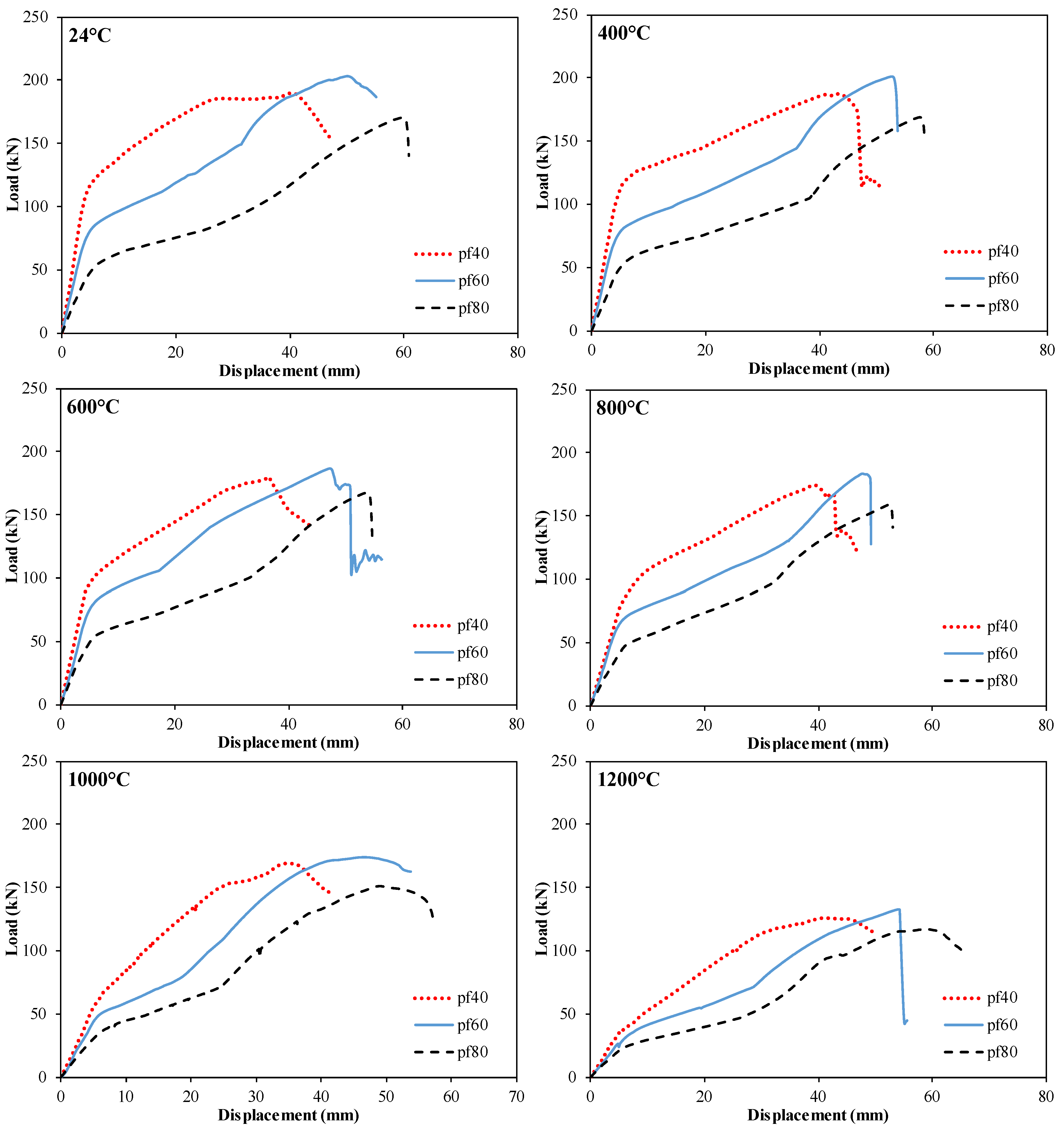
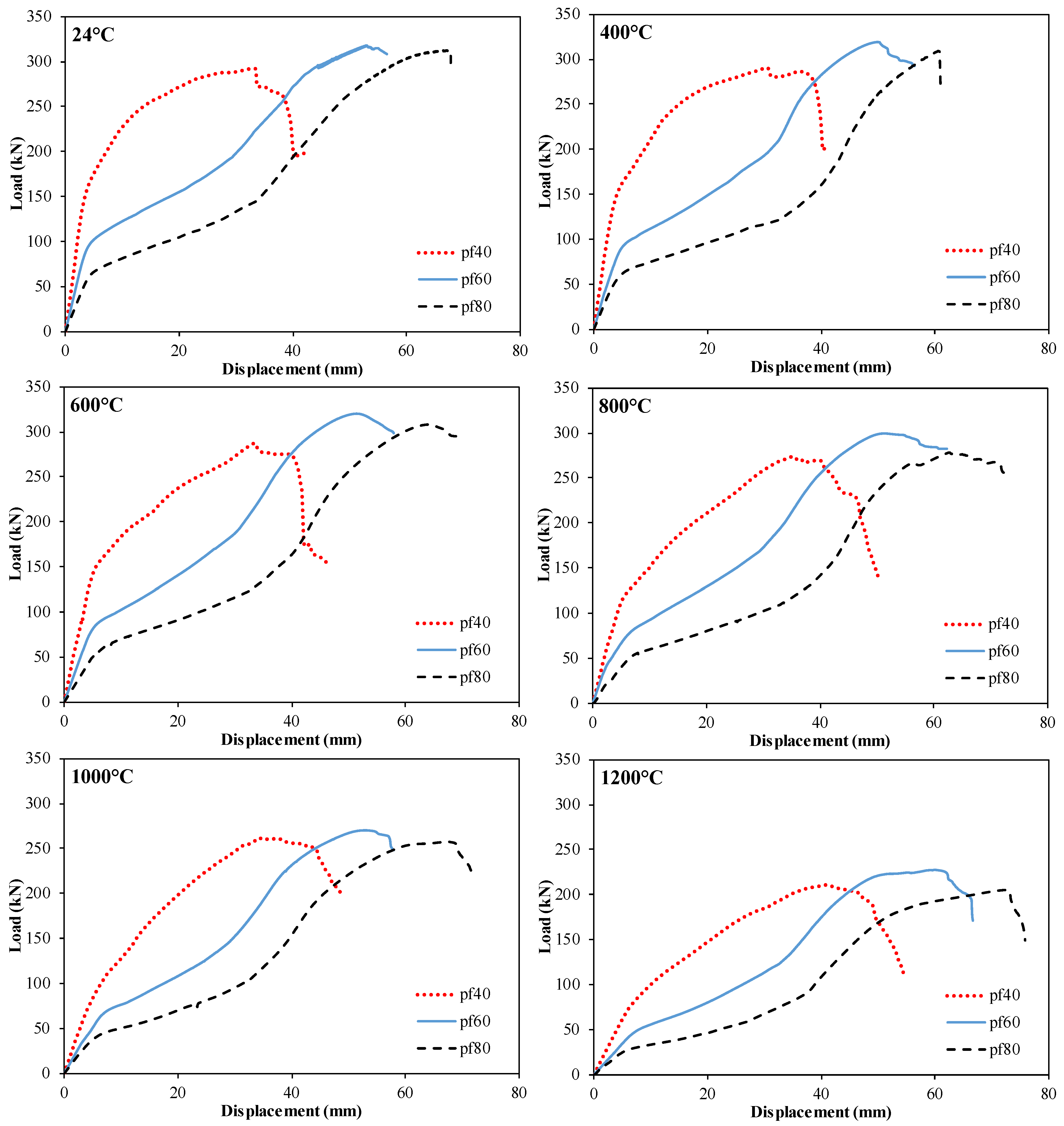
Load–displacement curves of the specimens with M16 bolts and M24 bolts are given in Figure 12 and Figure 13, respectively. Furthermore, plastic and ultimate capacities for specimens with M16 bolts and M24 bolts are given in Table 4 and Table 5, respectively. Most of the load–displacement curves are similar to the load–displacement curve shown in Figure 2. These load–displacement curves have three different regions, as shown in Figure 2. However, the specimens with a pf of 40 failed before the development of second-order effects and membrane actions. These prevented the occurrence of the third region and an increase in the stiffness. This behavior resembles the load–displacement curves of Mode 2. However, based on the deformed shapes observed in the experiments (e.g., Figure 9 and Figure 10) and failure mechanism determination based on EC3 (Figure 7), the observed deformed shapes and failure mechanisms were considered as failure mode 1.
The highest plastic capacities were observed with a penetration force of 40 mm. As the pf increases, plastic capacity significantly decreases. The difference in plastic capacity between pf of 40 mm and pf of 80 mm is higher in specimens with M24 bolts than in specimens with M16 bolts. No direct relation was observed between ultimate capacity and pf. The highest ultimate capacity was observed in the specimens with a pf of 60 mm. The initial rigidity of the specimens decreases as the pf increases. Especially the specimens with pf of 80 exhibited much smaller rigidity compared to the specimens with pf of 40 and 60 mm.
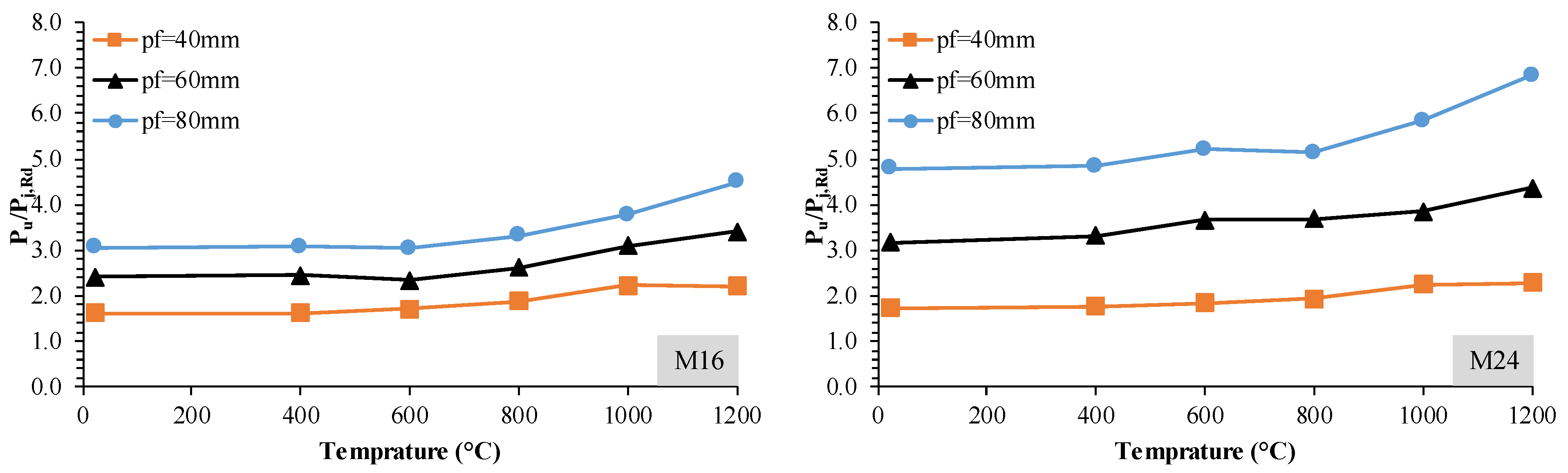
The ratio of ultimate capacity to plastic capacity (Pu/Pj,Rd) varies between 1.62 and 4.5 for the specimens with M16 bolts and between 1.74 and 6.83 for the specimens with M24 bolts. The ratio of ultimate capacity to plastic capacity (Pu/Pj,Rd) of the specimens with M16 and M24 bolts is depicted separately in Figure 14. Pu/Pj,Rd ratio increases as the temperature increases. While a slight increase in the Pu/Pj,Rd ratio is depicted up to 600°C, a significant increase is observed after 600 °C, especially at 1200 °C. The elevation of Pu/Pj,Rd at high temperatures is predominantly governed by the rapid decrease of Pj,Rd, reflecting the loss of yield strength and stiffness under thermal degradation. By comparison, Pu is less affected, since strain hardening, membrane action, and redistribution mechanisms remain effective at large deformations, thereby mitigating the rate of strength reduction.
The Pu/Pj,Rd ratio increases as the value of pf increases. Although the difference in the Pu of the specimens with different pf is small, the difference in PjR,d is high. These lead to an increase in the Pu/Pj,Rd ratio when the pf is higher. A higher Pu/Pj,Rd ratio is observed in the specimens with M24 bolts, rather than M16 bolts. The reason for this is that the yielding of the bolts limits the full development of the flange yielding with strain hardening.

4.3. Reduction Factor

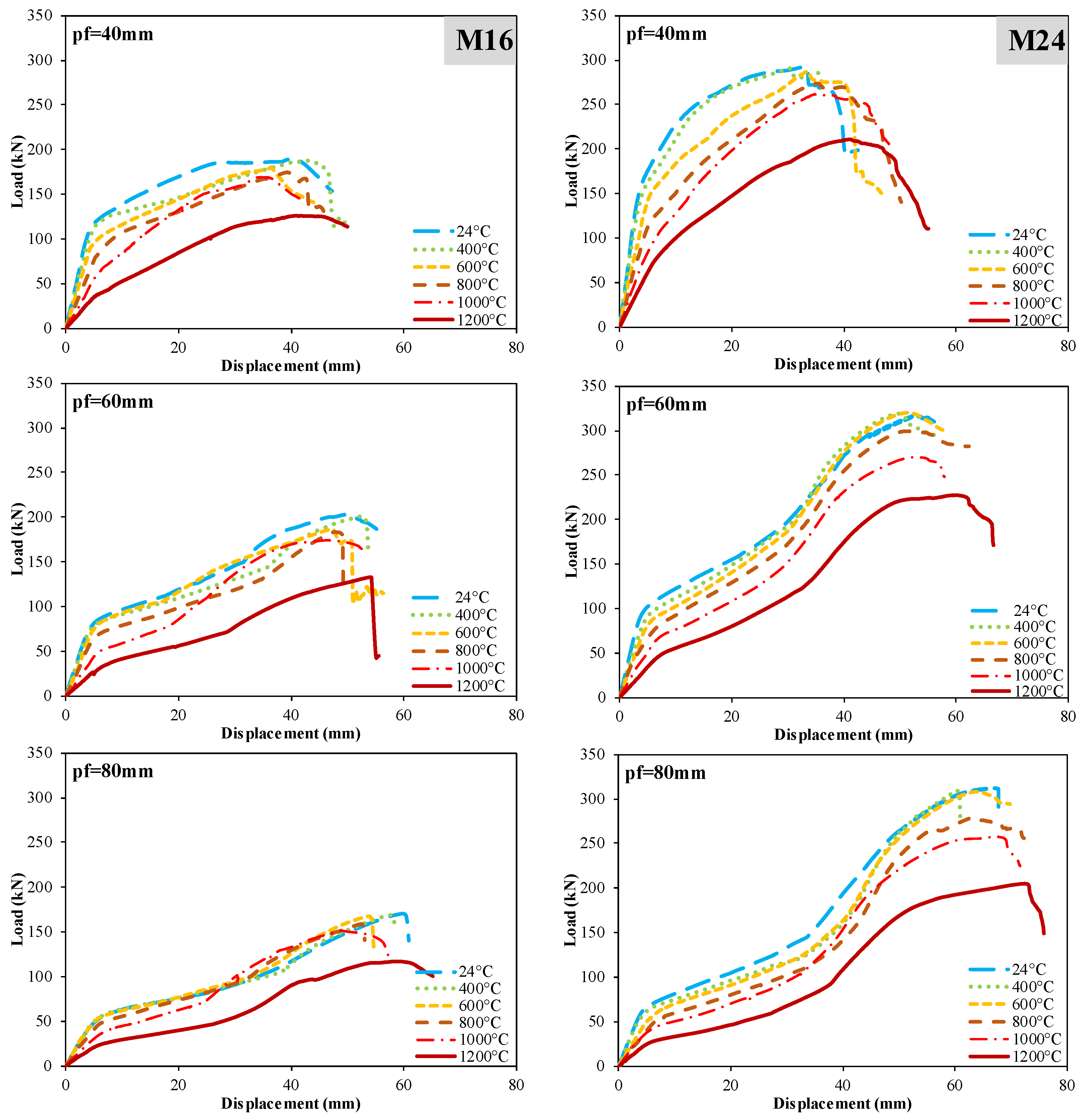
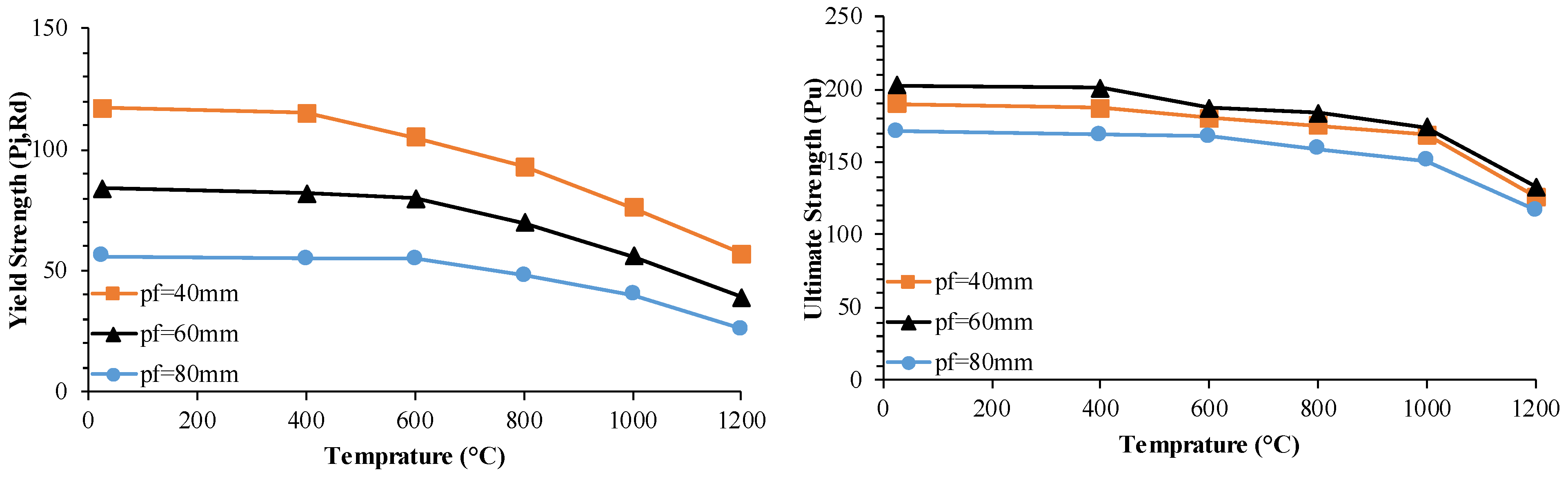
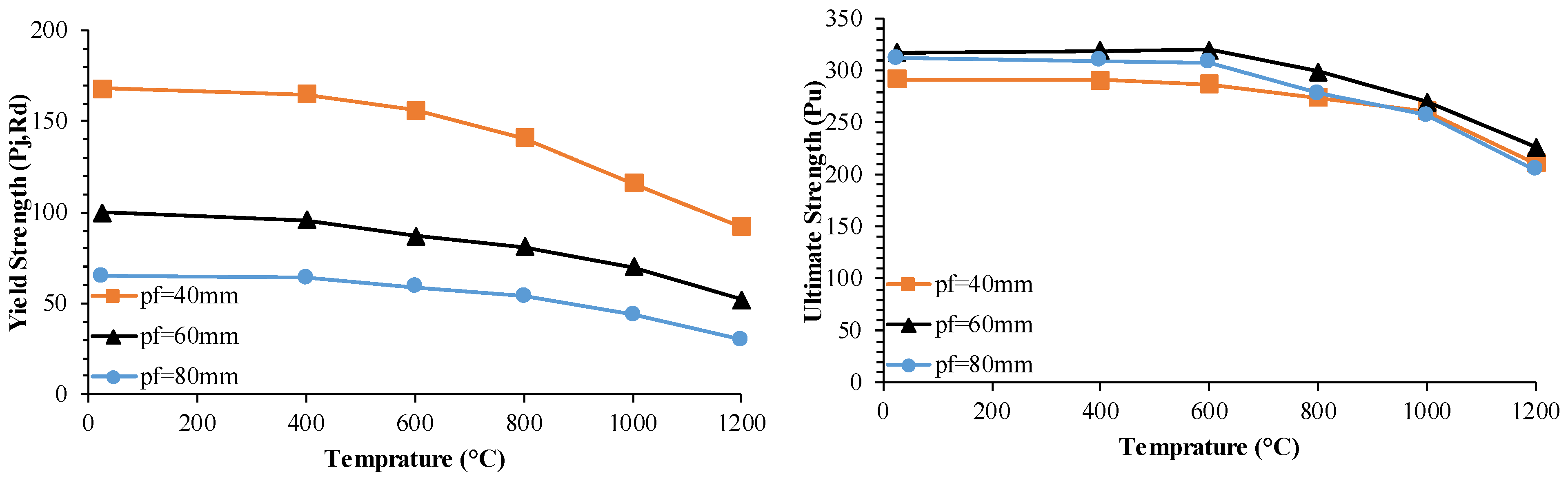
The load–displacement curves of the specimens with respect to elevated temperature are shown in Figure 15. The observation indicates that the initial rigidity of the specimens decreases as the level of exposed temperature increases. Especially after exposure to elevated temperatures of 1000 °C and 1200 °C, the stiffness of the specimens significantly decreased. The initial rigidity of the specimens exposed to 400 °C is almost the same as that of the reference specimens. As the temperature increases, the Pj,Rd decreases. A significant reduction in Pj,Rd was observed, especially after an elevated temperature of 600 °C. At an elevated temperature of 800 °C, the Pj,Rd was reduced by up to 20%. The reduction in Pj,Rd was calculated to be up to 33% at an elevated temperature of 1000 °C, and 54% at 1200 °C, respectively.
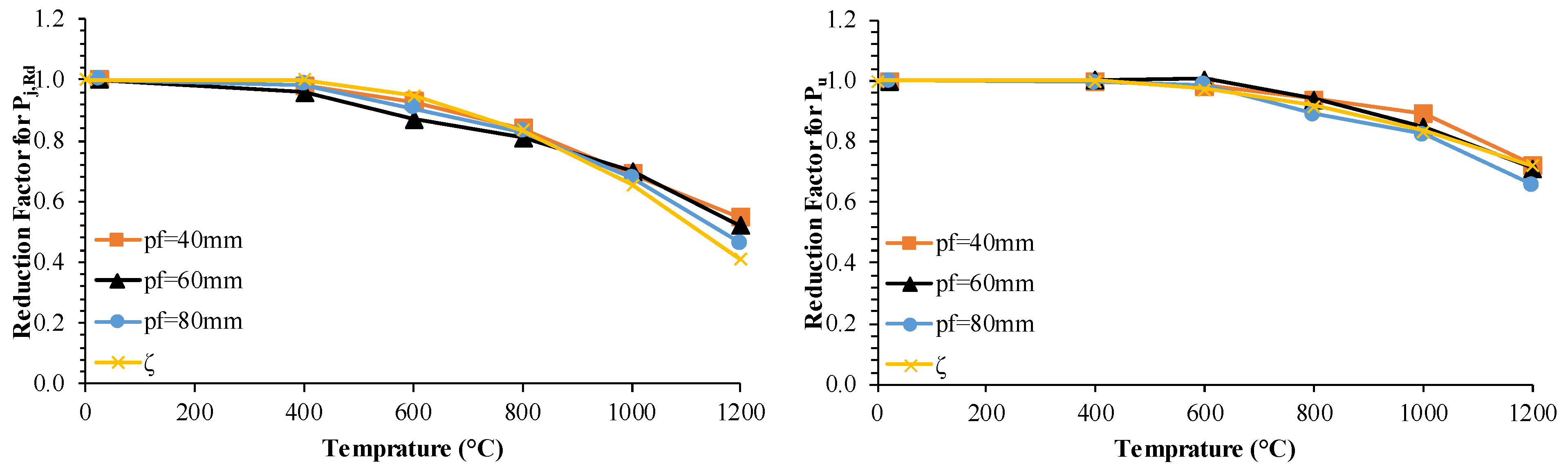
Figure 16 and Figure 17 show the plastic and ultimate strengths of specimens with M16 and M24 bolts, respectively. Up to 400 °C, there is almost no change in the material’s strength. However, at 600 °C, a reduction in capacity begins, and this reduction becomes more pronounced as the temperature rises. Notably, the effects of temperature are more pronounced on plastic strength than on ultimate strength.
To take into account the effects of post-elevated temperature, reduction factors are derived for both plastic and ultimate capacities. The following equations can be utilized for the reduction factor of plastic capacity ( ξ p ):
ξ p = 1   when   T < 400
ξ p = 1 T 400 × 0.00009 2 T 400 × 0.00009   when   T 400   ° C
The following equations can be utilized for the reduction factor of ultimate capacity ( ξ u ) :
ξ u = 1   when   T < 400
ξ u = 1 T 400 × 0.00006 2 T 400 × 0.00006   when   T 400   ° C
where T is the elevated temperature.
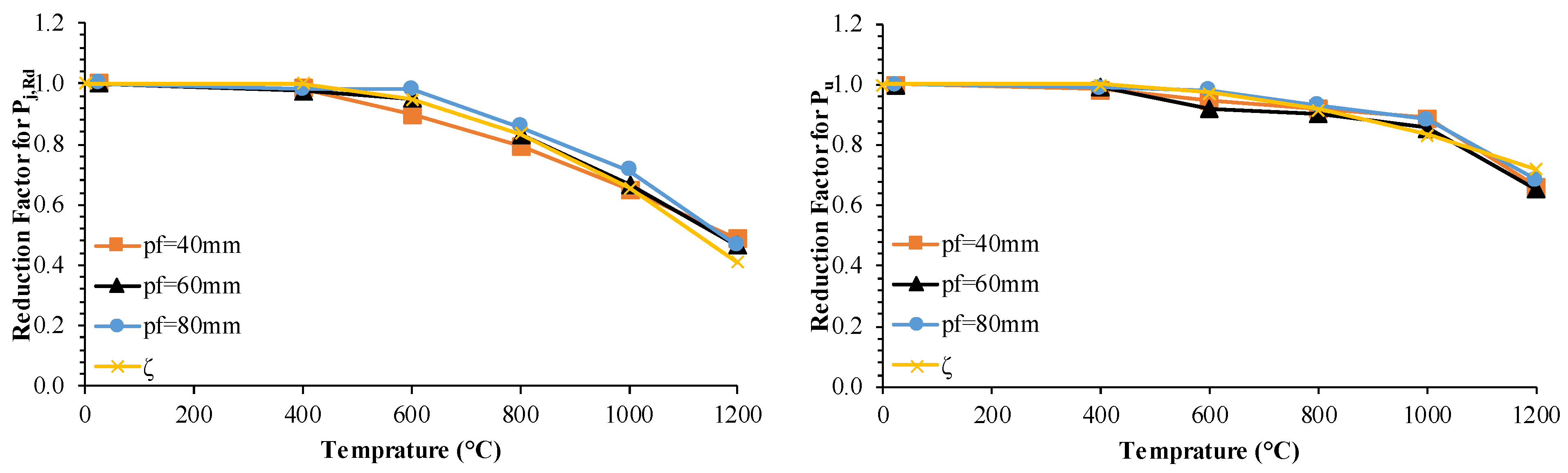
Figure 18 and Figure 19 show the reduction factors for the specimens with M16 and M24 bolts, respectively. The reduction factor was obtained by dividing the capacities of the specimens exposed to elevated temperature by the capacity of the reference specimen (specimen with ambient conditions). Moreover, the proposed reduction factors computed from Equations (8)–(11) are also added to these figures. These figures demonstrate that the proposed reduction factors can capture the effects of post-elevated temperature.
The accuracy of the proposed reduction factor regressions was verified statistically. The coefficient of determination (R2) values were found to be 0.973 for the plastic capacity reduction (ξp) and 0.958 for the ultimate capacity reduction (ξu), indicating that the equations capture more than 95–97% of the experimental variance. The corresponding root mean square errors (RMSE) were 0.030 and 0.023, respectively, which correspond to an average prediction deviation below 3%. These results confirm that the proposed expressions provide an excellent fit to the experimental data, ensuring reliable use of the reduction factors in post-fire design calculations.
The proposed temperature-dependent reduction factors (ξp and ξu) provide a simple, code-compatible means of incorporating post-fire strength degradation into the standards. When multiplied by the ambient-temperature design resistance, they allow engineers to estimate the residual plastic and ultimate capacities of fire-exposed T-stubs without altering the underlying design equations. Statistical verification (R2 ≈ 0.97, RMSE ≈ 0.03) confirms a high level of predictive confidence and a remaining safety margin of about 8–10 % below the experimental mean.

4.4. Ductility

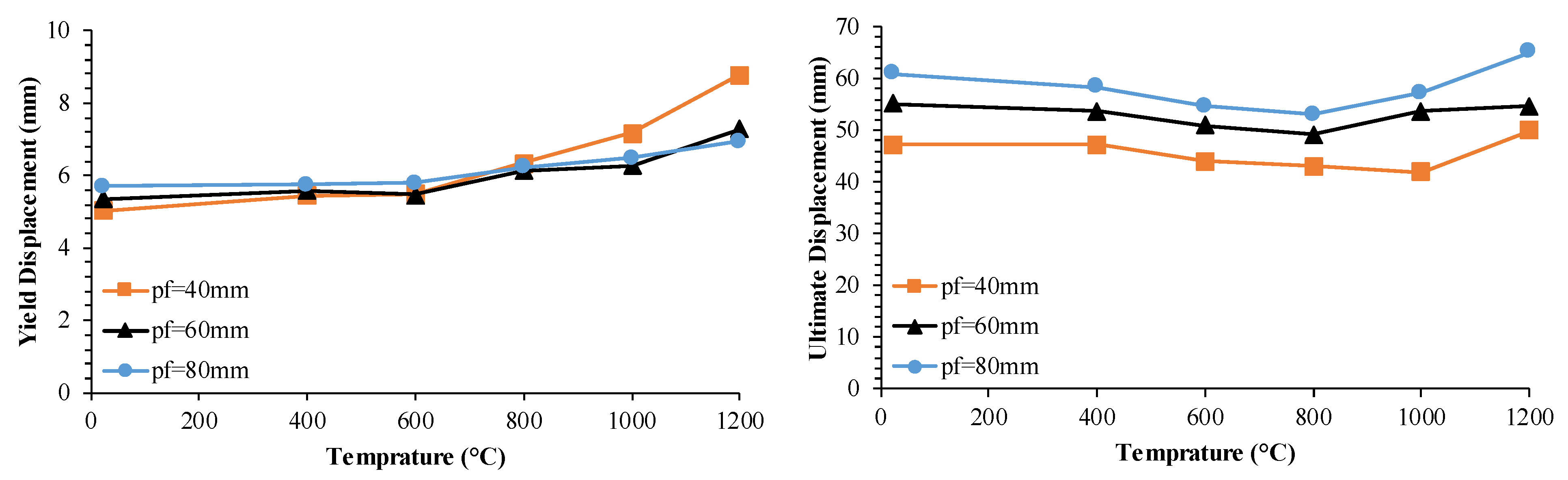
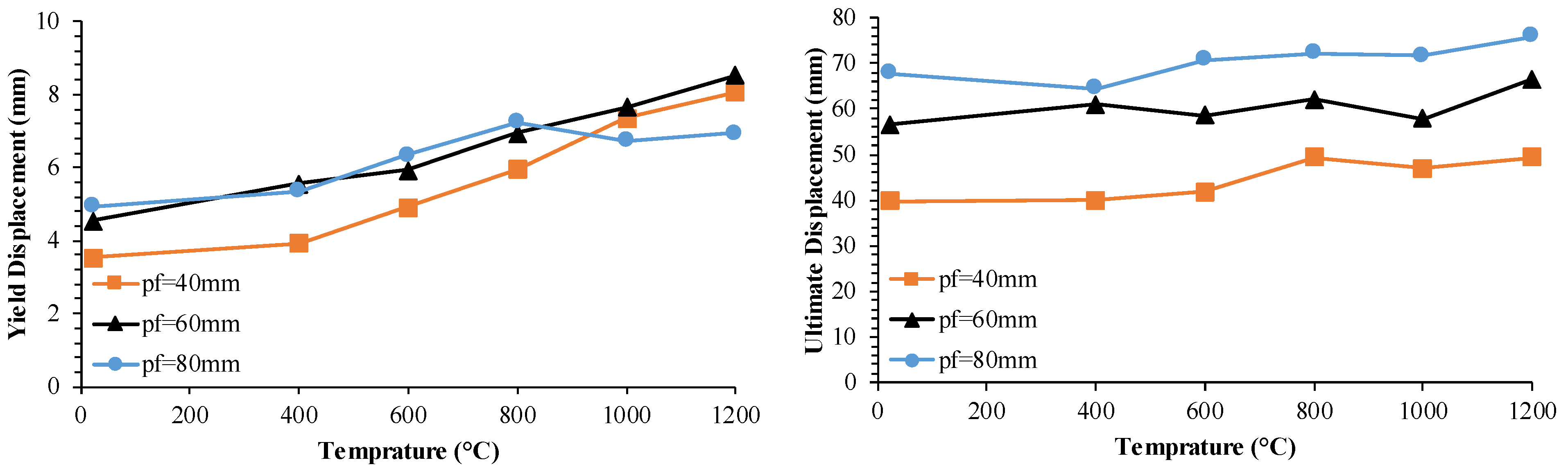
The yield displacement is defined as the displacement at which plastic behavior occurs. The ultimate displacement is defined as the point at which the load reduces below 85% of the ultimate capacity. The yield and ultimate displacements for the specimens with M16 and M24 bolts are shown in Figure 20 and Figure 21, respectively. It is seen that the specimens with a pf of 80 mm exhibited the highest ultimate displacement capacity, while those with a pf of 40 mm exhibited the lowest. No direct relation with pf was detected for the yield displacement. A general trend is observed that as the applied elevated temperature increases, the yield displacement increases for the yield displacement. For the ultimate displacement, no direct relation with the applied temperature was observed. The yield displacements of the specimens with M16 bolts are higher than those of the specimens with M24 bolts.
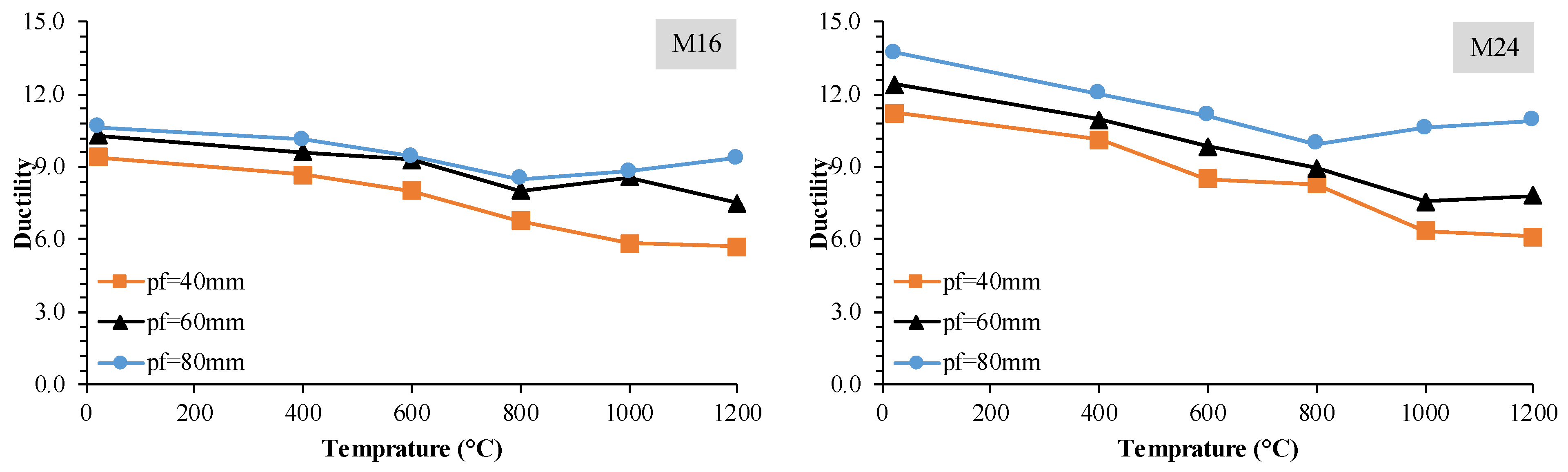
A ductility factor was calculated by dividing the plastic displacement by the ultimate displacement. The calculated ductility factor is depicted in Figure 22. For the reference specimens with M24 bolts, the ductility values of pf of 40 mm, 60 mm, and 80 mm are 11.21, 12.39, and 13.71, respectively. These values decreased to 6.12, 7.80, and 10.92 when the specimens were exposed to 1200 °C. It is generally observed that as the temperature increases, the ductility decreases. The highest ductility was observed in specimens with a pf of 80 mm, while the lowest ductility was observed in specimens with a pf of 40 mm. The ductility decreased as the value of pf decreased. The specimens with M24 bolts exhibited higher ductility than the specimens with M16 bolts.

4.5. Statistical Analysis

According to the results of the two-factor ANOVA, both temperature and pf have a statistically significant effect on plastic capacity (Pj,Rd) in M16 and M24 specimens. For the M16 T-stub samples, F(5,10) = 24.51 and p = 2.6 × 10⁻⁵ (<0.001) were found for the temperature factor, while F(2,10) = 87.44 and p = 4.6 × 10⁻⁷ (<0.001) were obtained for the pf factor. The total sum of squares (SS) is 9924.94, of which 46.85% corresponds to the temperature factor and 67.36% to the pf factor. This indicates that both parameters contribute significantly to the variability in plastic capacity. Similar statistical trends were observed in the M24 T-stub samples. The values obtained were F(5,10) = 16.22 and p = 1.6 × 10⁻⁴ (<0.001) for the temperature factor and F(2,10) = 152.85 and p = 3.2 × 10⁻⁸ (<0.001) for the pf factor. The total sum of squares for the M24 samples was 30667.78, of which 20.4% corresponded to the temperature factor and 77.1% to the pf factor. The mean square (MS) values were found to be 38.23 for M16 and 77.29 for M24, indicating low within-group variance. This statistical analysis confirms that, at a 95% confidence level, both the temperature and pf factors have significant main effects on plastic capacity (Pj,Rd) in the M16 and M24 configurations, and that random errors are not dominant in the total variance structure.
The results of the two-factor ANOVA indicate that both the temperature and pf factors have statistically significant effects on the ultimate capacity (Pu) values of the M16 and M24 T-stub specimens. For M16 T-stub specimens, F(5,10) = 132.15, p < 0.001 for the temperature factor, and F(2,10) = 75.13, p < 0.001 for the pf factor; for the M24 T-stub samples, the values obtained were F(5,10) = 87.91, p < 0.001 for the temperature factor, and F(2,10) = 17.33, p < 0.01 for the pf factor. However, the effect of the pf parameter on Pu does not show a linear trend. No regular increase or decrease was observed between the increase in the pf value and the ultimate capacity; the highest average Pu value was obtained at pf = 60 mm. This situation indicates that pf affects the connection behavior, but the effect is not monotonic; rather, it has a quadratic character. Therefore, even though the pf factor is statistically significant in the ANOVA analysis, this effect should not be interpreted as a direct proportional relationship.

5. Proposed Calculations of T-Stubs After Post-Fire

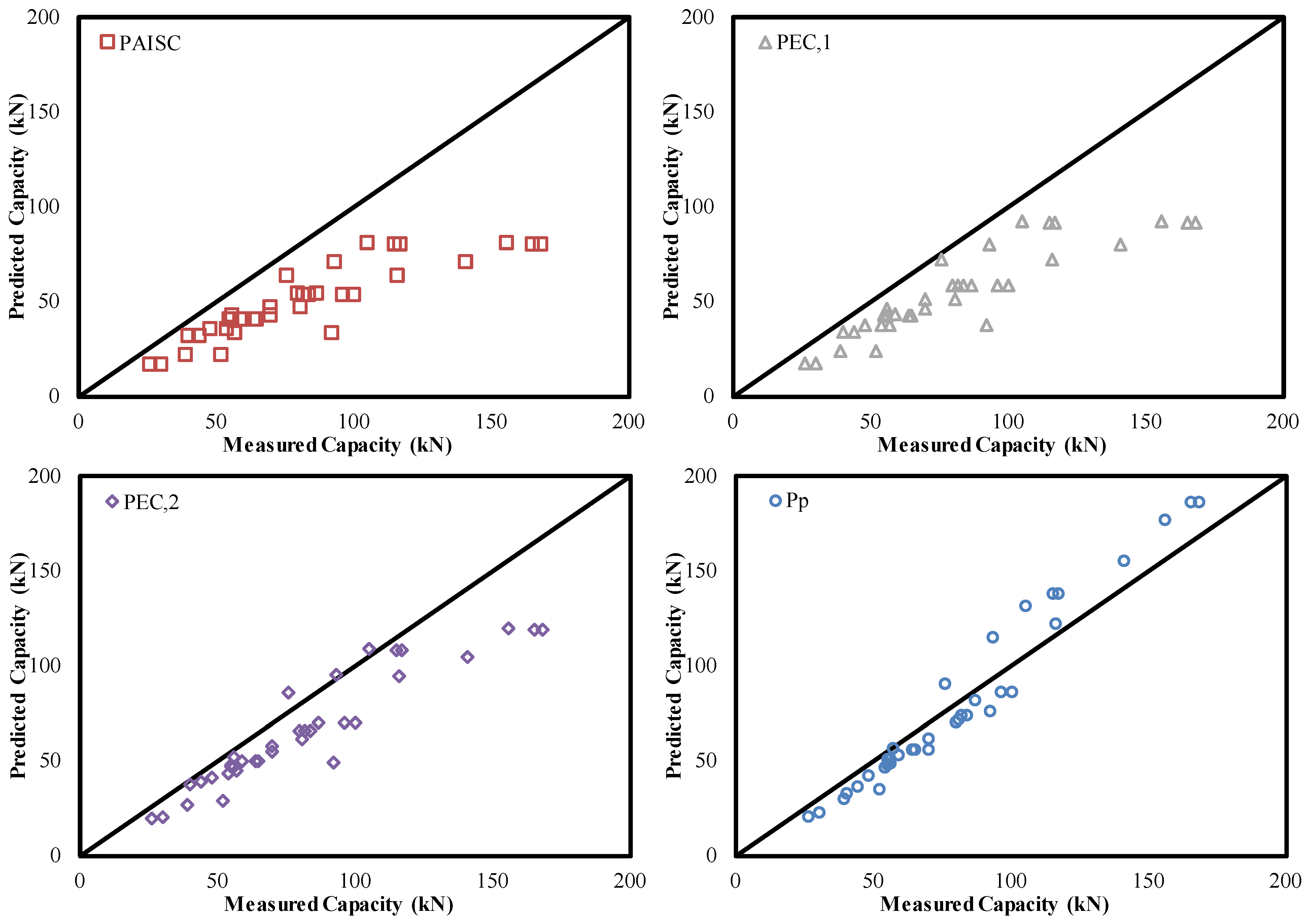
The capacity of T-stubs was calculated using the methods given in Section 2. The yield strength of the materials obtained from the coupon tests was utilized while using the methods given in AISC and Eurocode. In other words, the actual yield strength of the flange exposed to elevated temperature was used to calculate the post-fire capacity of the T-stubs. Table 6 shows the calculated capacities from AISC (PAISC), Eurocode Method 1 (PEC,1), and Eurocode Method 2 (PEC,2). These capacities were compared with the plastic strength of the T-stub (Pj,Rd). The average ratio of Pj,Rd to PAISC for 18 specimens with M24 bolts is 1.84. The maximum, minimum, and standard deviation of Pj,Rd/PAISC are 2.79, 1.38, and 0.33. On the other hand, the average ratio of Pj,Rd to PEC,1 for 18 specimens with M24 bolts is 1.67. The maximum, minimum, and standard deviation of Pj,Rd/PEC,1 are 2.45, 1.30, and 0.27. The average ratio changes to 1.37 for the case PEC,2. The maximum, minimum, and standard deviation of Pj,Rd/PEC,2 are 1.88, 1.12, and 0.19. These ratios change for the specimens with M16 bolts. The average ratio of Pj,Rd to PAISC for 18 specimens with M16 bolts is 1.44. The maximum, minimum, and standard deviation of the (Pj,Rd/PAISC) are 1.77, 1.19, and 0.15. The average ratio of Pj,Rd to PEC,1 for 18 specimens with M16 bolts is 1.31. Maximum, minimum, and standard deviation values of Pj,Rd/PEC,1 are 1.63, 1.05, and 0.14. The average ratio changes to 1.16 in the case of PEC 2. The maximum, minimum, and standard deviation of Pj,Rd/PEC,2 are 1.45, 0.89, and 0.15.
The ratios given above show that the current standards underestimate the plastic capacities of unstiffened T-stubs. The difference between the actual and predicted capacities can be attributed to several factors. First, the component method adopted in Eurocode assumes simplified yield line mechanisms with hinge locations fixed at idealized positions. In practice, however, the yield lines observed in the experiments developed at slightly different positions, leading to a shorter effective lever arm and higher resistance. Second, both AISC and Eurocode neglect the contribution of strain hardening and membrane effects, which were clearly observed in the experiments at large deformations. These effects increased the actual plastic capacity beyond the code predictions. Moreover, to account for the effects of elevated post-temperature, a reduction factor should be implemented. The proposed calculation by Özkılıç [11] is modified with a reduction factor. Equation (12) is proposed for the calculation of unstiffened T-stubs after exposure to elevated temperature.
P P = ξ p F y t p 2 b p p f 0.75 d b 0.8 t w
where ξ p is defined in Equations (7) and (8).
The ratios of Pj,Rd to Pp are given in Table 5. For 36 specimens, the average, maximum, minimum, and standard deviation ratios of Pj,Rd to PAISC is 1.64, 2.79, 1.19, and 0.33. On the other hand, the average ratio of Pj,Rd to PEC,1 for all specimens is 1.49, 2.45, 1.05, and 0.28. These ratios are modified to 1.26, 1.88, 0.89, and 0.2 for the case of PEC,2. When the proposed modifications are utilized, the average, maximum, minimum, and standard deviation ratios of Pj,Rd to PP change to 1.08, 1.47, 0.80, and 0.16. Figure 23 compares the measured and computed capacities.

6. Conclusions

Within the scope of the study, 36 T-stubs were tested. A total of 30 of them were exposed to high temperature, while 6 were not subjected to high temperature. The temperature values were selected as 400 °C, 600 °C, 800 °C, 1000 °C, and 1200 °C. The values for the distance from the bolt row to the stem of the T-stub (pf) were selected as 40 mm, 60 mm, and 80 mm. The results obtained within the scope of the study can be summarized as follows:
  • Increasing the value of pf resulted in a significant reduction in the plastic capacity. On the other hand, a direct relationship between pf and ultimate capacity was not detected. These results are aligned with the findings given in the literature [11,23,24].
  • As the pf value or the applied elevated temperature increases, the Pu/Pj,Rd ratios increase.
  • No significant change in either plastic or ultimate capacity was observed up to 400 °C. After this temperature, the plastic and ultimate capacity decrease as the applied elevated temperature increases. Especially at the applied elevated temperature of either 1000 °C or 1200 °C, a significant reduction in the plastic and ultimate capacity was observed. It should also be noted that the effects of elevated temperature are more dramatic on the plastic capacity.
  • As the pf value increases, the ultimate displacement capacity increases. A direct relation was not observed between the pf and the yield displacement.
  • A general trend observed is that the yield displacement increases as the applied elevated temperature rises. For ultimate displacement, no direct relation with the applied temperature was observed.
  • It is generally observed that the ductility decreases as the applied elevated temperature increases. On the other hand, the ductility increases as the value of pf increases.
  • The average ratios of Pj,Rd to PAISC, PEC,1, and PEC,2 are 1.64, 1.49, and 1.26. These ratios show that the current standards underestimate the capacities. A modified calculation is proposed to obtain more accurate results, as well as account for conditions following elevated temperature exposure. The average ratio of Pj,Rd to PP is computed as 1.08.
  • Reduction factors for both plastic and ultimate capacities were proposed in order to take into account the effects of post-elevated temperature effects. The proposed reduction factors are capable of predicting the effects of post-elevated temperature exposure.
  • The findings demonstrate that unstiffened T-stubs may retain significant residual strength even after exposure to elevated temperatures (≥600 °C). This highlights the potential possibility of repair and reuse of fire-damaged steel joints, rather than automatic demolition, provided that appropriate post-fire assessment and safety checks are performed.

7. Limitations of the Study and Future Works

The present study represents a component-level investigation focused on the post-fire performance of the flange portion of unstiffened T-stubs. The bolts and nuts were intentionally kept at ambient conditions to isolate the effects of flange material degradation and to ensure consistent Mode 1 failure. Consequently, the derived reduction factors are applicable to the flange component of T-stubs and should be combined with standard post-fire assessments of bolt strength and pretension loss when evaluating complete joints.
These findings provide reliable baseline data for post-fire analytical modeling and design calibration, but further research involving fully heated assemblies and combined thermal–mechanical loading is necessary to generalize the conclusions to full connection behavior. Despite these limitations, the proposed framework offers a valuable first step toward developing practical post-fire assessment procedures for thin-plated steel connections.
Therefore, any recommendation for repair or reuse should be limited to the flange component and supported by further experimental work involving fully heated assemblies, where the combined effects of bolt degradation, loss of pretension, and contact behavior are captured. Future research should extend these findings to complete connection systems to confirm their overall post-fire performance. Furthermore, the future studies should focus on extending these relationships to stiffened configurations, different failure modes, and cyclic or combined loading scenarios.

Funding

The study was supported by the Necmettin Erbakan University with the project coded 221219023.

Data Availability Statement

The data presented in this study are available on request from the corresponding author.

Conflicts of Interest

The author declares no conflicts of interest.

References

  1. Qiang, X.; Jiang, X.; Bijlaard, F.S.; Kolstein, H.; Luo, Y. Post-fire behaviour of high strength steel endplate connections—Part 1: Experimental study. J. Constr. Steel Res. 2015, 108, 82–93. [Google Scholar] [CrossRef]
  2. Özkılıç, Y.O. Cyclic and monotonic performance of unstiffened extended end-plate connections having thin end-plates and large-bolts. Eng. Struct. 2023, 281, 115794. [Google Scholar] [CrossRef]
  3. Özkılıç, Y.O. Cyclic and monotonic performance of stiffened extended end-plate connections with large-sized bolts and thin end-plates. Bull. Earthq. Eng. 2022, 20, 7441–7475. [Google Scholar] [CrossRef]
  4. Sarfarazi, S.; Shamass, R.; Della Corte, G.; Guarracino, F. Assessment of Design Approaches for Stainless-Steel Joints Through an Equivalent FE Modelling Technique. ce/papers 2022, 5, 271–281. [Google Scholar] [CrossRef]
  5. Wang, P.; You, Y.; Wang, Q.; Gu, H.; Wang, G.; Liu, Y.; Liu, F. Post-fire tensile behavior of hole-anchored bolted T-stub connection. J. Constr. Steel Res. 2021, 187, 106941. [Google Scholar] [CrossRef]
  6. Bezerra, L.M.; Bonilla, J.; Freitas, C.S.; Massicotte, B. Behavior of T-stub steel connections bolted to rigid bases. J. Constr. Steel Res. 2022, 192, 107242. [Google Scholar] [CrossRef]
  7. Bezerra, L.M.; Bonilla, J.; Silva, W.A.; Matias, W.T. Experimental and numerical studies of bolted T-stub steel connection with different flange thicknesses connected to a rigid base. Eng. Struct. 2020, 218, 110770. [Google Scholar] [CrossRef]
  8. Khani, R.; Hosseinzadeh, Y.; Asl Hoseinzadeh, M. Investigating the prying force magnitude and location in the T-stub connection based on the energy method. Eng. Struct. 2023, 280, 115655. [Google Scholar] [CrossRef]
  9. Özkılıç, Y.O.; Topkaya, C. The plastic and the ultimate resistance of four-bolt extended end-plate connections. J. Constr. Steel Res. 2021, 181, 106614. [Google Scholar] [CrossRef]
  10. Zhao, X.; He, S.; Yan, S. Full-range behaviour of T-stubs with various yield line patterns. J. Constr. Steel Res. 2021, 186, 106919. [Google Scholar] [CrossRef]
  11. Özkılıç, Y.O. The capacities of unstiffened T-stubs with thin plates and large bolts. J. Constr. Steel Res. 2021, 186, 106908. [Google Scholar] [CrossRef]
  12. Huang, X.; Li, R.; Zhang, X.; Ge, J.; Zhao, J. Ultra low cycle fatigue behavior of Q690 high-strength steel welded T-stub joints: Experiments and fracture prediction analysis. Thin-Walled Struct. 2023, 191, 111054. [Google Scholar] [CrossRef]
  13. Chen, Z.; Gao, F.; Wang, Z.; Lin, Q.; Huang, S.; Ma, L. Performance of Q690 high-strength steel T-stub under monotonic and cyclic loading. Eng. Struct. 2023, 277, 115405. [Google Scholar] [CrossRef]
  14. Lin, T.; Wang, Z.; Hu, F.; Hou, W. Comparison in tensile behaviour of conventional and high-strength steel welded-plate preloaded T-stubs. Structures 2022, 43, 93–104. [Google Scholar] [CrossRef]
  15. Yuan, H.X.; Liu, X.; Liu, J.; Theofanous, M. Cyclic behaviour and hysteretic model of austenitic stainless steel bolted T-stubs. J. Constr. Steel Res. 2021, 182, 106659. [Google Scholar] [CrossRef]
  16. Yapici, O. Advanced finite element modelling of stainless steel bolted T-stubs under large deformations. Structures 2023, 58, 105461. [Google Scholar] [CrossRef]
  17. Yapici, O.; Theofanous, M.; Yuan, H.; Skalomenos, K.; Dirar, S. Experimental study of ferritic stainless steel bolted T-stubs under monotonic loading. J. Constr. Steel Res. 2021, 183, 106761. [Google Scholar] [CrossRef]
  18. Yapici, O.; Theofanous, M.; Afshan, S.; Yuan, H.; Dirar, S. Numerical modelling of stainless steel bolted T-stubs in tension. Thin-Walled Struct. 2022, 177, 109432. [Google Scholar] [CrossRef]
  19. Zhao, Y.; Guo, C.; Wang, Z.; Ye, J.; Cheng, J. Testing and numerical analysis of WAAM stainless steel T-stub connections. J. Constr. Steel Res. 2025, 227, 109374. [Google Scholar] [CrossRef]
  20. Guo, X.; Kyvelou, P.; Ye, J.; Gardner, L. Experimental investigation of wire arc additively manufactured steel T-stub connections. J. Constr. Steel Res. 2023, 211, 108106. [Google Scholar] [CrossRef]
  21. Dai, X.; Ye, J.; Lu, H.; Quan, G.; Liu, N.; Wang, Z.; Zhao, Y. Behaviour and design of wire and arc additively manufactured steel T-stub connections. Structures 2025, 76, 109044. [Google Scholar] [CrossRef]
  22. Kendall, G.; Belyi, A.; Elkady, A. Experimental investigation of welded steel T-stub components under high loading rates. J. Constr. Steel Res. 2024, 220, 108851. [Google Scholar] [CrossRef]
  23. Özkılıç, Y.O. The effects of stiffener configuration on stiffened T-stubs. Steel Compos. Struct. Int. J. 2022, 44, 489–502. [Google Scholar]
  24. Özkılıç, Y.O. The capacities of thin plated stiffened T-stubs. J. Constr. Steel Res. 2021, 186, 106912. [Google Scholar] [CrossRef]
  25. RasouliTabar, M.; TahamouliRoudsari, M.; Memarzadeh, P.; Fathi, F. Experimental Study of the Effect of Using Stiffener in T-stub Steel Connections Under Cyclic Loading. J. Struct. Constr. Eng. 2025, 12, e209070. [Google Scholar]
  26. Liu, X.-C.; Zhu, Y.-N.; Chen, X.; Li, Y.-M. Seismic performance of bolted double-web T-stub connections with T-shaped steel column. J. Constr. Steel Res. 2022, 191, 107168. [Google Scholar] [CrossRef]
  27. Wang, M.; Dong, K.; Liu, M. Damage control mechanism and seismic performance of a steel moment connection with replaceable low-yield-point steel double T-stub fuses. Thin-Walled Struct. 2020, 157, 107143. [Google Scholar] [CrossRef]
  28. Wang, P.; Sun, L.; Xia, C.; Gu, H.; Liu, Y.; Liu, M.; Liu, F. Cyclic behavior of T-stub connection to hollow section steel column using TSOBs. J. Constr. Steel Res. 2021, 185, 106874. [Google Scholar] [CrossRef]
  29. Oliveira, S.; Costa, R.; Santos, A.F.; da Silva, L.S.; Harada, Y.; Piluso, V. A decoupled T-stub component model for the cyclic modelling of steel joints. J. Constr. Steel Res. 2023, 209, 108044. [Google Scholar] [CrossRef]
  30. Li, T.; Men, J.; Zhang, Q.; Li, J.; Huang, C.-H. Seismic fragility and resilience assessment of steel frame with replaceable T-stub connection components. Eng. Struct. 2024, 314, 118396. [Google Scholar] [CrossRef]
  31. Shen, Y.; Li, M.; Li, Y. A reliable cyclic envelope model for partially-restrained steel beam-column bolted T-stub connections based on experimental data. Thin-Walled Struct. 2024, 200, 111951. [Google Scholar] [CrossRef]
  32. Rasoulitabar, M.; TahamoliRoudsari, M.; Memarzadeh, P.; Fathi, F. Experimental investigation of the cyclic behavior of bolted T-stub steel connections. Steel Compos. Struct. 2025, 55, 397. [Google Scholar]
  33. Men, J.; Li, T.; Zhou, Q.; Zhang, H.; Huang, C.-H. Structural fuse performance and earthquake-resilient performance of beam-column joints with replaceable T-stub. J. Constr. Steel Res. 2023, 206, 107943. [Google Scholar] [CrossRef]
  34. Liu, X.; Hao, Z.; Luo, X.; Jin, Z. Experimental Behavior and Modelling of Steel Bolted T-Stub Connections. Buildings 2023, 13, 575. [Google Scholar] [CrossRef]
  35. Hu, D.; Papadopoulos, J.; Adams, G.G. Prying action in an elastic T-stub tensile connection. J. Constr. Steel Res. 2020, 169, 106027. [Google Scholar] [CrossRef]
  36. Zhang, Y.; Gao, S.; Guo, L.; Fu, F.; Wang, S. Ultimate tensile behavior of bolted stiffened T-stub connections in progressive collapse resistance. J. Constr. Steel Res. 2022, 189, 107111. [Google Scholar] [CrossRef]
  37. Wang, Y.; Sun, L.; Wang, P.; Hou, G.; Cai, X.; He, M. Feasibility study of TSOB replacing standard high-strength bolt in T-stub connection. Structures 2024, 62, 106246. [Google Scholar] [CrossRef]
  38. Jiang, B.; Duan, L.; Lin, S.; Zhu, Y.; Liu, J.; Zhao, J. Mechanical performance and design method of a stiffened T-stub with four-row bolts and oversized holes. Eng. Struct. 2025, 329, 119842. [Google Scholar] [CrossRef]
  39. Lyu, J.; Yan, S.; He, S.; Zhao, X.; Rasmussen, K. Mechanical model for the full range behaviour of bolted T-stubs. J. Constr. Steel Res. 2023, 200, 107652. [Google Scholar] [CrossRef]
  40. Zhang, Y.; Gao, S.; Guo, L.; Qu, J.; Wang, S. Ultimate tensile behavior of bolted T-stub connections with preload. J. Build. Eng. 2022, 47, 103833. [Google Scholar] [CrossRef]
  41. Faralli, A.C.; Latour, M.; Tan, P.; Rizzano, G.; Wrobel, P. Experimental investigation and modelling of T-stubs undergoing large displacements. J. Constr. Steel Res. 2021, 180, 106580. [Google Scholar] [CrossRef]
  42. Francavilla, A.B.; Latour, M.; Rizzano, G. Ultimate behaviour of bolted T-stubs under large displacements: A mechanical model. J. Constr. Steel Res. 2022, 195, 107355. [Google Scholar] [CrossRef]
  43. Haggag, M.; Elruby, A.; Ismail, M.K.; AbdelAleem, B.H.; El-Dakhakhni, W. Failure mode and capacity prediction for bolted T-stub connections using ensemble learning. J. Constr. Steel Res. 2024, 212, 108288. [Google Scholar] [CrossRef]
  44. Grubits, P.; Balogh, T.; Movahedi, M. Rad Optimization of Bolted Steel T-Stub Connection Based on Nonlinear Finite Element Analysis Using Genetic Algorithm. Infrastructures 2025, 10, 8. [Google Scholar] [CrossRef]
  45. Shen, Y.; Li, M.; Li, Y. Surrogate-based calibration and prediction of hysteretic model parameters for steel beam-column bolted T-stub connections. J. Build. Eng. 2025, 103, 112082. [Google Scholar] [CrossRef]
  46. ACI Committee 130. ACI 130R-19 Report on the Role of Materials in Sustainable Concrete Construction; American Concrete Institute: Farmington Hills, MI, USA, 2019. [Google Scholar]
  47. Gao, F.; Liu, Z.; Guan, X. Fire resistance behavior of T-stub joint components under transient heat transfer conditions. Eng. Struct. 2021, 237, 112164. [Google Scholar] [CrossRef]
  48. Der, B.; Wald, F.; Vild, M. Numerical Design Calculation of T-stubs at Elevated Temperatures. Fire Technol. 2024, 61, 541–562. [Google Scholar] [CrossRef]
  49. Spyrou, S.; Davison, J.; Burgess, I.; Plank, R. Experimental and analytical investigation of the ‘tension zone’ components within a steel joint at elevated temperatures. J. Constr. Steel Res. 2004, 60, 867–896. [Google Scholar] [CrossRef]
  50. Barata, P.; Ribeiro, J.; Rigueiro, C.; Santiago, A.; Rodrigues, J.P. Assessment of the T-stub joint component at ambient and elevated temperatures. Fire Saf. J. 2014, 70, 1–13. [Google Scholar] [CrossRef]
  51. Li, Y.; Zhao, J. Mechanical model and finite element analyses of the T-stub joint component in fire. Adv. Struct. Eng. 2017, 20, 1828–1844. [Google Scholar] [CrossRef]
  52. Maljaars, J.; De Matteis, G. Structural response of aluminium T-stub connections at elevated temperatures and fire. Key Eng. Mater. 2016, 710, 127–136. [Google Scholar] [CrossRef]
  53. Heidarpour, A. and M.A. Bradford, Behaviour of a T-stub assembly in steel beam-to-column connections at elevated temperatures. Eng. Struct. 2008, 30, 2893–2899. [Google Scholar] [CrossRef]
  54. Wang, W.; Fang, H.; Wang, Z. Comprehensive studies on the behaviors of high strength steel T-stubs with thin-walled flange at elevated temperatures. Thin-Walled Struct. 2023, 190, 110998. [Google Scholar] [CrossRef]
  55. Qiang, X.; Shu, Y.; Jiang, X. Mechanical behaviour of high strength steel T-stubs at elevated temperatures: Experimental study. Thin-Walled Struct. 2023, 182, 110314. [Google Scholar] [CrossRef]
  56. You, Y.; Liu, M.; Liu, Y.; Wang, P.; Zhou, S.; Chen, J. Experimental studies on thread-fixed one-side bolted T-stubs in tension at elevated temperatures. J. Constr. Steel Res. 2020, 171, 106139. [Google Scholar] [CrossRef]
  57. Both, I.; Duma, D.; Dinu, F.; Dubina, D.; Zaharia, R. The influence of loading rate on the ultimate capacity of bolted T-stubs at ambient and high temperature. Fire Saf. J. 2021, 125, 103438. [Google Scholar] [CrossRef]
  58. Cho, Y.; Teh, L.H.; Young, B.; Ahmed, A. Net section tension strength of bolted connections in ultra-high strength sheet steel during and after fire. J. Constr. Steel Res. 2020, 172, 106237. [Google Scholar] [CrossRef]
  59. Dhamane, S.; Mushahary, S.K.; Singh, K.D. Experimental study on S700 T-stub in heating and cooling during fire. Thin-Walled Struct. 2024, 195, 111342. [Google Scholar] [CrossRef]
  60. Ribeiro, J.; Santiago, A.; Rigueiro, C. Post-impact fire resistance of T-stub joint component, Numerical evaluation. In Proceedings of the Application of Structural Fire Engineering, Prague, Czech Republic, 19–20 April 2013. [Google Scholar]
  61. Ribeiro, J.; Rigueiro, C.; Santiago, A. Numerical behaviour of T-stub joint component at ambient and elevated temperatures. In Proceedings of the 2nd CISLACI, Coimbra, Portugal, 29 May–1 June 2013. [Google Scholar]
  62. Cai, Y.; Young, B. Structural behaviour of cold-formed stainless steel bolted connections at post-fire condition. J. Constr. Steel Res. 2019, 152, 312–321. [Google Scholar] [CrossRef]
  63. Sagiroglu, M. Experimental evaluation of the post-fire behavior of steel T-component in the beam-to-column connection. Fire Saf. J. 2018, 96, 153–164. [Google Scholar] [CrossRef]
  64. Qiang, X.; Shu, Y.; Jiang, X.; Xiao, Y. Nonlinear analysis on mechanical behaviour of high strength steel extended endplate connections and equivalent T-stubs in fire considering axial force. Case Stud. Constr. Mater. 2023, 19, e02402. [Google Scholar] [CrossRef]
  65. Mahmood, M.; Tizani, W.; Salman, W.D. Post-fire strength of austenitic stainless-steel T-stubs with four bolts per row. J. Constr. Steel Res. 2023, 207, 107966. [Google Scholar] [CrossRef]
  66. EN 1993-1-8; Eurocode 3: Design of Steel Structures-Part 1-8: Design of Joints. CEN: Brussels, Belgium, 2005.
  67. Tartaglia, R.; D’Aniello, M.; Zimbru, M. Experimental and numerical study on the T-Stub behaviour with preloaded bolts under large deformations. Structures 2020, 27, 2137–2155. [Google Scholar] [CrossRef]
  68. Faralli, A.C. Large Deformation of T-Stub Connection in Bolted Steel Joints. Doctoral Dissertation, UCL (University College London), London, UK, 2019. [Google Scholar]
  69. Zhao, M.S.; Lee, C.K.; Chiew, S.P. Tensile behavior of high performance structural steel T-stub joints. J. Constr. Steel Res. 2016, 122, 316–325. [Google Scholar] [CrossRef]
  70. Zhang, Y.; Liu, M.; Ma, Q.; Liu, Z.; Wang, P.; Ma, C.; Sun, L. Yield line patterns of T-stubs connected by thread-fixed one-side bolts under tension. J. Constr. Steel Res. 2020, 166, 105932. [Google Scholar] [CrossRef]
  71. Sebbagh, H.R.; Kerdal, D.E.D.; Abidelah, A.; Bouchaïr, A. T-stubs with two and four bolts under monotonic and cyclic loading. J. Constr. Steel Res. 2021, 178, 106486. [Google Scholar] [CrossRef]
  72. Chen, C.; Zhang, X.; Zhao, M.; Lee, C.K.; Fung, T.C.; Chiew, S.P. Effects of welding on the tensile performance of high strength steel T-stub joints. Structures 2017, 9, 70–78. [Google Scholar] [CrossRef]
  73. Liang, G.; Guo, H.; Liu, Y.; Li, Y. Q690 high strength steel T-stub tensile behavior: Experimental and numerical analysis. Thin-Walled Struct. 2018, 122, 554–571. [Google Scholar] [CrossRef]
  74. ANSI/AISC 358-16; Prequalified Connections for Special and Intermediate Steel Moment Frames for Seismic Applications. American Institute of Steel Construction: Chicago, IL, USA, 2016.
  75. Murray, T.M.; Sumner, E.A. Design Guide 4: Extended End-Plate Moment Connections Seismic and Wind Applications; American Institute of Steel Construction: Chicago, IL, USA, 2003. [Google Scholar]
  76. Murray, T.M.; Shoemaker, W.L. Flush and Extended Multiple-Row Moment End-Plate Connections; American Institute of Steel Construction: Chicago, IL, USA, 2002. [Google Scholar]
  77. Khani, R.; Hosseinzadeh, Y.; D’Aniello, M.; Asl, M.H. Nonlinear response of coupled and tied-to-rigid base T-stub connections. J. Constr. Steel Res. 2024, 215, 108550. [Google Scholar] [CrossRef]
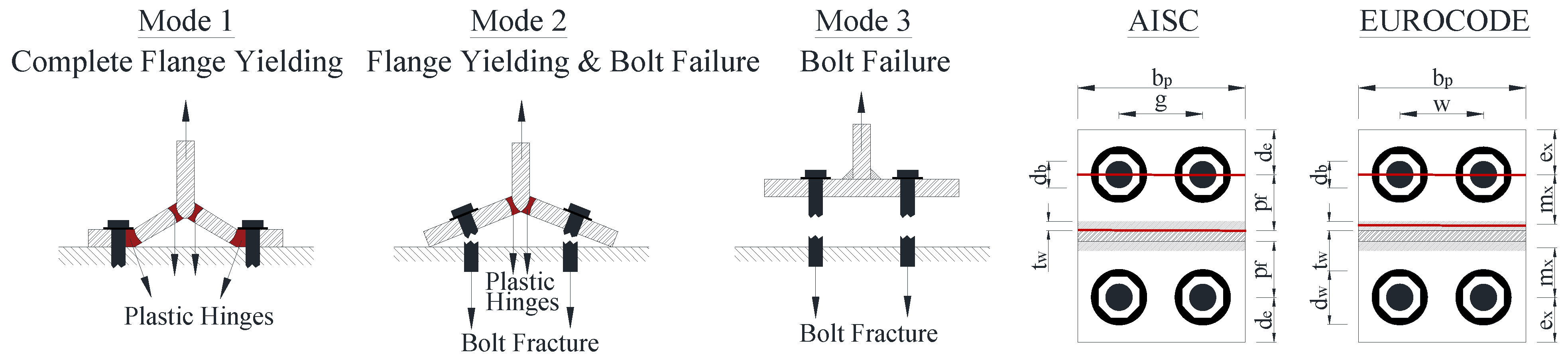
Figure 1. Failure modes of T-stubs and definition of parameters (adapted from [11]).
Buildings 15 04113 g001
Figure 2. Typical load displacement response behavior of T-stubs.
Buildings 15 04113 g002
Figure 3. Dimension of T-stubs.
Buildings 15 04113 g003
Figure 4. Unheated and heated unstiffened T-stubs.
Buildings 15 04113 g004
Figure 5. Stress displacement curves of the coupons.
Buildings 15 04113 g005
Figure 6. Test setup.
Buildings 15 04113 g006
Figure 7. Failure mechanism according to Eurocode.
Buildings 15 04113 g007
Figure 8. Failure Mode 1 with bolt failure.
Buildings 15 04113 g008
Figure 9. Failure mode 1 with flange failure.
Buildings 15 04113 g009
Figure 10. Flange failure.
Buildings 15 04113 g010
Figure 11. Simplified yield line.
Buildings 15 04113 g011
Figure 12. Load–displacement curves of the specimens with M16 bolts.
Buildings 15 04113 g012
Figure 13. Load–displacement curves of the specimens with M24 bolts.
Buildings 15 04113 g013
Figure 14. The ratio of ultimate capacity to plastic capacity (Pu/Pj,Rd).
Buildings 15 04113 g014
Figure 15. Load–displacement curves of the specimens with respect to elevated temperature.
Buildings 15 04113 g015
Figure 16. Yield and ultimate strength for specimens with M16 bolt.
Buildings 15 04113 g016
Figure 17. Yield and ultimate strength for specimens with M24 bolt.
Buildings 15 04113 g017
Figure 18. Reduction factors for specimens with M16 bolt.
Buildings 15 04113 g018
Figure 19. Reduction factors for specimens with M24 bolt.
Buildings 15 04113 g019
Figure 20. Yield and ultimate displacements for specimens with M16 bolt.
Buildings 15 04113 g020
Figure 21. Yield and ultimate displacements for specimens with M24 bolt.
Buildings 15 04113 g021
Figure 22. Ductility factors for specimens with M16 and M24 bolts.
Buildings 15 04113 g022
Figure 23. Comparison of measured and predicted capacities.
Buildings 15 04113 g023
Table 1. Parameters utilized in this study.
ParameterSymbolLevels/Values
Bolt diameterdbM16, M24
Distance from stem to bolt rowpf40 mm, 60 mm, 80 mm
Flange thicknesstf10 mm
Steel gradeS275
TemperatureT24 °C, 400 °C, 600 °C, 800 °C, 1000 °C, 1200 °C
Table 2. Material properties (in MPa).
Coupon24 °C400 °C600 °C800 °C1000 °C1200 °C
Fy268268270235212110
Fu372361356342301223
Table 3. Failure modes.
M16M24
T/pf40 mm60 mm80 mm40 mm60 mm80 mm
24 °CExcessive DeformationsBolt FailureBolt FailureFlange F. 1Flange F. 2Flange F. 1
400 °CExcessive DeformationsBolt FailureBolt FailureFlange F. 1Flange F. 1Flange F. 1
600 °CFlange F. 1Bolt FailureBolt FailureFlange F. 1Excessive DeformationsExcessive Deformations
800 °CExcessive DeformationsBolt FailureBolt FailureFlange F. 2Excessive DeformationsExcessive Deformations
1000 °CExcessive DeformationsBolt FailureBolt FailureFlange F. 1Flange F. 2Flange F. 2
1200 °CExcessive DeformationsBolt FailureBolt FailureFlange F. 2Flange F. 2Flange F. 2
Table 4. Plastic and ultimate capacities for specimens with M16 bolts.
M16Pj,RdPuPu/Pj,Rd
T/pf40 mm60 mm80 mm40 mm60 mm80 mm40 mm60 mm80 mm
24 °C11784561902031711.622.423.05
400 °C11582551872011691.632.453.07
600 °C10580551801871681.712.343.05
800 °C9370481751831591.882.623.31
1000 °C7656401691741512.223.113.78
1200 °C5739261261331172.213.414.50
Table 5. Plastic and ultimate capacities for specimens with M24 bolts.
M24Pj,RdPuPu/Pj,Rd
T/pf40 mm60 mm80 mm40 mm60 mm80 mm40 mm60 mm80 mm
24 °C168100652923183121.743.184.80
400 °C16596642913193101.763.324.84
600 °C15687592873203081.843.685.22
800 °C14181542742992781.943.695.15
1000 °C11670442612702572.253.865.84
1200 °C9252302112272052.294.376.83
Table 6. Calculated and proposed capacities.
TestBoltpfTemperaturePj,RdPAISCPEC,1PEC,2PpPj,Rd/PAISCPj,Rd/PEC,1Pj,Rd/PEC,2Pj,Rd/Pp
U1M24402416880911191872.091.841.410.90
U2M246024100545870861.871.721.441.16
U3M24802465404349561.621.521.311.16
U4M244040016580911191872.051.811.380.88
U5M246040096545870861.791.651.381.11
U6M248040064404349561.591.501.291.14
U7M244060015681921201781.931.691.300.88
U8M246060087545970821.611.481.241.06
U9M248060059414350531.461.371.181.11
U10M244080014171801041562.001.761.350.90
U11M246080081475161721.721.591.331.12
U12M248080054353843471.531.441.241.15
U13M244010001166472941221.821.611.230.95
U14M2460100070424655571.651.521.271.24
U15M2480100044323439371.381.301.121.20
U16M2440120092333849772.792.451.881.20
U17M2460120052222429352.362.171.821.47
U18M2480120030171820231.821.711.481.30
U19M16402411780911081391.461.281.080.84
U20M16602484545865741.571.441.281.13
U21M16802456404347511.391.311.191.10
U22M164040011580911081391.431.261.060.83
U23M166040082545865741.531.411.251.10
U24M168040055404347511.371.291.171.08
U25M164060010581921091321.301.140.960.80
U26M166060080545966711.481.361.211.13
U27M168060055414347481.361.281.161.14
U28M1640800937180951161.321.160.980.80
U29M166080070475157621.491.371.221.13
U30M168080048353841421.361.281.161.13
U31M1640100076647286911.191.050.890.84
U32M1660100056424652491.321.221.081.15
U33M1680100040323437331.261.181.081.20
U34M1640120057333844571.731.521.281.00
U35M1660120039222427301.771.631.451.28
U36M1680120026171819211.581.481.351.25
Disclaimer/Publisher’s Note: The statements, opinions and data contained in all publications are solely those of the individual author(s) and contributor(s) and not of MDPI and/or the editor(s). MDPI and/or the editor(s) disclaim responsibility for any injury to people or property resulting from any ideas, methods, instructions or products referred to in the content.