Article

A SWOT/TOWS Analysis of Inventory Methods for Buildings Damaged or Might Be Damaged

by
Krzysztof Zima
1,*,
Joanna Gil-Mastalerczyk
2 and
Viktor Proskuryakov
3
1
Faculty of Civil Engineering, Cracow University of Technology, Warszawska 24, 31-155 Kraków, Poland
2
Faculty of Civil Engineering and Architecture, Kielce University of Technology, Tysiąclecia Państwa Polskiego 7, 25-314 Kielce, Poland
3
Department of Architectural Environment Design, Lviv Polytechnic National University, 12 Bandery St., 79013 Lviv, Ukraine
*
Author to whom correspondence should be addressed.
Buildings 2025, 15(21), 3971; https://doi.org/10.3390/buildings15213971

Submission received: 8 June 2025 / Revised: 9 September 2025 / Accepted: 28 October 2025 / Published: 3 November 2025

Abstract

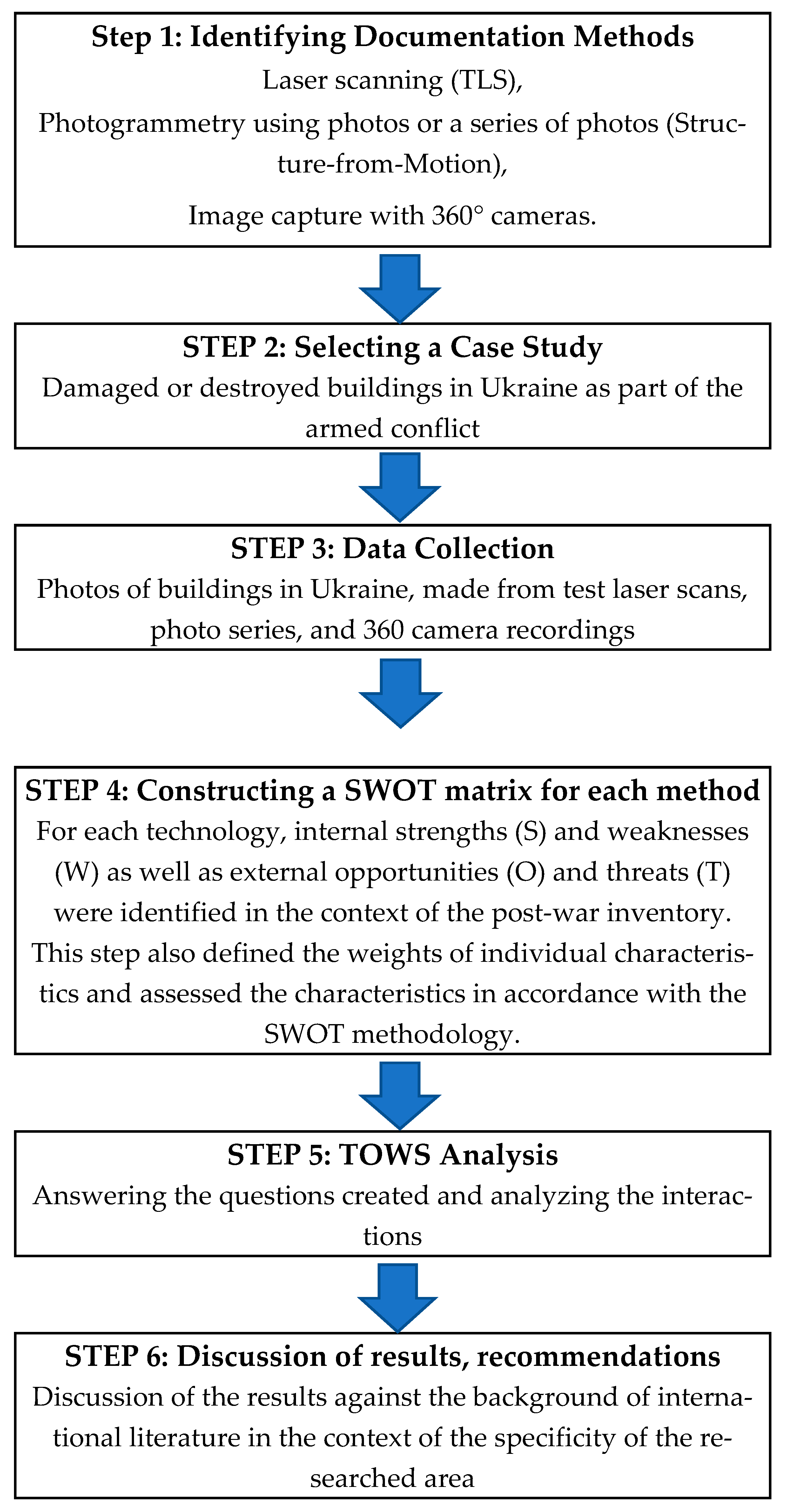
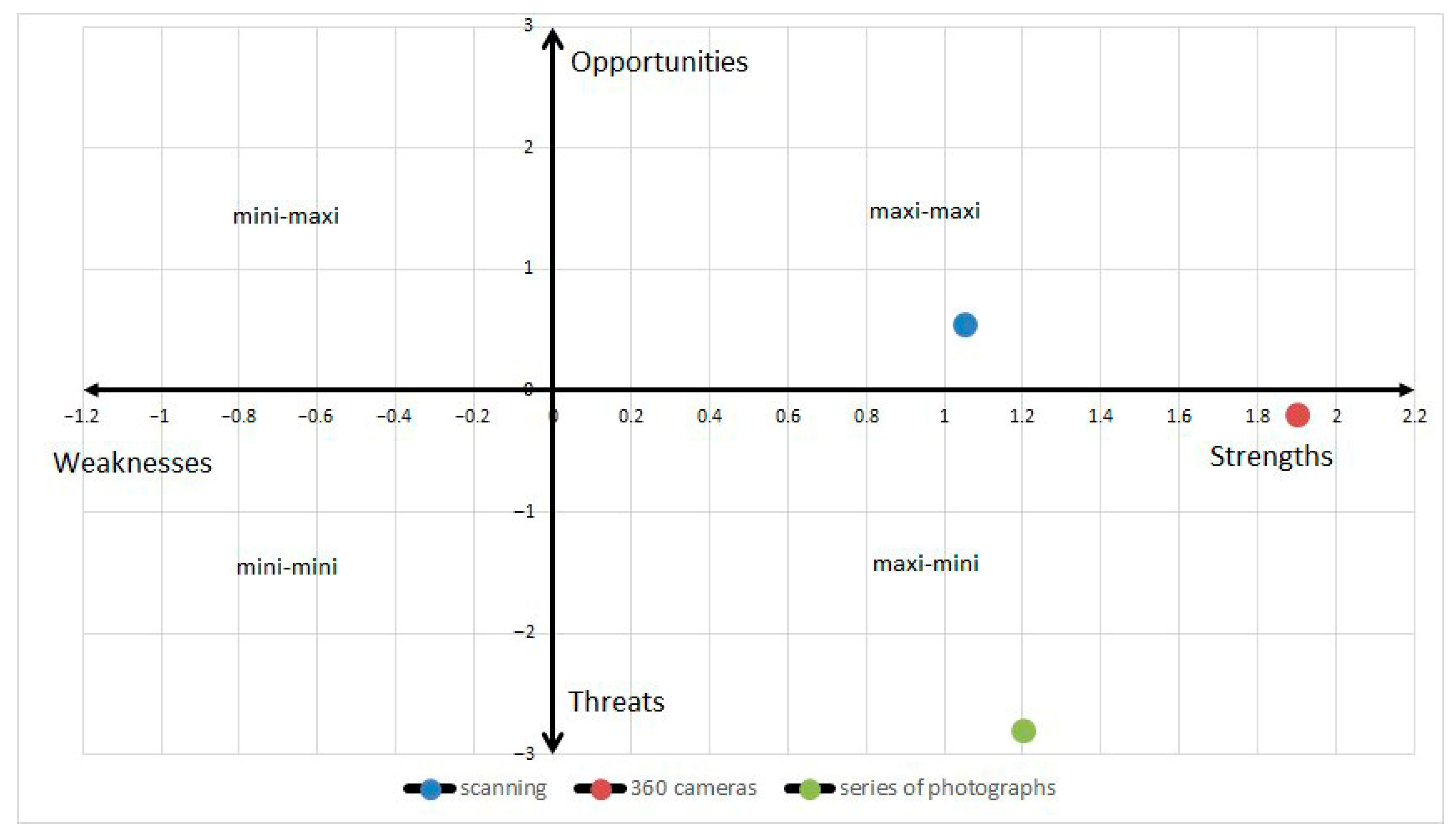
The present article focuses on the assessment of the potential advantages and disadvantages of the utilisation of modern building inventory technologies in crisis situations, using a case study of Ukraine, currently engulfed in armed conflict. The following methods are described in detail: laser scanning, 360-degree camera images, and photo series. The authors conducted an in-depth SWOT/TOWS analysis, adapted to the specifics of the post-conflict environment, with a view to the future reconstruction of damaged buildings. The originality of the study lies in the use of a modified, quantitative version of the conventional SWOT analysis, supplemented with a weighting and rating system, which allowed for a more accurate assessment of the effectiveness of various technologies, including laser scanning. While the study focuses on the Ukrainian context, the authors emphasise that the developed methodology is universal and can be successfully applied to other critical areas, such as regions affected by earthquakes, floods, fires, or technological disasters. A modified SWOT/TOWS analysis can serve as a valuable tool in crisis management and infrastructure reconstruction during emergencies, providing the data necessary for making rational and effective decisions regarding the use of modern technologies in construction. The analysis revealed that, of the analysed inventory strategies, only laser scanning technology fits the so-called “maxi-maxi” strategy, a scenario in which both internal resources and external capabilities are maximised. The remaining two strategies were designated as “maxi-mini,” signifying that their implementation is associated with elevated levels of risk despite their inherent advantages. It is imperative to acknowledge the existence of substantial external threats that persist. Nevertheless, this does not constitute a complete rejection of the concept. This study examines armed conflict as a research context for a selection of buildings in Ukraine. The analysis was constrained to the three most prevalent methods: The use of TLS, SfM, and 360-degree cameras is also a key component of the methodology.
Keywords: BIM; building inventory; laser scanning; SWOT; TOWS BIM; building inventory; laser scanning; SWOT; TOWS