Review

A Review of Transmission Line Icing Disasters: Mechanisms, Detection, and Prevention

1
Economic and Technical Research Institute of State Grid Jiangxi Electric Power Co., Ltd., Nanchang 330006, China
2
School of Civil Engineering and Architecture, Northeast Electric Power University, Jilin 132012, China
*
Author to whom correspondence should be addressed.
Buildings 2025, 15(20), 3757; https://doi.org/10.3390/buildings15203757
Submission received: 10 September 2025 / Revised: 13 October 2025 / Accepted: 16 October 2025 / Published: 17 October 2025

Abstract

Transmission line icing poses a significant natural disaster threat to power grid security. This paper systematically reviews recent advances in the understanding of icing mechanisms, intelligent detection, and prevention technologies, while providing perspectives on future development directions. In mechanistic research, although a multi-physics coupling framework has been established, characterization of dynamic evolution over complex terrain and coupled physical mechanisms remains inadequate. Detection technology is undergoing a paradigm shift from traditional contact measurements to non-contact intelligent perception. Visual systems based on UAVs and fixed platforms have achieved breakthroughs in ice recognition and thickness retrieval, yet their performance remains constrained by image quality, data scale, and edge computing capabilities. Anti-/de-icing technologies have evolved into an integrated system combining active intervention and passive defense: DC de-icing (particularly MMC-based topologies) has become the mainstream active solution for high-voltage lines due to its high efficiency and low energy consumption; superhydrophobic coatings, photothermal functional coatings, and expanded-diameter conductors show promising potential but face challenges in durability, environmental adaptability, and costs. Future development relies on the deep integration of mechanistic research, intelligent perception, and active prevention technologies. Through multidisciplinary innovation, key technologies such as digital twins, photo-electro-thermal collaborative response systems, and intelligent self-healing materials will be advanced, with the ultimate goal of comprehensively enhancing power grid resilience under extreme climate conditions.

1. Introduction

Against the backdrop of global warming, the Earth has entered a 30-year period of regional cooling within a 300-year cycle. The interplay between warm and cold climates has intensified extreme weather phenomena: while overall temperatures rise, the frequency and intensity of disasters such as cold waves and blizzards have increased significantly, leading to amplified destructive impacts [1]. Transmission line icing is a widespread natural phenomenon across the globe, particularly in cold and humid climates. Icing disasters pose a major challenge to power systems worldwide. Ice accumulation not only seriously threatens the safe operation of transmission lines, but can also trigger a chain of accidents, including wire breaks, tower collapses, flashover and collapse of insulators, and conductor galloping [2,3]. Countries such as Russia, Canada, the United States, the United Kingdom, and Norway have all experienced severe icing events, resulting in substantial economic losses [4,5,6]. Russia, as the country with the largest high-latitude territory in the world, faces severe adverse icing conditions on its power grid annually. Consequently, Russian scholars have conducted a considerable number of fundamental and applied research studies on ice accretion [7,8,9]. In China, due to its complex terrain and diverse climate, transmission line icing is especially prominent. During the winter of 2018–2019, Jiangxi Province experienced persistent freezing rain disasters, leading to severe icing accidents in the transmission system. The event caused over 30 protective trippings on dozens of 110 kV and higher-voltage transmission lines across the province, including 44 wire breaks and 7 structural collapses of transmission towers, significantly impacting regional power supply stability and socio-economic activities [10]. Therefore, in-depth research on the formation mechanisms, detection technologies, and prevention measures of transmission line icing is of great importance for ensuring the stable operation of power systems.
This review systematically addresses transmission line icing by integrating methodological rigor, forward-looking perspectives, and engineering relevance. Key contributions include:
(1)
An interdisciplinary framework is adopted, positioning advancements in AI and new materials as key catalysts for innovation in icing mitigation. The study examines their integration with power engineering, highlighting application methodologies and future potential to inspire novel solutions.
(2)
A focused analysis of research developments over the past decade is provided, with particular attention to emerging approaches such as deep learning-based intelligent monitoring, novel DC de-icing circuit topologies, and photothermal superhydrophobic coatings, ensuring the timeliness and relevance of the review.
(3)
A holistic “mechanism–detection–prevention–trend” analytical framework is established. This structure not only synthesizes the current technological landscape but also elucidates underlying scientific principles and evolutionary pathways, thereby enabling readers to develop a systematic understanding and identify promising research directions.
This review consolidates existing knowledge while providing insights and technical references to enhance power system security and reliability. The paper is organized into five main sections as follows: Section 1 is the introduction. Section 2 outlines the formation, classification, and influencing factors of icing. Section 3 introduces current icing detection and monitoring technologies. Section 4 discusses icing prevention and control strategies. Section 5 section presents the conclusion and future perspectives.

2. Overview of Transmission Line Icing

2.1. Formation of Icing

Icing formation is a complex phase transition process resulting from the coupled effects of thermodynamics and fluid dynamics under specific meteorological conditions [11]. When the ambient temperature is near freezing (typically ranging from −5 °C to 0 °C), the relative humidity exceeds 85%, and the wind speed ranges between 3 m/s and 15 m/s, ice crystals descending from higher altitudes melt into supercooled water droplets upon passing through a warmer mid-layer atmosphere above freezing. These droplets then undergo freezing upon contact with cold conductor surfaces. In contrast, if the air temperature above the line is too low, precipitation freezes completely in the air, significantly reducing the risk of ice accumulation on conductors [12], as illustrated in Figure 1.

2.2. Classification of Icing

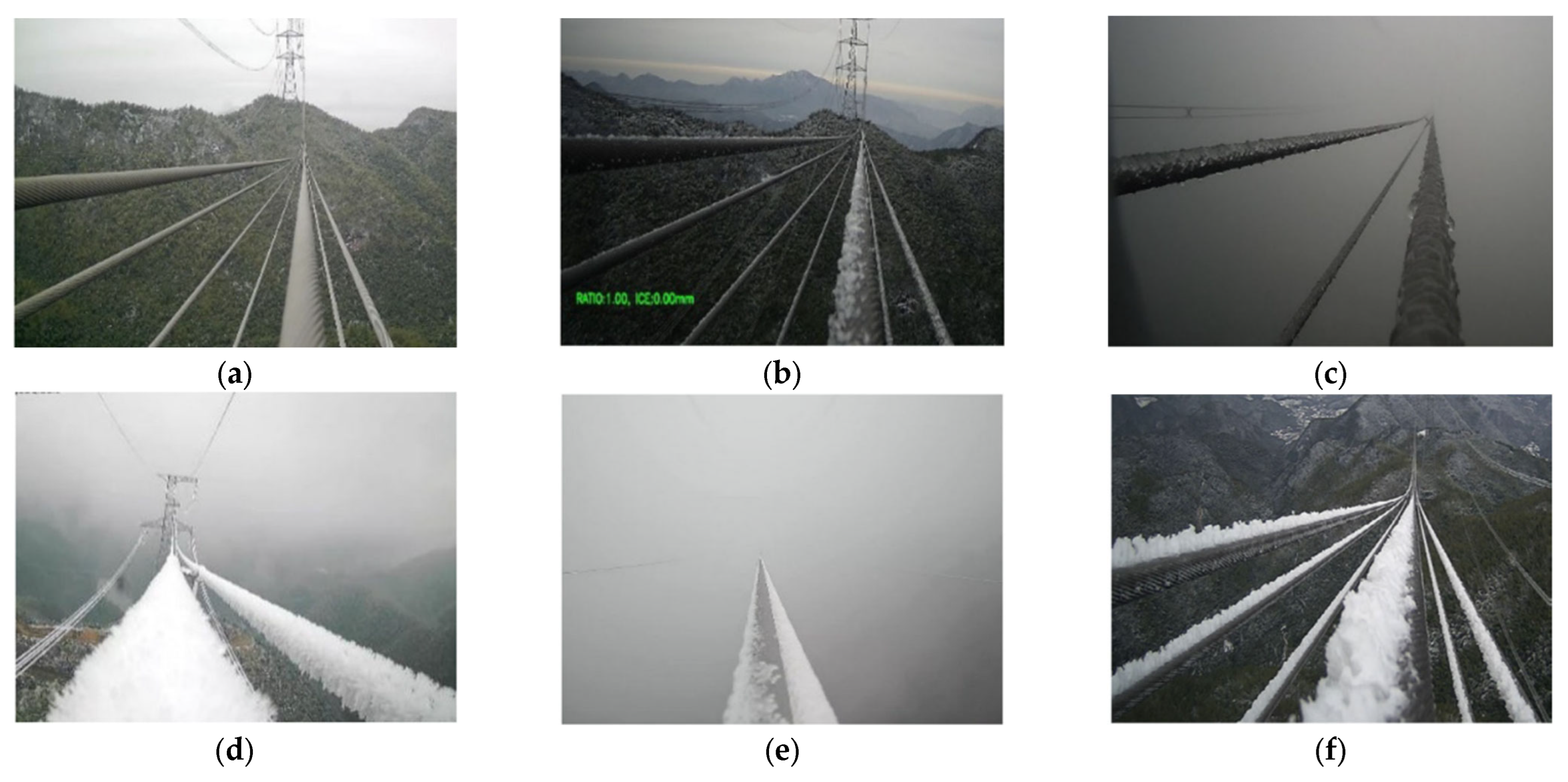
The icing on transmission lines can be classified into five types [13]: wet snow, hoar frost, rime, mixed rime, and glaze. The typical morphologies are illustrated in Figure 2.

2.3. Factors Influencing Icing

2.3.1. Meteorological Conditions

Temperature and humidity are the key meteorological factors governing the formation of icing on transmission lines. Their variations directly determine the probability of icing occurrence and the rate of ice accumulation [14,15]. Icing formation results from the combined effect of both temperature and humidity. A stable ice layer is most likely to form on conductor surfaces when the air temperature ranges between −5 °C and −15 °C and the relative humidity exceeds 85% [16]. Wind speed and direction play a critical role in the collision of water droplets with the conductor and the subsequent ice accretion process, significantly influencing both ice mass and morphology. Higher wind speeds markedly increase the collision efficiency of water droplets with the conductor, thereby promoting rapid ice growth [17,18]. However, once the wind speed exceeds a certain threshold, the ice accretion rate tends to saturate, as excessively high wind speeds prevent some droplets from effectively adhering to the conductor surface [19]. Furthermore, when the wind direction is perpendicular to the axis of the conductor, the ice layer tends to form uniformly around the conductor. In contrast, when the wind is parallel to the conductor axis, ice accretion often becomes asymmetric, concentrating mainly on one side of the conductor [20].
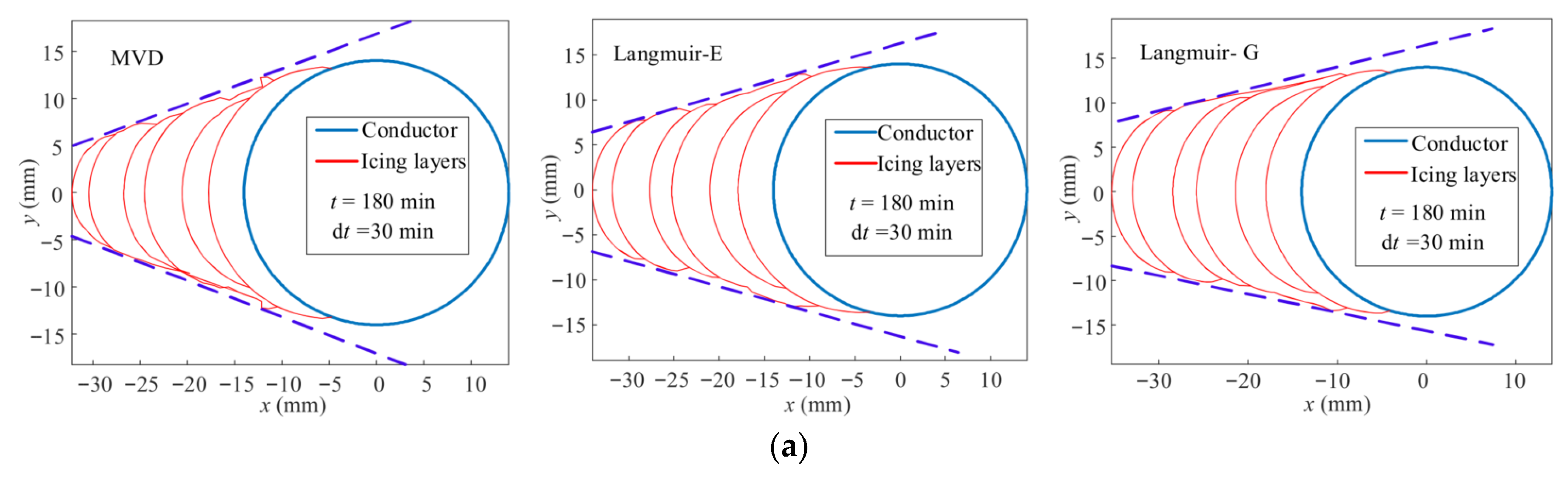
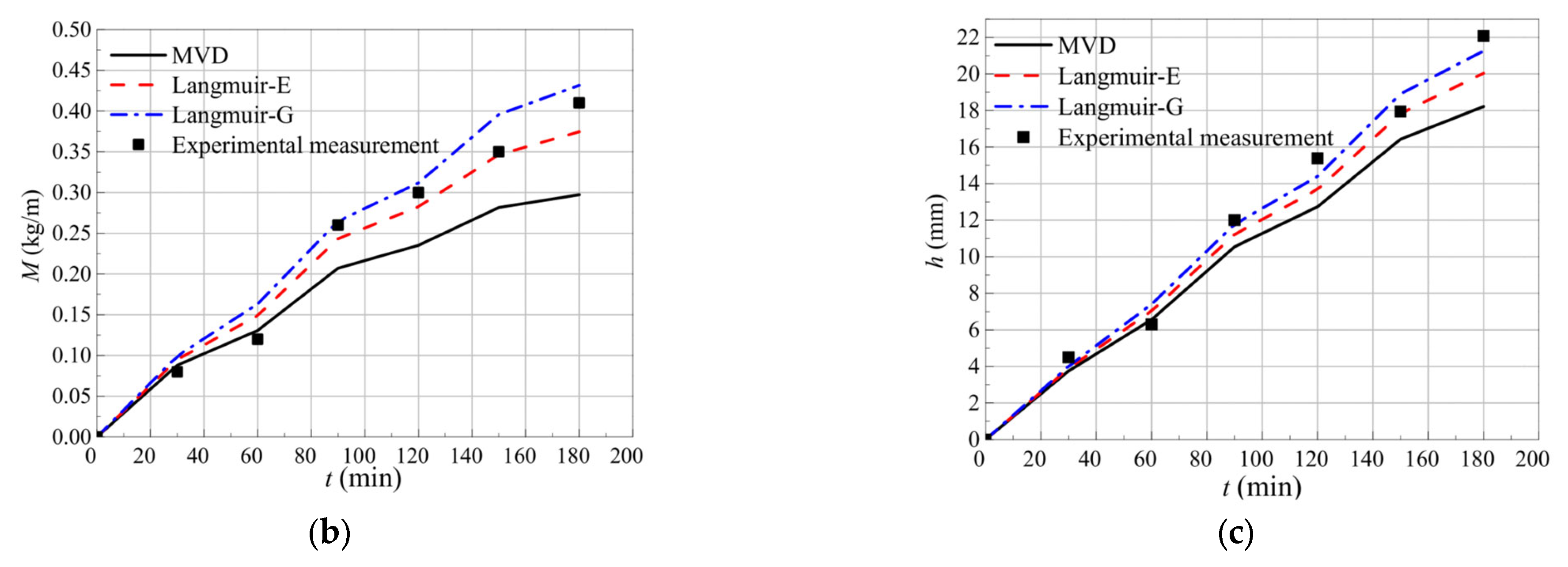
Wind speed and raindrop size collectively determine the aerodynamic behavior and collision efficiency of water droplets, serving as coupled variables that cannot be neglected in icing prediction models. An increase in wind speed enhances the relative velocity between raindrops and the conductor, thereby raising the collision kinetic energy and collision efficiency. However, when wind speed becomes excessively high, smaller droplets may be deflected by airflow around the conductor, reducing collision efficiency. Large droplets (e.g., diameter > 500 μm) possess high inertia, making their trajectories less susceptible to airflow disturbance and thus more likely to collide with the conductor. In contrast, small droplets (e.g., diameter < 100 μm) tend to follow the streamlines, resulting in low collision efficiency. Medium-sized droplets (200–400 μm) under moderate wind speeds (3–15 m/s) achieve an optimal balance between collision and capture, making them most conducive to stable ice accretion [20]. The collision coefficient, a key parameter describing droplet capture capability, is often determined using the Langmuir-Blodgett model or numerical simulations such as CFD. For instance, Wang et al. [21] and Xu et al. [22] utilized software to simulate two-phase flow and thermal equilibrium around conductors, providing detailed analyses of the influence of multiple parameters including wind speed, MVD, and liquid water content. Han et al. [23] highlighted that ignoring the droplet size distribution and relying solely on MVD may lead to prediction errors in ice growth rate ranging from 14% to 300%. The conductor icing calculated based on environmental parameters measured in the tests, including icing shapes, icing mass, and icing thickness, is illustrated in Figure 3.

2.3.2. Geographical Environment

Topography and terrain significantly influence transmission line icing by modulating airflow and moisture distribution. In mountainous areas, complex landforms induce ascending and descending airflows, which alter the spatial distribution of temperature and humidity. When warm, moist air encounters mountain barriers, forced uplift occurs, leading to cooling and condensation. This often results in severe icing on windward slopes and mountain peaks [24,25]. In contrast, plain regions experience more stable airflow, where icing formation depends primarily on broad meteorological conditions rather than local topographic effects. Additionally, specific landforms such as valleys and canyons can produce a venturi effect, significantly amplifying wind speed and further exacerbating icing severity [26]. Altitude also plays a crucial role in transmission line icing. As elevation increases, air temperature decreases and atmospheric moisture content generally reduces. However, this does not imply lower icing risk at high altitudes. On the contrary, due to persistently low temperatures and frequently strong winds, conductors in high-elevation areas are often prone to forming thick and persistent ice layers [27,28].

2.3.3. Line Characteristics

Conductor material and diameter are intrinsic factors influencing ice accretion on transmission lines. The surface roughness and thermal conductivity of the conductor significantly affects its icing behavior. Smooth conductors reduce water droplet adhesion compared to rough surfaces, thereby somewhat suppressing ice formation. Furthermore, conductors with higher thermal conductivity can delay the rate of ice accumulation through more efficient heat transfer. Regarding conductor diameter, thicker conductors exhibit a larger surface area, which enhances the capture of airborne water droplets and leads to significantly greater ice thickness [29]. The span length and sag height of the line also influence ice distribution. Longer spans allow greater conductor deflection under wind load, promoting increased ice accumulation. In terms of sag height, conductors suspended at higher elevations are generally exposed to stronger wind speeds and lower temperatures, making them more susceptible to severe icing.

2.4. Summary

Current research on transmission line icing, while having established a systematic cognitive framework, continues to face significant challenges in prediction accuracy and mechanistic quantification. Predominant prediction models, largely based on idealized steady-state meteorological assumptions, inadequately account for the spatiotemporal dynamics of key parameters such as temperature, humidity, wind speed, and water droplet distribution. This leads to substantial deviations in predicting ice mass, morphology, and accretion rate, particularly under complex terrain and transient meteorological conditions. Fundamentally, icing is a strongly coupled multi-physics process, encompassing droplet collision and capture efficiency, latent heat release during phase change, conductor surface heat balance, and wind-ice-conductor coupled vibrations. However, the quantitative characterization of these coupling mechanisms remains insufficient, limiting model accuracy and universality. Furthermore, the scarcity of in situ monitoring data under extreme weather and complex terrain conditions deprives model validation and refinement of reliable support. Concurrently, differences in adhesion strength, density, and growth patterns among various ice types impose further demands on precise physical modeling and risk assessment.
Future research should prioritize the following directions: developing dynamic icing prediction models capable of integrating real-time meteorological data and Geographic Information Systems; combining high-fidelity numerical simulations with controlled laboratory experiments to elucidate the micro-scale ice-water-air-solid interaction mechanisms; and enhancing the construction of icing monitoring networks based on remote sensing and the Internet of Things to acquire high spatiotemporal resolution data on the icing process, thereby supporting model calibration and risk early warning.

3. Detection and Monitoring Technologies for Transmission Line Icing

3.1. Conventional Detection and Monitoring Technologies

3.1.1. Natural Icing Observation Stations

As a primary method for early icing detection, natural icing observation stations involve the establishment of fixed monitoring points in ice-prone areas, where trained personnel manually measure ice thickness and record environmental parameters. Although this approach can provide first-hand data on ice accretion dynamics, it exhibits several significant limitations in practical applications. First, observation stations are often located in high-altitude or remote regions characterized by harsh and hazardous working conditions. Second, the manual measurement process is time-consuming, resulting in low data acquisition efficiency. Finally, the method requires substantial and continuous investment in human and material resources, leading to high operational and maintenance costs. These factors collectively restrict the broad applicability and promotion of this method.

3.1.2. Simulated Conductor Method

The simulated conductor method represents a significant technical approach for monitoring ice accretion on transmission lines. This technique employs a conductor, installed adjacent to the target line and matching its material and diameter, to measure icing parameters via sensors, thereby enabling the indirect estimation of the ice conditions, particularly ice thickness, on the actual line. This method represents a technological shift from direct measurement to indirect monitoring. Three primary technical routes are commonly employed, (a) weight-based measurement using mechanical sensors: this approach detects changes in weight caused by ice accumulation via tension or pressure sensors. For instance, Mao et al. [30] introduced a weighing sensor to mitigate measurement errors caused by conductor galloping. (b) Distributed measurement using optical fiber sensors: this technique enables the acquisition of multi-point icing information along the conductor. Yan et al. [31] proposed a fiber-optic sensing system that improves measurement accuracy by establishing a correlation between ice thickness on simulated and actual conductors. (c) Dielectric property measurement using capacitive sensors: this method infers ice thickness based on changes in capacitance caused by ice accumulation. Chang et al. [32] enhanced the accuracy of this technique by introducing a correction coefficient. Compared to traditional manual inspection, the simulated conductor method offers significant advantages in terms of safety, efficiency, and cost-effectiveness. It effectively reduces operational intensity and enables remote monitoring. Nevertheless, its applicability remains less extensive than that of mechanical modeling methods, particularly under extreme weather conditions and in complex terrain environments, where its performance is more constrained.

3.1.3. Mechanical Modeling Method

The mechanical model-based method aims to estimate the equivalent ice thickness on power transmission lines through theoretical modeling. By integrating real-time mechanical load data, collected by sensors installed on the lines, with a dedicated mechanical model, the method calculates the ice mass and subsequently derives the average ice thickness based on the density of the ice. The development of this method has evolved from simple two-dimensional to complex three-dimensional models: Huang et al. [33] initially proposed a two-dimensional computational model perpendicular to the conductor plane. Subsequently, Yang et al. [34] incorporated wind influence, constructing a more accurate three-dimensional static equilibrium model. Yang et al. [35] introduced a technique for estimating equivalent ice thickness on 500 kV overhead lines based on axial tension measurement, providing an effective means for indirect ice load monitoring on high-voltage transmission lines. Compared to conventional detection methods, the mechanical modeling approach offers advantages such as convenient implementation and lower cost, while effectively reducing the risks associated with manual ice observation. Despite its promising performance in theoretical and laboratory settings, the method still faces challenges in real-world engineering applications. Due to complex and variable field conditions, its measurement accuracy and reliability remain limited, particularly under extreme weather, where significant errors may occur and hinder accurate ice condition assessment by maintenance personnel.

3.1.4. Optical Fiber Sensor Method

The optical fiber sensor method is an ice monitoring technology for transmission lines based on the principle of temperature variation difference. It identifies icing conditions by detecting the temperature change discrepancy between iced and ice-free sections. The core principle lies in the significant difference in specific heat capacity between ice and conductor materials, which causes the temperature in iced areas to change more slowly than in ice-free areas. This temperature difference induces stress variations in the optical fiber or FBG sensors, thereby reflecting the ice accretion status. Ogawa et al. [36] developed an FBG tension sensor system integrated with metal plates installed between the transmission line and insulator string. This system monitors ice load by measuring changes in line tension, constituting a quasi-distributed online monitoring system. Gao et al. [37] designed an equivalent ice thickness calculation scheme using optical fiber sensors, which estimates ice thickness based on changes in insulator tension. Xu et al. [38] established a temperature field variation model under icing conditions and analyzed the temperature response characteristics of optical fiber sensors before and after icing through finite element simulation. The optical fiber sensor method offers notable advantages such as strong resistance to electromagnetic interference, high sensitivity, excellent electrical insulation properties, and no need for an external power supply [39]. These characteristics make it particularly suitable for high-voltage transmission environments. Due to its unique strengths, this method demonstrates significant value in specific application scenarios, especially in icing monitoring under strong electromagnetic interference conditions, where it is considered irreplaceable.

3.2. Image-Based Detection and Monitoring Technologies

3.2.1. Image Detection and Monitoring Method

Image detection, as a leading non-contact technique for transmission line icing monitoring, enables intuitive and accurate assessment through intelligent image analysis. It offers distinct advantages over contact-based methods, including visual measurement, immunity to electromagnetic interference, and spatial distribution acquisition, establishing it as a mainstream research focus.
Image acquisition systems are primarily deployed in two forms: tower-fixed and UAV-mobile. Tower-fixed systems involve installing visual sensors on transmission towers to enable continuous monitoring of specific line segments. This deployment mode allows real-time, all-weather monitoring with high data-update frequency, though its coverage is generally limited to areas near the towers. In contrast, UAV-mobile systems leverage the flexibility of unmanned aerial vehicles for comprehensive line inspection. For instance, Yao et al. [40] proposed an aerial detection method that uses UAV-captured images combined with preprocessing and boundary detection algorithms to measure ice thickness. Guo et al. [41] equipped a UAV with a binocular camera and adopted a local multi-layer convolutional neural network for feature matching, demonstrating the potential of integrating mobile platforms with AI technologies.
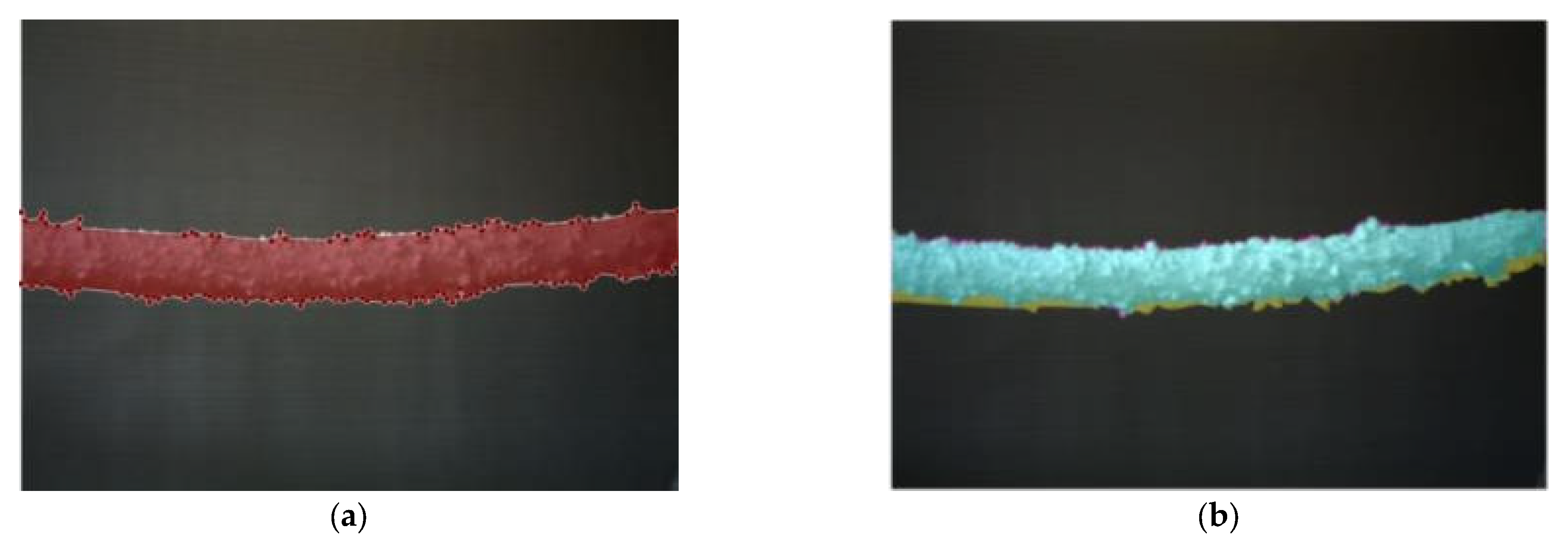
Depending on the type of visual sensor used, icing image detection can be classified into two main technical approaches: monocular vision and stereo vision, each with distinct advantages and limitations in icing monitoring. Monocular vision systems are structurally simple and cost-effective, making them suitable for large-scale deployment. This method relies on two-dimensional images captured by a single camera, employing advanced image processing algorithms to achieve precise extraction of icing features and thickness calculation. Researchers such as Yang et al. [42] developed a fractal-based “blanket cone” method that innovatively established a mathematical mapping relationship between the pixel domain of the ice layer and its actual thickness, providing a theoretical foundation for monocular vision measurement. Zhang et al. [43] integrated wavelet transform with morphological methods to propose an edge detection algorithm that significantly improved the recognition of icing contours under complex backgrounds. In terms of noise suppression, Nusantika et al. [44] enhanced the Canny operator by combining morphological filtering and diagonal pixel analysis, effectively addressing challenges in image denoising and edge preservation. In contrast, stereo vision systems generate disparity maps based on synchronously captured left and right view images using stereo matching algorithms. In the context of UAV applications, Ma et al. [45] utilized a binocular camera-equipped drone system integrated with line laser feature point positioning technology. Nusantika et al. [46,47] developed an intelligent detection system based on stereo vision. By incorporating MSR enhancement, ORB and SIFT feature extraction algorithms, and employing a MAGSAC-optimized RANSAC method, they established a robust image processing pipeline. Furthermore, Nusantika et al. [48] proposed a multi-threshold algorithm combining image restoration and enhancement, with a comparison of detection results shown in Figure 4.
Image processing algorithms serve as the core component of ice detection, with their performance directly affecting measurement accuracy and reliability. A complete algorithmic workflow typically consists of three key steps: image preprocessing, feature extraction, and thickness calculation. In the preprocessing stage, researchers have developed various denoising and enhancement algorithms to improve image quality. Hu et al. [49] employed a K-SVD denoising algorithm to effectively mitigate image noise interference. Regarding feature extraction, two main technical approaches are commonly used: edge detection and region segmentation. The edge detection method measures ice thickness by identifying ice boundaries. For instance, Yan et al. [50] developed a GSO-optimized Canny algorithm tailored to the diverse shapes of ice accretion, demonstrating strong performance in complex backgrounds. Region segmentation, on the other hand, calculates thickness by distinguishing ice-covered areas from the background. Shu et al. [51] achieved promising results using an improved scanline seed filling algorithm and an FCM algorithm that integrates features and spatial neighborhood information. Despite significant progress in image detection methods, several technical challenges remain to be addressed. The rapid development of deep learning technologies offers new potential to overcome these limitations.

3.2.2. Deep Learning-Based Detection and Monitoring Methods

Deep learning technologies have led to breakthrough advancements in the field of transmission line icing detection. Depending on the network architecture and detection workflow, existing deep learning methods can be broadly categorized into two technical pathways: two-stage detection and one-stage detection. Two-stage detection methods, represented by the R-CNN series, including R-CNN [52], Faster R-CNN [53], and Mask R-CNN [54], first generate region proposals and then perform detailed classification and regression. This approach offers significant advantages in detection accuracy. In contrast, one-stage detection methods such as SSD [55] and the YOLO series [56,57,58] employ an end-to-end detection strategy. These methods achieve substantially higher detection speeds while maintaining competitive accuracy, making them more suitable for application scenarios requiring real-time performance.
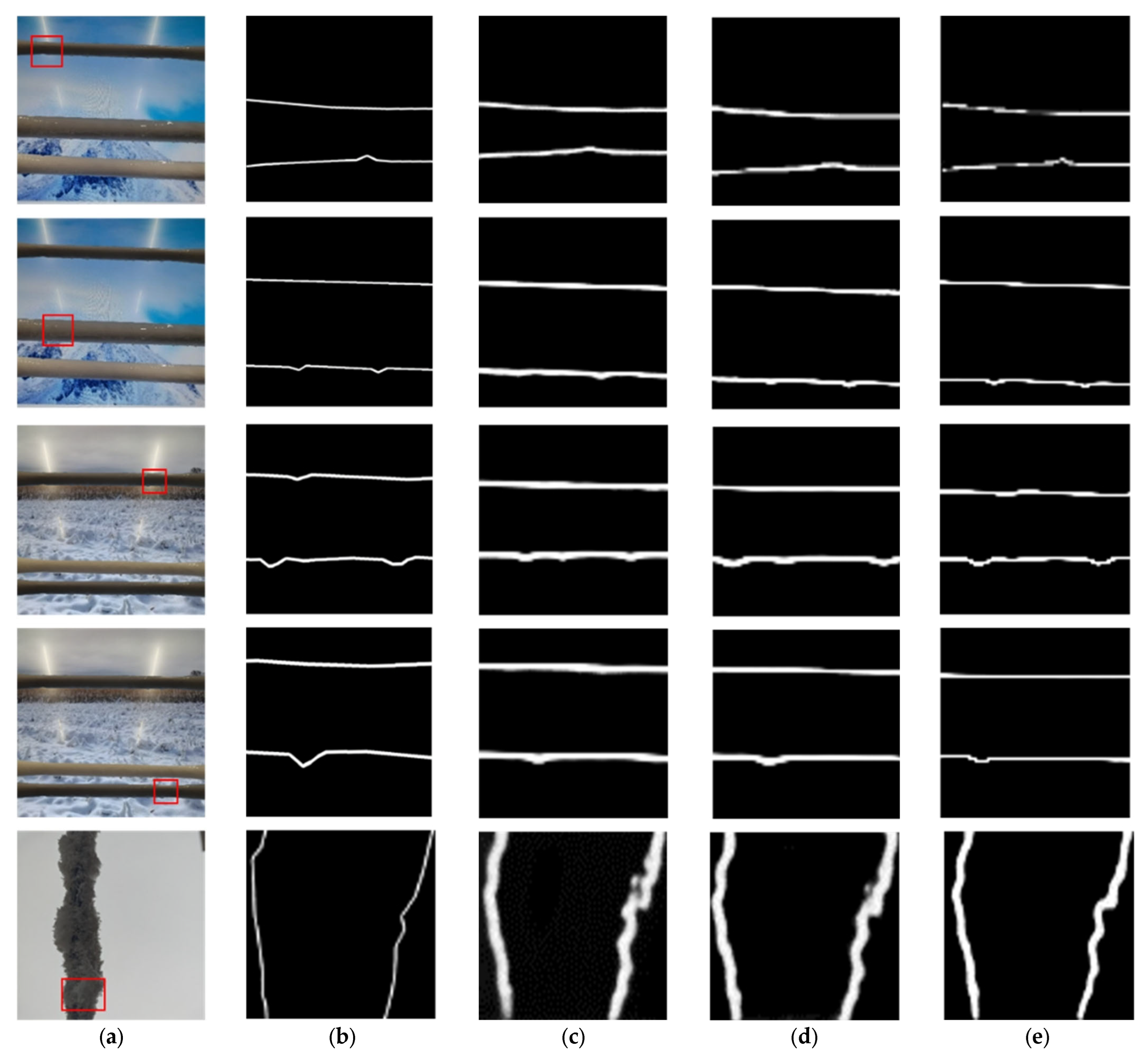
In recent years, deep learning models have achieved remarkable progress in the field of transmission line icing detection. Zhou et al. [59] applied a GPR model to process micro-meteorological data, achieving high accuracy, though its applicability remains limited under single working conditions. Li et al. [60] proposed a hybrid CNN-RF model that combines the feature extraction capability of convolutional neural networks with the classification strength of random forests, further improving recognition performance. Ma et al. [61] innovatively integrated the advantages of ResNet and FPN to construct a multi-scale feature fusion model, which effectively combines shallow detailed features with deep semantic information and significantly enhances the accuracy of icing identification. Yang et al. [62] utilized IULBP texture features, providing a new approach for the recognition of ice types. Yue et al. [63] achieved classification of ice and non-ice images using a multilayer perceptron neural network. Hu et al. [64] proposed an SGAN-UNet network that combines generative adversarial networks with S-UNet, markedly improving segmentation performance. Dong et al. [65] introduced the LDKA-Net algorithm, which enhances feature extraction capability through WFVC-Net and an EM-DCA mechanism, substantially improving detection accuracy while reducing the number of model parameters. Zhang et al. [66] proposed a novel CG-UNet deep learning model that excels in detecting non-uniform icing regions. This model adopts an encoder–decoder architecture and innovatively incorporates a CGM, enabling effective utilization of encoder features to distinguish easily confusable pixels during edge generation. A comparison of detection results is shown in Figure 5.
In the field of icing prediction and monitoring, two main technical approaches have been developed: indirect prediction models based on meteorological parameters, and direct monitoring techniques based on intelligent image analysis.
Indirect prediction models estimate ice thickness by analyzing historical and real-time meteorological data. For instance, Snaiki et al. [67] employed an FFNN combined with a metaheuristic algorithm to predict the ice-to-liquid ratio. Liu et al. [68] utilized KPCA and the GWO to optimize a SVM model. Han et al. [69], Ke et al. [70], and Li et al. [71] proposed hybrid models that integrate signal decomposition, feature extraction, and deep learning techniques such as LSTM and Transformer. Kretov et al. [72] focused on constructing datasets for machine learning prediction models on lines lacking dedicated sensors. By collecting meteorological and other relevant data, they achieved a prediction accuracy of approximately 81% and identified key features such as altitude and snow depth, offering a low-cost solution for expanding monitoring coverage. These methods, which rely on analyzing historical meteorological data such as temperature, humidity, wind speed, and precipitation, play a significant role in trend forecasting and early warning. To address issues such as computational complexity and susceptibility to local optima in traditional models, the ELM has gained attention due to its fast learning speed and strong generalization capability, demonstrating satisfactory performance in power system applications such as fault diagnosis [73]. However, the random initialization of ELM can limit its stability. To mitigate this, Mo et al. [74] applied a KELM to enhance model stability and prediction accuracy, improving robustness while maintaining computational efficiency.
Direct monitoring technology based on intelligent image analysis enables intuitive confirmation of ice accretion status and direct calculation of ice thickness by processing field images captured by inspection robots, fixed cameras, or UAVs, offering a transformative solution for precise and visual ice condition monitoring. The core of such technology lies in advanced computer vision and deep learning algorithms, particularly semantic segmentation models. Jiao et al. [75] proposed EDPNet, a network specifically designed for deployment on edge devices such as de-icing robots. By incorporating an LMRC module and a dynamic loss function, the model significantly reduces complexity and parameter count. Implemented on an OrangePi 5 Plus, it achieved a 74.6% increase in detection speed while maintaining the maximum ice thickness detection error within 4.2%. To further enhance measurement accuracy without compromising lightweight design, Zhang et al. [76] developed EECNet, which employs network pruning and introduces a DABM and an EPCM to strengthen feature extraction capabilities. The model achieved a mIoU of 92.7% and an ice thickness recognition error of less than 3.4%. Additionally, Zhang et al. [77] proposed the GMSA-Net, which incorporates an MSCM to better adapt to the slender morphological characteristics of transmission lines, and a GMAM to extract deeper semantic information. The model reached a mIoU of 96.4% with a recognition error within 3.8%. The recognition performance under complex backgrounds is illustrated in Figure 6.

3.3. Summary

This chapter synthesizes the technological evolution from traditional contact-based monitoring to modern non-contact intelligent detection. Table 1 summarizes key research on transmission line icing detection and monitoring.
As summarized in Table 1, research on transmission line icing monitoring is shifting from traditional methods towards intelligent, high-precision approaches, primarily converging along two pathways: computer vision-based image recognition and data-driven predictive models.
Vision-based methods offer non-contact measurement and easy integration with platforms like drones, enabling large-scale automated inspection. However, their performance is highly susceptible to environmental conditions (e.g., fog, rain, snow), challenging their robustness in real-world field applications. Accurately inverting 3D ice thickness from 2D images remains difficult, hindered by factors like camera calibration and viewpoint variations. Furthermore, these models rely heavily on large, annotated datasets and substantial computational resources, posing challenges for real-time edge computing. Data-driven models, which predict icing trends using historical and meteorological data, demonstrate high fitting accuracy. Their limitations include a heavy reliance on widespread, durable sensor deployment, which involves significant costs and maintenance challenges in extreme environments. Moreover, the complex structures of many models often lack satisfactory interpretability, potentially hindering trust and adoption in critical power systems.
Future development is advancing towards multidimensional intelligence and systematic integration. Key trends involve the deep fusion of multi-source data using technologies like graph neural networks to create high-fidelity digital twins. AI models are evolving from perceptual to cognitive and predictive intelligence, with a focus on hybrid models that possess strong generalization and embed physical laws. Ultimately, a cloud-edge-end collaborative architecture will emerge, deploying lightweight models for real-time processing at the edge while the cloud handles large-scale simulation and global optimization, forming an efficient closed-loop system.

4. De-Icing and Anti-Icing Technologies for Transmission Lines

4.1. De-Icing Technologies for Transmission Lines

4.1.1. Mechanical De-Icing

Manual ice removal by knocking is one of the earliest proposed mechanical de-icing methods, first systematically described by Phlman and Landers in 1982 [78]. This method relies on operators using insulated tools to strike ice-covered conductors or throwing hard objects from the ground to dislodge ice; a U-shaped trap can also be used to scrape off the ice layer. Although simple to perform, it is inefficient and poses safety risks, making it suitable only for temporary de-icing needs on low-altitude lines. The pulley scraper de-icing method drives a blade-equipped pulley along the conductor via a traction rope to scrape off ice. This device is simple in structure and demonstrates significant de-icing effectiveness, but it has poor adaptability to complex terrain, and the steel blades may damage the conductor surface. Explosive de-icing utilizes shock waves from explosives to dislodge ice, offering rapid and efficient removal. This method requires pre-laying detonation cords and employs segmented blasting to cover the target area. Xie et al. [79] experimentally verified its de-icing effectiveness, while Cao et al. [80] analyzed the dynamic response of the conductor-tower system after blasting through numerical simulation and proposed optimization solutions for both single and twin-bundled conductors. However, explosive de-icing carries a risk of conductor damage, involves complex installation, and is only applicable in specific scenarios. Electromagnetic vibration de-icing can be divided into two categories: electromagnetic pulse methods and electromagnetic impact methods. The electromagnetic pulse method uses pulsed coils to induce eddy currents, generating mechanical repulsive forces to break the ice layer, but it is only suitable for localized de-icing [81]. The electromagnetic impact method employs short-circuit currents to cause collisions between twin-bundled conductors, shaking off the ice. Robotic de-icing is a rapidly advancing technical direction in recent years [82,83]. Montambault and Pouliot [84] developed the HQ LineROVer de-icing vehicle, marking the beginning of the practical application of robotic de-icing. Zhao et al. [85] enhanced its functionality by adding infrared detection and remote communication modules. Modern de-icing robots offer advantages such as relatively low energy consumption, high de-icing efficiency, improved safety, and obstacle-crossing capabilities [86]. To further enhance automation levels, robotic systems based on UAVs have become a research focus, extending de-icing capabilities to complex terrains [87].

4.1.2. Short-Circuit De-Icing

As an active de-icing method, short-circuit de-icing is based on the principles of the Joule heating effect and heat transfer theory. When an electric current passes through an ice-covered conductor, the electrical resistance of the conductor generates Joule heat. This heat is transferred through thermal conduction to melt the ice layer, while simultaneous energy exchange occurs between the ice surface and the surrounding environment via thermal radiation and convection [88]. The State Grid Corporation of China has provided calculation formulas for the minimum and maximum de-icing currents [89]. Through extensive field tests, Jiang et al. [90] observed that when the operating current falls below the critical de-icing current, the required de-icing time exhibits a nonlinear increase.
AC Short-Circuit De-Icing
After decades of development, AC short-circuit de-icing technology has evolved into three primary implementation methods [91]: Three-phase short-circuit de-icing, the most traditional approach, offers relatively uniform heat distribution. Two-phase short-circuit de-icing reduces the required power capacity by connecting phases in series. Single-phase short-circuit de-icing, while structurally simplest, suffers from low energy efficiency, limiting its practical application. AC short-circuit de-icing methods generally exhibit several inherent limitations: First, they necessitate disconnecting the line from the power grid during operation, significantly impacting power supply reliability. Second, the high demand for reactive power imposes additional stress on grid operation. Furthermore, technical challenges make AC short-circuit de-icing difficult to implement for long-distance transmission lines operating at 500 kV and above [92]. These limitations have prompted researchers to shift their focus toward more advantageous DC de-icing technologies.
DC Short-Circuit Current De-Icing
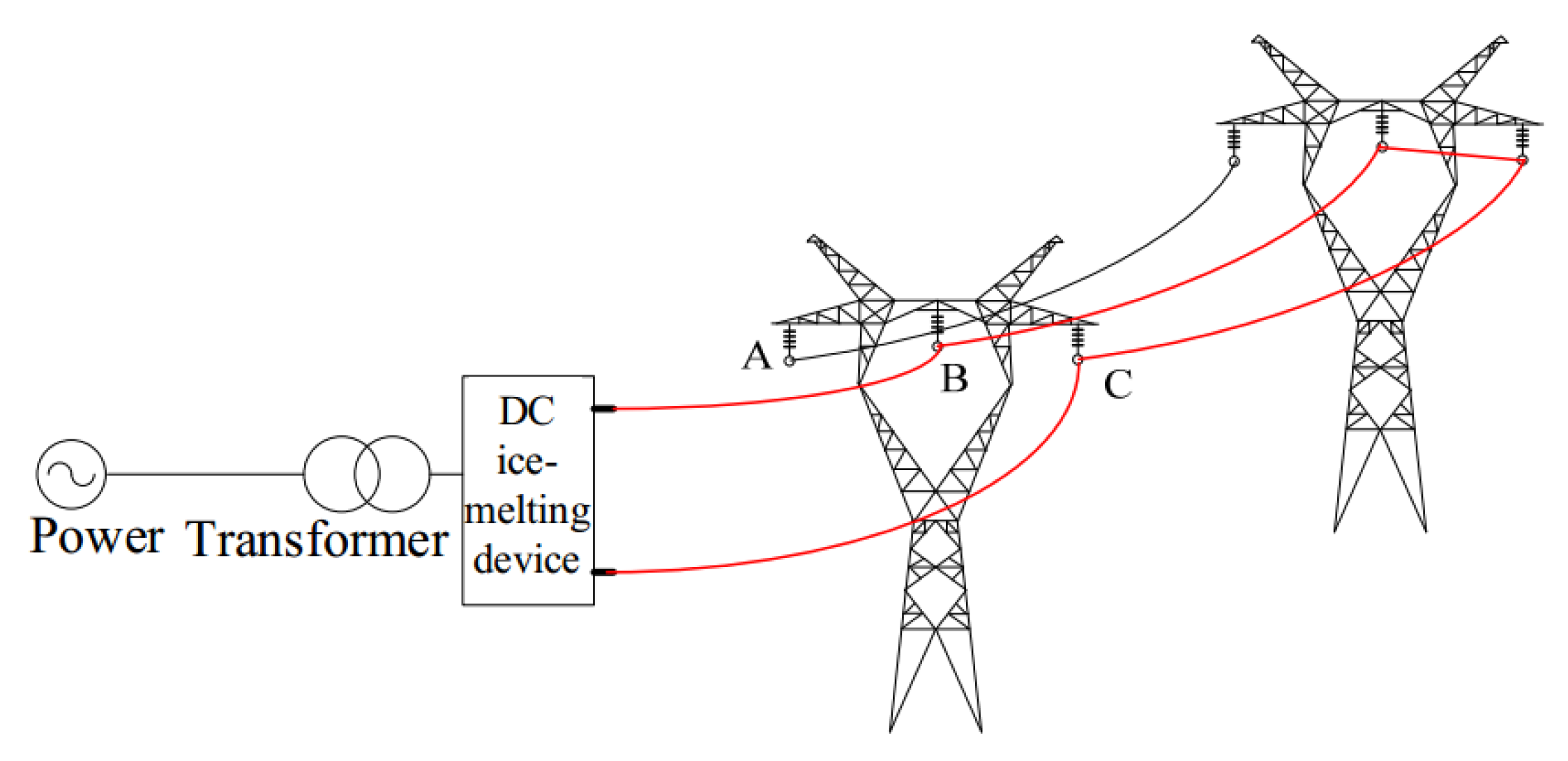
A major breakthrough in DC short-circuits de-icing technology began with pioneering research by Manitoba Hydro in Canada in 1993. Since the AC impedance of a conductor is significantly greater than its DC resistance, the power capacity required for DC short-circuit de-icing is only 5–20% of that needed for AC short-circuit de-icing. This substantial reduction is primarily because DC systems eliminate concerns related to skin effect and reactive power compensation. A typical configuration of DC short-circuit de-icing is illustrated in Figure 7 [13]. Following the severe ice disaster in 2008, China achieved significant breakthroughs in DC short-circuit de-icing technology, successfully developing high-power DC short-circuit de-icing devices with fully independent intellectual property rights. This technology encompasses two main types: those equipped with dedicated rectifier transformers and those without, and it has now been deployed on a large scale across the country [93]. In recent years, the introduction of MMC technology has markedly increased the voltage level and capacity of DC short-circuit de-icing installations. Compared to traditional two-level and clamped multilevel topologies, MMC offers distinct advantages in high-voltage adaptability, power quality, system reliability, and maintainability [94,95]. In particular, DC short-circuit de-icing devices based on the full-bridge MMC topology feature a simple structure and offer multifunctional capabilities: they can operate as STATCOMs to provide dynamic reactive power compensation during normal grid operation, while under icing conditions, they can output continuously adjustable DC voltage and current to achieve efficient ice melting [96,97]. Hou et al. [98] proposed a novel DC traction power supply system based on full-bridge submodule MMC. This topology overcomes the voltage drop limitation of conventional rectifiers, extends power supply distance, enables optimal utilization of regenerative braking energy, and provides catenary de-icing capability. Simulation results validate the effectiveness of the proposed scheme. Furthermore, alongside enhancing de-icing efficiency, the safety and reliability of optimization schemes are of critical importance. Zasypkin et al. [99] proposed protecting electromagnetic voltage transformers from DC voltage influences during ice-melting operations by installing capacitor banks, thereby allowing the transformers to remain connected. This approach reduces outage times and improves system reliability. Separately, Sadykov et al. [100] focused on the modernization of mobile de-icing systems. While acknowledging the effectiveness of technologies like high-frequency currents, they further introduced an integrated method for monitoring line topology to minimize the risk of damage to transformers at the line terminals.
In terms of international engineering applications, Hydro-Québec of Canada, in collaboration with AREVA, developed a high-voltage DC de-icing device [101]. Utilizing a current of 7200 A, it successfully cleared ice from 735 kV and 315 kV transmission lines. Russia has adopted DC de-icing technology on its 500 kV lines, achieving efficient ice removal on long-span sections [102]. Domestically, Hunan Power Grid employed a fixed DC de-icing device to effectively address icing on 220 kV lines [103]. In recent years, the State Grid Corporation of China has successively applied DC de-icing technology for de-icing overhead ground wires on high-voltage and ultra-high-voltage lines [104,105]. These engineering practices have accumulated valuable experience for technological refinement. Despite substantial progress, short-circuit current de-icing technology still faces several challenges: First, the initial investment for a single set of a fixed 500 kV de-icing device is relatively high. Second, when dealing with severe ice accumulation, multiple processing cycles are often required, significantly prolonging the operation time. Furthermore, and most critically, technology face’s reliability challenges, as de-icing efficiency can drastically decrease under extreme environmental conditions.

4.1.3. Ice-Melting of Bundled Conductors

The current-transfer ice-melting technology for bundled conductors is an innovative active anti-icing method. Its fundamental principle involves the use of intelligent switching devices to redirect and concentrate the total load current onto a subset of sub-conductors [106]. For a system with m bundled conductors, each conductor typically carries a current of I/m under normal operation. In contrast, this technique transfers the total current I onto n sub-conductors (m > n ≥ 1), thereby increasing the current density of the target sub-conductors to I/n [107]. This intentional redistribution of current significantly enhances the Joule heating effect, raising the temperature of the conductors to the ice-melting threshold and enabling sequential de-icing along the entire transmission line [108]. However, it should be noted that during DC ice-melting of bundled conductors, asynchronous de-icing among sub-conductors may occur, potentially leading to abrupt jumping phenomena [109,110].

4.2. Anti-Icing Technologies for Transmission Lines

4.2.1. Anti-Icing by Controlling Conductor Surface Electric Field Strength

As an emerging anti-icing technology, electric field control primarily relies on the combined effects of corona discharge and electric field forces. Li et al. [111] demonstrated that when the Es on the conductor surface exceeds a critical value, the resulting corona discharge significantly influences the ice accretion process. Yin et al. [112] further revealed that the intensity of corona discharge increases nonlinearly with Es, leading to a higher concentration of ions in the surrounding space. Under the influence of the electric field, charged water droplets experience a repulsive force, which alters their trajectories and reduces the probability of collision with the conductor, thereby effectively inhibiting ice formation. Artificial climate chamber experiments indicated that when Es < 20 kV/cm, the amount of ice deposition increases with Es; however, beyond this threshold, the trend reverses. Moreover, when Es > 20 kV/cm, branched ice structures tend to form. Additionally, during glaze ice conditions, due to the influence of icicle length, the capacitance per unit length of the conductor at Es = 5 kV/cm was found to be larger than that at Es = 25 kV/cm due to the influence of icicle length [113].

4.2.2. Anti-Icing Superhydrophobic Coatings

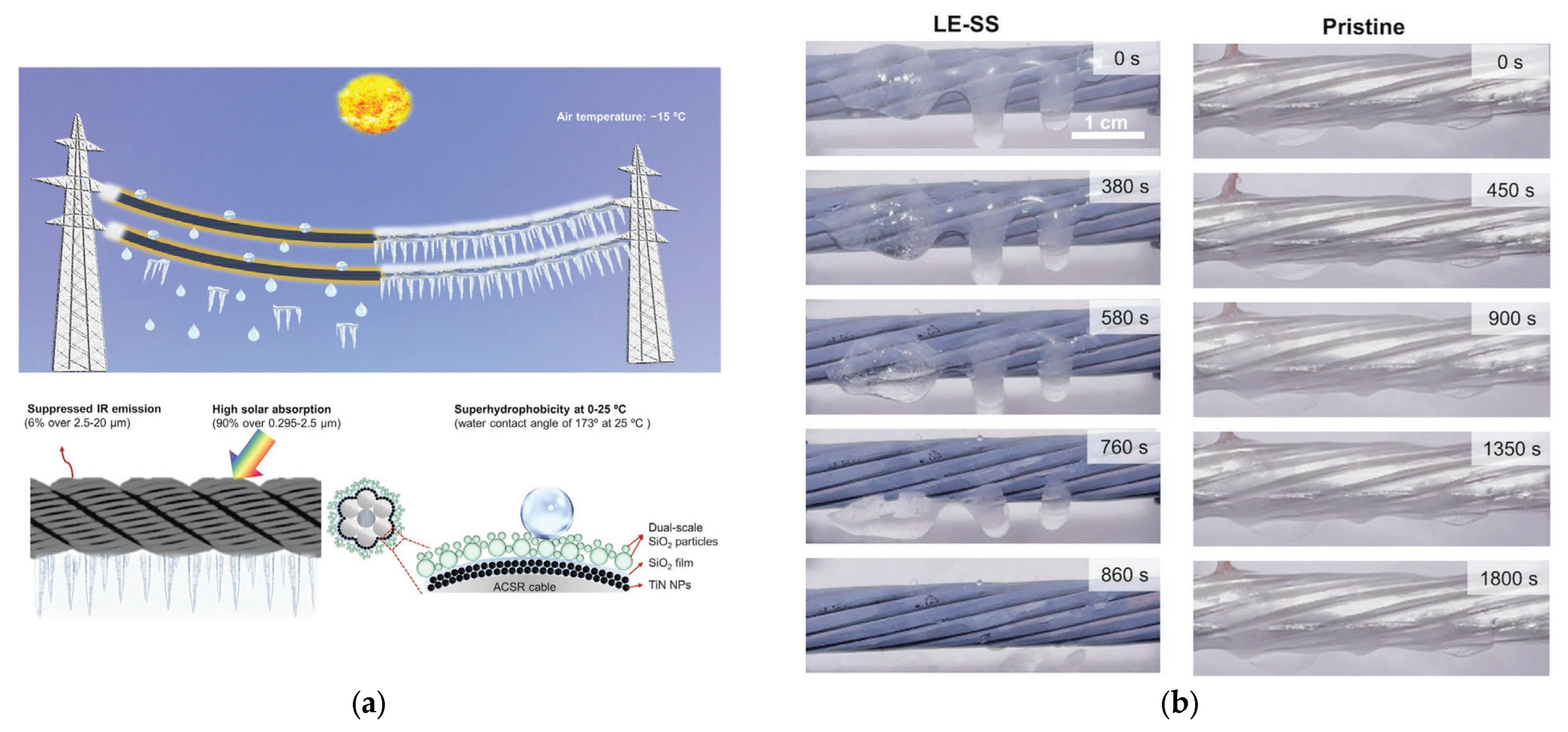
In recent years, interdisciplinary research has promoted the development of novel passive anti-icing strategies [114]. Anti-icing coatings can be categorized into six major types based on their mechanisms: ice-suppression coatings [115], photothermal coatings [116], flexible coatings [117], curable coatings [118], hydrophobic coatings [119], and composite coatings. An ideal anti-icing coating should fulfill the following requirements: ease of application, cost controllability, durability, reliability, and minimal impact on electrical performance. To address these needs, researchers have proposed the concept of superhydrophobic surfaces, which involves directly engineering micro/nano structures on substrate materials to avoid the weight burden of additional coatings and minimize impacts on the electrical properties of equipment [120]. Poulikakos et al. [121] developed a plasmonic metasurface composite with photothermal effects, which not only maintained water repellency but also enabled surface self-heating through solar energy. Hu et al. [122] designed a silicon carbide composite coating that delayed ice formation on cable sheaths and achieved ice-melting under laser irradiation within 28 s. Zhang et al. [123] fabricated a carbon nanotube-modified coating that extended the ice formation time on aluminum substrates by 165 s and enabled de-icing under near-infrared light irradiation within 60 s. Gou et al. [124] proposed a graphene–fluorosilane-treated silica coating that prolonged the ice formation time on copper substrates by 658 s. Li et al. [125] introduced a LE-SS nanocoating with unique photothermal conversion properties and superhydrophobic surface characteristics, allowing it to maintain excellent de-icing and defrosting performance even at temperatures as low as −15 °C. Figure 8 illustrates the schematic of the nanocoatings and compares the de-icing performance between coated and bare conductors at low temperatures. Blinov et al. [126] developed a nanostructured protective coating for overhead power lines, analyzing its surface morphology and elemental composition via scanning electron microscopy. The influence of the coating on the high-frequency signal bandwidth and electrical resistance of the conductor was experimentally evaluated. Electrical performance was further validated on a 110 kV transmission line, ultimately yielding a coating that meets operational requirements. Wang et al. [127] developed a G/CB@OTES superhydrophobic coating that elevated the temperature of transmission lines to 98.5 °C under light irradiation within 10 min and achieved complete ice melting within 151 s.

4.2.3. Anti-Icing Expanded-Diameter Conductors

Expanded-diameter conductors represent an innovative design approach that increases the outer diameter of the conductor while maintaining the effective conductive cross-sectional area [128]. Based on a statistical analysis of 10 years of observational data from the Xuefeng Mountain field station, Wang et al. [129] reported that the increased diameter reduces the local collision efficiency of supercooled water droplets, thereby slowing the rate of ice accretion. Consequently, the ice thickness on the conductor decreases as its diameter increases. Moreover, in 500 kV transmission lines, replacing conventional quadruple-bundle conductors with expanded-diameter conductors can significantly enhance the system’s anti-icing performance, reducing ice accumulation by 30~80% [130]. Nevertheless, expanded-diameter conductor technology still faces challenges such as high cost and complex manufacturing processes. Particularly in ultra-high voltage and extra-high voltage applications, although the electrical and mechanical performance fully meets requirements, the installation techniques demand significantly higher precision and effort [29].

4.2.4. Other Anti-Icing Technologies

Huang et al. [131] proposed an anti-icing technology based on an eddy current self-heating ring, which enables automatic de-icing through the magnetothermal effect. Experimental data indicate that this method can reduce ice accretion by 18.38~30.61%, demonstrating effective anti-icing performance in severe ice conditions. Akhobadze [132] proposed a de-icing method for high-voltage power lines that utilizes electromagnetic surface waves. The approach involves analyzing wave propagation and energy absorption at the air-ice-conductor interface to convert electromagnetic energy into heat. In addition, the torque pendulum technology suppresses the torsional tendency of ice-covered conductors by providing a counteracting torque. Its operating principle involves balancing the torque generated by the shift in the center of gravity during ice accumulation. Liu et al. [133] established a torsional vibration model for ice-covered single conductors and proposed an orthogonal torque loading method to enhance equivalent stiffness and inhibit torsion. Field experiments showed that this approach achieved a maximum torsional suppression rate exceeding 90% and a reduction in torsional angle of over 88%, significantly mitigating ice-induced torsion.

4.3. Summary

This chapter synthesizes the current state of knowledge regarding anti-icing and de-icing technologies, summarizing recent research advances and application status. Table 2 summarizes key research on de-icing and anti-icing technologies for transmission lines.
As summarized in Table 2, research on anti-icing/de-icing technologies for transmission lines is shifting from traditional passive protection towards active intelligent control, primarily evolving along two directions: active de-icing based on external energy input and passive anti-icing via material surface modification.
Active de-icing technologies (e.g., DC de-icing, eddy current self-heating rings) show effectiveness but face limitations including external energy dependence, system complexity, and high initial costs. DC de-icing requires grid infrastructure modifications, limiting its applicability, while self-heating rings offer only localized protection, struggling to prevent ice uniformly along entire conductors. Under extreme weather, uneven heating may even cause ice dam effects, increasing safety risks. In passive anti-icing, superhydrophobic and photothermal functional coatings are prominent, yet their engineering application is hindered by durability and environmental adaptability. The mechanical strength and environmental compatibility of coating systems need enhancement, and balancing eco-friendliness with long-term performance remains a key scientific challenge. Replacing traditional conductors with expanded-diameter conductors offers a non-material-based anti-icing alternative.
Future development requires breakthroughs in multiple dimensions: Firstly, integrating technical pathways by combining the efficiency of active de-icing with the low energy consumption of passive anti-icing to develop intelligent multi-field (optical-electrical-thermal) coupled systems. Secondly, upgrading material systems by enhancing the mechanical durability and chemical stability of superhydrophobic surfaces and developing self-healing intelligent materials (e.g., temperature-triggered phase-change materials, stress-responsive repair systems). Finally, implementing structure-function integrated design in engineering practice to develop new conductor structures that combine high transmission capacity with low icing risk.

5. Conclusions and Prospects

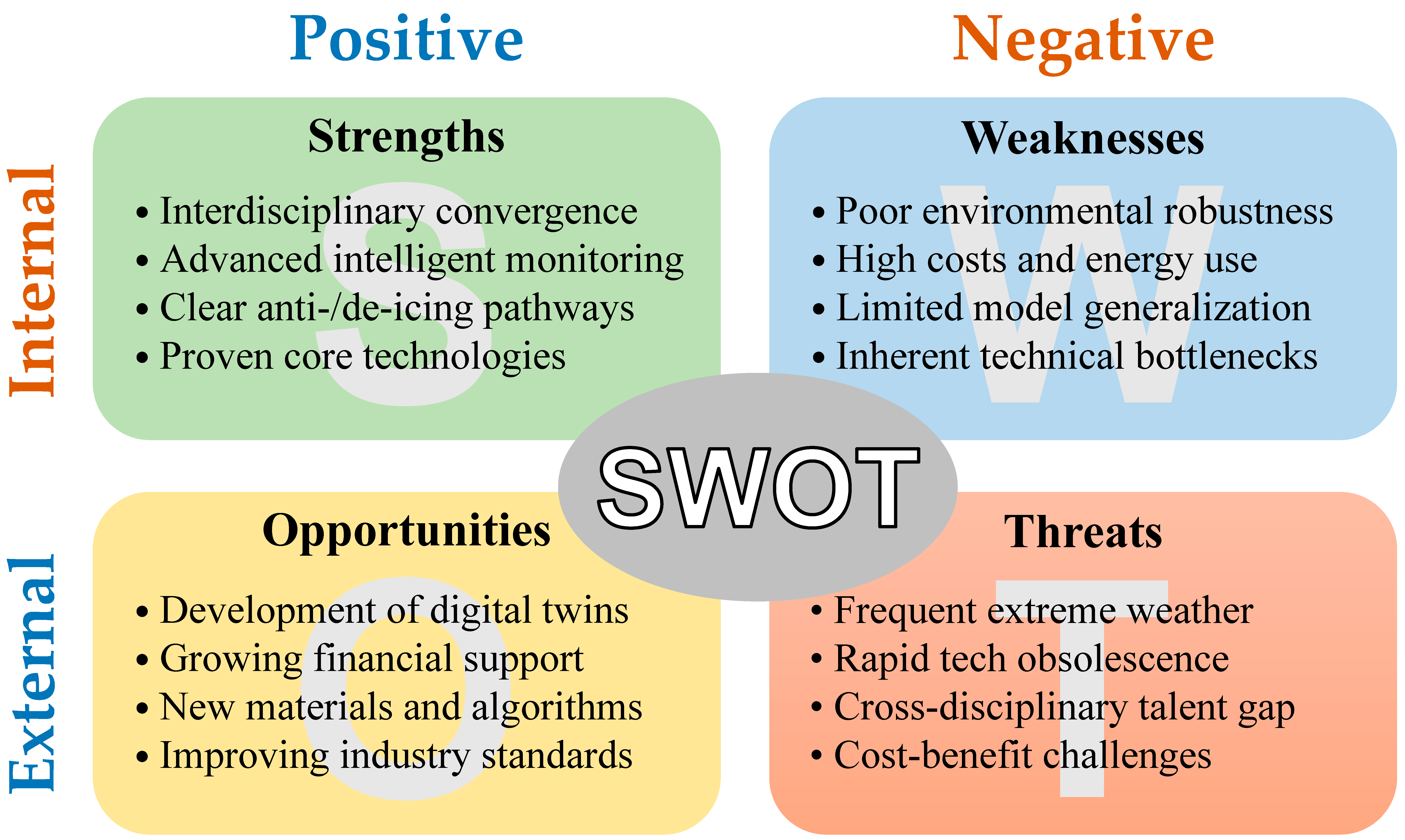
Transmission line icing represents a significant natural threat to power grid security, making the integrated innovation of icing mechanism research, intelligent detection, and efficient prevention technologies a critical focus in power engineering. This paper systematically reviews recent advances in the field and outlines developmental pathways via a SWOT analysis (Figure 9).
Research on icing mechanisms has established a multi-physics framework integrating meteorology, fluid dynamics and thermodynamics, identifying key parameters including temperature, humidity, wind speed and water droplet size. However, existing models show limitations in characterizing dynamic ice evolution over complex terrain and coupled physical mechanisms. Future work should develop dynamic prediction models integrating real-time meteorological data with geographic information systems, supported by high-fidelity simulations and controlled experiments to elucidate micro-scale interactions.
The detection field is shifting from contact measurements to non-contact intelligent perception using computer vision and deep learning. Visual systems with UAVs and fixed platforms have advanced ice recognition, segmentation and thickness retrieval, yet remain constrained by image quality, annotation data scale, weather robustness and edge computing efficiency. Future development will move toward multi-modal perception and deep information fusion, employing graph neural networks to construct digital twins for comprehensive line-wide intelligent cognition.
Anti-/de-icing technologies have evolved into an integrated strategy combining active and passive approaches. DC de-icing, particularly MMC-based topologies, has become the mainstream solution for high-voltage lines due to high efficiency and low grid impact. Superhydrophobic coatings, photothermal coatings and expanded-diameter conductors show promise but face challenges in durability, environmental adaptability, costs and installation precision. Future evolution should emphasize technical pathway integration, developing photo-electro-thermal collaborative systems or self-healing smart coatings.
In conclusion, future research should focus on building an integrated technology chain covering mechanistic understanding, intelligent perception and active prevention: enhancing multi-physics modeling; developing AI and edge computing-based monitoring systems; and promoting coordinated innovation in materials, structures and functions to create reliable, cost-effective and environmentally compatible solutions. Through interdisciplinary collaboration, resilient power grid systems capable of addressing extreme climate challenges can be achieved.

Author Contributions

J.H.: funding acquisition, writing—review and editing; L.L.: investigation, data curation; X.Z.: conceptualization, supervision, writing—original draft; Y.J.: supervision, writing—review and editing. All authors have read and agreed to the published version of the manuscript.

Funding

This paper was supported by a grant from Economic and Technical Research Institute of State Grid Jiangxi Electric Power Co., Ltd. (No. SGJXJY00NYWT2500392).

Data Availability Statement

The original contributions presented in the study are included in the article, further inquiries can be directed to the corresponding author.

Acknowledgments

The authors thank the anonymous reviewers for their constructive comments and suggestions, which greatly improved the quality of this manuscript.

Conflicts of Interest

Author Jie Hu and Longjiang Liu were employed by the company Economic and Technical Research Institute of State Grid Jiangxi Electric Power Co., Ltd., Nanchang, Jiangxi 330006, China. The remaining authors declare that the research was conducted in the absence of any commercial or financial relationships that could be construed as a potential conflict of interest.

List of Abbreviations

ACAlternating Current
AIArtificial Intelligence
CGMCross-Guide Module
CFDComputational Fluid Dynamics
CG-UNetCross-Guide-UNet
CNN-RFConvolutional Neural Network—Random Forest
CNTCarbon Nanotubes
DABMDilated Asymmetric Bottleneck Module
DCDirect Current
EDPNetEfficient Dynamic Perception Network
EECNetEfficient Edge Computing Network
ELMExtreme Learning Machine
EM-DCAExpectation Maximization Dynamic Convolutional Attention
EPCMEfficient Partial Conversion Module
EsSurface Electric Field Strength
F1-scoreBalanced F-Score
FBGFiber Bragg Grating
FCMFuzzy C-Means
FFNNFeedforward Neural Network
FPNFeature Pyramid Network
GMSA-NetGlobal Micro Strip Awareness Network
GMAMGlobal Micro-Awareness Module
GPRGaussian Process Regression
GSOGlowworm Swarm Optimization
GWOGray Wolf Optimizer
IULBPImproved Uniform Local Binary Patterns
KELMKernel Extreme Learning Machine
KPCAKernel Principal Component Analysis
K-SVDk Singular Value Decomposition
LDKA-NetLarge Dynamic Kernel Aggregation Net
LE-SSLow-emissivity Solar-assisted Superhydrophobic
LMRCLightweight Multi-dimensional Recombination Convolution
LSTMLong Short-Term Memory
MAEMean Absolute Error
MAGSACMarginalizing Sample Consensus
mIoUmean Intersection over Union
MMCModular Multilevel Converter
mPAmean Pixel Accuracy
MSCMMixed Strip Convolution Module
MSRMulti-Scale Retinex
MVDMedian Volume Diameter
NIRNear-infrared
ORBOriented FAST and Rotated BRIEF
R2Coefficient of Determination
RANSACRandom Sample Consensus
R-CNNRegion-Based Convolutional Neural Network
ResNetResidual Network
RMSERoot Mean Square Error
S-UNetStrengthened U-Net
SGAN-UNetStrengthened Generative Adversarial Network U-Net
SIFTScale-Invariant Feature Transform
SSDSingle Shot MultiBox Detector
STATCOMStatic Synchronous Compensator
SVMSupport Vector Machine
UAVUnmanned Aerial Vehicle
WFVC-Netwide field of view convolutional network
YOLOYou Only Look Once

References

  1. Dai, D.; Hu, Y.; Qian, H.; Qi, G.; Wang, Y. A novel detection algorithm for the icing status of transmission lines. Symmetry 2024, 16, 1264. [Google Scholar] [CrossRef]
  2. Xu, X.; Niu, D.; Wang, P.; Lu, Y.; Xia, H. The weighted support vector machine based on hybrid swarm intelligence optimization for icing prediction of transmission line. Math. Probl. Eng. 2015, 2015, 798325. [Google Scholar] [CrossRef]
  3. Han, X.; Wang, J.; Xing, B.; Jiang, X.; Dong, S. Collision characteristics of water droplets in icing process of insulators. Electr. Power Syst. Res. 2022, 212, 108663. [Google Scholar] [CrossRef]
  4. Han, S.; Li, D.; Li, K.; Wu, H.; Gao, Y.; Zhang, Y.; Yuan, R. Analysis and study of transmission line icing based on Grey Correlation Pearson Combinatorial optimization support vector machine. Measurement 2024, 236, 115086. [Google Scholar] [CrossRef]
  5. Gonçalves, A.; Marques, M.C.; Loureiro, S.; Nieto, R.; Liberato, M.L. Disruption risk analysis of the overhead power lines in Portugal. Energy 2023, 263, 125583. [Google Scholar] [CrossRef]
  6. Brettschneider, S.; Fofana, I. Evolution of countermeasures against atmospheric icing of power lines over the past four decades and their applications into field operations. Energies 2021, 14, 6291. [Google Scholar] [CrossRef]
  7. Levchenko, I.I.; Satsuk, E.I.; Shovkoplyas, S.S. Intellectual ice melting system on wires of overhead transmission lines of distribution electric networks. In Proceedings of the International Russian Automation Conference (RusAutoCon), Sochi, Russia, 8–14 September 2019; pp. 1–7. [Google Scholar]
  8. Karunasingha, N.; Titov, D. An Analysis of forecasting technologies for icing events in overhead power line wires. In Proceedings of the International Ural Conference on Electrical Power Engineering (UralCon), Magnitogorsk, Russia, 29 September–1 October 2023; pp. 227–232. [Google Scholar]
  9. Zhlobitskiy, L.; Lankin, M.; Shovkoplyas, S. Method of forecasting icing on overhead power lines wires. In Proceedings of the International Russian Automation Conference (RusAutoCon), Sochi, Russia, 10–16 September 2023; pp. 36–41. [Google Scholar]
  10. Liu, Y. Analysis and countermeasures of ice accident of transmission lines in Jiangxi Province. Constr. Des. Proj. 2020, 6, 96. [Google Scholar]
  11. Wang, L.; Chen, Z.; Zhang, W.; Lu, Z.; Cheng, Y.; Qu, X.; Gul, C.; Yang, Y. The causes and forecasting of icing events on power transmission lines in southern China: A review and perspective. Atmosphere 2023, 14, 1815. [Google Scholar] [CrossRef]
  12. Aquino, J.; Prado, J.C.D.; Nazaripouya, H.; Bertoletti, A.Z. Enhancing power grid resilience against ice storms: State-of-the-art, challenges, needs, and opportunities. IEEE Access 2023, 11, 60792–60806. [Google Scholar] [CrossRef]
  13. Jiao, J.; Liu, F.; Wang, Z.; Zou, G.; Peng, Y. Detection and segmentation of overhead transmission line icing images via an improved YOLOv8-seg. Electr. Eng. 2025, 107, 9635–9647. [Google Scholar] [CrossRef]
  14. Li, Q.H.; Meng, J.; Li, J.S.; Liu, Y.L.; Chang, Q.; Jiang, M.; Guo, D. Spatial distribution and division of wire icing thickness under different return periods in Shanxi Province. J. Arid Meteorol. 2022, 40, 156–165. [Google Scholar]
  15. Zhang, R.Z.; Zhou, K.; Zhao, L.X.; Tan, L.; Li, H.D.; Wang, Y.N.; Cai, Y.M.; Li, C.S.; Chen, S. Prediction technology of power transmission line icing based on micrometeorological and microtopography in Beijing area. Sci. Technol. Eng. 2022, 22, 14744–14751. [Google Scholar]
  16. Zhang, Z.; Zhang, H.; Yue, S.; Zeng, W. A review of icing and anti-icing technology for transmission lines. Energies 2021, 16, 601. [Google Scholar] [CrossRef]
  17. Fu, P.; Farzaneh, M.; Bouchard, G. Two-dimensional modelling of the ice accretion process on transmission line wires and conductors. Cold Reg. Sci. Technol. 2006, 46, 132–146. [Google Scholar] [CrossRef]
  18. Yin, H.; Wang, J.J. Effects of micrometeorological parameters and icing time on icing of transmission line. High Volt. Appar. 2017, 53, 145–150. [Google Scholar]
  19. Li, X.C.; Zhang, X.; Liu, J.; Hu, J.L. Prediction of transmission line icing thickness applying AMPSO-BP neural network model. Electr. Power Constr. 2021, 42, 140–146. [Google Scholar]
  20. Farzaneh, M.; Savadjiev, K. Statistical analysis of field data for precipitation icing accretion on overhead power lines. IEEE Trans. Power Deliv. 2005, 20, 1080–1087. [Google Scholar] [CrossRef]
  21. Wang, Q.; Lou, W.J.; Xu, H.W.; Wang, L.Q. Numerical simulation of icing on transmission conductors considering time-varying meteorological parameters. J. Harbin Inst. Technol. 2022, 54, 11–21. [Google Scholar]
  22. Xu, F.; Li, D.; Gao, P.; Zang, W.; Duan, Z.; Ou, J. Numerical simulation of two-dimensional transmission line icing and analysis of factors that influence icing. J. Fluids Struct. 2023, 118, 103858. [Google Scholar] [CrossRef]
  23. Han, X.B.; Qiao, G.J.; Jiang, X.L. Study on the influence of water droplet particle size distribution on transmission line icing. Electr. Power Syst. Res. 2025, 247, 111840. [Google Scholar] [CrossRef]
  24. Song, Y.Q.; Shao, M. Impacts of complex terrain features on local wind field and PM2.5 concentration. Atmosphere 2023, 14, 761. [Google Scholar] [CrossRef]
  25. Song, L.L.; Wu, Z.P.; Qin, P.; Huang, H.H.; Liu, A.; Zhi, S.Q. An analysis of the characteristics of strong winds in the surface layer over a complex terrain. Acta Meteorol. Sin. 2009, 67, 452–460. [Google Scholar]
  26. Chen, K.J.; Bian, R.; Zhou, W.Z. Wind-induced flashover incident analysis of jumper considering the effect of typhoon and mountainous topography. High. Volt. Eng. 2023, 49, 1507–1514. [Google Scholar]
  27. Cao, L.Z. Study on icing characteristics of overhead lines in high altitude mountainous region of northwest Sichuan. Electr. Power Surv. Des. 2019, S1, 229–233. [Google Scholar]
  28. Ren, X. Research on ice covering mechanism and intelligent ice melting technology of transmission lines in high-altitude areas. Technol. Mark. 2025, 32, 80–83+87. [Google Scholar]
  29. Jiang, X.L.; Fan, C.J.; Xie, Y.B. New method of preventing ice disaster in power grid using expanded conductors in heavy icing area. IET Gener. Transm. Distrib. 2019, 13, 536–542. [Google Scholar] [CrossRef]
  30. Mao, X.Y.; Chen, G.; Lv, Q.Y.; Dong, L.F.; Lu, C.J. Online ice quality measurement technology based on analogue conductors. Autom. Instrum. 2023, 4, 179–184. [Google Scholar]
  31. Yan, Z.H.; Ge, J.F.; Ye, L.; Yang, X.J.; Gong, Y.; Huang, Z.H.; Su, L.Z. Transmission line ice detection system based on the simulated wire. Foreign Electron. Meas. Technol. 2016, 35, 63–66. [Google Scholar]
  32. Chang, X.M.; Dun, Z.; Dou, Y.K.; Xue, Y.; Yuan, K. The design of capacitive device for detecting transmission lines ice thickness. J. Taiyuan Univ. Technol. 2014, 45, 559–561. [Google Scholar]
  33. Huang, X.B.; Sun, Q.D.; Cheng, R.G.; Zhang, G.J.; Liu, J.B. Mechanical analysis on transmission line conductor icing and application of online monitoring system. Autom. Electr. Power Syst. 2007, 31, 98–101. [Google Scholar]
  34. Yang, L.; Hao, Y.P.; Li, W.G.; Dai, D.; Li, L.; Zhu, G.H.; Luo, B. A mechanical calculation model for on-line icing-monitoring system of overhead transmission lines. Proc. CSEE 2010, 30, 100–105. [Google Scholar]
  35. Yang, L.; Chen, Y.; Hao, Y.; Li, L.; Li, H.; Huang, Z. Detection method for equivalent ice thickness of 500-kV overhead lines based on axial tension measurement and its application. IEEE Trans. Instrum. Meas. 2023, 72, 9001611. [Google Scholar] [CrossRef]
  36. Ogawa, Y.; Iwasaki, J.I.; Nakamura, K. A multiplexing load monitoring system of power transmission lines using fiber Bragg grating. In Proceedings of the 12th International Conference on Optical Fiber Sensors: Foreword, Williamsburg, VA, USA, 28–31 October 1997. [Google Scholar]
  37. Gao, M.; Zhang, J.T.; Zhao, Z.G.; Li, C.; Xu, X.; Liang, S. Monitoring and analysis of icing on transmission lines based on optical fiber sensing. Chin. J. Sens. Actuators 2018, 31, 1295–1300. [Google Scholar]
  38. Xu, Z.N.; Li, X.F.; Guo, Y.F.; Zhao, L.J. Influence of wind speed on the effectiveness of monitoring of ice-covered overhead transmission line based on BOTDA. Electr. Power Eng. Technol. 2022, 41, 152–162. [Google Scholar]
  39. Li, X.F.; Xu, Z.N.; Guo, Y.F.; Zhao, L.J. Review of application of icing monitoring technology for transmission lines based on optical fiber sensing. J. North China Electr. Power Univ. 2023, 50, 22–34+43. [Google Scholar]
  40. Yao, J.Y.; Yang, S.Y.; Shu, Z.Y.; Gao, J.; Li, Z.H. Research on monitoring of ice-coating thickness of transmission line based on aerial image. High Volt. Appar. 2021, 57, 105–114. [Google Scholar]
  41. Guo, Q.L.; Xiao, J.; Hu, X.G. New keypoint matching method using local convolutional features for power transmission line icing monitoring. Sensors 2018, 18, 698. [Google Scholar] [CrossRef]
  42. Yang, M.; Su, P.; Feng, J.H. Measurement of icing thickness of transmission line based on fractal theory. Meas. Control. Technol. 2018, 37, 111–116. [Google Scholar]
  43. Zhang, Y.Y.; Wang, Y.L.; Wei, A.M. A new image detection method of transmission line icing thickness. In Proceedings of the IEEE 4th Information Technology, Electronic and Automation Control Conference (ITNEC), Chongqing, China, 12–14 June 2020; pp. 2059–2064. [Google Scholar]
  44. Nusantika, N.R.; Hu, X.G.; Xiao, J. Improvement Canny edge detection for the UAV icing monitoring of transmission line icing. In Proceedings of the IEEE 16th Conference on Industrial Electronics and Applications (ICIEA), Chengdu, China, 1–4 August 2021; pp. 1838–1843. [Google Scholar]
  45. Ma, Y.; Yu, H.; Liu, J.; Zhai, Y. Measurement of ice thickness based on binocular vision camera. In Proceedings of the IEEE International Conference on Mechatronics and Automation (ICMA), Takamatsu, Japan, 6–9 August 2017; pp. 162–166. [Google Scholar]
  46. Nusantika, N.R.; Xiao, J.; Hu, X.G. An enhanced multiscale retinex, Oriented FAST and Rotated BRIEF (ORB), and Scale-Invariant Feature Transform (SIFT) pipeline for robust key point matching in 3D monitoring of power transmission line icing with binocular vision. Electronics 2024, 13, 4252. [Google Scholar] [CrossRef]
  47. Nusantika, N.R.; Xiao, J.; Hu, X.G. Precision ice detection on power transmission lines: A novel approach with multi-scale retinex and advanced morphological edge detection monitoring. J. Imaging 2024, 10, 287. [Google Scholar] [CrossRef]
  48. Nusantika, N.R.; Hu, X.G.; Xiao, J. Newly designed identification scheme for monitoring ice thickness on power transmission lines. Appl. Sci. 2023, 13, 9862. [Google Scholar] [CrossRef]
  49. Hu, M.H.; He, J.C.; Alsabaan, M. Image identification method of ice thickness on transmission line based on visual sensing. Mob. Netw. Appl. 2023, 28, 1783–1792. [Google Scholar] [CrossRef]
  50. Yan, L.M.; Chu, S.Q.; Xu, J.J.; Zhang, B.; Zhou, Y.T. Detection of ice thickness of transmission line based on GSO-Canny algorithm. Foreign Electron. Meas. Technol. 2022, 41, 157–161. [Google Scholar]
  51. Shu, Z.Y.; Shen, J.Y.; Li, H.Q.; Xiong, H.L.; Li, S.C.; Ma, J.C. Research on the identification of transmission line ice thickness based on aerial images. China Meas. Test 2023, 49, 21–25+59. [Google Scholar]
  52. Girshick, R.; Donahue, J.; Darrell, T.; Malik, J. Rich feature hierarchies for accurate object detection and semantic segmentation. In Proceedings of the IEEE Conference on Computer Vision and Pattern Recognition, Columbus, OH, USA, 23–28 June 2014; pp. 580–587. [Google Scholar]
  53. Yang, M.; Ma, H.; Chen, B.; Dong, G. Intensive cold-air invasion detection and classification with deep learning in complicated meteorological systems. Complexity 2022, 2022, 4354198. [Google Scholar] [CrossRef]
  54. Zhang, W.; Liljedahl, A.K.; Kanevskiy, M.; Epstein, H.E.; Jones, B.M.; Jorgenson, M.T.; Kent, K. Transferability of the deep learning Mask R-CNN model for automated mapping of ice-wedge polygons in high-resolution satellite and UAV images. Remote Sens. 2020, 12, 1085. [Google Scholar] [CrossRef]
  55. Liu, W.; Anguelov, D.; Erhan, D.; Szegedy, C.; Reed, S.; Fu, C.Y.; Berg, A.C. SSD: Single shot multibox detector. In Computer Vision-ECCV 2016: Lecture Notes in Computer Science; Springer: Berlin/Heidelberg, Germany, 2016; Volume 9905, pp. 21–37. [Google Scholar]
  56. Sun, J.; Wu, Y.; Qiu, Y.; Miao, C. Position and morphology detection of mixed particles based on IPI and YOLOv7. Opt. Commun. 2023, 554, 130158. [Google Scholar] [CrossRef]
  57. Wang, C.Y.; Yeh, I.H.; Liao, H.Y.M. YOLOv9: Learning What You Want to Learn Using Programmable Gradient Information. In Computer Vision-ECCV 2024: Lecture Notes in Computer Science; Springer: Berlin/Heidelberg, Germany, 2024; Volume 15089. [Google Scholar]
  58. Wang, A.; Chen, H.; Liu, L.H.; Chen, K.; Lin, Z.; Han, J.; Ding, G. YOLOv10: Real-Time End-to-End Object Detection Source. 38th Conference on Neural Information Processing Systems. NeurIPS 2024, arXiv:2405.14458. [Google Scholar]
  59. Zhou, R.; Zhang, Z.; Yan, Z.; Zhai, T.; Xiao, Z.; Li, L. GPR-based high-precision passive-support fiber ice coating detection method for power transmission lines. Opt. Express 2021, 29, 30483–30493. [Google Scholar] [CrossRef]
  60. Li, J.F.; Wang, Q.R.; Li, M. Electric equipment image recognition based on deep learning and random forest. High Volt. Eng. 2017, 43, 3705–3711. [Google Scholar]
  61. Ma, F.; Wang, B.; Li, M.; Dong, X.; Mao, Y.; Zhou, Y.; Ma, H. Edge intelligent perception method for power grid icing condition based on multi-scale feature fusion target detection and model quantization. Front. Energy Res. 2021, 9, 754335. [Google Scholar] [CrossRef]
  62. Yang, L.; Jiang, X.; Hao, Y.; Li, L.; Li, H.; Li, R.; Luo, B. Recognition of natural ice types on in-service glass insulators based on texture feature descriptor. IEEE Trans. Dielectr. Electr. Insul. 2017, 24, 535–542. [Google Scholar] [CrossRef]
  63. Yue, S.; Yuan, M.; Lu, T.; Shivakumara, P.; Blumenstein, M.; Shi, J.; Kumar, G.H. Rotation invariant angle-density based features for an ice image classification system. Expert Syst. Appl. 2020, 162, 113744. [Google Scholar] [CrossRef]
  64. Hu, T.; Shen, L.; Wu, D.; Duan, Y.; Song, Y. Research on transmission line ice-cover segmentation based on improved U-Net and GAN. Electr. Power Syst. Res. 2023, 221, 109405. [Google Scholar] [CrossRef]
  65. Dong, X.; Wan, Y.; Zhu, Y.; Ji, C. Research on detection of icing cover transmission lines under different weather conditions based on wide-field dynamic convolutional network LDKA-NET. Appl. Sci. 2024, 14, 11486. [Google Scholar] [CrossRef]
  66. Zhang, Y.; Jiao, Y.; Dou, Y.; Zhao, L.; Liu, Q.; Liu, Y. Ice thickness detection of transmission lines based on Cross-Guide-UNet. Appl. Sci. 2025, 15, 4264. [Google Scholar] [CrossRef]
  67. Snaiki, R.; Jamali, A.; Rahem, A.; Shabani, M.; Barjenbruch, B.L. A metaheuristic-optimization-based neural network for icing prediction on transmission lines. Cold Reg. Sci. Technol. 2024, 224, 104249. [Google Scholar] [CrossRef]
  68. Liu, Y.; Li, Q.; Liu, J.; Li, H.; Duan, R. Research on an icing-thickness calculation model for power transmission lines based on KPCA and GWO. Electr. Power Syst. Res. 2025, 248, 111877. [Google Scholar] [CrossRef]
  69. Han, Z.; Lv, H.; Liang, Z.; Yi, J. Transmission line icing thickness prediction model based on ISSA-CNN-LSTM. J. Phys. Conf. Ser. 2023, 2588, 012020. [Google Scholar] [CrossRef]
  70. Ke, H.; Sun, H.; Zhao, H.; Wu, T. Ice cover prediction for transmission lines based on feature extraction and an improved transformer scheme. Electronics 2024, 13, 2339. [Google Scholar] [CrossRef]
  71. Li, G.; Chen, H.; Sun, S.; Guo, T.; Yang, L. Research on transmission line icing prediction for power system based on improved snake optimization algorithm-optimized deep hybrid kernel extreme learning machine. Energies 2025, 18, 4646. [Google Scholar] [CrossRef]
  72. Kretov, D.; Belko, A.; Mutalov, A. The dataset for a machine learning forecast model of an overhead power lines icing. In Proceedings of the International Russian Smart Industry Conference (SmartIndustryCon), Sochi, Russia, 24–28 March 2025; pp. 934–939. [Google Scholar]
  73. Gu, H.M.; Zhang, Q.Q.; Wang, L. An intelligent method for fault situation in double-circuit transmission lines utilizing extreme learning machine. Electr. Eng. 2025, 107, 2051–2062. [Google Scholar] [CrossRef]
  74. Mo, D.; Wang, S.; Fan, Y.; Takyi-Aninakwa, P.; Zhang, M.; Wang, Y.; Fernandez, C. Enhanced multi-constraint dung beetle optimization-kernel extreme learning machine for lithium-ion battery state of health estimation with adaptive enhancement ability. Energy 2024, 307, 132723. [Google Scholar] [CrossRef]
  75. Jiao, Y.; Zhang, Y.; Dou, Y.; Zhao, L.; Liu, Q. EDPNet: A transmission line ice-thickness recognition end-side network based on efficient dynamic perception. Appl. Sci. 2024, 14, 8796. [Google Scholar] [CrossRef]
  76. Zhang, Y.; Jiao, Y.; Dou, Y.; Zhao, L.; Liu, Q.; Liu, Y. EECNet: An efficient edge computing network for transmission line ice thickness recognition. Processes 2025, 13, 2033. [Google Scholar] [CrossRef]
  77. Zhang, Y.; Dou, Y.; Jiao, Y.; Zhao, L.; Guo, D. GMSA-Net: A transmission line ice thickness identification network based on global micro strip awareness. Sensors 2024, 24, 4053. [Google Scholar] [CrossRef]
  78. Pohlman, J.C.; Landers, P. Present state-of-the-art of transmission line icing. IEEE Power Eng. Rev. 1982, PER-2, 20–21. [Google Scholar] [CrossRef]
  79. Xie, D.S.; Song, W.; Wang, W.; Sun, T.; Huang, T.Z.; Cai, X.M. Study on blasting parameters of high voltage transmission line coated by ice. J. North Univ. China (Nat. Sci. Ed.) 2018, 39, 746–751. [Google Scholar]
  80. Cao, Y.H.; Xue, K.Y.; Miao, L.L.; Li, H.T.; Guan, X.F.; Zhang, J.J.; Li, G.P. Dynamic response analysis of iced tower-line system due to blasting deicing. J. North Univ. China (Nat. Sci. Ed.) 2019, 40, 198–205. [Google Scholar]
  81. Jiang, X.; Chen, Y.; Huang, T.; Wang, M.; Huang, H. Electro-impulse de-icing (EIDI) test of aircraft wing leading edge. In Proceedings of the 22nd International Symposium on High Voltage Engineering, Xi’an, China, 21–26 November 2021; IET Conference Proceedings. pp. 66–71. [Google Scholar]
  82. Alhassan, A.B.; Zhang, X.; Shen, H.; Xu, H. Power transmission line inspection robots: A review, trends and challenges for future research. Int. J. Electr. Power Energy Syst. 2020, 118, 105862. [Google Scholar] [CrossRef]
  83. Fan, W.; Zhang, S.; Zhu, W.; Zhu, H. An efficient dynamic formulation for the vibration analysis of a multi span power transmission line excited by a moving de-icing robot. Appl. Math. Model. 2022, 103, 619–635. [Google Scholar] [CrossRef]
  84. Montambault, S.; Pouliot, N. The HQ LineROVer: Contributing to innovation in transmission line maintenance. In Proceedings of the IEEE 10th International Conference on Transmission and Distribution Construction, Operation and Live-Line Maintenance (ESMO), Orlando, FL, USA, 6–10 April 2003; pp. 33–40. [Google Scholar]
  85. Zhao, J.; Guo, R.; Cao, L.; Zhang, F. Improvement of LineROVer: A mobile robot for de-icing of transmission lines. In Proceedings of the 2010 1st International Conference on Applied Robotics for the Power Industry, Montreal, QC, Canada, 5–7 October 2010; pp. 1–4. [Google Scholar]
  86. Xian, H.X.; Qiao, G.; Wang, L.L.; Cheng, T.C.; Wu, H.Y. Structural design and simulation analysis of intelligent de-icing robots for high voltage transmission lines based on TRIZ theory. J. Mach. Des. 2025, 1–8. [Google Scholar] [CrossRef]
  87. Zhang, R.K.; Zhu, Y.; Tang, H.Y.; Xie, H.X. Design and research on the deicing robot for transmission lines. J. Chongqing Electr. Power Coll. 2024, 29, 1–4. [Google Scholar]
  88. Li, K.Q.; Du, L.; Han, W.H. Icing analysis of transmission lines considering the current heat. In Proceedings of the Asia-Pacific Power and Energy Engineering Conference, Wuhan, China, 25–28 March 2011; pp. 1–4. [Google Scholar]
  89. Q/GDW 10716-2022; Technical Guide of Current Ice-Melting for Overhead Transmission Lines. State Grid Corporation of China: Beijing, China, 2022.
  90. Jiang, X.; Meng, Z.; Zhang, Z.; Hu, J.; Lei, Y. DC ice-melting and temperature variation of optical fiber for ice-covered overhead ground wire. IET Gener. Transm. Distrib. 2016, 10, 352–358. [Google Scholar] [CrossRef]
  91. Yang, F.; Hou, Y.N. Application research of AC ice melting method in mountainous area of northern Guangdong. Telecom Power Technol. 2020, 37, 13–17. [Google Scholar]
  92. Wu, X.G.; He, R. Engineering application and technical and economic comparison of DC de-icing device in 500 kV substation. Electr. Power Surv. Des. 2023, 11, 7–11. [Google Scholar] [CrossRef]
  93. Lu, J.Z.; Zhang, Y. Realization of de-icing based on 12-pulse rectification for 500 kV transmission line. High Volt. Eng. 2012, 38, 3041–3047. [Google Scholar]
  94. Li, S.; Wang, X.; Yao, Z.; Li, T.; Peng, Z. Circulating current suppressing strategy for MMC-HVDC based on nonideal proportional resonant controllers under unbalanced grid conditions. IEEE Trans. Power Electron. 2015, 30, 387–397. [Google Scholar] [CrossRef]
  95. Yue, Y.F.; Wang, W.; Tang, X.; Tang, C. A control method for modular multilevel AC/AC converter based the equivalent current decomposition model. J. Electr. Power Sci. Technol. 2021, 36, 50–60. [Google Scholar]
  96. Hu, P.F.; Liang, Y.Q.; Du, Y.; Bi, R.M.; Rao, C.L.; Han, Y. Development and testing of a 10 kV 1.5 kA mobile DC de-icer based on modular multilevel converter with STATCOM function. J. Power Electron. 2018, 18, 456–466. [Google Scholar]
  97. Guo, Y.Q.; Zhou, Y.B.; Xu, J.Z.; Xu, S.K.; Zhao, C.Y.; Fu, C. Control strategy of DC ice-melting equipments for full-bridge modular multilevel converters. Autom. Electr. Power Syst. 2017, 41, 106–113. [Google Scholar]
  98. Hou, L.X.; Zhang, S.Q.; Wei, Y.D.; Li, X.Q.; Jiang, Q.R.; Li, M.R.; Li, W.R. DC traction power supply system based on modular multilevel converter suitable for energy feeding and de-icing. Csee J. Power Energy Syst. 2024, 10, 649–659. [Google Scholar]
  99. Zasypkin, A.; Shchurov, A. Capacitor protection of electromagnetic voltage transformers in dc ice melting schemes on overhead transmission lines. In Proceedings of the International Multi-Conference on Industrial Engineering and Modern Technologies (FarEastCon), Vladivostok, Russia, 6–9 October 2020; pp. 1–6. [Google Scholar]
  100. Sadykov, M.; Garifullina, N.; Demkina, Y. Modernization of mobile installations for removing ice deposits on power transmission lines. In Proceedings of the International Conference on Industrial Engineering, Applications and Manufacturing (ICIEAM), Sochi, Russia, 12–16 May 2025; pp. 51–55. [Google Scholar]
  101. Jourden, S. De-icer installation at Lévis substation on hydro Québec’s high voltage system. South Power Syst. Technol. 2009, 3, 1–6. [Google Scholar]
  102. Mohammed, A.G.; Ozgur, G.; Sevkat, E. Electrical resistance heating for deicing and snow melting applications: Experimental study. Cold Reg. Sci. Technol. 2019, 160, 128–138. [Google Scholar] [CrossRef]
  103. Lu, J.Z.; Li, B.; Zhang, H.X.; Fang, Z.; Jiang, Z.L. Application of new-type AC and DC de-icers in Hunan power grid. South. Power Syst. Technol. 2009, 3, 77–79. [Google Scholar]
  104. Hao, X.P.; Zhang, Y.Q.; Miao, D.; Tang, H.; Guo, H.D.; Zhang, X. Research on the application of sectional fixed DC ground wires de-icing method for 500 kV transmission lines. Electrotech. Appl. 2025, 44, 126–131. [Google Scholar]
  105. Tian, W.G.; Liu, P.J.; Cui, R.J.; Zhao, H.; Xiang, H.B. Research on ice melting scheme for ground wires of ±800 kV UHV DC transmission lines under uninterrupted mode. Autom. Appl. 2025, 66, 240–244. [Google Scholar]
  106. Huneault, M.; Langheit, C.; St-Arnaud, R.; Benny, J.; Audet, J.; Richard, J.-C. A dynamic programming methodology to develop de-icing strategies during ice storms by channeling load currents in transmission networks. IEEE Trans. Power Deliv. 2005, 20, 1604–1610. [Google Scholar] [CrossRef]
  107. Jiang, X.; Wang, Y.; Shu, L.; Zhang, Z.; Hu, Q.; Wang, Q. Control scheme of the de-icing method by the transferred current of bundled conductors and its key parameters. IET Gener. Transm. Distrib. 2015, 9, 2198–2205. [Google Scholar] [CrossRef]
  108. Wang, Y.X.; Jiang, X.L.; Fan, S.H.; Meng, Z.G. Asynchronism of ice shedding from the de-iced conductor based on heat transfer. ET Sci. Meas. Technol. 2016, 10, 389–395. [Google Scholar]
  109. Huang, G.; Yan, B.; Wen, N.; Wu, C.; Li, Q. Study on jump height of transmission lines after ice-shedding by reduced-scale modeling test. Cold Reg. Sci. Technol. 2019, 165, 102781. [Google Scholar] [CrossRef]
  110. Huang, G.Z.; Yan, B.; Mou, Z.Y.; Lv, X. Numerical investigation into torsional behavior of quad bundle conductors. IEEE Trans. Power Deliv. 2021, 36, 1024–1033. [Google Scholar] [CrossRef]
  111. Li, Y.; Zhang, X.; Gao, S.; Tang, X.; Li, P.; Li, Y.; Guo, Y.; Wu, G. Effect of water droplets on the corona discharge characteristics of composite insulators in arid areas. In Proceedings of the 2nd International Conference on Electrical Materials and Power Equipment (ICEMPE), Guangzhou, China, 7–10 April 2019; pp. 467–472. [Google Scholar]
  112. Yin, F.H.; Farzaneh, M.; Jiang, X.L. Influence of AC electric field on conductor icing. IEEE Trans. Dielectr. Electr. Insul. 2016, 23, 2134–2144. [Google Scholar] [CrossRef]
  113. Yin, F.H.; Jiang, X.L.; Farzaneh, M. Influences of electric field of conductors surface on conductor icing. High Volt. Eng. 2018, 44, 1023–1033. [Google Scholar]
  114. Esmeryan, K.D. From extremely water-repellent coatings to passive icing protection-principles, limitations and innovative application aspects. Coatings 2020, 10, 66. [Google Scholar] [CrossRef]
  115. Yin, X.; Zhang, Y.; Wang, D.; Liu, Z.; Liu, Y.; Pei, X.; Yu, B.; Zhou, F. Integration of self-Lubrication and near-infrared photothermogenesis for excellent anti-Icing/deicing performance. Adv. Funct. Mater. 2015, 25, 4237–4245. [Google Scholar] [CrossRef]
  116. Najibi, H.; Mohammadi, A.H.; Tohidi, B. Estimating the hydrate safety margin in the presence of salt and/or organic inhibitor using freezing point depression data of aqueous solutions. Ind. Eng. Chem. Res. 2006, 45, 4441–4446. [Google Scholar] [CrossRef]
  117. Golovin, K.; Dhyani, A.; Thouless, M.D.; Tuteja, A. Low-interfacial toughness materials for effective large-scale deicing. Science 2019, 364, 371–375. [Google Scholar] [CrossRef]
  118. Wang, Z.; Zhu, Y.; Liu, X.; Zhao, Z.; Chen, J.; Jing, X.; Chen, H. Temperature self-regulating electrothermal pseudo-slippery surface for anti-icing. Chem. Eng. J. 2021, 422, 130110. [Google Scholar] [CrossRef]
  119. Vasileiou, T.; Schutzius, T.M.; Poulikakos, D. Imparting icephobicity with substrate flexibility. Langmuir 2017, 33, 6708–6718. [Google Scholar] [CrossRef]
  120. Lian, C.; Emersic, C.; Rajab, F.H.; Cotton, I.; Zhang, X.; Lowndes, R.; Li, L. Assessing the superhydrophobic performance of laser micropatterned aluminium overhead line conductor material. IEEE Trans. Power Deliv. 2022, 37, 972–979. [Google Scholar] [CrossRef]
  121. Mitridis, E.; Lambley, H.; Tröber, S.; Schutzius, T.M.; Poulikakos, D. Transparent photothermal metasurfaces amplifying superhydrophobicity by absorbing sunlight. ACS Nano 2020, 14, 11712–11721. [Google Scholar] [CrossRef] [PubMed]
  122. Hu, J.H.; Jiang, G. Superhydrophobic coatings on iodine doped substrate with photothermal deicing and passive anti-icing properties. Surf. Coat. Technol. 2020, 402, 126342. [Google Scholar] [CrossRef]
  123. Zhang, F.; Xu, D.; Zhang, D.; Ma, L.; Wang, J.; Huang, Y.; Chen, M.; Qian, H.; Li, X. A durable and photothermal superhydrophobic coating with entwinned CNTs-SiO2 hybrids for anti-icing applications. Chem. Eng. J. 2021, 423, 130238. [Google Scholar] [CrossRef]
  124. Gou, Y.; Han, J.; Li, Y.; Qin, Y.; Li, Q.; Zhong, X. Research on anti-icing performance of graphene photothermal superhydrophobic surface for wind turbine blades. Energies 2023, 16, 408. [Google Scholar] [CrossRef]
  125. Li, Y.; Ma, W.; Kwon, Y.S.; Li, W.; Yao, S.; Huang, B. Solar deicing nanocoatings adaptive to overhead power lines. Adv. Funct. Mater. 2022, 32, 2113297. [Google Scholar] [CrossRef]
  126. Blinov, A.V.; Kostyukov, D.A.; Yasnaya, M.A.; Zvada, P.A.; Arefeva, L.P.; Varavka, V.N.; Zvezdilin, R.A.; Kravtsov, A.A.; Maglakelidze, D.G.; Golik, A.B.; et al. Oxide nanostructured coating for power lines with anti-icing effect. Coatings 2022, 12, 1346. [Google Scholar] [CrossRef]
  127. Wang, C.; Liu, Y.F.; Zhu, L.M.; Li, R.Y.; Liu, B.S. Study on the preparation and properties of photothermal superhydrophobic coatings for ice-resistant transmission lines. New Chem. Mater. 2025, 54, 244–250. [Google Scholar]
  128. Si, J.J.; Rui, X.M.; Liu, S.C.; Liu, L.; Yang, W.G. Stability analysis study on diameter-expanded conductor with fewer inner wires. IEEE Trans. Power Deliv. 2022, 37, 3536–3546. [Google Scholar]
  129. Wang, X.K.; Yu, J.B.; Liu, Z.H.; Qin, Z.; Jiang, X.L.; Hu, Q. Comparison of icing between equivalent expanded diameter conductor and bundle conductor. High Volt. Eng. 2022, 48, 2698–2705. [Google Scholar]
  130. Bi, C.L.; Jiang, X.L.; Han, X.B.; Yang, Z.Y.; Ren, X.D. Anti-icing method of using expanded diameter conductor to replace bundle conductor. Trans. China Electrotech. Soc. 2020, 35, 2469–2477. [Google Scholar]
  131. Huang, Y.F.; Jiang, X.L.; Ren, X.D.; Li, Z.Y. Study on preventing icing disasters of transmission lines by use of eddy self-heating ring. Trans. China Electrotech. Soc. 2021, 36, 2169–2177. [Google Scholar]
  132. Akhobadze, G. De-icing power transmission wires. In Proceedings of the International Conference on Actual Problems of Electron Devices Engineering (APEDE), Saratov, Russia, 24–25 September 2020; pp. 276–278. [Google Scholar]
  133. Liu, L.; Li, Y.; Jiang, X.; Zhang, Z.; Hu, J.; Hu, Q.; Zheng, H.; Chen, Q.; Yang, G. Research on icing torsion suppression method of overhead single conductors based on dynamic balance of orthogonal moments. IEEE Trans. Power Deliv. 2024, 39, 3398–3406. [Google Scholar] [CrossRef]
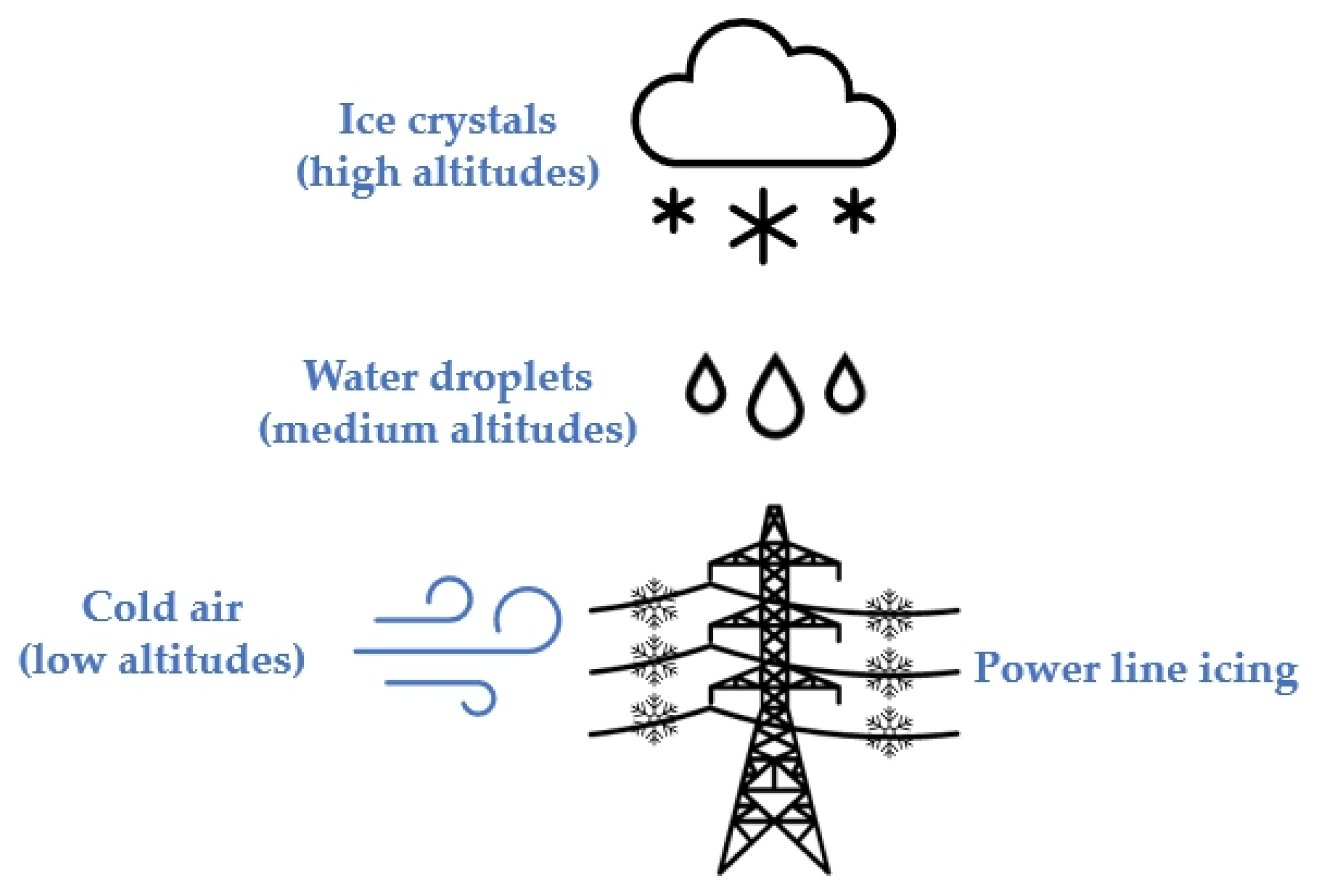
Figure 1. The icing formation process on overhead power lines [12]. (Licensed under CC BY-NC-ND 4.0).
Buildings 15 03757 g001
Figure 2. Six types of ice-covered conductors: (a) normal, (b) frost, (c) glaze, (d) rime, (e) mixed rime and (f) snow [13]. (Reprinted with permission from Springer Nature. Copyright 2025. License No. 6115801290073).
Buildings 15 03757 g002
Figure 3. The conductor icing calculated based on environment parameters measured in the tests: (a) icing shapes, (b) icing mass and (c) icing thickness [23]. (Reprinted with permission from Elsevier. Copyright 2025. License No. 6117410674839).
Buildings 15 03757 g003aBuildings 15 03757 g003b
Figure 4. The evaluation image of the (a) ground truth image testing and the (b) proposed method [48]. (Licensed under CC BY).
Buildings 15 03757 g004
Figure 5. Edge detection visualization diagram: (a) original image, (b) ground truth, (c) RCF image, (d) PidiNet image, and (e) CG-UNet image [66]. (Licensed under CC BY).
Buildings 15 03757 g005
Figure 6. Test results in complex backgrounds [77]. (Licensed under CC BY).
Buildings 15 03757 g006aBuildings 15 03757 g006b
Figure 7. DC short-circuit ice melting diagram [13]. (Licensed under CC BY).
Buildings 15 03757 g007
Figure 8. LE-SS nanocoating: (a) schematic illustration of the nanocoating, (b) de-icing process at an ambient temperature of −15 °C [125]. (Reprinted with permission from John Wiley and Sons. Copyright 2025. License No. 6117410996295).
Buildings 15 03757 g008
Figure 9. SWOT Analysis of Transmission Line Icing.
Buildings 15 03757 g009
Table 1. Key research on detection and monitoring for transmission line icing.
ReferenceResearch FocusMethodology/TechniqueKey Findings/Conclusions
Yang et al. [35]Detection of ice thicknessAxial tension measurementThe relative error is below 7% for the equivalent ice thickness (proposed method versus manual measurement).
Nusantika et al. [48]Detection of icing coverIntegration of image restoration, filter enhancement and enhanced multi-threshold algorithmThe method achieved 90% measurement accuracy, with performance metrics of 97.72% accuracy, 96.24% precision, 86.22% recall, and 99.48% specificity.
Hu et al. [64]Detection of icing coverAn optimized network SGAN_UNet composed by GAN and S_UnetSGAN_UNet attains superior metrics (89.47% mIoU, 95.73% mPA, 92.31% F1-score) and a 1.10% mIoU gain over S_UNet.
Dong et al. [65]Detection of icing coverLDKA-NET (WFVC Net, Full-dimensional dynamic convolutional feature fusion network, and EM-DCA)With a superior mAP@0.5 of 99.01%, the improved algorithm surpasses both the SSD and YOLOv5-L models by a clear margin (+4.81% and +3.11%, respectively).
Zhang et al. [66]Detection of icing coverCG-UNet (encoder–decoder architecture and CGM)With optimal dataset and image scale scores of 0.934 and 0.938, the thickness detection error is constrained within 7.2%.
Snaiki et al. [67]Prediction of the ice-to-liquid ratioFFNN with metaheuristic optimizersThe metaheuristic optimizers consistently outperformed SGD.
Liu et al. [68]Monitoring of ice thicknessKPCA, GWO, and SVMThe accuracy is 98.81%.
Ke et al. [70]Monitoring of ice thicknessFeature extraction and improved Transformer schemeThe proposed algorithm is superior to all baseline methods under multiple features and parameters.
Li et al. [71]Monitoring of ice thicknessImproved snake optimization algorithm and optimized deep hybrid kernel extreme learning machineRMSE 0.057, MAE 0.044, R2 0.993.
Zhang et al. [77]Monitoring of ice thicknessGMSA-Net (MSCM and GMAM)Key performance metrics: 96.4% mIoU, 98.1% F1-Score, and <3.8% ice thickness identification error.
Table 2. Key research on de-icing and anti-icing technologies for transmission lines.
ReferenceResearch FocusMethodology/TechniqueKey Findings/Conclusions
Hou et al. [98]DC de-icingDC traction power supply system suitable for energy feeding and de-icingEfficient de-icing through energy recycling.
Wang et al. [118]Anti-icing coatingTemperature self-regulating electrothermal pseudo-slippery surfaceKey results: ~30% lower anti-icing energy use at 1.5 W/cm2; ~40% ice inhibition after 120 s at −40 °C.
Lian et al. [120]Anti-icing surfacesSuperhydrophobic surfaces (Laser Micropatterned Aluminum)Surfaces remained superhydrophobic after 1 year outdoors, with a post-16-week weekly contact angle loss of ~0.1° (static) and ~0.2° (hysteresis).
Zhang et al. [123]De-icing coatingDurable photothermal superhydrophobic coating (CNT-Silica nanoparticle hybrid)Water contact angle: 159.3°; complete photothermal de-icing in <60 s (onset: 5 s) under 808 nm NIR.
Gou et al. [124]Anti-icing surfacesPhotothermal superhydrophobic surface (Graphene, fluorosilane-treated SiO2 solution, copper substrate)Contact angle: 160.5°; maintained unfrozen droplets under 808 nm NIR laser (2 W/cm2).
Li et al. [125]De-icing coatingScalable solar-thermal icephobic nanocoating (Titanium nitride nanoparticle layer and dual-scale silica particles)Temperature rise of 72 °C under 1 sun; high solar absorptance (90%) and low infrared emissivity (6%); rapid de-icing in 860 s and defrosting in 515 s at −15 °C.
Blinov et al. [126]Anti-icing coatingNanostructured coating (Solution of tetraethoxysilane and ammonia)Tensile strength: 2385 N; Wetting contact angle: 130°; Ice accumulation: 0.52 ± 0.13 g; Voltage deviation: 0.5% at 100,000 Hz.
Wang et al. [127]Anti-icing coatingPhotothermal superhydrophobic coatings (Graphene and carbonblack, non-fluorinated n-octyltriethoxysilane)Water contact angle: 158.3° ± 3.6°; Sliding angle: 4.6° ± 1.5°; Surface rapidly heats to 98.5 °C in 10 min, melting frozen droplets in 151 s.
Wang et al. [129]Anti-icing expanded diameter conductorExpanded diameter conductor replaces n (n = 4, 6, 8) bundle conductorIdentical transmission capacity, 60–70% less ice accumulation, and superior mechanical properties.
Huang et al. [131]De-icing self-heating ringEddy self-heating rings made of ferromagnetic materialNo ice forms on conductor with self-heating rings, reducing total ice mass by 18.38–30.61%.
Disclaimer/Publisher’s Note: The statements, opinions and data contained in all publications are solely those of the individual author(s) and contributor(s) and not of MDPI and/or the editor(s). MDPI and/or the editor(s) disclaim responsibility for any injury to people or property resulting from any ideas, methods, instructions or products referred to in the content.