Effects of Cover-Plate Geometry on the Mechanical Behavior of Steel Frame Joints with Middle-Flange and Wide-Flange H-Beams



Abstract
1. Introduction
2. Numerical Analysis Methods and Materials
2.1. Material Property
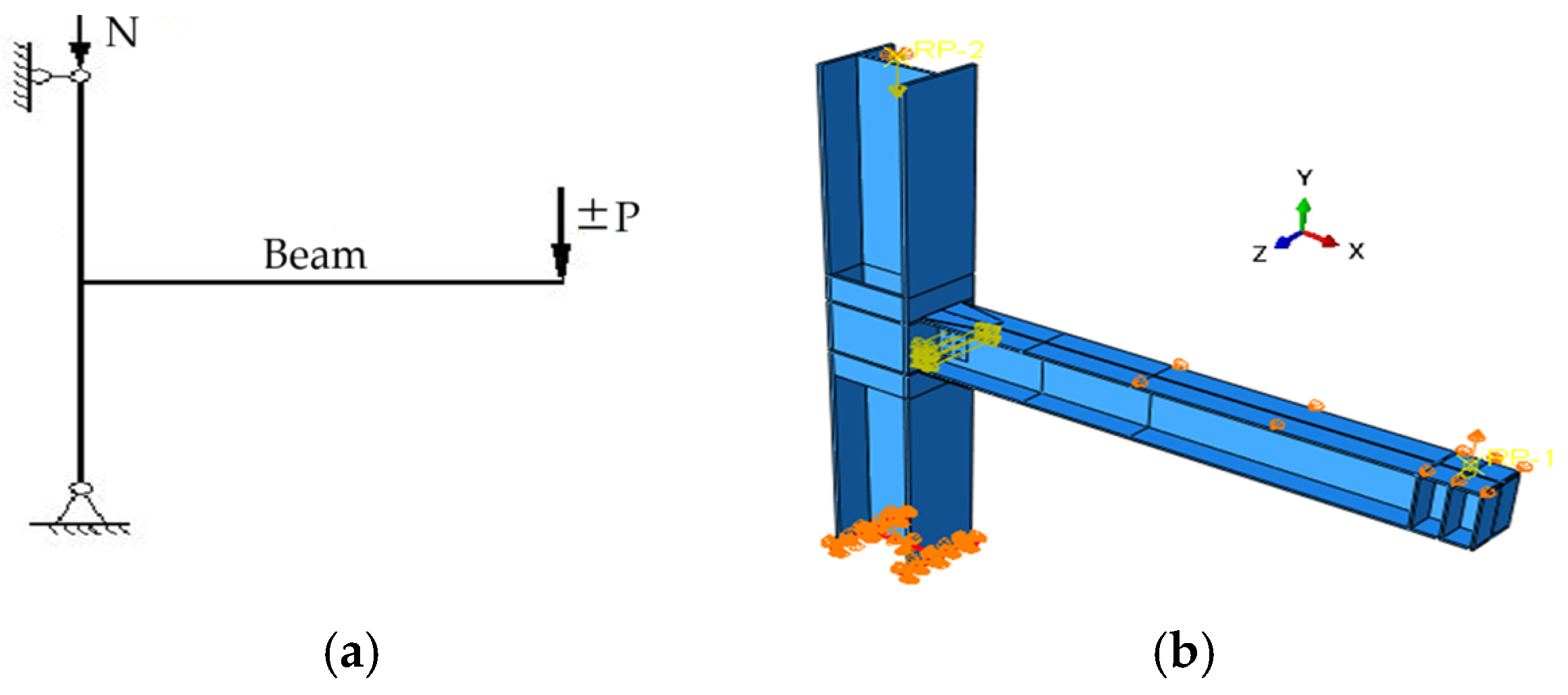
2.2. Numerical Modeling
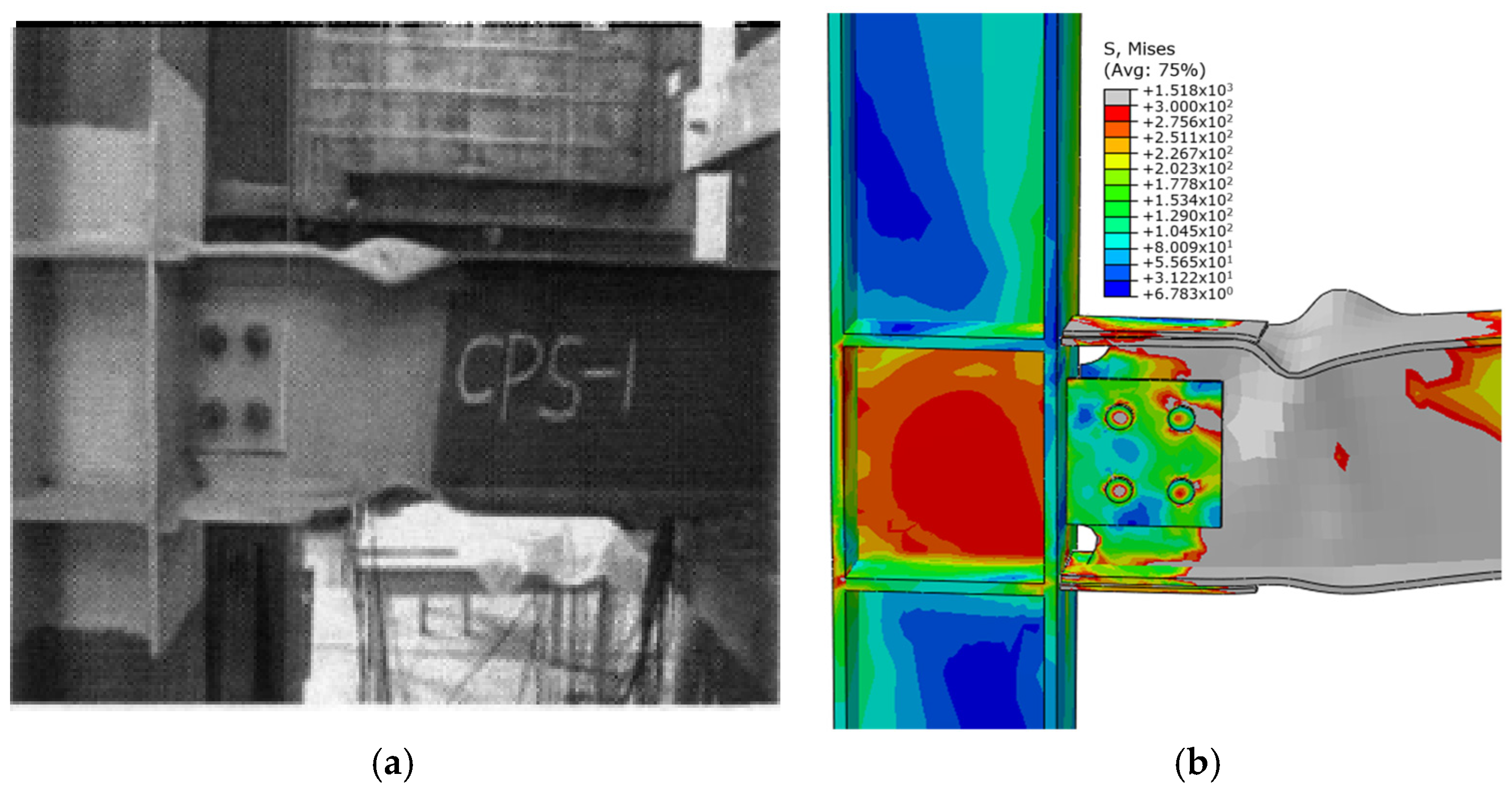
2.3. ABAQUS Analysis Validation
3. Specimen Design
4. Analysis of the Reinforcement Effect of Cover Plates
5. Effect Parameters Analysis of Cover Plates and Discussion
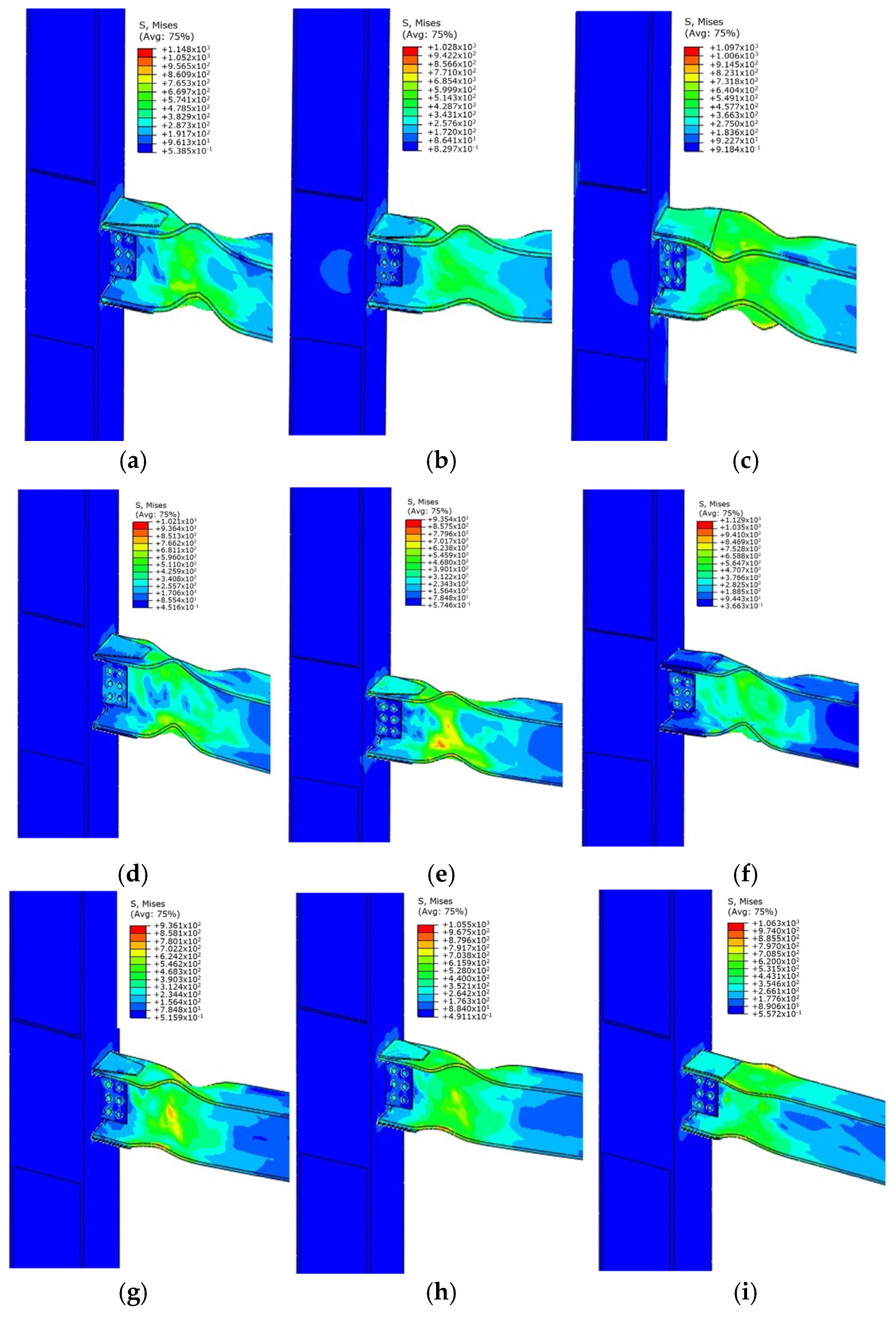
5.1. The Influences of Top Cover-Plate Shape
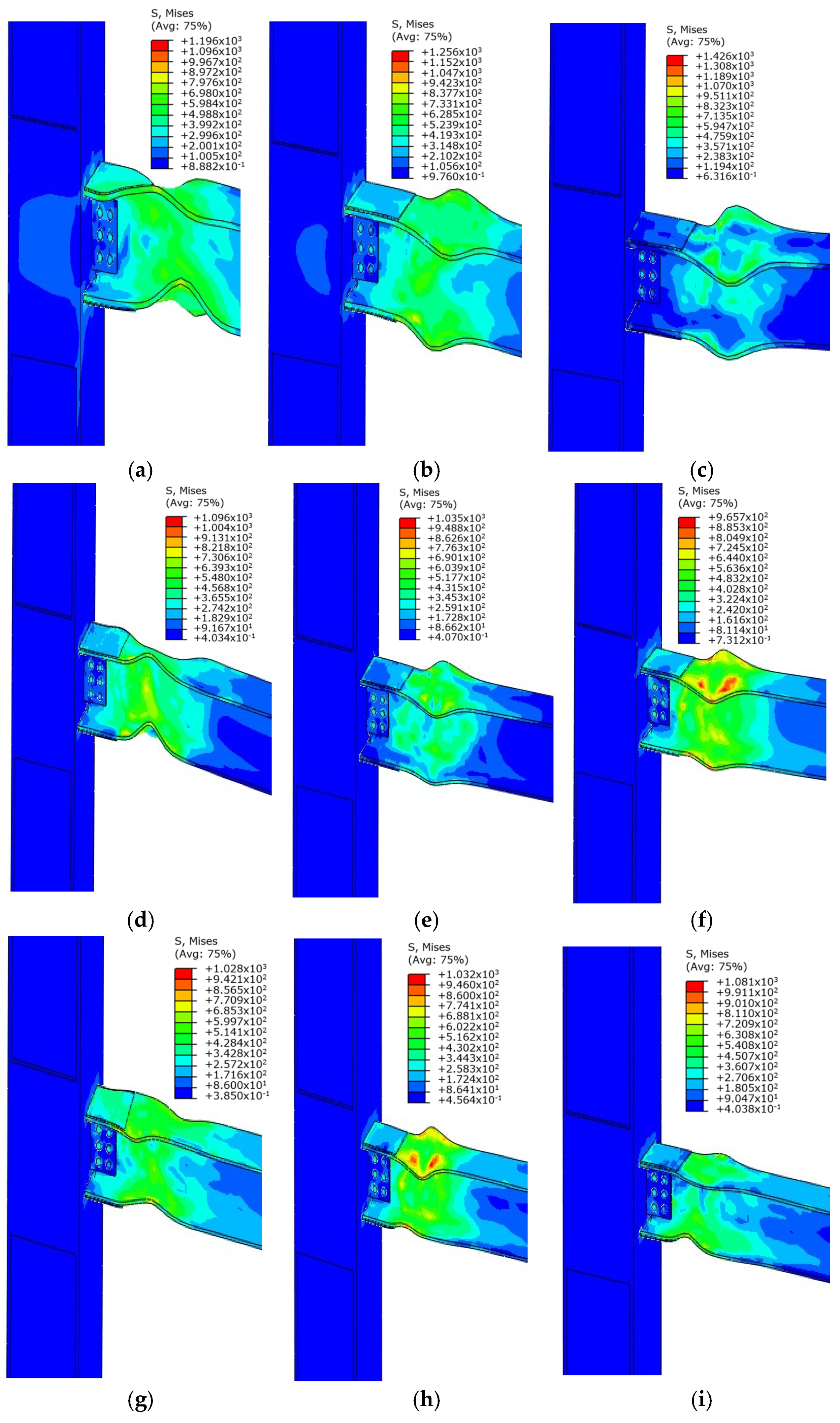
5.2. The Influences of Cover-Plate Length
5.3. The Influences of Cover-Plate Thickness
5.4. Discussions
- Cover-Plate Length:
- 2.
- Cover-Plate Thickness:
6. Conclusions
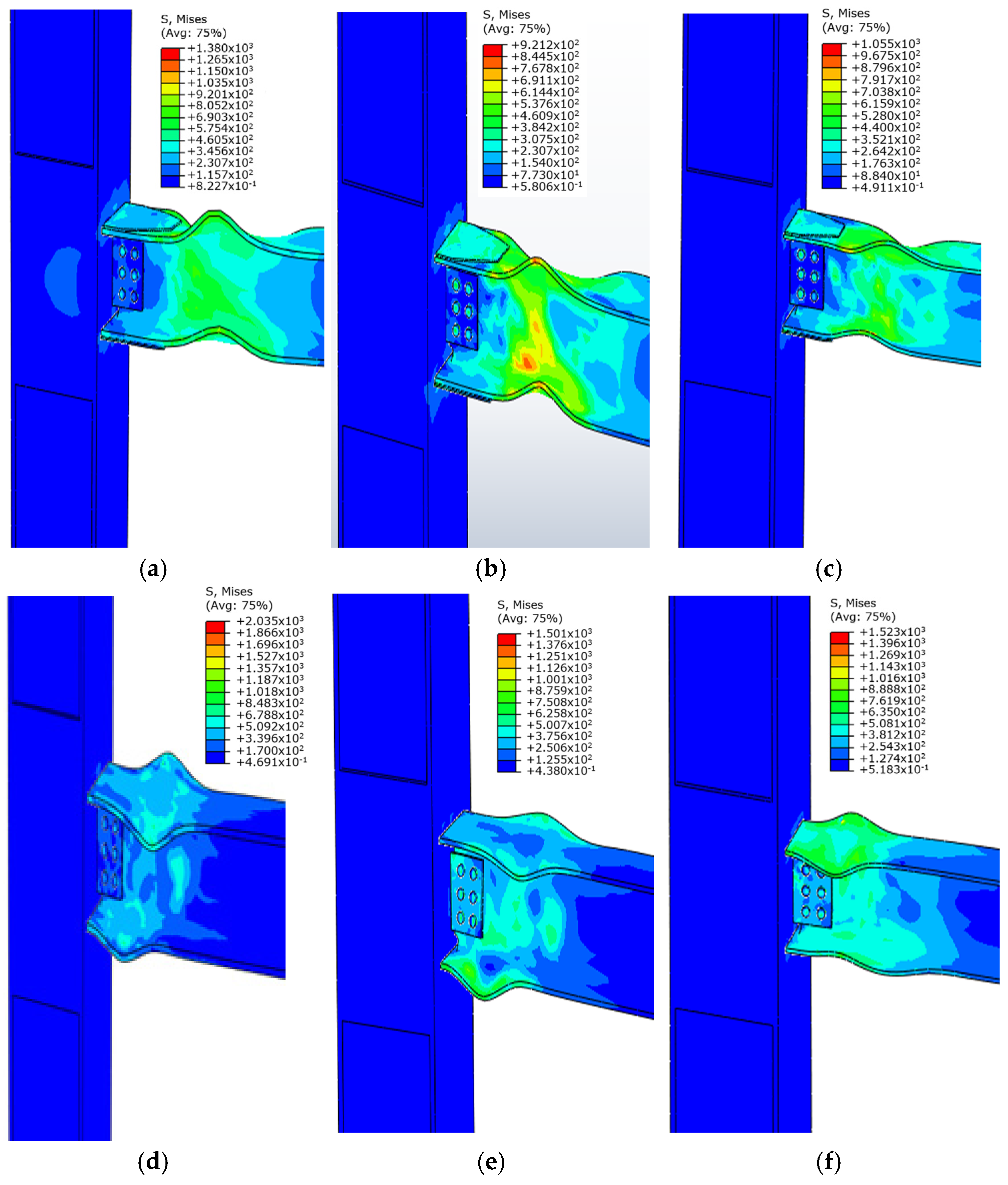
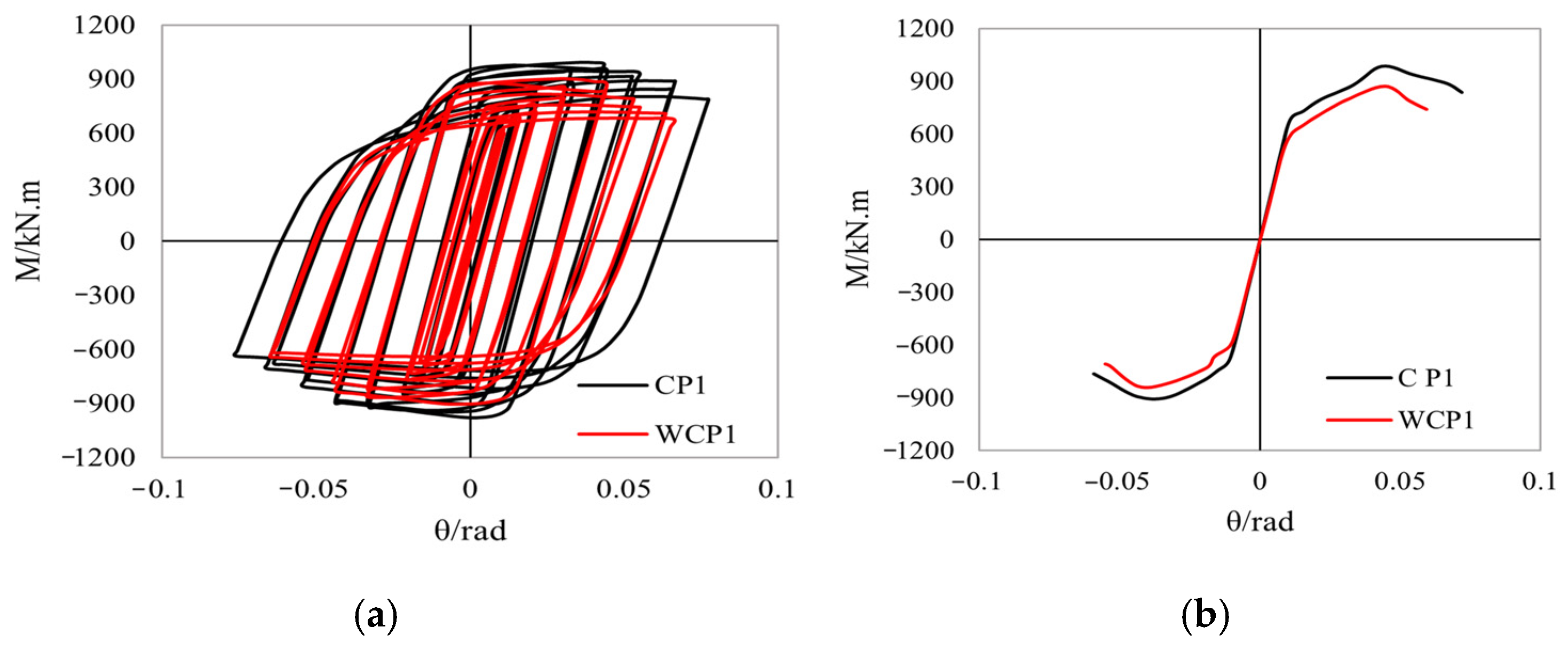
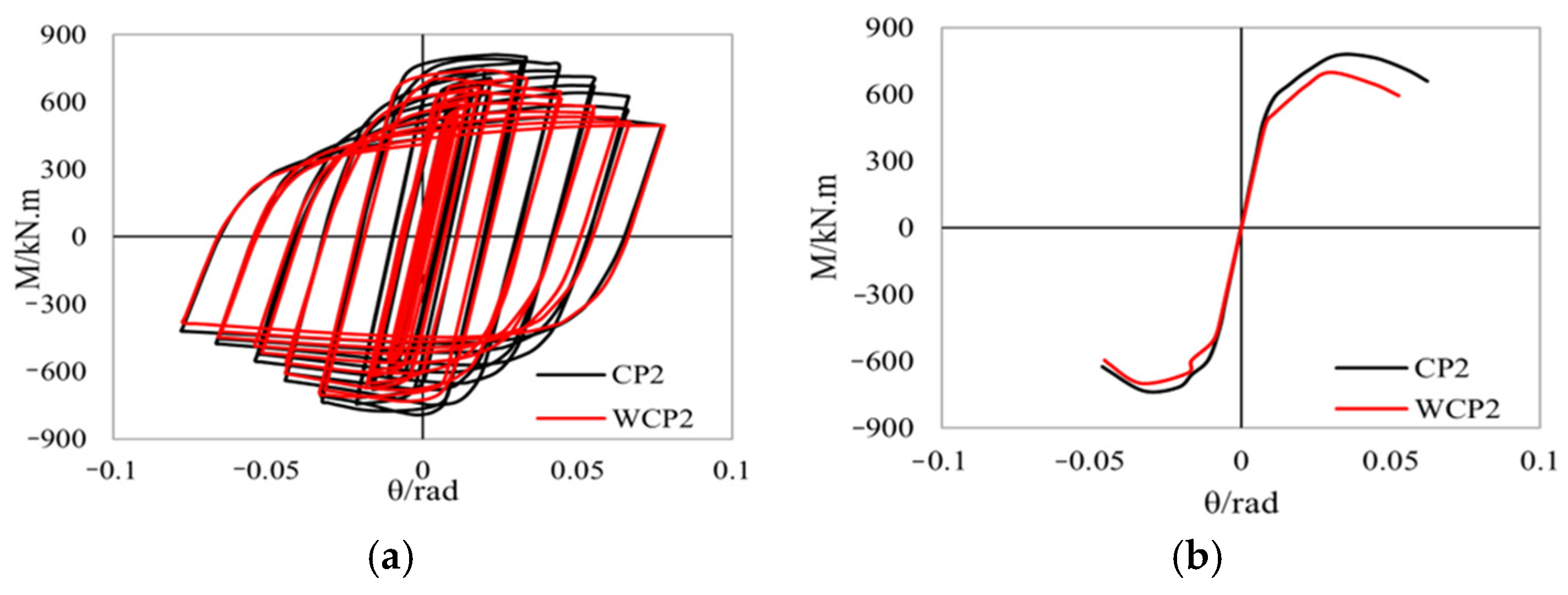
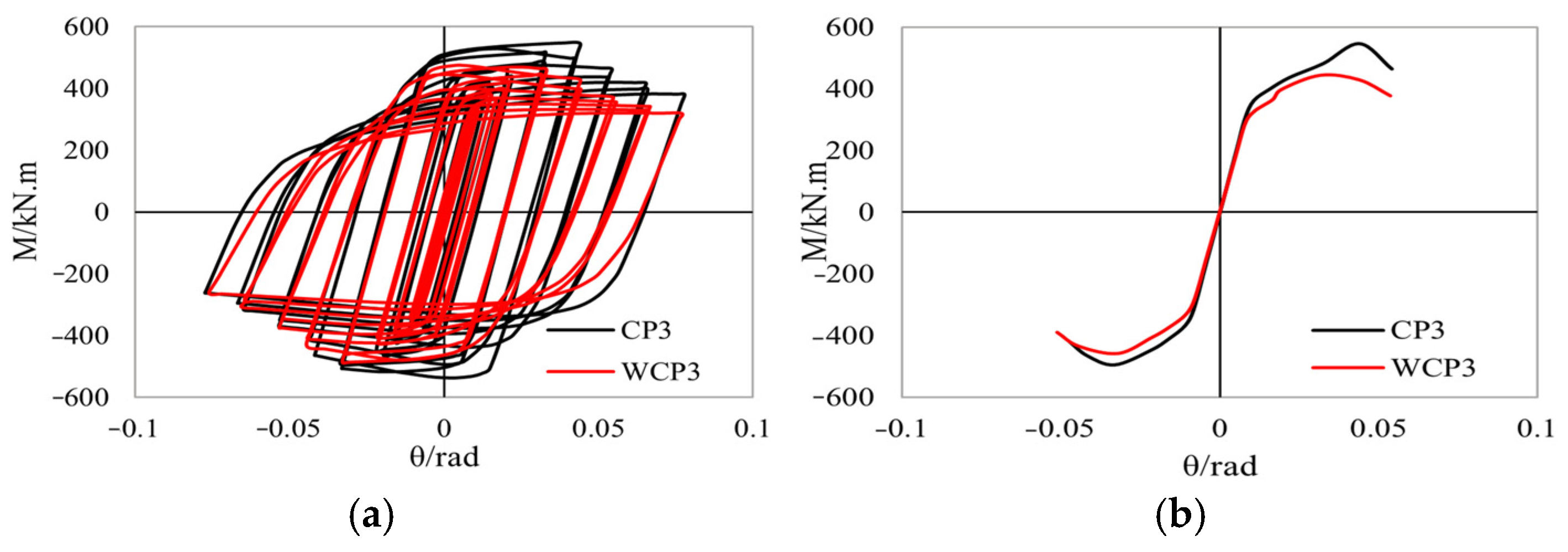
- Adopting cover-plate reinforced connections can effectively shift plastic hinge formation outward in frame connections using middle-flange or wide-flange H-shaped steel beams. This strategy significantly enhances the seismic performance and ductility of the joint. Compared to WCP specimens, CP specimens increased ductility by approximately 25% and improved initial rotational stiffness and yield moment by 7% and 15%, respectively.
- Adjusting the length of the cover plate impacts seismic ductility. A reasonable cover-plate length, 0.70~0.90 times the beam depth, is recommended for better ductility and plastic rotation capacity, although it exceeds the upper limit of 0.75 times the beam depth specified by BS EN 1998-3 and JGJ99-2015.
- The cover-plate thickness plays a crucial role in seismic ductility. This study recommends that the cover-plate thickness be at least 0.3 times the beam flange thickness (not less than 6mm) and that the combined thickness of the cover plate and beam flange not exceed the column flange thickness to maintain a balance between connection stiffness and ductility, even though this does not comply with the provisions of BS EN 1998-3 and JGJ99-2015.
Author Contributions
Funding
Data Availability Statement
Conflicts of Interest
References
- Kinki, A.I.J. Reconnaissance Report on Damage to Steel Building Structures Observed from the 1995 Hyogoken-Nanbu Earthquake; Steel Committee of Kinki Branch, Architectural Institute of Japan: Osaka, Japan, 1995. [Google Scholar]
- Mahin, S.A. Lessons from damage to steel buildings during the Northridge earthquake. Eng. Struct. 1998, 20, 261–270. [Google Scholar] [CrossRef] [Scilit]
- Muguruma, H.; Nishiyama, M.; Watanabe, F. Lessons learned from the Kobe earthquake—A Japanese perspective. Pci J. 1995, 40, 28–42. [Google Scholar] [CrossRef] [Scilit]
- Malley, J.O.; Carter, C.J.; Saunders, C.M. Seismic design guidelines and Provisions for steel-framed buildings: FEMA 267/267A and 1997 AISC Seismic Provisions. Earthq. Spectra 2000, 16, 179–203. [Google Scholar] [CrossRef] [Scilit]
- Simoncelli, M.; Zucca, M.; Stochino, F. Fire Resistance of Steel Rack Frames: Assessment, Reinforcement and Collapse Mitigation Strategies. Fire Technol. 2024, 1–23. [Google Scholar] [CrossRef] [Scilit]
- FEMA-350; Recommended Seismic Design Criteria for New Steel Moment-Frame Buildings. FEMA: Washington, DC, USA, 2000.
- Nakashima, M.; Roeder, C.W.; Maruoka, Y. Steel moment frames for earthquakes in United States and Japan. J. Struct. Eng. 2000, 126, 861–868. [Google Scholar] [CrossRef] [Scilit]
- Engelhardt, M.D.; Sabol, T.A. Reinforcing of steel moment connections with cover plates: Benefits and limitations. Eng. Struct. 1998, 20, 510–520. [Google Scholar] [CrossRef] [Scilit]
- Kim, T.; Whittaker, A.S.; Gilani, A.S.J.; Bertero, V.V.; Takhirov, S.M. Experimental evaluation of plate-reinforced steel moment-resisting connections. J. Struct. Eng. 2002, 128, 483–491. [Google Scholar] [CrossRef] [Scilit]
- FEMA-351; Recommended Seismic Evaluation and Upgrade Criteria for Existing Welded Steel Moment-Frame Buildings. FEMA: Washington, DC, USA, 2000.
- FEMA-355D; State of the Art Report on Connection Performance. FEMA: Sacramento, CA, USA, 2000.
- BS EN 1998-3; Eurocode 8: Design of Structures for Earthquake Resistance Part 3: Assessment and Retrofitting of Buildings. British Standards Institution: London, UK, 2006.
- JGJ99-2015; Technical Specification for Steel Structures of Tall Buildings. China Architecture & Building Press: Beijing, China, 2015.
- GB 50011-2010; Code for Seismic Design of Buildings. China Architecture & Building Press: Beijing, China, 2010.
- Lu, L.; Xu, Y.; Zheng, H. Investigation of composite action on seismic performance of weak-axis column bending connections. J. Constr. Steel Res. 2017, 129, 286–300. [Google Scholar] [CrossRef] [Scilit]
- Lu, L.; Xu, Y.; Lim, J.B.P. Mechanical performance of a new I-section weak-axis column bending connection. Steel Compos. Struct. 2018, 26, 31–44. [Google Scholar]
- Lu, L.; Xu, Y.; Zheng, H.; Lim, J.B.P. Cyclic response and design procedure of a weak-axis cover-plate moment connection. Steel Compos. Struct. 2018, 26, 329–345. [Google Scholar]
- Chen, X.; Shi, G. Experimental study on seismic behaviour of cover-plate joints in high strength steel frames. Eng. Struct. 2019, 191, 292–310. [Google Scholar] [CrossRef] [Scilit]
- Jiang, S.; Shi, G.; Zhang, N.; Zhao, H.; Sun, T. Experimental study on seismic behavior of cover-plate connections between steel beams and high strength steel box columns. Thin-Walled Struct. 2023, 193, 111208. [Google Scholar] [CrossRef] [Scilit]
- Casita, C.B.; Suswanto, B.; Iranata, D.; Matsumura, M. Numerical Investigation to Assess the Cyclic Performance of RBS Connection using Cover Plates. E3S Web Conf. 2023, 434, 02017. [Google Scholar] [CrossRef] [Scilit]
- Meng, B.; Du, Q.; Li, F.; Duan, S.; Li, L. Seismic performance of steel connections with double-leg energy dissipation cover plates. Structures 2022, 43, 1945–1961. [Google Scholar] [CrossRef] [Scilit]
- Ribeiro, T.; Bernardo, L.; Carrazedo, R.; De Domenico, D. Eurocode-compliant topology optimisation and analysis of a steel cover-plate in a splice moment connection. Mater. Today Proc. 2022, 65, 1056–1063. [Google Scholar] [CrossRef] [Scilit]
- Nassiraei, H. Probabilistic analysis of strength in retrofitted X-Joints under tensile loading and fire conditions. Buildings 2024, 14, 2105. [Google Scholar] [CrossRef] [Scilit]
- Zhai, S.Y.; Lyu, Y.F.; Cao, K.; Li, G.Q.; Wang, W.Y.; Chen, C. Experimental study on bolted-cover plate corner connections for column-supported modular steel buildings. J. Constr. Steel. Res. 2022, 189, 107060. [Google Scholar] [CrossRef] [Scilit]
- Zhai, S.Y.; Lyu, Y.F.; Cao, K.; Li, G.Q.; Wang, W.Y.; Chen, C. Experimental-numerical investigation and design of bolted-cover plate connections under bending for modular steel buildings. J. Build. Eng. 2023, 75, 107057. [Google Scholar] [CrossRef] [Scilit]
- Cao, K.; Zhai, S.Y.; Lyu, Y.F.; Li, G.Q.; Wang, W.Y.; Chen, C. Working mechanism evaluations of full-scale joints with bolted-cover plate connection for modular steel buildings. Thin-Walled Struct. 2024, 199, 111772. [Google Scholar] [CrossRef] [Scilit]
- Deng, E.F.; Lian, J.Y.; Zhang, Z.; Qian, H.; Zhang, G.C.; Zhang, P.; Sheikh, S.A. Axial mechanical behavior of an innovative liftable connection for modular steel construction. Thin-Walled Struct. 2023, 182, 110256. [Google Scholar] [CrossRef] [Scilit]
- Deng, E.F.; Wang, Y.H.; Zong, L.; Zhang, Z.; Zhang, J.F. Seismic behavior of a novel liftable connection for modular steel buildings: Experimental and numerical studies. Thin-Walled Struct. 2024, 197, 111563. [Google Scholar] [CrossRef] [Scilit]
- FEMA-267; Interim Guidelines: Evaluation, Repair, Modification and Design of Steel Moment Frames, Report No. SAC-95-02. FEMA: Washington, DC, USA, 1995.
- Gemechu, T.D.; Lu, L. Analysis of Factors Affecting the Seismic Performance of Widened Flange Connections in Mid-Flange H-Beams and Box Columns. Buildings 2024, 14, 3170. [Google Scholar] [CrossRef] [Scilit]
- Valente, M. Numerical investigations of steel beam-to-column connections with reinforcing plates. Appl. Mech. Mater. 2012, 234, 78–83. [Google Scholar] [CrossRef] [Scilit]
- Valente, M.; Castiglioni, C.A.; Kanyilmaz, A. Dissipative devices for earthquake resistant composite steel structures: Bolted versus welded solution. Bull. Earthq. Eng. 2016, 14, 3613–3639. [Google Scholar] [CrossRef] [Scilit]
- Nie, W.; Lu, L.; Li, R.; Hao, H.; Luo, T. Global buckling investigation of T-shaped built-up columns composed of two hot-rolled H-shapes. Structures 2023, 58, 105485. [Google Scholar] [CrossRef] [Scilit]
- Katiana, K.; Apostolos, K.; Olympia, P. Numerical investigation of weak axis I profile connections. In Proceedings of the 9th Hellenic National Conference on Steel Structures, Larissa, Thessaly, Greece, 5–7 October 2017. [Google Scholar]
- ANSI/AISC 341-05; Seismic Provisions for Structural Steel Buildings. American Institute of Steel Construction: Chicago, IL, USA, 2005.
- JGJ 82-2011; Technical Specification for High Strength Bolt Connections of Steel Structures. China Architecture & Building Press: Beijing, China, 2011.
- Lu, L.; Zhu, P.; Ding, S.; Ma, Z.; Li, R.; Nie, S.; Wang, W.; Raftery, G.M. Impact of anti-corrosion coatings and maintenance on high-strength bolt friction connections in C4 marine environment. Structures 2024, 68, 107098. [Google Scholar] [CrossRef] [Scilit]
- Wang, P. Experimental Evaluation of Flange-Plate Reinforced and Cover-Plate Reinforced Steel Moment-Resistance Connections. Master’s Thesis, Qingdao University of Technology, Qingdao, China, 2009. [Google Scholar]
- Shim, H.J.; Lee, E.T.; Kim, S.B.; Kim, S.S. Development and performance evaluation of weak-axis column bending connections for advanced constructability. Int. J. Steel Struct. 2014, 14, 369–380. [Google Scholar] [CrossRef] [Scilit]
- Lu, L.; Zhang, J.; Zhang, G.; Peng, H.; Liu, B.; Hao, H. The Influence of Box-Strengthened Panel Zone on Steel Frame Seismic Performance. Buildings 2023, 13, 3042. [Google Scholar] [CrossRef] [Scilit]
- 16G519; Detail Drawings of Steel Structure Joints for Multi-Story and High-Rise Civil Buildings. China Planning Press: Beijing, China, 2016.





| Notation | Definition | Notation | Definition |
|---|---|---|---|
| bf | beam flange width | CP | specimens with cover plates |
| db | beam depth | WCP | specimens without cover plates |
| x-axis | length direction of the beam | CPS | specimens with varying shapes of top cover plate |
| y-axis | height direction of the column | CPL | specimens with varying lengths of rectangular cover plates |
| z-axis | width direction of the beam | CPT | specimens with varying thicknesses of rectangular cover plates |
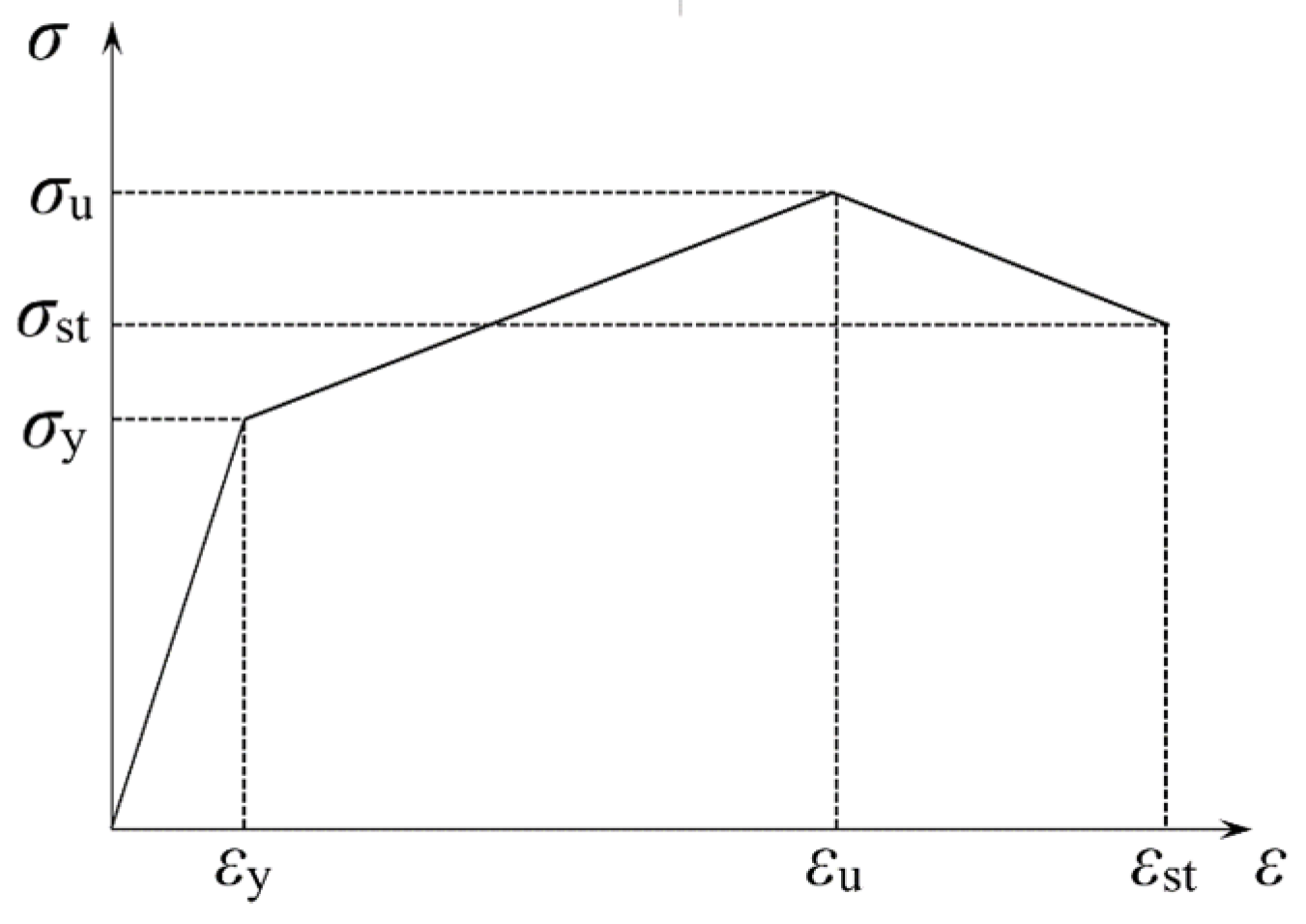
| σy | yield stress | bcp | width of the cover plate |
| σu | maximum stress | tcp | thickness of the cover plate |
| σst | failure stress | tbf | thickness of the beam flange |
| εy | yield strain | lcp | length of the cover plate |
| εu | maximum strain | bcp1 | width of the top cover plate |
| εst | failure strain | bcp2 | the width of the bottom cover |
| MPa | Mega pascal | θy | yield rotational displacements |
| Rk | initial rotational stiffness | θmax | peak rotational displacements |
| My | yield moment | θu | terminated rotational displacements |
| Mmax | peak moment | θp | plastic rotation capacity |
| Mu | terminated moment |
| Material Samples | E/MPa | /MPa | |||||
|---|---|---|---|---|---|---|---|
| Q235 steel | 197,000 | 320 | 0.001748 | 451.667 | 0.14361 | 360.643 | 0.19653 |
| 8.8-grade bolt | 161,000 | 645.0 | 0.004 | 793.5 | 0.025 | 636.9 | 0.121 |
| Group No. | Spe. | Beam Size | Beam Length (mm) | Column Size | Column Height (mm) | Cover Plate | ||
|---|---|---|---|---|---|---|---|---|
| Size of the Cover Plate | tcp/tbf | |||||||
| Top | Bottom | |||||||
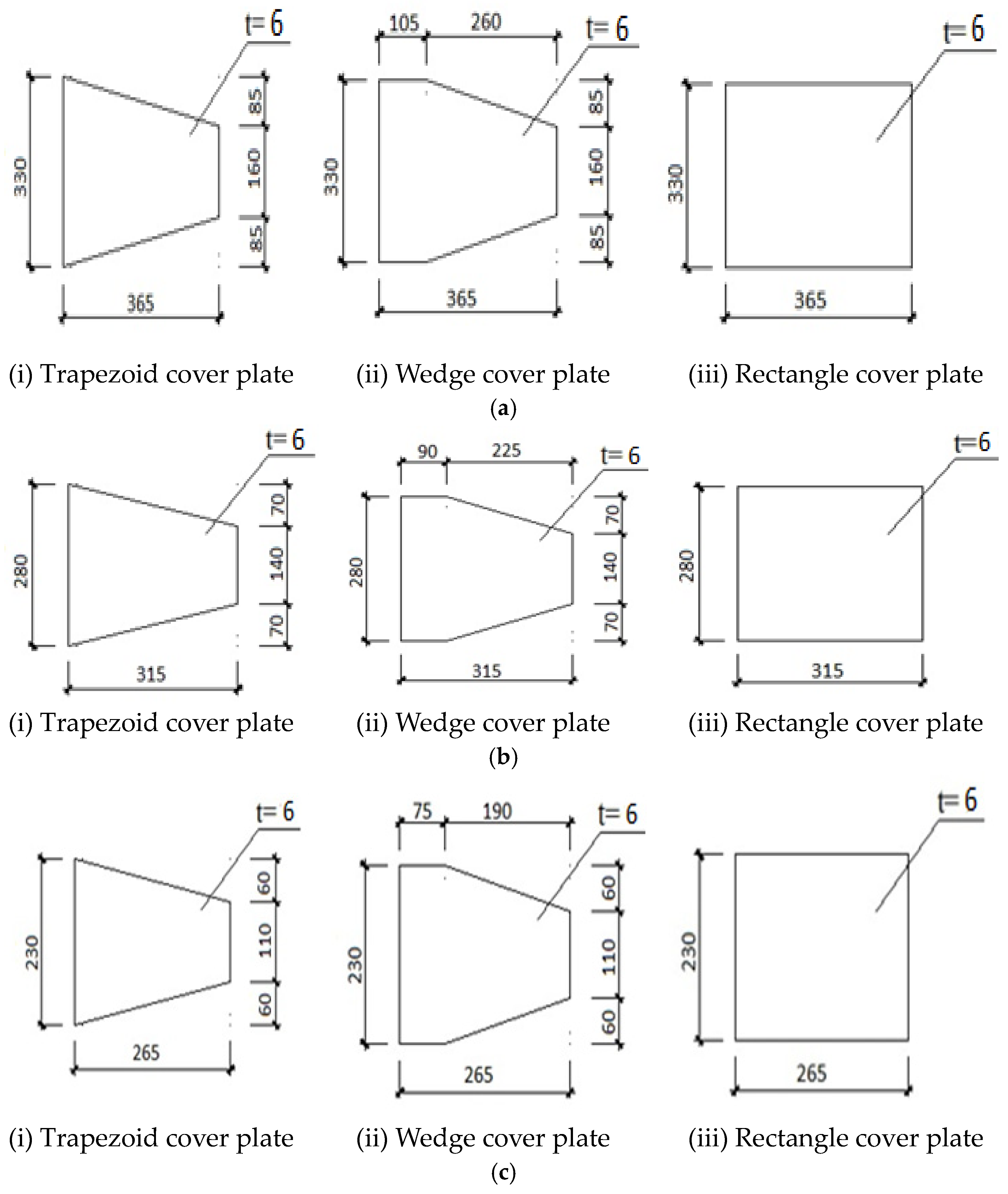
| 1st group | CP1 | HW 350 × 350 × 12 × 19 | 3000 | HW 502 × 470 × 20 × 25 | 3600 | Figure 7(aii) | 365 × 370 × 6 | 0.32 |
| WCP1 | HW 350 × 350 × 12 × 19 | HW 502 × 470 × 20 × 25 | - | - | - | |||
| 2nd group | CP2 | HM 390 × 300 × 10 × 16 | 3000 | HW 502 × 470 × 20 × 25 | 3600 | Figure 7(bii) | 315 × 320 × 6 | 0.38 |
| WCP2 | HM 390 × 300 × 10 × 16 | HW 502 × 470 × 20 × 25 | - | - | - | |||
| 3rd group | CP3 | HM 340 × 250 × 9 × 14 | 3000 | HW 502 × 470 × 20 × 25 | 3600 | Figure 7(cii) | 265 × 270 × 6 | 0.24 |
| WCP3 | HM 340 × 250 × 9 × 14 | HW 502 × 470 × 20 × 25 | - | - | - | |||
| Member | Section of Column | Section of Beam | Bottom Cover Plate | Top Cover Plate | Beam Flange Thickness (mm) | Cover-Plate Thickness/Beam Flange Thickness |
|---|---|---|---|---|---|---|
| CPS-1-1 | HW 502 × 470 × 20 × 25 | HW 350 × 350 × 12 × 19 | 365 × 370 × 6 | Figure 7a | - | - |
| CPS-1-2 | 365 × 370 × 6 | |||||
| CPS1-3 | 365 × 370 × 6 | |||||
| CPS-2-1 | HM 390 × 300 × 10 × 16 | 315 × 320 × 6 | Figure 7b | - | - | |
| CPS-2-2 | 315 × 320 × 6 | |||||
| CPS-2-3 | 315 × 320 × 6 | |||||
| CPS-3-1 | HM 340 × 250 × 9 × 14 | 265 × 270 × 6 | Figure 7c | - | - | |
| CPS-3-2 | 265 × 270 × 6 | |||||
| CPS-3-3 | 265 × 270 × 6 | |||||
| CPL-1-1 | HW 502 × 470 × 20 × 25 | HW 350 × 350 × 12 × 19 | 335 × 370 × 6 | 335 × 330 × 6 | - | - |
| CPL-1-2 | 365 × 370 × 6 | 365 × 330 × 6 | ||||
| CPL1-3 | 395 × 370 × 6 | 395 × 330 × 6 | ||||
| CPL-2-1 | HM 390 × 300 × 10 × 16 | 285 × 320 × 6 | 285 × 280 × 6 | - | - | |
| CPL-2-2 | 315 × 320 × 6 | 315 × 280 × 6 | ||||
| CPL-2-3 | 345 × 320 × 6 | 345 × 280 × 6 | ||||
| CPL-3-1 | HM 340 × 250 × 9 × 14 | 235 × 270 × 6 | 235 × 230 × 6 | - | - | |
| CPL-3-2 | 265 × 270 × 6 | 265 × 230 × 6 | ||||
| CPL-3-3 | 295 × 270 × 6 | 295 × 230 × 6 | ||||
| CPT-1-1 | HW 502 × 470 × 20 × 25 | HW 350 × 350 × 12 × 19 | 365 × 370 × 4 | 365 × 330 × 4 | 19 | 0.21 |
| CPT-1-2 | 365 × 370 × 6 | 365 × 330 × 6 | 19 | 0.32 | ||
| CPT1-3 | 365 × 370 × 8 | 365 × 330 × 8 | 19 | 0.42 | ||
| CPT-2-1 | HM 390 × 300 × 10 × 16 | 315 × 320 × 4 | 315 × 280 × 4 | 16 | 0.25 | |
| CPT-2-2 | 315 × 320 × 6 | 315 × 280 × 6 | 16 | 0.38 | ||
| CPT-2-3 | 315 × 320 × 8 | 315 × 280 × 8 | 16 | 0.50 | ||
| CPT-3-1 | HM 340 × 250 × 9 × 14 | 265 × 270 × 4 | 265 × 230 × 4 | 14 | 0.29 | |
| CPT-3-2 | 265 × 270 × 6 | 265 × 230 × 6 | 14 | 0.43 | ||
| CPT-3-3 | 265 × 270 × 8 | 265 × 230 × 8 | 14 | 0.57 |
| Group No. | Member | Rk (kN.m/rad) | My (kN.m) | θy (rad) | Mmax (kN.m) | θmax (rad) | Mu (kN.m) | θu (rad) | θp |
|---|---|---|---|---|---|---|---|---|---|
| 1st group | CP-1 | 66,736.88 | 790 | 0.021 | 984.79 | 0.043 | 837.08 | 0.072 | 0.068 |
| WCP-1 | 62,311.39 | 704 | 0.020 | 872.29 | 0.044 | 741.45 | 0.059 | 0.055 | |
| 2nd group | CP-2 | 64,133.85 | 627 | 0.014 | 774.97 | 0.032 | 658.72 | 0.062 | 0.058 |
| WCP-2 | 59,981.84 | 568 | 0.015 | 699.45 | 0.030 | 594.53 | 0.053 | 0.049 | |
| 3rd group | CP-3 | 38,794.91 | 440 | 0.023 | 546.91 | 0.044 | 464.88 | 0.054 | 0.065 |
| WCP-3 | 36,308.14 | 355 | 0.016 | 443.29 | 0.032 | 376.79 | 0.054 | 0.049 |
| Member | Rk (kN.m/rad) | My (kN.m) | θy (rad) | Mmax (kN.m) | θmax (rad) | Mu (kN.m) | θu (rad) | θp (rad) |
|---|---|---|---|---|---|---|---|---|
| CPS-1-1 | 66,583.86 | 805 | 0.0216 | 971.05 | 0.0423 | 825.39 | 0.073 | 0.069 |
| CPS-1-2 | 66,736.88 | 790 | 0.0212 | 984.79 | 0.0434 | 837.08 | 0.072 | 0.068 |
| CPS1-3 | 66,995.35 | 728 | 0.0152 | 922.89 | 0.0432 | 784.46 | 0.069 | 0.065 |
| CPS-2-1 | 64,001.49 | 623 | 0.0142 | 769.54 | 0.0445 | 654.11 | 0.065 | 0.061 |
| CPS-2-2 | 64,133.85 | 627 | 0.0142 | 774.97 | 0.0319 | 658.72 | 0.062 | 0.058 |
| CPS-2-3 | 64,358.96 | 632 | 0.0143 | 779.03 | 0.0425 | 662.18 | 0.064 | 0.060 |
| CPS-3-1 | 38,721.33 | 455 | 0.022 | 539.72 | 0.0444 | 458.76 | 0.055 | 0.051 |
| CPS-3-2 | 38,794.91 | 440 | 0.02285 | 546.91 | 0.0440 | 464.88 | 0.054 | 0.050 |
| CPS-3-3 | 38,937.06 | 430 | 0.01885 | 523.5 | 0.0446 | 444.97 | 0.051 | 0.047 |
| CPL-1-1 | 66,677.97 | 720 | 0.0152 | 921.81 | 0.0445 | 783.54 | 0.067 | 0.063 |
| CPL-1-2 | 66,995.35 | 728 | 0.015 | 922.89 | 0.0432 | 784.46 | 0.069 | 0.065 |
| CPL1-3 | 67,306.95 | 820 | 0.0197 | 976.31 | 0.0445 | 829.86 | 0.060 | 0.056 |
| CPL-2-1 | 64,011.88 | 628 | 0.0145 | 768.2 | 0.0308 | 652.97 | 0.055 | 0.050 |
| CPL-2-2 | 64,358.96 | 635 | 0.015 | 779.03 | 0.0425 | 662.18 | 0.064 | 0.060 |
| CPL-2-3 | 64,700.05 | 640 | 0.0144 | 788.19 | 0.0437 | 669.97 | 0.068 | 0.064 |
| CPL-3-1 | 38,677.23 | 405 | 0.0177 | 508.08 | 0.0445 | 431.87 | 0.050 | 0.046 |
| CPL-3-2 | 38,937.06 | 430 | 0.0189 | 523.5 | 0.0446 | 444.97 | 0.051 | 0.047 |
| CPL-3-3 | 39,194.10 | 395 | 0.0143 | 497.41 | 0.0438 | 422.8 | 0.055 | 0.051 |
| CPT-1-1 | 65,600.07 | 712 | 0.014 | 889.75 | 0.0438 | 756.29 | 0.061 | 0.056 |
| CPT-1-2 | 66,263.70 | 724 | 0.0148 | 919.34 | 0.0445 | 781.44 | 0.064 | 0.050 |
| CPT-1-3 | 66,860.34 | 725 | 0.0148 | 921.46 | 0.0427 | 783.24 | 0.073 | 0.048 |
| CPT-2-1 | 63,091.55 | 610 | 0.0132 | 755.72 | 0.0446 | 642.36 | 0.064 | 0.059 |
| CPT-2-2 | 63,695.87 | 608 | 0.0129 | 756.95 | 0.0332 | 643.41 | 0.05 | 0.056 |
| CPT-2-3 | 64,228.23 | 612 | 0.0131 | 763.67 | 0.0333 | 649.44 | 0.056 | 0.051 |
| CPT-3-1 | 38,198.82 | 415 | 0.0191 | 519.99 | 0.0446 | 441.99 | 0.056 | 0.052 |
| CPT-3-2 | 38,548.34 | 388 | 0.0146 | 482.89 | 0.044 | 410.46 | 0.053 | 0.048 |
| CPT-3-3 | 38,850.70 | 436 | 0.0186 | 514.58 | 0.0436 | 437.40 | 0.052 | 0.048 |
Disclaimer/Publisher’s Note: The statements, opinions and data contained in all publications are solely those of the individual author(s) and contributor(s) and not of MDPI and/or the editor(s). MDPI and/or the editor(s) disclaim responsibility for any injury to people or property resulting from any ideas, methods, instructions or products referred to in the content. |
© 2025 by the authors. Licensee MDPI, Basel, Switzerland. This article is an open access article distributed under the terms and conditions of the Creative Commons Attribution (CC BY) license (https://creativecommons.org/licenses/by/4.0/).
Share and Cite
Al-Ansi, O.Z.Y.; Lu, L.; AL-Saeedi, S.M.A.A.; Liu, B. Effects of Cover-Plate Geometry on the Mechanical Behavior of Steel Frame Joints with Middle-Flange and Wide-Flange H-Beams. Buildings 2025, 15, 203. https://doi.org/10.3390/buildings15020203
Al-Ansi OZY, Lu L, AL-Saeedi SMAA, Liu B. Effects of Cover-Plate Geometry on the Mechanical Behavior of Steel Frame Joints with Middle-Flange and Wide-Flange H-Beams. Buildings. 2025; 15(2):203. https://doi.org/10.3390/buildings15020203
Chicago/Turabian StyleAl-Ansi, Osama Zaid Yahya, Linfeng Lu, Saleem Mohammed Ali Ahmed AL-Saeedi, and Bingyou Liu. 2025. "Effects of Cover-Plate Geometry on the Mechanical Behavior of Steel Frame Joints with Middle-Flange and Wide-Flange H-Beams" Buildings 15, no. 2: 203. https://doi.org/10.3390/buildings15020203
APA StyleAl-Ansi, O. Z. Y., Lu, L., AL-Saeedi, S. M. A. A., & Liu, B. (2025). Effects of Cover-Plate Geometry on the Mechanical Behavior of Steel Frame Joints with Middle-Flange and Wide-Flange H-Beams. Buildings, 15(2), 203. https://doi.org/10.3390/buildings15020203