Review

Gold Recovery Beyond Ores: Sources, Processes, Challenges, and Prospects

1
Innovation Centre of the Faculty of Chemistry in Belgrade Ltd., University of Belgrade, Studentski trg 12–16, 11000 Belgrade, Serbia
2
Innovation Center of the Faculty of Technology and Metallurgy in Belgrade Ltd., University of Belgrade, Karnegijeva 4, 11000 Belgrade, Serbia
3
Zijin School of Geology and Mining, Fuzhou University, Fuzhou 350108, China
4
Faculty of Technology and Metallurgy, University of Belgrade, Karnegijeva 4, 11000 Belgrade, Serbia
*
Author to whom correspondence should be addressed.
Metals 2026, 16(6), 595; https://doi.org/10.3390/met16060595 (registering DOI)
Submission received: 16 April 2026 / Revised: 21 May 2026 / Accepted: 24 May 2026 / Published: 29 May 2026
(This article belongs to the Special Issue Advances in Mineral Processing and Hydrometallurgy—4th Edition)

Abstract

Gold (Au) is a strategically critical metal whose technological relevance and increasing demand contrast with the long-term decline in primary ore grades. This review discusses gold recovery from primary ores providing the metallurgical and technological baseline for the comparative evaluation of unconventional Au-bearing resources. Emphasis is placed on electronic waste and copper anode slimes as highly valuable secondary raw materials containing gold concentrations comparable to, or exceeding, those in natural deposits. The review examines the origin, chemical and mineralogical characteristics, impurity profiles, and processing routes associated with these materials, including conventional and emerging pyro-, hydro-, and biometallurgical approaches. Material-specific constraints, matrix complexity, recovery efficiency, process limitations, and environmental aspects are discussed in relation to process applicability and technological feasibility. Particular attention is given to the differences between geologically constrained primary ores and heterogeneous secondary Au-bearing materials, whose engineered and continuously evolving compositions influence recovery strategies, limiting the direct application of conventional routes to secondary resources. Finally, the review highlights that primary ores remain the dominant source of global Au production, whereas secondary resources currently represent a complementary component, and outlines key challenges and future directions relevant to the broader utilization of these materials.

1. Introduction

Gold has played a central role in human civilization for over five millennia and, as one of the first metals to be exploited, remains among the most historically and culturally significant. Owing to its rarity, chemical stability, malleability, and resistance to corrosion, gold has historically been used as currency, a monetary standard, and a symbol of wealth, remaining central to global finance until the 20th century [1].
In the contemporary era, gold remains a strategic commodity, but its role has significantly diversified. Beyond traditional applications, gold is indispensable in electronics, telecommunications, aerospace, medical devices, and advanced technologies due to its exceptional electrical conductivity and chemical stability. Consequently, technological demand for gold continues to increase.
According to the U.S. Geological Survey, global gold mine production in 2025 was approximately 3300 t, making it one of the largest annual totals on record, with China, Russia, Australia, Canada, and the United States as the leading producers [2]. On the demand side, gold consumption is rising, driven by investment (bars, coins), central bank reserves, and industrial applications. Total global gold demand has exceeded 5000 t annually in recent years. Industrial demand, although smaller in absolute terms (~320–330 t/year), remains structurally important because of gold’s indispensable function in the high-tech industry. Although gold is not currently classified as a Critical Raw Material, its concentrated primary production, strategic financial importance, and stable technological demand further intensify pressure on primary resources [3,4]. While recovery from primary ores via conventional hydro- and pyrometallurgical routes remains the basis for global production, secondary sources are increasingly contributing to supply, driven by resource scarcity and circular economy incentives. Recent estimates indicate that approximately 1400 t of gold were recovered from secondary sources in 2025, thereby confirming the significant role of recycling as complementary to, rather than a replacement for, primary gold production [5].
The combination of the above-mentioned factors strengthens the rationale for developing alternative and secondary gold supply routes. Electronic waste (e-waste), industrial residues, and by-products often contain gold at concentrations that exceed those in many primary ores, making them promising targets for recovery. However, these unconventional secondary resources differ substantially from primary ores in terms of chemical and mineralogical characteristics, impurity profiles, and processing challenges. Consequently, recovery strategies must be carefully adapted to the specific material matrix.
In this context, a systematic, material-oriented overview of gold recovery from secondary sources and conventional primary ores is necessary to better understand their technological potential and role in a sustainable gold supply. This review discusses the origin, chemical and mineralogical characteristics, impurity profiles, and processing routes of unconventional Au-bearing materials in comparison with primary ores. Various technological approaches are considered with respect to material-specific constraints, matrix complexity, recovery efficiency, process and utilization limitations, and environmental implications.
Rather than serving solely as a descriptive summary of gold recovery technologies, the review emphasizes how material origin and matrix composition influence process applicability and recovery behavior across primary and secondary Au-bearing resources. Particular attention is given to the fundamental differences between geologically constrained primary ores and highly heterogeneous secondary materials, whose engineered and continuously evolving compositions often limit the direct transferability of conventional primary-metallurgy-based recovery routes. Key technical limitations, processing challenges, and emerging valorization strategies are discussed within the broader context of resource sustainability and circular economy principles.

2. Review Structure and Methodology

To address the scope of this review focused on Au-bearing resources and valorization opportunities, a structured literature survey integrating peer-reviewed publications, fundamental literature, selected official reports, patents, and state-of-the-art technological developments related to metallurgy, recycling, raw materials, and sustainability was conducted. The review was organized with emphasis placed on material characteristics, generation trends, recovery technologies, process limitations, and associated environmental aspects of both primary and secondary gold sources, while the material-oriented structure of the manuscript was designed to facilitate comparative analysis and improve accessibility of specific topics for both scientific and industrial readers.
Literature screening and data extraction were primarily conducted using the indexed databases Scopus and Web of Science, together with major scientific publisher platforms including ScienceDirect (Elsevier), SpringerLink, MDPI, and ACS Publications, selected for their multidisciplinary coverage of peer-reviewed literature relevant to the scope of this review, thereby supporting the comprehensiveness, diversity, and quality of the included sources. Additional targeted searches were performed when necessary to verify specific claims, complement individual subtopics, and identify relevant studies not retrieved during the initial screening stage. The search strategy was based on combinations of title- and keyword-related terms associated with gold recovery, refractory gold ores, e-waste, copper anode slimes, hydro-, pyro-, and biohydrometallurgy, alternative lixiviants, urban mining, emerging technologies, and life cycle assessment. The literature survey was additionally supported by continuous monitoring of developments in extractive metallurgy, ore processing, precious-metal processing, and recycling technologies, including research trends within leading international research groups and industrial trends relevant to Au recovery.
The initially collected literature was further refined without reliance on software-based automation or author queries, through contextual evaluation supported by author expertise in the field. Studies containing incomplete or inconsistent data, duplicates, or substantially overlapping studies were excluded or consolidated. The remaining literature was critically analyzed and contextualized against current technological challenges and industrial practice in order to ensure thematic consistency and support the comparative evaluation of Au recovery approaches across resources.
The final reference selection was based on relevance, technological significance, recency, and applicability to the scope of the review. Where applicable, priority was given to highly cited and scientifically established studies, with emphasis placed on recent journal articles published predominantly after 2010, while approximately 60% of the cited literature originates from the 2020–2026 period. Older references were retained where necessary due to their fundamental relevance to gold extraction chemistry and metallurgical process development. More than 87% of the cited literature consists of peer-reviewed journal articles, predominantly original scientific research papers complemented by review articles, while the remaining references mainly correspond to books, conference proceedings, and official reports relevant to the reviewed topics. The final literature dataset comprised 269 references.

3. Primary Gold Production: Ore Types, Extraction Technologies, Efficiency, Limitations and Environmental Impacts

3.1. Geological Characteristics, Resources, and Processing Implications

Primary gold production originates from a diversity of geological ore types, each with distinct mineralogical, geochemical, and textural characteristics, variable Au concentrations, and associated gangue minerals that strongly influence economic viability and processing strategies.
Identified global reserves are geographically concentrated and finite, with approximately 60,000–66,000 t of economically viable gold reserves worldwide, primarily located in Russia, Australia, South Africa, and to a lesser degree Canada and the United States. At current production rates, these reserves would sustain ~20 years of output without further discoveries or reserve replacement [2].
Typical primary ore grades range from 1 g/t to 5 g/t, with high-grade zones exceeding 5 g/t in some underground deposits, and are low relative to many other metals, reflecting a long-term declining trend. Lower-grade ores (<1 g/t) now dominate many major open-pit operations [6].
Common primary ore classifications include non-refractory (free-milling), refractory, and double-refractory categories. Gold recovery efficiency varies with ore type, mineralogy, and process route. The dominant industrial route for gold recovery from primary ores typically involves comminution (crushing/grinding), concentration (gravity or flotation), leaching (most usually cyanidation), and subsequent gold recovery via cementation, electrowinning (EW), or activated carbon. The latter process, known as Carbon-in-Pulp (CIP), represents a widely adopted method to adsorb gold complexes on carbon after cyanidation. Carbon-in-Leach (CIL) and heap leaching processes for low-grade ores can also be applied following ore preparation, including crushing, washing, screening, and gravity separation [7]. Following leaching, the resulting slurry or pregnant solution is typically subjected to solid–liquid separation, including coagulation/flocculation, thickening, and filtration, to remove suspended solids and obtain a clarified solution. These steps are particularly important both to minimize losses of fine particles during filtration and to reduce interference with downstream process efficiency (e.g., adsorption, cementation, or EW) [8,9].
For free-milling ores, which release gold readily, using the conventional route is efficient to achieve high recoveries (>90%), whereas refractory (and double-refractory ores), which contain gold locked within sulfides, organic carbon, or silicate matrices—making extraction significantly more complex—require additional pretreatment in order to release the gold from the matrix. Improvements via pretreatment can raise recoveries closer to those of free-milling ores but at the expense of additional energy and chemical inputs. These distinctions are critical to mineral processing design and recovery efficiency [10,11].
Due to the progressive depletion of high-grade gold deposits, contemporary mining operations are increasingly focused on the exploitation of lower-grade ores, particularly refractory. In most cases, this type of ore is characterized by a sulfide mineral matrix and almost invariably contains pyrite [12,13,14]. In such systems, gold is typically finely disseminated and encapsulated within the sulfide matrix, with pyrite playing a dominant role. Gold may occur either structurally bound within the crystal lattice of these minerals or as submicroscopic inclusions, which is the primary reason for its poor recovery by conventional methods [15,16,17].
In addition to dedicated gold ores, Au is frequently recovered as a by-product during the processing of polymetallic sulfide ores, particularly within copper, lead, and zinc metallurgical routes. Gold commonly occurs in association with sulfide minerals of base metals and is therefore incorporated into primary metal streams during pyrometallurgical processing, where it is subsequently concentrated in intermediate products such as black copper, anode slimes, or lead bullion [18]. Subsequent refining stages enable the efficient recovery of gold and other precious metals from these phases. A more detailed discussion of these integrated recovery routes, including their relevance in the treatment of secondary raw materials, is provided in Section 3.

3.2. Processing Technologies for Primary Gold Ores

3.2.1. Comminution and Pre-Concentration

Regardless of ore classification, the first preparation step is comminution, including multi-stage crushing followed by grinding (e.g., semi-autogenous grinding and/or ball milling) to achieve adequate liberation of gold-bearing minerals. In the case of refractory ores, as an additional preparation step, flotation is introduced, which enables the production of a high-grade concentrate, reducing downstream processing volumes and improving the efficiency of subsequent oxidative pretreatment—a crucial step in gold liberation from mineral matrix [19]. Oxidative pretreatment methods include roasting [20], pressure oxidation [21,22], bio-oxidation [23,24], or ultrafine grinding [25], and the choice depends on mineralogy, arsenic content, scale of operation, capital expenditure, and environmental considerations. The goal is to oxidize Fe(II) and sulfide sulfur, disrupt sulfide mineral matrices, and improve downstream gold recovery efficiency.

3.2.2. Oxidative Pretreatment

Roasting includes thermal oxidation of sulfides at elevated temperatures (500–700 °C), producing porous calcine and liberating gold. Controlled roasting can significantly enhance gold recovery by improving mineral permeability and surface exposure. Conventional flux systems developed for simple pyrite concentrates [26] may not be directly applicable to complex refractory materials due to the strong dependence of smelting behavior on concentrate physicochemistry and flux–gangue interactions, including mineral associations, gangue composition, particle size and liberation degree, sulfur content, liquidus temperature, and slag basicity. Consequently, flux composition and process conditions often require material-specific optimization to achieve efficient matrix degradation and precious metal liberation. In addition, roasting generates SO2 and As-bearing off-gases, requiring gas capture and conversion (commonly to sulfuric acid) and necessitating advanced off-gas treatment systems and stabilization strategies for removing volatile As-species, all to prevent environmental contamination. Modern roasting operations incorporate complex gas-handling, dust-collection, and scrubbing systems, increasing capital and operating costs. These environmental and operational limitations have contributed to the increasing use of hydrometallurgical alternatives such as pressure oxidation (POX), particularly for complex refractory ores [27,28].
Pressure oxidation (POX) represents one of the most effective oxidative pretreatment methods for refractory gold ores, enabling extensive sulfide oxidation and subsequent gold liberation. The process is conducted in autoclaves under elevated temperatures (~180–230 °C) and oxygen partial pressure, resulting in the complete oxidation of sulfide and Fe(II), and the formation of a porous residue suitable for downstream cyanidation. Sulfuric acid is generated autogenously during the process, which may complicate downstream phase separation due to the formation of secondary precipitates [27,29,30]. Compared with roasting, POX may offer advantages regarding the management of gaseous emissions and containment of arsenic- and sulfur-bearing species, since these components remain largely within the aqueous phase rather than being released through off-gases. However, POX also requires high capital investment and the use of corrosion-resistant materials. Key process variables include temperature, oxygen partial pressure, slurry density, and residence time, which directly influence oxidation kinetics and overall process efficiency [11,27,31].
Experimental and industrial studies demonstrate that POX can achieve high recovery efficiencies across different refractory ore systems, although performance remains strongly dependent on ore mineralogy and process conditions. For a pyritic concentrate from the Bacis Mine (Durango, Mexico), alkaline POX at 150 °C and 1 MPa O2 prior to cyanidation achieved ~92% gold recovery after one hour, exceeding the performance of roasting (~80%) under comparable conditions [27]. Similarly, acid POX applied to a sulfide-rich refractory ore from the Faina Project (Brazil) (220 °C, 500 kPa O2, 3 h) resulted in ~98.4% gold recovery, significantly higher than that obtained under alkaline conditions in the same study [31]. Additional studies report ~90% Au recovery under acidic POX conditions (350–700 kPa), confirming the strong dependence of process performance on operating parameters and medium chemistry [11].
The characteristics of POX residues, particularly iron-bearing phases, significantly influence downstream gold recovery efficiency. The formation of needle-like iron precipitates (e.g., specularite) is considered favorable, as it reduces secondary gold encapsulation and improves leachability. Despite its high efficiency, POX remains a capital-intensive technology, and its economic viability depends on ore mineralogy, scale of operation, and integration within the overall process flowsheet [32,33].

3.2.3. Cyanide Leaching and Conventional Recovery Routes

Although amalgamation proved effective for the recovery of coarse, liberated gold, its metallurgical limitations and environmental drawbacks ultimately limited its applicability. The process is inherently unsuitable for finely disseminated gold and cannot treat ores in which gold is encapsulated within sulfide minerals or occurs in submicroscopic form. Furthermore, increasing awareness of mercury toxicity and its environmental persistence has led to strict regulatory control and progressive elimination of amalgamation from industrial-scale operations [34]. Nevertheless, mercury use persists in small-scale and artisanal gold mining, where it continues to represent a significant environmental and health risk. These technical and environmental constraints, combined with the need to process lower-grade and more complex ores, stimulated the development and widespread adoption of cyanide leaching, which offered significantly higher recoveries and broader applicability across different ore types [19].
Despite its technological maturity and widespread industrial application, cyanide leaching remains highly controversial due to the acute toxicity of cyanide and the environmental risks associated with accidental releases and tailings management [35]. The use of cyanide in gold mining has been restricted or banned in several jurisdictions worldwide due to environmental and safety concerns. National bans or strong restrictions have been implemented in countries such as the Czech Republic, Slovakia, North Macedonia, Hungary, and Germany, while similar prohibitions exist in some regions of Argentina, Costa Rica, and the United States [36]. Within the European Union, cyanide-based processing is not fully prohibited but is strictly regulated under the Mining Waste Directive (Directive 2006/21/EC [37]). Although the directive has not been substantially updated since its adoption in 2006, the European Parliament and civil society organizations have highlighted the need to align it with contemporary environmental standards and global best practices, and ongoing evaluations and discussions on its review have been initiated to strengthen environmental protection measures for extractive waste management [38].
Despite increasing environmental and regulatory pressure, cyanidation remains the dominant hydrometallurgical method for gold extraction due to its high efficiency and industrial scalability. In alkaline solution (typically pH 10–11), gold is oxidatively dissolved in the presence of cyanide and oxygen according to the Elsner Equation (1), forming the stable dicyanoaurate complex, Au(CN)2 [19]:
4Au + 8NaCN + O2 + 2H2O → 4Na[Au(CN)2] + 4NaOH
Under optimized conditions, cyanidation of free-milling ores routinely achieves gold recoveries exceeding 90–95%, particularly in CIP/CIL circuits [12,19]. On the contrary, cyanidation efficiency decreases in ores containing copper, pregrobbing carbon, or certain sulfide minerals—refractory and double-refractory ores [39,40].
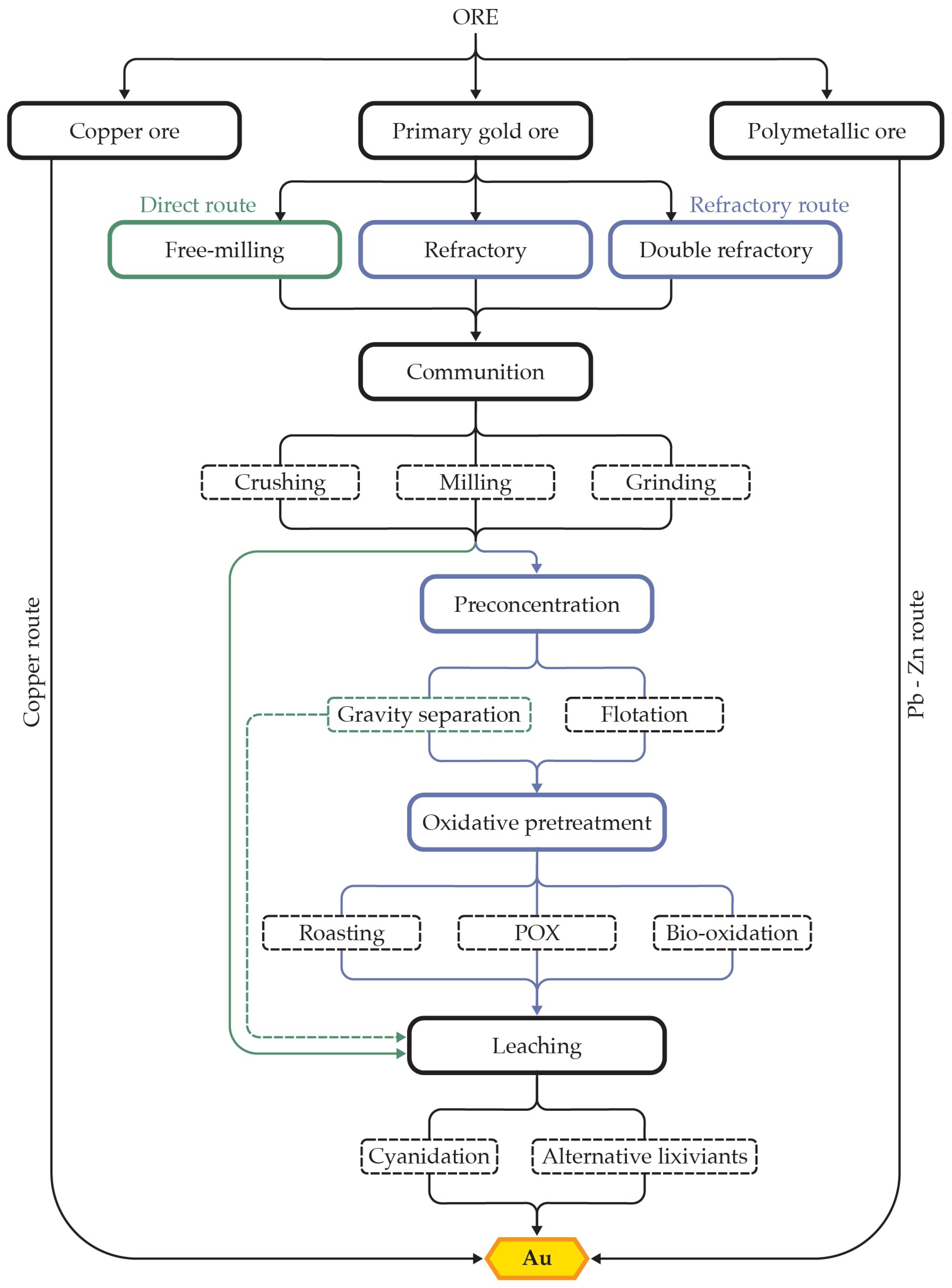
Table 1 provides a comparative overview of methods used for gold recovery from primary sources, whereas Figure 1 presents a schematic representation of the main processing routes as a function of ore type, based on [12,17,19,24,30] data. Reported Au recovery values in the Tables were selected, where applicable, to reflect representative ranges from the referenced literature, including both optimized and less favorable process performances, in order to support a more balanced comparative evaluation of the analyzed technologies.
Cyanide toxicity and environmental and regulatory challenges prompted stricter operational controls. This has led to increased research into alternative lixiviants which would substitute cyanidation [41,42,43].

3.2.4. Alternative Lixiviants and Hybrid Processing Approaches for Gold Extraction

Although cyanidation remains the industrial standard, research into alternative lixiviants has intensified in response to environmental and regulatory pressures [44].
Thiosulfate-based systems are considered the most advanced alternative, particularly for carbonaceous pregrobbing and copper-bearing ores. Thiosulfate leaching is conducted in mildly alkaline solutions (pH 8–10) using ammonium thiosulfate as a complexing agent, typically with Cu(II)-ammonia as a catalytic oxidant system (Equation (2)).
4Au + 8S2O32− + O2 + 2H2O → 4[Au(S2O3)2]3− + 4OH
Under optimized conditions, ammoniacal thiosulfate leaching has achieved gold recoveries above 80–90%. Industrial application has been demonstrated by Barrick Gold [45], although broader implementation remains limited by process complexity and reagent management. However, high reagent consumption due to thiosulfate degradation, solution instability, and complex copper management remain major limitation [46,47,48,49,50,51].
Thiourea leaching is characterized by rapid dissolution kinetics in acidic media (pH 1–3) in the presence of ferric iron as oxidant, forming a cationic gold complex (Equation (3)), and reported gold recoveries of 80–95% in laboratory-scale studies.
Au + 2CS(NH2)2 + Fe3+ → [Au(CS(NH2)2)2]+ + Fe2+
The synergy of advanced oxidation processes (AOP) with thiourea was also studied, but for now only at the laboratory scale [52].
Nevertheless, its practical implementation is hindered by poor reagent stability, oxidative degradation, which additionally complicate process control and downstream effluent treatment, and elevated operating costs, all limiting its commercial use and affecting the overall environmental sustainability of the process [53,54,55].
Thiocyanate (SCN) systems have demonstrated promising extraction efficiencies, in some cases exceeding 90% from oxide ores, with relatively fast kinetics. Despite being approximately 1000× less toxic than cyanide, slower kinetics relative to cyanidation and the need for high SCN/oxidant levels remain practical limitations for broader industrial application [44,56].
Halide systems (chloride, bromide, iodide) dissolve gold in strongly acidic, oxidizing environments through the formation of tetrachloroaurate or analogous complexes, with gold recoveries of 85–98%, especially for concentrates and high-grade materials. Although they exhibit rapid kinetics, halide systems require corrosive conditions (pH < 2), specialized materials of construction, and wastewater treatment, resulting in higher capital and operating costs together with additional environmental concerns [57]. In addition, the management of chlorine-containing process streams and corrosive acidic media represents an important operational and environmental challenge that may further limit large-scale industrial implementation.
Glycine leaching and bio-oxidation are considered potentially lower-impact alternatives for processing complex and refractory gold ores. Glycine (NH2CH2COOH) forms stable gold complexes in alkaline media (pH 9–12) in the presence of oxygen or peroxide, according to (Equation (4)):
4Au + 8NH2CH2COOH + 4NaOH + O2 → 4Na[Au(NH2CH2COO)2] + 6H2O
Gold recoveries of 60–90% have been reported, depending on mineralogy and oxidation efficiency [58,59]. Research at Curtin University has highlighted glycine potential, particularly for copper–gold ores [60], although the kinetics of the system is generally slower than cyanidation.
Bio-oxidation has emerged as an environmentally milder alternative for the pretreatment of refractory sulfide gold ores, as a pretreatment step. In this approach, mixed iron- and sulfur-oxidizing microorganisms, such as Acidithiobacillus spp., catalyze the oxidative breakdown of sulfide matrices (e.g., pyrite in refractory ores), liberating gold (Equation (5)) for subsequent cyanidation [61]:
4FeS2 + 15O2 + 2H2O → 2Fe2(SO4)3 + 2H2SO4
This process can increase subsequent gold recovery from 40 to 90% [62], but requires long residence times and careful biological control [63]. In addition, the bio-oxidation methodology has proven effective for low-grade, arsenic-bearing refractory gold ores [64].
Nevertheless, large-scale industrial replacements of cyanidation remain limited due to process complexity, slower kinetics, reagent management challenges, and economic constraints.
Table 2 presents a comparative overview of non-conventional (alternative) methods for gold recovery from primary sources.
Mechanical activation combined with bio-oxidation has been shown to increase gold extraction from sulfide concentrates from ~84 to >98% compared to non-biooxidized material, demonstrating the potential efficiency gains with optimized microbial pretreatment [65]. Pool bio-oxidation studies on arsenic-rich ores confirm that the mechanistic role of microbial oxidation in sulfide and arsenic removal for increased gold extraction [64,66]. Also, if integrated with alternative lixiviants such as thiourea, complete gold extraction from double-refractory ores can be achieved without the need for roasting or cyanide [67,69]. Despite slower kinetics than thermal or pressure oxidation and sensitivity to ore chemistry, inhibition by toxic components contained in matrix, bio-oxidation offers a lower-energy and potentially more sustainable route to refractory gold processing when embedded within hybrid flowsheets.
The high technological maturity and industrial application of primary gold processing routes represent the basis for the valorization of many secondary Au-bearing resources. However, the direct transferability of processes developed for geologically defined ore systems to secondary resources remains limited due to substantially different material characteristics arising from the heterogeneity and engineered nature of these matrices, which are discussed in detail in the following sections.

3.3. Environmental and Energy Impacts of Primary Gold Production

Mining activities (both open-pit and underground) are highly energy and carbon-intensive due to the large volumes of material that must be moved, crushed, and chemically treated to extract relatively small quantities of gold. Specifically, the negative environmental impacts of mining include acid mine drainage [70,71], greenhouse gas emissions [72], the generation of waste—particularly hazardous waste—deterioration of water and air quality [73], chemical spillages, and occupational health risks [74]. Environmental risks often persist after mine closure, including contamination from residual tailings and, in operations using mercury amalgamation, long-term mercury pollution of soils and waterways.
Declining ore grades require increasingly large material throughput for equivalent gold production, directly affecting energy use and environmental footprint [70,75,76].
Life cycle assessments (LCA) show that gold production from typical non-refractory ores with grades of ~3.5 g/t may require more than 200,000 GJ of energy per tonne of gold produced, while associated greenhouse gas (GHG) emissions can reach ~18,000 t CO2e/t Au. These impacts increase for refractory ores requiring additional processing steps, sometimes by more than 50% [77,78], also affecting both the environmental burden and economic cost of gold production. Despite efforts to reduce emissions intensity—for example, by integrating renewable energy sources—the absolute environmental burden remains substantial, especially when considering other impacts such as land disturbance, tailings and waste rock disposal, water use, and potential release of toxic reagents (e.g., cyanide and mercury) during processing [79].
Environmental challenges are also associated with alternative gold extraction systems. While POX generally reduces direct atmospheric emissions compared with roasting, the stabilization and long-term management of arsenic-bearing residues remain important environmental considerations. In contrast, roasting processes require strict control of SO2 and volatile arsenic emissions through advanced gas-cleaning and off-gas treatment systems [27,28]. Consequently, environmental regulations and sustainability requirements increasingly influence the selection and development of both conventional and alternative gold recovery technologies. Recent industrial LCA studies, such as the Aurubis report on silver and gold refining, further confirm the high energy demand, GHG emissions, water consumption, and chemical use associated with conventional pyro- and hydrometallurgical precious metal production, highlighting the potential advantages of emerging, lower-impact recovery methods, such as bio-assisted, AOP, and alternative lixiviant processes for more sustainable gold recovery [80].

4. Secondary Gold Production: Sources, Recycling Technologies, Process Limitations, and Sustainability Aspects

4.1. Electronic Waste

4.1.1. Global Generation Trends and Urban Mining Potential

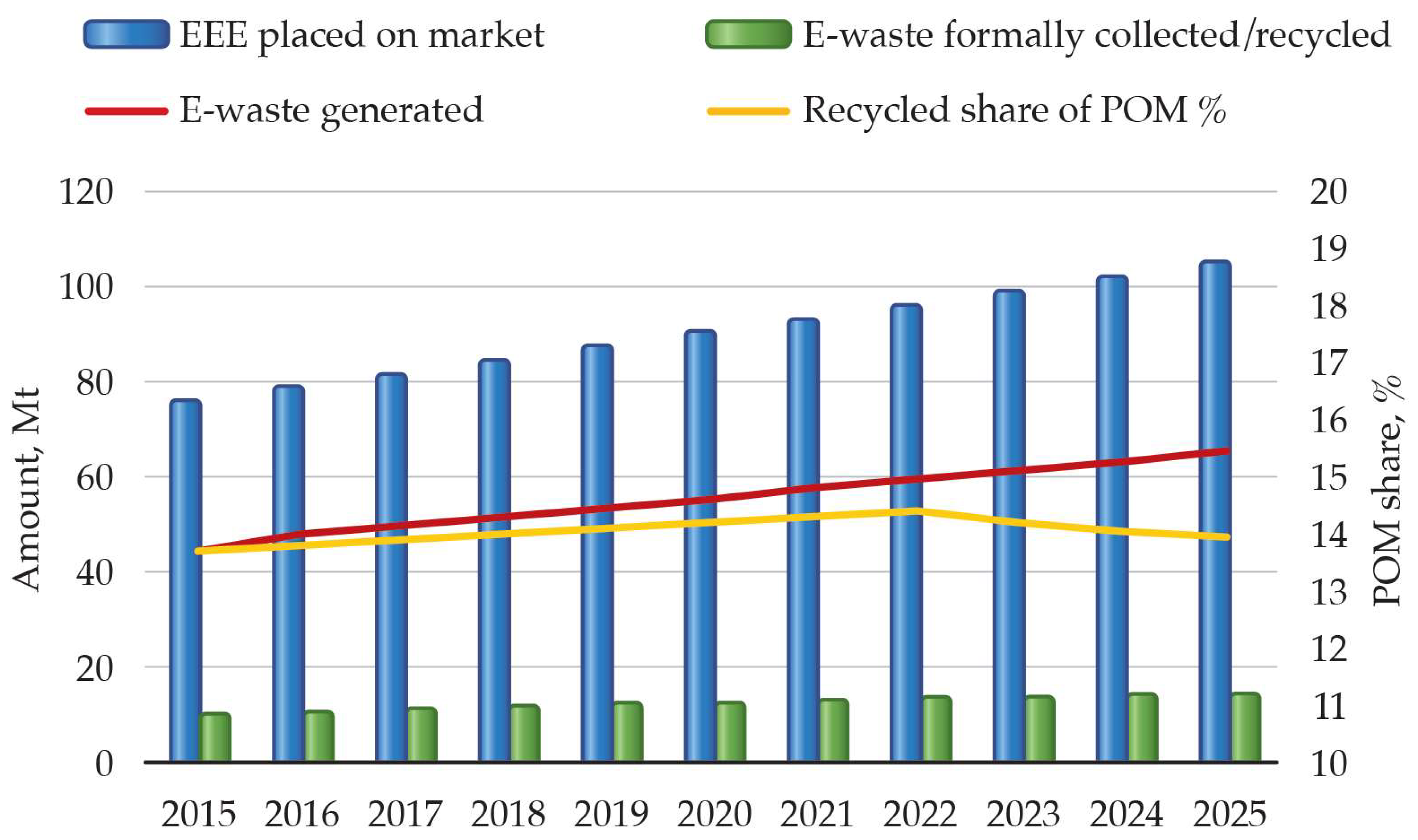
The unprecedented expansion of electrical and electronic equipment (EEE) production over the past several decades, driven by both accelerated consumption and short product lifecycles, has resulted in the rapid waste accumulation, establishing electronic waste (e-waste) as one of the fastest-growing global waste streams, with an annual growth rate of 3–5%, expecting to rise to 82 Mt in 2030 [81,82]. Beyond its environmental implications, e-waste has emerged as a highly concentrated anthropogenic resource for valuable and critical metals [83]. Among them, gold has a central technological and economic role because it is widely used in electronic components. Printed circuit boards (PCBs), in particular, are among the most metal-rich electronic components, with gold concentrations often exceeding 100–500 g/t—far higher than in natural ores—making their recycling highly economically attractive [84,85]. While such elevated concentrations are mostly associated with older or specialized industrial and telecommunication PCBs, typical modern consumer electronics contain substantially lower gold content per board. Nevertheless, this exceptional concentration differential underpins the emerging concept of “urban mining”, wherein secondary waste streams are regarded as high-grade resources rather than disposal burdens [86,87]. Although e-waste often contains gold concentrations exceeding those of primary ores, it cannot be considered a simple high-grade analogue of conventional ore systems. Unlike geologically formed mineral deposits, e-waste represents an engineered and continuously evolving mixture of metals and other materials, resulting in higher matrix complexity and variable processing behavior. This high heterogeneity and compositional complexity significantly complicate its collection, separation, and metallurgical processing, contributing to low formal recycling rates despite the substantial economic value of these materials. Currently, only about 17% of e-waste enters formal collection and recycling systems, whereas most of the waste is landfilled or processed within informal sectors, accounting for more than 14 Mt and 30 Mt, respectively [81,88]. The quantities of electrical and electronic equipment placed on the market (POM), as well as e-waste generated, collected, and formally recycled, are commonly reported within standardized frameworks, enabling comparison of material flows and recovery efficiency. These trends are illustrated in Figure 2, which highlights the relative contributions of each stream over the past decade.
Low recycling rates are primarily associated with the high heterogeneity of e-waste, which includes numerous product types and highly variable chemical compositions comprising metals, polymers, glass fibers, and other complex constituents. In addition to valuable metals (e.g., Au, Ag, Cu, Pd, Pt), typically present in concentrations ranging from trace levels (Au: ~200–1000 g/t; Ag: ~100–2000 g/t; Pd: ~10–100 g/t) to several weight percent for base metals such as Cu (10–30 wt%), Fe (5–15 wt%), Sn (2–5 wt%), and Pb (1–5 wt%), e-waste also contains significant levels of non-metallic components, including plastics (20–30 wt%) and glass/ceramics (10–20 wt%), as well as hazardous substances such as heavy metals, brominated flame retardants, and battery electrolytes, together with various organic components that further increase compositional complexity [91,92,93]. Such variability limits the direct applicability of conventional recovery routes originally developed for more compositionally uniform primary ore systems. Namely, compared to primary ores, which are generally characterized by more consistent mineralogical associations and relatively stable impurity distributions, secondary materials exhibit substantially greater variability in both elemental and phase composition. This is strongly influenced by device type, manufacturing period, and material integration strategies, including progressive substitution of metals (e.g., replacement of Pb with Sn in solders), the use of ultra-thin, precious metal coatings, partial substitution of gold with less precious materials, and diverse semiconductor formulations, all of which further complicate valorization [94,95].
Stated compositional complexity and heterogeneity, largely driven by economic pressures and market dynamics rather than recyclability considerations, pose significant challenges for representative sampling, pre-processing, and process selection, thereby severely limiting the development of standardized recovery routes. Traditional recycling and “urban mining” approaches, largely derived from primary metallurgical processing, are therefore not always directly transferable to secondary waste streams [91,93,96]. This inherent difference directly affects process design and recovery efficiency, necessitating significant adaptation of processing strategies originally developed for primary metallurgical systems.

4.1.2. Technologies for Gold Recovery from E-Waste

Pretreatment and Physical Separation
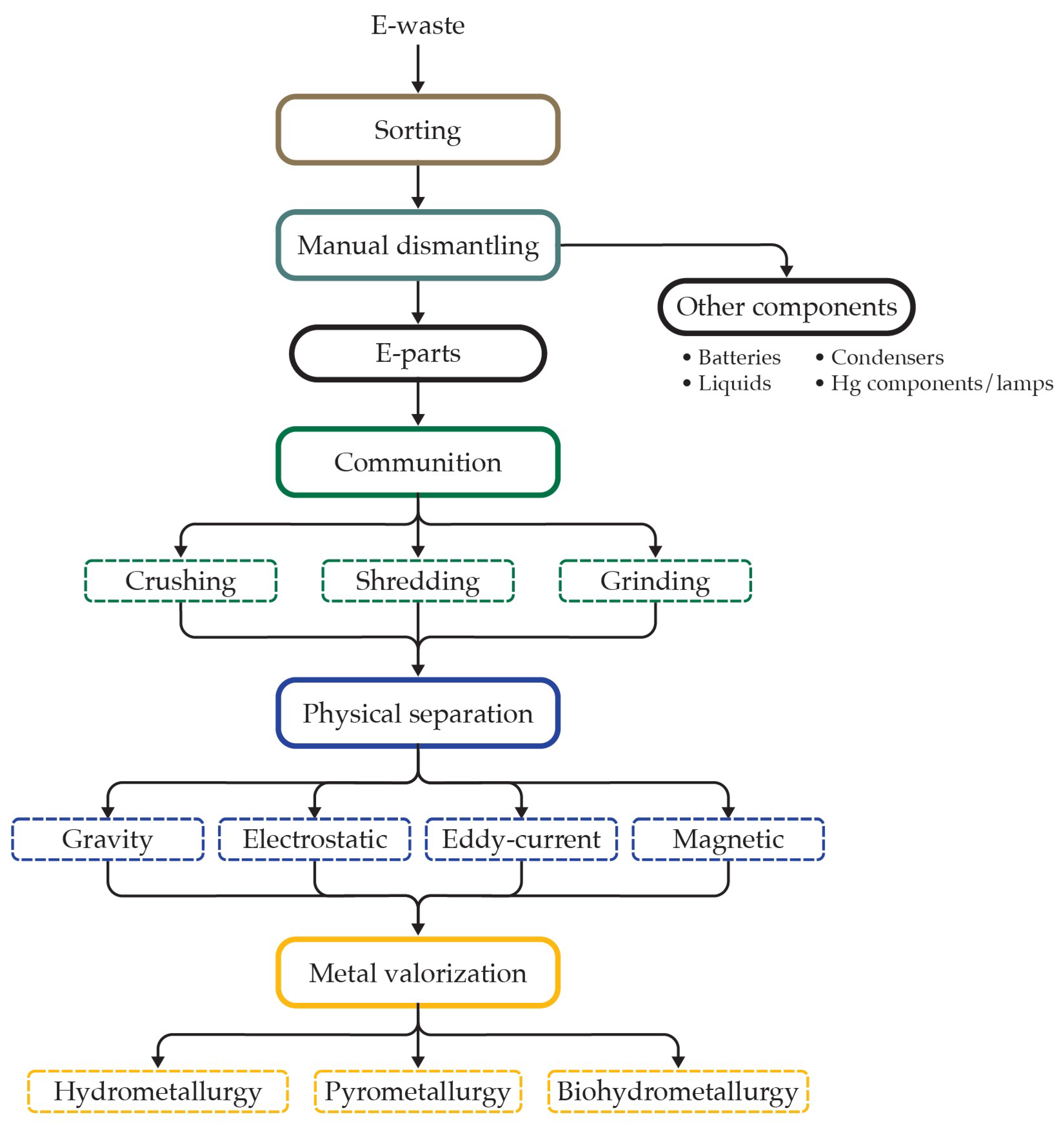
The efficient recovery of precious metals from e-waste involves sequential processing steps including collection and transportation to recycling facilities, dismantling to remove hazardous components and isolate valuable components such as printed circuit boards, followed by combinations of mechanical processing (shredding and size reduction) and physical separation techniques such as magnetic, eddy-current, density or electrostatic separation to concentrate metal-rich fractions [93,95,96,97]. The resulting concentrates are subsequently treated by metallurgical processes, most commonly pyrometallurgical smelting or hydrometallurgical leaching, to recover valuable metals (Figure 3) [89,90,91,92,93,94,95,96,97,98,99,100,101,102]. However, each comminution and physical separation stage is associated with non-negligible, irreversible, metal losses. In this context, a group of authors investigated the dissipation and losses of metals during mechanical processing and reported that approximately 36%, 47%, 7%, and 10% of the Au are lost via the non-metallic fraction, non-ferrous metals, ferrous metals, and dust streams, respectively. Moreover, the basic e-waste pretreatment scheme presented in Figure 3 constitutes only a simplified representation of the process steps. Each material stream exhibits distinct characteristics and should therefore be treated as an independent system. The aggregation of even nominally similar fractions across different production years introduces significant variability, driven by material heterogeneity and temporal variations in elemental composition resulting from changes in manufacturing practices. Accordingly, preparation and processing methodologies must be tailored to the specific characteristics of individual material stream to enhance valorization efficiency and prevent economic losses [103].
Pyrometallurgical Processing
Pyrometallurgy is the traditional and most widely used approach for recovering metals from e-waste, based on gold production from primary sources and on existing industrial infrastructure [93,104]. It employs high-temperature oxidative or reductive processes to induce chemical and physical transformations, commonly including smelting, incineration, combustion, and pyrolysis [83,105].
In practice, shredded e-waste is frequently co-smelted with primary copper concentrates or metallurgical residues. While the proportion of e-waste varies among operators, recent trends indicate that major refineries are adopting higher ratios, with 40–60% e-waste blended with 60–40% copper concentrate, compared to the traditional maximum of around 20% [106]. In large copper and lead smelters, base metals serve as carriers for valuable elements such as gold, which become enriched in alloy or matte phases for subsequent refining. Prominent examples include Umicore (Belgium), Aurubis (Germany), Noranda (Quebec), Rönnskär (Sweden), and DOWA (Japan), with Umicore being the largest facility, producing not only base and precious metals but also specialty metals such as indium, selenium, and tellurium [98,106,107]. However, these plants also integrate hydrometallurgical and electrochemical steps, illustrating that pyrometallurgy alone is often insufficient for treatment of heterogeneous e-waste [108,109].
Other pyrometallurgical approaches include top-blown rotary converter smelters, equipped with a rotating chamber and oxygen–propane lance, which allow slag removal and metal casting. A two-step pyro-refining process, consisting of oxidation followed by DC arc-furnace refining, can produce a metallic phase with over 98% copper suitable for casting as anodic copper. During this process, up to 95% of gold can be concentrated in the metallic phase, suggesting high Au yield [110]. The authors emphasize that proper preparation of waste PCBs is essential, particularly prior to the melting process. Controlled vacuum pyrolysis with condensation of the volatile products enables higher valorization of the organic fraction, simplifies subsequent pyrometallurgical operations, and offers opportunities to reduce emissions of toxic substances [111].
The main drawbacks of pyrometallurgical processing for e-waste recycling include significant environmental impacts, high energy consumption, and substantial emissions. In addition, the process is rigid and poorly adaptable to heterogeneous chemical composition of input material resulting from continuous changes in electronic device manufacturing and materials selection. The process also requires complex off-gas cleaning systems, while large slag volumes may increase the risk of metal losses during treatment [107,112]. Such losses are inherent to metallurgical treatment of slag and depend not only on the quantity of slag generated but also on the specific handling and refining methods employed, yet they are further increased in e-waste processing. This is due to the heterogeneity of materials and the high slag-to-metal ratio, highlighting the need for careful process optimization to maximize metal recovery.
Integrated Pyro-Hydro Processing Routes
A combination of pyrometallurgy, hydrometallurgy with relatively low selectivity in leaching phases, and electrometallurgy has been the common route for metal recovery, especially gold, from e-waste [113,114,115]. This concept resembles and is actually a modification of the black copper route, or similar processes in primary production [116,117].
Partial or non-selective leaching involving strong complexing ligands such as cyanide or strong mineral acids and their mixtures (e.g., aqua regia) [99,118], is often included, typically followed by electrorefining to produce anodic slime with a high precious-metal content that is further processed [119]. A key advantage of this “pyro enrichment–hydro separation” approach is the ability to combine various e-waste categories with primary materials to elevate copper content from typical PCB levels (~75–80%) up to 90% or more, facilitating downstream metallurgical processing [117,120,121].
However, economic fluctuations in metal prices and rising environmental and carbon-footprint costs, and the need to increase e-waste recycling rate (from usual 20% of smelting input), shifted research to more efficient and environmentally acceptable approaches.
Hydrometallurgical Processes and Leaching Systems for Gold Recovery
Hydrometallurgical approaches dominate current recovery strategies, as they operate under milder conditions compared with pyrometallurgical processing, require lower capital costs, and offer selectivity and production of highly pure metals [122,123,124,125,126]. Additionally, hydrometallurgical methods offer flexibility, allowing precise control over process parameters such as temperature, phase ratios (i.e., pulp density), leaching time, agitation rate, lixiviant concentration, and other factors that influence both recovery efficiency and selectivity [127,128,129]. Yet, efficient pretreatment steps—shredding, comminution, and polymer removal—are crucial to expose metal surfaces, enhance leaching kinetics, and allow selectivity since the heterogeneous nature of e-waste otherwise limits gold accessibility and recovery efficiency [102,125,130]. However, mechanical processing used to separate the organic fraction and produce granulate for subsequent magnetic separation can result in losses of valuable metals through co-removal with ferromagnetic components [95,131]. Chemical pretreatment, including the selective removal of base metals, can also be essential for effective downstream processing and improved leaching efficiency of precious metals. Studies on copper recovery from PCBs demonstrate how proper base metal extraction facilitates subsequent hydrometallurgical operations, which can similarly benefit gold recovery [132,133].
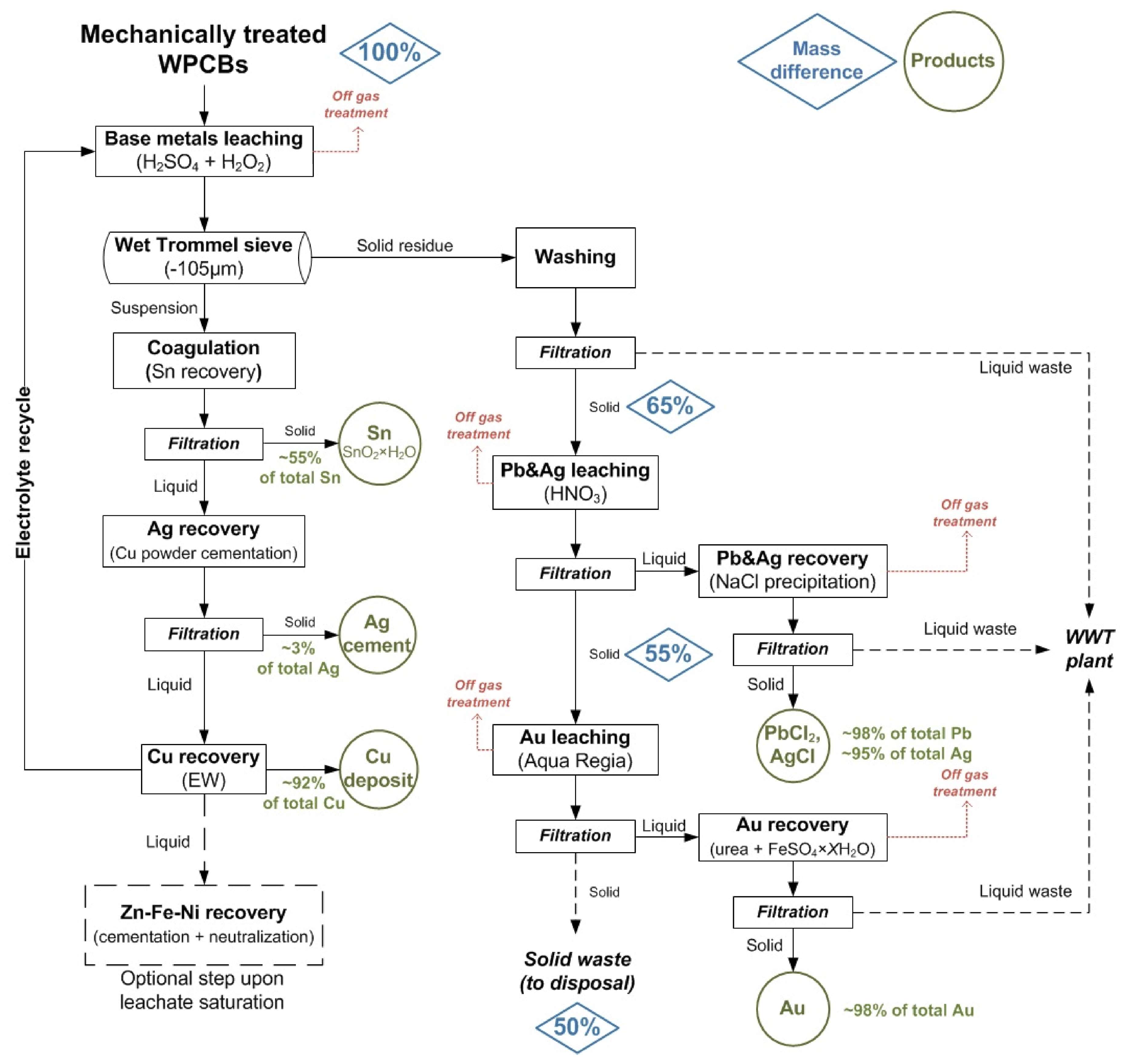
Leaching agents for gold extraction can be classified into traditional systems (e.g., cyanide, aqua regia) and alternative, less toxic chemistries. Cyanide remains highly effective for dissolving gold but is toxic and generates complex leachates that require careful handling and downstream purification. Aqua regia dissolves gold effectively but is strongly corrosive and produces hazardous wastewater, making it less desirable for sustainable operations. Both systems can achieve Au recoveries of 80–99%, but remain non-selective and require high reagent consumption. In addition, these systems require careful management of process effluents and secondary residues in order to minimize environmental risks associated with highly acidic media [134,135,136]. A comprehensive process flow for the selective recovery of metals from waste PCBs has been proposed, integrating mechanical, hydrometallurgical, and separation steps to maximize metal valorization while minimizing losses. The overall scheme (Figure 4), adapted from Kamberović et al. [137], illustrates the sequence of operations and highlights key points where different metals can be selectively recovered, enabling 99% Au recovery under scaled-up laboratory (pilot-scale) conditions. However, the reported recovery does not include possible Au losses occurring during the pre-treatment stage.
Within this context, central processor units (CPUs) are a frequently used e-waste component for gold recovery due to their relatively high and readily accessible gold content. However, a fraction of gold remains embedded within structures protected by ceramic, polymeric, or composite coatings, requiring adequate mechanical pretreatment for metal liberation prior to chemical processing. Subsequent leaching using conventional lixiviants (e.g., aqua regia) enables gold recovery with purity of typically 94–98% [97,138,139].
Nevertheless, complete extraction remains challenging, as insufficient liberation during pre-treatment and process inefficiencies during subsequent leaching and refining stages may contribute to residual gold losses within the CPU matrix and lower overall recovery yields. These limitations further highlight the importance of optimized preparation and material-specific process adaptation.
Due to the hazardous nature of cyanide and aqua regia, their use requires strict chemical management. Increasing regulatory pressure, environmental concerns, and sustainability directives are driving the development of more selective gold recovery methods for e-waste that operate under milder conditions, minimize chemical consumption and waste, and reduce energy demand [64,91,95,140].
Alternative Lixiviants and Systems for E-Waste Gold Recovery
To meet contemporary regulatory and environmental requirements, non-cyanide lixiviants including thiosulfate [141,142,143,144], thiourea [145,146], thiocyanate [147], halide [148,149], glycine [150]—again following the methodology of obtaining gold from primary sources—have been extensively studied to reduce environmental impact while maintaining high gold recovery. In line with current efforts to replace cyanide-based systems, mentioned alternative lixiviants as electrolytes are being actively explored [151]. Some studies describe Au leaching directly from mechanically treated waste PCBs using electrochemical hydrochlorination [152,153,154]. Although the approach demonstrates technical feasibility, the reported Au recovery remained below 90% (up to 86.3%), while near-complete Cu recovery required relatively high HCl concentrations (up to 6 mol/dm3). Additional limitations include chlorine evolution at the anode together with associated process-control and environmental challenges.
Table 3 provides an overview of the most commonly used reagents and systems in laboratory- and pilot-scale studies of e-waste. Reported efficiencies correspond to laboratory or pilot-scale conditions and may be lower in industrial applications due to the heterogeneity of e-waste and the generally low gold content. All processes require pretreatment steps to ensure effective liberation of metals and proper contact with the leaching reagents. Collectively, these studies indicate that the principal challenge of secondary Au recovery is no longer Au dissolution itself, but the achievement of selective and industrially viable processing of increasingly heterogeneous multicomponent matrices.
Advanced oxidation processes (AOPs) are also being explored for the recovery of gold from e-waste within cleaner hydrometallurgical systems. These systems rely on the generation of highly reactive radicals (e.g., •OH or SO4) through oxidant activation, typically in Fenton-like or persulfate-based systems, which promote oxidative dissolution of metallic gold in the presence of complexing ligands [52,155]. For example, a peroxymonosulfate-activated Fenton-like system has recently been demonstrated for the efficient recovery of Au, Pd, and Pt from e-waste, where sulfate and hydroxyl radicals generated in solution drive metal oxidation and dissolution [156]. In parallel, peroxydisulfate-based AOP systems have been reported to selectively dissolve precious metals from secondary resources without the use of strong acids or cyanide, highlighting their potential as environmentally compatible recovery routes for urban mining [157]. Although these approaches are still largely at the laboratory stage, AOP-assisted leaching represents a promising strategy for enhancing precious metal recovery from complex waste streams such as e-waste. AOPs appear particularly effective for leaching readily accessible gold (i.e., from central processor units) [155,158].
Separation and Purification of Gold from Leachates
The leachate produced from dissolution steps requires separation and purification to isolate gold from base metals and co-dissolved species. Techniques include solvent extraction [159], adsorption on functionalized resins [160,161], polymers [162], polycarbons [163] or graphene membranes [164], as well as precipitation [165], ion exchange [166,167], and electrowinning [168,169], each exhibiting different levels of selectivity, cost, and scalability [130,160]. Among these, precipitation and electrowinning are commonly employed for the final recovery of gold from solution. While filtration serves as a downstream step for separating solid gold precipitates from the leach solution and may be associated with minor losses during solid–liquid separation, overall recovery is primarily governed by the efficiency of the recovery chemistry. Under optimized conditions, reduction–precipitation or electrowinning can achieve >99% recovery of dissolved gold. Lower recoveries reported in pilot or sub-optimized systems (e.g., ~80–85%) are therefore mainly associated with incomplete precipitation or electrowinning, rather than limitations of the filtration step [130,170,171].
Recent approaches using porous polymers with high affinity for gold ions have shown very high adsorption capacities and high ion selectivity under acidic conditions, with reported Au recoveries up to 99%, highlighting potential for greener downstream processing [172]. However, such performance was achieved only at relatively low Au concentrations (~2 mmol/dm3), potentially limiting applicability to industrial effluents and recycling streams. In addition, the process still requires acid treatment for removal of co-adsorbed ions and final polymer incineration for Au recovery, partially limiting its alignment with circular economy principles.
The main separation and purification methods applied to gold-containing leachates from e-waste are summarized in Table 4. Reported efficiency values are derived from laboratory- or pilot-scale studies following pretreatment and pre-purification steps aimed at enhancing selectivity and enabling the recovery of high-purity gold.

4.1.3. Environmental Impacts of Traditional Recycling Methods

Life cycle assessment (LCA) is increasingly used to evaluate the environmental performance of e-waste recycling processes across their complete lifecycle, from collection and pretreatment to metallurgical recovery and waste management. Comparative LCA studies show that pyrometallurgical routes, while effective for large-scale metal recovery, tend to have the highest energy use and greenhouse gas emissions, whereas common hydrometallurgical processes can have lower carbon footprints but may be constrained by chemical use and effluent treatment burdens. For example, hydrometallurgical approaches may produce roughly 18 t CO2 per kg of gold recovered compared with 58 t CO2 per kg of gold for pyrometallurgy under certain scenarios, highlighting trade-offs between process routes [174]. Despite the significantly higher Au concentration in secondary raw materials, comparable or even higher emissions than those associated with typical non-refractory ore processing may occur due to the heterogeneous composition of e-waste and complex multimetal separation stages. Accordingly, high Au content alone cannot be considered a sufficient indicator of overall process sustainability.
Recent integrated LCA and techno-economic analyses emphasize the importance of energy source optimization, such as substituting natural gas or integrating waste heat recovery, to reduce overall impacts in e-waste recycling [175]. These assessments also consistently show that recycling precious metals from e-waste generally results in lower environmental impacts than primary mining and refining, reinforcing the importance of sustainable recovery strategies [176]. The reported values reflect data from official sources and formal recycling activities. Nevertheless, the informal sector is widespread and largely unregulated, and materials recovered through such channels may subsequently enter formal supply chains, leading to high uncertainty in estimates of recovery efficiency, gold losses, and associated health and environmental impacts [177,178]. Environmental performance of e-waste recycling routes strongly depends on process integration, pretreatment efficiency, and emission control. In this context, formal recycling systems generally provide significantly improved environmental control compared with informal processing practices, which are frequently associated with uncontrolled emissions and improper waste handling. At the same time, the environmental advantages often associated with secondary gold recovery should not be generalized, since the treatment of heterogeneous secondary materials may also involve substantial energy demand, complex pretreatment requirements, hazardous emissions, and challenging waste management, depending on the material matrix and selected recovery route.

4.1.4. Emerging Technologies and Bioprocesses

Recent advances increasingly emphasize hybrid strategies and lower-impact recovery approaches aligned with circular economy principles. The use of organic solvents [179] or strong (and biodegradable) organic acids, such as methanesulfonic acid (CH3SO3H), together with the strong inorganic acids in the process, to obtain gold from PCB parts with higher Au content is emerging. However, it is indisputable that treating waste gases and liquids is expensive and technologically challenging [180]. Also, deep eutectic solvents are reported as promising green solvents for hydrometallurgical gold recovery (≥95%) [181]. Other green technologies include ozone-assisted leaching [182], ultrasound [183,184], extraction using reduced graphene oxide [185], supercritical water technology [186], and ion-liquid leaching [187]. These trends underscore the need for integrated, sustainable approaches that balance recovery efficiency, environmental safety, and economic feasibility, highlighting the central role of hydrometallurgy in meeting future gold recovery challenges from increasingly complex e-waste. Among these approaches, deep eutectic solvents and ionic liquids have attracted particular attention due to their selectivity and lower volatility compared with conventional lixiviants, although their large-scale application remains limited by solvent cost, regeneration efficiency, and process integration challenges [181,187]. Similarly, hybrid approaches combining selective hydrometallurgical separation with mechanical or thermal pretreatment are increasingly investigated to improve recovery efficiency from highly heterogeneous e-waste streams. However, despite promising laboratory-scale results, the industrial implementation of these approaches remains limited by complex feed composition, selectivity limitations, high reagent consumption, slow kinetics, and challenges associated with process integration and adaptation to existing metallurgical infrastructure. These limitations continue to motivate the development of more sustainable and selective recovery strategies, including biological approaches.
Biohydrometallurgy, which has been industrially implemented for sulfide ore processing, particularly for copper and refractory gold ores, has gradually expanded toward secondary materials such as e-waste [188]. This extension introduces distinct challenges due to the heterogeneous and synthetic nature of e-waste substrates. This synthetic composition introduces physicochemical challenges that differ fundamentally from those encountered in classical biohydrometallurgy. Mechanical processing—shredding and particle size reduction—is therefore not merely pretreatment but essential step to expose gold-bearing surfaces for any subsequent chemical or biological interaction [189]. Metal mobilization in biological systems is predominantly indirect (i.e., employing Acidophilic Chemolithotrophs), mediated by metabolite-driven chemical pathways. Biological mechanisms may involve disruption of surrounding metal matrices or function as concentration and precipitation steps [190].
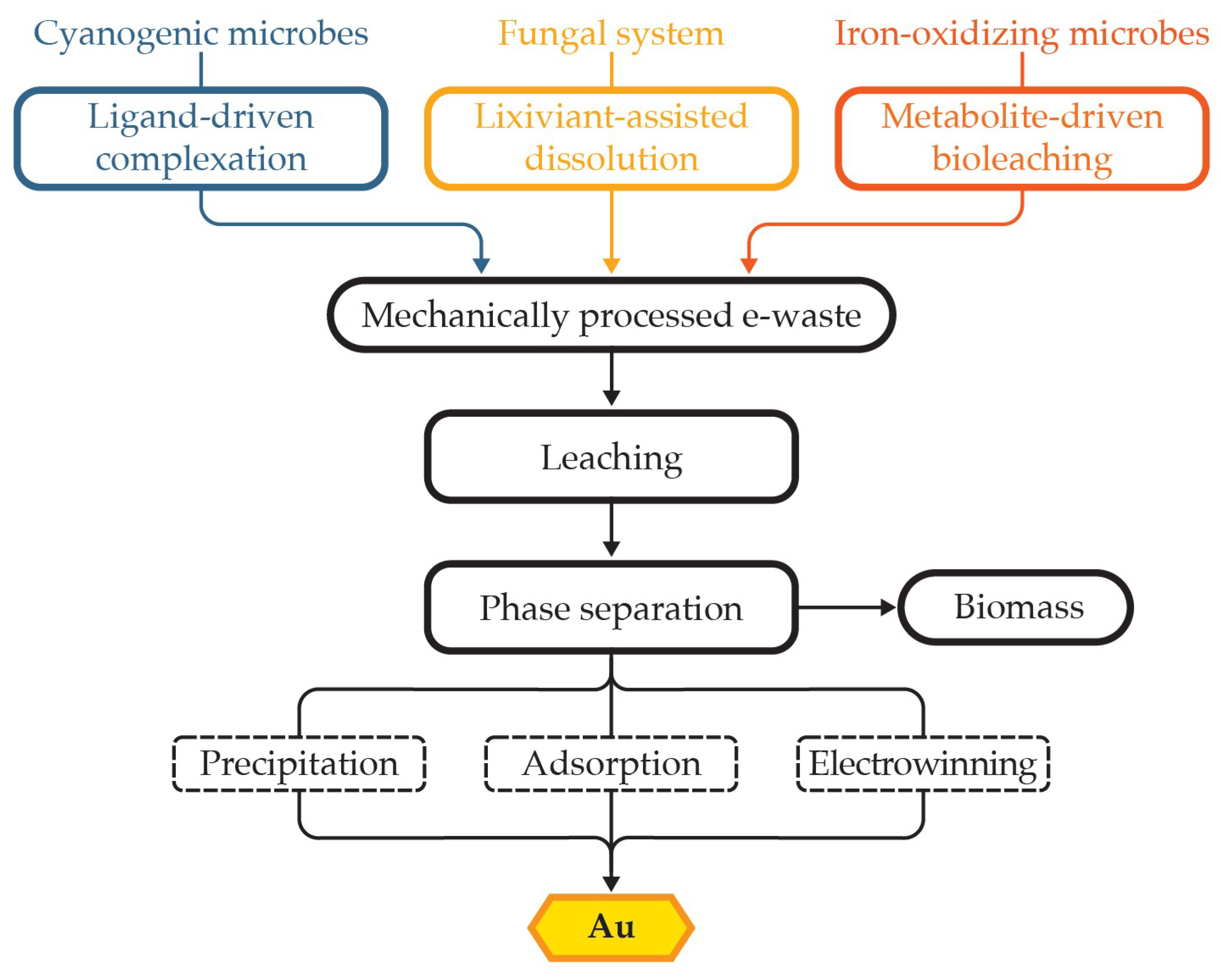
In the case of gold, dissolution requires stabilization of oxidized species by strong complexing ligands. Among biological systems, cyanogenic microorganisms (MO) consistently demonstrate superior gold mobilization efficiency through favorable ligand thermodynamics. Cyanogenic biological systems represent the closest biological analogue to conventional hydrometallurgical gold extraction, while operating at significantly lower cyanide concentrations. This pathway represents the most gold-specific biological route because it directly targets metallic gold rather than merely altering surrounding matrices. However, their practical implementation requires precise bioprocess control to balance ligand production and microbial tolerance. Additional mechanisms include biosorption, bioaccumulation, and biomineralization, through which gold complexes may be reduced to elemental nanoparticles [191]. Studies demonstrate that microbial consortia can be progressively adapted to reduce inhibitory lag phases and partially overcome toxicity constraints associated with e-waste. This is particularly important due to the presence of toxic PCB additives, including brominated flame retardants and heavy metals. Although such adaptation may improve metal valorization, intrinsic biological growth kinetics remain slower than purely chemical oxidation reactions [188,189,192,193]. An overview of biohydrometallurgical gold recovery techniques from e-waste is presented in Figure 5, summarizing major strategies and their mechanisms, based on data reported in the literature.
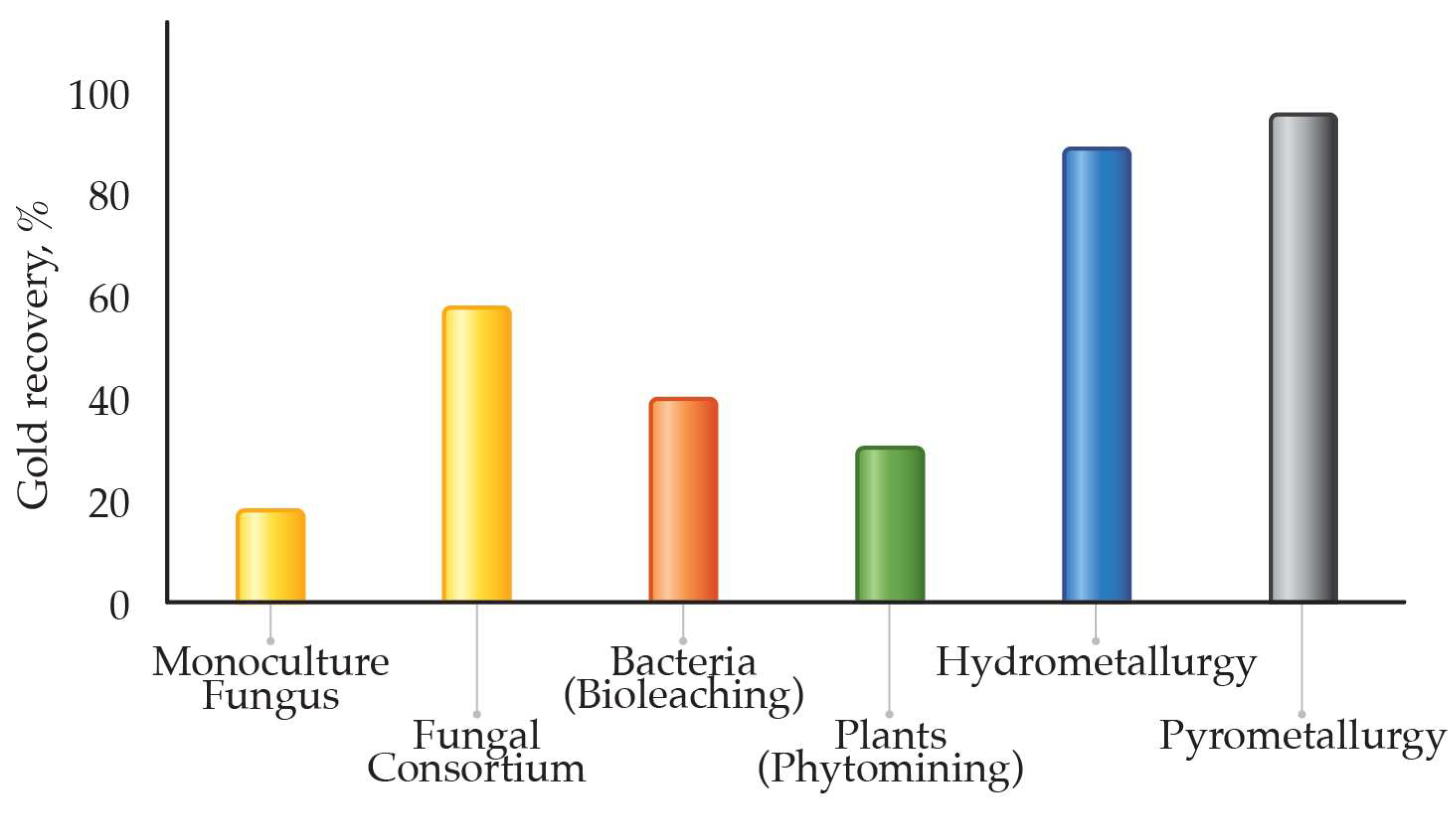
Fungal systems, employing filamentous fungi such as Aspergillus and Penicillium, represent another major biological pathway that generally relies on the secretion of organic acids, such as citric, oxalic, gluconic, or malic, which act as lixiviants [190]. However, due to weak complexes with gold, fungi rarely achieve direct Au dissolution at significant rates. Instead, fungal systems physically penetrate heterogeneous solid substrates, increasing surface contact between metabolites and embedded metal particles, primarily dismantling the surrounding matrix, exposing previously encapsulated gold surfaces to subsequent complexation reactions. Quantitative data demonstrate that monoculture fungal systems achieved approximately 17% gold recovery from mobile PCBs. On the contrary, mixed fungal consortia reached up to 56% recovery under comparable laboratory conditions, confirming the importance of metabolic diversity, cooperative interactions, and consortium design in bioleaching efficiency [189,194]. Comprehensive classifications of fungal-mediated gold mobilization describe biochemical mobilization, bioaccumulation [190], biosorption [195], biomineralization, and bioreduction [196] as distinct but interrelated mechanisms, none of which involve direct enzymatic oxidation of metallic gold [197]. Therefore, fungal bioleaching integrates chemical dissolution, structural disruption, and ecological synergy, making it a promising yet kinetically moderate approach in e-waste processing and gold valorization.
Plant-based systems have been proposed as potential biological recovery approaches for gold, although direct processing of complex electronic composites (e.g., shredded PCBs) remains unrealistic under current conditions [198]. Brassica juncea is the most extensively studied species in gold phytomining research. In controlled greenhouse and hydroponic systems containing 5 mg/kg Au, treatment with NH4SCN induced accumulation up to 57 mg/kg in aerial parts. In KCN-induced systems, even higher levels were reported (46 to 326 mg/kg), depending on the plant part analyzed [199]. However, operational costs (fertilization, irrigation, chelating ligands, and incineration) significantly reduce net profits. Recent assessments emphasize that phytomining remains time- and land-intensive, and is more suitable as a complementary technology, particularly relevant for tailings remediation rather than for large-scale e-waste recovery [200]. Although gold uptake mechanisms remain incompletely resolved, it is evident that over-application leads to “metal shock,” characterized by chlorosis, necrosis, and biomass loss [201,202]. Thus, phytomining in e-waste management is more realistically positioned as a low-energy polishing step or remediation approach complementary to bioleaching and hydrometallurgy rather than a primary recovery technology [196]. An overview of commonly applied biological methods is given in Table 5, while a comparison of gold recovery efficiencies is shown in Figure 6.
Biological gold recovery offers several advantages compared to conventional metallurgical routes, including operation under ambient temperature and pressure, lower energy requirements, reduced reliance on concentrated chemical reagents, and the potential for modular and decentralized processing. However, important limitations remain, including slower kinetics relative to chemical leaching, inhibition of microbial activity by complex e-waste compositions, and pulp density constraints that limit process throughput. Moreover, most reported systems remain validated primarily at the laboratory scale [199,213,214].
Biological recovery routes mainly rely on indirect mechanisms involving metal exposure, ligand-mediated dissolution, biosorption, or biomineralization processes. Cyanogenic systems generally demonstrate higher Au recovery efficiency than purely acidogenic approaches, although biological routes still remain kinetically slower than conventional hydrometallurgical processes. Current limitations are therefore primarily associated with matrix accessibility, process integration, and metabolic optimization rather than fundamental thermodynamic constraints, indicating that industrial applicability remains dependent on improved process integration and bioprocess control.
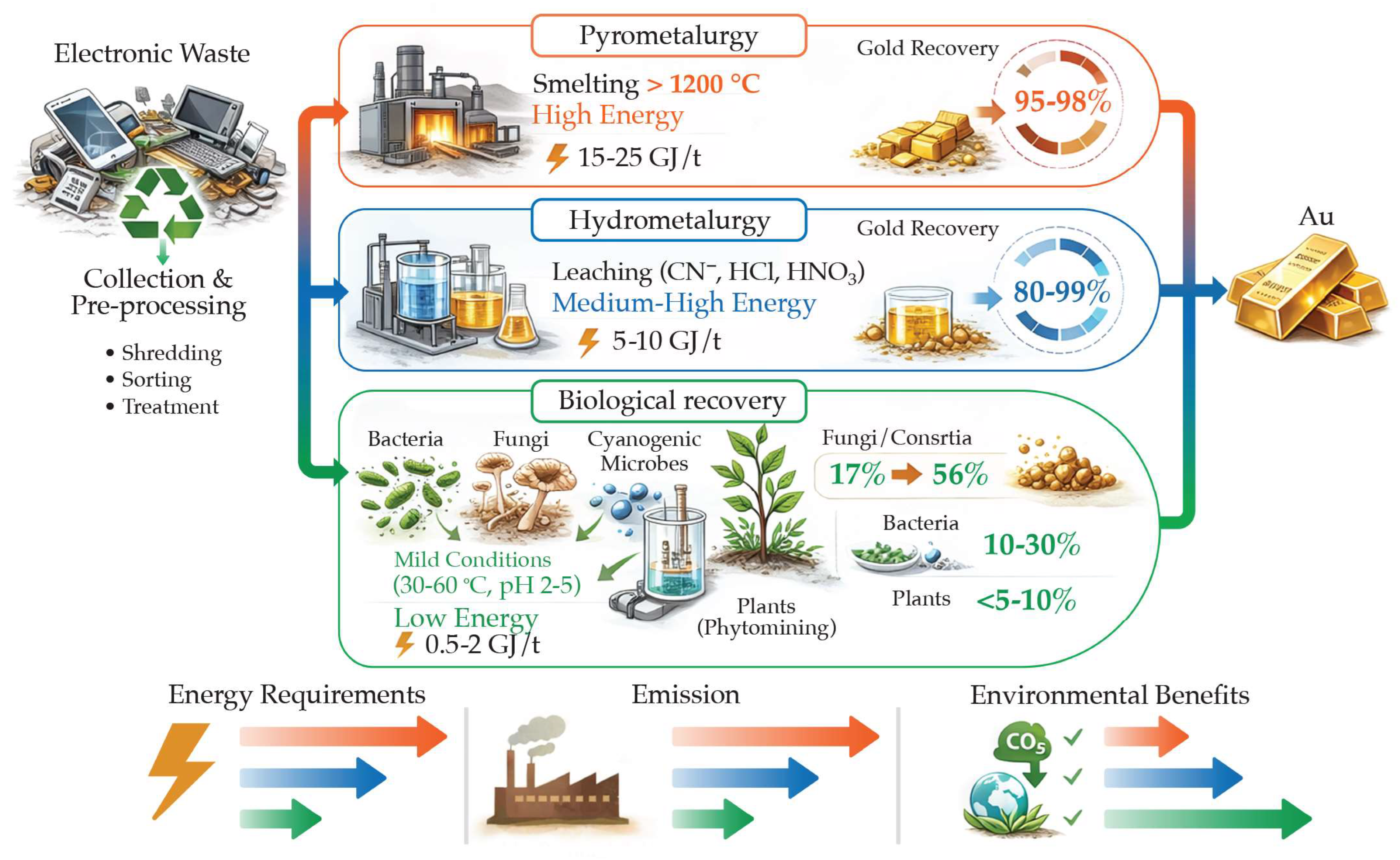
Figure 7 presents a schematic overview of the principal gold recovery routes from electronic waste, providing a comparative illustration of the previously discussed processing approaches.

4.2. Copper Anode Slime as a Secondary Resource of Gold

4.2.1. Formation and Generation

Another important secondary source for gold recovery is copper anode slime (CAS), the solid residue generated during the electrorefining of copper anodes. In this process, impure copper anodes—originating either from primary copper smelting or from co-smelting of copper-containing secondary materials—dissolve anodically in an acidic electrolyte, while high-purity copper is deposited on the cathode, leaving CAS as a valuable material for subsequent gold recovery. Noble and semi-noble elements (e.g., Au, Ag, platinum group metals (PGMs), Se, and Te) do not dissolve under these conditions and accumulate as an insoluble sludge at the bottom of the electrorefining cell, commonly referred to as copper anode slime [215,216,217,218].
The generation of CAS is closely related to the composition of copper anodes and the mineralogical characteristics of the smelting feed materials. Industrial practice indicates that approximately 5–10 kg of anode slime is produced per tonne of refined copper cathode, although the amount depends on feed composition and electrorefining conditions [219,220,221]. Considering that global refined copper production exceeds 26 Mt annually [222], CAS is generated in relatively small quantities compared with other metallurgical residues but represents a significant secondary source of valuable metals in which gold concentrations usually exceed those in many primary ores [217,218]. However, it contains hazardous elements such as As and Cd and is therefore classified as environmentally hazardous waste [223,224]. Consequently, efficient valorization of CAS, particularly gold, is essential both for the economic aspects, considering its importance in copper refinery profitability and for reducing the environmental impact of industrial waste, supporting sustainable resource utilization [220,225,226].

4.2.2. Chemical and Mineralogical Composition

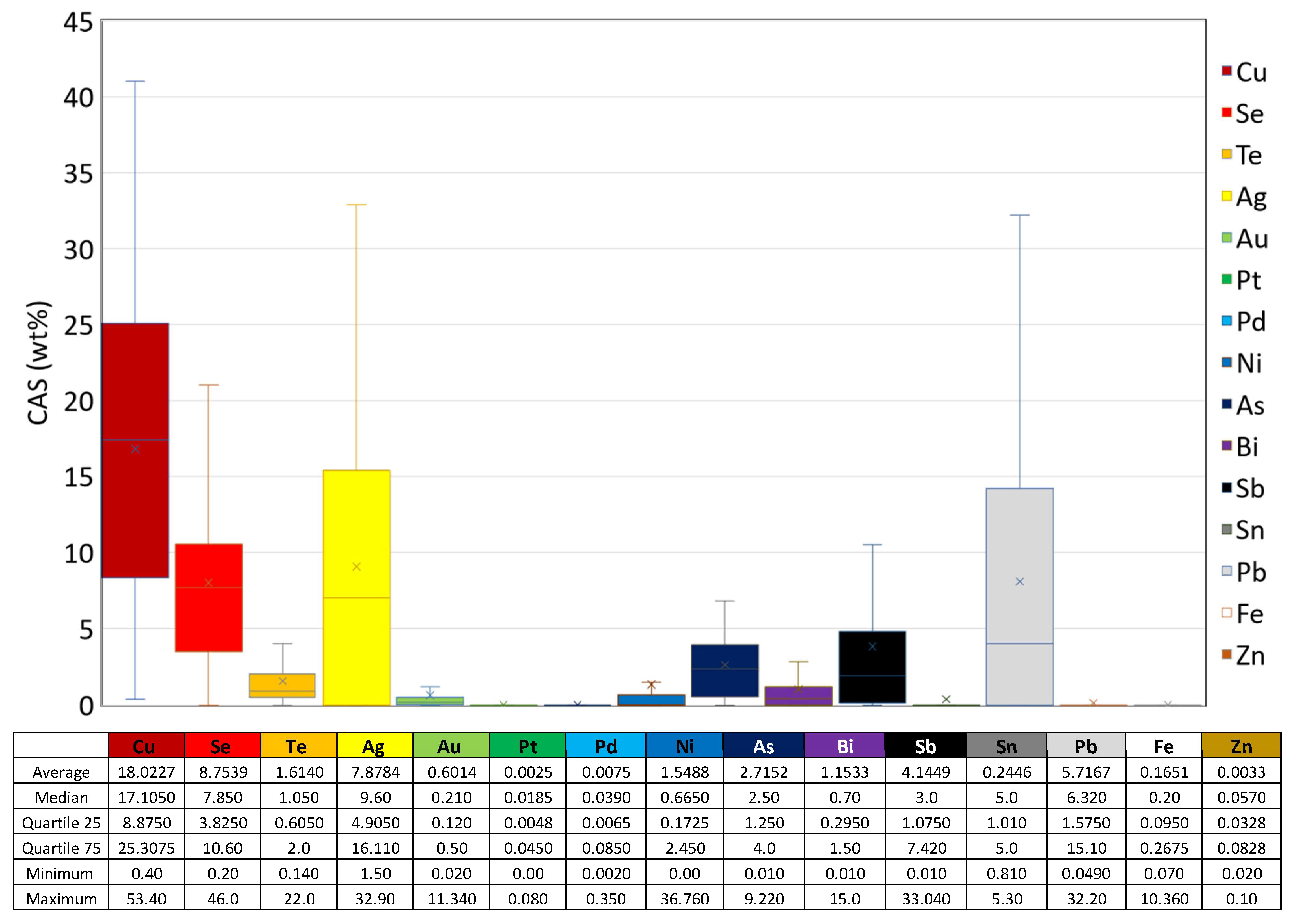
The composition of copper anode slime is highly variable and depends on several factors, including the composition of copper concentrates, smelting conditions, anode casting quality, and electrorefining parameters. In general, it contains significant amounts of precious metals (Au, Ag, PGMs), chalcogens (Se, Te), and base metals such as Cu, Pb, Bi, and Sb, together with minor quantities of Ni, As, and other elements [227,228,229]. These components occur in a variety of mineral phases, including metallic particles, selenides, tellurides, sulfides, and oxides, resulting in a heterogeneous multiphase material [230,231]. Gold in CAS typically occurs as metallic particles or Au–Ag alloys, but it is frequently associated with complex multiphase aggregates. Such mineralogical associations often hinder direct access of leaching agents to gold particles and complicate its selective recovery [217,220]. Figure 8 shows the chemical composition of CAS compiled by Elmira Moosavi-Khoonsari [218] for more than 100 different smelters, from which it can be seen that Au, along with other important metals, varies from 0.020 to 11.340 wt% [232,233].
Increasing integration of secondary feed materials into copper smelting and co-processing routes progressively transforms CAS from a relatively predictable metallurgical by-product into a more compositionally complex material, complicating selective metal recovery and process optimization. This so-called non-standard CAS differs from conventional CAS produced from the refining of anodes derived solely from copper concentrates in several aspects, including particle morphology, phase composition, and the distribution of precious metals inherited from the upstream input materials [234]. One notable example is the formation of metastannic acid, especially the β-stereoisomer (H2Sn5O11 × 9H2O), a poorly soluble tin phase generated during electrorefining [235]. The content of this phase tends to increase with higher e-waste shares in the smelting feed, particularly when tin-bearing components are abundant. Metastannic acid forms gelatinous or fine particulate matrices that significantly hinder the accessibility of other metals, and gold, during hydrometallurgical processing [236,237]. These additional phases further increase the compositional variability of CAS and directly influence the selection and efficiency of subsequent recovery technologies [238,239,240]. A comparative overview of the chemical composition of various copper anode slimes obtained from primary copper metallurgy, co-smelting processes involving secondary materials, as well as those generated through the recycling of e-waste is presented in Table 6.
The data indicate clear differences between conventional copper anode slimes and those influenced by secondary feed materials. Compared with primary gold ores, which are generally geologically constrained and characterized by relatively consistent mineralogical compositions, CAS represents a metallurgical by-product with inherently higher heterogeneity arising from process conditions and feed variability, while also serving as an important secondary source of gold. In contrast, compared with e-waste, CAS remains more metal-rich and predominantly inorganic. These compositional differences directly influence gold distribution, downstream processing, and process selectivity. Consequently, recovery strategies developed for primary systems, as well as conventional copper anode slimes, cannot be directly transferred to more variable, non-standard CAS without appropriate adaptation, in order to ensure efficient process performance and effective gold valorization.

4.2.3. Technologies for Gold Recovery from CAS

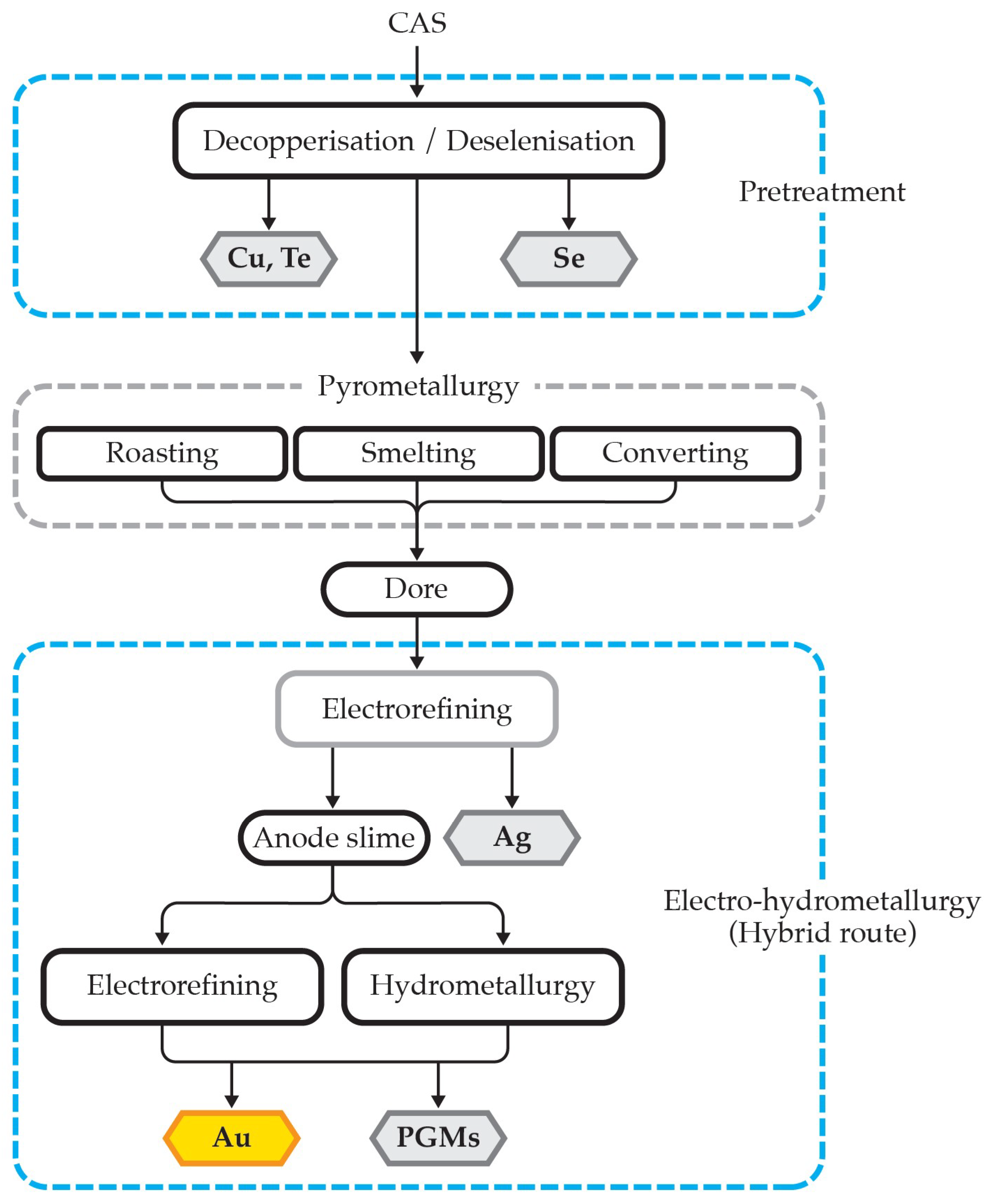
CAS valorization has been the subject of numerous studies, yet the optimal processing strategy is largely determined by its physicochemical characteristics [243]. Due to its high value, copper anode slime is almost universally processed in copper refineries through precious metal recovery circuits. Historically, these flowsheets have been based on a hybrid system combining pyro- and hydrometallurgical operations integrated with subsequent electrorefining steps [244]. A typical sequence begins with sulfation or oxidative roasting to volatilize selenium and break down refractory phases, followed by acid leaching to dissolve copper and base metals. The remaining residue is converted into bullion through reductive smelting and then refined to separate silver and gold via electrorefining [238,245]. These conventional routes are well established, but they exhibit several inherent limitations. The full recovery of precious metals is often delayed until late in the flowsheet, which increases in-process inventories, leads to metal loss, and results in inefficient material utilization. Additionally, pyrometallurgical steps contribute to high energy consumption and significant emissions, as well as long processing times, while their effectiveness strongly depends on CAS mineralogy and the behavior of accompanying elements such as As, Sb, Se, and Pb during treatment [230,238]. Figure 9 provides an overview of the pyrometallurgical processing of copper anode slime, including subsequent hydro- and electrochemical (hybrid) refining steps, based on literature data.
Due to material heterogeneity and refractory compound contents, a pretreatment step in CAS valorization is often conducted. In that context, a widely applied pretreatment method is alkali fusion, which is particularly efficient for transformation of refractory compounds (e.g., metastannic acid) that hinder conventional hydrometallurgical processing and Au valorization. In this approach, CAS is reacted with alkaline fluxes at elevated temperatures to convert insoluble phases into soluble species suitable for subsequent leaching. A commonly reported method is the NaOH–NaNO3 fusion, which enables the removal of Se, As, Sn, and Pb while enriching noble metals in the residue [249]. Related fusion-leaching routes combine this pretreatment with acid or sulfide leaching to further separate base metals from precious metal fractions, typically retaining more than 99% of Au in the solid phase [250]. In contrast, NaOH-only fusion has been investigated for the selective transformation of metastannic acid from non-standard CAS, facilitating efficient tin removal while retaining 99.99% Au in the solid residue, resulting in substantial enrichment of precious metals and facilitating further valorization [237].
Additionally, low-temperature alkali fusion variants have been proposed to selectively convert Se- and As-bearing phases at moderate temperatures, reducing energy consumption while maintaining high conversion efficiency [251]. An integrated process combining O2-enriched roasting, H2SO4–NaCl leaching, and alkaline treatment was also proposed for scrap copper anode slime, enabling efficient removal of base metals while preserving and concentrating gold in the solid residue, with a gold enrichment ratio of approximately 5.7 [239]. These approaches demonstrate that alkali fusion systems can be tailored through flux composition and operating conditions to selectively remove interfering elements while concentrating gold prior to downstream metal recovery from CAS.
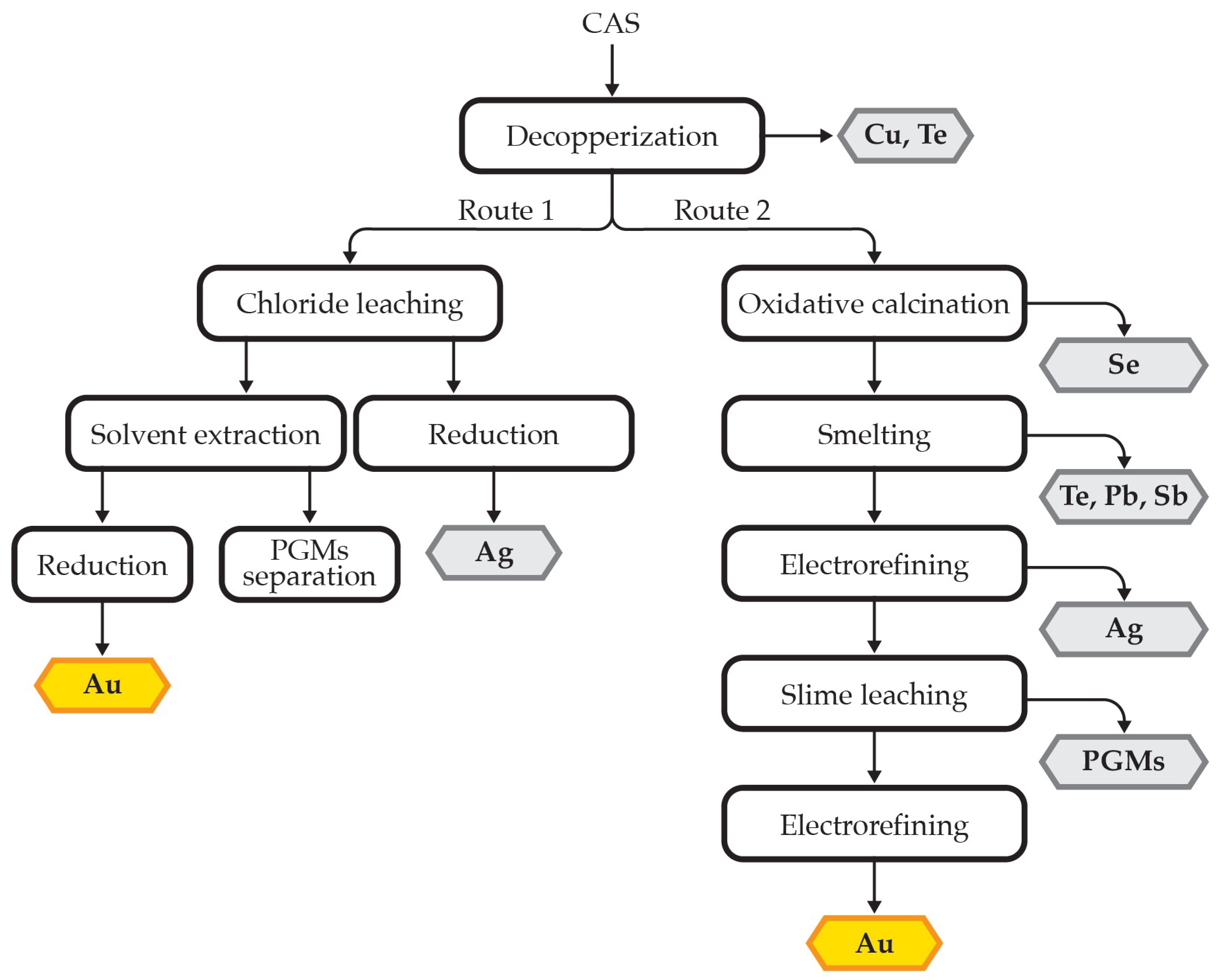
In recent years, significant research efforts have focused on developing more environmentally sustainable CAS processing technologies, and hydrometallurgical processing has gained prominence as an alternative to traditional hybrid flowsheets [233,243]. This approach emphasizes early extraction of precious metals and reduction in high-temperature operations, offers lower energy requirements, reduced emissions, and shorter overall processing times, while often achieving first-pass recovery rates approaching 99% for gold and silver [218]. Figure 10 provides an overview of the traditional hydrometallurgical processing of CAS, based on literature data.
Hydrometallurgical methods include sequential acid leaching (e.g., H2SO4, HCl) with oxidants, chloride, thiosulfate, or thiourea leaching for selective dissolution of precious metals, and optimized precipitation or solvent extraction steps to isolate target elements, followed by subsequent reduction or electrorefining. Such routes can significantly reduce the retention of valuable metals within the process and facilitate early doré or solution-phase recovery, which improves economics and minimizes metal losses [233]. Research on the recycling of non-standard CAS, particularly material obtained when e-waste is used as the sole feedstock, remains limited. In one reported approach, the material was first subjected to desulfurization, followed by HCl leaching under reducing conditions using Zn or Mg powder. Under these conditions, metastannic acid was converted into a soluble species and quantitatively removed from the solid matrix, enabling the enrichment of Au and facilitating its subsequent recovery in downstream processing steps [236]. On the other hand, Ding et al. applied an integrated hydrometallurgical processing route, in which a NaClO3–NaCl–H2SO4 solution was used as the leaching agent for gold recovery from non-standard CAS, achieving 98% efficiency. Subsequently, other valuable metals present in the anode slime were recovered through sequential separation steps applied to the remaining material [225].
An overview of the standard approaches for copper anode slime processing is given in Table 7.
Alternatively, pressure leaching, oxidative dissolution, and advanced solvent extraction tailored to the specific phase associations in CAS, especially in materials with complex mineralogy, is also explored [255,256]. In addition, chlorinating roasting followed by chlorinating leaching has been shown to retain gold in metallic form and can thus be leached sequentially [242]. A multistage hydrometallurgical route integrating oxidative leaching agents (e.g., NaOCl, H2O2) with reductive cementation to separate copper, gold, and silver is another route that offers flexibility and may improve selectivity, although applications for secondary raw materials are currently limited to the laboratory scale [257].
Emerging Technologies for Gold CAS Valorization
Several novel techniques have recently been proposed, including mechanochemical gold extraction, in which oxidative chlorine species are generated during ball milling, enabling efficient conversion of metallic gold into soluble chlorocomplex [258], deep eutectic solvents [259,260], ionic liquids [261,262], or vacuum carbothermal reduction [263,264] as green leaching agents for selective recovery of precious metals, or selective adsorption systems for recovery of gold from leach solutions using functionalized biomaterials [265]. These approaches aim to reduce reagent consumption, improve selectivity, and minimize environmental impact. Nevertheless, most of these technologies remain at the laboratory scale, and their industrial implementation is still limited by the complexity of CAS mineralogy and composition, process scalability, and insufficient techno-economic and environmental evaluation. Consequently, future development will likely focus on hybrid flowsheets and improved process integration to enhance both recovery efficiency and environmental performance.
Despite its high value, CAS remains one of the most complex metallurgical residues to process. Several factors contribute to these challenges, including a highly heterogeneous composition, the presence of multiple valuable metals, the coexistence of toxic elements (As, Sb, Cd), and complex mineralogical phases. Such complexity often results in incomplete metal separation and low recovery efficiencies when conventional single-metal extraction approaches are used [238]. These observations indicate that CAS processing cannot be interpreted simply as treatment of a high-grade Au feed, since process selectivity and matrix interactions often become equally important as absolute metal concentration. Additionally, environmental concerns related to emissions from roasting processes and hazardous reagents used in hydrometallurgical systems represent significant challenges for sustainable CAS treatment.

4.2.4. Environmental Impacts and Sustainability Considerations of CAS Utilization

Life cycle assessment (LCA) studies addressing CAS processing remain relatively limited but provide valuable insight into the environmental performance of different recovery routes. An important aspect is that LCA studies typically assess the entire multi-metal recovery chain rather than Au recovery alone, since CAS processing inherently involves the simultaneous extraction of several valuable elements such as Au, Ag, Cu, Se, and Te, with environmental impacts usually allocated per mass of treated CAS [225,266]. Comparative LCA analyses of pyro- and hydrometallurgical and hybrid flowsheets have shown that environmental impacts are strongly influenced by energy consumption and reagent use. Additionally, environmental performance is strongly affected by the management of gaseous emissions, acidic process effluents, and hazardous residues generated during CAS treatment. In contrast, integrated or hybrid processing routes may offer improved overall environmental performance [267]. In contrast, non-standard CAS generated from secondary sources remains scarcely addressed in LCA studies, as most research to date has focused on process development and metal separation rather than comprehensive environmental assessment of these emerging secondary materials.

5. Conclusions

This review analyzes primary and secondary gold sources, together with the corresponding extraction technologies and their advantages and limitations. While primary sources remain the backbone of global gold production, they are limited in availability and associated with significant environmental burdens and high energy demands. In contrast, secondary sources, such as e-waste and CAS—generated during ore or e-waste processing—represent an important complementary resource with the potential for a lower overall environmental impact. However, secondary Au-bearing materials cannot be regarded simply as high-grade equivalents of primary ores, since their engineered and heterogeneous nature introduces substantially different metallurgical, environmental, and process-related challenges. The progressive transition from ores toward heterogeneous anthropogenic materials therefore shifts the principal challenge of Au recovery from metal dissolution itself toward process selectivity, integration, and sustainability.
Technologies for gold recovery from secondary materials are largely based on principles developed for primary ores. However, their application is often less efficient due to the higher complexity and heterogeneity of feed materials, the presence of multiple phases, and various process interferences, which require a multidisciplinary approach integrating metallurgy, chemistry, process engineering, and environmental considerations to address effectively. Nevertheless, their relevance lies primarily in process efficiency, but also in the overall valorization of gold that would otherwise remain unrecovered, and the fact that they are well-established technologies, with existing equipment and available trained workforce.
Accordingly, the evaluation of these technologies should extend beyond technical performance to include resource availability, gold concentration, and broader material flows, requiring consideration of material heterogeneity, resource accessibility, and overall process sustainability rather than recovery efficiency alone. A key question is whether reduced efficiency can be justified by the recovery of otherwise inaccessible gold, or whether advances in selectivity are required to address increasing material complexity. Also, as waste streams become increasingly complex, recycling may generate intermediates that are inherently difficult to process and only partially valorized, potentially leading to the generation of additional waste and associated environmental burdens, thereby reinforcing the role of secondary sources as complementary to, rather than substitutes for, primary production.
Finally, it should be noted that lower national income levels are often associated with a higher likelihood that gold recovery processes occur within informal or inadequately regulated sectors. Such practices may deviate from established environmental and occupational standards, while the recovered gold can nevertheless enter formal supply chains. These dynamics introduce additional uncertainty in assessing process efficiency, gold losses, and environmental impacts, highlighting the need to consider socio-economic context alongside technical evaluations when analyzing secondary gold sources.

6. Future Directions

Future gold processing technologies are shaped not only by evolving economic and technological drivers, but also by increasingly complex operational realities. Despite sustained demand, significant volumes of gold continue to be lost within informal and poorly regulated sectors, while the growing prevalence of refractory ores further complicates extraction and recycling processes. According to the World Gold Council’s Gold 2048 outlook, global demand is expected to increase due to expanding middle classes in emerging markets and the evolving role of gold in energy, healthcare, and advanced technologies. ESG considerations are also anticipated to play an increasingly central role, as the industry faces pressure to maintain production levels comparable to historical outputs over the coming decades. “The next 30 years will no doubt bring significant changes—some we anticipate, some that none of us predict” [268].
These trends indicate that future gold extraction technologies must balance efficiency, environmental sustainability, and social responsibility while maintaining economic viability. However, technological conservatism is likely to persist, with established processes remaining dominant unless stronger economic and regulatory drivers accelerate the adoption of alternative solutions.
Emerging approaches such as deep eutectic solvents, ionic liquids, electrochemical methods, and hybrid pyro-hydrometallurgical flowsheets are increasingly investigated as potentially more selective and environmentally acceptable alternatives to conventional processing routes. At the same time, improved process integration and selective recovery strategies are expected to play an important role in the treatment of increasingly heterogeneous secondary raw materials. Nevertheless, despite promising laboratory-scale results, many of these technologies still face challenges related to industrial scalability, integration into existing metallurgical infrastructure, and insufficient techno-economic and environmental evaluation. Additional research gaps include limited long-term process validation, insufficient understanding of complex secondary feed behavior in alternative and emerging systems, and the lack of standardized comparative assessment under industrially relevant conditions.
Key areas of innovation are expected to include: (i) development of less toxic and more selective reagents; (ii) improvements in leaching kinetics and overall recovery; (iii) advances in separation technologies, including solvent extraction and ion exchange; (iv) incremental efficiency gains in electrowinning and refining; and (v) improved environmental integration, particularly in water management and solid–liquid separation, in response to increasing demands related to environmental performance, regulatory compliance, residue stability, energy consumption, and compatibility with circular economy principles.
The increasing integration of secondary resources, particularly e-waste, into gold supply chains introduces materials of unprecedented chemical and physical complexity. In this context, hydrometallurgy is expected to play an important role in response to demands for energy efficiency, cleaner production, and circular resource use, particularly for the recovery of metals from secondary resources and low-grade ores [269]. Future developments will likely focus on selective separation from complex multi-metal systems, although industrial risk aversion may limit adoption in primary production. Today, however, these challenges are amplified, as modern input materials often exceed the processing limits of conventional routes, underscoring the need for innovations. Market and geopolitical factors will also shape this evolution, as price volatility and economic disruptions can constrain the technological adoption, potentially limiting global gains.
Ultimately, the future of gold processing will depend on the ability to integrate fundamental chemical understanding with system-level innovation, enabling the efficient and sustainable recovery of gold from increasingly complex and unconventional resources.

Author Contributions

Conceptualization, J.D. and Ž.K.; Writing—Original Draft Preparation, J.D. and S.N.; Writing—Review & Editing, S.D., Ž.K., and S.Z.; Visualization, J.D., S.N., and S.D.; Supervision, J.D., Ž.K., and S.Z. All authors have read and agreed to the published version of the manuscript.

Funding

This work was financially supported by the Ministry of Science, Technological Development and Innovation of the Republic of Serbia (Contract No. 451-03-33/2026-03/200288, 451-03-33/2026-03/200287, and 451-03-34/2026-03/200135).

Data Availability Statement

No new data or analyses were generated in this study. Data sharing is not applicable to this article.

Acknowledgments

The authors thank Mladen Milašinović in expert assistance with schematic design and graphical visualization.

Conflicts of Interest

Authors Jovana Djokić, Stefan Nikolić and Stevan Dimitrijević were employed by the company Belgrade Ltd. The remaining authors declare that the research was conducted in the absence of any commercial or financial relationships that could be construed as a potential conflict of interest.

Abbreviations

The following abbreviations are used in this manuscript:
E-wasteElectronic Waste 
EWElectrowinning
CIPCarbon-In-Pulp
CILCarbon-In-Leach
POXPressure Oxidation
ESGEnvironmental, Social, And Governance
AOPAdvanced Oxidation Process
LCALife Cycle Assessments 
GHGGreenhouse Gas
EEEElectrical and Electronic Equipment
PCBPrinted Circuit Board
POMPlaced-On-Market
MOMicroorganisms
CASCopper Anode Slime
PGMsPlatinum Group Metals 

References

  1. Bernstein, P.L. The Power of Gold: The History of an Obsession; John Wiley & Sons: Hoboken, NJ, USA, 2012. [Google Scholar]
  2. U.S. Geological Survey. Mineral Commodity Summaries 2026: Gold; U.S. Geological Survey: Reston, VA, USA, 2026. [Google Scholar]
  3. International Energy Agency. Final List of Critical Minerals (2022); IEA: Paris, France, 2022. [Google Scholar]
  4. European Commission; Directorate-General for Internal Market, Industry, Entrepreneurship and SMEs. Study on the Critical Raw Materials for the EU 2023: Final Report; Publications Office of the European Union: Luxembourg, 2023. [Google Scholar]
  5. World Gold Council. Gold Demand Trends: Full Year 2025; World Gold Council: London, UK, 2026; Available online: https://www.gold.org/goldhub (accessed on 10 March 2026).
  6. Calvo, G.; Mudd, G.; Valero, A.; Valero, A. Decreasing Ore Grades in Global Metallic Mining: A Theoretical Issue or a Global Reality? Resources 2016, 5, 36. [Google Scholar] [CrossRef]
  7. Chen, J.; Zhong, S.; Tang, D.; Kuang, C. Practical Experience in Large-Scale Development of Zijinshan Low-Grade Gold-Copper Mine. Min. Met. Explor. 2020, 37, 1339–1347. [Google Scholar] [CrossRef]
  8. Kim, J.; Kim, R.; Han, K.N. Advances in Hydrometallurgical Gold Recovery through Cementation, Adsorption, Ion Exchange and Solvent Extraction. Minerals 2024, 14, 607. [Google Scholar] [CrossRef]
  9. Lu, Q.; Rao, J.; Li, M.; Xiao, R.; Kamberovic, Z.; Liu, Q.; Weng, W.; Zhong, S. Advances in Tuning the Filtration Performance of the Ore Pulp during Hydrometallurgical Leaching of High-Silicon Materials: A Review. Miner. Eng. 2026, 244, 110259. [Google Scholar] [CrossRef]
  10. Vaughan, J.P. The Process Mineralogy of Gold: The Classification of Ore Types. JOM 2004, 56, 46–48. [Google Scholar] [CrossRef]
  11. Wang, S.; Wu, J.; Jiao, F. Pretreatment and Extraction of Gold from Refractory Gold Ore in Acidic Conditions. Minerals 2025, 15, 340. [Google Scholar] [CrossRef]
  12. La Brooy, S.R.; Linge, H.G.; Walker, G.S. Review of Gold Extraction from Ores. Miner. Eng. 1994, 7, 1213–1241. [Google Scholar] [CrossRef]
  13. Lorenzen, L.; Van Deventer, J.S.J. The Mechanism of Leaching of Gold from Refractory Ores. Miner. Eng. 1992, 5, 1377–1387. [Google Scholar] [CrossRef]
  14. Sokić, M.; Matković, V.; Radosavljević, S.; Marković, B.; Kamberović, Z. Characterization of Polymetallic Sulphide Ore Deposits Located in Serbia. Inz. Miner. 2003, S.3, 83–86. [Google Scholar]
  15. Kontopoulos, A.; Stefanakis, M. Process selection for the Olympias refractory gold concentrate. In Proceedings of Precious Metals ’89; Jha, M.C., Hill, S.D., Guindy, M.E., Eds.; TMS: Warrendale, PA, USA, 1988; pp. 179–209. [Google Scholar]
  16. Sinadinović, D.; Kamberović, Ž.; Vakanjac, B. Refractory gold ores, characteristics and methods of their procession. In Proceedings of the VII Balkan Mineral Processing Conference, Beograd, Jugoslavija, 13–18 September 1999; pp. 411–419. [Google Scholar]
  17. Barbouchi, A.; Louarrat, M.; Mikali, M.; Barfoud, L.; El Alaoui-Chrifi, M.A.; Faqir, H.; Benzakour, I.; Idouhli, R.; Khadiri, M.; Benzakour, J. Advancements in Improving Gold Recovery from Refractory Gold Ores/Concentrates: A Review. Can. Met. Q. 2025, 64, 2370–2387. [Google Scholar] [CrossRef]
  18. Kongolo, K.; Mwema, M. The Extractive Metallurgy of Gold. In Extractive Metallurgy; IntechOpen: London, UK, 2011. [Google Scholar]
  19. Adams, M.D. Gold Ore Processing; Elsevier: Amsterdam, The Netherlands, 2016. [Google Scholar]
  20. Fernández, R.R.; Sohn, H.Y.; LeVier, K.M. Process for Treating Refractory Gold Ores by Roasting under Oxidizing Conditions. Min. Met. Explor. 2000, 17, 1–6. [Google Scholar] [CrossRef]
  21. Rusanen, L.; Aromaa, J.; Forsen, O. Pressure Oxidation of Pyrite-Arsenopyrite Refractory Gold Concentrate. Physicochem. Probl. Miner. Process 2013, 49, 101–109. [Google Scholar] [CrossRef]
  22. Sinadinović, D.; Kamberović, Ž. The procession of polymetalic sulphide ore containing precious metals by oxidation leaching in an autoclave under oxygen pressure. Proceedings of 3rd Conference Metallurgy, Ohrid, Makedonija, 4–6 May 2000; pp. 149–154. [Google Scholar]
  23. Sun, L.-X.; Zhang, X.; Tan, W.-S.; Zhu, M.-L. Effects of Dissolved Oxygen on the Biooxidation Process of Refractory Gold Ores. J. Biosci. Bioeng. 2012, 114, 531–536. [Google Scholar] [CrossRef]
  24. Karthikeyan, O.P.; Rajasekar, A.; Balasubramanian, R. Bio-Oxidation and Biocyanidation of Refractory Mineral Ores for Gold Extraction: A Review. Crit. Rev. Environ. Sci. Technol. 2015, 45, 1611–1643. [Google Scholar] [CrossRef]
  25. González-Anaya, J.A.; Nava-Alonso, F.; Pecina-Treviño, E.T. Gold Recovery Optimization of a Refractory Concentrate by Ultrafine Grinding—A Laboratory Study. Min. Met. Explor. 2011, 28, 94–101. [Google Scholar] [CrossRef]
  26. Ammen, C.W. Recovery and Refining of Precious Metals; Van Nostrand Reinhold Company: New York, NY, USA, 1984. [Google Scholar]
  27. Espinoza-Martínez, A.M.; Valenzuela-García, J.L.; Salazar-Campoy, M.M.; Encinas-Romero, M.A.; Martínez-Ballesteros, G.; Parga Torres, J.R. Gold and Silver Recovery from a Refractory Pyritic Concentrate by Roasting and Alkaline Pressure Oxidation. Minerals 2025, 15, 1260. [Google Scholar] [CrossRef]
  28. Li, H.; Li, Z.; Jin, J.; Han, Y.; Li, Y. Pore Evolution in Refractory Gold Ore Formed by Oxidation Roasting and the Effect on the Cyanide Leaching Process. ACS Omega 2022, 7, 3618–3625. [Google Scholar] [CrossRef] [PubMed]
  29. Sinadinović, D.; Vračar, R.; Kamberović, Ž. On the Aqueous Oxidation of Polymetalic Cu-Zn-Pb Gold Bearing Sulphide Ore in an Autoclave. CIM Bull. 2001, 96, 123–128. [Google Scholar]
  30. Pereira, A.C. Refractory Gold Ores: A Critical Review of Mineralogy and Processing Options. Engenharias 2025, 29, 12141446. Available online: https://revistaft.com.br/refractory-gold-ores-a-critical-review-of-mineralogy-and-processing-options/ (accessed on 22 March 2026).
  31. Lemos, F.D.A.; Nascimento, M.; Moreira Júnior, G.R.; Andrade, V.R.D.; Pinto, P.C.; Salles, A.J.G. Recovery of Gold from Refractory Ore Employing Pressure Oxidation. REM-Int. Eng. J. 2025, 78, e230116. [Google Scholar] [CrossRef]
  32. Kamberović, Ž.; Sokić, M.; Korać, M. On the physicocemical problems of aqueous oxidation of polymetalic gold bearing sulphide ore in an autoclave. Physicochem. Probl. Miner. Process 2003, 37, 107–114. [Google Scholar]
  33. Alguacil, F. The Chemistry of Gold Extraction (2nd Edition) by Marsden, J.O. and House, C.I. Gold. Bull. 2006, 39, 138. [Google Scholar] [CrossRef]
  34. Hilson, G.; Monhemius, A.J. Alternatives to Cyanide in the Gold Mining Industry: What Prospects for the Future? J. Clean. Prod. 2006, 14, 1158–1167. [Google Scholar] [CrossRef]
  35. Tran, Q.B.; Lohitnavy, M.; Phenrat, T. Assessing Potential Hydrogen Cyanide Exposure from Cyanide-Contaminated Mine Tailing Management Practices in Thailand’s Gold Mining. J. Environ. Manag. 2019, 249, 109357. [Google Scholar] [CrossRef]
  36. McCarthy, S.; Lee Wei Jie, A.; Braddock, D.C.; Serpe, A.; Wilton-Ely, J.D.E.T. From Waste to Green Applications: The Use of Recovered Gold and Palladium in Catalysis. Molecules 2021, 26, 5217. [Google Scholar] [CrossRef]
  37. European Union. Directive 2006/21/EC on the Management of Waste from Extractive Industries; European Union: Brussels, Belgium, 2006. [Google Scholar]
  38. European Parliament. Review of Directive 2006/21/EC on the Management of Waste from Extractive Industries (Written question E-003031/2024); European Parliament: Brussels, Belgium, 2024. [Google Scholar]
  39. Soto-Uribe, J.C.; Valenzuela-Garcia, J.L.; Salazar-Campoy, M.M.; Parga-Torres, J.R.; Tiburcio-Munive, G.; Encinas-Romero, M.A.; Vazquez-Vazquez, V.M. Gold Extraction from a Refractory Sulfide Concentrate by Simultaneous Pressure Leaching/Oxidation. Minerals 2023, 13, 116. [Google Scholar] [CrossRef]
  40. Dosmukhamedov, N.K.; Yussupova, Z.A.; Kaplan, V.A.; Zholdasbay, E.E. Optimization of Cyanidation Process for Gold-Bearing Ores from Central Kazakhstan. NFM 2024, 2, 39–44. [Google Scholar] [CrossRef]
  41. Surimbayev, B.; Yessengarayev, Y.; Khumarbekuly, Y.; Bolotova, L.; Kanaly, Y.; Akzharkenov, M.; Zhumabai, S. Effect of Sodium Acetate Additive on Gold Leaching with Cyanide Solution: Laboratory and Semi-Pilot Leaching Tests. Heliyon 2024, 10, e35805. [Google Scholar] [CrossRef]
  42. Zhang, Y.; Cui, M.; Wang, J.; Liu, X.; Lyu, X. A Review of Gold Extraction Using Alternatives to Cyanide: Focus on Current Status and Future Prospects of the Novel Eco-Friendly Synthetic Gold Lixiviants. Miner. Eng. 2022, 176, 107336. [Google Scholar] [CrossRef]
  43. Gökelma, M.; Birich, A.; Stopic, S.; Friedrich, B. A Review on Alternative Gold Recovery Re-Agents to Cyanide. MSCE 2016, 4, 8–17. [Google Scholar] [CrossRef]
  44. Liu, Z.; Guo, X.; Tian, Q.; Zhang, L. A Systematic Review of Gold Extraction: Fundamentals, Advancements, and Challenges toward Alternative Lixiviants. J. Hazard. Mater. 2022, 440, 129778. [Google Scholar] [CrossRef]
  45. Thomas, K.G.; Fleming, C.A.; Marchbank, A.R. Application of the Thiosulfate Leaching Process at the Barrick Goldstrike Mine. In Proceedings of the SME Annual Meeting, Denver, CO, USA, 24–27 February 2013; Society for Mining, Metallurgy & Exploration: Englewood, CO, USA, 2013. [Google Scholar]
  46. Xie, F.; Chen, J.; Wang, J.; Wang, W. Review of Gold Leaching in Thiosulfate-Based Solutions. Trans. Nonferrous Met. Soc. China 2021, 31, 3506–3529. [Google Scholar] [CrossRef]
  47. Jeon, S.; Bright, S.; Park, I.; Tabelin, C.B.; Ito, M.; Hiroyoshi, N. A Simple and Efficient Recovery Technique for Gold Ions from Ammonium Thiosulfate Medium by Galvanic Interactions of Zero-Valent Aluminum and Activated Carbon: A Parametric and Mechanistic Study of Cementation. Hydrometallurgy 2022, 208, 105815. [Google Scholar] [CrossRef]
  48. Xu, B.; Kong, W.; Li, Q.; Yang, Y.; Jiang, T.; Liu, X. A Review of Thiosulfate Leaching of Gold: Focus on Thiosulfate Consumption and Gold Recovery from Pregnant Solution. Metals 2017, 7, 222. [Google Scholar] [CrossRef]
  49. Redrovan, A.S.; Torre, E.D.L.; Aragón-Tobar, C.F. Gold Leaching from an Auriferous Ore by Alkaline Thiosulfate–Glycine–Copper Solution. Metals 2025, 15, 204. [Google Scholar] [CrossRef]
  50. Lee, S.; Sadri, F.; Ghahreman, A. Enhanced Gold Recovery from Alkaline Pressure Oxidized Refractory Gold Ore After Its Mechanical Activation Followed by Thiosulfate Leaching. J. Sustain. Met. 2022, 8, 186–196. [Google Scholar] [CrossRef]
  51. Mystrioti, C.; Kousta, K.; Papassiopi, N.; Adam, K.; Taxiarchou, M.; Paspaliaris, I. Evaluation of Thiosulfate for Gold Recovery from Pressure Oxidation Residues. Mater. Proc. 2023, 15, 87. [Google Scholar]
  52. Hou, L.; Valdivieso, A.L.; Chen, Y.; Chen, P.; Zainiddinovich, N.Z.; Wu, C.; Song, S.; Jia, F. A Highly Efficient Clean Hydrometallurgy Process for Gold Leaching in a Fenton Oxidation Assisted Thiourea System. Sustain. Mater. Technol. 2024, 40, e00975. [Google Scholar] [CrossRef]
  53. Birich, A.; Stopic, S.; Friedrich, B. Kinetic Investigation and Dissolution Behavior of Cyanide Alternative Gold Leaching Reagents. Sci. Rep. 2019, 9, 7191. [Google Scholar] [CrossRef] [PubMed]
  54. Kamberović, Ž.; Korać, M.; Sinadinović, D. Autoclave Oxidation and Thiourea Leaching of Refractory Ores from Serbia. In Proceedings of the 16th International Congress of Chemical and Process Engineering, Summaries, Prague, Czech Republic, 22–26 August 2004; Volume 1, p. 325. [Google Scholar]
  55. Aylmore, M.G.; Muir, D.M. Thiosulfate Leaching of Gold—A Review. Miner. Eng. 2001, 14, 135–174. [Google Scholar] [CrossRef]
  56. Azizitorghabeh, A.; Wang, J.; Ramsay, J.A.; Ghahreman, A. A Review of Thiocyanate Gold Leaching–Chemistry, Thermodynamics, Kinetics and Processing. Miner. Eng. 2021, 160, 106689. [Google Scholar] [CrossRef]
  57. Ilyas, S.; Cheema, H.A.; Lee, J.-C. Halide Leaching of Gold. In Gold Metallurgy and the Environment; Ilyas, S., Lee, J.-C., Eds.; CRC Press: Boca Raton, FL, USA, 2018; ISBN 9781315150475. [Google Scholar]
  58. Oraby, E.A.; Eksteen, J.J. The Selective Leaching of Copper from a Gold–Copper Concentrate in Glycine Solutions. Hydrometallurgy 2014, 150, 14–19. [Google Scholar] [CrossRef]
  59. Eksteen, J.J.; Oraby, E.A. The Leaching and Adsorption of Gold Using Low Concentration Amino Acids and Hydrogen Peroxide: Effect of Catalytic Ions, Sulphide Minerals and Amino Acid Type. Miner. Eng. 2015, 70, 36–42. [Google Scholar] [CrossRef]
  60. Eksteen, J.J.; Oraby, E.A.; Tanda, B.C.; Tauetsile, P.J.; Bezuidenhout, G.A.; Newton, T.; Trask, F.; Bryan, I. Towards Industrial Implementation of Glycine-Based Leach and Adsorption Technologies for Gold-Copper Ores. Can. Metall. Q. 2018, 57, 390–398. [Google Scholar] [CrossRef]
  61. Zhang, S.; Yang, H.; Tong, L.; Jin, Z.; Ma, P. Synergistic Strategy for Enhanced Bio-Oxidation of Refractory Gold Concentrate with High Arsenic and Sulfur: Ferric Oxidation with Mixed Organic Nutrients Supplementation. Miner. Eng. 2026, 238, 110050. [Google Scholar] [CrossRef]
  62. Rawlings, D.E. Biomining (Mineral Bioleaching, Mineral Biooxidation). In Encyclopedia of Geobiology; Reitner, J., Thiel, V., Eds.; Springer Netherlands: Dordrecht, The Netherlands, 2011; pp. 182–185. ISBN 9781402092114. [Google Scholar]
  63. Olson, G.J.; Brierley, J.A.; Brierley, C.L. Bioleaching review part B: Progress in bioleaching: Applications of microbial processes by the minerals industries. Appl. Microbiol. Biotechnol. 2003, 63, 249–257. [Google Scholar] [CrossRef]
  64. Li, J.; Tong, L.; Xia, Y.; Yang, H.; Sand, W.; Xie, H.; Lan, B.; Zhong, S.; Auwalu, A. Microbial Synergy and Stoichiometry in Heap Biooxidation of Low-Grade Porphyry Arsenic-Bearing Gold Ore. Extremophiles 2020, 24, 355–364. [Google Scholar] [CrossRef]
  65. Beiranvand, Z.; Ahmadi, A.; Hosseini, M.R. Effect of Mechanical Activation on Biooxidation and Gold Extraction of a High-Grade Flotation Concentrate Using Mesophilic and Moderately Thermophilic Microorganisms. Miner. Eng. 2023, 204, 108394. [Google Scholar] [CrossRef]
  66. Li, J.; Tong, L.; Zhang, H.; Chen, Q.; Yang, H.; Shen, L.; Zhai, Y.; Yao, R. Pool Bio-Oxidation and Fitting Analysis of Low-Grade Arsenic-Containing Refractory Gold Ore. Green Chem. Eng. 2024, 5, 511–518. [Google Scholar] [CrossRef]
  67. Sasaki, K.; Suyama, I.; Takimoto, R.; Konadu, K.T.; Ichinose, H.; Eksteen, J. Complete Gold Extraction and Recovery from Double Refractory Gold Ores by Thiourea after Bio-Oxidation. Hydrometallurgy 2024, 227, 106330. [Google Scholar] [CrossRef]
  68. Zhang, S.; Yang, H.; Ma, P.; Luan, Z.; Tong, L.; Jin, Z.; Sand, W. Column Bio-Oxidation of Low-Grade Refractory Gold Ore Containing High-Arsenic and High-Sulfur: Insight on Change in Microbial Community Structure and Sulfide Surface Corrosion. Miner. Eng. 2022, 175, 107201. [Google Scholar] [CrossRef]
  69. Takimoto, R.; Cindy; Okibe, N.; Sasaki, K. Bio-Oxidation of Double Refractory Gold Ores by a Mixed Culture Including an Acidophilic Heterotroph before Cyanidation. J. Sustain. Met. 2025, 11, 3760–3769. [Google Scholar] [CrossRef]
  70. Laker, M.C. Environmental Impacts of Gold Mining—With Special Reference to South Africa. Mining 2023, 3, 205–220. [Google Scholar] [CrossRef]
  71. Kumah, A. Sustainability and Gold Mining in the Developing World. J. Clean. Prod. 2006, 14, 315–323. [Google Scholar] [CrossRef]
  72. Mudd, G.M. Global Trends in Gold Mining: Towards Quantifying Environmental and Resource Sustainability. Resour. Policy 2007, 32, 42–56. [Google Scholar] [CrossRef]
  73. Finnie, B.; Stuart, J.; Gibson, L.; Zabriskie, F. Balancing Environmental and Industry Sustainability: A Case Study of the US Gold Mining Industry. J. Environ. Manag. 2009, 90, 3690–3699. [Google Scholar] [CrossRef]
  74. Eisler, R. Health Risks of Gold Miners: A Synoptic Review. Environ. Geochem. Health 2003, 25, 325–345. [Google Scholar] [CrossRef] [PubMed]
  75. Trench, A.; Baur, D.; Ulrich, S.; Sykes, J.P. Gold Production and the Global Energy Transition—A Perspective. Sustainability 2024, 16, 5951. [Google Scholar] [CrossRef]
  76. Torrance, K.W.; Redwood, S.D.; Cecchi, A. The Impact of Artisanal Gold Mining, Ore Processing and Mineralization on Water Quality in Marmato, Colombia. Environ. Geochem. Health 2021, 43, 4265–4282. [Google Scholar] [CrossRef] [PubMed]
  77. Norgate, T.; Haque, N. Using Life Cycle Assessment to Evaluate Some Environmental Impacts of Gold Production. J. Clean. Prod. 2012, 29–30, 53–63. [Google Scholar] [CrossRef]
  78. Ulrich, S.; Trench, A.; Hagemann, S. Greenhouse Gas Emissions and Production Cost Footprints in Australian Gold Mines. J. Clean. Prod. 2020, 267, 122118. [Google Scholar] [CrossRef]
  79. Elomaa, H.; Sinisalo, P.; Rintala, L.; Aromaa, J.; Lundström, M. Process Simulation and Gate-to-Gate Life Cycle Assessment of Hydrometallurgical Refractory Gold Concentrate Processing. Int. J. Life Cycle Assess. 2020, 25, 456–477. [Google Scholar] [CrossRef]
  80. Aurubis. Life Cycle Assessment of Silver and Gold; Aurubis: Hamburg, Germany, 2024; Available online: https://www.aurubis.com (accessed on 22 March 2026).
  81. Baldé, C.P.; Kuehr, R.; Yamamoto, T.; McDonald, R.; D’Angelo, E.; Althaf, S.; Bel, G.; Deubzer, O.; Fernandez-Cubillo, E.; Forti, V.; et al. The Global E-Waste Monitor 2024; International Telecommunication Union (ITU): Geneva, Switzerland; United Nations Institute for Training and Research (UNITAR): Geneva, Switzerland; Bonn, Germany, 2024. [Google Scholar]
  82. Tipre, D.R.; Khatri, B.R.; Thacker, S.C.; Dave, S.R. The brighter side of e-waste—A rich secondary source of metal. Environ. Sci. Pollut. Res. 2021, 28, 10503–10518. [Google Scholar]
  83. Khaliq, A.; Rhamdhani, M.; Brooks, G.; Masood, S. Metal Extraction Processes for Electronic Waste and Existing Industrial Routes: A Review and Australian Perspective. Resources 2014, 3, 152–179. [Google Scholar] [CrossRef]
  84. Oke, E.A.; Potgieter, H. Discarded E-Waste/Printed Circuit Boards: A Review of Their Recent Methods of Disassembly, Sorting and Environmental Implications. J. Mater. Cycles Waste Manag. 2024, 26, 1277–1293. [Google Scholar] [CrossRef]
  85. Cayumil, R.; Khanna, R.; Rajarao, R.; Mukherjee, P.S.; Sahajwalla, V. Concentration of Precious Metals during Their Recovery from Electronic Waste. Waste Manag. 2016, 57, 121–130. [Google Scholar] [CrossRef]
  86. Thakur, P.; Kumar, S. Metallurgical processes unveil the unexplored “sleeping mines” e-waste: A review. Environ. Sci. Pollut. Res. 2020, 27, 32359–32370. [Google Scholar] [CrossRef] [PubMed]
  87. Gómez, M.; Grimes, S.; Qian, Y.; Feng, Y.; Fowler, G. Critical and Strategic Metals in Mobile Phones: A Detailed Characterisation of Multigenerational Waste Mobile Phones and the Economic Drivers for Recovery of Metal Value. J. Clean. Prod. 2023, 419, 138099. [Google Scholar] [CrossRef]
  88. Nithya, R.; Sivasankari, C.; Thirunavukkarasu, A. Electronic Waste Generation, Regulation and Metal Recovery: A Review. Environ. Chem. Lett. 2021, 19, 1347–1368. [Google Scholar] [CrossRef]
  89. Lysaght, O.; Forti, V.; Bel, G.; Baldé, C.P.; Kuehr, R.; Wang, F.; Iattoni, G.; Deubzer, O.; Pralat, N.; Lobuntsova, Y.; et al. E-Waste Statistics: Guidelines on Classifications, Reporting and Indicators, 3rd ed.; UNITAR–SCYCLE: Bonn, Germany, 2026. [Google Scholar]
  90. Eurostat. Waste Statistics—Electrical and Electronic Equipment; European Commission: Luxembourg, 2024; Available online: https://ec.europa.eu/eurostat (accessed on 22 March 2026).
  91. Rao, M.D.; Singh, K.K.; Morrison, C.A.; Love, J.B. Challenges and Opportunities in the Recovery of Gold from Electronic Waste. RSC Adv. 2020, 10, 4300–4309. [Google Scholar] [CrossRef] [PubMed]
  92. Oguchi, M.; Sakanakura, H.; Terazono, A. Toxic Metals in WEEE: Characterization and Substance Flow Analysis in Waste Treatment Processes. Sci. Total Environ. 2013, 463–464, 1124–1132. [Google Scholar] [CrossRef] [PubMed]
  93. Zhang, L.; Xu, Z. A Review of Current Progress of Recycling Technologies for Metals from Waste Electrical and Electronic Equipment. J. Clean. Prod. 2016, 127, 19–36. [Google Scholar] [CrossRef]
  94. Dervišević, I.; Minić, D.; Kamberović, Ž.; Ćosović, V.; Ristić, M. Characterization of PCBs from Computers and Mobile Phones, and the Proposal of Newly Developed Materials for Substitution of Gold, Lead and Arsenic. Environ. Sci. Pollut. Res. 2013, 20, 4278–4292. [Google Scholar] [CrossRef]
  95. Cesaro, A.; Gallo, M.; Moreschi, L.; Del Borghi, A. The Hydrometallurgical Recovery of Critical and Valuable Elements from WEEE Shredding Dust: Process Effectiveness in a Life Cycle Perspective. Resour. Conserv. Recycl. 2024, 206, 107609. [Google Scholar] [CrossRef]
  96. Cui, J.; Zhang, L. Metallurgical Recovery of Metals from Electronic Waste: A Review. J. Hazard. Mater. 2008, 158, 228–256. [Google Scholar] [CrossRef] [PubMed]
  97. Kamberović, Ž.; Korać, M.; Ivšić, D.; Nikolić, V.; Ranitović, M. Hydrometallurgical Process for Extraction of Metals from Electronic Waste—Part I: Material Characterization and Process Option Selection. Met.-J. Met. 2009, 15, 231–243. [Google Scholar] [CrossRef] [PubMed]
  98. Van Yken, J.; Boxall, N.J.; Cheng, K.Y.; Nikoloski, A.N.; Moheimani, N.R.; Kaksonen, A.H. E-Waste Recycling and Resource Recovery: A Review on Technologies, Barriers and Enablers with a Focus on Oceania. Metals 2021, 11, 1313. [Google Scholar] [CrossRef]
  99. Dutta, D.; Rautela, R.; Gujjala, L.K.S.; Kundu, D.; Sharma, P.; Tembhare, M.; Kumar, S. A Review on Recovery Processes of Metals from E-Waste: A Green Perspective. Sci. Total Environ. 2023, 859, 160391. [Google Scholar] [CrossRef]
  100. Kaya, M. Recovery of Metals and Nonmetals from Electronic Waste by Physical and Chemical Recycling Processes. Waste Manag. 2016, 57, 64–90. [Google Scholar] [CrossRef]
  101. Gulliani, S.; Volpe, M.; Messineo, A.; Volpe, R. Recovery of Metals and Valuable Chemicals from Waste Electric and Electronic Materials: A Critical Review of Existing Technologies. RSC Sustain. 2023, 1, 1085–1108. [Google Scholar] [CrossRef]
  102. Ormuž, J.K.; Žmak, I.; Ćurković, L. Selective Gold Recovery from Waste Electronics: A Speciation-Based Recycling Approach. Materials 2026, 19, 538. [Google Scholar] [CrossRef]
  103. Kamberović, Ž. Recycling of the critical raw materials from waste electronics. In Proceedings of the XIII International Mineral Processing and Recycling Conference (IMPRC-2019), Belgrade, Serbia, 8–10 May 2019. [Google Scholar]
  104. Hoffmann, J.E. Recovering Precious Metals from Electronic Scrap. JOM 1992, 44, 43–48. [Google Scholar] [CrossRef]
  105. Ebin, B.; Isik, M.I. Pyrometallurgical Processes for the Recovery of Metals from WEEE. In WEEE Recycling; Elsevier: Amsterdam, The Netherlands, 2016; pp. 107–137. ISBN 9780128033630. [Google Scholar]
  106. Ilankoon, I.M.S.K.; Dilshan, R.A.D.P.; Dushyantha, N. Co-Processing of e-Waste with Natural Resources and Their Products to Diversify Critical Metal Supply Chains. Miner. Eng. 2024, 211, 108706. [Google Scholar] [CrossRef]
  107. Ye, F.; Liu, Z.; Xia, L. Materials and Energy Balance of E-Waste Smelting—An Industrial Case Study in China. Metals 2021, 11, 1814. [Google Scholar] [CrossRef]
  108. Hagelüken, C. Recycling of Electronic Scrap at Umicore’s Integrated Metals Smelter and Refinery. World Met.—Erzmetall 2006, 59, 152–161. [Google Scholar]
  109. Umicore. Annual Report 2022; Umicore: Brussels, Belgium, 2022; Available online: https://www.umicore.com (accessed on 22 March 2026).
  110. Kamberović, Ž.; Ranitović, M.; Korać, M.; Jovanović, N.; Tomović, B.; Gajić, N. Pyro-Refining of Mechanically Treated Waste Printed Circuit Boards in a DC Arc-Furnace. J. Sustain. Metall. 2018, 4, 251–259. [Google Scholar] [CrossRef]
  111. Kilibarda, N.; Kamberović, Ž.; Đokić, J.; Kovačević, T.; Jovanović, N. Metals Valorization from Pyrolyzed Waste PCBS. Tehnika 2024, 79, 689–694. [Google Scholar] [CrossRef]
  112. Zhong, S.; Chen, J.; Weng, W.; Lu, Q.; Zeng, G.; Chen, J.; Cai, J.; Tan, W.; Chi, X. Well-Tuned Filtration Performance of the H2SO4-Leached Copper Slag Pulp and Ultrasonic-Enhanced Leaching of Valuable Metals. Sep. Purif. Technol. 2026, 384, 136215. [Google Scholar] [CrossRef]
  113. Dimitrijević, S.B.; Dimitrijević, S.P. E-scrap processing: Theory and practice. In Advanced Ceramics and Applications; Rainer, G., Mitić, V.V., Eds.; De Gruyter: Berlin, Germany; Boston, MA, USA, 2021; pp. 237–262. [Google Scholar] [CrossRef]
  114. Dimitrijević, S.B.; Mirić, M.B.; Trujić, V.K.; Madić, B.N.; Dimitrijević, S.P. Recovery of Precious (Au, Ag, Pd, Pt) and Other Metals by E–Scrap Processing. Bulg. Chem. Commun. 2014, 46, 417–422. [Google Scholar]
  115. Kamberović, Ž.; Korać, M.; Ranitović, M.; Gavrilovski, M.; Vraneš, N. An Integrated Approach on WEEE Recycling: Special Reference to Printed Circuit Boards and CRT Monitors. In Proceedings of the 1st International Conference “Ecology of Urban Areas 2011”, Ečka, Serbia, 30 September 2011; pp. 357–362. [Google Scholar]
  116. Magdalinović, S.; Dimitrijević, S.; Ivanović, A.; Dimitrijević, S.; Đorđievski, S. Application of mineral processing methods in recycling the waste printed circuit board. In Proceedings of the 53rd International October Conference on Mining and Metallurgy (IOC 2022), Bor, Serbia, 3–5 October 2022; pp. 47–50. [Google Scholar]
  117. He, X.; Ding, Y.; Shi, Z.; Ren, J.; Zhao, B.; Zhang, C.; Zhang, S. A Comprehensive Review on the Distribution Behaviors of Precious Metals through Pyrometallurgical Processes and Implications for Recycling. Miner. Eng. 2024, 219, 108998. [Google Scholar] [CrossRef]
  118. Dimitrijević, S.B.; Mirić, M.; Trujić, V.; Ivanović, A.; Dimitrijević, S.P. Recycling of Precious Metals from E–scrap. IJCCE 2013, 32, 17–23. Available online: https://ijcce.ac.ir/article_6740.html (accessed on 22 March 2026). [CrossRef]
  119. Ghodrat, M.; Rhamdhani, M.A.; Brooks, G.; Masood, S.; Corder, G. Techno economic analysis of electronic waste processing through black copper smelting route. J. Clean. Prod. 2016, 126, 178–190. [Google Scholar] [CrossRef]
  120. Stanojević-Šimšić, Z.; Dragulović, S.; Dimitrijević, S.B.; Trujić, V.; Conić, V.; Ivanović, A.; Gardić, V. Study the new technological procedure of copper electrolytic refining using non—Standard plate electrodes. Optoelectron. Adv. Mat. 2012, 6, 1197–1201. [Google Scholar]
  121. European Union. Report on Best Available Technologies; EU-India Joint Study; European Union Resource Efficiency Initiative (EU-REI). 2023. Available online: www.eu-rei.com/wp-content/uploads/2023/10/Best-Technology-Report.pdf (accessed on 22 March 2026).
  122. Kumari, A.; Jha, M.K.; Singh, R.P. Recovery of Metals from Pyrolysed PCBs by Hydrometallurgical Techniques. Hydrometallurgy 2016, 165, 97–105. [Google Scholar] [CrossRef]
  123. Li, H.; Eksteen, J.; Oraby, E. Hydrometallurgical Recovery of Metals from Waste Printed Circuit Boards (WPCBs): Current Status and Perspectives—A Review. Resour. Conserv. Recy 2018, 139, 122–139. [Google Scholar] [CrossRef]
  124. Zhang, Y.; Liu, S.; Xie, H.; Zeng, X.; Li, J. Current status on leaching precious metals from waste printed circuit boards. Procedia Environ. Sci. 2012, 16, 560–568. [Google Scholar] [CrossRef]
  125. Sethurajan, M.; Van Hullebusch, E.D.; Fontana, D.; Akcil, A.; Deveci, H.; Batinic, B.; Leal, J.P.; Gasche, T.A.; Ali Kucuker, M.; Kuchta, K.; et al. Recent Advances on Hydrometallurgical Recovery of Critical and Precious Elements from End of Life Electronic Wastes—A Review. Crit. Rev. Environ. Sci. Technol. 2019, 49, 212–275. [Google Scholar] [CrossRef]
  126. Picazo-Rodríguez, N.G.; Baltierra-Costeira, G.; Soria-Aguilar, M.d.J.; Arroyo, Z.G.; Toro, N.; Saldana, M.; de, l.G.d.L.J.R.; Carrillo-Pedroza, F.R. E-Waste Recycling: An Overview of Hydrometallurgical Processes Used for Metal Recovery. Hem. Ind. 2025, 79, 191–207. [Google Scholar] [CrossRef]
  127. Yazici, E.Y.; Deveci, H. Ferric Sulphate Leaching of Metals from Waste Printed Circuit Boards. Int. J. Miner. Process 2014, 133, 39–45. [Google Scholar] [CrossRef]
  128. Torres, R.; Segura-Bailón, B.; Lapidus, G.T. Effect of Temperature on Copper, Iron and Lead Leaching from e-Waste Using Citrate Solutions. Waste Manag. 2018, 71, 420–425. [Google Scholar] [CrossRef]
  129. Van Yken, J.; Cheng, K.Y.; Boxall, N.J.; Nikoloski, A.N.; Moheimani, N.; Valix, M.; Sahajwalla, V.; Kaksonen, A.H. Potential of Metals Leaching from Printed Circuit Boards with Biological and Chemical Lixiviants. Hydrometallurgy 2020, 196, 105433. [Google Scholar] [CrossRef]
  130. Huy Do, M.; Tien Nguyen, G.; Dong Thach, U.; Lee, Y.; Huu Bui, T. Advances in Hydrometallurgical Approaches for Gold Recovery from E-Waste: A Comprehensive Review and Perspectives. Miner. Eng. 2023, 191, 107977. [Google Scholar] [CrossRef]
  131. Ranitović, M.; Djokić, J.; Korać, M.; Gajić, N.; Dimitrijević, S. Recyclability of technology metals from e-waste: Case study of In and Ga recovery from magnetic fraction. Met. Mater. Eng. 2019, 25, 183–194. [Google Scholar] [CrossRef]
  132. Kamberović, Ž.; Korać, M.; Ranitović, M. Hydrometallurgical Process for Extraction of Metals from Electronic Waste—Part II: Development of the Processes for the Recovery of Copper from Printed Circuit Boards (PCB). Met.–J. Met. 2011, 17, 139–149. [Google Scholar]
  133. Vlasopoulos, D.; Mendrinou, P.; Oustadakis, P.; Kousi, P.; Stergiou, A.; Karamoutsos, S.-D.; Hatzikioseyian, A.; Tsakiridis, P.E.; Remoundaki, E.; Agatzini-Leonardou, S. Hydrometallurgical Recovery of Silver and Gold from Waste Printed Circuit Boards and Treatment of the Wastewater in a Biofilm Reactor: An Integrated Pilot Application. J. Environ. Manag. 2023, 344, 118334. [Google Scholar] [CrossRef]
  134. Khan, K.; Abdullayev, R.; Jillella, G.K.; Nair, V.G.; Bousily, M.; Kar, S.; Gajewicz-Skretna, A. Decoding Cyanide Toxicity: Integrating Quantitative Structure-Toxicity Relationships (QSTR) with Species Sensitivity Distributions and q-RASTR Modeling. Ecotoxicol. Environ. Saf. 2025, 291, 117824. [Google Scholar] [CrossRef]
  135. Akcil, A.; Erust, C.; Gahan, C.S.; Ozgun, M.; Sahin, M.; Tuncuk, A. Precious Metal Recovery from Waste Printed Circuit Boards Using Cyanide and Non-Cyanide Lixiviants—A Review. Waste Manag. 2015, 45, 258–271. [Google Scholar] [CrossRef]
  136. Sheng, P.P.; Etsell, T.H. Recovery of Gold from Computer Circuit Board Scrap Using Aqua Regia. Waste Manag. Res. 2007, 25, 380–383. [Google Scholar] [CrossRef]
  137. Kamberović, Ž.; Ranitović, M.; Korać, M.; Andjić, Z.; Gajić, N.; Djokić, J.; Jevtić, S. Hydrometallurgical Process for Selective Metals Recovery from Waste-Printed Circuit Boards. Metals 2018, 8, 441. [Google Scholar] [CrossRef]
  138. Tuncuk, A.; Stazi, V.; Akcil, A.; Yazici, E.Y.; Deveci, H. Aqueous Metal Recovery Techniques from E-Scrap: Hydrometallurgy in Recycling. Miner. Eng. 2012, 25, 28–37. [Google Scholar] [CrossRef]
  139. Dehchenari, M.A.; Hosseinpoor, S.; Aali, R.; Salighehdar Iran, N.; Mehdipour, M. Simple Method for Extracting Gold from Electrical and Electronic Wastes Using Hydrometallurgical Process. Environ. Health Eng. Manag. 2016, 4, 55–58. [Google Scholar] [CrossRef]
  140. Nag, A.; Qurashi, A.; Morrison, C.A.; Moth-Poulsen, K.; Pradeep, T.; Love, J.B. Recent Advances in the Recycling of Precious Metals Using Sustainable Chemistry. Coord. Chem. Rev. 2026, 548, 217186. [Google Scholar] [CrossRef]
  141. Hao, J.; Wang, X.; Wang, Y.; Guo, F.; Wu, Y. Study of Gold Leaching from Pre-Treated Waste Printed Circuit Boards by Thiosulfate-cobalt-Glycine System and Separation by Solvent Extraction. Hydrometallurgy 2023, 221, 106141. [Google Scholar] [CrossRef]
  142. Chen, Y.; Zi, F.; Hu, X.; Yang, P.; Ma, Y.; Cheng, H.; Wang, Q.; Qin, X.; Liu, Y.; Chen, S.; et al. The Use of New Modified Activated Carbon in Thiosulfate Solution: A Green Gold Recovery Technology. Sep. Purif. Technol. 2020, 230, 115834. [Google Scholar] [CrossRef]
  143. Zhang, H.; Dai, X.; Chen, P.; Song, S.; Jia, F. Efficient and Eco-Friendly Gold Extraction from Electronic Waste via Thiosulfate Electrochemical Oxidation. Sep. Purif. Technol. 2025, 361, 131375. [Google Scholar] [CrossRef]
  144. Kasper, A.C.; Veit, H.M. Gold recovery from printed circuit boards of mobile phones scraps using a leaching solution alternative to cyanide. Braz. J. Chem. Eng. 2018, 35, 931–942. [Google Scholar] [CrossRef]
  145. Ippolito, N.M.; Birloaga, I.; Ferella, F.; Centofanti, M.; Vegliò, F. Preliminary Study on Gold Recovery from High Grade E-Waste by Thiourea Leaching and Electrowinning. Minerals 2021, 11, 235. [Google Scholar] [CrossRef]
  146. Ray, D.A.; Baniasadi, M.; Graves, J.E.; Greenwood, A.; Farnaud, S. Thiourea Leaching: An Update on a Sustainable Approach for Gold Recovery from E-Waste. J. Sustain. Met. 2022, 8, 597–612. [Google Scholar] [CrossRef]
  147. Li, J.; Safarzadeh, M.S.; Moats, M.S.; Miller, J.D.; LeVier, K.M.; Dietrich, M.; Wan, R.Y. Thiocyanate Hydrometallurgy for the Recovery of Gold. Hydrometallurgy 2012, 113–114, 10–18. [Google Scholar] [CrossRef]
  148. Bui, T.H.; Jeon, S.; Lee, Y. Facile Recovery of Gold from E-Waste by Integrating Chlorate Leaching and Selective Adsorption Using Chitosan-Based Bioadsorbent. J. Environ. Chem. Eng. 2021, 9, 104661. [Google Scholar] [CrossRef]
  149. Cui, H.; Anderson, C. Hydrometallurgical Treatment of Waste Printed Circuit Boards: Bromine Leaching. Metals 2020, 10, 462. [Google Scholar] [CrossRef]
  150. Li, H.; Oraby, E.; Eksteen, J. Extraction of Precious Metals from Waste Printed Circuit Boards Using Cyanide-Free Alkaline Glycine Solution in the Presence of an Oxidant. Miner. Eng. 2022, 181, 107501. [Google Scholar] [CrossRef]
  151. Zhong, S.; Xu, T.; Chi, X.; Tan, W.; Weng, W.; Tang, D. Cyanide-Free Electroplating for Gold Coatings: A Review. J. Sustain. Met. 2025, 11, 735–753. [Google Scholar] [CrossRef]
  152. Serga, V.; Zarkov, A.; Blumbergs, E.; Shishkin, A.; Baronins, J.; Elsts, E.; Pankratov, V. Leaching of Gold and Copper from Printed Circuit Boards under the Alternating Current Action in Hydrochloric Acid Electrolytes. Metals 2022, 12, 1953. [Google Scholar] [CrossRef]
  153. Kim, E.; Kim, M.; Lee, J.; Pandey, B.D. Selective Recovery of Gold from Waste Mobile Phone PCBs by Hydrometallurgical Process. J. Hazard. Mater. 2011, 198, 206–215. [Google Scholar] [CrossRef]
  154. Serga, V.; Zarkov, A.; Shishkin, A.; Melnichuks, M.; Pankratov, V. Investigation of the Impact of Electrochemical Hydrochlorination Process Parameters on the Efficiency of Noble (Au, Ag) and Base Metals Leaching from Computer Printed Circuit Boards. Metals 2024, 14, 65. [Google Scholar] [CrossRef]
  155. Đokić, J.; Gajić, N.; Radovanović, D.; Štulović, M.; Kamberović, Ž. Thermodynamic Analysis of an Alternative Gold Leaching Process: Polysulfides and Advanced Oxidation Processes. In Proceedings of the 6th Metallurgical & Materials Engineering Congress of South-East Europe (MME SEE 2025), Trebinje, Bosnia and Herzegovina, 4–7 June 2025. [Google Scholar]
  156. Ding, A.; Zhu, C.; Liu, C.; Xiao, C. Green Recovery of Precious Metals from Discarded Waste through a Peroxymonosulfate-Based Homogeneous Fenton-Like System. ACS EST Eng. 2025, 5, 782–791. [Google Scholar] [CrossRef]
  157. Ding, A.; Li, M.; Liu, C.; Chee, T.-S.; Yan, Q.; Lei, L.; Xiao, C. Recovering Palladium and Gold by Peroxydisulfate-Based Advanced Oxidation Process. Sci. Adv. 2024, 10, eadm9311. [Google Scholar] [CrossRef] [PubMed]
  158. Hao, F.; Zheng, Y.; Zhang, S.; Zhang, Y.; Gao, G.; Shen, Y.; Zhao, S. Oxidant-Assisted Glycine Leaching of Gold from e-Waste: Optimization and Kinetic Analysis. Can. Met. Q. 2025, 1–21. [Google Scholar] [CrossRef]
  159. Binnemans, K.; Jones, P.T. Solvometallurgy: An Emerging Branch of Extractive Metallurgy. J. Sustain. Met. 2017, 3, 570–600. [Google Scholar] [CrossRef]
  160. Preetam, A.; Modak, A.; Naik, S.N.; Pant, K.K.; Kumar, V. Realistic Approach for Recovering Gold from Waste Electronics by Thiourea Leaching and Adsorption Using a Covalent Porphyrin/Triphenylamine-Based Porous Polymer. ACS Appl. Polym. Mater. 2024, 6, 3676–3689. [Google Scholar] [CrossRef]
  161. Wójcik, G.; Górska-Parat, M.; Hubicki, Z.; Zinkowska, K. Selective Recovery of Gold from Electronic Waste by New Efficient Type of Sorbent. Materials 2023, 16, 924. [Google Scholar] [CrossRef]
  162. Hong, Y.; Thirion, D.; Subramanian, S.; Yoo, M.; Choi, H.; Kim, H.Y.; Stoddart, J.F.; Yavuz, C.T. Precious Metal Recovery from Electronic Waste by a Porous Porphyrin Polymer. Proc. Natl. Acad. Sci. USA 2020, 117, 16174–16180. [Google Scholar] [CrossRef] [PubMed]
  163. Fu, K.; Liu, X.; Zhang, X.; Zhou, S.; Zhu, N.; Pei, Y.; Luo, J. Utilizing Cost-Effective Pyrocarbon for Highly Efficient Gold Retrieval from e-Waste Leachate. Nat. Commun. 2024, 15, 6137. [Google Scholar] [CrossRef] [PubMed]
  164. Qiang, Y.; Gao, S.; Zhang, Y.; Wang, S.; Chen, L.; Mu, L.; Fang, H.; Jiang, J.; Lei, X. Thermally Reduced Graphene Oxide Membranes Revealed Selective Adsorption of Gold Ions from Mixed Ionic Solutions. Int. J. Mol. Sci. 2023, 24, 12239. [Google Scholar] [CrossRef]
  165. Nag, A.; Singh, M.K.; Morrison, C.A.; Love, J.B. Efficient Recycling of Gold and Copper from Electronic Waste by Selective Precipitation. Angew. Chem. Int. Ed. 2023, 62, e202308356. [Google Scholar] [CrossRef]
  166. Cyganowski, P.; Garbera, K.; Leśniewicz, A.; Wolska, J.; Pohl, P.; Jermakowicz-Bartkowiak, D. The Recovery of Gold from the Aqua Regia Leachate of Electronic Parts Using a Core–Shell Type Anion Exchange Resin. J. Saudi Chem. Soc. 2017, 21, 741–750. [Google Scholar] [CrossRef]
  167. Neto, I.F.F.; Silva, M.A.D.; Soares, H.M.V.M. Effective Recovery of Gold from Chloride Multi-Metal Solutions Through Anion Exchange. Recycling 2025, 10, 64. [Google Scholar] [CrossRef]
  168. Murali, A.; Zhang, Z.; Shine, A.E.; Free, M.L.; Sarswat, P.K. E-Wastes Derived Sustainable Cu Recovery Using Solvent Extraction and Electrowinning Followed by Thiosulfate-Based Gold and Silver Extraction. J. Hazard. Mater. Adv. 2022, 8, 100196. [Google Scholar] [CrossRef]
  169. Kasper, A.C.; Carrillo Abad, J.; García Gabaldón, M.; Veit, H.M.; Pérez Herranz, V. Determination of the Potential Gold Electrowinning from an Ammoniacal Thiosulphate Solution Applied to Recycling of Printed Circuit Board Scraps. Waste Manag. Res. 2016, 34, 47–57. [Google Scholar] [CrossRef]
  170. Batnasan, A.; Haga, K.; Huang, H.-H.; Shibayama, A. High-Pressure Oxidative Leaching and Iodide Leaching Followed by Selective Precipitation for Recovery of Base and Precious Metals from Waste Printed Circuit Boards Ash. Metals 2019, 9, 363. [Google Scholar] [CrossRef]
  171. Yang, P.; Li, X.; Chen, S.; Zi, F.; Hu, X. Highly Efficient Recovery of Au(I) from Gold Leaching Solution Using Sodium Dimethyldithiocarbamate. ACS Omega 2024, 9, 20547–20556. [Google Scholar] [CrossRef]
  172. Biswas, F.B.; Rahman, I.M.M.; Nakakubo, K.; Endo, M.; Nagai, K.; Mashio, A.S.; Taniguchi, T.; Nishimura, T.; Maeda, K.; Hasegawa, H. Highly Selective and Straightforward Recovery of Gold and Platinum from Acidic Waste Effluents Using Cellulose-Based Bio-Adsorbent. J. Hazard. Mater. 2021, 410, 124569. [Google Scholar] [CrossRef] [PubMed]
  173. Sronsri, C.; Panitantum, N.; Sittipol, W.; U-yen, K.; Kerdphol, P. Optimization of Selective Gold Recovery from Electronic Wastes through Hydrometallurgy and Adsorption. Process Saf. Environ. Prot. 2022, 163, 659–668. [Google Scholar] [CrossRef]
  174. Phogat, P.; Kumar, S.; Wan, M. A Scientometrics Study of Advancing Sustainable Metal Recovery from E-Waste: Processes, Challenges, and Future Directions. RSC Sustain. 2025, 3, 2434–2454. [Google Scholar] [CrossRef]
  175. Wang, X.; Huang, W.; Yan, B.; Zhou, S.; Zhu, X.; Wang, Z.; Cheng, Z.; Chen, G. E-Waste Recycling: Integrated Life Cycle Assessment and Techno-Economic Analysis Unravels Pyrometallurgy’s Edge and Delivers an Optimization Framework for Recovering Waste Printed Circuit Boards. Waste Manag. 2025, 207, 115135. [Google Scholar] [CrossRef]
  176. He, Y.; Hosseinzadeh-Bandbafha, H.; Kiehbadroudinezhad, M.; Peng, W.; Tabatabaei, M.; Aghbashlo, M. Environmental Footprint Analysis of Gold Recycling from Electronic Waste: A Comparative Life Cycle Analysis. J. Clean. Prod. 2023, 432, 139675. [Google Scholar] [CrossRef]
  177. Dutta, D.; Goel, S. Understanding the Gap between Formal and Informal E-Waste Recycling Facilities in India. Waste Manag. 2021, 125, 163–171. [Google Scholar] [CrossRef]
  178. Corwin, J. Between Toxics and Gold: Devaluing Informal Labor in the Global Urban Mine. Capital. Nat. Social. 2020, 31, 106–123. [Google Scholar] [CrossRef]
  179. Nag, A.; Morrison, C.A.; Love, J.B. Rapid Dissolution of Noble Metals in Organic Solvents. Chem. Sus. Chem. 2022, 15, e202201285. [Google Scholar] [CrossRef]
  180. Mir, S.; Dhawan, N.; Dimitrijević, S.; Dimitrijević, S. Investigation of processing methods for the recovery of gold, copper, and nickel values from RAM connectors. J. Mater. Cycles Waste Manag. 2025, 27, 2241–2256. [Google Scholar] [CrossRef]
  181. Moganti, L.K.; Dutta, D. Deep Eutectic Solvents in E-Waste Recycling: Preparation, Properties, and Hydrometallurgical Metal Recovery. RSC Adv. 2026, 16, 5228–5251. [Google Scholar] [CrossRef] [PubMed]
  182. Stojanovski, K.; Briega-Martos, V.; Escalera-López, D.; Gonzalez Lopez, F.J.; Smiljanic, M.; Grom, M.; Baldizzone, C.; Hodnik, N.; Cherevko, S. Toward Eco-Friendly E-Waste Recycling: New Perspectives on Ozone-Assisted Gold Leaching. Adv. Energy Sustain. Res. 2024, 5, 2300116. [Google Scholar] [CrossRef]
  183. Pudas, T.; Holmström, A.; Hyvönen, J.; Sillanpää, T.; Mäkinen, J.; Weber, M.; Mizohata, K.; Kuronen, A.; Kotiaho, T.; Haeggström, E.; et al. Effect of HIFU Frequency on Gold Removal Efficiency from E-Waste. Sci. Rep. 2026, 16, 3000. [Google Scholar] [CrossRef] [PubMed]
  184. Holmström, A.; Pudas, T.; Hyvönen, J.; Weber, M.; Mizohata, K.; Sillanpää, T.; Mäkinen, J.; Kuronen, A.; Kotiaho, T.; Hæggström, E.; et al. Gold Removal from E-Waste Using High-Intensity Focused Ultrasound. Ultrason. Sonochem. 2024, 111, 107109. [Google Scholar] [CrossRef]
  185. Li, F.; Zhu, J.; Sun, P.; Zhang, M.; Li, Z.; Xu, D.; Gong, X.; Zou, X.; Geim, A.K.; Su, Y.; et al. Highly Efficient and Selective Extraction of Gold by Reduced Graphene Oxide. Nat. Commun. 2022, 13, 4472. [Google Scholar] [CrossRef] [PubMed]
  186. Botelho Meireles De Souza, G.; Bisinotto Pereira, M.; Clementino Mourão, L.; Gonçalves Alonso, C.; Jegatheesan, V.; Cardozo-Filho, L. Valorization of E-Waste via Supercritical Water Technology: An Approach for Obsolete Mobile Phones. Chemosphere 2023, 337, 139343. [Google Scholar] [CrossRef]
  187. Yin, X.; Liu, R.; Yue, Y.; Li, J.; Yang, Y. Ultra-fast and Selective Recycling of Gold from Electronic Waste Based on Triiodide Ionic liquids. AIChE J. 2025, 71, e18773. [Google Scholar] [CrossRef]
  188. Jaiswal, M.; Srivastava, S. A review on sustainable approach of bioleaching of precious metals from electronic wastes. J. Hazard. Mater. Adv. 2024, 14, 100435–100445. [Google Scholar] [CrossRef]
  189. Harshan, K.; Rajan, A.P. Unveiling the potential of microbial biominers in bioleaching for heavy metal recovery from E-waste—A comprehensive review. J. Hazard. Mater. Adv. 2025, 18, 100691–100705. [Google Scholar] [CrossRef]
  190. Nivedita, M. Gold Bio-recovery from Electronic Waste Using Aspergillus niger: A Case Study. J. Bioremediat Biodegrad. 2022, 13, 538–541. [Google Scholar]
  191. Bindschedler, S.; Bouquet, T.Q.T.V.; Job, D.; Joseph, E.; Junier, P. Fungal Biorecovery of Gold From E-waste. Adv. Appl. Microbiol. 2017, 99, 53–81. [Google Scholar]
  192. Argumedo-Delira, R.; Gómez-Martínez, M.J.; Soto, B.J. Gold bioleaching from printed circuit boards of mobile phones by Aspergillus niger in a culture without agitation and with glucose as a carbon source. Metals 2019, 9, 521. [Google Scholar] [CrossRef]
  193. Adetunji, A.I.; Oberholster, P.J.; Erasmus, M. Bioleaching of Metals from E-Waste Using Microorganisms: A Review. Minerals 2023, 13, 828–832. [Google Scholar] [CrossRef]
  194. Narayanasamy, M.; Dhanasekaran, D.; Vinothini, G.; Thajuddin, N. Extraction and recovery of precious metals from electronic waste printed circuit boards by bioleaching acidophilic fungi. Int. J. Environ. Sci. Technol. 2018, 15, 119–132. [Google Scholar] [CrossRef]
  195. Gadd, G.M. Geomycology: Biogeochemical transformations of rocks, minerals, metals and radionuclides by fungi, bioweathering and bioremediation. Mycol. Res. 2007, 111, 3–49. [Google Scholar] [CrossRef]
  196. Das, S.K.; Liang, J.; Schmidt, M.; Laffir, F.; Marsili, E. Biomineralization mechanism of gold by zygomycete fungi Rhizopus oryzae. ACS Nano 2012, 6, 6165–6173. [Google Scholar] [CrossRef] [PubMed]
  197. Harms, H.; Schlosser, D.; Wick, L.Y. Untapped potential: Exploiting fungi in bioremediation of hazardous chemicals. Nat. Rev. Microbiol. 2011, 9, 177–192. [Google Scholar] [CrossRef] [PubMed]
  198. Sheoran, V.; Sheoran, A.S.; Poonia, P. Phytomining of gold: A review. J. Geochem. Explor. 2013, 128, 42–50. [Google Scholar] [CrossRef]
  199. Zulkernain, N.H.; Basant, N.; Ng, C.C.; Kriti; Salari, M.; Mallick, S. Recovery of precious metals from e-wastes through conventional and phytoremediation treatment methods: A review and prediction. J. Mater. Cycles Waste Manag. 2023, 25, 2726–2752. [Google Scholar] [CrossRef]
  200. Lin, B.; Wiesner, T.; Malmali, M. Performance of a Small-scale haber process: A techno-economic analysis. ACS Sustain. Chem. Eng. 2020, 8, 15517–15531. [Google Scholar] [CrossRef]
  201. Bali, T.; Siegele, R.; Harris, A.T. Phytoextraction of Au: Uptake, accumulation and cellular distribution in Medicago sativa and Brassica juncea. J. Chem. Eng. 2010, 156, 286–297. [Google Scholar] [CrossRef]
  202. Yang, X.E.; Long, X.X.; Ni, W.Z. Physiological and molecular mechanisms of heavy metal uptake by hyperaccumulting plants. J. Plant Nutr. Fert. 2002, 8, 8–15. [Google Scholar] [CrossRef]
  203. Işıldar, A.; van de Vossenberg, J.; Rene, E.R.; van Hullebusch, E.D.; Lens, P.N.L. Two-Step Bioleaching of Copper and Gold from Discarded Printed Circuit Boards (PCB). Waste Manag. 2016, 57, 149–157. [Google Scholar] [CrossRef]
  204. Brandl, H.; Lehmann, S.; Faramarzi, M.A.; Martinelli, D. Biomobilization of Silver, Gold, and Platinum from Solid Waste Materials by HCN-Forming Microorganisms. Hydrometallurgy 2008, 94, 14–17. [Google Scholar] [CrossRef]
  205. Arshadi, M.; Mousavi, S.M.; Rasoulnia, P. Enhancement of Simultaneous Gold and Copper Recovery from Discarded Mobile Phone PCBs Using Bacillus Megaterium: RSM Based Optimization of Effective Factors and Evaluation of Their Interactions. Waste Manag. 2016, 57, 158–167. [Google Scholar] [CrossRef]
  206. Natarajan, G.; Ting, Y.-P. Pretreatment of E-Waste and Mutation of Alkali-Tolerant Cyanogenic Bacteria Promote Gold Biorecovery. Bioresour. Technol. 2014, 152, 80–85. [Google Scholar] [CrossRef]
  207. Natarajan, G.; Tay, S.B.; Yew, W.S.; Ting, Y.-P. Engineered Strains Enhance Gold Biorecovery from Electronic Scrap. Miner. Eng. 2015, 75, 32–37. [Google Scholar] [CrossRef]
  208. Natarajan, G.; Ting, Y.-P. Gold Biorecovery from E-Waste: An Improved Strategy through Spent Medium Leaching with pH Modification. Chemosphere 2015, 136, 232–238. [Google Scholar] [CrossRef]
  209. Tran, C.D.; Lee, J.-C.; Pandey, B.D.; Jeong, J.; Yoo, K.; Huynh, T.H. Bacterial Cyanide Generation in the Presence of Metal Ions (Na+, Mg2+, Fe2+, Pb2+) and Gold Bioleaching from Waste PCBs. J. Chem. Eng. Jpn. 2011, 44, 692–700. [Google Scholar] [CrossRef]
  210. Li, J.; Liang, C.; Ma, C. Bioleaching of Gold from Waste Printed Circuit Boards by Chromobacterium violaceum. J. Mater. Cycles Waste Manag. 2015, 17, 529–539. [Google Scholar] [CrossRef]
  211. Ruan, J.; Zhu, X.; Qian, Y.; Hu, J. A New Strain for Recovering Precious Metals from Waste Printed Circuit Boards. Waste Manag. 2014, 34, 901–907. [Google Scholar] [CrossRef]
  212. Pradhan, J.K.; Kumar, S. Metals Bioleaching from Electronic Waste by Chromobacterium violaceum and Pseudomonads Sp. Waste Manag. Res. 2012, 30, 1151–1159. [Google Scholar] [CrossRef] [PubMed]
  213. Erkmen, A.N.; Ulber, R.; Jüstel, T.; Altendorfner, M. Towards Sustainable Recycling of Critical Metals from E-Waste: Bioleaching and Phytomining. Resour. Conserv. Recycl. 2025, 215, 108057. [Google Scholar] [CrossRef]
  214. Dinh, T.; Dobo, Z.; Kovacs, H. Phytomining of Noble Metals—A Review. Chemosphere 2022, 286, 131805. [Google Scholar] [CrossRef]
  215. Schlesinger, M.E.; King, M.J.; Sole, K.C.; Davenport, W.G. Electrolytic Refining. In Extractive Metallurgy of Copper; Elsevier: Amsterdam, The Netherlands, 2011; pp. 251–280. ISBN 9780080967899. [Google Scholar]
  216. Hait, J.; Jana, R.K.; Sanyal, S.K. Processing of Copper Electrorefining Anode Slime: A Review. Miner. Process Extr. Met. 2009, 118, 240–252. [Google Scholar] [CrossRef]
  217. Blanco-Vino, W.; Ordóñez, J.I.; Hernández, P. Alternatives for Copper Anode Slime Processing: A Review. Miner. Eng. 2024, 215, 108789. [Google Scholar] [CrossRef]
  218. Moosavi-Khoonsari, E.; Tripathi, N. Copper Anode Slime Processing with a Focus on Gold Recovery: A Review of Traditional and Recent Technologies. Processes 2024, 12, 2686. [Google Scholar] [CrossRef]
  219. Ferron, C.J. Recovery of Gold as By-Product from the Base-Metals Industries. In Advances in Gold Ore Processing; Adams, M.D., Ed.; Elsevier: Amsterdam, The Netherlands, 2005; Volume 15, pp. 861–896. [Google Scholar] [CrossRef]
  220. Syed, S. Recovery of Gold from Secondary Sources—A Review. Hydrometallurgy 2012, 115–116, 30–51. [Google Scholar] [CrossRef]
  221. Schlesinger, M.E.; Sole, K.C.; Davenport, W.G.; Alvear Flores, G.R.F. Extractive Metallurgy of Copper, 6th ed.; Elsevier: Amsterdam, The Netherlands, 2021. [Google Scholar]
  222. International Copper Study Group (ICSG). International Copper Study Group Website. Available online: https://www.icsg.org (accessed on 22 March 2026).
  223. Dong, Z.; Jiang, T.; Xu, B.; Yang, J.; Chen, Y.; Li, Q.; Yang, Y. Comprehensive Recoveries of Selenium, Copper, Gold, Silver and Lead from a Copper Anode Slime with a Clean and Economical Hydrometallurgical Process. Chem. Eng. J. 2020, 393, 124762. [Google Scholar] [CrossRef]
  224. Xian, J.; Zhu, N.; Zhu, W.; Wang, J.; Wu, P. A Green and Economical Process for Resource Recovery from Precious Metals Enriched Residue of Copper Anode Slime. J. Clean. Prod. 2022, 369, 133341. [Google Scholar] [CrossRef]
  225. Ding, Y.; Zhang, S.; Liu, B.; Li, B. Integrated Process for Recycling Copper Anode Slime from Electronic Waste Smelting. J. Clean. Prod. 2017, 165, 48–56. [Google Scholar] [CrossRef]
  226. Wang, S.; Cui, W.; Zhang, G.; Zhang, L.; Peng, J. Ultra Fast Ultrasound-Assisted Decopperization from Copper Anode Slime. Ultrason. Sonochem. 2017, 36, 20–26. [Google Scholar] [CrossRef]
  227. Khakmardan, S.; Rezai, B.; Abdollahzadeh, A.; Ghorbani, Y. From Waste to Wealth: Unlocking the Value of Copper Anode Slimes through Systematic Characterization and Pretreatment. Miner. Eng. 2023, 200, 108141. [Google Scholar] [CrossRef]
  228. González De Las Torres, A.; Moats, M.; Ríos, G.; Rodríguez Almansa, A.; Sánchez-Rodas, D. Removal of Sb Impurities in Copper Electrolyte and Evaluation of As and Fe Species in an Electrorefining Plant. Metals 2021, 11, 902. [Google Scholar] [CrossRef]
  229. Cook, N.J.; Ehrig, K.; Ciobanu, C.L.; King, S.A.; Liebezeit, V.; Slattery, A.D. Detailed Characterisation of Precious Metals and Critical Elements in Anode Slimes from the Olympic Dam Copper Refinery, South Australia. Miner. Eng. 2024, 206, 108539. [Google Scholar] [CrossRef]
  230. Chen, T.T.; Dutrizac, J.E. Mineralogical Overview of the Behavior of Gold in Conventional Copper Electrorefinery Anode Slimes Processing Circuits. Min. Met. Explor. 2008, 25, 156–164. [Google Scholar] [CrossRef]
  231. Zeng, H.; Liu, F.; Zhou, S.; Liao, C.; Chen, F.; Zeng, Y. Leaching Behavior of the Main Metals from Copper Anode Slime during the Pretreatment Stage of the Kaldor Furnace Smelting Process. Processes 2022, 10, 2510. [Google Scholar] [CrossRef]
  232. Barros, K.S.; Vielmo, V.S.; Moreno, B.G.; Riveros, G.; Cifuentes, G.; Bernardes, A.M. Chemical Composition Data of the Main Stages of Copper Production from Sulfide Minerals in Chile: A Review to Assist Circular Economy Studies. Minerals 2022, 12, 250. [Google Scholar] [CrossRef]
  233. Liu, G.; Wu, Y.; Tang, A.; Pan, D.; Li, B. Recovery of Scattered and Precious Metals from Copper Anode Slime by Hydrometallurgy: A Review. Hydrometallurgy 2020, 197, 105460. [Google Scholar] [CrossRef]
  234. Amer, A.M. Processing of Copper Anodic-Slimes for Extraction of Valuable Metals. Waste Manag. 2003, 23, 763–770. [Google Scholar] [CrossRef]
  235. Toledo-Antonio, J.A.; Gutiérrez-Baez, R.; Sebastian, P.J.; Vázquez, A. Thermal Stability and Structural Deformation of Rutile SnO2 Nanoparticles. J. Solid. State Chem. 2003, 174, 241–248. [Google Scholar] [CrossRef]
  236. Djokić, J.; Jovančićević, B.; Brčeski, I.; Ranitović, M.; Gajić, N.; Kamberović, Ž. Leaching of Metastannic Acid from E-Waste by-Products. J. Mater. Cycles Waste Manag. 2020, 22, 1899–1912. [Google Scholar] [CrossRef]
  237. Djokić, J.; Gajić, N.; Radovanović, D.; Štulović, M.; Dimitrijević, S.; Vujović, N.; Kamberović, Ž. Alkali Fusion–Leaching Process for Non-Standard Copper Anode Slime (CAS). Metals 2025, 15, 1308. [Google Scholar] [CrossRef]
  238. Zeng, Y.; Liao, C.; Liu, F.; Zhou, X. Occurrence Behaviors of As/Sb/Bi in Copper Anode Slime and Their Separation by Compound Leaching Followed by Stepwise Precipitation. ACS Omega 2023, 8, 10022–10029. [Google Scholar] [CrossRef]
  239. Liu, S.; Cai, Y.; Zhang, Y.; Su, Z.; Jiang, T. Selective Separation of Base Metals and High-Efficiency Enrichment of Precious Metals from Scrap Copper Anode Slime. Sep. Purif. Technol. 2022, 296, 121378. [Google Scholar] [CrossRef]
  240. Gibson, R.W.; Goodman, P.D.; Holt, L.; Dalrymple, I.M.; Fray, D.J. Process for the Recovery of Tin, Tin Alloys or Lead Alloys from Printed Circuit Boards. U.S. Patent 6641712B1, 4 November 2003. [Google Scholar]
  241. Chen, J.; Liu, Z.; Wang, Q.; Wang, S.; Guo, X. Kinetics of Tellurium Recovery by Sodium Sulfide Leaching from Copper Anode Slime. Sep. Purif. Technol. 2026, 380, 135249. [Google Scholar] [CrossRef]
  242. Wang, S.; Li, L.; Wang, S.-D.; Wang, H.; Wu, G.-D. Extraction of Platinum and Gold from Copper Anode Slimes by a Process of Chlorinating Roasting Followed by Chlorinating Leaching. J. Min. Met. Sect. B-Met. 2020, 56, 193–202. [Google Scholar]
  243. Xing, W.D.; Sohn, S.H.; Lee, M.S. A Review on the Recovery of Noble Metals from Anode Slimes. Miner. Process Extr. Met. Rev. 2020, 41, 130–143. [Google Scholar] [CrossRef]
  244. Singh Randhawa, N.; Hait, J. Characteristics and Processing of Copper Refinery Anode Slime. In Sustainable and Economic Waste Management; Md Anawar, H., Strezov, V., Abhilash, Eds.; CRC Press: Boca Raton, FL, USA, 2020; pp. 263–288. ISBN 9780429279072. [Google Scholar]
  245. Liu, Y.; Yan, K.; Peng, S.; Liu, Z.; Li, Y.; Wang, R.; Xu, Z.; Liu, Z.; Zhang, Z. Resource Utilization of Impurity-Removed Copper Anode Slime Based on Two-Stage Roasting: Process Optimization for Selective Separation and High-Value Recovery of Copper and Selenium. Green. Chem. 2026, 28, 1986–2007. [Google Scholar] [CrossRef]
  246. Ziegler, C.; Bryson, L. The Role of R&D in the Makeover of the Precious Metals Refinery at Aurubis Hamburg. In Proceedings of the 63rd Conference of Metallurgists, COM 2024; Metallurgy And Materials Society of CIM, Ed.; Springer Nature: Cham, Switzerland, 2025; pp. 883–890. ISBN 9783031673979. [Google Scholar]
  247. Navarro, L.G.; Morris, T.; Read, W.; Parameswaran, K. Metal Sustainability from a Manufacturing Perspective: Initiatives at ASARCO LLC Amarillo Copper Refinery; Izatt, R.M., Ed.; Wiley: Hoboken, NJ, USA, 2016; pp. 397–4234. [Google Scholar]
  248. Ludvigsson, B.M.; Larsson, S.R. Anode Slimes Treatment: The Boliden Experience. JOM 2003, 55, 41–44. [Google Scholar] [CrossRef]
  249. Li, D.; Guo, X.; Xu, Z.; Tian, Q.; Feng, Q. Leaching Behavior of Metals from Copper Anode Slime Using an Alkali Fusion-Leaching Process. Hydrometallurgy 2015, 157, 9–12. [Google Scholar] [CrossRef]
  250. Li, D.; Guo, X.; Xu, Z.; Xu, R.; Feng, Q. Metal Values Separation from Residue Generated in Alkali Fusion-Leaching of Copper Anode Slime. Hydrometallurgy 2016, 165, 290–294. [Google Scholar] [CrossRef]
  251. Guo, X.; Xu, Z.; Tian, Q.; Li, D. Optimization on Selenium and Arsenic Conversion from Copper Anode Slime by Low-Temperature Alkali Fusion Process. J. Cent. South. Univ. 2017, 24, 1537–1543. [Google Scholar] [CrossRef]
  252. Furuzono, T.; Fujimoto, A.; Takeuchi, T.; Takebayashi, K. Unique Hydrometallurgical Process for Copper-Anode Slime Treatment at Saganoseki Smelter and Refinery. In Extraction 2018; Springer: Cham, Switzerland, 2018; pp. 2699–2710. [Google Scholar]
  253. Nexhip, C.; Crossman, R.; Rockandel, M. By-Products Recovery via Integrated Copper Operations at Rio Tinto Kennecott. In Proceedings of the Exchange of Good Practices on Metal by-Products Recovery, Brussels, Belgium, 12–13 November 2015. [Google Scholar]
  254. Kurokawa, H. New precious metal refining process development at Sumitomo Metal Mining Co., Ltd. Min. Mater. Process Inst. Jpn. 2018, 134, 74–80. [Google Scholar]
  255. Liu, W.; Yang, T.; Zhang, D.; Chen, L.; Liu, Y. Pretreatment of Copper Anode Slime with Alkaline Pressure Oxidative Leaching. Int. J. Miner. Process 2014, 128, 48–54. [Google Scholar] [CrossRef]
  256. Metso Outotec. Hydrometallurgical Precious Metals Process Brochure; Metso Outotec: Helsinki, Finland. Available online: https://www.metso.com/globalassets/industry-pages/metals-refining/hydrometallurgy/hydrometallurgical_precious_metals_process_brochure-4982-06-25-en-met.pdf (accessed on 22 March 2026).
  257. Rodliyah, I.; Rochani, S. Extracting Silver from Anode Slime after Lead and Gold Separations. IMJ 2017, 20, 31–38. [Google Scholar] [CrossRef][Green Version]
  258. Xiao, L.; Wang, Y.; Sun, Z.; Qian, P.; Han, P.; Yu, B.; Ye, S. A Novel, Solvent-Free Mechanochemistry Approach for Gold Extraction from Anode Slime. ACS Sustain. Chem. Eng. 2019, 7, 11415–11425. [Google Scholar] [CrossRef]
  259. Häckl, K.; Kunz, W. Some Aspects of Green Solvents. Comptes Rendus Chim. 2018, 21, 572–580. [Google Scholar] [CrossRef]
  260. Topçu, M.A.; Kalem, V.; Rüşen, A. Processing of Anode Slime with Deep Eutectic Solvents as a Green Leachant. Hydrometallurgy 2021, 205, 105732. [Google Scholar] [CrossRef]
  261. Topçu, M.A.; Rüşen, A. Simple and Selective Copper Recovery from Valuable Industrial Waste by Imidazolium Based Ionic Liquids with BF4-Anions. Process Saf. Environ. Prot. 2023, 169, 788–796. [Google Scholar] [CrossRef]
  262. Popescu, A.M.; Soare, V.; Demidenko, O.; Moreno, J.M.C.; Neacsu, E.I.; Donath, C.; Burada, M.; Constantin, I.; Constantin, V. Recovery of Silver and Gold From Electronic Waste by Electrodeposition in Ethaline Ionic Liquid. Rev. Chim. 2020, 71, 122–132. [Google Scholar] [CrossRef]
  263. Li, B.; Deng, J.; Jiang, W.; Zha, G.; Yang, B. Removal of Arsenic, Lead and Bismuth from Copper Anode Slime by a One-Step Sustainable Vacuum Carbothermal Reduction Process. Sep. Purif. Technol. 2023, 310, 123059. [Google Scholar] [CrossRef]
  264. Deng, J.; Zha, G.; Liu, D.; He, J.; Jiang, W. Thermodynamic Behavior of As, Pb, and As during the Vacuum Carbothermal Reduction of Copper Anode Slime. Appl. Sci. 2023, 13, 5878. [Google Scholar] [CrossRef]
  265. Zhang, B.; Wang, Y.; Lin, G.; Zhang, H. Extraction of Gold from the Leachate of Copper Anode Slime by Quaternary Ammonium Rice Husk Lignin. Solvent Extr. Ion. Exch. 2023, 41, 1–19. [Google Scholar] [CrossRef]
  266. Li, Y.; Baker, J.; Fang, Y.; Cao, H.; Pleydell-Pearce, C.; Watson, T.; Chen, S.; Zhao, G. Comparative Environmental Impacts Analysis of Technologies for Recovering Critical Metals from Copper Anode Slime: Insights from LCA. Environ. Chem. Ecotoxicol. 2025, 7, 275–285. [Google Scholar] [CrossRef]
  267. Li, Z.; Zhang, W.; Xia, B.; Wang, C. Comparison of Life Cycle Environmental Impact between Two Processes for Silver Separation from Copper Anode Slime. Int. J. Environ. Res. Public Health 2022, 19, 7790. [Google Scholar] [CrossRef]
  268. World Gold Council. The 30-Year View: Examining the Future of Gold; World Gold Council: London, UK, 2018; Available online: https://www.gold.org (accessed on 22 March 2026).
  269. Bas, A.D. New Frontiers in Hydrometallurgy: An Interview with Prof. Jochen Petersen of UCT. 2018. Available online: https://www.researchgate.net/publication/323153716 (accessed on 22 March 2026).
Figure 1. Overview of primary gold production routes as a function of ore type.
Metals 16 00595 g001
Figure 2. Quantities of EEE, e-waste recycled, and officially collected and recycled amount of EEE from the market, datafrom [81,89,90].
Metals 16 00595 g002
Figure 3. Basics of e-waste preparation and treatment, adapted from [91,97,100].
Metals 16 00595 g003
Figure 4. Waste PCBs process flow diagram. Reprinted from [137], distributed under the terms of the Creative Commons Attribution (CC BY 4.0) license.
Metals 16 00595 g004
Figure 5. Overview of bioleaching methods, adapted from [189,191,192,193].
Metals 16 00595 g005
Figure 6. Comparative gold recovery efficiencies as a function of different leaching systems, adapted from [213,192,214].
Metals 16 00595 g006
Figure 7. Overview of technologies applied for gold recovery from e-waste (from top to bottom, the arrows represent pyrometallurgical, hydrometallurgical, and biological recovery approaches).
Metals 16 00595 g007
Figure 8. Chemical composition of various CAS samples. Reprinted from [218], distributed under the terms of the Creative Commons Attribution (CC BY 4.0) license.
Metals 16 00595 g008
Figure 9. Overview of the pyrometallurgical processing of copper anode slime, with subsequent separation steps, adapted from [246,247,248,229].
Metals 16 00595 g009
Figure 10. Overview of the hydrometallurgical processing of copper anode slime, adapted from [252,253,254].
Metals 16 00595 g010
Table 1. Overview of gold recovery methods from primary sources.
Ore TypeMethodProcess
Conditions
Au
Recovery
AdvantagesLimitationsRef.
Free-milling gold oresComminution
+ Leaching
+ CIP/CIL
Fine grinding;
cyanidation; carbon adsorption;
>90%Mature technology;
high recovery;
scalable;
Cyanide toxicity; high
chemical consumption;
environmental impact;
[12]
Low-grade
oxide ores
Heap
cyanidation
Ambient conditions; long residence time; heap irrigation;60–90%Low capital cost; suitable for large volumes;Slow kinetics;
large land footprint;
solution losses;
[19]
Refractory
sulfide ores
(pyrite-rich)
Flotation
+ cyanidation
Sulfide concentrate preparation prior to cyanidation;50–70%Reduces processing
volume;
Encapsulated Au in
sulfides; limited direct
recovery;
[15,16]
Refractory
sulfide
concentrates
Roasting
+ cyanidation
~650 °C, ~2 h,
oxidative roasting prior to cyanidation;
80–95%Effective sulfide
oxidation;
improved gold
liberation;
SO2 and As emissions;
high off-gas
treatment cost;
[28]
Refractory
sulfide ores
Autoclave POX
+ cyanidation
~180–230 °C, elevated pO2 prior to
cyanidation;
90–98%Highly effective
sulfide oxidation; lower gaseous
emissions;
High capital and operating costs; corrosion
challenges; wastewater treatment;
[32]
Refractory
pyritic
concentrate (Bacis Mine, Mexico)
Alkaline POX
+ cyanidation
150 °C, 1 MPa pO2
prior to cyanidation;
~92%Rapid matrix
decomposition; high extraction
efficiency;
High capital and operating costs; strict
process control;
[27]
Refractory
sulfide-rich ore
(Faina Project, Brazil)
Acidic POX
+ cyanidation
220 °C, 500 kPa pO2,
3 h prior to
cyanidation;
~98.4%High recovery
under optimized conditions;
Sensitive to lixiviant
chemistry; strict process
control;
[31]
Refractory oresUltrafine
grinding
+ cyanidation
Extensive mechanical pretreatment
prior to cyanidation;
80–95%Improved mineral
liberation without chemical oxidation;
High energy consumption; rapid
equipment wear;
liberation-degree
dependent;
[33]
Coarse
free gold ores
AmalgamationHg-based;
ambient conditions;
50–70%Simple operation;
effective for coarse gold;
High toxicity;
ineffective for fine or
encapsulated gold;
[34]
Table 2. Overview of alternative methods and hybrid systems for gold recovery from primary sources.
MethodProcess
Conditions
Au
Recovery
AdvantagesLimitationsRef.
Thiosulfate
((NH4)2S2O3)
Alkaline medium (pH 8–10); Cu–NH3 catalysis;
oxygen/aeration;
70–95%Lower toxicity than
cyanide; effective for pregrobbing and
carbonaceous ores;
High reagent
consumption;
copper control required;
moderate kinetics;
limited industrial
application;
[45,48]
Thiourea
(SC(NH2)2)
Acidic (pH 1–3);
ferric ions as
oxidants;
80–95%Fast Au dissolution;
suitable for refractory
materials;
Oxidative instability;
high reagent cost;
fast kinetics; pilot-scale application;
[55]
Thiocyanate
(SCN)
Acidic (~pH 2);
oxidant-assisted
leaching;
~96%High Au recovery
under strict
conditions;
High SCN/oxidant
consumption;
slow–moderate kinetics;
experimental
development;
[56]
Halides
(Cl, Br,I)
Strongly acidic
halide media
(pH < 2);
oxidants required;
85–98%Fast kinetics; effective
for complex ores
and concentrates;
Corrosive conditions;
chlorine management;
fast kinetics; limited
niche industrial use;
[57]
Glycine
(NH2CH2COOH)
Alkaline (pH 9–12);
oxidant required;
60–90%Low toxicity; potential
reagent recyclability;
Slow-to-moderate
kinetics; emerging
technology;
[58,60]
Bio-oxidation
(iron- and
sulfur-oxidizing
consortia)
Acidic (pH 1.5–2.5);
acidophilic microbes;
aeration and
controlled pulp
density required;
85–95%Lower energy demand; reduced gaseous
emissions; suitable for
refractory sulfides;
Sensitive to ore
chemistry, pulp density,
and microbial activity;
slow kinetics;
pilot/semi-industrial
application;
[65]
Mixed-culture bio-oxidation + mechanical
activation
(low-grade
refractory ore)
Acidic (pH 1.5–2.5);
mechanical
pretreatment prior
consortia leaching;
90–98%Enhanced sulfide
oxidation and Au
liberation;
Requires consortia
optimization and
activation;
slow–moderate kinetics; laboratory to small
pilot scale;
[65]
Pool
bio-oxidation
(arsenic- and sulfur-rich ores)
Acidic conditions (pH 1.5–2.5);90–98%Reduced energy
demand compared with
POX and roasting;
Requires careful
microbial management;
slower than POX;
slow kinetics;
laboratory-to-pilot scale;
[66]
Bio-oxidation +
thiourea
(double-refractory ores)
Pretreatment prior
acidic thiourea
leaching (pH 1–3);
~98–99%High recovery from
double-refractory ores;
Requires strict process control; moderate
kinetics;
laboratory-scale;
[67]
Column
bio-oxidation
(refractory
sulfide
concentrates)
Aeration required;
adapted microbial
consortia;
acidic conditions
(pH 1.5–2.5);
85–95%Continuous operation;
suitable for
sulfide concentrates;
Requires microbial
adaptation; sensitive to
ore chemistry;
slow kinetics;
pilot-scale application;
[68]
Table 3. Overview of reagents and systems for gold recovery from e-waste.
MethodProcess ConditionsAu
Recovery
AdvantagesLimitationsRef.
Cyanide (NaCN/KCN)Alkaline, oxygenated, pH ~10–11;90–98% Very high efficiency;
well-established;
Highly toxic;
hazardous waste;
complex wastewater;
[102]
Aqua Regia
(HCl + HNO3)
Strong acid mixture, room/elevated
temperature;
85–95%Non-selectiveCorrosive; generates
hazardous effluent;
[130]
Thiosulfate
(NH4)2S2O3
Alkaline (pH 9–11),
oxidant (e.g., Cu2+);
80–90%Low toxicity;
cyanide-free;
High reagent consumption;
sensitive to oxidation;
[141]
Thiourea
(SC(NH2)2)
Acidic, presence of
oxidant (Fe3+);
~90%Rapid gold dissolution;
less toxic than cyanide;
High operating cost;
reagent oxidation/
decomposition;
[145]
Thiocyanate/
Polysulfide
Acidic or alkaline,
oxidant-assisted;
70–85%Cyanide-free;
adaptable selectivity;
Early research stage;
stability issues;
[147]
Glycine/
Amino acid
Alkaline + oxidant
(O2 or NaOCl)
75–85%Selective; mild
conditions;
environmentally friendly;
Lower kinetics;
scaling challenges;
[150]
Table 4. Overview of separation and purification methods for gold recovery from e-waste leachates.
MethodProcess ConditionsAu
Recovery
AdvantagesLimitationsRef.
Solvent
Extraction
Organo- or thiophosphorus
extractants; chloride or
thiosulfate leachates
85–95%High selectivity for Au;
scalable
Organic solvent use; waste management; multi-stage needed[159]
Adsorption/
Functional Resins
Polymer-based resins;
activated carbon;
functionalized sorbents
80–92%Highly selective; effective for low Au conc.;
adaptable
Capacity limits;
potential fouling
[160]
Ion ExchangeChelating resins + strongly acidic or alkaline matrices>90%Good selectivity; possible
integration with continuous processes
Less studied for e-waste Au; sensitive to
competing metals
[167]
ElectrowinningAcidic or cyanide/thiosulfate leachate;
conductive electrolytes;
controlled current density
80–98%Direct metal deposition; high purityPre-purification;
energy-intensive;
scale-up sensitivity
[173]
Table 5. Biological methods for gold extraction from e-waste.
Method/MOProcess ConditionsAu
Recovery
AdvantagesLimitationsRef.
1st step:
Acidithiobacillus ferrivorans and Acidithiobacillus thiooxidans;
2nd step:
Pseudomonas
fluorescens and Pseudomonas putida
T: 30 °C;
pH: 8.0–9.2
44%Cyanogenic MO produces CN;
direct Au complexation; selective Au solubilization; mild conditions
Metabolic conditions dependent; MO inhibition by metals/toxic PCB components; lab-scale[203]
Chromobacterium violaceum and Pseudomonas
fluorescens
T: 30 °C;
pH: 7.2–9.2
69%[204]
Bacillus
megaterium
pH: 10; pulp density: 8.13 g/dm3; glycine: 10 g/dm3>99.99%[205]
Chromobacterium violaceumT: 30 °C; pH: 9.5; pulp density: 5 g/dm3; 170 rpm22.5%[206]
Acidithiobacillus ferrooxidansT: 30 °C; pH: 2; pulp
density: 10 g/dm3;
150 rpm
~40%[207]
Genetically
engineered
Chromobacterium violaceum (pBAD)
T: 30 °C; pulp density: 5 g/dm3; Pretreated:
6 mol/dm3 HNO3;
170 rpm
30%[208]
Chromobacterium violaceumpH: 11; pulp density: 15 g/dm3; 4.0 × 10⁻³ mol/dm3 MgSO4;
8 days
11%[209]
Chromobacterium violaceumpH: 8–9; NaCl, MgSO4 × 7H2O70%[210]
Pseudomonas
chlororaphis
pH: 78.2%[211]
Chromobacterium violaceum +
Pseudomonas
aeruginosa
T: 30 °C; pH: 7.2; pulp density: 10 g/dm3; optical density (660 nm): 1.0; 5% inoculum; 7 days73%Efficient oxidation of
sulfide/base-metal matrix; improved Au exposure; well-established
organisms
Indirect Au
leaching;
subsequent chemical recovery; sensitive to high pulp
density
[212]
Table 6. Composition of copper anode slimes from various sources.
Source/SampleCu (wt%)Ag (wt%)Au (wt%)Se (wt%)Te (wt%)Pb (wt%)Bi (wt%)Sn (wt%)Ref.
Typical industrial CAS0.4–531–300.02–110.2–460.1–220.05–320.01–15[223]
Chinese copper smelter CAS19.334.850.588.0915.2414.18[231]
Korean smelter CAS9.660.04622.231.53[231]
Industrial CAS sample21.8613.146.192.72[241]
Non-standard CAS
(e-waste processing)
4.796.800.8423.6828.13[236]
E-waste derived anode slime
(Chinese e-waste smelting)
12.774.790.183.18~13.72[242]
Table 7. Methods for gold extraction from CAS.
MethodTargetKey Process StepsAu BehaviorRef.
Pyro-hydro hybrid
(conventional)
Base metals removal;
precious metal recovery
Smelting/roasting → Acid leaching → Silver recovery → Gold refiningAu retained;
subsequent raffination
[220]
Hydrometallurgical routes
(lab-scale)
Early, selective recovery of precious metalsAcid/thiourea/thiosulfate leaching, selective precipitationAu retained in solution;
subsequent extraction
[217,231]
Alkali fusion
(NaOH only)
Selective Sn removal; non-standard CAS
generated from e-waste processing
NaOH fusion → soluble Na2SnO3 → leachingAu retained in residue, enriched[237]
Integrated O2-enriched roasting + H2SO4–NaCl leaching +
alkaline treatment
Base metals removal;
enrichment of precious metals
Roasting → Acid leaching → Alkaline treatmentAu enrichment ratio ~5.7[239]
Alkali fusion
(NaOH–NaNO3)
Convert refractory phases
(Sn, Se, As, Pb)
NaOH + NaNO3 fusion →
Water or acid leaching
Au retained in residue, enriched [249]
Low-temperature alkali fusionConvert Se and AsNaOH fusion at ~530–550 °CAu preserved;
subsequent recovery
[251]
Disclaimer/Publisher’s Note: The statements, opinions and data contained in all publications are solely those of the individual author(s) and contributor(s) and not of MDPI and/or the editor(s). MDPI and/or the editor(s) disclaim responsibility for any injury to people or property resulting from any ideas, methods, instructions or products referred to in the content.