Article

Tailored Annealing for Interfacial Design and Mechanical Optimization of Cu18150/Al1060/Cu18150 Trilayer Composites

1
National Engineering Research Center of Light Alloy Net Forming and Key State Laboratory of Metal Matrix Composites, School of Material Science and Engineering, Shanghai Jiao Tong University, Shanghai 200240, China
2
Department of Mechanical Engineering, Faculty of Engineering, University of Maragheh, Maragheh 83111-55181, Iran
3
Department of Materials Engineering, Faculty of Engineering, University of Maragheh, Maragheh 83111-55181, Iran
*
Author to whom correspondence should be addressed.
Metals 2026, 16(2), 176; https://doi.org/10.3390/met16020176
Submission received: 31 December 2025 / Revised: 26 January 2026 / Accepted: 26 January 2026 / Published: 1 February 2026

Abstract

Copper–aluminum layered composites offer a promising combination of high conductivity, light weight, and cost-effectiveness, making them attractive for applications in electric vehicles, electronics, and power transmission. However, achieving reliable interfacial bonding while avoiding excessive work hardening and brittle intermetallic formation remains a significant challenge. In this study, a Cu18150/Al1060/Cu18150 trilayer composite was fabricated through a three-stage high-temperature oxygen-free rolling process. Subsequently, the produced composite was subjected to annealing treatments to systematically investigate the effects of rolling passes, annealing temperature/time on interfacial evolution and mechanical behavior. Results indicate that rolling passes primarily influence interfacial topography and defect distribution. Fewer passes lead to wavy, mechanically bonded interfaces, while more passes improve flatness but reduce intermetallic continuity. Annealing temperature critically governs diffusion kinetics; temperatures up to 400 °C promote the formation of a uniform Al2Cu layer, whereas 450 °C accelerates the growth of brittle Al4Cu9, thickening the intermetallic layer to 18 μm and compromising toughness. Annealing duration further modulates diffusion mechanisms, with short-term (0.5 h) treatments favoring defect-assisted diffusion, resulting in a porous, rapidly thickened layer. In contrast, longer annealing (≥1 h) shifts toward lattice diffusion, which densifies the interface but risks excessive brittle phase formation if prolonged. Mechanical performance evolves accordingly; as-rolled strength increases with the number of rolling passes, but at the expense of ductility. Annealing transforms bonding from a mechanical to a metallurgical condition, shifting fracture from delamination to collaborative failure. The identified optimal process, single-pass rolling followed by annealing at 420 °C for 1 h, yields a balanced interfacial structure of Al2Cu, AlCu, and Al4Cu9 phases, achieving a tensile strength of 258.9 MPa and an elongation of 28.2%, thereby satisfying the target performance criteria (≥220 MPa and ≥20%).

1. Introduction

The pursuit of high-performance, multifunctional materials has become a cornerstone of modern materials engineering in response to the global imperative for energy efficiency, lightweight design, and sustainability. Across diverse sectors, including transportation, renewable energy, high-speed electronics, etc., there is mounting pressure to develop materials that combine low density, high strength, and superior electrical/thermal conductivities within a single architecture. This necessity stems from the accelerating shift toward electrification and miniaturization, where the careful management of heat and current under demanding mechanical conditions dictates device longevity and system efficiency [1,2,3]. Against this evolving backdrop, heterogeneous metallic composites such as Cu/Al multilayers have emerged as promising solutions, offering an engineered balance between functional and structural properties that cannot be achieved by monolithic metals alone [4,5].
Copper, with an electrical conductivity of ~5.96 × 10⁷ S/m and thermal conductivity ~401 W/m·K, along with its excellent corrosion resistance and mechanical integrity, remains indispensable for high-performance electrical and thermal applications [6]. However, its high density (8.96 g/cm3) presents a recurring challenge for these applications where weight directly impacts performance. Moreover, the fluctuating price of copper compounds the economic constraints associated with large-scale deployment [7,8]. In contrast, aluminum offers a markedly lower density (2.70 g/cm3), along with a cost advantage and moderate thermal and electrical conductivities (≈3.5 × 10⁷ S/m and 237 W/m·K, respectively). Nonetheless, aluminum’s lower mechanical strength, higher creep rate, and pronounced oxidation tendency often limit its standalone use [9,10]. The need for lightweight, conductive materials in applications like electric vehicles and power electronics drives the development of Cu/Al composites. In a layered architecture, copper surfaces provide excellent electrical contact, wear resistance, and corrosion protection, while the aluminum core contributes to weight reduction and cost savings. This synergy positions Cu/Al composites as potential replacements for monolithic copper in several industrial domains, most notably in high-current busbars, connectors, heat sinks, and electrical conductors used in electric vehicles and power electronics [11,12,13].
To overcome the challenges associated with oxide formation, high-temperature oxygen-free rolling (HTOR) recognized as an effective and scalable approach for fabricating dissimilar metal composites. In the HTOR process, Cu–Al stacks are preheated in a sealed chamber under a controlled non-oxidizing atmosphere (N2 or Ar) and reducing (H2) gases. This environment prevents surface oxides, allowing intimate metallic contact. Rolling at elevated temperatures (400–500 °C) further enhances atomic mobility and promotes solid-state diffusion, enabling the onset of metallurgical bonding during deformation [14,15,16,17]. HTOR yields superior interfaces to conventional hot rolling, with fewer voids, thinner oxides, and more continuous IMC layers, enhancing both interfacial strength and electrical conductivity. Beyond oxide suppression, the process of controlled deformation at elevated temperature alters near-interface grain structures and dislocation distributions, thereby influencing subsequent diffusion kinetics. Regions of fine grains or high deformation provide accelerated diffusion pathways along grain boundaries, which accelerates IMC growth during annealing. Optimizing post-processing therefore requires understanding how HTOR parameters, including temperature, reduction, and pass number condition the pre-annealed interface [18,19,20,21]. While HTOR establishes a sound metallurgical bond, the as-rolled composite typically exhibits high dislocation densities and heterogeneous IMC formation. Subsequent annealing thus remains essential to stabilize the interface and achieve an optimal balance of strength and ductility.
Despite of a delicate trade-off, annealing facilitates recovery and recrystallization, releasing internal stresses and restoring ductility. Simultaneously, it promotes further diffusion across the Cu–Al interface, allowing IMC growth and homogenization [22,23,24]. Moderate annealing enhances bond strength and toughness through improved diffusion and stress relief. Excessive annealing, by contrast, leads to uncontrolled IMC thickening, particularly the growth of AlCu and Al4Cu9 phases, which are highly brittle and prone to cracking under mechanical loading [25,26]. The interfacial reactions, governed by temperature-dependent parabolic kinetics, demand precise thermal control [27,28]. Optimal annealing is not universal but depends on the rolling-induced interface, its defects, roughness, and oxide content. Low deformation yields thin, irregular intermetallic layers, while excessive deformation causes persistent cracks or delamination [29,30,31,32,33]. Thus, reliable properties require coordinated control of both rolling and annealing stages.
While most prior research has examined simple bilayer Cu/Al composites, their asymmetric structure leads to uneven stress distribution and delamination under bending loads [34,35,36,37]. To address this, recent attention has shifted to mechanically symmetric Cu/Al/Cu trilayers [38,39]. This architecture sandwiches aluminum between two copper layers, providing balanced resistance to flexural stress, improved strain distribution, and enhanced crack resistance [40,41]. Beyond these mechanical advantages, the trilayer design offers functional benefits: the outer copper layers ensure high surface conductivity and wear resistance, while the aluminum core reduces mass. This makes it promising for high-current connectors, clad strips, and lightweight conductor laminates in applications such as electric vehicles and aerospace [13,42,43,44]. However, systematic studies on how rolling and annealing jointly influence the interfacial and mechanical evolution of such trilayers, particularly when using high-strength copper alloys instead of pure copper remain limited [14,45].
Recent advances have introduced precipitation-strengthened copper alloys, such as Cu–Cr–Zr (C18150), for demanding applications. This alloy gains strength and thermal stability from fine Cr and Zr precipitates while maintaining high electrical conductivity, making it ideal for high-load electrical contacts [46,47,48]. When bonded with aluminum, Cu–Cr–Zr alters interfacial diffusion through solute drag and modified grain boundary behavior, potentially stabilizing beneficial intermetallic morphologies [20,26,46]. However, the influence of alloying elements on Cu/Al interfaces remains largely unexplored. Key questions persist regarding element partitioning, intermetallic phase selection, and mechanical response; areas traditionally studied only with pure copper [49,50,51]. The integrated manufacturing process of hot-rolling followed by annealing creates a coupled thermomechanical system. Rolling establishes initial interfacial conditions, defect density, roughness, and bond integrity, that define subsequent diffusion. Insufficient deformation limits bonding, while excessive deformation introduces micro-cracks, both degrading interface quality [29,33,37,52]. Annealing parameters, particularly temperature and time, then control intermetallic growth and microstructural evolution. Lower temperatures (~300 °C) promote recovery and limited diffusion, preserving ductility. At higher temperatures (~450 °C), rapid diffusion forms thicker intermetallic layers, which can become brittle crack initiation sites if they exceed an optimal thickness of 1–3 µm [25,53,54,55,56]. Therefore, optimizing the balance between strength and ductility requires a holistic understanding of how rolling and annealing parameters interact to shape final microstructure and properties.
The fracture behavior of Cu/Al multilayer composites is governed by their interfacial characteristics. In contrast to homogeneous metals, failure in these layered systems is typically controlled by the interface. The shift from ductile to brittle behavior is determined by IMC thickness, bond integrity, and interfacial residual stress [23,57,58]. Thin IMC layers (<2 µm) generally strengthen the material through coherent deformation and efficient load transfer, whereas thick layers (>5 µm) promote brittle fracture and reduce ductility [23,59,60,61]. Consequently, post-rolling annealing serves not only as a thermal treatment but as a targeted mechanical optimization step. By carefully regulating diffusion, grain recovery, and interfacial chemistry, both high bond strength and adequate ductility can be achieved. Ultimately, linking microstructural evolution, such as IMC morphology and grain size, to macroscopic mechanical properties enables the design of tailored process–structure–property relationships for practical applications [25,53,62,63]. Several critical gaps persist in the understanding of Cu/Al bonding. First, while bilayer systems are well-studied, the potential of symmetric trilayer designs with their improved stress distribution and complex interfacial dynamics remains largely unexplored [33,64,65]. Second, the influence of alloyed copper (e.g., with Cr or Zr) on interfacial chemistry and fracture behavior is not well documented [50,66]. Finally, a fragmented view separates the effects of rolling from annealing; a cohesive model linking rolling-induced microstructure to subsequent annealing kinetics is needed [25,33,37,67,68,69]. Addressing these gaps is essential for a unified framework that optimizes processing for superior mechanical performance.
The present research investigates the design and optimization of Cu–Al–Cu trilayer composites produced by hot roll bonding and annealing. A key aspect of this investigation is to evaluate how the Cr and Zr alloying elements in the Cu18150 outer layers modify interfacial diffusion kinetics and IMC evolution compared to the well-documented behavior of pure Cu/Al systems. Therefore, while prior studies on pure Cu provide a foundational kinetic framework, the quantitative analysis and growth models presented herein are derived exclusively from experimental data on the Cu18150/Al1060 system.
We focus on how the interplay between deformation structures and diffusion processes controls interfacial evolution and final properties. Using a Cu–Cr–Zr alloy (Cu18150) as the outer layers and Al1060 as the core, the work has five objectives: (i) fabricating composites via varying rolling passes to assess initial bonding; (ii) studying annealing conditions to control intermetallic growth and interface quality; (iii) linking microstructure to tensile properties and fracture behavior; (iv) identifying the dominant diffusion mechanisms; and (v) proposing optimized processing parameters for balanced strength and ductility in practical applications. This study bridges fundamental knowledge with industrial practice by linking process, interface, and property control in Cu–Al composites. While focused on power and transportation systems, the findings are transferable to other dissimilar metal pairings where interface engineering is crucial [70,71]. Ultimately, this work highlights a thermomechanical framework, combining deformation-induced structures with diffusion-managed annealing as a strategic path for designing next-generation metal composites. Such materials will be essential as industries pursue electrification and multifunctional, high-reliability components.

2. Materials and Methods

2.1. Materials

Commercially sourced base materials were employed in this study. The outer layers were made of copper-chromium-zirconium alloy (Cu18150) sheets, conforming to ASTM B631 standards [72] for precipitation-hardenable copper alloys. Their chemical composition was quantitatively verified via optical emission spectroscopy (OES) using a Skyray OES8000 spectrometer (Jiangsu Skyray Instrument Co., Ltd., Kunshan, China), equipped with a high-performance linear array CCD detector and Paschen-Runge polychromator (Jiangsu Skyray Instrument Co., Ltd., Kunshan, China). Analysis was conducted under argon atmosphere with digital plasma spark excitation (100–1000 Hz frequency, 1–60 A current, and high-energy pre-spark mode), following surface preparation by mechanical grinding and turning to ensure flat, contaminant-free analytical areas. Calibration utilized certified reference materials (CRMs) traceable to GBW standards [73] for Cu–Cr–Zr matrices, achieving detection limits below 10 ppm for key alloying elements. Triplicate measurements yielded results with <1% relative standard deviation, as detailed in Table 1. This alloy’s strength derives from fine, coherent Cr2Zr precipitates formed during aging, which effectively impede dislocation motion while preserving high electrical conductivity.

2.2. Composite Fabrication via High-Temperature Oxygen-Free Rolling

The Cu18150/Al1060/Cu18150 trilayer composites were fabricated through a three-stage high-temperature oxygen-free rolling (HTOR) process, designed to ensure oxide-free metallurgical bonding while controlling the evolution of interfacial microstructure. Commercially sourced Cu18150 alloy sheets (initial thickness: 2.0 ± 0.05 mm; purchased from Shanghai Unique Alloy Co., Ltd., Shanghai, China) and Al1060 aluminum sheets (initial thickness: 3.0 ± 0.05 mm; purchased from Jiangsu Skyray Instrument Co., Ltd., Kunshan, China) were precision-cut to dimensions of 100 mm × 50 mm using a waterjet cutter (Dardi International Corporation, Foshan, China) to minimize edge contamination. Bonding surfaces were sequentially ground with 400-, 600-, and 800-grit SiC abrasive papers to remove native oxide layers, achieving a centerline average roughness (Ra) of <0.4 µm as verified by profilometry. Surfaces were then degreased via ultrasonic cleaning in acetone (5 min) followed by absolute ethanol (3 min), and dried with compressed argon to prevent reoxidation.
A symmetric Cu18150/Al1060/Cu18150 sandwich stack was assembled with precise alignment under optical microscopy to ensure uniform contact between layers. The assembly was promptly loaded into a custom-fabricated, vacuum-sealed quartz retort furnace (Beijing GF Co., Ltd., Beijing, China; maximum temperature of 1200 °C, vacuum capability of 10−3 Pa) directly coupled to the rolling mill via a heat-insulated transfer trolley (transit time: <10 s). The chamber was evacuated to 10−2 Pa, then backfilled and purged three times with ultrahigh-purity argon, establishing a reducing atmosphere of 95 vol.% N2 + 5 vol.% H2. The stack was ramped to 500 ± 5 °C at 10 °C/min and soaked for 30 min, promoting surface activation via H2-mediated oxide dissociation while ensuring through-thickness thermal homogeneity (gradient < 5 °C, monitored by three K-type thermocouples).
Hot rolling was performed on a laboratory-scale two-high reversing rolling mill (Jiangsu Guangduan Machinery Co., Ltd., Wuxi, China; roll diameter of 300 mm, roll width of 200 mm, maximum separating force of 500 kN). Preheated stacks were transferred within 8–10 s and rolled unlubricated (dry rolls, μ ≈ 0.3–0.4) to maximize shear-driven atomic mixing at interfaces. Progressive reductions were applied in four passes at an inter-pass temperature of 450–480 °C (measured via infrared pyrometer): Pass 1: 44% reduction (to 3.9 mm), Pass 2: 39% (to 2.4 mm), Pass 3: 33% (to 1.6 mm), and Pass 4: 44% (to 0.9 ± 0.02 mm final thickness), yielding cumulative ~87% deformation. Roll speed was maintained at 0.1–0.15 m/s (20–30 rpm), with ~20–30 s inter-pass equilibration in the retort. Post-final pass, samples were air-cooled to room temperature (~25 °C) at 15 °C/min in ambient air. This integrated HTOR sequence, high-temperature deformation under inert/reducing conditions, effectively suppressed oxide entrapment while tailoring defect densities for controlled post-rolling annealing responses.

2.3. Post-Rolling Heat Treatment (Annealing)

Systematic post-rolling annealing treatments were employed to influence the evolution of IMCs, alleviate residual stresses caused by deformation, and enhance the balance between strength and ductility in the Cu18150/Al/Cu18150 trilayer composites. All annealing experiments were conducted in an NBD-M1200-30IT high-temperature box furnace (NBD Material Technology Co., Ltd., Nanjing, China; maximum temperature: 1200 °C), featuring silicon carbide heating elements, K-type thermocouple control (±1 °C accuracy), and a 16-segment programmable PID temperature controller. To mitigate surface oxidation during air exposure, samples were precision-wrapped in type 304 stainless steel foil pouches (0.05 mm thick, seam-sealed under argon flush) before insertion. The systematic annealing protocol comprised three sequential phases, as outlined below.
  • Phase 1: Temperature screening. Representative samples from each of the four rolling passes (final thicknesses: 3.9, 2.4, 1.6, 0.9 mm) underwent broad temperature exploration at 300, 350, 400, and 450 °C, each with a 2 h isothermal hold. This phase established preliminary IMC growth kinetics and recovery/recrystallization thresholds, with furnace cooling (~3 °C/min) to ambient temperature (~25 °C).
  • Phase 2: Temperature refinement. Informed by Phase 1 outcomes, a narrower matrix of 360, 380, 400, 420, and 450 °C was applied to the most promising rolling condition (Pass 4, 70% cumulative reduction), using a standardized 1 h hold time. This refinement targeted the optimal window for balanced IMC thickening (1–3 µm) while preserving matrix ductility. Phase 3: Time optimization. Building on the identified optimal temperature from Phase 2, dwell times of 0.5, 1.0, 1.5, and 2.0 h were evaluated for the selected rolling-annealing combination. This phase quantified time-dependent diffusion and phase stability.
Across all phases, samples were ramped from room temperature to target values at a controlled rate of 10 ± 1 °C/min, with overshoot limited to <5 °C via the furnace’s adaptive control algorithm. Post-annealing, foil-wrapped specimens were transferred to a desiccator within 30 s to prevent moisture ingress, ensuring microstructural fidelity for subsequent characterization. Temperature profiles were continuously logged at 1 s intervals using the furnace’s integrated data acquisition system, with independent verification via embedded K-type thermocouples. This multi-phase strategy enabled the construction of comprehensive process–microstructure–property maps for HTOR-annealed Cu18150/Al1060/Cu18150 systems.

2.4. Microstructural Characterization

Cross-sectional specimens for microstructural examination were extracted perpendicular to the rolling direction (RD) using a precision slow-speed diamond saw to minimize heat-affected zones and edge artifacts. Samples were hot-mounted in phenolic conductive resin to ensure edge retention and electrical grounding. Progressive mechanical preparation followed metallographic standards: grinding with P400, P800, P1200, and P2000 SiC papers (under ethanol lubrication, 150–300 rpm wheel speed), followed by diamond polishing (9, 6, and 3 µm suspensions on automated platen). Final surface finishing employed 1 µm alumina suspension and vibratory polishing with 0.05 µm colloidal silica to achieve mirror-like surfaces without relief polishing artifacts. No chemical etching was required, as backscattered electron (BSE) contrast inherently delineated phases.
Microstructural analysis and interfacial characterization were conducted using a Phenom XL G2 Desktop Scanning Electron Microscope (Thermo Fisher Scientific, distributed by Phenom Scientific Instrument (Shanghai) Co., Ltd., Shanghai, China) operating at 15 kV accelerating voltage, ~10 mm working distance, and 30° sample tilt for optimal interface resolution. The system featured a CeB6 electron source, backscattered electron (BSE) detector, and integrated Energy Dispersive X-ray Spectroscopy (EDS). BSE imaging exploited Z-contrast to clearly resolve Cu18150 layers (bright), Al1060 core (dark), and IMCs (intermediate gray: Al2Cu, AlCu). Interfacial IMC thickness was quantified at 25 equidistant locations per sample (500 nm spacing) using ImageJ/FIJI v1.54f, reporting mean ± standard deviation (σ). Elemental mapping (Al Kα, Cu Lα, O Kα, Cr Kα, Zr Lα; 1024 × 768 px, 100 µs dwell/pixel, 5 min acquisition) and point analyses elucidated diffusion profiles, phase identification (via Cu/Al ratios), and microsegregation.

2.5. Mechanical Testing

Tensile specimens conformed to ASTM E8/E8M sub-size flat geometry (Type 1A sheet specimen, scaled): gauge length 25 mm, width 6 mm, total length 100 mm, fillet radius 6 mm, with loading axis parallel to RD. Electrical discharge machining (EDM, wire diameter 0.25 mm, spark energy 0.5 mJ) ensured precise geometry and damage-free surfaces, verified by optical profilometry. The full composite thickness (0.9–3.9 mm) was retained as-received. Quasi-static tensile tests were executed at 23 ± 2 °C using a WDW-10S electromechanical universal testing machine (Jinan Hensgrand Instrument Co., Ltd., Jinan, China). A constant crosshead displacement rate of 1.0 mm/min yielded an initial engineering strain rate of 6.7 × 10⁻⁴ s−1. Strain measurement employed a non-contact video extensometer (integrated ARAMIS system, 12 MP camera, 25 Hz acquisition, 0.05% strain resolution) tracking two 6 × 6 mm speckle-patterned regions on the gauge, eliminating grip effects and enabling full stress–strain curves to fracture. Load signals were acquired at 100 Hz via a 24-bit ADC. Minimum n = 5 valid replicates per condition ensured statistical robustness (rejection criterion: >10% deviation from mean). Engineering stress-strain data yielded yield strength, ultimate tensile strength, uniform elongation, and total elongation. Fractography utilized the aforementioned Phenom XL G2 SEM at 5–20 kV to document failure modes: ductile dimpling (Al matrix), transgranular cleavage (Cu/IMCs), intergranular decohesion, and interfacial delamination. Cross-sectional failure analysis correlated crack paths with IMC morphology and residual stresses. All data satisfied ISO 6892-1 [75] Class B1 precision requirements.

3. Results and Discussion

3.1. Evolution of Interfacial Microstructure

3.1.1. Effect of Rolling Pass Number

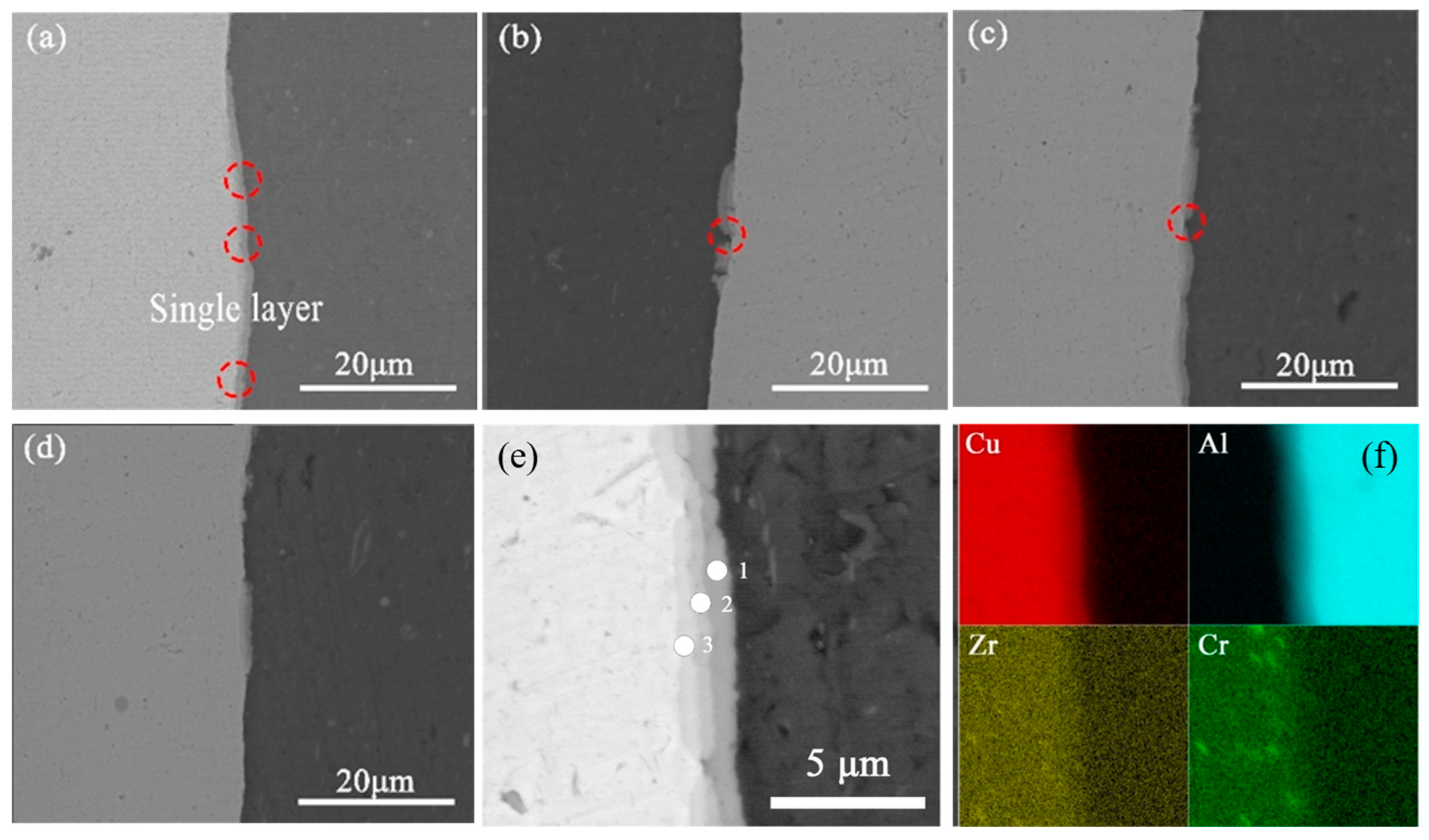
Initial bonding was achieved via high-temperature oxygen-free rolling. The interfacial morphology was strongly dependent on the number of rolling passes. After a single pass, the Cu/Al interface exhibited a pronounced wavy, non-uniform contour (Figure 1a), indicative of deformation incompatibility between the dissimilar metals (red circle).At this stage, IMCs were present but discontinuous along the interface, with varying layers (1–3 layers). This observation supports the notion of non-uniform atomic diffusion occurring in the system. In this regard, the EDS point analysis (Table 2) identified three distinct IMCs of Al2Cu adjacent to the Al layer, AlCu in the middle, and Al4Cu9 adjacent to the Cu layer. The total IMC layer thickness was approximately 2 µm. EDS mapping (Figure 1e,f) revealed sharp elemental boundaries, confirming that bonding was predominantly mechanical with limited diffusion. With an increasing number of rolling passes (2 to 4), the interfacial waviness was progressively reduced, achieving a near-flat interface after four passes (Figure 1b–d). The IMC layer became more uniform, consistently presenting a three-layer structure; however, its continuity along the interface decreased with increasing passes. Crucially, the total IMC thickness remained largely unaffected by the number of passes, with variations of less than 1 µm. This suggests that rolling deformation primarily influences interfacial conformity and defect density, rather than the extent of diffusion-driven growth during the brief high-temperature rolling contact.
The pronounced wavy interface observed after a single rolling pass reflects the inherent deformation incompatibility between Cu18150 and Al1060 layers during HTOR. This situation arises from differential flow stresses leading to interfacial buckling and mechanical interlocking rather than uniform metallurgical bonding [76]. The observed topography, along with the presence of discontinuous IMCs that display a variable three-layer structure (Al2Cu, AlCu, and Al4Cu9), highlights that the initial diffusion process is quite localized. This phenomenon is influenced by short thermal exposure and the atomic mixing that occurs at asperity contacts due to shear forces. This is further supported by the sharp elemental gradients revealed through EDS analysis, which primarily suggest mechanical adhesion with limited solid-state intermixing. The progressive increase in rolling passes, up to four, systematically flattens the interface by improving layer conformity and distributing deformation more homogeneously. However, the continuity of IMC decreases, even though the total thickness remains consistent at around 2 µm. This suggests that the number of passes mainly influences defect density and topography, rather than cumulative diffusion, as the rolling dwell times are still limited by interface reactions [77]. This pass-dependent interfacial evolution aligns with established deformation-diffusion coupling in dissimilar metal cladding. While low passes preserve high surface area for subsequent diffusion but introduce stress concentrators. In contrast, high passes promote flatness at the cost of reduced atomic contact sites, influencing post-rolling annealing responses.

3.1.2. Effect of Post-Rolled Annealing Temperature

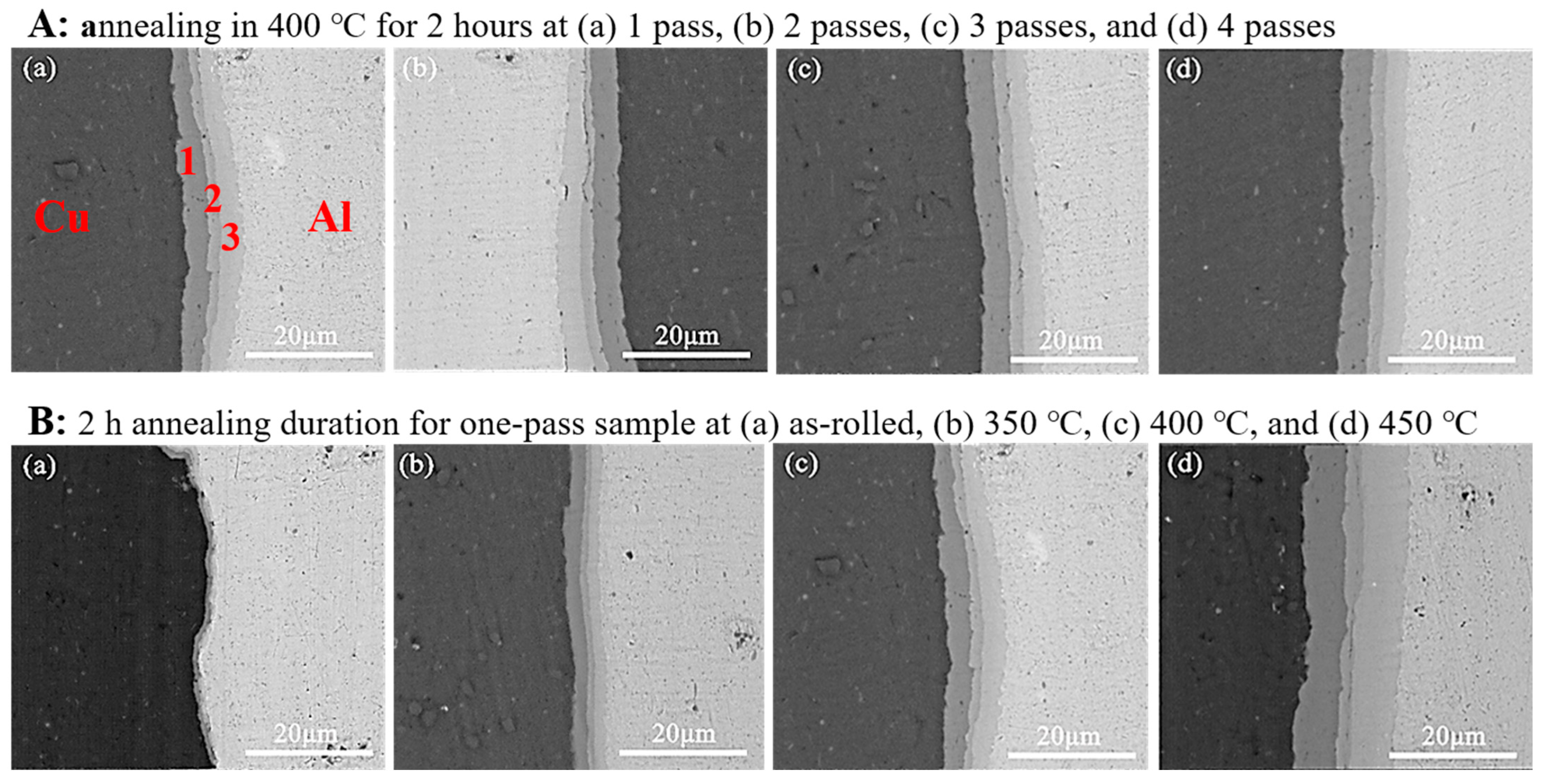
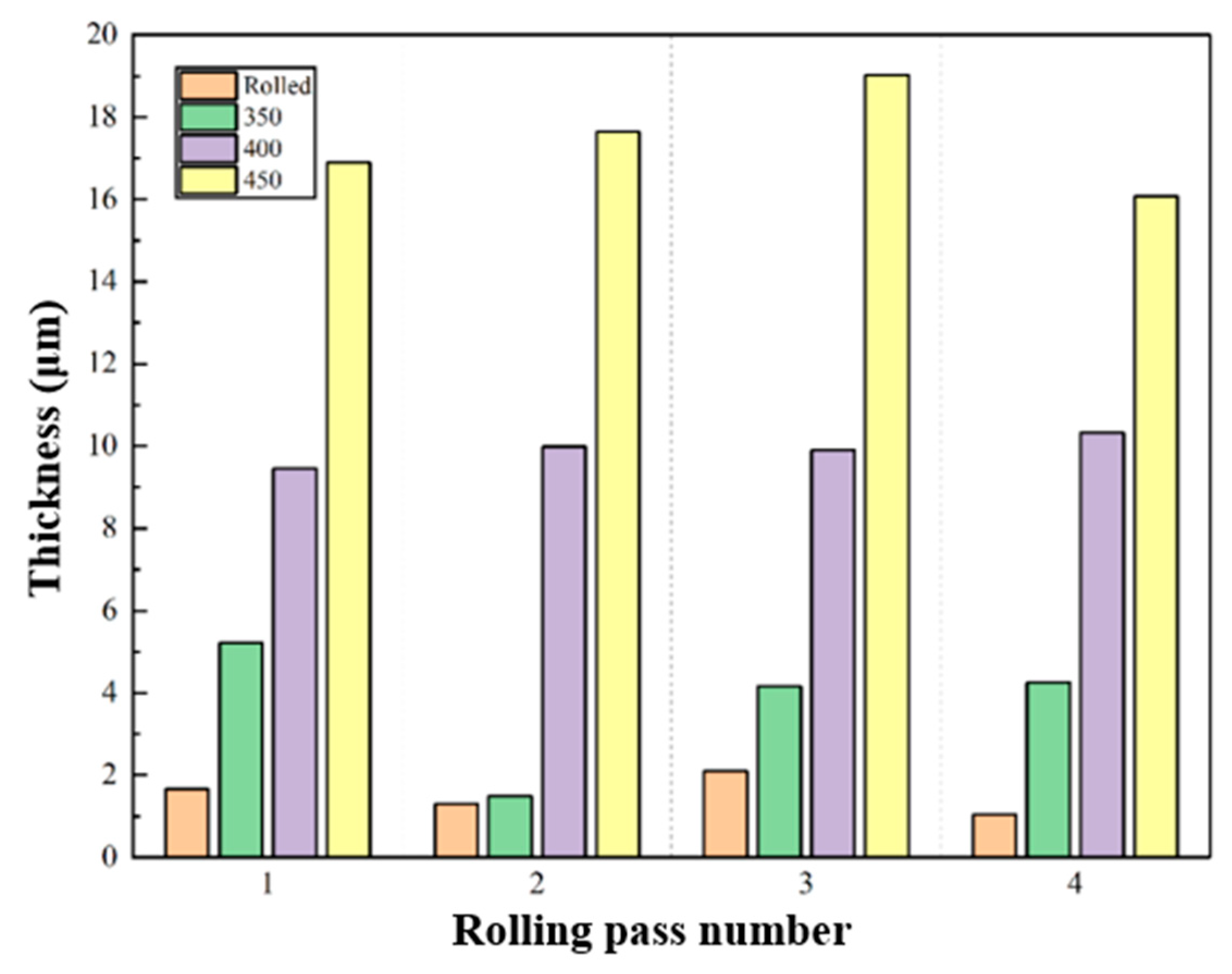
Subsequent annealing profoundly transformed the interfacial microstructure from mechanical to metallurgical bonding. For samples annealed at 400 °C for 2 h (Figure 2A), the IMC layer thickened significantly, became continuous, and displayed a uniform three-layer structure across all rolling passes. The initial waviness from rolling was preserved, but the IMC layers now grew uniformly perpendicular to the interface. A systematic investigation of annealing temperature revealed a strong thermally activated growth behavior. As shown in Figure 2B and Figure 3, IMC thickness increased dramatically with temperature: from ~2 µm (as-rolled) to ~4 µm (350 °C/2 h), ~10 µm (400 °C/2 h), and ~18 µm (450 °C/2 h). Furthermore, the growth kinetics of the individual IMC layers were temperature-dependent. At lower temperatures (≤400 °C), the Al2Cu layer (Al-side) grew at a higher rate. At 450 °C, the growth rate of the Cu-side Al4Cu9 layer surpassed that of Al2Cu, resulting in a thicker Al4Cu9 layer after 2 h.
Figure 2. SEM observation of samples at different pass numbers of 1, 2, 3, and 4 and at temperatures of 350, 400, and 450 °C. Numbers in the Figure (Aa) denotes 1: Al4Cu9, 2: AlCu, 3: Al2Cu layers. Note that images are presented at slightly different magnifications to optimize the visibility of the IMC layer at each temperature. The scale bars and quantified thickness data in Figure 3 provide the definitive comparative metrics.
Metals 16 00176 g002
Figure 3. Thickness of the interfacial compound layer in the as-rolled state and the annealed conditions after holding at different temperatures of 350, 400, and 450 °C for 2 h under different rolling pass numbers of 1, 2, 3, and 4.
Metals 16 00176 g003
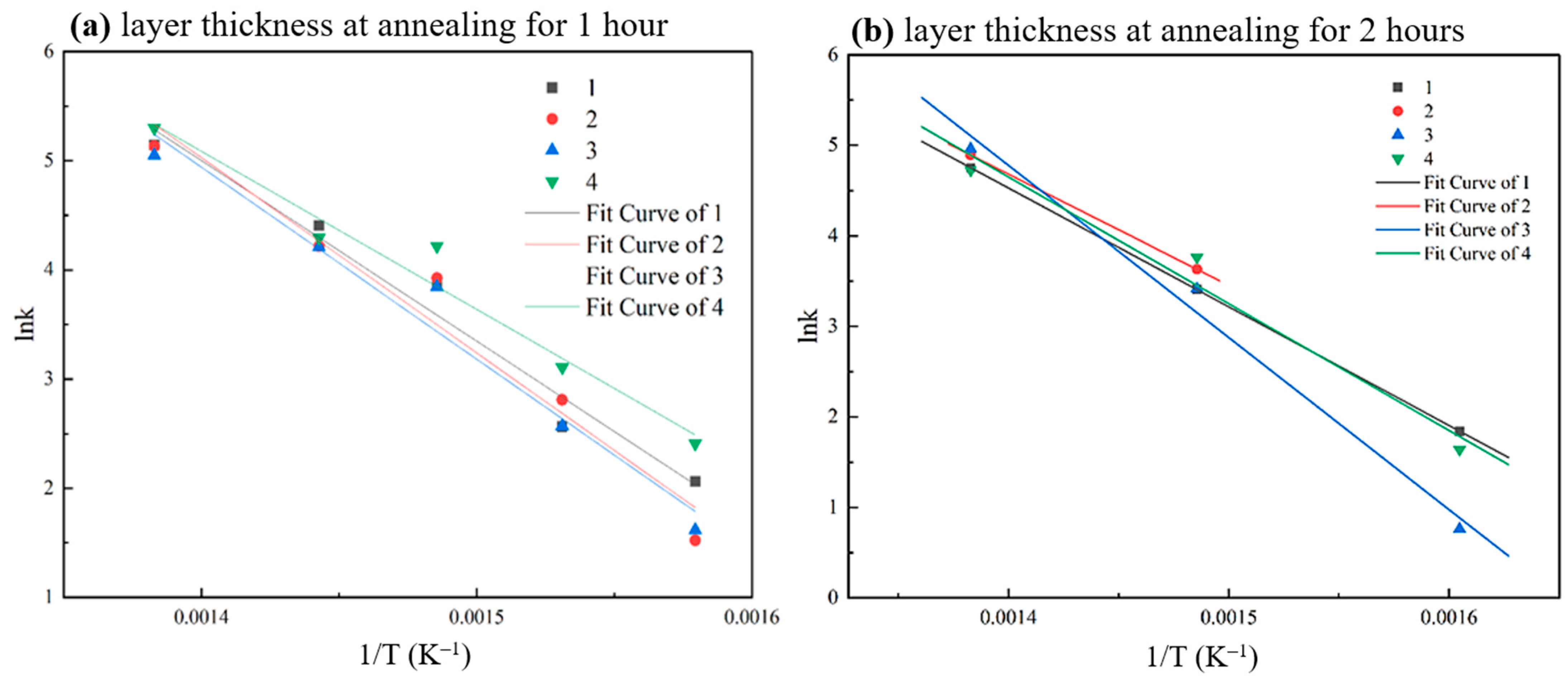
The growth kinetics were quantitatively analyzed using the parabolic growth law, x2 = kt, where the rate constant k follows an Arrhenius relationship, k = k0exp(−Q/RT). A modified equation, (xtx0)2 = kt, accounted for the initial IMC layer thickness (x0) from rolling. Excellent linear fits of lnk versus 1/T were obtained for both 1 h and 2 h annealing series (Figure 4a,b). The calculated apparent activation energy Q was approximately 138.1 kJ/mol for 1 h annealing and 121.5 kJ/mol for 2 h annealing conditions. The higher Q and pre-exponential factor k0 associated with shorter annealing times indicate a transition in the dominant diffusion mechanism. Initially, defect-assisted diffusion, such as pipe diffusion along dislocations and grain boundaries, plays a crucial role in the initial and rapid growth phases. In contrast, bulk lattice diffusion dominates the later steady-state growth phase [78]. It is important to emphasize that the kinetic parameters calculated here (activation energy Q, rate constant k) are specific to the Cu18150/Al1060 system. While the parabolic growth law provides a universal formalism, the values differ from those reported for pure Cu/Al interfaces due to the influence of Cr and Zr alloying elements in Cu18150, which likely alter diffusion pathways and phase stability. Thus, the models and conclusions drawn are directly applicable to this alloyed composite system.
The calculated apparent activation energies of 121.5–138.1 kJ/mol for the Cu18150/Al1060 system can be contextualized within the known kinetics of pure Cu/Al diffusion couples, which typically report values of ~110–125 kJ/mol for IMC growth [78]. Our values, residing at the upper end of this range, suggest a moderate suppression of diffusion kinetics attributable to the presence of Cr and Zr in the Cu18150 alloy. This retardation likely stems from solute drag effects, where alloying elements segregate to grain boundaries or the advancing interface, impeding atomic mobility. Furthermore, the consistent formation of a uniform three-layer IMC structure (Al2Cu/AlCu/Al4Cu9) without anomalous phases indicates that these alloying elements may also contribute to interfacial phase stability. A direct, quantitative isolation of their role, for instance, via precise measurement of elemental partitioning using techniques like atom probe tomography, remains a valuable target for future research but lies beyond the scope of this processing-focused study.
Annealing at 400 °C for 2 h transforms the as-rolled mechanical interface into a continuous, uniform three-layer IMC structure across all pass conditions. This process maintains the waviness that allows for perpendicular growth. Additionally, elevated temperatures ranging from 350 to 450 °C lead to exponential thickening from approximately 2 µm to 18 µm, through thermally activated diffusion. As the temperature rises, the composition of IMCs shifts from Al2Cu at temperatures up to 400 °C to Al4Cu9 at 450 °C, due to growth kinetics that favor copper-side diffusion at higher homologues [30].
Parabolic growth analysis, taking into consideration the initial IMC (x0), reveals Arrhenius-derived activation energies of 138.1 kJ/mol (1 h) and 121.5 kJ/mol (2 h). The observed elevated short-time Q values suggest the presence of defect-pipe diffusion pathways, which are introduced by rolling-induced dislocations. As these defects anneal out, the process transitions to lattice diffusion. This behavior aligns with existing literature on Cu–Al systems, where Q ~120–140 kJ/mol signals grain boundary/pipe mechanisms [78]. The findings highlight temperature as the key factor influencing kinetics. Optimal regimes (≤400 °C, e.g., 420 °C) produce thinner, more uniform IMC layers that enhance bond strength, whereas at 450 °C, the excessive and accelerated growth of the Cu-rich Al4Cu9 layer leads to interface thickening associated with embrittlement in the literature [59,60,61,79].

3.1.3. Effect of Post-Rolled Annealing Duration

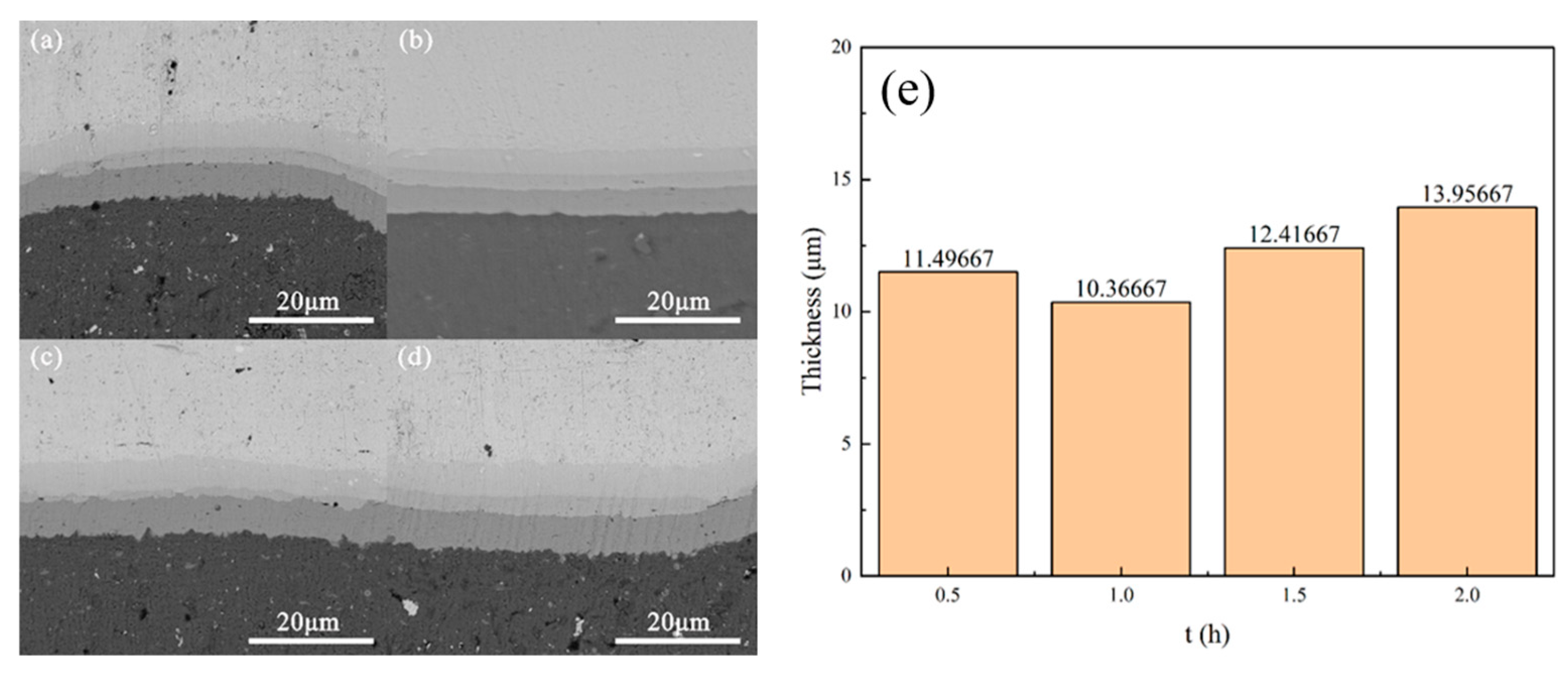
The time-dependent evolution of the IMC layer at 400 °C exhibited a non-monotonic trend (Figure 5a–e). After 0.5 h, the layer reached ~11.5 µm. Unexpectedly, the thickness decreased to ~10.4 µm after 1 h before increasing again to ~14.0 µm after 2 h. This transient thinning is attributed to an interfacial densification process. The initial rapid growth, driven by defect-assisted diffusion, likely produces a porous or structurally deficient IMC layer. With extended annealing, atomic rearrangement and healing of microvoids lead to a denser, more stable interface, resulting in a slight reduction in the measured thickness. This densification reflects microstructural stabilization, where excess vacancies and dislocations inherited from rolling initially promote rapid growth. During extended holds, these structures settle into more stable and equilibrium configurations, which helps to avoid the Kirkendall voiding often seen in prolonged Cu–Al diffusion couples [33]. Subsequent growth follows the classical parabolic law, as confirmed by the linear fit of x2 versus t for data from 1 to 2 h. This behavior underscores the importance of annealing time in striking a balance between diffusion completeness and phase stability, with the 1 h condition achieving an optimal, densified microstructure that minimizes defects without promoting excessive growth of brittle phases.

3.2. Evolution of Mechanical Properties

3.2.1. Effect of Rolling Pass Number

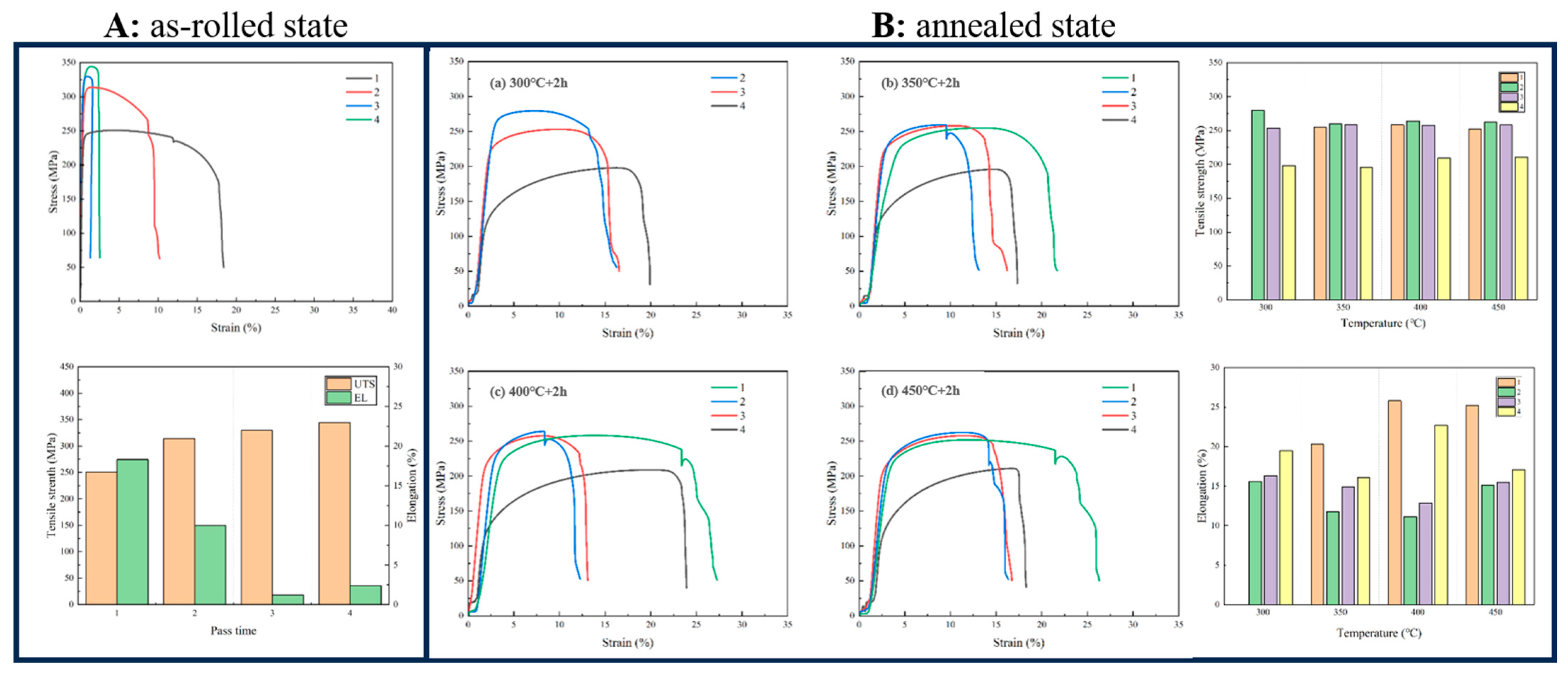
In the as-rolled state, the material exhibited classic work-hardening behavior (Figure 6A). The ultimate tensile strength (UTS) increased from 250 MPa (1 pass) to 344 MPa (4 passes). Conversely, elongation (EL) drastically decreased from 18.3% to 1.2%. The stress–strain curves for low-pass samples showed serrations, indicating interfacial delamination and poor bond strength. High-pass samples displayed smooth curves, suggesting improved interfacial integrity and cooperative deformation. Annealing altered this relationship (Figure 6B). For single-pass material, annealing maintained UTS near 250 MPa while dramatically improving EL to over 20% (peaking at 25.8% at 400 °C/2 h), as work hardening was relieved and metallurgical bonding was achieved. For multi-pass materials, annealing significantly reduced UTS (e.g., from 344 MPa to ~200 MPa for 4 passes) due to the elimination of work hardening, but improved EL compared to the brittle as-rolled state. The optimal combination of strength and ductility after annealing was consistently found in the single-pass material, benefiting from its lower initial dislocation density and sufficient interfacial development upon annealing.
The tensile response of as-rolled materials highlights the significant role of work-hardening, as evidenced by the increase in ultimate tensile strength from 250 MPa after one pass to 344 MPa after four passes. This improvement is attributed to the rising dislocation densities. However, there is a catastrophic reduction in ductility, which drops from 18.3% to 1.2%. This loss is linked to strain localization and delamination observed in the low-pass serrated curves, which then shift to a smoother cooperative deformation in the higher passes due to improved conformity. After the annealing process, single-pass materials retain UTS (~250 MPa) while recovering EL > 20% through recovery and metallurgical bonding. In contrast, materials that undergo multiple passes experience a significant decrease in tensile strength, dropping to around 200 MPa due to recrystallization, which negates hardening effects, though EL improves modestly. This observation highlights the advantages of low passes for achieving a favorable balance of properties, utilizing minimal initial hardening to maximize interfacial benefits [76]. The observed trends highlight the role of rolling passes as topography tuners, where low-pass wavy interfaces enable superior annealing-induced strengthening without excessive softening. This aligns with research on deformation preconditioning aimed at achieving the optimal strength-ductility synergy in clad systems.

3.2.2. Effect of Post-Rolled Annealing Temperature

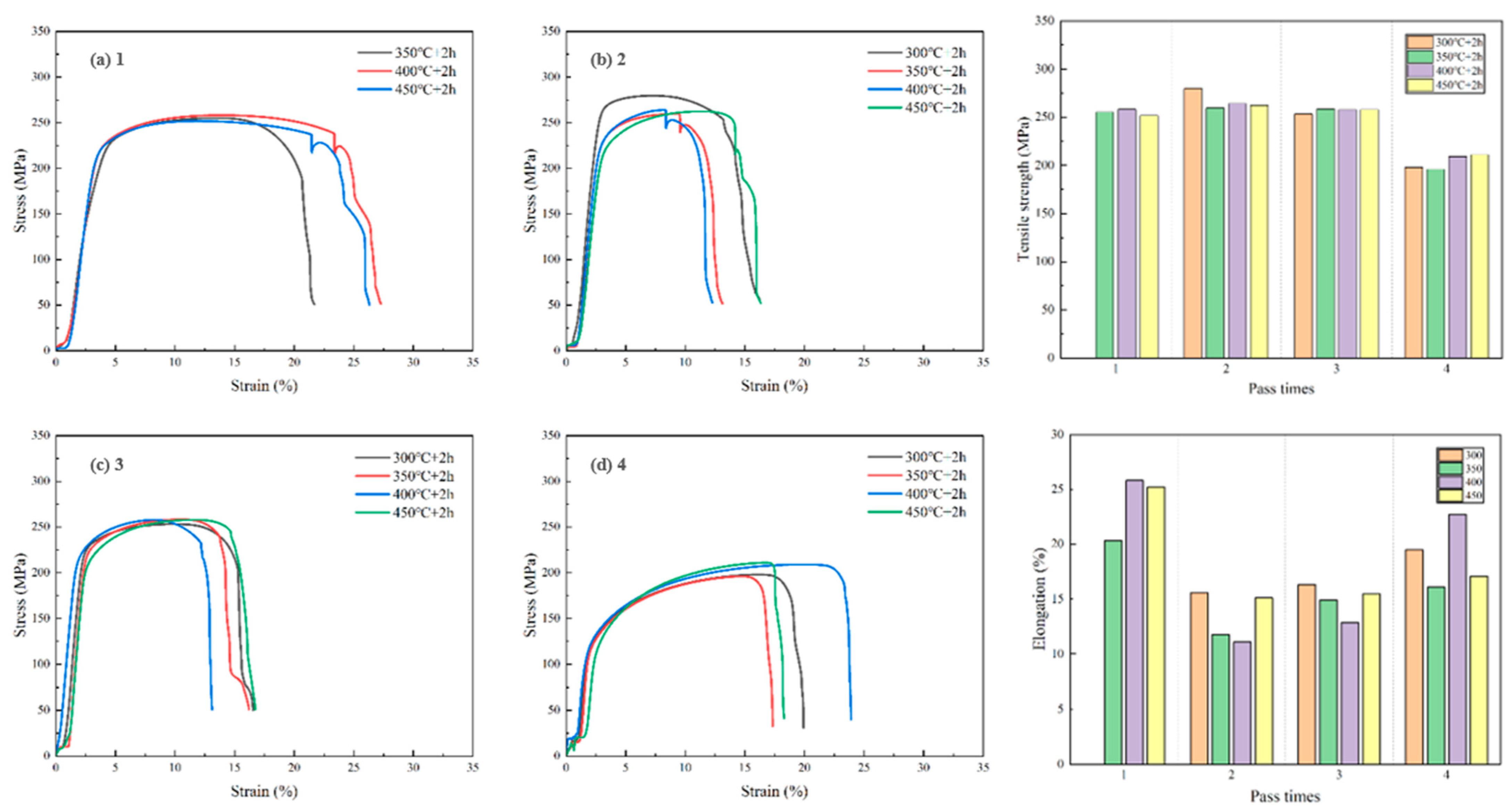
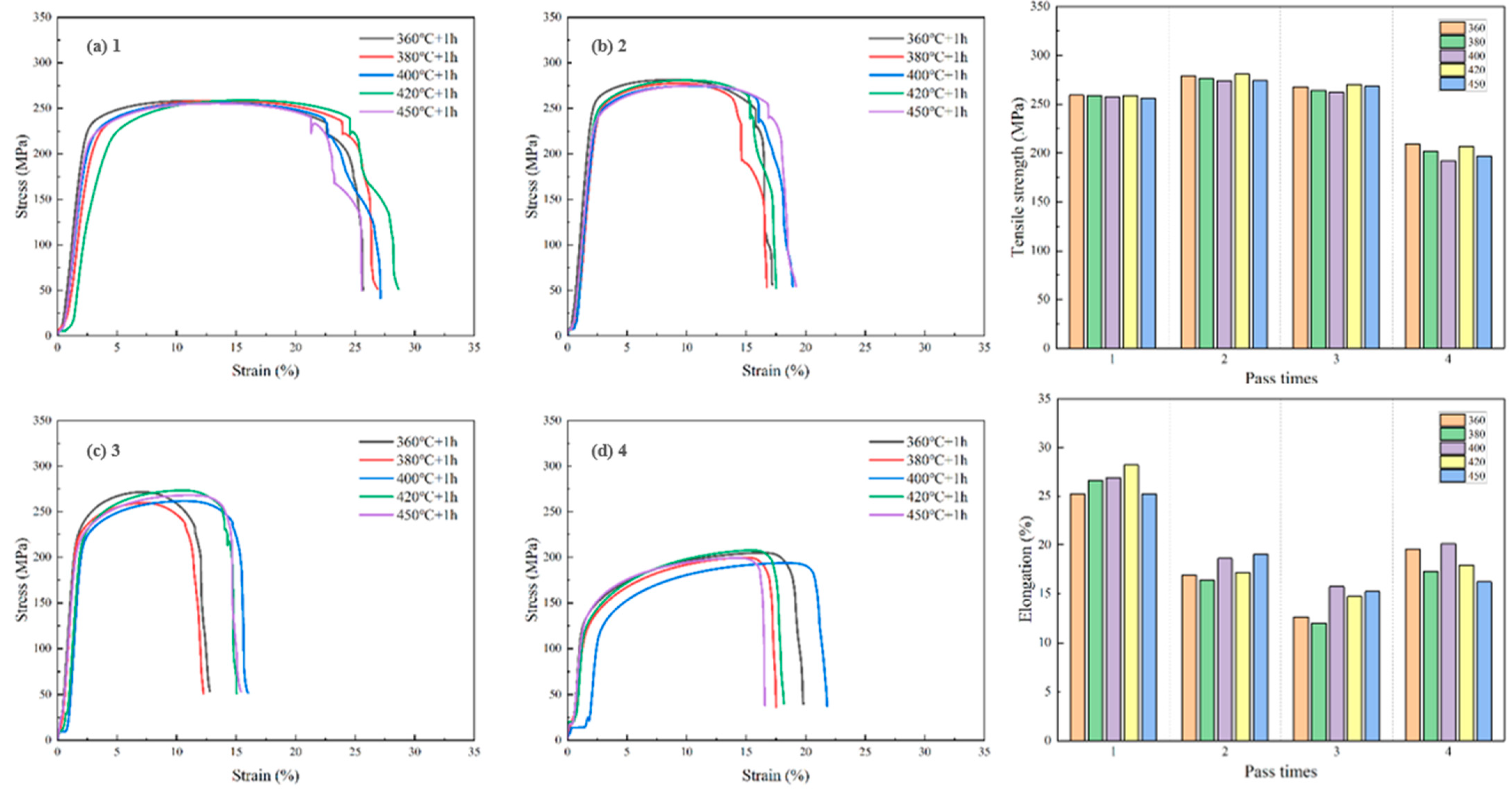
The influence of annealing temperature on UTS followed a parabolic trend. For 2 h anneals, UTS peaked at 400 °C (~258 MPa for 1 pass) and dropped at 450 °C due to excessive growth of brittle IMCs (Figure 7). For 1 h anneals with finer temperature intervals, the peak shifted to 420 °C, reaching 258.9 MPa for single-pass material (Figure 8). Ductility response was complex and pass-dependent. Single-pass material showed peak ductility at 400–420 °C. Multi-pass materials, due to the competition between recrystallization (improving ductility) and brittle IMC growth (reducing it), exhibited more variable EL trends. Critically, low-pass materials annealed at high temperatures (450 °C) reverted to delamination failure, as evidenced by serrated stress–strain curves, due to stress concentration at the wavy interface and crack initiation in the thick, brittle AlCu layer.
UTS exhibits a parabolic relationship with temperature, reaching its highest point at approximately 258 MPa when subjected to annealing in 400–420 °C for 1–2 h. Beyond 450 °C, a decline occurs due to the formation of brittle intermetallic compounds, which leads to delamination, as indicated by serrations in the low-pass curves. In contrast, elongation is optimized in a single pass at 400–420 °C, where a balance between recovery and bonding is achieved. The variability observed in multi-pass processes reflects the competition between recrystallization and embrittlement. Low-pass superiority persists, as they can tolerate moderate intermetallic compounds while also increasing the risk of cracking at high temperatures. In contrast, flat high-pass interfaces manage to distribute stress effectively but are prone to softening of the base metal. This delineates annealing temperature as the arbiter of performance trade-offs, where 400–420 °C windows maximize load transfer through thin IMCs, corroborated by fracture mechanics models positing optimal IMC thickness ~5–10 µm for peak toughness in Cu–Al laminates [30].

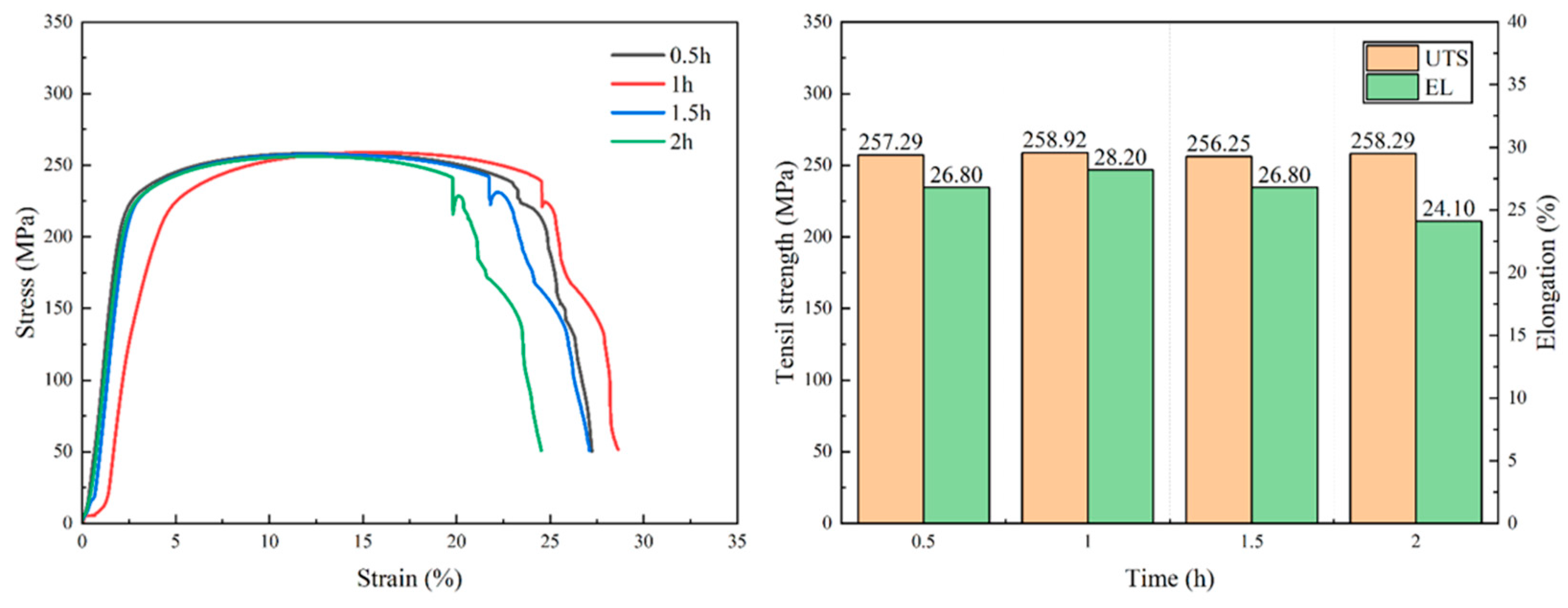
3.2.3. Effect of Post-Rolled Annealing Duration

At the optimal 420 °C, the effect of annealing time on single-pass material was investigated (Figure 9). UTS increased from 257.3 MPa (0.5 h) to a peak of 258.9 MPa (1 h), slightly decreased at 1.5 h (256.3 MPa), and recovered at 2 h. EL peaked at 28.2% after 1 h and then declined. This non-monotonic behavior correlates directly with the microstructural evolution. The 1 h condition corresponds to the densified, optimally thick (~10.4 µm), and uniform IMC layer, providing strong bonding without excessive embrittlement. Shorter times yield incomplete bonding, whereas longer periods promote the development of the embrittling AlCu phase. At 420 °C, the single-pass UTS reaches a maximum of 258.9 MPa, while elongation is recorded at 28.2% after 1 h. This outcome is associated with a densified intermetallic compound measuring approximately 10.4 µm. In contrast, a shorter duration of 0.5 h results in incomplete bonding, and extending the time beyond 1.5 h leads to embrittlement due to AlCu. The observed non-monotonic behavior reflects the microstructural densification process, where the 1 h achieves an equilibrium state without the occurrence of excess diffusion. This condition results in an optimal strength-ductility product, fulfilling the specified targets (≥220 MPa and ≥20% EL). Time optimization thus refines the process envelope, emphasizing the importance of short holds for defect healing without overgrowth. This approach aligns with diffusion couple experiments that support time-temperature-transformation frameworks for IMC control [33].

3.2.4. Fractography

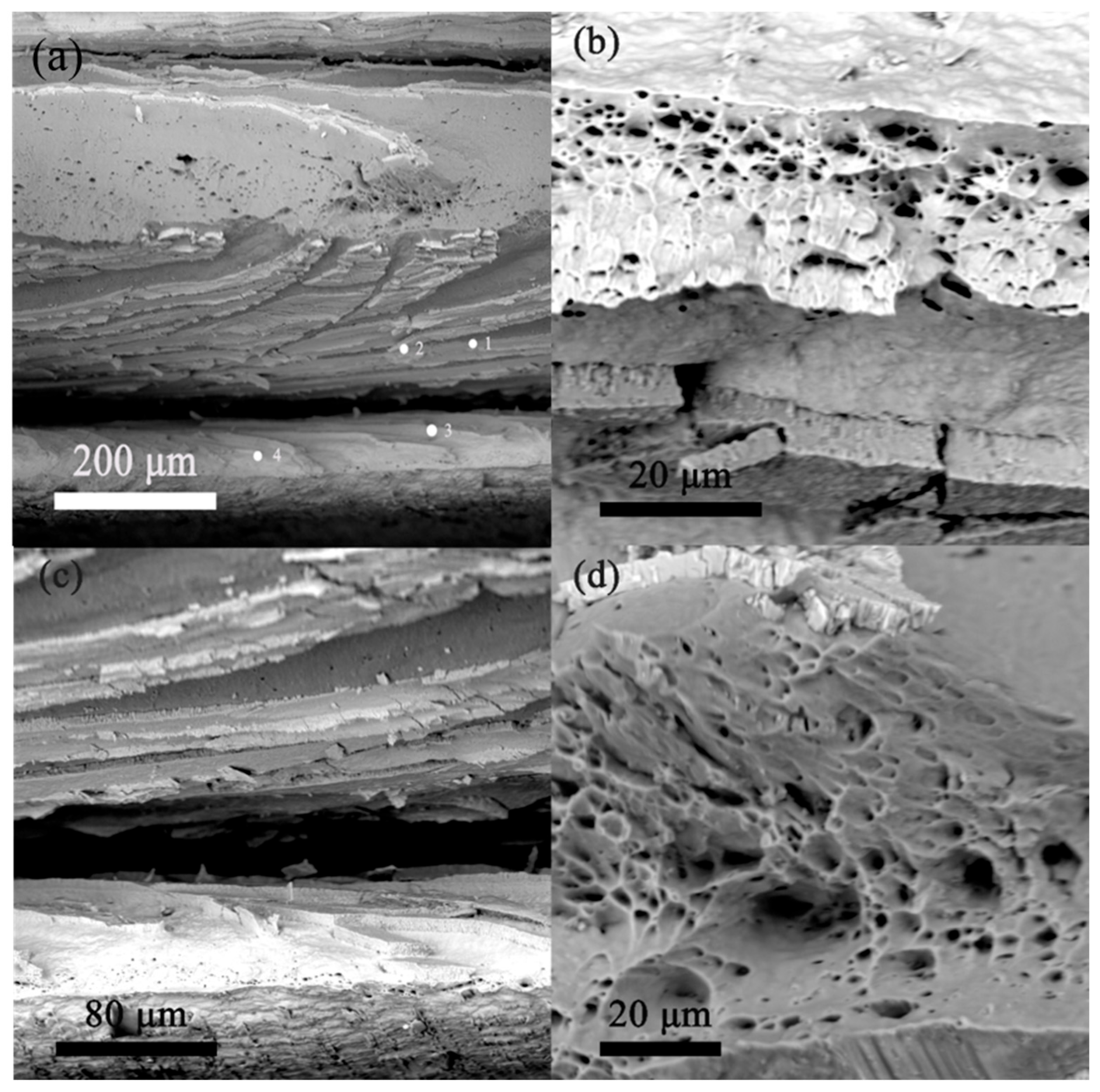
Fractographic examination of the fracture surfaces established a clear relationship between the interface microstructure and the dominant failure modes, as illustrated in Figure 10 and Figure 11, and summarized in Table 3. In high passes, optimally annealed samples (4 passes at 400 °C for 1 h), failure proceeded cooperatively without macroscopic delamination. The Cu layer exhibited a dimpled rupture, which is a sign of microvoid coalescence and indicates a ductile fracture. In contrast, the Al layer presented a mixed-mode fracture, primarily characterized by cleavage-like facets mixed with dimples, suggesting a predominantly brittle behavior. The IMC layer, in turn, showed brittle intergranular fracture. Energy-dispersive spectroscopy (EDS) analysis further revealed that cracks predominantly initiated and propagated through the AlCu phase.
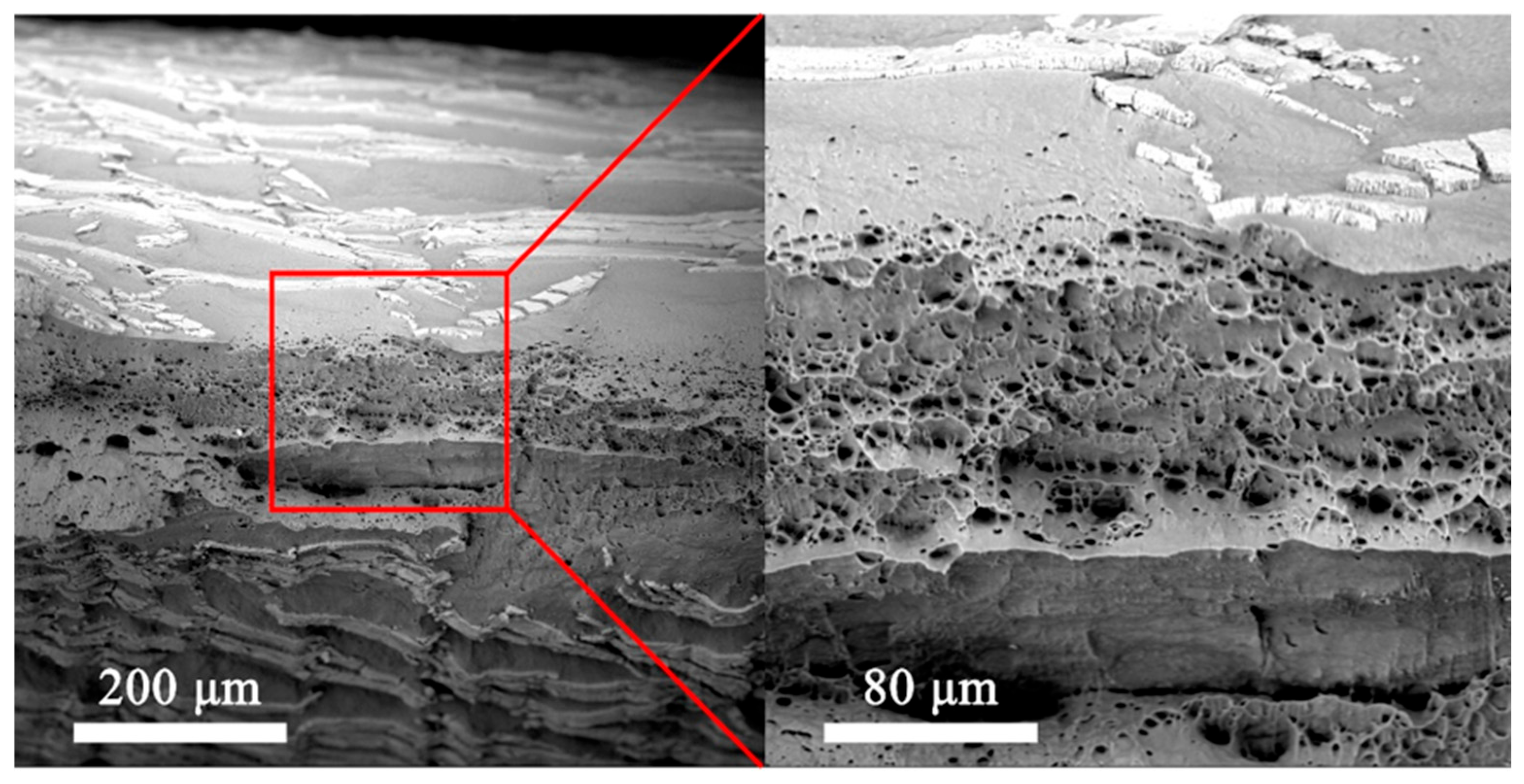
In contrast, low-pass, optimally annealed samples (1 pass at 400 °C for 1 h) failed primarily via interfacial delamination, with both Cu and Al layers displaying fully dimpled fracture surfaces that underscored their intrinsic ductility (Figure 11). The failure path followed the IMC layer, specifically through the AlCu phase, as confirmed by the EDS point analysis presented in Table 3 (corresponding to the locations marked in Figure 11). This delamination is mechanistically linked to the wavy interfacial topography. The undulations act as inherent geometric stress concentrators, elevating local triaxial stresses (particularly at the troughs and peaks) within the brittle AlCu phase that constitutes the fracture path. This localized stress amplification prematurely initiates cracks under tensile loading, favoring interface-dominated failure over cooperative deformation of the metallic layers. A future quantitative correlation between initial interface roughness parameters (e.g., Ra, wavelength) and the resultant fracture mode, supported by micromechanical stress modeling, would provide a definitive link between the process-induced topography and the mechanical outcome observed here. These observations highlight that a robust metallurgical bond suppresses macroscopic delamination, yet the fracture locus and overall plasticity remain governed by the intrinsic properties of the IMC layer. Notably, the AlCu phase serves as the preferred site for crack initiation, with wavy interfaces in low-pass materials exacerbating stress concentrations and thereby accelerating cracking within this brittle phase.
High-pass optimal annealing (4 passes, 400 °C/1 h) yields cooperative fracture delamination, with ductile Cu dimples (microvoid coalescence), mixed Al cleavage/dimples, and brittle IMC intergranular paths through AlCu. Whereas, low-pass (1 pass) promotes delamination along AlCu despite ductile layers, exacerbated by wavy stress risers. Robust bonding suppresses gross separation, but AlCu brittleness dictates locus, with geometry modulating propagation. These modes affirm interface-controlled failure, where topography governs initiation and IMC properties limit ductility. This is consistent with existing research on stress concentration in wavy clads that accelerates brittle phase cracking, suggesting that having a minimal sufficient IMCs can improve toughness [78].

4. Conclusions

This investigation systematically delineates the coupled thermomechanical pathways governing interfacial evolution and mechanical optimization in Cu18150/Al1060/Cu18150 trilayer composites fabricated via high-temperature oxygen-free rolling followed by tailored annealing. Rolling passes emerge as the primary architects of interfacial topography; low passes (1 pass sample) result in wavy, defect-rich interfaces that promote increased post-annealing diffusion because of the higher surface area. In contrast, high passes (4-pass sample) create flatter surfaces at the expense of IMC continuity but have little effect on the thickness of the as-rolled IMC (~2 µm). This highlights the significant role of deformation in shaping defect landscapes rather than influencing diffusion during transient rolling contacts. It is important to note that the identified optimal IMC thickness of approximately 5–10 µm is specific to the Cu18150/Al1060 material pair and trilayer architecture studied. This value is a consequence of the intrinsic brittleness of the Al–Cu intermetallics and the mechanical properties of the parent alloys. For industrial transfer, the key principle is to employ process control to achieve a continuous, uniform, and thin IMC layer that ensures strong metallurgical bonding while preventing the excessive growth of the most brittle phases (e.g., Al4Cu9), the critical thickness for which will vary with the specific composite system.
Annealing plays a crucial role in transforming the bonding process from mechanical to metallurgical. The temperature range of 300–450 °C significantly influences the IMC growth, which can thicken exponentially from 2 to 18 µm, following parabolic kinetics with an activation energy of approximately 121–138 kJ/mol. This process illustrates a shift in mechanisms, starting with dislocation-pipe diffusion at shorter times and transitioning to lattice-controlled diffusion. Additionally, the time factor, particularly at 420 °C over 0.5 to 2 h, leads to a non-linear densification pattern, where the thickness varies from 11.5 to 10.4 and then to 14.0 µm, primarily due to the annihilation of defects.
The mechanical performance highlights important microstructural factors: the as-rolled state enhances UTS from 250 to 344 MPa but significantly reduces ductility, dropping from 18.3% to 1.2%. In contrast, annealing improves elongation, achieving values greater than 20–28% through recovery and bonding processes. The optimal condition occurs at a single-pass treatment of 420 °C for 1 h, resulting in a UTS of 258.9 MPa and an elongation of 28.2%. This condition leads to the fabrication of a uniform trilayer IMC of approximately 10.4 µm (Al2Cu/AlCu/Al4Cu9), which effectively balances strength and ductility without leading to brittle overgrowth.
Fractographic revelations cement the AlCu phase as the Achilles’ heel, dictating where cracks begin in ductile layers. The presence of low-pass waviness increases the likelihood of delamination due to stress concentrations, while high-pass flatness facilitates cooperative fracture. This affirms the role of interface-controlled failure, where topography modulates propagation and IMC brittleness sets limits of ductility. Fractographic analysis established that failure is governed by the brittle AlCu phase. The wavy interfaces resulting from low-pass rolling promote delamination by locally amplifying stress within this phase, whereas flatter interfaces from high-pass rolling facilitate more cooperative, trans-layer fracture. Furthermore, while this study establishes the Cu18150/Al1060 system as a viable high-performance composite, the kinetic analysis suggests the Cr and Zr alloying elements measurably influence interfacial evolution compared to pure copper, likely through solute-mediated diffusion suppression. This underscores the importance of tailored processing when employing advanced copper alloys in dissimilar metal bonding.
From an industrial perspective, the identified optimal route comprising a single rolling pass followed by annealing at 420 °C for 1 h presents favorable scalability. The simplified single-pass deformation minimizes handling and cumulative defect formation, while the annealing parameters are compatible with standard batch furnace operations. The primary consideration for scale-up is the integration of the HTOR atmosphere control into a continuous or high-throughput batch process, a challenge that is well-defined and surmountable within existing clad metal manufacturing frameworks. The optimized interface, characterized by a thin, continuous, and uniform IMC layer, is expected to provide a robust foundation for fatigue resistance by minimizing stress concentrations within the brittle intermetallic zone. However, its long-term performance under thermomechanical fatigue or prolonged thermal aging requires dedicated investigation. Future work should focus on evaluating the interfacial stability, IMC growth kinetics, and crack propagation resistance under controlled cyclic loading and thermal cycling conditions to fully qualify the composite for demanding service environments. It should be noted that this study provides a foundation for future work to directly quantify the mechanical advantages of this symmetric trilayer architecture over a bilayer counterpart processed under similar conditions.
Overall, the findings establish a continuum that connects process, structure, and property, highlighting that the optimal conditions for exceeding benchmarks (≥220 MPa UTS and ≥20% EL) involve 1-pass HTOR followed by annealing at 420 °C for 1 h. Additionally, they shed light on the specific characteristics of the alloy Cu18150, particularly the influence of Cr-Zr on diffusion stability.

Author Contributions

Conceptualization, M.E. and Y.Z.; Formal analysis, Y.Z. and L.W.; Funding acquisition, Q.W.; Investigation, M.E. and S.A.; Methodology, S.A.; Project administration, Q.W.; Resources, Q.W.; Supervision, Q.W.; Validation, M.E.; Writing—original draft, M.E., Y.Z., L.W. and S.A.; Writing—review and editing, M.E., Y.Z., S.A. and Q.W. All authors have read and agreed to the published version of the manuscript.

Funding

This work was financially supported by the National Key Research and Development Program of China (Grant Nos. 2021YFB3701303 and 2024YFB3714303), the National Natural Science Foundation of China (No. U1902220), and the SJTU-Warwick Joint Seed Fund (Nos. SJTU2210 and SJTU2024).

Data Availability Statement

The original contributions presented in this study are included in the article. Further inquiries can be directed to the corresponding author.

Conflicts of Interest

The authors declare no conflicts of interest.

References

  1. Gao, H.; Li, J.; Lei, G.; Song, L.; Kong, C.; Yu, H. High Strength and Thermal Stability of Multilayered Cu/Al Composites Fabricated Through Accumulative Roll Bonding and Cryorolling. Metall. Mater. Trans. A 2022, 53, 1176–1187. [Google Scholar] [CrossRef]
  2. Han, J.; Li, S.; Gao, X.; Huang, Z.; Wang, T.; Huang, Q. Effect of Annealing Process on Interface Microstructure and Mechanical Property of the Cu/Al Corrugated Clad Sheet. J. Mater. Res. Technol. 2023, 23, 284–299. [Google Scholar] [CrossRef]
  3. Long, X.; Lu, C.; Su, Y.; Dai, Y. Machine Learning Framework for Predicting the Low Cycle Fatigue Life of Lead-Free Solders. Eng. Fail. Anal. 2023, 148, 107228. [Google Scholar] [CrossRef]
  4. Fu, Y.; Yousefi Mehr, V.; Toroghinejad, M.R.; Chen, X.; Jie, J.; Zhu, S. Twinning and Stacking Fault-Induced Precipitation in an Aluminum Alloy. J. Mater. Res. Technol. 2025, 34, 2127–2132. [Google Scholar] [CrossRef]
  5. Zheng, K.; Min, Z.; Zhang, F.; Ren, Z.; Lin, Y. High Heat-Fade Resistance, Metal-Free Resin-Based Brake Pads: A Step towards Replacing Copper by Using Andalusite. Chin. J. Mech. Eng. 2025, 38, 153. [Google Scholar] [CrossRef]
  6. Zhang, W.; Huang, L.; Mi, X.; Xie, H.; Feng, X.; Ahn, J.H. Researches for Higher Electrical Conductivity Copper-based Materials. cMat 2024, 1, e13. [Google Scholar] [CrossRef]
  7. Watari, T.; Nansai, K.; Nakajima, K. Major Metals Demand, Supply, and Environmental Impacts to 2100: A Critical Review. Resour. Conserv. Recycl. 2021, 164, 105107. [Google Scholar] [CrossRef]
  8. Valero, A.; Valero, A.; Calvo, G.; Ortego, A. Material Bottlenecks in the Future Development of Green Technologies. Renew. Sustain. Energy Rev. 2018, 93, 178–200. [Google Scholar] [CrossRef]
  9. Czerwinski, F. Aluminum Alloys for Electrical Engineering: A Review. J. Mater. Sci. 2024, 59, 14847–14892. [Google Scholar] [CrossRef]
  10. Zhang, Y.; Fang, Y.; Chen, Q.; Zhang, S.; Weng, M.; Wei, H.; Yang, G.; Huang, G.; Cui, C. Fabrication of Metastable Nanoscale Ag–Cu Supersaturated Solid Solutions and Their Low-Temperature Low-Pressure Interconnect Applications. J. Mater. Sci. Technol. 2026, 246, 76–85. [Google Scholar] [CrossRef]
  11. Chang, Q.; Gao, P.; Zhang, J.; Huo, Y.; Zhang, Z.; Xie, J. Numerical Simulation of Copper-Aluminum Composite Plate Casting and Rolling Process and Composite Mechanism. Materials 2022, 15, 8139. [Google Scholar] [CrossRef]
  12. Ahmadzadeh Salout, S.; Mirbagheri, S.M.H. Microstructural and Mechanical Characterization of Al/Cu Interface in a Bimetallic Composite Produced by Compound Casting. Sci. Rep. 2024, 14, 7529. [Google Scholar] [CrossRef]
  13. Saberi, Y.; Oveisi, H. Development of Novel Cellular Copper–Aluminum Composite Materials: The Advantage of Powder Metallurgy and Mechanical Milling Approach for Lighter Heat Exchanger. Mater. Chem. Phys. 2022, 279, 125742. [Google Scholar] [CrossRef]
  14. Cai, H.; Wang, Q.; Zhang, N.; Ebrahimi, M.; Zhao, Y. Shear Behavior of Cu/Al/Cu Trilayered Composites Prepared by High-Temperature Oxygen-Free Rolling. J. Alloys Compd. 2024, 1004, 175857. [Google Scholar] [CrossRef]
  15. Zhida, J.; Yangyang, X.U.; Jiaxin, Y.U.; Wencai, L.I.U.; Haowen, Z.H.U. Mechanical and Conductive Properties of Cu/1060Al/Cu Three- Layer Composite Prepared by High-Temperature Oxygen-Free Rolling. Acta Met. Sin. 2025, 1. Available online: https://www.ams.org.cn/CN/abstract/abstract36394.shtml (accessed on 25 January 2026).
  16. Jiang, Z.; Zhu, H.; Sun, J.; Huang, Y.; Wu, G.; Shang, Z.; Liu, W. Microstructure and Mechanical Properties of High-Temperature Free-Oxygen Rolled Cu/1060Al Bimetallic Composite Materials. J. Mater. Res. Technol. 2024, 29, 1262–1277. [Google Scholar] [CrossRef]
  17. Zheng, K.; Le, Q.; Pan, L.; Huang, J. Friction and Wear Prediction of Copper-Free Resin-Based Brake Materials: A Hybrid PSO-FPA-BP Neural Network Approach. Wear 2026, 589, 206536. [Google Scholar] [CrossRef]
  18. Zhuo, X.; Shao, C.; Zhang, P.; Hu, Z.; Liu, H. Effect of Hot Rolling on the Microstructure and Mechanical Performance of a Mg-5Sn Alloy. Materials 2022, 15, 5973. [Google Scholar] [CrossRef]
  19. Wilde, G.; Divinski, S. Grain Boundaries and Diffusion Phenomena in Severely Deformed Materials. Mater. Trans. 2019, 60, 1302–1315. [Google Scholar] [CrossRef]
  20. Beke, D.L.; Kaganovskii, Y.; Katona, G.L. Interdiffusion along Grain Boundaries—Diffusion Induced Grain Boundary Migration, Low Temperature Homogenization and Reactions in Nanostructured Thin Films. Prog. Mater. Sci. 2018, 98, 625–674. [Google Scholar] [CrossRef]
  21. Kelly, M.B.; Niverty, S.; Chawla, N. Four Dimensional (4D) Microstructural Evolution of Cu6Sn5 Intermetallic and Voids under Electromigration in Bi-Crystal Pure Sn Solder Joints. Acta Mater. 2020, 189, 118–128. [Google Scholar] [CrossRef]
  22. Zhao, Y.; Ebrahimi, M.; Attarilar, S.; Lu, Q.; Jiang, H.; Wang, Q. Layer Thickness Effects on Residual Stress, Microstructure, and Tensile Properties of Cu18150/Al1060/Cu18150 Multilayered Composites: An Integrated EBSD-KAM Approach. Materials 2025, 18, 4673. [Google Scholar] [CrossRef]
  23. Cai, H.; Yang, S.; Wang, Q.; Zhao, Y.; Jia, Q.; Ebrahimi, M.; Liu, L.; Guo, F.; Shang, Z. Interfacial Shear Fracture Behavior of C18150Cu/1060Al/C18150Cu Trilayered Composite at Different Temperatures. Materials 2025, 18, 559. [Google Scholar] [CrossRef]
  24. Jiang, X.-P.; Yu, W.; Wei, Y.; Wu, H.-J.; Ding, J.-P.; Hu, C.-Y.; Liu, X.-J.; Feng, J.; Chong, X.-Y. Tailoring Precipitation-Strengthening in Ir-Based Ternary Alloys: A First-Principles Approach to L12 Phase Engineering. Rare Met. 2025, 44, 9036–9052. [Google Scholar] [CrossRef]
  25. Xuan, Y.; Li, J.; Gao, H.; Yu, H. Tensile Properties of Cryorolled Cu/Al Clad Sheet with an SUS304 Interlayer after Annealing at Various Temperatures. Materials 2024, 17, 4065. [Google Scholar] [CrossRef] [PubMed]
  26. Kim, D.; Kim, K.; Kwon, H. Interdiffusion and Intermetallic Compounds at Al/Cu Interfaces in Al-50vol.%Cu Composite Prepared by Solid-State Sintering. Materials 2021, 14, 4307. [Google Scholar] [CrossRef]
  27. Kim, D.-G.; Jung, S.-B. Interfacial Reactions and Growth Kinetics for Intermetallic Compound Layer between In–48Sn Solder and Bare Cu Substrate. J. Alloys Compd. 2005, 386, 151–156. [Google Scholar] [CrossRef]
  28. Zhao, N.; Zhong, Y.; Huang, M.L.; Ma, H.T.; Dong, W. Growth Kinetics of Cu6Sn5 Intermetallic Compound at Liquid-Solid Interfaces in Cu/Sn/Cu Interconnects under Temperature Gradient. Sci. Rep. 2015, 5, 13491. [Google Scholar] [CrossRef]
  29. Yuan, Z.; Lu, Y.; Tu, Y.; Yuan, T.; Wang, X.; Ni, Z.; Wei, L.; Ali Raza, S.R. An Insight into the Interfacial Structure and Mechanical Properties of Al/Cu Laminated Sheets through Post-Treatment. Vacuum 2025, 240, 114542. [Google Scholar] [CrossRef]
  30. Fu, X.; Wang, R.; Zhu, Q.; Wang, P.; Zuo, Y. Effect of Annealing on the Interface and Mechanical Properties of Cu-Al-Cu Laminated Composite Prepared with Cold Rolling. Materials 2020, 13, 369. [Google Scholar] [CrossRef] [PubMed]
  31. Mao, Z.; Xie, J.; Wang, A.; Wang, W.; Ma, D.; Liu, P. Effects of Annealing Temperature on the Interfacial Microstructure and Bonding Strength of Cu/Al Clad Sheets Produced by Twin-Roll Casting and Rolling. J. Mater. Process. Technol. 2020, 285, 116804. [Google Scholar] [CrossRef]
  32. Gao, H.; Gu, H.; Wang, S.; Xuan, Y.; Yu, H. Effect of Annealing Temperature on the Interfacial Microstructure and Bonding Strength of Cu/Al Clad Sheets with a Stainless Steel Interlayer. Materials 2022, 15, 2119. [Google Scholar] [CrossRef]
  33. Li, X.; Zhang, H.; Wang, J.; Yu, G.; Jiang, Z. Effect of Annealing Holding Time on Microstructure, Interface Diffusion Behavior, and Deformation Behavior of Cu/Al Composite Foil After Secondary Micro-Rolling. Materials 2025, 18, 5418. [Google Scholar] [CrossRef] [PubMed]
  34. Sedighi, M.; Joudaki, J.; Kheder, H. Residual Stresses Due to Roll Bending of Bi-Layer Al-Cu Sheet: Experimental and Analytical Investigations. J. Strain Anal. Eng. Des. 2017, 52, 102–111. [Google Scholar] [CrossRef]
  35. Wang, Z.; Bian, Y.; Yang, M.; Ma, R.; Fan, Y.; Du, A.; Zhao, X.; Cao, X. Investigation of Coordinated Behavior of Deformation at the Interface of Cu–Al Laminated Composite. J. Mater. Res. Technol. 2023, 24, 6545–6557. [Google Scholar] [CrossRef]
  36. Lee, S.; Lee, M.-G.; Lee, S.-P.; Lee, G.-A.; Kim, Y.-B.; Lee, J.-S.; Bae, D.-S. Effect of Bonding Interface on Delamination Behavior of Drawn Cu/Al Bar Clad Material. Trans. Nonferr. Met. Soc. China 2012, 22, s645–s649. [Google Scholar] [CrossRef]
  37. Sas-Boca, I.-M.; Iluțiu-Varvara, D.-A.; Tintelecan, M.; Aciu, C.; Frunzӑ, D.I.; Popa, F. Studies on Hot-Rolling Bonding of the Al-Cu Bimetallic Composite. Materials 2022, 15, 8807. [Google Scholar] [CrossRef]
  38. Ebrahimi, M.; Liu, G.; Li, C.; Wang, Q.; Jiang, H.; Ding, W.; Su, F.; Shang, Z. Characteristic Investigation of Trilayered Cu/Al8011/Al1060 Composite: Interface Morphology, Microstructure, and in-Situ Tensile Deformation. Prog. Nat. Sci. Mater. Int. 2021, 31, 679–687. [Google Scholar] [CrossRef]
  39. Ebrahimi, M.; Liu, G.; Li, C.; Wang, Q.; Jiang, H.; Ding, W.; Su, F. Experimental and Numerical Analysis of Cu/Al8011/Al1060 Trilayered Composite: A Comprehensive Study. J. Mater. Res. Technol. 2020, 9, 14695–14707. [Google Scholar] [CrossRef]
  40. Zheng, H.; Zhang, R.; Xu, Q.; Kong, X.; Sun, W.; Fu, Y.; Wu, M.; Liu, K. Fabrication of Cu/Al/Cu Laminated Composites Reinforced with Graphene by Hot Pressing and Evaluation of Their Electrical Conductivity. Materials 2023, 16, 622. [Google Scholar] [CrossRef] [PubMed]
  41. Han, M.; Li, Z.; Huang, Z.; Wang, X.; Gao, W. Thermal Mechanical Bending Response of Symmetrical Functionally Graded Material Plates. Materials 2023, 16, 4683. [Google Scholar] [CrossRef]
  42. de Leon, M.; Shin, H.-S. Review of the Advancements in Aluminum and Copper Ultrasonic Welding in Electric Vehicles and Superconductor Applications. J. Mater. Process. Technol. 2022, 307, 117691. [Google Scholar] [CrossRef]
  43. Wang, W.; Wu, L.; Li, Z.; Mu, W.; Wang, F.; Zhang, W.; Wang, N.; Weng, Z. Passivation, Layered Surface High-Temperature Oxidation, and Mechanical Behaviors in Al-Doped Cobalt-Based Dual-Phase Multi-Principal Element Alloys. Appl. Surf. Sci. 2026, 719, 164930. [Google Scholar] [CrossRef]
  44. Cai, G.; Huang, Y.; Qing, Y.; Misra, R.D.K. Investigation of Microstructure and Texture Evolution of Nickel-Saving Duplex Stainless Steels Containing Y. J. Mater. Res. Technol. 2026, 41, 1551–1562. [Google Scholar] [CrossRef]
  45. Zhang, C.; Lou, M.; Wang, Y.; Shao, Y.; Yang, D.; Sui, T. Mechanical Responses and Microscopic Irreversible Deformation Evolution of Thermoplastic Fiber-Reinforced Composites under Cyclic Loading. Int. J. Fatigue 2026, 203, 109327. [Google Scholar] [CrossRef]
  46. Liang, X.L.; Liu, D.Y.; Shen, Z.L.; Tao, N.R. Enhanced Precipitation Hardening in Nanograined CuCrZr Alloy. Scr. Mater. 2024, 247, 116118. [Google Scholar] [CrossRef]
  47. Zeng, C.; Wen, H.; Bernard, B.C.; Raush, J.R.; Gradl, P.R.; Khonsari, M.; Guo, S.M. Effect of Temperature History on Thermal Properties of Additively Manufactured C-18150 Alloy Samples. Manuf. Lett. 2021, 28, 25–29. [Google Scholar] [CrossRef]
  48. Yuan, Z.; Lu, Y.; Tu, Y.; Yuan, T.; Wang, X.; Ni, Z.; Han, P.; Liu, F.; Huo, W. Microstructure and Corrosion Behavior of Al-Cu Intermetallics in Laminated Sheets. Intermetallics 2025, 187, 109022. [Google Scholar] [CrossRef]
  49. Li, S.; Wang, W.; Cui, Y.; Xie, J.; Wang, A.; Mao, Z.; Zhang, F. Trace Zr Addition Enhances Strength and Plasticity in Cu-Zr/Al2Cu/Al Alloys via Local FCC-to-BCC Transition: Molecular Dynamics Insights on Interface-Specific Deformation and Strain Rate Effects. Materials 2025, 18, 1480. [Google Scholar] [CrossRef] [PubMed]
  50. Chen, D.; Kang, L.; Wang, X.; Zhou, H.; Liu, Z.; Xu, Y.; Liu, D.; Yao, P. The Diffusion Behavior and Mechanical Properties of CuCrZr/AlMgSi Interaction Layer in Ultra-High Speed Sliding Electrical Contact. J. Alloys Compd. 2025, 1029, 180628. [Google Scholar] [CrossRef]
  51. Wang, D.; Lv, J.; Liu, Z.; Liu, L.; Wei, Y.; Chang, C.; Zhou, W.; Zhang, Y.; Han, C. Interface Optimization, Microstructural Characterization, and Mechanical Performance of CuCrZr/GH4169 Multi-Material Structures Manufactured via LPBF-LDED Integrated Additive Manufacturing. Materials 2025, 18, 2206. [Google Scholar] [CrossRef] [PubMed]
  52. Wang, J.; Zhao, F.; Xie, G.; Hou, Y.; Wang, R.; Liu, X. Rolling Deformation Behaviour and Interface Evaluation of Cu-Al Bimetallic Composite Plates Fabricated by Horizontal Continuous Composite Casting. J. Mater. Process. Technol. 2021, 298, 117296. [Google Scholar] [CrossRef]
  53. Lee, J.; Jeong, H. Intermetallic Formation at Interface of Al/Cu Clad Fabricated by Hydrostatic Extrusion and Its Properties. J. Nanosci. Nanotechnol. 2015, 15, 8589–8592. [Google Scholar] [CrossRef]
  54. Yang, D.; Huang, Y. Interfacial Intermetallic Compound Modification to Extend the Electromigration Lifetime of Copper Pillar Joints. Front. Mater. 2023, 9, 1080848. [Google Scholar] [CrossRef]
  55. Chang, Q.; Zhang, J.; Gao, P.; Zhang, Z.; Huo, Y.; Xie, J. Study on the Phase Structure of the Interface Zone of Cu–Al Composite Plate in Cast-Rolling State and Different Heat Treatment Temperatures Based on EBSD. J. Mater. Res. Technol. 2023, 24, 1056–1069. [Google Scholar] [CrossRef]
  56. Hang, C.J.; Wang, C.Q.; Mayer, M.; Tian, Y.H.; Zhou, Y.; Wang, H.H. Growth Behavior of Cu/Al Intermetallic Compounds and Cracks in Copper Ball Bonds during Isothermal Aging. Microelectron. Reliab. 2008, 48, 416–424. [Google Scholar] [CrossRef]
  57. Zechner, J.; Kolednik, O. Fracture Resistance of Aluminum Multilayer Composites. Eng. Fract. Mech. 2013, 110, 489–500. [Google Scholar] [CrossRef]
  58. Yousefi Mehr, V.; Toroghinejad, M.R. Mode|Fracture Analysis of Aluminum-Copper Bimetal Composite Using Finite Element Method. Heliyon 2024, 10, e26329. [Google Scholar] [CrossRef]
  59. Mypati, O.; Pal, S.K.; Srirangam, P. Tensile and Fatigue Properties of Aluminum and Copper Micro Joints for Li-Ion Battery Pack Applications. Forces Mech. 2022, 7, 100101. [Google Scholar] [CrossRef]
  60. Hatano, R.; Ogura, T.; Matsuda, T.; Sano, T.; Hirose, A. Relationship between Intermetallic Compound Layer Thickness with Deviation and Interfacial Strength for Dissimilar Joints of Aluminum Alloy and Stainless Steel. Mater. Sci. Eng. A 2018, 735, 361–366. [Google Scholar] [CrossRef]
  61. Zhao, D.; Guo, W.; Shang, Z.; Xu, C.; Gao, X.; Wang, X. The Growth Behavior and Kinetics of Intermetallic Compounds in Cu–Al Interface at 600 °C–800 °C. Intermetallics 2024, 168, 108244. [Google Scholar] [CrossRef]
  62. Wang, Z.; Zhu, X.; Wang, C.; Xiao, X.; Zhang, K.; Jiang, C.; Liu, J. Microstructure and Mechanical Properties of Al/Cu-SS Hybrid Composite via Ball Milling and Friction Stir Processing. iScience 2025, 28, 114008. [Google Scholar] [CrossRef]
  63. Xu, X.; Zhou, S.; Li, B.; Wei, Y.; Wang, H. Investigation Interfacial Wetting Behavior of Copper Matte/Slag/Fe3O4 Enriched Intermediate Layer During High Temperature Smelting. Metall. Mater. Trans. B 2025, 56, 449–471. [Google Scholar] [CrossRef]
  64. Yu, Q.; Wang, J.; Zheng, Z.; Mai, Y. Study on Mechanical and Electrical Properties of Layered CuCrZr/Cu-Al2O3 Composite. Mater. Today Commun. 2025, 43, 111826. [Google Scholar] [CrossRef]
  65. Li, Z.; Gou, J.; Gao, J.; Zhu, J.; Kou, W.; Wang, J. Microstructural Evolution and Corrosion Resistance of Additively Manufactured Ti–6Al–4V Alloy Annular Shaped Components Using Multistage Heat Treatment. Mater. Chem. Phys. 2025, 346, 131414. [Google Scholar] [CrossRef]
  66. Ma, Y.; Chen, H.; Li, H.; Dang, S. Influence Mechanism of Ageing Parameters of Cu-Cr-Zr Alloy on Its Structure and Properties. Materials 2022, 15, 7605. [Google Scholar] [CrossRef] [PubMed]
  67. Hu, Y.; Chen, J.; Zhen, Y.; Han, Y.; Yu, C.; Xiong, K.; Zhang, S. Study on the Wettability, Intermetallic Compound Growth, Voids Formation and Mechanical Properties of Cu/Sn Joints with Changes in Substrate Roughness for Electronic Packaging. J. Mater. Sci. Mater. Electron. 2025, 36, 851. [Google Scholar] [CrossRef]
  68. Wang, X.; Chen, J.; He, X.; Lin, M.; Hou, Z.; Yu, C.; Lu, H.; Xiong, K. The Impact of Ni and Zn Doping on the Stability, Electrical and Thermal Conductivity of Intermetallic Compounds between Sn Solder and Cu Substrate. Vacuum 2025, 240, 114527. [Google Scholar] [CrossRef]
  69. Zhang, P.; Yue, X.; Jiang, X.; Sun, Y.; Wang, Y. Study on the Influence of Multi-Energy Field Combined Surface Modification on the Subsurface Microstructure Evolution of AA7075 Aluminum Alloy. Mater. Charact. 2025, 219, 114644. [Google Scholar] [CrossRef]
  70. Chen, J.; Zhou, D.; Zhou, X.; Liang, H.; Feng, P.; Yu, Y.; Kang, X. Investigation of Interface Characteristics and Mechanical Performances of Cu/Al Plate Fabricated by Underwater Explosive Welding Method. PLoS ONE 2025, 20, e0320970. [Google Scholar] [CrossRef]
  71. Song, G.; Li, T.; Yu, J.; Liu, L. A Review of Bonding Immiscible Mg/Steel Dissimilar Metals. Materials 2018, 11, 2515. [Google Scholar] [CrossRef]
  72. ASTM B631; Standard Specification for Silver-Tungsten Electrical Contact Materials. ASTM International: West Conshohocken, PA, USA, 2021.
  73. GB/T 4336-2016; Carbon and Low-Alloy Steel—Determination of Multi-Element Content—Spark Discharge Atomic Emission Spectrometric Method (Routine Method). Standardization Administration of the People’s Republic of China (SAC): Beijing, China, 2016.
  74. Ebrahimi, M.; Zhao, Y.; Cai, H.; Attarilar, S.; Shang, Z.; Wang, Q. Interface Characterization of Cu18150/Al1060/Cu18150 Laminated Composite Produced by Combined Cast-Roll and Hot-Roll Technique. J. Mater. Res. Technol. 2025, 36, 7111–7124. [Google Scholar] [CrossRef]
  75. ISO 6892-1; Metallic Materials—Tensile Testing—Part 1: Method of Test at Room Temperature. ISO: Geneva, Switzerland, 2019.
  76. Wang, W.; Wang, H.; Liu, X.; Liu, Z. Interface Evolution and Strengthening of Two-Step Roll Bonded Copper/Aluminum Clad Composites. Mater. Charact. 2023, 199, 112778. [Google Scholar] [CrossRef]
  77. Chen, C.-Y.; Hwang, W.-S. Effect of Annealing on the Interfacial Structure of Aluminum-Copper Joints. Mater. Trans. 2007, 48, 1938–1947. [Google Scholar] [CrossRef]
  78. Yang, D.; Wang, A.; Ma, D.; Mao, Z.; Wang, J.; Liang, T.; Xie, J. Interface Evolution and Properties of C18150 Cu/1060 Al Composites in the Process of Annealing. J. Alloys Compd. 2025, 1010, 178171. [Google Scholar] [CrossRef]
  79. Gao, H.; Li, J.; Song, L.; Peng, X.; Kong, C.; Yu, H. Effect of Intermetallic Compounds on the Mechanical Properties of Cu/Al Clad Sheets with an SS304 Interlayer. Mater. Sci. Eng. A 2024, 915, 147286. [Google Scholar] [CrossRef]
Figure 1. SEM observation of as-rolled interfaces showing the effect of rolling passes of (a) 1 pass, (b) 2 passes, (c) 3 passes, (d) 4 passes, (e,f) EDS elemental mapping (at 5000× magnification) of 1-pass-processed sample indicating the distributions of Cu, Al, Zr, and Cr at the interface.
Metals 16 00176 g001
Figure 4. Fitting curves of the interface compound layer thickness at annealing temperatures of (a) 1 h, (b) 2 h.
Metals 16 00176 g004
Figure 5. SEM observation of 1-pass-processed sample annealed at 420 °C for different duration times of (a) 0.5 h, (b) 1 h, (c) 1.5 h, and (d) 2 h; (e) thickness of interfacial compound layer of 1-pass-processed sample annealed at 420 °C for different duration times of 0.5 h, 1 h, 1.5 h, and 2 h.
Metals 16 00176 g005
Figure 6. (A): Effect of different rolling pass numbers on stress–strain curves and tensile strength in the as-rolled state; (B): Stress–strain curves, tensile strength, and elongation of different rolling pass numbers under different annealing temperatures with a 2 h holding time.
Metals 16 00176 g006
Figure 7. Stress–strain curves, tensile strength, and elongation at different annealing temperatures for a 2 h duration at various rolling pass numbers; (a) 1 pass, (b) 2 passes, (c) 3 passes, (d) 4 passes.
Metals 16 00176 g007
Figure 8. Stress–strain curves, tensile strength, and elongation at different annealing temperatures for a 1 h duration at various rolling pass numbers; (a) 1 pass, (b) 2 passes, (c) 3 passes, (d) 4 passes.
Metals 16 00176 g008
Figure 9. Stress–strain curves, tensile strength, and elongation of annealing at 420 °C for different durations in a one-pass-processed sample.
Metals 16 00176 g009
Figure 10. Fractography after annealing at 400 °C for 1 h in 4-pass rolling: (a) fracture surface morphology of the material with EDS point numbers, (b) dimple in the copper layer, (c) fracture morphology of the interface layer, and (d) dimple in the aluminum layer. (Note: The EDS point analysis for the 1-pass sample is provided separately in Table 3 and Figure 11).
Metals 16 00176 g010
Figure 11. Fracture surface morphology and the magnified morphology of the aluminum layer dimples after annealing at 400 °C for 1 h in 1-pass rolling.
Metals 16 00176 g011
Table 1. Chemical composition of the 18150 copper alloy and 1060 aluminum alloys in wt.% (Reprinted from Ref [74]).
CuCrZrZnAlFeSiNiMnMg
Cu1815099.0810.7200.1020.0420.023-0.00790.0150.00060.0004
Al10600.0500.0008-0.03998.90.500.4600.00370.00410.0033
Table 2. Point analysis composition of 1-pass-processed sample.
SpotElementAtomic ConcentrationComponents
1Al62.09Al2Cu
Cu37.91
2Al47.64AlCu
Cu52.36
3Al37.85Al4Cu9
Cu62.15
Table 3. EDS point scanning composition analysis of the fracture surface of the material annealed at 400 °C for 1 h in 1-pass rolling (corresponding to Figure 11).
SpotElementAtomic ConcentrationComponents
1Al61.16Al2Cu
Cu38.84
2Al51.19AlCu
Cu48.81
3Al51.59AlCu
Cu48.41
4Al39.16Al4Cu9
Cu60.74
Disclaimer/Publisher’s Note: The statements, opinions and data contained in all publications are solely those of the individual author(s) and contributor(s) and not of MDPI and/or the editor(s). MDPI and/or the editor(s) disclaim responsibility for any injury to people or property resulting from any ideas, methods, instructions or products referred to in the content.