Article

Effect of Nb on the Microstructure and High-Cycle Fatigue Properties of the Coarse-Grained Heat-Affected Zone in Low-Carbon Microalloyed Steel


1
State Key Laboratory of Metastable Materials Science and Technology, Yanshan University, Qinhuangdao 066004, China
2
CITIC Metal Co., Ltd., Beijing 100004, China
*
Authors to whom correspondence should be addressed.
Metals 2026, 16(2), 175; https://doi.org/10.3390/met16020175 (registering DOI)
Submission received: 10 December 2025 / Revised: 25 January 2026 / Accepted: 26 January 2026 / Published: 1 February 2026
(This article belongs to the Section Welding and Joining)

Abstract

A comprehensive investigation was conducted into the microstructural evolution, high-cycle fatigue properties, and corresponding fatigue fracture mechanism of the simulated coarse-grained heat-affected zone (CGHAZ) in low-carbon microalloyed steel with different Nb contents. The results demonstrated that an increase in Nb content led to a higher density of both low-angle and high-angle grain boundaries (LAGBs and HAGBs), a reduction in the mean equivalent diameter (MED), and a refinement of the prior austenite grains (PAGs) in the CGHAZs. The crack initiation lifetimes accounted for over 97% of the total fatigue life in the CGHAZs, thereby establishing it as the dominant mechanism governing fatigue failure. The fatigue strength of the simulated CGHAZs exhibited a continuous increase from 212.6 MPa to 231.9 MPa as the Nb content was increased from 0.018 wt.% to 0.055 wt.%. The augmentation of Nb content has been demonstrated to be a successful strategy for enhancing the CGHAZ fatigue strength of low-carbon microalloyed steels.

1. Introduction

As the global energy structure undergoes a transition toward clean and low-carbon sources, wind power installed capacity continues to exhibit robust growth [1,2,3]. The structural integrity of wind turbine towers is a critical factor in determining the overall lifespan and reliability of the entire unit, particularly in the current trend toward larger wind turbines. Submerged arc welding is the predominant technique for the fabrication and assembly of wind power towers [4]. The appearance of the weld joints has been demonstrated to induce stress concentration on the weld toes under high-cycle fatigue loading [5], thereby resulting in the initiation of fatigue cracks primarily at the weld toes [6]. The corresponding microregion of weld toe was the welding coarse-grain heat-affected zone (CGHAZ) [7], which has emerged as the primary weak site leading to wind tower fatigue failure [8,9]. The production of welding CGHAZ with higher fatigue strength and the elucidation of the fatigue damage mechanism have progressively emerged as research priorities.
Previous studies have been published on the high-cycle fatigue properties of the heat-affected zone (HAZ) in welded structural steel plates. For instance, the high-cycle fatigue strength of the HAZ of Q370qENH weathering steel was found to be approximately 80% of that of the base steel [10] and the fatigue strength reference of the HAZ was determined to be 175 MPa. Wang et al. [11] enhanced resistance to crack initiation and propagation of simulated CGHAZ during fatigue fracture through weakened bainite variant selection at the heat input of 14~20 kJ/cm. Bai et al. [12] revealed that a lower heat input (~15 kJ/cm) resulted in higher ultimate fatigue stress of HAZ in a FH690 heavy-gauge marine steel, and twin martensite in M/A constituents played a pivotal role in the initiation and propagation of fatigue cracking. In addition, the welding heat input required for wind power steels ranged from 25 to 40 kJ/cm for the single-wire submerged arc welding process. Zhang et al. [13] observed that an increase in heat input (>30 kJ/cm) resulted in a decline in the strength and impact toughness of pipeline steel due to an increased formation of polygonal ferrite. Huang et al. [14] found that the microstructure of CGHAZ in Q690qE steel joints exhibited lath bainite (LB) and granular bainite (GB). It was further noted that as the welding heat input increased from 22.5 kJ/cm to 33.6 kJ/cm, there was a concomitant decrease in microhardness and impact toughness. Ma et al. [15] and Cao et al. [16] have also reported on the results of mechanical property tests for CGHAZ, including impact toughness and hardness. However, a critical gap exists regarding the production of the CGHAZ with enhanced fatigue performance within this specific range of heat input. In addition, Nb microalloying technology plays a pivotal role in the development of modern steel materials. Despite the findings indicated that the addition of Nb can considerably enhance the strength and impact toughness of steel plates and/or corresponding CGHAZs, a scientific gap persists concerning the effect of Nb on the high-cycle fatigue properties of the CGHAZ in low-carbon microalloyed steel.
The factors governing the high-cycle fatigue life remain the subject of considerable controversy. He et al. [17] conducted a study on the evaluation of fatigue damage to a low-alloy steel, and the findings demonstrated that the crack initiation process for HAZ constituted over 99% of the total fatigue life in very high cycle fatigue. As demonstrated in the study by He et al. [18], the proportion between crack initial fatigue life and total fatigue life is greater than 95% for the high cycle fatigue regime. However, Wang et al. [19] advanced the proposition that the fatigue life of CGHAZ in bainitic steel welds was predominantly attributable to fatigue crack propagation life, as evidenced by surface observations. This phenomenon was induced by the high-angle grain boundaries (HAGB) with high density and the elevated plastic deformability of polygonal ferrite. Consequently, there is a necessity to thoroughly investigate and elucidate the regulatory mechanisms governing the high-cycle fatigue life of the CGHAZ.
In this study, the three CGHAZs of low-carbon microalloyed steel with varying Nb contents were simulated by the Gleeble 3800-GTC system (Poestenkill, NY, USA). The objective of the present study was to quantify the effect of Nb content on high-cycle fatigue strength and to elucidate the microstructural mechanisms in the CGHAZs at a heat input of 35 kJ/cm. The findings can provide both theoretical and experimental support for the continued development of wind power steel, with the objective of achieving a higher fatigue life.

2. Materials and Methods

The chemical compositions of the experimental steels with different Nb contents (0.018 wt.%, 0.038 wt.%, and 0.055 wt.%) are provided in Table 1. The chemical compositions were determined using an ARL-iSpark8860 direct reading spectrometer (Waltham, MA, USA). The experimental steels were smelted using a 200 kg BR-VM-200 vacuum induction furnace (Bona, Shanghai, China) and subsequently cast into ingots. The ingots were homogenized at 1210 °C for 2 h, then the steel plates were rolled using the TMCP process with the following parameters: heating temperature 1210 °C, holding time ≥ 0.5 h; first-stage rolling final temperature ≥ 1020 °C, followed by holding until intermediate billet thickness reached 45 mm. Second stage rolling started at ≤900 °C, with a final rolling temperature of 800 °C. Accelerated cooling was applied immediately after rolling, with water entry temperature at 770 °C and reheating temperature at 530°. Subsequently, the steel plates were subjected to cooling to ambient temperature, thereby achieving the production of experimental steels.
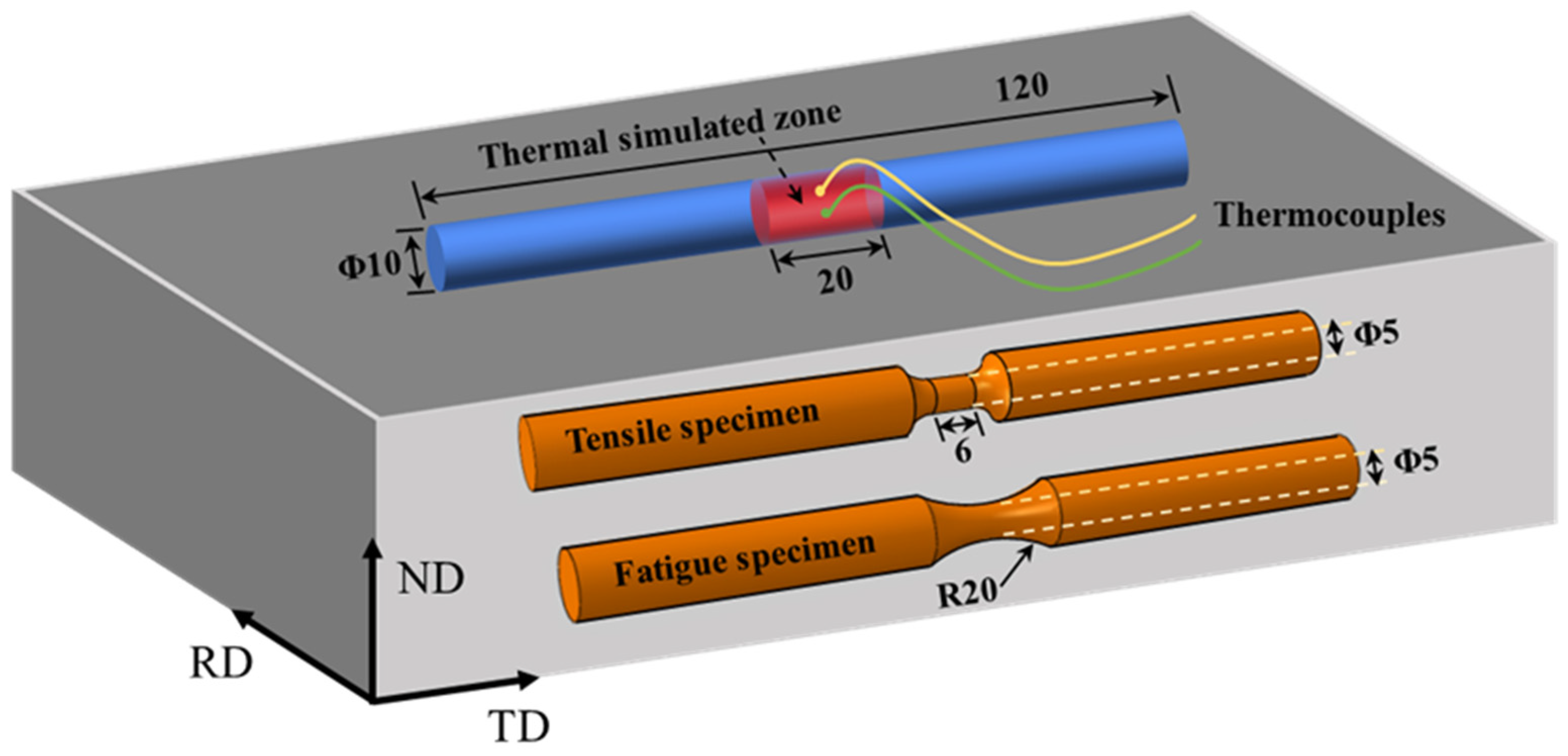
The round bar specimens, measuring Φ10 mm × 120 mm, were machined perpendicular to the rolling direction as illustrated in Figure 1. Welding thermal simulation of the CGHAZs with varying Nb contents was performed using a Gleeble 3800-GTC system (Poestenkill, NY, USA) to simulate submerged arc welding under a high heat input of 35 kJ/cm. The heating and cooling curves for the CGHAZs during the welding thermal cycles were established based on the Rykalin-2D model. A closed-loop temperature control system was implemented using K-type thermocouples welded at the midpoints of the round bar specimens. The specimens were heated linearly to a peak temperature of 1350 °C at a rate of 100 °C/s, held for 1 s, and subsequently cooled to 200 °C, completing the thermal simulation cycle. Additionally, a dilatometer was used to determine the start and finish temperatures of phase transformations during the welding thermal cycles.
Metallographic specimens from the simulated CGHAZs were prepared by sectioning through the thermocouple-welded region. After standard metallographic preparation and etching with a 4% nitric acid alcohol solution, the resulting microstructures were examined using an optical microscope (ZEISS, Baden-Württemberg, Germany) and a scanning electron microscope (Hitachi, Tokyo, Japan). Quantitative analysis of the microstructures was performed using Image-Pro Plus 6.0 software. To minimize statistical errors, at least 10 independent fields of view were randomly selected and analyzed for each simulated CGHAZ condition. The electron backscatter diffraction (EBSD) specimens were prepared using an ion milling system (Hitachi, Tokyo, Japan) under high vacuum conditions. The EBSD scans, measuring 150 μm × 150 μm, were performed using an Oxford C-Swift detector (Oxford, UK) with a step size of 0.25 μm. The acquired crystallographic orientation data were subsequently analyzed with AZtecCrystal 2.1 software (Oxford, UK). The detailed substructures in the CGHAZs were examined using a transmission electron microscope (JEOL, Tokyo, Japan) through 3 mm diameter thin foils, which were prepared by electrolytic polishing in a solution of 7% perchloric acid in ethanol. In addition, the precipitated particles were extracted from the matrix employing the carbon extraction replica technique. Their size distribution and chemical composition were analyzed using the TEM coupled with energy-dispersive X-ray spectroscopy (EDS, Oxford, UK). To ensure statistical reliability, more than 500 particles were analyzed for each simulated CGHAZ condition.
Figure 1 illustrates the geometry and dimensions of the CGHAZ specimens used for tensile and high-cycle fatigue testing. Tensile tests were conducted at ambient temperature on an electronic universal testing machine. The yield strength, tensile strength, and uniform elongation values are reported as the average of three replicate tests. High-cycle fatigue tests were carried out using a servohydraulic testing system Landmark 370.10 (Eden Prairie, MA, USA) under stress-controlled conditions with a sinusoidal waveform, a stress ratio (R) of 0.1, and a frequency of 20 Hz. The fatigue strength at 2 × 10⁶ cycles was determined according to the staircase method proposed by Dixon and Mood in the standard GB/T 24176-2009 [20]. These fatigue tests were performed on three pairs of CGHAZ specimens with varying Nb contents. To analyze fracture mechanisms, the fracture surfaces of the fatigued specimens were examined using SEM. Microhardness was measured with a micro-Vickers hardness tester (FM-ARS-9000, FUTURE-TECH, Sinsheim, Germany) under a 500 g load for each CGHAZ condition, with reported values representing the average of 10 randomly selected indentations.

3. Results

3.1. Microstructures

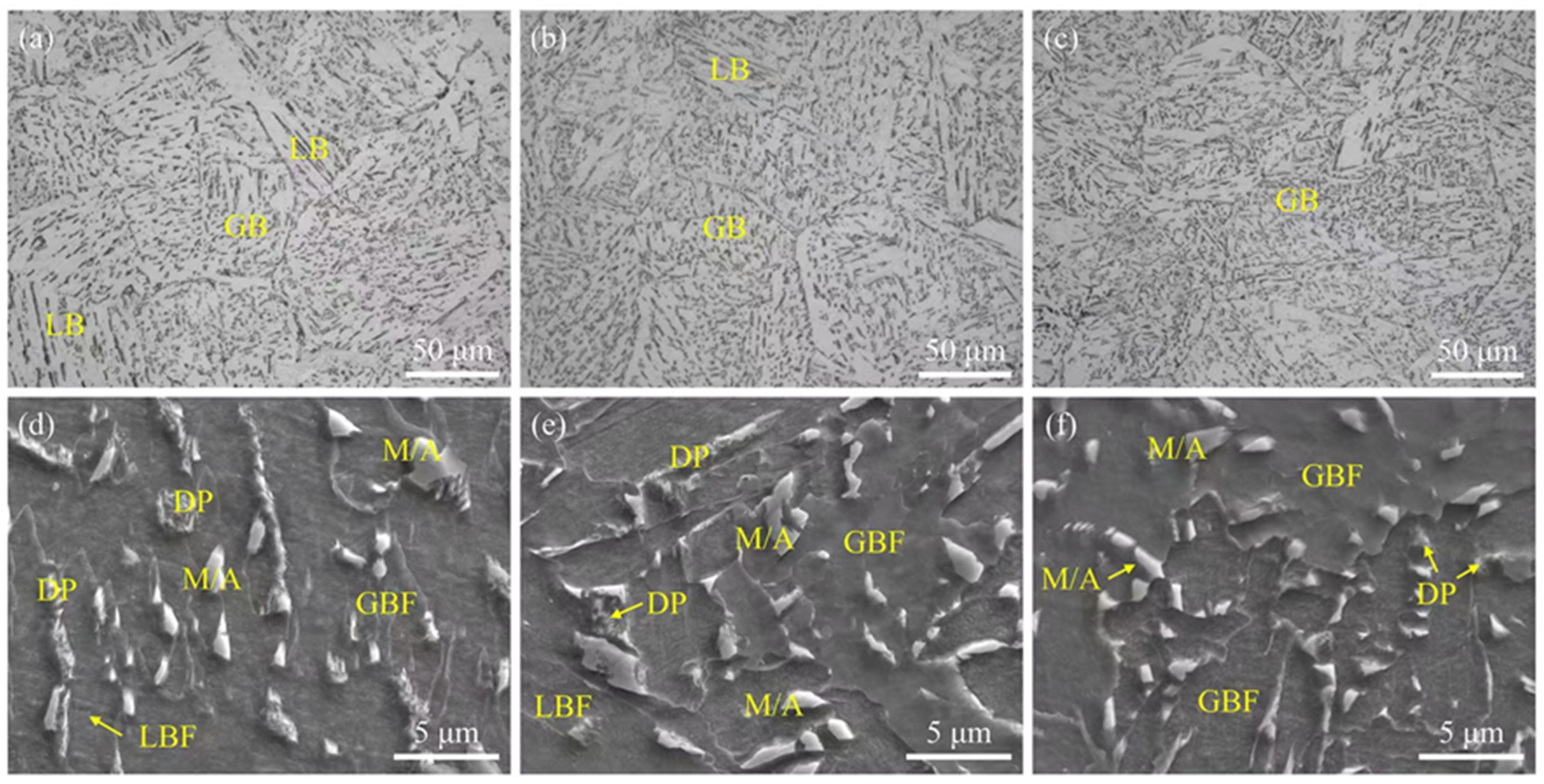
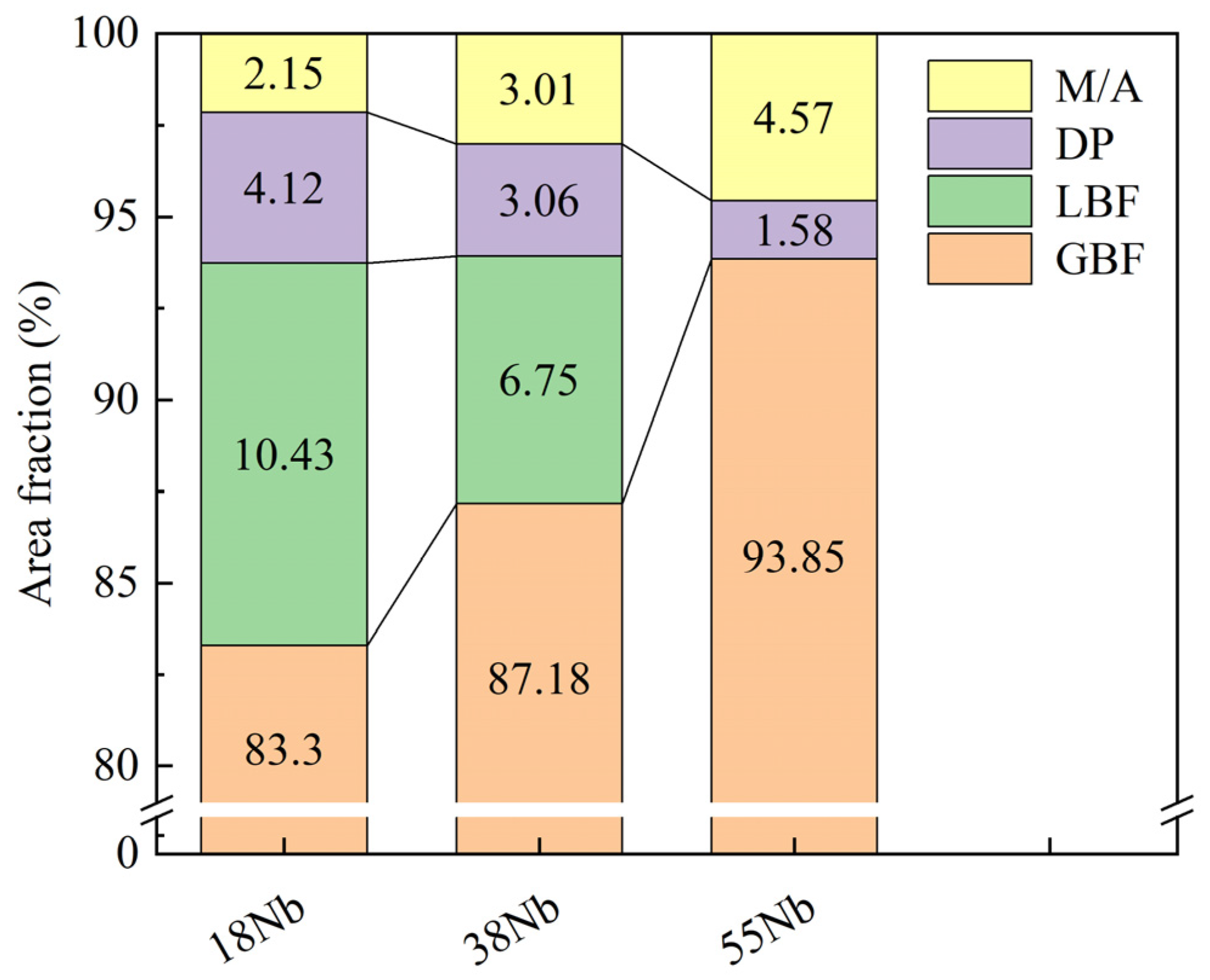
Figure 2 illustrates the typical OM and complementary SEM micrographs of the simulated CGHAZs with different Nb contents. The quantitative results are illustrated in Figure 3 for each microstructure of the specimens generated via the welding simulation. The CGHAZ specimens exhibited a predominant bainite microstructure, comprising lath bainitic ferrite (LBF), granular bainitic ferrite (GBF), M/A constituents (M/A), and degenerated pearlite (DP). Given the Nb content of 0.018 wt.%, the CGHAZ exhibited LBF, GBF, M/A constituents, and DP. The M/A constituents and DP were surrounded by a substantial presence of either LBF or GBF plates. The elevated Nb content increased GBF and M/A constituent, while concurrently decreasing the content of LBF and DP. As the Nb content elevated to 0.055 wt.%, the microstructure was identified as GB, comprising the GBF, M/A constituents, and DP.
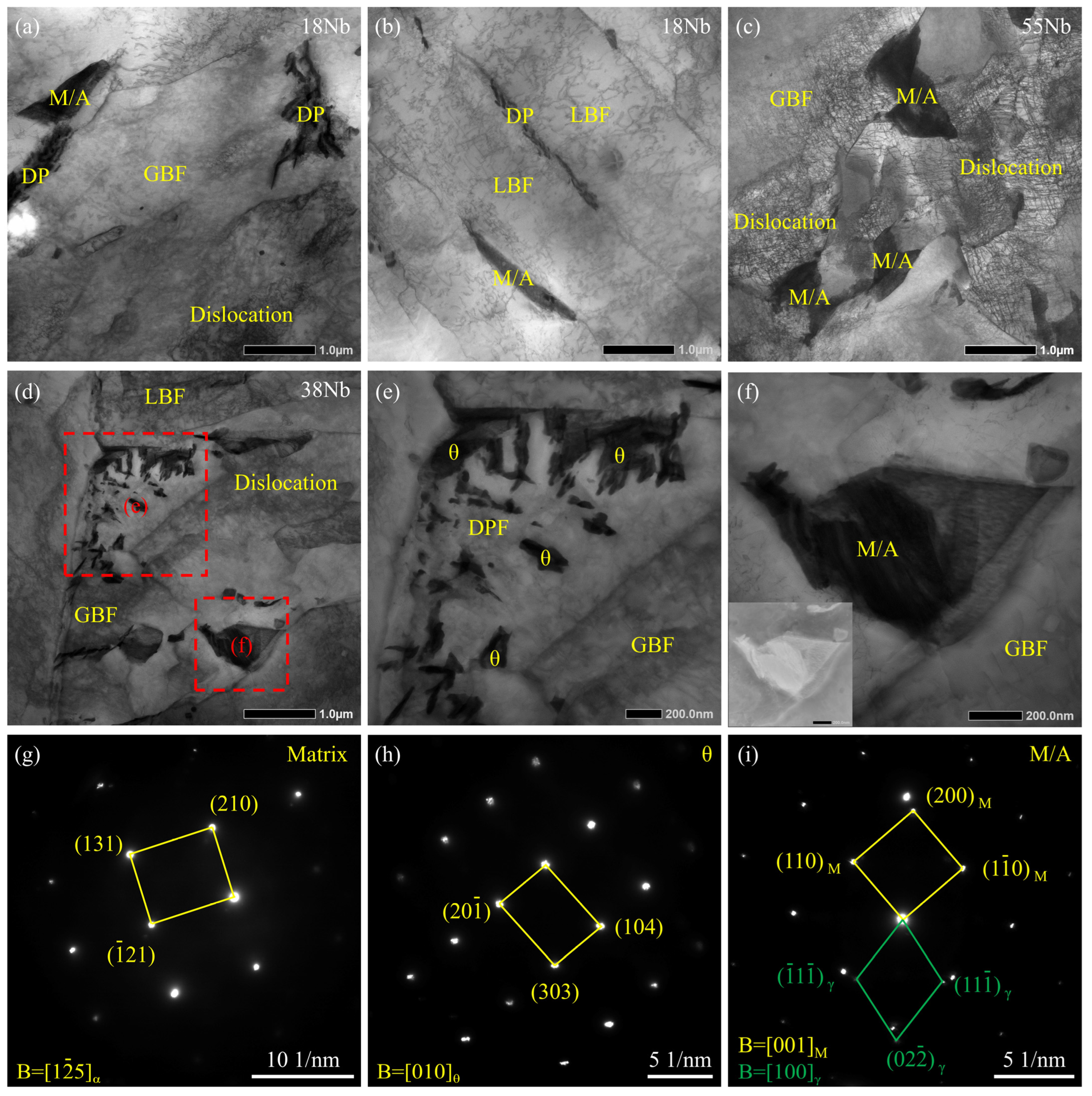
Figure 4 illustrates the detained TEM micrographs of the simulated CGHAZs with varying Nb contents. The microstructure characteristics of the CGHAZs observed via TEM were found to be identical to those observed via OM and SEM in Figure 2. The elevated Nb content resulted in a substantial increase in the number of dislocation substructures in the CGHAZ, predominantly manifesting as entangled dislocation lines. The calibration result of the selected area electron diffraction (SAED) pattern (Figure 4g) indicated that the bainitic matrix was body-centered cubic (BCC) ferrite phase. As demonstrated in Figure 4e,f, the magnified images of the selected areas from the 38 Nb CGHAZ in Figure 4d reveal the typical fine structure of the DP and M/A constituents in CGHAZs. Figure 4e illustrates that the DP microstructure consists of θ particles surrounded by degenerated pearlite ferrite (DPF). The identification of the θ phase was facilitated by the calibration result of the SAED pattern, as depicted in Figure 4h. Furthermore, the M/A constituents were identified through the SAED pattern (Figure 4i), which was composed of body-centered cubic (BCC) martensite and face-centered cubic (FCC) austenite phases.
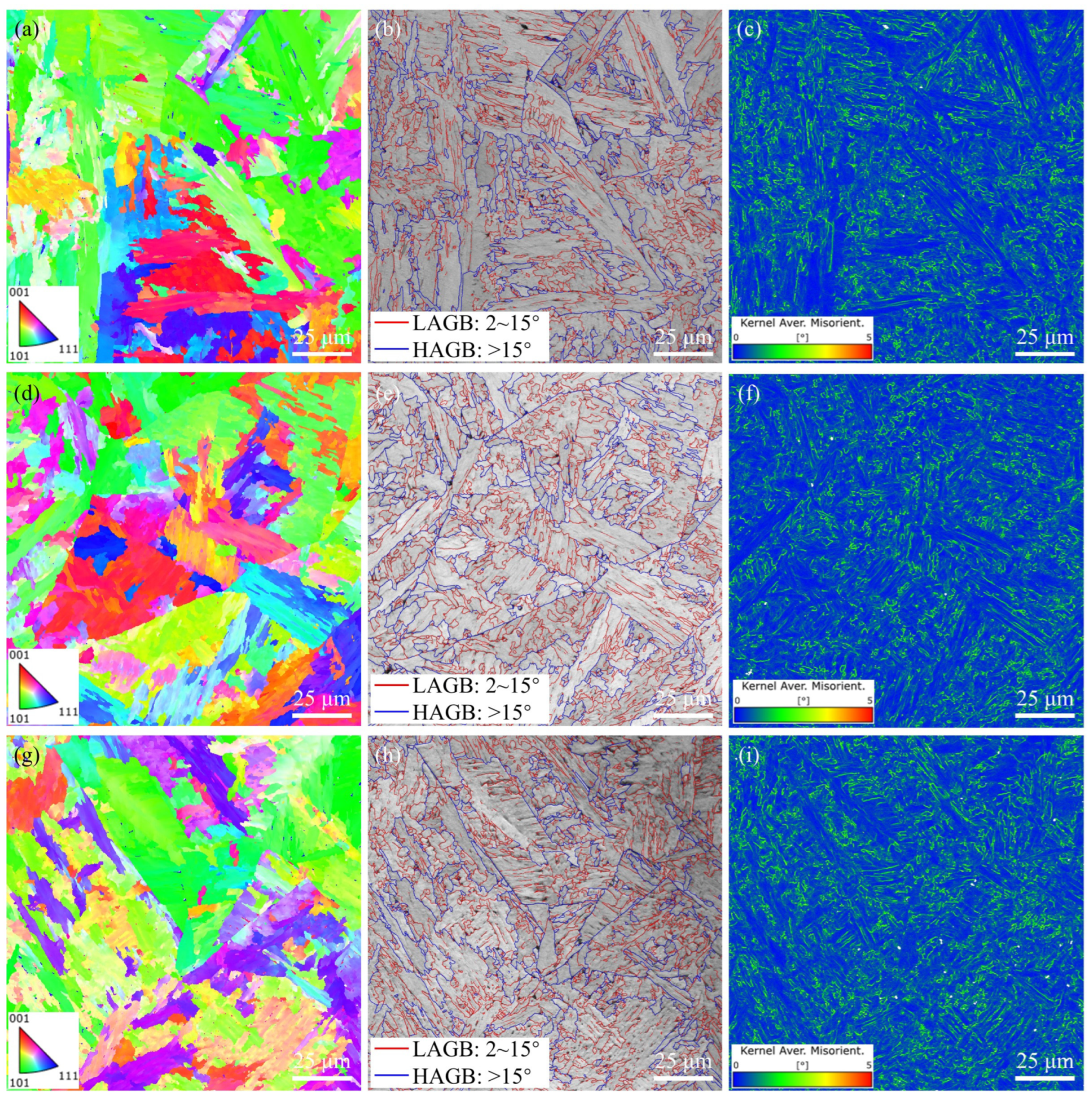
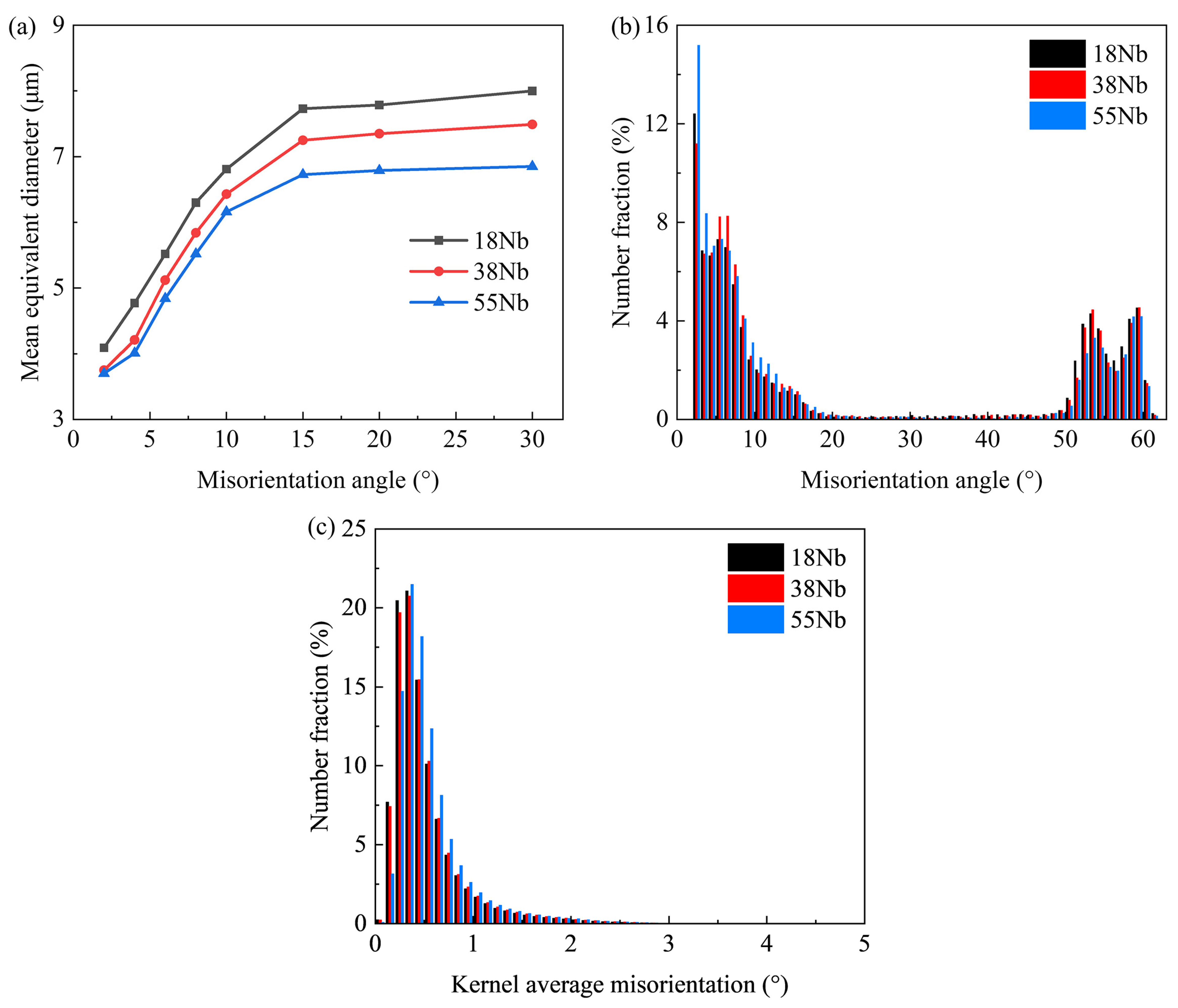
The EBSD results elucidating the crystal orientation characteristics of the simulated CGHAZs are presented in Figure 5 and Figure 6. Table 2 displays the statistical data of the crystallographic characteristics of the simulated CGHAZs. Inverse pole figures (IPFs) were utilized for the analysis of grain orientation in a variety of crystal directions. The utilization of varied coloration in the grains was indicative of the crystal orientation of the simulated CGHAZ grains. The mixed-color grains exhibited a random orientation in the simulated CGHAZs with varying Nb contents. Mean equivalent diameter (MED) is a pivotal method for the characterization of the grain size of ferrite matrix in alloy materials [21,22]. As illustrated in Figure 6a, the elevated Nb content resulted in a decline in the MED, defined by different misorientation angles (MTAs). This finding suggests that Nb had a refining effect on the CGHAZ microstructure.
The low-angle grain boundary (LAGB) with a MTA ranging from 2 to 15° and the high-angle grain boundary (HAGB) with a MTA exceeding 15° were delineated in the image quality (IQ) maps (Figure 5b,e,h) with red and blue lines, respectively. The elevated Nb content promoted a higher fraction of LAGBs in the CGHAZ, which increased from 59.2% to 66.9%. This was accompanied by a concomitant reduction in the HAGB fraction from 40.8% to 33.1%. In instances where the grain sizes of CGHAZ were inconsistent, it has been determined that the number fraction of grain boundaries was not an accurate representation of their respective densities. In accordance with the established formula in [23], an augmentation in the Nb content was observed to result in a unidirectional rise in the density of LAGBs from 2.32 × 10⁻⁴ to 2.99 × 10⁻⁴ 1/μm, whilst the density of HAGBs exhibited a consistent increase from 1.60 × 10⁻⁴ to 1.74 × 10⁻⁴ 1/μm. This finding indicated that Nb microalloying promoted grain refinement, resulting in a substantial increase in grain boundary density within the CGHAZ.
The kernel average misorientation (KAM) map was employed to illustrate the distribution of the local strain level present within the alloy materials, as shown in Figure 5c,f,i. The elevated Nb content resulted in a monotonic increase in the KAM value from 0.51° to 0.57° within the CGHAZ specimens. KAM was regarded as a sensitive indicator of the internal dislocation density within the grains of alloy materials [24]. A high value of KAM indicated the presence of a greater number of dislocations [25]. As the Nb content increases, the rise in KAM values reflected an increase in dislocation density, consistent with the results from TEM observations (Figure 4).
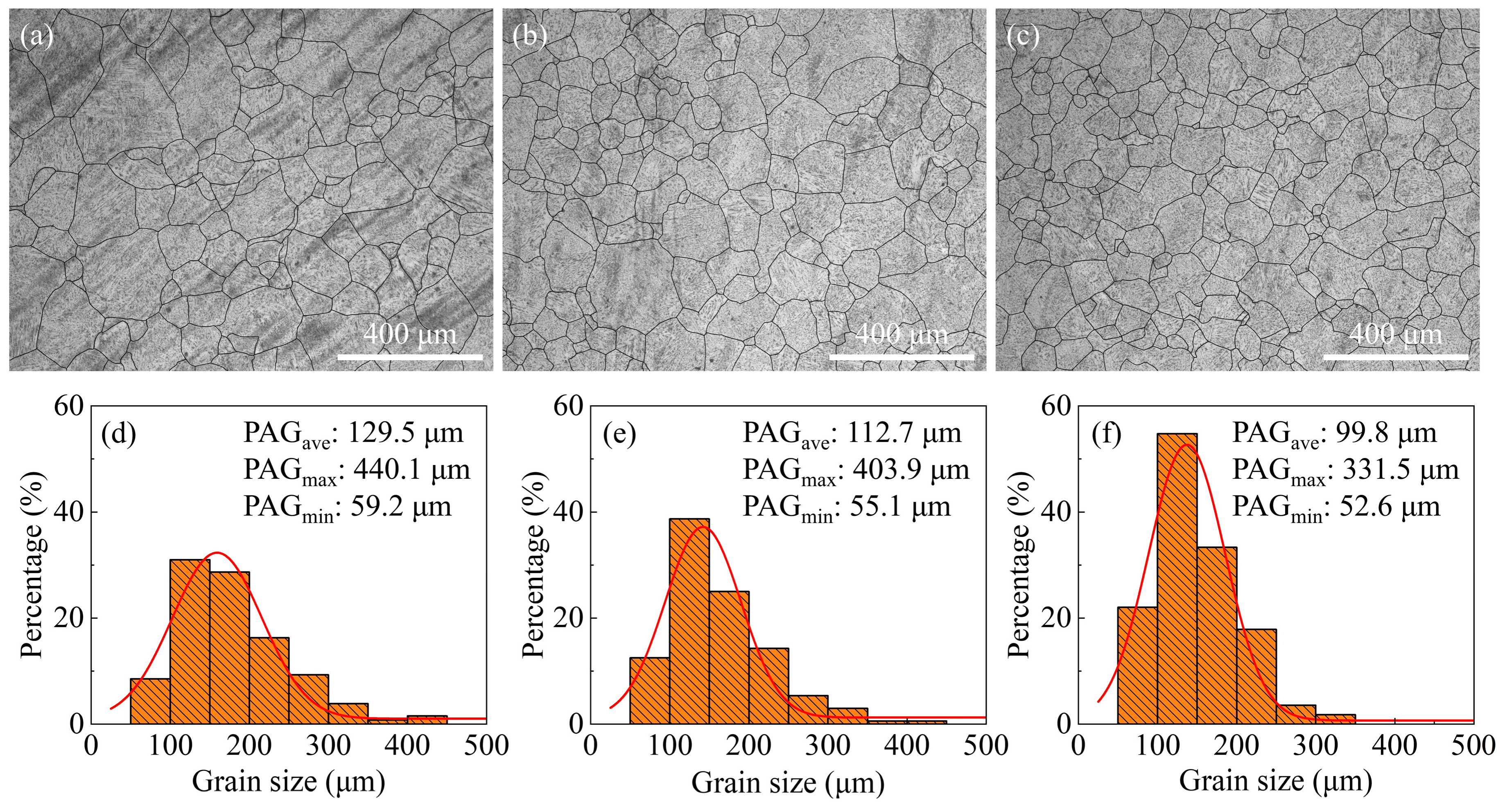
Figure 7 displays the typical prior austenite grains (PAGs) and their corresponding grain size distribution histograms for the CGHAZs at different Nb contents. The results demonstrate that the addition of Nb had a significant refining effect on the PAG structure. Specifically, as the Nb content increased from 0.018 wt.% to 0.055 wt.%, the average PAG size in the CGHAZs decreased markedly from 129.5 μm to 99.8 μm.
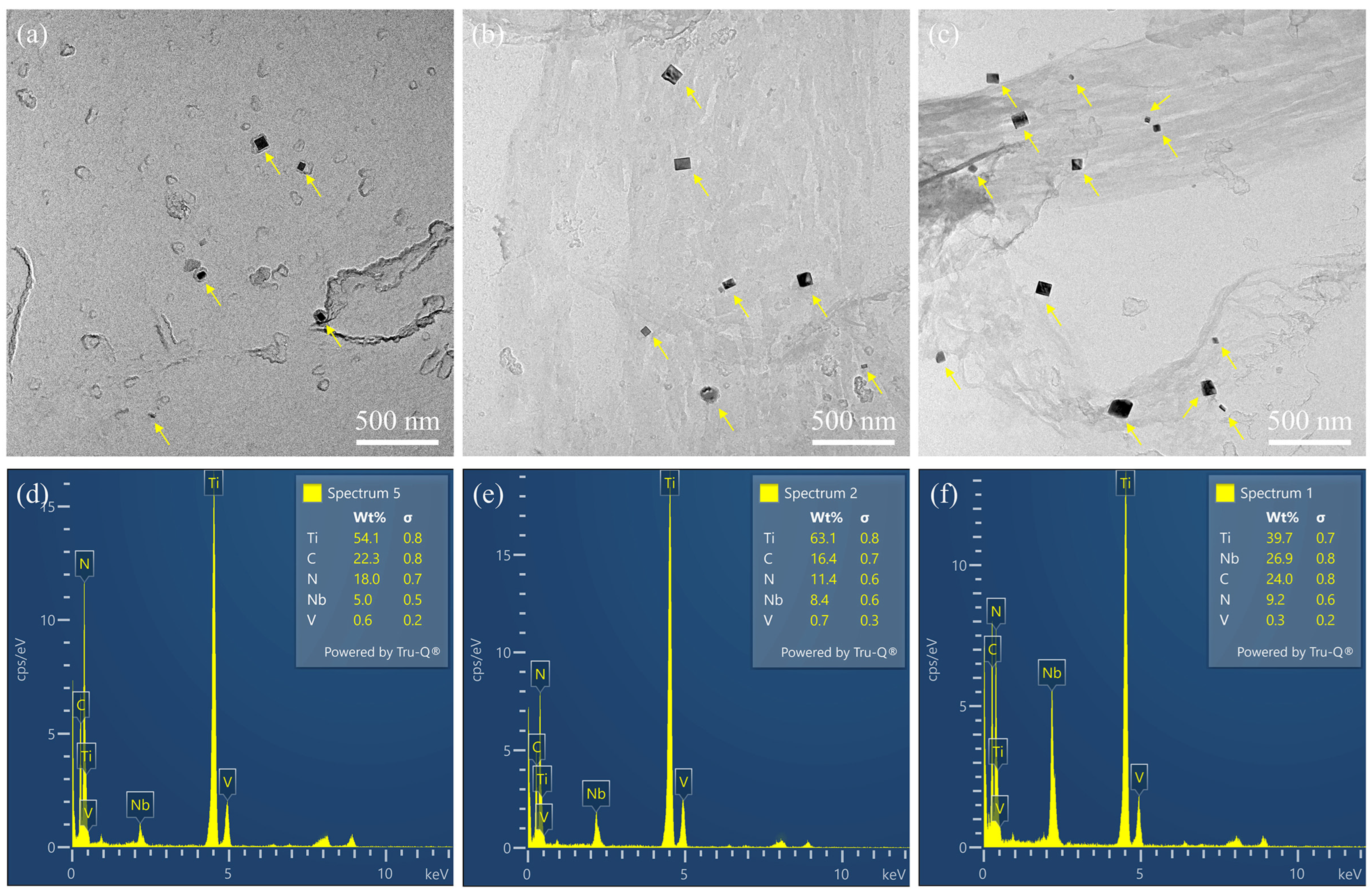
Figure 8 displays the TEM micrographs and corresponding EDS point analysis of precipitated particles in the simulated CGHAZs. The nanoparticles were identified as (Ti,Nb,V)(C,N) composite carbonitrides through EDS analysis across specimens with varying Nb content. With the increase in Nb content from 0.018 wt.% to 0.055 wt.%, the average diameter of these (Ti,Nb,V)(C,N) particles increased from 58.8 nm to 63.0 nm, while the average volume fraction exhibited a continuous rise from 0.31% to 0.68%.

3.2. Mechanical Properties

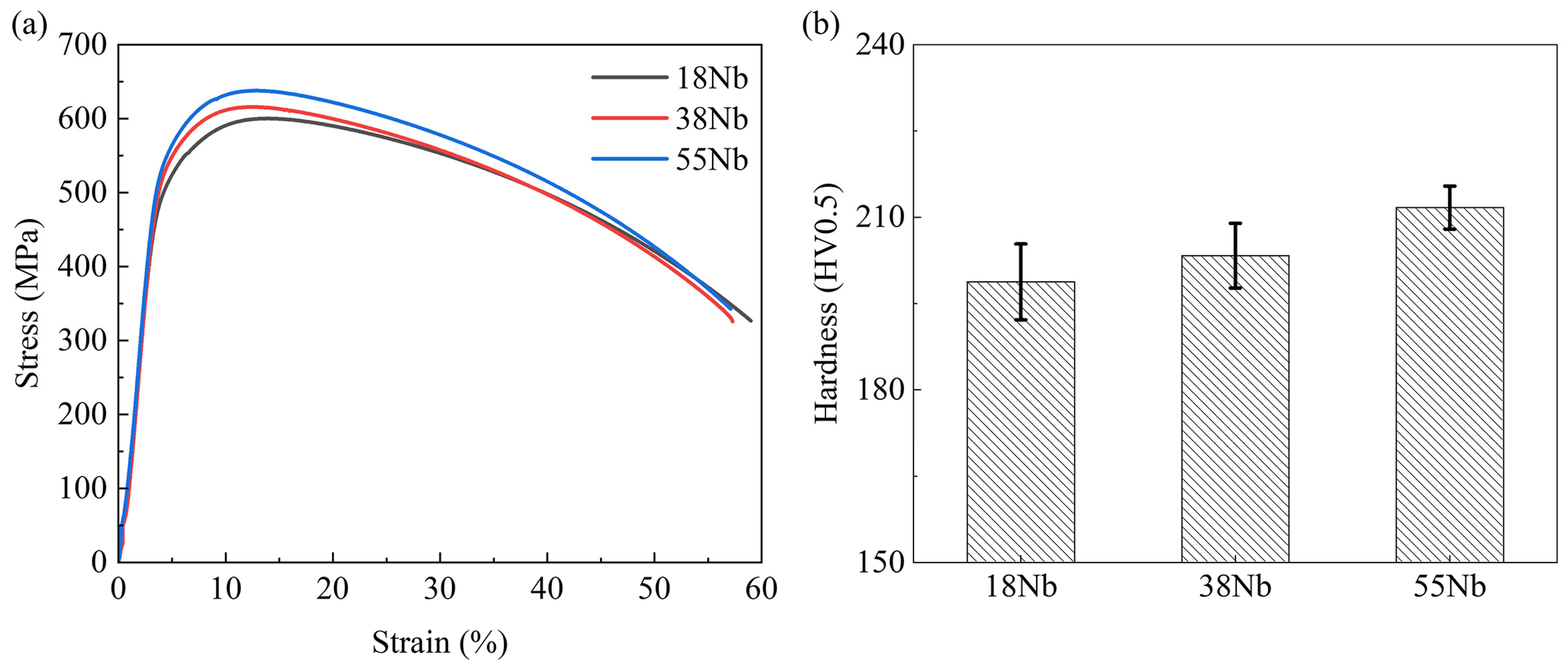
Figure 9 presents the engineering stress–strain curves obtained from tensile tests, along with hardness measurements, performed on the simulated CGHAZs at room temperature. The corresponding mechanical properties are quantitatively summarized in Table 3. As the Nb content increased from 0.018 wt.% to 0.055 wt.%, the yield strength of the simulated CGHAZs rose from 469 MPa to 503 MPa, the tensile strength improved from 600 MPa to 637 MPa, and the uniform elongation decreased from 10.9% to 9.5%. Furthermore, the microhardness of the CGHAZs consistently rose from 198.8 HV0.5 to 211.7 HV0.5 with increasing Nb content, corroborating the overall strengthening effect induced by Nb microalloying. The results demonstrate that the increase of Nb effectively improved the strength and hardness of the CGHAZ, albeit with a moderate trade-off in ductility.
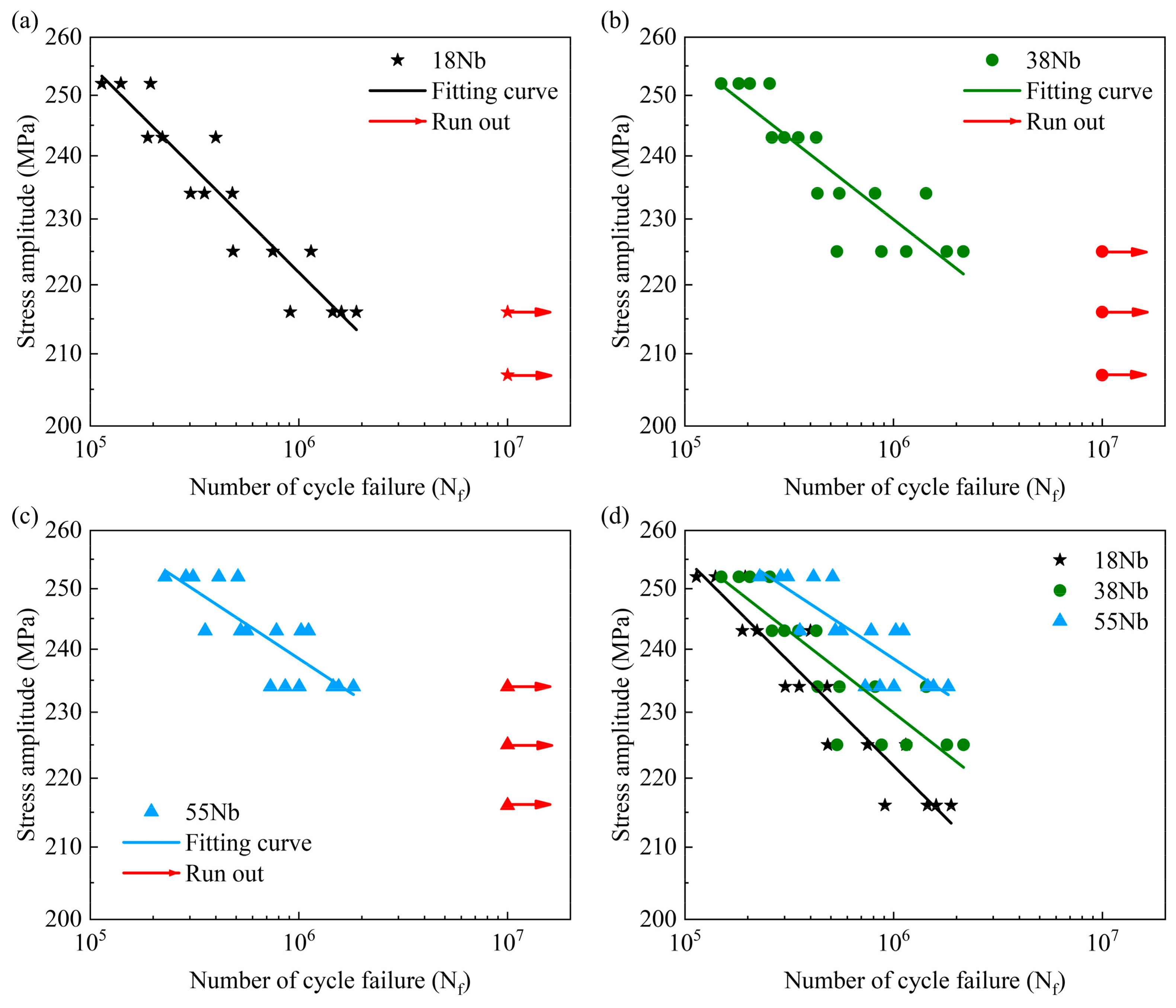
Figure 10 presents the high-cycle fatigue properties of the simulated CGHAZs with different Nb contents. The corresponding S-N curves (Woehler curves) for each CGHAZ specimen are exhibited in Figure 10a, Figure 10b and Figure 10c, respectively. It can be observed that the fatigue data obtained from the CGHAZ specimens exhibited a relatively clustered distribution. The S-N curves of the failed CGHAZ specimens were fitted using the following Equation [26,27]:
log   σ a = log   σ f b * log   ( N f )
where σ a donates the stress amplitude, σ f signifies the fatigue strength coefficient, Nf represents the number of cycles to failure, and b is the fatigue strength exponent. The fitted results of Nf vs. stress amplitude are illustrated in Figure 10d, and the fitting equations of the CGHAZ specimens are as follows:
18 Nb: log σa = 2.71 − 0.06*log(Nf)
38 Nb: log σa = 2.65 − 0.05*log(Nf)
55 Nb: log σa = 2.62 − 0.04*log(Nf)
Therefore, consistent with the trends observed for tensile strength and hardness, the fatigue strength of the simulated CGHAZ specimens increased progressively from 212.6 MPa to 231.9 MPa as the Nb content was raised from 0.018 wt.% to 0.055 wt.%.

3.3. Fatigue Fracture Characteristics

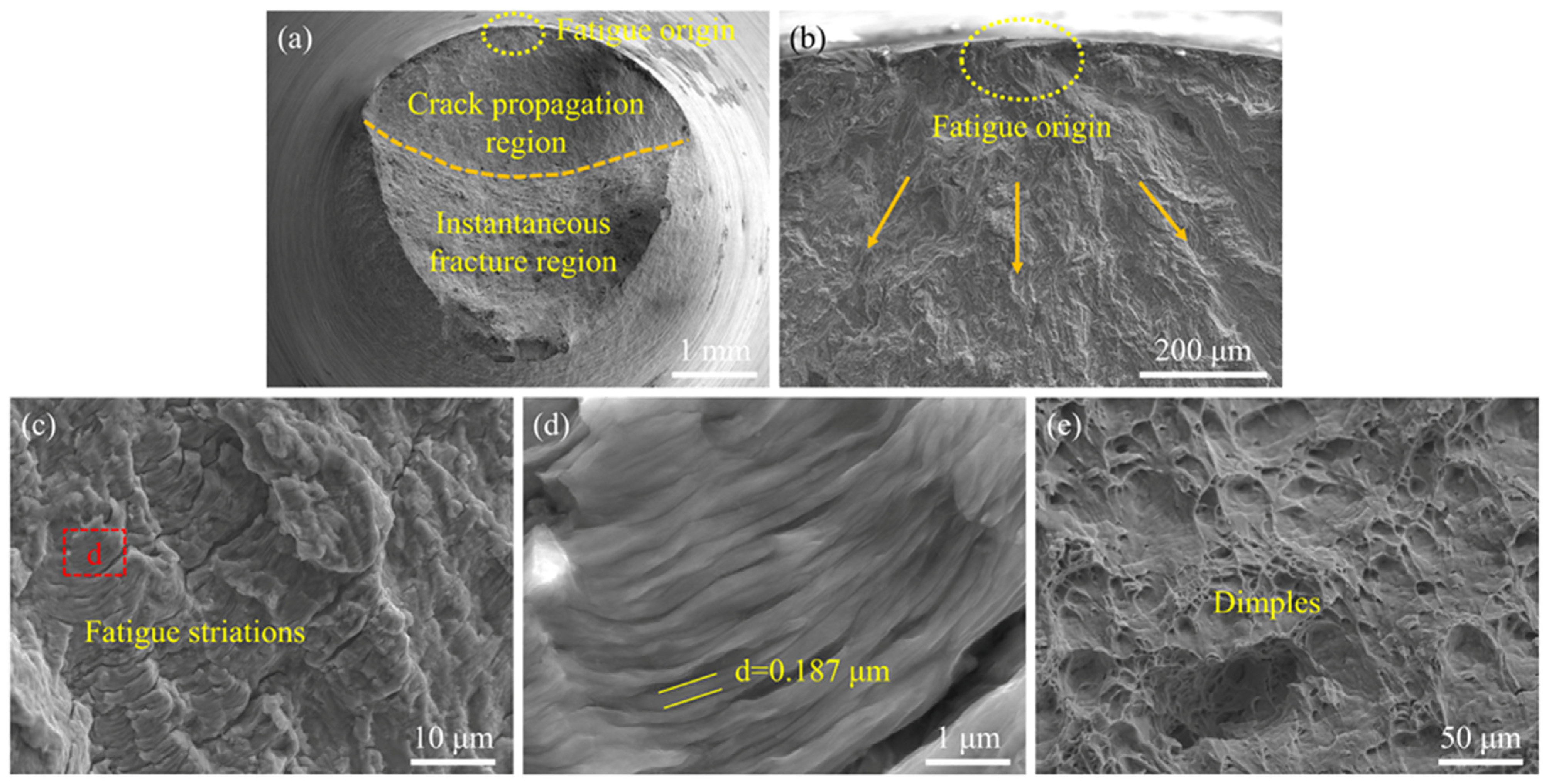
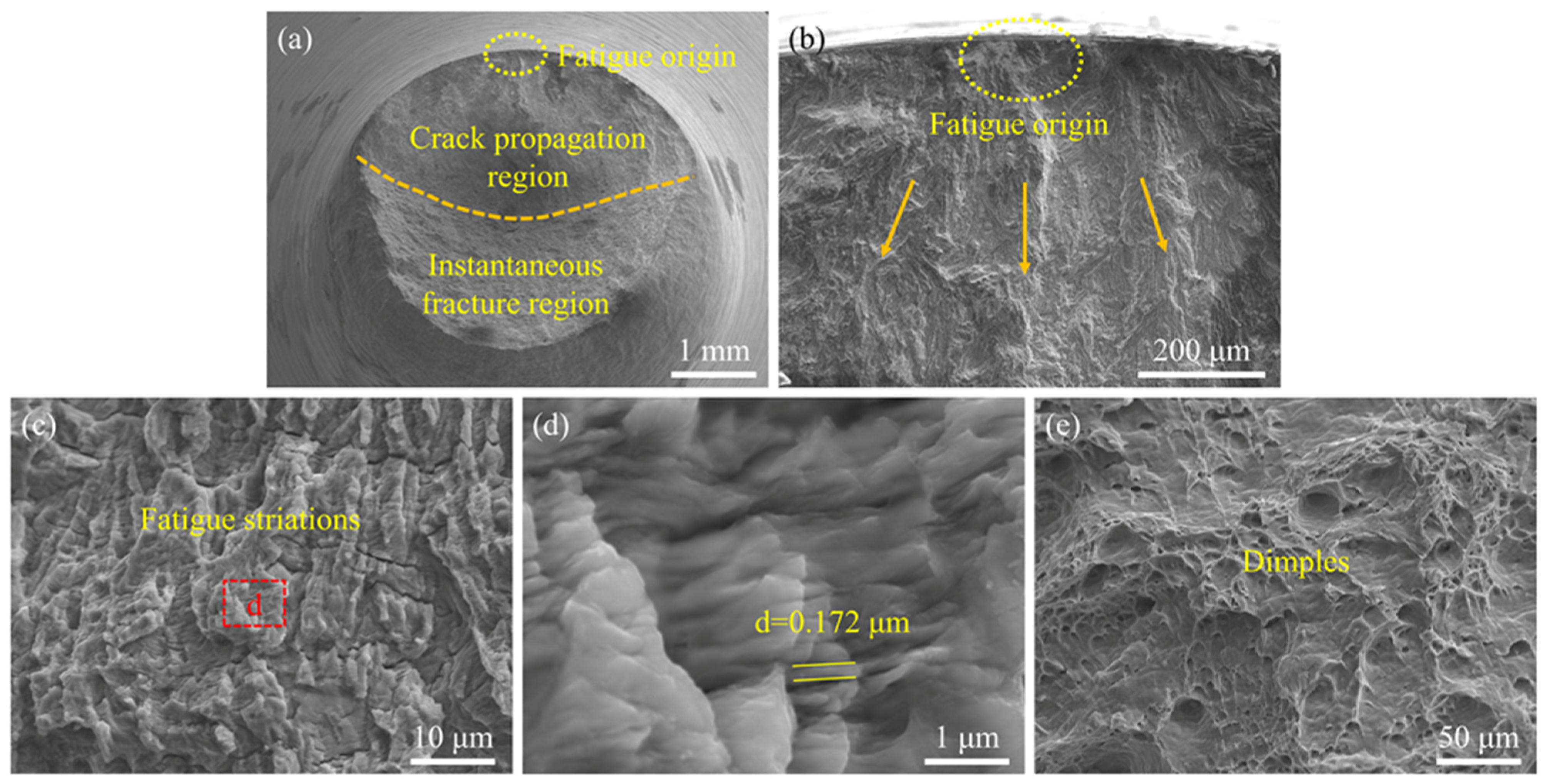
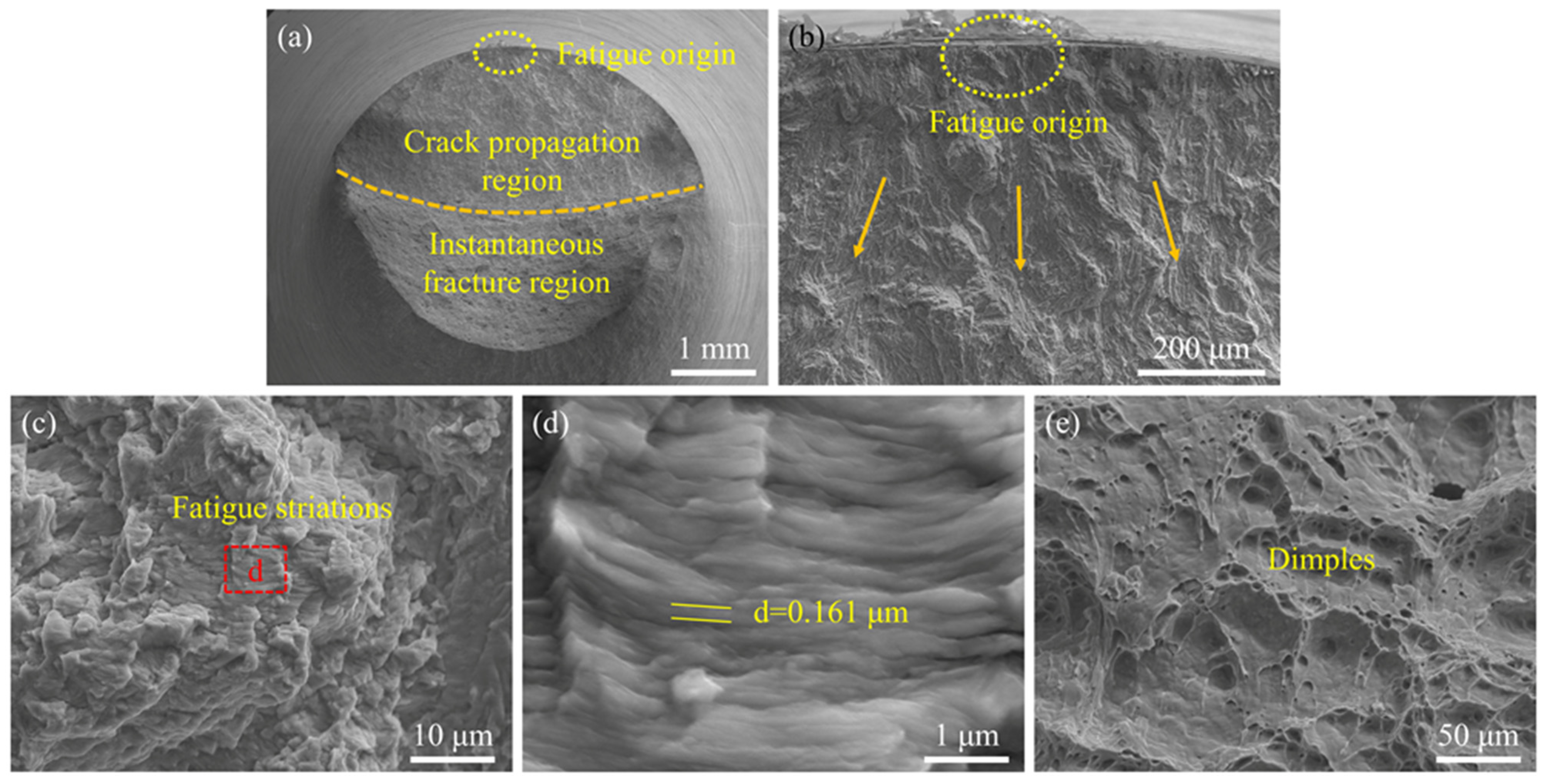
In order to characterize the fatigue fracture behaviors in detail, the fracture surfaces of the CGHAZ failure specimens were examined by SEM, as illustrated in Figure 11, Figure 12 and Figure 13. It is evident that three CGHAZ specimen types exhibited comparable fatigue fracture morphologies. The progression of fatigue damage can be categorized into three distinct stages: crack initiation, crack propagation, and instantaneous fracture. It has been established that fatigue cracks initiated at the surface of CGHAZ specimens and subsequently propagated inwards at a perpendicular angle to the direction of cyclic stress loading. The crack propagation region exhibited discernible fatigue striations, while the instantaneous fracture region was characterized by the presence of equiaxed dimples of varying sizes. In addition, the fatigue failure lifetime can be categorized into two phases: the fatigue crack initiation lifetime and the fatigue crack propagation lifetime. Fatigue striation spacing is indicative of the distance to which fatigue cracks propagate under a single stress cycle [28,29]. The increase in Nb content led to a reduction in the average fatigue striation spacing in the CGHAZ from 0.187 μm to 0.161 μm. According to Figure 11, Figure 12 and Figure 13, the fatigue crack propagation lifetimes of the CGHAZs with different Nb contents ranged from 9049 to 12,091 cycles, accounting for 0.83% to 2.57% of the total failure lifetimes. This finding indicates that the crack initiation lifetimes played a dominant role in the fatigue damage, and the similar findings were corroborated by the literature [17,18].

4. Discussion

4.1. Microstructure Evolutionary

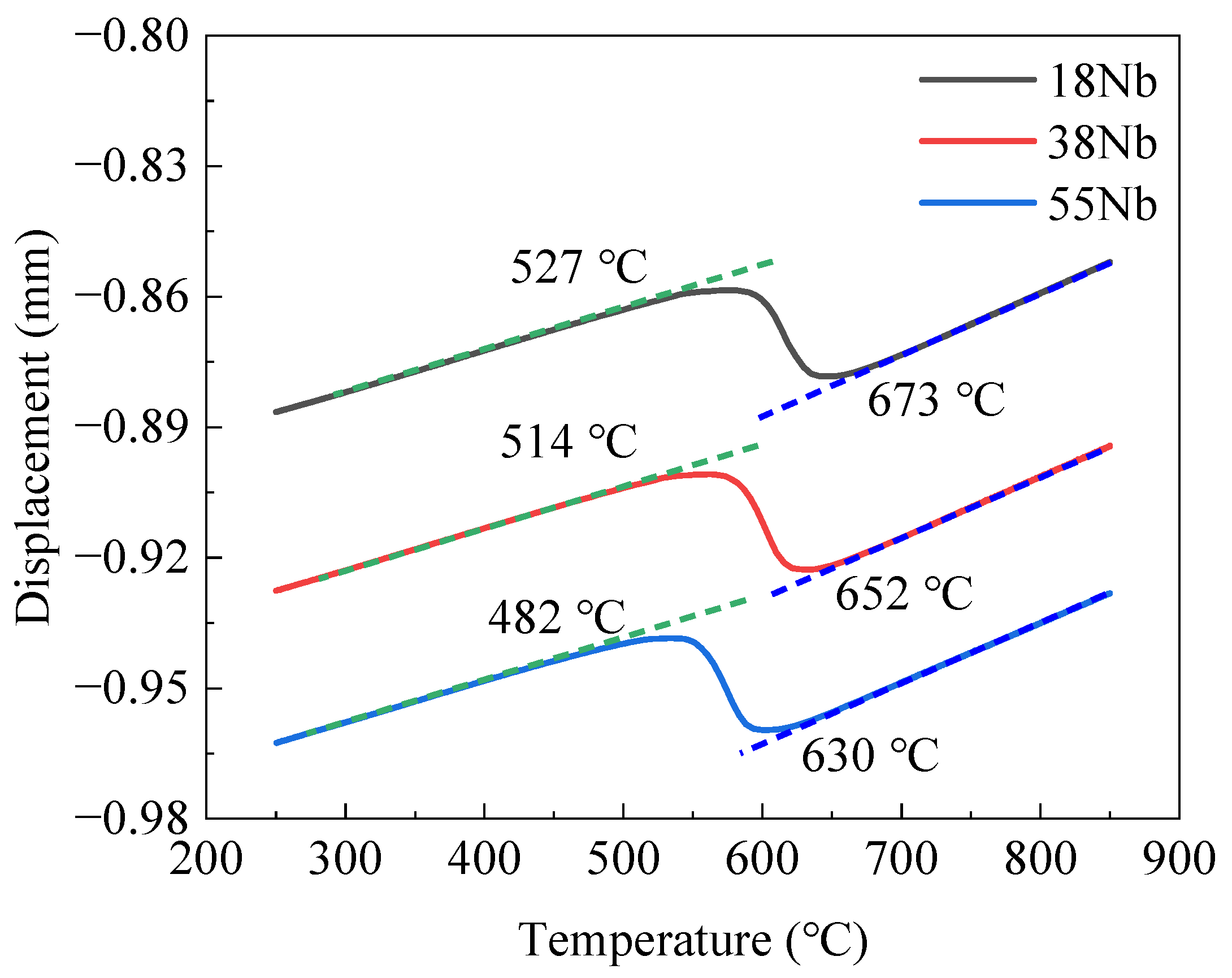
Figure 14 illustrates the dilatometric curves of the simulated CGHAZs measured on the Gleeble 3800-GTC system during the thermal simulation, with the green and blue dotted lines denoting the tangents to the corresponding curve segments. As the Nb content increased from 0.018 wt.% to 0.055 wt.% during the cooling process, the start temperature (Ar3) of the simulated CGHAZs at which the γ → α phase transformation declined from 673 °C to 630 °C, and the finish temperature (Ar1) at which the transformation reduced from 527 °C to 482 °C. The Ar3 and Ar1 temperatures were determined from continuous cooling dilatometry curves using the tangent method. This phenomenon was attributed to the solute drag effect from dissolved Nb atoms [30], which retarded the migration of γ grain boundaries [31]. This inhibition forced the γ → α transformation to proceed at a lower temperature, resulting in a depression of the Ar3 temperature. In addition, the granular bainite (GB) phase transformation primarily nucleated at prior austenite grain boundaries (PAGBs) [32], while the lath bainite (LB) grain nucleation mainly occurred within PAG grains [33]. Refined PAGs, induced by elevated Nb contents, have been shown to form higher-density grain boundaries (Table 2). These boundaries provide a substantial number of nucleation sites for GB transformation, thereby promoting increased GB formation in the CGHAZs. The content of LB in the CGHAZs decreased with increasing Nb content, whereas the fraction of GB increased, as shown in Figure 2 and Figure 3. The PAGBs and bainitic packets in the LB microstructure were characterized as HAGBs [23], whereas the internal substructure within GB grains consisted predominantly of LAGBs (Figure 5). Consequently, an augmentation in the Nb content resulted in a concomitant increase in the density of both LAGBs and HAGBs. The density of LAGBs exhibited a higher magnitude compared to that of HAGBs within the CGHAZs (Figure 6).
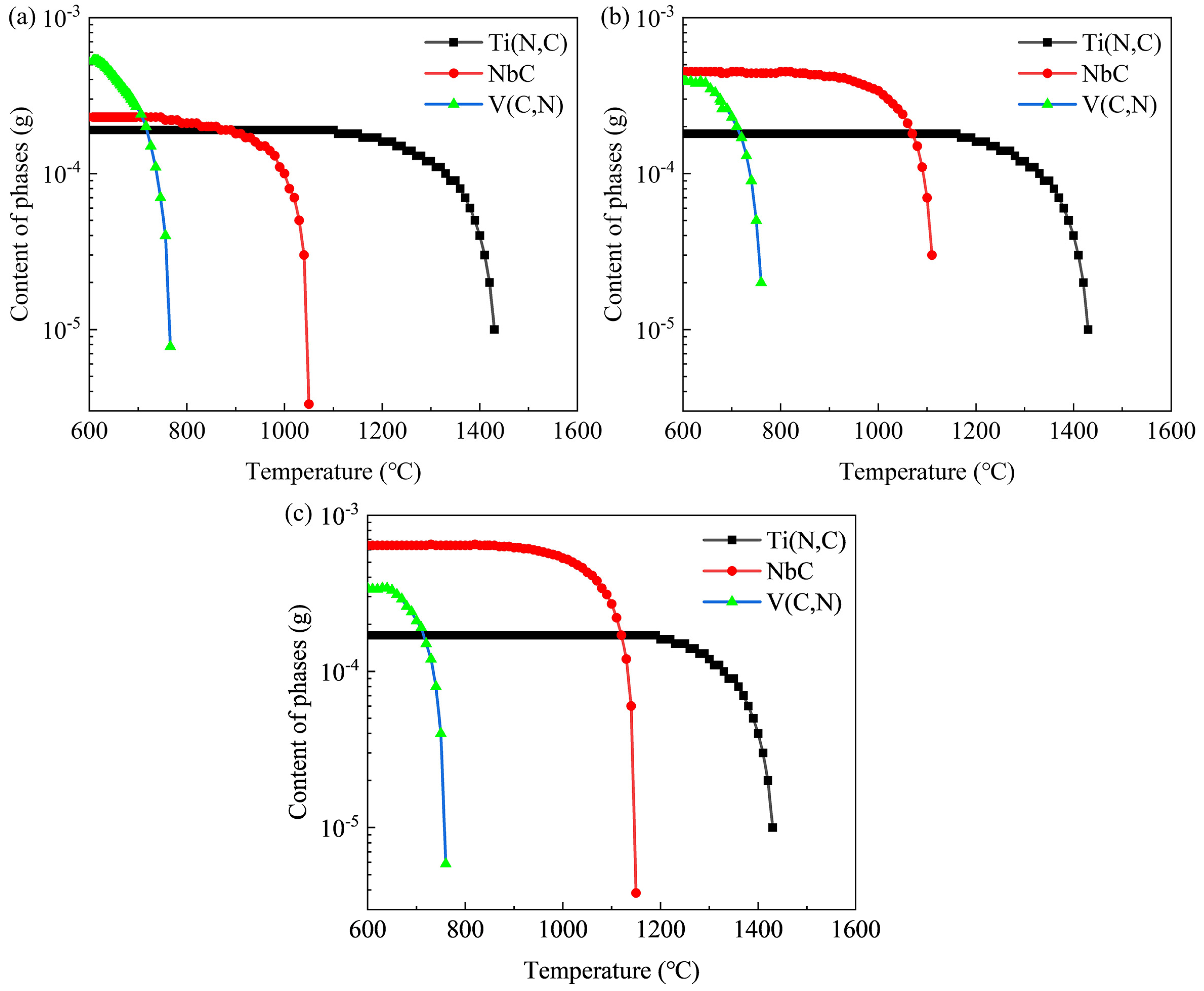
Figure 15 illustrates the thermodynamic calculation results of precipitated phases, obtained using Thermo-CalcTM 4.0 software with the TCFE13 database. The precipitation temperatures of the Ti(N,C) and V(C,N) phases were determined to be approximately 1439 °C and 765 °C, respectively. As the Nb content evaluated from 0.018 wt.% to 0.055 wt.%, the precipitation temperature of the NbC phase increased continuously from 1051 °C to 1151 °C. During the welding heating process, the NbC and V(C,N) phases dissolved completely into the α-matrix, whereas the Ti(N,C) phase underwent partial dissolution. Upon post-weld cooling, precipitation occurred in the sequence of Ti(N,C), NbC, and V(C,N). Notably, the NbC and V(C,N) phases precipitated epitaxially on the surfaces of pre-existing Ti(N,C) particles, leading to the formation of (Ti,Nb,V)(C,N) composite precipitates [34,35]. As the Nb content increased, both the average diameter and the volume fraction of the (Ti,Nb,V)(C,N) particles in the CGHAZs exhibited a corresponding increase.
The presence of precipitated particles in steels exerted resistance on the migration of γ grain boundaries [36,37]. The Zener model proposed that precipitation particles generated a pinning force on γ grain boundaries [38], restricting their migration (Equation (5)).
P z = 3 f v γ γ γ 2 r
where Pz represents the pinning force exerted by precipitation particles against the γ grain boundaries, fv indicates the volume fraction of the particles, γγγ denotes the interface energy between two adjacent γ grains, and r signifies the radius of the particles. The pinning effect on the migration of γ grain boundaries was enhanced with increasing Nb content. Consequently, as the Nb content increased, the average size of PAGs and the MED in the CGHAZs decreased (Figure 6 and Figure 7), indicating a refinement of the intragranular microstructure.

4.2. Fatigue Damage Mechanism

To elucidate the fatigue fracture mechanism in the CGHAZs with varying Nb contents, it is essential to analyze the initiation and propagation of fatigue cracks. The results presented above indicated that crack initiation behavior played a dominant role in the fatigue fracture process. The predominant factor contributing to the initiation of fatigue cracks was the presence of local strain concentrations within the alloy materials [39], which were the result of irreversible plastic deformation [40]. Grain boundaries have been demonstrated to impede dislocation motion in polycrystalline materials [40,41]. During the process of cyclic deformation, HAGB inhibited dislocation movement, resulting in the accumulation of dislocation pile-ups and the formation of stress concentrations at the grain boundaries, which induced the initiation of fatigue cracks [42,43]. However, dislocations have the capacity to migrate through the LAGB into adjacent grains [44], and LAGB cracking is a formidable challenge. An elevated Nb content increased the density of both LAG and HAGB in the CGHAZs, with the LAGB density exhibiting a higher magnitude than that of HAGBs. Consequently, this effect augmented the hindering effect of fatigue crack initiation.
The discrepancy in grain size resulted in variations in the number of dislocation pile-ups unit length in front of the boundaries [45]. Pursuant to Taylor theory and the Orowan formula, the relationship between shear stress (τ) and dislocation density (ρ) during plastic deformation can be expressed as follows [46]:
τ = τ 0 + K G b ρ
where τ0 represents the initial shear stress required to initiate dislocation motion in the absence of other dislocation influences, K indicates the empirical constant, G signifies the shear modulus of elasticity, b is the Burgers vector. During the process of plastic deformation, it is hypothesized that the shear stress experienced by each grain is consistent with Schmid’s law for the crystal orientation of the grain. The relationship between these variables can be expressed as follows:
τ = Ω σ
where Ω represents the Schmid factor, σ denotes the rheological normal stress applied across the sample’s extremities, which is analogous to the yield strength of the materials. According to the derivation by Zhang et al. [45], the relationship between the number of dislocation pile-ups unit length (n) and the parameters ρ and Ω is given by the following equation:
n = ρ = Ω σ σ 0 K G b
where σ0 is referred to as the dislocation slip threshold stress, which is indicative of the resistance to deformation within the crystal. In accordance with the Hall–Petch relationship, the following relationship exists between the grain size (d) and yield stress:
σ σ 0 = k d 1 / 2
where k is a constant with the material. In the study, the d is determined as the MED from EBSD data, as reported in [21,22]. The relationship between the number of dislocation pile-ups and the grain size can be described using the following equation:
n = k Ω K G b d
As demonstrated in Equation (10), the number of dislocation pile-ups at grain boundaries increased continuously as the grain size of polycrystalline materials grew. As the number of dislocation pile-ups reached the critical number (nc), local cracking occurred at grain boundaries [45], leading to the formation of fatigue cracks [47]. The elevated Nb content resulted in a decline in the MED of CGHAZ (Table 2), leading to a decrease in the number of dislocation pile-ups. This finding suggests a potential reduction in the fatigue cracking tendency. Therefore, the elevated Nb content generated a combined effect in the CGHAZ specimens, manifesting as an increased LAGB accompanied by a decrease in MED. This effect served to reinforce the inhibitory effect of fatigue crack initiation.
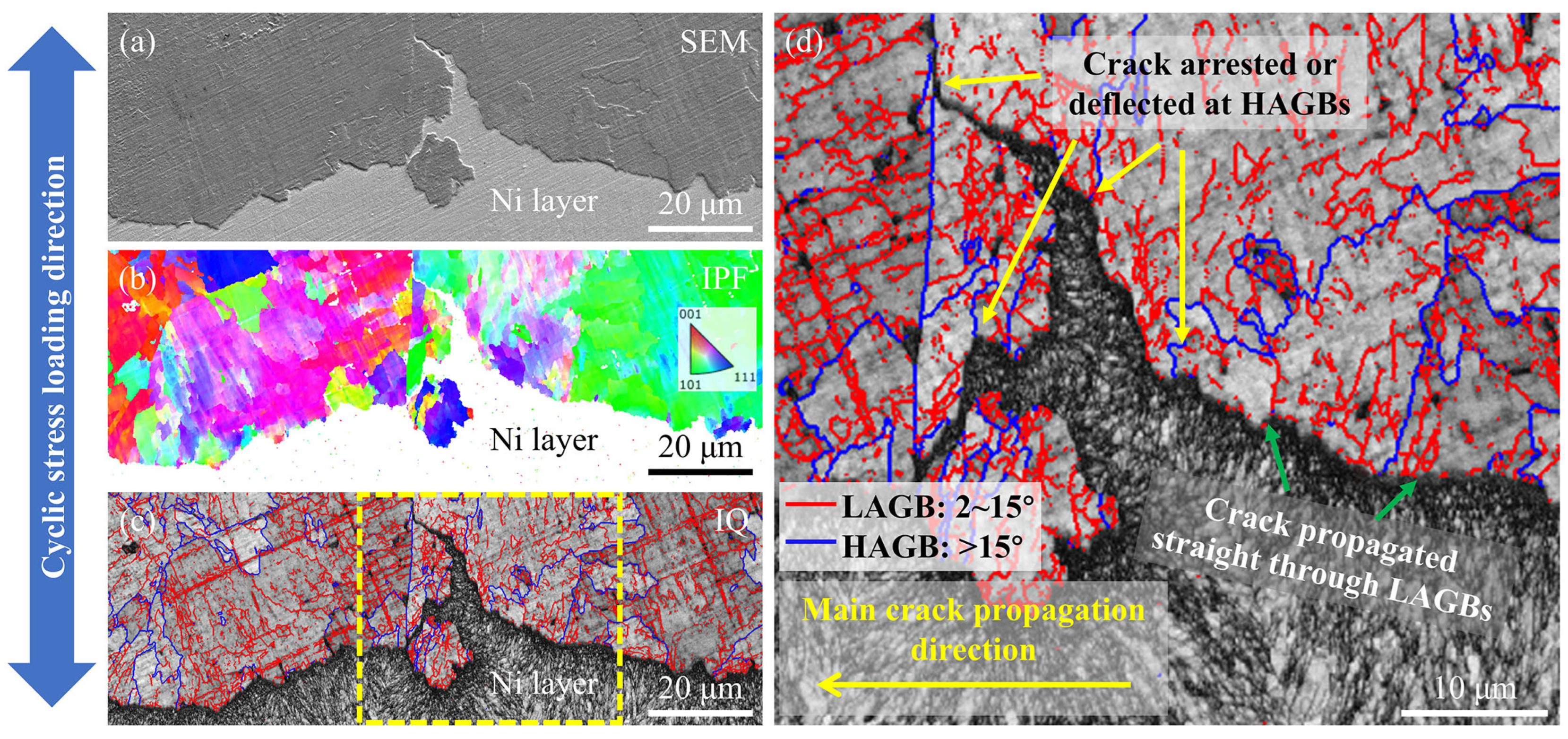
Subsequent to the nucleation of fatigue microcracks on the surface of CGHAZ specimens, fatigue cracks underwent subsequent propagation into the interior of CGHAZ specimens during cyclic stress loading. A characterization of the propagation path of fatigue microcracks in the CGHAZ was conducted, and the results are displayed in Figure 16. Prior to the execution of the EBSB test, the fatigue fracture surface was protected by a layer of nickel plating. The main fatigue crack propagated predominantly perpendicular to the cyclic loading direction, with its local deflections caused by obstacles from HAGBs. Secondary microcracks were initiated from the main fatigue crack, generally propagating directly through the LAGBs while deflecting or arresting at the HAGBs. The findings indicated that HAGBs effectively impeded the propagation of fatigue cracks, whereas LAGBs lacked this capability. This phenomenon can be attributed to the significant disparity in crystallographic orientation across HAGBs. The propagation of fatigue cracks necessitated the expenditure of considerable energy to alter their path and accommodate the novel crystallographic plane [23,37]. Furthermore, despite exerting a negative influence by hindering dislocation motion during the crack initiation, HAGBs ultimately inhibited crack propagation to a certain extent. In contrast, LAGBs exhibited the opposite effect. Consequently, the augmented Nb content elevated the density of HAGB in the simulated CGHAZs (Table 2), thereby enhancing the inhibitory effect of fatigue crack propagation and augmenting the fatigue crack propagation lifetime.
In summary, an increase in Nb present has been shown to inhibit both crack initiation and propagation of fatigue cracks, thereby contributing positively to the enhancement of both crack fatigue initiation lifetime and propagation lifetime. However, it is imperative to acknowledge that crack initiation lifetimes accounted for over 97% of the total failure lifetimes. Compared to the propagation lifetimes, the enhancement in Nb content exerted a more positive influence on the augmentation of crack initiation lifetimes. It has been determined that fatigue crack initiation was the predominant factor leading to fatigue failure fractures. Finally, the fatigue strength of the simulated CGHAZs increased continuously from 212.6 MPa to 231.9 MPa as the Nb content was increased from 0.018 wt.% to 0.055 wt.%.

5. Conclusions

The microstructure and high-cycle fatigue properties of the simulated CGHAZs with varying Nb contents were investigated in a low-carbon microalloyed steel through Gleeble 3800-GTC system. The fatigue fracture characteristics and damage mechanism were revealed with remarkable clarity. The main conclusions are summarized as follows.
(1)
As the Nb content increased, the area fractions of the GBF and M/A constituent increased in the CGHAZ, while those of the LBF and DP decreased. Concurrent with these alterations, the densities of both LAGBs and HAGBs increased, the MED from EBSD data decreased, and the PAGs refined.
(2)
The fatigue strength of the simulated CGHAZs exhibited an upward trend, increasing from 212.6 MPa to 231.9 MPa as the Nb content was augmented from 0.018 wt.% to 0.055 wt.%. In addition, the yield strength, tensile strength, and hardness of the CGHAZs exhibited a continuous increasing trend with increasing Nb content.
(3)
The fatigue crack initiation lifetime of the CGHAZs accounted for over 97% of the total failure lifetimes, and the fatigue crack initiation was identified as the dominant factor governing fatigue damage. The increase in Nb content promoted a synergistic effect, evidenced by an elevated density of LAGBs and a decreased MED, which collectively enhanced the resistance to fatigue crack initiation.
(4)
HAGBs can deflect and arrest the fatigue secondary microcracks effectively. The enhanced density of HAGBs, concomitant with elevated Nb contents, has been demonstrated to directly augment the inhibitory effect of fatigue crack propagation.
(5)
For the low-carbon microalloyed steels, the increase in Nb content resulted in enhanced fatigue crack initiation and propagation lifetimes, thereby increasing the high-cycle fatigue strength of the CGHAZ.

Author Contributions

Conceptualization, G.Z. and Q.W.; Methodology, G.Z. and Y.K.; Formal analysis, G.Z. and L.Z.; Investigation, G.Z., J.H. and Y.K.; Resources, J.H.; Data curation, G.Z., J.H. and L.Z.; Writing—original draft, G.Z.; Writing—review & editing, Q.W. and Z.L.; Visualization, G.Z.; Supervision, Q.W. and Z.L.; Project administration, G.Z.; Funding acquisition, Q.W. and Z.L. All authors have read and agreed to the published version of the manuscript.

Funding

This work was supported by the Major Scientific and Technological Innovation Project of CITIC Group (Grant Number 2022zxkya06100) and the CITIC Metal—CBMM Collaborative R&D Project for Niobium Technology Advancement (Grant Number M2149-2024).

Data Availability Statement

The original contributions presented in this study are included in the article. Further inquiries can be directed to the corresponding authors.

Conflicts of Interest

Authors Guodong Zhang, Jiangli He and Zhongzhu Liu were employed by the company CITIC Metal Co., Ltd. The remaining authors declare that the research was conducted in the absence of any commercial or financial relationships that could be construed as a potential conflict of interest.

Abbreviations

The following abbreviations are used in this manuscript:
CGHAZCoarse-grained heat-affected zone
LAGBsLow-angle grain boundaries
HAGBsHigh-angle grain boundaries
MEDMean equivalent diameter
PAGsPrior austenite grains
TMCPThermomechanical control process
OMOptical microscope
SEMScanning electron microscope
EBSDElectron backscatter diffraction
TEMTransmission electron microscope
EDSEnergy-dispersive X-ray spectroscopy
LBFLath bainitic ferrite
GBFGranular bainitic ferrite
DPFDegenerated pearlite ferrite
SAEDSelected area electron diffraction
BCCBody-centered cubic
FCCFace-centered cubic
IPFsInverse pole figures
MTAsMisorientation angles
IQImage quality
KAMKernel average misorientation

References

  1. Li, Y.L.; Huang, Y.J.; Sheng, J. Policy-driven energy transition: China’s low-carbon journey and global implications. Energy Econ. 2025, 150, 108888. [Google Scholar] [CrossRef]
  2. Liu, P.H.; Li, M.D.; Han, C.F.; Meng, L.P.; Shao, Z.G. From input to output: Unraveling the Spatio–temporal pattern and driving factors of the coupling coordination between wind power efficiency and installed capacity in China. Appl. Energy 2025, 396, 126320. [Google Scholar] [CrossRef]
  3. Teng, M.M.; Lv, K.F.; Han, C.F.; Liu, P.H. A tripartite stochastic evolutionary game for trading strategies under renewable portfolio standards in China’s electric power industry. Renew. Energy 2025, 240, 122193. [Google Scholar] [CrossRef]
  4. Liu, Y.R.; Gong, B.M.; Liu, S.; Deng, C.Y.; Zhao, Y.Y.; Liu, Y.; Hu, W.T. Low-cycle fatigue properties and fracture location transition mechanism of dissimilar steel welded joints in towers of wind turbines. Int. J. Fatigue 2025, 190, 108672. [Google Scholar] [CrossRef]
  5. Xu, K.; Qiao, G.Y.; Wang, J.S.; Zhang, S.Y.; Xiao, F.R. Research on the fatigue properties of sub-heat-affected zones in X80 pipe. Fatigue Fract. Eng. M. 2020, 43, 2915–2927. [Google Scholar] [CrossRef]
  6. Braun, M.; Wang, X.R. A review of fatigue test data on weld toe grinding and weld profiling. Int. J. Fatigue 2021, 145, 106073. [Google Scholar] [CrossRef]
  7. Wang, B.S.; Chen, N.N.; Cai, Y.; Guo, W.; Wang, M. Effect of crystallographic features on low-temperature fatigue ductile-to-brittle transition for simulated coarse-grained heat-affected zone of bainite steel weld. Int. J. Fatigue 2023, 170, 107523. [Google Scholar] [CrossRef]
  8. Hutchinson, B.; Komenda, J.; Rohrer, G.S.; Beladi, H. Heat affected zone microstructure and their influence on toughness in two microalloyed HSLA steel. Acta Mater. 2015, 97, 380–391. [Google Scholar] [CrossRef]
  9. Nishikawa, H.; Furuya, Y.; Kasuya, T.; Enoki, M. Microstructurally small fatigue crack initiation behavior of fine and coarse grain simulated heat-affected zone microstructures in low carbon steel. Mat. Sci. Eng. A 2022, 832, 142363. [Google Scholar] [CrossRef]
  10. Zhu, Z.H.; Feng, Q.S.; Wang, B.F.; Zheng, W.Q.; Yu, Y.J. High-Cycle Fatigue Performance of the Heat-Affected Zone of Q370qENH Weathering Bridge Steel. J. Mater. Civil. Eng. 2024, 36, 04024018. [Google Scholar] [CrossRef]
  11. Wang, X.Y.; Wang, X.L.; Xie, Z.J.; Shang, C.J.; Liu, Z.Z. Crystallographic study on microstructure evolution and mechanical properties of coarse grained heat affected zone of a 500 MPa grade wind power steel. J. Mater. Res. Technol. 2024, 31, 3921–3934. [Google Scholar] [CrossRef]
  12. Bai, Y.; Guo, X.; Sun, X.J.; Liu, G.Y.; Xie, Z.J.; Wang, X.L.; Shang, C.J. Effect of heat input on microstructural characteristics and fatigue property of heat-affected zone in a FH690 heavy-gauge marine steel. Int. J. Fatigue 2025, 196, 108898. [Google Scholar] [CrossRef]
  13. Zhang, X.Y.; Gao, H.L.; Zhuang, C.J.; Ji, L.K. Effect of Welding Heat Input on Microstructure and Properties of Coarse Grain Zones in X100 Pipeline Steel. J. Weld. 2010, 31, 29–32+114. [Google Scholar]
  14. Huang, W.; Qi, K.; Liu, Z.; Yang, L.; Xue, Z.; Li, T.; Zhang, X.; Li, R. Microstructure and mechanical properties of submerged arc welded medium-thickness Q690qE high-strength steel plate joints. High Temp. Mater. Process. 2024, 43, 20240033. [Google Scholar] [CrossRef]
  15. Ma, Y.M.; Guo, X.; Han, Y.; Jiang, Y.; Liu, Z.; Gan, H.; Song, C. Influence mechanism of heat input on low-temperature impact toughness of the coarse grain heat affected zone of ultra-strength steel. Trans. China Weld. Inst. 2024, 45, 90–98. [Google Scholar]
  16. Cao, R.; Yang, Z.; Chan, Z.; Lei, W. The determination of the weakest zone and the effects of the weakest zone on the impact toughness of the 12Cr2Mo1R welded joint. J. Manuf. Process. 2020, 50, 539–546. [Google Scholar] [CrossRef]
  17. He, C.; Huang, C.X.; Liu, Y.J.; Wang, Q.Y. Fatigue damage evaluation of low-alloy steel welded joints in fusion zone and heat affected zone based on frequency response changes in gigacycle fatigue. Int. J. Fatigue 2014, 61, 297–303. [Google Scholar] [CrossRef]
  18. He, H.F.; Yang, D.D.; Ren, Z.H.; Zhao, R.C.; Huang, J.H. The proportion between the gear bending fatigue crack initiation and total life: A quantitative study. Eng. Fail. Anal. 2025, 175, 109611. [Google Scholar] [CrossRef]
  19. Wang, B.; Chen, N.; Cai, Y.; Guo, W.; Wang, M. Effect of Microstructure on Impact Toughness and Fatigue Performance in Coarse-Grained Heat-Affected Zone of Bainitic Steel Welds. J. Mater. Eng. Perform. 2023, 32, 3678–3689. [Google Scholar] [CrossRef]
  20. GB/T 24176-2009; Metallic Materials—Fatigue Testing—Statistical Planning and Analysis of Data. Standards Press of China: Beijing, China, 2009.
  21. Zhao, L.Y.; Wang, Q.F.; Shi, G.H.; Yang, X.Y.; Qiao, M.L.; Wu, J.P.; Zhang, F.C. In-depth understanding of the relationship between dislocation substructure and tensile properties in a low carbon microalloying steel. Mater. Sci. Eng. A 2022, 854, 143681. [Google Scholar] [CrossRef]
  22. Zhang, S.M.; Liu, K.; Chen, H.; Xiao, X.P.; Wang, Q.F.; Zhang, F.C. Effect of increased N content on microstructure and tensile properties of low-C V-microalloyed steels. Mater. Sci. Eng. A 2016, 651, 951–960. [Google Scholar] [CrossRef]
  23. He, J.L.; Wang, Q.M.; Zhao, L.Y.; Hu, B.; Wang, Q.F. Competitive growth of martensite/austenite constituent and degenerated pearlite and the impact toughness in the coarse-grained heat-affected zone of a low carbon microalloying steel. J. Mater. Res. Technol. 2025, 36, 789–805. [Google Scholar] [CrossRef]
  24. Kumar, N.; Kumar, P. Investigation on microstructural and mechanical integrity of GTAW dissimilar welded joint of IN 718/ASS 304L using Ni-based filler IN 625 using EBSD and DHD techniques. Int. J. Press. Vessel. Pip. 2024, 209, 105213. [Google Scholar] [CrossRef]
  25. Xue, J.L.; Guo, W.; Zhang, Y.X.; Xia, M.S.; Jia, Q.; Chi, J.X.; Shi, J.X.; Wu, Y.; Zhang, H.Q. Local microstructure and mechanical characteristics of HAZ and tensile behavior of laser welded QP980 joints. Mater. Sci. Eng. A 2022, 854, 143862. [Google Scholar] [CrossRef]
  26. Basquin, O.H. The exponential law of endurance tests. Am. Soc. Test. Mater. Proc. 1910, 10, 625–630. [Google Scholar]
  27. Murakami, Y.; Takagi, T.; Wada, K.; Matsunaga, H. Essential structure of S-N curve: Prediction of fatigue life and fatigue limit of defective materials and nature of scatter. Int. J. Fatigue 2021, 146, 106138. [Google Scholar] [CrossRef]
  28. Connors, W.C. Fatigue striation spacing analysis. Mater. Charact. 1994, 33, 245–253. [Google Scholar] [CrossRef]
  29. Moreira, P.M.G.P.; de Matos, P.F.P.; de Castro, P.M.S.T. Fatigue striation spacing and equivalent initial flaw size in Al 2024-T3 riveted specimens. Theor. Appl. Fract. Mec. 2005, 43, 89–99. [Google Scholar] [CrossRef]
  30. Yang, Y.L.; Jia, X.; Ma, Y.X.; Wang, P.; Zhu, F.X.; Yang, H.F.; Wang, C.; Wang, S.G. Effect of Nb on microstructure and mechanical properties between base metal and high heat input coarse-grain HAZ in a Ti-deoxidized low carbon high strength steel. J. Mater. Res. Technol. 2022, 18, 2399–2412. [Google Scholar] [CrossRef]
  31. Wang, Z.X.; Li, X.C.; Wang, X.L.; Shang, C.J.; Zhang, Y.Q. Studies on the effect of Nb on microstructure refinement and impact toughness improvement in coarse-grained heat-affected zone of X80 pipeline steels. Mater. Today Commun. 2025, 42, 111605. [Google Scholar] [CrossRef]
  32. Zhu, D.M.; He, J.L.; Shi, G.H.; Wang, Q.F. Effect of Welding Heat Input on Microstructure and Impact Toughness of the Simulated CGHAZ in Q500qE Steel. Acta Met. Sin. 2022, 58, 1581–1588. [Google Scholar]
  33. Daigne, J.; Guttmann, M.; Naylor, J.P. The influence of lath boundaries and carbide distribution on the yield strength of 0.4% C tempered martensitic steels. Mater. Sci. Eng. 1982, 56, 1–10. [Google Scholar] [CrossRef]
  34. Wen, H.; Wang, Q.; Dou, Y.; Wang, Q.; Xu, X.; Wang, Q. Comparison of Strengthening Mechanism of the Nb, V, and Nb-V Micro-Alloyed High-Strength Bolt Steels Investigated by Microstructural Evolution and Strength Modeling. Metals 2024, 14, 1309. [Google Scholar] [CrossRef]
  35. Park, H.; Jo, H.H.; Kim, S.H.; Kim, C.; Moon, J.; Chung, J.H.; Lee, B.H.; Lee, C.H. Distinct roles of Nb, Ti, and V microalloying elements on the fire resistance of low-Mo steels. J. Mater. Res. Technol. 2025, 37, 2144–2151. [Google Scholar] [CrossRef]
  36. Liu, F.C.; Li, J.W.; Wang, Q.; Liu, Y.D.; Bai, Y.; He, T.; Yuan, G. Microstructural refinement by the formation of acicular ferrite on Ti–Mg oxide inclusion in low-carbon steel. Mat. Sci. Eng. A 2021, 824, 141795. [Google Scholar] [CrossRef]
  37. Shi, G.H.; Zhao, H.L.; Zhang, S.M.; Wang, Q.F.; Zhang, F.C. Microstructural characteristics and impact fracture behaviors of low-carbon vanadium-microalloyed steel with different nitrogen contents. Mat. Sci. Eng. A 2020, 769, 138501. [Google Scholar] [CrossRef]
  38. Zener, C. Theory of Growth of Spherical Precipitates from Solid Solution. J. Appl. Phys. 1949, 20, 950–953. [Google Scholar] [CrossRef]
  39. Antolovich, S.D.; Armstrong, R.W. Plastic strain localization in metals: Origins and consequences. Prog. Mater. Sci. 2014, 59, 1–160. [Google Scholar] [CrossRef]
  40. Figueroa, J.C.; Laird, C. Crack initiation mechanisms in copper polycrystals cycled under constant strain amplitudes and in step tests. Mater. Sci. Eng. 1983, 60, 45–58. [Google Scholar] [CrossRef]
  41. Tanaka, K.; Mura, T. A dislocation model for fatigue crack initiation. J. Appl. Mech. 1981, 48, 97–103. [Google Scholar] [CrossRef]
  42. Sangid, M.D.; Maier, H.J.; Sehitoglu, H. The role of grain boundaries on fatigue crack initiation–An energy approach. Int. J. Plast. 2011, 27, 801–821. [Google Scholar] [CrossRef]
  43. Essmann, U.; Gösele, U.; Mughrabi, H. A model of extrusions and intrusions in fatigued metals I. Point-defect production and the growth of extrusions. Philos. Mag. A 1981, 44, 405–426. [Google Scholar] [CrossRef]
  44. Kobayashi, S.; Inomata, T.; Kobayashi, H.; Tsurekawa, S.; Watanabe, T. Effects of grain boundary- and triple junction-character on intergranular fatigue crack nucleation in polycrystalline aluminum. J. Mater. Sci. 2008, 43, 3792–3799. [Google Scholar] [CrossRef]
  45. Zhang, Z.J.; Zhang, P.; Li, L.L.; Zhang, Z.F. Fatigue cracking at twin boundaries: Effects of crystallographic orientation and stacking fault energ. Acta Mater. 2012, 60, 3113–3127. [Google Scholar] [CrossRef]
  46. Wang, Y.J.; Li, L.L.; Zhang, Z.J.; Zhang, Z.F. Effects of grain size and Schmid factor difference on fatigue cracking at twin boundaries in CrCoNi medium-entropy alloy. Acta Metall. Sin. 2025, 1–11. [Google Scholar]
  47. Li, L.L.; Zhang, Z.J.; Zhang, P.; Zhang, Z.F. A review on the fatigue cracking of twin boundaries: Crystallographic orientation and stacking fault energy. Prog. Mater. Sci. 2023, 131, 101011. [Google Scholar] [CrossRef]
Figure 1. Three-dimensional diagram of the thermal simulated specimens.
Metals 16 00175 g001
Figure 2. Typical OM and SEM micrographs of the simulated CGHAZs: (a,d) 18 Nb; (b,e) 38 Nb; (c,f) 55 Nb. LB—lath bainite, GB—granular bainite, LBF—lath bainitic ferrite, GBF—granular bainitic ferrite, M/A—M/A constituent, DP—degenerated pearlite.
Metals 16 00175 g002
Figure 3. Area fraction of each microstructure in the simulated CGHAZs.
Metals 16 00175 g003
Figure 4. Typical TEM micrographs of the simulated CGHAZs: (a,b) 18 Nb; (c) 55 Nb; (d) 38 Nb. (e,f) Magnified images of the selected areas from (d). (g) Selected area electron diffraction (SAED) pattern of the bainitic ferrite matrix, (h) SAED pattern of the θ phase, and (i) SAED pattern of the M/A constituent.
Metals 16 00175 g004
Figure 5. Inverse pole figures (IPFs) (a,d,g), image quality (IQ) maps with grain boundary distributions (b,e,h), and kernel average misorientation (KAM) maps (c,f,i) in the simulated CGHAZs: 18 Nb (ac); 38 Nb (df); 55 Nb (gi).
Metals 16 00175 g005
Figure 6. Mean equivalent diameter (MED) as a function of misorientation angles (MTAs) (a), the number fraction of MTA (b), and the number fraction of kernel average misorientation (KAM) value (c) in the simulated CGHAZs.
Metals 16 00175 g006
Figure 7. Micrographs (ac) and statistical histograms (df) of prior austenite grains (PAGs) in the simulated CGHAZs: (a,d) 18 Nb; (b,e) 38 Nb; (c,f) 55 Nb. The red curves represent Gaussian fits applied to these histograms.
Metals 16 00175 g007
Figure 8. TEM micrographs (ac) and EDS point analysis (df) of precipitated particles in the simulated CGHAZs: (a,d) 18 Nb; (b,e) 38 Nb; (c,f) 55 Nb.
Metals 16 00175 g008
Figure 9. Engineering stress–strain curves (a) and hardness (b) of each specimen in the CGHAZs.
Metals 16 00175 g009
Figure 10. High-cycle fatigue properties of the simulated CGHAZs with varying Nb contents: (a) 18 Nb; (b) 38 Nb; (c) 55 Nb; (d) S-N curves fitted with Nf vs. stress amplitude.
Metals 16 00175 g010
Figure 11. Typical fatigue fracture morphologies of 18 Nb CGHAZ failure specimen (σa = 234 MPa, Nf = 352,540): (a) overall morphology; (b) fatigue origin; (c) fatigue crack propagation region; (d) magnified image of the selected area from (c); (e) instantaneous fracture region. The yellow arrows in these micrographs indicate the direction of crack propagation direction.
Metals 16 00175 g011
Figure 12. Typical fatigue fracture morphologies of 38Nb CGHAZ failure specimen (σa = 234 MPa, Nf = 815,662): (a) overall morphology; (b) fatigue origin; (c) fatigue crack propagation region; (d) magnified image of the selected area from (c); (e) instantaneous fracture region.
Metals 16 00175 g012
Figure 13. Typical fatigue fracture morphologies of 55 Nb CGHAZ failure specimen (σa = 234 MPa, Nf = 1,458,632): (a) overall morphology; (b) fatigue origin; (c) fatigue crack propagation region; (d) magnified image of the selected area from (c); (e) instantaneous fracture region.
Metals 16 00175 g013
Figure 14. Thermal dilatometric curves of the simulated CGHAZs with different Nb contents.
Metals 16 00175 g014
Figure 15. Thermodynamic calculations of the precipitated particles in the simulated CGHAZs: (a) 18 Nb; (b) 38 Nb; (c) 55 Nb.
Metals 16 00175 g015
Figure 16. Typical SEM micrograph (a), IPF (b), and IQ map (c) with grain boundary distributions of the propagation path of fatigue cracks in the 38 Nb CGHAZ. (d) Magnified images of the selected areas from (c).
Metals 16 00175 g016
Table 1. Chemical composition of the experimental steels (wt.%).
CSiMnPSCrNbVTiAltFe
18 Nb0.070.231.380.0060.0030.240.0180.0250.0140.027Balance
38 Nb0.070.231.420.0050.0040.240.0380.0250.0150.031Balance
55 Nb0.070.231.400.0040.0030.240.0550.0250.0140.032Balance
Table 2. EBSD statistical data of the simulated CGHAZs.
LAGBHAGBMEDMTA ≥ 15° (μm)
Number FractionLLAGB (mm) ρ L A G B
(1/μm)
Number FractionLHAGB (mm) ρ H A G B
(1/μm)
18 Nb59.2%8.692.32 × 10−440.8%5.991.60 × 10−47.73
38 Nb62.1%10.002.67 × 10−437.9%6.211.66 × 10−47.25
55 Nb66.9%11.202.99 × 10−433.1%6.541.74 × 10−46.73
Table 3. Mechanical property summary of the simulated CGHAZs.
SpecimenYield Strength (MPa)Tensile Strength (MPa)Uniform Elongation (%)Hardness (HV0.5)
18 Nb469 ± 4600 ± 710.9 ± 0.1198.8 ± 6.6
38 Nb490 ± 1617 ± 210.0 ± 0.2203.3 ± 5.6
55 Nb503 ± 4637 ± 89.5 ± 0.2211.7 ± 3.7
Disclaimer/Publisher’s Note: The statements, opinions and data contained in all publications are solely those of the individual author(s) and contributor(s) and not of MDPI and/or the editor(s). MDPI and/or the editor(s) disclaim responsibility for any injury to people or property resulting from any ideas, methods, instructions or products referred to in the content.