A Finite Volume-Based Unified Transient Deterministic Framework for Lubrication Modelling



Abstract
1. Introduction
2. Methodology
2.1. Coupled Thermo-Hydrodynamic Lubrication Framework
2.1.1. Hydrodynamic Flow and Mass Conservation
2.1.2. Deterministic Representation of Surface Roughness
2.1.3. Film Thickness and Interface Deformation
2.1.4. Surface Coating Deformation
2.1.5. Lubricant Film Temperature
2.1.6. Thermal Transport in Solid and Coated Domains
2.1.7. Interfacial Friction
2.1.8. Constitutive Lubricant Behaviour
2.2. Case Studies
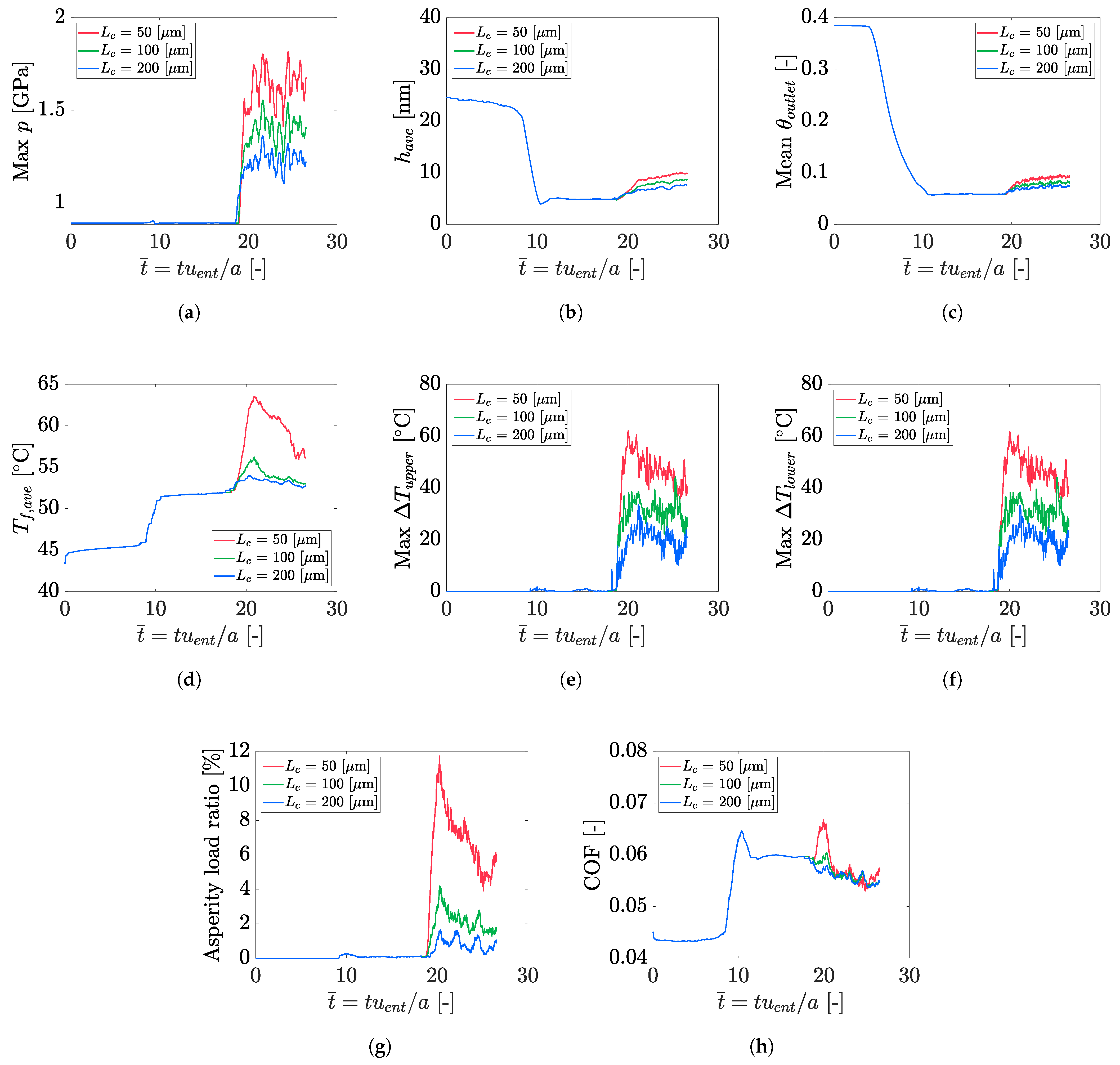
2.2.1. Case Study 1—Transient Starvation with Roughness
2.2.2. Case Study 2—Transient Starvation with Coatings
3. Results and Discussion
3.1. Model Validation
3.1.1. Deterministic Treatment of Roughness
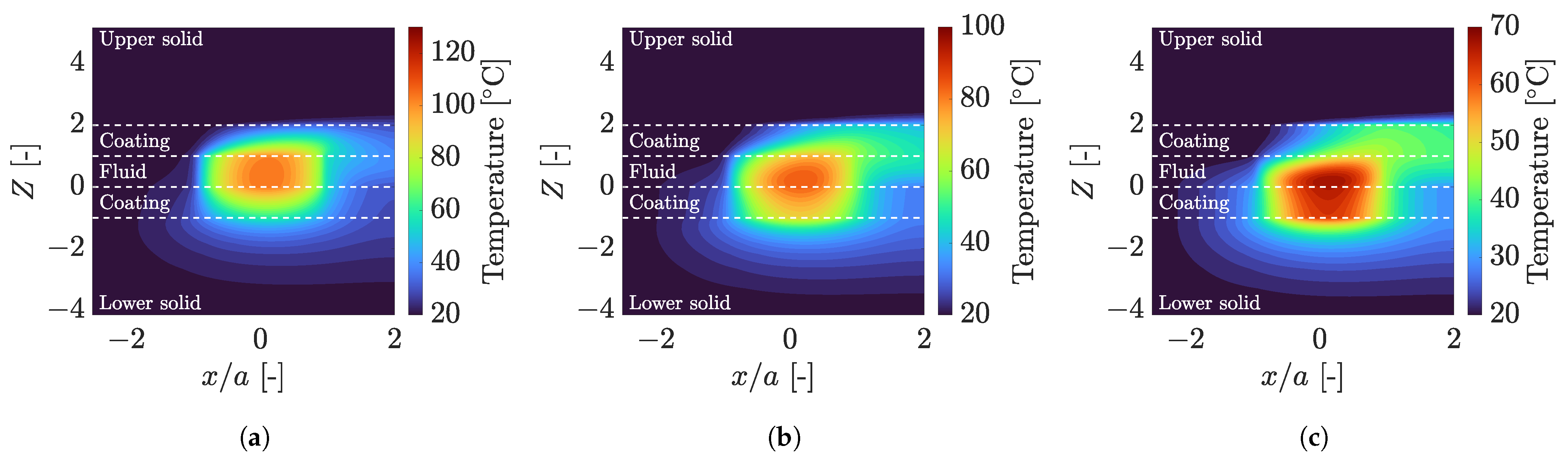
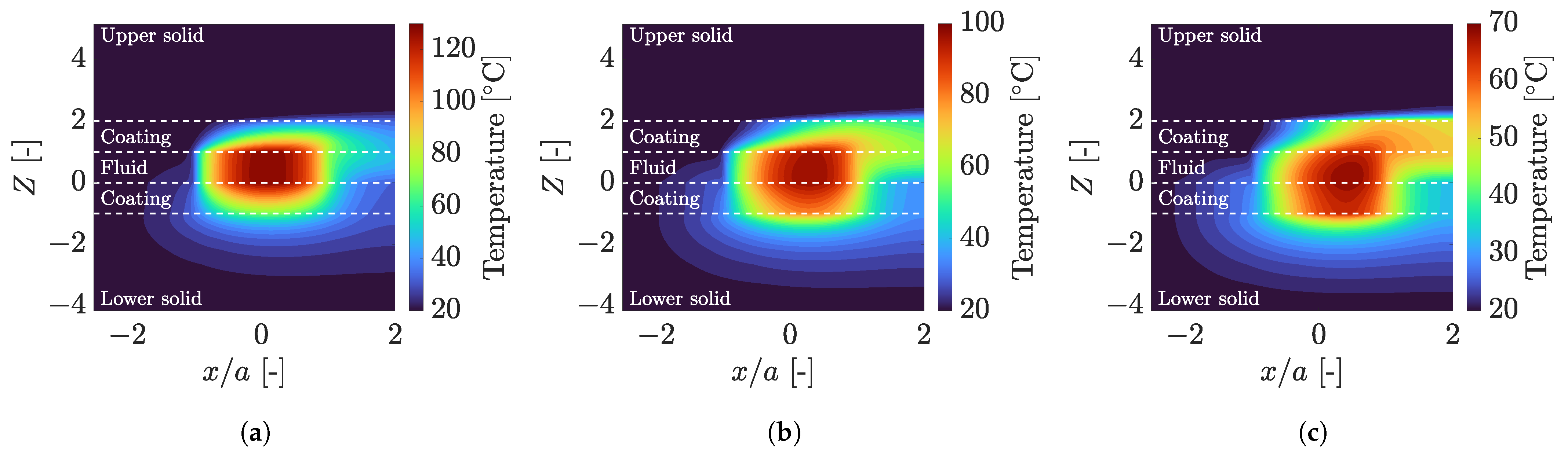
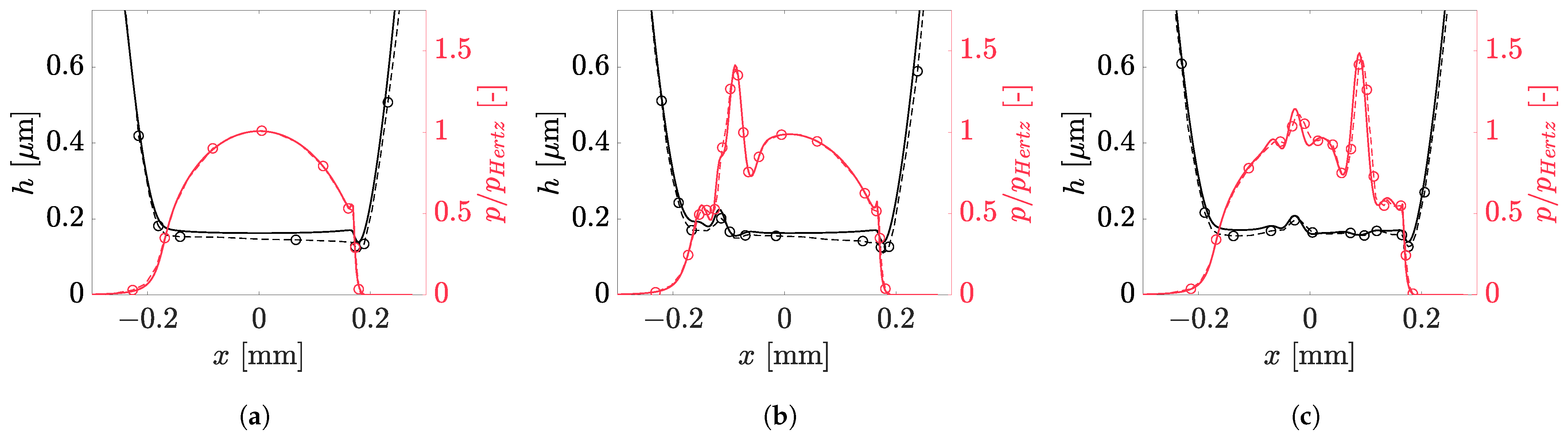
3.1.2. Surface Coatings
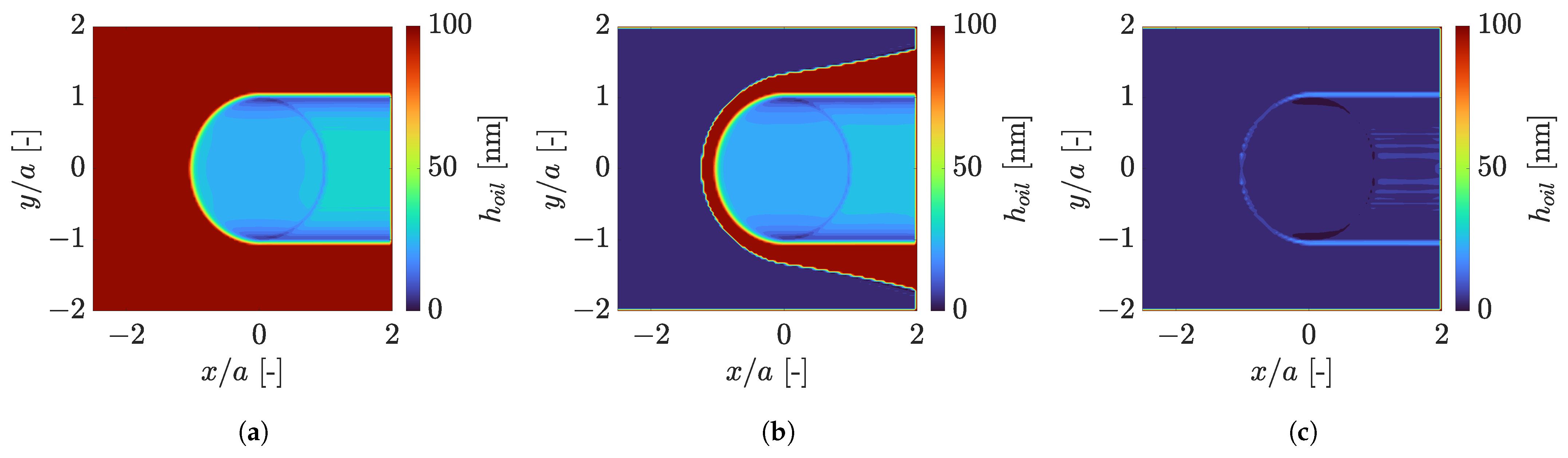
3.2. Case Study 1
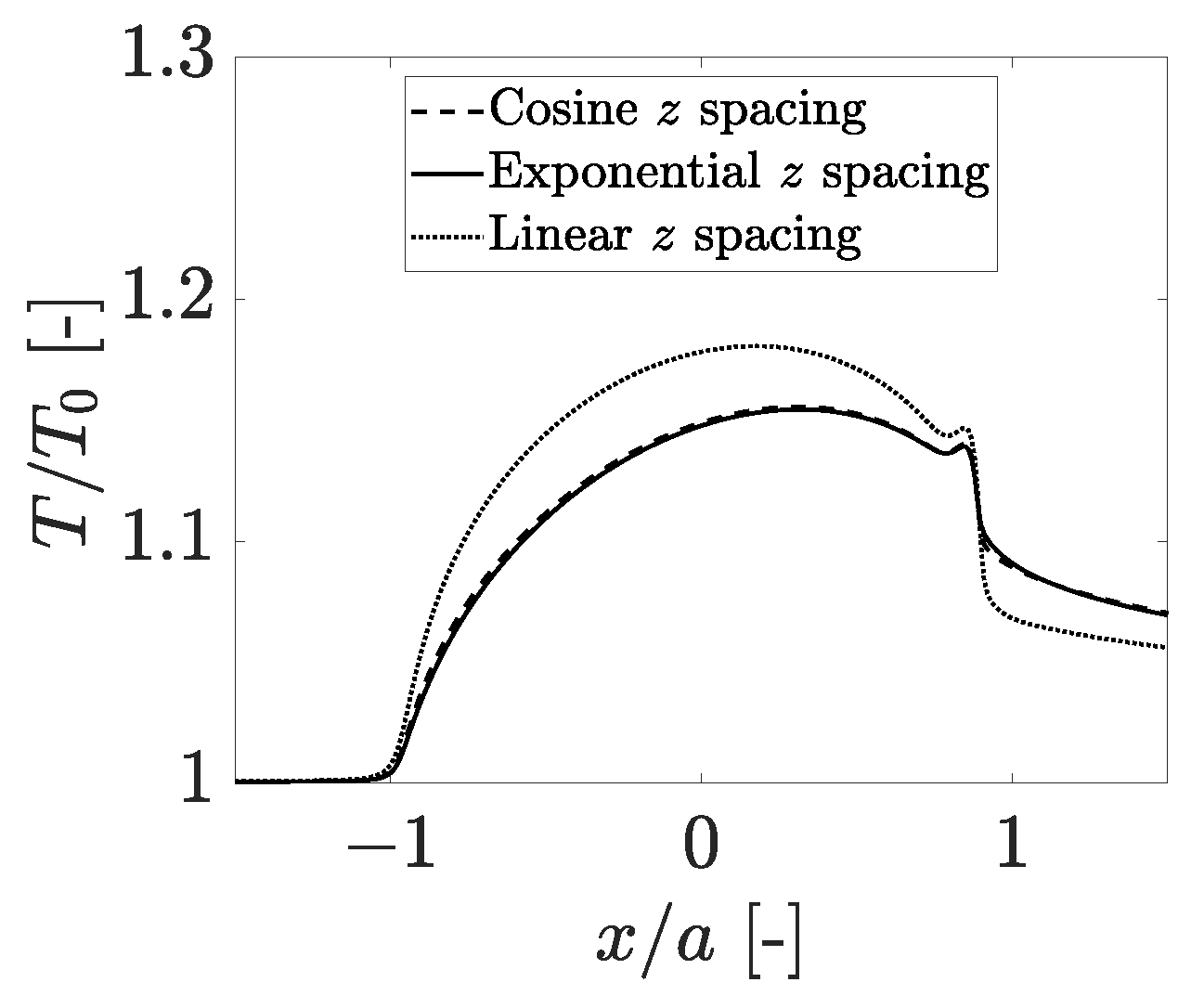
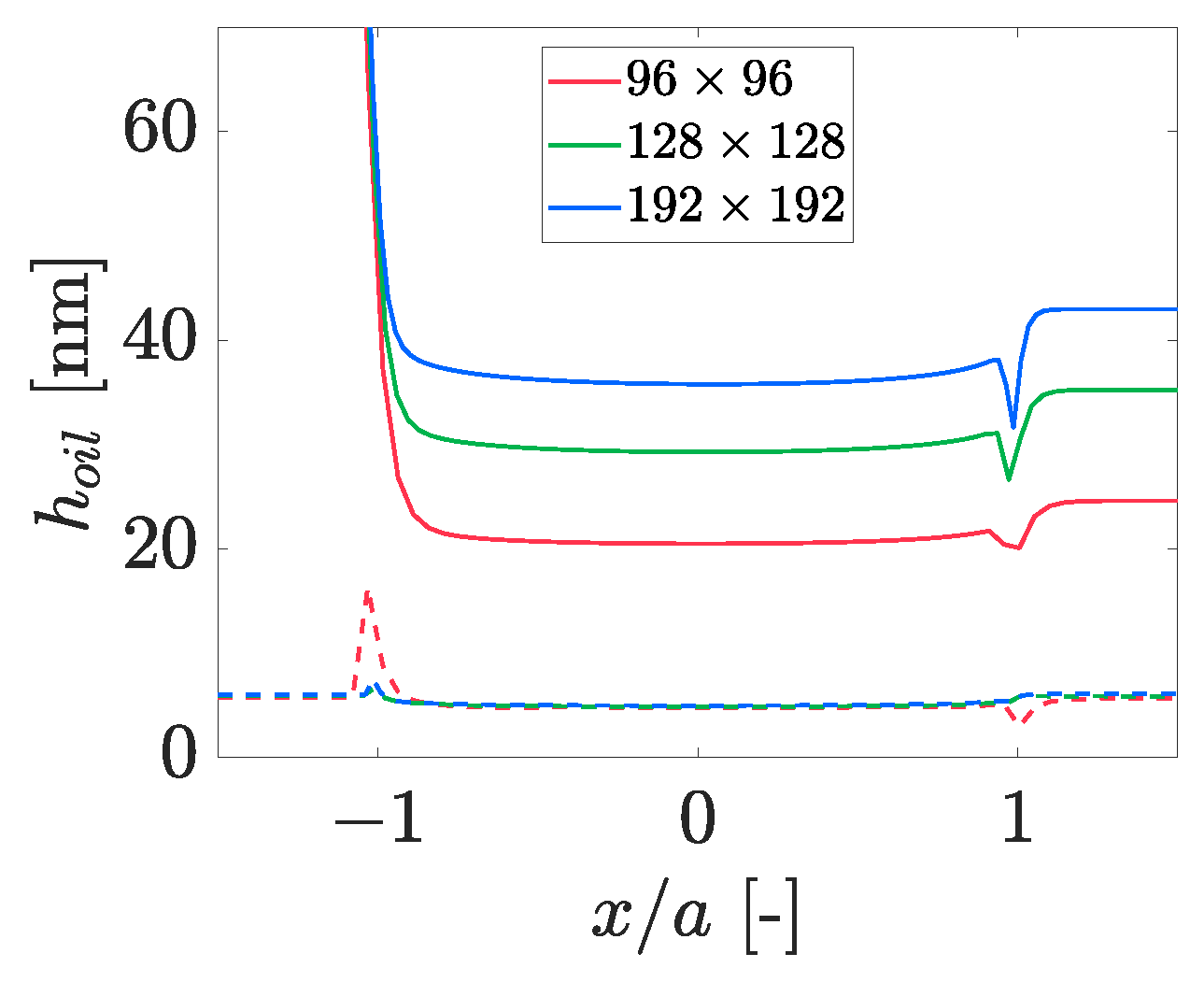
3.2.1. Effect of Mesh Size
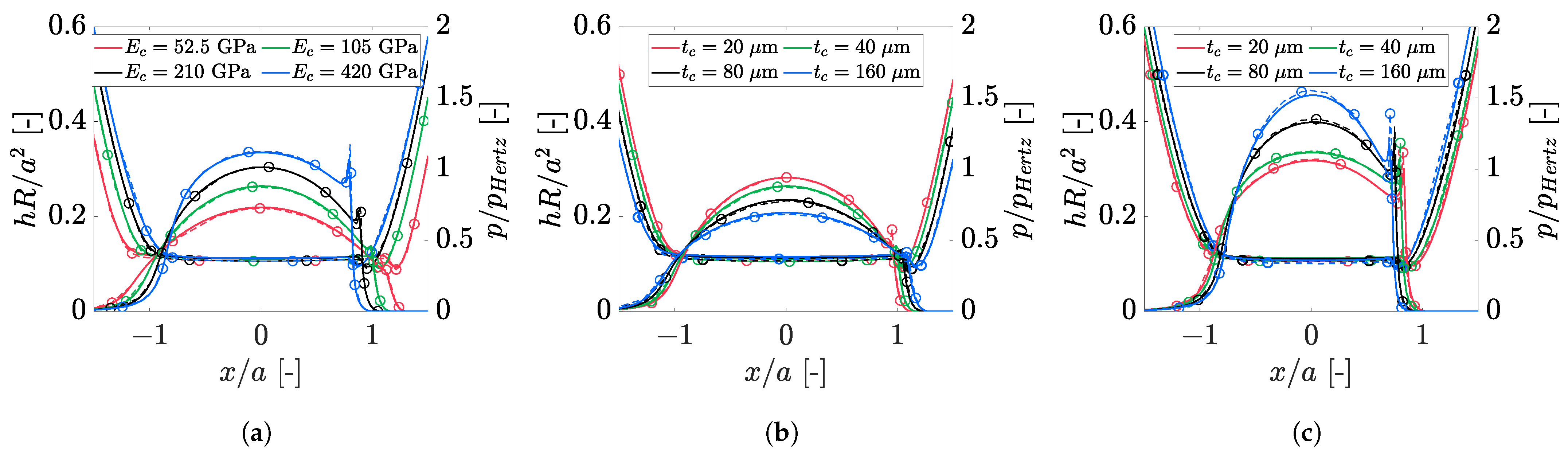
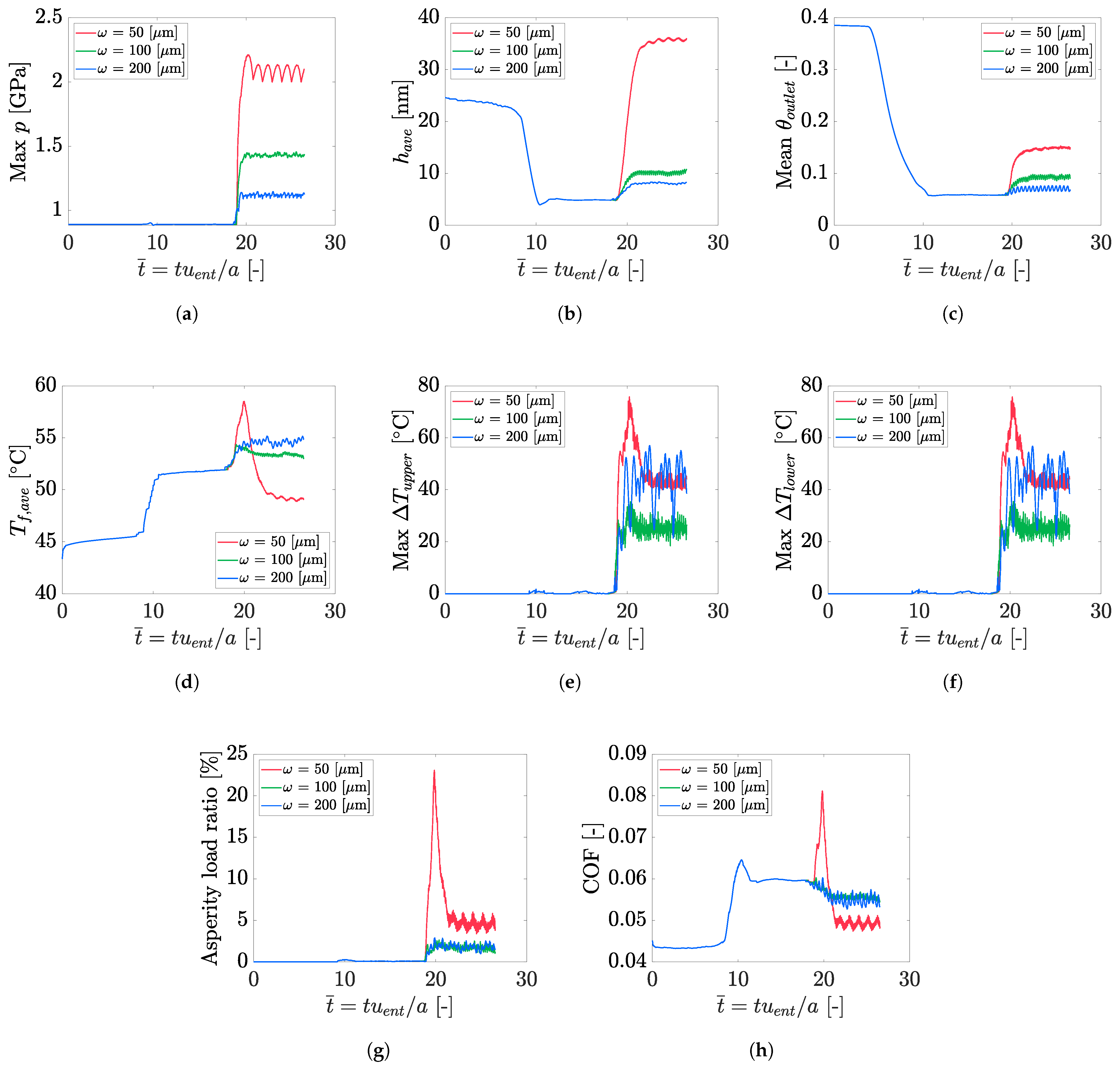
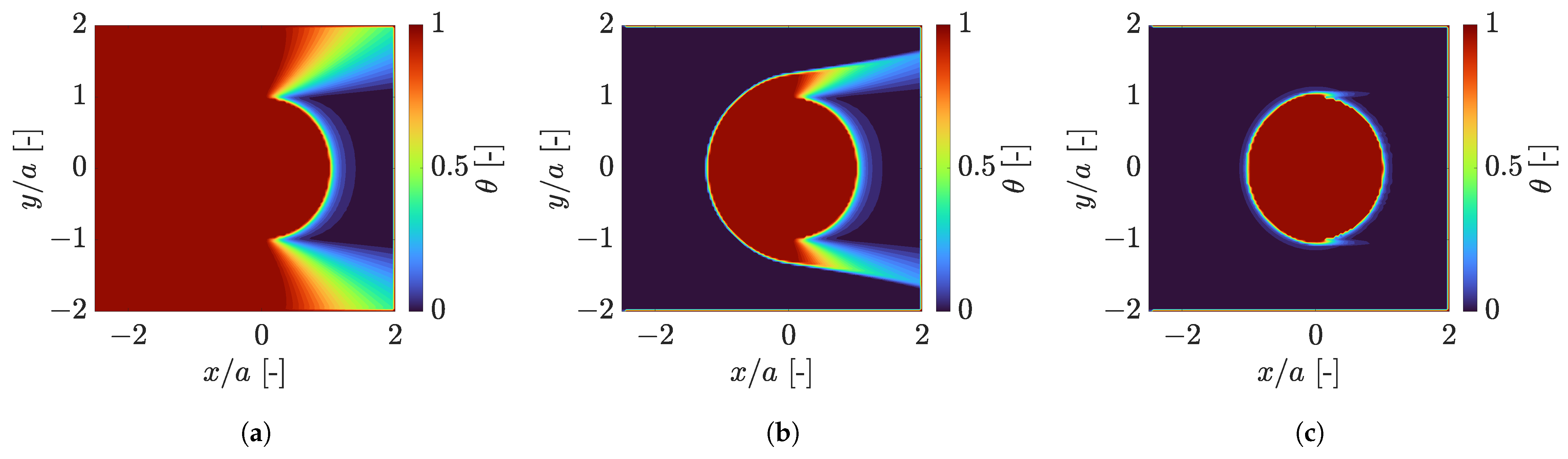
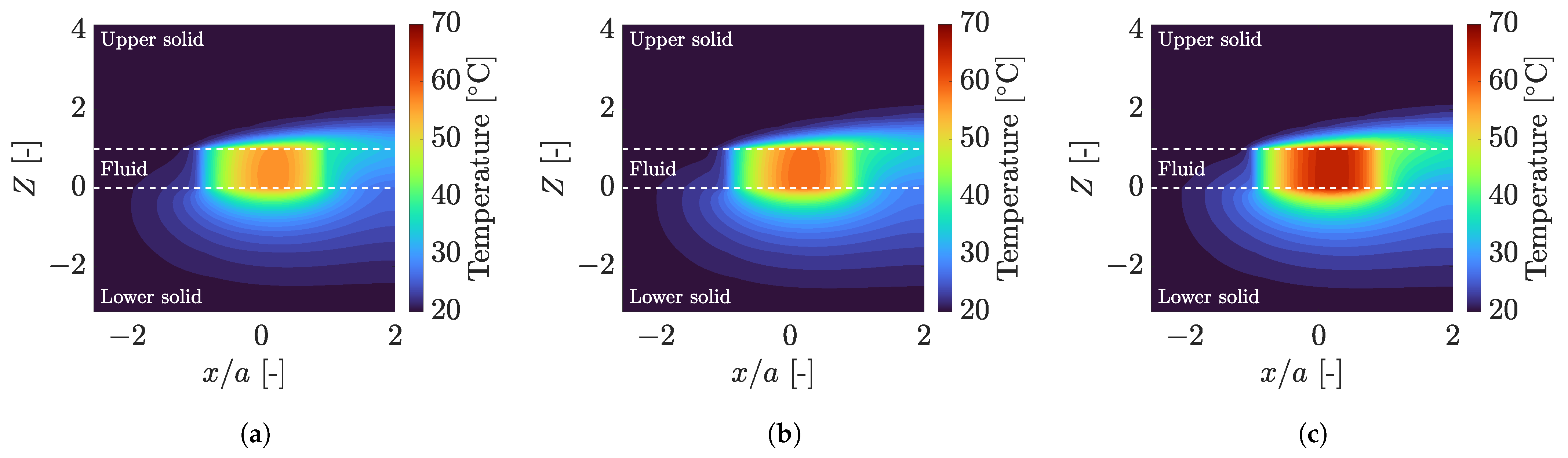
3.2.2. Isotropic Sinusoidal Roughness
- Lower solid:
- Fluid:
- Upper solid:
3.2.3. Random Machined Roughness
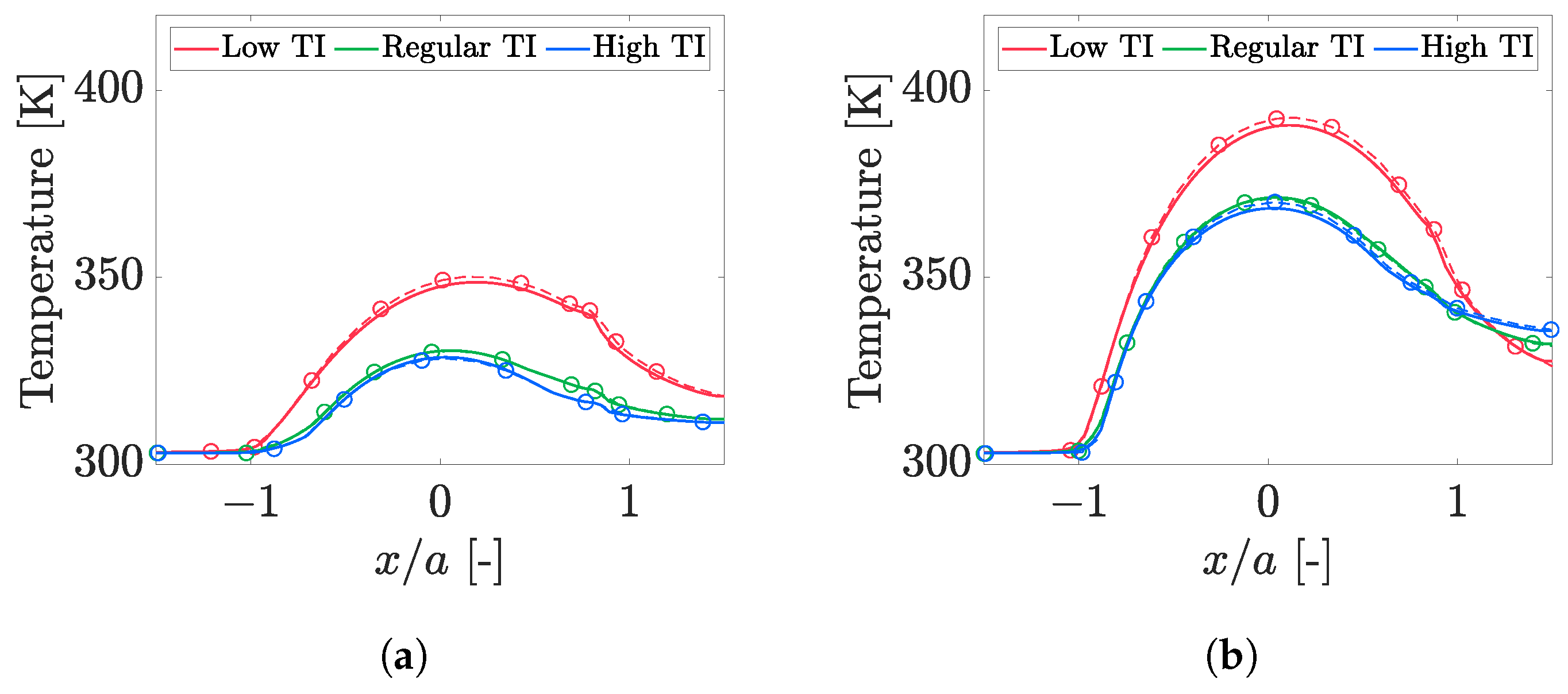
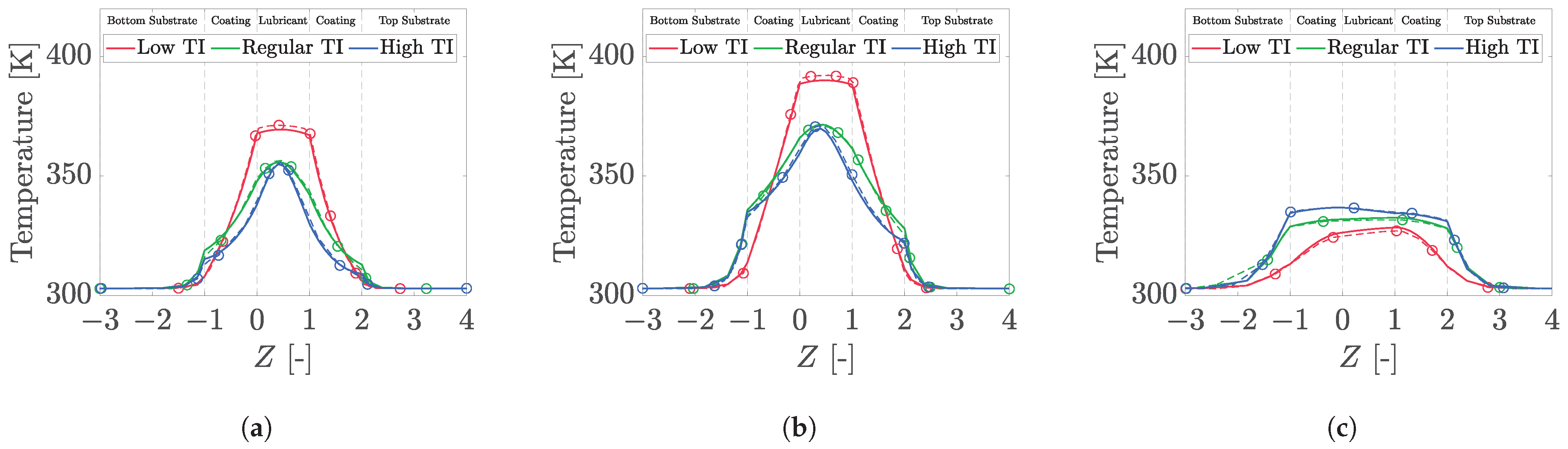
3.3. Case Study 2
- Lower solid:
- Lower coating:
- Fluid:
- Upper coating:
- Upper solid:
4. Conclusions
Author Contributions
Funding
Data Availability Statement
Acknowledgments
Conflicts of Interest
Appendix A. Nomenclature

| Symbol | Parameter |
|---|---|
| A | Roughness amplitude |
| Dimensionless roughness amplitude | |
| a | Hertzian contact radius |
| c | Lubricant specific heat capacity |
| Specific heat capacity of solid body i | |
| Specific heat capacity of coating layer j | |
| Continuous influence coefficient for normal surface displacement | |
| Discrete influence coefficient for normal surface displacement | |
| Thickness of solid body s | |
| Reduced elastic modulus of elasticity | |
| Young’s modulus of lower and upper solids, respectively | |
| Young’s modulus of coating layer j | |
| Pressure-film fraction convergence criterion | |
| Global pressure convergence criterion | |
| Temperature convergence criterion | |
| Global temperature convergence criterion | |
| Load convergence criterion | |
| Boundary friction coefficient | |
| Shear modulus of coating layer j | |
| Frequency response function of the normal surface displacement | |
| h | Geometric film thickness |
| Central film thickness under fully-flooded conditions | |
| Thickness of coating layer j | |
| Lubricant film thickness | |
| Rigid body separation | |
| k | Lubricant thermal conductivity |
| Thermal conductivity of solid body i | |
| Thermal conductivity of coating layer j | |
| L | Total number of coating layers in each solid |
| N | Time iteration |
| Number of discretisation points along each coordinate direction | |
| p | Pressure |
| Fourier-transformed pressure distribution | |
| Asperity contact pressure | |
| Cavitation pressure | |
| Equivalent radii of curvature along the x- and y-directions, respectively | |
| Root mean square roughness | |
| Pressure-film fraction residual | |
| Global pressure residual | |
| Temperature residual | |
| Global temperature residual | |
| Load residual | |
| Time-dependent surface roughness profiles of lower and upper solids, respectively | |
| Slide-to-roll ratio | |
| T | Fluid temperature |
| Reference (ambient) temperature | |
| Temperature of solid body i | |
| t | Time |
| Dimensionless time | |
| Fluid velocities in the x-, y- and z-directions, respectively | |
| Velocities of solid body i in x-, y- and z-directions, respectively | |
| Entrainment speed in the x-direction | |
| Sliding speed in the x-direction | |
| Normal elastic deformation | |
| Fourier-transformed normal displacement in coating layer j | |
| W | Applied load |
| Dimensionless position of roughness profile in the domain | |
| Position of roughness profile in the domain | |
| Position of roughness profile in the domain at | |
| Shape function | |
| Z | Normalised fluid domain coordinate |
| Normalised solid domain coordinate | |
| Normalised coating domain coordinate | |
| Distance of a node () to the origin in the frequency domain | |
| Pressure–viscosity coefficient | |
| Coefficient of fluid thermal expansion | |
| Shear rate | |
| Mesh refinement coefficient | |
| Normal elastic deformation | |
| Fluid viscosity | |
| Reference fluid viscosity | |
| Liquid film fraction | |
| Friction coefficient | |
| Poisson’s ratio of lower and upper solids, respectively | |
| Poisson’s ratio of coating layer j | |
| Fluid density | |
| Density of the saturated fluid at cavitation conditions | |
| Density of solid body i | |
| Density of coating layer j | |
| Reference fluid density | |
| Hydrodynamic shear stress | |
| Asperity contact shear stress | |
| Eyring shear stress | |
| Computational domain | |
| Periodic roughness wavelength | |
| Dimensionless periodic roughness wavelength |
Appendix B. Finite Volume Discretisation
Appendix B.1. Discretisation of the Generalised Reynolds Equation
| Symbol | Parameter | Definition |
|---|---|---|
| Influence coefficient relating the pressure at node to the elastic deformation at node | – | |
| H | Normalised film thickness | |
| Normalised pressure | ||
| N | Time level | – |
| Grid aspect ratio | ||
| Normalised velocities of the lower and upper surfaces in the sliding direction | , | |
| Normalised mean entrainment velocity | ||
| Normalised time step | ||
| Normalised control volume face dimensions in the x- and y-directions | , | |
| Normalised distances between neighbouring nodes in the west and east directions | – | |
| Normalised distances between neighbouring nodes in the north and south directions | – | |
| , | Normalised face lengths associated with west/east and north/south control volume faces | – |
| Normalised pressure-flow coefficient in the generalised Reynolds equation | ||
| Normalised equivalent density integrated across the film thickness | ||
| Normalised entrainment-flow density coefficient | ||
| Normalised surface-velocity density coefficient | ||
| Lubricant film fraction | ||
| Algebraic coefficients associated with west, central, east, north, and south pressure nodes | – | |
| Source term of the discretised Reynolds equation | – |
Appendix B.2. Discretisation of the Fluid Energy Equation
| Symbol | Parameter | Definition |
|---|---|---|
| Normalised specific heat capacity | ||
| H | Normalised lubricant film thickness | |
| Dimensionless diffusion tensor in the transformed coordinate system | – | |
| Normalised pressure | ||
| Outward surface vector normal to a control-volume face | – | |
| Normalised temperature | ||
| Dimensionless contravariant velocity vector in the transformed domain | ||
| Dimensionless contravariant velocity components in the X-, Y-, and Z-directions | – | |
| Normalised coordinates in the sliding, transverse, and film-thickness directions | , , | |
| Normalised coefficient of thermal expansion | ||
| Normalised control-volume dimensions in the transformed coordinate directions | – | |
| Control-volume volume in the transformed domain | ||
| Film-thickness-to-contact-length scale ratio | ||
| Normalised dynamic viscosity | ||
| Normalised density | ||
| Peclet number | ||
| Brinkman number | ||
| Modified Brinkman number |
Appendix B.3. Discretisation of Heat Transport in Solid and Coated Domains
Appendix C. Validation Figures Digitisation Uncertainties
| Figure | Image Resolution | Variable | Axis Range | Estimated Uncertainty |
|---|---|---|---|---|
| Figure 2 and Figure 3 | 824 × 676 | x [mm] | −0.4 to 0.4 [mm] | [mm] |
| Figure 2 and Figure 3 | 824 × 676 | [-] | 0 to 2 [-] | [-] |
| Figure 2 and Figure 3 | 824 × 676 | h [µm] | 0 to 1 [µm] | [µm] |
| Figure 4 and Figure 5 | 961 × 688 | [-] | −1.2 to 1.2 [-] | [-] |
| Figure 4 | 961 × 688 | [-] | 0 to 2.5 [-] | [-] |
| Figure 4 | 961 × 688 | [-] | to [-] | [-] |
| Figure 5 | 961 × 688 | [-] | 1 to 1.25 [-] | [-] |
| Figure 7 | 1254 × 934 | [-] | −2 to 1.5 [-] | [-] |
| Figure 7 | 1254 × 934 | [-] | 0 to 2 [-] | [-] |
| Figure 7 | 1254 × 934 | [-] | 0 to 0.6 [-] | [-] |
| Figure 8 | 1254 × 934 | [-] | −1.5 to 1.5 [-] | [-] |
| Figure 8 and Figure 9 | 1254 × 934 | Temperature [K] | 300 to 420 [K] | [K] |
| Figure 9 | 1254 × 934 | Z [-] | −3 to 4 [-] | [-] |
References
- Lugt, P.M.; Morales-Espejel, G.E. A review of elasto-hydrodynamic lubrication theory. Tribol. Trans. 2011, 54, 470–496. [Google Scholar] [CrossRef] [Scilit]
- Ardah, S.; Profito, F.J.; Dini, D. A comprehensive review and trends in lubrication modelling. Adv. Colloid Interface Sci. 2025, 342, 103492. [Google Scholar] [CrossRef] [Scilit] [PubMed]
- Morales-Espejel, G.E.; Wemekamp, A.W. Ertel-Grubin method in elastohydrodynamic lubrication—A review. Proc. Inst. Mech. Eng. Part J 2008, 222, 15–34. [Google Scholar] [CrossRef] [Scilit]
- Lubrecht, A.A.; Napel, W.E.T.; Bosma, R. The influence of longitudinal and transverse roughness on the elastohydrodynamic lubrication of circular contacts. J. Tribol. 1988, 110, 421–426. [Google Scholar] [CrossRef] [Scilit]
- Patir, N.; Cheng, H.S. An Average Flow Model for Determining Effects of Three-Dimensional Roughness on Partial Hydrodynamic Lubrication. J. Lubr. Technol. 1978, 100, 12–17. [Google Scholar] [CrossRef] [Scilit]
- Patir, N.; Cheng, H.S. Application of Average Flow Model to Lubrication Between Rough Sliding Surfaces. J. Lubr. Technol. 1979, 101, 220–229. [Google Scholar] [CrossRef] [Scilit]
- Venner, C.H.; Lubrecht, A.A. Numerical Simulation of a Transverse Ridge in a Circular EHL Contact Under Rolling/Sliding. J. Tribol. 1994, 116, 751–761. [Google Scholar] [CrossRef] [Scilit]
- Zhu, D.; Hu, Y.Z. The Study of Transition from Elastohydrodynamic to Mixed and Boundary Lubrication. In Proceedings of the Advancing Frontier of Engineering Tribology: Proceedings of the 1999 STLE/SAME H.S. Cheng Tribology Surveillance, Golden, CO, USA, 11–13 October 1999. [Google Scholar]
- Hu, Y.; Zhu, D. A Full Numerical Solution to the Mixed Lubrication in Point Contacts. J. Tribol. 2000, 122, 1–9. [Google Scholar] [CrossRef] [Scilit]
- Venner, C.H.; Lubrecht, A.A. Multilevel Methods in Lubrication; Tribology Series; Elsevier: Amsterdam, The Netherlands, 2000; Volume 37, pp. 57–100. [Google Scholar]
- Liu, S.; Wang, Q.; Liu, G. A versatile method of discrete convolution and FFT (DC-FFT) for contact analyses. Wear 2000, 243, 101–111. [Google Scholar] [CrossRef] [Scilit]
- Zhu, D. On some aspects of numerical solutions of thin-film and mixed elastohydrodynamic lubrication. Proc. Inst. Mech. Eng. Part J 2007, 221, 561–579. [Google Scholar] [CrossRef] [Scilit]
- Pu, W.; Wang, J.; Zhu, D. Progressive Mesh Densification Method for Numerical Solution of Mixed Elastohydrodynamic Lubrication. J. Tribol. 2016, 138, 021502. [Google Scholar] [CrossRef] [Scilit]
- Blok, H.A. Theoretical study of temperature rise at surfaces of actual contact under oiliness lubricating conditions. Proc. Instn. Mech. Engrs. 1937, 2, 222–235. [Google Scholar]
- Jaeger, J.C. Moving sources of heat and the temperature at sliding contacts. J. Proc. R. Soc. N. S. W. 1942, 76, 203–224. [Google Scholar] [CrossRef] [Scilit]
- Carslaw, H.S.; Jaeger, J.C. Conduction of Heat in Solids; Oxford University Press: London, UK, 1959. [Google Scholar]
- Zhu, D.; Wang, J.; Wang, Q.J. On the Stribeck Curves for Lubricated Counterformal Contacts of Rough Surfaces. J. Tribol. 2015, 137, 021501. [Google Scholar] [CrossRef] [Scilit]
- Wang, X.; Liu, Y.; Zhu, D. Numerical Solution of Mixed Thermal Elastohydrodynamic Lubrication in Point Contacts With Three-Dimensional Surface Roughness. J. Tribol. 2017, 139, 011501. [Google Scholar] [CrossRef] [Scilit]
- Habchi, W.; Eyheramendy, D.; Bair, S.; Vergne, P.; Morales-Espejel, G. Thermal elastohydrodynamic lubrication of point contacts using a Newtonian/generalized Newtonian lubricant. Tribol. Lett. 2008, 30, 41–52. [Google Scholar] [CrossRef] [Scilit]
- Cui, J.; Yang, P.; Kaneta, M.; Krupka, I. Numerical study on the interaction of transversely oriented ridges in thermal elastohydrodynamic lubrication point contacts using the Eyring shear-thinning model. Proc. Inst. Mech. Eng. Part J 2017, 231, 93–106. [Google Scholar] [CrossRef] [Scilit]
- Gu, C.; Meng, X.; Zhang, D. Analysis of the coated and textured ring/liner conjunction based on a thermal mixed lubrication model. Friction 2018, 6, 420–431. [Google Scholar] [CrossRef] [Scilit]
- Kaneta, M.; Matsuda, K.; Wang, J.; Yang, P. Numerical Study on Effect of Dimples on Tribo-Characteristics in Non-Newtonian Thermal Elastohydrodynamic Lubrication Point Contacts With Different Mechanical and Thermal Properties. J. Tribol. 2020, 142, 041601. [Google Scholar] [CrossRef] [Scilit]
- Cann, P.M.E.; Damiens, B.; Lubrecht, A.A. The transition between fully flooded and starved regimes in EHL. Tribol. Int. 2004, 37, 859–864. [Google Scholar] [CrossRef] [Scilit]
- Bijani, D.; Deladi, E.L.; de Rooij, M.B.; Schipper, D.J. The influence of surface texturing on the frictional behaviour in starved lubricated parallel sliding contacts. Lubricants 2019, 7, 68. [Google Scholar] [CrossRef] [Scilit]
- Decote, M.; Fillot, N.; Mahéo, Y.; Morales-Espejel, G.E. An Original Methodology to Model Stationary and Transient Starvation in Elastohydrodynamic Lubrication Contact. J. Tribol. 2024, 146, 054102. [Google Scholar] [CrossRef] [Scilit]
- Morales-Espejel, G.E. Surface roughness effects in elastohydrodynamic lubrication: A review with contributions. Proc. Inst. Mech. Eng. Part J 2014, 228, 1217–1242. [Google Scholar] [CrossRef] [Scilit]
- Wang, W.Z.; Li, S.; Shen, D.; Zhang, S.; Hu, Y. A mixed lubrication model with consideration of starvation and interasperity cavitations. Proc. Inst. Mech. Eng. Part J 2012, 226, 1023–1038. [Google Scholar] [CrossRef] [Scilit]
- Ebner, M.; Yilmaz, M.; Lohner, T.; Michaelis, K.; Höhn, B.R.; Stahl, K. On the effect of starved lubrication on elastohydrodynamic (EHL) line contacts. Tribol. Int. 2018, 118, 515–523. [Google Scholar] [CrossRef] [Scilit]
- Yin, C.; Yang, P.; Tan, H.; Wang, J. Thermal elastohydrodynamic lubrication of starved elliptical contacts. Tribol. Int. 2009, 42, 964–974. [Google Scholar] [CrossRef] [Scilit]
- Liu, M.; Ku, H.; Zhang, J.; Xu, P.; Wu, C. Predicting Fatigue Life for Finite Line Contact under Starved Elastohydrodynamic Lubrication Condition. Math. Probl. Eng. 2020, 2020, 1–14. [Google Scholar] [CrossRef] [Scilit]
- Wen, C.; Meng, X.; Gu, J.; Xiao, L.; Jiang, S.; Bi, H. Starved lubrication analysis of angular contact ball bearing based on a multi-degree-of-freedom tribo-dynamic model. Friction 2023, 11, 1395–1418. [Google Scholar] [CrossRef] [Scilit]
- Pu, W.; Zhu, D.; Wang, J. A Starved Mixed Elastohydrodynamic Lubrication Model for the Prediction of Lubrication Performance, Friction and Flash Temperature with Arbitrary Entrainment Angle. J. Tribol. 2018, 140, 031501. [Google Scholar] [CrossRef] [Scilit]
- Liu, Y.; Chen, W.W.; Zhu, D.; Liu, S.; Wang, Q.J. An elastohydrodynamic lubrication model for coated surfaces in point contacts. J. Tribol. 2007, 129, 509–516. [Google Scholar] [CrossRef] [Scilit]
- Habchi, W. A numerical model for the solution of thermal elastohydrodynamic lubrication in coated circular contacts. Tribol. Int. 2014, 73, 57–68. [Google Scholar] [CrossRef] [Scilit]
- Ai, X. Numerical Analyses of Elastohydrodynamically Lubricated Line and Point Contacts with Rough Surfaces by Using Semi-System and Multigrid Methods. Ph.D. Thesis, Northwestern University, Evanston, IL, USA, 1993. [Google Scholar]
- Moukalled, F.; Mangani, L.; Darwish, M. The Finite Volume Method in Computational Fluid Dynamics; Springer: Berlin/Heidelberg, Germany, 2016; Volume 113. [Google Scholar] [CrossRef] [Scilit]
- Ferziger, J.; Perić, M. Computational Methods for Fluid Dynamics, 3rd ed.; Springer: Berlin/Heidelberg, Germany, 2002. [Google Scholar]
- Hajishafiee, A.; Dini, D.; Kadiric, A.; Ioannides, S. A fully-coupled finite volume CFD solver for elasto-hydrodynamic lubrication problems with particular application to rolling element bearings. Tribol. Int. 2017, 109, 258–273. [Google Scholar] [CrossRef] [Scilit]
- Singh, K.; Sadeghi, F.; Russell, T.; Lorenz, S.J.; Peterson, W.; Villarreal, J.; Jinmon, T. Fluid-Structure Interaction Modeling of Elastohydrodynamically Lubricated Line Contacts. J. Tribol. 2021, 143, 091602. [Google Scholar] [CrossRef] [Scilit]
- Layton, J.; Rothwell, B.C.; Ambrose, S.; Eastwick, C.; Medina, H.; Rebelo, N. A New Thermal Elasto-Hydrodynamic Lubrication Solver Implementation in OpenFOAM. Lubricants 2023, 11, 308. [Google Scholar] [CrossRef] [Scilit]
- Hansen, E.; Kacan, A.; Frohnapfel, B.; Codrignani, A. An EHL Extension of the Unsteady FBNS Algorithm. Tribol. Lett. 2022, 70, 80. [Google Scholar] [CrossRef] [Scilit]
- Ardah, S.; Profito, F.J.; Dini, D. Modelling heterogeneous interfaces using element-based finite volumes. Comput. Methods Appl. Mech. Eng. 2026, 458, 118986. [Google Scholar] [CrossRef] [Scilit]
- Ardah, S.; Profito, F.J.; Dini, D. An integrated finite volume framework for thermal elasto-hydrodynamic lubrication. Tribol. Int. 2023, 177, 107935. [Google Scholar] [CrossRef] [Scilit]
- Ardah, S.; Profito, F.J.; Reddyhoff, T.; Dini, D. Advanced modelling of lubricated interfaces in general curvilinear grids. Tribol. Int. 2023, 188, 108727. [Google Scholar] [CrossRef] [Scilit]
- Wang, Q.; Zhu, D. Interfacial Mechanics; CRC Press: Boca Raton, FL, USA, 2019. [Google Scholar] [CrossRef] [Scilit]
- Dowson, D. A generalized Reynolds equation for fluid-film lubrication. Int. J. Mech. Sci. 1962, 4, 159–170. [Google Scholar] [CrossRef] [Scilit]
- Elrod, H.G.; Adams, M.L. A computer program for cavitation and starvation problems. In Proceedings of the Cavitation and Related Phenomena in Lubrication: Proceedings of the 1st Leeds-Lyon Symposium on Tribology; Department of Mechanical Engineering, The University of Leeds: Leeds, UK, 1974; pp. 37–41. [Google Scholar]
- Elrod, H.G. A general theory for laminar lubrication with Reynolds roughness. J. Lubr. Technol. 1979, 101, 8–14. [Google Scholar] [CrossRef] [Scilit]
- Elrod, H.G. A cavitation algorithm. J. Lubr. Technol. 1981, 103, 350–354. [Google Scholar] [CrossRef] [Scilit]
- Jakobsson, B.; Floberg, L. The Finite Journal Bearing Considering Vaporization. Trans. Chalmers Univ. Technol. 1957, 190. [Google Scholar]
- Olsson, K. Cavitation in Dynamically Loaded Bearings. Trans. Chalmers Univ. Technol. 1965, 308. [Google Scholar]
- Wang, Q.J.; Sun, L.; Zhang, X.; Liu, S.; Zhu, D. FFT-Based Methods for Computational Contact Mechanics. Front. Mech. Eng. 2020, 6, 61. [Google Scholar] [CrossRef] [Scilit]
- Yu, C.; Wang, Z.; Wang, Q. Analytical frequency response functions for contact of multilayered materials. Mech. Mater. 2014, 76, 102–120. [Google Scholar] [CrossRef] [Scilit]
- Wang, Z.; Yu, C.; Wang, Q. Model for Elastohydrodynamic Lubrication of Multilayered Materials. J. Tribol. 2015, 137, 011501. [Google Scholar] [CrossRef] [Scilit]
- Roelands, C.J.A.; Winer, W.O.; Wright, W.A. Correlational Aspects of the Viscosity-Temperature-Pressure Relationship of Lubricating Oils (Dr In dissertation at Technical University of Delft, 1966). J. Lubr. Technol. 1971, 93, 209–210. [Google Scholar] [CrossRef] [Scilit]
- Eyring, H. Viscosity, Plasticity, and Diffusion as Examples of Absolute Reaction Rates. J. Chem. Phys. 1936, 4, 283–291. [Google Scholar] [CrossRef] [Scilit]
- Dowson, D.; Higginson, G.R. A Numerical Solution to the Elasto-Hydrodynamic Problem. J. Mech. Eng. Sci. 1959, 1, 6–15. [Google Scholar] [CrossRef] [Scilit]
- Dowson, D.; Higginson, G. Elasto-Hydrodynamic Lubrication, 1st ed.; Pergamon Press: Oxford, UK, 1977; Volume 23. [Google Scholar] [CrossRef] [Scilit]
- Wang, Y.; Qiu, Q.; Zhang, P.; Gao, X.; Zhang, Z.; Huang, P. Correlation between Lubricating Oil Characteristic Parameters and Friction Characteristics. Coatings 2023, 13, 881. [Google Scholar] [CrossRef] [Scilit]
- PlotDigitizer: Version 3.1.6. Available online: https://plotdigitizer.com (accessed on 5 May 2026).
- Ai, X.; Cheng, H.S. The Influence of Moving Dent on Point EHL Contacts. Tribol. Trans. 1994, 37, 323–335. [Google Scholar] [CrossRef] [Scilit]
- Venner, C.H.; Lubrecht, A.A. Numerical Analysis of the Influence of Waviness on the Film Thickness of a Circular EHL Contact. J. Tribol. 1996, 118, 153–161. [Google Scholar] [CrossRef] [Scilit]
- Sutter, G.; Ranc, N. Flash temperature measurement during dry friction process at high sliding speed. Wear 2010, 268, 1237–1242. [Google Scholar] [CrossRef] [Scilit]
- Björling, M.; Isaksson, P.; Marklund, P.; Larsson, R. The Influence of DLC Coating on EHL Friction Coefficient. Tribol. Lett. 2012, 47, 285–294. [Google Scholar] [CrossRef] [Scilit]
- Björling, M.; Larsson, R.; Marklund, P. The Effect of DLC Coating Thickness on Elastohydrodynamic Friction. Tribol. Lett. 2014, 55, 353–362. [Google Scholar] [CrossRef] [Scilit]
- Björling, M.; Habchi, W.; Bair, S.; Larsson, R.; Marklund, P. Friction Reduction in Elastohydrodynamic Contacts by Thin-Layer Thermal Insulation. Tribol. Lett. 2014, 53, 477–486. [Google Scholar] [CrossRef] [Scilit]
- Bobach, L.; Bartel, D.; Beilicke, R.; Mayer, J.; Michaelis, K.; Stahl, K.; Bachmann, S.; Schnagl, J.; Ziegele, H. Reduction in EHL Friction by a DLC Coating. Tribol. Lett. 2015, 60, 17. [Google Scholar] [CrossRef] [Scilit]
- Habchi, W.; Bair, S. Quantifying the inlet pressure and shear stress of elastohydrodynamic lubrication. Tribol. Int. 2023, 182, 108351. [Google Scholar] [CrossRef] [Scilit]








| Parameter Type | Parameter | Value |
|---|---|---|
| Operating conditions | Applied load, W [N] | 100 |
| Entrainment speed, [m/s] | 0.25 | |
| Slide-to-roll ratio, [-] | 2 | |
| Reference temperature, [°C] | 20 | |
| Solid properties | Effective radius of curvature, R [mm] | 19.05 |
| Young’s modulus of solid bodies, [GPa] | 210 | |
| Poisson’s ratio of solid bodies, [-] | 0.3 | |
| Thermal conductivity of solid bodies, [W/(m·K)] | 21 | |
| Specific heat capacity of solid bodies, [J/(kg·K)] | 446 | |
| Density of solid bodies, [kg/m3] | 7710 | |
| Lubricant properties | Lubricant reference viscosity, [Pa·s] | 0.01 |
| Lubricant pressure–viscosity coefficient, [GPa−1] | 18.2 | |
| Fluid specific heat capacity, c [J/(kg·K)] | 1867 | |
| Fluid thermal conductivity, k [W/(m·K)] | 0.104 | |
| Fluid coefficient of thermal expansion, [1/K] | ||
| Eyring shear stress, [MPa] | 10 | |
| Reference density, [kg/m3] | 980 | |
| Simulation parameters | Mesh size for fluid and solid domains, | 128 × 128 × 11 |
| Computational domain | −2.5 2, −2 2 * | |
| Solids thickness, [m] | 3.15 | |
| Cavitation pressure, [kPa] | 100 | |
| Pressure-liquid film fraction convergence criterion, | ||
| Load convergence criterion, | ||
| Temperature convergence criterion, | ||
| Global pressure convergence criterion, | ||
| Global temperature convergence criterion, |
| Parameter | Coating | ||
|---|---|---|---|
| Low TI | Regular TI | High TI | |
| Thermal conductivity, [W/(m·K)] | 5 | 21 | 90 |
| Specific heat capacity, [J/(kg·K)] | 200 | 446 | 1000 |
| Density, [kg/m3] | 3500 | 7710 | 10,000 |
Disclaimer/Publisher’s Note: The statements, opinions and data contained in all publications are solely those of the individual author(s) and contributor(s) and not of MDPI and/or the editor(s). MDPI and/or the editor(s) disclaim responsibility for any injury to people or property resulting from any ideas, methods, instructions or products referred to in the content. |
© 2026 by the authors. Licensee MDPI, Basel, Switzerland. This article is an open access article distributed under the terms and conditions of the Creative Commons Attribution (CC BY) license.
Share and Cite
Kaliafetis, F.; Dini, D.; Ewen, J.P.; Ardah, S. A Finite Volume-Based Unified Transient Deterministic Framework for Lubrication Modelling. Lubricants 2026, 14, 281. https://doi.org/10.3390/lubricants14070281
Kaliafetis F, Dini D, Ewen JP, Ardah S. A Finite Volume-Based Unified Transient Deterministic Framework for Lubrication Modelling. Lubricants. 2026; 14(7):281. https://doi.org/10.3390/lubricants14070281
Chicago/Turabian StyleKaliafetis, Filimonas, Daniele Dini, James P. Ewen, and Suhaib Ardah. 2026. "A Finite Volume-Based Unified Transient Deterministic Framework for Lubrication Modelling" Lubricants 14, no. 7: 281. https://doi.org/10.3390/lubricants14070281
APA StyleKaliafetis, F., Dini, D., Ewen, J. P., & Ardah, S. (2026). A Finite Volume-Based Unified Transient Deterministic Framework for Lubrication Modelling. Lubricants, 14(7), 281. https://doi.org/10.3390/lubricants14070281