Article

A Morphological Identification and Study of Radio Galaxies from LoTSS DR2 II. Strange and Odd Morphology Extragalactic Radio Sources ‘STROMERSs’


1
National Astronomical Observatories, Chinese Academy of Sciences, Beijing 100101, China
2
Department of Astronomy, Xiamen University, Xiamen 361005, China
3
Department of Physics, Jadavpur University, Kolkata 700032, India
*
Authors to whom correspondence should be addressed.
Galaxies 2025, 13(6), 128; https://doi.org/10.3390/galaxies13060128
Submission received: 10 July 2025 / Revised: 15 September 2025 / Accepted: 6 November 2025 / Published: 14 November 2025
(This article belongs to the Special Issue Recent Advances in Radio Astronomy)

Abstract

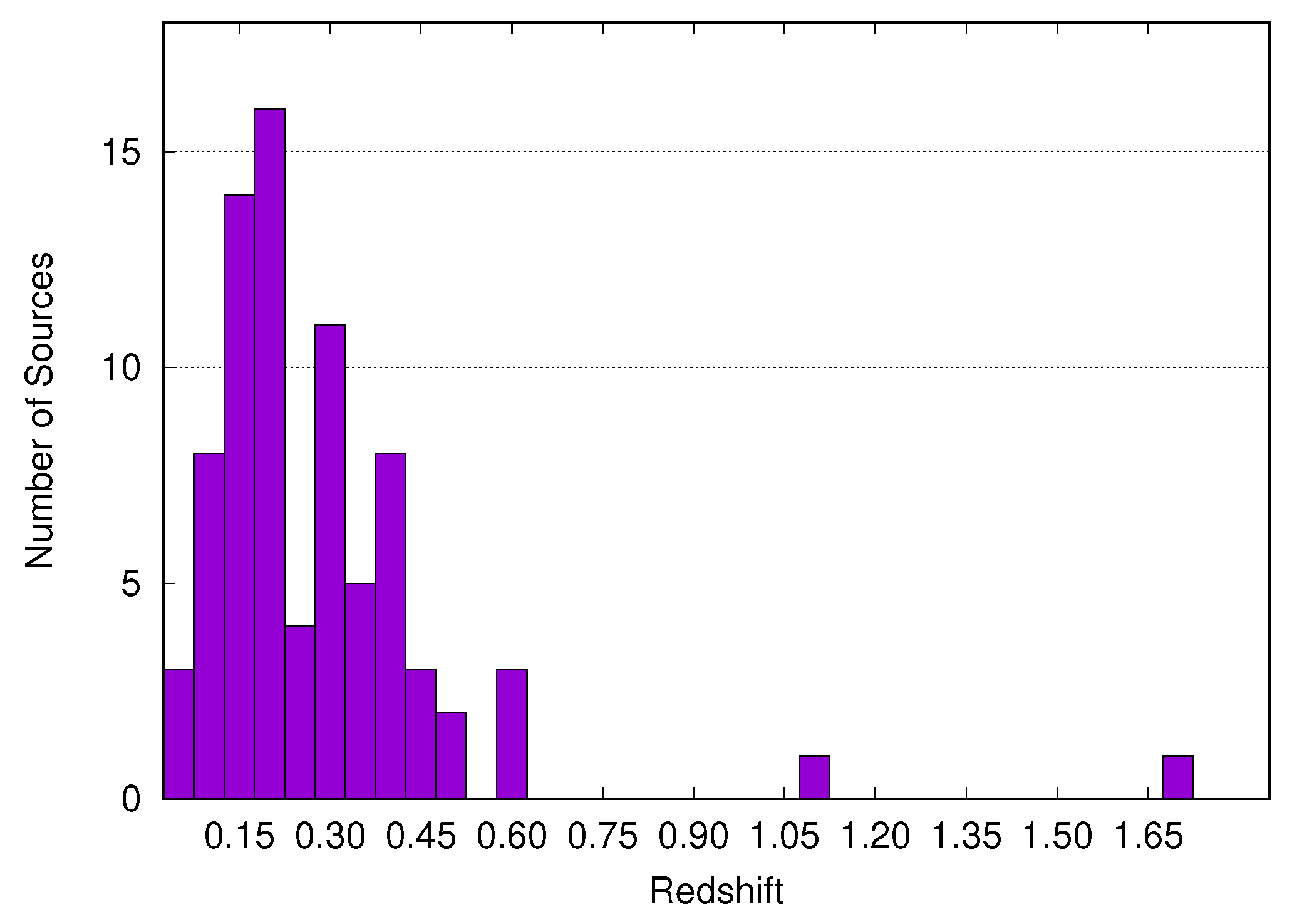
STRange and Odd Morphology Extragalactic Radio Sources (STROMERSs) is a new category of radio galaxies that shows extremely peculiar anatomy. A purely manual visual search is carried out for the identification of such interesting sources. We reported a total of 108 STROMERS sources from the LOFAR Two-meter Sky Survey second data release (LoTSS DR2) at 144 MHz. The host galaxies are found ∼94% of the sources. We studied the radio and optical properties of the sources. Redshifts were found in 76% of sources with known host galaxies. The redshifts of STROMERS range from 0.0015 to 1.6599 and peak at 0.15. Among the reported STROMERS sources, there are 17 giant radio galaxies (GRG) with a linear size of greater than 700 kpc. Among them, only five GRGs are new, which is a small fraction of the population of GRGs from LoTSS DR2 data. The source ILTJ164117.44 +380208.4 has the highest linear size, approximately 1.8 Mpc. To study the reasons behind these interesting morphologies, we studied the galaxy cluster environment of each candidate within a 1 Mpc search radius. We found that 53% of STROMERS candidates are associated with cluster environments with known redshifts. The source ILTJ150956.65+332642.9 is associated with a high mass galaxy cluster Abell 2034 with mass a 7.57 × 10 14 M . We also propose that the merger scenario is one of the reasons for the formation of STROMERS in the paper.

1. Introduction

The extragalactic radio sources are unusual and the most powerful objects in the universe. These objects can be larger than a megaparsec in size and have radio luminosities that are usually 100 times higher than those of star-forming galaxies [1]. A typical radio source consists of two jets pointing in opposite directions. The long, collimated outflows of the highly ionised plasma driven by the central black hole are known as astrophysical jets. In certain cases, the core of a radio source is often connected to its extended components and outer lobes by this thin collimated jet. It has become accepted that these sources have an active galactic nucleus (AGN) at their core.
The morphology of extragalactic radio sources and their understanding are an eminent issue. It could provide valuable insights into the evolution of a radio source, its interaction with its ambient media, and the attributes of the radio source in general. Considering the morphology of the extragalactic radio galaxies there are two classes: one is the classical double-lobed radio galaxy, and the other is the irregular radio galaxy. A pair of extended lobes characterise the classical double-lobed radio galaxy in opposite directions with a bright compact radio core at the centre. On the other hand, an irregular radio galaxy has non-uniform and asymmetric lobe extensions and orientations. The radio lobes are “fed” (with relativistic particles) by these jets which connect the central core to the edges. The radio jets are one of the most energetic phenomena in the universe. The radio morphology of a galaxy primarily depends on the jet-lobe structure and its orientations. Depending on this, irregular radio galaxies are categorized into some interesting classes. (I) Winged Radio Galaxy (WRG) is an interesting class of irregular radio galaxy due to its ambiguous model of origin, where a pair of low-surface-brightness, diffused secondary lobes is seen to be oriented at an angle with the high-surface-brightness, collimated primary lobes [2,3,4,5,6,7]. (II) The Bent-tail (BT) radio galaxy, where the primary jets are seen to be bent in the same direction, giving the source a ‘C’, ‘V’, ‘L’-like shape [8,9,10,11,12,13]. (III) Due to some recurrent activity, when the new jets are ejected in the same direction as the old jets, then the morphology of that particular source shows two colinear lobes on both sides of the central core. This type of source is known as the Double-Double Radio Galaxy (DDRG), often called restarted radio sources [14,15]. (IV) Odd Radio Circle (ORC) shows nearly circular radio emission of 1 arcmin. These have recently been reported by Norris et al. [16,17].
Aside from these identified classes and subclasses of irregular radio sources, we are curious if there exist any other kinds of irregular radio sources. With the new high-resolution telescopic instruments and cutting-edge technologies, we can now observe, in detail, the fine structure of a radio source. We began searching for radio sources with unique morphology that differ from previously known classes. From the LOFAR Two-meter Sky Survey First Data Release (LoTSS DR1), we reported four such kinds of radio sources named ‘Miscellaneous Radio Source (MRS)’ [18]. Later, we reported nine such candidates from the VLA Faint Images of the Radio Sky at Twenty-Centimeters (VLA FIRST) and defined them as STRange and Odd Morphology Extragalactic Radio Sources (STROMERSs) [19]. The sources with unique and peculiar radio morphology different from known subclasses are considered STROMERS candidates as defined by Bera et al. [19].
Important information about the ‘central engine’ of radio galaxies can be learned by studying their rare specimens that display extremely unusual characteristics, such as a distinctive radio morphology, spectrum, polarization, or time variability, as has been extensively discussed in the literature and clearly shown by the classic case of BL Lacs [20]. Both theoretical models of double radio sources and their numerical simulations can be tested and improved by these “strange objects”. Even the most casual names, like “freaks” [21], “curiosities” [22], or just “miscellaneous” [18], do not adequately describe the astrophysical potential of seemingly peculiar radio sources that have scarce characteristics. We previously suggested a name to describe these anomalies in radio morphology is “STROMERSs” (STRange and Odd Morphology Extragalactic Radio Sources) [19].
Finding and analyzing the sources of STROMERS will be crucial for two key areas of study: galactic interaction and galaxy evolution. In addition to identifying and characterizing a new class of irregular galaxies we believe that the findings of this study will provide valuable insights into the lifetime and epoch-specific evolution of galaxies. We expect that by studying and analyzing these peculiar morphologies, we will be able to track the disruption that is often present in a galaxy’s environment, primarily in the intergalactic medium (IGM). A more detailed discussion in this context is given in Section 4.
In this paper, Section 2 describes the identification procedure of STROMERS candidates, which includes the LoTSS DR2 data, source selection criterion, and corresponding host galaxies identification. The results of the work are presented in Section 3. Section 4 presents the summary and discussion portions. The results section also includes giant sources, merger scenarios, cluster environments, and a short note on some interesting STROMERS candidates. We use the following cosmology parameters in this paper: H 0 = 67.4 km s−1 Mpc−1, Ω m = 0.315 , and Ω v a c = 0.685 [23]. In the required parameter calculations, we have used the cosmological calculator for the flat universe by Nick Gnedin1. The spectral index ( α ) is defined as S ν ν α , where S ν is the flux density at the particular frequency ν . The contour map drawing, overlaying the radio map of the sources on their respective optical image, and drawing of the presence of nearby galaxy clusters, all are done using the Common Astronomy Software Applications (CASA)2. Every position presentation uses the J2000 coordinate system.

2. Methodology for Identifying STROMERS

2.1. The LoTSS Second Data Release: LoTSS DR2

Over time, jets of radio galaxies become fainter because of adiabatic, inverse compton, and synchrotron energy losses of the electrons. Therefore, it can be difficult to identify extended radio sources because the radio surveys or images must have sufficient spatial resolution and be sensitive to diffuse emission. In this scenario, a telescope like the Low Frequency Array (LOFAR: van et al. [24]) with high resolution and sensitivity is capable of detecting such sources. The LOFAR Two-Metre Sky Survey (LoTSS: Shimwell et al. [25]) is one of the ongoing wide area deep radio sky surveys. The LoTSS aims to scan the entire northern sky with a unique combination of sensitivity (∼100 μ Jy beam−1) and high angular resolution (∼6″) using the high-band antennas (HBA) at 120–168 MHz with a central frequency of 144 MHz [26]. With its features, LoTSS can identify and accurately describe a very high density of radio sources. The source density is significantly larger (≥8 times) compared to early very wide-area higher-frequency surveys like the NRAO VLA Sky Survey (NVSS: Condon et al. [27]) and Faint Images of the Radio Sky at Twenty-Centimeters (FIRST: Becker et al. [28]), as well as that of low-frequency surveys available nowadays, such as the TIFR GMRT Sky Survey alternative data release (TGSS-ADR1: Intema et al. [29]) and the Very Large Array Low-frequency Sky Survey Redux (VLSSr: Lane et al. [30]).
The second data release of LoTSS (LoTSS DR2) consists of 841 pointings and it covers a total of 5634 (∼27 per cent of the Northern sky) square degrees, which is about thirteen times greater than the first data release of LOFAR (LoTSS DR1). The data release is formed by two contiguous regions that are centred at roughly 12h45m00s +4430′00″ (RA-13 region) and 1h00m00s +2800′00″ (RA-1 region) and span 4178 and 1457 square degrees, or 626 and 215 pointings, respectively [26]. We compare the basic parameters of the first and second data releases of LoTSS in Table 1. LoTSS DR1 included 63 pointings, while LoTSS DR2 had 841 pointings. They have totally observed 1623 pointings, including those of DR2, while 154 pointings are partially observed. To finish the survey, observations must be made for 1391 pointings [26]. The median rms noise ( σ ) of LoTSS DR2 is S 144 M H z = 83 μ Jy beam−1. A completely automated, direction-dependent calibration and imaging pipeline was used to create the survey images. With 4.2 million radio sources with ≥5 σ magnitude, the LoTSS DR2 is now the largest radio catalogue in existence.

2.2. Sample Selection

We have used the LoTSS DR2 source catalogue, which contains a total of 4,396,228 radio sources as well as Stokes I, Q, U, and V images from 120–168 MHz that cover 27% of the northern sky [26]. Given the large data size and numerous multi-component sources, it is impossible to analyze every source in the catalogue. Our interest is to find irregular sources with moderate luminosity and sizes. We set the angular size restriction of 20″, which is more than three times the angular resolution of LoTSS (6″), as the minimum angular size of our sample. To apply the angular size restriction, we have used the map-fitted major axis as the size of the sources, which is listed as ‘Maj’ in Hardcastle et al. [31] catalogue.
We set the angular size restriction of 20″ to be more than three times the angular resolution of LoTSS (6″), which is the minimum angular size of our sample. To obtain a larger sample and the best and most complete result feasible, we do not apply any other limitations, such as for the integrated or peak brightness of the sources. A total of 204,789 sources are obtained after the application of the mentioned size criterion. After that, we visually inspected each source to check for the existence of possible STROMERS candidates. The final classifications of the sources have been determined following careful visual analysis by several of the co-authors. Only their corresponding contour maps are used for the detection and confirmation of the STROMERS candidates. We identified the position of the radio core from the cutout image and then identified the corresponding candidate from the main catalogue. We draw radio contour maps for every potential candidate and then select the desired STROMERS candidates. To draw the contour plot, we downloaded each FITS image from the LoTSS DR2 cutout service3. The radio contour is plotted three times the local rms noise of each selected candidate.

2.3. Host Galaxy Identification

Radio jets are released from the centre core, which is host to an active galactic nucleus (AGN). The host galaxy is typically located in the core area. The identification of the host galaxy of radio sources is an important task when someone deals with radio morphology. We used radio maps from LoTSS DR2, the Very Large Array Sky Survey (VLASS: Lacy et al. [32]), and the Faint Images of the Radio Sky at Twenty-Centimeters (FIRST) survey [28] to identify the core of the selected candidates. With an image resolution of around 2.5″ at 3 GHz frequency, the VLASS4 (epoch 3) makes it easier to detect or resolve jet/lobe structures as well as the core of the galaxy. With their higher frequencies and resolutions, radio surveys FIRST (1.4 GHz) and VLASS (3 GHz) support LoTSS in detecting radio cores, particularly when LoTSS may not have detected them properly.
Hardcastle et al. [31] proposed optical counterpart of the LoTSS DR2 radio sources adopting the likelihood-ratio cross-matching method as developed by Williams et al. [33] for DR1. Optical and IR counterparts are identified for 85 per cent of sources in LoTSS DR2. A good fraction (58%) of spectroscopy redshifts come from the existing Sloan Digital Sky Survey (SDSS) data release 16 [34] with small additions from the DESI early data release [35] and HETDEX survey [36] and photometric redshifts from Ducan et al. [37], Bilicki et al. [38]. We initially adopted the host galaxy identifications and redshifts from Hardcastle et al. [31]. To ensure the positional accuracy of the radio cores and their optical or IR hosts identified by Hardcastle et al. [31], we used a simple nearest-neighbor match for the cores, limited to a maximum radius of 1′. We spatially overlapped the radio and optical/IR images to identify the true hosts and manually corrected the host positions for some sources. Redshift information for these candidates was taken from the SDSS and Wide-field Infrared Survey Explorer—All-Sky (WISEA) catalogues (Chung et al. [39], Rebull et al. [40]) for the optical and IR counterparts, respectively.

3. Results

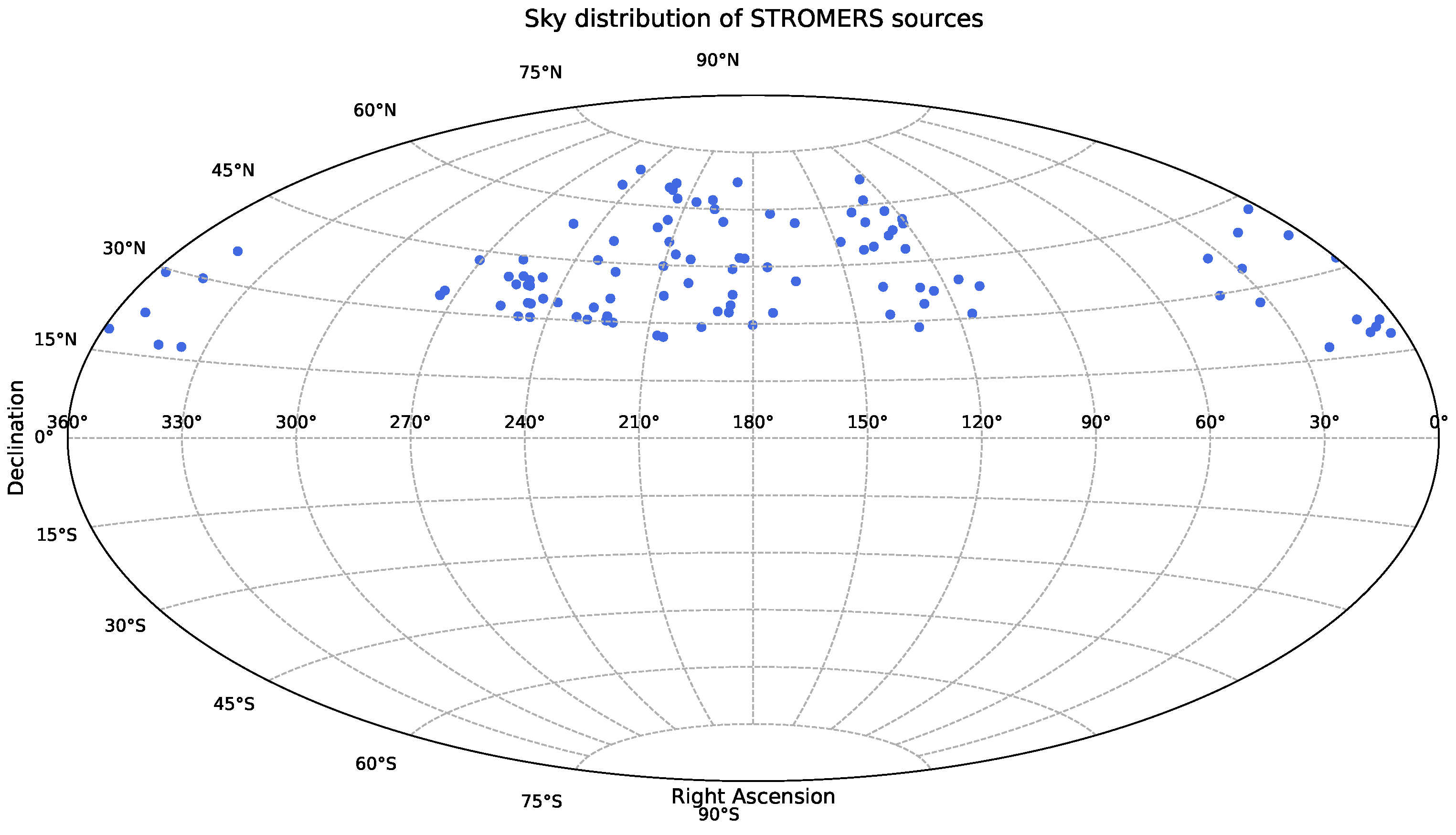
In this paper, we report a total of 108 peculiar morphologies of radio galaxies called ‘STROMERS’ from LoTSS DR2. This identification is totally carried out by manual visual search from the parent catalogue of LoTSS DR2 [26]. After several visualizations and review of the radio map of the candidates by the co-authors, we report them as ‘STROMERS’. In this work, we calculate some basic properties of the candidates like spectral indices, radio luminosities, linear sizes, etc, with the available radio and optical data. A sky distribution of the identified STROMERS candidates is shown in the Figure 1. The distribution shows that the STROMERS sources are uniformly distributed over the LoTSS DR2 sky area.
All the STROMERS candidates are listed in Table 2 in order of increasing R.A. (J2000.0). Column 5 represents redshift value of the sources from the available optical and infrared catalogue. The spectroscopic redshift of the optical host was obtained from Sloan Digital Sky Survey (SDSS) [34], DESI [35] and HETDEX survey [36]. Redshifts were found for a total of 65 sources out of 108. Among them are 52 spectroscopic values and 13 photometric values. The histogram in Figure 2 showed the distribution of redshift values with the number of STROMERS candidates. Both the spectroscopic and photometric redshifts are considered for the plot.
The basic parameters of the STROMERS sources are mentioned in Table 2. The sources are catalogued in the table in the ascending order of Right Ascension (RA). The table contains the following columns; column 1: Catalog Number, column 2: Name (LOFAR ID), column 3: RA (J2000.0) of host ID, column 4: Declination (J2000.0) of host ID, column 5: Redshift, spectroscopic redshifts are mentioned by ‘*’ and rest are photometric redshifts. Spectroscopic redshifts are taken from SDSS, DESI and HETDEX catalogues and photometric redshifts are taken from WISEA catalogue, column 6: LoTSS flux density at 144 MHz in mJy ( F 144 ), column 7: measured NVSS flux density at 1400 MHz in mJy ( F 1400 ), column 8: spectral index ( α 144 1400 ), column 9: angular size of the sources ( L A S ) in arc-second (Major Axis) at 144 MHz frequency, the angular size (LAS) of the sources is taken from Hardcastle et al. [31] where LAS was measured as the maximum angular separation between the outermost detected component of a radio source, for the multi-component sources, the LAS is measured by fitting a Gaussian using PyBDSF. Details of LAS measurement are mentioned in [31]. Column 10: linear size ( L L S ) in kpc at the LoTSS frequency, column 12: luminosity in erg s−1 ( L 144 MHz ).
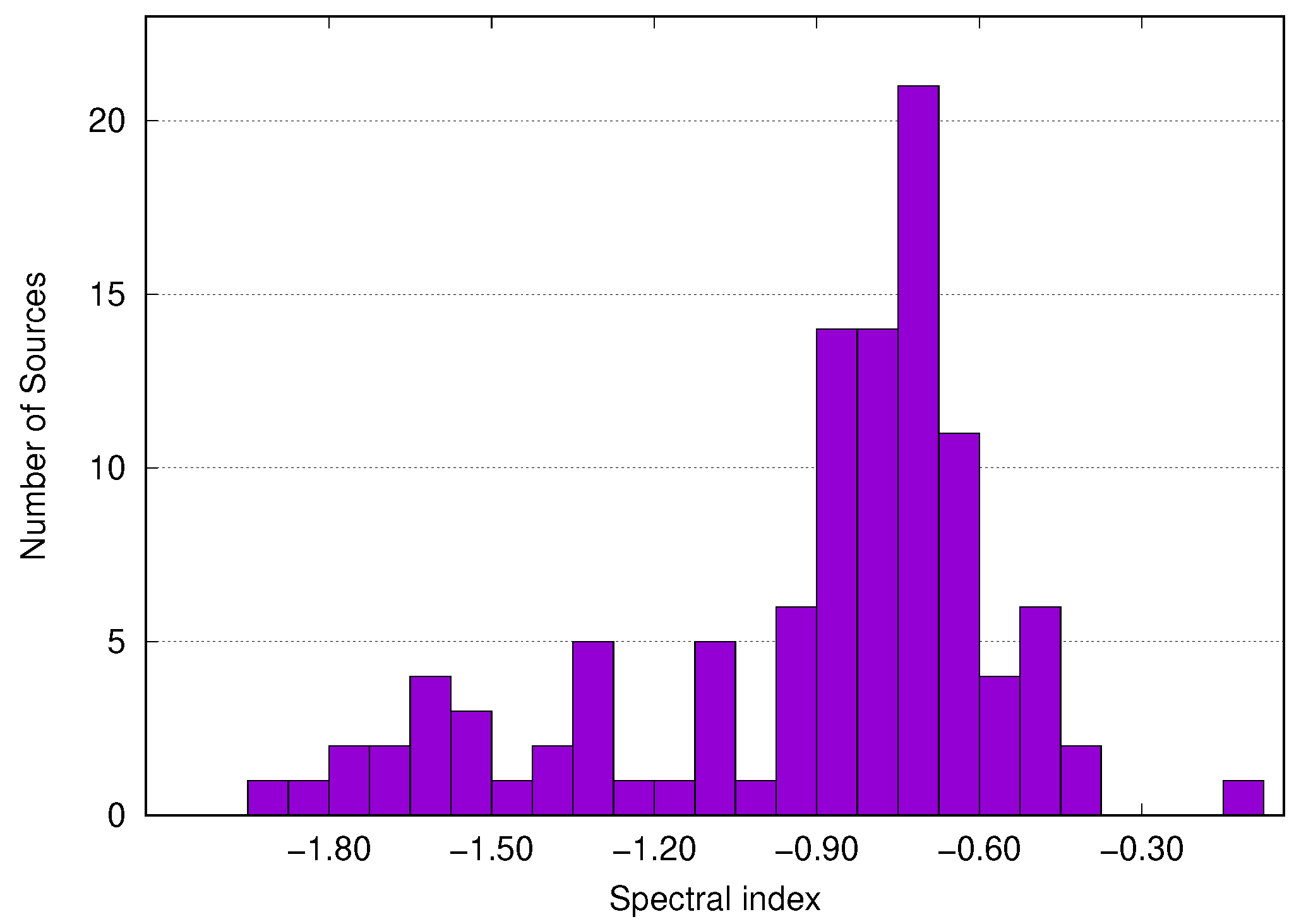
In columns 6 and 7, we list the flux density values of the sources from LoTSS and NVSS. With the task ‘CASA-VIEWER’ in Common Astronomy Software Applications [44], we calculate the flux densities by manually selecting the proper regions of each radio image. The cutout images of NVSS are downloaded from the cutout website5. For 1400 MHz flux, we choose NVSS data over FIRST. With VLA-D configuration and low resolution (45″), NVSS measures more accurate fluxes than FIRST (VLA-B configuration). The two-point spectral indices ( α 1400 144 ) are estimated between two frequencies, 144 MHz and 1400 MHz. The equation adopted here is S ν ν α , where S ν is the flux density at the particular frequency ν and α is the spectral index. The spectral index distribution of the sources is shown in Figure 3. The highest estimated LoTSS flux is 6.08 Jy for the source ILTJ123314.87+670732.8. The lowest and highest spectral indices are found for the sources ILTJ162826.94+401050.6 and ILTJ143900.62+660949.2 with values of –0.13 and –1.80, respectively.
The characteristic parameter that determines the intensity of the radio jets is the radio luminosity ( L r a d ). From the available flux information and redshift value, we calculate luminosity ( L r a d ) for 82 STROMERS candidates. We calculate the luminosity ( L r a d ) by using the formula (adapted from O’Dea & Owen [45]):
L r a d = 1.2 × 10 27 D Mpc 2 S 0 ν 0 α ( 1 + z ) ( 1 + α ) × ( ν u ( 1 + α ) ν l ( 1 + α ) ) ( 1 + α ) 1 erg s 1
In this equation, the notations are used as, D Mpc : the luminosity distance to the source (Mpc), S 0 : the flux density (Jy) at a given frequency ν 0 (Hz), z: the redshift of the radio galaxy, α : the spectral index, ν u (Hz): the upper cutoff frequency, and ν l (Hz): the lower cutoff frequency. In this luminosity calculation, we used the respective values of the upper and lower cutoff frequencies as 15 GHz and 100 MHz [19].
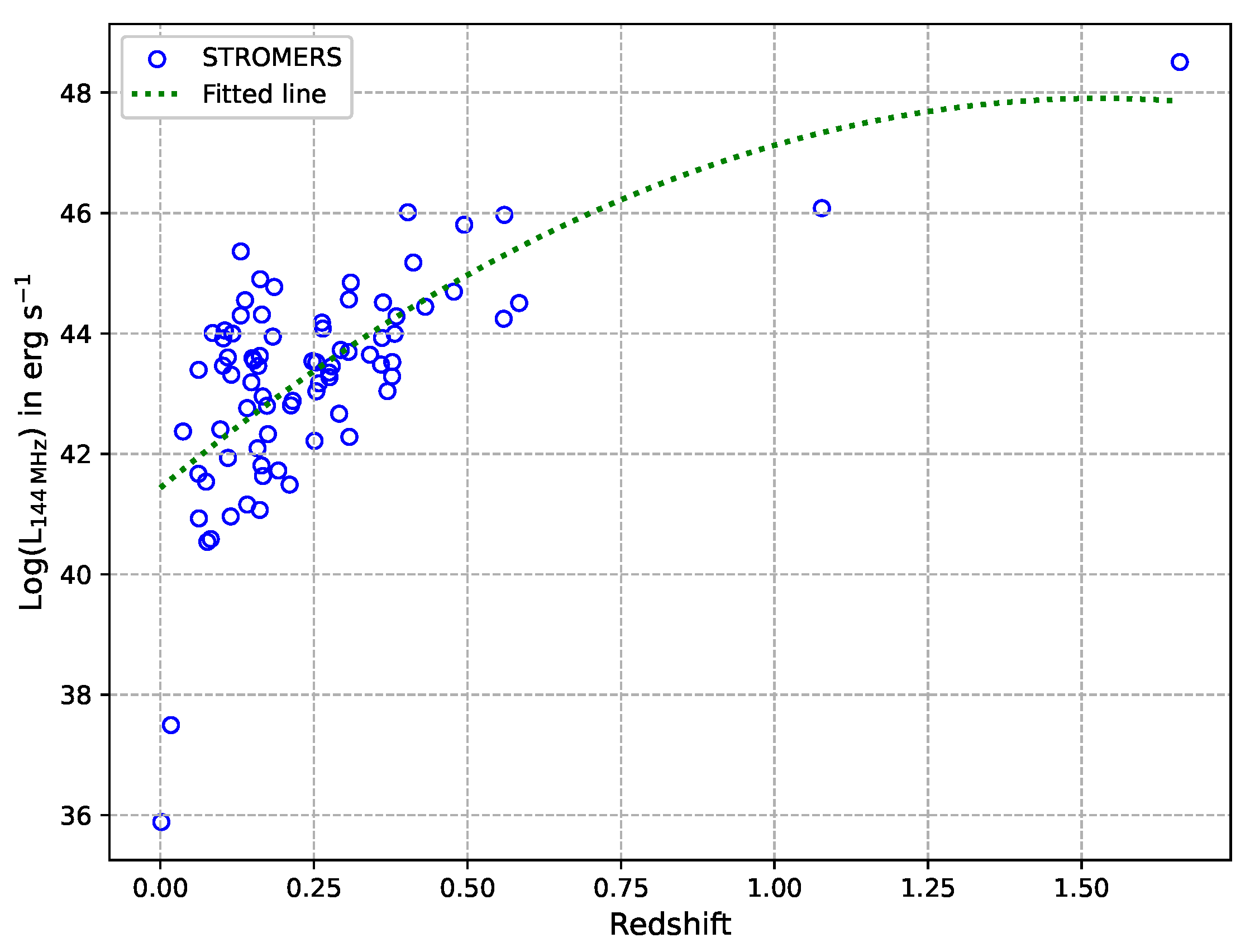
In Figure 4, we plot the radio luminosity distribution of 82 STROMERS candidates with known redshifts. We have taken the log value of luminosity for the plot. The most luminous STROMERS candidates is ILTJ082712.31+531059.4 with luminosity L 144 M H z 1.82 × 10 44 erg s−1 at spectroscopic redshift 1.6599. The candidate ILTJ121857.66+471814.7 has a lowest luminosity value 5.96 × 10 38 erg s−1 with the redshift 0.0015. The dashed line represents the best-fitted relation between radio luminosity and redshift for our sources. It highlights the mean radio luminosity with the change of redshift, serving as a statistical representation of the overall distribution. This line is not meant to imply a physical relation, but rather to illustrate the general trend across the population.

3.1. Giant STROMERS Sources (GST)

Giant radio galaxies (GRGs) constitute a remarkable category of active galaxies displaying linear sizes ranging from approximately 0.7 to 5 Mpc, thereby positioning them among the largest physically connected objects known. The first example of a giant radio galaxy, 3C236, was identified approximately four decades ago by Willis et al. [46]. It extends roughly 4.62 Mpc and continues to be regarded as one of the largest known examples of its kind. At present, the largest known GRG is J1529+6015 with ∼6.6 Mpc linear size [47]. Oei et al. [41] reported 2060 new GRG sources by using a novel statistical framework in LoTSS DR2. Also from LoTSS DR2 data, Dhabade et al. [42] analyze the properties, including arm-length ratios, flux density ratios of pairs of lobes, and misalignment angles of 111 GRGs samples, of which 76 are newly reported. They raise interesting questions about how relativistic jets starting in SMBHs form and evolve into such massive structures. By counting galaxies surrounding GRGs, it is known that GRGs are typically found in low galaxy density environments [48,49,50,51], supporting the theory that their evolution to such vast sizes is the result of their occurrence in low-density environments.
The STROMERS candidates with linear sizes greater than 700 kpc are referred to as giant STROMERS sources (GST). In the current work, we found a total of 17 such sources. This includes twelve sources previously reported as a GRG candidate. Newly identified five GRG candidates will be added to the existing GRG list from LoTSS DR2 data. The GST source reported in Oei et al. [41], Dhabade et al. [42], Mostert et al. [43], and, Hardcastle et al. [31] are marked as ‘o’, ‘d’, ‘m’, and, ‘h’ in Table 2 respectively. Some of the sources reported in the mentioned literature are not included in our catalogue as GST due to different measured angular sizes. There is a difference in the measured angular sizes (LAS) of the STROMERS sources from Oei et al. [41] and Mostert et al. [43]. The angular sizes of the sources may be overestimated by Oei et al. [41] and Mostert et al. [43]. Oei et al. [41] estimated end-to-end LAS and was validated manually. Mostert et al. [43] measured LAS by a semi-automated method with faint emission of sources. In this work, LAS was adopted from Hardcastle et al. [31], measured by automated PyBDSF Gaussian fitting.

3.2. Radio Morphology Driven by Galaxy Merger?

Massive nuclear accretion can be caused by galaxy mergers that push huge amounts of gas towards the SMBH. Jets and outflows powered by AGN frequently arise during this process. The surrounding IGM can be heated by the mechanical feedback from AGN activity, especially through jets, which can also drive gas out of the galaxy [52]. Signs of AGN activity, such as increased accretion rates and the presence of strong jets, are frequently observed in galaxies that have recently experienced mergers. Recent interaction and the ensuing AGN-driven processes are indicated by the morphological disruptions and tidal features commonly seen in these post-merger galaxies. Numerous studies have demonstrated the substantial correlation between Radio Loud AGN (RLAGNs) and mergers [42,53,54,55].
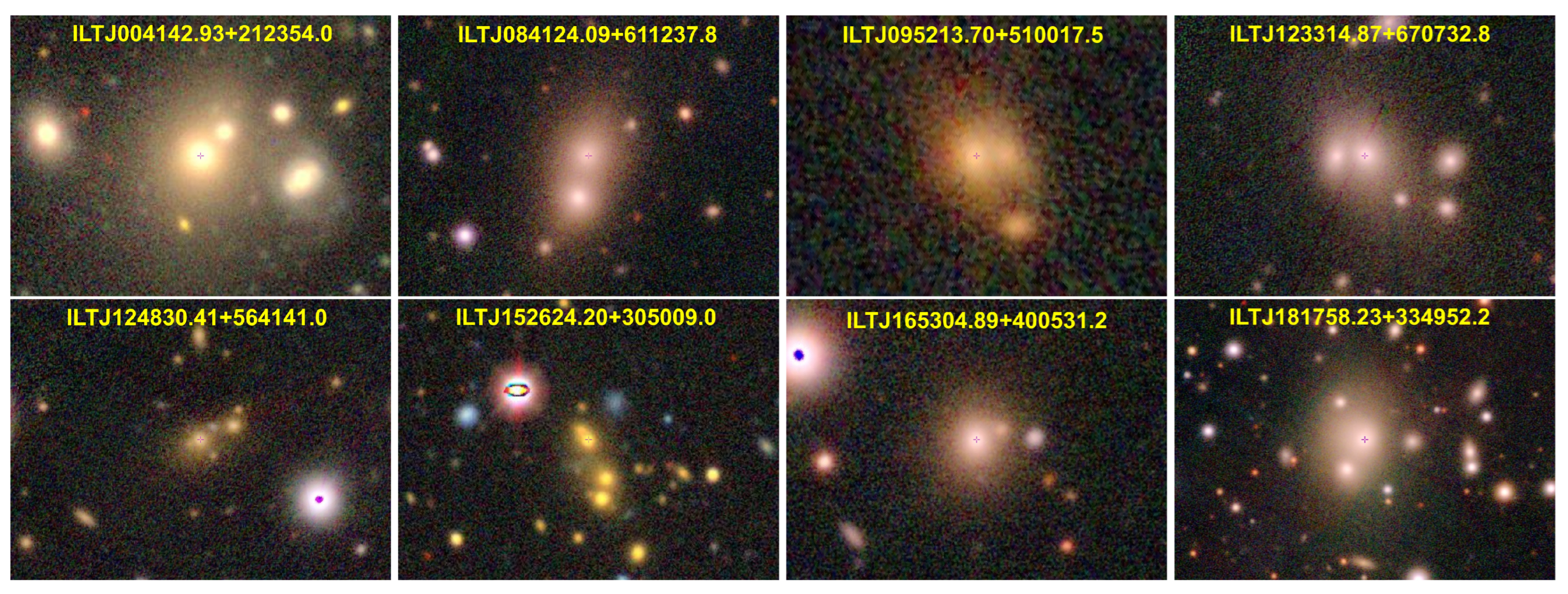
We examined the host galaxy images for each source in our database to determine whether comparable evidence of mergers may be seen in STROMERS. We have used deeper optical images from DESI Legacy Imaging Surveys. The Pan-STARRS and SDSS data were also used where DESI data were not found. Our investigation found signs of mergers, like close companion galaxies or tidal tails. Such a scenario has been seen for 30 sources and a sample of images is shown in Figure 5. The central ‘+’ marks are the proposed host galaxies. The STROMERS sources with possible merger scenario are indicates with ‘‡’ in the Table 2. The redshifts (either spectroscopic or photometric) are similar for companion galaxies. By examining the relationship between galaxy mergers and peculiar morphology formation, these studies may bring an understanding of the dynamics of supermassive black hole mergers and their effects on the surrounding intergalactic medium.

3.3. Galaxy Cluster Environment of STROMERS

Recent studies of Bera et al. [19] have shown that about 86% of STROMERSs are associated in relatively denser environments of at least one galaxy cluster. Similar analyses are done for the present work. We used cluster catalogues [56,57,58] to cross-match our sample in order to look into the existence of STROMERSs in dense environments like galaxy clusters. This study determined whether the candidates were associated with the brightest cluster galaxies (BCGs). We have used the search radius of 1 Mpc at the redshift of each source. We assumed that STROMERS candidates and clusters of galaxies are associated if δ z = | z z c l | 0.05 , where z c l is the redshift of the galaxy cluster [19].
In Table 3, we listed the WHL clusters within a 1 Mpc search radius, taking the host galaxy as the centre. Some basic parameters of the clusters are calculated as mentioned in caption notes in Table 3. Our search found that 35 out of 82 STROMERS candidates are associated with BCG galaxy clusters. We found 33 clusters from Wen & Han [56] catalogue and 2 from Wen et al. [57] catalogue. From Table 3, we found that all the STROMERS sources are associated with one cluster except three candidates ILTJ145945.43+424240.1 and ILTJ164117.44+380208.4, which are associated with two clusters. We also found that 21 out of 35 STROMERS associated with clusters are situated within the core of these clusters. In Table 3, we list the cluster masses M 500 with the richness R L * 500 value using the equation 17 of Wen & Han [56]. The high mass galaxy cluster is WHL J151011.7+332911 with cluster mass 7.57 × 10 14 M . Similarly, the low mass galaxy cluster is WHL J120046.1+294258 with cluster mass 0.43 × 10 14 M . We found 14 massive cluster with masses M 500 ≥ 2 × 10 14 M showing their strong jetted AGNs.
In Table 3, we have listed the galaxy clusters in the vicinity of the identified STROMERS radio sources. The nearby galaxy clusters are listed in column 2. The measured angular separation ( S θ in the unit of arcmin) and linear separation ( S l in the unit of kpc) between the source and its respective clusters are presented in columns 3 and 5, respectively. The redshift (z) of the galaxy clusters is catalogued in column 4. The ‘’ marked redshifts indicate that these z values are photometric redshifts, while the rest are spectroscopic. The value m r is the r-band magnitude of brightest cluster member. In column 7, we catalogued r 500 in Mpc, which represents the radius within which the average mass density of the cluster is 500 times the critical density of the universe at the cluster’s redshift. Column 8 presents the cluster richness, R L * 500 . In Column 9, The cluster masses ( M 500 in the unit of × 10 14 M ) are calculated from equation 17 of Wen & Han [56]. The number of all member galaxies ( N 500 ) within cluster radius ( r 500 ) are listed in column 10.

3.4. Individual Notes for Sources with the Most Peculiar Morphology

In this section, we present a few details of some individual STROMERS candidates and their respective morphological structures, overall appearances, and natures.
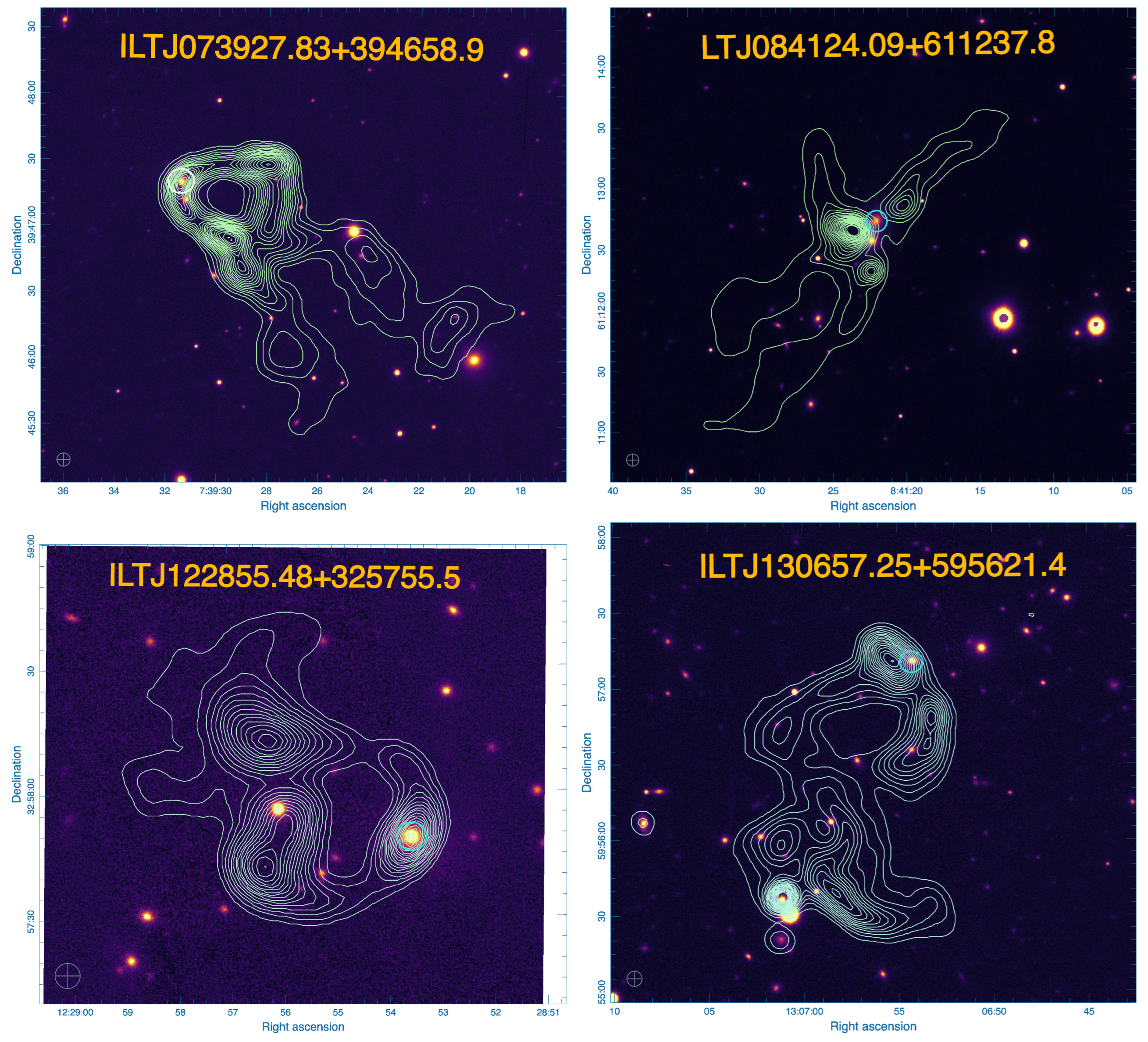
ILTJ073927.83+394658.9: The primary jets of the radio source (in Figure 6) are bent in shape and make the source an example of an extremely bent source. However, the jets are bent further to give an overall ring shape, and additionally the jets are also extended further to make this a STROMERS candidate. The ring shape is likely caused by projection of radio tails well-separated in 3D, and nothing peculiar, especially since both individual tails can be traced much further beyond the apparent ring. The corresponding optical host of the source is SDSS J073931.42+394719.9 [59], with a redshift of 0.0977 [60]. With nearly 3 arcmin of angular size, the source has a linear size of 0.32 Mpc. The luminosity of the source is found as 3.63 × 10 41 erg s−1. The source is also previously reported by Bera et al. [19] at 1400 MHz frequency.
ILTJ084124.09+611237.8: The source has primarily a three-lobe structure with lobes on the NE, SW, and south sides. Each of the lobes has a further extension in the north, NW, and SE directions, respectively. Along with this, an additional lobe is observed to be ejected from the NE lobe and extended parallel to the SE lobe exactly opposite to the NW lobe. Thus, overall, the source has a four-lobe structure shown in Figure 6. From the VLASS image, there is a possibility that this source might be two WATs hosted by 2MASX J08412241+6112346 and SDSS J084122.11+611244.6, respectively, seen in projection. The grayscale image also shown the possibility of X-shape sources. The optical host of the source is identified as SDSS J084122.12+611244.8 [59] with a redshift value of 0.130950 ± 3.12 × 10 5 [60]. The infrared (IR) counterpart of this source is WISEA J084122.17+611244.0 [61]. The source has a flux of 4.7 Jy at 144 MHz with a luminosity of 4.83 × 10 42 erg s−1. The angular and linear size of the source is ∼ 4 arcmin and 0.54 Mpc, respectively. The galaxy cluster WHL J084122.1+611245 [62] is associated with the source. The cluster is located at an angular distance of 0.018 arcmin, which is less than 3 kpc in the linear scale from the optical centre of the galaxy. The cluster also identified as GMBCG J130.34220+61.21246 [63] and RM J084122.1+611244.9 [64] in the Gaussian Mixture Brightest Cluster Galaxy (GMBCG) and RedMapper (RM) Cluster catalogue.
ILTJ122855.48+325755.5: The radio source has a three-lobe structure, with an overall ring-shaped morphology. The primary ring-shaped morphology has a similarity with the earlier discussed STROMERS candidate ILTJ073927.83+394658.9. There is a diffused emission observed towards the tails of the source (in Figure 6). The source maybe a BT galaxy hosted by J122853.56+325749.0, together with a superimposed FRII source hosted by the bright galaxy between the lobes. The optical source SDSS J122853.56+325749.0 [61] with redshift 0.1735 [60] is the host galaxy of the source. The source WISEA J122853.56+325749.1 [61] is the respective IR counterpart. The source has a relatively small angular size with little over 1 arcmin. The linear size and luminosity are estimated as 0.22 Mpc and 6.04 × 10 41 erg s 1 . The STROMERS source is also hosted by the BCG galaxy cluster WHL J122853.6+325749 [62].
ILTJ130657.25+595621.4: The radio map shows the source has an interesting and complex morphology as shown in Figure 6. Primarily, the radio morphology has two parts one is on the NW and another on the SE. The NW portion has a relatively simple bent morphology, with an extended tail that connects the SE part. The SE part has lobe extension in the SW and NE directions. The NE part of the lobe is extended and bent towards the north and that extension connects with the NW part of the source. A compact region found located at 17″ towards SE which is associated with SDSS J130701.15+595536.2. The optical host of the source is SDSS J130659.00+595544.7 [61]. The source has an angular size of nearly 2 arcmin.
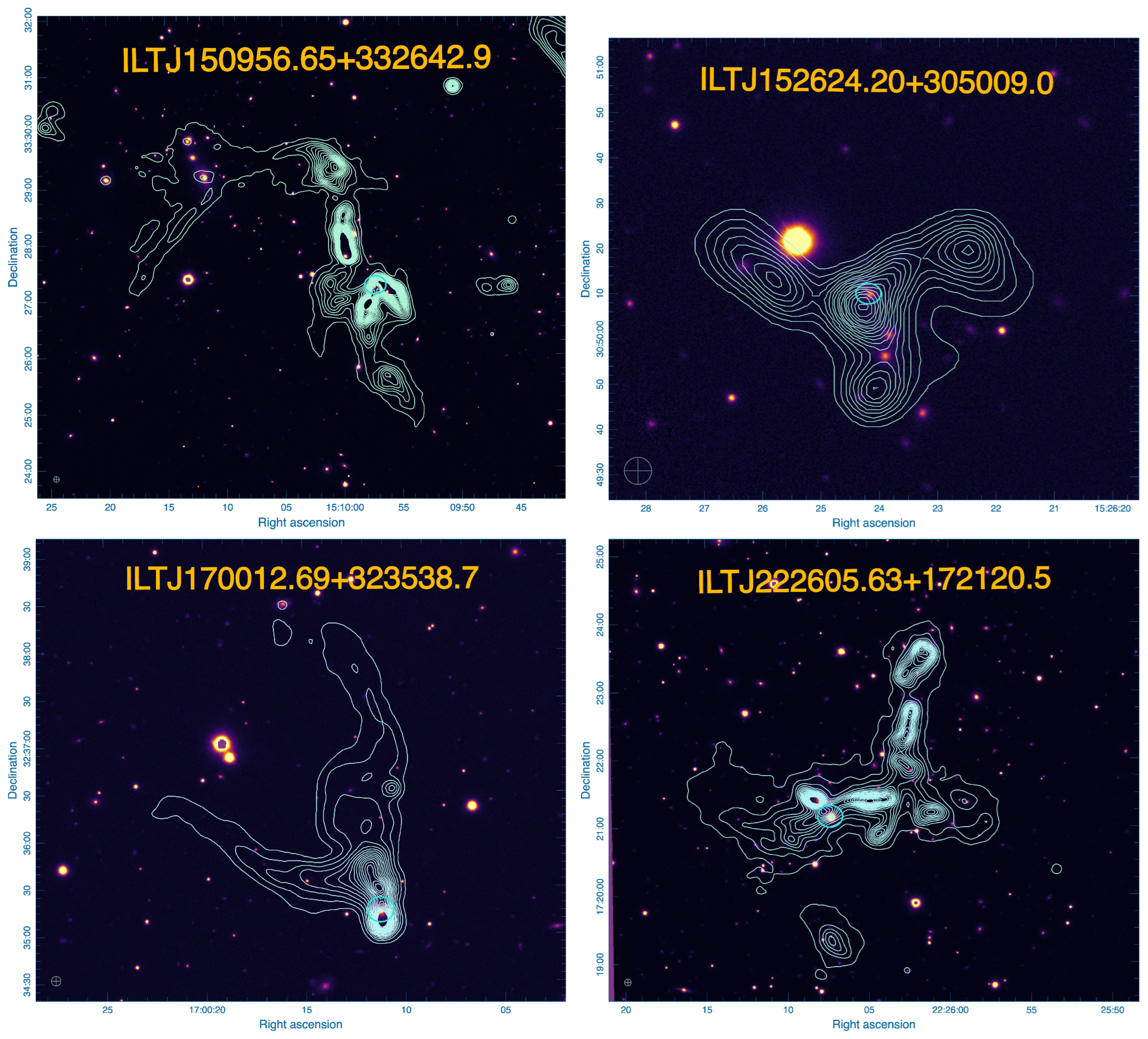
ILTJ150956.65+332642.9: The source core has a bent-tail lobe structure with the core at the north side and the lobes towards the south side. In addition to that, the source has two compact radio emissions on the north side along with the core (in Figure 7). SDSS J150957.37+332714.9 [59] is the optical host of the source with WISEA J150957.37+332715.0 [61] as the IR counterpart. The source redshift is 0.1172. With a angular size of 3 arcmin, the source has a linear size of 383 kpc. The source is previously reported in some literature and it is may be a combination of cluster radio relics and tailed radio galaxies [65,66,67]. The estimated luminosity of the source is 2.03 × 10 42 erg s−1. WHL J151011.7+332911 [62] is found as the associated galaxy cluster with the source. The cluster is located at an angular distance of 0.72 arcmin which corresponds to a linear distance of nearly 100 kpc.
ILTJ152624.20+305009.0: This source could be the superposition of two WATs, with respective hosts as SDSS J152624.17+305009.8 and SDSS J152623.83+305000.9. as shown in Figure 7. The optical and IR host of the source is identified as SDSS J152624.17+305009.8 [59] and WISEA J152624.19+305009.7 [61], respectively. The source has a redshift of 0.3065. The angular and linear sizes are estimated as 1.45 arcmin and 0.39 Mpc. The radio luminosity of the source is 1.47 × 10 42 erg s−1. With an angular and linear separation of 0.17 arcmin and 47 kpc, the galaxy cluster WHL J152623.8+305001 [62] is identified as the associated cluster of this STROMERS candidate.
ILTJ170012.69+323538.7: This STROMERS candidate has a tail on the north side is seen to be bifurcated and extended further (Figure 7). However, the two bifurcated lobes are not symmetric. This may be a WAT whose tails cross each other in projection just north of the host. The inner jet is directed south, apparently bends towards or away from us along the line of sight, and towards the north. This source has previously been identified as 4C +32.52E in the Fourth Cambridge Radio Catalogue [68] and B2 1658+32A [69] in the Second Bologna Catalog of radio sources. The optical host of the source is SDSS J170011.22+323514.7 [59] and IR host is WISEA J170011.23+323514.8 [61]. The source has a redshift of 0.1020 [60]. The has an angular size of 4.2 arcmin and a linear size of 0.47 Mpc. The radio luminosity of the source is calculated as 9.16 × 10 41 erg s−1.
ILTJ222605.63+172120.5: There are few radio lobes in the radio map as shown in Figure 7. Overall the lobes are directed in the north and west direction. On the north side, there are three lobes aligned nearly in a straight line. On the other hand, the lobe directed towards the west primarily has two lobes with some extended diffused emission towards the south. Apart from these, there is a small radio lobe in the SW direction from the central spot. This source is also previously reported as Abell 2443, also known as PSZ2 G080.41-33.24, ACT-CL J2226.0+1722, detailed of X-rays, optical and radio study has been carried out by Botteon et al. [70]. The host of the source is WISEA J222602.23+172141.0 [61]. The source has a redshift of 0.1029 [71]. The angular and linear size of the source are measured as 4.5 arcmin and 0.53 Mpc, with a luminosity of 1.17 × 10 42 erg s−1.

4. Summary and Discussion

In this paper, we have reported a total of 108 newly identified STROMERS candidates from LoTSS DR2 that have a rare kind of radio morphology. The morphology of these sources does not match known classes and sub-classes of radio galaxies like DDRG, Bent-tail, Wings, and HYMORS. Considering our sample size, these type of sources is found only ∼0.06%. The morphology was also checked in other available radio data like FIRST, TGSS, and VLASS, but peculiar morphology is only seen in the LoTSS. Previously, we reported four such interesting morphologies of radio sources from the first data release of LoTSS [18]. Also, Bera et al. [19] reported nine such sources from the VLA FIRST at 1.4 GHz. Recently, Gopal-Krishna et al. [72] reported 25 such sources from the LoTSS DR2 catalogue. They restricted flux density ≥ 500 mJy and dynamic range exceeds ∼40:1. Whereas we selected the sources of flux density ≥ 30 mJy. We also excluded those sources that are reported by Gopal-Krishna et al. [72]. For this minimum limit of flux cutoff, we can find such a large number of sources and this is the largest sample of this kind of classification. In addition to their unique appearance, these sources could be useful for studying the surrounding medium, episodes of jet activity, and the evolution of galaxies.
Using data from the literature data, we have compiled and derived the spectral index, redshift, radio luminosity, and linear size of the reported STROMERSs. The redshift was estimated from the available optical and IR catalogues of SDSS, DESI, HETDEX, and WISEA, respectively. The candidates show a wide range of redshift values spanning 0.0015 to 1.6599. The highest spectroscopic redshift value of the sources ILTJ082712.31+531059.4 is 1.6599. In our previous study, the redshift of the STROMERS was a comparatively low value between 0.098 and 0.311 [18,19]. The STROMERS source ILTJ123314.87+670732.8 is the brightest source with a flux value of 6.08 Jy at 144 MHz. The source was first reported by Owen et al. [73] associated with a host of brightest galaxy in Abell cluster 1559. The source is also noted as a WAT in Abell 1559 by Sakelliou & Merrifield [74] but its peculiar morphology is detected with LOFAR due to high sensitivity.
The spectral index ( α 144 1400 ) between the two frequencies 144 MHz and 1400 MHz is calculated for all the STROMERS sources as shown in column 8 in Table 2. It is found that the spectral index ( α 144 1400 ) of the STROMERS lies between –0.30 to –1.80, which is in the defined range of typical radio galaxies. A few STROMERS candidates show a steep spectrum ( α 144 1400 1.50 ). While such steep spectral indices could result from radio relics, they can also arise in low-frequency lobe-dominated sources where the higher frequency observations resolve out a significant fraction of the extended structure. In general, the flat spectrum sources are found in dense cluster medium, and they might be composed of tailed radio galaxies. The cores of those tailed are responsible for the flat radio spectrum. There might be an error in the extreme values of spectral indices due to the NVSS flux error.
The linear sizes of STROMERS sources lie between 16.15 kpc and 1806.2 kpc. A total of 17 sources are found in a giant category with linear sizes of more the 700 kpc. Among them, only four sources are newly identified GRG. It will add the number of GRG population from LoTSS DR2. The GST ILTJ164117.44+380208.4 is the highest projected length of 1806.2 kpc with an angular size of 646.4 arcsec. We found 5 GST sources with more than 1 Mpc projected length. The large angular and linear sizes of the STROMERS imply that these sources are relatively larger than average extended radio sources.
There are some points of possible origin of such peculiar morphology of radio galaxies as mentioned Sasmal et al. [12]. In short, the interaction between the jets and the intergalactic medium (IGM) leads to an asymmetric structure of sources. These may indicate any special phase or phase transition during evolution. These may be the combined effect of a change in axes of the spin orientation, the impact of bouncy, backflow of plasma, galaxy merger, and ram pressure due to the relatively high-speed motion, which may sum up to give rise to such interesting morphology [12]. Some of these STROMERS sources may be superpositions of unrelated sources, which is very common in rich environments. The blackflow model by Cotton et al. [75] may also be responsible for some of the strange morphologies that are seen in STROMERS sources. The possibility of a ring-like shape, as seen in some of the STROMERS sources, may be caused by the radio tails crossing each other in projection [22]. Some of the sources previously identified with no such peculiar morphologies. Due to high sensitivity and high resolution of the LoTSS, peculiar morphologies have now been detected in certain sources. For example, ILTJ134152.85+262241.8– a well-studied combination of two-tailed radio galaxies in cluster Abell 1775 [76,77], exhibits new tail features in the E (east) and SE (southeast) direction in LoTSS images. These features classify it as a ’STROMERS’ morphology.
To study the merger scenario, we examined the optical host of each STROMERS candidate as mentioned in detail in Section 3.2. The optical host of 30 STROMERS sources exhibits unusual characteristics. These may be merged supermassive binary black holes, which lead to such peculiar structures of sources. Based on our STROMERS sample, 45% of all candidates show possible merger incidents. This type of study on the peculiar morphology of a radio galaxy is studied for the first time in the literature. This may be one of the reasons behind the peculiar structure of the radio galaxy. To confirm this, we need more samples and a detailed optical study of the host galaxy.
Within a 1 Mpc search radius, 42% of STROMERS candidates are found in the BCG cluster. Among them, 63% of clusters are situated within the radio core of the candidates. The highest cluster association (70%) is found for Bent-tail and HYMORS candidates, and it drops to 10% for normal radio galaxies. The cluster association of STROMERS sources lies between normal radio galaxies and BT or HYMORS sources. Bera et al. [19] found 86% cluster assocation from FIRST sample. Although they are not restricted to the BCG cluster catalogue. This suggests that within their individual clusters, the host galaxies of these STROMERS are luminous. Mendygral et al. [78] showed in their simulation study that flow speeds of about 400 km s 1 in galaxy clusters are enough to dramatically affect the morphologies of radio jets and lobes. The findings of STROMERS in the cluster are consistent with the studies on how cluster environment, including ram pressure and turbulence, can drastically change the morphologies and jet paths [79,80]. Jets may bend, distort, and reorient as a result of these interactions, especially in BCGs where the gas density and gravitational potential are highest. A better understanding of how these dynamic processes influence the evolution of radio galaxies in clusters is made possible by the agreement between our observations and the simulation predictions [42].
Many more STROMERS will be detected through systematic searches throughout the upcoming radio survey, and multi-frequency follow-up can help reveal important information about the morphology and environment. These are exciting indications of what the future SKA, with its high angular resolution and surface brightness sensitivity, will ultimately display. The identification of larger samples of radio galaxies has been greatly accelerated by machine learning techniques [43,81]. As these techniques develop, they can handle increasingly complex structures of radio galaxies like HYMORS or STROMERS.

Author Contributions

T.K.S.: Conceptualization, methodology, data analysis, investigation, Validation, software and writing—original draft. S.K.B.: Conceptualization, methodology, data analysis, visualization and writing—original draft. X.C.: Writing—review, editing, visualization, supervision, project administration and funding acquisition. Y.W.: Writing—review, editing, visualization, supervision and funding acquisition. S.M.: Writing—review, editing, visualization and supervision. T.F.: Writing—review, editing, visualization and supervision. All authors have read and consented to the publication of this final version of the manuscript.

Funding

This work is supported by the National SKA Program of China under No. 2022SKA0110100 and 2022SKA0110101. S.K.B. and T.F. acknowledge the National Natural Science Foundation of China (Nos. 11890692, 12133008, 12221003).

Data Availability Statement

All the data that are used in this article are publicly available from the LOFAR website see note 4 above.

Acknowledgments

The authors thank the anonymous referees for providing a helpful comments and suggestions. This research made use of archival data of LOFAR, co-financed by the EU, the European Fund for Regional Development and the Northern Netherlands Provinces (SNN), and EZ/KOMPAS and maintained by ASTRON, Netherlands Institute for Radio Astronomy.The authors would like to acknowledge NASA/IPAC Extra-galactic Database (NED) as this work has made use of the NED, which is operated by the Jet Propulsion Laboratory, California Institute of Technology, under contract with the National Aeronautics and Space Administration. This research has made use of the CIRADA cutout service at URL see note 4 above, operated by the Canadian Initiative for Radio Astronomy Data Analysis (CIRADA). CIRADA is funded by a grant from the Canada Foundation for Innovation 2017 Innovation Fund (Project 35999), as well as by the Provinces of Ontario, British Columbia, Alberta, Manitoba and Quebec, in collaboration with the National Research Council of Canada, the US National Radio Astronomy Observatory and Australia’s Commonwealth Scientific and Industrial Research Organisation. We thank the staff of the National Radio Astronomy Observatory (NRAO) for their support of the NVSS and FIRST surveys. The NRAO is a facility of the National Science Foundation operated under cooperative agreement by Associated Universities, Inc.

Conflicts of Interest

The authors declare no conflicts of interest.

Notes

1
https://astro.uchicago.edu/~gnedin/cc/, accessed on 5 November 2025.
2
https://casa.nrao.edu/, accessed on 5 November 2025.
3
https://lofar-surveys.org/dr2_release.html, accessed on 5 November 2025.
4
http://cutouts.cirada.ca/, accessed on 5 November 2025.
5
https://www.cv.nrao.edu/nvss/postage.shtml, accessed on 5 November 2025.
6
https://zenodo.org/records/17404885, accessed on 5 November 2025.

References

  1. Kellermann, K.I.; Owen, F.N. Galactic and Extragalactic Radio Astronomy, 2nd ed.; Verschuur, G.L., Kellerman, K.I., Eds.; Springer: New York, NY, USA, 1988. [Google Scholar]
  2. Leahy, J.P.; Parma, P. Extragalactic Radio Sources: From Beams to Jets; Roland, J., Sol, H., Pelletier, G., Eds.; Cambridge University Press: Cambridge, UK, 1992; Volume 307. [Google Scholar]
  3. Cheung, C.C. FIRST “Winged” and X-Shaped Radio Source Candidates. Astron. J. 2007, 133, 2097–2121. [Google Scholar] [CrossRef] [Scilit]
  4. Yang, X.; Joshi, R.; Gopal-Krishna, T.A.; Ho, L.C.; Witta, P.J.; Liu, X.; Yang, J.; Wang, R.; Wu, X.B. Extended Catalog of Winged or X-shaped Radio Sources from the FIRST Survey. Astrophys. J. Suppl. Ser. 2019, 245, 17. [Google Scholar] [CrossRef] [Scilit]
  5. Bera, S.; Pal, S.; Sasmal, T.K.; Mondal, S. FIRST Winged Radio Galaxies with X and Z Symmetry. Astrophys. J. Suppl. Ser. 2020, 251, 9. [Google Scholar] [CrossRef] [Scilit]
  6. Bera, S.; Sasmal, T.K.; Patra, D.; Mondal, S. “Winged” Radio Sources from the LOFAR Two-meter Sky Survey First Data Release (LoTSS DR1). Astrophys. J. Suppl. Ser. 2022, 260, 7. [Google Scholar] [CrossRef] [Scilit]
  7. Bera, S.K.; Fang, T.; Sasmal, T.K.; Mondal, S.; Chen, X. A Morphological Identification and Study of Radio Galaxies from LoTSS DR2. I. The “Winged” Radio Galaxies. Astrophys. J. Suppl. Ser. 2025, 278, 34. [Google Scholar] [CrossRef] [Scilit]
  8. Blanton, E.L.; Gregg, M.D.; Helfand, D.J.; Becker, R.H.; White, R.L. FIRST Bent-Double Radio Sources: Tracers of High-Redshift Clusters. Astrophys. J. 2000, 531, 118–136. [Google Scholar] [CrossRef] [Scilit]
  9. Dehghan, S.; Johnston-Hollitt, M.; Franzen, T.M.O.; Norris, R.P.; Miller, N.A. Bent-tailed Radio Sources in the Australia Telescope Large Area Survey of the Chandra Deep Field South. Astron. J. 2014, 148, 75. [Google Scholar] [CrossRef] [Scilit]
  10. Missaglia, V.; Massaro, F.; Capetti, A.; Paolillo, M.; Kraft, R.P.; Baldi, R.D.; Paggi, A. WATCAT: A tale of wide-angle tailed radio galaxies. Astron. Astrophys. 2019, 626, A8. [Google Scholar] [CrossRef] [Scilit]
  11. Ryle, M.; Windram, M.D. The radio emission from galaxies in the Perseus cluster. Mon. Not. R. Astron. Soc. 1968, 138, 1. [Google Scholar] [CrossRef] [Scilit]
  12. Sasmal, T.K.; Bera, S.; Pal, S.; Mondal, S. A New Catalog of Head-Tail Radio Galaxies from the VLA FIRST Survey. Astrophys. J. Suppl. Ser. 2022, 259, 31. [Google Scholar] [CrossRef] [Scilit]
  13. Rudnick, L.; Owen, F.N. Head-tail radio sources in clusters of galaxies. Astrophys. J. 1976, 203, L107–L111. [Google Scholar] [CrossRef] [Scilit]
  14. Saikia, D.J.; Konar, C.; Kulkarni, V.K. J0041+3224: A new double-double radio galaxy. Mon. Not. R. Astron. Soc. 2006, 366, 1391–1398. [Google Scholar] [CrossRef] [Scilit]
  15. Schoenmakers, A.P.; de Bruyn, A.G.; Röttgering, H.J.A.; van der Laan, H.; Kaiser, C.R. Radio galaxies with a ‘double-double morphology’-I. Analysis of the radio properties and evidence for interrupted activity in active galactic nuclei. Mon. Not. R. Astron. Soc. 2000, 315, 371–380. [Google Scholar] [CrossRef] [Scilit]
  16. Norris, R.P.; Collier, J.D.; Crocker, R.M.; Heywood, I.; Macgregor, P.; Rudnick, L.; Shabala, S.; Andernach, H.; da Cunha, E.; English, J.; et al. MeerKAT uncovers the physics of an odd radio circle. Mon. Not. R. Astron. Soc. 2022, 513, 1300–1316. [Google Scholar] [CrossRef] [Scilit]
  17. Norris, R.P.; Intema, H.T.; Kapińska, A.D.; Koribalski, B.S.; Lenc, E.; Rudnick, L.; Alsaberi, R.Z.; Anderson, C.; Anderson, G.E.; Crawford, E.; et al. Unexpected circular radio objects at high Galactic latitude. Publ. Astron. Soc. Aust. 2021, 38, e003. [Google Scholar] [CrossRef] [Scilit]
  18. Sasmal, T.K.; Bera, S.; Mondal, S. Miscellaneous radio galaxies from LOFAR survey. Astrono. Notes 2022, 343, 10083S. [Google Scholar] [CrossRef] [Scilit]
  19. Bera, S.K.; Sasmal, T.K.; Mondal, S.; Fang, T.; Chen, X. Strange and Odd Morphology Extragalactic Radio Sources (STROMERSs): A Faint Images of the Radio Sky at Twenty-Centimeters (FIRST) Look at the Strange and Odd Radio Sources. Universe 2024, 10, 347. [Google Scholar] [CrossRef] [Scilit]
  20. Blandford, R.D.; Rees, M.J. Some comments on radiation mechanisms in Lacertids. In Pittsburgh Conference on BL Lac Objects; University of Pittsburgh: Pittsburgh, PA, USA, 1978; pp. 328–341. [Google Scholar]
  21. Fomalont, E.B. Origin of Cosmic Rays; Proceedings of the Symposium; Dordrecht, D., Ed.; Reidel Publishing Co.: Bologna, Italy, 1981; Volume 94, pp. 111–125. [Google Scholar]
  22. Proctor, D.D. Morphological Annotations for Groups in the First Database. Astrophys. J. Suppl. Ser. 2011, 194, 31. [Google Scholar] [CrossRef] [Scilit]
  23. Aghanim, N.; Akrami, Y.; Ashdown, M.; Baccigalupi, C.; Ballardini, M.; Banday, A.J.; Barreiro, R.B.; Bartolo, N.; Basak, S. Planck 2018 results. VI. Cosmological parameters. Astron. Astrophys. 2020, 641, A6. [Google Scholar]
  24. van Haarlem, M.P.; Wise, M.W.; Gunst, A.W.; Heald, G.; McKean, J.P.; Hessels, J.W.; de Bruyn, A.G.; Nijboer, R.; Swinbank, J.; Fallows, R.; et al. LOFAR: The LOw-Frequency ARray. Astron. Astrophys. 2013, 556, A2. [Google Scholar] [CrossRef] [Scilit]
  25. Shimwell, T.W.; Röttgering, H.J.A.; Best, P.N.; Williams, W.L.; Dijkema, T.J.; de Gasperin, F.; Hardcastle, M.J.; Heald, G.H.; Hoang, D.N.; Horneffer, A.; et al. The LOFAR Two-metre Sky Survey. I. Survey description and preliminary data release. Astron. Astrophys. 2017, 598, A104. [Google Scholar] [CrossRef] [Scilit]
  26. Shimwell, T.W.; Hardcastle, M.J.; Tasse, C.; Best, P.N.; Röttgering, H.J.A.; Williams, W.L.; Botteon, A.; Drabent, A.; Mechev, A.; Shulevski, A.; et al. The LOFAR Two-metre Sky Survey. V. Second data release. Astron. Astrophys. 2022, 659, A1. [Google Scholar] [CrossRef] [Scilit]
  27. Condon, J.J.; Cotton, W.D.; Greisen, E.W.; Yin, Q.F.; Perley, R.A.; Taylor, G.B.; Broderick, J.J. The NRAO VLA Sky Survey. Astron. J. 1998, 115, 1693–1716. [Google Scholar]
  28. Becker, R.H.; White, R.L.; Helfand, D.J. The FIRST Survey: Faint Images of the Radio Sky at Twenty Centimeters. Astrophys. J. 1995, 450, 559. [Google Scholar] [CrossRef] [Scilit]
  29. Intema, H.T.; Jagnnathan, P.; Mooley, K.P.; Frail, D.A. The GMRT 150 MHz all-sky radio survey. First alternative data release TGSS ADR1. Astron. Astrophys. 2017, 598, A78. [Google Scholar] [CrossRef] [Scilit]
  30. Lane, W.M.; Cotton, W.D.; van Velzen, S.; Clarke, T.E.; Kassim, N.E.; Helmboldt, J.F.; Lazio, T.J.W.; Cohen, A.S. The Very Large Array Low-frequency Sky Survey Redux (VLSSr). Mon. Not. R. Astron. Soc. 2014, 440, 327–338. [Google Scholar] [CrossRef] [Scilit]
  31. Hardcastle, M.J.; Horton, M.A.; Williams, W.L.; Duncan, K.J.; Alegre, L.; Barkus, B.; Croston, J.H.; Dickinson, H.; Osinga, E.; Röttgering, H.J.A.; et al. The LOFAR Two-Metre Sky Survey. VI. Optical identifications for the second data release. Astron. Astrophys. 2023, 678, A151. [Google Scholar] [CrossRef] [Scilit]
  32. Lacy, M.; Baum, S.A.; Chandler, C.J.; Chatterjee, S.; Clarke, T.E.; Deustua, S.; English, J.; Farnes, J.; Gaensler, B.M.; Gugliucci, N.; et al. Jansky very large array sky survey (VLASS). Science case and survey design. Publ. Astron. Soc. Pac. 2020, 132, 30. [Google Scholar] [CrossRef] [Scilit]
  33. Williams, W.L.; Hardcastle, M.J.; Best, P.N.; Sabater, J.; Croston, J.H.; Duncan, K.J.; Shimwell, T.W.; Röttgering, H.J.A.; Nisbet, D.; Gürkan, G.; et al. The LOFAR Two-metre Sky Survey. III. First data release: Optical/infrared identifications and value-added catalogue. Astron. Astrophys. 2019, 622, A21. [Google Scholar] [CrossRef] [Scilit]
  34. Blanton, M.R.; Bershady, M.A.; Abolfathi, B.; Albareti, F.D.; Allende Prieto, C.; Almeida, A.; Alonso-García, J.; Anders, F.; Anderson, S.F.; Andrews, B.; et al. Sloan Digital Sky Survey IV: Mapping the Milky Way, Nearby Galaxies, and the Distant Universe. Astron. J. 2017, 154, 35. [Google Scholar] [CrossRef] [Scilit]
  35. Juneau, S.; Dey, A. Ninth Data Release of the DESI Legacy Surveys Available at the Astro Data Lab. NOIRLab Mirror 2022, 3, 10. [Google Scholar]
  36. Cooper, E.M.; Gebhardt, K.; Davis, D.; Farrow, D.J.; Liu, C.; Zeimann, G.; Ciardullo, R.; Feldmeier, J.J.; Drory, N.; Jeong, D.; et al. HETDEX Public Source Catalog 1: 220 K Sources Including over 50 K Ly-alpha Emitters from an Untargeted Wide-area Spectroscopic Survey. Astrophys. J. 2023, 943, 30. [Google Scholar]
  37. Duncan, K.J.; Kondapally, R.; Brown, M.J.I.; Bonato, M.; Best, P.N.; Röttgering, H.J.A.; Bondi, M.; Bowler, R.A.A.; Cochrane, R.K.; Gürkan, G.; et al. The LOFAR Two-meter Sky Survey: Deep Fields Data Release 1. IV. Photometric redshifts and stellar masses. Astron. Astrophys. 2021, 648, A4. [Google Scholar] [CrossRef] [Scilit]
  38. Bilicki, M.; Peacock, J.A.; Jarrett, T.H.; Cluver, M.E.; Maddox, N.; Brown, M.J.; Taylor, E.N.; Hambly, N.C.; Solarz, A.; Holwerda, B.W.; et al. WISE × SuperCOSMOS Photometric Redshift Catalog: 20 Million Galaxies over 3/pi Steradians. Astrophys. J. Suppl. Ser. 2016, 224, 24. [Google Scholar] [CrossRef] [Scilit]
  39. Chung, S.M.; Eisenhardt, P.R.; Gonzalez, A.H.; Stanford, S.A.; Brodwin, M.; Stern, D.; Jarrett, T. A WISE View of Star Formation in Local Galaxy Clusters. Astrophys. J. 2011, 743, 10. [Google Scholar] [CrossRef] [Scilit]
  40. Rebull, L.M.; Koenig, X.P.; Padgett, D.L.; McGehee, P.M.; Hillenbrand, L.A.; Knapp, G.R.; Leisawitz, D.; Liu, W.; Noriega-Crespo, A.; Ressler, M.E.; et al. New Young Star Candidates in the Taurus-Auriga Region as Selected from the Wide-Field Infrared Survey Explorer. Astrophys. J. Suppl. Ser. 2011, 196, 19. [Google Scholar] [CrossRef] [Scilit]
  41. Oei, M.S.S.L.; van Weeren, R.J.; Gast, A.R.D.J.G.I.B.; Botteon, A.; Hardcastle, M.J.; Dabhade, P.; Shimwell, T.W.; Röttgering, H.J.A.; Drabent, A. Measuring the giant radio galaxy length distribution with the LoTSS. Astron. Astrophys. 2023, 672, A163. [Google Scholar]
  42. Dabhade, P.; Chavan, K.; Saikia, D.J.; Oei, M.S.S.L.; Röttgering, H.J.A. Search and analysis of giant radio galaxies with associated nuclei (SAGAN): V. Study of giant double-double radio galaxies from LoTSS DR2. Astron. Astrophys. 2025, 696, A97. [Google Scholar] [CrossRef] [Scilit]
  43. Mostert, R.I.J.; Oei, M.S.S.L.; Barkus, B.; Hardcastle, M.J.; Duncan, K.J.; Röttgering, H.J.A.; van Weeren, R.J.; Horton, M. Constraining the giant radio galaxy population with machine learning and Bayesian inference. Astron. Astrophys. 2024, 691, A185. [Google Scholar] [CrossRef] [Scilit]
  44. Bean, B.; Bhatnagar, S.; Castro, S.; Meyer, J.D.; Emonts, B.; Garcia, E.; Garwood, R.; Golap, K.; Villalba, J.G.; Harris, P.; et al. CASA, the Common Astronomy Software Applications for Radio Astronomy. Publ. Astron. Soc. Pac. 2022, 134, 114501. [Google Scholar] [CrossRef] [Scilit]
  45. O’Dea, C.P.; Owen, F.N. Astrophysical Implications of the Multifrequency VLA Observations of NGC 1265. Astrophys. J. 1987, 316, 95. [Google Scholar] [CrossRef] [Scilit]
  46. Willis, A.G.; Strom, R.G.; Wilson, A.S. 3C236, DA240; the largest radio sources known. Nature 1974, 250, 625–630. [Google Scholar] [CrossRef] [Scilit]
  47. Oei, M.S.; Hardcastle, M.J.; Timmerman, R.; Gast, A.R.; Botteon, A.; Rodriguez, A.C.; Stern, D.; Calistro Rivera, G.; van Weeren, R.J.; Röttgering, H.J.; et al. Black hole jets on the scale of the cosmic web. Nature 2024, 633, 537–541. [Google Scholar] [CrossRef] [Scilit] [PubMed]
  48. Pirya, A.; Saikia, D.J.; Singh, M.; Chandola, H.C. A study of the environments of large radio galaxies using SDSS. Mon. Not. R. Astron. Soc. 2012, 426, 758–763. [Google Scholar] [CrossRef] [Scilit]
  49. Saripalli, L.; Malarecki, J.M. Giant radio galaxies as probes of the large-scale structure. In Proceedings of the “The Many Facets of Extragalactic Radio Surveys: Towards New Scientific Challenges” (EXTRA-RADSUR2015), Bologna, Italy, 20–23 October 2015; Volume 44. [Google Scholar]
  50. Sankhyayan, S.; Dabhade, P. Search and analysis of giant radio galaxies with associated nuclei (SAGAN). IV. Interplay with the Supercluster environment. Astron. Astrophys. 2024, 687, L8. [Google Scholar] [CrossRef] [Scilit]
  51. Andernach, H.; Brüggen, M. Properties of giant radio galaxies larger than 3 Mpc. Astron. Astrophys. 2025, 699, A257. [Google Scholar] [CrossRef] [Scilit]
  52. Harrison, C.M.; Ramos Almeida, C. Observational Tests of Active Galactic Nuclei Feedback: An Overview of Approaches and Interpretation. Galaxies 2024, 12, 17. [Google Scholar] [CrossRef] [Scilit]
  53. Ramos Almeida, C.; Bessiere, P.S.; Tadhunter, C.N.; Pérez-González, P.G.; Barro, G.; Inskip, K.J.; Morganti, R.; Holt, J.; Dicken, D. Are luminous radio-loud active galactic nuclei triggered by galaxy interactions? Mon. Not. R. Astron. Soc. 2012, 419, 687–705. [Google Scholar] [CrossRef] [Scilit]
  54. Chiaberge, M.; Gilli, R.; Lotz, J.M.; Norman, C. Radio Loud AGNs are Mergers. Astrophys. J. 2015, 806, 147. [Google Scholar] [CrossRef] [Scilit]
  55. Bernhard, E.; Tadhunter, C.N.; Pierce, J.C.S.; Dicken, D.; Mullaney, J.R.; Morganti, R.; Ramos, A.C.; Daddi, E. Quantifying the cool ISM in radio AGNs: Evidence for late-time retriggering by galaxy mergers and interactions. Mon. Not. R. Astron. Soc. 2022, 512, 86–103. [Google Scholar] [CrossRef] [Scilit]
  56. Wen, Z.L.; Han, J.L. Calibration of the Optical Mass Proxy for Clusters of Galaxies and an Update of the WHL12 Cluster Catalog. Astrophys. J. 2015, 807, 178. [Google Scholar] [CrossRef] [Scilit]
  57. Wen, Z.L.; Han, J.L.; Yang, F. A catalogue of clusters of galaxies identified from all sky surveys of 2MASS, WISE, and SuperCOSMOS. Mon. Not. R. Astron. Soc. 2018, 475, 343–352. [Google Scholar] [CrossRef] [Scilit]
  58. Wen, Z.L.; Han, J.L. Photometric redshifts for galaxies in the Subaru Hyper Suprime-Cam and unWISE and a catalogue of identified clusters of galaxies. Mon. Not. R. Astron. Soc. 2021, 500, 1003–1017. [Google Scholar] [CrossRef] [Scilit]
  59. Fan, X.; Michael, A.S.; Donald, P.S.; Gunn, J.E.; Lupton, R.H.; Yanny, B.; Anderson, S.F.; Anderson, J.E., Jr.; Annis, J.; Bahcall, N.A.; et al. High-Redshift Quasars Found in Sloan Digital Sky Survey Commissioning Data. Astron. J. 1999, 118, 1–13. [Google Scholar] [CrossRef] [Scilit]
  60. Albareti, F.D.; Allende, P.C.; Almeida., A.; Anders, F.; Anderson, S.; Andrews, B.H.; Aragón-Salamanca, A.; Argudo-Fernández, M.; Armengaud, E.; Aubourg, E.; et al. The 13th Data Release of the Sloan Digital Sky Survey: First Spectroscopic Data from the SDSS-IV Survey Mapping Nearby Galaxies at Apache Point Observatory. Astrophys. J. Suppl. Ser. 2017, 233, 25. [Google Scholar] [CrossRef] [Scilit]
  61. Cutri, R.M.; Wright, E.L.; Conrow, T.; Fowler, J.W.; Eisenhardt, P.R.M.; Grillmair, C.; Kirkpatrick, J.D.; Masci, F.; McCallon, H.L.; Wheelock, S.L.; et al. Explanatory Supplement to the AllWISE Data Release Products. 2013, 1. Available online: https://irsa.ipac.caltech.edu/data/WISE/docs/release/AllWISE/expsup/index.html (accessed on 5 November 2025).
  62. Wen, Z.L.; Han, J.L.; Liu, F.S. Galaxy Clusters Identified from the SDSS DR6 and Their Properties. Astrophys. J. Suppl. Ser. 2010, 183, 197–213. [Google Scholar] [CrossRef] [Scilit]
  63. Hao, J.; McKay, T.A.; Koester, B.P.; Rykoff, E.S.; Rozo, E.; Annis, J.; Wechsler, R.H.; Evrard, A.; Siegel, S.R.; Becker, M.; et al. A GMBCG Galaxy Cluster Catalog of 55,424 Rich Clusters from SDSS DR7. Astrophys. J. Suppl. Ser. 2010, 191, 254–274. [Google Scholar] [CrossRef] [Scilit]
  64. Rykoff, E.S.; Rozo, E.; Busha, M.T.; Cunha, C.E.; Finoguenov, A.; Evrard, A.; Hao, J.; Koester, B.P.; Leauthaud, A.; Nord, B.; et al. redMaPPer. I. Algorithm and SDSS DR8 Catalog. Astrophys. J. 2014, 785, 104. [Google Scholar] [CrossRef] [Scilit]
  65. Xu, W.; Ramos-Ceja, M.E.; Pacaud, F.; Reiprich, T.H.; Erben, T. Catalog of X-ray-selected extended galaxy clusters from the ROSAT All-Sky Survey (RXGCC). Astron. Astrophys. 2022, 658, A59. [Google Scholar] [CrossRef] [Scilit]
  66. Ramos-Ceja, M.E.; Pacaud, F.; Reiprich, T.H.; Migkas, K.; Lovisari, L.; Schellenberger, G. Projection effects in galaxy cluster samples: Insights from X-ray redshifts. Astron. Astrophys. 2019, 626, A48. [Google Scholar] [CrossRef] [Scilit]
  67. Shimwell, T.W.; Luckin, J.; Brüggen, M.; Brunetti, G.; Intema, H.T.; Owers, M.S.; Röttgering, H.J.A.; Stroe, A.; van Weeren, R.J.; Williams, W.L.; et al. A plethora of diffuse steep spectrum radio sources in Abell 2034 revealed by LOFAR. Mon. Not. R. Astron. Soc. 2016, 459, 277–290. [Google Scholar] [CrossRef] [Scilit]
  68. Pilkington, J.D.H.; Scott, J.F. A survey of radio sources between declinations 20° and 40°. Mon. Not. R. Astron. Soc. 1965, 69, 183. [Google Scholar]
  69. Colla, G.; Fanti, C.; Ficarra, A.; Formiggini, L.; Gandolfi, E.; Grueff, G.; Lari, C.; Padrielli, L.; Roffi, G.; Tomasi, P.; et al. A catalogue of 3235 radio sources at 408 MHz. Astron. Astrophy. Supp. 1970, 1, 281. [Google Scholar]
  70. Botteon, A.; Shimwell, T.W.; Cassano, R.; Cuciti, V.; Zhang, X.; Bruno, L.; Camillini, L.; Natale, R.; Jones, A.; Gastaldello, F.; et al. The Planck clusters in the LOFAR sky. I. LoTSS-DR2: New detections and sample overview. Astron. Astrophys. 2022, 660, A78. [Google Scholar] [CrossRef] [Scilit]
  71. Golovich, N.; Dawson, W.A.; Wittman, D.M.; Jee, M.J.; Benson, B.; Lemaux, B.C.; van Weeren, R.J.; Andrade-Santos, F.; Sobral, D.; de Gasperin, F.; et al. Merging Cluster Collaboration: Optical and Spectroscopic Survey of a Radio-selected Sample of 29 Merging Galaxy Clusters. Astrophys. J. Suppl. Ser. 2019, 240, 39. [Google Scholar] [CrossRef] [Scilit]
  72. Patra, D.; Joshi, R. Sample of 25 radio galaxies with highly unusual radio morphologies, selected from the LoTSS-DR2 survey at 144 MHz. J. Astro. Astroph. 2025, 46, 36. [Google Scholar]
  73. Owen, F.N.; White, R.A.; Burns, J.O. A 20 Centimeter VLA Survey of Abell Clusters of Galaxies. III. Images and Optical Identifications. Astrophys. J. Suppl. Ser. 1993, 87, 135. [Google Scholar] [CrossRef] [Scilit]
  74. Sakelliou, I.; Merrifield, M.R. The origin of wide-angle tailed radio galaxies. Mon. Not. R. Astron. Soc. 2000, 311, 649–656. [Google Scholar] [CrossRef] [Scilit]
  75. Cotton, W.D.; Thorat, K.; Condon, J.J.; Frank, B.S.; Józsa, G.I.G.; White, S.V.; Deane, R.; Oozeer, N.; Atemkeng, M.; Bester, L.; et al. Hydrodynamical backflow in X-shaped radio galaxy PKS 2014-55. Mon. Not. R. Astron. Soc. 2020, 495, 1271–1283. [Google Scholar] [CrossRef] [Scilit]
  76. O’Dea, C.P.; Sarazin, C.L.; Owen, F.N. Narrow-Angle Tail Radio Sources and the Distribution of Galaxy Orbits in Abell Clusters. Astrophys. J. 1987, 316, 113. [Google Scholar] [CrossRef] [Scilit]
  77. Feretti, L.; Perola, G.C.; Fanti, R. Tailed radio sources as probes of the intergalactic medium pressure. Astron. Astrophys. 1992, 265, 9–18. [Google Scholar]
  78. Mendygral, P.J.; Jones, T.W.; Dolag, K. MHD Simulations of Active Galactic Nucleus Jets in a Dynamic Galaxy Cluster Medium. Astrophys. J. 2012, 750, 166. [Google Scholar] [CrossRef] [Scilit]
  79. Burns, J.O. Stormy Weather in Galaxy Clusters. Science 1998, 280, 400. [Google Scholar] [CrossRef] [Scilit] [PubMed]
  80. Gitti, M.; Brighenti, F.; McNamara, B.R. Evidence for AGN Feedback in Galaxy Clusters and Groups. Adv. Astron. 2012, 950641. [Google Scholar] [CrossRef] [Scilit]
  81. Tang, H.; Scaife, A.M.M.; Wong, O.I.; Shabala, S.S. Radio Galaxy Zoo: Giant radio galaxy classification using multidomain deep learning. Mon. Not. R. Astron. Soc. 2022, 510, 4504–4524. [Google Scholar] [CrossRef] [Scilit]
Figure 1. The sky distribution of the 108 STROMERS sources is shown above. Blue solid points indicate each STROMERS source.
Galaxies 13 00128 g001
Figure 2. The histogram illustrated the distribution of redshift values with the number of STROMERS sources. Both the spectroscopic and photometric redshifts are taken for the plot.
Galaxies 13 00128 g002
Figure 3. Spectral index ( α 144 1400 ) variation with number of STROMERS sources using LoTSS and NVSS fluxes.
Galaxies 13 00128 g003
Figure 4. The variation of radio luminosity at 144 MHz frequency with the redshift for the STROMERS candidates.
Galaxies 13 00128 g004
Figure 5. The figure shows a montage of host galaxies of eight STROMERS, which show possible signs of mergers. The central cross marks (+) are the proposed host galaxies. The optical colour images are from DESI Legacy Imaging Surveys DR9.
Galaxies 13 00128 g005
Figure 6. The above pictures show the contour plots of 144 MHz LoTSS DR2 images with angular resolution of 6″ overlaid with optical PanSTARRS i-band images. We have plotted 20 linearly spaced contour levels between 0.0006 to 0.06 Jy beam−1 for ILTJ073927.83+394658.9, 0.0004 to 0.009 Jy beam−1 for ILTJ084124.09+611237.8, 0.0005 to 0.006 Jy beam−1 for ILTJ122855.48+325755.5 and 0.0004 to 0.02 Jy beam−1 for ILTJ130657.25+595621 respectively above 3 σ where σ is the local rms of individual sources. More details in the individual Section 3.4. The montage of 108 identified STROMERS candidates at 144 MHz from LoTSS DR2 are available here6.
Galaxies 13 00128 g006
Figure 7. The above pictures shows the contour plots of 144 MHz LoTSS DR2 images with angular resolution of 6″ overlaid with optical PanSTARRS i-band images. We have ploted 20 linearly spaced contour levels between 0.0004 to 0.0013 Jy beam−1 for ILTJ150956.65+332642.9, 0.0003 to 0.003 Jy beam−1 for ILTJ152624.20+305009.0, 0.0003 to 0.003 Jy beam−1 for ILTJ170012.69+323538.7 and 0.0009 to 0.005 Jy beam−1 for ILTJ222605.63+172120.5, respectively above 3 σ where σ is the local rms of indivusual sources. More details in the individual subsection.
Galaxies 13 00128 g007
Table 1. A comparison table of LoTSS DR1 and LoTSS DR2.
ParametreLoTSS DR1LoTSS DR2
Survey regionRA: 10 h 45 m 00 s to 15 h 30 m 00 s(i) 12 h 45 m 00 s +4430′00″
Dec: +4500′00″ to +5700′00″(ii) 1 h 00 m 00 s +2800′00″
Sky coverage424 degree25634 degree2
Number of pointings63841
Integration time∼8 h∼16 h
Median rms noise71  μ Jy beam−183  μ Jy beam−1
Total number of sources325,6944,396,228
Angular resolution6″6″
Frequency range120–168 MHz120–168 MHz
Table 2. Candidates of STROMERS Radio Source.
Sl.NameR.A.Decl.Redshift F 144 F 1400 α 144 1400 LAS LLS L 144 MHz
No. (J2000.0)(J2000.0) (mJy)(mJy) (arcsec)(kpc)(erg s−1) ( × 10 41 )
1ILTJ000003.76+314705.5 00 00 03.53+31 47 08.3302.262.3–0.69133.0
2ILTJ001543.52+181441.500 15 44.21+18 14 45.70.3697 *74.211.8–0.8170.6373.57.70
3ILTJ001625.00+424409.300 16 24.82+42 44 10.0139.521.1–0.8358.4
4ILTJ001704.41+204532.200 17 04.61+20 45 57.30.4118 *443.274.6–0.71160.9906.865.20
5ILTJ001817.54+370904.800 18 17.62+37 08 59.7357.235.9–1.01104.5
6ILTJ002645.42+194110.7 o00 26 41.58+19 42 12.5442.711.7–1.60455.2
7ILTJ003633.87+185406.5 o00 36 34.53+18 54 04.8290.657.3–0.71242.3
8ILTJ004142.93+212354.0 00 41 41.44+21 24 10.10.1023 *3022.9478.3–0.81180.6352.418.50
9ILTJ010842.55+395834.101 08 42.33+39 58 51.142.95.4–0.9163.7
10ILTJ012931.82+171318.7 01 29 31.67+17 13 18.10.3624198.845.3–0.6587.8458.833.61
11ILTJ015511.75+335317.601 55 11.53+33 53 06.8342.59.4–1.5874.4
12ILTJ021045.46+271133.9 o02 10 46.35+27 11 21.80.1582 *221.231.3–0.86609.71726.72.98
13ILTJ022024.46+365941.8 d02 20 24.17+36 59 41.30.03685290.4819.3–0.821097.4832.63.94
14ILTJ024833.22+294040.702 48 33.22+29 40 28.7345.231.3–1.05125.2
15ILTJ071821.03+374646.407 18 23.80+37 46 47.2225.629.2–0.90122.9
16ILTJ073927.83+394658.9 07 39 31.43+39 47 19.90.0976 *320.683.5–0.59170.8319.74.08
17ILTJ074307.52+311040.407 43 07.47+31 10 55.10.2539 *424.346.2–0.97126.8500.012.43
18ILTJ080103.33+554423.6 m08 01 03.48+55 44 25.2192.69.4–1.3392.1
19ILTJ080439.42+543448.108 04 39.78+54 34 19.20.2581 *132.427.0–0.7083.2344.88.77
20ILTJ081506.26+662549.508 15 11.47+66 26 12.00.15001191.9147.2–0.92117.9339.113.33
21ILTJ081650.09+372033.308 16 52.45+37 20 29.10.0820 *290.67.3–1.62357.6233.10.66
22ILTJ081909.08+580433.908 19 11.01+58 04 12.00.2540 *113.122.7–0.7091.1372.07.68
23ILTJ082533.56+481727.0 h08 25 35.31+48 17 43.40.1830 *1692.366.4–1.42285.8910.819.04
24ILTJ082712.31+531059.4 h08 27 08.34+53 10 51.51.6599 *593.481.8–0.87142.61239.41823.21
25ILTJ083152.70+382229.908 31 50.98+38 22 48.487.520.1–0.6569.9
26ILTJ083440.18+341340.6 h08 34 42.49+34 13 45.10.4312 *107.926.9–0.6190.1506.631.27
27ILTJ083811.85+515448.6 08 38 11.65+51 55 16.20.1145 *535.16.6–1.93151.9326.70.96
28ILTJ084124.09+611237.8 08 41 22.17+61 12 44.00.1309 *2340.2739.6–0.51222.7538.278.42
29ILTJ084933.47+282206.308 49 34.63+28 21 55.70.4947 *411.586.1–0.6986.3524.0122.25
30ILTJ090129.07+553936.909 01 30.13+55 39 16.50.1154 *1768.033.9–1.7393.8196.210.11
31ILTJ090753.31+492216.709 07 55.26+49 22 09.10.3608 *130.027.0–0.6990.6456.518.63
32ILTJ091421.41+582300.8 h09 14 21.58+58 23 01.40.5600 *513.583.9–0.8091.3588.8143.90
33ILTJ091720.27+390059.809 17 19.90+39 01 28.50.210465.59.2–0.8684.3289.51.63
34ILTJ091856.71+315056.7 o09 18 59.41+31 51 40.70.0619 *1136.9150.3–0.89451.2558.11.95
35ILTJ092337.03+484216.8 09 23 35.52+48 42 34.30.3413 *129.124.3–0.73125.6610.314.09
36ILTJ095213.70+510017.5 09 52 14.35+51 00 09.50.3069 *457.679.9–0.7762.6283.535.29
37ILTJ105325.33+561803.710 53 22.88+56 18 51.90.0764 *163.328.5–0.77193.8280.70.63
38ILTJ110530.97+410546.2 11 05 31.90+41 05 50.80.1521 *246.982.6–0.48171.9454.812.79
39ILTJ113139.69+585124.4 11 31 44.49+58 51 47.6200.841.1–0.70207.5
40ILTJ113638.86+325249.711 36 40.35+32 52 38.20.0743 *1110.072.1–1.20223.5315.71.71
41ILTJ114104.90+445045.311 41 04.22+44 50 54.80.2510136.24.6–1.49138.0541.33.37
42ILTJ120046.46+294240.5 o12 00 46.11+29 42 57.60.1652 *1112.4234.8–0.68219.2641.827.45
43ILTJ121158.63+470836.012 11 58.57+47 08 30.50.2911 *152.113.3–1.0797.4424.85.29
44ILTJ121857.66+471814.712 18 57.76+47 18 14.40.00153247.8479.2–0.84498.316.150.006
45ILTJ122526.32+373749.512 25 24.50+37 37 18.80.1853 *1058.3250.7–0.63229.9714.143.45
46ILTJ122718.77+345219.8 m12 27 19.46+34 52 20.90.3593227.110.6–1.34145.4730.711.97
47ILTJ122732.72+442133.412 27 31.16+44 21 02.90.2747 *113.726.1–0.65137.7576.610.47
48ILTJ122855.48+325755.512 28 53.56+32 57 48.90.1735 *81.328.4–0.4677.3227.86.04
49ILTJ123314.87+670732.8 12 33 14.06+67 07 43.50.1049 *6080.6476.3–1.12191.9382.421.10
50ILTJ124211.01+331325.812 42 09.48+33 13 17.90.1593 *148.258.2–0.41160.3440.511.71
51ILTJ124830.41+564141.0 12 48 30.23+56 41 44.90.2791 *318.235.2–0.97115.7489.911.64
52ILTJ125942.57+290544.812 59 41.37+29 05 55.50.1670 *190.616.5–1.07287.9822.61.88
53ILTJ130657.25+595621.413 06 54.24+59 57 10.50.2644 *248.958.2–0.64130.6532.121.77
54ILTJ131428.93+622002.7 13 14 24.69+62 19 45.40.1308 *2204.8393.6–0.76111.8260.427.06
55ILTJ132218.51+403122.813 22 18.23+40 31 20.60.584279.116.2–0.7065.8434.833.29
56ILTJ132546.74+464201.513 25 47.34+46 42 13.40.3772 *261.931.2–1.5985.1454.19.83
57ILTJ132552.92+464126.213 25 53.85+46 41 22.00.3776 *94.517.3–0.7569.3553.712.48
58ILTJ134152.85+262241.813 41 49.38+26 22 30.92888.1379.9–0.89514.6
59ILTJ134303.62+613758.913 43 05.52+61 37 53.4371.557.7–0.82120.9
60ILTJ134751.10+475307.013 47 52.14+47 53 15.10.1646 *226.76.8–1.54225.4636.42.24
61ILTJ134855.08+264400.513 48 55.83+26 44 09.5154.327.0–0.7683.8
62ILTJ134947.23+370252.713 49 47.73+37 02 57.40.2476 *344.149.1–0.85144.0559.012.66
63ILTJ135959.92+444348.013 59 59.36+44 43 45.9116.622.7–0.7280.4
64ILTJ140244.57+510348.014 02 43.95+51 03 45.90.2630 *384.373.5–0.73108.6440.624.04
65ILTJ141839.91+564102.514 18 37.93+56 40 57.60.5590 *112.82.6–1.65171.91294.825.63
66ILTJ142004.27+621721.9 14 20 04.93+62 17 15.20.1414 *126.22.3–1.76171.9427.81.17
67ILTJ142859.77+543645.1 d14 28 57.61+54 36 26.60.3815 *330.016.4–1.32188.9986.119.98
68ILTJ143814.09+642319.514 38 21.95+64 22 57.20.1413 *276.568.1–0.62106.1273.05.81
69ILTJ143900.62+660949.214 39 00.36+66 09 46.00.1751231.93.8–1.8077.6230.33.77
70ILTJ144229.53+294531.114 42 29.87+29 45 49.10.2154 *1052.2118.6–0.96180.1650.46.55
71ILTJ144707.21+645739.8 14 47 03.97+64 57 35.1178.534.0–0.7276.4
72ILTJ145101.16+312114.214 50 59.23+31 21 13.20.1619 *603.5120.1–0.71164.2457.113.82
73ILTJ145103.31+301156.3 o14 51 02.13+30 12 27.4501.940.2–1.11239.2
74ILTJ145348.79+355323.414 53 48.95+35 53 40.60.3843103.327.9–0.5792.1482.826.69
75ILTJ145945.43+424240.114 59 44.08+42 42 44.10.2937 *220.538.2–0.77171.9754.715.26
76ILTJ150956.65+332642.915 09 57.37+33 27 14.30.1172 *620.2217–0.46180.7383.120.03
77ILTJ151256.88+301837.015 12 56.89+30 18 16.30.1101 *632.119.0–1.54284.3284.22.54
78ILTJ152247.74+502808.315 22 48.91+50 28 13.80.2753142.326.9–0.73102.5570.89.70
79ILTJ152624.20+305009.0 15 26 24.18+30 50 09.90.3065 *167.832.3–0.7287.8396.914.78
80ILTJ153006.43+452549.6 h15 30 08.30+45 25 41.40.3101 *474.696.4–0.70169.9774.246.76
81ILTJ155455.35+341447.9 15 54 57.74+34 15 00.20.1919 *109.113.0–0.93100.3311.12.06
82ILTJ161415.02+345810.716 14 22.47+34 58 50.10.1666 *122.039.0–0.50288.6823.07.05
83ILTJ161824.91+683455.816 18 22.96+68 35 14.7335.1103.2–0.52138.2
84ILTJ162007.62+301421.816 20 08.39+30 14 25.80.3077 *51.18.3–0.80132.6601.13.60
85ILTJ162118.44+642658.916 21 20.67+64 27 13.052.921.9–0.3992.8
86ILTJ162603.25+333335.6 16 26 03.41+33 33 35.70.2126 *199.432.1–0.8099.2343.16.07
87ILTJ162826.94+401050.6 16 28 26.26+40 10 48.50.402967.349.8–0.1336.7198.4150.29
88ILTJ162952.06+334131.516 29 51.82+33 40 56.10.1618 *242.54.9–1.71108.3311.81.07
89ILTJ163401.36+301555.1 16 34 04.26+30 15 53.5251.810.8–1.38112.8
90ILTJ163803.75+375255.916 38 00.83+37 52 59.62979.6230.4–1.22204.8
91ILTJ163927.34+534653.4 o16 39 32.63+53 46 43.83357.4642.3–0.73219.5
92ILTJ164117.44+380208.4 o16 41 22.92+38 02 08.70.1626 *1623.8383.9–0.63646.41806.249.43
93ILTJ164234.61+391603.716 42 33.09+39 15 38.867.63.7–1.2792.4
94ILTJ165304.89+400531.2 h16 53 04.83+40 07 02.60.1483 *710.8105.5–0.84435.91128.78.92
95ILTJ165548.87+375913.916 55 49.01+37 59 23.60.0627 *532.470.2–0.89231.4289.90.93
96ILTJ170012.69+323538.717 00 11.22+32 35 14.80.1020 *863.5224.3–0.59251.6472.311.74
97ILTJ170759.74+440239.8 17 07 59.80+44 02 38.20.4779116.828.1–0.4782.8493.440.17
98ILTJ171106.89+394140.2 17 10 56.30+39 41 31.20.0622 *2982.0654.5–0.66674.4808.710.96
99ILTJ180238.88+424717.518 02 39.47+42 47 15.487.514.2–0.7951.6
100ILTJ181611.54+350004.718 16 11.57+35 00 04.01.0772141.44.1–1.5655.8467.2160.90
101ILTJ181758.23+334952.2 18 17 56.02+33 48 59.72532.2385.5–0.82376.2
102ILTJ222605.63+172120.5 22 26 07.96+17 21 24.40.1098 *4901.2235.1–1.33397.9825.113.48
103ILTJ225155.24+171715.022 51 58.62+17 18 14.60.0851 *2651.7697.2–0.59420.2695.220.21
104ILTJ225646.12+354117.422 56 46.09+35 41 29.50.1378 *3594.9490.7–0.87180.9455.834.88
105ILTJ230019.04+295705.823 00 20.25+29 57 13.9339.848.5–0.86160.4
106ILTJ232827.02+222508.923 28 27.02+22 25 17.0220.849.6–0.6565.8
107ILTJ234705.00+292856.223 47 04.81+29 29 00.30.0172146.326.8–0.75204.971.60.03
108ILTJ235412.08+184638.623 54 11.83+18 46 36.541.36.4–0.8244.9
References—SDSS: Sloan Digital Sky Survey [34]; DESI: Dark Energy Spectroscopic Instrument [35], HETDEX: The Hobby-Eberly Telescope Dark Energy Experiment [36], WISEA: Wide-field Infrared Survey Explorer—ALL-SKY [39,40]. The STROMERS sources indicated with ‘o’, ‘d’, ‘m’, and ‘h’ are in Oei et al. [41], Dhabade et al. [42], Mostert et al. [43], and, Hardcastle et al. [31] respectively. The possible merger candidates are indicated with ‘‡’.
Table 3. List of galaxy clusters associated with STROMERSs.
Sl.STROMERSGalaxy Cluster z cl S θ S l m r r 500 R L * 500 M 500 N 500
No.Candidate(WHL) (arcmin)(kpc) (Mpc) × 10 14 M
1ILTJ000003.76+314705.5J000003.5+3147080.09160.1151115.180.6921.141.1511
2ILTJ001543.52+181441.5J001541.3+1814320.36840.67421418.750.7125.761.4814
3ILTJ015511.75+335317.6J015510.6+3353480.08510.6937315.440.7219.191.0414
4ILTJ021045.46+271133.9J021039.6+2712200.15821.789304416.870.6517.410.939
5ILTJ074307.52+311040.4J074307.9+3110350.24970.004117.470.7830.641.7218
6ILTJ081909.08+580433.9J081911.0+5804120.25970.004118.010.8734.982.4922
7ILTJ083440.18+341340.6J083442.4+3411300.43082.25278418.650.8755.673.2722
8ILTJ084124.09+611237.8J084122.1+6112450.13170.018315.110.9748.722.8321
9ILTJ084933.47+282206.3J084934.6+2821560.49420.002119.340.9366.213.9527
10ILTJ090129.07+553936.9J090130.1+5539170.11490.7529814.601.0145.132.6121
11ILTJ090753.31+492216.7J090755.3+4922090.36000.005218.730.6317.520.949
12ILTJ091720.27+390059.8J091719.9+390129 a0.2311 0.6072917.6225.341.40
13ILTJ092337.03+484216.8J092334.7+4842390.34220.1634918.670.7928.171.579
14ILTJ095213.70+510017.5J095214.4+5100100.30690.005117.680.7429.791.6711
15ILTJ114104.90+445045.3J114107.3+4450170.16680.83210816.800.6922.051.2014
16ILTJ120046.46+294240.5J120046.1+2942580.16060.65211515.860.9546.150.4327
17ILTJ121158.63+470836.0J121158.6+4708310.29110.001118.140.6516.930.919
18ILTJ122526.32+373749.5J122524.5+3737190.18611.25024116.670.8033.621.8922
19ILTJ122855.48+325755.5J122853.6+3257490.17360.4458216.740.6715.720.839
20ILTJ123314.87+670732.8J123314.1+6707440.10530.005114.901.0355.603.2633
21ILTJ132553.32+464122.1J132547.4+4642130.37601.40245118.990.8646.152.6721
22ILTJ134152.85+262241.8J134149.1+2622240.13701.18810613.901.1472.050.6415
23ILTJ142004.27+621721.9J142005.0+6217150.14160.006115.640.8837.002.1023
24ILTJ145348.79+355323.4J145404.3+3553380.36661.80957918.350.8846.672.7025
25ILTJ145945.43+424240.1J145944.1+4242440.29370.52614318.020.8235.241.9921
J150002.8+4243170.28943.63499017.760.8026.481.4714
26ILTJ150956.65+332642.9J151011.7+3329110.11410.7249514.751.31120.957.5768
27ILTJ151256.88+301837.0J151256.9+3018160.11020.003115.530.6013.390.706
28ILTJ152624.20+305009.0J152623.8+3050010.30760.1684718.190.8437.742.1518
29ILTJ155455.35+341447.9J155457.8+3415010.19200.008216.190.7930.581.7112
30ILTJ162603.25+333335.6J162603.4+3333360.21200.004116.960.7825.391.4013
31ILTJ163401.36+301555.1J163402.8+3015490.18410.004117.330.6519.501.0513
32ILTJ164117.44+380208.4J164122.9+3802090.16300.001116.400.9653.333.1334
J164122.9+380210 a0.16264.28773416.4560.213.56
33ILTJ165304.89+400531.2J165253.2+4009130.14935.30285415.790.8933.681.9018
34ILTJ170759.74+440239.8J170759.8+4402390.48780.006219.530.7029.201.6313
35ILTJ171106.89+394140.2J171101.3+3941260.1105 0.3984014.741.2377.514.6839
References—All the cluster information taken from WHL cluster catalogue: Wen+Han+Liu [56]. The cluster which are marked as ‘a’ are taken from Wen et al. [57] catalogue. The ‘’ marked redshifts indicate that these z values are photometric redshifts, while the rest are spectroscopic.
Disclaimer/Publisher’s Note: The statements, opinions and data contained in all publications are solely those of the individual author(s) and contributor(s) and not of MDPI and/or the editor(s). MDPI and/or the editor(s) disclaim responsibility for any injury to people or property resulting from any ideas, methods, instructions or products referred to in the content.