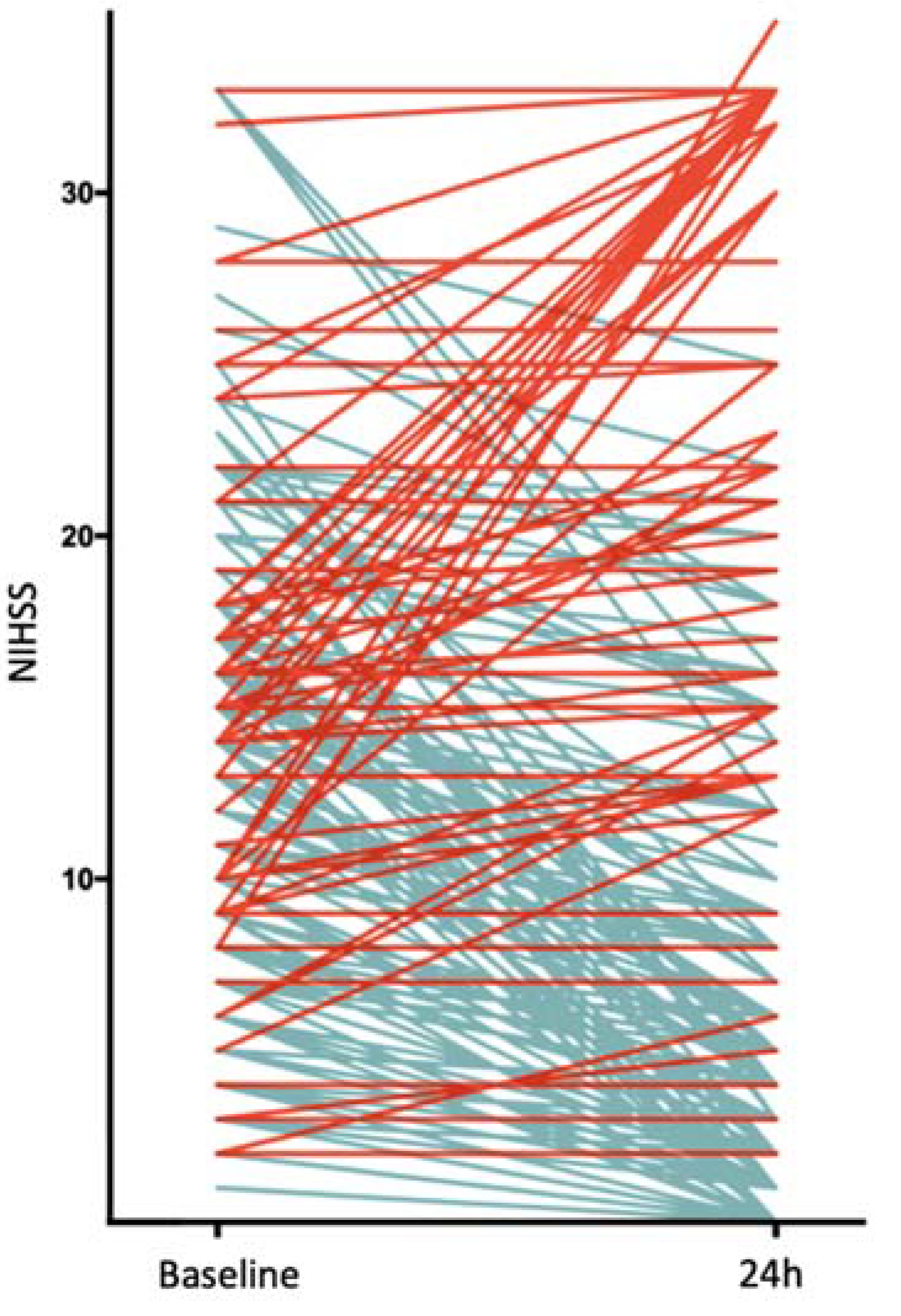
Course of Early Neurologic Symptom Severity after Endovascular Treatment of Anterior Circulation Large Vessel Occlusion Stroke: Association with Baseline Multiparametric CT Imaging and Clinical Parameters
 , , ,
, , , 
 ,
, Abstract
Share and Cite
Fabritius, M.P.; Wölfer, T.A.; Herzberg, M.; Tiedt, S.; Puhr-Westerheide, D.; Grosu, S.; Maurus, S.; Geyer, T.; Curta, A.; Kellert, L.; et al. Course of Early Neurologic Symptom Severity after Endovascular Treatment of Anterior Circulation Large Vessel Occlusion Stroke: Association with Baseline Multiparametric CT Imaging and Clinical Parameters. Diagnostics 2021, 11, 1272. https://doi.org/10.3390/diagnostics11071272
Fabritius MP, Wölfer TA, Herzberg M, Tiedt S, Puhr-Westerheide D, Grosu S, Maurus S, Geyer T, Curta A, Kellert L, et al. Course of Early Neurologic Symptom Severity after Endovascular Treatment of Anterior Circulation Large Vessel Occlusion Stroke: Association with Baseline Multiparametric CT Imaging and Clinical Parameters. Diagnostics. 2021; 11(7):1272. https://doi.org/10.3390/diagnostics11071272
Chicago/Turabian StyleFabritius, Matthias Philipp, Teresa A. Wölfer, Moriz Herzberg, Steffen Tiedt, Daniel Puhr-Westerheide, Sergio Grosu, Stefan Maurus, Thomas Geyer, Adrian Curta, Lars Kellert, and et al. 2021. "Course of Early Neurologic Symptom Severity after Endovascular Treatment of Anterior Circulation Large Vessel Occlusion Stroke: Association with Baseline Multiparametric CT Imaging and Clinical Parameters" Diagnostics 11, no. 7: 1272. https://doi.org/10.3390/diagnostics11071272
APA StyleFabritius, M. P., Wölfer, T. A., Herzberg, M., Tiedt, S., Puhr-Westerheide, D., Grosu, S., Maurus, S., Geyer, T., Curta, A., Kellert, L., Küpper, C., Liebig, T., Ricke, J., Dimitriadis, K., Kunz, W. G., Zimmermann, H., & Reidler, P. (2021). Course of Early Neurologic Symptom Severity after Endovascular Treatment of Anterior Circulation Large Vessel Occlusion Stroke: Association with Baseline Multiparametric CT Imaging and Clinical Parameters. Diagnostics, 11(7), 1272. https://doi.org/10.3390/diagnostics11071272