


Abstract
The paper concerns inequalities between fundamental quantities as area, perimeter, diameter and width for convex plane fugures.
1. Introduction
In this paper we use methods from the geometry of convex figures and geometric inequalities. Both the above mathematical subjects are old but have been very convenient, fruitful and active in recent times. A classical textbook in the convexity is the excellent, “Theory of Convex Bodies” by T. Bonnesen and W. Fenchel [1]. Another very nice tool is the “Convex Figures” of I. Yaglom and V. Boltyanski [2]. The Yugoslavian and Romanian school, with Mitvinovic and Andrescu, produced a very interesting theorem in algebraic and geometric Inequalities. Here, the problem is to find solutions to three interesting inequalities for convex figures in the plane. This problem came to me from a former student of mine, Prof. E. Symeonidis. The problem was published in AXIOMS 2018 7(1) by S.Marcus and F. Nichita. The solution of the first inequality is quite simple but the two others are sophisticated. For the solution I used two lemmas that have particular interest and could be useful to solve other problems.
2. Problems
Let f be a convex figure in the plane (that is a compact convex set). We denote by G its centroid. D is the maximal chord and d the minimal chord through G. Moreover, L stands for the perimeter, the diameter, the minimal breadth, and A the area of F.
We have to prove:
- (a)
- (b)
- (c)
Proof.
Inequality (a).
The formula for the perimeter of a convex figure F see [3] is:
where is the breadth of F to the direction is the min. breadth of F. So we have:
This is because of the obvious
The equality holds for the circle and the convex figures with constant breadth. □
For (b) and (c) we need two lemmas.
Lemma 1.
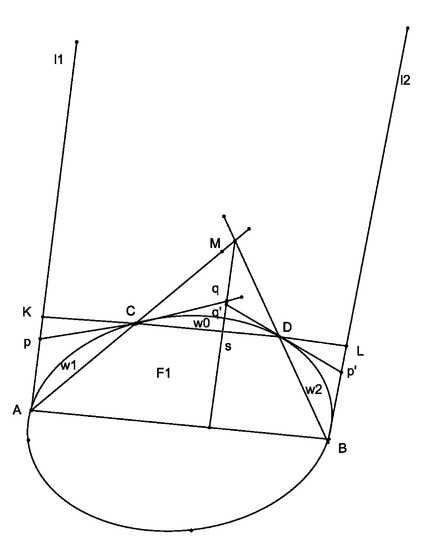
Let F be a convex figure and a diametrical chord. We denote by the support lines at the points respectively. We take the chord parallel to , so that . The str.line intersects at the points . The chord disects F into two parts. We denote the one part by as in the Figure 1. Then we have: .
Figure 1.
Lemma 1.
Proof.
Let intersect at the point M and parallel to , The support line at the point C intrsects at the points . The support line at the point D intersects at the points . In the triangle the points C and D are the midle points of the sides, so we use equalities of triangles without the proofs. The triangles are equal, the same for , the same for and . We denote the area of the segments of the , , .
We have
. Because .
By we denote the area of the triangle with sides . Analogously . Hence we conclude . □
Lemma 2.
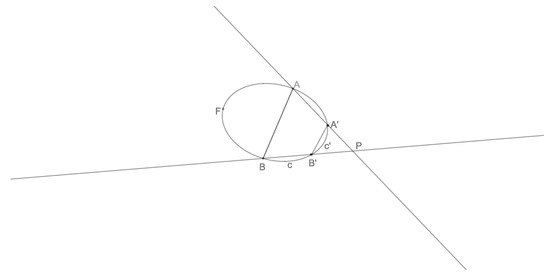
In the perimeter of the convex set F there are the points . The chord and are parallel and the point is outside of F. We denote by on the and , like in the Figure 2. We will prove that:
Figure 2.
Lemma 2.
Proof.
We denote by M the vector .
We have We easily find
hence
and
but
From the above (1), (2) follows
From (3) and (4) we take
and finally
□
Inequality (b).
The continuity of the convexity asserts us that we can choose the diametrical chord so that:
where and stands for the min.breadth and diameter of F respectively.
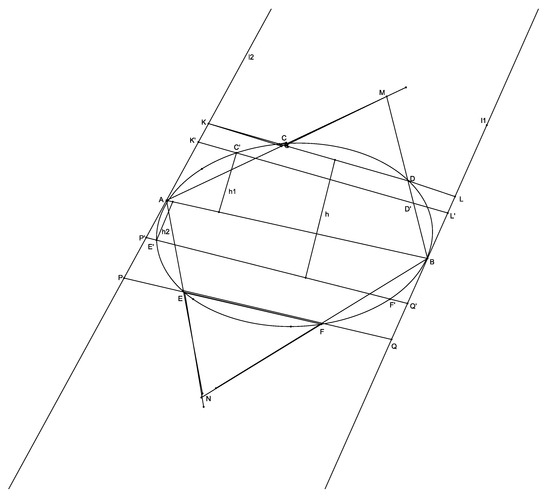
Figure 3.
Proofs b, c.
We take the points on so that .
We easily see, according our first lemma that
That means
where h is the distance between .
We now see that the convex F and the orthogonal have common part ; therefore, the position of the centroid G of F depends on the centroid g of the segments and segment . The point g lies inside the orthogonal . So we conclude that and from (6) follows that
Inequality (c).
The equality only for F circle. We suppose that F is not a circle.
We translate the str. lines closer towards to until to such a way the parallelogram has
we have:
where and .
Let now be the part of the perimeter L over of and analogously . We see that and . So, from the lemma 2, we easily see that and . That is .
Moreover, ; therefore, but ; hence, .
Funding
This research received no external funding.
Acknowledgments
I thank Eleutherius Symeonidis for introducing me to these wonderful problems of S. Marcus and F. Nichita. I also thank the reviewers for their remarks that aided the simplicity of the proofs.
Conflicts of Interest
The authors declare no conflict of interest.
References
- Bonnesen, T.; Fencel, W. Theory of Convex Bodies; BCS Associates: London, UK, 1988. [Google Scholar]
- Yaglom, I.M.; Boltyanskii, V.G. Convex Figures; Holt, Rinehart and Winston: Dunfermline, UK, 1961. [Google Scholar]
- Tsintsifas, G. Convex Figures. Available online: http://gtsintsifas.com (accessed on 1 July 2020).
© 2020 by the author. Licensee MDPI, Basel, Switzerland. This article is an open access article distributed under the terms and conditions of the Creative Commons Attribution (CC BY) license (http://creativecommons.org/licenses/by/4.0/).