


Abstract
We find the sharp radius of uniformly convex -spirallikeness for (here is the Bessel function of the first kind of order ) with three different kinds of normalizations of the function . As an application, we derive sufficient conditions on the parameters for the functions to be uniformly convex -spirallikeness and, consequently, generate examples of uniform convex -spirallike via . Results are well-supported by the relevant graphs and tables.
Keywords:
γ-spirallike functions; uniformly convex functions; bessel function and derivatives; radius problem MSC:
30C45; 30C15
1. Introduction
Let be the class of analytic functions normalized by the condition in the unit disk , where . Now let be the image of an arc , under the function , and let be a point not on . Let . The arc is -spirallike with respect to if
lies between and . Further, an arc is convex -spirallike if
lies between and . In the form of one variable, equivalently, we say that a function is -spirallike of order if and only if
where and . We denote the class of such functions by . In view of the well-known Alexander’s relation, let be the class of convex -spirallike functions of order , which is defined below:
Spacek [1] introduced and studied the class . Each function in is univalent in , but they are not necessarily starlike. Further, it is worth mentioning that, for general values of , a function in need not be univalent in . For example, , but this is not univalent. In this context, see Figure 1. Indeed, is univalent if ; see Robertson [2] and Pfaltzgraff [3]. Note that, for , the classes and reduce to the classes of starlike and convex functions of order , given by
which we denote by and , respectively.
In the above context and using the idea of uniformly starlike and uniformly convex functions introduced and studied in [4,5,6,7,8], Ravichandran et al. [9] introduced the concept of uniformly -spiral functions as described below:
Definition 1.
([9]). The function f is a uniformly convex γ-spiral function if the image of every circular arc with center at ζ lying in is a convex γ-spiral.
We denote the class of such functions by . These functions have an analytic characterization (see [9]) as follows:
Indeed, authors in [9] obtained the one-variable characterization as:
Special functions and their geometric properties frequently appear in univalent function theory. In the recent past, normalized function properties have been explored in terms of radius problems [10,11,12,13]. In particular, for a normalized special function f, we define
and, similarly, one may define the -radius. In this direction, the -radius of Bessel functions was obtained in [10], and Ramanujan-type entire functions were dealt with in [11]. A unified treatment of the radius of Ma–Minda classes [14] and more for some special functions was studied in [13,15,16].
However, to the best of our knowledge, the -radius has not been studied to date for the above-mentioned special functions. Therefore, we define the -radius here:
Definition 2.
Let f in be a special function. Then, the radius of a uniformly convex γ-spirallike is found as:
In the present investigation, we consider our special normalized functions to be the derivatives of Bessel functions. Recall that the Bessel function of the first kind of order is defined by ([17], p. 217):
We know that all its zeros are real for . Here we consider the general function
which was studied by Mercer [18]. Here, as mentioned in [18], we take and . From (1), we now have the power series representation
where There are three important reference works dealing with the function Firstly, in Mercer’s paper [18], it is proved that the positive zero of increases with in . Secondly, Ismail and Muldoon [19], under the conditions such that and or and , showed the following behavior of roots:
- (i)
- For , the zeros of are either real or purely imaginary.
- (ii)
- For , where is the largest real root of the quadratic the the zeros of are real.
- (iii)
- If , and , the zeros of are all real, except for a single pair that is conjugate and purely imaginary.
In 2016, Baricz et al. [20] obtained the sufficient and necessary conditions for the starlikeness of a normalized form of by using the results of Mercer [18], Ismail and Muldoon [19], and Shah and Trimble [21].
Since the function does not belong to , to prove our results, we consider the following normalizations of the function as given by:
In the rest of this paper, for the quadratic , we will always assume that or Moreover, is the largest real root of the quadratic defined according to the above conditions.
Since the functions and are entire functions of order zero, then they have infinitely many zeros. According to the Hadamard factorization theorem [22], we may write
and
where and denote the positive zero of and respectively. For recent updates on the geometric properties of Bessel functions, readers are urged to see [20,23,24,25,26,27,28] and references therein.
2. Zeros of Hyperbolic Polynomials and the Laguerre–Pólya Class of Entire Functions
In this section, we recall some necessary information about polynomials and entire functions with real zeros. An algebraic polynomial is called hyperbolic if all its zeros are real. We formulate the following specific statement that we shall need; see [25] for more details. By definition, a real entire function belongs to the Laguerre–Pólya class if it can be represented in the form
with , and Similarly, is said to be of type in the Laguerre–Pólya class, written , if or can be represented as
with , and The class is the complement of the space of hyperbolic polynomials in the topology induced by the uniform convergence on the compact sets of the complex plane, while is the complement of the hyperbolic polynomials whose zeros possess a preassigned constant sign. Given an entire function with the Maclaurin expansion
its Jensen polynomials are defined by
The next result of Jensen [29] is a well-known characterization of functions belonging to .
Lemma 1.
The function φ belongs to , respectively) if and only if all the polynomials , are hyperbolic (hyperbolic with zeros of equal sign). Moreover, the sequence converges locally uniformly to .
The following result is a key tool in the proof of the main results.
Lemma 2.
([30]). The function has infinitely many zeros, and all of them are positive, if . Denoting by the positive zero of under the same conditions, the Weierstrassian decomposition
is valid, and this product is uniformly convergent on compact subsets of the complex plane. Moreover, if we denote by the nth positive zero of where then the positive zeros of are interlaced with those of In other words, the zeros satisfy the chain of inequalities
3. Main Results
Our principal result establishes the radius of , see Table 1, and reads as follows:
Theorem 1.
Let The following statements hold:
- If , , then the radius of uniformly convex γ-spirallikeness of the function is the smallest positive root of the equation
- If then the radius of uniformly convex γ-spirallikeness of the function is the smallest positive root of the equation
- If then the radius of uniformly convex γ-spirallikeness of the function is the smallest positive root of the equation
Proof.
We first prove part . From (3), we have
and by means of (6) and (7), we obtain
For , we get
where . Moreover, observe that if we use the inequality ([31], Lemma 2.1)
where and such that , then we see that the inequality (8) is also valid when . Here we have seen that the zeros of and are interlacing according to Lemma 1. In view of the Definition 2 and the above inequalities (8), let us define , which is given by
Clearly, it can be seen that
for all . Moreover, for using Lemma 2,
Now let be the smallest positive root of the equation Hence, the inequality
holds whenever the following inequality is valid:
The above inequality may be equivalently read as , which is valid for all . The sharpness of the radius constant can be observed, in view of the maximum and minimum modulus principles by taking such that the following reverse inequality holds:
This completes the proof of part .
For the other parts, in view of Lemma 2, note that the functions and belong to the Laguerre–Pólya class , which is closed under differentiation, that their derivatives and also belong to , and that the zeros are real. Thus assuming and to be the positive zeros of and , respectively, we have the following representations:
which yield
Further, reasoning along the same lines as in part , the result follows at once. □

Table 1.
Radii of uniformly convex spirallike for , and in Theorem 1.
Table 1.
Radii of uniformly convex spirallike for , and in Theorem 1.
| and | and | and | |||||||
|---|---|---|---|---|---|---|---|---|---|
Example 1.
For the value , we may express the function in terms of the elementary trigonometric functions as follows:
Consequently, we get
and
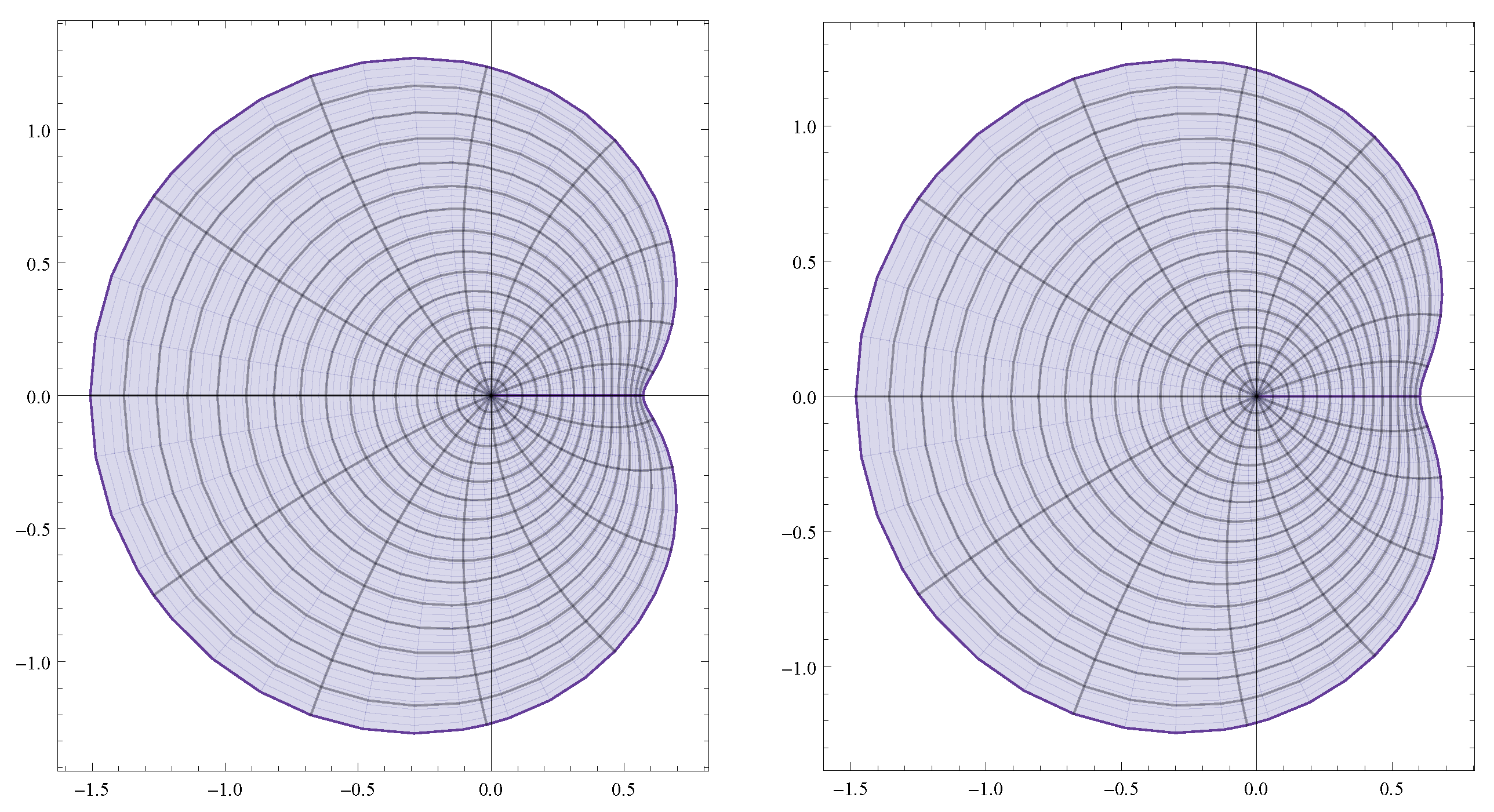
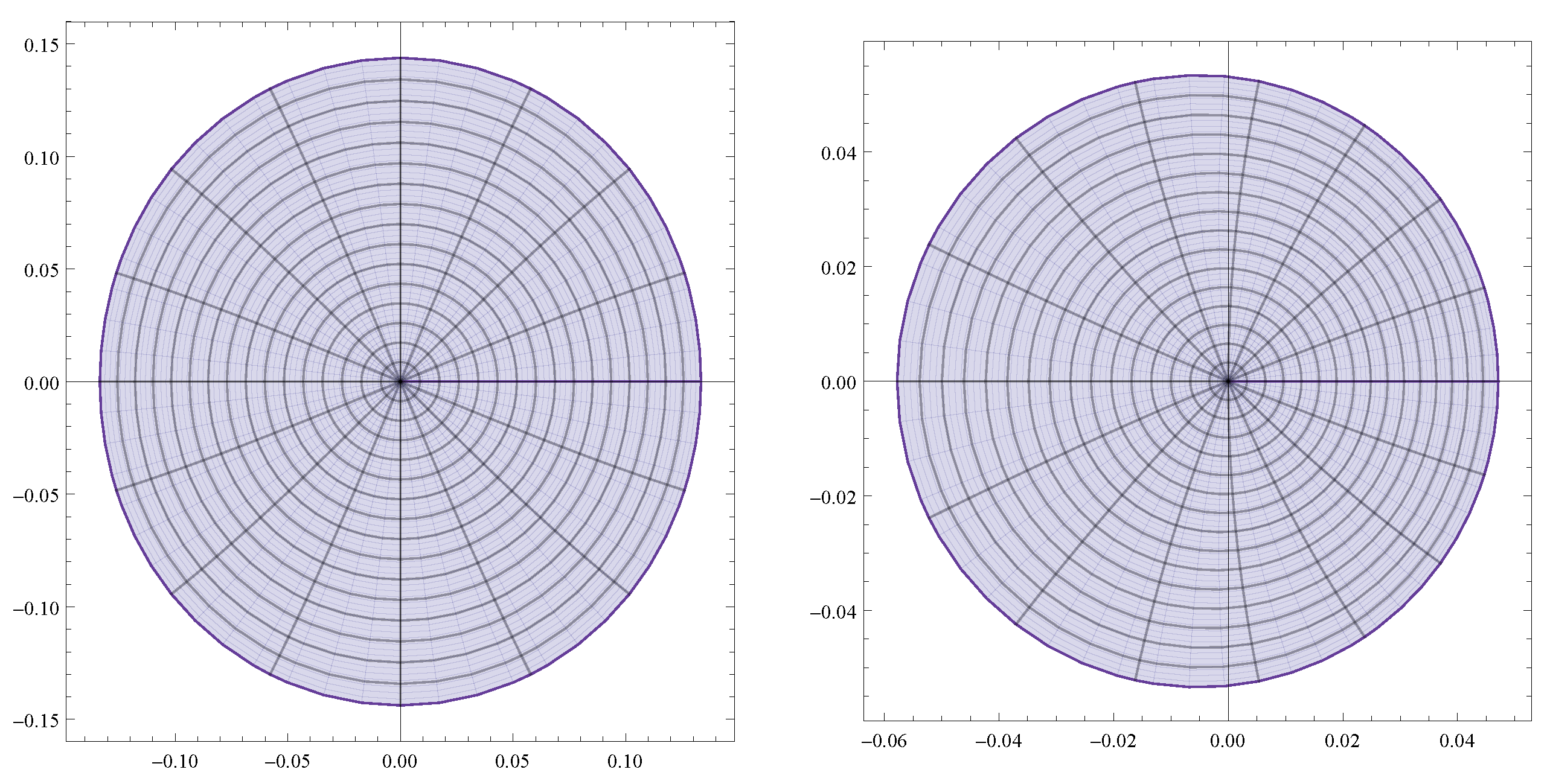
An immediate consequence of the proof of Theorem 1 is the following sufficient conditions for functions to be uniformly convex -spirallike. In fact, Table 2, Table 3 and Table 4 explain the sufficient conditions for uniformly convex -spirallikeness by giving the minimum value of the with respect to the given equations in Corollary 1. Also, Figure 1, Figure 2 and Figure 3 represent image domains of the unit disk in view of Corollary 1.
Corollary 1.
(Sufficient condition.) Let and . Then, the following statements hold:
- Let . The function is uniformly convex γ-spirallike if
- The function is uniformly convex γ-spirallike if
- The function is uniformly convex γ-spirallike if
- In particular, provides sufficient conditions for functions to be uniformly convex.
Table 2.
Minimum value of for uniformly convex -spirallike of in Corollary 1.
Table 2.
Minimum value of for uniformly convex -spirallike of in Corollary 1.
| and | and | and | |||||||
|---|---|---|---|---|---|---|---|---|---|
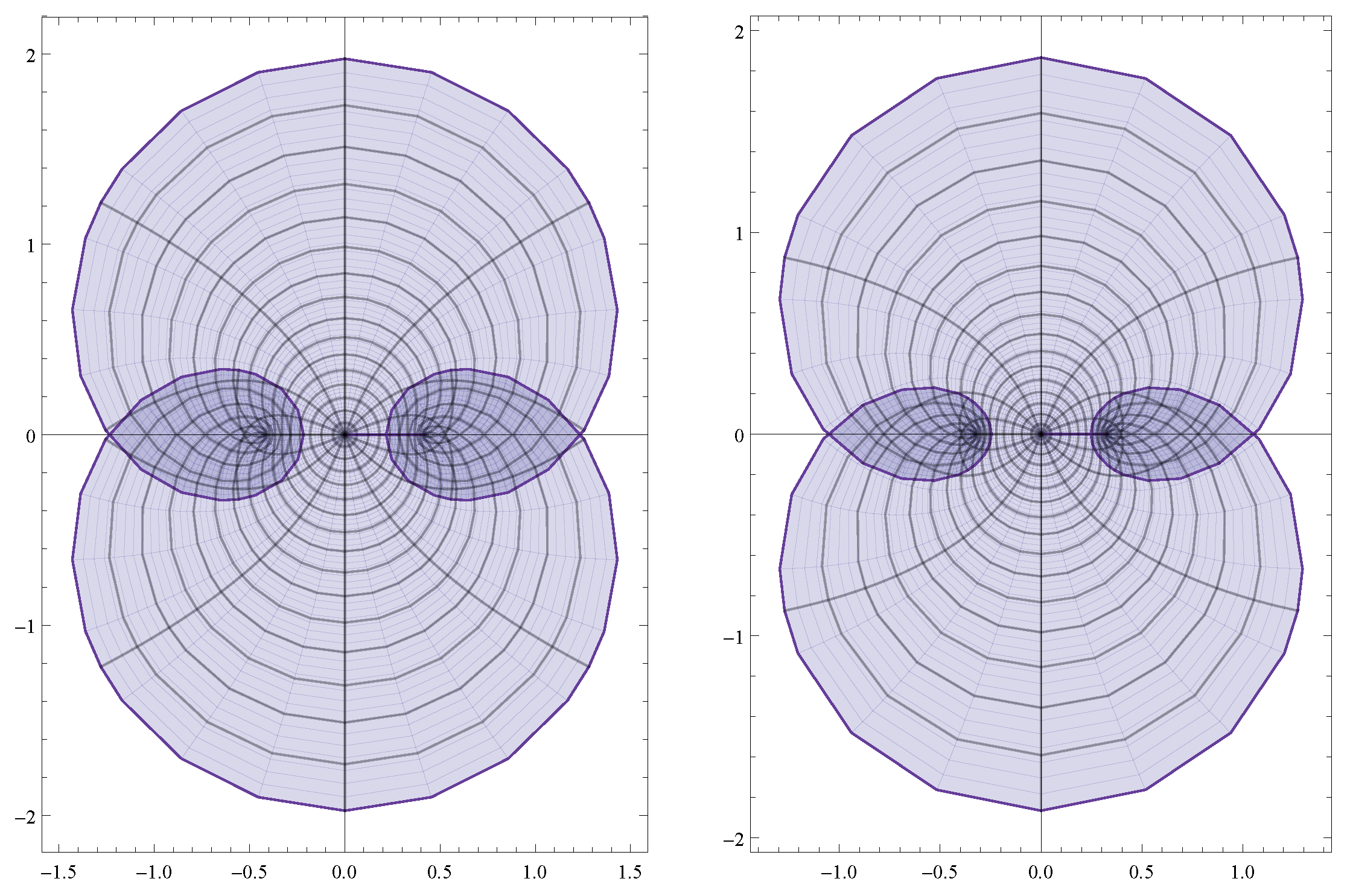
Figure 1.
Image domains of the unit disk under with , and for , and with , and for using Table 2.
Figure 1.
Image domains of the unit disk under with , and for , and with , and for using Table 2.
Remark 1.
In light of Spacek [1], here we see that for , and , and for , and , but that these are not univalent in , as shown in Figure 1.
Table 3.
Minimum value of for uniformly convex -spirallike of in Corollary 1.
Table 3.
Minimum value of for uniformly convex -spirallike of in Corollary 1.
| and | and | and | |||||||
|---|---|---|---|---|---|---|---|---|---|
Figure 2.
Image domains of the unit disk under the function with , and for , and the function with , and for using Table 3.
Figure 2.
Image domains of the unit disk under the function with , and for , and the function with , and for using Table 3.
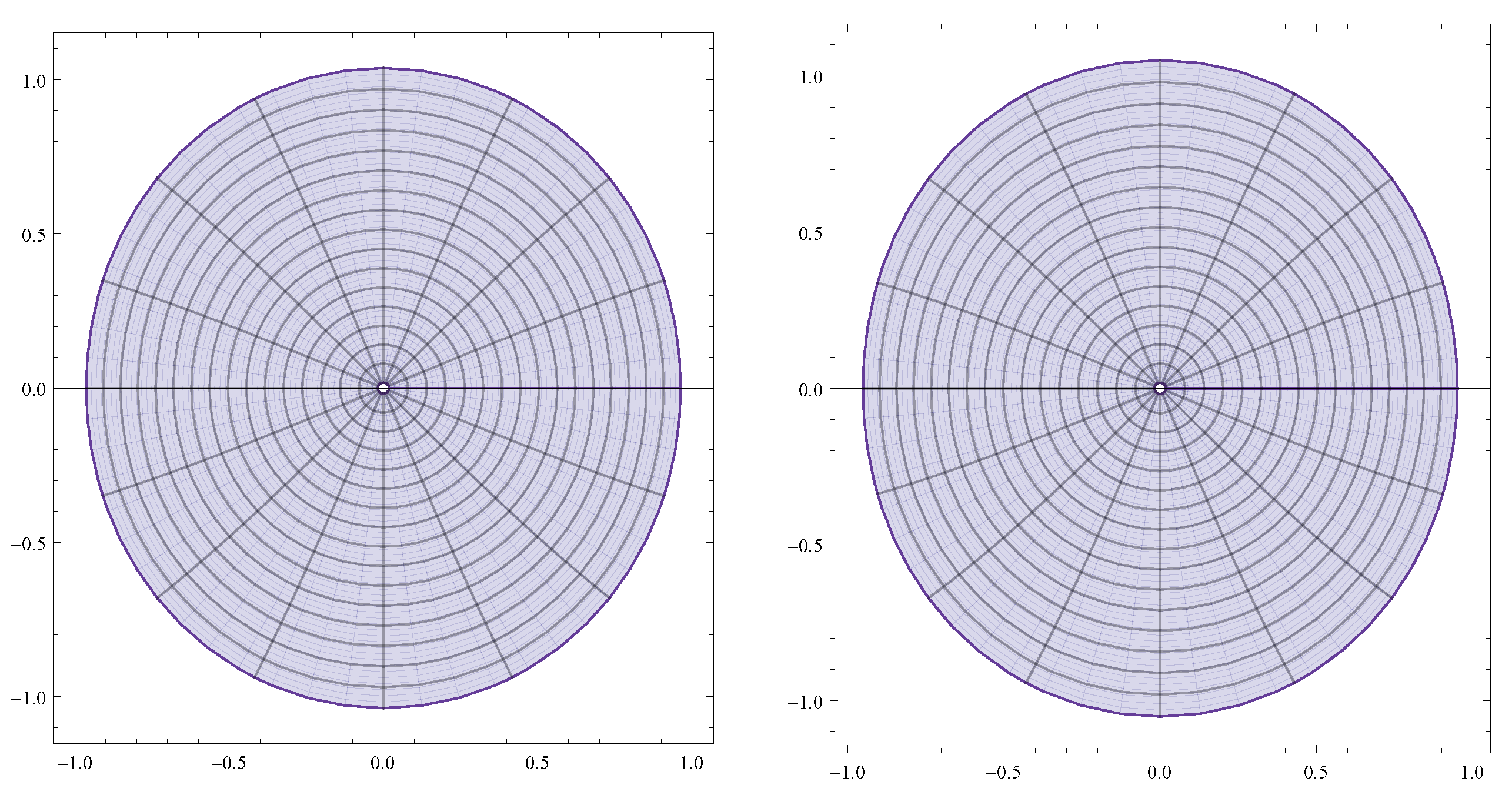
Table 4.
Minimum value of for uniformly convex -spirallike of in Corollary 1.
Table 4.
Minimum value of for uniformly convex -spirallike of in Corollary 1.
| and | and | and | |||||||
|---|---|---|---|---|---|---|---|---|---|
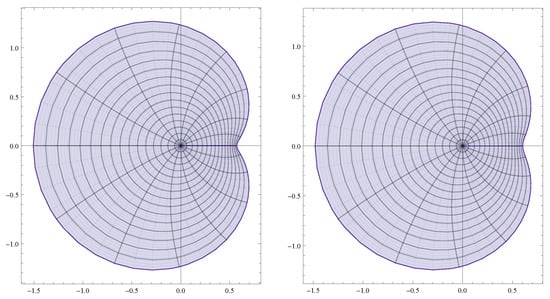
Figure 3.
Image domains of the unit disk under function with , and for , and function with , and for using Table 4.
Figure 3.
Image domains of the unit disk under function with , and for , and function with , and for using Table 4.
Remark 2.
In Theorem 1, letting , we obtain the radius of uniform convexity for the functions , and as defined by (3), (4), and (5), respectively.
Corollary 2.
(Radius of uniform convexity). Let . The following statements hold:
- If , then the radius of uniform convexity of the function is the smallest positive root of the equation
- The radius of uniform convexity of the function is the smallest positive root of the equation
- Then the radius of uniform convexity of the function is the smallest positive root of the equation
Now, from Theorem 1, we deduce that:
Example 2.
Let , and , see Figure 4. The following statements are true.
- The radius of uniformly convex spirallikeness of the function is the smallest positive root of the equation
- The radius of uniformly convex spirallikeness of the function is the smallest positive root of the equation
- The radius of uniformly convex spirallikeness of the function is the smallest positive root of the equation
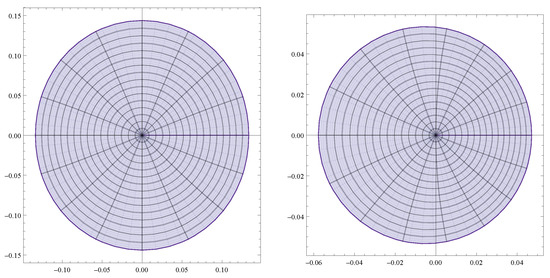
Figure 4.
Image domains of for and for , respectively, with , and for
Figure 4.
Image domains of for and for , respectively, with , and for
4. Conclusions
For the three different kinds of normalizations, namely (3), (4), and (5) of the function where is the Bessel function of the first kind of order , we obtained the sharp radius of uniformly -spirallikeness. As a byproduct, we obtained the conditions on parameters for the normalized forms to be uniform -spirallike functions. Thus, we created a category of examples of uniform -spirallike functions from special functions.
Author Contributions
All authors contributed equally. All authors have read and agreed to the published version of the manuscript.
Funding
This research received no external funding.
Data Availability Statement
Not applicable.
Acknowledgments
The authors would like to thank the anonymous reviewers for their insightful comments.
Conflicts of Interest
The authors declare no conflict of interest.
References
- Spacek, L. Contribution á la thèorie des fonctions univalentes. Casop Pest. Mat.-Fys. 1933, 62, 12–19. [Google Scholar]
- Robertson, M.S. Univalent functions f(z) for which zf′(z) is spirallike. Mich. Math. J. 1969, 16, 97–101. [Google Scholar] [CrossRef]
- Pfaltzgraff, J.A. Univalence of the integral of f′(z)λ. Bull. Lond. Math. Soc. 1975, 7, 254–256. [Google Scholar] [CrossRef]
- Kanas, S.; Wiśniowska, A. Conic domains and starlike functions. Rev. Roumaine Math. Pures Appl. 2000, 45, 647–657. [Google Scholar]
- Kanas, S.; Wiśniowska, A. Conic regions and k-uniform convexity. J. Comput. Appl. Math. 1999, 105, 327–336. [Google Scholar] [CrossRef]
- Goodman, A.W. On uniformly convex functions. Ann. Pol. Math. 1991, 56, 87–92. [Google Scholar] [CrossRef]
- Goodman, A.W. On uniformly starlike functions. J. Math. Anal. Appl. 1991, 155, 364–370. [Google Scholar] [CrossRef]
- Ronning, F. Uniformly convex functions and a corresponding class of starlike functions. Proc. Am. Math. Soc. 1993, 118, 189–196. [Google Scholar] [CrossRef]
- Ravichandran, V.; Selvaraj, C.; Rajagopal, R. On uniformly convex spiral functions and uniformly spirallike functions. Soochow J. Math. 2003, 29, 393–405. [Google Scholar]
- Baricz, Á.; Kupán, P.A.; Szxaxsz, R. The radius of starlikeness of normalized Bessel functions of the first kind. Proc. Am. Math. Soc. 2014, 142, 2019–2025. [Google Scholar] [CrossRef]
- Deniz, E. Geometric and monotonic properties of Ramanujan type entire functions. Ramanujan J. 2020, 55, 103–130. [Google Scholar] [CrossRef]
- Kazımoğlu, S.; Deniz, E. The radii of starlikeness and convexity of the functions including derivatives of Bessel functions. Turk. J. Math. 2022, 46, 894–911. [Google Scholar] [CrossRef]
- Saliu, A.; Jabeen, K.; Al-shbeil, I.; Oladejo, S.O.; Cătaş, A. Radius and Differential Subordination Results for Starlikeness Associated with Limaçon Class. J. Funct. Spaces 2022. [Google Scholar] [CrossRef]
- Ma, W.C.; Minda, D. A unified treatment of some special classes of univalent functions. In Proceedings of the Conference on Complex Analysis, Tianjin, China, 19–23 June 1992; Conf Proc Lecture Notes Anal I; Int Press: Cambridge, MA, USA, 1992; pp. 157–169. [Google Scholar]
- Gangania, K.; Kumar, S.S. S*(ψ) and C(ψ)-radii for some special functions. Iran. J. Sci. Technol. Trans. A Sci. 2022, 46, 95966. [Google Scholar]
- Gangania, K.K.; Kumar, S.S. Certain Radii problems for S*(ψ) and Special functions. arXiv 2023, arXiv:2007.07816v2. [Google Scholar]
- Oliver, F.W.J.; Lozier, D.W.; Boisvert, R.F.; Clark, C.W. (Eds.) NIST Handbook of Mathematical Functions; Cambridge Univ. Press: Cambridge, UK, 2010. [Google Scholar]
- Mercer, A.C. The zeros of az2Jν″(z)+bzJν′(z)+cJν(z) as functions of order. Internat. J. Math. Math. Sci. 1992, 15, 319–322. [Google Scholar] [CrossRef]
- Ismail, M.E.H.; Muldoon, M.E. Bounds for the small real and purely imaginary zeros of Bessel and related functions. Meth. Appl. Anal. 1995, 2, 1–21. [Google Scholar] [CrossRef]
- Baricz, Á.; Çağlar, M.; Deniz, E. Starlikeness of bessel functions and their derivatives. Math. Inequal. Appl. 2016, 19, 439–449. [Google Scholar] [CrossRef]
- Shah, S.M.; Trimble, S.Y. Entire functions with univalent derivatives. J. Math. Anal. Appl. 1971, 33, 220–229. [Google Scholar] [CrossRef]
- Levin, B.Y. Lectures on Entire Functions. Am. Math. Soc. Transl. Math. Monogr. 1996, 150, 248. [Google Scholar]
- Baricz, Á.; Orhan, H.; Szász, R. The radius of α- convexity of normalized Bessel functions of the first kind. Comput. Method. Func. Theo. 2016, 16, 93–103. [Google Scholar] [CrossRef]
- Deniz, E.; Szász, R. The radius of uniform convexity of Bessel functions. J. Math. Anal. Appl. 2017, 453, 572–588. [Google Scholar] [CrossRef]
- Deniz, E.; Kazımoğlu, S.; Çağlar, M. Radii of Starlikeness and Convexity of Bessel Function Derivatives. Ukr. Math. J. 2022, 73, 1686–1711. [Google Scholar] [CrossRef]
- Szász, R. About the radius of starlikeness of Bessel functions of the first kind. Monatshefte Für Math. 2015, 176, 323–330. [Google Scholar] [CrossRef]
- Frasin, B.A.; Aldawish, I. On Subclasses of Uniformly Spirallike Functions Associated with Generalized Bessel Functions. J. Funct. Spaces 2019, 2019, 1329462. [Google Scholar]
- Kazımoğlu, S.; Gangania, K. Radius of γ-Spirallikeness of order α for some Special functions. arXiv 2022, arXiv:2211.13232. [Google Scholar]
- Jensen, J.L.W.V. Recherches sur la théorie des équations. Acta Math. 1913, 36, 181–195. [Google Scholar] [CrossRef]
- Kazımoğlu, S.; Deniz, E. Radius Problems for Functions Containing Derivatives of Bessel Functions. Comput. Method. Func. Theo. 2022, 1–26. [Google Scholar] [CrossRef]
- Baricz, Á.; Szász, R. The radius of convexity of normalized Bessel functions of the first kind. Anal. Appl. 2014, 12, 485–509. [Google Scholar] [CrossRef]
Disclaimer/Publisher’s Note: The statements, opinions and data contained in all publications are solely those of the individual author(s) and contributor(s) and not of MDPI and/or the editor(s). MDPI and/or the editor(s) disclaim responsibility for any injury to people or property resulting from any ideas, methods, instructions or products referred to in the content. |
© 2023 by the authors. Licensee MDPI, Basel, Switzerland. This article is an open access article distributed under the terms and conditions of the Creative Commons Attribution (CC BY) license (https://creativecommons.org/licenses/by/4.0/).