
Three Decades of Fuzzy AHP: A Bibliometric Analysis

 ,
, 

Abstract
1. Introduction
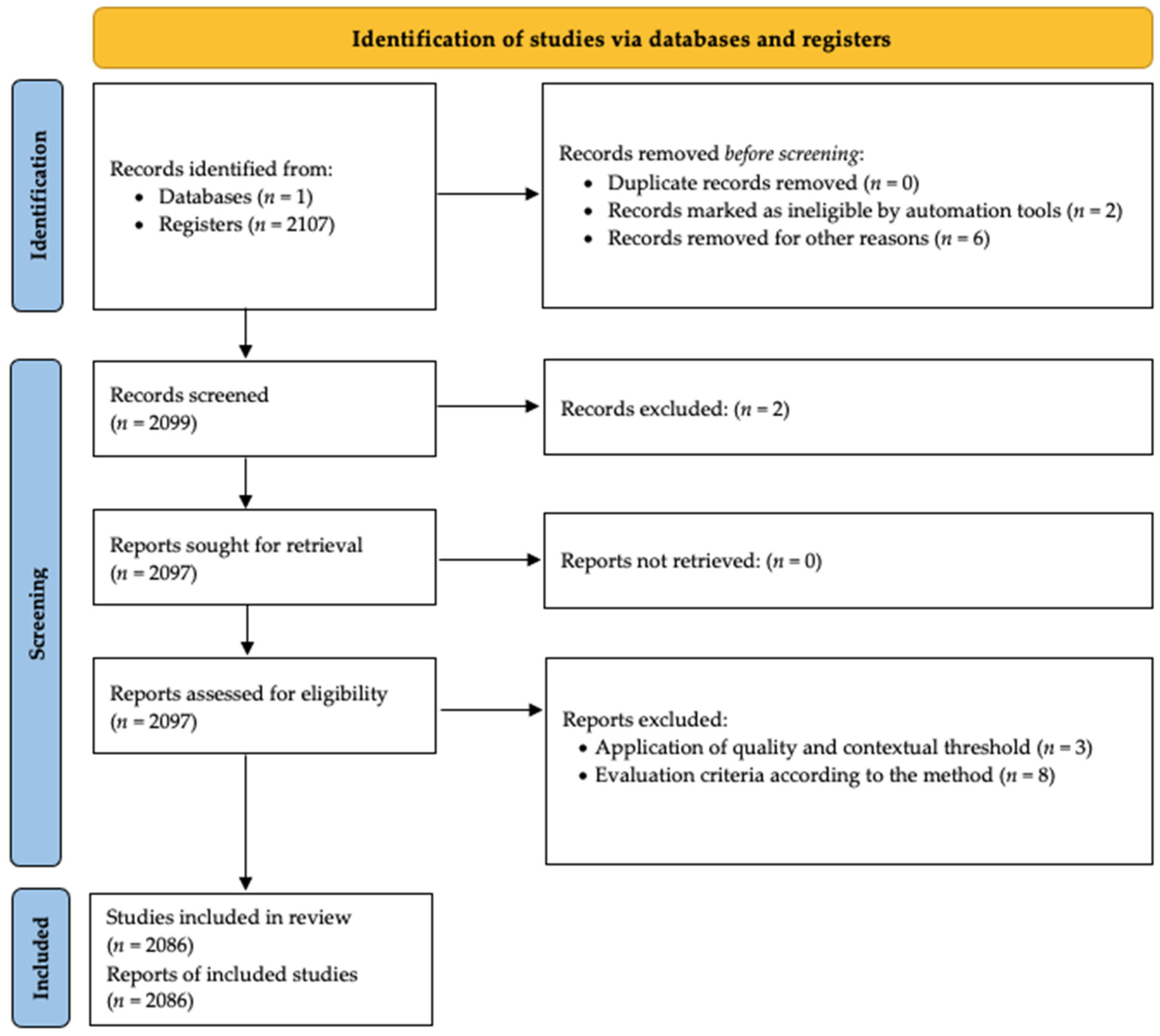
2. Materials and Methods
3. Results and Discussion
3.1. Preliminary Analysis
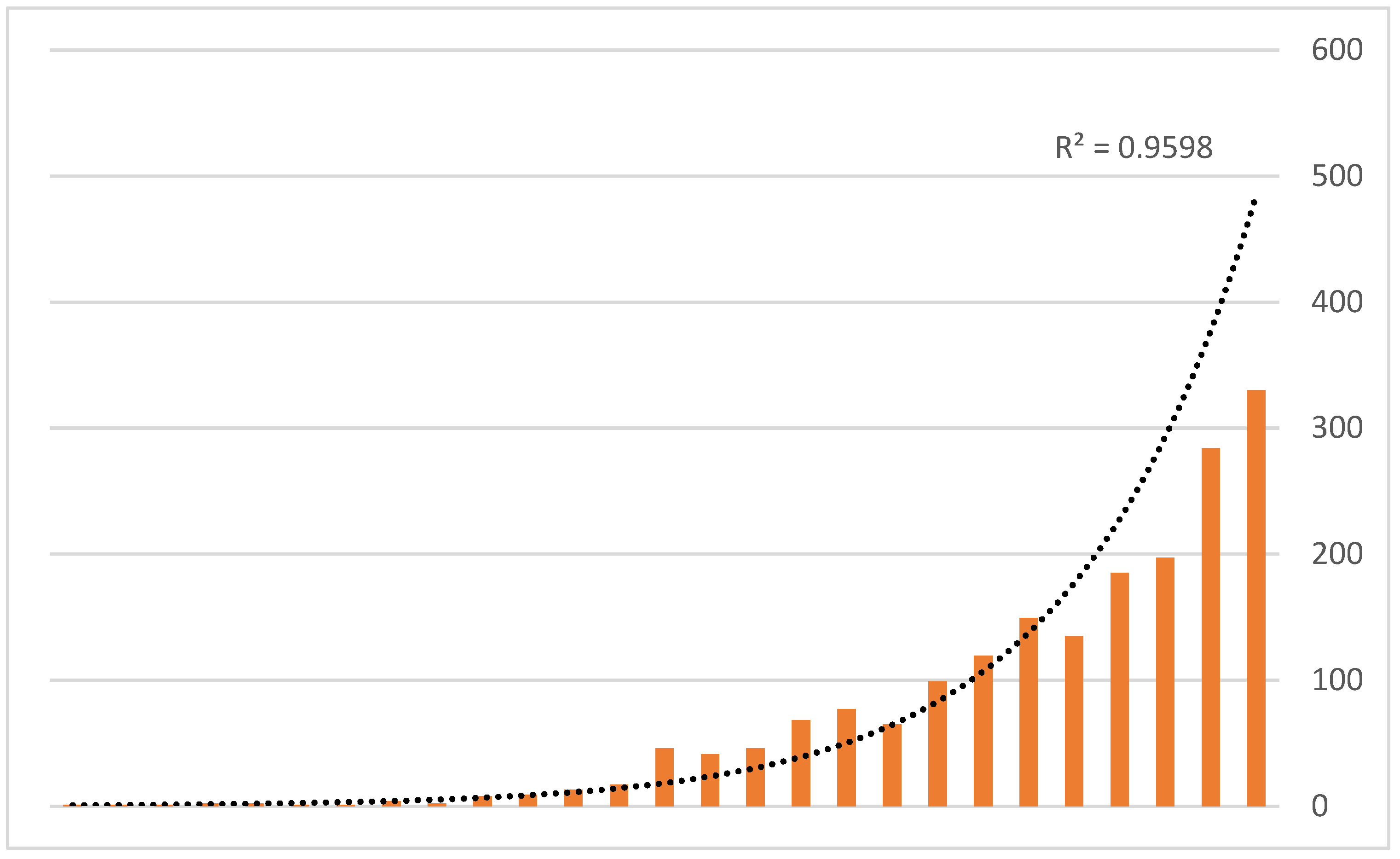
3.2. Production and Academic Impact

| Article Title | Authors | Year | Journal | Cites | NIY |
|---|---|---|---|---|---|
| Applications of the Extent Analysis Method on Fuzzy AHP [48] | Chang, D.Y. | 1996 | European Journal of Operational Research | 2436 | 93.7 |
| Integrated Analytic Hierarchy Process and its Applications—A Literature Review [15] | Ho, W. | 2008 | European Journal of Operational Research | 552 | 39.4 |
| Multi-Attribute Comparison of Catering Service Companies Using Fuzzy AHP: The case of Turkey [55] | Kahraman, C.; Cebeci, U.; Ruan, D. | 2004 | International Journal of Production Economics | 467 | 25.9 |
| On the Extent Analysis Method for Fuzzy AHP and its Applications [62] | Wang, Y.M.; Luo, Y.; Hua, Z. | 2008 | European Journal of Operational Research | 437 | 31.2 |
| A Comparison Between Fuzzy AHP and Fuzzy TOPSIS Methods to Supplier Selection [64] | Lima, F.R.; Osiro, L.; Carpinetti, L.C.R. | 2014 | Applied Soft Computing | 432 | 54.0 |
| Global Supplier Selection: A Fuzzy AHP Approach [50] | Chan, F.T.S.; Kumar, N.; Tiwari, M.K.; Lau, H.C.W.; Choy, K.L. | 2008 | International Journal of Production Research | 389 | 27.8 |
| A Performance Evaluation Model by Integrating Fuzzy AHP and Fuzzy TOPSIS Methods [66] | Sun, C.C. | 2010 | Expert Systems with Applications | 372 | 31.0 |
| Supplier Selection Using Fuzzy AHP and Fuzzy Multi-Objective Linear Programming for Developing Low Carbon Supply Chain [49] | Shaw, K.; Shankar, R.; Yadav, S.S.; Thakur, L.S. | 2012 | Expert Systems with Applications | 369 | 36.9 |
| An Integrated Framework for Sustainable Supplier Selection and Evaluation in Supply Chains [51] | Luthra, S.; Govindan, K.; Kannan, D.; Mangla, S.K.; Garg, C.P. | 2017 | Journal of Cleaner Production | 375 | 75.0 |
| Fuzzy Failure Modes and Effects Analysis by Using Fuzzy TOPSIS-based Fuzzy AHP [61] | Kutlu, A.C.; Ekmekcioglu, M. | 2012 | Expert Systems with Applications | 343 | 34.3 |
| On Consistency and Ranking of Alternatives in Fuzzy AHP [60] | Leung, L.C.; Cao, D. | 2000 | European Journal of Operational Research | 316 | 14.4 |
| A Fuzzy AHP and BSC Approach for Evaluating Performance of IT Department in the Manufacturing Industry in Taiwan [52] | Lee, A.H.I.; Chen, W.C.; Chang, C.J. | 2008 | Expert Systems with Applications | 328 | 23.4 |
| A Discussion on Extent Analysis Method and Applications of Fuzzy AHP [59] | Zhu, K.J.; Jing, Y.; Chang, D.Y. | 1999 | European Journal of Operational Research | 312 | 13.6 |
| Determining the Importance Weights for the Customer Requirements in QFD Using a Fuzzy AHP with an Extent Analysis Approach [58] | Kwong, C.K.; Bai, H. | 2003 | IIE Transactions | 305 | 16.1 |
| Construction Projects Selection and Risk Assessment by Fuzzy AHP and Fuzzy TOPSIS Methodologies [65] | Taylan, O.; Bafail, A.O.; Abdulaal, R.M.S.; Kabli, M.R. | 2014 | Applied Soft Computing | 303 | 37.9 |
| Fuzzy Multi-Attribute Selection Among Transportation Companies Using Axiomatic Design and Analytic Hierarchy Process [68] | Kulak, O.; Kahraman, C. | 2005 | Information Sciences | 296 | 17.4 |
| Evaluation of Hazardous Waste Transportation Firms by Using a Two Step Fuzzy AHP and TOPSIS Methodology [63] | Gumus, A.T. | 2009 | Expert Systems with Applications | 304 | 23.4 |
| Selection of Optimum Maintenance Strategies Based on a Fuzzy Analytic Hierarchy Process [53] | Wang, L.; Chu, J.; Wu, J. | 2007 | International Journal of Production Economics | 300 | 20.0 |
| Developing a Fuzzy Analytic Hierarchy Process (AHP) Model for Behavior-Based Safety Management [54] | Dagdeviren, M.; Yuksel, I. | 2008 | Information Sciences | 284 | 20.3 |
| Intuitionistic Fuzzy Analytic Hierarchy Process [17] | Xu, Z.S.; Liao, H.C. | 2014 | IEEE Transactions on Fuzzy Systems | 273 | 34.1 |
| Combining Grey Relation and TOPSIS Concepts for Selecting an Expatriate Host Country [67] | Chen, M.F.; Tzeng, G.H. | 2004 | Mathematical and Computer Modelling | 275 | 15.3 |
| A Comparative Analysis for Multiattribute Selection Among Renewable Energy Alternatives Using Fuzzy Axiomatic Design and Fuzzy Analytic Hierarchy Process [26] | Kahraman, C.; Kaya, I.; Cebi, S. | 2009 | Energy | 282 | 21.7 |
| The Analytic Hierarchy Process and Analytic Network Process: An Overview of Applications [20] | Sipahi, S.; Timor, M. | 2010 | Management Decision | 269 | 22.4 |
| A Fuzzy AHP Approach to the Determination of Importance Weights of Customer Requirements in Quality Function Deployment [57] | Kwong, C.K.; Bai, H. | 2002 | Journal of Intelligent Manufacturing | 241 | 12.1 |
| Prioritization of Human Capital Measurement Indicators Using Fuzzy AHP [56] | Bozbura, F.T.; Beskese, A.; Kahraman, C. | 2007 | Expert Systems with Applications | 268 | 17.9 |
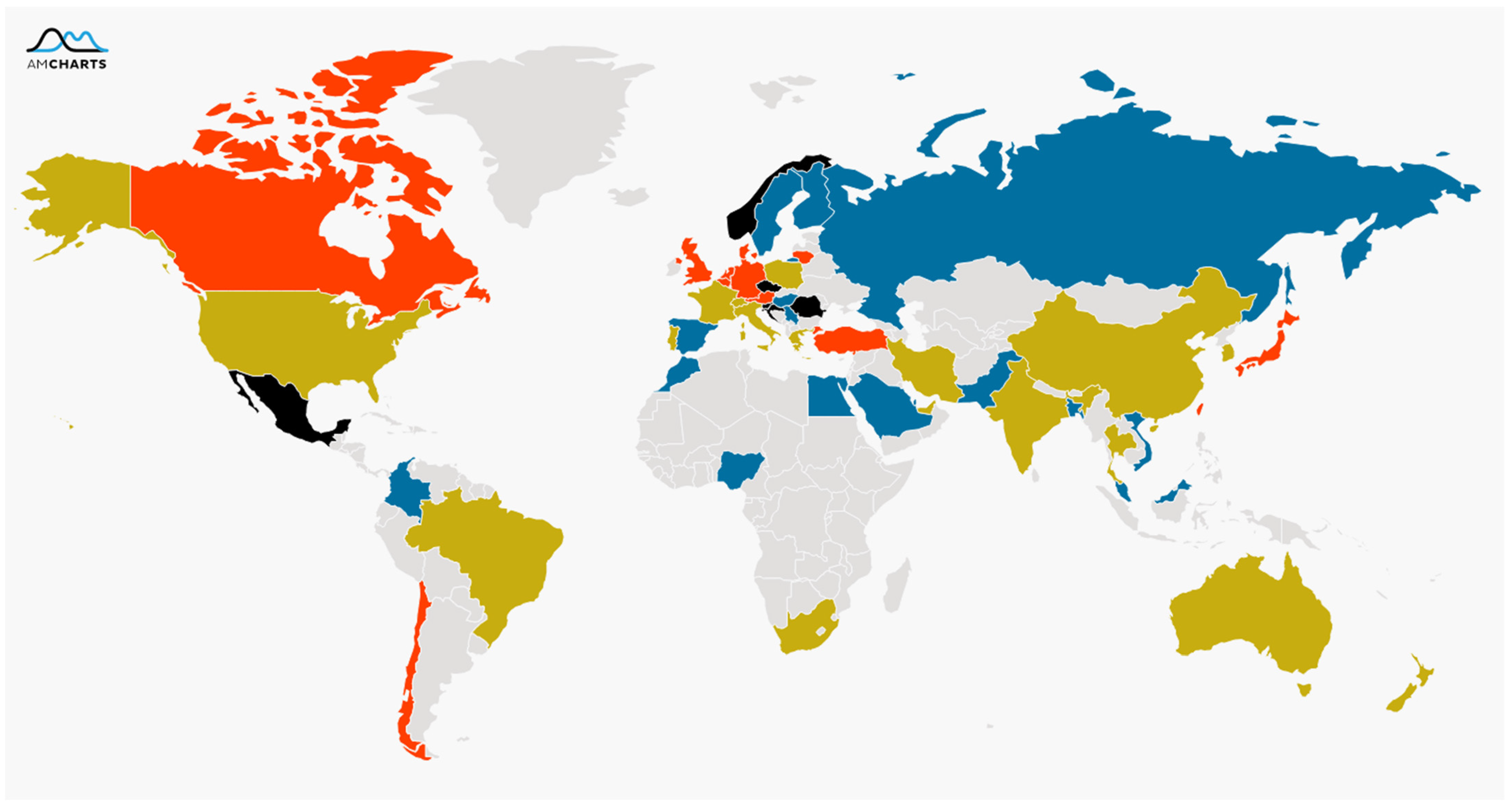
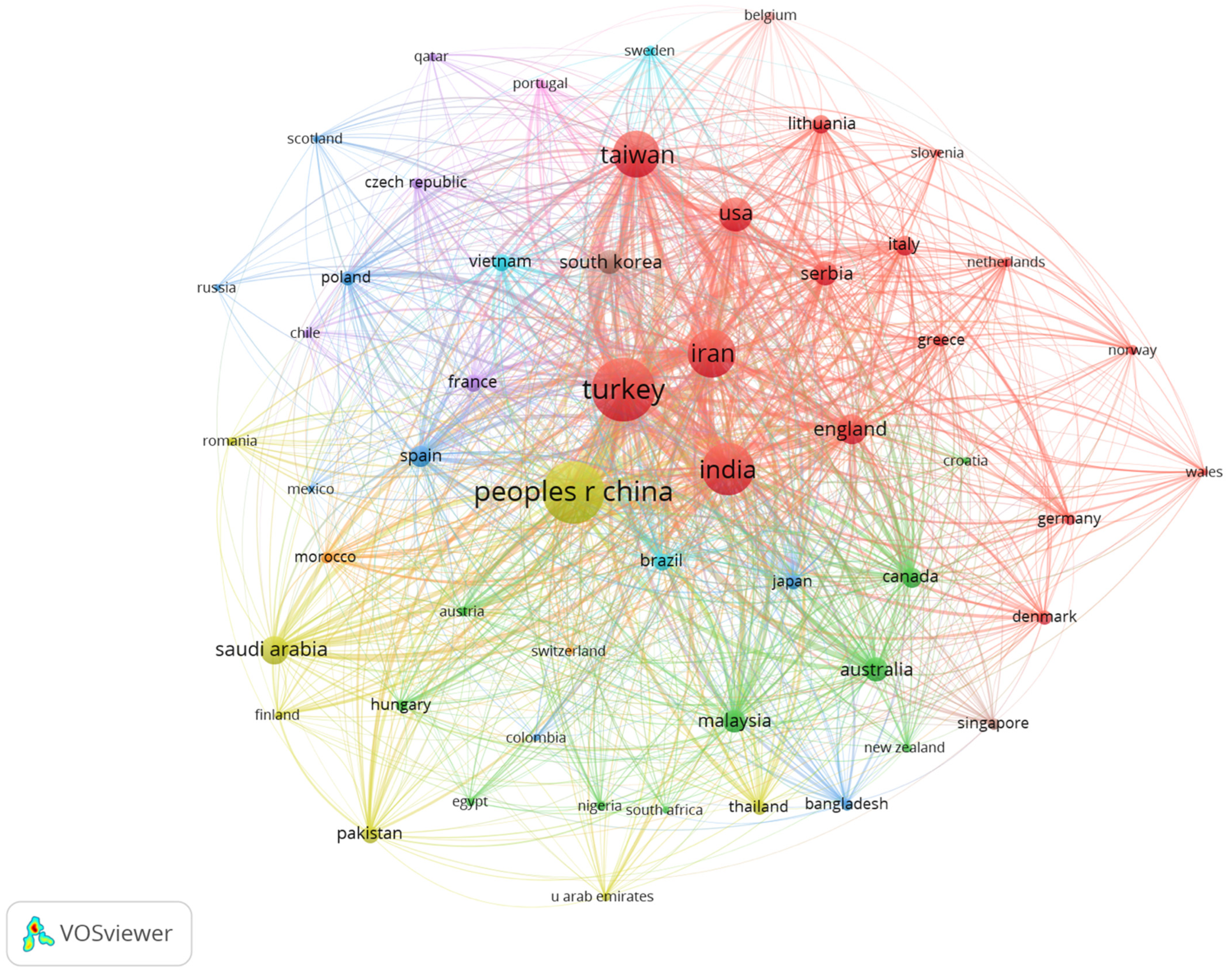
3.3. Academic Production by Country and International Collaboration Networks
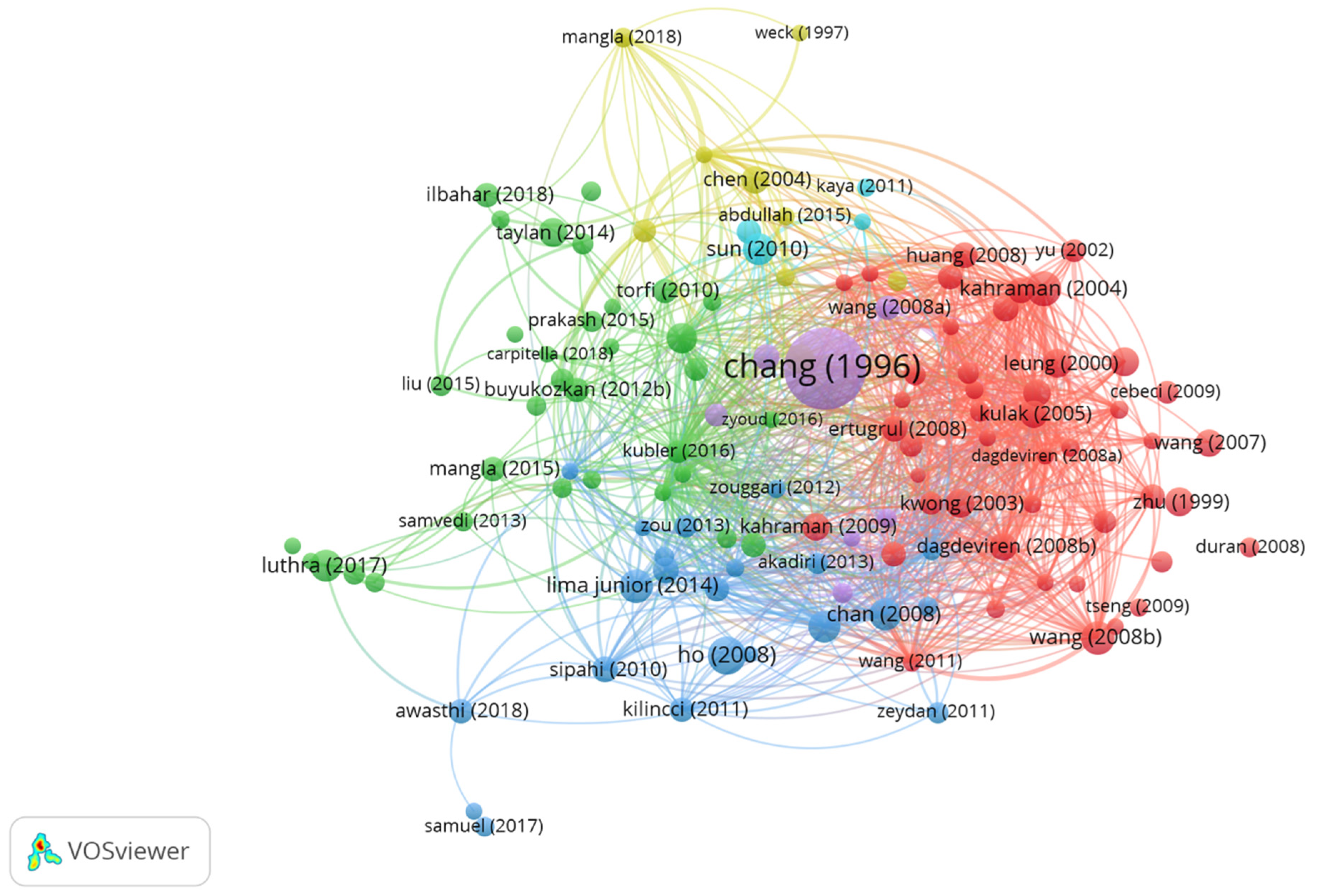
3.4. Bibliographic Coupling of Articles, Emerging Trends and High-Impact Publication Opportunities
4. Conclusions
Author Contributions
Funding
Data Availability Statement
Conflicts of Interest
Nomenclature
| AB | Abstract |
| AHP | Analytical Hierarchy Process |
| ANN | Artificial Neural Network |
| ANP | Analytic Networks process |
| AK | Author keywords |
| DpY | Documents per Year |
| FAHP | Fuzzy Analytical Hierarchy Process |
| F-AHP | Fuzzy Analytical Hierarchy Process |
| fsQCA | Fuzzy-set Qualitative Comparative Analysis |
| Fuzzy AHP | Fuzzy Analytical Hierarchy Process |
| fuzzy-MPDM | Fuzzy Multi Person Decision Making |
| fuzzy-MPPC | Fuzzy Multi Person Preference Criteria |
| FTOPSIS | Fuzzy Technique for Order Preference by Similarity of an Ideal Solution |
| GSC | Green Supply Chain |
| GFC | Great Financial Crisis |
| IFAHP | Intuitionistic fuzzy Analytical Hierarchy Process |
| IT | Information Technology |
| JCR | Journal Citation Reports® |
| KP | Keyword Plus® |
| NIY | Normalized Impact per Year |
| SSCI | Social Sciences Citation Index |
| SCIE | Science Citation Index Expanded |
| TI | Title |
| TOPSIS | Technique for Order Preference by Similarity of an Ideal Solution |
| TS | Topic |
| VUCA | Volatility (V), Uncertatinty (U), Complexity (C) and Ambiguity (A) |
| WAIPRA | Window of Academic Interest and Persistence in the Research Agenda |
Appendix A. Bibliographic Coupling per Documents—Cluster Analysis
| Article Title | Authors | Year | Journal | Cites | NIY |
|---|---|---|---|---|---|
| Risk Assessment Using a New Consulting Process in Fuzzy AHP [69] | Lyu, H.M.; Sun, W.J.; Shen, S.L.; Zhou, A.N. | 2020 | Journal of Construction Engineering and Management | 103 | 51.5 |
| A Novel Spherical Fuzzy Analytic Hierarchy Process and Its Renewable Energy Application [70] | Gundogdu, F.K.; Kahraman, C. | 2020 | Soft Computing | 101 | 50.5 |
| Intuitionistic Fuzzy Analytic Hierarchy Process [17] | Xu, Z.S.; Liao, H.C. | 2014 | IEEE Transactions on Fuzzy Systems | 273 | 34.1 |
| On the Extent Analysis Method for Fuzzy AHP and its Applications [62] | Wang, Y.M.; Luo, Y.; Hua, Z. | 2008 | European Journal of Operational Research | 437 | 31.2 |
| Fuzzy Analytic Hierarchy Process with Interval Type-2 Fuzzy Sets [71] | Kahraman, C.; Oztaysi, B.; Sari, I.U.; Turanoglu, E. | 2014 | Knowledge-based Systems | 229 | 28.6 |
| Evaluating Teaching Performance Based on Fuzzy AHP and Comprehensive Evaluation Approach [72] | Chen, J.F.; Hsieh, H.N.; Do, Q.H. | 2015 | Applied Soft Computing | 189 | 27.0 |
| Multi-attribute Comparison of Catering Service Companies Using Fuzzy AHP: The Case of Turkey [55] | Kahraman, C.; Cebeci, U.; Ruan, D. | 2004 | International Journal of Production Economics | 467 | 25.9 |
| Comparison of Fuzzy AHP and AHP in a Spatial Multi-criteria Decision Making Model for Urban Land-use Planning [73] | Mosadeghi, R.; Warnken, J.; Tomlinson, R.; Mirfenderesk, H. | 2015 | Computers Environment and Urban Systems | 181 | 25.9 |
| Evaluation of Hazardous Waste Transportation Firms by Using a Two Step Fuzzy AHP and TOPSIS Methodology [63] | Gumus, A.T. | 2009 | Expert Systems with Applications | 304 | 23.4 |
| A Comparative Analysis for Multiattribute Selection Among Renewable Energy Alternatives Using Fuzzy Axiomatic Design and Fuzzy Analytic Hierarchy Process [26] | Kahraman, C.; Kaya, I.; Cebi, S. | 2009 | Energy | 282 | 21.7 |
| A GIS-based Extended Fuzzy Multi-criteria Evaluation for Landslide Susceptibility Mapping [74] | Feizizadeh, B.; Roodposhti, M.S.; Jankowski, P.; Blaschke, T. | 2014 | Computers & Geosciences | 170 | 21.3 |
| Developing a Fuzzy Analytic Hierarchy Process (AHP) Model for Behavior-based Safety Management [54] | Dagdeviren, M.; Yuksel, I. | 2008 | Information Sciences | 284 | 20.3 |
| Selection of Optimum Maintenance Strategies Based on a Fuzzy Analytic Hierarchy Process [53] | Wang, L.; Chu, J.; Wu, J. | 2007 | International Journal of Production Economics | 300 | 20.0 |
| Multi-Criteria Analysis Framework for Potential Flood Prone Areas Mapping [75] | Papaioannou, G.; Vasiliades, L.; Loukas, A. | 2015 | Water Resources Management | 139 | 19.9 |
| Optimal Preventive Maintenance Policy for Electric Power Distribution Systems Based on the Fuzzy AHP Methods [76] | Firouz, M.H.; Ghadimi, N. | 2016 | Complexity | 119 | 19.8 |
| Comparison of Fuzzy AHP and Fuzzy TOPSIS Methods for Facility Location Selection [77] | Ertugrul, I.; Karakasoglu, N. | 2008 | International Journal of Advanced Manufacturing Technology | 256 | 18.3 |
| Hospital Site Selection Using Fuzzy AHP and Its Derivatives [78] | Vahidnia, M.H.; Alesheikh, A.A.; Alimohammadi, A. | 2009 | Journal of Environmental Management | 234 | 18.0 |
| Prioritization of Human Capital Measurement Indicators Using Fuzzy AHP [56] | Bozbura, F.T.; Beskese, A.; Kahraman, C. | 2007 | Expert Systems with Applications | 268 | 17.9 |
| A Fuzzy AHP Application in Government-sponsored R&D Project Selection [79] | Huang, C.C.; Chu, P.Y.; Chiang, Y.H. | 2008 | Omega-International Journal of Management Science | 247 | 17.6 |
| Fuzzy Multi-attribute Selection Among Transportation Companies using Axiomatic Design and Analytic Hierarchy Process [68] | Kulak, O.; Kahraman, C. | 2005 | Information Sciences | 296 | 17.4 |
| Determining the Importance Weights for the Customer Requirements in QFD Using a Fuzzy AHP with an Extent Analysis Approach [58] | Kwong, C.K.; Bai, H. | 2003 | IIE Transactions | 305 | 16.1 |
| A Fuzzy AHP Approach to Personnel Selection Problem | Gungor, Z.; Serhadlioglu, G.; Kesen, S.E. | 2009 | Applied Soft Computing | 202 | 15.5 |
| Fuzzy AHP-based Decision Support System for Selecting ERP Systems in Textile Industry by Using Balanced Scorecard [80] | Cebeci, U. | 2009 | Expert Systems with Applications | 197 | 15.2 |
| On the Invalidity of Fuzzifying Numerical Judgments in the Analytic Hierarchy Process [82] | Saaty, T.L.; Tran, L.T. | 2007 | Mathematical and Computer Modelling | 227 | 15.1 |
| Development of a Fuzzy ANP Based SWOT Analysis for the Airline Industry in Turkey [83] | Sevkli, M.; Oztekin, A.; Uysal, O.; Torlak, G.; Turkyilmaz, A.; Delen, D. | 2012 | Expert Systems with Applications | 149 | 14.9 |
| On Consistency and Ranking of Alternatives in Fuzzy AHP [60] | Leung, L.C.; Cao, D. | 2000 | European Journal of Operational Research | 316 | 14.4 |
| Strategic Decision Selection Using Hesitant Fuzzy TOPSIS and Interval Type-2 Fuzzy AHP: A case study [84] | Onar, S.C.; Oztaysi, B.; Kahraman, C. | 2014 | International Journal of Computational Intelligence Systems | 112 | 14.0 |
| A Discussion on Extent Analysis Method and Applications of Fuzzy AHP [59] | Zhu, K.J.; Jing, Y.; Chang, D.Y. | 1999 | European Journal of Operational Research | 312 | 13.6 |
| Selecting a Cruise Port of Call Location Using the Fuzzy AHP Method: A Case Study in East Asia [85] | Wang, Y.; Jung, K.A.; Yeo, G.T.; Chou, C.C. | 2014 | Tourism Management | 104 | 13.0 |
| Fuzzy AHP Approach for Selecting the Suitable Bridge Construction Method [86] | Pan, N.F. | 2008 | Automation in Construction | 182 | 13.0 |
| A Fuzzy AHP Approach to Evaluating Machine Tool Alternatives [87] | Ayag, Z.; Ozdemir, R.G. | 2006 | Journal of Intelligent Manufacturing | 206 | 12.9 |
| Fuzzy Analytic Hierarchy Process: A Logarithmic Fuzzy Preference Programming Methodology [88] | Wang, Y.M.; Chin, K.S. | 2011 | International Journal of Approximate Reasoning | 140 | 12.7 |
| A Fuzzy AHP Approach to the Determination of Importance Weights of Customer Requirements in Quality Function Deployment [57] | Kwong, C.K.; Bai, H. | 2002 | Journal of Intelligent Manufacturing | 241 | 12.1 |
| Computer-aided Machine-tool Selection Based on a Fuzzy AHP Approach [89] | Duran, O.; Aguilo, J. | 2008 | Expert Systems with Applications | 160 | 11.4 |
| Fuzzy AHP-based Multicriteria Decision Making Systems Using Particle Swarm Optimization [90] | Javanbarg, M.B.; Scawthorn, C.; Kiyono, J.; Shahbodaghkhan, B. | 2012 | Expert Systems with Applications | 109 | 10.9 |
| Fuzzy AHP-based Study of Cleaner Production Implementation in Taiwan PWB Manufacturer [91] | Tseng, M.L.; Lin, Y.H.; Chiu, A.S.F. | 2009 | Journal of Cleaner Production | 140 | 10.8 |
| Critical Component Identification in Reliability Centered Asset Management of Power Distribution Systems Via Fuzzy AHP | Dehghanian, P.; Fotuhi-Firuzabad, M.; Bagheri-Shouraki, S.; Kazemi, A.A.R. | 2012 | IEEE Systems Journal | 100 | 10.0 |
| A GP-AHP Method for Solving Group Decision-making Fuzzy AHP Problems [92] | Yu, C.S. | 2002 | Computers & Operations Research | 193 | 9.7 |
| A Web-based Decision Support System for Multi-criteria Inventory Classification Using Fuzzy AHP Methodology [94] | Cakir, O.; Canbolat, M.S. | 2008 | Expert Systems with Applications | 128 | 9.1 |
| Application of Fuzzy Extended AHP Methodology on Shipping Registry Selection: The case of Turkish maritime industry [95] | Celik, M.; Er, I.D.; Ozok, A.F. | 2009 | Expert Systems with Applications | 116 | 8.9 |
| Assessing Contractor Selection Criteria Weights with Fuzzy AHP Method Application in Group Decision Environment [96] | Jaskowski, P.; Biruk, S.; Bucon, R. | 2010 | Automation in Construction | 106 | 8.8 |
| A Fuzzy Analytic Network Process (ANP) Model to Identify Faulty Behavior Risk (FBR) in Work System [97] | Dagdeviren, M.; Yuksel, I.; Kurt, M. | 2008 | Safety Science | 113 | 8.1 |
| A Fuzzy AHP-based Simulation Approach to Concept Evaluation in a NPD Environment [98] | Ayag, Z. | 2005 | IIE Transactions | 137 | 8.1 |
| Risk-based Environmental Decision-making Using Fuzzy Analytic Hierarchy Process (F-AHP) [11] | Tesfamariam, S.; Sadiq, R. | 2006 | Stochastic Environmental Research and Risk Assessment | 123 | 7.7 |
| Operating System Selection Using Fuzzy Replacement Analysis and Analytic Hierarchy Process [99] | Tolga, E.; Demircan, M.L.; Kahraman, C. | 2005 | International Journal of Production Economics | 124 | 7.3 |
| Quality Function Deployment Implementation Based on Analytic Network Process with Linguistic Data: An application in automotive industry [100] | Ertay, T.; Buyukozkan, G.; Kahraman, C.; Ruan, D. | 2005 | Journal of Intelligent & Fuzzy Systems | 101 | 5.9 |
| Article Title | Authors | Year | Journal | Cites | NIY |
|---|---|---|---|---|---|
| An Integrated Framework for Sustainable Supplier Selection and Evaluation in Supply Chains [51] | Luthra, S.; Govindan, K.; Kannan, D.; Mangla, S.K.; Garg, C.P. | 2017 | Journal of Cleaner Production | 375 | 75.0 |
| Strategic Renewable Energy Resources Selection for Pakistan: Based on SWOT-Fuzzy AHP Approach [123] | Wang, Y.; Xu, L.; Solangi, Y.A. | 2020 | Sustainable Cities and Society | 114 | 57.0 |
| A Novel Approach to Risk Assessment for Occupational Health and Safety using Pythagorean Fuzzy AHP & Fuzzy Inference System [124] | Ilbahar, E.; Karasan, A.; Cebi, S.; Kahraman, C. | 2018 | Safety Science | 219 | 54.8 |
| Risk Evaluation Using a Novel Hybrid Method Based on FMEA, Extended MULTIMOORA, and AHP Methods Under Fuzzy Environment [125] | Fattahi, R.; Khalilzadeh, M. | 2018 | Safety Science | 171 | 42.8 |
| Construction Projects Selection and Risk Assessment by Fuzzy AHP and Fuzzy TOPSIS Methodologies [65] | Taylan, O.; Bafail, A.O.; Abdulaal, R.M.S.; Kabli, M.R. | 2014 | Applied Soft Computing | 303 | 37.9 |
| Fuzzy Failure Modes and Effects Analysis by Using Fuzzy TOPSIS-based Fuzzy AHP [61] | Kutlu, A.C.; Ekmekcioglu, M. | 2012 | Expert Systems with Applications | 343 | 34.3 |
| Fuzzy AHP-TOPSIS Approaches to Prioritizing Solutions for Reverse Logistics Barriers [126] | Sirisawat, P.; Kiatcharoenpol, T. | 2018 | Computers & Industrial Engineering | 133 | 33.3 |
| Risk Analysis in Green Supply Chain Using Fuzzy AHP Approach: A case study [25] | Mangla, S.K.; Kumar, P.; Barua, M.K. | 2015 | Resources Conservation and Recycling | 228 | 32.6 |
| A State-of the-art Survey & Testbed of Fuzzy AHP (FAHP) Applications [127] | Kubler, S.; Robert, J.; Derigent, W.; Voisin, A.; Le Traon, Y. | 2016 | Expert Systems with Applications | 189 | 31.5 |
| Operation Patterns Analysis of Automotive Components Remanufacturing Industry Development in China [101] | Tian, G.D.; Zhang, H.H.; Feng, Y.X.; Jia, H.F.; Zhang, C.Y.; Jiang, Z.G.; Li, Z.W.; Li, P.G. | 2017 | Journal of Cleaner Production | 143 | 28.6 |
| A Novel Approach for Failure Mode and Effects Analysis Using Combination Weighting and Fuzzy VIKOR Method [102] | Liu, H.C.; You, J.X.; You, X.Y.; Shan, M.M. | 2015 | Applied Soft Computing | 186 | 26.6 |
| A Combined Multi-criteria Approach to Support FMECA Analyses: A real-world case [103] | Carpitella, S.; Certa, A.; Izquierdo, J.; La Fata, C.M. | 2018 | Reliability Engineering & System Safety | 105 | 26.3 |
| Integration of AHP-TOPSIS Method for Prioritizing the Solutions of Reverse Logistics Adoption to Overcome its Barriers Under Fuzzy Environment [104] | Prakash, C.; Barua, M.K. | 2015 | Journal of Manufacturing Systems | 183 | 26.1 |
| A Fuzzy AHP-TOPSIS Framework for Ranking the Solutions of Knowledge Management Adoption in Supply Chain to Overcome its Barriers [105] | Patil, S.K.; Kant, R. | 2014 | Expert Systems with Applications | 204 | 25.5 |
| An Extended VIKOR Method ased on Entropy Measure for the Failure Modes Risk Assessment—A case study of the geothermal power plant (GPP) [106] | Mohsen, O.; Fereshteh, N. | 2017 | Safety Science | 120 | 24.0 |
| A Combined Fuzzy AHP and Fuzzy TOPSIS Based Strategic Analysis of Electronic Service Quality in Healthcare Industry [158] | Buyukozkan, G.; Cifci, G. | 2012 | Expert Systems with Applications | 235 | 23.5 |
| A New Approximation for Risk Assessment Using the AHP and Fine Kinney Methodologies [108] | Kokangul, A.; Polat, U.; Dagsuyu, C. | 2017 | Safety Science | 117 | 23.4 |
| Analyzing the Drivers of Green Manufacturing with Fuzzy Approach [109] | Govindan, K.; Diabat, A.; Shankar, K.M. | 2015 | Journal of Cleaner Production | 154 | 22.0 |
| Assessment of Regions Priority for Implementation of Solar Projects in Iran: New application of a hybrid multi-criteria decision making approach [110] | Vafaeipour, M.; Hashemkhani Zolfani, S.; Varzandeh, M.H.M.; Derakhti, A.; Eshkalag, M.K. | 2014 | Energy Conversion and Management | 173 | 21.6 |
| Fuzzy AHP to Determine the Relative Weights of Evaluation Criteria and Fuzzy TOPSIS to Rank the Alternatives [111] | Torfi, F.; Farahani, R.Z.; Rezapour, S. | 2010 | Applied Soft Computing | 239 | 19.9 |
| A Framework for Water Loss Management in Developing Countries Under Fuzzy Environment: Integration of Fuzzy AHP with Fuzzy TOPSIS [112] | Zyoud, S.H.; Kaufmann, L.G.; Shaheen, H.; Samhan, S.; Fuchs-Hanusch, D. | 2016 | Expert Systems with Applications | 119 | 19.8 |
| Measuring Operational Performance of OSH Management System—A demonstration of AHP-based selection of leading key performance indicators [113] | Podgorski, D. | 2015 | Safety Science | 125 | 17.9 |
| Interrelationships of Risks Faced by Third Party Logistics Service Providers: A DEMATEL based approach [114] | Govindan, K.; Chaudhuri, A. | 2016 | Transportation Research Part E-logistics and Transportation Review | 107 | 17.8 |
| Quantifying Risks in a Supply Chain Through Integration of Fuzzy AHP and Fuzzy TOPSIS [115] | Samvedi, A.; Jain, V.; Chan, F.T.S. | 2013 | International Journal of Production Research | 155 | 17.2 |
| Landfill Site Selection Using Fuzzy AHP and Fuzzy TOPSIS: A case study for Istanbul [22] | Beskese, A.; Demir, H.H.; Ozcan, H.K.; Okten, H.E. | 2015 | Environmental Earth Sciences | 115 | 16.4 |
| Decision Making on Business Issues with Foresight Perspective; An application of new hybrid MCDM model in shopping mall locating [116] | Hashemkhani Zolfani, S.; Aghdaie, M.H.; Derakhti, A.; Zavadskas, E.K.; Varzandeh, M.H.M. | 2013 | Expert Systems with Applications | 147 | 16.3 |
| A Two-stage Fuzzy AHP Model for Risk Assessment of Implementing Green Initiatives in the Fashion Supply Chain [117] | Wang, X.J.; Chan, H.K.; Yee, R.W.Y.; Diaz-Rainey, I. | 2012 | International Journal of Production Economics | 160 | 16.0 |
| Selection of the Strategic Alliance Partner in Logistics Value Chain [107] | Buyukozkan, G.; Feyzioglu, O.; Nebol, E. | 2008 | International Journal of Production Economics | 224 | 16.0 |
| Risk Management in the Construction Industry Using Combined Fuzzy FMEA and Fuzzy AHP [118] | Abdelgawad, M.; Fayek, A.R. | 2010 | Journal of Construction Engineering and Management | 161 | 13.4 |
| Strategic Logistics Outsourcing: An integrated QFD and fuzzy AHP approach [119] | Ho, W.; He, T.; Lee, C.K.M.; Emrouznejad, A. | 2012 | Expert Systems with Applications | 108 | 10.8 |
| A Decision Support System for Selecting Convenience Store Location Through Integration of Fuzzy AHP and Artificial Neural Network [120] | Kuo, R.J.; Chi, S.C.; Kao, S.S. | 2002 | Computers in Industry | 200 | 10.0 |
| A Combined Fuzzy MCDM Approach for Selecting Shopping Center Site: An example from Istanbul, Turkey [121] | Onut, S.; Efendigil, T.; Kara, S.S. | 2010 | Expert Systems with Applications | 114 | 9.5 |
| An Assessment of Exploiting Renewable Energy Sources with Concerns of Policy and Technology [122] | Shen, Y.C.; Lin, G.T.R.; Li, K.P.; Yuan, B.J.C. | 2010 | Energy Policy | 102 | 8.5 |
| Article Title | Authors | Year | Journal | Cites | NIY |
|---|---|---|---|---|---|
| Multi-tier Sustainable Global Supplier Selection Using a Fuzzy AHP-VIKOR Based Approach [140] | Awasthi, A.; Govindan, K.; Gold, S. | 2018 | International Journal of Production Economics | 233 | 58.3 |
| A Comparison Between Fuzzy AHP and Fuzzy TOPSIS Methods to Supplier Selection [64] | Lima, F.R.; Osiro, L.; Carpinetti, L.C.R. | 2014 | Applied Soft Computing | 432 | 54.0 |
| Integrated Analytic Hierarchy Process and its Applications—A literature review [15] | Ho, W. | 2008 | European Journal of Operational Research | 552 | 39.4 |
| Supplier Selection Using Fuzzy AHP and Fuzzy Multi-objective Linear Programming for Developing Low Carbon Supply Chain [49] | Shaw, K.; Shankar, R.; Yadav, S.S.; Thakur, L.S. | 2012 | Expert Systems with Applications | 369 | 36.9 |
| Integrating Sustainability into Strategic Decision-making: A fuzzy AHP method for the selection of relevant sustainability issues [141] | Calabrese, A.; Costa, R.; Levialdi, N.; Menichini, T. | 2019 | Technological Forecasting and Social Change | 105 | 35.0 |
| An Integrated Decision Support System based on ANN and Fuzzy_AHP for Heart Failure Risk Prediction [31] | Samuel, O.W.; Asogbon, G.M.; Sangaiah, A.K.; Fang, P.; Li, G.L. | 2017 | Expert Systems with Applications | 158 | 31.6 |
| Global Supplier Selection: A fuzzy AHP approach [50] | Chan, F.T.S.; Kumar, N.; Tiwari, M.K.; Lau, H.C.W.; Choy, K.L. | 2008 | International Journal of Production Research | 389 | 27.8 |
| Supplier Selection Using Fuzzy AHP and TOPSIS: A case study in the Indian automotive industry [142] | Jain, V.; Sangaiah, A.K.; Sakhuja, S.; Thoduka, N.; Aggarwal, R. | 2018 | Neural Computing & Applications | 107 | 26.8 |
| An STEEP-fuzzy AHP-TOPSIS Framework for Evaluation and Selection of Thermal Power Plant Location: A case study from India [128] | Choudhary, D.; Shankar, R. | 2012 | Energy | 251 | 25.1 |
| Comprehensive Flood Risk Assessment Based on Set Pair Analysis-variable Fuzzy Sets Model and Fuzz AHP [129] | Zou, Q.; Zhou, J.Z.; Zhou, C.; Song, L.X.; Guo, J. | 2013 | Stochastic Environmental Research and Risk Assessment | 209 | 23.2 |
| The Analytic Hierarchy Process and Analytic Network Process: An overview of applications [20] | Sipahi, S.; Timor, M. | 2010 | Management Decision | 269 | 22.4 |
| Application of a Trapezoidal Fuzzy AHP Method for Work Safety Evaluation and Early Warning Rating of Hot and Humid Environments [130] | Zheng, G.Z.; Zhu, N.; Tian, Z.; Chen, Y.; Sun, B.H. | 2012 | Safety Science | 222 | 22.2 |
| Fuzzy AHP Approach for Supplier Selection in a Washing Machine Company [28] | Kilincci, O.; Onal, S.A. | 2011 | Expert Systems with Applications | 235 | 21.4 |
| Multi-criteria Evaluation Model for the Selection of Sustainable Materials for Building Projects [131] | Akadiri, P.O.; Olomolaiye, P.O.; Chinyio, E.A. | 2013 | Automation in Construction | 180 | 20.0 |
| A Combined Methodology for Supplier Selection and Performance Evaluation [132] | Zeydan, M.; Colpan, C.; Cobanoglu, C. | 2011 | Expert Systems with Applications | 174 | 15.8 |
| Multi-criteria Supplier Segmentation Using a Fuzzy Preference Relations Based AHP [134] | Rezaei, J.; Ortt, R. | 2013 | European Journal of Operational Research | 123 | 13.7 |
| Supplier Selection in the Airline Retail Industry Using a Funnel Methodology: Conjunctive screening method and fuzzy AHP | Rezaei, J.; Fahim, P.B.M.; Tavasszy, L. | 2014 | Expert Systems with Applications | 109 | 13.6 |
| Simulation Based Fuzzy TOPSIS Approach for Group Multi-criteria Supplier Selection Problem [133] | Zouggari, A.; Benyoucef, L. | 2012 | Engineering Applications of Artificial Intelligence | 134 | 13.4 |
| Supplier Selection in Electronic Marketplaces Using Satisficing and Fuzzy AHP [136] | Chamodrakas, I.; Batis, D.; Martakos, D. | 2010 | Expert Systems with Applications | 151 | 12.6 |
| An Integrated Fuzzy Multi-criteria Group Decision-making Approach for Green Supplier Evaluation [137] | Buyukozkan, G. | 2012 | International Journal of Production Research | 112 | 11.2 |
| An Application of Fuzzy AHP for Evaluating Course Website Quality [138] | Lin, H.F. | 2010 | Computers & Education | 131 | 10.9 |
| Fuzzy Analytical Hierarchy Process for Evaluating and Selecting a Vendor in a Supply Chain Model [139] | Haq, A.N.; Kannan, G. | 2006 | International Journal of Advanced Manufacturing Technology | 151 | 9.4 |
| Article Title | Authors | Year | Journal | Cites | NIY |
|---|---|---|---|---|---|
| Barriers to Effective Circular Supply Chain Management in a Developing Country Context [144] | Mangla, S.K.; Luthra, S.; Mishra, N.; Singh, A.; Rana, N.P.; Dora, M.; Dwivedi, Y. | 2018 | Production Planning & Control | 159 | 39.8 |
| A Fuzzy AHP and BSC Approach for Evaluating Performance of IT Department in the Manufacturing Industry in Taiwan [52] | Lee, A.H.I.; Chen, W.C.; Chang, C.J. | 2008 | Expert Systems with Applications | 328 | 23.4 |
| An Integrated Intuitionistic Fuzzy AHP and SWOT Method for Outsourcing Reverse Logistics [145] | Tavana, M.; Zareinejad, M.; Di Caprio, D.; Kaviani, M.A. | 2016 | Applied Soft Computing | 118 | 19.7 |
| A Hybrid Model Based on Fuzzy AHP and Fuzzy WASPAS for Construction Site Selection [146] | Turskis, Z.; Zavadskas, E.K.; Antucheviciene, J.; Kosareva, N. | 2015 | International Journal of Computers Communications & Control | 126 | 18.0 |
| Integration of Fuzzy AHP and Interval Type-2 fuzzy DEMATEL: An application to human resource management | Abdullah, L.; Zulkifli, N. | 2015 | Expert Systems with Applications | 123 | 17.6 |
| Strategic Analysis of Healthcare Service Quality Using Fuzzy AHP Methodology [147] | Buyukozkan, G.; Cifci, G.; Guleryuz, S. | 2011 | Expert Systems with Applications | 188 | 17.1 |
| Combining Grey Relation and TOPSIS Concepts for Selecting an Expatriate Host Country [67] | Chen, M.F.; Tzeng, G.H. | 2004 | Mathematical and Computer Modelling | 275 | 15.3 |
| A Framework for Measuring the Performance of Service Supply Chain Management [149] | Cho, D.W.; Lee, Y.H.; Ahn, S.H.; Hwang, M.K. | 2012 | Computers & Industrial Engineering | 151 | 15.1 |
| Evaluating Alternative Production Cycles Using the Extended Fuzzy AHP Method [150] | Weck, M.; Klocke, F.; Schell, H.; Ruenauver, E. | 1997 | European Journal of Operational Research | 119 | 4.8 |
| Article Title | Authors | Year | Journal | Cites | NIY |
|---|---|---|---|---|---|
| Applications of the Extent Analysis Method on Fuzzy AHP [48] | Chang, D.Y. | 1996 | European Journal of Operational Research | 2436 | 93.7 |
| Using Fuzzy AHP to Manage Intellectual Capital Assets: An application to the ICT service industry [143] | Calabrese, A.; Costa, R.; Menichini, T. | 2013 | Expert Systems with Applications | 145 | 16.1 |
| Applying Fuzzy Linguistic Preference Relations to the Improvement of consistency of Fuzzy AHP [151] | Wang, T.C.; Chen, Y.H. | 2008 | Information Sciences | 219 | 15.6 |
| Green Supply Chain Management in the Electronic Industry [152] | Hsu, C.W.; Hu, A.H. | 2008 | International Journal of Environmental Science and Technology | 151 | 10.8 |
| Evaluating Naval Tactical Missile Systems by Fuzzy AHP Based on the Grade Value of Membership Function [24] | Cheng, C.H. | 1997 | European Journal of Operational Research | 254 | 10.2 |
| Risk Evaluation of Green Components to Hazardous Substance Using FMEA and FAHP [153] | Hu, A.H.; Hsu, C.W.; Kuo, T.C.; Wu, W.C. | 2009 | Expert Systems with Applications | 119 | 9.2 |
| Evaluating Weapon System Using Fuzzy Analytic Hierarchy Process-Based on Entropy Weight [154] | Mon, D.L.; Cheng, C.H.; Lin, J.C. | 1994 | Fuzzy Sets and Systems | 189 | 6.8 |
| Article Title | Authors | Year | Journal | Cites | NIY |
|---|---|---|---|---|---|
| A Performance Evaluation Model by Integrating Fuzzy AHP and Fuzzy TOPSIS Methods [66] | Sun, C.C. | 2010 | Expert Systems with Applications | 372 | 31.0 |
| The Application of Fuzzy Delphi Method and Fuzzy AHP in Lubricant Regenerative Technology Selection [155] | Hsu, Y.L.; Lee, C.H.; Kreng, V.B. | 2010 | Expert Systems with Applications | 236 | 19.7 |
| An Integrated Fuzzy AHP-ELECTRE Methodology for Environmental Impact Assessment [156] | Kaya, T.; Kahraman, C. | 2011 | Expert Systems with Applications | 137 | 12.5 |
| Evaluating the Criteria for Human Resource for Science and Technology (HRST) Based on an Integrated Fuzzy AHP and Fuzzy DEMATEL Approach [157] | Chou, Y.C.; Sun, C.C.; Yen, H.Y. | 2012 | Applied Soft Computing | 110 | 11.0 |
Appendix B. Summary of Fuzzy Sets Applied in Fuzzy AHP and Articles That Hybridize and/or Compare Fuzzy AHP with Other MCDM Methodologies
| Fuzzy Set | Approach |
|---|---|
| Triangular Fuzzy Numbers TFN | [48,50,54,55,58,62,66,69,86,91,93,138,147] |
| Trapezoidal Fuzzy Number TraFN | [129,130] |
| Trapezoidal interval tope-2 fuzzy set | [159,160] |
| Intuitionistic fuzzy set | [22,61,63,64,65,66,67,77,84,104,105,107,111,112,115,121,126,127,128,135,158] |
| Method | Approach |
|---|---|
| Fuzzy TOPSIS | [61,64,65,66,77,111,158] |
| Fuzzy Delphi | [149,155] |
| Fuzzy AHP—VIKOR | [102,140,161,162] |
| Pythagorean fuzzy AHP & fuzzy inference system | [124] |
| Fuzzy AHP and artificial neural network | [120] |
References
- Mack, O.; Khare, A.; Krämer, A.; Burgartz, T. Managing in a VUCA World; Springer: Berlin/Heidelberg, Germany, 2015; ISBN 9783319168890. [Google Scholar]
- Gao, Y.; Feng, Z.; Zhang, S. Managing supply chain resilience in the era of VUCA. Front. Eng. Manag. 2021, 8, 465–470. [Google Scholar] [CrossRef]
- Kuusisto, E. Approaching VUCA Environment with Enterprise Agility in Government Organization: Case Business Finland and COVID-19. Master’s Thesis, University of Vaasa, Vaasa, Finland, 2022. Available online: https://urn.fi/URN:NBN:fi-fe2022042931570 (accessed on 1 July 2022).
- Bennett, N.; Lemoine, G.J. What a difference a word makes: Understanding threats to performance in a VUCA world. Bus. Horizons 2014, 57, 311–317. [Google Scholar] [CrossRef]
- Schoemaker, P.J.H.; Heaton, S.; Teece, D. Innovation, Dynamic Capabilities, and Leadership. Calif. Manag. Rev. 2018, 61, 15–42. [Google Scholar] [CrossRef]
- Lepeley, M.-T. Soft skills for human centered management and global sustainability. In Management in the Global VUCA Environment; Lepeley, M.T., Beutell, N.J., Abarca, N., Mailuf, N., Eds.; Routledge: New York, NY, USA, 2021; ISBN 9781003094463. [Google Scholar]
- Safian, M.; Ezwan, E.; Hadi, A. The evolution of Analytical Hierarchy Process (AHP) as a decision making tool in property sectors. Int. Proc. Econ. Dev. Res. 2011, 6, 28. [Google Scholar]
- Saaty, R.W. The analytic hierarchy process—What it is and how it is used. Math. Model. 1987, 9, 161–176. [Google Scholar] [CrossRef]
- Saaty, T.L. What is the analytic hierarchy process? In Mathematical Models for Decision Support; Springer: Berlin/Heidelberg, Germany, 1988; pp. 109–121. [Google Scholar]
- Liu, Y.; Eckert, C.M.; Earl, C. A review of fuzzy AHP methods for decision-making with subjective judgements. Expert Syst. Appl. 2020, 161, 113738. [Google Scholar] [CrossRef]
- Tesfamariam, S.; Sadiq, R. Risk-based environmental decision-making using fuzzy analytic hierarchy process (F-AHP). Stoch. Hydrol. Hydraul. 2006, 21, 35–50. [Google Scholar] [CrossRef]
- Ho, W.; Ma, X. The state-of-the-art integrations and applications of the analytic hierarchy process. Eur. J. Oper. Res. 2018, 267, 399–414. [Google Scholar] [CrossRef]
- Zadeh, L. A fuzzy-algorithmic approach to the definition of complex or imprecise concepts. Int. J. Man-Mach. Stud. 1976, 8, 249–291. [Google Scholar] [CrossRef]
- Zadeh, L.A. Information and control. Fuzzy Sets 1965, 8, 338–353. [Google Scholar]
- Ho, W. Integrated analytic hierarchy process and its applications—A literature review. Eur. J. Oper. Res. 2008, 186, 211–228. [Google Scholar] [CrossRef]
- Fiss, P.C. Building Better Causal Theories: A Fuzzy Set Approach to Typologies in Organization Research. Acad. Manag. J. 2011, 54, 393–420. [Google Scholar] [CrossRef]
- Xu, Z.; Liao, H. Intuitionistic Fuzzy Analytic Hierarchy Process. IEEE Trans. Fuzzy Syst. 2013, 22, 749–761. [Google Scholar] [CrossRef]
- Abdullah, L.; Jaafar, S.; Taib, I. Intuitionistic Fuzzy Analytic Hierarchy Process Approach in Ranking of Human Capital Indicators. J. Appl. Sci. 2013, 13, 423–429. [Google Scholar] [CrossRef]
- Tan, R.; Aviso, K.; Huelgas, A.; Promentilla, M. Fuzzy AHP approach to selection problems in process engineering involving quantitative and qualitative aspects. Process Saf. Environ. Prot. 2013, 92, 467–475. [Google Scholar] [CrossRef]
- Sipahi, S.; Timor, M. The analytic hierarchy process and analytic network process: An overview of applications. Manag. Decis. 2010, 48, 775–808. [Google Scholar] [CrossRef]
- Ayodele, T.; Ogunjuyigbe, A.; Odigie, O.; Munda, J. A multi-criteria GIS based model for wind farm site selection using interval type-2 fuzzy analytic hierarchy process: The case study of Nigeria. Appl. Energy 2018, 228, 1853–1869. [Google Scholar] [CrossRef]
- Beskese, A.; Demir, H.H.; Ozcan, H.K.; Ökten, H. Landfill site selection using fuzzy AHP and fuzzy TOPSIS: A case study for Istanbul. Environ. Earth Sci. 2014, 73, 3513–3521. [Google Scholar] [CrossRef]
- Abbasi, S.; Sarabadan, S. Evaluating Tactical Missile Systems by Using Fuzzy AHP and TOPSIS Technique. J. Mil. Inf. Sci. 2015, 3, 28. [Google Scholar] [CrossRef]
- Cheng, C.-H. Evaluating naval tactical missile systems by fuzzy AHP based on the grade value of membership function. Eur. J. Oper. Res. 1997, 96, 343–350. [Google Scholar] [CrossRef]
- Mangla, S.K.; Kumar, P.; Barua, M.K. Risk analysis in green supply chain using fuzzy AHP approach: A case study. Resour. Conserv. Recycl. 2015, 104, 375–390. [Google Scholar] [CrossRef]
- Kahraman, C.; Kaya, I.; Cebi, S. A comparative analysis for multiattribute selection among renewable energy alternatives using fuzzy axiomatic design and fuzzy analytic hierarchy process. Energy 2009, 34, 1603–1616. [Google Scholar] [CrossRef]
- Ren, J.; Ren, X. Sustainability ranking of energy storage technologies under uncertainties. J. Clean. Prod. 2018, 170, 1387–1398. [Google Scholar] [CrossRef]
- Kilincci, O.; Onal, S.A. Fuzzy AHP approach for supplier selection in a washing machine company. Expert Syst. Appl. 2011, 38, 9656–9664. [Google Scholar] [CrossRef]
- Fouladgar, M.M.; Yazdani-Chamzini, A.; Zavadskas, E.K. An integrated model for prioritizing strategies of the iranian mining sector: Irano kasybos sektoriaus strategijų prioriteto nustatymo integruotas modelis. Technol. Econ. Dev. Econ. 2011, 17, 459–483. [Google Scholar] [CrossRef]
- Yu, C.; Shao, Y.; Wang, K.; Zhang, L. A group decision making sustainable supplier selection approach using extended TOPSIS under interval-valued Pythagorean fuzzy environment. Expert Syst. Appl. 2019, 121, 1–17. [Google Scholar] [CrossRef]
- Samuel, O.W.; Asogbon, G.M.; Sangaiah, A.K.; Fang, P.; Li, G. An integrated decision support system based on ANN and Fuzzy_AHP for heart failure risk prediction. Expert Syst. Appl. 2016, 68, 163–172. [Google Scholar] [CrossRef]
- Yepes-Nuñez, J.J.; Urrutia, G.; Romero-Garcia, M.; Alonso-Fernandez, S. The PRISMA 2020 statement: An updated guideline for reporting systematic reviews. Rev. Esp. Cardiol. (Engl. Ed.) 2021, 74, 790–799. [Google Scholar]
- Tavares Thomé, A.M.T.; Scavarda, L.F.; Scavarda, A.J. Conducting systematic literature review in operations management. Prod. Plan. Control. 2016, 27, 408–420. [Google Scholar] [CrossRef]
- Zupic, I.; Čater, T. Bibliometric methods in management and organization. Organ. Res. Methods 2015, 18, 429–472. [Google Scholar] [CrossRef]
- Bartol, T.; Budimir, G.; Dekleva-Smrekar, D.; Pusnik, M.; Južnič, P. Assessment of research fields in Scopus and Web of Science in the view of national research evaluation in Slovenia. Scientometrics 2013, 98, 1491–1504. [Google Scholar] [CrossRef]
- Vieira, E.S.; Gomes, J.A.N.F. A comparison of Scopus and Web of Science for a typical university. Scientometrics 2009, 81, 587–600. [Google Scholar] [CrossRef]
- Bakkalbasi, N.; Bauer, K.; Glover, J.; Wang, L. Three options for citation tracking: Google Scholar, Scopus and Web of Science. Biomed. Digit. Libr. 2006, 3, 7. [Google Scholar] [CrossRef] [PubMed]
- Franceschini, F.; Maisano, D.; Mastrogiacomo, L. Empirical analysis and classification of database errors in Scopus and Web of Science. J. Inf. 2016, 10, 933–953. [Google Scholar] [CrossRef]
- AlRyalat, S.A.S.; Malkawi, L.W.; Momani, S.M. Comparing Bibliometric Analysis Using PubMed, Scopus, and Web of Science Databases. J. Vis. Exp. 2019, 152, e58494. [Google Scholar] [CrossRef] [PubMed]
- Yang, K.; Meho, L.I. Citation Analysis: A Comparison of Google Scholar, Scopus, and Web of Science. Proc. Am. Soc. Inf. Sci. Technol. 2007, 43, 1–15. [Google Scholar] [CrossRef]
- Martín-Martín, A.; Thelwall, M.; Orduna-Malea, E.; Delgado López-Cózar, E. Google Scholar, Microsoft Academic, Scopus, Dimensions, Web of Science, and OpenCitations’ COCI: A multidisciplinary comparison of coverage via citations. Scientometrics 2021, 126, 871–906. [Google Scholar] [CrossRef]
- Van Eck, N.J.; Waltman, L. Software survey: VOSviewer, a computer program for bibliometric mapping. Scientometrics 2010, 84, 523–538. [Google Scholar] [CrossRef] [PubMed]
- Castelló-Sirvent, F. A Fuzzy-Set Qualitative Comparative Analysis of Publications on the Fuzzy Sets Theory. Mathematics 2022, 10, 1322. [Google Scholar] [CrossRef]
- Garrido-Ruso, M.; Aibar-Guzmán, B.; Monteiro, A.P. Businesses’ Role in the Fulfillment of the 2030 Agenda: A Bibliometric Analysis. Sustainability 2022, 14, 8754. [Google Scholar] [CrossRef]
- Bai, Y.; Li, H.; Liu, Y. Visualizing research trends and research theme evolution in E-learning field: 1999–2018. Scientometrics 2020, 126, 1389–1414. [Google Scholar] [CrossRef]
- Kocak, M.; García-Zorita, C.; Marugán-Lázaro, S.; Çakır, M.P.; Sanz-Casado, E. Mapping and clustering analysis on neuroscience literature in Turkey: A bibliometric analysis from 2000 to 2017. Scientometrics 2019, 121, 1339–1366. [Google Scholar] [CrossRef]
- Castelló-Sirvent, F.; Roger-Monzó, V. Research agenda on turnaround strategies beyond systemic disruptions. J. Organ. Chang. Manag. 2022; ahead-of-print. [Google Scholar] [CrossRef]
- Chang, D.-Y. Applications of the extent analysis method on fuzzy AHP. Eur. J. Oper. Res. 1996, 95, 649–655. [Google Scholar] [CrossRef]
- Shaw, K.; Shankar, R.; Yadav, S.S.; Thakur, L.S. Supplier selection using fuzzy AHP and fuzzy multi-objective linear programming for developing low carbon supply chain. Expert Syst. Appl. 2012, 39, 8182–8192. [Google Scholar] [CrossRef]
- Chan, F.T.S.; Kumar, N.; Tiwari, M.K.; Lau, H.C.W.; Choy, K.L. Global supplier selection: A fuzzy-AHP approach. Int. J. Prod. Res. 2008, 46, 3825–3857. [Google Scholar] [CrossRef]
- Luthra, S.; Govindan, K.; Kannan, D.; Mangla, S.K.; Garg, C.P. An integrated framework for sustainable supplier selection and evaluation in supply chains. J. Clean. Prod. 2016, 140, 1686–1698. [Google Scholar] [CrossRef]
- Lee, A.H.; Chen, W.-C.; Chang, C.-J. A fuzzy AHP and BSC approach for evaluating performance of IT department in the manufacturing industry in Taiwan. Expert Syst. Appl. 2008, 34, 96–107. [Google Scholar] [CrossRef]
- Wang, L.; Chu, J.; Wu, J. Selection of optimum maintenance strategies based on a fuzzy analytic hierarchy process. Int. J. Prod. Econ. 2007, 107, 151–163. [Google Scholar] [CrossRef]
- Dağdeviren, M.; Yüksel, I. Developing a fuzzy analytic hierarchy process (AHP) model for behavior-based safety management. Inf. Sci. 2008, 178, 1717–1733. [Google Scholar] [CrossRef]
- Kahraman, C.; Cebeci, U.; Ruan, D. Multi-attribute comparison of catering service companies using fuzzy AHP: The case of Turkey. Int. J. Prod. Econ. 2004, 87, 171–184. [Google Scholar] [CrossRef]
- Bozbura, F.; Beskese, A.; Kahraman, C. Prioritization of human capital measurement indicators using fuzzy AHP. Expert Syst. Appl. 2007, 32, 1100–1112. [Google Scholar] [CrossRef]
- Kwong, C.K.; Bai, H. A fuzzy AHP approach to the determination of importance weights of customer requirements in quality function deployment. J. Intell. Manuf. 2002, 13, 367–377. [Google Scholar] [CrossRef]
- Kwong, C.; Bai, H. Determining the Importance Weights for the Customer Requirements in QFD Using a Fuzzy AHP with an Extent Analysis Approach. IIE Trans. 2003, 35, 619–626. [Google Scholar] [CrossRef]
- Zhu, K.-J.; Jing, Y.; Chang, D.-Y. A discussion on Extent Analysis Method and applications of fuzzy AHP. Eur. J. Oper. Res. 1999, 116, 450–456. [Google Scholar] [CrossRef]
- Leung, L.; Cao, D. On consistency and ranking of alternatives in fuzzy AHP. Eur. J. Oper. Res. 2000, 124, 102–113. [Google Scholar] [CrossRef]
- Kutlu, A.C.; Ekmekçioğlu, M. Fuzzy failure modes and effects analysis by using fuzzy TOPSIS-based fuzzy AHP. Expert Syst. Appl. 2012, 39, 61–67. [Google Scholar] [CrossRef]
- Wang, Y.-M.; Luo, Y.; Hua, Z. On the extent analysis method for fuzzy AHP and its applications. Eur. J. Oper. Res. 2008, 186, 735–747. [Google Scholar] [CrossRef]
- Gumus, A.T. Evaluation of hazardous waste transportation firms by using a two step fuzzy-AHP and TOPSIS methodology. Expert Syst. Appl. 2009, 36, 4067–4074. [Google Scholar] [CrossRef]
- Junior, F.R.L.; Osiro, L.; Carpinetti, L.C.R. A comparison between Fuzzy AHP and Fuzzy TOPSIS methods to supplier selection. Appl. Soft Comput. 2014, 21, 194–209. [Google Scholar] [CrossRef]
- Taylan, O.; Bafail, A.O.; Abdulaal, R.M.; Kabli, M.R. Construction projects selection and risk assessment by fuzzy AHP and fuzzy TOPSIS methodologies. Appl. Soft Comput. 2014, 17, 105–116. [Google Scholar] [CrossRef]
- Sun, C.-C. A performance evaluation model by integrating fuzzy AHP and fuzzy TOPSIS methods. Expert Syst. Appl. 2010, 37, 7745–7754. [Google Scholar] [CrossRef]
- Chen, M.-F.; Tzeng, G.-H. Combining grey relation and TOPSIS concepts for selecting an expatriate host country. Math. Comput. Model. 2004, 40, 1473–1490. [Google Scholar] [CrossRef]
- Kulak, O.; Kahraman, C. Fuzzy multi-attribute selection among transportation companies using axiomatic design and analytic hierarchy process. Inf. Sci. 2005, 170, 191–210. [Google Scholar] [CrossRef]
- Lyu, H.-M.; Sun, W.-J.; Shen, S.-L.; Zhou, A.-N. Risk Assessment Using a New Consulting Process in Fuzzy AHP. J. Constr. Eng. Manag. 2020, 146, 04019112. [Google Scholar] [CrossRef]
- Gündoğdu, F.K.; Kahraman, C. A novel spherical fuzzy analytic hierarchy process and its renewable energy application. Soft Comput. 2019, 24, 4607–4621. [Google Scholar] [CrossRef]
- Kahraman, C.; Öztayşi, B.; Sarı, I.U.; Turanoğlu, E. Fuzzy analytic hierarchy process with interval type-2 fuzzy sets. Knowledge-Based Syst. 2014, 59, 48–57. [Google Scholar] [CrossRef]
- Chen, J.-F.; Hsieh, H.-N.; Do, Q.H. Evaluating teaching performance based on fuzzy AHP and comprehensive evaluation approach. Appl. Soft Comput. 2015, 28, 100–108. [Google Scholar] [CrossRef]
- Mosadeghi, R.; Warnken, J.; Tomlinson, R.; Mirfenderesk, H. Comparison of Fuzzy-AHP and AHP in a spatial multi-criteria decision making model for urban land-use planning. Comput. Environ. Urban Syst. 2015, 49, 54–65. [Google Scholar] [CrossRef]
- Feizizadeh, B.; Roodposhti, M.S.; Jankowski, P.; Blaschke, T. A GIS-based extended fuzzy multi-criteria evaluation for landslide susceptibility mapping. Comput. Geosci. 2014, 73, 208–221. [Google Scholar] [CrossRef]
- Papaioannou, G.; Vasiliades, L.; Loukas, A. Multi-Criteria Analysis Framework for Potential Flood Prone Areas Mapping. Water Resour. Manag. 2015, 29, 399–418. [Google Scholar] [CrossRef]
- Firouz, M.H.; Ghadimi, N. Optimal preventive maintenance policy for electric power distribution systems based on the fuzzy AHP methods. Complexity 2016, 21, 70–88. [Google Scholar] [CrossRef]
- Ertuğrul, I.; Karakaşoğlu, N. Comparison of fuzzy AHP and fuzzy TOPSIS methods for facility location selection. Int. J. Adv. Manuf. Technol. 2008, 39, 783–795. [Google Scholar] [CrossRef]
- Vahidnia, M.H.; Alesheikh, A.A.; Alimohammadi, A. Hospital site selection using fuzzy AHP and its derivatives. J. Environ. Manag. 2009, 90, 3048–3056. [Google Scholar] [CrossRef]
- Huang, C.-C.; Chu, P.-Y.; Chiang, Y.-H. A fuzzy AHP application in government-sponsored R&D project selection. Omega 2008, 36, 1038–1052. [Google Scholar] [CrossRef]
- Güngör, Z.; Serhadlıoğlu, G.; Kesen, S.E. A fuzzy AHP approach to personnel selection problem. Appl. Soft Comput. 2009, 9, 641–646. [Google Scholar] [CrossRef]
- Cebeci, U. Fuzzy AHP-based decision support system for selecting ERP systems in textile industry by using balanced scorecard. Expert Syst. Appl. 2009, 36, 8900–8909. [Google Scholar] [CrossRef]
- Saaty, T.L.; Tran, L.T. On the invalidity of fuzzifying numerical judgments in the Analytic Hierarchy Process. Math. Comput. Model. 2007, 46, 962–975. [Google Scholar] [CrossRef]
- Sevkli, M.; Oztekin, A.; Uysal, O.; Torlak, G.; Turkyilmaz, A.; Delen, D. Development of a fuzzy ANP based SWOT analysis for the airline industry in Turkey. Expert Syst. Appl. 2012, 39, 14–24. [Google Scholar] [CrossRef]
- Onar, S.C.; Oztaysi, B.; Kahraman, C. Strategic Decision Selection Using Hesitant fuzzy TOPSIS and Interval Type-2 Fuzzy AHP: A case study. Int. J. Comput. Intell. Syst. 2014, 7, 1002–1021. [Google Scholar] [CrossRef]
- Wang, Y.; Jung, K.-A.; Yeo, G.-T.; Chou, C.-C. Selecting a cruise port of call location using the fuzzy-AHP method: A case study in East Asia. Tour. Manag. 2014, 42, 262–270. [Google Scholar] [CrossRef]
- Pan, N.-F. Fuzzy AHP approach for selecting the suitable bridge construction method. Autom. Constr. 2008, 17, 958–965. [Google Scholar] [CrossRef]
- Ayağ, Z.; Özdemir, R.G. A Fuzzy AHP Approach to Evaluating Machine Tool Alternatives. J. Intell. Manuf. 2006, 17, 179–190. [Google Scholar] [CrossRef]
- Wang, Y.-M.; Chin, K.-S. Fuzzy analytic hierarchy process: A logarithmic fuzzy preference programming methodology. Int. J. Approx. Reason. 2011, 52, 541–553. [Google Scholar] [CrossRef]
- Durán, O.; Aguilo, J. Computer-aided machine-tool selection based on a Fuzzy-AHP approach. Expert Syst. Appl. 2008, 34, 1787–1794. [Google Scholar] [CrossRef]
- Javanbarg, M.B.; Scawthorn, C.; Kiyono, J.; Shahbodagh, B. Fuzzy AHP-based multicriteria decision making systems using particle swarm optimization. Expert Syst. Appl. 2012, 39, 960–966. [Google Scholar] [CrossRef]
- Tseng, M.-L.; Lin, Y.-H.; Chiu, A.S.F. Fuzzy AHP-based study of cleaner production implementation in Taiwan PWB manufacturer. J. Clean. Prod. 2009, 17, 1249–1256. [Google Scholar] [CrossRef]
- Dehghanian, P.; Fotuhi-Firuzabad, M.; Bagheri-Shouraki, S.; Kazemi, A.A.R. Critical Component Identification in Reliability Centered Asset Management of Power Distribution Systems Via Fuzzy AHP. IEEE Syst. J. 2011, 6, 593–602. [Google Scholar] [CrossRef]
- Yu, C.-S. A GP-AHP method for solving group decision-making fuzzy AHP problems. Comput. Oper. Res. 2002, 29, 1969–2001. [Google Scholar] [CrossRef]
- Cakir, O.; Canbolat, M.S. A web-based decision support system for multi-criteria inventory classification using fuzzy AHP methodology. Expert Syst. Appl. 2008, 35, 1367–1378. [Google Scholar] [CrossRef]
- Celik, M.; Er, I.D.; Ozok, A.F. Application of fuzzy extended AHP methodology on shipping registry selection: The case of Turkish maritime industry. Expert Syst. Appl. 2009, 36, 190–198. [Google Scholar] [CrossRef]
- Jaskowski, P.; Biruk, S.; Bucon, R. Assessing contractor selection criteria weights with fuzzy AHP method application in group decision environment. Autom. Constr. 2010, 19, 120–126. [Google Scholar] [CrossRef]
- Dağdeviren, M.; Yüksel, I.; Kurt, M. A fuzzy analytic network process (ANP) model to identify faulty behavior risk (FBR) in work system. Saf. Sci. 2008, 46, 771–783. [Google Scholar] [CrossRef]
- Ayağ, Z. A fuzzy AHP-based simulation approach to concept evaluation in a NPD environment. IIE Trans. 2005, 37, 827–842. [Google Scholar] [CrossRef]
- Tolga, E.; Demircan, M.L.; Kahraman, C. Operating system selection using fuzzy replacement analysis and analytic hierarchy process. Int. J. Prod. Econ. 2005, 97, 89–117. [Google Scholar] [CrossRef]
- Ertay, T.; Buyukozkan, G.; Kahraman, C.; Ruan, D. Quality function deployment implementation based on analytic network process with linguistic data: An application in automotive industry. J. Intell. Fuzzy Syst. 2005, 16, 221–232. [Google Scholar]
- Tian, G.; Zhang, H.; Feng, Y.; Jia, H.; Zhang, C.; Jiang, Z.; Li, Z.; Li, P. Operation patterns analysis of automotive components remanufacturing industry development in China. J. Clean. Prod. 2017, 164, 1363–1375. [Google Scholar] [CrossRef]
- Liu, H.-C.; You, J.-X.; You, X.-Y.; Shan, M.-M. A novel approach for failure mode and effects analysis using combination weighting and fuzzy VIKOR method. Appl. Soft Comput. 2015, 28, 579–588. [Google Scholar] [CrossRef]
- Carpitella, S.; Certa, A.; Izquierdo, J.; La Fata, C.M. A combined multi-criteria approach to support FMECA analyses: A real-world case. Reliab. Eng. Syst. Saf. 2018, 169, 394–402. [Google Scholar] [CrossRef]
- Prakash, C.; Barua, M. Integration of AHP-TOPSIS method for prioritizing the solutions of reverse logistics adoption to overcome its barriers under fuzzy environment. J. Manuf. Syst. 2015, 37, 599–615. [Google Scholar] [CrossRef]
- Patil, S.K.; Kant, R. A fuzzy AHP-TOPSIS framework for ranking the solutions of Knowledge Management adoption in Supply Chain to overcome its barriers. Expert Syst. Appl. 2014, 41, 679–693. [Google Scholar] [CrossRef]
- Mohsen, O.; Fereshteh, N. An extended VIKOR method based on entropy measure for the failure modes risk assessment—A case study of the geothermal power plant (GPP). Saf. Sci. 2017, 92, 160–172. [Google Scholar] [CrossRef]
- Büyüközkan, G.; Feyzioğlu, O.; Nebol, E. Selection of the strategic alliance partner in logistics value chain. Int. J. Prod. Econ. 2008, 113, 148–158. [Google Scholar] [CrossRef]
- Kokangül, A.; Polat, U.; Dağsuyu, C. A new approximation for risk assessment using the AHP and Fine Kinney methodologies. Saf. Sci. 2017, 91, 24–32. [Google Scholar] [CrossRef]
- Govindan, K.; Diabat, A.; Shankar, K.M. Analyzing the drivers of green manufacturing with fuzzy approach. J. Clean. Prod. 2015, 96, 182–193. [Google Scholar] [CrossRef]
- Vafaeipour, M.; Zolfani, S.H.; Varzandeh, M.H.M.; Derakhti, A.; Eshkalag, M.K. Assessment of regions priority for implementation of solar projects in Iran: New application of a hybrid multi-criteria decision making approach. Energy Convers. Manag. 2014, 86, 653–663. [Google Scholar] [CrossRef]
- Torfi, F.; Farahani, R.Z.; Rezapour, S. Fuzzy AHP to determine the relative weights of evaluation criteria and Fuzzy TOPSIS to rank the alternatives. Appl. Soft Comput. 2010, 10, 520–528. [Google Scholar] [CrossRef]
- Zyoud, S.H.; Kaufmann, L.G.; Shaheen, H.; Samhan, S.; Fuchs-Hanusch, D. A framework for water loss management in developing countries under fuzzy environment: Integration of Fuzzy AHP with Fuzzy TOPSIS. Expert Syst. Appl. 2016, 61, 86–105. [Google Scholar] [CrossRef]
- Podgórski, D. Measuring operational performance of OSH management system—A demonstration of AHP-based selection of leading key performance indicators. Saf. Sci. 2015, 73, 146–166. [Google Scholar] [CrossRef]
- Govindan, K.; Chaudhuri, A. Interrelationships of risks faced by third party logistics service providers: A DEMATEL based approach. Transp. Res. Part E: Logist. Transp. Rev. 2016, 90, 177–195. [Google Scholar] [CrossRef]
- Samvedi, A.; Jain, V.; Chan, F.T. Quantifying risks in a supply chain through integration of fuzzy AHP and fuzzy TOPSIS. Int. J. Prod. Res. 2013, 51, 2433–2442. [Google Scholar] [CrossRef]
- Zolfani, S.H.; Aghdaie, M.H.; Derakhti, A.; Zavadskas, E.K.; Varzandeh, M.H.M. Decision making on business issues with foresight perspective; an application of new hybrid MCDM model in shopping mall locating. Expert Syst. Appl. 2013, 40, 7111–7121. [Google Scholar] [CrossRef]
- Wang, X.; Chan, H.K.; Yee, R.W.; Diaz-Rainey, I. A two-stage fuzzy-AHP model for risk assessment of implementing green initiatives in the fashion supply chain. Int. J. Prod. Econ. 2012, 135, 595–606. [Google Scholar] [CrossRef]
- AbdelGawad, M.; Fayek, A.R. Risk Management in the Construction Industry Using Combined Fuzzy FMEA and Fuzzy AHP. J. Constr. Eng. Manag. 2010, 136, 1028–1036. [Google Scholar] [CrossRef]
- Ho, W.; He, T.; Lee, C.K.M.; Emrouznejad, A. Strategic logistics outsourcing: An integrated QFD and fuzzy AHP approach. Expert Syst. Appl. 2012, 39, 10841–10850. [Google Scholar] [CrossRef]
- Kuo, R.; Chi, S.; Kao, S. A decision support system for selecting convenience store location through integration of fuzzy AHP and artificial neural network. Comput. Ind. 2002, 47, 199–214. [Google Scholar] [CrossRef]
- Önüt, S.; Efendigil, T.; Kara, S.S. A combined fuzzy MCDM approach for selecting shopping center site: An example from Istanbul, Turkey. Expert Syst. Appl. 2010, 37, 1973–1980. [Google Scholar] [CrossRef]
- Shen, Y.-C.; Lin, G.T.; Li, K.-P.; Yuan, B.J. An assessment of exploiting renewable energy sources with concerns of policy and technology. Energy Policy 2010, 38, 4604–4616. [Google Scholar] [CrossRef]
- Wang, Y.; Xu, L.; Solangi, Y.A. Strategic Renewable Energy Resources Selection for Pakistan: Based on SWOT-Fuzzy AHP Approach. Sustain. Cities Soc. 2020, 52, 101861. [Google Scholar] [CrossRef]
- Ilbahar, E.; Karaşan, A.; Cebi, S.; Kahraman, C. A novel approach to risk assessment for occupational health and safety using Pythagorean fuzzy AHP & fuzzy inference system. Saf. Sci. 2018, 103, 124–136. [Google Scholar] [CrossRef]
- Fattahi, R.; Khalilzadeh, M. Risk evaluation using a novel hybrid method based on FMEA, extended MULTIMOORA, and AHP methods under fuzzy environment. Saf. Sci. 2018, 102, 290–300. [Google Scholar] [CrossRef]
- Sirisawat, P.; Kiatcharoenpol, T. Fuzzy AHP-TOPSIS approaches to prioritizing solutions for reverse logistics barriers. Comput. Ind. Eng. 2018, 117, 303–318. [Google Scholar] [CrossRef]
- Kubler, S.; Robert, J.; Derigent, W.; Voisin, A.; Le Traon, Y. A state-of the-art survey & testbed of fuzzy AHP (FAHP) applications. Expert Syst. Appl. 2016, 65, 398–422. [Google Scholar] [CrossRef]
- Choudhary, D.; Shankar, R. An STEEP-fuzzy AHP-TOPSIS framework for evaluation and selection of thermal power plant location: A case study from India. Energy 2012, 42, 510–521. [Google Scholar] [CrossRef]
- Zou, Q.; Zhou, J.; Zhou, C.; Song, L.; Guo, J. Comprehensive flood risk assessment based on set pair analysis-variable fuzzy sets model and fuzzy AHP. Stoch. Hydrol. Hydraul. 2012, 27, 525–546. [Google Scholar] [CrossRef]
- Zheng, G.; Zhu, N.; Tian, Z.; Chen, Y.; Sun, B. Application of a trapezoidal fuzzy AHP method for work safety evaluation and early warning rating of hot and humid environments. Saf. Sci. 2012, 50, 228–239. [Google Scholar] [CrossRef]
- Akadiri, P.O.; Olomolaiye, P.O.; Chinyio, E.A. Multi-criteria evaluation model for the selection of sustainable materials for building projects. Autom. Constr. 2013, 30, 113–125. [Google Scholar] [CrossRef]
- Zeydan, M.; Çolpan, C.; Çobanoğlu, C. A combined methodology for supplier selection and performance evaluation. Expert Syst. Appl. 2011, 38, 2741–2751. [Google Scholar] [CrossRef]
- Rezaei, J.; Fahim, P.B.; Tavasszy, L. Supplier selection in the airline retail industry using a funnel methodology: Conjunctive screening method and fuzzy AHP. Expert Syst. Appl. 2014, 41, 8165–8179. [Google Scholar] [CrossRef]
- Rezaei, J.; Ortt, R. Multi-criteria supplier segmentation using a fuzzy preference relations based AHP. Eur. J. Oper. Res. 2013, 225, 75–84. [Google Scholar] [CrossRef]
- Zouggari, A.; Benyoucef, L. Simulation based fuzzy TOPSIS approach for group multi-criteria supplier selection problem. Eng. Appl. Artif. Intell. 2012, 25, 507–519. [Google Scholar] [CrossRef]
- Chamodrakas, I.; Batis, D.; Martakos, D. Supplier selection in electronic marketplaces using satisficing and fuzzy AHP. Expert Syst. Appl. 2009, 37, 490–498. [Google Scholar] [CrossRef]
- Büyüközkan, G. An integrated fuzzy multi-criteria group decision-making approach for green supplier evaluation. Int. J. Prod. Res. 2012, 50, 2892–2909. [Google Scholar] [CrossRef]
- Lin, H.-F. An application of fuzzy AHP for evaluating course website quality. Comput. Educ. 2010, 54, 877–888. [Google Scholar] [CrossRef]
- Haq, A.N.; Kannan, G. Fuzzy analytical hierarchy process for evaluating and selecting a vendor in a supply chain model. Int. J. Adv. Manuf. Technol. 2005, 29, 826–835. [Google Scholar] [CrossRef]
- Awasthi, A.; Govindan, K.; Gold, S. Multi-tier sustainable global supplier selection using a fuzzy AHP-VIKOR based approach. Int. J. Prod. Econ. 2018, 195, 106–117. [Google Scholar] [CrossRef]
- Calabrese, A.; Costa, R.; Levialdi, N.; Menichini, T. Integrating sustainability into strategic decision-making: A fuzzy AHP method for the selection of relevant sustainability issues. Technol. Forecast. Soc. Chang. 2018, 139, 155–168. [Google Scholar] [CrossRef]
- Jain, V.; Sangaiah, A.K.; Sakhuja, S.; Thoduka, N.; Aggarwal, R. Supplier selection using fuzzy AHP and TOPSIS: A case study in the Indian automotive industry. Neural Comput. Appl. 2016, 29, 555–564. [Google Scholar] [CrossRef]
- Calabrese, A.; Costa, R.; Menichini, T. Using Fuzzy AHP to manage Intellectual Capital assets: An application to the ICT service industry. Expert Syst. Appl. 2013, 40, 3747–3755. [Google Scholar] [CrossRef]
- Mangla, S.K.; Luthra, S.; Mishra, N.; Singh, A.; Rana, N.P.; Dora, M.; Dwivedi, Y. Barriers to effective circular supply chain management in a developing country context. Prod. Plan. Control 2018, 29, 551–569. [Google Scholar] [CrossRef]
- Tavana, M.; Zareinejad, M.; Di Caprio, D.; Kaviani, M.A. An integrated intuitionistic fuzzy AHP and SWOT method for outsourcing reverse logistics. Appl. Soft Comput. 2016, 40, 544–557. [Google Scholar] [CrossRef]
- Turskis, Z.; Zavadskas, E.K.; Antucheviciene, J.; Kosareva, N. A Hybrid Model Based on Fuzzy AHP and Fuzzy WASPAS for Construction Site Selection. Int. J. Comput. Commun. Control. 2015, 10, 113–128. [Google Scholar] [CrossRef]
- Abdullah, L.; Zulkifli, N. Integration of fuzzy AHP and interval type-2 fuzzy DEMATEL: An application to human resource management. Expert Syst. Appl. 2015, 42, 4397–4409. [Google Scholar] [CrossRef]
- Büyüközkan, G.; Çifçi, G.; Güleryüz, S. Strategic analysis of healthcare service quality using fuzzy AHP methodology. Expert Syst. Appl. 2011, 38, 9407–9424. [Google Scholar] [CrossRef]
- Cho, D.W.; Lee, Y.H.; Ahn, S.H.; Hwang, M.K. A framework for measuring the performance of service supply chain management. Comput. Ind. Eng. 2012, 62, 801–818. [Google Scholar] [CrossRef]
- Weck, M.; Klocke, F.; Schell, H.; Rüenauver, E. Evaluating alternative production cycles using the extended fuzzy AHP method. Eur. J. Oper. Res. 1997, 100, 351–366. [Google Scholar] [CrossRef]
- Wang, T.-C.; Chen, Y.-H. Applying fuzzy linguistic preference relations to the improvement of consistency of fuzzy AHP. Inf. Sci. 2008, 178, 3755–3765. [Google Scholar] [CrossRef]
- Hsu, C.W.; Hu, A.H. Green supply chain management in the electronic industry. Int. J. Environ. Sci. Technol. 2008, 5, 205–216. [Google Scholar] [CrossRef]
- Hu, A.H.; Hsu, C.-W.; Kuo, T.-C.; Wu, W.-C. Risk evaluation of green components to hazardous substance using FMEA and FAHP. Expert Syst. Appl. 2009, 36, 7142–7147. [Google Scholar] [CrossRef]
- Mon, D.-L.; Cheng, C.-H.; Lin, J.-C. Evaluating weapon system using fuzzy analytic hierarchy process based on entropy weight. Fuzzy Sets Syst. 1994, 62, 127–134. [Google Scholar] [CrossRef]
- Hsu, Y.-L.; Lee, C.-H.; Kreng, V. The application of Fuzzy Delphi Method and Fuzzy AHP in lubricant regenerative technology selection. Expert Syst. Appl. 2010, 37, 419–425. [Google Scholar] [CrossRef]
- Kaya, T.; Kahraman, C. An integrated fuzzy AHP–ELECTRE methodology for environmental impact assessment. Expert Syst. Appl. 2011, 38, 8553–8562. [Google Scholar] [CrossRef]
- Chou, Y.-C.; Sun, C.-C.; Yen, H.-Y. Evaluating the criteria for human resource for science and technology (HRST) based on an integrated fuzzy AHP and fuzzy DEMATEL approach. Appl. Soft Comput. 2012, 12, 64–71. [Google Scholar] [CrossRef]
- Büyüközkan, G.; Çifçi, G. A combined fuzzy AHP and fuzzy TOPSIS based strategic analysis of electronic service quality in healthcare industry. Expert Syst. Appl. 2012, 39, 2341–2354. [Google Scholar] [CrossRef]
- Alegoz, M.; Yapicioglu, H. Supplier selection and order allocation decisions under quantity discount and fast service options. Sustain. Prod. Consum. 2019, 18, 179–189. [Google Scholar] [CrossRef]
- Sen, B.; Hussain, S.A.I.; Das Gupta, A.; Gupta, M.K.; Pimenov, D.Y.; Mikołajczyk, T. Application of Type-2 Fuzzy AHP-ARAS for Selecting Optimal WEDM Parameters. Metals 2020, 11, 42. [Google Scholar] [CrossRef]
- Castelló-Sirvent, F.; Meneses-Eraso, C. Research Agenda on Multiple-Criteria Decision-Making: New Academic Debates in Business and Management. Axioms 2022, 11, 515. [Google Scholar] [CrossRef]
- Wang, B.; Song, J.; Ren, J.; Li, K.; Duan, H.; Wang, X. Selecting sustainable energy conversion technologies for agricultural residues: A fuzzy AHP-VIKOR based prioritization from life cycle perspective. Resour. Conserv. Recycl. 2018, 142, 78–87. [Google Scholar] [CrossRef]


| Web of Science Categories | Record Count |
|---|---|
| Computer Science Artificial Intelligence | 391 |
| Environmental Sciences | 326 |
| Operations Research Management Science | 302 |
| Green Sustainable Science Technology | 205 |
| Computer Science Interdisciplinary Applications | 193 |
| Engineering Industrial | 188 |
| Engineering Electrical Electronic | 176 |
| Environmental Studies | 144 |
| Management | 142 |
| Computer Science Information Systems | 131 |
| Engineering Manufacturing | 131 |
| Engineering Multidisciplinary | 112 |
| Energy Fuels | 111 |
| Engineering Environmental | 104 |
| Engineering Civil | 103 |
| Geosciences Multidisciplinary | 103 |
| Water Resources | 84 |
| Economics | 74 |
| Business | 61 |
| Computer Science Theory Methods | 56 |
| Construction Building Technology | 54 |
| Automation Control Systems | 53 |
| Telecommunications | 52 |
| Mathematics Interdisciplinary Applications | 50 |
| Multidisciplinary Sciences | 47 |
| Funding Agencies | Record Count |
|---|---|
| National Natural Science Foundation of China | 173 |
| Ministry of Science and Technology Taiwan | 39 |
| Fundamental Research Funds for the Central Universities | 33 |
| European Commission | 18 |
| China Postdoctoral Science Foundation | 12 |
| King Saud University | 12 |
| National Basic Research Program of China | 11 |
| Conselho Nacional De Desenvolvimento Cientifico e Tecnologico | 10 |
| National Key R D Program of China | 10 |
| National Key Research and Development Program of China | 10 |
| China Scholarship Council | 8 |
| Spanish Government | 8 |
| Turkiye Bilimsel Ve Teknolojik Arastirma Kurumu Tubitak | 8 |
| Coordenacao de Aperfeicoamento de Pessoal de Nivel Superior Capes | 7 |
| Ministry of Education Science Technological Development Serbia | 7 |
| Ministry of Science and Technology China | 7 |
| Yildiz Technical University | 7 |
| Department of Science Technology India | 6 |
| National High Technology Research and Development Program of China | 6 |
| Specialized Research Fund for the Doctoral Program of Higher Education | 6 |
| University of Tehran | 6 |
| City University of Hong Kong | 5 |
| Grant Agency of The Czech Republic | 5 |
| National Natural Science Foundation of Guangdong Province | 5 |
| National Science Foundation | 5 |
| Journal | Articles | First Year | DpY |
|---|---|---|---|
| Expert Systems with Applications | 105 | 2007 | 7.0 |
| Sustainability | 88 | 2015 | 12.6 |
| Journal of Intelligent & Fuzzy Systems | 66 | 2005 | 3.9 |
| Journal of Cleaner Production | 60 | 2009 | 4.6 |
| Applied Soft Computing | 43 | 2008 | 3.1 |
| International Journal of Production Research | 42 | 2006 | 2.6 |
| Computers & Industrial Engineering | 30 | 1999 | 1.3 |
| Mathematical Problems in Engineering | 26 | 2013 | 2.9 |
| Soft Computing | 26 | 2009 | 2.0 |
| International Journal of Advanced Manufacturing | 25 | 2006 | 1.6 |
| IEEE Access | 24 | 2019 | 8.0 |
| Technological and Economic Development of Economy | 24 | 2011 | 2.2 |
| Journal of Multiple Valued Logic and Soft Computing | 23 | 2008 | 1.6 |
| Safety Science | 21 | 2008 | 1.5 |
| Environmental Science and Pollution Research | 19 | 2014 | 2.4 |
| Mathematics | 19 | 2019 | 6.3 |
| Annals of Operations Research | 17 | 2018 | 4.3 |
| International Journal of Information Technology & Decision Making | 17 | 2005 | 1.0 |
| Energy | 16 | 2008 | 1.1 |
| Energies | 15 | 2013 | 1.7 |
| Environment Development and Sustainability | 15 | 2019 | 5.0 |
| Environmental Earth Sciences | 15 | 2012 | 1.5 |
| European Journal of Operational Research | 15 | 1996 | 0.6 |
| International Journal of Computatioal Intelligence Systems | 15 | 2009 | 1.2 |
| Tehnicki Vjesnik Technical Gazette | 15 | 2011 | 1.4 |
| Journal | Cites | First Year | NIY Average |
|---|---|---|---|
| Expert Systems with Applications | 9034 | 2007 | 9.7 |
| European Journal of Operational Research | 5110 | 1996 | 18.5 |
| Applied Soft Computing | 3076 | 2008 | 11.6 |
| Journal of Cleaner Production | 2505 | 2009 | 11.7 |
| International Journal of Production Research | 1927 | 2006 | 5.9 |
| International Journal of Production Economics | 1770 | 2004 | 18.7 |
| Safety Science | 1426 | 2008 | 12.6 |
| Computers & Industrial Engineering | 1297 | 1999 | 9.0 |
| Information Sciences | 1160 | 2005 | 8.4 |
| International Journal of Advanced Manufacturing Technology | 1009 | 2006 | 4.1 |
| Energy | 921 | 2008 | 10.2 |
| Sustainability | 855 | 2015 | 3.9 |
| Journal of Intelligent Manufacturing | 720 | 2002 | 5.7 |
| Technological and Economic Development of Economy | 650 | 2011 | 4.6 |
| Mathematical and Computer Modelling | 607 | 2004 | 9.7 |
| Automation in Construction | 573 | 2008 | 10.7 |
| Soft Computing | 568 | 2009 | 9.7 |
| Journal of Intelligent & Fuzzy Systems | 562 | 2005 | 1.7 |
| Resources Conservation and Recycling | 540 | 2012 | 16.8 |
| International Journal of Hydrogen Energy | 509 | 2008 | 10.7 |
| IIE Transactions | 460 | 2003 | 12.5 |
| Journal of Construction Engineering and Management | 453 | 2007 | 11.3 |
| Stochastic Environmental Research and Risk Assessment | 441 | 2006 | 10.7 |
| Production Planning & Control | 440 | 2010 | 7.5 |
| International Journal of Computational Intelligence Systems | 415 | 2009 | 3.3 |
| Rank | Countries | CpD | Articles | Cites | Rank | Countries | CpD | Articles | Cites |
|---|---|---|---|---|---|---|---|---|---|
| 1 | Belgium | 82.8 | 9 | 745 | 28 | South Korea | 24.0 | 57 | 1369 |
| 2 | Wales | 78.3 | 6 | 470 | 29 | France | 23.3 | 29 | 676 |
| 3 | Denmark | 72.9 | 20 | 1458 | 30 | South Africa | 23.0 | 5 | 115 |
| 4 | Singapore | 44.9 | 13 | 584 | 31 | Portugal | 22.6 | 11 | 249 |
| 5 | Germany | 39.1 | 14 | 547 | 32 | Switzerland | 21.0 | 5 | 105 |
| 6 | Austria | 39.0 | 12 | 468 | 33 | Nigeria | 19.5 | 10 | 195 |
| 7 | Lithuania | 39.0 | 34 | 1325 | 34 | Sweden | 19.4 | 11 | 213 |
| 8 | Chile | 36.6 | 9 | 329 | 35 | Vietnam | 18.8 | 29 | 546 |
| 9 | England | 36.4 | 87 | 3164 | 36 | Malaysia | 18.8 | 50 | 939 |
| 10 | Japan | 35.3 | 22 | 777 | 37 | Hungary | 18.2 | 13 | 236 |
| 11 | The Netherlands | 33.9 | 12 | 407 | 38 | Qatar | 18.0 | 7 | 126 |
| 12 | Canada | 33.1 | 43 | 1424 | 39 | Spain | 17.8 | 46 | 818 |
| 13 | Taiwan | 32.5 | 216 | 7021 | 40 | Serbia | 17.7 | 61 | 1078 |
| 14 | Turkey | 32.1 | 398 | 12788 | 41 | Bangladesh | 17.5 | 15 | 262 |
| 15 | Scotland | 31.8 | 6 | 191 | 42 | Egypt | 16.3 | 8 | 130 |
| 16 | Australia | 30.2 | 61 | 1842 | 43 | Morocco | 14.2 | 13 | 184 |
| 17 | Greece | 30.0 | 19 | 570 | 44 | Finland | 14.1 | 9 | 127 |
| 18 | USA | 29.9 | 112 | 3346 | 45 | Saudi Arabia | 13.5 | 79 | 1070 |
| 19 | New Zealand | 29.4 | 8 | 235 | 46 | Pakistan | 12.7 | 29 | 368 |
| 20 | Italy | 27.9 | 39 | 1087 | 47 | Russia | 10.6 | 5 | 53 |
| 21 | Poland | 27.3 | 23 | 628 | 48 | Colombia | 10.2 | 6 | 61 |
| 22 | India | 27.3 | 278 | 7576 | 49 | Mexico | 8.7 | 6 | 52 |
| 23 | China | 26.6 | 388 | 10319 | 50 | Czechia | 8.0 | 13 | 104 |
| 24 | Brazil | 26.3 | 31 | 816 | 51 | Slovenia | 7.5 | 6 | 45 |
| 25 | United Arab Emirates | 25.7 | 9 | 231 | 52 | Croatia | 7.3 | 6 | 44 |
| 26 | Iran | 24.5 | 234 | 5730 | 53 | Norway | 6.2 | 12 | 74 |
| 27 | Thailand | 24.1 | 20 | 481 | 54 | Romania | 5.1 | 8 | 41 |
| Cluster | Articles | First Year | Last Year | WAIPRA | Cites | NIY Average |
|---|---|---|---|---|---|---|
| 1 | 46 | 1999 | 2020 | 21 | 9222 | 17.2 |
| 2 | 33 | 2002 | 2020 | 18 | 5771 | 25.9 |
| 3 | 22 | 2006 | 2019 | 13 | 4796 | 24.8 |
| 4 | 9 | 1997 | 2018 | 21 | 1587 | 19.0 |
| 5 | 7 | 1994 | 2013 | 19 | 3513 | 23.2 |
| 6 | 4 | 2010 | 2012 | 2 | 855 | 18.5 |
Publisher’s Note: MDPI stays neutral with regard to jurisdictional claims in published maps and institutional affiliations. |
© 2022 by the authors. Licensee MDPI, Basel, Switzerland. This article is an open access article distributed under the terms and conditions of the Creative Commons Attribution (CC BY) license (https://creativecommons.org/licenses/by/4.0/).
Share and Cite
Castelló-Sirvent, F.; Meneses-Eraso, C.; Alonso-Gómez, J.; Peris-Ortiz, M. Three Decades of Fuzzy AHP: A Bibliometric Analysis. Axioms 2022, 11, 525. https://doi.org/10.3390/axioms11100525
Castelló-Sirvent F, Meneses-Eraso C, Alonso-Gómez J, Peris-Ortiz M. Three Decades of Fuzzy AHP: A Bibliometric Analysis. Axioms. 2022; 11(10):525. https://doi.org/10.3390/axioms11100525
Chicago/Turabian StyleCastelló-Sirvent, Fernando, Carlos Meneses-Eraso, Jaime Alonso-Gómez, and Marta Peris-Ortiz. 2022. "Three Decades of Fuzzy AHP: A Bibliometric Analysis" Axioms 11, no. 10: 525. https://doi.org/10.3390/axioms11100525
APA StyleCastelló-Sirvent, F., Meneses-Eraso, C., Alonso-Gómez, J., & Peris-Ortiz, M. (2022). Three Decades of Fuzzy AHP: A Bibliometric Analysis. Axioms, 11(10), 525. https://doi.org/10.3390/axioms11100525