

Materials for Acid Activation: New Principles and Recent Advances
 , , and
Abstract
1. Introduction
2. Alkali-Activated Geopolymer
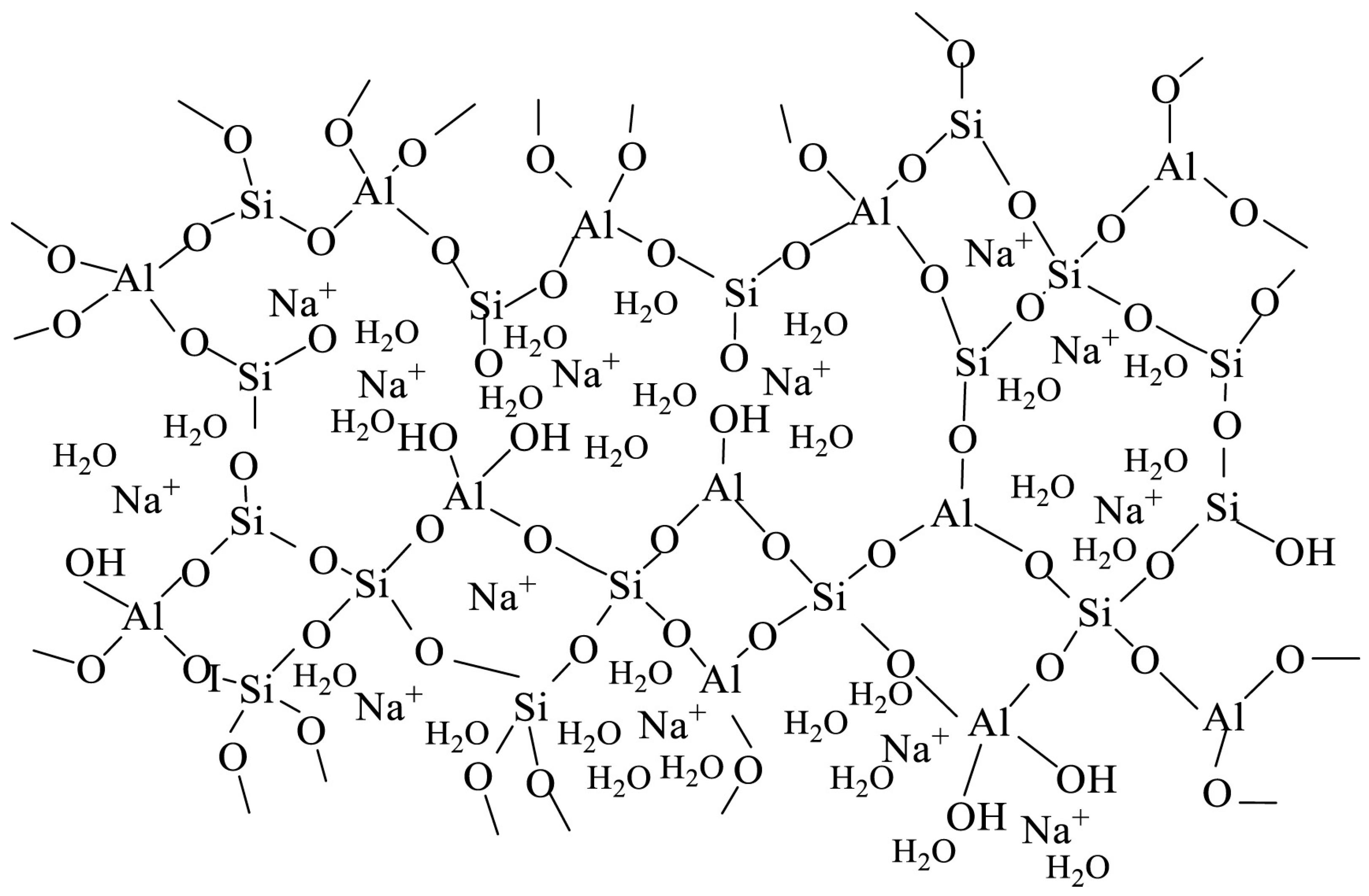
2.1. Definition and Chemistry
2.2. Alkali-Activated Geopolymerization Mechanism
3. Phosphate-Based Geopolymer
3.1. Acid-Activated Geopolymerization Mechanism
3.2. Influence of Activation and Curing Temperature
3.3. Limitations of Phosphorus Use in Geopolymer Production
4. Reuse of Solid Waste in the Development of Phosphate-Based Geopolymers
Mechanical Behavior of Waste-Based Geopolymers
5. Conclusions
- I.
- The advances of phosphate-based geopolymers are being explored for many different applications, such as civil construction utilization, thermal insulating materials, encapsulation of contaminants and adsorption of wastewater pollutants.
- II.
- Aluminum phosphate (AlPO4) occurs during geopolymerization, and it is presented on both crystalline (berlinite) and amorphous phases. It is associated with phosphate-based geopolymers’ mechanical properties and thermal stability, reinforcing the amorphous matrix, acting as a filler isostructural to quartz, increasing their compressive strengths. In opposition, phosphate-based geopolymers developed with precursors containing calcium in their composition may exhibit amorphous calcium phosphate, which can decrease the compressive strength, thus deteriorating the microstructure of the resulting geopolymer.
- III.
- Optimizing geopolymers’ cure and molarity is one of the most critical steps of geopolymerization. When not optimized, the process can be interrupted by the premature formation of a hardened amorphous gel, resulting in a coating of partially reacted precursor particles, hindering the continuity of the dissolution and development of crystalline phases. Furthermore, in cases with excess phosphoric acid, the crystalline products of the reaction may be produced, but they may be damaged or dissolved.
- IV.
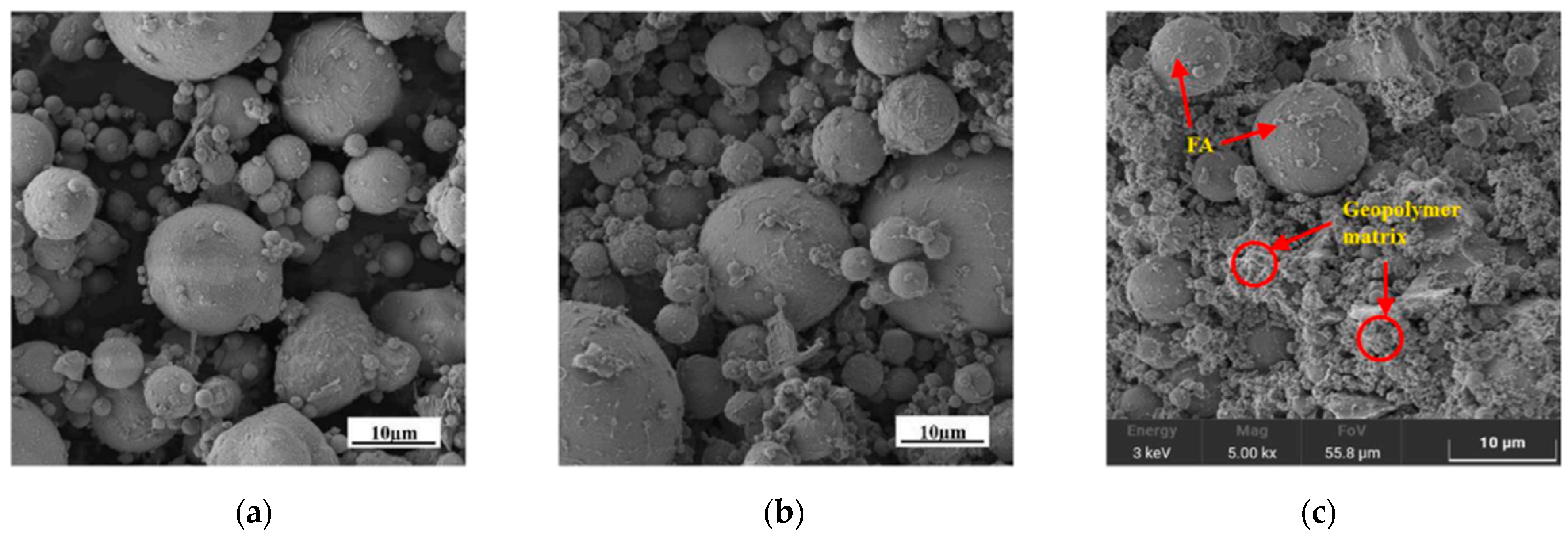
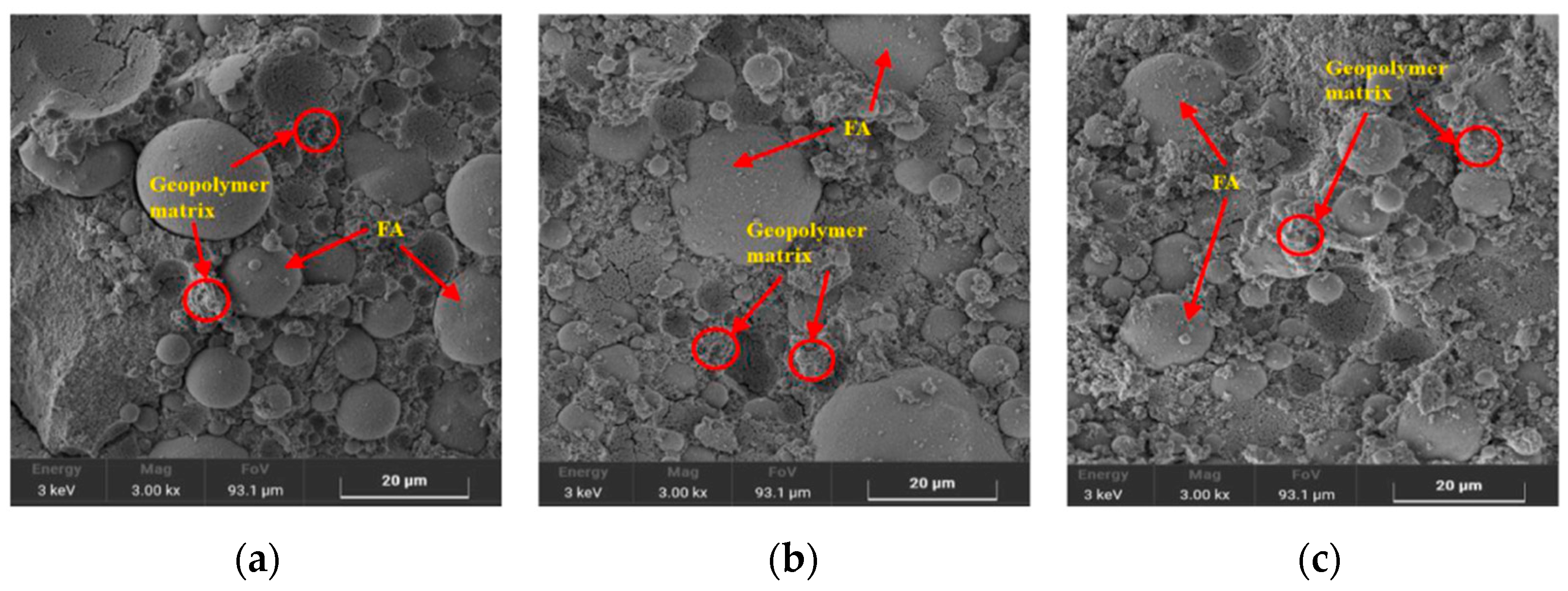
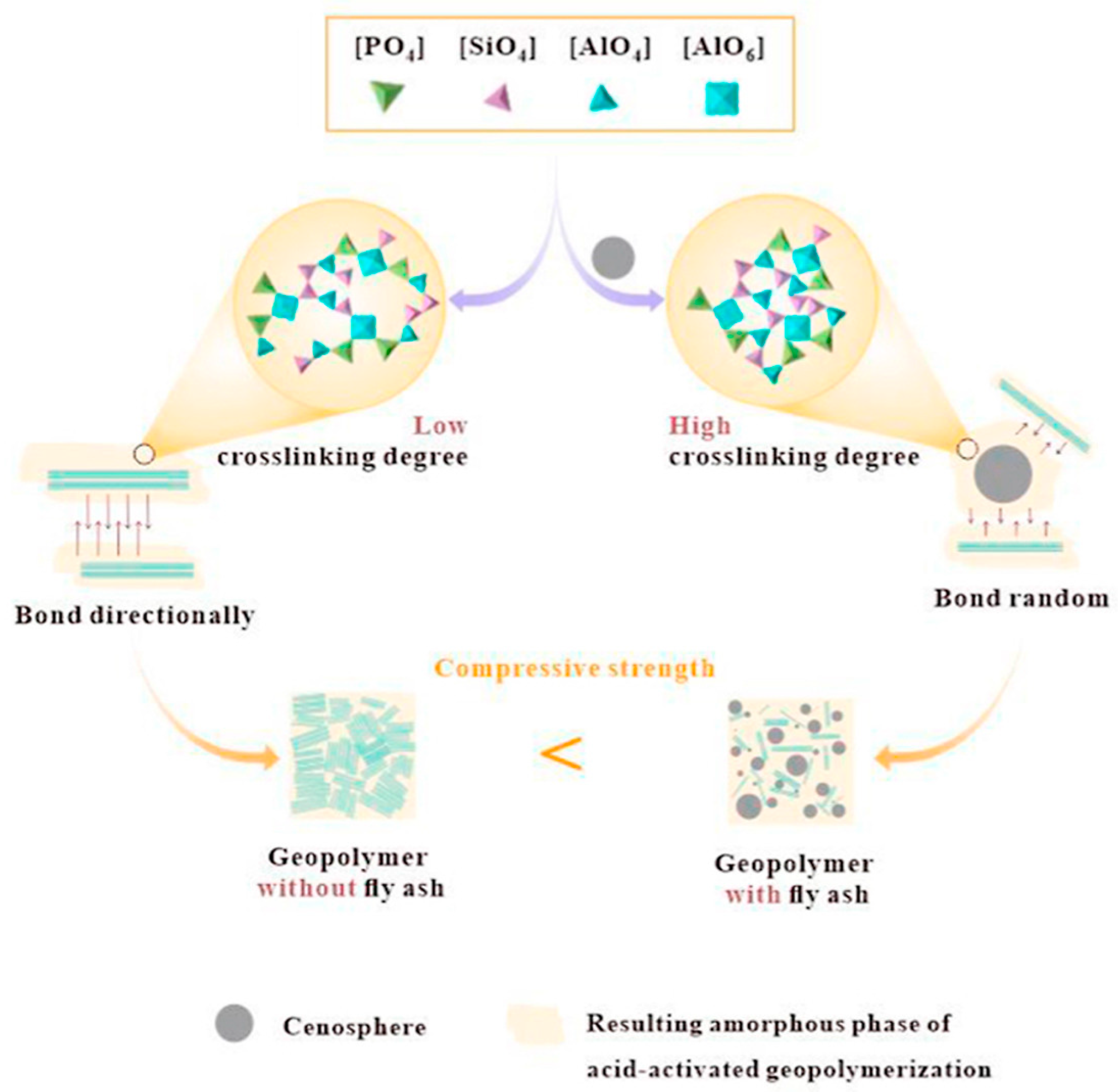
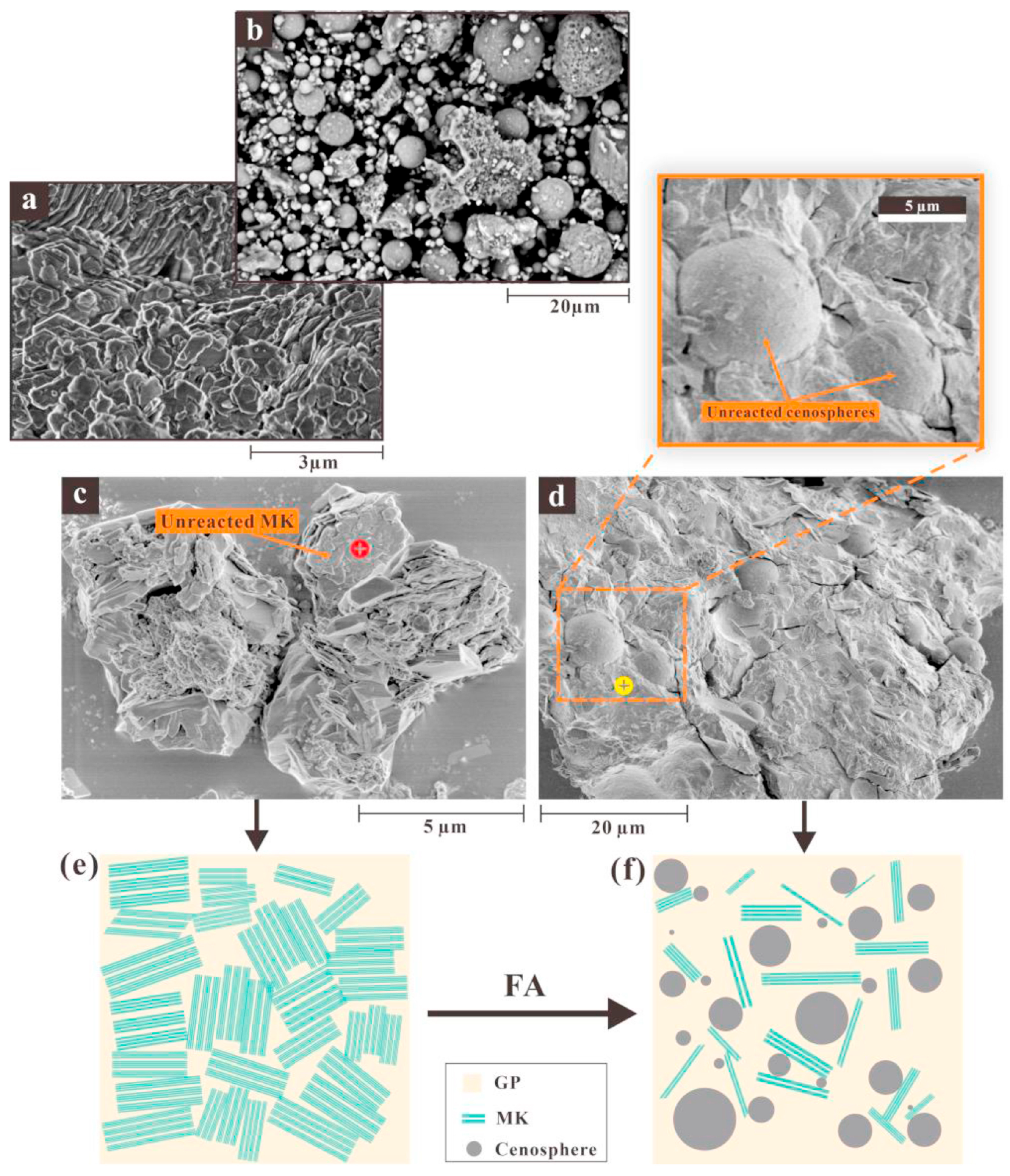
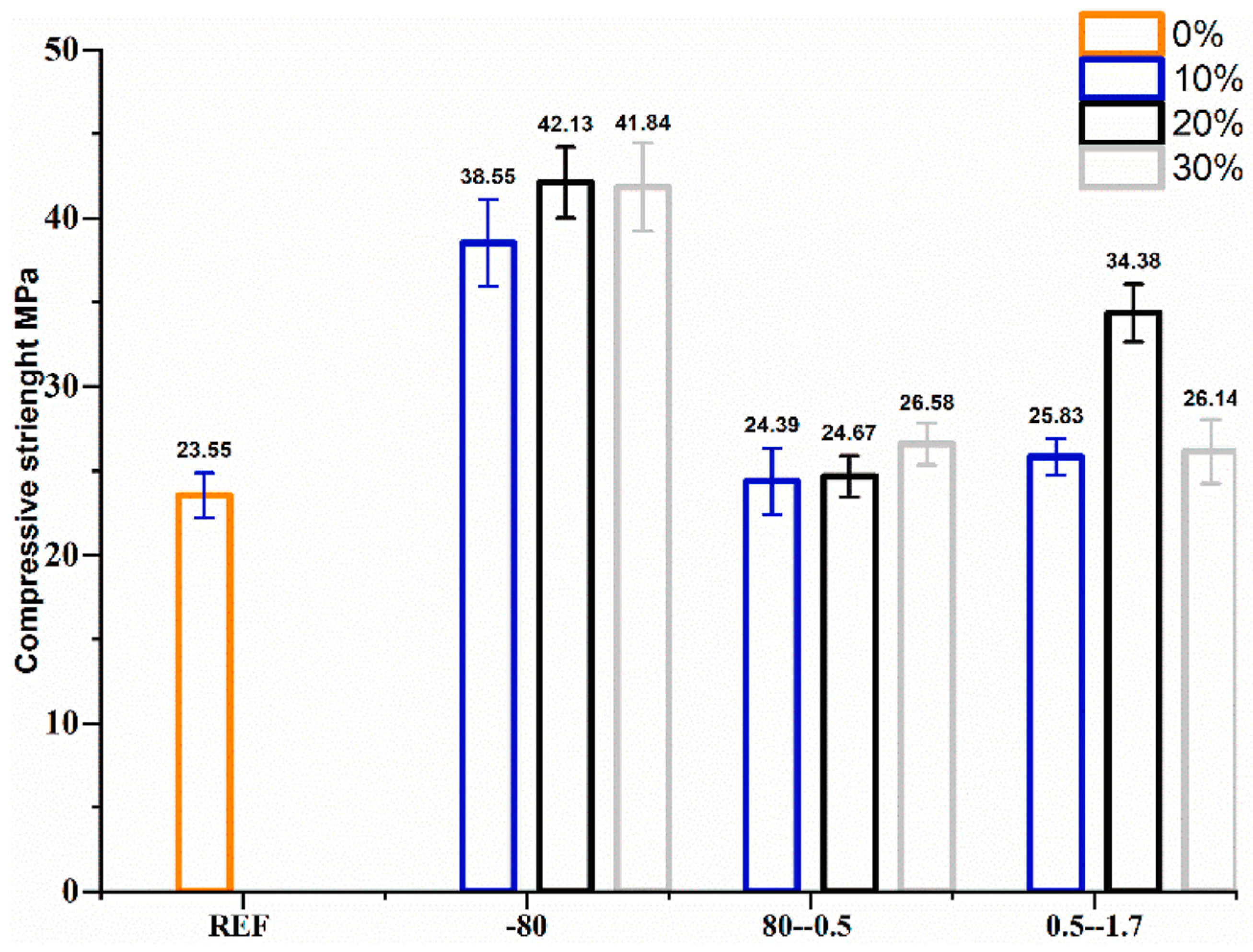
- Solid waste used in the development of geopolymers not only contributes to a sustainable approach in the construction field, but can also have a positive impact on their mechanical behaviour. Solid waste can act as a reinforcement to the geopolymer matrix, through its morphology, even when it does not participate in geopolymerization, limiting microcrack propagation, or even acting on the orientation of the microstructure bounds. It may also act as a filler, helping to improve the packing density of the geopolymer matrix when its particle size is optimized.
- I.
- Life cycle and economic assessment. Future studies should incorporate life cycle assessment (LCA), techno-economic analysis, and other sustainability metrics to evaluate the environmental and economic feasibility of phosphate-based geopolymers on an industrial scale. These assessments should also consider how curing conditions, activator molarity, and precursor composition influence the overall environmental footprint.
- II.
- Development of alternative or hybrid activators. Research should focus on the development of alternative activator systems capable of reducing the consumption of phosphoric acid, such as hybrid activators combining phosphates with other chemical systems, or the use of waste-derived phosphorus sources.
- III.
- Exploration of new waste-derived precursors. Although several solid wastes have already been investigated, additional research is required to evaluate the potential of other industrial, mining, and agricultural residues rich in aluminosilicates or phosphates as precursors for phosphate-based geopolymers.
- IV.
- Durability and long-term performance. More comprehensive studies on durability are required, including resistance to chemical attack, thermal cycling, moisture variations, and long-term mechanical stability, particularly for structural or infrastructure applications.
- V.
- Microstructural evolution and reaction mechanisms. Advanced characterization techniques, such as nuclear magnetic resonance (NMR), synchrotron-based X-ray diffraction, and in situ spectroscopic methods, could provide deeper insights into the geopolymerization mechanisms and the role of different phases in the development of the material properties.
Author Contributions
Funding
Data Availability Statement
Acknowledgments
Conflicts of Interest
References
- Dihaji, H.; Azerkane, D.; Bih, L.; Essaddek, A.; Haily, E.M. Comparative Study of Geopolymers Synthesized with Alkaline and Acid Reactants at Various Liquid-to-Solid Ratios Using Moroccan Kaolin Clay. Constr. Build. Mater. 2025, 468, 140453. [Google Scholar] [CrossRef]
- Günel, G.; Alakara, E.H.; Demir, I.; Sevim, O. Thermal Behavior and Mechanical Performance of Glass Waste-Based Geopolymer Composites: Influence of Elevated Temperatures and Cooling Regimes. Constr. Build. Mater. 2025, 494, 143405. [Google Scholar] [CrossRef]
- Oliveira, L.B.; Marvila, M.T.; Fediuk, R.; Vieira, C.M.F.; Azevedo, A.R.G. Development of a Complementary Precursor Based on Flue Gas Desulfurization (FGD) for Geopolymeric Pastes Produced with Metakaolin. J. Mater. Res. Technol. 2023, 22, 3489–3501. [Google Scholar] [CrossRef]
- Alvi, I.H.; Hu, H.; Li, Q.; Ma, Y.; Onyekwena, C.C. Exploring the Formation of Phosphoric Acid-Based Metakaolin Geopolymer and Underlying Mechanisms under Various Liquid-to-Solid Ratios. J. Solid State Chem. 2026, 353, 125607. [Google Scholar] [CrossRef]
- Sabbrojjaman, M.; Liu, Y.; Tafsirojjaman, T. A Comparative Review on the Utilisation of Recycled Waste Glass, Ceramic and Rubber as Fine Aggregate on High Performance Concrete: Mechanical and Durability Properties. Dev. Built Environ. 2024, 17, 100371. [Google Scholar] [CrossRef]
- Yadav, B.; Rusia, S.; Pandey, J.S.; Singh, H.S.; Maurya, A.D.; Chauhan, A.; Mathur, U.; Pal, K. Statistical Modeling and Optimization of Waste Glass-Based Paver Block Properties. Next Mater. 2025, 9, 101236. [Google Scholar] [CrossRef]
- Pantongsuk, T.; Zhang, B.; Yu, T.; Luo, J.; Liu, H.; Fahimizadeh, M.; Liu, D.; Li, L.; Jamnongkan, T.; Wisawapipat, W.; et al. Optimizing Acid-Based Geopolymer Performance by Controlling the Critical Humidity Factor in Initial Curing Conditions. Constr. Build. Mater. 2025, 493, 143152. [Google Scholar] [CrossRef]
- Zhang, B.; Feng, Y.; Zhou, X.; Lai, D.; Zhong, H.; Yu, T.; Liang, J.; Xie, J. Dynamic Mechanical Behaviour and Life Cycle Assessment of Rubberised Solid Waste-Based Geopolymer Concrete. J. Clean. Prod. 2025, 501, 145247. [Google Scholar] [CrossRef]
- Borçato, A.G.; Casali, J.M.; Betioli, A.M.; Medeiros-Junior, R.A. Development of Eco-Friendly Brick Waste-Based Geopolymers: Effect of Calcium Incorporation on Rheology, Compressive Strength, Microstructure, and Eco-Efficiency. J. Build. Eng. 2025, 111, 113101. [Google Scholar] [CrossRef]
- Zawrah, M.F.; Ata, M.B.H.; Abdelrahman, H.S. Effect of Acid Concentration and Curing Conditions on Microstructure, Mechanical and Electrical Properties of Phosphate Geopolymers. Next Mater. 2025, 9, 100990. [Google Scholar] [CrossRef]
- Tochetto, G.; Goulart Oliveira, K.; D’Agostini, M.; Franchin, G.; Elsayed, H.; Hotza, D.; Nagel-Hassemer, M.E.; Colombo, P. A Comprehensive Review of Phosphate-Based Acid Geopolymers: Production, Properties, and Applications. J. Phys. Chem. Solids 2026, 211, 113489. [Google Scholar] [CrossRef]
- Marvila, M.T.; de Azevedo, A.R.G.; Vieira, C.M.F. Reaction Mechanisms of Alkali-Activated Materials. Rev. IBRACON De Estrut. E Mater. 2021, 14, e14309. [Google Scholar] [CrossRef]
- Provis, J.L. Geopolymers and Other Alkali Activated Materials: Why, How, and What? Mater. Struct. 2014, 47, 11–25. [Google Scholar] [CrossRef]
- Guo, H.; Yuan, P.; Zhang, B.; Wang, Q.; Deng, L.; Liu, D. Realization of High-Percentage Addition of Fly Ash in the Materials for the Preparation of Geopolymer Derived from Acid-Activated Metakaolin. J. Clean. Prod. 2021, 285, 125430. [Google Scholar] [CrossRef]
- Allaoui, D.; Majdoubi, H.; Haddaji, Y.; Nadi, M.; Mansouri, S.; Oumam, M.; Tamraoui, Y.; Alami, J.; Hannache, H.; Manoun, B. Valorization of Ceramic Sanitary Waste into Resilient Phosphoric Acid-Based Geopolymers for Sustainable Construction: Thermal, Mechanical, and Microstructural Properties. Ceram. Int. 2024, 50, 8875–8889. [Google Scholar] [CrossRef]
- Matsimbe, J.; Dinka, M.; Olukanni, D.; Musonda, I. Geopolymer: A Systematic Review of Methodologies. Materials 2022, 15, 6852. [Google Scholar] [CrossRef] [PubMed]
- Almutairi, A.L.; Tayeh, B.A.; Adesina, A.; Isleem, H.F.; Zeyad, A.M. Potential Applications of Geopolymer Concrete in Construction: A Review. Case Stud. Constr. Mater. 2021, 15, e00733. [Google Scholar] [CrossRef]
- Cong, P.; Cheng, Y. Advances in Geopolymer Materials: A Comprehensive Review. J. Traffic Transp. Eng. (Engl. Ed.) 2021, 8, 283–314. [Google Scholar] [CrossRef]
- Jwaida, Z.; Dulaimi, A.; Mashaan, N.; Othuman Mydin, M.A. Geopolymers: The Green Alternative to Traditional Materials for Engineering Applications. Infrastructures 2023, 8, 98. [Google Scholar] [CrossRef]
- Madirisha, M.M.; Dada, O.R.; Ikotun, B.D. Chemical Fundamentals of Geopolymers in Sustainable Construction. Mater. Today Sustain. 2024, 27, 100842. [Google Scholar] [CrossRef]
- Jiang, T.; Liu, Z.; Tian, X.; Wu, J.; Wang, L. Review on the Impact of Metakaolin-Based Geopolymer’s Reaction Chemistry, Nanostructure and Factors on Its Properties. Constr. Build. Mater. 2024, 412, 134760. [Google Scholar] [CrossRef]
- Moujoud, Z.; Sair, S.; Ait Ousaleh, H.; Ayouch, I.; El Bouari, A.; Tanane, O. Geopolymer Composites Reinforced with Natural Fibers: A Review of Recent Advances in Processing and Properties. Constr. Build. Mater. 2023, 388, 131666. [Google Scholar] [CrossRef]
- Zribi, M.; Baklouti, S. Phosphate-Based Geopolymers: A Critical Review. Polym. Bull. 2022, 79, 6827–6855. [Google Scholar] [CrossRef]
- Ma, S.; Zhang, Z.; Liu, X. Comprehensive Understanding of Aluminosilicate Phosphate Geopolymers: A Critical Review. Materials 2022, 15, 5961. [Google Scholar] [CrossRef] [PubMed]
- Zhang, Y.; Li, P.; Yu, T.; Zhou, Y.; Huang, Y.; Pei, Y. A State-of-the-Art Review on the Application of Geopolymerization/Geopolymer in Environmental Fields. Buildings 2025, 15, 4054. [Google Scholar] [CrossRef]
- Krishna, R.S.; Mishra, J.; Zribi, M.; Adeniyi, F.; Saha, S.; Baklouti, S.; Shaikh, F.U.A.; Gökçe, H.S. A Review on Developments of Environmentally Friendly Geopolymer Technology. Materialia 2021, 20, 101212. [Google Scholar] [CrossRef]
- Meng, L.; Ouyang, F.; Cheng, J.; Wang, Z.; Li, B.; Xu, X.; Duan, P.; Zhu, Y.; Zhang, Z.; Chen, M.; et al. Mix Proportion Design of Phosphoric Acid-Activated Cementitious Materials and Microstructure Evolution at High Temperature. Cem. Concr. Compos. 2025, 159, 106003. [Google Scholar] [CrossRef]
- Wei, Q.; Liu, Y.; Le, H. Mechanical and Thermal Properties of Phosphoric Acid Activated Geopolymer Materials Reinforced with Mullite Fibers. Materials 2022, 15, 4185. [Google Scholar] [CrossRef]
- Occhicone, A.; Graziuso, S.G.; De Gregorio, E.; Montagnaro, F.; Ricciotti, L.; Tarallo, O.; Roviello, G.; Ferone, C. Synthesis and Characterization of New Acid-Activated Red Mud-Metakaolin Geopolymers and Comparison with Their Alkaline Counterparts. J. Clean. Prod. 2024, 435, 140492. [Google Scholar] [CrossRef]
- de Matos Riscado, A.L.L.; Vieira, C.M.F.; Monteiro, S.N.; de Azevedo, A.R.G.; Marvila, M.T. Parameter Optimization for Fly Ash Geopolymer Mixtures: Molarity, Silica Modulus, and Solution/Binder Influence. Sci. Rep. 2025, 15, 20355. [Google Scholar] [CrossRef]
- Silva, A.A.S.; Pereira, B.C.F.; Batista, J.P.B.; Gomes, T.C.F.; Moraes, J.C.B. Study of a New Potassium Phosphate-Based Waste as an Alkaline Activator in Alkali-Activated Binders: The Açai Seed Ash. Constr. Build. Mater. 2023, 408, 133757. [Google Scholar] [CrossRef]
- de Oliveira, L.B.; de Azevedo, A.R.G.; Marvila, M.T.; Pereira, E.C.; Fediuk, R.; Vieira, C.M.F. Durability of Geopolymers with Industrial Waste. Case Stud. Constr. Mater. 2022, 16, e00839. [Google Scholar] [CrossRef]
- Yang, D.; Wang, P.; Chen, W.; Liu, L.; Huang, Y.; Xiang, X.; Wang, G.; Wu, J. Effects of Red Mud, Desert Sand, and Ground Granulated Blast Furnace Slag on the Mechanical Properties and Microstructure of Fly Ash-Based Geopolymer. Constr. Build. Mater. 2025, 468, 140471. [Google Scholar] [CrossRef]
- Luo, X.; Tian, X.; Wu, J.; Yang, X.; Liu, Z.; Jiao, Z.; Peng, H. Molecular Simulations of the Initial Stage’s Induction and Formation Process of N-A-S-H Gel Based on NaOH-Activated Metakaolin. J. Non. Cryst. Solids 2024, 626, 122804. [Google Scholar] [CrossRef]
- Bernasconi, D.; Viani, A.; Zárybnická, L.; Mácová, P.; Bordignon, S.; Caviglia, C.; Destefanis, E.; Gobetto, R.; Pavese, A. Phosphate-Based Geopolymer: Influence of Municipal Solid Waste Fly Ash Introduction on Structure and Compressive Strength. Ceram. Int. 2023, 49, 22149–22159. [Google Scholar] [CrossRef]
- Tochetto, G.; D’Agostini, M.; de Oliveira, K.G.; Hotza, D.; Nagel-Hassemer, M.E.; Colombo, P. Development and Characterization of Phosphoric Acid-Activated Geopolymers for Extrusion-Based Additive Manufacturing. J. Eur. Ceram. Soc. 2026, 46, 118031. [Google Scholar] [CrossRef]
- Li, J.S.; Zhang, W.; Lang, L.; Dong, C.X.; Huang, K. Preparation and Properties of Geopolymer Containing Phosphoric Acid-Activated Fly Ash and Mechanically-Milled Kaolinite: Experiments and Density Function Theory. J. Clean. Prod. 2024, 441, 140992. [Google Scholar] [CrossRef]
- Oubaha, S.; Charai, M.; Beniddar, H.; Mabroum, S.; El Machi, A.; Mghazli, M.O.; Taha, Y.; Hakkou, R. Phosphate’s Second Life: Upcycling Phosphogypsum and Clay by-Product through Acid Geopolymer Technology. Constr. Build. Mater. 2024, 451, 138829. [Google Scholar] [CrossRef]
- Majdoubi, H.; Makhlouf, R.; Haddaji, Y.; Nadi, M.; Mansouri, S.; Semllal, N.; Oumam, M.; Manoun, B.; Alami, J.; Hannache, H.; et al. Valorization of Phosphogypsum Waste through Acid Geopolymer Technology: Synthesis, Characterization, and Environmental Assessment. Constr. Build. Mater. 2023, 371, 130710. [Google Scholar] [CrossRef]
- Xu, Z.; Li, C.; Peng, X. Immobilization of Radioactive Borate Liquid Waste Using Calcined Laterite–Phosphoric Acid–Fe3O4-Based Geopolymer Waste Forms. Ceram. Int. 2024, 50, 48164–48173. [Google Scholar] [CrossRef]
- Pu, S.; Li, H.; Cai, G.; Mei, G.; Duan, W.; Wu, Z. Improving the Early Performance of Fly Ash Phosphate Acid−based Geopolymer Using Fe3O4 Powder. J. Build. Eng. 2025, 116, 114732. [Google Scholar] [CrossRef]
- Douiri, H.; Louati, S.; Baklouti, S.; Arous, M.; Fakhfakh, Z. Enhanced Dielectric Performance of Metakaolin–H3PO4 Geopolymers. Mater. Lett. 2016, 164, 299–302. [Google Scholar] [CrossRef]
- Pu, S.; Xu, B.; Duan, W.; Yao, H.; Wu, Z.; Mei, G.; Cai, G. A Green Phosphate-Based Geopolymer Adsorbent or Binder with High Specific Surface Area for Environmental Applications. Constr. Build. Mater. 2023, 408, 133738. [Google Scholar] [CrossRef]
- Fattori, F.; Magugliani, G.; Marinelli, G.; Comboni, D.; Gatta, G.D.; Girella, A.; Milanese, C.; Santi, A.; Galluccio, F.; Moschetti, I.; et al. Thermal and Chemical Parameters Controlling Phase Stability and Caesium Immobilisation in Phosphate-Based Geopolymers, Using a Chabazite-Rich Volcanic Tuff. Ceram. Int. 2025, 51, 63441–63452. [Google Scholar] [CrossRef]
- Cao, Y.; Wang, X.; Ding, L.; Liu, J.; Sun, Y.; Xia, T.; Huang, H.; Wei, X.; Wu, Z. Acceleration Mechanisms of Curing and Strength Development in Silico-Aluminophosphate Geopolymers with Aluminum Dihydrogen Phosphate. Constr. Build. Mater. 2025, 490, 142395. [Google Scholar] [CrossRef]
- de Carvalho, A.R.; da Calderón-Morales, B.R.S.; Borba Júnior, J.C.; de Oliveira, T.M.; Silva, G.J.B. Proposition of Geopolymers Obtained through the Acid Activation of Iron Ore Tailings with Phosphoric Acid. Constr. Build. Mater. 2023, 403, 133078. [Google Scholar] [CrossRef]
- Guo, H.; Zhang, B.; Deng, L.; Yuan, P.; Li, M.; Wang, Q. Preparation of High-Performance Silico-Aluminophosphate Geopolymers Using Fly Ash and Metakaolin as Raw Materials. Appl. Clay Sci. 2021, 204, 106019. [Google Scholar] [CrossRef]
- Tchakouté, H.K.; Bewa, C.N.; Fotio, D.; Dieuhou, C.M.; Kamseu, E.; Rüscher, C.H. Influence of Alumina on the Compressive Strengths and Microstructural Properties of the Acid-Based Geopolymers from Calcined Indurated Laterite and Metakaolin. Appl. Clay Sci. 2021, 209, 106148. [Google Scholar] [CrossRef]
- Valizadeh Kiamahalleh, M.; Gholampour, A.; Yoo, D.Y. Synthesis of Ambient-Cured Geopolymer with Recycled Glass as Binder and Fine Aggregate: Enhancing Mechanical and Durability Performance. Constr. Build. Mater. 2025, 502, 144488. [Google Scholar] [CrossRef]
- Majdoubi, H.; Haddaji, Y.; Bourzik, O.; Nadi, M.; Ziraoui, J.; Alomayri, T.S.; Oumam, M.; Manoun, B.; Alami, J.; Tamraoui, Y.; et al. Enhancing Thermal Insulation with Phosphate Washing Sludge Waste as an Inorganic Foaming Agent in Porous Acid-Based Geopolymers: Formulation and Processing Optimization. Constr. Build. Mater. 2023, 407, 133486. [Google Scholar] [CrossRef]
- He, M.; Yang, Z.; Li, N.; Zhu, X.; Fu, B.; Ou, Z. Strength, Microstructure, CO2 Emission and Economic Analyses of Low Concentration Phosphoric Acid-Activated Fly Ash Geopolymer. Constr. Build. Mater. 2023, 374, 130920. [Google Scholar] [CrossRef]
- Ren, Z.; Zhang, C.; Zhao, F.; Meng, J.; Han, X.; Liang, J. Synthesis of Phosphoric Acid-Based Mesoporous Geopolymers from Tourmaline Tailings for Effective Adsorption of Tetracycline Hydrochloride in Aqueous Environment. Microporous Mesoporous Mater. 2023, 362, 112786. [Google Scholar] [CrossRef]
- Tan, G.; Liu, Z.; Ma, X.; Zheng, Z.; Zhang, G.; Wu, B.; Zhang, L.; Liu, L. Phosphoric Acid-Activated Metakaolin-Based Geopolymer: Optimizing P/A Molar Ratio to Solidify Cs+ and Sr2+ in Nuclear Waste. Nucl. Eng. Des. 2024, 424, 113300. [Google Scholar] [CrossRef]
- Yu, H.; Lu, X.; Miki, T.; Matsubae, K.; Sasaki, Y.; Nagasaka, T. Sustainable Phosphorus Supply by Phosphorus Recovery from Steelmaking Slag: A Critical Review. Resour. Conserv. Recycl. 2022, 180, 106203. [Google Scholar] [CrossRef]
- Walsh, M.; Schenk, G.; Schmidt, S. Realising the Circular Phosphorus Economy Delivers for Sustainable Development Goals. Npj Sustain. Agric. 2023, 1, 2. [Google Scholar] [CrossRef]
- Cordell, D.; Drangert, J.-O.; White, S. The Story of Phosphorus: Global Food Security and Food for Thought. Glob. Environ. Change 2009, 19, 292–305. [Google Scholar] [CrossRef]
- Egle, L.; Rechberger, H.; Krampe, J.; Zessner, M. Phosphorus Recovery from Municipal Wastewater: An Integrated Comparative Technological, Environmental and Economic Assessment of P Recovery Technologies. Sci. Total Environ. 2016, 571, 522–542. [Google Scholar] [CrossRef]
- Hamidi, R.M.; Siyal, A.A.; Luukkonen, T.; Shamsuddin, R.M.; Moniruzzaman, M. Fly Ash Geopolymer as a Coating Material for Controlled-Release Fertilizer Based on Granulated Urea. RSC Adv. 2022, 12, 33187–33199. [Google Scholar] [CrossRef] [PubMed]
- Yan, H.; Zhu, X.; Dai, F.; He, Y.; Jing, X.; Song, P.; Wang, R. Porous Geopolymer Based Eco-Friendly Multifunctional Slow-Release Fertilizers for Promoting Plant Growth. Colloids Surf. A Physicochem. Eng. Asp. 2021, 631, 127646. [Google Scholar] [CrossRef]
- Chilian, A.; Bancuta, O.-R.; Bancuta, I.; Popescu, I.V.; Irina Gheboianu, A.; Tănase, N.-M.; Tuican, M.; Zaharia, M.; Zinicovscaia, I. Extraction of Heavy Metals and Phosphorus from Sewage Sludge with Elimination of Antibiotics and Biological Risks. Chem. Eng. J. 2022, 437, 135298. [Google Scholar] [CrossRef]
- Yao, X.; Chang, Y.; Chen, S.; Chen, M.; Li, Z.; Zhou, B.; Xu, L. Analysis of Mechanical Properties and Microscopic Mechanism of Multi-Source All-Solid Waste Geopolymer Mortar. Constr. Build. Mater. 2026, 518, 145803. [Google Scholar] [CrossRef]
- Zhao, X.; Wang, H.; Wang, X.; Zhao, X.E. Sustainable Application of Waste Eggshell as Fillers in Alkali-Activated Solid Waste-Based Materials: Varying Treated Methods and Particle Sizes. Constr. Build. Mater. 2024, 425, 136040. [Google Scholar] [CrossRef]
- Qureshi, M.; Li, J.; Wu, C.; Sheng, D. Mechanical Strength of Rubberized Concrete: Effects of Rubber Particle Size, Content, and Waste Fibre Reinforcement. Constr. Build. Mater. 2024, 444, 137868. [Google Scholar] [CrossRef]
- Rashad, A.M.; Gharieb, M.; Shoukry, H.; Mokhtar, M.M. Valorization of Sugar Beet Waste as a Foaming Agent for Metakaolin Geopolymer Activated with Phosphoric Acid. Constr. Build. Mater. 2022, 344, 128240. [Google Scholar] [CrossRef]
- Lee, J.; Nam, M.; Park, D.; Wi, K. Recycling Municipal Solid Waste Incineration Fly Ash as a Functional Foaming Agent in Slag-Based Geopolymer. Constr. Build. Mater. 2025, 492, 142839. [Google Scholar] [CrossRef]
- Pu, S.; Shen, Z.; Duan, W.; Lang, L.; Liu, Y.; Xu, B.; Yao, H.; Mei, G. Discussion on the Applicability and Mechanism of Phosphate-Based Geopolymers Used for Cadmium and Cadmium-Lead Heavy Metals Solidification/Stabilization. J. Environ. Chem. Eng. 2024, 12, 113846. [Google Scholar] [CrossRef]
- Liu, X.; Lan, S.; Zhang, X.; Li, J.; Elmaasrawy, M.; Gao, X. Synergistic Enhancement of Mechanical Properties, Durability, and Microstructure of Phosphogypsum-Slag-Based All-Solid-Waste Binder Materials with Recycled Cement Powder and Red Mud. Constr. Build. Mater. 2026, 521, 146047. [Google Scholar] [CrossRef]
- Faraji, M.F.; Kara, H.O.; Raazi, M.; Ahıskalı, M.; Eskici, C.; Bayraktar, O.Y.; Kaplan, G.; Aydın, A.C.; Ozbakkaloglu, T. Development of High-Performance One-Part Geopolymer Foam Concrete Using Ground Granulated Blast Furnace Slag, Waste Concrete Sludge, and Bamboo Powder for Sustainable Construction. Constr. Build. Mater. 2026, 506, 144827. [Google Scholar] [CrossRef]
- Judicaël Geferson, O.O.; Placide Desire, B.B.; Serge, E.J.; Odogu, A.N.; Nsami, N.J.; Antoine, E. Sustainable and Cleaner Production of a Porous Geopolymer Support Based on Metakaolin and Natural Calcium Oxide. J. Build. Eng. 2024, 96, 110638. [Google Scholar] [CrossRef]
- Djobo, J.N.Y.; Stephan, D. The Reaction of Calcium during the Formation of Metakaolin Phosphate Geopolymer Binder. Cem. Concr. Res. 2022, 158, 106840. [Google Scholar] [CrossRef]
- Wang, Y.S.; Alrefaei, Y.; Dai, J.G. Influence of Coal Fly Ash on the Early Performance Enhancement and Formation Mechanisms of Silico-Aluminophosphate Geopolymer. Cem. Concr. Res. 2020, 127, 105932. [Google Scholar] [CrossRef]
- Tchakouté, H.K.; Fotio, D.; Rüscher, C.H.; Kamseu, E.; Djobo, J.N.Y.; Bignozzi, M.C.; Leonelli, C. The Effects of Synthesized Calcium Phosphate Compounds on the Mechanical and Microstructural Properties of Metakaolin-Based Geopolymer Cements. Constr. Build. Mater. 2018, 163, 776–792. [Google Scholar] [CrossRef]
- Jin, Z.; Liang, K.; Liu, C.; Yang, G.; Cui, K.; Mao, S. Mechanical Properties and Life Cycle Assessment (LCA) of Waste Glass Reinforced Concrete. J. Build. Eng. 2024, 96, 110643. [Google Scholar] [CrossRef]
- Mirindi, D.; Sinkhonde, D.; Bezabih, T.; Mirindi, F.; Oshineye, O.; Mirindi, P. Prediction of Flexural and Split Tensile Strength of Waste Glass-Concrete Composite Using Machine Learning Algorithms. Green Technol. Sustain. 2026, 4, 100275. [Google Scholar] [CrossRef]
- Nana, A.; Tchummegne, I.K.; Tome, S.; Adesina, A.; Alomayri, T.; Singla, R.; Kaze, R.C.; Kamseu, E.; Kumar, S.; Leonelli, C. Comparison of Feldspar and Meta-Halloysite Geopolymers by Alkaline and Acidic Activation. Constr. Build. Mater. 2024, 424, 135953. [Google Scholar] [CrossRef]
- Jouin, J.; Nouping Fekoua, J.N.; Ouamara, L.; Piolet, E.; Gharzouni, A.; Rossignol, S. Insulating Phosphoric Acid-Based Geopolymer Foams with Water and High Temperature Resistance. Constr. Build. Mater. 2023, 398, 132406. [Google Scholar] [CrossRef]
- Almeida, M.M.; Gonçalves, N.P.F.; Gameiro, T.; Labrincha, J.A.; Novais, R.M. Synergistic Enhancement of Hydroxyapatite-Phosphoric Acid-Activated Metakaolin-Based Geopolymers for Sustainable and Efficient Removal of Toxic Metal Ions in Wastewater Treatment: An Experimental Study Supported by Density Functional Theory Insights. Process Saf. Environ. Prot. 2026, 206, 108270. [Google Scholar] [CrossRef]



| Characteristic | Alkaline Activation | Acid Activation |
|---|---|---|
| Main reagents | NaOH, KOH, alkaline silicates [1] | Phosphoric acid (H3PO4) is the most commonly used [1], but aluminum dihydrogen phosphate and potassium dihydrogen phosphate can also be employed [43,44,45]. |
| Formed structure | Aluminosilicate [1] | Phosphosilicate [1], silicophosphate or silicoaluminophosphate [20]. |
| Participating units | Aluminate tetrahedra [AlO4] and silicate tetrahedra [SiO4] [14] | [AlO4], [SiO4], aluminum octahedra [AlO6], and phosphate tetrahedra [PO4] [14]. |
| Reaction | Dissolution of silica and alumina from the precursor promoted by the high pH of the alkaline solution, dissolving [SiO4] and [AlO4] units to form geopolymeric gels [1,46] | Acidic protons (H+) break the aluminosilicate structure, releasing species [1] that react with [PO4] from phosphoric acid, forming aluminum phosphate (AlPO4), also known as berlinite [14]. |
| Structural charge | The structure carries a negative charge that must be balanced by cations such as Na+ or K+, present in hydroxide or silicate solutions [11] | No additional cationic compensation is required due to the arrangement of P atoms; [PO4] and [AlO4] tetrahedra stabilize the structure [46]. |
| Common structures | Bernasconi et al. [35]; Zawrah et al. [10]: -Si-O-Si-O-(siloxo) -Si-O-Al-O-(sialate) Zawrah et al. [10]: -Si-O-Al-O-Si-O-(sialate–disiloxo) Dihaji et al. [1]: -Si-O-S-O-Al-O- | Zawrah et al. [10]: -Si-O-Si-O-(siloxo) -Si-O-Al-O-(sialate) -P-O-P-O-(phosphate) -P-O-Si-O-P-O-(phospho-siloxo) -P-O-Si-O-Al-O-P-O-(phospho-sialate) Wei et al. [28]: -P-O-Si-O-Al-O- Madirisha et al. [20]: -Al-O-P-O-(aluminophosphate) Bernasconi et al. [35]: -Al-O-P-O-Si-(polysilicoaluminophosphate) Guo et al. [47]: -Si-O-Al-O-P-(silicoaluminophosphate) Dihaji et al. [1]; Tchakouté et al. [48]: -Si-O-P-O-Si- |
| Main phases | Kiamahalleh et al. [49]; Oliveira et al. [32]: N-A-S-H gel (sodium aluminosilicate hydrate) C-A-S-H gel (calcium aluminosilicate hydrate) | Formation of aluminum phosphate (AlPO4) as a primary binding phase [10], along with other crystalline phosphates such as aluminum hydrogen phosphate [10] and calcium phosphates (e.g., CaHPO4, Ca(HPO4)·2H2O) [47,50]. In addition, depending on the precursor composition and Si/Al/P ratios, the binding matrix may also consist of amorphous to semi-crystalline gels, including silicophosphate (S-P), aluminophosphate (A-P), and silico-aluminophosphate (S-A-P) networks, reflecting the chemical diversity of acid-activated systems [11]. |
| Characteristic | Effect of Temperature | Effect of Molar Concentration |
|---|---|---|
| Apparent porosity | Thermal curing at 75 °C accelerates the reaction between H3PO4 and aluminosilicates, increasing geopolymeric network formation. This leads to pore closure and reduced porosity. In contrast, room-temperature curing results in higher apparent porosity. | Porosity decreases significantly from 8 M to 10 M and remains nearly constant at 12 M, indicating a possible weakening of the geopolymeric network due to excess acid. |
| Bulk density | Higher values are observed when geopolymers are cured at 75 °C, following an inverse trend to apparent porosity. | Bulk density increases from 8 M to 10 M and then decreases at 12 M. The higher density at 10 M suggests optimized particle packing due to improved bonding and microstructure. |
| Water absorption | Due to enhanced geopolymerization at 75 °C, pores become more closed, reducing water absorption and confirming porosity results. Samples cured at room temperature exhibit higher water absorption. | Water absorption decreases from 8 M to 10 M and increases again at 12 M. This increase is associated with the deterioration of geopolymerization caused by excess acid. |
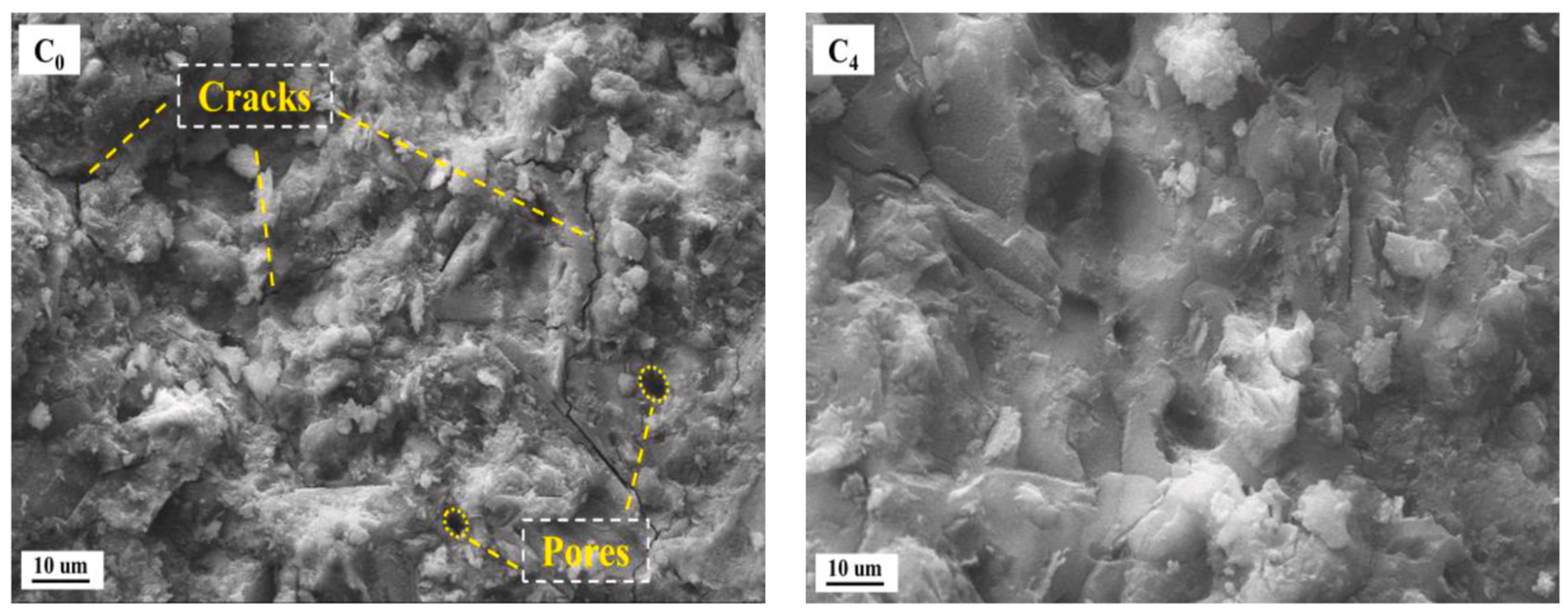
| Microstructural morphology | In general, most samples exhibit amorphous gel-like structures with varying degrees of poly(phospho-siloxo) or phospho-sialate connectivity. Samples cured at 75 °C show a more compact microstructure, with fewer voids and pores than those cured at room temperature. This behavior is associated with a higher degree of geopolymerization and connectivity. However, some thermally activated samples exhibit microcracks, attributed to stresses induced during SEM preparation or partial water evaporation during activation at 75 °C. | As molarity increases up to 10 M, microstructural homogeneity and connectivity improve due to a higher degree of geopolymerization. At 12 M, microstructures become more heterogeneous, with a higher proportion of interconnected pores. For instance, 8 M samples show lower geopolymerization, reflected in a more porous structure with low grain connectivity, indicating unreacted MK and free water. At 12 M, increased porosity, heterogeneity, and excess [PO4] units weaken the structure, potentially reducing compressive strength. The 10 M concentration yields denser and more homogeneous structures, confirming trends observed in porosity, water absorption, and bulk density. |
| X-ray diffraction (XRD) | Samples cured at 75 °C exhibit broader and less intense peaks, indicating higher polymerization compared to air-cured samples. The formation of berlinite (AlPO4) is also observed as a product of geopolymerization. | The air-cured sample at 8 M shows quartz and unreacted MK. Increasing molarity to 10 M and 12 M enhances geopolymerization, leading to the disappearance of quartz and metakaolin peaks. An amorphous aluminum hydrogen phosphate phase is identified in all samples, regardless of curing conditions and molarity. |
| Compressive strength | Samples cured at room temperature exhibit lower compressive strength than thermally activated samples, as curing at 75 °C accelerates the reaction between phosphoric acid and aluminosilicates, improving geopolymerization. | At 8 M, geopolymerization is incomplete, and free water escapes during drying, leaving pores that reduce compressive strength. At 12 M, excess PO43− ions weaken the network due to charge imbalance. Additionally, higher concentrations increase solution viscosity, hindering depolymerization and reducing strength. The optimal concentration is 10 M, yielding compressive strengths of 63.5 MPa (room temperature curing) and 68.7 MPa (75 °C curing) after 28 days. |
| Refs. | Optimal Condition | Suboptimal Condition |
|---|---|---|
| [7] | 8 M | 6 M: lower matrix homogeneity; 10 M: interruption of the reaction caused by the rapid formation of a hardened AlPO4 gel. |
| 50 °C | 70 °C: interruption of the reaction caused by the rapid formation of an amorphous gel and crack formation. | |
| [4] | L/S = 1 | L/S > 2: interruption of the reaction caused by the rapid formation of an amorphous gel. Additionally, crystalline phases damaged by the excess acid. |
| [27] | P/Al = 0.8 | P/Al > 0.8: formation of microcracks caused by excess unreacted phosphoric acid; P/Al < 0.8: insufficient amorphous gel formation. |
| [52] | P/Al = 0.7 | P/Al < 0.7: insufficient amorphous gel formation; P/Al > 0.7: presence of unreacted precursor. |
| [53] | H3PO4/Al2O3 = 1.8 | H3PO4/Al2O3 > 1.8: interruption of the reaction caused by the rapid formation of an amorphous gel. |
| Refs. | Waste Material (Replacement %) and Precursor | Application | Key Result | Conditions for Key Result |
|---|---|---|---|---|
| [38] | Phosphogypsum, waste from H3PO4 production (28.83%) and red clay | Civil construction | Compressive strength of 21.46 MPa achieved at 28 days. | 14.39 mol/L; L/S = 1; curing for 24 h at room temperature followed by 24 h at 72.45 °C. |
| [46] | Iron ore tailings (100%) | Civil construction | Compressive strength of 17.44 MPa achieved at 28 days. | 10 mol/L; L/S = 0.3; curing for 7 days at 60 °C. |
| [76] | Feldspar quarry waste (15%) and meta-halloysite | Civil construction | Compressive strength of 18.44 MPa achieved at 28 days. | 8 mol/L; L/S = 0.4; curing for 28 days at room temperature. |
| [65] | Carbonated lime, by-product from sugar beet production as a foaming agent (6%) and metakaolin | Thermal insulation | Conductivity of 0.08 W/m·K. | H3PO4:H2O = 7:3; L/S = 0.48; curing for 24 h at 60 °C. |
| [50] | Phosphate washing sludge waste as a foaming agent (50%) and metakaolin | Thermal insulation | Conductivity of 0.076 W/m·K. | 10 mol/L; L/S = 1; curing for 24 h at room temperature followed by 24 h at 60 °C. |
| [53] | Nuclear waste (encapsulated) and metakaolin | Contaminant encapsulation | Compressive strength of 98.1 MPa achieved at 28 days. | H3PO4/Al2O3 = 1.8; curing for 24 h at 50 °C. |
| [40] | Borate liquid waste (encapsulated) with calcined laterite and Fe3O4 as precursors | Contaminant encapsulation | Compressive strength of 12.69 MPa achieved at 28 days. | H3PO4:H2O = 3:2; L/S = 1; curing for 24 h at 80 °C. |
| [52] | Tourmaline mining tailings (100%) | Adsorbents for removal of pollutants and heavy metals from wastewater | Tetracycline hydrochloride adsorption capacity of 82.56 mg·g−1. | P/Al = 0.7; H2O/Al = 4; curing for 72 h at 60 °C followed by 28 days at 25 °C. |
Disclaimer/Publisher’s Note: The statements, opinions and data contained in all publications are solely those of the individual author(s) and contributor(s) and not of MDPI and/or the editor(s). MDPI and/or the editor(s) disclaim responsibility for any injury to people or property resulting from any ideas, methods, instructions or products referred to in the content. |
© 2026 by the authors. Licensee MDPI, Basel, Switzerland. This article is an open access article distributed under the terms and conditions of the Creative Commons Attribution (CC BY) license.
Share and Cite
Rocha, L.V.; Barraza, M.T.; Fontes Vieira, C.M.; Azevedo, A.R.G.d.; Marvila, M.T. Materials for Acid Activation: New Principles and Recent Advances. Minerals 2026, 16, 404. https://doi.org/10.3390/min16040404
Rocha LV, Barraza MT, Fontes Vieira CM, Azevedo ARGd, Marvila MT. Materials for Acid Activation: New Principles and Recent Advances. Minerals. 2026; 16(4):404. https://doi.org/10.3390/min16040404
Chicago/Turabian StyleRocha, Larissa Vieira, Madeleing Taborda Barraza, Carlos Maurício Fontes Vieira, Afonso Rangel Garcez de Azevedo, and Markssuel Teixeira Marvila. 2026. "Materials for Acid Activation: New Principles and Recent Advances" Minerals 16, no. 4: 404. https://doi.org/10.3390/min16040404
APA StyleRocha, L. V., Barraza, M. T., Fontes Vieira, C. M., Azevedo, A. R. G. d., & Marvila, M. T. (2026). Materials for Acid Activation: New Principles and Recent Advances. Minerals, 16(4), 404. https://doi.org/10.3390/min16040404